Elite Mathematics / Linear / Topics / Volume and Surface Area IGCSE · 4MA1 · Topic Volume and Surface Area: past paper questions & worked solutions
Every Volume and Surface Area question from the 4MA1 papers in our bank, 2020–2026, sorted from easiest to hardest. Try each one first, then open the worked solution.
30 questions
130 marks in total
46% of papers (25 of 54) include it
1/14/15 easy / medium / hard
Questions, easiest first Level is estimated from marks: 1–2 easy, 3–4 medium, 5+ hard.
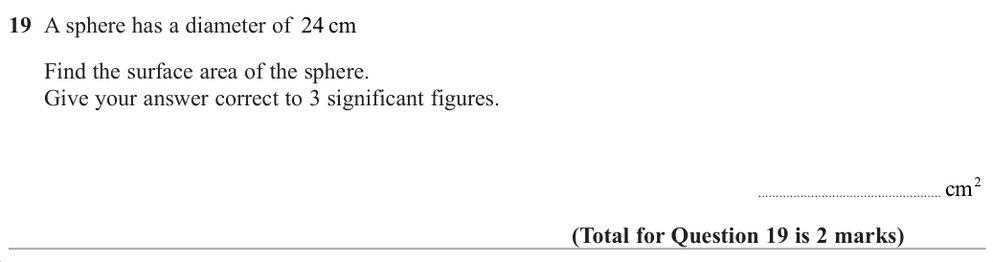
1. Nov 2025 4WM2H · Q19 Easy 2 marksShow worked solution Evaluate fraction $$r = \\frac{24}{2} = 12 \\text{ cm}$$
Calculate area Surface Area = 4*π**r*<sup>2</sup> = 4 × *π* × 12<sup>2</sup> = 4 × *π* × 144 = 576*π* ≈ 1809.557... cm<sup>2</sup>
**Step 3: Round to 3 significant figures.** 1809.557 → 1810 (the 1, 8, and 1 are the first three sig figs).
Final answer 1810 cm<sup>2</sup>
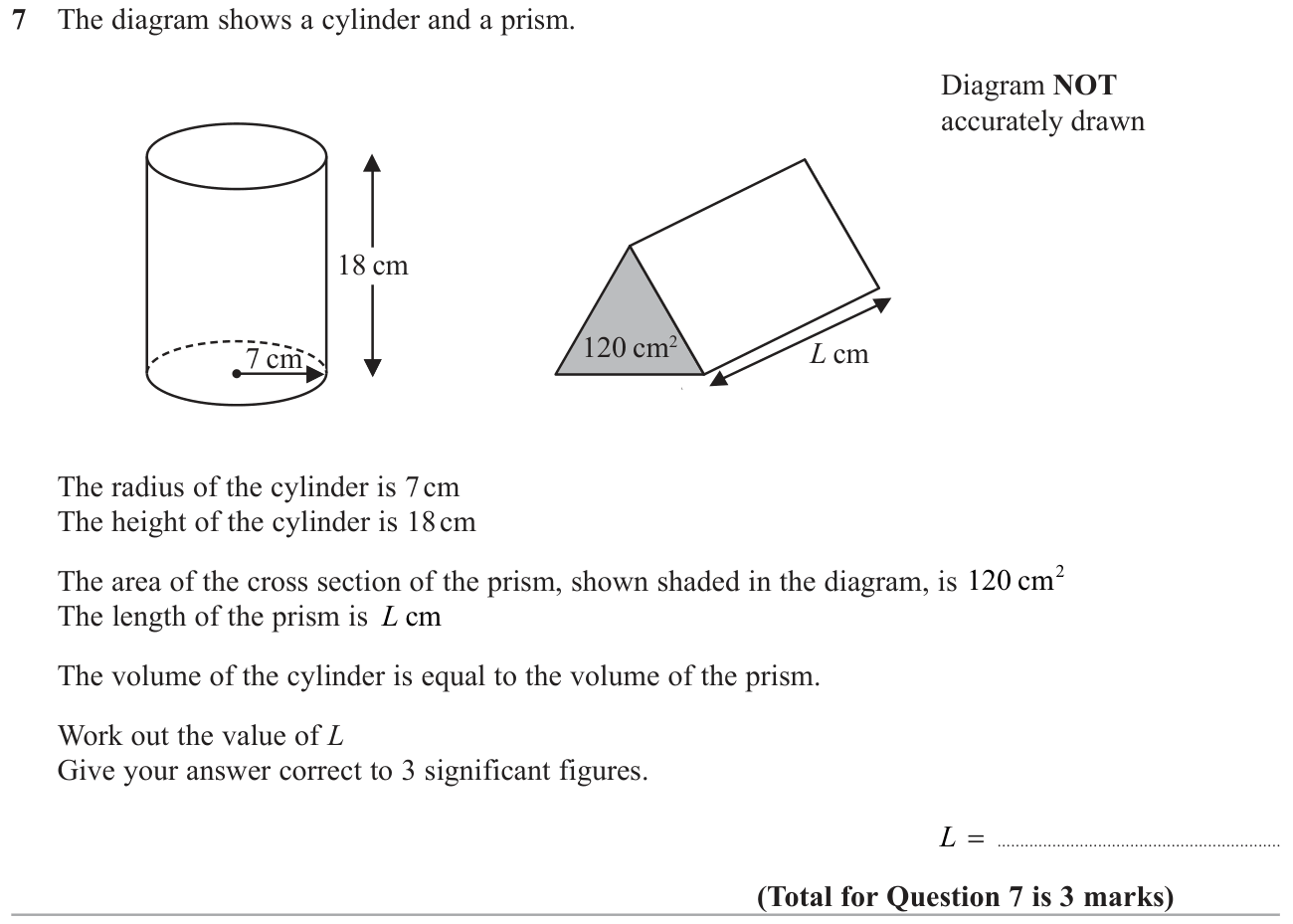
2. Jun 2026 P2H · Q7 Medium 3 marksShow worked solution Solution | Step 1 \[V_{\text{cylinder}}=\pi r^2h=\pi(7)^2(18)=882\pi\text{ cm}^3.\]
Use the stated radius, not a diameter.
Solution | Step 2 \[V_{\text{prism}}=120L,\qquad120L=882\pi\quad\Rightarrow\quad L=\frac{882\pi}{120}=23.090706\ldots.\]
Prism volume equals cross-sectional area times length; equate the two volumes.
Final answer \(L=23.1\text{ cm}\) (3 significant figures).
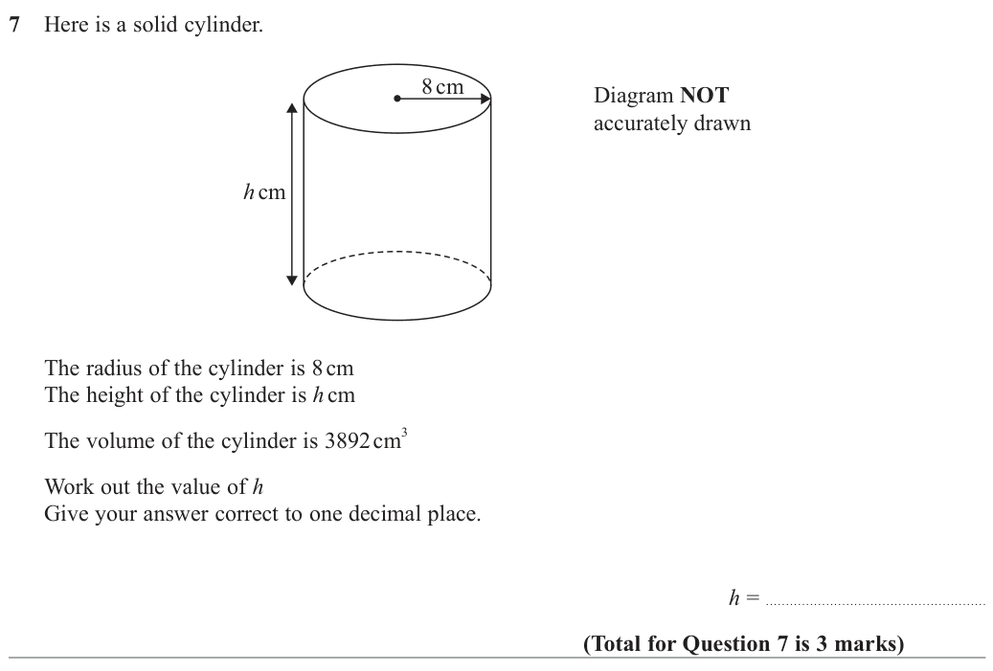
3. Jun 2025 P1H · Q7 Medium 3 marksShow worked solution Calculate area For a cylinder, \[ V=\pi r^2h \]
\[
3892=\pi(8)^2h
\]
\[
h=\frac{3892}{64\pi}=19.357\ldots
\]
Final answer \(19.4\text{ cm}\).
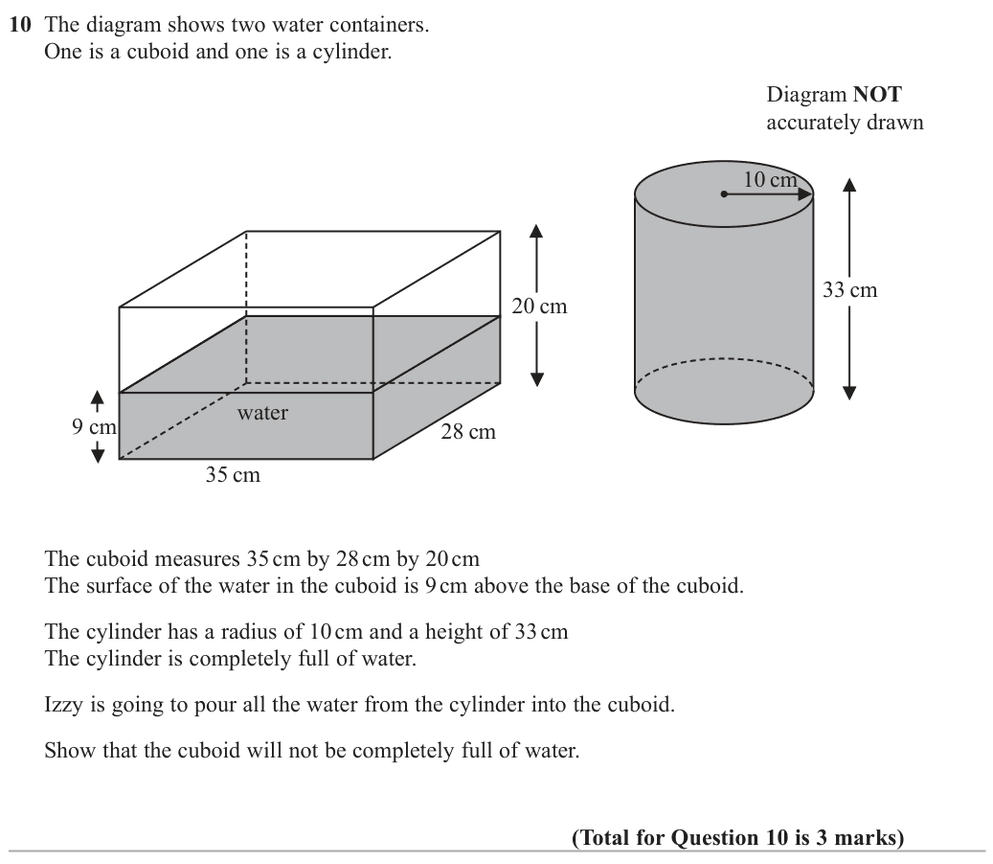
4. Jun 2025 P1HR · Q10 Medium 3 marksShow worked solution Capacity of the cuboid Capacity of the cuboid: \[ 35\times 28\times 20=19600\text{ cm}^3 \]
Water already in the cuboid Water already in the cuboid: \[ 35\times 28\times 9=8820\text{ cm}^3 \]
Volume of the full cylinder Volume of the full cylinder: \[ \pi(10)^2(33)=10367.255\ldots\text{ cm}^3 \]
Total water after pouring Total water after pouring: \[ 8820+10367.255\ldots=19187.255\ldots \]
Calculate area Since \[ 19187.255\ldots<19600 \]
the cuboid will not be the cuboid will not be completely full.
Final answer The cuboid will not be completely full.
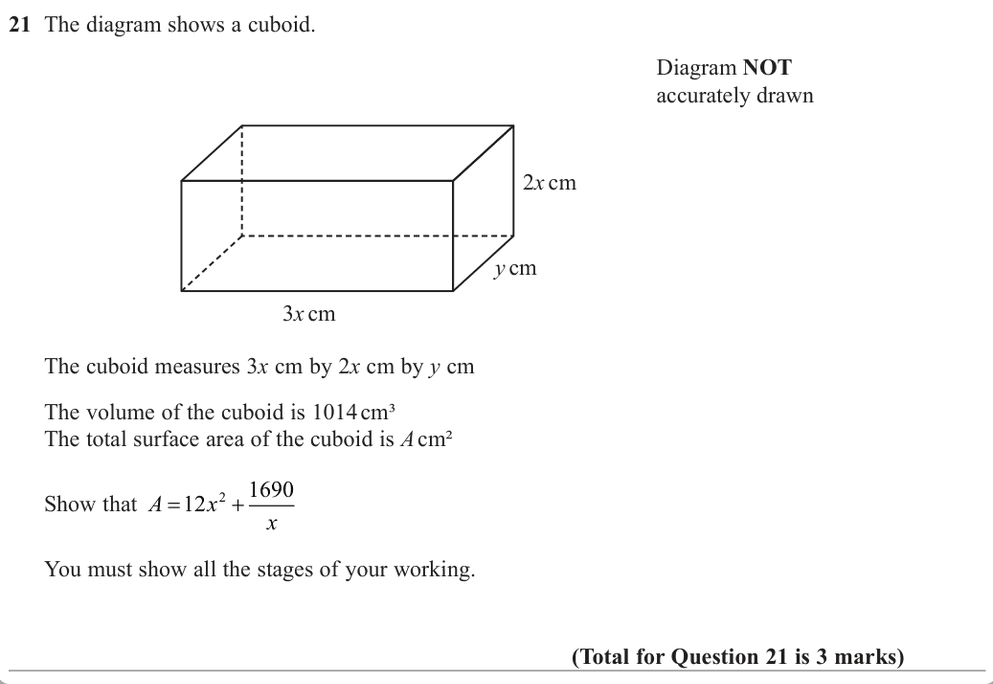
5. Jun 2025 P2H · Q21 Medium 3 marksShow worked solution The cuboid has dimensions \[
3x,\qquad 2x,\qquad y
\]
Calculate volume Its volume is \(1014\text{ cm}^3\), so
\[
(3x)(2x)(y)=1014
\]
\[
6x^2y=1014
\]
\[
y=\frac{1014}{6x^2}
\]
\[
y=\frac{169}{x^2}
\]
The total surface area is \[
A=2(3x\cdot 2x+3x\cdot y+2x\cdot y)
\]
\[
A=2(6x^2+5xy)
\]
\[
A=12x^2+10xy
\]
Substitute Substitute \(y=\frac{169}{x^2}\):
\[
A=12x^2+10x\left(\frac{169}{x^2}\right)
\]
\[
A=12x^2+\frac{1690}{x}
\]
Final answer \(\boxed{A=12x^2+\frac{1690}{x}}\)
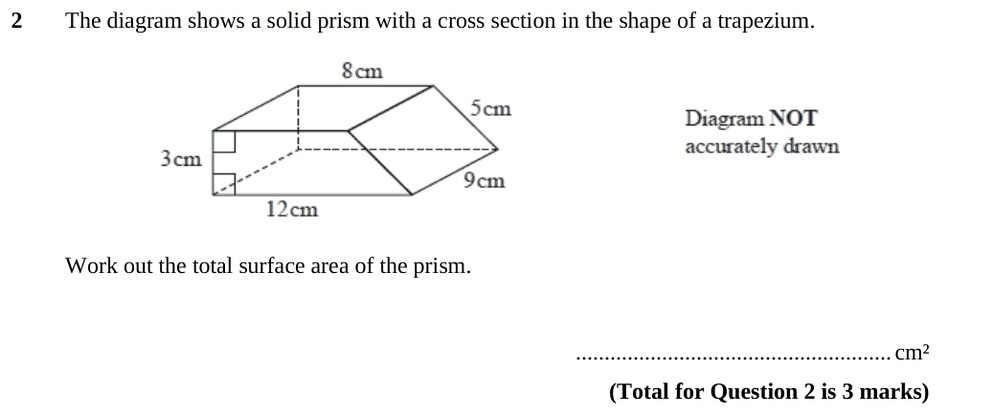
6. May 2025 4WM2H · Q2 Medium 3 marksShow worked solution Area of one trapezium Area of one trapezium:
\[
\frac12(8+12)\times 3=30
\]
Perimeter of the trapezium Perimeter of the trapezium:
\[
8+12+3+5=28
\]
Rectangular faces Rectangular faces:
\[
28\times 9=252
\]
Total surface area Total surface area:
\[
252+2(30)=312
\]
Final answer \(312\text{ cm}^2\).
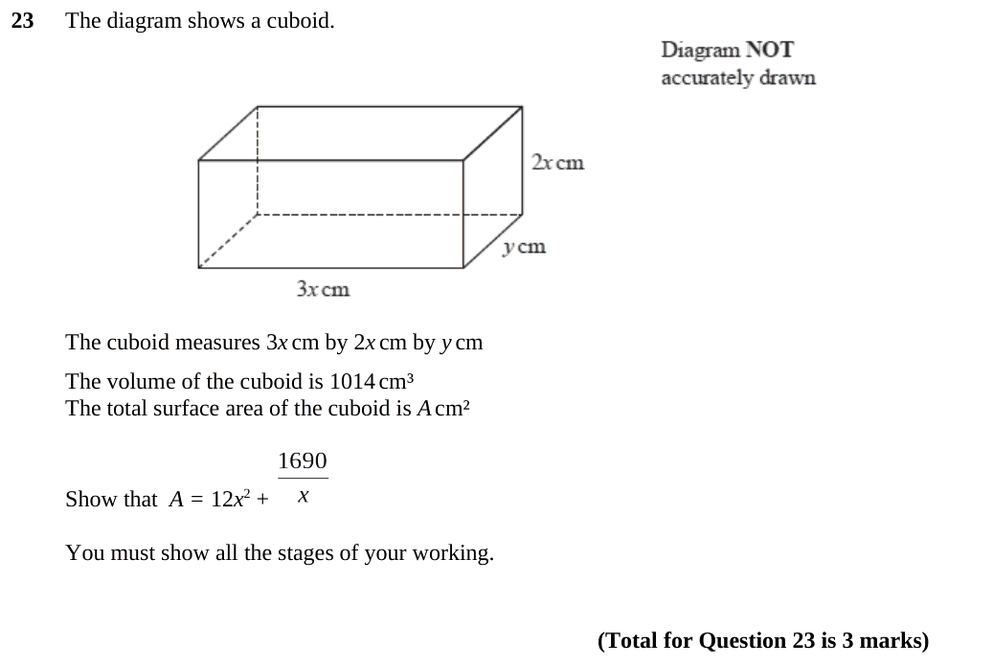
7. May 2025 4WM2H · Q23 Medium 3 marksShow worked solution Evaluate fraction \[
3x\times 2x\times y=1014
\]
\[
6x^2y=1014
\]
\[
y=\frac{169}{x^2}
\]
Surface area Surface area:
\[
A=2(3x\cdot2x+3x\cdot y+2x\cdot y)
\]
\[
=12x^2+10xy
\]
\[
=12x^2+10x\left(\frac{169}{x^2}\right)
\]
\[
=12x^2+\frac{1690}{x}
\]
Final answer \(A=12x^2+\dfrac{1690}{x}\).
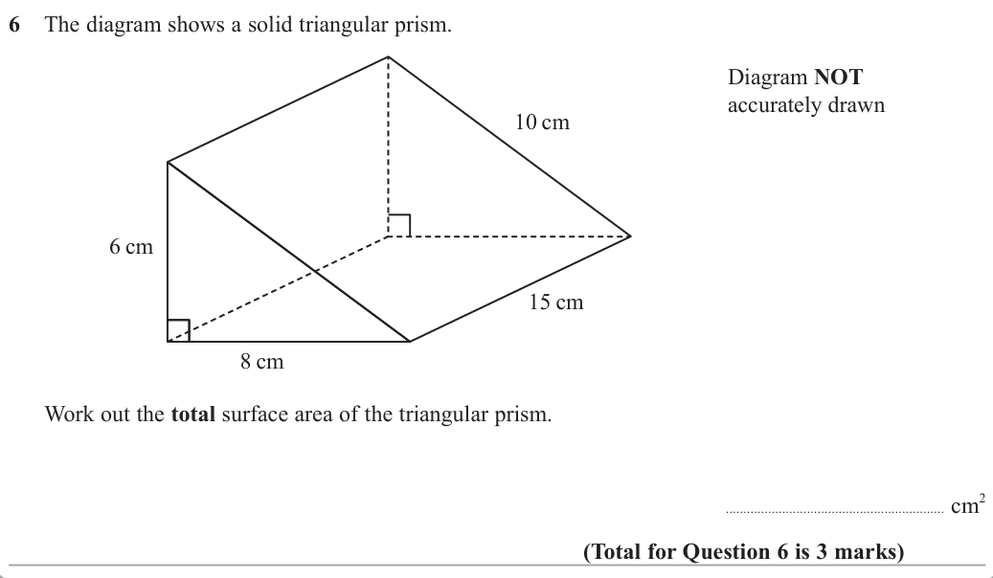
8. Nov 2024 P2H · Q6 Medium 3 marksShow worked solution The triangular end is a The triangular end is a right triangle with sides \(6\), \(8\), and \(10\).
Area of the two triangular Area of the two triangular ends: \[ 2\left(\frac12\times 6\times 8\right)=48 \]
Area of the three rectangles Area of the three rectangles: \[ 15(6+8+10)=360 \]
Total surface area Total surface area: \[ 48+360=408 \]
Final answer \(408\text{ cm}^2\).
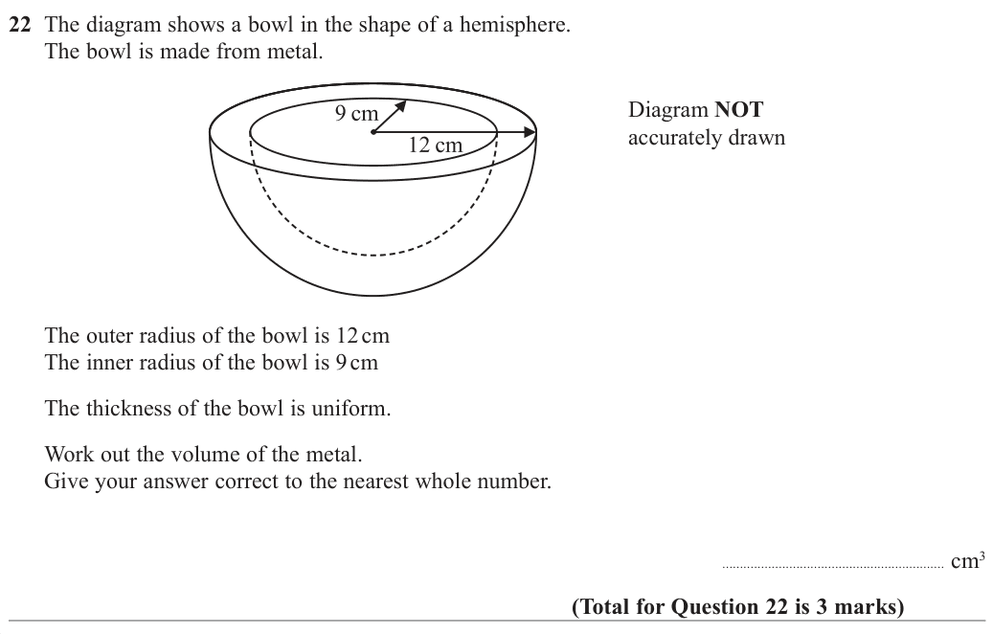
9. Nov 2024 P1H · Q22 Medium 3 marksShow worked solution The bowl is a hemispherical The bowl is a hemispherical shell.
The volume of the metal The volume of the metal is:
\[
\text{outer hemisphere volume}-\text{inner hemisphere volume}
\]
Volume of a hemisphere Volume of a hemisphere:
\[
\frac{2}{3}\pi r^3
\]
Calculate volume So
\[
\text{metal volume}
=\frac{2}{3}\pi(12)^3-\frac{2}{3}\pi(9)^3
\]
\[
=\frac{2}{3}\pi(12^3-9^3)
\]
\[
=\frac{2}{3}\pi(1728-729)
\]
\[
=666\pi
\]
\[
=2092.3007\ldots
\]
Final answer \(\boxed{2092\text{ cm}^3}\)
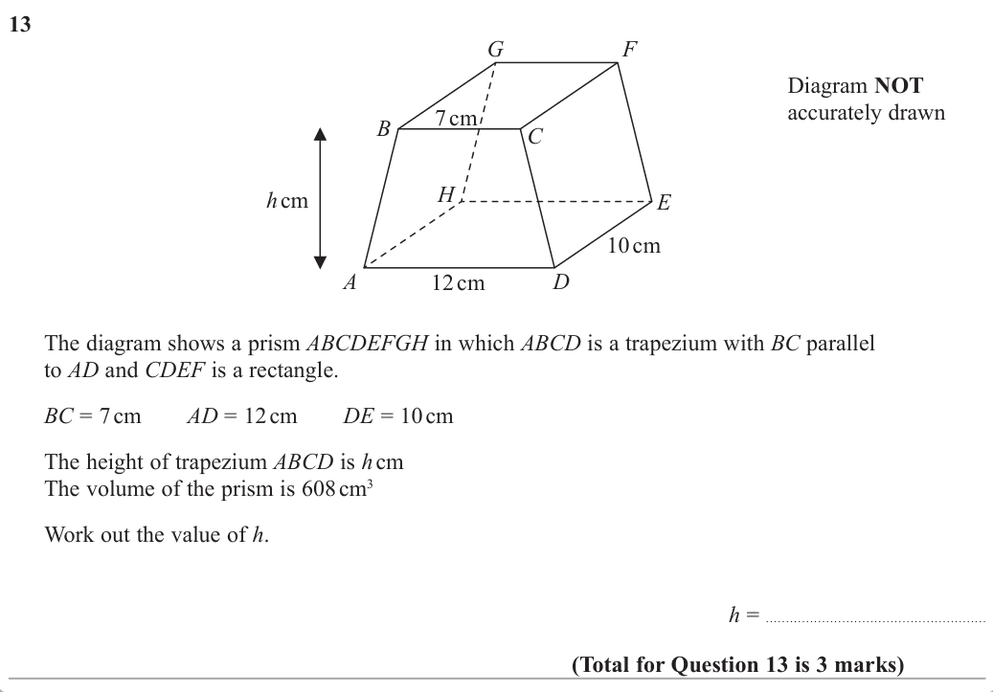
10. Jan 2020 P2HR · Q13 Medium 3 marksShow worked solution Area of the trapezium cross Area of the trapezium cross-section: \[ \frac12(7+12)h=9.5h \]
Volume of the prism Volume of the prism: \[ 9.5h\times 10=608 \]
\[
95h=608
\]
\[
h=6.4
\]
Final answer \(h=6.4\text{ cm}\).
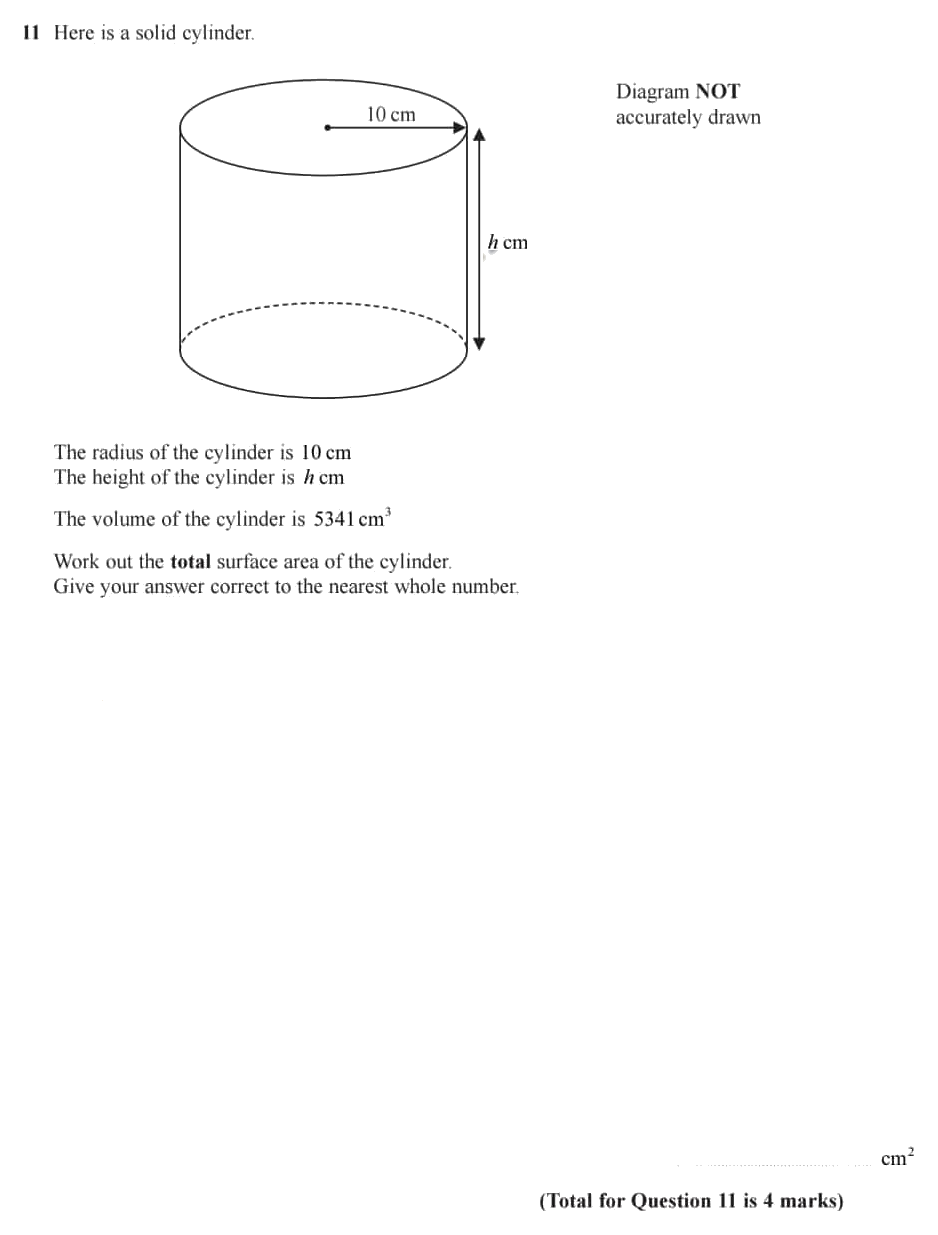
11. Jun 2026 4WM2HR · Q11 Medium 4 marksShow worked solution Find h from the volume \[\pi(10)^2h=5341\Rightarrow h=\frac{5341}{100\pi}=17.00\ldots\text{ cm}\]
Curved surface \[2\pi rh=2\pi(10)(17.00\ldots)=1068.2\]
Two circular ends \[2\pi r^2=2\pi(10)^2=200\pi=628.31\ldots\]
Total \[1068.2+628.31\ldots=1696.5\ldots\]
Keep \(h\) unrounded; using \(h=17\) gives \(1696\).
Final answer \(1697\) cm\(^2\)
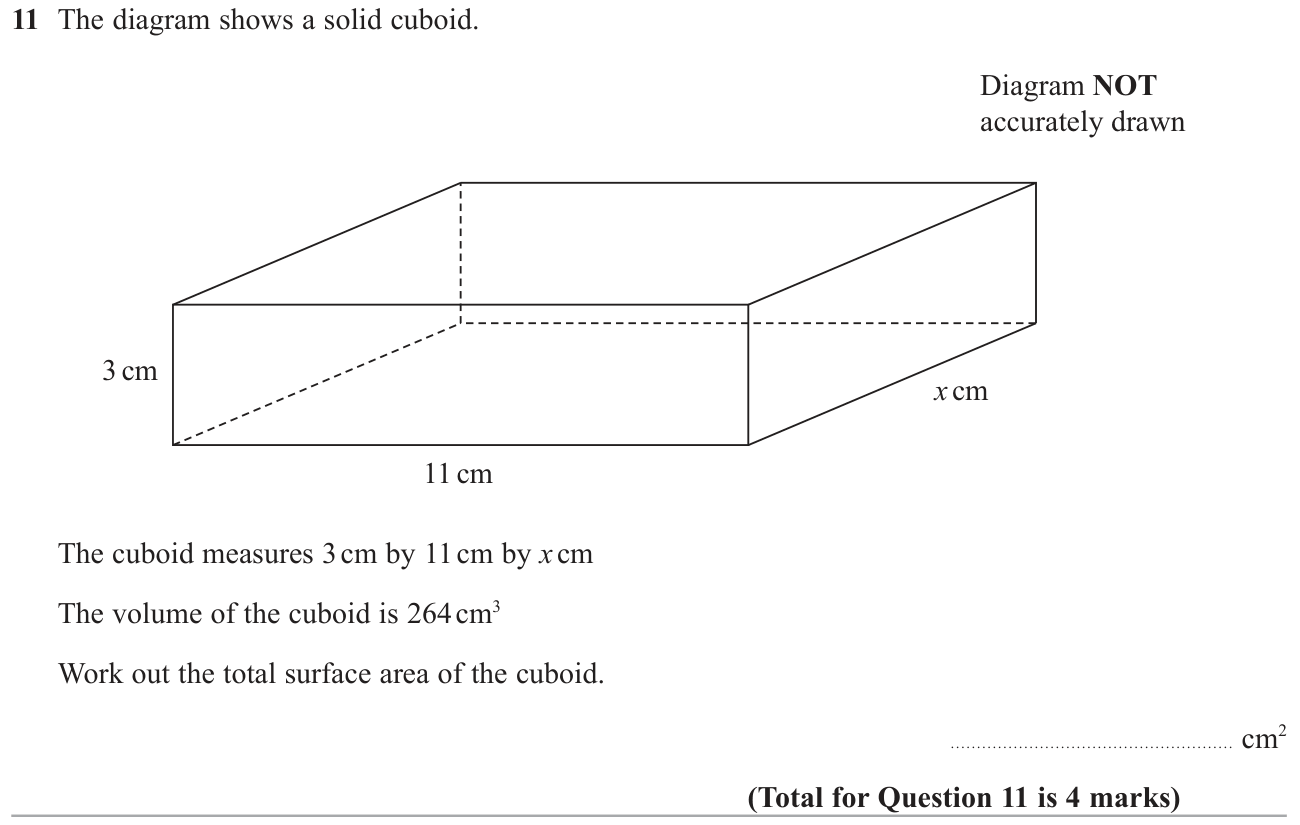
12. Jun 2026 P1HR · Q11 Medium 4 marksShow worked solution Solution | Step 1 \[3\times11\times x=264,\qquad x=\frac{264}{33}=8\text{ cm}.\]
The volume is the product of the three perpendicular edge lengths.
Solution | Step 2 \[S=2(3\times11)+2(3\times8)+2(11\times8).\]
There are two faces of each of the three rectangular sizes.
Solution | Step 3 \[S=66+48+176=290\text{ cm}^2.\]
Add all six face areas.
Final answer \(290\text{ cm}^2\)
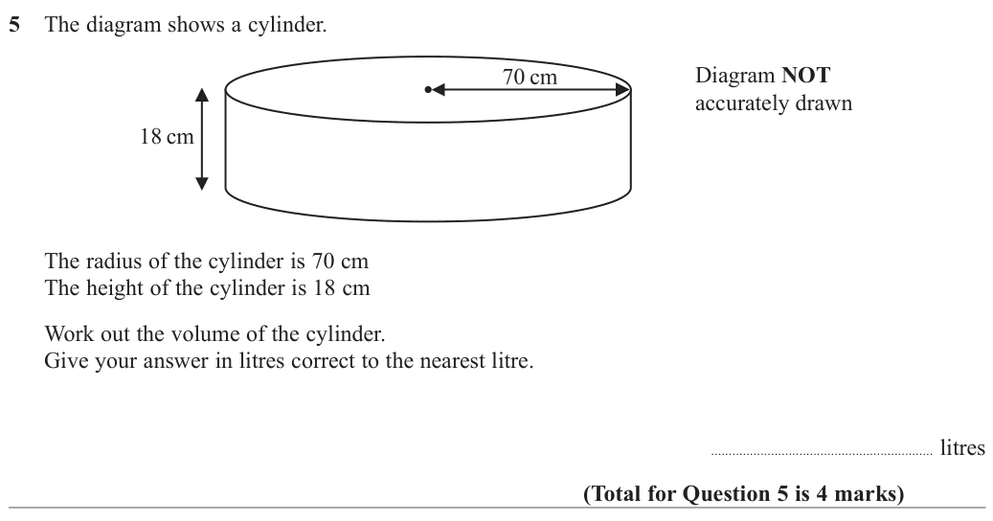
13. Nov 2024 P1H · Q5 Medium 4 marksShow worked solution Calculate area \[
V=\pi r^2h=\pi(70)^2(18)
\]
\[
V=277088.472\ldots\text{ cm}^3
\]
Calculate area Since \(1000\text{ cm}^3=1\) litre, \[ 277088.472\ldots\text{ cm}^3=277.088\ldots\text{ litres} \]
Final answer \(277\) litres.
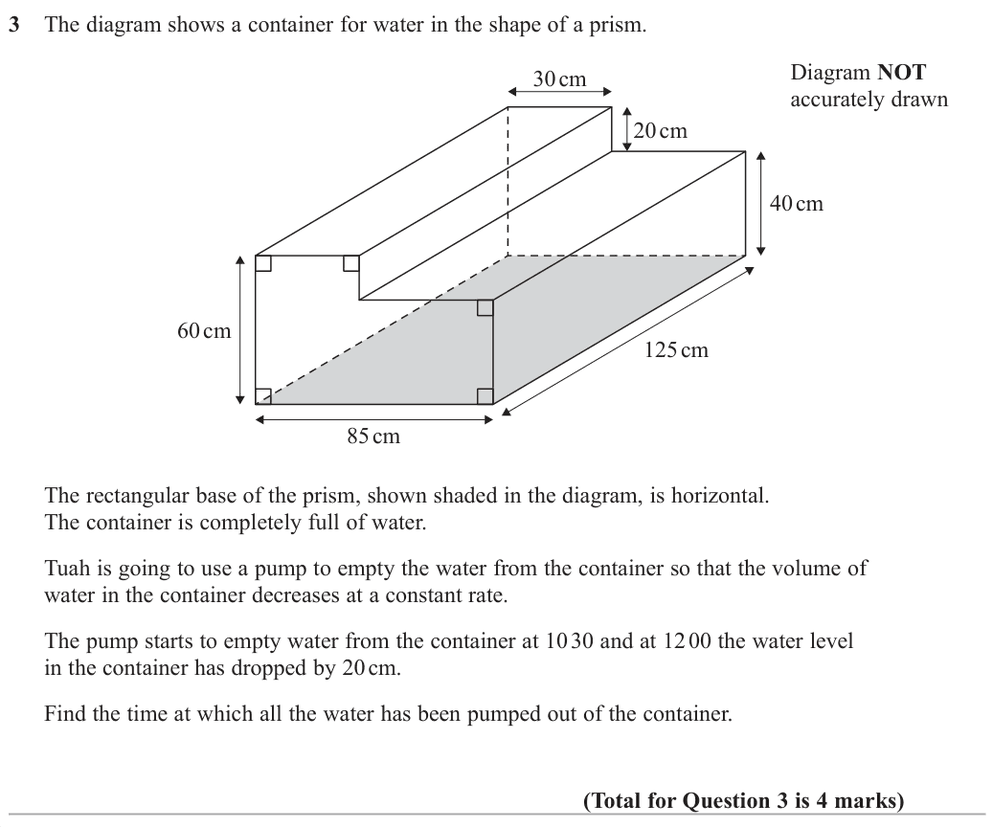
14. Jan 2021 P1H · Q3 Medium 4 marksShow worked solution The cross section is an The cross-section is an L-shape.
Area of the lower rectangle Area of the lower rectangle:
\[
85\times 40=3400
\]
Area of the upper rectangle Area of the upper rectangle:
\[
30\times 20=600
\]
Calculate area So the cross-sectional area is
\[
3400+600=4000\text{ cm}^2
\]
The full volume is \[
4000\times 125=500000\text{ cm}^3
\]
Calculate area In the first \(1.5\) hours, the water level drops by \(20\) cm. This is the top rectangular part:
\[
30\times 20\times 125=75000\text{ cm}^3
\]
Calculate area So the pumping rate is
\[
\frac{75000}{1.5}=50000\text{ cm}^3\text{/hour}
\]
Time to empty the whole Time to empty the whole container:
\[
\frac{500000}{50000}=10\text{ hours}
\]
Calculate area Starting at \(10{:}30\), ten hours later is
\[
20{:}30
\]
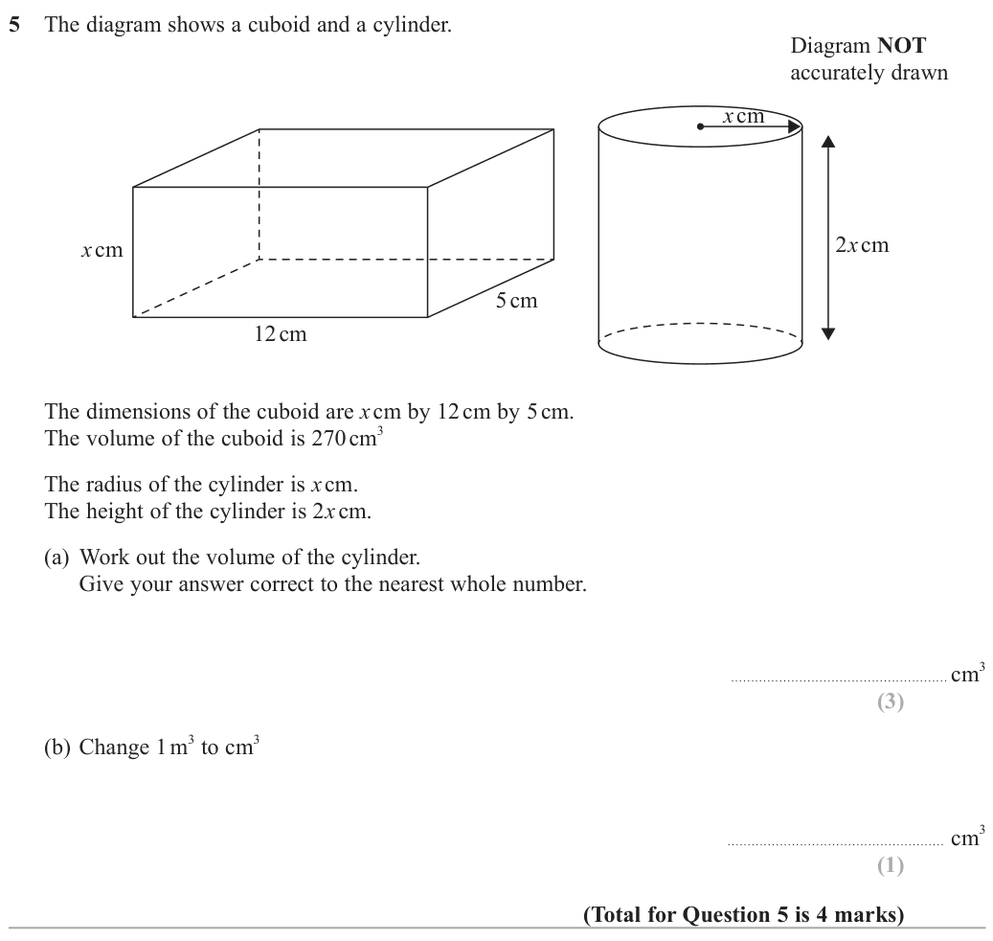
15. Jan 2021 P1HR · Q5 Medium 4 marksShow worked solution Calculate area For the cuboid, \[ 12\times 5\times x=270 \]
\[
60x=270
\]
\[
x=4.5
\]
Calculate area The cylinder has radius \(4.5\text{ cm}\) and height \(9\text{ cm}\).
\[
V=\pi r^2h=\pi(4.5)^2(9)=572.555\ldots
\]
Calculate area Also, \[ 1\text{ m}^3=100^3=1000000\text{ cm}^3 \]
Final answer \(573\text{ cm}^3\), and \(1\text{ m}^3=1000000\text{ cm}^3\).
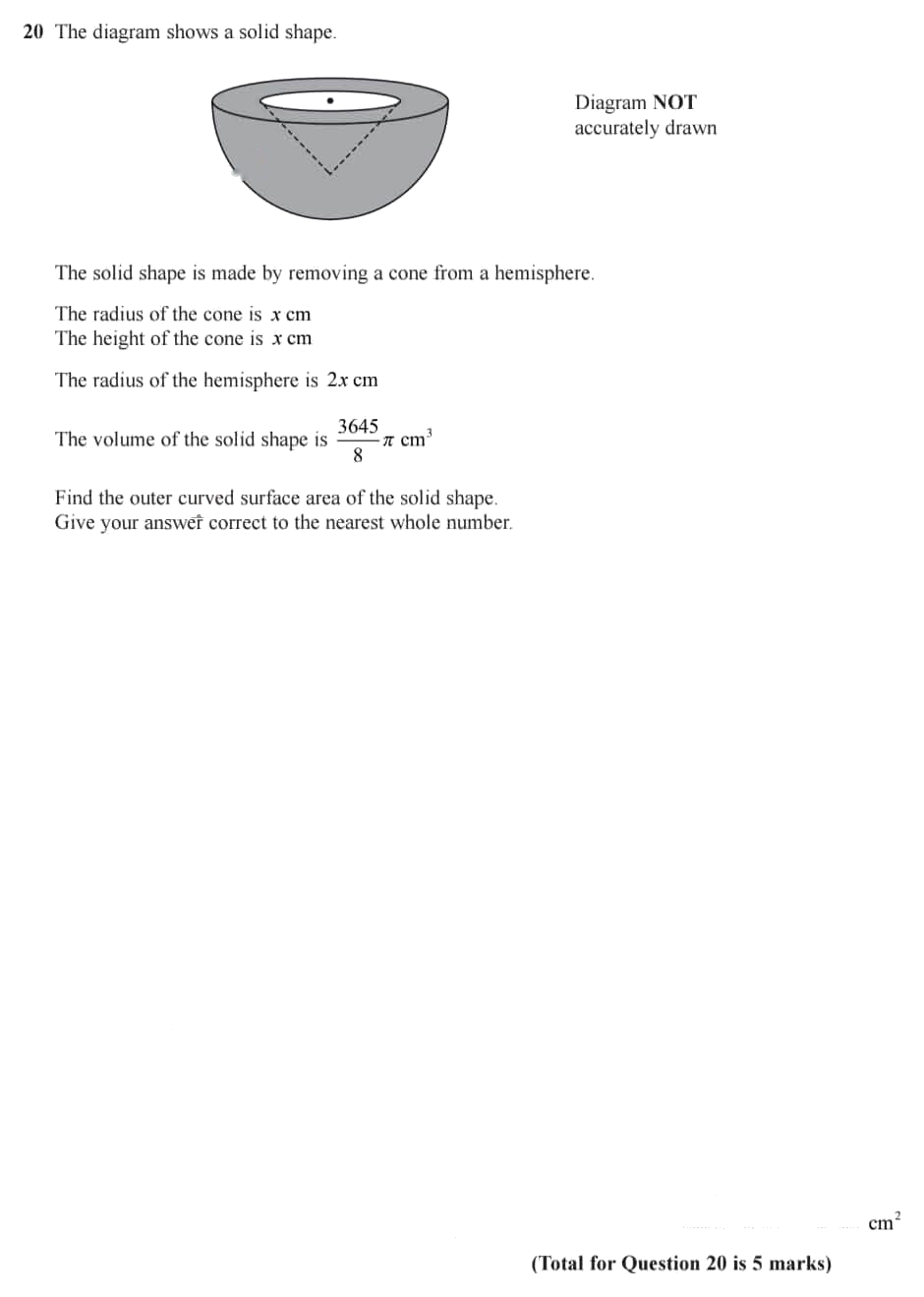
16. Jun 2026 4WM2HR · Q20 Hard 5 marksShow worked solution Volume of the solid \[\tfrac23\pi(2x)^3-\tfrac13\pi x^2(x)=\tfrac{16}{3}\pi x^3-\tfrac13\pi x^3=5\pi x^3\]
Solve for x \[5\pi x^3=\frac{3645}{8}\pi\Rightarrow x^3=\frac{729}{8}\Rightarrow x=4.5\]
Outer curved surface = curved hemisphere Radius \(2x=9\): \[2\pi(9)^2=162\pi=508.9\ldots\]
Final answer \(509\) cm\(^2\)
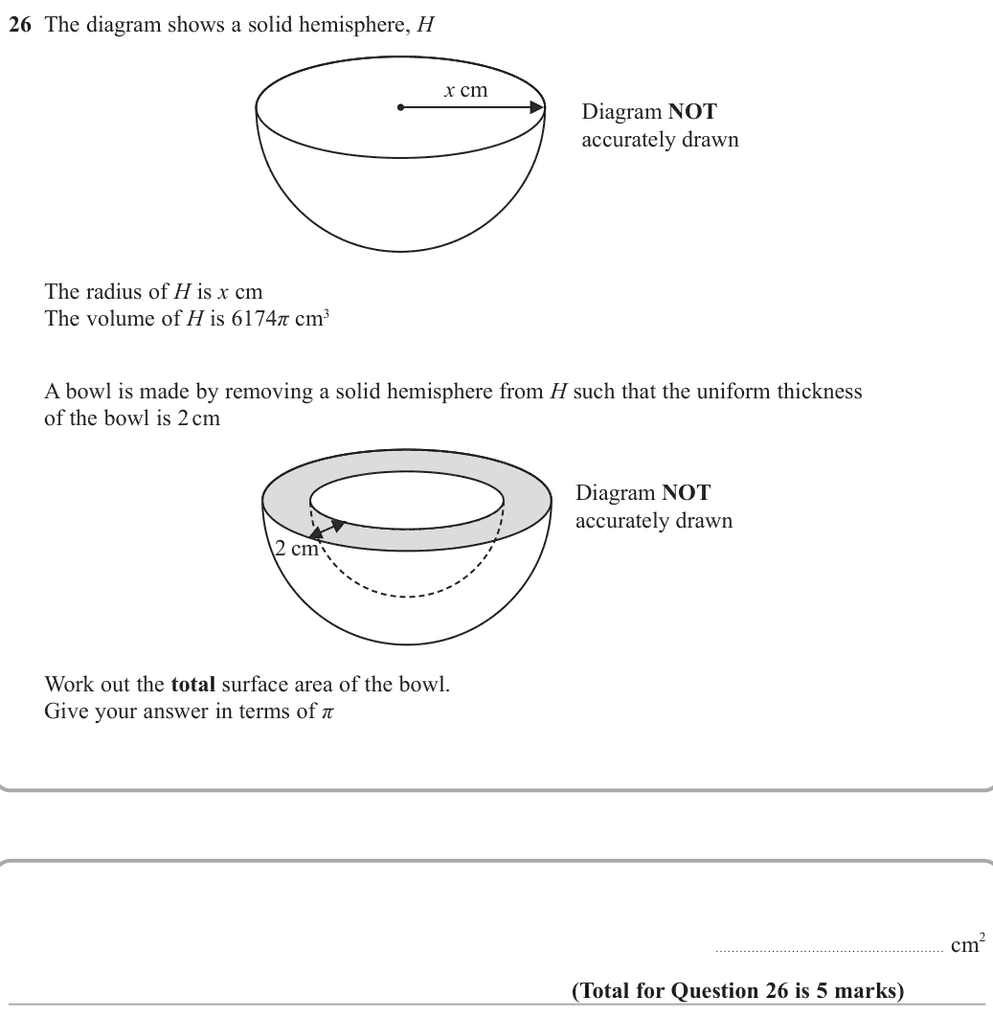
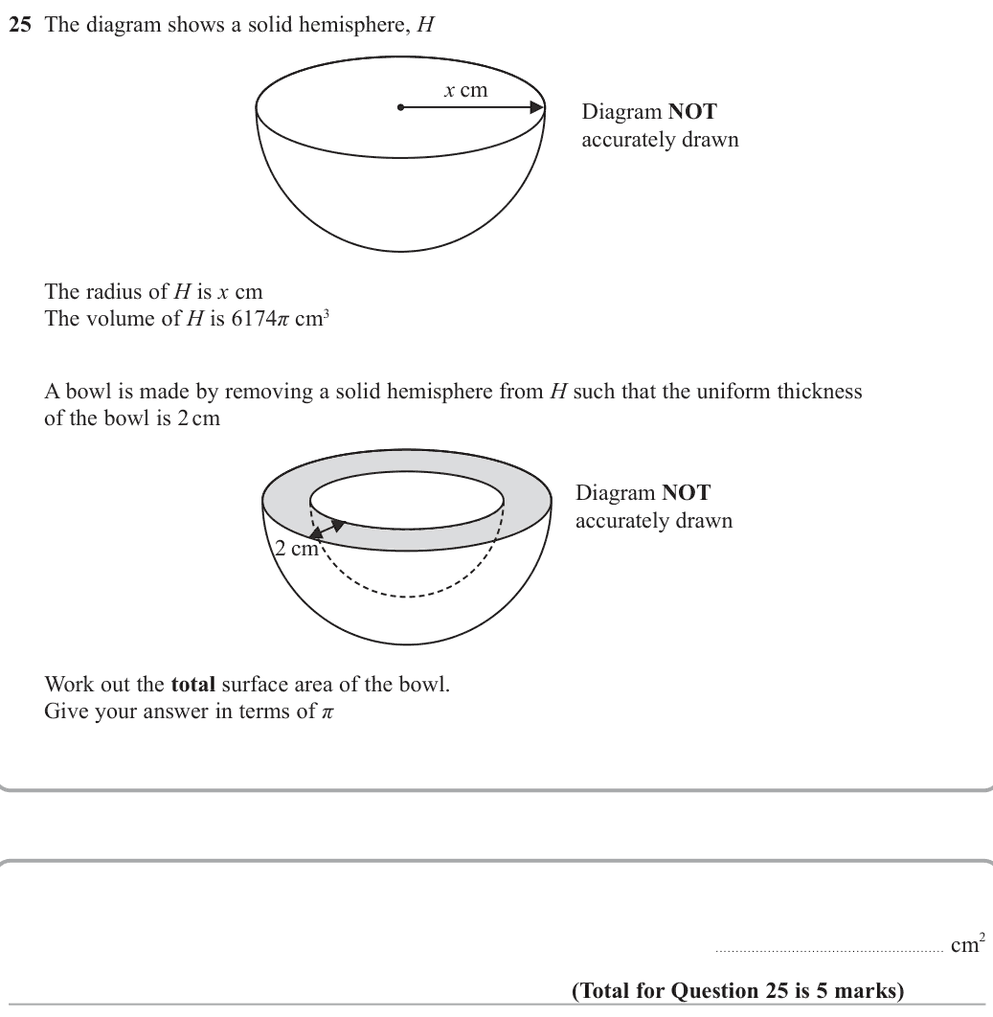
17. Jun 2025 P2HR · Q26 Hard 5 marksShow worked solution The volume of a hemisphere The volume of a hemisphere is
\[
\frac{2}{3}\pi r^3
\]
Evaluate fraction For the original hemisphere \(H\),
\[
\frac{2}{3}\pi x^3=6174\pi
\]
Cancel Cancel \(\pi\):
\[
\frac{2}{3}x^3=6174
\]
\[
x^3=9261
\]
\[
x=21
\]
The outer radius of the The outer radius of the bowl is \(21\) cm.
Calculate value The thickness is \(2\) cm, so the inner radius is
\[
21-2=19
\]
Total surface area of the Total surface area of the bowl is:
outer curved hemisphere inner curved - outer curved hemisphere - inner curved hemisphere - flat annular rim
Outer curved surface area Outer curved surface area:
\[
2\pi(21)^2=882\pi
\]
Inner curved surface area Inner curved surface area:
\[
2\pi(19)^2=722\pi
\]
Flat rim area Flat rim area:
\[
\pi(21^2-19^2)=80\pi
\]
Total Total:
\[
882\pi+722\pi+80\pi=1684\pi
\]
Final answer \(\boxed{1684\pi\text{ cm}^2}\)
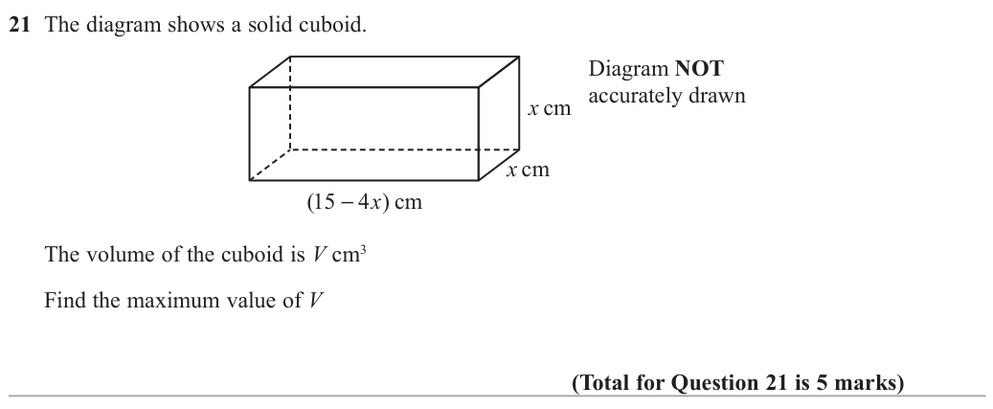
18. May 2025 4WM2HR · Q21 Hard 5 marksShow worked solution Required Cuboid has a square cross-section of side *x* cm and length (15−4*x*) cm. Find the maximum value of the volume *V*.
Write V as a function Write *V* as a function of *x*: *V* = *x* ⋅ *x* ⋅ (15−4*x*) = *x*<sup>2</sup>(15−4*x*) = 15*x*<sup>2</sup> − 4*x*<sup>3</sup>
Differentiate Differentiate: $$\\frac{dV}{dx} = 30x - 12x^2$$
Set ( x 0 gives Set $\\dfrac{dV}{dx} = 0$: $$30x - 12x^2 = 0 \\implies 6x(5-2x) = 0 \\implies x=0\\;\\text{ or }\\;x=\\tfrac{5}{2}=2.5$$ (*x* = 0 gives zero volume, so the meaningful solution is *x* = 2.5.)
Second derivative test to confirm Second derivative test to confirm maximum: $$\\frac{d^2V}{dx^2} = 30-24x\\;\\Bigg\|\_{x=2.5} = 30 - 60 = -30 \< 0 \\quad \\checkmark\\text{ (maximum)}$$
Calculate V max V max Calculate *V*<sub>max</sub>: *V*<sub>max</sub> = (2.5)<sup>2</sup> × (15−4×2.5) = 6.25 × 5 = 31.25 cm<sup>3</sup>
Note Calculus optimisation: always verify the nature of the stationary point using $\\dfrac{d^2V}{dx^2}$. Also check *x* \> 0 and 15 − 4*x* \> 0 (i.e. *x* \< 3.75) to ensure a valid cuboid.
Final answer Maximum volume *V* = 31.25 cm<sup>3</sup>
19. May 2025 4WM2HR · Q25 Hard 5 marksShow worked solution Required Hemisphere H has radius *x* cm and volume 6174*π* cm<sup>3</sup>. A bowl is made by removing an inner hemisphere, leaving 2 cm thickness. Find total surface area in terms of *π*.
Calculate volume Find outer radius *x*. Volume of hemisphere $= \\dfrac{2}{3}\\pi r^3$: $$\\frac{2}{3}\\pi x^3 = 6174\\pi \\implies x^3 = \\frac{6174\\times3}{2} = 9261 \\implies x = \\sqrt\[3\]{9261} = 21\\text{ cm}$$
Find inner radius r inner Find inner radius: *r*<sub>inner</sub> = 21 − 2 = 19 cm
Add 1 Three surfaces to add:
**1. Outer curved surface** (half-sphere, radius 21): *A*<sub>1</sub> = 2*π*(21)<sup>2</sup> = 2*π* × 441 = 882*π*
**2. Inner curved surface** (half-sphere, radius 19): *A*<sub>2</sub> = 2*π*(19)<sup>2</sup> = 2*π* × 361 = 722*π*
**3. Flat annular ring** at the top rim: *A*<sub>3</sub> = *π*(21)<sup>2</sup> − *π*(19)<sup>2</sup> = *π*(441−361) = 80*π*
Total surface area A total Total surface area: *A*<sub>total</sub> = 882*π* + 722*π* + 80*π* = 1684*π*
Note Three separate surfaces! Missing the flat annular ring is the most common error on this type of question.
Final answer Total surface area = 1684*π* cm<sup>2</sup>
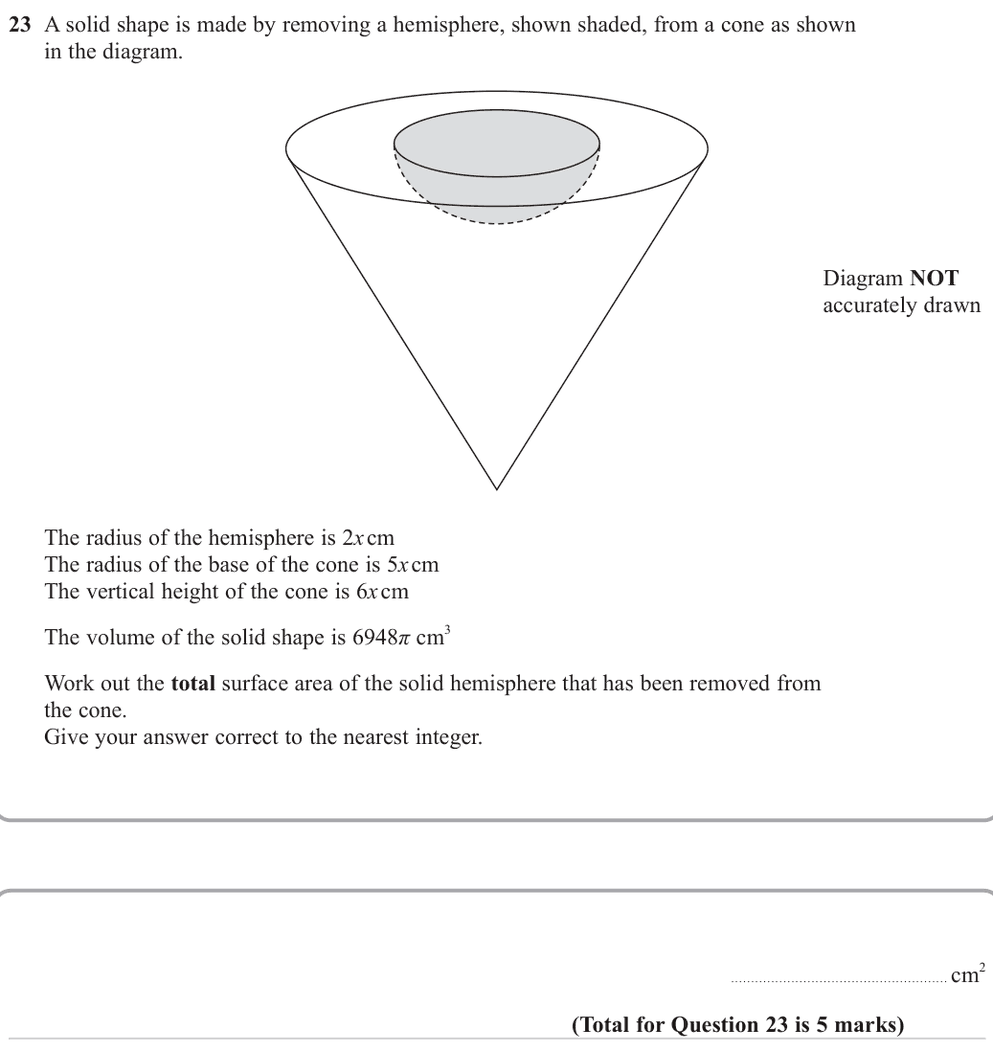
20. May 2024 P1H · Q23 Hard 5 marksShow worked solution Define cone dimensions The cone has radius \(5x\) and height \(6x\).
Volume of the cone Volume of the cone:
\[
\frac{1}{3}\pi(5x)^2(6x)
\]
\[
=50\pi x^3
\]
The removed hemisphere has radius The removed hemisphere has radius \(2x\).
Volume of the hemisphere Volume of the hemisphere:
\[
\frac{2}{3}\pi(2x)^3
\]
\[
=\frac{16}{3}\pi x^3
\]
The remaining solid has volume The remaining solid has volume \(6948\pi\), so
\[
50\pi x^3-\frac{16}{3}\pi x^3=6948\pi
\]
\[
\frac{134}{3}\pi x^3=6948\pi
\]
Cancel Cancel \(\pi\):
\[
\frac{134}{3}x^3=6948
\]
\[
x^3=\frac{10422}{67}
\]
\[
x=5.3781\ldots
\]
The solid hemisphere removed has The solid hemisphere removed has radius \(2x\).
Total surface area of a Total surface area of a solid hemisphere is
\[
3\pi r^2
\]
Calculate value So
\[
3\pi(2x)^2=12\pi x^2
\]
\[
12\pi(5.3781\ldots)^2=1090.3903\ldots
\]
Final answer \(\boxed{1090\text{ cm}^2}\)
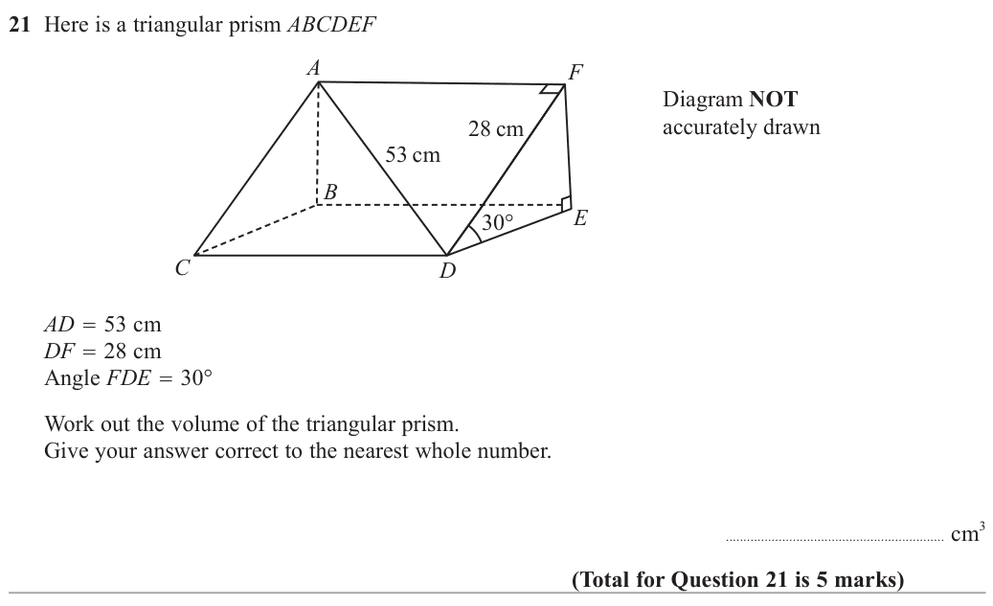
21. Nov 2023 P1H · Q21 Hard 5 marksShow worked solution The triangular cross section is The triangular cross-section is triangle \(DEF\).
It is right angled at It is right-angled at \(E\), with
\[
DF=28
\]
Use trigonometry and
\[
\angle FDE=30^\circ
\]
Use trigonometry So
\[
FE=28\sin 30^\circ=14
\]
Use trigonometry and
\[
DE=28\cos 30^\circ=14\sqrt3
\]
Area of triangle Area of triangle \(DEF\):
\[
\frac{1}{2}(14)(14\sqrt3)=98\sqrt3
\]
The length of the prism The length of the prism is
\[
AD=53
\]
Volume of the prism Volume of the prism:
\[
98\sqrt3\times 53
\]
\[
=5194\sqrt3
\]
\[
=8996.2719\ldots
\]
Final answer \(\boxed{8996\text{ cm}^3}\)
22. Jun 2023 P2HR · Q24 Hard 5 marksShow worked solution Let the radius of the Let the radius of the smaller sphere be \(r\).
Let the radius of the Let the radius of the larger sphere be \(R\).
Surface area of a sphere Surface area of a sphere is
\[
4\pi r^2
\]
The surface area of sphere The surface area of sphere \(A\) is nine times the surface area of sphere \(B\), so
\[
4\pi R^2=9(4\pi r^2)
\]
\[
R^2=9r^2
\]
\[
R=3r
\]
The difference between the volumes The difference between the volumes is \(117\pi\):
\[
\frac{4}{3}\pi(3r)^3-\frac{4}{3}\pi r^3=117\pi
\]
\[
\frac{4}{3}\pi(27r^3-r^3)=117\pi
\]
\[
\frac{104}{3}\pi r^3=117\pi
\]
Cancel Cancel \(\pi\):
\[
\frac{104}{3}r^3=117
\]
\[
r^3=\frac{117\times 3}{104}
\]
\[
r^3=\frac{27}{8}
\]
\[
r=\frac{3}{2}
\]
Final answer \(\boxed{1.5\text{ cm}}\)
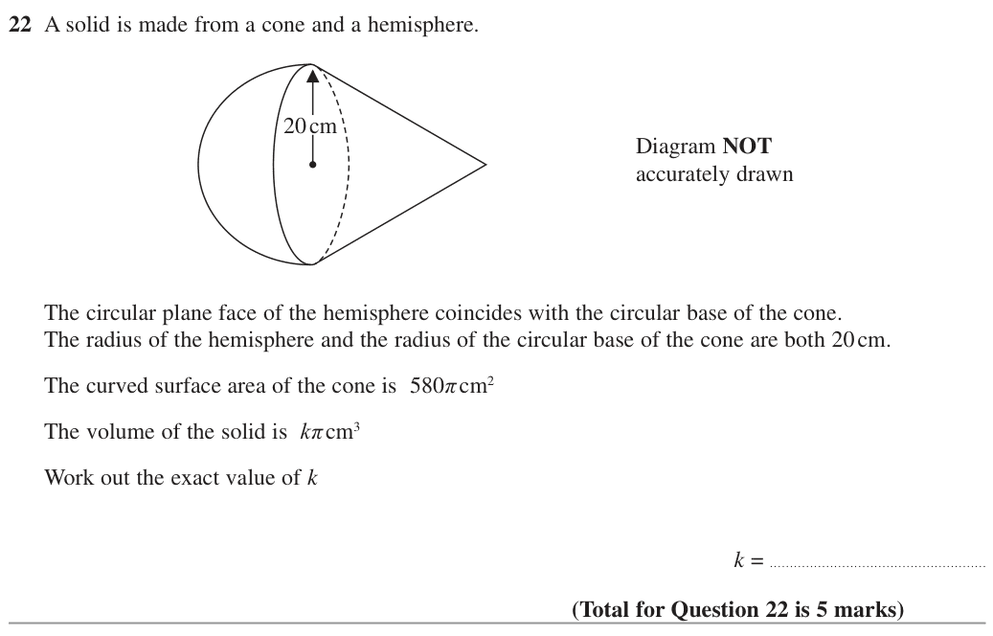
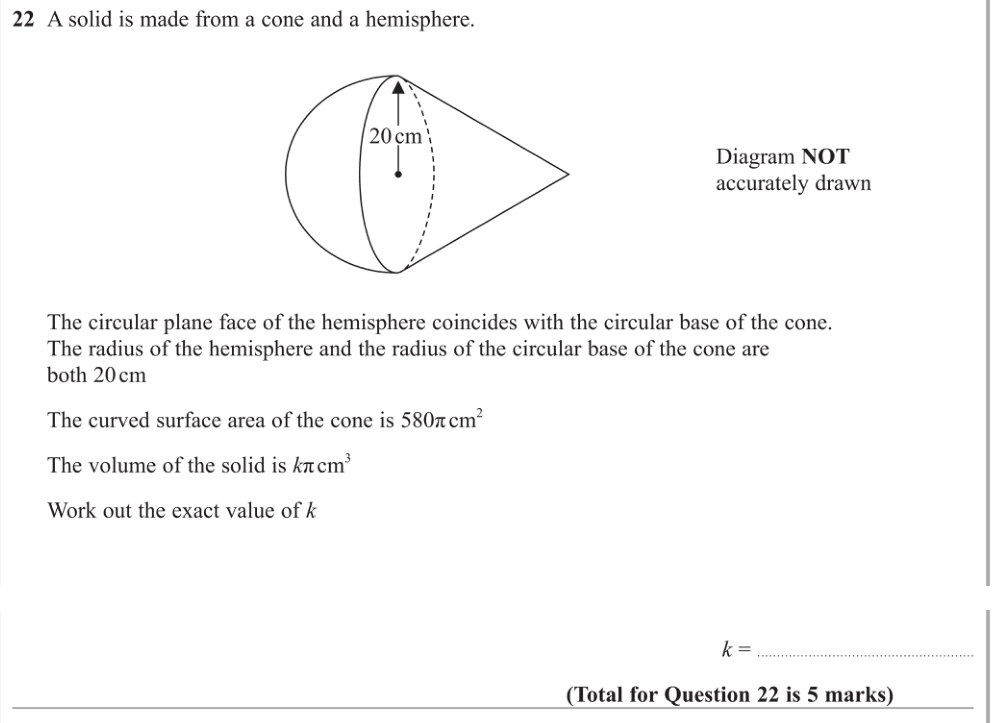
23. Jun 2022 P1H · Q22 Hard 5 marksShow worked solution The cone has radius cm The cone has radius \(20\) cm.
Calculate surface area The curved surface area of the cone is
\[
\pi rl
\]
Calculate value So
\[
\pi(20)l=580\pi
\]
\[
l=29
\]
Use Pythagoras to find the Use Pythagoras to find the height of the cone:
\[
h^2+20^2=29^2
\]
\[
h^2=841-400=441
\]
\[
h=21
\]
Volume of the cone Volume of the cone:
\[
\frac{1}{3}\pi r^2h
=\frac{1}{3}\pi(20)^2(21)
=2800\pi
\]
Volume of the hemisphere Volume of the hemisphere:
\[
\frac{2}{3}\pi r^3
=\frac{2}{3}\pi(20)^3
=\frac{16000}{3}\pi
\]
Total volume Total volume:
\[
2800\pi+\frac{16000}{3}\pi
=\frac{24400}{3}\pi
\]
Calculate volume The volume is \(k\pi\), so
\[
k=\frac{24400}{3}
\]
Final answer \(\boxed{\frac{24400}{3}}\)
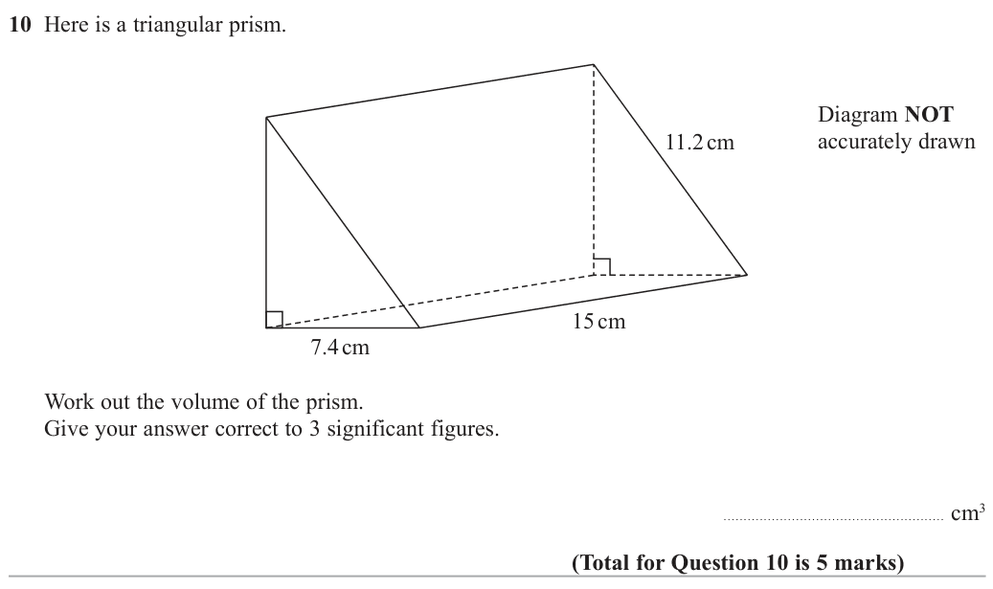
24. May 2021 P2H · Q10 Hard 5 marksShow worked solution Find the height of the Find the height of the triangular cross-section: \[ h^2=11.2^2-7.4^2 \]
\[
h=8.407\ldots
\]
Area of the triangular cross Area of the triangular cross-section: \[ \frac12(7.4)(8.407\ldots)=31.106\ldots \]
Volume of the prism Volume of the prism: \[ 31.106\ldots\times 15=466.596\ldots \]
Final answer \(467\text{ cm}^3\).
25. Specimen 4WM2H · Q22 Hard 5 marksShow worked solution Calculate surface area The curved surface area of a cone is
\[
\pi r l
\]
Calculate area Here \(r=20\) and \(\pi r l=580\pi\), so
\[
20l=580
\]
\[
l=29
\]
Use Pythagoras to find the Use Pythagoras to find the height of the cone:
\[
h^2=29^2-20^2
\]
\[
h^2=841-400=441
\]
\[
h=21
\]
Volume of the cone Volume of the cone:
\[
\frac13\pi r^2h=\frac13\pi(20)^2(21)=2800\pi
\]
Volume of the hemisphere Volume of the hemisphere:
\[
\frac23\pi r^3=\frac23\pi(20)^3=\frac{16000}{3}\pi
\]
Total volume Total volume:
\[
2800\pi+\frac{16000}{3}\pi
=\frac{24400}{3}\pi
\]
Calculate area Since the volume is \(k\pi\),
\[
k=\frac{24400}{3}
\]
Final answer \(\displaystyle k=\frac{24400}{3}\).
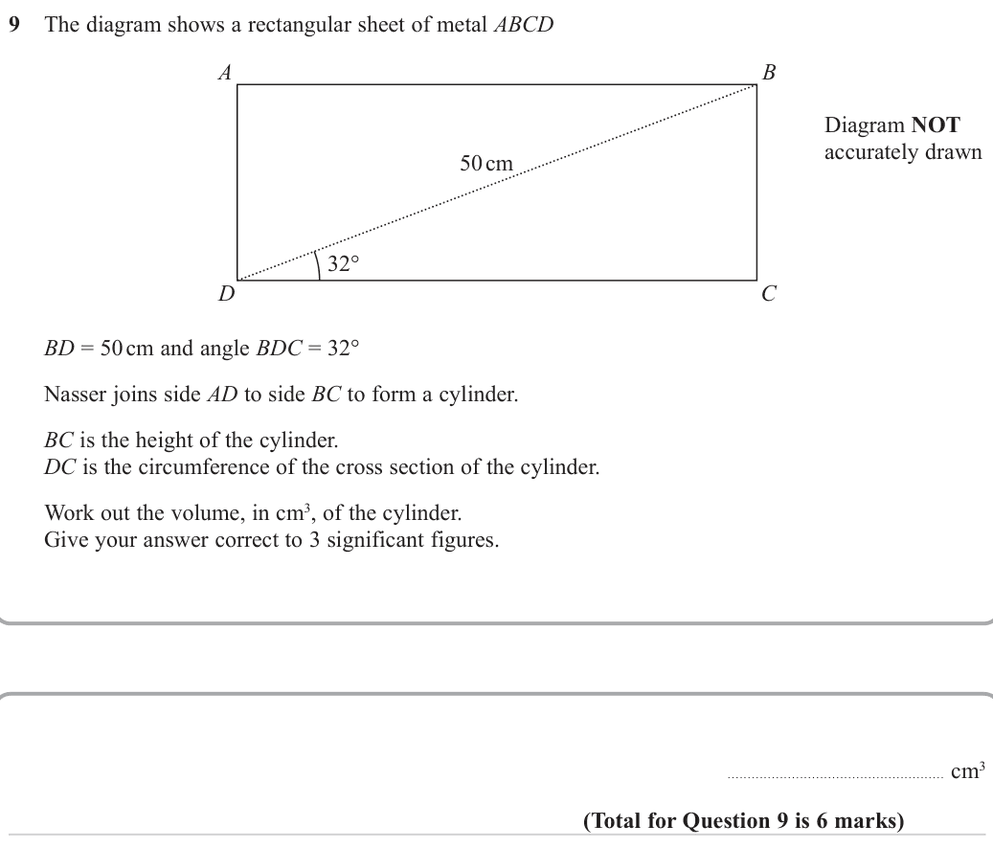
26. Jun 2023 P2HR · Q9 Hard 6 marksShow worked solution Use trigonometry In triangle \(DBC\),
\[
DC=50\cos32^\circ=42.402\ldots,\qquad BC=50\sin32^\circ=26.496\ldots
\]
The circumference of the cylinder The circumference of the cylinder is \(DC\), so
\[
2\pi r=DC
\]
\[
r=\frac{42.402\ldots}{2\pi}
\]
Volume Volume:
\[
V=\pi r^2h
=\pi\left(\frac{42.402\ldots}{2\pi}\right)^2(26.496\ldots)
=3790.974\ldots
\]
Final answer \(3.79\times10^3\text{ cm}^3\) to 3 significant figures.
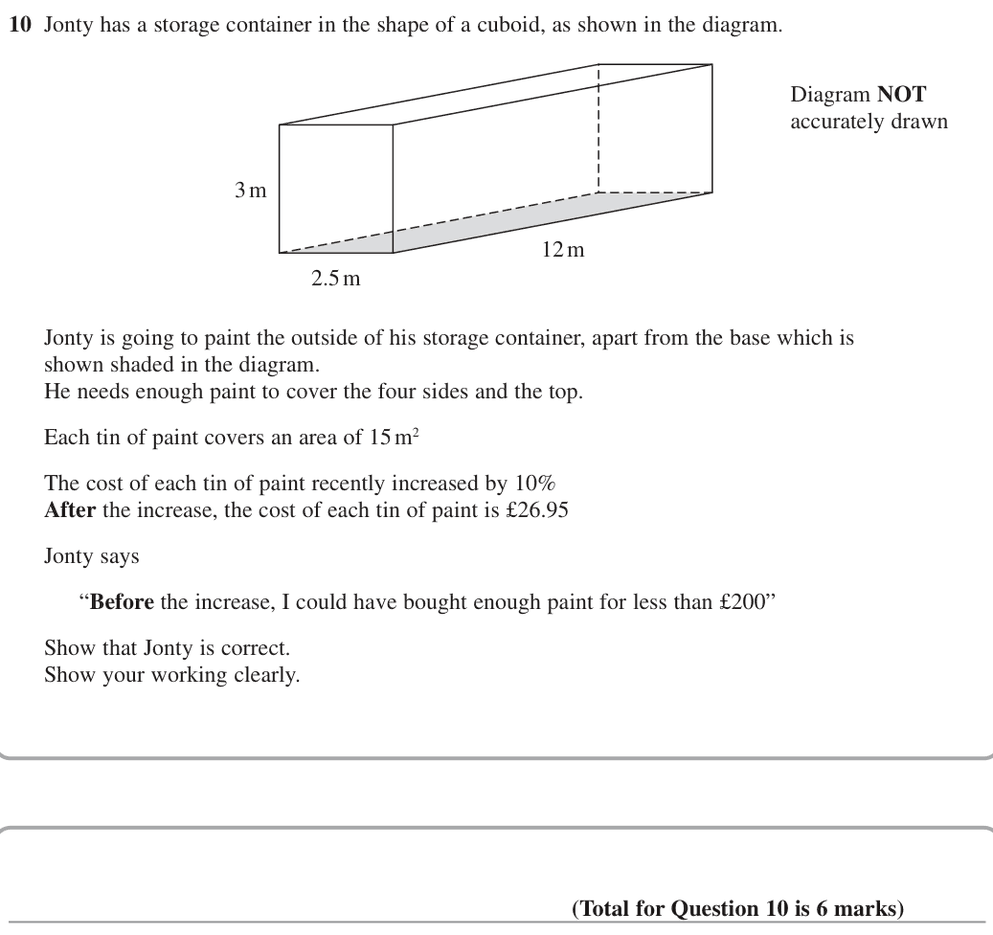
27. Jan 2022 P1HR · Q10 Hard 6 marksShow worked solution Jonty paints the four sides Jonty paints the four sides and the top, but not the base.
Top Top:
\[
12\times 2.5=30
\]
Two long sides Two long sides:
\[
2(12\times 3)=72
\]
Two short sides Two short sides:
\[
2(2.5\times 3)=15
\]
Total area Total area:
\[
30+72+15=117\text{ m}^2
\]
Calculate area Each tin covers \(15\text{ m}^2\), so the number of tins needed is
\[
\frac{117}{15}=7.8
\]
He must buy tins He must buy \(8\) tins.
Calculate area After the \(10\%\) increase, each tin costs \(\pounds 26.95\). Before the increase:
\[
\frac{26.95}{1.10}=24.50
\]
Calculate area Before the increase, \(8\) tins would cost
\[
8\times 24.50=196
\]
Calculate area Since \(\pounds 196<\pounds 200\), Jonty is correct.
Final answer Jonty is correct; before the increase the paint would have cost \(\pounds 196\).
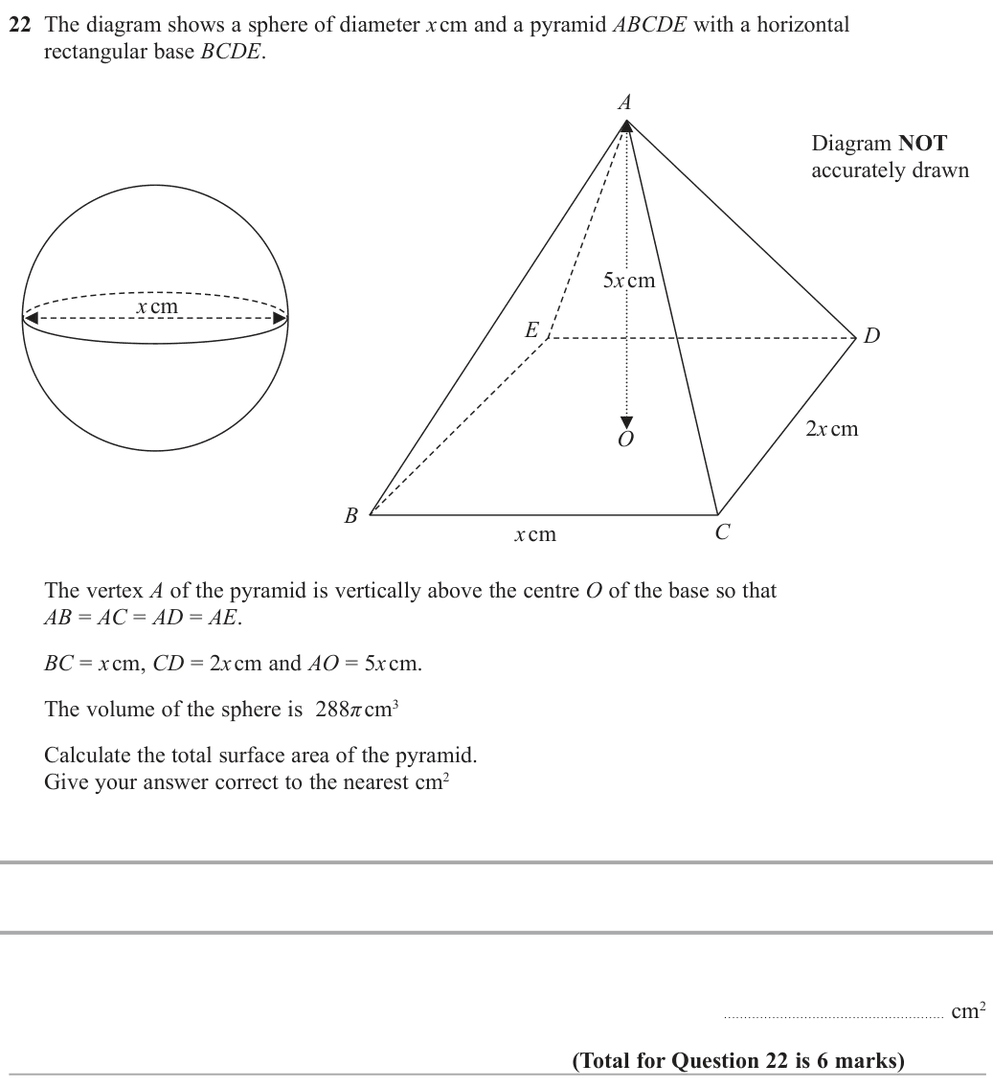
28. Nov 2021 P2H · Q22 Hard 6 marksShow worked solution Use trigonometry The sphere has diameter \(x\), so its radius is
\[
\frac x2
\]
The volume of the sphere The volume of the sphere is \(288\pi\text{ cm}^3\):
\[
\frac43\pi\left(\frac x2\right)^3=288\pi
\]
\[
\frac{\pi x^3}{6}=288\pi
\]
\[
x^3=1728
\]
\[
x=12
\]
The rectangular base of the The rectangular base of the pyramid has dimensions \(x\) and \(2x\), so its area is
\[
x(2x)=2x^2
\]
Use trigonometry For the two faces with base \(x\), the slant height is
\[
\sqrt{(5x)^2+x^2}=x\sqrt{26}
\]
Their total area is \[
2\left(\frac12 x\cdot x\sqrt{26}\right)=x^2\sqrt{26}
\]
Use trigonometry For the two faces with base \(2x\), the slant height is
\[
\sqrt{(5x)^2+\left(\frac x2\right)^2}
=\frac{x\sqrt{101}}2
\]
Their total area is \[
2\left(\frac12(2x)\cdot\frac{x\sqrt{101}}2\right)=x^2\sqrt{101}
\]
Total surface area Total surface area:
\[
2x^2+x^2\sqrt{26}+x^2\sqrt{101}
\]
Substitute Substitute \(x=12\):
\[
144(2+\sqrt{26}+\sqrt{101})=2469.440\ldots
\]
Correct to the nearest Correct to the nearest \(\text{cm}^2\):
\[
2469
\]
Final answer \(\boxed{2469\text{ cm}^2}\)
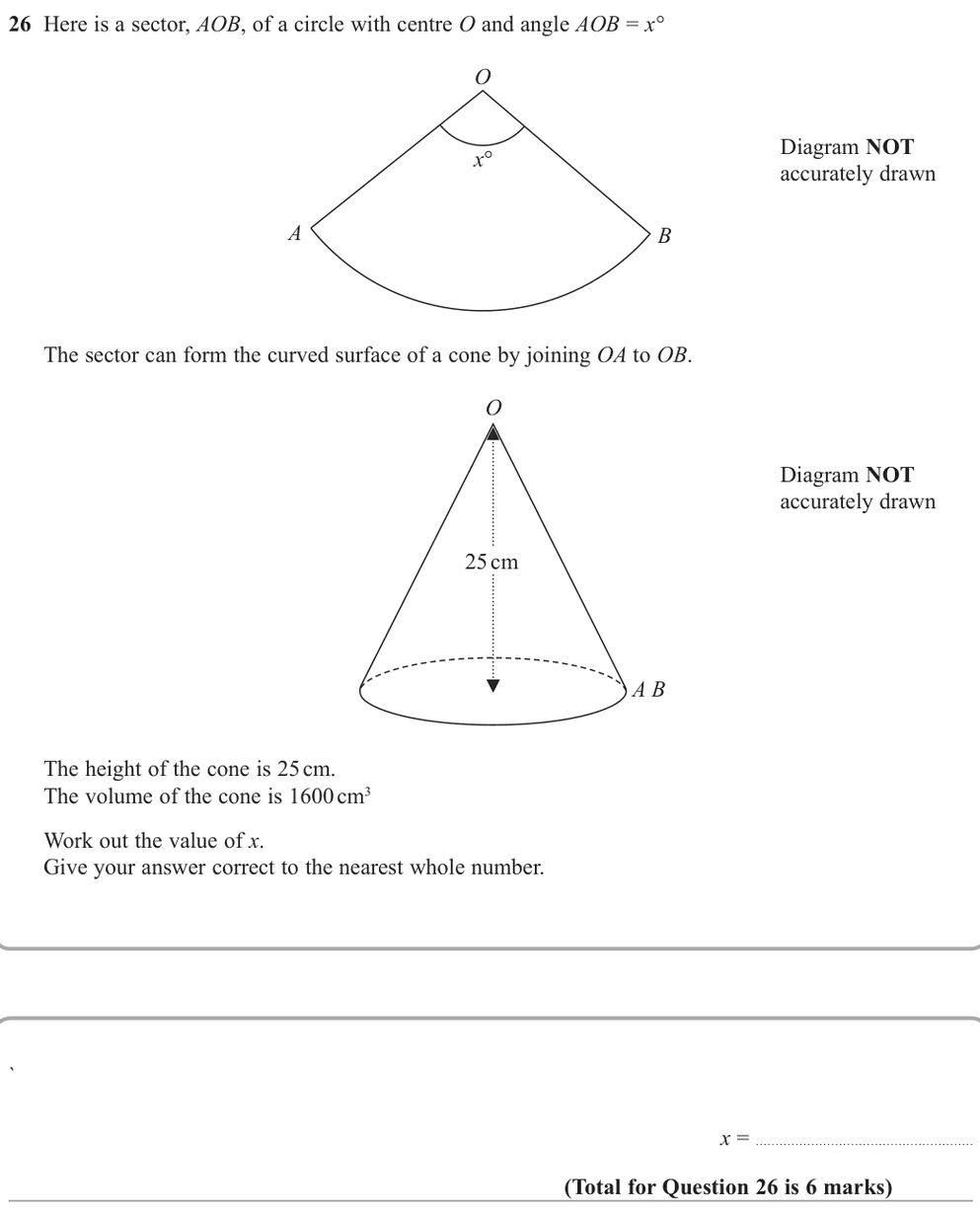
29. Jan 2020 P2H · Q26 Hard 6 marksShow worked solution Let the radius of the Let the radius of the base of the cone be \(r\), and let the slant height be \(l\).
The volume of the cone The volume of the cone is
\[
\frac{1}{3}\pi r^2h=1600
\]
Calculate area The height is \(25\) cm, so
\[
\frac{1}{3}\pi r^2(25)=1600
\]
\[
r^2=\frac{4800}{25\pi}
\]
\[
r=7.8176\ldots
\]
The slant height is found The slant height is found using Pythagoras:
\[
l^2=r^2+25^2
\]
\[
l=26.1938\ldots
\]
Calculate area When the sector is joined to form the cone, the arc length of the sector becomes the circumference of the cone base.
\[
\frac{x}{360}\times 2\pi l=2\pi r
\]
Cancel Cancel \(2\pi\):
\[
\frac{x}{360}l=r
\]
\[
x=\frac{360r}{l}
\]
\[
x=\frac{360(7.8176\ldots)}{26.1938\ldots}
=107.4433\ldots
\]
Final answer \(\boxed{107^\circ}\)
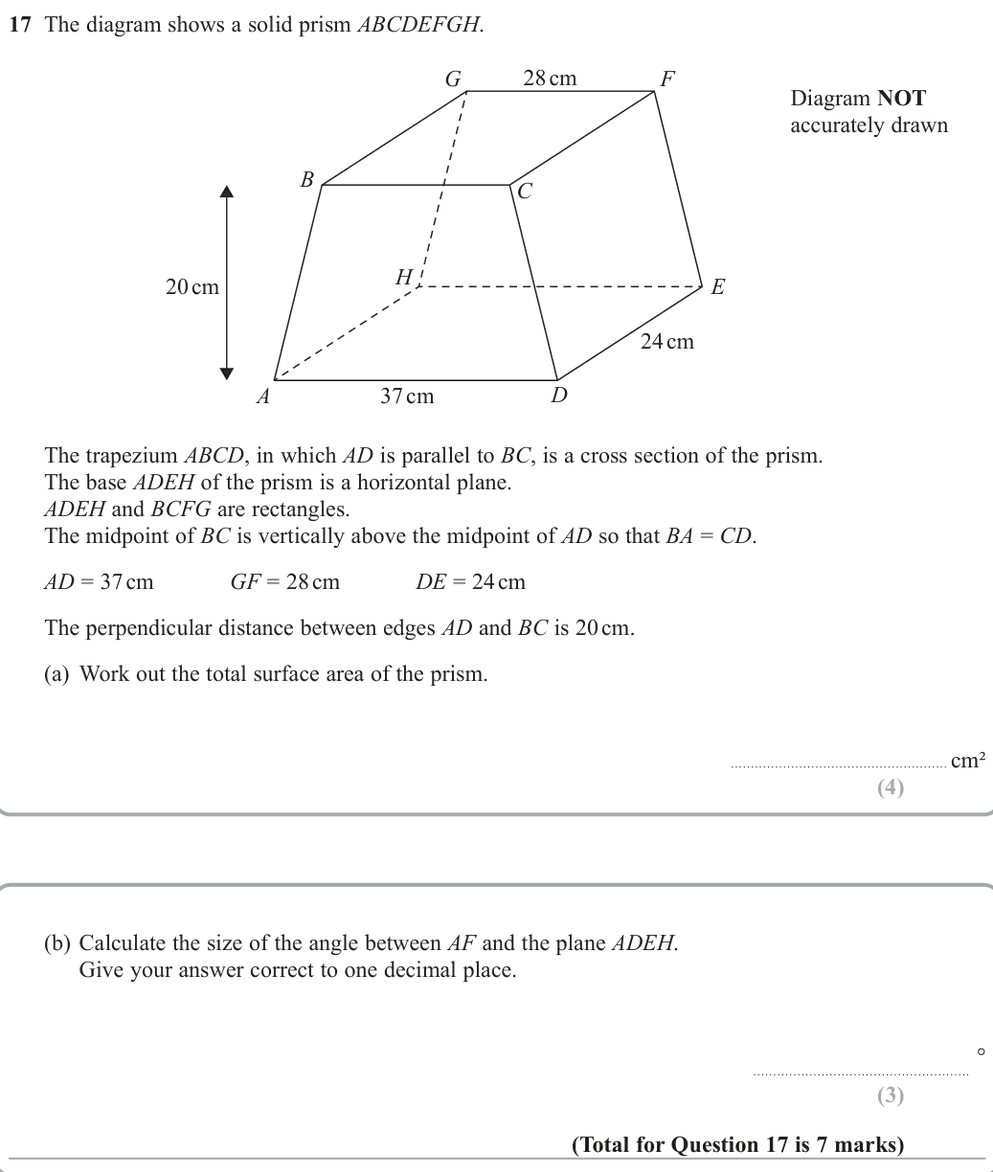
30. Jan 2021 P2H · Q17 Hard 7 marksShow worked solution The cross section is a The cross-section is a trapezium with parallel sides \(37\) cm and \(28\) cm, and perpendicular height \(20\) cm.
\[
\text{Area of cross-section}=\frac12(37+28)(20)=650
\]
Calculate area Since the trapezium is isosceles, the horizontal difference on each side is \[ \frac{37-28}{2}=4.5 \]
Calculate area So \[ AB=CD=\sqrt{20^2+4.5^2}=20.5 \]
The perimeter of the cross The perimeter of the cross-section is \[ 37+28+20.5+20.5=106 \]
The length of the prism The length of the prism is \(24\) cm, so the total surface area is \[ 2(650)+106(24)=3844 \]
Use trigonometry For the angle between \(AF\) and the horizontal plane, the horizontal projection has length \[ \sqrt{24^2+4.5^2} \]
Use trigonometry The vertical height is \(20\), so \[ \tan\theta=\frac{20}{\sqrt{24^2+4.5^2}} \]
\[
\theta=39.3^\circ
\]
Final answer \(3844\text{ cm}^2\), and \(39.3^\circ\).
More IGCSE Maths 4MA1 topics Dr Eslam Ahmed Elite Mathematics · Questions classified by topic, solutions checked by Dr Eslam
 Elite Mathematics