Elite Mathematics / Linear / Topics / Number Toolkit IGCSE · 4MA1 · Topic Number Toolkit: past paper questions & worked solutions
Every Number Toolkit question from the 4MA1 papers in our bank, 2022–2026, plus original Elite practice questions, sorted from easiest to hardest. Try each one first, then open the worked solution.
5 questions
14 marks in total
6% of papers (3 of 54) include it
1/4/0 easy / medium / hard
Questions, easiest first Level is estimated from marks: 1–2 easy, 3–4 medium, 5+ hard.
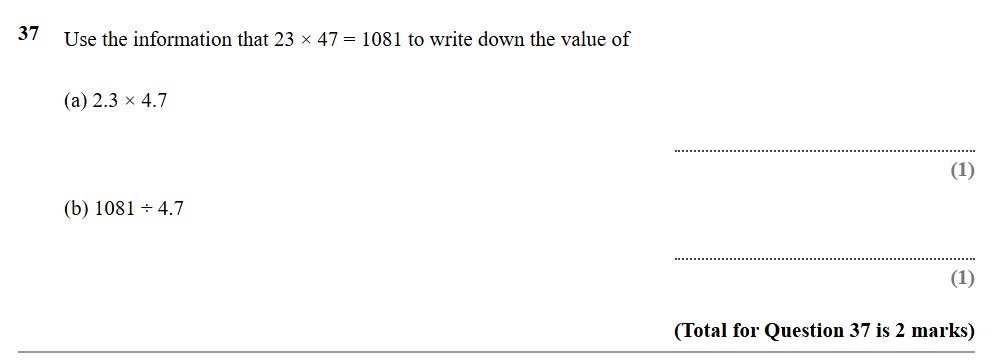
1. Elite Practice · Q37 Easy 2 marksShow worked solution (a) Each number is ten times smaller \(2.3\times4.7=1081\div100=10.81\)
(b) Reverse the multiplication \(1081\div47=23\), and \(4.7\) is ten times smaller than \(47\), so \(1081\div4.7=230\).
Final answer (a) \(10.81\) (b) \(230\)
2. Jun 2026 P2H · Q1 Medium 3 marksShow worked solution Solution | Step 1 \[4500=45\times100=(9\times5)(4\times25).\]
Split into factors that are easy to prime-factorise.
Solution | Step 2 \[4500=(3^2\times5)(2^2\times5^2)=2^2\times3^2\times5^3.\]
Express each factor as prime powers and combine powers of 5.
Final answer \(2^2\times3^2\times5^3\)
3. Jun 2026 P1HR · Q2 Medium 3 marksShow worked solution Solution | Step 1 \[504=2\times252=2^2\times126=2^3\times63.\]
Divide repeatedly by the prime 2.
Solution | Step 2 \[63=3\times21=3^2\times7,\qquad 504=2^3\times3^2\times7.\]
All remaining factors are prime; group repeated factors as powers.
Final answer \(504=2^3\times3^2\times7\)
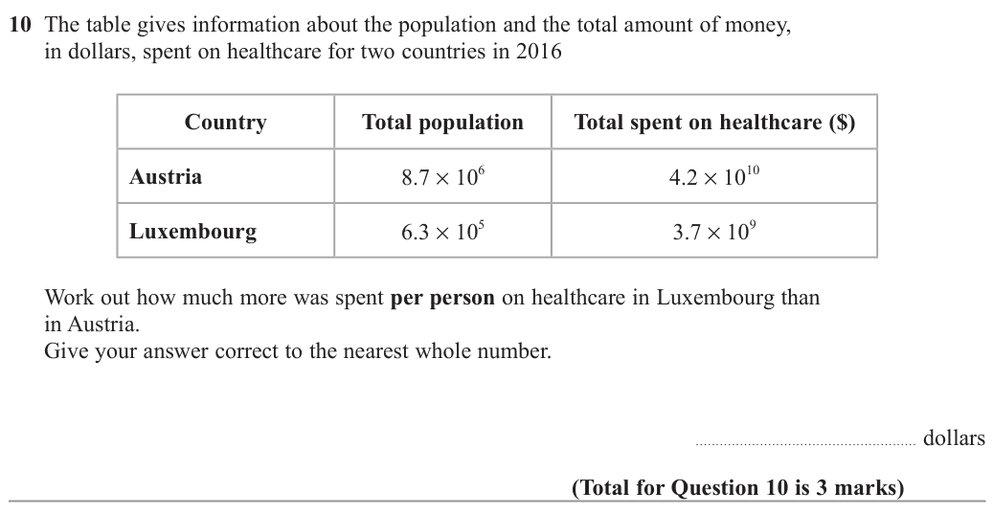
4. Jan 2022 P2HR · Q10 Medium 3 marksShow worked solution Austria spending per person Austria spending per person:
\[
\frac{4.2\times 10^{10}}{8.7\times 10^6}
=4827.586\ldots
\]
Luxembourg spending per person Luxembourg spending per person:
\[
\frac{3.7\times 10^9}{6.3\times 10^5}
=5873.015\ldots
\]
Difference Difference:
\[
5873.015\ldots-4827.586\ldots=1045.429\ldots
\]
Convert standard form To the nearest whole number, this is
\[
1045
\]
Final answer \(1045\) dollars
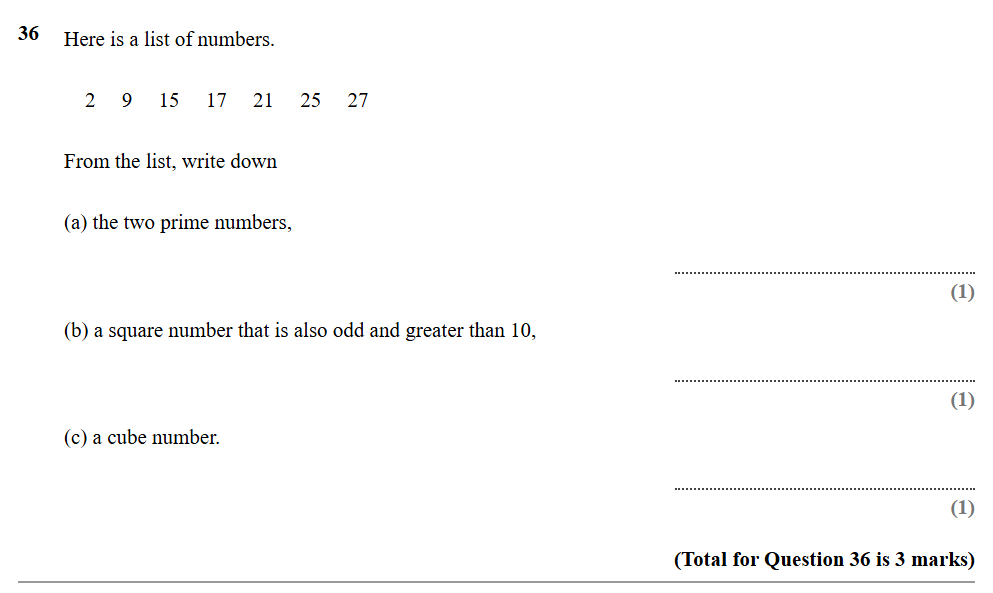
5. Elite Practice · Q36 Medium 3 marksShow worked solution (a) Exactly two factors \(2\) and \(17\) are prime (\(15=3\times5\), \(21=3\times7\)).
(b) Square numbers in the list \(9=3^2\) and \(25=5^2\); the odd one greater than \(10\) is \(25\).
(c) Cube numbers \(27=3^3\)
Final answer (a) \(2, 17\) (b) \(25\) (c) \(27\)
More IGCSE Maths 4MA1 topics Dr Eslam Ahmed Elite Mathematics · Questions classified by topic, solutions checked by Dr Eslam
 Elite Mathematics