Elite Mathematics / Linear / Topics / Vectors IGCSE · 4MA1 · Topic Vectors: past paper questions & worked solutions
Every Vectors question from the 4MA1 papers in our bank, 2020–2026, sorted from easiest to hardest. Try each one first, then open the worked solution.
28 questions
135 marks in total
52% of papers (28 of 54) include it
2/5/21 easy / medium / hard
Questions, easiest first Level is estimated from marks: 1–2 easy, 3–4 medium, 5+ hard.
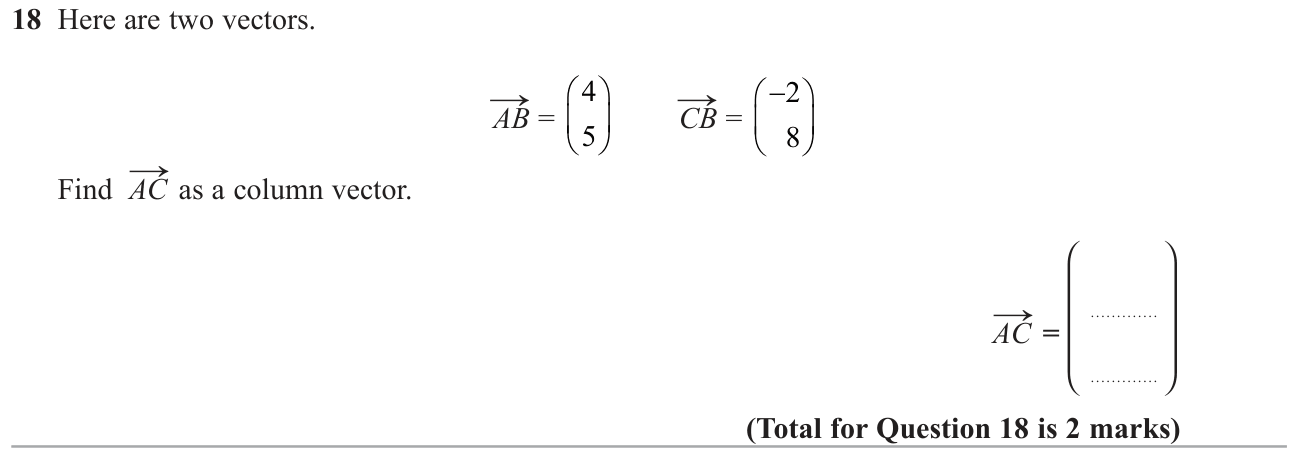
1. Jun 2026 P2HR · Q18 Easy 2 marksShow worked solution Solution | Step 1 \[\overrightarrow{AC}=\overrightarrow{AB}+\overrightarrow{BC}=\overrightarrow{AB}-\overrightarrow{CB}.\]
Reverse CB to travel from B to C.
Solution | Step 2 \[\overrightarrow{AC}=\begin{pmatrix}4\\5\end{pmatrix}-\begin{pmatrix}-2\\8\end{pmatrix}=\begin{pmatrix}6\\-3\end{pmatrix}.\]
Subtract corresponding components.
Final answer \(\overrightarrow{AC}=\begin{pmatrix}6\\-3\end{pmatrix}\).
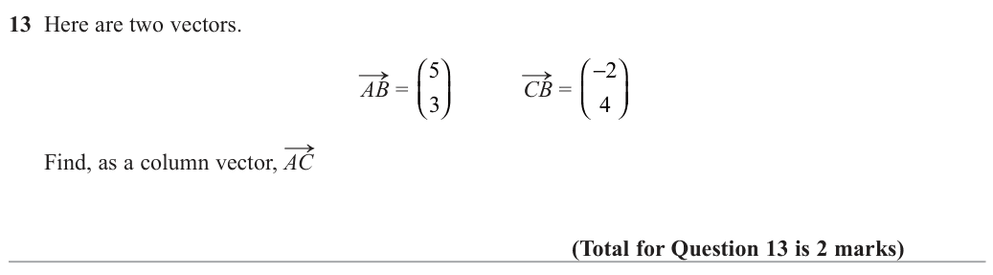
2. Jan 2021 P1HR · Q13 Easy 2 marksShow worked solution Use vectors \[
\overrightarrow{AB}=\begin{pmatrix}5\\3\end{pmatrix}
\]
Use vectors and
\[
\overrightarrow{CB}=\begin{pmatrix}-2\\4\end{pmatrix}
\]
Use vectors So
\[
\overrightarrow{BC}=-\overrightarrow{CB}
=\begin{pmatrix}2\\-4\end{pmatrix}
\]
\[
\overrightarrow{AC}
=\overrightarrow{AB}+\overrightarrow{BC}
=\begin{pmatrix}5\\3\end{pmatrix}
+\begin{pmatrix}2\\-4\end{pmatrix}
=\begin{pmatrix}7\\-1\end{pmatrix}
\]
Final answer \(\begin{pmatrix}7\\-1\end{pmatrix}\).
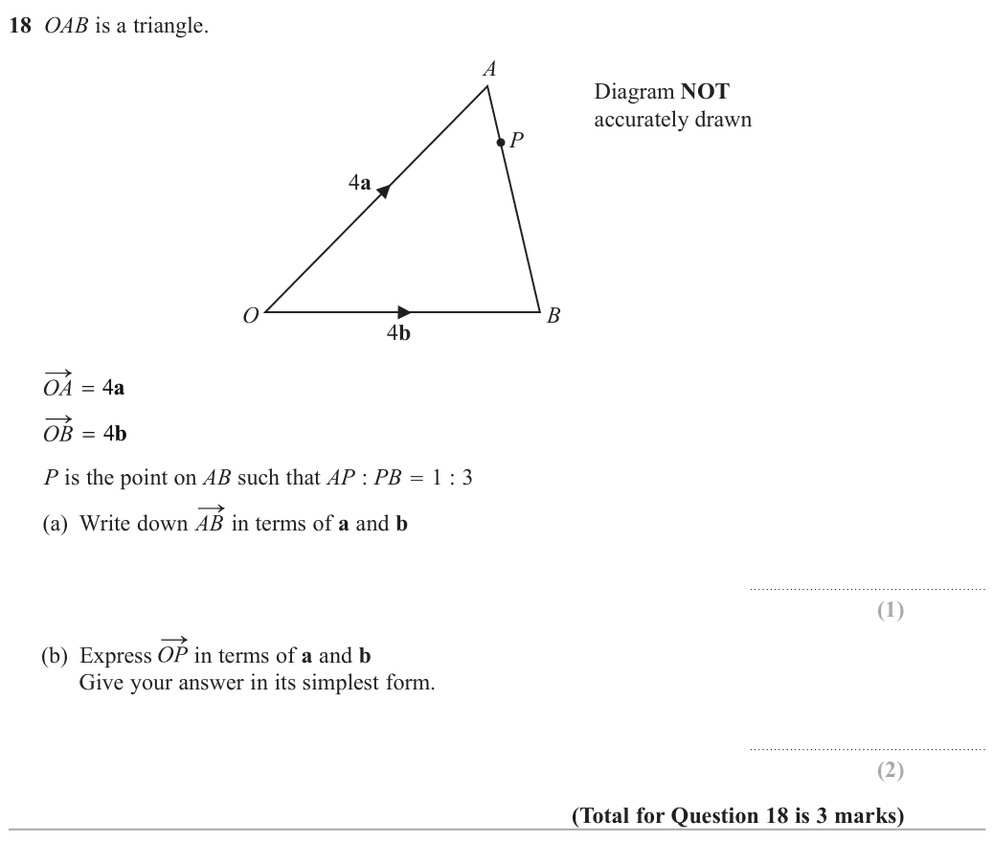
3. Jun 2025 P2HR · Q18 Medium 3 marksShow worked solution Use vectors \[
\overrightarrow{AB}=\overrightarrow{OB}-\overrightarrow{OA}=4\mathbf b-4\mathbf a
\]
Use vectors Since \(AP:PB=1:3\), point \(P\) is one quarter of the way from \(A\) to \(B\).
\[
\overrightarrow{AP}=\frac14\overrightarrow{AB}
=\frac14(4\mathbf b-4\mathbf a)
=\mathbf b-\mathbf a
\]
\[
\overrightarrow{OP}=\overrightarrow{OA}+\overrightarrow{AP}
=4\mathbf a+\mathbf b-\mathbf a
=3\mathbf a+\mathbf b
\]
Final answer \(\overrightarrow{AB}=4\mathbf b-4\mathbf a\), and \(\overrightarrow{OP}=3\mathbf a+\mathbf b\).
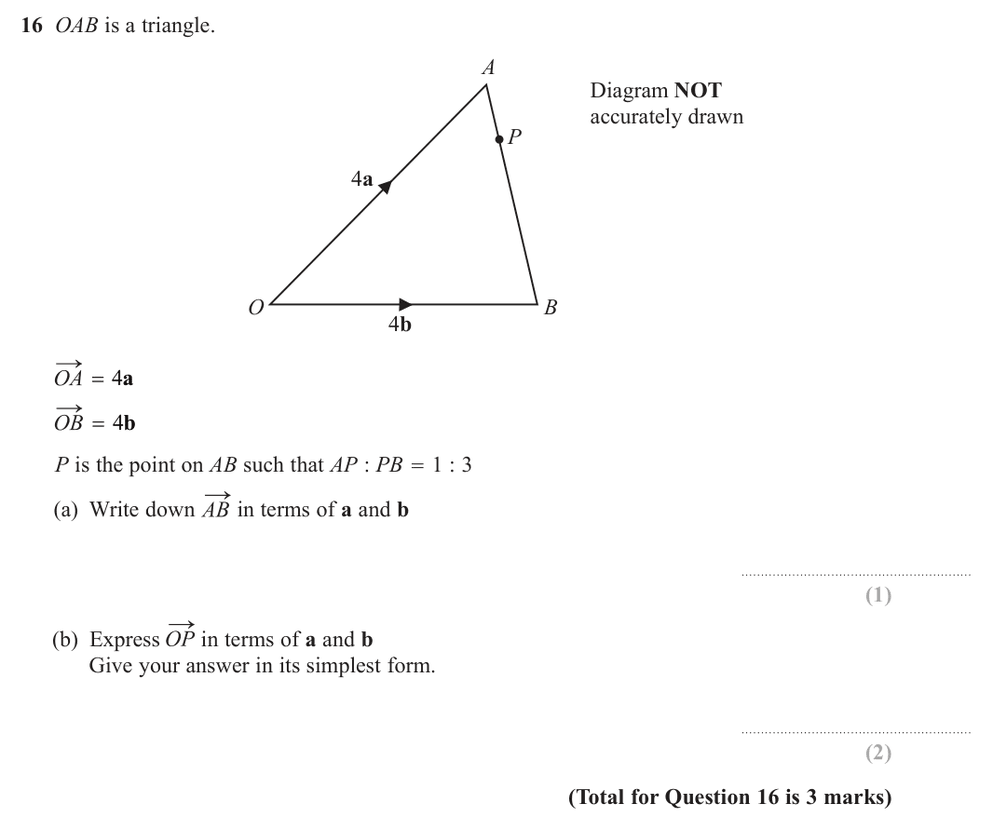
4. May 2025 4WM2HR · Q16 Medium 3 marksShow worked solution Required $\\overrightarrow{OA}=4\\mathbf{a}$, $\\overrightarrow{OB}=4\\mathbf{b}$, AP:PB = 1:3. (a) Find $\\overrightarrow{AB}$. (b) Express $\\overrightarrow{OP}$ in simplest form.
Part (a) $$\\overrightarrow{AB} = \\overrightarrow{AO}+\\overrightarrow{OB} = -4\\mathbf{a}+4\\mathbf{b}$$
Answer $\\overrightarrow{AB} = 4\\mathbf{b}-4\\mathbf{a}$
AP PB 1 3 means AP:PB = 1:3 means $\\overrightarrow{AP} = \\tfrac{1}{4}\\overrightarrow{AB}$: $$\\overrightarrow{AP} = \\tfrac{1}{4}(4\\mathbf{b}-4\\mathbf{a}) = \\mathbf{b}-\\mathbf{a}$$
Use Use $\\overrightarrow{OP} = \\overrightarrow{OA}+\\overrightarrow{AP}$: $$\\overrightarrow{OP} = 4\\mathbf{a}+(\\mathbf{b}-\\mathbf{a}) = 3\\mathbf{a}+\\mathbf{b}$$
Final answer $\\overrightarrow{OP} = 3\\mathbf{a}+\\mathbf{b}$
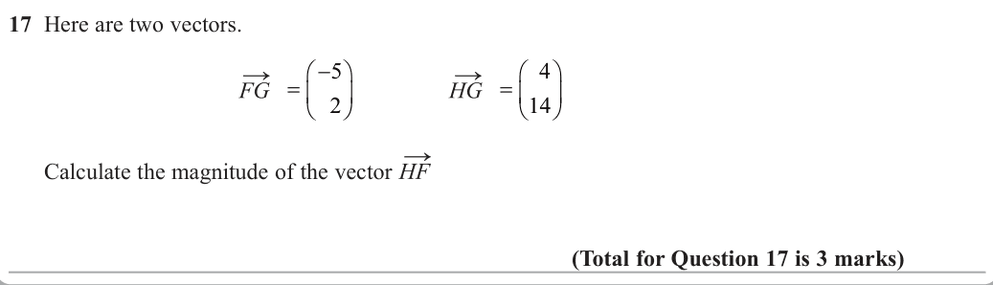
5. Nov 2024 P2H · Q17 Medium 3 marksShow worked solution Use vectors \[
\overrightarrow{GF}=-\overrightarrow{FG}
=\begin{pmatrix}5\\-2\end{pmatrix}
\]
\[
\overrightarrow{HF}
=\overrightarrow{HG}+\overrightarrow{GF}
=\begin{pmatrix}4\\14\end{pmatrix}
+\begin{pmatrix}5\\-2\end{pmatrix}
=\begin{pmatrix}9\\12\end{pmatrix}
\]
Magnitude Magnitude:
\[
|\overrightarrow{HF}|=\sqrt{9^2+12^2}=15
\]
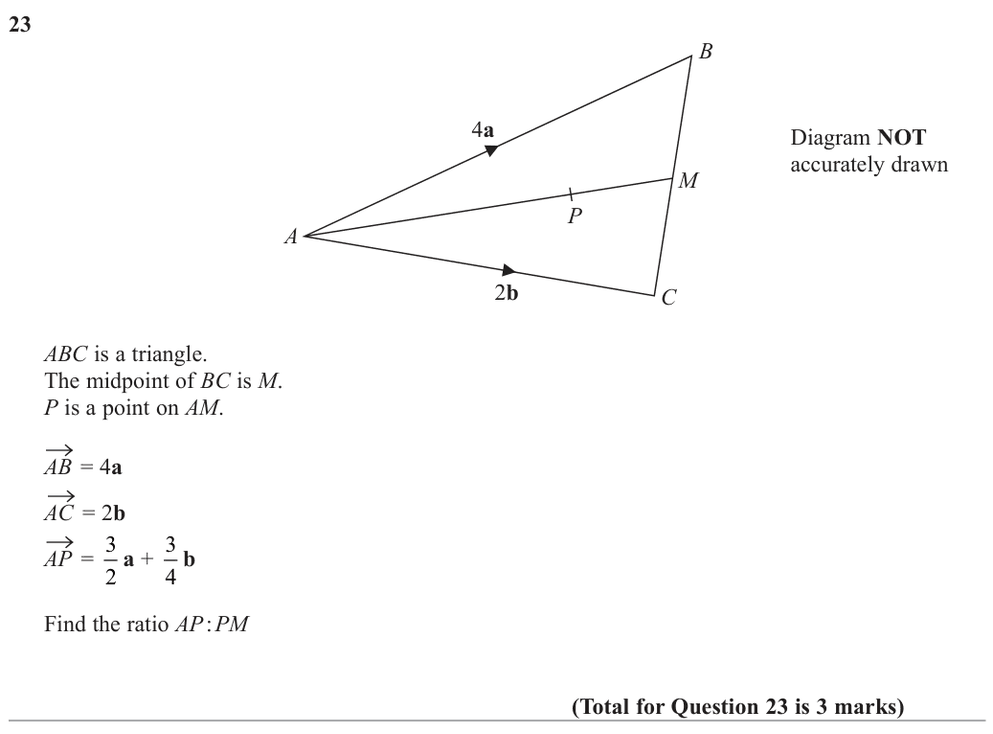
6. Jan 2020 P2H · Q23 Medium 3 marksShow worked solution Split the ratio Since \(M\) is the midpoint of \(BC\),
\[
\overrightarrow{AM}=\frac{\overrightarrow{AB}+\overrightarrow{AC}}{2}
\]
\[
\overrightarrow{AM}=\frac{4a+2b}{2}=2a+b
\]
Given \[
\overrightarrow{AP}=\frac32a+\frac34b
\]
Factorise Factorise:
\[
\overrightarrow{AP}=\frac34(2a+b)=\frac34\overrightarrow{AM}
\]
Split the ratio So \(AP\) is \(\frac34\) of \(AM\), leaving \(PM\) as \(\frac14\) of \(AM\).
Final answer \(AP:PM=3:1\)
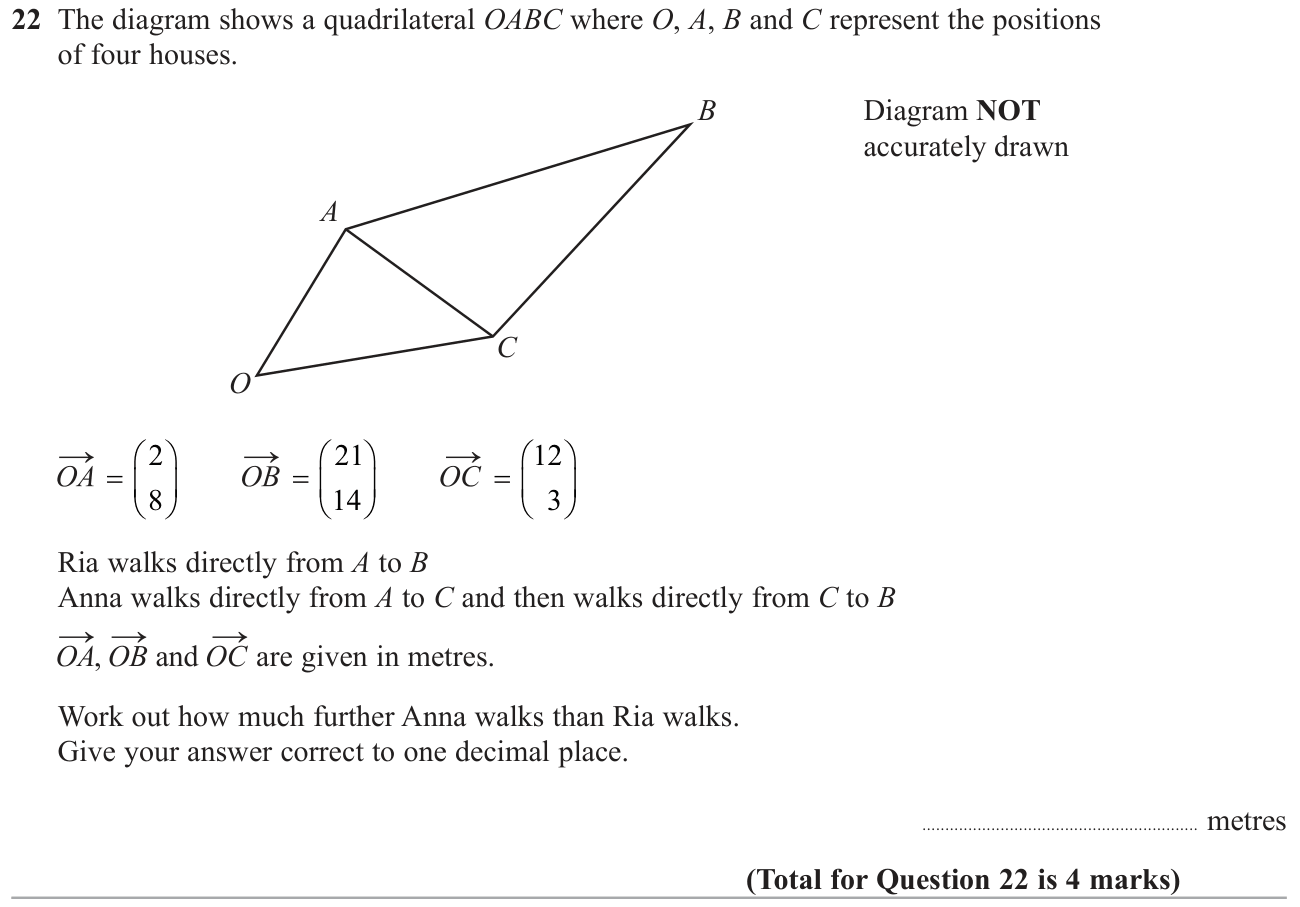
7. Jun 2026 P2H · Q22 Medium 4 marksShow worked solution Solution | Step 1 \[\overrightarrow{AB}=\binom{21}{14}-\binom{2}{8}=\binom{19}{6},\quad \overrightarrow{AC}=\binom{12}{3}-\binom{2}{8}=\binom{10}{-5},\]
\[\overrightarrow{CB}=\binom{21}{14}-\binom{12}{3}=\binom{9}{11}.\]
Subtract the starting position vector from the finishing position vector.
Solution | Step 2 \[AB=\sqrt{19^2+6^2}=\sqrt{397},\quad AC=\sqrt{10^2+(-5)^2}=\sqrt{125},\quad CB=\sqrt{9^2+11^2}=\sqrt{202}.\]
The modulus of a two-dimensional vector is the square root of the sum of squares of its components.
Solution | Step 3 \[\text{Extra distance}=AC+CB-AB=\sqrt{125}+\sqrt{202}-\sqrt{397}=5.468151\ldots\text{ m}.\]
Compare Anna's two-stage route with Ria's direct route; do not round the intermediate lengths.
Final answer Anna walks \(5.5\text{ m}\) further (1 decimal place).
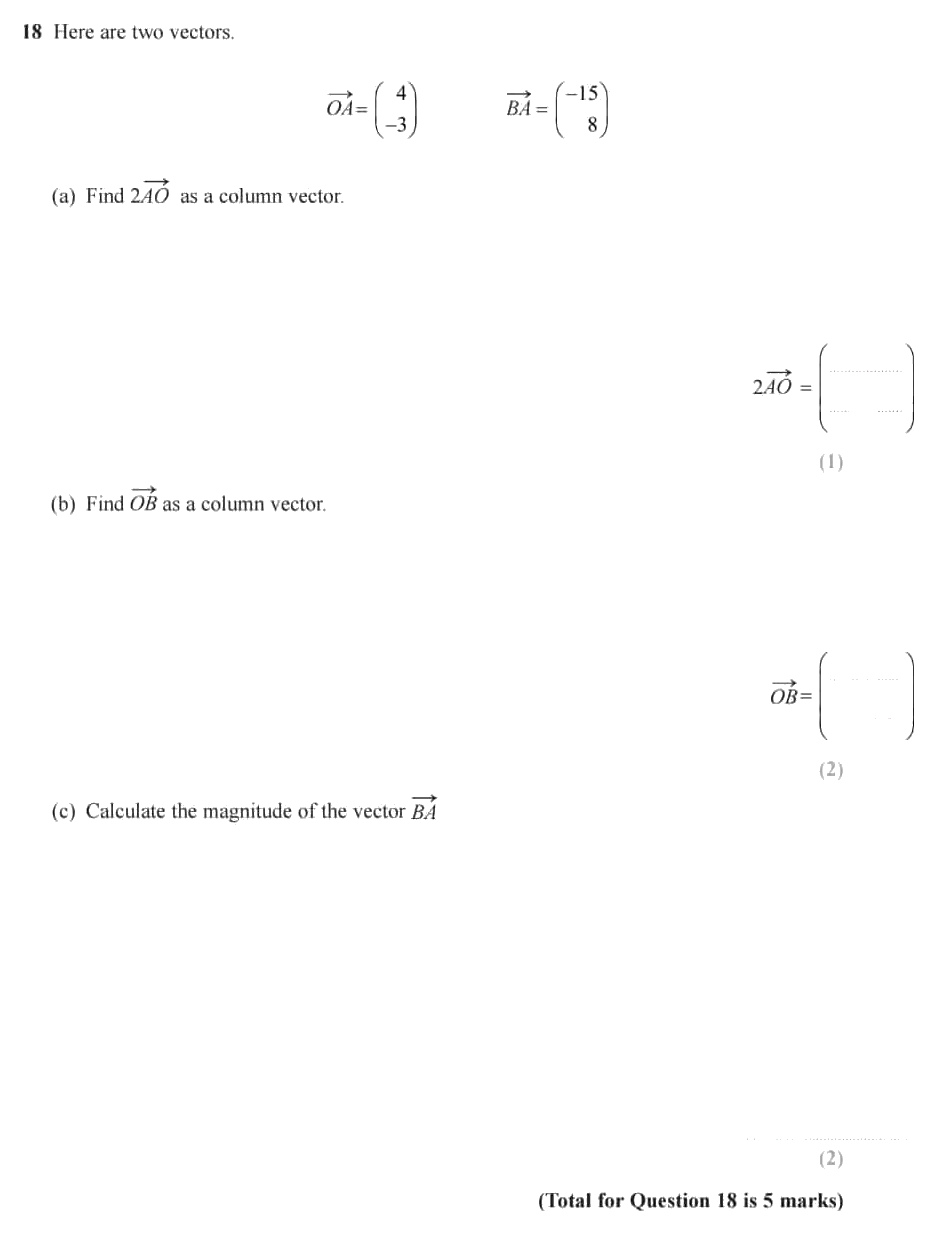
8. Jun 2026 4WM2HR · Q18 Hard 5 marksShow worked solution (a) Reverse OA and double \[\overrightarrow{AO}=\begin{pmatrix}-4\\3\end{pmatrix},\qquad 2\overrightarrow{AO}=\begin{pmatrix}-8\\6\end{pmatrix}\]
(b) Route O → A → B \[\overrightarrow{OB}=\overrightarrow{OA}+\overrightarrow{AB}=\begin{pmatrix}4\\-3\end{pmatrix}+\begin{pmatrix}15\\-8\end{pmatrix}=\begin{pmatrix}19\\-11\end{pmatrix}\]
(c) Magnitude \[|\overrightarrow{BA}|=\sqrt{(-15)^2+8^2}=\sqrt{289}=17\]
Final answer (a) \(\begin{pmatrix}-8\\6\end{pmatrix}\) (b) \(\begin{pmatrix}19\\-11\end{pmatrix}\) (c) \(17\)
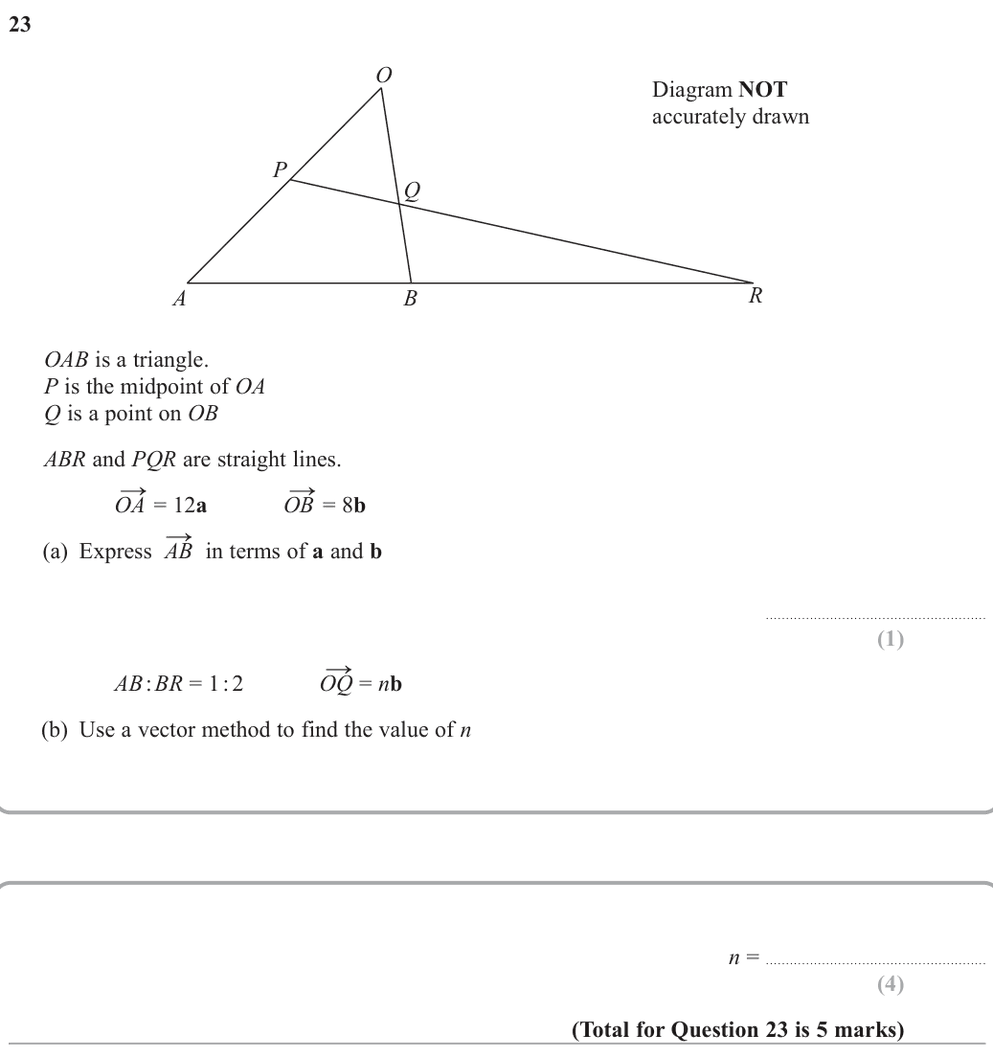
9. Jun 2025 P1H · Q23 Hard 5 marksShow worked solution Use vectors For part (a),
\[
\vec{OA}=12\mathbf a,\qquad \vec{OB}=8\mathbf b
\]
\[
\vec{AB}=\vec{OB}-\vec{OA}
\]
\[
\vec{AB}=8\mathbf b-12\mathbf a
\]
Find the midpoint For part (b), \(P\) is the midpoint of \(OA\), so
\[
\vec{OP}=6\mathbf a
\]
Given \[
AB:BR=1:2
\]
\[
\vec{BR}=2\vec{AB}
\]
\[
\vec{BR}=16\mathbf b-24\mathbf a
\]
Use vectors Therefore
\[
\vec{OR}=\vec{OB}+\vec{BR}
\]
\[
\vec{OR}=8\mathbf b+16\mathbf b-24\mathbf a
\]
\[
\vec{OR}=-24\mathbf a+24\mathbf b
\]
Use vectors Since \(P,Q,R\) are collinear, write \(Q\) on \(PR\):
\[
\vec{OQ}=\vec{OP}+t(\vec{OR}-\vec{OP})
\]
\[
\vec{OQ}=6\mathbf a+t(-30\mathbf a+24\mathbf b)
\]
\[
\vec{OQ}=(6-30t)\mathbf a+24t\mathbf b
\]
Use vectors But \(Q\) lies on \(OB\), so there is no \(\mathbf a\) component:
\[
6-30t=0
\]
\[
t=\frac15
\]
Use vectors Then
\[
\vec{OQ}=24\left(\frac15\right)\mathbf b
\]
\[
\vec{OQ}=\frac{24}{5}\mathbf b
\]
Use vectors Since \(\vec{OQ}=n\mathbf b\),
\[
n=\frac{24}{5}
\]
Final answer \(\vec{AB}=8\mathbf b-12\mathbf a,\quad n=\frac{24}{5}\)
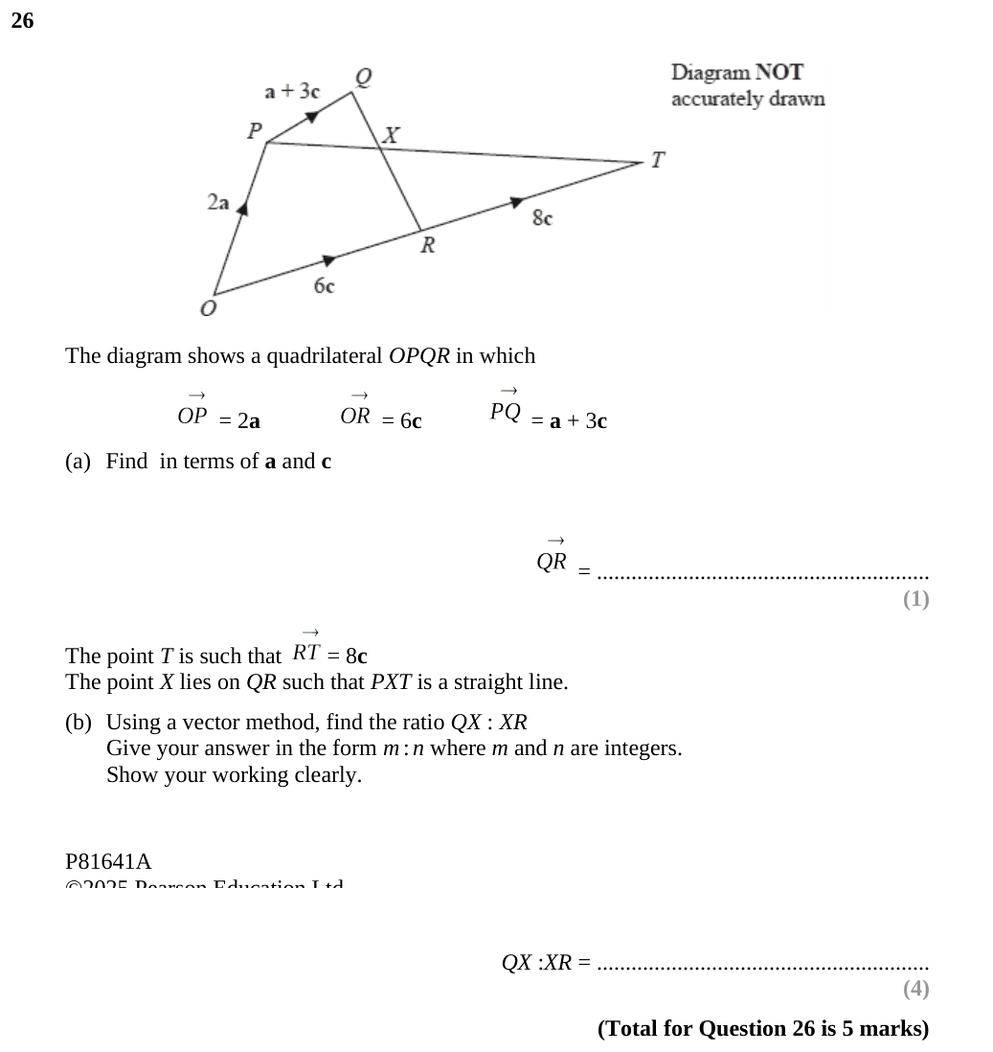
10. May 2025 4WM2H · Q26 Hard 5 marksShow worked solution (a) \[
\overrightarrow{QR}=\overrightarrow{OR}-\overrightarrow{OQ}
\]
\[
\overrightarrow{OQ}=2a+(a+3c)=3a+3c
\]
\[
\overrightarrow{QR}=6c-(3a+3c)=3c-3a
\]
(b) Let divide so that (b) Let \(X\) divide \(QR\) so that
\[
\overrightarrow{QX}=\lambda\overrightarrow{QR}
\]
Calculate value Then
\[
\overrightarrow{OX}=3a+3c+\lambda(3c-3a)
\]
Calculate value Also \(X\) lies on \(PT\), where \(\overrightarrow{OT}=14c\), so
\[
\overrightarrow{OX}=2a+\mu(14c-2a)
\]
Equating coefficients gives . Therefore Equating coefficients gives \(\lambda=\frac59\). Therefore
\[
QX:XR=\frac59:\frac49=5:4
\]
Final answer \(\overrightarrow{QR}=3c-3a\); \(QX:XR=5:4\).
11. Nov 2023 P2H · Q22 Hard 5 marksShow worked solution Split the ratio \[
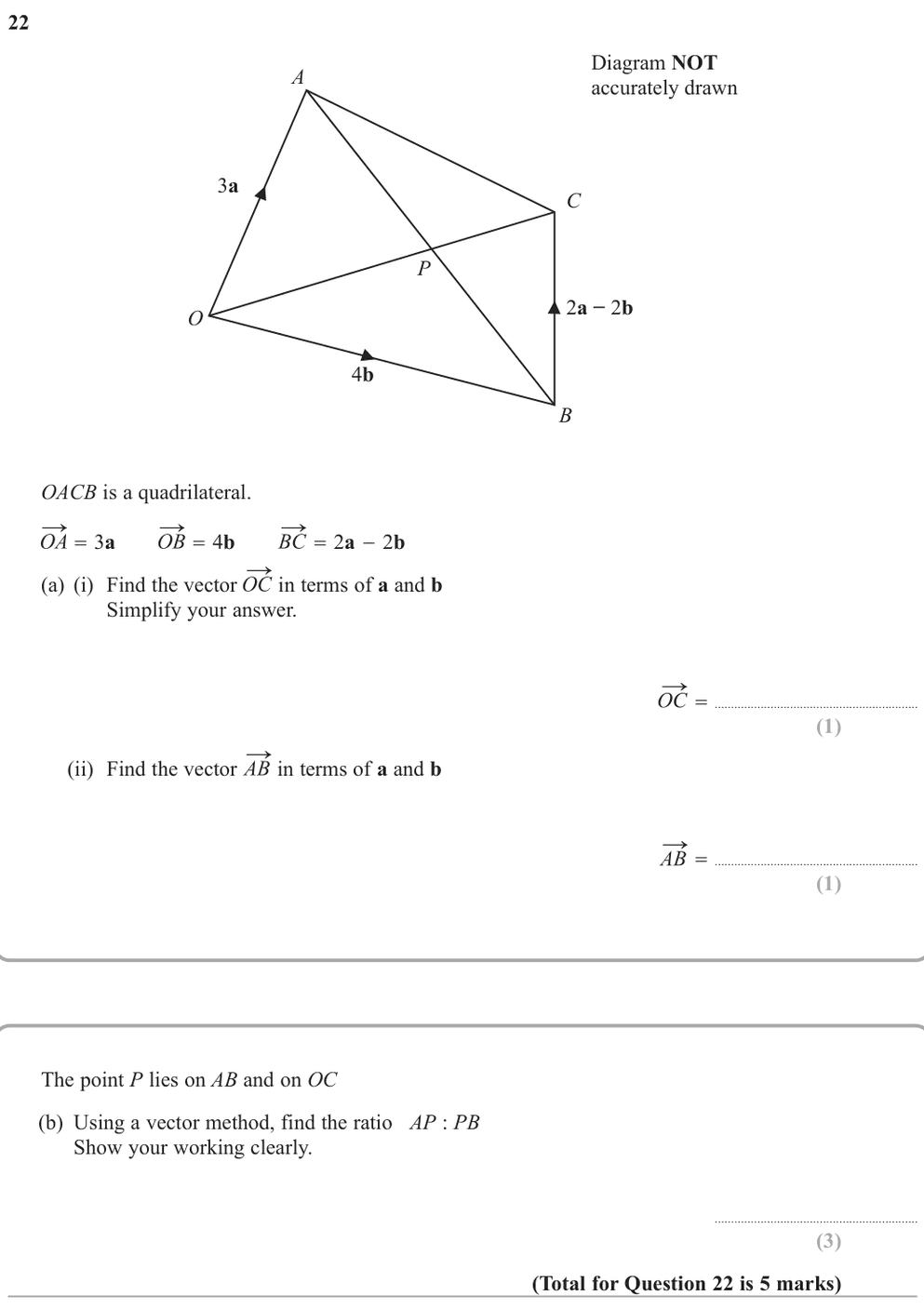
\overrightarrow{OA}=3a,\quad \overrightarrow{OB}=4b,\quad \overrightarrow{BC}=2a-2b
\]
Part (a) Part (a):
\[
\overrightarrow{OC}=\overrightarrow{OB}+\overrightarrow{BC}
=4b+(2a-2b)=2a+2b
\]
\[
\overrightarrow{AB}=\overrightarrow{OB}-\overrightarrow{OA}
=4b-3a
\]
Split the ratio For part (b), let \(P\) divide \(AB\) so that
\[
\overrightarrow{AP}=\mu\overrightarrow{AB}
\]
Split the ratio Then
\[
\overrightarrow{OP}=3a+\mu(4b-3a)=(3-3\mu)a+4\mu b
\]
Split the ratio Since \(P\) lies on \(OC\), also let
\[
\overrightarrow{OP}=\lambda(2a+2b)
\]
Equating coefficients Equating coefficients:
\[
3-3\mu=2\lambda,\quad 4\mu=2\lambda
\]
Split the ratio From \(4\mu=2\lambda\), \(\lambda=2\mu\).
\[
3-3\mu=4\mu
\]
\[
\mu=\frac37
\]
Split the ratio So \(AP:PB=\frac37:\frac47\).
Final answer \(\overrightarrow{OC}=2a+2b\), \(\overrightarrow{AB}=4b-3a\), and \(AP:PB=3:4\)
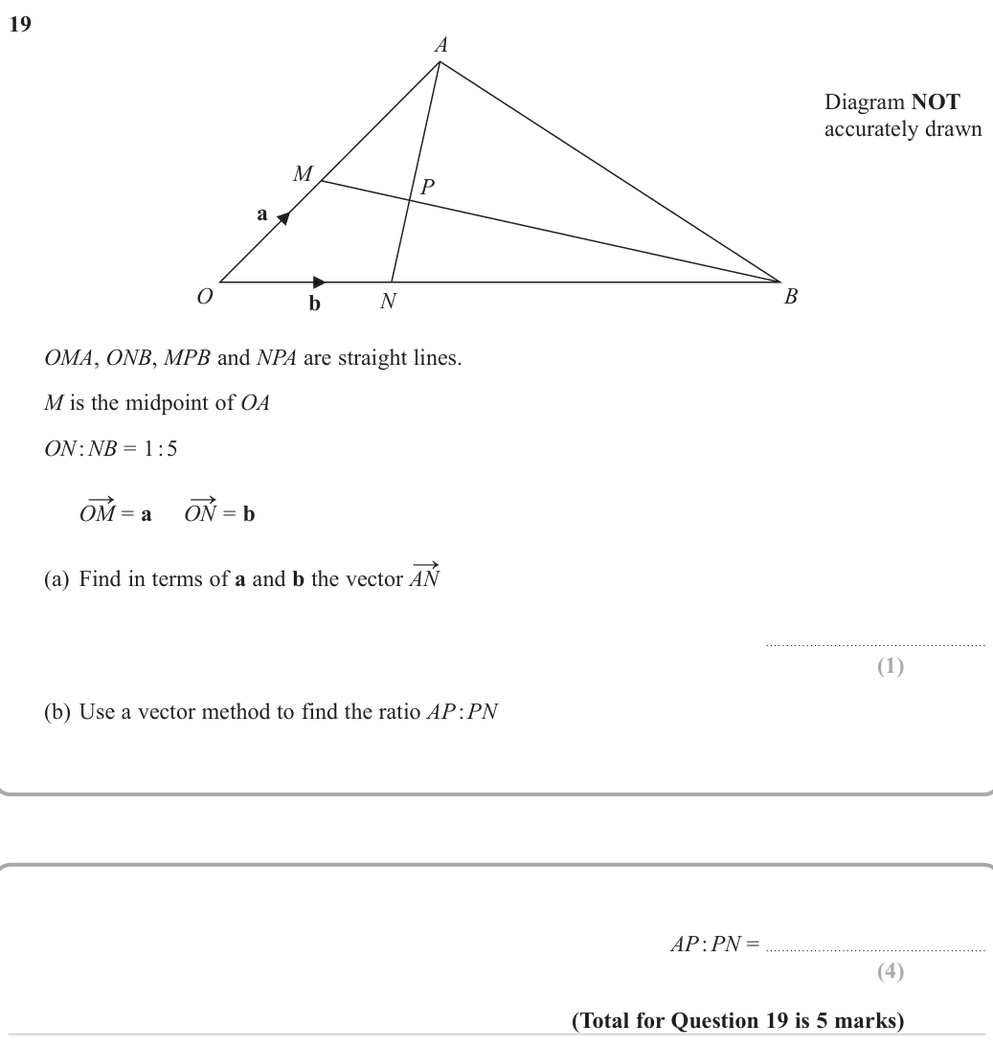
12. May 2023 P1H · Q19 Hard 5 marksShow worked solution Split the ratio Since \(M\) is the midpoint of \(OA\),
\[
\overrightarrow{OA}=2a
\]
Split the ratio Also,
\[
\overrightarrow{ON}=b
\]
Split the ratio So
\[
\overrightarrow{AN}=\overrightarrow{ON}-\overrightarrow{OA}=b-2a
\]
Let \[
\overrightarrow{AP}=\lambda\overrightarrow{AN}
\]
Split the ratio Then
\[
\overrightarrow{OP}=2a+\lambda(b-2a)=(2-2\lambda)a+\lambda b
\]
Split the ratio Since \(ON:NB=1:5\),
\[
\overrightarrow{OB}=6b
\]
Split the ratio Point \(P\) is also on \(MB\), so
\[
\overrightarrow{OP}=a+\mu(6b-a)=(1-\mu)a+6\mu b
\]
Compare coefficients Compare coefficients:
\[
2-2\lambda=1-\mu
\]
\[
\lambda=6\mu
\]
Split the ratio From \(\mu=2\lambda-1\),
\[
\lambda=6(2\lambda-1)
\]
\[
11\lambda=6
\]
\[
\lambda=\frac6{11}
\]
Split the ratio So
\[
AP:PN=\frac6{11}:\frac5{11}=6:5
\]
Final answer (a) \(b-2a\), (b) \(6:5\)
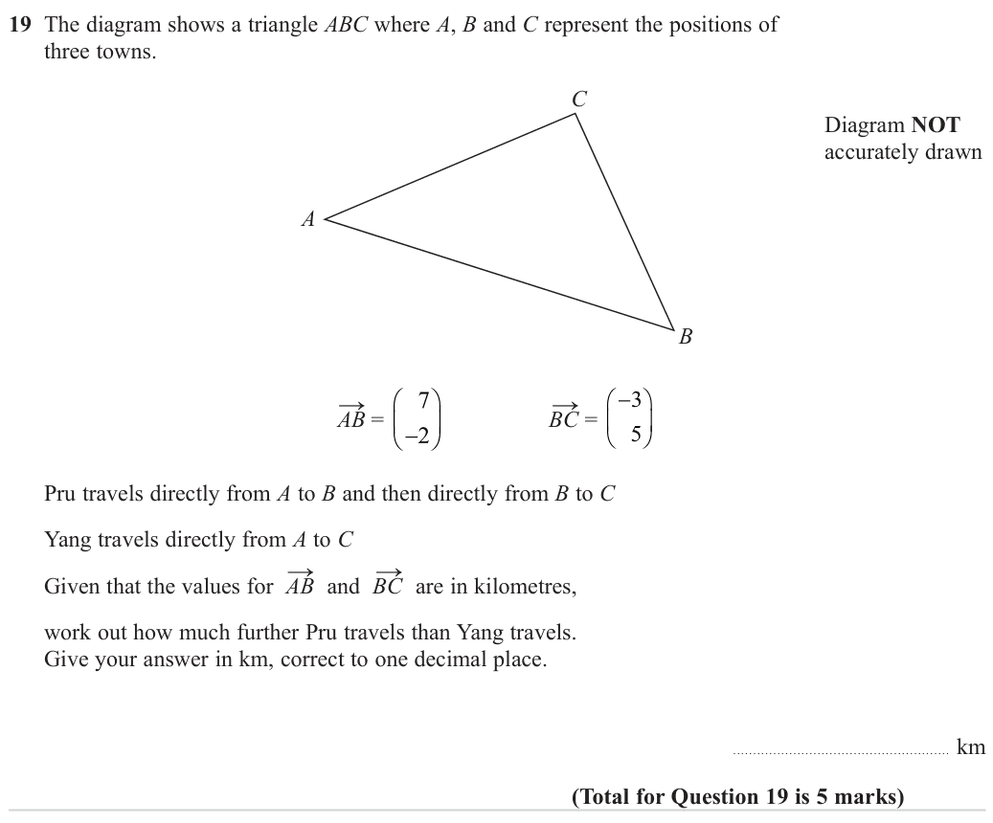
13. May 2023 P1HR · Q19 Hard 5 marksShow worked solution Pru travels \[
|AB|+|BC|=\sqrt{7^2+(-2)^2}+\sqrt{(-3)^2+5^2}
\]
\[
=\sqrt{53}+\sqrt{34}=13.111\ldots
\]
Simplify surd Yang travels from \(A\) to \(C\).
\[
\overrightarrow{AC}=\overrightarrow{AB}+\overrightarrow{BC}
=\begin{pmatrix}7\\-2\end{pmatrix}+\begin{pmatrix}-3\\5\end{pmatrix}
=\begin{pmatrix}4\\3\end{pmatrix}
\]
\[
|AC|=\sqrt{4^2+3^2}=5
\]
Difference Difference: \[ 13.111\ldots-5=8.111\ldots \]
Final answer Pru travels \(8.1\text{ km}\) further.
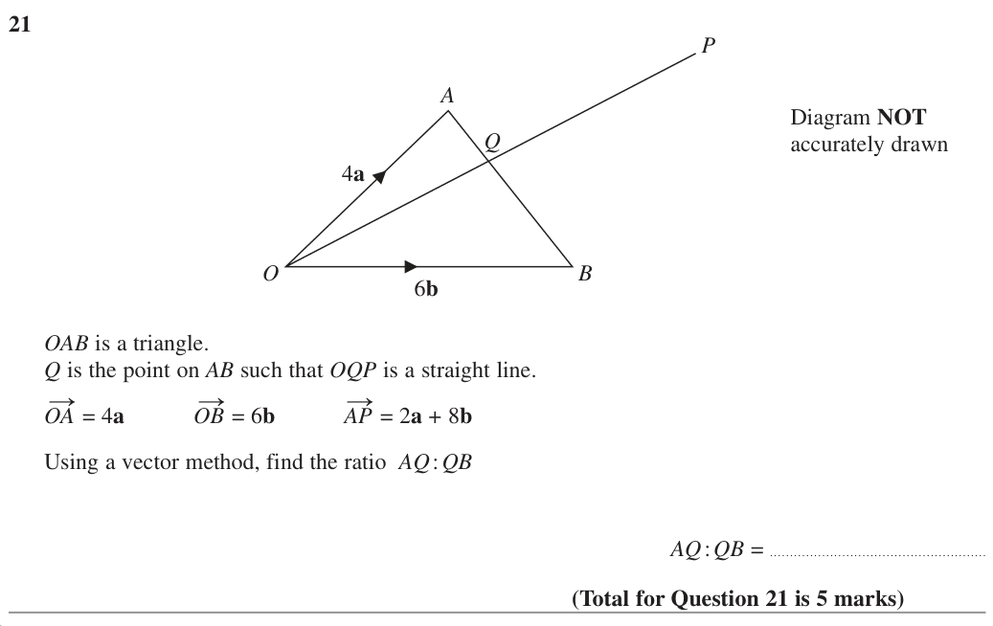
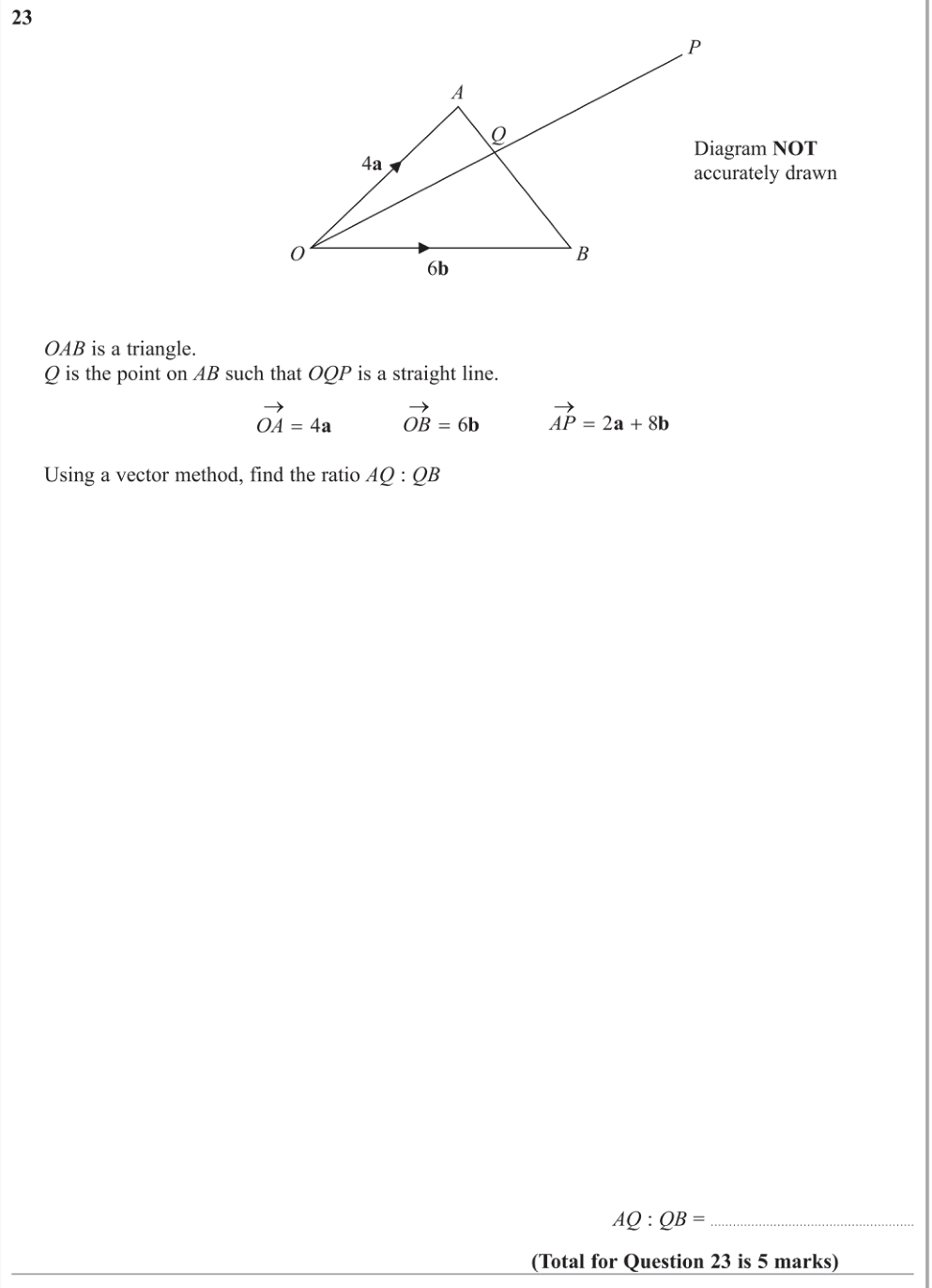
14. Jun 2022 P2H · Q21 Hard 5 marksShow worked solution Split the ratio \[
\overrightarrow{OA}=4a,\quad \overrightarrow{OB}=6b,\quad \overrightarrow{AP}=2a+8b
\]
Split the ratio So
\[
\overrightarrow{OP}=\overrightarrow{OA}+\overrightarrow{AP}
=4a+(2a+8b)=6a+8b
\]
Split the ratio Since \(Q\) lies on \(OP\), let
\[
\overrightarrow{OQ}=\lambda(6a+8b)
\]
Split the ratio Since \(Q\) lies on \(AB\), let
\[
\overrightarrow{OQ}=\overrightarrow{OA}+\mu\overrightarrow{AB}
\]
\[
\overrightarrow{AB}=6b-4a
\]
Split the ratio So
\[
\overrightarrow{OQ}=4a+\mu(6b-4a)=(4-4\mu)a+6\mu b
\]
Equating coefficients Equating coefficients:
\[
6\lambda=4-4\mu,\quad 8\lambda=6\mu
\]
Split the ratio From \(8\lambda=6\mu\), \(\mu=\frac43\lambda\).
\[
6\lambda=4-\frac{16}{3}\lambda
\]
\[
34\lambda=12,\quad \lambda=\frac6{17}
\]
\[
\mu=\frac{8}{17}
\]
Split the ratio So \(AQ:QB=\frac8{17}:\frac9{17}\).
Final answer \(AQ:QB=8:9\)
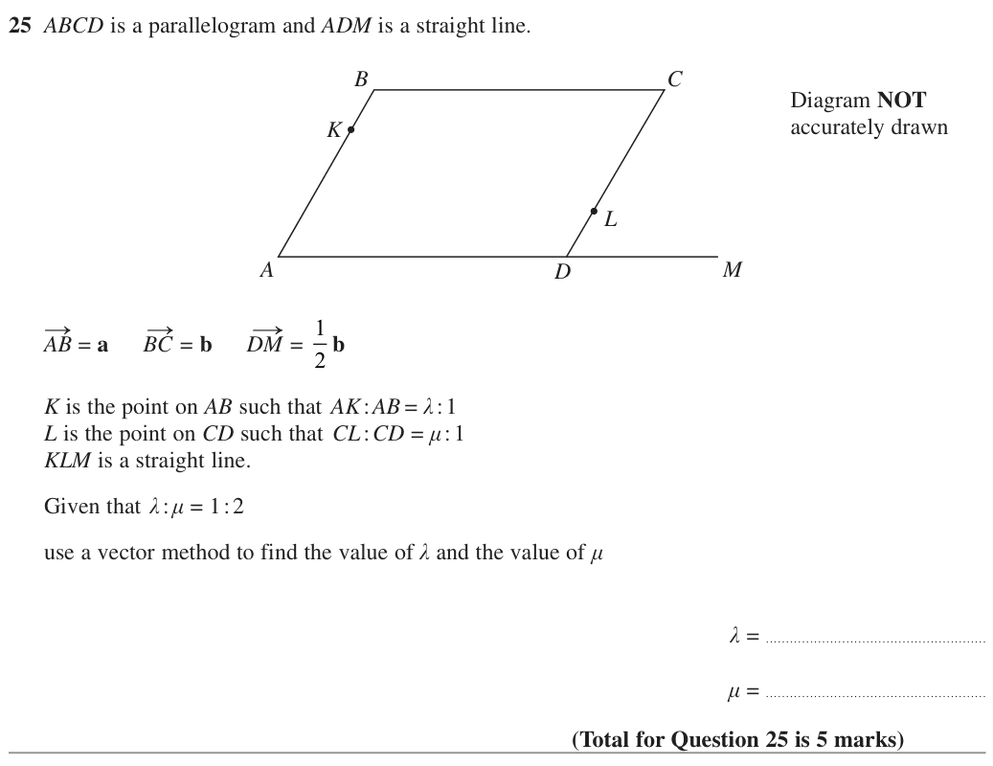
15. Jun 2022 P2HR · Q25 Hard 5 marksShow worked solution Let be the origin Let \(A\) be the origin.
\[
\vec{AB}=\mathbf a,\qquad \vec{BC}=\mathbf b
\]
Read the graph So
\[
B=\mathbf a,\qquad D=\mathbf b,\qquad C=\mathbf a+\mathbf b
\]
Read the graph Also
\[
\vec{DM}=\frac12\mathbf b
\]
Read the graph So
\[
M=\frac32\mathbf b
\]
Point is on Point \(K\) is on \(AB\):
\[
K=\lambda\mathbf a
\]
Read the graph Point \(L\) is on \(CD\), and \(\vec{CD}=-\mathbf a\):
\[
L=C+\mu(D-C)
\]
\[
L=\mathbf a+\mathbf b+\mu(-\mathbf a)
\]
\[
L=(1-\mu)\mathbf a+\mathbf b
\]
Given \[
\lambda:\mu=1:2
\]
\[
\mu=2\lambda
\]
Read the graph Since \(K,L,M\) are collinear, \(\vec{KM}\) is a multiple of \(\vec{KL}\).
\[
\vec{KM}=-\lambda\mathbf a+\frac32\mathbf b
\]
\[
\vec{KL}=(1-\mu-\lambda)\mathbf a+\mathbf b
\]
\[
\vec{KL}=(1-3\lambda)\mathbf a+\mathbf b
\]
Compare coefficients using \[
\vec{KM}=\frac32\vec{KL}
\]
\[
-\lambda=\frac32(1-3\lambda)
\]
\[
-2\lambda=3-9\lambda
\]
\[
7\lambda=3
\]
\[
\lambda=\frac37
\]
Read the graph Then
\[
\mu=2\lambda=\frac67
\]
Final answer \(\displaystyle \lambda=\frac37,\quad \mu=\frac67\)
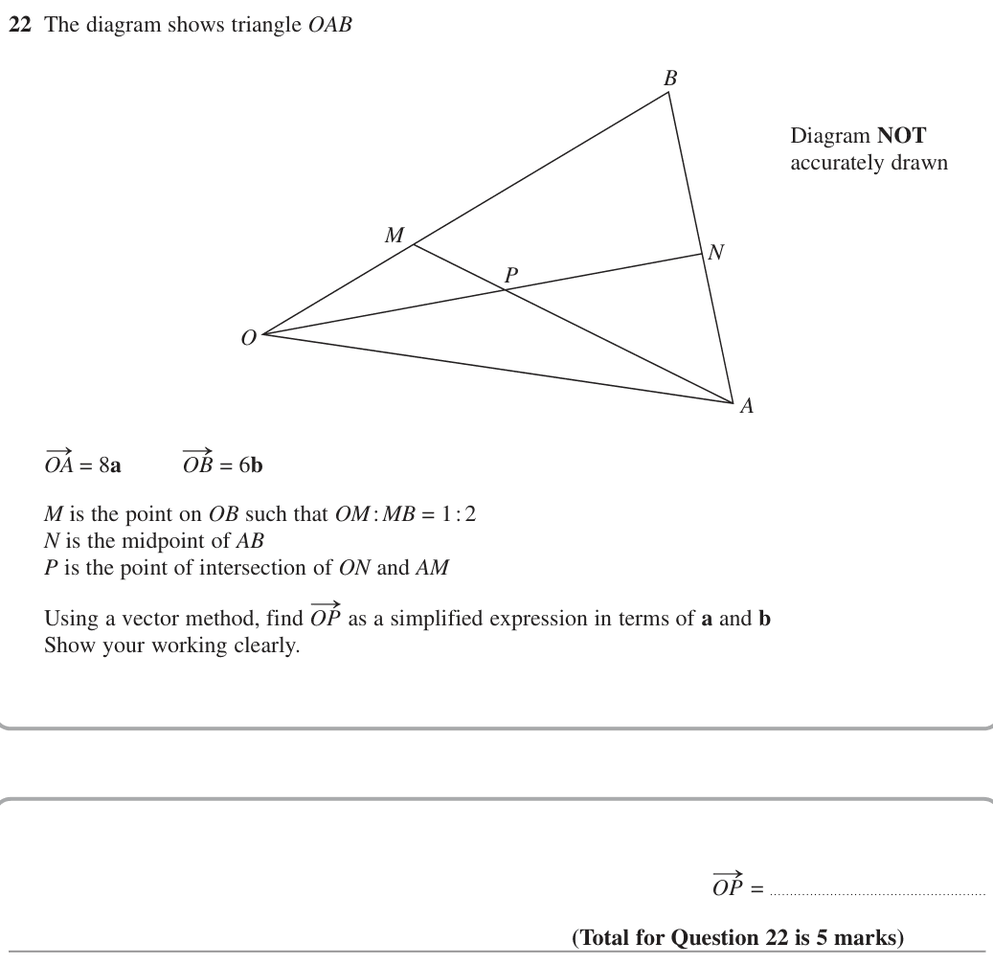
16. Jan 2022 P1H · Q22 Hard 5 marksShow worked solution Use vectors \[
\vec{OA}=8\mathbf a,\qquad \vec{OB}=6\mathbf b
\]
Use vectors Since \(OM:MB=1:2\),
\[
\vec{OM}=\frac13\vec{OB}
\]
\[
\vec{OM}=2\mathbf b
\]
Find the midpoint Since \(N\) is the midpoint of \(AB\),
\[
\vec{ON}=\frac{8\mathbf a+6\mathbf b}{2}
\]
\[
\vec{ON}=4\mathbf a+3\mathbf b
\]
Use vectors Point \(P\) lies on \(ON\), so
\[
\vec{OP}=\lambda(4\mathbf a+3\mathbf b)
\]
Use vectors Point \(P\) also lies on \(AM\), so
\[
\vec{OP}=8\mathbf a+\mu(2\mathbf b-8\mathbf a)
\]
\[
\vec{OP}=(8-8\mu)\mathbf a+2\mu\mathbf b
\]
Equate coefficients Equate coefficients:
\[
4\lambda=8-8\mu
\]
\[
3\lambda=2\mu
\]
Use vectors From \(3\lambda=2\mu\),
\[
\mu=\frac32\lambda
\]
Substitute Substitute:
\[
4\lambda=8-8\left(\frac32\lambda\right)
\]
\[
4\lambda=8-12\lambda
\]
\[
16\lambda=8
\]
\[
\lambda=\frac12
\]
Use vectors Therefore
\[
\vec{OP}=\frac12(4\mathbf a+3\mathbf b)
\]
\[
\vec{OP}=2\mathbf a+\frac32\mathbf b
\]
Final answer \(\displaystyle \vec{OP}=2\mathbf a+\frac32\mathbf b\)
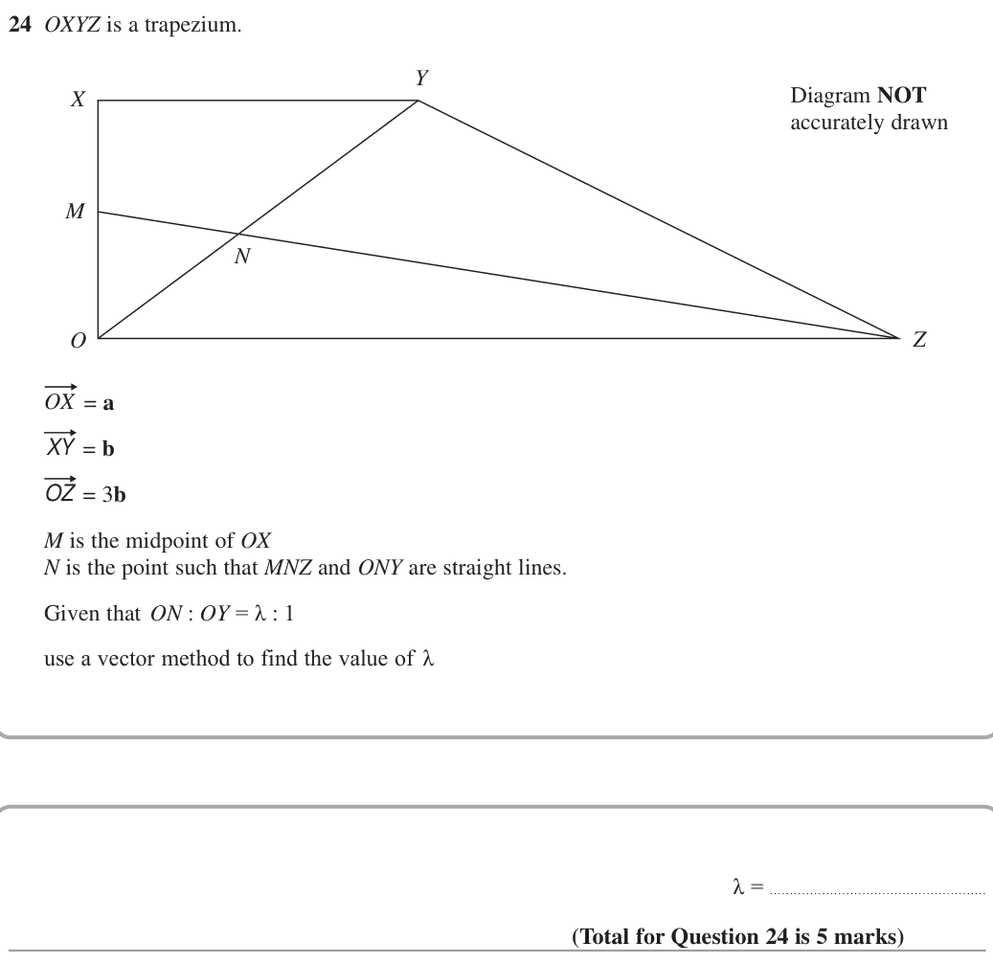
17. Jan 2022 P1HR · Q24 Hard 5 marksShow worked solution Take as the origin Take \(O\) as the origin.
\[
\vec{OX}=\mathbf a,\qquad \vec{XY}=\mathbf b,\qquad \vec{OZ}=3\mathbf b
\]
Use vectors So
\[
\vec{OY}=\mathbf a+\mathbf b
\]
Find the midpoint Since \(M\) is the midpoint of \(OX\),
\[
\vec{OM}=\frac12\mathbf a
\]
Use vectors Given \(ON:OY=\lambda:1\),
\[
\vec{ON}=\lambda(\mathbf a+\mathbf b)
\]
Use vectors Point \(N\) also lies on \(MZ\), so
\[
\vec{ON}=\frac12\mathbf a+t\left(3\mathbf b-\frac12\mathbf a\right)
\]
\[
\vec{ON}=\left(\frac12-\frac{t}{2}\right)\mathbf a+3t\mathbf b
\]
Use vectors Equate coefficients with \(\lambda\mathbf a+\lambda\mathbf b\):
\[
\lambda=\frac12-\frac{t}{2}
\]
\[
\lambda=3t
\]
Use vectors So
\[
t=\frac{\lambda}{3}
\]
Substitute Substitute:
\[
\lambda=\frac12-\frac{1}{2}\left(\frac{\lambda}{3}\right)
\]
\[
\lambda=\frac12-\frac{\lambda}{6}
\]
\[
\frac76\lambda=\frac12
\]
\[
\lambda=\frac37
\]
Final answer \(\displaystyle \lambda=\frac37\)
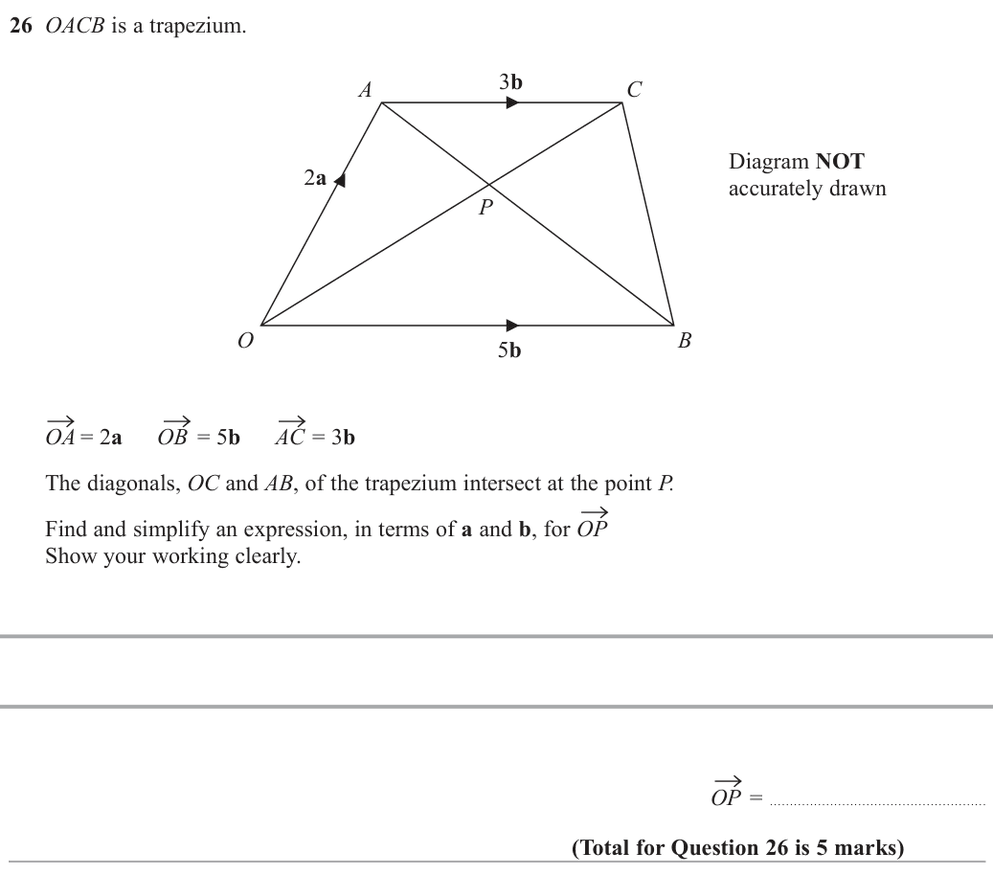
18. May 2021 P1H · Q26 Hard 5 marksShow worked solution Use vectors \[
\overrightarrow{OA}=2\mathbf a,\qquad
\overrightarrow{OB}=5\mathbf b,\qquad
\overrightarrow{AC}=3\mathbf b
\]
Use vectors So
\[
\overrightarrow{OC}
=\overrightarrow{OA}+\overrightarrow{AC}
=2\mathbf a+3\mathbf b
\]
Use vectors Since \(P\) lies on \(OC\), let
\[
\overrightarrow{OP}=t(2\mathbf a+3\mathbf b)
\]
Use vectors Since \(P\) also lies on \(AB\), let
\[
\overrightarrow{OP}
=\overrightarrow{OA}+s\overrightarrow{AB}
\]
Use vectors Now
\[
\overrightarrow{AB}
=\overrightarrow{OB}-\overrightarrow{OA}
=5\mathbf b-2\mathbf a
\]
Use vectors So
\[
\overrightarrow{OP}
=2\mathbf a+s(5\mathbf b-2\mathbf a)
\]
\[
\overrightarrow{OP}
=(2-2s)\mathbf a+5s\mathbf b
\]
Use vectors Compare this with
\[
t(2\mathbf a+3\mathbf b)=2t\mathbf a+3t\mathbf b
\]
Equating coefficients Equating coefficients:
\[
2t=2-2s
\]
\[
3t=5s
\]
Use vectors From \(t=1-s\),
\[
3(1-s)=5s
\]
\[
3=8s
\]
\[
s=\frac{3}{8}
\]
Use vectors So
\[
t=1-\frac{3}{8}=\frac{5}{8}
\]
Use vectors Therefore
\[
\overrightarrow{OP}
=\frac{5}{8}(2\mathbf a+3\mathbf b)
\]
\[
\overrightarrow{OP}
=\frac{5}{4}\mathbf a+\frac{15}{8}\mathbf b
\]
Final answer \(\boxed{\frac{5}{4}\mathbf a+\frac{15}{8}\mathbf b}\)
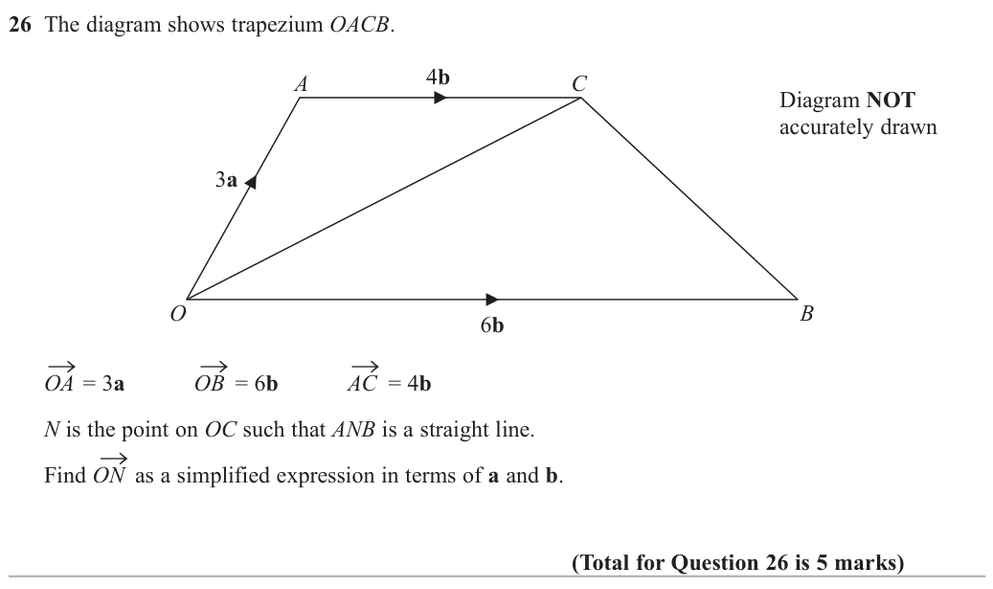
19. Jan 2020 P2HR · Q26 Hard 5 marksShow worked solution Read the graph \[
\vec{OA}=3\mathbf a,\qquad \vec{OB}=6\mathbf b,\qquad \vec{AC}=4\mathbf b
\]
Read the graph So
\[
\vec{OC}=3\mathbf a+4\mathbf b
\]
Read the graph Point \(N\) lies on \(OC\), so
\[
\vec{ON}=t(3\mathbf a+4\mathbf b)
\]
Read the graph Point \(N\) also lies on \(AB\), so
\[
\vec{ON}=3\mathbf a+s(6\mathbf b-3\mathbf a)
\]
\[
\vec{ON}=(3-3s)\mathbf a+6s\mathbf b
\]
Equate coefficients Equate coefficients:
\[
3t=3-3s
\]
\[
4t=6s
\]
Read the graph So
\[
t=1-s
\]
Read the graph and
\[
t=\frac32s
\]
\[
\frac32s=1-s
\]
\[
5s=2
\]
\[
s=\frac25
\]
Read the graph Then
\[
t=\frac35
\]
Read the graph Therefore
\[
\vec{ON}=\frac35(3\mathbf a+4\mathbf b)
\]
\[
\vec{ON}=\frac95\mathbf a+\frac{12}{5}\mathbf b
\]
Final answer \(\displaystyle \vec{ON}=\frac95\mathbf a+\frac{12}{5}\mathbf b\)
20. Specimen 4WM2H · Q23 Hard 5 marksShow worked solution Use vectors \[
\overrightarrow{OA}=4a,\qquad \overrightarrow{OB}=6b,\qquad \overrightarrow{AP}=2a+8b
\]
Use vectors So
\[
\overrightarrow{OP}=\overrightarrow{OA}+\overrightarrow{AP}
\]
\[
\overrightarrow{OP}=4a+(2a+8b)=6a+8b
\]
Use vectors Since \(O,Q,P\) are collinear, let
\[
\overrightarrow{OQ}=\lambda(6a+8b)
\]
Use vectors Also \(Q\) lies on \(AB\). Let
\[
\overrightarrow{AQ}=\mu\overrightarrow{AB}
\]
Use vectors Then
\[
\overrightarrow{AB}=6b-4a
\]
\[
\overrightarrow{OQ}=4a+\mu(6b-4a)
\]
\[
\overrightarrow{OQ}=(4-4\mu)a+6\mu b
\]
Use vectors Compare coefficients with
\[
\lambda(6a+8b)=6\lambda a+8\lambda b
\]
Use vectors So
\[
4-4\mu=6\lambda,\qquad 6\mu=8\lambda
\]
Use vectors From \(6\mu=8\lambda\),
\[
\lambda=\frac34\mu
\]
Substitute Substitute:
\[
4-4\mu=6\left(\frac34\mu\right)
\]
\[
4-4\mu=\frac92\mu
\]
\[
8=17\mu
\]
\[
\mu=\frac8{17}
\]
Use vectors Therefore
\[
AQ:QB=\frac8{17}:\frac9{17}=8:9
\]
Final answer \(AQ:QB=8:9\).
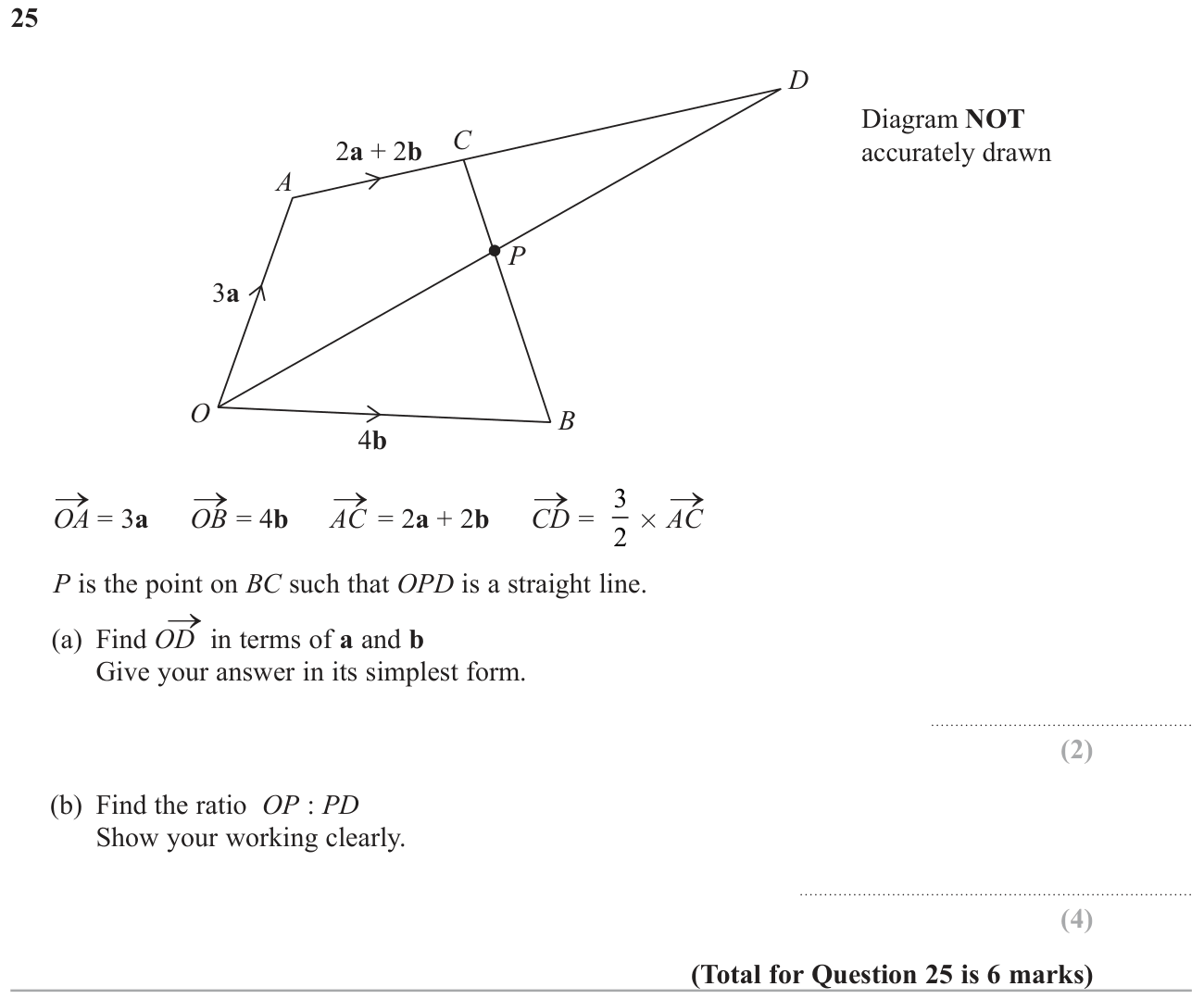
21. Jun 2026 P1HR · Q25 Hard 6 marksShow worked solution Part (a) | Step 1 \[\overrightarrow{CD}=\frac32(2\mathbf a+2\mathbf b)=3\mathbf a+3\mathbf b.\]
Use the stated relationship between CD and AC.
Part (a) | Step 2 \[\overrightarrow{OD}=\overrightarrow{OA}+\overrightarrow{AC}+\overrightarrow{CD}=3\mathbf a+(2\mathbf a+2\mathbf b)+(3\mathbf a+3\mathbf b)=8\mathbf a+5\mathbf b.\]
Add consecutive vectors along the route O-A-C-D.
Part (b) | Step 1 \[\overrightarrow{OC}=3\mathbf a+(2\mathbf a+2\mathbf b)=5\mathbf a+2\mathbf b,\qquad\overrightarrow{BC}=5\mathbf a-2\mathbf b.\]
Use OC=OA+AC and BC=OC-OB.
Part (b) | Step 2 Write \(\overrightarrow{OP}=t\overrightarrow{OD}=8t\mathbf a+5t\mathbf b\). Also, because P lies on BC, \[\overrightarrow{OP}=\overrightarrow{OB}+s\overrightarrow{BC}=5s\mathbf a+(4-2s)\mathbf b.\]
Use one scalar parameter on each of the two intersecting lines.
Part (b) | Step 3 \[8t=5s,\qquad5t=4-2s,\qquad s=\frac85t.\]
Equate the coefficients of the two nonparallel base vectors.
Part (b) | Step 4 \[5t=4-\frac{16}{5}t\quad\Longrightarrow\quad41t=20\quad\Longrightarrow\quad t=\frac{20}{41}.\]
Substitute the first relation into the second and solve.
Part (b) | Step 5 \[OP:PD=t:(1-t)=\frac{20}{41}:\frac{21}{41}=20:21.\]
OD is divided into the fractions t and 1-t at P.
Final answer (a) \(\overrightarrow{OD}=8\mathbf a+5\mathbf b\)
(b) \(OP:PD=20:21\)
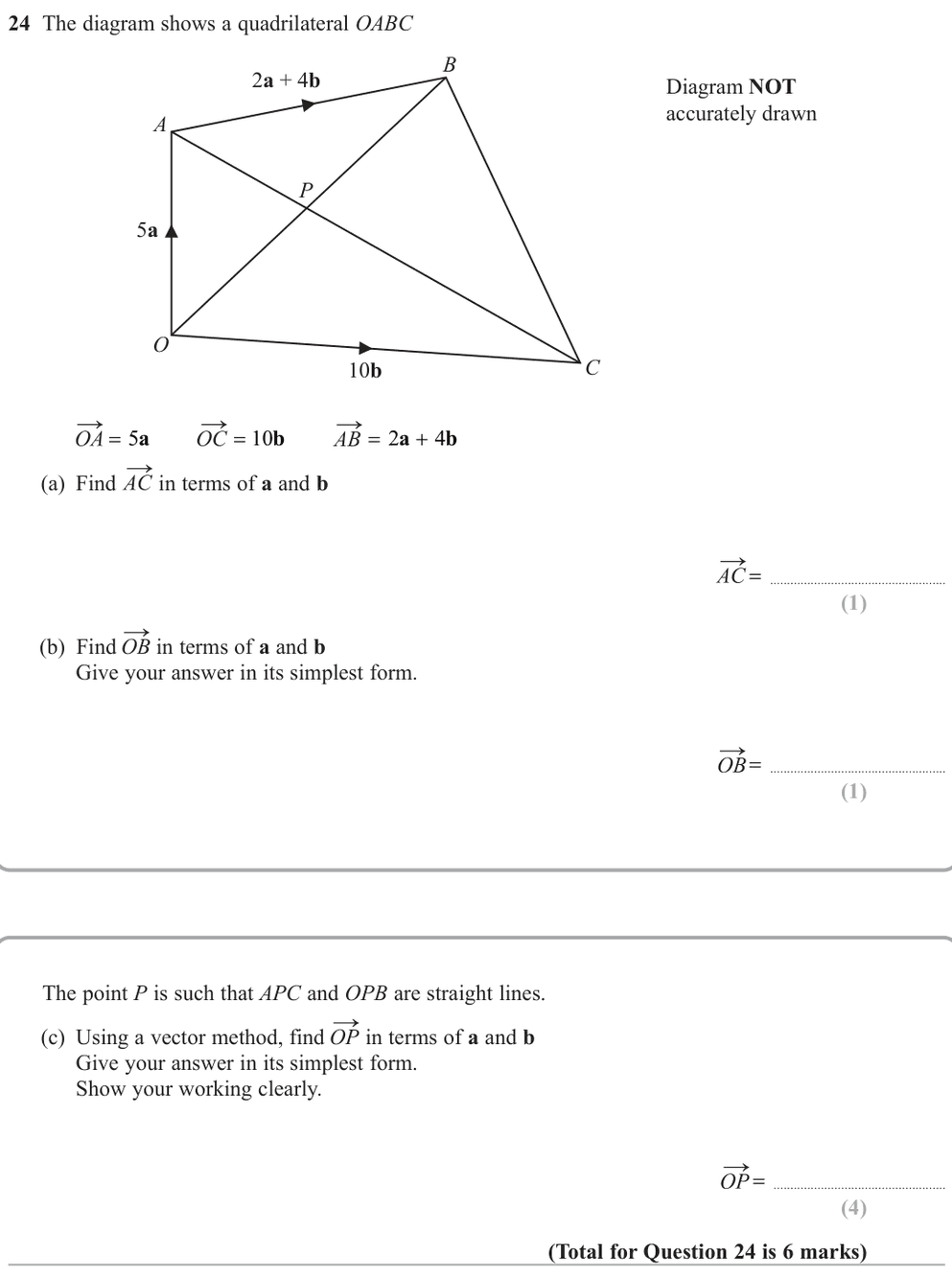
22. Nov 2025 4WM2H · Q24 Hard 6 marksShow worked solution (a) Find $\\overrightarrow{AC}$ $$\\overrightarrow{AC} = \\overrightarrow{AO} + \\overrightarrow{OC} = -\\overrightarrow{OA} + \\overrightarrow{OC} = -5\\mathbf{a} + 10\\mathbf{b}$$
Answer \(a\) − 5**a** + 10**b**
(b) Find $\\overrightarrow{OB}$ $$\\overrightarrow{OB} = \\overrightarrow{OA} + \\overrightarrow{AB} = 5\\mathbf{a} + (2\\mathbf{a} + 4\\mathbf{b}) = 7\\mathbf{a} + 4\\mathbf{b}$$
Answer \(b\) 7**a** + 4**b**
**Step 1: Set up vector equations for $\\overrightarrow{OP}$.** Since *O**P**B* is a straight line, $\\overrightarrow{OP}$ is a scalar multiple of $\\overrightarrow{OB}$. Let this be *λ*. $$\\overrightarrow{OP} = \\lambda(7\\mathbf{a} + 4\\mathbf{b}) = 7\\lambda\\mathbf{a} + 4\\lambda\\mathbf{b}$$
Since *P* lies on the straight line *A**C*, $\\overrightarrow{AP} = \\mu\\overrightarrow{AC}$ for some scalar *μ*. $$\\overrightarrow{OP} = \\overrightarrow{OA} + \\overrightarrow{AP} = 5\\mathbf{a} + \\mu(-5\\mathbf{a} + 10\\mathbf{b})$$ $$\\overrightarrow{OP} = (5 - 5\\mu)\\mathbf{a} + 10\\mu\\mathbf{b}$$
**Step 2: Equate the coefficients of **a** and **b**.** 7*λ* = 5 − 5*μ* — (1) $$4\\lambda = 10\\mu \\implies \\mu = \\frac{4}{10}\\lambda = 0.4\\lambda \\quad \\text{--- (2)}$$
**Step 3: Solve for *λ*.** Substitute (2) into (1): 7*λ* = 5 − 5(0.4*λ*) 7*λ* = 5 − 2*λ* $$9\\lambda = 5 \\implies \\lambda = \\frac{5}{9}$$
Evaluate fraction $$\\overrightarrow{OP} = \\frac{5}{9}(7\\mathbf{a} + 4\\mathbf{b}) = \\frac{35}{9}\\mathbf{a} + \\frac{20}{9}\\mathbf{b}$$
Final answer $\\frac{35}{9}\\mathbf{a} + \\frac{20}{9}\\mathbf{b}$
23. Nov 2025 P1H · Q27 Hard 6 marksShow worked solution Read the graph \[
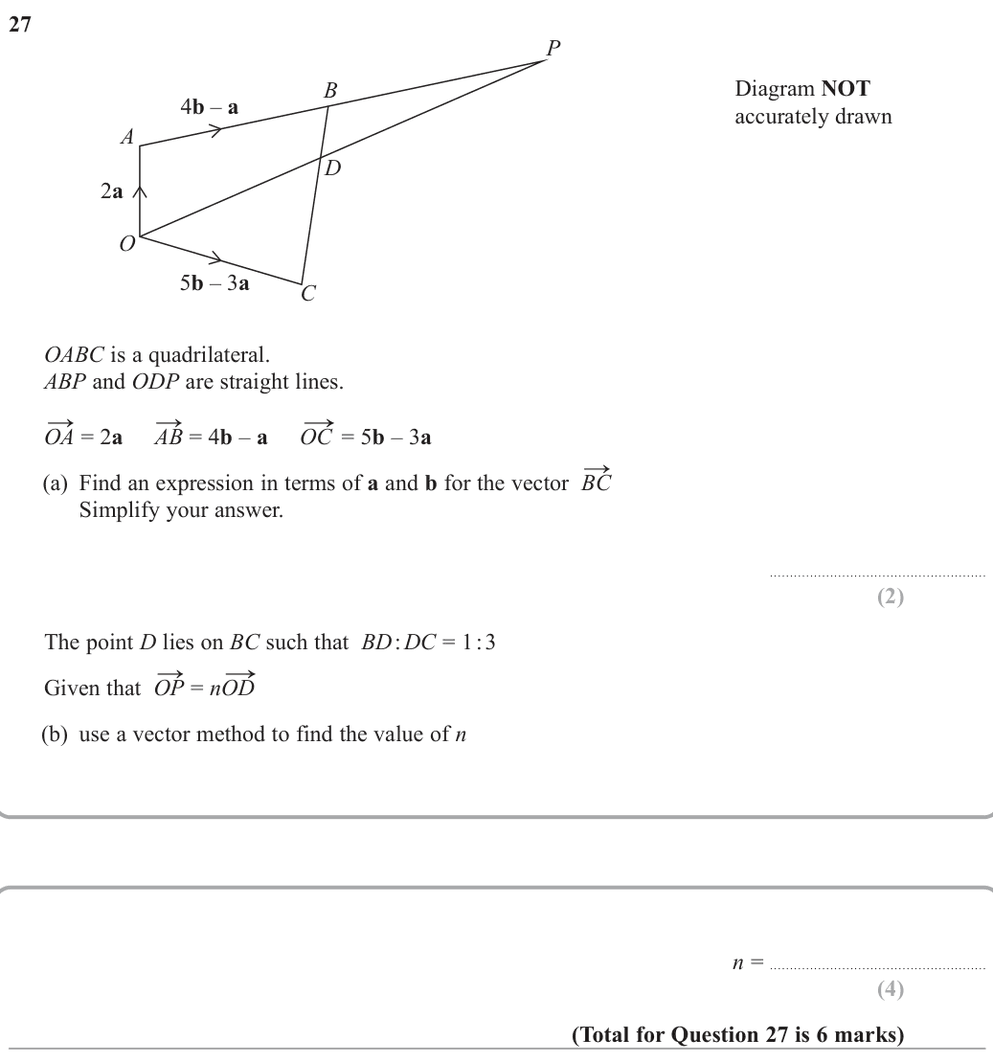
\vec{OA}=2\mathbf a,\qquad \vec{AB}=4\mathbf b-\mathbf a,\qquad \vec{OC}=5\mathbf b-3\mathbf a
\]
Read the graph First find \(\vec{OB}\):
\[
\vec{OB}=\vec{OA}+\vec{AB}
\]
\[
\vec{OB}=2\mathbf a+4\mathbf b-\mathbf a
\]
\[
\vec{OB}=\mathbf a+4\mathbf b
\]
Read the graph For part (a),
\[
\vec{BC}=\vec{OC}-\vec{OB}
\]
\[
\vec{BC}=(5\mathbf b-3\mathbf a)-(\mathbf a+4\mathbf b)
\]
\[
\vec{BC}=\mathbf b-4\mathbf a
\]
Read the graph For part (b), \(BD:DC=1:3\), so
\[
\vec{OD}=\vec{OB}+\frac14\vec{BC}
\]
\[
\vec{OD}=\mathbf a+4\mathbf b+\frac14(\mathbf b-4\mathbf a)
\]
\[
\vec{OD}=\frac{17}{4}\mathbf b
\]
Read the graph Since \(A,B,P\) are collinear, let
\[
\vec{OP}=\vec{OA}+s\vec{AB}
\]
\[
\vec{OP}=2\mathbf a+s(4\mathbf b-\mathbf a)
\]
\[
\vec{OP}=(2-s)\mathbf a+4s\mathbf b
\]
Read the graph But \(O,D,P\) are collinear, and \(\vec{OD}\) has only a \(\mathbf b\) component.
Read the graph So
\[
2-s=0
\]
\[
s=2
\]
Read the graph Then
\[
\vec{OP}=8\mathbf b
\]
Given \[
\vec{OP}=n\vec{OD}
\]
\[
8\mathbf b=n\left(\frac{17}{4}\mathbf b\right)
\]
\[
n=\frac{32}{17}
\]
Final answer \(\vec{BC}=\mathbf b-4\mathbf a,\quad \displaystyle n=\frac{32}{17}\)
24. Nov 2024 P1H · Q24 Hard 6 marksShow worked solution Read the graph \[
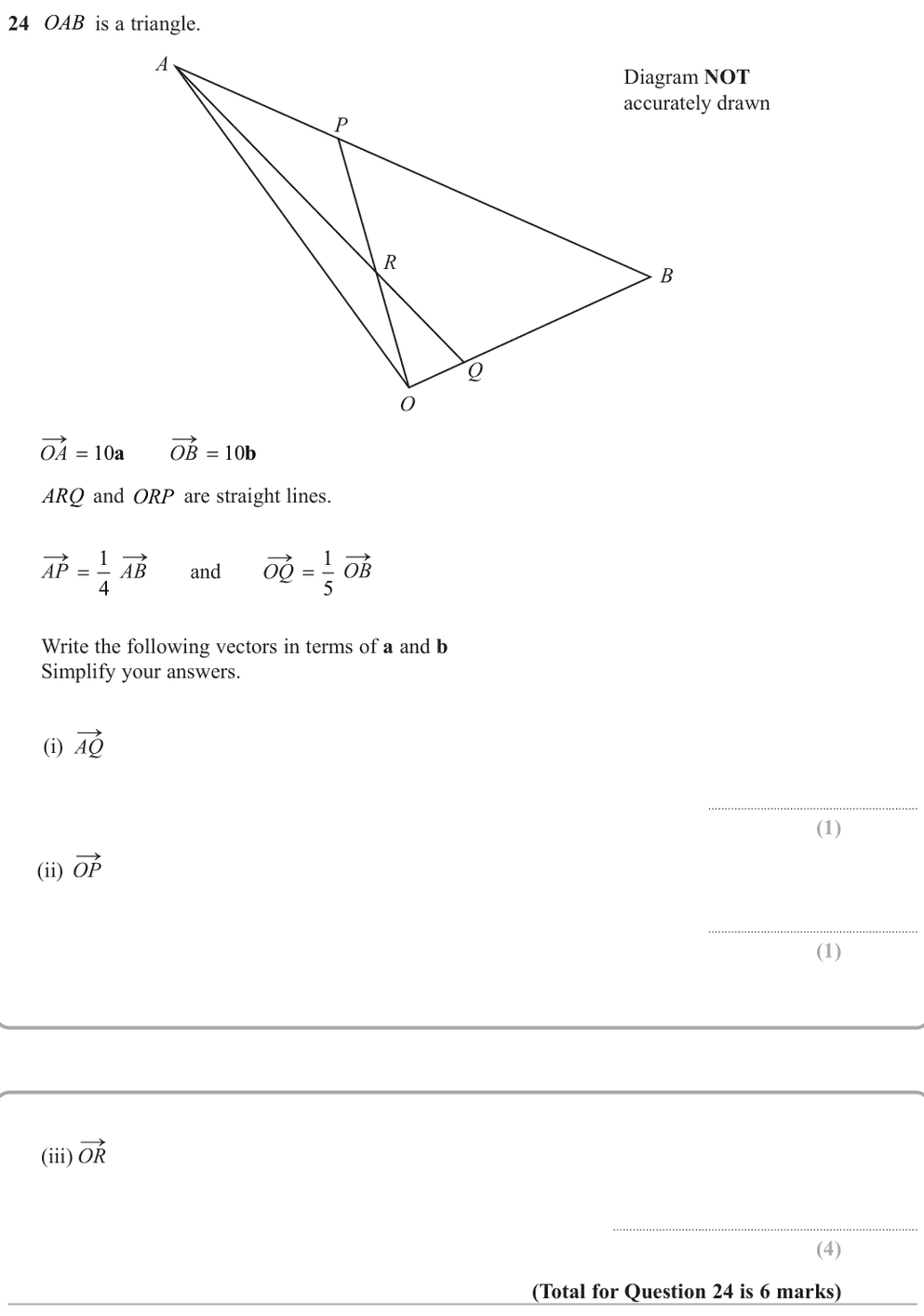
\vec{OA}=10\mathbf a,\qquad \vec{OB}=10\mathbf b
\]
Read the graph Also,
\[
\vec{AP}=\frac14\vec{AB}
\]
Read the graph and
\[
\vec{OQ}=\frac15\vec{OB}
\]
Read the graph For part (i),
\[
\vec{OQ}=2\mathbf b
\]
\[
\vec{AQ}=\vec{OQ}-\vec{OA}
\]
\[
\vec{AQ}=2\mathbf b-10\mathbf a
\]
Read the graph For part (ii),
\[
\vec{AB}=10\mathbf b-10\mathbf a
\]
\[
\vec{AP}=\frac14(10\mathbf b-10\mathbf a)
\]
\[
\vec{AP}=\frac52\mathbf b-\frac52\mathbf a
\]
\[
\vec{OP}=\vec{OA}+\vec{AP}
\]
\[
\vec{OP}=10\mathbf a-\frac52\mathbf a+\frac52\mathbf b
\]
\[
\vec{OP}=\frac{15}{2}\mathbf a+\frac52\mathbf b
\]
Read the graph For part (iii), \(R\) lies on \(OP\), so
\[
\vec{OR}=t\vec{OP}
\]
Read the graph It also lies on \(AQ\), so
\[
\vec{OR}=\vec{OA}+s\vec{AQ}
\]
\[
\vec{OR}=10\mathbf a+s(2\mathbf b-10\mathbf a)
\]
\[
\vec{OR}=(10-10s)\mathbf a+2s\mathbf b
\]
Read the graph Equate with
\[
t\left(\frac{15}{2}\mathbf a+\frac52\mathbf b\right)
\]
\[
\frac{15}{2}t=10-10s
\]
\[
\frac52t=2s
\]
Solve equation From the second equation,
\[
s=\frac54t
\]
Substitute Substitute:
\[
\frac{15}{2}t=10-\frac{25}{2}t
\]
\[
20t=10
\]
\[
t=\frac12
\]
Read the graph So
\[
\vec{OR}=\frac12\vec{OP}
\]
\[
\vec{OR}=\frac{15}{4}\mathbf a+\frac54\mathbf b
\]
Final answer \(\vec{AQ}=2\mathbf b-10\mathbf a\), \(\displaystyle \vec{OP}=\frac{15}{2}\mathbf a+\frac52\mathbf b\), \(\displaystyle \vec{OR}=\frac{15}{4}\mathbf a+\frac54\mathbf b\)
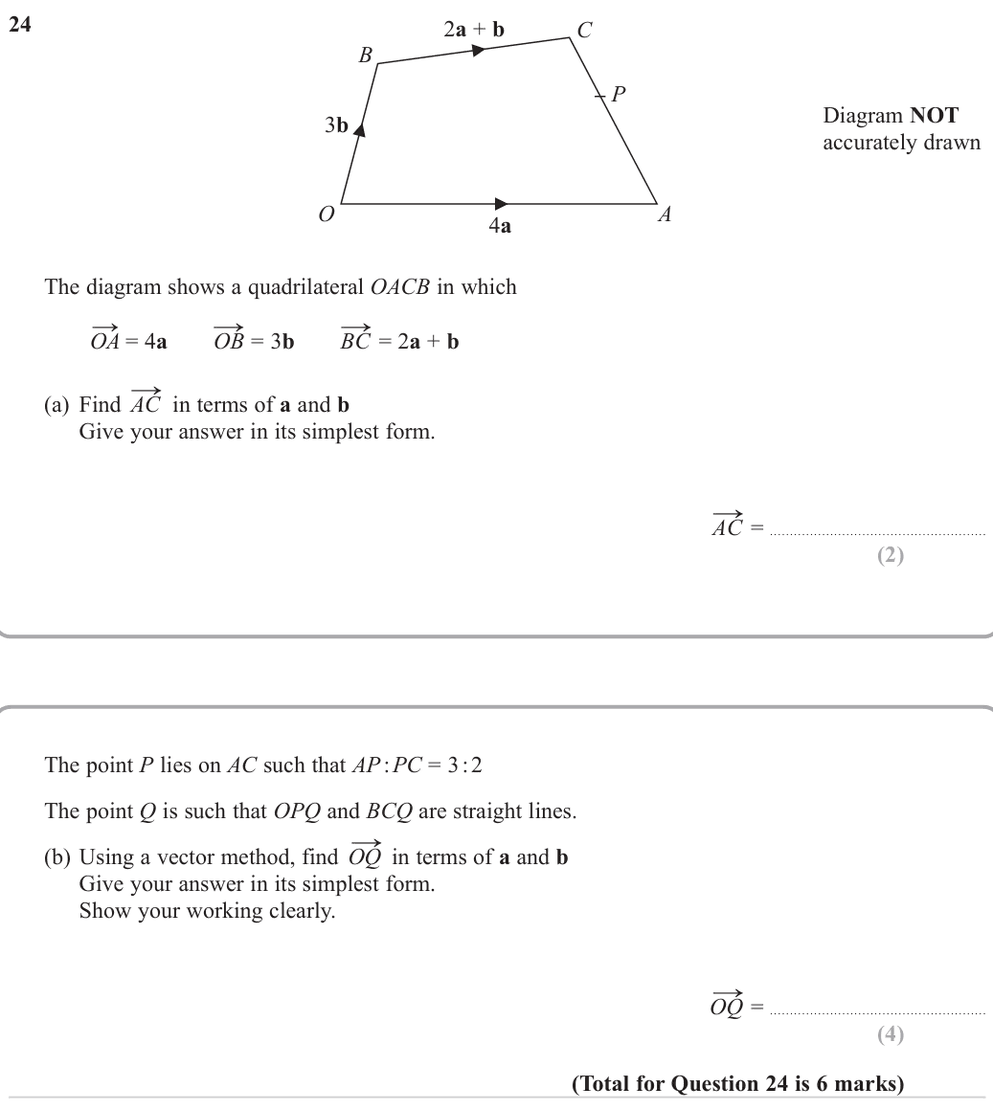
25. Jun 2024 P2H · Q24 Hard 6 marksShow worked solution Read the graph \[
\vec{OA}=4\mathbf a,\qquad \vec{OB}=3\mathbf b,\qquad \vec{BC}=2\mathbf a+\mathbf b
\]
Read the graph So
\[
\vec{OC}=\vec{OB}+\vec{BC}
\]
\[
\vec{OC}=2\mathbf a+4\mathbf b
\]
Read the graph For part (a),
\[
\vec{AC}=\vec{OC}-\vec{OA}
\]
\[
\vec{AC}=(2\mathbf a+4\mathbf b)-4\mathbf a
\]
\[
\vec{AC}=4\mathbf b-2\mathbf a
\]
Read the graph For part (b), \(AP:PC=3:2\), so
\[
\vec{OP}=\vec{OA}+\frac35\vec{AC}
\]
\[
\vec{OP}=4\mathbf a+\frac35(4\mathbf b-2\mathbf a)
\]
\[
\vec{OP}=\frac{14}{5}\mathbf a+\frac{12}{5}\mathbf b
\]
Read the graph Since \(O,P,Q\) are collinear,
\[
\vec{OQ}=t\vec{OP}
\]
\[
\vec{OQ}=t\left(\frac{14}{5}\mathbf a+\frac{12}{5}\mathbf b\right)
\]
Read the graph Since \(B,C,Q\) are collinear,
\[
\vec{OQ}=\vec{OB}+s\vec{BC}
\]
\[
\vec{OQ}=3\mathbf b+s(2\mathbf a+\mathbf b)
\]
\[
\vec{OQ}=2s\mathbf a+(3+s)\mathbf b
\]
Equate coefficients Equate coefficients:
\[
\frac{14}{5}t=2s
\]
\[
\frac{12}{5}t=3+s
\]
Solve equation From the first equation,
\[
s=\frac75t
\]
Substitute into the second Substitute into the second:
\[
\frac{12}{5}t=3+\frac75t
\]
\[
t=3
\]
Read the graph Therefore
\[
\vec{OQ}=3\vec{OP}
\]
\[
\vec{OQ}=\frac{42}{5}\mathbf a+\frac{36}{5}\mathbf b
\]
Final answer \(\vec{AC}=4\mathbf b-2\mathbf a\), \(\displaystyle \vec{OQ}=\frac{42}{5}\mathbf a+\frac{36}{5}\mathbf b\)
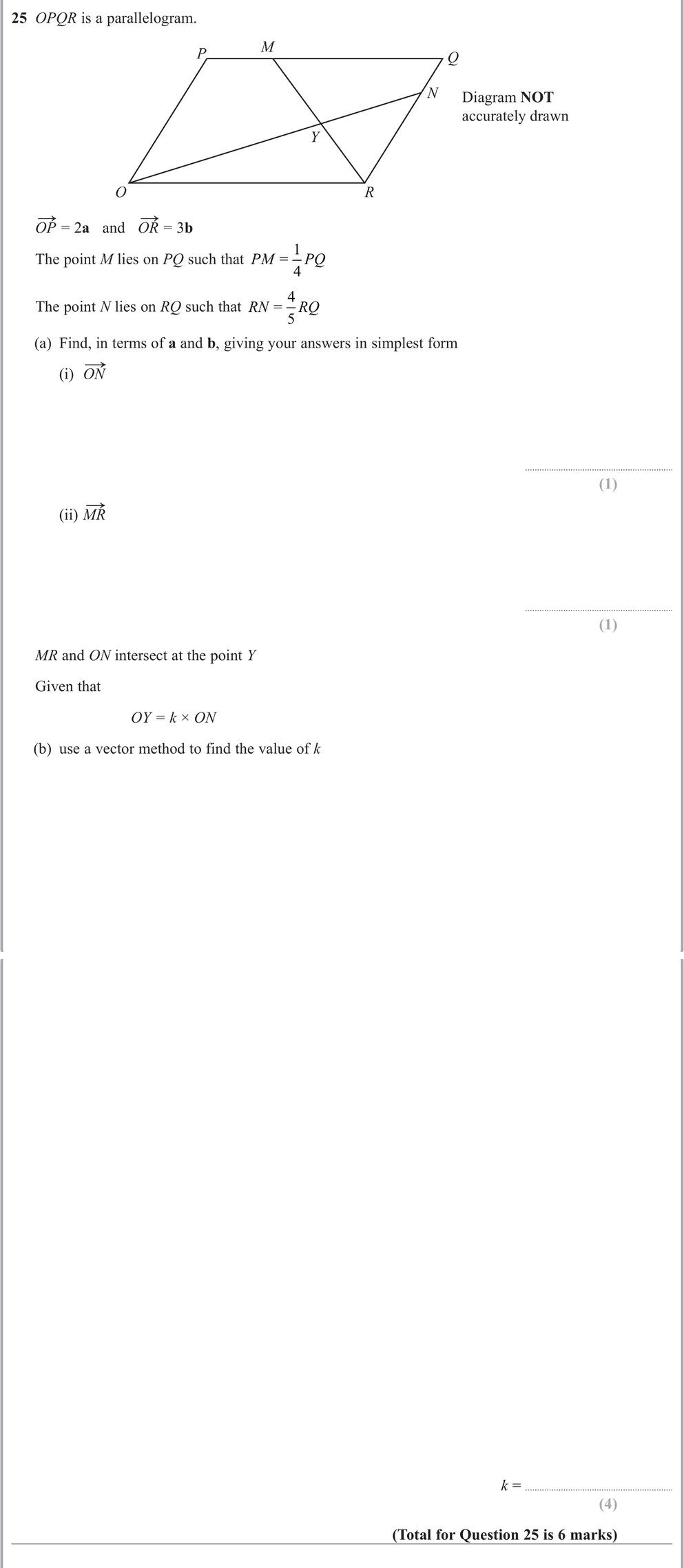
26. Jun 2024 P2HR · Q25 Hard 6 marksShow worked solution Calculate value \[
\overrightarrow{OP}=2a,\qquad \overrightarrow{OR}=3b
\]
Calculate value So
\[
\overrightarrow{OQ}=2a+3b
\]
Evaluate fraction Since \(PM:PQ=1:4\),
\[
\overrightarrow{PM}=\frac14\overrightarrow{PQ}
\]
\[
\overrightarrow{PM}=\frac14(3b)=\frac34b
\]
\[
\overrightarrow{OM}=2a+\frac34b
\]
Evaluate fraction Since \(RN:RQ=4:5\),
\[
\overrightarrow{RN}=\frac45\overrightarrow{RQ}
\]
\[
\overrightarrow{RN}=\frac45(2a)=\frac85a
\]
\[
\overrightarrow{ON}=3b+\frac85a
\]
Evaluate fraction So
\[
\overrightarrow{MR}=\overrightarrow{OR}-\overrightarrow{OM}
\]
\[
\overrightarrow{MR}=3b-\left(2a+\frac34b\right)
\]
\[
\overrightarrow{MR}=-2a+\frac94b
\]
Let be on Let \(Y\) be on \(ON\), so
\[
\overrightarrow{OY}=k\overrightarrow{ON}
=k\left(\frac85a+3b\right)
\]
Evaluate fraction Also \(Y\) is on \(MR\), so
\[
\overrightarrow{OY}=\overrightarrow{OM}+t\overrightarrow{MR}
\]
\[
\overrightarrow{OY}=2a+\frac34b+t\left(-2a+\frac94b\right)
\]
Evaluate fraction Compare coefficients of \(a\) and \(b\):
\[
\frac85k=2-2t
\]
\[
3k=\frac34+\frac94t
\]
Solve equation From the first equation,
\[
t=1-\frac45k
\]
Substitute into the second equation Substitute into the second equation:
\[
3k=\frac34+\frac94\left(1-\frac45k\right)
\]
\[
3k=3-\frac95k
\]
\[
\frac{24}{5}k=3
\]
\[
k=\frac58
\]
Final answer \(\overrightarrow{ON}=\frac85a+3b\), \(\overrightarrow{MR}=-2a+\frac94b\), and \(k=\frac58\)
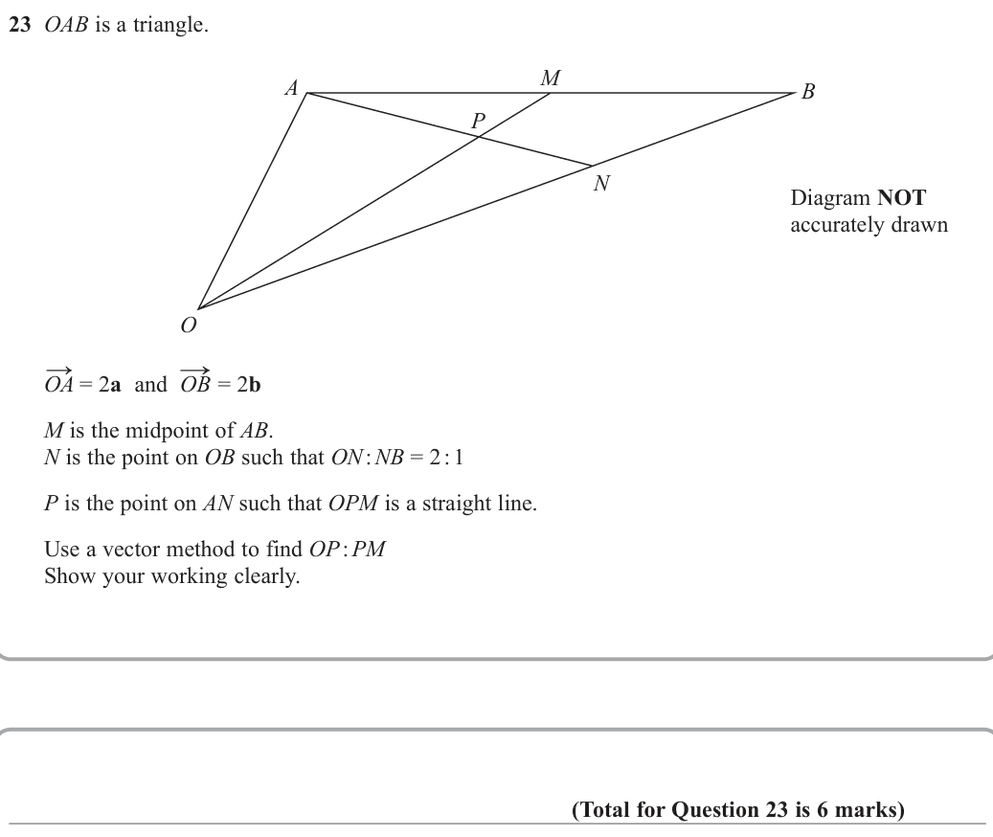
27. Jan 2021 P1H · Q23 Hard 6 marksShow worked solution Use vectors \[
\vec{OA}=2\mathbf a,\qquad \vec{OB}=2\mathbf b
\]
Find the midpoint Since \(M\) is the midpoint of \(AB\),
\[
\vec{OM}=\frac{2\mathbf a+2\mathbf b}{2}
\]
\[
\vec{OM}=\mathbf a+\mathbf b
\]
Use vectors Since \(ON:NB=2:1\),
\[
\vec{ON}=\frac23\vec{OB}
\]
\[
\vec{ON}=\frac23(2\mathbf b)=\frac43\mathbf b
\]
Use vectors Point \(P\) lies on \(OM\), so
\[
\vec{OP}=t(\mathbf a+\mathbf b)
\]
Use vectors Point \(P\) also lies on \(AN\), so
\[
\vec{OP}=2\mathbf a+s\left(\frac43\mathbf b-2\mathbf a\right)
\]
\[
\vec{OP}=(2-2s)\mathbf a+\frac{4s}{3}\mathbf b
\]
Use vectors Equate coefficients of \(\mathbf a\) and \(\mathbf b\):
\[
t=2-2s
\]
\[
t=\frac{4s}{3}
\]
Use vectors So
\[
\frac{4s}{3}=2-2s
\]
\[
4s=6-6s
\]
\[
10s=6
\]
\[
s=\frac35
\]
Use vectors Then
\[
t=\frac{4}{5}
\]
Use vectors So \(P\) is \(\frac45\) of the way from \(O\) to \(M\).
Final answer \(\displaystyle OP:PM=4:1\)
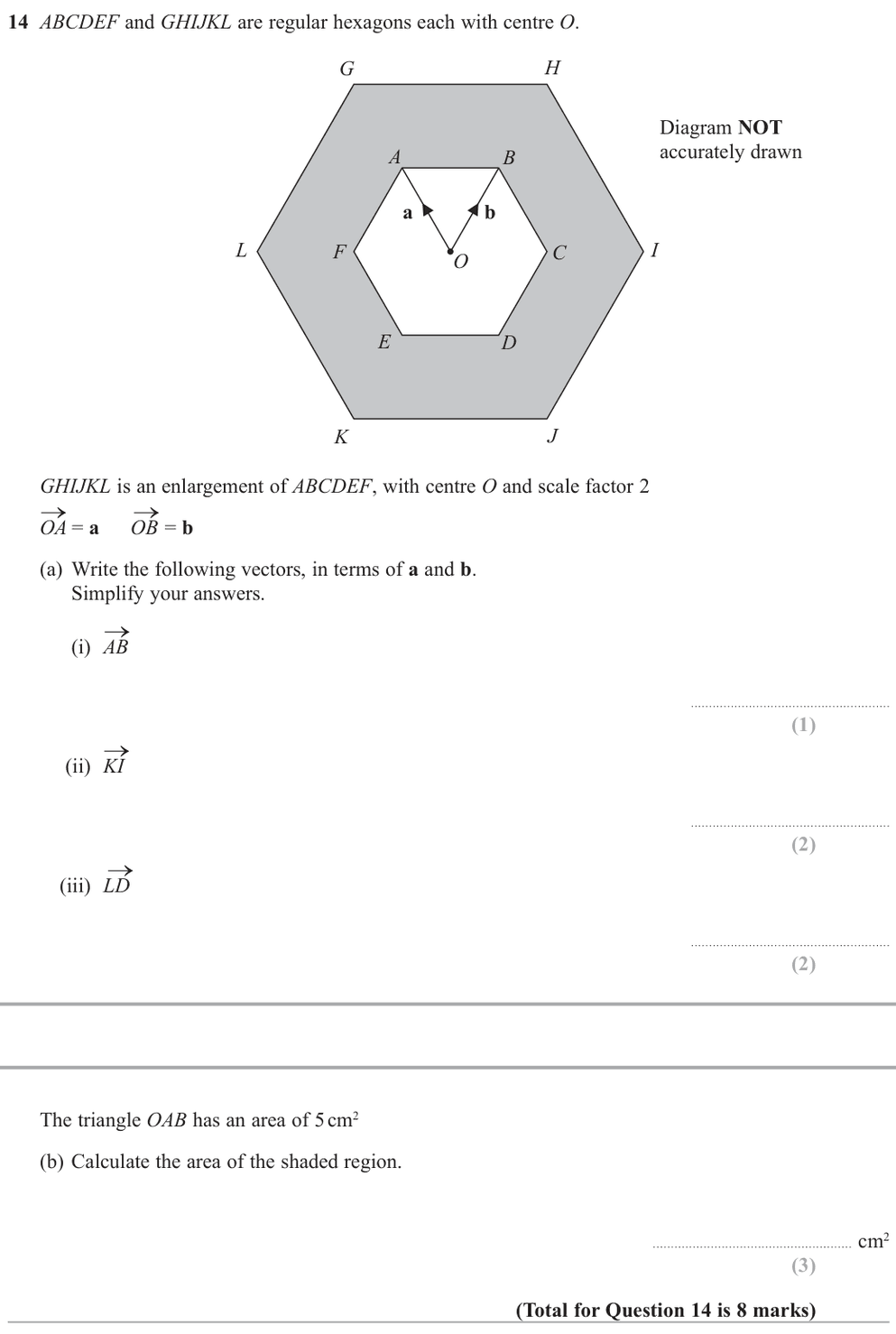
28. Nov 2021 P1H · Q14 Hard 8 marksShow worked solution Use vectors \[
\overrightarrow{OA}=\mathbf a,\qquad \overrightarrow{OB}=\mathbf b
\]
(a)(i) \[
\overrightarrow{AB}=\overrightarrow{OB}-\overrightarrow{OA}
=\mathbf b-\mathbf a
\]
Use vectors For a regular hexagon,
\[
\overrightarrow{OC}=\mathbf b-\mathbf a,\quad
\overrightarrow{OD}=-\mathbf a,\quad
\overrightarrow{OE}=-\mathbf b,\quad
\overrightarrow{OF}=\mathbf a-\mathbf b
\]
The outer hexagon has scale The outer hexagon has scale factor \(2\), so
\[
\overrightarrow{OI}=2(\mathbf b-\mathbf a),\quad
\overrightarrow{OK}=-2\mathbf b,\quad
\overrightarrow{OL}=2(\mathbf a-\mathbf b)
\]
(ii) \[
\overrightarrow{KI}
=\overrightarrow{OI}-\overrightarrow{OK}
=2(\mathbf b-\mathbf a)-(-2\mathbf b)
=4\mathbf b-2\mathbf a
\]
(iii) \[
\overrightarrow{LD}
=\overrightarrow{OD}-\overrightarrow{OL}
=-\mathbf a-2(\mathbf a-\mathbf b)
=2\mathbf b-3\mathbf a
\]
(b) The inner hexagon is (b) The inner hexagon is made from 6 equal triangles like \(OAB\):
\[
\text{inner area}=6\times 5=30
\]
The outer hexagon is an The outer hexagon is an enlargement with scale factor \(2\), so area scale factor is \(2^2=4\):
\[
\text{outer area}=4\times 30=120
\]
\[
\text{shaded area}=120-30=90
\]
Final answer (i) \(\mathbf b-\mathbf a\), (ii) \(4\mathbf b-2\mathbf a\), (iii) \(2\mathbf b-3\mathbf a\), (b) \(90\text{ cm}^2\).
More IGCSE Maths 4MA1 topics Dr Eslam Ahmed Elite Mathematics · Questions classified by topic, solutions checked by Dr Eslam
 Elite Mathematics