Elite Mathematics / Linear / Topics / 3D Pythagoras and Trigonometry IGCSE · 4MA1 · Topic 3D Pythagoras and Trigonometry: past paper questions & worked solutions
Every 3D Pythagoras and Trigonometry question from the 4MA1 papers in our bank, 2020–2026, sorted from easiest to hardest. Try each one first, then open the worked solution.
19 questions
82 marks in total
35% of papers (19 of 54) include it
0/11/8 easy / medium / hard
Questions, easiest first Level is estimated from marks: 1–2 easy, 3–4 medium, 5+ hard.
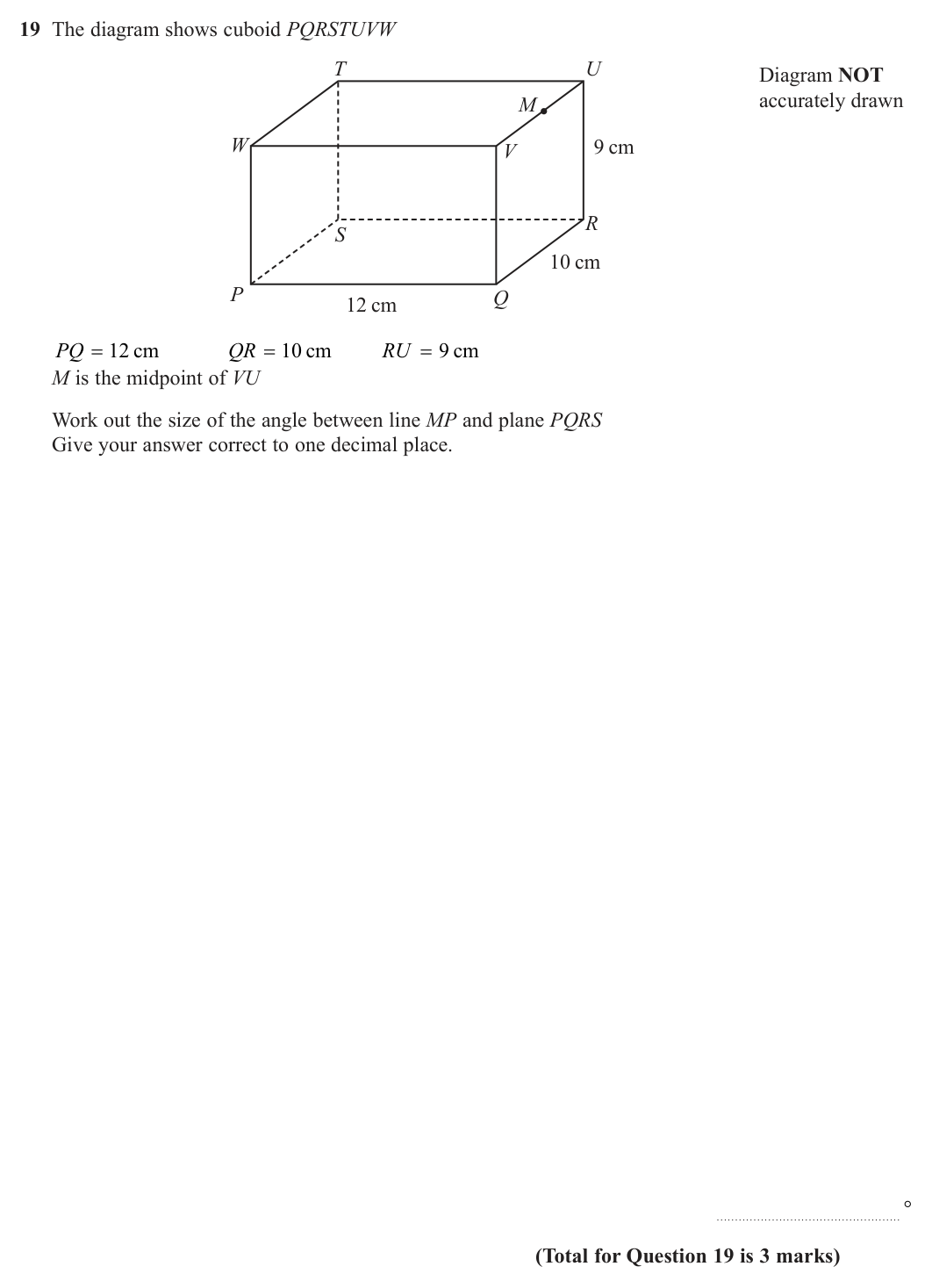
1. May 2026 4WM1H · Q19 Medium 3 marksShow worked solution Drop M to the base \(M\) is above the midpoint \(N\) of \(QR\), so \(QN=5\) and \(MN=9\).
Length PN \[PN=\sqrt{12^2+5^2}=13\]
Angle \[\tan\theta=\frac{9}{13}\Rightarrow\theta=34.69\ldots^\circ\]
Final answer \(34.7^\circ\)
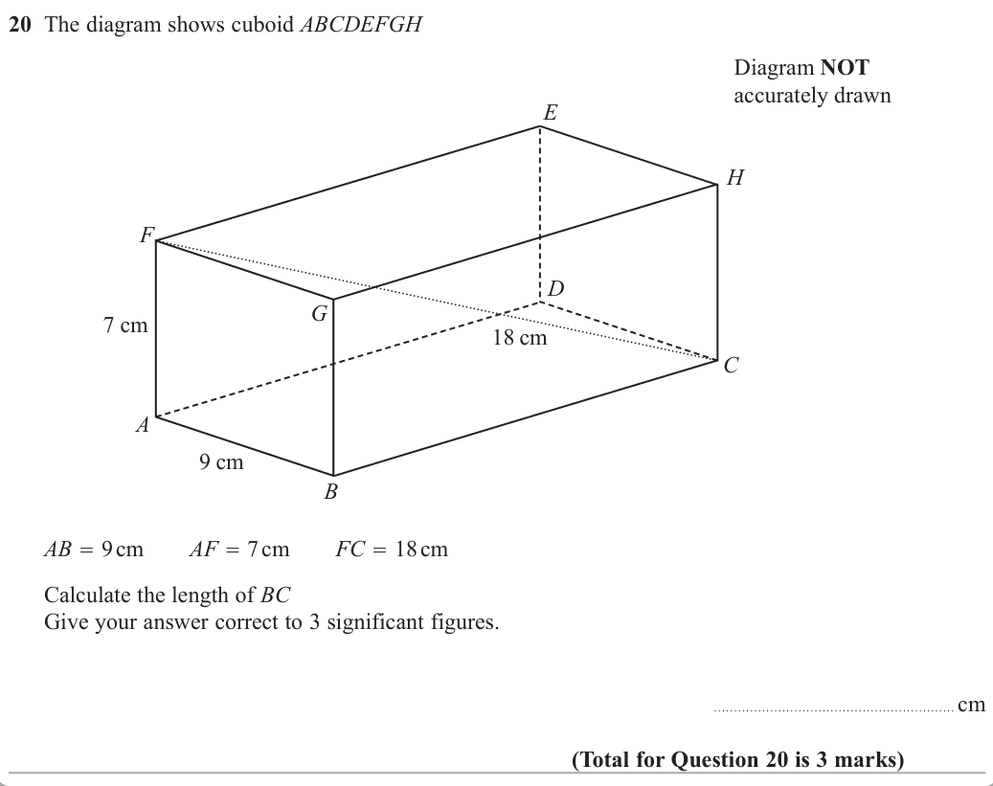
2. Jun 2025 P1HR · Q20 Medium 3 marksShow worked solution Use trigonometry In the rectangle \(ABCF\), use Pythagoras with the diagonal \(FC\):
\[
AC^2=FC^2-AF^2
\]
\[
AC^2=18^2-7^2=324-49=275
\]
Use trigonometry Now use Pythagoras in triangle \(ABC\):
\[
BC^2=AC^2-AB^2
\]
\[
BC^2=275-9^2=275-81=194
\]
\[
BC=\sqrt{194}=13.928\ldots
\]
Final answer \(13.9\text{ cm}\) to 3 significant figures
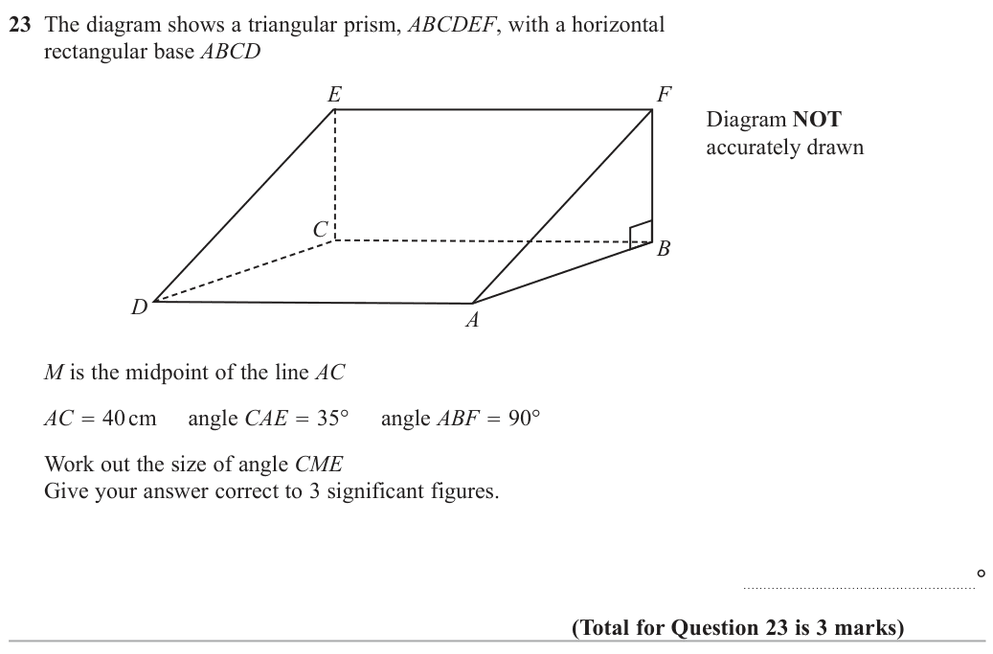
3. Jun 2025 P2HR · Q23 Medium 3 marksShow worked solution Use trigonometry \[
AC=40
\]
The point is vertically above The point \(E\) is vertically above \(C\), so triangle \(ACE\) is right-angled at \(C\).
\[
\angle CAE=35^\circ
\]
\[
\tan35^\circ=\frac{CE}{AC}
\]
\[
CE=40\tan35^\circ
\]
Find the midpoint Since \(M\) is the midpoint of \(AC\),
\[
CM=20
\]
Use trigonometry In right triangle \(CME\),
\[
\tan \angle CME=\frac{CE}{CM}
\]
\[
\tan \angle CME=\frac{40\tan35^\circ}{20}
\]
\[
\tan \angle CME=2\tan35^\circ
\]
\[
\angle CME=54.5^\circ
\]
Final answer \(54.5^\circ\)
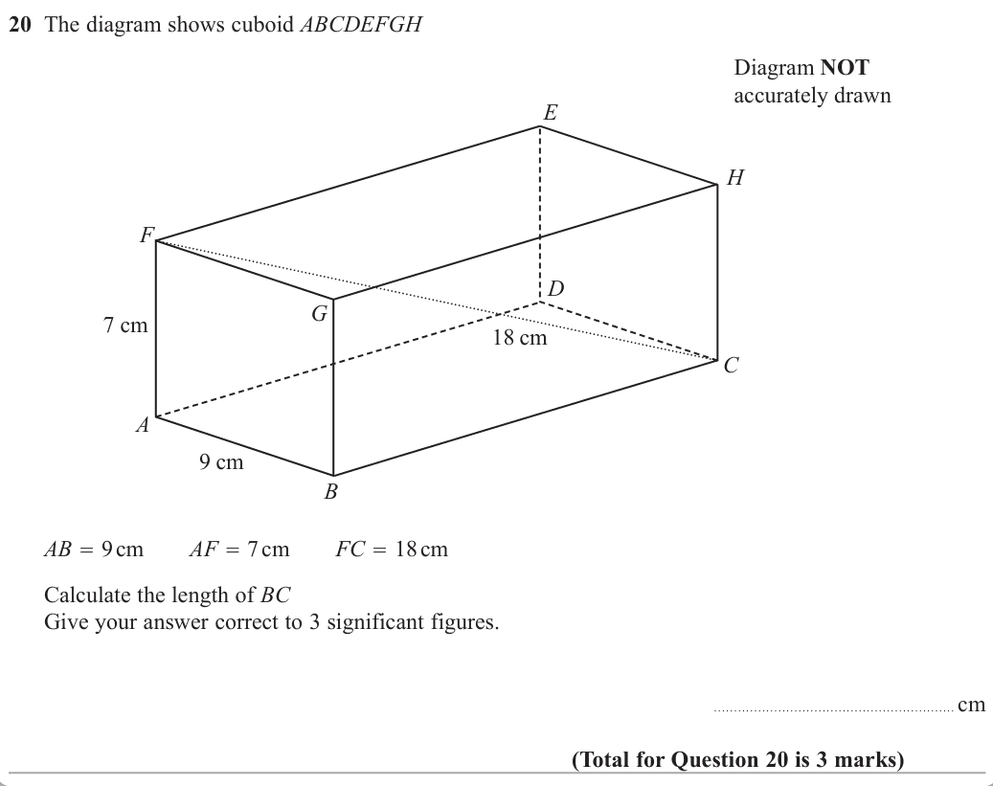
4. May 2025 4WM1HR · Q20 Medium 3 marksShow worked solution Use trigonometry In the rectangle \(ABCF\), use Pythagoras with the diagonal \(FC\):
\[
AC^2=FC^2-AF^2
\]
\[
AC^2=18^2-7^2=324-49=275
\]
Use trigonometry Now use Pythagoras in triangle \(ABC\):
\[
BC^2=AC^2-AB^2
\]
\[
BC^2=275-9^2=275-81=194
\]
\[
BC=\sqrt{194}=13.928\ldots
\]
Final answer \(13.9\text{ cm}\) to 3 significant figures
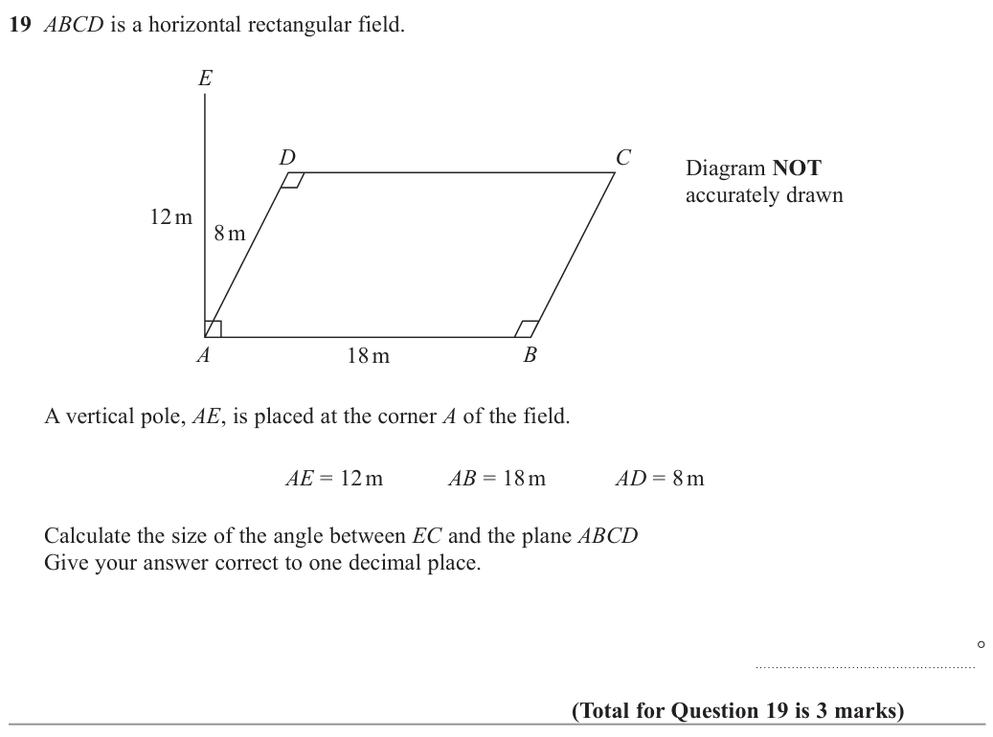
5. Jan 2022 P2HR · Q19 Medium 3 marksShow worked solution The projection of onto the The projection of \(EC\) onto the field is \(AC\).
\[
AC=\sqrt{18^2+8^2}=\sqrt{388}
\]
Use trigonometry The vertical height is \(AE=12\text{ m}\), so
\[
\tan\theta=\frac{12}{\sqrt{388}}
\]
\[
\theta=31.350\ldots^\circ
\]
Final answer \(31.4^\circ\).
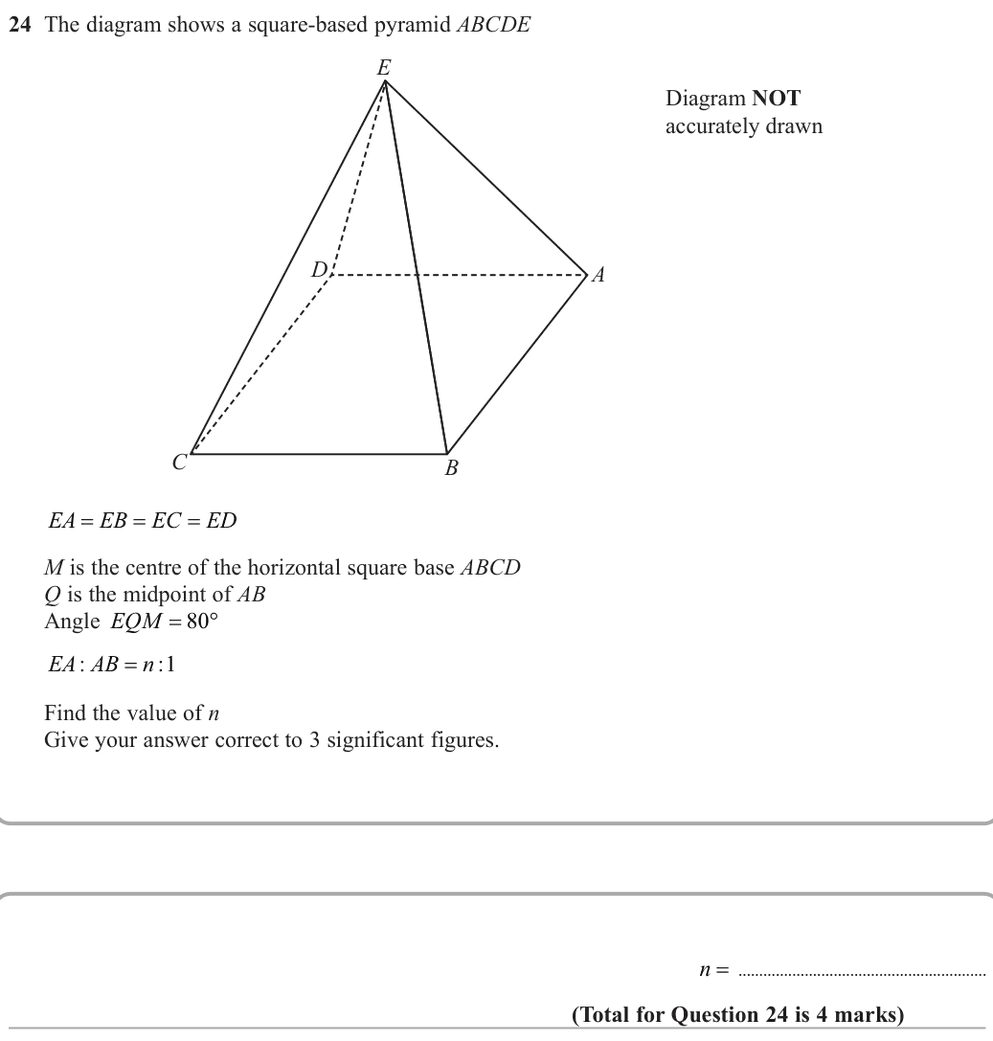
6. Jun 2025 P2H · Q24 Medium 4 marksShow worked solution Let \[
AB=s
\]
Find the midpoint Since \(M\) is the centre of the square base and \(Q\) is the midpoint of \(AB\),
\[
QM=\frac{s}{2}
\]
Use trigonometry Since \(EA=EB=EC=ED\), the point \(E\) is vertically above \(M\).
Use trigonometry In right triangle \(EQM\),
\[
\tan80^\circ=\frac{EM}{QM}
\]
\[
EM=\frac{s}{2}\tan80^\circ
\]
The distance from the centre The distance from the centre of a square to a vertex is half the diagonal:
\[
AM=\frac{s\sqrt2}{2}
\]
Use trigonometry In right triangle \(EMA\),
\[
EA^2=EM^2+AM^2
\]
\[
EA^2=\left(\frac{s}{2}\tan80^\circ\right)^2+\left(\frac{s\sqrt2}{2}\right)^2
\]
\[
EA=s\sqrt{\frac{\tan^2 80^\circ}{4}+\frac12}
\]
Use trigonometry So
\[
\frac{EA}{AB}=\sqrt{\frac{\tan^2 80^\circ}{4}+\frac12}
\]
\[
n=2.92
\]
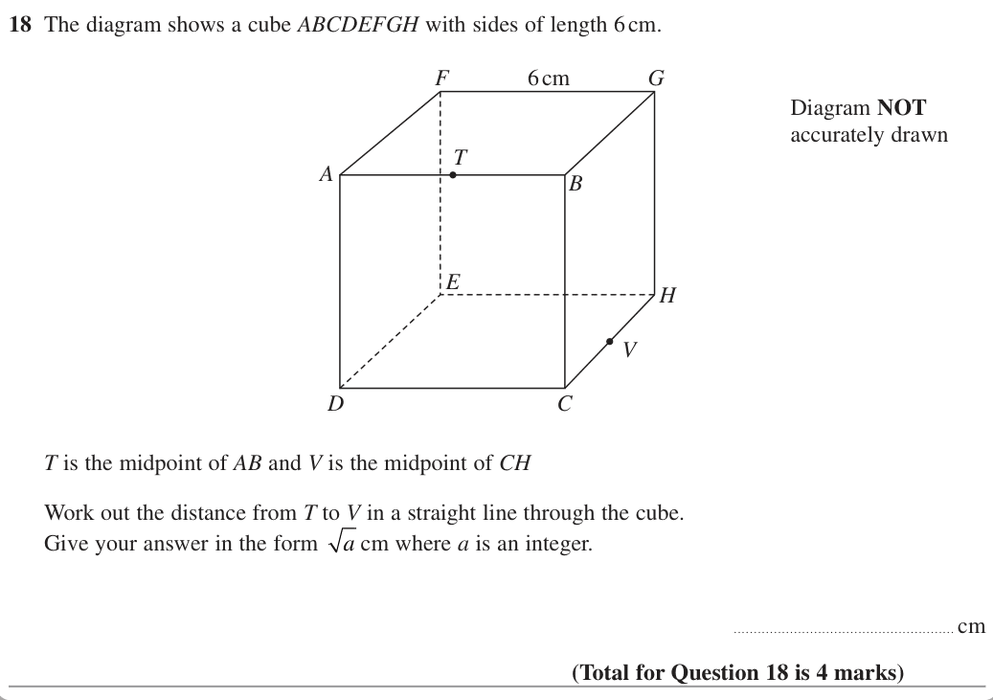
7. Jun 2022 P1HR · Q18 Medium 4 marksShow worked solution The cube has side length The cube has side length \(6\) cm.
Find the midpoint Let \(T\) be the midpoint of \(AB\) and \(V\) be the midpoint of \(CH\).
The changes in the three The changes in the three perpendicular directions from \(T\) to \(V\) are \[ 3,\quad 3,\quad 6 \]
Use trigonometry So by 3D Pythagoras, \[ TV=\sqrt{3^2+3^2+6^2} \]
\[
TV=\sqrt{9+9+36}=\sqrt{54}
\]
Final answer \(\sqrt{54}\text{ cm}\).
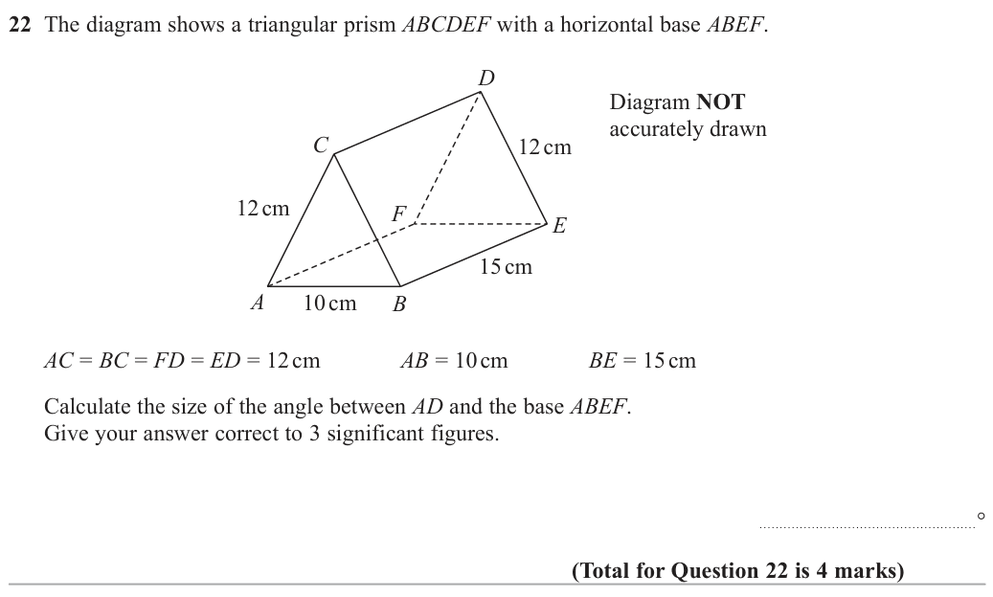
8. May 2021 P1H · Q22 Medium 4 marksShow worked solution Calculate value The triangular end is isosceles, with
\[
AC=BC=12,\qquad AB=10
\]
The perpendicular height of the The perpendicular height of the triangle is found by halving \(AB\):
\[
AM=5
\]
\[
CM^2=12^2-5^2=144-25=119
\]
\[
CM=\sqrt{119}
\]
The projection of on the The projection of \(AD\) on the horizontal base goes from \(A\) to the midpoint of \(FE\). Its length is
\[
\sqrt{15^2+5^2}=\sqrt{250}
\]
Use trigonometry So, for the angle \(\theta\) between \(AD\) and the base,
\[
\tan \theta=\frac{\sqrt{119}}{\sqrt{250}}
\]
\[
\theta=\tan^{-1}\left(\frac{\sqrt{119}}{\sqrt{250}}\right)=34.602\ldots
\]
Final answer \(34.6^\circ\)
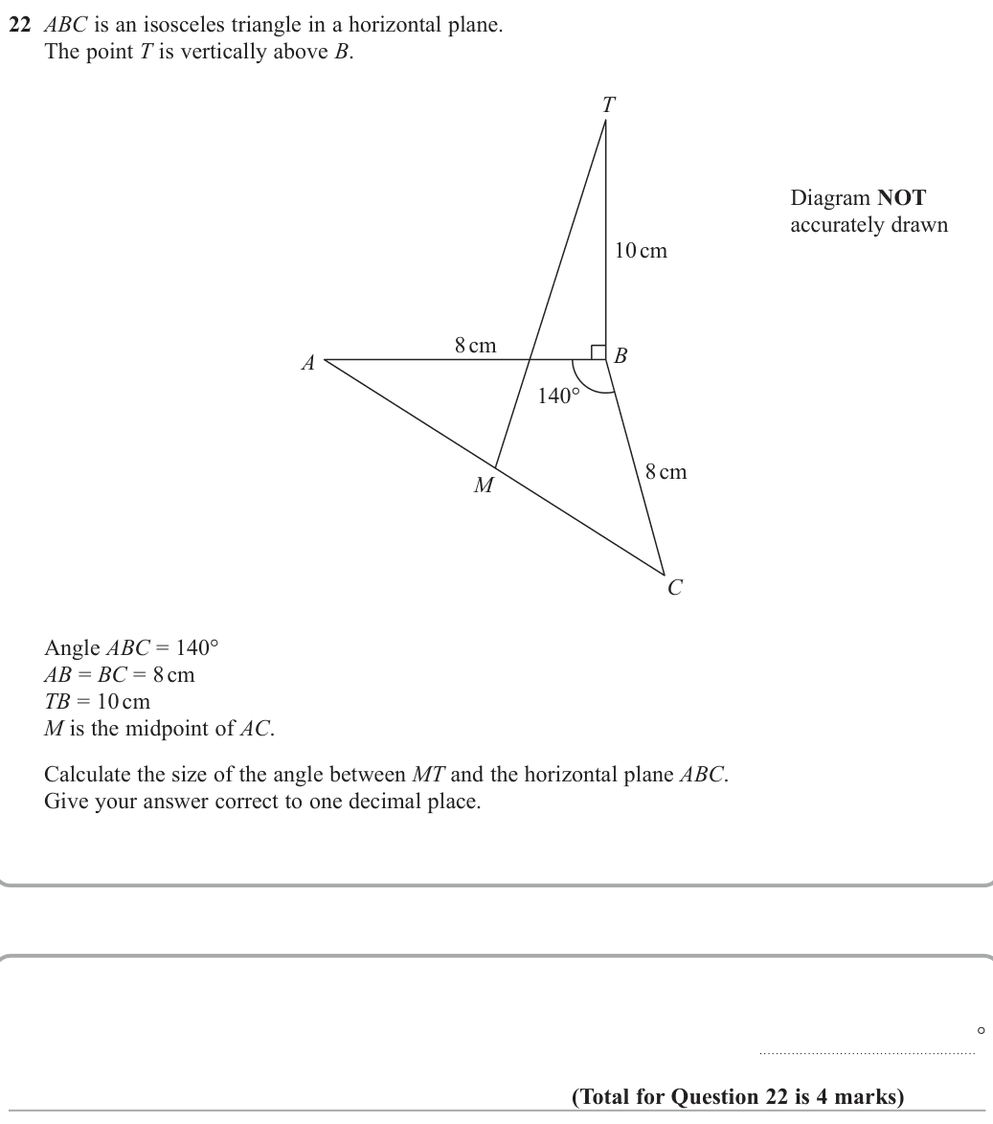
9. Jan 2021 P2HR · Q22 Medium 4 marksShow worked solution Use trigonometry Since \(AB=BC=8\), triangle \(ABC\) is isosceles.
The line from to the The line from \(B\) to the midpoint \(M\) bisects angle \(ABC\).
\[
\angle ABM=\frac{140^\circ}{2}=70^\circ
\]
Use trigonometry In right triangle \(ABM\),
\[
\cos 70^\circ=\frac{BM}{8}
\]
\[
BM=8\cos 70^\circ
\]
Use trigonometry Since \(T\) is vertically above \(B\), the projection of \(MT\) onto the horizontal plane is \(MB\).
Let the required angle be Let the required angle be \(\theta\).
\[
\tan \theta=\frac{TB}{BM}
\]
\[
\tan \theta=\frac{10}{8\cos70^\circ}
\]
\[
\theta=74.7^\circ
\]
Final answer \(74.7^\circ\)
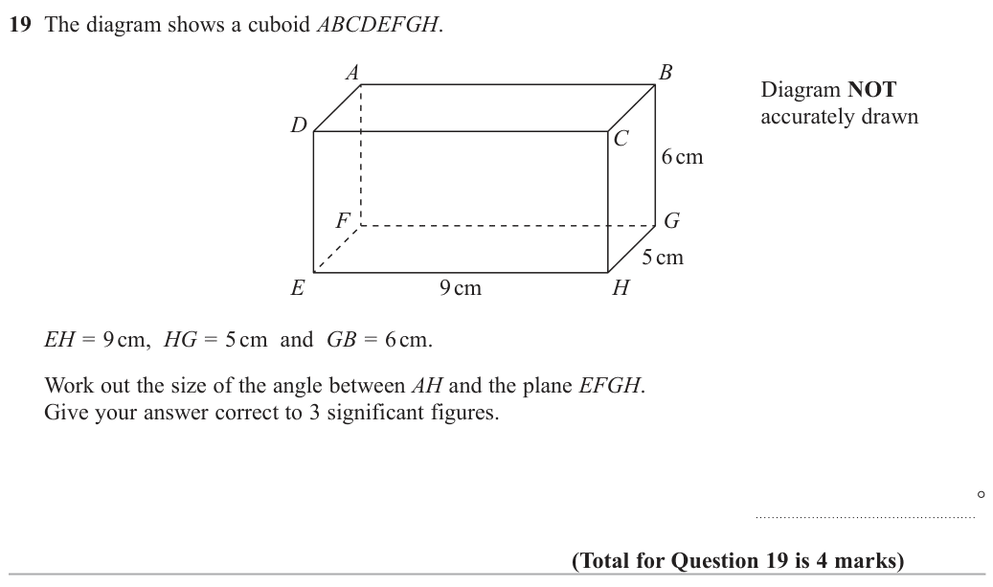
10. Jan 2020 P1H · Q19 Medium 4 marksShow worked solution The projection of onto the The projection of \(AH\) onto the base plane is the diagonal of the base rectangle:
\[
\sqrt{9^2+5^2}=\sqrt{106}
\]
Use trigonometry The vertical height is \(6\text{ cm}\), so
\[
\tan\theta=\frac{6}{\sqrt{106}}
\]
\[
\theta=30.232\ldots^\circ
\]
Final answer \(30.2^\circ\).
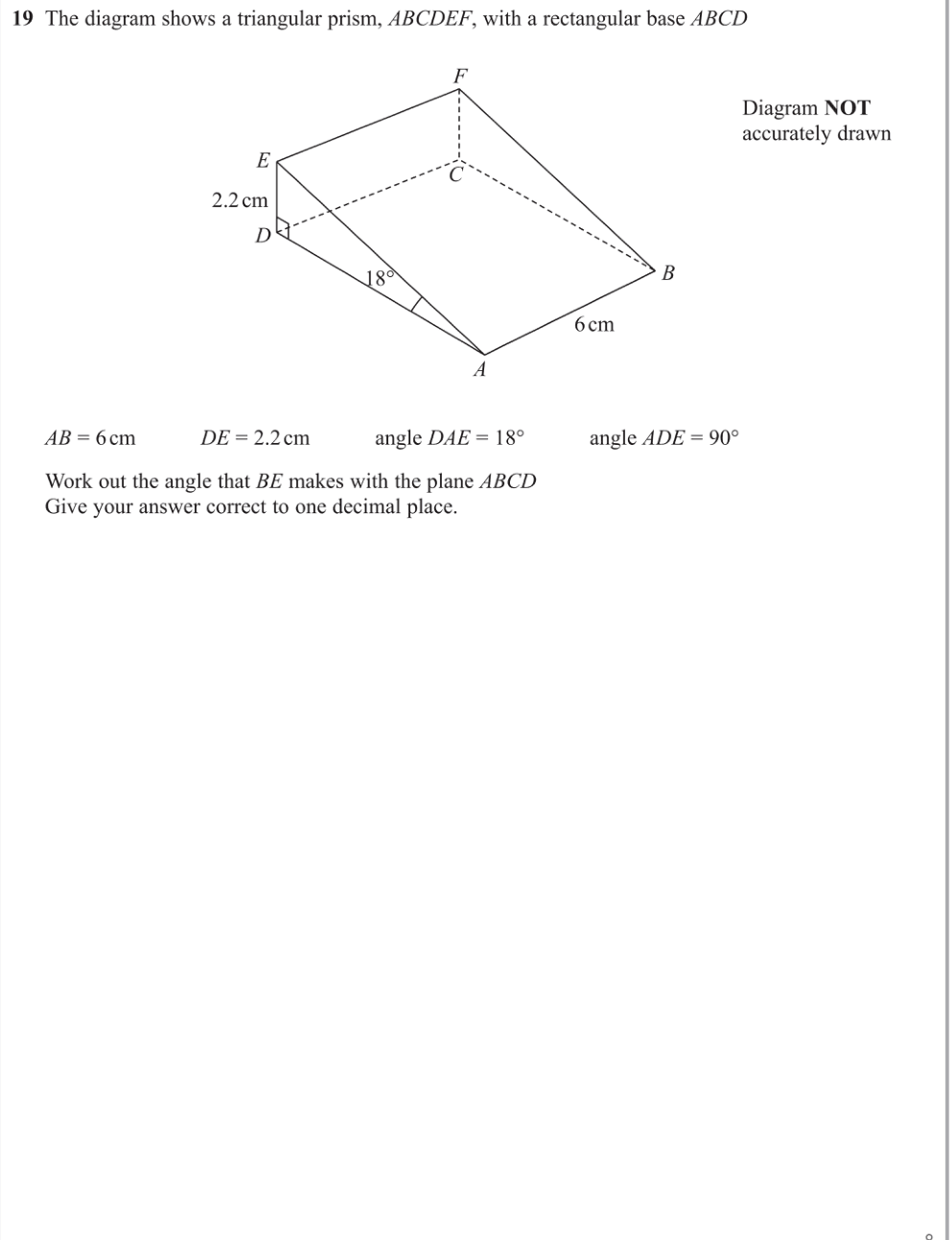
11. Specimen 4WM1H · Q19 Medium 4 marksShow worked solution Find AD In triangle \(ADE\),
\[
\tan 18^\circ=\frac{DE}{AD}
\]
\[
AD=\frac{2.2}{\tan 18^\circ}=6.77\ldots
\]
Find DB in the base The base \(ABCD\) is a rectangle, so
\[
DB=\sqrt{6^2+6.77\ldots^2}=9.04\ldots
\]
Use the projection triangle The projection of \(BE\) on the plane is \(BD\). Let the required angle be \(\theta\).
\[
\tan\theta=\frac{DE}{DB}
=\frac{2.2}{9.04\ldots}
\]
Calculate the angle \[
\theta=13.7^\circ
\]
Final answer \(13.7^\circ\).
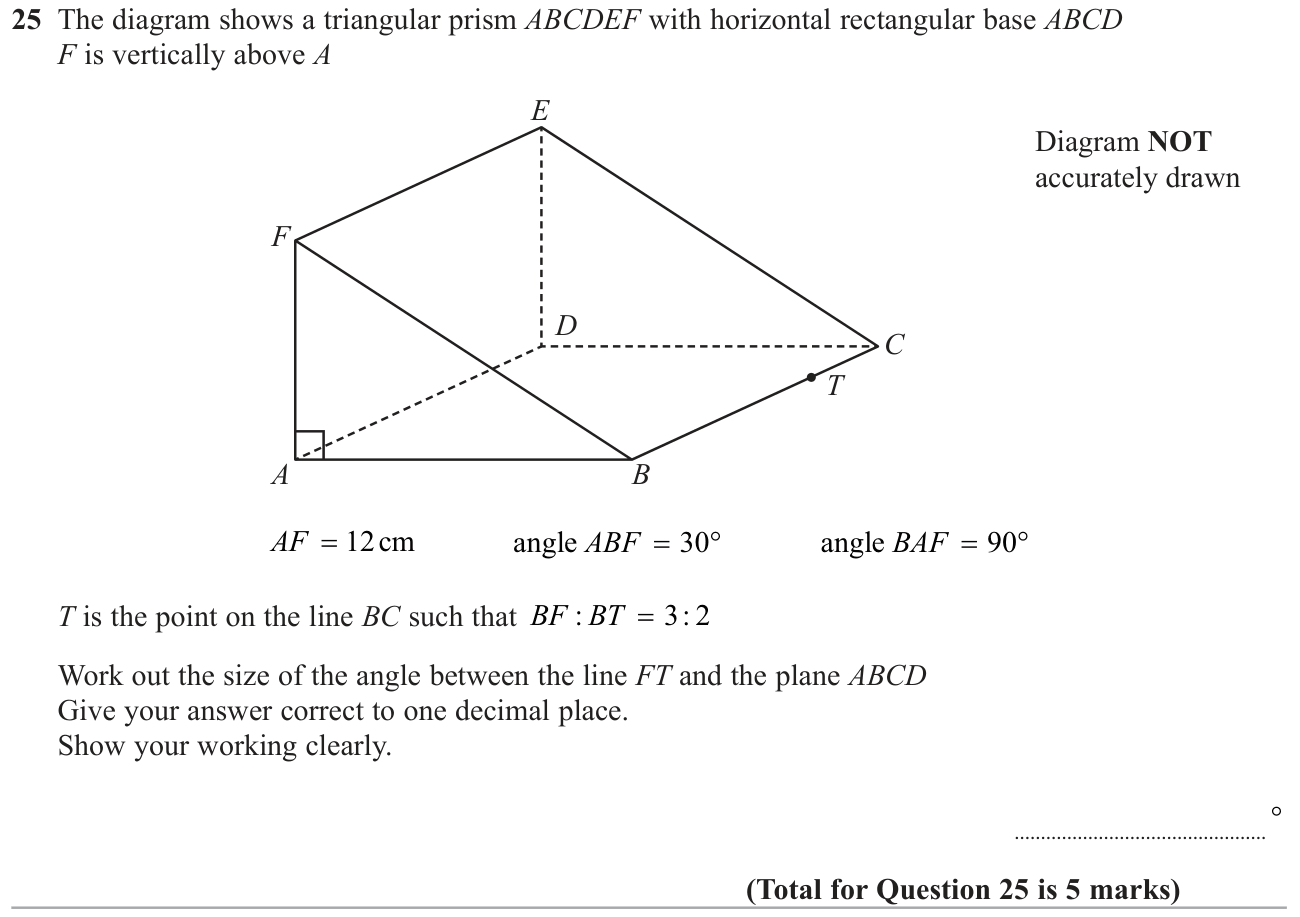
12. Jun 2026 P1H · Q25 Hard 5 marksShow worked solution Solution | Step 1 \[BF=\frac{12}{\sin30^\circ}=24\text{ cm},\qquad AB=\frac{12}{\tan30^\circ}=12\sqrt3\text{ cm}.\]
Use right triangle ABF.
Solution | Step 2 \[BT=\frac23 BF=16\text{ cm}.\]
Apply the given BF:BT ratio.
Solution | Step 3 \[AT=\sqrt{AB^2+BT^2}=\sqrt{432+256}=\sqrt{688}=4\sqrt{43}\text{ cm}.\]
AB is perpendicular to BC in the rectangular base, so triangle ABT is right-angled at B.
Solution | Step 4 The projection of FT onto plane ABCD is AT because F lies vertically above A. Therefore the required angle is \(\theta=\angle FTA\).
A line-plane angle is the angle between the line and its perpendicular projection onto the plane.
Solution | Step 5 \[\tan\theta=\frac{AF}{AT}=\frac{12}{4\sqrt{43}}=\frac{3}{\sqrt{43}},\quad\theta=24.583891\ldots^\circ=24.6^\circ.\]
Use right triangle FAT and round to one decimal place.
Final answer \(24.6^\circ\)
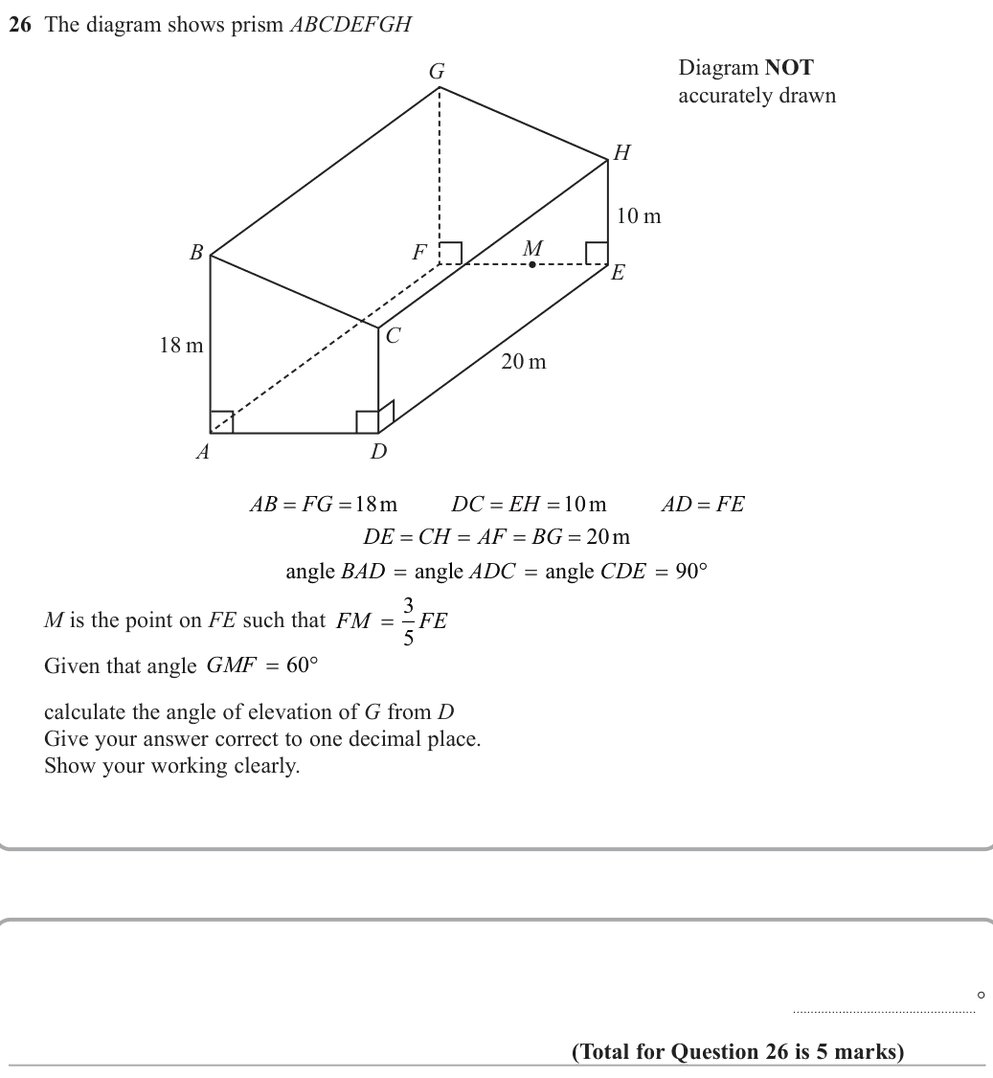
13. Nov 2025 4WM1H · Q26 Hard 5 marksShow worked solution Use trigonometry From triangle \(GMF\),
\[
\tan 60^\circ=\frac{FG}{FM}=\frac{18}{FM}
\]
\[
FM=\frac{18}{\tan 60^\circ}=6\sqrt3
\]
Simplify surd Since \(FM=\frac35FE\),
\[
FE=10\sqrt3
\]
Simplify surd The horizontal distance from \(D\) to the point below \(G\) is
\[
\sqrt{20^2+(10\sqrt3)^2}=10\sqrt7
\]
Use trigonometry If \(\theta\) is the angle of elevation,
\[
\tan\theta=\frac{18}{10\sqrt7}
\]
\[
\theta\approx 34.2289^\circ
\]
Final answer \(34.2^\circ\).
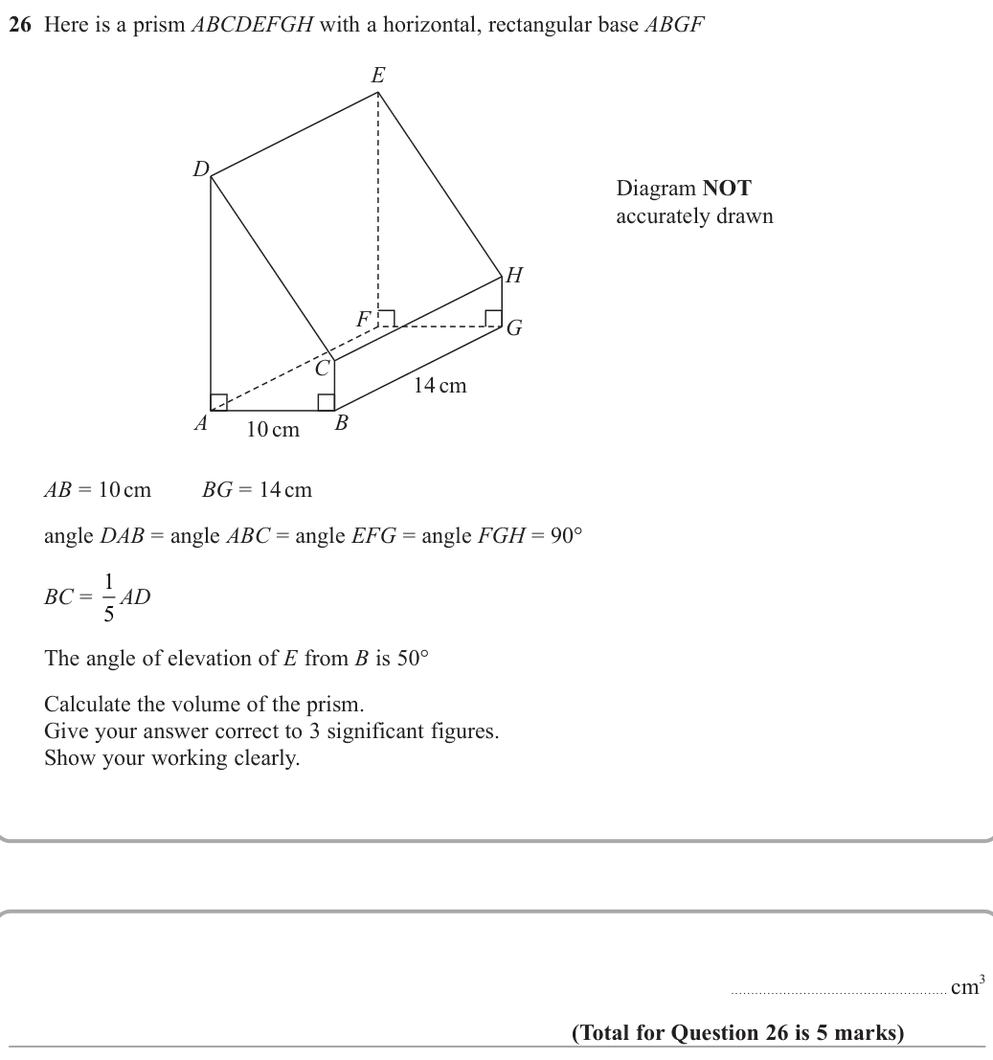
14. Nov 2025 P1H · Q26 Hard 5 marksShow worked solution The horizontal base is a The horizontal base \(ABGF\) is a rectangle.
\[
AB=10,\qquad BG=14
\]
Use trigonometry So the horizontal distance from \(B\) to \(F\) is
\[
BF=\sqrt{10^2+14^2}=\sqrt{296}
\]
Use trigonometry The angle of elevation of \(E\) from \(B\) is \(50^\circ\).
Use trigonometry Since \(E\) is vertically above \(F\),
\[
\tan 50^\circ=\frac{FE}{BF}
\]
\[
FE=\sqrt{296}\tan50^\circ
\]
The prism has the same The prism has the same cross section throughout, so
\[
AD=FE=\sqrt{296}\tan50^\circ
\]
Use trigonometry Also
\[
BC=\frac15AD
\]
Area of the trapezium cross Area of the trapezium cross section \(ABCD\):
\[
\frac12(AD+BC)\times AB
\]
\[
=\frac12\left(AD+\frac15AD\right)\times 10
\]
\[
=6AD
\]
Volume of the prism Volume of the prism:
\[
6AD\times 14=84AD
\]
\[
=84\sqrt{296}\tan50^\circ
\]
\[
=1722.311\ldots
\]
Correct to 3 significant figures Correct to 3 significant figures:
\[
1720
\]
Final answer \(\boxed{1720\text{ cm}^3}\)
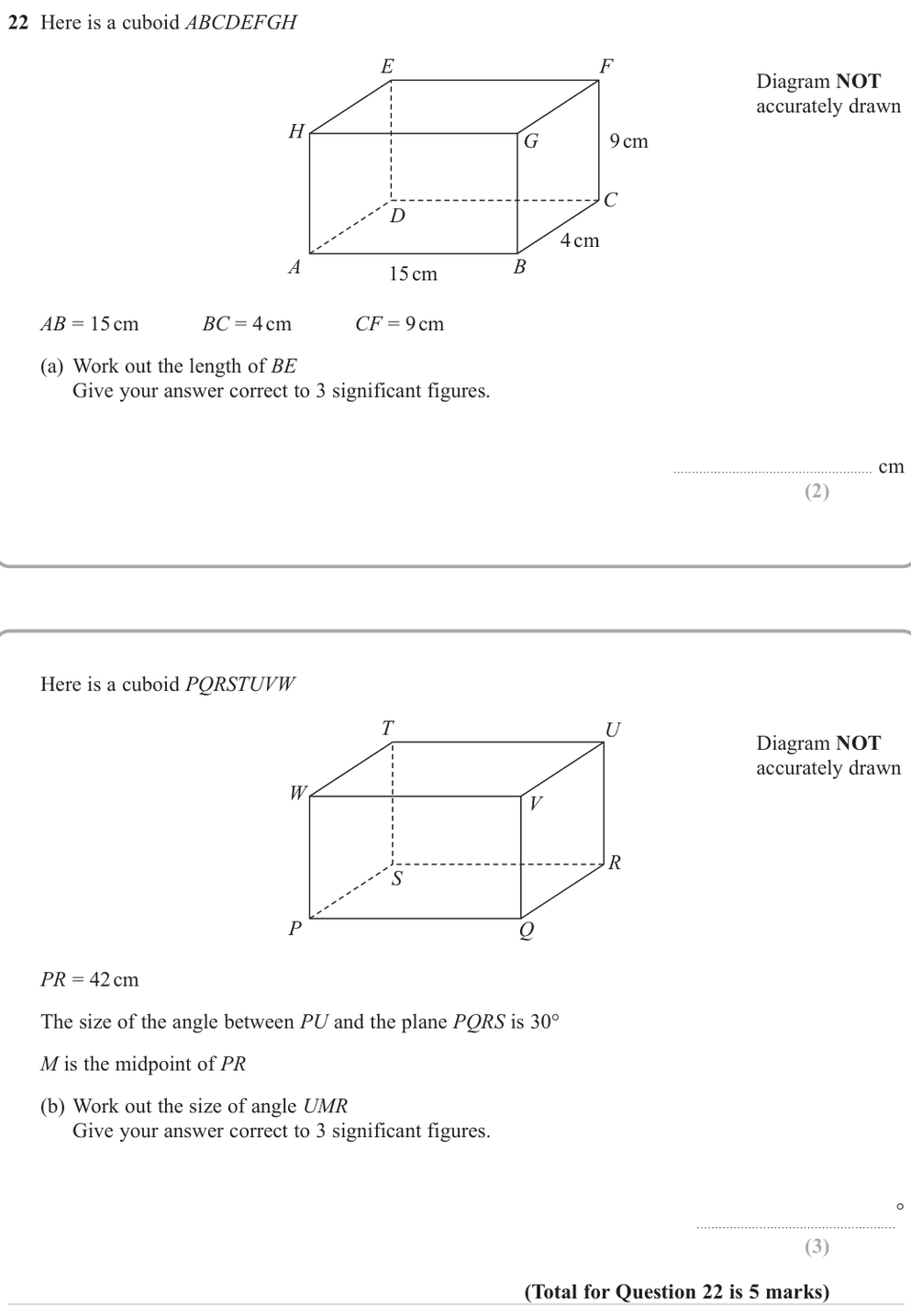
15. Jun 2023 P2HR · Q22 Hard 5 marksShow worked solution Find the gradient For part (a), \(BE\) is the space diagonal using the three perpendicular lengths:
\[
AB=15,\qquad BC=4,\qquad CF=9
\]
\[
BE^2=15^2+4^2+9^2
\]
\[
BE^2=225+16+81=322
\]
\[
BE=\sqrt{322}=17.9\text{ cm}
\]
Use trigonometry For part (b), the projection of \(PU\) onto the plane \(PQRS\) is \(PR\).
\[
PR=42
\]
The angle between and the The angle between \(PU\) and the plane is \(30^\circ\), so
\[
\tan 30^\circ=\frac{RU}{PR}
\]
\[
RU=42\tan30^\circ
\]
Find the midpoint Since \(M\) is the midpoint of \(PR\),
\[
MR=21
\]
Use trigonometry In right triangle \(MRU\),
\[
\tan \angle UMR=\frac{RU}{MR}
\]
\[
\tan \angle UMR=\frac{42\tan30^\circ}{21}
\]
\[
\tan \angle UMR=2\tan30^\circ
\]
\[
\angle UMR=49.1^\circ
\]
Final answer \(BE=17.9\text{ cm}\), \(\angle UMR=49.1^\circ\)
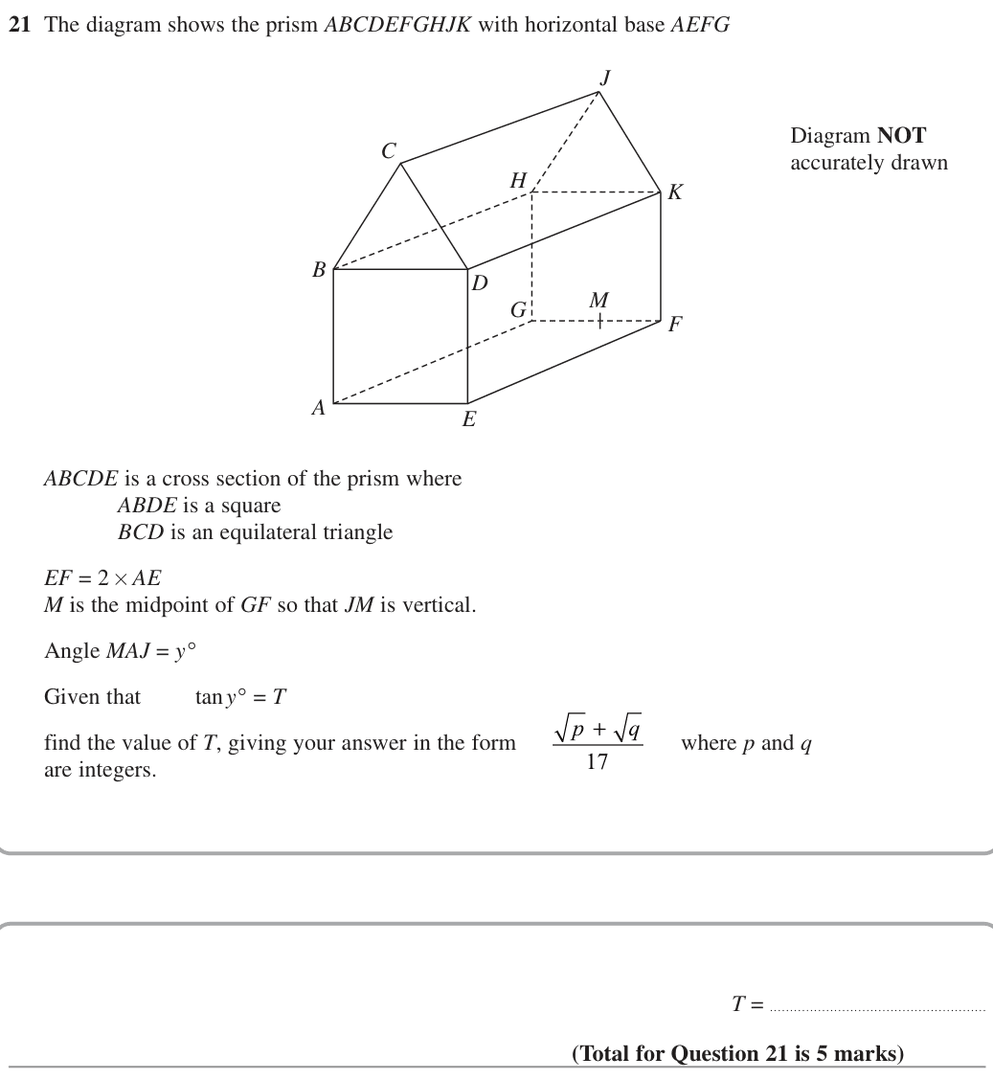
16. Jan 2022 P1H · Q21 Hard 5 marksShow worked solution Let \[
AE=x
\]
Use trigonometry Since \(ABDE\) is a square,
\[
AB=BD=DE=AE=x
\]
Use trigonometry Since \(BCD\) is an equilateral triangle, the height from \(C\) to \(BD\) is
\[
\frac{\sqrt3}{2}x
\]
Use trigonometry Therefore the vertical height from the base to \(J\) is
\[
JM=x+\frac{\sqrt3}{2}x
\]
\[
JM=\frac{x(2+\sqrt3)}{2}
\]
Use trigonometry Also,
\[
EF=2AE=2x
\]
Find the midpoint Since \(M\) is the midpoint of \(GF\), the horizontal distance from \(A\) to \(M\) is
\[
AM=\sqrt{\left(\frac{x}{2}\right)^2+(2x)^2}
\]
\[
AM=\sqrt{\frac{x^2}{4}+4x^2}
\]
\[
AM=\frac{x\sqrt{17}}{2}
\]
Use trigonometry In right triangle \(AMJ\),
\[
\tan y^\circ=\frac{JM}{AM}
\]
\[
T=\frac{\frac{x(2+\sqrt3)}{2}}{\frac{x\sqrt{17}}{2}}
\]
\[
T=\frac{2+\sqrt3}{\sqrt{17}}
\]
Rationalise the denominator Rationalise the denominator:
\[
T=\frac{(2+\sqrt3)\sqrt{17}}{17}
\]
\[
T=\frac{2\sqrt{17}+\sqrt{51}}{17}
\]
\[
T=\frac{\sqrt{68}+\sqrt{51}}{17}
\]
Final answer \(\displaystyle T=\frac{\sqrt{68}+\sqrt{51}}{17}\)
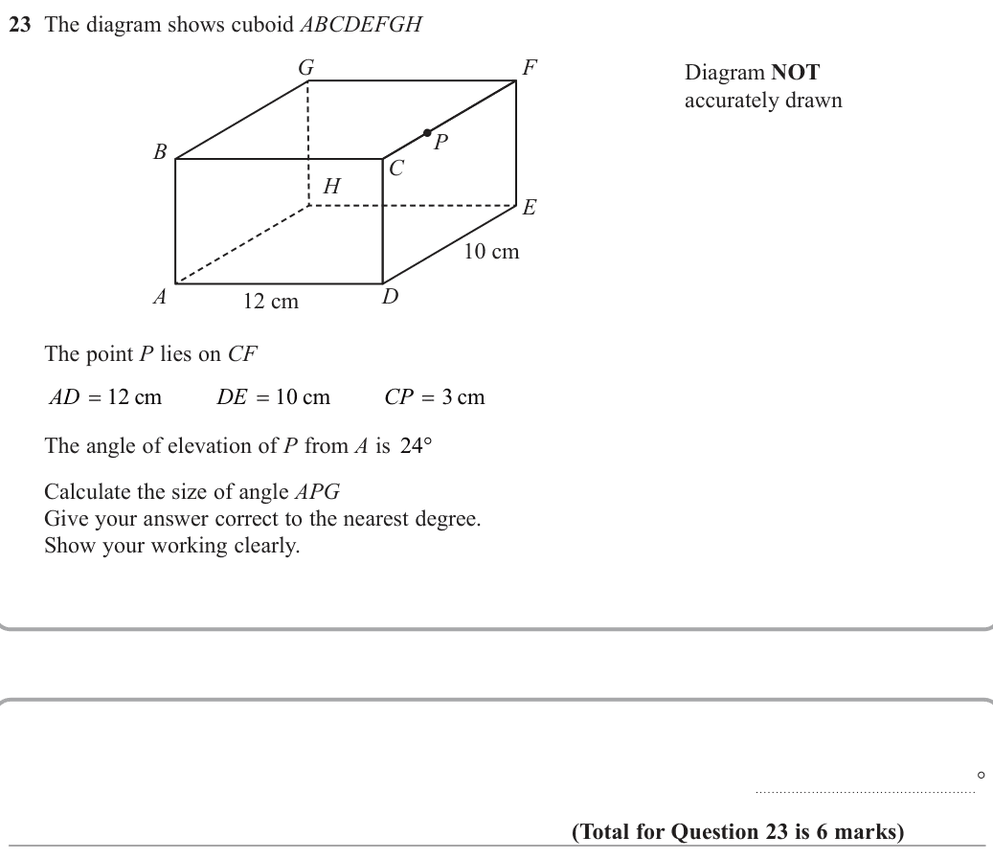
17. May 2025 4WM1H · Q23 Hard 6 marksShow worked solution Point is cm from along Point \(P\) is \(3\) cm from \(C\) along \(CF\). The horizontal distance from \(A\) to the point directly below \(P\) is
\[
\sqrt{12^2+3^2}=\sqrt{153}
\]
Use trigonometry Using the angle of elevation,
\[
h=\sqrt{153}\tan24^\circ=5.507\ldots
\]
Use trigonometry So
\[
AP=\frac{\sqrt{153}}{\cos24^\circ}=13.5399\ldots
\]
Use trigonometry On the top face,
\[
PG=\sqrt{12^2+7^2}=\sqrt{193}=13.8924\ldots
\]
Use trigonometry Also,
\[
AG=\sqrt{12^2+10^2+h^2}=16.561\ldots
\]
Use cosine rule Use the cosine rule in triangle \(APG\).
\[
\cos\angle APG=\frac{AP^2+PG^2-AG^2}{2(AP)(PG)}
\]
\[
\angle APG=49.163\ldots^\circ
\]
Use trigonometry To the nearest degree,
\[
49^\circ
\]
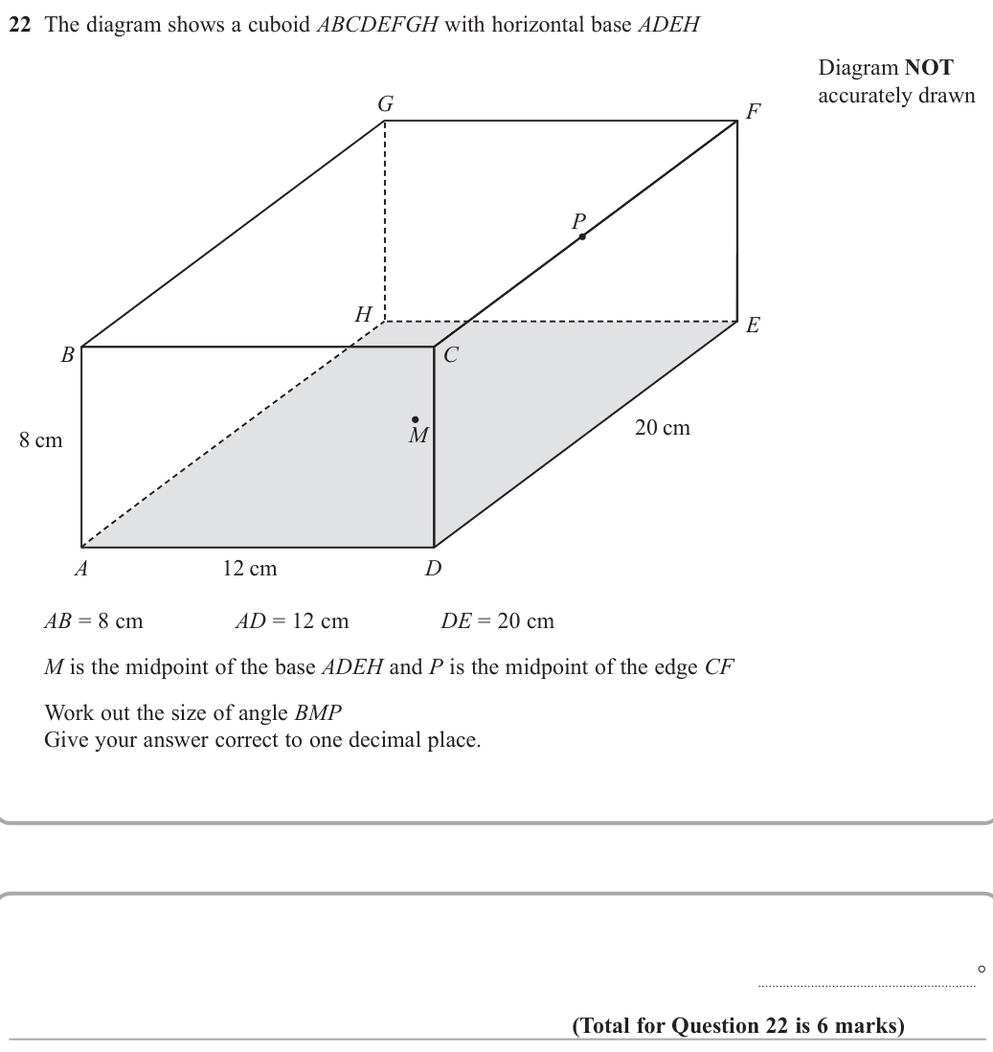
18. May 2024 P1HR · Q22 Hard 6 marksShow worked solution Use trigonometry Use coordinates with
\[
A=(0,0,0)
\]
Use trigonometry Since
\[
AD=12,\qquad DE=20,\qquad AB=8
\]
take \[
B=(0,0,8)
\]
The centre of the rectangular The centre of the rectangular base \(ADEH\) is
\[
M=(6,10,0)
\]
Find the midpoint Point \(P\) is the midpoint of \(CF\).
\[
C=(12,0,8),\qquad F=(12,20,8)
\]
\[
P=(12,10,8)
\]
Use trigonometry Now
\[
\vec{MB}=B-M=(-6,-10,8)
\]
\[
\vec{MP}=P-M=(6,0,8)
\]
Use the scalar product formula Use the scalar product formula:
\[
\vec{MB}\cdot\vec{MP}=(-6)(6)+(-10)(0)+(8)(8)
\]
\[
\vec{MB}\cdot\vec{MP}=28
\]
\[
|\vec{MB}|=\sqrt{(-6)^2+(-10)^2+8^2}=\sqrt{200}
\]
\[
|\vec{MP}|=\sqrt{6^2+0^2+8^2}=10
\]
\[
\cos \angle BMP=\frac{28}{10\sqrt{200}}
\]
\[
\angle BMP=78.6^\circ
\]
Final answer \(78.6^\circ\)
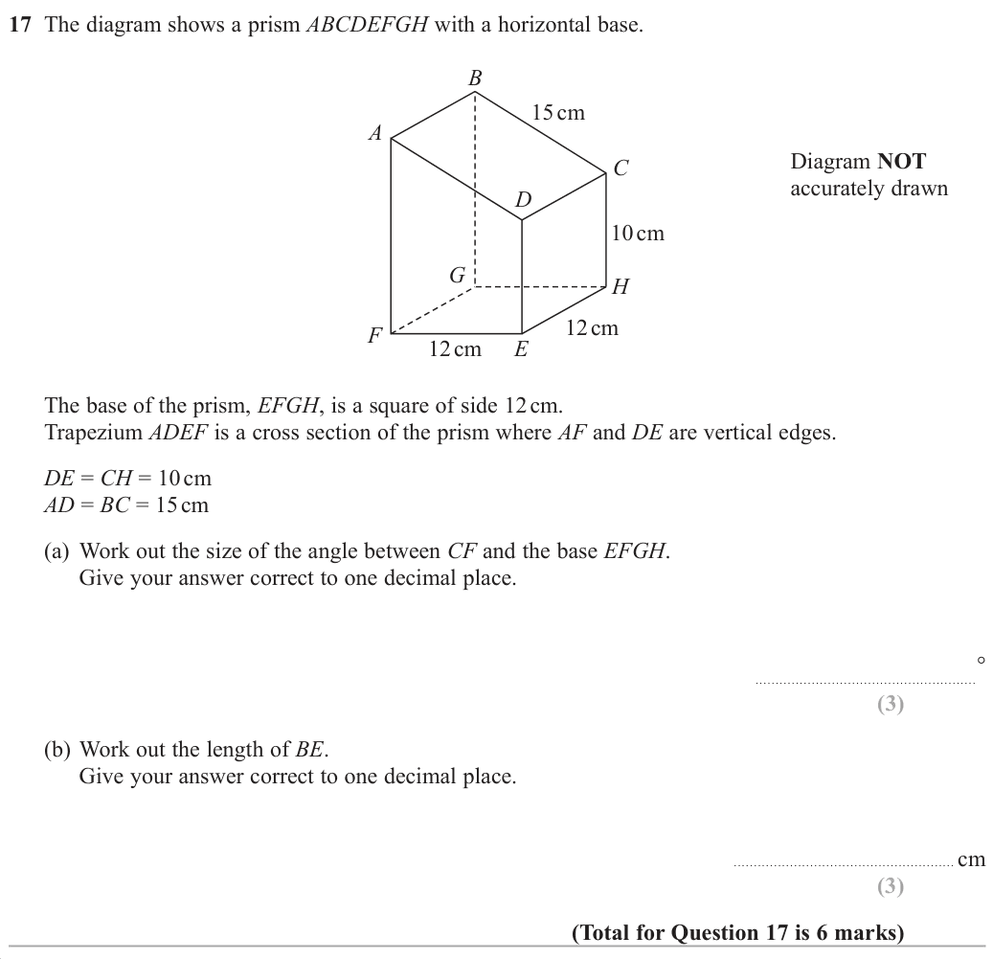
19. May-Nov 2020 P1HR · Q17 Hard 6 marksShow worked solution Use trigonometry (a) \(C\) is vertically above \(H\), so the vertical height from \(F\) to \(C\) is \(10\text{ cm}\).
The projection of on the The projection of \(CF\) on the base is \(FH\):
\[
FH=12\sqrt2
\]
\[
\tan\theta=\frac{10}{12\sqrt2}
\]
\[
\theta=30.508\ldots^\circ
\]
Answer **Answer:** \(30.5^\circ\).
(b) In the trapezium cross (b) In the trapezium cross-section, \(AD=15\) and the horizontal distance is \(12\), so the difference in vertical heights is
\[
\sqrt{15^2-12^2}=9
\]
Use trigonometry Since \(DE=10\), the height \(BG=19\text{ cm}\).
The projection of on the The projection of \(BE\) on the base is \(GE=12\sqrt2\), so
\[
BE=\sqrt{19^2+(12\sqrt2)^2}
=25.475\ldots
\]
Final answer \(25.5\text{ cm}\).
More IGCSE Maths 4MA1 topics Dr Eslam Ahmed Elite Mathematics · Questions classified by topic, solutions checked by Dr Eslam
 Elite Mathematics