Elite Mathematics / Linear / Topics / Circle Theorems IGCSE · 4MA1 · Topic Circle Theorems: past paper questions & worked solutions
Every Circle Theorems question from the 4MA1 papers in our bank, 2020–2026, sorted from easiest to hardest. Try each one first, then open the worked solution.
33 questions
123 marks in total
52% of papers (28 of 54) include it
3/24/6 easy / medium / hard
Questions, easiest first Level is estimated from marks: 1–2 easy, 3–4 medium, 5+ hard.
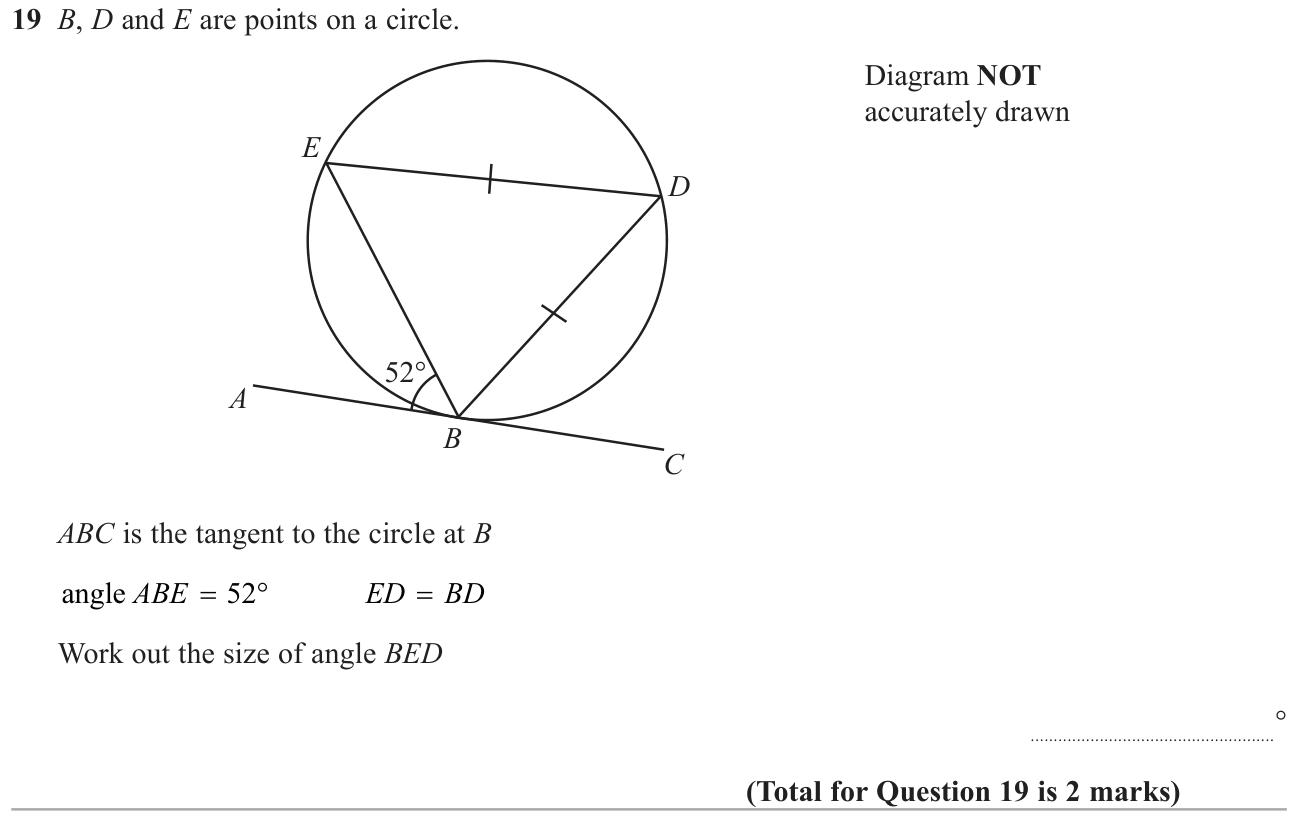
1. Jun 2026 P2H · Q19 Easy 2 marksShow worked solution Solution | Step 1 \(\angle BDE=\angle ABE=52^\circ\), by the alternate segment theorem for tangent \(AB\) and chord \(BE\).
The angle between a tangent and chord equals the angle in the opposite segment.
Solution | Step 2 Since \(ED=BD\), the base angles \(\angle BED\) and \(\angle EBD\) are equal. Thus \[\angle BED=\frac{180^\circ-52^\circ}{2}=64^\circ.\]
Equal sides in triangle EBD subtend equal opposite angles, and its angles sum to 180 degrees.
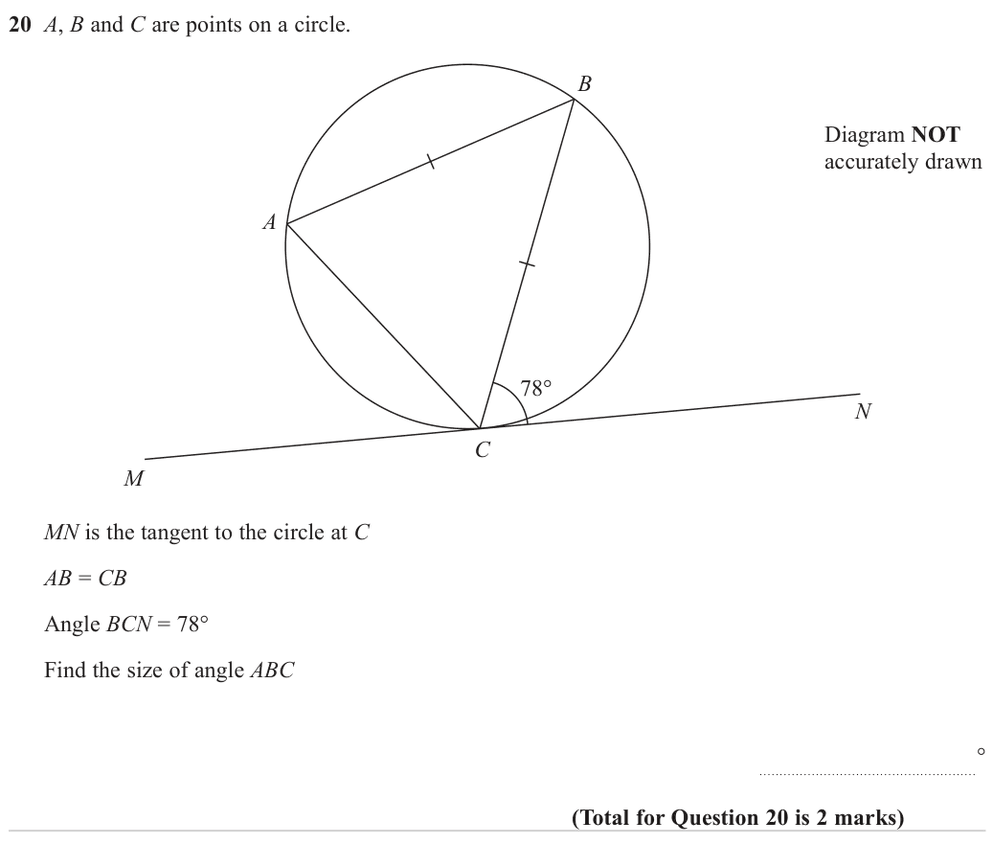
2. Jun 2023 P2HR · Q20 Easy 2 marksShow worked solution The angle between the tangent The angle between the tangent \(CN\) and the chord \(CB\) is \(78^\circ\).
Use trigonometry By the alternate segment theorem,
\[
\angle BAC=78^\circ
\]
Calculate value Also,
\[
AB=CB
\]
Use trigonometry so triangle \(ABC\) is isosceles and the base angles are equal:
\[
\angle BAC=\angle ACB=78^\circ
\]
Use trigonometry Using the angle sum of a triangle:
\[
\angle ABC=180^\circ-78^\circ-78^\circ
\]
\[
\angle ABC=24^\circ
\]
Final answer \(\boxed{24^\circ}\)
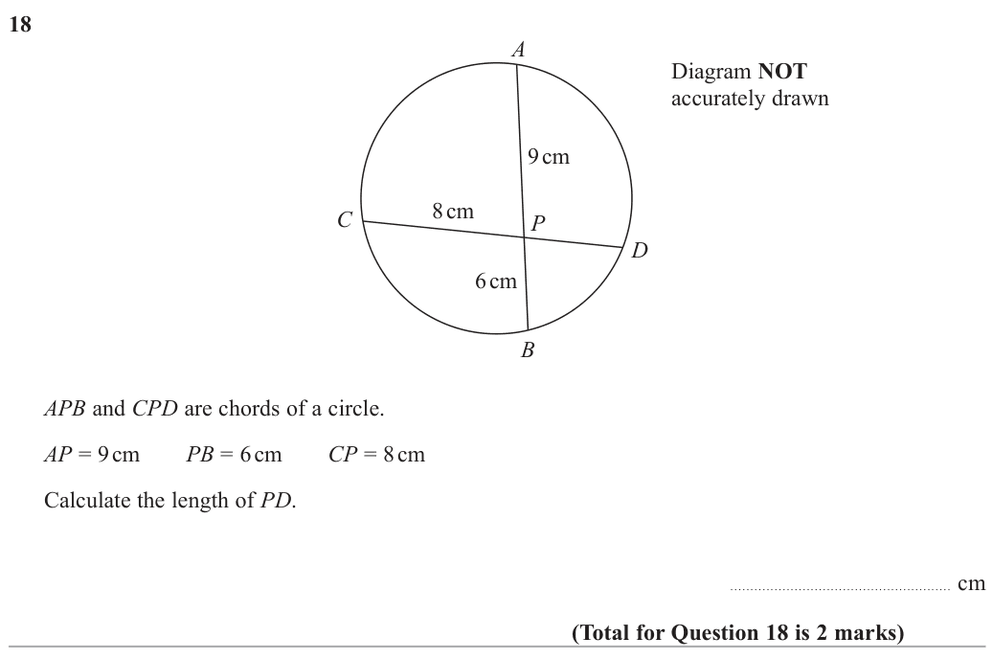
3. Jan 2020 P2HR · Q18 Easy 2 marksShow worked solution Use the intersecting chords theorem Use the intersecting chords theorem: \[ AP\times PB=CP\times PD \]
Substitute the values Substitute the values: \[ 9\times 6=8\times PD \]
\[
54=8PD
\]
\[
PD=6.75
\]
Final answer \(6.75\text{ cm}\).
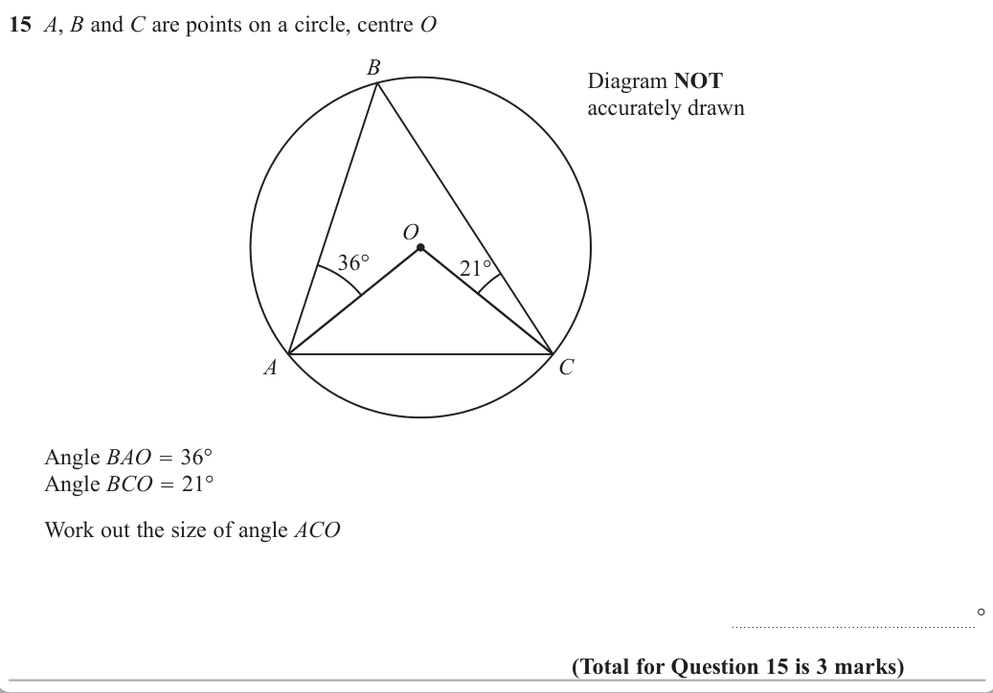
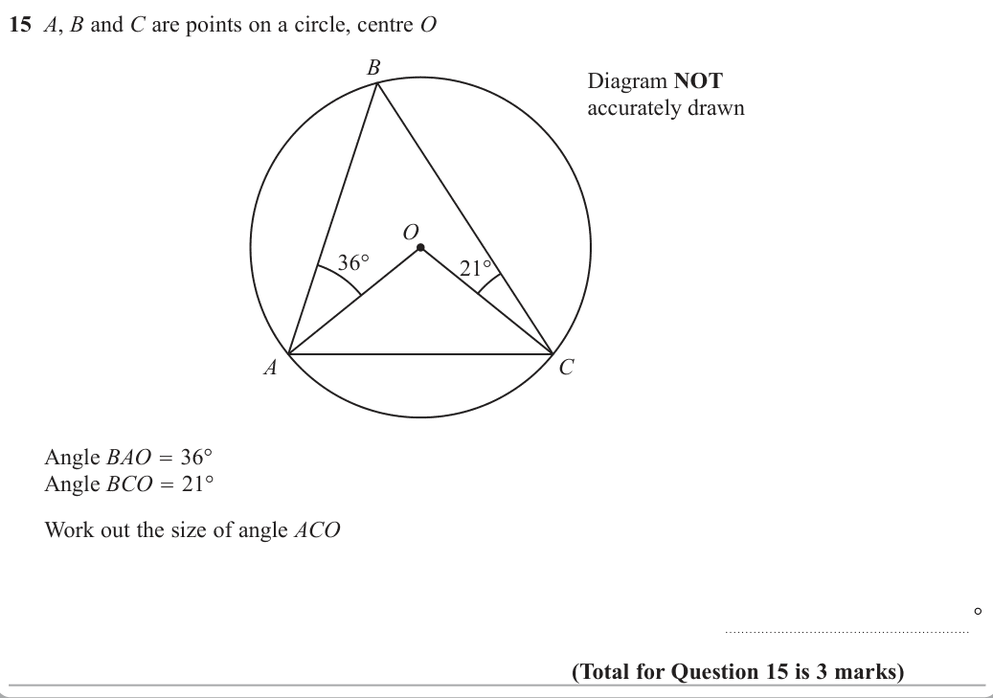
4. Jun 2025 P2HR · Q15 Medium 3 marksShow worked solution Use trigonometry Since \(OA=OB\), triangle \(AOB\) is isosceles: \[ \angle ABO=36^\circ \]
Use trigonometry So \[ \angle AOB=180^\circ-36^\circ-36^\circ=108^\circ \]
Use trigonometry Since \(OB=OC\), triangle \(BOC\) is isosceles: \[ \angle OBC=21^\circ \]
Use trigonometry So \[ \angle BOC=180^\circ-21^\circ-21^\circ=138^\circ \]
Use circle theorem Angles around \(O\) add to \(360^\circ\): \[ \angle AOC=360^\circ-108^\circ-138^\circ=114^\circ \]
Use trigonometry Since \(OA=OC\), \[ \angle ACO=\frac{180^\circ-114^\circ}{2}=33^\circ \]
Final answer \(33^\circ\).
5. May 2025 4WM2HR · Q15 Medium 3 marksShow worked solution Required A, B, C on circle centre O. ∠*B**A**O* = 36°, ∠*B**C**O* = 21°. Find ∠*A**C**O*.
O A B is isosceles △*O**A**B* is isosceles (*O**A* = *O**B*= radius): ∠*O**A**B* = ∠*O**B**A* = 36° ⟹ ∠*A**O**B* = 180° − 36° − 36° = 108°
O B C is isosceles △*O**B**C* is isosceles (*O**B* = *O**C*): ∠*O**B**C* = ∠*O**C**B* = 21° ⟹ ∠*B**O**C* = 180° − 21° − 21° = 138°
Angles at centre O (on Angles at centre O (on the same side): ∠*A**O**C* = 360° − 108° − 138° = 114°
O A C is isosceles △*O**A**C* is isosceles (*O**A* = *O**C*): $$\\angle OAC + \\angle OCA = 180°-114° = 66° \\implies \\angle ACO = \\frac{66°}{2} = 33°$$
Final answer ∠*A**C**O* = 33°
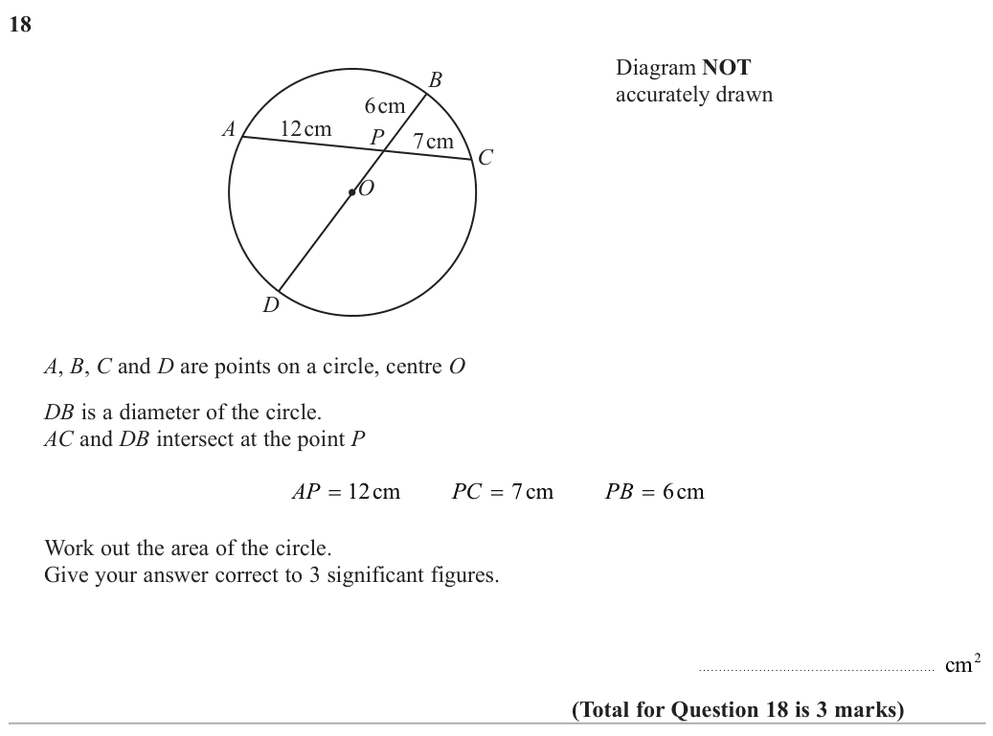
6. May 2025 4WM2HR · Q18 Medium 3 marksShow worked solution Required DB is a diameter; chords AC and DB intersect at P. AP = 12 cm, PC = 7 cm, PB = 6 cm. Find area of circle (3 s.f.).
Apply the Intersecting Chords Theorem Apply the **Intersecting Chords Theorem**: *A**P* × *P**C* = *B**P* × *P**D* $$12\\times7 = 6\\times PD \\implies PD = \\frac{84}{6} = 14\\text{ cm}$$
Diameter D B D B Diameter *D**B*: *D**B* = *P**D* + *P**B* = 14 + 6 = 20 cm ⟹ *r* = 10 cm
Area of circle Area r Area of circle: Area = *π**r*<sup>2</sup> = 100*π* ≈ 314.159… cm<sup>2</sup>
Note Intersecting Chords Theorem: if two chords cross inside a circle at P, then *A**P* × *P**C* = *B**P* × *P**D*.
Final answer Area of circle = 314 cm<sup>2</sup> (3 s.f.)
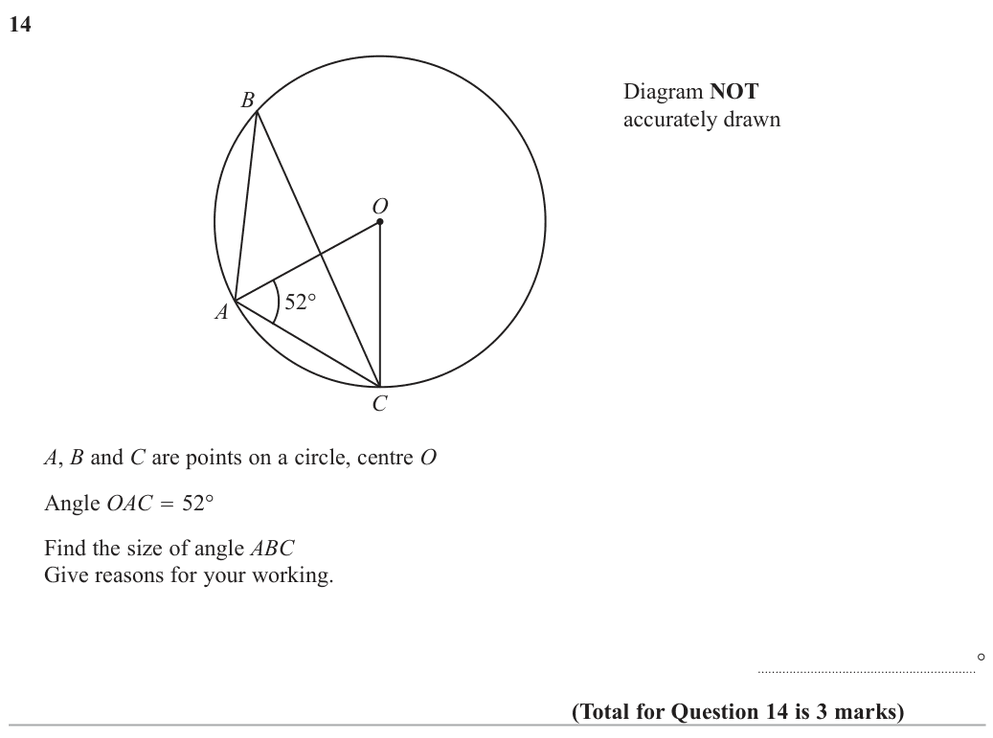
7. Nov 2023 P1H · Q14 Medium 3 marksShow worked solution Use trigonometry Since \(OA=OC\), triangle \(AOC\) is isosceles.
\[
\angle ACO=\angle OAC=52^\circ
\]
Use trigonometry So \[ \angle AOC=180^\circ-52^\circ-52^\circ=76^\circ \]
The angle at the circumference The angle at the circumference is half the angle at the centre standing on the same arc: \[ \angle ABC=\frac{76^\circ}{2}=38^\circ \]
Final answer \(38^\circ\).
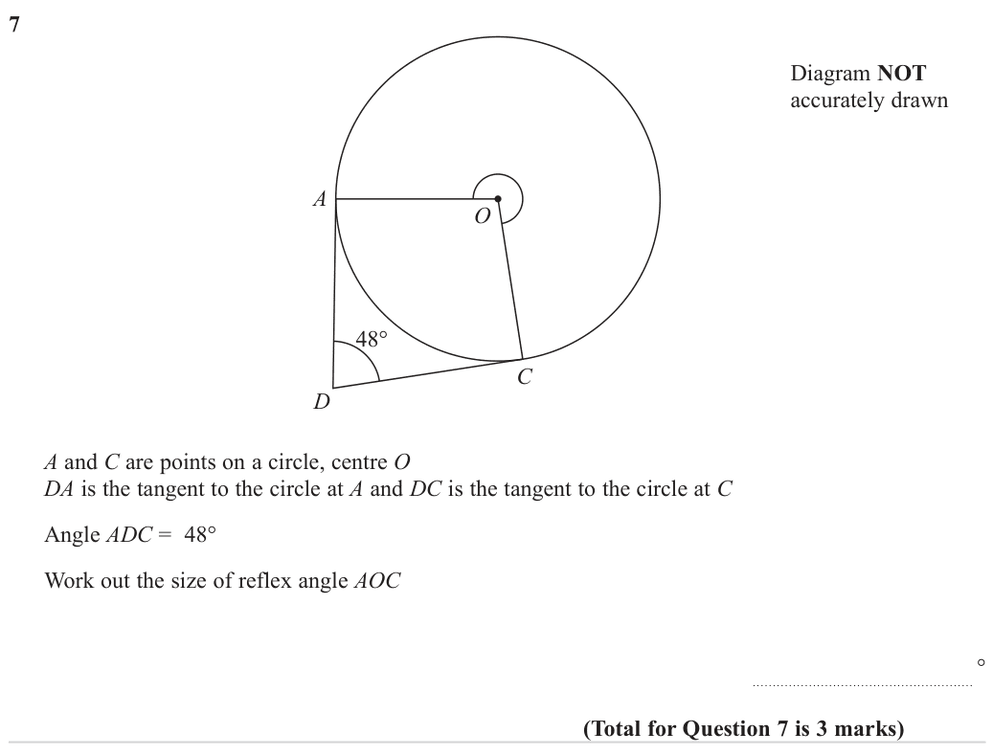
8. Jun 2023 P2H · Q7 Medium 3 marksShow worked solution Use circle theorem A radius is perpendicular to a tangent, so \[ \angle OAD=90^\circ \]
Use trigonometry and \[ \angle OCD=90^\circ \]
Use trigonometry In quadrilateral \(AOCD\), \[ \angle AOC=360^\circ-90^\circ-90^\circ-48^\circ=132^\circ \]
The question asks for the The question asks for the reflex angle: \[ 360^\circ-132^\circ=228^\circ \]
Final answer \(228^\circ\).
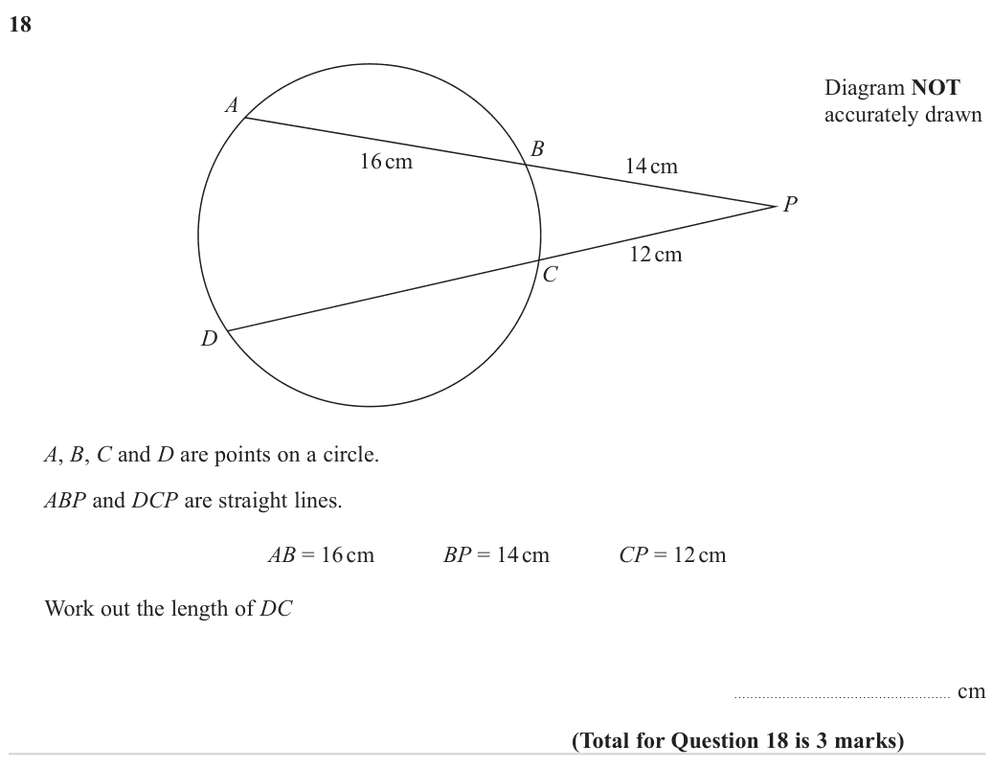
9. Jun 2023 P2HR · Q18 Medium 3 marksShow worked solution Use circle theorem From the external point \(P\), two secants meet the circle.
Use circle theorem For the upper secant, \[ PB=14,\qquad PA=14+16=30 \]
Use circle theorem For the lower secant, \[ PC=12,\qquad PD=12+DC \]
Use circle theorem Using the secant theorem: \[ PB\times PA=PC\times PD \]
\[
14\times30=12(12+DC)
\]
\[
420=144+12DC
\]
\[
276=12DC
\]
\[
DC=23
\]
Final answer \(DC=23\text{ cm}\).
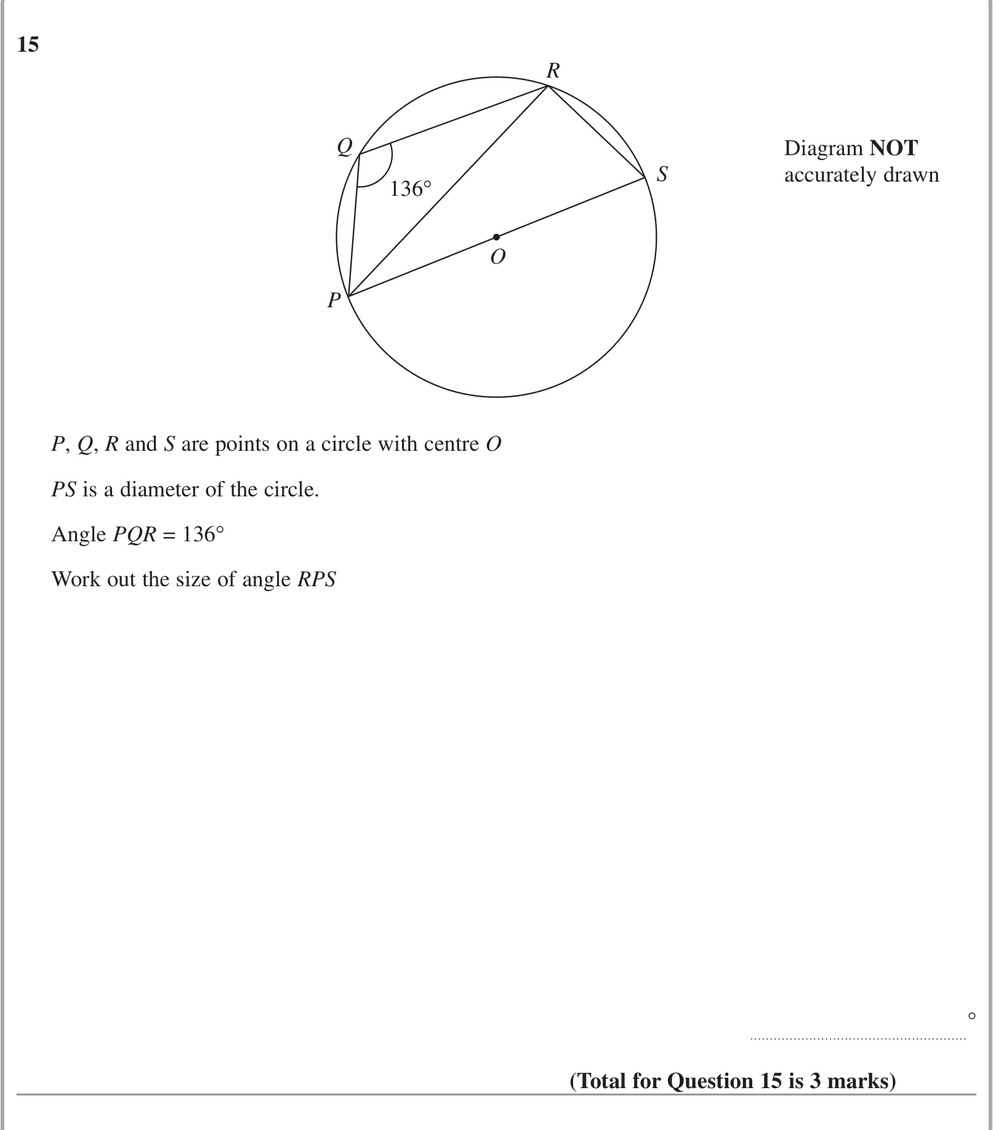
10. Jun 2022 P1HR · Q15 Medium 3 marksShow worked solution Opposite angles in a cyclic Opposite angles in a cyclic quadrilateral add to \(180^\circ\): \[ \angle PSR=180^\circ-136^\circ=44^\circ \]
Use trigonometry Since \(PS\) is a diameter, \[ \angle PRS=90^\circ \]
Use trigonometry In triangle \(PRS\), \[ \angle RPS=180^\circ-90^\circ-44^\circ=46^\circ \]
Final answer \(46^\circ\).
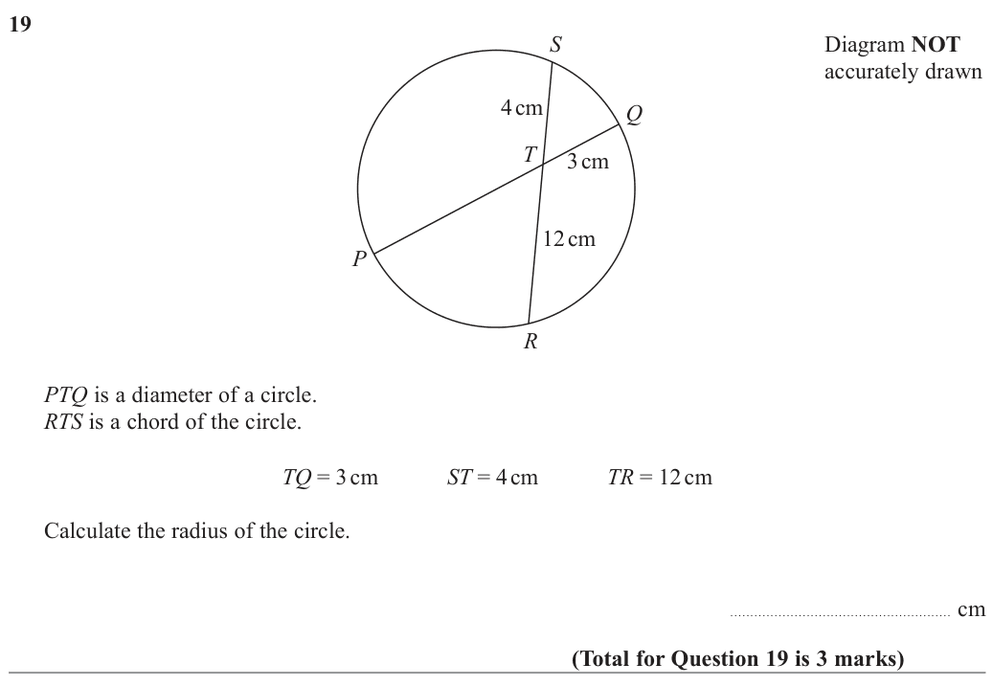
11. Jan 2022 P2H · Q19 Medium 3 marksShow worked solution Use the intersecting chords theorem Use the intersecting chords theorem: \[ PT\times TQ=ST\times TR \]
\[
PT\times 3=4\times 12
\]
\[
PT=16
\]
Use circle theorem Since \(PTQ\) is a diameter, \[ PQ=PT+TQ=16+3=19 \]
Use circle theorem So the radius is \[ 19\div 2=9.5 \]
Final answer \(9.5\text{ cm}\).
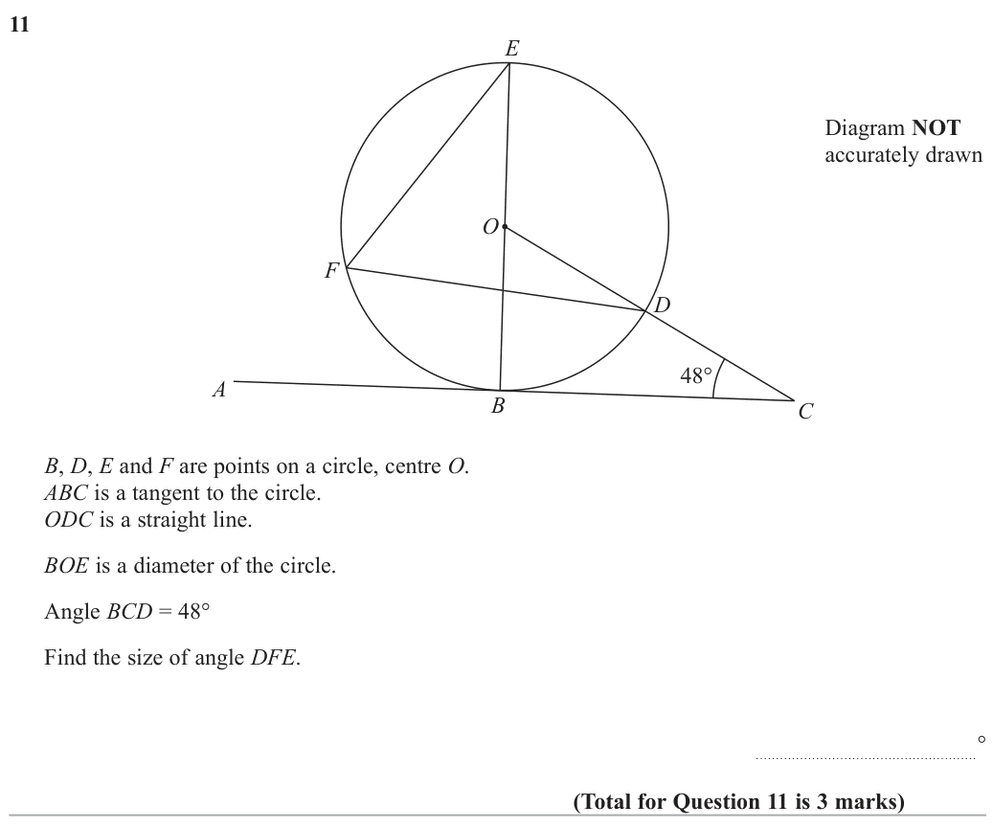
12. Nov 2021 P2H · Q11 Medium 3 marksShow worked solution The tangent at is perpendicular The tangent at \(B\) is perpendicular to the radius \(OB\), so \[ \angle OBC=90^\circ \]
Use trigonometry In triangle \(OBC\), \[ \angle BOC=180^\circ-90^\circ-48^\circ=42^\circ \]
Use trigonometry Since \(O,D,C\) are on a straight line, \[ \angle BOD=42^\circ \]
Use trigonometry \(BOK\) is a diameter, so \(BOE\) is a straight line and \[ \angle DOE=180^\circ-42^\circ=138^\circ \]
The angle at the circumference The angle at the circumference is half the angle at the centre: \[ \angle DFE=\frac{138^\circ}{2}=69^\circ \]
Final answer \(69^\circ\).
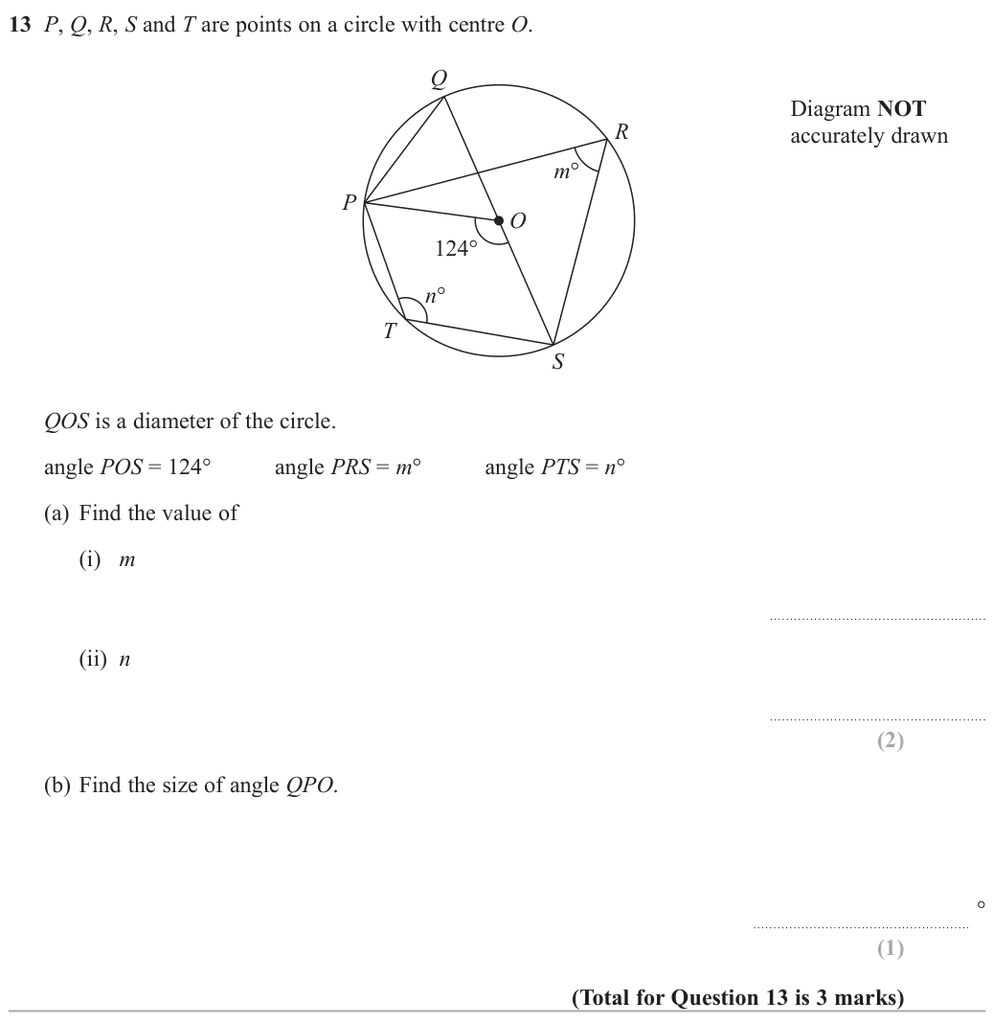
13. Jan 2021 P2H · Q13 Medium 3 marksShow worked solution Use trigonometry The central angle \(\angle POS\) is \(124^\circ\). The angle at the circumference standing on the same chord \(PS\) is half this angle.
\[
m=\frac{124}{2}=62
\]
Use circle theorem Angles opposite each other in a cyclic quadrilateral add to \(180^\circ\), so \[ n=180-62=118 \]
Use trigonometry Since \(QOS\) is a diameter, \[ \angle QOP=180^\circ-124^\circ=56^\circ \]
Use trigonometry Triangle \(QOP\) is isosceles because \(OQ=OP\). Therefore \[ \angle QPO=\frac{180-56}{2}=62^\circ \]
Final answer \(m=62\), \(n=118\), and \(\angle QPO=62^\circ\).
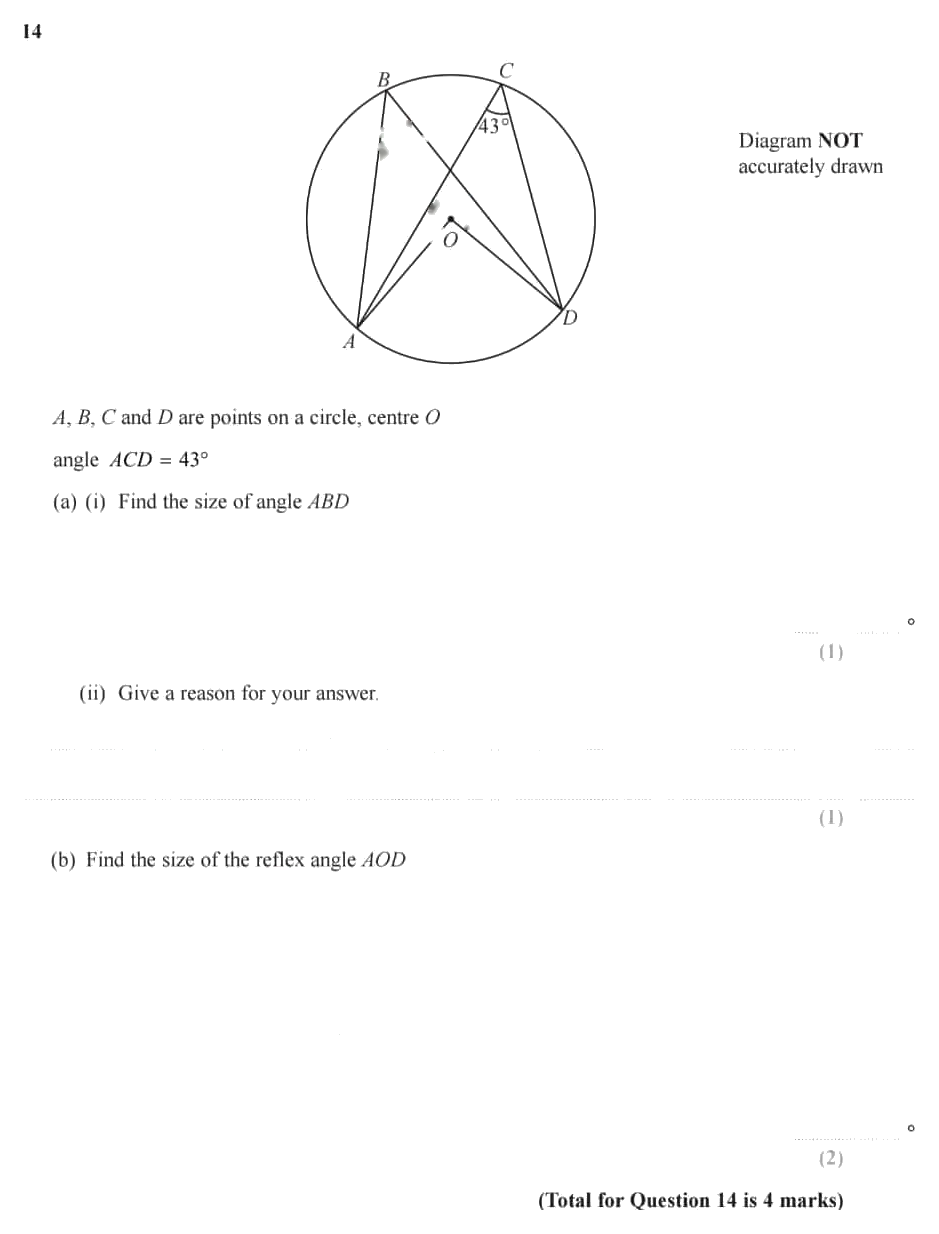
14. Jun 2026 4WM2HR · Q14 Medium 4 marksShow worked solution (a)(i) Same segment \[\angle ABD=\angle ACD=43^\circ\]
(a)(ii) Reason Angles in the same segment are equal (both stand on the arc \(AD\)).
(b) Angle at the centre \[\angle AOD=2\times43^\circ=86^\circ\ \ (\text{angle at centre is twice the angle at the circumference})\]
Reflex angle \[360^\circ-86^\circ=274^\circ\]
Final answer (a) \(43^\circ\), angles in the same segment are equal (b) \(274^\circ\)
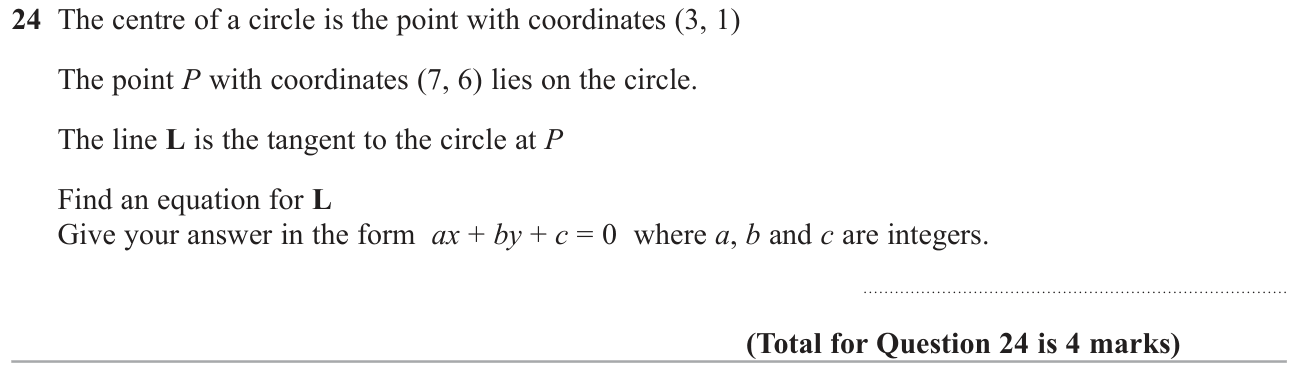
15. Jun 2026 P1HR · Q24 Medium 4 marksShow worked solution Solution | Step 1 \[m_{CP}=\frac{6-1}{7-3}=\frac54.\]
Find the gradient of the radius from the centre C=(3,1) to P=(7,6).
Solution | Step 2 \[m_L=-\frac45.\]
The tangent is perpendicular to the radius at P, so its gradient is the negative reciprocal.
Solution | Step 3 \[y-6=-\frac45(x-7).\]
Use the tangent gradient and the given point of contact.
Solution | Step 4 \[5y-30=-4x+28\quad\Longrightarrow\quad4x+5y-58=0.\]
Multiply by 5 and collect all terms on one side to obtain integer coefficients.
Final answer \(4x+5y-58=0\)
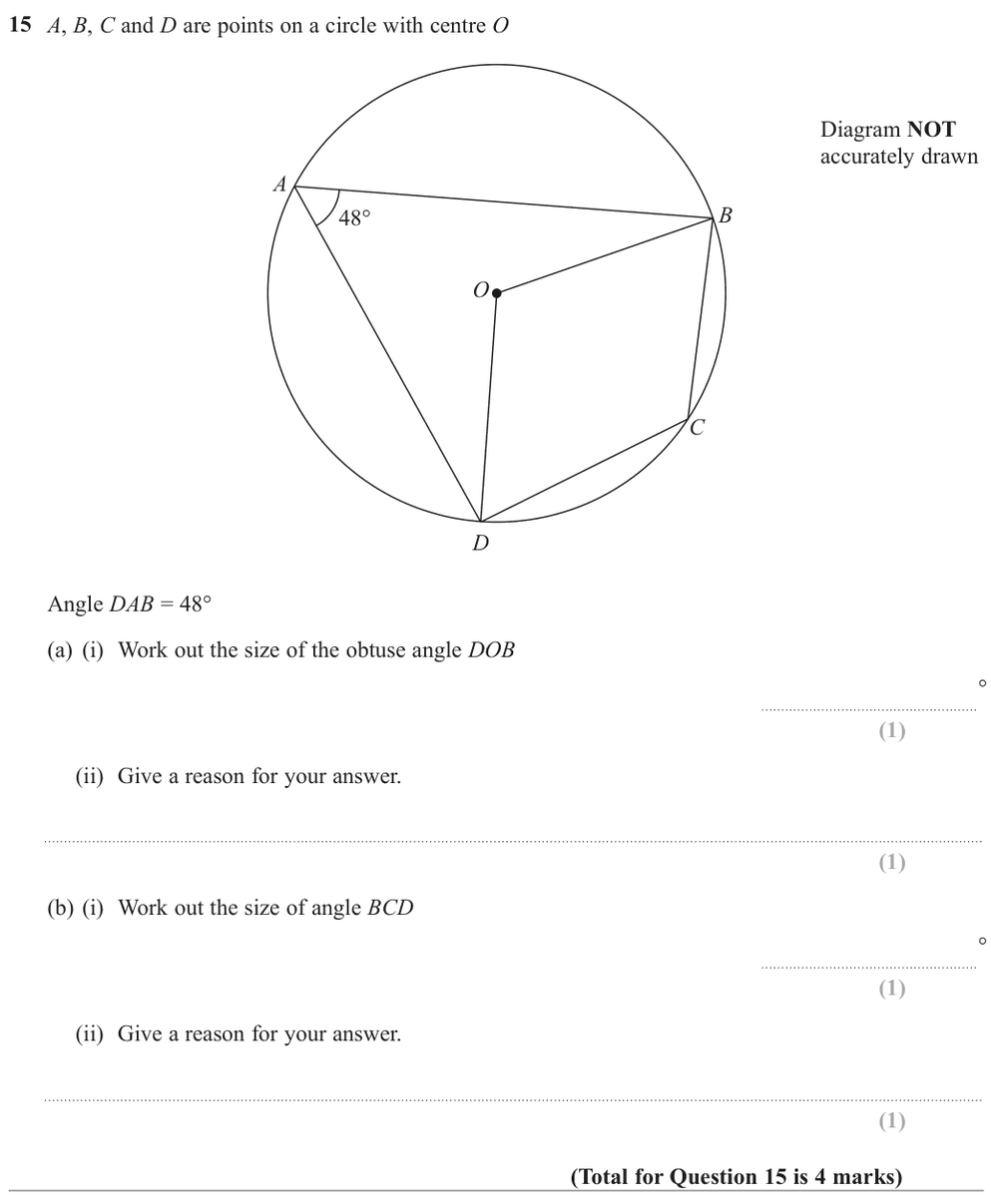
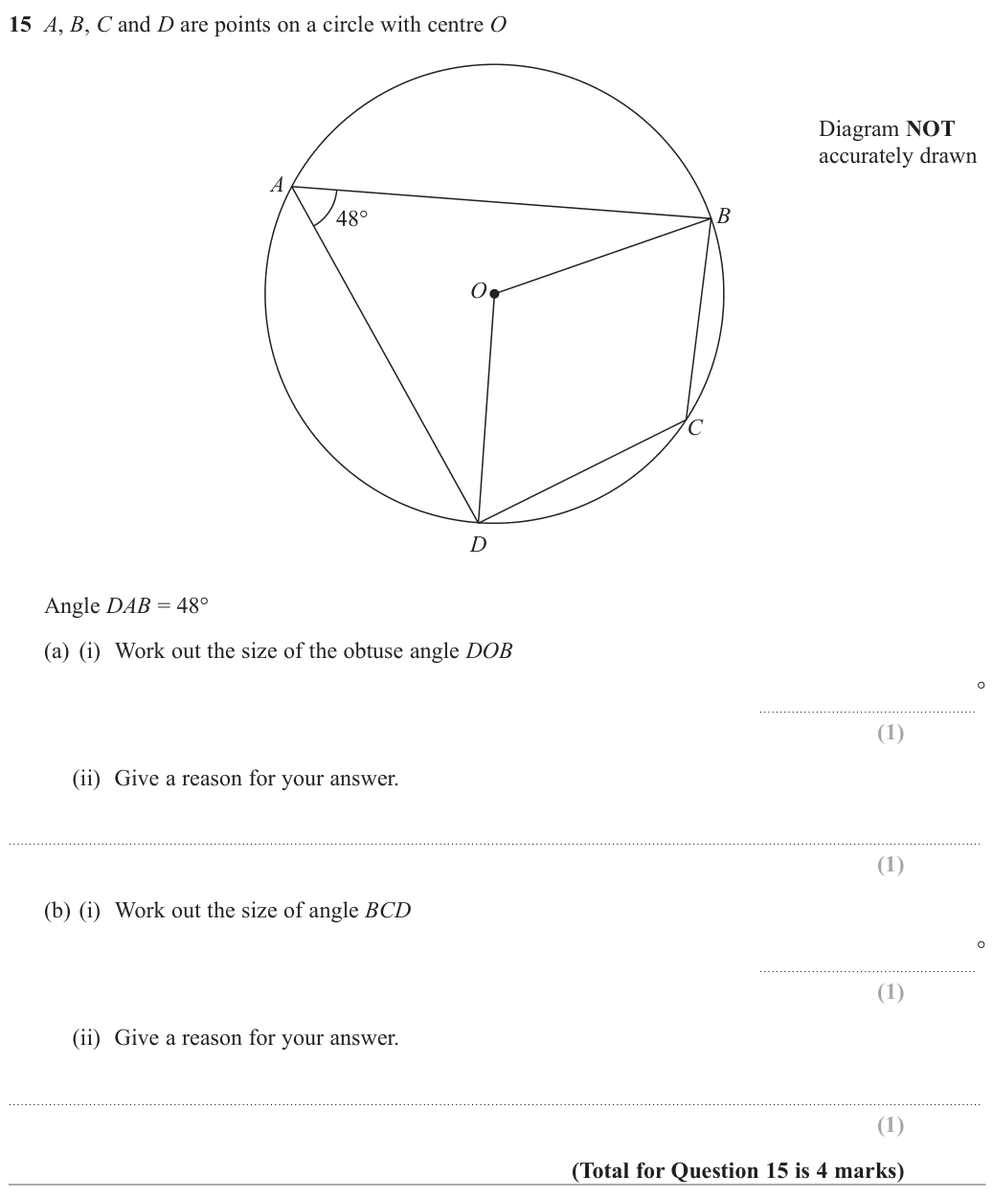
16. Nov 2025 4WM2H · Q15 Medium 4 marksShow worked solution Part (a)(i) Angle D O **Part (a)(i) Angle *D**O**B*:** ∠*D**O**B* = 2 × 48<sup>∘</sup> = 96<sup>∘</sup>
Answer (a)(i) 96<sup>∘</sup>
**Part (a)(ii) Reason:** The angle subtended by an arc at the centre is twice the angle subtended at the circumference.
**Part (b)(i) Angle *B**C**D*:** ∠*B**C**D* = 180<sup>∘</sup> − 48<sup>∘</sup> = 132<sup>∘</sup>
Final answer (b)(i) 132<sup>∘</sup>
**Part (b)(ii) Reason:** Opposite angles in a cyclic quadrilateral sum to 180<sup>∘</sup>.
17. Nov 2025 P2H · Q15 Medium 4 marksShow worked solution (a) The angle at the (a) The angle at the centre is twice the angle at the circumference standing on chord \(DB\): \[ \angle DOB=2\times 48^\circ=96^\circ \]
(b) Opposite angles in cyclic (b) Opposite angles in cyclic quadrilateral \(ABCD\) add to \(180^\circ\): \[ \angle BCD=180^\circ-48^\circ=132^\circ \]
Final answer \(\angle DOB=96^\circ\), and \(\angle BCD=132^\circ\).
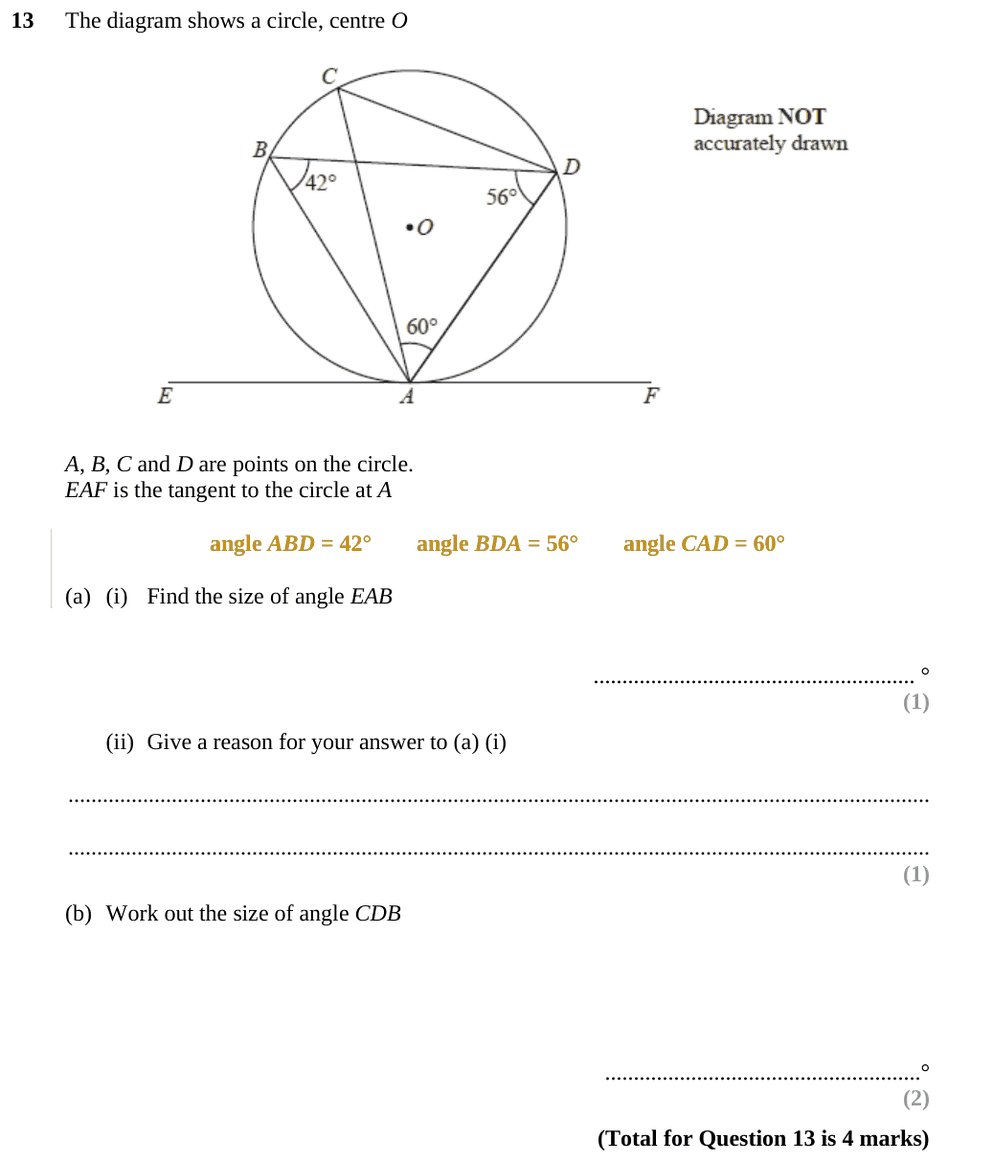
18. May 2025 4WM2H · Q13 Medium 4 marksShow worked solution Use trigonometry By the alternate segment theorem,
\[
\angle EAB=\angle ADB=56^\circ
\]
Use trigonometry In triangle \(ABD\),
\[
\angle BAD=180^\circ-42^\circ-56^\circ=82^\circ
\]
Use trigonometry So
\[
\angle BAC=82^\circ-60^\circ=22^\circ
\]
Angles subtended by the same Angles subtended by the same chord \(CB\) are equal, so
\[
\angle CDB=22^\circ
\]
Final answer \(56^\circ\), alternate segment theorem, \(22^\circ\).
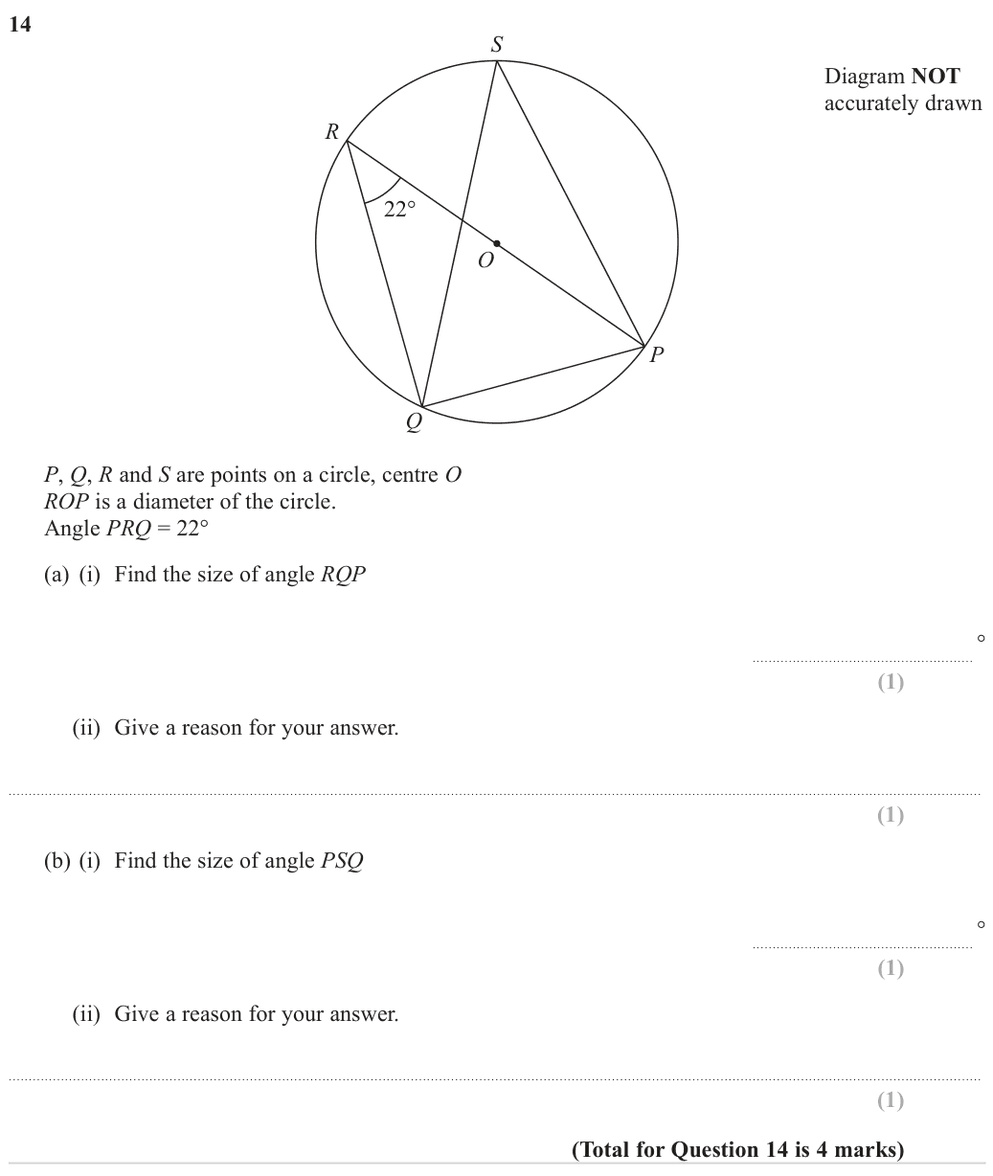
19. Jun 2023 P2H · Q14 Medium 4 marksShow worked solution Use trigonometry (a) Since \(RP\) is a diameter, \[ \angle RQP=90^\circ \]
Reason the angle in a Reason: the angle in a semicircle is \(90^\circ\).
(b) Angles and stand on (b) Angles \(PRQ\) and \(PSQ\) stand on the same chord \(PQ\), so they are equal.
\[
\angle PSQ=22^\circ
\]
Final answer \(\angle RQP=90^\circ\), and \(\angle PSQ=22^\circ\).
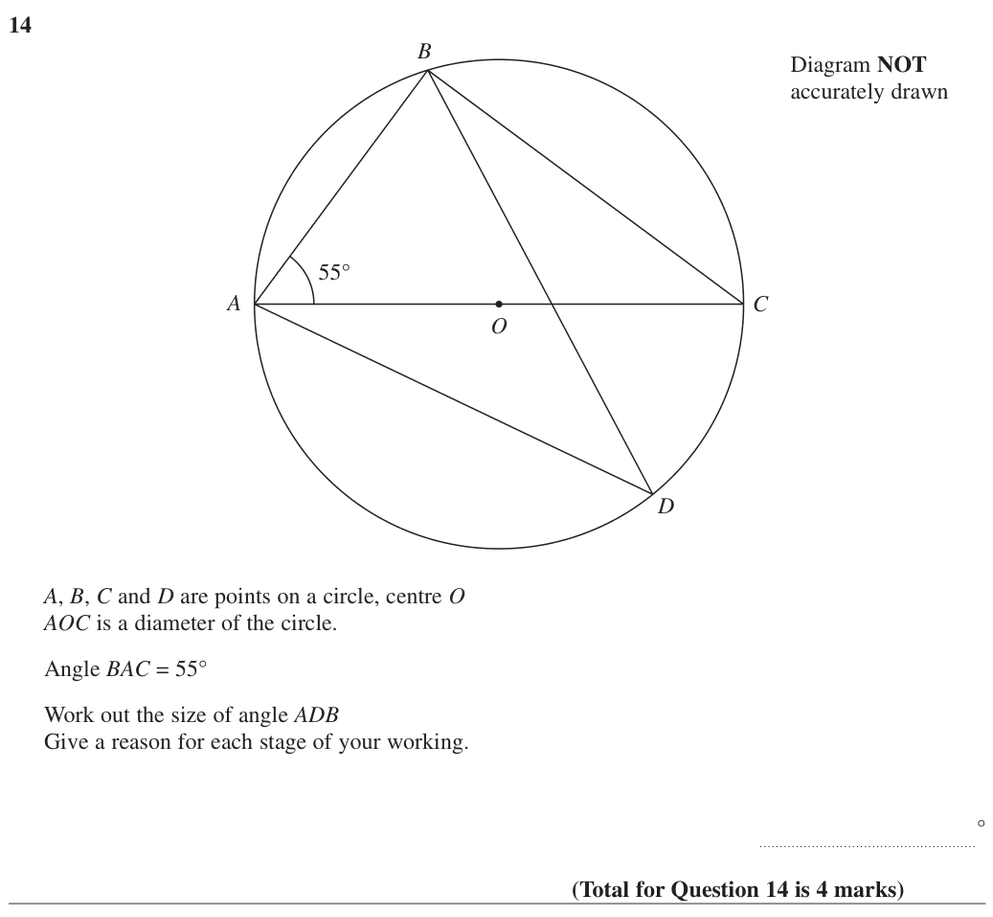
20. Jan 2022 P1HR · Q14 Medium 4 marksShow worked solution Use trigonometry Since \(AC\) is a diameter, \[ \angle ABC=90^\circ \]
Use trigonometry In triangle \(ABC\), \[ \angle ACB=180^\circ-90^\circ-55^\circ=35^\circ \]
Angles in the same segment Angles in the same segment are equal, so \[ \angle ADB=\angle ACB=35^\circ \]
Final answer \(35^\circ\).
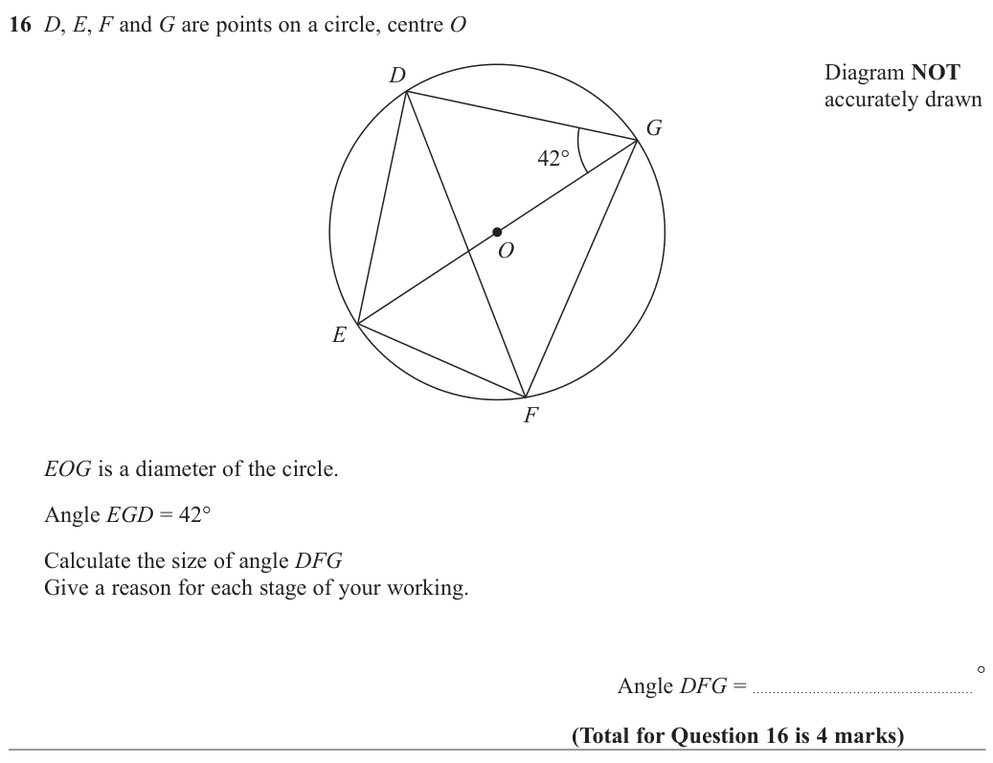
21. Jan 2022 P2H · Q16 Medium 4 marksShow worked solution Use trigonometry Since \(EOG\) is a diameter, \[ \angle EDG=90^\circ \]
Use trigonometry In triangle \(EDG\), \[ \angle DEG=180^\circ-90^\circ-42^\circ=48^\circ \]
Angles and stand on the Angles \(DEG\) and \(DFG\) stand on the same chord \(DG\), so they are equal.
\[
\angle DFG=48^\circ
\]
Final answer \(48^\circ\).
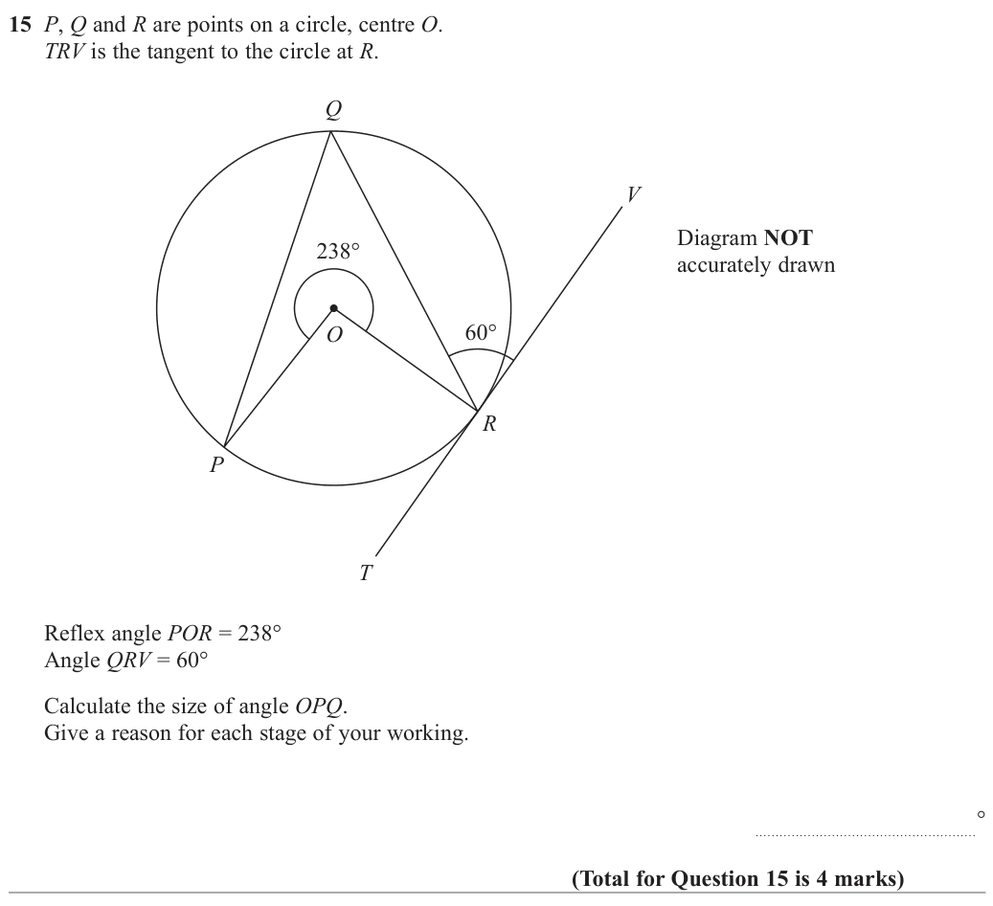
22. May 2021 P1H · Q15 Medium 4 marksShow worked solution Use trigonometry The reflex angle \(POR\) is \(238^\circ\), so the smaller angle is \[ 360^\circ-238^\circ=122^\circ \]
Use trigonometry Since \(OP=OR\), triangle \(OPR\) is isosceles: \[ \angle OPR=\frac{180^\circ-122^\circ}{2}=29^\circ \]
Use trigonometry By the alternate segment theorem, \[ \angle QPR=60^\circ \]
Use trigonometry Therefore \[ \angle QPO=60^\circ-29^\circ=31^\circ \]
Final answer \(31^\circ\).
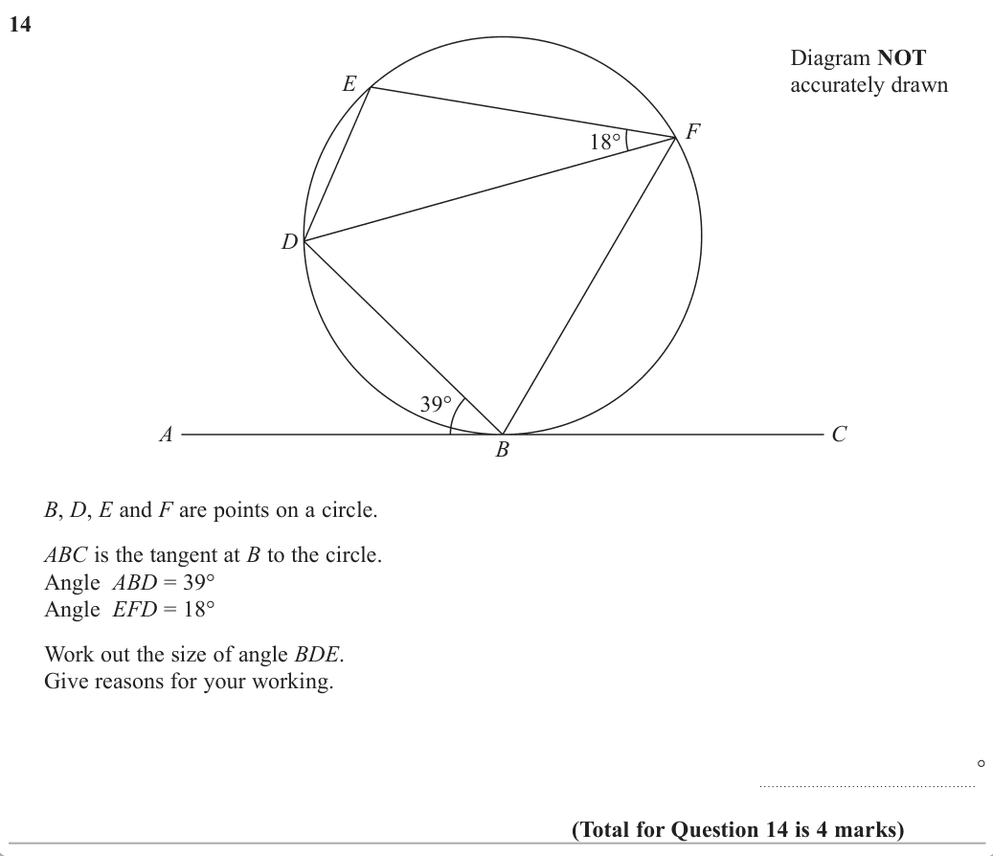
23. Jan 2021 P1HR · Q14 Medium 4 marksShow worked solution Use trigonometry By the alternate segment theorem, the angle between the tangent and chord \(BD\) is equal to the angle in the opposite segment: \[ \angle BFD=39^\circ \]
Given \[
\angle EFD=18^\circ
\]
Use trigonometry So \[ \angle BFE=39^\circ+18^\circ=57^\circ \]
Opposite angles in cyclic quadrilateral Opposite angles in cyclic quadrilateral \(BDEF\) add to \(180^\circ\): \[ \angle BDE=180^\circ-57^\circ=123^\circ \]
Final answer \(123^\circ\).
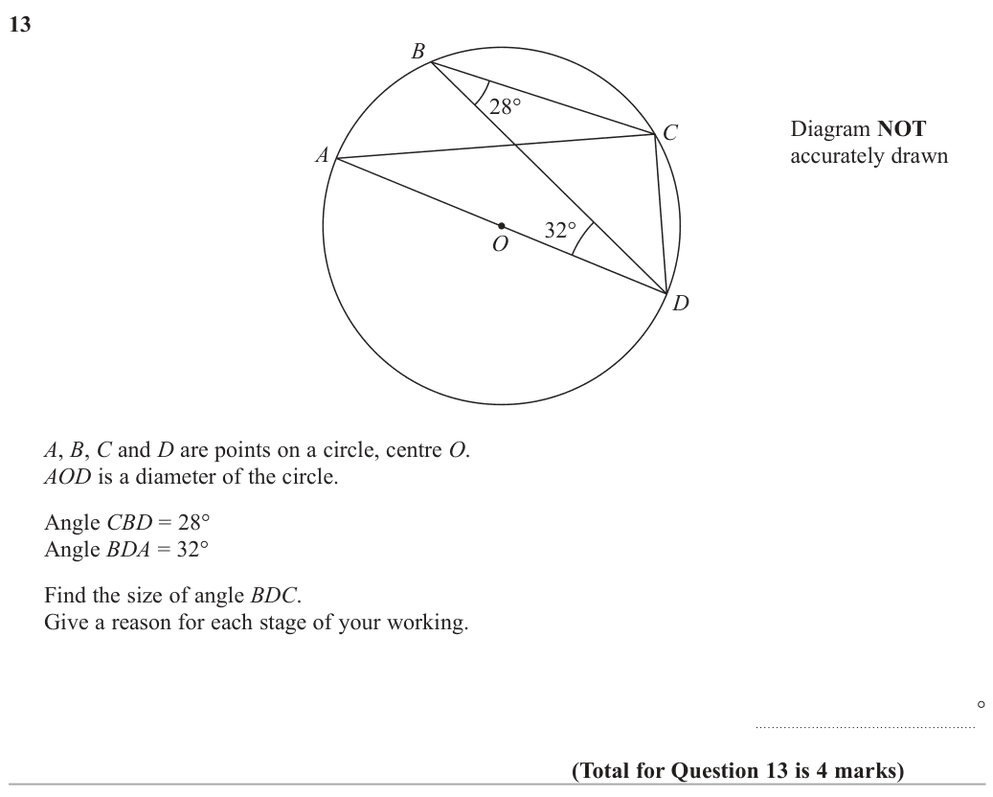
24. Jan 2020 P2H · Q13 Medium 4 marksShow worked solution Use trigonometry Since \(AD\) is a diameter, \[ \angle ABD=90^\circ \]
Given \[
\angle CBD=28^\circ
\]
Use trigonometry So \[ \angle ABC=90^\circ-28^\circ=62^\circ \]
Opposite angles in a cyclic Opposite angles in a cyclic quadrilateral add to \(180^\circ\): \[ \angle ADC=180^\circ-62^\circ=118^\circ \]
Use trigonometry At \(D\), \[ \angle ADC=\angle BDA+\angle BDC \]
\[
118^\circ=32^\circ+\angle BDC
\]
\[
\angle BDC=86^\circ
\]
Final answer \(86^\circ\).
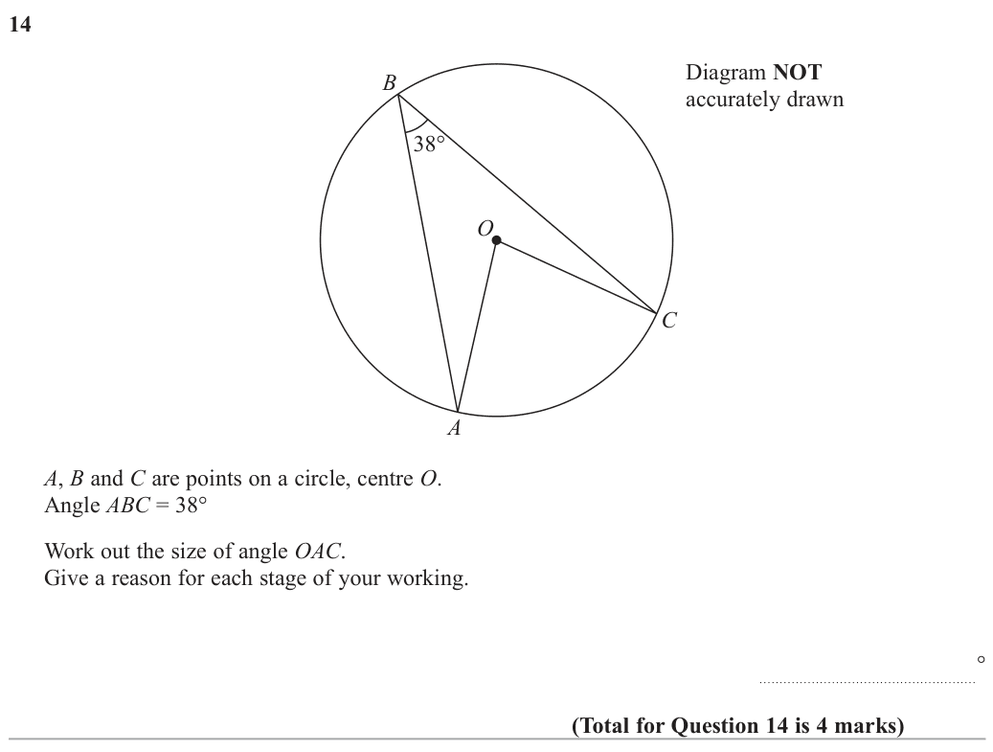
25. Jan 2020 P1HR · Q14 Medium 4 marksShow worked solution Angle and central angle stand Angle \(ABC\) and central angle \(AOC\) stand on the same arc \(AC\).
The angle at the centre The angle at the centre is twice the angle at the circumference: \[ \angle AOC=2\times 38^\circ=76^\circ \]
Use trigonometry Since \(OA=OC\), triangle \(AOC\) is isosceles.
\[
\angle OAC=\angle OCA=\frac{180^\circ-76^\circ}{2}=52^\circ
\]
Final answer \(52^\circ\).
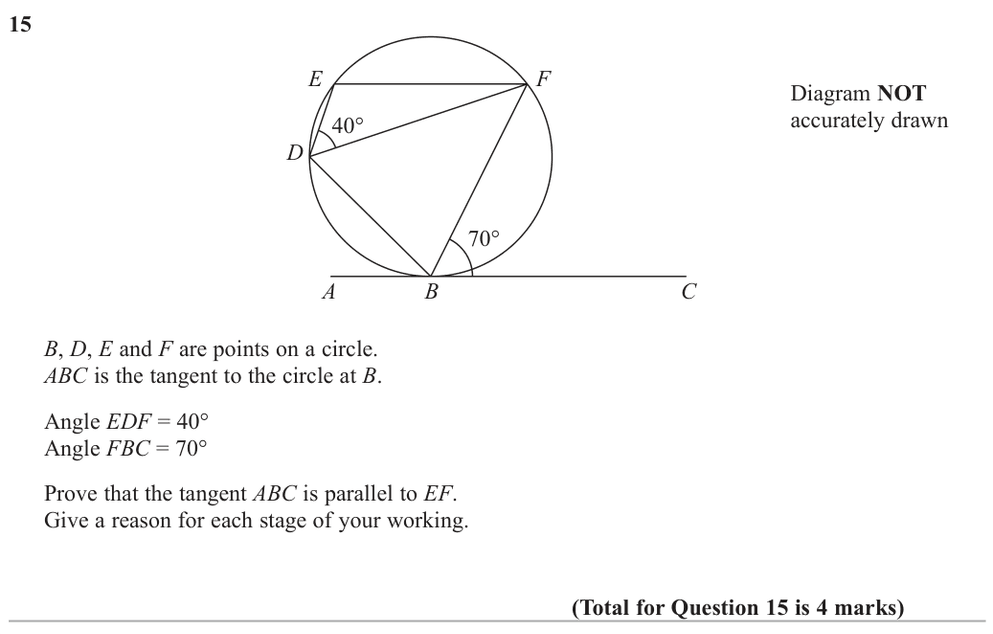
26. May-Nov 2020 P1HR · Q15 Medium 4 marksShow worked solution Proof By the alternate segment theorem, the angle between tangent \(BC\) and chord \(BF\) equals the angle in the opposite segment: \[ \angle BEF=70^\circ \]
Given \[ \angle EDF=40^\circ \]
Angles \(EDF\) and \(EBF\) stand on the same chord \(EF\), so \[ \angle EBF=40^\circ \]
In triangle \(BEF\), \[ \angle EFB=180^\circ-70^\circ-40^\circ=70^\circ \]
So \[ \angle EFB=\angle FBC=70^\circ \]
These are alternate interior angles, so \[ EF\parallel ABC \]
Final answer The tangent \(ABC\) is parallel to \(EF\).
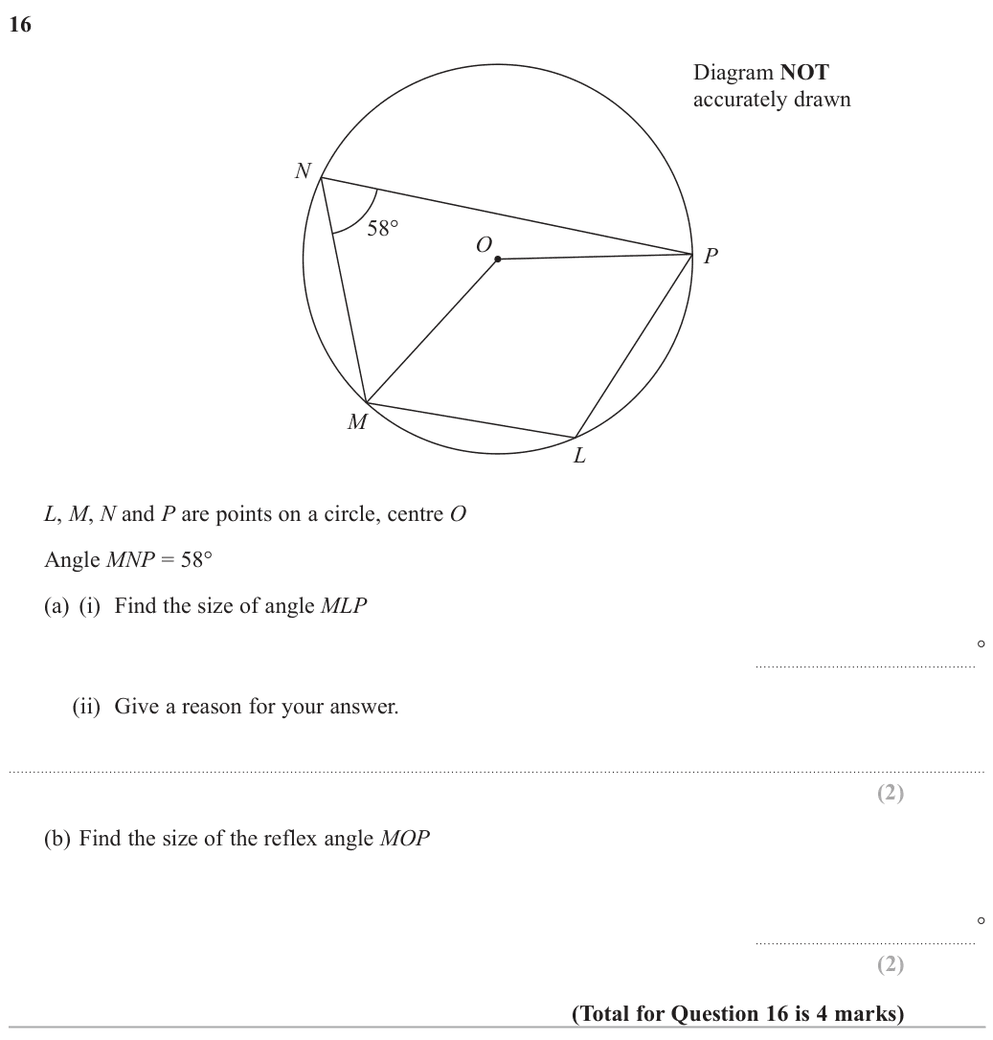
27. May-Nov 2020 P1H · Q16 Medium 4 marksShow worked solution (a) Opposite angles in cyclic (a) Opposite angles in cyclic quadrilateral \(MNPL\) add to \(180^\circ\): \[ \angle MLP=180^\circ-58^\circ=122^\circ \]
(b) The angle at the (b) The angle at the centre is twice the angle at the circumference standing on the same arc \(MP\): \[ \angle MOP=2\times 58^\circ=116^\circ \]
The reflex angle is \[
360^\circ-116^\circ=244^\circ
\]
Final answer \(\angle MLP=122^\circ\), and reflex \(\angle MOP=244^\circ\).
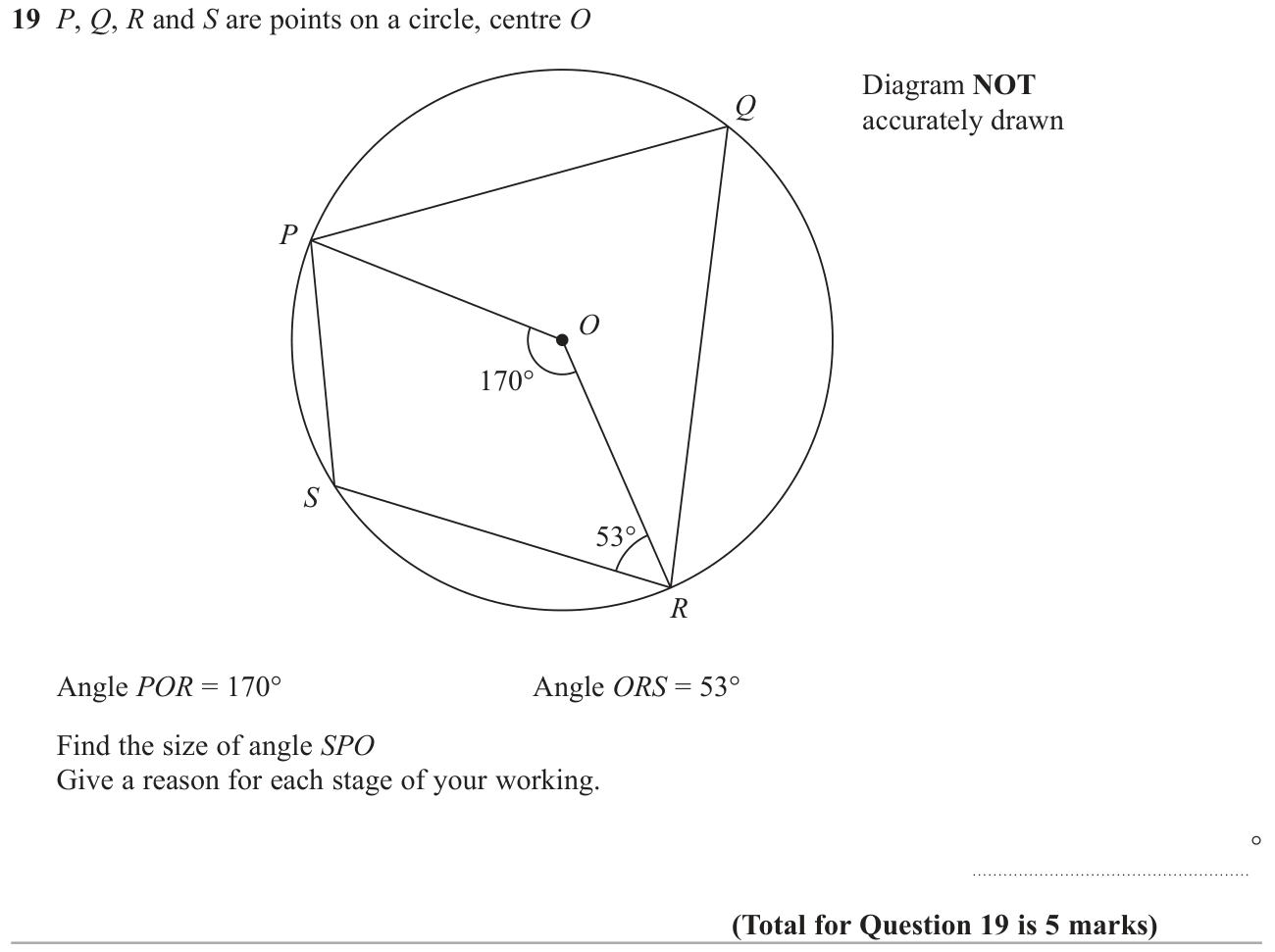
28. Jun 2026 P1HR · Q19 Hard 5 marksShow worked solution Solution | Step 1 \[\angle PQR=\frac{170^\circ}{2}=85^\circ.\]
The angle at the centre is twice the angle at the circumference subtended by the same arc PR containing S.
Solution | Step 2 \[\angle PSR=180^\circ-85^\circ=95^\circ.\]
Opposite angles of cyclic quadrilateral PQRS sum to 180 degrees.
Solution | Step 3 \[\angle SPO=360^\circ-(170^\circ+53^\circ+95^\circ)=42^\circ.\]
The interior angles of quadrilateral PSRO sum to 360 degrees; its other angles are POR, ORS and PSR.
Final answer \(\angle SPO=42^\circ\)
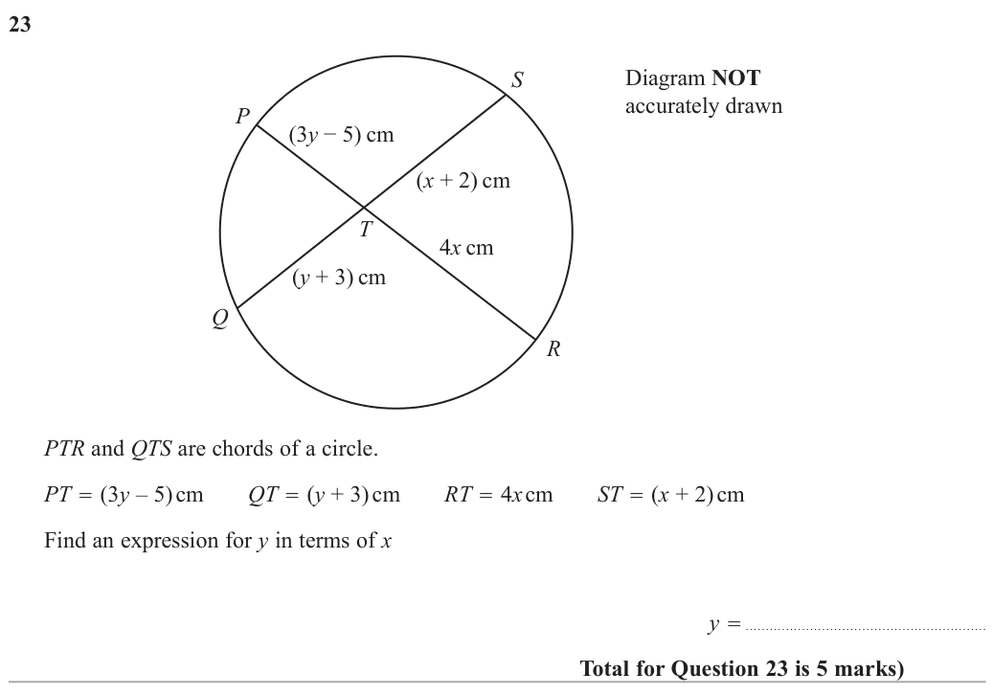
29. Jun 2025 P1HR · Q23 Hard 5 marksShow worked solution Use chord theorem For two intersecting chords in a circle,
\[
PT\times TR=QT\times TS
\]
Substitute the given lengths Substitute the given lengths:
\[
(3y-5)(4x)=(y+3)(x+2)
\]
Expand Expand:
\[
12xy-20x=xy+2y+3x+6
\]
Collect the terms on one Collect the \(y\) terms on one side:
\[
12xy-xy-2y=20x+3x+6
\]
\[
11xy-2y=23x+6
\]
Factorise Factorise:
\[
y(11x-2)=23x+6
\]
\[
y=\frac{23x+6}{11x-2}
\]
Final answer \(\boxed{y=\frac{23x+6}{11x-2}}\)
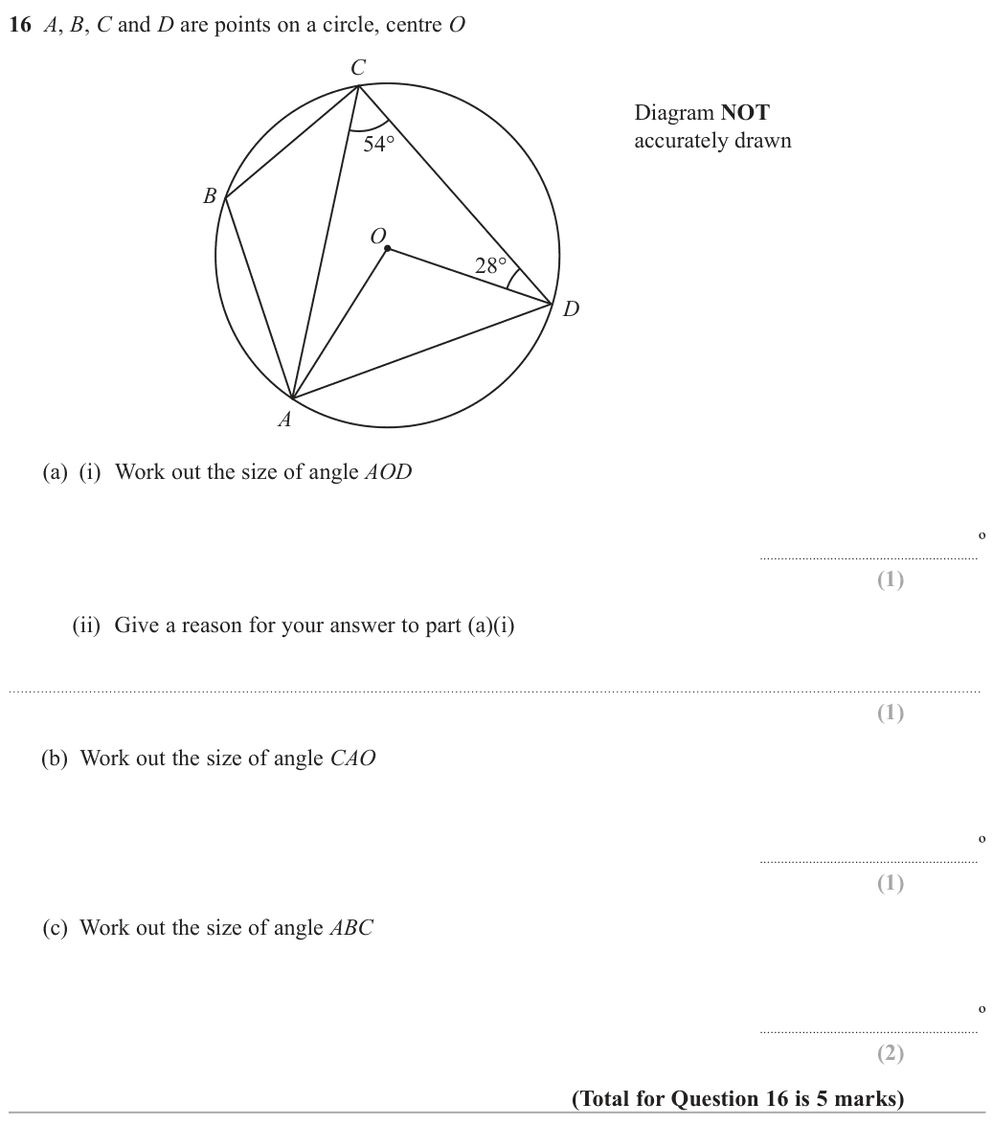
30. Nov 2024 P2H · Q16 Hard 5 marksShow worked solution (a) The angle at the (a) The angle at the centre is twice the angle at the circumference standing on the same arc \(AD\): \[ \angle AOD=2\times 54^\circ=108^\circ \]
Use trigonometry (b) Since \(OC=OD\), triangle \(COD\) is isosceles: \[ \angle OCD=\angle CDO=28^\circ \]
Use trigonometry So \[ \angle COD=180^\circ-28^\circ-28^\circ=124^\circ \]
Use circle theorem Angles around \(O\) add to \(360^\circ\): \[ \angle AOC=360^\circ-108^\circ-124^\circ=128^\circ \]
Use trigonometry Since \(OA=OC\), \[ \angle CAO=\frac{180^\circ-128^\circ}{2}=26^\circ \]
(c) Angle stands on the (c) Angle \(ABC\) stands on the major arc \(AC\), so \[ \angle ABC=\frac{360^\circ-128^\circ}{2}=116^\circ \]
Final answer \(\angle AOD=108^\circ\), \(\angle CAO=26^\circ\), and \(\angle ABC=116^\circ\).
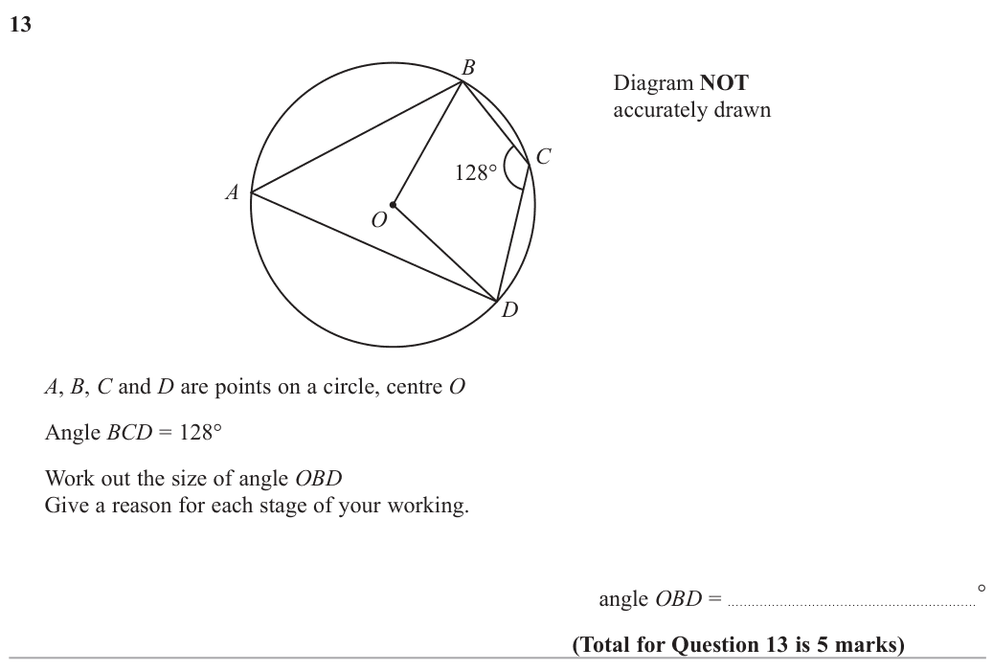
31. May 2024 P1HR · Q13 Hard 5 marksShow worked solution Opposite angles in cyclic quadrilateral Opposite angles in cyclic quadrilateral \(ABCD\) add to \(180^\circ\): \[ \angle BAD=180^\circ-128^\circ=52^\circ \]
The angle at the centre The angle at the centre is twice the angle at the circumference standing on the same arc \(BD\): \[ \angle BOD=2\times 52^\circ=104^\circ \]
Use trigonometry Since \(OB=OD\), triangle \(OBD\) is isosceles: \[ \angle OBD=\frac{180^\circ-104^\circ}{2}=38^\circ \]
Final answer \(38^\circ\).
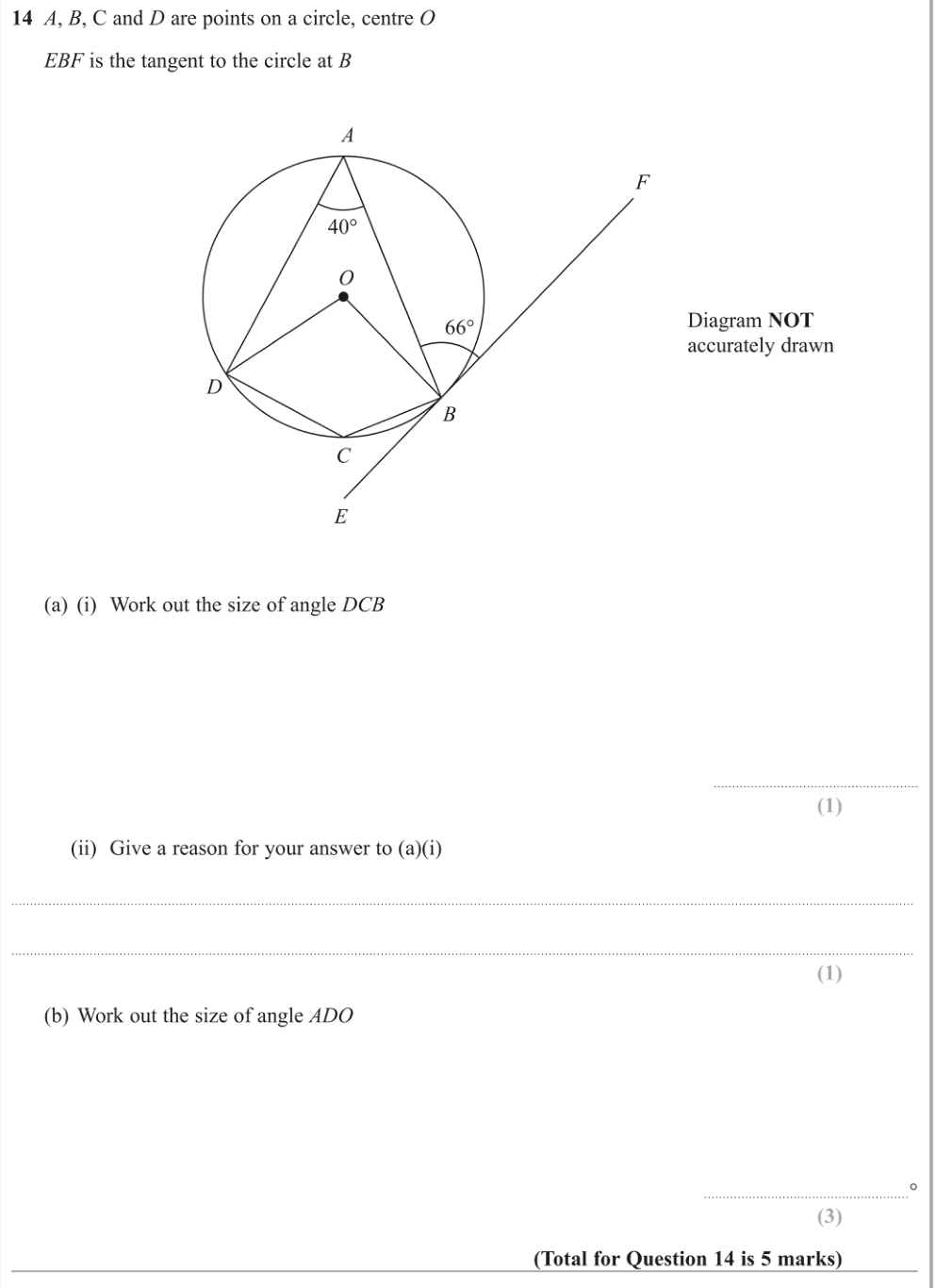
32. Specimen 4WM2H · Q14 Hard 5 marksShow worked solution Use trigonometry In cyclic quadrilateral \(A D C B\), opposite angles add to \(180^\circ\).
\[
\angle DCB=180^\circ-40^\circ=140^\circ
\]
Reason opposite angles in a Reason: opposite angles in a cyclic quadrilateral add to \(180^\circ\).
Use trigonometry By the alternate segment theorem,
\[
\angle ADB=66^\circ
\]
Use trigonometry In triangle \(ADB\),
\[
\angle ABD=180^\circ-40^\circ-66^\circ=74^\circ
\]
The angle at the centre The angle at the centre is twice the angle at the circumference standing on the same chord \(AD\):
\[
\angle AOD=2(74^\circ)=148^\circ
\]
Use trigonometry Since \(OA=OD\), triangle \(AOD\) is isosceles:
\[
\angle ADO=\frac{180^\circ-148^\circ}{2}=16^\circ
\]
Final answer \(\angle DCB=140^\circ\); reason: opposite angles in a cyclic quadrilateral; \(\angle ADO=16^\circ\).
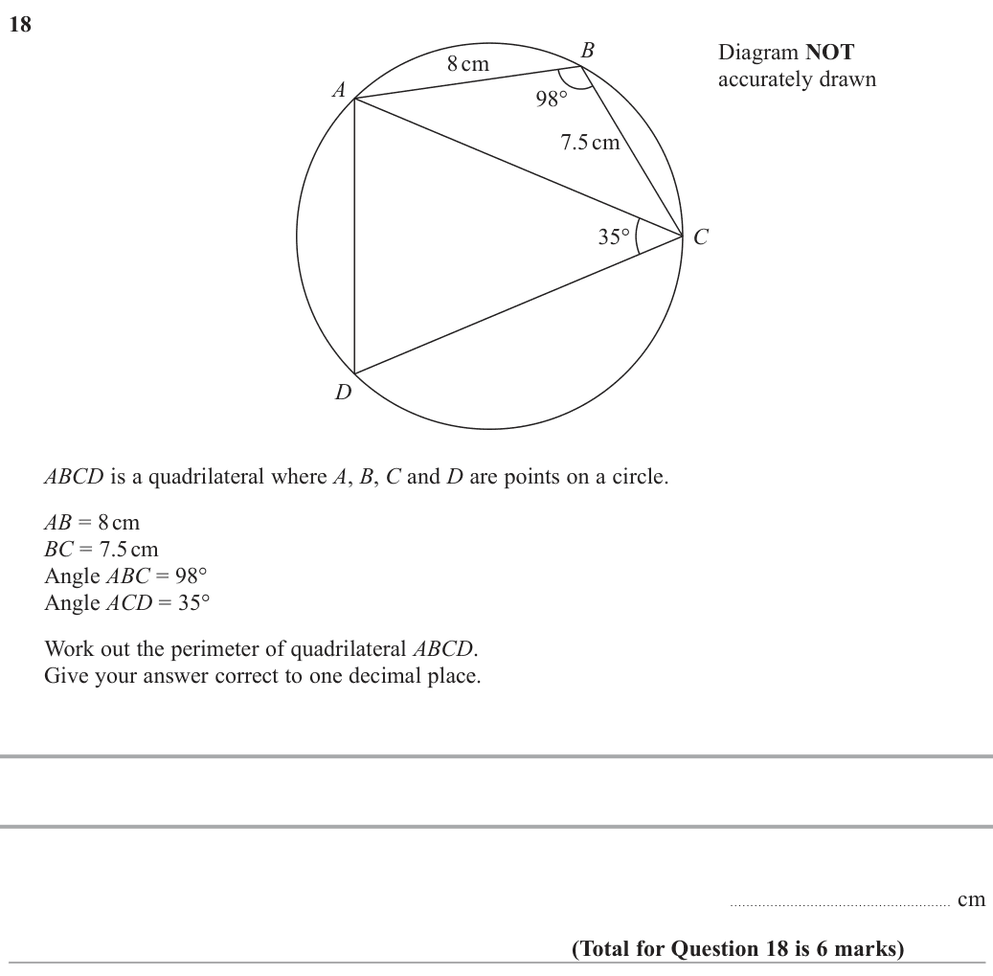
33. May 2021 P2H · Q18 Hard 6 marksShow worked solution Use trigonometry In triangle \(ABC\), use the cosine rule: \[ AC^2=8^2+7.5^2-2(8)(7.5)\cos 98^\circ \]
\[
AC=11.702\ldots
\]
Opposite angles in a cyclic Opposite angles in a cyclic quadrilateral add to \(180^\circ\), so \[ \angle ADC=180^\circ-98^\circ=82^\circ \]
Use trigonometry In triangle \(ACD\), \[ \angle CAD=180^\circ-82^\circ-35^\circ=63^\circ \]
Use the sine rule Use the sine rule: \[ AD=\frac{AC\sin 35^\circ}{\sin 82^\circ}=6.778\ldots \]
\[
CD=\frac{AC\sin 63^\circ}{\sin 82^\circ}=10.529\ldots
\]
Perimeter Perimeter: \[ 8+7.5+6.778\ldots+10.529\ldots=32.807\ldots \]
Final answer \(32.8\text{ cm}\).
More IGCSE Maths 4MA1 topics Dr Eslam Ahmed Elite Mathematics · Questions classified by topic, solutions checked by Dr Eslam
 Elite Mathematics