Differentiation: past paper questions & worked solutions
Every Differentiation question from the 4MA1 papers in our bank, 2020–2026, sorted from easiest to hardest. Try each one first, then open the worked solution.
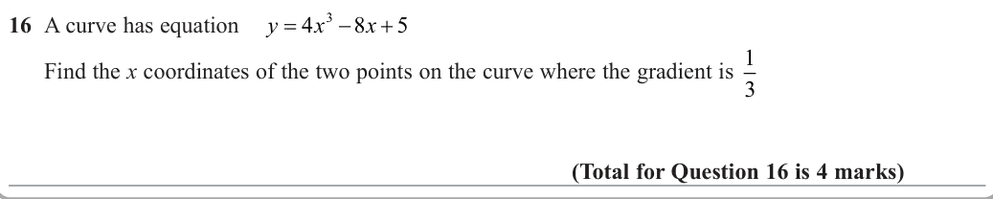
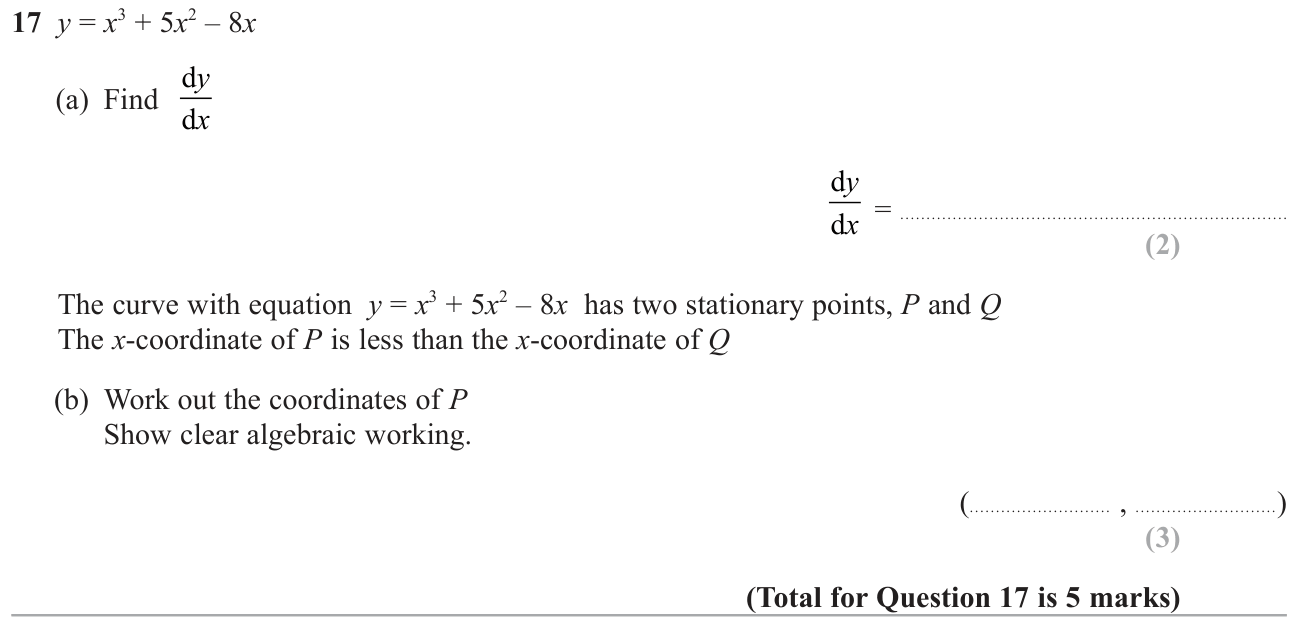
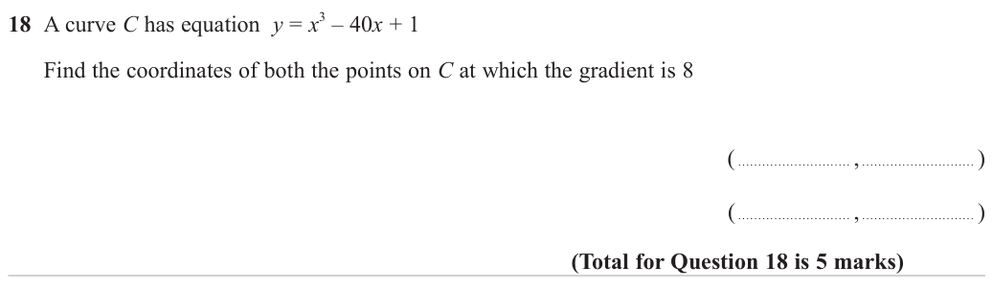
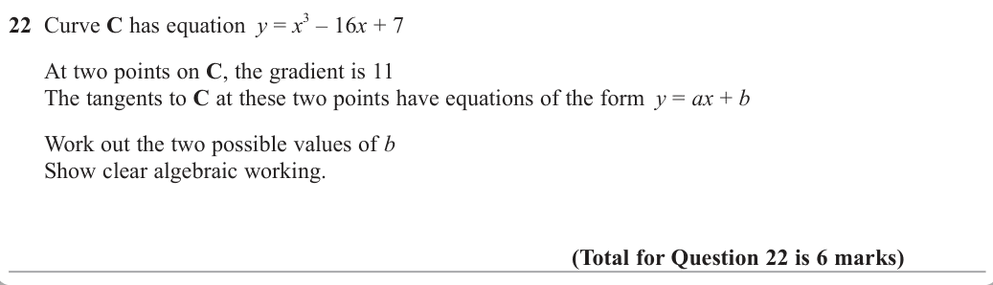
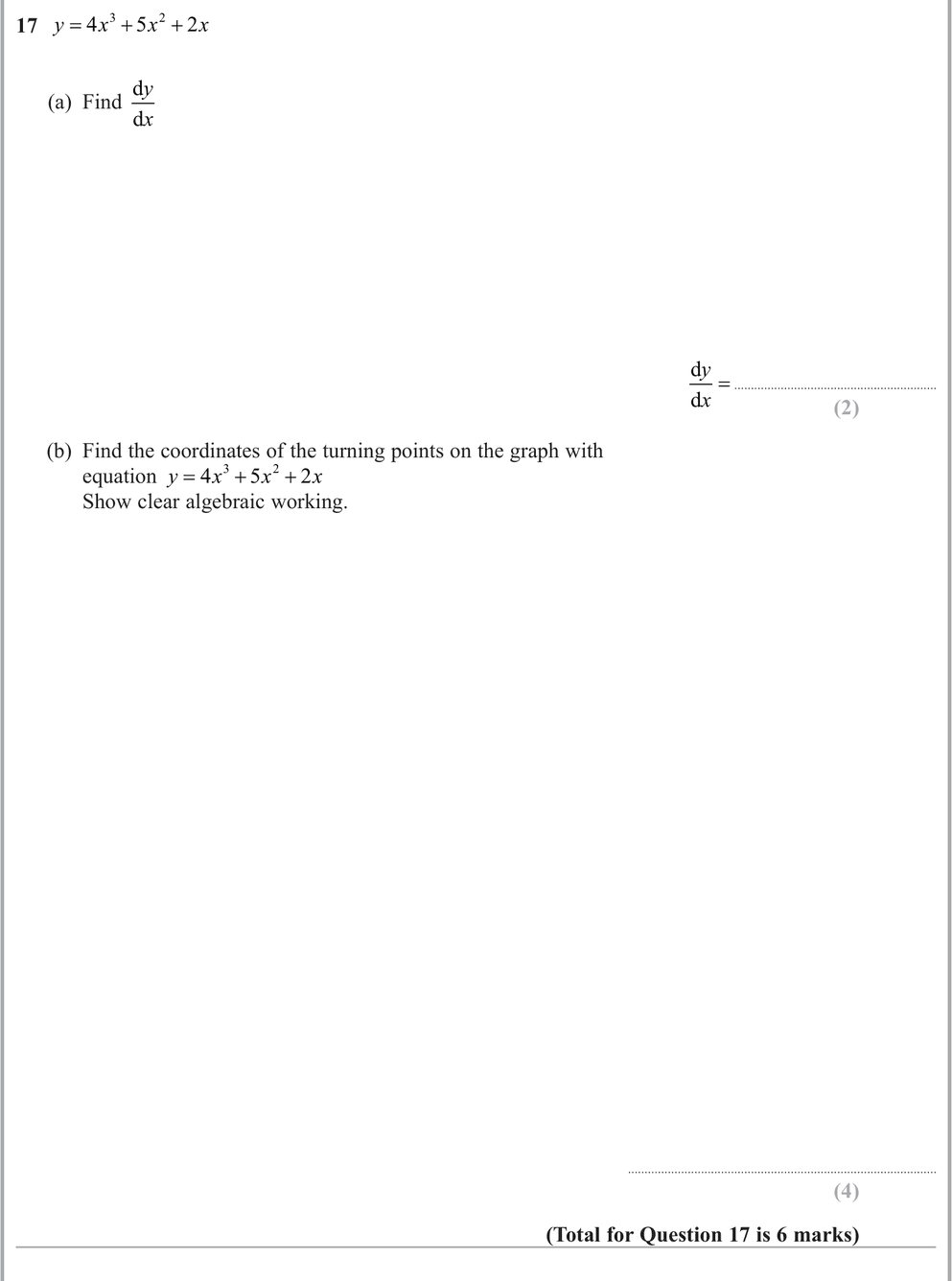
\(\left(-\frac12,-\frac14\right)\) and \(\left(-\frac13,-\frac7{27}\right)\).
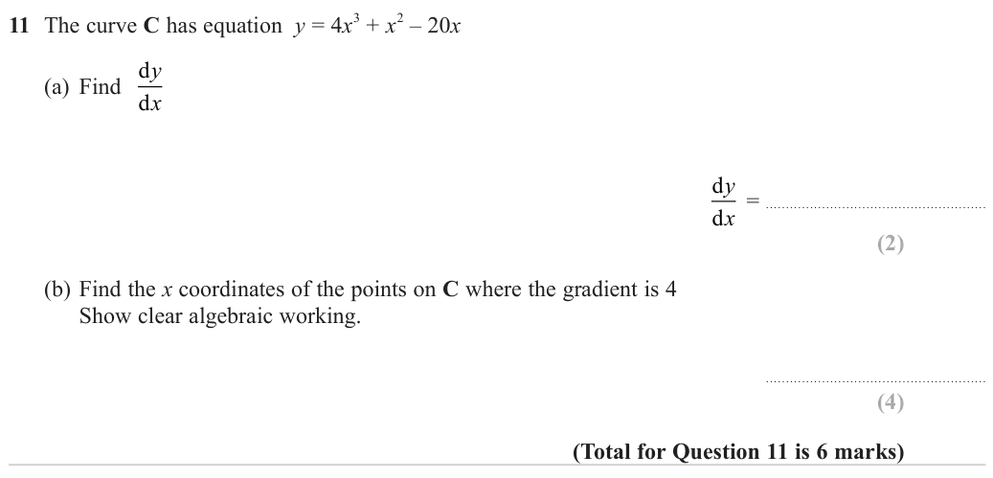
22. May 2023 P1H · Q11
Hard6 marksShow worked solution
Find the gradient
\[
y=4x^3+x^2-20x
\]
(a)
\[
\frac{dy}{dx}=12x^2+2x-20
\]
Find the gradient
(b) The gradient is \(4\), so \[ 12x^2+2x-20=4 \]
\[
12x^2+2x-24=0
\]
\[
6x^2+x-12=0
\]
Factorise
Factorise: \[ (3x-4)(2x+3)=0 \]
Find the gradient
So \[ x=\frac43 \quad \text{or} \quad x=-\frac32 \]
Final answer
\(\frac{dy}{dx}=12x^2+2x-20\), and \(x=\frac43\) or \(x=-\frac32\).
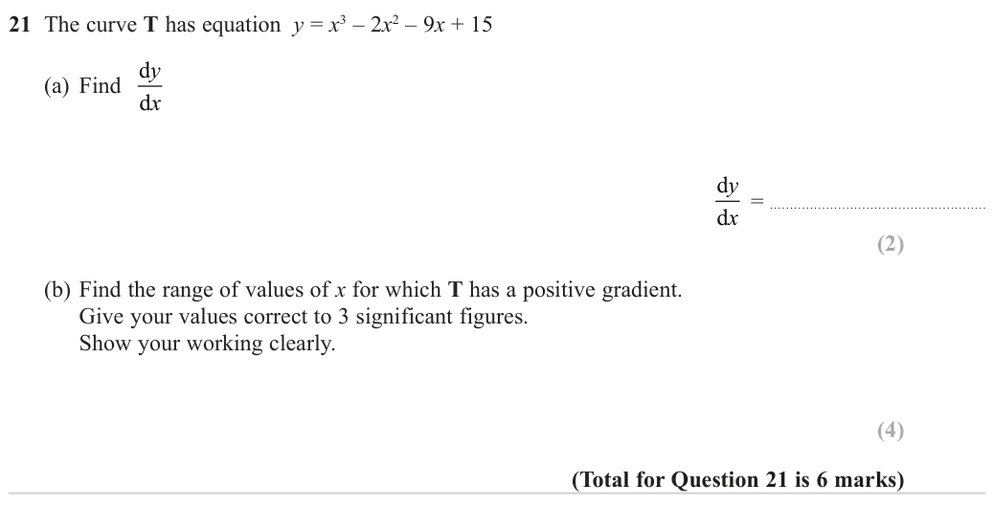
23. May 2023 P1HR · Q21
Hard6 marksShow worked solution
(a)
\[
y=x^3-2x^2-9x+15
\]
\[
\frac{dy}{dx}=3x^2-4x-9
\]
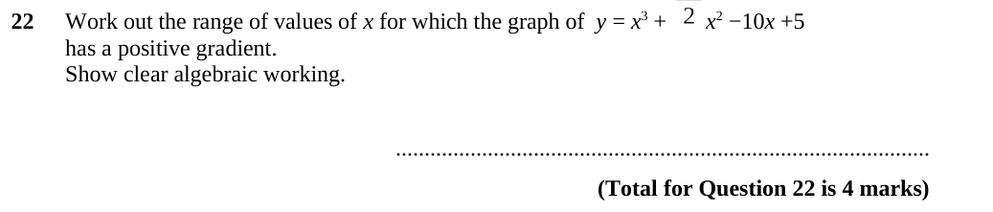
(b) The curve has a
(b) The curve has a positive gradient when
\[
3x^2-4x-9>0
\]
Solve
\[
3x^2-4x-9=0
\]
\[
x=\frac{4\pm\sqrt{16+108}}{6}
\]
\[
x=\frac{2\pm\sqrt{31}}{3}
\]
Differentiate
To 3 significant figures, the roots are
\[
x=-1.19,\quad x=2.52
\]
Solve quadratic equation
Since the quadratic opens upwards, it is positive outside the roots.
Final answer
(a) \(\dfrac{dy}{dx}=3x^2-4x-9\), (b) \(x<-1.19\) or \(x>2.52\)
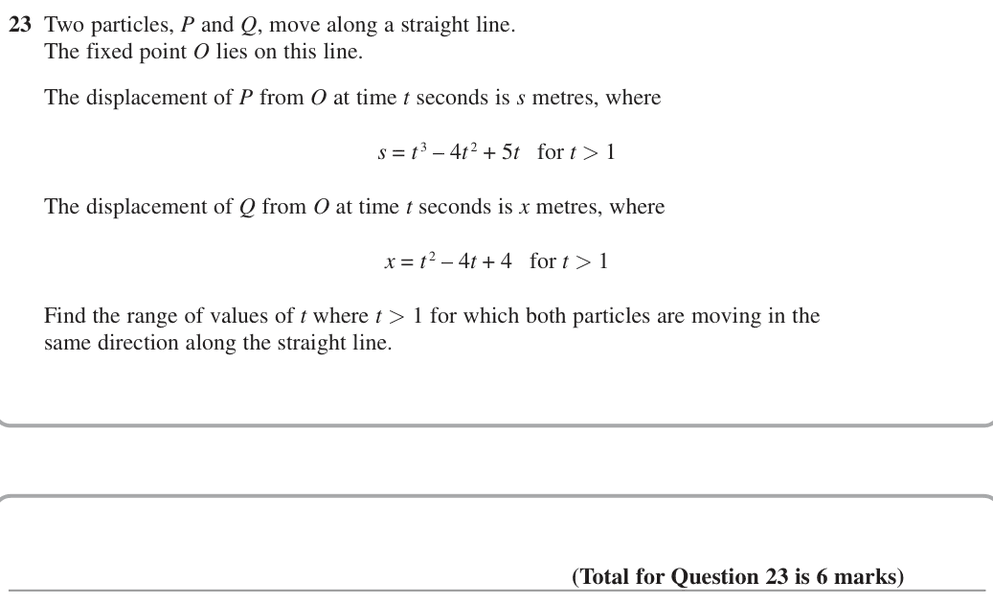
24. Jan 2022 P1HR · Q23
Hard6 marksShow worked solution
Particle
Particle \(P\):
\[
s=t^3-4t^2+5t
\]
\[
\frac{ds}{dt}=3t^2-8t+5
\]
\[
\frac{ds}{dt}=(3t-5)(t-1)
\]
Particle
Particle \(Q\):
\[
x=t^2-4t+4
\]
\[
\frac{dx}{dt}=2t-4=2(t-2)
\]
Differentiate
For \(t>1\):
moves in the negative direction
- \(P\) moves in the negative direction when \(1<t<\frac53\). - \(P\) moves in the positive direction when \(t>\frac53\). - \(Q\) moves in the negative direction when \(1<t<2\). - \(Q\) moves in the positive direction when \(t>2\).
Differentiate
So both particles move in the same direction when both velocities have the same sign.
Final answer
\(1<t<\dfrac53\) or \(t>2\)
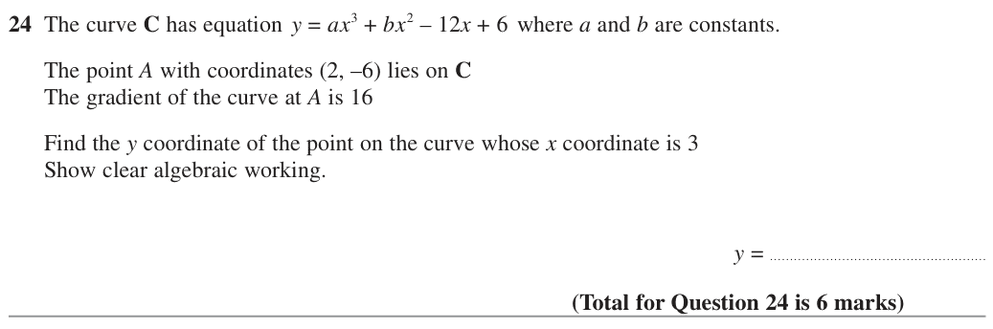
25. Jan 2022 P1H · Q24
Hard6 marksShow worked solution
Calculate value
\[
y=ax^3+bx^2-12x+6
\]
Point lies on the curve
Point \(A=(2,-6)\) lies on the curve:
\[
-6=8a+4b-24+6
\]
\[
8a+4b=12
\]
\[
2a+b=3
\]
Differentiate
Differentiate:
\[
\frac{dy}{dx}=3ax^2+2bx-12
\]
The gradient at is 16
The gradient at \(x=2\) is 16:
\[
16=12a+4b-12
\]
\[
12a+4b=28
\]
\[
3a+b=7
\]
Solve
Now solve
\[
2a+b=3
\]
\[
3a+b=7
\]
Subtracting gives
\[
a=4
\]
Calculate value
Then
\[
2(4)+b=3
\]
\[
b=-5
\]
Calculate value
For \(x=3\),
\[
y=4(3)^3-5(3)^2-12(3)+6
\]
\[
y=108-45-36+6
\]
\[
y=33
\]
Final answer
\(y=33\)
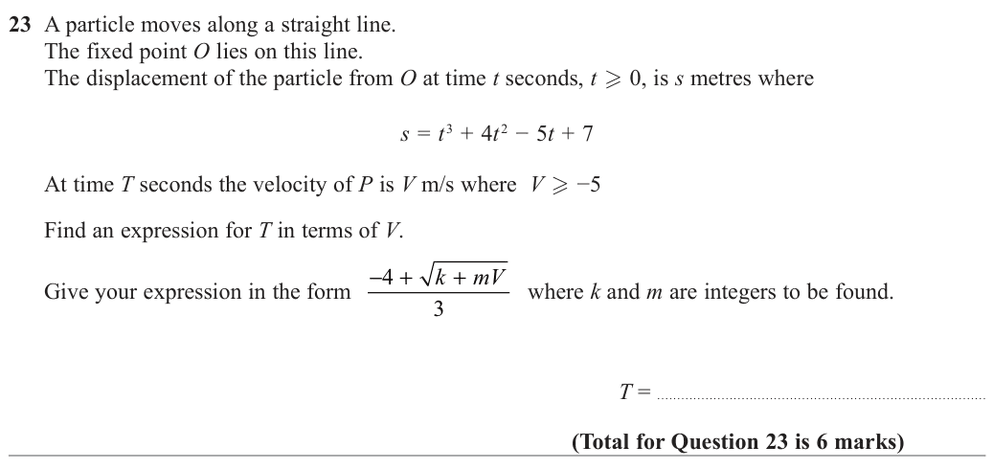
26. Jan 2020 P1HR · Q23
Hard6 marksShow worked solution
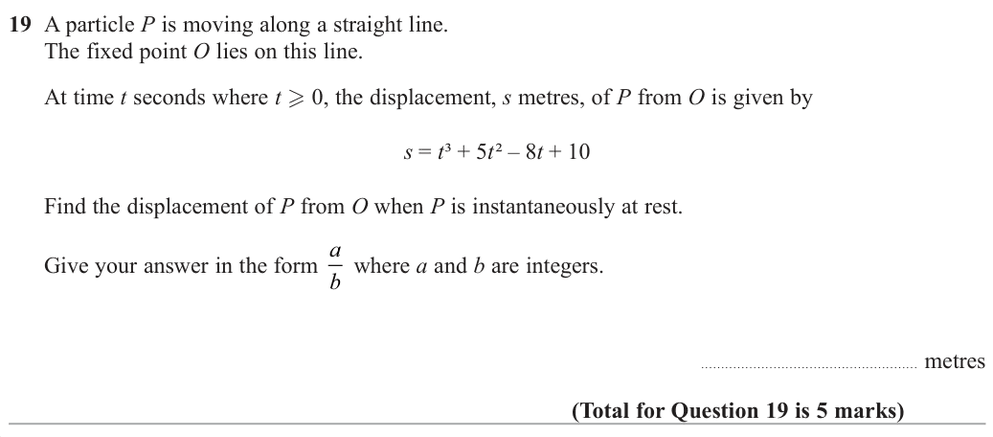
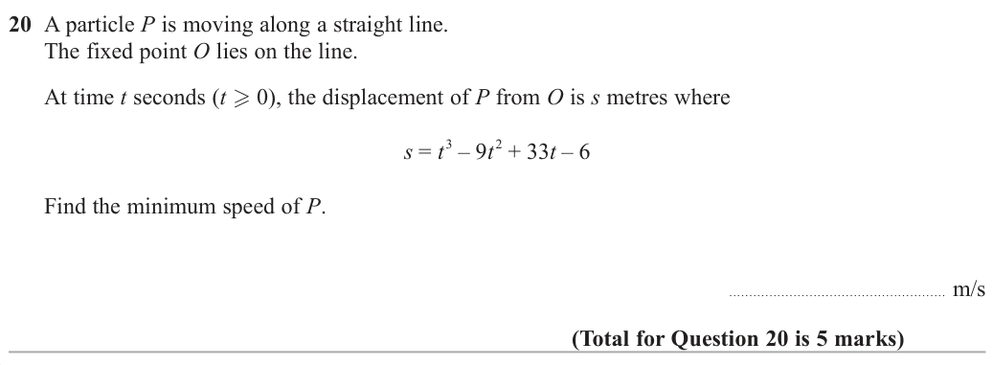
Calculate value
\[
s=t^3+4t^2-5t+7
\]
Evaluate fraction
Velocity is the derivative of displacement:
\[
v=\frac{ds}{dt}=3t^2+8t-5
\]
Calculate value
At time \(T\), the velocity is \(V\), so
\[
V=3T^2+8T-5
\]
\[
3T^2+8T-(V+5)=0
\]
Use the quadratic formula
Use the quadratic formula:
\[
T=\frac{-8\pm\sqrt{8^2-4(3)(-(V+5))}}{2(3)}
\]
\[
T=\frac{-8\pm\sqrt{64+12V+60}}{6}
\]
\[
T=\frac{-8\pm\sqrt{124+12V}}{6}
\]
\[
T=\frac{-4\pm\sqrt{31+3V}}{3}
\]
Simplify surd
Since \(T\ge 0\), take the positive root:
\[
T=\frac{-4+\sqrt{31+3V}}{3}
\]
Final answer
\(\displaystyle T=\frac{-4+\sqrt{31+3V}}{3}\)
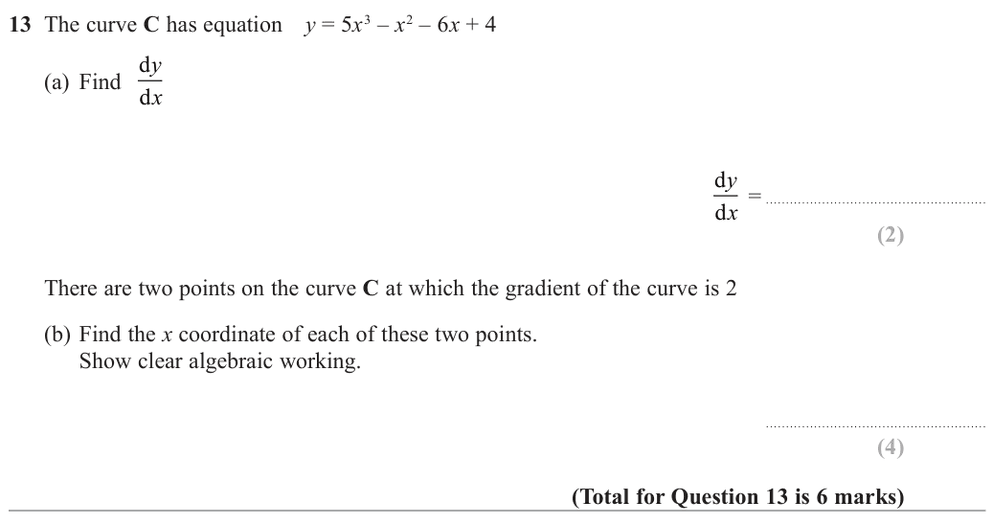
27. May-Nov 2020 P1HR · Q13
Hard6 marksShow worked solution
Find the gradient
\[
y=5x^3-x^2-6x+4
\]
\[
\frac{dy}{dx}=15x^2-2x-6
\]
Find the gradient
The gradient is 2, so \[ 15x^2-2x-6=2 \]
\[
15x^2-2x-8=0
\]
\[
x=\frac{2\pm\sqrt{(-2)^2-4(15)(-8)}}{30}
\]
\[
x=\frac{2\pm22}{30}
\]
\[
x=\frac45 \quad \text{or} \quad x=-\frac23
\]
Final answer
\(x=-\frac23\) and \(x=\frac45\).
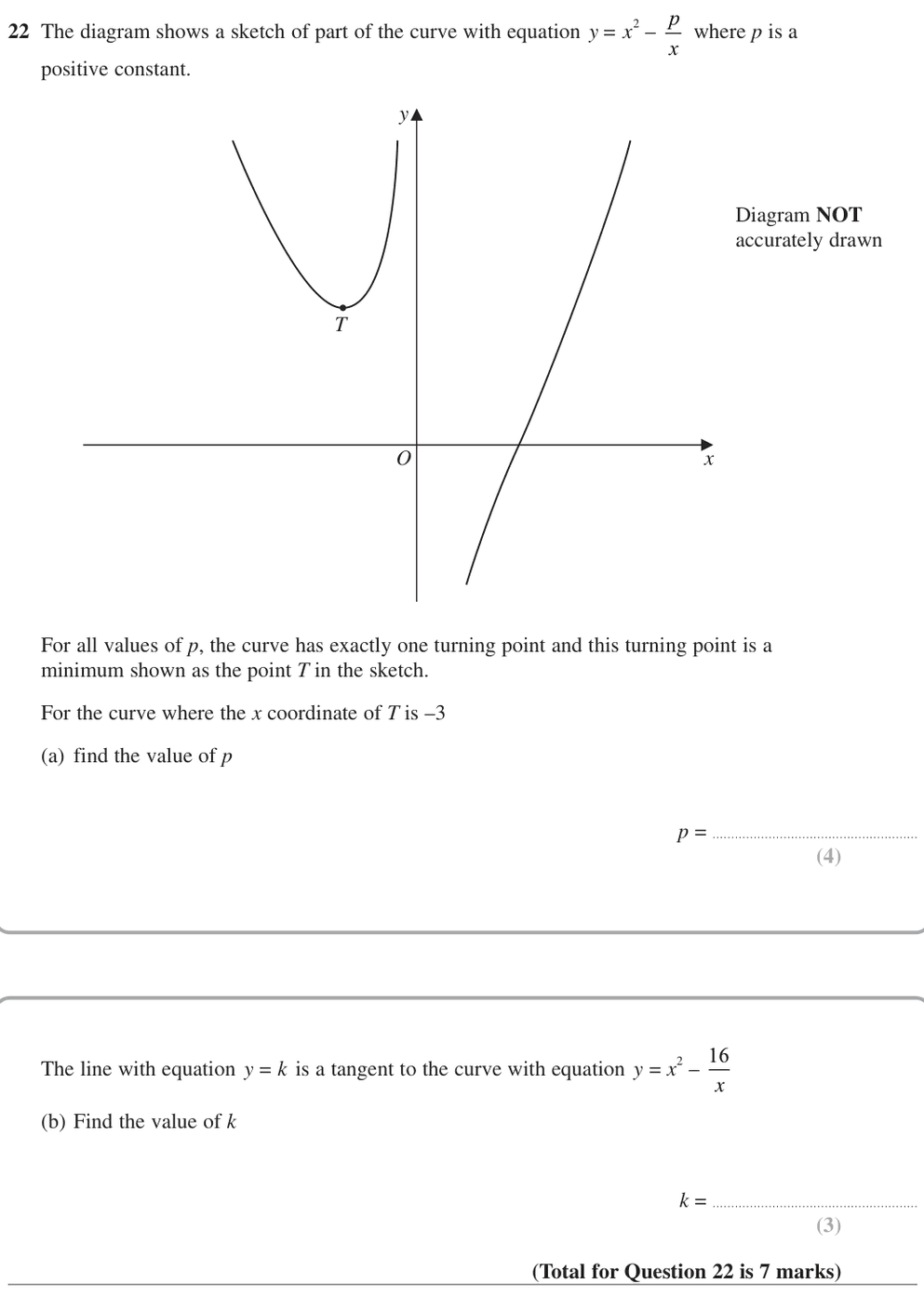
28. Jun 2022 P1HR · Q22
Hard7 marksShow worked solution
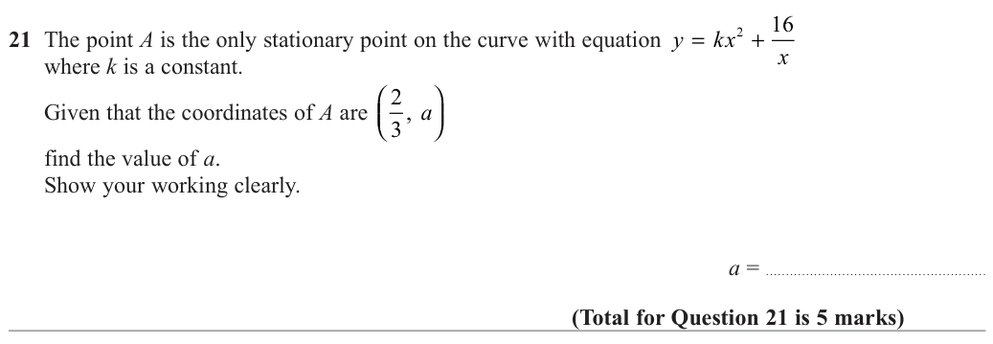
Find the gradient
For part (a),
\[
y=x^2-\frac{p}{x}
\]
\[
\frac{dy}{dx}=2x+\frac{p}{x^2}
\]
Find the gradient
At the minimum point, \(x=-3\) and the gradient is 0.
\[
2(-3)+\frac{p}{(-3)^2}=0
\]
\[
-6+\frac{p}{9}=0
\]
\[
p=54
\]
Find the gradient
For part (b),
\[
y=x^2-\frac{16}{x}
\]
\[
\frac{dy}{dx}=2x+\frac{16}{x^2}
\]
Find the gradient
At a horizontal tangent,
\[
2x+\frac{16}{x^2}=0
\]
\[
2x^3+16=0
\]
\[
x^3=-8
\]
\[
x=-2
\]
Find the gradient
Now substitute \(x=-2\) into the curve:
\[
k=(-2)^2-\frac{16}{-2}
\]
\[
k=4+8=12
\]
Final answer
\(p=54,\ k=12\)
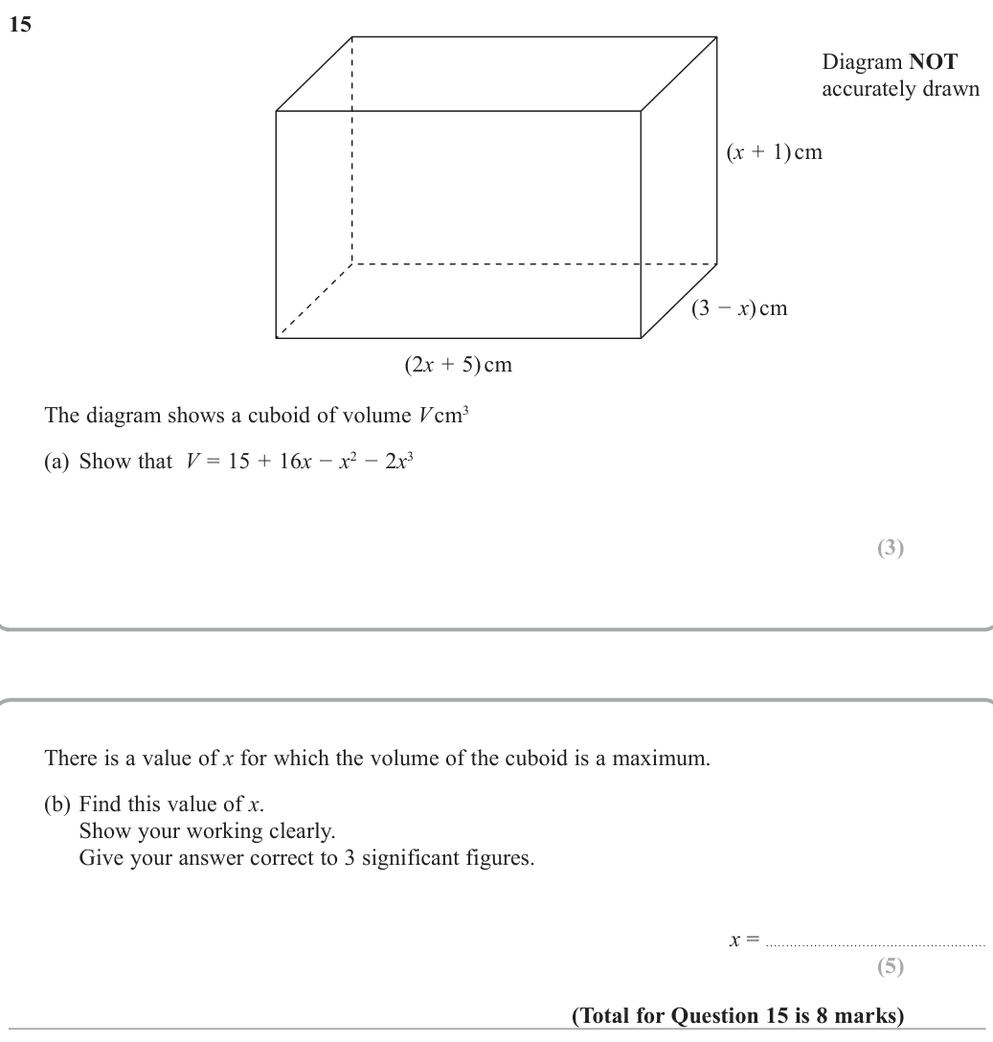
29. Jan 2020 P1H · Q15
Hard8 marksShow worked solution
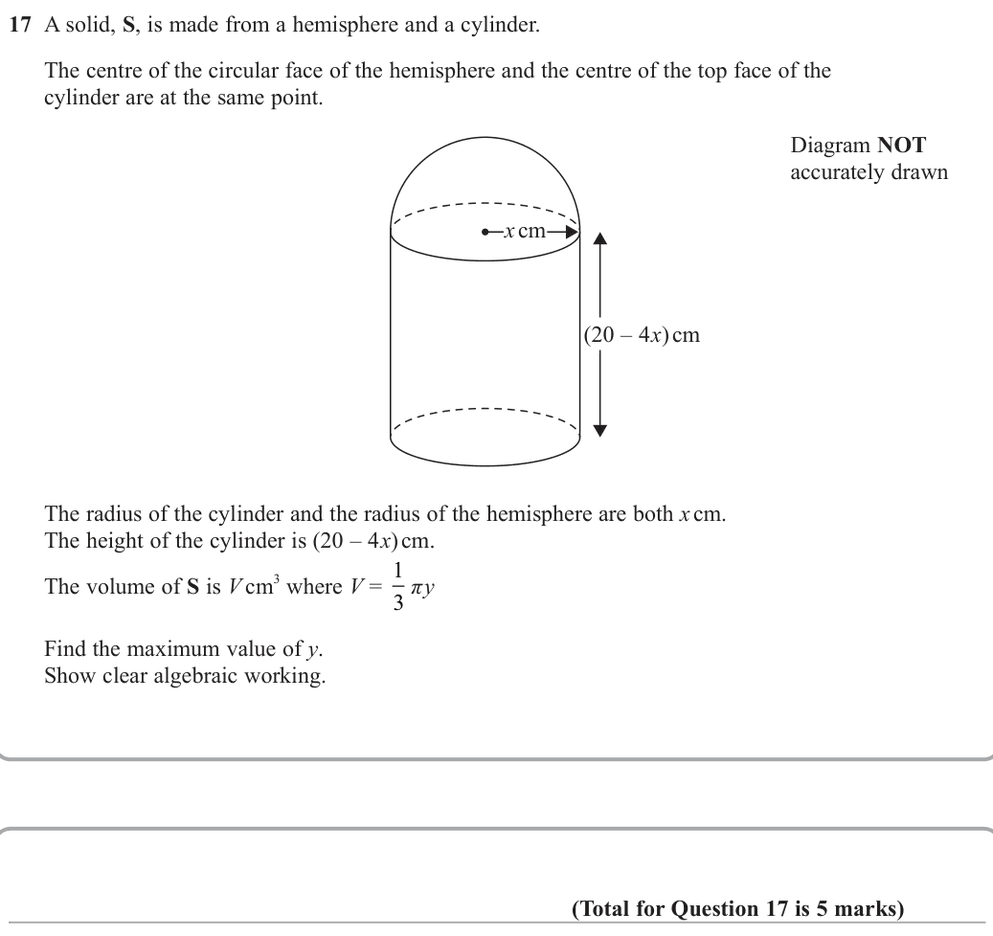
The volume is
\[
V=(2x+5)(x+1)(3-x)
\]
Expand brackets
First expand: \[ (2x+5)(x+1)=2x^2+7x+5 \]
\[
V=(2x^2+7x+5)(3-x)
\]
\[
V=15+16x-x^2-2x^3
\]
Calculate volume
For the maximum volume, \[ \frac{dV}{dx}=0 \]
\[
\frac{dV}{dx}=16-2x-6x^2
\]
\[
16-2x-6x^2=0
\]
\[
3x^2+x-8=0
\]
Solve quadratic equation
Using the quadratic formula, \[ x=\frac{-1\pm\sqrt{97}}{6} \]
 Elite Mathematics