Bearings, Scale Drawing and Constructions: past paper questions & worked solutions
Every Bearings, Scale Drawing and Constructions question from the 4MA1 papers in our bank, 2020–2025, sorted from easiest to hardest. Try each one first, then open the worked solution.
Level is estimated from marks: 1–2 easy, 3–4 medium, 5+ hard.
1. Nov 2025 4WM2H · Q1
Easy2 marksShow worked solution
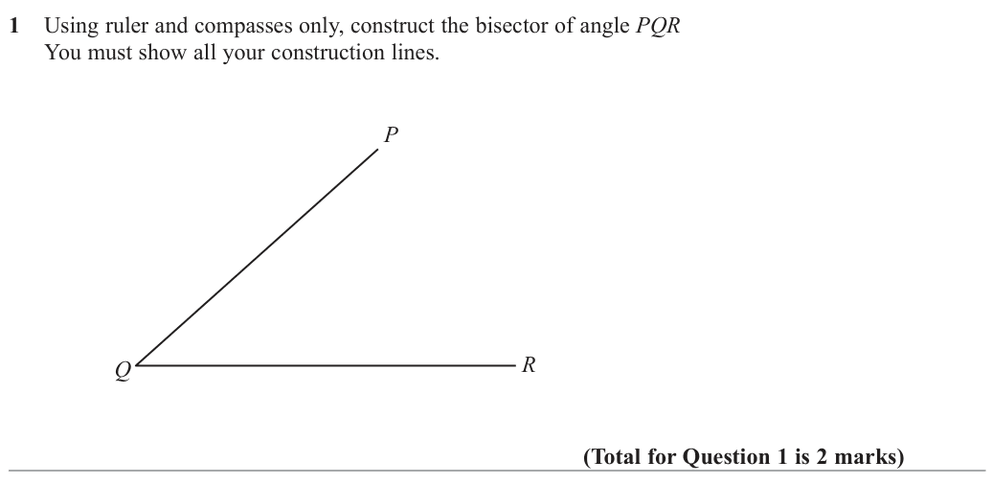
Construct angle bisector
**Step 1:** Place the point of the compass at the vertex *Q*. Draw an arc that intersects both arms *Q**P* and *Q**R*. Let’s call these intersection points *A* and *B*. **Step 2:** Without changing the compass width, place the compass point on *A* and draw an arc inside the angle. **Step 3:** Place the compass point on *B* and draw another arc to intersect the previous arc. Let this intersection be point *C*. **Step 4:** Draw a straight line from *Q* through *C*. This is the angle bisector.
Final answer
This is the angle bisector.
2. Nov 2025 P1H · Q3
Easy2 marksShow worked solution
Construction answer
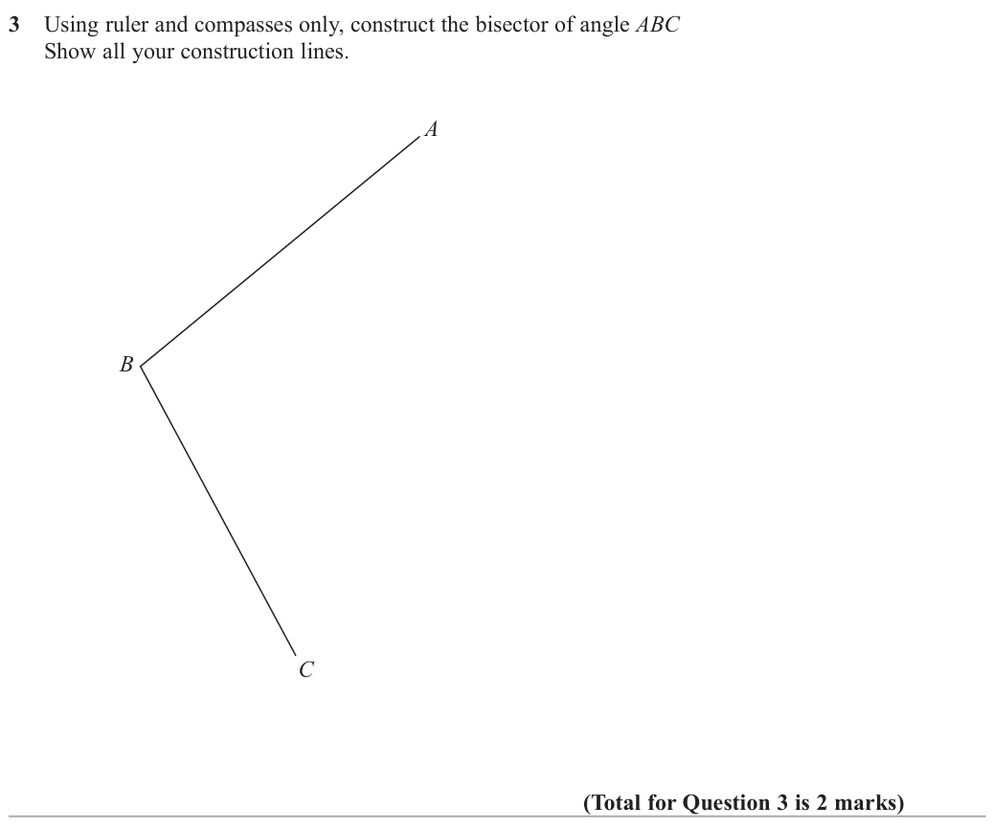
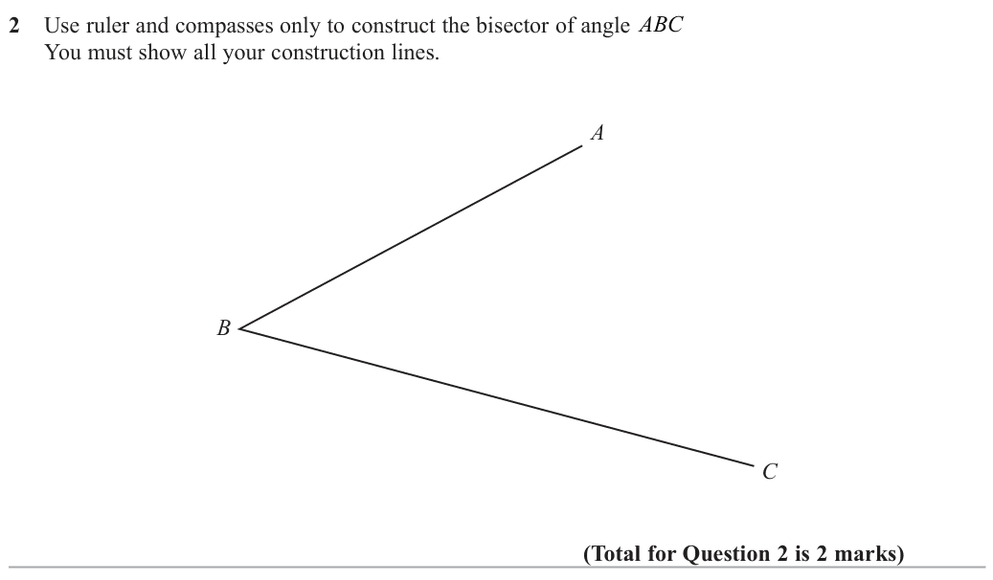
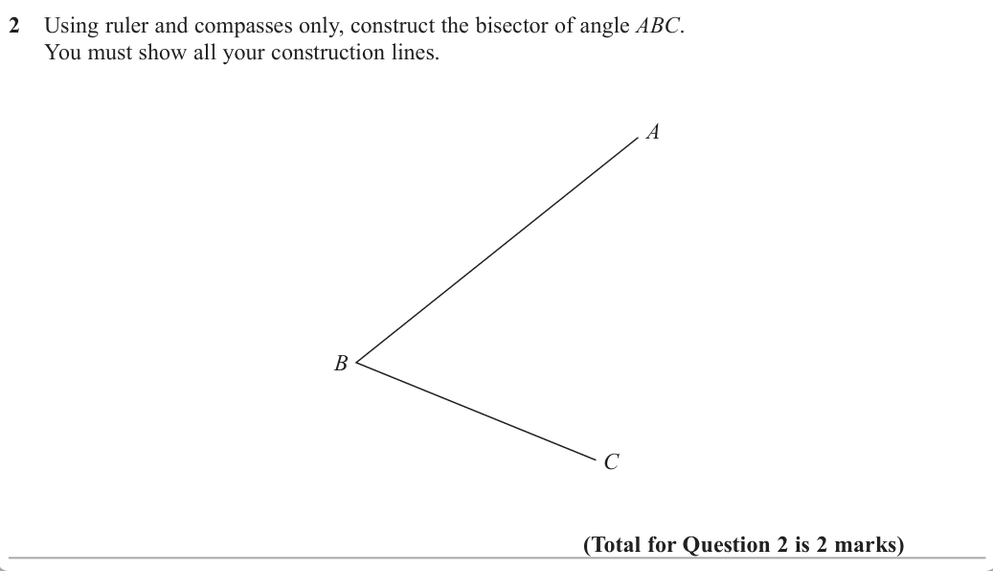
To construct the bisector of angle \(ABC\):
1. Use centre \(B\) to draw an arc crossing \(BA\) and \(BC\). 2. Use the same compass width from the two crossing points to make two arcs inside the angle. 3. Join \(B\) to the point where these two arcs meet.
Final answer
That line is the required angle bisector.
3. Jun 2025 P2H · Q4
Easy2 marksShow worked solution
Construction answer
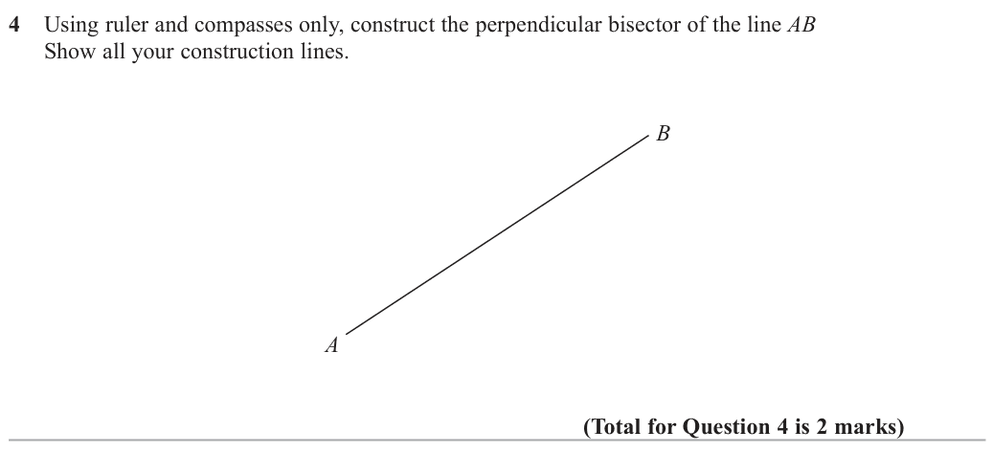
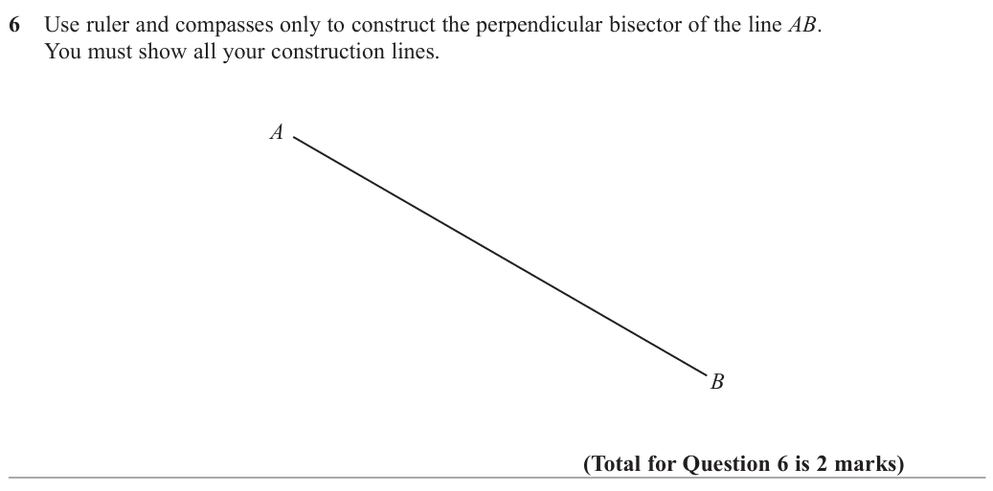
To construct the perpendicular bisector of \(AB\):
1. Open the compass to more than half the length of \(AB\). 2. Draw equal arcs from \(A\) above and below \(AB\). 3. Without changing the compass width, draw equal arcs from \(B\). 4. Join the two arc intersections with a ruler.
Final answer
The joined line is the perpendicular bisector of \(AB\).
4. May 2025 4WM2H · Q4
Easy2 marksShow worked solution
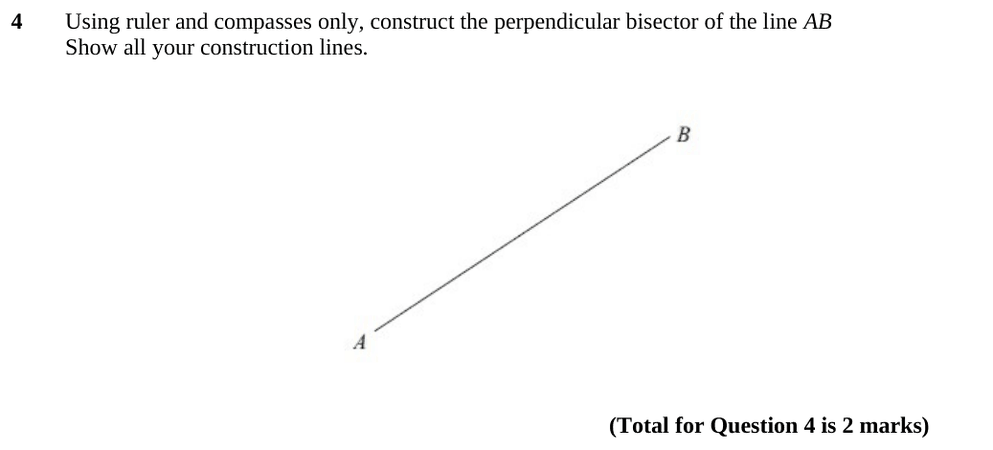
Use a compass radius greater
Use a compass radius greater than half of \(AB\). Draw matching arcs from \(A\) above and below the line, then draw matching arcs from \(B\) with the same radius. Join the two arc-intersection points.
Final answer
the joined line is the perpendicular bisector of \(AB\).
5. Nov 2024 P1H · Q2
Easy2 marksShow worked solution
Construction answer
To construct the bisector of angle \(ABC\):
1. Draw an arc centred at \(B\) cutting both arms of the angle. 2. From the two cut points, draw equal arcs inside the angle. 3. Draw the line from \(B\) through the intersection of these arcs.
Final answer
The constructed ray is the angle bisector of \(ABC\).
6. May 2021 P2H · Q3
Easy2 marksShow worked solution
Use bearings
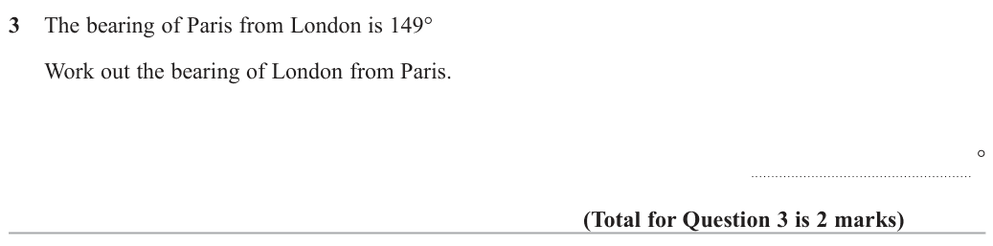
The bearing of Paris from London is the reverse bearing of London from Paris.
Reverse bearings differ by
Reverse bearings differ by \(180^\circ\): \[ 149^\circ+180^\circ=329^\circ \]
Final answer
\(329^\circ\).
7. Jan 2020 P2H · Q5
Easy2 marksShow worked solution
Construction answer
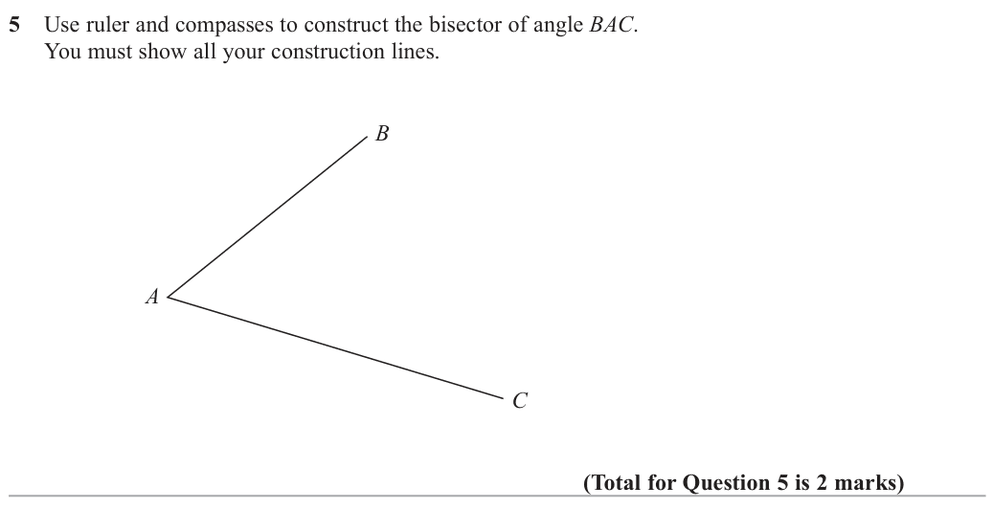
To construct the bisector of angle \(BAC\):
1. Put the compass point at \(A\) and draw an arc that cuts \(AB\) and \(AC\). 2. From the two points where the arc cuts the arms, draw equal arcs inside the angle. 3. Draw a straight line from \(A\) through the intersection of those two arcs.
Final answer
The ray from \(A\) through the arc intersection is the angle bisector of \(BAC\).
8. Jan 2020 P2HR · Q6
Easy2 marksShow worked solution
Construction answer
To construct the perpendicular bisector of \(AB\):
1. Set the compass radius to more than half of \(AB\). 2. With centre \(A\), draw arcs above and below the line. 3. With the same radius and centre \(B\), draw arcs crossing the first pair. 4. Draw the straight line through the two arc intersections.
Final answer
This line is the perpendicular bisector of \(AB\).
9. May-Nov 2020 P1HR · Q2
Easy2 marksShow worked solution
Construction answer
To construct the bisector of angle \(ABC\):
1. Put the compass point at \(B\) and draw an arc cutting \(BA\) and \(BC\). 2. From those two cut points, draw equal arcs inside the angle. 3. Draw a straight line from \(B\) through the point where the two arcs cross.
Final answer
This line bisects angle \(ABC\).
10. Jan 2022 P2H · Q5
Medium4 marksShow worked solution
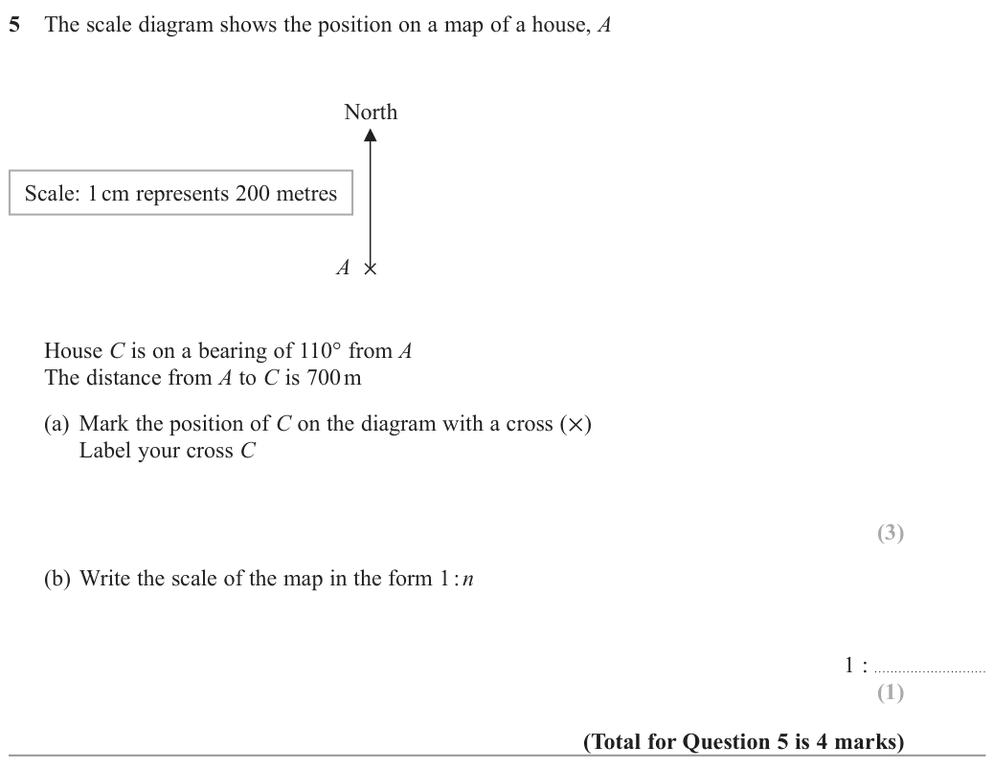
The distance from to is
The distance from \(A\) to \(C\) is \(700\text{ m}\).
The scale is
\[
1\text{ cm represents }200\text{ m}
\]
Use bearings
So the map distance is \[ 700\div 200=3.5\text{ cm} \]
Use bearings
Part (a): from \(A\), draw a bearing of \(110^\circ\) and mark \(C\) at \(3.5\text{ cm}\) from \(A\).
Use bearings
For part (b), \[ 200\text{ m}=20000\text{ cm} \]
Use bearings
So the scale is \[ 1:20000 \]
Final answer
Draw \(C\) 3.5 cm from \(A\) on a bearing of \(110^\circ\), and the scale is \(1:20000\).
11. Nov 2023 P1H · Q18
Hard5 marksShow worked solution
The bearing of from is
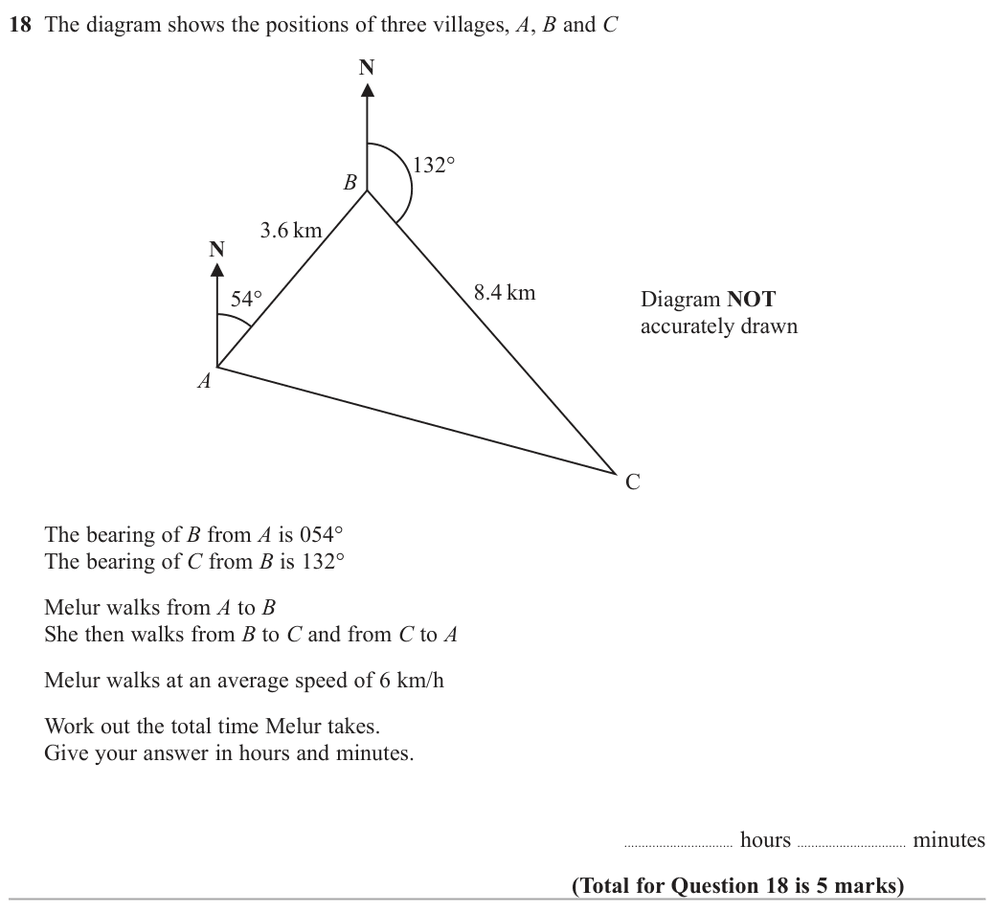
The bearing of \(B\) from \(A\) is \(054^\circ\), so the bearing of \(A\) from \(B\) is \[ 054^\circ+180^\circ=234^\circ \]
The bearing of from is
The bearing of \(C\) from \(B\) is \(132^\circ\).
Use bearings
So \[ \angle ABC=234^\circ-132^\circ=102^\circ \]
Use cosine rule
Use the cosine rule to find \(AC\): \[ AC^2=3.6^2+8.4^2-2(3.6)(8.4)\cos 102^\circ \]
\[
AC=9.8028\ldots\text{ km}
\]
Total distance walked
Total distance walked: \[ 3.6+8.4+9.8028\ldots=21.8028\ldots\text{ km} \]
Use bearings
At \(6\text{ km/h}\), time is \[ 21.8028\ldots\div 6=3.6338\ldots\text{ hours} \]
 Elite Mathematics