Elite Mathematics / Linear / Topics / Combined and Conditional Probability IGCSE · 4MA1 · Topic Combined and Conditional Probability: past paper questions & worked solutions
Every Combined and Conditional Probability question from the 4MA1 papers in our bank, 2020–2026, sorted from easiest to hardest. Try each one first, then open the worked solution.
35 questions
166 marks in total
52% of papers (28 of 54) include it
0/19/16 easy / medium / hard
Questions, easiest first Level is estimated from marks: 1–2 easy, 3–4 medium, 5+ hard.
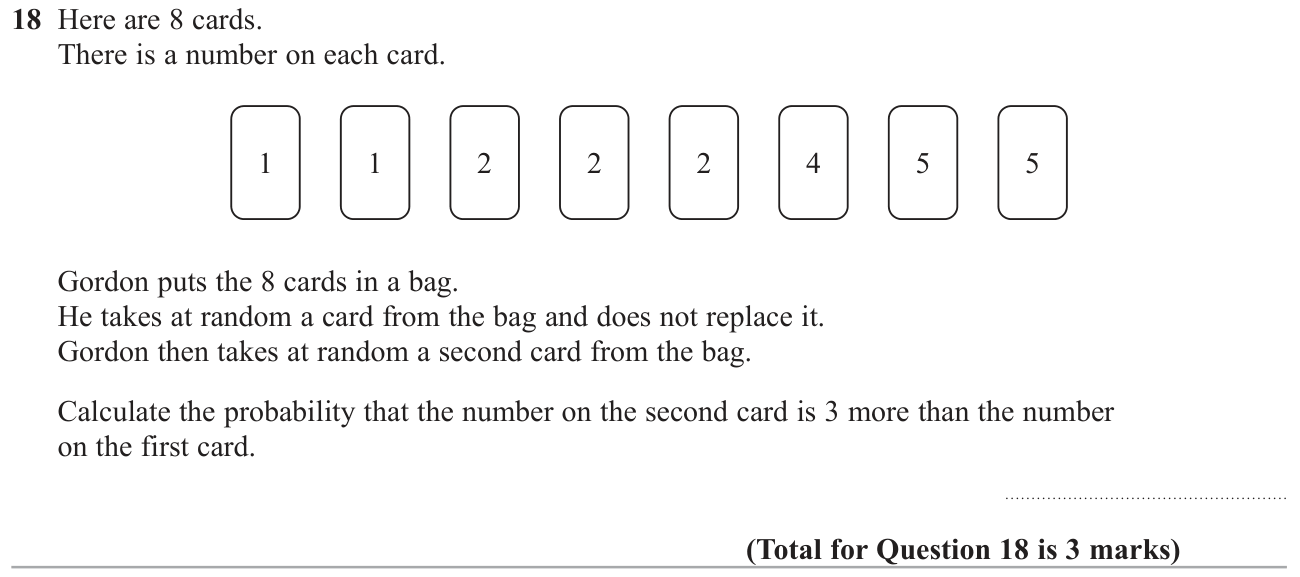
1. Jun 2026 P1HR · Q18 Medium 3 marksShow worked solution Solution | Step 1 The only possible ordered number pairs are \((1,4)\) and \((2,5)\).
The second number must be exactly 3 more than the first, not merely differ by 3.
Solution | Step 2 \[P(1\text{ then }4)=\frac28\times\frac17,\qquad P(2\text{ then }5)=\frac38\times\frac27.\]
There are 7 cards remaining for the second draw; there are two 1s, three 2s, one 4 and two 5s.
Solution | Step 3 \[P=\frac{2}{56}+\frac{6}{56}=\frac{8}{56}=\frac17.\]
The two ordered events are mutually exclusive, so add their probabilities.
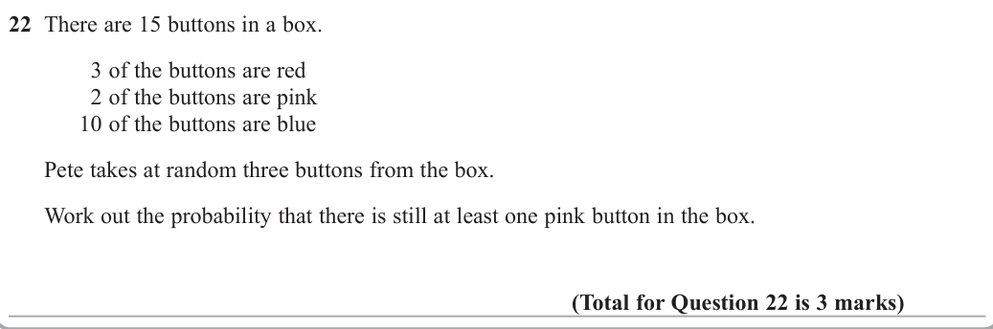
2. Nov 2025 P1H · Q22 Medium 3 marksShow worked solution There are 2 pink buttons There are 2 pink buttons.
At least one pink button At least one pink button is still in the box unless both pink buttons are taken.
Use the complement So use the complement.
The probability that both pink The probability that both pink buttons are taken is
\[
\frac{\binom{2}{2}\binom{13}{1}}{\binom{15}{3}}
\]
\[
=\frac{13}{455}
\]
\[
=\frac{1}{35}
\]
Evaluate fraction Therefore,
\[
P(\text{at least one pink is still in the box})
=1-\frac{1}{35}
\]
\[
=\frac{34}{35}
\]
Final answer \(\frac{34}{35}\)
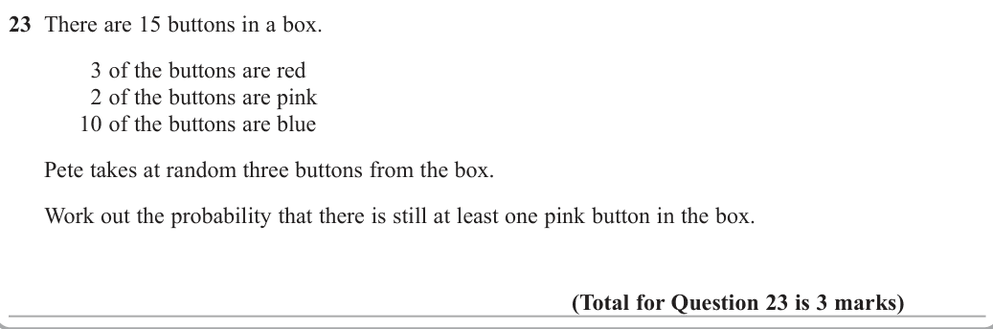
3. Nov 2025 4WM1H · Q23 Medium 3 marksShow worked solution There are 2 pink buttons There are 2 pink buttons.
At least one pink button At least one pink button is still in the box unless both pink buttons are taken.
Use the complement So use the complement.
The probability that both pink The probability that both pink buttons are taken is
\[
\frac{\binom{2}{2}\binom{13}{1}}{\binom{15}{3}}
\]
\[
=\frac{13}{455}
\]
\[
=\frac{1}{35}
\]
Evaluate fraction Therefore,
\[
P(\text{at least one pink is still in the box})
=1-\frac{1}{35}
\]
\[
=\frac{34}{35}
\]
Final answer \(\frac{34}{35}\)
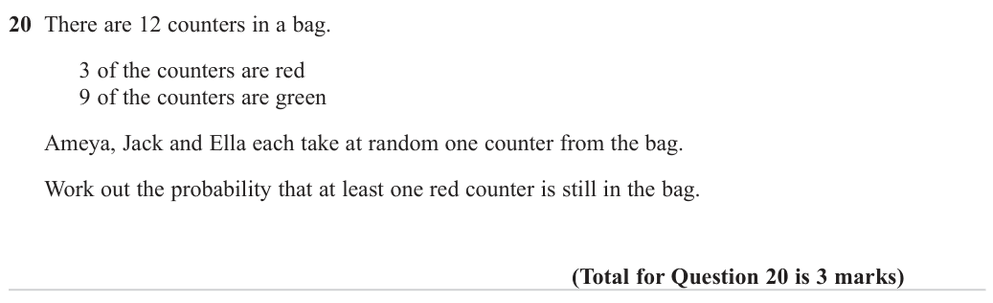
4. Jun 2023 P2H · Q20 Medium 3 marksShow worked solution There are 3 red counters There are 3 red counters.
At least one red counter At least one red counter is still in the bag unless all 3 red counters are taken.
Use the complement So use the complement:
\[
P(\text{all 3 red are taken})
=\frac{3}{12}\cdot\frac{2}{11}\cdot\frac{1}{10}
\]
\[
=\frac{6}{1320}
\]
\[
=\frac{1}{220}
\]
Evaluate fraction Therefore,
\[
P(\text{at least one red is still in the bag})
=1-\frac{1}{220}
\]
\[
=\frac{219}{220}
\]
Final answer \(\frac{219}{220}\)
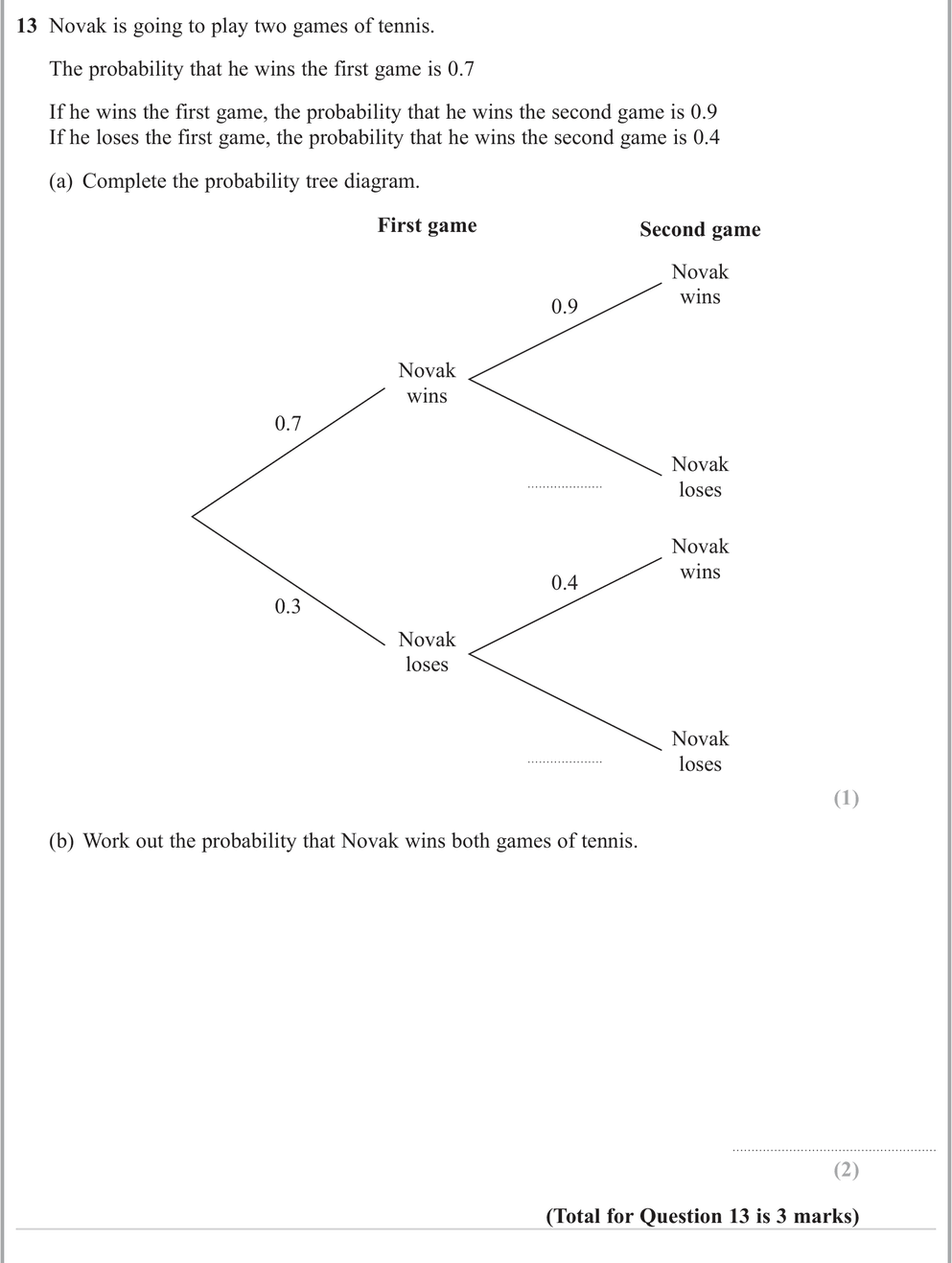
5. May 2023 P1HR · Q13 Medium 3 marksShow worked solution (a) Complete the tree After a win: loses \(1-0.9=0.1\). After a loss: loses \(1-0.4=0.6\).
(b) Wins both games \[
0.7\times0.9=0.63
\]
Final answer (a) \(0.1\), \(0.6\) (b) \(0.63\)
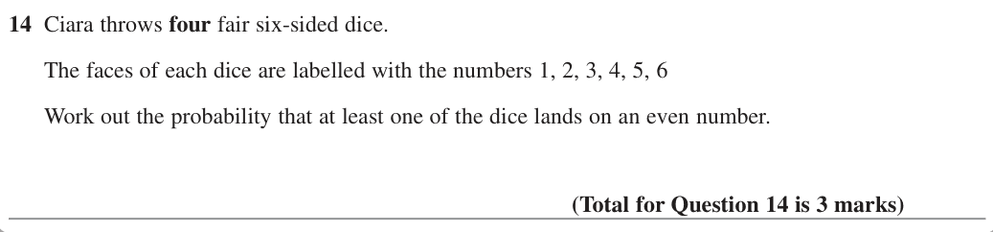
6. Jun 2022 P2HR · Q14 Medium 3 marksShow worked solution Use the complement "At least one even" is the opposite of "all four dice are odd". Each die is odd with probability \(\frac12\).
All four dice odd \[
\left(\frac12\right)^4=\frac{1}{16}
\]
At least one even \[
1-\frac{1}{16}=\frac{15}{16}
\]
Final answer \(\dfrac{15}{16}\)
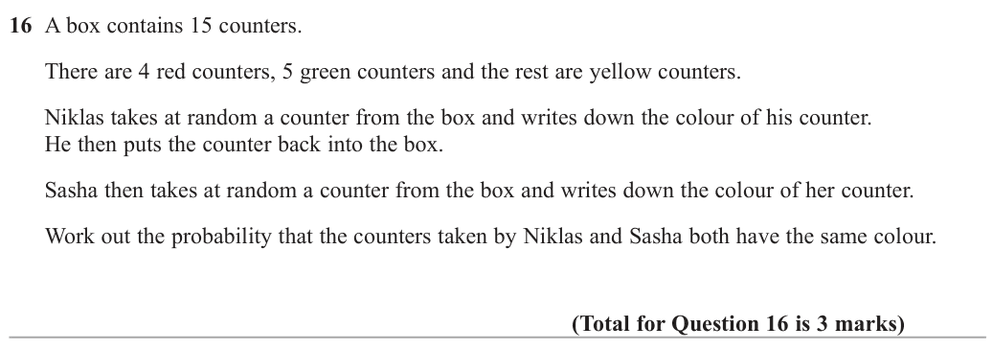
7. Nov 2021 P2H · Q16 Medium 3 marksShow worked solution Count the colours \(4\) red, \(5\) green and \(15-9=6\) yellow. The counter is replaced, so the second pick has the same probabilities.
Both the same colour \[
\left(\frac{4}{15}\right)^2+\left(\frac{5}{15}\right)^2+\left(\frac{6}{15}\right)^2=\frac{16+25+36}{225}=\frac{77}{225}
\]
Final answer \(\dfrac{77}{225}\)
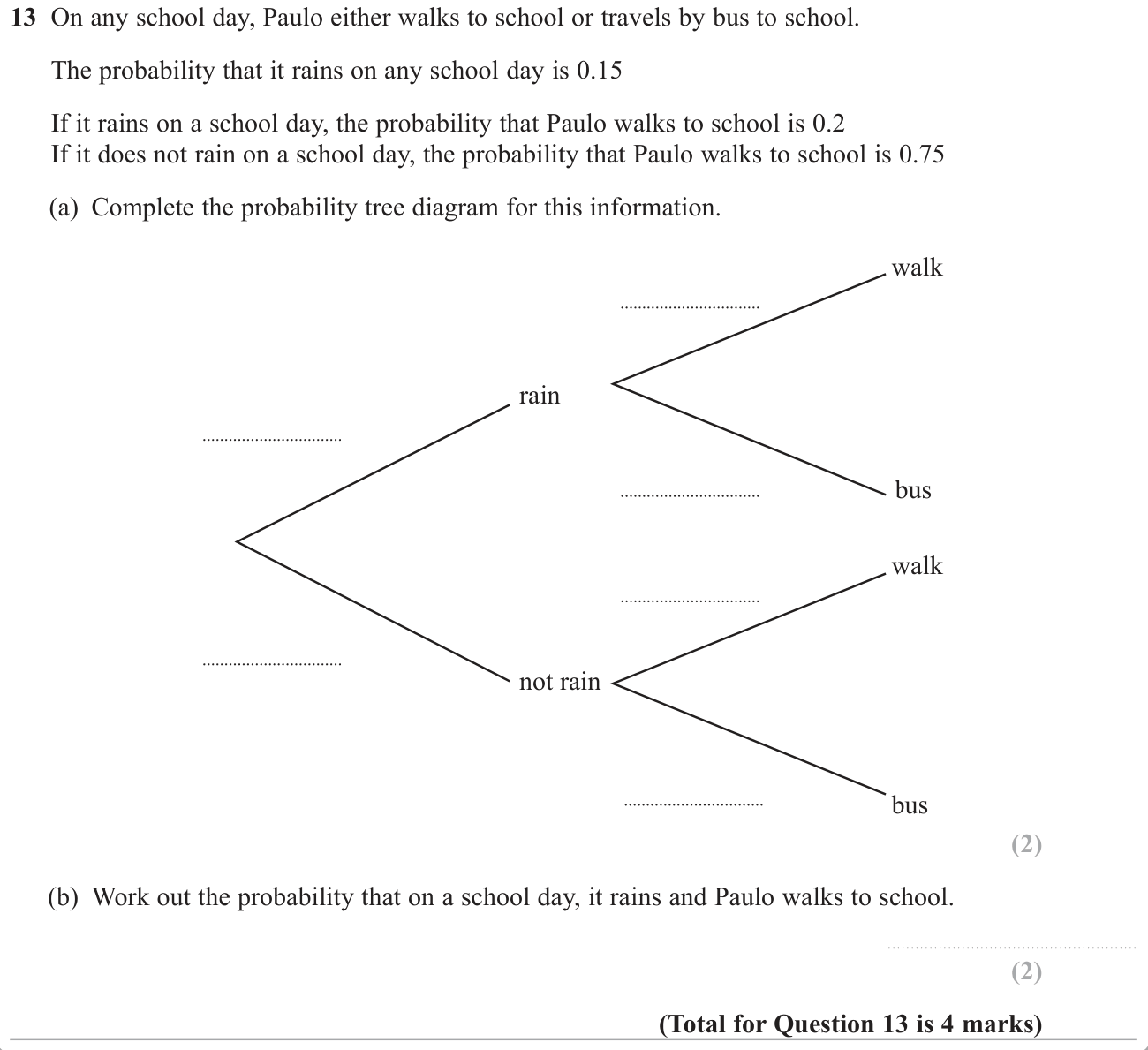
8. Jun 2026 P1H · Q13 Medium 4 marksShow worked solution Part (a) | Step 1 First split: rain \(0.15\), not rain \(0.85\).
Complementary branches sum to 1.
Part (a) | Step 2 After rain: walk \(0.20\), bus \(0.80\). After not rain: walk \(0.75\), bus \(0.25\).
Use the stated conditional probabilities and their complements on the corresponding branches.
Part (b) | Step 1 \[P(\text{rain and walk})=P(\text{rain})P(\text{walk}\mid\text{rain})=0.15\times0.2=0.03.\]
Multiply the probabilities along the rain-then-walk path; independence is not assumed.
Final answer (a) Rain/not rain: \(0.15,0.85\); walk/bus after rain: \(0.2,0.8\); walk/bus after no rain: \(0.75,0.25\).
(b) \(0.03\)
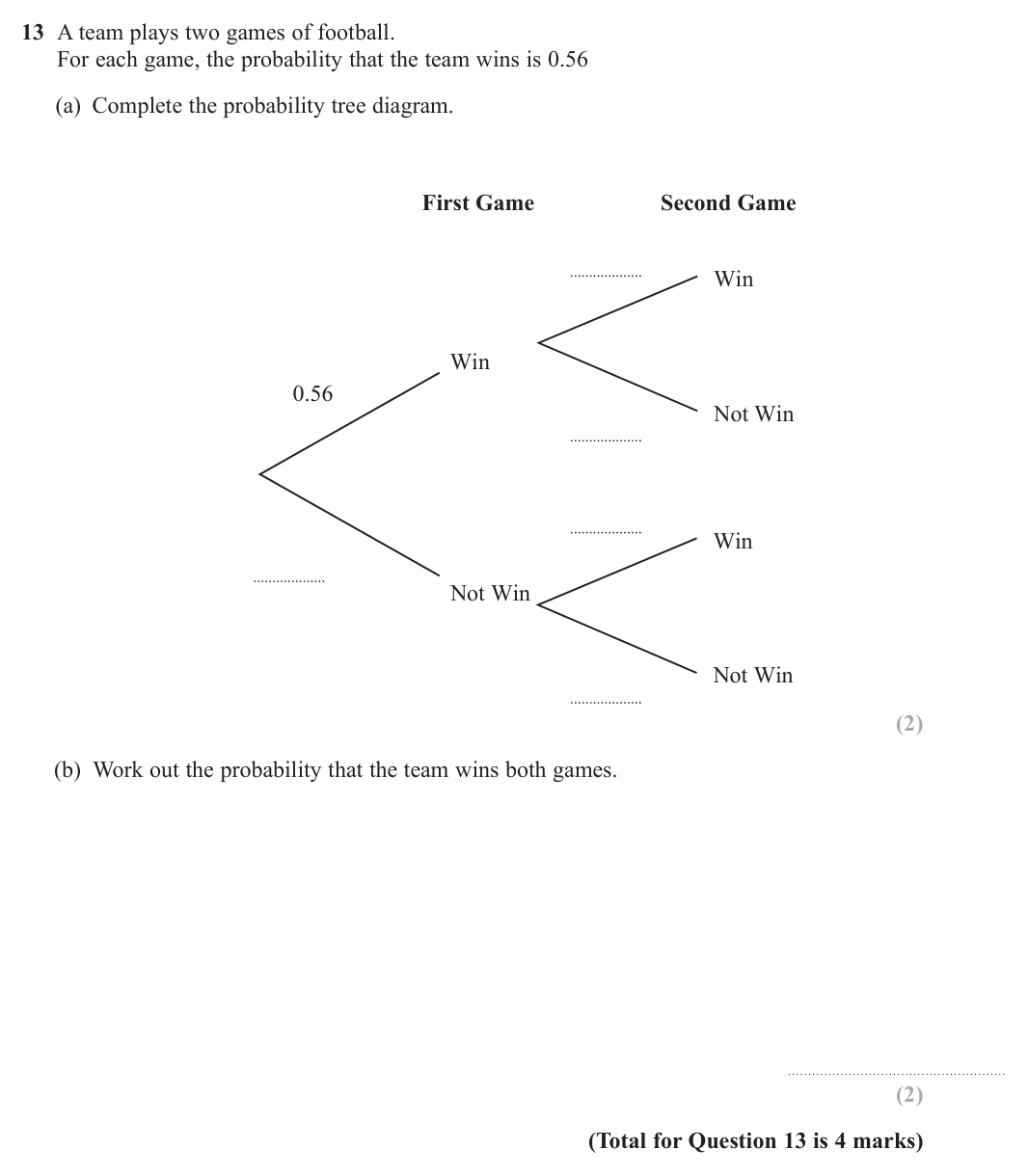
9. May 2026 4WM1H · Q13 Medium 4 marksShow worked solution (a) Branches add to 1 Not win \(=1-0.56=0.44\) on every pair of branches.
(b) Win and win \[0.56\times0.56=0.3136\]
Final answer (a) see diagram (b) \(0.3136\)
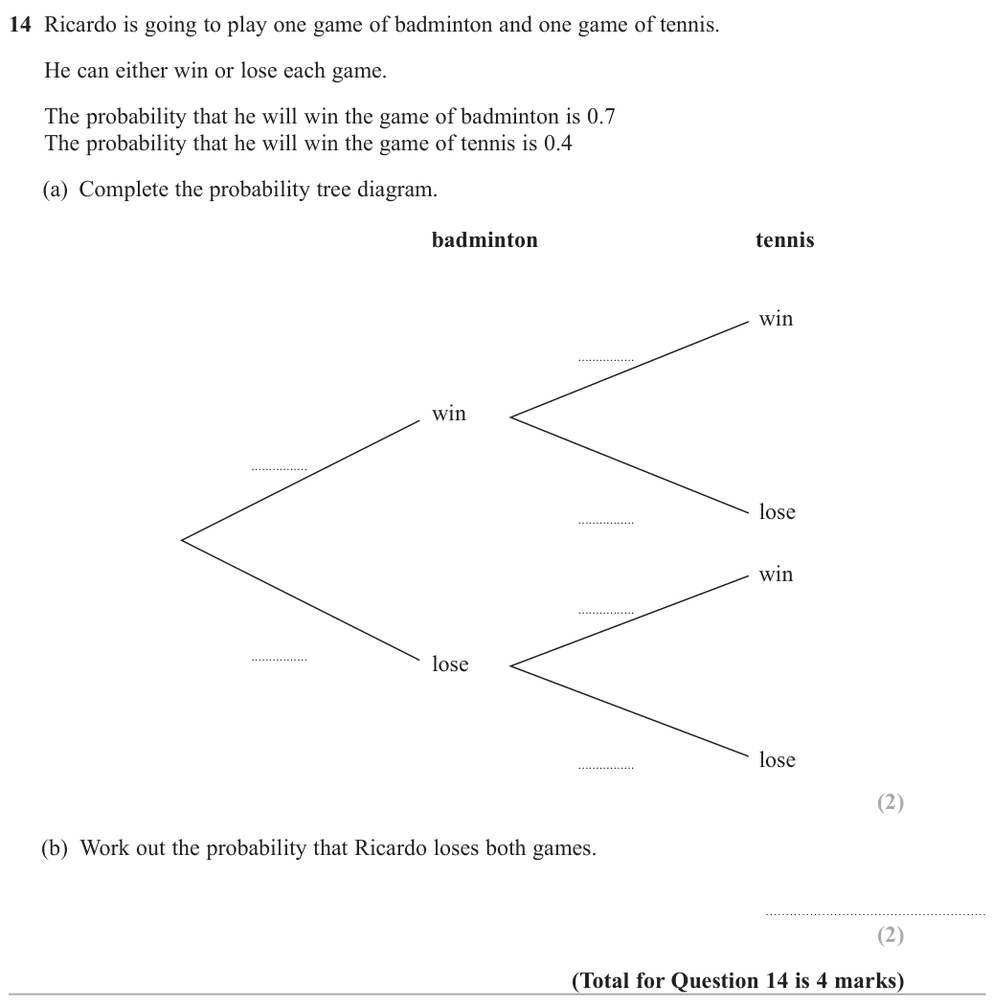
10. Jun 2025 P1H · Q14 Medium 4 marksShow worked solution (a) Complete the tree Badminton: win \(0.7\), lose \(0.3\).
Tennis (on both branches): win \(0.4\), lose \(0.6\).
(b) Lose both \[
0.3\times0.6=0.18
\]
Final answer (a) \(0.7, 0.3\); \(0.4, 0.6\) on both branches (b) \(0.18\)
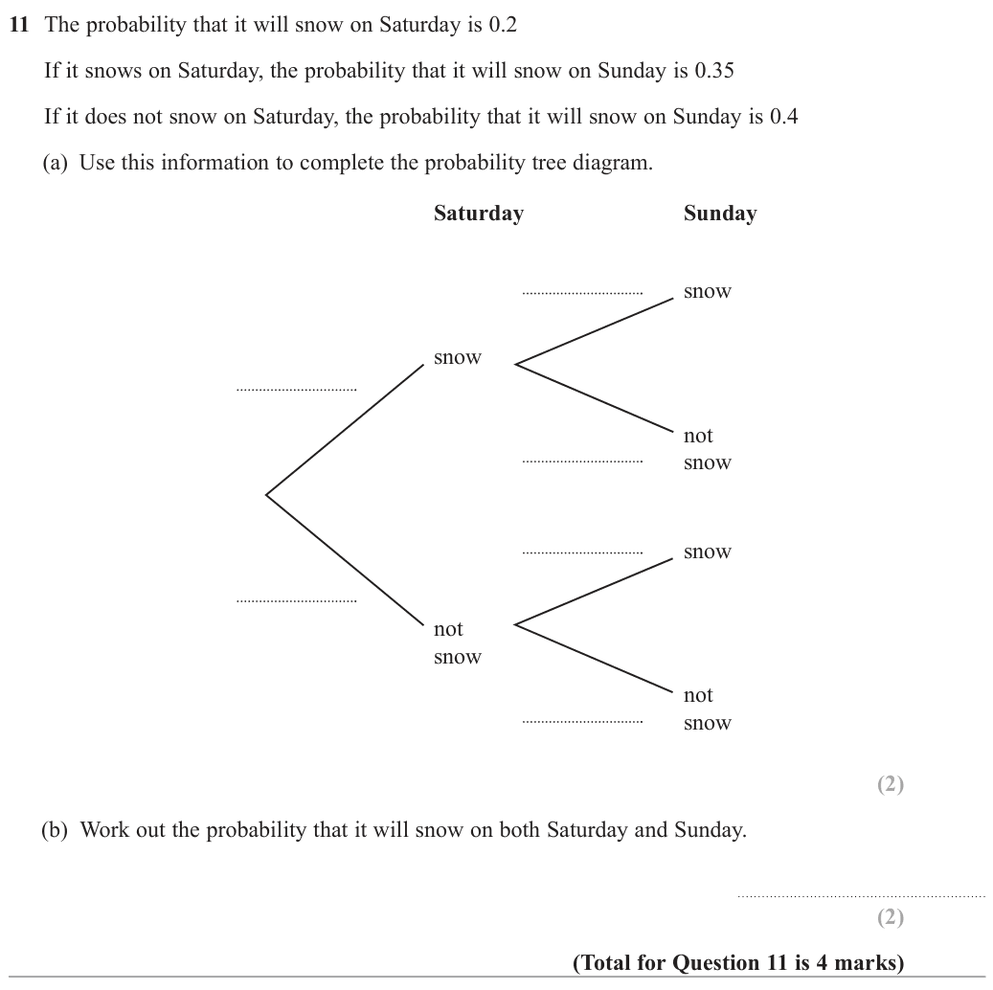
11. May 2025 4WM1HR · Q11 Medium 4 marksShow worked solution The missing branch probabilities are The missing branch probabilities are complements.
\[
P(\text{not snow on Saturday})=0.8
\]
\[
P(\text{not snow on Sunday} \mid \text{snow Saturday})=0.65
\]
\[
P(\text{not snow on Sunday} \mid \text{not snow Saturday})=0.6
\]
Calculate value For snow on both days,
\[
0.2\times 0.35=0.07
\]
Final answer tree labels \(0.2,0.8,0.35,0.65,0.4,0.6\); probability \(0.07\).
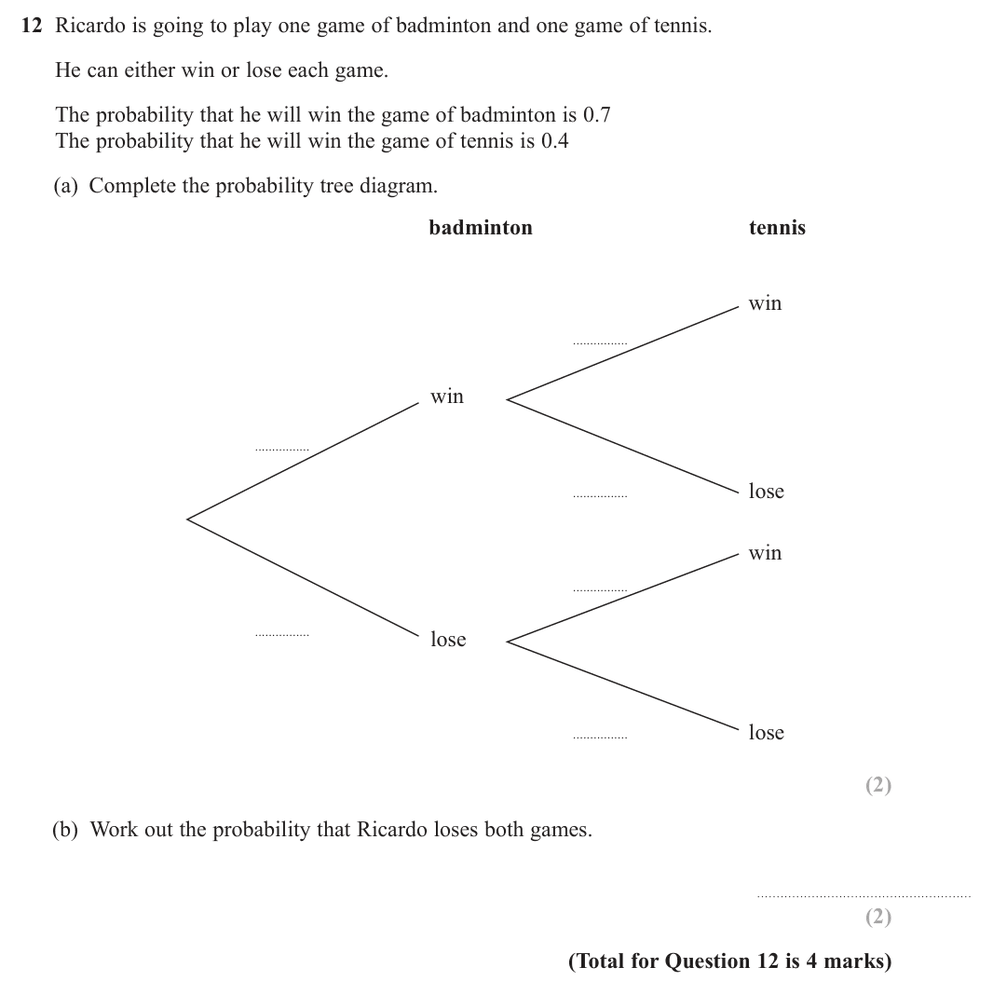
12. May 2025 4WM1H · Q12 Medium 4 marksShow worked solution Calculate probability For badminton,
\[
P(\text{win})=0.7,\qquad P(\text{lose})=0.3
\]
Calculate probability For tennis,
\[
P(\text{win})=0.4,\qquad P(\text{lose})=0.6
\]
The probability of losing both The probability of losing both games is
\[
0.3\times0.6=0.18
\]
Final answer Tennis branches are \(0.4\) and \(0.6\) on each branch; probability of losing both is \(0.18\).
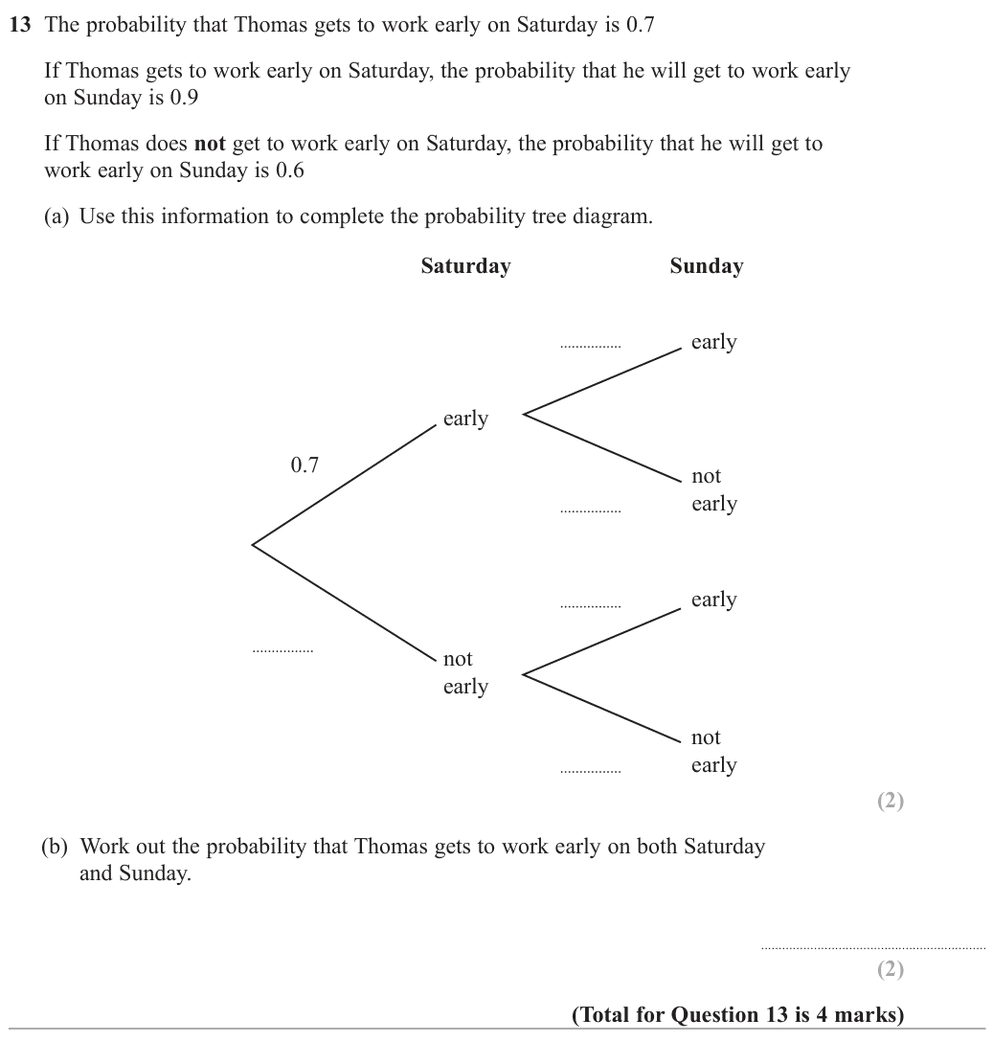
13. Nov 2024 P1H · Q13 Medium 4 marksShow worked solution (a) Complete the tree Saturday: not early \(0.3\).
After early: Sunday early \(0.9\), not early \(0.1\). After not early: Sunday early \(0.6\), not early \(0.4\).
(b) Early on both days \[
0.7\times0.9=0.63
\]
Final answer (a) \(0.3\); \(0.9, 0.1\); \(0.6, 0.4\) (b) \(0.63\)
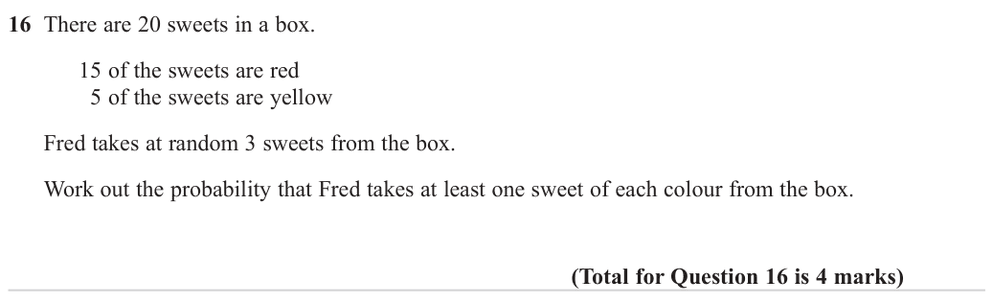
14. May 2024 P1H · Q16 Medium 4 marksShow worked solution Use the complement "At least one of each colour" fails only if all three sweets are red or all three are yellow.
All red, all yellow (no replacement) \[
P(RRR)=\frac{15}{20}\times\frac{14}{19}\times\frac{13}{18}=\frac{2730}{6840},\qquad P(YYY)=\frac{5}{20}\times\frac{4}{19}\times\frac{3}{18}=\frac{60}{6840}
\]
At least one of each \[
1-\frac{2730+60}{6840}=\frac{4050}{6840}=\frac{45}{76}
\]
Final answer \(\dfrac{45}{76}\)
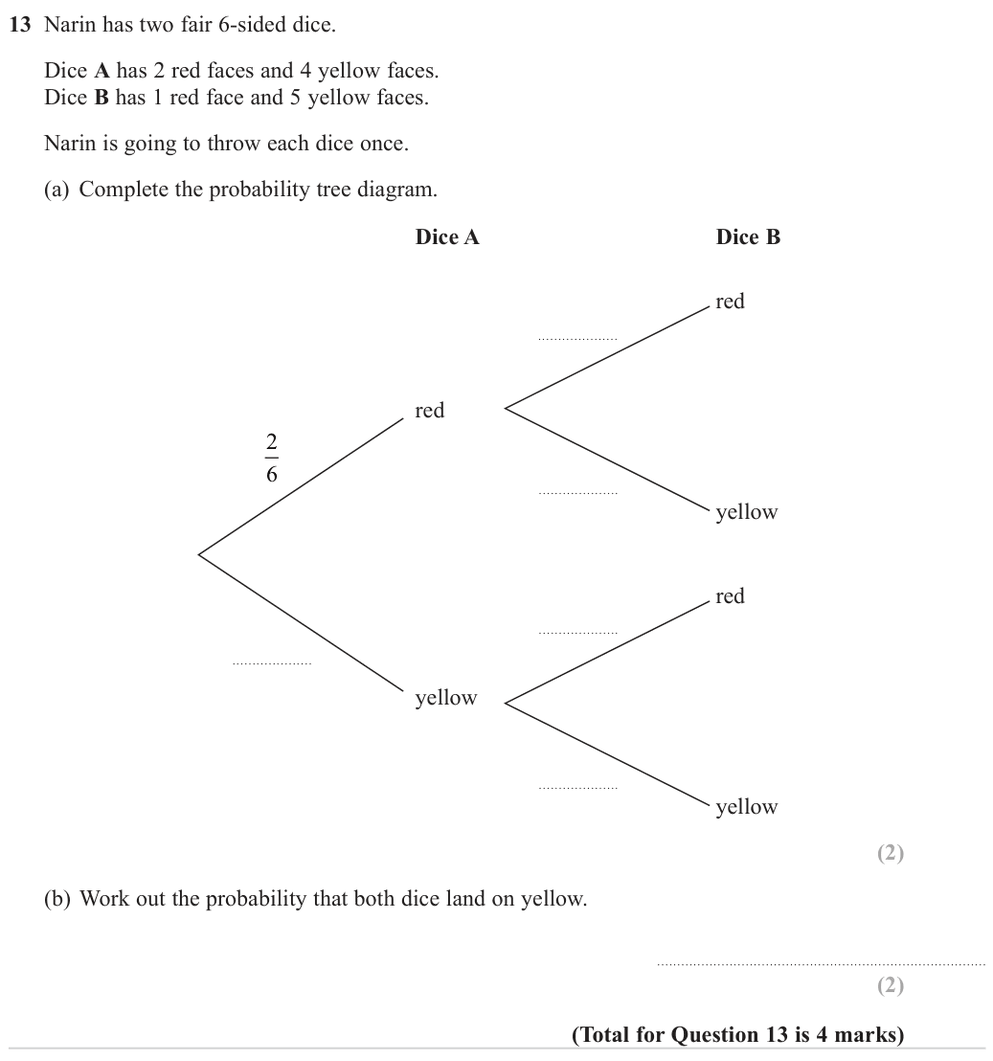
15. Jun 2023 P2H · Q13 Medium 4 marksShow worked solution (a) Complete the tree Dice A: yellow \(\frac{4}{6}\).
Dice B (on both branches): red \(\frac{1}{6}\), yellow \(\frac{5}{6}\).
(b) Both yellow \[
\frac46\times\frac56=\frac{20}{36}=\frac59
\]
Final answer (a) \(\frac46\); \(\frac16,\frac56\) on both branches (b) \(\dfrac59\)
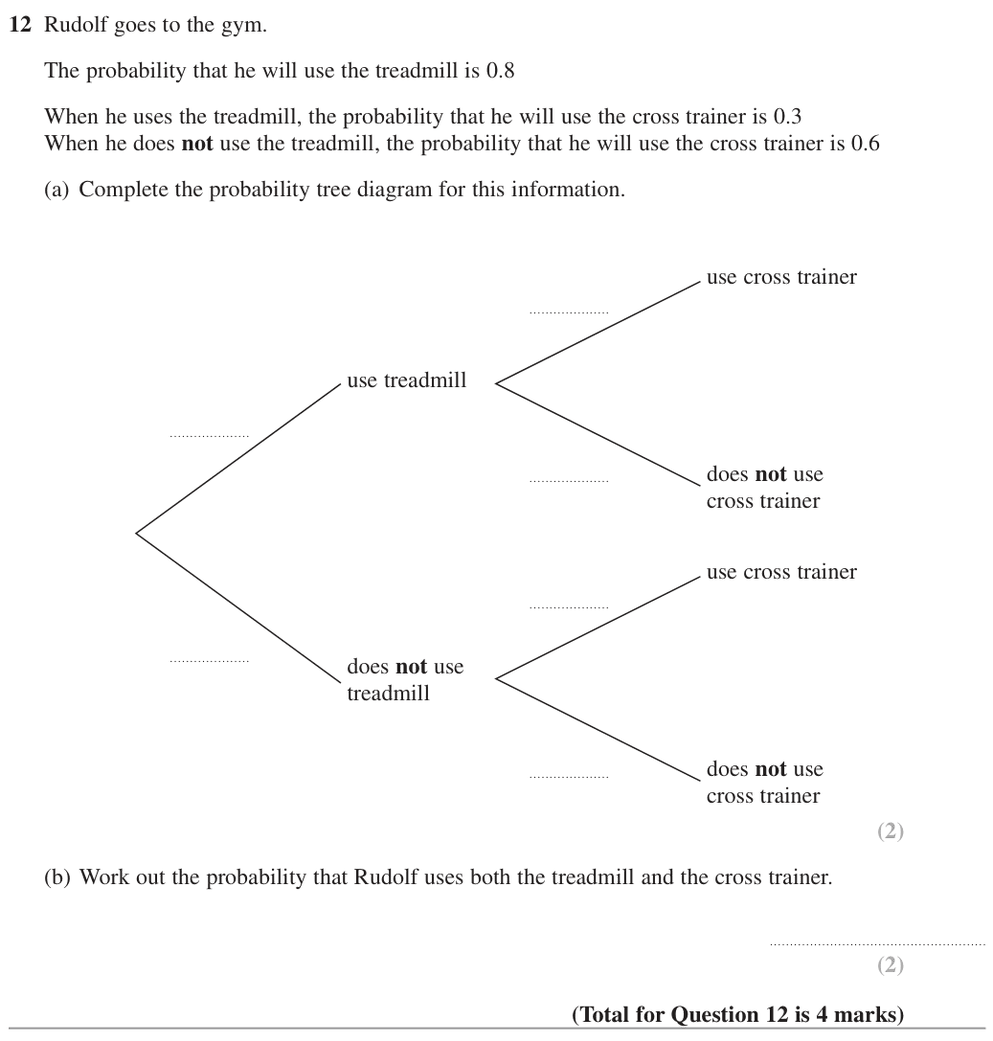
16. Jun 2022 P1H · Q12 Medium 4 marksShow worked solution (a) Complete the tree Treadmill: use \(0.8\), not use \(0.2\).
After using the treadmill: cross trainer \(0.3\), not \(0.7\).
After not using the treadmill: cross trainer \(0.6\), not \(0.4\).
(b) Treadmill and cross trainer \[
0.8\times0.3=0.24
\]
Final answer (a) \(0.8, 0.2\); \(0.3, 0.7\); \(0.6, 0.4\) (b) \(0.24\)
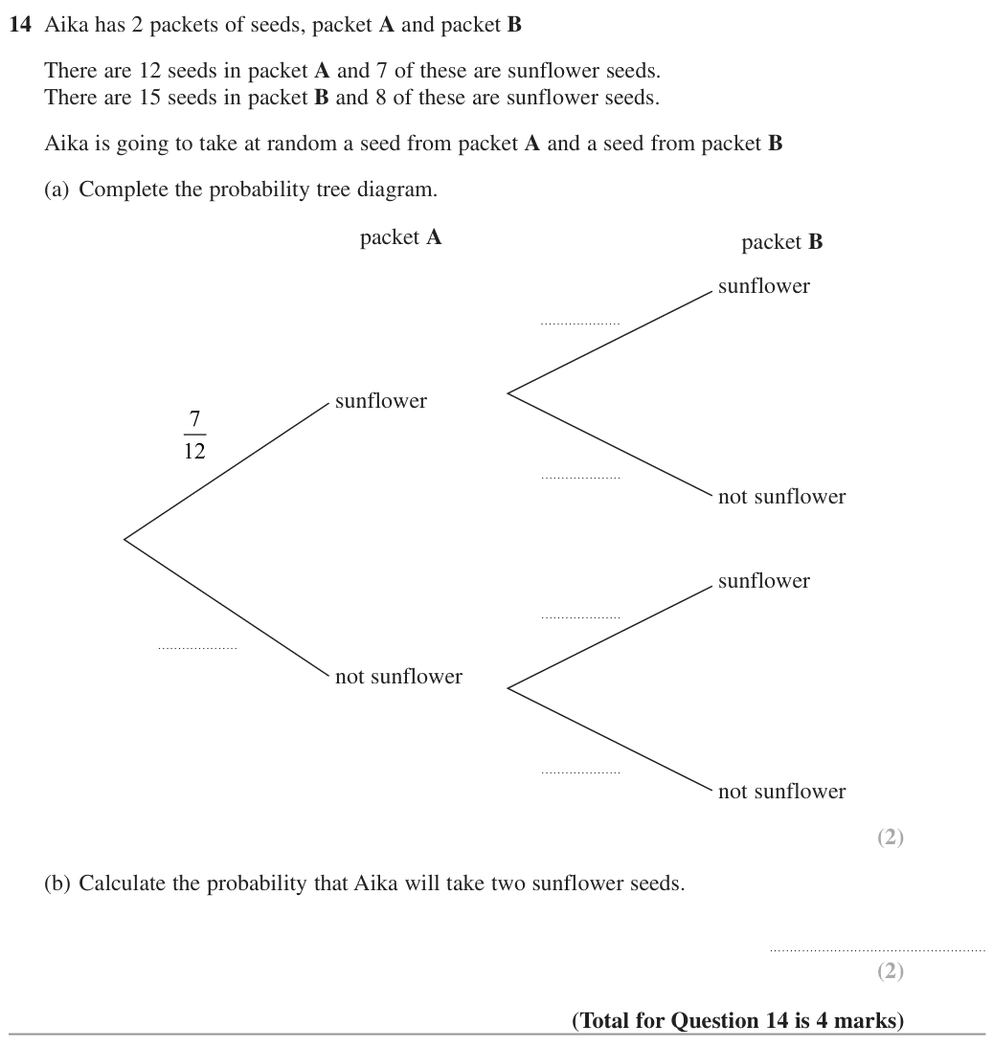
17. Jan 2022 P1H · Q14 Medium 4 marksShow worked solution (a) Complete the tree Packet A: not sunflower \(1-\frac{7}{12}=\frac{5}{12}\).
Packet B (on both branches): sunflower \(\frac{8}{15}\), not sunflower \(\frac{7}{15}\).
(b) Two sunflower seeds \[
\frac{7}{12}\times\frac{8}{15}=\frac{56}{180}=\frac{14}{45}
\]
Final answer (a) \(\frac{5}{12}\); \(\frac{8}{15},\frac{7}{15}\) on both branches (b) \(\dfrac{14}{45}\)
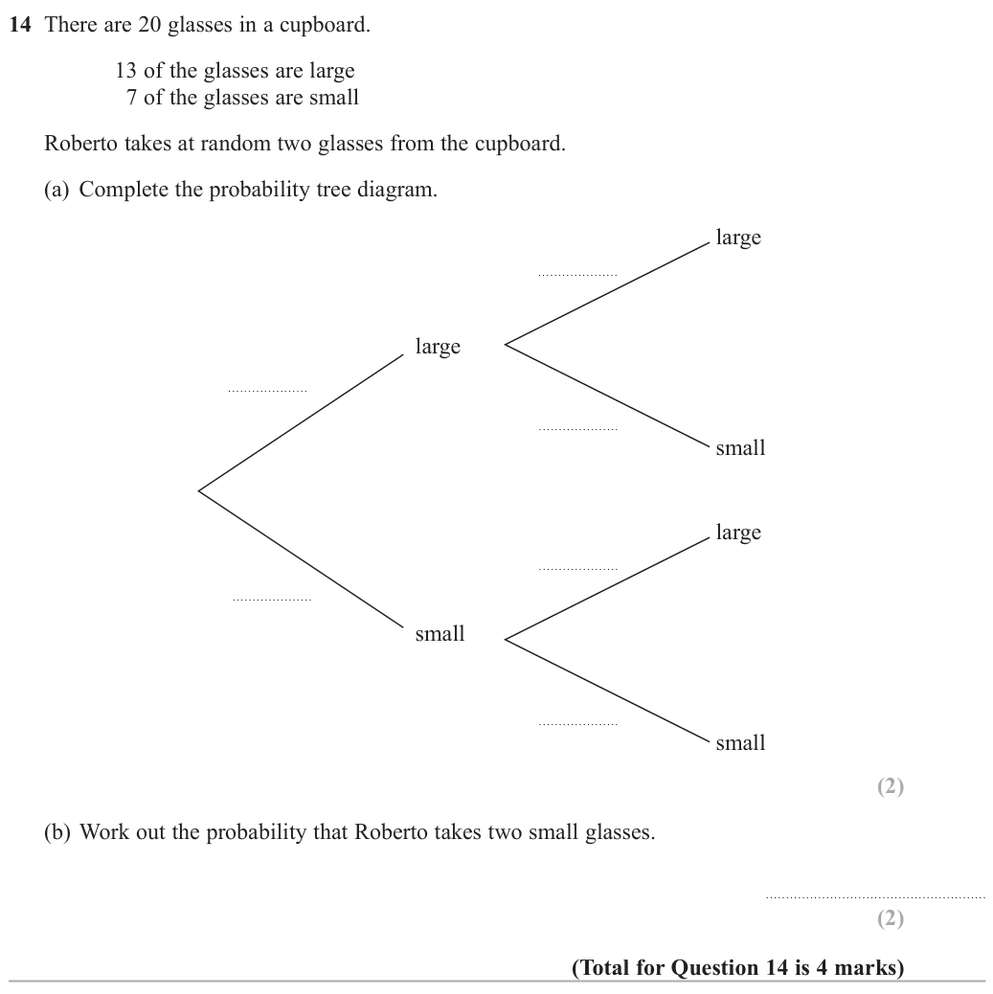
18. Jan 2020 P2H · Q14 Medium 4 marksShow worked solution (a) First glass \[
P(\text{large})=\frac{13}{20},\qquad P(\text{small})=\frac{7}{20}
\]
(a) Second glass (one fewer glass left) After a large glass: large \(\frac{12}{19}\), small \(\frac{7}{19}\).
After a small glass: large \(\frac{13}{19}\), small \(\frac{6}{19}\).
(b) Two small glasses \[
\frac{7}{20}\times\frac{6}{19}=\frac{42}{380}=\frac{21}{190}
\]
Final answer (a) \(\frac{13}{20},\frac{7}{20}\); \(\frac{12}{19},\frac{7}{19}\); \(\frac{13}{19},\frac{6}{19}\) (b) \(\dfrac{21}{190}\)
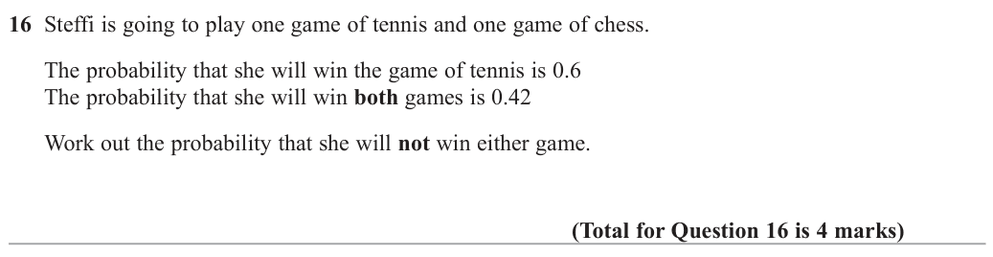
19. Jan 2020 P1HR · Q16 Medium 4 marksShow worked solution Find the probability of winning chess Treat the two games as independent:
\[
0.6\times P(\text{win chess})=0.42 \;\Rightarrow\; P(\text{win chess})=0.42\div0.6=0.7
\]
Probabilities of losing \[
P(\text{not win tennis})=1-0.6=0.4,\qquad P(\text{not win chess})=1-0.7=0.3
\]
Win neither game \[
0.4\times0.3=0.12
\]
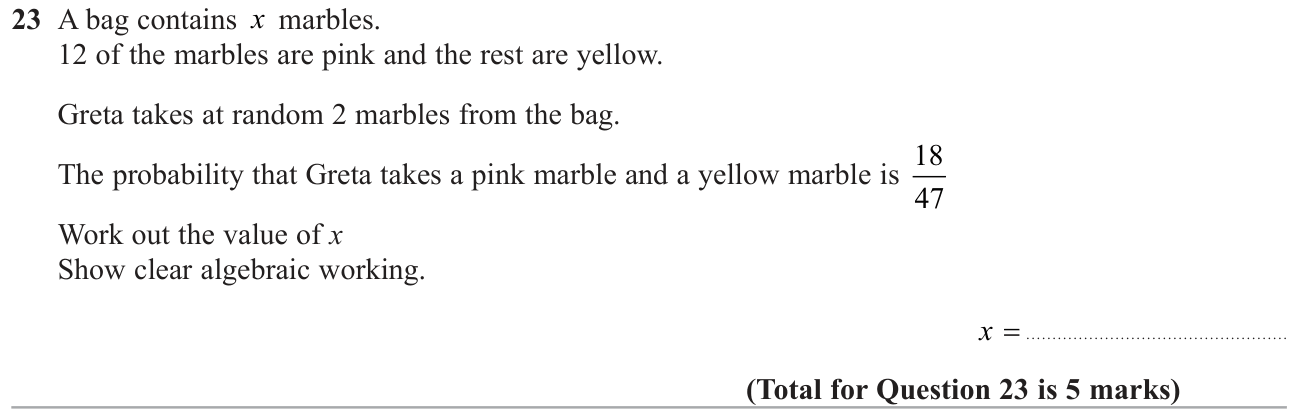
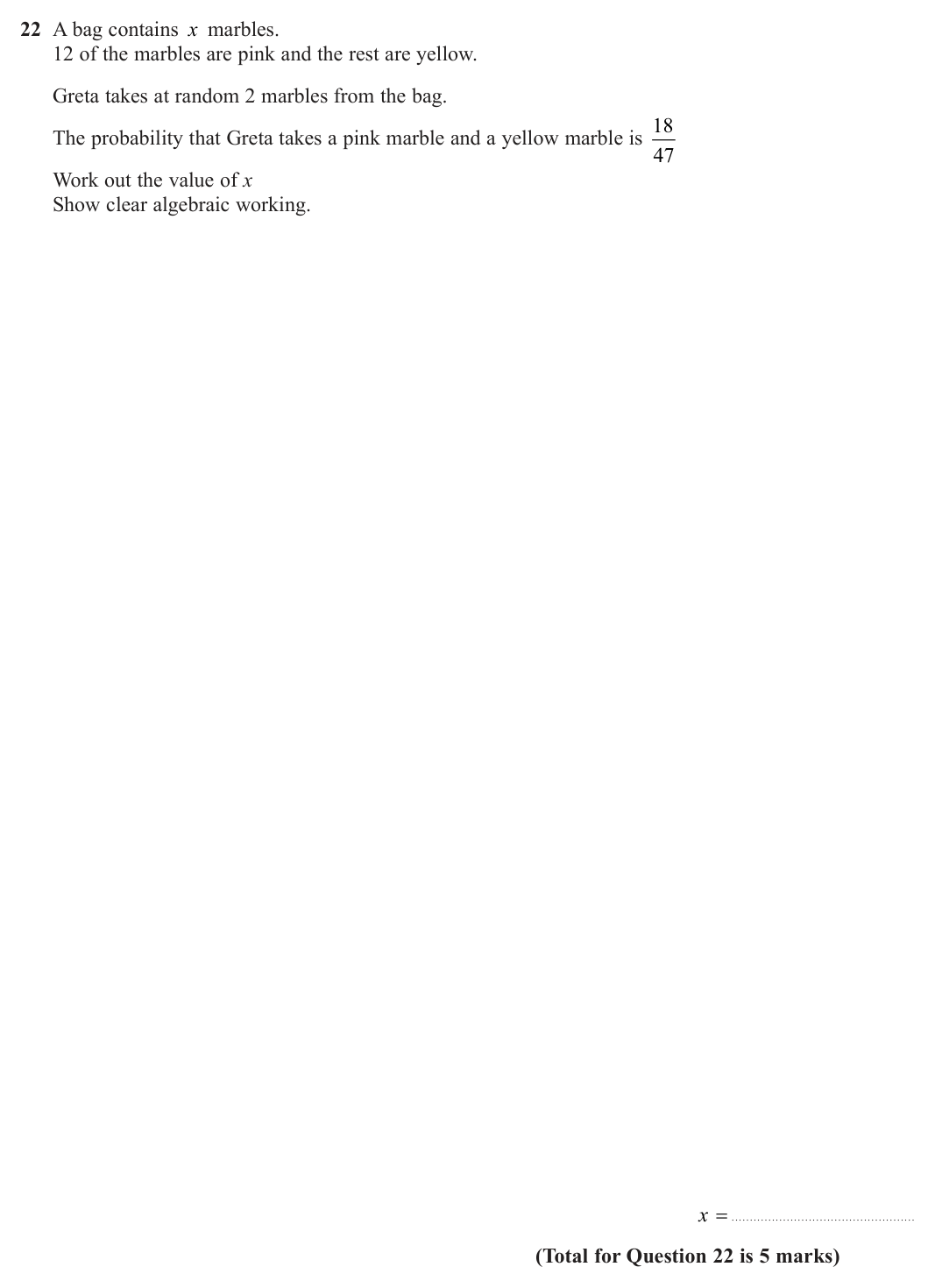
20. Jun 2026 P1H · Q23 Hard 5 marksShow worked solution Solution | Step 1 \[P(\text{one pink, one yellow})=\frac{12}{x}\frac{x-12}{x-1}+\frac{x-12}{x}\frac{12}{x-1}=\frac{24(x-12)}{x(x-1)}.\]
Include pink-then-yellow and yellow-then-pink, without replacement.
Solution | Step 2 \[\frac{24(x-12)}{x(x-1)}=\frac{18}{47}\implies1128(x-12)=18x(x-1).\]
Equate to the given probability and cross-multiply.
Solution | Step 3 \[18x^2-1146x+13536=0\implies3x^2-191x+2256=0.\]
Rearrange and divide by 6.
Solution | Step 4 \[(x-48)(3x-47)=0\implies x=48\text{ or }x=\frac{47}{3}.\]
Factorise the quadratic.
Solution | Step 5 The number of marbles must be an integer, so \(x=48\).
Reject the non-integer root.
21. May 2026 4WM1H · Q22 Hard 5 marksShow worked solution Pink then yellow, or yellow then pink \[2\times\frac{12}{x}\times\frac{x-12}{x-1}=\frac{18}{47}\]
Cross-multiply \[1128(x-12)=18x(x-1)\Rightarrow 18x^2-1146x+13536=0\]
Simplify (÷6) and solve \[3x^2-191x+2256=0\Rightarrow(x-48)(3x-47)=0\]
x must be a whole number \[x=48\]
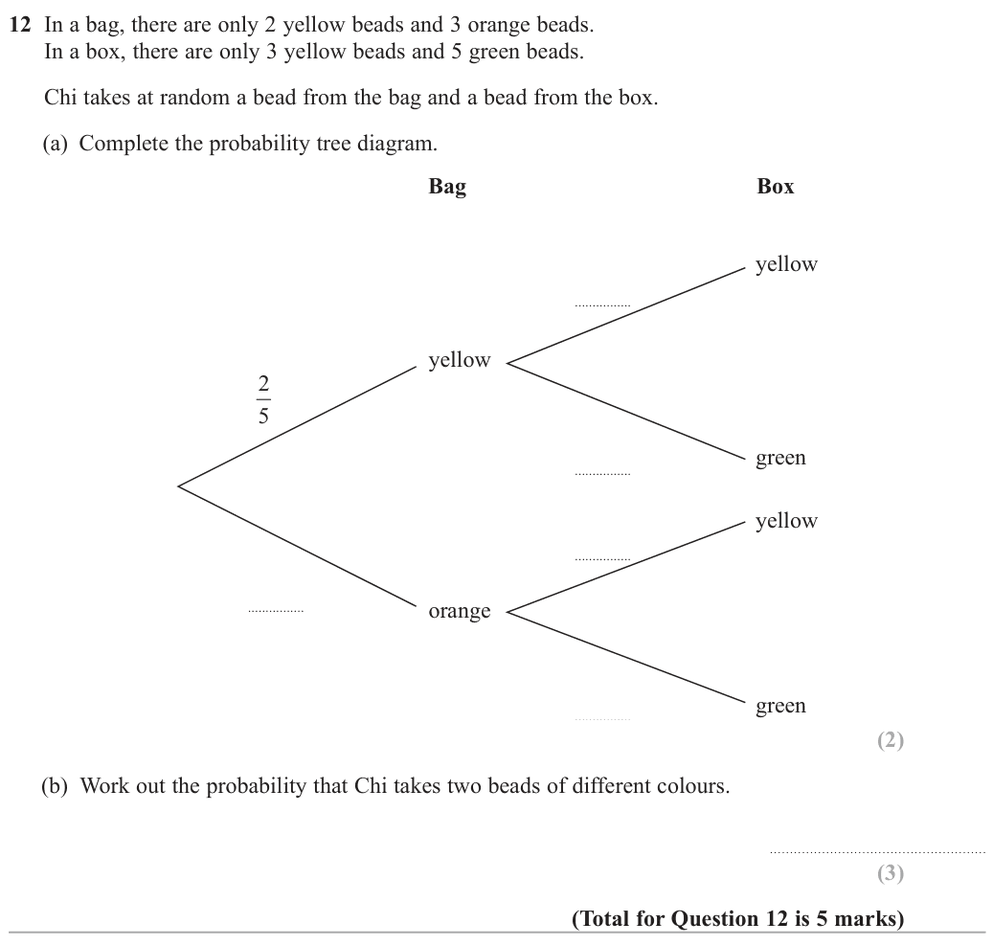
22. Nov 2025 4WM1H · Q12 Hard 5 marksShow worked solution Bag 1 Bag 1:
\[
P(Y)=\frac25,\qquad P(O)=\frac35
\]
Bag 2 Bag 2:
\[
P(Y)=\frac38,\qquad P(G)=\frac58
\]
The only way to get The only way to get the same colour is yellow then yellow.
\[
P(\text{different})=1-\frac25\times\frac38
\]
\[
=1-\frac{3}{20}=\frac{17}{20}
\]
Final answer \(\frac{17}{20}\).
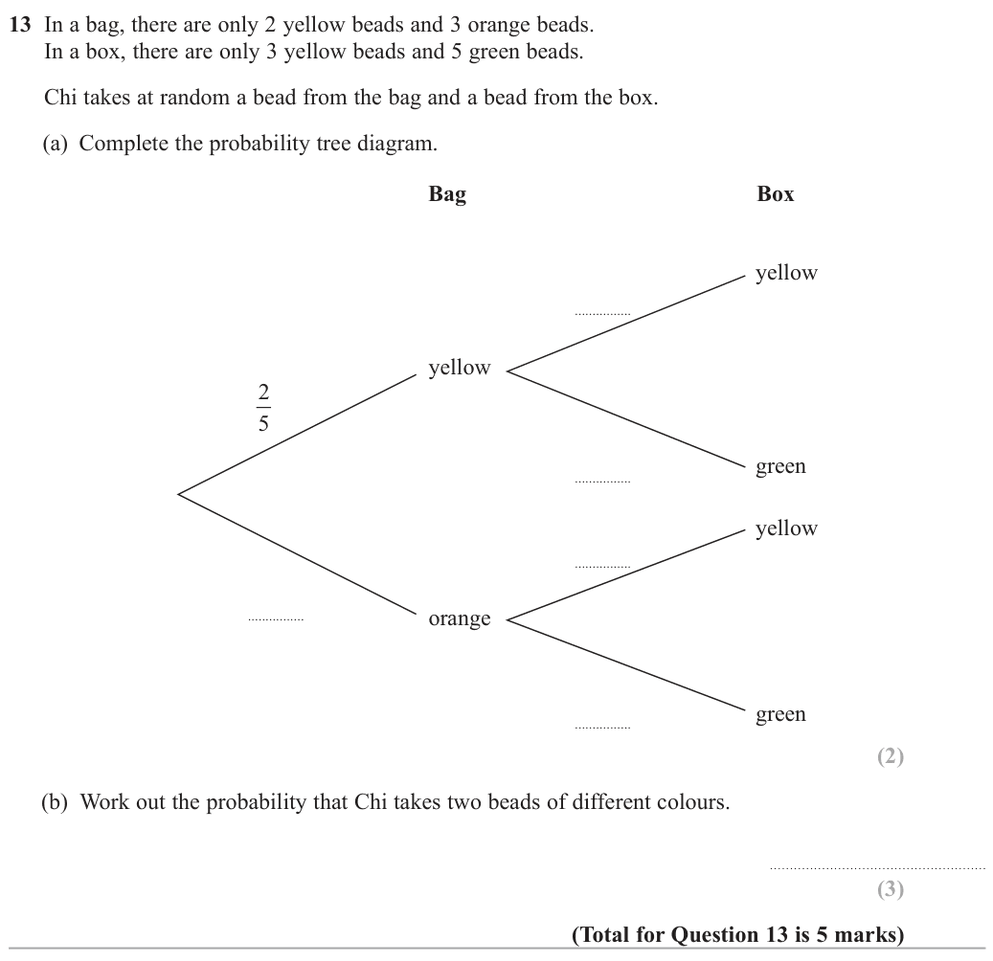
23. Nov 2025 P1H · Q13 Hard 5 marksShow worked solution (a) Complete the tree Bag: orange \(\frac35\).
Box (on both branches): yellow \(\frac38\), green \(\frac58\).
(b) Use the complement The only way to get the same colour is yellow from both, so
\[
P(\text{different})=1-\frac25\times\frac38=1-\frac{6}{40}=\frac{17}{20}
\]
Final answer (a) \(\frac35\); \(\frac38,\frac58\) on both branches (b) \(\dfrac{17}{20}\)
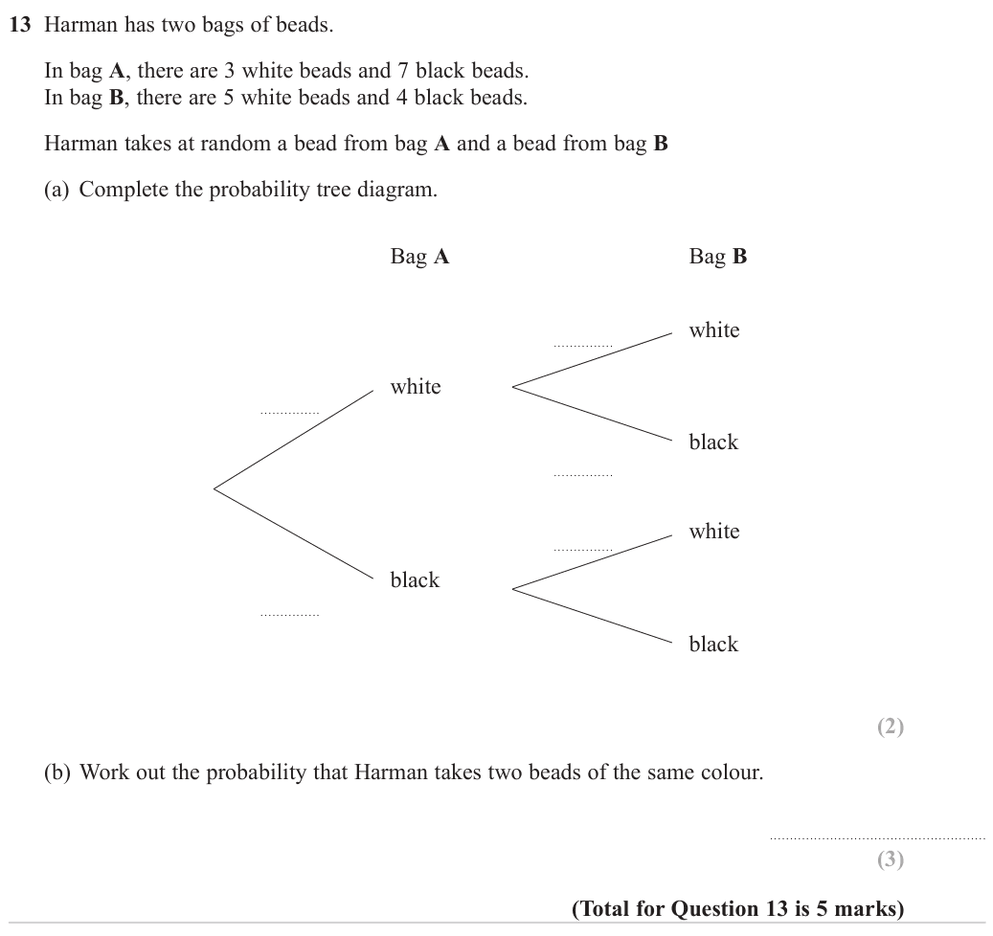
24. May 2024 P1H · Q13 Hard 5 marksShow worked solution (a) Complete the tree Bag A: white \(\frac{3}{10}\), black \(\frac{7}{10}\).
Bag B (on both branches): white \(\frac59\), black \(\frac49\).
(b) Same colour = both white or both black \[
\frac{3}{10}\times\frac59+\frac{7}{10}\times\frac49=\frac{15}{90}+\frac{28}{90}=\frac{43}{90}
\]
Final answer (a) \(\frac{3}{10},\frac{7}{10}\); \(\frac59,\frac49\) on both branches (b) \(\dfrac{43}{90}\)
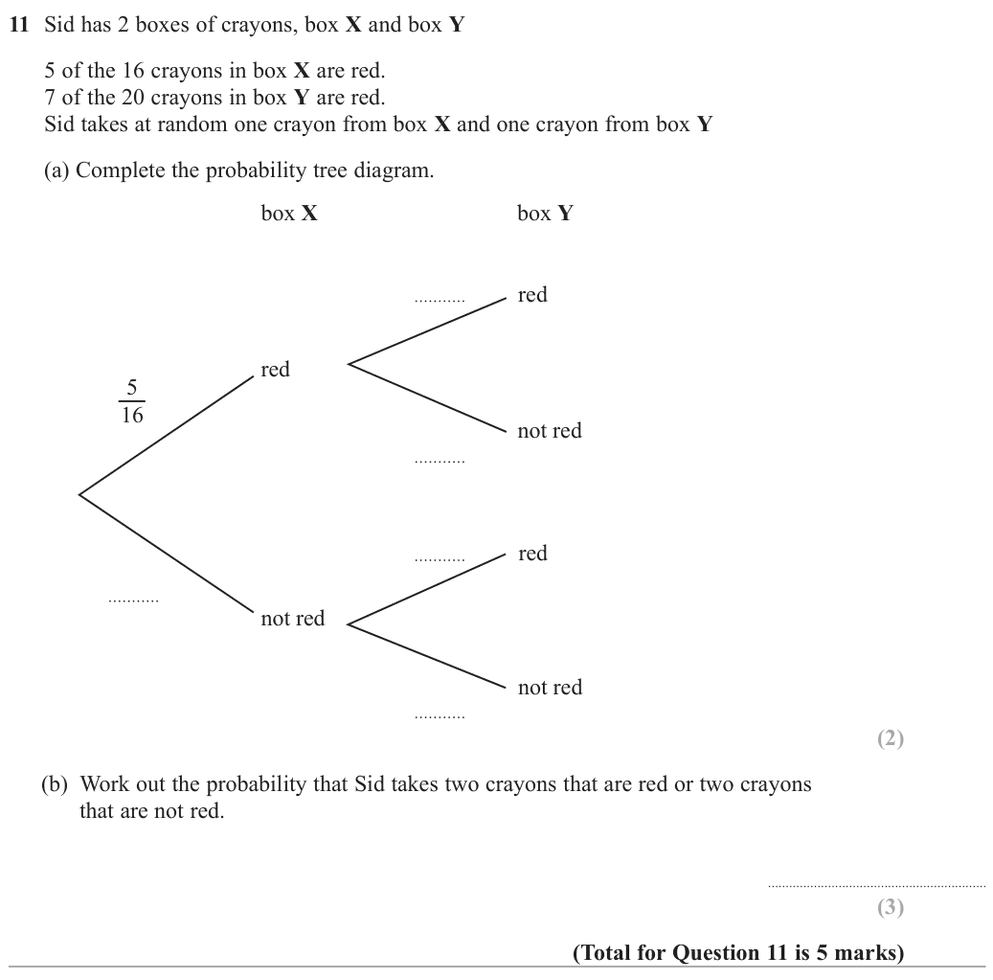
25. Nov 2023 P2H · Q11 Hard 5 marksShow worked solution (a) Complete the tree Box X: not red \(\frac{11}{16}\).
Box Y (on both branches): red \(\frac{7}{20}\), not red \(\frac{13}{20}\).
(b) Both red or both not red \[
\frac{5}{16}\times\frac{7}{20}+\frac{11}{16}\times\frac{13}{20}=\frac{35}{320}+\frac{143}{320}=\frac{178}{320}=\frac{89}{160}
\]
Final answer (a) \(\frac{11}{16}\); \(\frac{7}{20},\frac{13}{20}\) on both branches (b) \(\dfrac{89}{160}\)
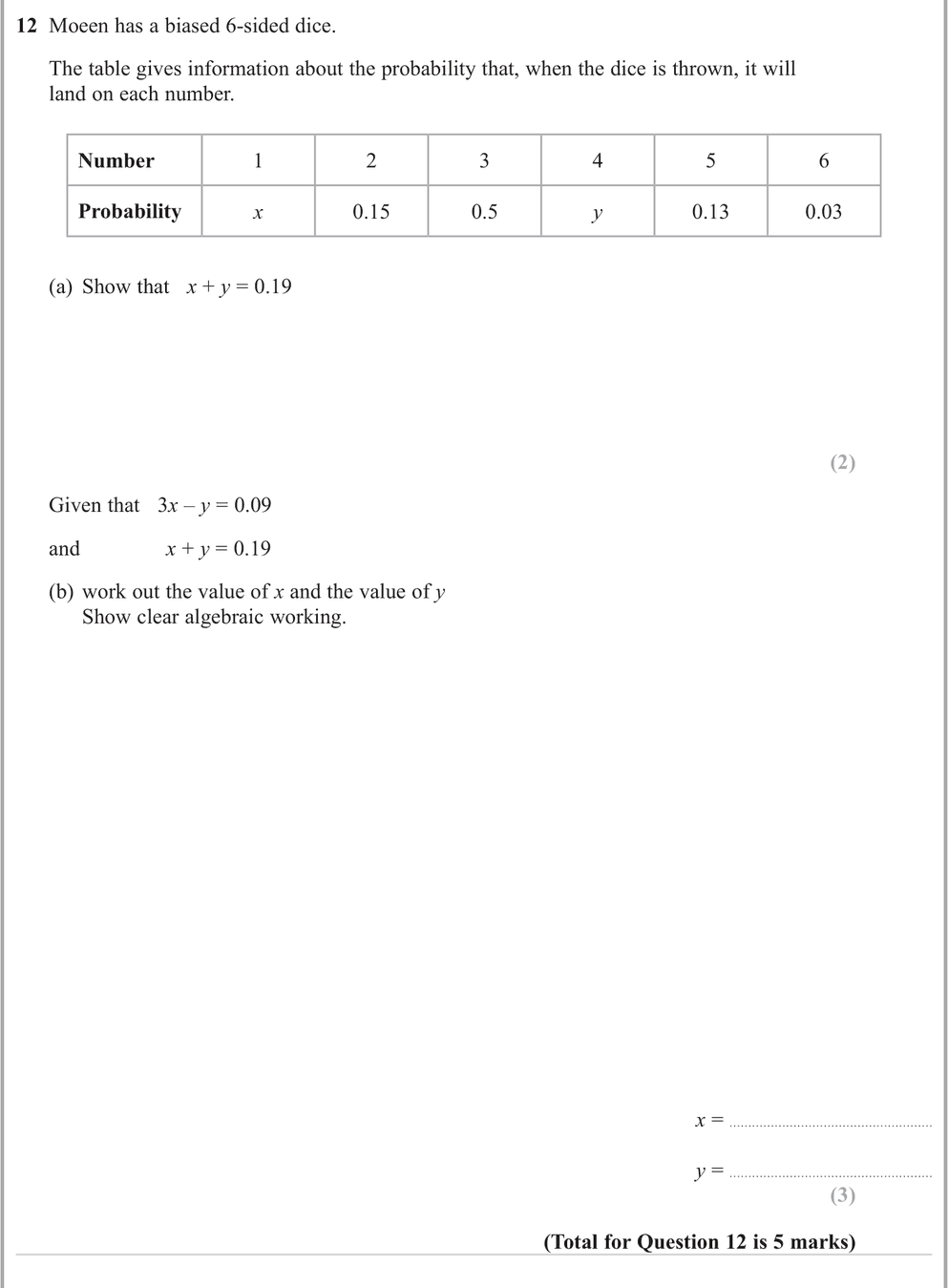
26. May 2023 P1HR · Q12 Hard 5 marksShow worked solution (a) Probabilities add to 1 \[
x+0.15+0.5+y+0.13+0.03=1 \;\Rightarrow\; x+y+0.81=1 \;\Rightarrow\; x+y=0.19
\]
(b) Add the two equations \[
(3x-y)+(x+y)=0.09+0.19 \;\Rightarrow\; 4x=0.28 \;\Rightarrow\; x=0.07
\]
(b) Find y \[
y=0.19-0.07=0.12
\]
Final answer (b) \(x=0.07,\ y=0.12\)
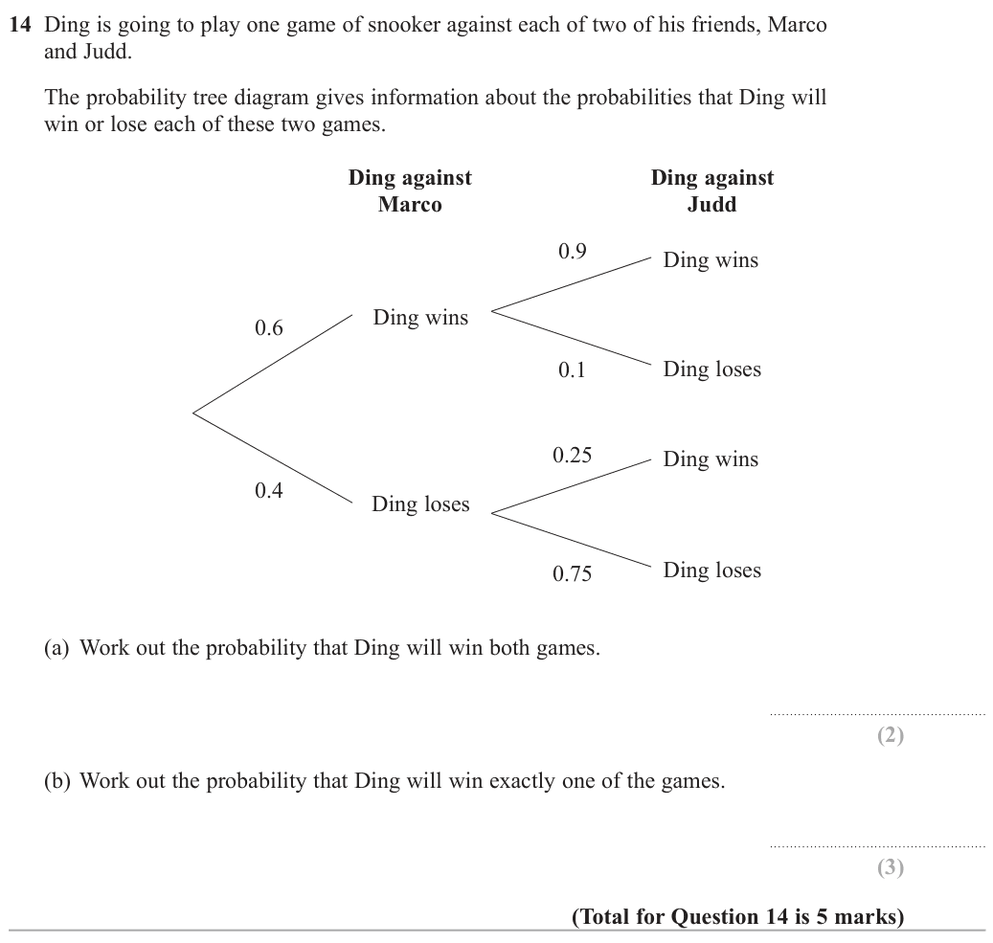
27. Jan 2021 P1H · Q14 Hard 5 marksShow worked solution (a) Win both games Multiply along the "win, win" branch:
\[
0.6\times0.9=0.54
\]
(b) Win exactly one game Win then lose, or lose then win:
\[
0.6\times0.1+0.4\times0.25=0.06+0.10=0.16
\]
Final answer (a) \(0.54\) (b) \(0.16\)
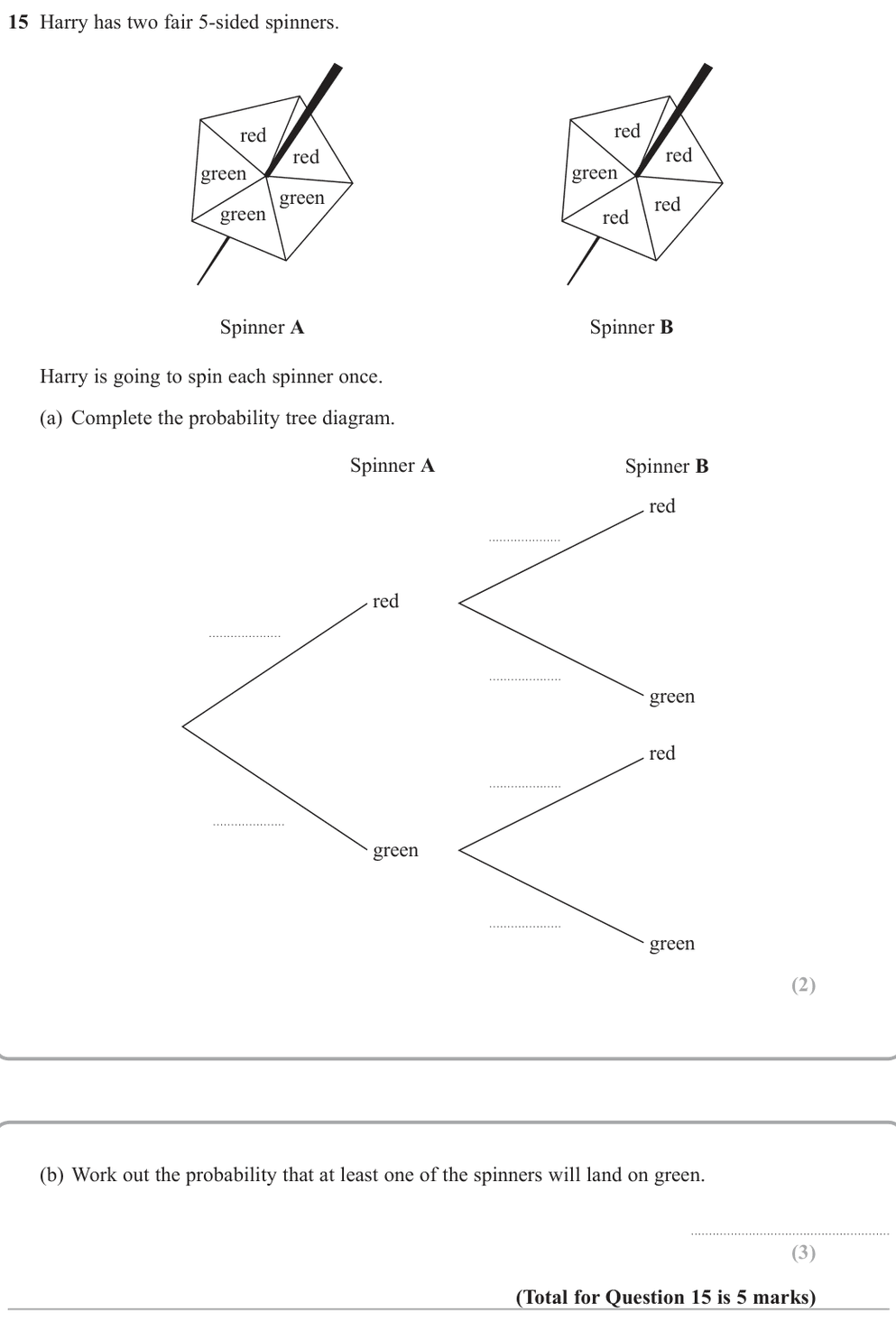
28. May-Nov 2020 P1H · Q15 Hard 5 marksShow worked solution (a) Complete the tree Spinner A has \(2\) red and \(3\) green sections: red \(\frac25\), green \(\frac35\).
Spinner B has \(4\) red and \(1\) green (on both branches): red \(\frac45\), green \(\frac15\).
(b) Use the complement "At least one green" is the opposite of "both red":
\[
1-\frac25\times\frac45=1-\frac{8}{25}=\frac{17}{25}
\]
Final answer (a) \(\frac25,\frac35\); \(\frac45,\frac15\) on both branches (b) \(\dfrac{17}{25}\)
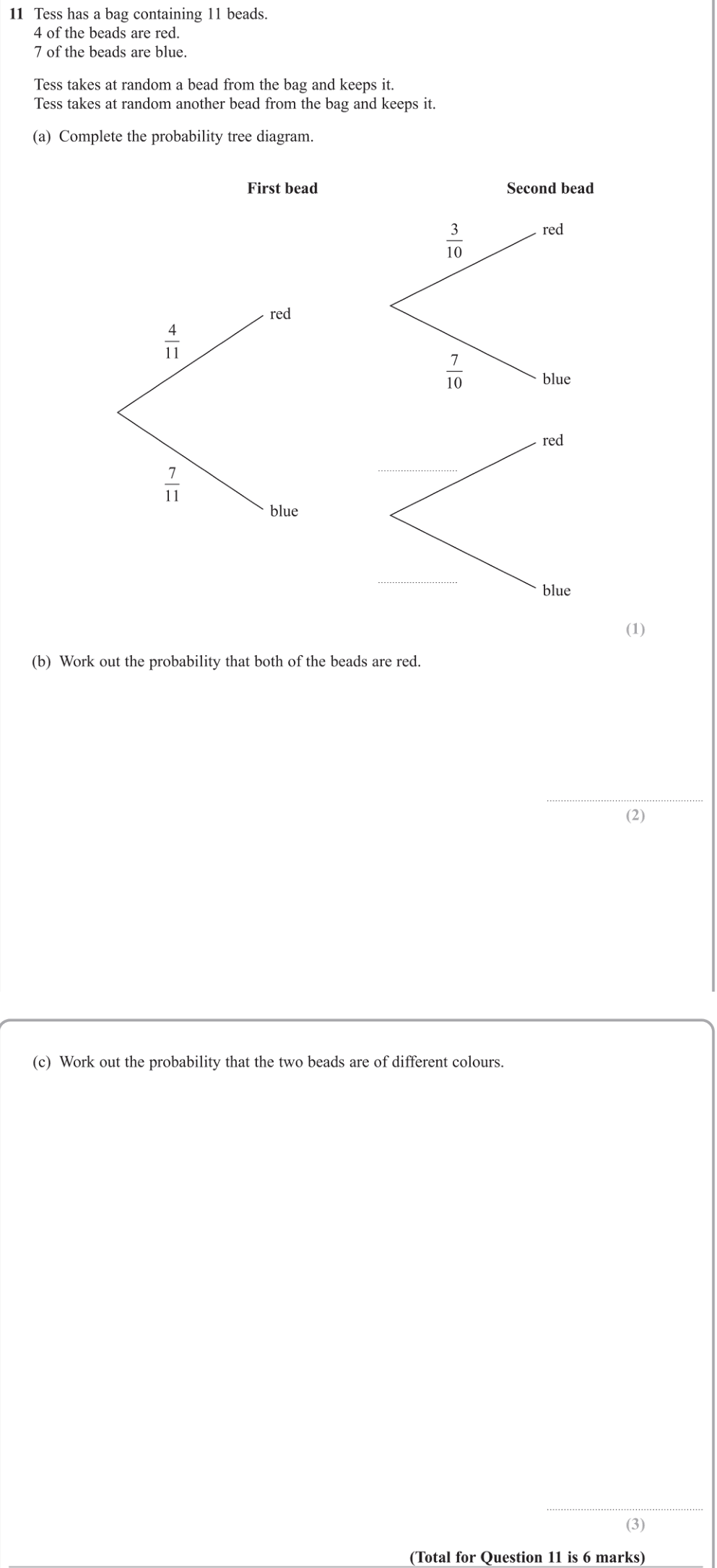
29. Specimen 4WM1H · Q11 Hard 6 marksShow worked solution Complete the blue-first branch After a blue bead is taken first, there are \(4\) red and \(6\) blue beads left out of \(10\).
\[
P(\text{red second after blue})=\frac4{10},\qquad
P(\text{blue second after blue})=\frac6{10}
\]
Find both red \[
P(RR)=\frac4{11}\times\frac3{10}
=\frac{12}{110}
=\frac6{55}
\]
Find different colours \[
P(RB)=\frac4{11}\times\frac7{10}
\]
\[
P(BR)=\frac7{11}\times\frac4{10}
\]
\[
P(\text{different})=\frac{28}{110}+\frac{28}{110}
=\frac{28}{55}
\]
Final answer Missing probabilities \(\frac4{10}\) and \(\frac6{10}\); \(P(RR)=\frac6{55}\); \(P(\text{different})=\frac{28}{55}\).
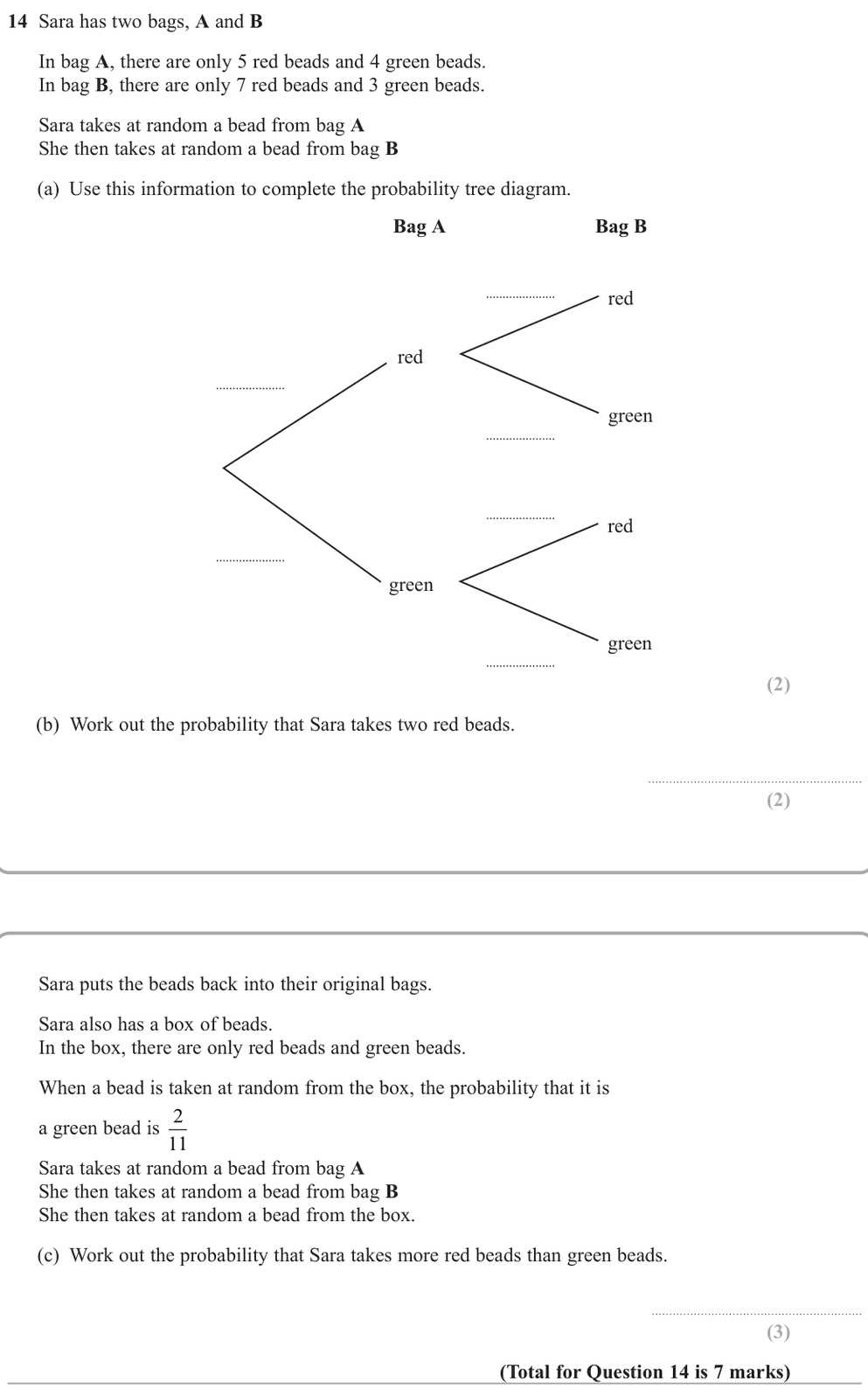
30. Jun 2025 P2HR · Q14 Hard 7 marksShow worked solution (a) Complete the tree Bag A: red \(\frac59\), green \(\frac49\).
Bag B (on both branches): red \(\frac{7}{10}\), green \(\frac{3}{10}\).
(b) Two red beads \[
\frac59\times\frac{7}{10}=\frac{35}{90}=\frac{7}{18}
\]
(c) More red than green with three beads She needs at least two reds: RRR, RRG, RGR or GRR. The box gives red \(\frac{9}{11}\), green \(\frac{2}{11}\).
(c) Add the four cases \[
\frac{5\cdot7\cdot9+5\cdot7\cdot2+5\cdot3\cdot9+4\cdot7\cdot9}{9\cdot10\cdot11}=\frac{315+70+135+252}{990}=\frac{772}{990}=\frac{386}{495}
\]
Final answer (a) \(\frac59,\frac49\); \(\frac{7}{10},\frac{3}{10}\) on both branches (b) \(\dfrac{7}{18}\) (c) \(\dfrac{386}{495}\)
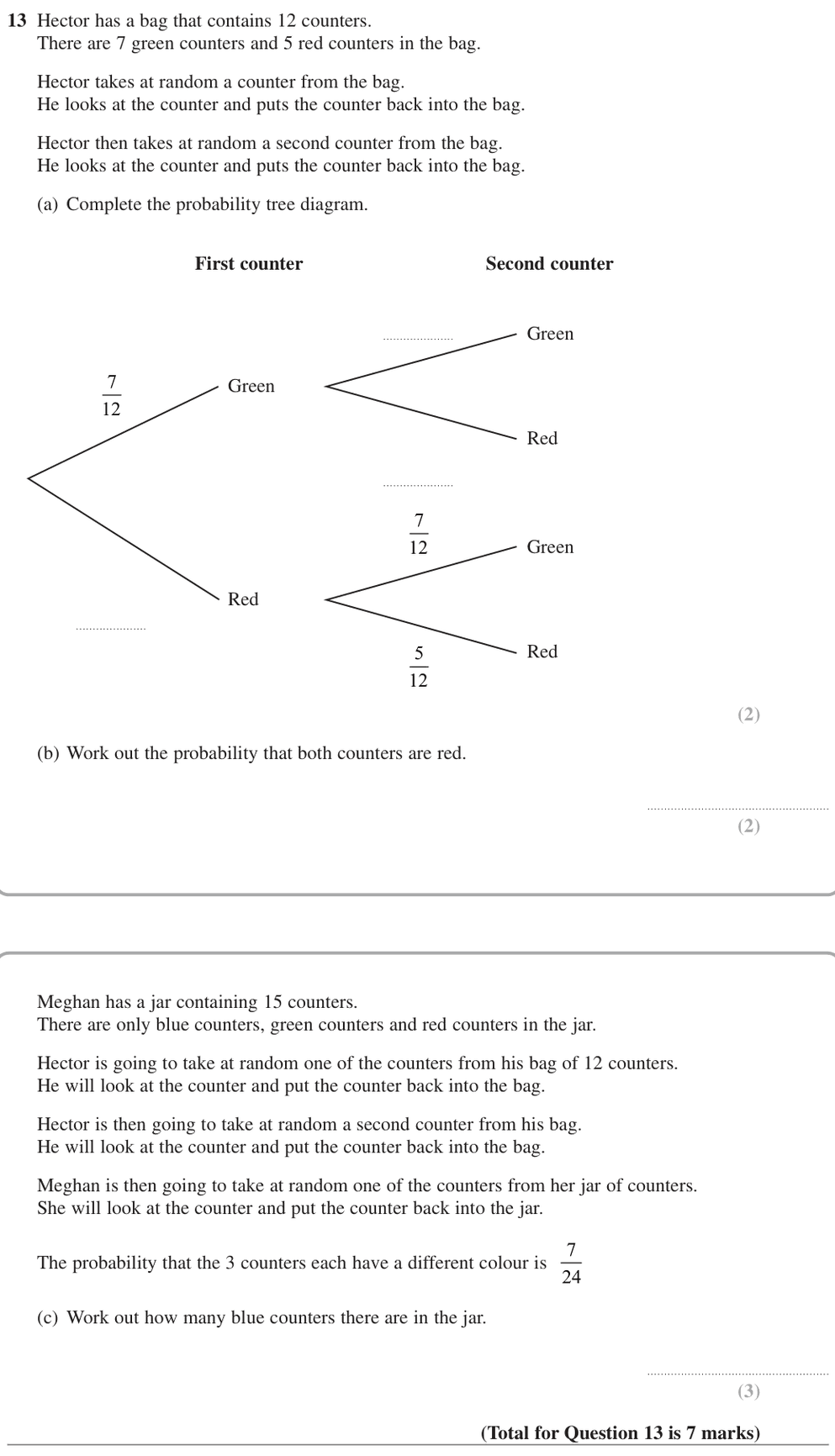
31. Jan 2022 P1HR · Q13 Hard 7 marksShow worked solution (a) Complete the tree (counter is replaced) First counter red: \(\frac{5}{12}\).
After green, second counter: green \(\frac{7}{12}\), red \(\frac{5}{12}\).
(b) Both red \[
\frac{5}{12}\times\frac{5}{12}=\frac{25}{144}
\]
(c) What "three different colours" needs Hector only has green and red, so he must take one green and one red (either order), and Meghan must take blue.
\[
P(\text{one green, one red})=2\times\frac{7}{12}\times\frac{5}{12}=\frac{35}{72}
\]
(c) Solve for the number of blue counters Let \(b\) be the number of blue counters out of \(15\).
\[
\frac{35}{72}\times\frac{b}{15}=\frac{7}{24} \;\Rightarrow\; \frac{b}{15}=\frac{7}{24}\times\frac{72}{35}=\frac{3}{5} \;\Rightarrow\; b=9
\]
Final answer (a) \(\frac{5}{12}\); \(\frac{7}{12},\frac{5}{12}\) (b) \(\dfrac{25}{144}\) (c) \(9\)
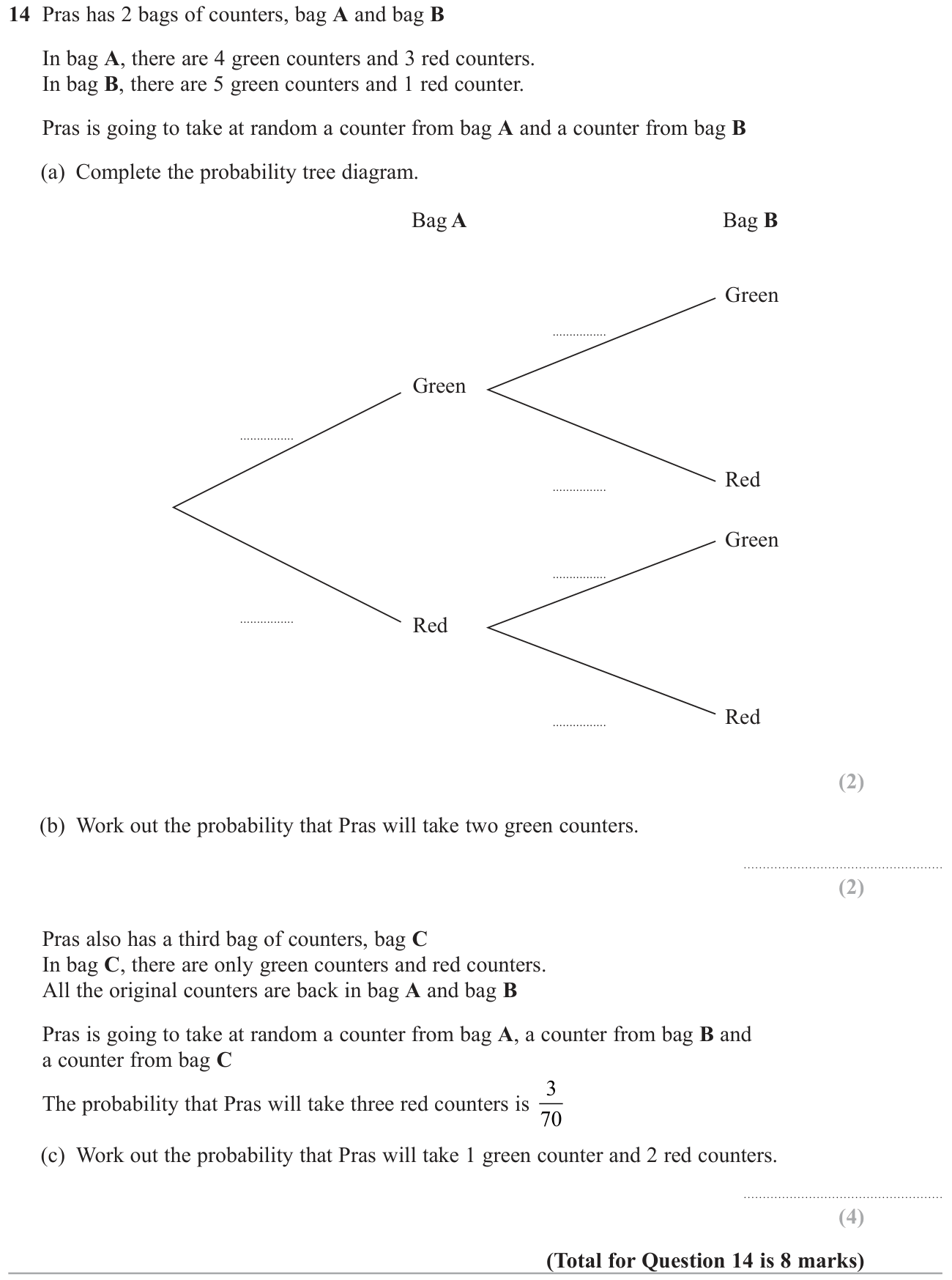
32. Jun 2026 P2HR · Q14 Hard 8 marksShow worked solution Part (a) | Step 1 From the start, label the Bag A branches \(P(G_A)=4/7\) and \(P(R_A)=3/7\).
Bag A has 7 counters in total.
Part (a) | Step 2 From each Bag A outcome, label the Bag B green branch \(5/6\) and red branch \(1/6\).
Bag B has 6 counters and is unaffected by the result from bag A.
Part (b) | Step 1 \[P(G_AG_B)=\frac47\times\frac56=\frac{20}{42}=\frac{10}{21}.\]
Both events must occur, so multiply along the green-green path.
Part (c) | Step 1 Let \(r=P(R_C)\). Then \[\frac37\times\frac16\times r=\frac3{70}\quad\Rightarrow\quad r=\frac35,\qquad P(G_C)=\frac25.\]
Use the given probability of three reds to find the bag C probabilities.
Part (c) | Step 2 Exactly one green means the disjoint outcomes \(G_AR_BR_C\), \(R_AG_BR_C\), or \(R_AR_BG_C\).
The single green counter can come from A, B or C.
Part (c) | Step 3 \[P=\frac47\frac16\frac35+\frac37\frac56\frac35+\frac37\frac16\frac25=\frac2{35}+\frac3{14}+\frac1{35}=\frac3{10}.\]
Multiply within each outcome and add the three mutually exclusive probabilities.
Final answer (a) Branch labels from top to bottom: \(4/7,3/7\) for A; \(5/6,1/6\) for B after either A result.
(b) \(\frac{10}{21}\).
(c) \(\frac3{10}\).
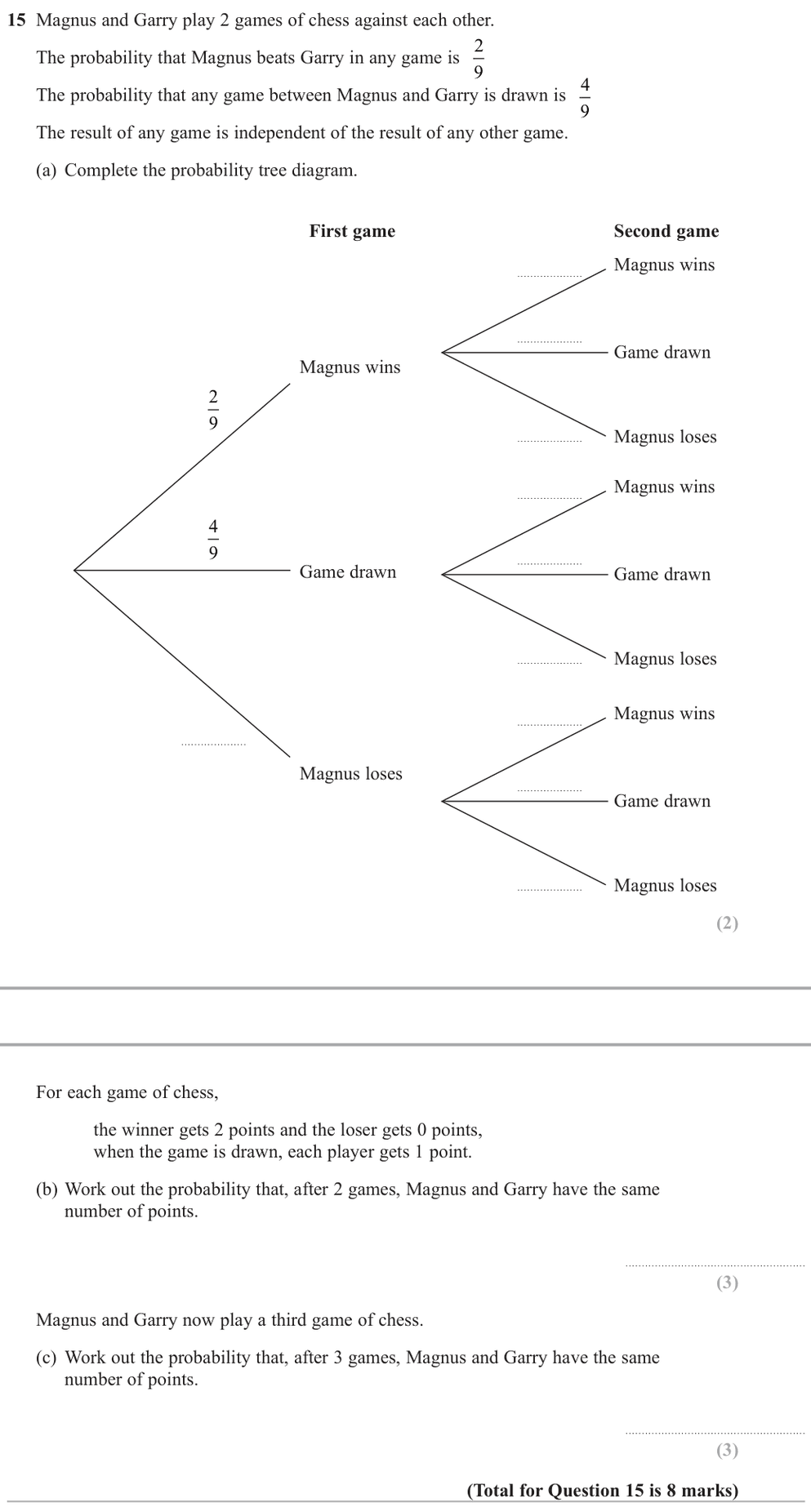
33. Nov 2021 P1H · Q15 Hard 8 marksShow worked solution (a) Complete the tree Magnus loses: \(1-\frac29-\frac49=\frac39\).
Every second-game branch repeats \(\frac29,\ \frac49,\ \frac39\) (the games are independent).
(b) Equal points after 2 games Two draws, or one win and one loss (either order):
\[
\left(\frac49\right)^2+2\times\frac29\times\frac39=\frac{16}{81}+\frac{12}{81}=\frac{28}{81}
\]
(c) Equal points after 3 games Each player needs \(3\) of the \(6\) points: three draws, or one win, one draw and one loss (\(3!=6\) orders).
(c) Add the cases \[
\left(\frac49\right)^3+6\times\frac29\times\frac49\times\frac39=\frac{64}{729}+\frac{144}{729}=\frac{208}{729}
\]
Final answer (a) \(\frac39\); \(\frac29,\frac49,\frac39\) on every branch (b) \(\dfrac{28}{81}\) (c) \(\dfrac{208}{729}\)
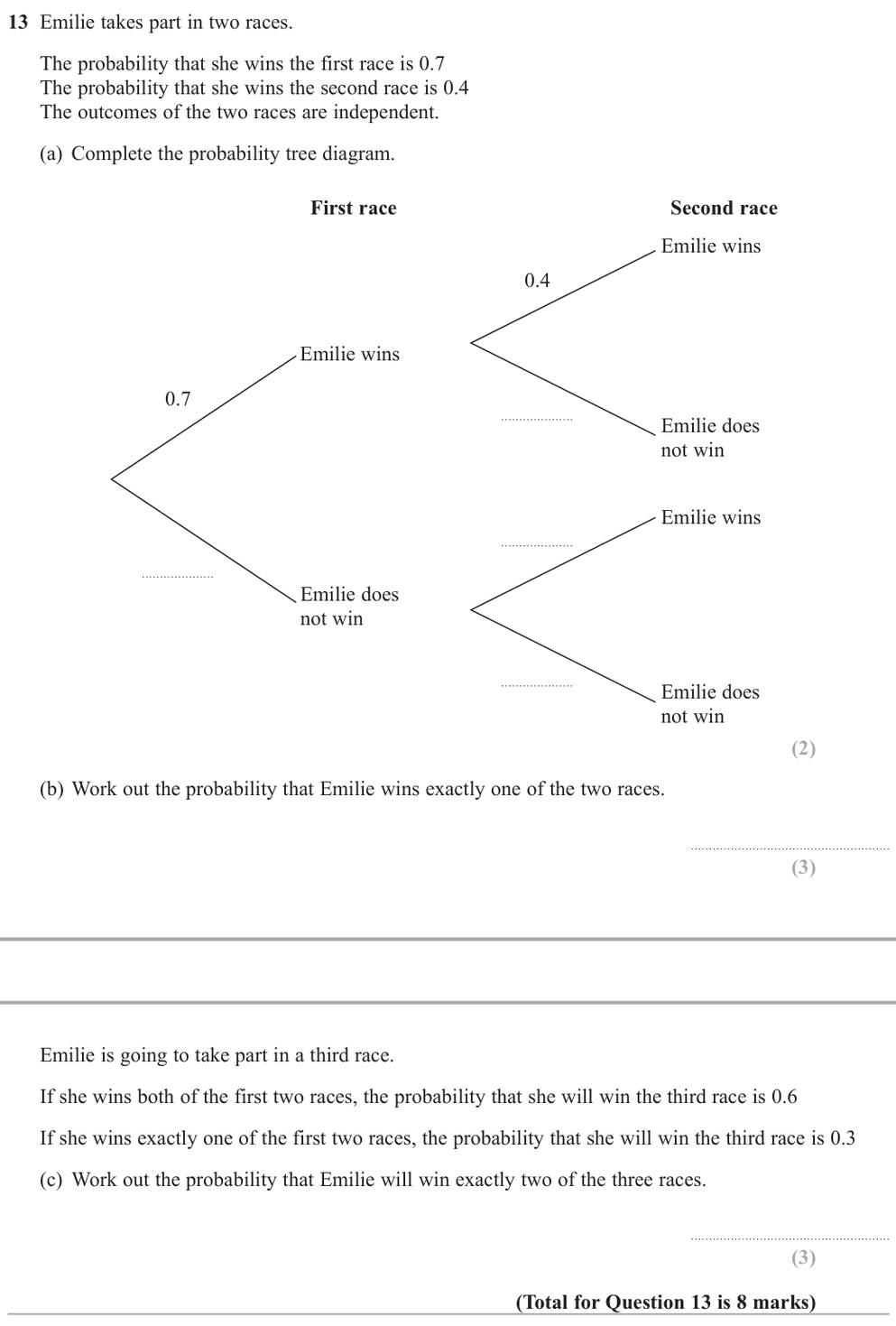
34. May 2021 P2H · Q13 Hard 8 marksShow worked solution (a) Complete the tree First race: does not win \(0.3\).
Second race: after a win, does not win \(0.6\); after not winning, wins \(0.4\) and does not win \(0.6\).
(b) Exactly one win \[
0.7\times0.6+0.3\times0.4=0.42+0.12=0.54
\]
(c) Win the first two, lose the third \(P(\text{win both})=0.7\times0.4=0.28\), then lose the third with \(1-0.6=0.4\):
\[
0.28\times0.4=0.112
\]
(c) Exactly one of the first two, then win the third \[
0.54\times0.3=0.162
\]
(c) Add the cases \[
0.112+0.162=0.274
\]
Final answer (a) \(0.3\); \(0.6\); \(0.4, 0.6\) (b) \(0.54\) (c) \(0.274\)
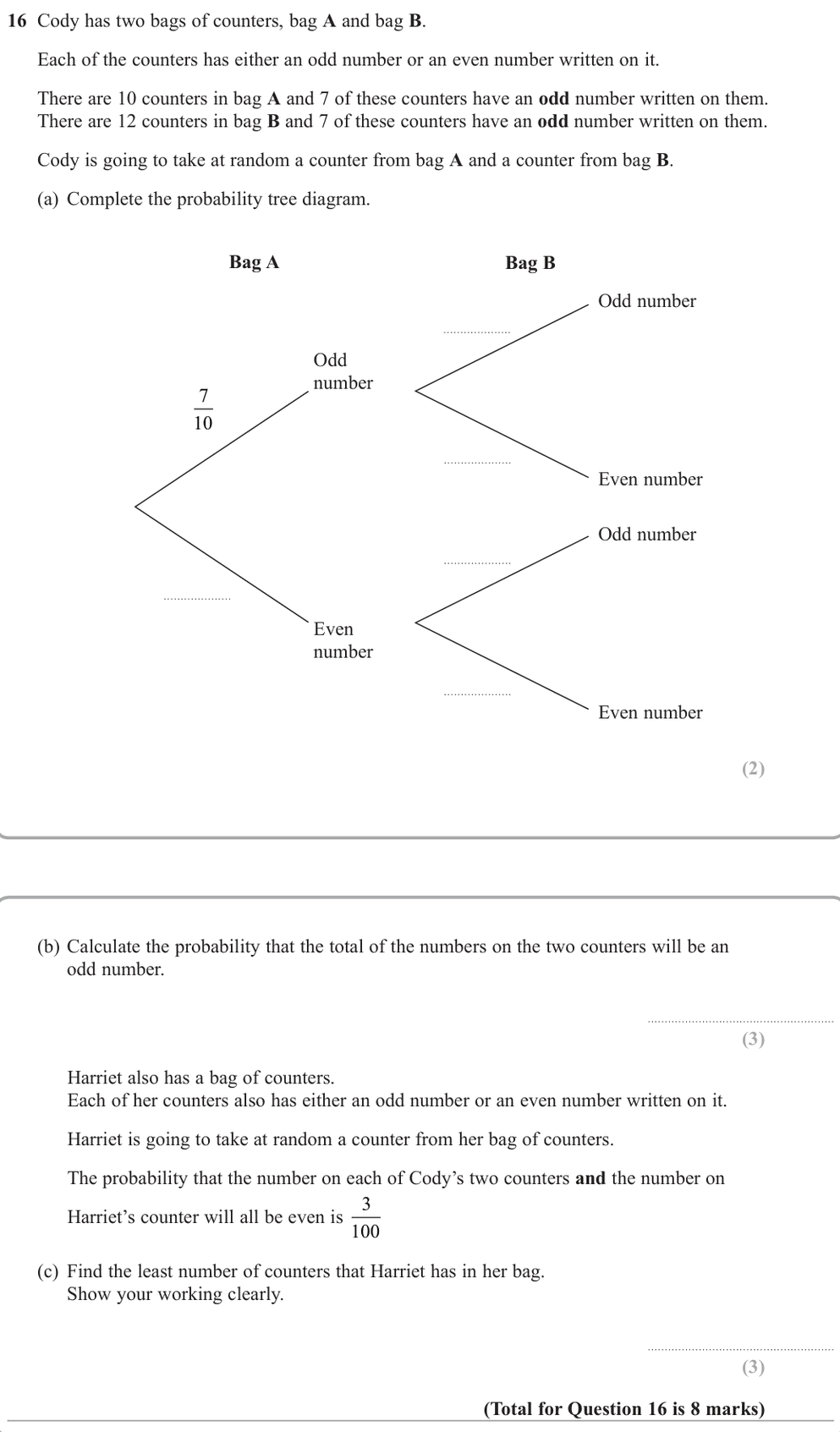
35. Jan 2020 P2HR · Q16 Hard 8 marksShow worked solution (a) Complete the tree Bag A: odd \(\frac{7}{10}\), even \(\frac{3}{10}\).
Bag B (on both branches): odd \(\frac{7}{12}\), even \(\frac{5}{12}\).
(b) Odd total = odd + even or even + odd \[
\frac{7}{10}\times\frac{5}{12}+\frac{3}{10}\times\frac{7}{12}=\frac{35}{120}+\frac{21}{120}=\frac{56}{120}=\frac{7}{15}
\]
(c) Probability Harriet takes an even counter Cody takes two even counters with probability \(\frac{3}{10}\times\frac{5}{12}=\frac{1}{8}\).
\[
\frac18\times p=\frac{3}{100} \;\Rightarrow\; p=\frac{24}{100}=\frac{6}{25}
\]
(c) Least number of counters \(\frac{6}{25}\) is in its simplest form, so the number of counters must be a multiple of \(25\). The least number is \(25\).
Final answer (a) \(\frac{3}{10}\); \(\frac{7}{12},\frac{5}{12}\) on both branches (b) \(\dfrac{7}{15}\) (c) \(25\)
More IGCSE Maths 4MA1 topics Dr Eslam Ahmed Elite Mathematics · Questions classified by topic, solutions checked by Dr Eslam
 Elite Mathematics