Elite Mathematics / Linear / Topics / Area and Volume of Similar Shapes IGCSE · 4MA1 · Topic Area and Volume of Similar Shapes: past paper questions & worked solutions
Every Area and Volume of Similar Shapes question from the 4MA1 papers in our bank, 2020–2026, sorted from easiest to hardest. Try each one first, then open the worked solution.
23 questions
95 marks in total
43% of papers (23 of 54) include it
0/15/8 easy / medium / hard
Questions, easiest first Level is estimated from marks: 1–2 easy, 3–4 medium, 5+ hard.
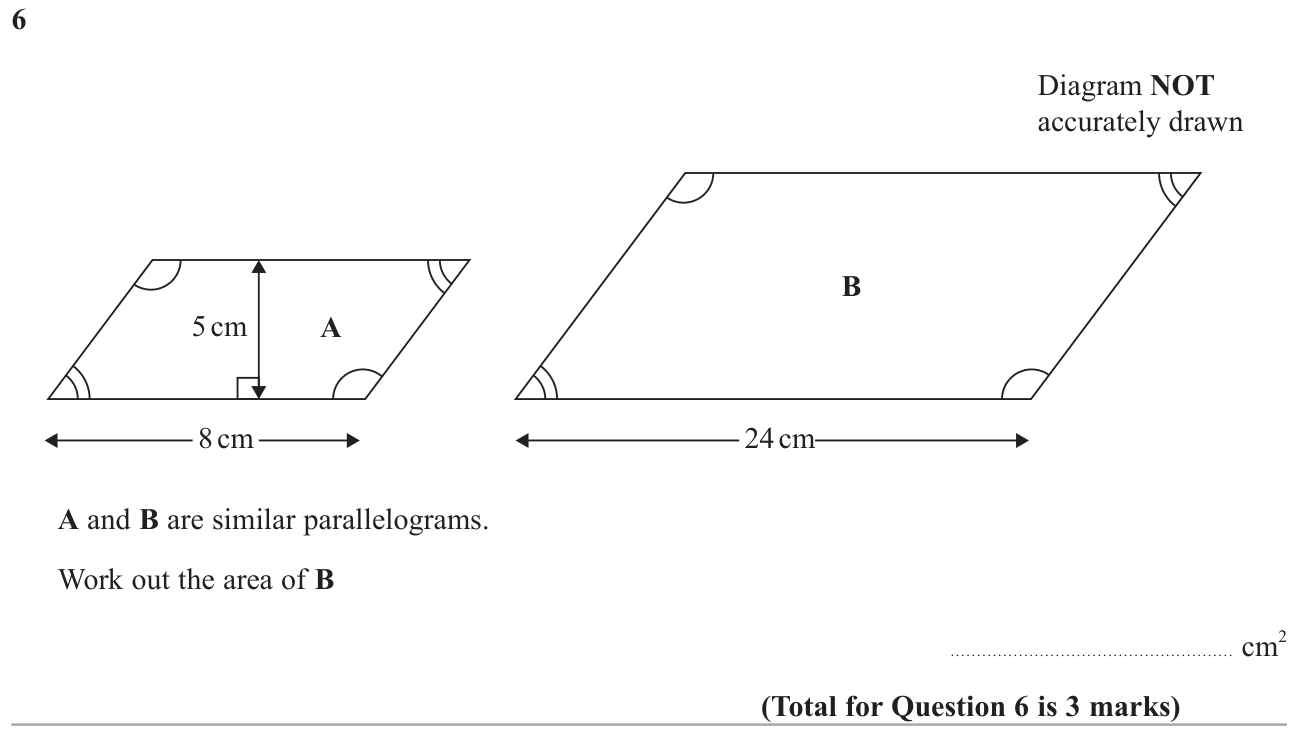
1. Jun 2026 P1HR · Q6 Medium 3 marksShow worked solution Solution | Step 1 \[k=\frac{24}{8}=3.\]
The marked corresponding bases give the linear scale factor from A to B.
Solution | Step 2 \[\operatorname{area}(A)=8\times5=40\text{ cm}^2.\]
The 5 cm measurement is the perpendicular height.
Solution | Step 3 \[\operatorname{area}(B)=k^2\operatorname{area}(A)=3^2\times40=360\text{ cm}^2.\]
Areas scale by the square of the linear scale factor.
Final answer \(360\text{ cm}^2\)
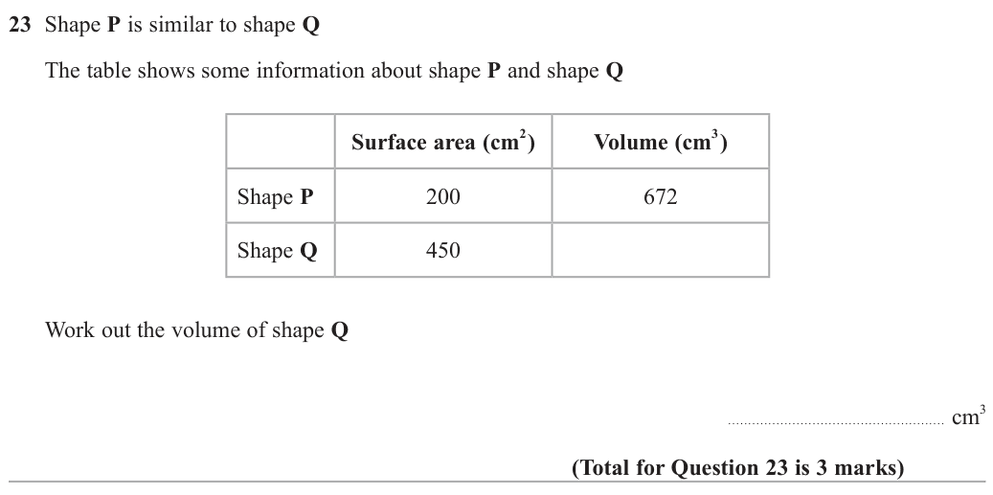
2. Nov 2025 4WM2H · Q23 Medium 3 marksShow worked solution Calculate area $$\\text{ASF} = \\frac{\\text{Area of Q}}{\\text{Area of P}} = \\frac{450}{200} = \\frac{9}{4} = 2.25$$
Simplify surd $$\\text{LSF} = \\sqrt{\\text{ASF}} = \\sqrt{\\frac{9}{4}} = \\frac{3}{2} = 1.5$$
Calculate volume $$\\text{VSF} = (\\text{LSF})^3 = \\left(\\frac{3}{2}\\right)^3 = \\frac{27}{8} = 3.375$$
Calculate volume $$\\text{Volume of Q} = \\text{Volume of P} \\times \\text{VSF} = 672 \\times \\frac{27}{8}$$ = 84 × 27 = 2268
Final answer 2268 cm<sup>3</sup>
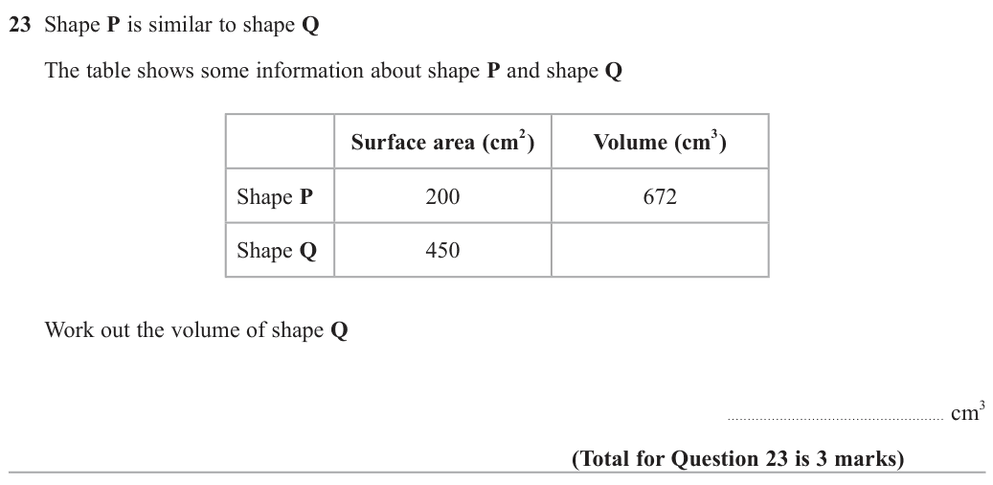
3. Nov 2025 P2H · Q23 Medium 3 marksShow worked solution Surface area ratio Q P Surface area ratio Q:P:
\[
450:200=9:4
\]
Split the ratio So the linear ratio Q:P is
\[
3:2
\]
Split the ratio Therefore the volume ratio Q:P is
\[
3^3:2^3=27:8
\]
Shape P has volume Shape P has volume \(672\text{ cm}^3\).
Volume of Q Volume of Q:
\[
672\times \frac{27}{8}=2268
\]
Final answer \(\boxed{2268\text{ cm}^3}\)
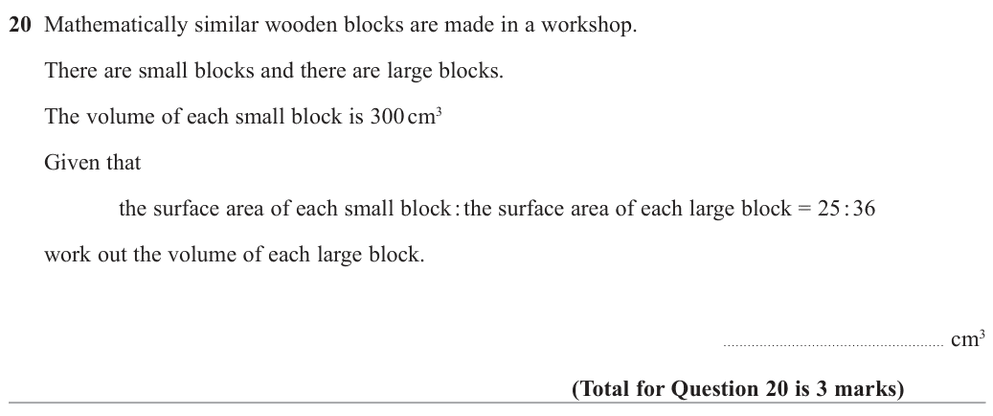
4. May 2021 P2H · Q20 Medium 3 marksShow worked solution Split the ratio The surface area ratio of the small block to the large block is
\[
25:36
\]
Split the ratio So the linear ratio is
\[
\sqrt{25}:\sqrt{36}=5:6
\]
Split the ratio Therefore the volume ratio is
\[
5^3:6^3=125:216
\]
The small block has volume The small block has volume \(300\text{ cm}^3\).
Large block volume Large block volume:
\[
300\times \frac{216}{125}=518.4
\]
Final answer \(\boxed{518.4\text{ cm}^3}\)
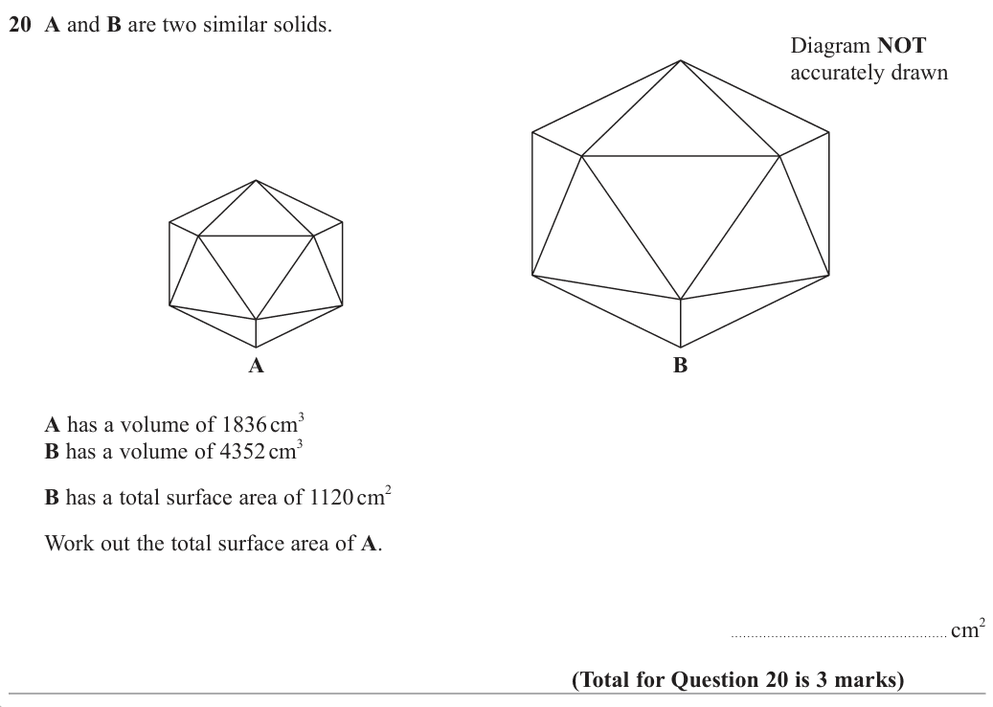
5. Jan 2021 P1H · Q20 Medium 3 marksShow worked solution The volume ratio of solid The volume ratio of solid A to solid B is
\[
1836:4352
\]
Simplify Simplify:
\[
\frac{1836}{4352}=\frac{27}{64}
\]
Split the ratio So the linear ratio is
\[
\sqrt[3]{27}:\sqrt[3]{64}=3:4
\]
Surface area ratio Surface area ratio:
\[
3^2:4^2=9:16
\]
Solid B has surface area Solid B has surface area \(1120\text{ cm}^2\), so solid A has surface area
\[
1120\times \frac9{16}=630
\]
Final answer \(\boxed{630\text{ cm}^2}\)
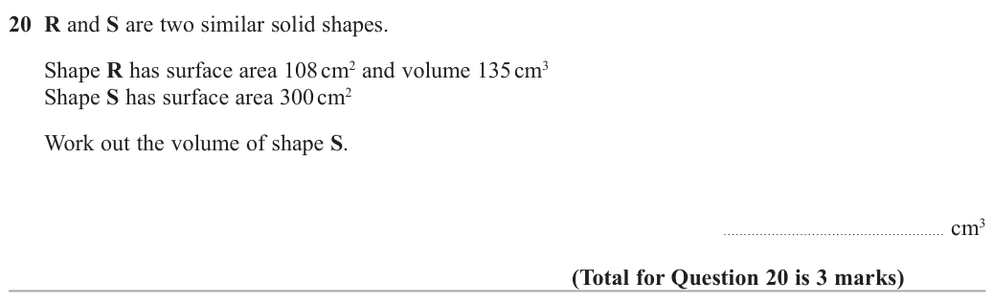
6. May-Nov 2020 P1H · Q20 Medium 3 marksShow worked solution Shape R has surface area Shape R has surface area \(108\text{ cm}^2\) and volume \(135\text{ cm}^3\).
Shape S has surface area Shape S has surface area \(300\text{ cm}^2\).
Surface area ratio S R Surface area ratio S:R:
\[
300:108=25:9
\]
Split the ratio So the linear ratio S:R is
\[
5:3
\]
Split the ratio Therefore the volume ratio S:R is
\[
5^3:3^3=125:27
\]
Volume of S Volume of S:
\[
135\times \frac{125}{27}=625
\]
Final answer \(\boxed{625\text{ cm}^3}\)
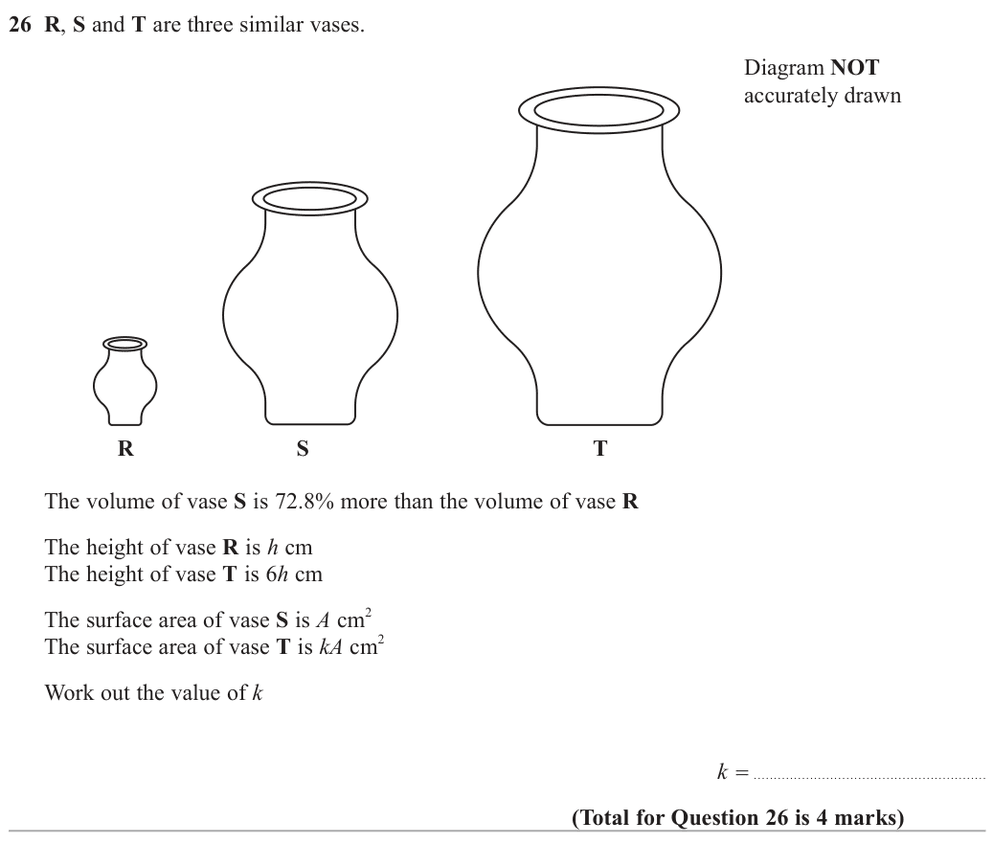
7. Jun 2025 P1HR · Q26 Medium 4 marksShow worked solution The volume of vase is The volume of vase \(S\) is \(72.8\%\) more than vase \(R\), so
\(\dfrac{V_S}{V_R}=1.728\)
Calculate area For similar solids, volume scale factor is the cube of the linear scale factor:
\(\text{linear scale factor from }R\text{ to }S=\sqrt[3]{1.728}=1.2\)
The height of vase is The height of vase \(T\) is \(6h\), so the linear scale factor from \(R\) to \(T\) is \(6\).
Calculate area Therefore the linear scale factor from \(S\) to \(T\) is
\(\dfrac{6}{1.2}=5\)
Surface area scale factor is Surface area scale factor is the square of the linear scale factor:
\(k=5^2=25\)
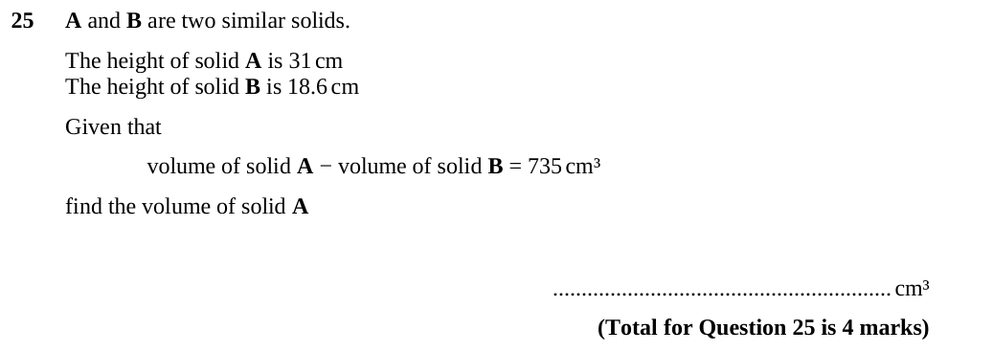
8. Jun 2025 P2H · Q26 Medium 4 marksShow worked solution The heights of solids A The heights of solids A and B are \(31\) cm and \(18.6\) cm.
\[
31:18.6=5:3
\]
Split the ratio So the volumes are in the ratio
\[
5^3:3^3=125:27
\]
The difference in volume is \[
125-27=98
\]
parts parts.
Evaluate fraction This difference is \(735\text{ cm}^3\), so one part is
\[
\frac{735}{98}=7.5
\]
Volume of solid A Volume of solid A:
\[
125\times 7.5=937.5
\]
Final answer \(\boxed{937.5\text{ cm}^3}\)
9. May 2025 4WM2H · Q25 Medium 4 marksShow worked solution Linear scale factor from solid Linear scale factor from solid \(A\) to solid \(B\):
\[
\frac{18.6}{31}=0.6
\]
Calculate volume So the volume scale factor is
\[
0.6^3=0.216
\]
Let the volume of be Let the volume of \(A\) be \(V\). Then
\[
V-0.216V=735
\]
\[
0.784V=735
\]
\[
V=937.5
\]
Final answer \(937.5\text{ cm}^3\).
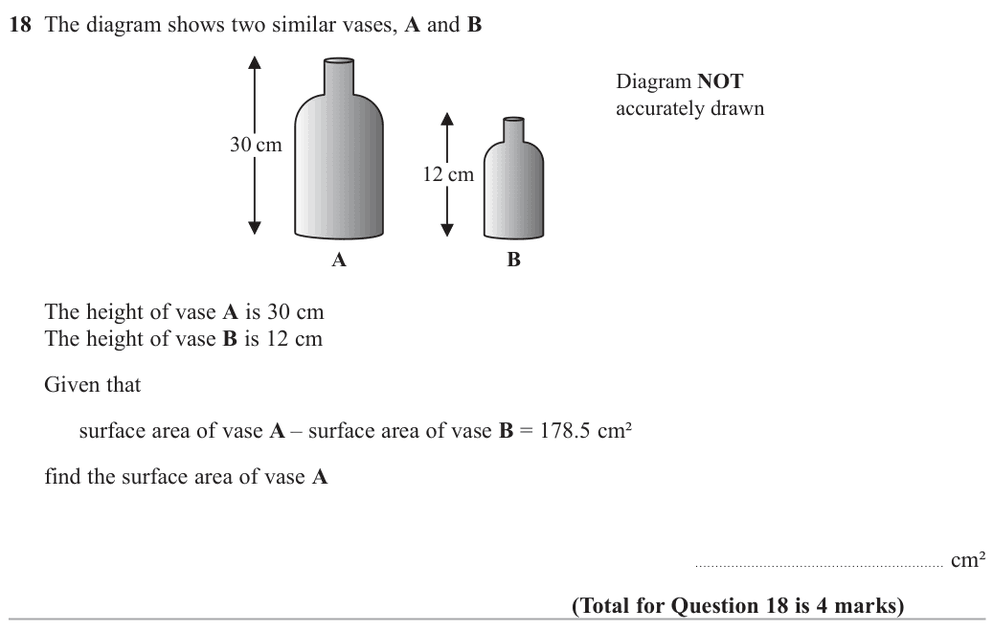
10. May 2024 P1HR · Q18 Medium 4 marksShow worked solution Calculate area The linear scale factor from vase \(B\) to vase \(A\) is \[ \frac{30}{12}=2.5 \]
Calculate area So the surface area scale factor is \[ 2.5^2=6.25 \]
Calculate surface area Let the surface area of vase \(B\) be \(S\).
\[
6.25S-S=178.5
\]
\[
5.25S=178.5
\]
\[
S=34
\]
Calculate area Therefore the surface area of vase \(A\) is \[ 6.25\times 34=212.5 \]
Final answer \(212.5\text{ cm}^2\).
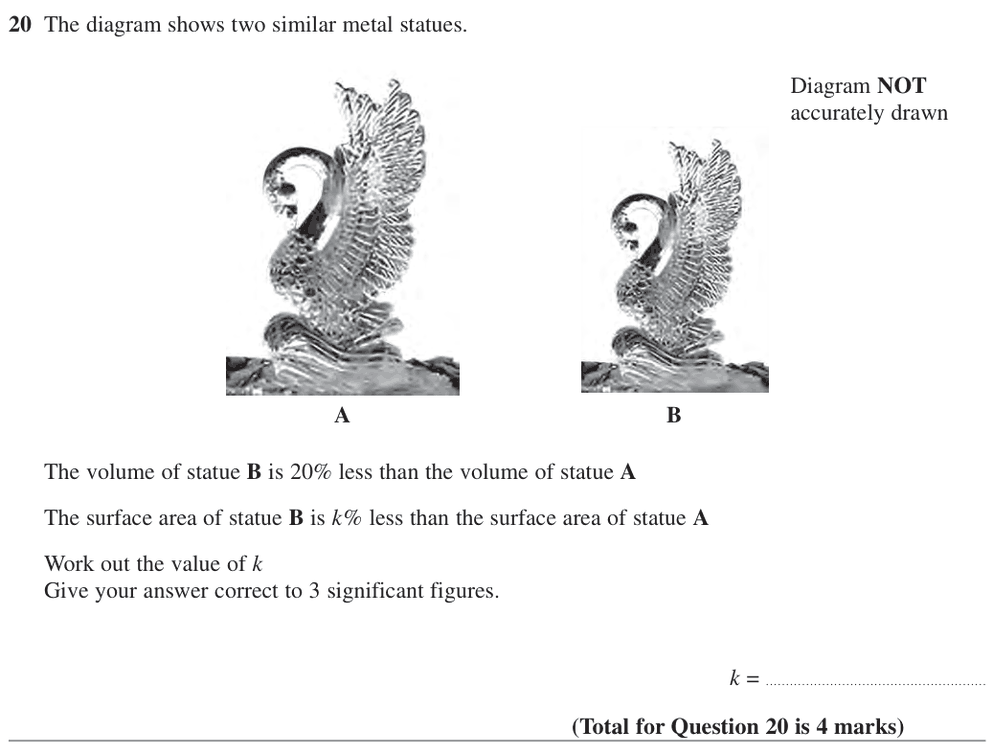
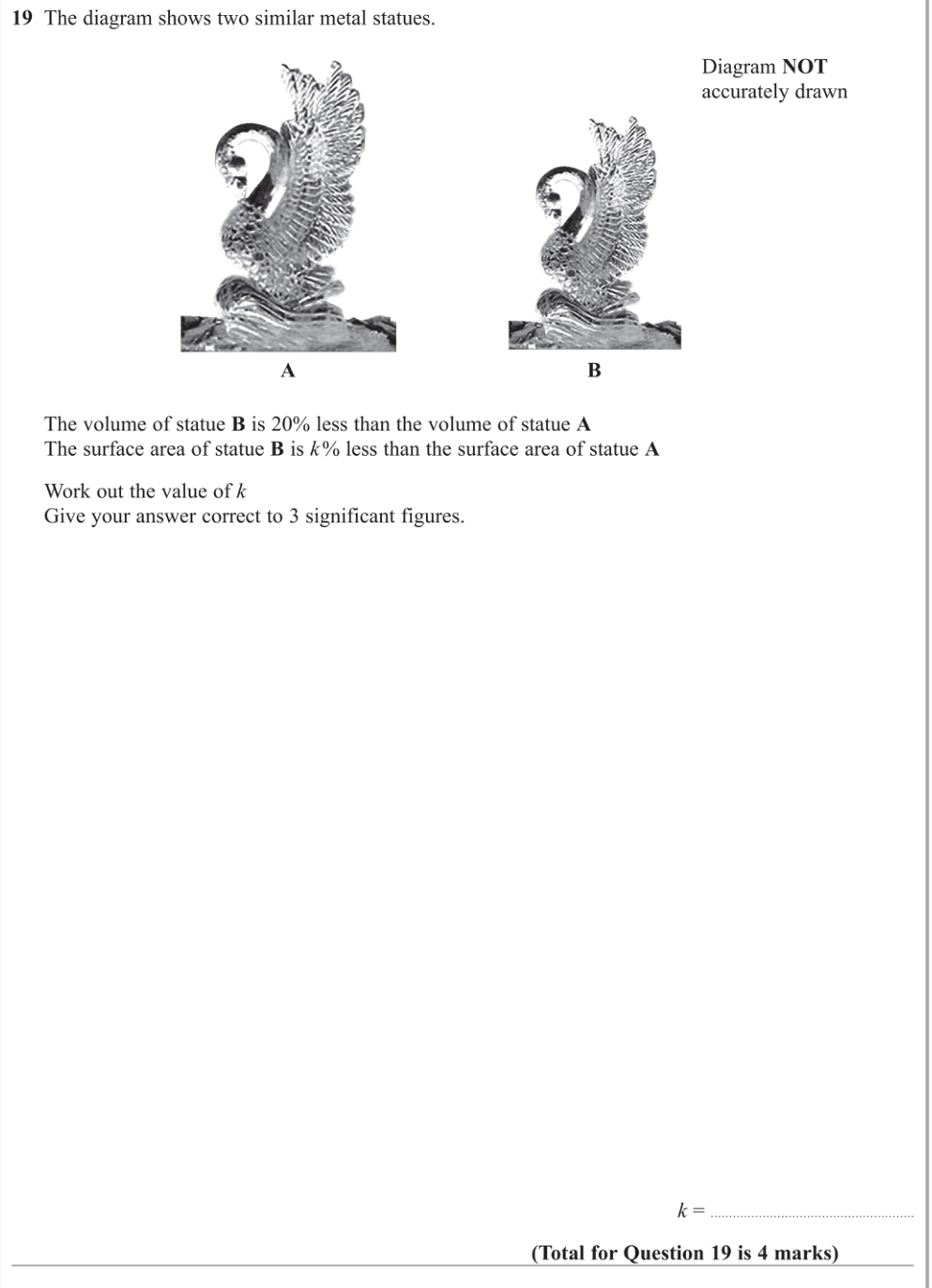
11. Jun 2022 P1HR · Q20 Medium 4 marksShow worked solution The volume of statue is The volume of statue \(B\) is \(20\%\) less than statue \(A\), so the volume scale factor is \(0.8\).
Calculate area For similar solids, the linear scale factor is the cube root of the volume scale factor:
\(\text{linear scale factor}=\sqrt[3]{0.8}\)
Surface area scale factor is Surface area scale factor is the square of the linear scale factor:
\(\text{surface area scale factor}=(\sqrt[3]{0.8})^2=0.8^{2/3}=0.861773...\)
Calculate area So statue \(B\) has \(86.1773...\%\) of the surface area of statue \(A\).
\(k=100-86.1773...=13.8226...\)
Final answer \(k=13.8\) to 3 significant figures.
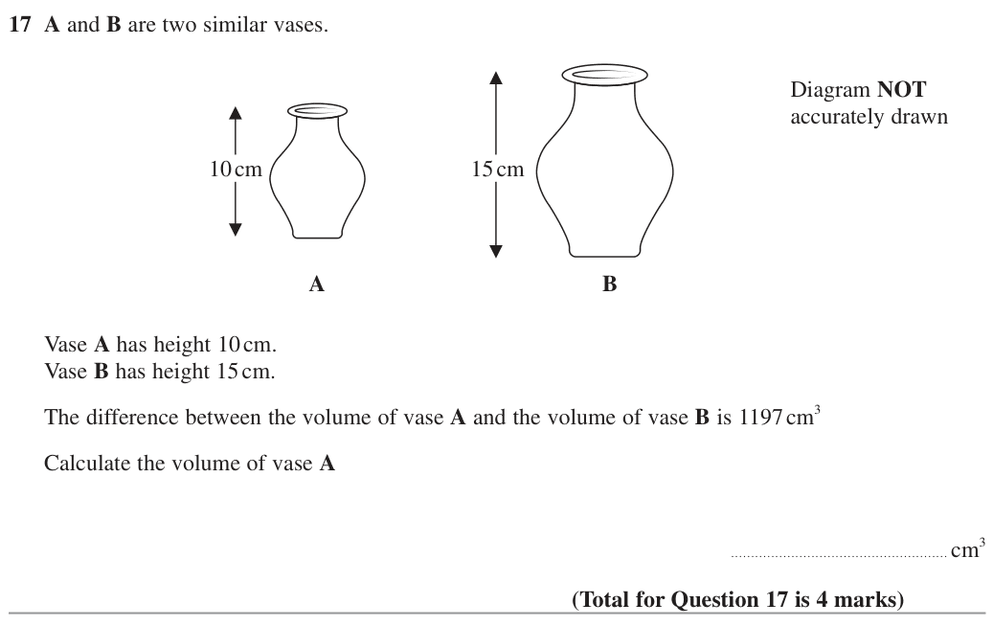
12. Jan 2022 P1H · Q17 Medium 4 marksShow worked solution Calculate area The linear scale factor from vase \(A\) to vase \(B\) is \[ \frac{15}{10}=1.5 \]
Calculate area So the volume scale factor is \[ 1.5^3=3.375 \]
Let the volume of vase Let the volume of vase \(A\) be \(V\).
\[
3.375V-V=1197
\]
\[
2.375V=1197
\]
\[
V=504
\]
Final answer \(504\text{ cm}^3\).
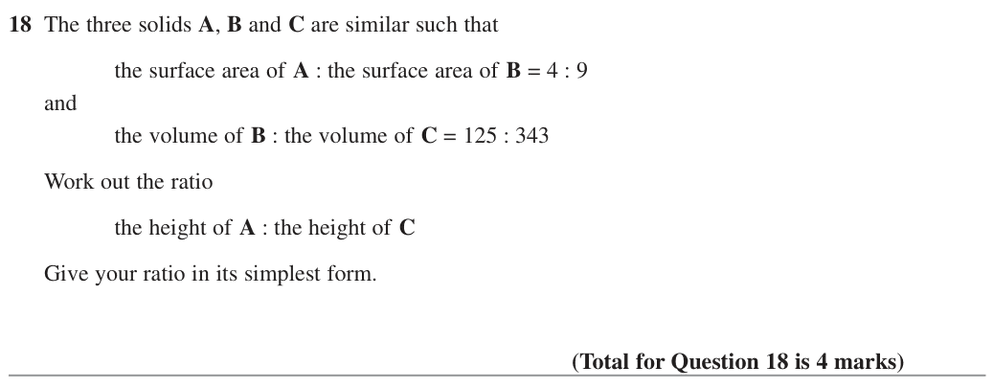
13. Jan 2022 P1HR · Q18 Medium 4 marksShow worked solution Split the ratio Surface area ratio \(A:B=4:9\), so the length ratio is
\[
\sqrt4:\sqrt9=2:3
\]
Split the ratio Volume ratio \(B:C=125:343\), so the length ratio is
\[
\sqrt[3]{125}:\sqrt[3]{343}=5:7
\]
Split the ratio Therefore
\[
\frac{A}{C}=\frac{2}{3}\times \frac{5}{7}=\frac{10}{21}
\]
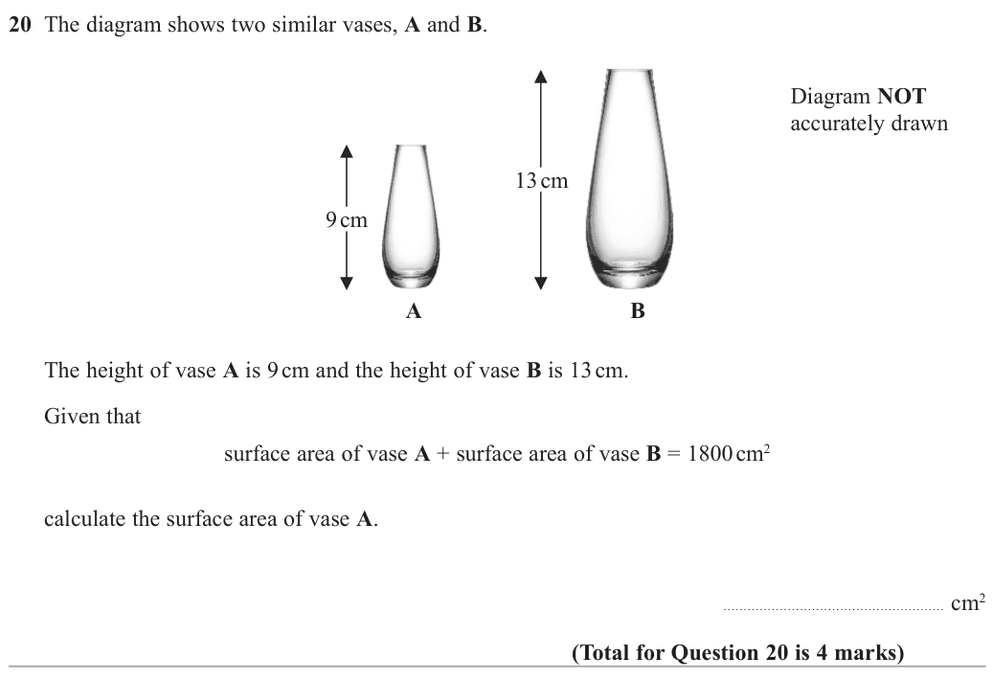
14. Jan 2020 P2HR · Q20 Medium 4 marksShow worked solution The two vases are similar The two vases are similar.
Their heights are in the Their heights are in the ratio
\[
9:13
\]
Split the ratio So their surface areas are in the ratio
\[
9^2:13^2=81:169
\]
The total surface area is The total surface area is \(1800\text{ cm}^2\), so there are
\[
81+169=250
\]
parts altogether parts altogether.
Surface area of vase A Surface area of vase A:
\[
1800\times \frac{81}{250}=583.2
\]
Final answer \(\boxed{583.2\text{ cm}^2}\)
15. Specimen 4WM2H · Q19 Medium 4 marksShow worked solution The volume of statue is The volume of statue \(B\) is \(80\%\) of the volume of statue \(A\), so the volume scale factor is
\[
0.8
\]
Calculate area For similar solids:
\[
\text{linear scale factor}=\sqrt[3]{0.8}
\]
The surface area scale factor The surface area scale factor is therefore
\[
\left(\sqrt[3]{0.8}\right)^2=0.8^{2/3}
\]
\[
0.8^{2/3}=0.861773\ldots
\]
Convert standard form So the percentage decrease in surface area is
\[
(1-0.861773\ldots)\times 100=13.8226\ldots
\]
Calculate area Correct to 3 significant figures,
\[
k=13.8
\]
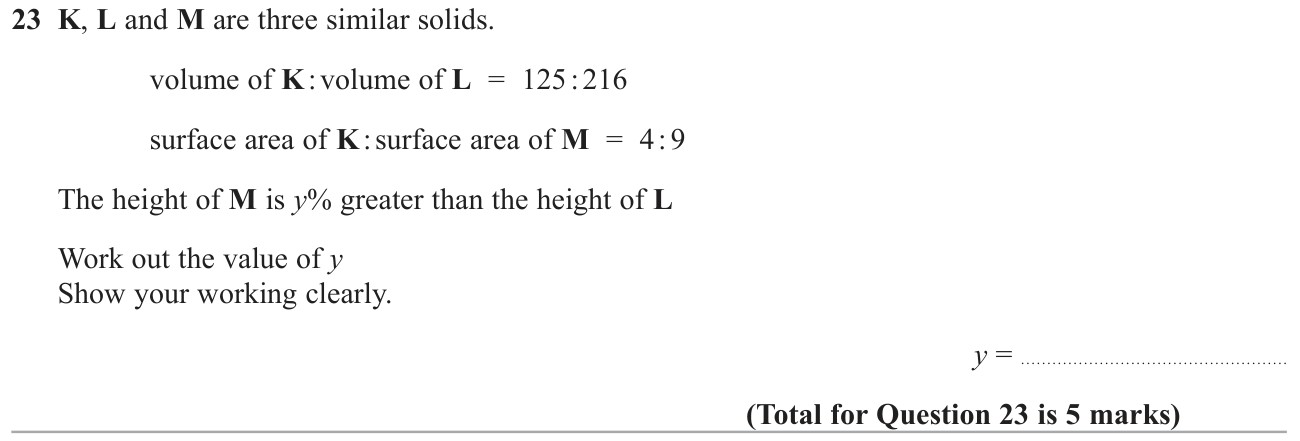
16. Jun 2026 P2HR · Q23 Hard 5 marksShow worked solution Solution | Step 1 \[h_K:h_L=\sqrt[3]{125}:\sqrt[3]{216}=5:6.\]
Corresponding lengths have the cube-root ratio of volumes.
Solution | Step 2 \[h_K:h_M=\sqrt4:\sqrt9=2:3.\]
Corresponding lengths have the square-root ratio of surface areas.
Solution | Step 3 Take \(h_K=10\) units. Then \(h_L=12\) and \(h_M=15\), so \[y=\frac{15-12}{12}\times100=25.\]
Align the shared K-length and compare the increase relative to L.
Final answer \(y=25\), so the height is \(25\%\) greater.
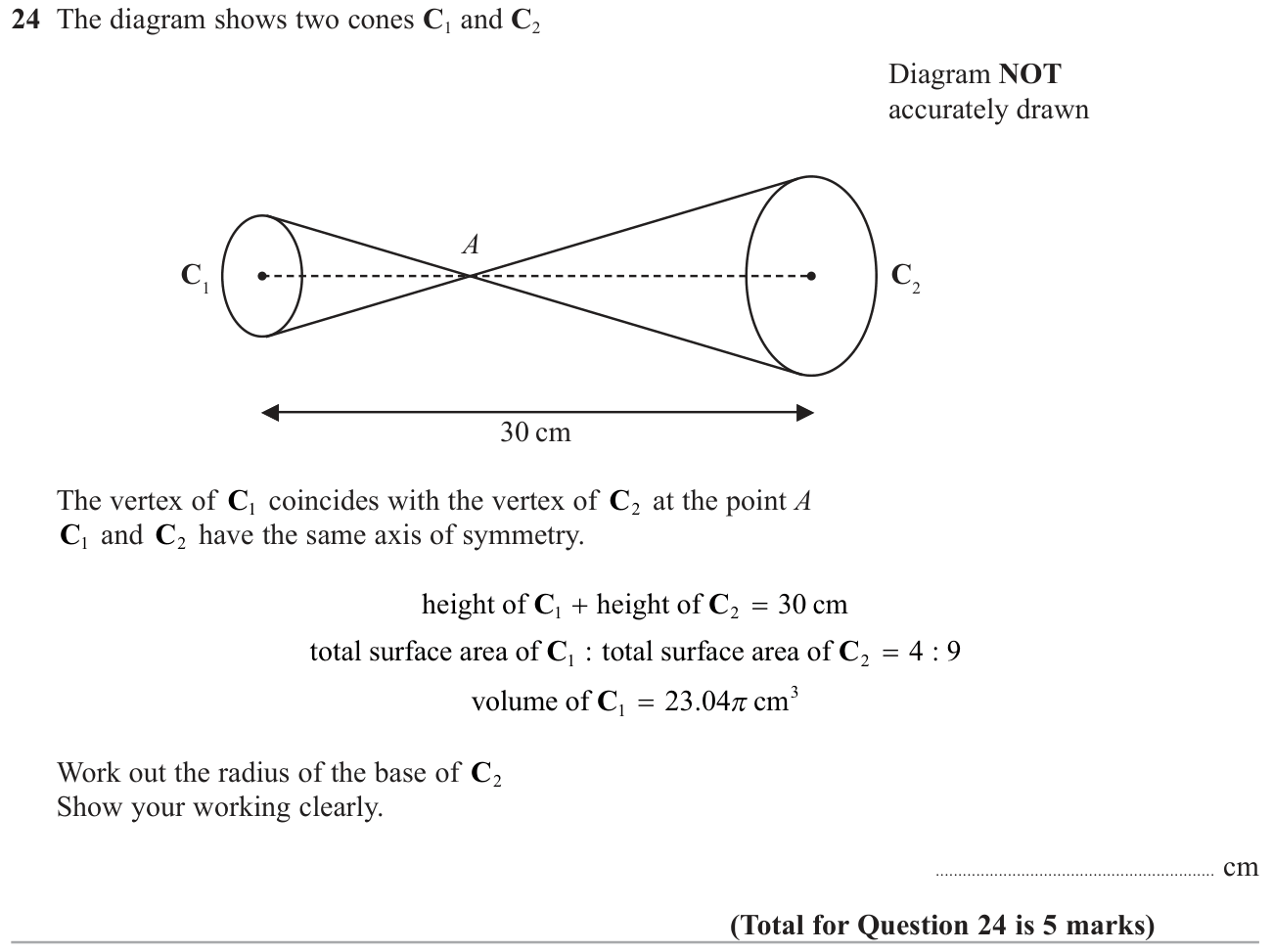
17. Jun 2026 P2H · Q24 Hard 5 marksShow worked solution Solution | Step 1 The straight generators shown through \(A\) give equal vertex angles, so the cones are similar. The area ratio \(4:9\) gives length ratio \(\sqrt4:\sqrt9=2:3\).
For similar solids, surface areas scale as the square of corresponding lengths.
Solution | Step 2 The heights total \(30\text{ cm}\), so \[h_1=\frac25(30)=12\text{ cm},\qquad h_2=\frac35(30)=18\text{ cm}.\]
Split the total in the common length ratio 2:3.
Solution | Step 3 \[\frac13\pi r_1^2(12)=23.04\pi\quad\Rightarrow\quad4r_1^2=23.04\quad\Rightarrow\quad r_1=\sqrt{5.76}=2.4\text{ cm}.\]
Use the volume of the first cone and choose a positive radius.
Solution | Step 4 \[r_2=\frac32r_1=\frac32(2.4)=3.6\text{ cm}.\]
Radii scale by the same factor as the heights.
Final answer \(3.6\text{ cm}\)
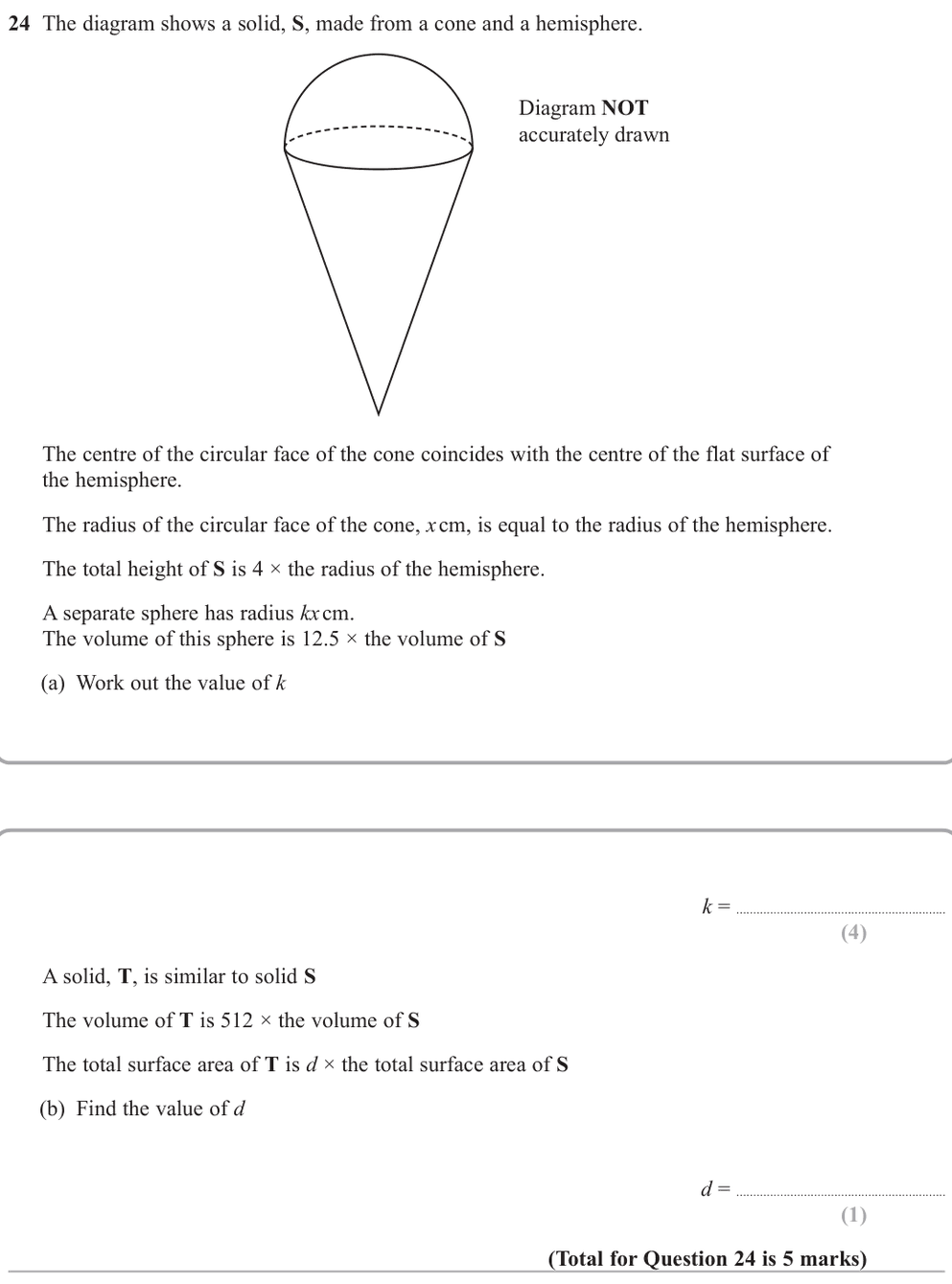
18. Jun 2024 P2HR · Q24 Hard 5 marksShow worked solution The hemisphere has radius The hemisphere has radius \(x\), so its height is \(x\).
The total height of solid The total height of solid S is \(4x\), so the cone height is
\[
4x-x=3x
\]
Volume of the cone Volume of the cone:
\[
\frac13\pi x^2(3x)=\pi x^3
\]
Volume of the hemisphere Volume of the hemisphere:
\[
\frac23\pi x^3
\]
Calculate volume So the volume of solid S is
\[
\pi x^3+\frac23\pi x^3=\frac53\pi x^3
\]
Calculate volume The sphere has radius \(kx\), so its volume is
\[
\frac43\pi(kx)^3=\frac43\pi k^3x^3
\]
This is times the volume This is \(12.5\) times the volume of S:
\[
\frac43\pi k^3x^3=12.5\left(\frac53\pi x^3\right)
\]
Cancel Cancel \(\frac13\pi x^3\):
\[
4k^3=62.5
\]
\[
k^3=15.625=\frac{125}{8}
\]
\[
k=2.5
\]
Calculate volume For solid T, the volume scale factor is \(512\).
\[
512=8^3
\]
Calculate area So the linear scale factor is \(8\), and the surface area scale factor is
\[
8^2=64
\]
Final answer \(\boxed{k=2.5,\ d=64}\)
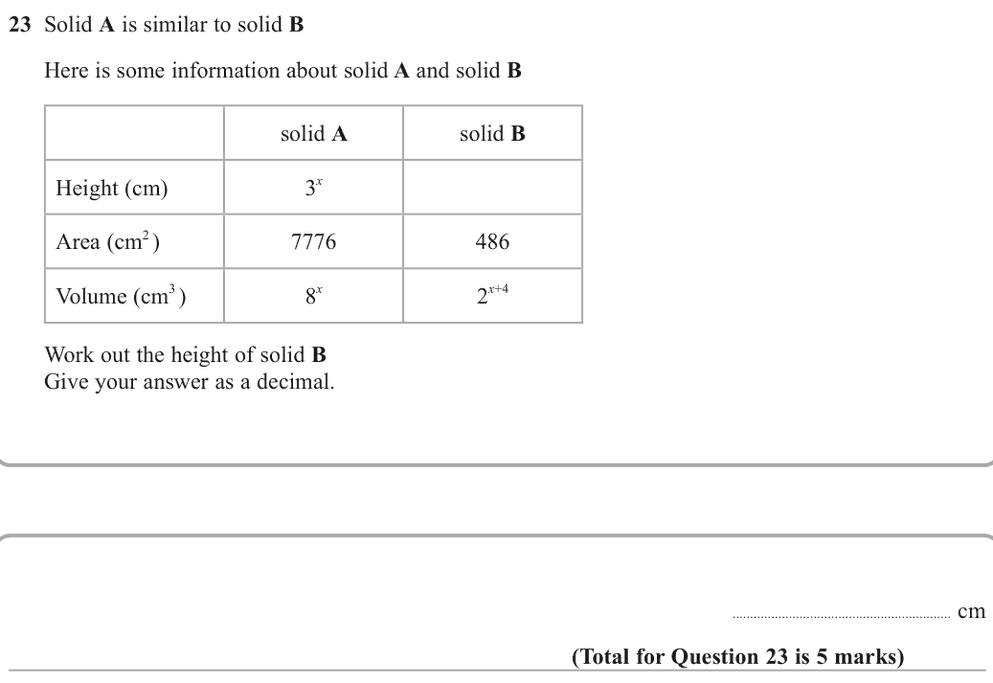
19. Nov 2023 P1H · Q23 Hard 5 marksShow worked solution The area ratio of solid The area ratio of solid A to solid B is
\[
7776:486=16:1
\]
Split the ratio So the linear ratio A:B is
\[
\sqrt{16}:1=4:1
\]
Split the ratio Therefore the volume ratio A:B is
\[
4^3:1^3=64:1
\]
Calculate volume The volumes are \(8^x\) and \(2^{x+4}\), so
\[
\frac{8^x}{2^{x+4}}=64
\]
Use index laws Write \(8^x\) as a power of 2:
\[
8^x=(2^3)^x=2^{3x}
\]
Evaluate fraction So
\[
\frac{2^{3x}}{2^{x+4}}=2^6
\]
\[
2^{3x-(x+4)}=2^6
\]
\[
2x-4=6
\]
\[
x=5
\]
The height of solid A The height of solid A is
\[
3^x=3^5=243
\]
Split the ratio Since the linear ratio A:B is \(4:1\), the height of solid B is
\[
\frac{243}{4}=60.75
\]
Final answer \(\boxed{60.75\text{ cm}}\)
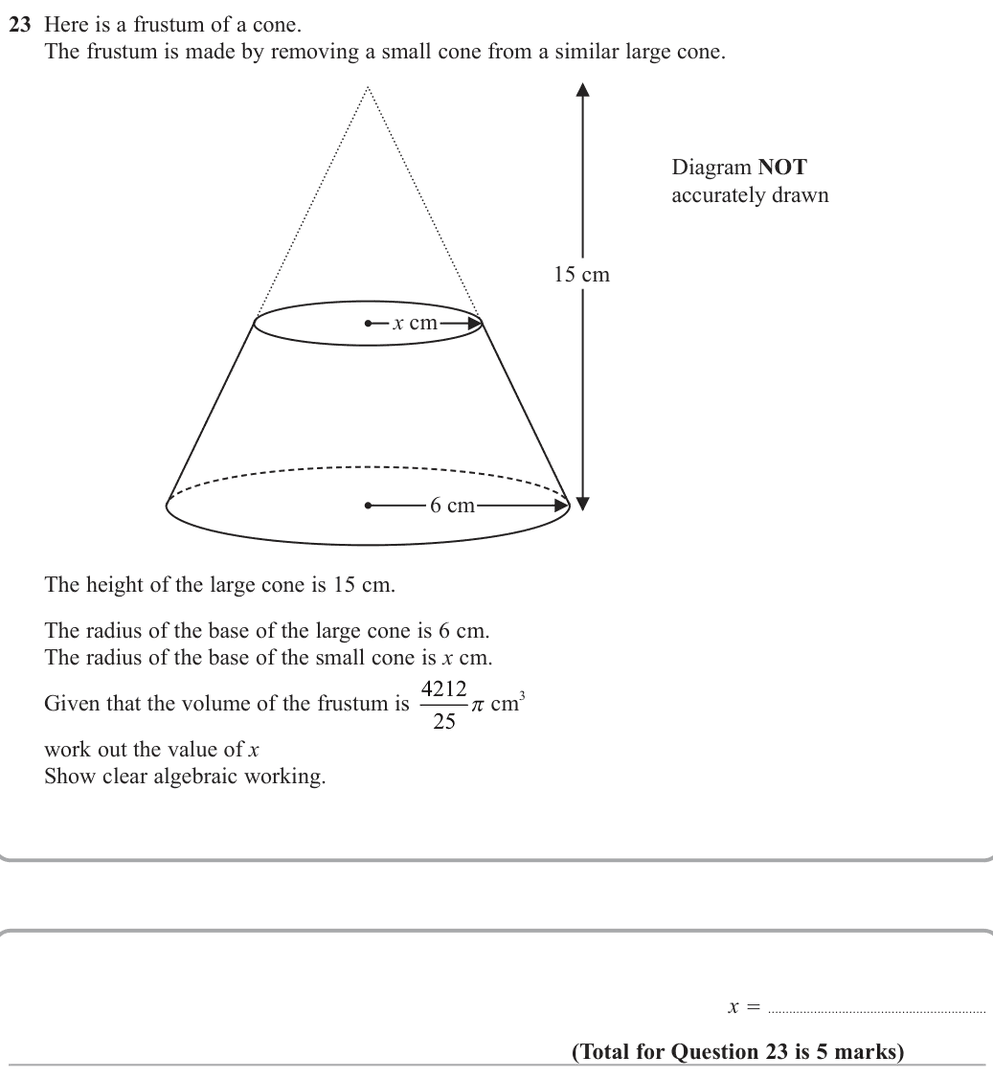
20. Nov 2023 P2H · Q23 Hard 5 marksShow worked solution The large cone has height The large cone has height \(15\) cm and radius \(6\) cm.
The small cone has radius The small cone has radius \(x\). Since the cones are similar,
\[
\frac{\text{radius}}{\text{height}}=\frac6{15}=\frac25
\]
Evaluate fraction So for the small cone,
\[
\frac{x}{h}=\frac25
\]
\[
h=\frac52x
\]
Volume of the large cone Volume of the large cone:
\[
\frac13\pi(6)^2(15)=180\pi
\]
Volume of the small cone Volume of the small cone:
\[
\frac13\pi x^2\left(\frac52x\right)=\frac56\pi x^3
\]
The frustum volume is \[
\frac{4212}{25}\pi
\]
Evaluate fraction So
\[
180\pi-\frac56\pi x^3=\frac{4212}{25}\pi
\]
Cancel Cancel \(\pi\):
\[
180-\frac56x^3=\frac{4212}{25}
\]
\[
\frac56x^3=180-\frac{4212}{25}
\]
\[
\frac56x^3=\frac{288}{25}
\]
\[
x^3=\frac{1728}{125}
\]
\[
x=\frac{12}{5}=2.4
\]
Final answer \(\boxed{2.4\text{ cm}}\)
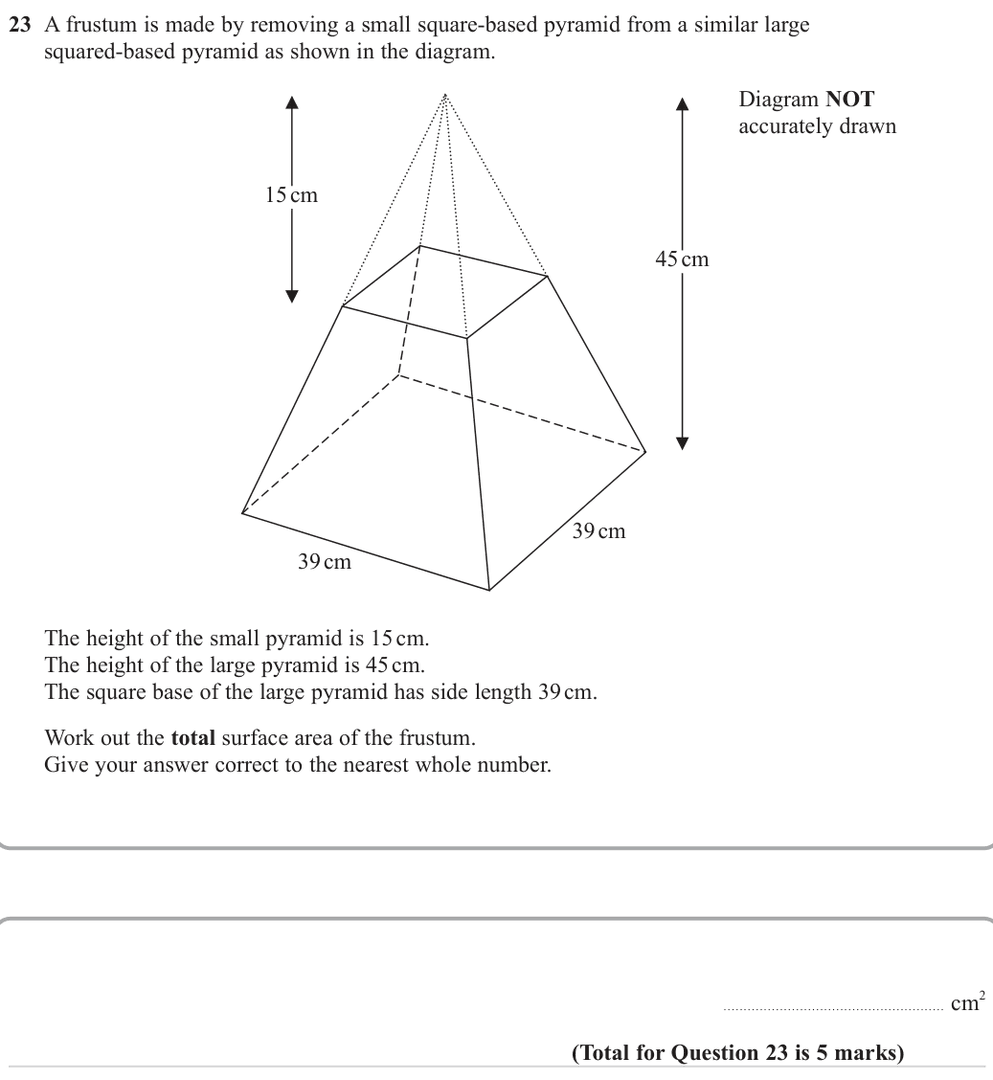
21. May 2023 P1H · Q23 Hard 5 marksShow worked solution The small and large square The small and large square-based pyramids are similar.
Their heights are \[
15:45=1:3
\]
Square of the frustum So the side length of the top square of the frustum is
\[
\frac{39}{3}=13\text{ cm}
\]
The vertical height of the The vertical height of the frustum is
\[
45-15=30\text{ cm}
\]
Evaluate fraction For one trapezium face, the difference between the half-side lengths is
\[
\frac{39-13}{2}=13\text{ cm}
\]
Simplify surd So the slant height of the trapezium face is
\[
\sqrt{30^2+13^2}=\sqrt{1069}
\]
Area of one trapezium face Area of one trapezium face:
\[
\frac12(39+13)\sqrt{1069}=26\sqrt{1069}
\]
Area of four trapezium faces Area of four trapezium faces:
\[
4(26\sqrt{1069})=104\sqrt{1069}
\]
Add the top and bottom Add the top and bottom square faces:
\[
13^2+39^2=169+1521=1690
\]
Total surface area Total surface area:
\[
1690+104\sqrt{1069}=5090.338\ldots
\]
Correct to the nearest whole Correct to the nearest whole number:
\[
5090
\]
Final answer \(\boxed{5090\text{ cm}^2}\)
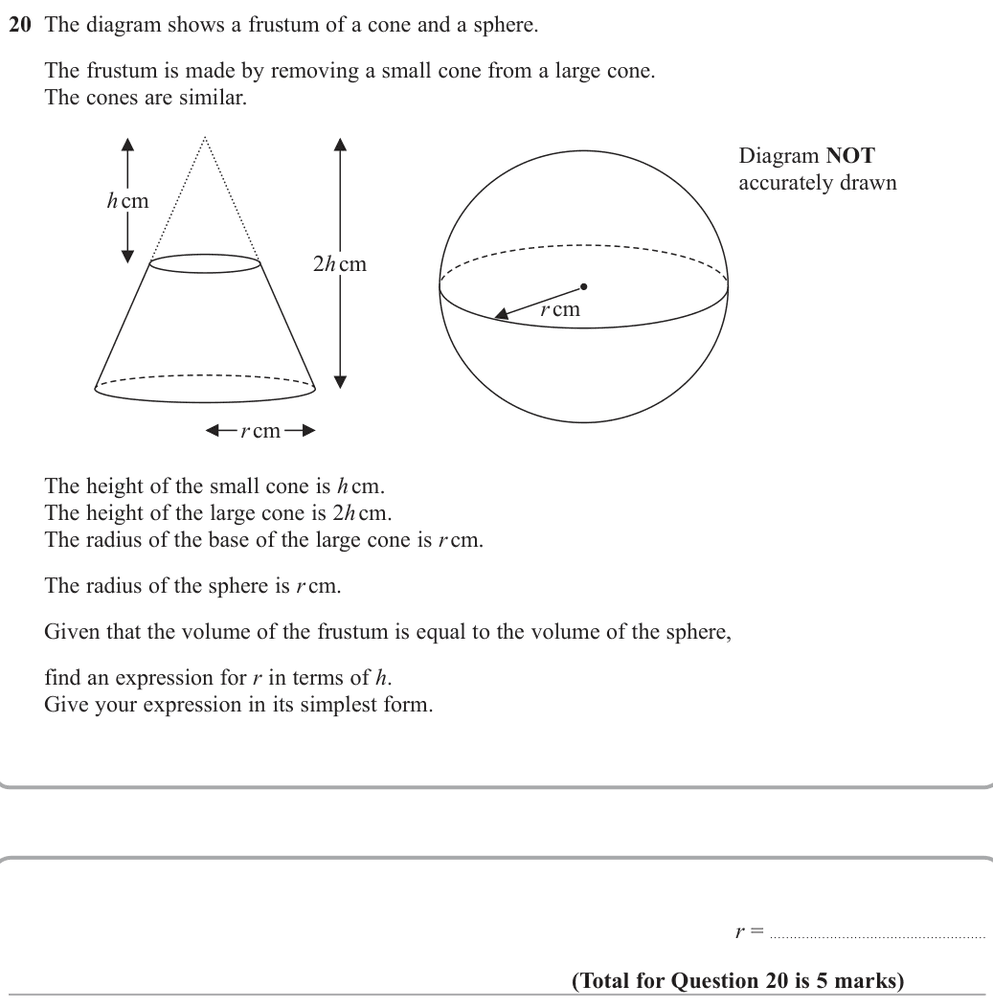
22. Jan 2020 P1HR · Q20 Hard 5 marksShow worked solution The two cones are similar The two cones are similar.
The large cone has height The large cone has height \(2h\) and base radius \(r\).
The small cone has height The small cone has height \(h\), so its linear scale factor compared with the large cone is
\[
\frac{h}{2h}=\frac12
\]
Define cone dimensions So the small cone has radius
\[
\frac r2
\]
Volume of the large cone Volume of the large cone:
\[
\frac13\pi r^2(2h)=\frac23\pi r^2h
\]
Volume of the small cone Volume of the small cone:
\[
\frac13\pi\left(\frac r2\right)^2h=\frac1{12}\pi r^2h
\]
Calculate volume So the volume of the frustum is
\[
\frac23\pi r^2h-\frac1{12}\pi r^2h=\frac7{12}\pi r^2h
\]
Calculate volume The sphere has radius \(r\), so its volume is
\[
\frac43\pi r^3
\]
The two volumes are equal The two volumes are equal:
\[
\frac7{12}\pi r^2h=\frac43\pi r^3
\]
Divide by Divide by \(\pi r^2\):
\[
\frac7{12}h=\frac43r
\]
\[
7h=16r
\]
\[
r=\frac{7h}{16}
\]
Final answer \(\displaystyle r=\frac{7h}{16}\)
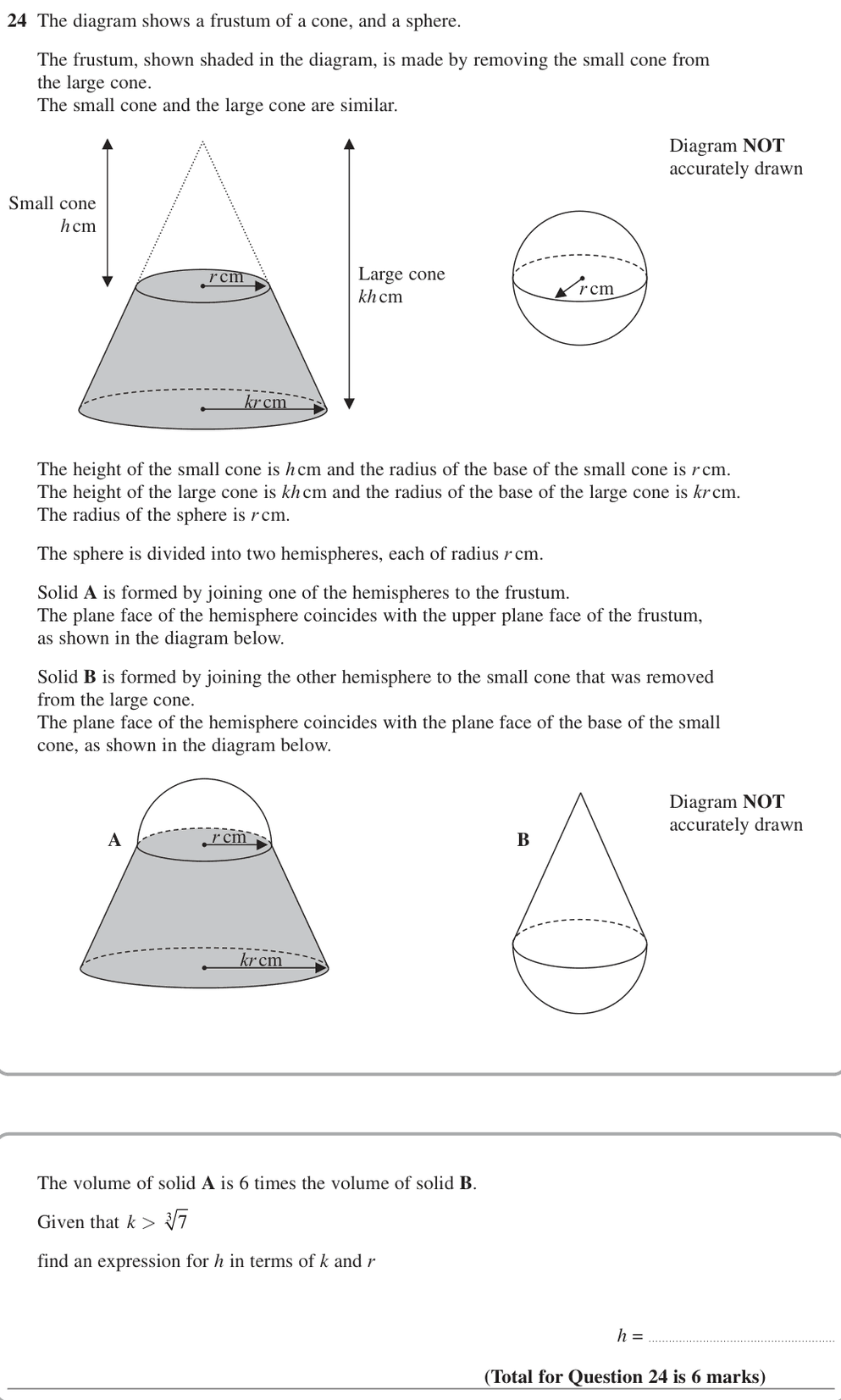
23. Jun 2022 P2HR · Q24 Hard 6 marksShow worked solution Small cone volume Small cone volume:
\[
V_s=\frac13\pi r^2h
\]
The larger similar cone has The larger similar cone has radius \(kr\) and height \(kh\), so its volume is
\[
V_L=\frac13\pi(kr)^2(kh)=\frac13\pi k^3r^2h
\]
Calculate volume So the frustum volume is
\[
V_L-V_s=\frac13\pi r^2h(k^3-1)
\]
The volume of one hemisphere The volume of one hemisphere of radius \(r\) is
\[
\frac23\pi r^3
\]
Solid A is the frustum Solid A is the frustum plus one hemisphere:
\[
V_A=\frac13\pi r^2h(k^3-1)+\frac23\pi r^3
\]
Solid B is the small Solid B is the small cone plus one hemisphere:
\[
V_B=\frac13\pi r^2h+\frac23\pi r^3
\]
Given Given \(V_A=6V_B\):
\[
\frac13\pi r^2h(k^3-1)+\frac23\pi r^3
=6\left(\frac13\pi r^2h+\frac23\pi r^3\right)
\]
Divide by Divide by \(\frac13\pi r^2\):
\[
h(k^3-1)+2r=6h+12r
\]
\[
h(k^3-7)=10r
\]
\[
h=\frac{10r}{k^3-7}
\]
Final answer \(\displaystyle h=\frac{10r}{k^3-7}\)
More IGCSE Maths 4MA1 topics Dr Eslam Ahmed Elite Mathematics · Questions classified by topic, solutions checked by Dr Eslam
 Elite Mathematics