Elite Mathematics / Linear / Topics / Real-Life Graphs IGCSE · 4MA1 · Topic Real-Life Graphs: practice questions & worked solutions
Recent 4MA1 Higher papers have not examined Real-Life Graphs, so these are original exam-style Elite practice questions, sorted from easiest to hardest. Try each one first, then open the worked solution.
7 questions
28 marks in total
0% of papers (0 of 54) include it – practise it with the Elite questions below
0/6/1 easy / medium / hard
Questions, easiest first Level is estimated from marks: 1–2 easy, 3–4 medium, 5+ hard.
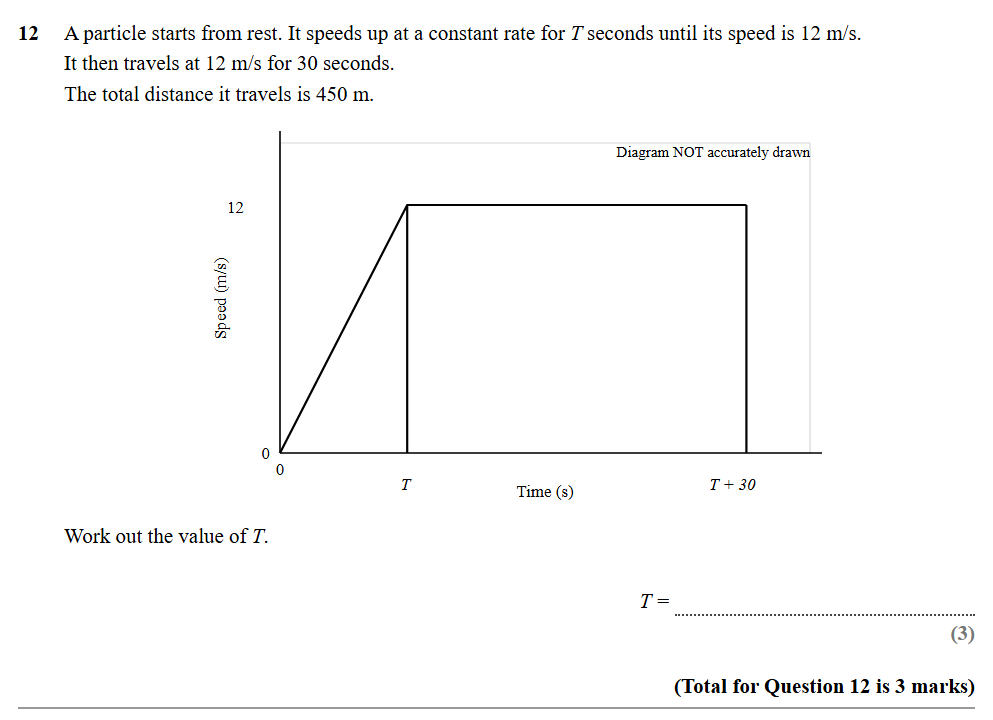
1. Elite Practice · Q12 Medium 3 marksShow worked solution Distance = area under the graph Triangle: \(\tfrac12\times T\times12=6T\). Rectangle: \(30\times12=360\).
Form and solve the equation \[
6T+360=450 \;\Rightarrow\; 6T=90 \;\Rightarrow\; T=15
\]
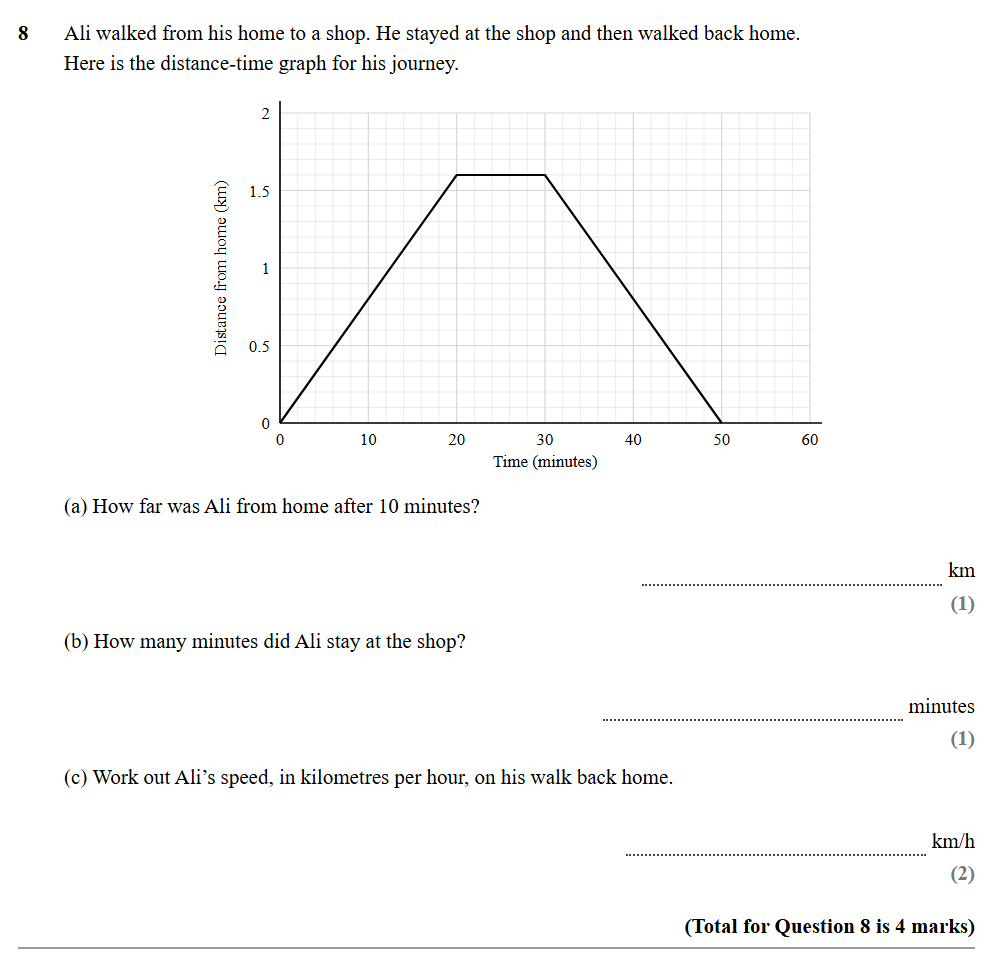
2. Elite Practice · Q8 Medium 4 marksShow worked solution (a) Read the graph at 10 minutes The line from \((0,0)\) to \((20,1.6)\) is halfway up at \(10\) minutes: \(0.8\) km.
(b) The flat section From \(20\) to \(30\) minutes: \(10\) minutes.
(c) Speed = distance ÷ time He walks \(1.6\) km in \(50-30=20\) minutes \(=\frac13\) hour.
\[
1.6\div\frac13=4.8\text{ km/h}
\]
Final answer (a) \(0.8\) km (b) \(10\) minutes (c) \(4.8\) km/h
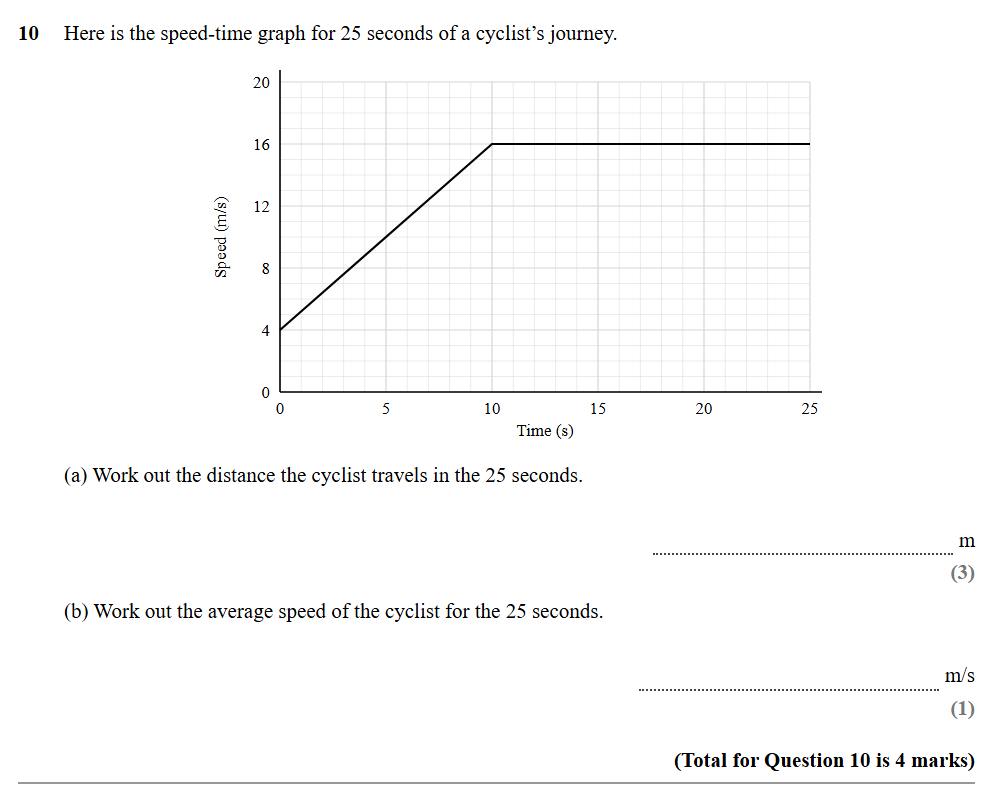
3. Elite Practice · Q10 Medium 4 marksShow worked solution (a) Area of the trapezium (first 10 s) \[
\frac{4+16}{2}\times10=100\text{ m}
\]
(a) Area of the rectangle (last 15 s) \[
16\times15=240\text{ m}
\]
Total: \(100+240=340\) m.
(b) Average speed = total distance ÷ total time \[
340\div25=13.6\text{ m/s}
\]
Final answer (a) \(340\) m (b) \(13.6\) m/s
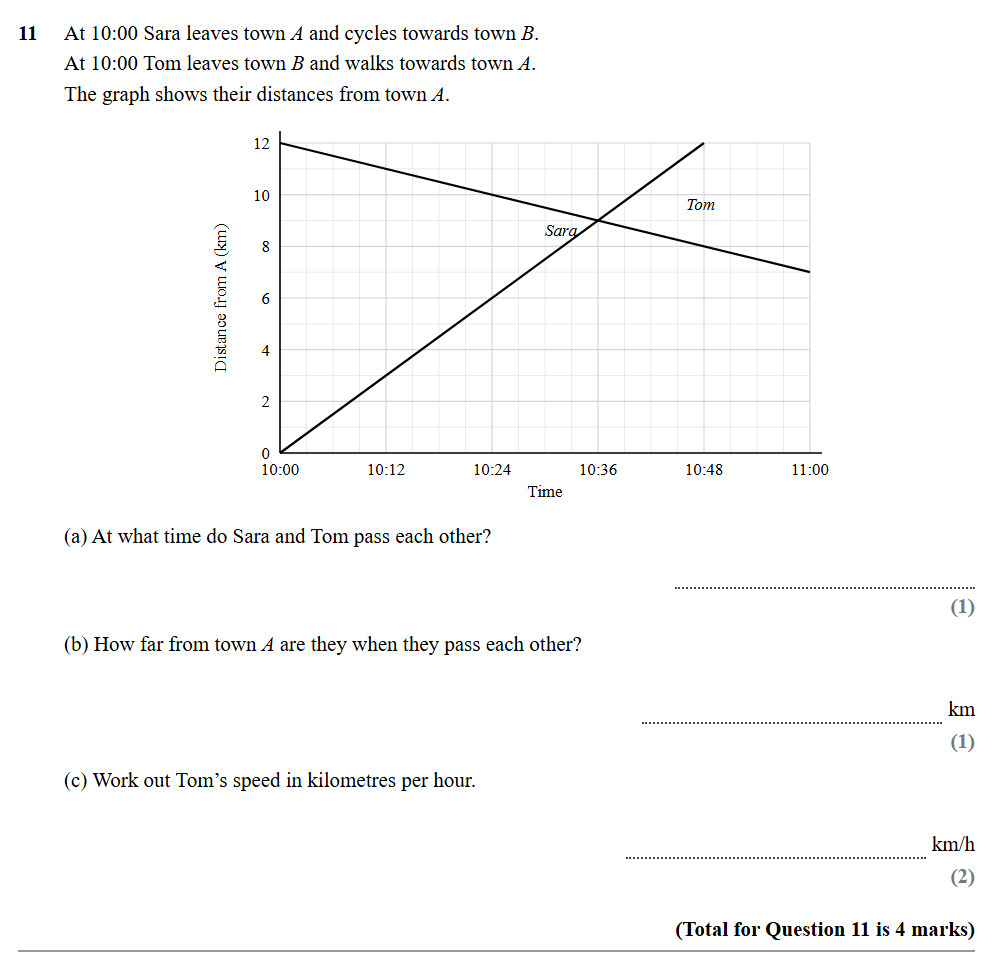
4. Elite Practice · Q11 Medium 4 marksShow worked solution (a) Where the lines cross The lines cross at \(36\) minutes after 10:00, so at \(10{:}36\).
(b) Read across At the crossing point the distance from \(A\) is \(9\) km.
(c) Tom's speed Tom goes from \(12\) km to \(7\) km from \(A\) in \(1\) hour:
\[
\frac{12-7}{1}=5\text{ km/h}
\]
Final answer (a) \(10{:}36\) (b) \(9\) km (c) \(5\) km/h
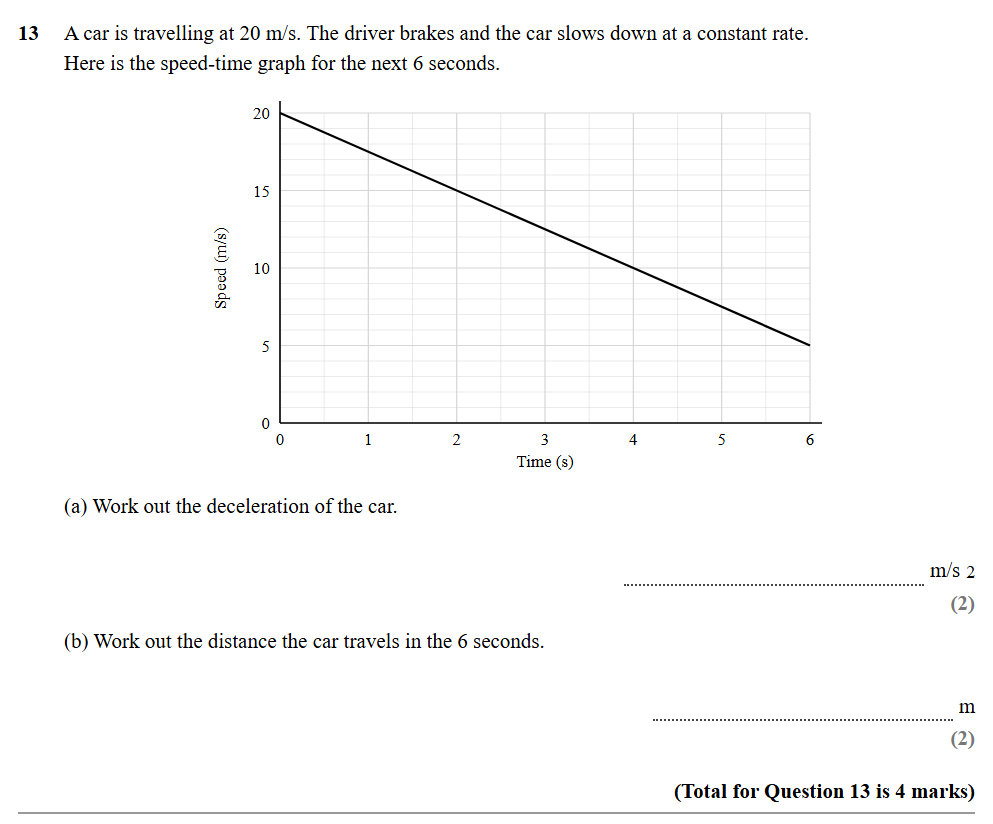
5. Elite Practice · Q13 Medium 4 marksShow worked solution (a) Gradient of the line \[
\frac{5-20}{6}=-2.5
\]
So the deceleration is \(2.5\) m/s\(^2\).
(b) Area of the trapezium \[
\frac{20+5}{2}\times6=75\text{ m}
\]
Final answer (a) \(2.5\) m/s\(^2\) (b) \(75\) m
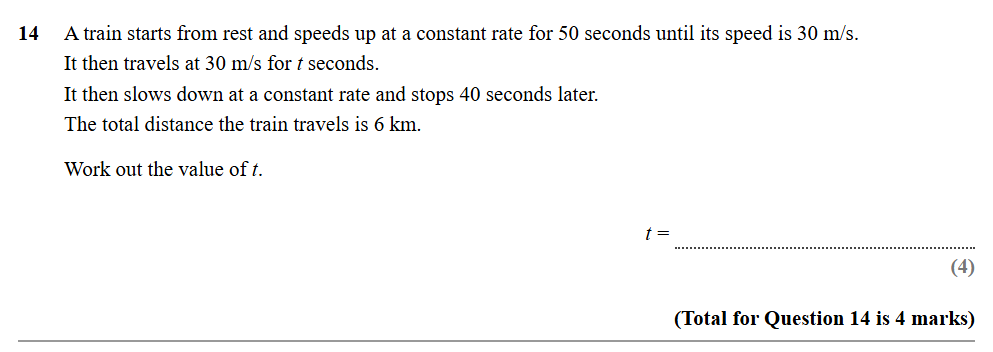
6. Elite Practice · Q14 Medium 4 marksShow worked solution Sketch the speed-time graph A trapezium: up for \(50\) s, flat at \(30\) m/s for \(t\) s, down for \(40\) s.
Distance = area (in metres) \[
\tfrac12\times50\times30+30t+\tfrac12\times40\times30=750+30t+600
\]
Form and solve the equation \(6\) km \(=6000\) m:
\[
1350+30t=6000 \;\Rightarrow\; 30t=4650 \;\Rightarrow\; t=155
\]
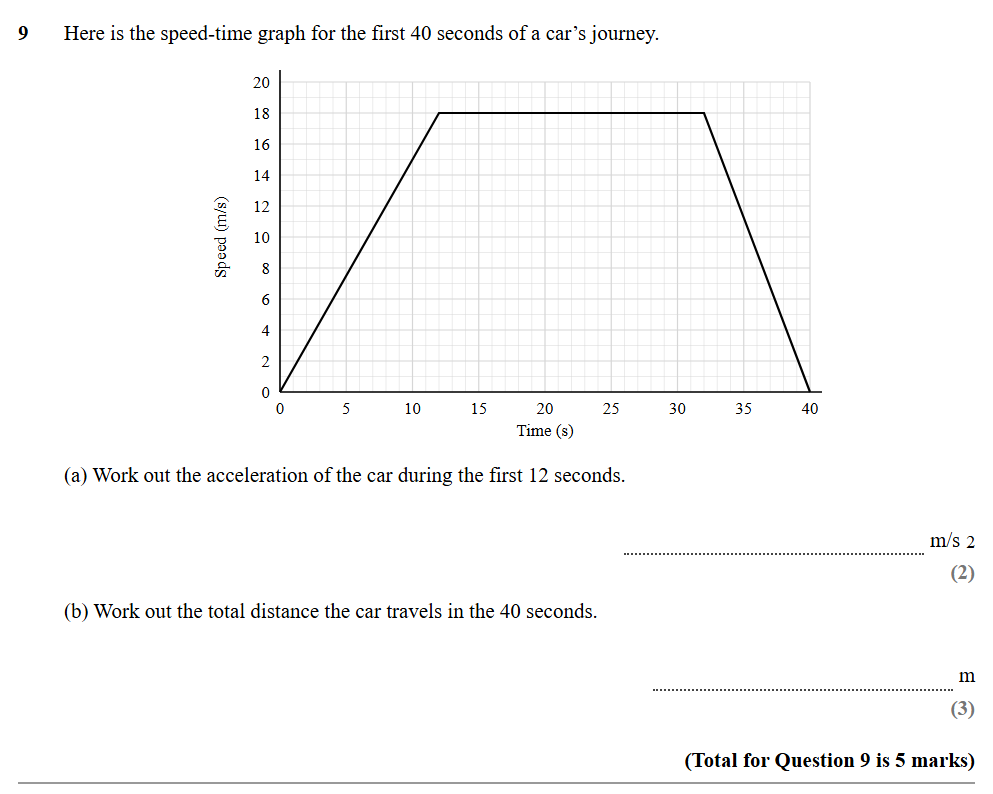
7. Elite Practice · Q9 Hard 5 marksShow worked solution (a) Acceleration = gradient \[
\frac{18-0}{12}=1.5\text{ m/s}^2
\]
(b) Distance = area under the graph Split into a triangle, a rectangle and a triangle:
\[
\tfrac12\times12\times18+20\times18+\tfrac12\times8\times18=108+360+72=540\text{ m}
\]
Final answer (a) \(1.5\) m/s\(^2\) (b) \(540\) m
More IGCSE Maths 4MA1 topics Dr Eslam Ahmed Elite Mathematics · Questions classified by topic, solutions checked by Dr Eslam
 Elite Mathematics