Elite Mathematics / Linear / Topics / Standard and Compound Units IGCSE · 4MA1 · Topic Standard and Compound Units: past paper questions & worked solutions
Every Standard and Compound Units question from the 4MA1 papers in our bank, 2020–2026, sorted from easiest to hardest. Try each one first, then open the worked solution.
42 questions
142 marks in total
59% of papers (32 of 54) include it
3/34/5 easy / medium / hard
Questions, easiest first Level is estimated from marks: 1–2 easy, 3–4 medium, 5+ hard.
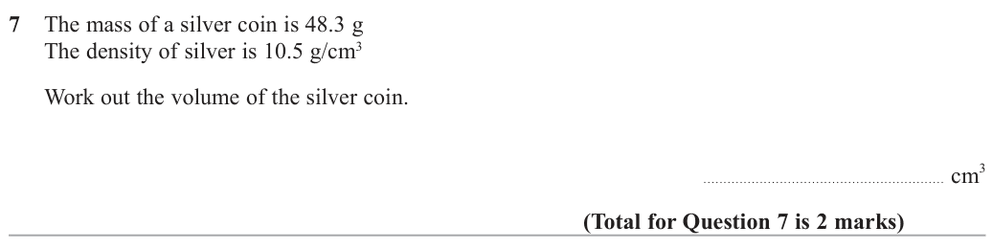
1. Jun 2025 P2HR · Q7 Easy 2 marksShow worked solution Use \[
\text{density}=\frac{\text{mass}}{\text{volume}}
\]
Calculate volume So \[ \text{volume}=\frac{\text{mass}}{\text{density}} =\frac{48.3}{10.5}=4.6 \]
Final answer \(4.6\text{ cm}^3\).
2. Jan 2020 P2H · Q2 Easy 2 marksShow worked solution Calculate value \[
1\text{ m}=100\text{ cm}
\]
Calculate value So \[ 1\text{ m}^3=100^3\text{ cm}^3=1,000,000\text{ cm}^3 \]
\[
32.4\text{ m}^3=32.4\times1,000,000
\]
\[
=32,400,000\text{ cm}^3
\]
Final answer \(32,400,000\text{ cm}^3\).
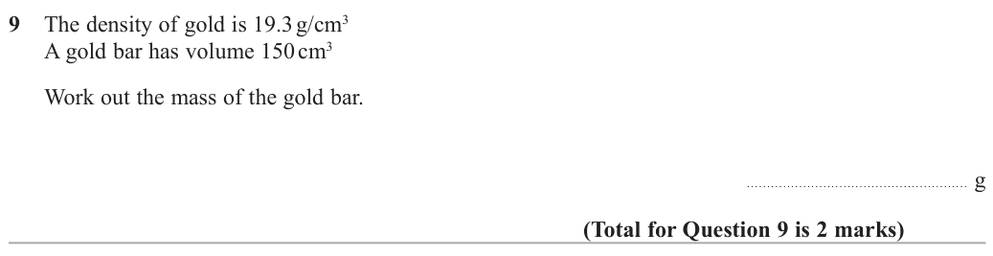
3. Jan 2020 P2H · Q9 Easy 2 marksShow worked solution Calculate volume \[
\text{mass}=\text{density}\times\text{volume}
\]
\[
\text{mass}=19.3\times150
\]
\[
\text{mass}=2895
\]
Final answer \(2895\text{ g}\).
4. Jun 2026 P1H · Q8 Medium 3 marksShow worked solution Solution | Step 1 \[70\text{ m/s}=70\times3600=252000\text{ m/h}.\]
There are 3600 seconds in one hour.
Solution | Step 2 \[252000\div1000=252\text{ km/h}.\]
There are 1000 metres in one kilometre.
Final answer \(252\text{ km/h}\)
5. Jun 2026 P2HR · Q9 Medium 3 marksShow worked solution Solution | Step 1 \(198\text{ km}=198000\text{ m}\) and \(1\text{ hour}=3600\text{ s}\).
Convert both the distance and the time in the rate.
Solution | Step 2 \[198\text{ km/h}=\frac{198000}{3600}=55\text{ m/s}.\]
Metres per second means metres divided by seconds.
Final answer \(55\text{ m/s}\).
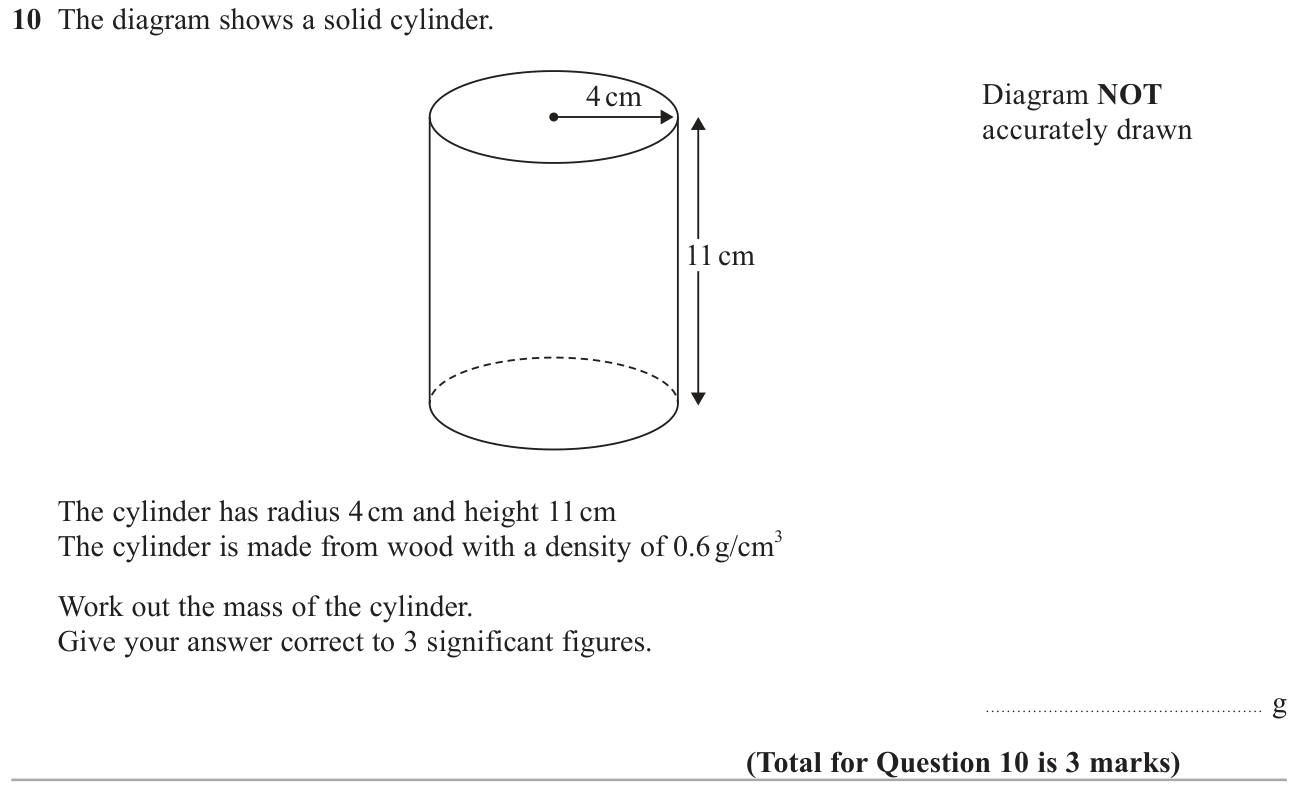
6. Jun 2026 P2HR · Q10 Medium 3 marksShow worked solution Solution | Step 1 \[V=\pi r^2h=\pi(4)^2(11)=176\pi\text{ cm}^3.\]
Use the cylinder volume formula.
Solution | Step 2 \[m=\rho V=0.6(176\pi)=105.6\pi=331.7521842\ldots\text{ g}.\]
Mass equals density times volume; keep full precision until the end.
Solution | Step 3 \[m=332\text{ g}\quad\text{(3 significant figures)}.\]
Round the final mass as requested.
Final answer \(332\text{ g}\) (3 significant figures).
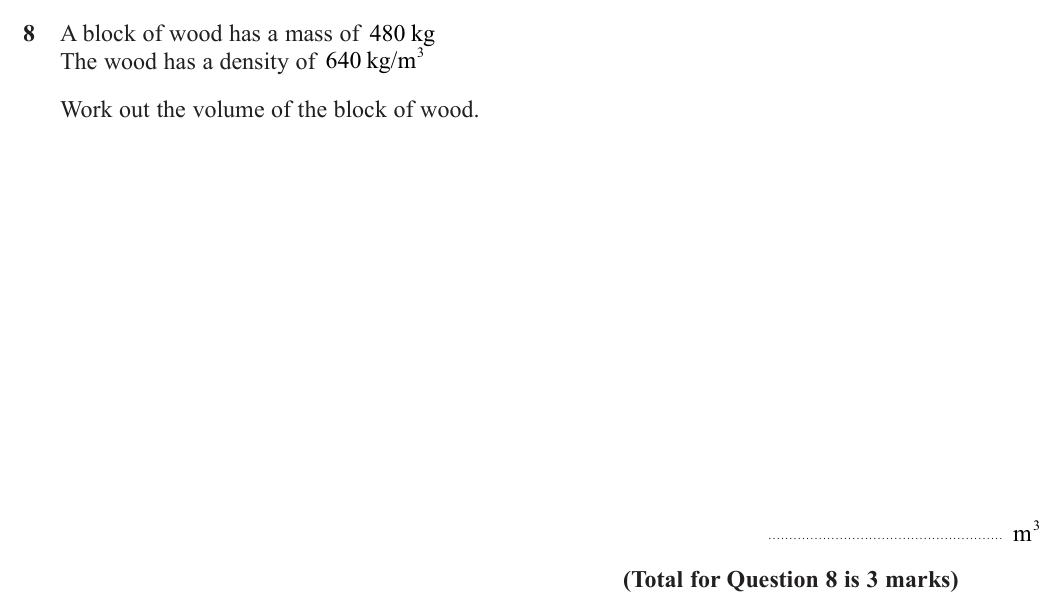
7. May 2026 4WM1H · Q8 Medium 3 marksShow worked solution Volume = mass ÷ density \[V=\frac{480}{640}=0.75\text{ m}^3\]
Final answer \(0.75\) m\(^3\)
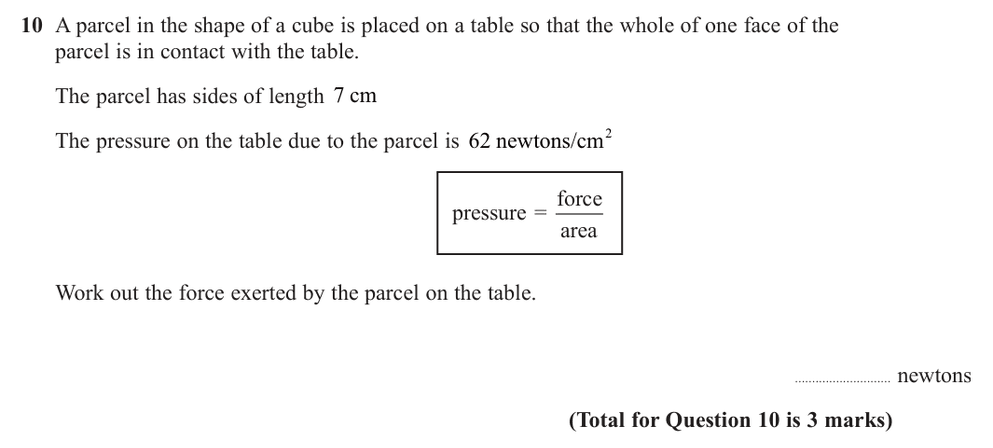
8. Nov 2025 4WM1H · Q10 Medium 3 marksShow worked solution The contact area is one The contact area is one square face:
\[
7\times 7=49\text{ cm}^2
\]
\[
\text{force}=\text{pressure}\times\text{area}=62\times 49=3038
\]
Final answer \(3038\) newtons.
9. Jun 2025 P1HR · Q7 Medium 3 marksShow worked solution Convert m/s to km/h multiply To convert m/s to km/h, multiply by \(3.6\).
\[
50x\times3.6=180x
\]
Final answer \(180x\text{ km/h}\).
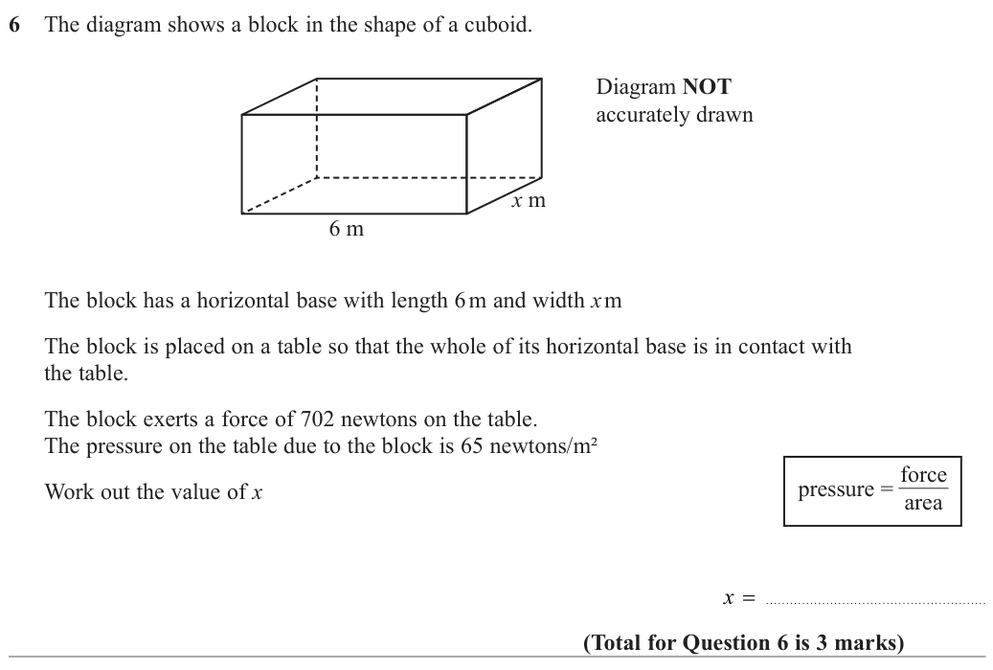
10. May 2025 4WM1H · Q6 Medium 3 marksShow worked solution Calculate area \[
\text{pressure}=\frac{\text{force}}{\text{area}}
\]
\[
65=\frac{702}{\text{area}}
\]
\[
\text{area}=\frac{702}{65}=10.8
\]
Calculate area The base area is \(6x\), so
\[
6x=10.8
\]
\[
x=1.8
\]
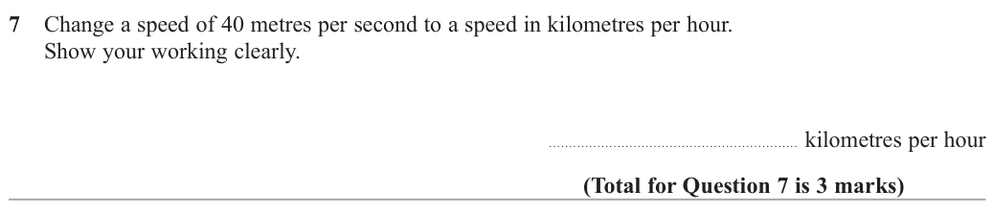
11. May 2025 4WM1HR · Q7 Medium 3 marksShow worked solution Evaluate fraction \[
40\text{ m/s}=40\times \frac{3600}{1000}\text{ km/h}
\]
\[
=144\text{ km/h}
\]
Final answer \(144\) kilometres per hour.
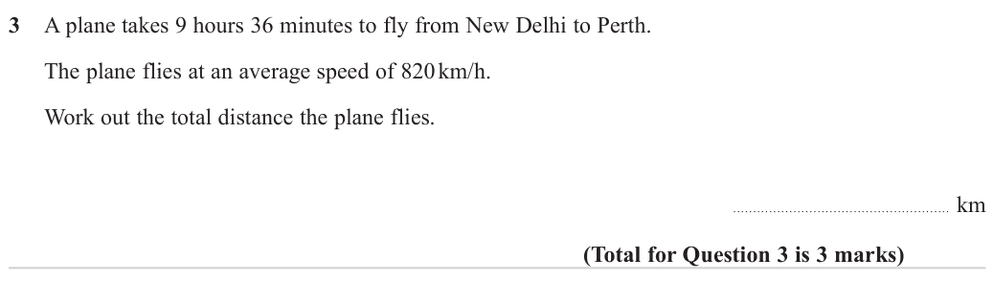
12. Jun 2024 P2H · Q3 Medium 3 marksShow worked solution Evaluate fraction \[
9\text{ h }36\text{ min}=9+\frac{36}{60}=9.6\text{ hours}
\]
\[
\text{distance}=820\times 9.6=7872
\]
Final answer \(7872\text{ km}\).
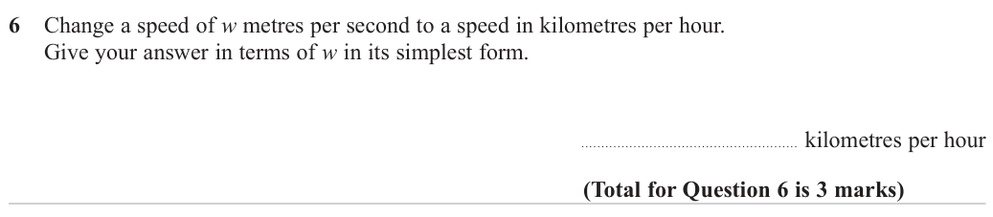
13. Jun 2024 P2H · Q6 Medium 3 marksShow worked solution Convert m/s to km/h multiply To convert m/s to km/h, multiply by \(3.6\).
\[
w\text{ m/s}=3.6w\text{ km/h}
\]
\[
3.6w=\frac{18w}{5}
\]
Final answer \(\frac{18w}{5}\text{ km/h}\).
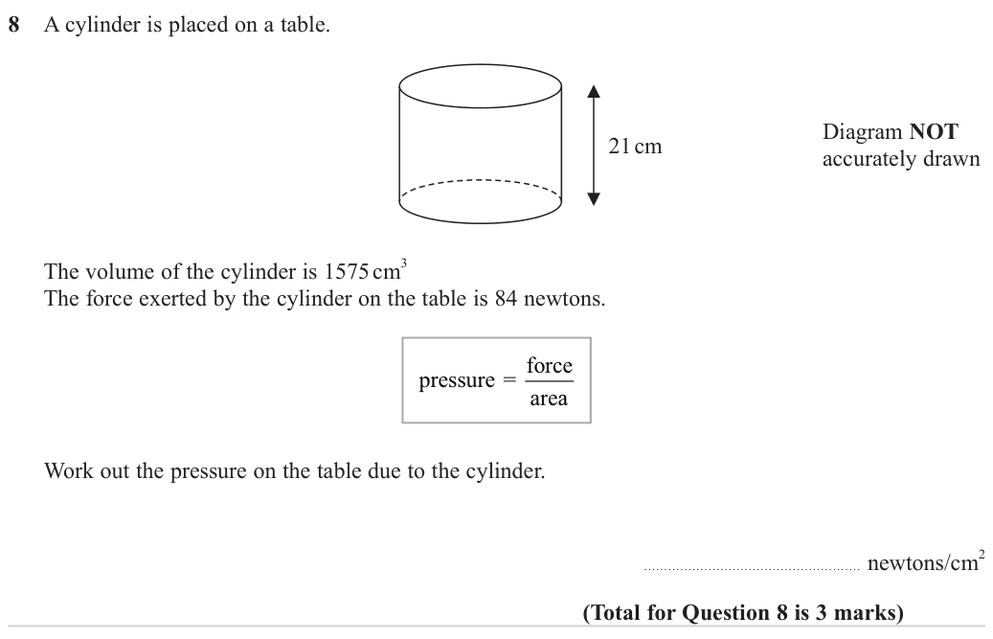
14. May 2024 P1H · Q8 Medium 3 marksShow worked solution The volume of a cylinder The volume of a cylinder is \[ \text{volume}=\text{area of base}\times \text{height} \]
Calculate area So the area in contact with the table is \[ 1575\div 21=75\text{ cm}^2 \]
Use \[
\text{pressure}=\frac{\text{force}}{\text{area}}
\]
\[
\text{pressure}=\frac{84}{75}=1.12
\]
Final answer \(1.12\text{ newtons/cm}^2\).
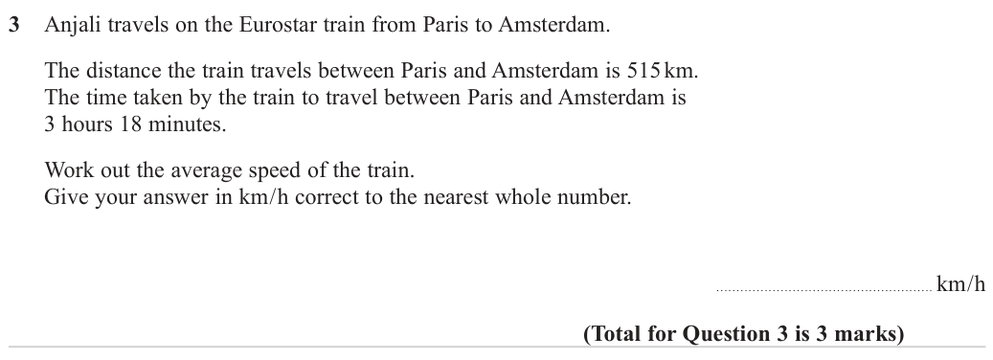
15. Jun 2023 P2HR · Q3 Medium 3 marksShow worked solution Time hours minutes Time \(=3\) hours \(18\) minutes:
\[
3+\frac{18}{60}=3.3\text{ hours}
\]
\[
\text{average speed}=\frac{515}{3.3}=156.06\ldots
\]
Final answer \(156\text{ km/h}\).
16. Jun 2023 P2H · Q9 Medium 3 marksShow worked solution Convert km/h to m/s divide To convert km/h to m/s, divide by \(3.6\).
\[
27\div3.6=7.5
\]
Final answer \(7.5\text{ m/s}\).
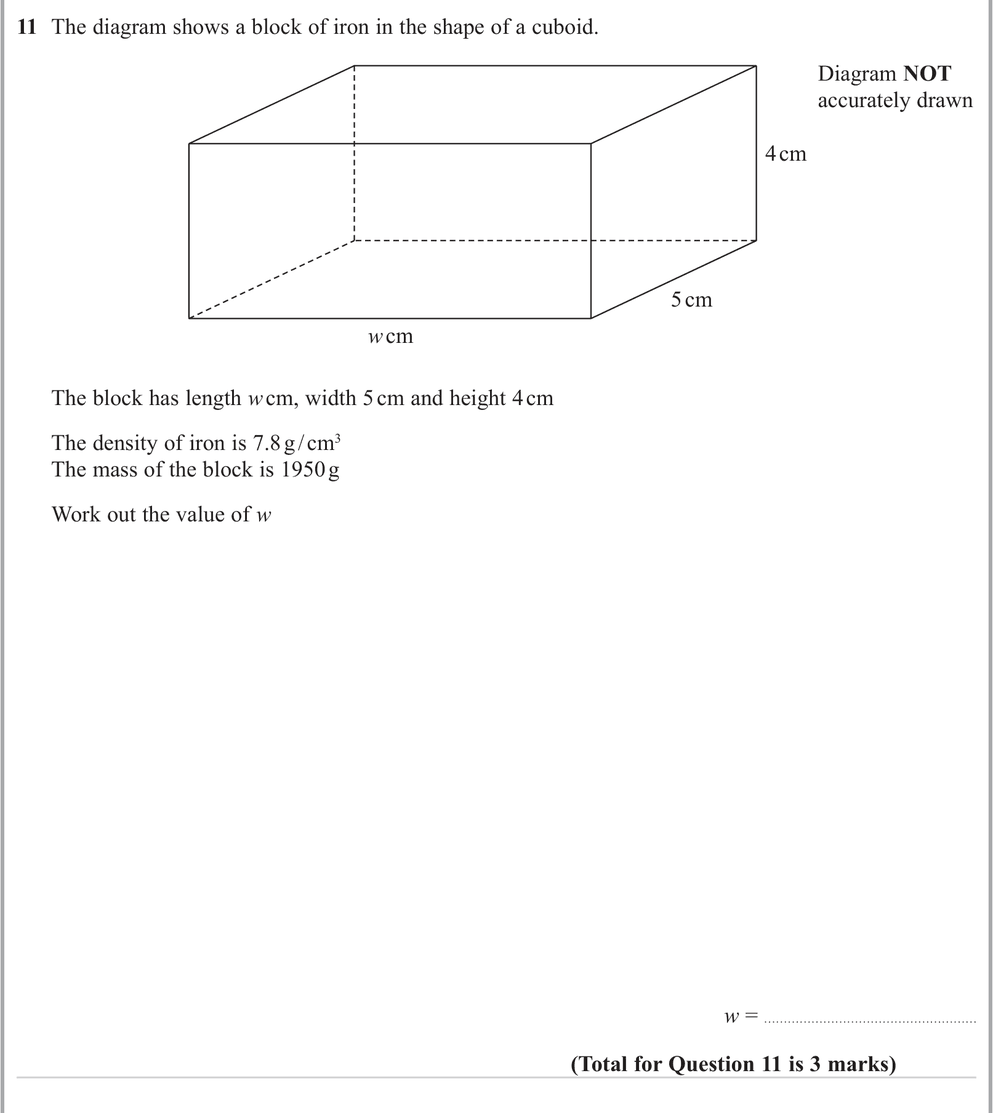
17. May 2023 P1HR · Q11 Medium 3 marksShow worked solution Calculate volume \[
\text{density}=\frac{\text{mass}}{\text{volume}}
\]
\[
7.8=\frac{1950}{\text{volume}}
\]
\[
\text{volume}=\frac{1950}{7.8}=250\text{ cm}^3
\]
Calculate value For the cuboid,
\[
w\times 5\times 4=250
\]
\[
20w=250
\]
\[
w=12.5
\]
Final answer \(w=12.5\text{ cm}\).
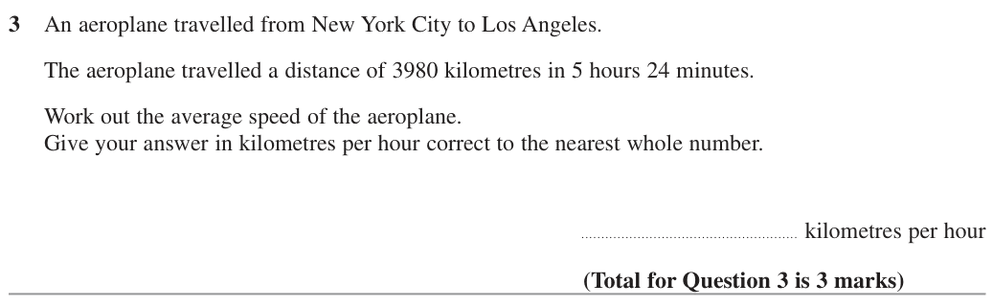
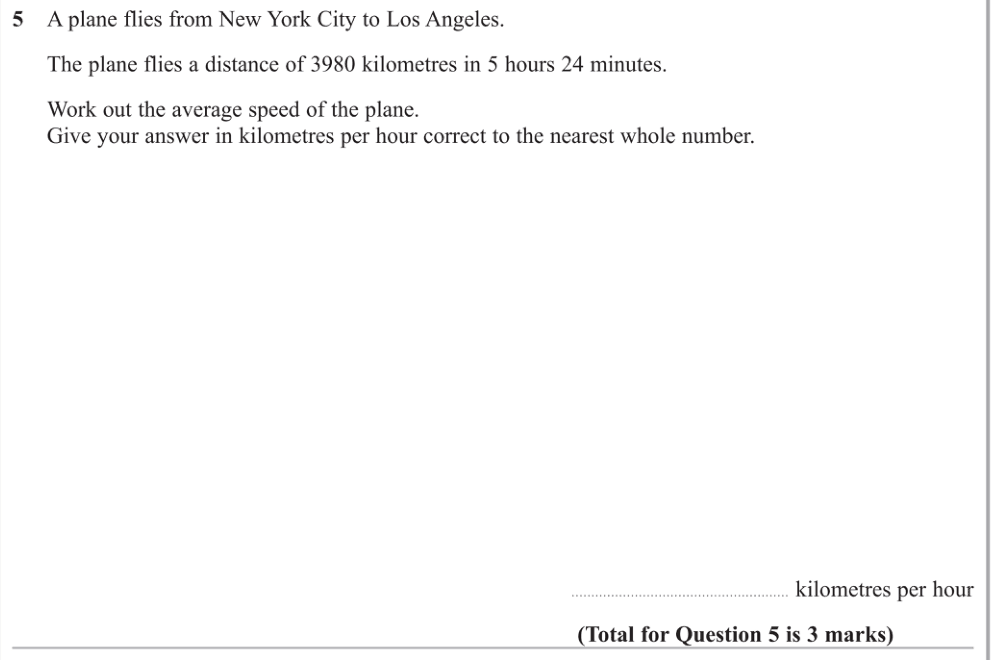
18. Jun 2022 P2H · Q3 Medium 3 marksShow worked solution The time is \[
5\text{ h }24\text{ min}=5.4\text{ h}
\]
Average speed Average speed: \[ 3980\div 5.4=737.037\ldots \]
Final answer \(737\text{ kilometres per hour}\).
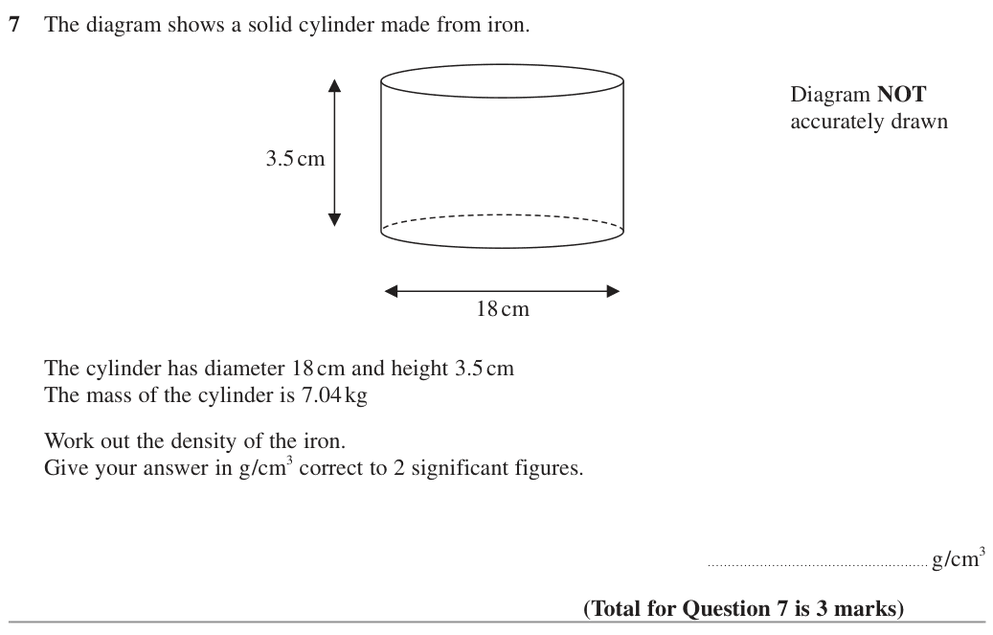
19. Jun 2022 P1HR · Q7 Medium 3 marksShow worked solution Radius of the cylinder is \[
\frac{18}{2}=9\text{ cm}
\]
Volume is \[
\pi r^2h=\pi(9^2)(3.5)=283.5\pi
\]
\[
=890.64\ldots\text{ cm}^3
\]
Mass is \[
7.04\text{ kg}=7040\text{ g}
\]
Density is \[
\frac{7040}{890.64\ldots}=7.904\ldots
\]
Final answer \(7.9\text{ g/cm}^3\) to 2 significant figures.
20. Jun 2022 P2H · Q7 Medium 3 marksShow worked solution Convert km/h to m/s divide To convert km/h to m/s, divide by \(3.6\).
\[
81\div3.6=22.5
\]
Final answer \(22.5\text{ m/s}\).
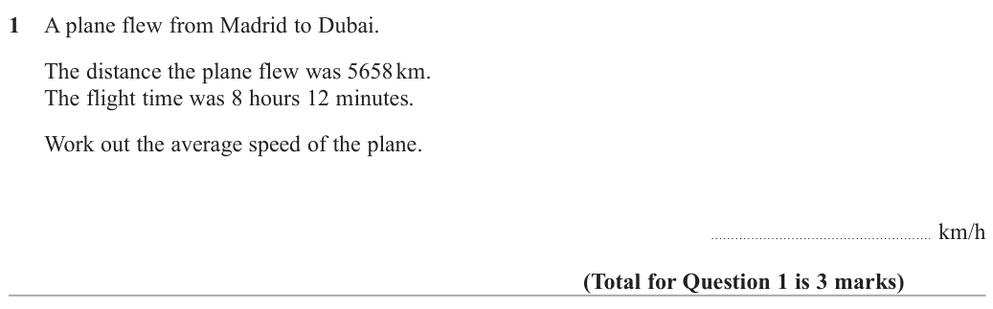
21. May 2021 P1H · Q1 Medium 3 marksShow worked solution Evaluate fraction \[
8\text{ h }12\text{ min}=8+\frac{12}{60}=8.2\text{ hours}
\]
\[
\text{average speed}=\frac{5658}{8.2}=690
\]
Final answer \(690\text{ km/h}\).
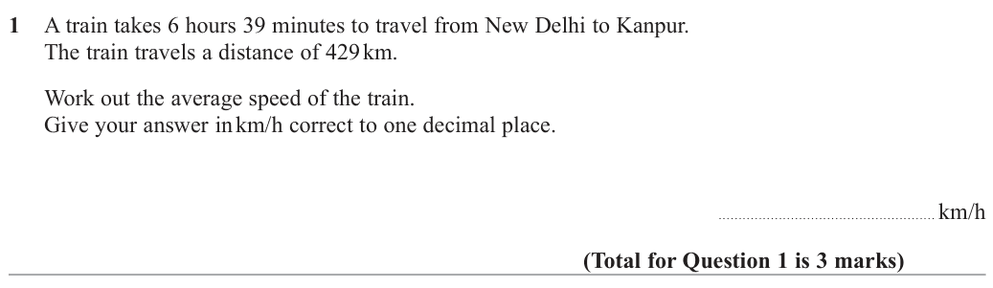
22. Jan 2021 P2H · Q1 Medium 3 marksShow worked solution The time is \[
6\text{ h }39\text{ min}=6.65\text{ h}
\]
Average speed Average speed: \[ 429\div 6.65=64.511\ldots \]
Final answer \(64.5\text{ km/h}\).
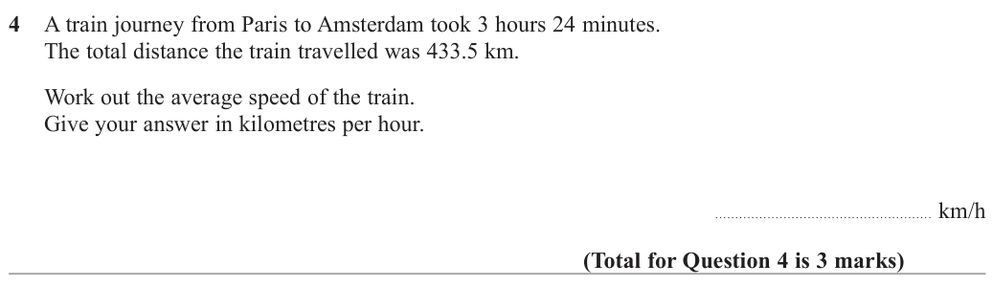
23. Jan 2021 P1HR · Q4 Medium 3 marksShow worked solution The time is \[
3\text{ h }24\text{ min}=3.4\text{ h}
\]
Average speed Average speed: \[ 433.5\div 3.4=127.5 \]
Final answer \(127.5\text{ km/h}\).
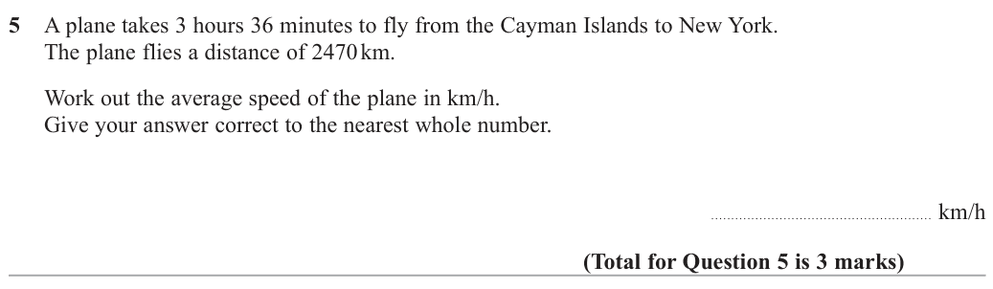
24. Jan 2020 P2HR · Q5 Medium 3 marksShow worked solution The time is \[
3\text{ h }36\text{ min}=3.6\text{ h}
\]
Average speed Average speed: \[ 2470\div 3.6=686.111\ldots \]
Final answer \(686\text{ km/h}\).
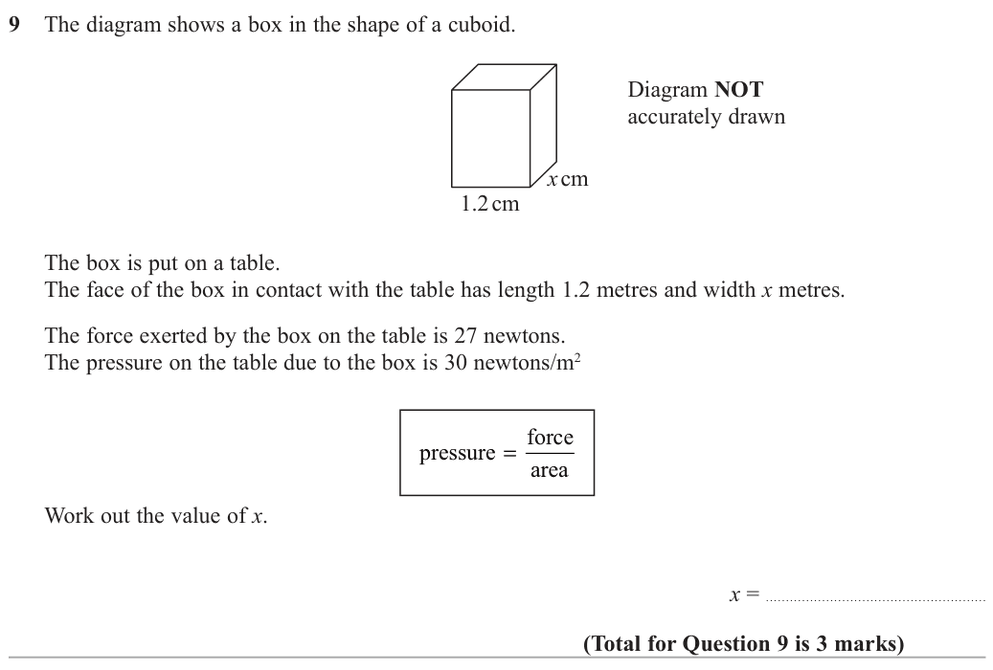
25. Jan 2020 P2HR · Q9 Medium 3 marksShow worked solution Calculate area \[
\text{pressure}=\frac{\text{force}}{\text{area}}
\]
\[
30=\frac{27}{\text{area}}
\]
\[
\text{area}=\frac{27}{30}=0.9\text{ m}^2
\]
The base area is \[
1.2x=0.9
\]
\[
x=\frac{0.9}{1.2}=0.75
\]
Final answer \(x=0.75\text{ m}\).
26. Jan 2020 P2H · Q10 Medium 3 marksShow worked solution Convert m/s to km/h multiply To convert m/s to km/h, multiply by \(3.6\).
\[
50\times3.6=180
\]
Final answer \(180\text{ km/h}\).
27. Specimen 4WM1H · Q5 Medium 3 marksShow worked solution Convert the time \[
24\text{ minutes}=\frac{24}{60}=0.4\text{ hours}
\]
\[
5\text{ hours }24\text{ minutes}=5.4\text{ hours}
\]
Calculate the speed \[
\text{speed}=\frac{3980}{5.4}=737.037\ldots
\]
Round the answer \[
737.037\ldots \approx 737
\]
Final answer \(737\text{ kilometres per hour}\).
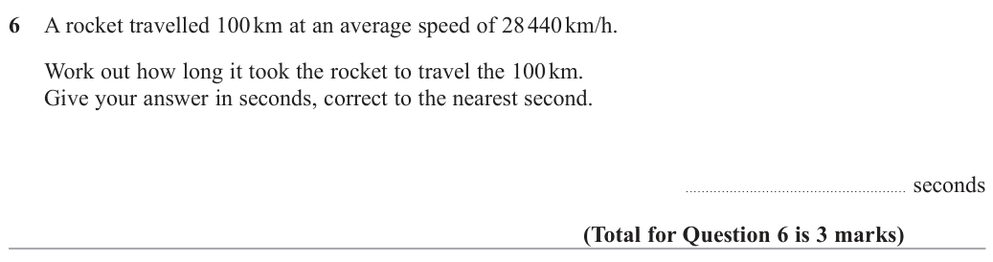
28. May-Nov 2020 P1H · Q6 Medium 3 marksShow worked solution Use \[
\text{time}=\frac{\text{distance}}{\text{speed}}
\]
\[
\text{time}=\frac{100}{28440}\text{ hours}
\]
Convert hours to seconds Convert hours to seconds: \[ \frac{100}{28440}\times 3600=12.658\ldots \]
To the nearest second To the nearest second, \[ 12.658\ldots \approx 13 \]
Final answer \(13\) seconds.
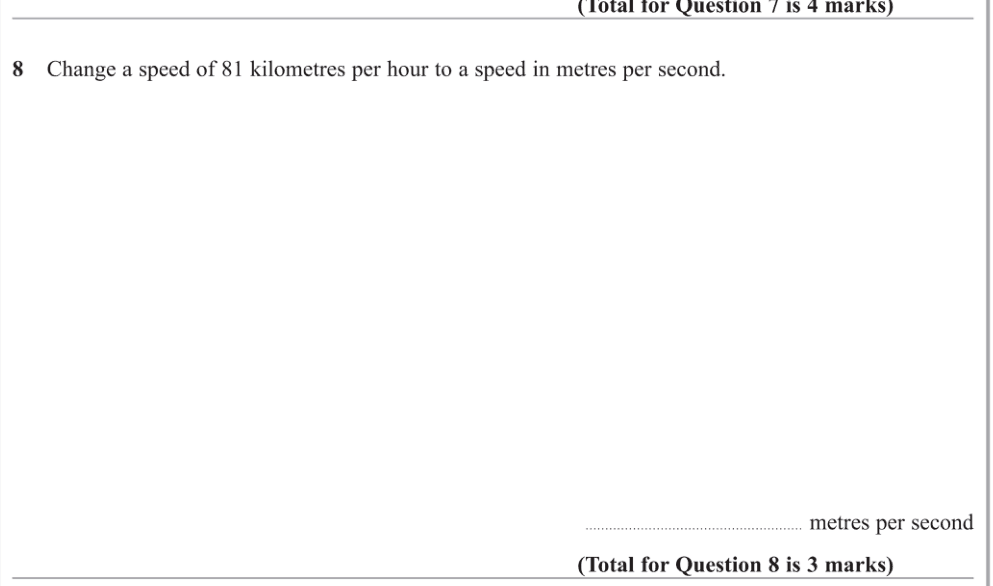
29. Specimen 4WM1H · Q8 Medium 3 marksShow worked solution Convert kilometres to metres \[
81\text{ km}=81000\text{ m}
\]
Convert hours to seconds \[
1\text{ hour}=3600\text{ seconds}
\]
Divide to find metres per second \[
\frac{81000}{3600}=22.5
\]
Final answer \(22.5\text{ metres per second}\).
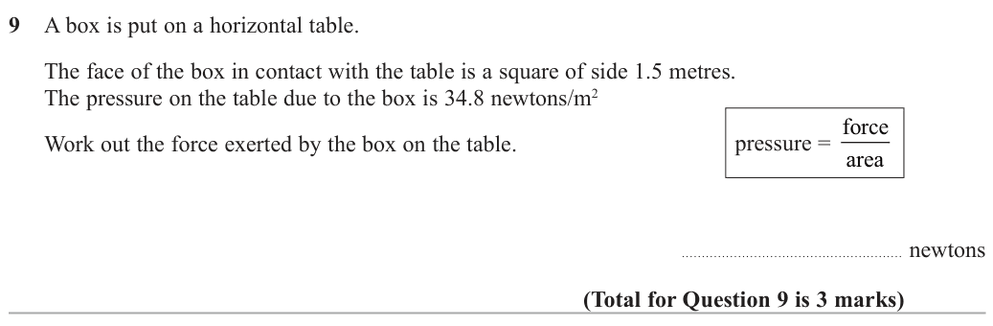
30. May-Nov 2020 P1HR · Q9 Medium 3 marksShow worked solution The area of the square The area of the square face is \[ 1.5\times 1.5=2.25\text{ m}^2 \]
Use \[
\text{pressure}=\frac{\text{force}}{\text{area}}
\]
Calculate area So \[ \text{force}=\text{pressure}\times \text{area} \]
\[
34.8\times 2.25=78.3
\]
Final answer \(78.3\text{ newtons}\).
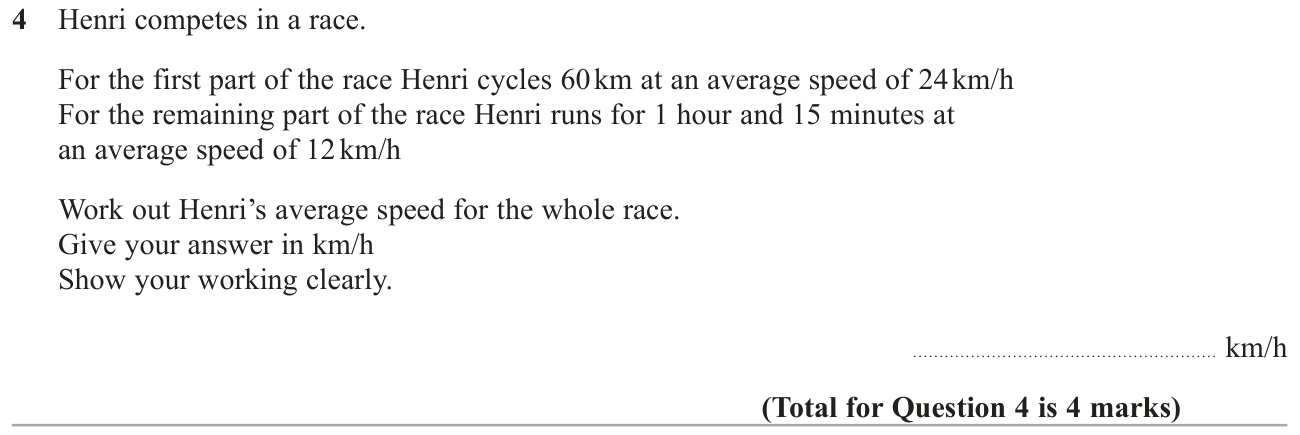
31. Jun 2026 P1H · Q4 Medium 4 marksShow worked solution Solution | Step 1 Cycling time: \(60\div24=2.5\) hours. Running time: \(1+15/60=1.25\) hours.
Time equals distance divided by speed.
Solution | Step 2 Running distance: \(12\times1.25=15\) km. Total distance: \(60+15=75\) km. Total time: \(2.5+1.25=3.75\) hours.
Combine the actual distances and times.
Solution | Step 3 \[\text{Average speed}=\frac{75}{3.75}=20\text{ km/h}.\]
Average speed is total distance divided by total time, not the mean of the two speeds.
Final answer \(20\text{ km/h}\)
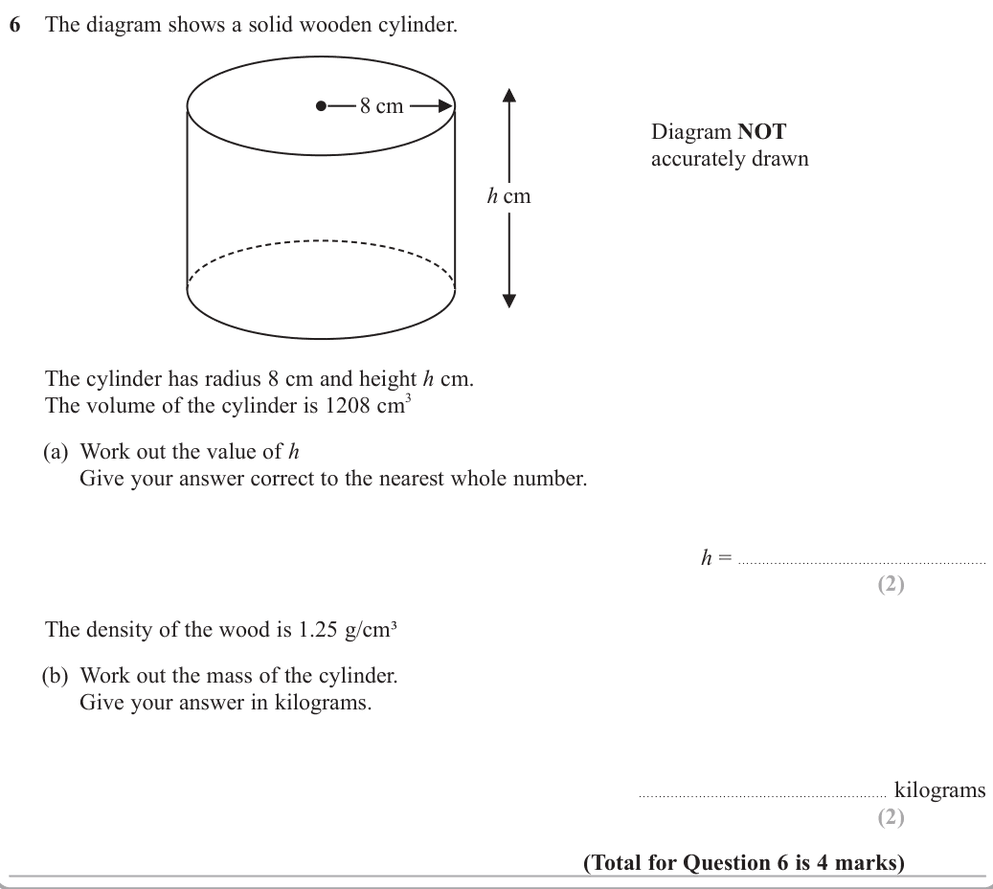
32. May 2024 P1HR · Q6 Medium 4 marksShow worked solution Evaluate fraction For the cylinder, \[ V=\pi r^2h \]
\[
1208=\pi(8)^2h
\]
\[
h=\frac{1208}{64\pi}=6.006\ldots
\]
Calculate value So, to the nearest whole number, \[ h=6 \]
Calculate volume For the mass, use the given volume: \[ \text{mass}=\text{density}\times \text{volume} \]
\[
1.25\times 1208=1510\text{ g}
\]
\[
1510\text{ g}=1.51\text{ kg}
\]
Final answer \(h=6\text{ cm}\), and the mass is \(1.51\text{ kg}\).
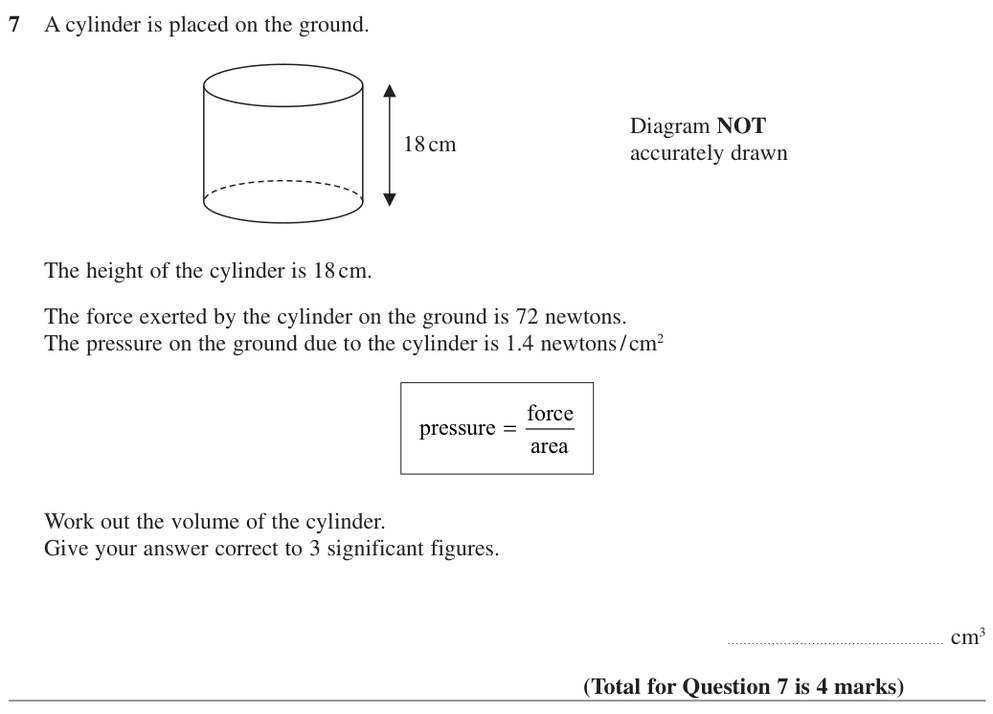
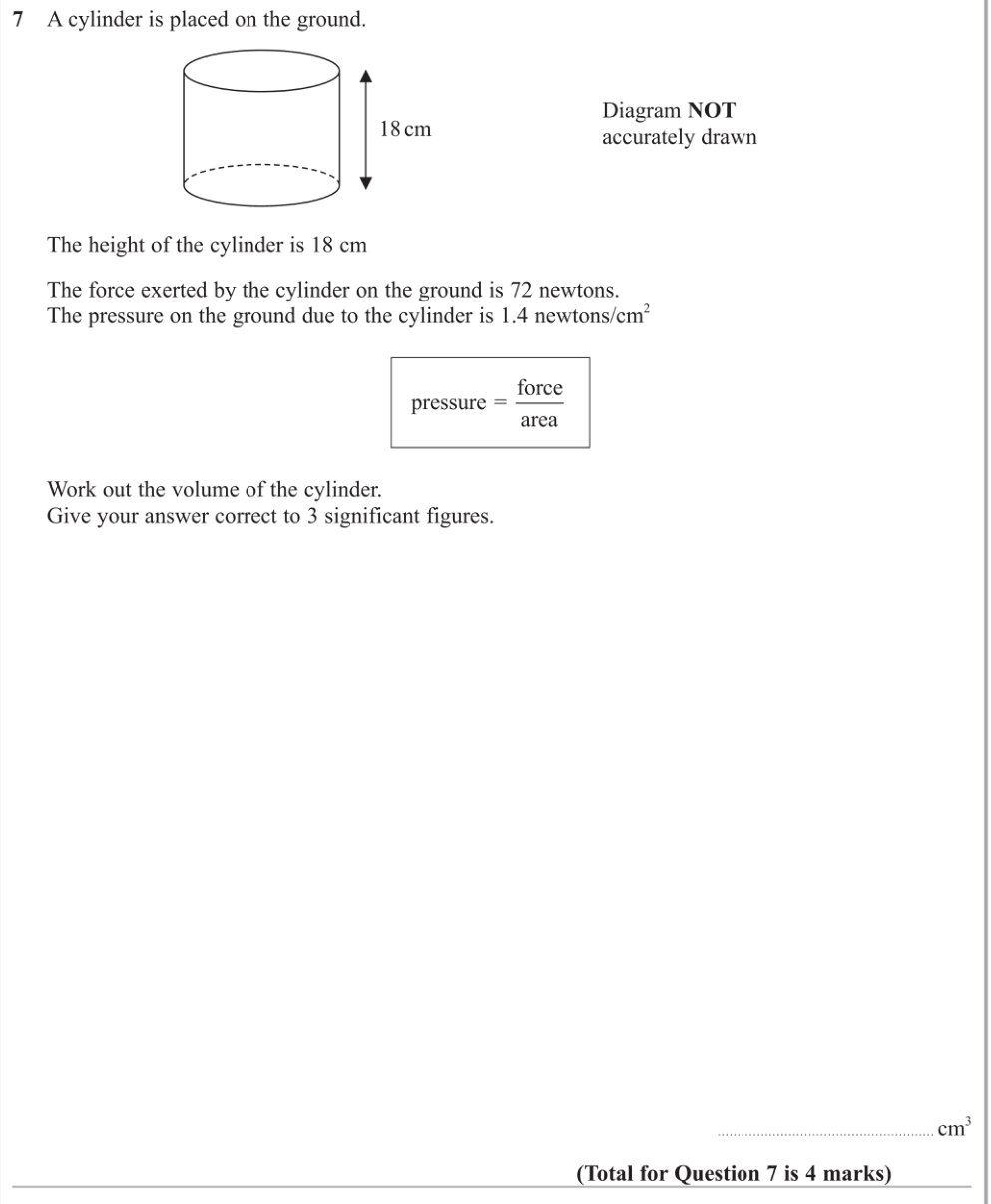
33. Jun 2022 P1H · Q7 Medium 4 marksShow worked solution Calculate area \[
\text{pressure}=\frac{\text{force}}{\text{area}}
\]
\[
1.4=\frac{72}{\text{area}}
\]
\[
\text{area}=\frac{72}{1.4}=51.428\ldots\text{ cm}^2
\]
The base area of the The base area of the cylinder is \(51.428\ldots\text{ cm}^2\).
Volume is \[
51.428\ldots\times18=925.714\ldots
\]
Final answer \(926\text{ cm}^3\) to 3 significant figures.
34. Jan 2022 P1HR · Q7 Medium 4 marksShow worked solution Calculate value First part: \[ \text{distance}=245\text{ km}, \qquad \text{time}=2.5\text{ h} \]
Second part Second part: \[ \text{time}=\frac{220}{80}=2.75\text{ h} \]
Third part Third part: \[ 50\text{ minutes}=\frac56\text{ h} \]
\[
\text{distance}=72\times\frac56=60\text{ km}
\]
Total distance Total distance: \[ 245+220+60=525\text{ km} \]
Total time Total time: \[ 2.5+2.75+\frac56=6.0833\ldots\text{ h} \]
Average speed Average speed: \[ \frac{525}{6.0833\ldots}=86.301\ldots \]
Final answer \(86.3\text{ km/h}\).
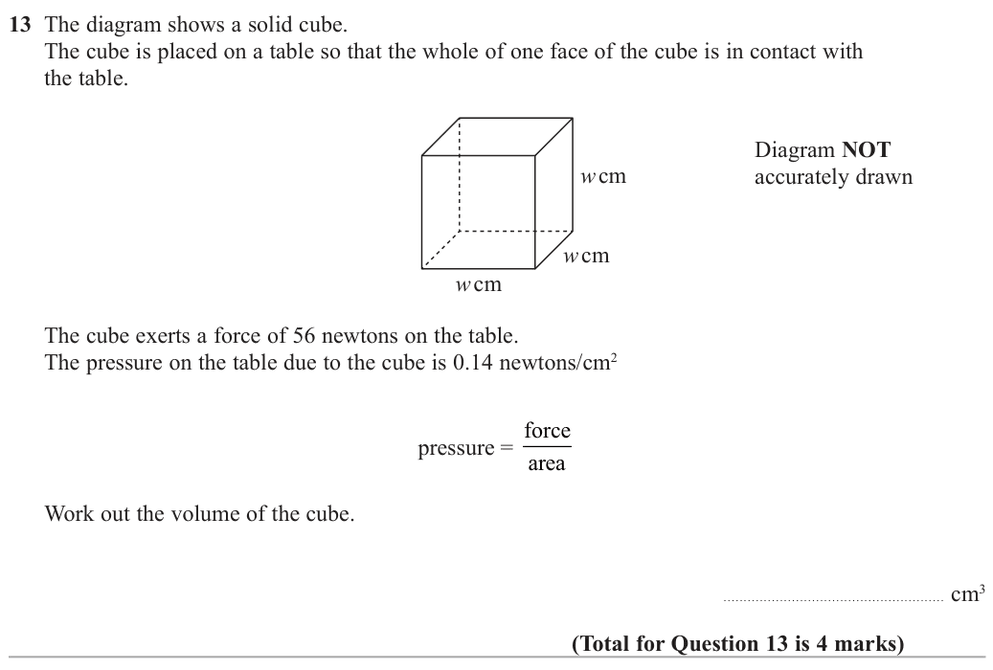
35. Jan 2020 P1H · Q13 Medium 4 marksShow worked solution Calculate area \[
\text{pressure}=\frac{\text{force}}{\text{area}}
\]
\[
0.14=\frac{56}{\text{area}}
\]
\[
\text{area}=\frac{56}{0.14}=400\text{ cm}^2
\]
The cube rests on one The cube rests on one square face, so \[ w^2=400 \]
\[
w=20
\]
Volume of the cube is \[
20^3=8000
\]
Final answer \(8000\text{ cm}^3\).
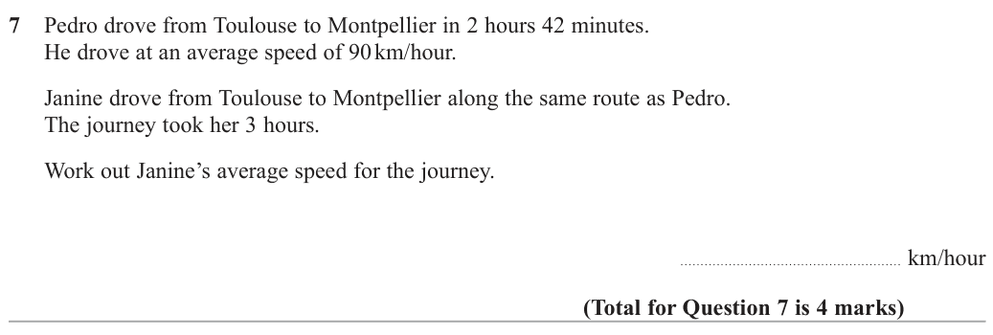
36. May-Nov 2020 P1HR · Q7 Medium 4 marksShow worked solution Pedro s time was Pedro's time was \[ 2\text{ h }42\text{ min}=2.7\text{ h} \]
Distance from Toulouse to Montpellier Distance from Toulouse to Montpellier: \[ 90\times 2.7=243\text{ km} \]
Calculate value Janine took 3 hours, so her average speed was \[ 243\div 3=81 \]
Final answer \(81\text{ km/hour}\).
37. Specimen 4WM2H · Q7 Medium 4 marksShow worked solution Calculate area \[
\text{pressure}=\frac{\text{force}}{\text{area}}
\]
Calculate area So the area of the base is
\[
\text{area}=\frac{72}{1.4}=51.428571\ldots
\]
The volume is \[
51.428571\ldots \times 18=925.714285\ldots
\]
Calculate volume Correct to 3 significant figures,
\[
925.714\ldots \approx 926
\]
Final answer \(926\text{ cm}^3\).
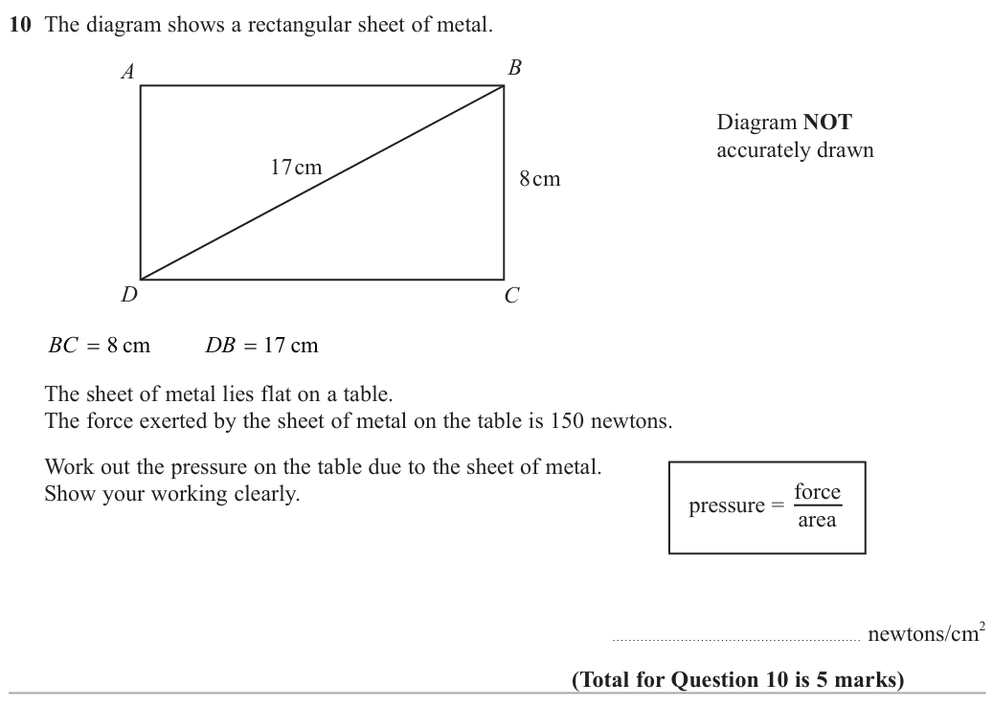
38. May 2025 4WM1HR · Q10 Hard 5 marksShow worked solution Use Pythagoras to find the Use Pythagoras to find the other side of the rectangle.
\[
DC=\sqrt{17^2-8^2}=15
\]
\[
\text{area}=15\times 8=120\text{ cm}^2
\]
\[
\text{pressure}=\frac{150}{120}=1.25
\]
Final answer \(1.25\) newtons/cm\(^2\).
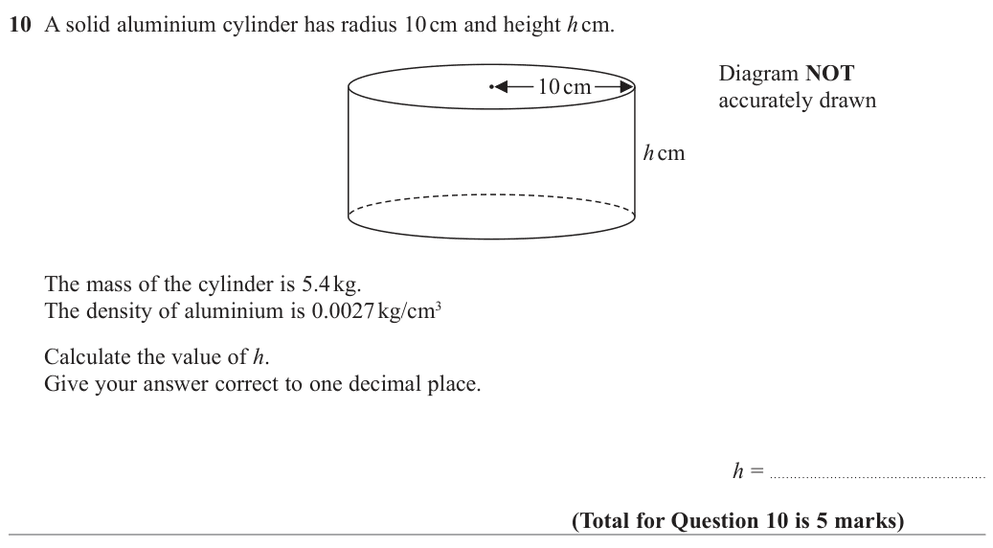
39. Nov 2021 P1H · Q10 Hard 5 marksShow worked solution Calculate volume The mass is \(5.4\text{ kg}\), and the density is \(0.0027\text{ kg/cm}^3\).
\[
\text{volume}=\frac{\text{mass}}{\text{density}}
=\frac{5.4}{0.0027}=2000\text{ cm}^3
\]
Evaluate fraction For the cylinder, \[ V=\pi r^2h \]
\[
2000=\pi(10)^2h
\]
\[
h=\frac{2000}{100\pi}=6.366\ldots
\]
Final answer \(6.4\text{ cm}\).
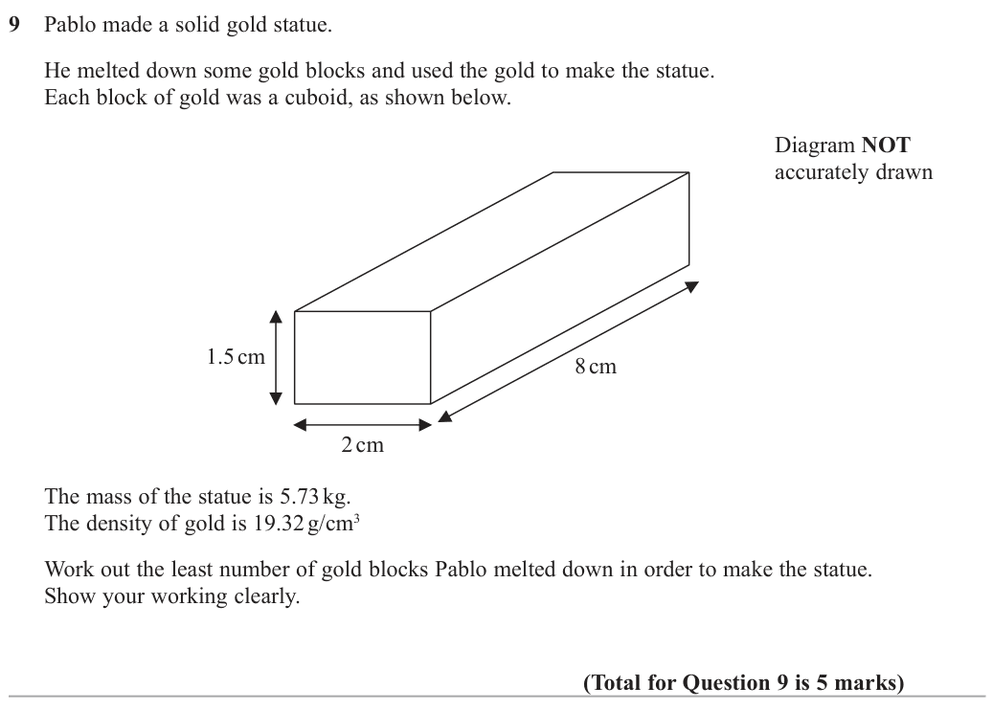
40. Jan 2020 P1HR · Q9 Hard 5 marksShow worked solution Convert the mass to grams Convert the mass to grams: \[ 5.73\text{ kg}=5730\text{ g} \]
Calculate volume Using \[ \text{density}=\frac{\text{mass}}{\text{volume}} \]
\[
\text{volume of gold}=\frac{5730}{19.32}=296.58\ldots\text{ cm}^3
\]
Volume of one cuboid block Volume of one cuboid block is \[ 1.5\times2\times8=24\text{ cm}^3 \]
Number of blocks needed is \[
\frac{296.58\ldots}{24}=12.35\ldots
\]
Pablo must have a whole Pablo must have a whole number of blocks, so he needs at least 13 blocks.
Final answer \(13\) blocks.
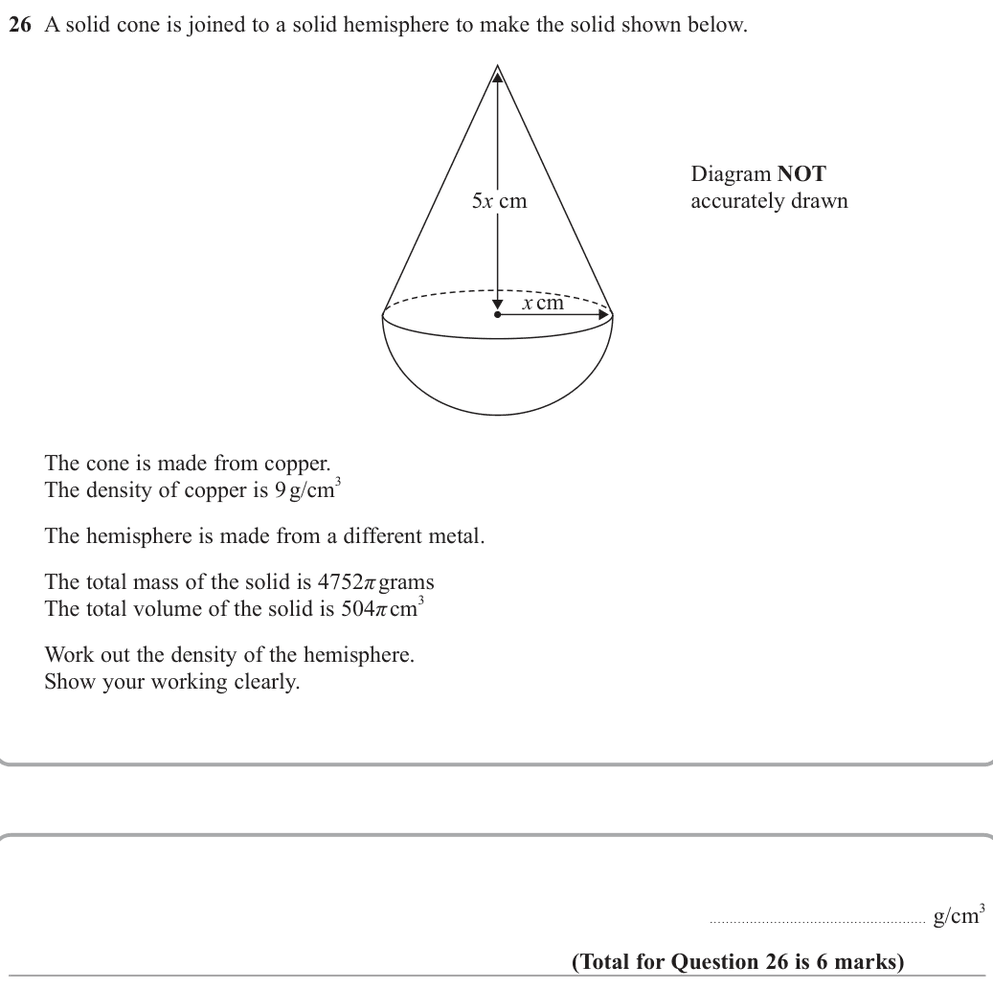
41. Nov 2025 P2H · Q26 Hard 6 marksShow worked solution Volume of cone Volume of cone:
\[
\frac13\pi x^2(5x)=\frac53\pi x^3
\]
Volume of hemisphere Volume of hemisphere:
\[
\frac23\pi x^3
\]
Total volume Total volume:
\[
\frac53\pi x^3+\frac23\pi x^3=504\pi
\]
\[
\frac73\pi x^3=504\pi
\]
\[
x^3=216
\]
\[
x=6
\]
Cone volume Cone volume:
\[
\frac53\pi(6)^3=360\pi
\]
Mass of copper cone Mass of copper cone:
\[
360\pi\times 9=3240\pi
\]
Mass of hemisphere Mass of hemisphere:
\[
4752\pi-3240\pi=1512\pi
\]
Hemisphere volume Hemisphere volume:
\[
\frac23\pi(6)^3=144\pi
\]
Density of the hemisphere Density of the hemisphere:
\[
\frac{1512\pi}{144\pi}=10.5
\]
Final answer \(10.5\text{ g/cm}^3\)
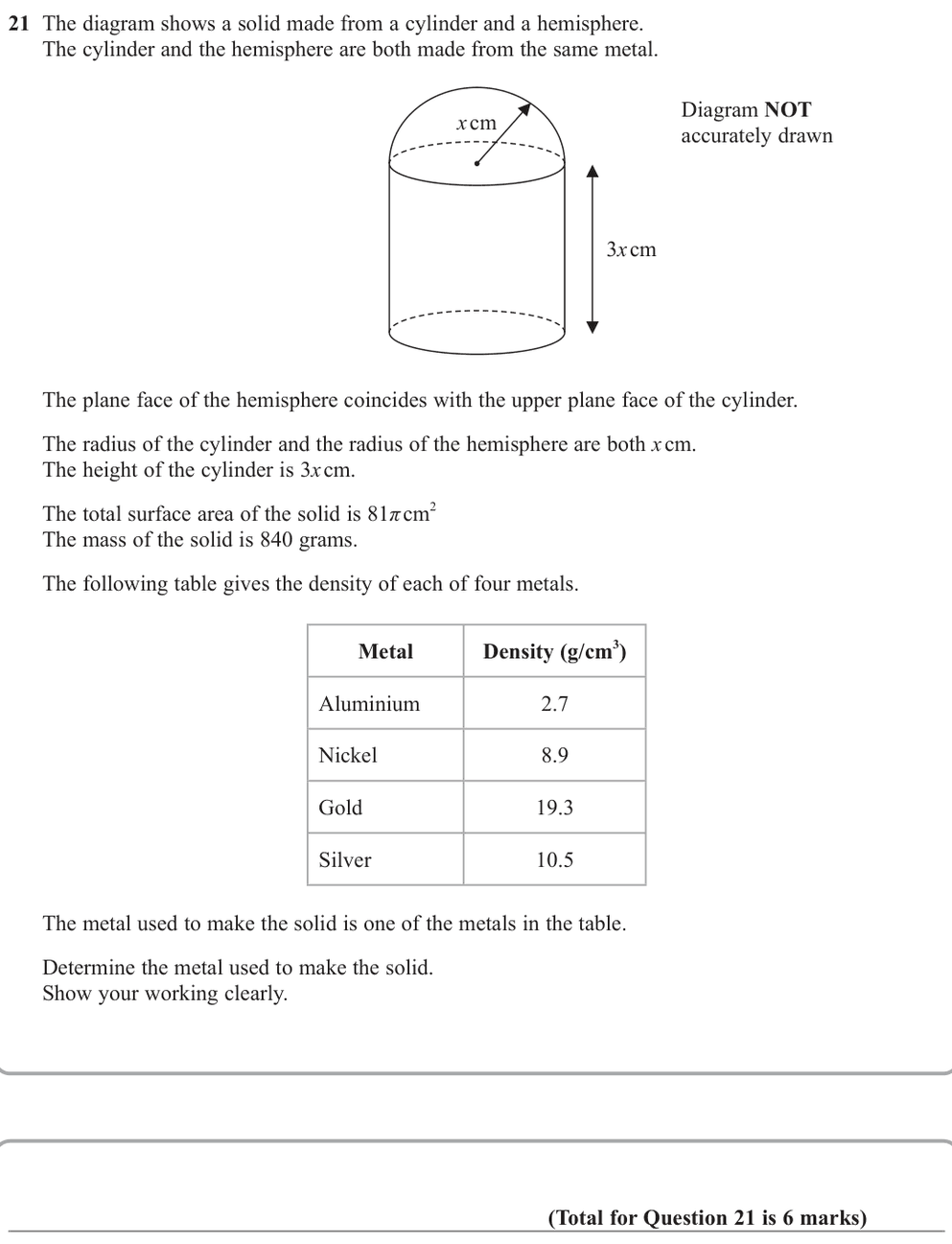
42. Jan 2022 P2HR · Q21 Hard 6 marksShow worked solution The outside surface area is The outside surface area is:
curved surface area of cylinder curved surface area of cylinder:
\[
2\pi x(3x)=6\pi x^2
\]
bottom of cylinder bottom of cylinder:
\[
\pi x^2
\]
curved surface area of hemisphere curved surface area of hemisphere:
\[
2\pi x^2
\]
Calculate value So
\[
6\pi x^2+\pi x^2+2\pi x^2=81\pi
\]
\[
9\pi x^2=81\pi
\]
\[
x^2=9
\]
\[
x=3
\]
Volume of the cylinder Volume of the cylinder:
\[
\pi x^2(3x)=3\pi x^3
\]
Volume of the hemisphere Volume of the hemisphere:
\[
\frac23\pi x^3
\]
Total volume Total volume:
\[
3\pi(3)^3+\frac23\pi(3)^3
\]
\[
=81\pi+18\pi=99\pi
\]
Density Density:
\[
\frac{840}{99\pi}=2.70\ldots
\]
Compare density This matches aluminium, whose density is \(2.7\text{ g/cm}^3\).
More IGCSE Maths 4MA1 topics Dr Eslam Ahmed Elite Mathematics · Questions classified by topic, solutions checked by Dr Eslam
 Elite Mathematics