Elite Mathematics / Linear / Topics / Probability Toolkit IGCSE · 4MA1 · Topic Probability Toolkit: past paper questions & worked solutions
Every Probability Toolkit question from the 4MA1 papers in our bank, 2020–2026, sorted from easiest to hardest. Try each one first, then open the worked solution.
42 questions
163 marks in total
61% of papers (33 of 54) include it
2/31/9 easy / medium / hard
Questions, easiest first Level is estimated from marks: 1–2 easy, 3–4 medium, 5+ hard.
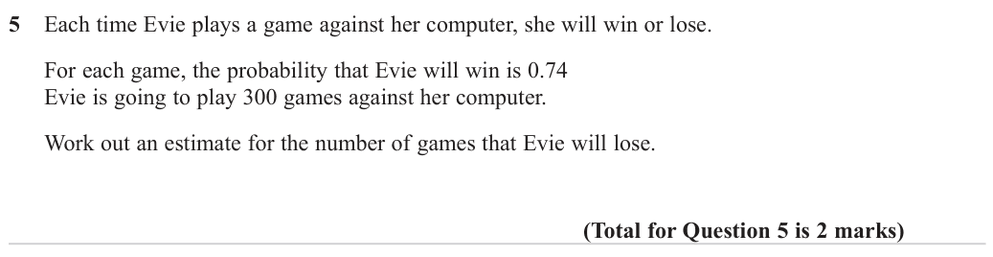
1. May 2023 P1HR · Q5 Easy 2 marksShow worked solution Probability of losing \[
1-0.74=0.26
\]
Estimate for 300 games \[
300\times0.26=78
\]
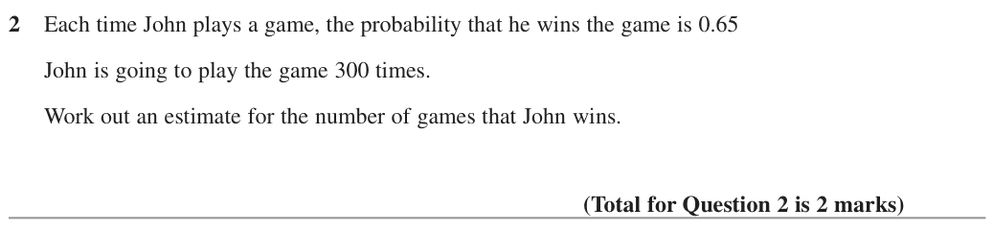
2. Jan 2022 P1HR · Q2 Easy 2 marksShow worked solution Expected number = probability × number of games \[
0.65\times300=195
\]
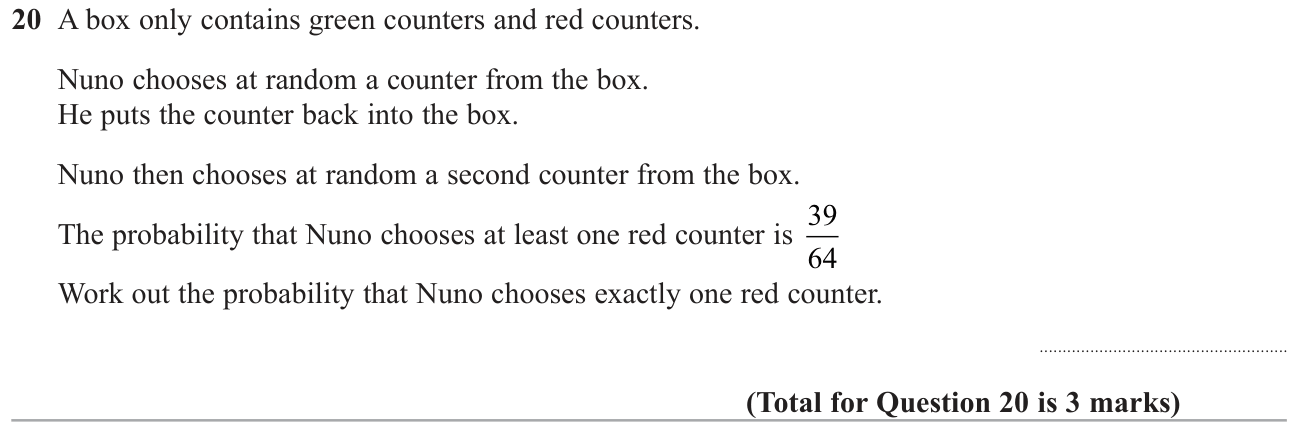
3. Jun 2026 P2H · Q20 Medium 3 marksShow worked solution Solution | Step 1 Let \(g=P(G)\). With replacement, the draws are independent. \[P(GG)=1-P(\text{at least one red})=1-\frac{39}{64}=\frac{25}{64}.\]
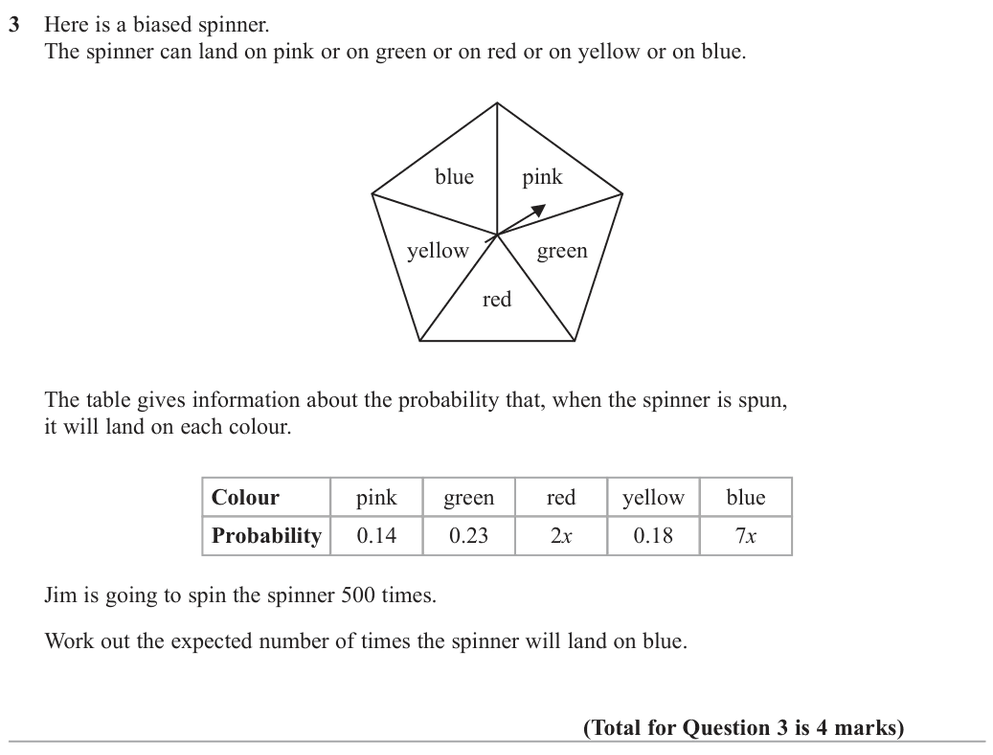
The complementary event to at least one red is two greens.
Solution | Step 2 \[g^2=\frac{25}{64}\quad\Rightarrow\quad g=\frac58,\qquad P(R)=1-\frac58=\frac38.\]
Multiply identical independent green probabilities and take the nonnegative root.
Solution | Step 3 \[P(\text{exactly one red})=P(RG)+P(GR)=\frac38\frac58+\frac58\frac38=\frac{30}{64}=\frac{15}{32}.\]
The two possible orders are mutually exclusive and must both be included.
Final answer \(\dfrac{15}{32}\)
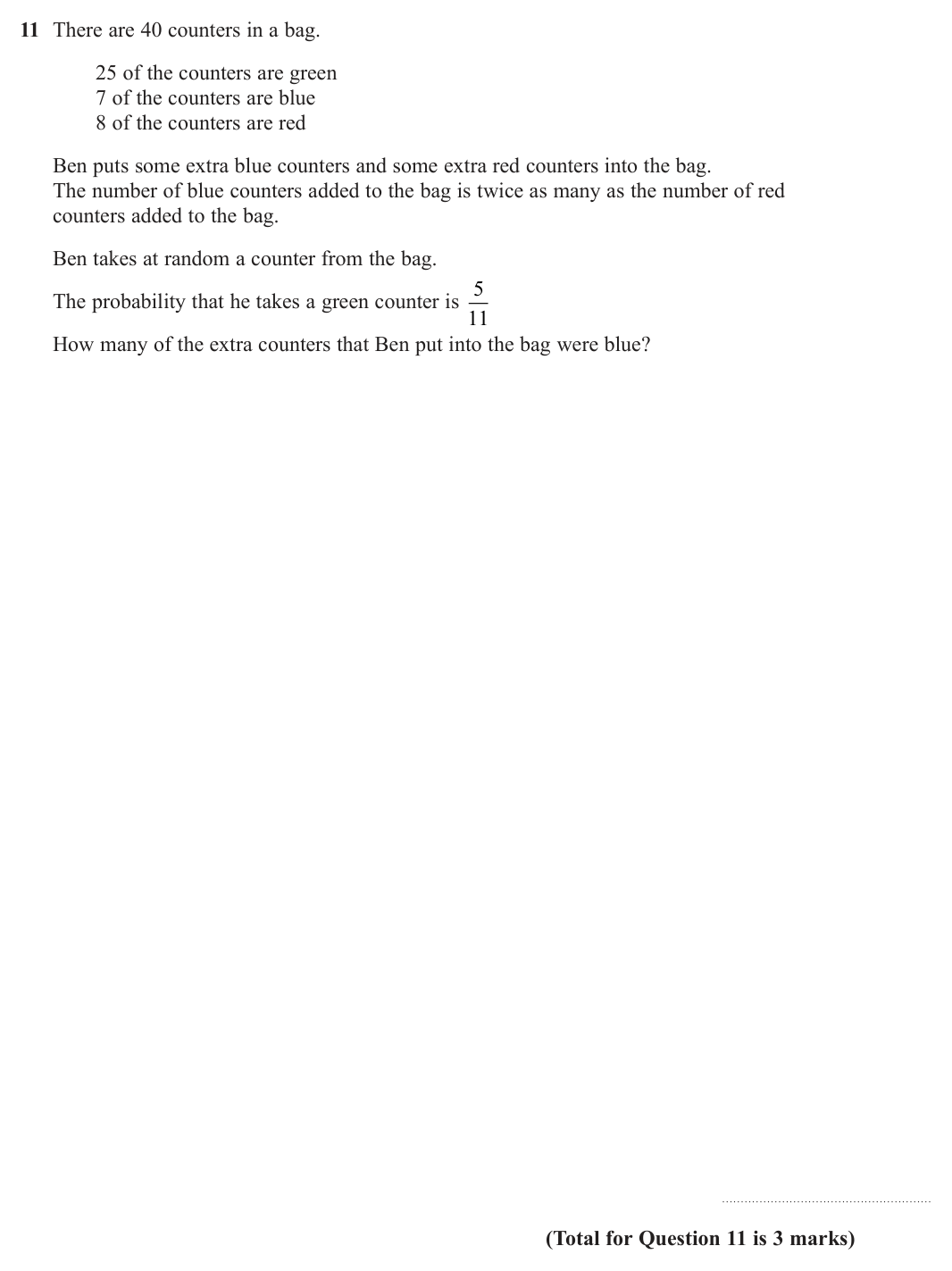
4. May 2026 4WM1H · Q11 Medium 3 marksShow worked solution Let r red be added Then \(2r\) blue are added and the total is \(40+3r\).
Use P(green) \[\frac{25}{40+3r}=\frac{5}{11}\Rightarrow 275=200+15r\Rightarrow r=5\]
Blue added \[2r=10\]
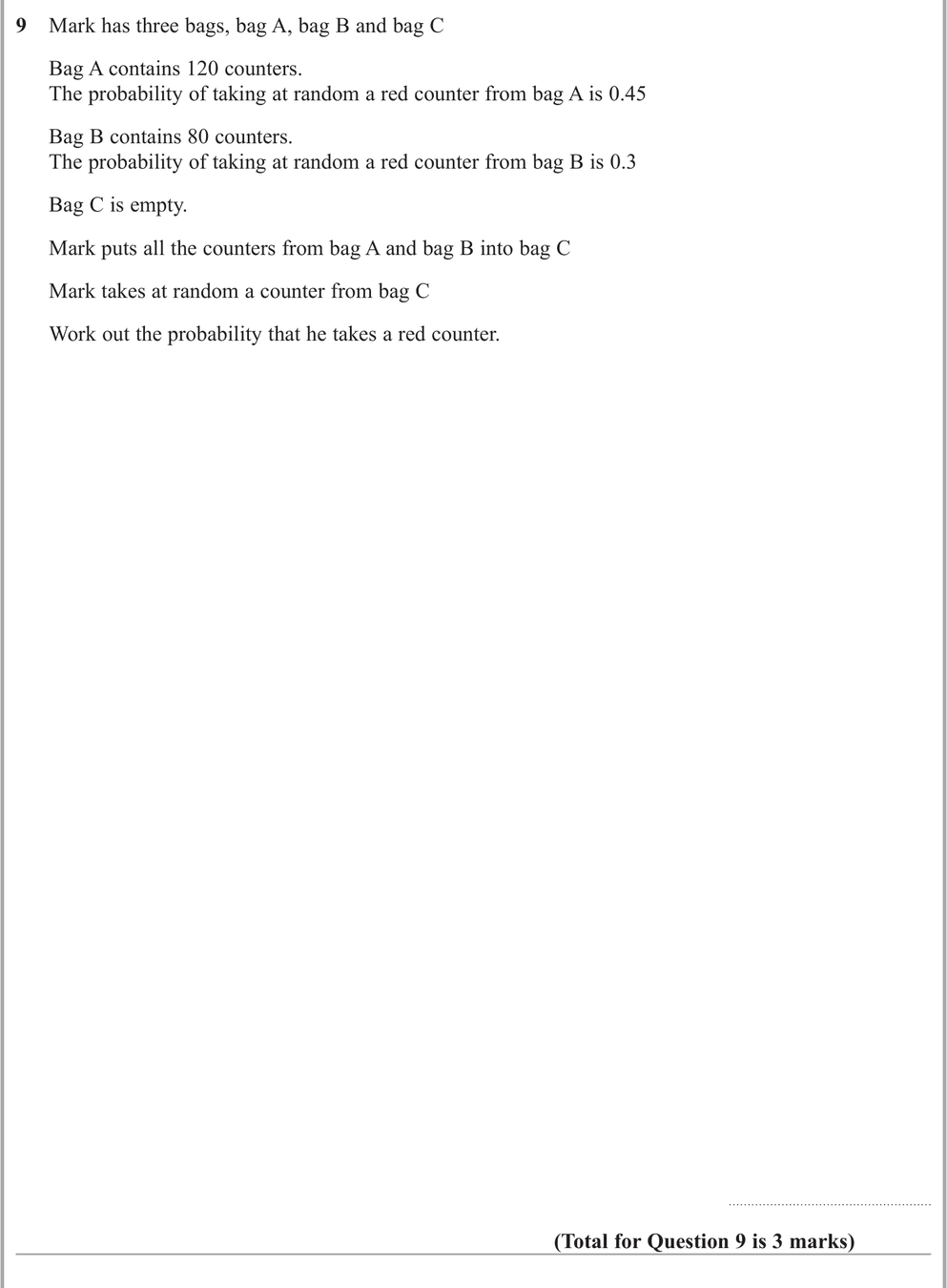
5. Nov 2025 P2H · Q9 Medium 3 marksShow worked solution Red counters in each bag Bag A: \(120\times0.45=54\). Bag B: \(80\times0.3=24\).
Probability of red from bag C Bag C has \(54+24=78\) red counters out of \(120+80=200\).
\[
\frac{78}{200}=0.39
\]
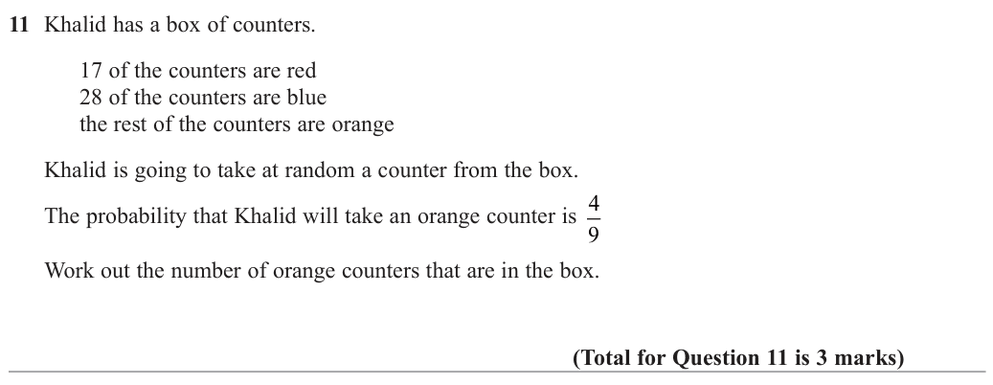
6. Jun 2025 P2H · Q11 Medium 3 marksShow worked solution Counters that are not orange \(17+28=45\) counters are not orange, and \(P(\text{not orange})=1-\frac49=\frac59\).
Total number of counters \[
\frac59\times T=45 \;\Rightarrow\; T=81
\]
Orange counters \[
81-45=36
\]
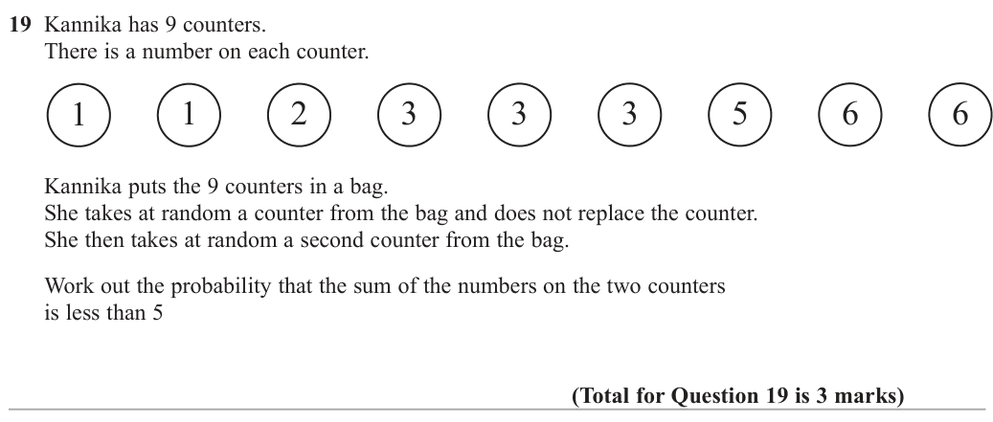
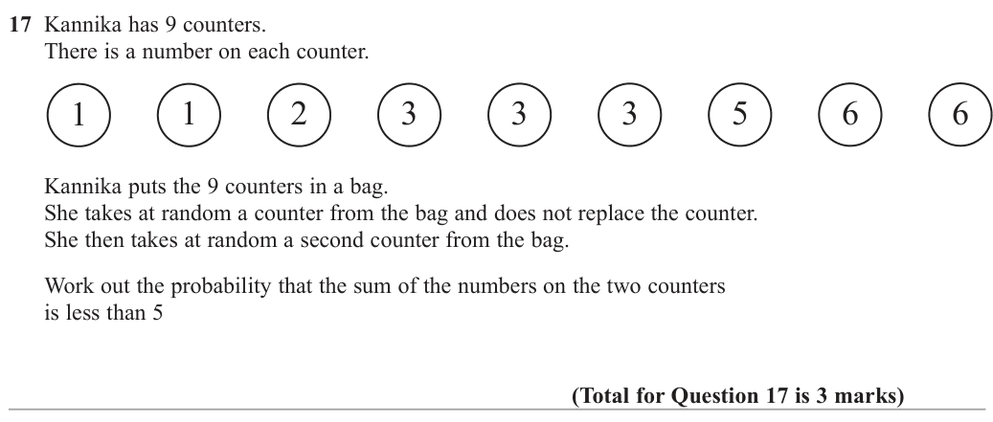
7. Jun 2025 P1HR · Q19 Medium 3 marksShow worked solution Pairs with a sum less than 5 The counters are \(1,1,2,3,3,3,5,6,6\). The only possible sums under \(5\) are \(1+1\), \(1+2\) and \(1+3\).
First counter, then second (no replacement) \[
P(1,1)=\frac29\times\frac18=\frac{2}{72}
\]
\[
P(1\text{ and }2)=2\times\frac29\times\frac18=\frac{4}{72},\qquad P(1\text{ and }3)=2\times\frac29\times\frac38=\frac{12}{72}
\]
Add the cases \[
\frac{2+4+12}{72}=\frac{18}{72}=\frac14
\]
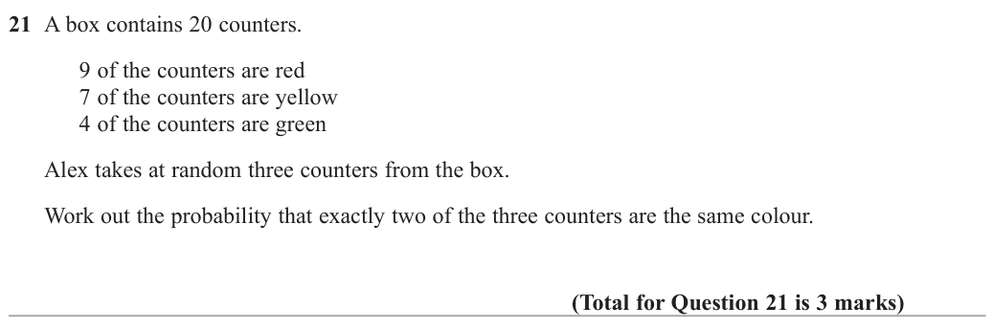
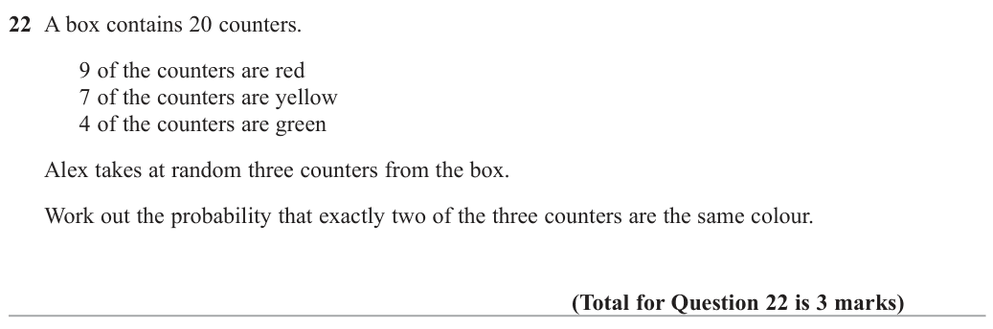
8. Jun 2025 P1H · Q21 Medium 3 marksShow worked solution There are \[
\binom{20}{3}=1140
\]
ways to choose 3 counters ways to choose 3 counters.
Exactly two counters are the Exactly two counters are the same colour:
\[
\binom{9}{2}(11)+\binom{7}{2}(13)+\binom{4}{2}(16)
\]
\[
=36(11)+21(13)+6(16)
\]
\[
=396+273+96=765
\]
Calculate probability So the probability is
\[
\frac{765}{1140}=\frac{51}{76}
\]
Final answer \(\frac{51}{76}\)
9. May 2025 4WM1HR · Q17 Medium 3 marksShow worked solution The counters are \[
1,\ 1,\ 2,\ 3,\ 3,\ 3,\ 5,\ 6,\ 6
\]
There are \[
\binom{9}{2}=36
\]
ways to choose two counters ways to choose two counters.
Calculate probability For a sum less than \(5\), the pairs are:
\[
(1,1),\quad (1,2),\quad (1,3)
\]
Counting the repeated counters gives \[
1+2+6=9
\]
Calculate probability So
\[
P(\text{sum}<5)=\frac{9}{36}=\frac14
\]
10. May 2025 4WM1H · Q22 Medium 3 marksShow worked solution Total ways to choose counters Total ways to choose \(3\) counters:
\[
\binom{20}{3}=1140
\]
Exactly two red Exactly two red:
\[
\binom{9}{2}\binom{11}{1}=396
\]
Exactly two yellow Exactly two yellow:
\[
\binom{7}{2}\binom{13}{1}=273
\]
Exactly two green Exactly two green:
\[
\binom{4}{2}\binom{16}{1}=96
\]
Favourable outcomes Favourable outcomes:
\[
396+273+96=765
\]
\[
P=\frac{765}{1140}=\frac{51}{76}
\]
Final answer \(\frac{51}{76}\)
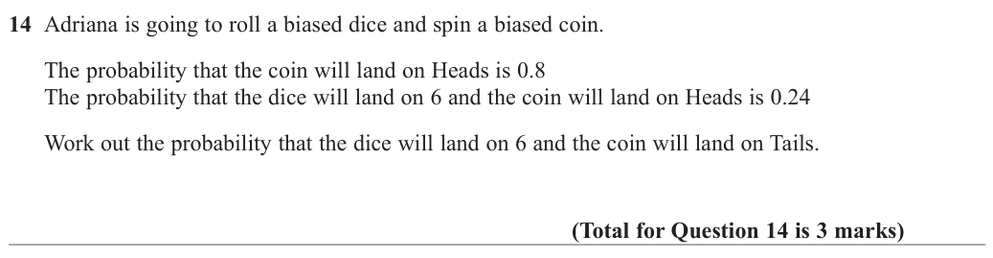
11. Jun 2024 P2HR · Q14 Medium 3 marksShow worked solution Find the probability of a 6 The dice and the coin are independent:
\[
P(6)\times0.8=0.24 \;\Rightarrow\; P(6)=0.3
\]
6 and Tails \(P(\text{Tails})=1-0.8=0.2\), so
\[
0.3\times0.2=0.06
\]
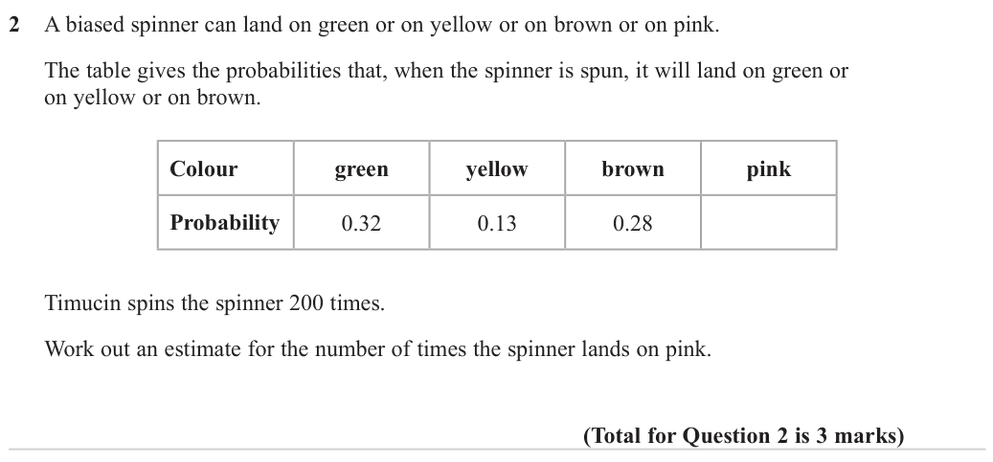
12. Jun 2023 P2H · Q2 Medium 3 marksShow worked solution Probability of pink \[
1-(0.32+0.13+0.28)=1-0.73=0.27
\]
Estimate for 200 spins \[
200\times0.27=54
\]
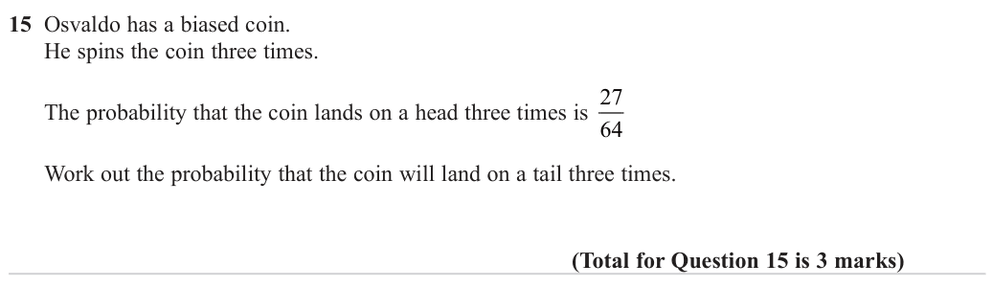
13. Jun 2023 P2HR · Q15 Medium 3 marksShow worked solution Find the probability of a head \[
P(H)^3=\frac{27}{64} \;\Rightarrow\; P(H)=\sqrt[3]{\frac{27}{64}}=\frac34
\]
Three tails \(P(T)=1-\frac34=\frac14\), so
\[
P(TTT)=\left(\frac14\right)^3=\frac{1}{64}
\]
Final answer \(\dfrac{1}{64}\)
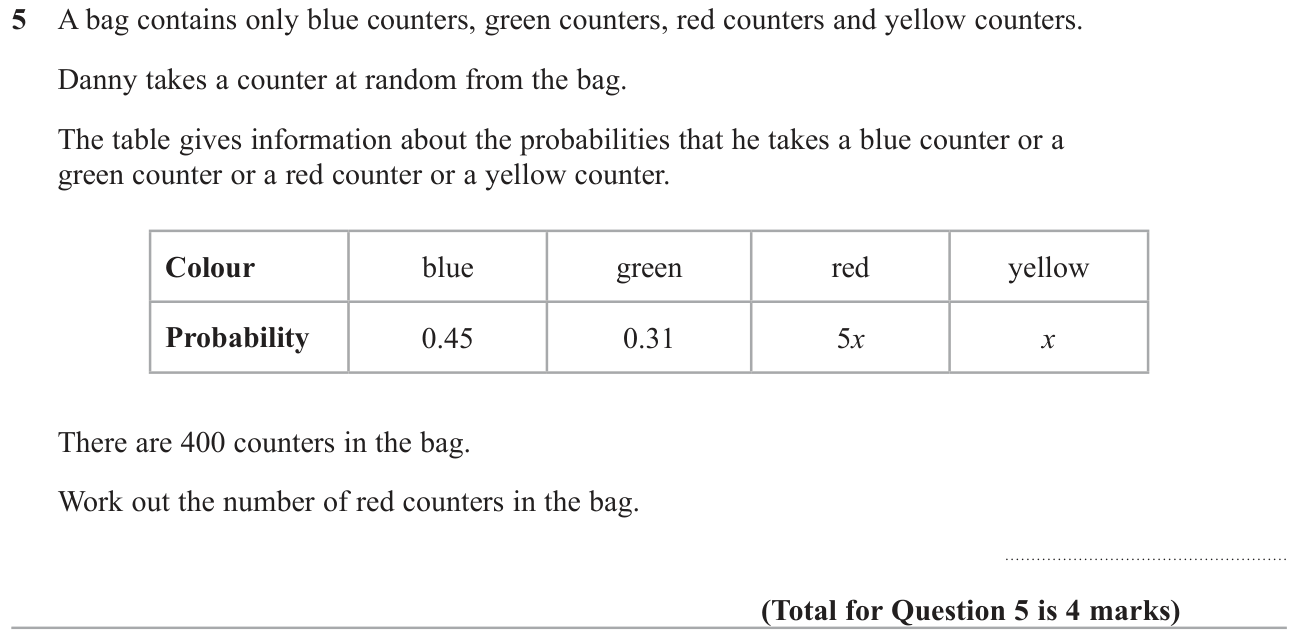
14. Jun 2026 P1HR · Q5 Medium 4 marksShow worked solution Solution | Step 1 \[0.45+0.31+5x+x=1.\]
The four colours are mutually exclusive and exhaust all counters, so their probabilities sum to 1.
Solution | Step 2 \[6x=1-0.76=0.24,\qquad x=0.04.\]
Collect the unknown probabilities and solve the linear equation.
Solution | Step 3 \[P(\text{red})=5(0.04)=0.20,\qquad N_{\text{red}}=400(0.20)=80.\]
Multiply the red proportion by the total number of counters.
Final answer \(80\) red counters
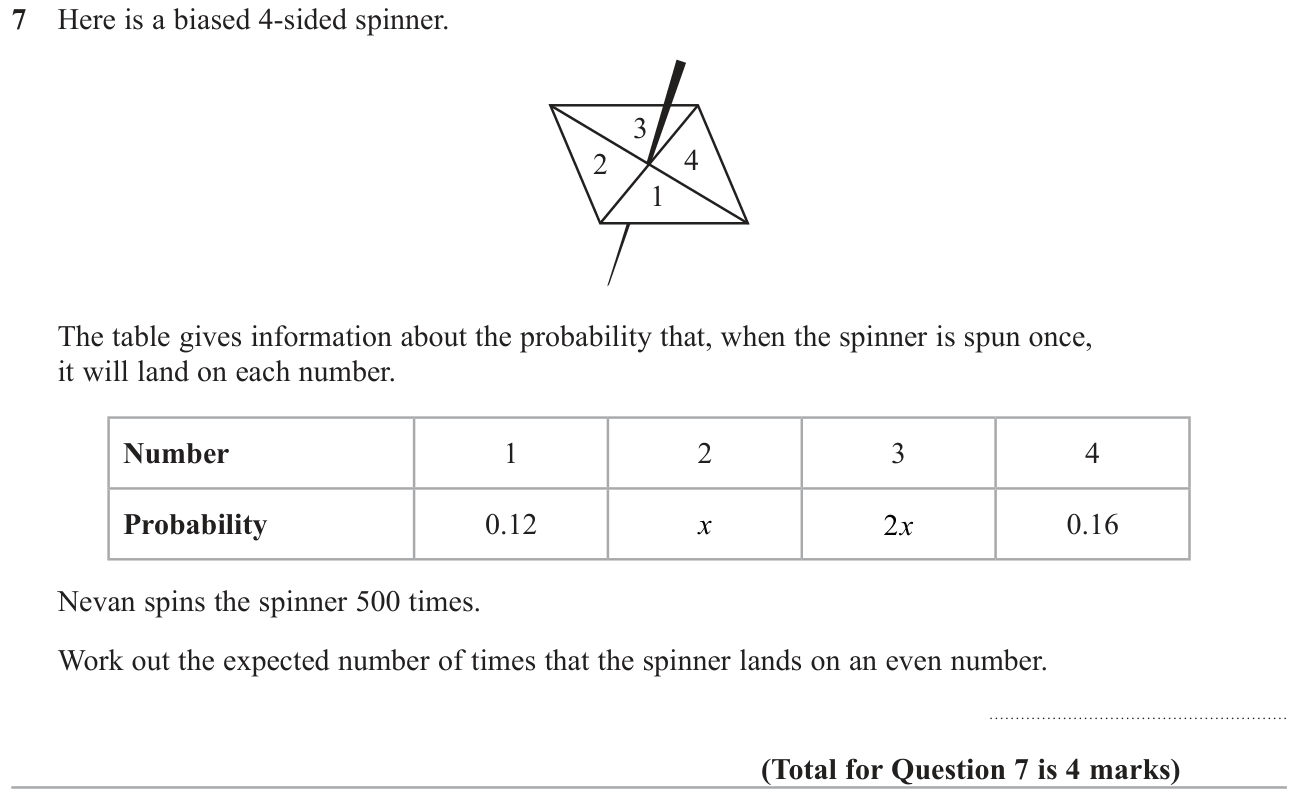
15. Jun 2026 P1H · Q7 Medium 4 marksShow worked solution Solution | Step 1 \[0.12+x+2x+0.16=1\implies3x=0.72\implies x=0.24.\]
The four exhaustive outcome probabilities sum to 1.
Solution | Step 2 \[P(\text{even})=P(2)+P(4)=0.24+0.16=0.40.\]
The events 2 and 4 are mutually exclusive.
Solution | Step 3 \[\text{Expected number}=500\times0.40=200.\]
Multiply the number of spins by the probability of an even result.
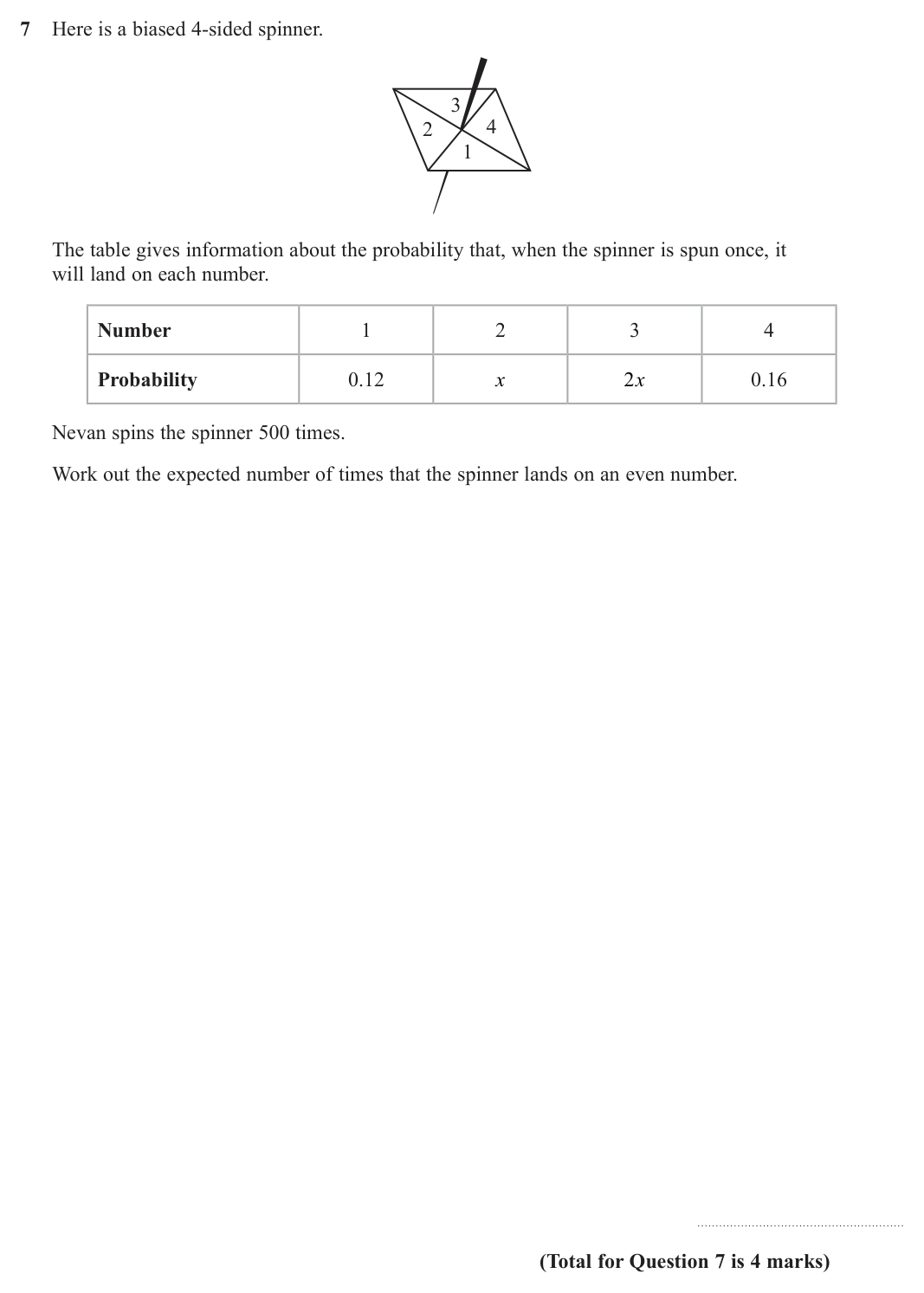
16. May 2026 4WM1H · Q7 Medium 4 marksShow worked solution Probabilities add to 1 \[0.12+x+2x+0.16=1\Rightarrow 3x=0.72\Rightarrow x=0.24\]
Even numbers are 2 and 4 \[P(\text{even})=0.24+0.16=0.40\]
Expected number \[500\times0.40=200\]
17. May 2025 4WM1H · Q3 Medium 4 marksShow worked solution Calculate probability The probabilities add to \(1\).
\[
0.14+0.23+2x+0.18+7x=1
\]
\[
0.55+9x=1
\]
\[
x=0.05
\]
The probability of blue is \[
7x=7(0.05)=0.35
\]
Expected number of blue results Expected number of blue results:
\[
500\times0.35=175
\]
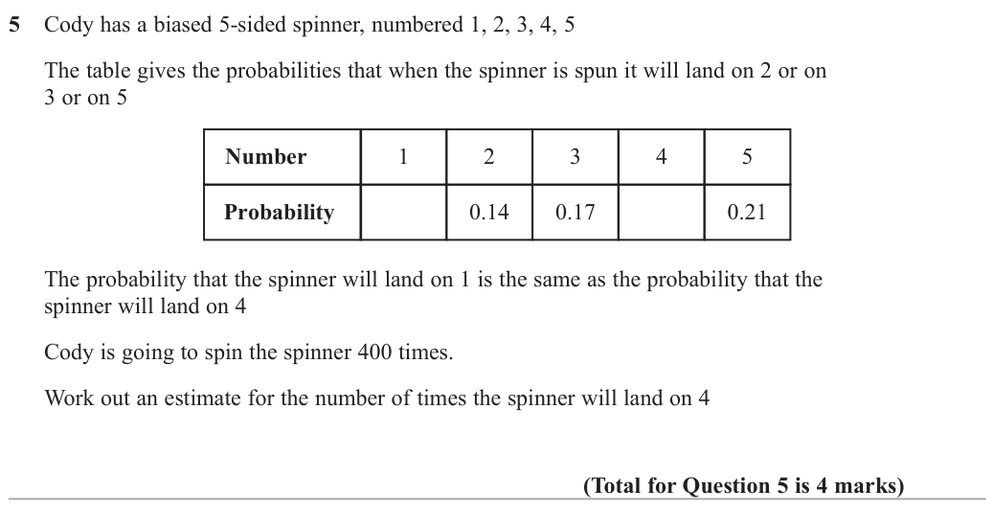
18. Nov 2024 P2H · Q5 Medium 4 marksShow worked solution Probabilities of 1 and 4 together \[
1-(0.14+0.17+0.21)=1-0.52=0.48
\]
They are equal \[
P(4)=0.48\div2=0.24
\]
Estimate for 400 spins \[
400\times0.24=96
\]
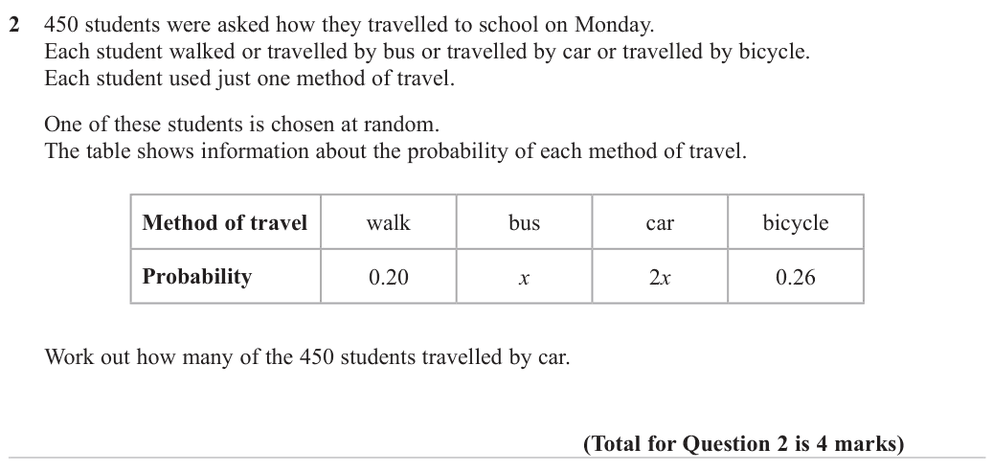
19. May 2024 P1H · Q2 Medium 4 marksShow worked solution Find x \[
0.20+x+2x+0.26=1 \;\Rightarrow\; 3x=0.54 \;\Rightarrow\; x=0.18
\]
Probability of travelling by car \[
2x=0.36
\]
Number of students \[
450\times0.36=162
\]
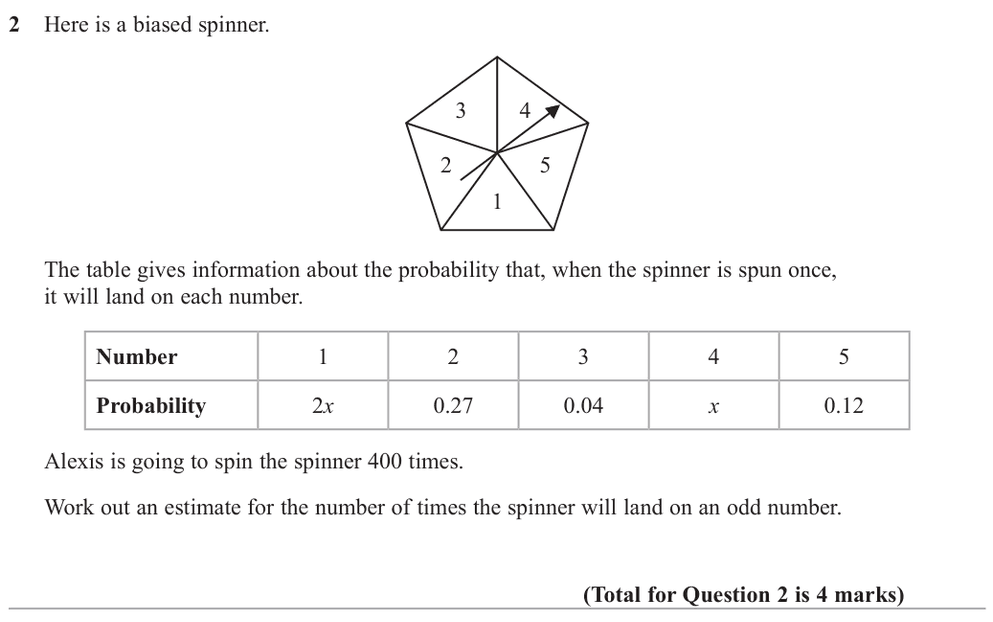
20. May 2024 P1HR · Q2 Medium 4 marksShow worked solution Find x \[
2x+0.27+0.04+x+0.12=1 \;\Rightarrow\; 3x=0.57 \;\Rightarrow\; x=0.19
\]
Probability of an odd number (1, 3 or 5) \[
2x+0.04+0.12=0.38+0.04+0.12=0.54
\]
Estimate for 400 spins \[
400\times0.54=216
\]
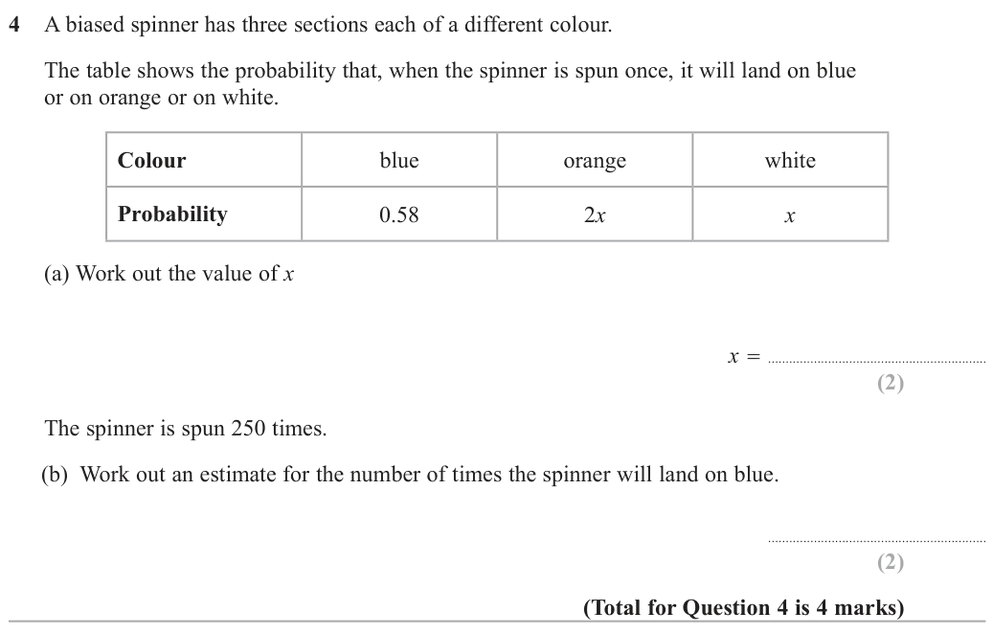
21. Nov 2023 P1H · Q4 Medium 4 marksShow worked solution (a) Probabilities add to 1 \[
0.58+2x+x=1 \;\Rightarrow\; 3x=0.42 \;\Rightarrow\; x=0.14
\]
(b) Estimate for blue in 250 spins \[
250\times0.58=145
\]
Final answer (a) \(x=0.14\) (b) \(145\)
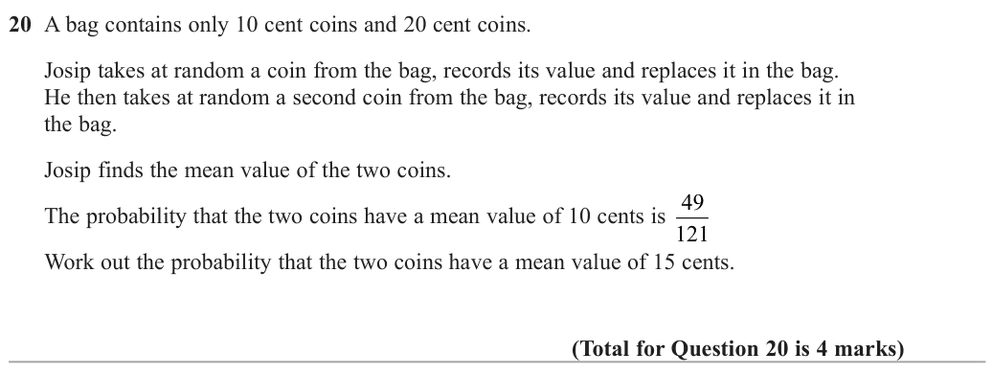
22. Nov 2023 P1H · Q20 Medium 4 marksShow worked solution Let the probability of taking Let the probability of taking a 10 cent coin be \(p\).
The mean is 10 cents The mean is 10 cents only when both coins are 10 cent coins.
\[
p^2=\frac{49}{121}
\]
\[
p=\frac{7}{11}
\]
Calculate probability So the probability of taking a 20 cent coin is
\[
1-\frac{7}{11}=\frac{4}{11}
\]
The mean is 15 cents The mean is 15 cents when one coin is 10 cents and the other is 20 cents.
There are two possible orders There are two possible orders:
\[
P(10,20)+P(20,10)
\]
\[
=\frac{7}{11}\cdot\frac{4}{11}+\frac{4}{11}\cdot\frac{7}{11}
\]
\[
=\frac{56}{121}
\]
Final answer \(\frac{56}{121}\)
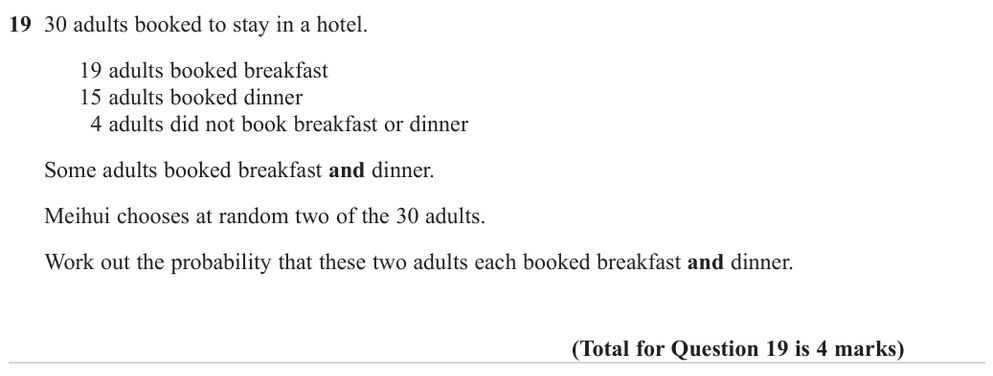
23. Jun 2023 P2HR · Q19 Medium 4 marksShow worked solution Adults who booked breakfast and dinner \(30-4=26\) adults booked at least one meal.
\[
n(B\cap D)=19+15-26=8
\]
Choose two of them (without replacement) \[
\frac{8}{30}\times\frac{7}{29}=\frac{56}{870}=\frac{28}{435}
\]
Final answer \(\dfrac{28}{435}\)
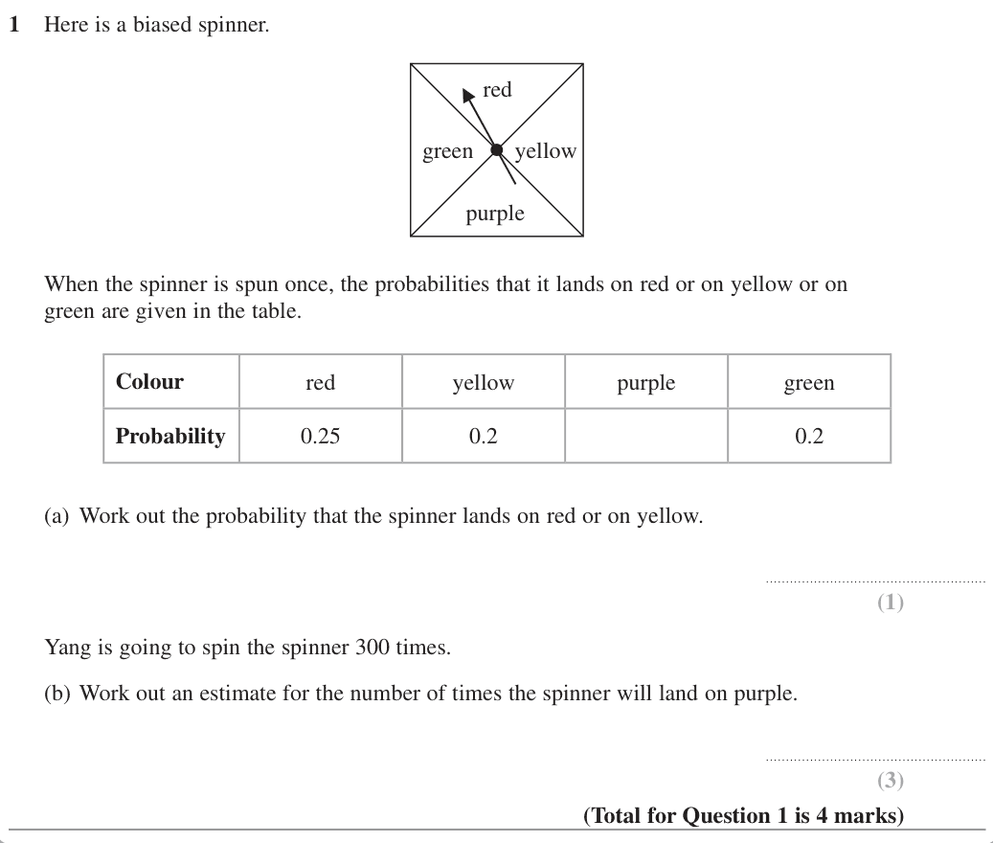
24. Jun 2022 P1HR · Q1 Medium 4 marksShow worked solution (a) Red or yellow \[
0.25+0.2=0.45
\]
(b) Probability of purple \[
1-(0.25+0.2+0.2)=0.35
\]
(b) Estimate for 300 spins \[
300\times0.35=105
\]
Final answer (a) \(0.45\) (b) \(105\)
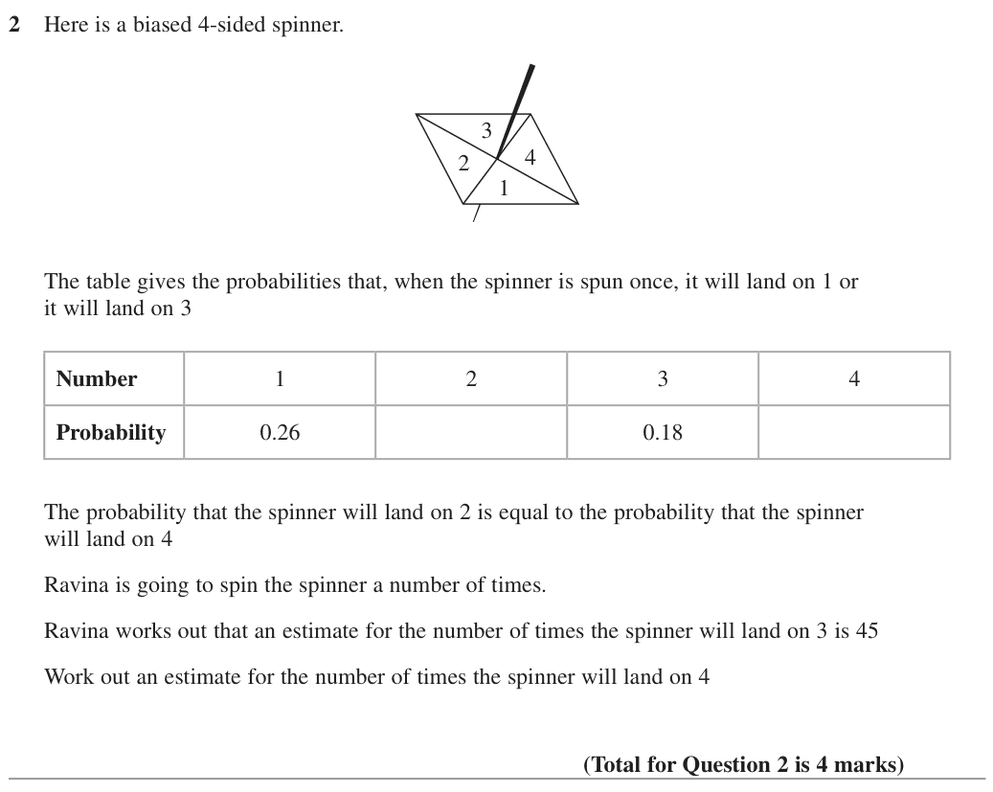
25. Jun 2022 P1H · Q2 Medium 4 marksShow worked solution Probabilities of landing on 2 and on 4 The probabilities add to \(1\), and \(P(2)=P(4)\):
\[
1-(0.26+0.18)=0.56,\qquad P(4)=0.56\div2=0.28
\]
Number of spins An estimate of \(45\) for the number 3 means
\[
0.18\times n=45 \;\Rightarrow\; n=250
\]
Estimate for landing on 4 \[
250\times0.28=70
\]
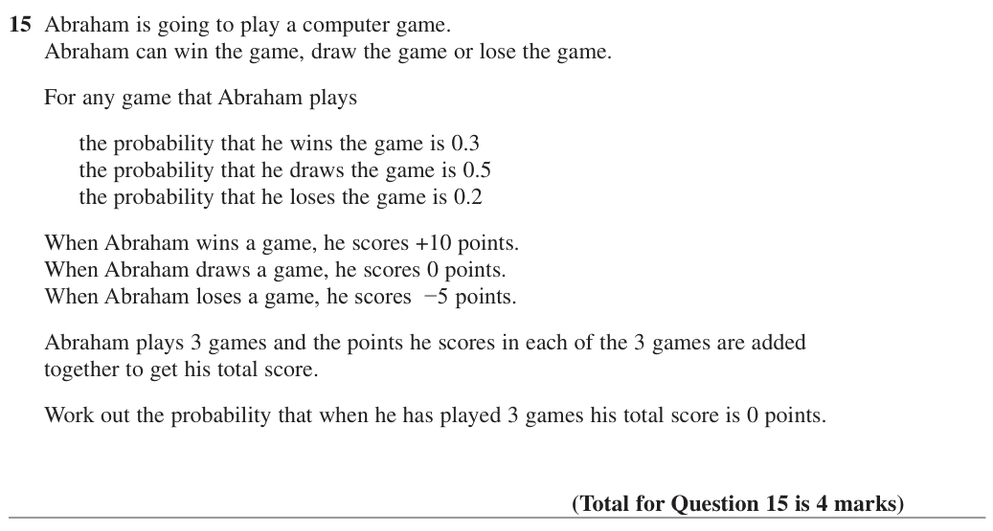
26. Jun 2022 P1H · Q15 Medium 4 marksShow worked solution Ways to score a total of 0 Three draws (\(0+0+0\)), or one win and two losses (\(10-5-5=0\)) in any order.
Three draws \[
0.5^3=0.125
\]
One win and two losses (3 orders) \[
3\times0.3\times0.2\times0.2=0.036
\]
Add the cases \[
0.125+0.036=0.161
\]
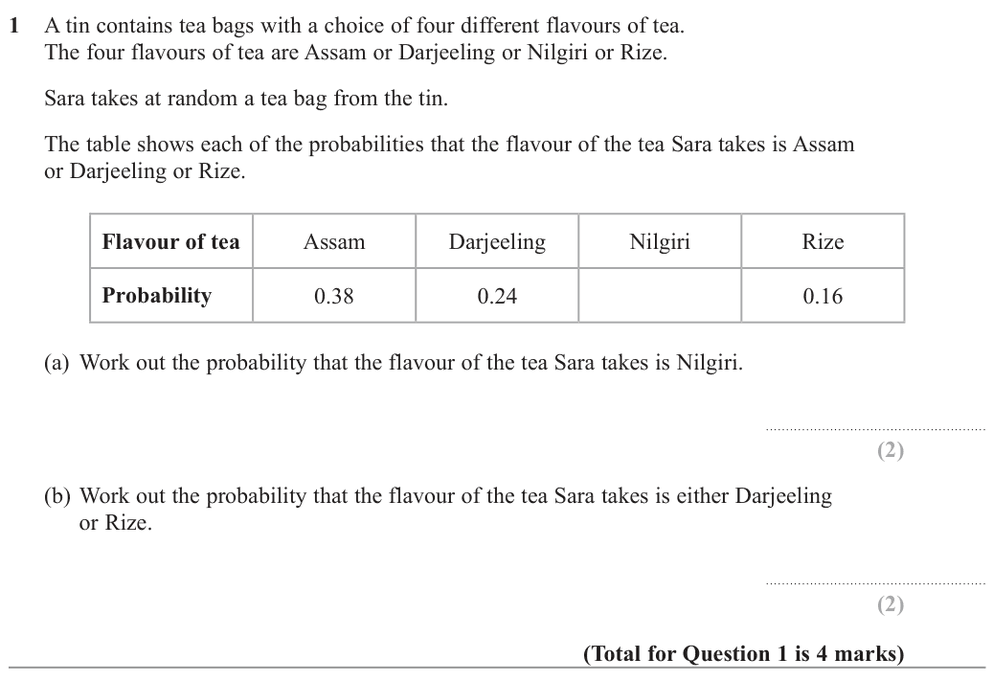
27. Jan 2022 P2HR · Q1 Medium 4 marksShow worked solution (a) Probabilities add to 1 \[
P(\text{Nilgiri})=1-(0.38+0.24+0.16)=1-0.78=0.22
\]
(b) Darjeeling or Rize \[
0.24+0.16=0.40
\]
Final answer (a) \(0.22\) (b) \(0.4\)
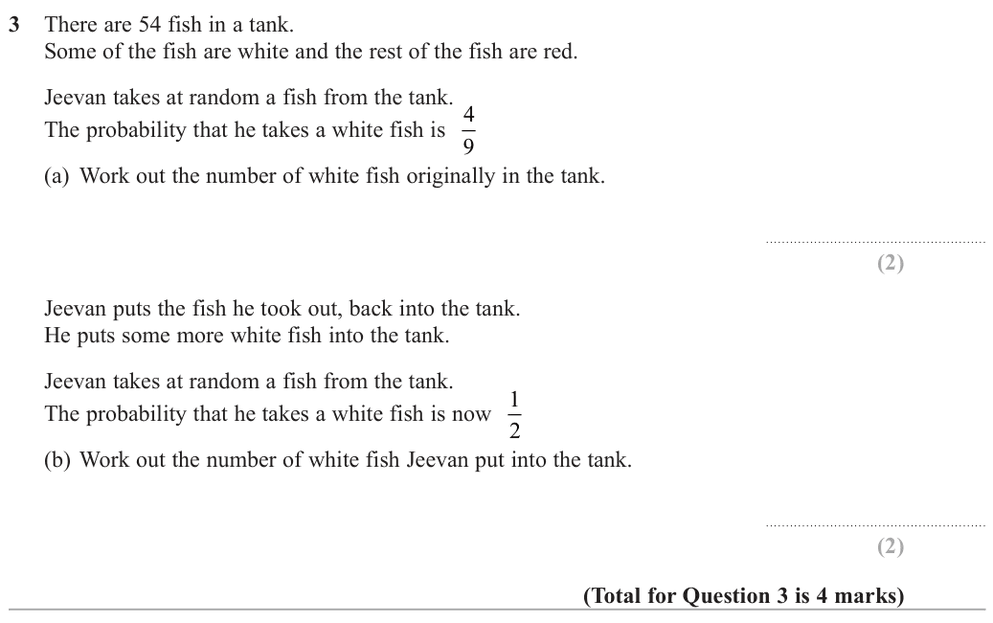
28. Nov 2021 P1H · Q3 Medium 4 marksShow worked solution Calculate probability (a) Let the number of white fish be \(w\).
\[
\frac{w}{54}=\frac49
\]
\[
w=54\times\frac49=24
\]
(b) There are still 54 (b) There are still 54 fish, and now
\[
\frac{\text{white fish}}{54}=\frac12
\]
\[
\text{white fish}=27
\]
Jeevan added \[
27-24=3
\]
Final answer (a) \(24\) white fish, (b) \(3\) white fish.
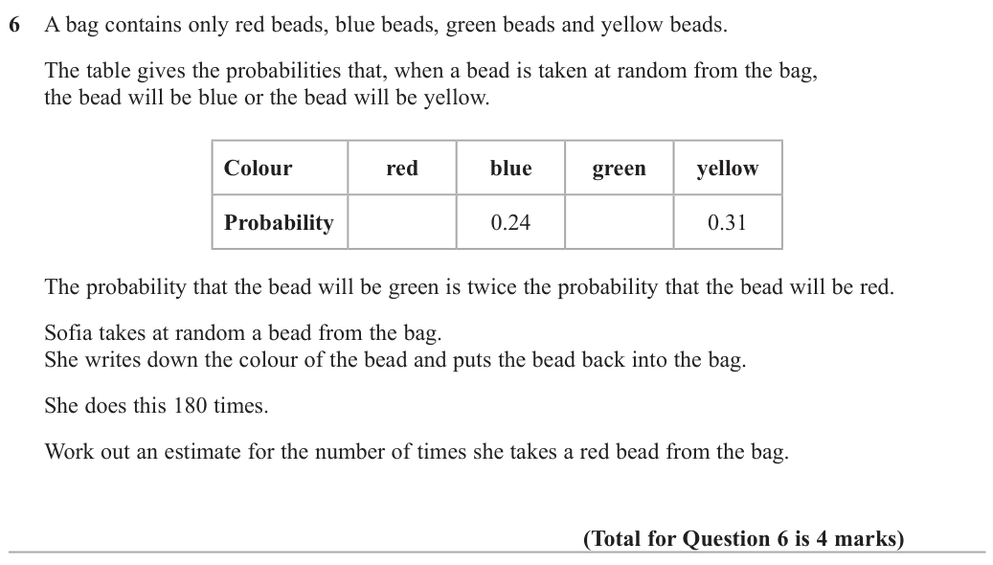
29. Jan 2020 P2H · Q6 Medium 4 marksShow worked solution Use the fact that probabilities add to 1 Let \(P(\text{red})=r\), so \(P(\text{green})=2r\).
\[
r+0.24+2r+0.31=1 \;\Rightarrow\; 3r=0.45 \;\Rightarrow\; r=0.15
\]
Expected number of red beads \[
180\times0.15=27
\]
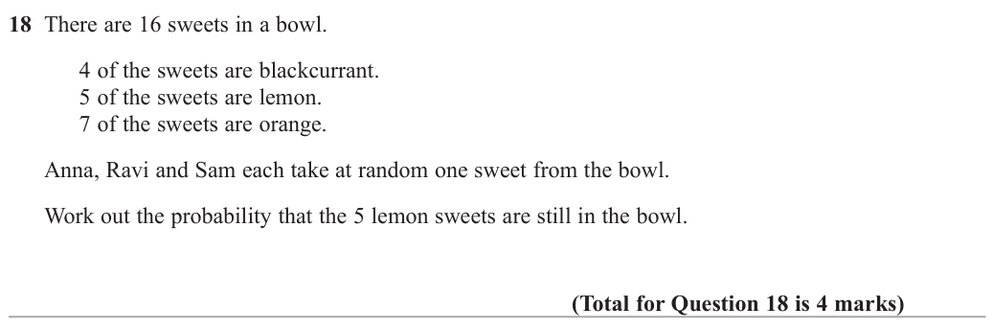
30. Jan 2020 P1H · Q18 Medium 4 marksShow worked solution Count the sweets that are not lemon There are \(16\) sweets and \(5\) are lemon, so \(11\) are not lemon.
Three picks without replacement, none lemon All \(5\) lemon sweets stay in the bowl only if Anna, Ravi and Sam each take a non-lemon sweet:
\[
\frac{11}{16}\times\frac{10}{15}\times\frac{9}{14}=\frac{990}{3360}=\frac{33}{112}
\]
Final answer \(\dfrac{33}{112}\)
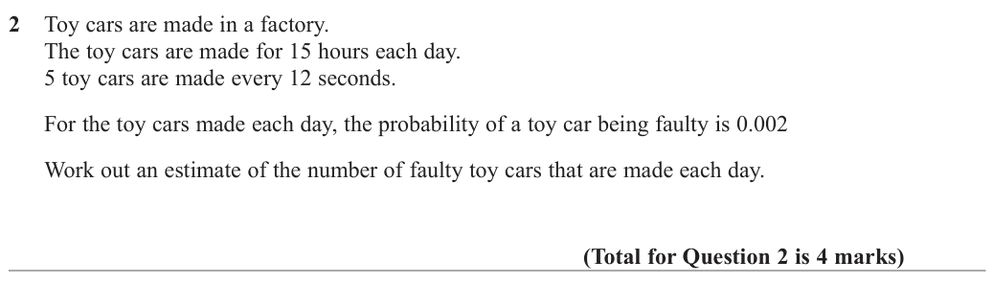
31. May-Nov 2020 P1H · Q2 Medium 4 marksShow worked solution Seconds in a working day \[
15\times60\times60=54\,000\text{ seconds}
\]
Toy cars made each day \[
\frac{54\,000}{12}\times5=22\,500
\]
Expected number of faulty cars \[
22\,500\times0.002=45
\]
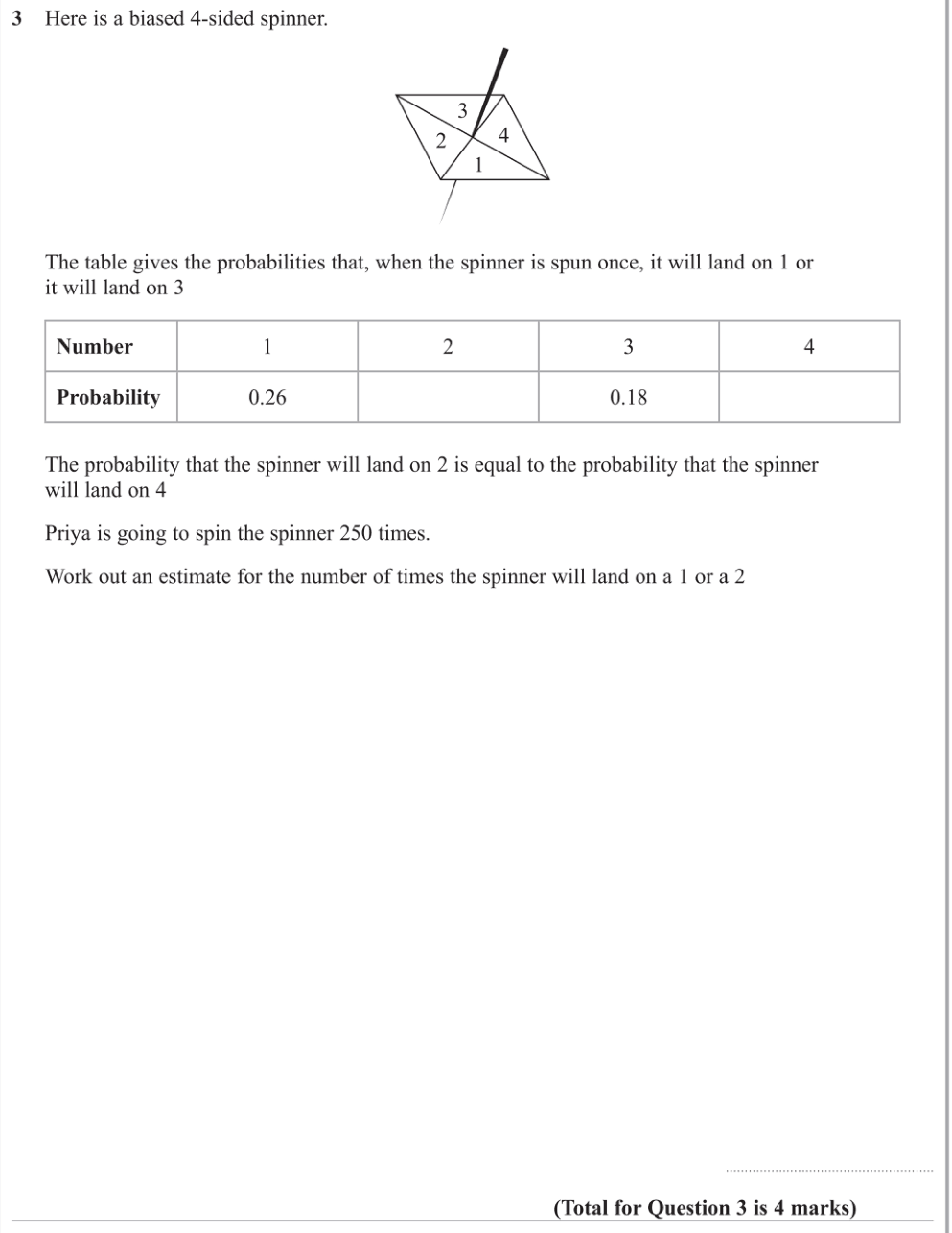
32. Specimen 4WM1H · Q3 Medium 4 marksShow worked solution Find the remaining probability \[
1-0.26-0.18=0.56
\]
Split the equal probabilities The probabilities for \(2\) and \(4\) are equal, so
\[
P(2)=P(4)=\frac{0.56}{2}=0.28
\]
Find the probability of 1 or 2 \[
P(1\text{ or }2)=0.26+0.28=0.54
\]
Calculate the estimate \[
0.54\times 250=135
\]
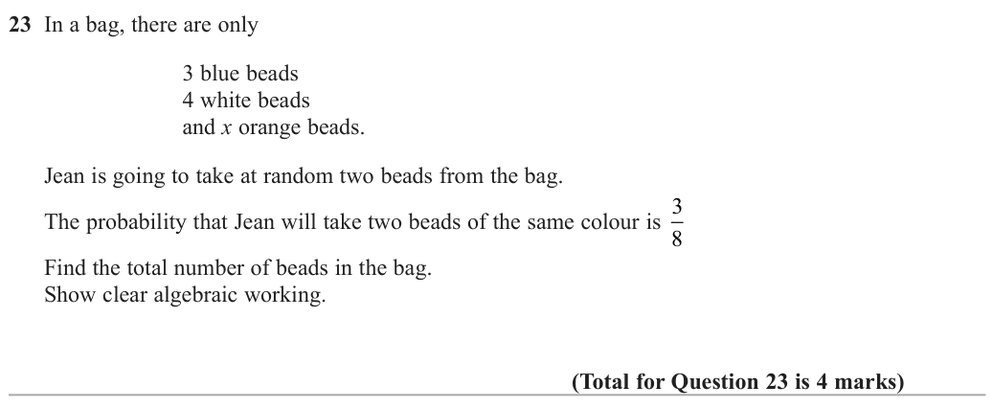
33. May-Nov 2020 P1HR · Q23 Medium 4 marksShow worked solution The total number of beads The total number of beads is
\[
x+7
\]
The probability of choosing two The probability of choosing two beads of the same colour is
\[
\frac{\binom{3}{2}+\binom{4}{2}+\binom{x}{2}}{\binom{x+7}{2}}
\]
Evaluate fraction This is equal to \(\frac38\), so
\[
\frac{3+6+\frac{x(x-1)}{2}}{\frac{(x+7)(x+6)}{2}}=\frac38
\]
\[
\frac{x^2-x+18}{(x+7)(x+6)}=\frac38
\]
\[
8(x^2-x+18)=3(x+7)(x+6)
\]
\[
8x^2-8x+144=3x^2+39x+126
\]
\[
5x^2-47x+18=0
\]
\[
(x-9)(5x-2)=0
\]
Calculate value Since \(x\) must be a whole number,
\[
x=9
\]
Calculate value So the total number of beads is
\[
9+7=16
\]
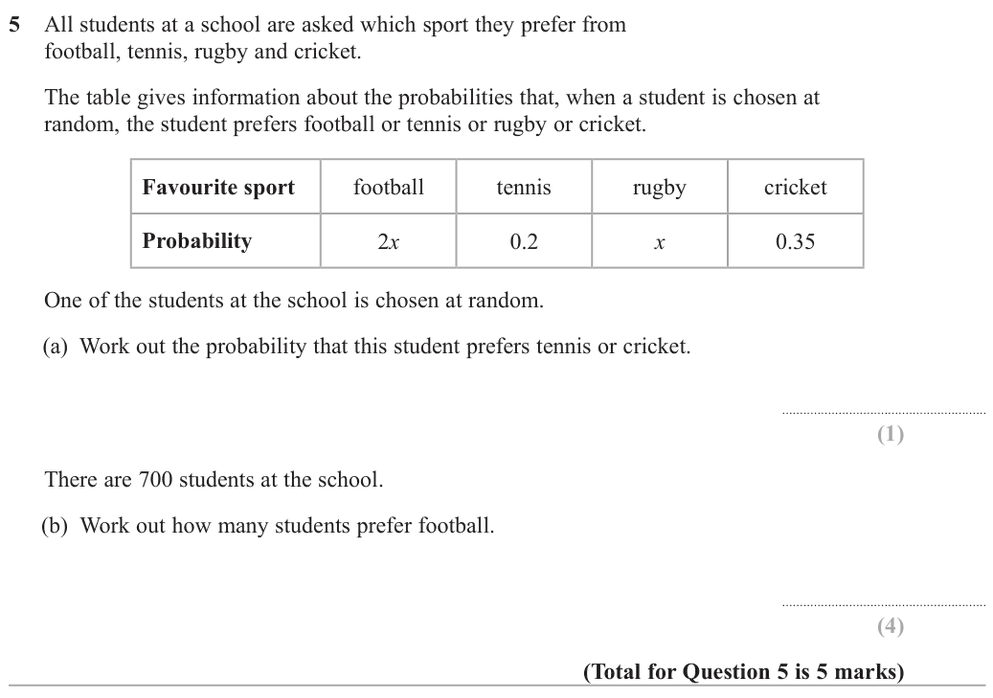
34. Nov 2025 4WM1H · Q5 Hard 5 marksShow worked solution Calculate value \[
P(\text{tennis or cricket})=0.2+0.35=0.55
\]
Calculate value Also,
\[
2x+0.2+x+0.35=1
\]
\[
3x=0.45
\]
\[
x=0.15
\]
Calculate value So
\[
P(\text{football})=2x=0.30
\]
\[
700\times 0.30=210
\]
Final answer \(0.55\), \(210\) students.
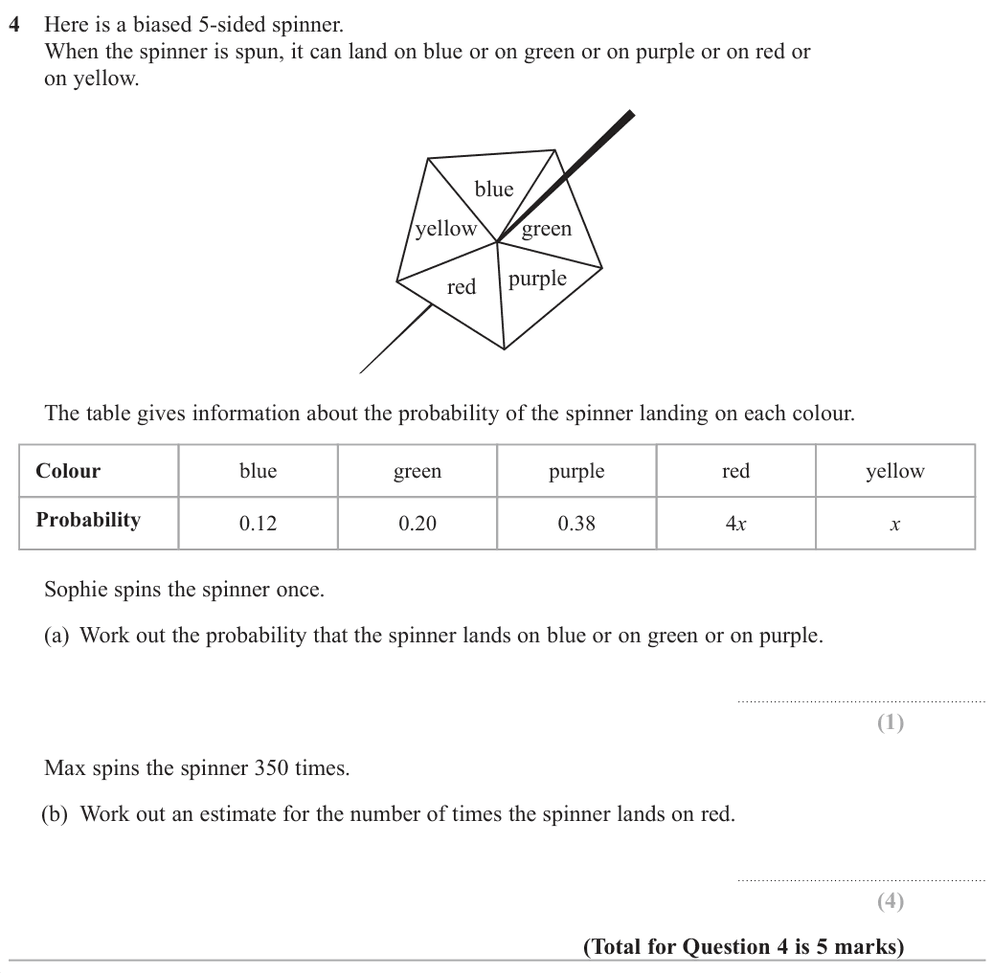
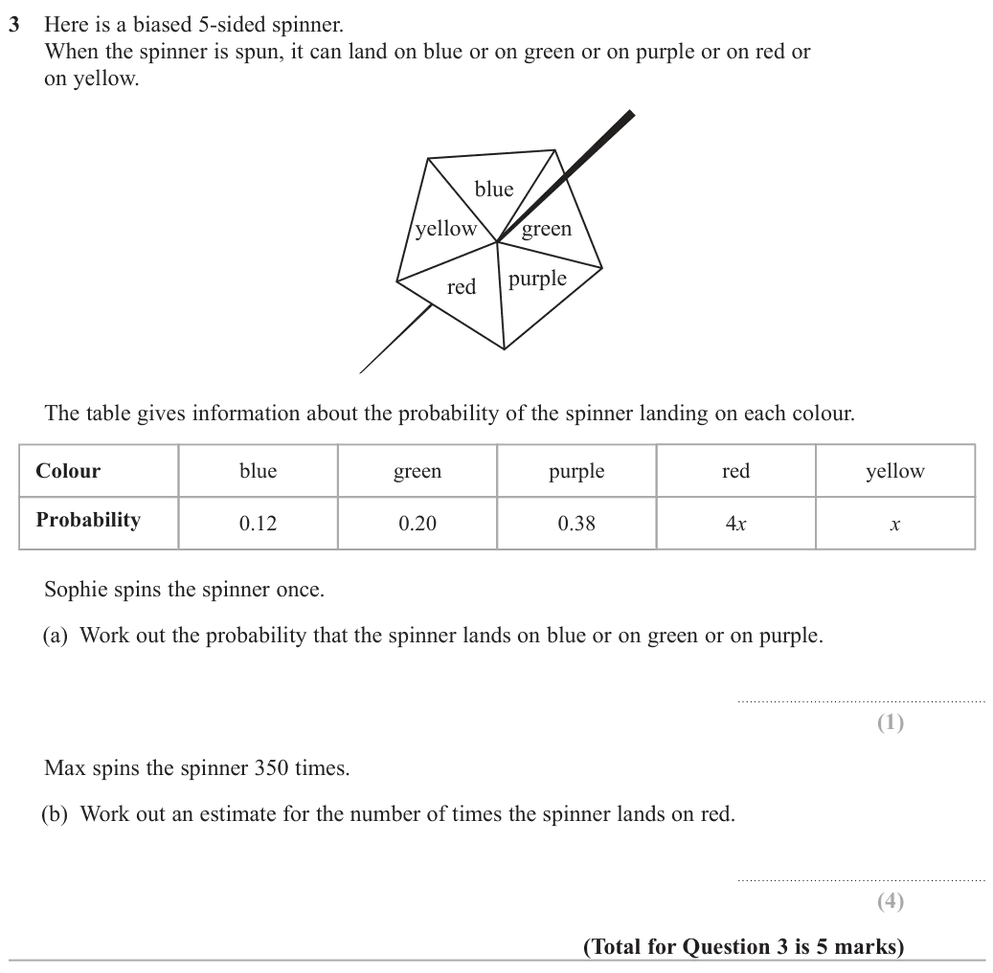
35. Jun 2025 P1HR · Q4 Hard 5 marksShow worked solution (a) Blue, green or purple \[
0.12+0.20+0.38=0.70
\]
(b) Find x Red and yellow share the rest: \(4x+x=1-0.70=0.30\), so \(5x=0.30\) and \(x=0.06\).
(b) Probability of red \[
4x=4\times0.06=0.24
\]
(b) Estimate for 350 spins \[
350\times0.24=84
\]
Final answer (a) \(0.7\) (b) \(84\)
36. May 2025 4WM1HR · Q3 Hard 5 marksShow worked solution Let the yellow probability be Let the yellow probability be \(x\). Then the red probability is \(4x\).
\[
0.12+0.20+0.30+4x+x=1
\]
\[
5x=0.38
\]
\[
x=0.076
\]
Calculate probability So
\[
P(\text{red})=4x=0.304
\]
\[
P(\text{blue, green or purple})=0.12+0.20+0.30=0.62
\]
Expected red Expected red:
\[
350\times 0.304=106.4
\]
Final answer \(0.62\), and about \(106\).
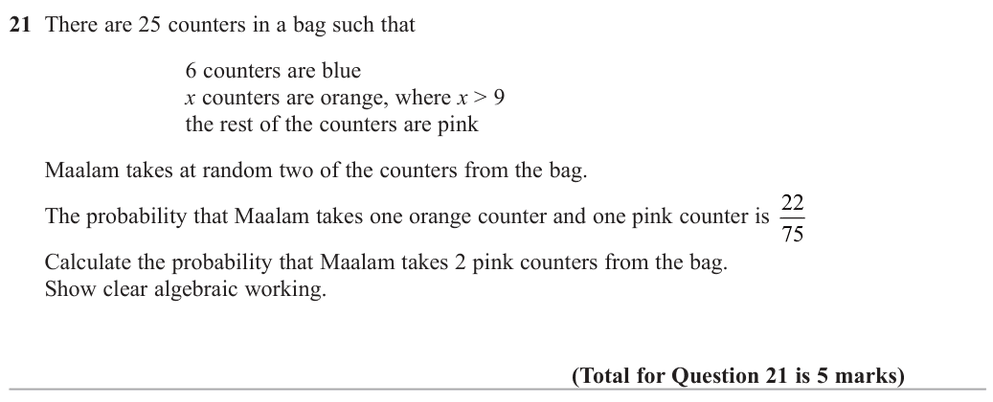
37. May 2024 P1HR · Q21 Hard 5 marksShow worked solution There are 25 counters There are 25 counters.
Blue counters Blue counters:
\[
6
\]
Orange counters Orange counters:
\[
x
\]
Pink counters Pink counters:
\[
25-6-x=19-x
\]
The probability of taking one The probability of taking one orange and one pink in either order is
\[
\frac{x}{25}\cdot\frac{19-x}{24}
+\frac{19-x}{25}\cdot\frac{x}{24}
\]
\[
=\frac{2x(19-x)}{25\cdot24}
\]
Evaluate fraction This is equal to \(\frac{22}{75}\), so
\[
\frac{2x(19-x)}{600}=\frac{22}{75}
\]
\[
\frac{x(19-x)}{300}=\frac{22}{75}
\]
\[
x(19-x)=88
\]
\[
19x-x^2=88
\]
\[
x^2-19x+88=0
\]
\[
(x-8)(x-11)=0
\]
Solve inequality Since \(x>9\),
\[
x=11
\]
Calculate value So the number of pink counters is
\[
19-11=8
\]
The probability of taking 2 The probability of taking 2 pink counters is
\[
\frac{8}{25}\cdot\frac{7}{24}=\frac{56}{600}
\]
\[
=\frac{7}{75}
\]
Final answer \(\frac{7}{75}\)
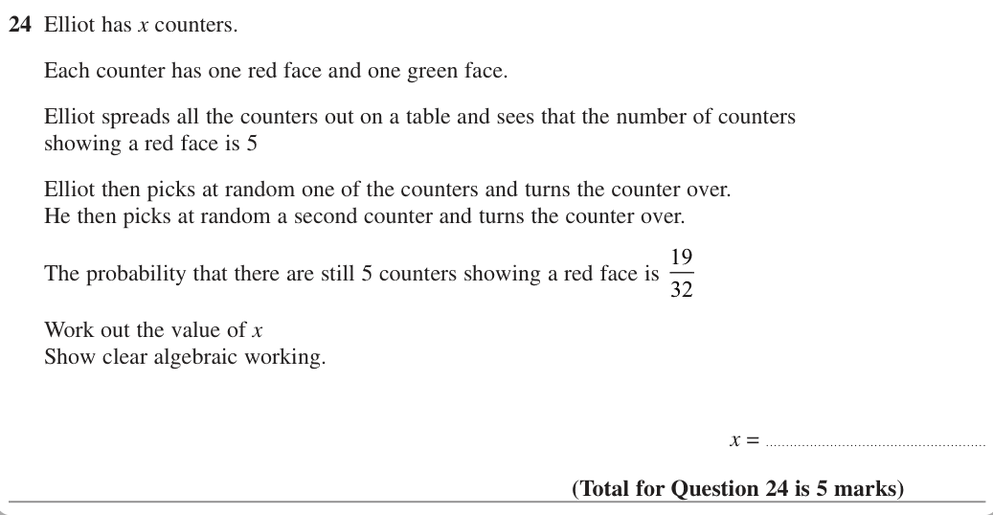
38. Jun 2022 P1HR · Q24 Hard 5 marksShow worked solution There are counters. Initially 5 There are \(x\) counters. Initially 5 show red, so \(x-5\) show green.
List probability cases After two turns, there are still 5 red faces if:
the same counter is picked - the same counter is picked twice, or - one red counter and one green counter are picked.
The probability of picking the The probability of picking the same counter twice is
\[
\frac{1}{x}
\]
The probability of picking one The probability of picking one red and one green in either order is
\[
\frac{5}{x}\cdot\frac{x-5}{x}+\frac{x-5}{x}\cdot\frac{5}{x}
\]
\[
=\frac{10(x-5)}{x^2}
\]
Evaluate fraction So
\[
\frac{1}{x}+\frac{10(x-5)}{x^2}=\frac{19}{32}
\]
\[
\frac{11x-50}{x^2}=\frac{19}{32}
\]
\[
32(11x-50)=19x^2
\]
\[
19x^2-352x+1600=0
\]
\[
(x-8)(19x-200)=0
\]
Calculate value Since \(x\) must be a whole number,
\[
x=8
\]
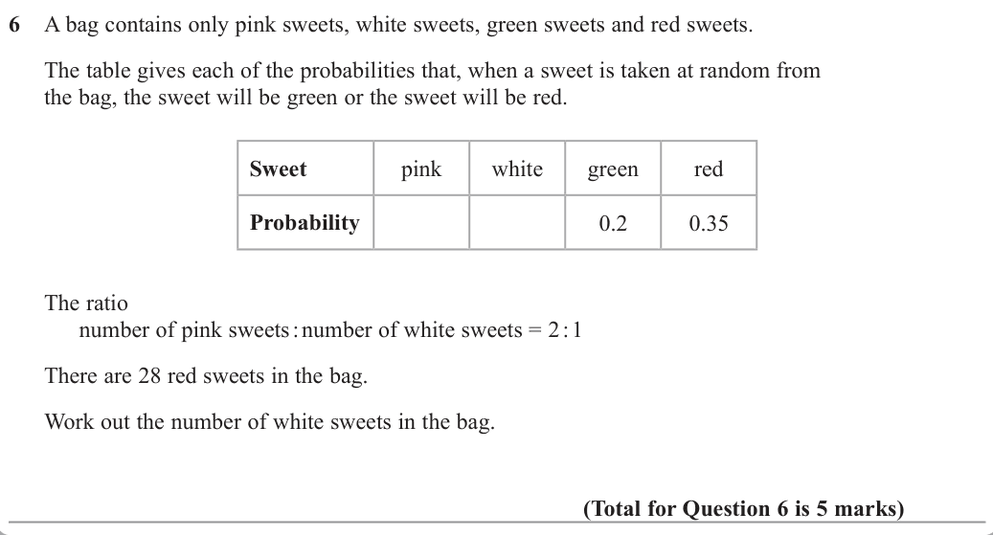
39. Jan 2022 P2H · Q6 Hard 5 marksShow worked solution Split the ratio The probabilities for green and red are
\[
0.20+0.35=0.55
\]
Split the ratio So
\[
P(\text{pink or white})=1-0.55=0.45
\]
Split the ratio Pink : white \(=2:1\), so white is \(\frac13\) of \(0.45\).
\[
P(\text{white})=\frac13\times 0.45=0.15
\]
Split the ratio The red probability is \(0.35\), and there are \(28\) red sweets.
\[
\text{total sweets}=\frac{28}{0.35}=80
\]
Number of white sweets Number of white sweets:
\[
0.15\times 80=12
\]
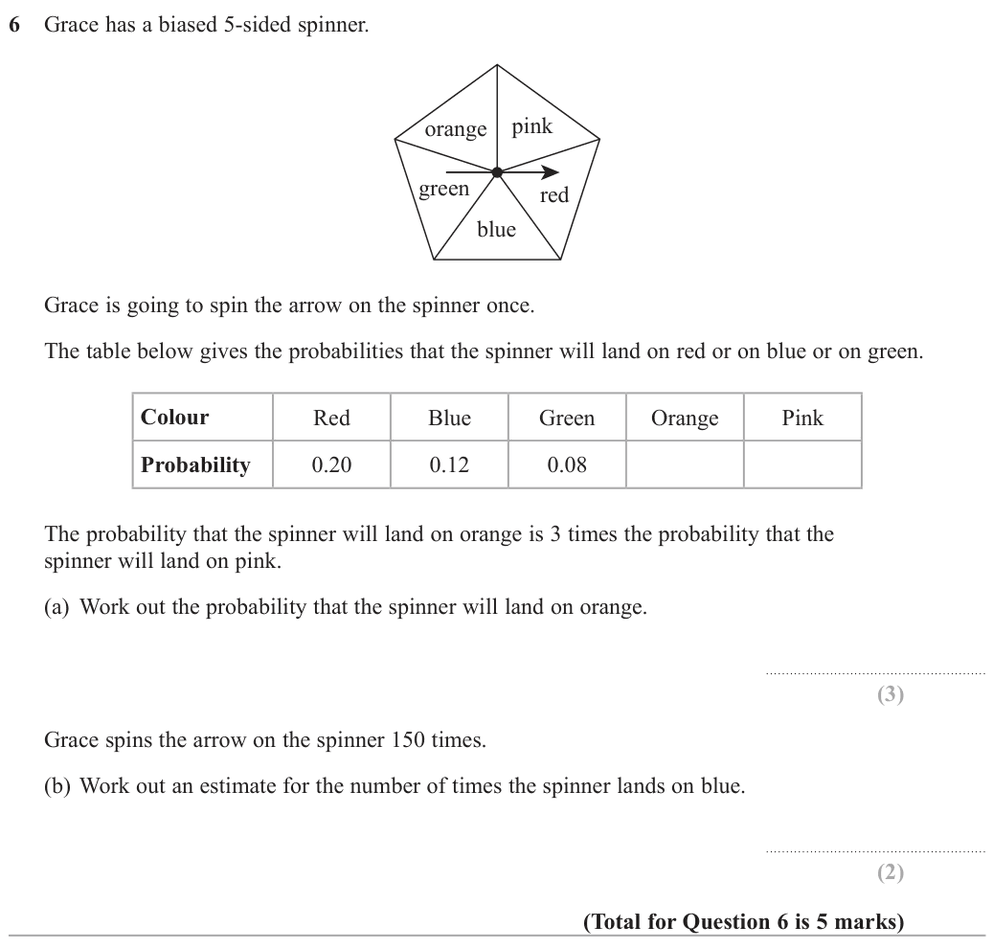
40. May 2021 P1H · Q6 Hard 5 marksShow worked solution (a) Set up with the missing probabilities Let \(P(\text{pink})=x\), so \(P(\text{orange})=3x\).
\[
0.20+0.12+0.08+3x+x=1 \;\Rightarrow\; 4x=0.60 \;\Rightarrow\; x=0.15
\]
(a) Probability of orange \[
3x=0.45
\]
(b) Estimate for blue \[
150\times0.12=18
\]
Final answer (a) \(0.45\) (b) \(18\)
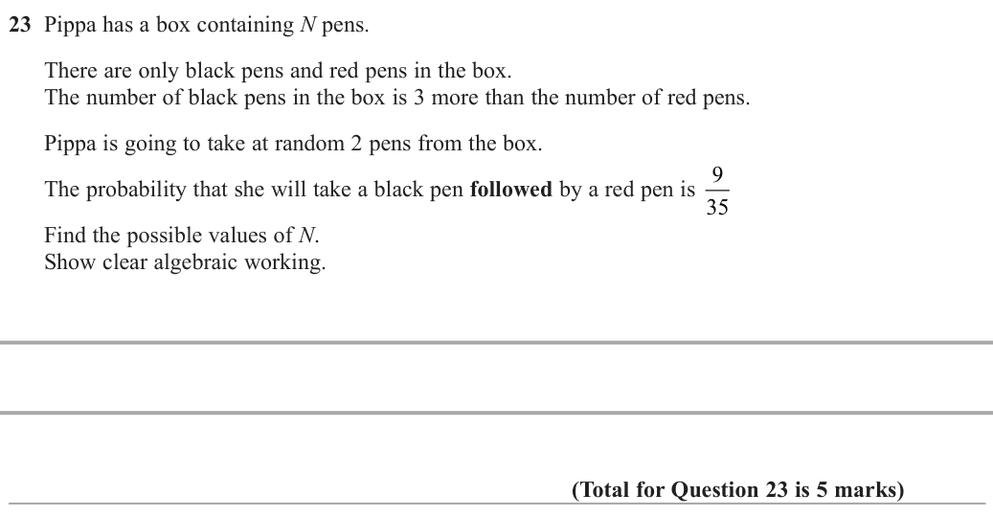
41. May 2021 P2H · Q23 Hard 5 marksShow worked solution Let the number of red Let the number of red pens be \(r\).
List probability cases Then the number of black pens is
\[
r+3
\]
Calculate value and
\[
N=2r+3
\]
Evaluate fraction So
\[
r=\frac{N-3}{2}
\]
Evaluate fraction and
\[
r+3=\frac{N+3}{2}
\]
The probability of black followed The probability of black followed by red is
\[
\frac{(N+3)/2}{N}\cdot \frac{(N-3)/2}{N-1}=\frac{9}{35}
\]
\[
\frac{N^2-9}{4N(N-1)}=\frac{9}{35}
\]
\[
35(N^2-9)=36N(N-1)
\]
\[
35N^2-315=36N^2-36N
\]
\[
N^2-36N+315=0
\]
\[
(N-15)(N-21)=0
\]
Final answer \(N=15\) or \(N=21\)
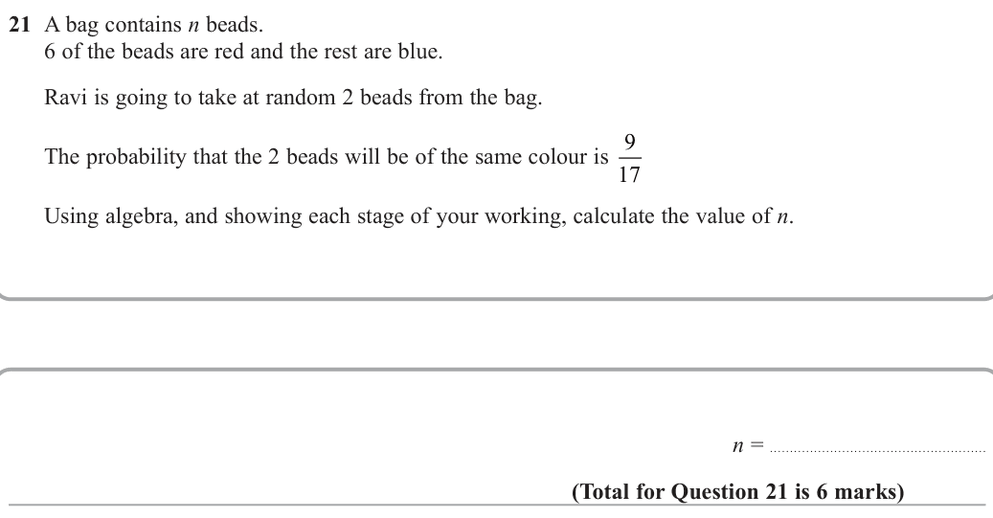
42. Jan 2021 P2HR · Q21 Hard 6 marksShow worked solution There are beads altogether There are \(n\) beads altogether.
Red beads Red beads:
\[
6
\]
Blue beads Blue beads:
\[
n-6
\]
The probability of taking two The probability of taking two beads of the same colour is
\[
P(RR)+P(BB)=\frac9{17}
\]
Use trigonometry So
\[
\frac6n\cdot\frac5{n-1}
+\frac{n-6}{n}\cdot\frac{n-7}{n-1}
=\frac9{17}
\]
\[
\frac{30+(n-6)(n-7)}{n(n-1)}=\frac9{17}
\]
Expand Expand:
\[
(n-6)(n-7)=n^2-13n+42
\]
Use trigonometry So
\[
\frac{n^2-13n+72}{n(n-1)}=\frac9{17}
\]
Cross multiply Cross multiply:
\[
17(n^2-13n+72)=9n(n-1)
\]
\[
17n^2-221n+1224=9n^2-9n
\]
\[
8n^2-212n+1224=0
\]
Divide by 4 Divide by 4:
\[
2n^2-53n+306=0
\]
Factor Factor:
\[
(2n-17)(n-18)=0
\]
Use trigonometry So
\[
n=\frac{17}{2}\quad\text{or}\quad n=18
\]
The number of beads must The number of beads must be a whole number, so
\[
n=18
\]
Final answer \(\boxed{18}\)
More IGCSE Maths 4MA1 topics Dr Eslam Ahmed Elite Mathematics · Questions classified by topic, solutions checked by Dr Eslam
 Elite Mathematics