Skip to content
Elite Mathematics
IGCSE · 4MA1 · Topic

Sequences: past paper questions & worked solutions

Every Sequences question from the 4MA1 papers in our bank, 2020–2026, sorted from easiest to hardest. Try each one first, then open the worked solution.

35questions
158marks in total
52%of papers (28 of 54) include it
3/12/20easy / medium / hard

Questions, easiest first

Level is estimated from marks: 1–2 easy, 3–4 medium, 5+ hard.

1. Jun 2026 P2HR · Q2

Easy2 marks
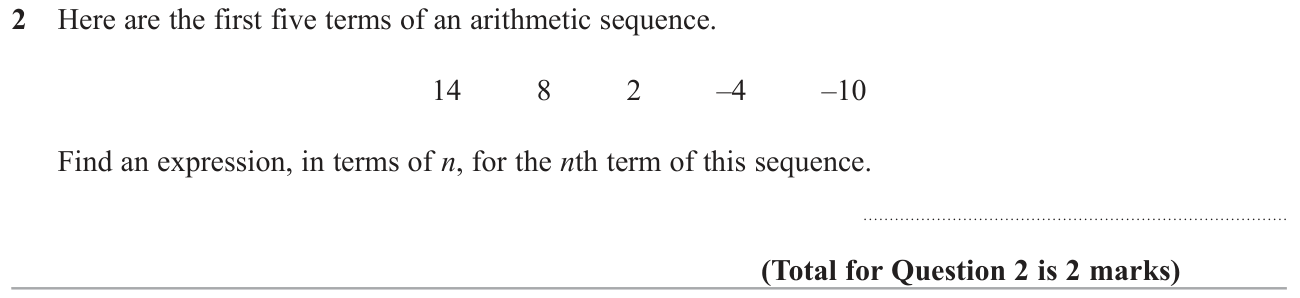
Jun 2026 P2HR Question 2 (2 marks): Sequences – 2 Here are the first five terms of an arithmetic sequence. 14 8 2 –4 –10 Find an expression, in terms of n, for the nth term of this sequence.   (Total for Question 2 is 2 marks)
Show worked solution
  1. Solution | Step 1

    The common difference is \(8-14=-6\).

    Each successive term decreases by 6.

  2. Solution | Step 2
    \[u_n=14+(n-1)(-6)=20-6n.\]

    Use first term plus (n-1) common differences.

Final answer

\(u_n=20-6n\).

2. Jun 2023 P2HR · Q4

Easy2 marks
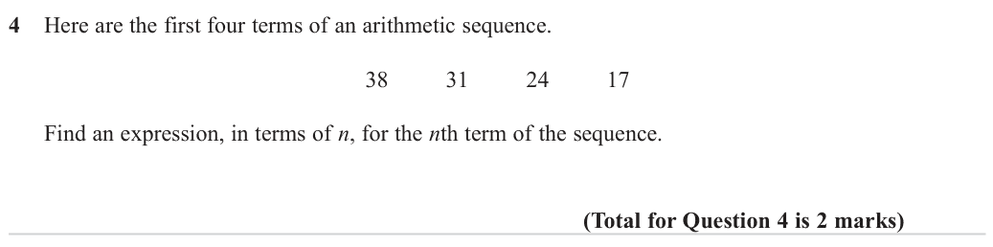
Jun 2023 P2HR Question 4 (2 marks): Sequences – 4 Here are the first four terms of an arithmetic sequence. 38 31 24 17 Find an expression, in terms of n, for the nth term of the sequence.   (Total for Question 4 is 2 marks)
Show worked solution
  1. The sequence is
    \[ 38,\ 31,\ 24,\ 17 \]
  2. The common difference is

    The common difference is \(-7\).

    \[ \text{nth term}=38+(n-1)(-7) \]
    \[ =38-7n+7=45-7n \]
Final answer

\(45-7n\).

3. May 2021 P1H · Q2

Easy2 marks
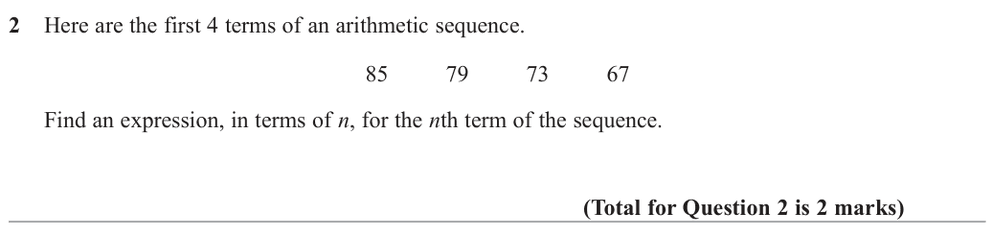
May 2021 P1H Question 2 (2 marks): Sequences – 2 Here are the first 4 terms of an arithmetic sequence. 85 79 73 67 Find an expression, in terms of n, for the nth term of the sequence.   (Total for Question 2 is 2 marks)
Show worked solution
  1. The sequence is
    \[ 85,\ 79,\ 73,\ 67 \]
  2. The common difference is

    The common difference is \(-6\).

    \[ \text{nth term}=85+(n-1)(-6) \]
    \[ =85-6n+6=91-6n \]
Final answer

\(91-6n\).

4. May 2025 4WM2H · Q5

Medium3 marks
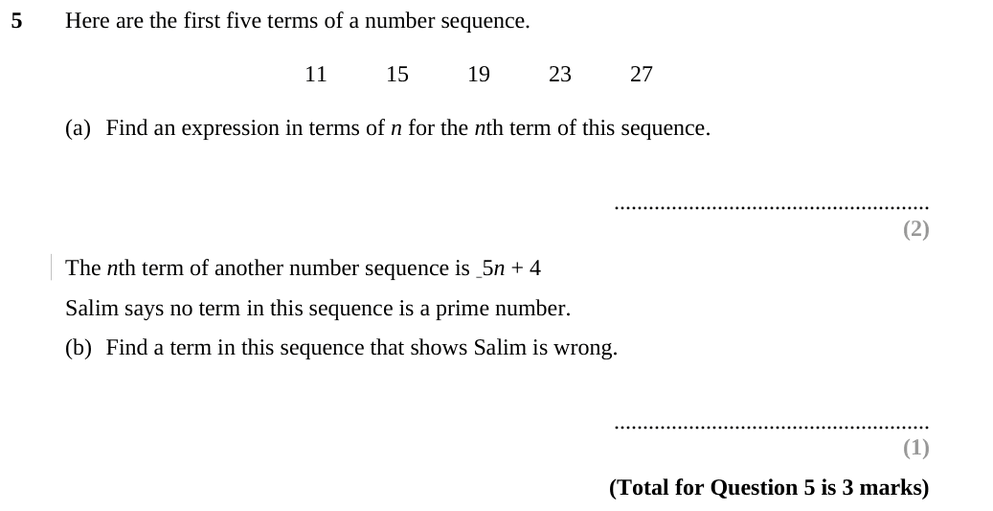
May 2025 4WM2H Question 5 (3 marks): Sequences – 5 Here are the first five terms of a number sequence. 11 15 19 23 27 (a) Find an expression in terms of n for the nth term of this sequence.   (2) The nth term of another number sequence is 5n + 4 Salim says no term in t
Show worked solution
  1. Find the nth term

    The sequence increases by \(4\), so

    \[ u_n=4n+7 \]
  2. Find the nth term

    For the sequence \(5n+4\), take \(n=3\):

    \[ 5(3)+4=19 \]
  3. Check prime condition

    and \(19\) is prime.

Final answer

\(4n+7\); a suitable counterexample is \(19\).

5. May 2024 P1H · Q1

Medium3 marks
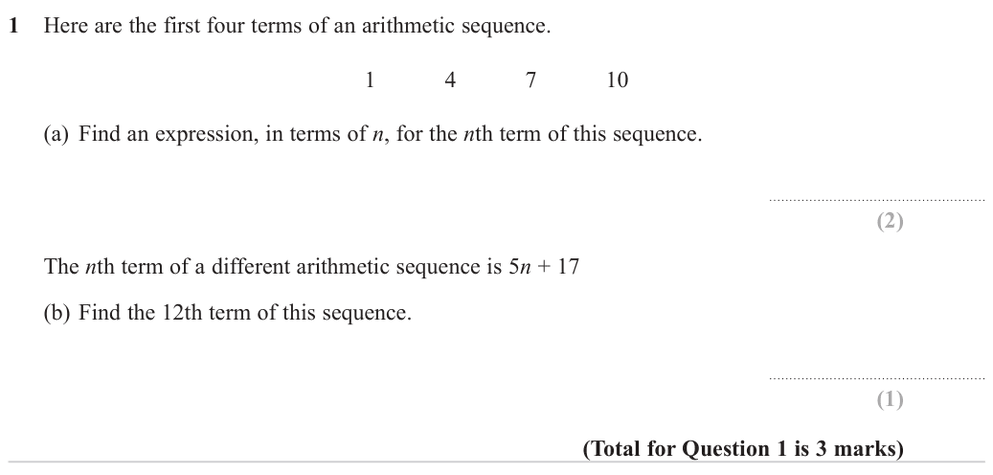
May 2024 P1H Question 1 (3 marks): Sequences – 1 Here are the first four terms of an arithmetic sequence. 1 4 7 10 (a) Find an expression, in terms of n, for the nth term of this sequence.   (2) The nth term of a different arithmetic sequence is 5n + 17 (b) Find the
Show worked solution
  1. The sequence is
    \[ 1,\ 4,\ 7,\ 10 \]
  2. The common difference is

    The common difference is \(3\).

    \[ \text{nth term}=1+3(n-1)=3n-2 \]
  3. Find the nth term

    For the other sequence, \[ 5n+17 \]

  4. The 12th term is
    \[ 5(12)+17=77 \]
Final answer

\(3n-2\), and \(77\).

6. Jun 2022 P1H · Q1

Medium3 marks
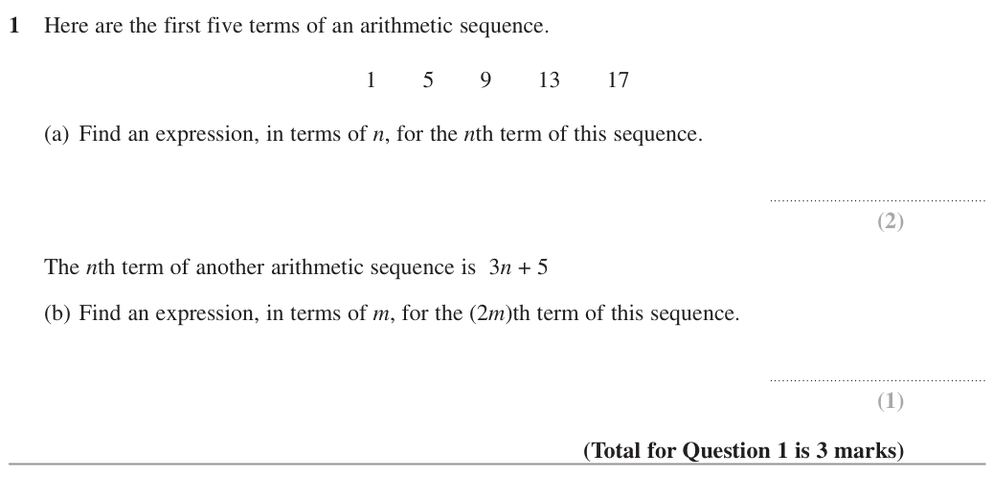
Jun 2022 P1H Question 1 (3 marks): Sequences – 1 Here are the first five terms of an arithmetic sequence. 1 5 9 13 17 (a) Find an expression, in terms of n, for the nth term of this sequence.   (2) The nth term of another arithmetic sequence is 3n + 5 (b) Find an exp
Show worked solution
  1. The sequence is
    \[ 1,\ 5,\ 9,\ 13,\ 17 \]
  2. Find the nth term

    The common difference is \(4\), so the nth term is \[ 4n-3 \]

  3. Find the nth term

    For the second sequence, the nth term is \(3n+5\).

  4. The th term is

    The \((2m)\)th term is \[ 3(2m)+5=6m+5 \]

Final answer

\(4n-3\), and \(6m+5\).

7. Jan 2020 P2H · Q25

Medium3 marks
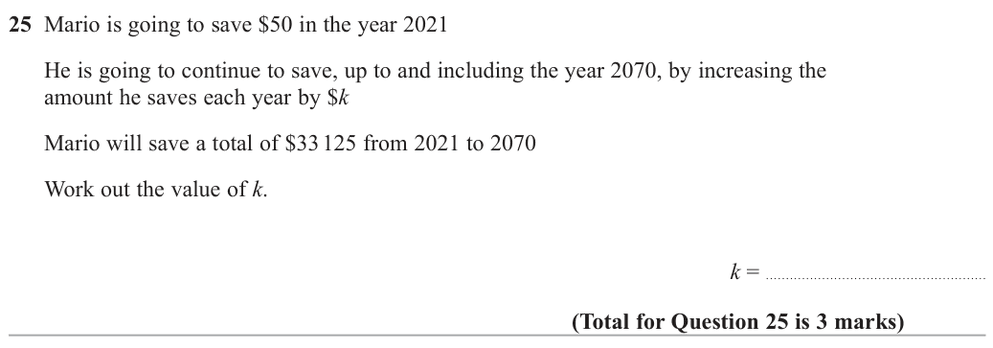
Jan 2020 P2H Question 25 (3 marks): Sequences – 25 Mario is going to save $50 in the year 2021 He is going to continue to save, up to and including the year 2070, by increasing the amount he saves each year by $k Mario will save a total of $33 125 from 2021 to 2070 Wo
Show worked solution
  1. Mario saves from 2021 up

    Mario saves from 2021 up to and including 2070.

  2. Number of years

    Number of years:

    \[ 2070-2021+1=50 \]
  3. This is an arithmetic sequence

    This is an arithmetic sequence.

  4. Use trigonometry

    First term:

    \[ 50 \]
  5. Common difference

    Common difference:

    \[ k \]
  6. Last term

    Last term:

    \[ 50+49k \]
  7. Use the arithmetic series formula

    Use the arithmetic series formula:

    \[ S_n=\frac n2(a+l) \]
    \[ 33125=\frac{50}{2}\left(50+(50+49k)\right) \]
    \[ 33125=25(100+49k) \]
    \[ 1325=100+49k \]
    \[ 49k=1225 \]
    \[ k=25 \]
Final answer

\(\boxed{k=25}\)

8. May 2025 4WM2H · Q24

Medium4 marks
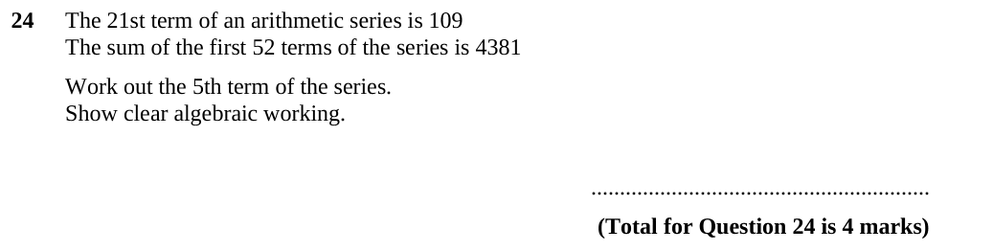
May 2025 4WM2H Question 24 (4 marks): Sequences – 24 The 21st term of an arithmetic series is 109 The sum of the first 52 terms of the series is 4381 Work out the 5th term of the series. Show clear algebraic working.   (Total for Question 24 is 4 marks)
Show worked solution
  1. Use series formula

    For an arithmetic series,

    \[ a+20d=109 \]
  2. Evaluate fraction

    and

    \[ \frac{52}{2}(2a+51d)=4381 \]
    \[ 26(2a+51d)=4381 \]
  3. Solving gives
    \[ d=-4.5, \qquad a=199 \]
  4. The fifth term is
    \[ a+4d=199+4(-4.5)=181 \]
Final answer

\(181\).

9. May 2024 P1HR · Q23

Medium4 marks
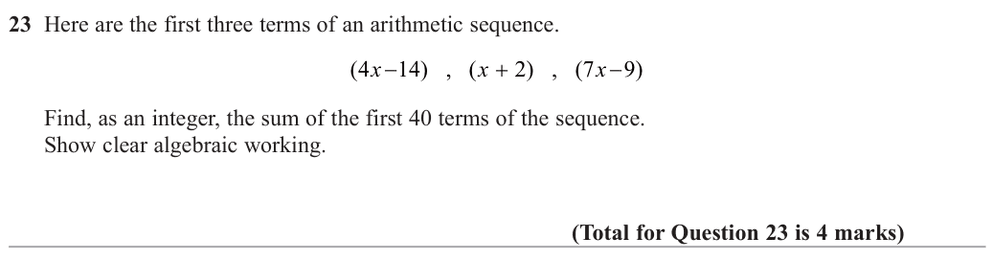
May 2024 P1HR Question 23 (4 marks): Sequences – 23 Here are the first three terms of an arithmetic sequence. ( ) , ( ) , ( ) 4 14 2 7 9 x x x Find, as an integer, the sum of the first 40 terms of the sequence. Show clear algebraic working.    (Total for Question 23 i
Show worked solution
  1. The first three terms are
    \[ 4x-14,\quad x+2,\quad 7x-9 \]
  2. Equal differences give
    \[ (x+2)-(4x-14)=(7x-9)-(x+2) \]
    \[ -3x+16=6x-11 \]
    \[ 9x=27 \]
    \[ x=3 \]
  3. Find the nth term

    So the sequence is

    \[ -2,\ 5,\ 12,\ldots \]
  4. with common difference

    with common difference \(7\).

    \[ S_{40}=\frac{40}{2}(2(-2)+39(7)) \]
    \[ S_{40}=20(-4+273)=5380 \]
Final answer

\(5380\)

10. Jun 2022 P1HR · Q2

Medium4 marks
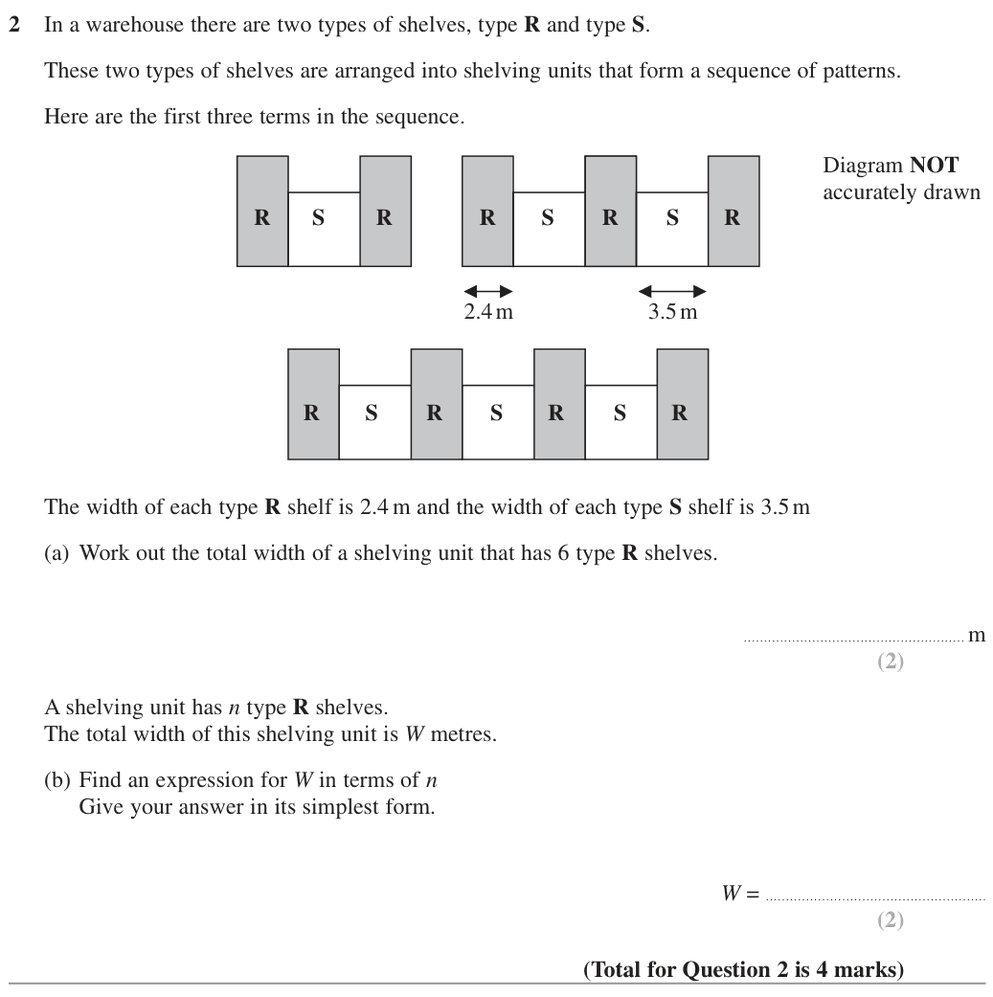
Jun 2022 P1HR Question 2 (4 marks): Sequences – 2 In a warehouse there are two types of shelves, type R and type S. These two types of shelves are arranged into shelving units that form a sequence of patterns. Here are the first three terms in the sequence. Diagram NO
Show worked solution
  1. Find the nth term

    For a shelving unit with 6 type R shelves, there are 5 type S shelves.

    \[ 6(2.4)+5(3.5)=14.4+17.5=31.9 \]
  2. Find the nth term

    For \(n\) type R shelves, there are \(n-1\) type S shelves.

    \[ W=2.4n+3.5(n-1) \]
    \[ W=2.4n+3.5n-3.5=5.9n-3.5 \]
Final answer

\(31.9\text{ m}\), and \(W=5.9n-3.5\).

11. Jan 2022 P1HR · Q16

Medium4 marks
Jan 2022 P1HR Question 16 (4 marks): Sequences – 16 An arithmetic series has first term 1 and common difference 4 Find the sum of all terms of the series from the 41st term to the 100th term inclusive.   (Total for Question 16 is 4 marks)
Show worked solution
  1. Find the nth term

    The first term is \(1\) and the common difference is \(4\).

  2. The 41st term is
    \[ 1+40(4)=161 \]
  3. The 100th term is
    \[ 1+99(4)=397 \]
  4. There are
    \[ 100-41+1=60 \]
  5. Find the nth term

    terms from the 41st to the 100th inclusive.

    \[ S=\frac{60}{2}(161+397) \]
    \[ S=30\times558=16740 \]
Final answer

\(16740\).

12. Jan 2021 P1H · Q24

Medium4 marks
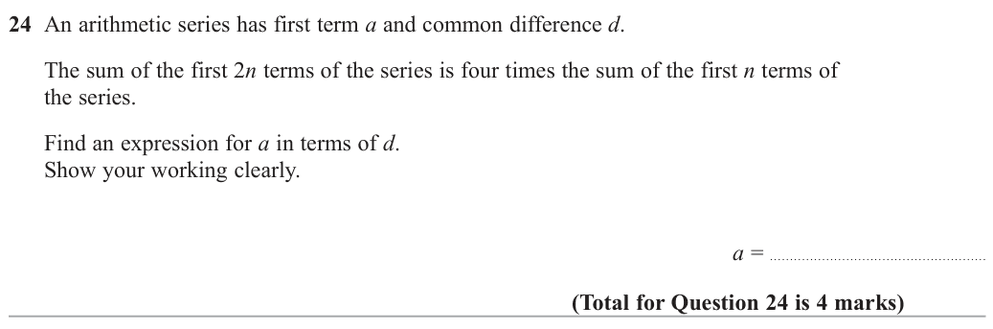
Jan 2021 P1H Question 24 (4 marks): Sequences – 24 An arithmetic series has first term a and common difference d. The sum of the first 2n terms of the series is four times the sum of the first n terms of the series. Find an expression for a in terms of d. Show your wo
Show worked solution
  1. Evaluate fraction
    \[ S_n=\frac n2(2a+(n-1)d) \]
    \[ S_{2n}=n(2a+(2n-1)d) \]
  2. Given
    \[ S_{2n}=4S_n \]
    \[ n(2a+(2n-1)d)=4\cdot \frac n2(2a+(n-1)d) \]
  3. Divide by

    Divide by \(n\):

    \[ 2a+(2n-1)d=2(2a+(n-1)d) \]
    \[ 2a+2nd-d=4a+2nd-2d \]
    \[ d=2a \]
    \[ a=\frac d2 \]
Final answer

\(a=\dfrac d2\)

13. Jan 2020 P2HR · Q22

Medium4 marks
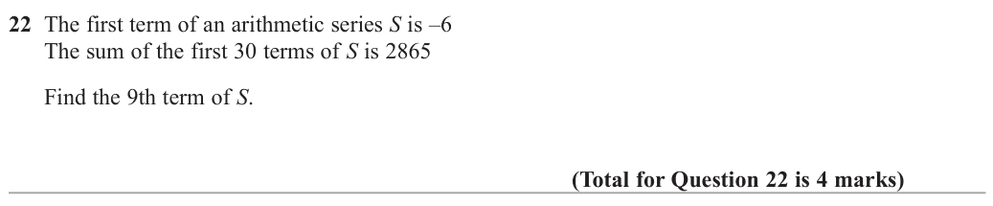
Jan 2020 P2HR Question 22 (4 marks): Sequences – 22 The first term of an arithmetic series S is -6 The sum of the first 30 terms of S is 2865 Find the 9th term of S.   (Total for Question 22 is 4 marks)
Show worked solution
  1. Find the nth term

    First term:

    \[ a=-6 \]
    \[ S_{30}=2865 \]
  2. Use
    \[ S_n=\frac n2(2a+(n-1)d) \]
    \[ 2865=\frac{30}{2}(2(-6)+29d) \]
    \[ 2865=15(-12+29d) \]
    \[ 191=-12+29d \]
    \[ 29d=203 \]
    \[ d=7 \]
  3. The 9th term is
    \[ u_9=a+8d \]
    \[ u_9=-6+8(7)=50 \]
Final answer

\(50\)

14. May-Nov 2020 P1HR · Q18

Medium4 marks
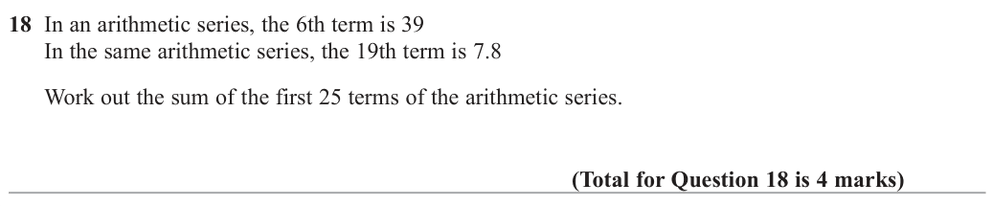
May-Nov 2020 P1HR Question 18 (4 marks): Sequences – 18 In an arithmetic series, the 6th term is 39 In the same arithmetic series, the 19th term is 7.8 Work out the sum of the first 25 terms of the arithmetic series.   (Total for Question 18 is 4 marks)
Show worked solution
  1. Let the first term be

    Let the first term be \(a\) and the common difference be \(d\).

  2. The 6th term is 39

    The 6th term is 39: \[ a+5d=39 \]

  3. Find the nth term

    The 19th term is 7.8: \[ a+18d=7.8 \]

  4. Subtract

    Subtract: \[ 13d=-31.2 \]

    \[ d=-2.4 \]
  5. Find the nth term

    Then \[ a+5(-2.4)=39 \]

    \[ a=51 \]
  6. The sum of the first

    The sum of the first 25 terms is \[ S_{25}=\frac{25}{2}\left(2a+24d\right) \]

    \[ S_{25}=\frac{25}{2}(102-57.6)=555 \]
Final answer

\(555\).

15. May-Nov 2020 P1H · Q24

Medium4 marks
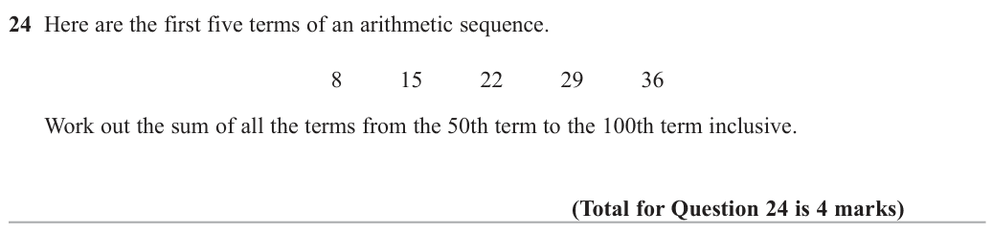
May-Nov 2020 P1H Question 24 (4 marks): Sequences – 24 Here are the first five terms of an arithmetic sequence. 8 15 22 29 36 Work out the sum of all the terms from the 50th term to the 100th term inclusive.   (Total for Question 24 is 4 marks)
Show worked solution
  1. The arithmetic sequence is
    \[ 8,\ 15,\ 22,\ 29,\ 36,\ldots \]
  2. Calculate value

    So

    \[ a=8,\quad d=7 \]
  3. The th term is

    The \(n\)th term is

    \[ u_n=8+7(n-1)=7n+1 \]
    \[ u_{50}=7(50)+1=351 \]
    \[ u_{100}=7(100)+1=701 \]
  4. There are
    \[ 100-50+1=51 \]
  5. Find the nth term

    terms from the 50th to the 100th inclusive.

    \[ \text{sum}=\frac{51}{2}(351+701) \]
    \[ =26826 \]
Final answer

\(26826\)

16. Jun 2026 P2H · Q2

Hard5 marks
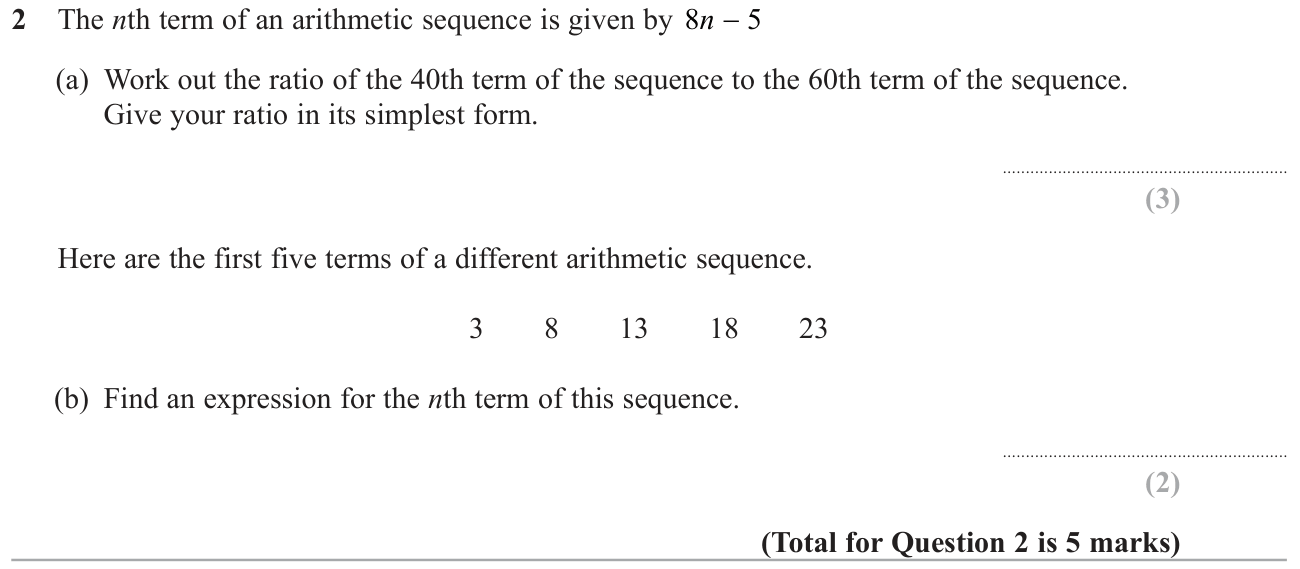
Jun 2026 P2H Question 2 (5 marks): Sequences – 2 The nth term of an arithmetic sequence is given by 8 5 n − (a) Work out the ratio of the 40th term of the sequence to the 60th term of the sequence. Give your ratio in its simplest form.   (3) Here are the first five t
Show worked solution
  1. Part (a) | Step 1
    \[u_{40}=8(40)-5=315,\qquad u_{60}=8(60)-5=475.\]

    Substitute the two term numbers into the given rule.

  2. Part (a) | Step 2
    \[315:475=(315\div5):(475\div5)=63:95.\]

    Divide both entries by their highest common factor, 5.

  3. Part (b) | Step 1

    The common difference is \(8-3=5\), so the rule has the form \(5n+c\).

    A constant difference gives a linear nth term.

  4. Part (b) | Step 2

    At \(n=1\), \(5+c=3\), giving \(c=-2\). Thus \(u_n=5n-2\).

    Use the first term to find the constant.

Final answer

(a) \(63:95\)

(b) \(5n-2\)

17. Jun 2026 P2H · Q25

Hard5 marks
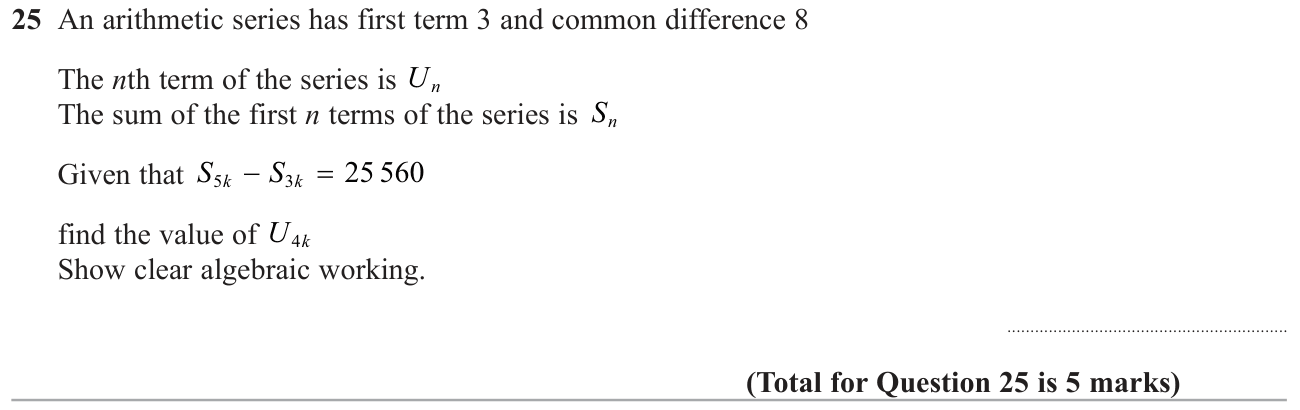
Jun 2026 P2H Question 25 (5 marks): Sequences – 25 An arithmetic series has first term 3 and common difference 8 The nth term of the series is U n The sum of the first n terms of the series is Sn Given that S S k k 5 3 25 560 � � find the value of U k 4 Show clear alg
Show worked solution
  1. Solution | Step 1

    With first term \(3\) and difference \(8\), \[S_n=\frac n2[2(3)+(n-1)8]=\frac n2(8n-2)=4n^2-n.\]

    Use the arithmetic-series sum formula with the given first term and common difference.

  2. Solution | Step 2
    \[S_{5k}=100k^2-5k,\qquad S_{3k}=36k^2-3k.\] \[(100k^2-5k)-(36k^2-3k)=25560\quad\Rightarrow\quad64k^2-2k-25560=0.\]

    Substitute 5k and 3k as the term counts, then subtract the complete expressions.

  3. Solution | Step 3

    \[32k^2-k-12780=0\quad\Rightarrow\quad(k-20)(32k+639)=0.\] The roots are \(k=20\) and \(k=-639/32\). Reject the negative root because the numbers of terms must be positive.

    Factor the quadratic and apply the contextual restriction.

  4. Solution | Step 4
    \[U_n=3+(n-1)8=8n-5,\qquad U_{4k}=U_{80}=8(80)-5=635.\]

    Use the nth-term formula with 4k=80, not with k=20.

Final answer

\(U_{4k}=635\)

18. Nov 2025 P2H · Q25

Hard5 marks
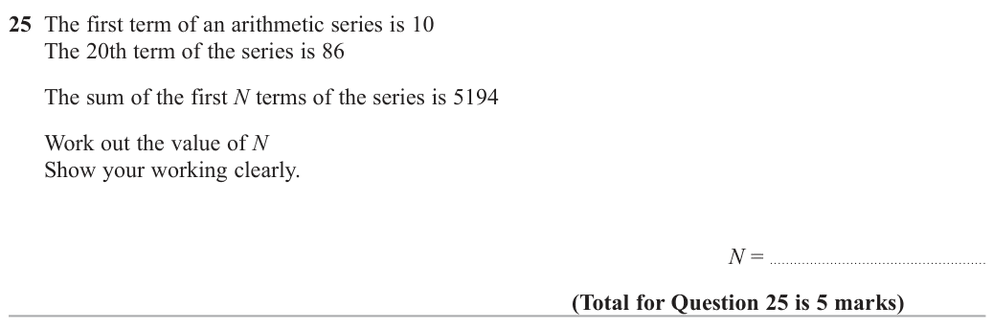
Nov 2025 P2H Question 25 (5 marks): Sequences – 25 The first term of an arithmetic series is 10 The 20th term of the series is 86 The sum of the first N terms of the series is 5194 Work out the value of N Show your working clearly. N =   (Total for Question 25 is 5 ma
Show worked solution
  1. Calculate value
    \[ a=10 \]
    \[ u_{20}=86 \]
    \[ 10+19d=86 \]
    \[ d=4 \]
  2. Use
    \[ S_N=\frac N2(2a+(N-1)d) \]
    \[ 5194=\frac N2(20+4(N-1)) \]
    \[ 5194=\frac N2(4N+16) \]
    \[ 5194=2N(N+4) \]
    \[ N^2+4N-2597=0 \]
    \[ N=\frac{-4+102}{2}=49 \]
Final answer

\(N=49\)

19. Nov 2025 4WM2H · Q26

Hard5 marks
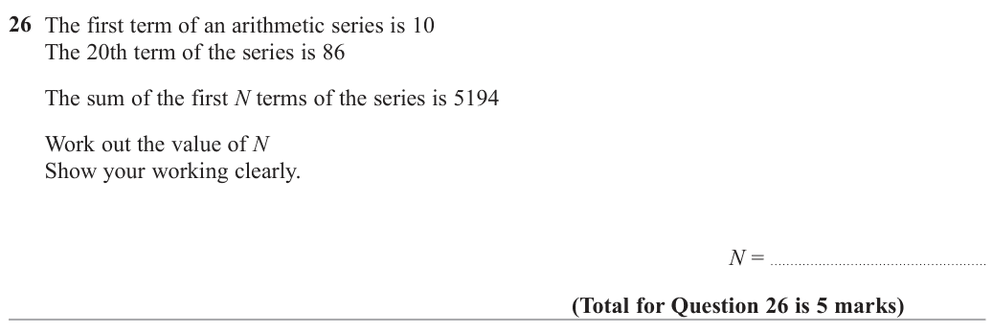
Nov 2025 4WM2H Question 26 (5 marks): Sequences – 26 The first term of an arithmetic series is 10 The 20th term of the series is 86 The sum of the first N terms of the series is 5194 Work out the value of N Show your working clearly. N =   (Total for Question 26 is 5 ma
Show worked solution
  1. Find common difference

    **Step 1: Find the common difference *d*.** The *n*<sup>th</sup> term is given by *u*<sub>*n*</sub> = *a* + (*n*−1)*d*. *u*<sub>20</sub> = 10 + 19*d* = 86 19*d* = 76 $$d = \\frac{76}{19} = 4$$

  2. Use sum formula

    **Step 2: Use the sum formula to form an equation in terms of *N*.** $$S_N = \\frac{N}{2} \\left\[2a + (N - 1)d \\right\]$$ Substitute the known values *S*<sub>*N*</sub> = 5194, *a* = 10, and *d* = 4: $$5194 = \\frac{N}{2} \\left\[2(10) + (N - 1)(4) \\right\]$$

  3. Solve quadratic equation

    **Step 3: Simplify and solve the quadratic equation.** Multiply by 2 to clear the fraction: 10388 = *N*\[20+4*N*−4\] 10388 = *N*(4*N*+16) 4*N*<sup>2</sup> + 16*N* − 10388 = 0

  4. Divide the entire equation by

    Divide the entire equation by 4 to make it simpler: *N*<sup>2</sup> + 4*N* − 2597 = 0

  5. Use quadratic formula

    **Step 4: Use the quadratic formula to find *N*.** $$N = \\frac{-b \\pm \\sqrt{b^2 - 4ac}}{2a}$$ $$N = \\frac{-4 \\pm \\sqrt{16 - 4(1)(-2597)}}{2}$$ $$N = \\frac{-4 \\pm \\sqrt{16 + 10388}}{2}$$ $$N = \\frac{-4 \\pm \\sqrt{10404}}{2}$$ $$N = \\frac{-4 \\pm 102}{2}$$

  6. Evaluate fraction

    Since *N* must be a positive integer, we discard the negative root: $$N = \\frac{-4 + 102}{2} = \\frac{98}{2} = 49$$

Final answer

*N* = 49

Always double-check that your *N* (number of terms) evaluates to a positive whole integer. If it ends up as a decimal or fraction, recheck your arithmetic progression formulas.

20. Jun 2025 P1H · Q24

Hard5 marks
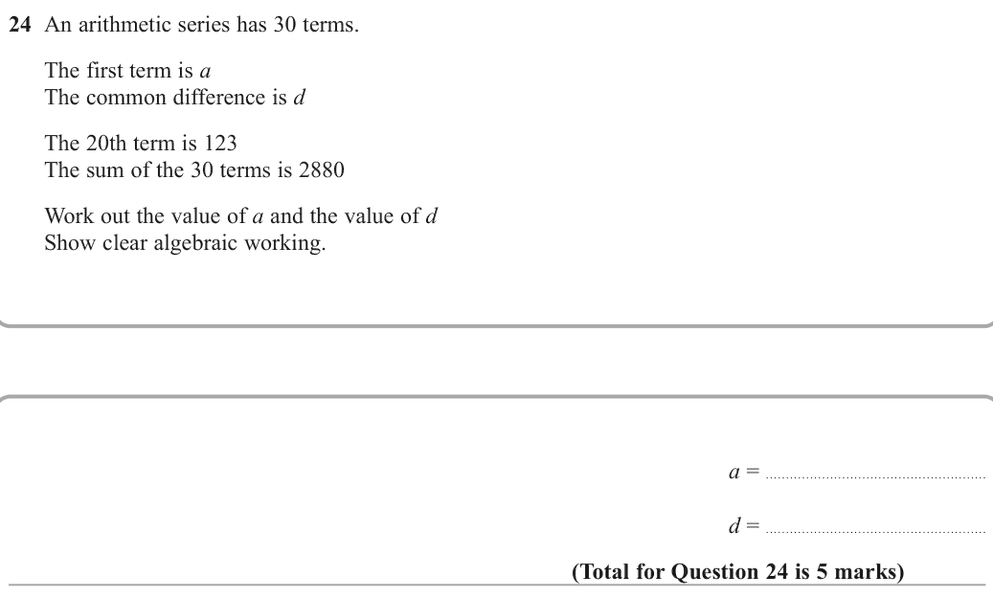
Jun 2025 P1H Question 24 (5 marks): Sequences – 24 An arithmetic series has 30 terms. The first term is a The common difference is d The 20th term is 123 The sum of the 30 terms is 2880 Work out the value of a and the value of d Show clear algebraic working. a =   d =
Show worked solution
  1. Evaluate fraction
    \[ u_{20}=a+19d=123 \]
    \[ S_{30}=\frac{30}{2}(2a+29d)=2880 \]
    \[ 2a+29d=192 \]
  2. Double the first equation

    Double the first equation:

    \[ 2a+38d=246 \]
  3. Subtract

    Subtract:

    \[ 9d=54 \]
    \[ d=6 \]
    \[ a+19(6)=123 \]
    \[ a=9 \]
Final answer

\(a=9,\ d=6\)

21. Nov 2024 P1H · Q19

Hard5 marks
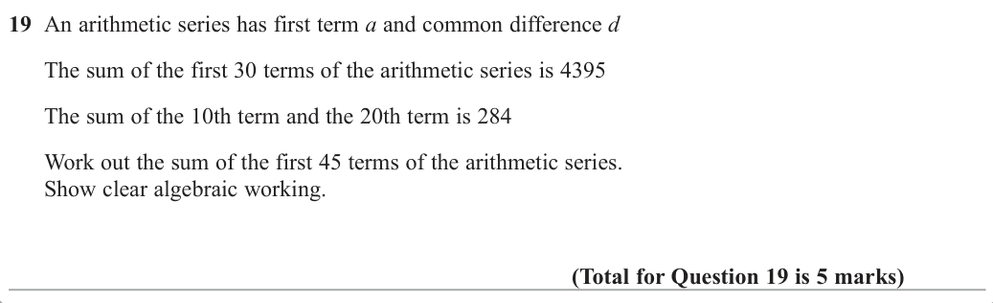
Nov 2024 P1H Question 19 (5 marks): Sequences – 19 An arithmetic series has first term a and common difference d The sum of the first 30 terms of the arithmetic series is 4395 The sum of the 10th term and the 20th term is 284 Work out the sum of the first 45 terms of
Show worked solution
  1. Let the first term be

    Let the first term be \(a\) and the common difference be \(d\).

    \[ S_{30}=4395 \]
    \[ \frac{30}{2}(2a+29d)=4395 \]
    \[ 2a+29d=293 \]
  2. The 8th term plus the

    The 8th term plus the 20th term is 284: \[ (a+7d)+(a+19d)=284 \]

    \[ 2a+26d=284 \]
  3. Subtract the equations

    Subtract the equations: \[ 3d=9 \]

    \[ d=3 \]
  4. Find the nth term

    Then \[ 2a+26(3)=284 \]

    \[ 2a=206 \]
    \[ a=103 \]
  5. Find the nth term

    Now find \(S_{45}\): \[ S_{45}=\frac{45}{2}(2a+44d) \]

    \[ S_{45}=\frac{45}{2}(206+132)=7605 \]
Final answer

\(7605\).

22. Jun 2023 P2HR · Q23

Hard5 marks
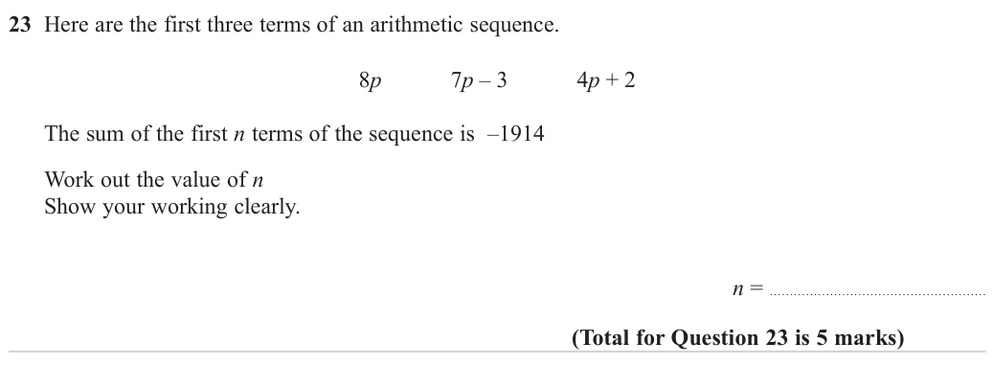
Jun 2023 P2HR Question 23 (5 marks): Sequences – 23 Here are the first three terms of an arithmetic sequence. 8p 7p - 3 4p + 2 The sum of the first n terms of the sequence is -1914 Work out the value of n Show your working clearly. n =   (Total for Question 23 is 5 mar
Show worked solution
  1. The first three terms are
    \[ 8p,\quad 7p-3,\quad 4p+2 \]
  2. Find the nth term

    For an arithmetic sequence, consecutive differences are equal:

    \[ (7p-3)-8p=(4p+2)-(7p-3) \]
    \[ -p-3=-3p+5 \]
    \[ 2p=8 \]
    \[ p=4 \]
  3. Find the nth term

    So the first term is

    \[ 8p=32 \]
  4. Find common difference

    and the common difference is

    \[ (7p-3)-8p=25-32=-7 \]
  5. The sum of the first

    The sum of the first \(n\) terms is

    \[ S_n=\frac n2(2a+(n-1)d) \]
    \[ -1914=\frac n2(64-7(n-1)) \]
    \[ -1914=\frac n2(71-7n) \]
    \[ -3828=n(71-7n) \]
    \[ 7n^2-71n-3828=0 \]
    \[ n=\frac{71\pm 335}{14} \]
  6. Only the positive value is

    Only the positive value is possible:

    \[ n=29 \]
Final answer

\(n=29\)

23. Jun 2022 P1HR · Q25

Hard5 marks
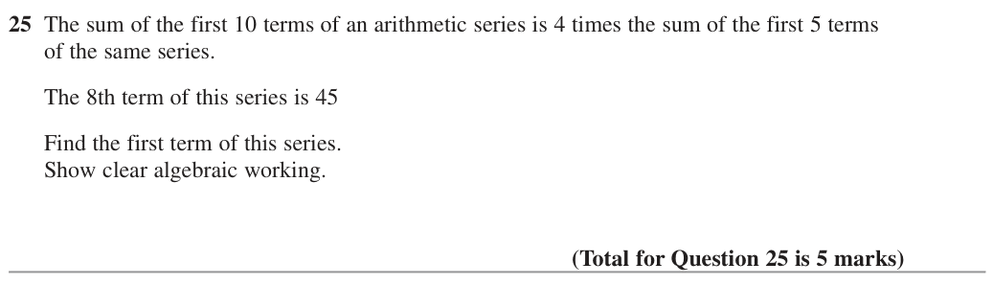
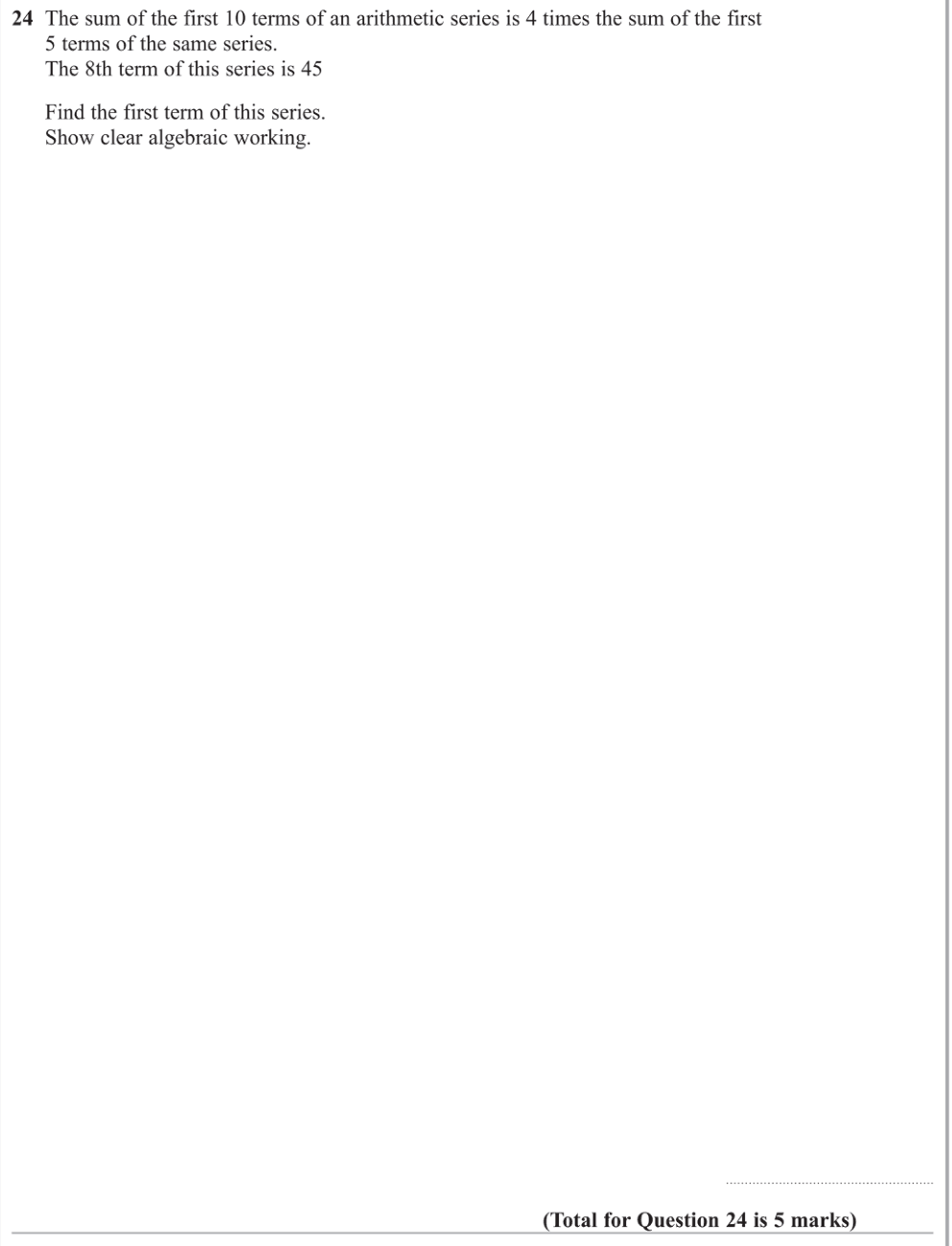
Jun 2022 P1HR Question 25 (5 marks): Sequences – 25 The sum of the first 10 terms of an arithmetic series is 4 times the sum of the first 5 terms of the same series. The 8th term of this series is 45 Find the first term of this series. Show clear algebraic working.   (
Show worked solution
  1. Calculate value
    \[ S_{10}=4S_5 \]
  2. Use
    \[ S_n=\frac n2(2a+(n-1)d) \]
    \[ S_{10}=5(2a+9d) \]
    \[ S_5=\frac52(2a+4d)=5(a+2d) \]
  3. Calculate value

    So

    \[ 5(2a+9d)=4\cdot 5(a+2d) \]
    \[ 2a+9d=4a+8d \]
    \[ d=2a \]
  4. The 8th term is 45

    The 8th term is 45:

    \[ u_8=a+7d=45 \]
    \[ a+7(2a)=45 \]
    \[ 15a=45 \]
    \[ a=3 \]
Final answer

The first term is \(3\)

24. Jan 2022 P2H · Q26

Hard5 marks
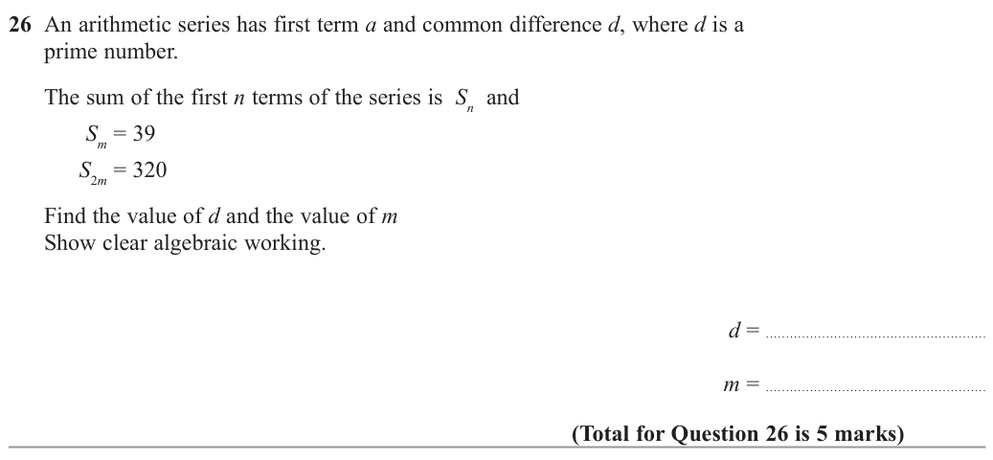
Jan 2022 P2H Question 26 (5 marks): Sequences – 26 An arithmetic series has first term a and common difference d, where d is a prime number. The sum of the first n terms of the series is Sn and Sm = 39 S2m = 320 Find the value of d and the value of m Show clear algebr
Show worked solution
  1. Calculate value
    \[ S_m=39 \]
    \[ S_{2m}=320 \]
  2. Use
    \[ S_n=\frac n2(2a+(n-1)d) \]
  3. Calculate value

    Then

    \[ 2S_m=m(2a+(m-1)d)=78 \]
  4. Calculate value

    and

    \[ S_{2m}=m(2a+(2m-1)d)=320 \]
  5. Subtract

    Subtract:

    \[ S_{2m}-2S_m=m[(2m-1)d-(m-1)d] \]
    \[ 320-78=m(md) \]
    \[ 242=m^2d \]
    \[ 242=2\times 11^2 \]
  6. Square factor

    Since \(d\) is prime and \(m^2\) is a square factor,

    \[ d=2,\quad m^2=121 \]
    \[ m=11 \]
Final answer

\(d=2,\ m=11\)

25. Nov 2021 P2H · Q20

Hard5 marks
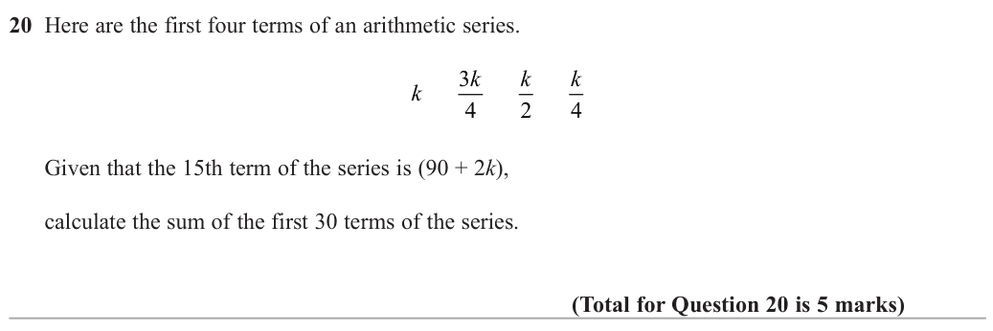
Nov 2021 P2H Question 20 (5 marks): Sequences – 20 Here are the first four terms of an arithmetic series. k k k k 3 4 2 4 Given that the 15th term of the series is (90 + 2k), calculate the sum of the first 30 terms of the series.   (Total for Question 20 is 5 marks)
Show worked solution
  1. The first four terms are
    \[ k,\quad \frac{3k}{4},\quad \frac{k}{2},\quad \frac{k}{4} \]
  2. The common difference is
    \[ d=-\frac{k}{4} \]
  3. The 15th term is
    \[ u_{15}=k+14\left(-\frac{k}{4}\right) \]
    \[ u_{15}=k-\frac{7k}{2}=-\frac{5k}{2} \]
  4. Given
    \[ -\frac{5k}{2}=90+2k \]
    \[ -5k=180+4k \]
    \[ k=-20 \]
  5. Evaluate fraction

    So

    \[ a=-20,\quad d=5 \]
    \[ S_{30}=\frac{30}{2}(2(-20)+29(5)) \]
    \[ S_{30}=15(105)=1575 \]
Final answer

\(1575\)

26. May 2021 P1H · Q23

Hard5 marks
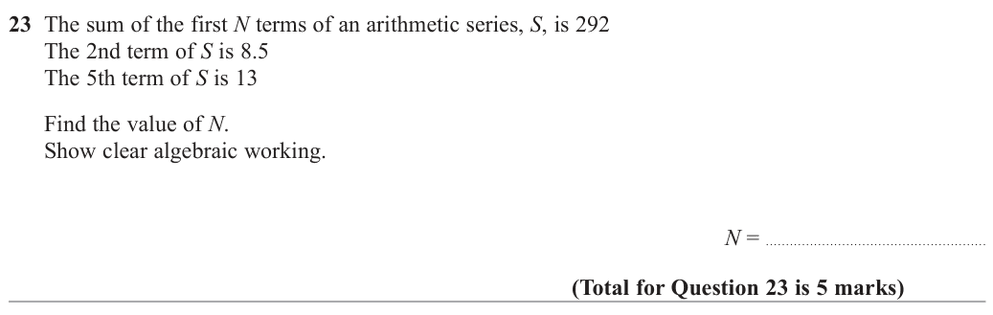
May 2021 P1H Question 23 (5 marks): Sequences – 23 The sum of the first N terms of an arithmetic series, S, is 292 The 2nd term of S is 8.5 The 5th term of S is 13 Find the value of N. Show clear algebraic working. N =   (Total for Question 23 is 5 marks)
Show worked solution
  1. The 2nd term is
    \[ a+d=8.5 \]
  2. The 5th term is
    \[ a+4d=13 \]
  3. Subtract

    Subtract:

    \[ 3d=4.5 \]
    \[ d=1.5 \]
    \[ a=8.5-1.5=7 \]
  4. Use
    \[ S_N=\frac N2(2a+(N-1)d) \]
    \[ 292=\frac N2(14+1.5(N-1)) \]
    \[ 292=\frac N2(1.5N+12.5) \]
    \[ 3N^2+25N-1168=0 \]
    \[ N=\frac{-25+121}{6}=16 \]
Final answer

\(N=16\)

27. Specimen 4WM2H · Q24

Hard5 marks
Specimen 4WM2H Question 24 (5 marks): Sequences – 24 The sum of the first 10 terms of an arithmetic series is 4 times the sum of the first 5 terms of the same series. The 8th term is 45. Find the first term of this series. (Total for Question 24 is 5 marks)
Show worked solution
  1. Let the first term be

    Let the first term be \(a\) and the common difference be \(d\).

    \[ S_n=\frac n2(2a+(n-1)d) \]
  2. Find the nth term

    So

    \[ S_{10}=5(2a+9d) \]
  3. Find the nth term

    and

    \[ S_5=\frac52(2a+4d) \]
  4. Given

    Given \(S_{10}=4S_5\):

    \[ 5(2a+9d)=4\left(\frac52(2a+4d)\right) \]
    \[ 10a+45d=20a+40d \]
    \[ 5d=10a \]
    \[ d=2a \]
  5. The 8th term is

    The 8th term is \(45\):

    \[ a+7d=45 \]
  6. Substitute

    Substitute \(d=2a\):

    \[ a+14a=45 \]
    \[ 15a=45 \]
    \[ a=3 \]
Final answer

the first term is \(3\).

28. Jun 2026 4WM2HR · Q25

Hard6 marks
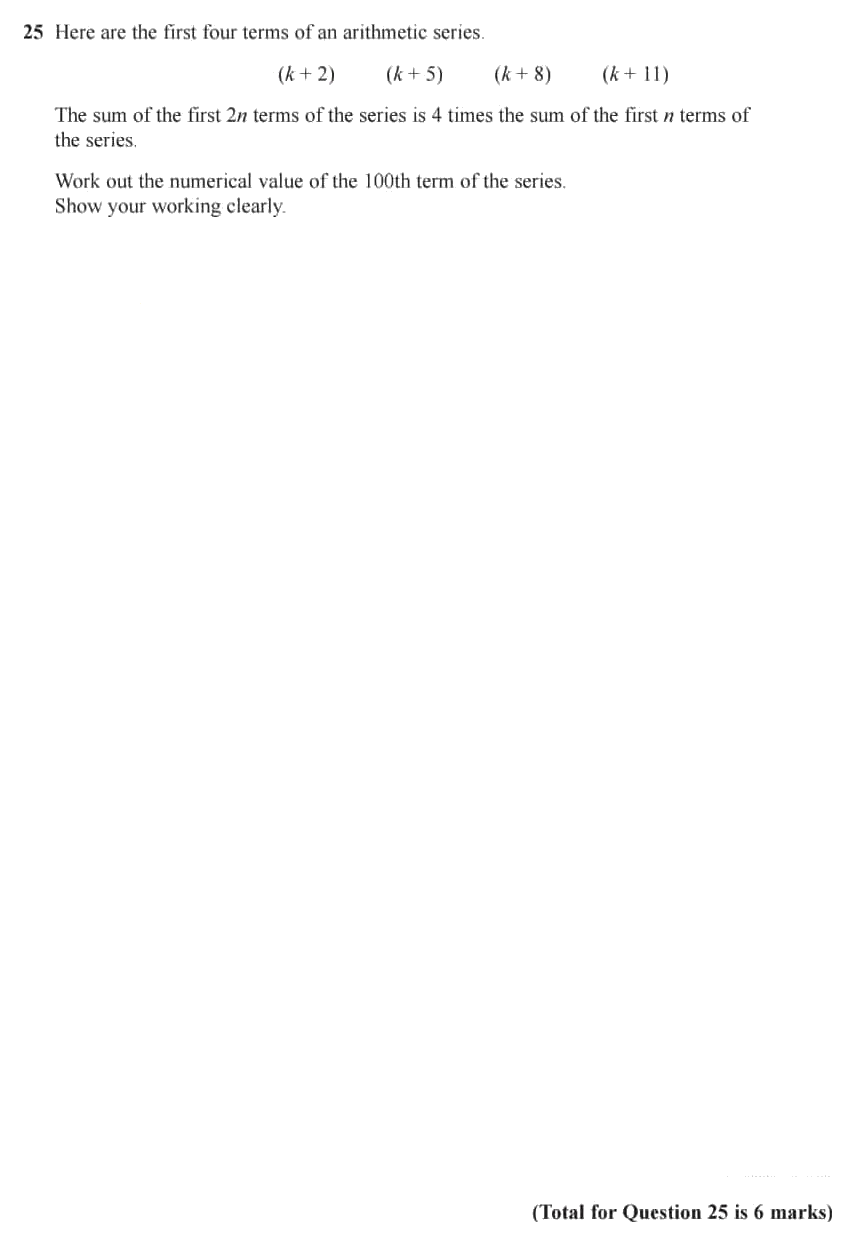
Jun 2026 4WM2HR Question 25 (6 marks): Sequences – 25 Here are the first four terms of an arithmetic series. (k + 2) (k + 5) (k + 8) (k + 11). The sum of the first 2n terms of the series is 4 times the sum of the first n terms of the series. Work out the numerical value
Show worked solution
  1. First term and difference

    \(a=k+2\), \(d=3\).

  2. Use the sum formula
    \[\frac{2n}{2}\big[2a+(2n-1)3\big]=4\times\frac n2\big[2a+(n-1)3\big]\]
  3. Simplify (divide by n)
    \[2a+6n-3=4a+6n-6\Rightarrow 2a=3\Rightarrow a=1.5,\ k=-\tfrac12\]
  4. 100th term
    \[a+99d=1.5+99(3)=298.5\]
Final answer

\(298.5\)

29. Jun 2026 P2HR · Q26

Hard6 marks
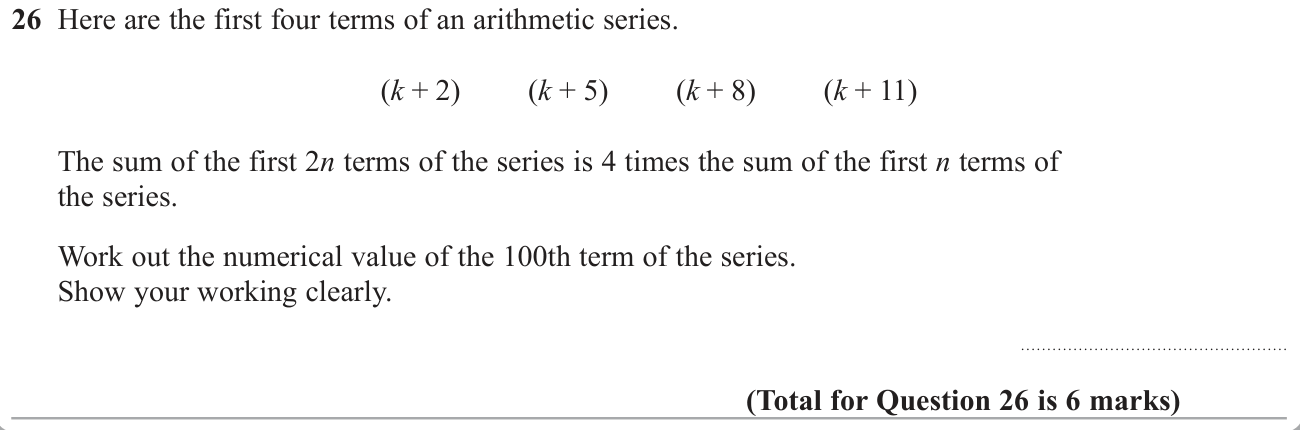
Jun 2026 P2HR Question 26 (6 marks): Sequences – 26 Here are the first four terms of an arithmetic series. (k + 2) (k + 5) (k + 8) (k + 11) The sum of the first 2n terms of the series is 4 times the sum of the first n terms of the series. Work out the numerical value o
Show worked solution
  1. Solution | Step 1

    The first term is \(a=k+2\) and the common difference is \(d=3\).

    Successive listed terms differ by 3.

  2. Solution | Step 2
    \[S_n=\frac n2\{2(k+2)+3(n-1)\}=\frac n2(2k+1+3n).\]

    Apply the arithmetic-series sum formula.

  3. Solution | Step 3
    \[S_{2n}=n\{2(k+2)+3(2n-1)\}=n(2k+1+6n).\]

    Use 2n in place of n throughout the sum formula.

  4. Solution | Step 4

    Using \(S_{2n}=4S_n\) and \(n>0\), \[2k+1+6n=2(2k+1+3n)=4k+2+6n.\]

    Divide the equation by n, then expand the right-hand side.

  5. Solution | Step 5
    \[2k+1=4k+2\quad\Rightarrow\quad k=-\frac12.\]

    The n-terms cancel, leaving a linear equation for k.

  6. Solution | Step 6
    \[u_{100}=k+2+99(3)=-\frac12+2+297=298.5.\]

    The 100th term is the first term plus 99 common differences.

Final answer

The 100th term is \(298.5\).

30. Jun 2025 P1HR · Q24

Hard6 marks
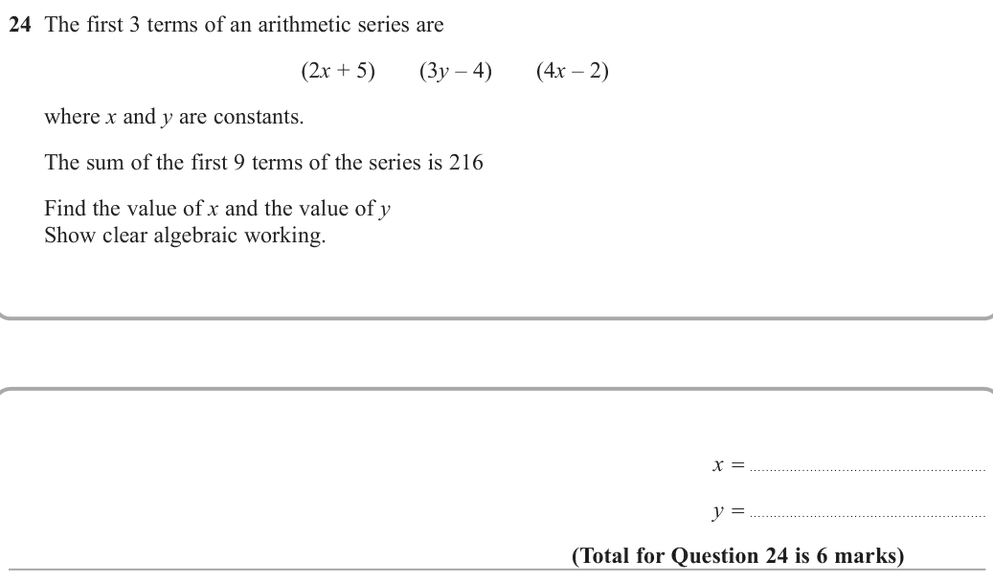
Jun 2025 P1HR Question 24 (6 marks): Sequences – 24 The first 3 terms of an arithmetic series are (2x + 5) (3y - 4) (4x - 2) where x and y are constants. The sum of the first 9 terms of the series is 216 Find the value of x and the value of y Show clear algebraic worki
Show worked solution
  1. The first 3 terms are
    \[ 2x+5,\quad 3y-4,\quad 4x-2 \]
  2. Equal differences give
    \[ (3y-4)-(2x+5)=(4x-2)-(3y-4) \]
    \[ 6y-6x=11 \]
  3. Use series formula

    For an arithmetic series,

    \[ S_9=9(a+4d) \]
  4. Here
    \[ a=2x+5 \]
    \[ d=(3y-4)-(2x+5)=3y-2x-9 \]
  5. Given

    Given \(S_9=216\):

    \[ 9[(2x+5)+4(3y-2x-9)]=216 \]
    \[ 12y-6x=55 \]
  6. Solve

    Now solve

    \[ 6y-6x=11 \]
    \[ 12y-6x=55 \]
  7. Subtracting gives
    \[ 6y=44 \]
    \[ y=\frac{22}{3} \]
  8. Evaluate fraction

    Then

    \[ 6\left(\frac{22}{3}\right)-6x=11 \]
    \[ x=\frac{11}{2} \]
Final answer

\(x=\dfrac{11}{2},\ y=\dfrac{22}{3}\)

31. May 2025 4WM2HR · Q24

Hard6 marks
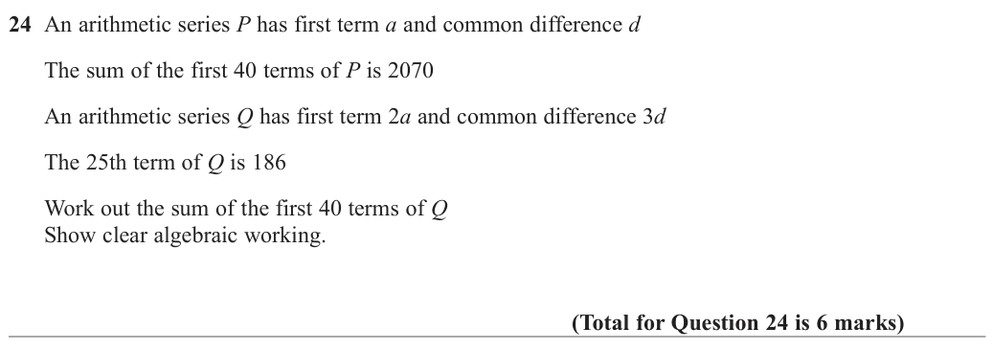
May 2025 4WM2HR Question 24 (6 marks): Sequences – 24 An arithmetic series P has first term a and common difference d The sum of the first 40 terms of P is 2070 An arithmetic series Q has first term 2a and common difference 3d The 25th term of Q is 186 Work out the sum o
Show worked solution
  1. Required

    Series P: first term *a*, c.d. *d*; *S*<sub>40</sub>(*P*) = 2070. Series Q: first term 2*a*, c.d. 3*d*; 25th term of Q  = 186. Find *S*<sub>40</sub>(*Q*).

  2. Form equation from S 40

    Form equation from *S*<sub>40</sub>(*P*) = 2070: $$S\_{40} = \\frac{40}{2}\[2a+39d\] = 20(2a+39d) = 2070 \\implies 2a + 39d = 103.5 \\tag{1}$$

  3. Form equation from 25th term

    Form equation from 25th term of Q  = 186: *T*<sub>25</sub>(*Q*) = 2*a* + 24(3*d*) = 2*a* + 72*d* = 186

  4. Solve simultaneous equations

    Solve simultaneously — subtract (1) from (2): 33*d* = 82.5 ⟹ *d* = 2.5

  5. Substitute d 2 5 (1)

    Substitute *d* = 2.5 into (1): 2*a* + 39(2.5) = 103.5 ⟹ 2*a* = 6 ⟹ *a* = 3

  6. Compute S 40 ( Q

    Compute *S*<sub>40</sub>(*Q*), with first term  = 2*a* = 6 and c.d.  = 3*d* = 7.5: $$S\_{40}(Q) = \\frac{40}{2}\\bigl\[2(6) + 39(7.5)\\bigr\] = 20\\bigl\[12 + 292.5\\bigr\] = 20 \\times 304.5 = 6090$$

Final answer

*S*<sub>40</sub>(*Q*) = 6090

32. May 2024 P1H · Q24

Hard6 marks
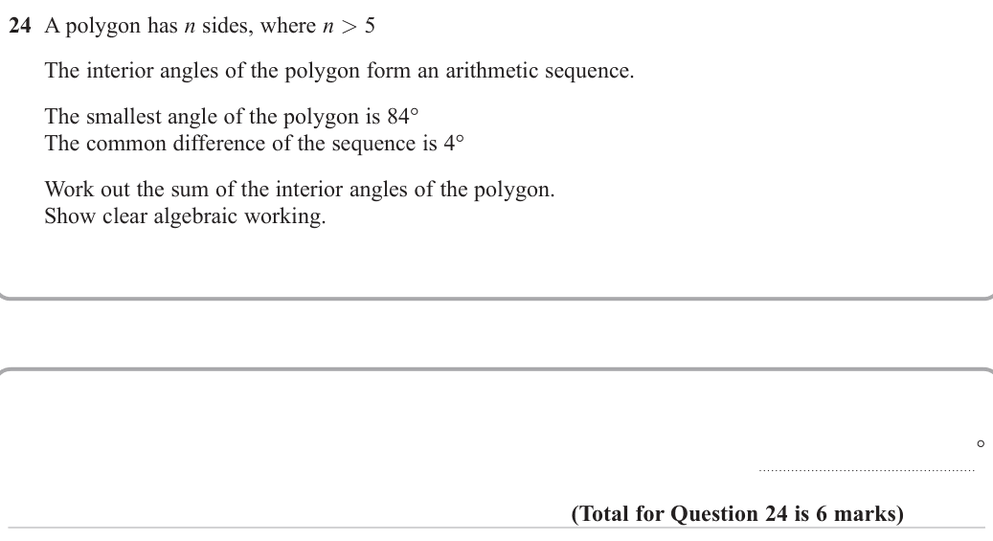
May 2024 P1H Question 24 (6 marks): Sequences – 24 A polygon has n sides, where n > 5 The interior angles of the polygon form an arithmetic sequence. The smallest angle of the polygon is 84° The common difference of the sequence is 4° Work out the sum of the interior
Show worked solution
  1. The interior angles form an

    The interior angles form an arithmetic sequence with first term \(84\) and common difference \(4\).

  2. Use trigonometry

    So the sum of the angles is

    \[ \frac n2(2(84)+(n-1)4) \]
    \[ =\frac n2(168+4n-4) \]
    \[ =2n^2+82n \]
  3. The sum of the interior

    The sum of the interior angles of an \(n\)-sided polygon is

    \[ 180(n-2) \]
  4. Calculate value

    So

    \[ 2n^2+82n=180(n-2) \]
    \[ 2n^2-98n+360=0 \]
    \[ n^2-49n+180=0 \]
    \[ (n-45)(n-4)=0 \]
  5. Solve inequality

    Since \(n>5\),

    \[ n=45 \]
  6. Use trigonometry

    Therefore the sum of the interior angles is

    \[ 180(45-2)=7740 \]
Final answer

\(7740\) degrees

33. Nov 2023 P1H · Q19

Hard6 marks
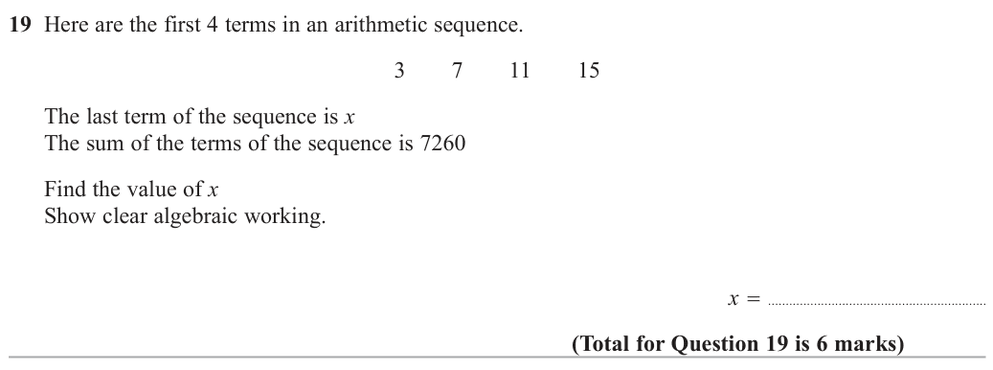
Nov 2023 P1H Question 19 (6 marks): Sequences – 19 Here are the first 4 terms in an arithmetic sequence. 3 7 11 15 The last term of the sequence is x The sum of the terms of the sequence is 7260 Find the value of x Show clear algebraic working. x =   (Total for Questi
Show worked solution
  1. The sequence is
    \[ 3,\ 7,\ 11,\ 15 \]
  2. Find the nth term

    The common difference is \(4\), so the nth term is \[ 4n-1 \]

  3. Find the nth term

    The last term is \(x\), so \[ x=4n-1 \]

    \[ n=\frac{x+1}{4} \]
  4. The sum is 7260

    The sum is 7260: \[ \frac{n}{2}(3+x)=7260 \]

  5. Substitute

    Substitute \(n=\dfrac{x+1}{4}\): \[ \frac{x+1}{8}(x+3)=7260 \]

    \[ (x+1)(x+3)=58080 \]
    \[ x^2+4x-58077=0 \]
  6. Factorise

    Factorise: \[ (x-239)(x+243)=0 \]

  7. Find the nth term

    The last term is positive, so \[ x=239 \]

Final answer

\(x=239\).

34. May 2023 P1H · Q20

Hard6 marks
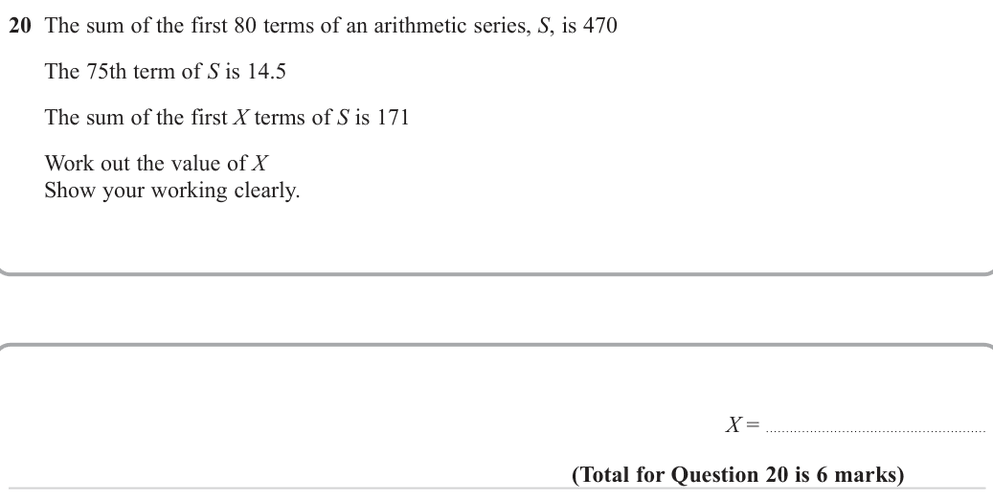
May 2023 P1H Question 20 (6 marks): Sequences – 20 The sum of the first 80 terms of an arithmetic series, S, is 470 The 75th term of S is 14.5 The sum of the first X terms of S is 171 Work out the value of X Show your working clearly. X =   (Total for Question 20 is 6
Show worked solution
  1. Evaluate fraction
    \[ S_{80}=470 \]
    \[ 40(2a+79d)=470 \]
    \[ 2a+79d=\frac{47}{4} \]
  2. The 75th term is
    \[ a+74d=14.5=\frac{29}{2} \]
  3. Double it

    Double it:

    \[ 2a+148d=29 \]
  4. Subtract

    Subtract:

    \[ 69d=29-\frac{47}{4}=\frac{69}{4} \]
    \[ d=\frac14 \]
    \[ a+74\left(\frac14\right)=\frac{29}{2} \]
    \[ a=-4 \]
  5. Evaluate fraction

    Now

    \[ S_X=171 \]
    \[ 171=\frac X2\left(2(-4)+(X-1)\frac14\right) \]
    \[ 171=\frac{X(X-33)}{8} \]
    \[ X^2-33X-1368=0 \]
    \[ X=\frac{33+81}{2}=57 \]
Final answer

\(X=57\)

35. Jan 2021 P1HR · Q21

Hard6 marks
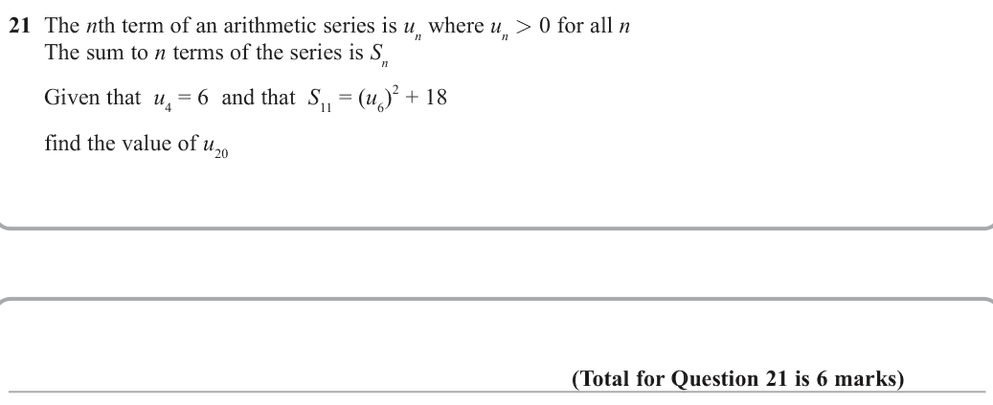
Jan 2021 P1HR Question 21 (6 marks): Sequences – 21 The nth term of an arithmetic series is un where un > 0 for all n The sum to n terms of the series is Sn Given that u4 = 6 and that S11 = (u6) 2 + 18 find the value of u20   (Total for Question 21 is 6 marks)
Show worked solution
  1. Let

    Let \(u_6=v\).

  2. Use series formula

    For an arithmetic series,

    \[ S_{11}=\frac{11}{2}(u_1+u_{11}) \]
  3. The average of and is

    The average of \(u_1\) and \(u_{11}\) is \(u_6\), so

    \[ S_{11}=11u_6=11v \]
  4. Given
    \[ S_{11}=(u_6)^2+18 \]
    \[ 11v=v^2+18 \]
    \[ v^2-11v+18=0 \]
    \[ (v-2)(v-9)=0 \]
  5. Calculate value

    So

    \[ u_6=2 \quad \text{or} \quad u_6=9 \]
  6. Find the nth term

    But \(u_4=6\). If \(u_6=2\), then the common difference is negative and later terms would not all be positive. Therefore,

    \[ u_6=9 \]
    \[ d=\frac{u_6-u_4}{2}=\frac{9-6}{2}=\frac32 \]
    \[ u_{20}=u_6+14d \]
    \[ u_{20}=9+14\left(\frac32\right)=30 \]
Final answer

\(u_{20}=30\)

More IGCSE Maths 4MA1 topics

Dr Eslam Ahmed
Dr Eslam Ahmed

Elite Mathematics · Questions classified by topic, solutions checked by Dr Eslam