Transformations: past paper questions & worked solutions
Every Transformations question from the 4MA1 papers in our bank, 2020–2026, sorted from easiest to hardest. Try each one first, then open the worked solution.
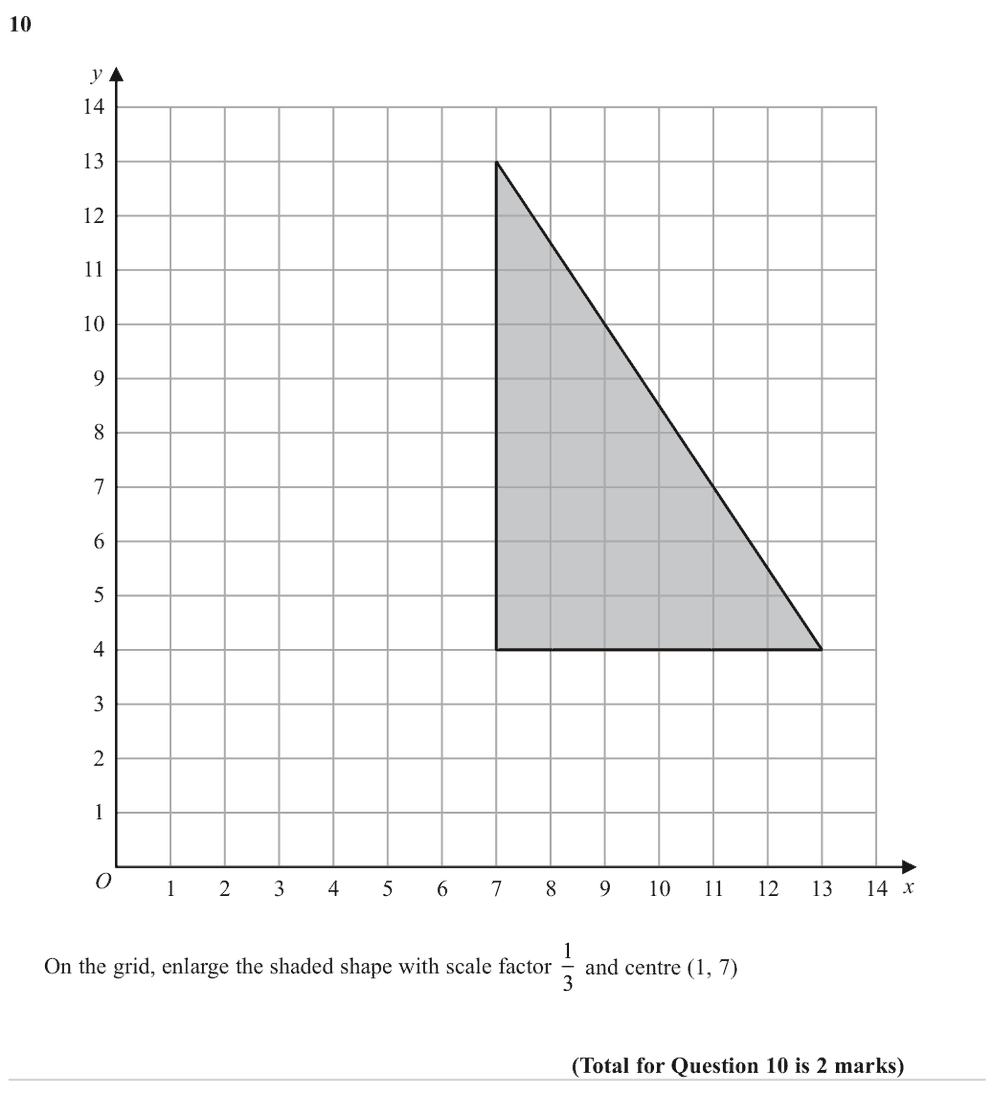
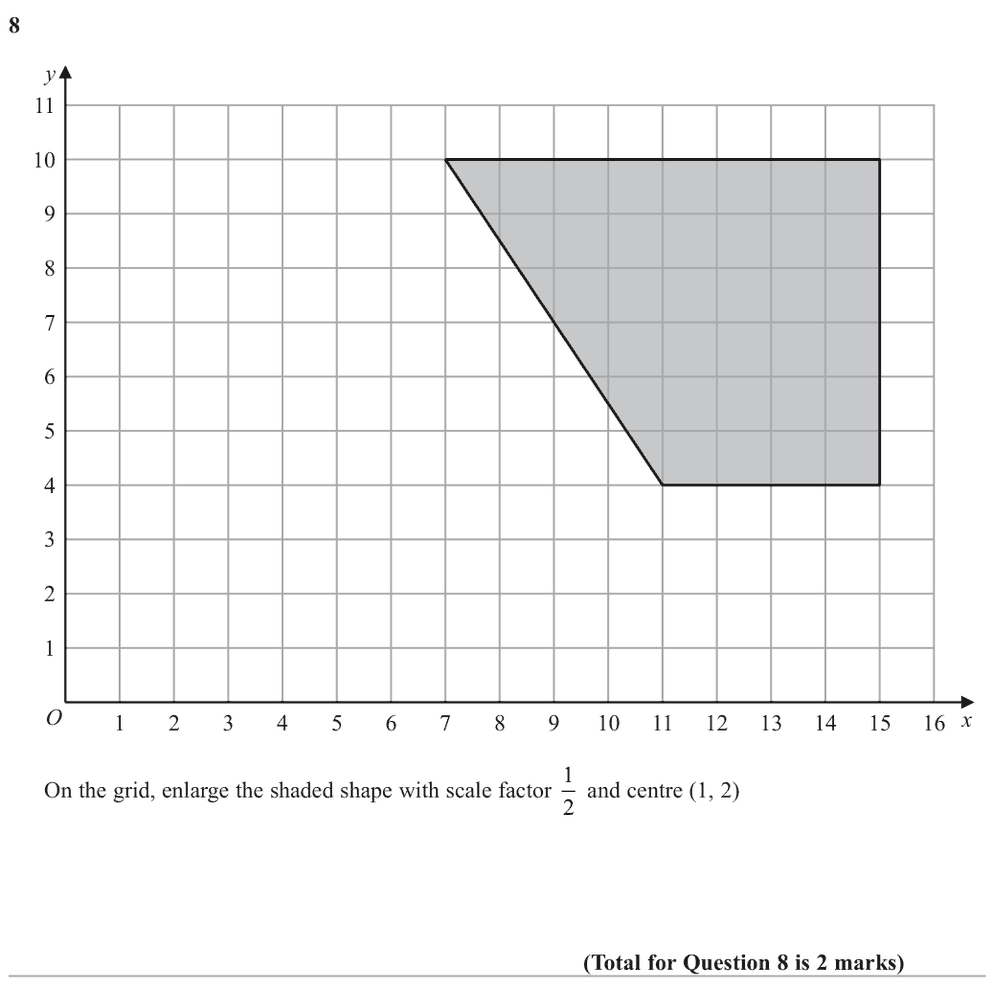
draw the enlarged shape with vertices \((4,6),(8,6),(8,3),(6,3)\).
3. Jun 2026 P2H · Q5
Medium4 marksShow worked solution
Part (a) | Step 1
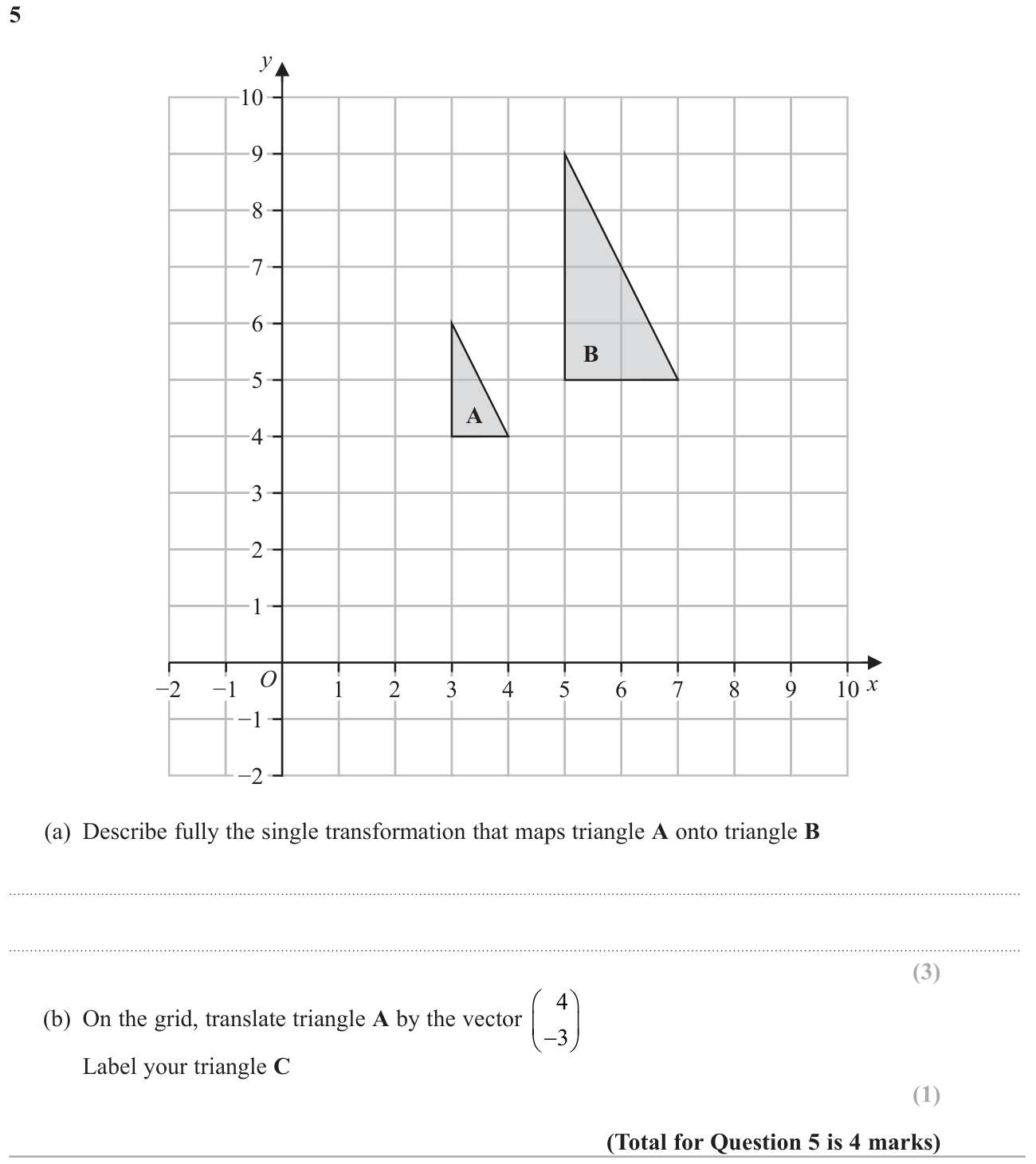
Triangle \(A\) has vertices \((3,4),(4,4),(3,6)\); the corresponding vertices of \(B\) are \((5,5),(7,5),(5,9)\). The lengths have doubled.
Read corresponding vertices and compare side lengths.
Part (a) | Step 2
For enlargement factor \(2\), the centre \(O\) satisfies \(B=O+2(A-O)\), so \(O=2A-B\). Using \((3,4)\mapsto(5,5)\) gives \(O=(6,8)-(5,5)=(1,3)\).
Find the fixed centre from a corresponding pair; the other pairs give the same centre.
Part (b) | Step 1
Add \((4,-3)\) to every vertex: \((3,4)\mapsto(7,1)\), \((4,4)\mapsto(8,1)\), and \((3,6)\mapsto(7,3)\). Plot these three points, join them with straight sides and label the triangle \(C\).
A translation moves every point by the same vector.
Final answer
(a) Enlargement with scale factor \(2\) and centre \((1,3)\).
(b) \(C:(7,1),(8,1),(7,3)\).
4. Jun 2025 P2HR · Q5
Medium4 marksShow worked solution
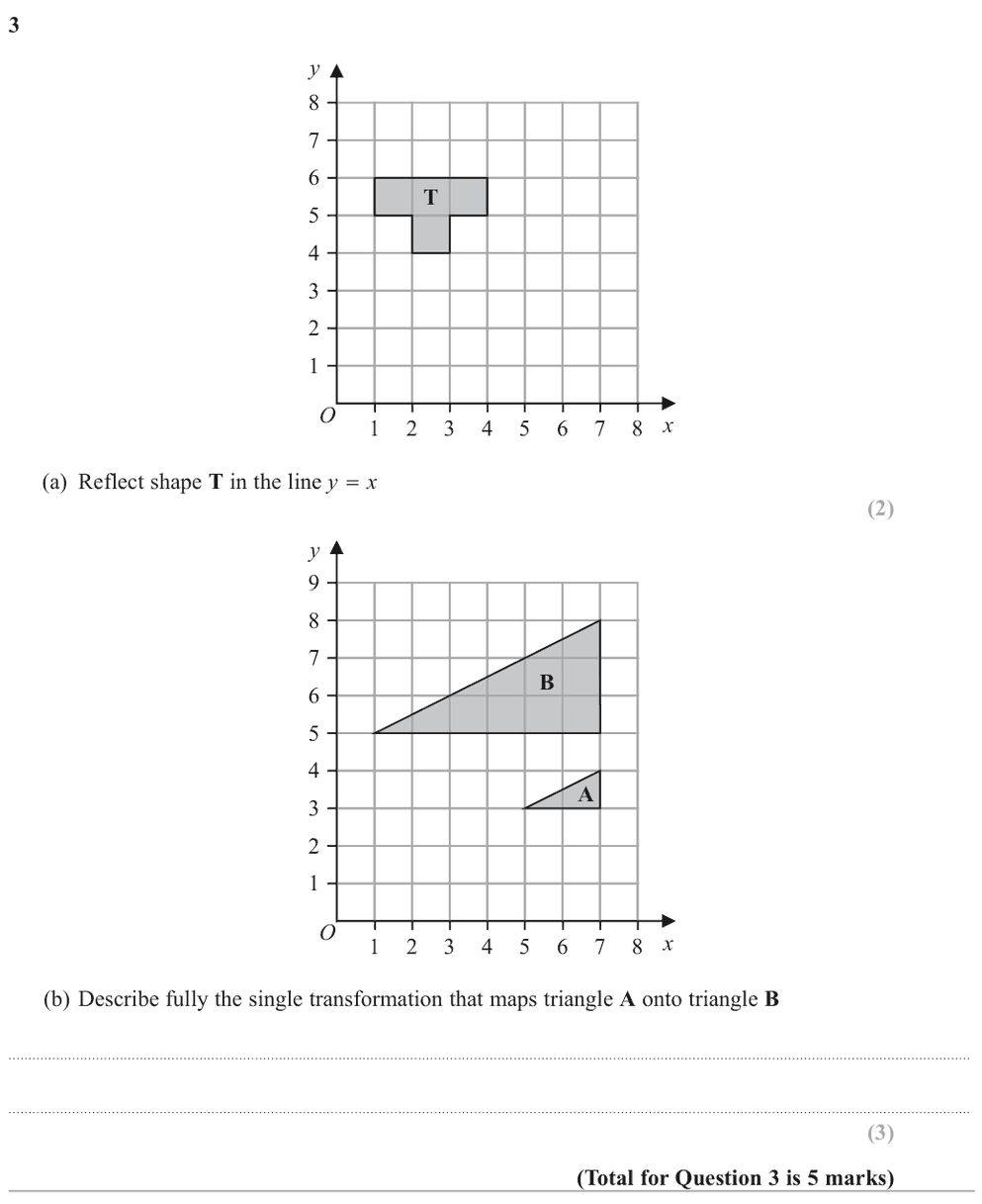
(a) Reflection in swaps each
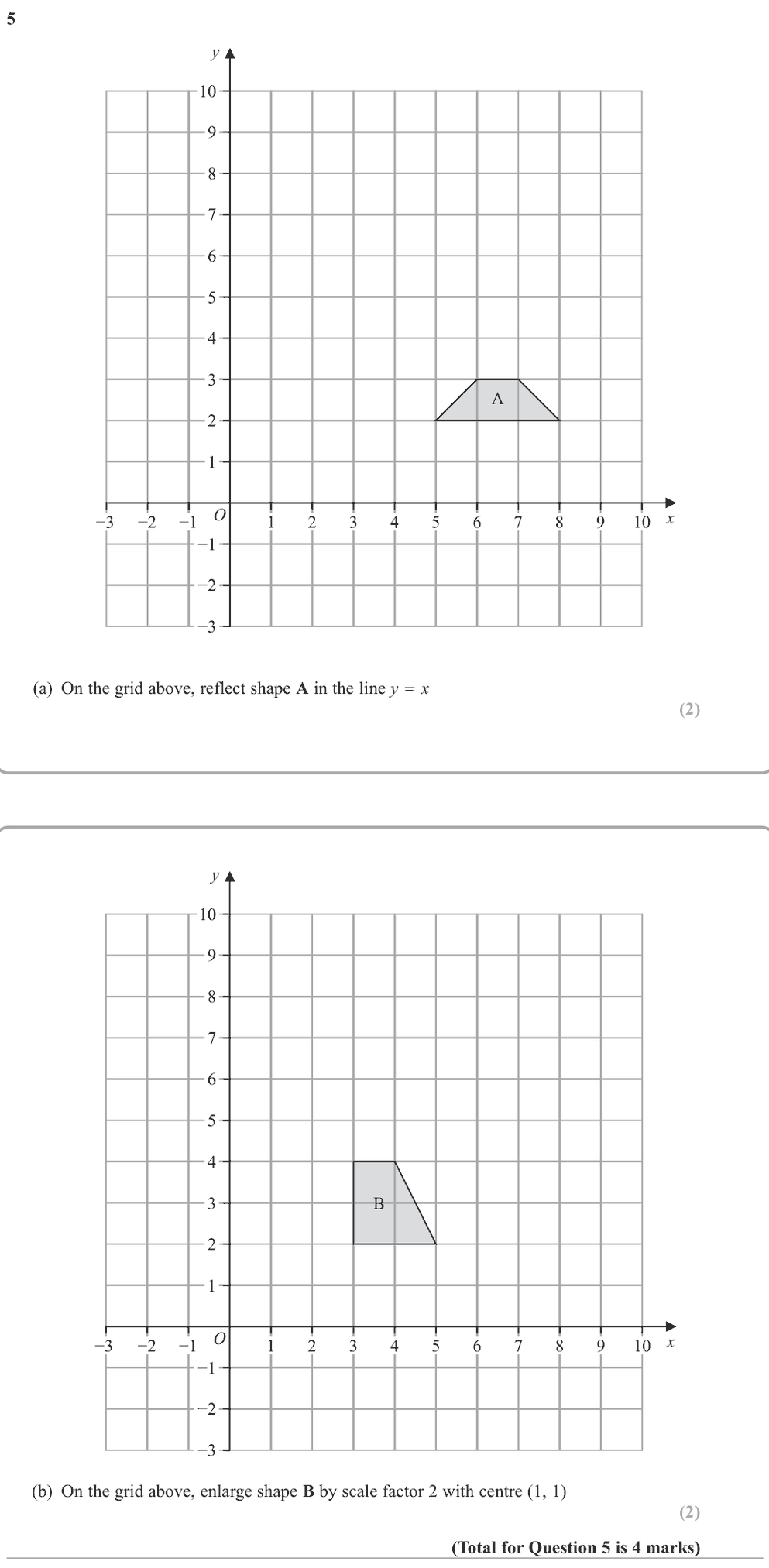
(a) Reflection in \(y=x\) swaps each coordinate:
\[
(x,y)\mapsto(y,x)
\]
The image of has vertices
The image of \(A\) has vertices
\[
(2,5),\ (2,8),\ (3,7),\ (3,6)
\]
(b) Enlarge by scale factor
(b) Enlarge \(B\) by scale factor \(2\) from centre \((1,1)\).
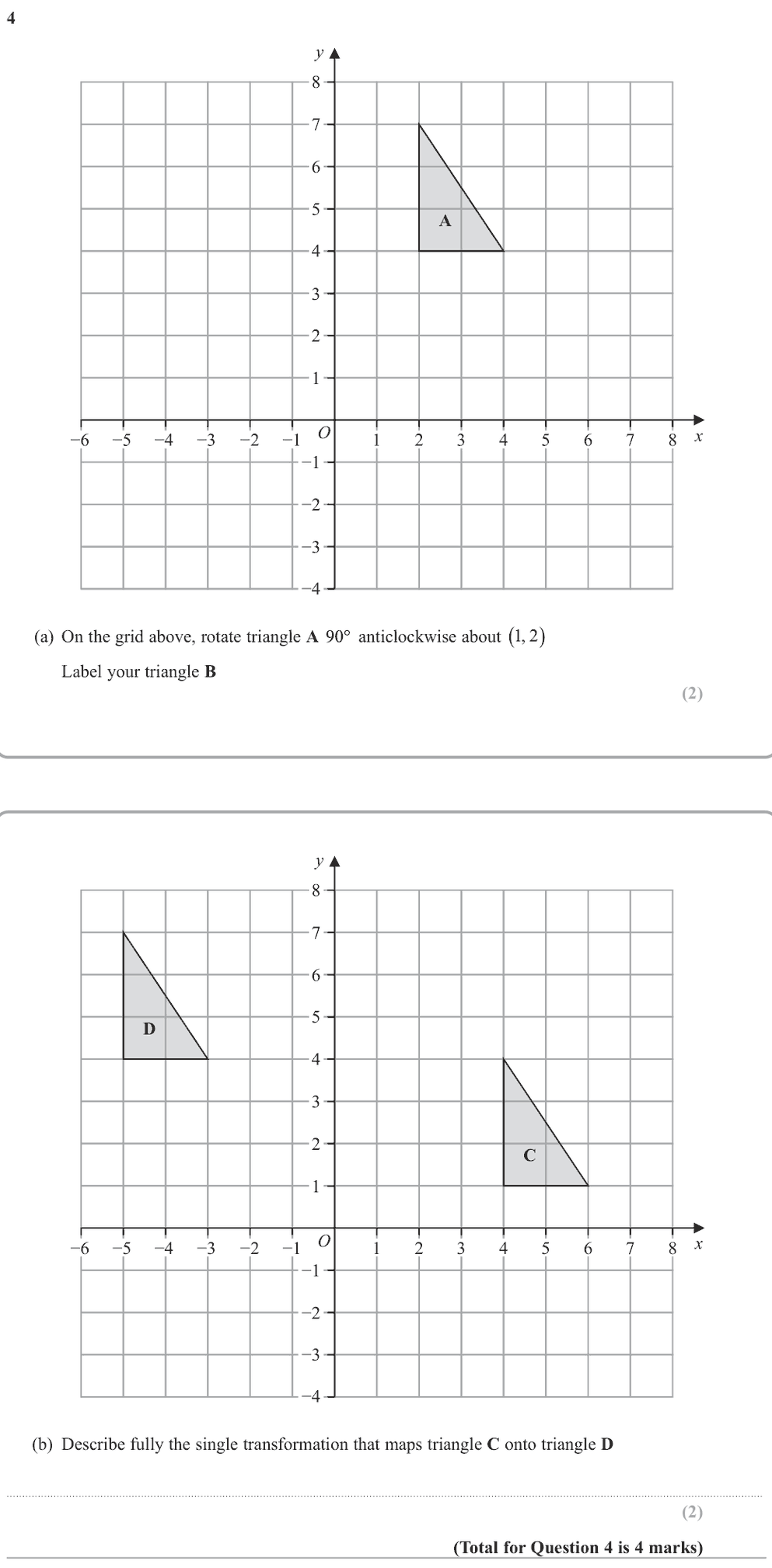
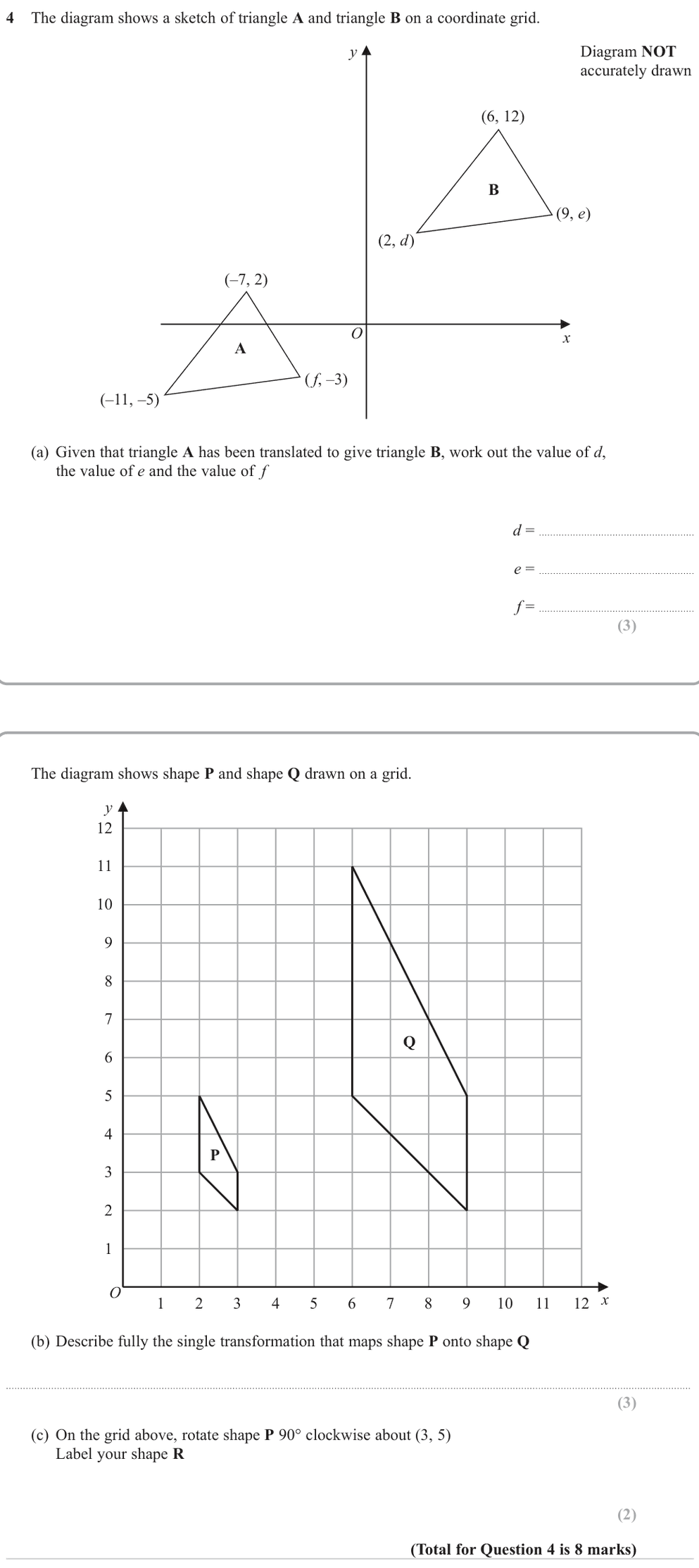
\(a\) Rotate triangle A 90° anticlockwise about (1,2); label triangle B. (b) Describe fully the transformation mapping C onto D.
The rule for 90 anticlockwise
The rule for 90° anticlockwise rotation about (*a*,*b*): (*x*, *y*) → (*a* − (*y*−*b*), *b* + (*x*−*a*)) About (1,2): (*x*,*y*) → (3−*y*, *x*+1)
Triangle A has vertices A
Triangle A has vertices *A*<sub>1</sub>(2,7), *A*<sub>2</sub>(4,5), *A*<sub>3</sub>(2,5). Apply the rule: (2,7) → (−4,3), (4,5) → (−2,5), (2,5) → (−2,3)
Answer
Triangle B has vertices (−4,3), (−2,5), (−2,3)
Identify corresponding vertices of C
Identify corresponding vertices of C and D from the diagram and compute the vector: $$(4,\\,4) \\longrightarrow (-5,\\,7): \\quad \\vec{v} = \\begin{pmatrix}-9\\\\3\\end{pmatrix}$$ Check: (6,1) → (−3,4) gives the same vector $\\begin{pmatrix}-9\\\\3\\end{pmatrix}$
Final answer
Translation by vector $\\begin{pmatrix}-9\\\\3\\end{pmatrix}$
6. Jun 2024 P2HR · Q2
Medium4 marksShow worked solution
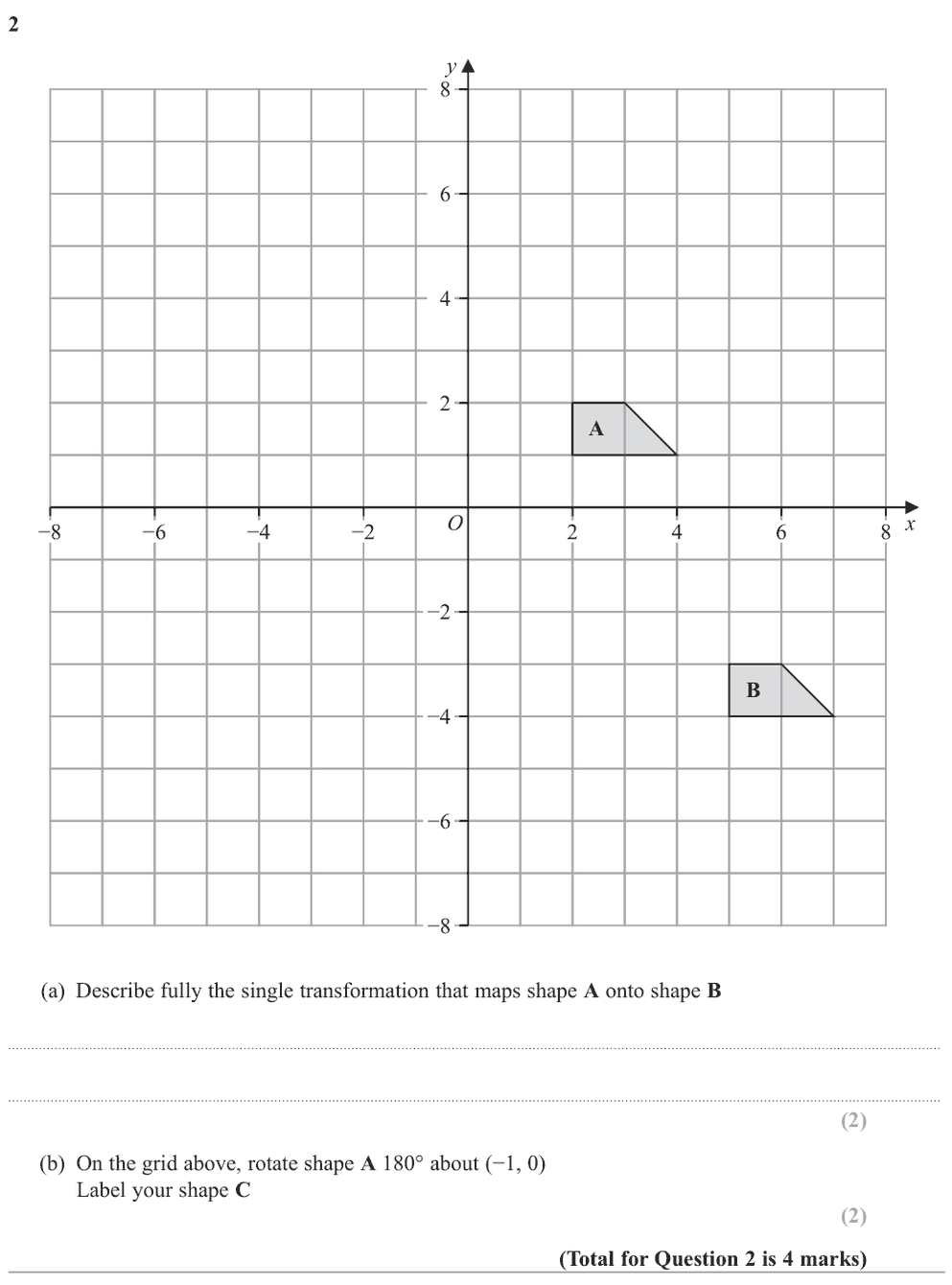
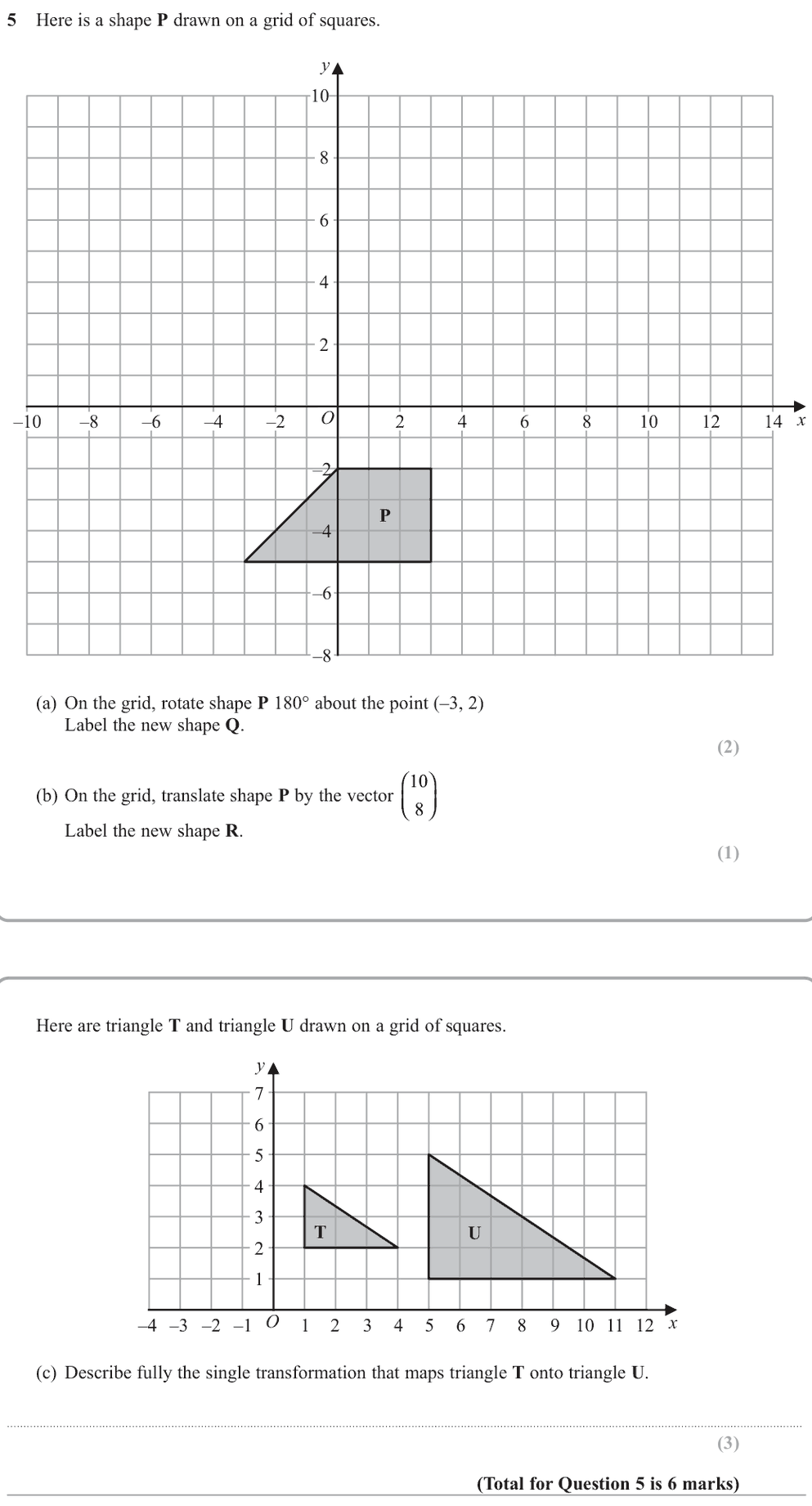
(a) Shape moves to shape
(a) Shape \(A\) moves to shape \(B\) by the vector
\[
\begin{pmatrix}3\\-5\end{pmatrix}
\]
Use matrices
So the transformation is a translation by \(\begin{pmatrix}3\\-5\end{pmatrix}\).
(b) For a rotation about
(b) For a \(180^\circ\) rotation about \((-1,0)\),
\[
(x,y)\mapsto(-2-x,\ -y)
\]
The image has vertices
\[
(-4,-1),\ (-6,-1),\ (-5,-2),\ (-4,-2)
\]
Final answer
(a) translation by \(\begin{pmatrix}3\\-5\end{pmatrix}\); (b) vertices \((-4,-1),(-6,-1),(-5,-2),(-4,-2)\).
7. Jun 2022 P2HR · Q1
Medium4 marksShow worked solution
Use trigonometry
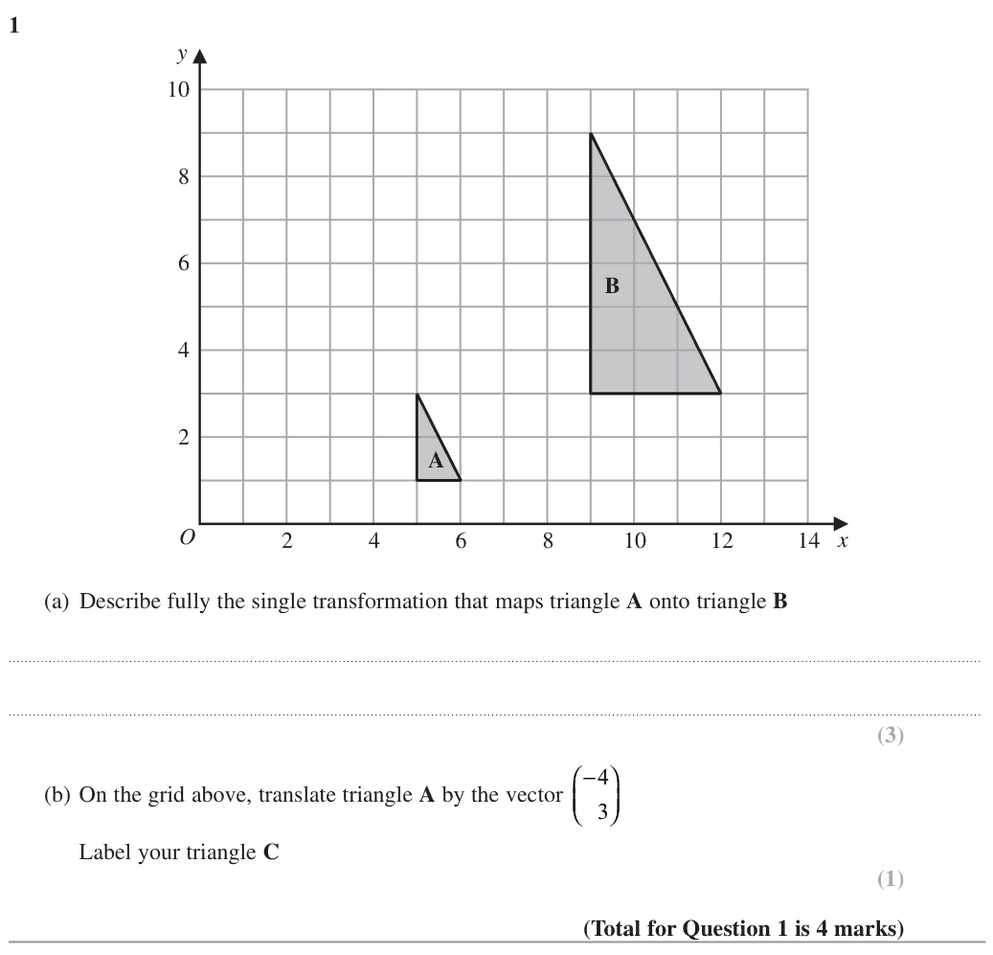
(a) Triangle \(A\) is enlarged to triangle \(B\).
The scale factor is
\[
3
\]
Use Transformations tag correct
Using corresponding vertices gives centre \((3,0)\).
Use Transformations tag correct
So the transformation is an enlargement, scale factor \(3\), centre \((3,0)\).
(b) Translating triangle by
(b) Translating triangle \(A\) by
\[
\begin{pmatrix}-4\\3\end{pmatrix}
\]
gives vertices
\[
(1,4),\ (2,4),\ (1,6)
\]
Final answer
(a) enlargement, scale factor \(3\), centre \((3,0)\); (b) vertices \((1,4),(2,4),(1,6)\).
8. Jun 2025 P2H · Q2
Hard5 marksShow worked solution
Use Transformations correct
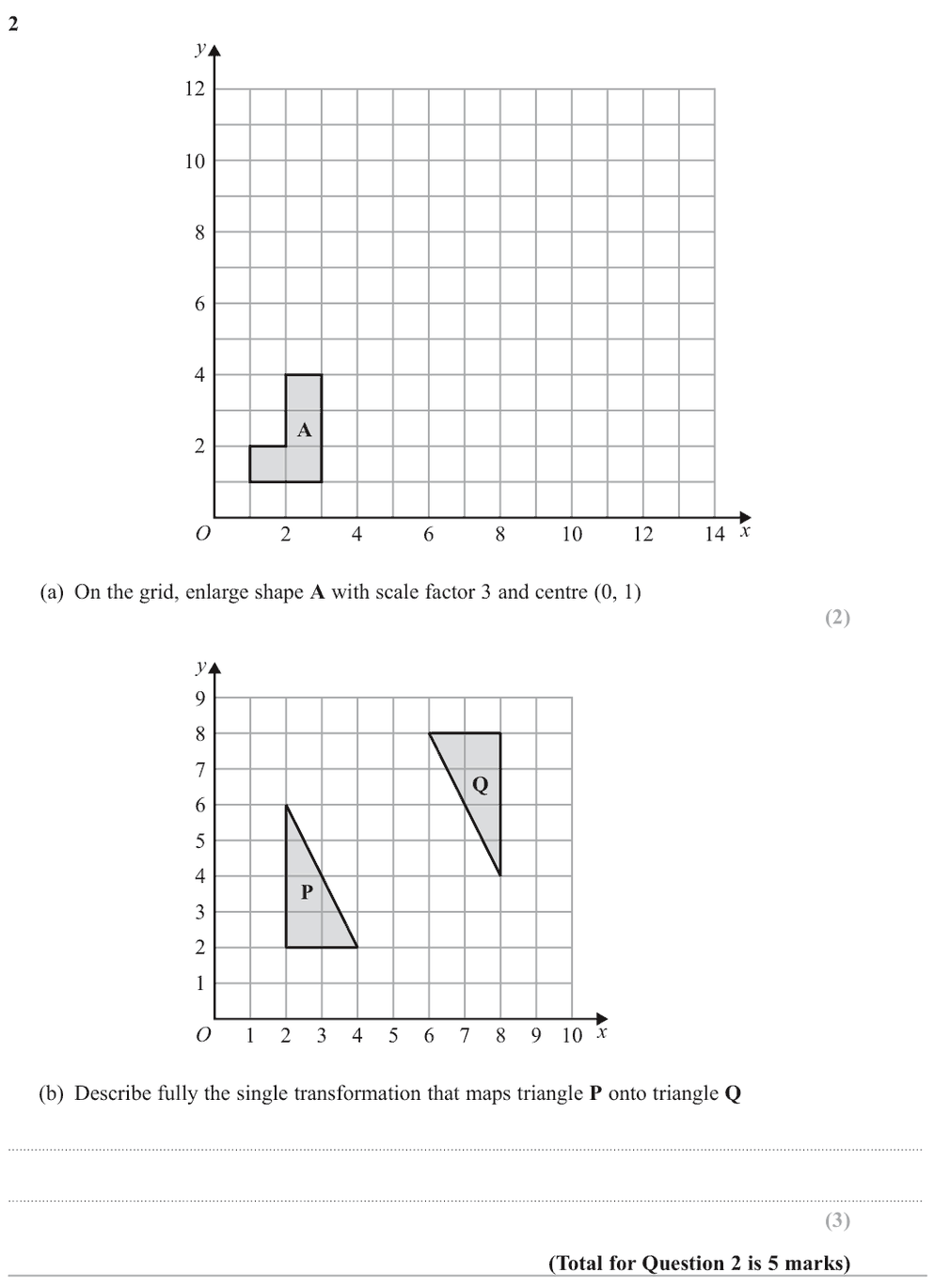
(a) Enlarge from centre \((0,1)\) with scale factor \(3\).
 Elite Mathematics