Angles in Polygons and Parallel Lines: past paper questions & worked solutions
Every Angles in Polygons and Parallel Lines question from the 4MA1 papers in our bank, 2020–2026, sorted from easiest to hardest. Try each one first, then open the worked solution.
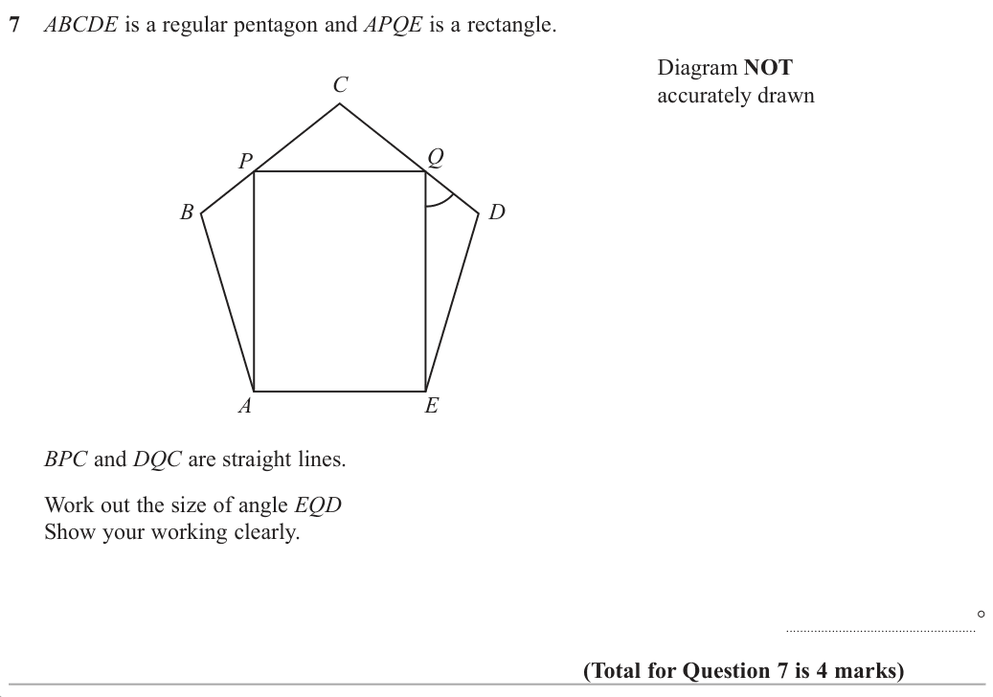
**Step 2: Find angles within the corner triangle △*D**E**Q*.** Since *A**P**Q**E* is a rectangle, the angle ∠*A**E**Q* = 90<sup>∘</sup>. Therefore, the angle ∠*D**E**Q* is: ∠*D**E**Q* = ∠*A**E**D* − ∠*A**E**Q* = 108<sup>∘</sup> − 90<sup>∘</sup> = 18<sup>∘</sup>
**Step 3: Analyze △*D**E**Q*.** The problem states *D**Q**C* is a straight line, meaning *Q* lies on the side *D**C*. Therefore, △*D**E**Q* is formed by *D*, *E*, *Q*. In △*D**E**Q*, the angle at vertex *D* is the pentagon’s interior angle ∠*C**D**E* = 108<sup>∘</sup>.
Using angles in a triangle summing to 180<sup>∘</sup>: ∠*E**Q**D* = 180<sup>∘</sup> − (∠*D**E**Q*+∠*E**D**Q*) = 180<sup>∘</sup> − (18<sup>∘</sup>+108<sup>∘</sup>) = 180<sup>∘</sup> − 126<sup>∘</sup> = 54<sup>∘</sup>
Final answer
54<sup>∘</sup>
6. Nov 2025 P1H · Q12
Medium4 marksShow worked solution
The interior angle and exterior
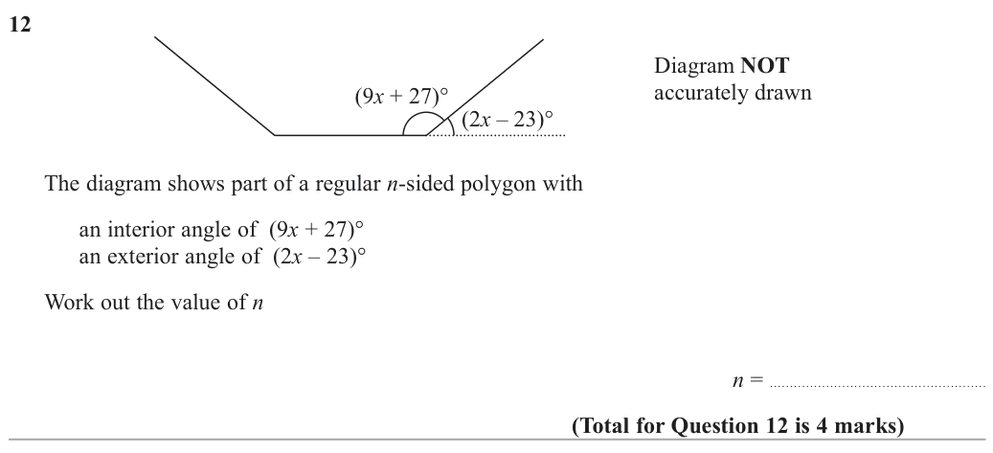
The interior angle and exterior angle of a regular polygon add to \(180^\circ\): \[ (9x+27)+(2x-23)=180 \]
\[
11x+4=180
\]
\[
x=16
\]
The exterior angle is
\[
2x-23=2(16)-23=9^\circ
\]
Find the gradient
For a regular polygon, \[ n=\frac{360}{9}=40 \]
Final answer
\(n=40\).
7. Jun 2025 P1H · Q3
Medium4 marksShow worked solution
Find the gradient
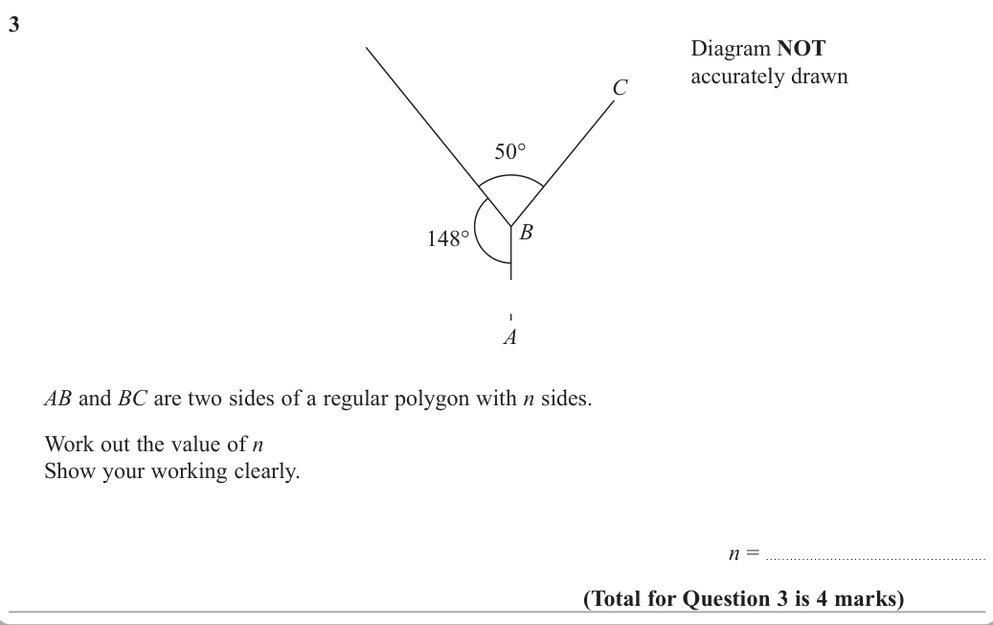
Angles around point \(B\) add to \(360^\circ\).
The interior angle of the
The interior angle of the regular polygon is \[ 360^\circ-140^\circ-50^\circ=170^\circ \]
Find the gradient
So the exterior angle is \[ 180^\circ-170^\circ=10^\circ \]
Find the gradient
For a regular polygon, \[ n=\frac{360}{10}=36 \]
Final answer
\(n=36\).
8. May 2024 P1H · Q5
Medium4 marksShow worked solution
The interior angle of a
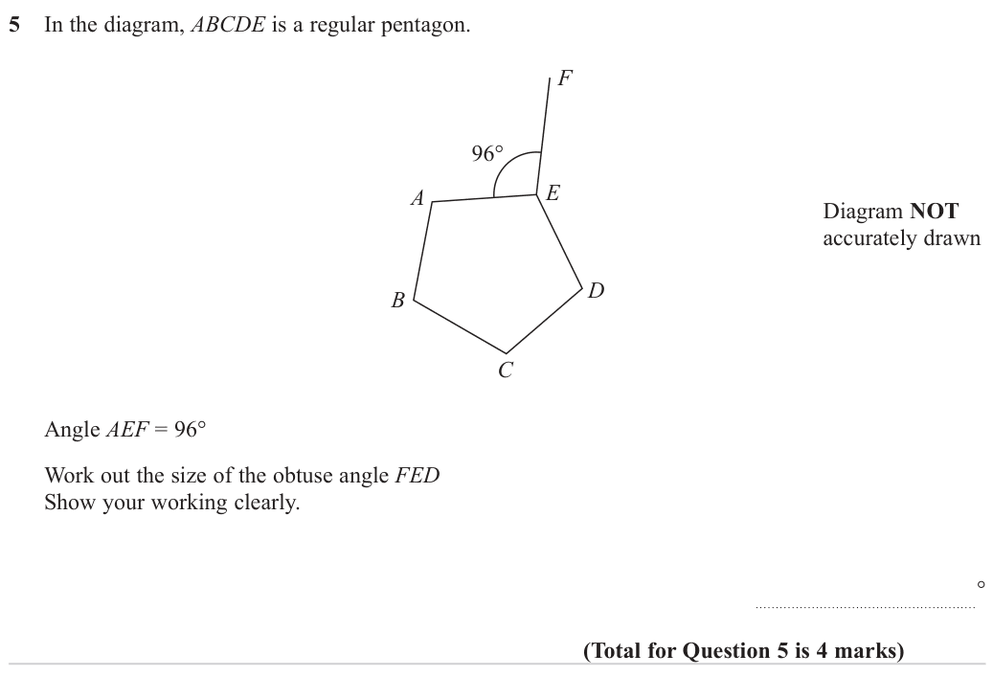
The interior angle of a regular pentagon is \[ \frac{(5-2)\times 180}{5}=108^\circ \]
Find the gradient
At \(E\), angles around a point add to \(360^\circ\).
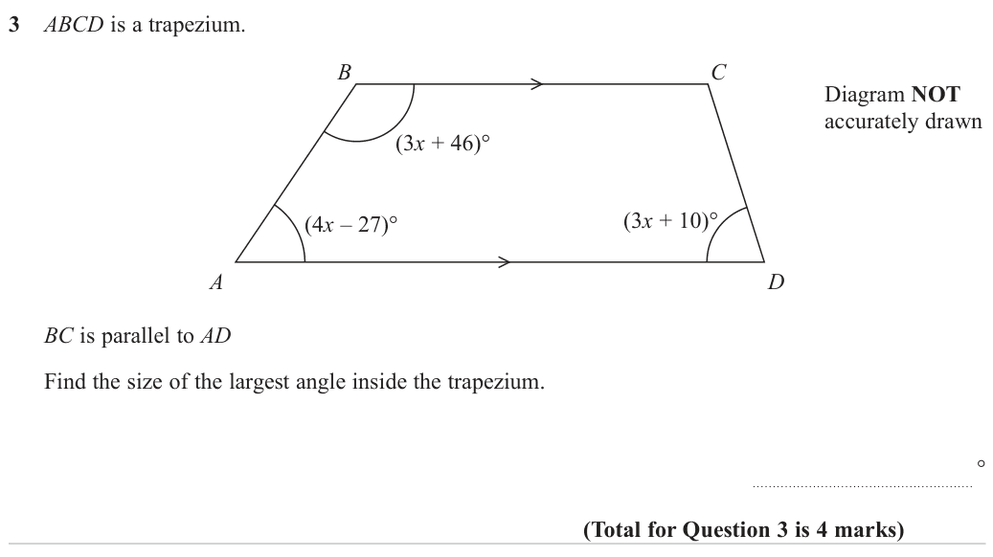
Since \(BC\parallel AD\), the co-interior angles on side \(AB\) add to \(180^\circ\): \[ (4x-27)+(3x+46)=180 \]
\[
7x+19=180
\]
\[
7x=161
\]
\[
x=23
\]
Find the gradient
Now find the angles: \[ \angle A=4(23)-27=65^\circ \]
\[
\angle B=3(23)+46=115^\circ
\]
\[
\angle D=3(23)+10=79^\circ
\]
Find the gradient
Also, co-interior angles on side \(CD\) add to \(180^\circ\): \[ \angle C=180^\circ-79^\circ=101^\circ \]
The largest angle is
The largest angle is \(115^\circ\).
Final answer
\(115^\circ\).
10. May 2023 P1HR · Q15
Medium4 marksShow worked solution
The sum of the interior
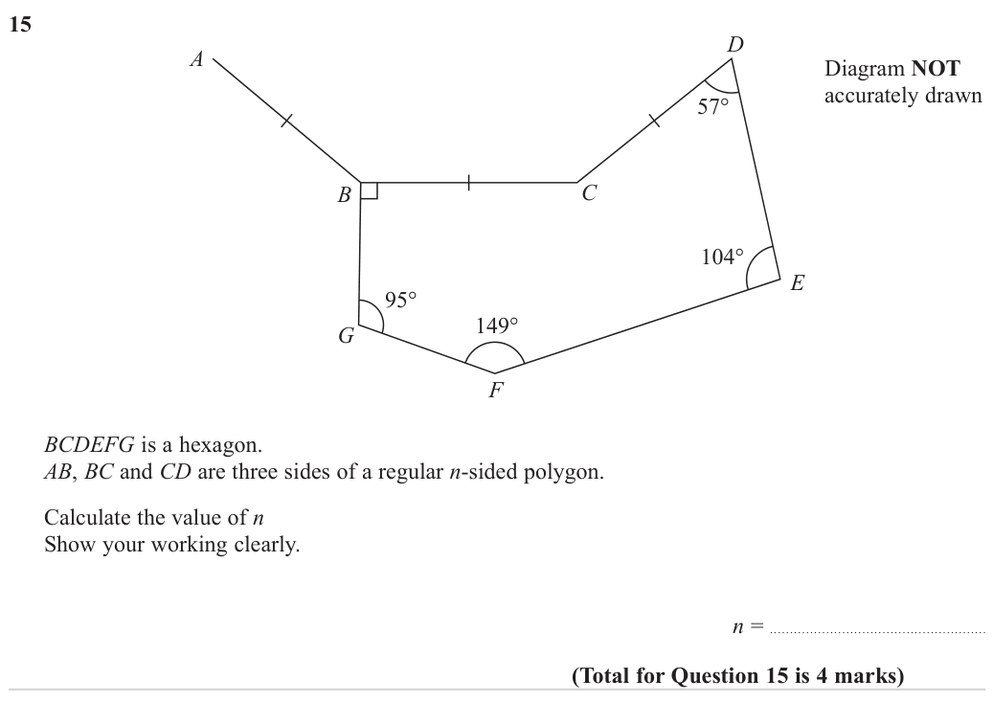
The sum of the interior angles of a hexagon is \[ (6-2)\times 180=720^\circ \]
Find the gradient
The reflex angle at \(C\) in the hexagon is \[ 720^\circ-(90^\circ+95^\circ+149^\circ+104^\circ+57^\circ)=225^\circ \]
Find the gradient
So the smaller angle \(BCD\) is \[ 360^\circ-225^\circ=135^\circ \]
This is the interior angle
This is the interior angle of the regular \(n\)-sided polygon.
Find the gradient
So the exterior angle is \[ 180^\circ-135^\circ=45^\circ \]
\[
n=\frac{360}{45}=8
\]
Final answer
\(n=8\).
11. Jun 2022 P1H · Q4
Medium4 marksShow worked solution
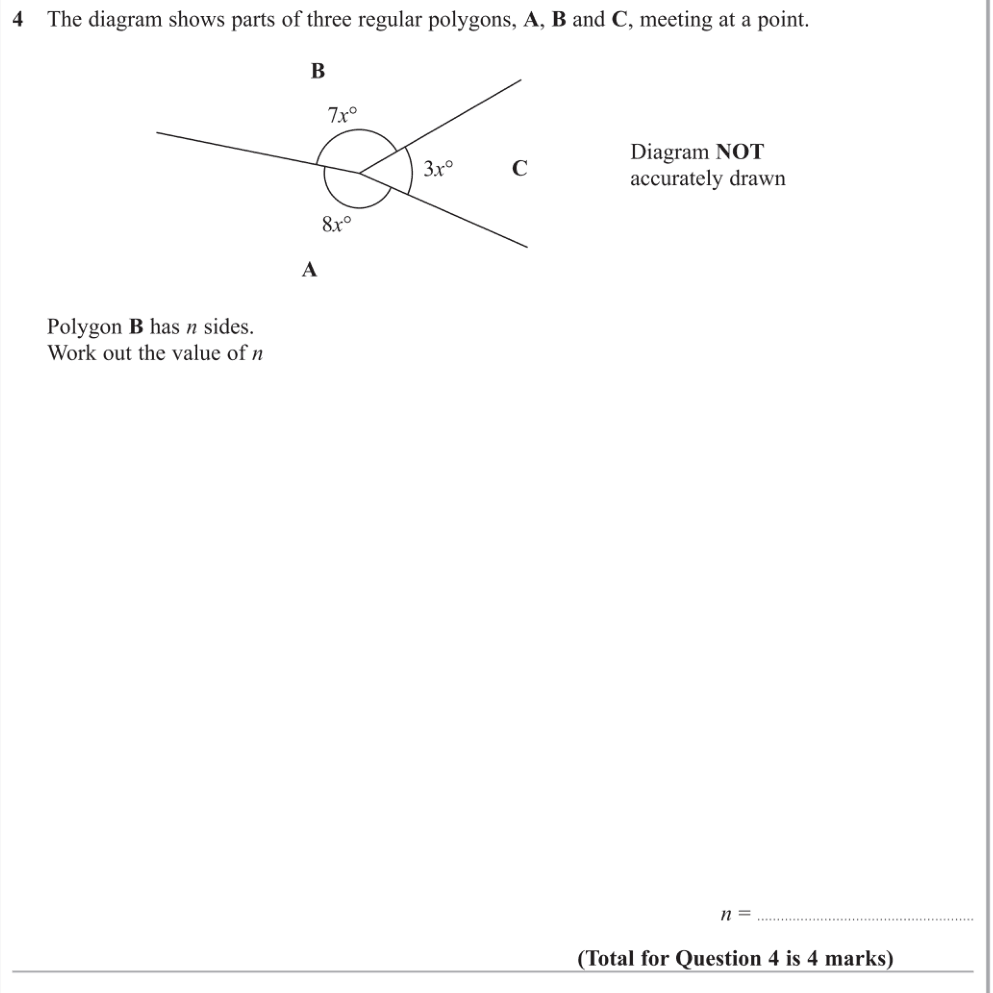
The angles around the point
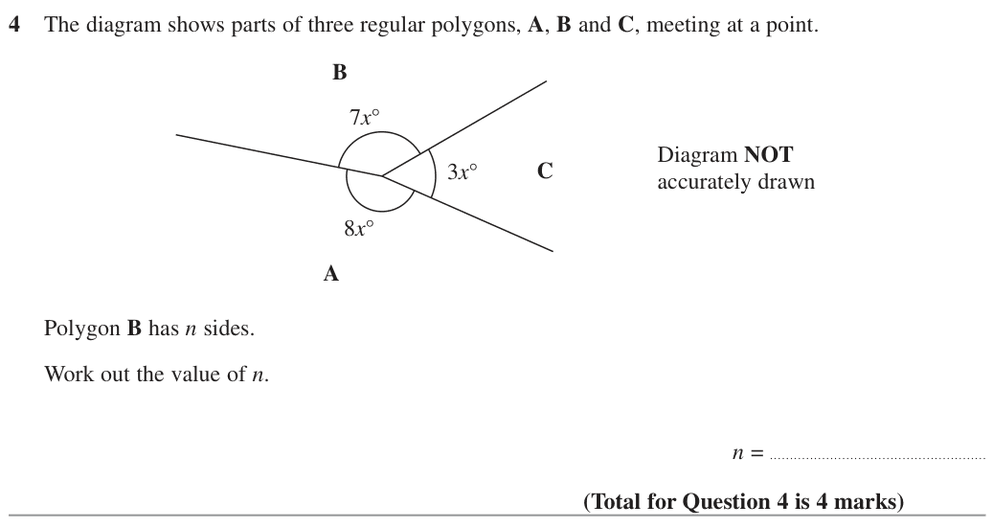
The angles around the point add to \(360^\circ\): \[ 7x+3x+8x=360 \]
\[
18x=360
\]
\[
x=20
\]
The interior angle of polygon
The interior angle of polygon \(B\) is \[ 7x=7\times 20=140^\circ \]
Find the gradient
So the exterior angle is \[ 180^\circ-140^\circ=40^\circ \]
Find the gradient
For a regular polygon, \[ n=\frac{360}{40}=9 \]
Final answer
\(n=9\).
12. Jan 2022 P2HR · Q4
Medium4 marksShow worked solution
The interior angle of a
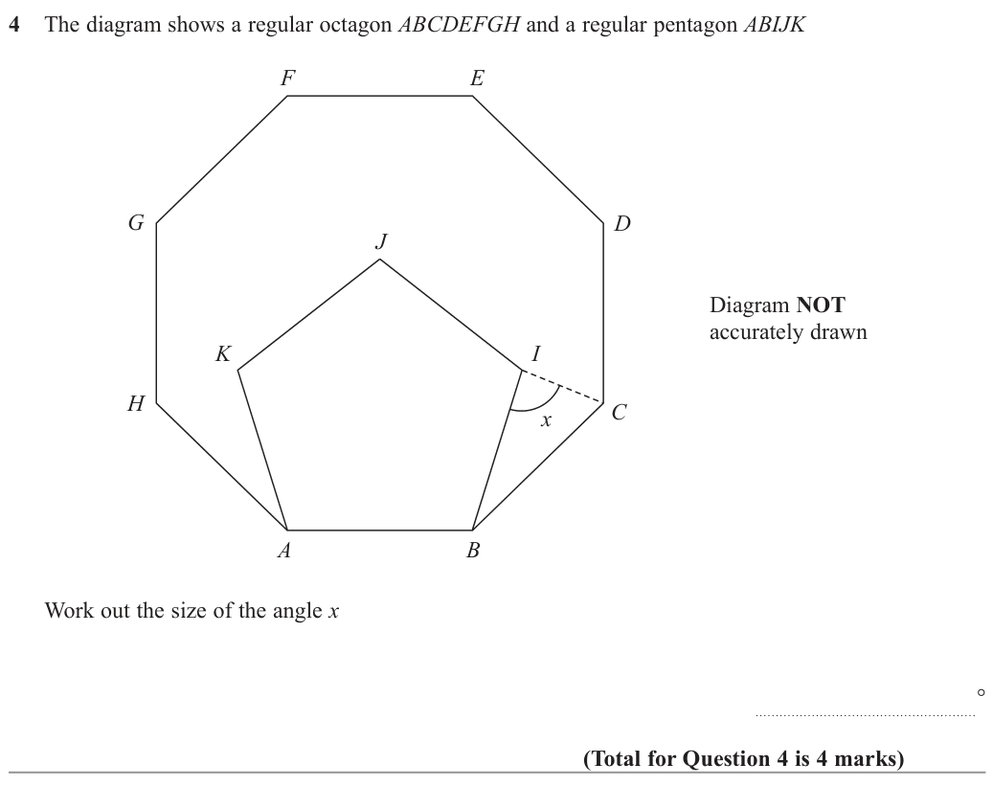
The interior angle of a regular octagon is \[ \frac{(8-2)\times 180}{8}=135^\circ \]
The interior angle of a
The interior angle of a regular pentagon is \[ \frac{(5-2)\times 180}{5}=108^\circ \]
Find the gradient
At \(B\), \[ \angle IBC=135^\circ-108^\circ=27^\circ \]
Find the gradient
Since both polygons share side \(AB\), \[ BI=BC \]
Find the gradient
So triangle \(BIC\) is isosceles.
\[
x=\frac{180^\circ-27^\circ}{2}=76.5^\circ
\]
Final answer
\(76.5^\circ\).
13. Jan 2022 P2H · Q11
Medium4 marksShow worked solution
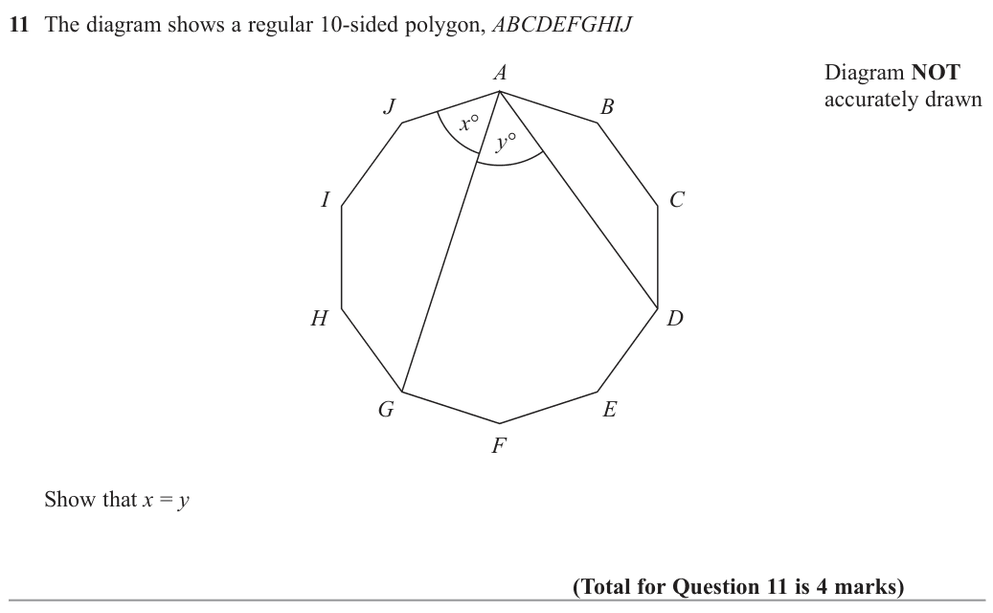
A regular 10 sided polygon
A regular 10-sided polygon can be divided into 10 equal arcs around its circumcircle.
The angle subtends the arc
The angle \(x\) subtends the arc from \(J\) to \(G\), which covers 3 equal sides of the decagon.
The angle subtends the arc
The angle \(y\) subtends the arc from \(G\) to \(D\), which also covers 3 equal sides of the decagon.
Equal arcs subtend equal angles
Equal arcs subtend equal angles at the circumference, so \[ x=y \]
Final answer
\(x=y\).
14. Jan 2020 P2H · Q4
Medium4 marksShow worked solution
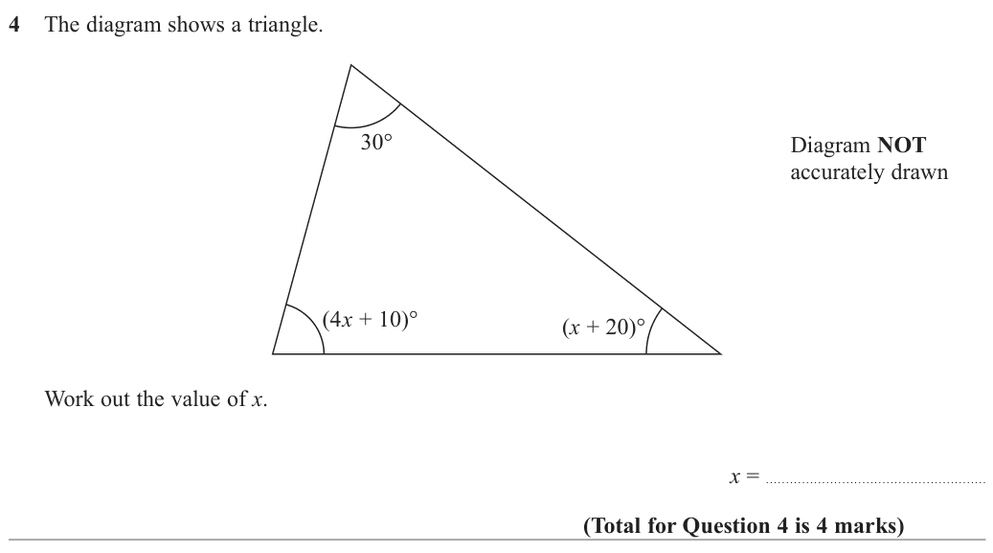
Angles in a triangle add
Angles in a triangle add to \(180^\circ\): \[ 30+(4x+10)+(x+20)=180 \]
\[
5x+60=180
\]
\[
5x=120
\]
\[
x=24
\]
Final answer
\(x=24\).
15. Specimen 4WM2H · Q4
Medium4 marksShow worked solution
Angles around a point add
Angles around a point add to \(360^\circ\):
\[
8x+7x+3x=360
\]
\[
18x=360
\]
\[
x=20
\]
The interior angle of polygon
The interior angle of polygon \(B\) is
\[
7x=7(20)=140^\circ
\]
Find the gradient
For a regular \(n\)-sided polygon,
\[
\frac{180(n-2)}{n}=140
\]
\[
180n-360=140n
\]
\[
40n=360
\]
\[
n=9
\]
Final answer
\(n=9\).
16. May-Nov 2020 P1H · Q8
Medium4 marksShow worked solution
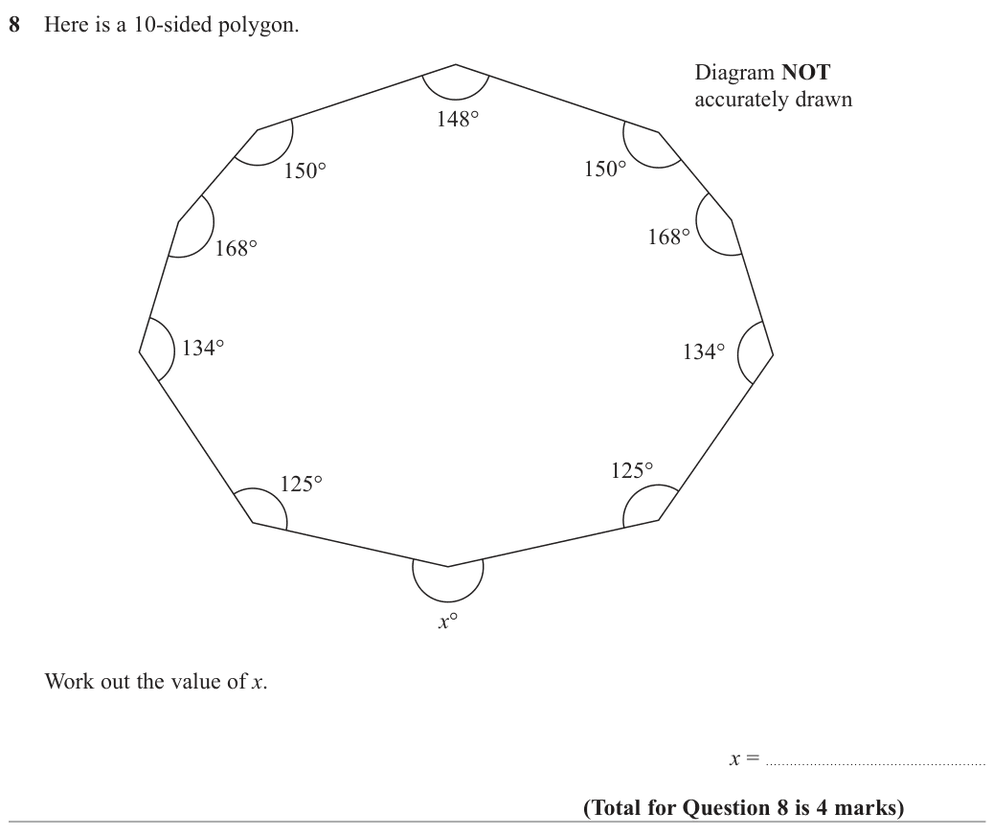
The sum of the interior
The sum of the interior angles of a 10-sided polygon is \[ (10-2)\times 180=1440^\circ \]
The sum of the 9
The sum of the 9 given interior angles is \[ 150+168+134+125+125+134+168+150+148=1302^\circ \]
Find the gradient
So the missing interior angle is \[ 1440^\circ-1302^\circ=138^\circ \]
The angle is the reflex
The angle \(x\) is the reflex angle outside the polygon at this vertex: \[ x=360^\circ-138^\circ=222^\circ \]
Final answer
\(222^\circ\).
17. May 2025 4WM2HR · Q10
Hard5 marksShow worked solution
Required
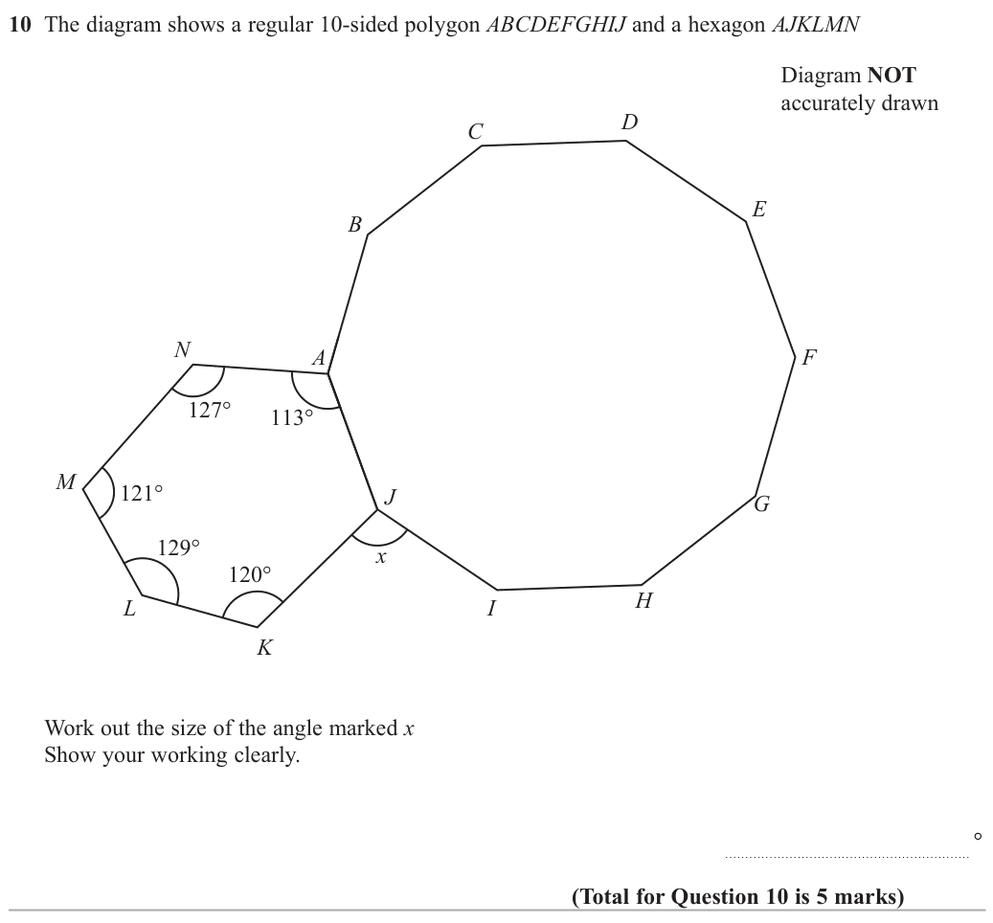
Find angle *x* in the figure combining a regular 10-gon (ABCDEFGHIJ) and hexagon AJKLMN.
Interior angle of a regular
Interior angle of a regular 10-sided polygon: $$\\text{Interior angle} = \\frac{(10-2)\\times180°}{10} = \\frac{1440°}{10} = 144°$$
Use trigonometry
Find the interior angle of the hexagon at vertex *A*. At point *A*: decagon angle + 113° + hexagon angle at *A* = 360°: ∠*x* = 360° − 144° − 110° = 106°
Final answer
*x* = 106°
18. Nov 2024 P2H · Q11
Hard5 marksShow worked solution
A regular pentagon has interior
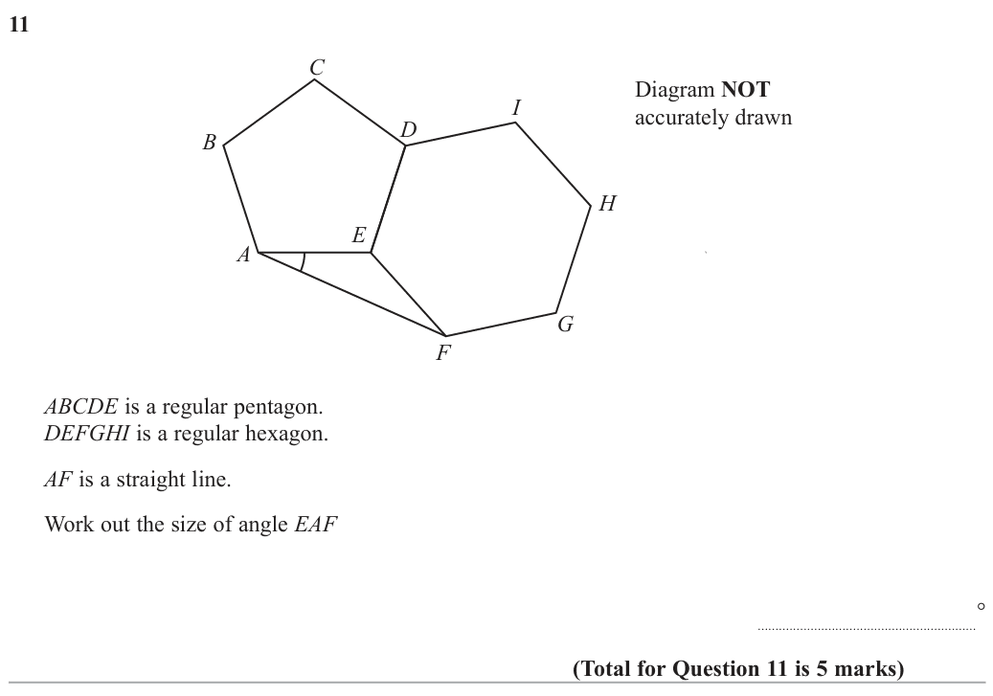
A regular pentagon has interior angle \[ 108^\circ \]
A regular hexagon has interior
A regular hexagon has interior angle \[ 120^\circ \]
Use trigonometry
At \(E\), the angle inside triangle \(AEF\) is \[ 360^\circ-108^\circ-120^\circ=132^\circ \]
Use trigonometry
Also \(AE=ED\) and \(ED=EF\), so \[ AE=EF \]
Use trigonometry
Triangle \(AEF\) is isosceles, so the base angles are equal: \[ \angle EAF=\frac{180^\circ-132^\circ}{2}=24^\circ \]
Final answer
\(24^\circ\).
19. Nov 2021 P2H · Q5
Hard5 marksShow worked solution
Find the gradient
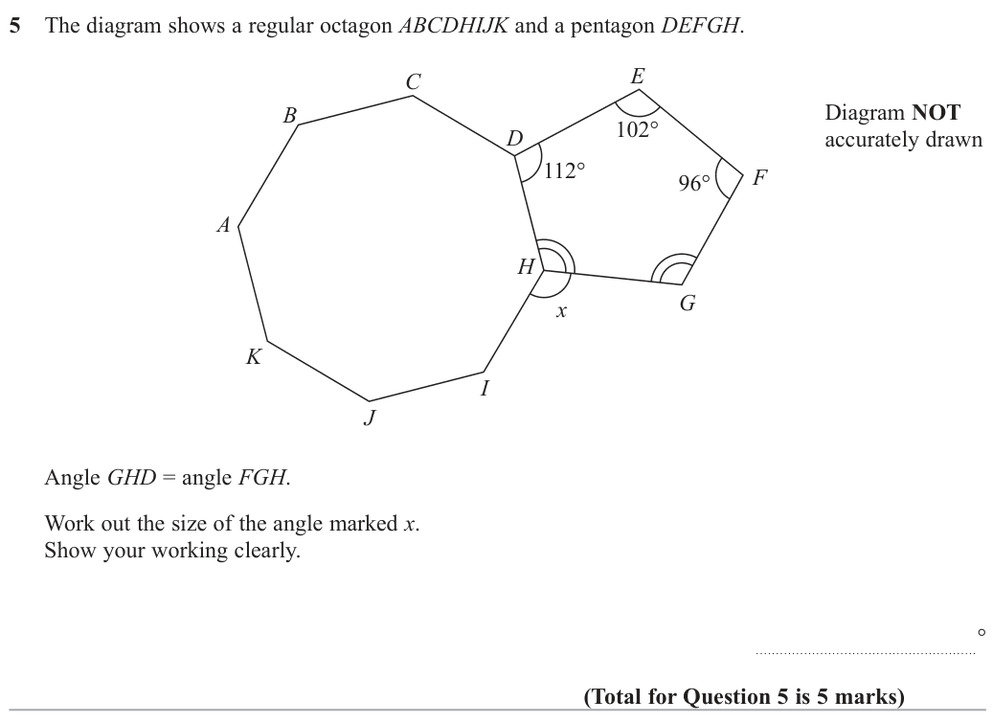
For pentagon \(DEFGH\), the interior angle sum is \[ (5-2)\times 180=540^\circ \]
Let
\[
\angle GHD=\angle FGH=a
\]
Find the gradient
Then \[ 112+102+96+a+a=540 \]
\[
2a=230
\]
\[
a=115^\circ
\]
A regular octagon has interior
A regular octagon has interior angle \[ \frac{(8-2)\times 180}{8}=135^\circ \]
Find the gradient
At \(H\), angles around a point add to \(360^\circ\): \[ x=360^\circ-135^\circ-115^\circ=110^\circ \]
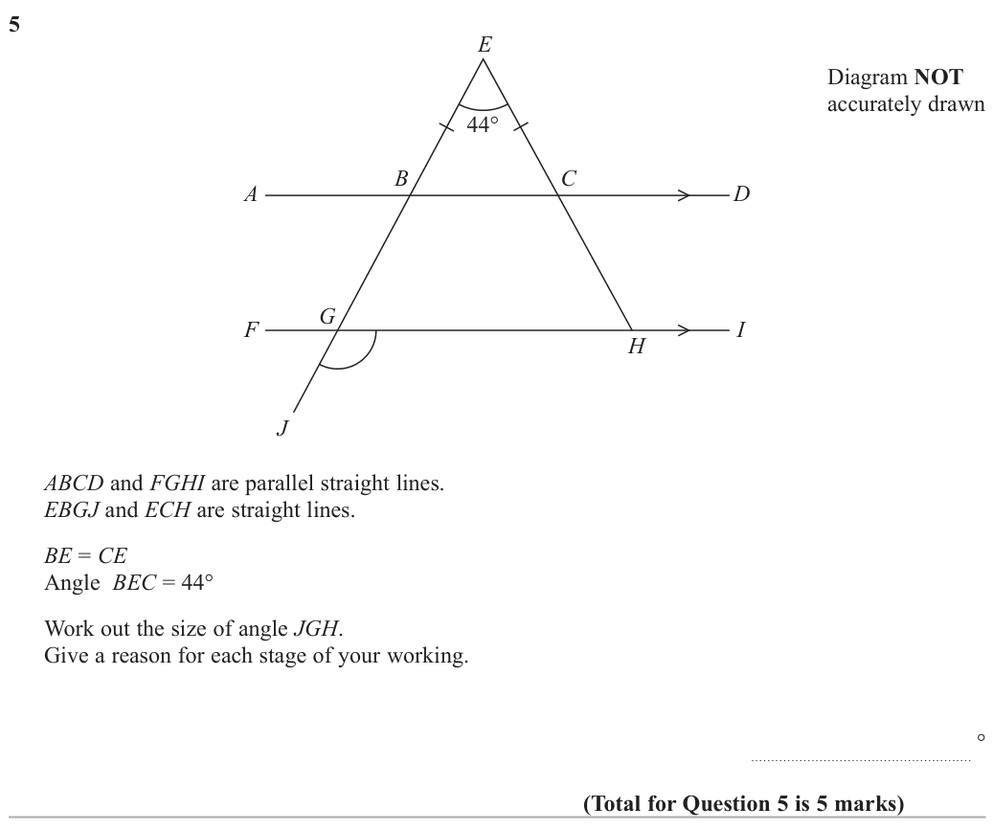
The two horizontal lines are parallel, so the corresponding acute angle at \(G\) is \(68^\circ\).
The required angle is supplementary
The required angle is supplementary to this angle: \[ 180^\circ-68^\circ=112^\circ \]
Final answer
\(112^\circ\).
21. Jan 2021 P1HR · Q8
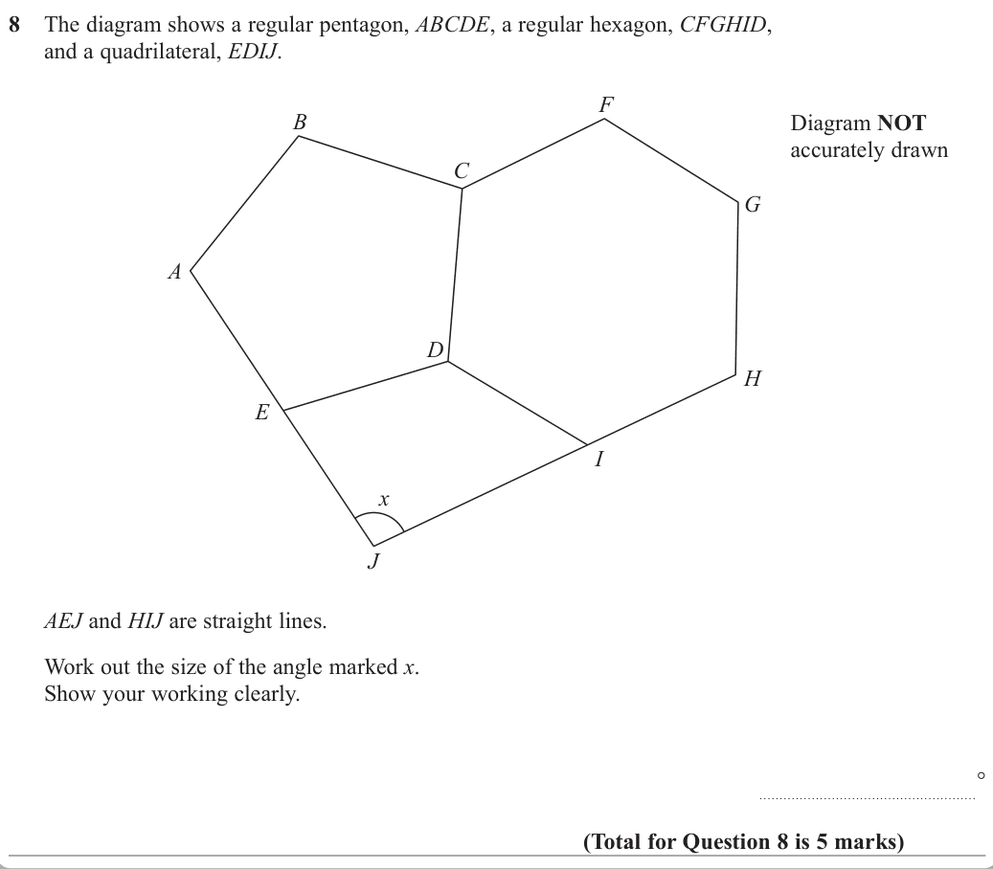
Hard5 marksShow worked solution
A regular pentagon has interior
A regular pentagon has interior angle \[ \frac{(5-2)180}{5}=108^\circ \]
A regular hexagon has interior
A regular hexagon has interior angle \[ \frac{(6-2)180}{6}=120^\circ \]
Find the gradient
At \(E\), since \(AEJ\) is a straight line, \[ \angle DEJ=180-108=72^\circ \]
Find the gradient
At \(D\), the angles around the point include the pentagon angle \(108^\circ\) and the hexagon angle \(120^\circ\), so \[ \angle EDI=360-108-120=132^\circ \]
Find the gradient
At \(I\), since \(HIJ\) is a straight line, \[ \angle DIJ=180-120=60^\circ \]
Find the gradient
In quadrilateral \(EDIJ\), angles sum to \(360^\circ\): \[ x=360-72-132-60=96 \]
Final answer
\(96^\circ\).
22. Jun 2022 P1H · Q23
Hard6 marksShow worked solution
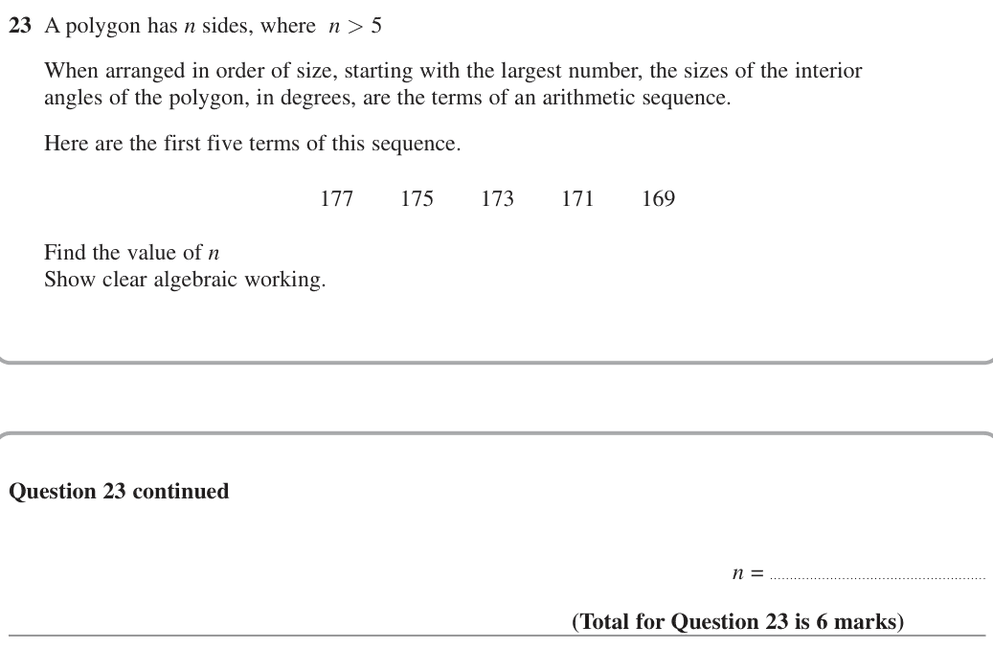
The interior angles form an
The interior angles form an arithmetic sequence:
\[
177,\ 175,\ 173,\ 171,\ 169,\ldots
\]
Calculate value
So
\[
a=177,\quad d=-2
\]
Use trigonometry
For an \(n\)-sided polygon, the sum of the interior angles is
 Elite Mathematics