Skip to content
Elite Mathematics
IAL · WMA12 · Topic

Trigonometric Identities and Equations: past paper questions & worked solutions

Every Trigonometric Identities and Equations question from the WMA12 papers in our bank, 2019–2026, sorted from easiest to hardest. Try each one first, then open the worked solution.

23questions
200marks in total
100%of papers (19 of 19) include it
2/12/9easy / medium / hard

Questions, easiest first

Level is estimated from marks: 1–6 easy, 7–8 medium, 9+ hard.

1. WMA12/01 May/June R 2024 · Q5

Easy6 marks
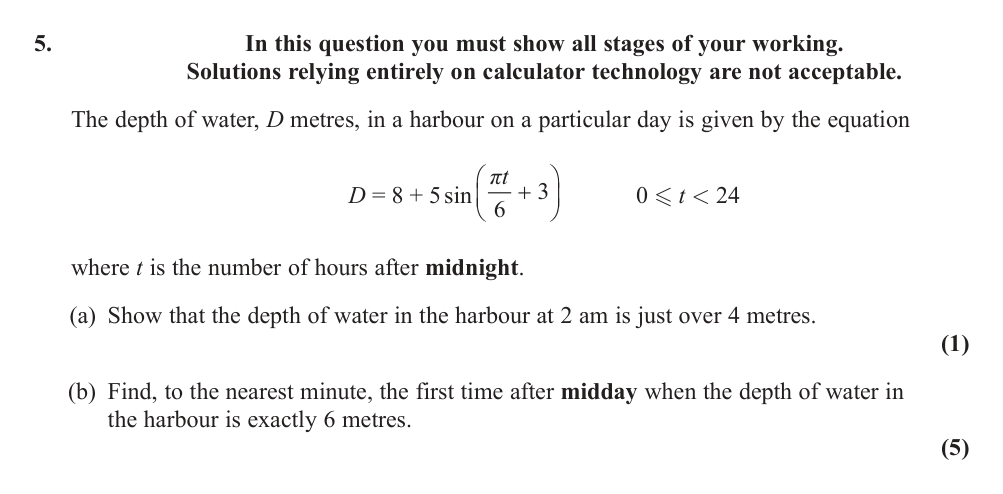
WMA12/01 May/June R 2024 Question 5 (6 marks): Trigonometric Identities and Equations
Show worked solution
  1. Substitute t equals two

    $D=8+5\sin\left(\dfrac{\pi(2)}{6}+3\right)=8+5\sin\left(\dfrac{\pi}{3}+3\right)$.

  2. Evaluate

    $D=4.064\ldots$, so the depth at 2 am is just over $4$ metres.

  3. Set depth equal to six

    $6=8+5\sin\left(\dfrac{\pi t}{6}+3\right)$, so $\sin\left(\dfrac{\pi t}{6}+3\right)=-\dfrac25$.

  4. Use the time interval

    After midday means $t>12$. Then $\dfrac{\pi t}{6}+3$ is greater than $2\pi+3$.

  5. Choose the first suitable angle

    The first angle after $2\pi+3$ with sine $-\dfrac25$ is $3\pi+\sin^{-1}\left(\dfrac25\right)$.

  6. Solve for t

    $\dfrac{\pi t}{6}+3=3\pi+\sin^{-1}\left(\dfrac25\right)$, so $t=13.056\ldots$ hours after midnight.

  7. Convert to clock time

    $0.056\ldots$ hours is about $3.38$ minutes, so the time to the nearest minute is $13{:}03$, or $1{:}03$ pm.

Final answer

$(a)$ $D(2)=4.06\ldots$ m, just over $4$ m. $\quad (b)$ $13{:}03$, or $1{:}03$ pm.

2. WMA12/01 May/June 2022 · Q5

Easy6 marks
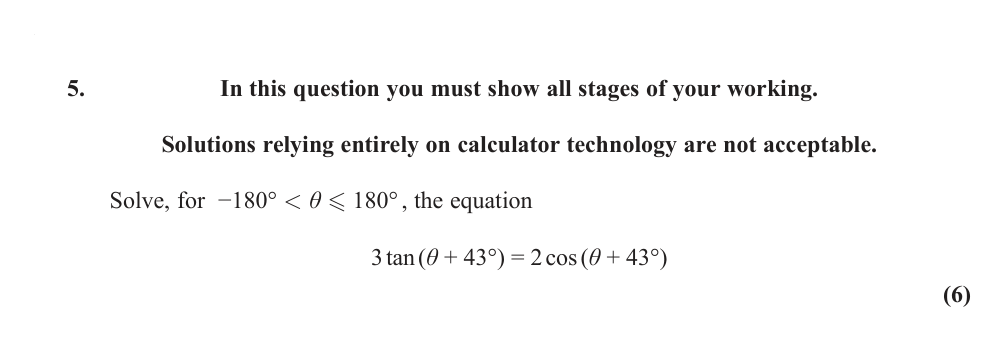
WMA12/01 May/June 2022 Question 5 (6 marks): Trigonometric Identities and Equations
Show worked solution
  1. Substitute u

    Let $u=\theta+43^\circ$. The equation becomes $3\tan u=2\cos u$.

  2. Clear the cosine denominator

    $3\dfrac{\sin u}{\cos u}=2\cos u$, so $3\sin u=2\cos^2u$.

  3. Use cos squared

    $3\sin u=2(1-\sin^2u)$, so $2\sin^2u+3\sin u-2=0$.

  4. Factor the quadratic

    $(2\sin u-1)(\sin u+2)=0$.

  5. Use the valid sine value

    $\sin u=-2$ is impossible, so $\sin u=\dfrac12$.

  6. Find u in the interval

    Since $-180^\circ<\theta\leq180^\circ$, $-137^\circ<u\leq223^\circ$. Thus $u=30^\circ$ or $150^\circ$.

  7. Return to theta

    $\theta=u-43^\circ$, so $\theta=-13^\circ$ or $107^\circ$.

Final answer

$\theta=-13^\circ,\ 107^\circ$.

3. WMA12/01 October 2024 · Q9

Medium7 marks
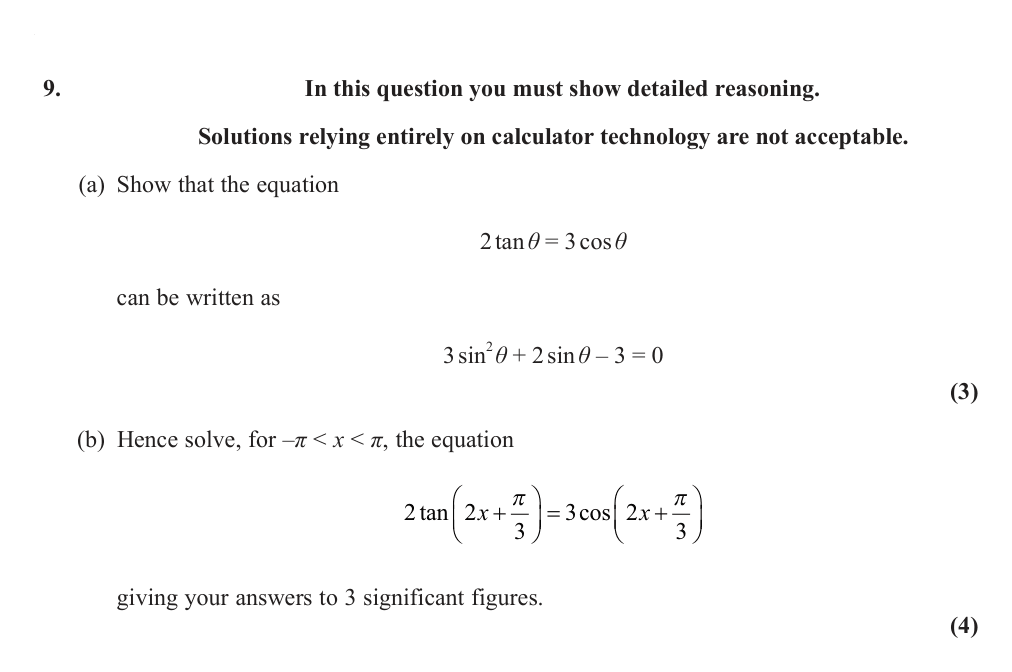
WMA12/01 October 2024 Question 9 (7 marks): Trigonometric Identities and Equations
Show worked solution
  1. Write tan in terms of sin and cos

    $2\tan\theta=3\cos\theta$ gives $2\dfrac{\sin\theta}{\cos\theta}=3\cos\theta$.

  2. Multiply by cos theta

    Since $\tan\theta$ is defined, $\cos\theta\ne0$. Hence $2\sin\theta=3\cos^2\theta$.

  3. Use the identity

    $2\sin\theta=3(1-\sin^2\theta)$, so $3\sin^2\theta+2\sin\theta-3=0$.

  4. Substitute the new angle

    Let $\theta=2x+\dfrac\pi3$. Then $3\sin^2\theta+2\sin\theta-3=0$.

  5. Solve for sin theta

    $\sin\theta=\dfrac{-2\pm\sqrt{40}}{6}=\dfrac{-1\pm\sqrt{10}}{3}$. The root $\dfrac{-1-\sqrt{10}}{3}$ is less than $-1$, so reject it.

  6. Find the angle range

    Since $-\pi<x<\pi$, $-\dfrac{5\pi}{3}<\theta<\dfrac{7\pi}{3}$.

  7. Find the theta values

    For $\sin\theta=\dfrac{-1+\sqrt{10}}{3}$ in this range, $\theta\approx-3.94649$, $0.804897$, $2.33670$, and $7.08808$.

  8. Convert back to x

    Using $x=\dfrac{\theta-\pi/3}{2}$ gives $x\approx-2.49684$, $-0.121150$, $0.644749$, and $3.02044$.

  9. Round the answers

    To $3$ significant figures, $x=-2.50$, $-0.121$, $0.645$, and $3.02$.

Final answer

$(a)$ Proven. $\quad (b)$ $x=-2.50$, $-0.121$, $0.645$, $3.02$.

4. WMA12/01 May/June R 2024 · Q7

Medium7 marks
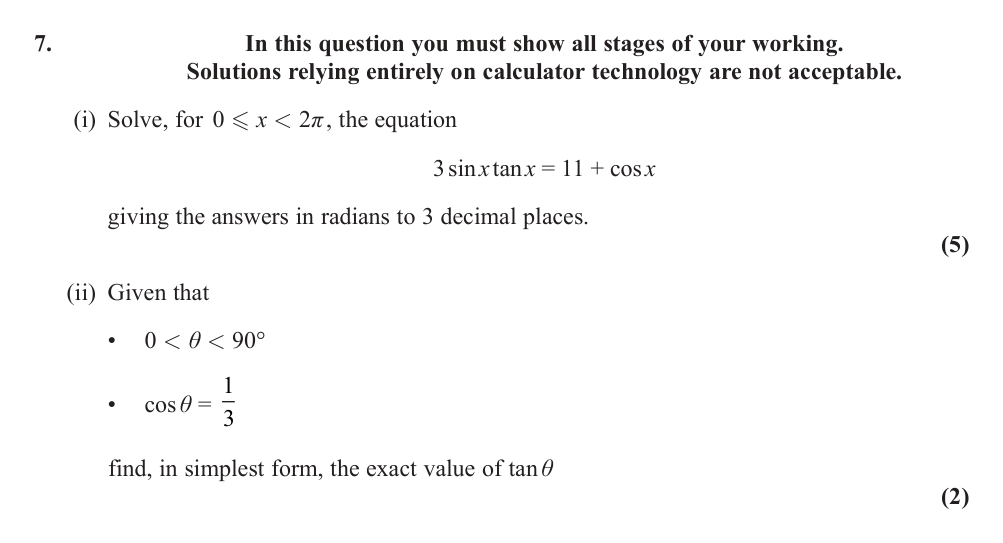
WMA12/01 May/June R 2024 Question 7 (7 marks): Trigonometric Identities and Equations
Show worked solution
  1. Rewrite tan x

    $3\sin x\tan x=11+\cos x$ becomes $\dfrac{3\sin^2x}{\cos x}=11+\cos x$.

  2. Multiply by cos x

    $3\sin^2x=11\cos x+\cos^2x$.

  3. Use sine squared

    $3(1-\cos^2x)=11\cos x+\cos^2x$, so $4\cos^2x+11\cos x-3=0$.

  4. Solve for cosine

    $(4\cos x-1)(\cos x+3)=0$, so $\cos x=\dfrac14$ or $\cos x=-3$.

  5. Reject impossible value

    $\cos x=-3$ is impossible, so $\cos x=\dfrac14$.

  6. Find x values

    For $0\le x<2\pi$, this gives $x=1.318\ldots$ or $x=4.965\ldots$, so $x=1.318,4.965$ radians.

  7. Use the right triangle identity

    Given $0<\theta<90^\circ$ and $\cos\theta=\dfrac13$, $\sin\theta=\sqrt{1-\dfrac19}=\dfrac{2\sqrt2}{3}$.

  8. Find tan theta

    $\tan\theta=\dfrac{\sin\theta}{\cos\theta}=\dfrac{2\sqrt2/3}{1/3}=2\sqrt2$.

Final answer

$(i)$ $x=1.318,\ 4.965$. $\quad (ii)$ $2\sqrt2$.

5. WMA12/01 October 2023 · Q3

Medium7 marks
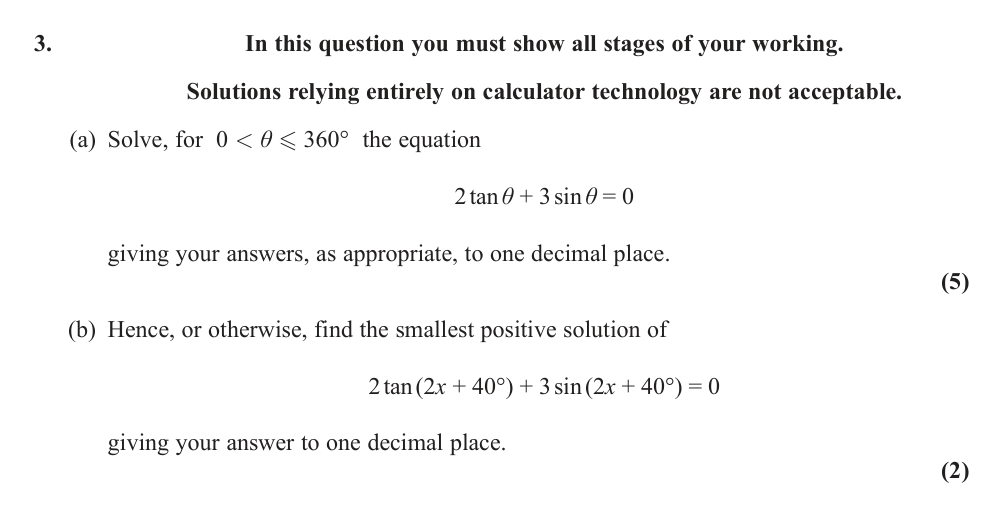
WMA12/01 October 2023 Question 3 (7 marks): Trigonometric Identities and Equations
Show worked solution
  1. Factor the equation

    $2\tan\theta+3\sin\theta=0$ becomes $\dfrac{2\sin\theta}{\cos\theta}+3\sin\theta=0$.

  2. Multiply by cos theta

    Since $\tan\theta$ is defined, $\cos\theta\ne0$. Multiplying by $\cos\theta$ gives $2\sin\theta+3\sin\theta\cos\theta=0$.

  3. Factor

    $\sin\theta(2+3\cos\theta)=0$.

  4. Solve the sine case

    For $0<\theta\le360^\circ$, $\sin\theta=0$ gives $\theta=180^\circ$ or $360^\circ$.

  5. Solve the cosine case

    $2+3\cos\theta=0$ gives $\cos\theta=-\dfrac23$, so $\theta=131.8^\circ$ or $228.2^\circ$ to one decimal place.

  6. Apply to the new angle

    For $2\tan(2x+40^\circ)+3\sin(2x+40^\circ)=0$, the angle $2x+40^\circ$ must be one of the solution angles, modulo $360^\circ$.

  7. Find the smallest positive x

    The smallest positive value comes from $2x+40^\circ=131.8\ldots^\circ$, so $x=\dfrac{131.8\ldots-40}{2}=45.9^\circ$ to one decimal place.

Final answer

$(a)$ $\theta=131.8^\circ,180^\circ,228.2^\circ,360^\circ$. $\quad (b)$ $x=45.9^\circ$.

6. WMA12/01 May/June 2023 · Q9

Medium7 marks
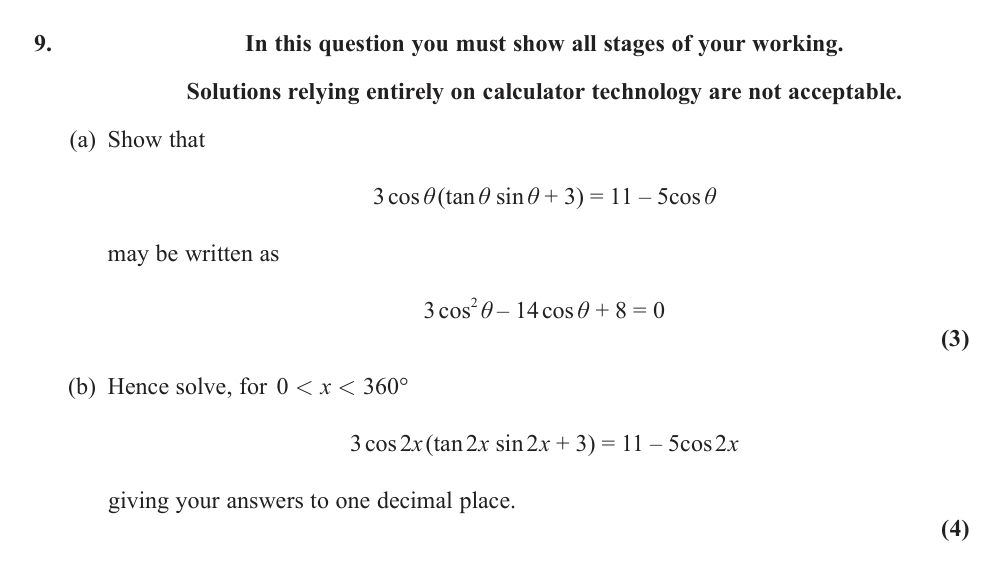
WMA12/01 May/June 2023 Question 9 (7 marks): Trigonometric Identities and Equations
Show worked solution
  1. Rewrite tan theta sin theta

    $\tan\theta\sin\theta=\dfrac{\sin^2\theta}{\cos\theta}$.

  2. Simplify the left side

    $3\cos\theta\left(\tan\theta\sin\theta+3\right)=3\sin^2\theta+9\cos\theta$.

  3. Use sine squared

    The equation becomes $3(1-\cos^2\theta)+9\cos\theta=11-5\cos\theta$.

  4. Rearrange

    $3-3\cos^2\theta+9\cos\theta=11-5\cos\theta$, so $3\cos^2\theta-14\cos\theta+8=0$.

  5. Apply the result to 2x

    For the equation in part (b), take $\theta=2x$. Then $3\cos^2(2x)-14\cos(2x)+8=0$.

  6. Solve the quadratic

    Let $u=\cos(2x)$. Then $3u^2-14u+8=0$, so $(3u-2)(u-4)=0$.

  7. Reject the impossible value

    $u=4$ is impossible for cosine, so $\cos(2x)=\dfrac23$.

  8. Use the interval

    Since $0<x<360^\circ$, we have $0<2x<720^\circ$.

  9. Find x

    In this interval, $2x=48.189\ldots^\circ,311.810\ldots^\circ,408.189\ldots^\circ,671.810\ldots^\circ$. Dividing by $2$ gives $x=24.1^\circ,155.9^\circ,204.1^\circ,335.9^\circ$ to one decimal place.

Final answer

$(a)$ Proven. $\quad (b)$ $x=24.1^\circ,155.9^\circ,204.1^\circ,335.9^\circ$.

7. WMA12/01 October 2022 · Q3

Medium7 marks · main topic: Sequences & Series
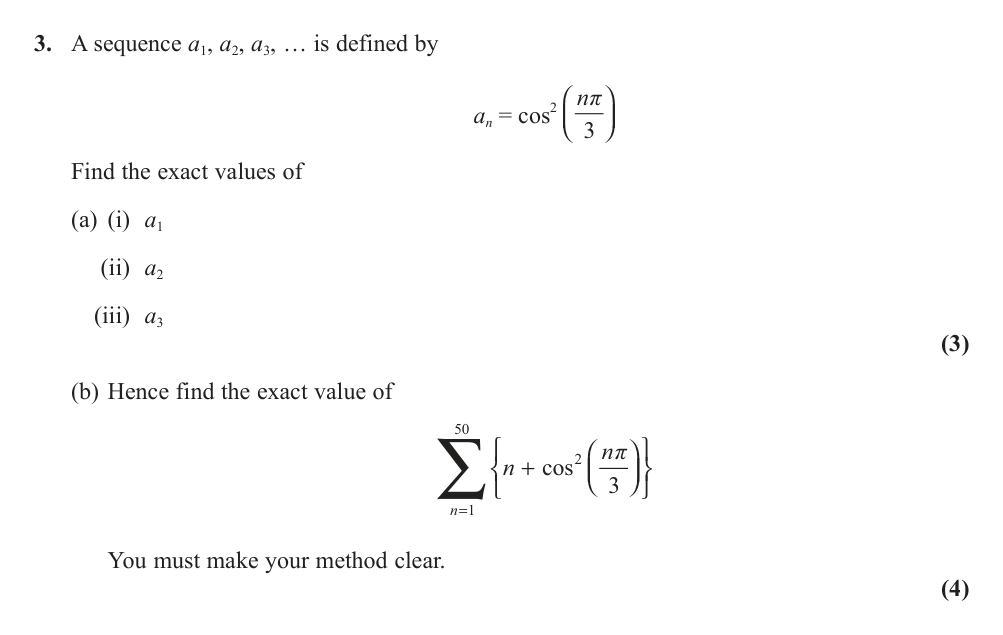
WMA12/01 October 2022 Question 3 (7 marks): Trigonometric Identities and Equations
Show worked solution
  1. Find the first term

    $a_1=\cos^2\left(\dfrac{\pi}{3}\right)=\left(\dfrac12\right)^2=\dfrac14$.

  2. Find the second term

    $a_2=\cos^2\left(\dfrac{2\pi}{3}\right)=\left(-\dfrac12\right)^2=\dfrac14$.

  3. Find the third term

    $a_3=\cos^2(\pi)=(-1)^2=1$.

  4. Recognise the repeating pattern

    The values of $\cos^2\left(\dfrac{n\pi}{3}\right)$ repeat every 3 terms as $\dfrac14,\dfrac14,1$.

  5. Sum the n part

    $\sum_{n=1}^{50} n=\dfrac{50\cdot51}{2}=1275$.

  6. Sum the cosine part

    There are $16$ complete groups of 3 terms in the first $48$ terms, then the first 2 terms repeat. Hence the cosine-square sum is $16\left(\dfrac14+\dfrac14+1\right)+\dfrac14+\dfrac14=24+\dfrac12=\dfrac{49}{2}$.

  7. Add the two sums

    $\sum_{n=1}^{50}\left(n+\cos^2\left(\dfrac{n\pi}{3}\right)\right)=1275+\dfrac{49}{2}=\dfrac{2599}{2}$.

Final answer

$(a)\ a_1=\dfrac14,\ a_2=\dfrac14,\ a_3=1. $\quad $(b)\ \dfrac{2599}{2}$.

8. WMA12/01 January 2020 · Q7

Medium7 marks
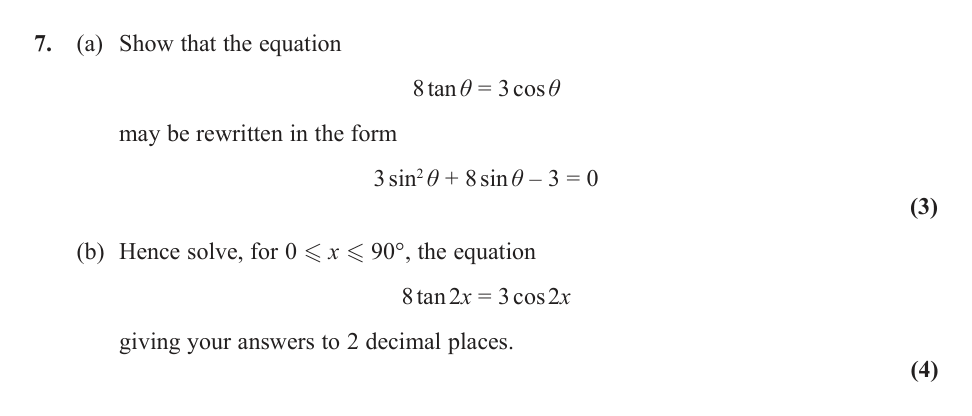
WMA12/01 January 2020 Question 7 (7 marks): Trigonometric Identities and Equations
Show worked solution
  1. Rewrite tan theta

    $8\tan\theta=3\cos\theta$ becomes $8\dfrac{\sin\theta}{\cos\theta}=3\cos\theta$.

  2. Clear the denominator

    Multiplying by $\cos\theta$ gives $8\sin\theta=3\cos^2\theta$.

  3. Use the identity

    Since $\cos^2\theta=1-\sin^2\theta$, $8\sin\theta=3(1-\sin^2\theta)$, so $3\sin^2\theta+8\sin\theta-3=0$.

  4. Apply the result to 2x

    For $8\tan2x=3\cos2x$, we get $3\sin^2(2x)+8\sin(2x)-3=0$.

  5. Solve for sin 2x

    $(3\sin2x-1)(\sin2x+3)=0$. Since $\sin2x$ cannot be $-3$, $\sin2x=\dfrac13$.

  6. Find x

    For $0\leq x\leq90^\circ$, $0\leq2x\leq180^\circ$. Thus $2x=19.471\ldots^\circ$ or $160.529\ldots^\circ$, so $x=9.74^\circ$ or $80.26^\circ$.

Final answer

$(a)$ Proven. $\quad (b)\ x=9.74^\circ,\ 80.26^\circ$.

9. WMA12/01 May/June 2025 · Q8

Medium8 marks
WMA12/01 May/June 2025 Question 8 (8 marks): Trigonometric Identities and Equations
Show worked solution
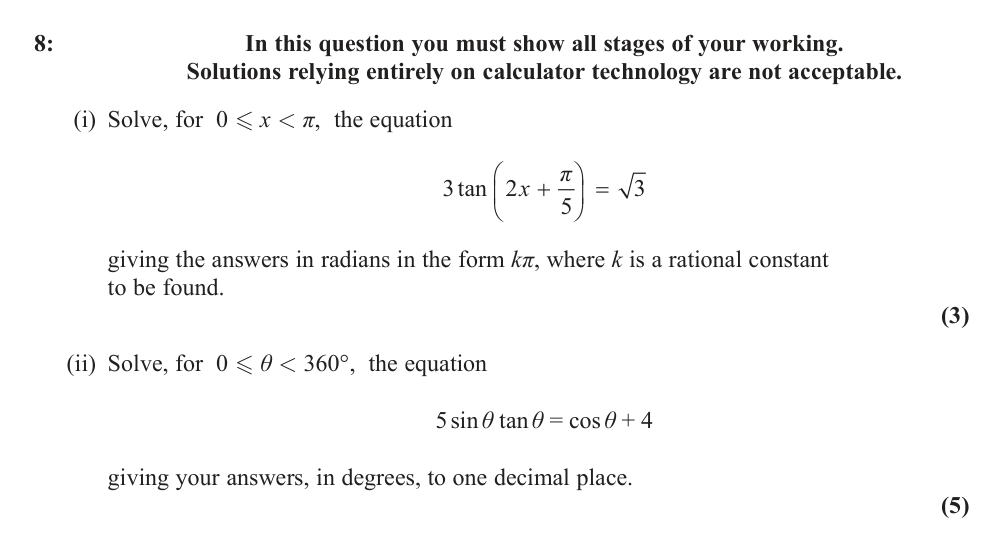
  1. Solve the tangent equation

    $3\tan\left(2x+\dfrac\pi5\right)=\sqrt3$ gives $\tan\left(2x+\dfrac\pi5\right)=\dfrac1{\sqrt3}$.

  2. Write the general angle

    Therefore $2x+\dfrac\pi5=\dfrac\pi6+n\pi$.

  3. Find x

    $2x=-\dfrac\pi{30}+n\pi$, so $x=-\dfrac\pi{60}+\dfrac{n\pi}{2}$.

  4. Use the interval

    For $0\le x<\pi$, the possible values are $x=\dfrac{29\pi}{60}$ and $x=\dfrac{59\pi}{60}$.

  5. Rewrite the second equation

    Using $\tan\theta=\dfrac{\sin\theta}{\cos\theta}$, $5\sin\theta\tan\theta=\cos\theta+4$ becomes $\dfrac{5\sin^2\theta}{\cos\theta}=\cos\theta+4$.

  6. Form an equation in cos theta

    Multiplying by $\cos\theta$ gives $5\sin^2\theta=\cos^2\theta+4\cos\theta$. Using $\sin^2\theta=1-\cos^2\theta$ gives $6\cos^2\theta+4\cos\theta-5=0$.

  7. Solve for cos theta

    $\cos\theta=\dfrac{-2\pm\sqrt{34}}{6}$. The negative option is less than $-1$, so reject it.

  8. Find theta

    $\cos\theta=\dfrac{-2+\sqrt{34}}{6}$ gives $\theta=50.320\ldots^\circ$ or $309.679\ldots^\circ$.

  9. Round the answers

    To one decimal place, $\theta=50.3^\circ$ or $309.7^\circ$.

Final answer

$(i)$ $x=\dfrac{29\pi}{60}$, $\dfrac{59\pi}{60}$. $\quad (ii)$ $\theta=50.3^\circ$, $309.7^\circ$.

10. WMA12/01 January 2025 · Q10

Medium8 marks
WMA12/01 January 2025 Question 10 (8 marks): Trigonometric Identities and Equations
Show worked solution
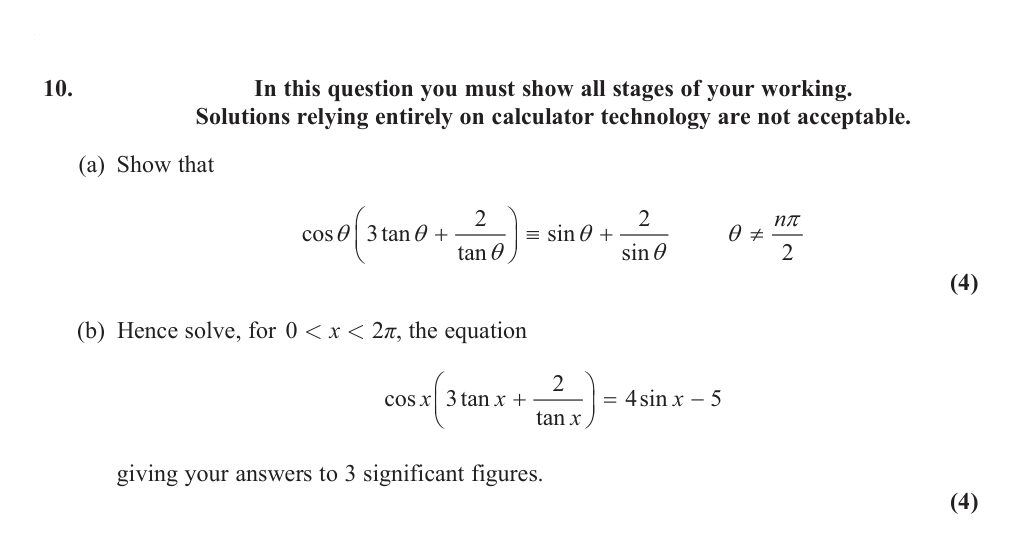
  1. Expand the left side

    $\cos\theta\left(3\tan\theta+\dfrac2{\tan\theta}\right)=3\sin\theta+\dfrac{2\cos\theta}{\tan\theta}$.

  2. Rewrite the second term

    Since $\tan\theta=\dfrac{\sin\theta}{\cos\theta}$, $\dfrac{2\cos\theta}{\tan\theta}=\dfrac{2\cos^2\theta}{\sin\theta}$.

  3. Use the identity

    $3\sin\theta+\dfrac{2\cos^2\theta}{\sin\theta}=3\sin\theta+\dfrac{2(1-\sin^2\theta)}{\sin\theta}$.

  4. Simplify

    $3\sin\theta+\dfrac2{\sin\theta}-2\sin\theta=\sin\theta+\dfrac2{\sin\theta}$, as required.

  5. Use part a

    The equation becomes $\sin x+\dfrac2{\sin x}=4\sin x-5$.

  6. Form a quadratic in sin x

    Multiplying by $\sin x$ gives $\sin^2x+2=4\sin^2x-5\sin x$, so $3\sin^2x-5\sin x-2=0$.

  7. Solve for sin x

    $(3\sin x+1)(\sin x-2)=0$. Since $\sin x=2$ is impossible, $\sin x=-\dfrac13$.

  8. Find x in the interval

    For $0<x<2\pi$, $\sin x=-\dfrac13$ gives $x=\pi+\sin^{-1}\left(\dfrac13\right)$ or $x=2\pi-\sin^{-1}\left(\dfrac13\right)$.

  9. Round the answers

    Thus $x=3.481\ldots$ or $x=5.943\ldots$, so to $3$ significant figures $x=3.48$ or $x=5.94$.

Final answer

$(a)$ Proven. $\quad (b)$ $x=3.48$, $5.94$.

11. WMA12/01 October 2022 · Q5

Medium8 marks
WMA12/01 October 2022 Question 5 (8 marks): Trigonometric Identities and Equations
Show worked solution
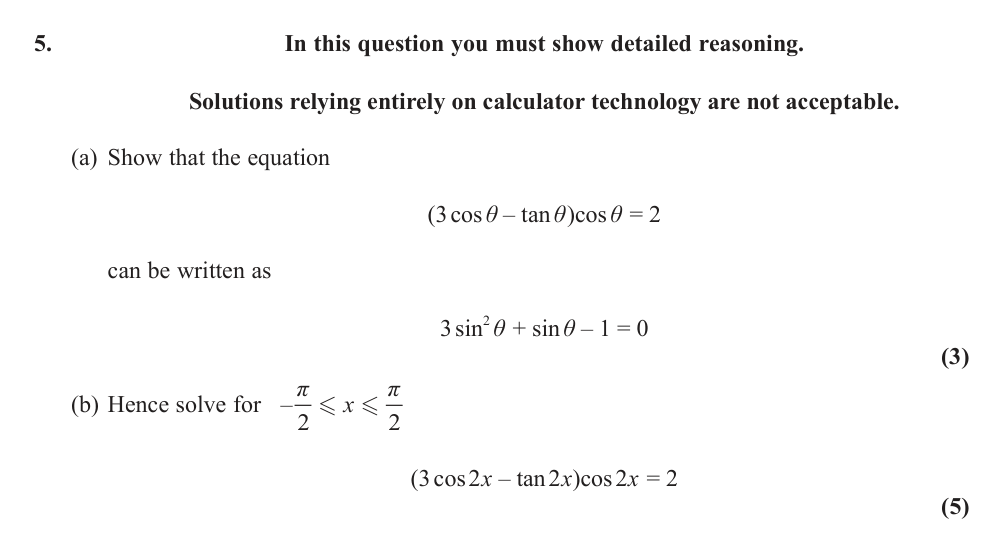
  1. Rewrite the left side

    $(3\cos\theta-\tan\theta)\cos\theta=3\cos^2\theta-\sin\theta$ because $\tan\theta\cos\theta=\sin\theta$.

  2. Move everything to one side

    The equation becomes $3\cos^2\theta-\sin\theta=2$.

  3. Use cos squared

    Since $\cos^2\theta=1-\sin^2\theta$, $3(1-\sin^2\theta)-\sin\theta=2$.

  4. Show the required form

    Expanding and rearranging gives $3\sin^2\theta+\sin\theta-1=0$.

  5. Apply the result to 2x

    For $(3\cos2x-\tan2x)\cos2x=2$, take $\theta=2x$. Then $3\sin^2(2x)+\sin(2x)-1=0$.

  6. Solve the quadratic

    Let $u=\sin(2x)$. Then $3u^2+u-1=0$, so $u=\dfrac{-1\pm\sqrt{13}}{6}$.

  7. Use the interval

    Since $-\dfrac{\pi}{2}\le x\le\dfrac{\pi}{2}$, we have $-\pi\le2x\le\pi$. Solving $\sin(2x)=\dfrac{-1+\sqrt{13}}{6}$ and $\sin(2x)=\dfrac{-1-\sqrt{13}}{6}$ in this interval gives $2x=-2.2665\ldots,-0.8751\ldots,0.4492\ldots,2.6924\ldots$.

  8. Divide by two

    Therefore $x=-1.133\ldots,-0.4375\ldots,0.2246\ldots,1.346\ldots$, giving $x=-1.13,-0.438,0.225,1.35$ radians.

Final answer

$(a)$ Proven. $\quad (b)\ x=-1.13,\ -0.438,\ 0.225,\ 1.35$ radians.

12. WMA12/01 January 2022 · Q7

Medium8 marks
WMA12/01 January 2022 Question 7 (8 marks): Trigonometric Identities and Equations
Show worked solution
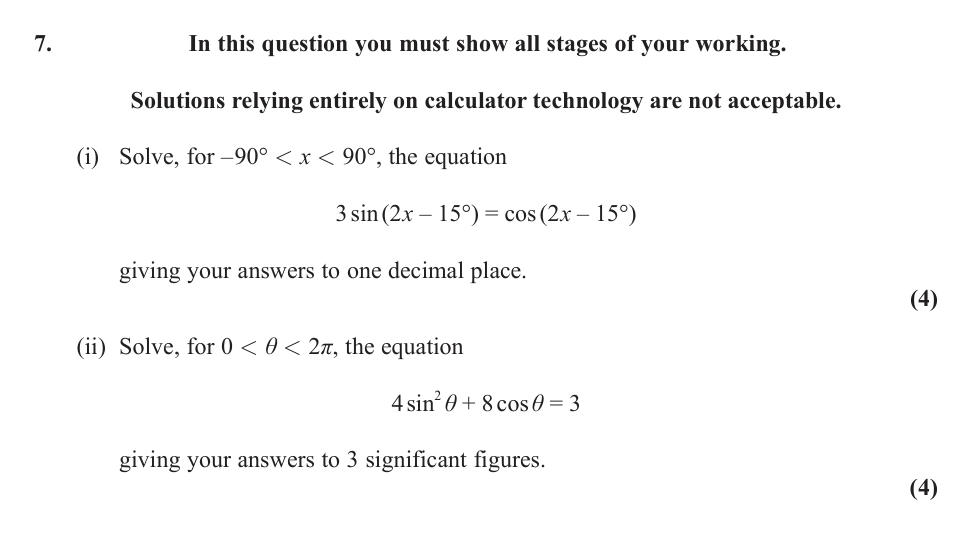
  1. Solve the first tangent equation

    Let $u=2x-15^\circ$. Then $3\sin u=\cos u$, so $\tan u=\dfrac13$.

  2. Use the interval for u

    Since $-90^\circ<x<90^\circ$, $-195^\circ<u<165^\circ$.

  3. Find x

    $u=18.434\ldots^\circ$ or $u=-161.565\ldots^\circ$, so $x=16.7^\circ$ or $x=-73.3^\circ$.

  4. Rewrite the second equation

    $4\sin^2\theta+8\cos\theta=3$.

  5. Use sin squared

    Substitute $\sin^2\theta=1-\cos^2\theta$ to get $4(1-\cos^2\theta)+8\cos\theta=3$.

  6. Solve for cos theta

    This gives $4\cos^2\theta-8\cos\theta-1=0$, so $\cos\theta=1\pm\dfrac{\sqrt5}{2}$.

  7. Choose the valid cosine

    Only $\cos\theta=1-\dfrac{\sqrt5}{2}$ lies between $-1$ and $1$.

  8. State theta

    For $0<\theta<2\pi$, $\theta=1.69$ or $4.59$ to 3 significant figures.

Final answer

$(i)\ x=-73.3^\circ,\ 16.7^\circ.\quad (ii)\ \theta=1.69,\ 4.59$.

13. WMA12/01 January 2021 · Q6

Medium8 marks
WMA12/01 January 2021 Question 6 (8 marks): Trigonometric Identities and Equations
Show worked solution
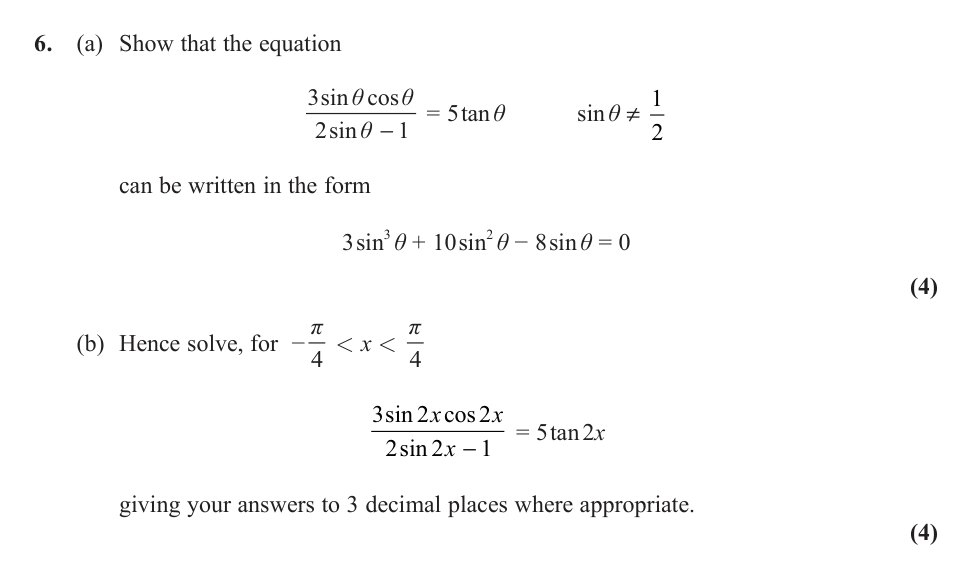
  1. Clear the fraction

    Starting with $\dfrac{3\sin\theta\cos\theta}{2\sin\theta-1}=5\tan\theta$, multiply by $(2\sin\theta-1)\cos\theta$.

  2. Use tan theta

    This gives $3\sin\theta\cos^2\theta=5\sin\theta(2\sin\theta-1)$.

  3. Use cos squared

    Substitute $\cos^2\theta=1-\sin^2\theta$: $3\sin\theta(1-\sin^2\theta)=10\sin^2\theta-5\sin\theta$.

  4. Collect terms

    Rearranging gives $3\sin^3\theta+10\sin^2\theta-8\sin\theta=0$.

  5. Factor the sine equation

    $3s^3+10s^2-8s=0$ gives $s(3s-2)(s+4)=0$, where $s=\sin2x$.

  6. Use the valid sine values

    Since $-\dfrac\pi2<2x<\dfrac\pi2$, the valid values are $\sin2x=0$ and $\sin2x=\dfrac23$.

  7. Find x

    $2x=0$ gives $x=0$. Also $2x=\sin^{-1}\left(\dfrac23\right)$, so $x=0.364863\ldots=0.365$ to 3 decimal places.

Final answer

$(a)$ Proven. $\quad (b)\ x=0,\ 0.365$.

14. WMA12/01 January 2020 · Q3

Medium8 marks · main topic: Polynomials
WMA12/01 January 2020 Question 3 (8 marks): Trigonometric Identities and Equations
Show worked solution
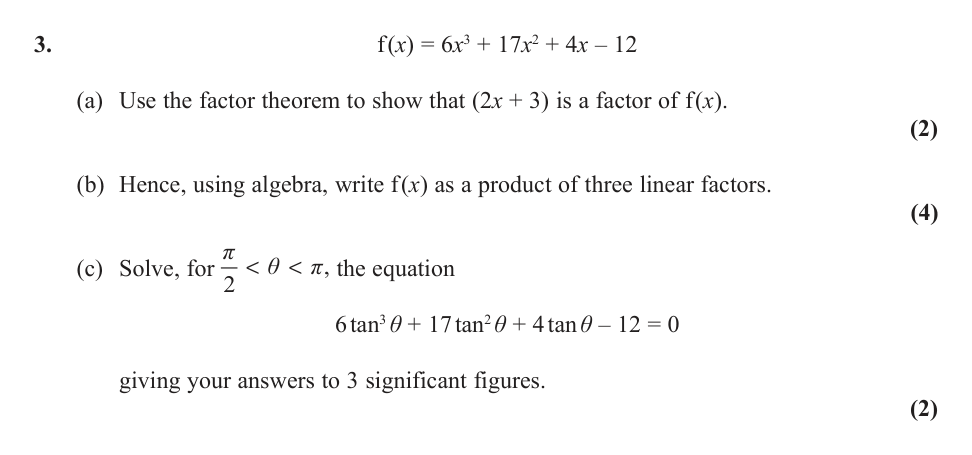
  1. Use the factor theorem

    For $(2x+3)$, use $x=-\dfrac32$. Substituting gives $f\left(-\dfrac32\right)=6\left(-\dfrac32\right)^3+17\left(-\dfrac32\right)^2+4\left(-\dfrac32\right)-12=0$.

  2. State the factor result

    Since $f\left(-\dfrac32\right)=0$, $(2x+3)$ is a factor of $f(x)$.

  3. Divide by the known factor

    $6x^3+17x^2+4x-12=(2x+3)(3x^2+4x-4)$.

  4. Factorise the quadratic

    $3x^2+4x-4=(3x-2)(x+2)$, so $f(x)=(2x+3)(3x-2)(x+2)$.

  5. Use the factorisation for tan theta

    Let $t=\tan\theta$. Then $(2t+3)(3t-2)(t+2)=0$, so $t=-\dfrac32$, $t=\dfrac23$, or $t=-2$.

  6. Choose the roots in the interval

    For $\dfrac\pi2<\theta<\pi$, $\tan\theta$ is negative, so use $\tan\theta=-\dfrac32$ and $\tan\theta=-2$.

  7. Find theta

    This gives $\theta=\pi-\tan^{-1}\left(\dfrac32\right)=2.16$ and $\theta=\pi-\tan^{-1}(2)=2.03$, to 3 significant figures.

Final answer

$(a)$ Proven. $\quad (b)\ f(x)=(2x+3)(3x-2)(x+2).\quad (c)\ \theta=2.03,\ 2.16$ radians.

15. WMA12/01 October 2025 · Q5

Hard9 marks
WMA12/01 October 2025 Question 5 (9 marks): Trigonometric Identities and Equations
Show worked solution
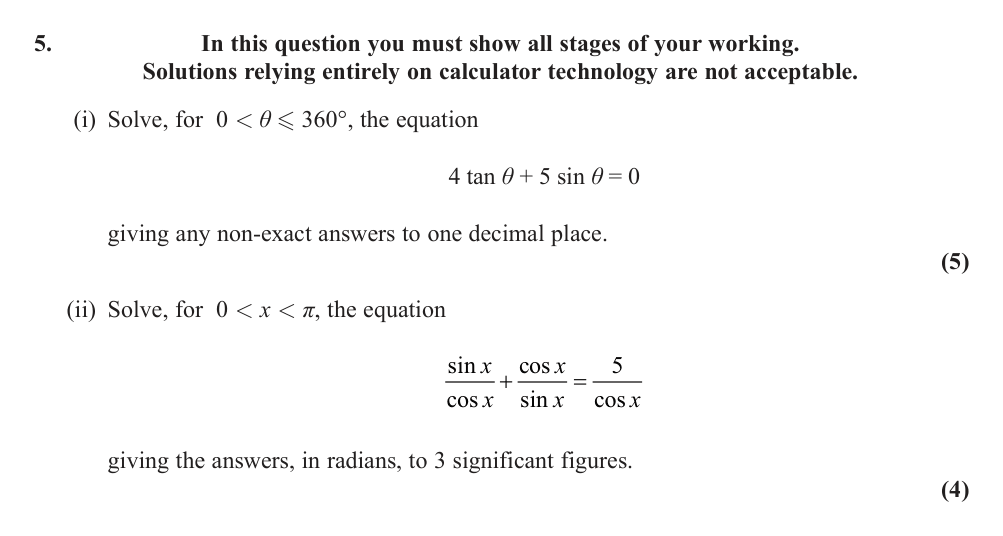
  1. Rewrite the first equation

    $4\tan\theta+5\sin\theta=0$ gives $4\dfrac{\sin\theta}{\cos\theta}+5\sin\theta=0$.

  2. Factor sin theta

    $\sin\theta\left(\dfrac4{\cos\theta}+5\right)=0$.

  3. Use sin theta equals zero

    In $0<\theta\le360^\circ$, $\sin\theta=0$ gives $\theta=180^\circ$ or $360^\circ$.

  4. Use the other factor

    $\dfrac4{\cos\theta}+5=0$ gives $\cos\theta=-\dfrac45$.

  5. Find the remaining angles

    For $0<\theta\le360^\circ$, $\cos\theta=-\dfrac45$ gives $\theta=143.130\ldots^\circ$ or $216.869\ldots^\circ$.

  6. Round part i

    The non-exact angles are $143.1^\circ$ and $216.9^\circ$ to one decimal place.

  7. Clear the fractions in part ii

    $\dfrac{\sin x}{\cos x}+\dfrac{\cos x}{\sin x}=\dfrac5{\cos x}$. Multiplying by $\sin x\cos x$ gives $\sin^2x+\cos^2x=5\sin x$.

  8. Use the identity

    $\sin^2x+\cos^2x=1$, so $1=5\sin x$ and $\sin x=\dfrac15$.

  9. Solve in the interval

    For $0<x<\pi$, $x=\sin^{-1}\left(\dfrac15\right)$ or $x=\pi-\sin^{-1}\left(\dfrac15\right)$.

  10. Round part ii

    Thus $x=0.201357\ldots$ or $2.94023\ldots$, so $x=0.201$ or $2.94$ to $3$ significant figures.

Final answer

$(i)$ $\theta=143.1^\circ$, $180^\circ$, $216.9^\circ$, $360^\circ$. $\quad (ii)$ $x=0.201$, $2.94$.

16. WMA12/01 January 2023 · Q8

Hard9 marks
WMA12/01 January 2023 Question 8 (9 marks): Trigonometric Identities and Equations
Show worked solution
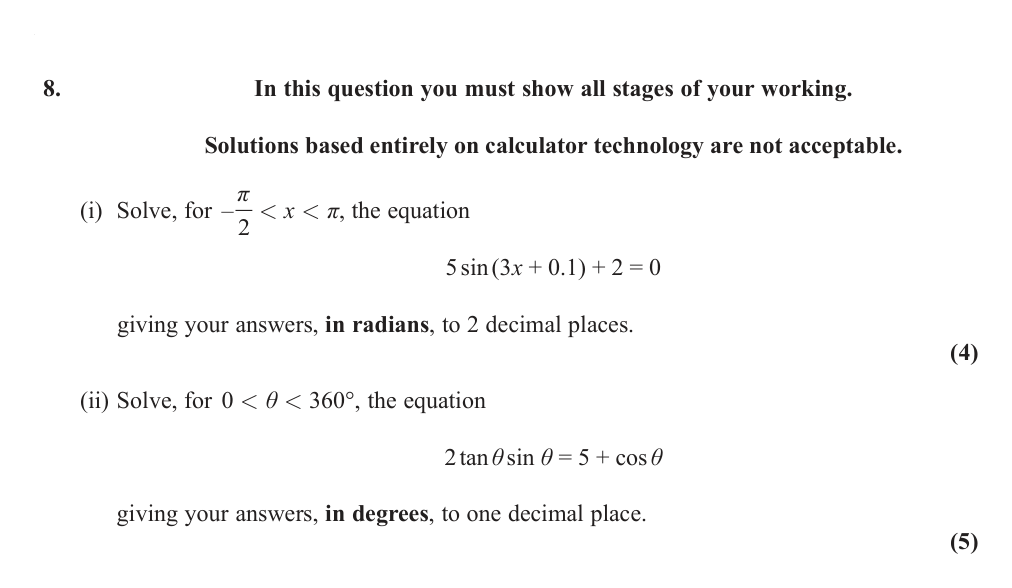
  1. Isolate the sine term

    $5\sin(3x+0.1)+2=0$ gives $\sin(3x+0.1)=-0.4$.

  2. Find the angle interval

    Since $-\dfrac{\pi}{2}<x<\pi$, multiplying by 3 and adding $0.1$ gives $-\dfrac{3\pi}{2}+0.1<3x+0.1<3\pi+0.1$.

  3. Solve for the inner angle

    In this interval, $3x+0.1=-2.7301\ldots,-0.4115\ldots,3.5531\ldots,5.8717\ldots$.

  4. Find x values

    Subtract $0.1$ and divide by $3$: $x=-0.9433\ldots,-0.1705\ldots,1.1510\ldots,1.9239\ldots$.

  5. Round the radian answers

    To 2 decimal places, $x=-0.94,-0.17,1.15,1.92$.

  6. Rewrite the second equation

    $2\tan\theta\sin\theta=5+\cos\theta$. Using $\tan\theta=\dfrac{\sin\theta}{\cos\theta}$ gives $\dfrac{2\sin^2\theta}{\cos\theta}=5+\cos\theta$.

  7. Use sine squared

    Multiplying by $\cos\theta$ gives $2\sin^2\theta=5\cos\theta+\cos^2\theta$. Substitute $\sin^2\theta=1-\cos^2\theta$.

  8. Solve for cos theta

    $2(1-\cos^2\theta)=5\cos\theta+\cos^2\theta$, so $3\cos^2\theta+5\cos\theta-2=0$.

  9. Factor and reject impossible value

    $(3\cos\theta-1)(\cos\theta+2)=0$. Since $\cos\theta=-2$ is impossible, $\cos\theta=\dfrac13$.

  10. Find theta

    For $0<\theta<360^\circ$, $\cos\theta=\dfrac13$ gives $\theta=70.5^\circ$ or $289.5^\circ$ to one decimal place.

Final answer

$(i)$ $x=-0.94,-0.17,1.15,1.92$. $\quad (ii)$ $\theta=70.5^\circ,289.5^\circ$.

17. WMA12/01 January 2026 · Q8

Hard10 marks
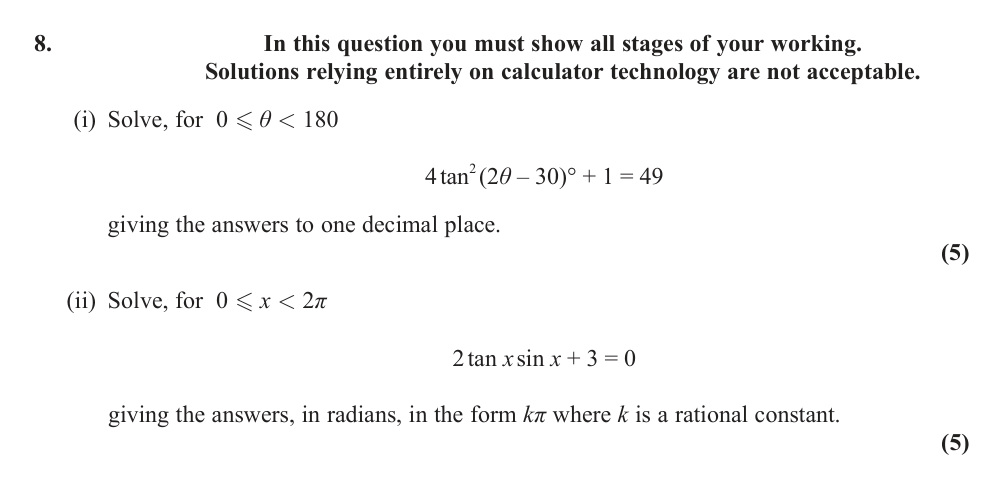
WMA12/01 January 2026 Question 8 (10 marks): Trigonometric Identities and Equations
Show worked solution
  1. Make the tangent expression the subject

    $4\tan^2(2\theta-30^\circ)+1=49$ gives $\tan^2(2\theta-30^\circ)=12$.

  2. Find the possible angle values

    Let $\alpha=2\theta-30^\circ$. Since $0\leq\theta<180^\circ$, $-30^\circ\leq\alpha<330^\circ$. The solutions of $\tan\alpha=\pm\sqrt{12}$ in this range are approximately $73.9^\circ,106.1^\circ,253.9^\circ,286.1^\circ$.

  3. Return to theta

    $\theta=\dfrac{\alpha+30^\circ}{2}$, giving $\theta=51.9^\circ,68.1^\circ,141.9^\circ,158.1^\circ$ to one decimal place.

  4. Rewrite tan x

    $2\tan x\sin x+3=0$ becomes $2\left(\dfrac{\sin x}{\cos x}\right)\sin x+3=0$.

  5. Form a quadratic in cos x

    Multiplying by $\cos x$ gives $2\sin^2 x+3\cos x=0$. Using $\sin^2x=1-\cos^2x$, $2(1-\cos^2x)+3\cos x=0$, so $2\cos^2x-3\cos x-2=0$.

  6. Solve for x

    $(2\cos x+1)(\cos x-2)=0$. Since $\cos x=2$ is impossible, $\cos x=-\dfrac12$. In $0\leq x<2\pi$, $x=\dfrac{2\pi}{3}$ or $x=\dfrac{4\pi}{3}$.

Final answer

$(i)\ \theta=51.9^\circ,\ 68.1^\circ,\ 141.9^\circ,\ 158.1^\circ.\quad (ii)\ x=\dfrac{2\pi}{3},\ \dfrac{4\pi}{3}$.

18. WMA12/01 October 2021 · Q10

Hard10 marks
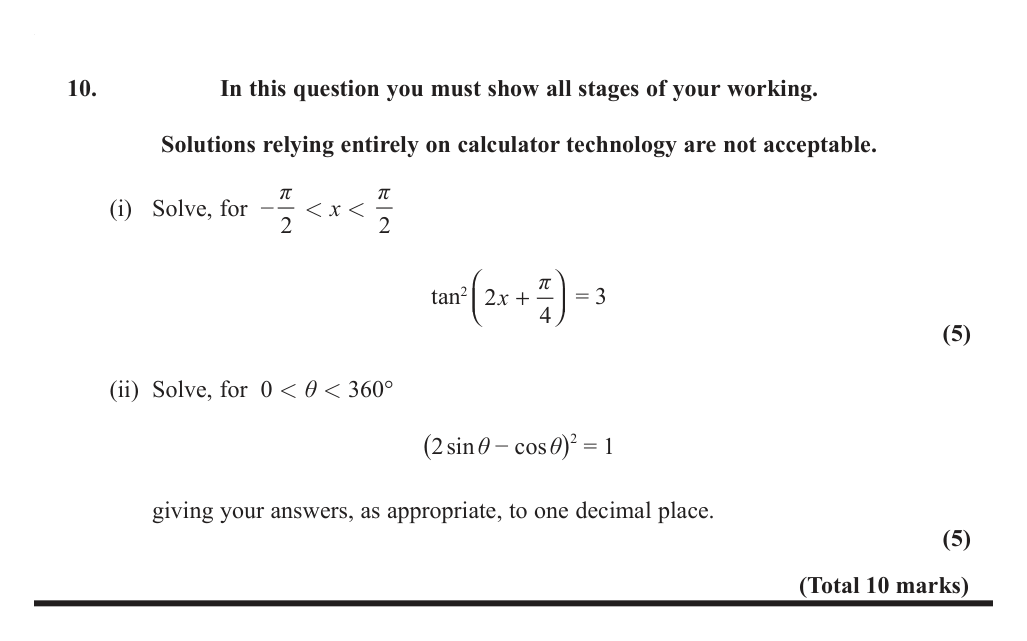
WMA12/01 October 2021 Question 10 (10 marks): Trigonometric Identities and Equations
Show worked solution
  1. Take the square root

    Let $u=2x+\dfrac\pi4$. From $\tan^2u=3$, $\tan u=\pm\sqrt3$.

  2. Write the angle families

    Thus $u=\dfrac\pi3+n\pi$ or $u=-\dfrac\pi3+n\pi$, where $n$ is an integer.

  3. Return to x

    So $x=\dfrac\pi{24}+\dfrac{n\pi}{2}$ or $x=-\dfrac{7\pi}{24}+\dfrac{n\pi}{2}$.

  4. Use the interval

    For $-\dfrac\pi2<x<\dfrac\pi2$, the solutions are $x=-\dfrac{11\pi}{24},-\dfrac{7\pi}{24},\dfrac\pi{24},\dfrac{5\pi}{24}$.

  5. Expand the squared equation

    $(2\sin\theta-\cos\theta)^2=1$ gives $4\sin^2\theta-4\sin\theta\cos\theta+\cos^2\theta=1$.

  6. Use the identity

    Since $1=\sin^2\theta+\cos^2\theta$, this simplifies to $3\sin^2\theta-4\sin\theta\cos\theta=0$.

  7. Factor

    $\sin\theta(3\sin\theta-4\cos\theta)=0$.

  8. Solve the two cases

    $\sin\theta=0$ gives $\theta=180^\circ$ in the interval. Also $3\sin\theta=4\cos\theta$ gives $\tan\theta=\dfrac43$.

  9. State theta

    For $0<\theta<360^\circ$, $\tan\theta=\dfrac43$ gives $\theta=53.1^\circ$ and $233.1^\circ$. Therefore $\theta=53.1^\circ,180^\circ,233.1^\circ$.

Final answer

$(i)\ x=-\dfrac{11\pi}{24},\ -\dfrac{7\pi}{24},\ \dfrac{\pi}{24},\ \dfrac{5\pi}{24}.\quad (ii)\ \theta=53.1^\circ,\ 180^\circ,\ 233.1^\circ$.

19. WMA12/01 May/June 2021 · Q8

Hard10 marks
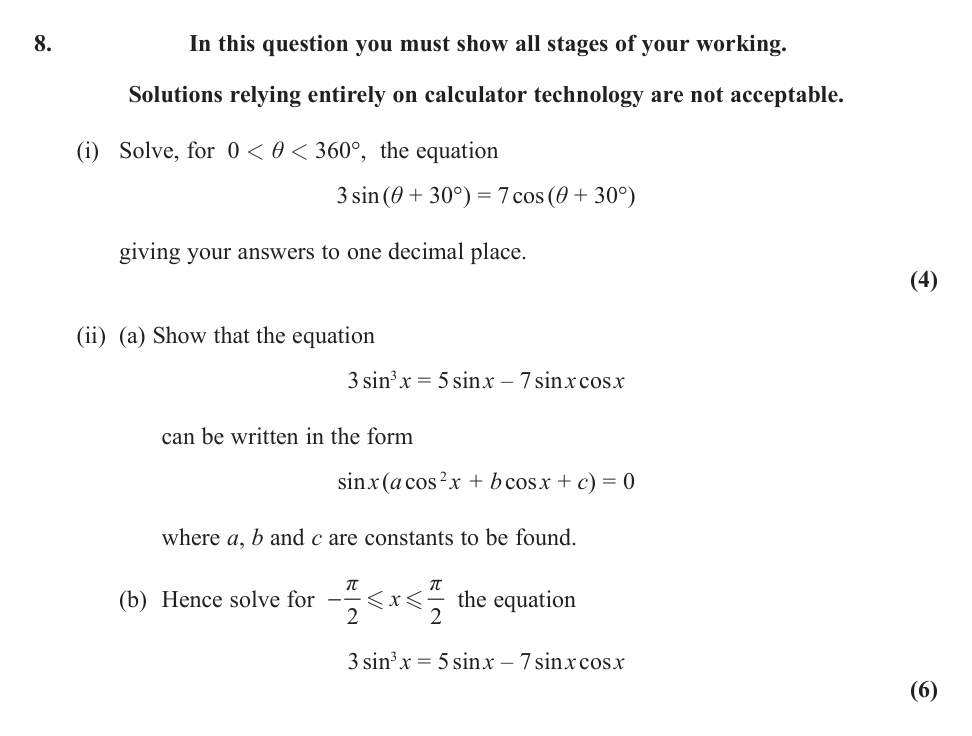
WMA12/01 May/June 2021 Question 8 (10 marks): Trigonometric Identities and Equations
Show worked solution
  1. Solve for theta plus thirty

    Let $u=\theta+30^\circ$. Then $3\sin u=7\cos u$, so $\tan u=\dfrac73$.

  2. Find u in the interval

    Since $0<\theta<360^\circ$, $30^\circ<u<390^\circ$. Thus $u=66.801\ldots^\circ$ or $246.801\ldots^\circ$.

  3. Return to theta

    $\theta=u-30^\circ$, giving $\theta=36.8^\circ$ and $216.8^\circ$ to one decimal place.

  4. Rearrange the second equation

    $3\sin^3x=5\sin x-7\sin x\cos x$ gives $3\sin^3x-5\sin x+7\sin x\cos x=0$.

  5. Factor out sine

    $\sin x(3\sin^2x-5+7\cos x)=0$.

  6. Use sin squared

    Since $\sin^2x=1-\cos^2x$, this becomes $\sin x(-3\cos^2x+7\cos x-2)=0$, or $\sin x(3\cos^2x-7\cos x+2)=0$.

  7. Solve in the interval

    For $-\dfrac\pi2\leq x\leq\dfrac\pi2$, $\sin x=0$ gives $x=0$. Also $3\cos^2x-7\cos x+2=0$ gives $(3\cos x-1)(\cos x-2)=0$.

  8. State the solutions

    $\cos x=2$ is impossible, so $\cos x=\dfrac13$. The solutions are $x=-\cos^{-1}\left(\dfrac13\right)$, $0$, and $\cos^{-1}\left(\dfrac13\right)$.

Final answer

$(i)\ \theta=36.8^\circ,\ 216.8^\circ.\quad (ii)(a)\ a=3,\ b=-7,\ c=2.\quad (ii)(b)\ x=-\cos^{-1}\left(\dfrac13\right),\ 0,\ \cos^{-1}\left(\dfrac13\right)$.

20. WMA12/01 May/June 2024 · Q8

Hard12 marks
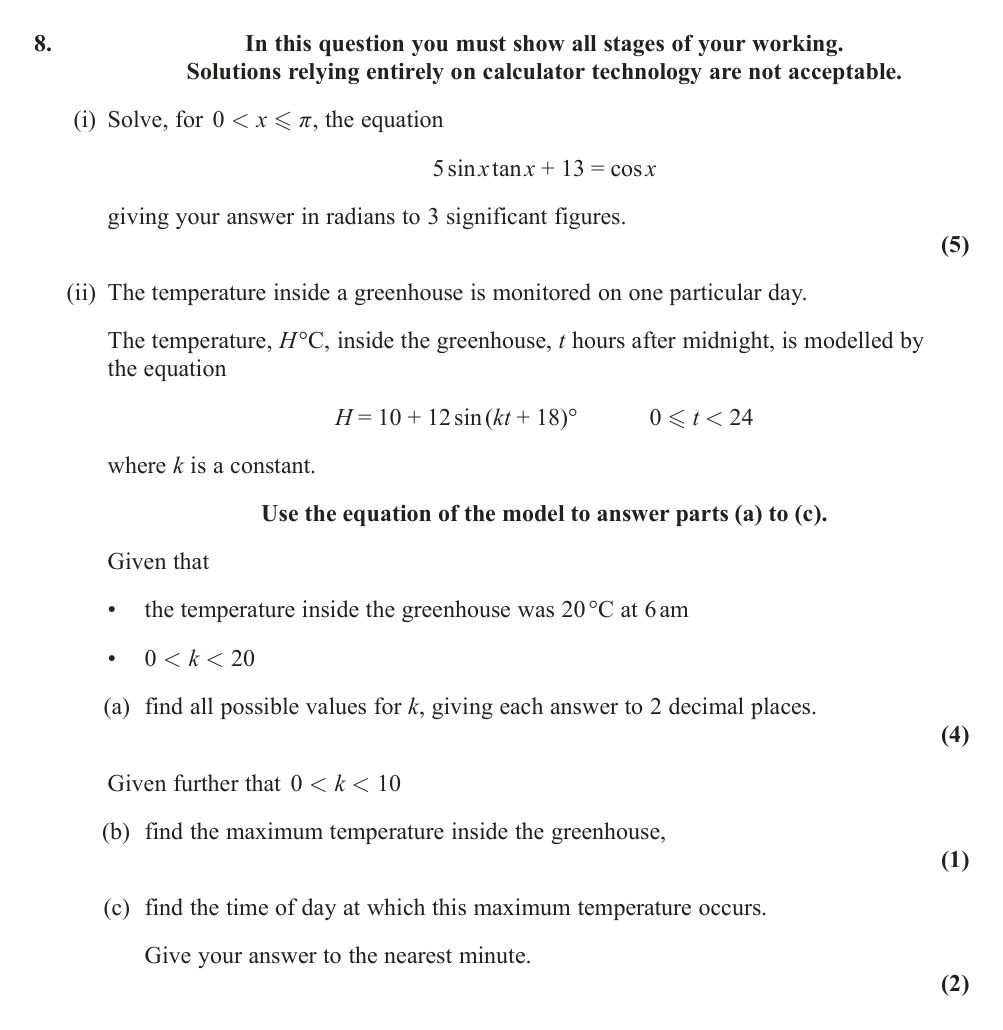
WMA12/01 May/June 2024 Question 8 (12 marks): Trigonometric Identities and Equations
Show worked solution
  1. Rewrite the trig equation

    $5\sin x\tan x+13=\cos x$ becomes $\dfrac{5\sin^2x}{\cos x}+13=\cos x$.

  2. Multiply by cos x

    $5\sin^2x+13\cos x=\cos^2x$.

  3. Use sine squared

    $5(1-\cos^2x)+13\cos x=\cos^2x$, so $6\cos^2x-13\cos x-5=0$.

  4. Solve for cos x

    $(2\cos x-5)(3\cos x+1)=0$, so $\cos x=\dfrac52$ or $\cos x=-\dfrac13$.

  5. Choose the valid root

    $\cos x=\dfrac52$ is impossible, so $\cos x=-\dfrac13$. For $0<x\le\pi$, $x=1.9106\ldots$, so $x=1.91$ radians to 3 significant figures.

  6. Use the temperature at 6 am

    At $t=6$, $20=10+12\sin(6k+18)^\circ$, so $\sin(6k+18)^\circ=\dfrac56$.

  7. Solve for k

    $\sin^{-1}\left(\dfrac56\right)=56.442\ldots^\circ$. Since $0<k<20$, $18<6k+18<138$, so $6k+18=56.442\ldots$ or $123.557\ldots$.

  8. Find possible k values

    This gives $k=6.407\ldots$ or $k=17.592\ldots$, so $k=6.41$ or $17.59$ to 2 decimal places.

  9. Use the tighter condition

    Given further that $0<k<10$, use $k=6.407\ldots$.

  10. Find the maximum temperature

    The maximum value of $\sin$ is $1$, so the maximum temperature is $10+12=22^\circ\text{C}$.

  11. Find the time of maximum

    The maximum occurs when $kt+18=90$, so $t=\dfrac{72}{6.407\ldots}=11.2375\ldots$ hours after midnight.

  12. Convert to time of day

    $0.2375\ldots$ hours is $14.25\ldots$ minutes, so the maximum occurs at about $11{:}14$ am.

Final answer

$(i)$ $x=1.91$ radians. $\quad (ii)(a)$ $k=6.41$ or $17.59$. $\quad (ii)(b)$ $22^\circ\text{C}$. $\quad (ii)(c)$ $11{:}14$ am.

21. WMA12/01 October 2023 · Q10

Hard12 marks · main topic: Binomial Expansion
WMA12/01 October 2023 Question 10 (12 marks): Trigonometric Identities and Equations
Show worked solution
  1. Find the second term

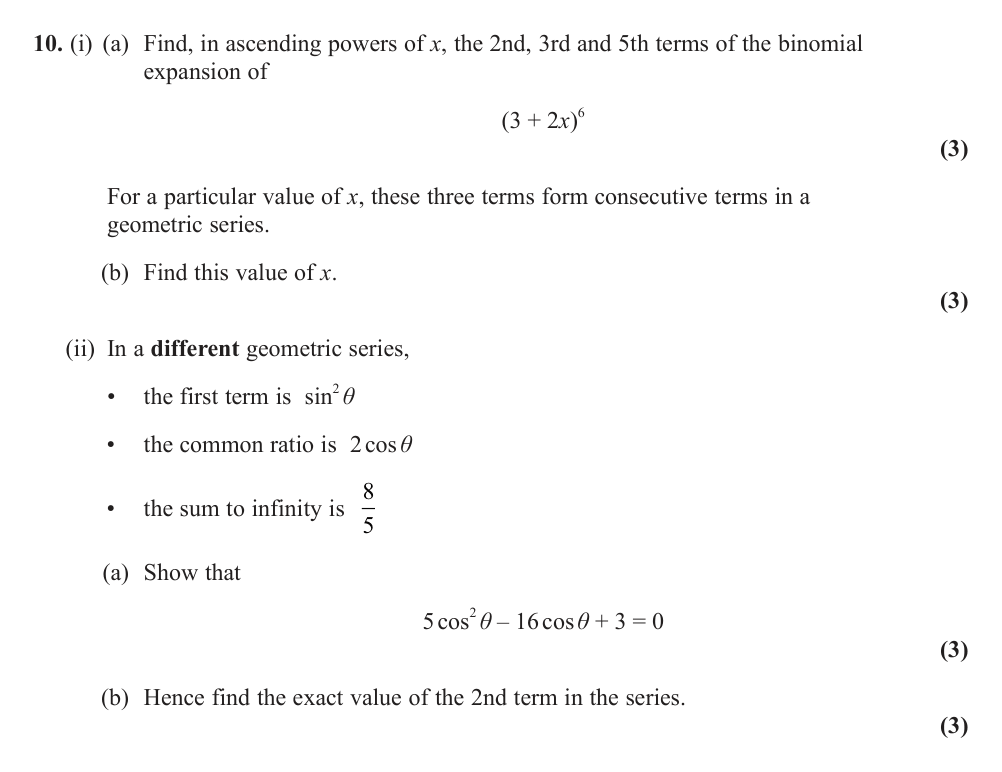
    The 2nd term of $(3+2x)^6$ is $\binom61 3^5(2x)=6\cdot243\cdot2x=2916x$.

  2. Find the third term

    The 3rd term is $\binom62 3^4(2x)^2=15\cdot81\cdot4x^2=4860x^2$.

  3. Find the fifth term

    The 5th term is $\binom64 3^2(2x)^4=15\cdot9\cdot16x^4=2160x^4$.

  4. Use the geometric condition

    For three consecutive terms in a geometric series, the middle term squared equals the product of the two outer terms.

  5. Set up the equation

    $(4860x^2)^2=(2916x)(2160x^4)$.

  6. Solve for x

    For the non-zero geometric case, divide by $x^4$: $4860^2=2916\cdot2160\,x$, so $x=\dfrac{4860^2}{2916\cdot2160}=\dfrac{15}{4}$.

  7. Use the sum to infinity

    In the different geometric series, first term $=\sin^2\theta$, common ratio $=2\cos\theta$, and $S_\infty=\dfrac85$.

  8. Form the equation

    $\dfrac{\sin^2\theta}{1-2\cos\theta}=\dfrac85$.

  9. Use sine squared

    $5\sin^2\theta=8(1-2\cos\theta)$. With $\sin^2\theta=1-\cos^2\theta$, this becomes $5(1-\cos^2\theta)=8-16\cos\theta$.

  10. Show the required equation

    Rearranging gives $5\cos^2\theta-16\cos\theta+3=0$.

  11. Solve for cosine

    $5\cos^2\theta-16\cos\theta+3=0$ gives $\cos\theta=3$ or $\cos\theta=\dfrac15$. The possible value is $\cos\theta=\dfrac15$.

  12. Find the second term

    The 2nd term is first term times common ratio: $\sin^2\theta(2\cos\theta)=\left(1-\dfrac{1}{25}\right)\cdot\dfrac25=\dfrac{24}{25}\cdot\dfrac25=\dfrac{48}{125}$.

Final answer

$(i)(a)$ $2916x,\ 4860x^2,\ 2160x^4$. $\quad (i)(b)$ $x=\dfrac{15}{4}$. $\quad (ii)(a)$ Proven. $\quad (ii)(b)$ $\dfrac{48}{125}$.

22. WMA12/01 October 2019 · Q9

Hard12 marks
WMA12/01 October 2019 Question 9 (12 marks): Trigonometric Identities and Equations
Show worked solution
  1. Solve the sine equation

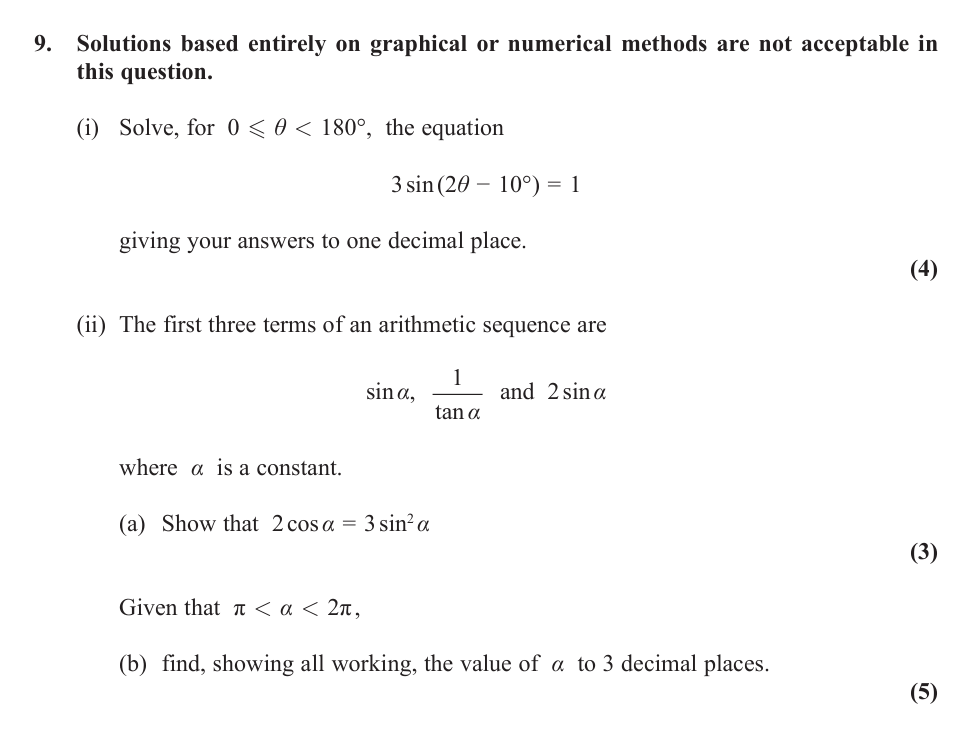
    Let $u=2\theta-10^\circ$. Then $\sin u=\dfrac13$.

  2. Find the valid angle values

    Since $0\leq\theta<180^\circ$, $-10^\circ\leq u<350^\circ$. In this interval, $u=19.471\ldots^\circ$ or $u=160.529\ldots^\circ$.

  3. Return to theta

    $\theta=\dfrac{u+10^\circ}{2}$, giving $\theta=14.7^\circ$ and $85.3^\circ$ to one decimal place.

  4. Use the arithmetic sequence condition

    For three consecutive terms of an arithmetic sequence, second minus first equals third minus second. Hence $\dfrac1{\tan\alpha}-\sin\alpha=2\sin\alpha-\dfrac1{\tan\alpha}$.

  5. Prove the required identity

    This gives $\dfrac2{\tan\alpha}=3\sin\alpha$. Since $\dfrac1{\tan\alpha}=\dfrac{\cos\alpha}{\sin\alpha}$, we get $\dfrac{2\cos\alpha}{\sin\alpha}=3\sin\alpha$, so $2\cos\alpha=3\sin^2\alpha$.

  6. Form a quadratic in cos alpha

    Using $\sin^2\alpha=1-\cos^2\alpha$, $2\cos\alpha=3(1-\cos^2\alpha)$, so $3\cos^2\alpha+2\cos\alpha-3=0$.

  7. Solve in the given interval

    $\cos\alpha=\dfrac{-1+\sqrt{10}}{3}$; the other root is less than $-1$. Since $\pi<\alpha<2\pi$ and cosine is positive, $\alpha$ is in the fourth quadrant.

  8. State alpha

    $\alpha=2\pi-\cos^{-1}\left(\dfrac{-1+\sqrt{10}}{3}\right)=5.517$ radians to 3 decimal places.

Final answer

$(i)\ \theta=14.7^\circ,\ 85.3^\circ.\quad (ii)(a)$ Proven. $\quad (ii)(b)\ \alpha=5.517$ radians.

23. WMA12/01 January 2024 · Q9

Hard14 marks
WMA12/01 January 2024 Question 9 (14 marks): Trigonometric Identities and Equations
Show worked solution
  1. Rewrite the equation

    $\sin x\tan x=5$ becomes $\dfrac{\sin^2x}{\cos x}=5$.

  2. Use sine squared

    Multiplying by $\cos x$ gives $\sin^2x=5\cos x$. Since $\sin^2x=1-\cos^2x$, $1-\cos^2x=5\cos x$.

  3. Solve for cos x

    $\cos^2x+5\cos x-1=0$, so $\cos x=\dfrac{-5\pm\sqrt{29}}{2}$.

  4. Choose the possible cosine value

    $\dfrac{-5-\sqrt{29}}{2}<-1$, so the valid value is $\cos x=\dfrac{-5+\sqrt{29}}{2}$.

  5. Find x

    For $0\le x<360^\circ$, this gives $x=78.9^\circ$ or $281.1^\circ$ to one decimal place.

  6. Find A from P

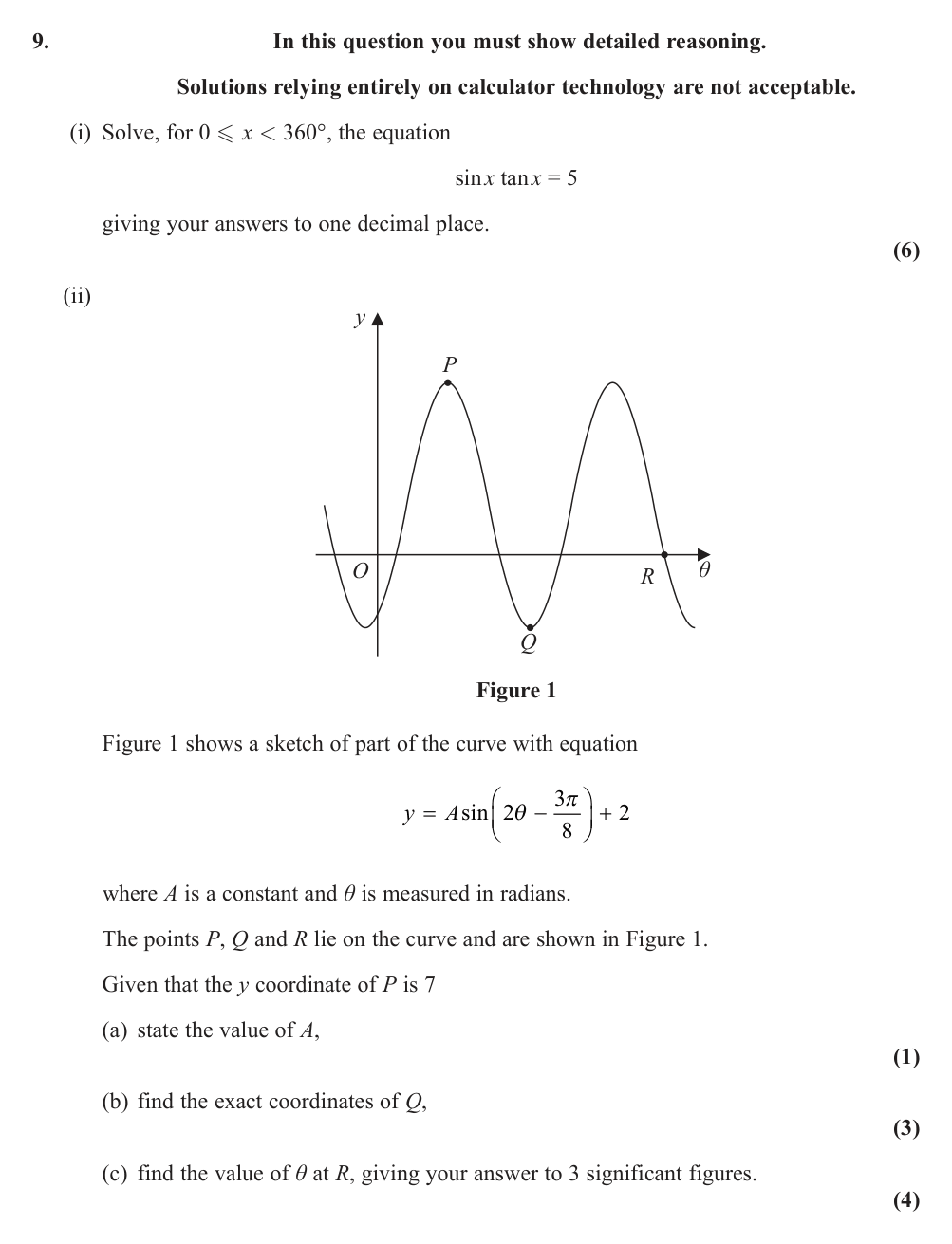
    The point $P$ is a maximum point on the sine curve. Its $y$ coordinate is $7$, so $A+2=7$ and $A=5$.

  7. Locate Q

    Point $Q$ is the next minimum after $P$, so $\sin\left(2\theta-\dfrac{3\pi}{8}\right)=-1$.

  8. Find theta at Q

    For this minimum, $2\theta-\dfrac{3\pi}{8}=\dfrac{3\pi}{2}$, so $2\theta=\dfrac{15\pi}{8}$ and $\theta=\dfrac{15\pi}{16}$.

  9. Find y at Q

    At the minimum, $y=2-5=-3$, so $Q=\left(\dfrac{15\pi}{16},-3\right)$.

  10. Set up R

    At $R$, $y=0$, so $5\sin\left(2\theta-\dfrac{3\pi}{8}\right)+2=0$.

  11. Choose the shown crossing

    Thus $\sin\left(2\theta-\dfrac{3\pi}{8}\right)=-\dfrac25$. The crossing $R$ shown after the second maximum has $2\theta-\dfrac{3\pi}{8}=3\pi+\sin^{-1}\left(\dfrac25\right)$.

  12. Find theta at R

    $\theta=\dfrac12\left(3\pi+\sin^{-1}\left(\dfrac25\right)+\dfrac{3\pi}{8}\right)=5.507\ldots$, so $\theta=5.51$ to 3 significant figures.

Final answer

$(i)$ $x=78.9^\circ,281.1^\circ$. $\quad (ii)(a)$ $A=5$. $\quad (ii)(b)$ $Q=\left(\dfrac{15\pi}{16},-3\right)$. $\quad (ii)(c)$ $\theta=5.51$.

More IAL Pure 2 topics

Dr Eslam Ahmed
Dr Eslam Ahmed

Elite Mathematics · Questions classified by topic, solutions checked by Dr Eslam