Elite Mathematics / Pure 2 / Topics / Geometric Sequences and Series IAL · WMA12 · Topic Geometric Sequences and Series: past paper questions & worked solutions
Every Geometric Sequences and Series question from the WMA12 papers in our bank, 2019–2026, sorted from easiest to hardest. Try each one first, then open the worked solution.
19 questions
164 marks in total
95% of papers (18 of 19) include it
3/7/9 easy / medium / hard
Questions, easiest first Level is estimated from marks: 1–6 easy, 7–8 medium, 9+ hard.
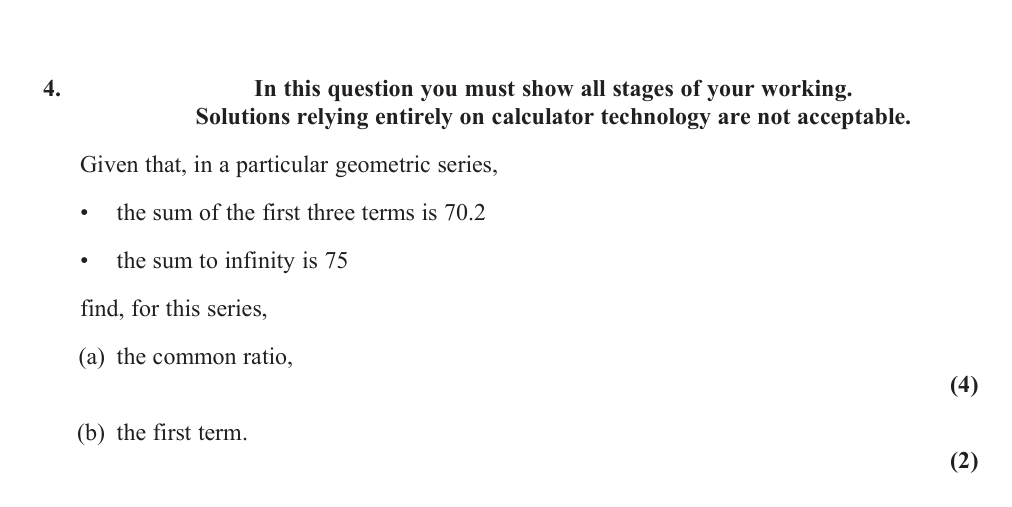
1. WMA12/01 January 2025 · Q4 Easy 6 marksShow worked solution Write the two sums For first term $a$ and common ratio $r$, $S_\infty=\dfrac{a}{1-r}=75$ and $S_3=\dfrac{a(1-r^3)}{1-r}=70.2$.
Divide the equations $\dfrac{S_3}{S_\infty}=1-r^3$, so $\dfrac{70.2}{75}=1-r^3$.
Find the ratio $0.936=1-r^3$, so $r^3=0.064$ and $r=0.4$.
Find the first term Use $\dfrac{a}{1-0.4}=75$. Hence $a=75(0.6)=45$.
Final answer $(a)$ $r=0.4$. $\quad (b)$ $45$.
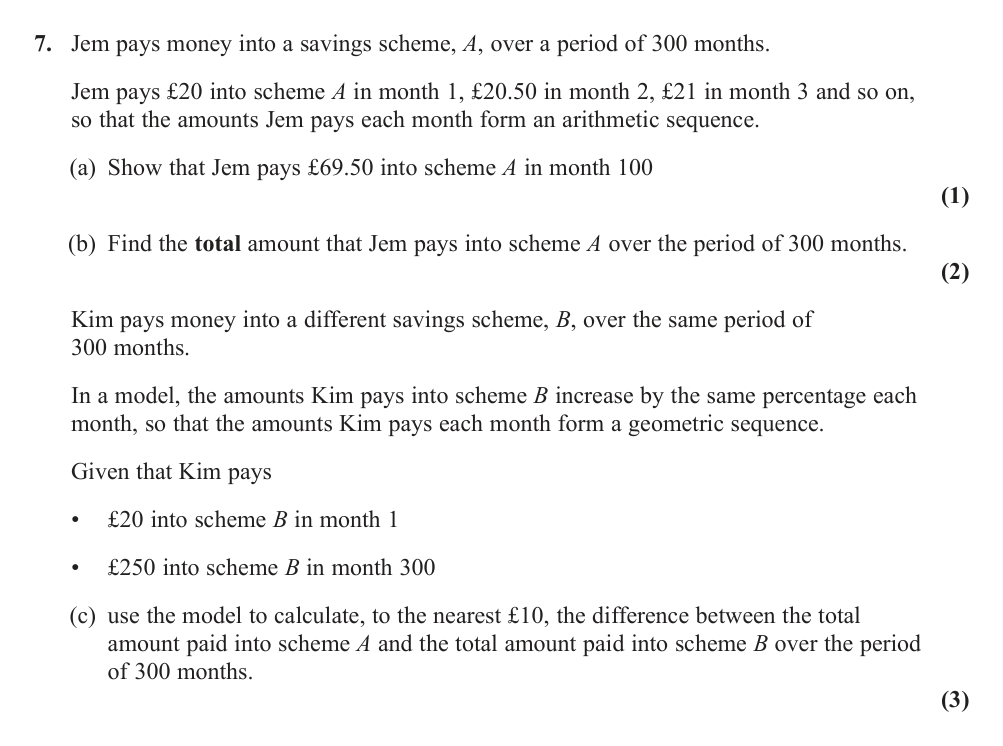
2. WMA12/01 October 2024 · Q7 Easy 6 marks · main topic: Modelling with Sequences & SeriesShow worked solution Identify Jem's sequence Jem's payments are arithmetic with first term $20$ and common difference $0.50$.
Show month 100 The month $100$ payment is $20+99(0.50)=69.50$, so Jem pays £69.50.
Sum Jem's payments $S_{300}=\dfrac{300}{2}\{2(20)+299(0.50)\}=150(189.5)=28425$.
Model Kim's payments Let the common ratio be $r$. Since the first payment is $20$ and the month $300$ payment is $250$, $20r^{299}=250$.
Find the ratio Thus $r^{299}=12.5$ and $r=12.5^{1/299}$.
Sum Kim's payments $S_B=20\dfrac{r^{300}-1}{r-1}$ with $r=12.5^{1/299}$, giving $S_B\approx27362.95$.
Find the difference The difference is $28425-27362.95\approx1062.05$, which is £1,060 to the nearest £10.
Final answer $(a)$ Proven. $\quad (b)$ £28,425. $\quad (c)$ £1,060.
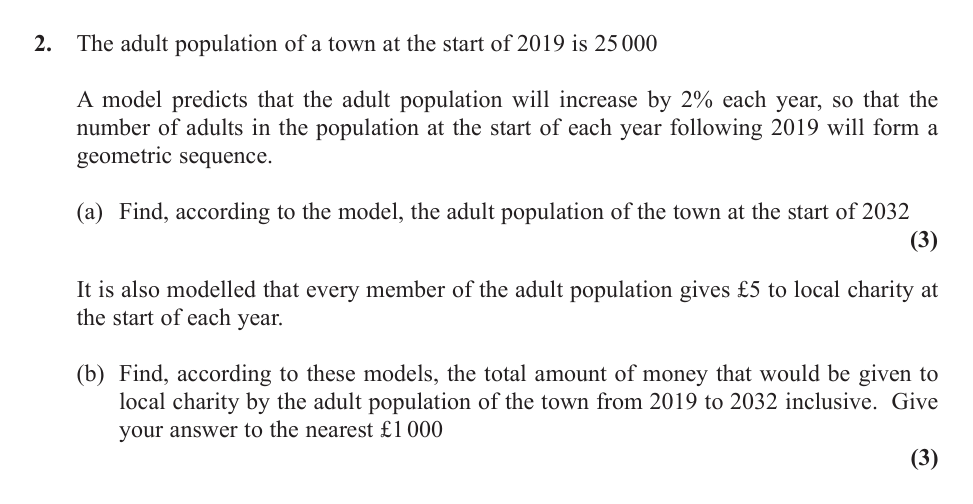
3. WMA12/01 October 2019 · Q2 Easy 6 marks · main topic: Modelling with Sequences & SeriesShow worked solution Identify the common ratio An increase of $2\%$ each year gives the geometric ratio $r=1.02$.
Count the years to 2032 From the start of 2019 to the start of 2032 there are $13$ yearly increases, so the population is $25000(1.02)^{13}$.
Calculate the 2032 population $25000(1.02)^{13}\approx32340.7$, so the model gives about $32341$ adults.
Set up the total number of adult payments From 2019 to 2032 inclusive there are $14$ yearly populations, so the total number of adult payments is $25000\dfrac{1.02^{14}-1}{1.02-1}$.
Multiply by the charity amount The total money is $5\times25000\dfrac{1.02^{14}-1}{0.02}\approx1\,996\,766$, so this is about £1,996,766.
Round as requested To the nearest £1000, this is £1,997,000.
Final answer $(a)$ 32341 adults, approximately. $\quad (b)$ £1,997,000.
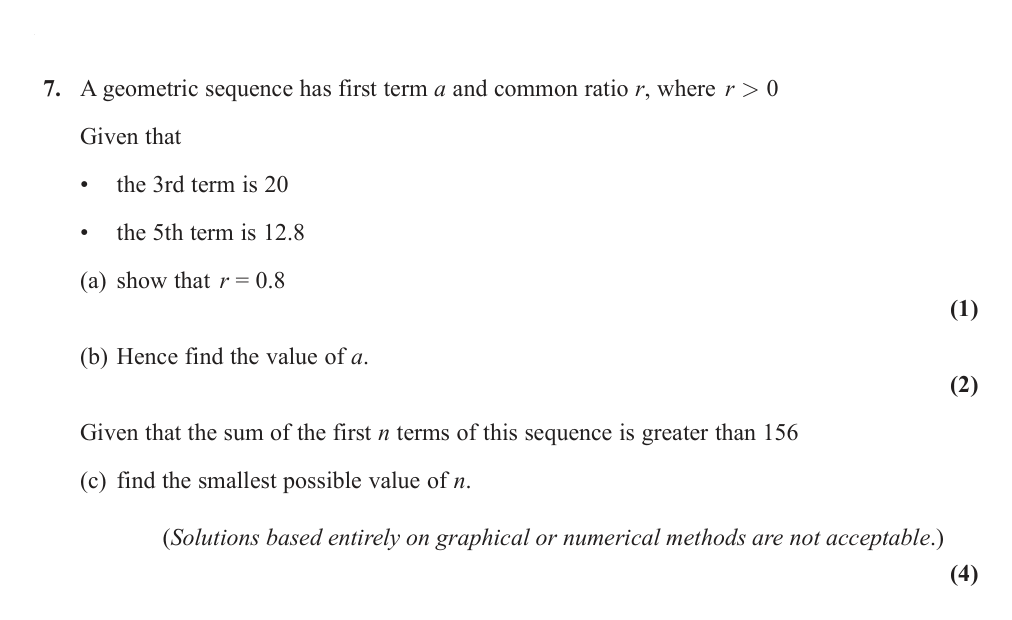
4. WMA12/01 January 2023 · Q7 Medium 7 marksShow worked solution Write the given terms For a geometric sequence, the third term is $ar^2=20$ and the fifth term is $ar^4=12.8$.
Divide the equations $\dfrac{ar^4}{ar^2}=\dfrac{12.8}{20}$, so $r^2=0.64$.
Use r positive Since $r>0$, $r=0.8$.
Find a Using $ar^2=20$, $a(0.8)^2=20$, so $a=\dfrac{20}{0.64}=31.25$.
Write the sum formula $S_n=\dfrac{a(1-r^n)}{1-r}=\dfrac{31.25(1-0.8^n)}{0.2}=156.25(1-0.8^n)$.
Set up the inequality We need $156.25(1-0.8^n)>156$.
Isolate the power $1-0.8^n>\dfrac{156}{156.25}=\dfrac{624}{625}$, so $0.8^n<\dfrac{1}{625}$.
Use logarithms $n\log(0.8)<\log\left(\dfrac{1}{625}\right)$. Since $\log(0.8)<0$, dividing reverses the inequality: $n>\dfrac{\log(1/625)}{\log(0.8)}=28.85\ldots$.
Choose the smallest integer The smallest possible integer value is therefore $n=29$.
Final answer $(a)$ $r=0.8$. $\quad (b)$ $a=31.25$. $\quad (c)$ $n=29$.
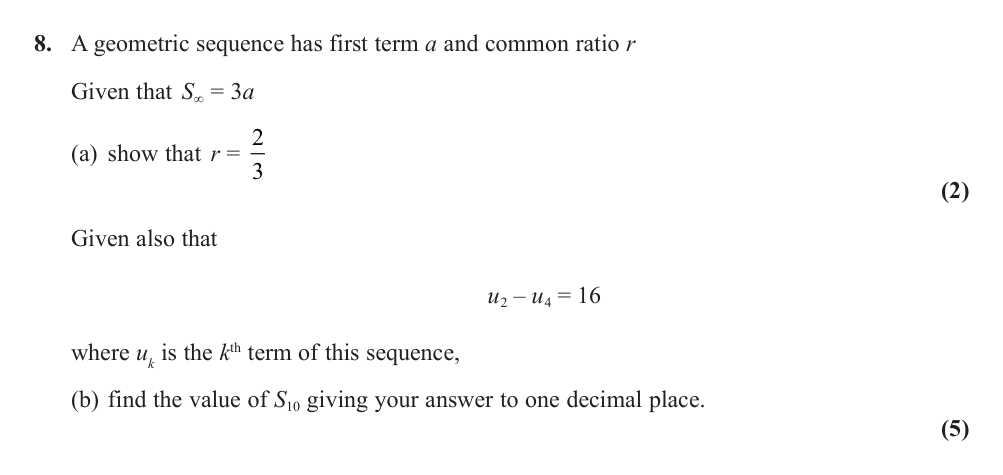
5. WMA12/01 October 2022 · Q8 Medium 7 marksShow worked solution Use the sum to infinity formula For a geometric sequence, $S_\infty=\dfrac{a}{1-r}$. The question gives $S_\infty=3a$.
Find the common ratio $\dfrac{a}{1-r}=3a$. Since $u_2-u_4=16$, $a\ne0$, so $\dfrac{1}{1-r}=3$ and $r=\dfrac23$.
Use u2 minus u4 $u_2-u_4=ar-ar^3=ar(1-r^2)=16$.
Substitute r $a\left(\dfrac23\right)\left(1-\dfrac49\right)=16$.
Solve for a $a\cdot\dfrac23\cdot\dfrac59=16$, so $\dfrac{10a}{27}=16$ and $a=\dfrac{216}{5}=43.2$.
Find S10 $S_{10}=\dfrac{a(1-r^{10})}{1-r}=3a\left(1-\left(\dfrac23\right)^{10}\right)$.
Evaluate $S_{10}=3\left(\dfrac{216}{5}\right)\left(1-\left(\dfrac23\right)^{10}\right)=\dfrac{92840}{729}=127.352\ldots$, so $S_{10}=127$ to 3 significant figures.
Final answer $(a)$ $a=43.2$. $\quad (b)$ $S_{10}=127.353\ldots$, so $127$ to 3 s.f.
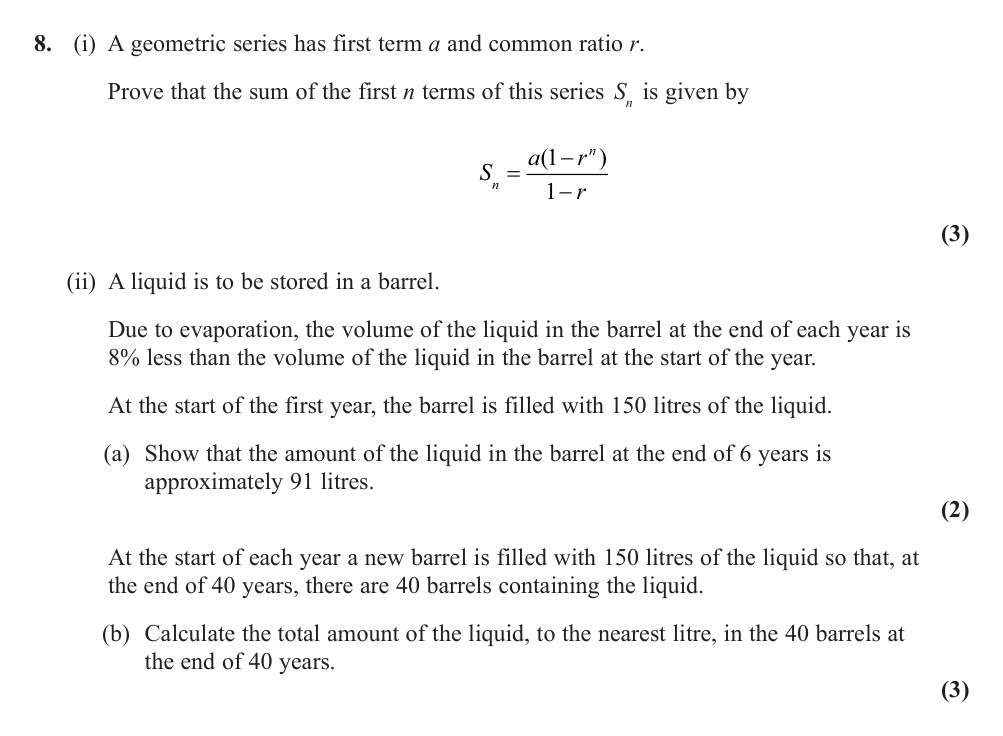
6. WMA12/01 October 2025 · Q8 Medium 8 marksShow worked solution Write S n $S_n=a+ar+ar^2+\cdots+ar^{n-1}$.
Multiply by r $rS_n=ar+ar^2+ar^3+\cdots+ar^n$.
Subtract $S_n-rS_n=a-ar^n=a(1-r^n)$.
Rearrange $(1-r)S_n=a(1-r^n)$, so $S_n=\dfrac{a(1-r^n)}{1-r}$.
Use the yearly multiplier An $8\%$ decrease each year means the multiplier is $0.92$.
Show the amount after six years After $6$ years, the amount is $150(0.92)^6=90.953\ldots$, which is approximately $91$ litres.
Set up the forty barrel total At the end of $40$ years, the amounts are $150(0.92),150(0.92)^2,\ldots,150(0.92)^{40}$.
Sum the geometric sequence The total is $150(0.92)\dfrac{1-0.92^{40}}{1-0.92}=1663.581\ldots$.
Round the total To the nearest litre, the total amount is $1664$ litres.
Final answer $(i)$ Proven. $\quad (ii)(a)$ Approximately $91$ litres. $\quad (ii)(b)$ $1664$ litres.
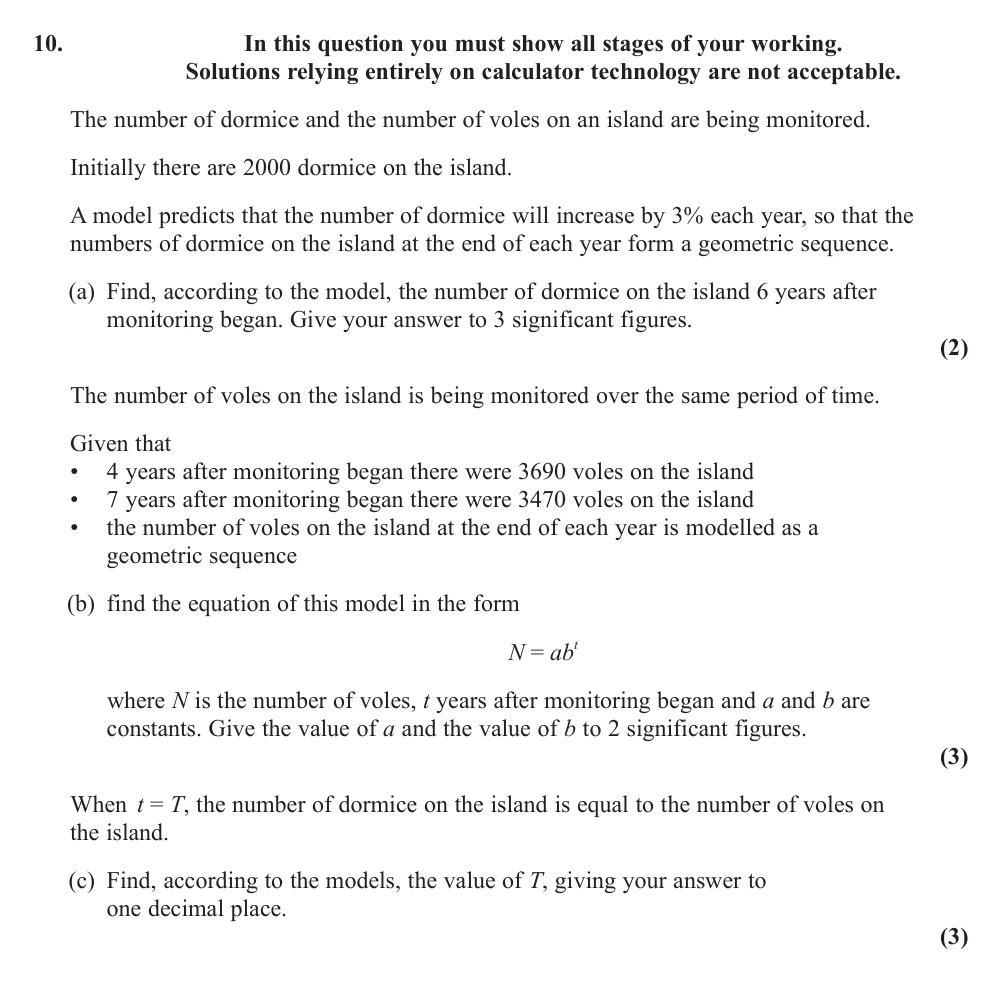
7. WMA12/01 May/June 2024 · Q10 Medium 8 marks · main topic: Modelling with Sequences & SeriesShow worked solution Model the dormice The dormice model is $D=2000(1.03)^t$.
Find the dormice after six years $D=2000(1.03)^6=2388.10\ldots$, so there are $2390$ dormice to 3 significant figures.
Set up the vole model Let the vole model be $N=ab^t$.
Use the two data points At $t=4$, $ab^4=3690$. At $t=7$, $ab^7=3470$.
Find b Dividing gives $b^3=\dfrac{3470}{3690}$, so $b=0.9797\ldots$, which is $0.98$ to 2 significant figures.
Find a $a=\dfrac{3690}{b^4}=4005.18\ldots$, which is $4000$ to 2 significant figures.
Write the vole model So the model is approximately $N=4000(0.98)^t$.
Set the two models equal Use $2000(1.03)^T=a b^T$ with the unrounded constants from the vole model.
Solve using logarithms $\left(\dfrac{1.03}{b}\right)^T=\dfrac{a}{2000}$, so $T=\dfrac{\log(a/2000)}{\log(1.03/b)}$.
Calculate T Substituting $a=4005.18\ldots$ and $b=0.9797\ldots$ gives $T=13.875\ldots$, so $T=13.9$ to one decimal place.
Final answer $(a)$ $2390$ dormice. $\quad (b)$ $N=4000(0.98)^t$ to 2 s.f. constants. $\quad (c)$ $T=13.9$.
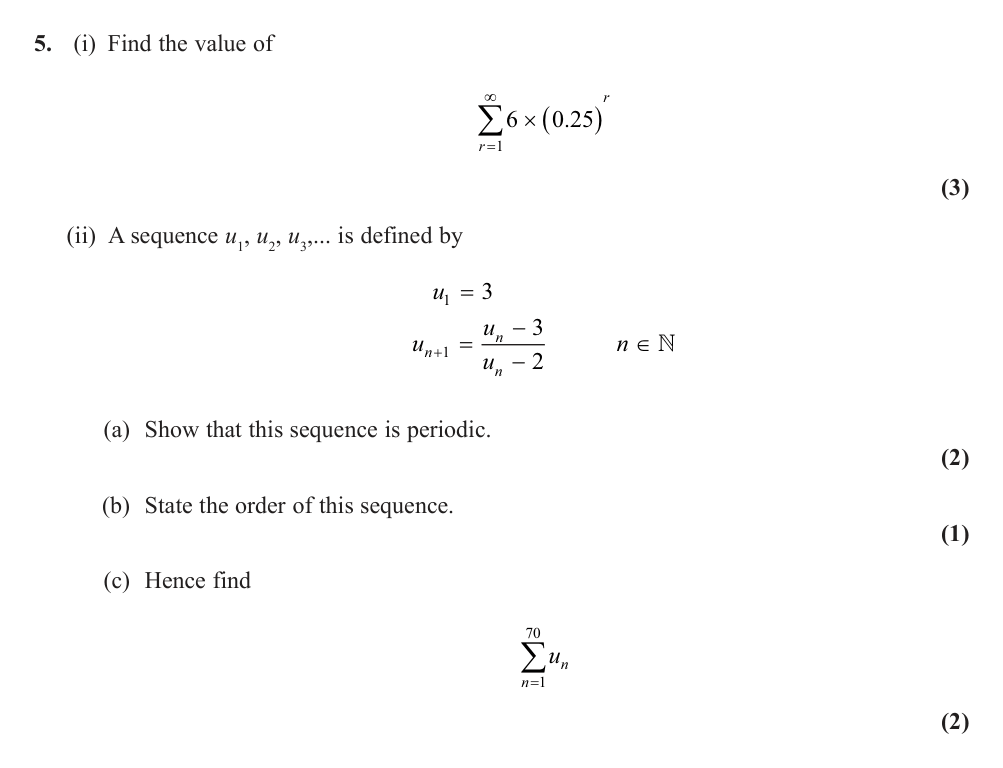
8. WMA12/01 January 2024 · Q5 Medium 8 marks · main topic: Sequences & SeriesShow worked solution Identify the geometric series $\displaystyle \sum_{r=1}^{\infty}6(0.25)^r$ has first term $6(0.25)=1.5$ and common ratio $0.25$.
Sum to infinity $S_\infty=\dfrac{1.5}{1-0.25}=\dfrac{1.5}{0.75}=2$.
Find the first few terms $u_1=3$. Then $u_2=\dfrac{3-3}{3-2}=0$.
Continue the recurrence $u_3=\dfrac{0-3}{0-2}=\dfrac32$, and $u_4=\dfrac{\frac32-3}{\frac32-2}=3$.
Show periodicity Since $u_4=3=u_1$, the terms repeat as $3,0,\dfrac32,3,0,\dfrac32,\ldots$.
State the order The repeating cycle has length $3$, so the order is $3$.
Sum one cycle One full cycle sums to $3+0+\dfrac32=\dfrac92$.
Use 70 terms Since $70=23\cdot3+1$, the first $70$ terms contain $23$ complete cycles and one extra term $u_1=3$.
Find the required sum $\displaystyle \sum_{n=1}^{70}u_n=23\left(\dfrac92\right)+3=\dfrac{207}{2}+\dfrac{6}{2}=\dfrac{213}{2}$.
Final answer $(i)$ $2$. $\quad (ii)(a)$ Periodic. $\quad (ii)(b)$ Order $3$. $\quad (ii)(c)$ $\dfrac{213}{2}$.
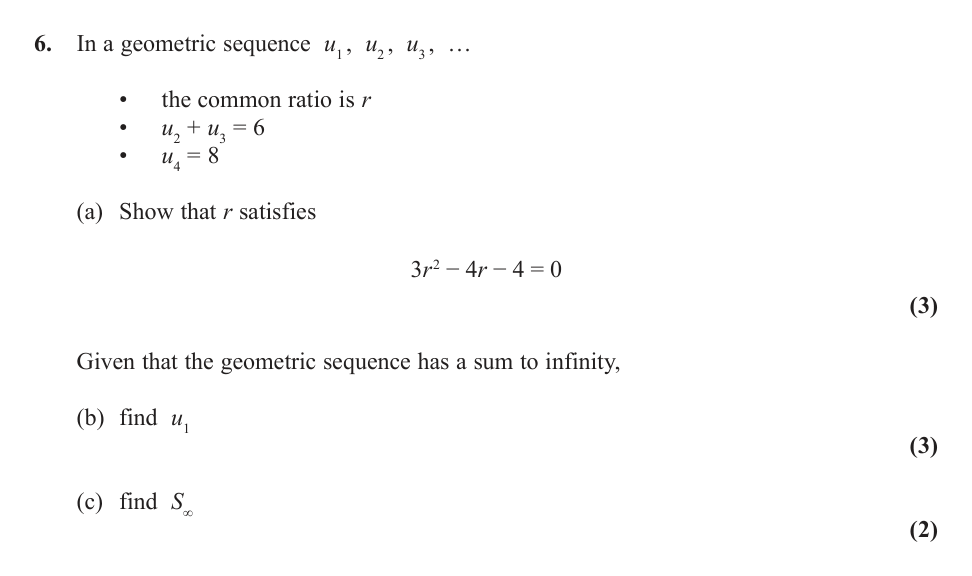
9. WMA12/01 May/June 2022 · Q6 Medium 8 marksShow worked solution Write the terms $u_2=u_1r$, $u_3=u_1r^2$, and $u_4=u_1r^3$.
Use u four Since $u_4=8$, $u_1r^3=8$, so $u_1r=\dfrac{8}{r^2}$.
Use u two plus u three $u_2+u_3=u_1r(1+r)=6$.
Show the quadratic Substitute $u_1r=\dfrac8{r^2}$ to get $\dfrac8{r^2}(1+r)=6$. Hence $8+8r=6r^2$, so $3r^2-4r-4=0$.
Solve for r $3r^2-4r-4=0$ gives $r=2$ or $r=-\dfrac23$.
Choose the sum-to-infinity ratio A sum to infinity requires $|r|<1$, so $r=-\dfrac23$.
Find u one $u_1r^3=8$, so $u_1\left(-\dfrac23\right)^3=8$ and $u_1=-27$.
Find the infinite sum $S_\infty=\dfrac{u_1}{1-r}=\dfrac{-27}{1+2/3}=-\dfrac{81}{5}$.
Final answer $(a)$ Proven: $3r^2-4r-4=0$. $\quad (b)\ u_1=-27.\quad (c)\ S_\infty=-\dfrac{81}{5}$.
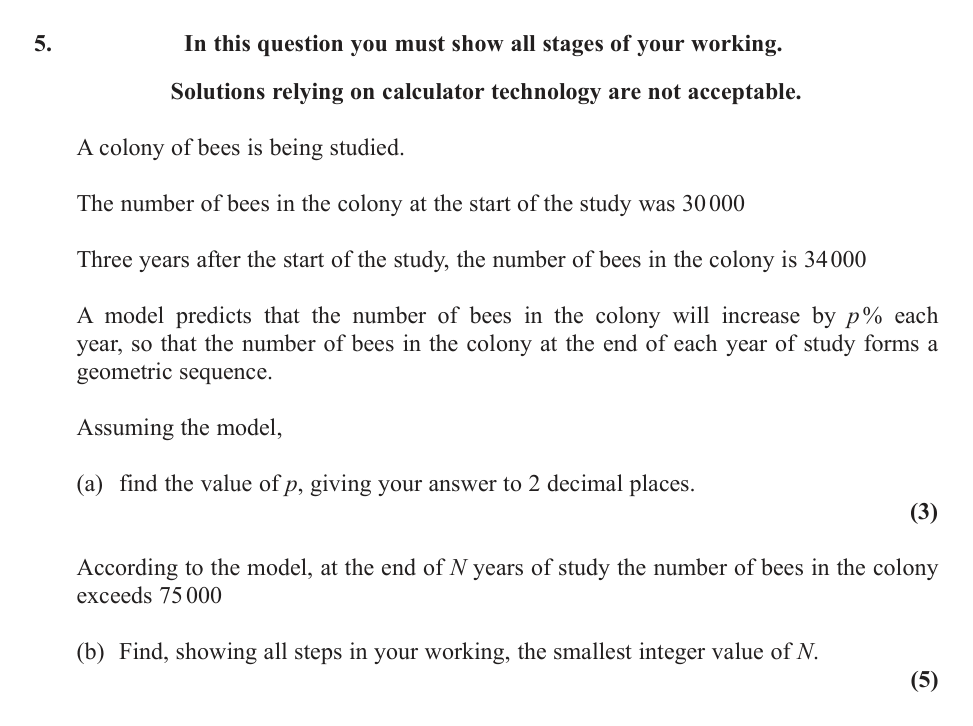
10. WMA12/01 January 2020 · Q5 Medium 8 marks · main topic: Modelling with Sequences & SeriesShow worked solution Set up the growth ratio Let the yearly ratio be $r$. After 3 years, $30000r^3=34000$.
Find p $r^3=\dfrac{17}{15}$, so $r=\left(\dfrac{17}{15}\right)^{1/3}\approx1.04257$. Therefore $p=(r-1)\times100\approx4.26$.
Set up the inequality After $N$ years the model gives $30000r^N$. We need $30000r^N>75000$, so $r^N>2.5$.
Take logarithms $N\log r>\log(2.5)$, so $N>\dfrac{\log(2.5)}{\log r}$.
Find the smallest integer Using $r\approx1.04257$, $\dfrac{\log(2.5)}{\log r}\approx21.98$. Hence the smallest integer value is $N=22$.
Final answer $(a)\ p=4.26.\quad (b)\ N=22$.
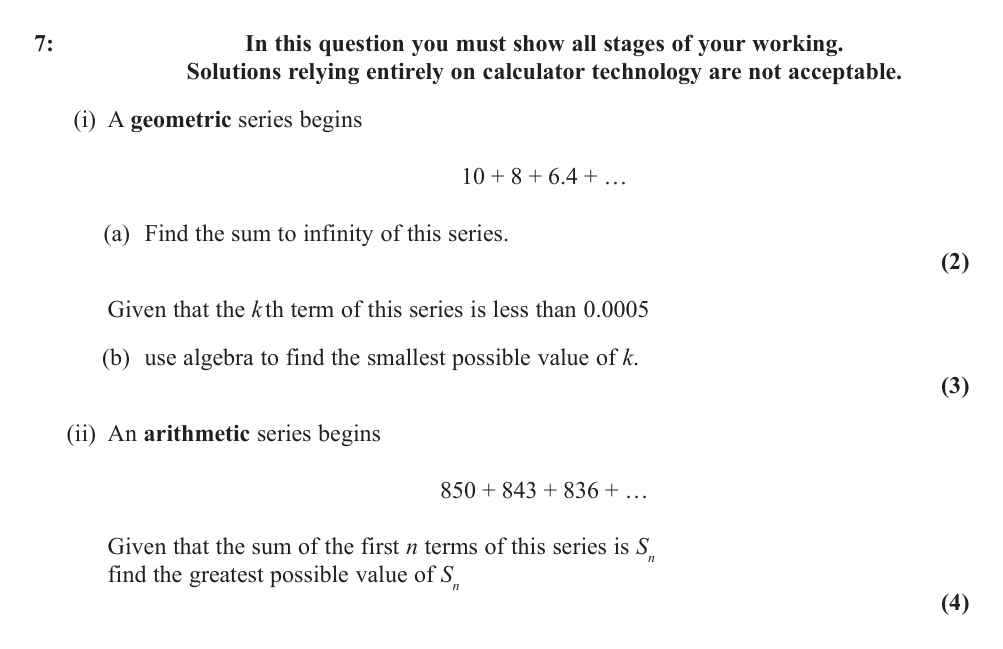
11. WMA12/01 May/June 2025 · Q7 Hard 9 marks · main topic: Sequences & SeriesShow worked solution Identify the geometric sequence The first term is $10$ and the common ratio is $\dfrac{8}{10}=0.8$.
Find the sum to infinity $S_\infty=\dfrac{10}{1-0.8}=50$.
Write the kth term The $k$th term is $10(0.8)^{k-1}$.
Use the inequality $10(0.8)^{k-1}<0.0005$, so $(0.8)^{k-1}<0.00005$.
Solve with logarithms Taking logarithms gives $(k-1)\log(0.8)<\log(0.00005)$. Since $\log(0.8)<0$, $k-1>\dfrac{\log(0.00005)}{\log(0.8)}=44.381\ldots$.
Find the smallest integer Thus $k>45.381\ldots$, so the smallest possible value is $k=46$.
Write the arithmetic sum For $850+843+836+\cdots$, the first term is $850$ and the common difference is $-7$.
Form S n $S_n=\dfrac n2\{2(850)+(n-1)(-7)\}=\dfrac n2(1707-7n)$.
Find the best integer n This quadratic has its maximum near $n=\dfrac{1707}{14}=121.928\ldots$, so check $n=122$.
Find the greatest sum $S_{122}=\dfrac{122}{2}(1707-854)=61(853)=52033$.
Final answer $(i)(a)$ $50$. $\quad (i)(b)$ $46$. $\quad (ii)$ $52033$.
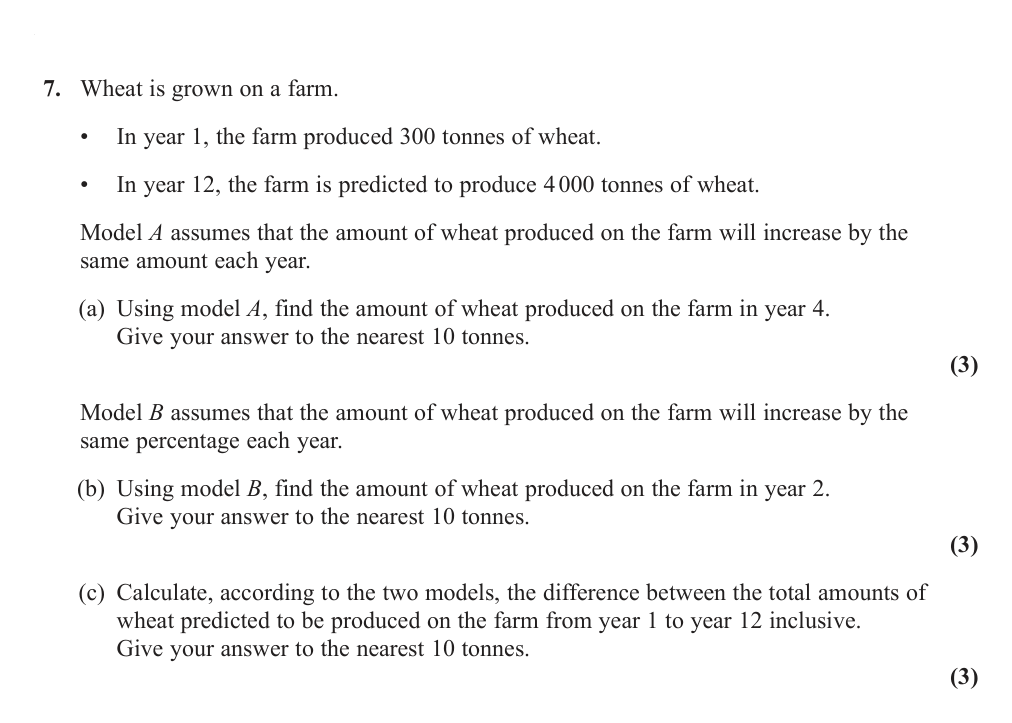
12. WMA12/01 January 2024 · Q7 Hard 9 marks · main topic: Modelling with Sequences & SeriesShow worked solution Model A common difference Model A is arithmetic. From year 1 to year 12 there are $11$ equal increases, so $d=\dfrac{4000-300}{11}=\dfrac{3700}{11}$.
Find year 4 in model A Year 4 is $300+3d=300+3\left(\dfrac{3700}{11}\right)=1309.09\ldots$, so the amount is $1310$ tonnes to the nearest $10$ tonnes.
Model B common ratio Model B is geometric. If the ratio is $r$, then $300r^{11}=4000$.
Find the ratio $r=\left(\dfrac{4000}{300}\right)^{1/11}=1.2655\ldots$.
Find year 2 in model B Year 2 is $300r=379.65\ldots$, so the amount is $380$ tonnes to the nearest $10$ tonnes.
Total for model A $S_A=\dfrac{12}{2}(300+4000)=25800$ tonnes.
Total for model B $S_B=300\dfrac{r^{12}-1}{r-1}=17935.20\ldots$ tonnes.
Find the difference The difference is $25800-17935.20\ldots=7864.79\ldots$, which is $7860$ tonnes to the nearest $10$ tonnes.
Final answer $(a)$ $1310$ tonnes. $\quad (b)$ $380$ tonnes. $\quad (c)$ $7860$ tonnes.
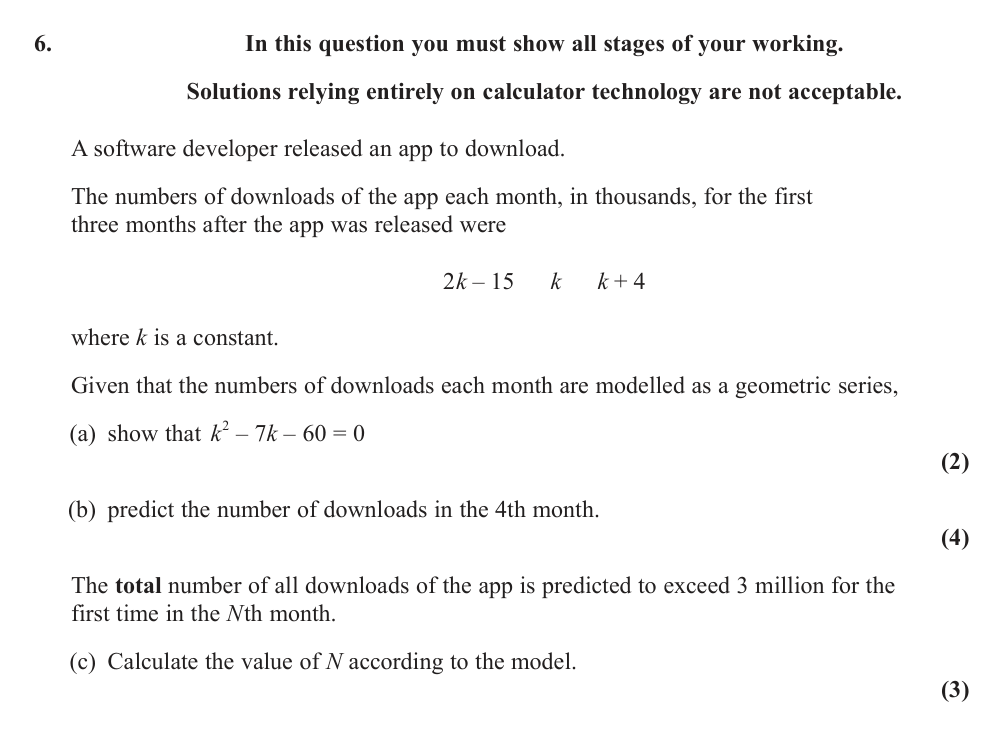
13. WMA12/01 May/June 2023 · Q6 Hard 9 marksShow worked solution Use the geometric condition For three consecutive terms of a geometric sequence, the middle term squared equals the product of the outer terms.
Set up the equation So $k^2=(2k-15)(k+4)$.
Show the required quadratic Expanding gives $k^2=2k^2-7k-60$, hence $k^2-7k-60=0$.
Find k $k^2-7k-60=(k-12)(k+5)=0$, so $k=12$ or $k=-5$. The download numbers must be positive, so $k=12$.
Find the common ratio The first three monthly values are $9$, $12$ and $16$ thousand. The common ratio is $\dfrac{12}{9}=\dfrac43$.
Predict month four The 4th month is $16\cdot\dfrac43=\dfrac{64}{3}$ thousand downloads, which is about $21300$ downloads.
Write the cumulative total In thousands, the total after $N$ months is $S_N=\dfrac{9\left(\left(\dfrac43\right)^N-1\right)}{\dfrac43-1}=27\left(\left(\dfrac43\right)^N-1\right)$.
Compare with three million Three million downloads is $3000$ thousand, so we need $27\left(\left(\dfrac43\right)^N-1\right)>3000$.
Solve the inequality $\left(\dfrac43\right)^N>\dfrac{1009}{9}$. Taking logarithms gives $N>\dfrac{\log(1009/9)}{\log(4/3)}=16.405\ldots$.
Choose the first month The first integer month for which the total exceeds $3$ million is $N=17$.
Final answer $(a)$ Proven. $\quad (b)$ $\dfrac{64}{3}$ thousand downloads, about $21300$ downloads. $\quad (c)$ $N=17$.
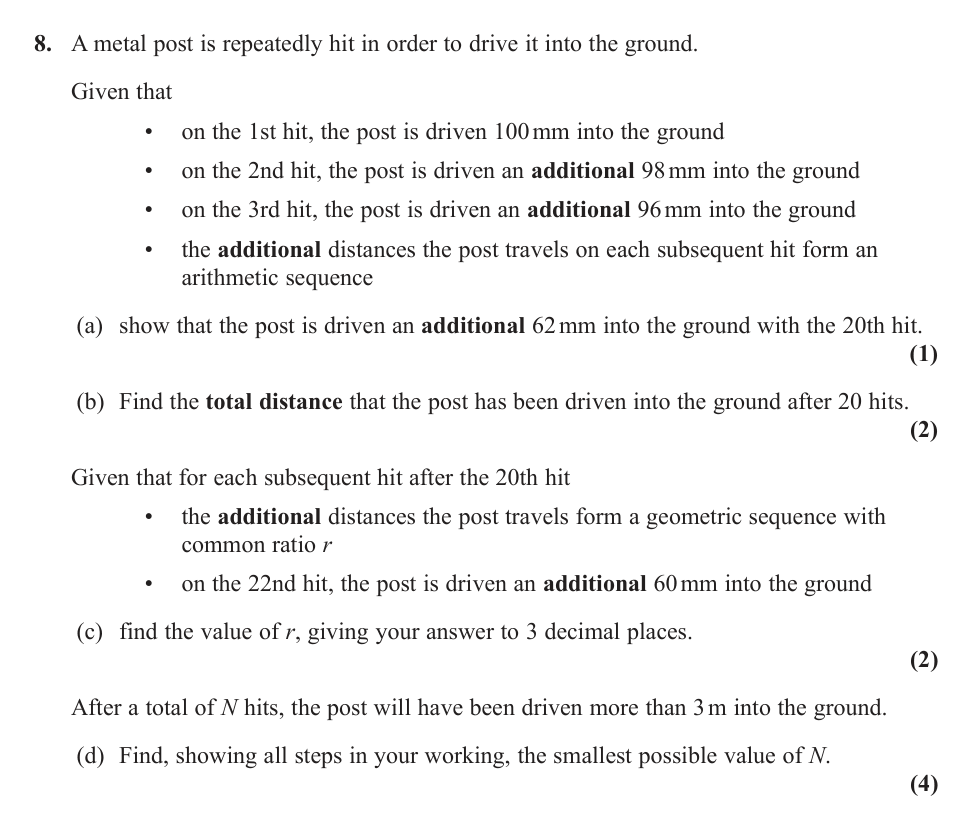
14. WMA12/01 January 2022 · Q8 Hard 9 marks · main topic: Modelling with Sequences & SeriesShow worked solution Use the arithmetic rule For the first $20$ hits, the additional distances form an arithmetic sequence with first term $100$ and common difference $-2$.
Show the twentieth hit The twentieth additional distance is $100+19(-2)=62$ mm.
Sum the first twenty hits $S_{20}=\dfrac{20}{2}(100+62)=1620$ mm.
Use the geometric information After the twentieth hit, the distances follow the same ratio, so the twenty second distance is $62r^2$.
Find r $62r^2=60$, hence $r=\sqrt{\dfrac{30}{31}}=0.984$ to 3 decimal places.
Set up the remaining distance More than $3$ m means more than $3000$ mm. After $20$ hits, the remaining amount to exceed is $3000-1620=1380$ mm.
Sum the geometric tail If there are $m$ further hits, their total is $62r+62r^2+\cdots+62r^m=62r\dfrac{1-r^m}{1-r}$.
Find the first m that works Using $r=\sqrt{30/31}$, $62r\dfrac{1-r^{27}}{1-r}$ is not enough, but $62r\dfrac{1-r^{28}}{1-r}$ makes the total exceed $3000$ mm.
State N Therefore $m=28$ further hits are needed after the first $20$, so $N=20+28=48$.
Final answer $(a)$ Proven: $62$ mm. $\quad (b)\ 1620$ mm. $\quad (c)\ r=0.984.\quad (d)\ N=48$.
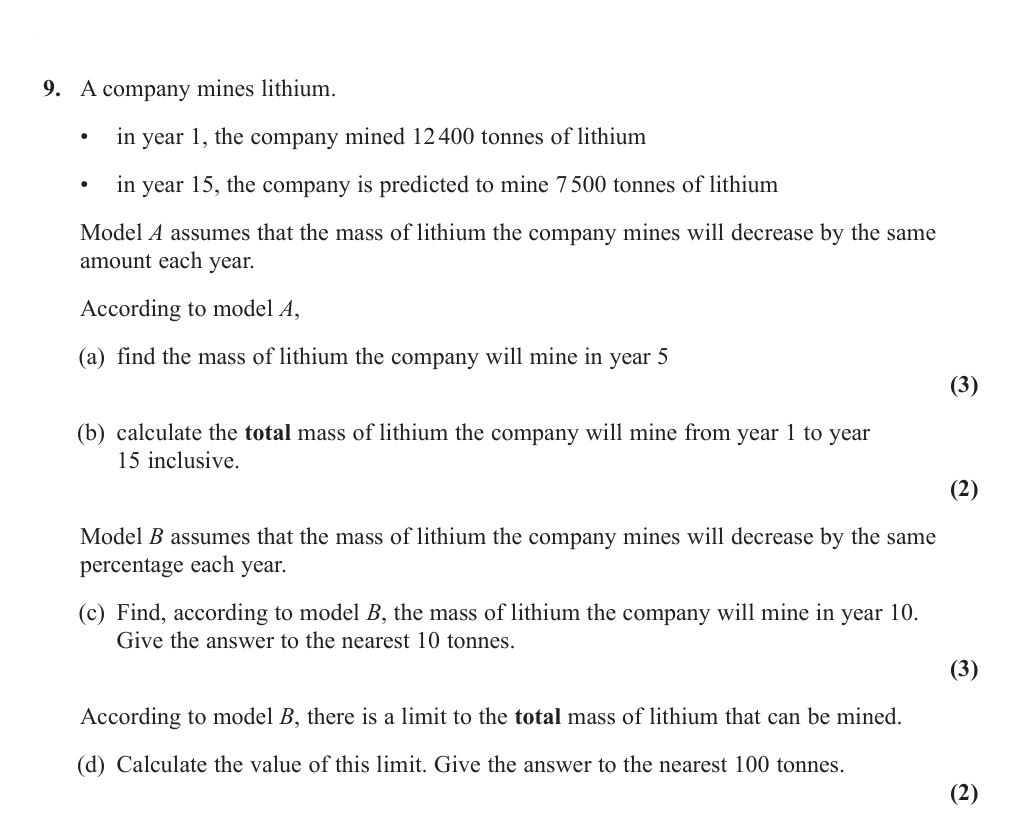
15. WMA12/01 January 2026 · Q9 Hard 10 marks · main topic: Modelling with Sequences & SeriesShow worked solution Model A as an arithmetic sequence For Model A, let the common difference be $d$. Since year 15 is the 15th term, $7500=12400+14d$.
Find year 5 for Model A $d=\dfrac{7500-12400}{14}=-350$. Year 5 is $12400+4(-350)=11000$ tonnes.
Find the total from year 1 to year 15 $S_{15}=\dfrac{15}{2}(12400+7500)=149250$ tonnes.
Model B as a geometric sequence Let the common ratio be $r$. Then $7500=12400r^{14}$, so $r=\left(\dfrac{7500}{12400}\right)^{1/14}\approx0.964723$.
Find year 10 for Model B Year 10 is $12400r^9\approx8975.26$, which is $8980$ tonnes to the nearest 10 tonnes.
Find the limiting total Since $0<r<1$, the sum to infinity is $S_\infty=\dfrac{12400}{1-r}\approx351508.1$, so the limit is $351500$ tonnes to the nearest 100 tonnes.
Final answer $(a)\ 11000$ tonnes. $\quad (b)\ 149250$ tonnes. $\quad (c)\ 8980$ tonnes. $\quad (d)\ 351500$ tonnes.
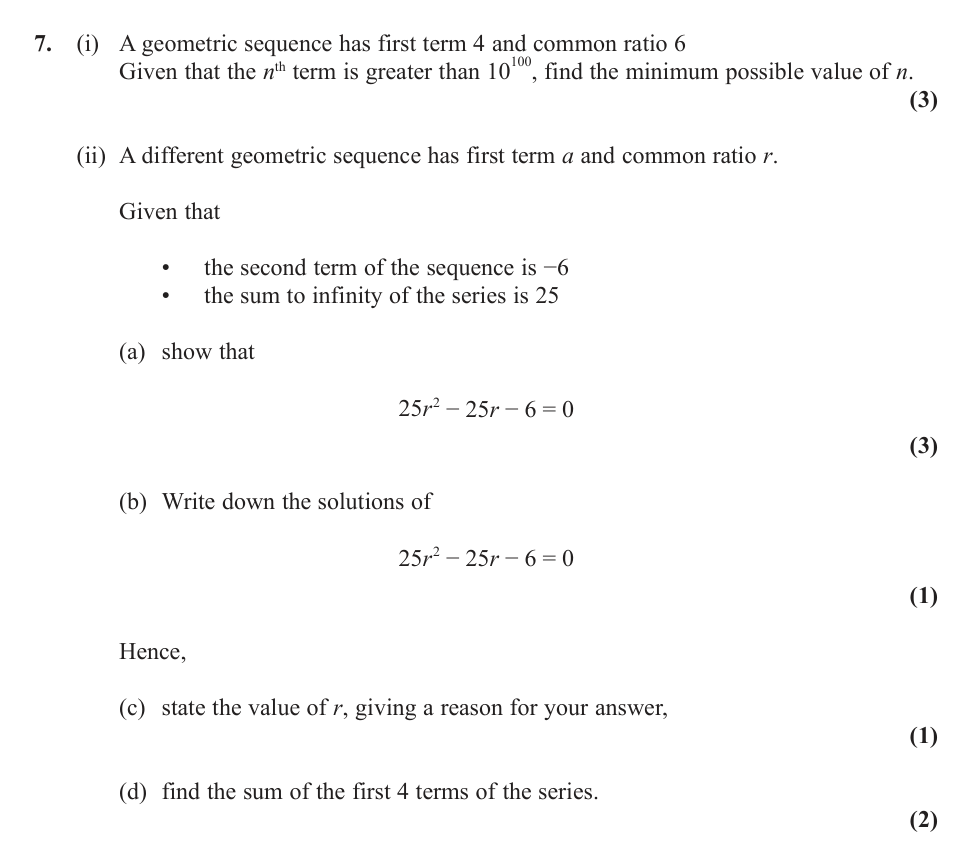
16. WMA12/01 October 2021 · Q7 Hard 10 marksShow worked solution Write the nth term The nth term of the first sequence is $4\cdot6^{n-1}$.
Use logarithms We need $4\cdot6^{n-1}>10^{100}$, so $n-1>\dfrac{100-\log_{10}4}{\log_{10}6}=127.736\ldots$.
Choose the smallest integer Thus $n$ must be greater than $128.736\ldots$, so the minimum possible value is $129$.
Use the second term For the second sequence, $ar=-6$, so $a=-\dfrac6r$.
Use the sum to infinity $\dfrac{a}{1-r}=25$. Substituting $a=-\dfrac6r$ gives $-6=25r(1-r)$.
Show the quadratic Rearranging gives $25r^2-25r-6=0$.
Solve for r $25r^2-25r-6=0$ gives $r=\dfrac65$ or $r=-\dfrac15$.
Choose the valid ratio A sum to infinity exists only when $|r|<1$, so $r=-\dfrac15$.
Find the first term Since $ar=-6$, $a=30$.
Sum four terms $S_4=30\dfrac{1-(-1/5)^4}{1-(-1/5)}=\dfrac{624}{25}$.
Final answer $(i)\ n=129.\quad (ii)(a)$ Proven. $\quad (ii)(b)\ r=\dfrac65\text{ or }-\dfrac15.\quad (ii)(c)\ r=-\dfrac15.\quad (ii)(d)\ \dfrac{624}{25}$.
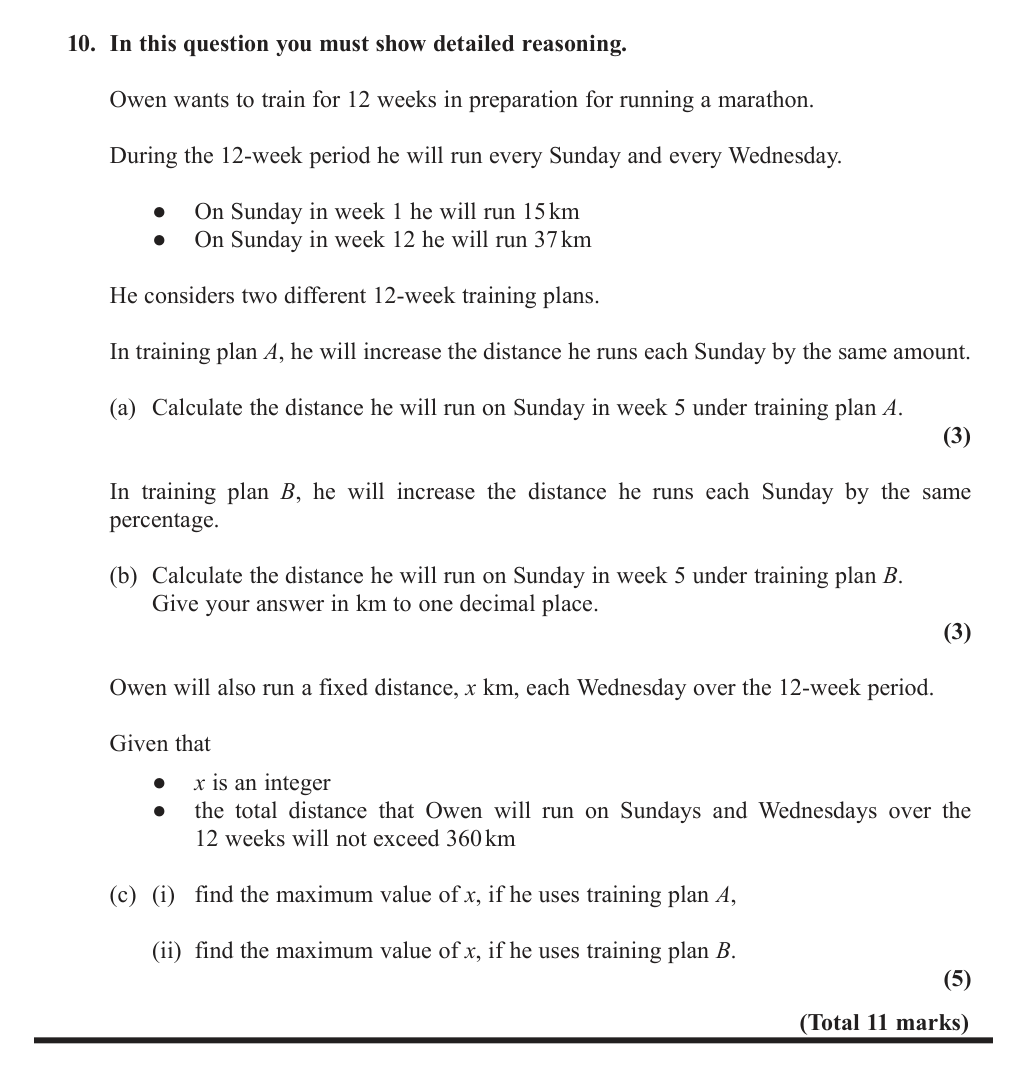
17. WMA12/01 January 2021 · Q10 Hard 11 marks · main topic: Modelling with Sequences & SeriesShow worked solution Find the arithmetic difference Plan A has $12$ Sunday runs from $15$ km to $37$ km, so there are $11$ equal increases. The common difference is $\dfrac{37-15}{11}=2$.
Find week five for plan A Week $5$ is the fifth term, so the distance is $15+4(2)=23\text{ km}$.
Find the geometric ratio For plan B, $15r^{11}=37$, so $r=\left(\dfrac{37}{15}\right)^{1/11}$.
Find week five for plan B The fifth Sunday distance is $15r^4=15\left(\dfrac{37}{15}\right)^{4/11}=20.829\ldots$, so it is $20.8\text{ km}$.
Sum the Sunday runs for plan A The arithmetic total is $\dfrac{12}{2}(15+37)=312$ km.
Find the Wednesday limit for plan A The total distance condition gives $312+12x\leq360$, so $x\leq4$. The maximum integer is $4$.
Sum the Sunday runs for plan B The geometric total is $15\dfrac{r^{12}-1}{r-1}=294.185\ldots$ km.
Find the Wednesday limit for plan B Now $294.185\ldots+12x\leq360$, so $x\leq5.484\ldots$. The maximum integer is $5$.
Final answer $(a)\ 23\text{ km}.\quad (b)\ 20.8\text{ km}.\quad (c)(i)\ x=4.\quad (c)(ii)\ x=5$.
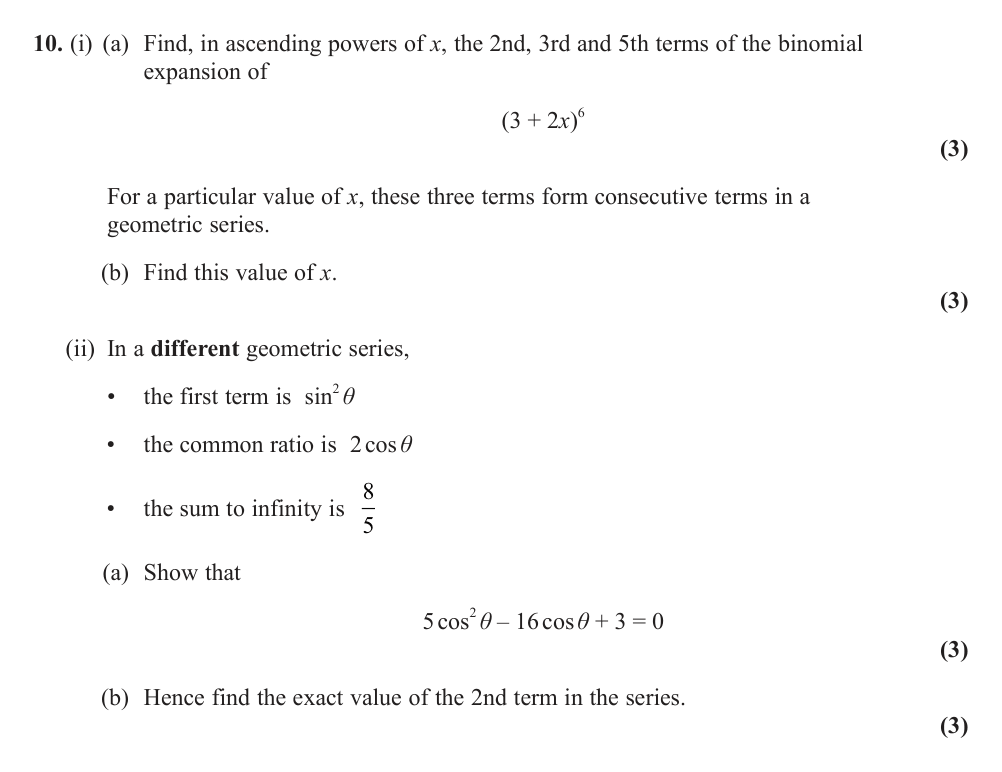
18. WMA12/01 October 2023 · Q10 Hard 12 marks · main topic: Binomial ExpansionShow worked solution Find the second term The 2nd term of $(3+2x)^6$ is $\binom61 3^5(2x)=6\cdot243\cdot2x=2916x$.
Find the third term The 3rd term is $\binom62 3^4(2x)^2=15\cdot81\cdot4x^2=4860x^2$.
Find the fifth term The 5th term is $\binom64 3^2(2x)^4=15\cdot9\cdot16x^4=2160x^4$.
Use the geometric condition For three consecutive terms in a geometric series, the middle term squared equals the product of the two outer terms.
Set up the equation $(4860x^2)^2=(2916x)(2160x^4)$.
Solve for x For the non-zero geometric case, divide by $x^4$: $4860^2=2916\cdot2160\,x$, so $x=\dfrac{4860^2}{2916\cdot2160}=\dfrac{15}{4}$.
Use the sum to infinity In the different geometric series, first term $=\sin^2\theta$, common ratio $=2\cos\theta$, and $S_\infty=\dfrac85$.
Form the equation $\dfrac{\sin^2\theta}{1-2\cos\theta}=\dfrac85$.
Use sine squared $5\sin^2\theta=8(1-2\cos\theta)$. With $\sin^2\theta=1-\cos^2\theta$, this becomes $5(1-\cos^2\theta)=8-16\cos\theta$.
Show the required equation Rearranging gives $5\cos^2\theta-16\cos\theta+3=0$.
Solve for cosine $5\cos^2\theta-16\cos\theta+3=0$ gives $\cos\theta=3$ or $\cos\theta=\dfrac15$. The possible value is $\cos\theta=\dfrac15$.
Find the second term The 2nd term is first term times common ratio: $\sin^2\theta(2\cos\theta)=\left(1-\dfrac{1}{25}\right)\cdot\dfrac25=\dfrac{24}{25}\cdot\dfrac25=\dfrac{48}{125}$.
Final answer $(i)(a)$ $2916x,\ 4860x^2,\ 2160x^4$. $\quad (i)(b)$ $x=\dfrac{15}{4}$. $\quad (ii)(a)$ Proven. $\quad (ii)(b)$ $\dfrac{48}{125}$.
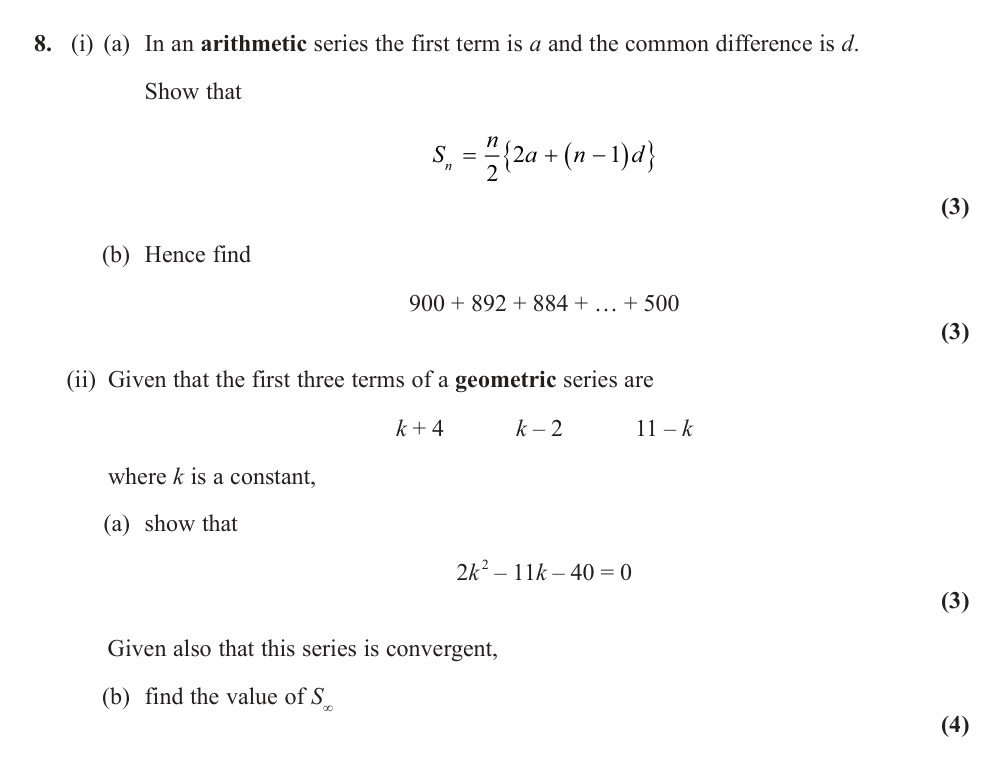
19. WMA12/01 May/June R 2024 · Q8 Hard 13 marks · main topic: Arithmetic SequencesShow worked solution Write the first and last terms The first term is $a$ and the $n$th term is $a+(n-1)d$.
Use the arithmetic sum formula $S_n=\dfrac n2(\text{first term}+\text{last term})$.
Show the formula Therefore $S_n=\dfrac n2\{a+[a+(n-1)d]\}=\dfrac n2\{2a+(n-1)d\}$.
Identify the arithmetic series For $900+892+884+\cdots+500$, the first term is $900$, the common difference is $-8$, and the last term is $500$.
Find the number of terms $500=900+(n-1)(-8)$, so $n-1=50$ and $n=51$.
Find the sum $S=\dfrac{51}{2}(900+500)=35700$.
Use the geometric condition For $k+4$, $k-2$, $11-k$ to be consecutive geometric terms, $(k-2)^2=(k+4)(11-k)$.
Show the quadratic $k^2-4k+4=-k^2+7k+44$, so $2k^2-11k-40=0$.
Solve for k $2k^2-11k-40=0$ gives $k=8$ or $k=-\dfrac52$.
Use convergence If $k=8$, the terms are $12,6,3$ and the common ratio is $\dfrac12$, so the series is convergent. If $k=-\dfrac52$, the common ratio is $-3$, so it is not convergent.
Find S infinity Use $k=8$: $S_\infty=\dfrac{12}{1-1/2}=24$.
Final answer $(i)(a)$ Proven. $\quad (i)(b)$ $35700$. $\quad (ii)(a)$ Proven. $\quad (ii)(b)$ $S_\infty=24$.
Dr Eslam Ahmed Elite Mathematics · Questions classified by topic, solutions checked by Dr Eslam
 Elite Mathematics