Elite Mathematics / Pure 2 / Topics / Applications of Differentiation IAL · WMA12 · Topic Applications of Differentiation: past paper questions & worked solutions
Every Applications of Differentiation question from the WMA12 papers in our bank, 2019–2026, sorted from easiest to hardest. Try each one first, then open the worked solution.
37 questions
331 marks in total
100% of papers (19 of 19) include it
1/16/20 easy / medium / hard
Questions, easiest first Level is estimated from marks: 1–6 easy, 7–8 medium, 9+ hard.
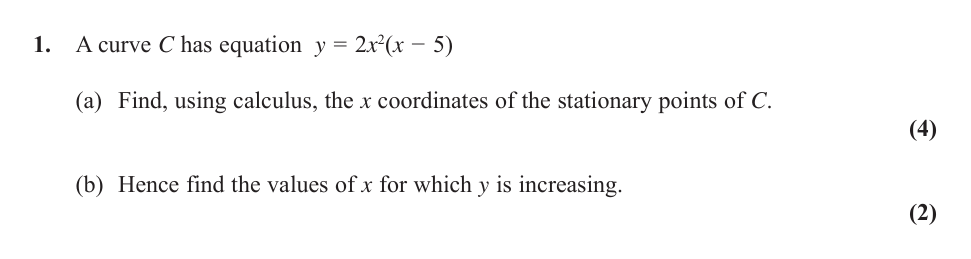
1. WMA12/01 October 2019 · Q1 Easy 6 marksShow worked solution Expand the curve $y=2x^2(x-5)=2x^3-10x^2$.
Differentiate $\dfrac{dy}{dx}=6x^2-20x=2x(3x-10)$.
Find the stationary values of x At a stationary point, $\dfrac{dy}{dx}=0$. Hence $2x(3x-10)=0$, so $x=0$ or $x=\dfrac{10}{3}$.
Use the sign of the derivative Since $2x(3x-10)$ is positive outside its two roots and negative between them, $y$ is increasing for $x<0$ and for $x>\dfrac{10}{3}$.
Final answer $(a)\ x=0,\ \dfrac{10}{3}.\quad (b)\ x<0\text{ or }x>\dfrac{10}{3}$.
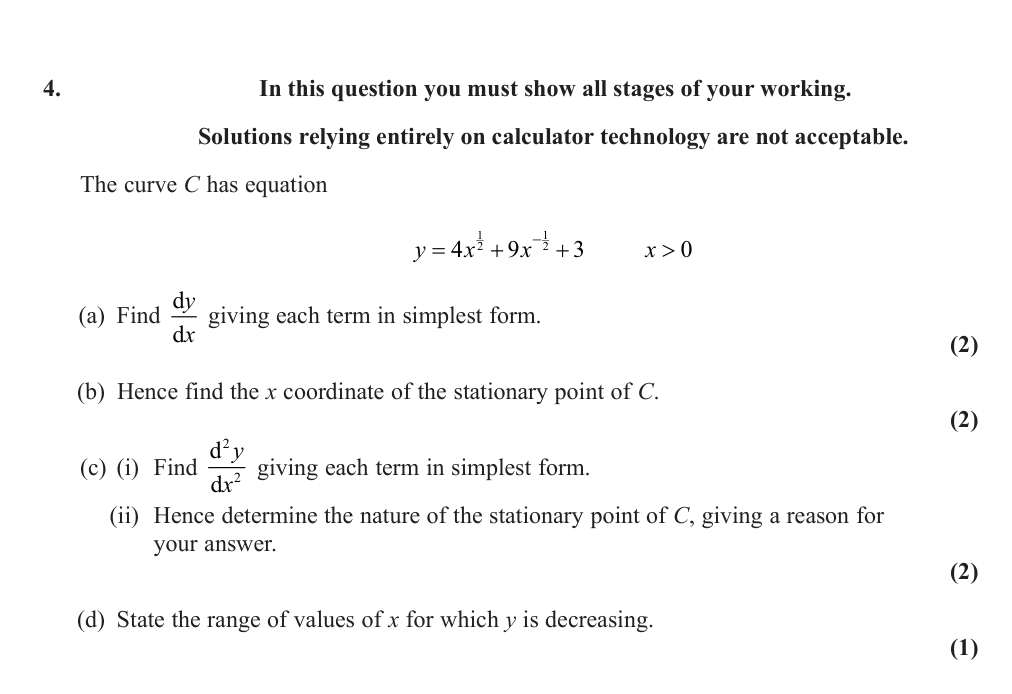
2. WMA12/01 October 2024 · Q4 Medium 7 marksShow worked solution Rewrite using powers $y=4x^{1/2}+9x^{-1/2}+3$.
Differentiate $\dfrac{dy}{dx}=2x^{-1/2}-\dfrac92x^{-3/2}=\dfrac{2}{\sqrt{x}}-\dfrac{9}{2x^{3/2}}$.
Set the derivative to zero $\dfrac{dy}{dx}=\dfrac{4x-9}{2x^{3/2}}$. Since $x>0$, the stationary point occurs when $4x-9=0$.
Find the x coordinate Therefore $x=\dfrac94$.
Differentiate again $\dfrac{d^2y}{dx^2}=-x^{-3/2}+\dfrac{27}{4}x^{-5/2}=-\dfrac1{x^{3/2}}+\dfrac{27}{4x^{5/2}}$.
Test the stationary point $\dfrac{d^2y}{dx^2}=\dfrac{27-4x}{4x^{5/2}}$. At $x=\dfrac94$, the numerator is $27-9=18>0$, so the stationary point is a minimum.
Find where y is decreasing For $x>0$, $2x^{3/2}>0$, so $\dfrac{dy}{dx}<0$ when $4x-9<0$. Hence $y$ is decreasing for $0<x<\dfrac94$.
Final answer $(a)$ $\dfrac{2}{\sqrt{x}}-\dfrac{9}{2x^{3/2}}$. $\quad (b)$ $x=\dfrac94$. $\quad (c)(i)$ $-\dfrac1{x^{3/2}}+\dfrac{27}{4x^{5/2}}$. $\quad (c)(ii)$ Minimum. $\quad (d)$ $0<x<\dfrac94$.
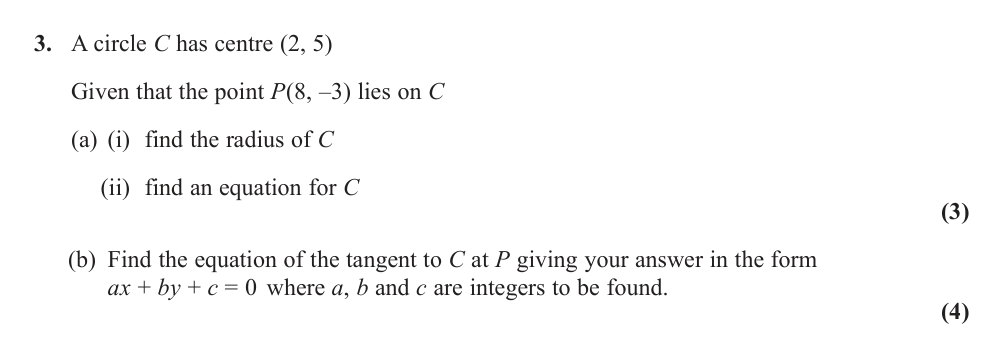
3. WMA12/01 May/June 2023 · Q3 Medium 7 marks · main topic: CirclesShow worked solution Use the distance formula The centre is $(2,5)$ and $P=(8,-3)$. The radius is $\sqrt{(8-2)^2+(-3-5)^2}$.
Find the radius $r=\sqrt{6^2+(-8)^2}=\sqrt{100}=10$.
Write the circle equation With centre $(2,5)$ and radius $10$, the circle is $(x-2)^2+(y-5)^2=100$.
Find the radius gradient The gradient of the radius from the centre to $P$ is $\dfrac{-3-5}{8-2}=\dfrac{-8}{6}=-\dfrac43$.
Find the tangent gradient The tangent is perpendicular to the radius, so its gradient is $\dfrac34$.
Use point P The tangent through $(8,-3)$ is $y+3=\dfrac34(x-8)$.
Put into integer form Multiplying by $4$ gives $4y+12=3x-24$, hence $3x-4y-36=0$.
Final answer $(a)(i)$ $10$. $\quad (a)(ii)$ $(x-2)^2+(y-5)^2=100$. $\quad (b)$ $3x-4y-36=0$.
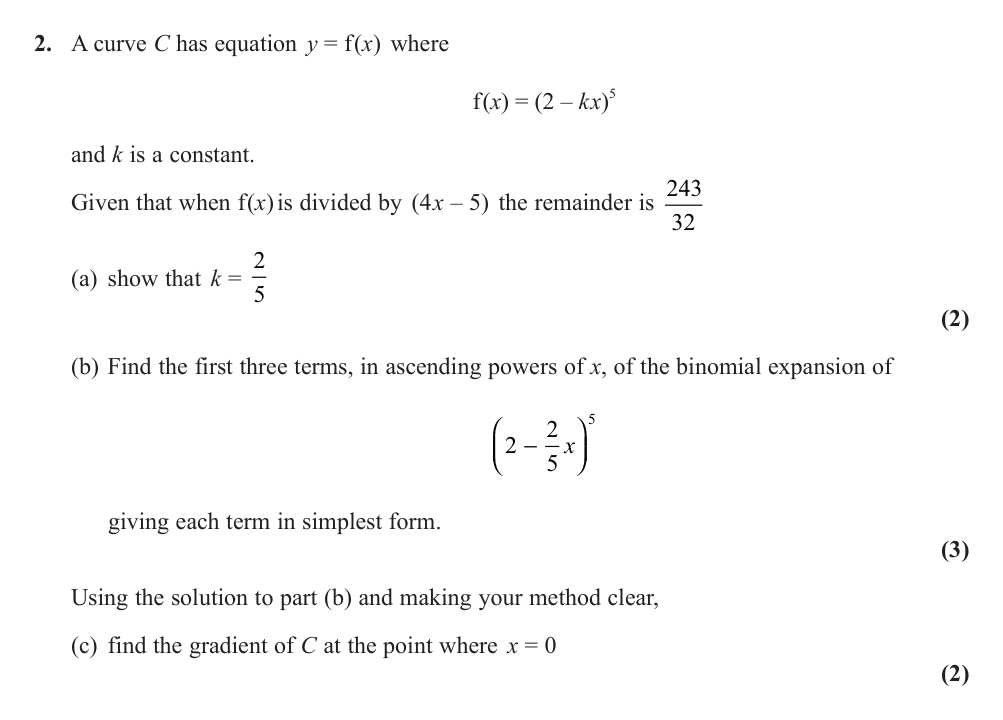
4. WMA12/01 October 2022 · Q2 Medium 7 marks · main topic: Binomial ExpansionShow worked solution Use the remainder theorem Dividing by $4x-5$ means the remainder is $f\left(\dfrac54\right)$.
Substitute x equals five quarters $f\left(\dfrac54\right)=\left(2-\dfrac{5k}{4}\right)^5=\dfrac{243}{32}$.
Take the fifth root Since $\dfrac{243}{32}=\left(\dfrac32\right)^5$, we have $2-\dfrac{5k}{4}=\dfrac32$.
Find k $\dfrac{5k}{4}=\dfrac12$, so $k=\dfrac25$.
Expand the binomial With $k=\dfrac25$, $f(x)=\left(2-\dfrac25x\right)^5$.
Find the first three terms $2^5+5(2^4)\left(-\dfrac25x\right)+10(2^3)\left(-\dfrac25x\right)^2=32-32x+\dfrac{64}{5}x^2$.
Use the coefficient of x For a polynomial, the gradient at $x=0$ is the coefficient of $x$ in the expansion. Therefore $f'(0)=-32$.
Final answer $(a)$ $k=\dfrac25$. $\quad (b)\ 32-32x+\dfrac{64}{5}x^2$. $\quad (c)\ -32$.
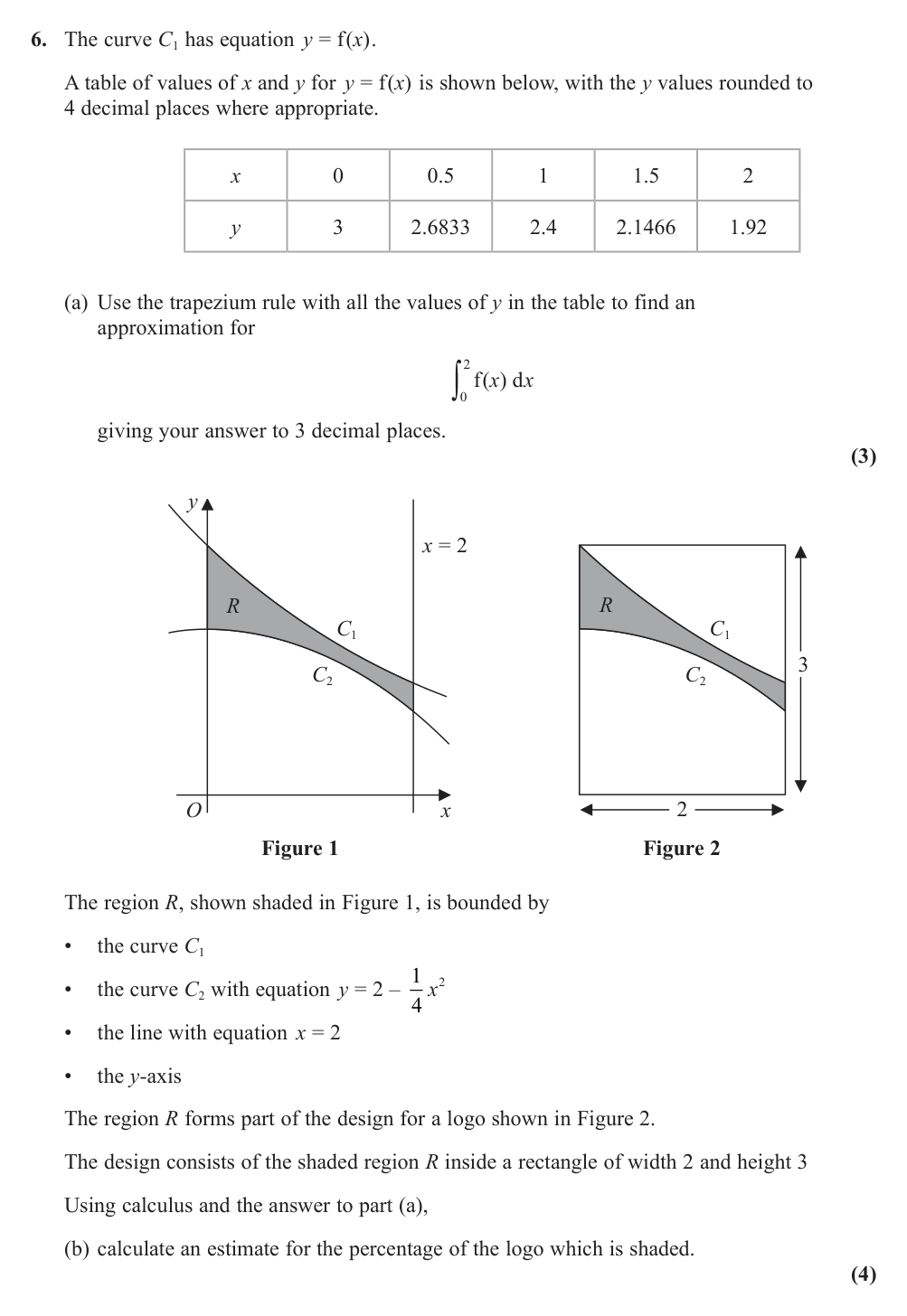
5. WMA12/01 October 2022 · Q6 Medium 7 marks · main topic: IntegrationShow worked solution Identify the strip width The $x$ values increase by $0.5$, so the trapezium-rule width is $h=0.5$.
Apply the trapezium rule $\displaystyle \int_0^2 f(x)\,dx\approx \dfrac{0.5}{2}\left[3+1.92+2(2.6833+2.4+2.1466)\right]$.
Evaluate the estimate This gives $4.84495$, so the approximation is $4.845$ to 3 decimal places.
Find the area under C2 $\displaystyle \int_0^2 \left(2-\dfrac14x^2\right)dx=\left[2x-\dfrac{x^3}{12}\right]_0^2=4-\dfrac{2}{3}=\dfrac{10}{3}$.
Estimate the shaded area The shaded region lies between $C_1$ and $C_2$, so its estimated area is $4.845-\dfrac{10}{3}=1.5116\ldots$.
Compare with the rectangle The rectangle has area $2\times3=6$.
Convert to a percentage Percentage shaded $=\dfrac{1.5116\ldots}{6}\times100=25.19\ldots\%$, so the estimate is $25.2\%$.
Final answer $(a)$ $4.845$. $\quad (b)\ 25.2\%$.
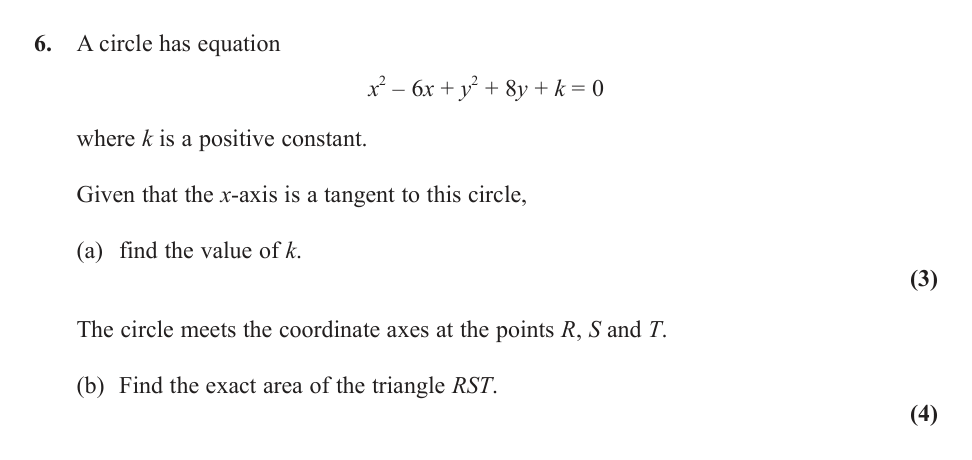
6. WMA12/01 May/June 2021 · Q6 Medium 7 marks · main topic: CirclesShow worked solution Complete the square $x^2-6x=(x-3)^2-9$ and $y^2+8y=(y+4)^2-16$.
Write centre-radius form The circle becomes $(x-3)^2+(y+4)^2=25-k$.
Use the tangent condition The centre is $(3,-4)$. Since the $x$-axis is tangent, the radius is the distance from the centre to the $x$-axis, which is $4$.
Find k Thus $25-k=4^2=16$, so $k=9$.
Find the intercepts With $k=9$, the circle is $(x-3)^2+(y+4)^2=16$. On the $x$-axis, $y=0$, giving $x=3$.
Find the y-axis points On the $y$-axis, $x=0$, so $9+(y+4)^2=16$. Hence $y=-4\pm\sqrt7$.
Calculate the triangle area The vertical base on the $y$-axis has length $2\sqrt7$, and its perpendicular distance to $(3,0)$ is $3$. The area is $\dfrac12(2\sqrt7)(3)=3\sqrt7$.
Final answer $(a)\ k=9.\quad (b)\ 3\sqrt7$.
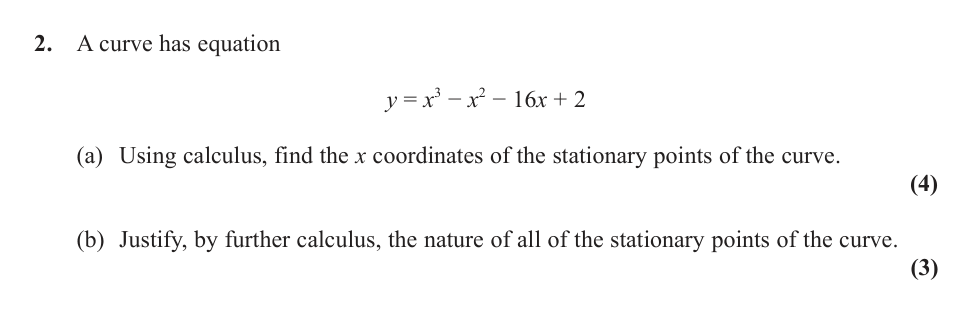
7. WMA12/01 January 2021 · Q2 Medium 7 marksShow worked solution Differentiate the curve For $y=x^3-x^2-16x+2$, $\dfrac{dy}{dx}=3x^2-2x-16$.
Set the gradient to zero Stationary points occur when $3x^2-2x-16=0$.
Factorise $3x^2-2x-16=(3x-8)(x+2)$, so $x=\dfrac83$ or $x=-2$.
Differentiate again $\dfrac{d^2y}{dx^2}=6x-2$.
Classify x equals negative two At $x=-2$, $6x-2=-14<0$, so the stationary point is a local maximum.
Classify x equals eight over three At $x=\dfrac83$, $6x-2=14>0$, so the stationary point is a local minimum.
Final answer $(a)\ x=-2,\ \dfrac83.\quad (b)$ local maximum at $x=-2$ and local minimum at $x=\dfrac83$.
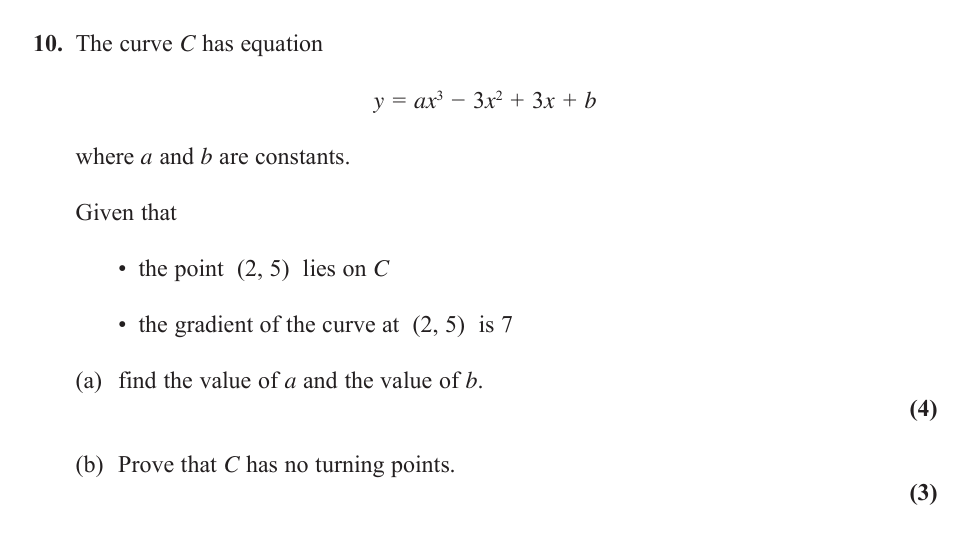
8. WMA12/01 October 2019 · Q10 Medium 7 marksShow worked solution Use the point on the curve Substitute $(2,5)$ into $y=ax^3-3x^2+3x+b$: $5=8a-12+6+b$, so $8a+b=11$.
Differentiate $\dfrac{dy}{dx}=3ax^2-6x+3$.
Use the given gradient At $x=2$, the gradient is $7$, so $12a-12+3=7$. Hence $12a=16$ and $a=\dfrac43$.
Find b Using $8a+b=11$, $b=11-8\left(\dfrac43\right)=\dfrac13$.
Check for turning points With $a=\dfrac43$, $\dfrac{dy}{dx}=4x^2-6x+3$.
Use the discriminant For $4x^2-6x+3=0$, the discriminant is $(-6)^2-4(4)(3)=36-48=-12<0$.
Conclude The derivative is never zero, so the curve has no turning points.
Final answer $(a)\ a=\dfrac43,\ b=\dfrac13.\quad (b)$ Proven: $C$ has no turning points.
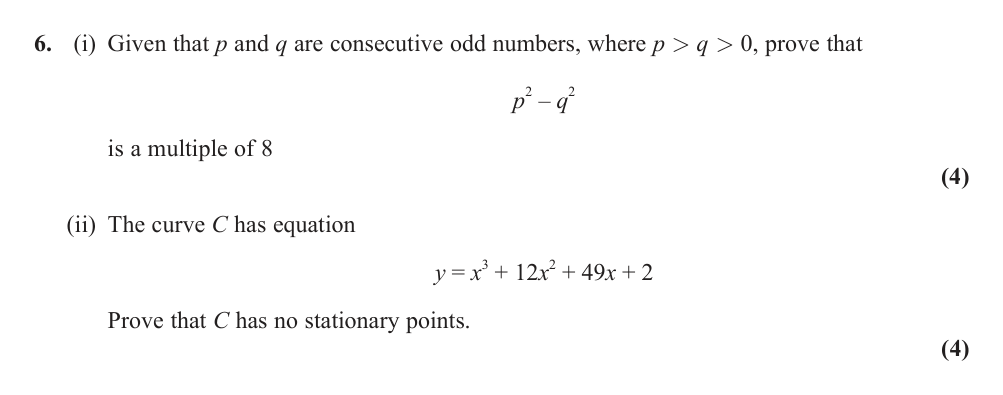
9. WMA12/01 January 2026 · Q6 Medium 8 marks · main topic: ProofShow worked solution Represent the consecutive odd numbers Let $q=2n-1$ and $p=2n+1$, where $n$ is a positive integer. Then $p>q>0$ and the numbers are consecutive odd numbers.
Subtract the squares $p^2-q^2=(2n+1)^2-(2n-1)^2$.
Simplify the expression $p^2-q^2=(4n^2+4n+1)-(4n^2-4n+1)=8n$.
Conclude the proof Since $n$ is an integer, $8n$ is a multiple of $8$, so $p^2-q^2$ is a multiple of $8$.
Differentiate the curve For $y=x^3+12x^2+49x+2$, $\dfrac{dy}{dx}=3x^2+24x+49$.
Show the gradient is never zero $3x^2+24x+49=3(x+4)^2+1$. This is always positive for real $x$.
State the conclusion Since $\dfrac{dy}{dx}$ is never $0$, the curve has no stationary points.
Final answer $(i)$ Proven. $\quad (ii)$ $C$ has no stationary points.
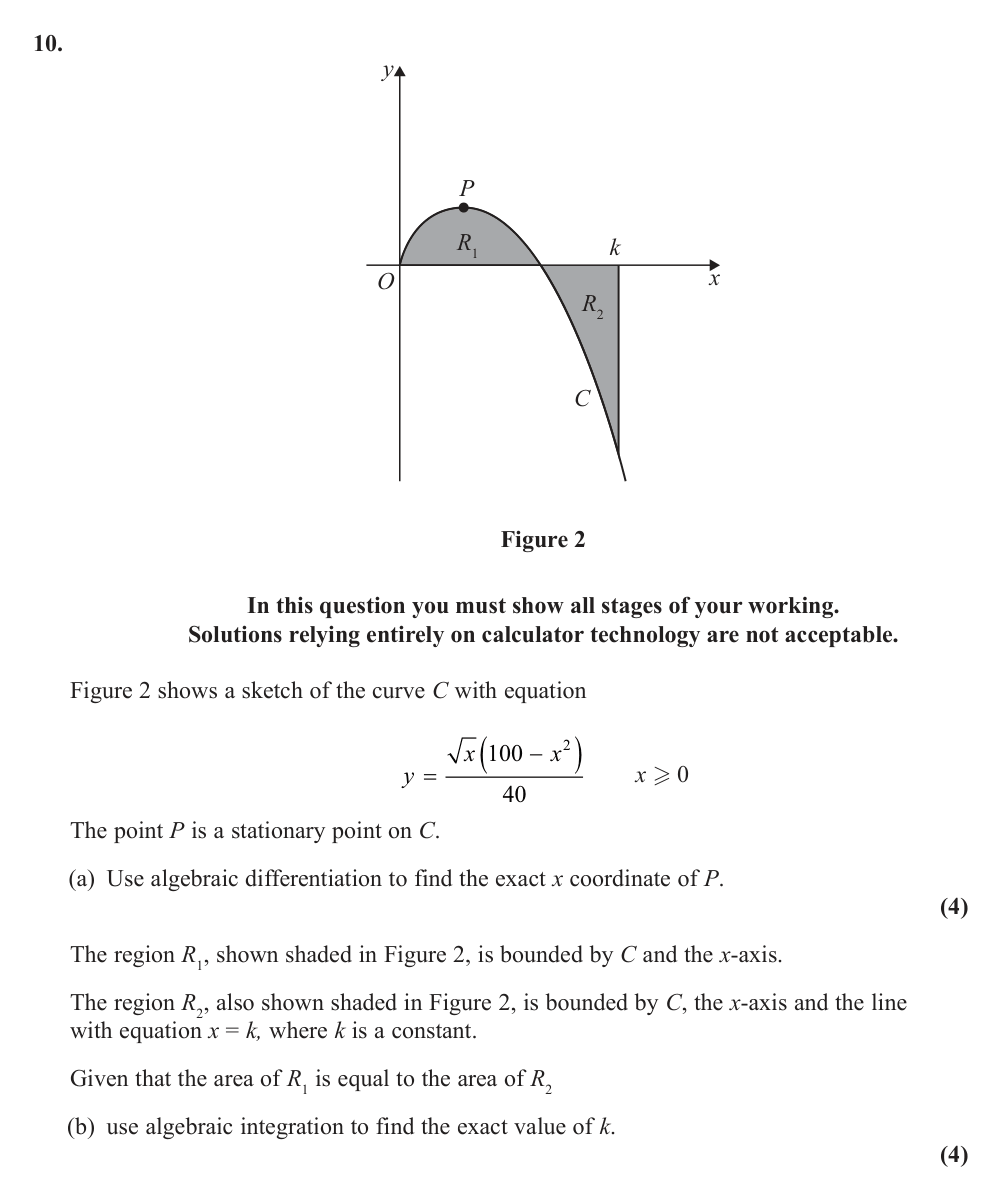
10. WMA12/01 January 2026 · Q10 Medium 8 marksShow worked solution Rewrite the curve $y=\dfrac{\sqrt{x}(100-x^2)}{40}=\dfrac52x^{1/2}-\dfrac1{40}x^{5/2}$.
Differentiate $\dfrac{dy}{dx}=\dfrac54x^{-1/2}-\dfrac1{16}x^{3/2}$.
Use the stationary point At $P$, $\dfrac{dy}{dx}=0$. Thus $\dfrac54x^{-1/2}=\dfrac1{16}x^{3/2}$. Multiplying by $16x^{1/2}$ gives $20=x^2$.
Find the x-coordinate Since $x\geq0$, $x=\sqrt{20}=2\sqrt5$.
Integrate the curve $\int y\,dx=\int\left(\dfrac52x^{1/2}-\dfrac1{40}x^{5/2}\right)dx=\dfrac53x^{3/2}-\dfrac1{140}x^{7/2}$.
Use equal areas The signed area from $0$ to $k$ is zero because the positive area $R_1$ equals the negative area $R_2$ in magnitude.
Solve for k $\dfrac53k^{3/2}-\dfrac1{140}k^{7/2}=0$. Since $k>0$, divide by $k^{3/2}$ to get $\dfrac53-\dfrac{k^2}{140}=0$, so $k^2=\dfrac{700}{3}$.
Write the exact value $k=\sqrt{\dfrac{700}{3}}=\dfrac{10\sqrt{21}}{3}$.
Final answer $(a)\ x=2\sqrt5.\quad (b)\ k=\dfrac{10\sqrt{21}}{3}$.
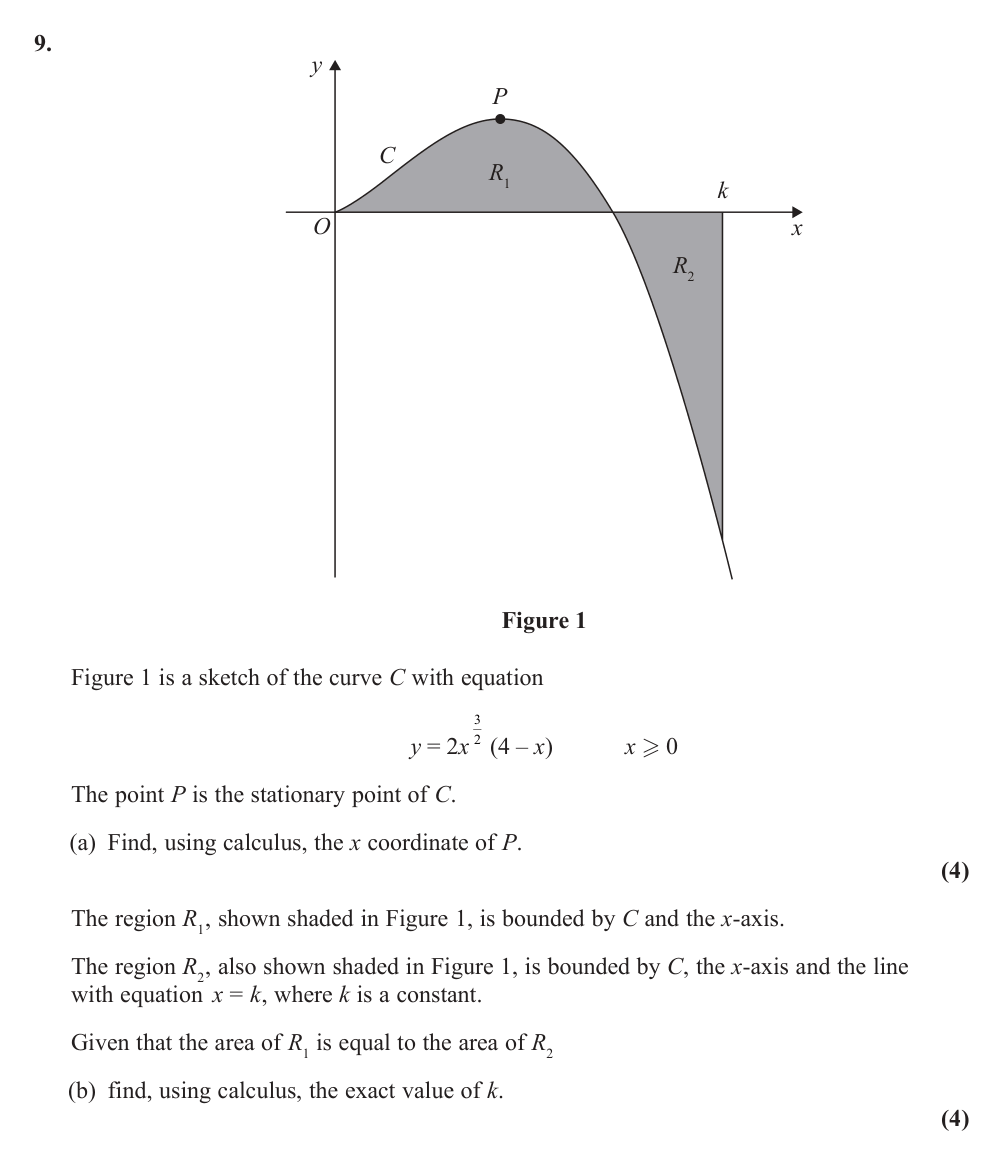
11. WMA12/01 May/June 2024 · Q9 Medium 8 marksShow worked solution Rewrite the curve $y=2x^{3/2}(4-x)=8x^{3/2}-2x^{5/2}$.
Differentiate $\dfrac{dy}{dx}=12x^{1/2}-5x^{3/2}=\sqrt{x}(12-5x)$.
Find the stationary point For the interior stationary point $P$, $12-5x=0$, so $x=\dfrac{12}{5}$.
Set up the area condition $R_1$ is the area from $x=0$ to $x=4$ above the $x$-axis. $R_2$ is the area from $x=4$ to $x=k$ below the $x$-axis.
Use equal areas Equal areas mean $\displaystyle \int_0^4 y\,dx=-\int_4^k y\,dx$, so $\displaystyle \int_0^k y\,dx=0$.
Integrate y $\displaystyle \int 2x^{3/2}(4-x)dx=\int(8x^{3/2}-2x^{5/2})dx=\dfrac{16}{5}x^{5/2}-\dfrac47x^{7/2}$.
Solve for k $\dfrac{16}{5}k^{5/2}-\dfrac47k^{7/2}=0$.
Factor $4k^{5/2}\left(\dfrac45-\dfrac{k}{7}\right)=0$.
Choose the value beyond four Since $k>4$, $\dfrac45-\dfrac{k}{7}=0$, so $k=\dfrac{28}{5}$.
Final answer $(a)$ $x=\dfrac{12}{5}$. $\quad (b)$ $k=\dfrac{28}{5}$.
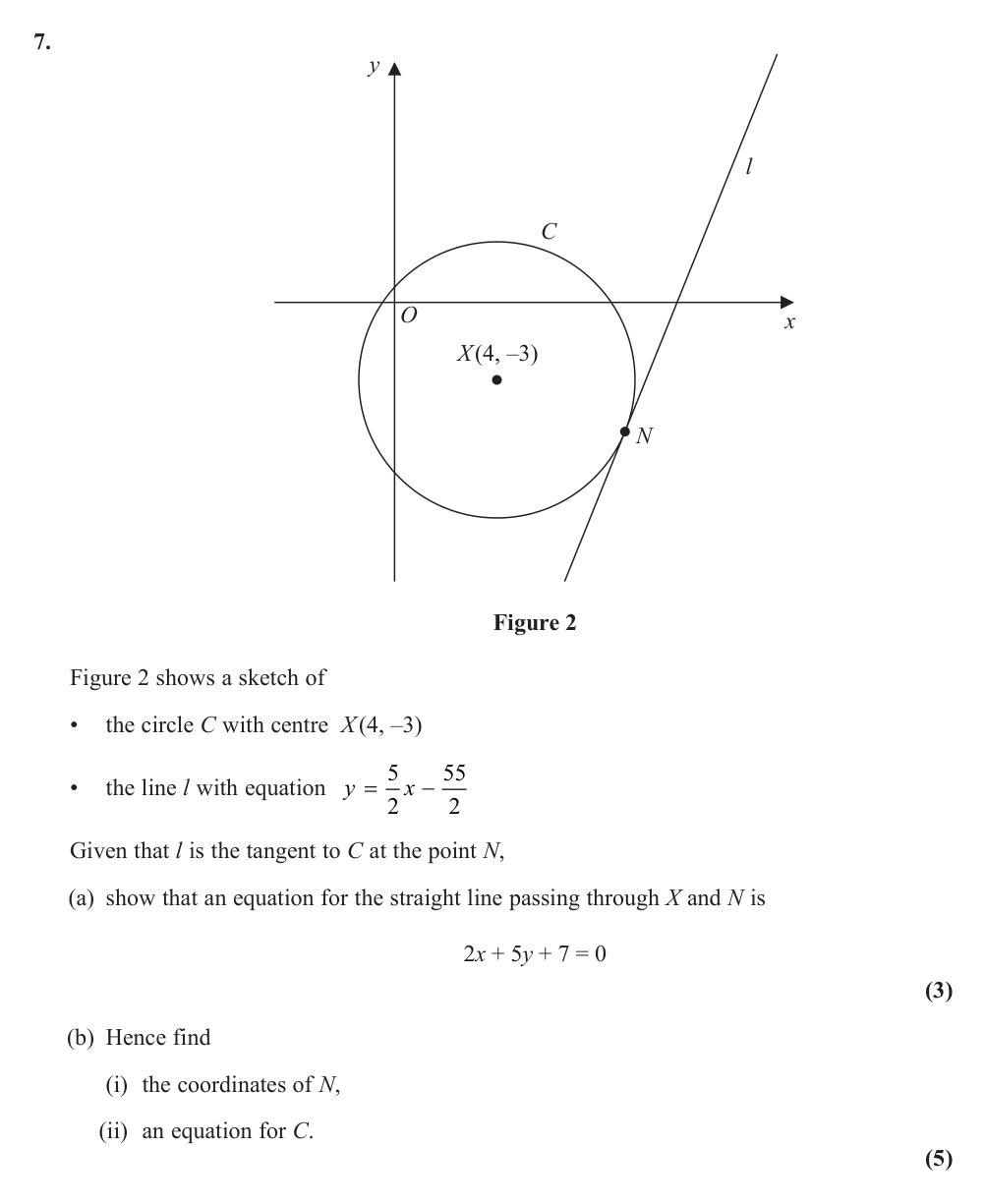
12. WMA12/01 October 2023 · Q7 Medium 8 marks · main topic: CirclesShow worked solution Use perpendicular gradients The tangent $l$ has gradient $\dfrac52$, so the radius $XN$ is perpendicular to it and has gradient $-\dfrac25$.
Use the centre The line through $X(4,-3)$ with gradient $-\dfrac25$ is $y+3=-\dfrac25(x-4)$.
Show the required line Multiplying by $5$ gives $5y+15=-2x+8$, so $2x+5y+7=0$.
Intersect the radius and tangent Use $y=\dfrac52x-\dfrac{55}{2}$ in $2x+5y+7=0$.
Find x coordinate $2x+5\left(\dfrac52x-\dfrac{55}{2}\right)+7=0$. Multiplying by $2$ gives $4x+25x-275+14=0$, so $29x=261$ and $x=9$.
Find y coordinate $y=\dfrac52(9)-\dfrac{55}{2}=\dfrac{45-55}{2}=-5$, so $N=(9,-5)$.
Find the radius squared $XN^2=(9-4)^2+(-5+3)^2=5^2+(-2)^2=29$.
Write the circle equation With centre $(4,-3)$ and radius squared $29$, the circle is $(x-4)^2+(y+3)^2=29$.
Final answer $(a)$ Proven. $\quad (b)(i)$ $N=(9,-5)$. $\quad (b)(ii)$ $(x-4)^2+(y+3)^2=29$.
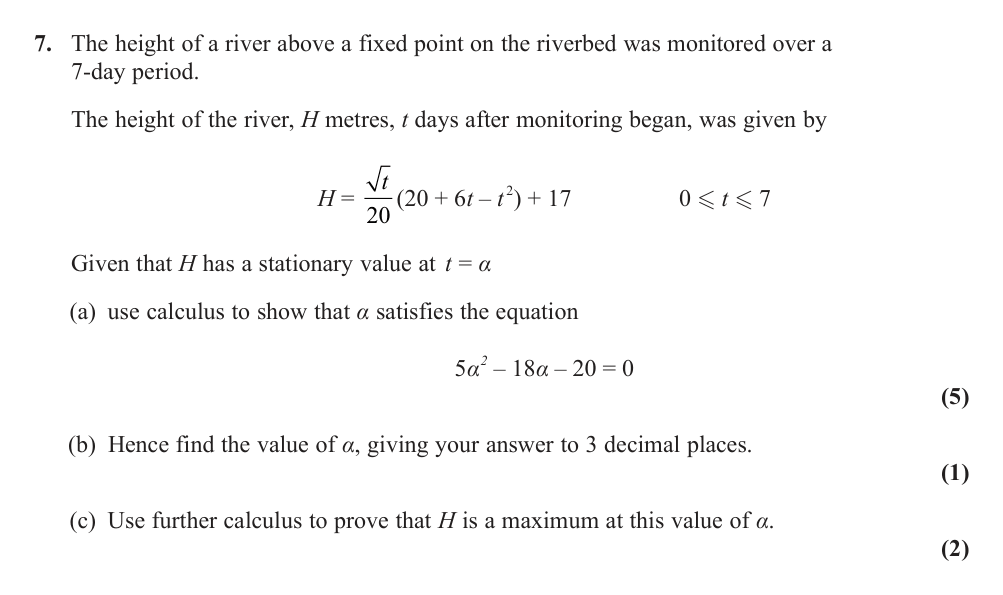
13. WMA12/01 May/June 2023 · Q7 Medium 8 marksShow worked solution Rewrite H with powers $H=\dfrac{1}{20}t^{1/2}(20+6t-t^2)+17$.
Expand before differentiating $H=\dfrac{1}{20}(20t^{1/2}+6t^{3/2}-t^{5/2})+17$.
Differentiate $\dfrac{dH}{dt}=\dfrac{1}{20}\left(10t^{-1/2}+9t^{1/2}-\dfrac52t^{3/2}\right)$.
Put over a common factor $\dfrac{dH}{dt}=\dfrac{-5t^2+18t+20}{40\sqrt{t}}$.
Use the stationary condition At $t=\alpha$, $\dfrac{dH}{dt}=0$. Since $\alpha>0$, the denominator is not zero, so $-5\alpha^2+18\alpha+20=0$.
Show the required equation Multiplying by $-1$ gives $5\alpha^2-18\alpha-20=0$.
Find alpha $\alpha=\dfrac{18\pm\sqrt{18^2+4(5)(20)}}{10}=\dfrac{9\pm\sqrt{181}}{5}$.
Use the time interval Only the positive value lies in $0\le t\le7$, so $\alpha=\dfrac{9+\sqrt{181}}{5}=4.491$ to 3 decimal places.
Differentiate again $\dfrac{d^2H}{dt^2}=\dfrac{-15t^2+18t-20}{80t^{3/2}}$.
Use the stationary equation At $t=\alpha$, $5\alpha^2=18\alpha+20$. Therefore the numerator of $\dfrac{d^2H}{dt^2}$ is $-15\alpha^2+18\alpha-20=-3(18\alpha+20)+18\alpha-20=-36\alpha-80$.
Show it is negative Since $\alpha>0$, $-36\alpha-80<0$, and the denominator $80\alpha^{3/2}$ is positive. Thus $\dfrac{d^2H}{dt^2}<0$, so $H$ is a maximum.
Final answer $(a)$ Proven. $\quad (b)$ $\alpha=4.491$. $\quad (c)$ $H$ is a maximum at this value.
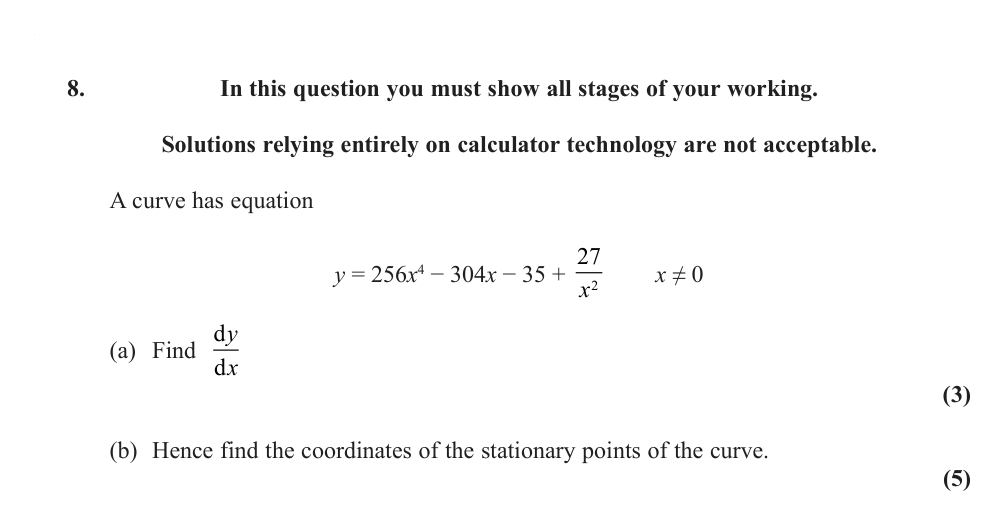
14. WMA12/01 May/June 2022 · Q8 Medium 8 marksShow worked solution Rewrite with powers $y=256x^4-304x-35+27x^{-2}$.
Differentiate $\dfrac{dy}{dx}=1024x^3-304-54x^{-3}=1024x^3-304-\dfrac{54}{x^3}$.
Set the derivative to zero $1024x^3-304-\dfrac{54}{x^3}=0$.
Use a substitution Multiplying by $x^3$ gives $1024x^6-304x^3-54=0$. Let $u=x^3$.
Solve for u $1024u^2-304u-54=0$, or $512u^2-152u-27=0=(8u+1)(64u-27)$.
Find x Thus $x^3=-\dfrac18$ or $x^3=\dfrac{27}{64}$, giving $x=-\dfrac12$ or $x=\dfrac34$.
Find the y values Substitution into $y=256x^4-304x-35+\dfrac{27}{x^2}$ gives $y=241$ at $x=-\dfrac12$ and $y=-134$ at $x=\dfrac34$.
State the stationary points The stationary points are $\left(-\dfrac12,241\right)$ and $\left(\dfrac34,-134\right)$.
Final answer $(a)\ \dfrac{dy}{dx}=1024x^3-304-\dfrac{54}{x^3}.\quad (b)\ \left(-\dfrac12,241\right),\ \left(\dfrac34,-134\right)$.
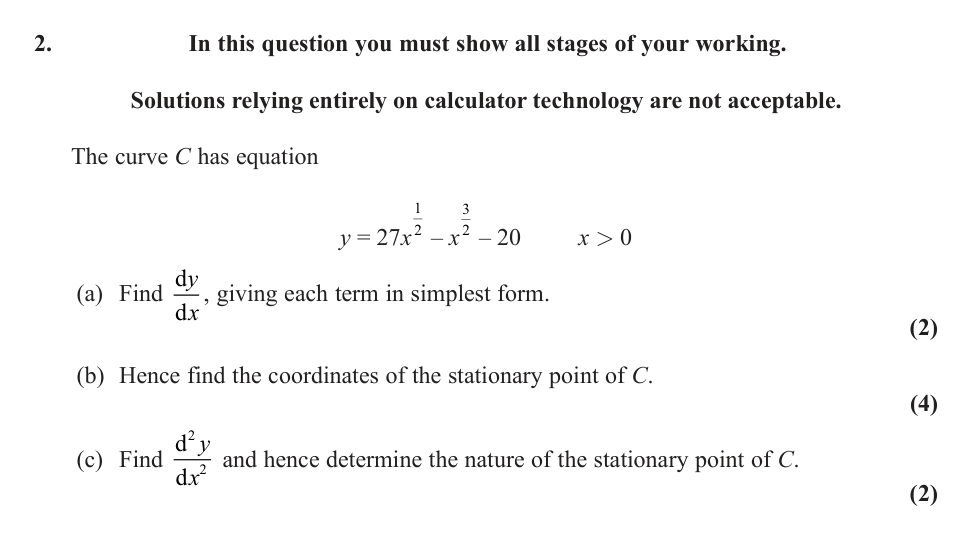
15. WMA12/01 January 2022 · Q2 Medium 8 marksShow worked solution Differentiate For $y=27x^{1/2}-x^{3/2}-20$, $\dfrac{dy}{dx}=\dfrac{27}{2}x^{-1/2}-\dfrac32x^{1/2}$.
Set the gradient to zero $\dfrac{27}{2}x^{-1/2}-\dfrac32x^{1/2}=0$.
Clear the powers Multiplying by $2x^{1/2}$ gives $27-3x=0$, so $x=9$.
Find y At $x=9$, $y=27\sqrt9-9^{3/2}-20=81-27-20=34$.
State the stationary point The stationary point is $(9,34)$.
Differentiate again $\dfrac{d^2y}{dx^2}=-\dfrac{27}{4}x^{-3/2}-\dfrac34x^{-1/2}$.
Determine the nature At $x=9$, both terms in $\dfrac{d^2y}{dx^2}$ are negative, so the stationary point is a local maximum.
Final answer $(a)\ \dfrac{dy}{dx}=\dfrac{27}{2}x^{-1/2}-\dfrac32x^{1/2}.\quad (b)\ (9,34).\quad (c)$ local maximum.
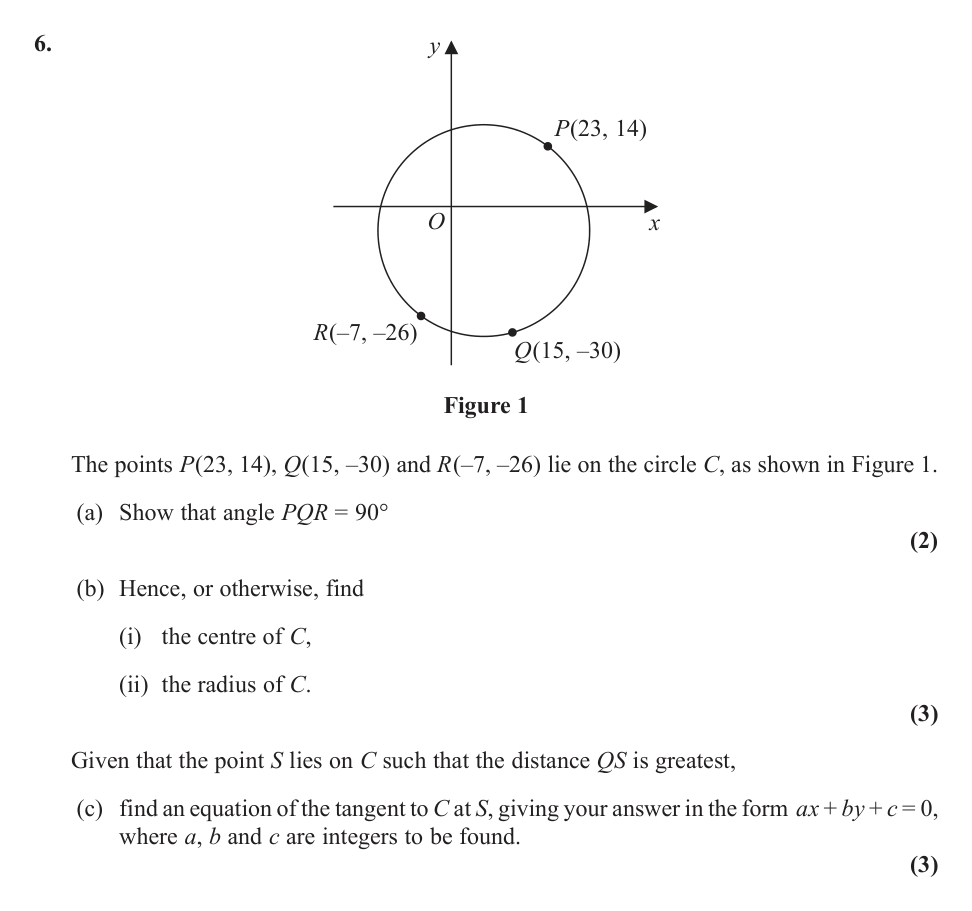
16. WMA12/01 January 2022 · Q6 Medium 8 marks · main topic: CirclesShow worked solution Find the gradient QP The gradient of $QP$ is $\dfrac{14-(-30)}{23-15}=\dfrac{44}{8}=\dfrac{11}{2}$.
Find the gradient QR The gradient of $QR$ is $\dfrac{-26-(-30)}{-7-15}=\dfrac4{-22}=-\dfrac2{11}$.
Show the right angle The product of the two gradients is $-1$, so $QP$ is perpendicular to $QR$ and $\angle PQR=90^\circ$.
Use the diameter Since the angle at $Q$ is a right angle, $PR$ is a diameter of the circle.
Find the centre The centre is the midpoint of $P(23,14)$ and $R(-7,-26)$, so it is $(8,-6)$.
Find the radius $PR=\sqrt{30^2+40^2}=50$, so the radius is $25$.
Find the farthest point from Q The greatest distance from $Q$ occurs at the point opposite $Q$ on the diameter through the centre. Thus $S=2(8,-6)-(15,-30)=(1,18)$.
Find the tangent gradient The radius from the centre to $S$ has gradient $\dfrac{18-(-6)}{1-8}=-\dfrac{24}{7}$, so the tangent gradient is $\dfrac7{24}$.
Write the tangent equation $y-18=\dfrac7{24}(x-1)$, which rearranges to $7x-24y+425=0$.
Final answer $(a)$ Proven: $\angle PQR=90^\circ$. $\quad (b)(i)\ (8,-6).\quad (b)(ii)\ 25.\quad (c)\ 7x-24y+425=0$.
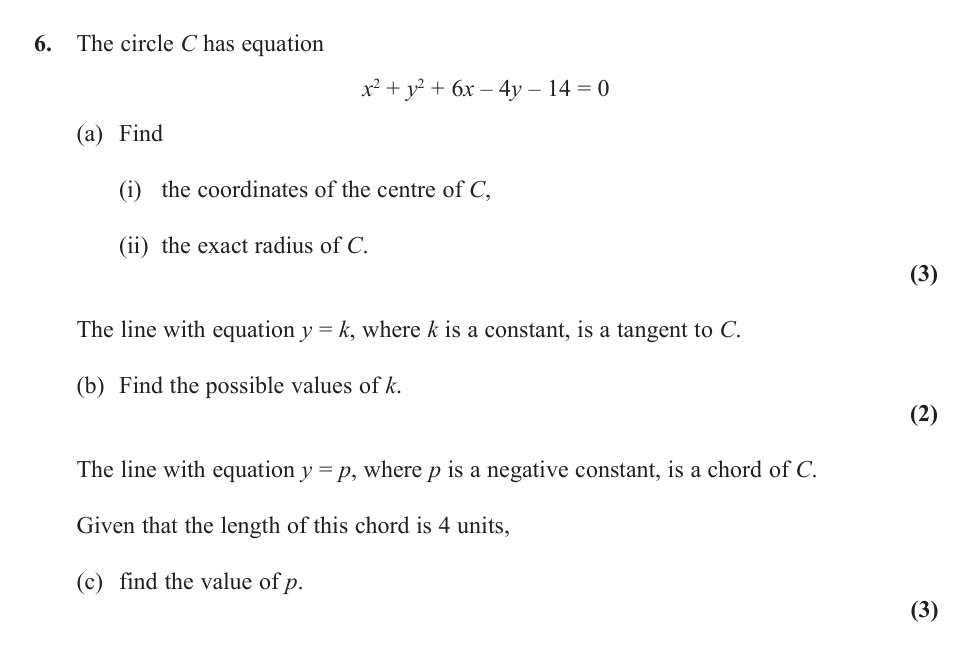
17. WMA12/01 January 2020 · Q6 Medium 8 marks · main topic: CirclesShow worked solution Complete the square $x^2+6x=(x+3)^2-9$ and $y^2-4y=(y-2)^2-4$.
Find the centre and radius The circle becomes $(x+3)^2+(y-2)^2=27$. Hence the centre is $(-3,2)$ and the radius is $\sqrt{27}=3\sqrt3$.
Use horizontal tangents A horizontal tangent has equation $y=k$. The possible tangent levels are one radius above and below the centre, so $k=2\pm3\sqrt3$.
Use half the chord length The chord has length $4$, so half the chord is $2$. If the chord is $y=p$, its perpendicular distance from the centre is $|p-2|$.
Apply Pythagoras $(p-2)^2+2^2=(3\sqrt3)^2=27$, so $(p-2)^2=23$.
Choose the negative value Since $p$ is negative, $p=2-\sqrt{23}$.
Final answer $(a)(i)\ (-3,2).\quad (a)(ii)\ 3\sqrt3.\quad (b)\ k=2\pm3\sqrt3.\quad (c)\ p=2-\sqrt{23}$.
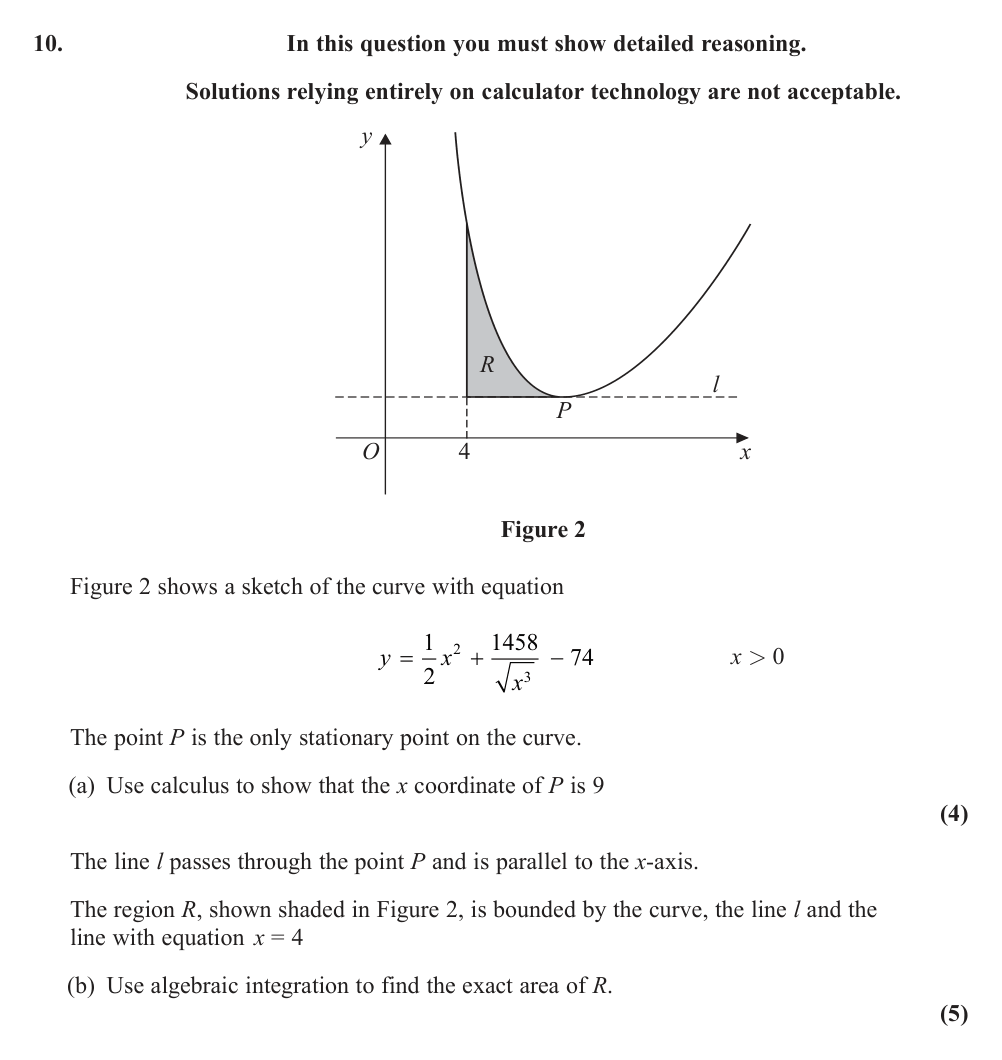
18. WMA12/01 January 2024 · Q10 Hard 9 marksShow worked solution Rewrite the curve $y=\dfrac12x^2+1458x^{-3/2}-74$.
Differentiate $\dfrac{dy}{dx}=x+1458\left(-\dfrac32\right)x^{-5/2}=x-2187x^{-5/2}$.
Use the stationary condition At a stationary point, $x-2187x^{-5/2}=0$.
Solve for x $x=2187x^{-5/2}$, so $x^{7/2}=2187=3^7$.
Show x coordinate Raising both sides to the power $\dfrac27$ gives $x=3^2=9$. Since $x>0$, this is the only stationary point.
Find the horizontal line At $x=9$, $y=\dfrac12(9)^2+\dfrac{1458}{\sqrt{9^3}}-74=\dfrac{81}{2}+54-74=\dfrac{41}{2}$.
Set up the area The region lies from $x=4$ to $x=9$ between the curve and the horizontal line $y=\dfrac{41}{2}$.
Integrate the difference $\displaystyle R=\int_4^9\left(\dfrac12x^2+1458x^{-3/2}-74-\dfrac{41}{2}\right)dx$.
Find an antiderivative $\displaystyle \int\left(\dfrac12x^2+1458x^{-3/2}-\dfrac{189}{2}\right)dx=\dfrac{x^3}{6}-2916x^{-1/2}-\dfrac{189}{2}x$.
Evaluate exactly $\displaystyle R=\left[\dfrac{x^3}{6}-2916x^{-1/2}-\dfrac{189}{2}x\right]_4^9=\dfrac{373}{3}$.
Final answer $(a)$ Proven. $\quad (b)$ $\dfrac{373}{3}$.
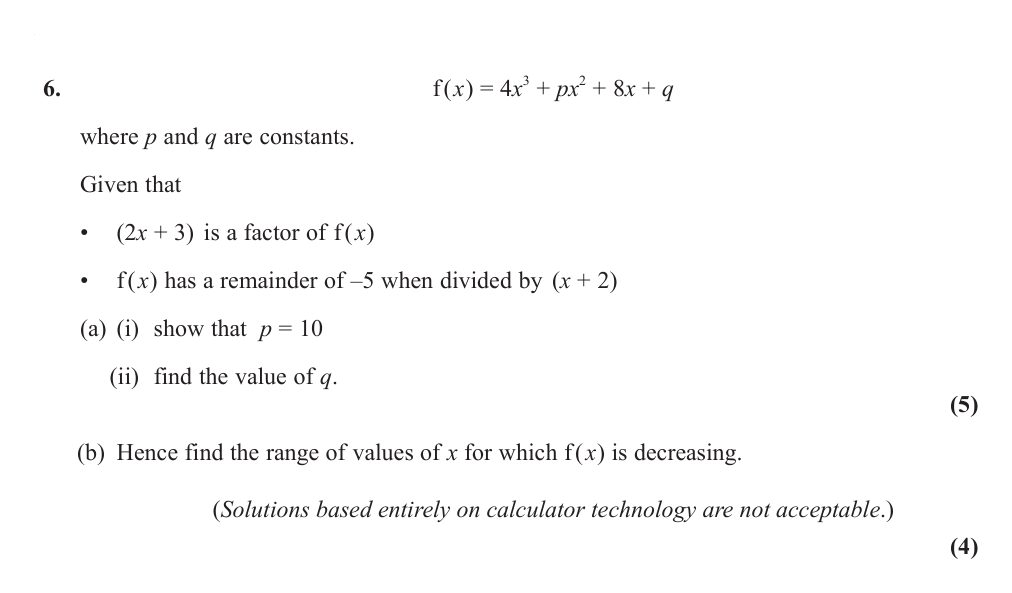
19. WMA12/01 May/June R 2024 · Q6 Hard 9 marksShow worked solution Use the factor theorem Since $(2x+3)$ is a factor, $x=-\dfrac32$ is a root.
Substitute x equals negative three halves $4\left(-\dfrac32\right)^3+p\left(-\dfrac32\right)^2+8\left(-\dfrac32\right)+q=0$.
Simplify the first condition $-\dfrac{27}{2}+\dfrac94p-12+q=0$, so $\dfrac94p+q=\dfrac{51}{2}$.
Use the remainder theorem The remainder on division by $(x+2)$ is $f(-2)$.
Substitute x equals negative two $f(-2)=4(-8)+4p-16+q=4p+q-48$.
Use the given remainder $4p+q-48=-5$, so $4p+q=43$.
Solve for p and q Subtract $\dfrac94p+q=\dfrac{51}{2}$ from $4p+q=43$: $\dfrac74p=\dfrac{35}{2}$, so $p=10$. Then $4(10)+q=43$, so $q=3$.
Differentiate With $p=10$, $f(x)=4x^3+10x^2+8x+3$, so $f'(x)=12x^2+20x+8$.
Factor the derivative $f'(x)=4(3x+2)(x+1)$.
Find where decreasing The quadratic derivative is negative between its roots, so $f(x)$ is decreasing for $-1<x<-\dfrac23$.
Final answer $(a)(i)$ $p=10$. $\quad (a)(ii)$ $q=3$. $\quad (b)$ $-1<x<-\dfrac23$.
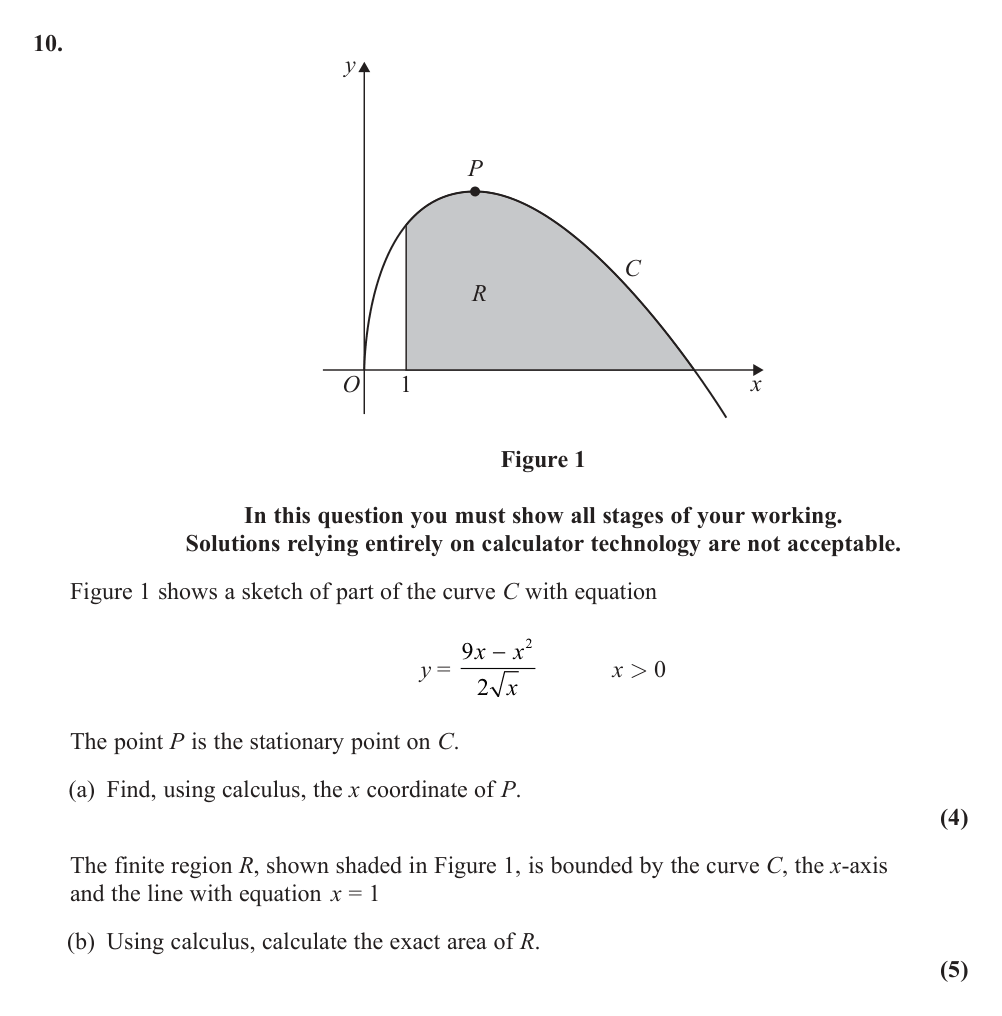
20. WMA12/01 May/June R 2024 · Q10 Hard 9 marksShow worked solution Rewrite the curve $y=\dfrac{9x-x^2}{2\sqrt{x}}=\dfrac12(9x^{1/2}-x^{3/2})$.
Differentiate $\dfrac{dy}{dx}=\dfrac12\left(\dfrac92x^{-1/2}-\dfrac32x^{1/2}\right)=\dfrac{3(3-x)}{4\sqrt{x}}$.
Use the stationary condition For $x>0$, the denominator is not zero. So $\dfrac{dy}{dx}=0$ when $3-x=0$.
Find P Therefore the $x$ coordinate of $P$ is $3$.
Find where the curve meets the x-axis $y=0$ when $9x-x^2=0$, so $x=9$ for the positive intercept.
Set up the area The region is under the curve from $x=1$ to $x=9$, so $R=\displaystyle \int_1^9 \dfrac{9x-x^2}{2\sqrt{x}}dx$.
Integrate $R=\displaystyle \int_1^9 \dfrac12(9x^{1/2}-x^{3/2})dx=\left[3x^{3/2}-\dfrac15x^{5/2}\right]_1^9$.
Evaluate $R=\left(3(27)-\dfrac15(243)\right)-\left(3-\dfrac15\right)=\dfrac{148}{5}$.
Final answer $(a)$ $x=3$. $\quad (b)$ $\dfrac{148}{5}$.
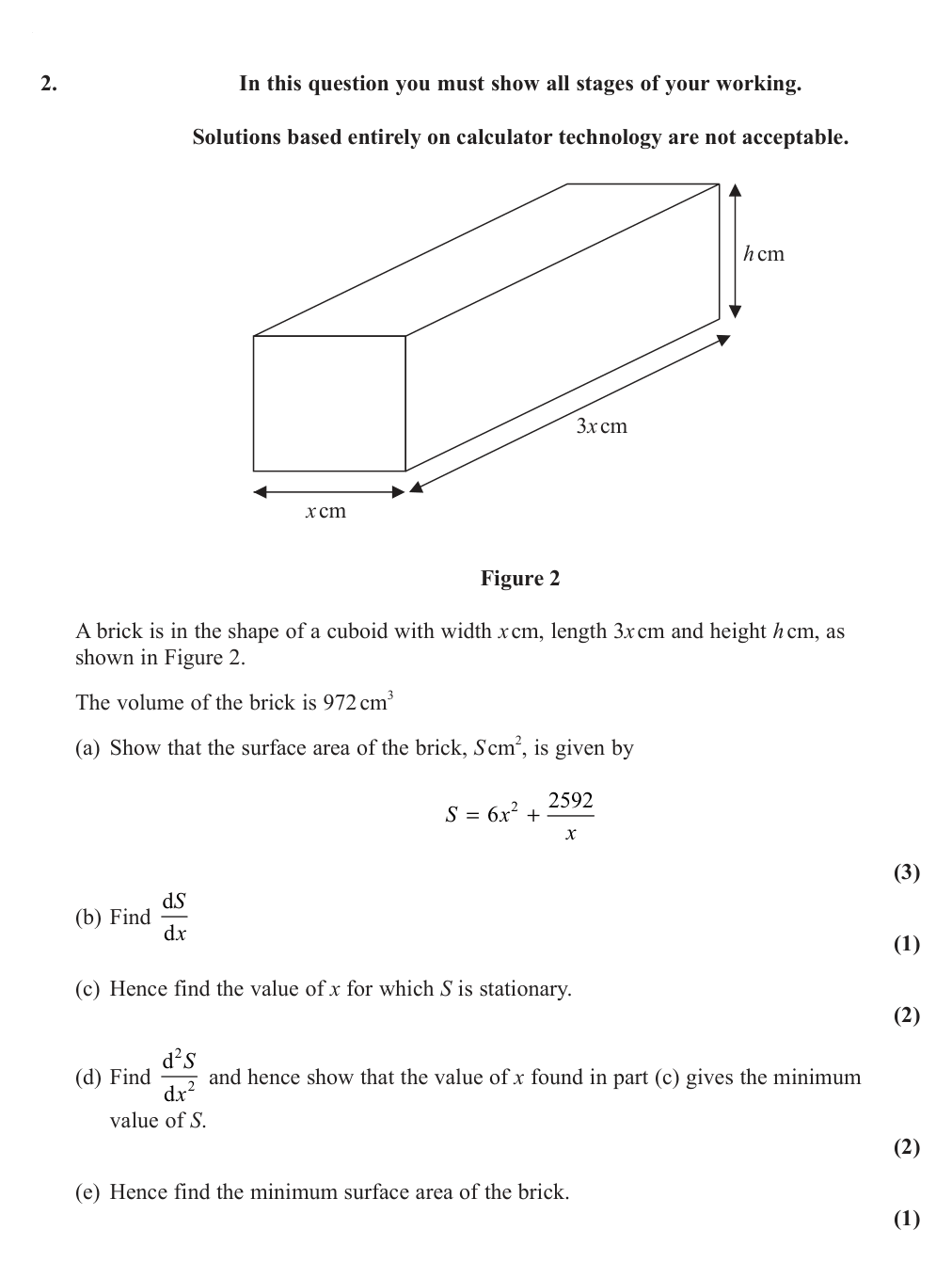
21. WMA12/01 January 2023 · Q2 Hard 9 marksShow worked solution Use the volume The cuboid has dimensions $x$, $3x$ and $h$, so its volume is $3x^2h=972$.
Write h in terms of x Hence $h=\dfrac{972}{3x^2}=\dfrac{324}{x^2}$.
Build the surface area The surface area is $S=2(3x^2+3xh+xh)=6x^2+8xh$.
Substitute h $S=6x^2+8x\left(\dfrac{324}{x^2}\right)=6x^2+\dfrac{2592}{x}$.
Differentiate $S=6x^2+2592x^{-1}$, so $\dfrac{dS}{dx}=12x-2592x^{-2}=12x-\dfrac{2592}{x^2}$.
Set the derivative to zero For a stationary value, $12x-\dfrac{2592}{x^2}=0$.
Solve for x Multiplying by $x^2$ gives $12x^3=2592$, so $x^3=216$ and $x=6$.
Use the second derivative $\dfrac{d^2S}{dx^2}=12+\dfrac{5184}{x^3}$.
Show it is a minimum At $x=6$, $\dfrac{d^2S}{dx^2}=12+\dfrac{5184}{216}=36>0$, so the stationary value is a minimum.
Find the minimum surface area $S=6(6)^2+\dfrac{2592}{6}=216+432=648$, so the minimum surface area is $648\text{ cm}^2$.
Final answer $(a)$ $S=6x^2+\dfrac{2592}{x}$. $\quad (b)\ \dfrac{dS}{dx}=12x-\dfrac{2592}{x^2}$. $\quad (c)\ x=6$. $\quad (d)$ Minimum shown. $\quad (e)\ 648\text{ cm}^2$.
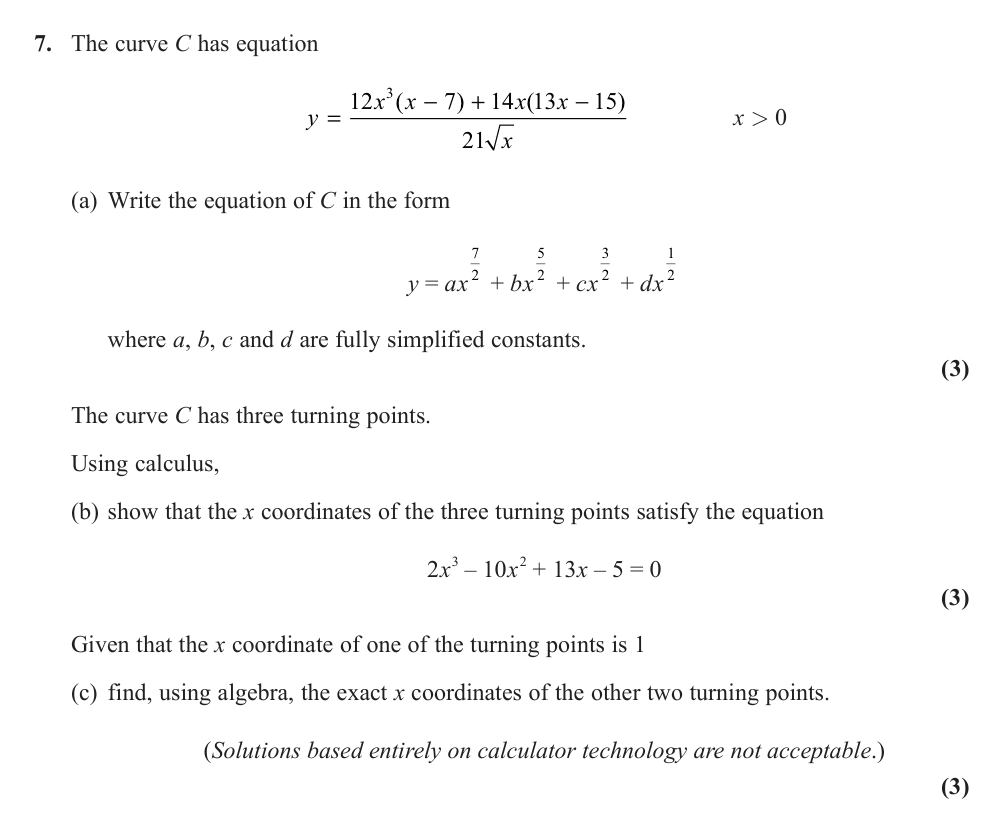
22. WMA12/01 October 2022 · Q7 Hard 9 marksShow worked solution Expand the numerator $12x^3(x-7)+14x(13x-15)=12x^4-84x^3+182x^2-210x$.
Divide by 21 root x Since $\sqrt{x}=x^{1/2}$, divide each term by $21x^{1/2}$.
Write in the required form $y=\dfrac{12}{21}x^{7/2}-\dfrac{84}{21}x^{5/2}+\dfrac{182}{21}x^{3/2}-\dfrac{210}{21}x^{1/2}=\dfrac47x^{7/2}-4x^{5/2}+\dfrac{26}{3}x^{3/2}-10x^{1/2}$.
Differentiate $\dfrac{dy}{dx}=2x^{5/2}-10x^{3/2}+13x^{1/2}-5x^{-1/2}$.
Factor the derivative $\dfrac{dy}{dx}=x^{-1/2}(2x^3-10x^2+13x-5)$.
Use the turning point condition At a turning point, $\dfrac{dy}{dx}=0$. Since $x>0$, $x^{-1/2}\ne0$, so the $x$ coordinates satisfy $2x^3-10x^2+13x-5=0$.
Use the known root One root is $x=1$, so divide $2x^3-10x^2+13x-5$ by $(x-1)$.
Factor the cubic $2x^3-10x^2+13x-5=(x-1)(2x^2-8x+5)$.
Solve the quadratic $2x^2-8x+5=0$ gives $x=\dfrac{8\pm\sqrt{64-40}}{4}=\dfrac{8\pm2\sqrt6}{4}=2\pm\dfrac{\sqrt6}{2}$.
Final answer $(a)$ $y=\dfrac47x^{7/2}-4x^{5/2}+\dfrac{26}{3}x^{3/2}-10x^{1/2}$. $\quad (b)$ Proven. $\quad (c)$ $x=2-\dfrac{\sqrt6}{2}$ and $x=2+\dfrac{\sqrt6}{2}$.
23. WMA12/01 October 2025 · Q7 Hard 10 marks · main topic: IntegrationShow worked solution Differentiate For $y=x^3-4x^{5/2}-kx^{1/2}+28x-44$, $\dfrac{dy}{dx}=3x^2-10x^{3/2}-\dfrac{k}{2}x^{-1/2}+28$.
Write in simplest form $\dfrac{dy}{dx}=3x^2-10x^{3/2}-\dfrac{k}{2\sqrt{x}}+28$.
Use the stationary point At $T$, $x=9$ and $\dfrac{dy}{dx}=0$.
Substitute x equals nine $0=3(9)^2-10(9)^{3/2}-\dfrac{k}{2\sqrt9}+28=243-270-\dfrac{k}{6}+28$.
Find k This simplifies to $0=1-\dfrac{k}{6}$, so $k=6$.
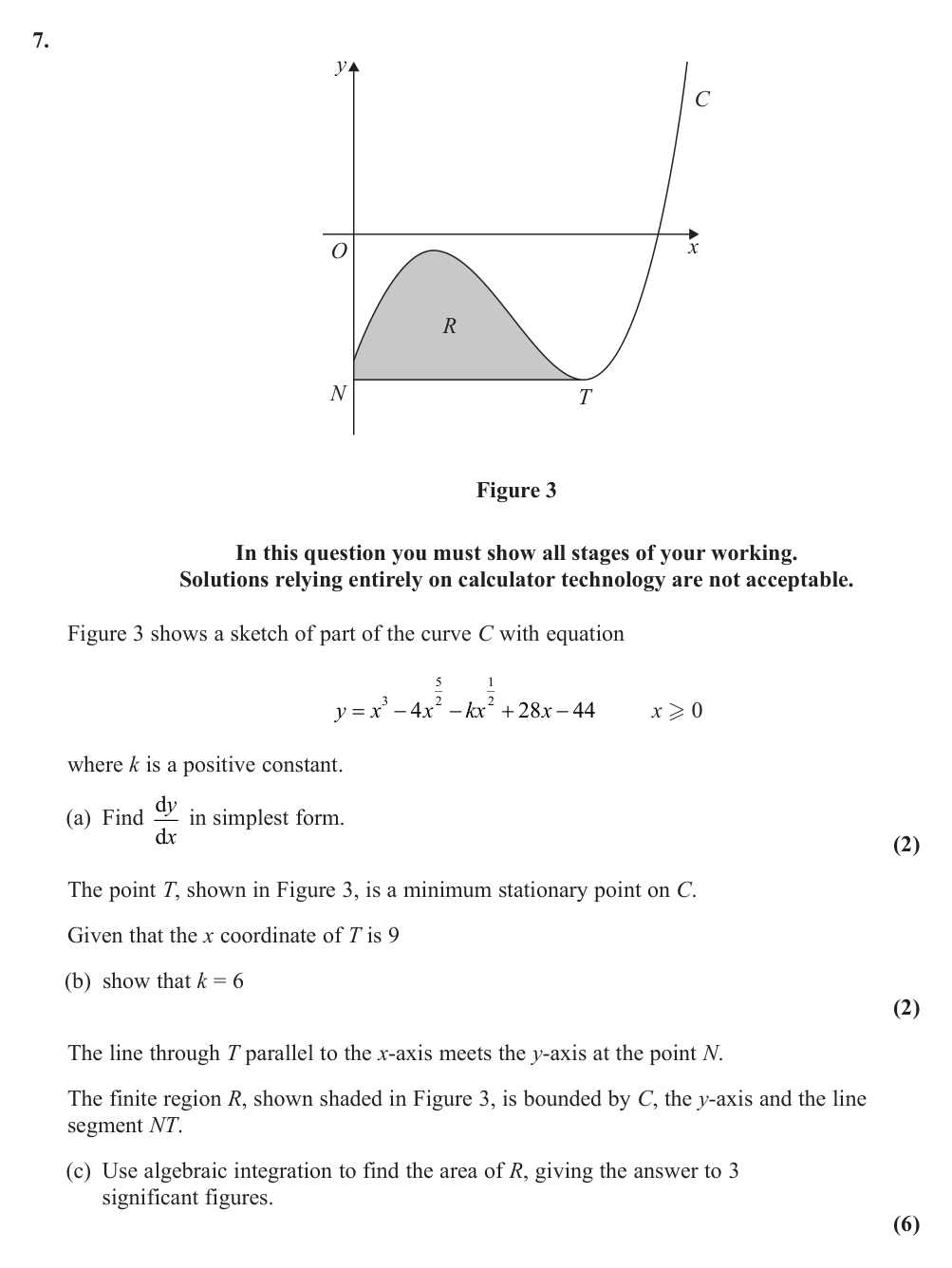
Find the horizontal line With $k=6$, the $y$ coordinate of $T$ is $9^3-4(9)^{5/2}-6\sqrt9+28(9)-44=-53$.
Set up the area The line $NT$ is $y=-53$. The region is between the curve and this line from $x=0$ to $x=9$.
Write the integral $R=\displaystyle\int_0^9\left(x^3-4x^{5/2}-6x^{1/2}+28x-44+53\right)dx$.
Integrate $R=\left[\dfrac{x^4}{4}-\dfrac87x^{7/2}-4x^{3/2}+14x^2+9x\right]_0^9$.
Evaluate $R=\dfrac{6939}{28}=247.821\ldots$, so the area is $248$ to $3$ significant figures.
Final answer $(a)$ $3x^2-10x^{3/2}-\dfrac{k}{2\sqrt{x}}+28$. $\quad (b)$ Proven. $\quad (c)$ $248$.
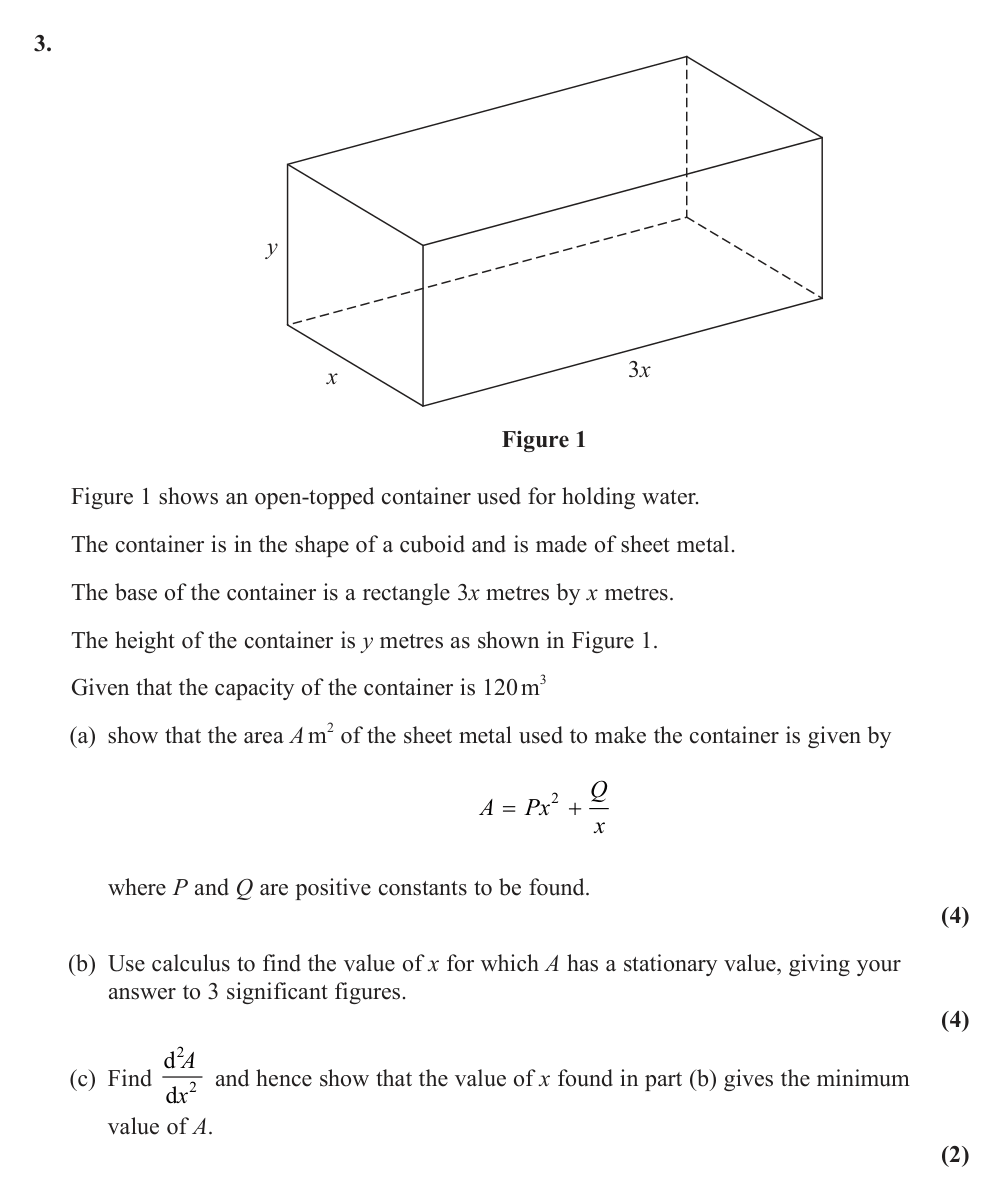
24. WMA12/01 January 2025 · Q3 Hard 10 marksShow worked solution Use the volume The volume is $(3x)(x)(y)=3x^2y$. Since the capacity is $120$, $3x^2y=120$, so $y=\dfrac{40}{x^2}$.
Write the metal area The open top means the metal area is the base plus four sides: $A=3x^2+2(3xy)+2(xy)$.
Substitute for y $A=3x^2+8xy=3x^2+8x\left(\dfrac{40}{x^2}\right)=3x^2+\dfrac{320}{x}$. Hence $P=3$ and $Q=320$.
Differentiate $\dfrac{dA}{dx}=6x-320x^{-2}=6x-\dfrac{320}{x^2}$.
Use the stationary condition Set $\dfrac{dA}{dx}=0$: $6x=\dfrac{320}{x^2}$, so $6x^3=320$.
Find x $x^3=\dfrac{160}{3}$, so $x=\sqrt[3]{\dfrac{160}{3}}=3.764\ldots$. To $3$ significant figures, $x=3.76$.
Differentiate again $\dfrac{d^2A}{dx^2}=6+640x^{-3}=6+\dfrac{640}{x^3}$.
Show the minimum For $x>0$, $6+\dfrac{640}{x^3}>0$, so the stationary value found in part (b) is a minimum.
Final answer $(a)$ $A=3x^2+\dfrac{320}{x}$, so $P=3$ and $Q=320$. $\quad (b)$ $x=3.76$. $\quad (c)$ $\dfrac{d^2A}{dx^2}=6+\dfrac{640}{x^3}$, minimum.
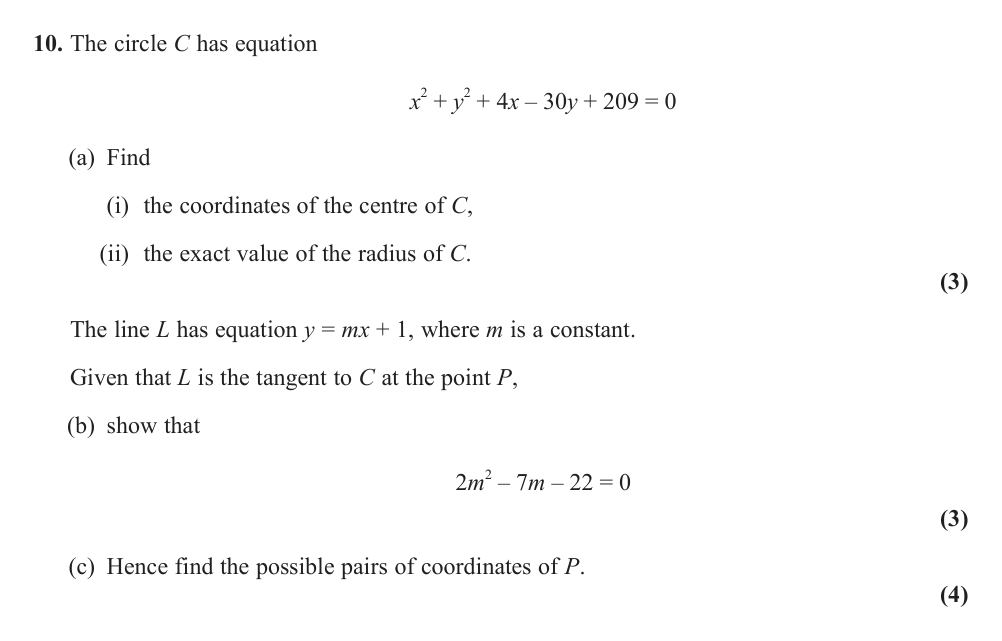
25. WMA12/01 October 2024 · Q10 Hard 10 marks · main topic: CirclesShow worked solution Complete the square $x^2+y^2+4x-30y+209=0$ becomes $(x+2)^2+(y-15)^2=20$.
Read the centre and radius The centre is $(-2,15)$ and the radius is $\sqrt{20}=2\sqrt5$.
Use the tangent distance The line $y=mx+1$ can be written as $mx-y+1=0$. Its distance from $(-2,15)$ must be $2\sqrt5$.
Set up the equation for m $\dfrac{|m(-2)-15+1|}{\sqrt{m^2+1}}=2\sqrt5$, so $\dfrac{|-2m-14|}{\sqrt{m^2+1}}=2\sqrt5$.
Show the quadratic Squaring gives $4(m+7)^2=20(m^2+1)$. Hence $(m+7)^2=5(m^2+1)$, so $2m^2-7m-22=0$.
Find the possible gradients $2m^2-7m-22=0$ gives $m=-2$ or $m=\dfrac{11}{2}$.
Use perpendicular radii A tangent is perpendicular to the radius at the point of contact.
Find the first point For $m=-2$, the radius gradient is $\dfrac12$. The radius through the centre is $y-15=\dfrac12(x+2)$. Solving with $y=-2x+1$ gives $x=-6$ and $y=13$.
Find the second point For $m=\dfrac{11}{2}$, the radius gradient is $-\dfrac2{11}$. The radius through the centre is $y-15=-\dfrac2{11}(x+2)$. Solving with $y=\dfrac{11}{2}x+1$ gives $x=\dfrac{12}{5}$ and $y=\dfrac{71}{5}$.
Final answer $(a)(i)$ $(-2,15)$. $\quad (a)(ii)$ $2\sqrt5$. $\quad (b)$ Proven. $\quad (c)$ $(-6,13)$ and $\left(\dfrac{12}{5},\dfrac{71}{5}\right)$.
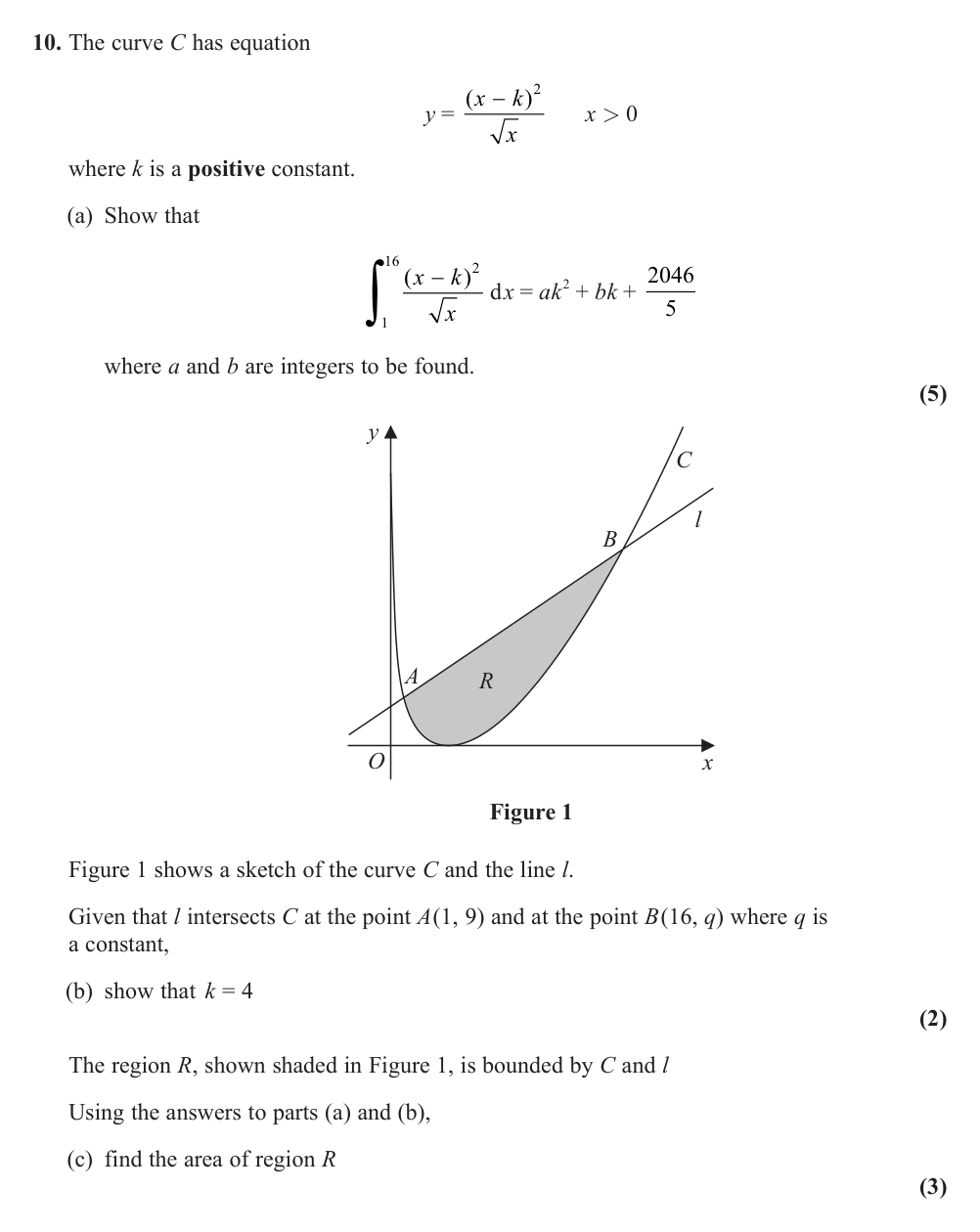
26. WMA12/01 May/June 2023 · Q10 Hard 10 marks · main topic: IntegrationShow worked solution Expand the integrand $\dfrac{(x-k)^2}{\sqrt{x}}=\dfrac{x^2-2kx+k^2}{x^{1/2}}=x^{3/2}-2kx^{1/2}+k^2x^{-1/2}$.
Integrate $\displaystyle \int \left(x^{3/2}-2kx^{1/2}+k^2x^{-1/2}\right)dx=\dfrac25x^{5/2}-\dfrac{4k}{3}x^{3/2}+2k^2x^{1/2}$.
Substitute the limits From $1$ to $16$, this gives $\left(\dfrac{2048}{5}-\dfrac{256k}{3}+8k^2\right)-\left(\dfrac25-\dfrac{4k}{3}+2k^2\right)$.
Simplify the integral The result is $6k^2-84k+\dfrac{2046}{5}$, so $a=6$ and $b=-84$.
Use point A Since $A(1,9)$ lies on $C$, $9=\dfrac{(1-k)^2}{\sqrt1}=(1-k)^2$.
Find k Thus $1-k=\pm3$, so $k=4$ or $k=-2$. Since $k$ is positive, $k=4$.
Find point B When $k=4$ and $x=16$, $q=\dfrac{(16-4)^2}{\sqrt{16}}=\dfrac{144}{4}=36$, so $B=(16,36)$.
Find the line The line through $A(1,9)$ and $B(16,36)$ has gradient $\dfrac{36-9}{16-1}=\dfrac95$, so $l$ has equation $y=\dfrac95x+\dfrac{36}{5}$.
Area under the line $\displaystyle \int_1^{16}\left(\dfrac95x+\dfrac{36}{5}\right)dx=\left[\dfrac{9}{10}x^2+\dfrac{36}{5}x\right]_1^{16}=\dfrac{675}{2}$.
Area under the curve From part (a), with $k=4$, $\displaystyle \int_1^{16}\dfrac{(x-4)^2}{\sqrt{x}}dx=6(4)^2-84(4)+\dfrac{2046}{5}=\dfrac{846}{5}$.
Subtract curve from line The shaded area is $\dfrac{675}{2}-\dfrac{846}{5}=\dfrac{1683}{10}$.
Final answer $(a)$ $a=6,\ b=-84$. $\quad (b)$ $k=4$. $\quad (c)$ Area $=\dfrac{1683}{10}$.
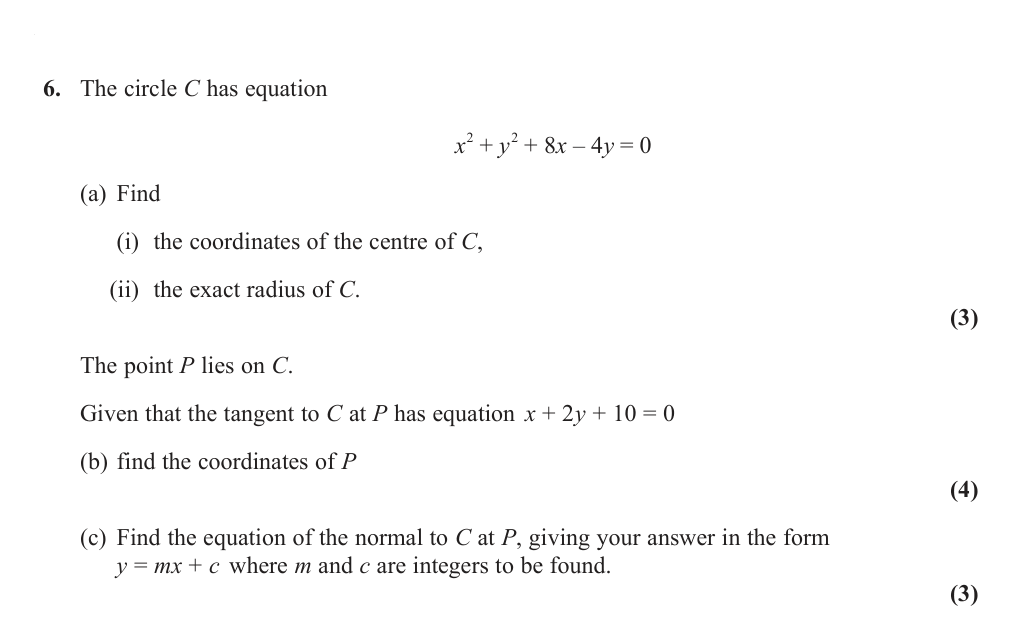
27. WMA12/01 January 2023 · Q6 Hard 10 marks · main topic: CirclesShow worked solution Complete the square $x^2+y^2+8x-4y=0$ becomes $(x+4)^2-16+(y-2)^2-4=0$.
Write the circle form So $(x+4)^2+(y-2)^2=20$.
Read the centre and radius The centre is $(-4,2)$ and the radius is $\sqrt{20}=2\sqrt5$.
Use the tangent gradient The tangent $x+2y+10=0$ has gradient $-\dfrac12$.
Find the radius gradient The radius to the point of contact is perpendicular to the tangent, so its gradient is $2$.
Write the normal through the centre The radius line through the centre $(-4,2)$ is $y-2=2(x+4)$, so $y=2x+10$.
Intersect with the tangent Substitute $y=2x+10$ into $x+2y+10=0$: $x+2(2x+10)+10=0$.
Find P $5x+30=0$, so $x=-6$. Then $y=2(-6)+10=-2$, hence $P=(-6,-2)$.
State the normal The normal at $P$ is the radius line already found, so its equation is $y=2x+10$.
Final answer $(a)(i)$ $(-4,2)$. $\quad (a)(ii)$ $2\sqrt5$. $\quad (b)$ $P=(-6,-2)$. $\quad (c)$ $y=2x+10$.
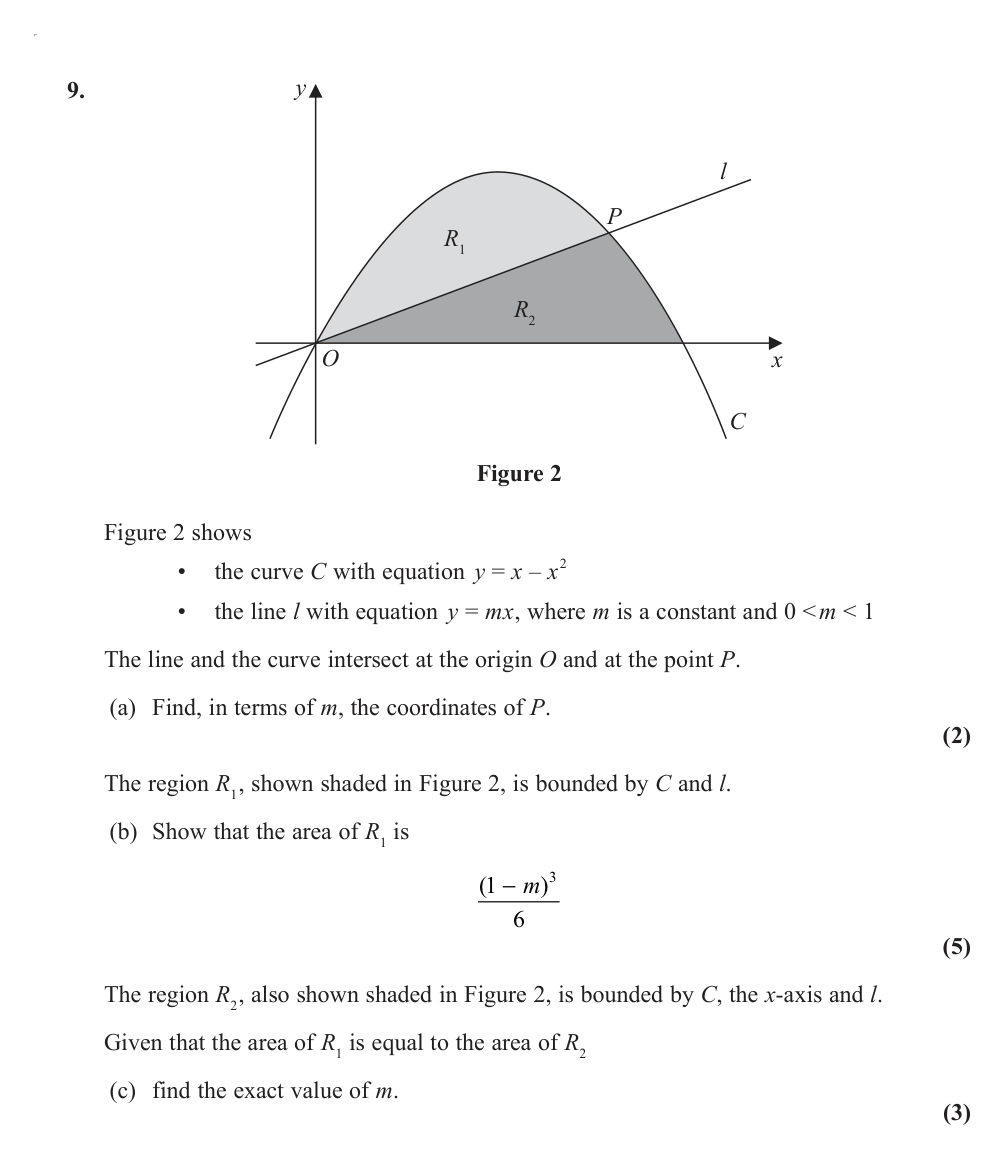
28. WMA12/01 January 2022 · Q9 Hard 10 marks · main topic: IntegrationShow worked solution Find the second intersection At an intersection, $x-x^2=mx$, so $x(1-m-x)=0$.
State P The non-zero intersection has $x=1-m$, and then $y=m(1-m)$, so $P=(1-m,m(1-m))$.
Set up area R one Region $R_1$ is between the curve and the line from $x=0$ to $x=1-m$.
Integrate the difference $A_{R_1}=\int_0^{1-m}\{(x-x^2)-mx\}\,dx=\int_0^{1-m}\{(1-m)x-x^2\}\,dx$.
Evaluate $A_{R_1}=\left[\dfrac{1-m}{2}x^2-\dfrac13x^3\right]_0^{1-m}=\dfrac{(1-m)^3}{2}-\dfrac{(1-m)^3}{3}=\dfrac{(1-m)^3}{6}$.
Use the total curve area The total area under $y=x-x^2$ from $x=0$ to $x=1$ is $\int_0^1(x-x^2)\,dx=\dfrac16$.
Use equal regions Since $R_1$ and $R_2$ are equal and together make this total area, each has area $\dfrac{1}{12}$.
Solve for m $\dfrac{(1-m)^3}{6}=\dfrac1{12}$, so $(1-m)^3=\dfrac12$ and $m=1-\dfrac1{\sqrt[3]{2}}$.
Final answer $(a)\ P=(1-m,\ m(1-m)).\quad (b)$ Proven: $\dfrac{(1-m)^3}{6}$. $\quad (c)\ m=1-\dfrac1{\sqrt[3]{2}}$.
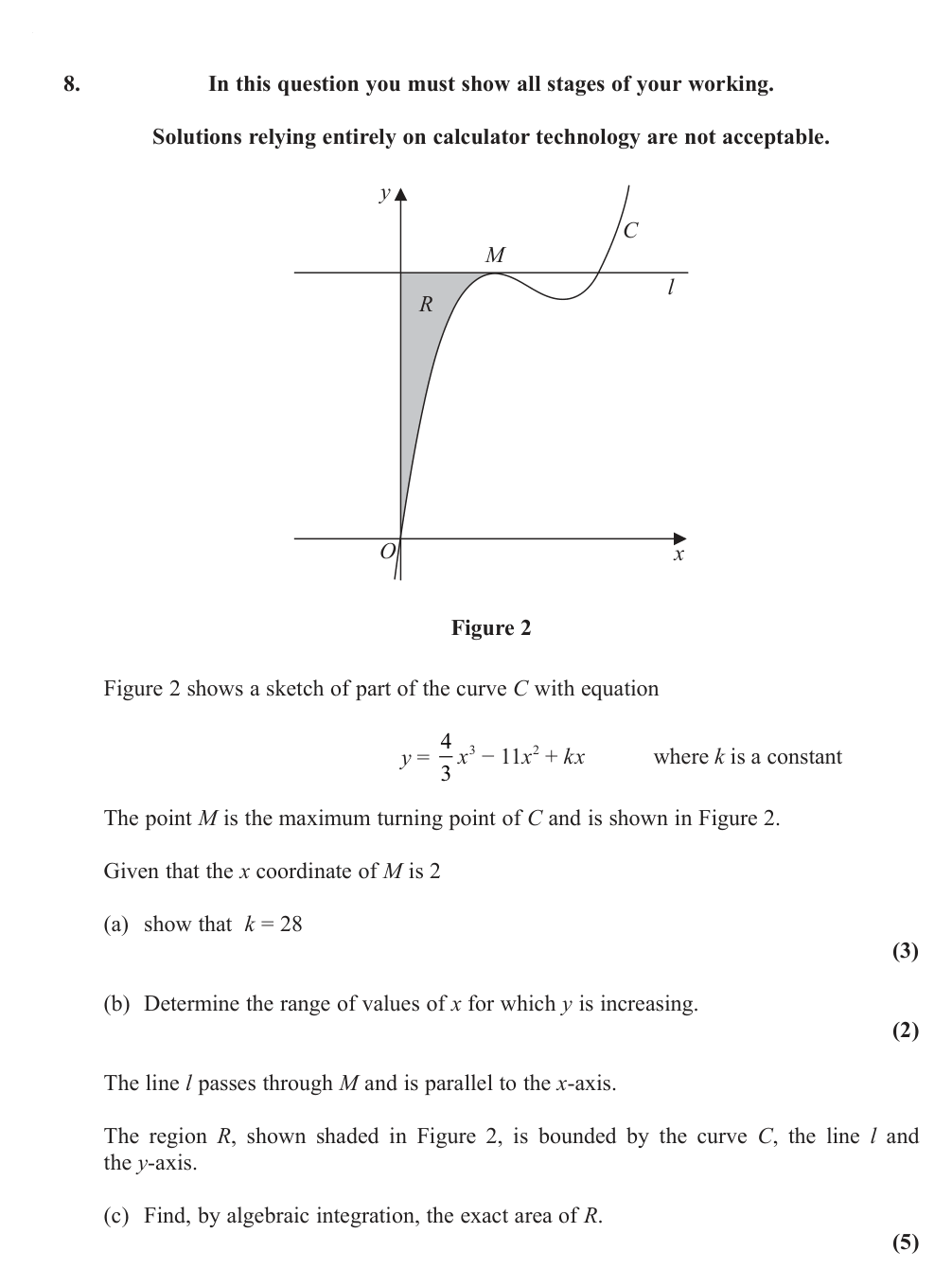
29. WMA12/01 October 2021 · Q8 Hard 10 marksShow worked solution Differentiate the curve For $y=\dfrac43x^3-11x^2+kx$, $\dfrac{dy}{dx}=4x^2-22x+k$.
Use the turning point At the turning point $M$, $x=2$ and $\dfrac{dy}{dx}=0$.
Show k $4(2)^2-22(2)+k=0$, so $16-44+k=0$ and $k=28$.
Factor the derivative With $k=28$, $\dfrac{dy}{dx}=4x^2-22x+28=2(2x-7)(x-2)$.
Find where y is increasing The derivative is positive outside its roots, so $y$ is increasing for $x<2$ or $x>\dfrac72$.
Find the height of the line At $x=2$, $y=\dfrac43(8)-11(4)+28(2)=\dfrac{68}{3}$. Hence line $l$ has equation $y=\dfrac{68}{3}$.
Set up the shaded area The region is between the line and the curve from $x=0$ to $x=2$, so $A=\int_0^2\left(\dfrac{68}{3}-\left(\dfrac43x^3-11x^2+28x\right)\right)dx$.
Integrate $A=\left[\dfrac{68}{3}x-\dfrac13x^4+\dfrac{11}{3}x^3-14x^2\right]_0^2$.
Evaluate exactly Substituting $x=2$ gives $\dfrac{136}{3}-\dfrac{16}{3}+\dfrac{88}{3}-56=\dfrac{40}{3}$.
Final answer $(a)$ Proven: $k=28$. $\quad (b)\ x<2\text{ or }x>\dfrac72.\quad (c)\ \dfrac{40}{3}$.
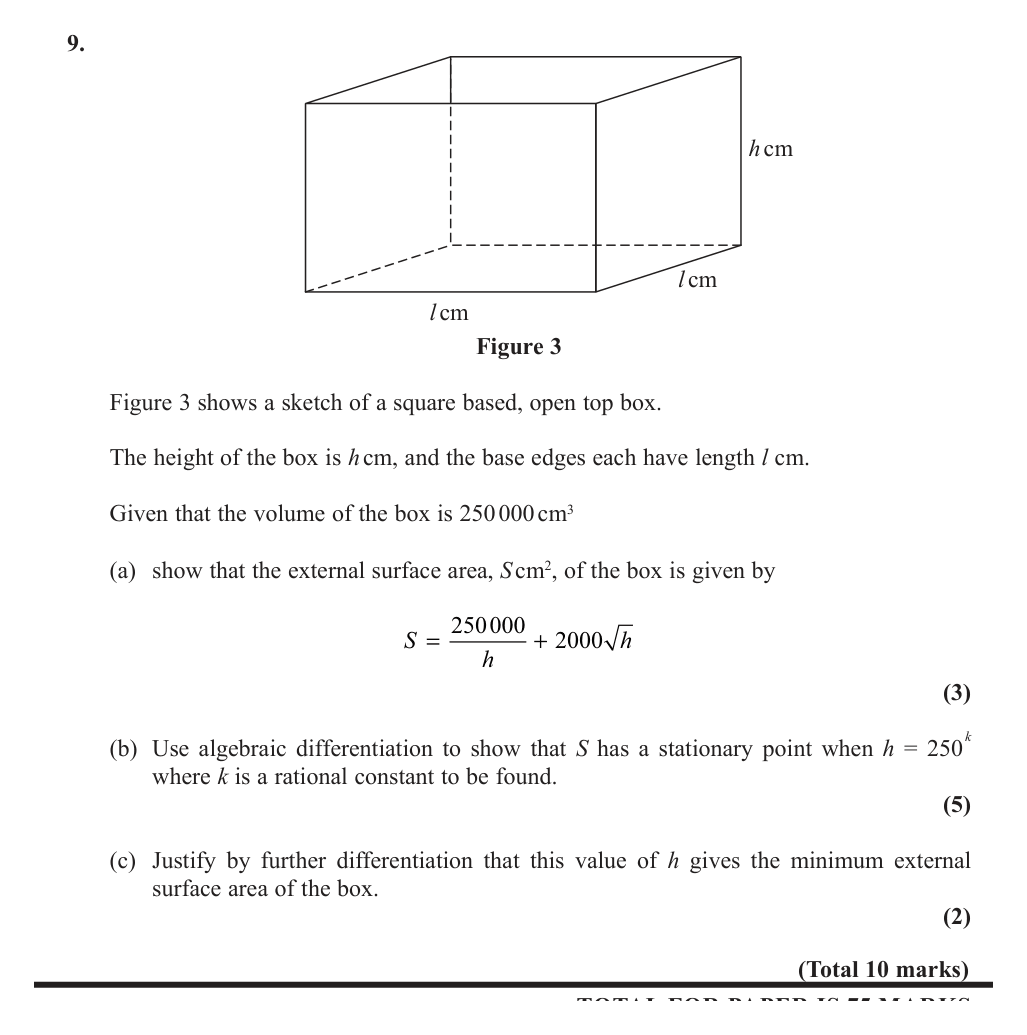
30. WMA12/01 May/June 2021 · Q9 Hard 10 marksShow worked solution Use the volume The volume is $l^2h=250000$, so $l^2=\dfrac{250000}{h}$.
Write the surface area The open box has one square base and four side faces, so $S=l^2+4lh$.
Substitute l Since $l=\sqrt{\dfrac{250000}{h}}=\dfrac{500}{\sqrt h}$, $4lh=4\cdot\dfrac{500}{\sqrt h}\cdot h=2000\sqrt h$.
Show S Therefore $S=\dfrac{250000}{h}+2000\sqrt h$.
Differentiate S $S=250000h^{-1}+2000h^{1/2}$, so $\dfrac{dS}{dh}=-250000h^{-2}+1000h^{-1/2}$.
Set the derivative to zero $-250000h^{-2}+1000h^{-1/2}=0$, so $1000h^{-1/2}=250000h^{-2}$.
Solve for h Multiplying by $h^2$ gives $1000h^{3/2}=250000$, so $h^{3/2}=250$ and $h=250^{2/3}$.
Find k Since $h=250^k$, we have $k=\dfrac23$.
Use the second derivative $\dfrac{d^2S}{dh^2}=500000h^{-3}-500h^{-3/2}$.
Check the sign At $h=250^{2/3}$, $h^{3/2}=250$, so the second derivative is $\dfrac{500000}{250^2}-\dfrac{500}{250}=8-2=6>0$.
Conclude The stationary point is therefore a minimum.
Final answer $(a)$ Proven: $S=\dfrac{250000}{h}+2000\sqrt h$. $\quad (b)\ h=250^{2/3}$, so $k=\dfrac23$. $\quad (c)$ Minimum.
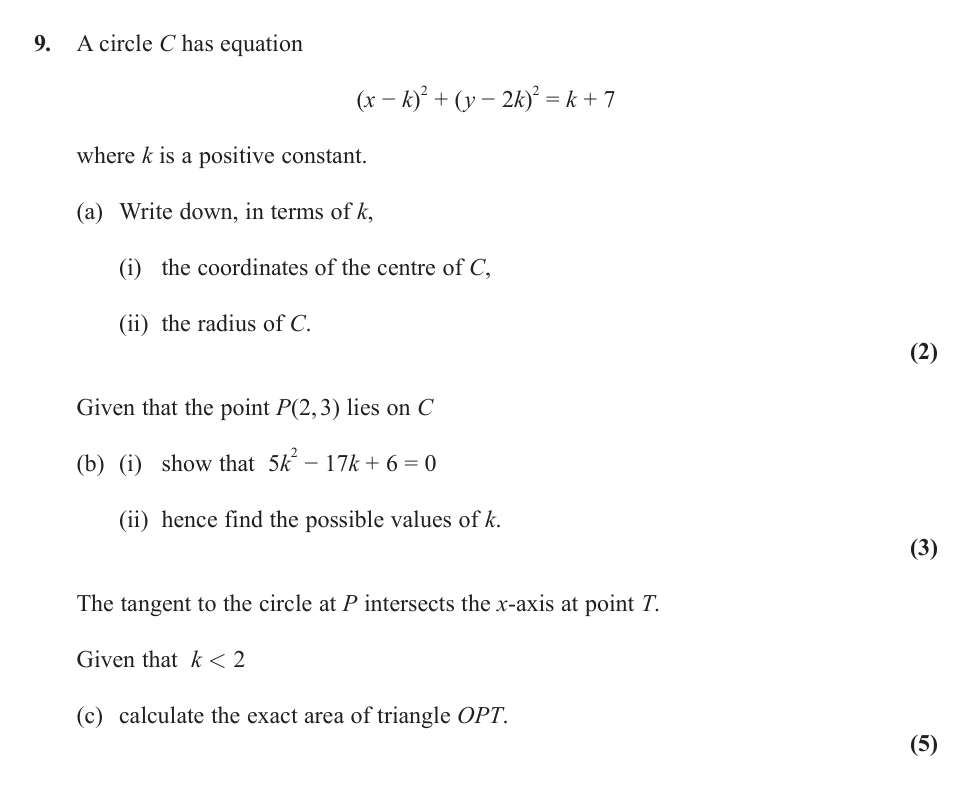
31. WMA12/01 January 2021 · Q9 Hard 10 marks · main topic: CirclesShow worked solution Read the centre and radius From $(x-k)^2+(y-2k)^2=k+7$, the centre is $(k,2k)$ and the radius is $\sqrt{k+7}$.
Substitute point P Since $P(2,3)$ lies on the circle, $(2-k)^2+(3-2k)^2=k+7$.
Show the quadratic Expanding gives $k^2-4k+4+4k^2-12k+9=k+7$, hence $5k^2-17k+6=0$.
Solve for k $5k^2-17k+6=(5k-2)(k-3)$, so $k=\dfrac25$ or $k=3$.
Use the condition k less than two For the tangent calculation, $k<2$, so the centre is $\left(\dfrac25,\dfrac45\right)$.
Find the tangent gradient The radius from the centre to $P$ has gradient $\dfrac{3-4/5}{2-2/5}=\dfrac{11}{8}$, so the tangent gradient is $-\dfrac8{11}$.
Find the x intercept The tangent is $y-3=-\dfrac8{11}(x-2)$. Setting $y=0$ gives $x=\dfrac{49}{8}$, so $T=\left(\dfrac{49}{8},0\right)$.
Calculate the area Triangle $OPT$ has base $\dfrac{49}{8}$ on the $x$-axis and height $3$, so its area is $\dfrac12\cdot\dfrac{49}{8}\cdot3=\dfrac{147}{16}$.
Final answer $(a)(i)\ (k,2k).\quad (a)(ii)\ \sqrt{k+7}.\quad (b)(ii)\ k=3\text{ or }\dfrac25.\quad (c)\ \dfrac{147}{16}$.
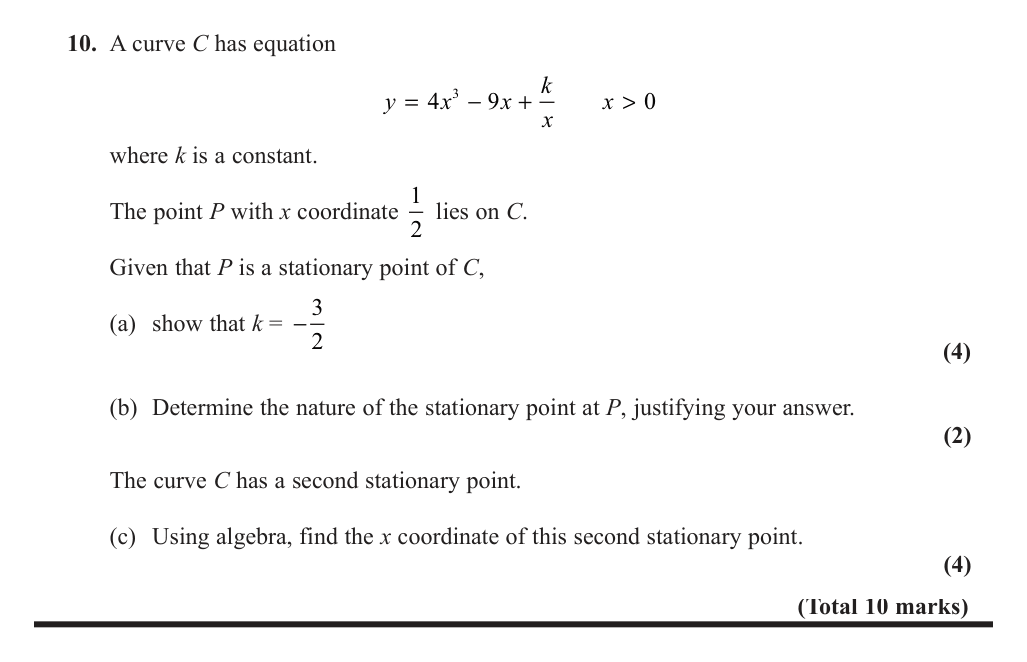
32. WMA12/01 January 2020 · Q10 Hard 10 marksShow worked solution Differentiate the curve Write $y=4x^3-9x+kx^{-1}$. Then $\dfrac{dy}{dx}=12x^2-9-kx^{-2}$.
Use the stationary point At $x=\dfrac12$, $\dfrac{dy}{dx}=0$, so $0=12\left(\dfrac12\right)^2-9-k\left(\dfrac12\right)^{-2}=3-9-4k$.
Find k $-6-4k=0$, hence $k=-\dfrac32$.
Use the second derivative With $k=-\dfrac32$, $\dfrac{dy}{dx}=12x^2-9+\dfrac{3}{2x^2}$ and $\dfrac{d^2y}{dx^2}=24x-3x^{-3}$.
Determine the nature of P At $x=\dfrac12$, $\dfrac{d^2y}{dx^2}=12-24=-12<0$, so $P$ is a local maximum.
Find the other stationary point Set $12x^2-9+\dfrac{3}{2x^2}=0$. Multiplying by $2x^2$ gives $24x^4-18x^2+3=0$, or $8x^4-6x^2+1=0$.
Solve the quadratic in x squared $(4x^2-1)(2x^2-1)=0$. The given point has $x=\dfrac12$, so the second stationary point has $x^2=\dfrac12$.
State the positive x coordinate Since $x>0$, the second stationary point has $x=\dfrac1{\sqrt2}$.
Final answer $(a)\ k=-\dfrac32.\quad (b)$ local maximum. $\quad (c)\ x=\dfrac1{\sqrt2}$.
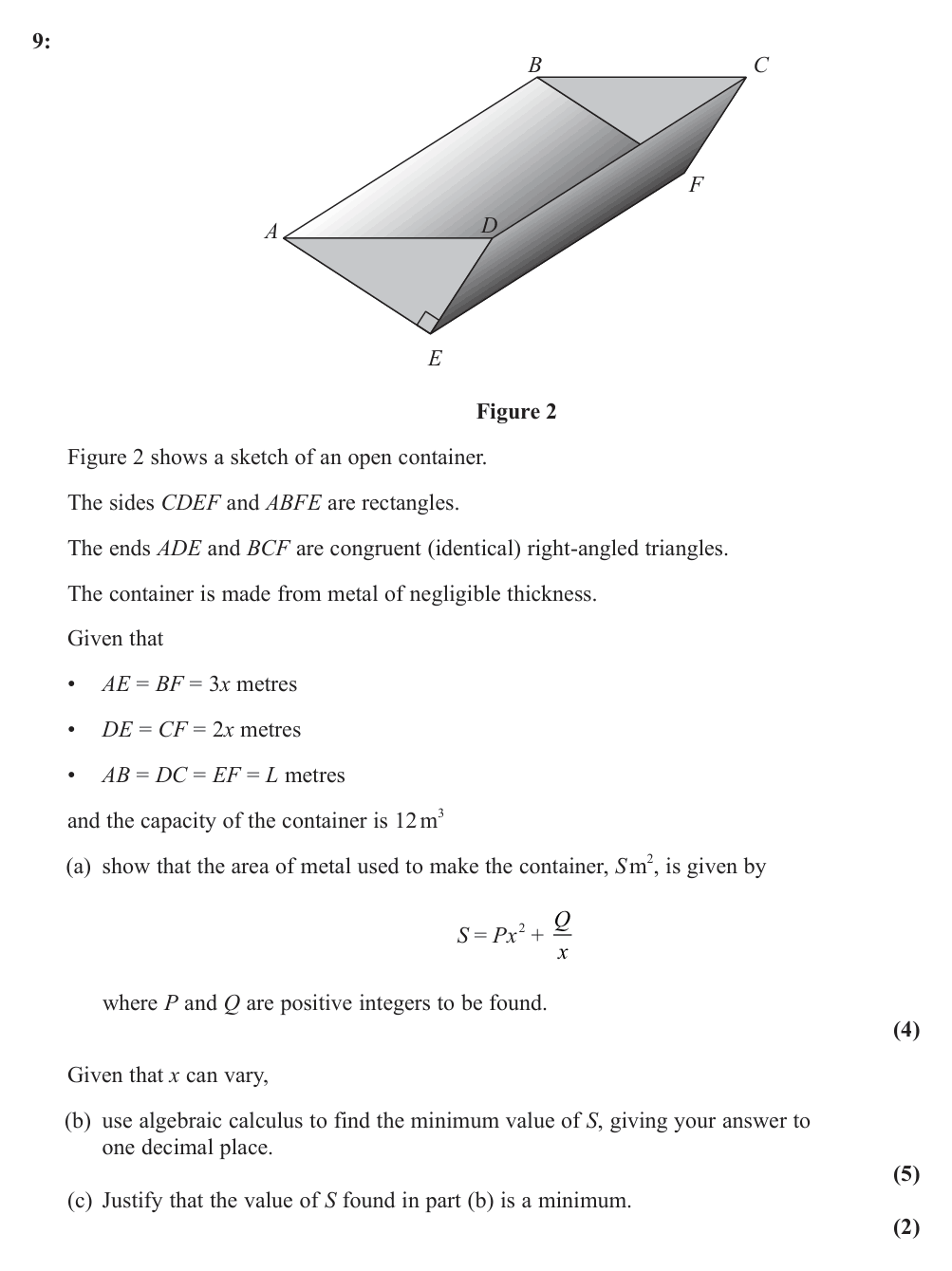
33. WMA12/01 May/June 2025 · Q9 Hard 11 marksShow worked solution Find the triangular end area Each end is a right-angled triangle with perpendicular sides $3x$ and $2x$, so its area is $\dfrac12(3x)(2x)=3x^2$.
Use the capacity The volume is cross-section area times length, so $3x^2L=12$ and $L=\dfrac4{x^2}$.
Write the metal area There are two triangular ends with total area $6x^2$, and two rectangular sides with total area $3xL+2xL=5xL$.
Substitute for L $S=6x^2+5x\left(\dfrac4{x^2}\right)=6x^2+\dfrac{20}{x}$. Hence $P=6$ and $Q=20$.
Differentiate $\dfrac{dS}{dx}=12x-20x^{-2}=12x-\dfrac{20}{x^2}$.
Find the stationary value of x Set $\dfrac{dS}{dx}=0$: $12x=\dfrac{20}{x^2}$, so $x^3=\dfrac53$.
Evaluate S At $x=\sqrt[3]{\dfrac53}$, $S=6x^2+\dfrac{20}{x}=25.3029\ldots$, so the minimum value is $25.3$ to one decimal place.
Differentiate again $\dfrac{d^2S}{dx^2}=12+40x^{-3}=12+\dfrac{40}{x^3}$.
Justify the minimum Since $x>0$, $12+\dfrac{40}{x^3}>0$, so the stationary value found is a minimum.
Final answer $(a)$ $S=6x^2+\dfrac{20}{x}$, so $P=6$ and $Q=20$. $\quad (b)$ $25.3$. $\quad (c)$ Minimum justified.
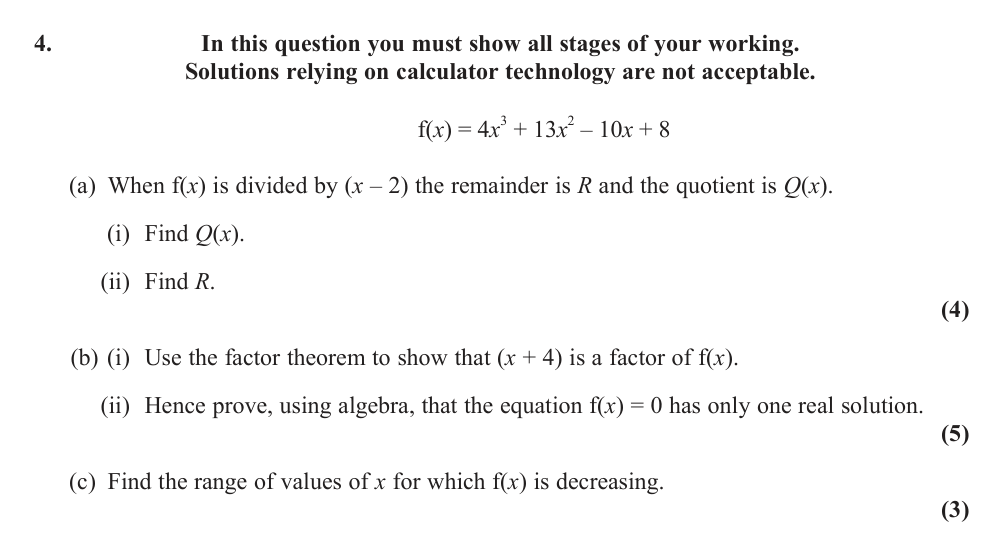
34. WMA12/01 October 2025 · Q4 Hard 12 marks · main topic: PolynomialsShow worked solution Divide by x minus two $4x^3+13x^2-10x+8=(x-2)(4x^2+21x+32)+72$.
State Q and R Hence $Q(x)=4x^2+21x+32$ and $R=72$.
Use the factor theorem $f(-4)=4(-4)^3+13(-4)^2-10(-4)+8=-256+208+40+8=0$.
Show the factor Since $f(-4)=0$, $(x+4)$ is a factor of $f(x)$.
Factor the cubic Dividing by $(x+4)$ gives $f(x)=(x+4)(4x^2-3x+2)$.
Check the quadratic The discriminant of $4x^2-3x+2$ is $(-3)^2-4(4)(2)=9-32=-23<0$, so this quadratic has no real roots.
Conclude the real solution Therefore $f(x)=0$ has only one real solution, $x=-4$.
Differentiate $f'(x)=12x^2+26x-10=2(3x-1)(2x+5)$.
Find where f is decreasing $f(x)$ is decreasing when $f'(x)<0$, which is between the roots. Hence $-\dfrac52<x<\dfrac13$.
Final answer $(a)(i)$ $Q(x)=4x^2+21x+32$. $\quad (a)(ii)$ $R=72$. $\quad (b)$ Proven; only real solution is $x=-4$. $\quad (c)$ $-\dfrac52<x<\dfrac13$.
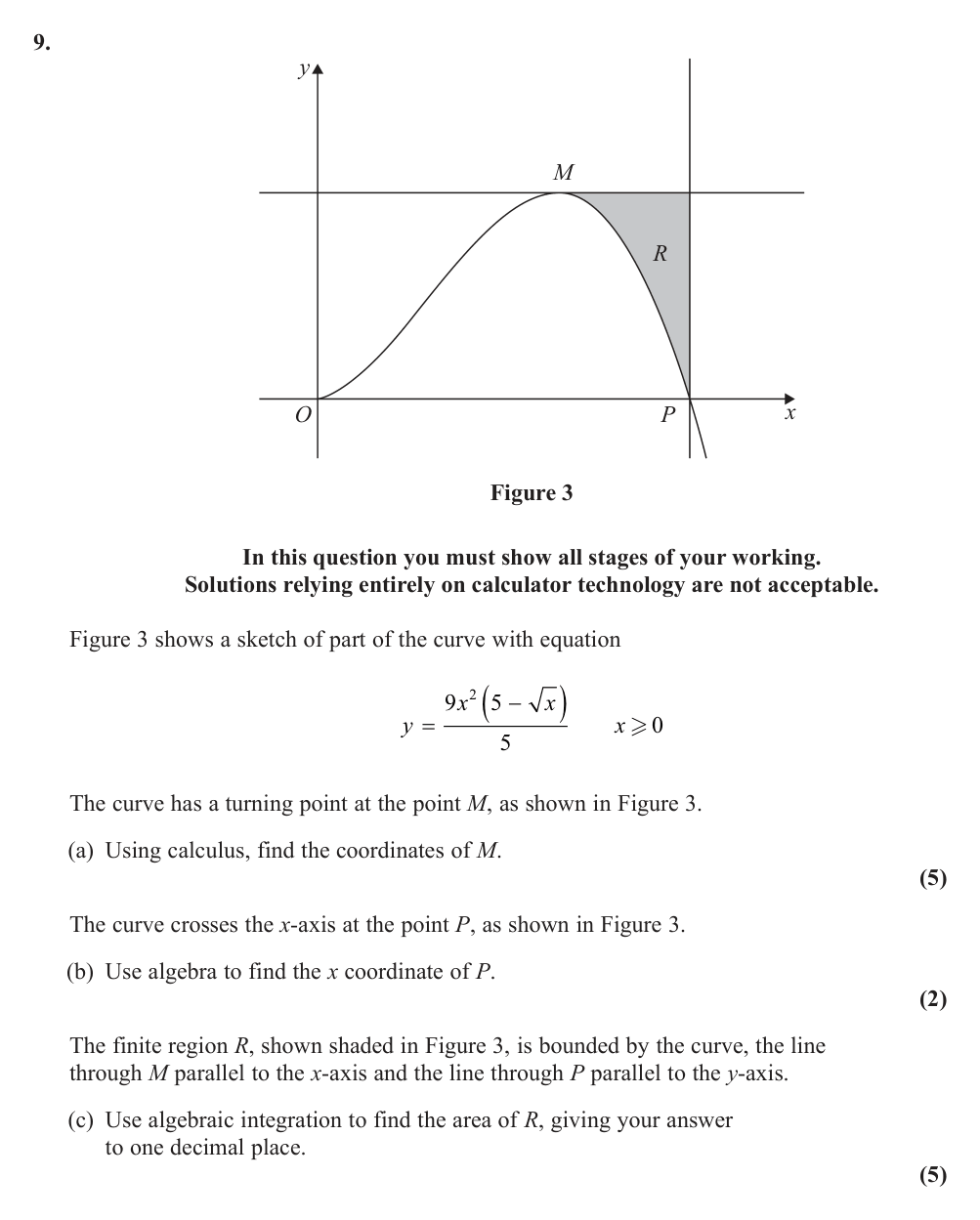
35. WMA12/01 January 2025 · Q9 Hard 12 marks · main topic: IntegrationShow worked solution Rewrite the curve $y=\dfrac{9x^2(5-\sqrt{x})}{5}=9x^2-\dfrac95x^{5/2}$.
Differentiate $\dfrac{dy}{dx}=18x-\dfrac92x^{3/2}=\dfrac92x(4-\sqrt{x})$.
Find the turning point x coordinate For the turning point shown away from the origin, set $4-\sqrt{x}=0$. Hence $x=16$.
Find the y coordinate At $x=16$, $y=\dfrac{9(16)^2(5-4)}{5}=\dfrac{2304}{5}$.
State M Therefore $M\left(16,\dfrac{2304}{5}\right)$.
Find the positive x intercept For the positive intercept, $\dfrac{9x^2(5-\sqrt{x})}{5}=0$ gives $5-\sqrt{x}=0$, so $x=25$.
Set up the area The top boundary is $y=\dfrac{2304}{5}$ and the curve is below it from $x=16$ to $x=25$. So $R=\displaystyle\int_{16}^{25}\left(\dfrac{2304}{5}-9x^2+\dfrac95x^{5/2}\right)dx$.
Integrate $R=\left[\dfrac{2304}{5}x-3x^3+\dfrac{18}{35}x^{7/2}\right]_{16}^{25}$.
Evaluate $R=\dfrac{9189}{7}=1312.714\ldots$, so the area is $1312.7$ to one decimal place.
Final answer $(a)$ $M\left(16,\dfrac{2304}{5}\right)$. $\quad (b)$ $x_P=25$. $\quad (c)$ $1312.7$.
36. WMA12/01 October 2023 · Q9 Hard 12 marksShow worked solution Differentiate For $y=\dfrac23x^2-9\sqrt{x}+13$, $\dfrac{dy}{dx}=\dfrac43x-\dfrac{9}{2\sqrt{x}}$.
Set up increasing condition $y$ is increasing when $\dfrac{dy}{dx}>0$.
Multiply by a positive quantity For $x>0$, multiply by $6\sqrt{x}$: $8x\sqrt{x}-27>0$.
Solve the inequality $x^{3/2}>\dfrac{27}{8}=\left(\dfrac32\right)^3$, so $\sqrt{x}>\dfrac32$ and $x>\dfrac94$.
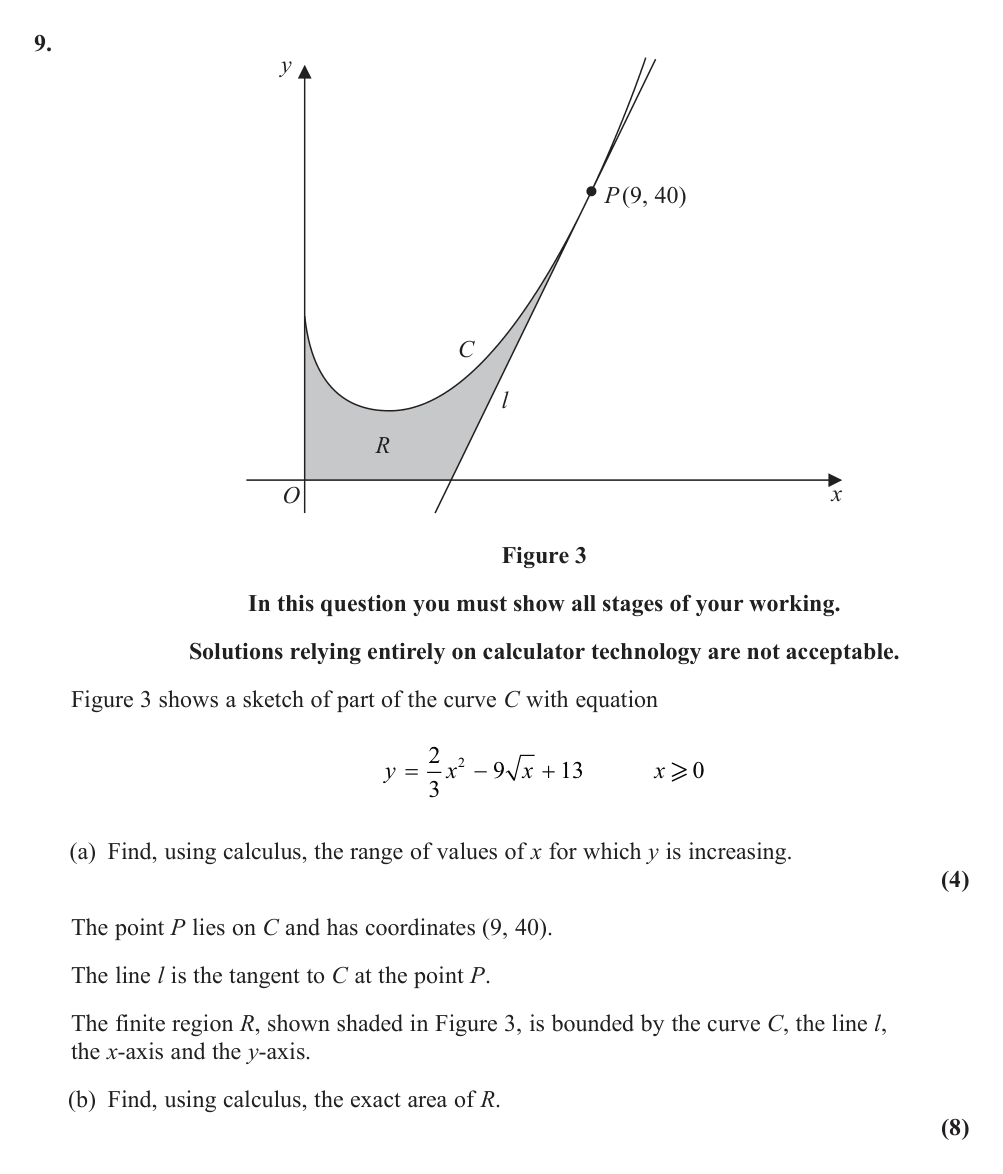
Find the tangent gradient At $P(9,40)$, $\dfrac{dy}{dx}=\dfrac43(9)-\dfrac{9}{2\cdot3}=12-\dfrac32=\dfrac{21}{2}$.
Write the tangent line $y-40=\dfrac{21}{2}(x-9)$, so $y=\dfrac{21}{2}x-\dfrac{109}{2}$.
Find where the tangent meets the x-axis Set $y=0$: $\dfrac{21}{2}x-\dfrac{109}{2}=0$, so $x=\dfrac{109}{21}$.
Split the area From $x=0$ to $x=\dfrac{109}{21}$, the lower boundary is the $x$-axis. From $x=\dfrac{109}{21}$ to $x=9$, the lower boundary is the tangent.
Set up the integral $\displaystyle R=\int_0^{109/21}\left(\dfrac23x^2-9\sqrt{x}+13\right)dx+\int_{109/21}^{9}\left(\dfrac23x^2-9\sqrt{x}+13-\left(\dfrac{21}{2}x-\dfrac{109}{2}\right)\right)dx$.
Use antiderivatives $\displaystyle \int\left(\dfrac23x^2-9\sqrt{x}+13\right)dx=\dfrac{2}{9}x^3-6x^{3/2}+13x$, and $\displaystyle \int\left(\dfrac{21}{2}x-\dfrac{109}{2}\right)dx=\dfrac{21}{4}x^2-\dfrac{109}{2}x$.
Evaluate Substituting the limits and simplifying gives $R=\dfrac{857}{21}$.
Final answer $(a)$ $y$ is increasing for $x>\dfrac94$. $\quad (b)$ Area $=\dfrac{857}{21}$.
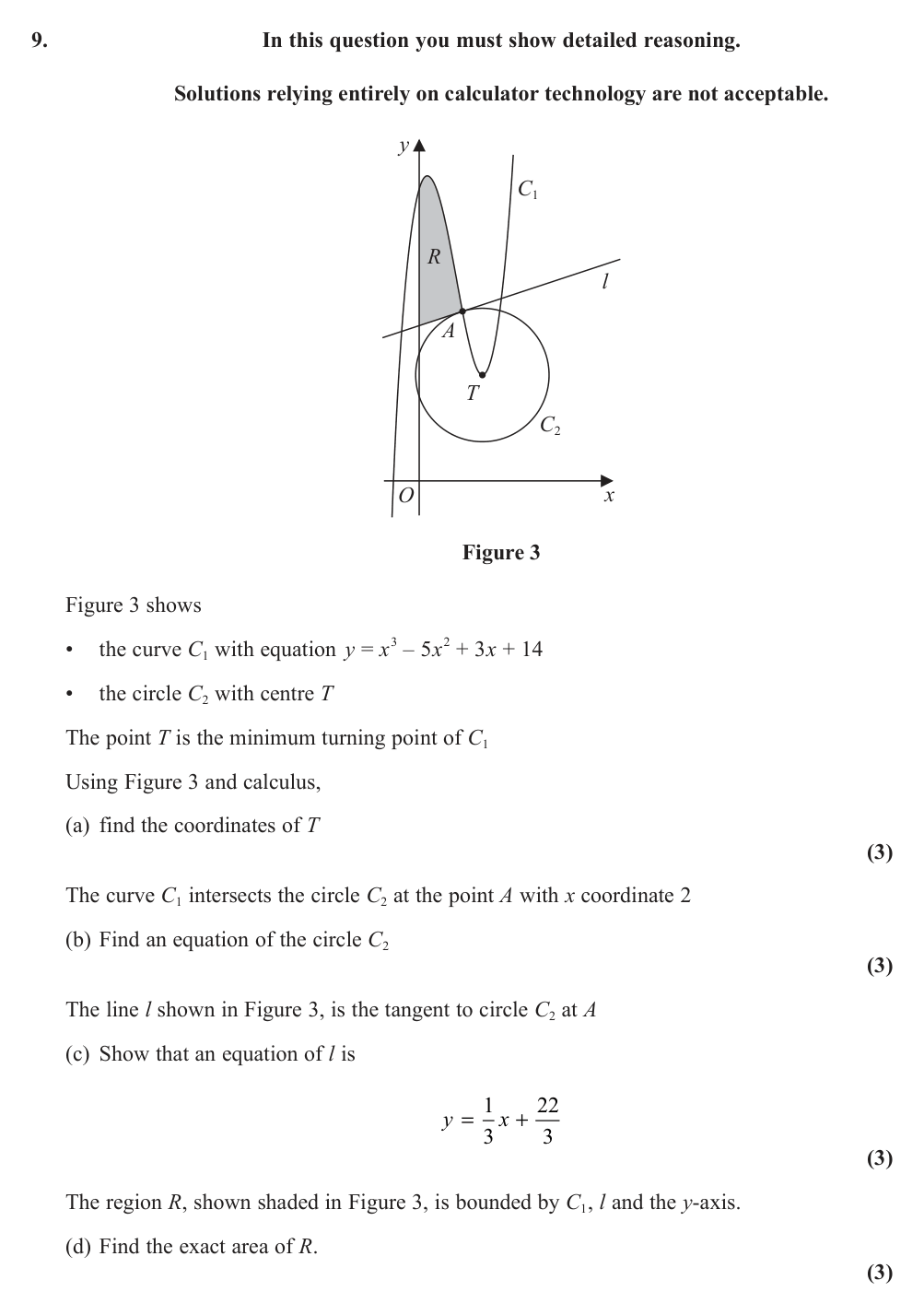
37. WMA12/01 October 2022 · Q9 Hard 12 marks · main topic: CirclesShow worked solution Differentiate the cubic For $y=x^3-5x^2+3x+14$, $\dfrac{dy}{dx}=3x^2-10x+3$.
Find stationary x values $3x^2-10x+3=0$ factors as $(3x-1)(x-3)=0$, so $x=\dfrac13$ or $x=3$.
Identify the minimum $\dfrac{d^2y}{dx^2}=6x-10$. At $x=3$, this is positive, so the minimum turning point has $x=3$.
Find T Substitute $x=3$: $y=27-45+9+14=5$. Hence $T=(3,5)$.
Find A At $x=2$ on $C_1$, $y=8-20+6+14=8$, so $A=(2,8)$.
Find the circle radius The centre of $C_2$ is $T=(3,5)$ and it passes through $A=(2,8)$. Thus $r^2=(2-3)^2+(8-5)^2=10$.
Write the circle equation Therefore $C_2$ has equation $(x-3)^2+(y-5)^2=10$.
Find the tangent gradient The radius $TA$ has gradient $\dfrac{8-5}{2-3}=-3$, so the tangent at $A$ has gradient $\dfrac13$.
Write the tangent equation Using $A=(2,8)$, $y-8=\dfrac13(x-2)$, so $y=\dfrac13x+\dfrac{22}{3}$.
Set up the area From $x=0$ to $x=2$, the cubic is above the line. The required area is $\displaystyle \int_0^2 \left[x^3-5x^2+3x+14-\left(\dfrac13x+\dfrac{22}{3}\right)\right]dx$.
Simplify the integrand The integrand is $x^3-5x^2+\dfrac83x+\dfrac{20}{3}$.
Integrate $\displaystyle \left[\dfrac{x^4}{4}-\dfrac{5x^3}{3}+\dfrac{4x^2}{3}+\dfrac{20x}{3}\right]_0^2=4-\dfrac{40}{3}+\dfrac{16}{3}+\dfrac{40}{3}=\dfrac{28}{3}$.
Final answer $(a)$ $T=(3,5)$. $\quad (b)$ $(x-3)^2+(y-5)^2=10$. $\quad (c)$ $y=\dfrac13x+\dfrac{22}{3}$. $\quad (d)$ $\dfrac{28}{3}$.
Dr Eslam Ahmed Elite Mathematics · Questions classified by topic, solutions checked by Dr Eslam
 Elite Mathematics