Elite Mathematics / Pure 2 / Topics / Circles IAL · WMA12 · Topic Circles: past paper questions & worked solutions
Every Circles question from the WMA12 papers in our bank, 2019–2026, sorted from easiest to hardest. Try each one first, then open the worked solution.
20 questions
161 marks in total
100% of papers (19 of 19) include it
4/10/6 easy / medium / hard
Questions, easiest first Level is estimated from marks: 1–6 easy, 7–8 medium, 9+ hard.
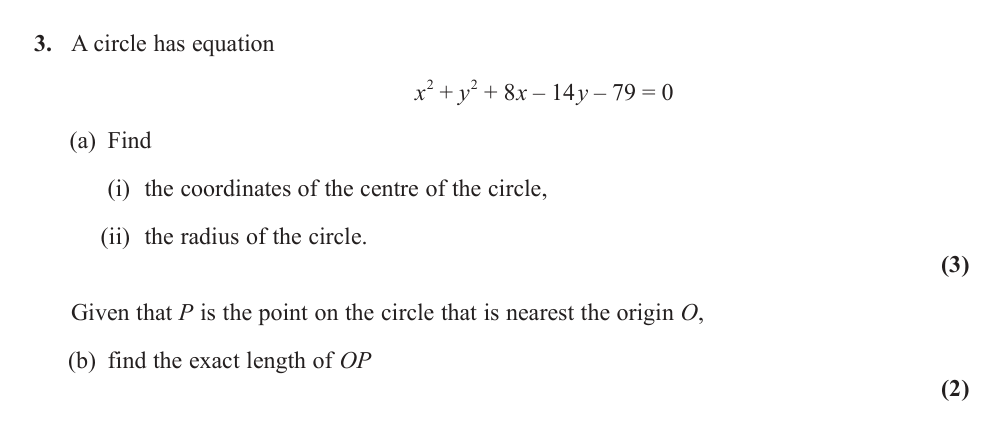
1. WMA12/01 May/June R 2024 · Q3 Easy 5 marksShow worked solution Complete the square $x^2+y^2+8x-14y-79=0$ becomes $(x+4)^2-16+(y-7)^2-49-79=0$.
Write standard form $(x+4)^2+(y-7)^2=144$.
Read centre and radius The centre is $(-4,7)$ and the radius is $12$.
Find distance from centre to origin The distance from $(-4,7)$ to $O(0,0)$ is $\sqrt{(-4)^2+7^2}=\sqrt{65}$.
Use origin inside the circle Since $\sqrt{65}<12$, the origin is inside the circle.
Find nearest distance to the circle The nearest point on the circle lies along the line from the centre to the origin, so $OP=12-\sqrt{65}$.
Final answer $(a)(i)$ $(-4,7)$. $\quad (a)(ii)$ $12$. $\quad (b)$ $12-\sqrt{65}$.
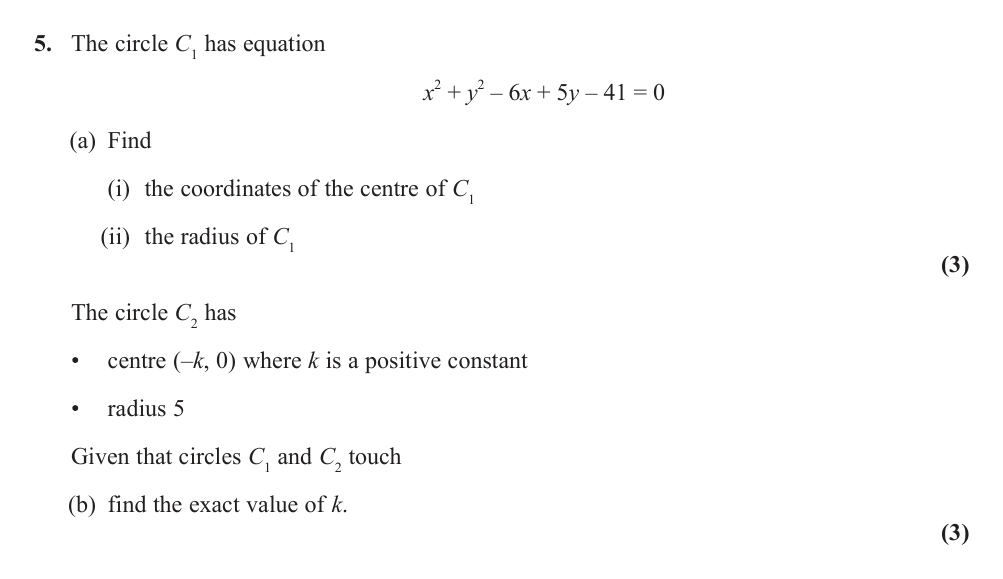
2. WMA12/01 January 2026 · Q5 Easy 6 marksShow worked solution Complete the square $x^2-6x=(x-3)^2-9$ and $y^2+5y=\left(y+\dfrac52\right)^2-\dfrac{25}{4}$.
Write the circle in centre-radius form The equation becomes $(x-3)^2+\left(y+\dfrac52\right)^2=\dfrac{225}{4}$.
Read the centre and radius The centre is $\left(3,-\dfrac52\right)$ and the radius is $\sqrt{\dfrac{225}{4}}=\dfrac{15}{2}$.
Use the touching condition The centre of $C_2$ is $(-k,0)$ and its radius is $5$. Since the circles touch externally, the distance between centres is $\dfrac{15}{2}+5=\dfrac{25}{2}$.
Solve for k $(k+3)^2+\left(\dfrac52\right)^2=\left(\dfrac{25}{2}\right)^2$, so $(k+3)^2=150$. Since $k>0$, $k+3=5\sqrt6$, hence $k=5\sqrt6-3$.
Final answer $(a)(i)\ (3,-\dfrac52).\quad (a)(ii)\ \dfrac{15}{2}.\quad (b)\ k=5\sqrt6-3$.
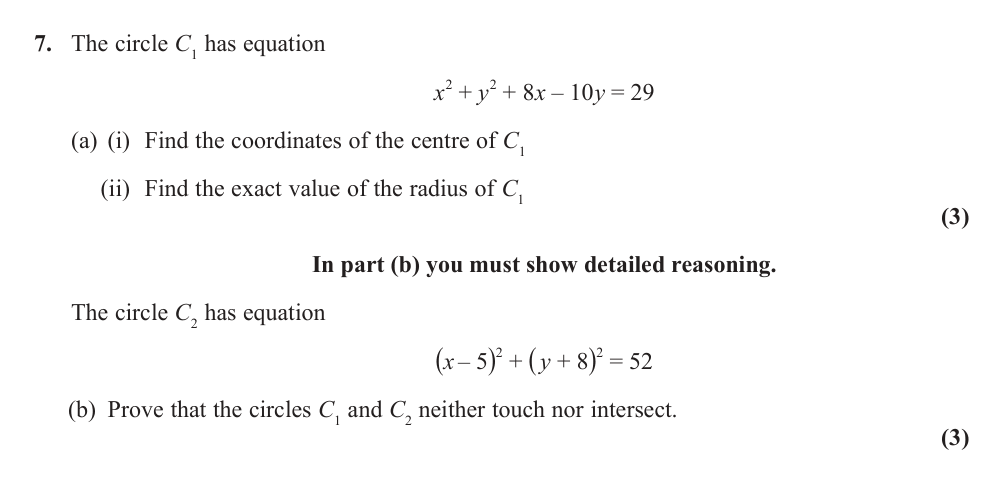
3. WMA12/01 May/June 2024 · Q7 Easy 6 marksShow worked solution Complete the square $x^2+y^2+8x-10y=29$ becomes $(x+4)^2-16+(y-5)^2-25=29$.
Write circle C1 in standard form $(x+4)^2+(y-5)^2=70$.
Read centre and radius The centre of $C_1$ is $(-4,5)$ and its radius is $\sqrt{70}$.
Read C2 $C_2$ has equation $(x-5)^2+(y+8)^2=52$, so its centre is $(5,-8)$ and its radius is $\sqrt{52}=2\sqrt{13}$.
Find distance between centres The distance between $(-4,5)$ and $(5,-8)$ is $\sqrt{9^2+(-13)^2}=\sqrt{250}=5\sqrt{10}$.
Compare with radii $\sqrt{70}+2\sqrt{13}=15.58\ldots$, while $5\sqrt{10}=15.81\ldots$.
Conclude The distance between centres is greater than the sum of the radii, so the circles are separate. Therefore they neither touch nor intersect.
Final answer $(a)(i)$ $(-4,5)$. $\quad (a)(ii)$ $\sqrt{70}$. $\quad (b)$ The circles neither touch nor intersect.
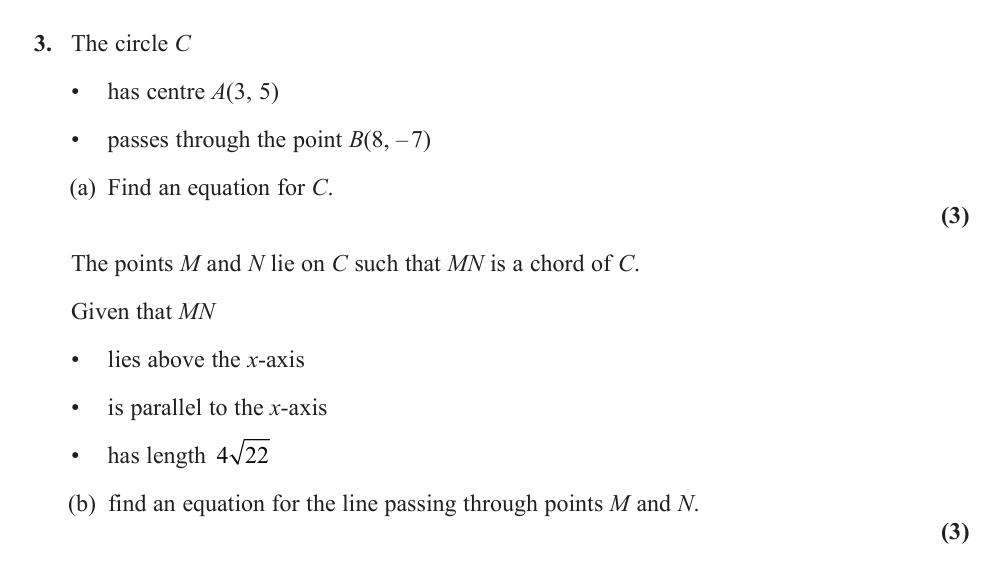
4. WMA12/01 January 2024 · Q3 Easy 6 marksShow worked solution Find the radius squared The centre is $A(3,5)$ and the circle passes through $B(8,-7)$, so $r^2=(8-3)^2+(-7-5)^2=25+144=169$.
Write the circle equation Hence $C$ has equation $(x-3)^2+(y-5)^2=169$.
Use the horizontal chord Since $MN$ is parallel to the $x$-axis, its equation has the form $y=c$.
Use half the chord length The chord length is $4\sqrt{22}$, so the half-length is $2\sqrt{22}$.
Relate chord length to the circle At height $y=c$, the horizontal half-length satisfies $169-(c-5)^2=(2\sqrt{22})^2=88$.
Solve for c $(c-5)^2=81$, so $c=14$ or $c=-4$.
Use the position above the x-axis The chord lies above the $x$-axis, so $c=14$. Therefore the line through $M$ and $N$ is $y=14$.
Final answer $(a)$ $(x-3)^2+(y-5)^2=169$. $\quad (b)$ $y=14$.
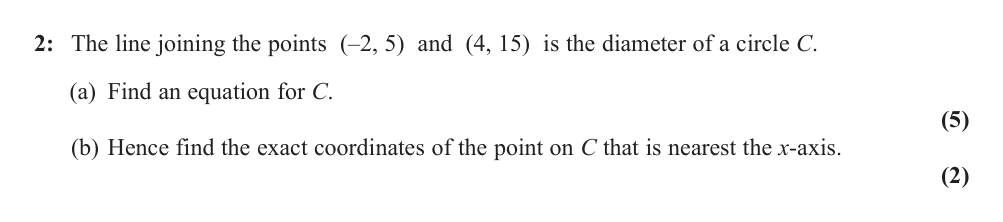
5. WMA12/01 May/June 2025 · Q2 Medium 7 marksShow worked solution Find the centre The centre is the midpoint of $(-2,5)$ and $(4,15)$, so it is $\left(\dfrac{-2+4}{2},\dfrac{5+15}{2}\right)=(1,10)$.
Find the radius squared Using $(-2,5)$, $r^2=(-2-1)^2+(5-10)^2=9+25=34$.
Write the circle equation Therefore $C$ has equation $(x-1)^2+(y-10)^2=34$.
Find the nearest point to the x axis The nearest point to the $x$-axis is vertically below the centre by one radius.
Write the coordinates The radius is $\sqrt{34}$, so the point is $\left(1,10-\sqrt{34}\right)$.
Final answer $(a)$ $(x-1)^2+(y-10)^2=34$. $\quad (b)$ $\left(1,10-\sqrt{34}\right)$.
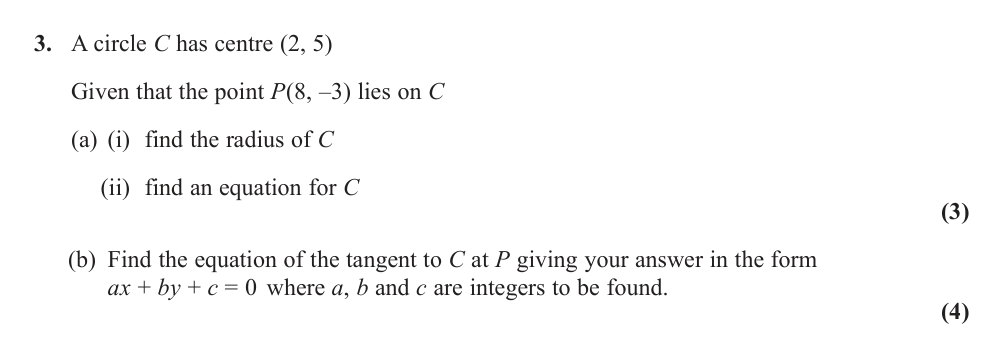
6. WMA12/01 May/June 2023 · Q3 Medium 7 marksShow worked solution Use the distance formula The centre is $(2,5)$ and $P=(8,-3)$. The radius is $\sqrt{(8-2)^2+(-3-5)^2}$.
Find the radius $r=\sqrt{6^2+(-8)^2}=\sqrt{100}=10$.
Write the circle equation With centre $(2,5)$ and radius $10$, the circle is $(x-2)^2+(y-5)^2=100$.
Find the radius gradient The gradient of the radius from the centre to $P$ is $\dfrac{-3-5}{8-2}=\dfrac{-8}{6}=-\dfrac43$.
Find the tangent gradient The tangent is perpendicular to the radius, so its gradient is $\dfrac34$.
Use point P The tangent through $(8,-3)$ is $y+3=\dfrac34(x-8)$.
Put into integer form Multiplying by $4$ gives $4y+12=3x-24$, hence $3x-4y-36=0$.
Final answer $(a)(i)$ $10$. $\quad (a)(ii)$ $(x-2)^2+(y-5)^2=100$. $\quad (b)$ $3x-4y-36=0$.
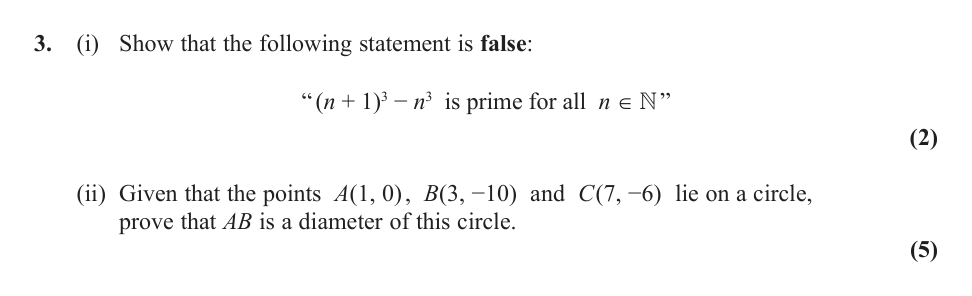
7. WMA12/01 May/June 2022 · Q3 Medium 7 marks · main topic: ProofShow worked solution Choose a counterexample Take $n=5$.
Evaluate the expression $(5+1)^3-5^3=216-125=91$.
Show it is not prime $91=7\times13$, so the statement is false.
Find the gradient CA For $A(1,0)$ and $C(7,-6)$, the gradient of $CA$ is $\dfrac{0-(-6)}{1-7}=-1$.
Find the gradient CB For $B(3,-10)$ and $C(7,-6)$, the gradient of $CB$ is $\dfrac{-10-(-6)}{3-7}=1$.
Show the right angle The product of the gradients is $-1$, so $CA$ is perpendicular to $CB$ and $\angle ACB=90^\circ$.
Conclude the diameter An angle of $90^\circ$ at the circumference subtends a diameter, so $AB$ is a diameter of the circle.
Final answer $(i)$ Counterexample: $n=5$ gives $91$, not prime. $\quad (ii)$ Proven: $AB$ is a diameter.
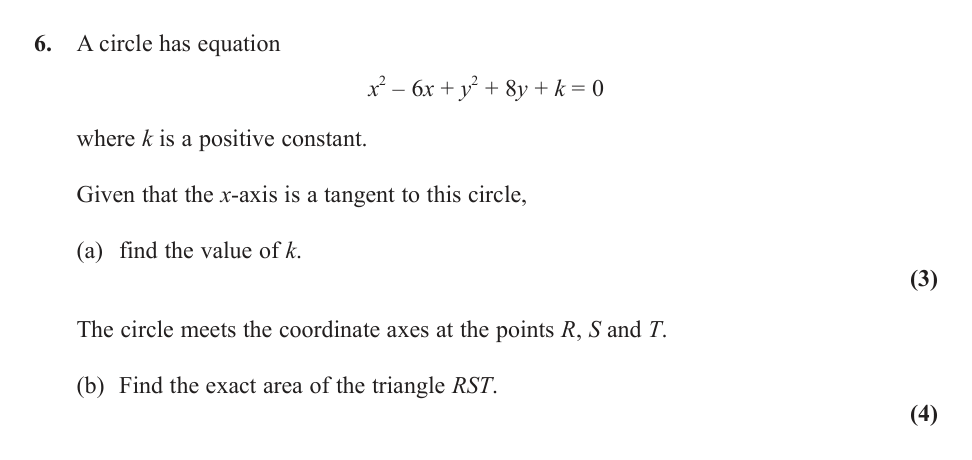
8. WMA12/01 May/June 2021 · Q6 Medium 7 marksShow worked solution Complete the square $x^2-6x=(x-3)^2-9$ and $y^2+8y=(y+4)^2-16$.
Write centre-radius form The circle becomes $(x-3)^2+(y+4)^2=25-k$.
Use the tangent condition The centre is $(3,-4)$. Since the $x$-axis is tangent, the radius is the distance from the centre to the $x$-axis, which is $4$.
Find k Thus $25-k=4^2=16$, so $k=9$.
Find the intercepts With $k=9$, the circle is $(x-3)^2+(y+4)^2=16$. On the $x$-axis, $y=0$, giving $x=3$.
Find the y-axis points On the $y$-axis, $x=0$, so $9+(y+4)^2=16$. Hence $y=-4\pm\sqrt7$.
Calculate the triangle area The vertical base on the $y$-axis has length $2\sqrt7$, and its perpendicular distance to $(3,0)$ is $3$. The area is $\dfrac12(2\sqrt7)(3)=3\sqrt7$.
Final answer $(a)\ k=9.\quad (b)\ 3\sqrt7$.
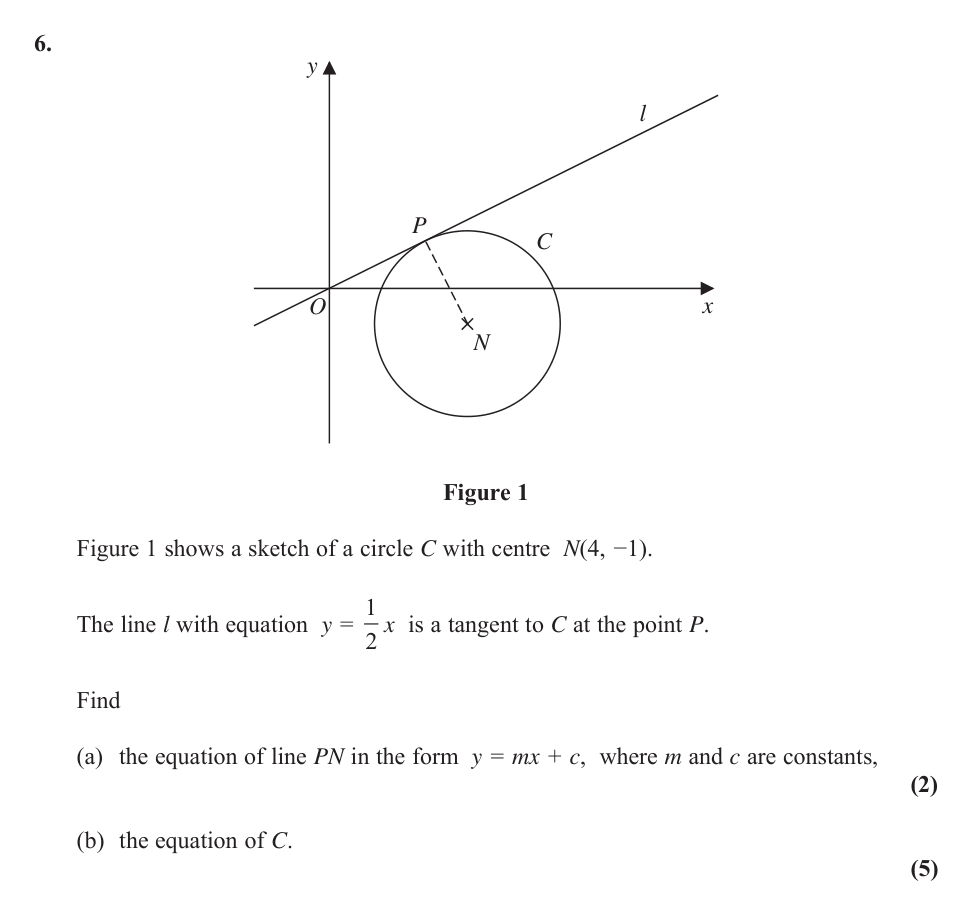
9. WMA12/01 October 2019 · Q6 Medium 7 marksShow worked solution Use perpendicular gradients The tangent has gradient $\dfrac12$, so the radius $PN$ has gradient $-2$.
Find the equation of PN Line $PN$ passes through $N(4,-1)$, so $y+1=-2(x-4)$. Therefore $y=-2x+7$.
Find point P At $P$, the tangent $y=\dfrac12x$ meets the radius $y=-2x+7$. Thus $\dfrac12x=-2x+7$, so $x=\dfrac{14}{5}$ and $y=\dfrac75$.
Find the radius squared $r^2=\left(\dfrac{14}{5}-4\right)^2+\left(\dfrac75+1\right)^2=\left(-\dfrac65\right)^2+\left(\dfrac{12}{5}\right)^2=\dfrac{36}{5}$.
Write the circle equation With centre $(4,-1)$ and radius squared $\dfrac{36}{5}$, the circle is $(x-4)^2+(y+1)^2=\dfrac{36}{5}$.
Final answer $(a)\ y=-2x+7.\quad (b)\ (x-4)^2+(y+1)^2=\dfrac{36}{5}$.
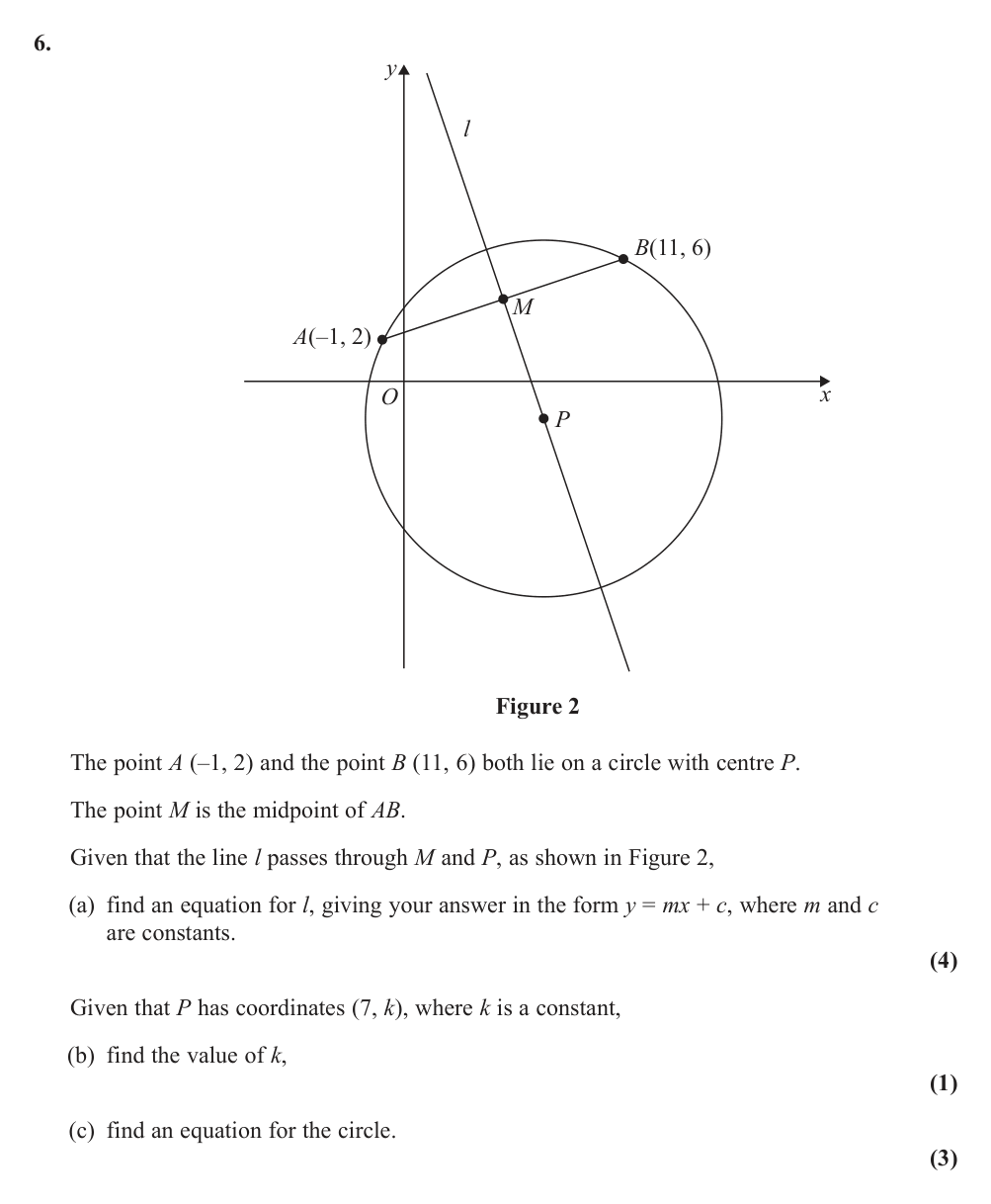
10. WMA12/01 January 2025 · Q6 Medium 8 marksShow worked solution Find the midpoint For $A(-1,2)$ and $B(11,6)$, the midpoint is $M\left(\dfrac{-1+11}{2},\dfrac{2+6}{2}\right)=(5,4)$.
Find the gradient of AB The gradient of $AB$ is $\dfrac{6-2}{11-(-1)}=\dfrac{4}{12}=\dfrac13$.
Use the perpendicular bisector The centre lies on the perpendicular bisector of the chord $AB$, so line $l$ has gradient $-3$ and passes through $M(5,4)$.
Find line l $y-4=-3(x-5)$, so $y=-3x+19$.
Use the centre coordinates Since $P=(7,k)$ lies on $l$, $k=-3(7)+19=-2$.
Find the radius squared The centre is $(7,-2)$. Using point $A$, $r^2=(7-(-1))^2+(-2-2)^2=8^2+(-4)^2=80$.
Write the circle equation Therefore the circle is $(x-7)^2+(y+2)^2=80$.
Final answer $(a)$ $y=-3x+19$. $\quad (b)$ $k=-2$. $\quad (c)$ $(x-7)^2+(y+2)^2=80$.
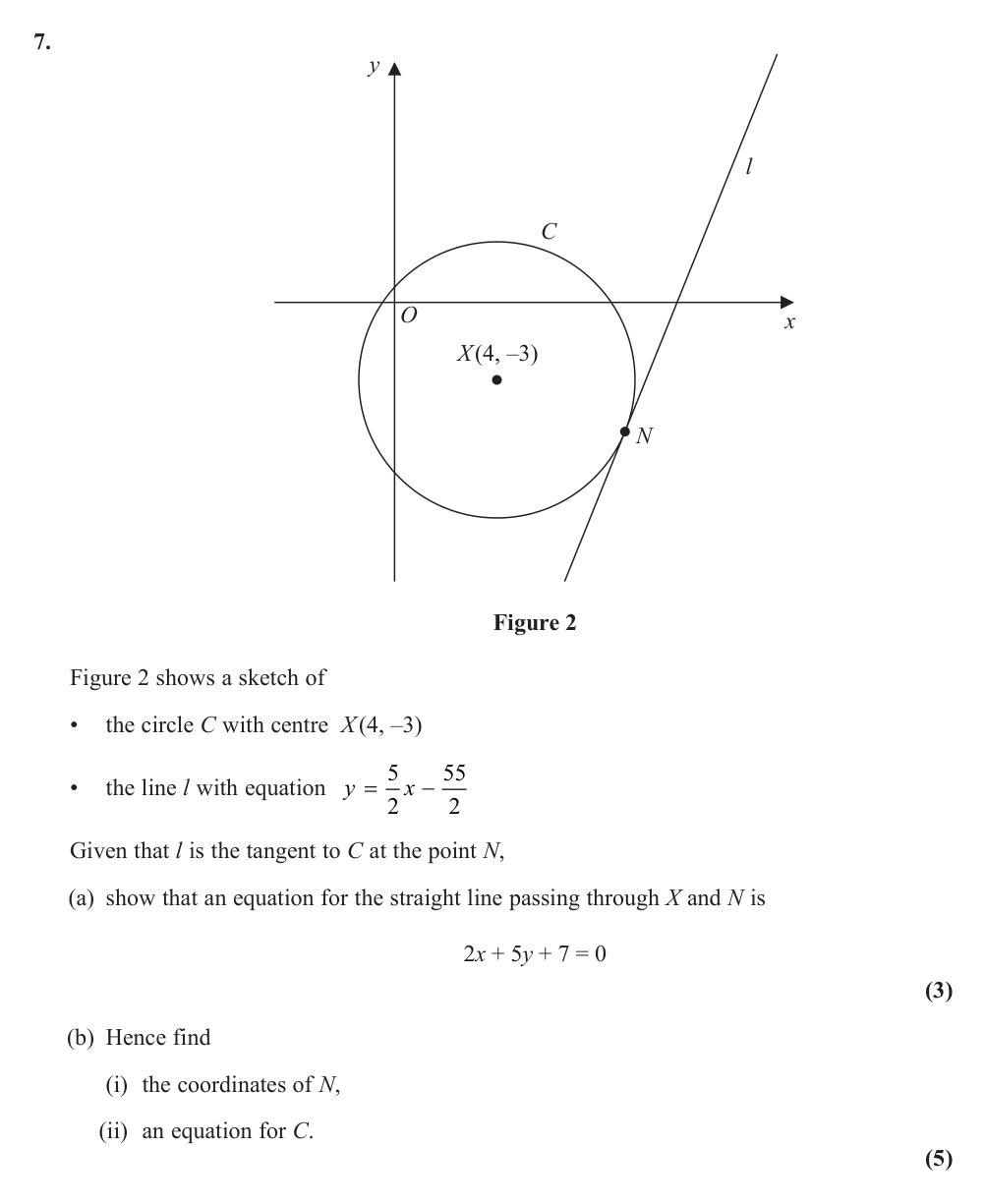
11. WMA12/01 October 2023 · Q7 Medium 8 marksShow worked solution Use perpendicular gradients The tangent $l$ has gradient $\dfrac52$, so the radius $XN$ is perpendicular to it and has gradient $-\dfrac25$.
Use the centre The line through $X(4,-3)$ with gradient $-\dfrac25$ is $y+3=-\dfrac25(x-4)$.
Show the required line Multiplying by $5$ gives $5y+15=-2x+8$, so $2x+5y+7=0$.
Intersect the radius and tangent Use $y=\dfrac52x-\dfrac{55}{2}$ in $2x+5y+7=0$.
Find x coordinate $2x+5\left(\dfrac52x-\dfrac{55}{2}\right)+7=0$. Multiplying by $2$ gives $4x+25x-275+14=0$, so $29x=261$ and $x=9$.
Find y coordinate $y=\dfrac52(9)-\dfrac{55}{2}=\dfrac{45-55}{2}=-5$, so $N=(9,-5)$.
Find the radius squared $XN^2=(9-4)^2+(-5+3)^2=5^2+(-2)^2=29$.
Write the circle equation With centre $(4,-3)$ and radius squared $29$, the circle is $(x-4)^2+(y+3)^2=29$.
Final answer $(a)$ Proven. $\quad (b)(i)$ $N=(9,-5)$. $\quad (b)(ii)$ $(x-4)^2+(y+3)^2=29$.
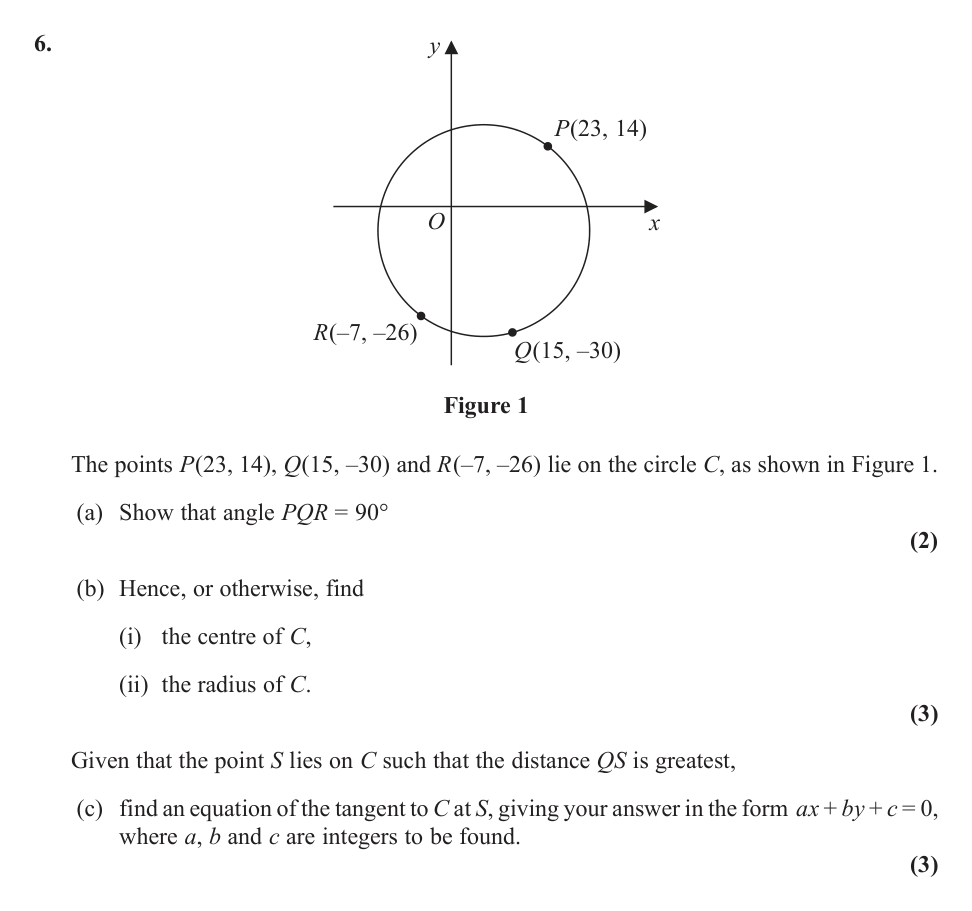
12. WMA12/01 January 2022 · Q6 Medium 8 marksShow worked solution Find the gradient QP The gradient of $QP$ is $\dfrac{14-(-30)}{23-15}=\dfrac{44}{8}=\dfrac{11}{2}$.
Find the gradient QR The gradient of $QR$ is $\dfrac{-26-(-30)}{-7-15}=\dfrac4{-22}=-\dfrac2{11}$.
Show the right angle The product of the two gradients is $-1$, so $QP$ is perpendicular to $QR$ and $\angle PQR=90^\circ$.
Use the diameter Since the angle at $Q$ is a right angle, $PR$ is a diameter of the circle.
Find the centre The centre is the midpoint of $P(23,14)$ and $R(-7,-26)$, so it is $(8,-6)$.
Find the radius $PR=\sqrt{30^2+40^2}=50$, so the radius is $25$.
Find the farthest point from Q The greatest distance from $Q$ occurs at the point opposite $Q$ on the diameter through the centre. Thus $S=2(8,-6)-(15,-30)=(1,18)$.
Find the tangent gradient The radius from the centre to $S$ has gradient $\dfrac{18-(-6)}{1-8}=-\dfrac{24}{7}$, so the tangent gradient is $\dfrac7{24}$.
Write the tangent equation $y-18=\dfrac7{24}(x-1)$, which rearranges to $7x-24y+425=0$.
Final answer $(a)$ Proven: $\angle PQR=90^\circ$. $\quad (b)(i)\ (8,-6).\quad (b)(ii)\ 25.\quad (c)\ 7x-24y+425=0$.
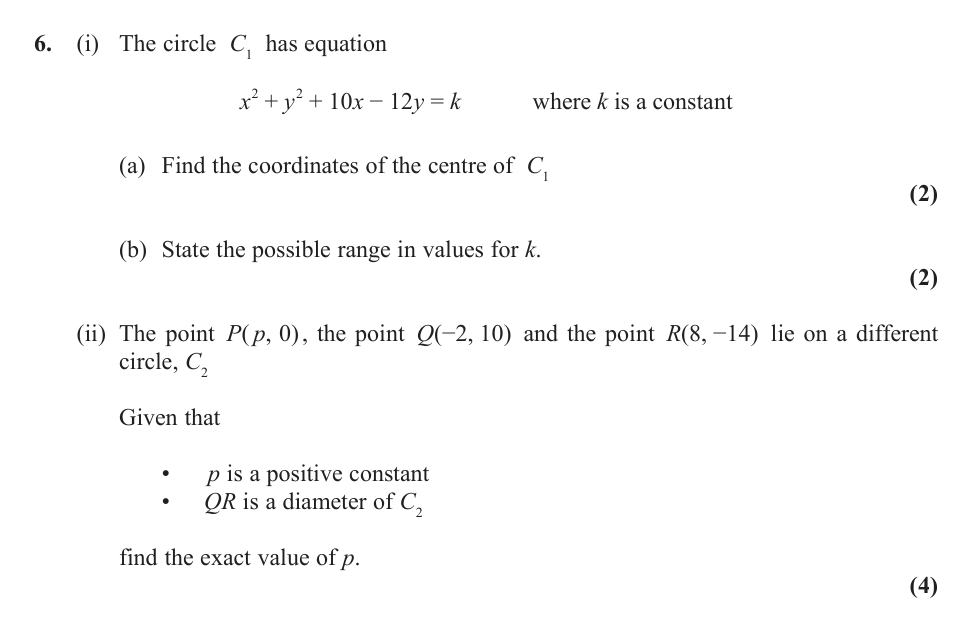
13. WMA12/01 October 2021 · Q6 Medium 8 marksShow worked solution Complete the square $x^2+10x=(x+5)^2-25$ and $y^2-12y=(y-6)^2-36$.
Write centre-radius form The circle becomes $(x+5)^2+(y-6)^2=k+61$.
Read the centre The centre is $(-5,6)$.
State the range for k For a circle with positive radius, $k+61>0$, so $k>-61$.
Use the diameter property If $QR$ is a diameter and $P$ lies on the circle, then $\angle QPR=90^\circ$.
Use perpendicular vectors So $(Q-P)\cdot(R-P)=0$. With $P=(p,0)$, $Q=(-2,10)$, and $R=(8,-14)$, this gives $(-2-p,10)\cdot(8-p,-14)=0$.
Form the quadratic $(-2-p)(8-p)-140=0$, so $p^2-6p-156=0$.
Choose the positive value $p=\dfrac{6\pm\sqrt{660}}{2}=3\pm\sqrt{165}$. Since $p$ is positive, $p=3+\sqrt{165}$.
Final answer $(i)(a)\ (-5,6).\quad (i)(b)\ k>-61.\quad (ii)\ p=3+\sqrt{165}$.
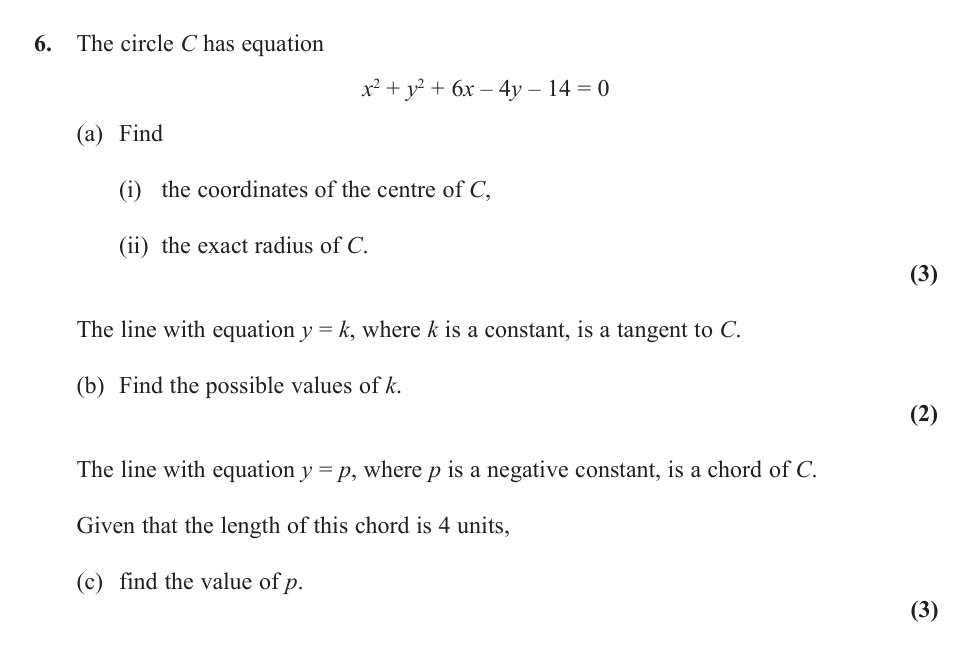
14. WMA12/01 January 2020 · Q6 Medium 8 marksShow worked solution Complete the square $x^2+6x=(x+3)^2-9$ and $y^2-4y=(y-2)^2-4$.
Find the centre and radius The circle becomes $(x+3)^2+(y-2)^2=27$. Hence the centre is $(-3,2)$ and the radius is $\sqrt{27}=3\sqrt3$.
Use horizontal tangents A horizontal tangent has equation $y=k$. The possible tangent levels are one radius above and below the centre, so $k=2\pm3\sqrt3$.
Use half the chord length The chord has length $4$, so half the chord is $2$. If the chord is $y=p$, its perpendicular distance from the centre is $|p-2|$.
Apply Pythagoras $(p-2)^2+2^2=(3\sqrt3)^2=27$, so $(p-2)^2=23$.
Choose the negative value Since $p$ is negative, $p=2-\sqrt{23}$.
Final answer $(a)(i)\ (-3,2).\quad (a)(ii)\ 3\sqrt3.\quad (b)\ k=2\pm3\sqrt3.\quad (c)\ p=2-\sqrt{23}$.
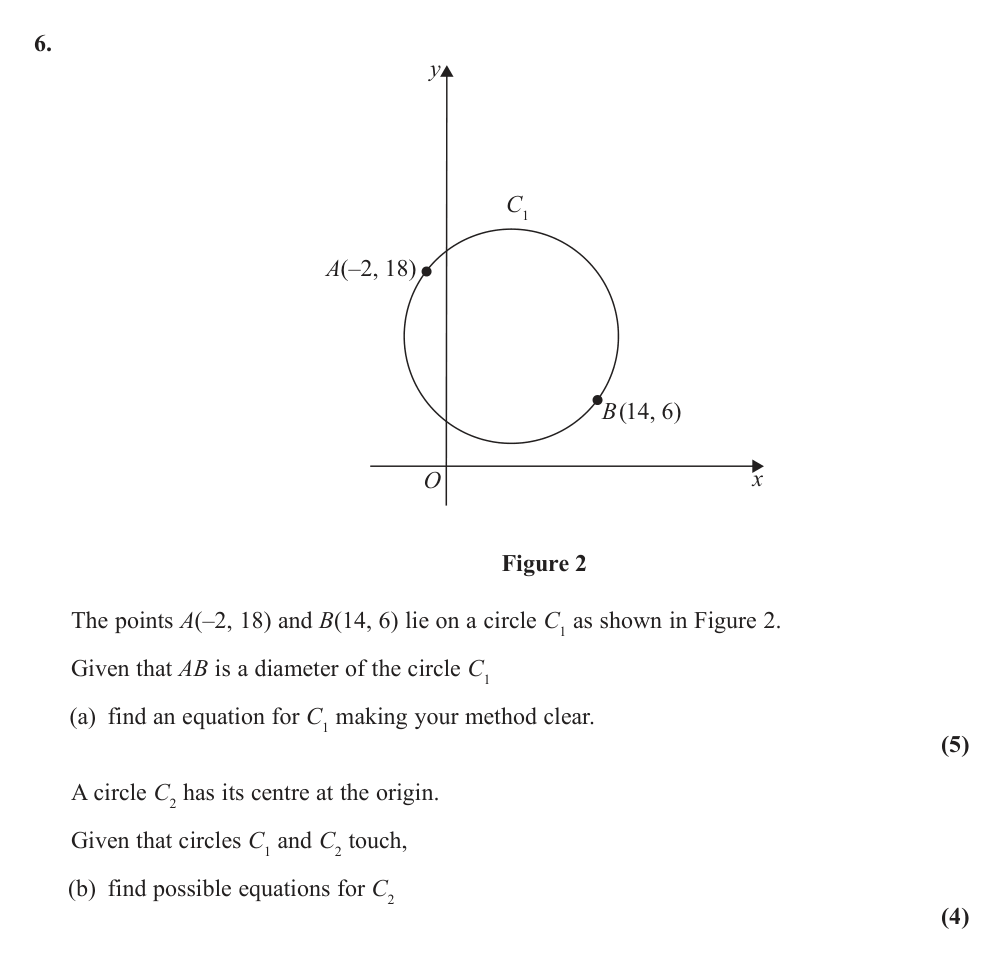
15. WMA12/01 October 2025 · Q6 Hard 9 marksShow worked solution Find the centre of C one Since $AB$ is a diameter, the centre is the midpoint of $A(-2,18)$ and $B(14,6)$. This is $(6,12)$.
Find the radius squared Using $A(-2,18)$, $r^2=(-2-6)^2+(18-12)^2=64+36=100$.
Write C one Therefore $C_1$ has equation $(x-6)^2+(y-12)^2=100$.
Find the centre distance The distance from the origin to $(6,12)$ is $\sqrt{6^2+12^2}=6\sqrt5$.
Find possible radii for C two Since $C_1$ has radius $10$, a circle centred at the origin can touch it with radius $6\sqrt5-10$ or $6\sqrt5+10$.
Write the equations Thus $C_2$ can be $x^2+y^2=(6\sqrt5-10)^2=280-120\sqrt5$ or $x^2+y^2=(6\sqrt5+10)^2=280+120\sqrt5$.
Final answer $(a)$ $(x-6)^2+(y-12)^2=100$. $\quad (b)$ $x^2+y^2=280-120\sqrt5$ or $x^2+y^2=280+120\sqrt5$.
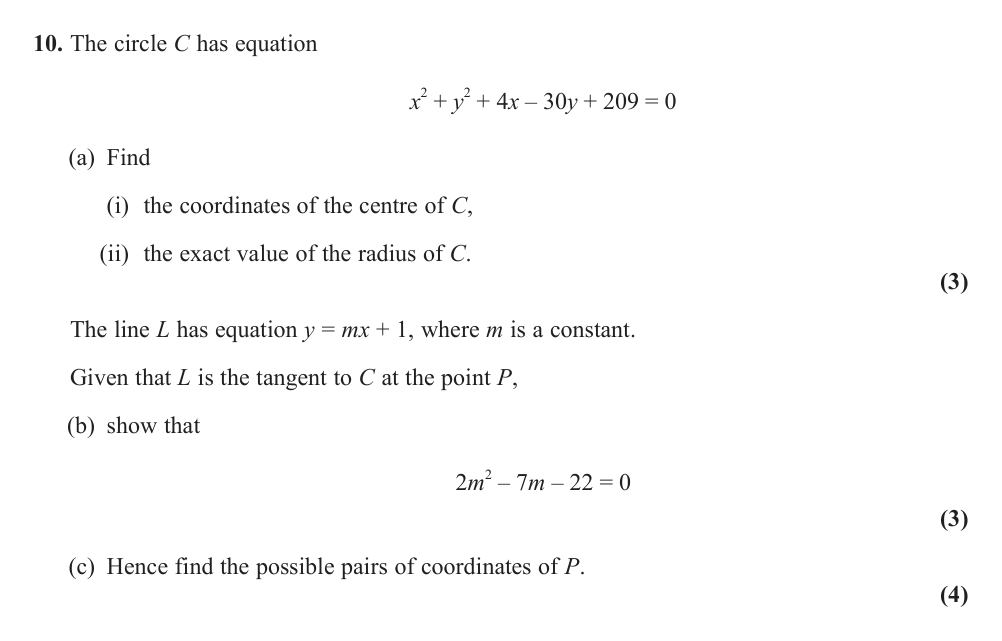
16. WMA12/01 October 2024 · Q10 Hard 10 marksShow worked solution Complete the square $x^2+y^2+4x-30y+209=0$ becomes $(x+2)^2+(y-15)^2=20$.
Read the centre and radius The centre is $(-2,15)$ and the radius is $\sqrt{20}=2\sqrt5$.
Use the tangent distance The line $y=mx+1$ can be written as $mx-y+1=0$. Its distance from $(-2,15)$ must be $2\sqrt5$.
Set up the equation for m $\dfrac{|m(-2)-15+1|}{\sqrt{m^2+1}}=2\sqrt5$, so $\dfrac{|-2m-14|}{\sqrt{m^2+1}}=2\sqrt5$.
Show the quadratic Squaring gives $4(m+7)^2=20(m^2+1)$. Hence $(m+7)^2=5(m^2+1)$, so $2m^2-7m-22=0$.
Find the possible gradients $2m^2-7m-22=0$ gives $m=-2$ or $m=\dfrac{11}{2}$.
Use perpendicular radii A tangent is perpendicular to the radius at the point of contact.
Find the first point For $m=-2$, the radius gradient is $\dfrac12$. The radius through the centre is $y-15=\dfrac12(x+2)$. Solving with $y=-2x+1$ gives $x=-6$ and $y=13$.
Find the second point For $m=\dfrac{11}{2}$, the radius gradient is $-\dfrac2{11}$. The radius through the centre is $y-15=-\dfrac2{11}(x+2)$. Solving with $y=\dfrac{11}{2}x+1$ gives $x=\dfrac{12}{5}$ and $y=\dfrac{71}{5}$.
Final answer $(a)(i)$ $(-2,15)$. $\quad (a)(ii)$ $2\sqrt5$. $\quad (b)$ Proven. $\quad (c)$ $(-6,13)$ and $\left(\dfrac{12}{5},\dfrac{71}{5}\right)$.
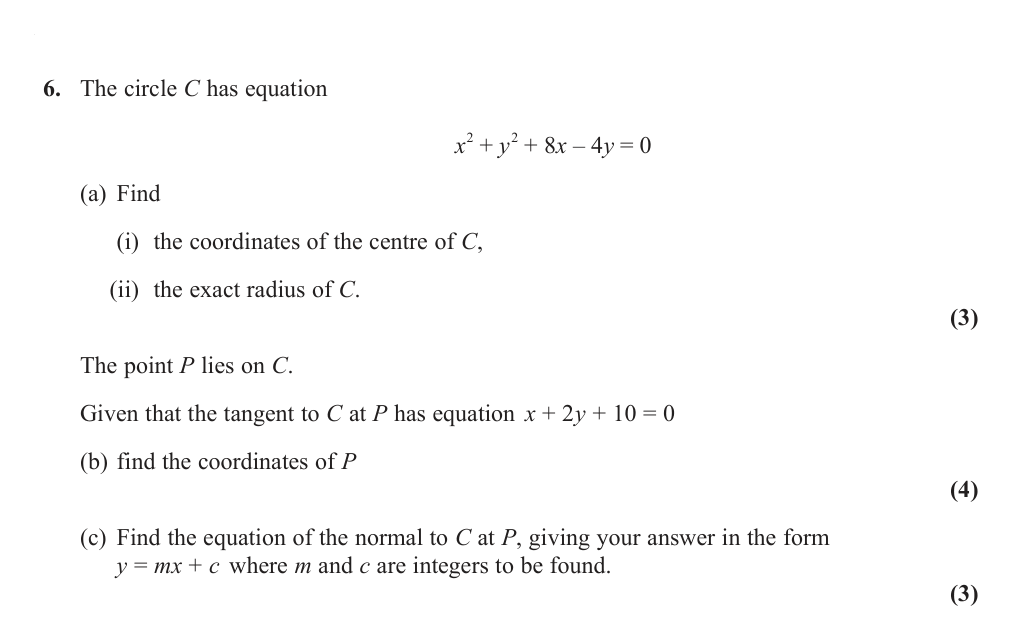
17. WMA12/01 January 2023 · Q6 Hard 10 marksShow worked solution Complete the square $x^2+y^2+8x-4y=0$ becomes $(x+4)^2-16+(y-2)^2-4=0$.
Write the circle form So $(x+4)^2+(y-2)^2=20$.
Read the centre and radius The centre is $(-4,2)$ and the radius is $\sqrt{20}=2\sqrt5$.
Use the tangent gradient The tangent $x+2y+10=0$ has gradient $-\dfrac12$.
Find the radius gradient The radius to the point of contact is perpendicular to the tangent, so its gradient is $2$.
Write the normal through the centre The radius line through the centre $(-4,2)$ is $y-2=2(x+4)$, so $y=2x+10$.
Intersect with the tangent Substitute $y=2x+10$ into $x+2y+10=0$: $x+2(2x+10)+10=0$.
Find P $5x+30=0$, so $x=-6$. Then $y=2(-6)+10=-2$, hence $P=(-6,-2)$.
State the normal The normal at $P$ is the radius line already found, so its equation is $y=2x+10$.
Final answer $(a)(i)$ $(-4,2)$. $\quad (a)(ii)$ $2\sqrt5$. $\quad (b)$ $P=(-6,-2)$. $\quad (c)$ $y=2x+10$.
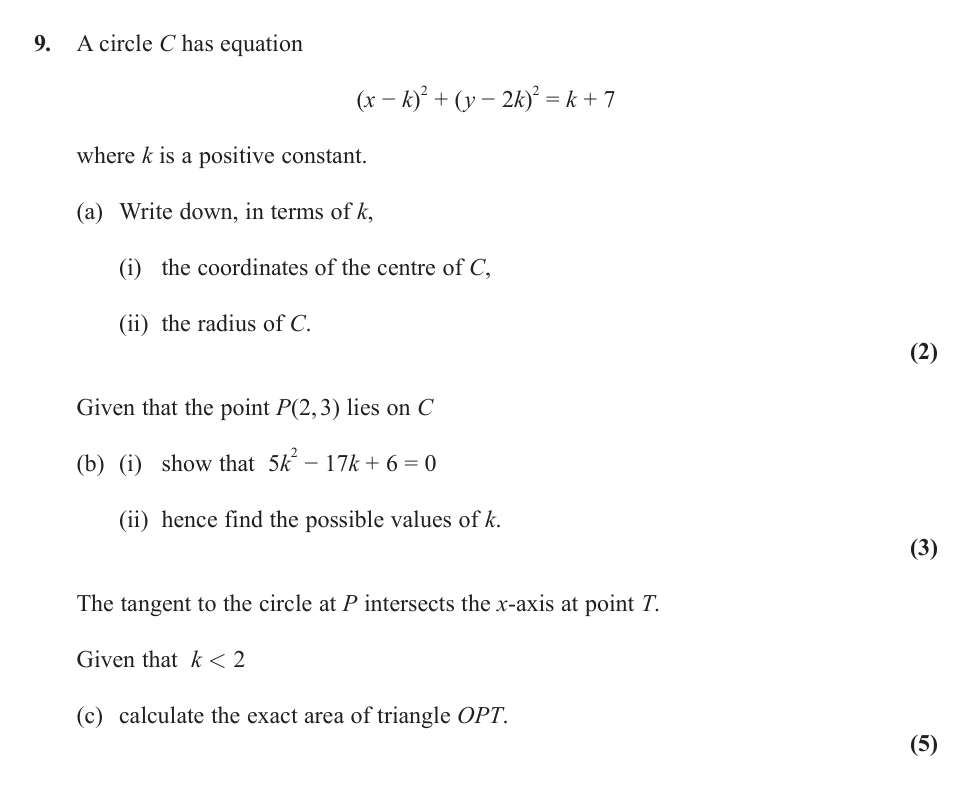
18. WMA12/01 January 2021 · Q9 Hard 10 marksShow worked solution Read the centre and radius From $(x-k)^2+(y-2k)^2=k+7$, the centre is $(k,2k)$ and the radius is $\sqrt{k+7}$.
Substitute point P Since $P(2,3)$ lies on the circle, $(2-k)^2+(3-2k)^2=k+7$.
Show the quadratic Expanding gives $k^2-4k+4+4k^2-12k+9=k+7$, hence $5k^2-17k+6=0$.
Solve for k $5k^2-17k+6=(5k-2)(k-3)$, so $k=\dfrac25$ or $k=3$.
Use the condition k less than two For the tangent calculation, $k<2$, so the centre is $\left(\dfrac25,\dfrac45\right)$.
Find the tangent gradient The radius from the centre to $P$ has gradient $\dfrac{3-4/5}{2-2/5}=\dfrac{11}{8}$, so the tangent gradient is $-\dfrac8{11}$.
Find the x intercept The tangent is $y-3=-\dfrac8{11}(x-2)$. Setting $y=0$ gives $x=\dfrac{49}{8}$, so $T=\left(\dfrac{49}{8},0\right)$.
Calculate the area Triangle $OPT$ has base $\dfrac{49}{8}$ on the $x$-axis and height $3$, so its area is $\dfrac12\cdot\dfrac{49}{8}\cdot3=\dfrac{147}{16}$.
Final answer $(a)(i)\ (k,2k).\quad (a)(ii)\ \sqrt{k+7}.\quad (b)(ii)\ k=3\text{ or }\dfrac25.\quad (c)\ \dfrac{147}{16}$.
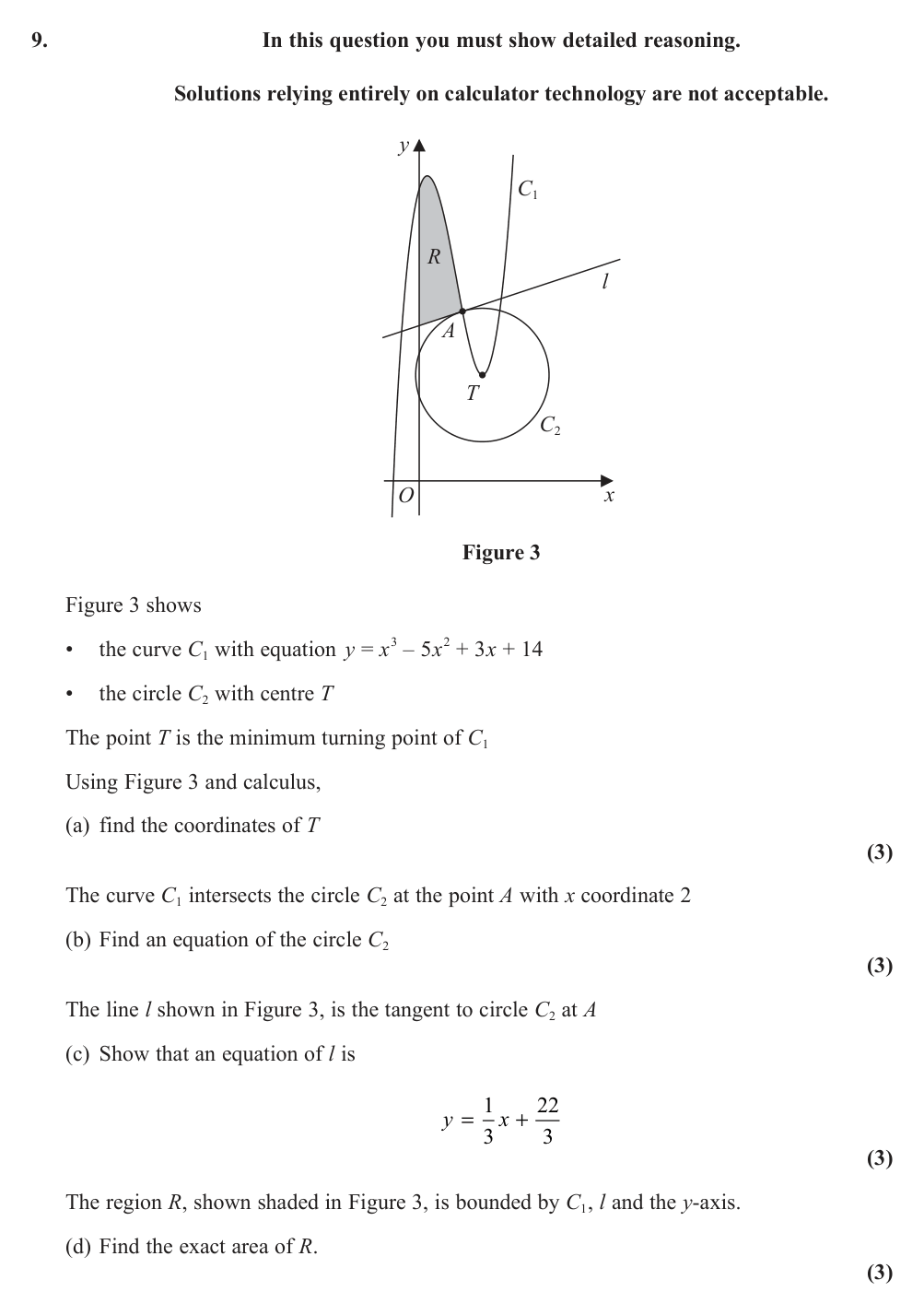
19. WMA12/01 October 2022 · Q9 Hard 12 marksShow worked solution Differentiate the cubic For $y=x^3-5x^2+3x+14$, $\dfrac{dy}{dx}=3x^2-10x+3$.
Find stationary x values $3x^2-10x+3=0$ factors as $(3x-1)(x-3)=0$, so $x=\dfrac13$ or $x=3$.
Identify the minimum $\dfrac{d^2y}{dx^2}=6x-10$. At $x=3$, this is positive, so the minimum turning point has $x=3$.
Find T Substitute $x=3$: $y=27-45+9+14=5$. Hence $T=(3,5)$.
Find A At $x=2$ on $C_1$, $y=8-20+6+14=8$, so $A=(2,8)$.
Find the circle radius The centre of $C_2$ is $T=(3,5)$ and it passes through $A=(2,8)$. Thus $r^2=(2-3)^2+(8-5)^2=10$.
Write the circle equation Therefore $C_2$ has equation $(x-3)^2+(y-5)^2=10$.
Find the tangent gradient The radius $TA$ has gradient $\dfrac{8-5}{2-3}=-3$, so the tangent at $A$ has gradient $\dfrac13$.
Write the tangent equation Using $A=(2,8)$, $y-8=\dfrac13(x-2)$, so $y=\dfrac13x+\dfrac{22}{3}$.
Set up the area From $x=0$ to $x=2$, the cubic is above the line. The required area is $\displaystyle \int_0^2 \left[x^3-5x^2+3x+14-\left(\dfrac13x+\dfrac{22}{3}\right)\right]dx$.
Simplify the integrand The integrand is $x^3-5x^2+\dfrac83x+\dfrac{20}{3}$.
Integrate $\displaystyle \left[\dfrac{x^4}{4}-\dfrac{5x^3}{3}+\dfrac{4x^2}{3}+\dfrac{20x}{3}\right]_0^2=4-\dfrac{40}{3}+\dfrac{16}{3}+\dfrac{40}{3}=\dfrac{28}{3}$.
Final answer $(a)$ $T=(3,5)$. $\quad (b)$ $(x-3)^2+(y-5)^2=10$. $\quad (c)$ $y=\dfrac13x+\dfrac{22}{3}$. $\quad (d)$ $\dfrac{28}{3}$.
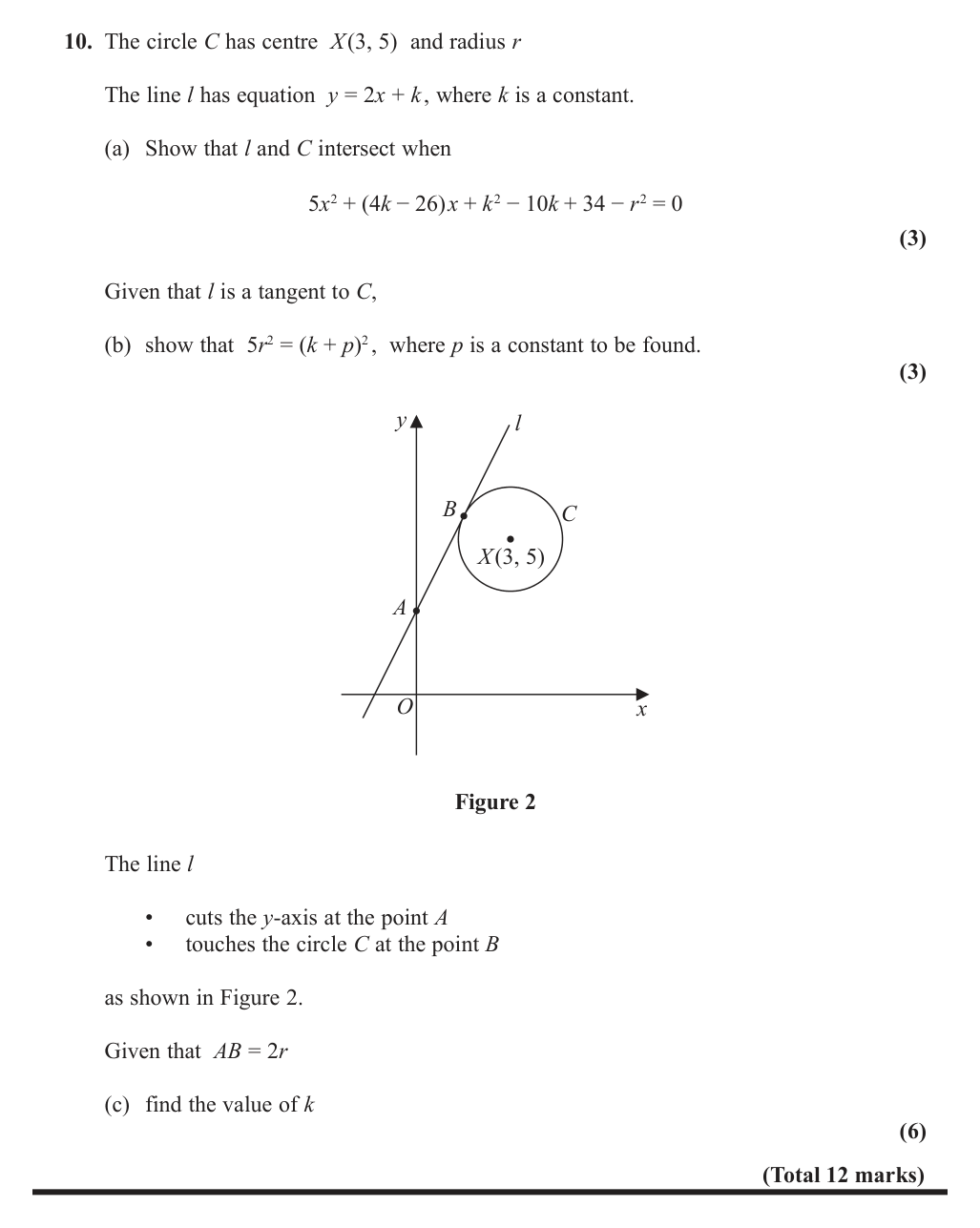
20. WMA12/01 May/June 2022 · Q10 Hard 12 marksShow worked solution Write the circle equation The circle has centre $(3,5)$ and radius $r$, so $(x-3)^2+(y-5)^2=r^2$.
Substitute the line On the line, $y=2x+k$. Substitution gives $(x-3)^2+(2x+k-5)^2=r^2$.
Expand $x^2-6x+9+4x^2+4kx-20x+k^2-10k+25-r^2=0$.
Show the intersection equation Collecting terms gives $5x^2+(4k-26)x+k^2-10k+34-r^2=0$.
Use tangency For a tangent, the quadratic has one repeated root, so its discriminant is zero.
Set the discriminant to zero $(4k-26)^2-20(k^2-10k+34-r^2)=0$.
Simplify This reduces to $20r^2-4k^2-8k-4=0$, hence $5r^2=(k+1)^2$. Therefore $p=1$.
Find the tangent point x coordinate For the repeated root, $x_B=-\dfrac{4k-26}{2\cdot5}=\dfrac{13-2k}{5}$.
Use distance AB The point $A$ is $(0,k)$ and $B$ lies on a line of gradient $2$, so $AB=\sqrt{x_B^2+(2x_B)^2}=\sqrt5\,x_B$.
Use the radius relation From $5r^2=(k+1)^2$, $r=\dfrac{k+1}{\sqrt5}$ in the shown configuration.
Apply AB equals two r $\sqrt5\left(\dfrac{13-2k}{5}\right)=2\left(\dfrac{k+1}{\sqrt5}\right)$.
Solve for k Multiplying by $\sqrt5$ gives $13-2k=2k+2$, so $k=\dfrac{11}{4}$.
Final answer $(a)$ Proven. $\quad (b)\ 5r^2=(k+1)^2$, so $p=1$. $\quad (c)\ k=\dfrac{11}{4}$.
Dr Eslam Ahmed Elite Mathematics · Questions classified by topic, solutions checked by Dr Eslam
 Elite Mathematics