Arithmetic Sequences and Series: past paper questions & worked solutions
Every Arithmetic Sequences and Series question from the WMA12 papers in our bank, 2019–2026, sorted from easiest to hardest. Try each one first, then open the worked solution.
Medium7 marks · main topic: Binomial ExpansionShow worked solution
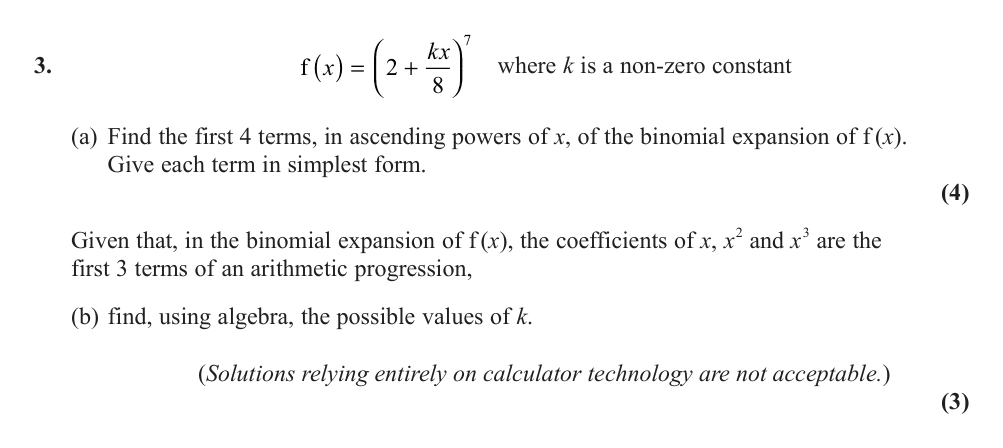
Start the binomial expansion
$\left(2+\dfrac{kx}{8}\right)^7$ begins with $2^7+7(2^6)\left(\dfrac{kx}{8}\right)+\binom72(2^5)\left(\dfrac{kx}{8}\right)^2+\binom73(2^4)\left(\dfrac{kx}{8}\right)^3$.
Simplify the terms
This gives $128+56kx+\dfrac{21}{2}k^2x^2+\dfrac{35}{32}k^3x^3$.
Use the arithmetic progression condition
The coefficients of $x$, $x^2$ and $x^3$ are $56k$, $\dfrac{21}{2}k^2$ and $\dfrac{35}{32}k^3$.
Set middle twice
For three terms in an arithmetic progression, twice the middle term equals the sum of the outer terms: $21k^2=56k+\dfrac{35}{32}k^3$.
Use k non-zero
Since $k\ne0$, divide by $k$ and multiply by $32$: $672k=1792+35k^2$.
Solve the quadratic
So $35k^2-672k+1792=0$. The discriminant is $672^2-4(35)(1792)=200704=448^2$.
Find the possible values
$k=\dfrac{672\pm448}{70}$, giving $k=16$ or $k=\dfrac{16}{5}$.
Final answer
$(a)$ $128+56kx+\dfrac{21}{2}k^2x^2+\dfrac{35}{32}k^3x^3$. $\quad (b)$ $k=\dfrac{16}{5}$ or $k=16$.
8. WMA12/01 May/June 2021 · Q1
Medium7 marks · main topic: Modelling with Sequences & SeriesShow worked solution
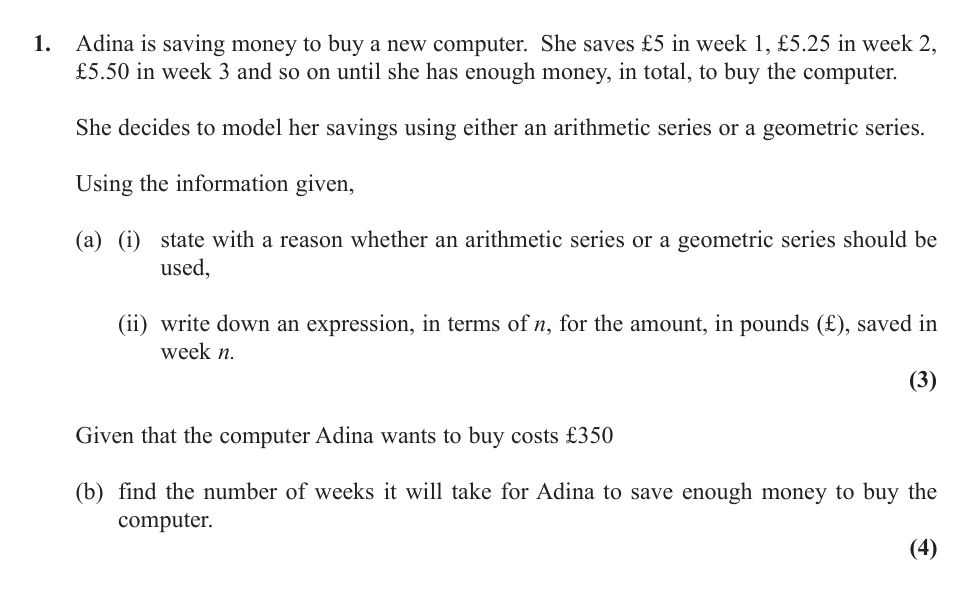
Choose the model
The weekly amounts are $5$, $5.25$, $5.50$, and so on. The increase is a constant $0.25$, so an arithmetic series should be used.
Write the nth amount
The first amount is $5$ and the common difference is $0.25$, so the amount saved in week $n$ is $5+0.25(n-1)$.
Set up the total
After $n$ weeks, $S_n=\dfrac n2\{2(5)+(n-1)(0.25)\}$.
Form the inequality
Adina needs $S_n\geq350$, so $\dfrac n2(9.75+0.25n)\geq350$.
Solve for n
This is $n^2+39n-2800\geq0$. The positive root is $36.89\ldots$, so the first whole number that works is $n=37$.
Check the week
After $36$ weeks the total is below $350$, and after $37$ weeks it is $351.50$, so it takes $37$ weeks.
Hard12 marks · main topic: Trigonometric EquationsShow worked solution
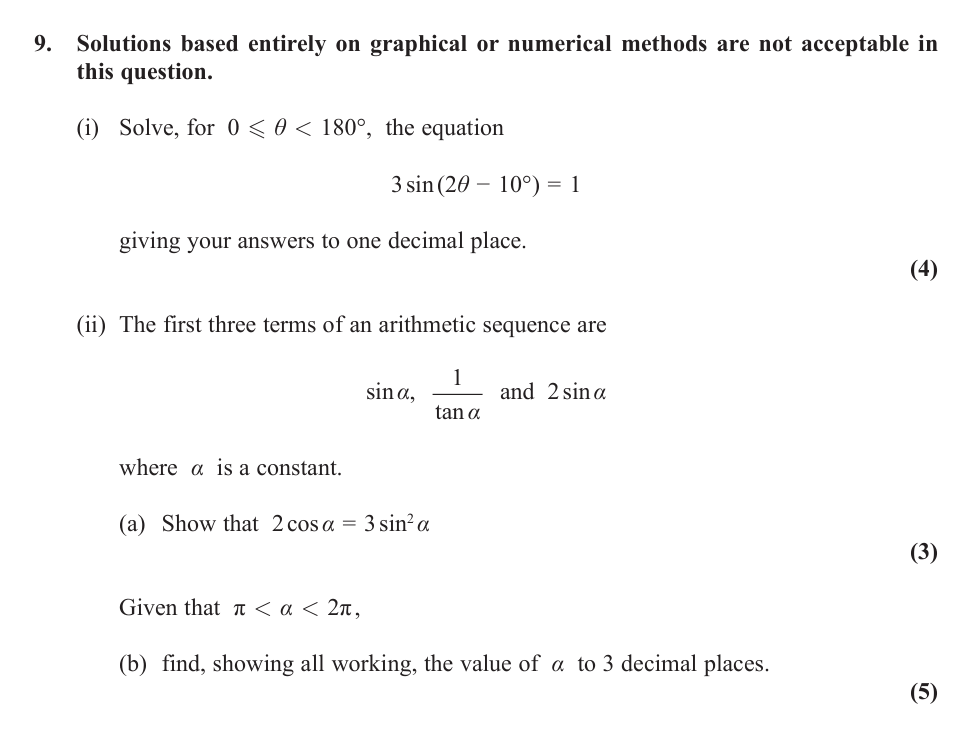
Solve the sine equation
Let $u=2\theta-10^\circ$. Then $\sin u=\dfrac13$.
Find the valid angle values
Since $0\leq\theta<180^\circ$, $-10^\circ\leq u<350^\circ$. In this interval, $u=19.471\ldots^\circ$ or $u=160.529\ldots^\circ$.
Return to theta
$\theta=\dfrac{u+10^\circ}{2}$, giving $\theta=14.7^\circ$ and $85.3^\circ$ to one decimal place.
Use the arithmetic sequence condition
For three consecutive terms of an arithmetic sequence, second minus first equals third minus second. Hence $\dfrac1{\tan\alpha}-\sin\alpha=2\sin\alpha-\dfrac1{\tan\alpha}$.
Prove the required identity
This gives $\dfrac2{\tan\alpha}=3\sin\alpha$. Since $\dfrac1{\tan\alpha}=\dfrac{\cos\alpha}{\sin\alpha}$, we get $\dfrac{2\cos\alpha}{\sin\alpha}=3\sin\alpha$, so $2\cos\alpha=3\sin^2\alpha$.
Form a quadratic in cos alpha
Using $\sin^2\alpha=1-\cos^2\alpha$, $2\cos\alpha=3(1-\cos^2\alpha)$, so $3\cos^2\alpha+2\cos\alpha-3=0$.
Solve in the given interval
$\cos\alpha=\dfrac{-1+\sqrt{10}}{3}$; the other root is less than $-1$. Since $\pi<\alpha<2\pi$ and cosine is positive, $\alpha$ is in the fourth quadrant.
State alpha
$\alpha=2\pi-\cos^{-1}\left(\dfrac{-1+\sqrt{10}}{3}\right)=5.517$ radians to 3 decimal places.
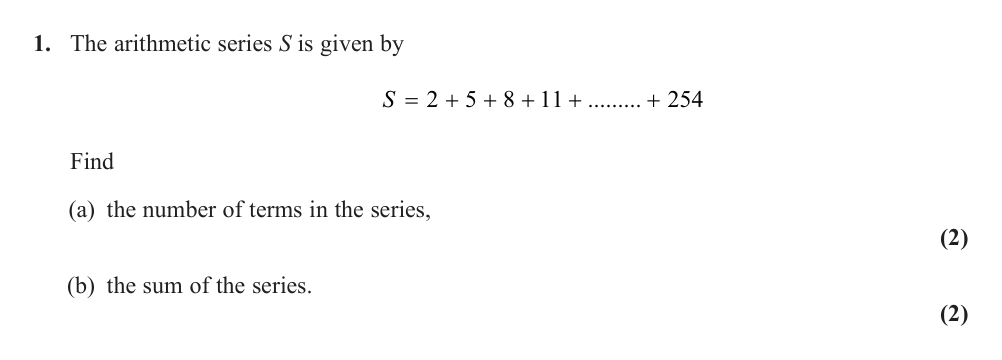
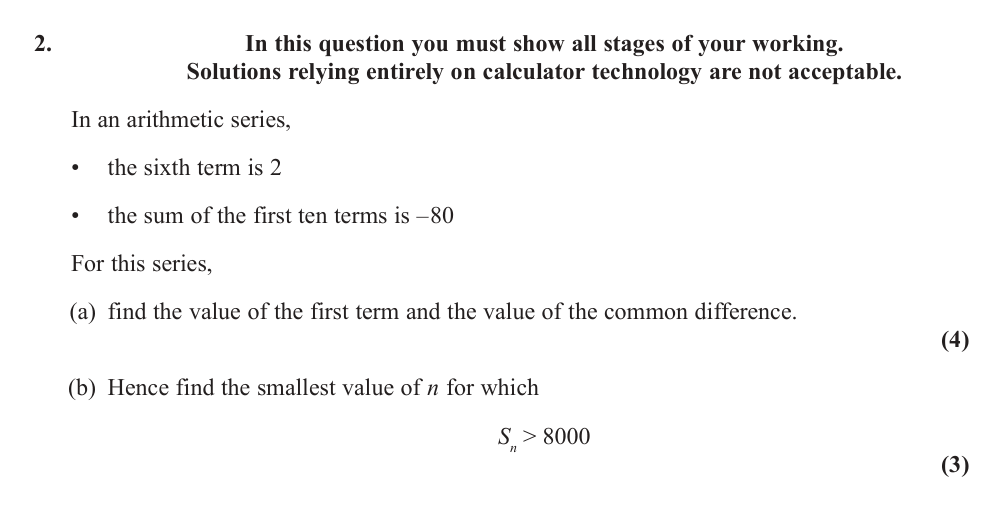
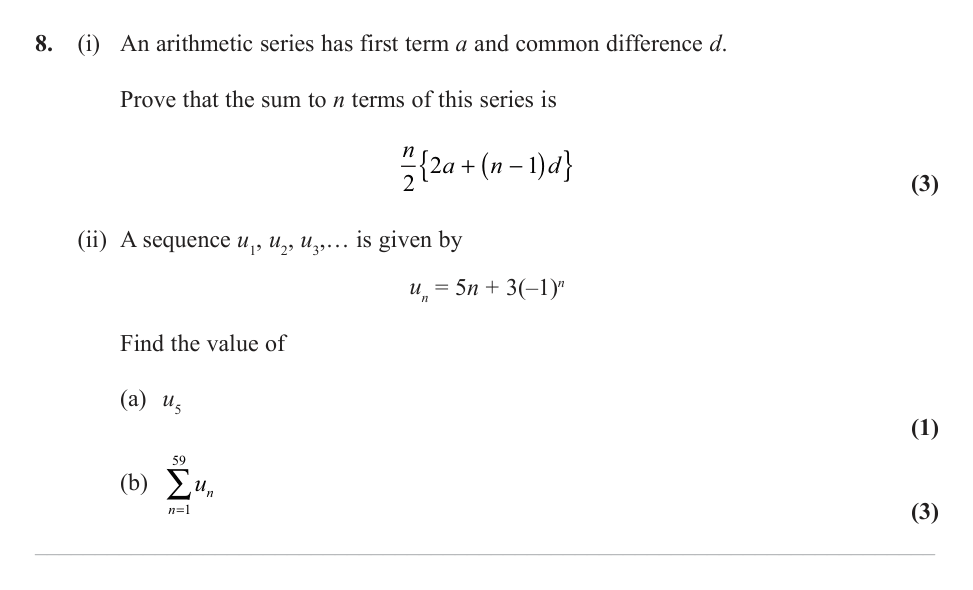
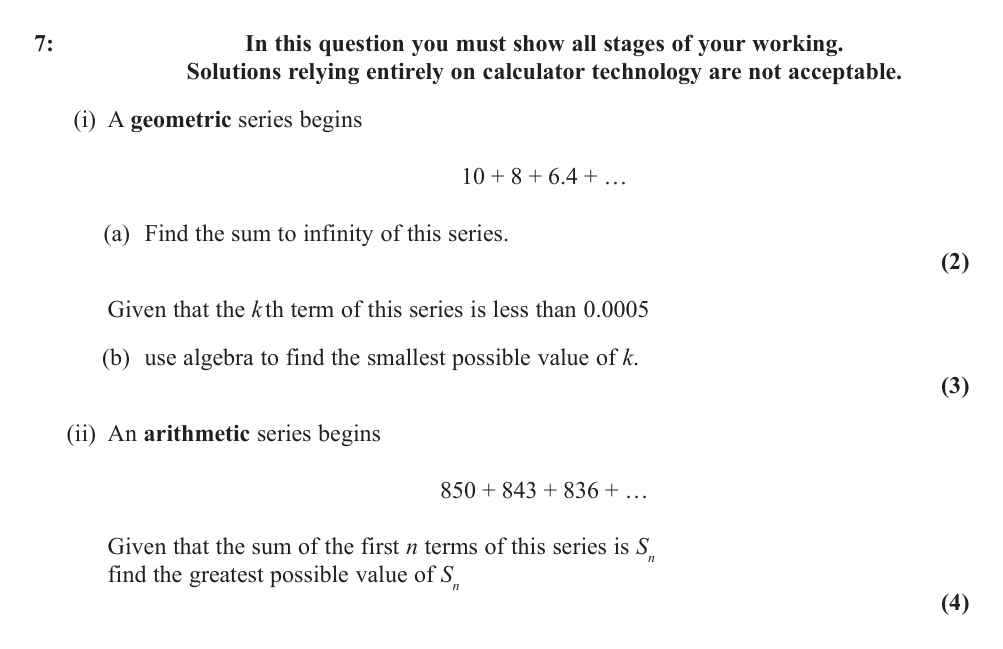
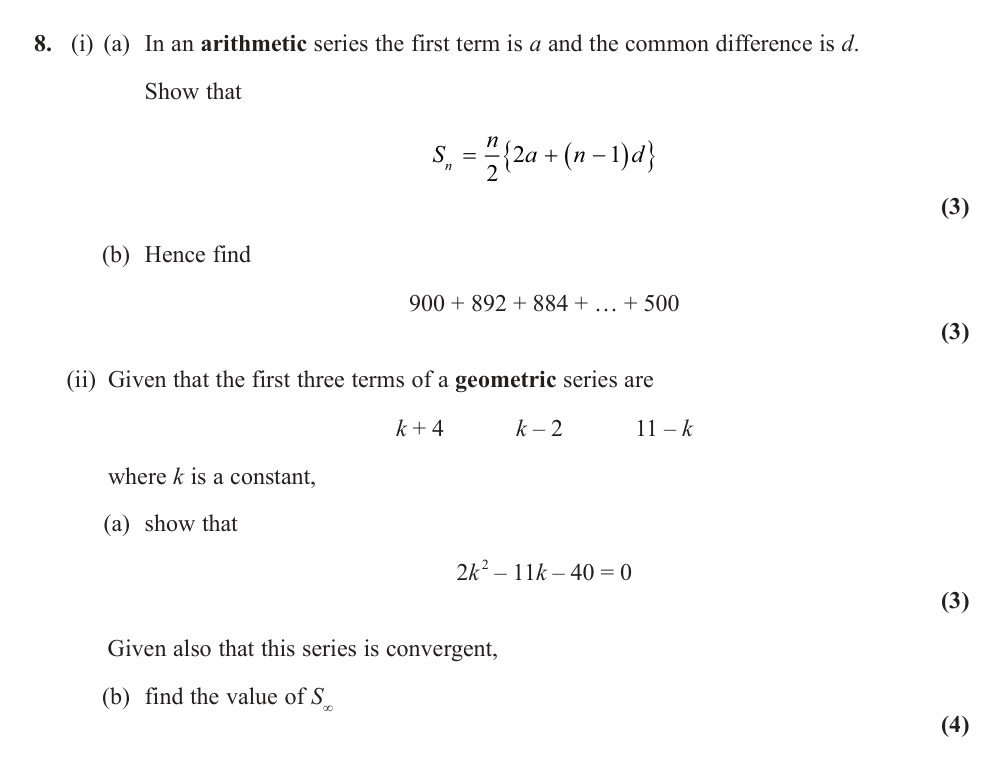
For $900+892+884+\cdots+500$, the first term is $900$, the common difference is $-8$, and the last term is $500$.
Find the number of terms
$500=900+(n-1)(-8)$, so $n-1=50$ and $n=51$.
Find the sum
$S=\dfrac{51}{2}(900+500)=35700$.
Use the geometric condition
For $k+4$, $k-2$, $11-k$ to be consecutive geometric terms, $(k-2)^2=(k+4)(11-k)$.
Show the quadratic
$k^2-4k+4=-k^2+7k+44$, so $2k^2-11k-40=0$.
Solve for k
$2k^2-11k-40=0$ gives $k=8$ or $k=-\dfrac52$.
Use convergence
If $k=8$, the terms are $12,6,3$ and the common ratio is $\dfrac12$, so the series is convergent. If $k=-\dfrac52$, the common ratio is $-3$, so it is not convergent.
 Elite Mathematics