Elite Mathematics / Pure 2 / Topics / Integration: Areas and the Trapezium Rule IAL · WMA12 · Topic Integration: Areas and the Trapezium Rule: past paper questions & worked solutions
Every Integration: Areas and the Trapezium Rule question from the WMA12 papers in our bank, 2019–2026, sorted from easiest to hardest. Try each one first, then open the worked solution.
41 questions
322 marks in total
100% of papers (19 of 19) include it
11/15/15 easy / medium / hard
Questions, easiest first Level is estimated from marks: 1–6 easy, 7–8 medium, 9+ hard.
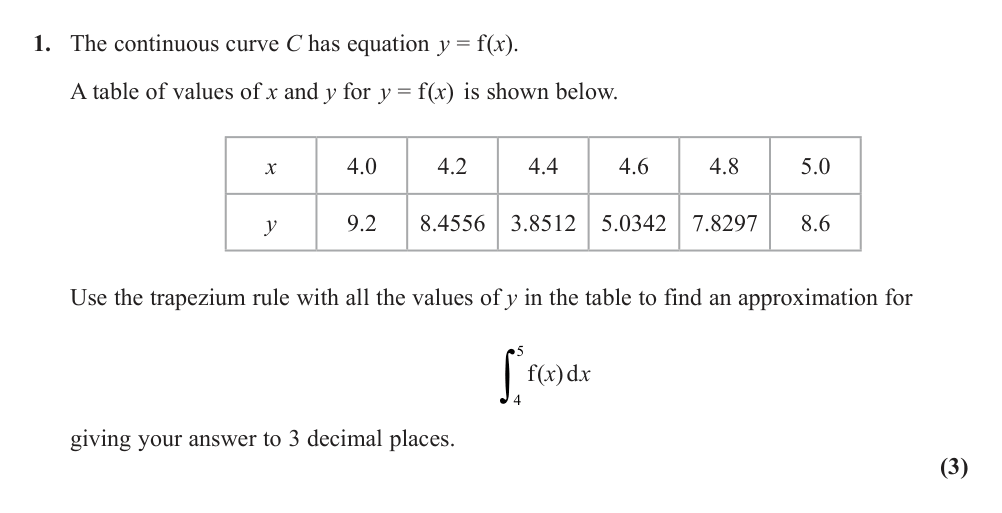
1. WMA12/01 May/June 2023 · Q1 Easy 3 marksShow worked solution Identify the interval width The $x$ values go from $4.0$ to $5.0$ in steps of $0.2$, so $h=0.2$.
Apply the trapezium rule $\displaystyle \int_4^5 f(x)\,dx\approx \dfrac{0.2}{2}\left[9.2+8.6+2(8.4556+3.8512+5.0342+7.8297)\right]$.
Evaluate The value is $6.81414$, so the approximation is $6.814$ to 3 decimal places.
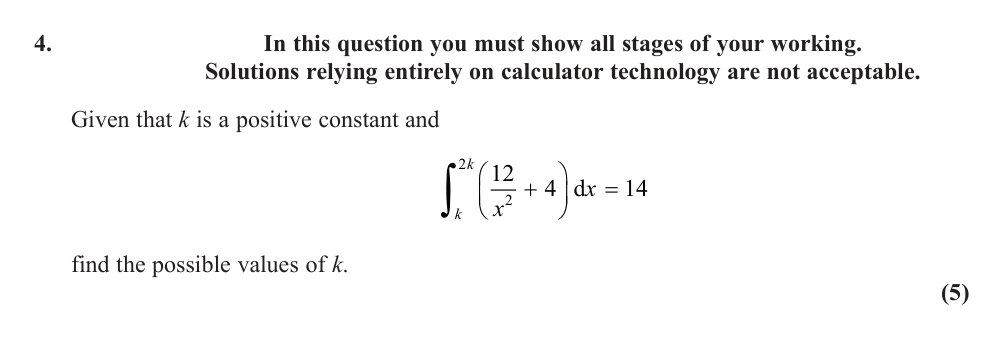
2. WMA12/01 January 2026 · Q4 Easy 5 marksShow worked solution Integrate first $\int\left(\dfrac{12}{x^2}+4\right)\,dx=\int(12x^{-2}+4)\,dx=-\dfrac{12}{x}+4x$.
Apply the limits $\left[-\dfrac{12}{x}+4x\right]_k^{2k}=\left(-\dfrac6k+8k\right)-\left(-\dfrac{12}{k}+4k\right)=\dfrac6k+4k$.
Form a quadratic Given the integral is $14$, $\dfrac6k+4k=14$. Multiplying by $k$ gives $4k^2-14k+6=0$, so $2k^2-7k+3=0$.
Solve for k $(2k-1)(k-3)=0$, hence $k=\dfrac12$ or $k=3$. Both are positive, so both are valid.
Final answer $k=\dfrac12$ or $k=3$.
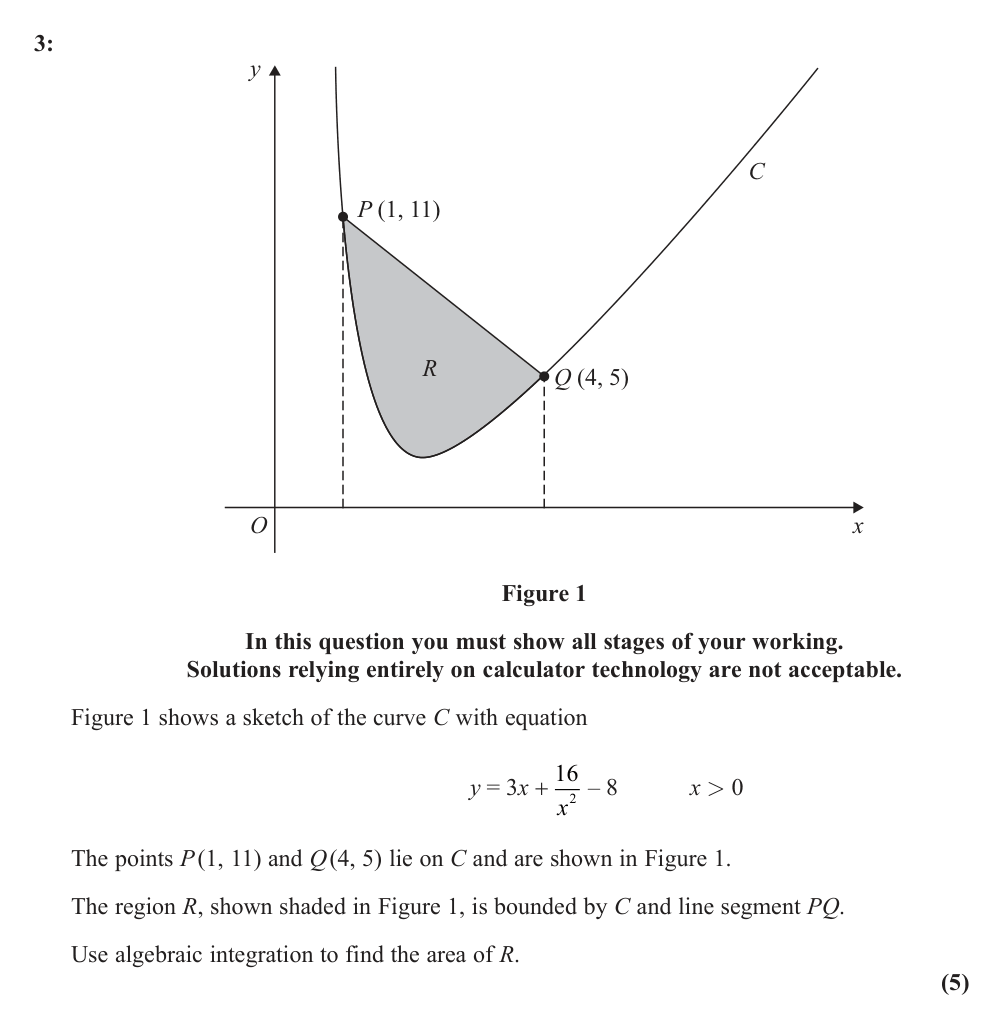
3. WMA12/01 May/June 2025 · Q3 Easy 5 marksShow worked solution Find the line PQ The gradient of $PQ$ is $\dfrac{5-11}{4-1}=-2$, so the line through $P(1,11)$ is $y-11=-2(x-1)$.
Write the line equation Thus $PQ$ has equation $y=-2x+13$.
Set up the area From $x=1$ to $x=4$, the line segment is above the curve. Hence $R=\displaystyle\int_1^4\left[(-2x+13)-\left(3x+\dfrac{16}{x^2}-8\right)\right]dx$.
Simplify the integrand $R=\displaystyle\int_1^4(21-5x-16x^{-2})\,dx$.
Integrate $R=\left[21x-\dfrac52x^2+\dfrac{16}{x}\right]_1^4$.
Evaluate $R=(84-40+4)-\left(21-\dfrac52+16\right)=48-\dfrac{69}{2}=\dfrac{27}{2}$.
Final answer $\dfrac{27}{2}$.
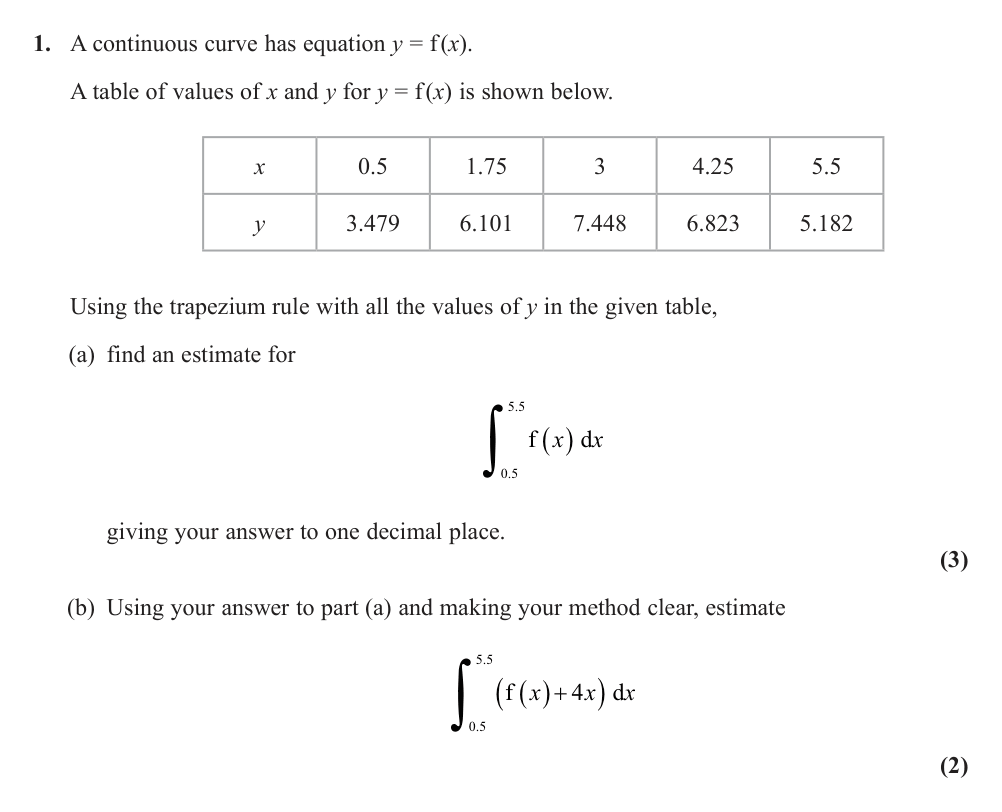
4. WMA12/01 October 2024 · Q1 Easy 5 marksShow worked solution Find the strip width The $x$ values increase by $1.25$, so the trapezium width is $h=1.25$.
Apply the trapezium rule $\displaystyle \int_{0.5}^{5.5} f(x)\,dx\approx\dfrac{1.25}{2}\{3.479+5.182+2(6.101+7.448+6.823)\}$.
Evaluate the estimate This gives $30.878125$, which is $30.9$ to one decimal place.
Split the second integral $\displaystyle \int_{0.5}^{5.5}(f(x)+4x)\,dx=\int_{0.5}^{5.5}f(x)\,dx+\int_{0.5}^{5.5}4x\,dx$.
Integrate 4x $\displaystyle \int_{0.5}^{5.5}4x\,dx=[2x^2]_{0.5}^{5.5}=2(5.5)^2-2(0.5)^2=60$.
Use part a Using the estimate from part (a), the required value is $30.9+60=90.9$.
Final answer $(a)$ $30.9$. $\quad (b)$ $90.9$.
5. WMA12/01 May/June R 2024 · Q2 Easy 5 marksShow worked solution Use the trapezium width The $x$ values increase by $1.5$, so $h=1.5$.
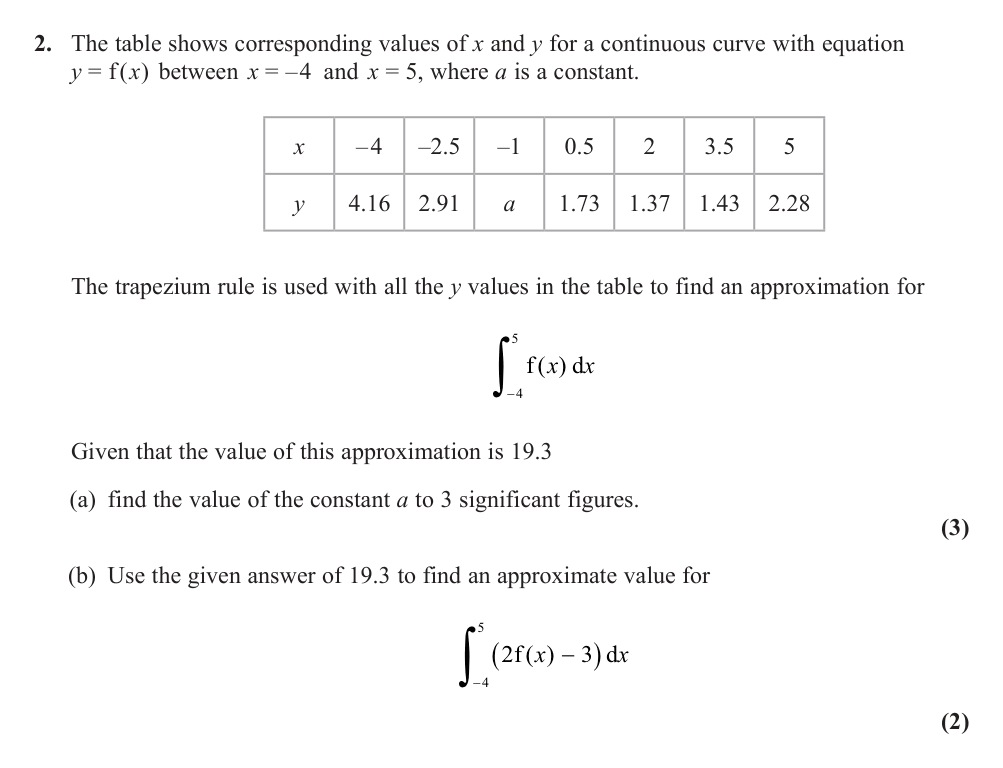
Set up the trapezium estimate $19.3=\dfrac{1.5}{2}[4.16+2.28+2(2.91+a+1.73+1.37+1.43)]$.
Solve for a This simplifies to $19.3=15.99+1.5a$, so $a=\dfrac{3.31}{1.5}=2.206\ldots$.
Round a Therefore $a=2.21$ to 3 significant figures.
Use the transformed integral $\displaystyle \int_{-4}^{5}(2f(x)-3)dx=2\int_{-4}^{5}f(x)dx-\int_{-4}^{5}3\,dx$.
Substitute the given estimate This is $2(19.3)-3(9)=38.6-27=11.6$.
Final answer $(a)$ $a=2.21$ to 3 s.f. $\quad (b)$ $11.6$.
6. WMA12/01 January 2026 · Q2 Easy 6 marksShow worked solution Find the strip width The $x$ values increase by $3$, so $h=3$.
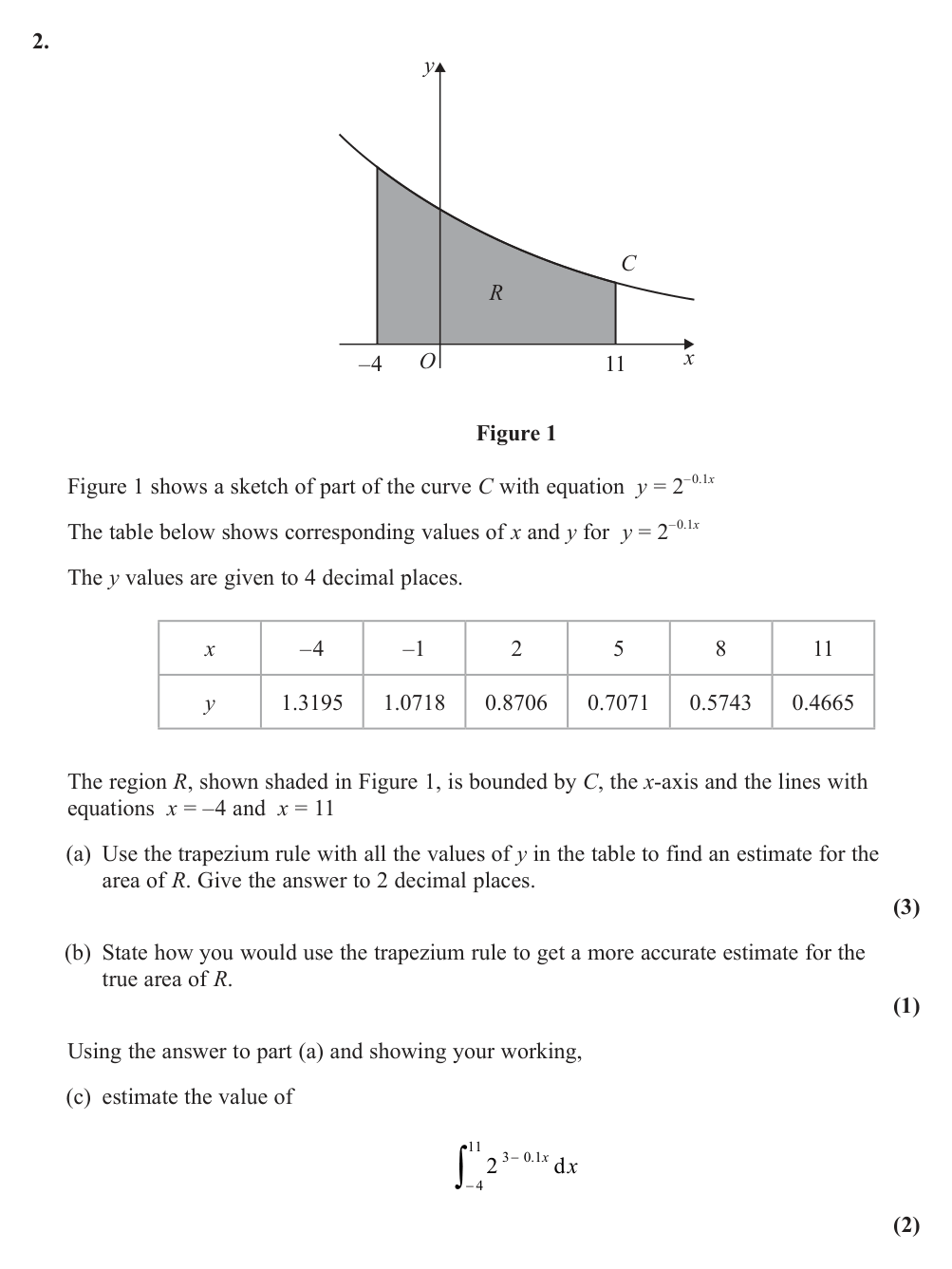
Apply the trapezium rule $A\approx \dfrac32\{1.3195+0.4665+2(1.0718+0.8706+0.7071+0.5743)\}$.
Calculate the estimated area $A\approx \dfrac32(8.2336)=12.3504$, so the area is $12.35$ to 2 decimal places.
Improve the estimate A more accurate estimate would use more trapezia, so the strip width is smaller.
Use the scale factor in the integral Since $2^{3-0.1x}=8\cdot2^{-0.1x}$, the required estimate is $8(12.35)=98.8$.
Final answer $(a)\ 12.35.\quad (b)$ Use narrower strips, or more trapezia. $\quad (c)\ 98.8$.
7. WMA12/01 May/June 2025 · Q5 Easy 6 marksShow worked solution Find the strip width The $x$ values increase by $1.5$, so $h=1.5$.
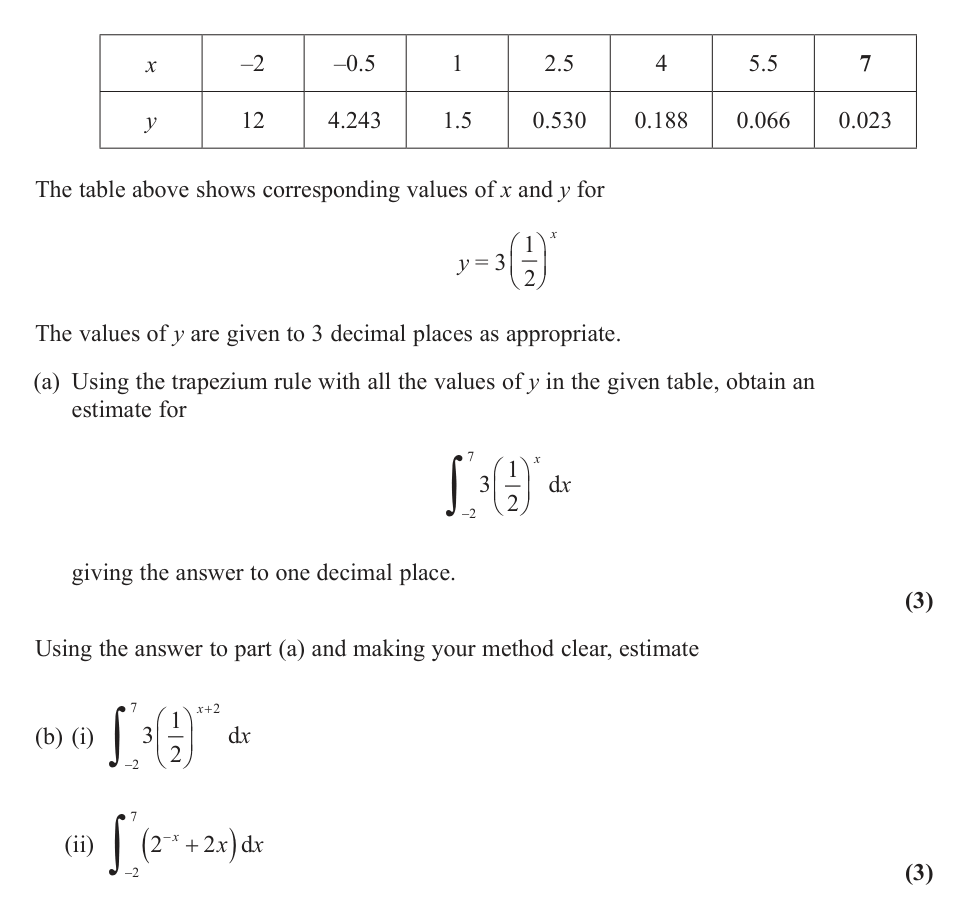
Apply the trapezium rule $\displaystyle\int_{-2}^{7}3\left(\dfrac12\right)^x dx\approx\dfrac{1.5}{2}\{12+0.023+2(4.243+1.5+0.530+0.188+0.066)\}$.
Evaluate This gives $18.80775$, which is $18.8$ to one decimal place.
Use the power shift $3\left(\dfrac12\right)^{x+2}=\dfrac14\cdot3\left(\dfrac12\right)^x$.
Estimate part b i So $\displaystyle\int_{-2}^{7}3\left(\dfrac12\right)^{x+2}dx\approx\dfrac14(18.80775)=4.7019375$, which is $4.7$.
Rewrite part b ii Since $3\left(\dfrac12\right)^x=3\cdot2^{-x}$, we have $2^{-x}=\dfrac13\cdot3\left(\dfrac12\right)^x$.
Estimate part b ii $\displaystyle\int_{-2}^{7}(2^{-x}+2x)dx\approx\dfrac{18.80775}{3}+[x^2]_{-2}^{7}=6.26925+45=51.26925$, which is $51.3$.
Final answer $(a)$ $18.8$. $\quad (b)(i)$ $4.7$. $\quad (b)(ii)$ $51.3$.
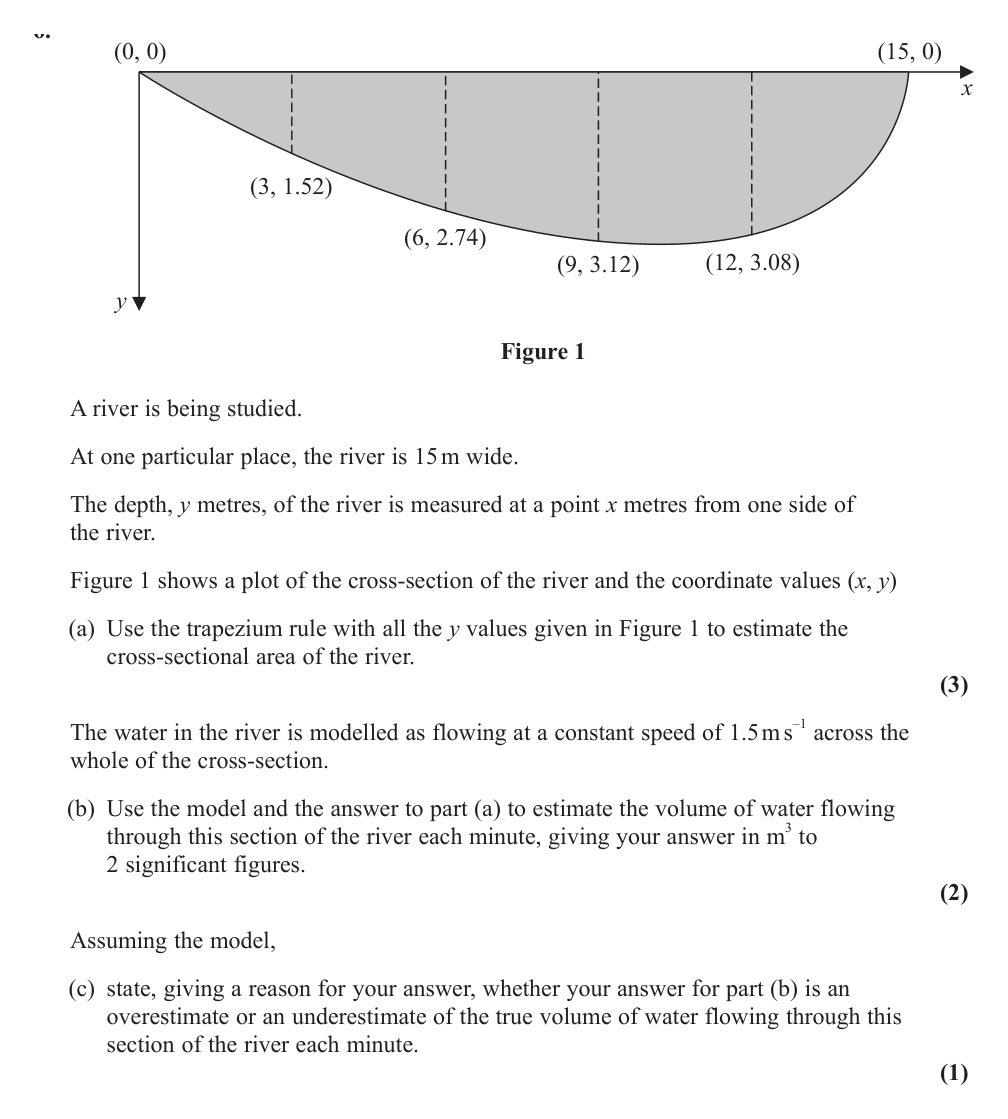
8. WMA12/01 October 2023 · Q6 Easy 6 marksShow worked solution Read the strip width The $x$ values are $0,3,6,9,12,15$, so the trapezium width is $h=3$.
Apply the trapezium rule $\text{Area}\approx \dfrac32\left[0+0+2(1.52+2.74+3.12+3.08)\right]$.
Find the cross-sectional area This gives $31.38\text{ m}^2$.
Convert flow speed to one minute The speed is $1.5\text{ m s}^{-1}$, so in one minute the water travels $1.5\times60=90\text{ m}$.
Estimate volume Volume per minute $\approx31.38\times90=2824.2\text{ m}^3$.
Round the volume To 2 significant figures, this is $2.8\times10^3\text{ m}^3$.
State over or under It is an underestimate, because the curve between the plotted points lies below the straight-line trapezium chords in the diagram, so the true cross-sectional area is larger.
Final answer $(a)$ $31.38\text{ m}^2$. $\quad (b)$ $2.8\times10^3\text{ m}^3$. $\quad (c)$ Underestimate.
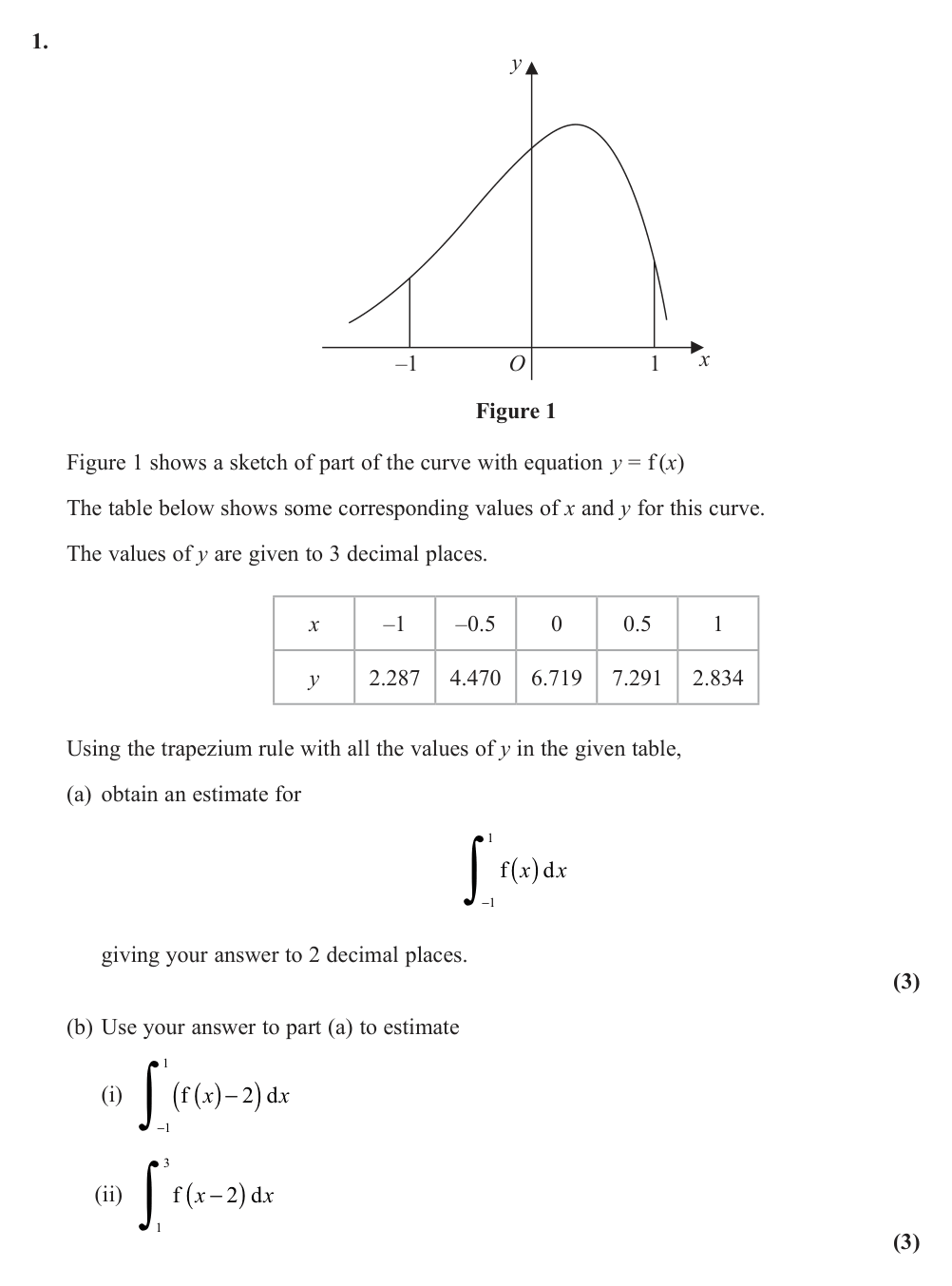
9. WMA12/01 January 2023 · Q1 Easy 6 marksShow worked solution Use the trapezium width The $x$ values run from $-1$ to $1$ in steps of $0.5$, so $h=0.5$.
Apply the trapezium rule $\displaystyle \int_{-1}^{1} f(x)\,dx\approx \dfrac{0.5}{2}\left[2.287+2.834+2(4.470+6.719+7.291)\right]$.
Evaluate the estimate This gives $10.52025$, so the estimate is $10.52$ to 2 decimal places.
Estimate the shifted-down area $\displaystyle \int_{-1}^{1}(f(x)-2)\,dx=\int_{-1}^{1}f(x)\,dx-\int_{-1}^{1}2\,dx$.
Subtract the rectangle The interval has width $2$, so $\int_{-1}^{1}2\,dx=4$. Hence the estimate is $10.52-4=6.52$.
Use a substitution For $\displaystyle \int_{1}^{3} f(x-2)\,dx$, let $u=x-2$. When $x=1$, $u=-1$, and when $x=3$, $u=1$.
Recognise the same integral So $\displaystyle \int_{1}^{3} f(x-2)\,dx=\int_{-1}^{1} f(u)\,du$, which has the same estimate $10.52$.
Final answer $(a)$ $10.52$. $\quad (b)(i)\ 6.52. $\quad $(b)(ii)\ 10.52$.
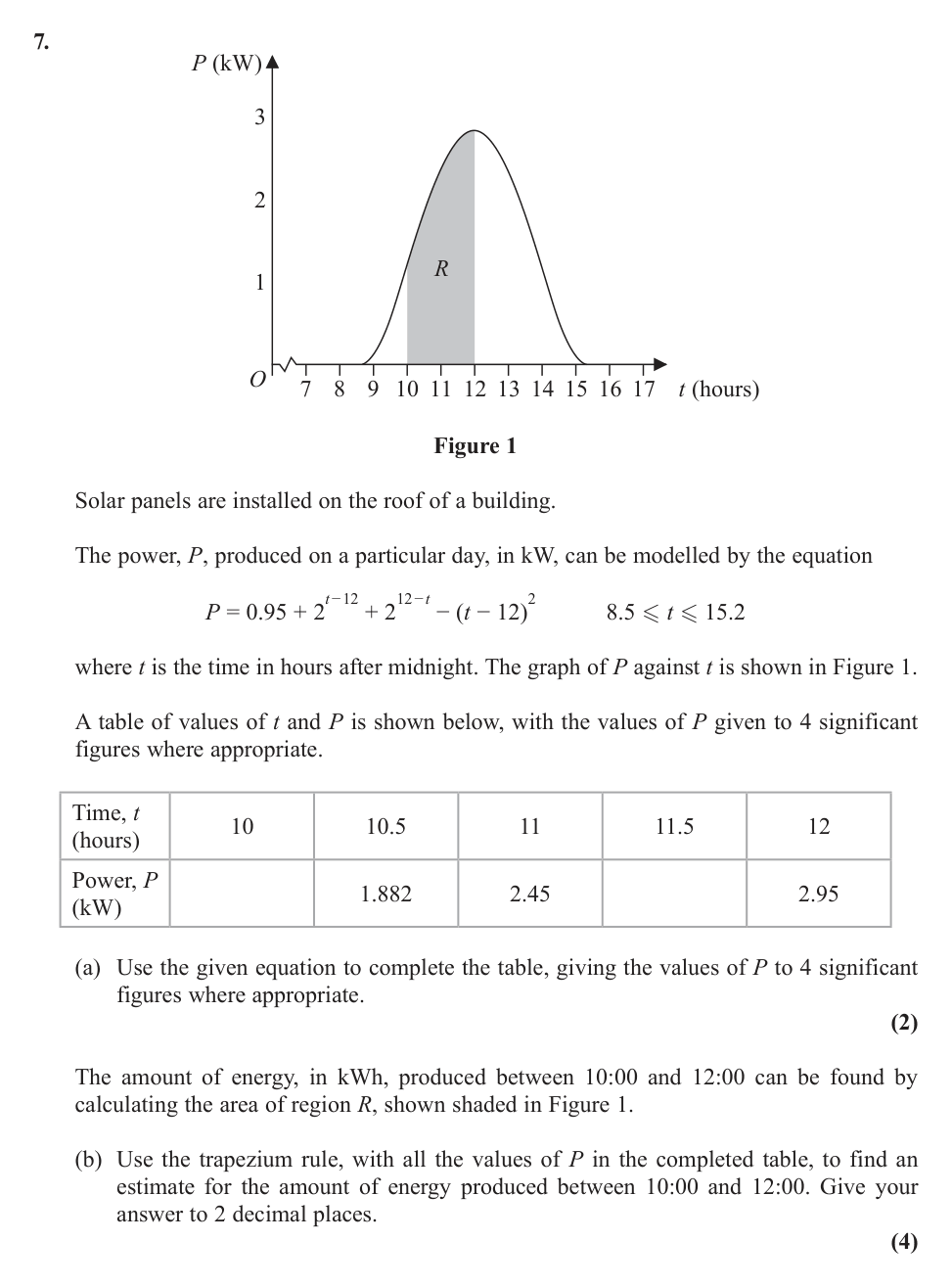
10. WMA12/01 January 2021 · Q7 Easy 6 marksShow worked solution Use the model at t equals ten $P(10)=0.95+2^{-2}+2^2-(10-12)^2=0.95+0.25+4-4=1.20$.
Use the model at t equals eleven point five $P(11.5)=0.95+2^{-0.5}+2^{0.5}-(11.5-12)^2=2.821\ldots$.
Identify the trapezium width The time values increase by $0.5$, so $h=0.5$.
Apply the trapezium rule The estimate is $\dfrac{0.5}{2}\{1.20+2.95+2(1.882+2.45+2.821\ldots)\}$.
Calculate the energy This gives $4.614\ldots$, so the estimated energy is $4.61\text{ kWh}$ to 2 decimal places.
Final answer $(a)\ P(10)=1.20,\ P(11.5)=2.821.\quad (b)\ 4.61\text{ kWh}$.
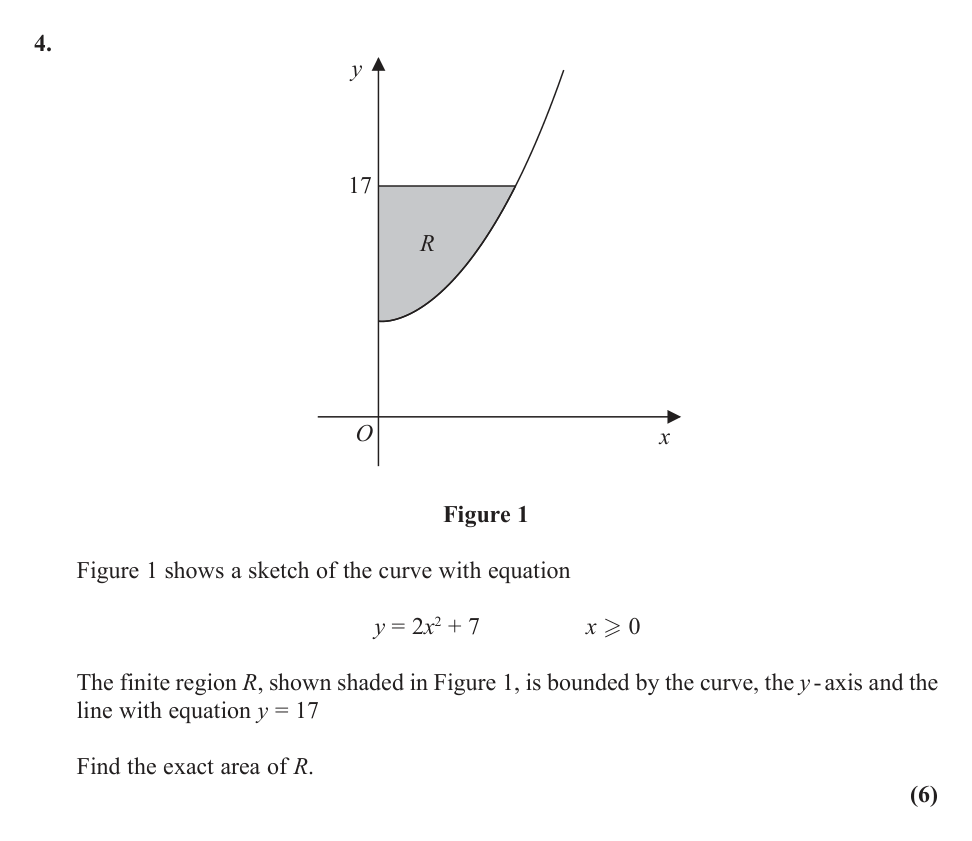
11. WMA12/01 January 2020 · Q4 Easy 6 marksShow worked solution Find the intersection with y equals 17 The curve is $y=2x^2+7$. Set $2x^2+7=17$ to get $x^2=5$, so the right-hand limit is $x=\sqrt5$.
Set up the area The shaded area is between $y=17$ and $y=2x^2+7$, from $x=0$ to $x=\sqrt5$.
Integrate $A=\int_0^{\sqrt5}\{17-(2x^2+7)\}\,dx=\int_0^{\sqrt5}(10-2x^2)\,dx$.
Evaluate the exact area $A=\left[10x-\dfrac23x^3\right]_0^{\sqrt5}=10\sqrt5-\dfrac23(5\sqrt5)=\dfrac{20\sqrt5}{3}$.
Final answer $\dfrac{20\sqrt5}{3}$.
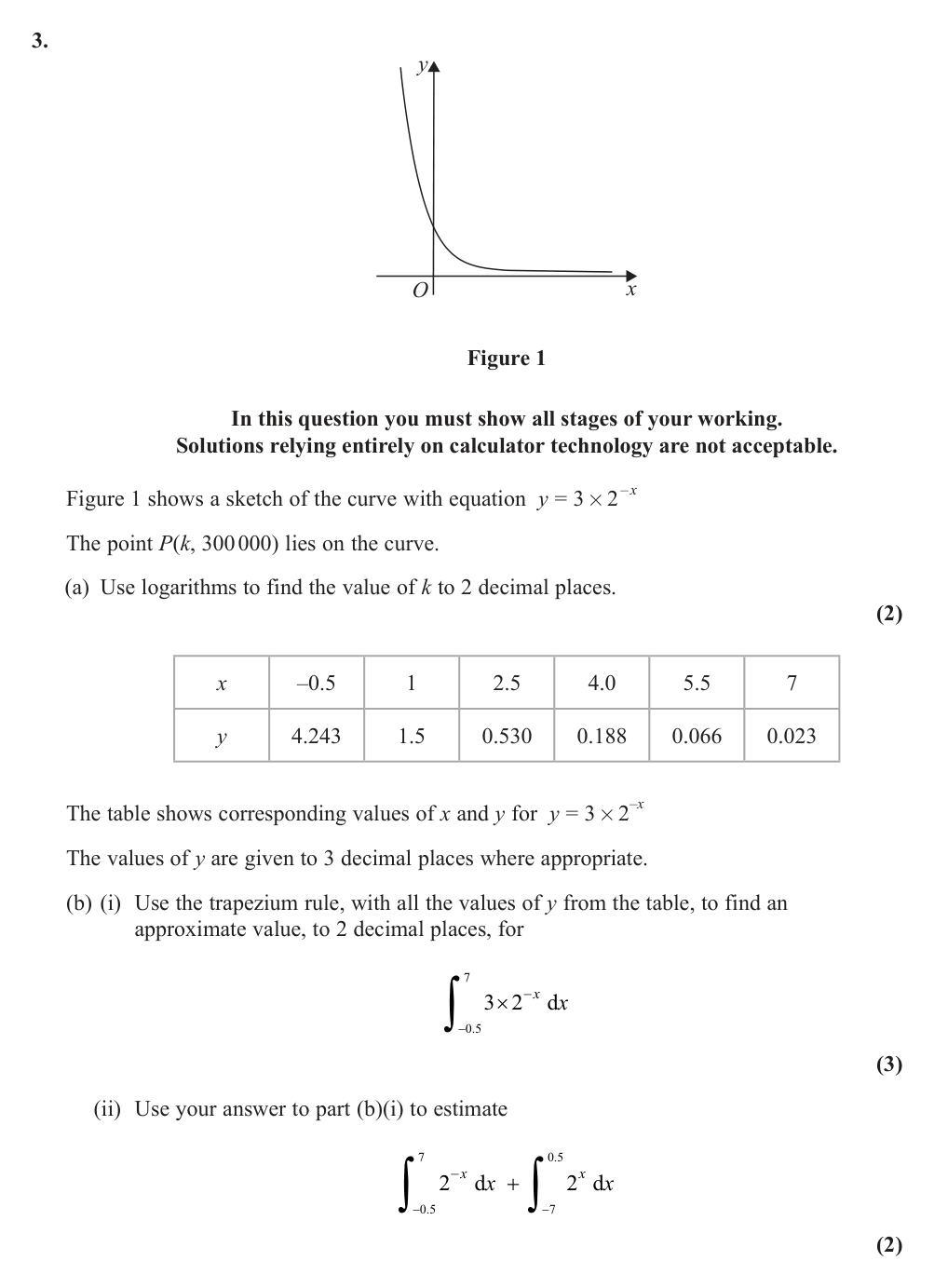
12. WMA12/01 October 2025 · Q3 Medium 7 marksShow worked solution Use the point on the curve Since $P(k,300000)$ lies on $y=3\times2^{-x}$, $300000=3\times2^{-k}$.
Solve with logarithms $100000=2^{-k}$, so $-k=\log_2(100000)$ and $k=-\log_2(100000)=-16.609\ldots$.
Round k To $2$ decimal places, $k=-16.61$.
Find the strip width The $x$ values increase by $1.5$, so $h=1.5$.
Apply the trapezium rule $\displaystyle\int_{-0.5}^{7}3\times2^{-x}dx\approx\dfrac{1.5}{2}\{4.243+0.023+2(1.5+0.530+0.188+0.066)\}$.
Evaluate the estimate This gives $6.6255$, which is $6.63$ to $2$ decimal places.
Relate the first new integral $\displaystyle\int_{-0.5}^{7}2^{-x}dx=\dfrac13\int_{-0.5}^{7}3\times2^{-x}dx$.
Relate the second new integral Using the substitution $u=-x$, $\displaystyle\int_{-7}^{0.5}2^x dx=\int_{-0.5}^{7}2^{-u}du$.
Estimate the total The required estimate is therefore $\dfrac23(6.6255)=4.417$, which is $4.42$ to $2$ decimal places.
Final answer $(a)$ $k=-16.61$. $\quad (b)(i)$ $6.63$. $\quad (b)(ii)$ $4.42$.
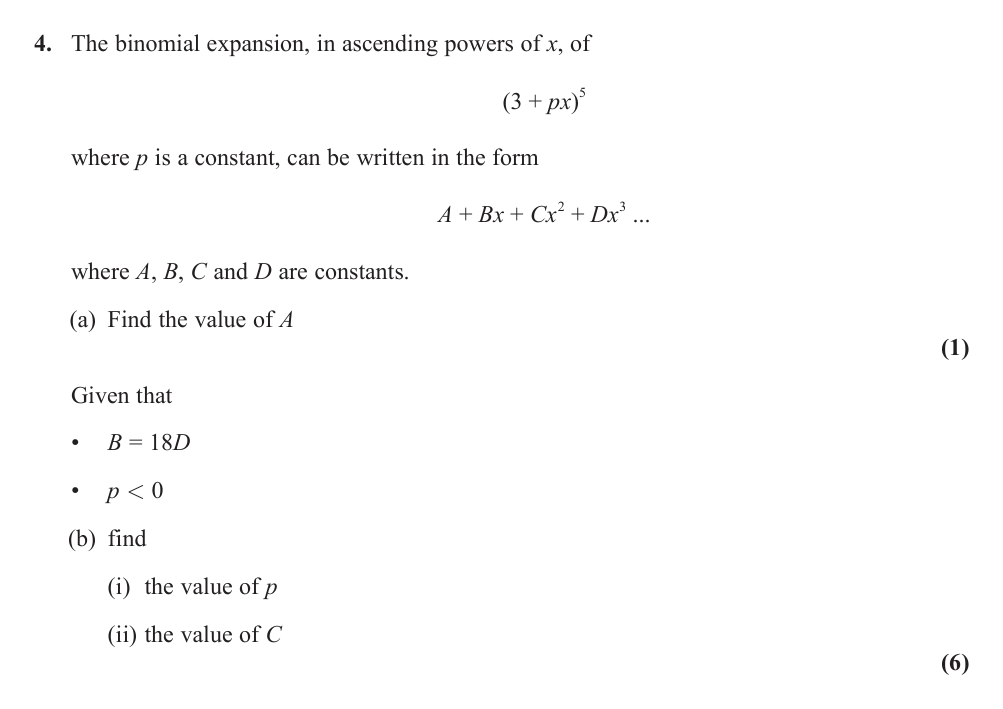
13. WMA12/01 May/June 2023 · Q4 Medium 7 marks · main topic: Binomial ExpansionShow worked solution Find the constant term In $(3+px)^5$, the constant term is $3^5=243$, so $A=243$.
Find B The coefficient of $x$ is $5(3^4)p=405p$, so $B=405p$.
Find D The coefficient of $x^3$ is $\binom53(3^2)p^3=10\cdot9p^3=90p^3$, so $D=90p^3$.
Use B equals 18D $405p=18(90p^3)=1620p^3$.
Solve for p Since $p<0$, $p\ne0$. Divide by $405p$ to get $1=4p^2$, so $p=\pm\dfrac12$. Therefore $p=-\dfrac12$.
Find C The coefficient of $x^2$ is $\binom52(3^3)p^2=10\cdot27\cdot\dfrac14=\dfrac{135}{2}$.
Final answer $(a)$ $A=243$. $\quad (b)(i)$ $p=-\dfrac12$. $\quad (b)(ii)$ $C=\dfrac{135}{2}$.
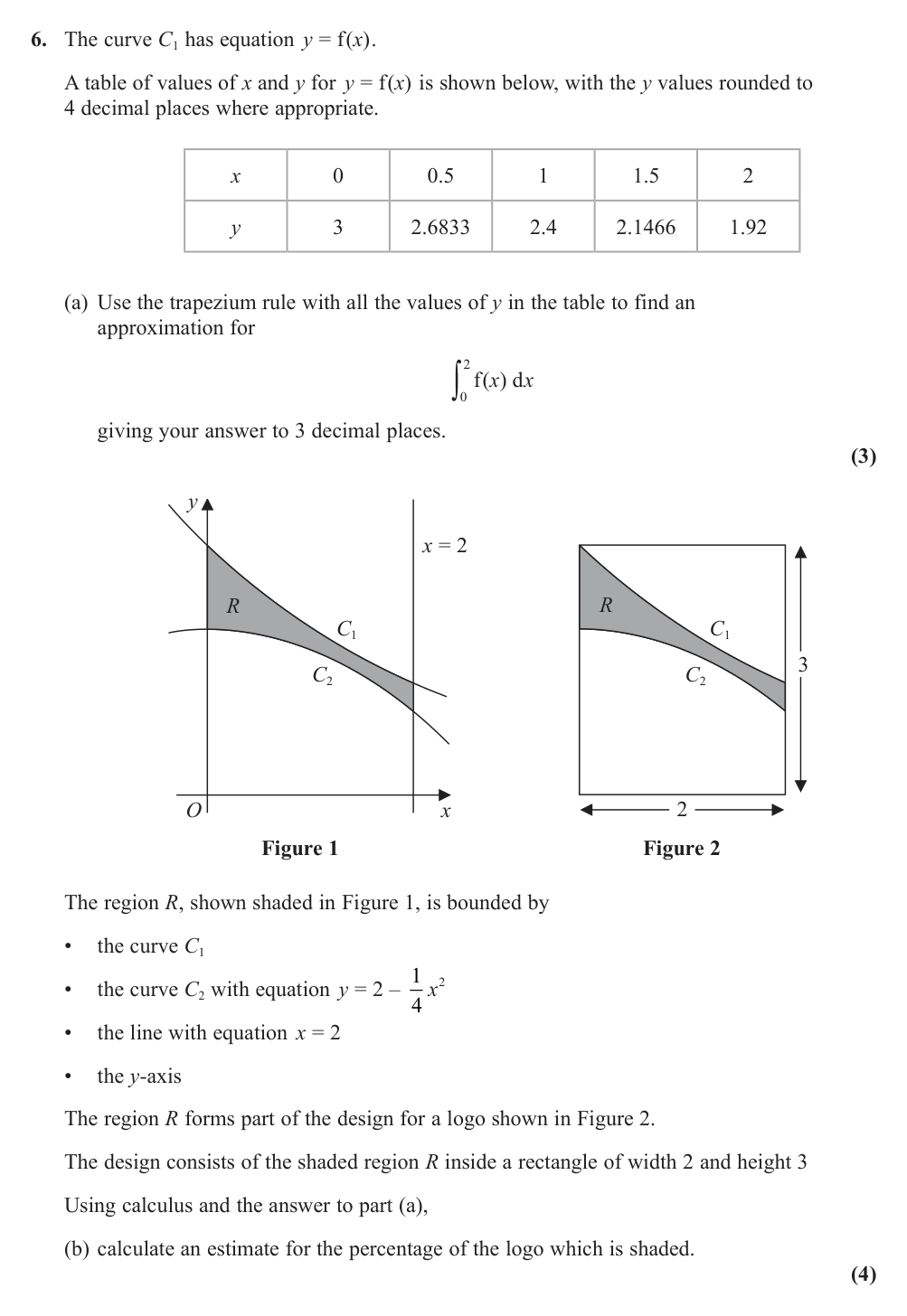
14. WMA12/01 October 2022 · Q6 Medium 7 marksShow worked solution Identify the strip width The $x$ values increase by $0.5$, so the trapezium-rule width is $h=0.5$.
Apply the trapezium rule $\displaystyle \int_0^2 f(x)\,dx\approx \dfrac{0.5}{2}\left[3+1.92+2(2.6833+2.4+2.1466)\right]$.
Evaluate the estimate This gives $4.84495$, so the approximation is $4.845$ to 3 decimal places.
Find the area under C2 $\displaystyle \int_0^2 \left(2-\dfrac14x^2\right)dx=\left[2x-\dfrac{x^3}{12}\right]_0^2=4-\dfrac{2}{3}=\dfrac{10}{3}$.
Estimate the shaded area The shaded region lies between $C_1$ and $C_2$, so its estimated area is $4.845-\dfrac{10}{3}=1.5116\ldots$.
Compare with the rectangle The rectangle has area $2\times3=6$.
Convert to a percentage Percentage shaded $=\dfrac{1.5116\ldots}{6}\times100=25.19\ldots\%$, so the estimate is $25.2\%$.
Final answer $(a)$ $4.845$. $\quad (b)\ 25.2\%$.
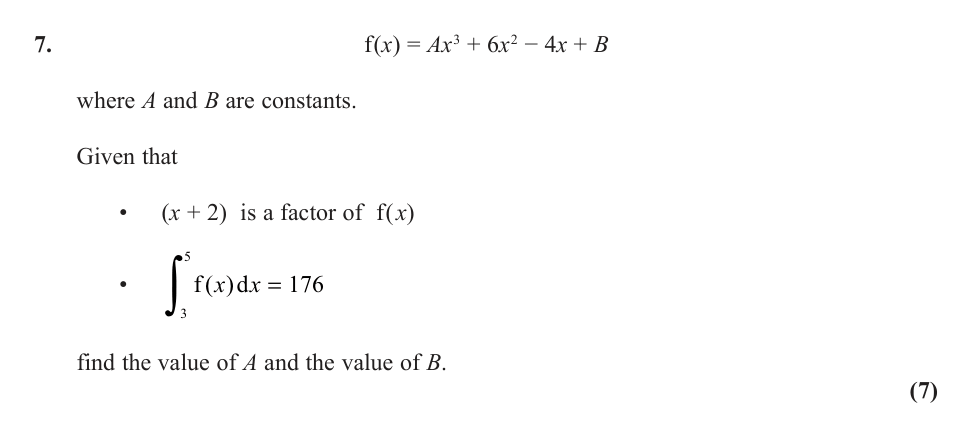
15. WMA12/01 May/June 2022 · Q7 Medium 7 marksShow worked solution Use the factor condition Since $(x+2)$ is a factor, $f(-2)=0$.
Form the first equation $A(-2)^3+6(-2)^2-4(-2)+B=0$, so $-8A+32+B=0$ and $B=8A-32$.
Set up the integral $\int_3^5(Ax^3+6x^2-4x+B)\,dx=176$.
Integrate $\left[\dfrac A4x^4+2x^3-2x^2+Bx\right]_3^5=176$.
Simplify the second equation This gives $136A+164+2B=176$, so $68A+B=6$.
Solve simultaneously Using $B=8A-32$ in $68A+B=6$ gives $76A=38$, so $A=\dfrac12$.
Find B $B=8\left(\dfrac12\right)-32=-28$.
Final answer $A=\dfrac12,\quad B=-28$.
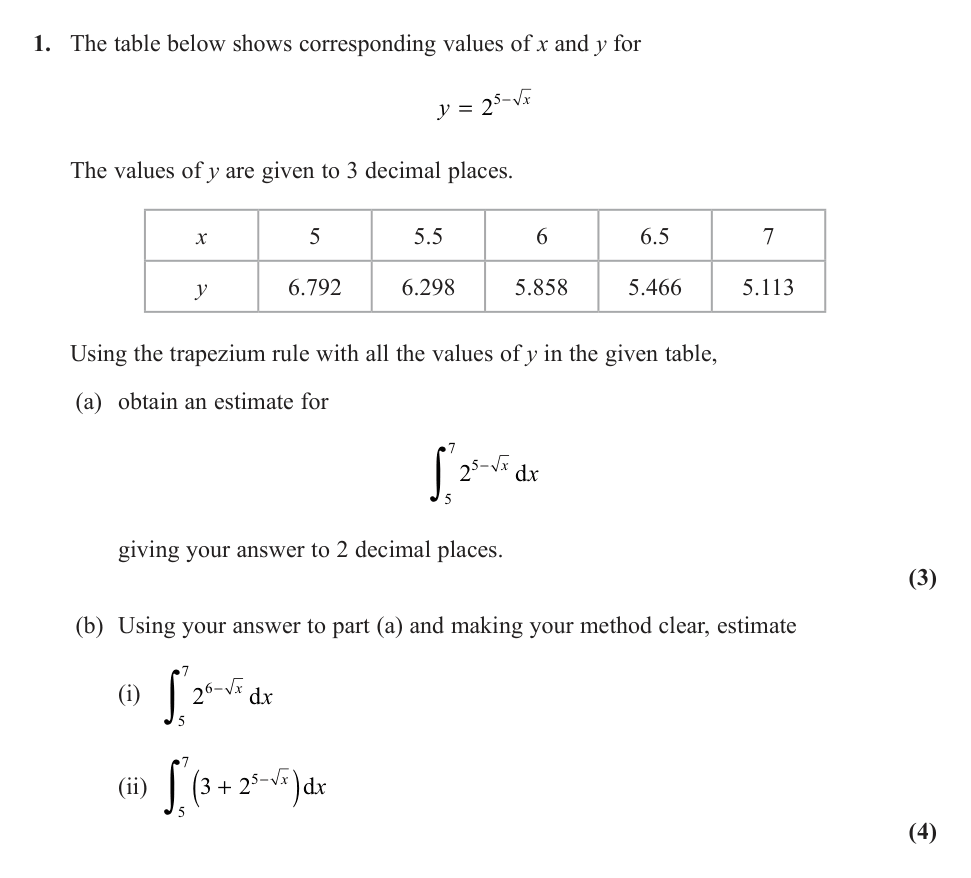
16. WMA12/01 January 2022 · Q1 Medium 7 marksShow worked solution Identify the strip width The $x$ values increase by $0.5$, so $h=0.5$.
Apply the trapezium rule $\int_5^7 2^{5-\sqrt{x}}\,dx\approx\dfrac{0.5}{2}\{6.792+5.113+2(6.298+5.858+5.466)\}$.
Calculate the estimate This gives $11.78725$, so the estimate is $11.79$ to 2 decimal places.
Use the factor of two $2^{6-\sqrt{x}}=2\cdot2^{5-\sqrt{x}}$, so $\int_5^7 2^{6-\sqrt{x}}\,dx\approx2(11.78725)=23.5745$.
Estimate part i This is $23.57$ to 2 decimal places.
Add the constant integral $\int_5^7(3+2^{5-\sqrt{x}})\,dx=\int_5^7 3\,dx+\int_5^7 2^{5-\sqrt{x}}\,dx$.
Estimate part ii The estimate is $3(7-5)+11.78725=17.78725$, so $17.79$ to 2 decimal places.
Final answer $(a)\ 11.79.\quad (b)(i)\ 23.57.\quad (b)(ii)\ 17.79$.
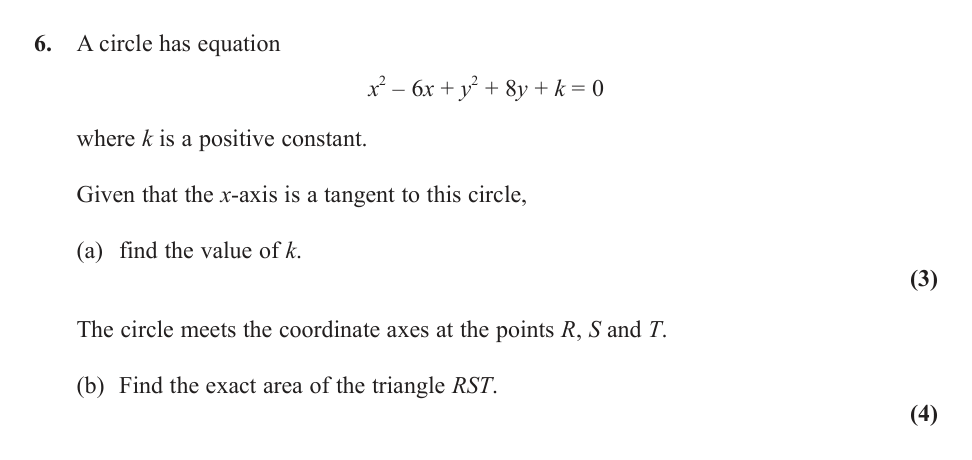
17. WMA12/01 May/June 2021 · Q6 Medium 7 marks · main topic: CirclesShow worked solution Complete the square $x^2-6x=(x-3)^2-9$ and $y^2+8y=(y+4)^2-16$.
Write centre-radius form The circle becomes $(x-3)^2+(y+4)^2=25-k$.
Use the tangent condition The centre is $(3,-4)$. Since the $x$-axis is tangent, the radius is the distance from the centre to the $x$-axis, which is $4$.
Find k Thus $25-k=4^2=16$, so $k=9$.
Find the intercepts With $k=9$, the circle is $(x-3)^2+(y+4)^2=16$. On the $x$-axis, $y=0$, giving $x=3$.
Find the y-axis points On the $y$-axis, $x=0$, so $9+(y+4)^2=16$. Hence $y=-4\pm\sqrt7$.
Calculate the triangle area The vertical base on the $y$-axis has length $2\sqrt7$, and its perpendicular distance to $(3,0)$ is $3$. The area is $\dfrac12(2\sqrt7)(3)=3\sqrt7$.
Final answer $(a)\ k=9.\quad (b)\ 3\sqrt7$.
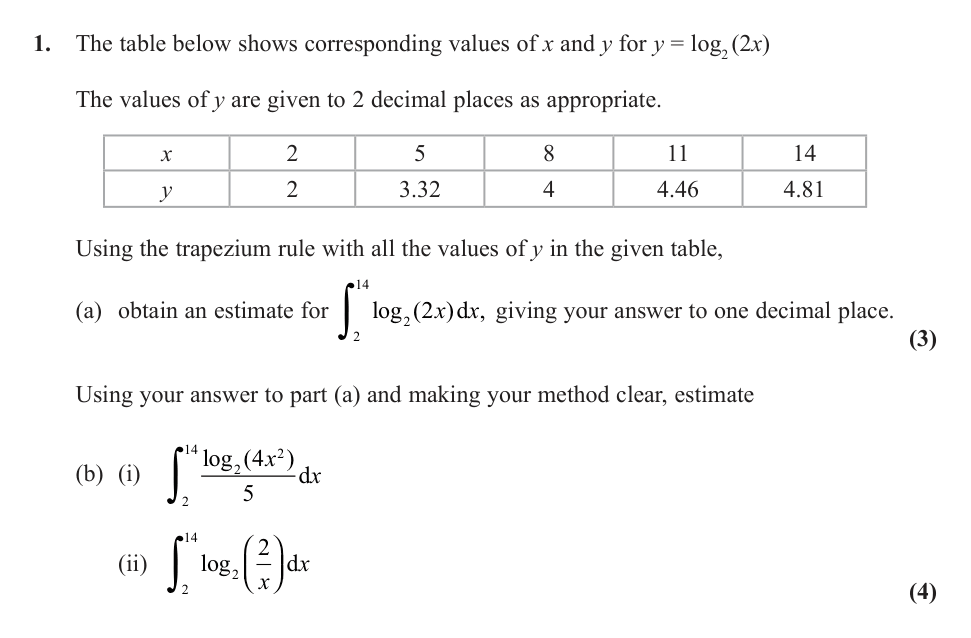
18. WMA12/01 January 2020 · Q1 Medium 7 marksShow worked solution Use the trapezium rule The strip width is $h=3$. Therefore $\int_2^{14}\log_2(2x)\,dx\approx\dfrac32\{2+4.81+2(3.32+4+4.46)\}$.
Calculate part (a) The estimate is $\dfrac32(30.37)=45.555$, so to one decimal place the answer is $45.6$.
Rewrite part (b)(i) $\log_2(4x^2)=\log_2\{(2x)^2\}=2\log_2(2x)$, so $\int_2^{14}\dfrac{\log_2(4x^2)}5\,dx=\dfrac25\int_2^{14}\log_2(2x)\,dx$.
Estimate part (b)(i) Using part (a), the estimate is $\dfrac25(45.555)=18.222$, so $18.2$ to one decimal place.
Rewrite part (b)(ii) $\log_2\left(\dfrac2x\right)=2-\log_2(2x)$.
Estimate part (b)(ii) $\int_2^{14}\log_2\left(\dfrac2x\right)dx\approx\int_2^{14}2\,dx-45.555=24-45.555=-21.555$, so $-21.6$.
Final answer $(a)\ 45.6.\quad (b)(i)\ 18.2.\quad (b)(ii)\ -21.6$.
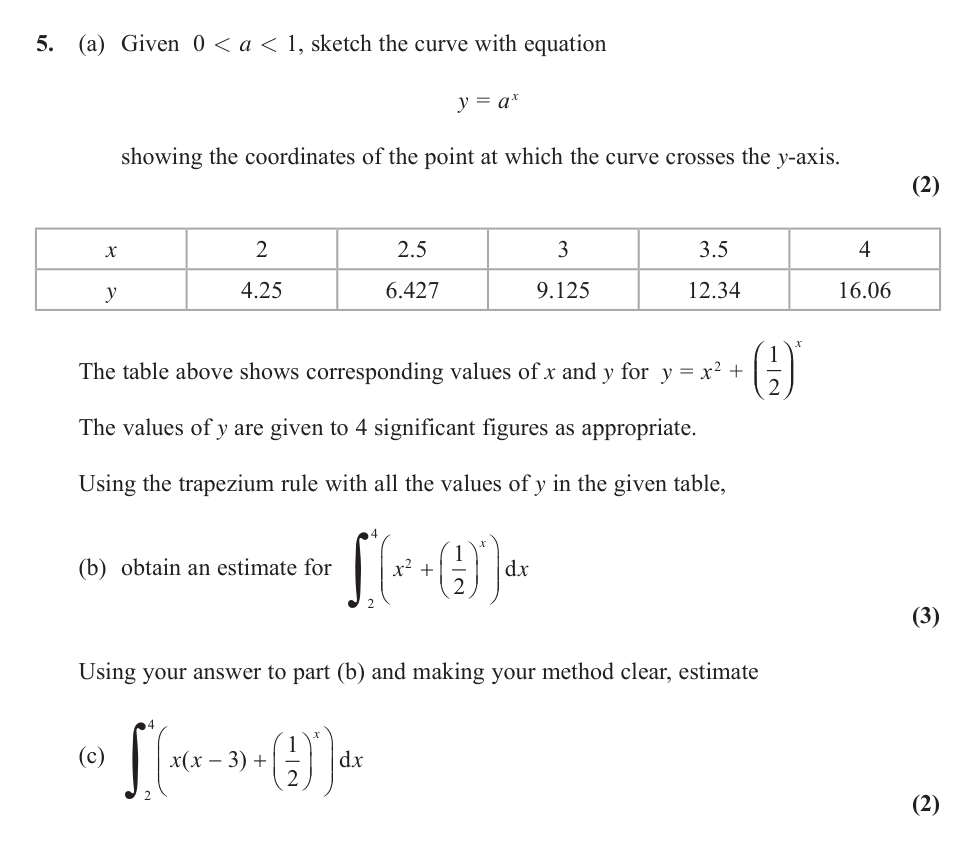
19. WMA12/01 October 2019 · Q5 Medium 7 marksShow worked solution Describe the sketch For $0<a<1$, $y=a^x$ is a decreasing exponential curve. At $x=0$, $y=a^0=1$, so it crosses the $y$-axis at $(0,1)$.
Find the strip width The $x$ values increase by $0.5$, so $h=0.5$.
Apply the trapezium rule $A\approx\dfrac{0.5}{2}\{4.25+16.06+2(6.427+9.125+12.34)\}$.
Calculate the estimate $A\approx0.25(76.094)=19.0235$, so the estimate is $19.0$ to 3 significant figures.
Relate the two integrands $x(x-3)+\left(\dfrac12\right)^x=x^2+\left(\dfrac12\right)^x-3x$.
Subtract the exact integral of 3x $\int_2^4 3x\,dx=\left[\dfrac32x^2\right]_2^4=24-6=18$.
Estimate the new integral Using the estimate from part (b), the required value is $19.0235-18=1.0235$, so the estimate is $1.0$.
Final answer $(a)$ A decreasing exponential curve crossing the $y$-axis at $(0,1)$. $\quad (b)\ 19.0.\quad (c)\ 1.0$.
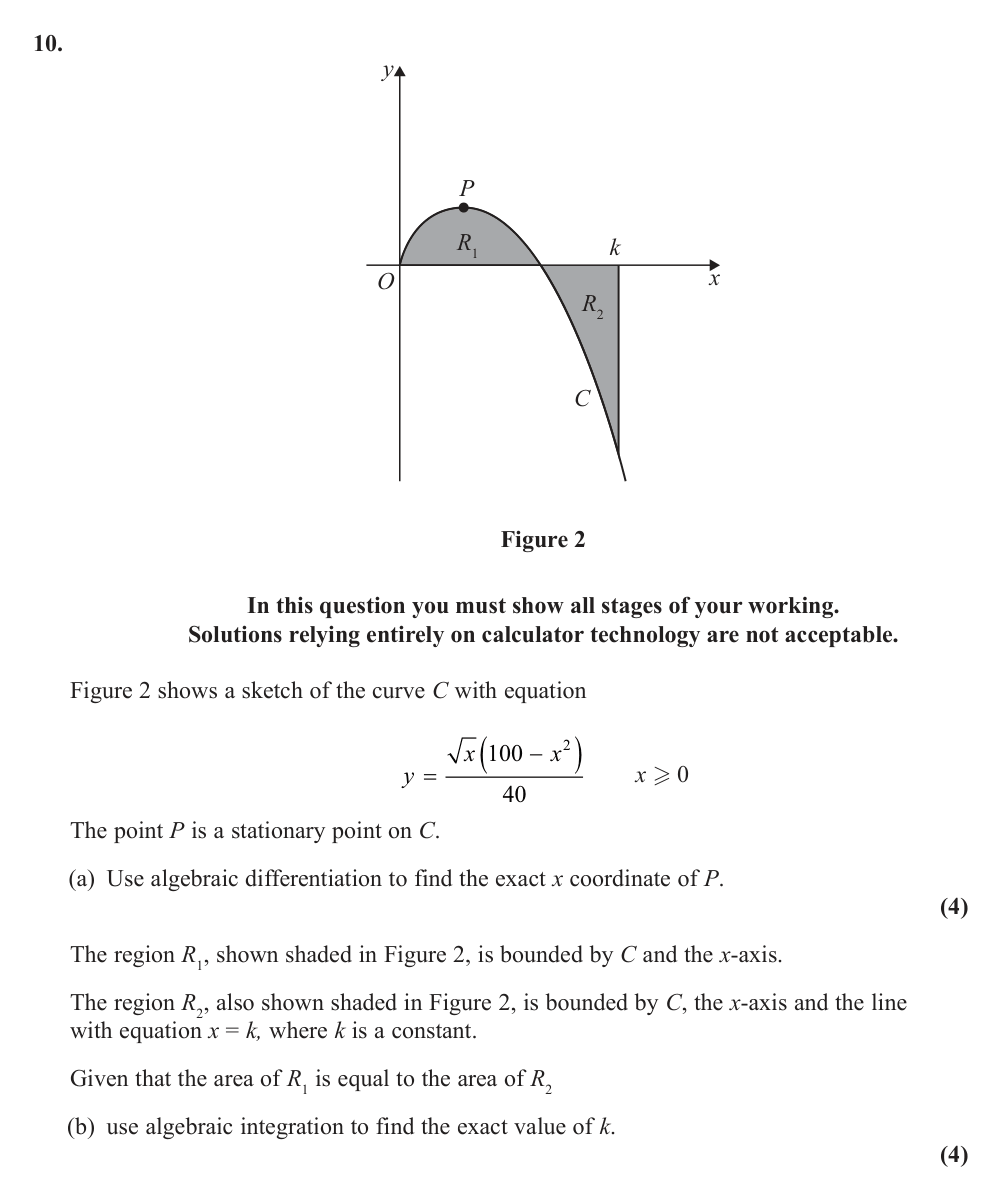
20. WMA12/01 January 2026 · Q10 Medium 8 marks · main topic: Applications of DifferentiationShow worked solution Rewrite the curve $y=\dfrac{\sqrt{x}(100-x^2)}{40}=\dfrac52x^{1/2}-\dfrac1{40}x^{5/2}$.
Differentiate $\dfrac{dy}{dx}=\dfrac54x^{-1/2}-\dfrac1{16}x^{3/2}$.
Use the stationary point At $P$, $\dfrac{dy}{dx}=0$. Thus $\dfrac54x^{-1/2}=\dfrac1{16}x^{3/2}$. Multiplying by $16x^{1/2}$ gives $20=x^2$.
Find the x-coordinate Since $x\geq0$, $x=\sqrt{20}=2\sqrt5$.
Integrate the curve $\int y\,dx=\int\left(\dfrac52x^{1/2}-\dfrac1{40}x^{5/2}\right)dx=\dfrac53x^{3/2}-\dfrac1{140}x^{7/2}$.
Use equal areas The signed area from $0$ to $k$ is zero because the positive area $R_1$ equals the negative area $R_2$ in magnitude.
Solve for k $\dfrac53k^{3/2}-\dfrac1{140}k^{7/2}=0$. Since $k>0$, divide by $k^{3/2}$ to get $\dfrac53-\dfrac{k^2}{140}=0$, so $k^2=\dfrac{700}{3}$.
Write the exact value $k=\sqrt{\dfrac{700}{3}}=\dfrac{10\sqrt{21}}{3}$.
Final answer $(a)\ x=2\sqrt5.\quad (b)\ k=\dfrac{10\sqrt{21}}{3}$.
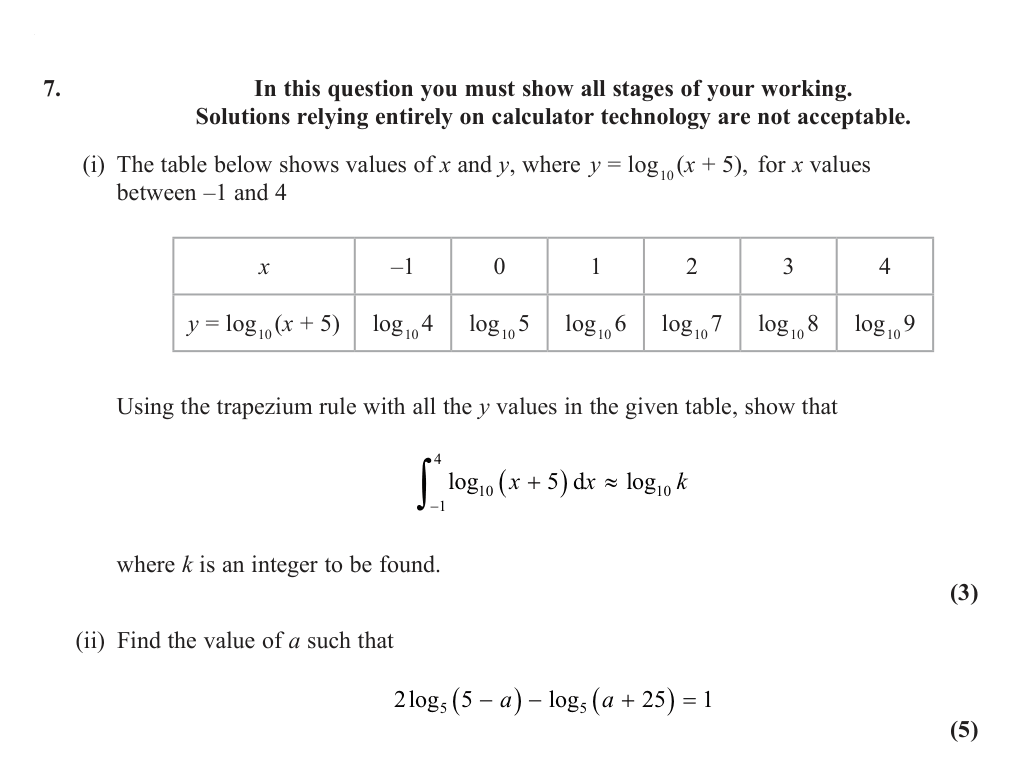
21. WMA12/01 January 2025 · Q7 Medium 8 marks · main topic: Laws of LogarithmsShow worked solution Use the trapezium rule The width is $1$, so $\displaystyle\int_{-1}^{4}\log_{10}(x+5)\,dx\approx\dfrac12\{\log_{10}4+\log_{10}9+2(\log_{10}5+\log_{10}6+\log_{10}7+\log_{10}8)\}$.
Combine the logarithms This is $\log_{10}\left(\sqrt{4\times9}\times5\times6\times7\times8\right)$.
Find k $\sqrt{4\times9}\times5\times6\times7\times8=6\times1680=10080$, so $k=10080$.
State the domain The logarithms require $5-a>0$ and $a+25>0$, so $-25<a<5$.
Combine the logarithms $2\log_5(5-a)-\log_5(a+25)=\log_5\left(\dfrac{(5-a)^2}{a+25}\right)$.
Use one as a logarithm $1=\log_5 5$, so $\dfrac{(5-a)^2}{a+25}=5$.
Form the quadratic $(5-a)^2=5(a+25)$, so $a^2-10a+25=5a+125$. Hence $a^2-15a-100=0$.
Solve and check $(a-20)(a+5)=0$, so $a=20$ or $a=-5$. Only $a=-5$ is in the domain, so $a=-5$.
Final answer $(i)$ $k=10080$. $\quad (ii)$ $a=-5$.
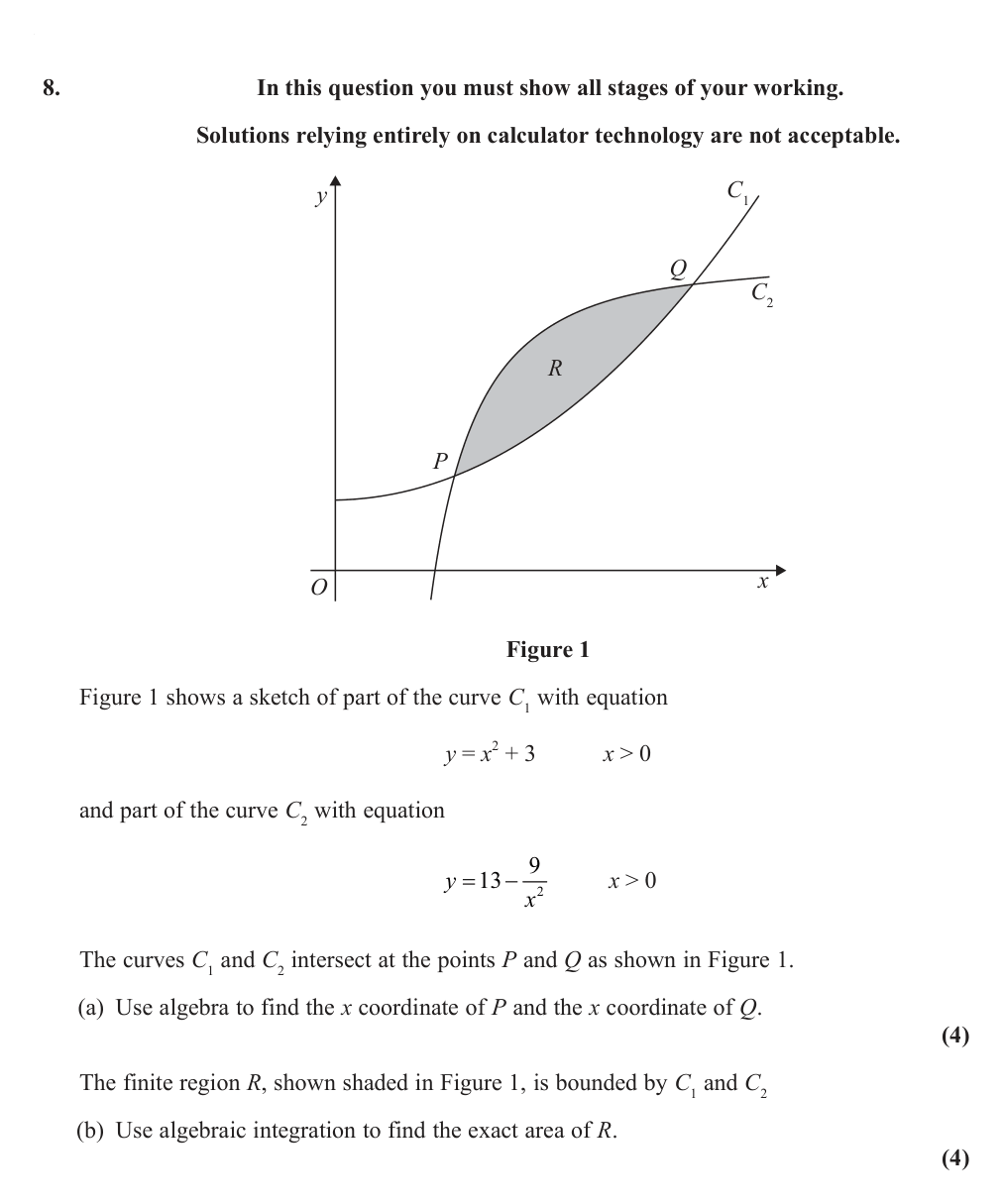
22. WMA12/01 October 2024 · Q8 Medium 8 marksShow worked solution Equate the curves $x^2+3=13-\dfrac9{x^2}$.
Clear the denominator Multiplying by $x^2$ gives $x^4+3x^2=13x^2-9$, so $x^4-10x^2+9=0$.
Factor Let $u=x^2$. Then $u^2-10u+9=(u-1)(u-9)=0$, so $x^2=1$ or $x^2=9$.
Use x greater than zero Since $x>0$, the intersections have $x=1$ and $x=3$. Thus $x_P=1$ and $x_Q=3$.
Set up the area Between $x=1$ and $x=3$, curve $C_2$ is above curve $C_1$, so $R=\displaystyle\int_1^3\left(13-\dfrac9{x^2}-(x^2+3)\right)dx$.
Simplify the integrand $R=\displaystyle\int_1^3(10-x^2-9x^{-2})\,dx$.
Integrate $R=\left[10x-\dfrac{x^3}{3}+\dfrac9x\right]_1^3$.
Evaluate $R=\left(30-9+3\right)-\left(10-\dfrac13+9\right)=24-\dfrac{56}{3}=\dfrac{16}{3}$.
Final answer $(a)$ $x_P=1$, $x_Q=3$. $\quad (b)$ $\dfrac{16}{3}$.
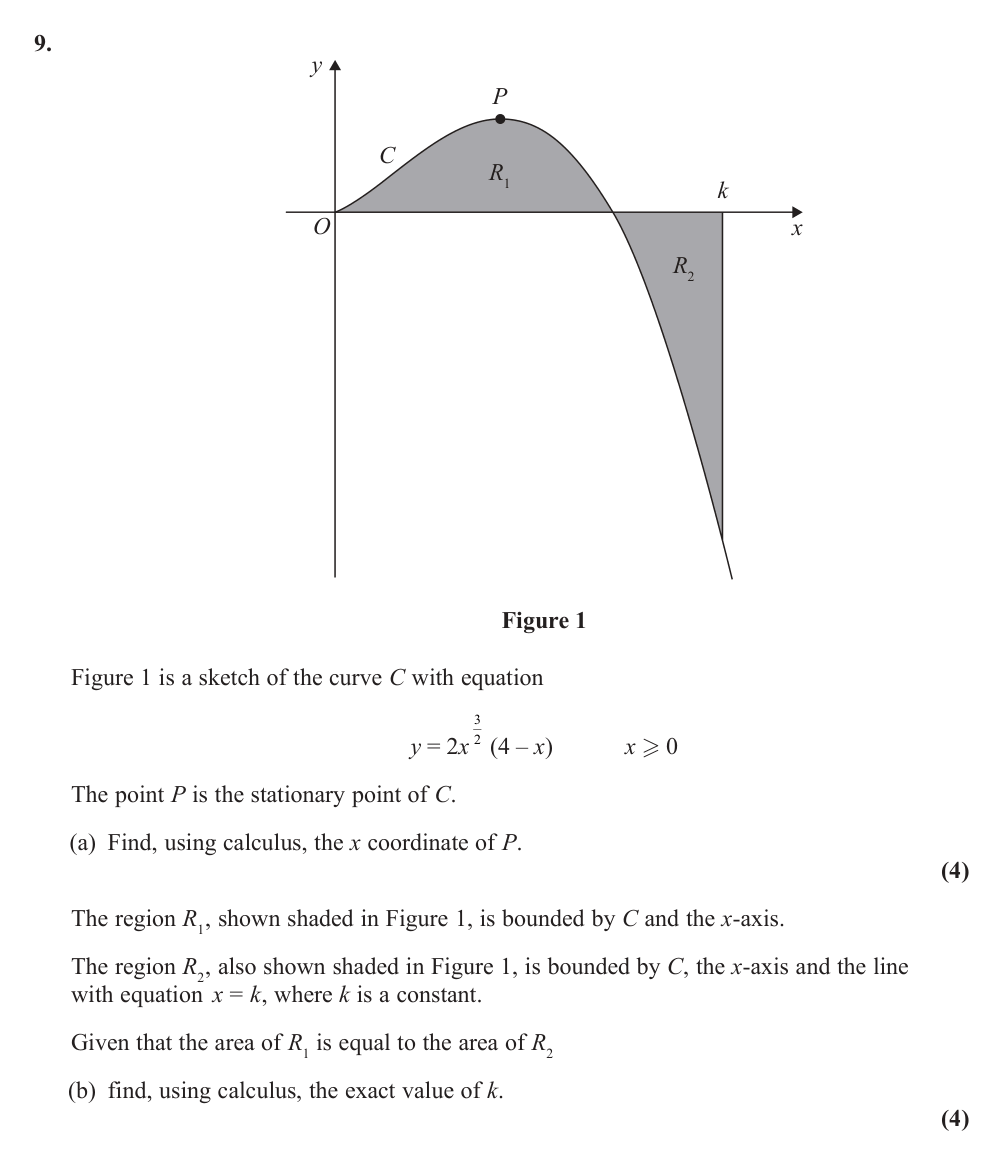
23. WMA12/01 May/June 2024 · Q9 Medium 8 marks · main topic: Applications of DifferentiationShow worked solution Rewrite the curve $y=2x^{3/2}(4-x)=8x^{3/2}-2x^{5/2}$.
Differentiate $\dfrac{dy}{dx}=12x^{1/2}-5x^{3/2}=\sqrt{x}(12-5x)$.
Find the stationary point For the interior stationary point $P$, $12-5x=0$, so $x=\dfrac{12}{5}$.
Set up the area condition $R_1$ is the area from $x=0$ to $x=4$ above the $x$-axis. $R_2$ is the area from $x=4$ to $x=k$ below the $x$-axis.
Use equal areas Equal areas mean $\displaystyle \int_0^4 y\,dx=-\int_4^k y\,dx$, so $\displaystyle \int_0^k y\,dx=0$.
Integrate y $\displaystyle \int 2x^{3/2}(4-x)dx=\int(8x^{3/2}-2x^{5/2})dx=\dfrac{16}{5}x^{5/2}-\dfrac47x^{7/2}$.
Solve for k $\dfrac{16}{5}k^{5/2}-\dfrac47k^{7/2}=0$.
Factor $4k^{5/2}\left(\dfrac45-\dfrac{k}{7}\right)=0$.
Choose the value beyond four Since $k>4$, $\dfrac45-\dfrac{k}{7}=0$, so $k=\dfrac{28}{5}$.
Final answer $(a)$ $x=\dfrac{12}{5}$. $\quad (b)$ $k=\dfrac{28}{5}$.
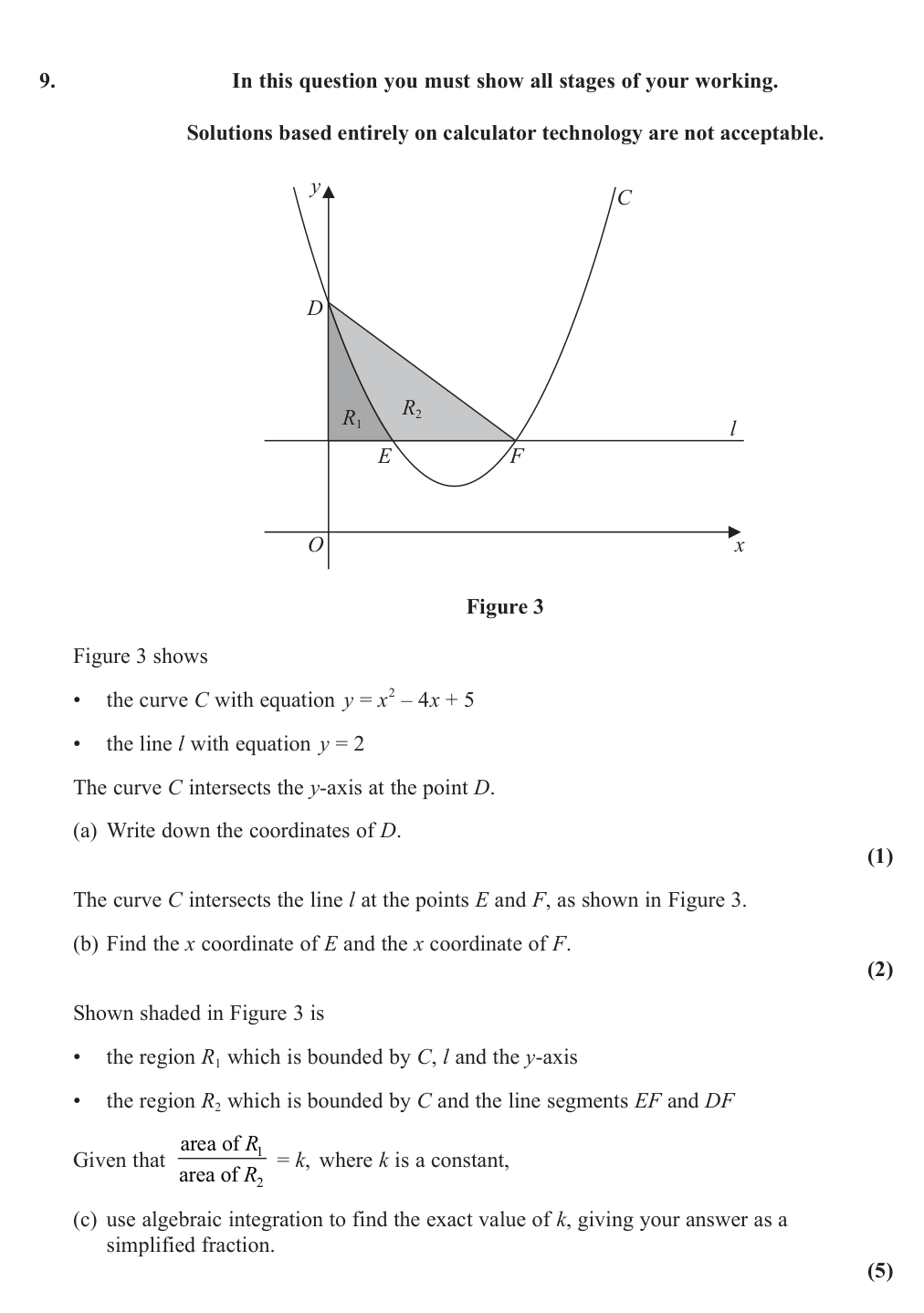
24. WMA12/01 January 2023 · Q9 Medium 8 marksShow worked solution Find D At the $y$-axis, $x=0$. On $C$, $y=0^2-4(0)+5=5$, so $D=(0,5)$.
Find intersections with the line The line is $y=2$, so solve $x^2-4x+5=2$.
Solve the quadratic $x^2-4x+3=0$, so $(x-1)(x-3)=0$. Hence $x_E=1$ and $x_F=3$.
Area of R1 $R_1$ lies between the curve and the line $y=2$ from $x=0$ to $x=1$.
Integrate R1 $\displaystyle R_1=\int_0^1\left(x^2-4x+5-2\right)dx=\int_0^1(x^2-4x+3)dx$.
Evaluate R1 $\displaystyle R_1=\left[\dfrac{x^3}{3}-2x^2+3x\right]_0^1=\dfrac13-2+3=\dfrac43$.
Find the line DF The line through $D=(0,5)$ and $F=(3,2)$ has gradient $-1$, so its equation is $y=5-x$.
Split R2 For $0\le x\le1$, $R_2$ is between $y=5-x$ and the curve. For $1\le x\le3$, it is between $y=5-x$ and $y=2$.
Integrate R2 $\displaystyle R_2=\int_0^1\left[(5-x)-(x^2-4x+5)\right]dx+\int_1^3\left[(5-x)-2\right]dx$.
Evaluate R2 $\displaystyle R_2=\int_0^1(-x^2+3x)dx+\int_1^3(3-x)dx=\dfrac{7}{6}+2=\dfrac{19}{6}$.
Find the ratio $k=\dfrac{\text{area of }R_1}{\text{area of }R_2}=\dfrac{4/3}{19/6}=\dfrac{8}{19}$.
Final answer $(a)$ $D=(0,5)$. $\quad (b)$ $x_E=1,\ x_F=3$. $\quad (c)$ $k=\dfrac{8}{19}$.
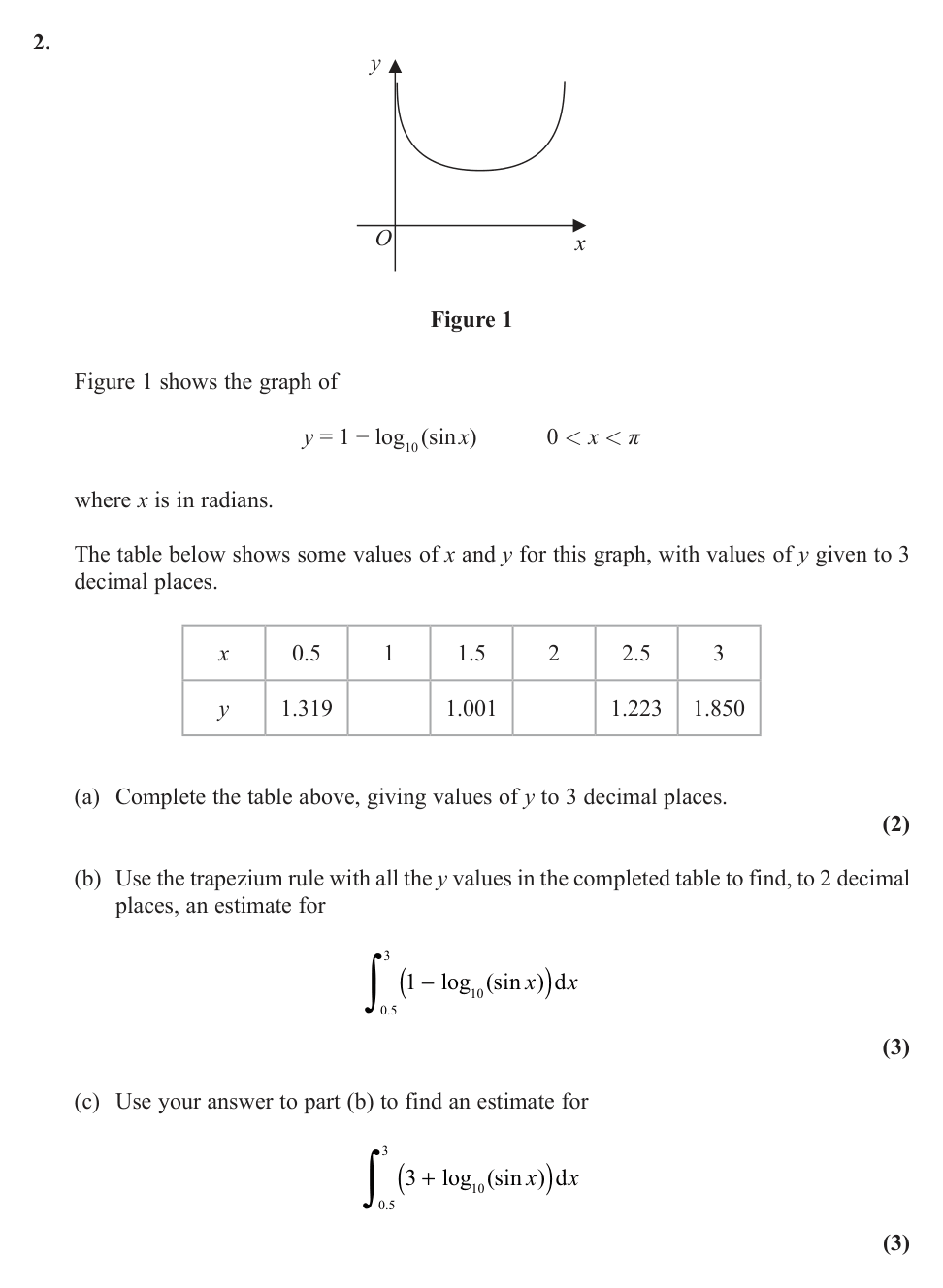
25. WMA12/01 May/June 2022 · Q2 Medium 8 marksShow worked solution Complete the missing table values Using $y=1-\log_{10}(\sin x)$ gives $y(1)=1.075$ and $y(2)=1.041$ to 3 decimal places.
Identify the strip width The $x$ values increase by $0.5$, so $h=0.5$.
Apply the trapezium rule $A\approx\dfrac{0.5}{2}\{1.319+1.850+2(1.075+1.001+1.041+1.223)\}$.
Calculate part b This gives $2.9625\ldots$, so the estimate is $2.96$ to 2 decimal places.
Rewrite the new integrand Since $y=1-\log_{10}(\sin x)$, we have $\log_{10}(\sin x)=1-y$.
Use the interval length $3+\log_{10}(\sin x)=4-y$, and the interval from $0.5$ to $3$ has length $2.5$.
Estimate part c $\int_{0.5}^{3}(3+\log_{10}(\sin x))\,dx\approx4(2.5)-2.9625\ldots=7.0374\ldots$, so $7.04$.
Final answer $(a)\ y(1)=1.075,\ y(2)=1.041.\quad (b)\ 2.96.\quad (c)\ 7.04$.
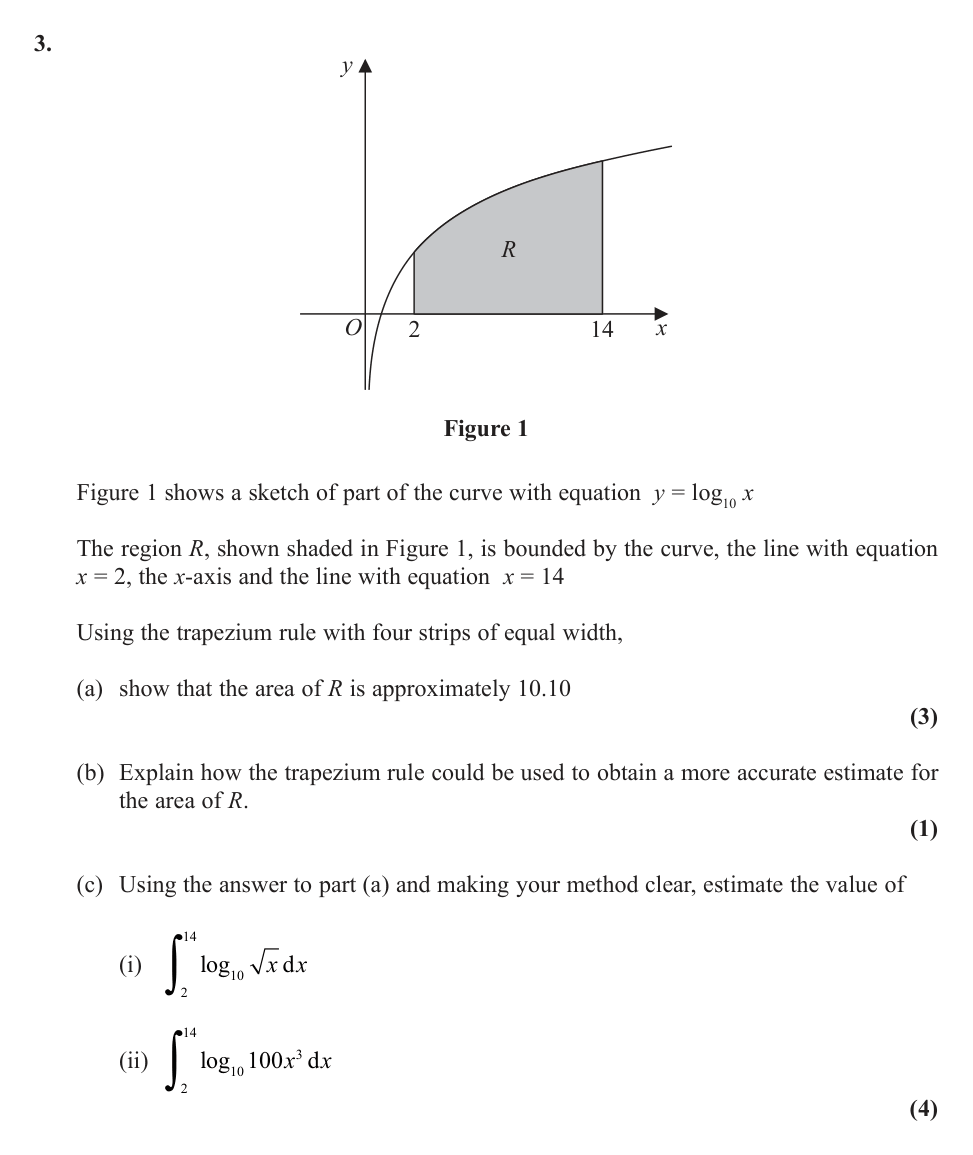
26. WMA12/01 October 2021 · Q3 Medium 8 marksShow worked solution Find the strip width Four equal strips from $x=2$ to $x=14$ have width $h=\dfrac{14-2}{4}=3$.
List the ordinates Use $x=2,5,8,11,14$ and $y=\log_{10}x$.
Apply the trapezium rule $A\approx\dfrac32\{\log_{10}2+\log_{10}14+2(\log_{10}5+\log_{10}8+\log_{10}11)\}=10.10\ldots$.
Improve the estimate Use more strips of smaller width to make the trapezium rule estimate more accurate.
Estimate the square-root integral $\log_{10}\sqrt{x}=\dfrac12\log_{10}x$, so $\int_2^{14}\log_{10}\sqrt{x}\,dx\approx\dfrac12(10.10)=5.05$.
Rewrite the second logarithm $\log_{10}(100x^3)=\log_{10}100+\log_{10}x^3=2+3\log_{10}x$.
Estimate the second integral $\int_2^{14}(2+3\log_{10}x)\,dx\approx2(12)+3(10.10)=54.30$.
Final answer $(a)\ 10.10.\quad (b)$ Use more strips. $\quad (c)(i)\ 5.05.\quad (c)(ii)\ 54.30$.
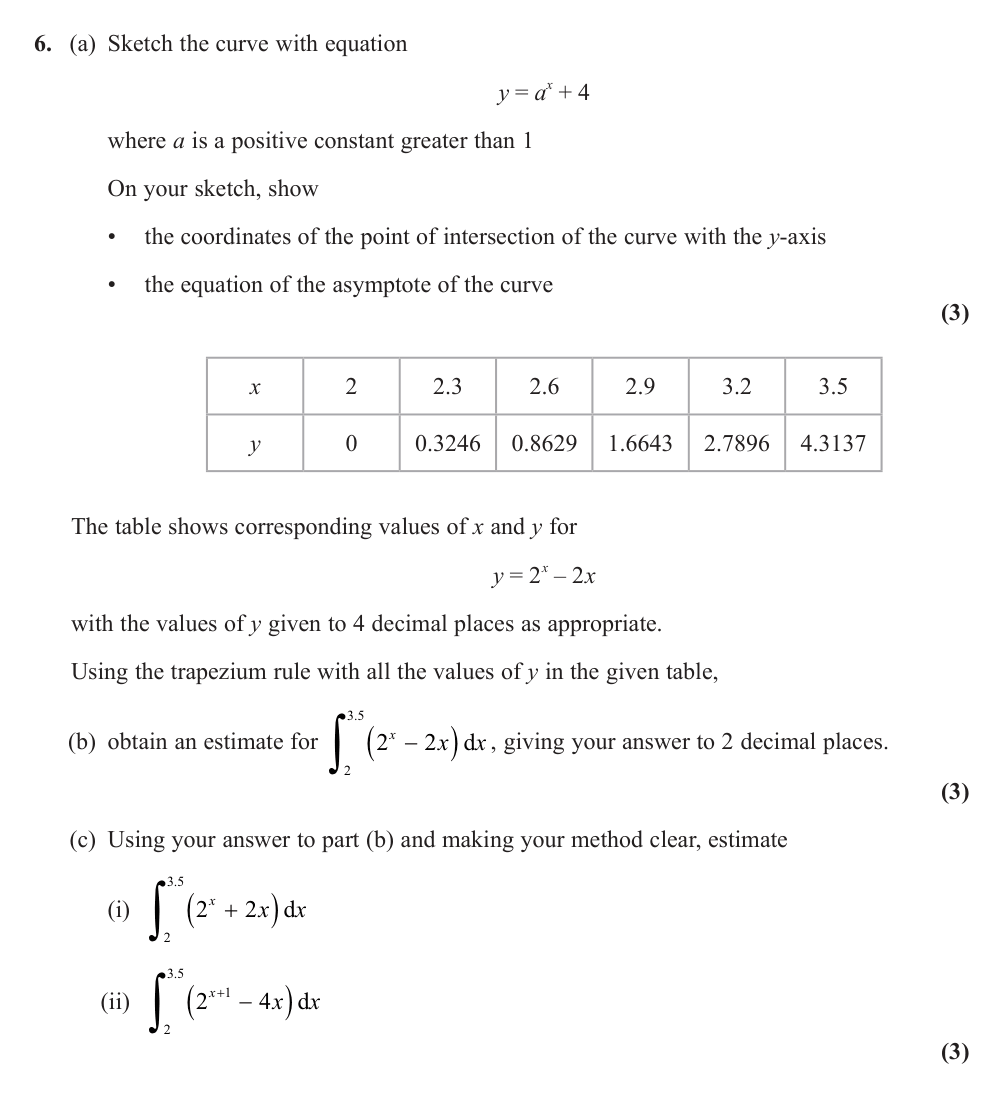
27. WMA12/01 May/June 2024 · Q6 Hard 9 marksShow worked solution Sketch key features For $y=a^x+4$ with $a>1$, the curve is increasing.
Find the y-intercept At $x=0$, $y=a^0+4=5$, so the $y$-intercept is $(0,5)$.
Find the asymptote As $x\to-\infty$, $a^x\to0$, so the horizontal asymptote is $y=4$.
Use the trapezium width The $x$ values increase by $0.3$, so $h=0.3$.
Apply the trapezium rule $\displaystyle \int_2^{3.5}(2^x-2x)dx\approx\dfrac{0.3}{2}[0+4.3137+2(0.3246+0.8629+1.6643+2.7896)]$.
Round part b This gives $2.339475$, so the estimate is $2.34$ to 2 decimal places.
Estimate part c i $2^x+2x=(2^x-2x)+4x$, so $\displaystyle \int_2^{3.5}(2^x+2x)dx\approx2.34+\int_2^{3.5}4x\,dx$.
Add the extra integral $\displaystyle \int_2^{3.5}4x\,dx=[2x^2]_2^{3.5}=16.5$, so the estimate is $2.34+16.5=18.84$.
Estimate part c ii $2^{x+1}-4x=2(2^x-2x)$, so the estimate is $2(2.34)=4.68$.
Final answer $(a)$ $y$-intercept $(0,5)$ and asymptote $y=4$. $\quad (b)$ $2.34$. $\quad (c)(i)$ $18.84$. $\quad (c)(ii)$ $4.68$.
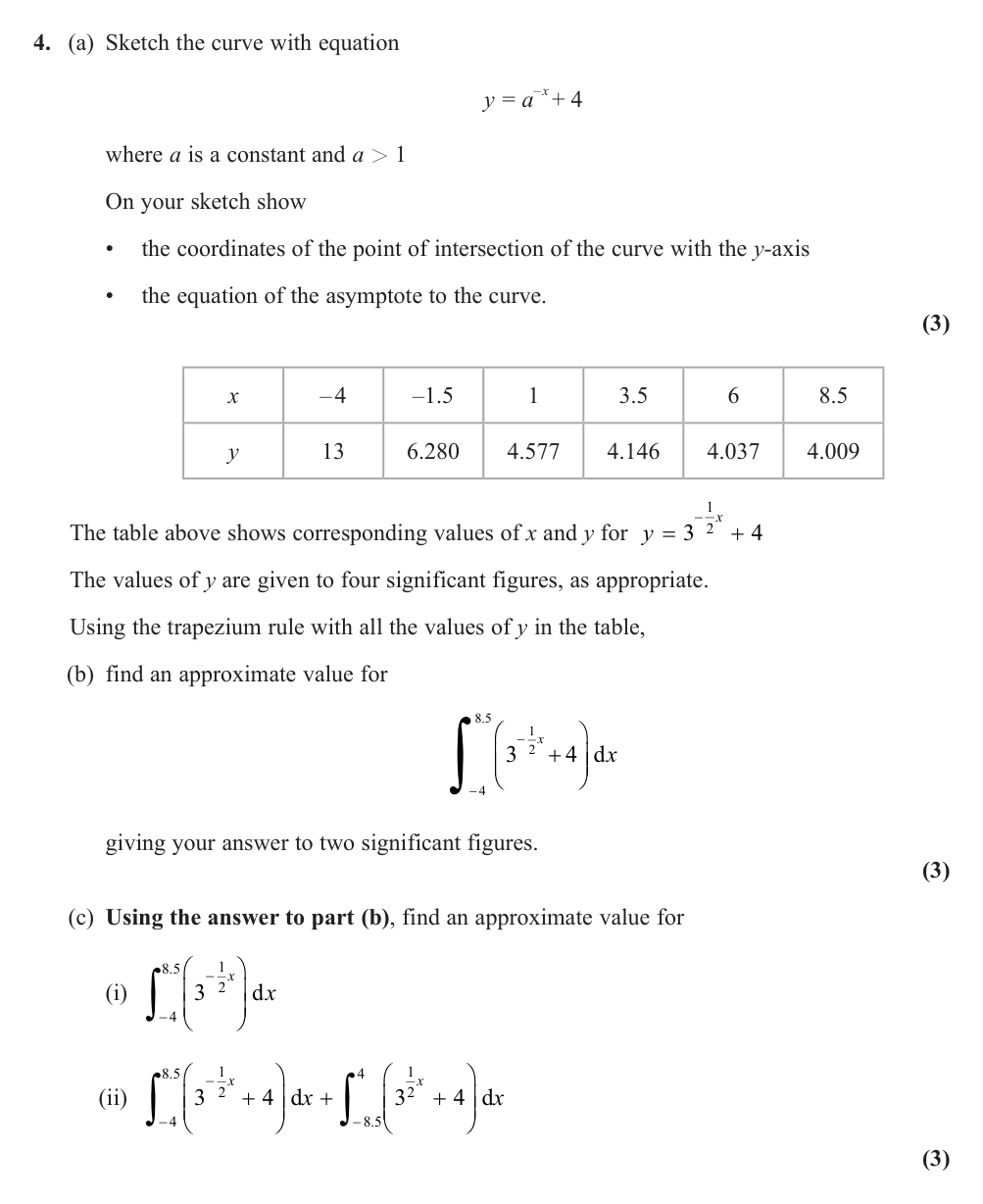
28. WMA12/01 January 2024 · Q4 Hard 9 marksShow worked solution Find the y-intercept For $y=a^{-x}+4$, set $x=0$: $y=a^0+4=5$, so the curve meets the $y$-axis at $(0,5)$.
Find the asymptote Since $a>1$, $a^{-x}\to0$ as $x\to\infty$, so the horizontal asymptote is $y=4$.
Describe the sketch The curve is decreasing, passes through $(0,5)$, and approaches the line $y=4$ from above.
Use the trapezium width The $x$ values increase by $2.5$, so $h=2.5$.
Apply the trapezium rule $\displaystyle \int_{-4}^{8.5}\left(3^{-x/2}+4\right)dx\approx \dfrac{2.5}{2}\left[13+4.009+2(6.280+4.577+4.146+4.037)\right]$.
Round part b This gives $68.86125$, so to two significant figures the estimate is $69$.
Remove the constant part $\displaystyle \int_{-4}^{8.5}4\,dx=4(12.5)=50$.
Estimate part c i Using the answer to part (b), $\displaystyle \int_{-4}^{8.5}3^{-x/2}dx\approx69-50=19$.
Use symmetry by substitution For $\displaystyle \int_{-8.5}^{4}(3^{x/2}+4)dx$, let $u=-x$. This changes it to the same integral as part (b).
Estimate part c ii Therefore the two integrals in part (c)(ii) are approximately equal, so the total is $69+69=138$.
Final answer $(a)$ $y$-intercept $(0,5)$ and asymptote $y=4$. $\quad (b)$ $69$. $\quad (c)(i)$ $19$. $\quad (c)(ii)$ $138$.
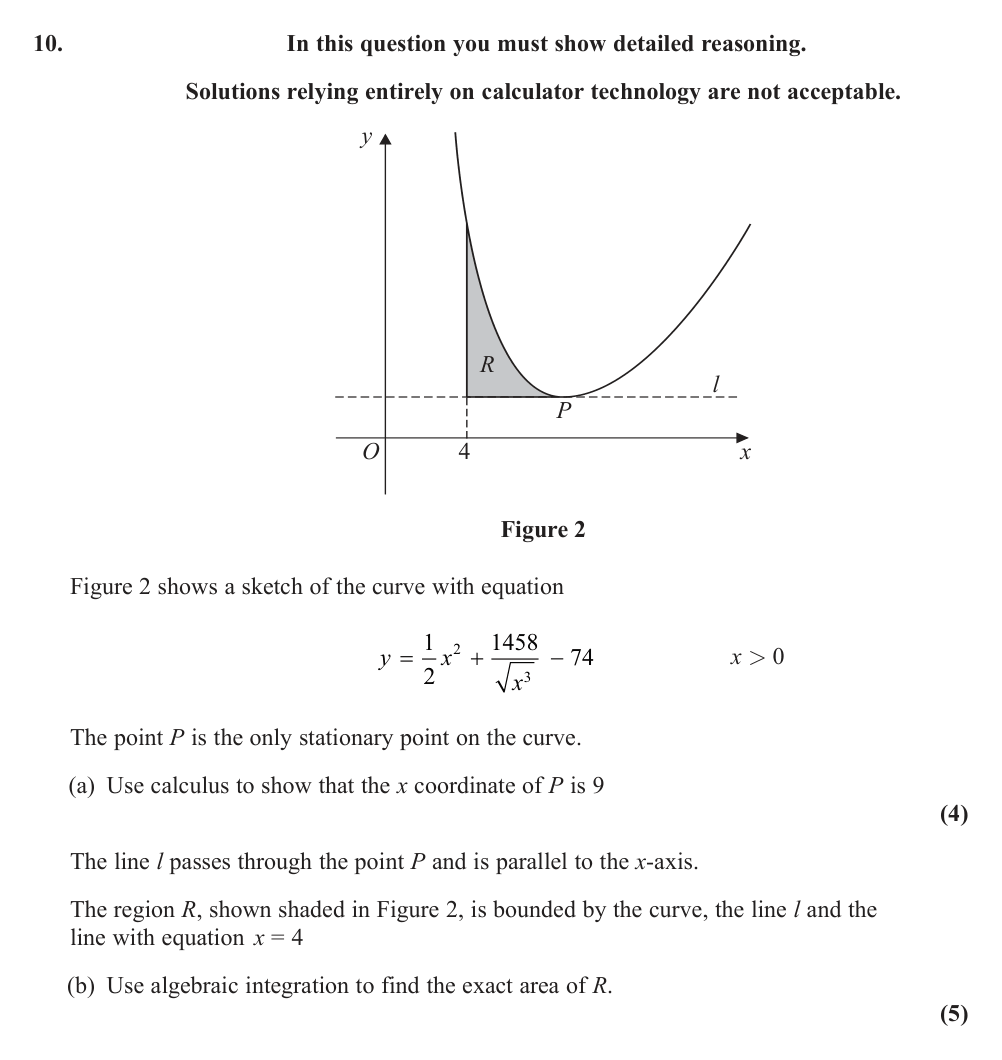
29. WMA12/01 January 2024 · Q10 Hard 9 marks · main topic: Applications of DifferentiationShow worked solution Rewrite the curve $y=\dfrac12x^2+1458x^{-3/2}-74$.
Differentiate $\dfrac{dy}{dx}=x+1458\left(-\dfrac32\right)x^{-5/2}=x-2187x^{-5/2}$.
Use the stationary condition At a stationary point, $x-2187x^{-5/2}=0$.
Solve for x $x=2187x^{-5/2}$, so $x^{7/2}=2187=3^7$.
Show x coordinate Raising both sides to the power $\dfrac27$ gives $x=3^2=9$. Since $x>0$, this is the only stationary point.
Find the horizontal line At $x=9$, $y=\dfrac12(9)^2+\dfrac{1458}{\sqrt{9^3}}-74=\dfrac{81}{2}+54-74=\dfrac{41}{2}$.
Set up the area The region lies from $x=4$ to $x=9$ between the curve and the horizontal line $y=\dfrac{41}{2}$.
Integrate the difference $\displaystyle R=\int_4^9\left(\dfrac12x^2+1458x^{-3/2}-74-\dfrac{41}{2}\right)dx$.
Find an antiderivative $\displaystyle \int\left(\dfrac12x^2+1458x^{-3/2}-\dfrac{189}{2}\right)dx=\dfrac{x^3}{6}-2916x^{-1/2}-\dfrac{189}{2}x$.
Evaluate exactly $\displaystyle R=\left[\dfrac{x^3}{6}-2916x^{-1/2}-\dfrac{189}{2}x\right]_4^9=\dfrac{373}{3}$.
Final answer $(a)$ Proven. $\quad (b)$ $\dfrac{373}{3}$.
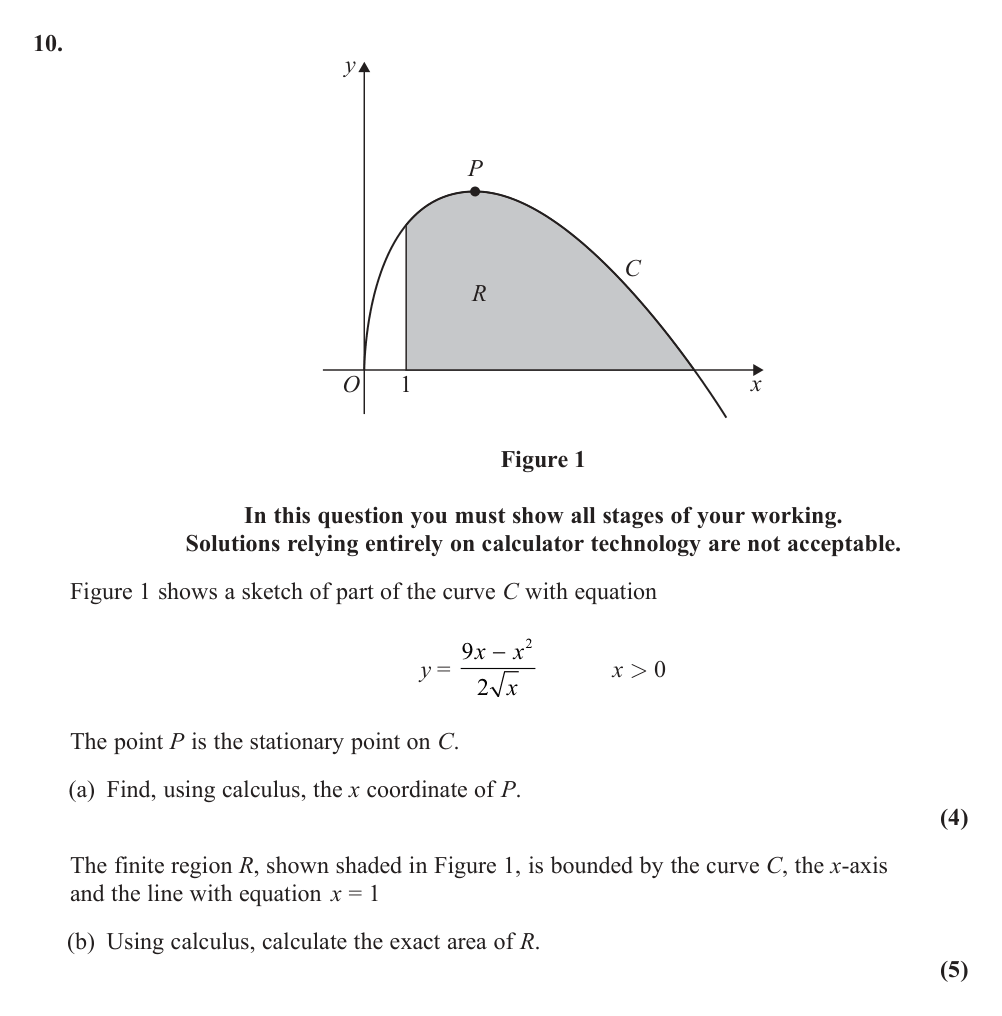
30. WMA12/01 May/June R 2024 · Q10 Hard 9 marks · main topic: Applications of DifferentiationShow worked solution Rewrite the curve $y=\dfrac{9x-x^2}{2\sqrt{x}}=\dfrac12(9x^{1/2}-x^{3/2})$.
Differentiate $\dfrac{dy}{dx}=\dfrac12\left(\dfrac92x^{-1/2}-\dfrac32x^{1/2}\right)=\dfrac{3(3-x)}{4\sqrt{x}}$.
Use the stationary condition For $x>0$, the denominator is not zero. So $\dfrac{dy}{dx}=0$ when $3-x=0$.
Find P Therefore the $x$ coordinate of $P$ is $3$.
Find where the curve meets the x-axis $y=0$ when $9x-x^2=0$, so $x=9$ for the positive intercept.
Set up the area The region is under the curve from $x=1$ to $x=9$, so $R=\displaystyle \int_1^9 \dfrac{9x-x^2}{2\sqrt{x}}dx$.
Integrate $R=\displaystyle \int_1^9 \dfrac12(9x^{1/2}-x^{3/2})dx=\left[3x^{3/2}-\dfrac15x^{5/2}\right]_1^9$.
Evaluate $R=\left(3(27)-\dfrac15(243)\right)-\left(3-\dfrac15\right)=\dfrac{148}{5}$.
Final answer $(a)$ $x=3$. $\quad (b)$ $\dfrac{148}{5}$.
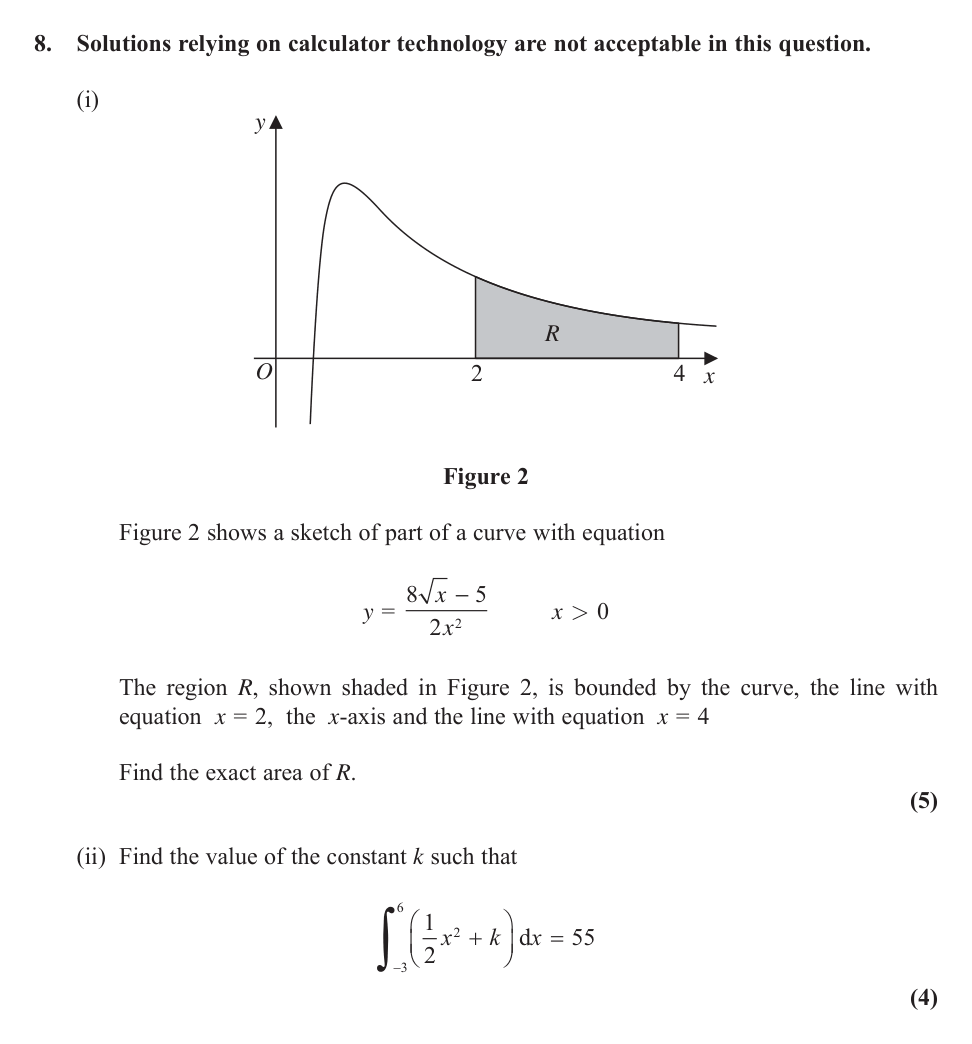
31. WMA12/01 October 2019 · Q8 Hard 9 marksShow worked solution Rewrite the curve $y=\dfrac{8\sqrt{x}-5}{2x^2}=4x^{-3/2}-\dfrac52x^{-2}$.
Integrate the curve $\int\left(4x^{-3/2}-\dfrac52x^{-2}\right)dx=-8x^{-1/2}+\dfrac{5}{2x}$.
Apply the limits for the area $\left[-8x^{-1/2}+\dfrac{5}{2x}\right]_2^4=\left(-4+\dfrac58\right)-\left(-4\sqrt2+\dfrac54\right)$.
Simplify the exact area This gives $4\sqrt2-\dfrac{37}{8}$.
Integrate the second expression $\int\left(\dfrac12x^2+k\right)dx=\dfrac{x^3}{6}+kx$.
Use the limits $\left[\dfrac{x^3}{6}+kx\right]_{-3}^{6}=\left(36+6k\right)-\left(-\dfrac92-3k\right)=\dfrac{81}{2}+9k$.
Solve for k $\dfrac{81}{2}+9k=55$, so $9k=\dfrac{29}{2}$ and $k=\dfrac{29}{18}$.
Final answer $(i)\ 4\sqrt2-\dfrac{37}{8}.\quad (ii)\ k=\dfrac{29}{18}$.
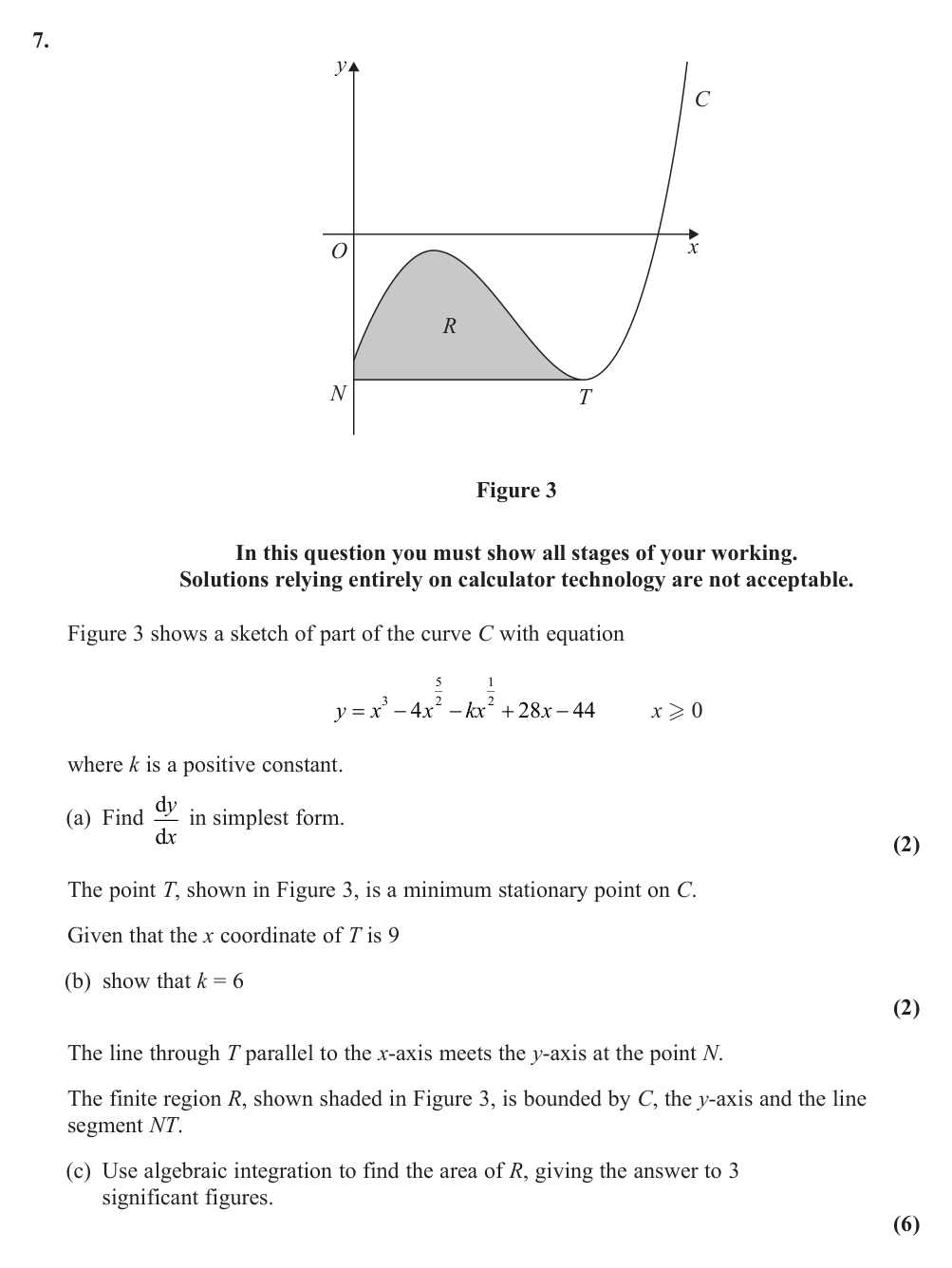
32. WMA12/01 October 2025 · Q7 Hard 10 marksShow worked solution Differentiate For $y=x^3-4x^{5/2}-kx^{1/2}+28x-44$, $\dfrac{dy}{dx}=3x^2-10x^{3/2}-\dfrac{k}{2}x^{-1/2}+28$.
Write in simplest form $\dfrac{dy}{dx}=3x^2-10x^{3/2}-\dfrac{k}{2\sqrt{x}}+28$.
Use the stationary point At $T$, $x=9$ and $\dfrac{dy}{dx}=0$.
Substitute x equals nine $0=3(9)^2-10(9)^{3/2}-\dfrac{k}{2\sqrt9}+28=243-270-\dfrac{k}{6}+28$.
Find k This simplifies to $0=1-\dfrac{k}{6}$, so $k=6$.
Find the horizontal line With $k=6$, the $y$ coordinate of $T$ is $9^3-4(9)^{5/2}-6\sqrt9+28(9)-44=-53$.
Set up the area The line $NT$ is $y=-53$. The region is between the curve and this line from $x=0$ to $x=9$.
Write the integral $R=\displaystyle\int_0^9\left(x^3-4x^{5/2}-6x^{1/2}+28x-44+53\right)dx$.
Integrate $R=\left[\dfrac{x^4}{4}-\dfrac87x^{7/2}-4x^{3/2}+14x^2+9x\right]_0^9$.
Evaluate $R=\dfrac{6939}{28}=247.821\ldots$, so the area is $248$ to $3$ significant figures.
Final answer $(a)$ $3x^2-10x^{3/2}-\dfrac{k}{2\sqrt{x}}+28$. $\quad (b)$ Proven. $\quad (c)$ $248$.
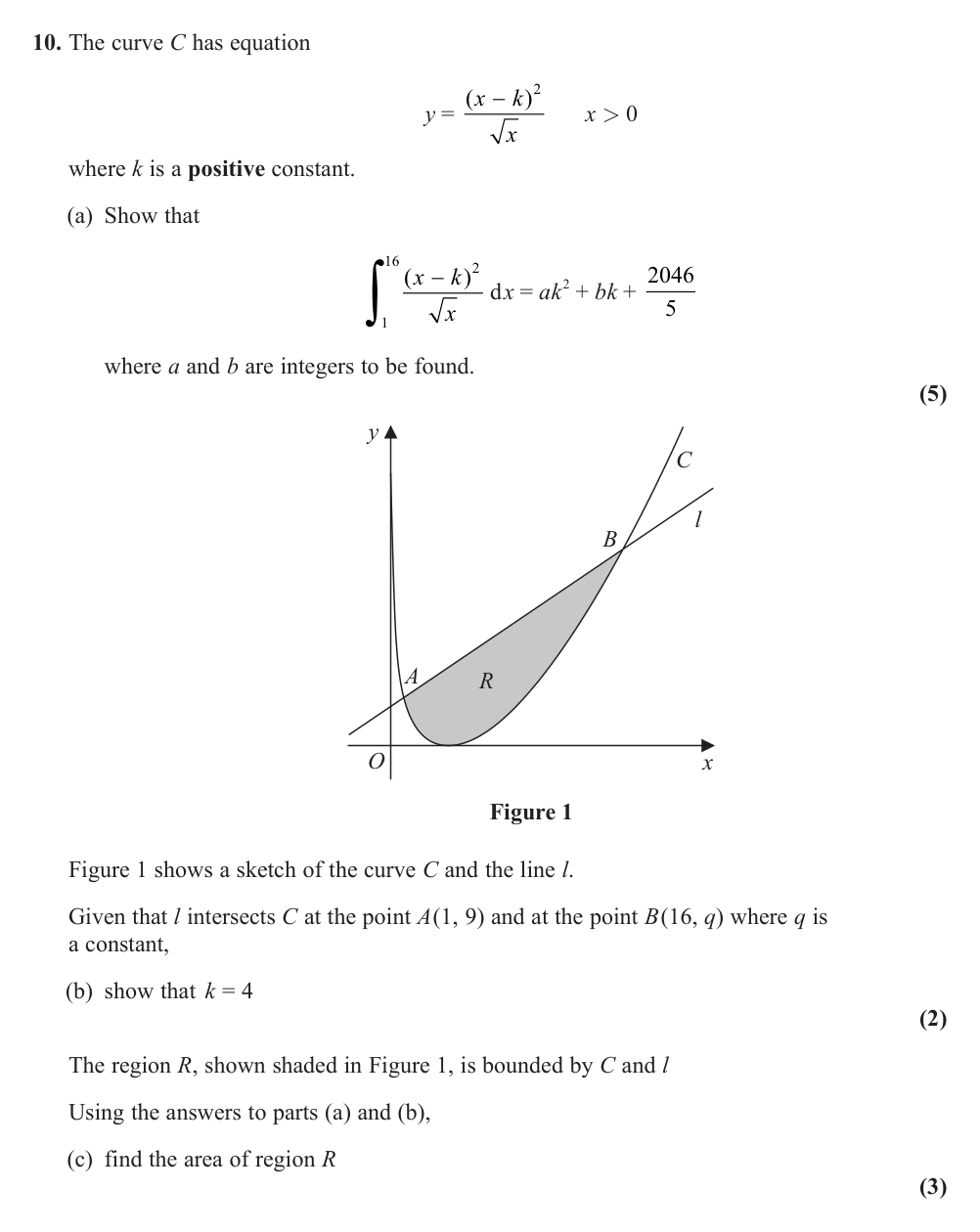
33. WMA12/01 May/June 2023 · Q10 Hard 10 marksShow worked solution Expand the integrand $\dfrac{(x-k)^2}{\sqrt{x}}=\dfrac{x^2-2kx+k^2}{x^{1/2}}=x^{3/2}-2kx^{1/2}+k^2x^{-1/2}$.
Integrate $\displaystyle \int \left(x^{3/2}-2kx^{1/2}+k^2x^{-1/2}\right)dx=\dfrac25x^{5/2}-\dfrac{4k}{3}x^{3/2}+2k^2x^{1/2}$.
Substitute the limits From $1$ to $16$, this gives $\left(\dfrac{2048}{5}-\dfrac{256k}{3}+8k^2\right)-\left(\dfrac25-\dfrac{4k}{3}+2k^2\right)$.
Simplify the integral The result is $6k^2-84k+\dfrac{2046}{5}$, so $a=6$ and $b=-84$.
Use point A Since $A(1,9)$ lies on $C$, $9=\dfrac{(1-k)^2}{\sqrt1}=(1-k)^2$.
Find k Thus $1-k=\pm3$, so $k=4$ or $k=-2$. Since $k$ is positive, $k=4$.
Find point B When $k=4$ and $x=16$, $q=\dfrac{(16-4)^2}{\sqrt{16}}=\dfrac{144}{4}=36$, so $B=(16,36)$.
Find the line The line through $A(1,9)$ and $B(16,36)$ has gradient $\dfrac{36-9}{16-1}=\dfrac95$, so $l$ has equation $y=\dfrac95x+\dfrac{36}{5}$.
Area under the line $\displaystyle \int_1^{16}\left(\dfrac95x+\dfrac{36}{5}\right)dx=\left[\dfrac{9}{10}x^2+\dfrac{36}{5}x\right]_1^{16}=\dfrac{675}{2}$.
Area under the curve From part (a), with $k=4$, $\displaystyle \int_1^{16}\dfrac{(x-4)^2}{\sqrt{x}}dx=6(4)^2-84(4)+\dfrac{2046}{5}=\dfrac{846}{5}$.
Subtract curve from line The shaded area is $\dfrac{675}{2}-\dfrac{846}{5}=\dfrac{1683}{10}$.
Final answer $(a)$ $a=6,\ b=-84$. $\quad (b)$ $k=4$. $\quad (c)$ Area $=\dfrac{1683}{10}$.
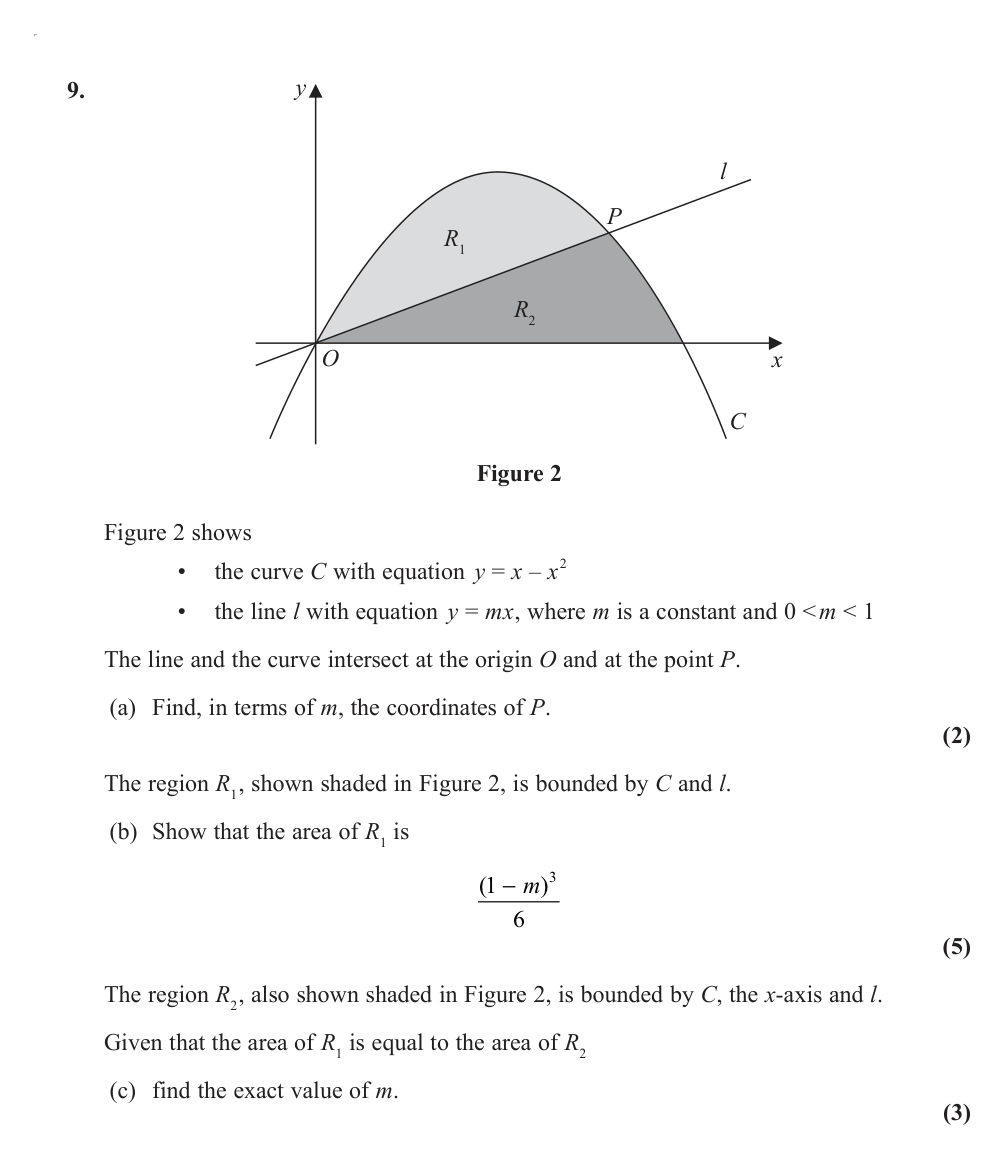
34. WMA12/01 January 2022 · Q9 Hard 10 marksShow worked solution Find the second intersection At an intersection, $x-x^2=mx$, so $x(1-m-x)=0$.
State P The non-zero intersection has $x=1-m$, and then $y=m(1-m)$, so $P=(1-m,m(1-m))$.
Set up area R one Region $R_1$ is between the curve and the line from $x=0$ to $x=1-m$.
Integrate the difference $A_{R_1}=\int_0^{1-m}\{(x-x^2)-mx\}\,dx=\int_0^{1-m}\{(1-m)x-x^2\}\,dx$.
Evaluate $A_{R_1}=\left[\dfrac{1-m}{2}x^2-\dfrac13x^3\right]_0^{1-m}=\dfrac{(1-m)^3}{2}-\dfrac{(1-m)^3}{3}=\dfrac{(1-m)^3}{6}$.
Use the total curve area The total area under $y=x-x^2$ from $x=0$ to $x=1$ is $\int_0^1(x-x^2)\,dx=\dfrac16$.
Use equal regions Since $R_1$ and $R_2$ are equal and together make this total area, each has area $\dfrac{1}{12}$.
Solve for m $\dfrac{(1-m)^3}{6}=\dfrac1{12}$, so $(1-m)^3=\dfrac12$ and $m=1-\dfrac1{\sqrt[3]{2}}$.
Final answer $(a)\ P=(1-m,\ m(1-m)).\quad (b)$ Proven: $\dfrac{(1-m)^3}{6}$. $\quad (c)\ m=1-\dfrac1{\sqrt[3]{2}}$.
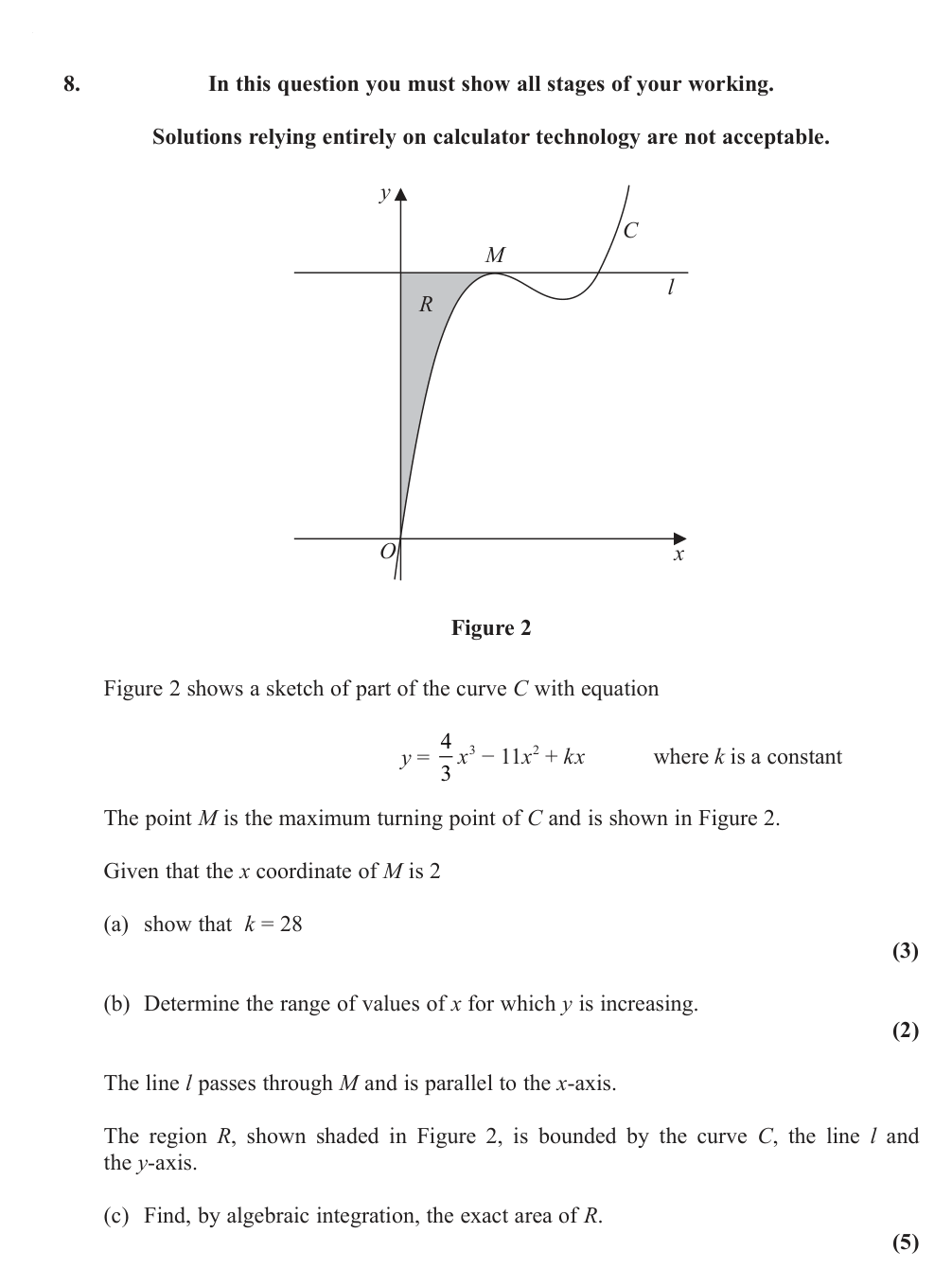
35. WMA12/01 October 2021 · Q8 Hard 10 marks · main topic: Applications of DifferentiationShow worked solution Differentiate the curve For $y=\dfrac43x^3-11x^2+kx$, $\dfrac{dy}{dx}=4x^2-22x+k$.
Use the turning point At the turning point $M$, $x=2$ and $\dfrac{dy}{dx}=0$.
Show k $4(2)^2-22(2)+k=0$, so $16-44+k=0$ and $k=28$.
Factor the derivative With $k=28$, $\dfrac{dy}{dx}=4x^2-22x+28=2(2x-7)(x-2)$.
Find where y is increasing The derivative is positive outside its roots, so $y$ is increasing for $x<2$ or $x>\dfrac72$.
Find the height of the line At $x=2$, $y=\dfrac43(8)-11(4)+28(2)=\dfrac{68}{3}$. Hence line $l$ has equation $y=\dfrac{68}{3}$.
Set up the shaded area The region is between the line and the curve from $x=0$ to $x=2$, so $A=\int_0^2\left(\dfrac{68}{3}-\left(\dfrac43x^3-11x^2+28x\right)\right)dx$.
Integrate $A=\left[\dfrac{68}{3}x-\dfrac13x^4+\dfrac{11}{3}x^3-14x^2\right]_0^2$.
Evaluate exactly Substituting $x=2$ gives $\dfrac{136}{3}-\dfrac{16}{3}+\dfrac{88}{3}-56=\dfrac{40}{3}$.
Final answer $(a)$ Proven: $k=28$. $\quad (b)\ x<2\text{ or }x>\dfrac72.\quad (c)\ \dfrac{40}{3}$.
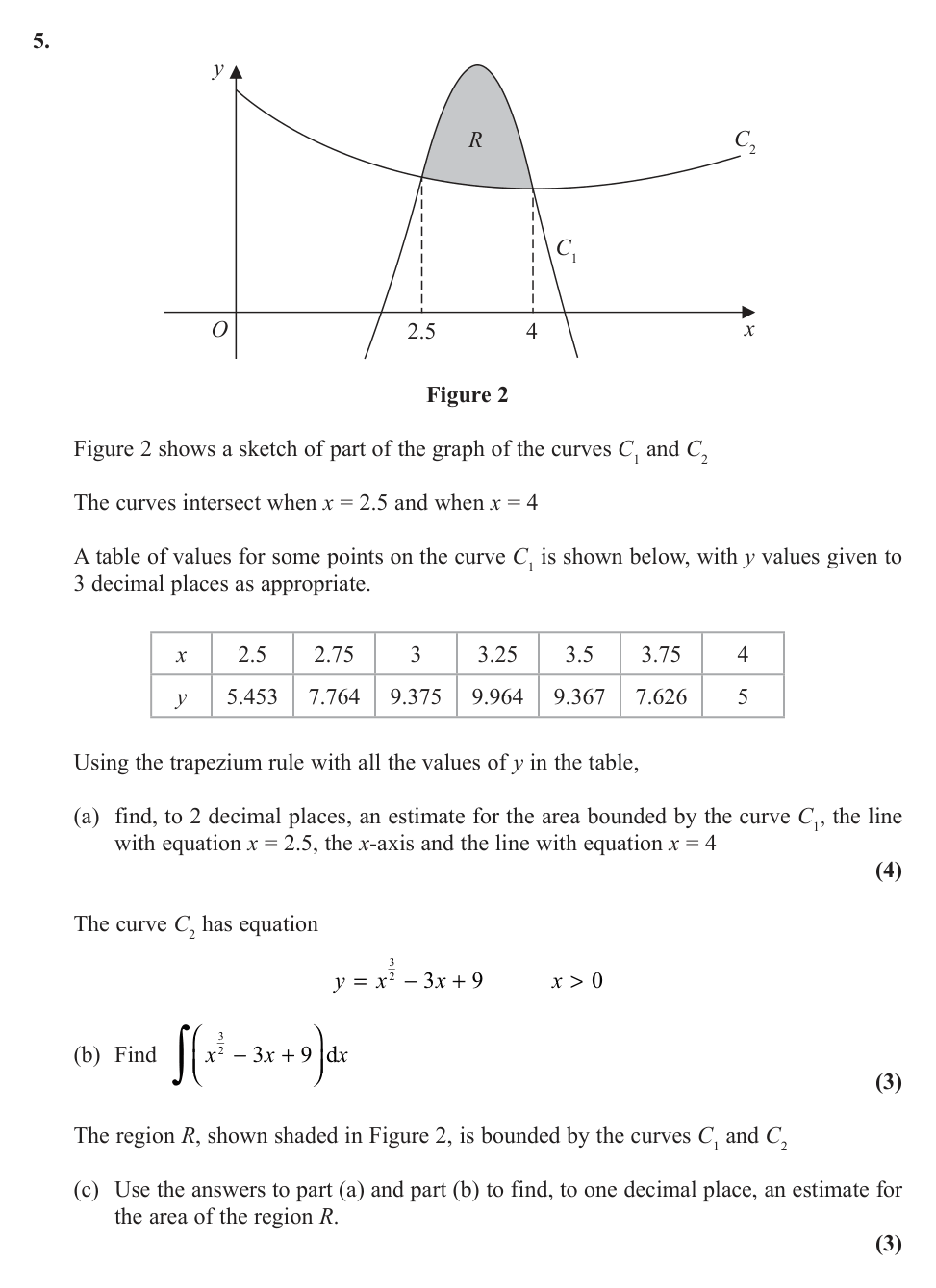
36. WMA12/01 May/June 2021 · Q5 Hard 10 marksShow worked solution Identify the strip width The $x$ values increase by $0.25$, so $h=0.25$.
Apply the trapezium rule The area under $C_1$ is approximately $\dfrac{0.25}{2}\{5.453+5+2(7.764+9.375+9.964+9.367+7.626)\}$.
Calculate the estimate This gives $12.330625$, so the estimate is $12.33$ to 2 decimal places.
Integrate C two $\int(x^{3/2}-3x+9)\,dx=\dfrac25x^{5/2}-\dfrac32x^2+9x+c$.
Find the area under C two Between $x=2.5$ and $x=4$, the exact integral of $C_2$ is $\left[\dfrac25x^{5/2}-\dfrac32x^2+9x\right]_{2.5}^{4}=7.722\ldots$.
Find the shaded area The shaded region is between $C_1$ and $C_2$, so its area is approximately $12.330625-7.722\ldots=4.608\ldots$.
Round the result To one decimal place, the area of region $R$ is $4.6$.
Final answer $(a)\ 12.33.\quad (b)\ \dfrac25x^{5/2}-\dfrac32x^2+9x+c.\quad (c)\ 4.6$.
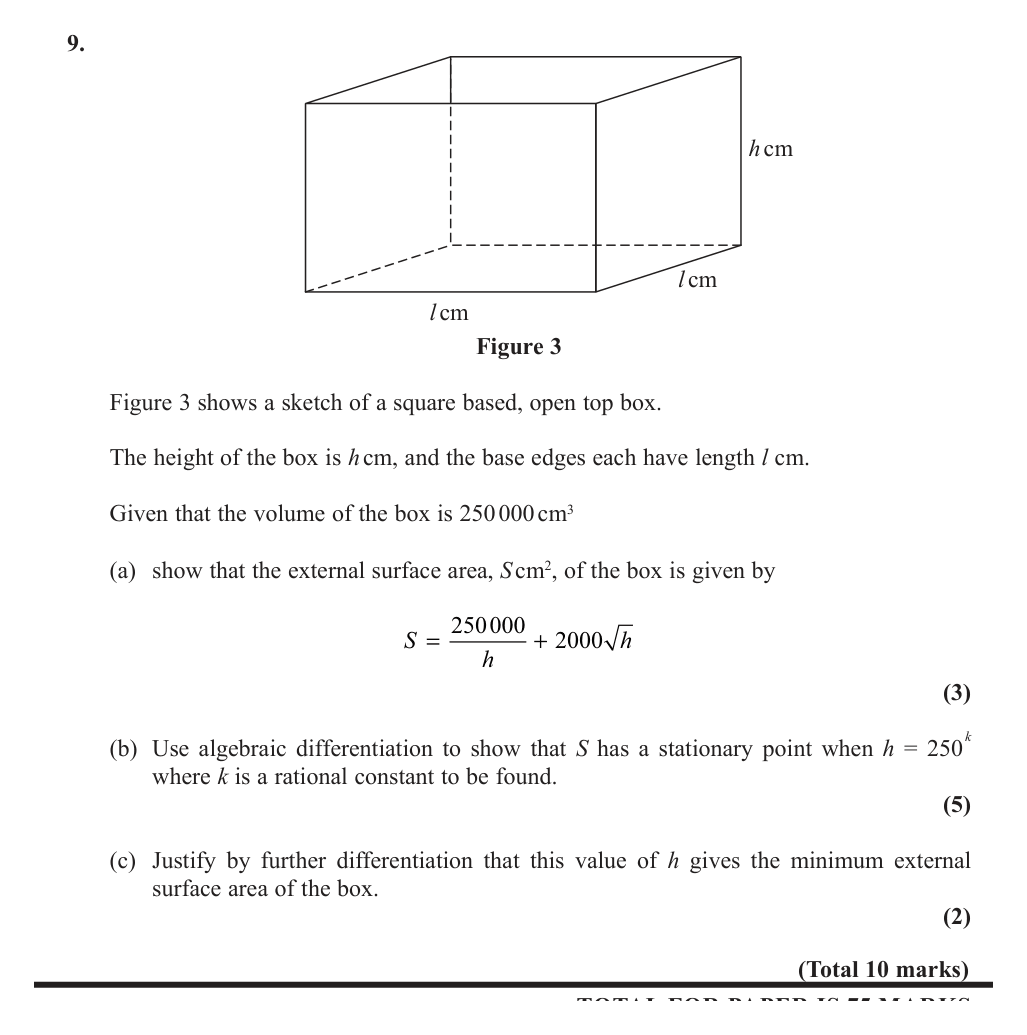
37. WMA12/01 May/June 2021 · Q9 Hard 10 marks · main topic: Applications of DifferentiationShow worked solution Use the volume The volume is $l^2h=250000$, so $l^2=\dfrac{250000}{h}$.
Write the surface area The open box has one square base and four side faces, so $S=l^2+4lh$.
Substitute l Since $l=\sqrt{\dfrac{250000}{h}}=\dfrac{500}{\sqrt h}$, $4lh=4\cdot\dfrac{500}{\sqrt h}\cdot h=2000\sqrt h$.
Show S Therefore $S=\dfrac{250000}{h}+2000\sqrt h$.
Differentiate S $S=250000h^{-1}+2000h^{1/2}$, so $\dfrac{dS}{dh}=-250000h^{-2}+1000h^{-1/2}$.
Set the derivative to zero $-250000h^{-2}+1000h^{-1/2}=0$, so $1000h^{-1/2}=250000h^{-2}$.
Solve for h Multiplying by $h^2$ gives $1000h^{3/2}=250000$, so $h^{3/2}=250$ and $h=250^{2/3}$.
Find k Since $h=250^k$, we have $k=\dfrac23$.
Use the second derivative $\dfrac{d^2S}{dh^2}=500000h^{-3}-500h^{-3/2}$.
Check the sign At $h=250^{2/3}$, $h^{3/2}=250$, so the second derivative is $\dfrac{500000}{250^2}-\dfrac{500}{250}=8-2=6>0$.
Conclude The stationary point is therefore a minimum.
Final answer $(a)$ Proven: $S=\dfrac{250000}{h}+2000\sqrt h$. $\quad (b)\ h=250^{2/3}$, so $k=\dfrac23$. $\quad (c)$ Minimum.
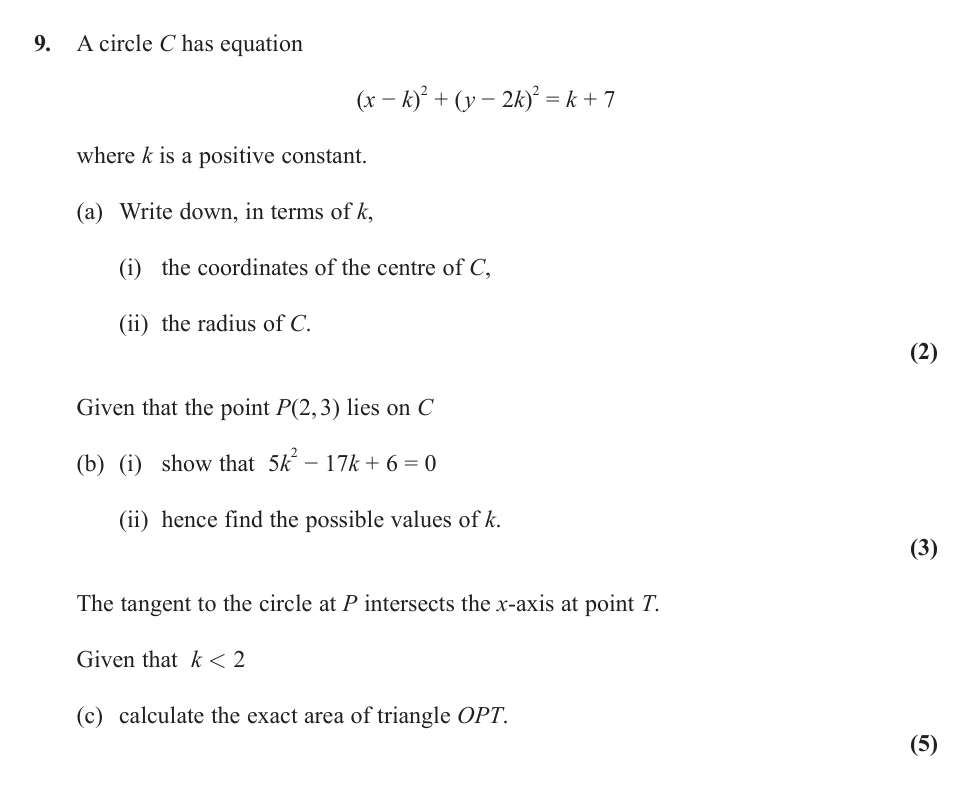
38. WMA12/01 January 2021 · Q9 Hard 10 marks · main topic: CirclesShow worked solution Read the centre and radius From $(x-k)^2+(y-2k)^2=k+7$, the centre is $(k,2k)$ and the radius is $\sqrt{k+7}$.
Substitute point P Since $P(2,3)$ lies on the circle, $(2-k)^2+(3-2k)^2=k+7$.
Show the quadratic Expanding gives $k^2-4k+4+4k^2-12k+9=k+7$, hence $5k^2-17k+6=0$.
Solve for k $5k^2-17k+6=(5k-2)(k-3)$, so $k=\dfrac25$ or $k=3$.
Use the condition k less than two For the tangent calculation, $k<2$, so the centre is $\left(\dfrac25,\dfrac45\right)$.
Find the tangent gradient The radius from the centre to $P$ has gradient $\dfrac{3-4/5}{2-2/5}=\dfrac{11}{8}$, so the tangent gradient is $-\dfrac8{11}$.
Find the x intercept The tangent is $y-3=-\dfrac8{11}(x-2)$. Setting $y=0$ gives $x=\dfrac{49}{8}$, so $T=\left(\dfrac{49}{8},0\right)$.
Calculate the area Triangle $OPT$ has base $\dfrac{49}{8}$ on the $x$-axis and height $3$, so its area is $\dfrac12\cdot\dfrac{49}{8}\cdot3=\dfrac{147}{16}$.
Final answer $(a)(i)\ (k,2k).\quad (a)(ii)\ \sqrt{k+7}.\quad (b)(ii)\ k=3\text{ or }\dfrac25.\quad (c)\ \dfrac{147}{16}$.
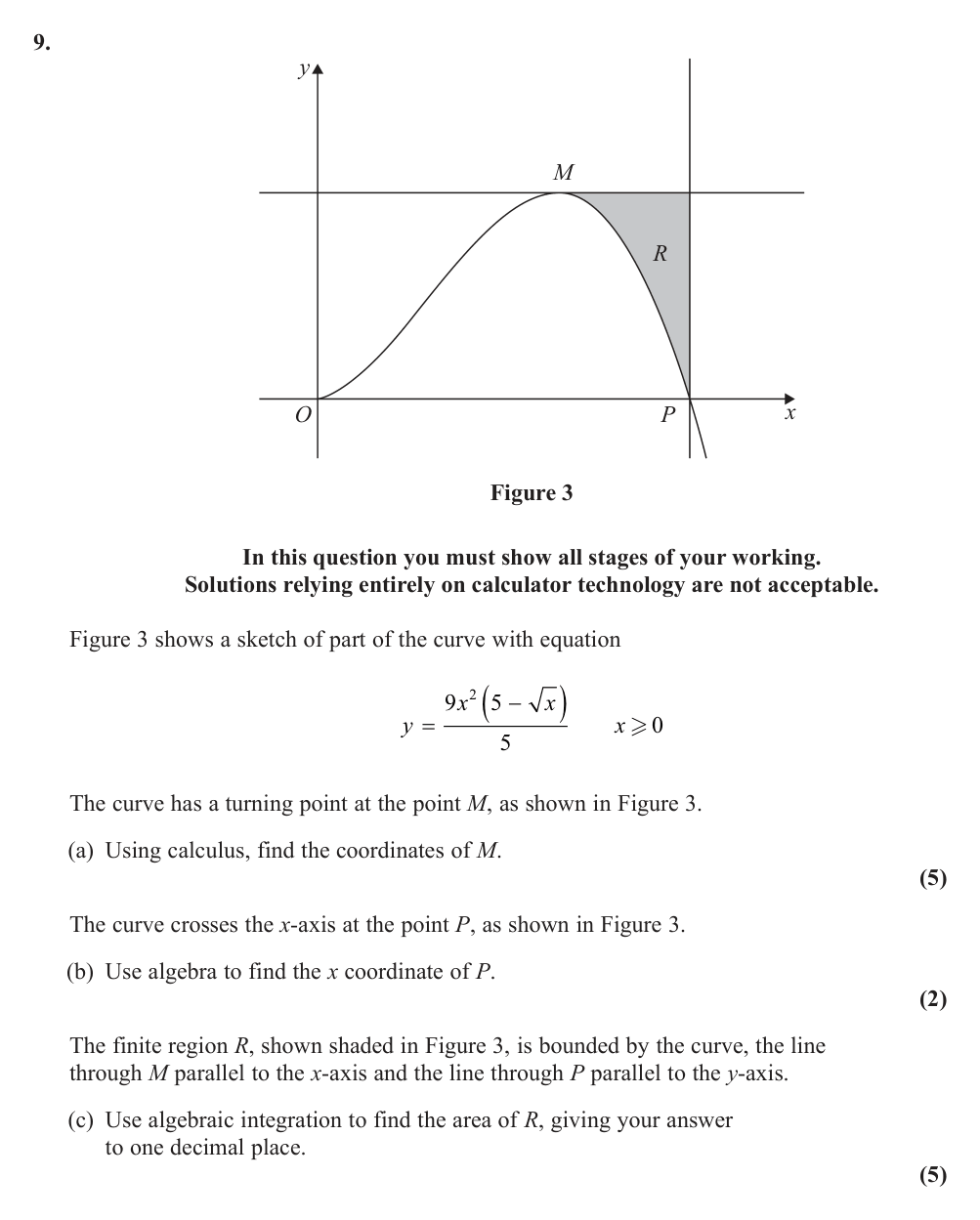
39. WMA12/01 January 2025 · Q9 Hard 12 marksShow worked solution Rewrite the curve $y=\dfrac{9x^2(5-\sqrt{x})}{5}=9x^2-\dfrac95x^{5/2}$.
Differentiate $\dfrac{dy}{dx}=18x-\dfrac92x^{3/2}=\dfrac92x(4-\sqrt{x})$.
Find the turning point x coordinate For the turning point shown away from the origin, set $4-\sqrt{x}=0$. Hence $x=16$.
Find the y coordinate At $x=16$, $y=\dfrac{9(16)^2(5-4)}{5}=\dfrac{2304}{5}$.
State M Therefore $M\left(16,\dfrac{2304}{5}\right)$.
Find the positive x intercept For the positive intercept, $\dfrac{9x^2(5-\sqrt{x})}{5}=0$ gives $5-\sqrt{x}=0$, so $x=25$.
Set up the area The top boundary is $y=\dfrac{2304}{5}$ and the curve is below it from $x=16$ to $x=25$. So $R=\displaystyle\int_{16}^{25}\left(\dfrac{2304}{5}-9x^2+\dfrac95x^{5/2}\right)dx$.
Integrate $R=\left[\dfrac{2304}{5}x-3x^3+\dfrac{18}{35}x^{7/2}\right]_{16}^{25}$.
Evaluate $R=\dfrac{9189}{7}=1312.714\ldots$, so the area is $1312.7$ to one decimal place.
Final answer $(a)$ $M\left(16,\dfrac{2304}{5}\right)$. $\quad (b)$ $x_P=25$. $\quad (c)$ $1312.7$.
40. WMA12/01 October 2023 · Q9 Hard 12 marks · main topic: Applications of DifferentiationShow worked solution Differentiate For $y=\dfrac23x^2-9\sqrt{x}+13$, $\dfrac{dy}{dx}=\dfrac43x-\dfrac{9}{2\sqrt{x}}$.
Set up increasing condition $y$ is increasing when $\dfrac{dy}{dx}>0$.
Multiply by a positive quantity For $x>0$, multiply by $6\sqrt{x}$: $8x\sqrt{x}-27>0$.
Solve the inequality $x^{3/2}>\dfrac{27}{8}=\left(\dfrac32\right)^3$, so $\sqrt{x}>\dfrac32$ and $x>\dfrac94$.
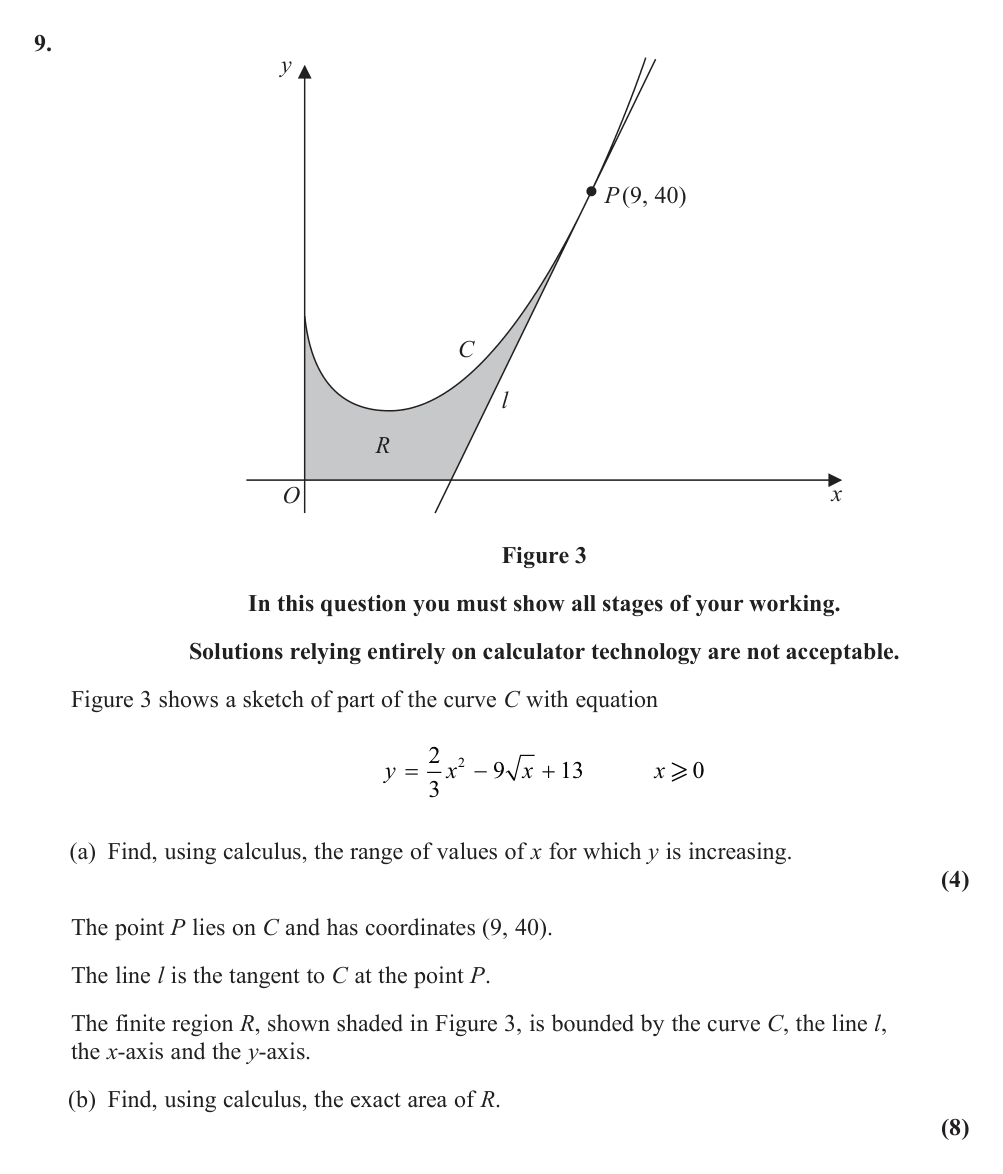
Find the tangent gradient At $P(9,40)$, $\dfrac{dy}{dx}=\dfrac43(9)-\dfrac{9}{2\cdot3}=12-\dfrac32=\dfrac{21}{2}$.
Write the tangent line $y-40=\dfrac{21}{2}(x-9)$, so $y=\dfrac{21}{2}x-\dfrac{109}{2}$.
Find where the tangent meets the x-axis Set $y=0$: $\dfrac{21}{2}x-\dfrac{109}{2}=0$, so $x=\dfrac{109}{21}$.
Split the area From $x=0$ to $x=\dfrac{109}{21}$, the lower boundary is the $x$-axis. From $x=\dfrac{109}{21}$ to $x=9$, the lower boundary is the tangent.
Set up the integral $\displaystyle R=\int_0^{109/21}\left(\dfrac23x^2-9\sqrt{x}+13\right)dx+\int_{109/21}^{9}\left(\dfrac23x^2-9\sqrt{x}+13-\left(\dfrac{21}{2}x-\dfrac{109}{2}\right)\right)dx$.
Use antiderivatives $\displaystyle \int\left(\dfrac23x^2-9\sqrt{x}+13\right)dx=\dfrac{2}{9}x^3-6x^{3/2}+13x$, and $\displaystyle \int\left(\dfrac{21}{2}x-\dfrac{109}{2}\right)dx=\dfrac{21}{4}x^2-\dfrac{109}{2}x$.
Evaluate Substituting the limits and simplifying gives $R=\dfrac{857}{21}$.
Final answer $(a)$ $y$ is increasing for $x>\dfrac94$. $\quad (b)$ Area $=\dfrac{857}{21}$.
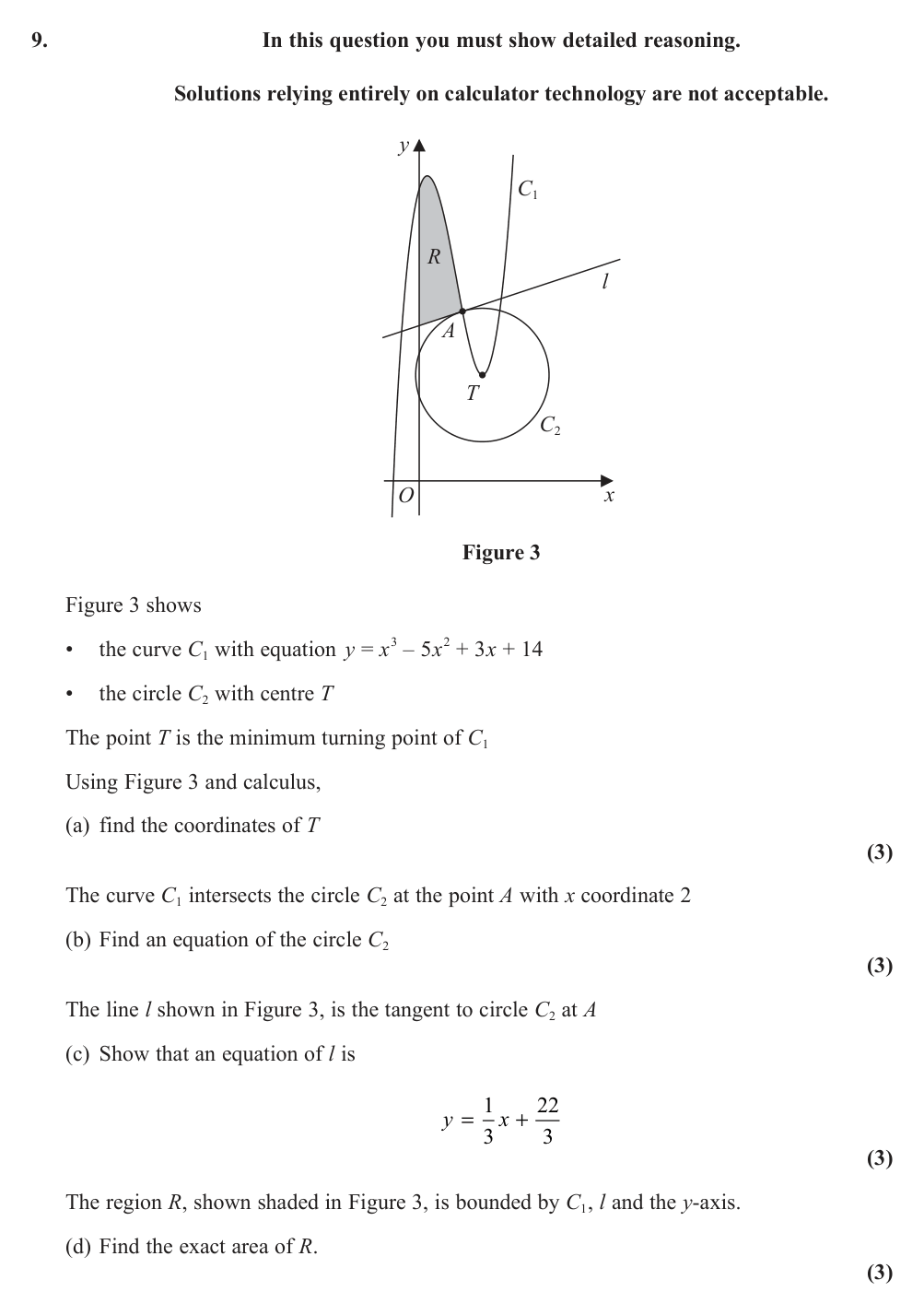
41. WMA12/01 October 2022 · Q9 Hard 12 marks · main topic: CirclesShow worked solution Differentiate the cubic For $y=x^3-5x^2+3x+14$, $\dfrac{dy}{dx}=3x^2-10x+3$.
Find stationary x values $3x^2-10x+3=0$ factors as $(3x-1)(x-3)=0$, so $x=\dfrac13$ or $x=3$.
Identify the minimum $\dfrac{d^2y}{dx^2}=6x-10$. At $x=3$, this is positive, so the minimum turning point has $x=3$.
Find T Substitute $x=3$: $y=27-45+9+14=5$. Hence $T=(3,5)$.
Find A At $x=2$ on $C_1$, $y=8-20+6+14=8$, so $A=(2,8)$.
Find the circle radius The centre of $C_2$ is $T=(3,5)$ and it passes through $A=(2,8)$. Thus $r^2=(2-3)^2+(8-5)^2=10$.
Write the circle equation Therefore $C_2$ has equation $(x-3)^2+(y-5)^2=10$.
Find the tangent gradient The radius $TA$ has gradient $\dfrac{8-5}{2-3}=-3$, so the tangent at $A$ has gradient $\dfrac13$.
Write the tangent equation Using $A=(2,8)$, $y-8=\dfrac13(x-2)$, so $y=\dfrac13x+\dfrac{22}{3}$.
Set up the area From $x=0$ to $x=2$, the cubic is above the line. The required area is $\displaystyle \int_0^2 \left[x^3-5x^2+3x+14-\left(\dfrac13x+\dfrac{22}{3}\right)\right]dx$.
Simplify the integrand The integrand is $x^3-5x^2+\dfrac83x+\dfrac{20}{3}$.
Integrate $\displaystyle \left[\dfrac{x^4}{4}-\dfrac{5x^3}{3}+\dfrac{4x^2}{3}+\dfrac{20x}{3}\right]_0^2=4-\dfrac{40}{3}+\dfrac{16}{3}+\dfrac{40}{3}=\dfrac{28}{3}$.
Final answer $(a)$ $T=(3,5)$. $\quad (b)$ $(x-3)^2+(y-5)^2=10$. $\quad (c)$ $y=\dfrac13x+\dfrac{22}{3}$. $\quad (d)$ $\dfrac{28}{3}$.
Dr Eslam Ahmed Elite Mathematics · Questions classified by topic, solutions checked by Dr Eslam
 Elite Mathematics