Elite Mathematics / Pure 2 / Topics / Binomial Expansion IAL · WMA12 · Topic Binomial Expansion: past paper questions & worked solutions
Every Binomial Expansion question from the WMA12 papers in our bank, 2019–2026, sorted from easiest to hardest. Try each one first, then open the worked solution.
19 questions
124 marks in total
100% of papers (19 of 19) include it
9/9/1 easy / medium / hard
Questions, easiest first Level is estimated from marks: 1–6 easy, 7–8 medium, 9+ hard.
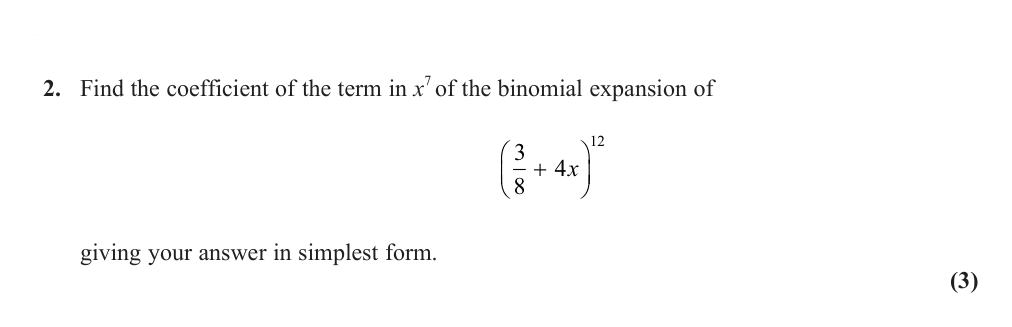
1. WMA12/01 January 2024 · Q2 Easy 3 marksShow worked solution Choose the x power In $\left(\dfrac38+4x\right)^{12}$, the term in $x^7$ comes from choosing $(4x)^7$ and $\left(\dfrac38\right)^5$.
Write the term The coefficient is $\binom{12}{7}\left(\dfrac38\right)^5 4^7$.
Simplify the powers $4^7=2^{14}$ and $8^5=2^{15}$, so $\left(\dfrac38\right)^5 4^7=\dfrac{3^5}{2}$.
Evaluate $\binom{12}{7}=792$, so the coefficient is $792\cdot\dfrac{243}{2}=96228$.
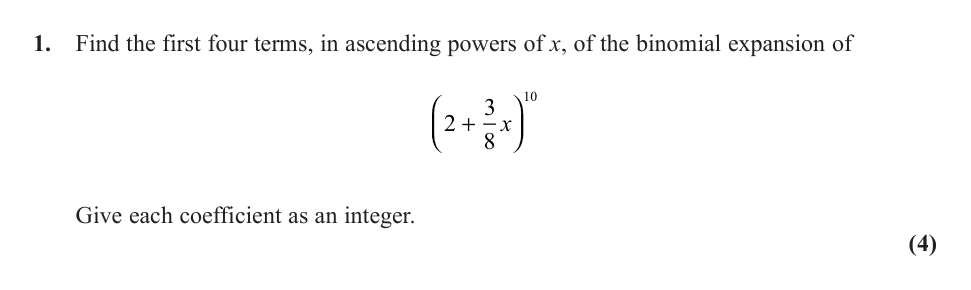
2. WMA12/01 May/June 2022 · Q1 Easy 4 marksShow worked solution Write the binomial terms $(2+\dfrac38x)^{10}=2^{10}+\binom{10}{1}2^9\left(\dfrac38x\right)+\binom{10}{2}2^8\left(\dfrac38x\right)^2+\binom{10}{3}2^7\left(\dfrac38x\right)^3+\cdots$.
Simplify the constant and linear terms $2^{10}=1024$ and $\binom{10}{1}2^9\left(\dfrac38\right)x=1920x$.
Simplify the quadratic term $\binom{10}{2}2^8\left(\dfrac38\right)^2x^2=1620x^2$.
Simplify the cubic term $\binom{10}{3}2^7\left(\dfrac38\right)^3x^3=810x^3$.
State the expansion The first four terms are $1024+1920x+1620x^2+810x^3$.
Final answer $1024+1920x+1620x^2+810x^3$.
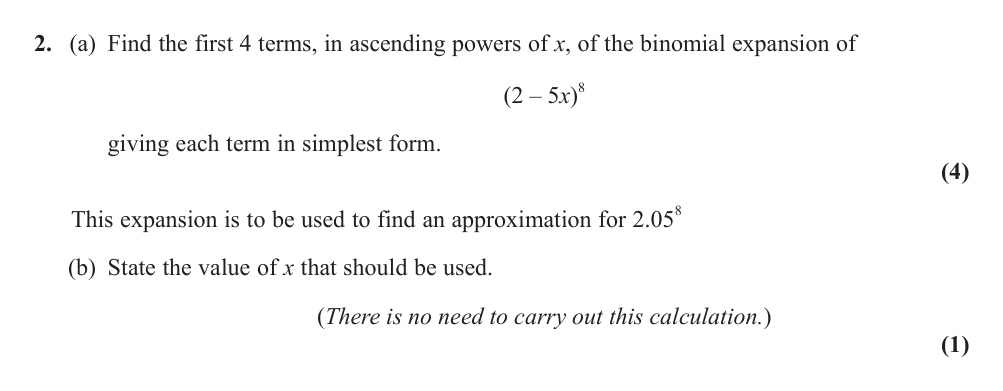
3. WMA12/01 January 2025 · Q2 Easy 5 marksShow worked solution Write the first four terms $(2-5x)^8=2^8+8(2^7)(-5x)+\binom82(2^6)(-5x)^2+\binom83(2^5)(-5x)^3+\cdots$.
Simplify each term The first four terms are $256-5120x+44800x^2-224000x^3$.
Connect the expansion to 2.05 To use $(2-5x)^8$ for $2.05^8$, set $2-5x=2.05$.
Find x $-5x=0.05$, so $x=-0.01$.
Final answer $(a)$ $256-5120x+44800x^2-224000x^3$. $\quad (b)$ $x=-0.01$.
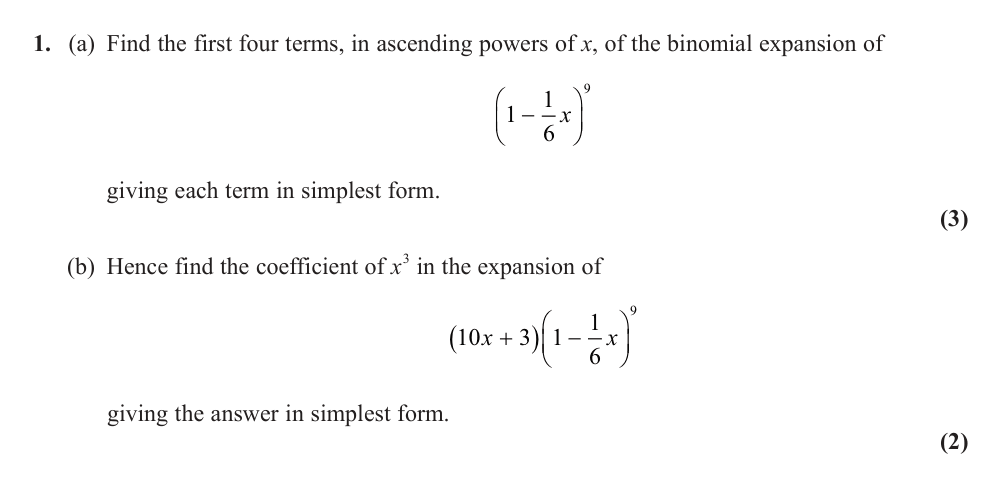
4. WMA12/01 May/June 2024 · Q1 Easy 5 marksShow worked solution Expand the first terms $\left(1-\dfrac16x\right)^9=1+9\left(-\dfrac16x\right)+\binom92\left(-\dfrac16x\right)^2+\binom93\left(-\dfrac16x\right)^3+\cdots$.
Simplify The first four terms are $1-\dfrac32x+x^2-\dfrac{7}{18}x^3$.
Identify contributions to x cubed In $(10x+3)\left(1-\dfrac16x\right)^9$, the $x^3$ coefficient comes from $3$ times the $x^3$ coefficient and $10x$ times the $x^2$ coefficient.
Calculate the coefficient $3\left(-\dfrac{7}{18}\right)+10(1)=-\dfrac76+10=\dfrac{53}{6}$.
Final answer $(a)$ $1-\dfrac32x+x^2-\dfrac{7}{18}x^3$. $\quad (b)$ $\dfrac{53}{6}$.
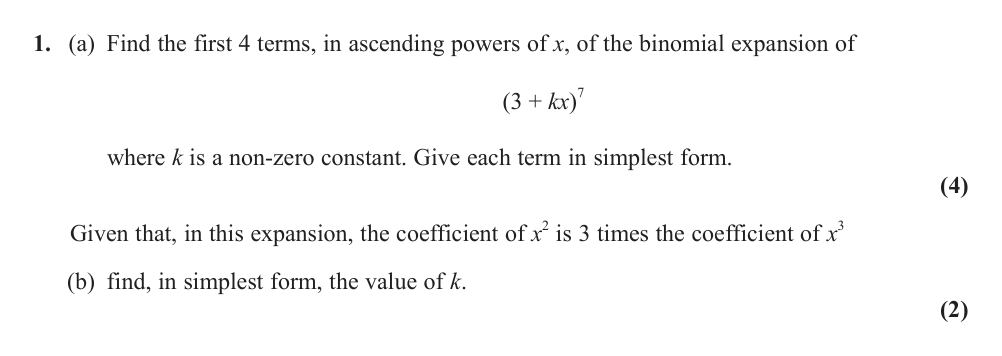
5. WMA12/01 January 2026 · Q1 Easy 6 marksShow worked solution Use the binomial expansion For $(3+kx)^7$, the first four terms are $3^7+\binom71 3^6(kx)+\binom72 3^5(kx)^2+\binom73 3^4(kx)^3$.
Simplify the coefficients This gives $2187+5103kx+5103k^2x^2+2835k^3x^3$.
Compare the required coefficients The coefficient of $x^2$ is $5103k^2$ and the coefficient of $x^3$ is $2835k^3$.
Solve for k Since $5103k^2=3(2835k^3)$ and $k\ne0$, divide by $k^2$ to get $5103=8505k$, hence $k=\dfrac{5103}{8505}=\dfrac35$.
Final answer $(a)\ 2187+5103kx+5103k^2x^2+2835k^3x^3.\quad (b)\ k=\dfrac35$.
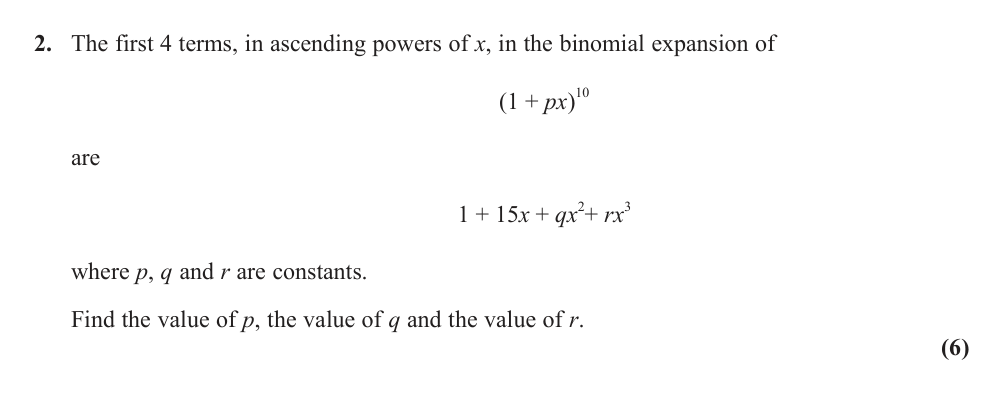
6. WMA12/01 October 2025 · Q2 Easy 6 marksShow worked solution Write the first four terms $(1+px)^{10}=1+10px+\binom{10}{2}p^2x^2+\binom{10}{3}p^3x^3+\cdots$.
Compare the x coefficient Since the coefficient of $x$ is $15$, $10p=15$, so $p=\dfrac32$.
Find q $q=\binom{10}{2}p^2=45\left(\dfrac32\right)^2=\dfrac{405}{4}$.
Find r $r=\binom{10}{3}p^3=120\left(\dfrac32\right)^3=405$.
Final answer $p=\dfrac32$, $q=\dfrac{405}{4}$, $r=405$.
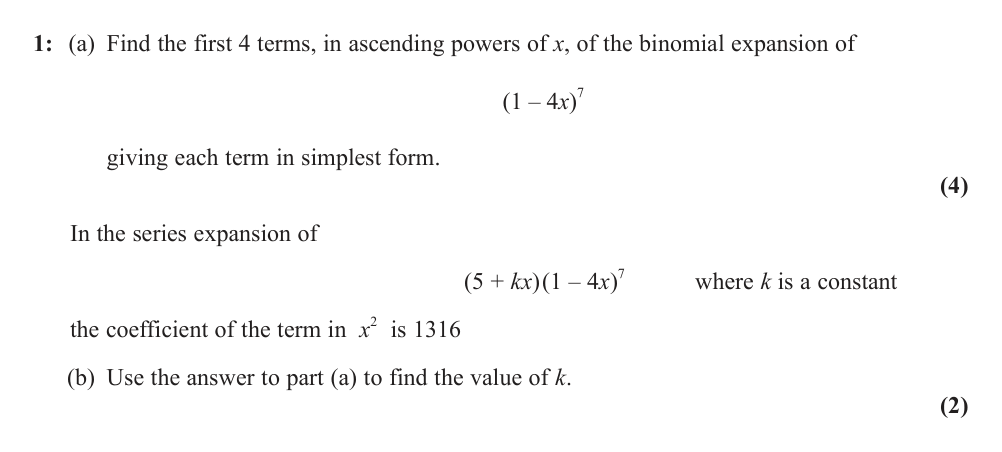
7. WMA12/01 May/June 2025 · Q1 Easy 6 marksShow worked solution Write the binomial terms $(1-4x)^7=1+7(-4x)+\binom72(-4x)^2+\binom73(-4x)^3+\cdots$.
Simplify The first four terms are $1-28x+336x^2-2240x^3$.
Find the x squared terms In $(5+kx)(1-4x)^7$, the $x^2$ coefficient comes from $5(336x^2)$ and $(kx)(-28x)$.
Use the given coefficient $5(336)-28k=1316$, so $1680-28k=1316$.
Find k $28k=364$, hence $k=13$.
Final answer $(a)$ $1-28x+336x^2-2240x^3$. $\quad (b)$ $k=13$.
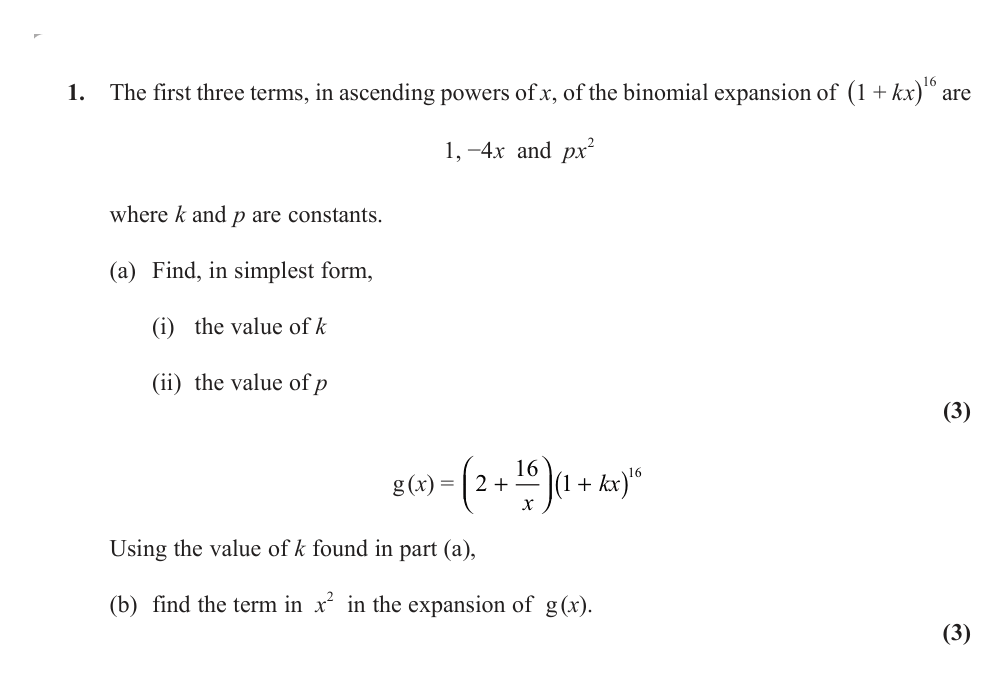
8. WMA12/01 October 2021 · Q1 Easy 6 marksShow worked solution Compare the linear term In $(1+kx)^{16}$, the coefficient of $x$ is $16k$.
Find k Since the coefficient of $x$ is $-4$, $16k=-4$, so $k=-\dfrac14$.
Find p The coefficient of $x^2$ is $\binom{16}{2}k^2=120\left(\dfrac1{16}\right)=\dfrac{15}{2}$.
Find the needed binomial terms For $k=-\dfrac14$, the $x^2$ coefficient in $(1+kx)^{16}$ is $\dfrac{15}{2}$ and the $x^3$ coefficient is $\binom{16}{3}\left(-\dfrac14\right)^3=-\dfrac{35}{4}$.
Build the x squared term in g In $g(x)=\left(2+\dfrac{16}{x}\right)(1+kx)^{16}$, the $x^2$ term comes from $2\left(\dfrac{15}{2}x^2\right)$ and $\dfrac{16}{x}\left(-\dfrac{35}{4}x^3\right)$.
Simplify The required term is $15x^2-140x^2=-125x^2$.
Final answer $(a)(i)\ k=-\dfrac14.\quad (a)(ii)\ p=\dfrac{15}{2}.\quad (b)\ -125x^2$.
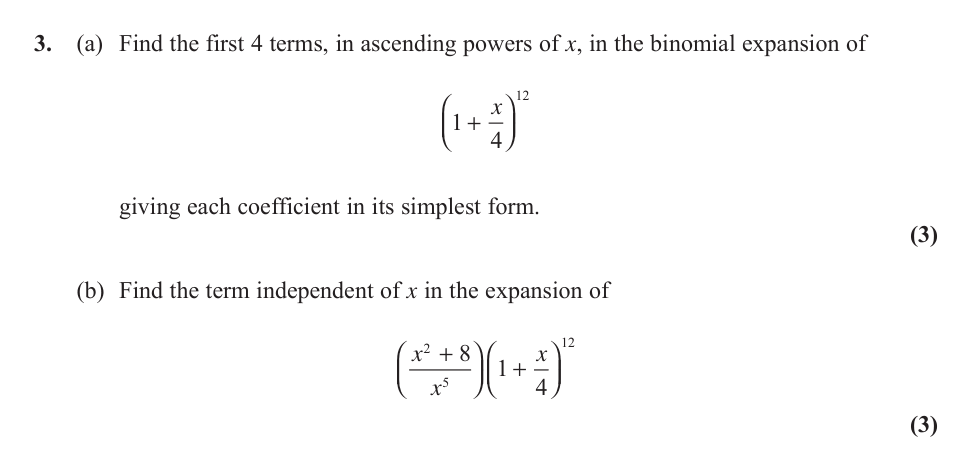
9. WMA12/01 October 2019 · Q3 Easy 6 marksShow worked solution Write the binomial terms $(1+\dfrac{x}{4})^{12}=1+\binom{12}{1}\dfrac{x}{4}+\binom{12}{2}\left(\dfrac{x}{4}\right)^2+\binom{12}{3}\left(\dfrac{x}{4}\right)^3+\cdots$.
Simplify the first four terms This gives $1+3x+\dfrac{33}{8}x^2+\dfrac{55}{16}x^3$.
Rewrite the prefactor $\dfrac{x^2+8}{x^5}=x^{-3}+8x^{-5}$.
Find the constant contributions The $x^{-3}$ part needs the $x^3$ coefficient, which is $\dfrac{55}{16}$. The $8x^{-5}$ part needs the $x^5$ coefficient, which is $8\binom{12}{5}\left(\dfrac14\right)^5=8\cdot\dfrac{99}{128}=\dfrac{99}{16}$.
Add the constant terms The term independent of $x$ is $\dfrac{55}{16}+\dfrac{99}{16}=\dfrac{154}{16}=\dfrac{77}{8}$.
Final answer $(a)\ 1+3x+\dfrac{33}{8}x^2+\dfrac{55}{16}x^3.\quad (b)\ \dfrac{77}{8}$.
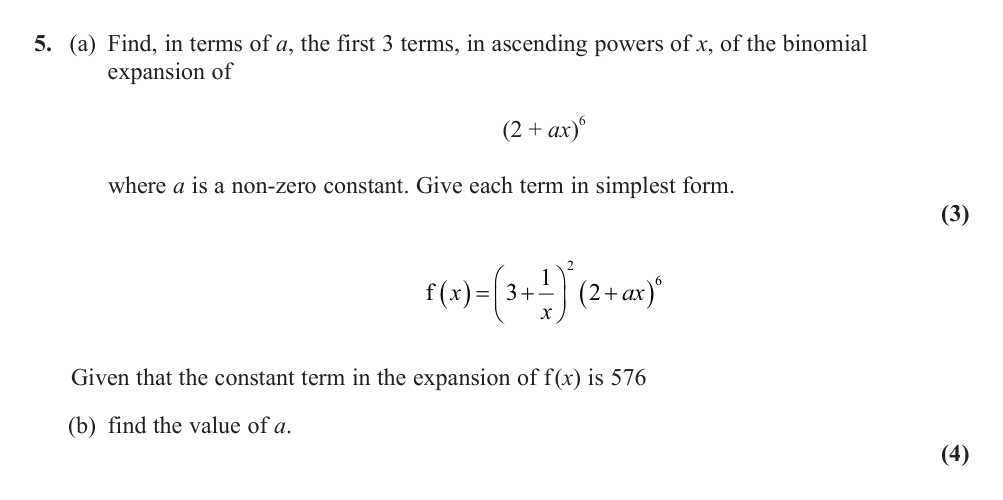
10. WMA12/01 October 2024 · Q5 Medium 7 marksShow worked solution Write the first three binomial terms $(2+ax)^6=2^6+6(2^5)(ax)+\binom62(2^4)(ax)^2+\cdots$.
Simplify the terms The first three terms are $64+192ax+240a^2x^2$.
Expand the other factor $\left(3+\dfrac1x\right)^2=9+6x^{-1}+x^{-2}$.
Collect constant contributions The constant term in $\left(3+\dfrac1x\right)^2(2+ax)^6$ is $9(64)+6(192a)+240a^2$.
Use the given constant term $576+1152a+240a^2=576$, so $240a^2+1152a=0$.
Solve for a $48a(5a+24)=0$. Since $a\ne0$, $5a+24=0$, so $a=-\dfrac{24}{5}$.
Final answer $(a)$ $64+192ax+240a^2x^2$. $\quad (b)$ $a=-\dfrac{24}{5}$.
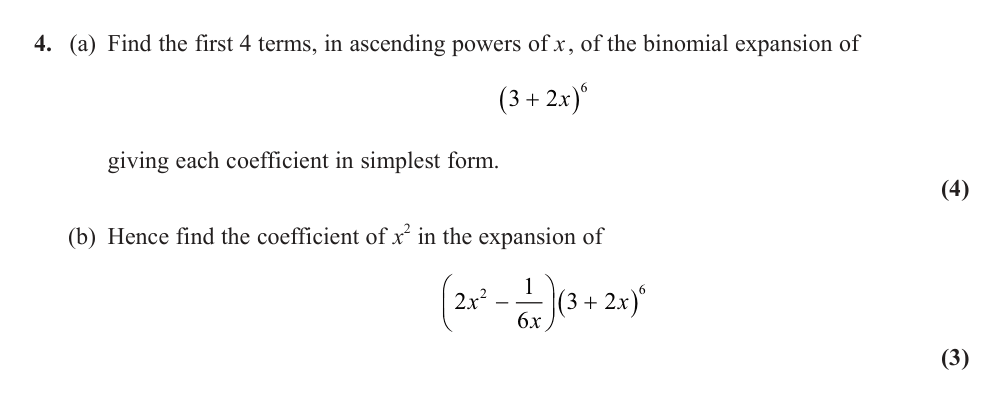
11. WMA12/01 May/June R 2024 · Q4 Medium 7 marksShow worked solution Write the expansion terms $(3+2x)^6=3^6+\binom61 3^5(2x)+\binom62 3^4(2x)^2+\binom63 3^3(2x)^3+\cdots$.
Simplify the first four terms This gives $729+2916x+4860x^2+4320x^3$.
Identify x squared contributions In $\left(2x^2-\dfrac{1}{6x}\right)(3+2x)^6$, the $x^2$ term comes from $2x^2$ times the constant term and $-\dfrac{1}{6x}$ times the $x^3$ term.
Calculate the coefficient The coefficient is $2(729)-\dfrac16(4320)=1458-720=738$.
Final answer $(a)$ $729+2916x+4860x^2+4320x^3$. $\quad (b)$ $738$.
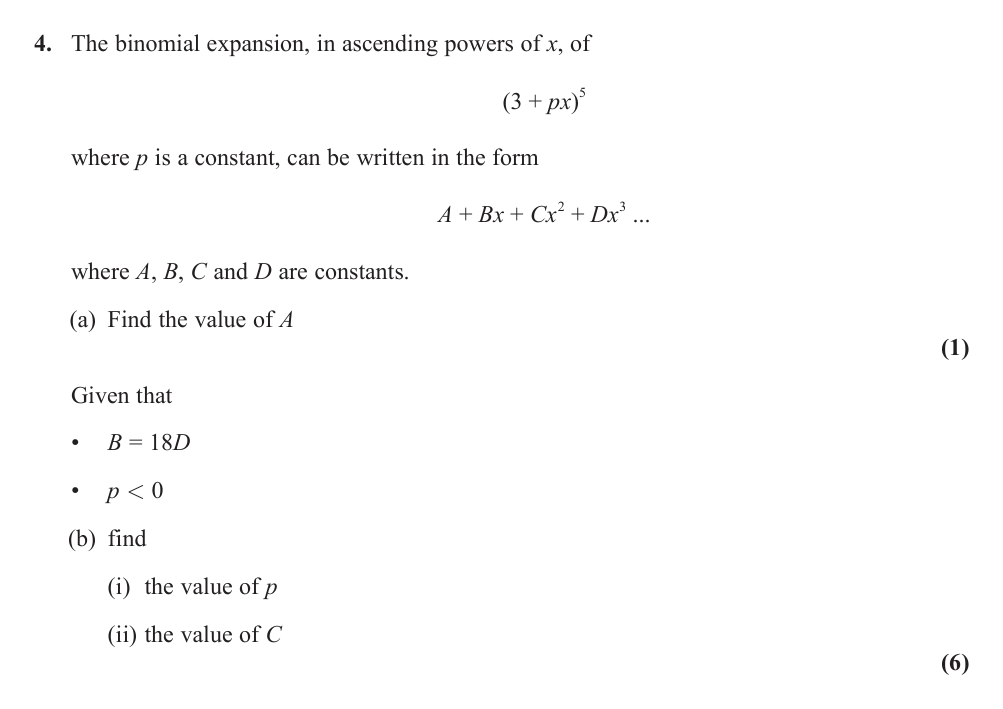
12. WMA12/01 May/June 2023 · Q4 Medium 7 marksShow worked solution Find the constant term In $(3+px)^5$, the constant term is $3^5=243$, so $A=243$.
Find B The coefficient of $x$ is $5(3^4)p=405p$, so $B=405p$.
Find D The coefficient of $x^3$ is $\binom53(3^2)p^3=10\cdot9p^3=90p^3$, so $D=90p^3$.
Use B equals 18D $405p=18(90p^3)=1620p^3$.
Solve for p Since $p<0$, $p\ne0$. Divide by $405p$ to get $1=4p^2$, so $p=\pm\dfrac12$. Therefore $p=-\dfrac12$.
Find C The coefficient of $x^2$ is $\binom52(3^3)p^2=10\cdot27\cdot\dfrac14=\dfrac{135}{2}$.
Final answer $(a)$ $A=243$. $\quad (b)(i)$ $p=-\dfrac12$. $\quad (b)(ii)$ $C=\dfrac{135}{2}$.
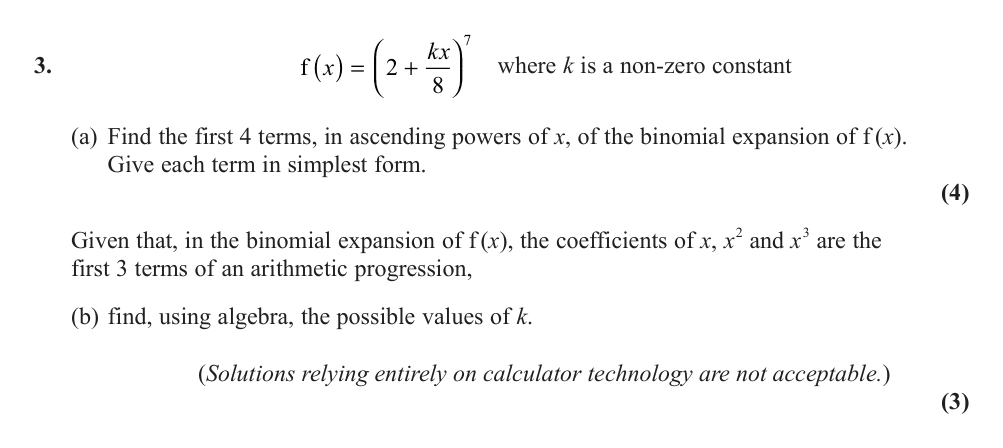
13. WMA12/01 January 2023 · Q3 Medium 7 marksShow worked solution Start the binomial expansion $\left(2+\dfrac{kx}{8}\right)^7$ begins with $2^7+7(2^6)\left(\dfrac{kx}{8}\right)+\binom72(2^5)\left(\dfrac{kx}{8}\right)^2+\binom73(2^4)\left(\dfrac{kx}{8}\right)^3$.
Simplify the terms This gives $128+56kx+\dfrac{21}{2}k^2x^2+\dfrac{35}{32}k^3x^3$.
Use the arithmetic progression condition The coefficients of $x$, $x^2$ and $x^3$ are $56k$, $\dfrac{21}{2}k^2$ and $\dfrac{35}{32}k^3$.
Set middle twice For three terms in an arithmetic progression, twice the middle term equals the sum of the outer terms: $21k^2=56k+\dfrac{35}{32}k^3$.
Use k non-zero Since $k\ne0$, divide by $k$ and multiply by $32$: $672k=1792+35k^2$.
Solve the quadratic So $35k^2-672k+1792=0$. The discriminant is $672^2-4(35)(1792)=200704=448^2$.
Find the possible values $k=\dfrac{672\pm448}{70}$, giving $k=16$ or $k=\dfrac{16}{5}$.
Final answer $(a)$ $128+56kx+\dfrac{21}{2}k^2x^2+\dfrac{35}{32}k^3x^3$. $\quad (b)$ $k=\dfrac{16}{5}$ or $k=16$.
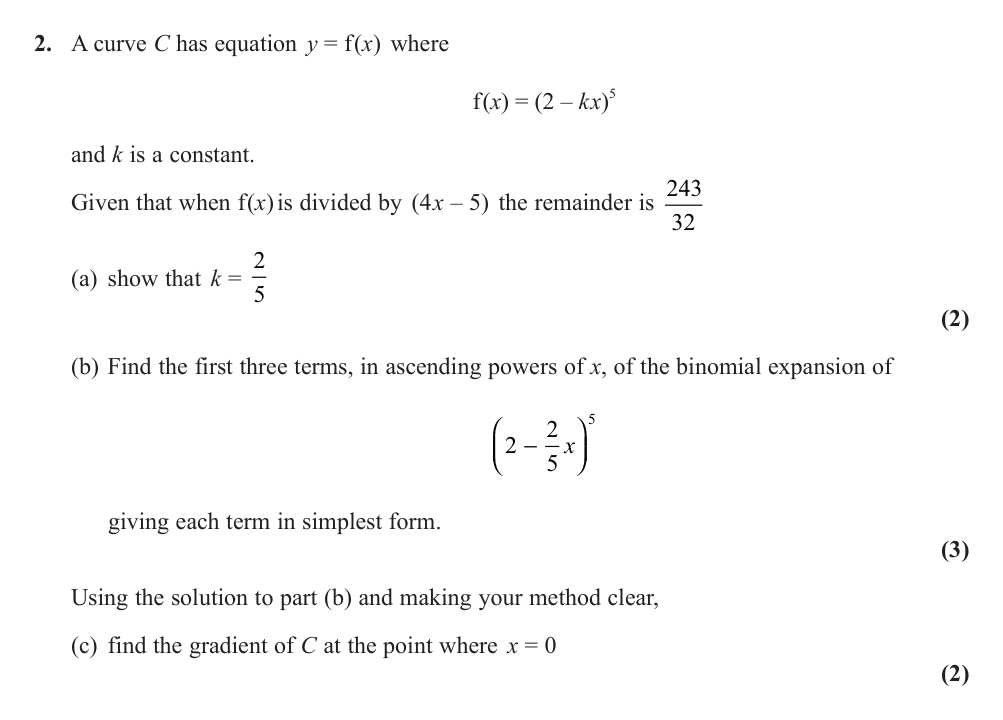
14. WMA12/01 October 2022 · Q2 Medium 7 marksShow worked solution Use the remainder theorem Dividing by $4x-5$ means the remainder is $f\left(\dfrac54\right)$.
Substitute x equals five quarters $f\left(\dfrac54\right)=\left(2-\dfrac{5k}{4}\right)^5=\dfrac{243}{32}$.
Take the fifth root Since $\dfrac{243}{32}=\left(\dfrac32\right)^5$, we have $2-\dfrac{5k}{4}=\dfrac32$.
Find k $\dfrac{5k}{4}=\dfrac12$, so $k=\dfrac25$.
Expand the binomial With $k=\dfrac25$, $f(x)=\left(2-\dfrac25x\right)^5$.
Find the first three terms $2^5+5(2^4)\left(-\dfrac25x\right)+10(2^3)\left(-\dfrac25x\right)^2=32-32x+\dfrac{64}{5}x^2$.
Use the coefficient of x For a polynomial, the gradient at $x=0$ is the coefficient of $x$ in the expansion. Therefore $f'(0)=-32$.
Final answer $(a)$ $k=\dfrac25$. $\quad (b)\ 32-32x+\dfrac{64}{5}x^2$. $\quad (c)\ -32$.
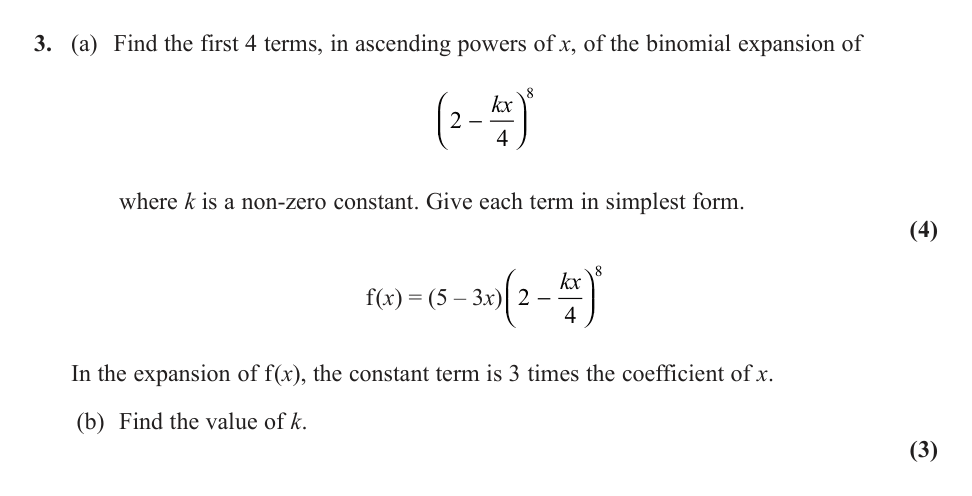
15. WMA12/01 January 2022 · Q3 Medium 7 marksShow worked solution Write the first terms $(2-\dfrac{kx}{4})^8=2^8+\binom81 2^7\left(-\dfrac{kx}{4}\right)+\binom82 2^6\left(-\dfrac{kx}{4}\right)^2+\binom83 2^5\left(-\dfrac{kx}{4}\right)^3+\cdots$.
Simplify the expansion The first four terms are $256-256kx+112k^2x^2-28k^3x^3$.
Find the constant term in f For $f(x)=(5-3x)(2-\dfrac{kx}{4})^8$, the constant term is $5(256)=1280$.
Find the coefficient of x The coefficient of $x$ is $5(-256k)-3(256)=-1280k-768$.
Use the condition The constant term is $3$ times the coefficient of $x$, so $1280=3(-1280k-768)$.
Solve for k $1280=-3840k-2304$, hence $k=-\dfrac{3584}{3840}=-\dfrac{14}{15}$.
Final answer $(a)\ 256-256kx+112k^2x^2-28k^3x^3.\quad (b)\ k=-\dfrac{14}{15}$.
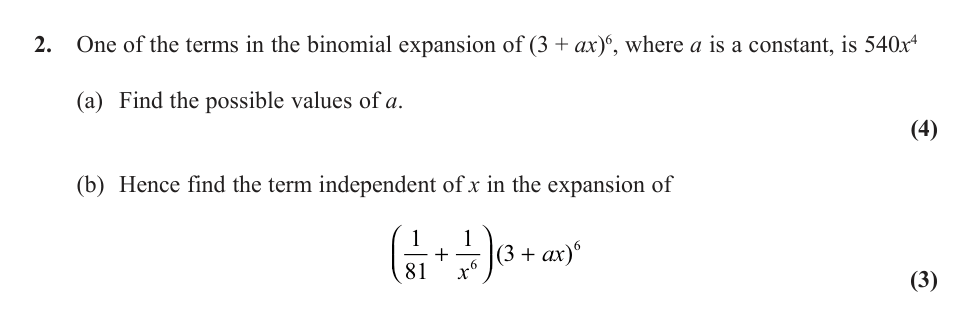
16. WMA12/01 January 2020 · Q2 Medium 7 marksShow worked solution Identify the x to the fourth term In $(3+ax)^6$, the $x^4$ term is $\binom64 3^2(ax)^4$.
Form the equation for a $\binom64 3^2a^4x^4=15\cdot9a^4x^4=135a^4x^4$. Since this term is $540x^4$, $135a^4=540$.
Solve for a $a^4=4$, so the real possible values are $a=\sqrt2$ or $a=-\sqrt2$.
Find the constant contribution from 1 over 81 The constant term from $\dfrac1{81}(3+ax)^6$ is $\dfrac1{81}\cdot3^6=9$.
Find the constant contribution from x to the minus six The $x^6$ term in $(3+ax)^6$ is $a^6x^6$. Since $a=\pm\sqrt2$, $a^6=8$, so $\dfrac1{x^6}\cdot a^6x^6$ contributes $8$.
Add the constant terms The term independent of $x$ is $9+8=17$.
Final answer $(a)\ a=\pm\sqrt2.\quad (b)\ 17$.
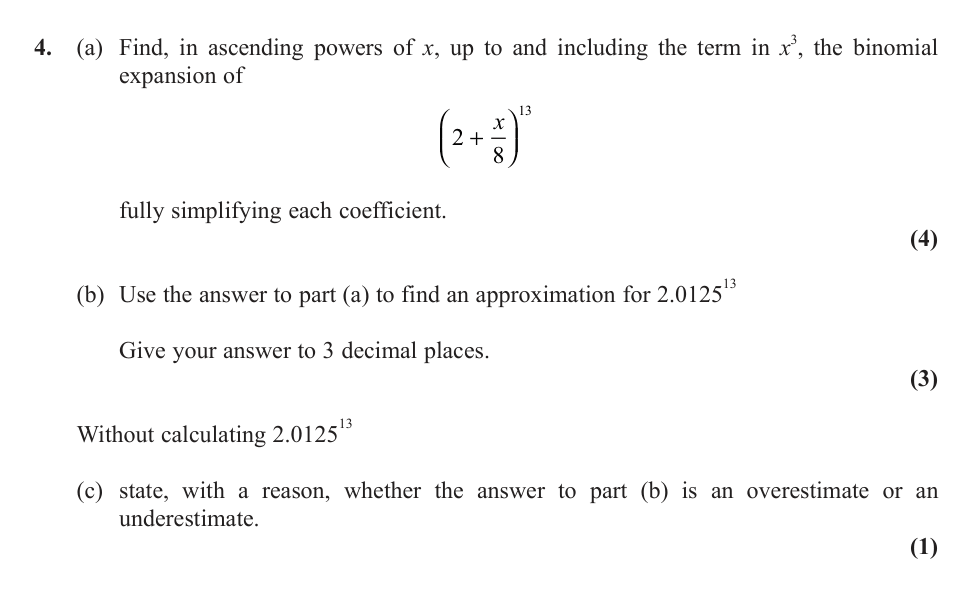
17. WMA12/01 May/June 2021 · Q4 Medium 8 marksShow worked solution Write the binomial terms $(2+\dfrac{x}{8})^{13}=2^{13}+\binom{13}{1}2^{12}\dfrac{x}{8}+\binom{13}{2}2^{11}\left(\dfrac{x}{8}\right)^2+\binom{13}{3}2^{10}\left(\dfrac{x}{8}\right)^3+\cdots$.
Simplify the expansion This gives $8192+6656x+2496x^2+572x^3+\cdots$.
Match the value Since $2.0125=2+0.0125=2+\dfrac{0.1}{8}$, use $x=0.1$ in the expansion.
Calculate the approximation $8192+6656(0.1)+2496(0.1)^2+572(0.1)^3=8883.132$.
Decide the direction The next terms in the expansion are positive because $x=0.1>0$, so stopping after the $x^3$ term gives an underestimate.
Final answer $(a)\ 8192+6656x+2496x^2+572x^3.\quad (b)\ 8883.132.\quad (c)$ Underestimate.
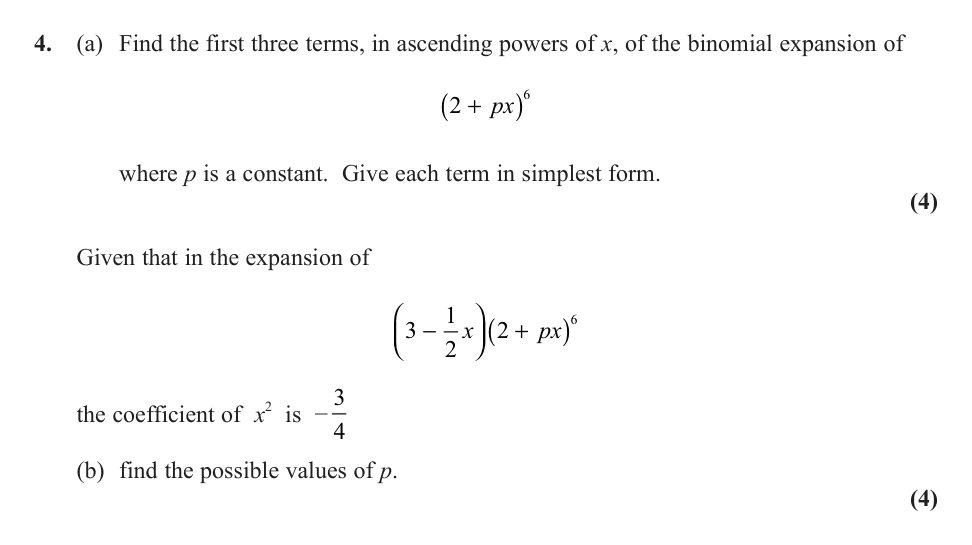
18. WMA12/01 January 2021 · Q4 Medium 8 marksShow worked solution Write the first binomial terms $(2+px)^6=2^6+\binom61 2^5(px)+\binom62 2^4(px)^2+\cdots$.
Simplify the expansion The first three terms are $64+192px+240p^2x^2$.
Find the coefficient of x squared In $(3-\dfrac12x)(2+px)^6$, the $x^2$ coefficient is $3(240p^2)-\dfrac12(192p)$.
Form the equation So $720p^2-96p=-\dfrac34$.
Solve the quadratic Multiplying by $4$ gives $2880p^2-384p+3=0$, or $960p^2-128p+1=0$.
State the values of p $p=\dfrac{128\pm112}{1920}$, so $p=\dfrac18$ or $p=\dfrac1{120}$.
Final answer $(a)\ 64+192px+240p^2x^2.\quad (b)\ p=\dfrac18\text{ or }p=\dfrac1{120}$.
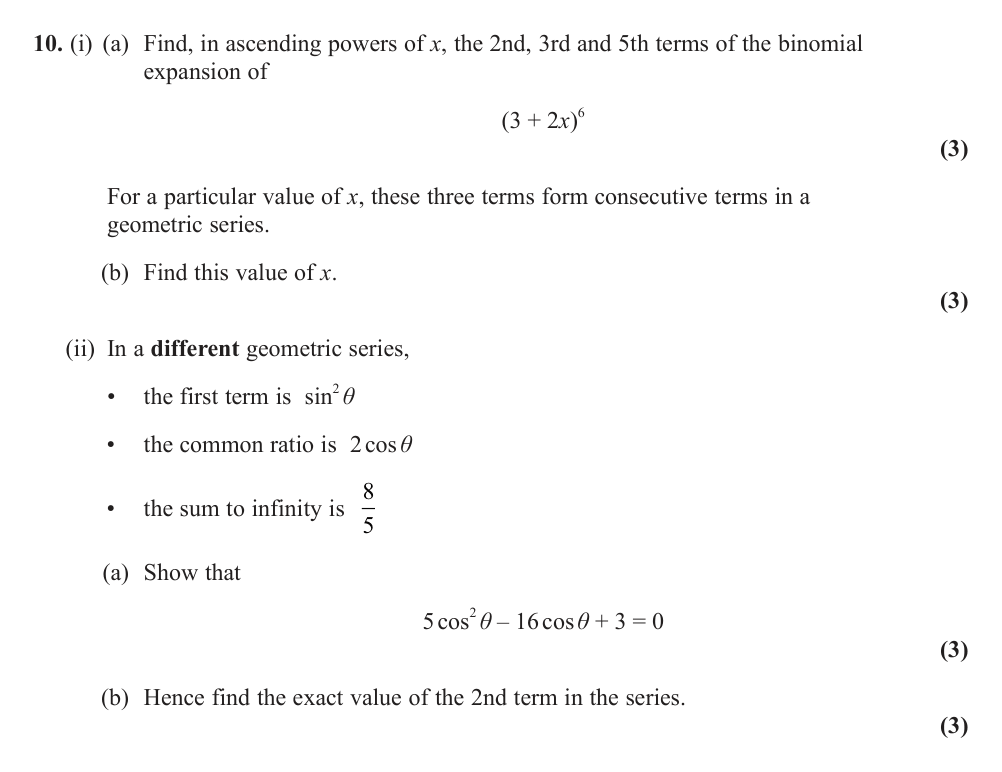
19. WMA12/01 October 2023 · Q10 Hard 12 marksShow worked solution Find the second term The 2nd term of $(3+2x)^6$ is $\binom61 3^5(2x)=6\cdot243\cdot2x=2916x$.
Find the third term The 3rd term is $\binom62 3^4(2x)^2=15\cdot81\cdot4x^2=4860x^2$.
Find the fifth term The 5th term is $\binom64 3^2(2x)^4=15\cdot9\cdot16x^4=2160x^4$.
Use the geometric condition For three consecutive terms in a geometric series, the middle term squared equals the product of the two outer terms.
Set up the equation $(4860x^2)^2=(2916x)(2160x^4)$.
Solve for x For the non-zero geometric case, divide by $x^4$: $4860^2=2916\cdot2160\,x$, so $x=\dfrac{4860^2}{2916\cdot2160}=\dfrac{15}{4}$.
Use the sum to infinity In the different geometric series, first term $=\sin^2\theta$, common ratio $=2\cos\theta$, and $S_\infty=\dfrac85$.
Form the equation $\dfrac{\sin^2\theta}{1-2\cos\theta}=\dfrac85$.
Use sine squared $5\sin^2\theta=8(1-2\cos\theta)$. With $\sin^2\theta=1-\cos^2\theta$, this becomes $5(1-\cos^2\theta)=8-16\cos\theta$.
Show the required equation Rearranging gives $5\cos^2\theta-16\cos\theta+3=0$.
Solve for cosine $5\cos^2\theta-16\cos\theta+3=0$ gives $\cos\theta=3$ or $\cos\theta=\dfrac15$. The possible value is $\cos\theta=\dfrac15$.
Find the second term The 2nd term is first term times common ratio: $\sin^2\theta(2\cos\theta)=\left(1-\dfrac{1}{25}\right)\cdot\dfrac25=\dfrac{24}{25}\cdot\dfrac25=\dfrac{48}{125}$.
Final answer $(i)(a)$ $2916x,\ 4860x^2,\ 2160x^4$. $\quad (i)(b)$ $x=\dfrac{15}{4}$. $\quad (ii)(a)$ Proven. $\quad (ii)(b)$ $\dfrac{48}{125}$.
Dr Eslam Ahmed Elite Mathematics · Questions classified by topic, solutions checked by Dr Eslam
 Elite Mathematics