Elite Mathematics / Pure 2 / Topics / Sequences and Series IAL · WMA12 · Topic Sequences and Series: past paper questions & worked solutions
Every Sequences and Series question from the WMA12 papers in our bank, 2019–2025, sorted from easiest to hardest. Try each one first, then open the worked solution.
22 questions
147 marks in total
84% of papers (16 of 19) include it
8/12/2 easy / medium / hard
Questions, easiest first Level is estimated from marks: 1–6 easy, 7–8 medium, 9+ hard.
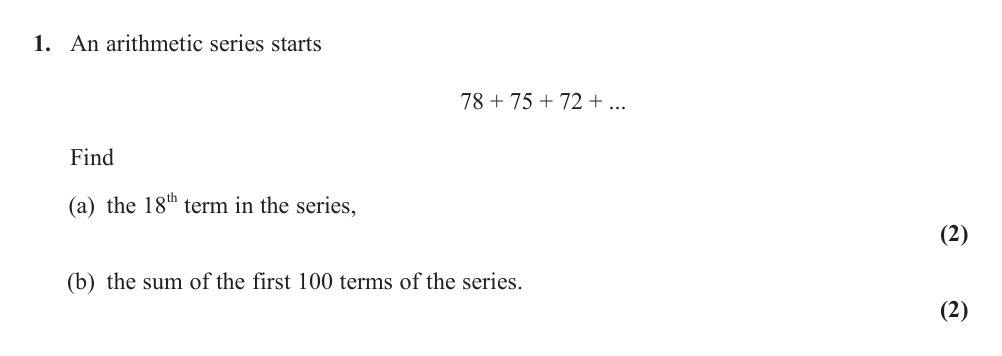
1. WMA12/01 October 2025 · Q1 Easy 4 marks · main topic: Arithmetic SequencesShow worked solution Identify the sequence The first term is $78$ and the common difference is $75-78=-3$.
Find the eighteenth term $u_{18}=78+17(-3)=27$.
Use the sum formula $S_{100}=\dfrac{100}{2}\{2(78)+99(-3)\}$.
Evaluate the sum $S_{100}=50(156-297)=50(-141)=-7050$.
Final answer $(a)$ $27$. $\quad (b)$ $-7050$.
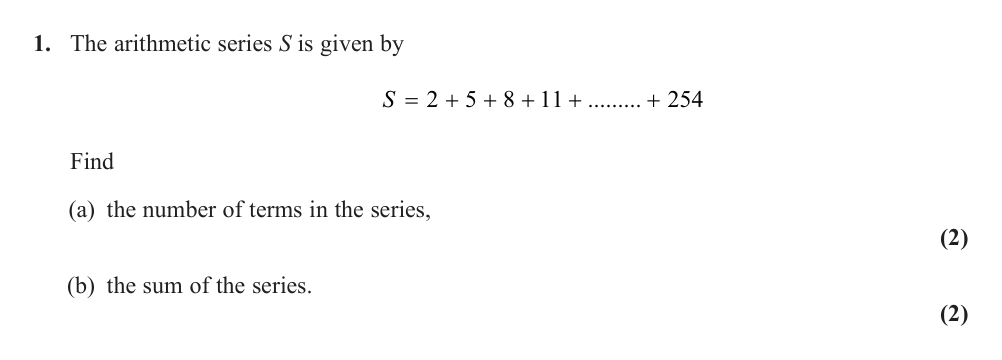
2. WMA12/01 January 2025 · Q1 Easy 4 marks · main topic: Arithmetic SequencesShow worked solution Identify the arithmetic series The first term is $2$, the common difference is $3$, and the last term is $254$.
Find the number of terms Use $254=2+(n-1)3$. Then $252=3(n-1)$, so $n-1=84$ and $n=85$.
Use the sum formula $S_n=\dfrac n2(a+l)$, where $a$ is the first term and $l$ is the last term.
Find the sum $S=\dfrac{85}{2}(2+254)=85\times128=10880$.
Final answer $(a)$ $85$. $\quad (b)$ $10880$.
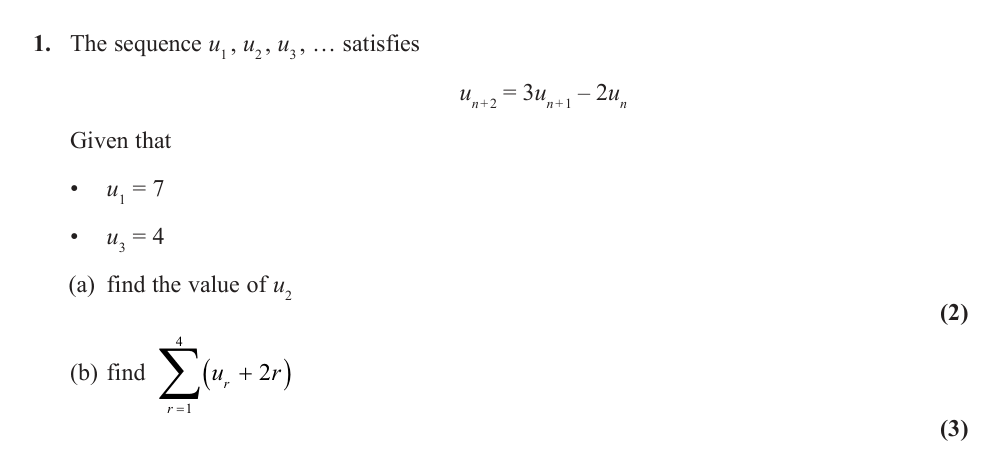
3. WMA12/01 May/June R 2024 · Q1 Easy 5 marksShow worked solution Use the recurrence at n equals one $u_3=3u_2-2u_1$.
Substitute given values $4=3u_2-2(7)$, so $4=3u_2-14$.
Find u2 $3u_2=18$, hence $u_2=6$.
Find u4 $u_4=3u_3-2u_2=3(4)-2(6)=0$.
Evaluate the sum $\displaystyle \sum_{r=1}^{4}(u_r+2r)=(7+2)+(6+4)+(4+6)+(0+8)$.
Add the terms The sum is $9+10+10+8=37$.
Final answer $(a)$ $u_2=6$. $\quad (b)$ $37$.
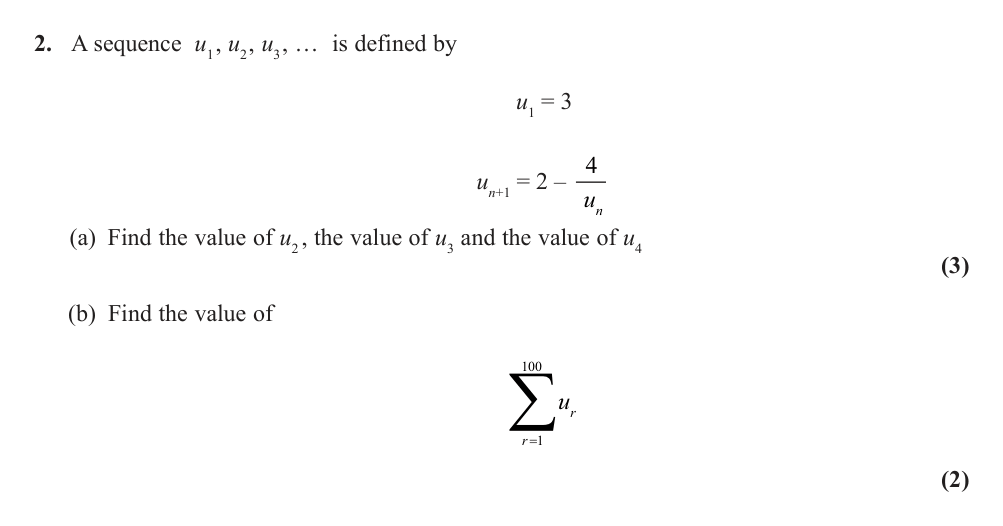
4. WMA12/01 October 2023 · Q2 Easy 5 marksShow worked solution Find u2 $u_2=2-\dfrac4{u_1}=2-\dfrac43=\dfrac23$.
Find u3 $u_3=2-\dfrac4{u_2}=2-\dfrac4{2/3}=2-6=-4$.
Find u4 $u_4=2-\dfrac4{u_3}=2-\dfrac4{-4}=3$.
Notice the cycle The sequence starts $3,\dfrac23,-4,3,\dfrac23,-4,\ldots$, so it repeats every 3 terms.
Sum one cycle $3+\dfrac23-4=-\dfrac13$.
Use 100 terms There are $33$ complete cycles in the first $99$ terms, then one extra term $u_{100}=3$.
Find the sum $\displaystyle \sum_{r=1}^{100}u_r=33\left(-\dfrac13\right)+3=-11+3=-8$.
Final answer $(a)$ $u_2=\dfrac23,\ u_3=-4,\ u_4=3$. $\quad (b)$ $-8$.
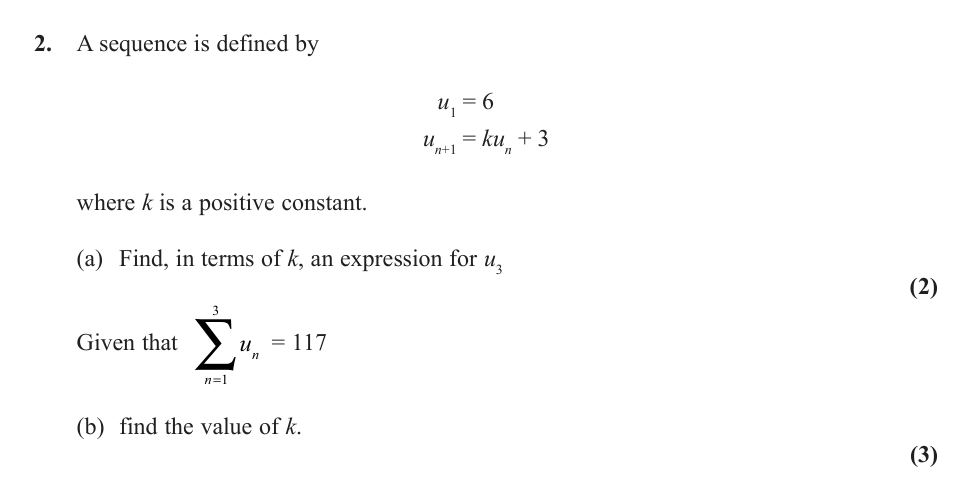
5. WMA12/01 October 2021 · Q2 Easy 5 marksShow worked solution Find u two $u_2=ku_1+3=6k+3$.
Find u three $u_3=ku_2+3=k(6k+3)+3=6k^2+3k+3$.
Use the given sum $u_1+u_2+u_3=117$, so $6+(6k+3)+(6k^2+3k+3)=117$.
Simplify the equation $6k^2+9k+12=117$, hence $2k^2+3k-35=0$.
Solve for k $(2k-7)(k+5)=0$. Since $k$ is positive, $k=\dfrac72$.
Final answer $(a)\ u_3=6k^2+3k+3.\quad (b)\ k=\dfrac72$.
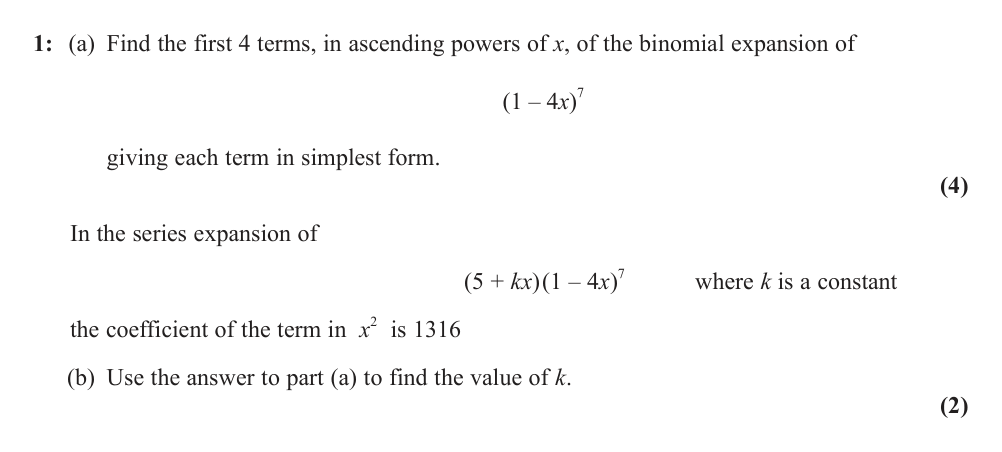
6. WMA12/01 May/June 2025 · Q1 Easy 6 marks · main topic: Binomial ExpansionShow worked solution Write the binomial terms $(1-4x)^7=1+7(-4x)+\binom72(-4x)^2+\binom73(-4x)^3+\cdots$.
Simplify The first four terms are $1-28x+336x^2-2240x^3$.
Find the x squared terms In $(5+kx)(1-4x)^7$, the $x^2$ coefficient comes from $5(336x^2)$ and $(kx)(-28x)$.
Use the given coefficient $5(336)-28k=1316$, so $1680-28k=1316$.
Find k $28k=364$, hence $k=13$.
Final answer $(a)$ $1-28x+336x^2-2240x^3$. $\quad (b)$ $k=13$.
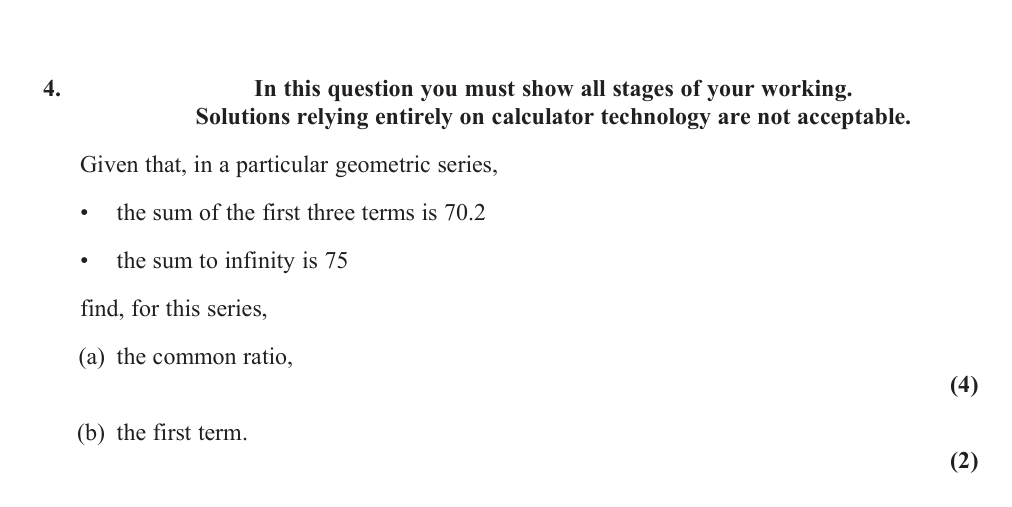
7. WMA12/01 January 2025 · Q4 Easy 6 marks · main topic: Geometric SequencesShow worked solution Write the two sums For first term $a$ and common ratio $r$, $S_\infty=\dfrac{a}{1-r}=75$ and $S_3=\dfrac{a(1-r^3)}{1-r}=70.2$.
Divide the equations $\dfrac{S_3}{S_\infty}=1-r^3$, so $\dfrac{70.2}{75}=1-r^3$.
Find the ratio $0.936=1-r^3$, so $r^3=0.064$ and $r=0.4$.
Find the first term Use $\dfrac{a}{1-0.4}=75$. Hence $a=75(0.6)=45$.
Final answer $(a)$ $r=0.4$. $\quad (b)$ $45$.
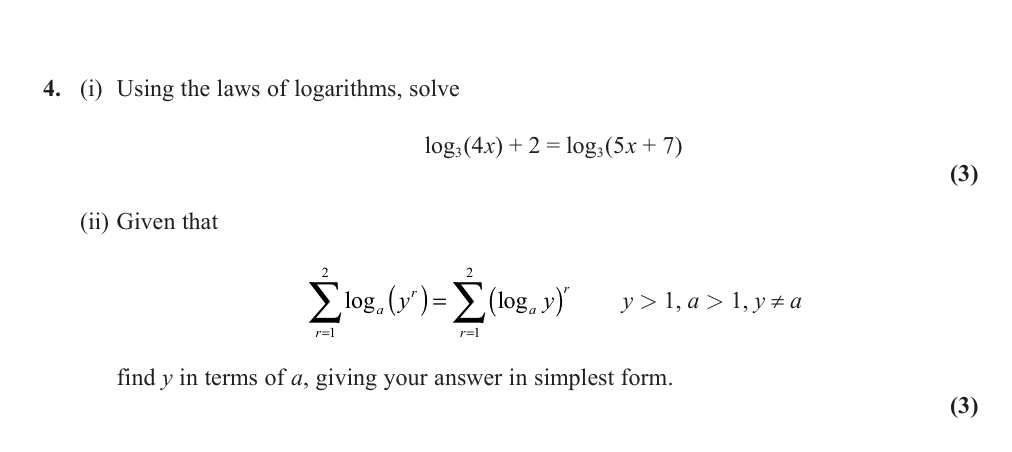
8. WMA12/01 January 2023 · Q4 Easy 6 marks · main topic: Laws of LogarithmsShow worked solution Rewrite the constant Since $2=\log_3 9$, the equation becomes $\log_3(4x)+\log_3 9=\log_3(5x+7)$.
Combine the logarithms $\log_3(4x)+\log_3 9=\log_3(36x)$.
Solve for x Therefore $36x=5x+7$, so $31x=7$ and $x=\dfrac{7}{31}$.
Introduce L Let $L=\log_a y$. Then $\log_a(y^r)=r\log_a y=rL$.
Evaluate the left sum $\displaystyle \sum_{r=1}^{2}\log_a(y^r)=L+2L=3L$.
Evaluate the right sum $\displaystyle \sum_{r=1}^{2}(\log_a y)^r=L+L^2$.
Solve for L So $3L=L+L^2$, which gives $L^2-2L=0$ and $L(L-2)=0$.
Use the restrictions Since $a>1$ and $y>1$, $\log_a y>0$, so $L\ne0$. Hence $L=2$ and $y=a^2$.
Final answer $(i)$ $x=\dfrac{7}{31}$. $\quad (ii)$ $y=a^2$.
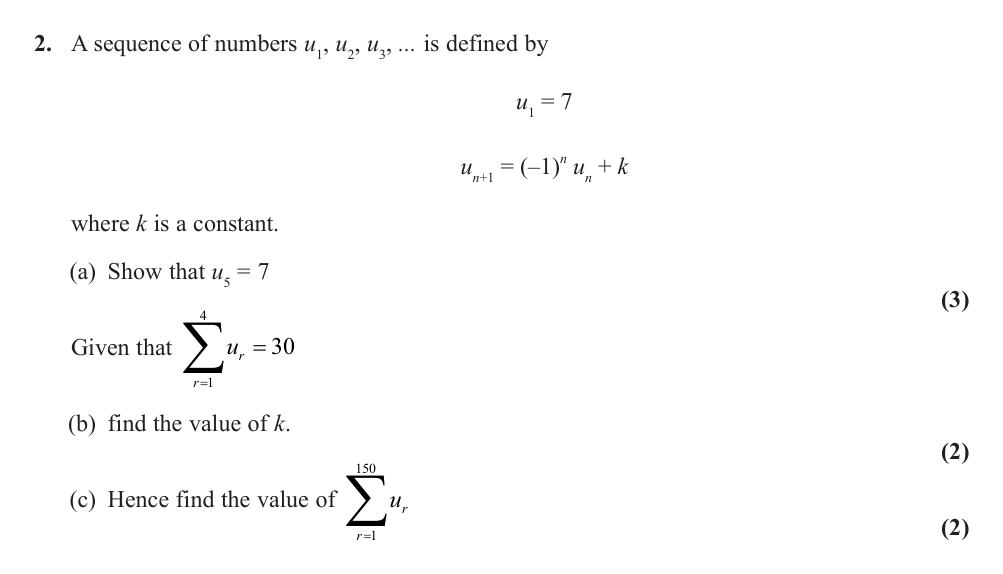
9. WMA12/01 October 2024 · Q2 Medium 7 marksShow worked solution Find the first few terms $u_1=7$, $u_2=(-1)^1u_1+k=k-7$, $u_3=(-1)^2u_2+k=2k-7$, and $u_4=(-1)^3u_3+k=7-k$.
Show u five $u_5=(-1)^4u_4+k=(7-k)+k=7$.
Use the given sum $\displaystyle \sum_{r=1}^{4}u_r=7+(k-7)+(2k-7)+(7-k)=2k$.
Find k Since $\displaystyle \sum_{r=1}^{4}u_r=30$, we have $2k=30$, so $k=15$.
Write one repeated block With $k=15$, the first four terms are $7,8,23,-8$, and their sum is $30$. Since $u_5=u_1$, the pattern repeats every four terms.
Sum 150 terms There are $37$ complete blocks in the first $150$ terms, with the first two terms left over. Hence $\displaystyle \sum_{r=1}^{150}u_r=37(30)+7+8=1125$.
Final answer $(a)$ Proven. $\quad (b)$ $k=15$. $\quad (c)$ $1125$.
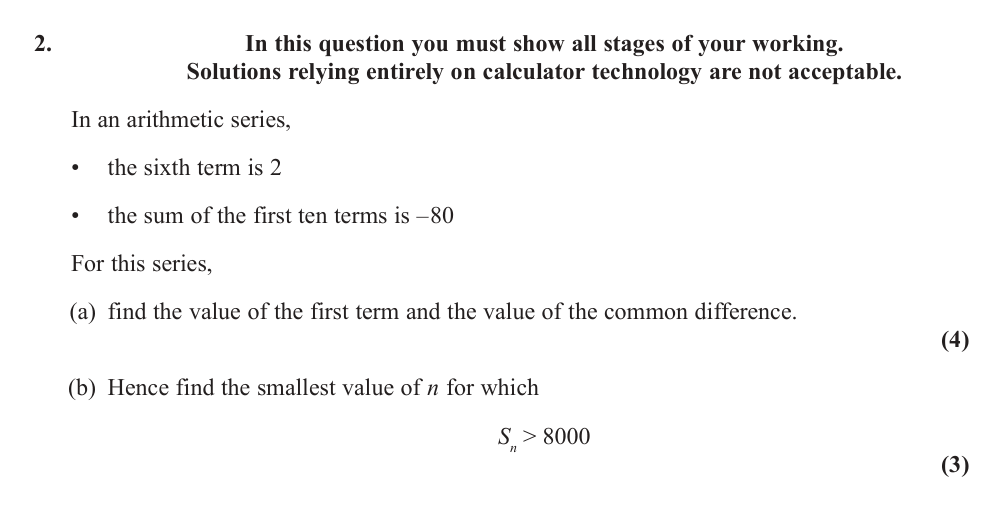
10. WMA12/01 May/June 2024 · Q2 Medium 7 marks · main topic: Arithmetic SequencesShow worked solution Use the sixth term For an arithmetic series, $u_6=a+5d=2$.
Use the sum of ten terms $S_{10}=\dfrac{10}{2}(2a+9d)=-80$, so $2a+9d=-16$.
Solve simultaneously From $a+5d=2$, $a=2-5d$. Substitute into $2a+9d=-16$.
Find a and d $2(2-5d)+9d=-16$, so $4-d=-16$ and $d=20$. Then $a=2-5(20)=-98$.
Write S n $S_n=\dfrac n2(2a+(n-1)d)=\dfrac n2(-196+20n-20)=10n^2-108n$.
Set up the inequality We need $10n^2-108n>8000$.
Solve the boundary $10n^2-108n-8000=0$ gives $5n^2-54n-4000=0$.
Find the positive threshold $n=\dfrac{54+\sqrt{82916}}{10}=34.195\ldots$.
Choose the smallest integer Therefore the smallest integer value with $S_n>8000$ is $n=35$.
Final answer $(a)$ First term $=-98$, common difference $=20$. $\quad (b)$ $n=35$.
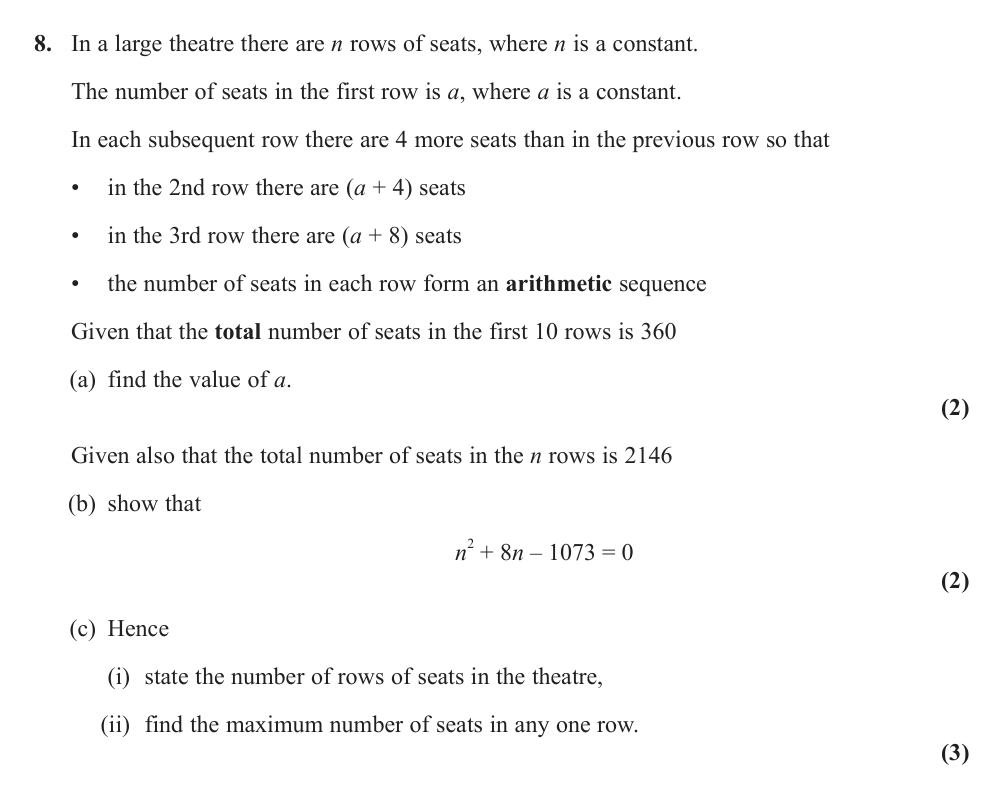
11. WMA12/01 October 2023 · Q8 Medium 7 marks · main topic: Arithmetic SequencesShow worked solution Use the arithmetic sum formula The first term is $a$ and the common difference is $4$.
Use the first 10 rows $S_{10}=\dfrac{10}{2}\left(2a+9\cdot4\right)=360$.
Find a $5(2a+36)=360$, so $10a+180=360$ and $a=18$.
Write S n $S_n=\dfrac n2\left(2(18)+(n-1)4\right)=\dfrac n2(4n+32)=2n^2+16n$.
Use the total number of seats Since the total is $2146$, $2n^2+16n=2146$.
Show the equation Dividing by $2$ and rearranging gives $n^2+8n-1073=0$.
Solve for n $n=\dfrac{-8\pm\sqrt{8^2+4(1073)}}{2}=\dfrac{-8\pm66}{2}$, so $n=29$ or $n=-37$.
Choose the row count The number of rows must be positive, so there are $29$ rows.
Find the maximum row size The largest row is the last row: $18+(29-1)4=18+112=130$ seats.
Final answer $(a)$ $a=18$. $\quad (b)$ Proven. $\quad (c)(i)$ $29$ rows. $\quad (c)(ii)$ $130$ seats.
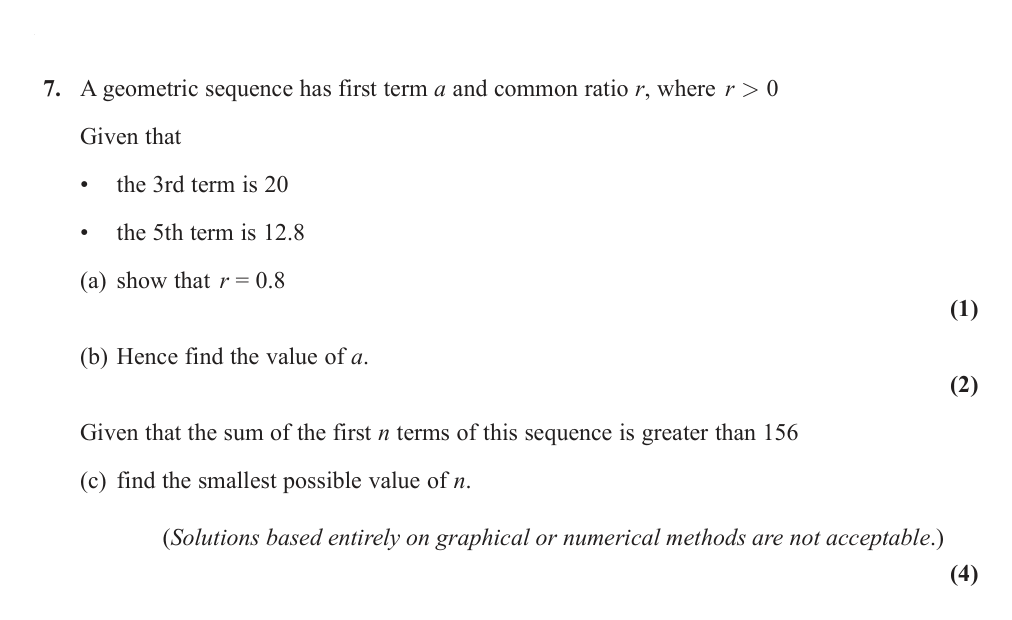
12. WMA12/01 January 2023 · Q7 Medium 7 marks · main topic: Geometric SequencesShow worked solution Write the given terms For a geometric sequence, the third term is $ar^2=20$ and the fifth term is $ar^4=12.8$.
Divide the equations $\dfrac{ar^4}{ar^2}=\dfrac{12.8}{20}$, so $r^2=0.64$.
Use r positive Since $r>0$, $r=0.8$.
Find a Using $ar^2=20$, $a(0.8)^2=20$, so $a=\dfrac{20}{0.64}=31.25$.
Write the sum formula $S_n=\dfrac{a(1-r^n)}{1-r}=\dfrac{31.25(1-0.8^n)}{0.2}=156.25(1-0.8^n)$.
Set up the inequality We need $156.25(1-0.8^n)>156$.
Isolate the power $1-0.8^n>\dfrac{156}{156.25}=\dfrac{624}{625}$, so $0.8^n<\dfrac{1}{625}$.
Use logarithms $n\log(0.8)<\log\left(\dfrac{1}{625}\right)$. Since $\log(0.8)<0$, dividing reverses the inequality: $n>\dfrac{\log(1/625)}{\log(0.8)}=28.85\ldots$.
Choose the smallest integer The smallest possible integer value is therefore $n=29$.
Final answer $(a)$ $r=0.8$. $\quad (b)$ $a=31.25$. $\quad (c)$ $n=29$.
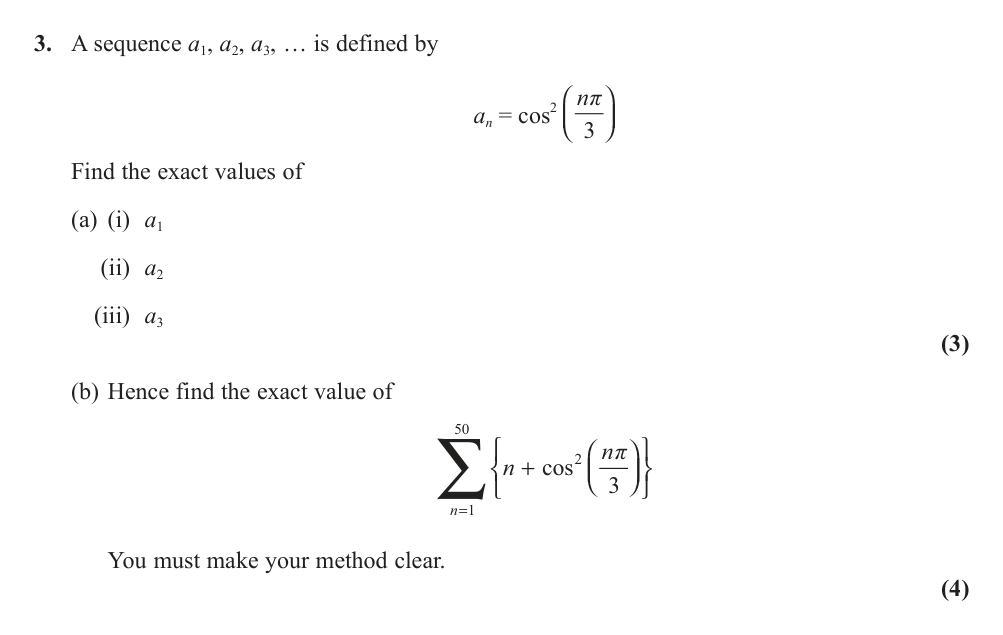
13. WMA12/01 October 2022 · Q3 Medium 7 marksShow worked solution Find the first term $a_1=\cos^2\left(\dfrac{\pi}{3}\right)=\left(\dfrac12\right)^2=\dfrac14$.
Find the second term $a_2=\cos^2\left(\dfrac{2\pi}{3}\right)=\left(-\dfrac12\right)^2=\dfrac14$.
Find the third term $a_3=\cos^2(\pi)=(-1)^2=1$.
Recognise the repeating pattern The values of $\cos^2\left(\dfrac{n\pi}{3}\right)$ repeat every 3 terms as $\dfrac14,\dfrac14,1$.
Sum the n part $\sum_{n=1}^{50} n=\dfrac{50\cdot51}{2}=1275$.
Sum the cosine part There are $16$ complete groups of 3 terms in the first $48$ terms, then the first 2 terms repeat. Hence the cosine-square sum is $16\left(\dfrac14+\dfrac14+1\right)+\dfrac14+\dfrac14=24+\dfrac12=\dfrac{49}{2}$.
Add the two sums $\sum_{n=1}^{50}\left(n+\cos^2\left(\dfrac{n\pi}{3}\right)\right)=1275+\dfrac{49}{2}=\dfrac{2599}{2}$.
Final answer $(a)\ a_1=\dfrac14,\ a_2=\dfrac14,\ a_3=1. $\quad $(b)\ \dfrac{2599}{2}$.
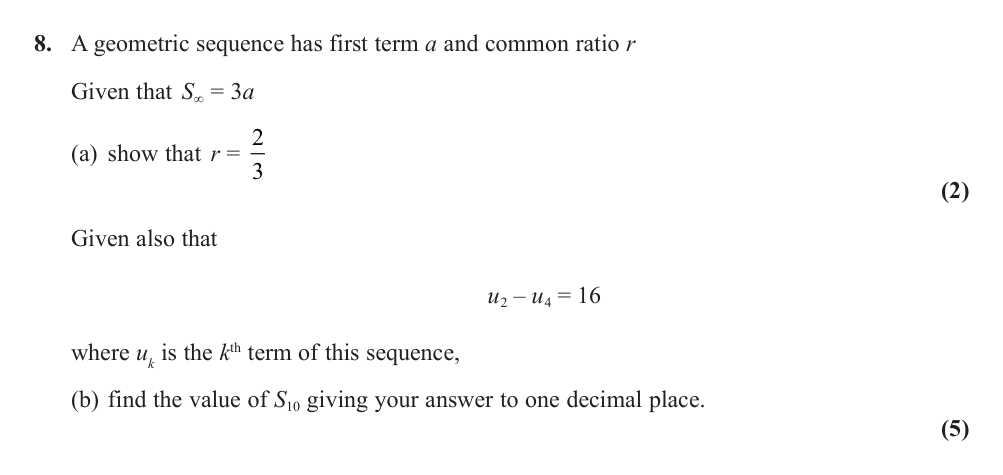
14. WMA12/01 October 2022 · Q8 Medium 7 marks · main topic: Geometric SequencesShow worked solution Use the sum to infinity formula For a geometric sequence, $S_\infty=\dfrac{a}{1-r}$. The question gives $S_\infty=3a$.
Find the common ratio $\dfrac{a}{1-r}=3a$. Since $u_2-u_4=16$, $a\ne0$, so $\dfrac{1}{1-r}=3$ and $r=\dfrac23$.
Use u2 minus u4 $u_2-u_4=ar-ar^3=ar(1-r^2)=16$.
Substitute r $a\left(\dfrac23\right)\left(1-\dfrac49\right)=16$.
Solve for a $a\cdot\dfrac23\cdot\dfrac59=16$, so $\dfrac{10a}{27}=16$ and $a=\dfrac{216}{5}=43.2$.
Find S10 $S_{10}=\dfrac{a(1-r^{10})}{1-r}=3a\left(1-\left(\dfrac23\right)^{10}\right)$.
Evaluate $S_{10}=3\left(\dfrac{216}{5}\right)\left(1-\left(\dfrac23\right)^{10}\right)=\dfrac{92840}{729}=127.352\ldots$, so $S_{10}=127$ to 3 significant figures.
Final answer $(a)$ $a=43.2$. $\quad (b)$ $S_{10}=127.353\ldots$, so $127$ to 3 s.f.
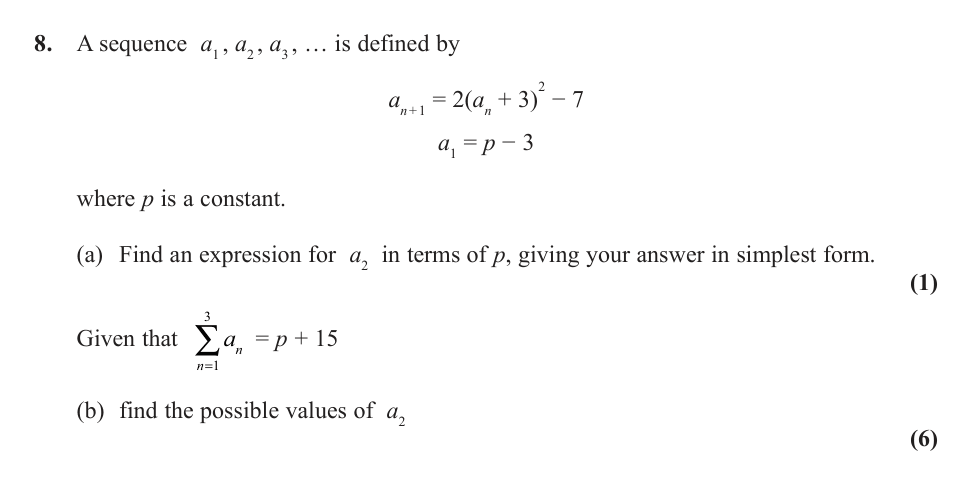
15. WMA12/01 January 2021 · Q8 Medium 7 marksShow worked solution Find a two Since $a_1=p-3$, we have $a_1+3=p$. Therefore $a_2=2(a_1+3)^2-7=2p^2-7$.
Find a three $a_2+3=2p^2-4$, so $a_3=2(2p^2-4)^2-7=8(p^2-2)^2-7$.
Use the given sum $a_1+a_2+a_3=p+15$.
Substitute the expressions $(p-3)+(2p^2-7)+8(p^2-2)^2-7=p+15$.
Simplify Cancelling $p$ and expanding gives $8p^4-30p^2=0$, so $2p^2(4p^2-15)=0$.
Find the possible a two values If $p=0$, then $a_2=-7$. If $p^2=\dfrac{15}{4}$, then $a_2=2\cdot\dfrac{15}{4}-7=\dfrac12$.
Final answer $(a)\ a_2=2p^2-7.\quad (b)\ a_2=-7\text{ or }\dfrac12$.
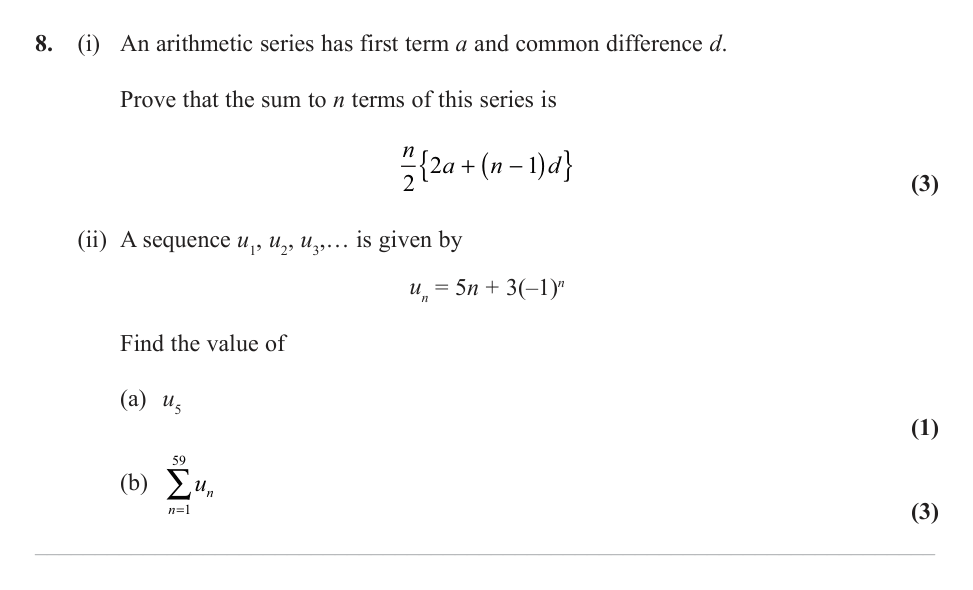
16. WMA12/01 January 2020 · Q8 Medium 7 marksShow worked solution Write the series forwards $S_n=a+(a+d)+(a+2d)+\cdots+(a+(n-1)d)$.
Write the series backwards $S_n=(a+(n-1)d)+(a+(n-2)d)+\cdots+a$.
Add the two forms Each pair adds to $2a+(n-1)d$, and there are $n$ pairs. Hence $2S_n=n\{2a+(n-1)d\}$.
Complete the proof Dividing by $2$ gives $S_n=\dfrac n2\{2a+(n-1)d\}$.
Find u5 $u_5=5(5)+3(-1)^5=25-3=22$.
Sum the sequence $\sum_{n=1}^{59}u_n=5\sum_{n=1}^{59}n+3\sum_{n=1}^{59}(-1)^n$.
Calculate the total $5\sum_{n=1}^{59}n=5\cdot\dfrac{59\cdot60}{2}=8850$, and $\sum_{n=1}^{59}(-1)^n=-1$. Therefore the total is $8850-3=8847$.
Final answer $(i)$ Proven. $\quad (ii)(a)\ 22.\quad (ii)(b)\ 8847$.
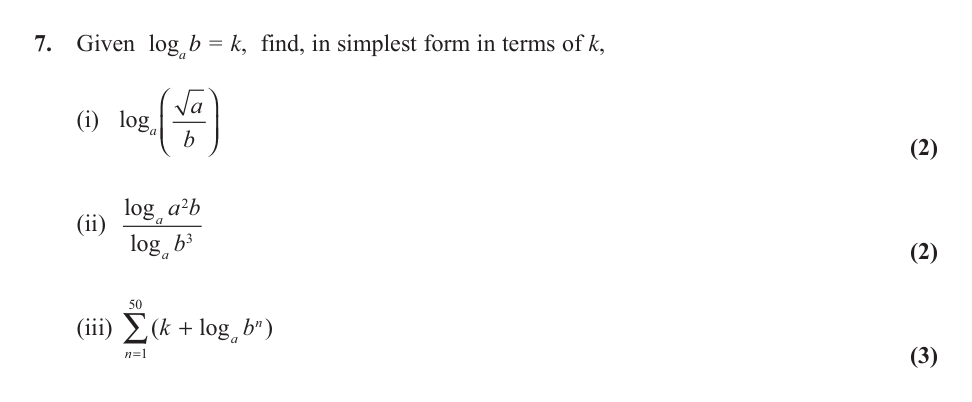
17. WMA12/01 October 2019 · Q7 Medium 7 marks · main topic: Laws of LogarithmsShow worked solution Use the given logarithm Since $\log_a b=k$, we can replace every $\log_a b$ by $k$.
Simplify part (i) $\log_a\left(\dfrac{\sqrt a}{b}\right)=\log_a(a^{1/2})-\log_a b=\dfrac12-k$.
Simplify the numerator and denominator $\log_a(a^2b)=\log_a a^2+\log_a b=2+k$, and $\log_a(b^3)=3\log_a b=3k$.
Write part (ii) Therefore $\dfrac{\log_a(a^2b)}{\log_a(b^3)}=\dfrac{k+2}{3k}$.
Simplify the summand $\log_a(b^n)=n\log_a b=nk$, so $k+\log_a(b^n)=k+nk=(n+1)k$.
Sum the series $\sum_{n=1}^{50}(n+1)k=k\left(\sum_{n=1}^{50}n+50\right)=k(1275+50)=1325k$.
Final answer $(i)\ \dfrac12-k.\quad (ii)\ \dfrac{k+2}{3k}.\quad (iii)\ 1325k$.
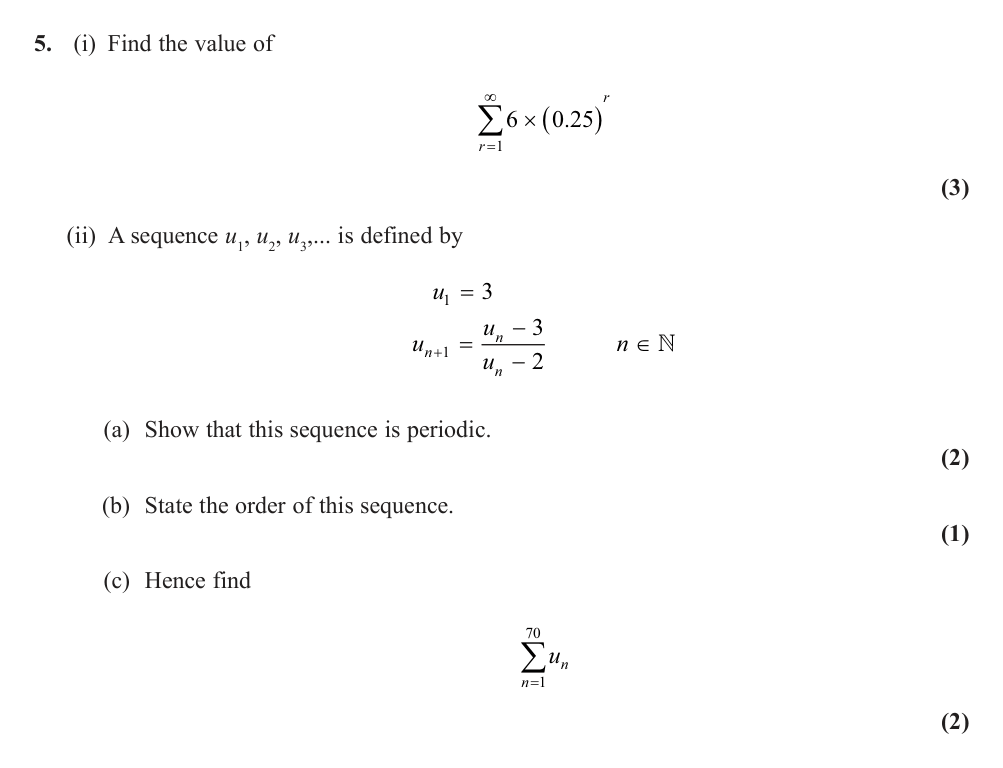
18. WMA12/01 January 2024 · Q5 Medium 8 marksShow worked solution Identify the geometric series $\displaystyle \sum_{r=1}^{\infty}6(0.25)^r$ has first term $6(0.25)=1.5$ and common ratio $0.25$.
Sum to infinity $S_\infty=\dfrac{1.5}{1-0.25}=\dfrac{1.5}{0.75}=2$.
Find the first few terms $u_1=3$. Then $u_2=\dfrac{3-3}{3-2}=0$.
Continue the recurrence $u_3=\dfrac{0-3}{0-2}=\dfrac32$, and $u_4=\dfrac{\frac32-3}{\frac32-2}=3$.
Show periodicity Since $u_4=3=u_1$, the terms repeat as $3,0,\dfrac32,3,0,\dfrac32,\ldots$.
State the order The repeating cycle has length $3$, so the order is $3$.
Sum one cycle One full cycle sums to $3+0+\dfrac32=\dfrac92$.
Use 70 terms Since $70=23\cdot3+1$, the first $70$ terms contain $23$ complete cycles and one extra term $u_1=3$.
Find the required sum $\displaystyle \sum_{n=1}^{70}u_n=23\left(\dfrac92\right)+3=\dfrac{207}{2}+\dfrac{6}{2}=\dfrac{213}{2}$.
Final answer $(i)$ $2$. $\quad (ii)(a)$ Periodic. $\quad (ii)(b)$ Order $3$. $\quad (ii)(c)$ $\dfrac{213}{2}$.
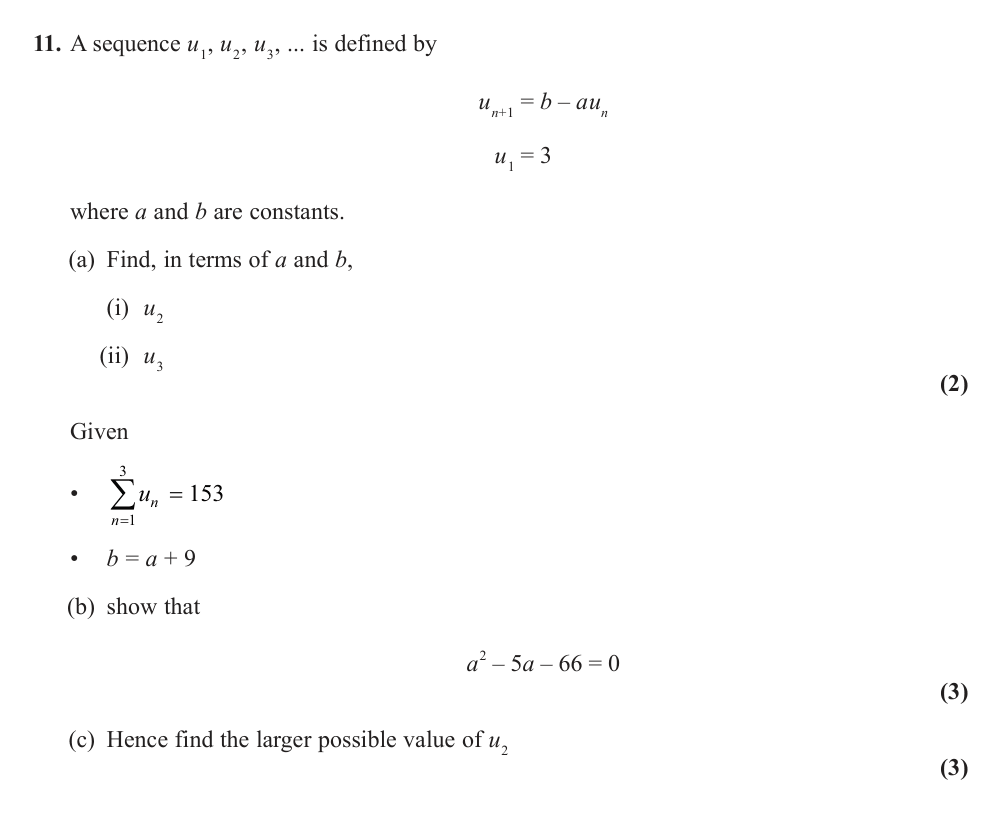
19. WMA12/01 May/June 2023 · Q11 Medium 8 marksShow worked solution Find u2 Using $u_{n+1}=b-au_n$ and $u_1=3$, we get $u_2=b-a(3)=b-3a$.
Find u3 $u_3=b-au_2=b-a(b-3a)=b-ab+3a^2$.
Use the sum condition $u_1+u_2+u_3=153$, so $3+(b-3a)+(b-ab+3a^2)=153$.
Substitute b equals a plus nine Using $b=a+9$, the left side becomes $3+(a+9)-3a+(a+9)-a(a+9)+3a^2$.
Simplify This is $2a^2-10a+21$, so $2a^2-10a+21=153$.
Show the required equation $2a^2-10a-132=0$. Dividing by $2$ gives $a^2-5a-66=0$.
Solve for a $a^2-5a-66=(a-11)(a+6)=0$, so $a=11$ or $a=-6$.
Find the corresponding u2 values If $a=11$, then $b=20$ and $u_2=20-3(11)=-13$. If $a=-6$, then $b=3$ and $u_2=3-3(-6)=21$.
Choose the larger value The larger possible value of $u_2$ is $21$.
Final answer $(a)(i)$ $u_2=b-3a$. $\quad (a)(ii)$ $u_3=b-ab+3a^2$. $\quad (b)$ Proven. $\quad (c)$ $21$.
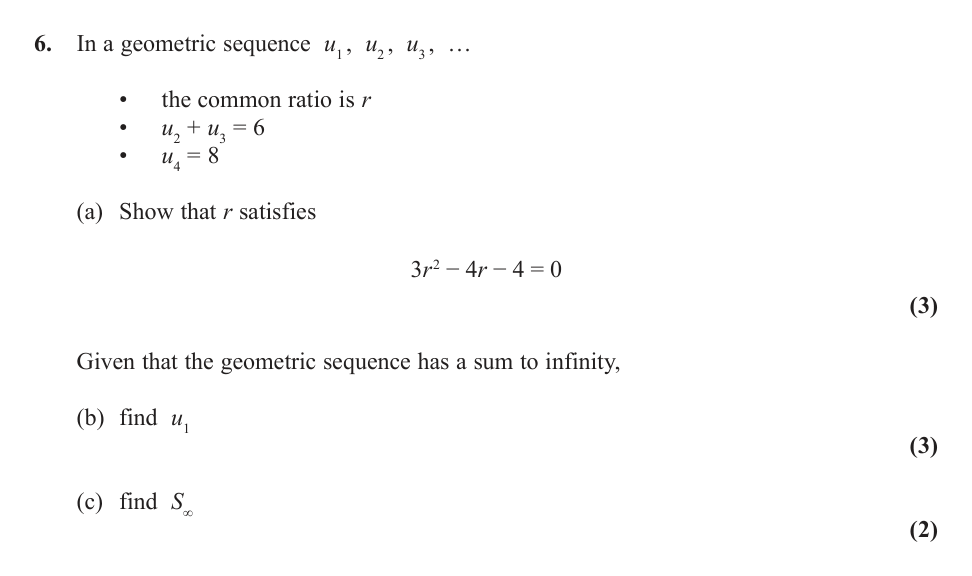
20. WMA12/01 May/June 2022 · Q6 Medium 8 marks · main topic: Geometric SequencesShow worked solution Write the terms $u_2=u_1r$, $u_3=u_1r^2$, and $u_4=u_1r^3$.
Use u four Since $u_4=8$, $u_1r^3=8$, so $u_1r=\dfrac{8}{r^2}$.
Use u two plus u three $u_2+u_3=u_1r(1+r)=6$.
Show the quadratic Substitute $u_1r=\dfrac8{r^2}$ to get $\dfrac8{r^2}(1+r)=6$. Hence $8+8r=6r^2$, so $3r^2-4r-4=0$.
Solve for r $3r^2-4r-4=0$ gives $r=2$ or $r=-\dfrac23$.
Choose the sum-to-infinity ratio A sum to infinity requires $|r|<1$, so $r=-\dfrac23$.
Find u one $u_1r^3=8$, so $u_1\left(-\dfrac23\right)^3=8$ and $u_1=-27$.
Find the infinite sum $S_\infty=\dfrac{u_1}{1-r}=\dfrac{-27}{1+2/3}=-\dfrac{81}{5}$.
Final answer $(a)$ Proven: $3r^2-4r-4=0$. $\quad (b)\ u_1=-27.\quad (c)\ S_\infty=-\dfrac{81}{5}$.
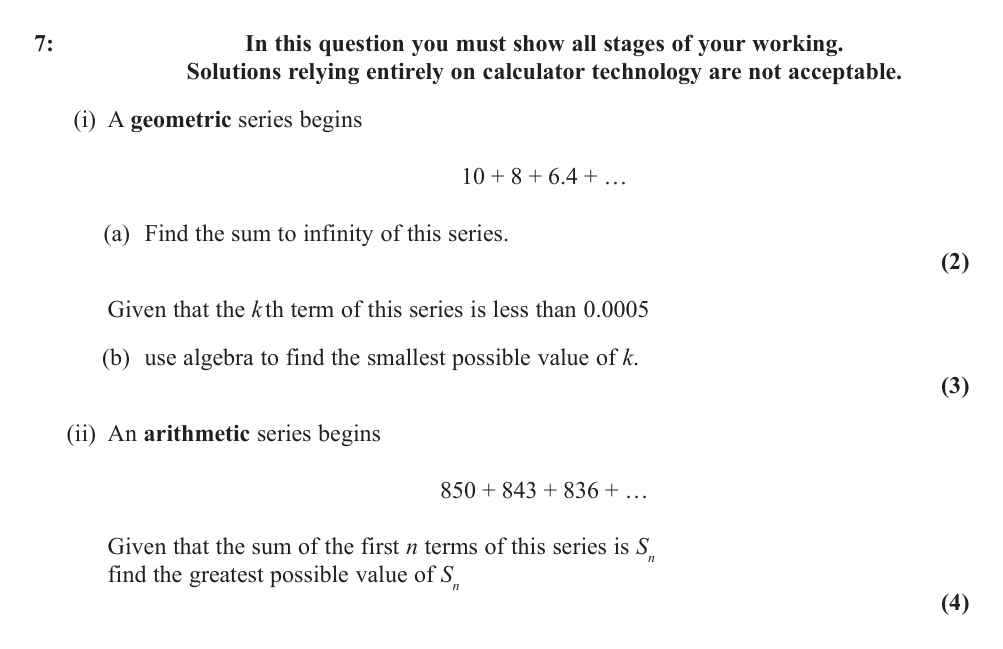
21. WMA12/01 May/June 2025 · Q7 Hard 9 marksShow worked solution Identify the geometric sequence The first term is $10$ and the common ratio is $\dfrac{8}{10}=0.8$.
Find the sum to infinity $S_\infty=\dfrac{10}{1-0.8}=50$.
Write the kth term The $k$th term is $10(0.8)^{k-1}$.
Use the inequality $10(0.8)^{k-1}<0.0005$, so $(0.8)^{k-1}<0.00005$.
Solve with logarithms Taking logarithms gives $(k-1)\log(0.8)<\log(0.00005)$. Since $\log(0.8)<0$, $k-1>\dfrac{\log(0.00005)}{\log(0.8)}=44.381\ldots$.
Find the smallest integer Thus $k>45.381\ldots$, so the smallest possible value is $k=46$.
Write the arithmetic sum For $850+843+836+\cdots$, the first term is $850$ and the common difference is $-7$.
Form S n $S_n=\dfrac n2\{2(850)+(n-1)(-7)\}=\dfrac n2(1707-7n)$.
Find the best integer n This quadratic has its maximum near $n=\dfrac{1707}{14}=121.928\ldots$, so check $n=122$.
Find the greatest sum $S_{122}=\dfrac{122}{2}(1707-854)=61(853)=52033$.
Final answer $(i)(a)$ $50$. $\quad (i)(b)$ $46$. $\quad (ii)$ $52033$.
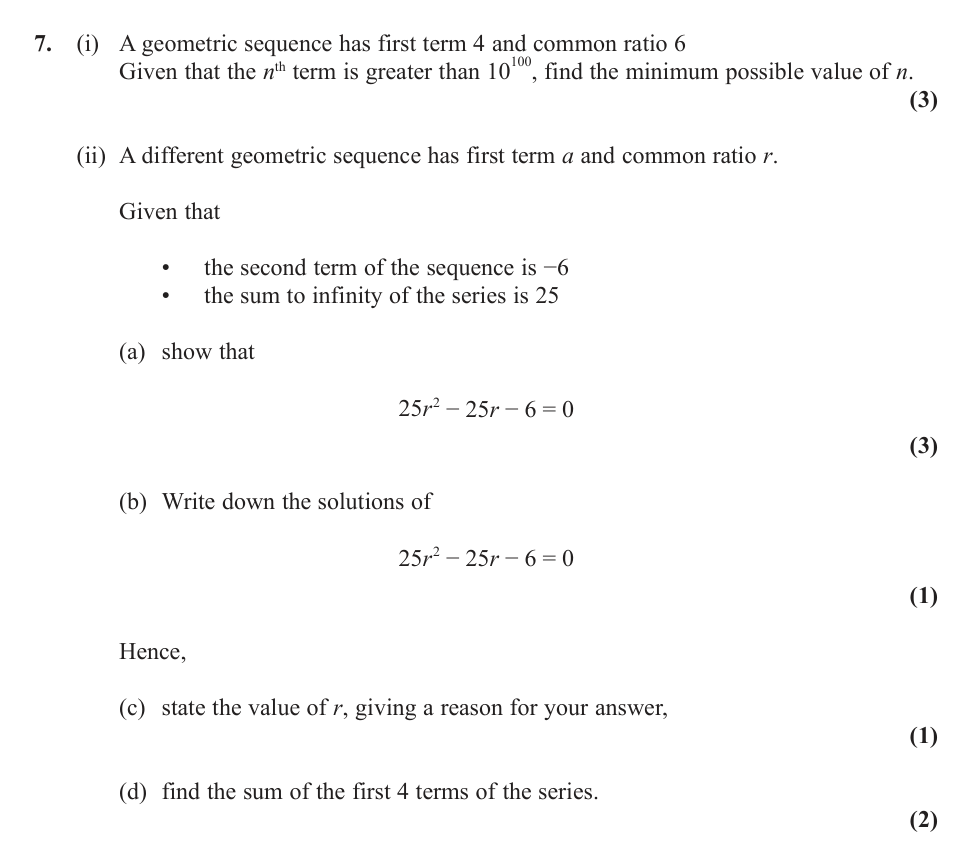
22. WMA12/01 October 2021 · Q7 Hard 10 marks · main topic: Geometric SequencesShow worked solution Write the nth term The nth term of the first sequence is $4\cdot6^{n-1}$.
Use logarithms We need $4\cdot6^{n-1}>10^{100}$, so $n-1>\dfrac{100-\log_{10}4}{\log_{10}6}=127.736\ldots$.
Choose the smallest integer Thus $n$ must be greater than $128.736\ldots$, so the minimum possible value is $129$.
Use the second term For the second sequence, $ar=-6$, so $a=-\dfrac6r$.
Use the sum to infinity $\dfrac{a}{1-r}=25$. Substituting $a=-\dfrac6r$ gives $-6=25r(1-r)$.
Show the quadratic Rearranging gives $25r^2-25r-6=0$.
Solve for r $25r^2-25r-6=0$ gives $r=\dfrac65$ or $r=-\dfrac15$.
Choose the valid ratio A sum to infinity exists only when $|r|<1$, so $r=-\dfrac15$.
Find the first term Since $ar=-6$, $a=30$.
Sum four terms $S_4=30\dfrac{1-(-1/5)^4}{1-(-1/5)}=\dfrac{624}{25}$.
Final answer $(i)\ n=129.\quad (ii)(a)$ Proven. $\quad (ii)(b)\ r=\dfrac65\text{ or }-\dfrac15.\quad (ii)(c)\ r=-\dfrac15.\quad (ii)(d)\ \dfrac{624}{25}$.
Dr Eslam Ahmed Elite Mathematics · Questions classified by topic, solutions checked by Dr Eslam
 Elite Mathematics