Level is estimated from marks: 1–6 easy, 7–8 medium, 9+ hard.
1. WMA12/01 October 2023 · Q1
Easy3 marksShow worked solution
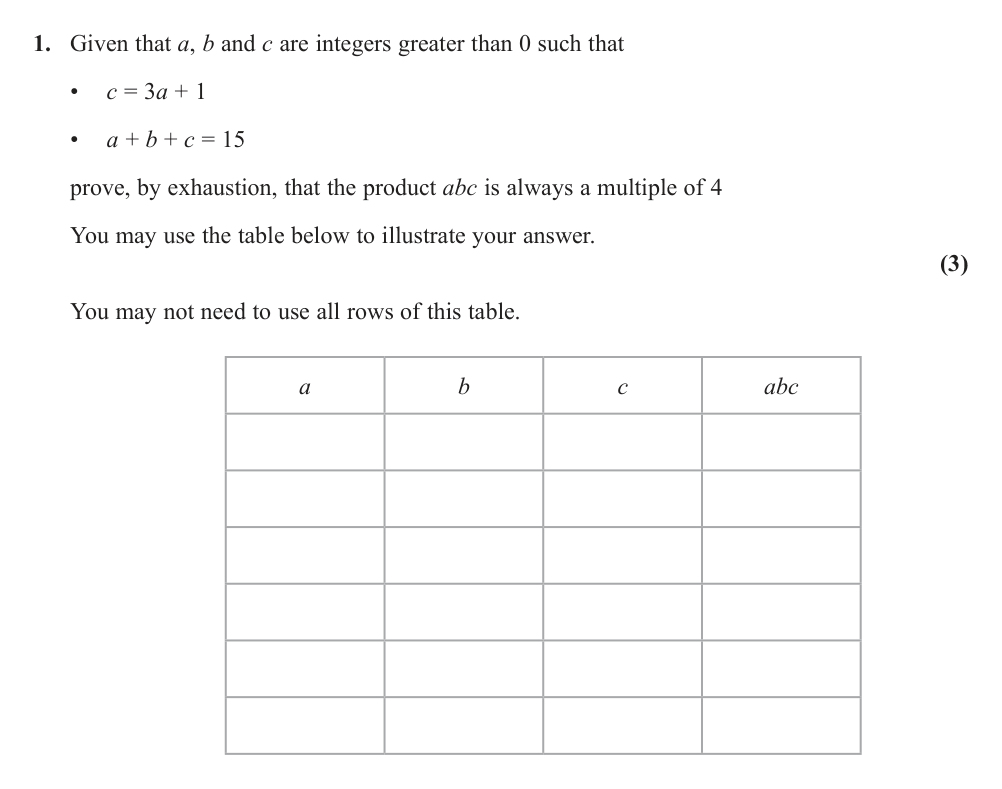
Use the conditions
Since $c=3a+1$ and $a+b+c=15$, substitute for $c$ to get $a+b+3a+1=15$.
Write b in terms of a
This gives $b=14-4a$.
List possible a values
The integers $a,b,c$ are positive. Since $b=14-4a>0$, we need $a<3.5$. Therefore $a=1,2,3$.
Check each case
If $a=1$, then $b=10$ and $c=4$, so $abc=40$. If $a=2$, then $b=6$ and $c=7$, so $abc=84$. If $a=3$, then $b=2$ and $c=10$, so $abc=60$.
Conclude the exhaustion
The products $40$, $84$ and $60$ are all multiples of $4$. All possible cases have been checked, so $abc$ is always a multiple of $4$.
Final answer
The only possible triples are $(1,10,4)$, $(2,6,7)$ and $(3,2,10)$, giving products $40$, $84$ and $60$. Each is a multiple of $4$, so $abc$ is always a multiple of $4$.
2. WMA12/01 October 2022 · Q1
Easy3 marksShow worked solution
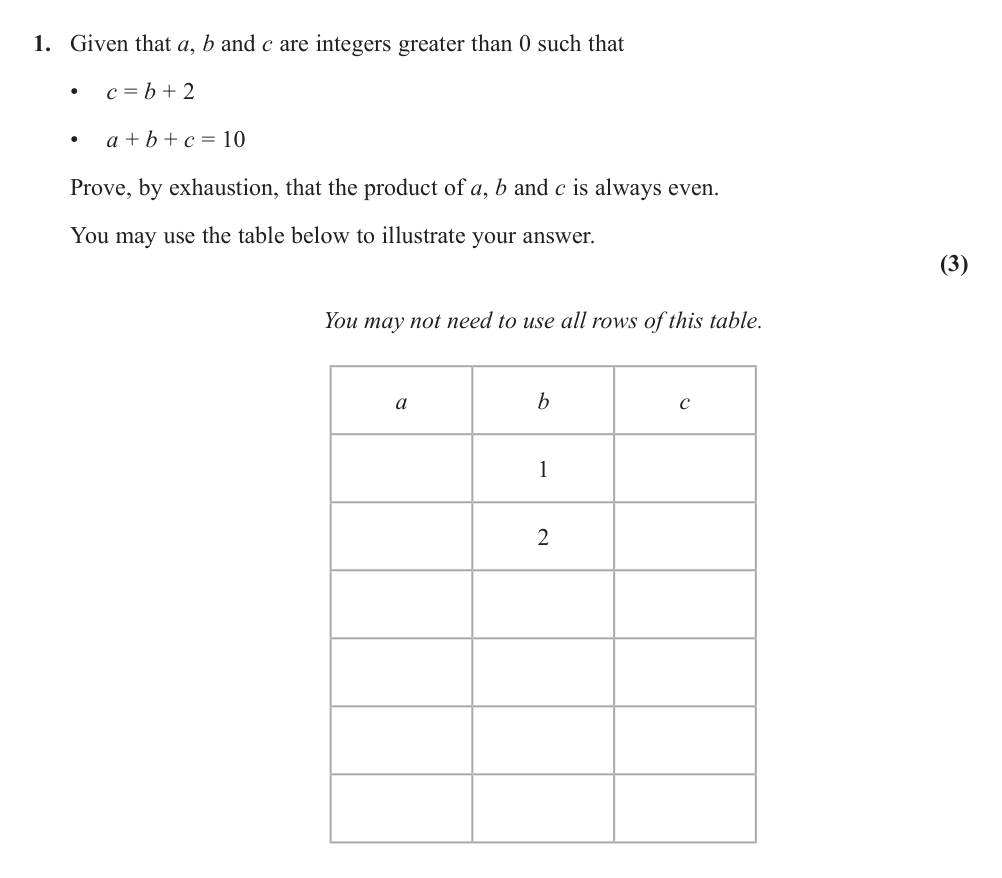
Use the two conditions
Since $c=b+2$ and $a+b+c=10$, substitute for $c$: $a+b+(b+2)=10$.
Write a in terms of b
This gives $a+2b+2=10$, so $a=8-2b$.
List the possible b values
The integers $a,b,c$ are all positive. Since $b>0$ and $a=8-2b>0$, the only possible values are $b=1,2,3$.
Exhaust the cases
If $b=1$, then $a=6$ and $c=3$, so $abc=18$. If $b=2$, then $a=4$ and $c=4$, so $abc=32$. If $b=3$, then $a=2$ and $c=5$, so $abc=30$.
Conclude the proof
The list contains every possible case, and in every case the product is even. Therefore $abc$ is always even.
Final answer
The possible triples are $(6,1,3)$, $(4,2,4)$ and $(2,3,5)$, giving products $18$, $32$ and $30$. Each product is even, so $abc$ is always even.
3. WMA12/01 May/June 2025 · Q10
Easy4 marksShow worked solution
List the possible cases
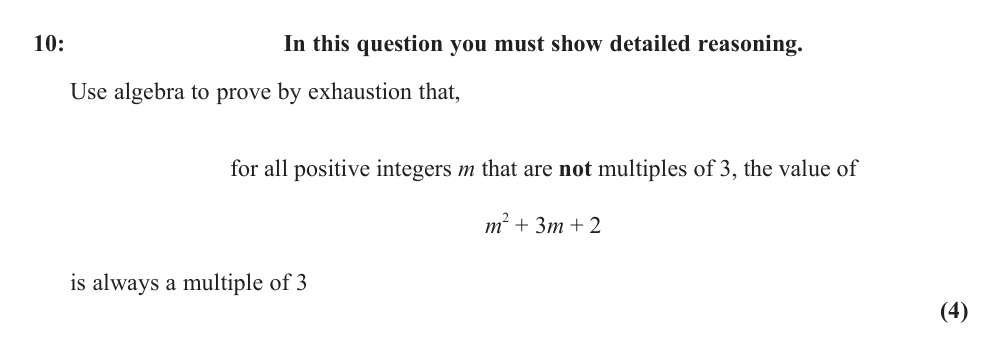
A positive integer that is not a multiple of $3$ must have the form $m=3q+1$ or $m=3q+2$.
Case one
If $m=3q+1$, then $m^2+3m+2=(3q+1)^2+3(3q+1)+2=9q^2+15q+6=3(3q^2+5q+2)$.
Case two
If $m=3q+2$, then $m^2+3m+2=(3q+2)^2+3(3q+2)+2=9q^2+21q+12=3(3q^2+7q+4)$.
Conclude by exhaustion
Both possible cases give a factor of $3$, so $m^2+3m+2$ is always a multiple of $3$.
Final answer
Proven.
4. WMA12/01 January 2023 · Q10
Easy4 marksShow worked solution
Use the three possible forms
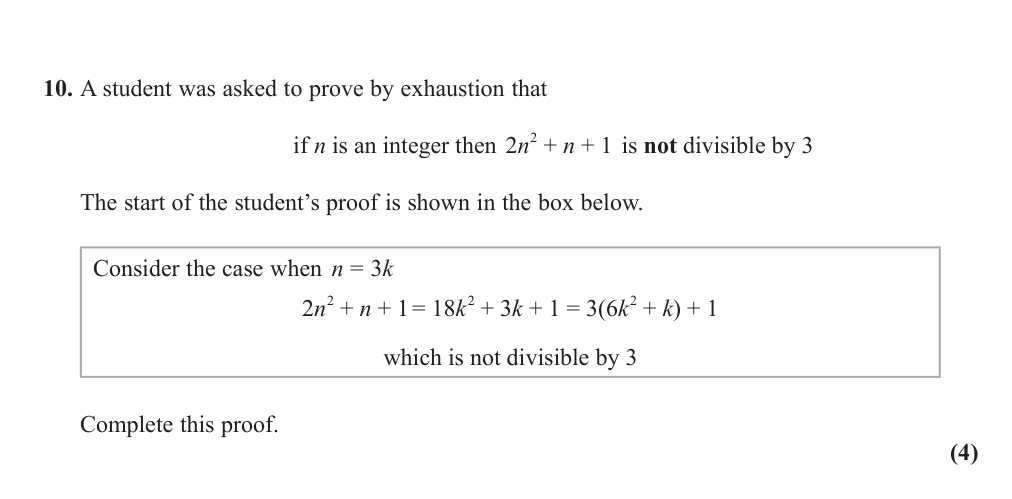
Every integer is exactly one of the forms $3k$, $3k+1$ or $3k+2$, where $k$ is an integer.
First case already given
For $n=3k$, the expression becomes $3(6k^2+k)+1$, so it leaves remainder $1$ when divided by $3$.
Try n equals 3k plus 1
If $n=3k+1$, then $2n^2+n+1=2(3k+1)^2+(3k+1)+1$.
Simplify the second case
$2(9k^2+6k+1)+3k+2=18k^2+15k+4=3(6k^2+5k+1)+1$, which is not divisible by $3$.
Try n equals 3k plus 2
If $n=3k+2$, then $2n^2+n+1=2(3k+2)^2+(3k+2)+1$.
Simplify the third case
$2(9k^2+12k+4)+3k+3=18k^2+27k+11=3(6k^2+9k+3)+2$, which is not divisible by $3$.
Complete the exhaustion
All possible integer forms have been checked, and none gives a multiple of $3$. Therefore $2n^2+n+1$ is not divisible by $3$.
Final answer
For $n=3k$, $n=3k+1$ and $n=3k+2$, the expression has remainders $1$, $1$ and $2$ respectively when divided by $3$. Therefore $2n^2+n+1$ is never divisible by $3$.
5. WMA12/01 October 2021 · Q9
Easy4 marksShow worked solution
Start with a square
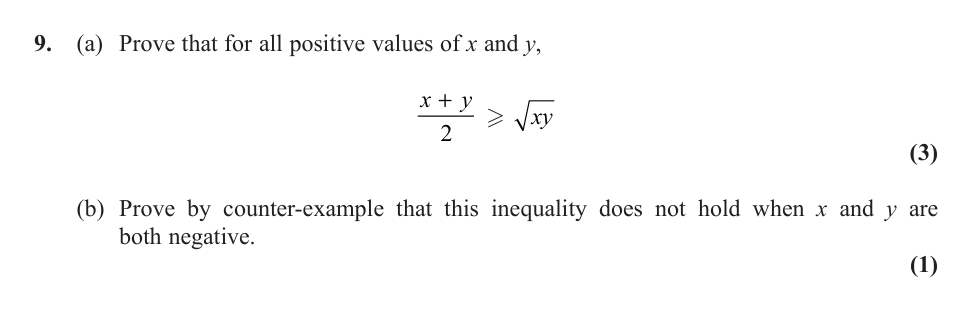
For positive $x$ and $y$, both $\sqrt{x}$ and $\sqrt{y}$ are real, so $(\sqrt{x}-\sqrt{y})^2\geq0$.
Expand
$(\sqrt{x}-\sqrt{y})^2=x-2\sqrt{xy}+y\geq0$.
Rearrange
Thus $x+y\geq2\sqrt{xy}$, and dividing by $2$ gives $\dfrac{x+y}{2}\geq\sqrt{xy}$.
Give a negative counterexample
Take $x=-1$ and $y=-1$. Then $\dfrac{x+y}{2}=-1$, while $\sqrt{xy}=\sqrt1=1$.
Conclude
Since $-1\geq1$ is false, the inequality does not hold for all negative $x$ and $y$.
Final answer
$(a)$ Proven. $\quad (b)$ For example, $x=y=-1$ gives $-1\not\geq1$.
6. WMA12/01 January 2021 · Q5
Easy4 marksShow worked solution
Start from a square
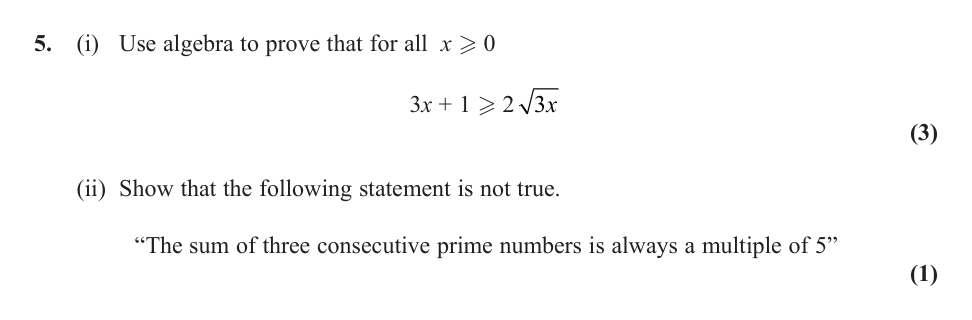
For $x\geq0$, $\sqrt{3x}$ is real and $(\sqrt{3x}-1)^2\geq0$.
Expand the square
$(\sqrt{3x}-1)^2=3x-2\sqrt{3x}+1\geq0$.
Rearrange the inequality
Therefore $3x+1\geq2\sqrt{3x}$, as required.
Give a counterexample
The consecutive prime numbers $5$, $7$, and $11$ have sum $5+7+11=23$.
Complete the disproof
$23$ is not a multiple of $5$, so the statement is not true.
Final answer
$(i)$ Proven. $\quad (ii)$ For example, $5+7+11=23$, which is not a multiple of $5$.
7. WMA12/01 January 2025 · Q8
Easy5 marksShow worked solution
Give a counterexample
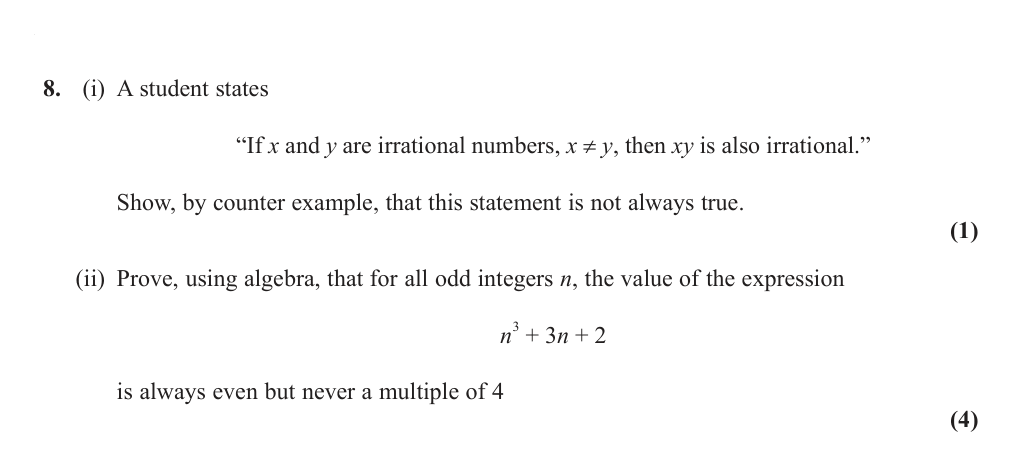
Let $x=\sqrt2$ and $y=\dfrac1{\sqrt2}$. Both are irrational and $x\ne y$, but $xy=1$, which is rational.
Represent an odd integer
Let $n=2q+1$, where $q$ is an integer.
Substitute into the expression
$n^3+3n+2=(2q+1)^3+3(2q+1)+2$.
Expand and factor
$n^3+3n+2=8q^3+12q^2+12q+6=2(4q^3+6q^2+6q+3)$.
Show it is even
The expression has a factor of $2$, so it is even.
Show it is not a multiple of four
The bracket $4q^3+6q^2+6q+3$ is odd, because the first three terms are even and $3$ is odd. Therefore the expression is $2$ times an odd integer, so it is not divisible by $4$.
Final answer
$(i)$ For example, $x=\sqrt2$ and $y=\dfrac1{\sqrt2}$ give $xy=1$. $\quad (ii)$ Proven.
8. WMA12/01 May/June 2023 · Q8
Easy5 marksShow worked solution
Choose consecutive primes
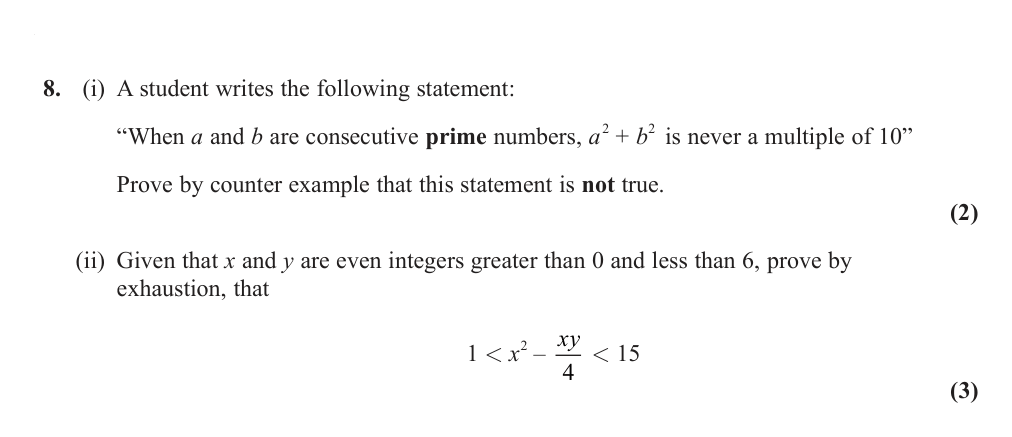
$7$ and $11$ are consecutive prime numbers.
Check the statement
$7^2+11^2=49+121=170$, which is a multiple of $10$.
Conclude the counterexample
This single counterexample proves the student's statement is not true.
List the possible even values
The even integers greater than $0$ and less than $6$ are $2$ and $4$. Therefore the possible ordered pairs are $(2,2),(2,4),(4,2),(4,4)$.
Check x equals two
If $(x,y)=(2,2)$, then $x^2-\dfrac{xy}{4}=4-1=3$. If $(x,y)=(2,4)$, then $x^2-\dfrac{xy}{4}=4-2=2$.
Check x equals four
If $(x,y)=(4,2)$, then $x^2-\dfrac{xy}{4}=16-2=14$. If $(x,y)=(4,4)$, then $x^2-\dfrac{xy}{4}=16-4=12$.
Complete the exhaustion
The possible values are $3,2,14,12$, and each lies strictly between $1$ and $15$. Hence $1<x^2-\dfrac{xy}{4}<15$ in every possible case.
Final answer
$(i)$ A counterexample is $a=7,b=11$, since $7^2+11^2=170$. $\quad (ii)$ Exhaustion proves the inequality for $(x,y)=(2,2),(2,4),(4,2),(4,4)$.
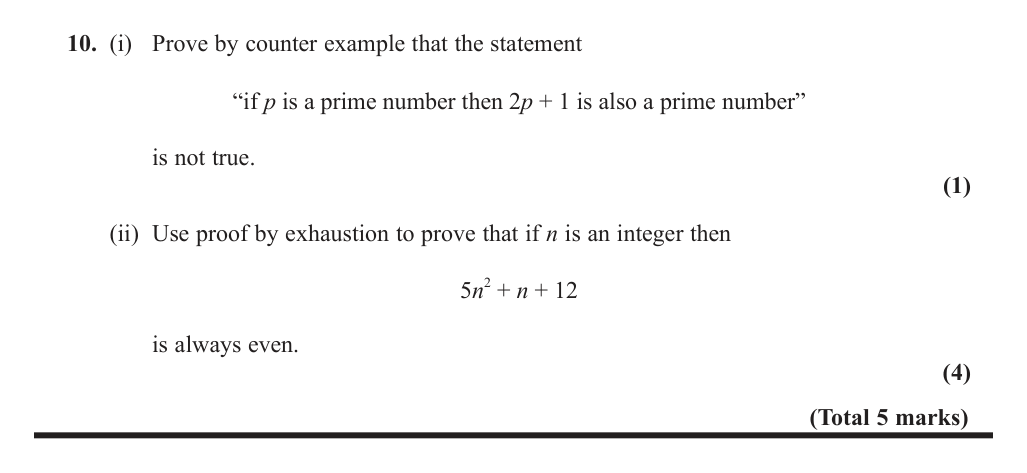
9. WMA12/01 January 2022 · Q10
Easy5 marksShow worked solution
Give a counterexample
Take $p=7$, which is prime.
Show the statement fails
$2p+1=2(7)+1=15$, and $15$ is not prime. So the statement is false.
Case one: n even
If $n$ is even, let $n=2k$. Then $5n^2+n+12=5(2k)^2+2k+12=20k^2+2k+12=2(10k^2+k+6)$, which is even.
Case two: n odd
If $n$ is odd, let $n=2k+1$. Then $5n^2+n+12=5(2k+1)^2+(2k+1)+12$.
Simplify the odd case
$5(2k+1)^2+(2k+1)+12=20k^2+22k+18=2(10k^2+11k+9)$, which is even.
Conclude by exhaustion
Every integer is either even or odd, and both cases give an even result. Therefore $5n^2+n+12$ is always even.
Final answer
$(i)$ For $p=7$, $2p+1=15$, not prime. $\quad (ii)$ Proven.
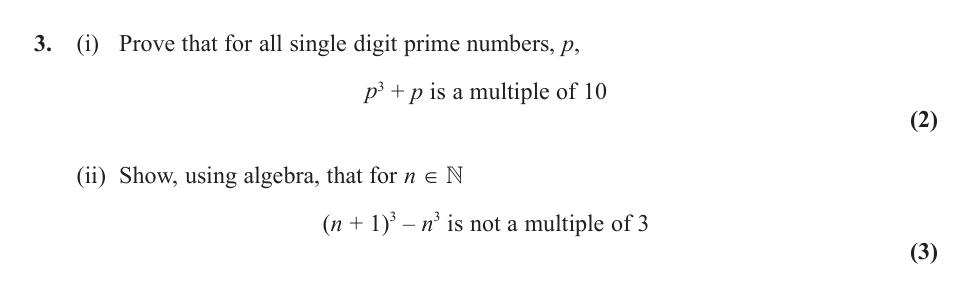
10. WMA12/01 May/June 2021 · Q3
Easy5 marksShow worked solution
List the cases
The single digit prime numbers are $2$, $3$, $5$, and $7$.
Check each prime
$2^3+2=10$, $3^3+3=30$, $5^3+5=130$, and $7^3+7=350$.
Conclude part one
Each result is a multiple of $10$, so $p^3+p$ is a multiple of $10$ for all single digit primes.
Expand the difference of cubes
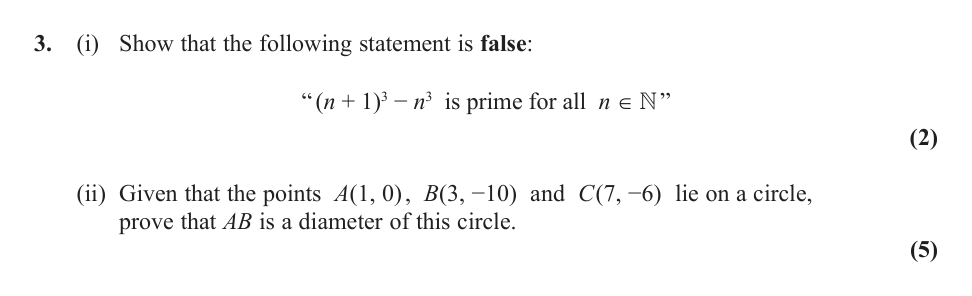
$(n+1)^3-n^3=(n^3+3n^2+3n+1)-n^3=3n^2+3n+1$.
Factor the multiple of three
$3n^2+3n+1=3n(n+1)+1$.
Use the remainder
$3n(n+1)$ is a multiple of $3$, so $3n(n+1)+1$ is one more than a multiple of $3$. Therefore it is not a multiple of $3$.
Final answer
$(i)$ Proven by checking $p=2,3,5,7$. $\quad (ii)$ Proven: $(n+1)^3-n^3$ leaves remainder $1$ on division by $3$.
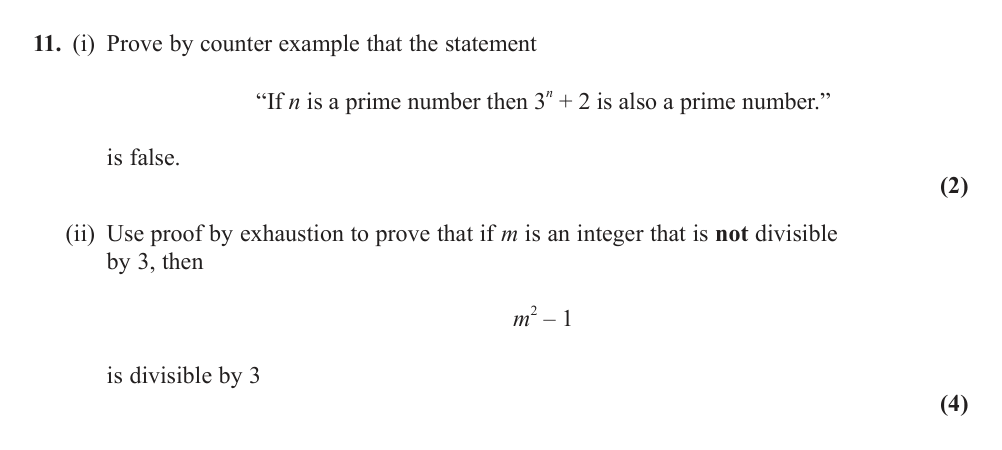
11. WMA12/01 October 2024 · Q11
Easy6 marksShow worked solution
Choose a prime value
Take $n=5$, which is prime.
Evaluate the expression
$3^5+2=243+2=245=5\times49$, so it is not prime. This disproves the statement.
List the possible forms of m
If integer $m$ is not divisible by $3$, then $m$ has remainder $1$ or $2$ on division by $3$.
Case one
If $m=3q+1$, then $m^2-1=(3q+1)^2-1=9q^2+6q=3(3q^2+2q)$, which is divisible by $3$.
Case two
If $m=3q+2$, then $m^2-1=(3q+2)^2-1=9q^2+12q+3=3(3q^2+4q+1)$, which is divisible by $3$.
Conclude by exhaustion
Both possible cases for an integer not divisible by $3$ have been checked, so $m^2-1$ is divisible by $3$.
Final answer
$(i)$ Counterexample: $n=5$ gives $3^5+2=245$, not prime. $\quad (ii)$ Proven.
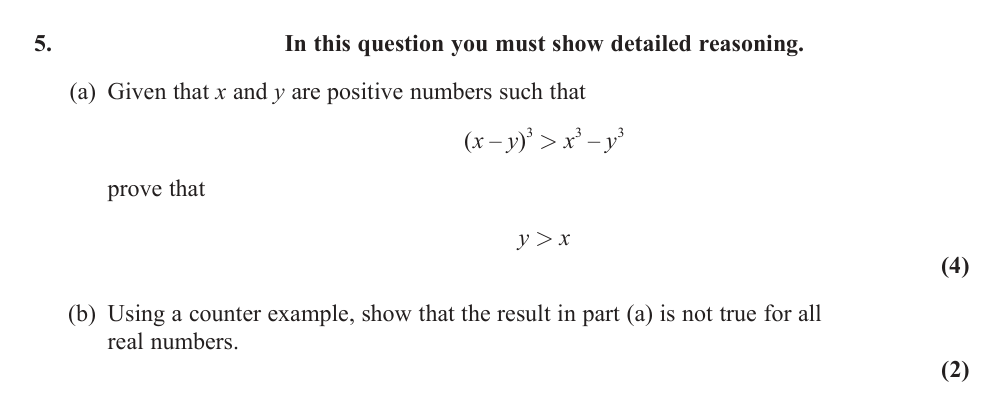
12. WMA12/01 May/June 2024 · Q5
Easy6 marksShow worked solution
Start from the inequality
$(x-y)^3>x^3-y^3$.
Expand the left side
$x^3-3x^2y+3xy^2-y^3>x^3-y^3$.
Cancel common terms
Subtract $x^3-y^3$ from both sides to get $-3x^2y+3xy^2>0$.
Factor
$3xy(y-x)>0$.
Use positivity
Since $x$ and $y$ are positive, $3xy>0$. Therefore $y-x>0$, so $y>x$.
Give a real-number counterexample
Take $x=1$ and $y=-1$. Then $(x-y)^3=2^3=8$ and $x^3-y^3=1-(-1)=2$, so the given inequality is true.
Show the conclusion fails
But $y>x$ would mean $-1>1$, which is false. Therefore the result is not true for all real numbers.
Final answer
$(a)$ Proven. $\quad (b)$ For example, $x=1,y=-1$ satisfies the inequality but not $y>x$.
13. WMA12/01 May/June 2024 · Q7
Easy6 marks · main topic: CirclesShow worked solution
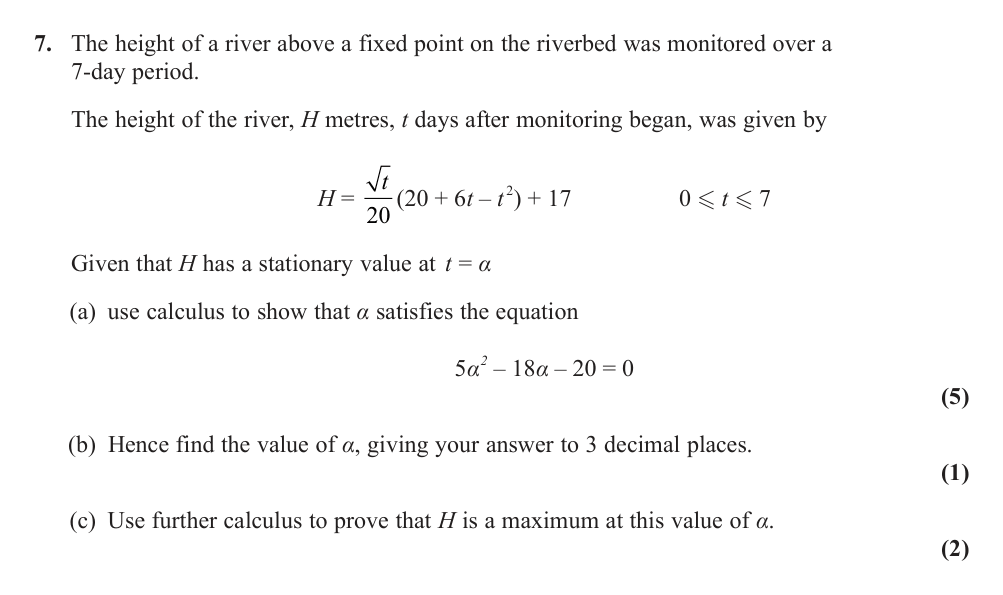
At $t=\alpha$, $5\alpha^2=18\alpha+20$. Therefore the numerator of $\dfrac{d^2H}{dt^2}$ is $-15\alpha^2+18\alpha-20=-3(18\alpha+20)+18\alpha-20=-36\alpha-80$.
Show it is negative
Since $\alpha>0$, $-36\alpha-80<0$, and the denominator $80\alpha^{3/2}$ is positive. Thus $\dfrac{d^2H}{dt^2}<0$, so $H$ is a maximum.
Final answer
$(a)$ Proven. $\quad (b)$ $\alpha=4.491$. $\quad (c)$ $H$ is a maximum at this value.
18. WMA12/01 October 2025 · Q9
Hard10 marks · main topic: Laws of LogarithmsShow worked solution
State the domain
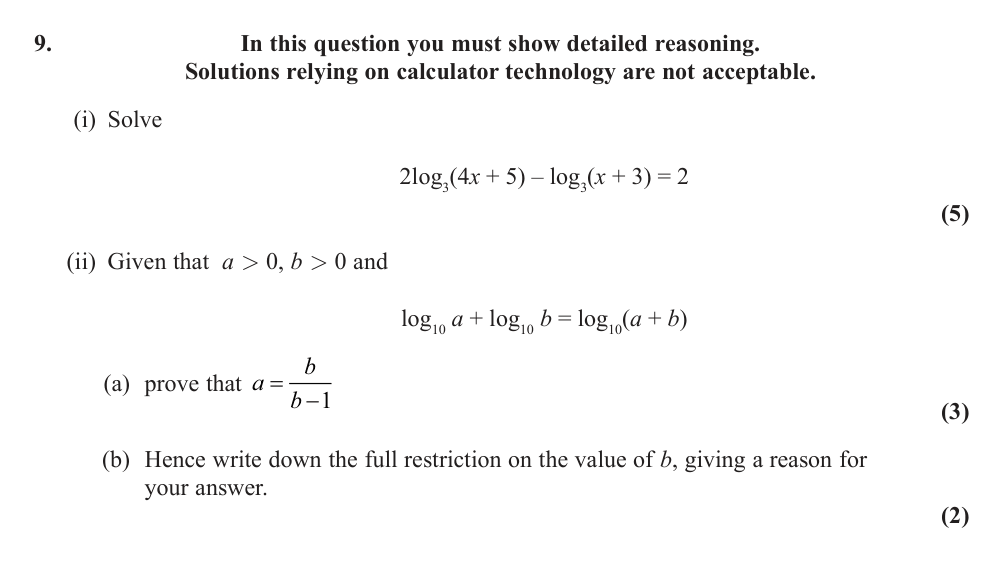
The logarithms require $4x+5>0$ and $x+3>0$, so $x>-\dfrac54$.
Since the logarithm function is one-to-one, $ab=a+b$.
Rearrange for a
$ab-a=b$, so $a(b-1)=b$ and therefore $a=\dfrac{b}{b-1}$.
Restrict b
Given $a>0$ and $b>0$, the fraction $\dfrac{b}{b-1}$ must be positive. Since the numerator is positive, the denominator must also be positive, so $b>1$.
 Elite Mathematics