Elite Mathematics / Pure 2 / Topics / Polynomials: Division, Remainder and Factor Theorems IAL · WMA12 · Topic Polynomials: Division, Remainder and Factor Theorems: past paper questions & worked solutions
Every Polynomials: Division, Remainder and Factor Theorems question from the WMA12 papers in our bank, 2019–2026, sorted from easiest to hardest. Try each one first, then open the worked solution.
23 questions
188 marks in total
95% of papers (18 of 19) include it
3/11/9 easy / medium / hard
Questions, easiest first Level is estimated from marks: 1–6 easy, 7–8 medium, 9+ hard.
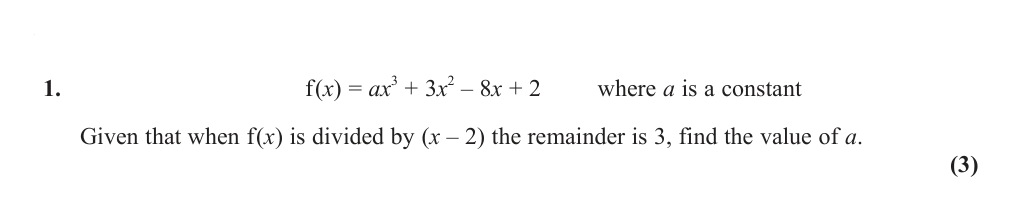
1. WMA12/01 January 2024 · Q1 Easy 3 marksShow worked solution Use the remainder theorem Dividing by $(x-2)$ means the remainder is $f(2)$.
Substitute x equals two $f(2)=a(2)^3+3(2)^2-8(2)+2=8a+12-16+2=8a-2$.
Use the given remainder The remainder is $3$, so $8a-2=3$.
Solve for a $8a=5$, hence $a=\dfrac58$.
Final answer $a=\dfrac58$.
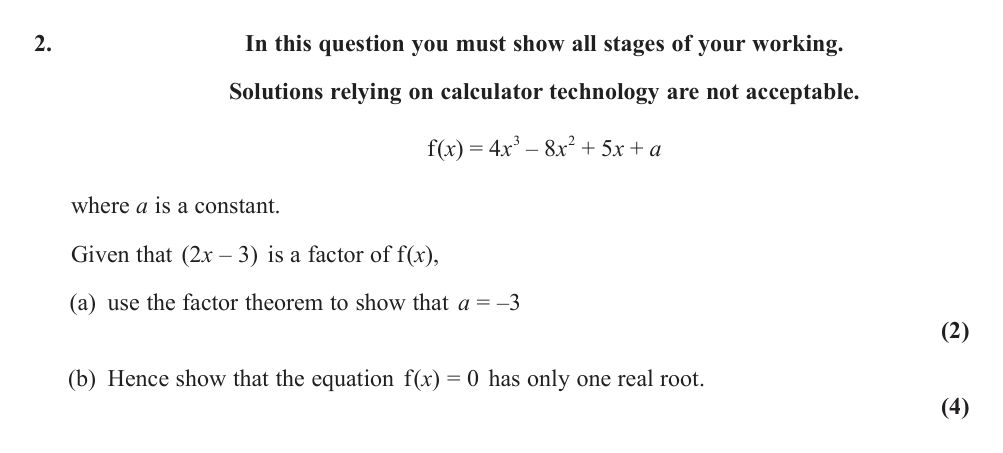
2. WMA12/01 May/June 2023 · Q2 Easy 6 marksShow worked solution Use the factor theorem Since $(2x-3)$ is a factor, $x=\dfrac32$ is a root, so $f\left(\dfrac32\right)=0$.
Substitute the root $4\left(\dfrac32\right)^3-8\left(\dfrac32\right)^2+5\left(\dfrac32\right)+a=0$.
Find a $13.5-18+7.5+a=0$, so $3+a=0$ and $a=-3$.
Write the polynomial With $a=-3$, $f(x)=4x^3-8x^2+5x-3$.
Factor using the known factor $4x^3-8x^2+5x-3=(2x-3)(2x^2-x+1)$.
Check the quadratic The discriminant of $2x^2-x+1$ is $(-1)^2-4(2)(1)=1-8=-7$.
Conclude about real roots Since the quadratic has negative discriminant, it has no real roots. Therefore $f(x)=0$ has only the one real root from $2x-3=0$, namely $x=\dfrac32$.
Final answer $(a)$ $a=-3$. $\quad (b)$ $f(x)=0$ has only one real root, $x=\dfrac32$.
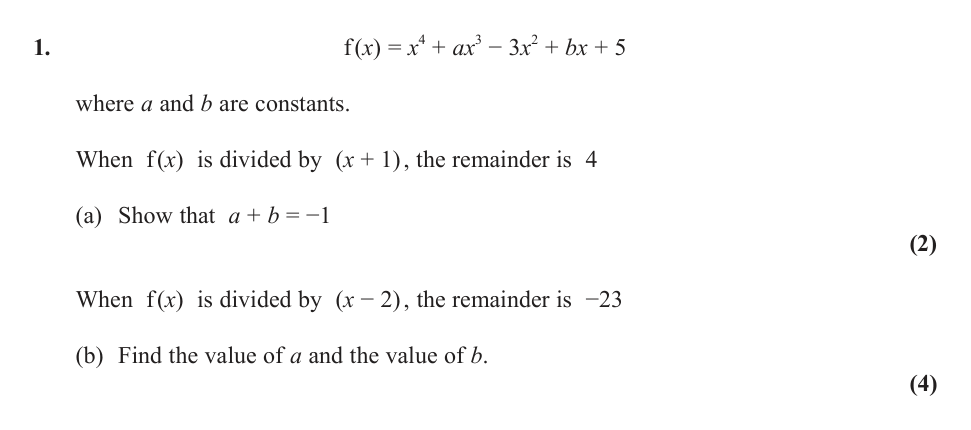
3. WMA12/01 January 2021 · Q1 Easy 6 marksShow worked solution Use the first remainder Dividing by $(x+1)$ means use $x=-1$. Hence $f(-1)=1-a-3-b+5=3-a-b$.
Show the required relation The remainder is $4$, so $3-a-b=4$. Therefore $a+b=-1$.
Use the second remainder Dividing by $(x-2)$ means use $x=2$. Hence $f(2)=16+8a-12+2b+5=9+8a+2b$.
Form the second equation The remainder is $-23$, so $9+8a+2b=-23$, which gives $4a+b=-16$.
Solve simultaneously Subtract $a+b=-1$ from $4a+b=-16$ to get $3a=-15$, so $a=-5$.
Find b Using $a+b=-1$, $-5+b=-1$, hence $b=4$.
Final answer $(a)$ Proven: $a+b=-1$. $\quad (b)\ a=-5,\ b=4$.
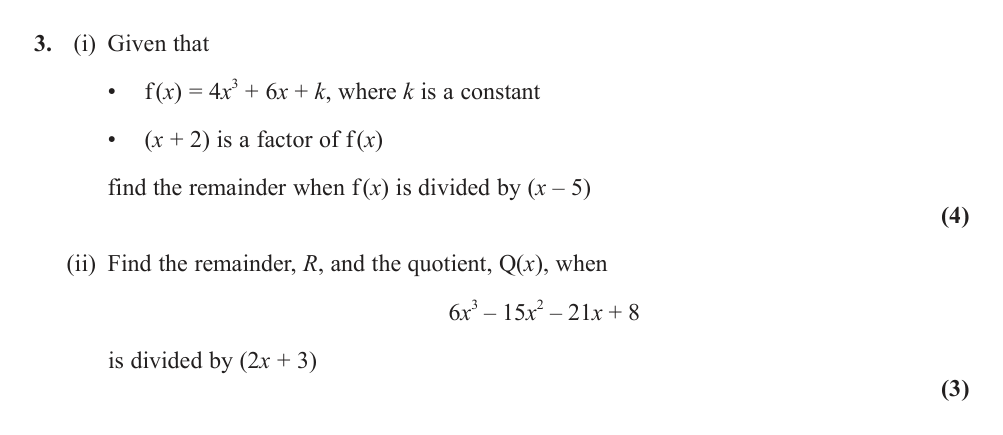
4. WMA12/01 January 2026 · Q3 Medium 7 marksShow worked solution Use the factor theorem Since $(x+2)$ is a factor of $f(x)=4x^3+6x+k$, we have $f(-2)=0$.
Find k $4(-2)^3+6(-2)+k=0$, so $-32-12+k=0$ and $k=44$.
Find the required remainder The remainder on division by $(x-5)$ is $f(5)=4(5)^3+6(5)+44=574$.
Set up the division Write $6x^3-15x^2-21x+8=(2x+3)(Ax^2+Bx+C)+R$.
Match coefficients Comparing coefficients gives $A=3$, $B=-12$, and $C=\dfrac{15}{2}$.
Find the remainder Then $(2x+3)\left(3x^2-12x+\dfrac{15}{2}\right)=6x^3-15x^2-21x+\dfrac{45}{2}$, so $R=8-\dfrac{45}{2}=-\dfrac{29}{2}$.
Final answer $(i)\ 574.\quad (ii)\ Q(x)=3x^2-12x+\dfrac{15}{2},\ R=-\dfrac{29}{2}$.
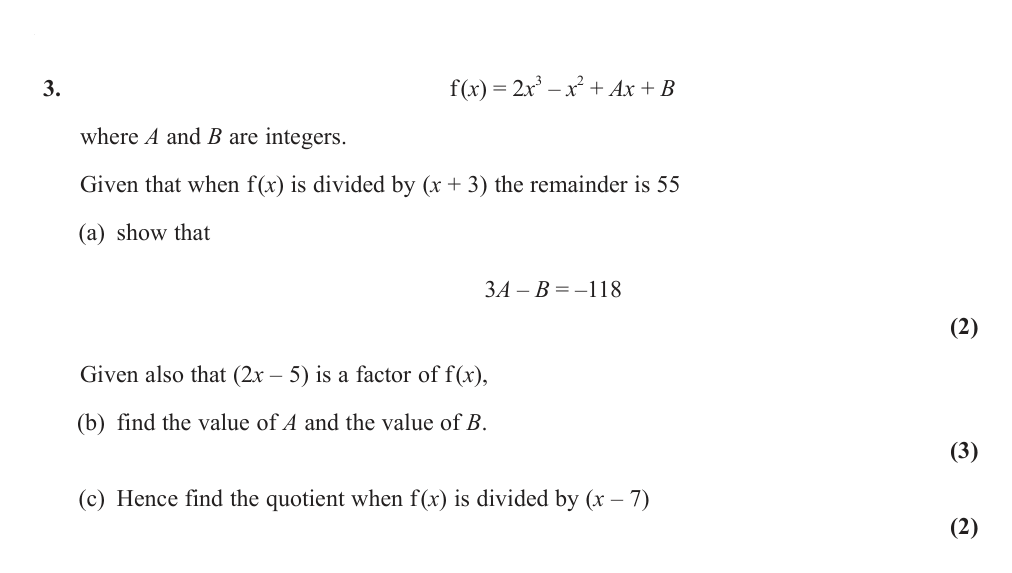
5. WMA12/01 October 2024 · Q3 Medium 7 marksShow worked solution Use the remainder theorem Dividing by $x+3$ leaves remainder $55$, so $f(-3)=55$.
Show the given equation $f(-3)=2(-3)^3-(-3)^2-3A+B=-63-3A+B$. Therefore $-63-3A+B=55$, so $3A-B=-118$.
Use the factor theorem Since $2x-5$ is a factor, $x=\dfrac52$ is a root and $f\left(\dfrac52\right)=0$.
Form a second equation $2\left(\dfrac52\right)^3-\left(\dfrac52\right)^2+\dfrac52A+B=0$, so $25+\dfrac52A+B=0$. Multiplying by $2$ gives $5A+2B=-50$.
Solve simultaneously From $3A-B=-118$, $B=3A+118$. Substitute into $5A+2B=-50$ to get $11A=-286$, so $A=-26$ and $B=40$.
Write the polynomial $f(x)=2x^3-x^2-26x+40$.
Divide by x minus seven $2x^3-x^2-26x+40=(x-7)(2x^2+13x+65)+495$, so the quotient is $2x^2+13x+65$.
Final answer $(a)$ Proven. $\quad (b)$ $A=-26$, $B=40$. $\quad (c)$ $2x^2+13x+65$.
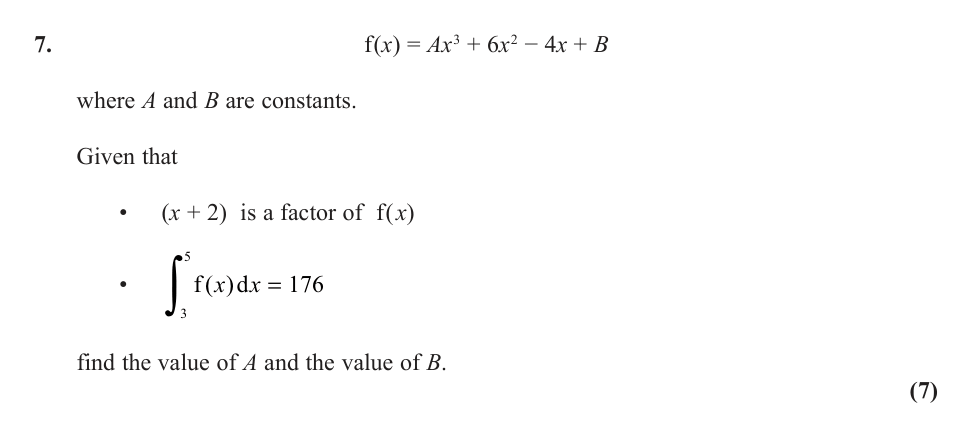
6. WMA12/01 May/June 2022 · Q7 Medium 7 marks · main topic: IntegrationShow worked solution Use the factor condition Since $(x+2)$ is a factor, $f(-2)=0$.
Form the first equation $A(-2)^3+6(-2)^2-4(-2)+B=0$, so $-8A+32+B=0$ and $B=8A-32$.
Set up the integral $\int_3^5(Ax^3+6x^2-4x+B)\,dx=176$.
Integrate $\left[\dfrac A4x^4+2x^3-2x^2+Bx\right]_3^5=176$.
Simplify the second equation This gives $136A+164+2B=176$, so $68A+B=6$.
Solve simultaneously Using $B=8A-32$ in $68A+B=6$ gives $76A=38$, so $A=\dfrac12$.
Find B $B=8\left(\dfrac12\right)-32=-28$.
Final answer $A=\dfrac12,\quad B=-28$.
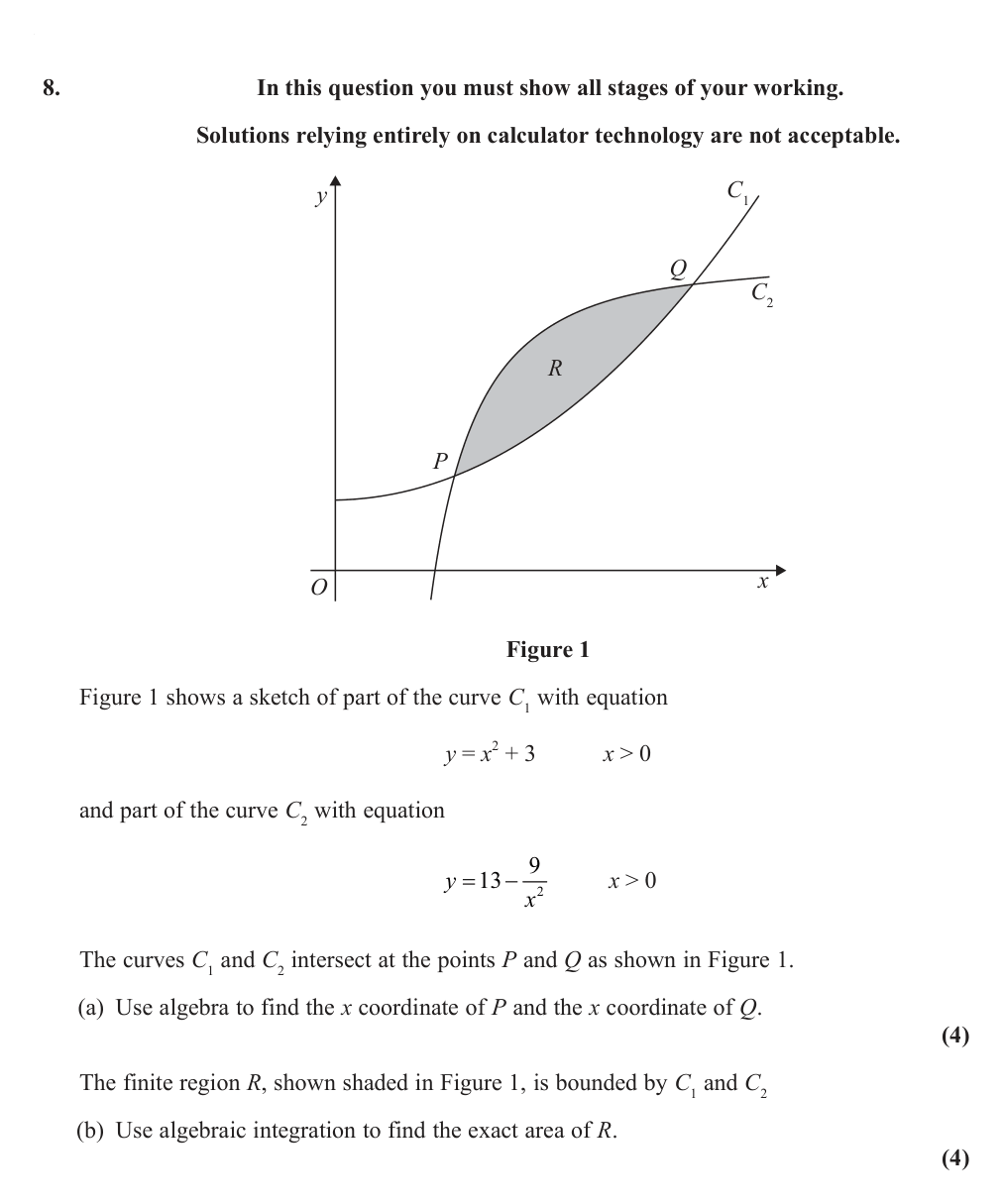
7. WMA12/01 October 2024 · Q8 Medium 8 marks · main topic: IntegrationShow worked solution Equate the curves $x^2+3=13-\dfrac9{x^2}$.
Clear the denominator Multiplying by $x^2$ gives $x^4+3x^2=13x^2-9$, so $x^4-10x^2+9=0$.
Factor Let $u=x^2$. Then $u^2-10u+9=(u-1)(u-9)=0$, so $x^2=1$ or $x^2=9$.
Use x greater than zero Since $x>0$, the intersections have $x=1$ and $x=3$. Thus $x_P=1$ and $x_Q=3$.
Set up the area Between $x=1$ and $x=3$, curve $C_2$ is above curve $C_1$, so $R=\displaystyle\int_1^3\left(13-\dfrac9{x^2}-(x^2+3)\right)dx$.
Simplify the integrand $R=\displaystyle\int_1^3(10-x^2-9x^{-2})\,dx$.
Integrate $R=\left[10x-\dfrac{x^3}{3}+\dfrac9x\right]_1^3$.
Evaluate $R=\left(30-9+3\right)-\left(10-\dfrac13+9\right)=24-\dfrac{56}{3}=\dfrac{16}{3}$.
Final answer $(a)$ $x_P=1$, $x_Q=3$. $\quad (b)$ $\dfrac{16}{3}$.
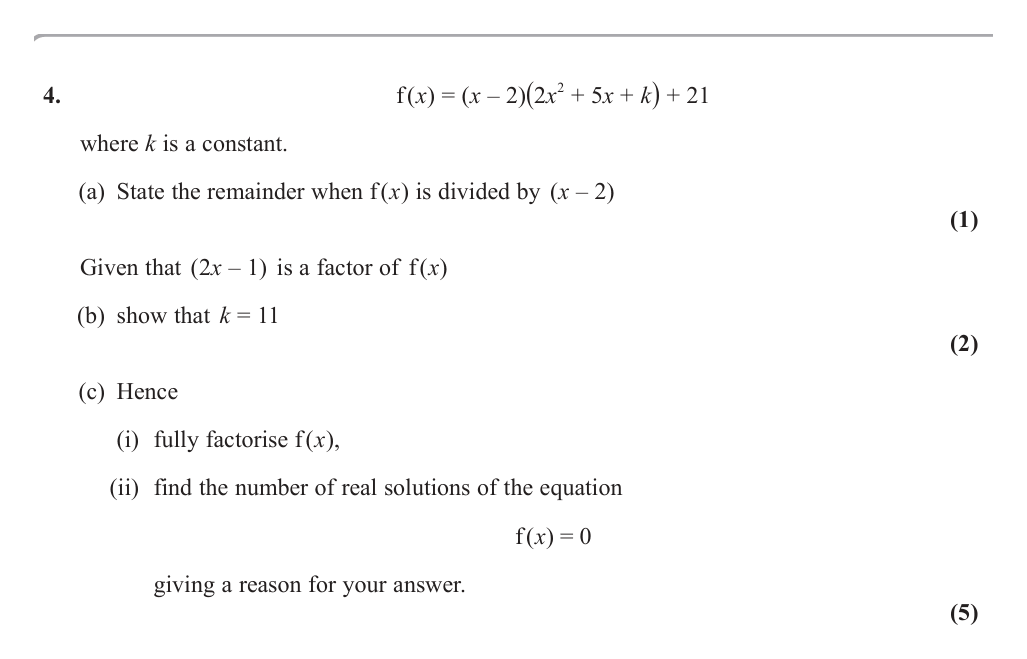
8. WMA12/01 May/June 2024 · Q4 Medium 8 marksShow worked solution Use the remainder theorem The remainder on division by $(x-2)$ is $f(2)$.
Find f of two $f(2)=(2-2)(2(2)^2+5(2)+k)+21=21$.
Use the factor theorem Since $(2x-1)$ is a factor, $x=\dfrac12$ is a root, so $f\left(\dfrac12\right)=0$.
Substitute x equals half $\left(\dfrac12-2\right)\left(2\left(\dfrac12\right)^2+5\left(\dfrac12\right)+k\right)+21=0$.
Solve for k $-\dfrac32(3+k)+21=0$. Multiplying by $2$ gives $-3(k+3)+42=0$, so $k=11$.
Write f with k equals eleven $f(x)=(x-2)(2x^2+5x+11)+21=2x^3+x^2+x-1$.
Factorise $2x^3+x^2+x-1=(2x-1)(x^2+x+1)$.
Count real solutions The quadratic $x^2+x+1$ has discriminant $1-4=-3$, so it has no real roots. Therefore $f(x)=0$ has one real solution.
Final answer $(a)$ $21$. $\quad (b)$ $k=11$. $\quad (c)(i)$ $(2x-1)(x^2+x+1)$. $\quad (c)(ii)$ One real solution.
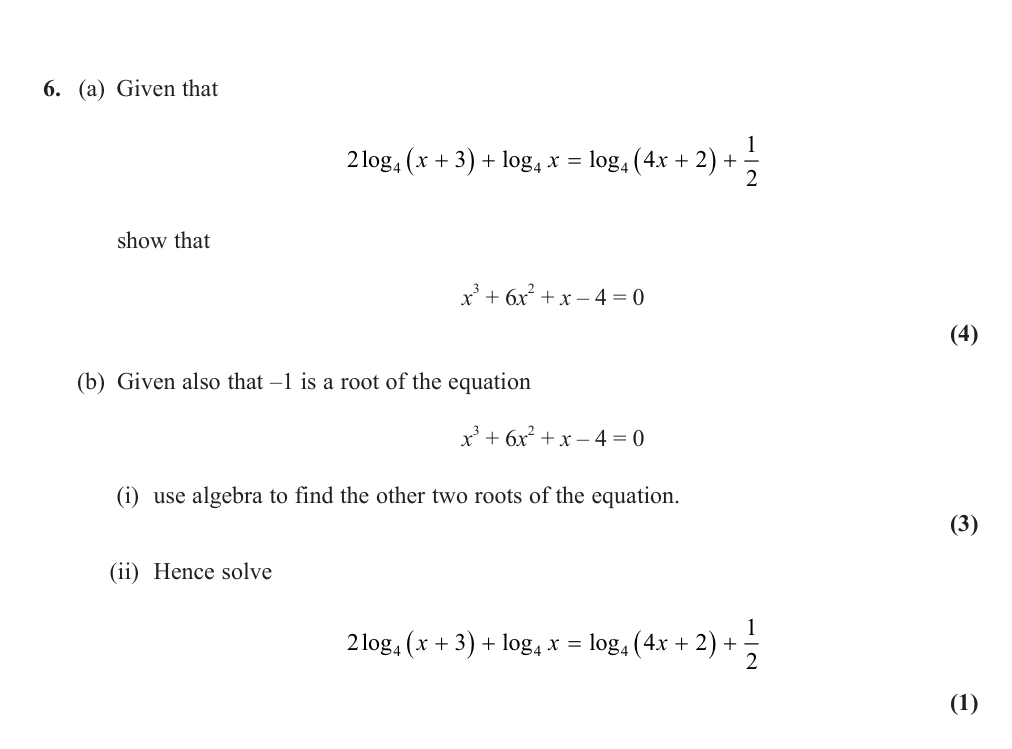
9. WMA12/01 January 2024 · Q6 Medium 8 marks · main topic: Laws of LogarithmsShow worked solution Combine the logarithms $2\log_4(x+3)=\log_4((x+3)^2)$, so the left side is $\log_4(x(x+3)^2)$.
Rewrite one half $\dfrac12=\log_4 2$, so the right side is $\log_4(4x+2)+\log_4 2=\log_4(8x+4)$.
Equate arguments Therefore $x(x+3)^2=8x+4$.
Expand $x(x^2+6x+9)=8x+4$, so $x^3+6x^2+9x=8x+4$.
Show the cubic Rearranging gives $x^3+6x^2+x-4=0$.
Use the given root Since $-1$ is a root, $(x+1)$ is a factor of $x^3+6x^2+x-4$.
Factor the cubic $x^3+6x^2+x-4=(x+1)(x^2+5x-4)$.
Solve the quadratic $x^2+5x-4=0$ gives $x=\dfrac{-5\pm\sqrt{25+16}}{2}=\dfrac{-5\pm\sqrt{41}}{2}$.
Apply the logarithm domain The original log equation requires $x>0$. The only positive root is $x=\dfrac{-5+\sqrt{41}}{2}$.
Final answer $(a)$ Proven. $\quad (b)(i)$ $x=\dfrac{-5+\sqrt{41}}{2}$ and $x=\dfrac{-5-\sqrt{41}}{2}$. $\quad (b)(ii)$ $x=\dfrac{-5+\sqrt{41}}{2}$.
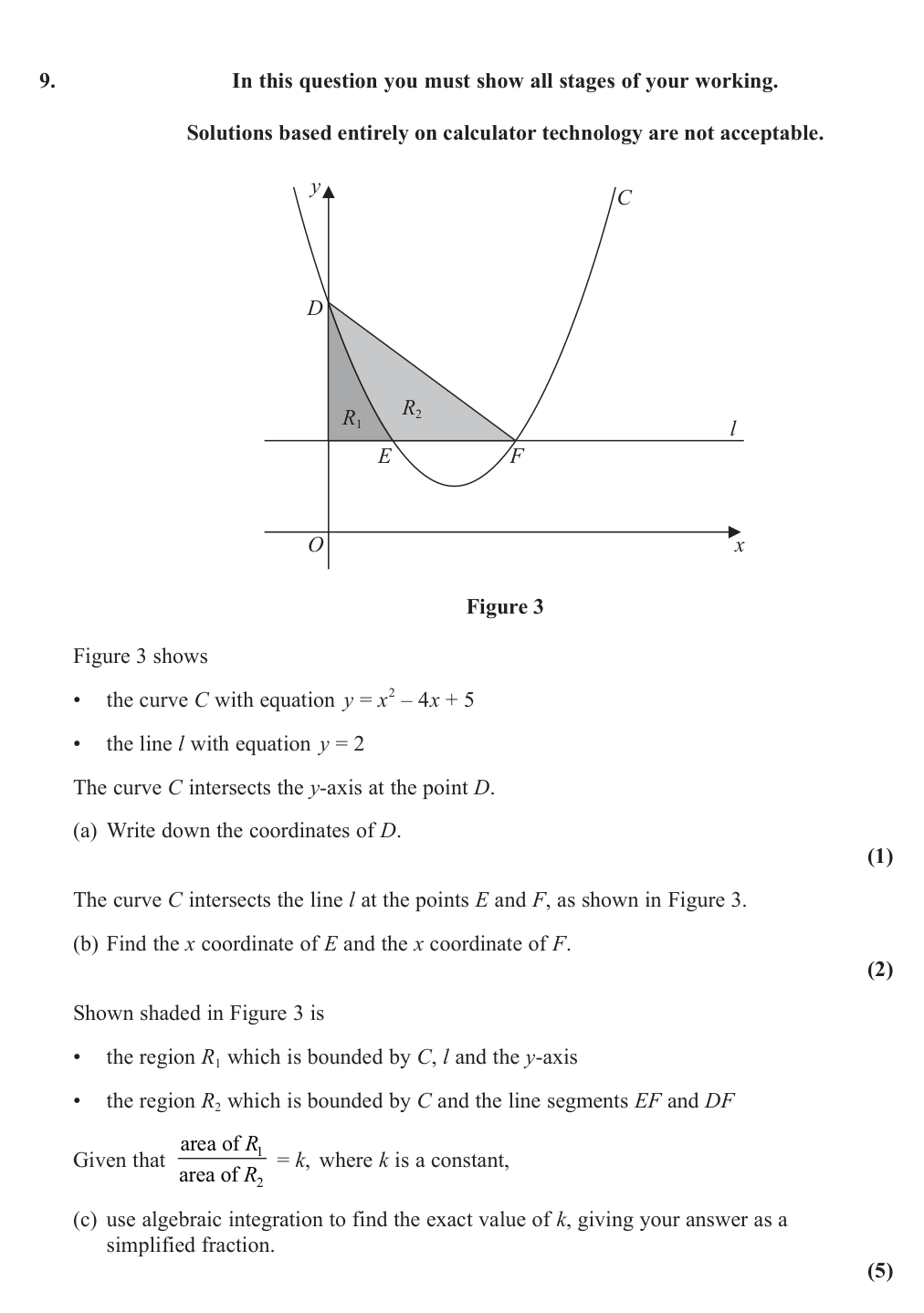
10. WMA12/01 January 2023 · Q9 Medium 8 marks · main topic: IntegrationShow worked solution Find D At the $y$-axis, $x=0$. On $C$, $y=0^2-4(0)+5=5$, so $D=(0,5)$.
Find intersections with the line The line is $y=2$, so solve $x^2-4x+5=2$.
Solve the quadratic $x^2-4x+3=0$, so $(x-1)(x-3)=0$. Hence $x_E=1$ and $x_F=3$.
Area of R1 $R_1$ lies between the curve and the line $y=2$ from $x=0$ to $x=1$.
Integrate R1 $\displaystyle R_1=\int_0^1\left(x^2-4x+5-2\right)dx=\int_0^1(x^2-4x+3)dx$.
Evaluate R1 $\displaystyle R_1=\left[\dfrac{x^3}{3}-2x^2+3x\right]_0^1=\dfrac13-2+3=\dfrac43$.
Find the line DF The line through $D=(0,5)$ and $F=(3,2)$ has gradient $-1$, so its equation is $y=5-x$.
Split R2 For $0\le x\le1$, $R_2$ is between $y=5-x$ and the curve. For $1\le x\le3$, it is between $y=5-x$ and $y=2$.
Integrate R2 $\displaystyle R_2=\int_0^1\left[(5-x)-(x^2-4x+5)\right]dx+\int_1^3\left[(5-x)-2\right]dx$.
Evaluate R2 $\displaystyle R_2=\int_0^1(-x^2+3x)dx+\int_1^3(3-x)dx=\dfrac{7}{6}+2=\dfrac{19}{6}$.
Find the ratio $k=\dfrac{\text{area of }R_1}{\text{area of }R_2}=\dfrac{4/3}{19/6}=\dfrac{8}{19}$.
Final answer $(a)$ $D=(0,5)$. $\quad (b)$ $x_E=1,\ x_F=3$. $\quad (c)$ $k=\dfrac{8}{19}$.
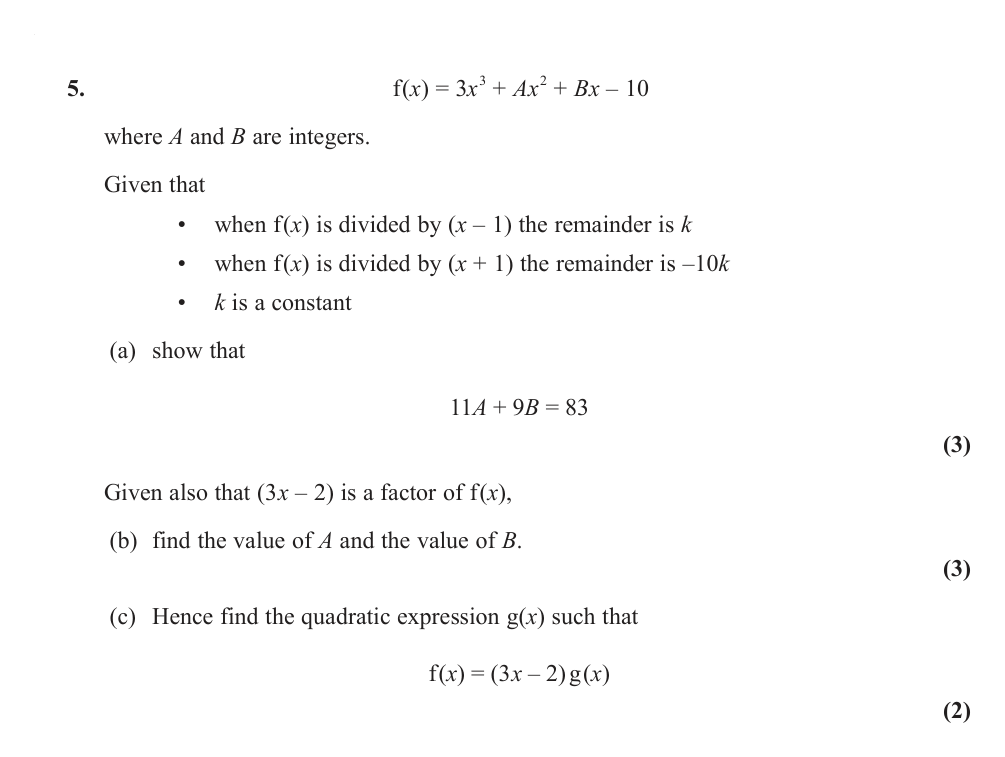
11. WMA12/01 January 2022 · Q5 Medium 8 marksShow worked solution Use x equals one $f(1)=3+A+B-10=A+B-7$, so $k=A+B-7$.
Use x equals negative one $f(-1)=-3+A-B-10=A-B-13$.
Use the second remainder relation Since $f(-1)=-10k$, $A-B-13=-10(A+B-7)$.
Show the relation Rearranging gives $11A+9B=83$.
Use the factor Since $(3x-2)$ is a factor, $f\left(\dfrac23\right)=0$.
Form the second equation $3\left(\dfrac23\right)^3+A\left(\dfrac23\right)^2+B\left(\dfrac23\right)-10=0$. Multiplying by $9$ gives $2A+3B=41$.
Solve for A and B Solving $11A+9B=83$ with $2A+3B=41$ gives $A=-8$ and $B=19$.
Divide by the factor With these values, $f(x)=3x^3-8x^2+19x-10=(3x-2)(x^2-2x+5)$.
Final answer $(a)$ Proven: $11A+9B=83$. $\quad (b)\ A=-8,\ B=19.\quad (c)\ g(x)=x^2-2x+5$.
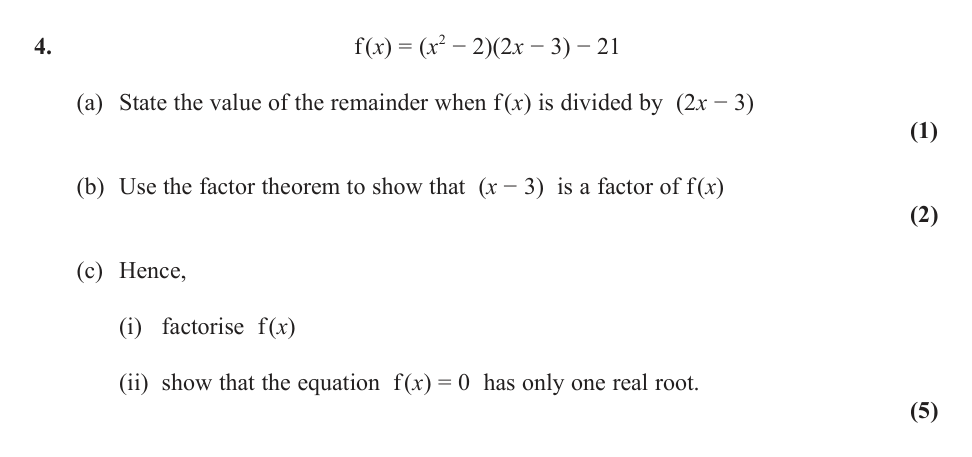
12. WMA12/01 October 2021 · Q4 Medium 8 marksShow worked solution Use the remainder theorem Dividing by $(2x-3)$ means use $x=\dfrac32$.
Find the remainder $f\left(\dfrac32\right)=\left(\dfrac94-2\right)(0)-21=-21$.
Check x equals three $f(3)=(9-2)(6-3)-21=7\cdot3-21=0$.
Use the factor theorem Since $f(3)=0$, $(x-3)$ is a factor of $f(x)$.
Expand f $f(x)=(x^2-2)(2x-3)-21=2x^3-3x^2-4x-15$.
Factorise Dividing by $(x-3)$ gives $2x^2+3x+5$, so $f(x)=(x-3)(2x^2+3x+5)$.
Check the quadratic roots For $2x^2+3x+5$, the discriminant is $3^2-4(2)(5)=9-40=-31<0$.
Conclude The quadratic has no real roots, so $f(x)=0$ has only one real root, $x=3$.
Final answer $(a)\ -21.\quad (b)$ Proven. $\quad (c)(i)\ f(x)=(x-3)(2x^2+3x+5).\quad (c)(ii)$ Only real root: $x=3$.
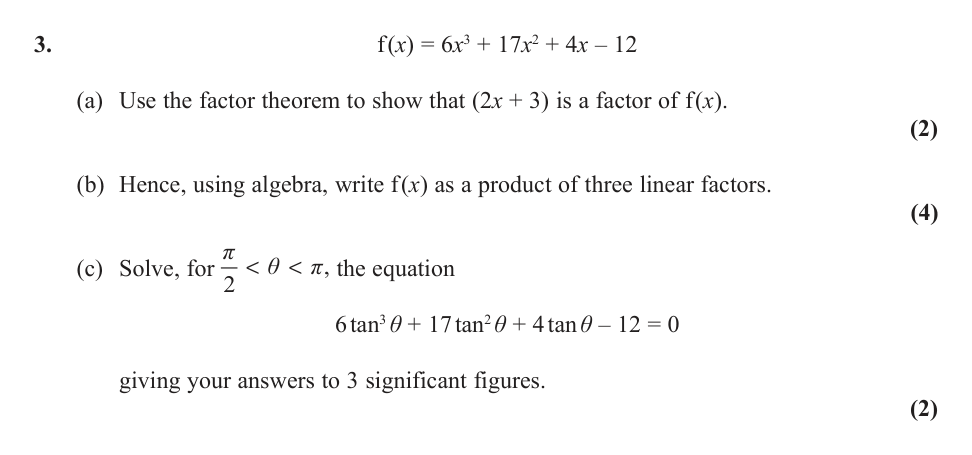
13. WMA12/01 January 2020 · Q3 Medium 8 marksShow worked solution Use the factor theorem For $(2x+3)$, use $x=-\dfrac32$. Substituting gives $f\left(-\dfrac32\right)=6\left(-\dfrac32\right)^3+17\left(-\dfrac32\right)^2+4\left(-\dfrac32\right)-12=0$.
State the factor result Since $f\left(-\dfrac32\right)=0$, $(2x+3)$ is a factor of $f(x)$.
Divide by the known factor $6x^3+17x^2+4x-12=(2x+3)(3x^2+4x-4)$.
Factorise the quadratic $3x^2+4x-4=(3x-2)(x+2)$, so $f(x)=(2x+3)(3x-2)(x+2)$.
Use the factorisation for tan theta Let $t=\tan\theta$. Then $(2t+3)(3t-2)(t+2)=0$, so $t=-\dfrac32$, $t=\dfrac23$, or $t=-2$.
Choose the roots in the interval For $\dfrac\pi2<\theta<\pi$, $\tan\theta$ is negative, so use $\tan\theta=-\dfrac32$ and $\tan\theta=-2$.
Find theta This gives $\theta=\pi-\tan^{-1}\left(\dfrac32\right)=2.16$ and $\theta=\pi-\tan^{-1}(2)=2.03$, to 3 significant figures.
Final answer $(a)$ Proven. $\quad (b)\ f(x)=(2x+3)(3x-2)(x+2).\quad (c)\ \theta=2.03,\ 2.16$ radians.
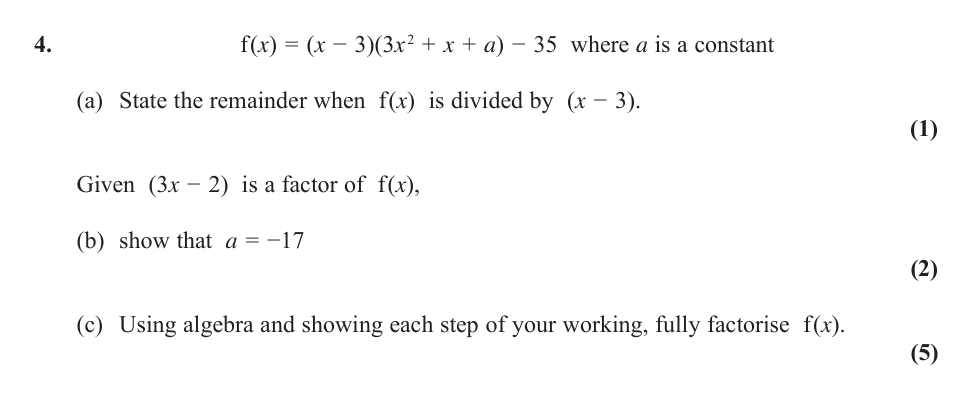
14. WMA12/01 October 2019 · Q4 Medium 8 marksShow worked solution Use the remainder theorem When $f(x)$ is divided by $(x-3)$, the remainder is $f(3)$. Since $f(3)=(3-3)(3\cdot3^2+3+a)-35$, the remainder is $-35$.
Use the given factor Since $(3x-2)$ is a factor, $x=\dfrac23$ is a root and $f\left(\dfrac23\right)=0$.
Solve for a $0=\left(\dfrac23-3\right)\left(3\left(\dfrac23\right)^2+\dfrac23+a\right)-35=-\dfrac73(a+2)-35$. Hence $-7(a+2)=105$, so $a=-17$.
Substitute a into f(x) $f(x)=(x-3)(3x^2+x-17)-35=3x^3-8x^2-20x+16$.
Divide by the known factor Dividing $3x^3-8x^2-20x+16$ by $(3x-2)$ gives $x^2-2x-8$.
Factorise fully $x^2-2x-8=(x+2)(x-4)$, so $f(x)=(3x-2)(x+2)(x-4)$.
Final answer $(a)\ -35.\quad (b)\ a=-17.\quad (c)\ f(x)=(3x-2)(x+2)(x-4)$.
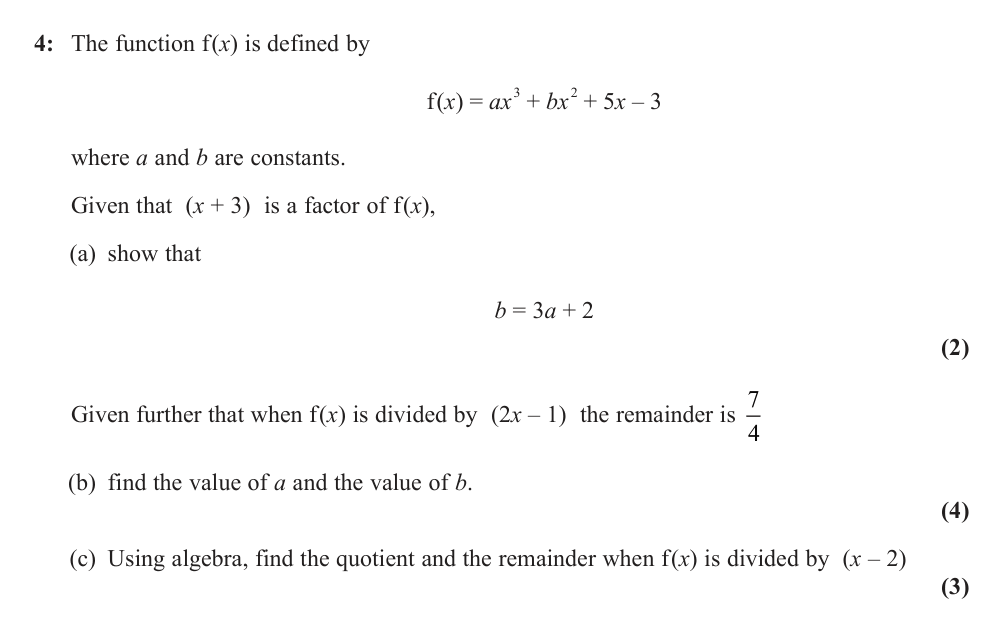
15. WMA12/01 May/June 2025 · Q4 Hard 9 marksShow worked solution Use the factor theorem Since $x+3$ is a factor, $f(-3)=0$.
Show the relation $f(-3)=-27a+9b-15-3=0$, so $9b=27a+18$ and therefore $b=3a+2$.
Use the remainder theorem When dividing by $2x-1$, substitute $x=\dfrac12$. The remainder is $\dfrac74$, so $f\left(\dfrac12\right)=\dfrac74$.
Form the second equation $\dfrac a8+\dfrac b4+\dfrac52-3=\dfrac74$. Multiplying by $8$ gives $a+2b-4=14$, so $a+2b=18$.
Solve for a and b Substitute $b=3a+2$ into $a+2b=18$: $a+6a+4=18$, so $a=2$ and $b=8$.
Write f of x $f(x)=2x^3+8x^2+5x-3$.
Divide by x minus two $2x^3+8x^2+5x-3=(x-2)(2x^2+12x+29)+55$.
State the result The quotient is $2x^2+12x+29$ and the remainder is $55$.
Final answer $(a)$ Proven. $\quad (b)$ $a=2$, $b=8$. $\quad (c)$ Quotient $2x^2+12x+29$, remainder $55$.
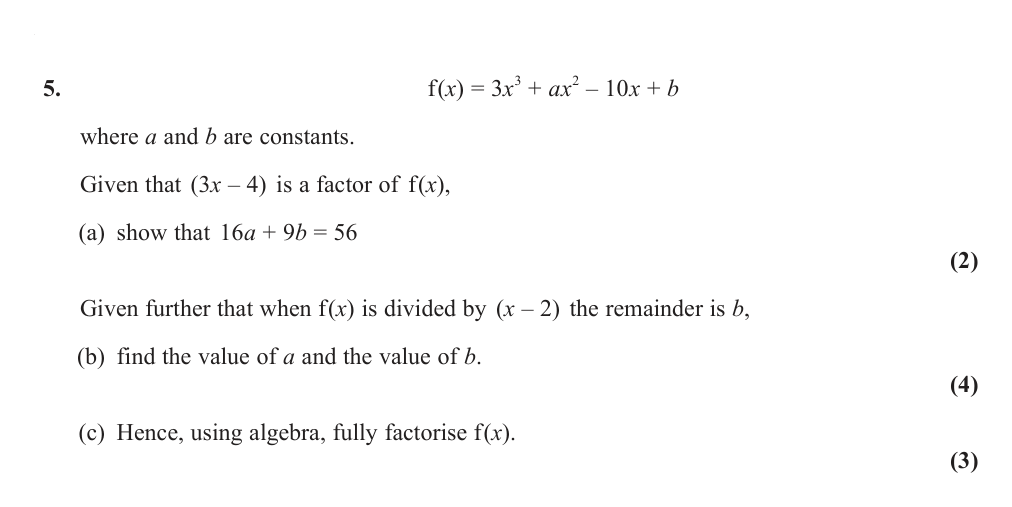
16. WMA12/01 January 2025 · Q5 Hard 9 marksShow worked solution Use the factor theorem Since $3x-4$ is a factor, $x=\dfrac43$ is a root and $f\left(\dfrac43\right)=0$.
Show the given equation $3\left(\dfrac43\right)^3+a\left(\dfrac43\right)^2-10\left(\dfrac43\right)+b=0$, so $\dfrac{64}{9}+\dfrac{16a}{9}-\dfrac{120}{9}+b=0$. Multiplying by $9$ gives $16a+9b=56$.
Use the remainder condition When dividing by $x-2$, the remainder is $f(2)$. Given that the remainder is $b$, $f(2)=b$.
Find a $f(2)=24+4a-20+b=4+4a+b$. Thus $4+4a+b=b$, so $a=-1$.
Find b Substitute $a=-1$ into $16a+9b=56$: $-16+9b=56$, so $b=8$.
Write f of x $f(x)=3x^3-x^2-10x+8$.
Find another factor $f(1)=3-1-10+8=0$, so $(x-1)$ is a factor.
Fully factorise Dividing by $(x-1)$ gives $3x^2+2x-8=(3x-4)(x+2)$. Hence $f(x)=(x-1)(x+2)(3x-4)$.
Final answer $(a)$ Proven. $\quad (b)$ $a=-1$, $b=8$. $\quad (c)$ $f(x)=(x-1)(x+2)(3x-4)$.
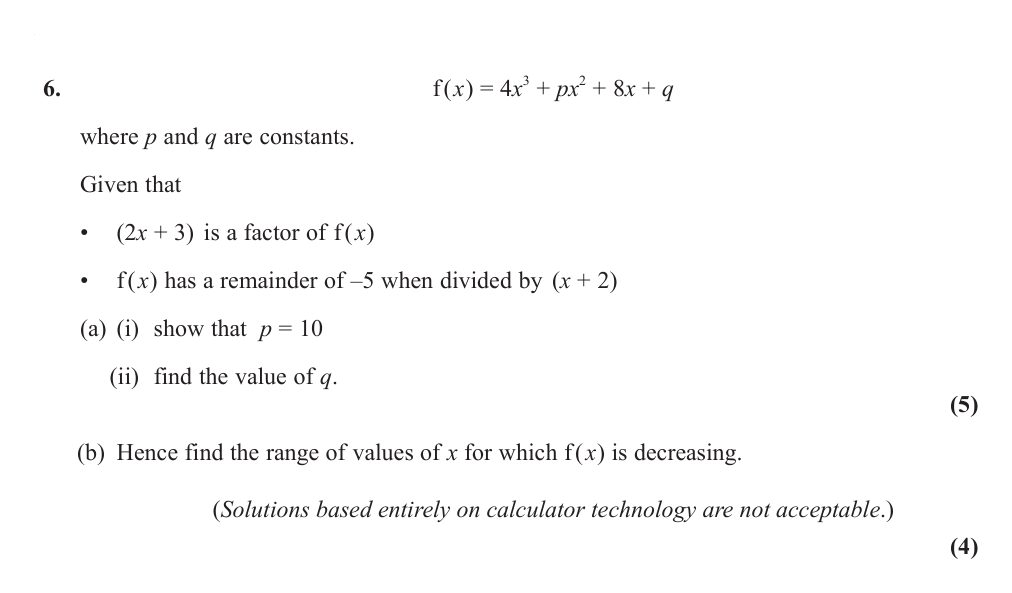
17. WMA12/01 May/June R 2024 · Q6 Hard 9 marks · main topic: Applications of DifferentiationShow worked solution Use the factor theorem Since $(2x+3)$ is a factor, $x=-\dfrac32$ is a root.
Substitute x equals negative three halves $4\left(-\dfrac32\right)^3+p\left(-\dfrac32\right)^2+8\left(-\dfrac32\right)+q=0$.
Simplify the first condition $-\dfrac{27}{2}+\dfrac94p-12+q=0$, so $\dfrac94p+q=\dfrac{51}{2}$.
Use the remainder theorem The remainder on division by $(x+2)$ is $f(-2)$.
Substitute x equals negative two $f(-2)=4(-8)+4p-16+q=4p+q-48$.
Use the given remainder $4p+q-48=-5$, so $4p+q=43$.
Solve for p and q Subtract $\dfrac94p+q=\dfrac{51}{2}$ from $4p+q=43$: $\dfrac74p=\dfrac{35}{2}$, so $p=10$. Then $4(10)+q=43$, so $q=3$.
Differentiate With $p=10$, $f(x)=4x^3+10x^2+8x+3$, so $f'(x)=12x^2+20x+8$.
Factor the derivative $f'(x)=4(3x+2)(x+1)$.
Find where decreasing The quadratic derivative is negative between its roots, so $f(x)$ is decreasing for $-1<x<-\dfrac23$.
Final answer $(a)(i)$ $p=10$. $\quad (a)(ii)$ $q=3$. $\quad (b)$ $-1<x<-\dfrac23$.
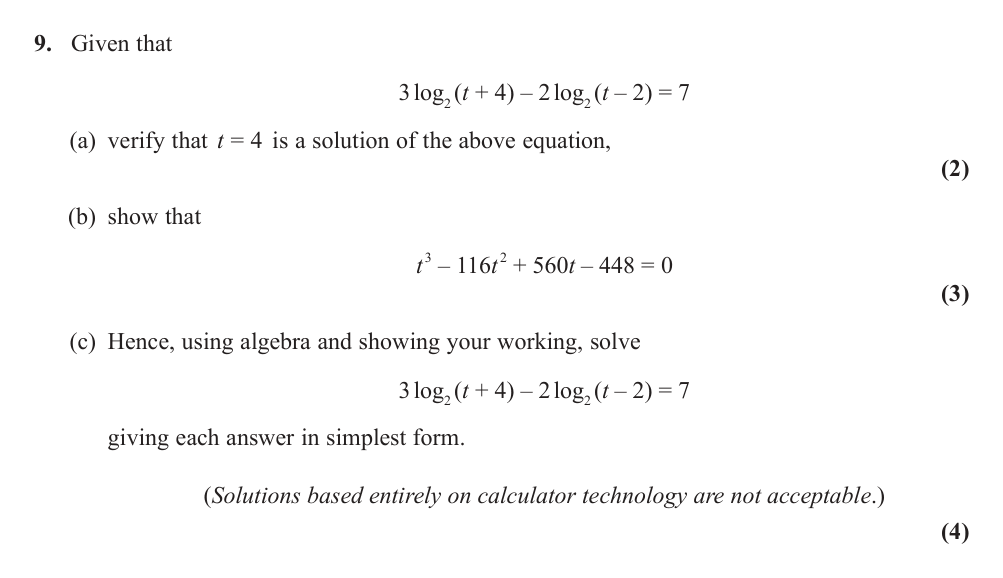
18. WMA12/01 May/June R 2024 · Q9 Hard 9 marks · main topic: Laws of LogarithmsShow worked solution Verify t equals four Substitute $t=4$: $3\log_2(8)-2\log_2(2)=3(3)-2(1)=7$.
Combine the logarithms $3\log_2(t+4)-2\log_2(t-2)=\log_2\left(\dfrac{(t+4)^3}{(t-2)^2}\right)$.
Use seven as a logarithm $7=\log_2(128)$, so $\dfrac{(t+4)^3}{(t-2)^2}=128$.
Clear the denominator $(t+4)^3=128(t-2)^2$.
Expand $t^3+12t^2+48t+64=128t^2-512t+512$.
Show the cubic Rearranging gives $t^3-116t^2+560t-448=0$.
Use the known root Since $t=4$ is a root, $(t-4)$ is a factor.
Factor the cubic $t^3-116t^2+560t-448=(t-4)(t^2-112t+112)$.
Solve the quadratic $t^2-112t+112=0$ gives $t=\dfrac{112\pm\sqrt{112^2-4(112)}}{2}=56\pm12\sqrt{21}$.
Use the log domain The original equation requires $t>2$. The value $56-12\sqrt{21}$ is less than $2$, so it is rejected. Hence $t=4$ or $t=56+12\sqrt{21}$.
Final answer $(a)$ Verified. $\quad (b)$ Proven. $\quad (c)$ $t=4$ or $t=56+12\sqrt{21}$.
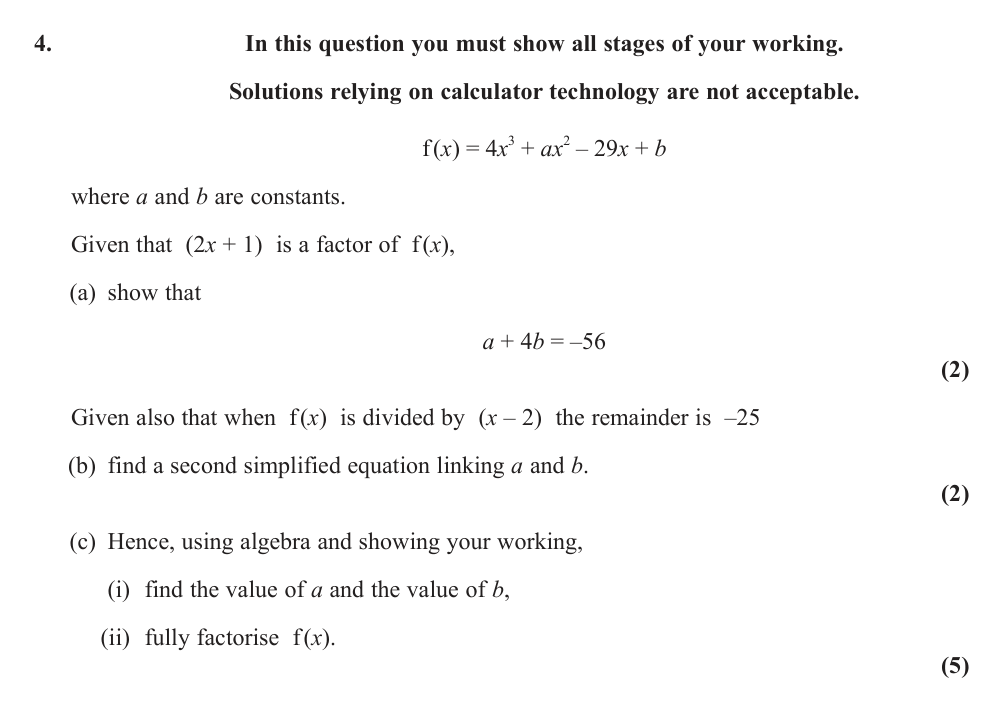
19. WMA12/01 October 2023 · Q4 Hard 9 marksShow worked solution Use the factor theorem Since $(2x+1)$ is a factor, $x=-\dfrac12$ is a root, so $f\left(-\dfrac12\right)=0$.
Substitute x equals negative half $4\left(-\dfrac12\right)^3+a\left(-\dfrac12\right)^2-29\left(-\dfrac12\right)+b=0$.
Show the first relation $-\dfrac12+\dfrac a4+\dfrac{29}{2}+b=0$. Multiplying by $4$ gives $a+4b+56=0$, so $a+4b=-56$.
Use the remainder theorem Dividing by $(x-2)$ gives remainder $f(2)$.
Substitute x equals two $f(2)=4(8)+4a-58+b=4a+b-26$.
Find the second relation The remainder is $-25$, so $4a+b-26=-25$, hence $4a+b=1$.
Solve the simultaneous equations Solve $a+4b=-56$ and $4a+b=1$. Multiplying the second equation by $4$ gives $16a+4b=4$.
Find a and b Subtracting $a+4b=-56$ from $16a+4b=4$ gives $15a=60$, so $a=4$. Then $16+b=1$, so $b=-15$.
Write f(x) Therefore $f(x)=4x^3+4x^2-29x-15$.
Factorise Using the known factors $(2x+1)$ and $(x-2)$, division gives $f(x)=(2x+1)(x-2)(2x+15)$.
Final answer $(a)$ Proven. $\quad (b)$ $4a+b=1$. $\quad (c)(i)$ $a=4,\ b=-15$. $\quad (c)(ii)$ $f(x)=(2x+1)(x-2)(2x+15)$.
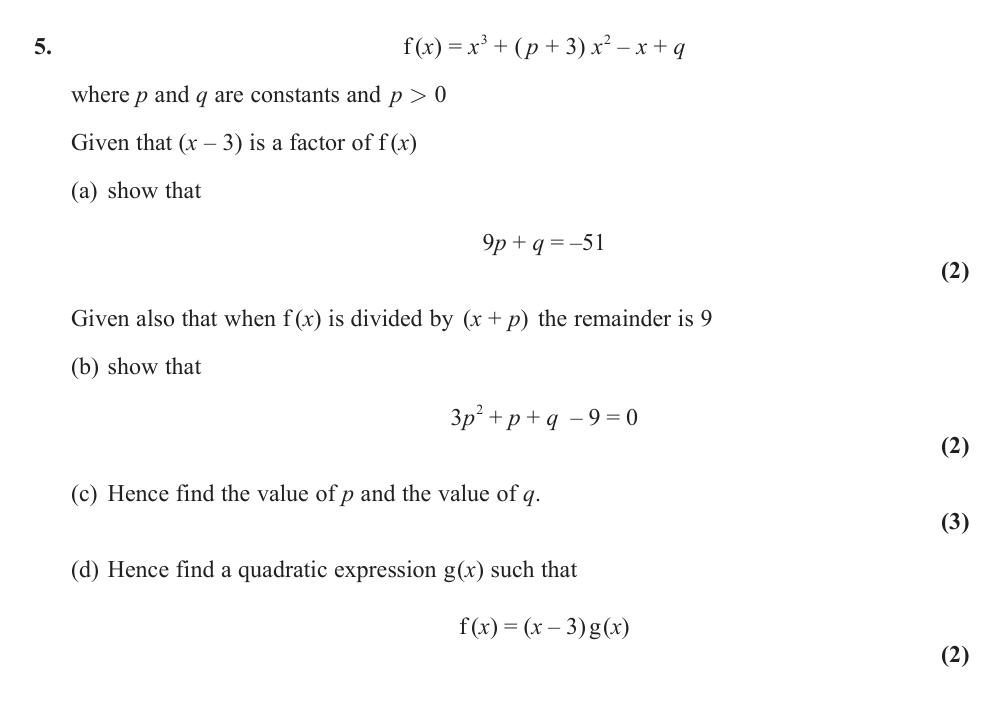
20. WMA12/01 January 2023 · Q5 Hard 9 marksShow worked solution Use the factor theorem Since $(x-3)$ is a factor, $f(3)=0$.
Substitute x equals three $27+9(p+3)-3+q=0$, so $51+9p+q=0$.
Show the first relation Therefore $9p+q=-51$.
Use the remainder theorem Dividing by $(x+p)$ means substituting $x=-p$. The remainder is $f(-p)$.
Substitute x equals negative p $f(-p)=-p^3+(p+3)p^2+p+q=3p^2+p+q$.
Show the second relation The remainder is $9$, so $3p^2+p+q=9$, hence $3p^2+p+q-9=0$.
Eliminate q From $9p+q=-51$, $q=-51-9p$. Substitute into $3p^2+p+q-9=0$.
Solve for p $3p^2+p-51-9p-9=0$, so $3p^2-8p-60=0$. This gives $p=6$ or $p=-\dfrac{10}{3}$.
Use p greater than zero Since $p>0$, $p=6$. Then $q=-51-9(6)=-105$.
Form f with p and q $f(x)=x^3+9x^2-x-105$.
Divide by x minus three $x^3+9x^2-x-105=(x-3)(x^2+12x+35)$, so $g(x)=x^2+12x+35$.
Final answer $(a)$ Proven. $\quad (b)$ Proven. $\quad (c)$ $p=6,\ q=-105$. $\quad (d)$ $g(x)=x^2+12x+35$.
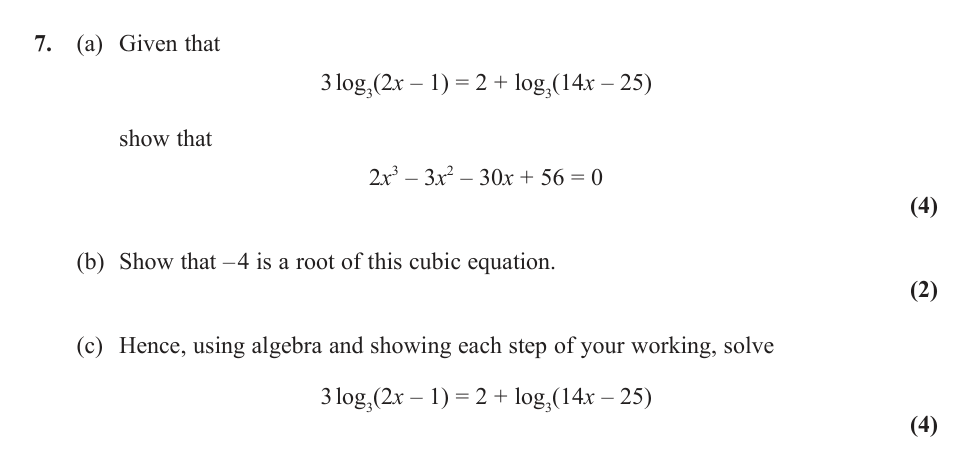
21. WMA12/01 May/June 2021 · Q7 Hard 10 marks · main topic: Laws of LogarithmsShow worked solution Use the power law $3\log_3(2x-1)=\log_3(2x-1)^3$.
Rewrite two as a logarithm Since $2=\log_3 9$, the right side is $\log_3 9+\log_3(14x-25)=\log_3\{9(14x-25)\}$.
Equate the arguments So $(2x-1)^3=9(14x-25)$.
Expand and simplify $8x^3-12x^2+6x-1=126x-225$, which simplifies to $2x^3-3x^2-30x+56=0$.
Check the given root Substituting $x=-4$ gives $2(-64)-3(16)-30(-4)+56=0$, so $-4$ is a root.
Factorise the cubic Dividing by $(x+4)$ gives $2x^2-11x+14=(2x-7)(x-2)$.
Apply the logarithm domain The possible roots are $-4$, $2$, and $\dfrac72$. The original logarithms require $2x-1>0$ and $14x-25>0$, so $x>\dfrac{25}{14}$.
State the valid solutions Therefore the solutions are $x=2$ and $x=\dfrac72$.
Final answer $(a)$ Proven. $\quad (b)$ $-4$ is a root of the cubic. $\quad (c)\ x=2,\ \dfrac72$.
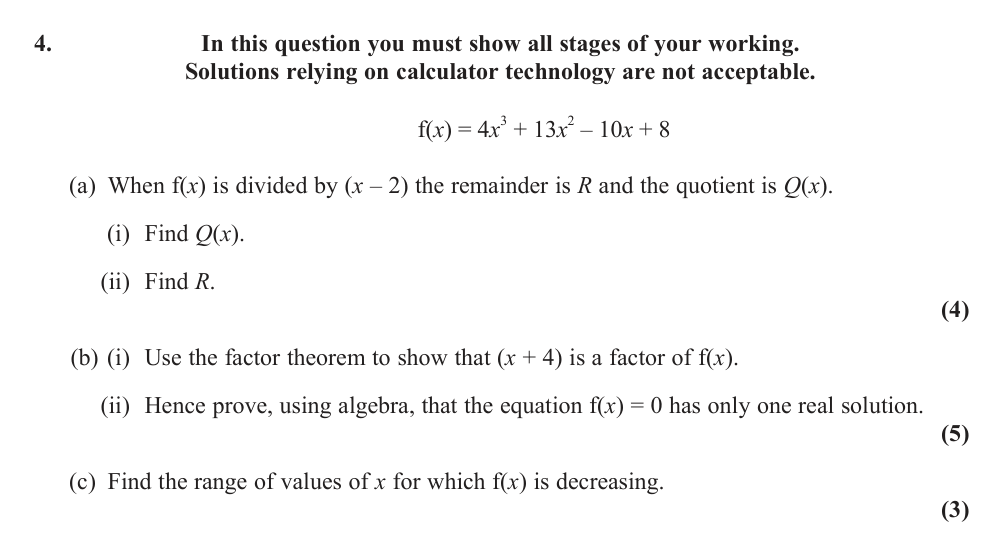
22. WMA12/01 October 2025 · Q4 Hard 12 marksShow worked solution Divide by x minus two $4x^3+13x^2-10x+8=(x-2)(4x^2+21x+32)+72$.
State Q and R Hence $Q(x)=4x^2+21x+32$ and $R=72$.
Use the factor theorem $f(-4)=4(-4)^3+13(-4)^2-10(-4)+8=-256+208+40+8=0$.
Show the factor Since $f(-4)=0$, $(x+4)$ is a factor of $f(x)$.
Factor the cubic Dividing by $(x+4)$ gives $f(x)=(x+4)(4x^2-3x+2)$.
Check the quadratic The discriminant of $4x^2-3x+2$ is $(-3)^2-4(4)(2)=9-32=-23<0$, so this quadratic has no real roots.
Conclude the real solution Therefore $f(x)=0$ has only one real solution, $x=-4$.
Differentiate $f'(x)=12x^2+26x-10=2(3x-1)(2x+5)$.
Find where f is decreasing $f(x)$ is decreasing when $f'(x)<0$, which is between the roots. Hence $-\dfrac52<x<\dfrac13$.
Final answer $(a)(i)$ $Q(x)=4x^2+21x+32$. $\quad (a)(ii)$ $R=72$. $\quad (b)$ Proven; only real solution is $x=-4$. $\quad (c)$ $-\dfrac52<x<\dfrac13$.
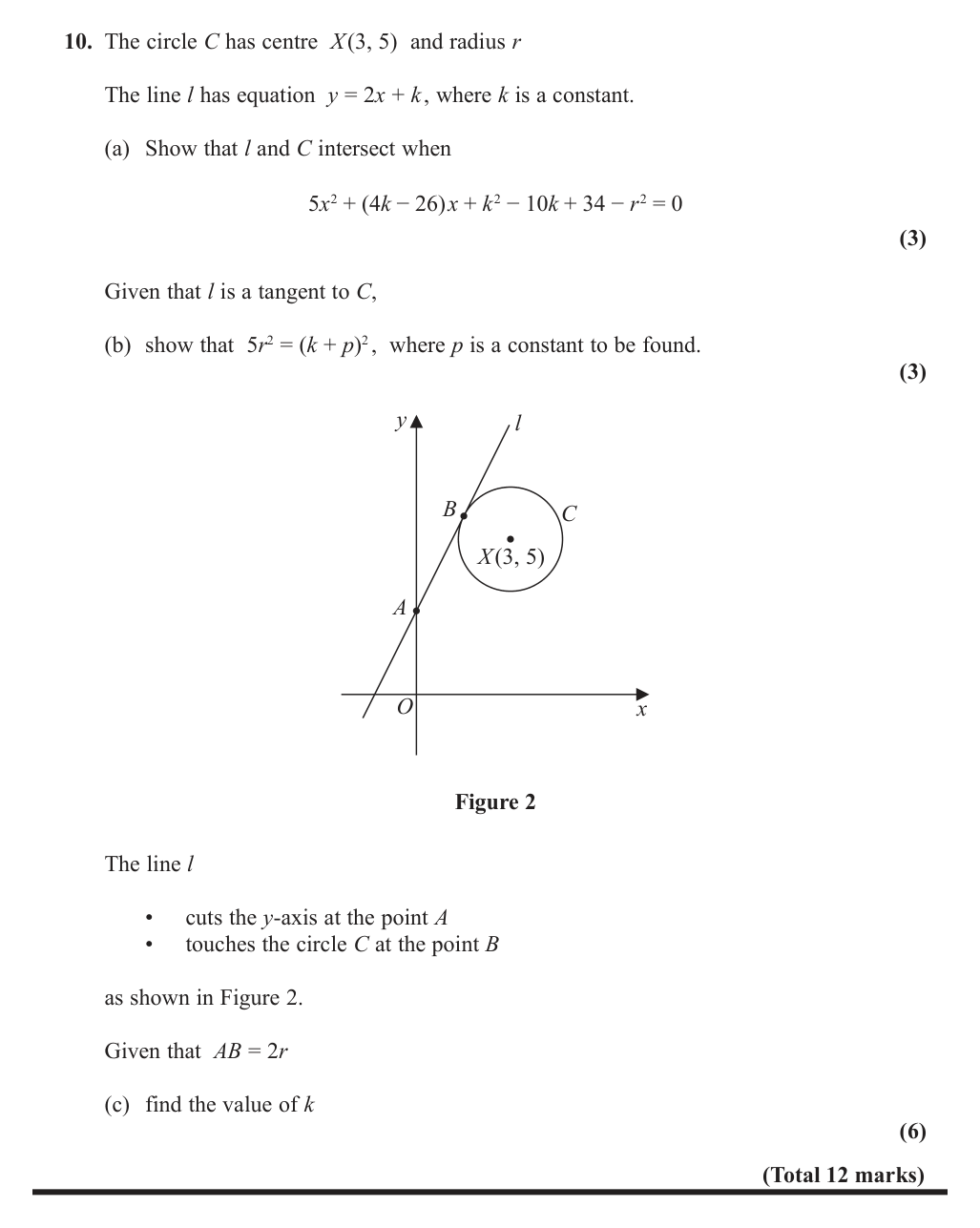
23. WMA12/01 May/June 2022 · Q10 Hard 12 marks · main topic: CirclesShow worked solution Write the circle equation The circle has centre $(3,5)$ and radius $r$, so $(x-3)^2+(y-5)^2=r^2$.
Substitute the line On the line, $y=2x+k$. Substitution gives $(x-3)^2+(2x+k-5)^2=r^2$.
Expand $x^2-6x+9+4x^2+4kx-20x+k^2-10k+25-r^2=0$.
Show the intersection equation Collecting terms gives $5x^2+(4k-26)x+k^2-10k+34-r^2=0$.
Use tangency For a tangent, the quadratic has one repeated root, so its discriminant is zero.
Set the discriminant to zero $(4k-26)^2-20(k^2-10k+34-r^2)=0$.
Simplify This reduces to $20r^2-4k^2-8k-4=0$, hence $5r^2=(k+1)^2$. Therefore $p=1$.
Find the tangent point x coordinate For the repeated root, $x_B=-\dfrac{4k-26}{2\cdot5}=\dfrac{13-2k}{5}$.
Use distance AB The point $A$ is $(0,k)$ and $B$ lies on a line of gradient $2$, so $AB=\sqrt{x_B^2+(2x_B)^2}=\sqrt5\,x_B$.
Use the radius relation From $5r^2=(k+1)^2$, $r=\dfrac{k+1}{\sqrt5}$ in the shown configuration.
Apply AB equals two r $\sqrt5\left(\dfrac{13-2k}{5}\right)=2\left(\dfrac{k+1}{\sqrt5}\right)$.
Solve for k Multiplying by $\sqrt5$ gives $13-2k=2k+2$, so $k=\dfrac{11}{4}$.
Final answer $(a)$ Proven. $\quad (b)\ 5r^2=(k+1)^2$, so $p=1$. $\quad (c)\ k=\dfrac{11}{4}$.
Dr Eslam Ahmed Elite Mathematics · Questions classified by topic, solutions checked by Dr Eslam
 Elite Mathematics