Elite Mathematics / Pure 2 / Topics / Exponentials and Logarithms IAL · WMA12 · Topic Exponentials and Logarithms: past paper questions & worked solutions
Every Exponentials and Logarithms question from the WMA12 papers in our bank, 2019–2026, sorted from easiest to hardest. Try each one first, then open the worked solution.
27 questions
203 marks in total
100% of papers (19 of 19) include it
7/14/6 easy / medium / hard
Questions, easiest first Level is estimated from marks: 1–6 easy, 7–8 medium, 9+ hard.
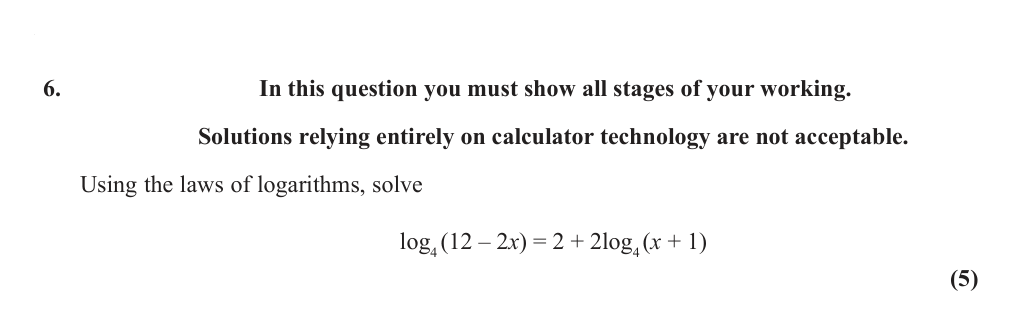
1. WMA12/01 October 2024 · Q6 Easy 5 marksShow worked solution State the domain The logarithms require $12-2x>0$ and $x+1>0$, so $-1<x<6$.
Combine the right hand side $2=\log_4(16)$, so $2+2\log_4(x+1)=\log_4\left(16(x+1)^2\right)$.
Equate the arguments $\log_4(12-2x)=\log_4\left(16(x+1)^2\right)$ gives $12-2x=16(x+1)^2$.
Form the quadratic $12-2x=16x^2+32x+16$, so $8x^2+17x+2=0$.
Factor and solve $8x^2+17x+2=(8x+1)(x+2)=0$, so $x=-\dfrac18$ or $x=-2$.
Check the domain The value $x=-2$ is outside $-1<x<6$, so the solution is $x=-\dfrac18$.
Final answer $x=-\dfrac18$.
2. WMA12/01 May/June 2023 · Q5 Easy 5 marksShow worked solution State the domain The logarithms require $16x>0$, $x+1>0$ and $x+6>0$, so $x>0$.
Combine the left side $\log_2(16x)+\log_2(x+1)=\log_2(16x(x+1))$.
Rewrite the right side $3=\log_2 8$, so $3+\log_2(x+6)=\log_2(8(x+6))$.
Equate the arguments Therefore $16x(x+1)=8(x+6)$.
Solve the quadratic $16x^2+16x=8x+48$, so $16x^2+8x-48=0$. Dividing by $8$ gives $2x^2+x-6=0$.
Factor and use the domain $(2x-3)(x+2)=0$, so $x=\dfrac32$ or $x=-2$. The domain $x>0$ rejects $-2$, leaving $x=\dfrac32$.
Final answer $x=\dfrac32$.
3. WMA12/01 January 2022 · Q4 Easy 5 marksShow worked solution Rewrite the right side $2\log_3(1-x)=\log_3(1-x)^2$ and $3=\log_3 27$.
Combine the logarithms The equation becomes $\log_3(32-12x)=\log_3\{27(1-x)^2\}$.
Equate the arguments $32-12x=27(1-x)^2$.
Form the quadratic $32-12x=27-54x+27x^2$, so $27x^2-42x-5=0$.
Solve $x=\dfrac{42\pm48}{54}$, giving $x=\dfrac53$ or $x=-\dfrac19$.
Check the domain The original logarithms require $1-x>0$, so $x<1$. Therefore $x=\dfrac53$ is invalid and $x=-\dfrac19$.
Final answer $x=-\dfrac19$.
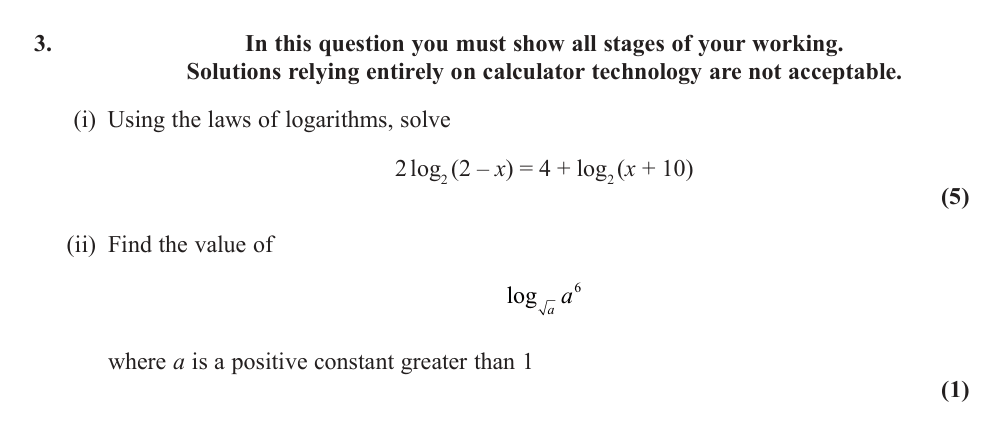
4. WMA12/01 May/June 2024 · Q3 Easy 6 marksShow worked solution State the domain The logarithms require $2-x>0$ and $x+10>0$, so $-10<x<2$.
Combine powers $2\log_2(2-x)=\log_2((2-x)^2)$.
Rewrite four $4=\log_2 16$, so $4+\log_2(x+10)=\log_2(16(x+10))$.
Equate arguments $(2-x)^2=16(x+10)$.
Solve the quadratic $x^2-4x+4=16x+160$, so $x^2-20x-156=0$.
Use the domain $x=26$ or $x=-6$. The value $26$ is outside the domain, so $x=-6$.
Evaluate the logarithm $\log_{\sqrt a}(a^6)=\log_{a^{1/2}}(a^6)=\dfrac{6}{1/2}=12$.
Final answer $(i)$ $x=-6$. $\quad (ii)$ $12$.
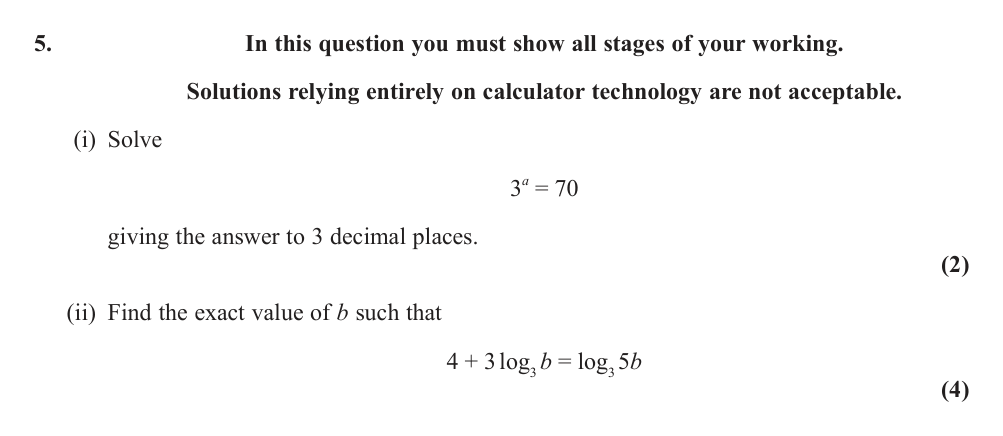
5. WMA12/01 October 2023 · Q5 Easy 6 marksShow worked solution Solve the exponential equation $3^a=70$ gives $a=\log_3 70=\dfrac{\log 70}{\log 3}$.
Round a $a=3.867147\ldots$, so $a=3.867$ to 3 decimal places.
Rewrite four as a logarithm $4=\log_3(3^4)=\log_3 81$.
Combine the left side $4+3\log_3 b=\log_3 81+\log_3(b^3)=\log_3(81b^3)$.
Equate arguments The equation becomes $\log_3(81b^3)=\log_3(5b)$, so $81b^3=5b$.
Use the log domain Since $\log_3 b$ is defined, $b>0$. Divide by $b$ to get $81b^2=5$.
Find b $b^2=\dfrac{5}{81}$, and $b>0$, so $b=\dfrac{\sqrt5}{9}$.
Final answer $(i)$ $a=3.867$. $\quad (ii)$ $b=\dfrac{\sqrt5}{9}$.
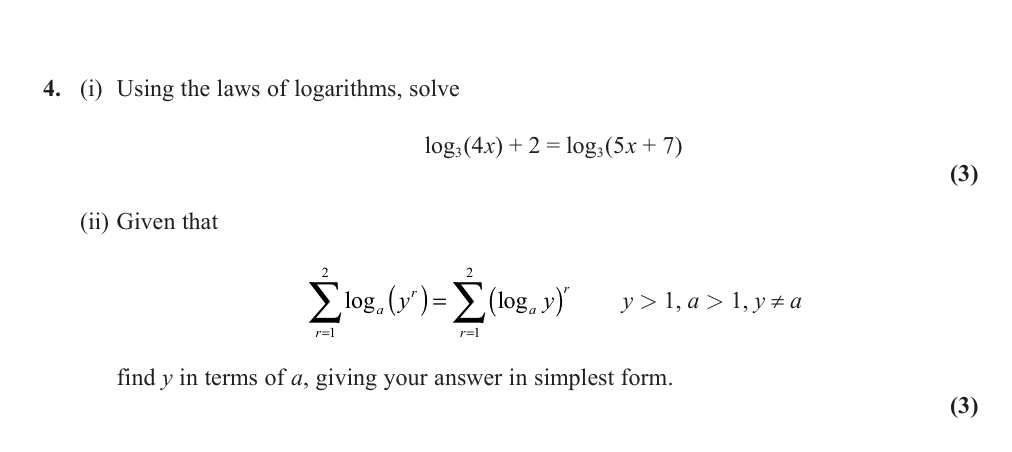
6. WMA12/01 January 2023 · Q4 Easy 6 marksShow worked solution Rewrite the constant Since $2=\log_3 9$, the equation becomes $\log_3(4x)+\log_3 9=\log_3(5x+7)$.
Combine the logarithms $\log_3(4x)+\log_3 9=\log_3(36x)$.
Solve for x Therefore $36x=5x+7$, so $31x=7$ and $x=\dfrac{7}{31}$.
Introduce L Let $L=\log_a y$. Then $\log_a(y^r)=r\log_a y=rL$.
Evaluate the left sum $\displaystyle \sum_{r=1}^{2}\log_a(y^r)=L+2L=3L$.
Evaluate the right sum $\displaystyle \sum_{r=1}^{2}(\log_a y)^r=L+L^2$.
Solve for L So $3L=L+L^2$, which gives $L^2-2L=0$ and $L(L-2)=0$.
Use the restrictions Since $a>1$ and $y>1$, $\log_a y>0$, so $L\ne0$. Hence $L=2$ and $y=a^2$.
Final answer $(i)$ $x=\dfrac{7}{31}$. $\quad (ii)$ $y=a^2$.
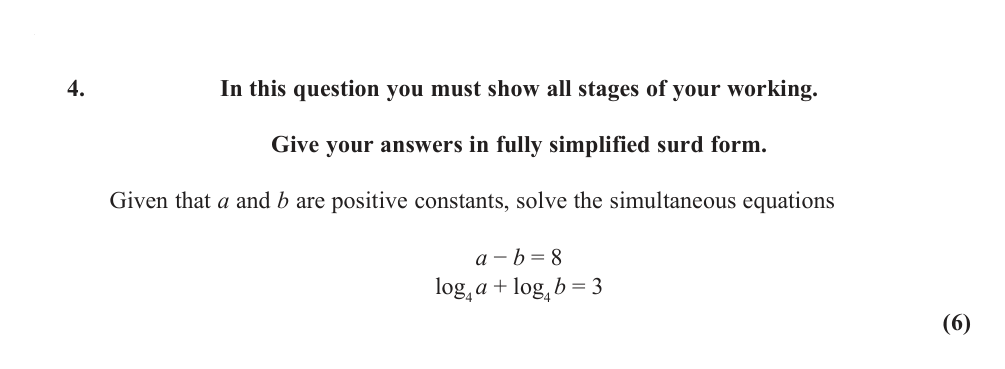
7. WMA12/01 May/June 2022 · Q4 Easy 6 marksShow worked solution Combine the logarithms $\log_4 a+\log_4 b=\log_4(ab)=3$.
Find ab Therefore $ab=4^3=64$.
Use a minus b From $a-b=8$, $b=a-8$.
Form a quadratic $a(a-8)=64$, so $a^2-8a-64=0$.
Solve for a $a=\dfrac{8\pm\sqrt{64+256}}{2}=4\pm4\sqrt5$.
Choose positive constants Since $b=a-8$ must also be positive, take $a=4+4\sqrt5$.
Find b $b=a-8=4\sqrt5-4$.
Final answer $a=4+4\sqrt5,\quad b=4\sqrt5-4$.
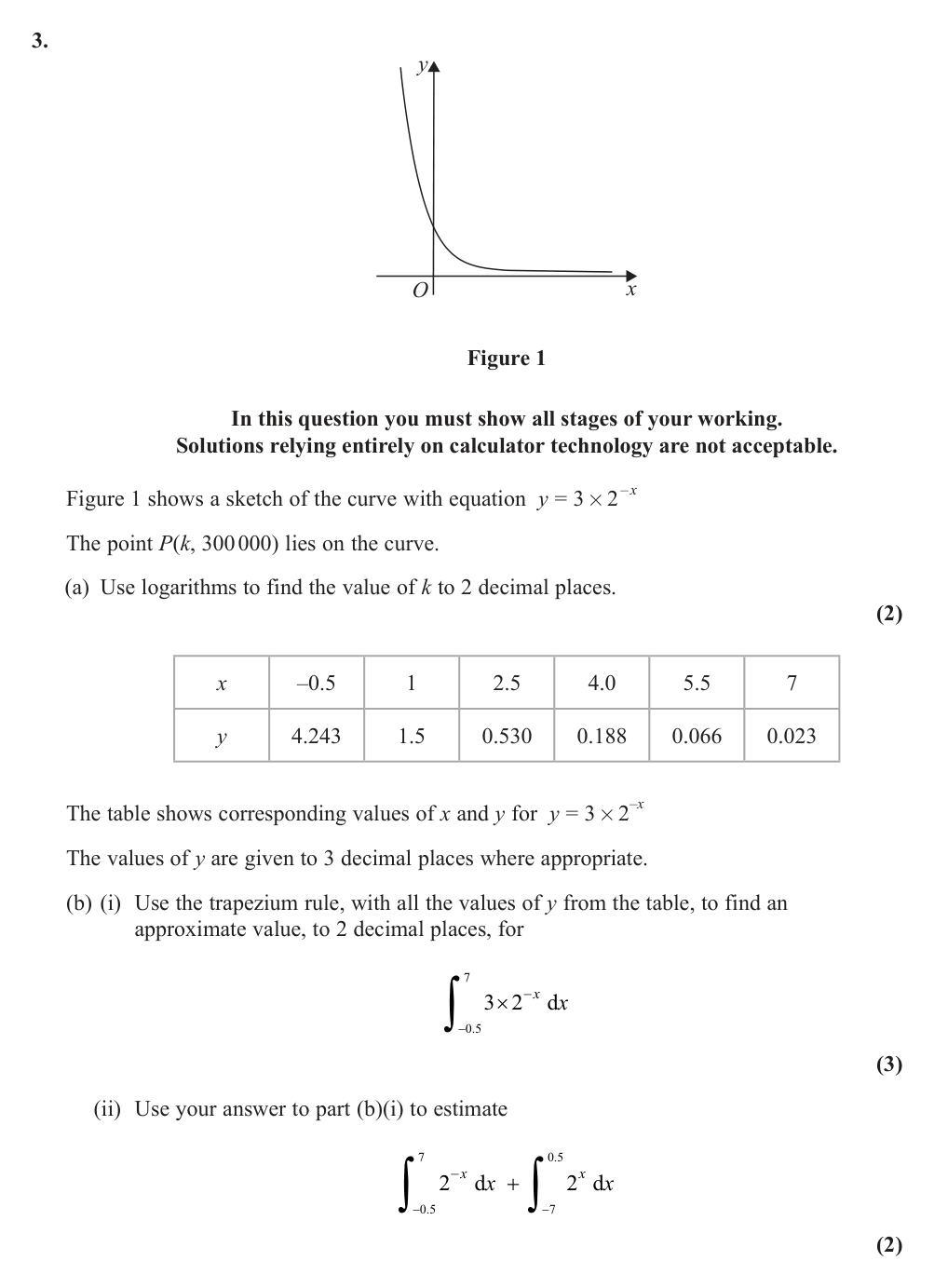
8. WMA12/01 October 2025 · Q3 Medium 7 marks · main topic: IntegrationShow worked solution Use the point on the curve Since $P(k,300000)$ lies on $y=3\times2^{-x}$, $300000=3\times2^{-k}$.
Solve with logarithms $100000=2^{-k}$, so $-k=\log_2(100000)$ and $k=-\log_2(100000)=-16.609\ldots$.
Round k To $2$ decimal places, $k=-16.61$.
Find the strip width The $x$ values increase by $1.5$, so $h=1.5$.
Apply the trapezium rule $\displaystyle\int_{-0.5}^{7}3\times2^{-x}dx\approx\dfrac{1.5}{2}\{4.243+0.023+2(1.5+0.530+0.188+0.066)\}$.
Evaluate the estimate This gives $6.6255$, which is $6.63$ to $2$ decimal places.
Relate the first new integral $\displaystyle\int_{-0.5}^{7}2^{-x}dx=\dfrac13\int_{-0.5}^{7}3\times2^{-x}dx$.
Relate the second new integral Using the substitution $u=-x$, $\displaystyle\int_{-7}^{0.5}2^x dx=\int_{-0.5}^{7}2^{-u}du$.
Estimate the total The required estimate is therefore $\dfrac23(6.6255)=4.417$, which is $4.42$ to $2$ decimal places.
Final answer $(a)$ $k=-16.61$. $\quad (b)(i)$ $6.63$. $\quad (b)(ii)$ $4.42$.
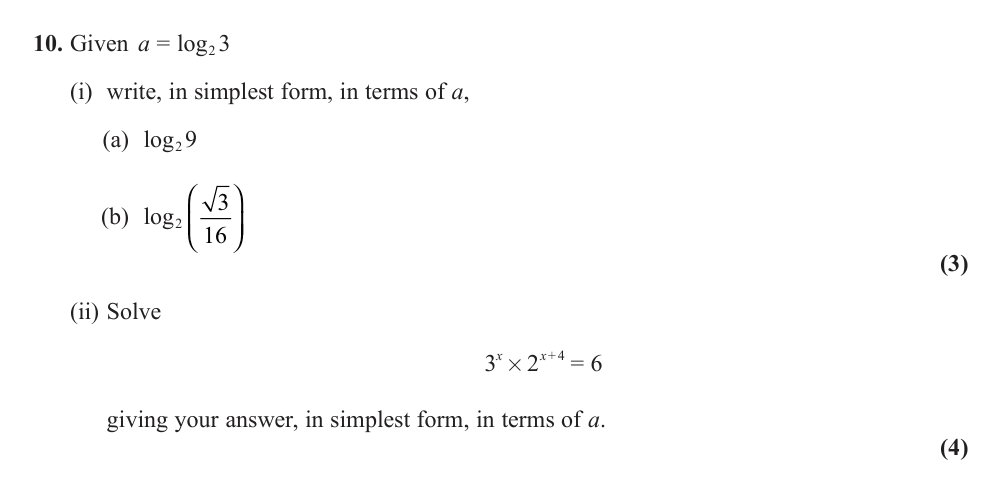
9. WMA12/01 October 2022 · Q10 Medium 7 marksShow worked solution Use the power rule for log 2 of 9 $\log_2 9=\log_2(3^2)=2\log_2 3=2a$.
Split the second logarithm $\log_2\left(\dfrac{\sqrt3}{16}\right)=\log_2(3^{1/2})-\log_2(16)$.
Simplify in terms of a $\log_2(3^{1/2})=\dfrac12\log_2 3=\dfrac a2$ and $\log_2(16)=4$, so the expression is $\dfrac a2-4$.
Take log base 2 of both sides For $3^x\times2^{x+4}=6$, take $\log_2$ of both sides: $\log_2(3^x)+\log_2(2^{x+4})=\log_2 6$.
Rewrite each term $\log_2(3^x)=xa$, $\log_2(2^{x+4})=x+4$, and $\log_2 6=\log_2(2\cdot3)=1+a$.
Solve for x So $xa+x+4=a+1$. Hence $x(a+1)=a-3$, giving $x=\dfrac{a-3}{a+1}$.
Final answer $(i)(a)\ 2a. $\quad $(i)(b)\ \dfrac{a}{2}-4. $\quad $(ii)\ x=\dfrac{a-3}{a+1}$.
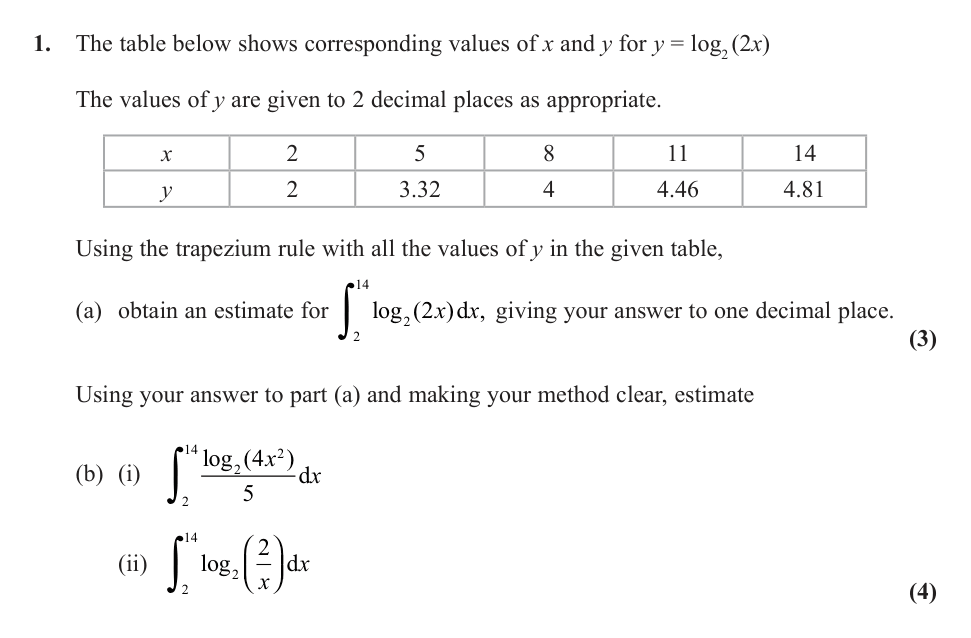
10. WMA12/01 January 2020 · Q1 Medium 7 marks · main topic: IntegrationShow worked solution Use the trapezium rule The strip width is $h=3$. Therefore $\int_2^{14}\log_2(2x)\,dx\approx\dfrac32\{2+4.81+2(3.32+4+4.46)\}$.
Calculate part (a) The estimate is $\dfrac32(30.37)=45.555$, so to one decimal place the answer is $45.6$.
Rewrite part (b)(i) $\log_2(4x^2)=\log_2\{(2x)^2\}=2\log_2(2x)$, so $\int_2^{14}\dfrac{\log_2(4x^2)}5\,dx=\dfrac25\int_2^{14}\log_2(2x)\,dx$.
Estimate part (b)(i) Using part (a), the estimate is $\dfrac25(45.555)=18.222$, so $18.2$ to one decimal place.
Rewrite part (b)(ii) $\log_2\left(\dfrac2x\right)=2-\log_2(2x)$.
Estimate part (b)(ii) $\int_2^{14}\log_2\left(\dfrac2x\right)dx\approx\int_2^{14}2\,dx-45.555=24-45.555=-21.555$, so $-21.6$.
Final answer $(a)\ 45.6.\quad (b)(i)\ 18.2.\quad (b)(ii)\ -21.6$.
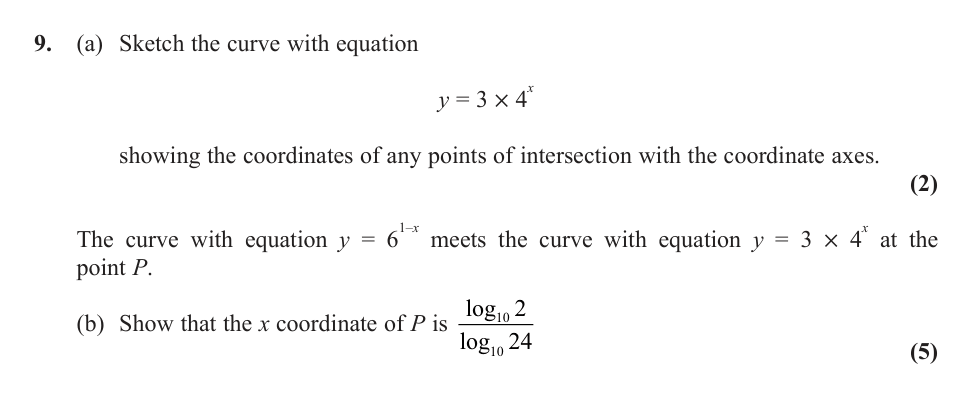
11. WMA12/01 January 2020 · Q9 Medium 7 marksShow worked solution Describe the sketch $y=3\times4^x$ is an increasing exponential curve. At $x=0$, $y=3$, so the curve crosses the $y$-axis at $(0,3)$ and has no $x$-axis intersection.
Equate the two curves At $P$, $6^{1-x}=3\times4^x$.
Take logarithms $(1-x)\log_{10}6=\log_{10}3+x\log_{10}4$.
Collect the x terms $\log_{10}6-\log_{10}3=x(\log_{10}4+\log_{10}6)$.
Simplify the logarithms $\log_{10}6-\log_{10}3=\log_{10}2$ and $\log_{10}4+\log_{10}6=\log_{10}24$.
State the x coordinate Therefore $x=\dfrac{\log_{10}2}{\log_{10}24}$.
Final answer $(a)$ Increasing exponential curve through $(0,3)$, with no $x$-axis intersection. $\quad (b)\ x=\dfrac{\log_{10}2}{\log_{10}24}$.
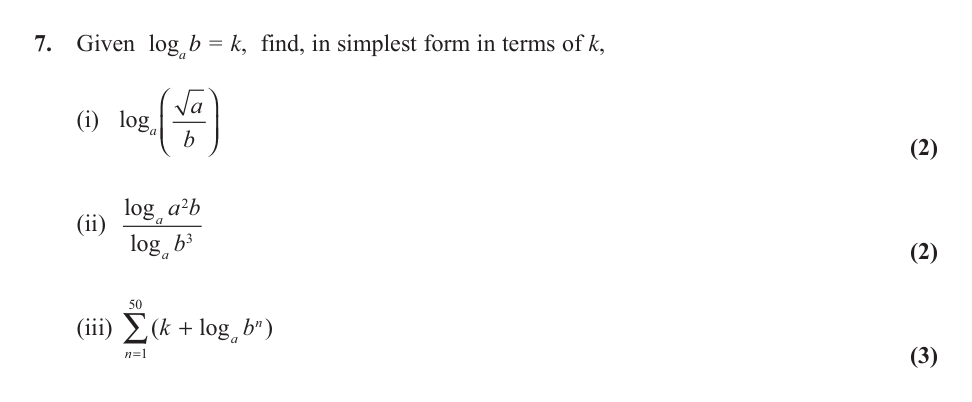
12. WMA12/01 October 2019 · Q7 Medium 7 marksShow worked solution Use the given logarithm Since $\log_a b=k$, we can replace every $\log_a b$ by $k$.
Simplify part (i) $\log_a\left(\dfrac{\sqrt a}{b}\right)=\log_a(a^{1/2})-\log_a b=\dfrac12-k$.
Simplify the numerator and denominator $\log_a(a^2b)=\log_a a^2+\log_a b=2+k$, and $\log_a(b^3)=3\log_a b=3k$.
Write part (ii) Therefore $\dfrac{\log_a(a^2b)}{\log_a(b^3)}=\dfrac{k+2}{3k}$.
Simplify the summand $\log_a(b^n)=n\log_a b=nk$, so $k+\log_a(b^n)=k+nk=(n+1)k$.
Sum the series $\sum_{n=1}^{50}(n+1)k=k\left(\sum_{n=1}^{50}n+50\right)=k(1275+50)=1325k$.
Final answer $(i)\ \dfrac12-k.\quad (ii)\ \dfrac{k+2}{3k}.\quad (iii)\ 1325k$.
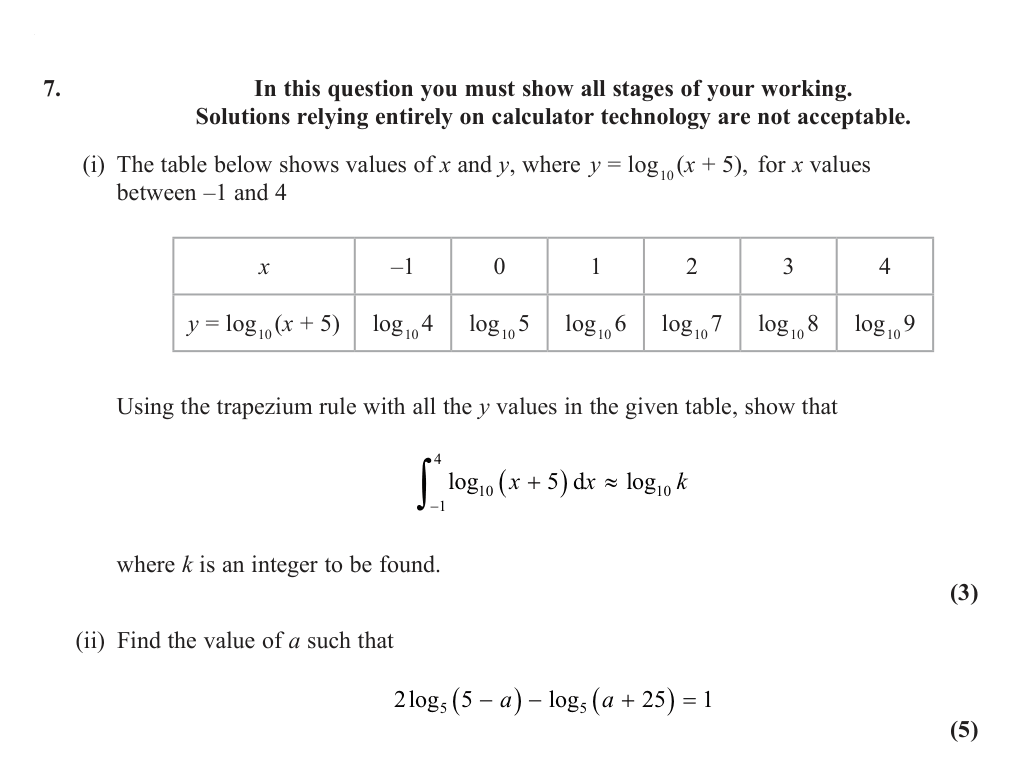
13. WMA12/01 January 2025 · Q7 Medium 8 marksShow worked solution Use the trapezium rule The width is $1$, so $\displaystyle\int_{-1}^{4}\log_{10}(x+5)\,dx\approx\dfrac12\{\log_{10}4+\log_{10}9+2(\log_{10}5+\log_{10}6+\log_{10}7+\log_{10}8)\}$.
Combine the logarithms This is $\log_{10}\left(\sqrt{4\times9}\times5\times6\times7\times8\right)$.
Find k $\sqrt{4\times9}\times5\times6\times7\times8=6\times1680=10080$, so $k=10080$.
State the domain The logarithms require $5-a>0$ and $a+25>0$, so $-25<a<5$.
Combine the logarithms $2\log_5(5-a)-\log_5(a+25)=\log_5\left(\dfrac{(5-a)^2}{a+25}\right)$.
Use one as a logarithm $1=\log_5 5$, so $\dfrac{(5-a)^2}{a+25}=5$.
Form the quadratic $(5-a)^2=5(a+25)$, so $a^2-10a+25=5a+125$. Hence $a^2-15a-100=0$.
Solve and check $(a-20)(a+5)=0$, so $a=20$ or $a=-5$. Only $a=-5$ is in the domain, so $a=-5$.
Final answer $(i)$ $k=10080$. $\quad (ii)$ $a=-5$.
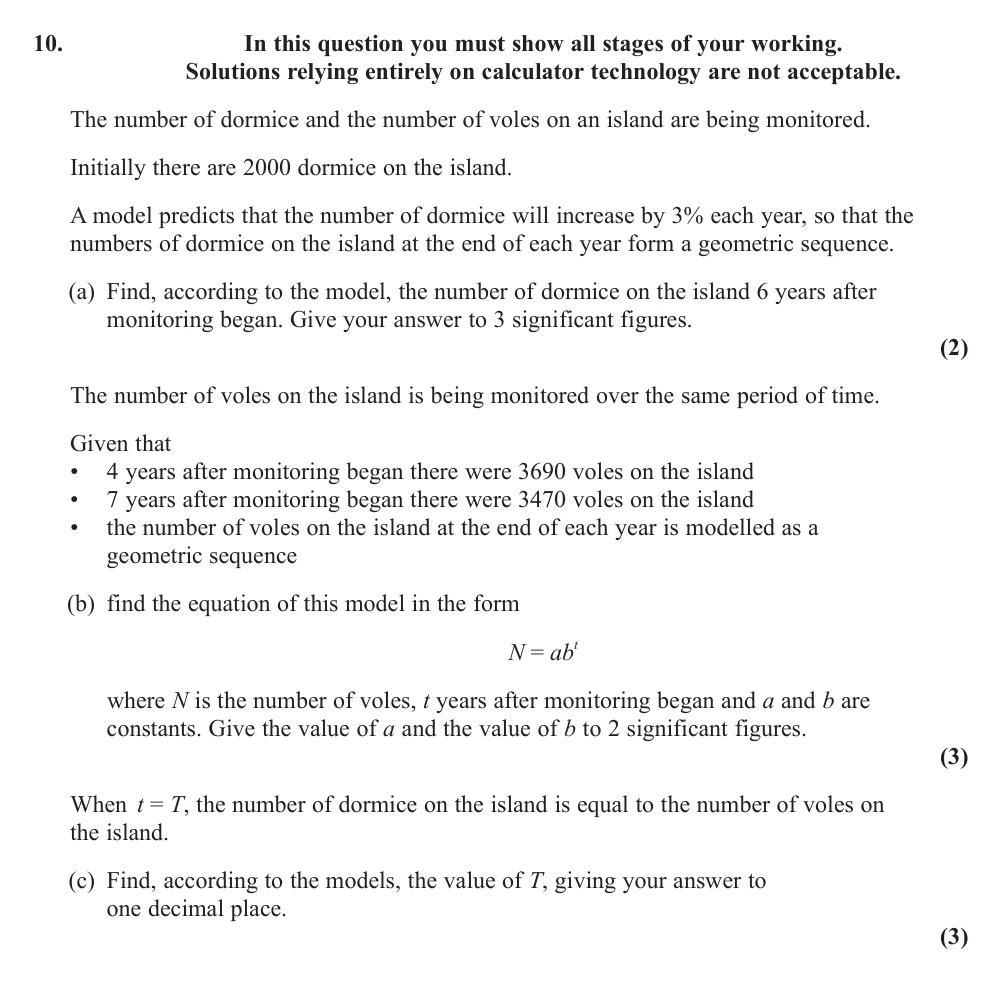
14. WMA12/01 May/June 2024 · Q10 Medium 8 marks · main topic: Modelling with Sequences & SeriesShow worked solution Model the dormice The dormice model is $D=2000(1.03)^t$.
Find the dormice after six years $D=2000(1.03)^6=2388.10\ldots$, so there are $2390$ dormice to 3 significant figures.
Set up the vole model Let the vole model be $N=ab^t$.
Use the two data points At $t=4$, $ab^4=3690$. At $t=7$, $ab^7=3470$.
Find b Dividing gives $b^3=\dfrac{3470}{3690}$, so $b=0.9797\ldots$, which is $0.98$ to 2 significant figures.
Find a $a=\dfrac{3690}{b^4}=4005.18\ldots$, which is $4000$ to 2 significant figures.
Write the vole model So the model is approximately $N=4000(0.98)^t$.
Set the two models equal Use $2000(1.03)^T=a b^T$ with the unrounded constants from the vole model.
Solve using logarithms $\left(\dfrac{1.03}{b}\right)^T=\dfrac{a}{2000}$, so $T=\dfrac{\log(a/2000)}{\log(1.03/b)}$.
Calculate T Substituting $a=4005.18\ldots$ and $b=0.9797\ldots$ gives $T=13.875\ldots$, so $T=13.9$ to one decimal place.
Final answer $(a)$ $2390$ dormice. $\quad (b)$ $N=4000(0.98)^t$ to 2 s.f. constants. $\quad (c)$ $T=13.9$.
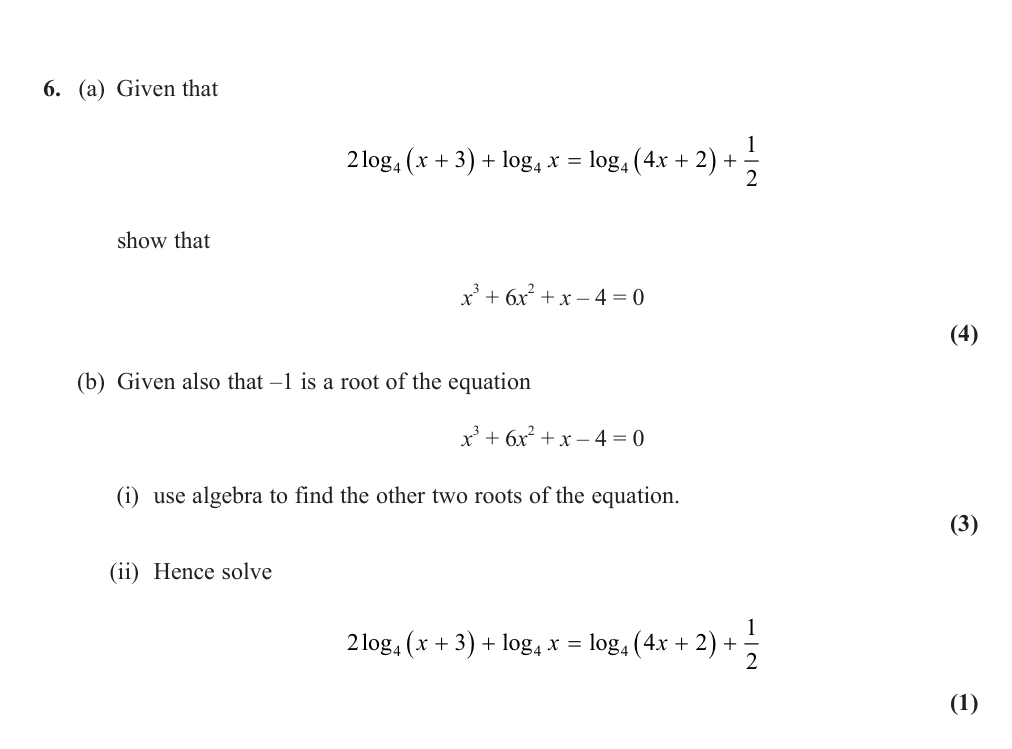
15. WMA12/01 January 2024 · Q6 Medium 8 marksShow worked solution Combine the logarithms $2\log_4(x+3)=\log_4((x+3)^2)$, so the left side is $\log_4(x(x+3)^2)$.
Rewrite one half $\dfrac12=\log_4 2$, so the right side is $\log_4(4x+2)+\log_4 2=\log_4(8x+4)$.
Equate arguments Therefore $x(x+3)^2=8x+4$.
Expand $x(x^2+6x+9)=8x+4$, so $x^3+6x^2+9x=8x+4$.
Show the cubic Rearranging gives $x^3+6x^2+x-4=0$.
Use the given root Since $-1$ is a root, $(x+1)$ is a factor of $x^3+6x^2+x-4$.
Factor the cubic $x^3+6x^2+x-4=(x+1)(x^2+5x-4)$.
Solve the quadratic $x^2+5x-4=0$ gives $x=\dfrac{-5\pm\sqrt{25+16}}{2}=\dfrac{-5\pm\sqrt{41}}{2}$.
Apply the logarithm domain The original log equation requires $x>0$. The only positive root is $x=\dfrac{-5+\sqrt{41}}{2}$.
Final answer $(a)$ Proven. $\quad (b)(i)$ $x=\dfrac{-5+\sqrt{41}}{2}$ and $x=\dfrac{-5-\sqrt{41}}{2}$. $\quad (b)(ii)$ $x=\dfrac{-5+\sqrt{41}}{2}$.
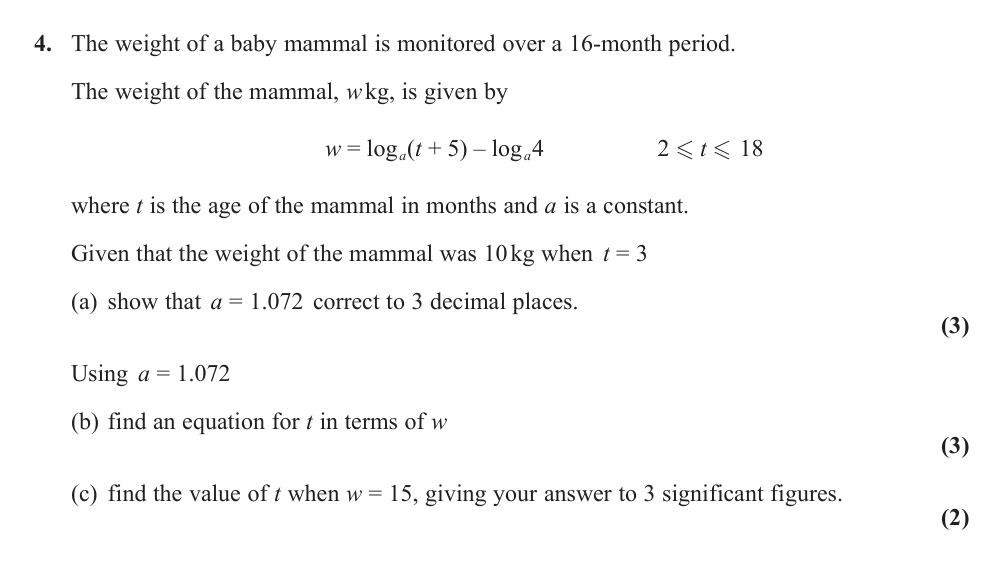
16. WMA12/01 October 2022 · Q4 Medium 8 marksShow worked solution Substitute the given information When $t=3$, $w=10$. So $10=\log_a(3+5)-\log_a4=\log_a8-\log_a4$.
Combine the logarithms $\log_a8-\log_a4=\log_a\left(\dfrac84\right)=\log_a2$, so $10=\log_a2$.
Find a $10=\log_a2$ means $a^{10}=2$, hence $a=2^{1/10}=1.071773\ldots=1.072$ to 3 decimal places.
Start from the model Using $a=1.072$, $w=\log_{1.072}(t+5)-\log_{1.072}4$.
Combine the logs again $w=\log_{1.072}\left(\dfrac{t+5}{4}\right)$.
Make t the subject Changing from logarithmic form to exponential form gives $(1.072)^w=\dfrac{t+5}{4}$, so $t=4(1.072)^w-5$.
Substitute w equals fifteen When $w=15$, $t=4(1.072)^{15}-5=6.3496\ldots$, so $t=6.35$ months to 3 significant figures.
Final answer $(a)$ $a=1.072$ to 3 d.p. $\quad (b)\ t=4(1.072)^w-5$. $\quad (c)\ t=6.35$ months to 3 s.f.
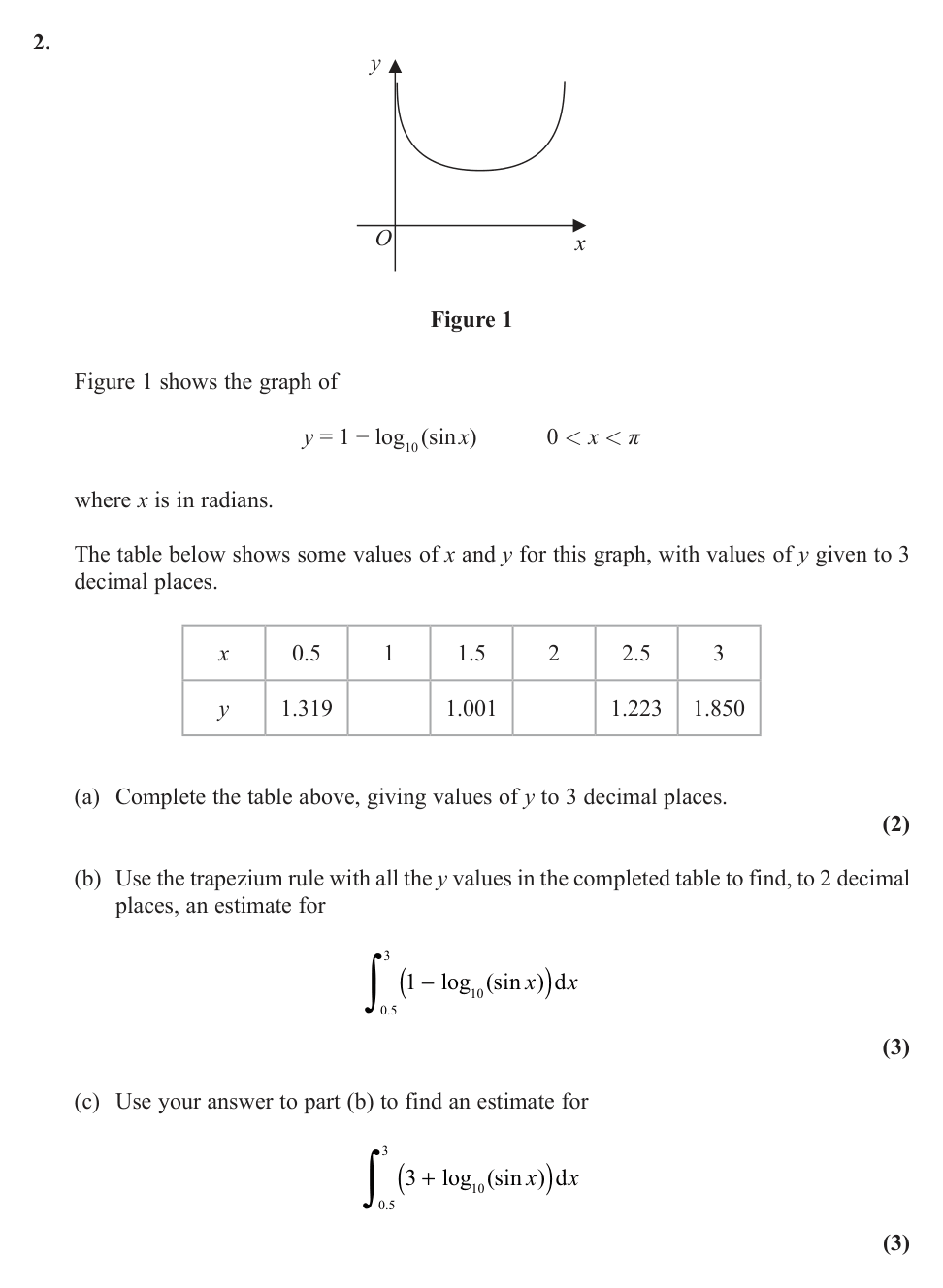
17. WMA12/01 May/June 2022 · Q2 Medium 8 marks · main topic: IntegrationShow worked solution Complete the missing table values Using $y=1-\log_{10}(\sin x)$ gives $y(1)=1.075$ and $y(2)=1.041$ to 3 decimal places.
Identify the strip width The $x$ values increase by $0.5$, so $h=0.5$.
Apply the trapezium rule $A\approx\dfrac{0.5}{2}\{1.319+1.850+2(1.075+1.001+1.041+1.223)\}$.
Calculate part b This gives $2.9625\ldots$, so the estimate is $2.96$ to 2 decimal places.
Rewrite the new integrand Since $y=1-\log_{10}(\sin x)$, we have $\log_{10}(\sin x)=1-y$.
Use the interval length $3+\log_{10}(\sin x)=4-y$, and the interval from $0.5$ to $3$ has length $2.5$.
Estimate part c $\int_{0.5}^{3}(3+\log_{10}(\sin x))\,dx\approx4(2.5)-2.9625\ldots=7.0374\ldots$, so $7.04$.
Final answer $(a)\ y(1)=1.075,\ y(2)=1.041.\quad (b)\ 2.96.\quad (c)\ 7.04$.
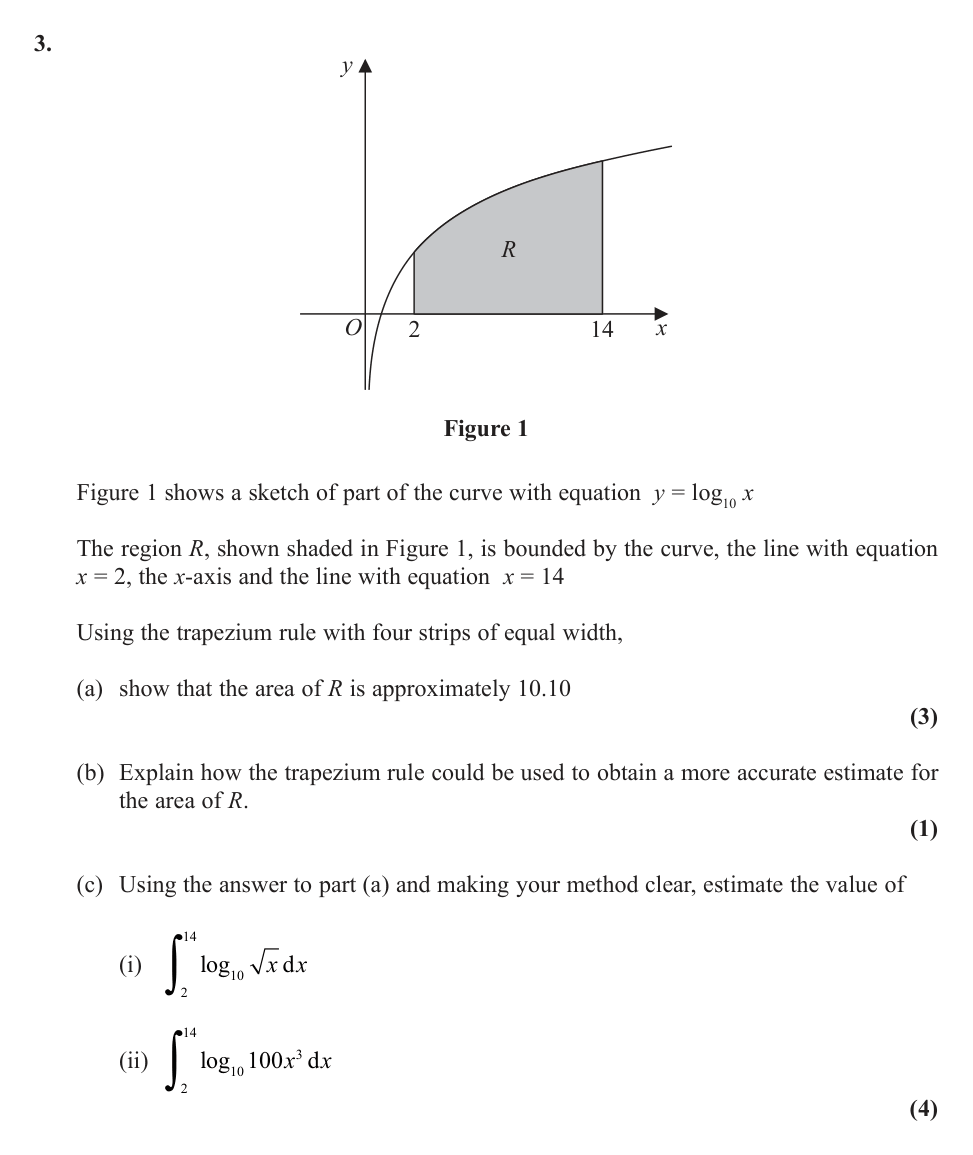
18. WMA12/01 October 2021 · Q3 Medium 8 marks · main topic: IntegrationShow worked solution Find the strip width Four equal strips from $x=2$ to $x=14$ have width $h=\dfrac{14-2}{4}=3$.
List the ordinates Use $x=2,5,8,11,14$ and $y=\log_{10}x$.
Apply the trapezium rule $A\approx\dfrac32\{\log_{10}2+\log_{10}14+2(\log_{10}5+\log_{10}8+\log_{10}11)\}=10.10\ldots$.
Improve the estimate Use more strips of smaller width to make the trapezium rule estimate more accurate.
Estimate the square-root integral $\log_{10}\sqrt{x}=\dfrac12\log_{10}x$, so $\int_2^{14}\log_{10}\sqrt{x}\,dx\approx\dfrac12(10.10)=5.05$.
Rewrite the second logarithm $\log_{10}(100x^3)=\log_{10}100+\log_{10}x^3=2+3\log_{10}x$.
Estimate the second integral $\int_2^{14}(2+3\log_{10}x)\,dx\approx2(12)+3(10.10)=54.30$.
Final answer $(a)\ 10.10.\quad (b)$ Use more strips. $\quad (c)(i)\ 5.05.\quad (c)(ii)\ 54.30$.
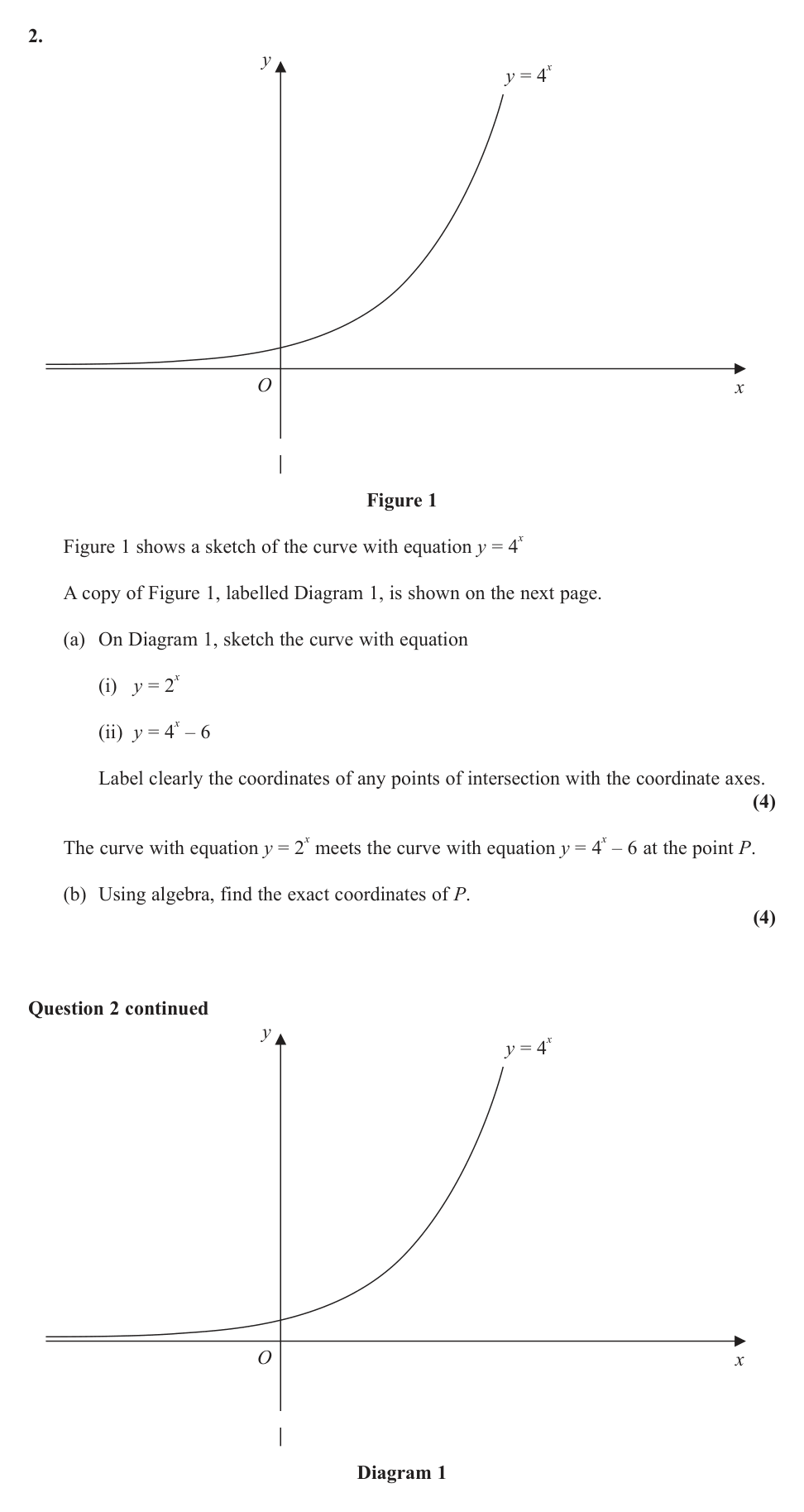
19. WMA12/01 May/June 2021 · Q2 Medium 8 marksShow worked solution Describe y equals two to the x $y=2^x$ is an increasing exponential curve. It crosses the $y$-axis at $(0,1)$ and has no $x$-axis intercept.
Describe y equals four to the x minus six $y=4^x-6$ is the graph of $y=4^x$ translated $6$ units down. It crosses the $y$-axis at $(0,-5)$.
Find the x-axis intercept For $y=4^x-6$, set $4^x-6=0$. Hence $4^x=6$ and $x=\log_4 6$.
Set up the intersection equation At $P$, $2^x=4^x-6$.
Use a substitution Let $u=2^x$. Then $4^x=(2^x)^2=u^2$, so $u=u^2-6$.
Solve for u $u^2-u-6=0$, so $(u-3)(u+2)=0$. Since $u=2^x>0$, $u=3$.
State P $2^x=3$, so $x=\log_2 3$, and $y=3$. Therefore $P=(\log_2 3,3)$.
Final answer $(a)(i)$ Sketch $y=2^x$ through $(0,1)$ with no $x$-axis intercept. $(a)(ii)$ Sketch $y=4^x-6$ through $(0,-5)$ and $(\log_4 6,0)$. $\quad (b)\ P=(\log_2 3,3)$.
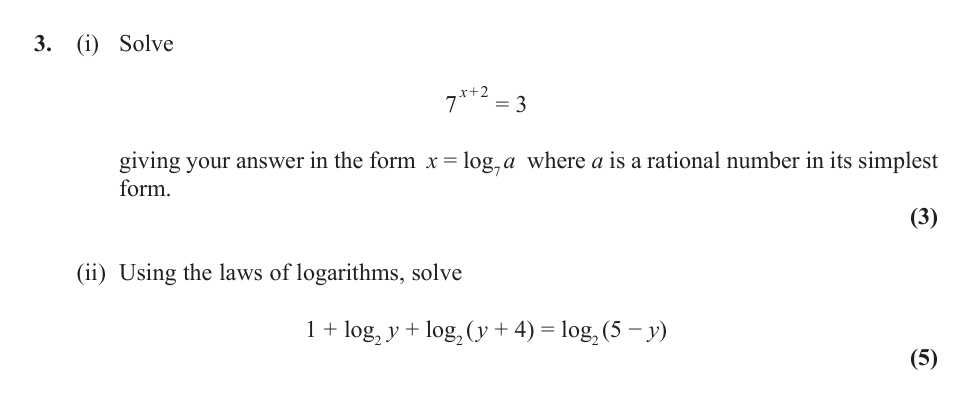
20. WMA12/01 January 2021 · Q3 Medium 8 marksShow worked solution Rewrite the exponential equation From $7^{x+2}=3$, divide by $7^2$ to get $7^x=\dfrac3{49}$.
Write x as a logarithm Therefore $x=\log_7\left(\dfrac3{49}\right)$.
Convert one to a logarithm Since $1=\log_2 2$, the equation becomes $\log_2 2+\log_2 y+\log_2(y+4)=\log_2(5-y)$.
Combine the logarithms $\log_2\{2y(y+4)\}=\log_2(5-y)$.
Solve the quadratic Thus $2y(y+4)=5-y$, so $2y^2+9y-5=0=(2y-1)(y+5)$.
Check the domain The original logarithms require $y>0$ and $y<5$, so $y=-5$ is invalid and $y=\dfrac12$.
Final answer $(i)\ x=\log_7\left(\dfrac3{49}\right).\quad (ii)\ y=\dfrac12$.
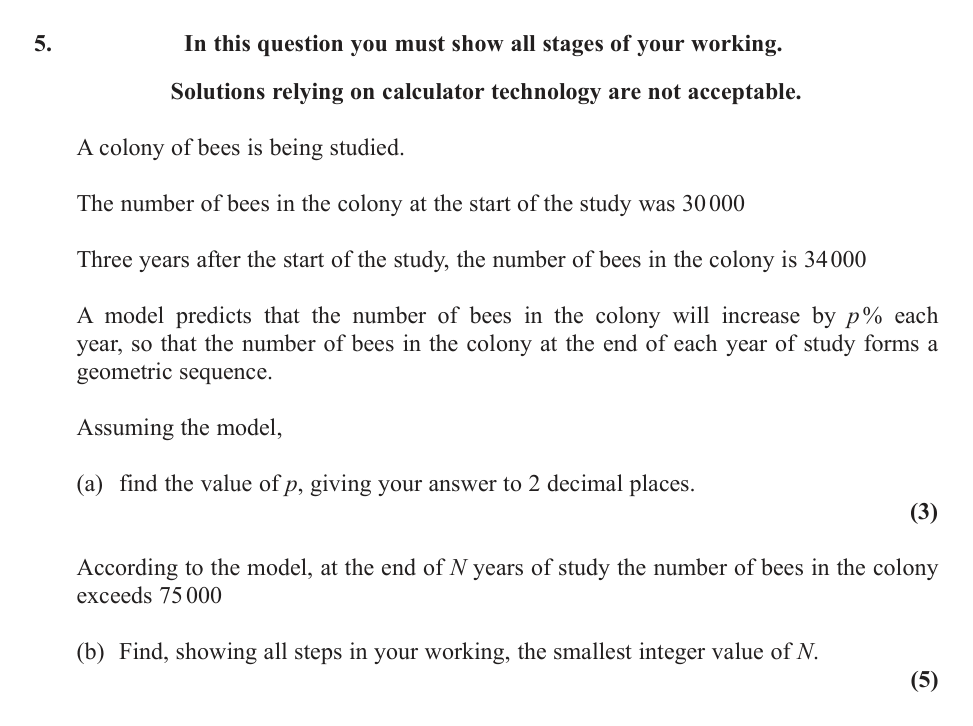
21. WMA12/01 January 2020 · Q5 Medium 8 marks · main topic: Modelling with Sequences & SeriesShow worked solution Set up the growth ratio Let the yearly ratio be $r$. After 3 years, $30000r^3=34000$.
Find p $r^3=\dfrac{17}{15}$, so $r=\left(\dfrac{17}{15}\right)^{1/3}\approx1.04257$. Therefore $p=(r-1)\times100\approx4.26$.
Set up the inequality After $N$ years the model gives $30000r^N$. We need $30000r^N>75000$, so $r^N>2.5$.
Take logarithms $N\log r>\log(2.5)$, so $N>\dfrac{\log(2.5)}{\log r}$.
Find the smallest integer Using $r\approx1.04257$, $\dfrac{\log(2.5)}{\log r}\approx21.98$. Hence the smallest integer value is $N=22$.
Final answer $(a)\ p=4.26.\quad (b)\ N=22$.
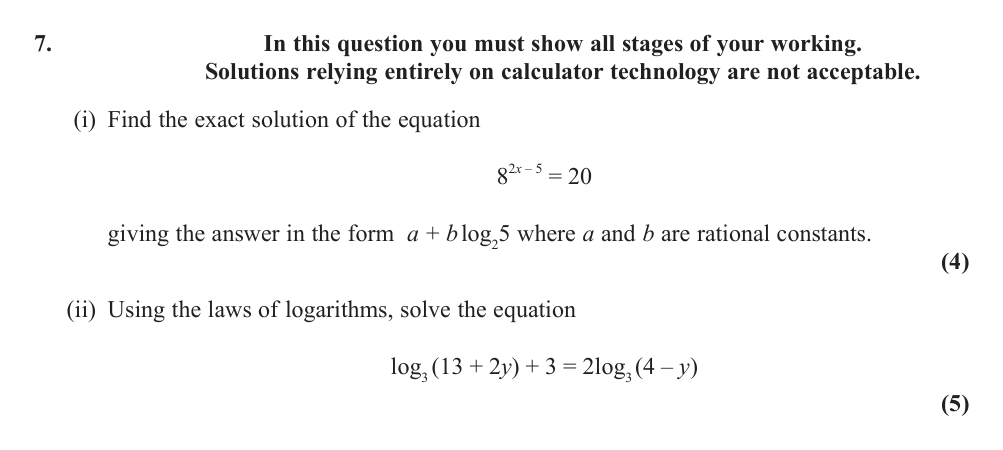
22. WMA12/01 January 2026 · Q7 Hard 9 marksShow worked solution Take logarithms base 2 From $8^{2x-5}=20$, take $\log_2$ of both sides to get $(2x-5)\log_2 8=\log_2 20$.
Simplify the logarithms Since $\log_2 8=3$ and $\log_2 20=\log_2(4\cdot5)=2+\log_2 5$, we get $3(2x-5)=2+\log_2 5$.
Solve for x $6x-15=2+\log_2 5$, so $6x=17+\log_2 5$ and $x=\dfrac{17}{6}+\dfrac16\log_2 5$.
Use log laws $3=\log_3 27$ and $2\log_3(4-y)=\log_3(4-y)^2$.
Remove the logarithms $\log_3(13+2y)+\log_3 27=\log_3(4-y)^2$, so $27(13+2y)=(4-y)^2$.
Solve the quadratic $351+54y=y^2-8y+16$, hence $y^2-62y-335=0=(y-67)(y+5)$.
Check the logarithm domains We need $13+2y>0$ and $4-y>0$. Therefore $y=67$ is not valid, and the solution is $y=-5$.
Final answer $(i)\ x=\dfrac{17}{6}+\dfrac16\log_2 5.\quad (ii)\ y=-5$.
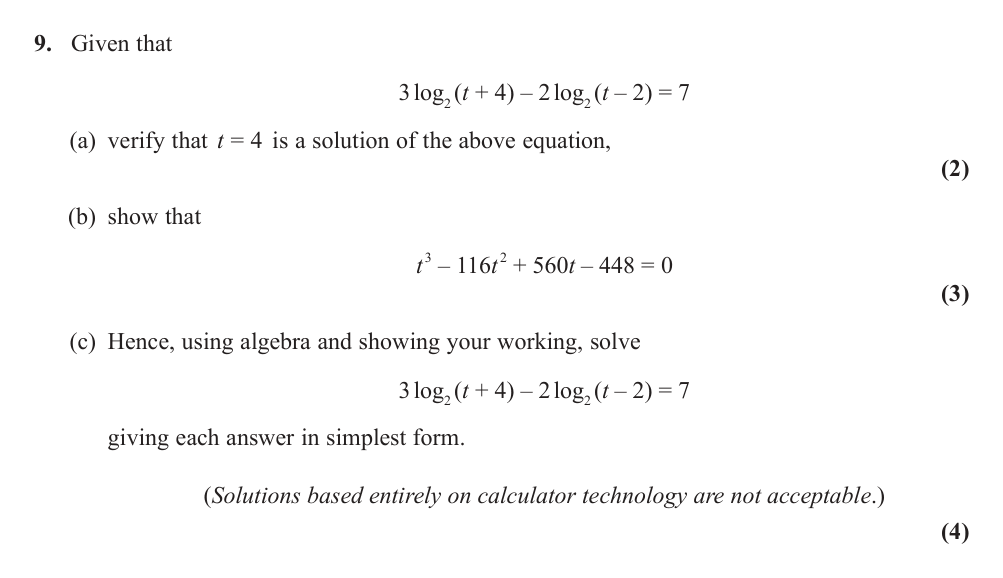
23. WMA12/01 May/June R 2024 · Q9 Hard 9 marksShow worked solution Verify t equals four Substitute $t=4$: $3\log_2(8)-2\log_2(2)=3(3)-2(1)=7$.
Combine the logarithms $3\log_2(t+4)-2\log_2(t-2)=\log_2\left(\dfrac{(t+4)^3}{(t-2)^2}\right)$.
Use seven as a logarithm $7=\log_2(128)$, so $\dfrac{(t+4)^3}{(t-2)^2}=128$.
Clear the denominator $(t+4)^3=128(t-2)^2$.
Expand $t^3+12t^2+48t+64=128t^2-512t+512$.
Show the cubic Rearranging gives $t^3-116t^2+560t-448=0$.
Use the known root Since $t=4$ is a root, $(t-4)$ is a factor.
Factor the cubic $t^3-116t^2+560t-448=(t-4)(t^2-112t+112)$.
Solve the quadratic $t^2-112t+112=0$ gives $t=\dfrac{112\pm\sqrt{112^2-4(112)}}{2}=56\pm12\sqrt{21}$.
Use the log domain The original equation requires $t>2$. The value $56-12\sqrt{21}$ is less than $2$, so it is rejected. Hence $t=4$ or $t=56+12\sqrt{21}$.
Final answer $(a)$ Verified. $\quad (b)$ Proven. $\quad (c)$ $t=4$ or $t=56+12\sqrt{21}$.
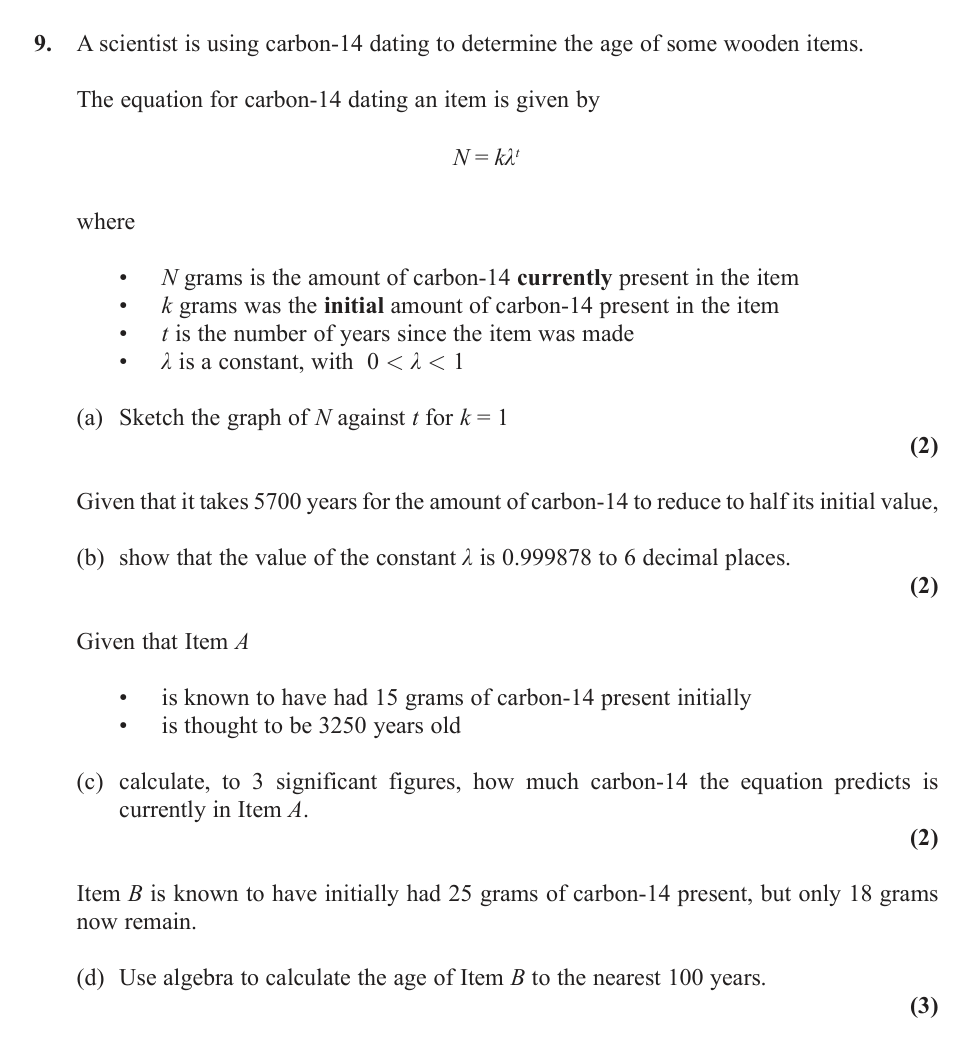
24. WMA12/01 May/June 2022 · Q9 Hard 9 marks · main topic: Modelling with Sequences & SeriesShow worked solution Sketch the model for k equals one For $k=1$, $N=\lambda^t$ with $0<\lambda<1$. The graph starts at $(0,1)$, decreases as $t$ increases, and tends towards $0$.
Use the half-life information After $5700$ years, $N=\dfrac{k}{2}$, so $k\lambda^{5700}=\dfrac{k}{2}$.
Find lambda $\lambda^{5700}=\dfrac12$, hence $\lambda=\left(\dfrac12\right)^{1/5700}=0.999878\ldots$, so $\lambda=0.999878$ to 6 decimal places.
Model item A For item A, $k=15$ and $t=3250$, so $N=15\lambda^{3250}$.
Calculate item A $N=15(0.9998784026\ldots)^{3250}=10.103\ldots$, so the current amount is $10.1$ g to 3 significant figures.
Set up item B For item B, $18=25\lambda^t$, so $\lambda^t=\dfrac{18}{25}$.
Take logarithms $t\log\lambda=\log\left(\dfrac{18}{25}\right)$, so $t=\dfrac{\log(18/25)}{\log\lambda}$.
Round the age Using $\lambda=(1/2)^{1/5700}$ gives $t=2701\ldots$, so the age is $2700$ years to the nearest $100$ years.
Final answer $(a)$ Decreasing exponential through $(0,1)$. $\quad (b)\ \lambda=0.999878$. $\quad (c)\ 10.1\text{ g}.\quad (d)\ 2700$ years.
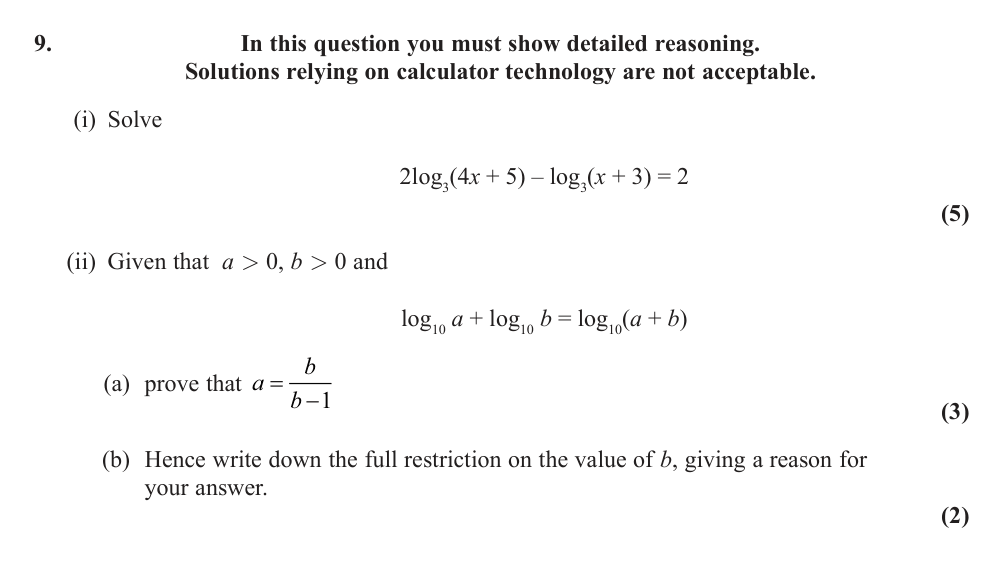
25. WMA12/01 October 2025 · Q9 Hard 10 marksShow worked solution State the domain The logarithms require $4x+5>0$ and $x+3>0$, so $x>-\dfrac54$.
Combine the logarithms $2\log_3(4x+5)-\log_3(x+3)=\log_3\left(\dfrac{(4x+5)^2}{x+3}\right)$.
Use two as a logarithm $2=\log_3 9$, so $\dfrac{(4x+5)^2}{x+3}=9$.
Form the quadratic $(4x+5)^2=9(x+3)$, so $16x^2+40x+25=9x+27$. Hence $16x^2+31x-2=0$.
Solve the quadratic $16x^2+31x-2=(16x-1)(x+2)=0$, so $x=\dfrac1{16}$ or $x=-2$.
Check the domain $x=-2$ is outside the domain, so $x=\dfrac1{16}$.
Use the logarithm equation $\log_{10}a+\log_{10}b=\log_{10}(a+b)$ gives $\log_{10}(ab)=\log_{10}(a+b)$.
Equate the arguments Since the logarithm function is one-to-one, $ab=a+b$.
Rearrange for a $ab-a=b$, so $a(b-1)=b$ and therefore $a=\dfrac{b}{b-1}$.
Restrict b Given $a>0$ and $b>0$, the fraction $\dfrac{b}{b-1}$ must be positive. Since the numerator is positive, the denominator must also be positive, so $b>1$.
Final answer $(i)$ $x=\dfrac1{16}$. $\quad (ii)(a)$ Proven. $\quad (ii)(b)$ $b>1$.
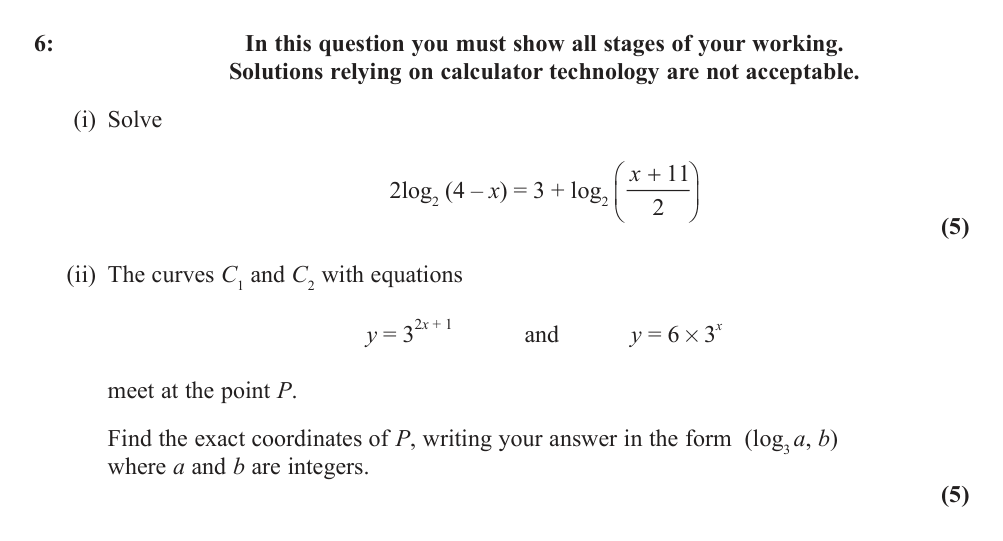
26. WMA12/01 May/June 2025 · Q6 Hard 10 marksShow worked solution State the domain The logarithms require $4-x>0$ and $\dfrac{x+11}{2}>0$, so $-11<x<4$.
Use log laws $2\log_2(4-x)=\log_2((4-x)^2)$ and $3+\log_2\left(\dfrac{x+11}{2}\right)=\log_2\left(8\cdot\dfrac{x+11}{2}\right)$.
Equate the arguments Thus $(4-x)^2=4(x+11)$.
Solve the quadratic $x^2-8x+16=4x+44$, so $x^2-12x-28=0$. Hence $(x-14)(x+2)=0$.
Check the domain The root $14$ is outside the domain, so $x=-2$.
Equate the curves At $P$, $3^{2x+1}=6\times3^x$.
Let u equal 3 to the x Let $u=3^x$. Then $3^{2x+1}=3u^2$, so $3u^2=6u$.
Find u Since $u>0$, divide by $3u$ to get $u=2$. Hence $3^x=2$ and $x=\log_3 2$.
Find y $y=6\times3^x=6\times2=12$, so $P=(\log_3 2,12)$.
Final answer $(i)$ $x=-2$. $\quad (ii)$ $P=(\log_3 2,12)$.
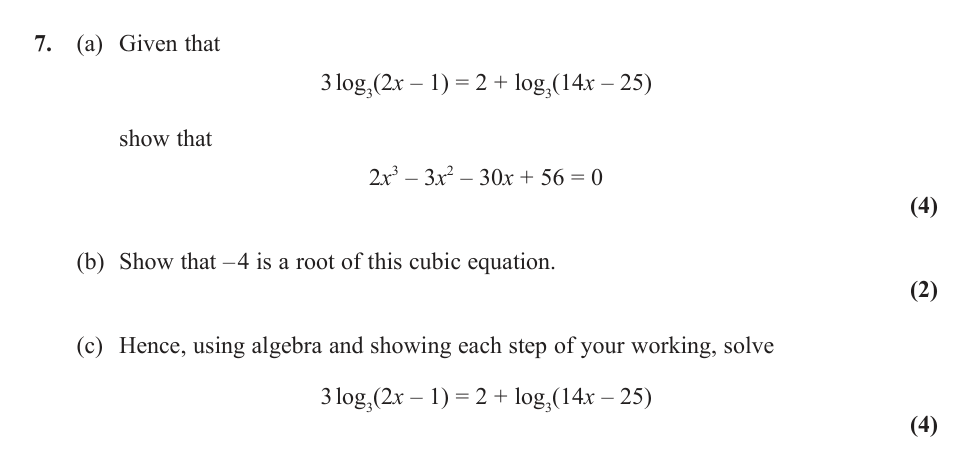
27. WMA12/01 May/June 2021 · Q7 Hard 10 marksShow worked solution Use the power law $3\log_3(2x-1)=\log_3(2x-1)^3$.
Rewrite two as a logarithm Since $2=\log_3 9$, the right side is $\log_3 9+\log_3(14x-25)=\log_3\{9(14x-25)\}$.
Equate the arguments So $(2x-1)^3=9(14x-25)$.
Expand and simplify $8x^3-12x^2+6x-1=126x-225$, which simplifies to $2x^3-3x^2-30x+56=0$.
Check the given root Substituting $x=-4$ gives $2(-64)-3(16)-30(-4)+56=0$, so $-4$ is a root.
Factorise the cubic Dividing by $(x+4)$ gives $2x^2-11x+14=(2x-7)(x-2)$.
Apply the logarithm domain The possible roots are $-4$, $2$, and $\dfrac72$. The original logarithms require $2x-1>0$ and $14x-25>0$, so $x>\dfrac{25}{14}$.
State the valid solutions Therefore the solutions are $x=2$ and $x=\dfrac72$.
Final answer $(a)$ Proven. $\quad (b)$ $-4$ is a root of the cubic. $\quad (c)\ x=2,\ \dfrac72$.
Dr Eslam Ahmed Elite Mathematics · Questions classified by topic, solutions checked by Dr Eslam
 Elite Mathematics