Trigonometric Functions: past paper questions & worked solutions
Every Trigonometric Functions question from the WMA11 papers in our bank, 2019–2026, sorted from easiest to hardest. Try each one first, then open the worked solution.
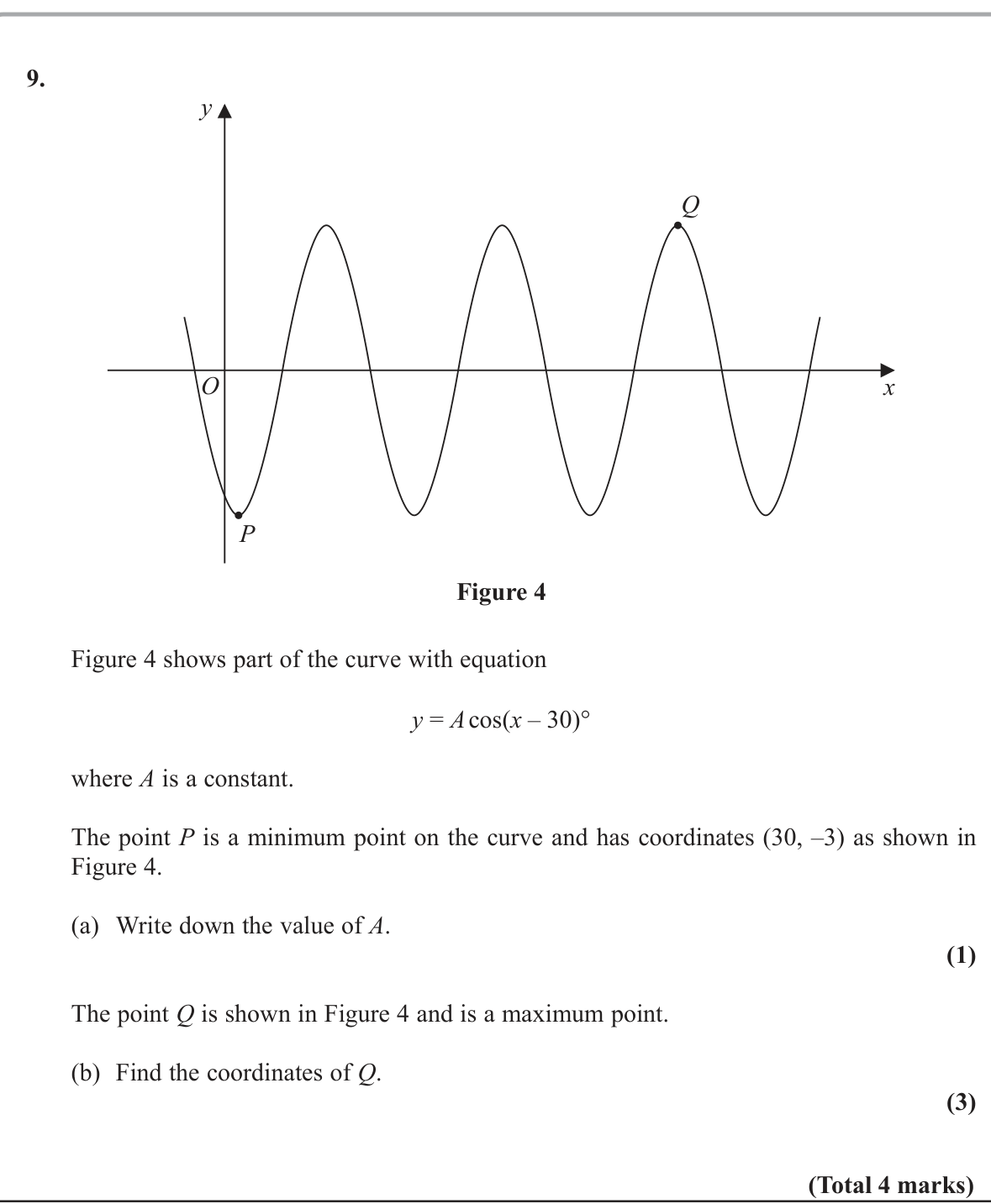
At $P(30,-3)$, $x-30=0$, so $\cos0^\circ=1$. Therefore $A=-3$.
Find maximum points
Since $A=-3$, maximum points occur when $\cos(x-30)^\circ=-1$.
Use the shown maximum Q
$x-30=180+360n$, so $x=210+360n$. The maximum shown at $Q$ is two full periods after the first maximum, so $x=210+720=930$.
Write Q
The maximum y-value is $3$, hence $Q=(930,3)$.
Final answer
$(a)\ A=-3.\quad (b)\ Q=(930,3)$.
3. WMA11/01 October 2019 · Q9
Easy4 marksShow worked solution
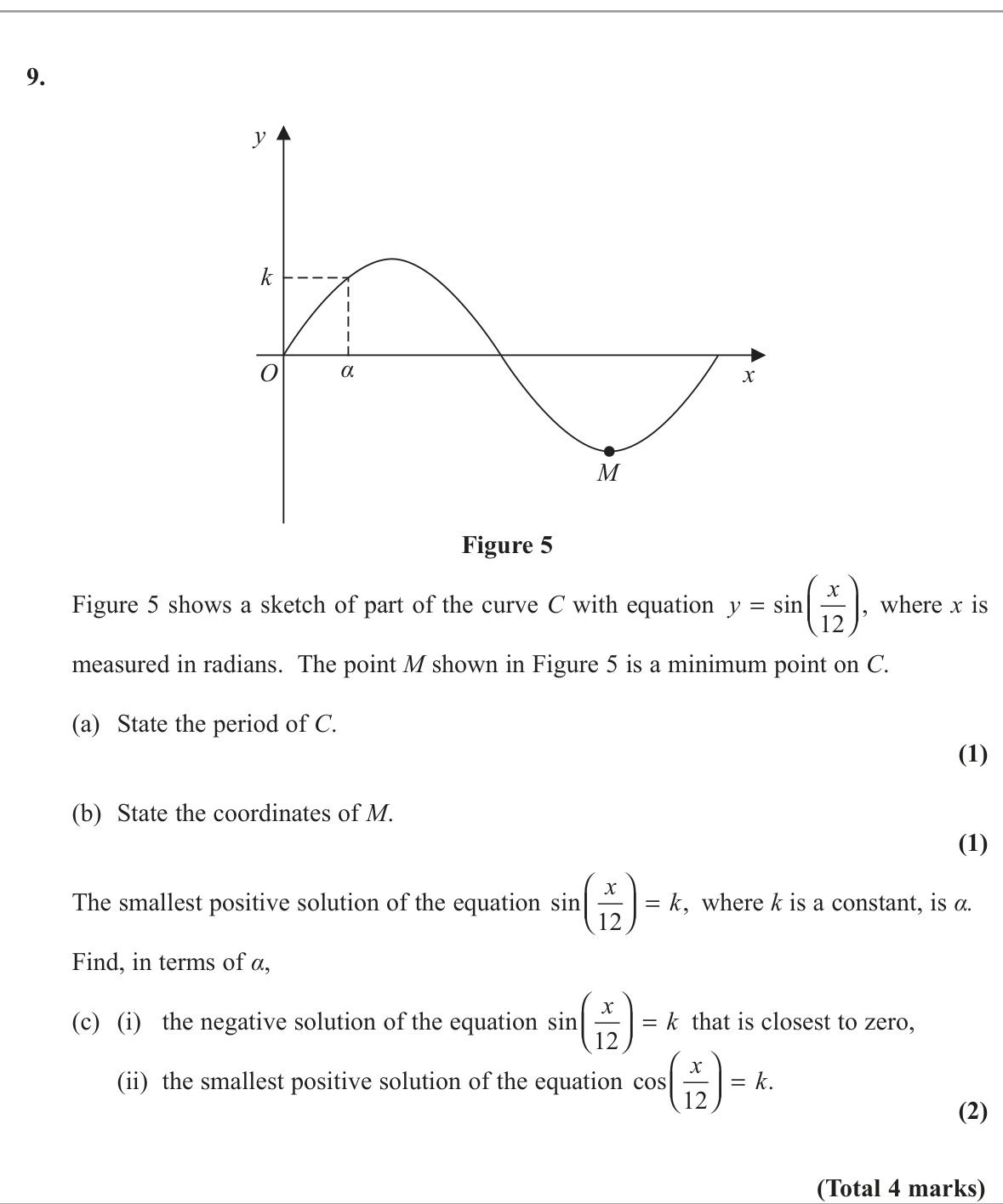
Use the scale factor inside the sine
For $y=\sin\left(\frac{x}{12}\right)$, one full sine cycle needs $\frac{x}{12}$ to increase by $2\pi$, so the period is $24\pi$.
Locate the minimum point
The sine function is $-1$ when its angle is $\frac{3\pi}{2}$. Therefore $\frac{x}{12}=\frac{3\pi}{2}$, so $x=18\pi$ and $M=(18\pi,-1)$.
Use sine symmetry
If the smallest positive solution of $\sin\left(\frac{x}{12}\right)=k$ is $\alpha$, then the closest negative solution is one half-period before the opposite sine position: $-12\pi-\alpha$.
Convert to cosine
Since $\cos\theta=\sin\left(\frac\pi2-\theta\right)$, the corresponding smallest positive cosine solution is $6\pi-\alpha$.
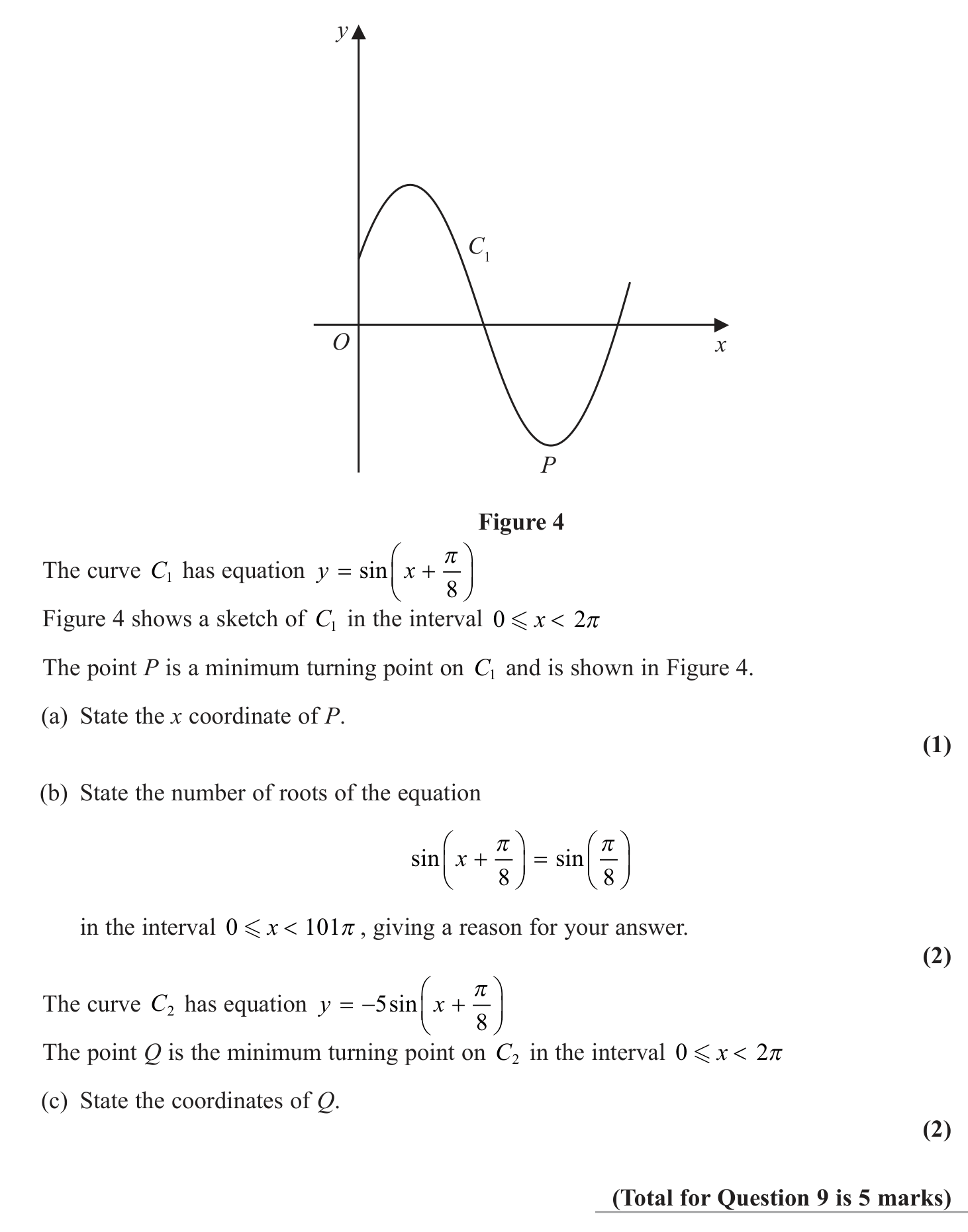
A sine curve reaches its minimum when its angle is $\frac{3\pi}{2}$. Therefore $$x+\frac\pi8=\frac{3\pi}{2},$$ so $$x=\frac{12\pi}{8}-\frac\pi8=\frac{11\pi}{8}.$$
(b) Write both families of roots
For $\sin u=\sin\left(\frac\pi8\right)$, $$u=\frac\pi8+2n\pi\quad\text{or}\quad u=\frac{7\pi}{8}+2n\pi.$$ With $u=x+\frac\pi8$, this gives $$x=2n\pi\quad\text{or}\quad x=\frac{3\pi}{4}+2n\pi.$$
(b) Count the roots in the interval
For $0\le x<101\pi$, each family has $n=0,1,\ldots,50$, giving 51 roots from each family. Hence the total number of roots is $$51+51=102.$$
(c) Locate the minimum of C2
Because $y=-5\sin\left(x+\frac\pi8\right)$, the minimum value $-5$ occurs when the sine value is $1$. Thus $$x+\frac\pi8=\frac\pi2,$$ so $x=\frac{3\pi}{8}$. Therefore $$Q=\left(\frac{3\pi}{8},-5\right).$$
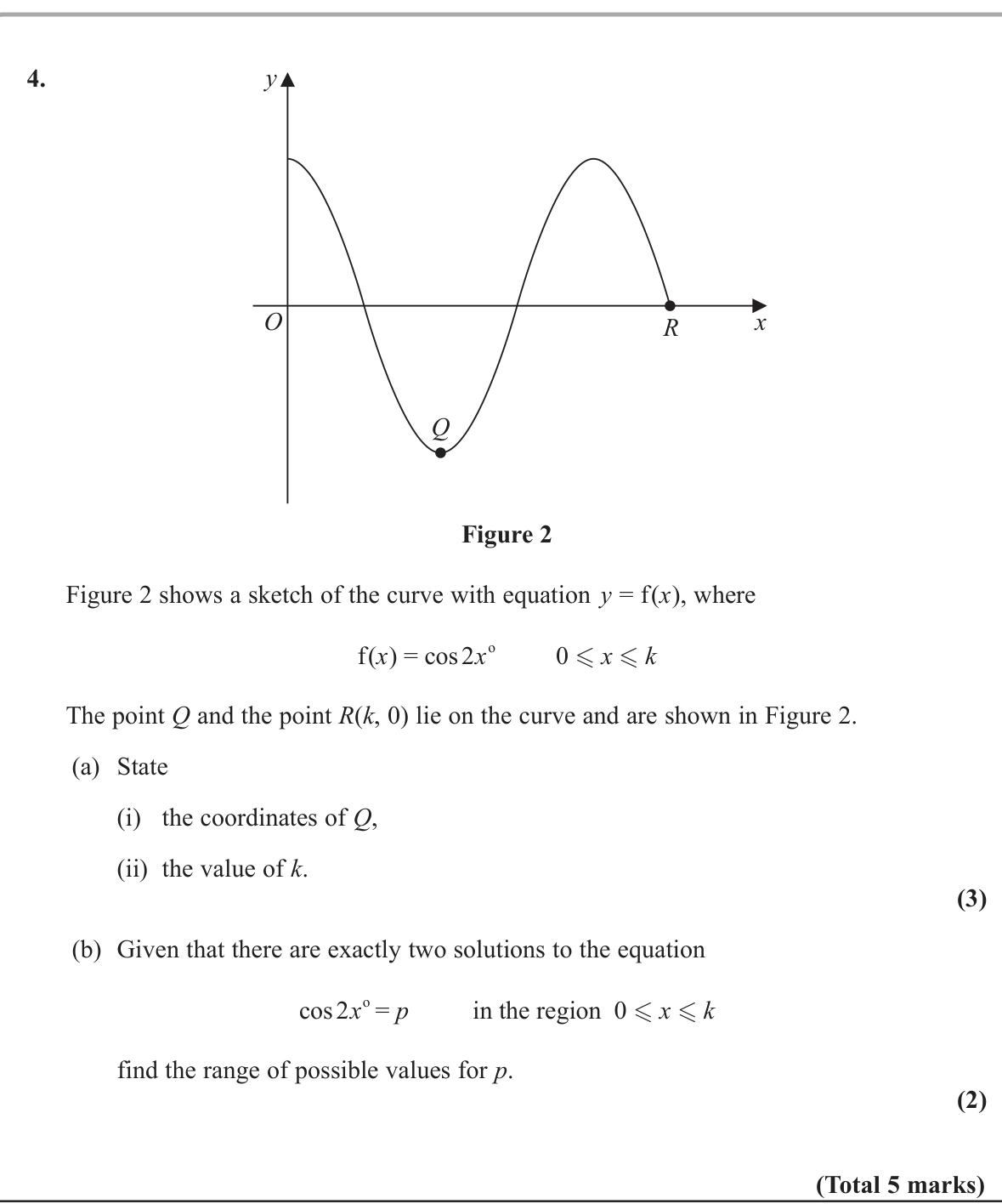
For $f(x)=\cos 2x^\circ$, the first minimum occurs when $2x=180^\circ$, so $x=90^\circ$ and $y=-1$. Therefore $Q=(90,-1)$.
Find k
The point $R(k,0)$ is the x-intercept after the next maximum. This occurs when $2x=450^\circ$, so $x=225^\circ$. Hence $k=225$.
Count horizontal intersections
A horizontal line $y=p$ gives exactly two intersections on $0\le x\le225$ when it cuts the two negative branches only, so $-1<p<0$.
Include the maximum case
There are also exactly two solutions when $p=1$, at $x=0$ and $x=180$. Therefore $-1<p<0$ or $p=1$.
Final answer
$(a)(i)\ Q=(90,-1).\quad (a)(ii)\ k=225.\quad (b)\ -1<p<0\text{ or }p=1$.
6. WMA11/01 January 2021 · Q3
Easy5 marksShow worked solution
Read cosine key points
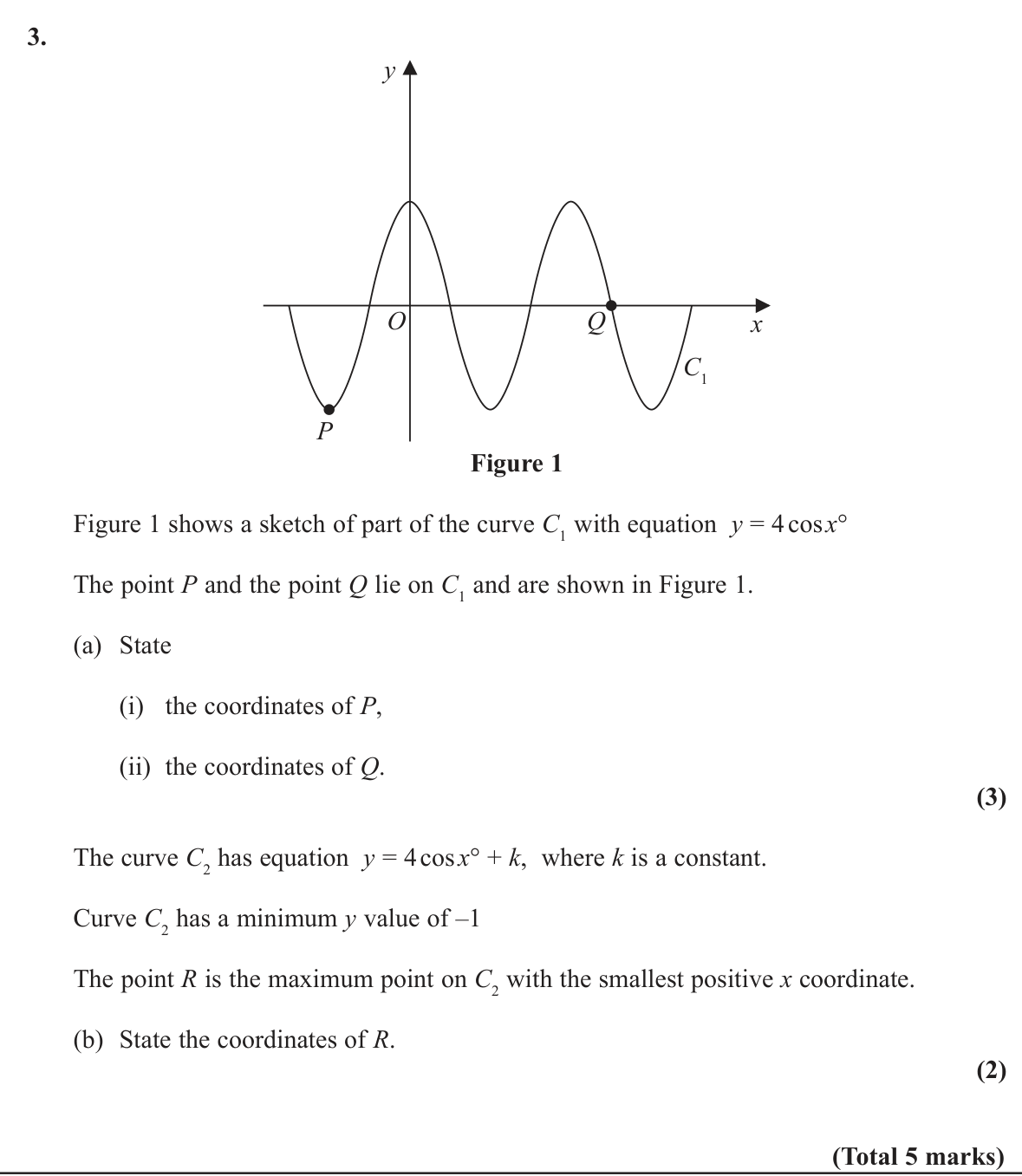
For $y=4\cos x^\circ$, the maximum value is $4$ and the minimum value is $-4$. The minimum immediately to the left of the y-axis is at $x=-180^\circ$, so $P=(-180,-4)$.
Find Q from the cosine zero
The x-intercepts of $4\cos x^\circ$ occur at $x=90^\circ,270^\circ,450^\circ,\ldots$. The point shown to the right of the next maximum is $Q=(450,0)$.
Use the shifted curve C2
For $C_2$, $y=4\cos x^\circ+k$. Its minimum is $-4+k$. Since the minimum value is $-1$, $-4+k=-1$, so $k=3$.
Find R
The maximum value of $C_2$ is $4+3=7$. The maximum point with the smallest positive x-coordinate occurs at $x=360^\circ$, so $R=(360,7)$.
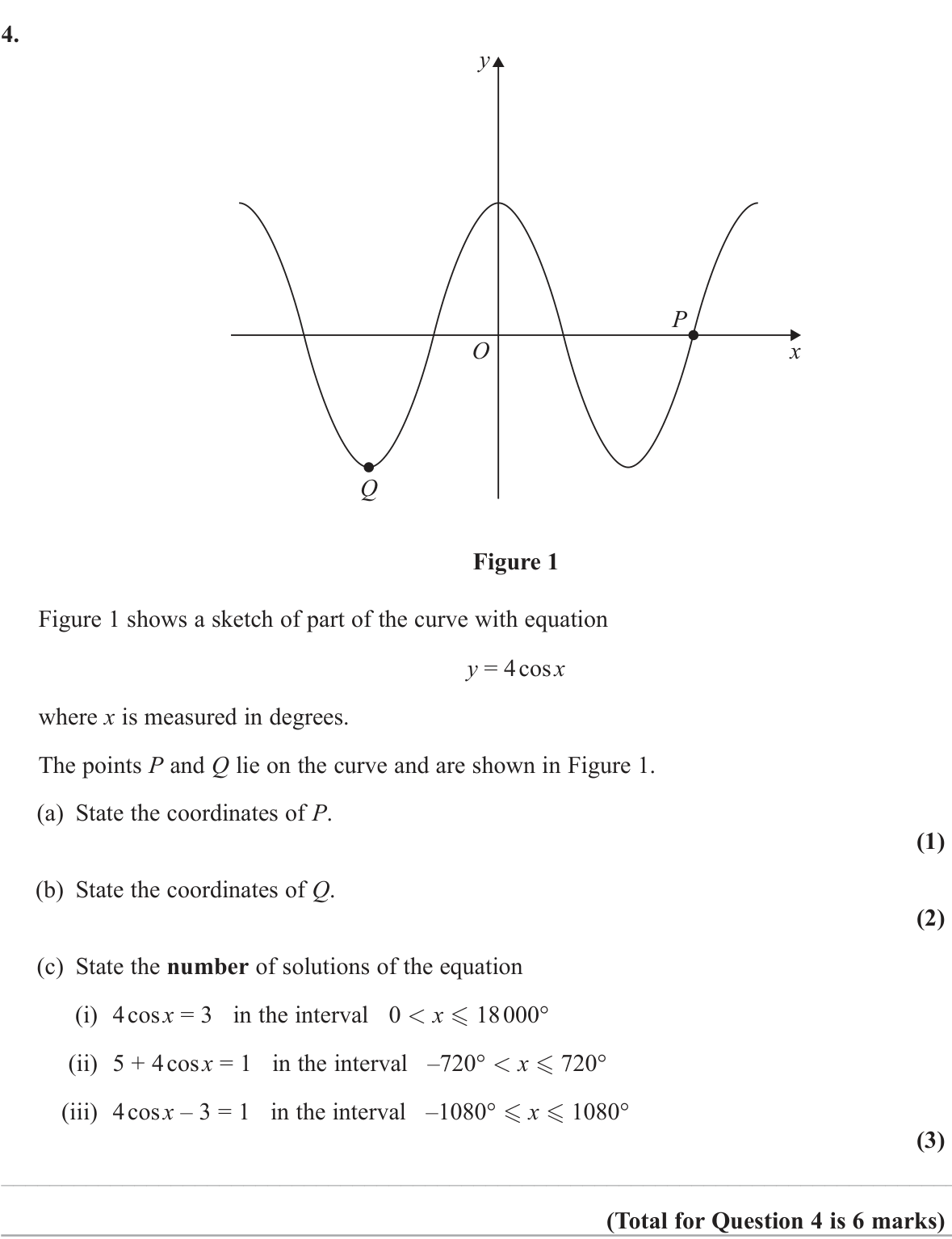
For $y=4\cos x$, the x-intercepts occur at $x=90^\circ+180^\circ n$. The labelled point $P$ is the right-hand intercept after $180^\circ$, so $P=(270^\circ,0)$.
Point Q
The minimum value is $-4$, reached at $x=180^\circ+360^\circ n$. The labelled point on the left is $Q=(-180^\circ,-4)$.
Count part c(i)
$4\cos x=3$ has two solutions every $360^\circ$. The interval $0<x\le18000^\circ$ contains $50$ full periods, so there are $100$ solutions.
Count part c(ii)
$5+4\cos x=1$ gives $\cos x=-1$. This occurs once every $360^\circ$. In $-720^\circ<x\le720^\circ$, the solutions are $-540^\circ,-180^\circ,180^\circ,540^\circ$, so there are $4$.
Count part c(iii)
$4\cos x-3=1$ gives $\cos x=1$. In $-1080^\circ\le x\le1080^\circ$, the multiples of $360^\circ$ are $-1080,-720,-360,0,360,720,1080$, so there are $7$.
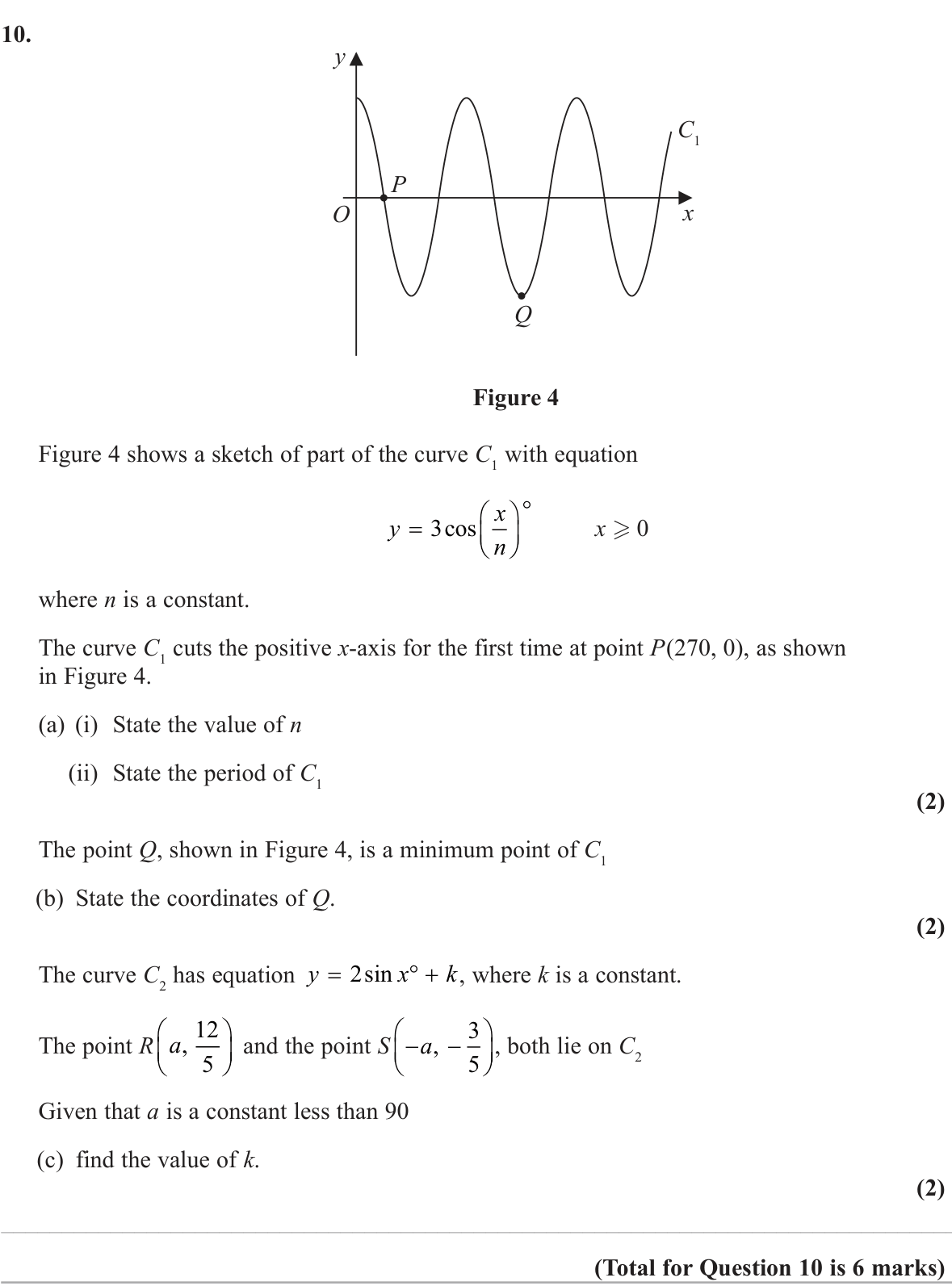
For $y=3\cos\left(\dfrac{x}{n}\right)^\circ$, the first positive zero occurs when $\dfrac{x}{n}=90^\circ$.
Find n
Since $P=(270,0)$, $\dfrac{270}{n}=90$, so $n=3$.
Find the period
The period is $360n=360(3)=1080^\circ$.
Read the shown minimum point
A minimum occurs when $\dfrac{x}{3}=180^\circ+360^\circ k$. The point $Q$ shown is the next displayed minimum after one full period, so $x=1620$ and $y=-3$.
Use the two points on C2
For $y=2\sin x^\circ+k$, the points give $2\sin a+k=\dfrac{12}{5}$ and $-2\sin a+k=-\dfrac35$.
Add the equations
Adding gives $2k=\dfrac{12}{5}-\dfrac35=\dfrac95$, so $k=\dfrac{9}{10}$.
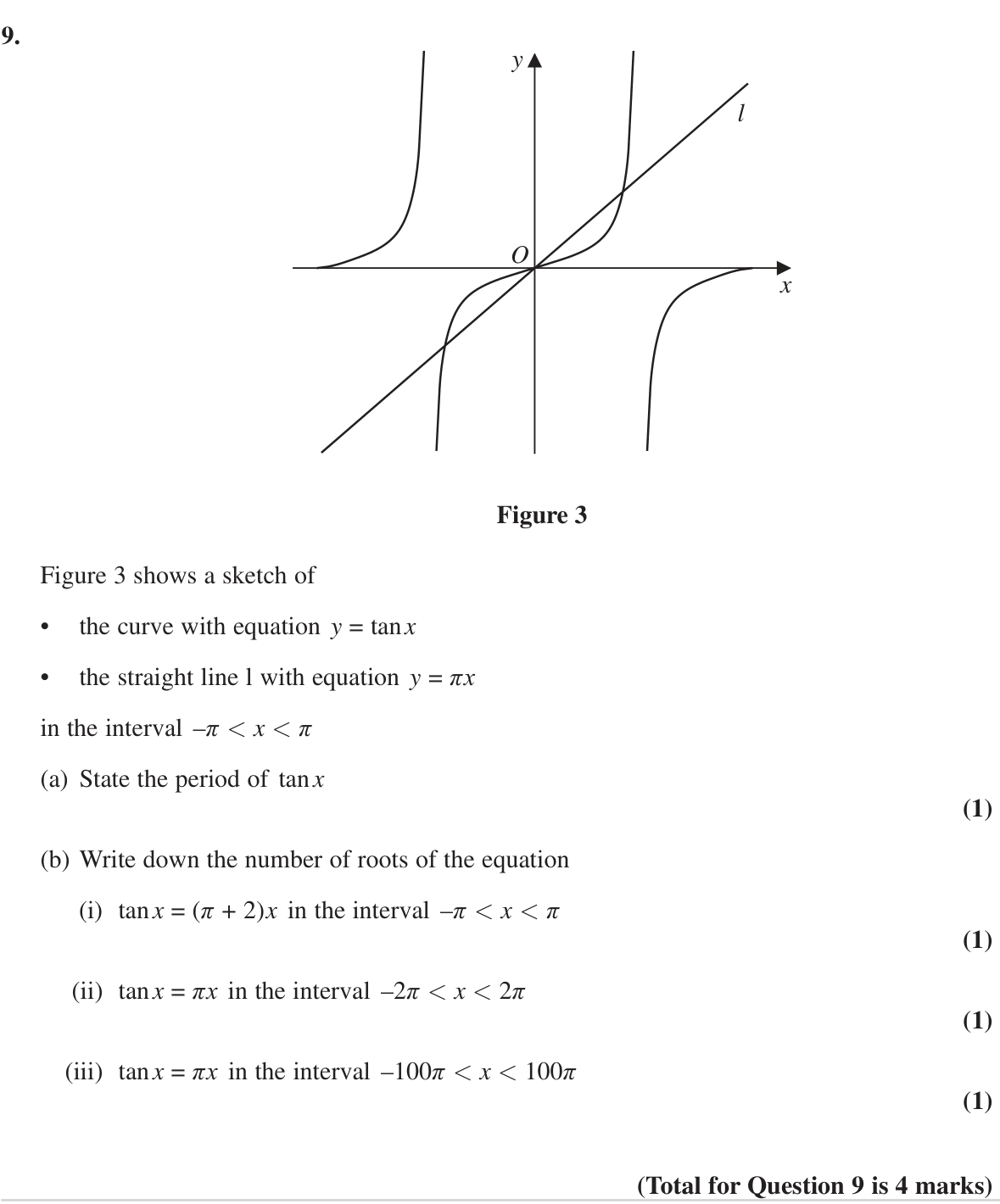
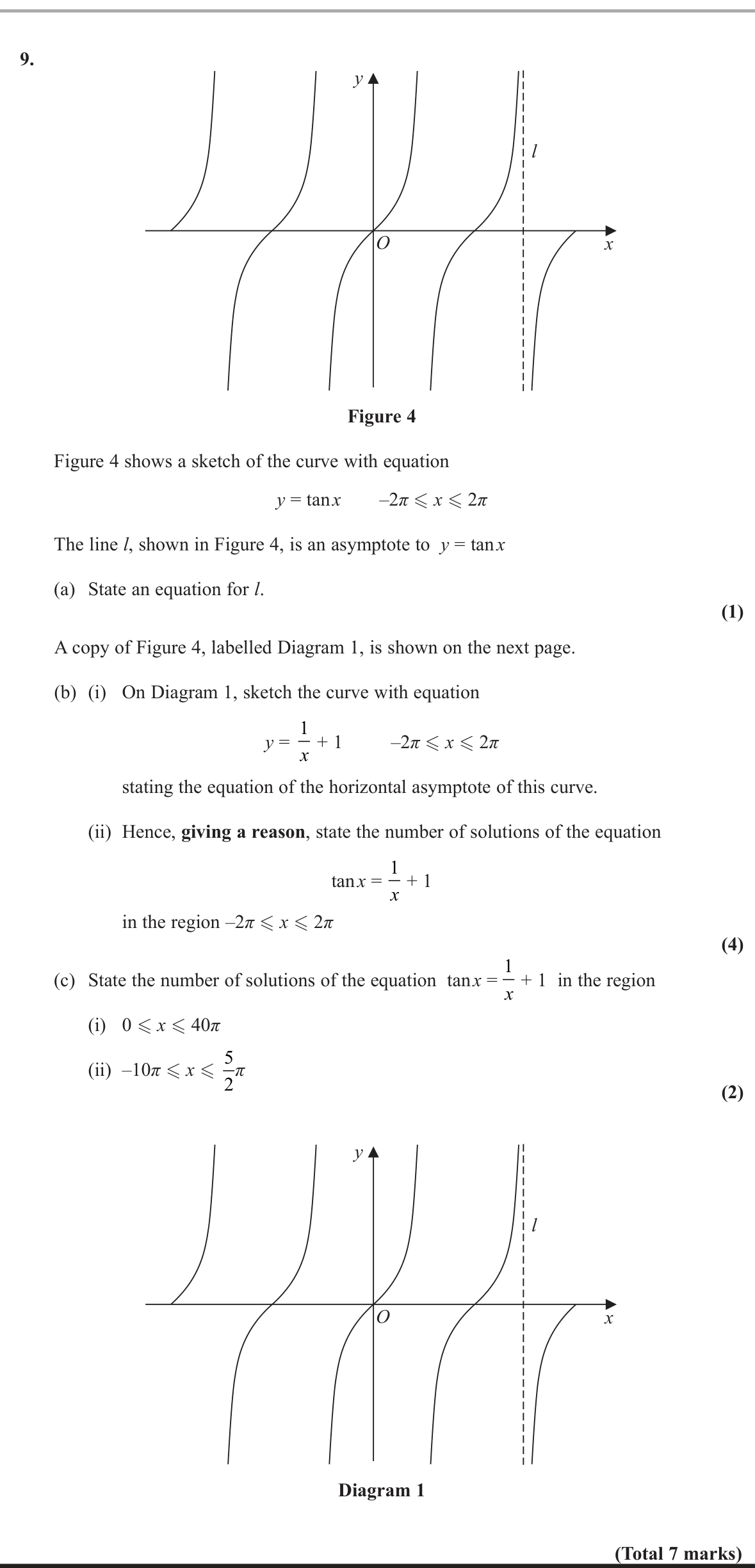
The shown dashed asymptote is the right-hand positive asymptote before $2\pi$, so $l$ has equation $x=\dfrac{3\pi}{2}$.
Describe the reciprocal graph
For $y=\dfrac1x+1$, the vertical asymptote is $x=0$ and the horizontal asymptote is $y=1$. The right branch lies above $y=1$ and the left branch lies below $y=1$.
Count intersections on -2pi to 2pi
The number of solutions of $\tan x=\dfrac1x+1$ is the number of intersections of the two graphs. From the sketch on $-2\pi\le x\le2\pi$, there are $5$ intersections.
Count first interval solutions
From the repeated tangent branches and the reciprocal curve, there is one intersection in each positive interval between consecutive tangent asymptotes. From $0$ to $40\pi$, this gives $40$ solutions.
Count second interval solutions
Extending the same intersection pattern across the stated interval gives $14$ intersections, so there are $14$ solutions.
Final answer
$(a)\ x=\dfrac{3\pi}{2}.\quad (b)(i)\ y=1\text{ is the horizontal asymptote}.\quad (b)(ii)\ 5.\quad (c)(i)\ 40.\quad (c)(ii)\ 14$.
13. WMA11/01 October 2024 · Q7
Medium8 marksShow worked solution
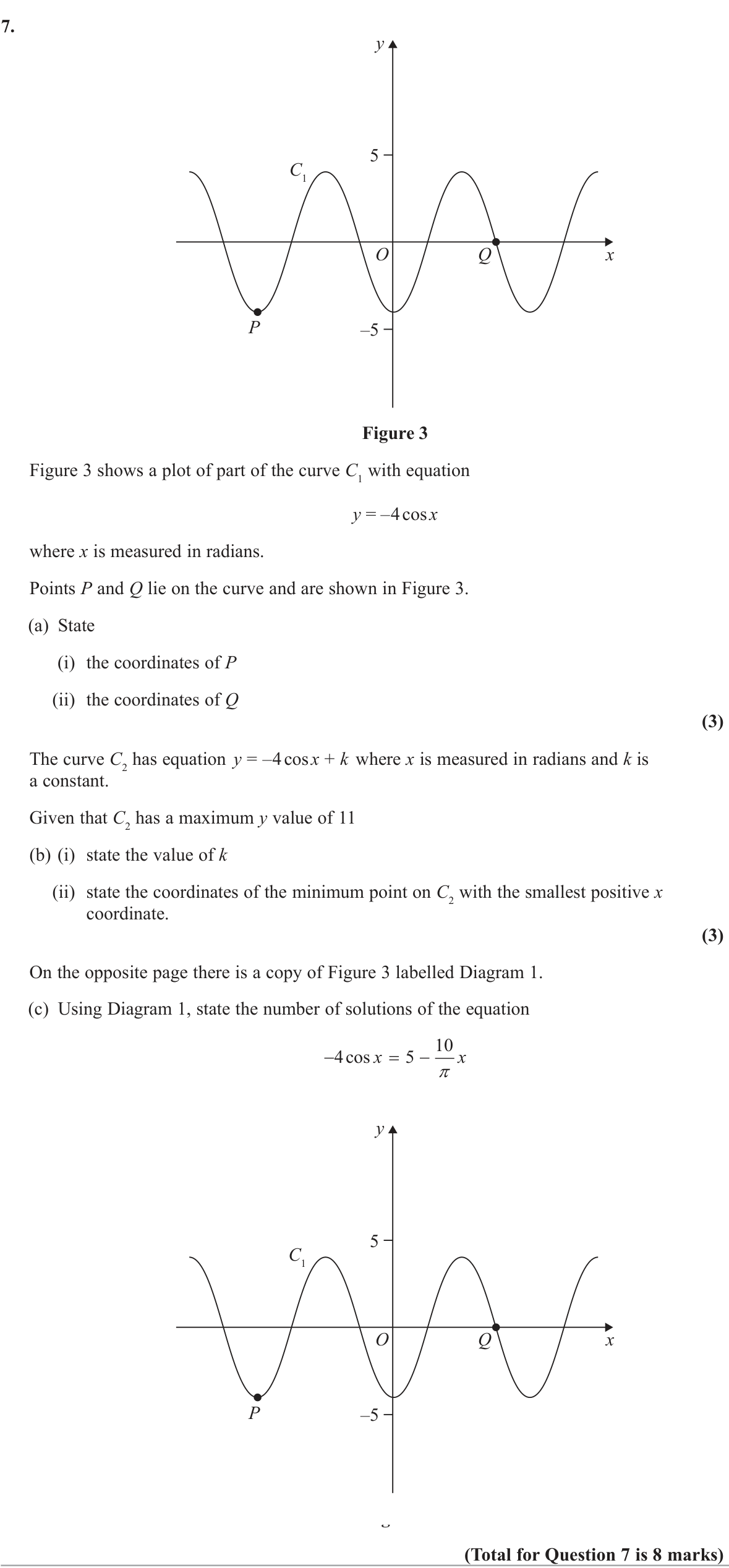
Use y equals negative 4 cos x
For $y=-4\cos x$, minimum points occur at $x=2\pi n$ with value $-4$.
Read P
The displayed minimum to the left of the y-axis is $P=(-2\pi,-4)$.
Read Q
The point $Q$ is the positive x-intercept after the maximum at $x=\pi$, so $Q=(\dfrac{3\pi}{2},0)$.
Find k for C2
For $y=-4\cos x+k$, the maximum value is $4+k$. Given the maximum is $11$, $k=7$.
Find the smallest positive minimum on C2
The minimum value is $-4+7=3$. The first positive minimum is at $x=2\pi$, so the point is $(2\pi,3)$.
Interpret the equation graphically
$-4\cos x=5-\dfrac{10}{\pi}x$ is the intersection of the cosine curve with the straight line $y=5-\dfrac{10}{\pi}x$.
Count intersections
The line passes through $(0,5)$ and meets the displayed curve once, at the x-axis point, so there is 1 solution.
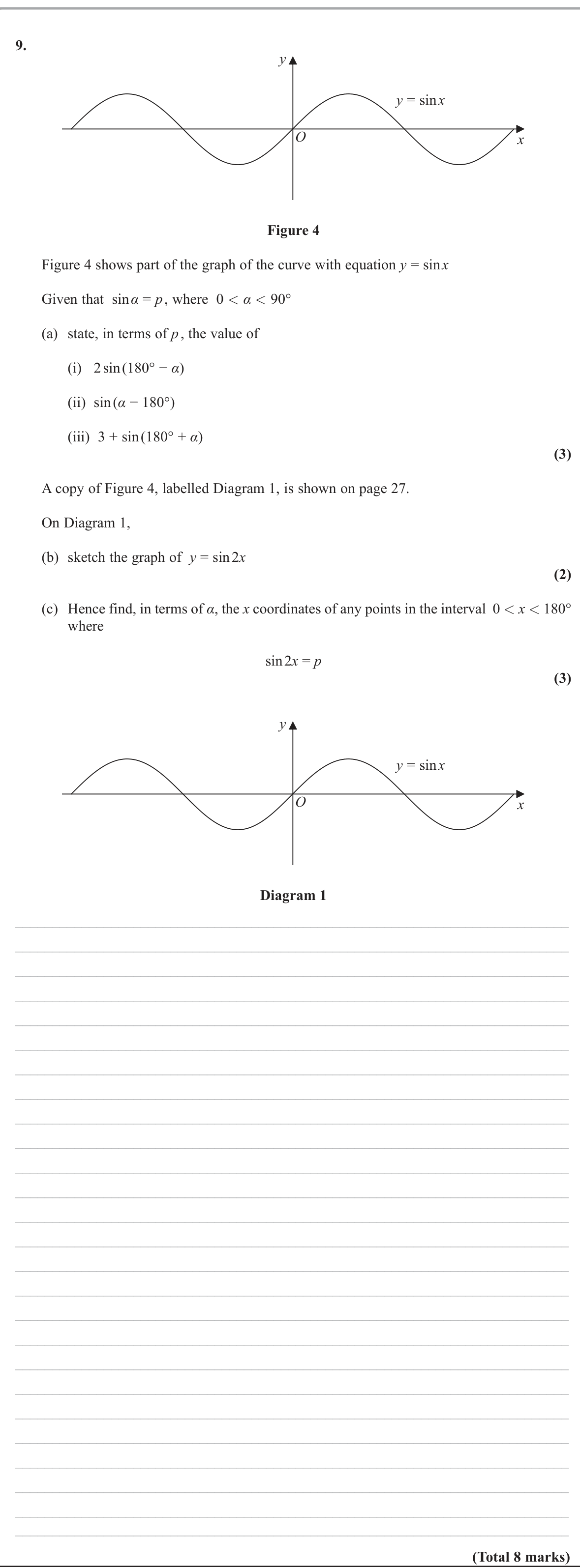
$\sin(180^\circ+\alpha)=-\sin\alpha=-p$, so $3+\sin(180^\circ+\alpha)=3-p$.
Sketch y = sin 2x
The graph has amplitude 1 and period $180^\circ$. It crosses the x-axis at $0^\circ,90^\circ,180^\circ$, has a maximum at $45^\circ$, and a minimum at $135^\circ$.
Solve sin 2x = p
Since $\sin\alpha=p$ and $0<2x<360^\circ$, the possible values are $2x=\alpha$ or $2x=180^\circ-\alpha$.
Find x
Therefore $x=\dfrac{\alpha}{2}$ or $x=90^\circ-\dfrac{\alpha}{2}$.
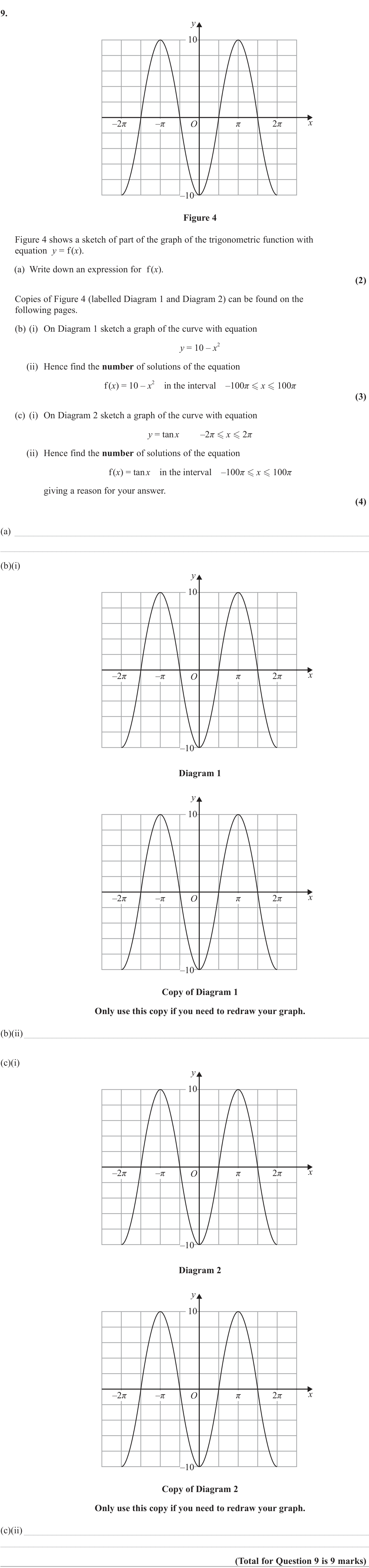
The graph has amplitude $10$, period $2\pi$, and value $-10$ at $x=0$, so $f(x)=-10\cos x$.
Sketch y equals 10 minus x squared
The graph $y=10-x^2$ is a downward-opening parabola with vertex $(0,10)$ and x-intercepts at $x=\pm\sqrt{10}$.
Count intersections with the parabola
On the given sketch, the parabola meets $f(x)$ twice. Outside the central part the parabola is below the range of $f(x)$, so there are $2$ solutions in $-100\pi\le x\le100\pi$.
Sketch y equals tan x
The graph $y=\tan x$ has zeros at integer multiples of $\pi$ and vertical asymptotes at $x=\dfrac\pi2+n\pi$.
Count in the reference interval
In $-2\pi\le x\le2\pi$, the graph $y=\tan x$ intersects $f(x)$ four times.
Scale to the required interval
The interval $-100\pi\le x\le100\pi$ is $50$ times as long as $-2\pi\le x\le2\pi$, so the number of solutions is $50\times4=200$.
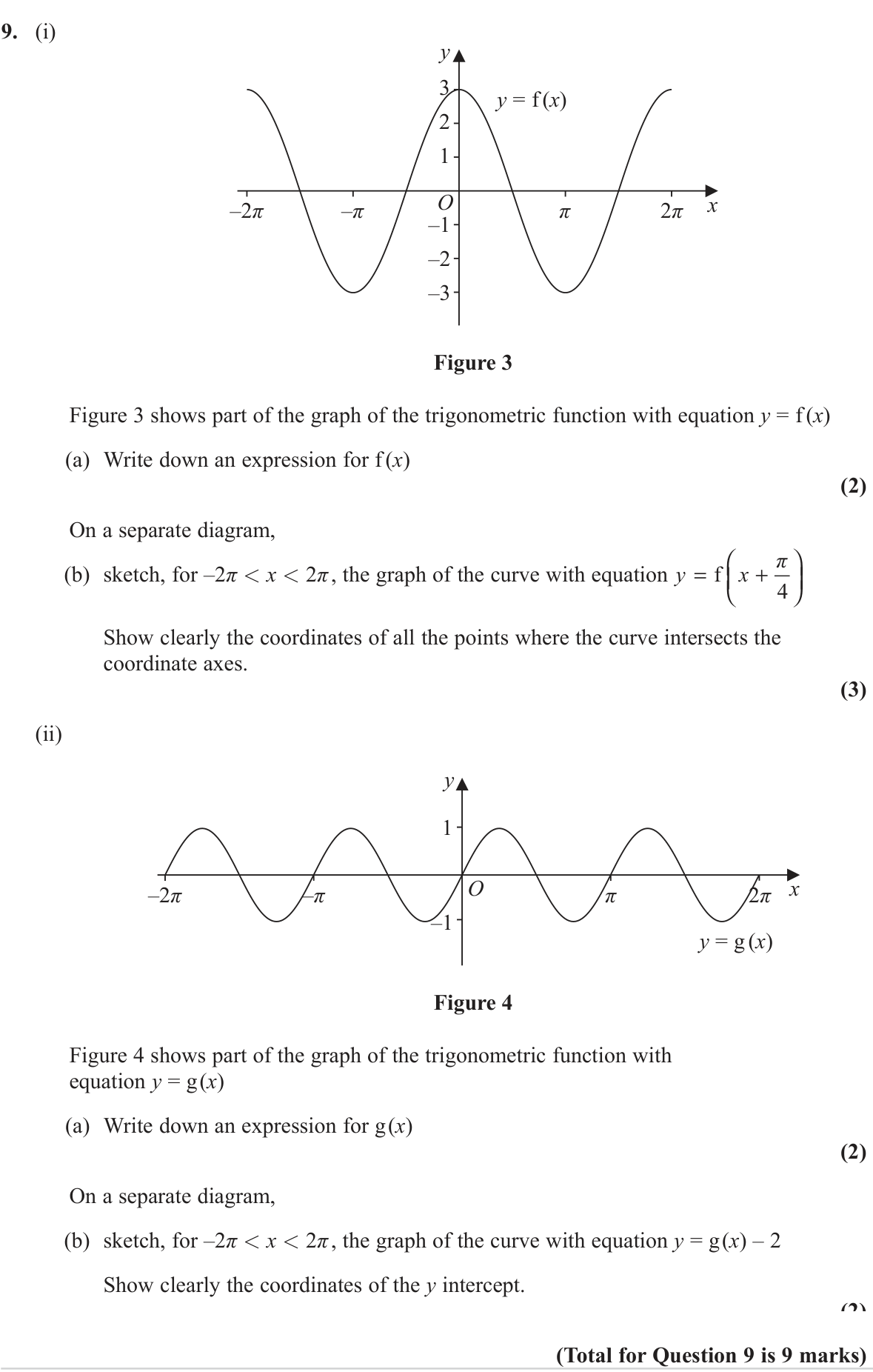
The first graph has amplitude 3, period $2\pi$, and maximum at $x=0$, so $f(x)=3\cos x$.
Transform f
$y=f\left(x+\dfrac\pi4\right)=3\cos\left(x+\dfrac\pi4\right)$, a shift left by $\dfrac\pi4$.
Find the x-intercepts
$\cos\left(x+\dfrac\pi4\right)=0$ gives $x=\dfrac\pi4+n\pi$. In $-2\pi<x<2\pi$, these are $-\dfrac{7\pi}{4}$, $-\dfrac{3\pi}{4}$, $\dfrac\pi4$, and $\dfrac{5\pi}{4}$.
Find the y-intercept
At $x=0$, $y=3\cos\dfrac\pi4=\dfrac{3\sqrt2}{2}$.
Identify g(x)
The second graph has amplitude 1, period $\pi$, and passes through the origin with positive gradient, so $g(x)=\sin2x$.
Transform g
$y=g(x)-2=\sin2x-2$, so the graph is shifted down by 2. Its y-intercept is $(0,-2)$.
 Elite Mathematics