Elite Mathematics / Pure 1 / Topics / Transformations of Functions IAL · WMA11 · Topic Transformations of Functions: past paper questions & worked solutions
Every Transformations of Functions question from the WMA11 papers in our bank, 2021–2025, sorted from easiest to hardest. Try each one first, then open the worked solution.
7 questions
55 marks in total
37% of papers (7 of 19) include it
3/1/3 easy / medium / hard
Questions, easiest first Level is estimated from marks: 1–6 easy, 7–8 medium, 9+ hard.
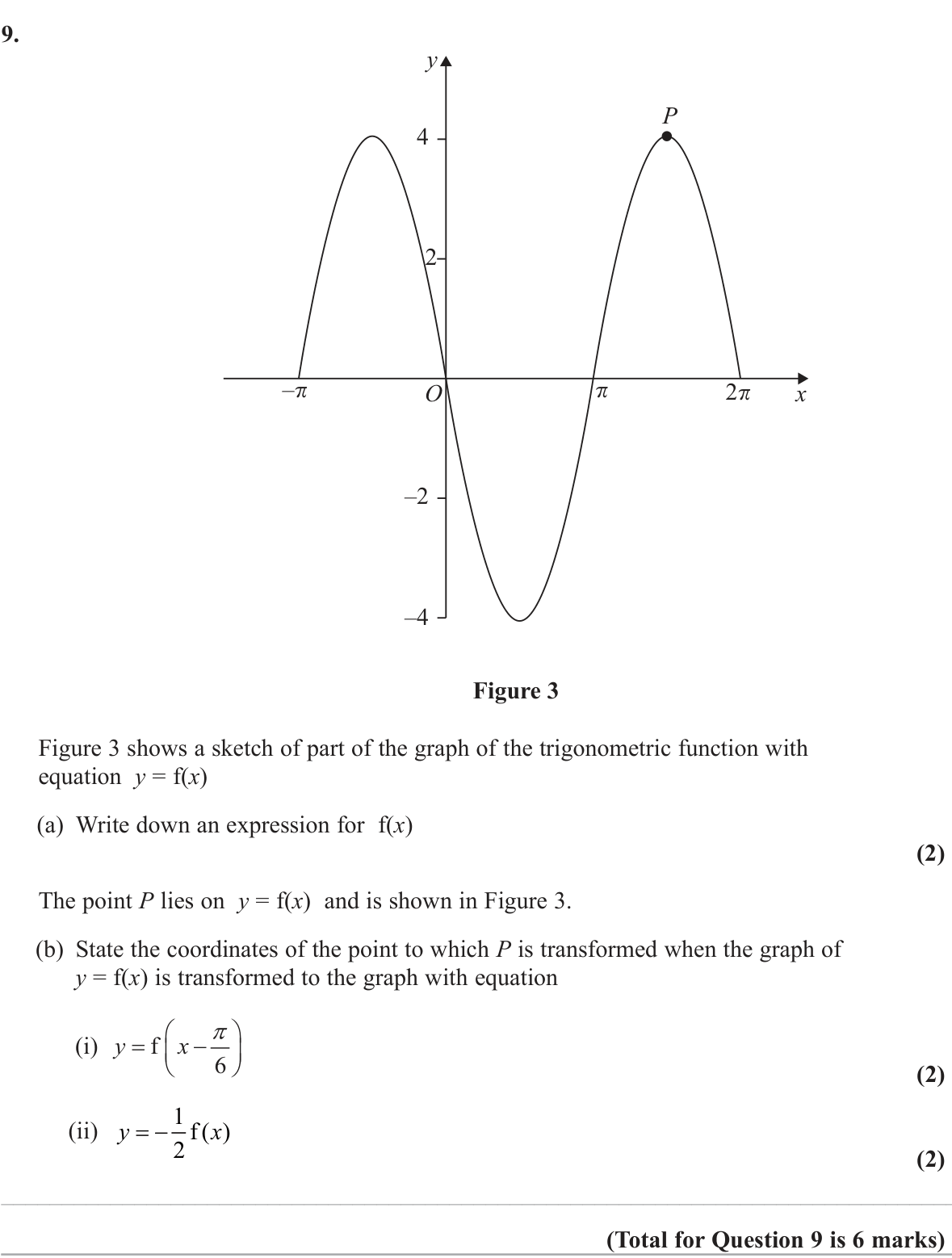
1. WMA11/01 October 2025 · Q9 Easy 6 marksShow worked solution Identify amplitude and direction The graph has amplitude $4$, crosses the origin, and initially moves downwards, so $f(x)=-4\sin x$.
Identify P The labelled maximum is at $P=\left(\dfrac{3\pi}{2},4\right)$.
Translate the graph right $y=f\left(x-\dfrac\pi6\right)$ translates the graph right by $\dfrac\pi6$.
New coordinates for part b(i) $P$ becomes $\left(\dfrac{3\pi}{2}+\dfrac\pi6,4\right)=\left(\dfrac{5\pi}{3},4\right)$.
Transform y equals negative half f(x) $y=-\dfrac12f(x)$ leaves x-coordinates unchanged and multiplies y-coordinates by $-\dfrac12$.
New coordinates for part b(ii) $P$ becomes $\left(\dfrac{3\pi}{2},-2\right)$.
Final answer $(a)\ f(x)=-4\sin x.\quad (b)(i)\ \left(\dfrac{5\pi}{3},4\right).\quad (b)(ii)\ \left(\dfrac{3\pi}{2},-2\right)$.
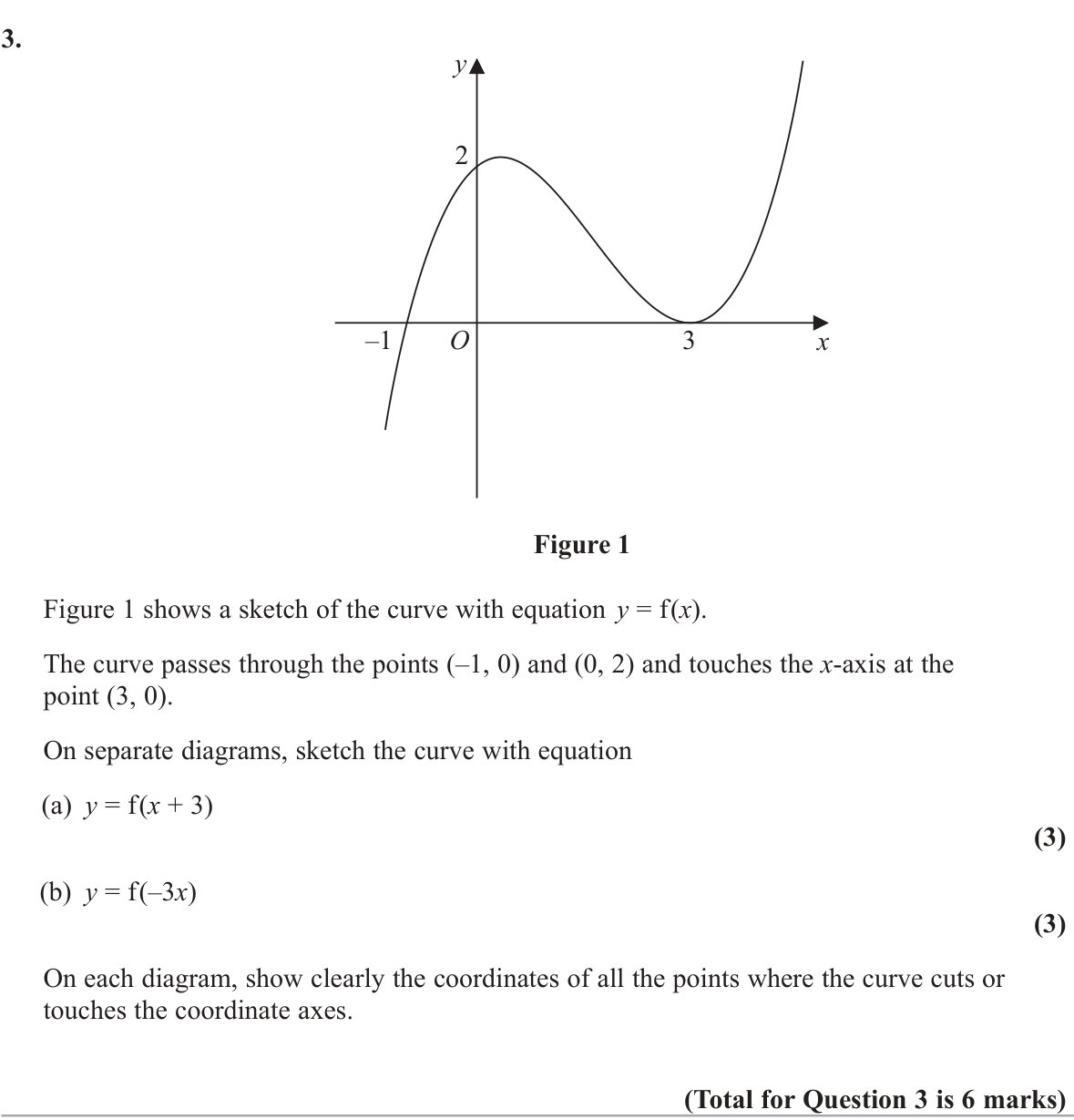
2. WMA11/01 May/June 2024 · Q3 Easy 6 marksShow worked solution Read the original key points The original curve passes through $(-1,0)$ and $(0,2)$, and touches the x-axis at $(3,0)$.
Translate the graph left $y=f(x+3)$ is a translation 3 units left. So $(-1,0)$ moves to $(-4,0)$, $(0,2)$ moves to $(-3,2)$, and $(3,0)$ moves to $(0,0)$.
State the axis intercepts for part a The curve cuts the x-axis at $(-4,0)$ and touches it at $(0,0)$. The y-intercept is also $(0,0)$.
Transform y equals f of negative 3x For $y=f(-3x)$, a point with original x-coordinate $X$ moves to $x=-\dfrac{X}{3}$.
State the axis intercepts for part b $(-1,0)$ moves to $(\dfrac13,0)$, $(3,0)$ moves to $(-1,0)$, and $(0,2)$ stays at $(0,2)$.
Final answer $(a)$ intercepts $(-4,0)$ and $(0,0)$, with $(0,0)$ a touch point. $(b)$ intercepts $(-1,0)$, $(\dfrac13,0)$ and $(0,2)$, with $(-1,0)$ a touch point.
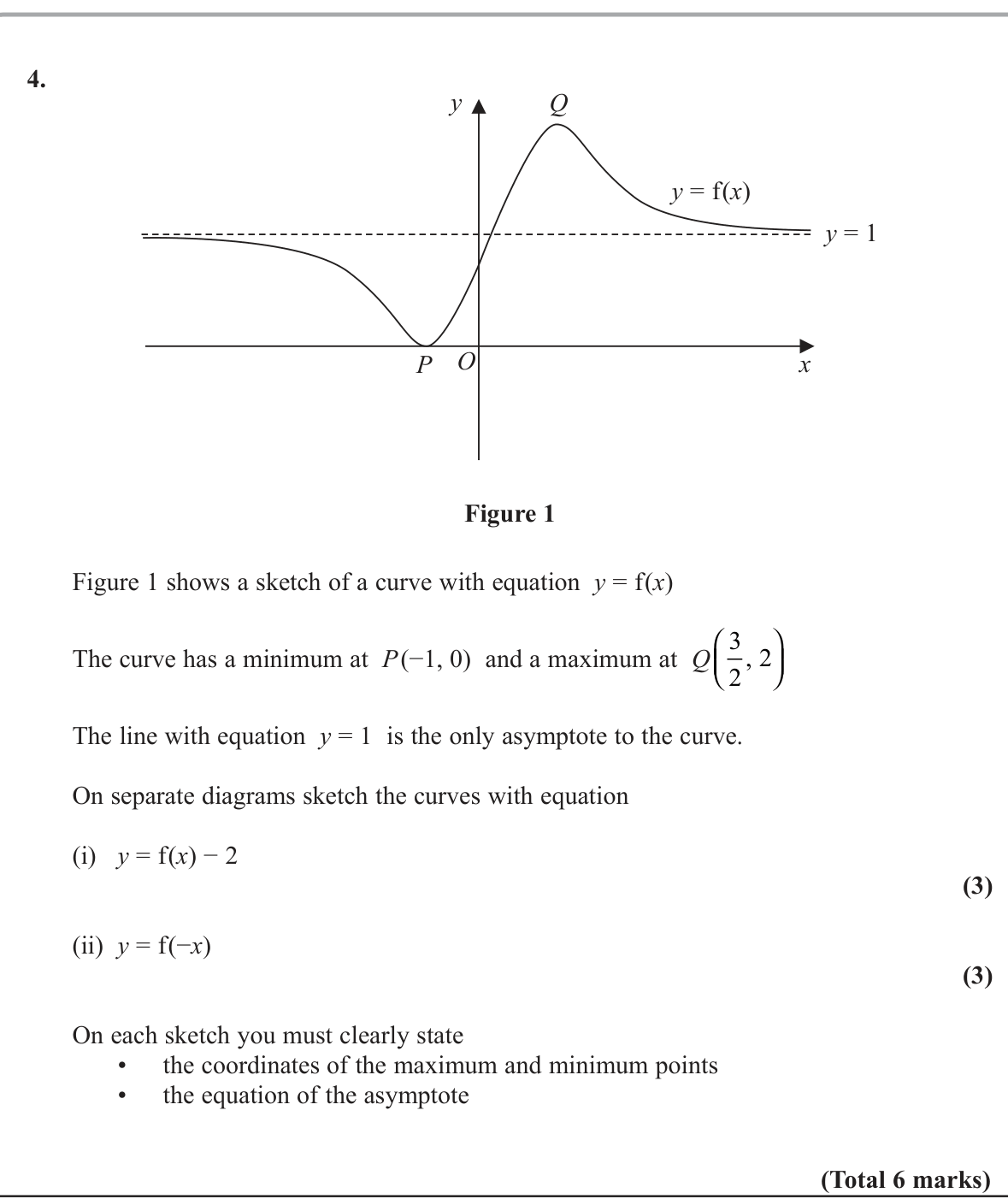
3. WMA11/01 May/June 2022 · Q4 Easy 6 marksShow worked solution Translate for y = f(x) - 2 Subtracting 2 moves every point of the graph down by 2 units.
State the new key features The minimum $P(-1,0)$ becomes $(-1,-2)$, the maximum $Q(\frac32,2)$ becomes $(\frac32,0)$, and the asymptote $y=1$ becomes $y=-1$.
Reflect for y = f(-x) Replacing $x$ by $-x$ reflects the graph in the y-axis.
State the reflected key features The minimum $P(-1,0)$ becomes $(1,0)$, the maximum $Q(\frac32,2)$ becomes $(-\frac32,2)$, and the horizontal asymptote remains $y=1$.
Final answer $(i)$ minimum $(-1,-2)$, maximum $(\frac32,0)$, asymptote $y=-1$. $(ii)$ minimum $(1,0)$, maximum $(-\frac32,2)$, asymptote $y=1$.
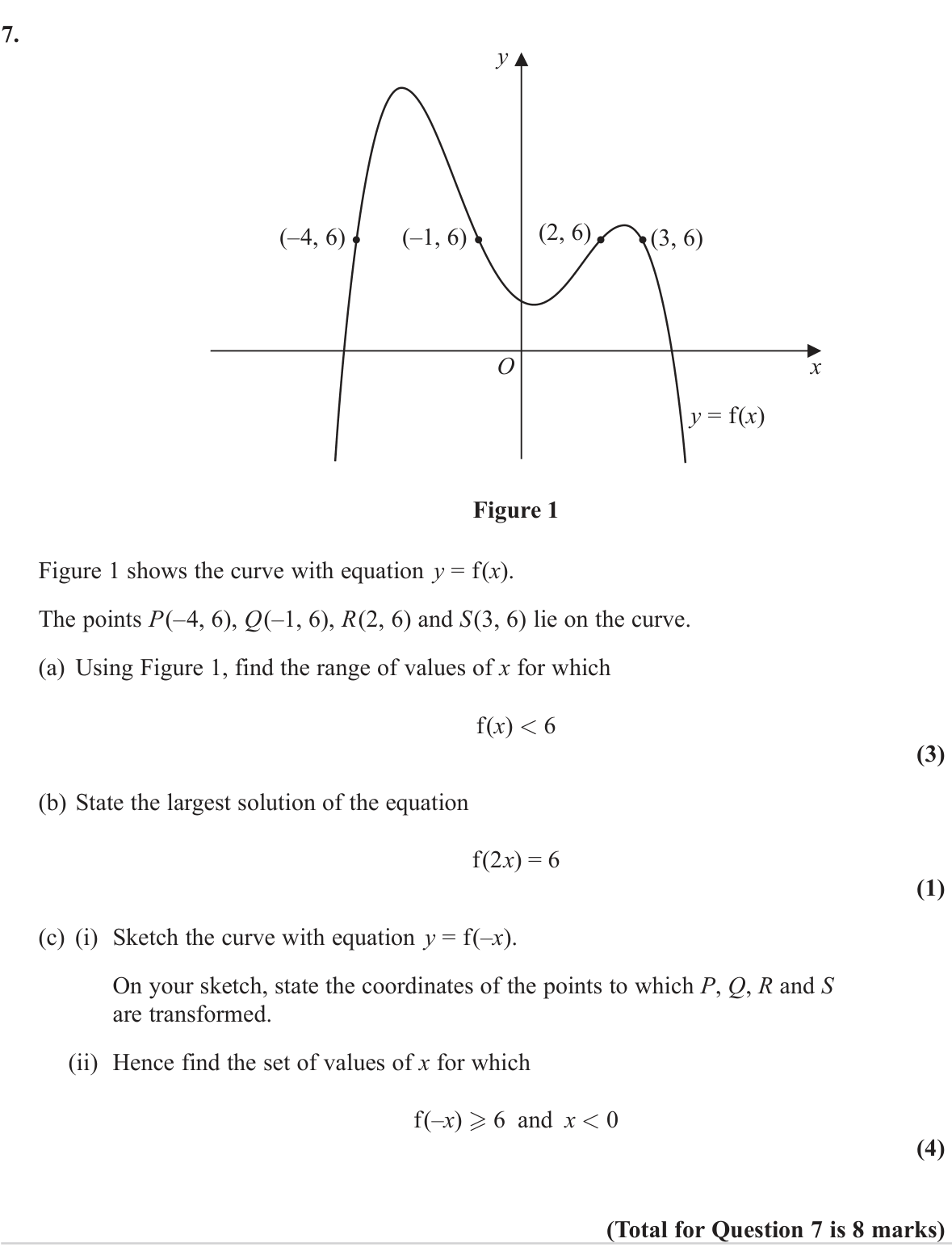
4. WMA11/01 October 2022 · Q7 Medium 8 marksShow worked solution Read f(x) < 6 from the graph The curve is below the line $y=6$ for $x<-4$, for $-1<x<2$, and for $x>3$.
Solve f(2x) = 6 Since $f(u)=6$ at $u=-4,-1,2,3$, we set $2x=-4,-1,2,3$. The solutions are $x=-2,-\dfrac12,1,\dfrac32$.
State the largest solution The largest solution is $x=\dfrac32$.
Reflect the points in the y-axis For $y=f(-x)$, each point $(x,y)$ becomes $(-x,y)$.
List the transformed points $P(-4,6)\to(4,6)$, $Q(-1,6)\to(1,6)$, $R(2,6)\to(-2,6)$, and $S(3,6)\to(-3,6)$.
Use the reflected graph For $x<0$, the part of the reflected graph on or above $y=6$ is from $x=-3$ to $x=-2$.
Final answer $(a)\ x<-4,\ -1<x<2,\ x>3.\quad (b)\ \dfrac32.\quad (c)(ii)\ -3\le x\le -2$.
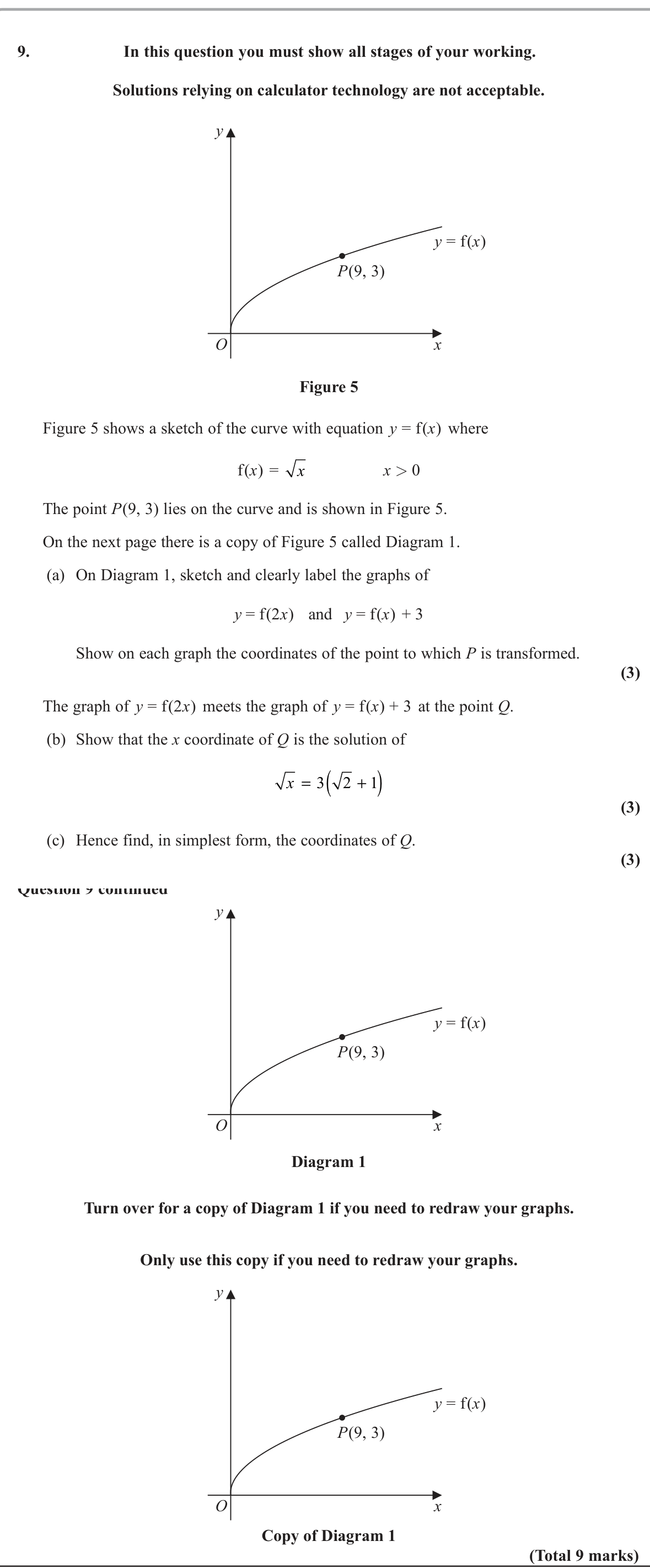
5. WMA11/01 October 2021 · Q9 Hard 9 marksShow worked solution Transform P on y = f(2x) $y=f(2x)$ is a horizontal scale factor of $\dfrac12$, so $P(9,3)$ maps to $\left(\dfrac92,3\right)$.
Translate point P $y=f(x)+3$ is a translation 3 units upward, so $P(9,3)$ maps to $(9,6)$.
Set up the intersection equation At $Q$, $f(2x)=f(x)+3$. Since $f(x)=\sqrt{x}$, this gives $\sqrt{2x}=\sqrt{x}+3$.
Show the required equation Let $s=\sqrt{x}$. Then $\sqrt{2x}=\sqrt2\,s$, so $\sqrt2s=s+3$. Hence $(\sqrt2-1)s=3$ and $s=\dfrac3{\sqrt2-1}=3(\sqrt2+1)$.
Find the x-coordinate $\sqrt{x}=3(\sqrt2+1)$, so $x=9(\sqrt2+1)^2=9(3+2\sqrt2)=27+18\sqrt2$.
Find the y-coordinate $y=\sqrt{x}+3=3(\sqrt2+1)+3=6+3\sqrt2$. Therefore $Q=(27+18\sqrt2,\ 6+3\sqrt2)$.
Final answer $(a)\ P\mapsto\left(\dfrac92,3\right)\text{ on }y=f(2x),\ P\mapsto(9,6)\text{ on }y=f(x)+3.\quad (c)\ Q=(27+18\sqrt2,\ 6+3\sqrt2)$.
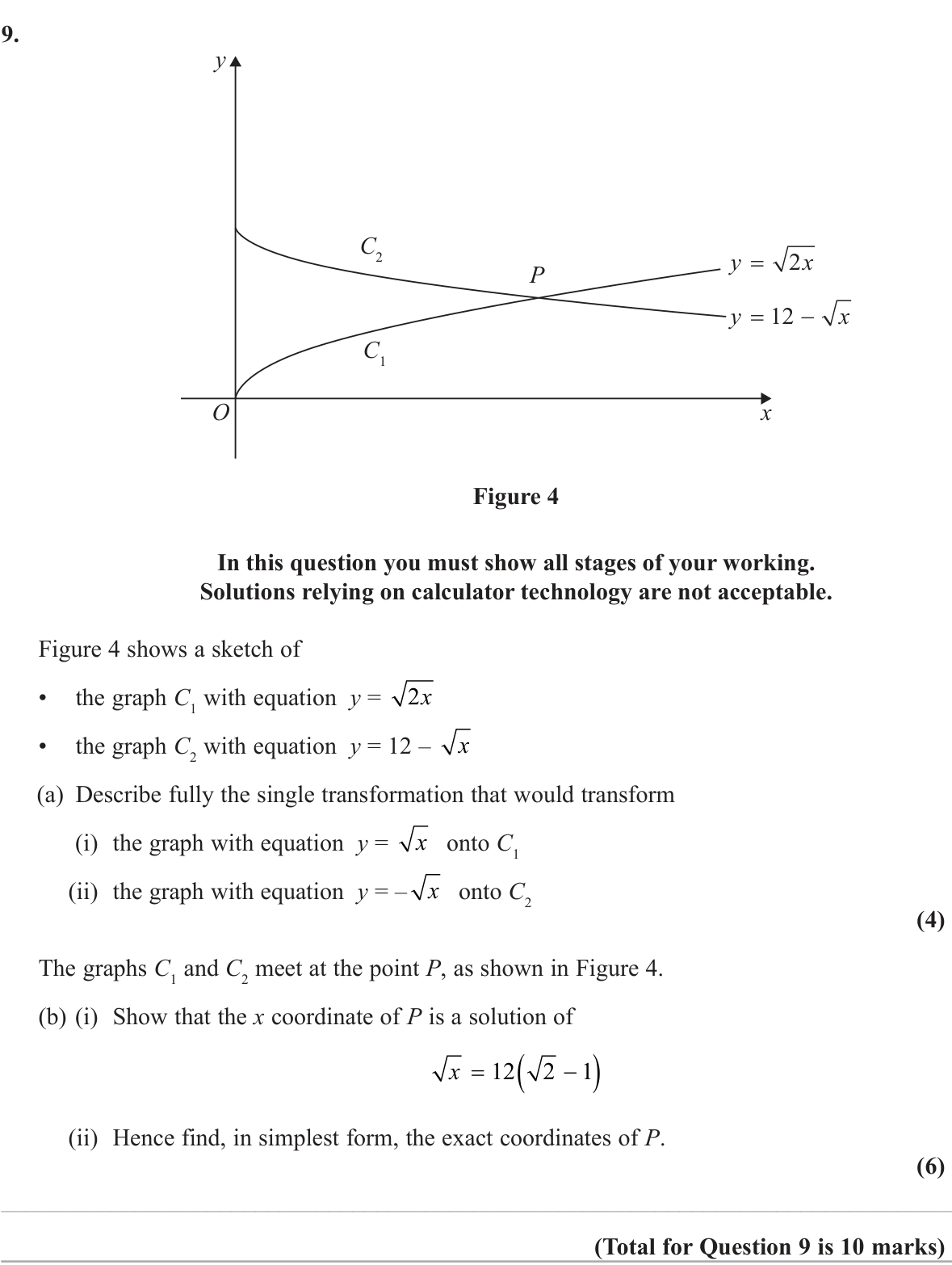
6. WMA11/01 May/June 2025 · Q9 Hard 10 marksShow worked solution Transform y equals root x to C1 $C_1$ has equation $y=\sqrt{2x}$. This is obtained from $y=\sqrt{x}$ by a stretch parallel to the x-axis with scale factor $\dfrac12$.
Equivalent description Equivalently, $y=\sqrt{2x}=\sqrt2\sqrt{x}$ is a stretch parallel to the y-axis with scale factor $\sqrt2$. The mark scheme also accepts the horizontal stretch description.
Translate the reflected curve $C_2$ has equation $y=12-\sqrt{x}=-\sqrt{x}+12$, so it is a translation of $y=-\sqrt{x}$ by $\begin{pmatrix}0\\12\end{pmatrix}$.
Set the curves equal At $P$, $\sqrt{2x}=12-\sqrt{x}$.
Factor out root x $\sqrt2\sqrt{x}+\sqrt{x}=12$, so $(\sqrt2+1)\sqrt{x}=12$.
Rationalise $\sqrt{x}=\dfrac{12}{\sqrt2+1}=\dfrac{12(\sqrt2-1)}{(\sqrt2+1)(\sqrt2-1)}=12(\sqrt2-1)$.
Find x $x=[12(\sqrt2-1)]^2=144(3-2\sqrt2)$.
Find y $y=\sqrt{2x}=\sqrt2\sqrt{x}=\sqrt2\cdot12(\sqrt2-1)=24-12\sqrt2$.
Final answer $(a)(i)$ stretch parallel to the x-axis scale factor $\dfrac12$ (equivalently vertical stretch scale factor $\sqrt2$). $(a)(ii)$ translation by $\begin{pmatrix}0\\12\end{pmatrix}$. $(b)\ P=(144(3-2\sqrt2),\ 24-12\sqrt2)$.
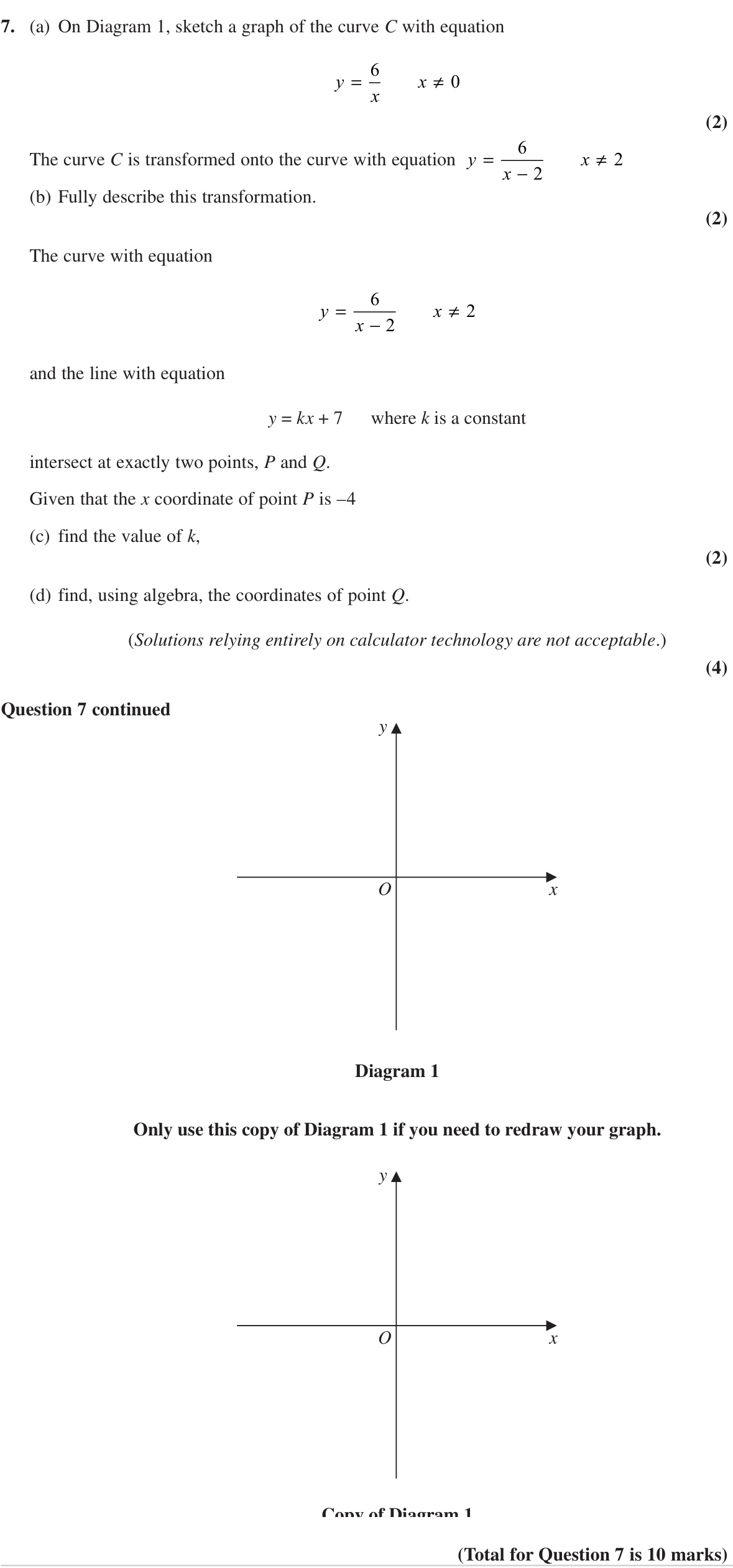
7. WMA11/01 January 2023 · Q7 Hard 10 marksShow worked solution Sketch y = 6/x The graph is a rectangular hyperbola with asymptotes $x=0$ and $y=0$, with branches in quadrants I and III.
Describe the transformation $y=\dfrac6{x-2}$ is obtained from $y=\dfrac6x$ by a translation 2 units in the positive x-direction.
Use P to find k At $x=-4$ on $y=\dfrac6{x-2}$, $y=\dfrac6{-6}=-1$.
Substitute into the line Since $P$ lies on $y=kx+7$, $-1=-4k+7$, so $k=2$.
Find the second intersection Solve $\dfrac6{x-2}=2x+7$. Multiplying by $x-2$ gives $6=(2x+7)(x-2)$.
Factor and choose Q $6=2x^2+3x-14$, so $2x^2+3x-20=0=(2x-5)(x+4)$. The root $x=-4$ is $P$, so $Q$ has $x=\dfrac52$.
Find y for Q $y=2\left(\dfrac52\right)+7=12$, so $Q=\left(\dfrac52,12\right)$.
Final answer $(b)$ Translation 2 units right. $(c)\ k=2.\quad (d)\ Q=\left(\dfrac52,12\right)$.
Dr Eslam Ahmed Elite Mathematics · Questions classified by topic, solutions checked by Dr Eslam
 Elite Mathematics