Elite Mathematics / Pure 1 / Topics / Differentiation IAL · WMA11 · Topic Differentiation: past paper questions & worked solutions
Every Differentiation question from the WMA11 papers in our bank, 2019–2026, sorted from easiest to hardest. Try each one first, then open the worked solution.
48 questions
414 marks in total
100% of papers (19 of 19) include it
10/13/25 easy / medium / hard
Questions, easiest first Level is estimated from marks: 1–6 easy, 7–8 medium, 9+ hard.
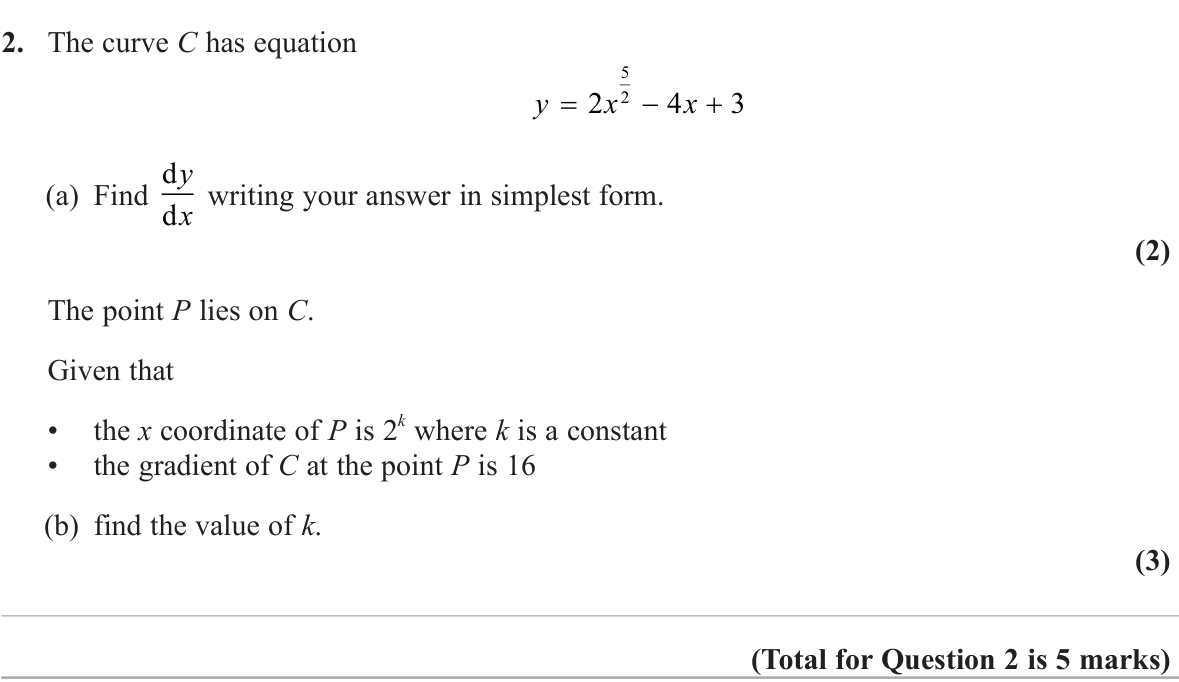
1. WMA11/01 May/June 2025 · Q2 Easy 5 marksShow worked solution Differentiate $y=2x^{5/2}-4x+3$, so $\dfrac{dy}{dx}=2\cdot\dfrac52x^{3/2}-4=5x^{3/2}-4$.
Use the gradient at P At $P$, the gradient is $16$, so $5x^{3/2}-4=16$.
Find x $5x^{3/2}=20$, hence $x^{3/2}=4$.
Use x equals 2 to the k Since the x-coordinate of $P$ is $2^k$, we have $(2^k)^{3/2}=4=2^2$.
Solve for k $2^{3k/2}=2^2$, so $\dfrac{3k}{2}=2$ and $k=\dfrac43$.
Final answer $(a)\ \dfrac{dy}{dx}=5x^{3/2}-4.\quad (b)\ k=\dfrac43$.
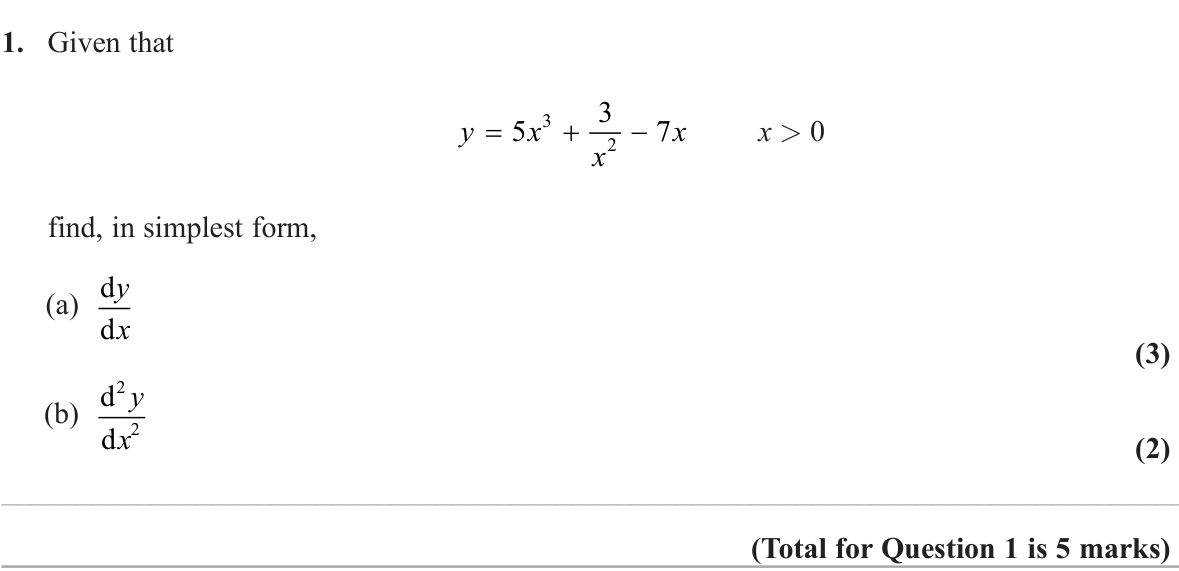
2. WMA11/01 October 2023 · Q1 Easy 5 marksShow worked solution Rewrite the powers $y=5x^3+3x^{-2}-7x$.
Differentiate once $\dfrac{dy}{dx}=15x^2-6x^{-3}-7=15x^2-\dfrac{6}{x^3}-7$.
Differentiate again $\dfrac{d^2y}{dx^2}=30x+18x^{-4}=30x+\dfrac{18}{x^4}$.
Final answer $\dfrac{dy}{dx}=15x^2-\dfrac{6}{x^3}-7$, and $\dfrac{d^2y}{dx^2}=30x+\dfrac{18}{x^4}$.
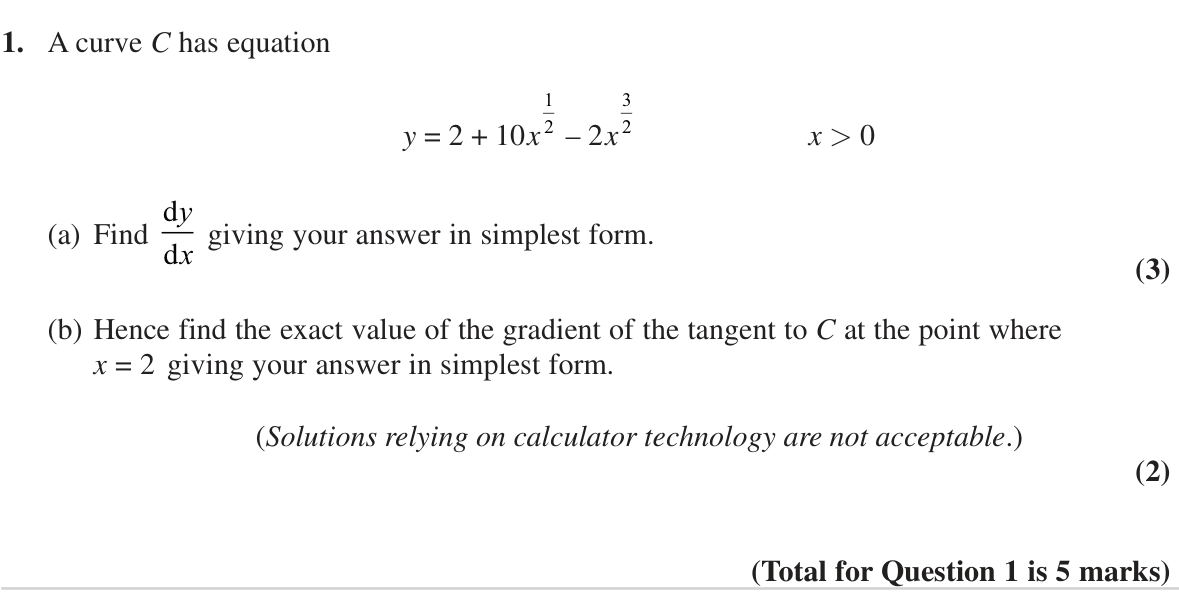
3. WMA11/01 January 2023 · Q1 Easy 5 marksShow worked solution Differentiate term by term $y=2+10x^{1/2}-2x^{3/2}$, so $\dfrac{dy}{dx}=5x^{-1/2}-3x^{1/2}$.
Write in simplest form $\dfrac{dy}{dx}=\dfrac{5}{\sqrt{x}}-3\sqrt{x}$.
Substitute x = 2 At $x=2$, the gradient is $\dfrac5{\sqrt2}-3\sqrt2=\dfrac5{\sqrt2}-\dfrac6{\sqrt2}=-\dfrac1{\sqrt2}$.
Rationalise $-\dfrac1{\sqrt2}=-\dfrac{\sqrt2}{2}$.
Final answer $(a)\ \dfrac{dy}{dx}=\dfrac{5}{\sqrt{x}}-3\sqrt{x}.\quad (b)\ -\dfrac{\sqrt2}{2}$.
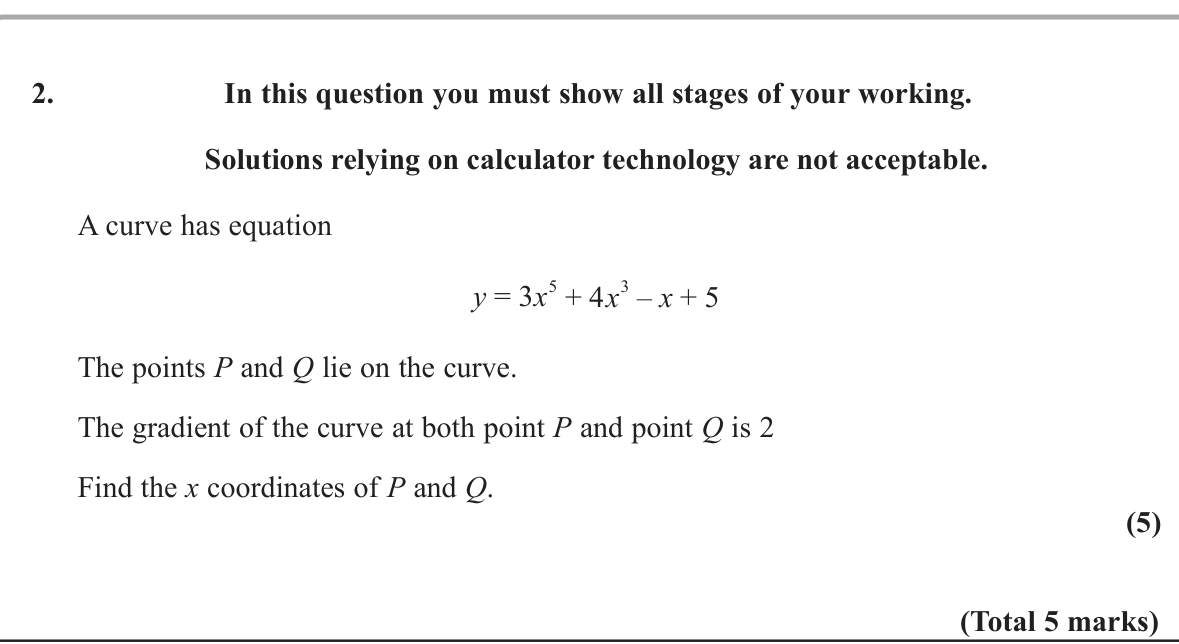
4. WMA11/01 October 2021 · Q2 Easy 5 marksShow worked solution Differentiate the curve For $y=3x^5+4x^3-x+5$, $\dfrac{dy}{dx}=15x^4+12x^2-1$.
Set the gradient equal to 2 $15x^4+12x^2-1=2$, so $15x^4+12x^2-3=0$.
Reduce to a quadratic in x squared Dividing by $3$ gives $5x^4+4x^2-1=0$. Let $u=x^2$, giving $5u^2+4u-1=0$.
Solve and reject the impossible value $5u^2+4u-1=(5u-1)(u+1)=0$. Since $u=x^2\ge0$, $u=\dfrac15$.
Find x $x^2=\dfrac15$, so $x=\pm\dfrac1{\sqrt5}=\pm\dfrac{\sqrt5}{5}$.
Final answer $x=\pm\dfrac{\sqrt5}{5}$.
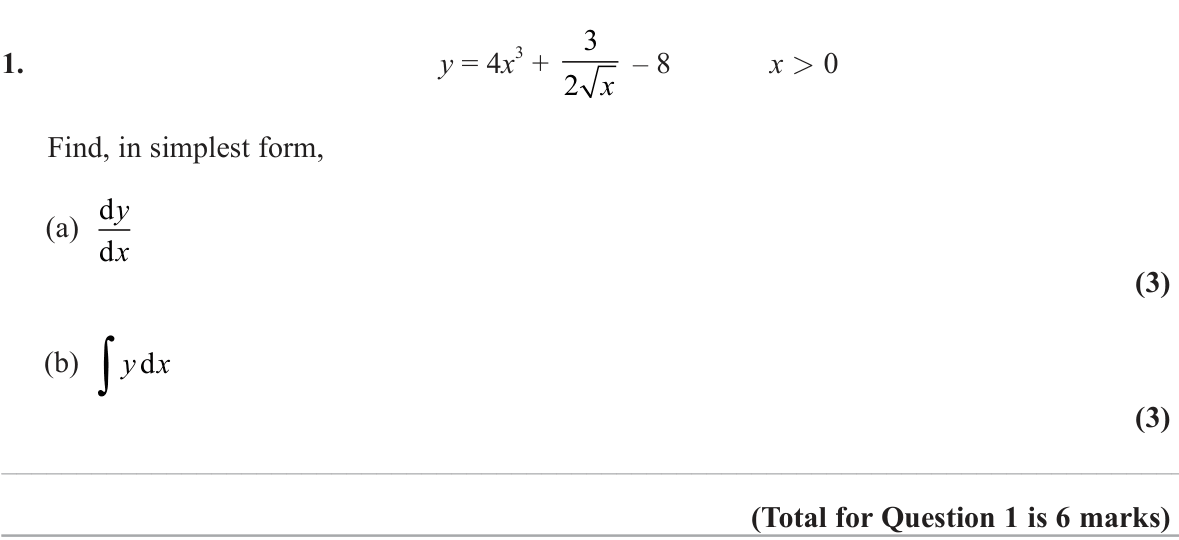
5. WMA11/01 January 2026 · Q1 Easy 6 marks · main topic: IntegrationShow worked solution Rewrite with powers $y=4x^3+\dfrac{3}{2}x^{-1/2}-8$.
Differentiate $\dfrac{dy}{dx}=12x^2+\dfrac32\left(-\dfrac12\right)x^{-3/2}$.
Simplify derivative $\dfrac{dy}{dx}=12x^2-\dfrac34x^{-3/2}=12x^2-\dfrac{3}{4x^{3/2}}$.
Integrate $\int y\,dx=\int\left(4x^3+\dfrac32x^{-1/2}-8\right)dx$.
Simplify integral $\int y\,dx=x^4+3x^{1/2}-8x+c=x^4+3\sqrt{x}-8x+c$.
Final answer $(a)\ \dfrac{dy}{dx}=12x^2-\dfrac{3}{4x^{3/2}}.\quad (b)\ \int y\,dx=x^4+3\sqrt{x}-8x+c$.
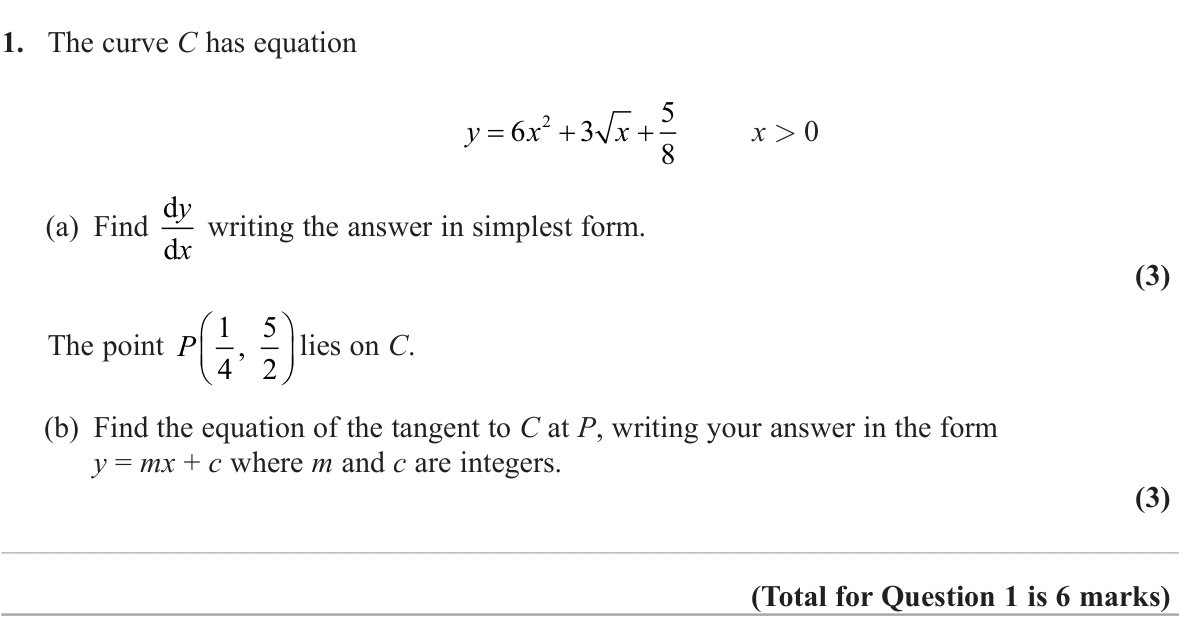
6. WMA11/01 October 2025 · Q1 Easy 6 marksShow worked solution Rewrite the curve $y=6x^2+3x^{1/2}+\dfrac58$.
Differentiate $\dfrac{dy}{dx}=12x+\dfrac32x^{-1/2}=12x+\dfrac{3}{2\sqrt{x}}$.
Find the tangent gradient At $x=\dfrac14$, $\dfrac{dy}{dx}=12\left(\dfrac14\right)+\dfrac32\left(\dfrac14\right)^{-1/2}=3+3=6$.
Use point P The tangent passes through $P\left(\dfrac14,\dfrac52\right)$, so $y-\dfrac52=6\left(x-\dfrac14\right)$.
Simplify $y-\dfrac52=6x-\dfrac32$, hence $y=6x+1$.
Final answer $(a)\ \dfrac{dy}{dx}=12x+\dfrac{3}{2\sqrt{x}}.\quad (b)\ y=6x+1$.
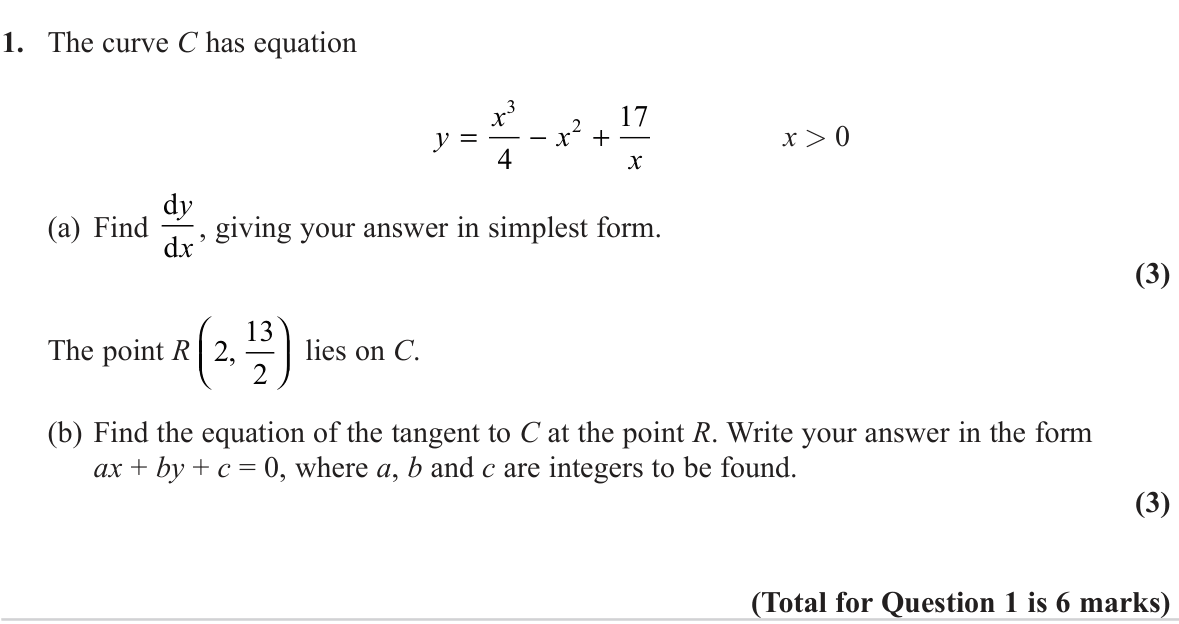
7. WMA11/01 October 2022 · Q1 Easy 6 marksShow worked solution Rewrite the curve $y=\dfrac{x^3}{4}-x^2+\dfrac{17}{x}=\dfrac14x^3-x^2+17x^{-1}$.
Differentiate $\dfrac{dy}{dx}=\dfrac34x^2-2x-17x^{-2}=\dfrac34x^2-2x-\dfrac{17}{x^2}$.
Find the gradient at R At $x=2$, the tangent gradient is $\dfrac34(4)-2(2)-\dfrac{17}{4}=3-4-\dfrac{17}{4}=-\dfrac{21}{4}$.
Use the point R The point is $R\left(2,\dfrac{13}{2}\right)$, so $y-\dfrac{13}{2}=-\dfrac{21}{4}(x-2)$.
Write in integer form Multiplying by 4 gives $4y-26=-21x+42$, hence $21x+4y-68=0$.
Final answer $(a)\ \dfrac{dy}{dx}=\dfrac34x^2-2x-\dfrac{17}{x^2}.\quad (b)\ 21x+4y-68=0$.
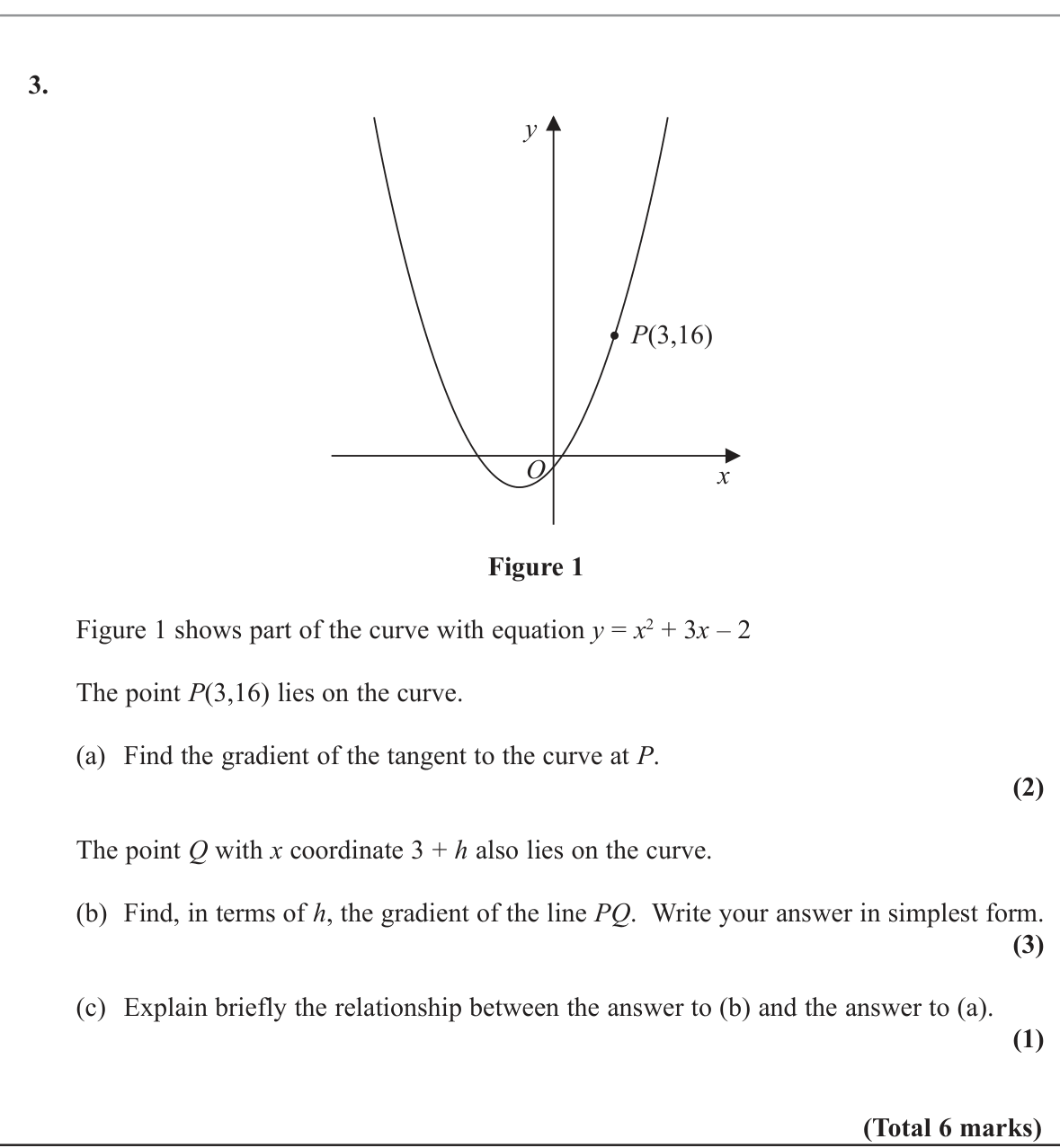
8. WMA11/01 January 2020 · Q3 Easy 6 marksShow worked solution Differentiate for the tangent gradient For $y=x^2+3x-2$, $\dfrac{dy}{dx}=2x+3$. At $x=3$, the gradient is $2(3)+3=9$.
Find the y-coordinate of Q For $x_Q=3+h$, $y_Q=(3+h)^2+3(3+h)-2=16+9h+h^2$.
Calculate the gradient of PQ $\text{gradient }PQ=\dfrac{(16+9h+h^2)-16}{(3+h)-3}=\dfrac{9h+h^2}{h}=9+h$.
Explain the relationship As $h\to0$, point $Q$ approaches $P$, and the chord gradient $9+h$ approaches the tangent gradient $9$.
Final answer $(a)\ 9.\quad (b)\ 9+h.\quad (c)\ As\ h\to0,\ 9+h\to9$.
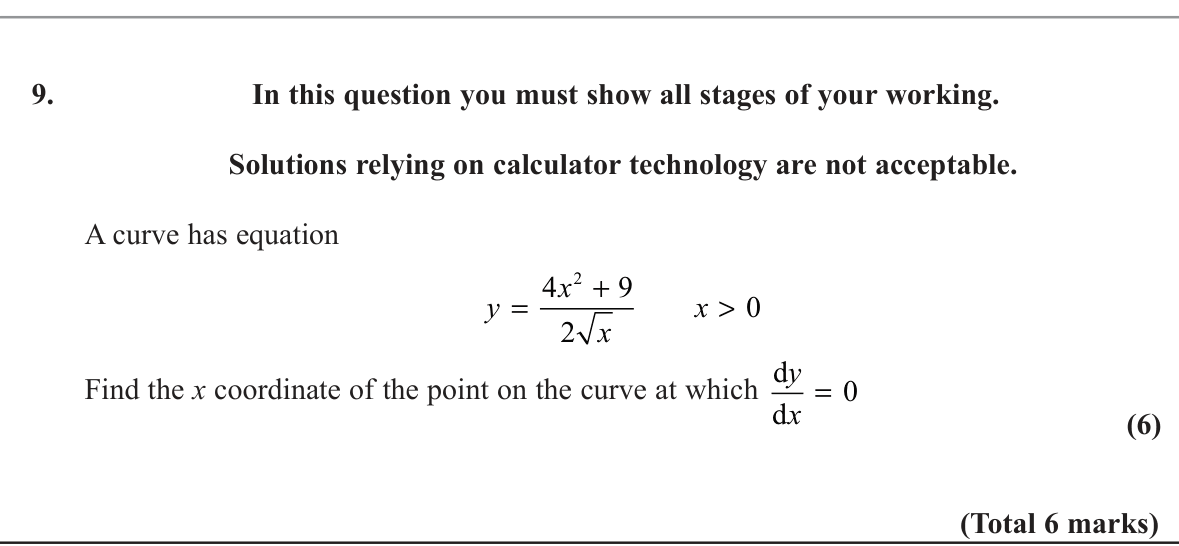
9. WMA11/01 January 2020 · Q9 Easy 6 marksShow worked solution Rewrite the function $y=\dfrac{4x^2+9}{2\sqrt{x}}=2x^{3/2}+\dfrac92x^{-1/2}$.
Differentiate $\dfrac{dy}{dx}=3x^{1/2}-\dfrac94x^{-3/2}$.
Set the derivative equal to zero $3x^{1/2}-\dfrac94x^{-3/2}=0$, so $3\sqrt{x}=\dfrac{9}{4x^{3/2}}$.
Solve for x Multiply by $4x^{3/2}$: $12x^2=9$. Hence $x^2=\frac34$. Since $x>0$, $x=\frac{\sqrt3}{2}$.
Final answer $x=\dfrac{\sqrt3}{2}$.
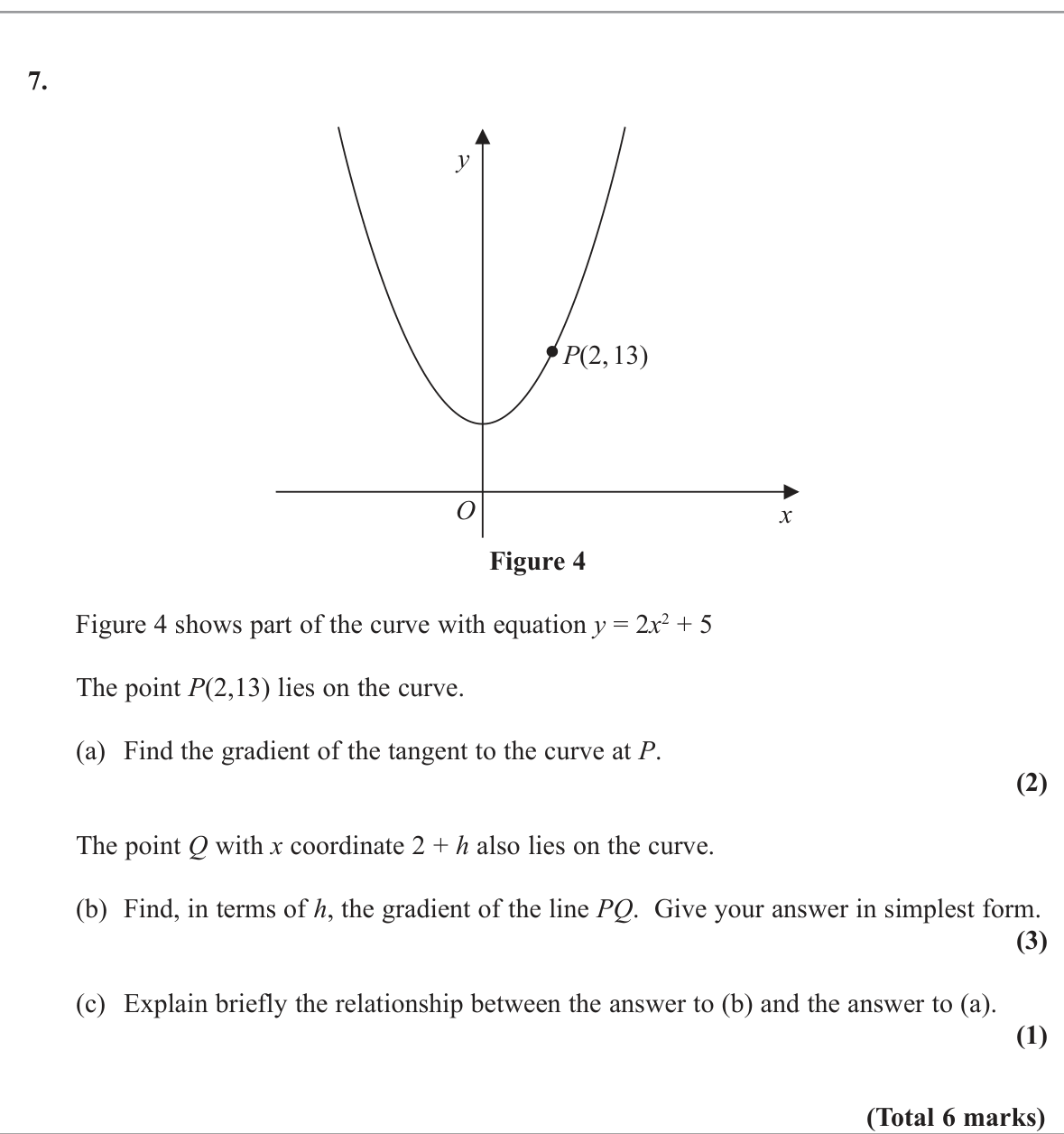
10. WMA11/01 October 2019 · Q7 Easy 6 marksShow worked solution Differentiate for the tangent gradient For $y=2x^2+5$, $\dfrac{dy}{dx}=4x$. At $P$, $x=2$, so the tangent gradient is $8$.
Find the coordinates of Q If $x_Q=2+h$, then $y_Q=2(2+h)^2+5=13+8h+2h^2$.
Find the gradient of PQ $\text{gradient }PQ=\dfrac{(13+8h+2h^2)-13}{(2+h)-2}=\dfrac{8h+2h^2}{h}=8+2h$.
Explain the link As $h$ gets closer to $0$, point $Q$ gets closer to $P$, and the chord gradient $8+2h$ tends to the tangent gradient $8$.
Final answer $(a)\ 8.\quad (b)\ 8+2h.\quad (c)\ As\ h\to0,\ 8+2h\to8$.
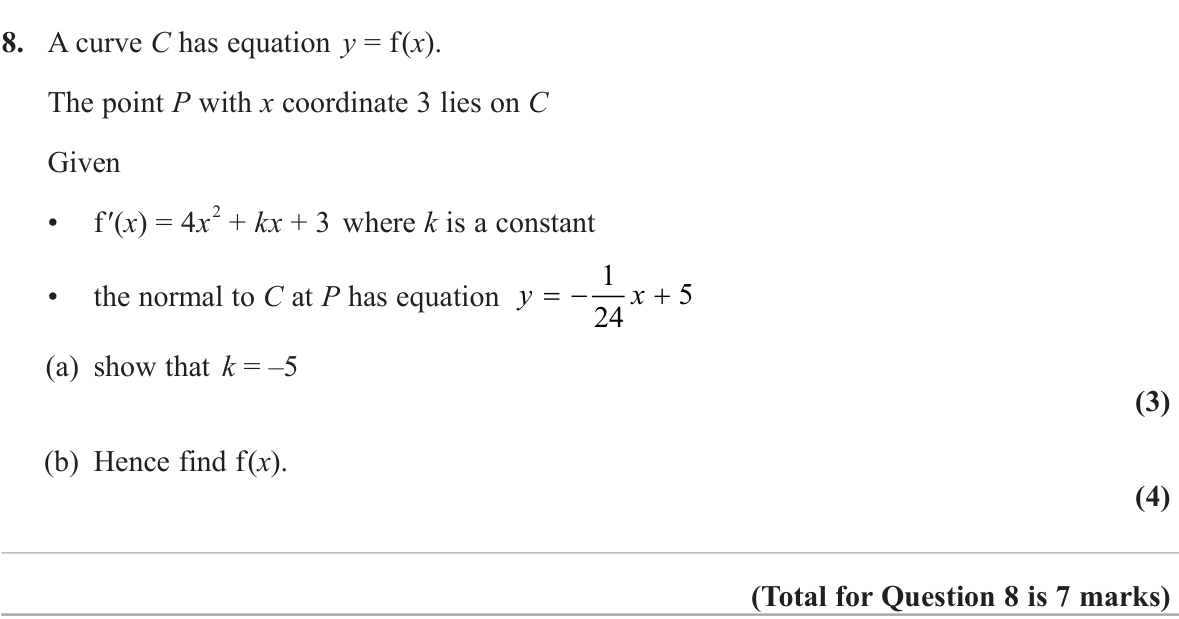
11. WMA11/01 October 2024 · Q8 Medium 7 marks · main topic: IntegrationShow worked solution Find the y-coordinate of P The normal is $y=-\dfrac1{24}x+5$. At $x=3$, $y=-\dfrac3{24}+5=\dfrac{39}{8}$.
Use the normal gradient The normal gradient is $-\dfrac1{24}$, so the tangent gradient is $24$.
Use f prime at x equals 3 $f'(3)=4(3)^2+3k+3=39+3k$.
Find k $39+3k=24$, so $k=-5$.
Integrate f prime With $k=-5$, $f'(x)=4x^2-5x+3$, so $f(x)=\dfrac43x^3-\dfrac52x^2+3x+c$.
Use point P $\dfrac{39}{8}=\dfrac43(27)-\dfrac52(9)+3(3)+c=\dfrac{45}{2}+c$.
Find c $c=\dfrac{39}{8}-\dfrac{45}{2}=-\dfrac{141}{8}$.
Final answer $k=-5$ and $f(x)=\dfrac43x^3-\dfrac52x^2+3x-\dfrac{141}{8}$.
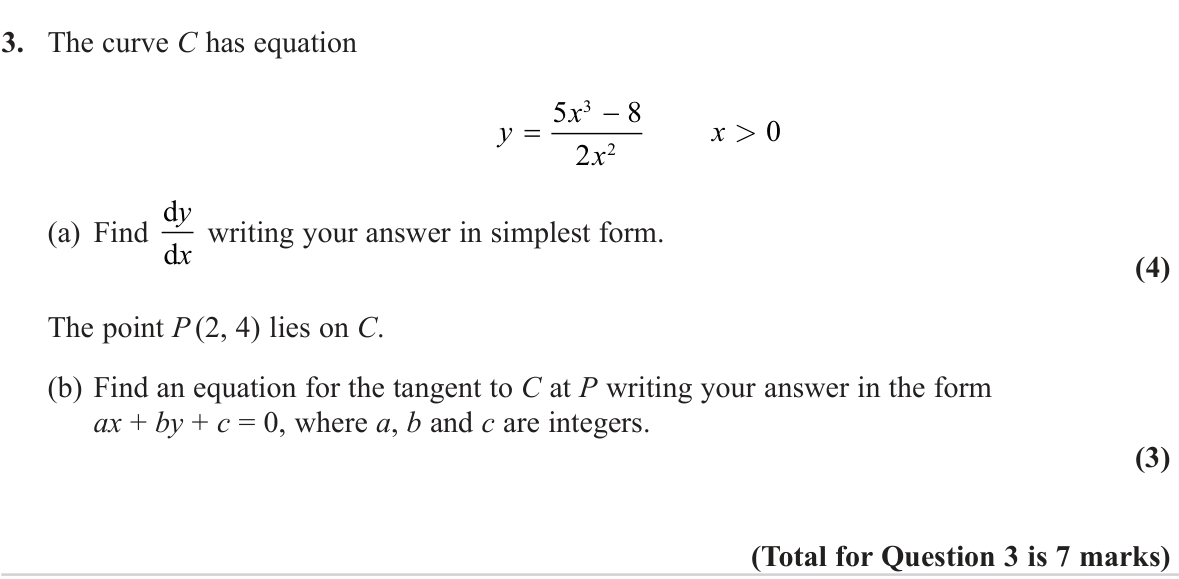
12. WMA11/01 January 2024 · Q3 Medium 7 marksShow worked solution Rewrite y $y=\dfrac{5x^3-8}{2x^2}=\dfrac52x-4x^{-2}$.
Differentiate $\dfrac{dy}{dx}=\dfrac52+8x^{-3}=\dfrac52+\dfrac{8}{x^3}$.
Find the gradient at P At $x=2$, $\dfrac{dy}{dx}=\dfrac52+\dfrac{8}{8}=\dfrac72$.
Use point-gradient form The tangent through $P(2,4)$ is $y-4=\dfrac72(x-2)$.
Rearrange $2y-8=7x-14$, so $7x-2y-6=0$.
Final answer $(a)\ \dfrac{dy}{dx}=\dfrac52+\dfrac{8}{x^3}.\quad (b)\ 7x-2y-6=0$.
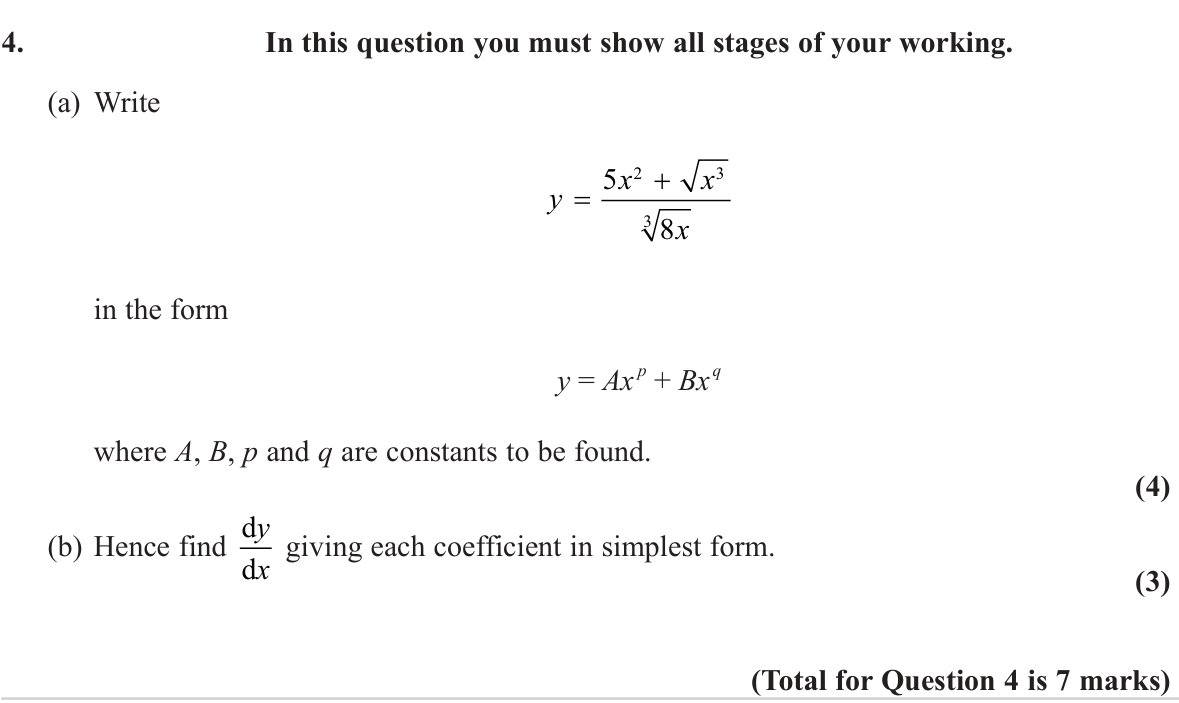
13. WMA11/01 May/June 2023 · Q4 Medium 7 marksShow worked solution Rewrite the denominator $\sqrt[3]{8x}=2x^{1/3}$.
Rewrite the numerator $\sqrt{x^3}=x^{3/2}$.
Divide each term $y=\dfrac{5x^2}{2x^{1/3}}+\dfrac{x^{3/2}}{2x^{1/3}}=\dfrac52x^{5/3}+\dfrac12x^{7/6}$.
Differentiate $\dfrac{dy}{dx}=\dfrac52\cdot\dfrac53x^{2/3}+\dfrac12\cdot\dfrac76x^{1/6}$.
Simplify coefficients $\dfrac{dy}{dx}=\dfrac{25}{6}x^{2/3}+\dfrac{7}{12}x^{1/6}$.
Final answer $(a)\ y=\dfrac52x^{5/3}+\dfrac12x^{7/6}.\quad (b)\ \dfrac{dy}{dx}=\dfrac{25}{6}x^{2/3}+\dfrac{7}{12}x^{1/6}$.
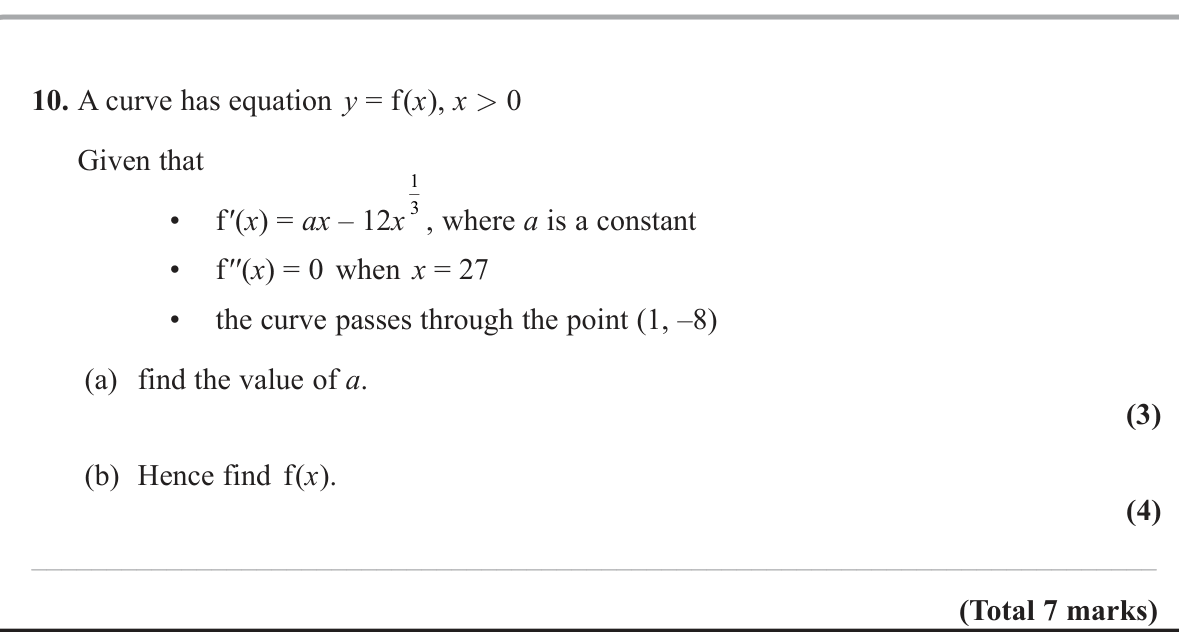
14. WMA11/01 October 2021 · Q10 Medium 7 marks · main topic: IntegrationShow worked solution Differentiate f'(x) $f'(x)=ax-12x^{1/3}$, so $f''(x)=a-4x^{-2/3}$.
Use f''(27) = 0 Since $27^{2/3}=9$, $0=a-\dfrac{4}{9}$, so $a=\dfrac49$.
Integrate f'(x) With $a=\dfrac49$, $f'(x)=\dfrac49x-12x^{1/3}$. Therefore $f(x)=\dfrac29x^2-9x^{4/3}+c$.
Use the point (1, -8) $-8=\dfrac29-9+c$, so $c=-8+9-\dfrac29=\dfrac79$.
Write f(x) $f(x)=\dfrac29x^2-9x^{4/3}+\dfrac79$.
Final answer $(a)\ a=\dfrac49.\quad (b)\ f(x)=\dfrac{2}{9}x^2-9x^{4/3}+\dfrac79$.
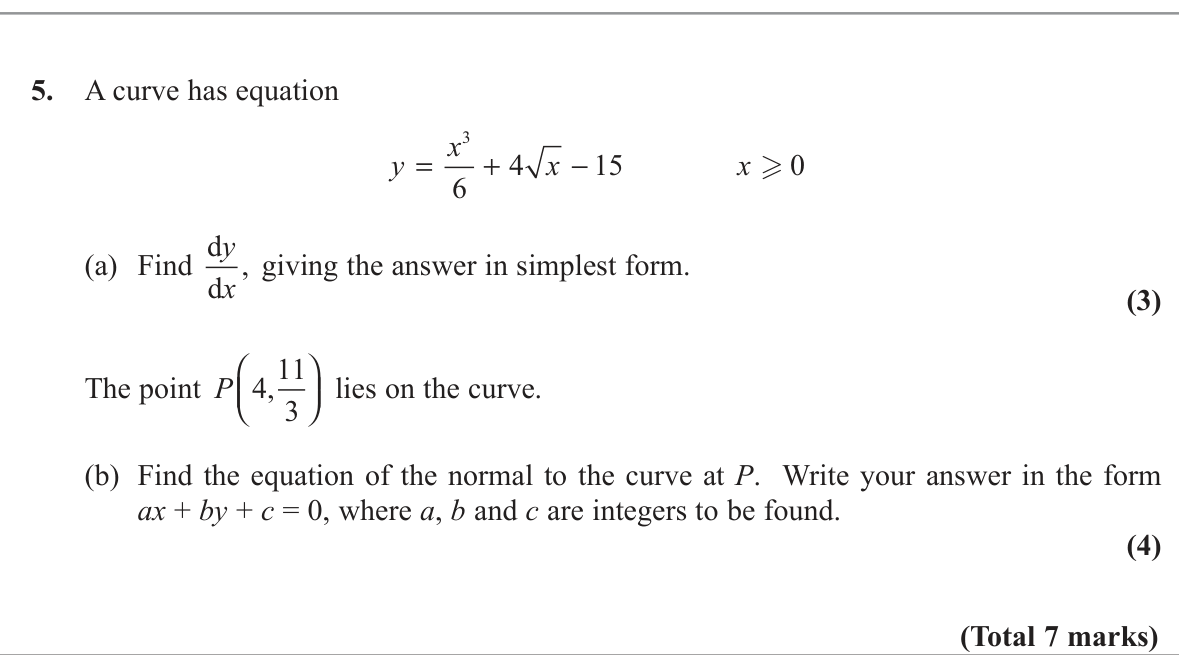
15. WMA11/01 October 2019 · Q5 Medium 7 marksShow worked solution Rewrite before differentiating $y=\frac{x^3}{6}+4x^{1/2}-15$.
Differentiate term by term $\dfrac{dy}{dx}=\frac{3x^2}{6}+4\cdot\frac12x^{-1/2}=\frac{x^2}{2}+\frac{2}{\sqrt{x}}$.
Find tangent and normal gradients At $x=4$, $\dfrac{dy}{dx}=\frac{16}{2}+\frac{2}{2}=9$. The normal gradient is therefore $-\frac19$.
Build the normal equation Using $P\left(4,\frac{11}{3}\right)$: $y-\frac{11}{3}=-\frac19(x-4)$. Multiplying out gives $x+9y-37=0$.
Final answer $\dfrac{dy}{dx}=\dfrac{x^2}{2}+\dfrac{2}{\sqrt{x}}$, and the normal is $x+9y-37=0$.
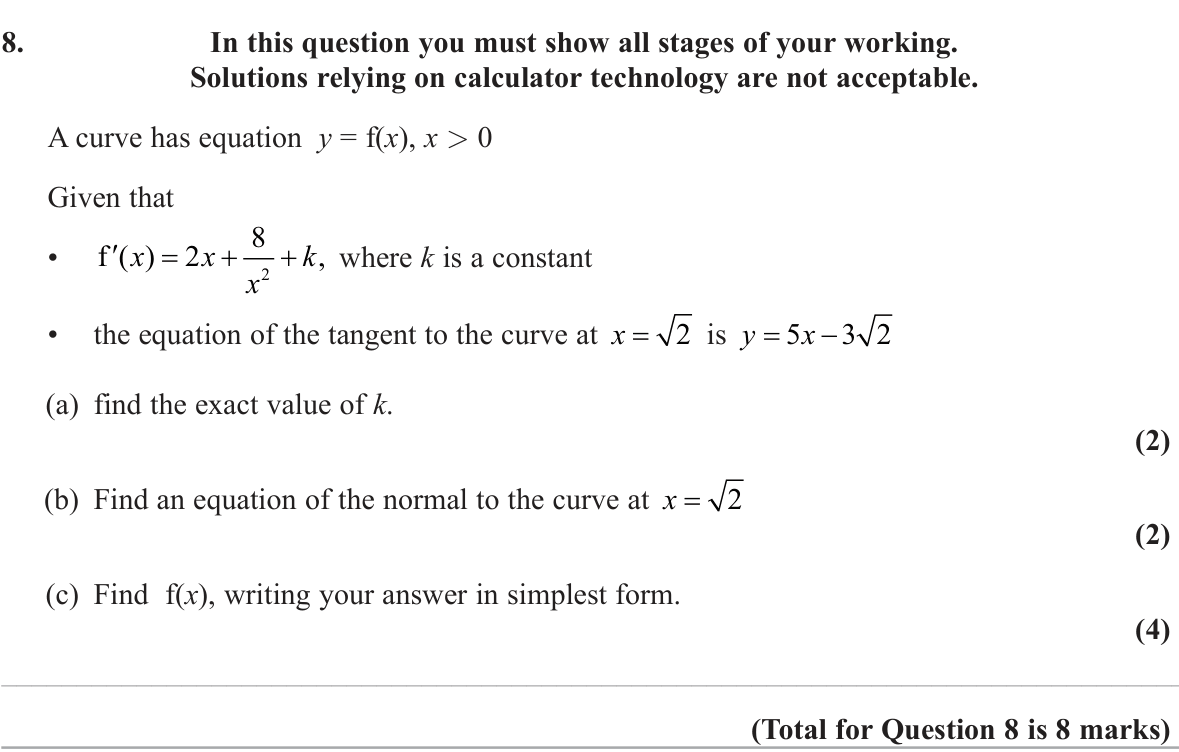
16. WMA11/01 October 2025 · Q8 Medium 8 marks · main topic: IntegrationShow worked solution Use tangent gradient The tangent has equation $y=5x-3\sqrt2$, so the gradient at $x=\sqrt2$ is $5$.
Find k $f'(\sqrt2)=2\sqrt2+\dfrac8{(\sqrt2)^2}+k=2\sqrt2+4+k=5$, so $k=1-2\sqrt2$.
Find the point on the curve At $x=\sqrt2$, the tangent gives $y=5\sqrt2-3\sqrt2=2\sqrt2$.
Normal gradient The tangent gradient is $5$, so the normal gradient is $-\dfrac15$.
Equation of the normal $y-2\sqrt2=-\dfrac15(x-\sqrt2)$, hence $y=-\dfrac15x+\dfrac{11\sqrt2}{5}$.
Integrate f prime $f(x)=\int\left(2x+\dfrac8{x^2}+k\right)dx=x^2-\dfrac8x+kx+c$.
Substitute k $f(x)=x^2-\dfrac8x+(1-2\sqrt2)x+c$.
Use the point $2\sqrt2=2-\dfrac8{\sqrt2}+(1-2\sqrt2)\sqrt2+c=-2-3\sqrt2+c$.
Find c $c=2+5\sqrt2$, so $f(x)=x^2-\dfrac8x+(1-2\sqrt2)x+2+5\sqrt2$.
Final answer $(a)\ k=1-2\sqrt2.\quad (b)\ y=-\dfrac15x+\dfrac{11\sqrt2}{5}.\quad (c)\ f(x)=x^2-\dfrac8x+(1-2\sqrt2)x+2+5\sqrt2$.
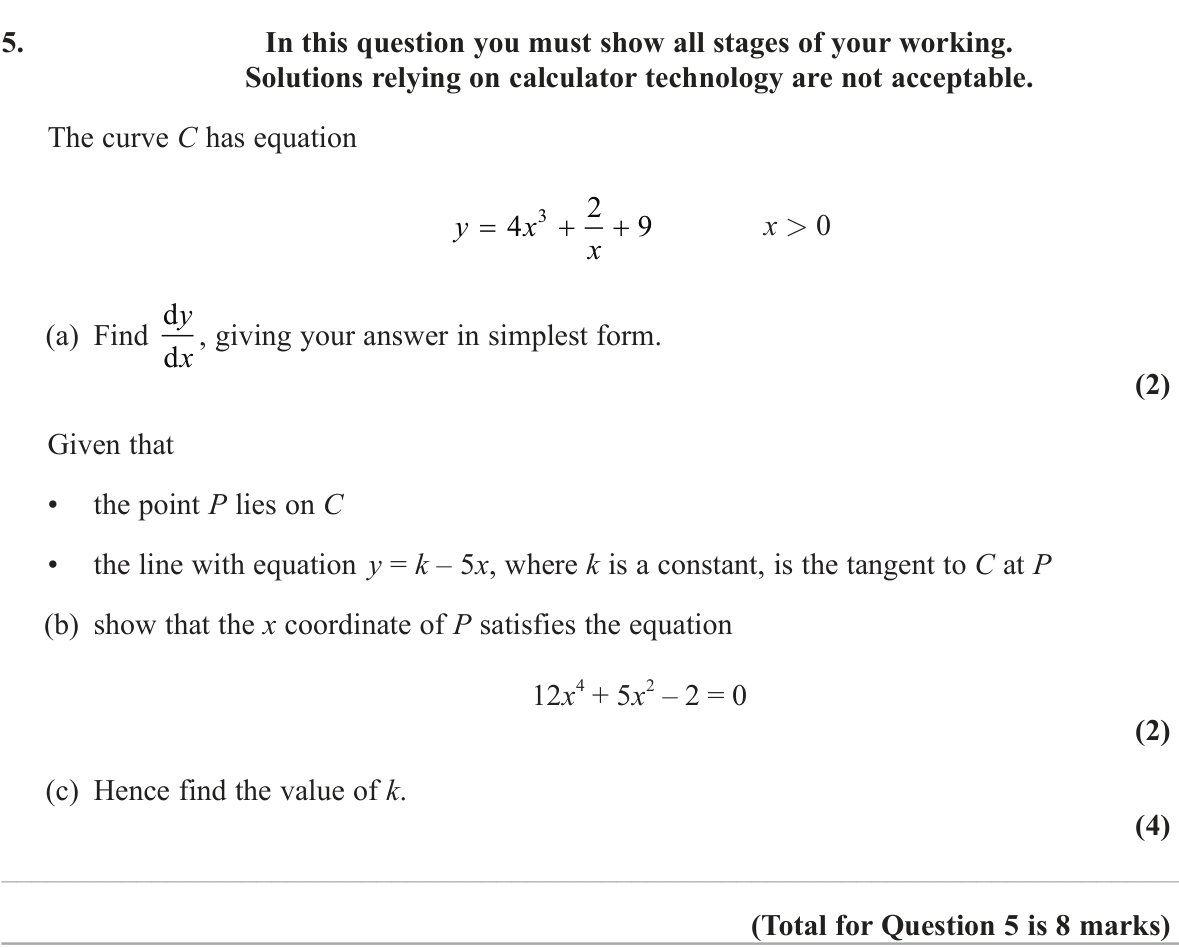
17. WMA11/01 January 2025 · Q5 Medium 8 marksShow worked solution Differentiate $y=4x^3+2x^{-1}+9$, so $\dfrac{dy}{dx}=12x^2-2x^{-2}=12x^2-\dfrac2{x^2}$.
Use the tangent gradient The tangent line $y=k-5x$ has gradient $-5$, so at $P$, $12x^2-\dfrac2{x^2}=-5$.
Clear the denominator Multiplying by $x^2$ gives $12x^4-2=-5x^2$, hence $12x^4+5x^2-2=0$.
Solve for x squared Let $u=x^2$. Then $12u^2+5u-2=(3u+2)(4u-1)=0$.
Use x greater than zero $x^2=\dfrac14$, so $x=\dfrac12$.
Find the y-coordinate of P $y=4\left(\dfrac12\right)^3+\dfrac{2}{1/2}+9=\dfrac12+4+9=\dfrac{27}{2}$.
Find k Since $P$ lies on $y=k-5x$, $\dfrac{27}{2}=k-\dfrac52$, so $k=16$.
Final answer $(a)\ \dfrac{dy}{dx}=12x^2-\dfrac{2}{x^2}.\quad (c)\ k=16$.
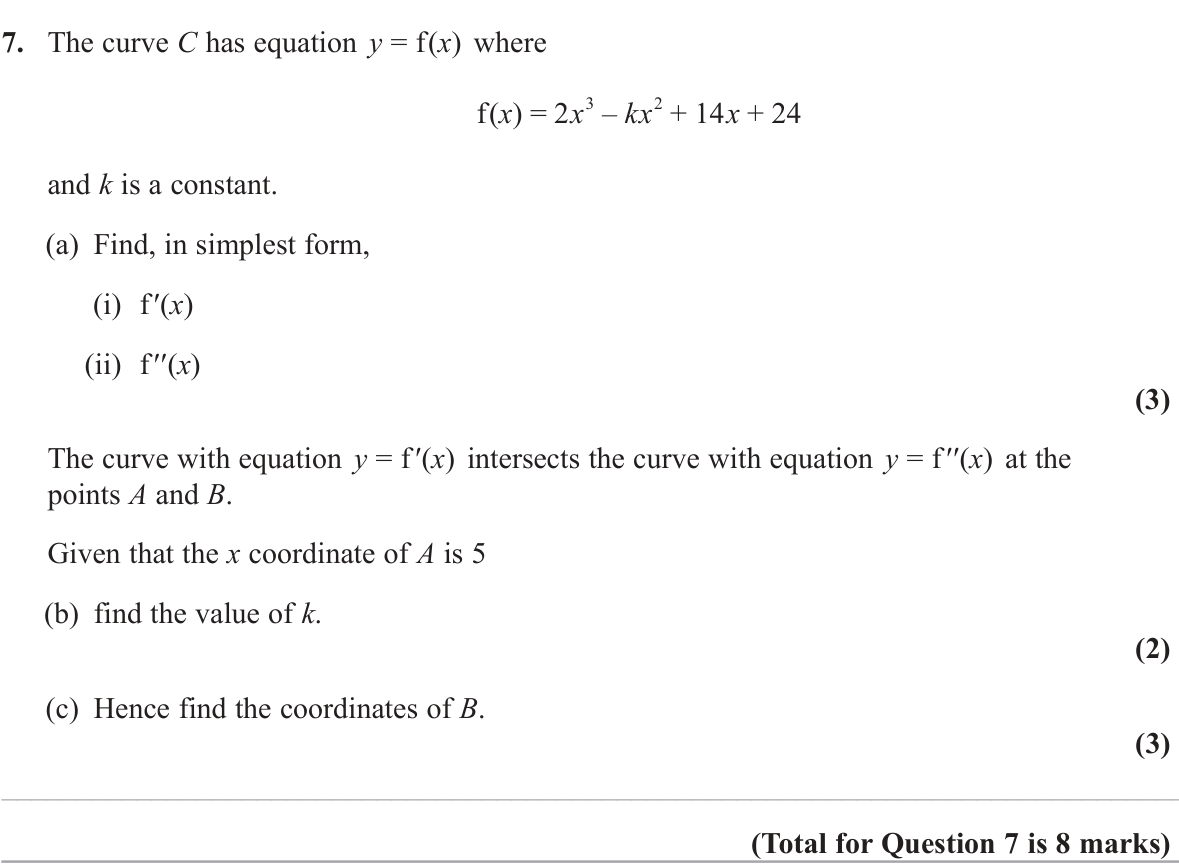
18. WMA11/01 May/June 2024 · Q7 Medium 8 marksShow worked solution Differentiate once $f'(x)=6x^2-2kx+14$.
Differentiate again $f''(x)=12x-2k$.
Use the intersection at A At an intersection of $y=f'(x)$ and $y=f''(x)$, $f'(x)=f''(x)$. Given $x_A=5$, substitute $x=5$.
Find k $6(5)^2-2k(5)+14=12(5)-2k$, so $164-10k=60-2k$ and $k=13$.
Find the other x-coordinate With $k=13$, $6x^2-26x+14=12x-26$, so $6x^2-38x+40=0$. Hence $(3x-4)(x-5)=0$.
Use the point B The other point has $x=\dfrac43$. Then $y=f''(\dfrac43)=12(\dfrac43)-26=-10$.
Final answer $(a)(i)\ f'(x)=6x^2-2kx+14.\quad (a)(ii)\ f''(x)=12x-2k.\quad (b)\ k=13.\quad (c)\ B=(\dfrac43,-10)$.
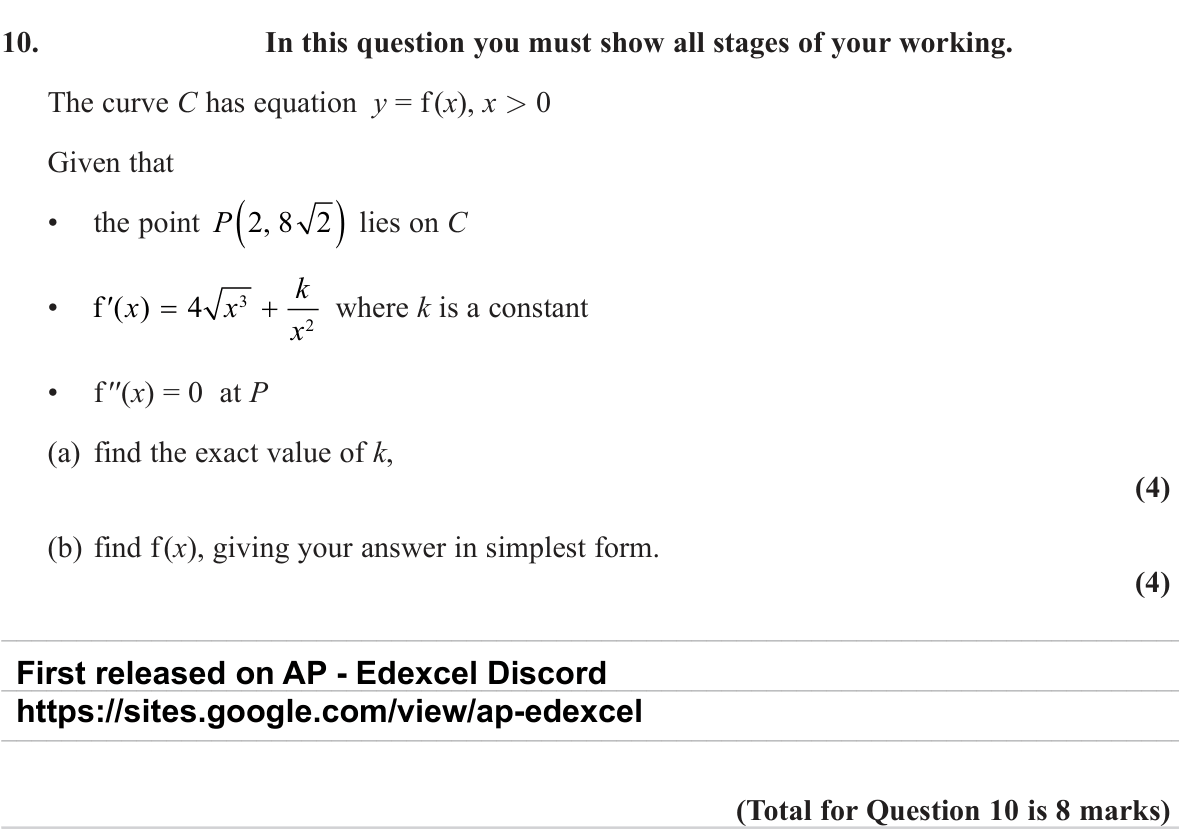
19. WMA11/01 January 2024 · Q10 Medium 8 marks · main topic: IntegrationShow worked solution Differentiate f prime $f'(x)=4x^{3/2}+kx^{-2}$, so $f''(x)=6x^{1/2}-2kx^{-3}$.
Use f''(P) = 0 At $P$, $x=2$ and $f''(2)=0$, so $6\sqrt2-2k(2^{-3})=0$.
Find k $6\sqrt2-\dfrac{k}{4}=0$, hence $k=24\sqrt2$.
Integrate f prime $f(x)=\int\left(4x^{3/2}+24\sqrt2x^{-2}\right)dx=\dfrac85x^{5/2}-24\sqrt2x^{-1}+c$.
Use the point P $P(2,8\sqrt2)$ lies on $C$, so $8\sqrt2=\dfrac85(2^{5/2})-\dfrac{24\sqrt2}{2}+c$.
Find c $8\sqrt2=\dfrac{32\sqrt2}{5}-12\sqrt2+c$, so $c=\dfrac{68\sqrt2}{5}$.
Final answer $(a)\ k=24\sqrt2.\quad (b)\ f(x)=\dfrac85x^{5/2}-\dfrac{24\sqrt2}{x}+\dfrac{68\sqrt2}{5}$.
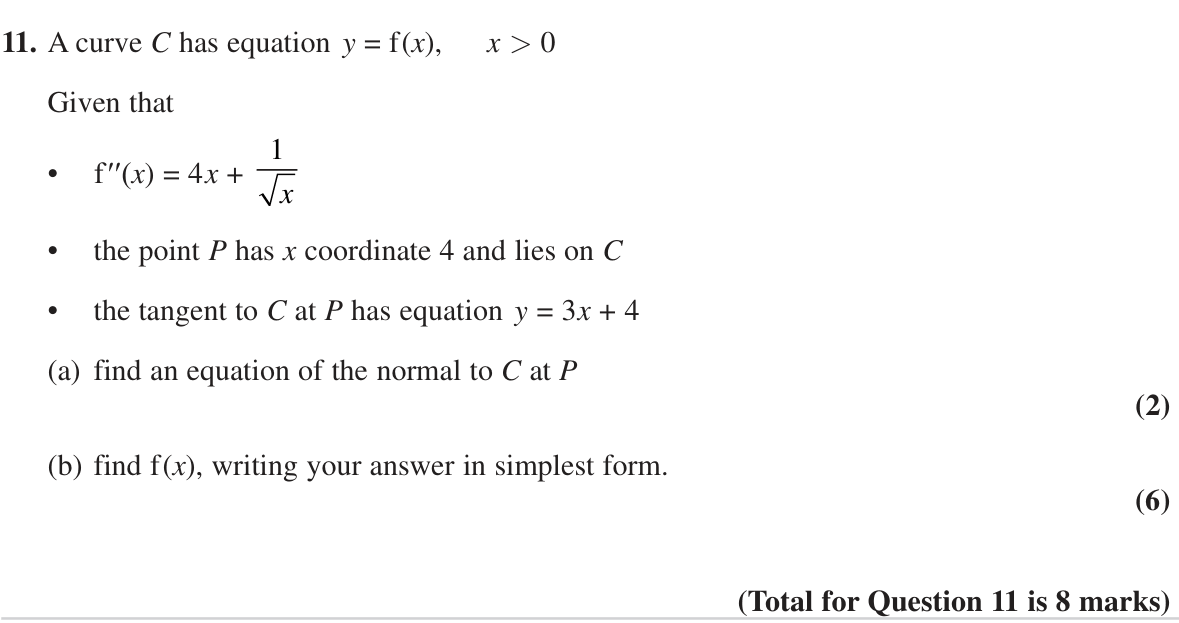
20. WMA11/01 January 2023 · Q11 Medium 8 marks · main topic: IntegrationShow worked solution Find point P Since $P$ has x-coordinate 4 and lies on the tangent $y=3x+4$, $P=(4,16)$.
Find the normal The tangent gradient is 3, so the normal gradient is $-\dfrac13$. Hence the normal is $y-16=-\dfrac13(x-4)$.
Integrate f''(x) $f''(x)=4x+x^{-1/2}$, so $f'(x)=2x^2+2\sqrt{x}+A$.
Use the tangent gradient At $x=4$, $f'(4)=3$. Thus $2(16)+2(2)+A=3$, so $A=-33$.
Integrate again $f(x)=\dfrac23x^3+\dfrac43x^{3/2}-33x+B$.
Use P(4, 16) $16=\dfrac23(64)+\dfrac43(8)-33(4)+B=\dfrac{160}{3}-132+B$.
Find B $B=\dfrac{284}{3}$, so $f(x)=\dfrac23x^3+\dfrac43x^{3/2}-33x+\dfrac{284}{3}$.
Final answer $(a)\ y-16=-\dfrac13(x-4).\quad (b)\ f(x)=\dfrac23x^3+\dfrac43x^{3/2}-33x+\dfrac{284}{3}$.
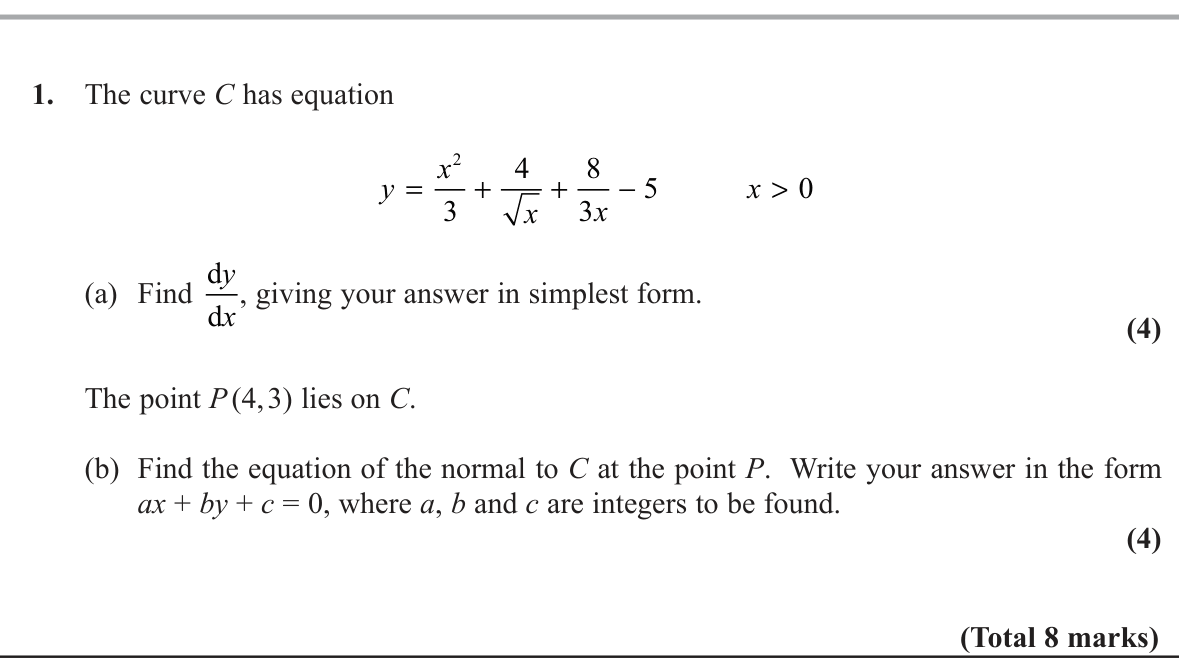
21. WMA11/01 May/June 2021 · Q1 Medium 8 marksShow worked solution Rewrite using powers $y=\dfrac{x^2}{3}+4x^{-1/2}+\dfrac83x^{-1}-5$.
Differentiate term by term $\dfrac{dy}{dx}=\dfrac{2x}{3}-2x^{-3/2}-\dfrac83x^{-2}=\dfrac{2x}{3}-\dfrac{2}{x\sqrt{x}}-\dfrac{8}{3x^2}$.
Find the tangent gradient at P At $x=4$, $\dfrac{dy}{dx}=\dfrac83-\dfrac14-\dfrac16=\dfrac94$.
Find the normal gradient The normal gradient is the negative reciprocal of $\dfrac94$, so $m_n=-\dfrac49$.
Write the normal equation Using $P(4,3)$, $y-3=-\dfrac49(x-4)$. Multiplying by $9$ gives $9y-27=-4x+16$, hence $4x+9y-43=0$.
Final answer $(a)\ \dfrac{dy}{dx}=\dfrac{2x}{3}-\dfrac{2}{x\sqrt{x}}-\dfrac{8}{3x^2}.\quad (b)\ 4x+9y-43=0$.
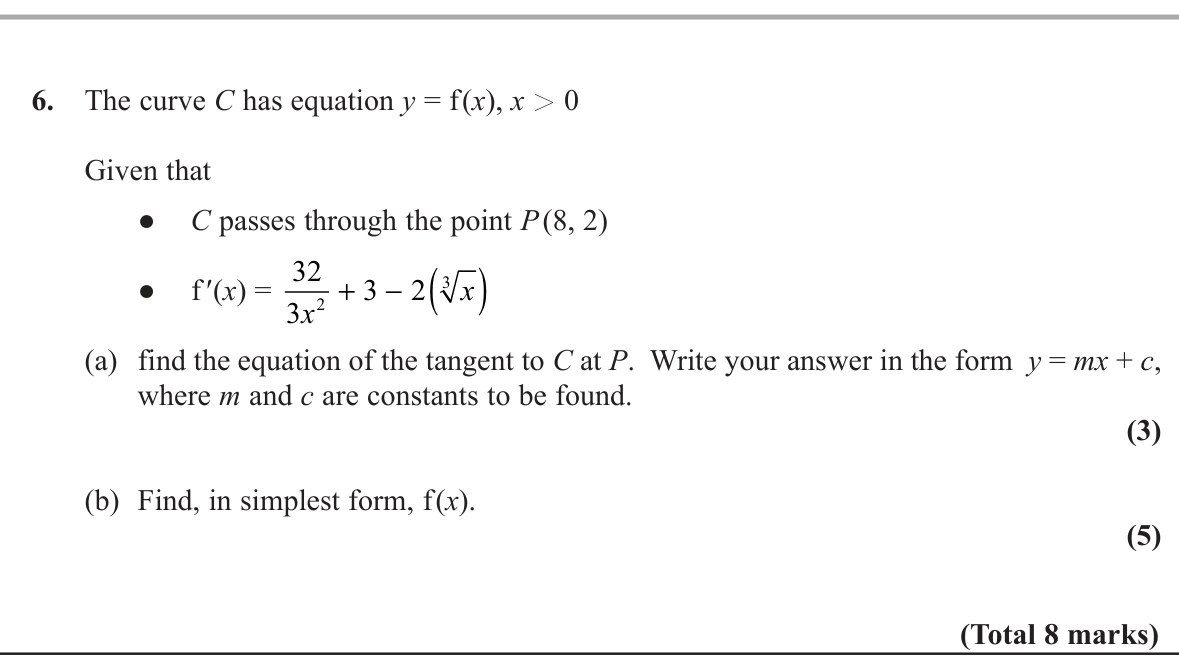
22. WMA11/01 May/June 2021 · Q6 Medium 8 marks · main topic: IntegrationShow worked solution Find the gradient at P $f'(x)=\dfrac{32}{3x^2}+3-2\sqrt[3]{x}$. At $x=8$, $f'(8)=\dfrac{32}{3(64)}+3-2(2)=\dfrac16-1=-\dfrac56$.
Write the tangent equation Using $P(8,2)$, $y-2=-\dfrac56(x-8)$, hence $y=-\dfrac56x+\dfrac{26}{3}$.
Integrate f'(x) $f'(x)=\dfrac{32}{3}x^{-2}+3-2x^{1/3}$, so $f(x)=-\dfrac{32}{3x}+3x-\dfrac32x^{4/3}+c$.
Use P(8,2) to find c $2=-\dfrac{32}{24}+24-\dfrac32(16)+c=-\dfrac43+c$, so $c=\dfrac{10}{3}$.
Write f(x) $f(x)=-\dfrac{32}{3x}+3x-\dfrac32x^{4/3}+\dfrac{10}{3}$.
Final answer $(a)\ y=-\dfrac56x+\dfrac{26}{3}.\quad (b)\ f(x)=-\dfrac{32}{3x}+3x-\dfrac32x^{4/3}+\dfrac{10}{3}$.
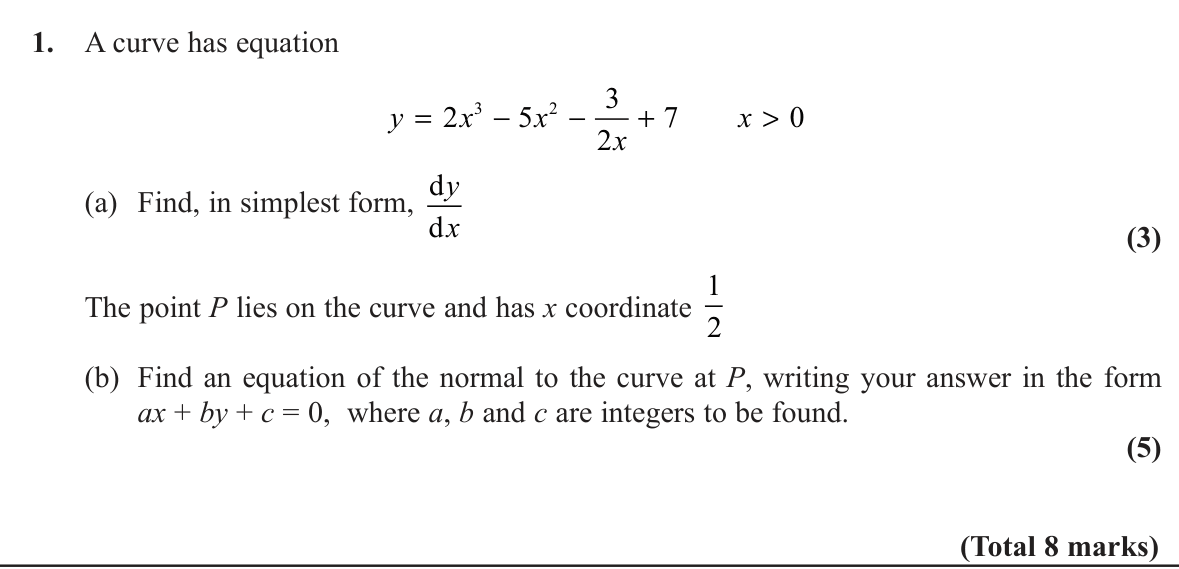
23. WMA11/01 January 2021 · Q1 Medium 8 marksShow worked solution Rewrite the negative power term $y=2x^3-5x^2-\dfrac{3}{2x}+7=2x^3-5x^2-\dfrac32x^{-1}+7$.
Differentiate term by term $\dfrac{dy}{dx}=6x^2-10x+\dfrac32x^{-2}=6x^2-10x+\dfrac{3}{2x^2}$.
Find the point P At $x=\dfrac12$, $y=2\left(\dfrac18\right)-5\left(\dfrac14\right)-\dfrac{3}{1}+7=3$, so $P=\left(\dfrac12,3\right)$.
Find the normal gradient At $x=\dfrac12$, $\dfrac{dy}{dx}=6\left(\dfrac14\right)-10\left(\dfrac12\right)+\dfrac{3}{2(1/4)}=\dfrac52$. The normal gradient is therefore $-\dfrac25$.
Write the normal in integer form $y-3=-\dfrac25\left(x-\dfrac12\right)$. Multiplying by $5$ gives $5y-15=-2x+1$, hence $2x+5y-16=0$.
Final answer $(a)\ \dfrac{dy}{dx}=6x^2-10x+\dfrac{3}{2x^2}.\quad (b)\ 2x+5y-16=0$.
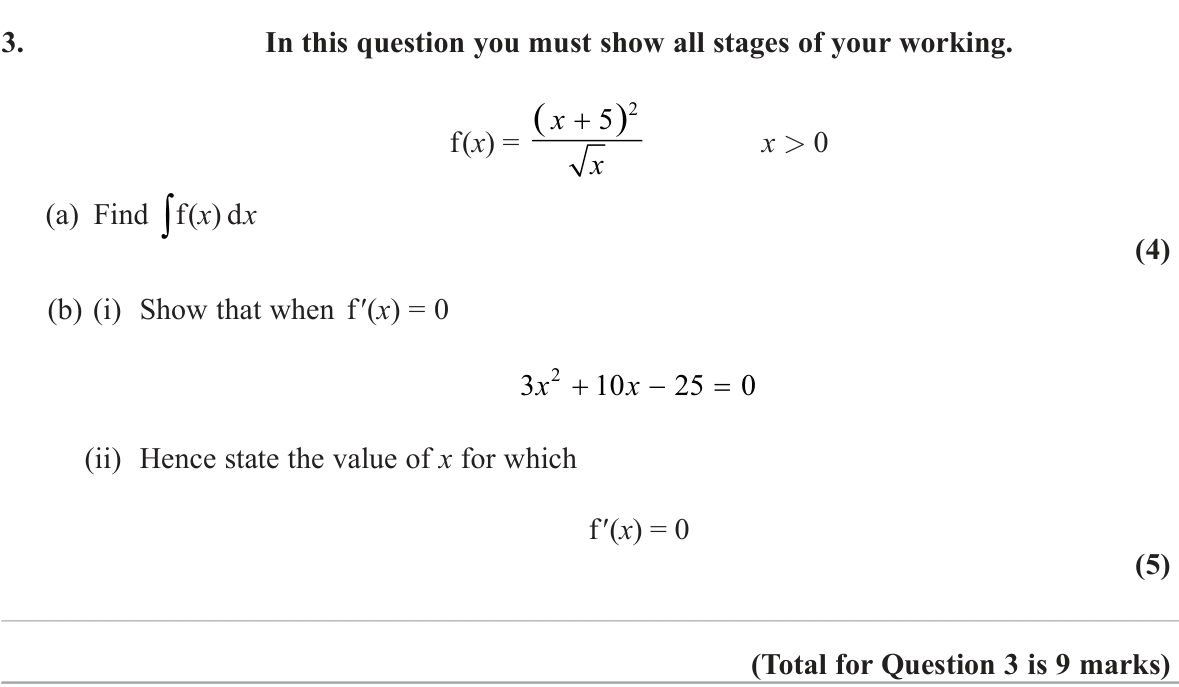
24. WMA11/01 October 2024 · Q3 Hard 9 marks · main topic: IntegrationShow worked solution Rewrite f(x) $f(x)=\dfrac{(x+5)^2}{\sqrt{x}}=\dfrac{x^2+10x+25}{x^{1/2}}=x^{3/2}+10x^{1/2}+25x^{-1/2}$.
Integrate $\int f(x)\,dx=\dfrac25x^{5/2}+\dfrac{20}{3}x^{3/2}+50x^{1/2}+c$.
Differentiate f(x) $f'(x)=\dfrac32x^{1/2}+5x^{-1/2}-\dfrac{25}{2}x^{-3/2}$.
Set f prime equal to zero $\dfrac32x^{1/2}+5x^{-1/2}-\dfrac{25}{2}x^{-3/2}=0$.
Clear powers of x Multiplying by $2x^{3/2}$ gives $3x^2+10x-25=0$.
Use x greater than zero $3x^2+10x-25=(3x-5)(x+5)$, so $x=\dfrac53$ or $x=-5$. Since $x>0$, $x=\dfrac53$.
Final answer $(a)\ \dfrac25x^{5/2}+\dfrac{20}{3}x^{3/2}+50x^{1/2}+c.\quad (b)\ x=\dfrac53$.
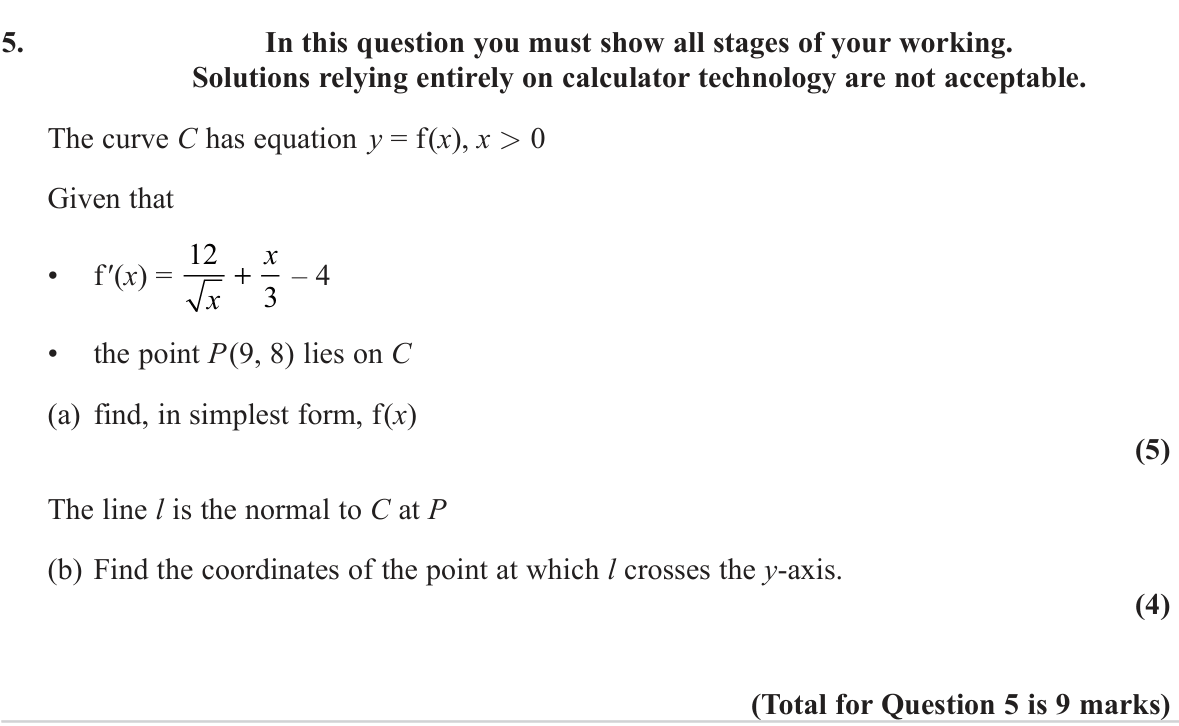
25. WMA11/01 October 2022 · Q5 Hard 9 marks · main topic: IntegrationShow worked solution Integrate f'(x) $f'(x)=12x^{-1/2}+\dfrac{x}{3}-4$, so $f(x)=24\sqrt{x}+\dfrac{x^2}{6}-4x+c$.
Use P(9, 8) $8=24\sqrt9+\dfrac{9^2}{6}-4(9)+c=72+\dfrac{81}{6}-36+c$.
Find c $72+\dfrac{81}{6}-36=\dfrac{99}{2}$, so $c=8-\dfrac{99}{2}=-\dfrac{83}{2}$.
Find the tangent gradient at P $f'(9)=\dfrac{12}{3}+\dfrac93-4=3$.
Find the normal gradient The normal gradient is the negative reciprocal of 3, so it is $-\dfrac13$.
Find the y-intercept The normal through $(9,8)$ is $y-8=-\dfrac13(x-9)$, so $y=-\dfrac13x+11$. It crosses the y-axis at $(0,11)$.
Final answer $(a)\ f(x)=24\sqrt{x}+\dfrac{x^2}{6}-4x-\dfrac{83}{2}.\quad (b)\ (0,11)$.
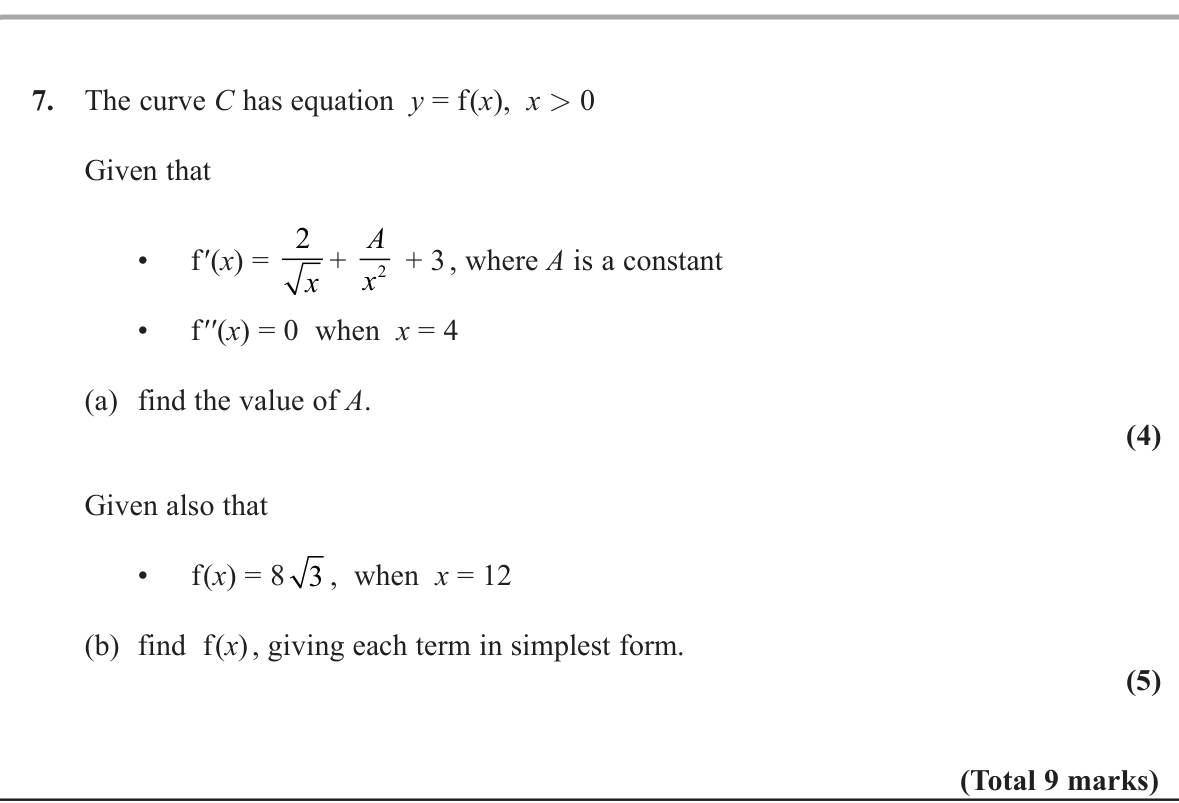
26. WMA11/01 May/June 2022 · Q7 Hard 9 marks · main topic: IntegrationShow worked solution Differentiate f'(x) $f'(x)=2x^{-1/2}+Ax^{-2}+3$, so $f''(x)=-x^{-3/2}-2Ax^{-3}$.
Use f''(4) = 0 $-4^{-3/2}-2A(4^{-3})=0$, so $-\dfrac18-\dfrac{A}{32}=0$ and $A=-4$.
Substitute A into f'(x) $f'(x)=\dfrac2{\sqrt{x}}-\dfrac4{x^2}+3$.
Integrate to find f(x) $f(x)=4\sqrt{x}+\dfrac4x+3x+c$.
Use f(12) = 8sqrt3 $f(12)=8\sqrt3+\dfrac13+36+c=8\sqrt3$, so $c=-\dfrac{109}{3}$.
Final answer $f(x)=4\sqrt{x}+\dfrac4x+3x-\dfrac{109}{3}$.
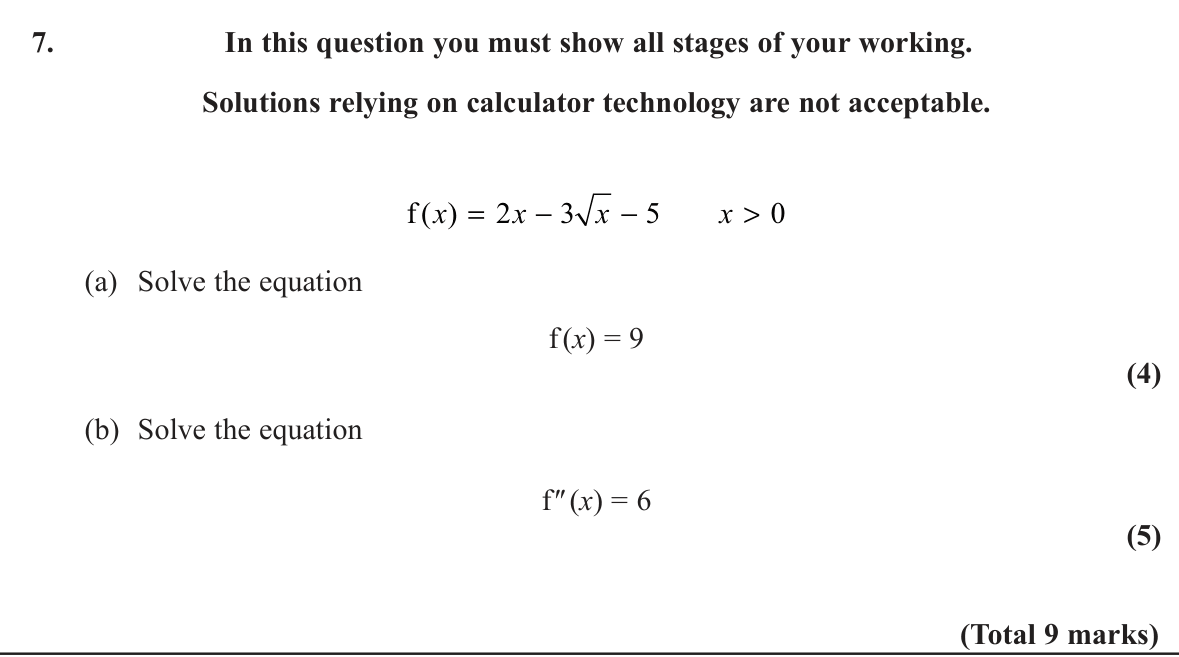
27. WMA11/01 January 2021 · Q7 Hard 9 marksShow worked solution Solve f(x) = 9 without calculator methods $2x-3\sqrt{x}-5=9$, so $2x-3\sqrt{x}-14=0$.
Use u = sqrt(x) Let $u=\sqrt{x}$, where $u>0$. Then $x=u^2$, so $2u^2-3u-14=0$.
Factorise and reject the invalid root $2u^2-3u-14=(2u-7)(u+2)$. Since $u>0$, $u=\dfrac72$, so $x=u^2=\dfrac{49}{4}$.
Differentiate twice $f(x)=2x-3x^{1/2}-5$, so $f'(x)=2-\dfrac32x^{-1/2}$ and $f''(x)=\dfrac34x^{-3/2}$.
Solve f''(x) = 6 $\dfrac34x^{-3/2}=6$, so $x^{-3/2}=8$. Therefore $x^{3/2}=\dfrac18$.
Find x Since $x^{3/2}=(\sqrt{x})^3$, we get $\sqrt{x}=\dfrac12$, hence $x=\dfrac14$.
Final answer $(a)\ x=\dfrac{49}{4}.\quad (b)\ x=\dfrac14$.
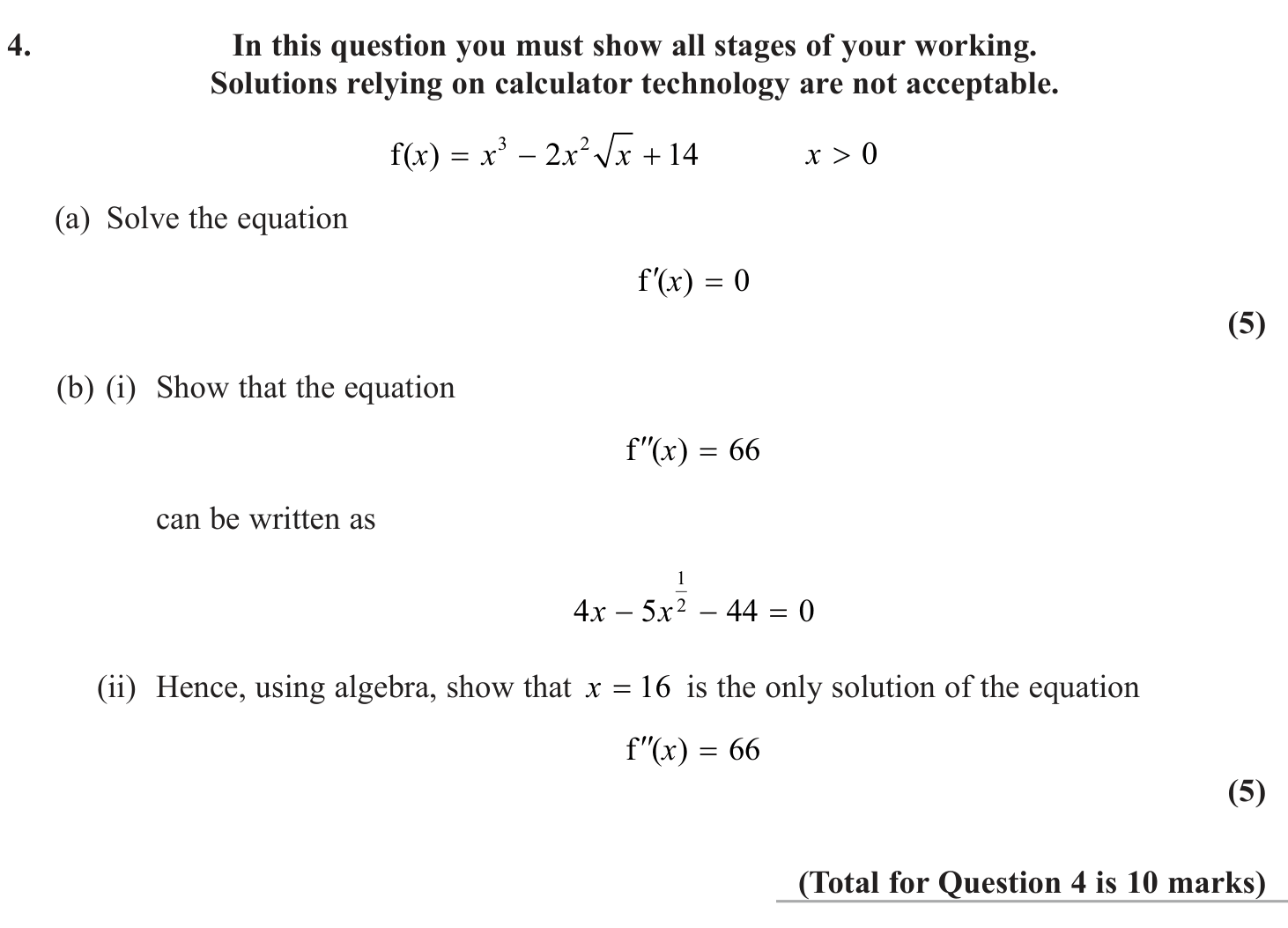
28. WMA11/01 May/June 2026 · Q4 Hard 10 marksShow worked solution (a) Rewrite the radical as a power $f(x)=x^3-2x^{5/2}+14$.
(a) Differentiate and solve $f'(x)=3x^2-5x^{3/2}=x^{3/2}(3x^{1/2}-5)$. Since $x>0$, the factor $x^{3/2}$ is non-zero. Therefore $3\sqrt{x}-5=0$, so $\sqrt{x}=\dfrac53$ and $x=\dfrac{25}{9}$.
(b)(i) Differentiate again $f''(x)=6x-\dfrac{15}{2}x^{1/2}$.
(b)(i) Rearrange the given equation $6x-\dfrac{15}{2}x^{1/2}=66$. Multiplying by 2 and dividing by 3 gives $4x-5x^{1/2}-44=0$, as required.
(b)(ii) Factorise as a quadratic in the square root Let $u=\sqrt{x}$, where $u\geq0$. Then $4u^2-5u-44=0$, and $(u-4)(4u+11)=0$. Hence $u=4$ or $u=-\dfrac{11}{4}$.
(b)(ii) Apply the square-root restriction Because $u=\sqrt{x}\geq0$, the value $-\dfrac{11}{4}$ is impossible. Thus $\sqrt{x}=4$ and $x=16$, which is the only solution.
Final answer $(a)\ x=\dfrac{25}{9}.\qquad (b)(i)\ 4x-5\sqrt{x}-44=0.\qquad (b)(ii)\ x=16\text{ is the only solution}.$
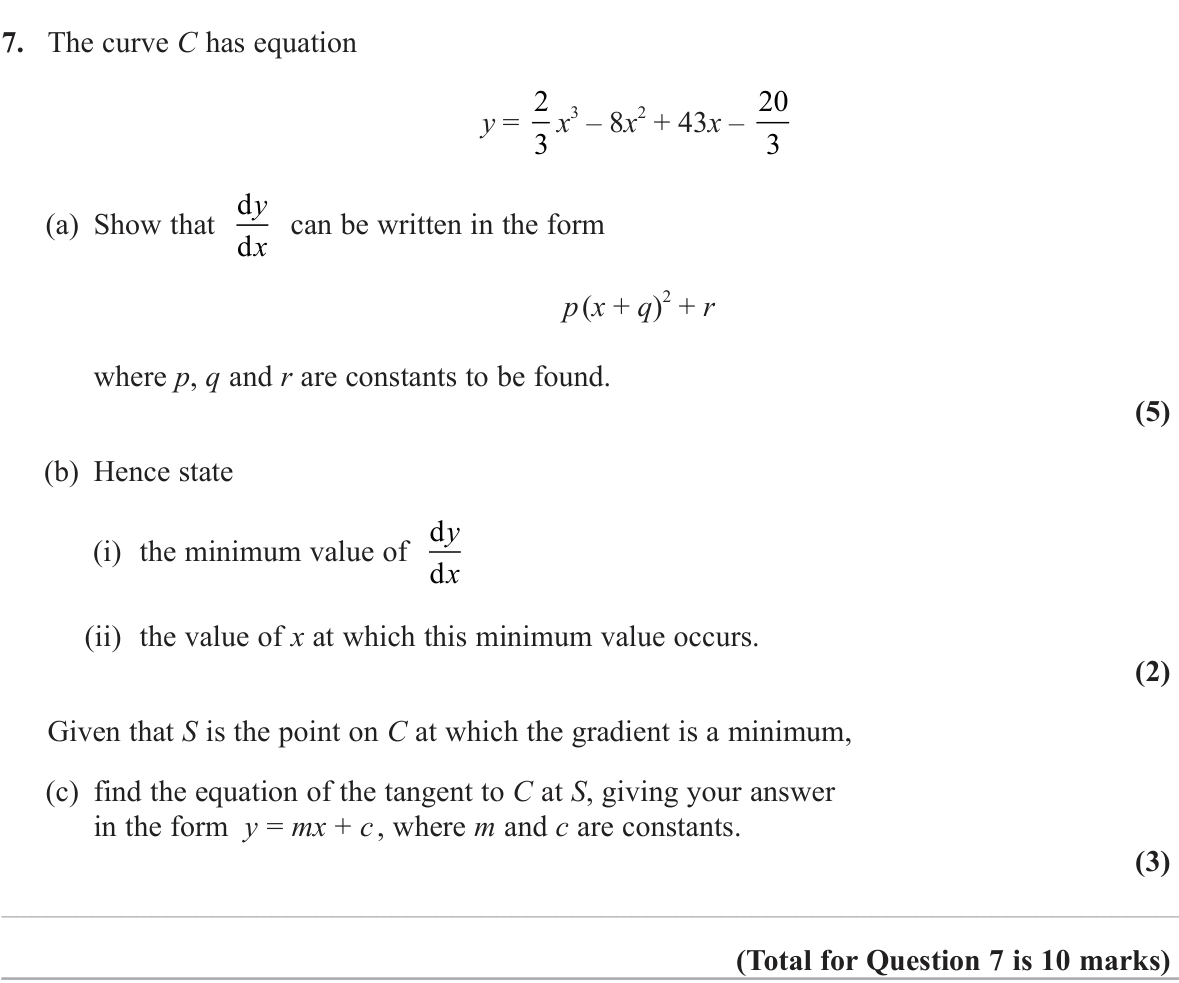
29. WMA11/01 January 2026 · Q7 Hard 10 marksShow worked solution Differentiate $y=\dfrac23x^3-8x^2+43x-\dfrac{20}{3}$ gives $\dfrac{dy}{dx}=2x^2-16x+43$.
Complete the square $2x^2-16x+43=2(x^2-8x)+43=2[(x-4)^2-16]+43$.
Simplify $\dfrac{dy}{dx}=2(x-4)^2+11$.
Minimum gradient Since $2(x-4)^2\ge0$, the minimum value of $\dfrac{dy}{dx}$ is $11$.
Where it occurs The minimum occurs when $x-4=0$, so $x=4$.
Find the point S At $x=4$, $y=\dfrac23(4)^3-8(4)^2+43(4)-\dfrac{20}{3}=80$.
Tangent equation The gradient at $S$ is $11$, so $y-80=11(x-4)$.
Simplify $y=11x+36$.
Final answer $(a)\ \dfrac{dy}{dx}=2(x-4)^2+11.\quad (b)\ \min\dfrac{dy}{dx}=11\text{ at }x=4.\quad (c)\ y=11x+36$.
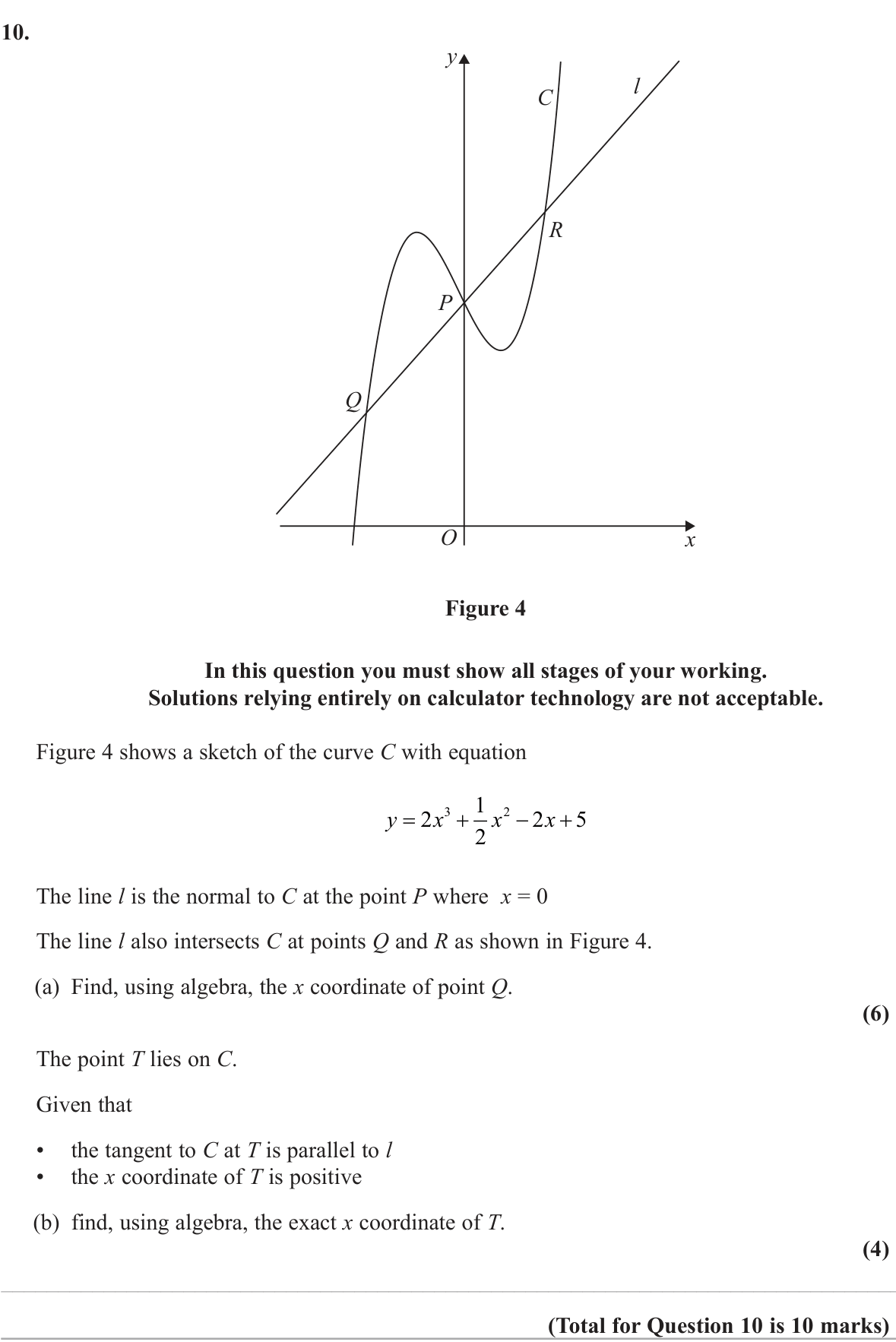
30. WMA11/01 October 2025 · Q10 Hard 10 marksShow worked solution Differentiate C $y=2x^3+\dfrac12x^2-2x+5$, so $\dfrac{dy}{dx}=6x^2+x-2$.
Find the tangent gradient at P At $P$, $x=0$, so the tangent gradient is $-2$.
Equation of the normal The normal gradient is $\dfrac12$ and $P=(0,5)$, so $l:y=\dfrac12x+5$.
Find intersections with the normal Set $2x^3+\dfrac12x^2-2x+5=\dfrac12x+5$.
Form and factor the cubic $2x^3+\dfrac12x^2-\dfrac52x=0$. Multiplying by $2$ gives $4x^3+x^2-5x=0=x(4x^2+x-5)$.
Solve for x $x(4x+5)(x-1)=0$, so the intersections have x-coordinates $0$, $-\dfrac54$ and $1$.
Select point Q The point $Q$ is the left-hand intersection, so $x_Q=-\dfrac54$.
Parallel tangent condition The tangent at $T$ is parallel to $l$, so its gradient is $\dfrac12$.
Set derivative equal to one half $6x^2+x-2=\dfrac12$, so $12x^2+2x-5=0$.
Use the positive solution $x=\dfrac{-2\pm\sqrt{4+240}}{24}=\dfrac{-1\pm\sqrt{61}}{12}$. Since $x_T$ is positive, $x_T=\dfrac{-1+\sqrt{61}}{12}$.
Final answer $(a)\ x_Q=-\dfrac54.\quad (b)\ x_T=\dfrac{-1+\sqrt{61}}{12}$.
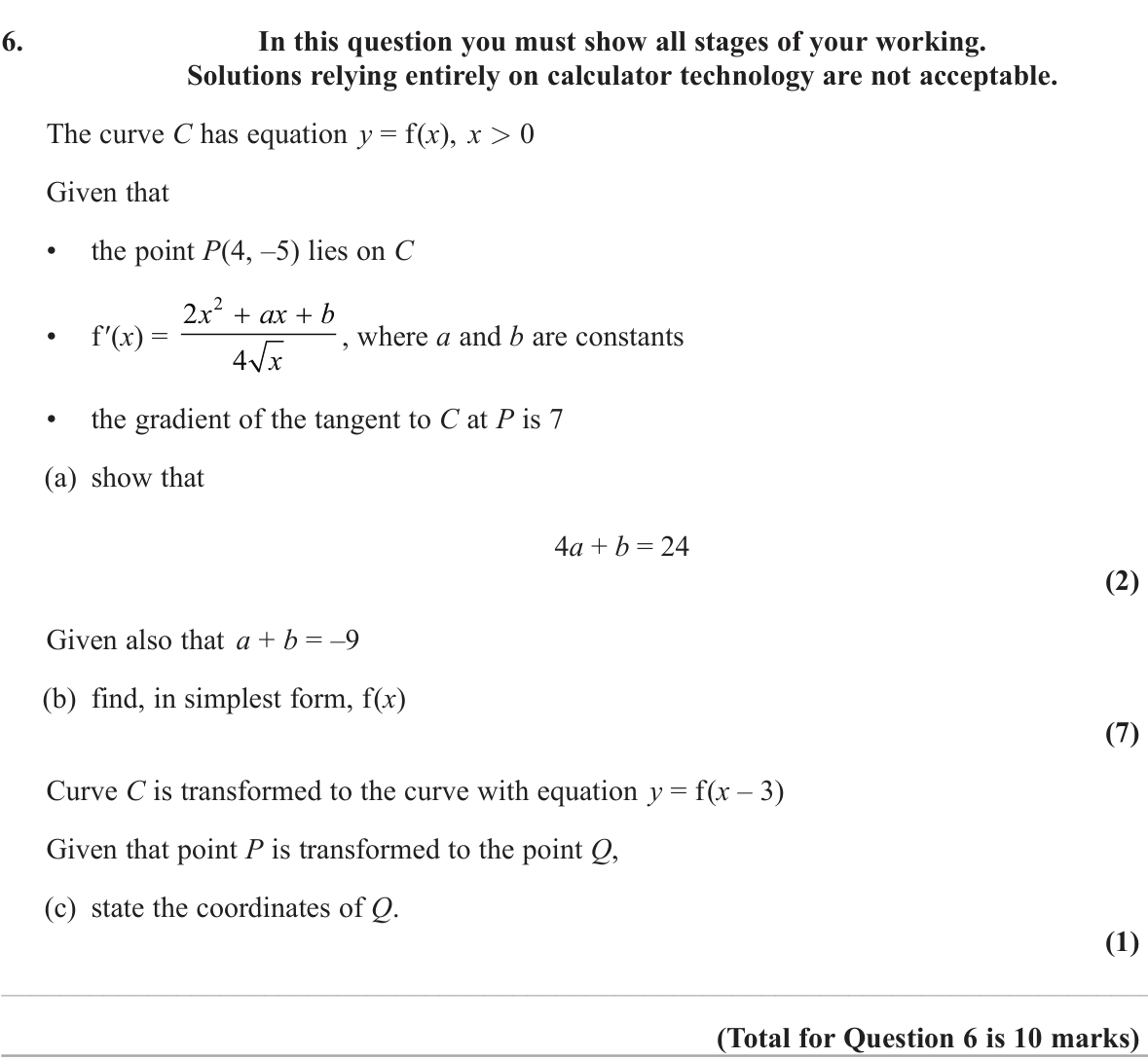
31. WMA11/01 January 2025 · Q6 Hard 10 marks · main topic: IntegrationShow worked solution Use the gradient at P At $x=4$, $f'(4)=7$. Since $f'(x)=\dfrac{2x^2+ax+b}{4\sqrt{x}}$, we get $\dfrac{32+4a+b}{8}=7$.
Show the required equation $32+4a+b=56$, so $4a+b=24$.
Solve for a and b Together with $a+b=-9$, subtracting gives $3a=33$, so $a=11$ and $b=-20$.
Rewrite f prime $f'(x)=\dfrac{2x^2+11x-20}{4\sqrt{x}}=\dfrac12x^{3/2}+\dfrac{11}{4}x^{1/2}-5x^{-1/2}$.
Integrate $f(x)=\dfrac15x^{5/2}+\dfrac{11}{6}x^{3/2}-10x^{1/2}+c$.
Use P to find c $-5=\dfrac15(4^{5/2})+\dfrac{11}{6}(4^{3/2})-10(4^{1/2})+c=\dfrac{16}{15}+c$.
State f(x) $c=-\dfrac{91}{15}$, so $f(x)=\dfrac15x^{5/2}+\dfrac{11}{6}x^{3/2}-10x^{1/2}-\dfrac{91}{15}$.
Transform P $y=f(x-3)$ translates the curve 3 units to the right, so $P(4,-5)$ becomes $Q(7,-5)$.
Final answer $(b)\ f(x)=\dfrac15x^{5/2}+\dfrac{11}{6}x^{3/2}-10x^{1/2}-\dfrac{91}{15}.\quad (c)\ Q=(7,-5)$.
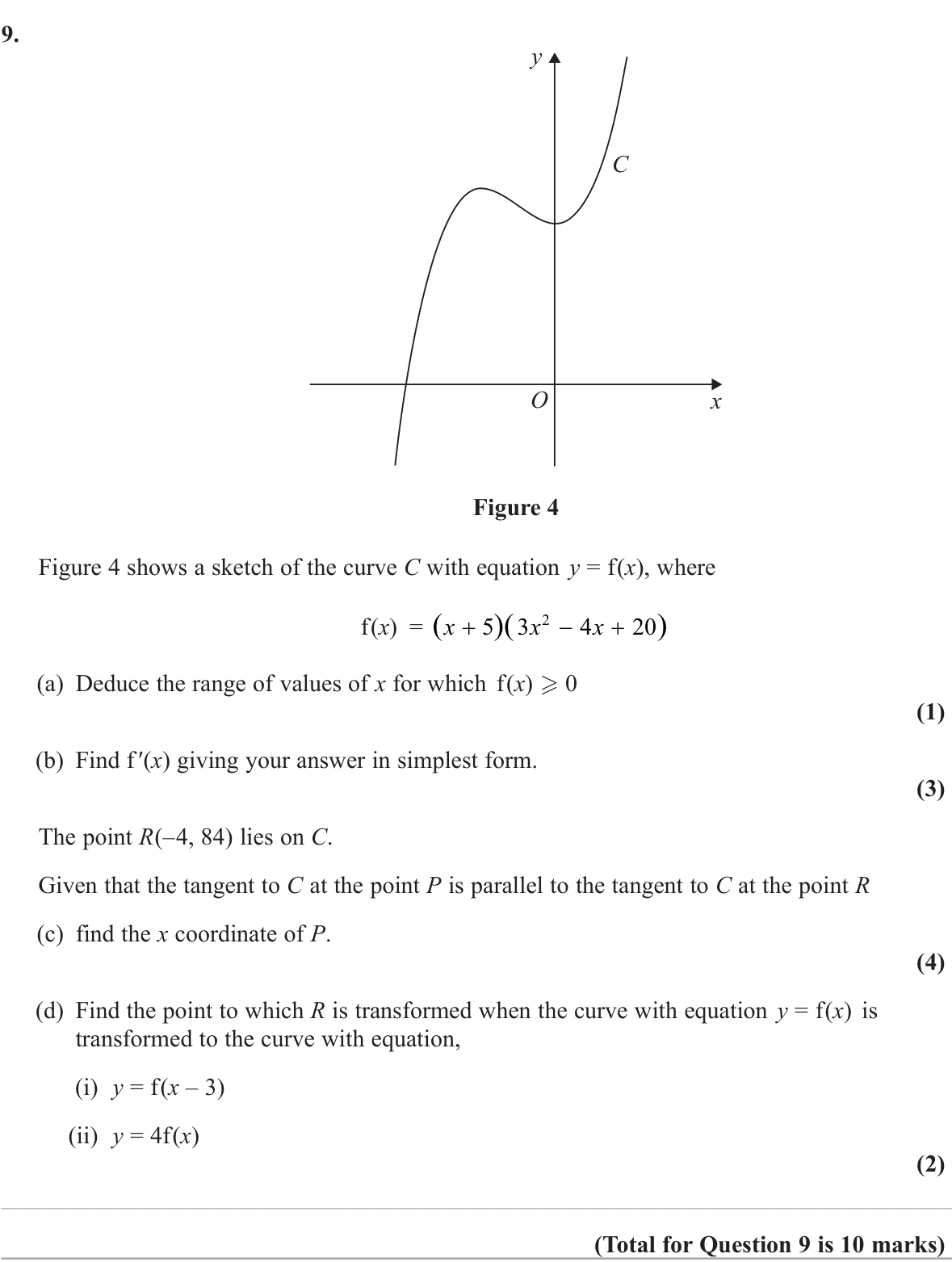
32. WMA11/01 October 2024 · Q9 Hard 10 marksShow worked solution Use the positive quadratic factor $3x^2-4x+20$ has discriminant $(-4)^2-4(3)(20)<0$ and positive leading coefficient, so it is always positive.
Deduce the sign of f(x) The sign of $f(x)=(x+5)(3x^2-4x+20)$ is therefore the sign of $x+5$. Hence $f(x)\ge0$ for $x\ge-5$.
Expand f(x) $f(x)=3x^3+11x^2+100$.
Differentiate $f'(x)=9x^2+22x$.
Find the gradient at R At $R(-4,84)$, $f'(-4)=9(16)+22(-4)=56$.
Use parallel tangents For the tangent at $P$ to be parallel, $f'(x)=56$.
Solve for x $9x^2+22x-56=0$, so $x=\dfrac{-22\pm50}{18}$. The roots are $x=-4$ and $x=\dfrac{14}{9}$.
Choose the point P $x=-4$ is the point $R$, so $x_P=\dfrac{14}{9}$.
Translate point R $y=f(x-3)$ translates the curve 3 units to the right, so $(-4,84)$ maps to $(-1,84)$.
Transform R under y equals 4f(x) $y=4f(x)$ stretches vertically by scale factor 4, so $(-4,84)$ maps to $(-4,336)$.
Final answer $(a)\ x\ge-5.\quad (b)\ f'(x)=9x^2+22x.\quad (c)\ x_P=\dfrac{14}{9}.\quad (d)(i)\ (-1,84).\quad (d)(ii)\ (-4,336)$.
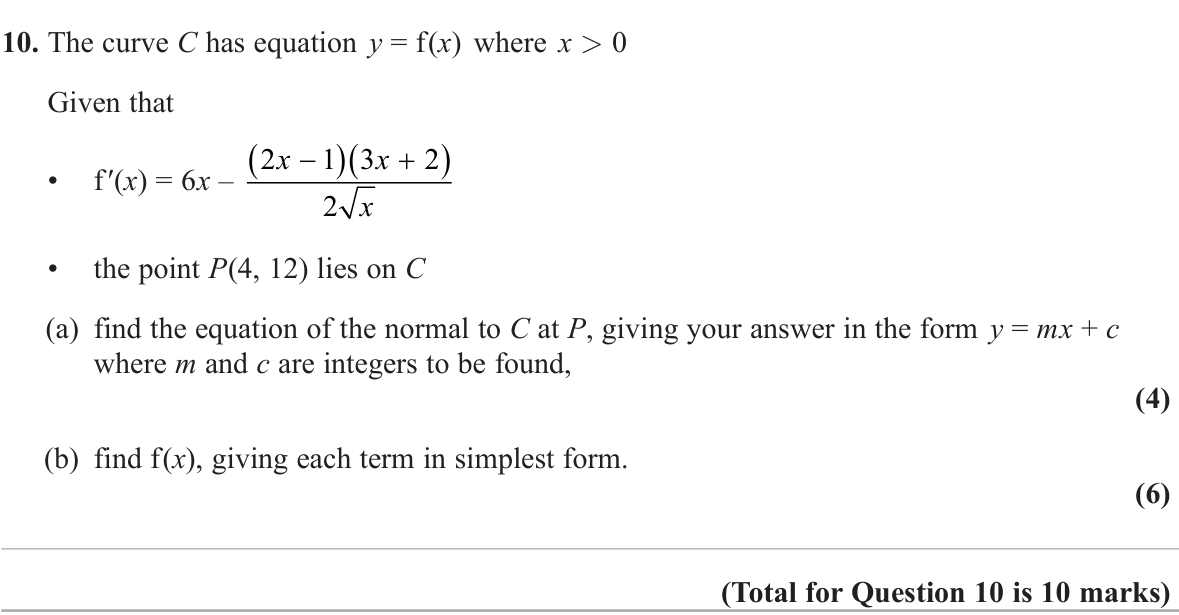
33. WMA11/01 May/June 2024 · Q10 Hard 10 marks · main topic: IntegrationShow worked solution Expand the numerator $(2x-1)(3x+2)=6x^2+x-2$.
Simplify f prime $f'(x)=6x-\dfrac{6x^2+x-2}{2\sqrt{x}}=6x-3x^{3/2}-\dfrac12x^{1/2}+x^{-1/2}$.
Find the tangent gradient at P $f'(4)=24-3(8)-\dfrac12(2)+\dfrac12=-\dfrac12$.
Use the normal gradient The normal gradient is the negative reciprocal of $-\dfrac12$, so it is $2$.
Find the normal equation Through $P(4,12)$, $y-12=2(x-4)$, hence $y=2x+4$.
Integrate f prime $f(x)=3x^2-\dfrac65x^{5/2}-\dfrac13x^{3/2}+2x^{1/2}+c$.
Use P to find c $12=3(4)^2-\dfrac65(4^{5/2})-\dfrac13(4^{3/2})+2(4^{1/2})+c$.
Simplify c $12=48-\dfrac{192}{5}-\dfrac83+4+c=\dfrac{164}{15}+c$, so $c=\dfrac{16}{15}$.
Final answer $(a)\ y=2x+4.\quad (b)\ f(x)=3x^2-\dfrac65x^{5/2}-\dfrac13x^{3/2}+2x^{1/2}+\dfrac{16}{15}$.
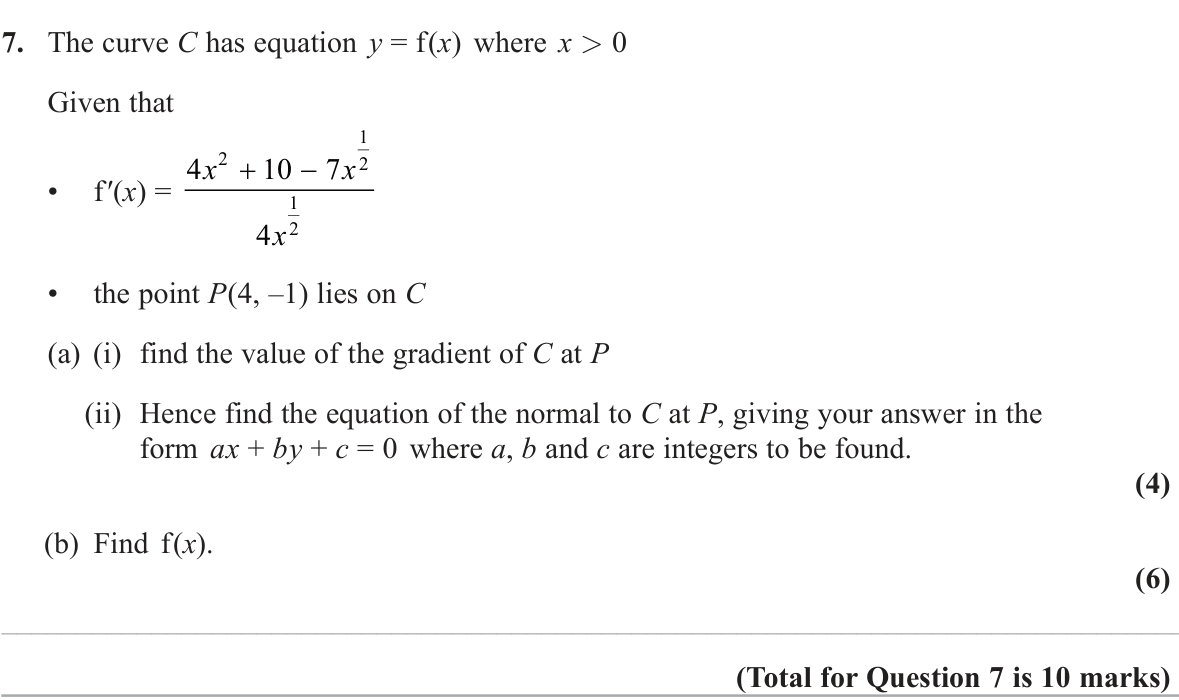
34. WMA11/01 October 2023 · Q7 Hard 10 marks · main topic: IntegrationShow worked solution Simplify f prime $f'(x)=\dfrac{4x^2+10-7x^{1/2}}{4x^{1/2}}=x^{3/2}+\dfrac52x^{-1/2}-\dfrac74$.
Find the gradient at P At $x=4$, $f'(4)=4^{3/2}+\dfrac52(4^{-1/2})-\dfrac74=8+\dfrac54-\dfrac74=\dfrac{15}{2}$.
Find the normal gradient The normal gradient is the negative reciprocal, so $m_n=-\dfrac{2}{15}$.
Use point P Using $P(4,-1)$, $y+1=-\dfrac{2}{15}(x-4)$.
Write the normal in integer form $15y+15=-2x+8$, hence $2x+15y+7=0$.
Integrate f prime $f(x)=\int\left(x^{3/2}+\dfrac52x^{-1/2}-\dfrac74\right)dx=\dfrac25x^{5/2}+5x^{1/2}-\dfrac74x+c$.
Use P to find c $-1=\dfrac25(4^{5/2})+5(4^{1/2})-\dfrac74(4)+c=\dfrac{64}{5}+10-7+c$, so $c=-\dfrac{84}{5}$.
Final answer $(a)(i)\ \dfrac{15}{2}.\quad (a)(ii)\ 2x+15y+7=0.\quad (b)\ f(x)=\dfrac25x^{5/2}+5x^{1/2}-\dfrac74x-\dfrac{84}{5}$.
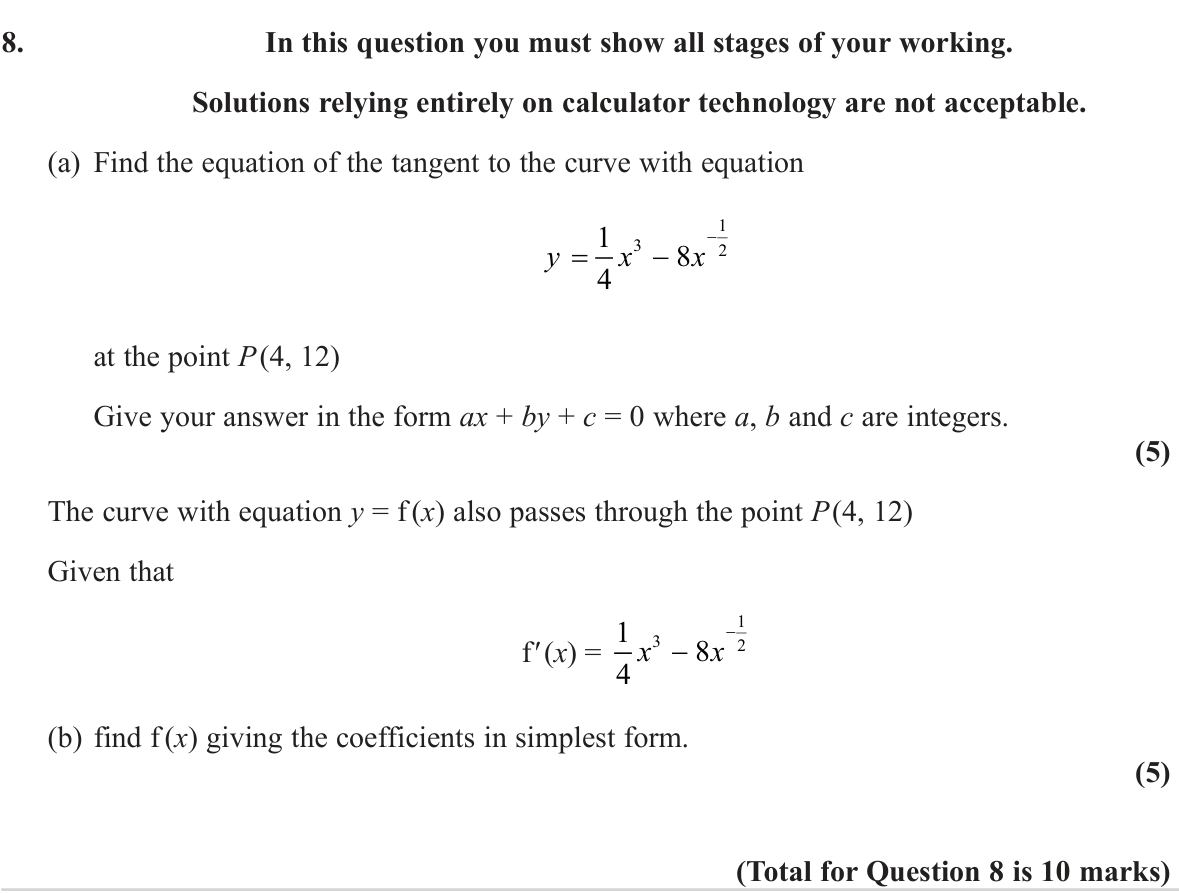
35. WMA11/01 May/June 2023 · Q8 Hard 10 marks · main topic: IntegrationShow worked solution Differentiate the curve For $y=\dfrac14x^3-8x^{-1/2}$, $\dfrac{dy}{dx}=\dfrac34x^2+4x^{-3/2}$.
Find the gradient at P At $x=4$, $\dfrac{dy}{dx}=\dfrac34(16)+4(4^{-3/2})=12+\dfrac12=\dfrac{25}{2}$.
Find the tangent Using $P(4,12)$, $y-12=\dfrac{25}{2}(x-4)$.
Write in integer form Multiplying by 2 gives $2y-24=25x-100$, hence $25x-2y-76=0$.
Integrate f'(x) $f'(x)=\dfrac14x^3-8x^{-1/2}$ gives $f(x)=\dfrac{x^4}{16}-16\sqrt{x}+c$.
Use P(4, 12) $12=\dfrac{4^4}{16}-16\sqrt4+c=16-32+c$, so $c=28$.
Final answer $(a)\ 25x-2y-76=0.\quad (b)\ f(x)=\dfrac{x^4}{16}-16\sqrt{x}+28$.
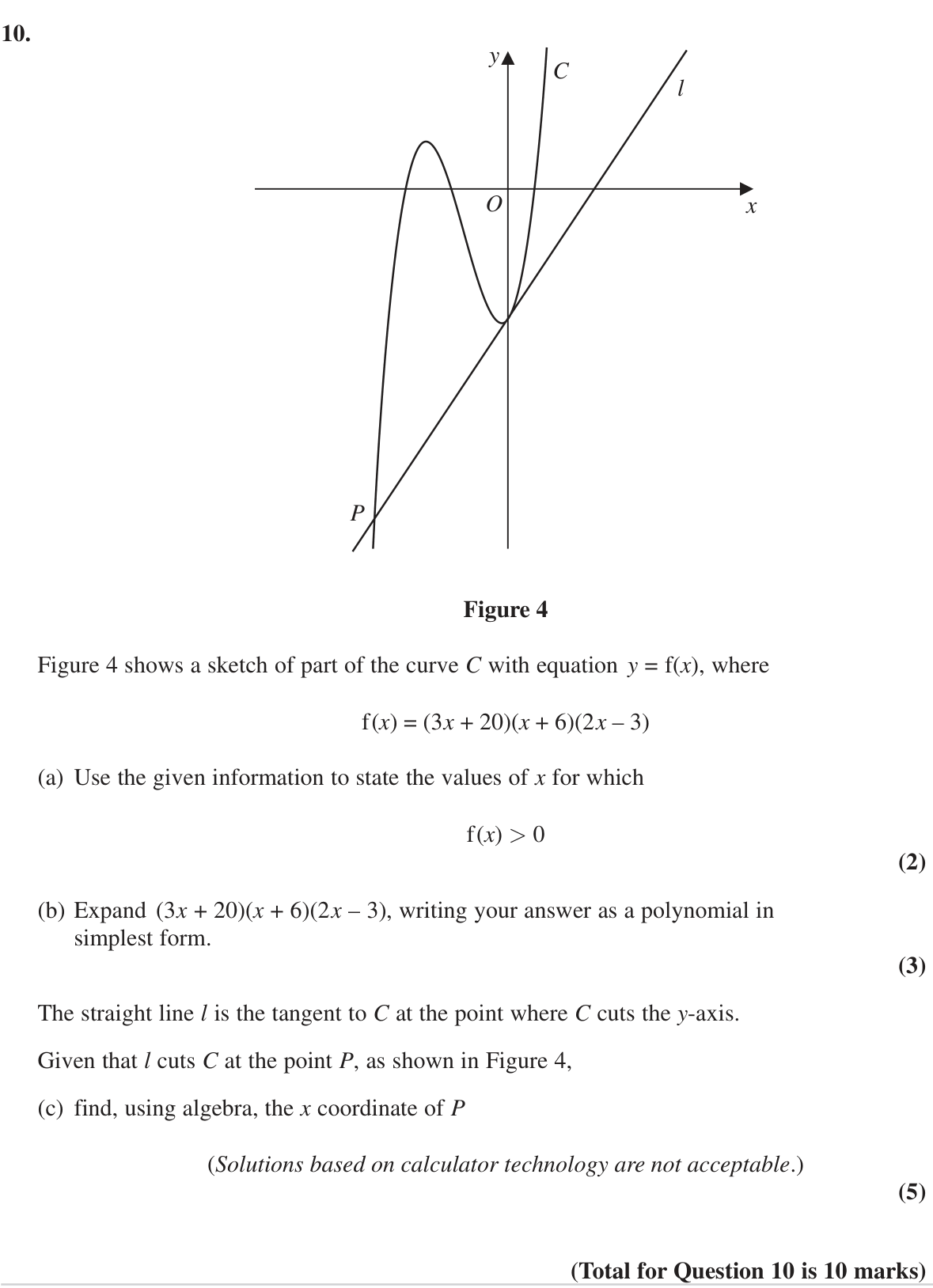
36. WMA11/01 January 2023 · Q10 Hard 10 marksShow worked solution Use the roots $f(x)=(3x+20)(x+6)(2x-3)$ has roots $x=-\dfrac{20}{3}$, $x=-6$, and $x=\dfrac32$.
State where f(x) is positive Since the cubic has positive leading coefficient, $f(x)>0$ for $-\dfrac{20}{3}<x<-6$ and for $x>\dfrac32$.
Expand the first two brackets $(3x+20)(x+6)=3x^2+38x+120$.
Complete the expansion $(3x^2+38x+120)(2x-3)=6x^3+67x^2+126x-360$.
Find the tangent at the y-axis $f'(x)=18x^2+134x+126$, so at $x=0$ the tangent gradient is $126$. Also $f(0)=-360$.
Write the tangent equation The tangent line is $y=126x-360$.
Find the other intersection Set $6x^3+67x^2+126x-360=126x-360$. This gives $6x^3+67x^2=0$, so $x^2(6x+67)=0$.
Choose point P $x=0$ is the tangent point on the y-axis, so the other intersection $P$ has $x=-\dfrac{67}{6}$.
Final answer $(a)\ -\dfrac{20}{3}<x<-6\text{ or }x>\dfrac32.\quad (b)\ 6x^3+67x^2+126x-360.\quad (c)\ x_P=-\dfrac{67}{6}$.
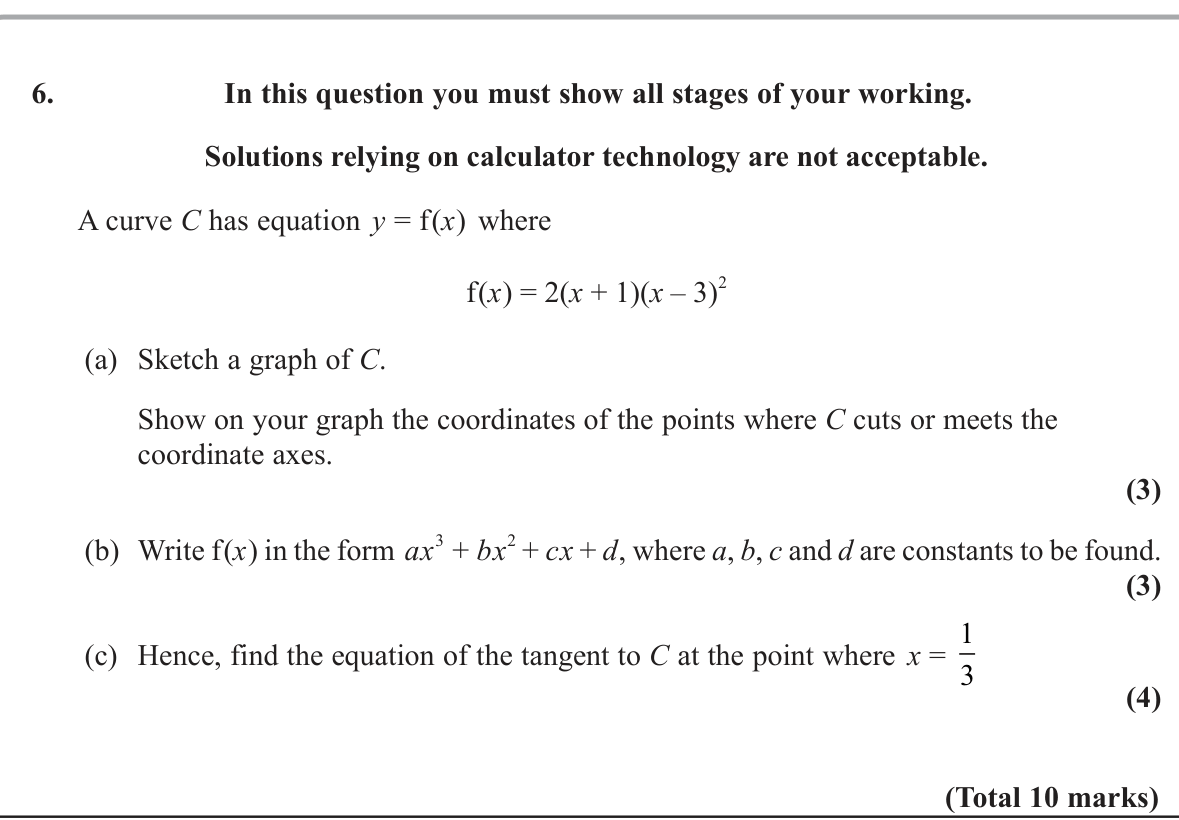
37. WMA11/01 October 2021 · Q6 Hard 10 marks · main topic: Graphs of FunctionsShow worked solution Use the factorised form for the sketch $f(x)=2(x+1)(x-3)^2$. The curve cuts the x-axis at $(-1,0)$ and meets the x-axis at $(3,0)$ because $x=3$ is a repeated root.
Find the y-intercept $f(0)=2(1)(9)=18$, so the y-intercept is $(0,18)$.
Describe the cubic shape The leading term is positive, so the cubic goes down to the left and up to the right. It crosses at $x=-1$ and touches at $x=3$.
Expand f(x) $(x+1)(x-3)^2=(x+1)(x^2-6x+9)=x^3-5x^2+3x+9$, so $f(x)=2x^3-10x^2+6x+18$.
Differentiate $f'(x)=6x^2-20x+6$.
Find the gradient at x = 1/3 $f'\left(\dfrac13\right)=6\left(\dfrac19\right)-20\left(\dfrac13\right)+6=0$, so the tangent is horizontal.
Find the y-coordinate $f\left(\dfrac13\right)=2\left(\dfrac43\right)\left(-\dfrac83\right)^2=\dfrac{512}{27}$.
Write the tangent A horizontal tangent through this point has equation $y=\dfrac{512}{27}$.
Final answer $(a)\ x\text{-intercepts }(-1,0),(3,0),\ y\text{-intercept }(0,18).\quad (b)\ f(x)=2x^3-10x^2+6x+18.\quad (c)\ y=\dfrac{512}{27}$.
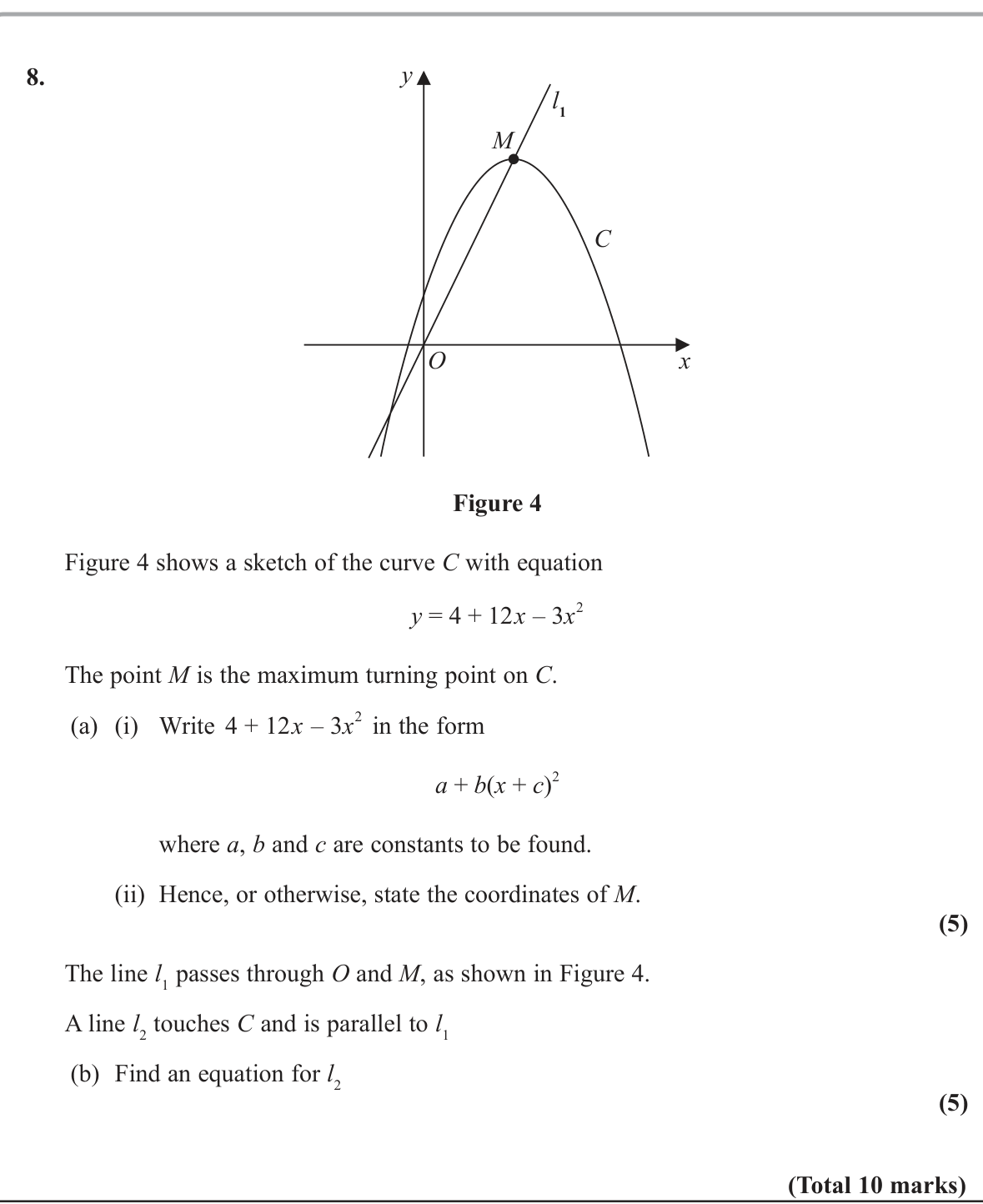
38. WMA11/01 October 2021 · Q8 Hard 10 marks · main topic: Straight LineShow worked solution Complete the square $4+12x-3x^2=-3(x^2-4x)+4=-3\big((x-2)^2-4\big)+4=16-3(x-2)^2$.
State the maximum point The maximum occurs when $(x-2)^2=0$, so $M=(2,16)$.
Find the gradient of l1 Line $l_1$ passes through $O(0,0)$ and $M(2,16)$, so its gradient is $\dfrac{16}{2}=8$.
Use the parallel tangent gradient Line $l_2$ is parallel to $l_1$, so its gradient is also $8$. For $y=4+12x-3x^2$, $\dfrac{dy}{dx}=12-6x$.
Find the point of contact Set $12-6x=8$, giving $x=\dfrac23$. Then $y=4+12\left(\dfrac23\right)-3\left(\dfrac49\right)=\dfrac{32}{3}$.
Write l2 Using gradient $8$ through $\left(\dfrac23,\dfrac{32}{3}\right)$, $y-\dfrac{32}{3}=8\left(x-\dfrac23\right)$. Hence $y=8x+\dfrac{16}{3}$.
Final answer $(a)(i)\ 16-3(x-2)^2.\quad (a)(ii)\ M=(2,16).\quad (b)\ y=8x+\dfrac{16}{3}$.
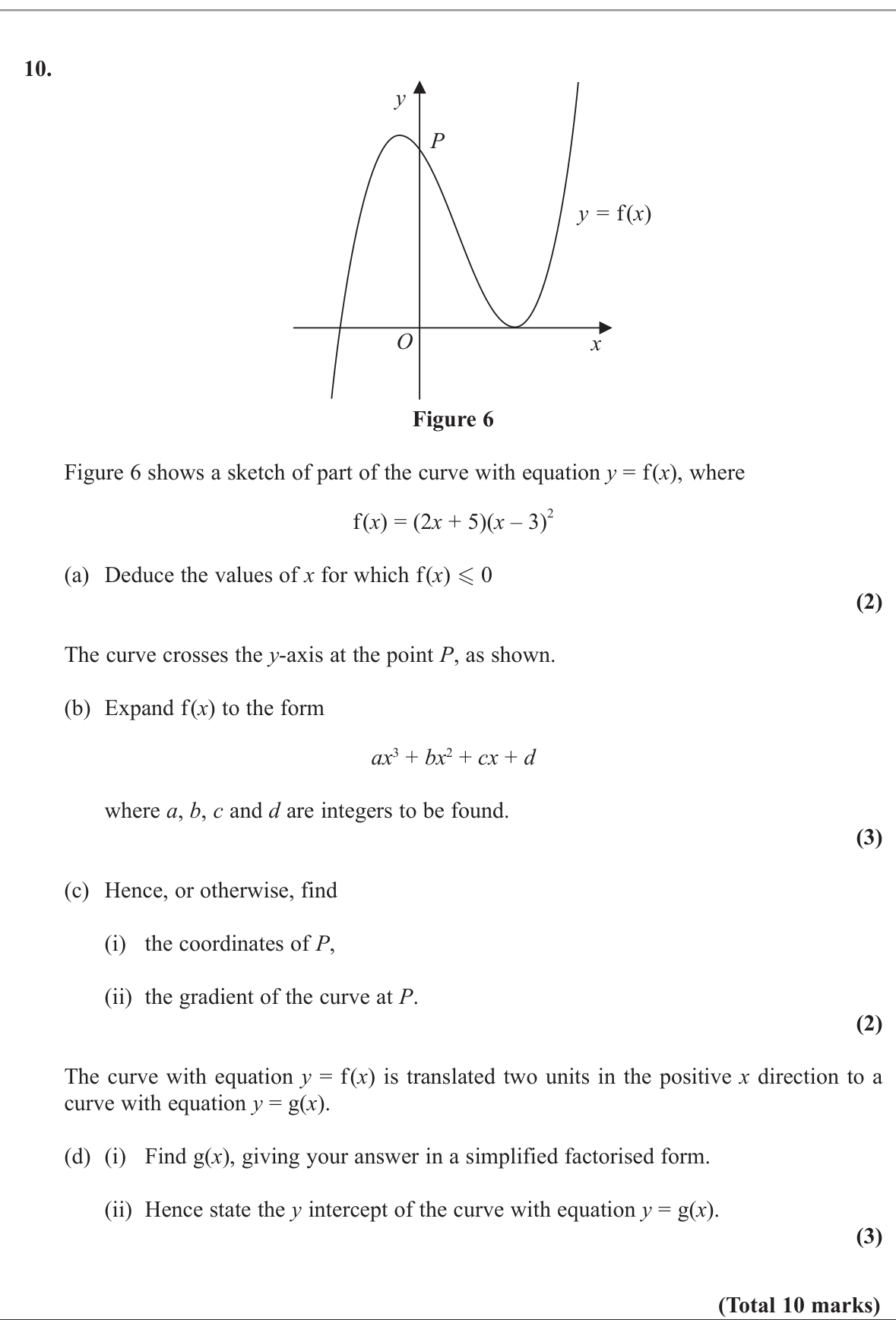
39. WMA11/01 October 2019 · Q10 Hard 10 marks · main topic: Graphs of FunctionsShow worked solution Use the factorised form for the inequality $f(x)=(2x+5)(x-3)^2$. Since $(x-3)^2\ge0$, the sign is controlled by $2x+5$, with an extra zero at $x=3$. Hence $f(x)\le0$ for $x\le-\frac52$ or $x=3$.
Expand the cubic $(x-3)^2=x^2-6x+9$, so $f(x)=(2x+5)(x^2-6x+9)=2x^3-7x^2-12x+45$.
Find P and the gradient at P At the y-axis, $x=0$, so $P=(0,45)$. Also $f'(x)=6x^2-14x-12$, so the gradient at $P$ is $f'(0)=-12$.
Translate the graph A translation 2 units in the positive x direction means $g(x)=f(x-2)$. Therefore $g(x)=(2(x-2)+5)((x-2)-3)^2=(2x+1)(x-5)^2$.
Find the new y-intercept Set $x=0$: $g(0)=(1)(25)=25$, so the y-intercept is $25$.
Final answer $f(x)\le0$ for $x\le-\frac52$ or $x=3$; $f(x)=2x^3-7x^2-12x+45$; $P=(0,45)$; gradient $=-12$; $g(x)=(2x+1)(x-5)^2$; y-intercept $25$.
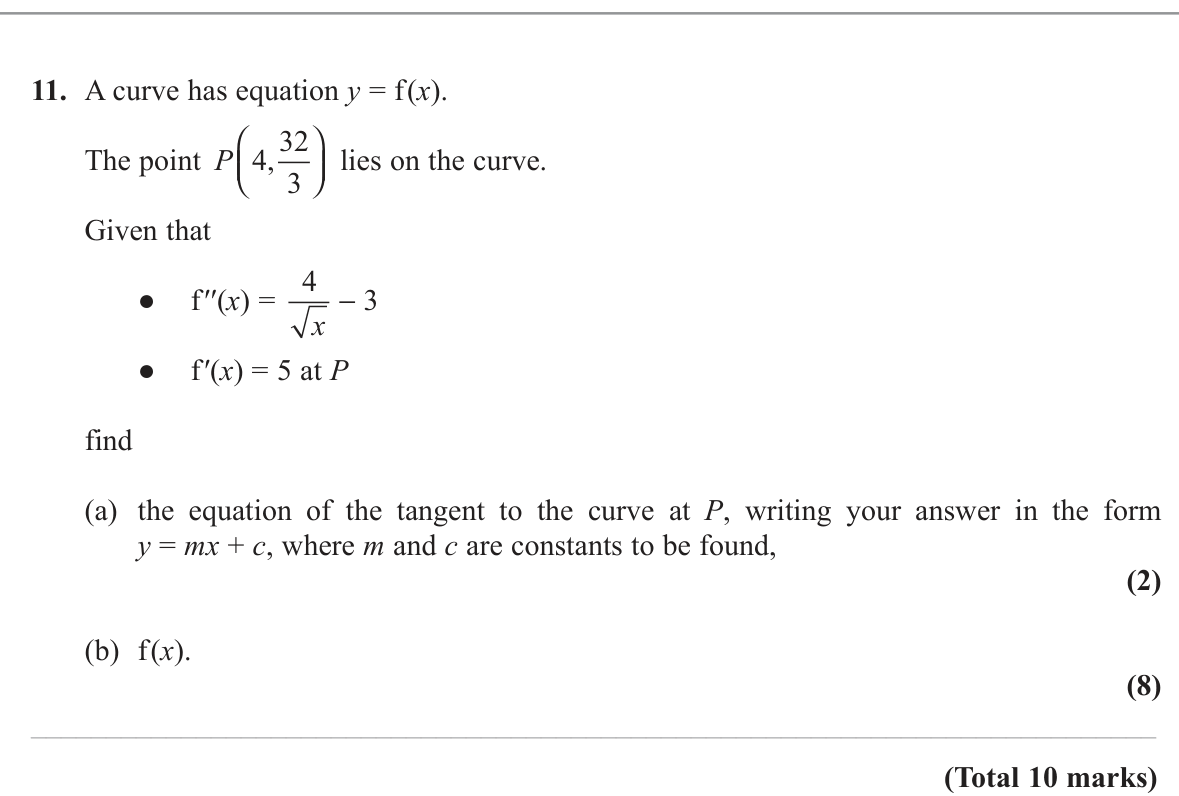
40. WMA11/01 October 2019 · Q11 Hard 10 marks · main topic: IntegrationShow worked solution Use the given gradient for the tangent At $P\left(4,\frac{32}{3}\right)$, $f'(4)=5$, so the tangent has gradient $5$.
Find the tangent equation $y-\frac{32}{3}=5(x-4)$. Hence $y=5x-\frac{28}{3}$.
Integrate f'' to find f' $f''(x)=4x^{-1/2}-3$, so $f'(x)=8x^{1/2}-3x+C$.
Use f'(4)=5 $5=8(2)-12+C=4+C$, so $C=1$. Therefore $f'(x)=8\sqrt{x}-3x+1$.
Integrate again $f(x)=\frac{16}{3}x^{3/2}-\frac32x^2+x+D$.
Use the point on the curve Substitute $x=4$, $f(4)=\frac{32}{3}$: $\frac{32}{3}=\frac{16}{3}(8)-\frac32(16)+4+D=\frac{68}{3}+D$, so $D=-12$.
Final answer $(a)\ y=5x-\frac{28}{3}.\quad (b)\ f(x)=\frac{16}{3}x^{3/2}-\frac32x^2+x-12$.
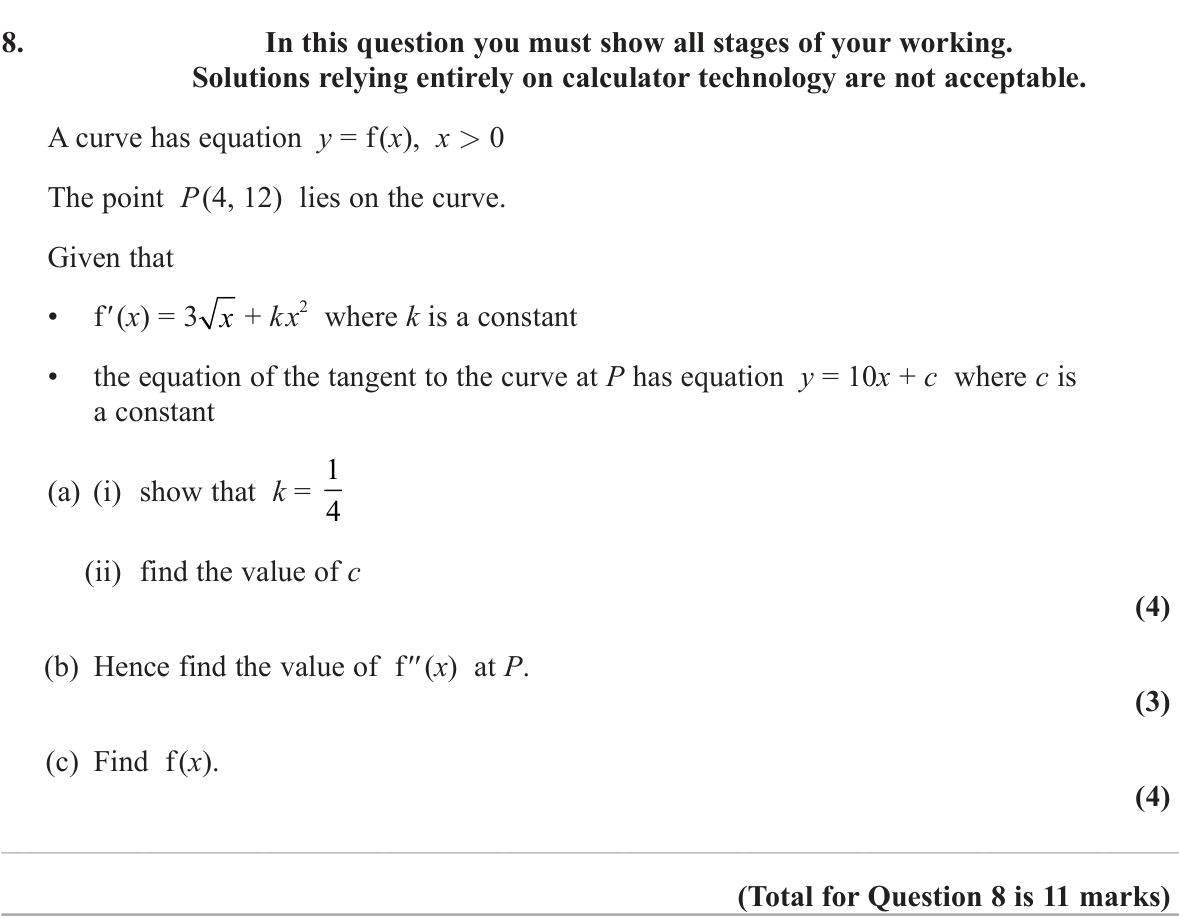
41. WMA11/01 May/June 2025 · Q8 Hard 11 marks · main topic: IntegrationShow worked solution Use the tangent gradient The tangent at $P$ has equation $y=10x+c$, so the gradient at $P$ is $10$.
Show k $f'(4)=3\sqrt4+k(4)^2=6+16k=10$, so $16k=4$ and $k=\dfrac14$.
Find c Substitute $P(4,12)$ into $y=10x+c$: $12=40+c$, so $c=-28$.
Differentiate f prime With $k=\dfrac14$, $f'(x)=3x^{1/2}+\dfrac14x^2$.
Find f double prime $f''(x)=\dfrac32x^{-1/2}+\dfrac12x$.
Evaluate at P $f''(4)=\dfrac32\cdot\dfrac12+2=\dfrac34+2=\dfrac{11}{4}$.
Integrate f prime $f(x)=\int\left(3x^{1/2}+\dfrac14x^2\right)dx=2x^{3/2}+\dfrac1{12}x^3+d$.
Use P to find d $12=2(4^{3/2})+\dfrac1{12}(4^3)+d=16+\dfrac{16}{3}+d$.
State f(x) $d=-\dfrac{28}{3}$, so $f(x)=2x^{3/2}+\dfrac1{12}x^3-\dfrac{28}{3}$.
Final answer $(a)(i)\ k=\dfrac14.\quad (a)(ii)\ c=-28.\quad (b)\ f''(P)=\dfrac{11}{4}.\quad (c)\ f(x)=2x^{3/2}+\dfrac1{12}x^3-\dfrac{28}{3}$.
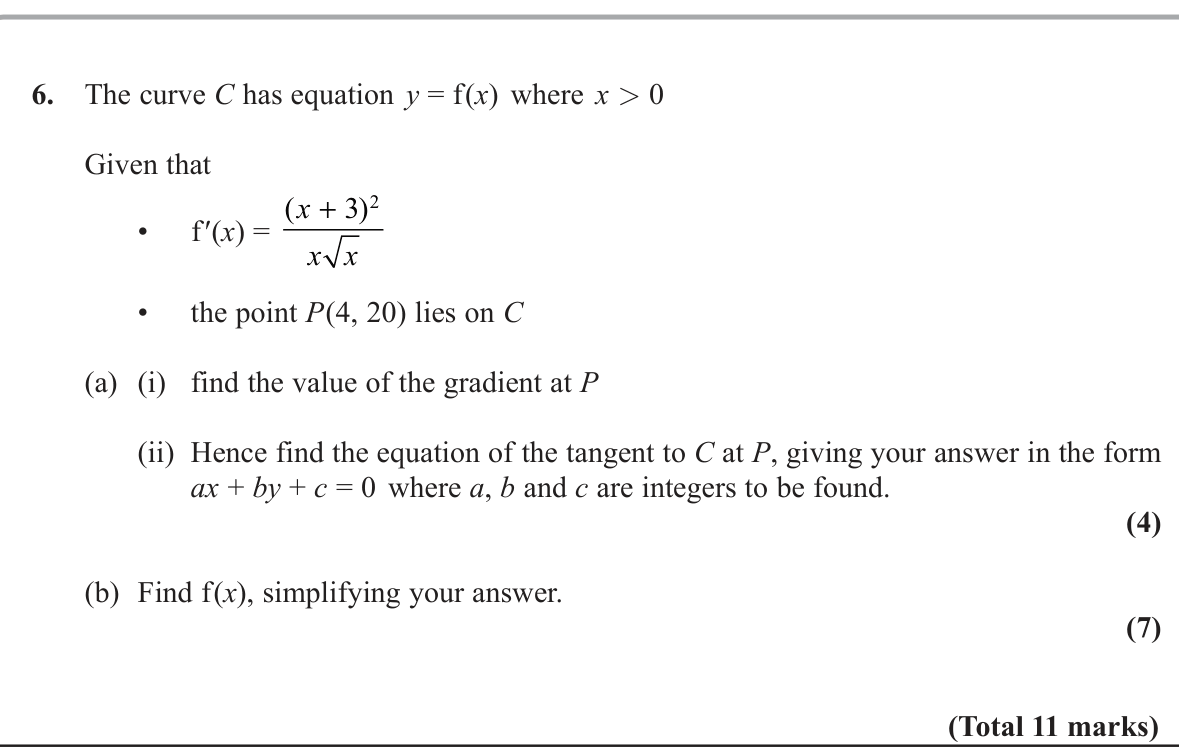
42. WMA11/01 January 2022 · Q6 Hard 11 marks · main topic: IntegrationShow worked solution Simplify f'(x) $f'(x)=\dfrac{(x+3)^2}{x\sqrt{x}}=\dfrac{x^2+6x+9}{x^{3/2}}=x^{1/2}+6x^{-1/2}+9x^{-3/2}$.
Find the gradient at P At $x=4$, $f'(4)=2+3+\dfrac98=\dfrac{49}{8}$.
Find the tangent equation Using $P(4,20)$, $y-20=\dfrac{49}{8}(x-4)$. Multiplying out gives $49x-8y-36=0$.
Integrate f'(x) $f(x)=\int\left(x^{1/2}+6x^{-1/2}+9x^{-3/2}\right)dx=\dfrac23x^{3/2}+12x^{1/2}-18x^{-1/2}+c$.
Use P(4,20) $20=\dfrac23(8)+12(2)-\dfrac{18}{2}+c=\dfrac{61}{3}+c$, so $c=-\dfrac13$.
Write f(x) $f(x)=\dfrac23x\sqrt{x}+12\sqrt{x}-\dfrac{18}{\sqrt{x}}-\dfrac13$.
Final answer $(a)(i)\ \dfrac{49}{8}.\quad (a)(ii)\ 49x-8y-36=0.\quad (b)\ f(x)=\dfrac23x\sqrt{x}+12\sqrt{x}-\dfrac{18}{\sqrt{x}}-\dfrac13$.
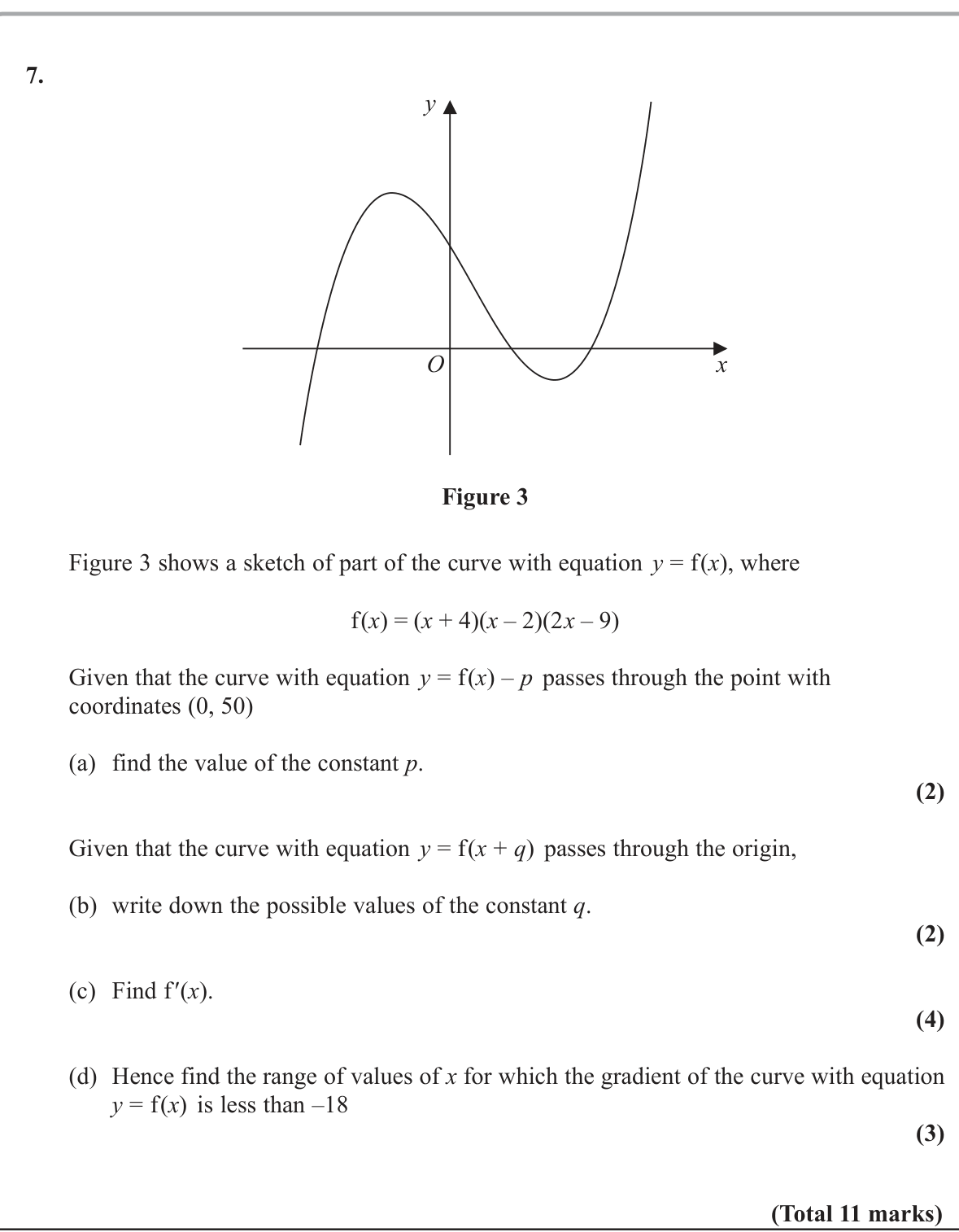
43. WMA11/01 January 2022 · Q7 Hard 11 marksShow worked solution Find p from the translated curve $f(0)=(4)(-2)(-9)=72$. Since $y=f(x)-p$ passes through $(0,50)$, $72-p=50$, so $p=22$.
Use roots for f(x + q) If $y=f(x+q)$ passes through the origin, then $f(q)=0$. From $f(x)=(x+4)(x-2)(2x-9)$, the possible values are $q=-4,2,\dfrac92$.
Expand f(x) $(x+4)(x-2)(2x-9)=2x^3-5x^2-34x+72$.
Differentiate $f'(x)=6x^2-10x-34$.
Set the gradient less than -18 $6x^2-10x-34<-18$, so $6x^2-10x-16<0$, or $3x^2-5x-8<0$.
Solve the inequality $3x^2-5x-8=(3x-8)(x+1)$. Since the quadratic opens upward, it is negative between the roots: $-1<x<\dfrac83$.
Final answer $(a)\ p=22.\quad (b)\ q=-4,2,\dfrac92.\quad (c)\ f'(x)=6x^2-10x-34.\quad (d)\ -1<x<\dfrac83$.
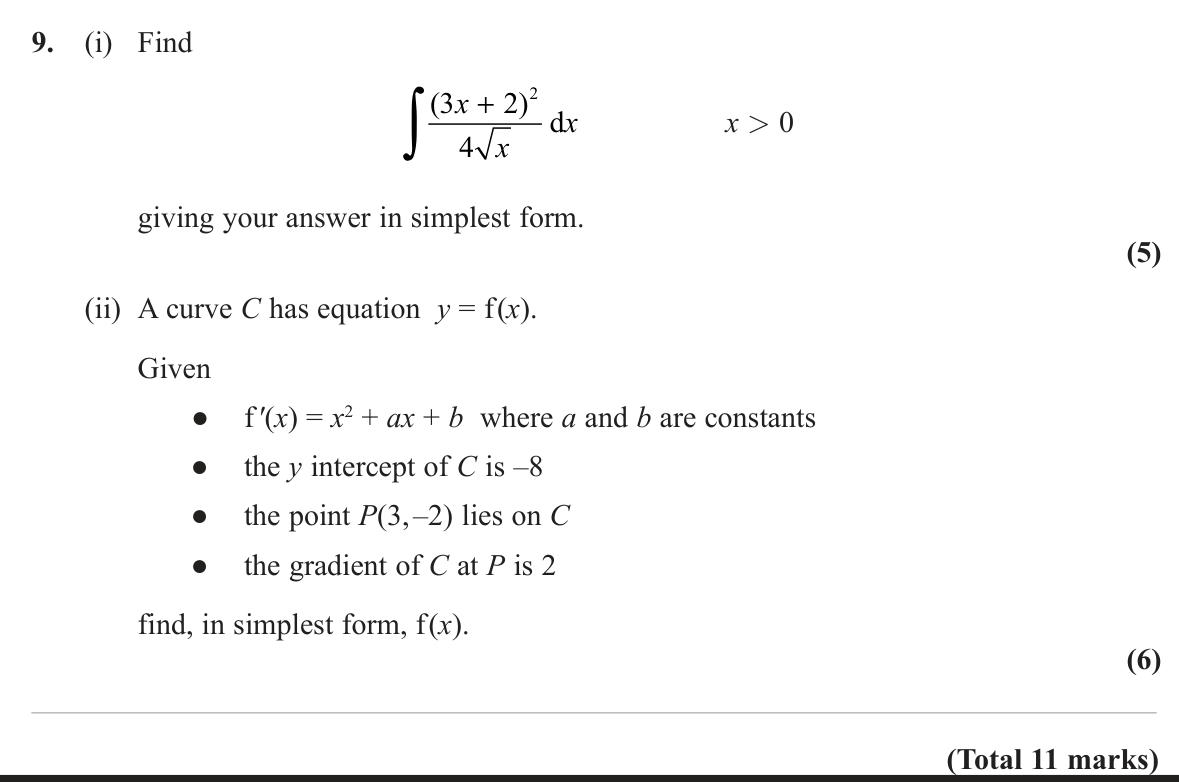
44. WMA11/01 January 2021 · Q9 Hard 11 marks · main topic: IntegrationShow worked solution Expand and simplify the integrand $\dfrac{(3x+2)^2}{4\sqrt{x}}=\dfrac{9x^2+12x+4}{4x^{1/2}}=\dfrac94x^{3/2}+3x^{1/2}+x^{-1/2}$.
Integrate term by term $\int\left(\dfrac94x^{3/2}+3x^{1/2}+x^{-1/2}\right)dx=\dfrac9{10}x^{5/2}+2x^{3/2}+2x^{1/2}+c$.
Write in simplest form Factoring out $\sqrt{x}$ gives $\dfrac{\sqrt{x}(9x^2+20x+20)}{10}+c$.
Use the gradient condition at P Since $f'(x)=x^2+ax+b$ and the gradient at $P(3,-2)$ is $2$, $f'(3)=2$. Hence $9+3a+b=2$, so $3a+b=-7$.
Integrate f'(x) $f(x)=\dfrac{x^3}{3}+\dfrac{a}{2}x^2+bx+c$. The y-intercept is $-8$, so $c=-8$.
Use P(3,-2) $-2=\dfrac{27}{3}+\dfrac{9a}{2}+3b-8$, so $\dfrac{9a}{2}+3b=-3$.
Solve for a and b From $3a+b=-7$, $b=-7-3a$. Substitute into $\dfrac{9a}{2}+3b=-3$ to get $a=-4$, and then $b=5$.
Write f(x) Therefore $f(x)=\dfrac{x^3}{3}-2x^2+5x-8$.
Final answer $(i)\ \dfrac{\sqrt{x}(9x^2+20x+20)}{10}+c.\quad (ii)\ f(x)=\dfrac{x^3}{3}-2x^2+5x-8$.
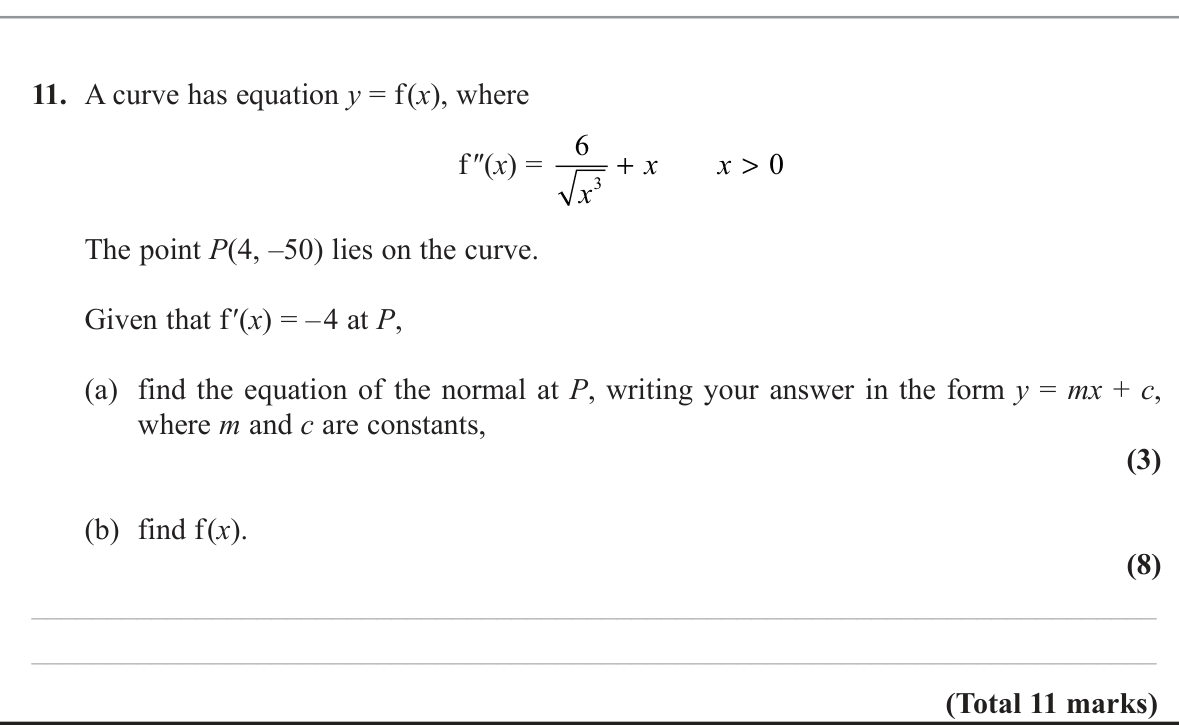
45. WMA11/01 January 2020 · Q11 Hard 11 marks · main topic: IntegrationShow worked solution Find the normal gradient At $P$, $f'(4)=-4$, so the tangent gradient is $-4$. The normal gradient is therefore $\frac14$.
Find the normal equation Using $P(4,-50)$: $y+50=\frac14(x-4)$, so $y=\frac14x-51$.
Integrate f'' to find f' $f''(x)=6x^{-3/2}+x$. Therefore $f'(x)=-12x^{-1/2}+\frac12x^2+k$.
Use f'(4) = -4 $-4=-\frac{12}{2}+\frac12(16)+k=-6+8+k=2+k$, so $k=-6$.
Integrate again $f(x)=-24x^{1/2}+\frac{x^3}{6}-6x+d$.
Use the point on the curve Substitute $P(4,-50)$: $-50=-24(2)+\frac{64}{6}-24+d=-72+\frac{32}{3}+d=-\frac{184}{3}+d$. Hence $d=\frac{34}{3}$.
Final answer $(a)\ y=\dfrac14x-51.\quad (b)\ f(x)=-24\sqrt{x}+\dfrac{x^3}{6}-6x+\dfrac{34}{3}$.
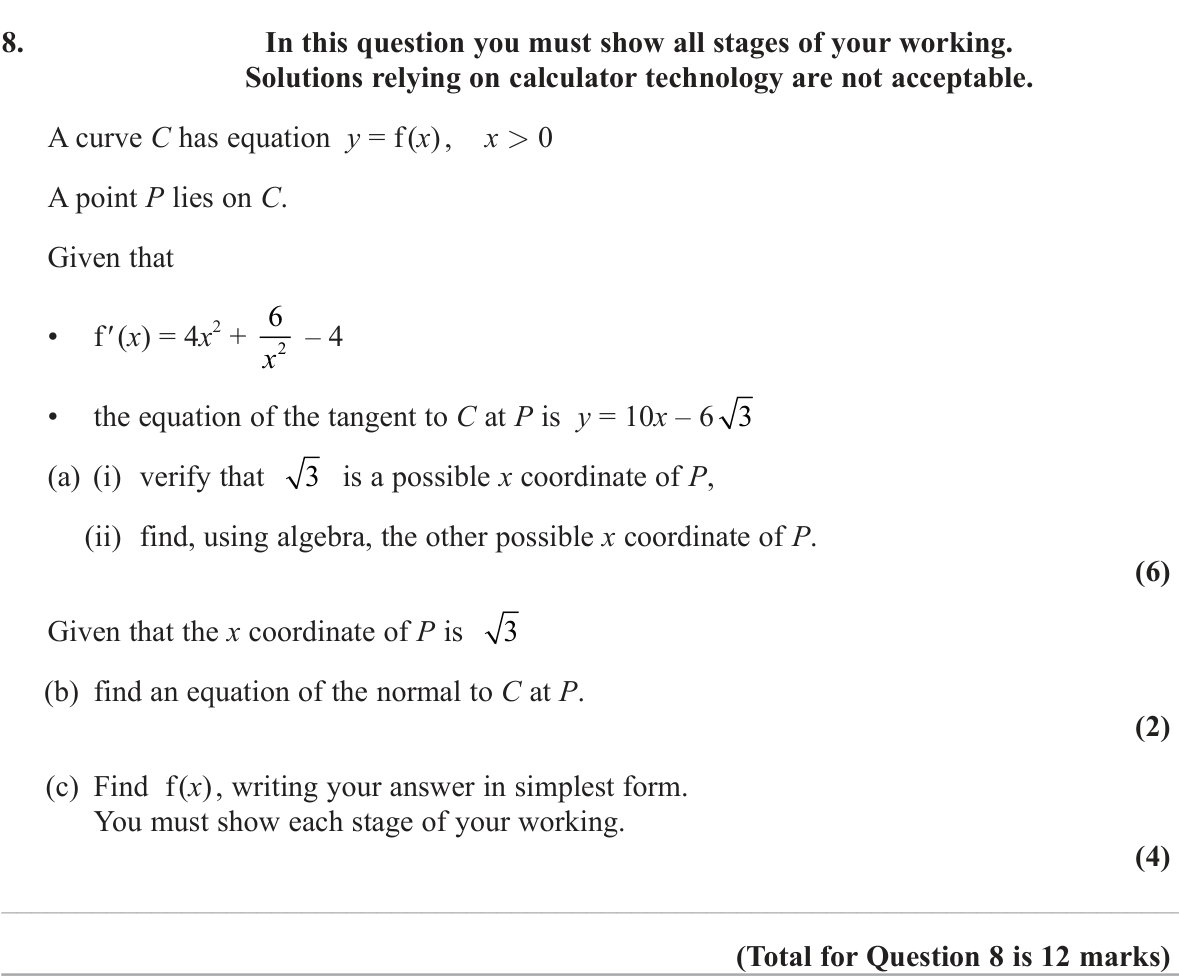
46. WMA11/01 January 2026 · Q8 Hard 12 marks · main topic: IntegrationShow worked solution Verify x equals root 3 $f'(\sqrt3)=4(\sqrt3)^2+\dfrac6{(\sqrt3)^2}-4=12+2-4=10$, which matches the tangent gradient.
Find all possible x-coordinates Set $4x^2+\dfrac6{x^2}-4=10$.
Form a quadratic in x squared Multiplying by $x^2$ gives $4x^4-14x^2+6=0$, so $2x^4-7x^2+3=0$.
Factor $2x^4-7x^2+3=(2x^2-1)(x^2-3)=0$.
Use x greater than zero $x=\sqrt3$ or $x=\dfrac1{\sqrt2}=\dfrac{\sqrt2}{2}$. The other possible x-coordinate is $\dfrac{\sqrt2}{2}$.
Find the point P Given $x_P=\sqrt3$, the tangent gives $y_P=10\sqrt3-6\sqrt3=4\sqrt3$.
Normal equation The normal gradient is $-\dfrac1{10}$, so $y-4\sqrt3=-\dfrac1{10}(x-\sqrt3)$.
Integrate f prime $f(x)=\int\left(4x^2+\dfrac6{x^2}-4\right)dx=\dfrac43x^3-\dfrac6x-4x+c$.
Use P to find c $4\sqrt3=\dfrac43(\sqrt3)^3-\dfrac6{\sqrt3}-4\sqrt3+c=4\sqrt3-2\sqrt3-4\sqrt3+c$.
State f(x) $c=6\sqrt3$, so $f(x)=\dfrac43x^3-\dfrac6x-4x+6\sqrt3$.
Final answer $(a)(i)$ verified. $(a)(ii)\ x=\dfrac{\sqrt2}{2}.\quad (b)\ y-4\sqrt3=-\dfrac1{10}(x-\sqrt3).\quad (c)\ f(x)=\dfrac43x^3-\dfrac6x-4x+6\sqrt3$.
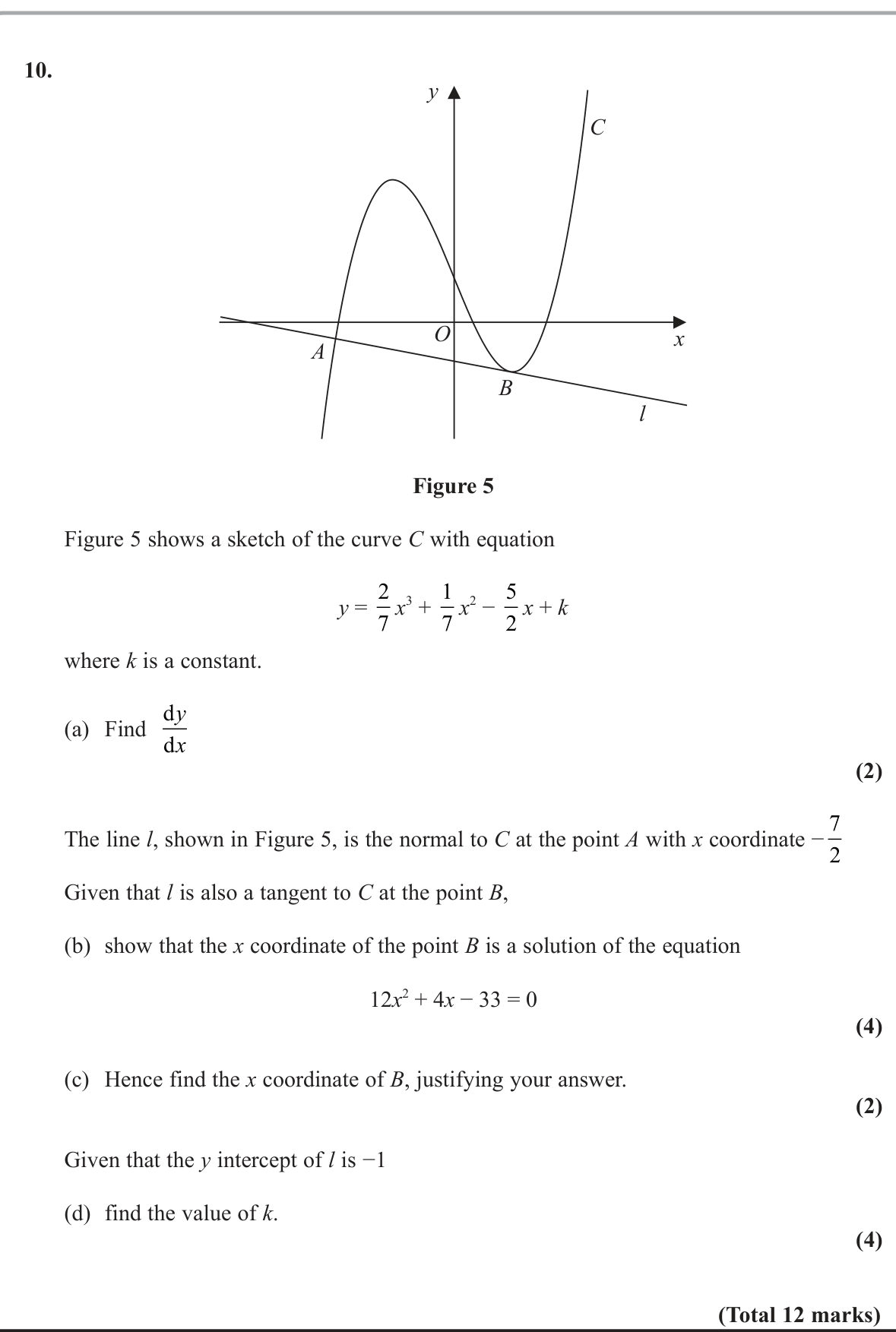
47. WMA11/01 May/June 2022 · Q10 Hard 12 marksShow worked solution Differentiate the curve For $y=\dfrac27x^3+\dfrac17x^2-\dfrac52x+k$, $\dfrac{dy}{dx}=\dfrac67x^2+\dfrac27x-\dfrac52$.
Find the tangent gradient at A At $x=-\dfrac72$, $\dfrac{dy}{dx}=\dfrac67\left(\dfrac{49}{4}\right)+\dfrac27\left(-\dfrac72\right)-\dfrac52=\dfrac{21}{2}-1-\dfrac52=7$.
Find the gradient of l Since $l$ is the normal at $A$, its gradient is the negative reciprocal of 7, so $m_l=-\dfrac17$.
Use that l is tangent at B At $B$, the tangent gradient is also $-\dfrac17$, so $\dfrac67x^2+\dfrac27x-\dfrac52=-\dfrac17$.
Reach the given quadratic Multiplying by 14 gives $12x^2+4x-35=-2$, hence $12x^2+4x-33=0$.
Solve for the x-coordinate of B $12x^2+4x-33=0$ gives $x=\dfrac{-4\pm40}{24}$, so $x=\dfrac32$ or $x=-\dfrac{11}{6}$. From the diagram, $B$ is the point to the right of the y-axis, so $x_B=\dfrac32$.
Use the y-intercept of l Since the y-intercept is $-1$ and the gradient is $-\dfrac17$, the line is $y=-\dfrac17x-1$.
Find the y-coordinate of A At $x=-\dfrac72$ on the line, $y=-\dfrac17\left(-\dfrac72\right)-1=\dfrac12-1=-\dfrac12$.
Substitute A into the curve $-\dfrac12=\dfrac27\left(-\dfrac72\right)^3+\dfrac17\left(-\dfrac72\right)^2-\dfrac52\left(-\dfrac72\right)+k=-\dfrac74+k$.
Find k Therefore $k=\dfrac54$.
Final answer $(a)\ \dfrac{dy}{dx}=\dfrac67x^2+\dfrac27x-\dfrac52.\quad (c)\ x_B=\dfrac32.\quad (d)\ k=\dfrac54$.
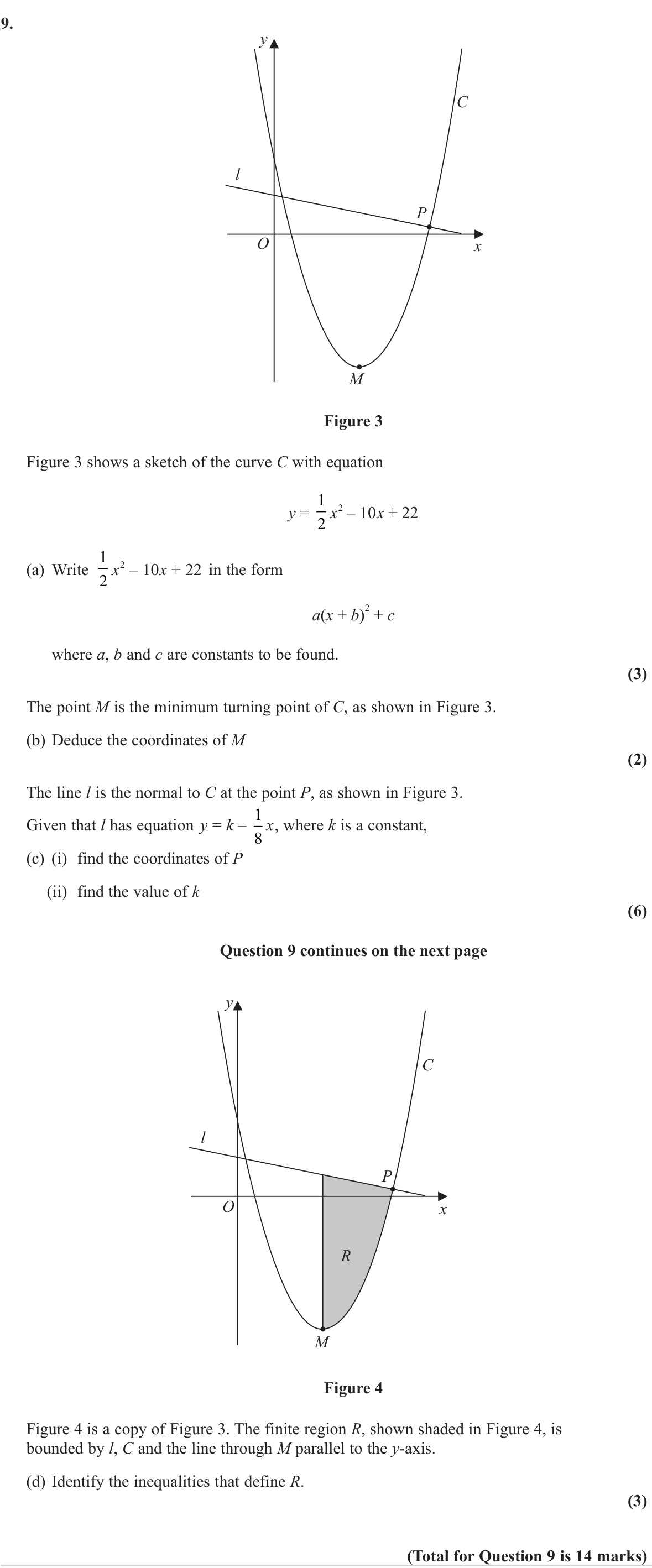
48. WMA11/01 October 2022 · Q9 Hard 14 marksShow worked solution Complete the square $\dfrac12x^2-10x+22=\dfrac12(x^2-20x)+22=\dfrac12\big((x-10)^2-100\big)+22$.
Simplify the completed square form $\dfrac12\big((x-10)^2-100\big)+22=\dfrac12(x-10)^2-28$.
Read the minimum point The minimum point is $M(10,-28)$.
Use the normal gradient The line $l$ has gradient $-\dfrac18$, so the tangent gradient at $P$ is $8$.
Differentiate the curve $\dfrac{dy}{dx}=x-10$. At $P$, $x-10=8$, so $x=18$.
Find P When $x=18$, $y=\dfrac12(18)^2-10(18)+22=4$, so $P=(18,4)$.
Find k Since $P$ lies on $y=k-\dfrac18x$, $4=k-\dfrac18(18)=k-\dfrac94$, so $k=\dfrac{25}{4}$.
Write the upper boundary The line is $y=\dfrac{25}{4}-\dfrac{x}{8}$.
Write the lower boundary The curve is $y=\dfrac12x^2-10x+22$.
Identify the region The region lies to the right of the vertical line through $M$ and between the curve and the normal line: $10\le x\le18$ and $\dfrac12x^2-10x+22\le y\le\dfrac{25}{4}-\dfrac{x}{8}$.
Final answer $(a)\ \dfrac12(x-10)^2-28.\quad (b)\ M(10,-28).\quad (c)\ P(18,4),\ k=\dfrac{25}{4}.\quad (d)\ 10\le x\le18,\ \dfrac12x^2-10x+22\le y\le\dfrac{25}{4}-\dfrac{x}{8}$.
Dr Eslam Ahmed Elite Mathematics · Questions classified by topic, solutions checked by Dr Eslam
 Elite Mathematics