Inequalities: past paper questions & worked solutions
Every Inequalities question from the WMA11 papers in our bank, 2020–2026, sorted from easiest to hardest. Try each one first, then open the worked solution.
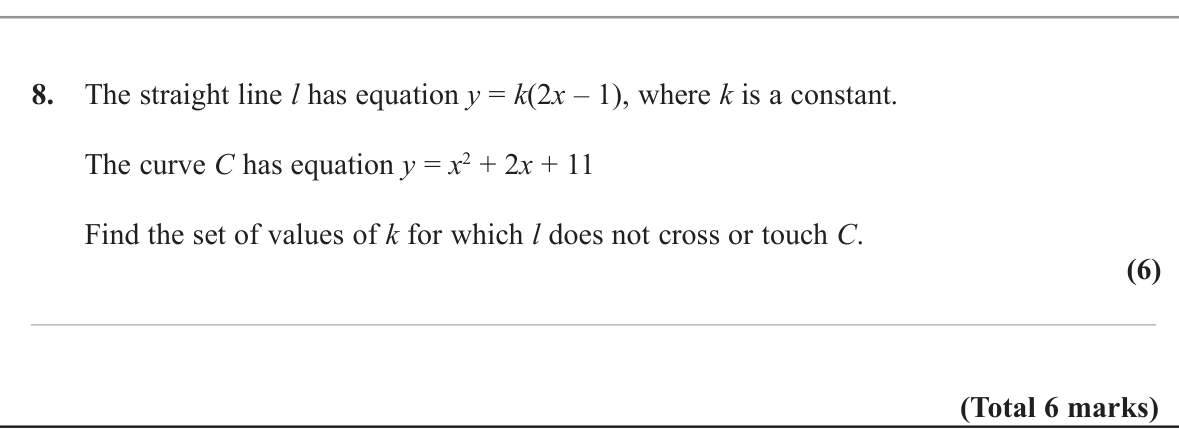
For the line not to cross or touch the curve, the quadratic in $x$ must have no real roots, so its discriminant is less than zero.
Form the inequality in k
$(2-2k)^2-4(1)(11+k)<0$. Dividing by $4$ gives $(1-k)^2-(11+k)<0$, so $k^2-3k-10<0$.
Solve the quadratic inequality
$(k-5)(k+2)<0$, so $k$ lies between the two roots: $-2<k<5$.
Final answer
$-2<k<5$.
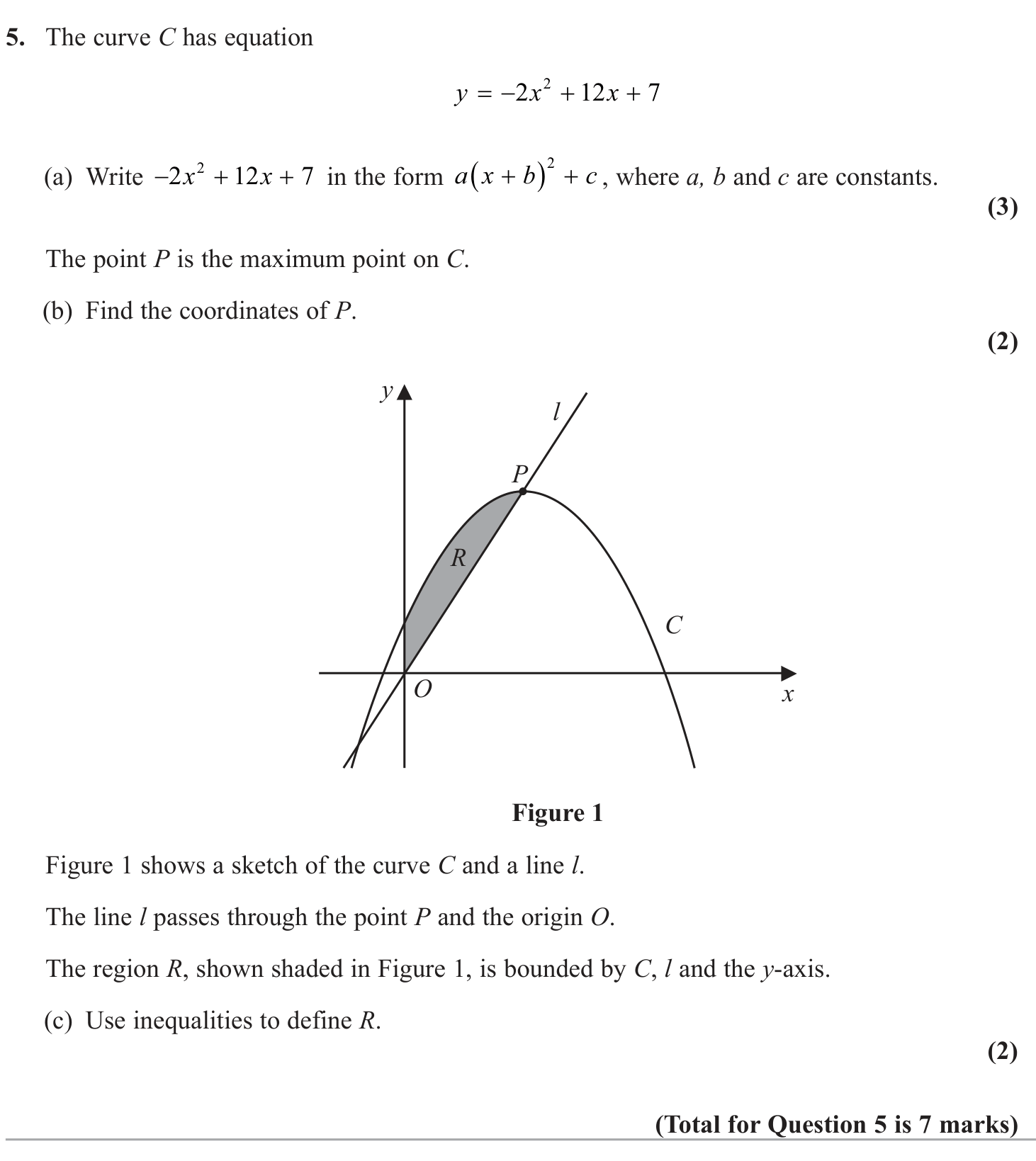
5. WMA11/01 May/June 2026 · Q5
Medium7 marks · main topic: QuadraticsShow worked solution
(a) Factor out the leading coefficient
$-2x^2+12x+7=-2(x^2-6x)+7$.
(a) Complete the square
$x^2-6x=(x-3)^2-9$, so $-2x^2+12x+7=-2\big((x-3)^2-9\big)+7=-2(x-3)^2+25$.
(b) Read the maximum from completed-square form
Because the coefficient of $(x-3)^2$ is negative, the curve has its maximum when $(x-3)^2=0$. Hence $x=3$, and the maximum value is $y=25$, so $P=(3,25)$.
(c) Find the equation of the boundary line
The line through $O=(0,0)$ and $P=(3,25)$ has gradient $\dfrac{25}{3}$, so $l$ has equation $y=\dfrac{25}{3}x$.
(c) Describe the shaded region
Points in $R$ are below the curve, above the line, and on or to the right of the $y$-axis. Therefore $y\leq-2x^2+12x+7$, $y\geq\dfrac{25}{3}x$, and $x\geq0$.
 Elite Mathematics