Elite Mathematics / Pure 1 / Topics / Laws of Indices & Surds IAL · WMA11 · Topic Laws of Indices & Surds: past paper questions & worked solutions
Every Laws of Indices & Surds question from the WMA11 papers in our bank, 2020–2025, sorted from easiest to hardest. Try each one first, then open the worked solution.
13 questions
79 marks in total
63% of papers (12 of 19) include it
9/3/1 easy / medium / hard
Questions, easiest first Level is estimated from marks: 1–6 easy, 7–8 medium, 9+ hard.
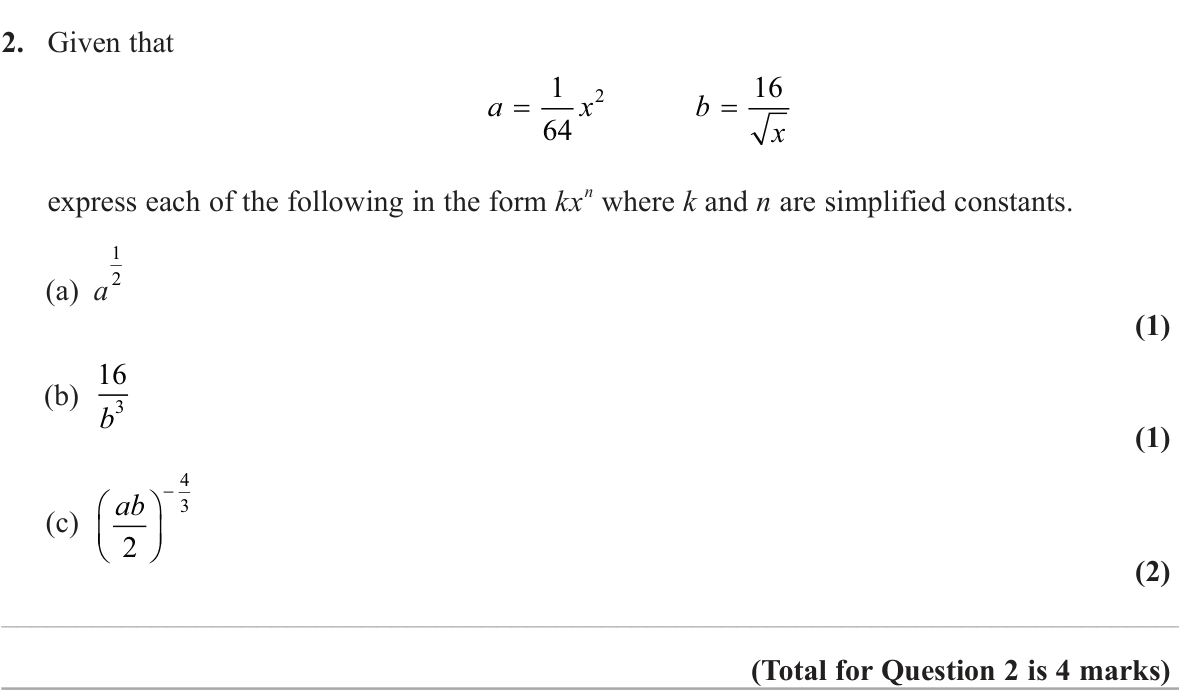
1. WMA11/01 October 2023 · Q2 Easy 4 marksShow worked solution Square root a $a^{1/2}=\left(\dfrac{1}{64}x^2\right)^{1/2}=\dfrac18x$.
Cube b $b=16x^{-1/2}$, so $b^3=4096x^{-3/2}$.
Find 16 divided by b cubed $\dfrac{16}{b^3}=\dfrac{16}{4096x^{-3/2}}=\dfrac{1}{256}x^{3/2}$.
Simplify ab over 2 $\dfrac{ab}{2}=\dfrac{1}{2}\left(\dfrac{1}{64}x^2\right)\left(16x^{-1/2}\right)=\dfrac18x^{3/2}$.
Raise to the power -4 over 3 $\left(\dfrac18x^{3/2}\right)^{-4/3}=8^{4/3}x^{-2}=16x^{-2}$.
Final answer $(a)\ \dfrac18x.\quad (b)\ \dfrac{1}{256}x^{3/2}.\quad (c)\ 16x^{-2}$.
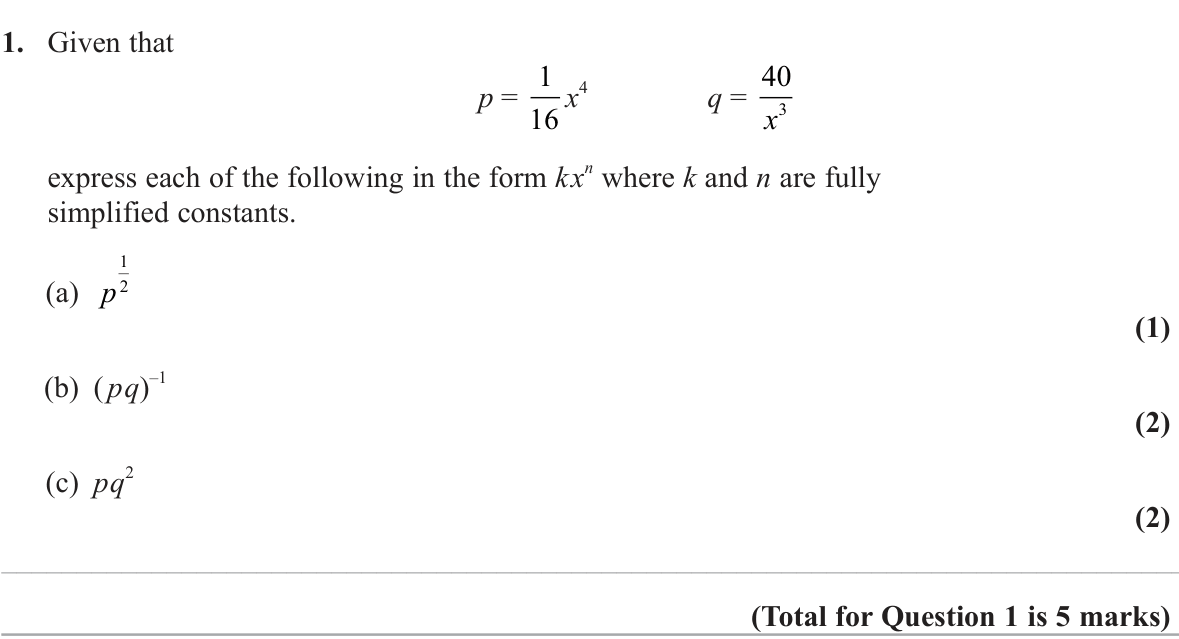
2. WMA11/01 May/June 2025 · Q1 Easy 5 marksShow worked solution Simplify p $p=\dfrac1{16}x^4$.
Simplify part (a) $p^{1/2}=\left(\dfrac1{16}x^4\right)^{1/2}=\dfrac14x^2$.
Simplify pq $pq=\dfrac1{16}x^4\cdot\dfrac{40}{x^3}=\dfrac52x$.
Simplify part (b) $(pq)^{-1}=\left(\dfrac52x\right)^{-1}=\dfrac25x^{-1}$.
Simplify part (c) $pq^2=\dfrac1{16}x^4\left(\dfrac{40}{x^3}\right)^2=\dfrac{1600}{16}x^{-2}=100x^{-2}$.
Final answer $(a)\ \dfrac14x^2.\quad (b)\ \dfrac25x^{-1}.\quad (c)\ 100x^{-2}$.
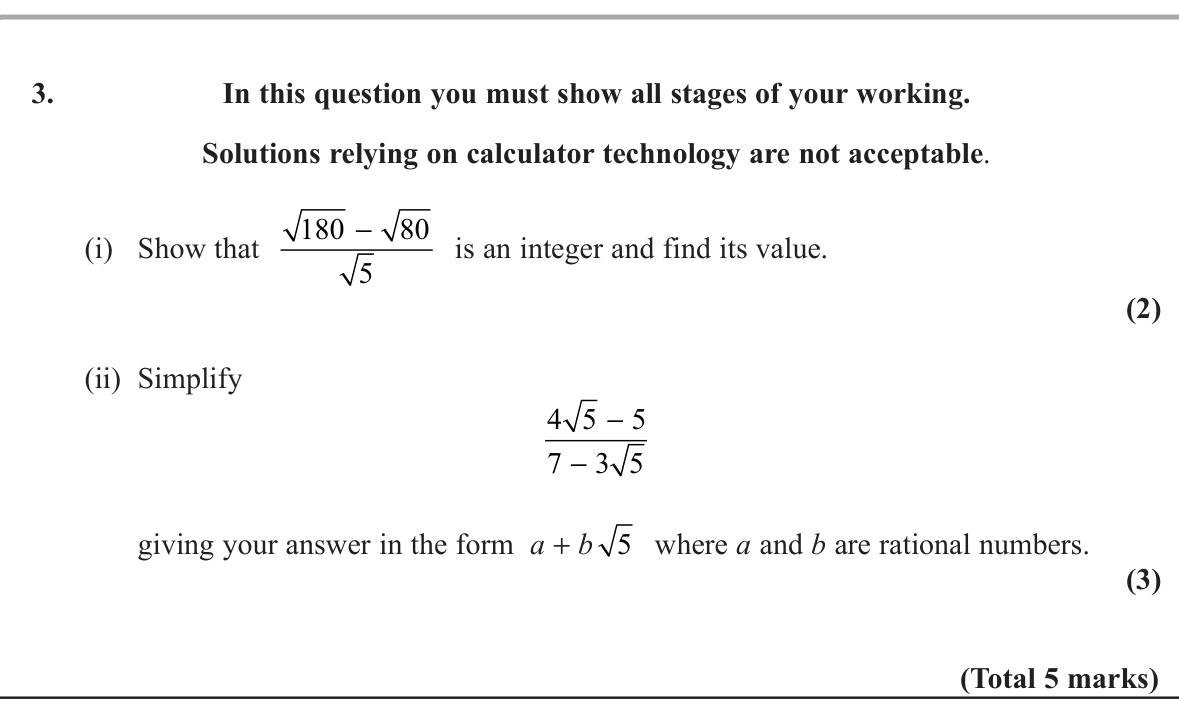
3. WMA11/01 May/June 2022 · Q3 Easy 5 marksShow worked solution Simplify the square roots $\sqrt{180}=6\sqrt5$ and $\sqrt{80}=4\sqrt5$.
Complete part (a) $\dfrac{\sqrt{180}-\sqrt{80}}{\sqrt5}=\dfrac{6\sqrt5-4\sqrt5}{\sqrt5}=2$.
Rationalise part (b) $\dfrac{4\sqrt5-5}{7-3\sqrt5}\times\dfrac{7+3\sqrt5}{7+3\sqrt5}=\dfrac{(4\sqrt5-5)(7+3\sqrt5)}{49-45}$.
Expand and simplify The numerator is $28\sqrt5+60-35-15\sqrt5=25+13\sqrt5$, so the expression is $\dfrac{25+13\sqrt5}{4}$.
Final answer $(a)\ 2.\quad (b)\ \dfrac{25}{4}+\dfrac{13}{4}\sqrt5$.
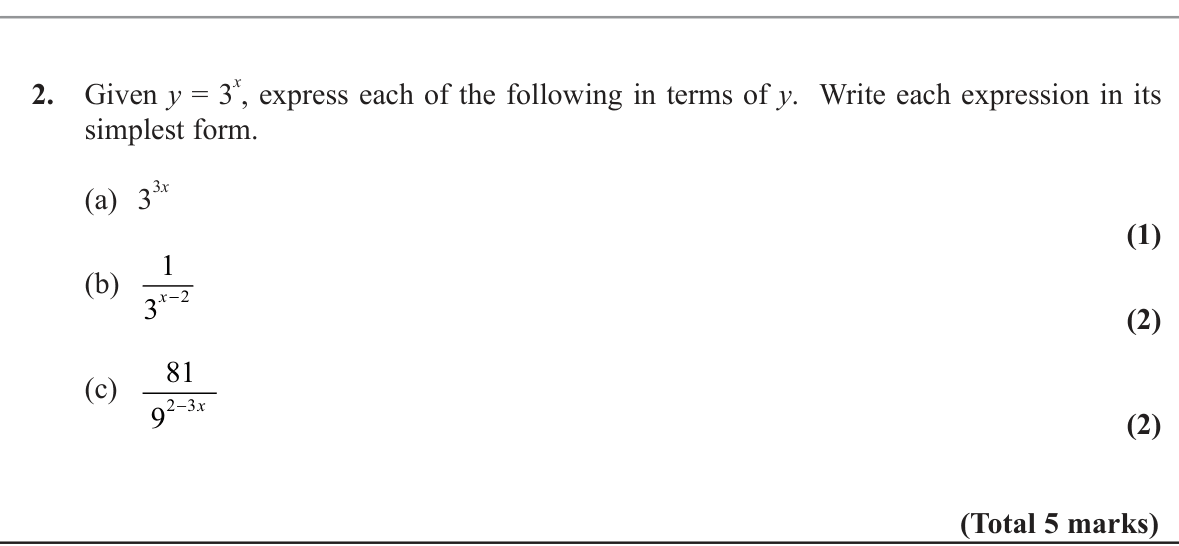
4. WMA11/01 January 2020 · Q2 Easy 5 marksShow worked solution Use y = 3^x Since $y=3^x$, powers of $3^x$ can be replaced by powers of $y$.
Simplify part (a) $3^{3x}=\left(3^x\right)^3=y^3$.
Simplify part (b) $\dfrac{1}{3^{x-2}}=3^{2-x}=\dfrac{3^2}{3^x}=\dfrac9y$.
Simplify part (c) $\dfrac{81}{9^{2-3x}}=\dfrac{3^4}{(3^2)^{2-3x}}=\dfrac{3^4}{3^{4-6x}}=3^{6x}=\left(3^x\right)^6=y^6$.
Final answer $(a)\ y^3.\quad (b)\ \dfrac{9}{y}.\quad (c)\ y^6$.
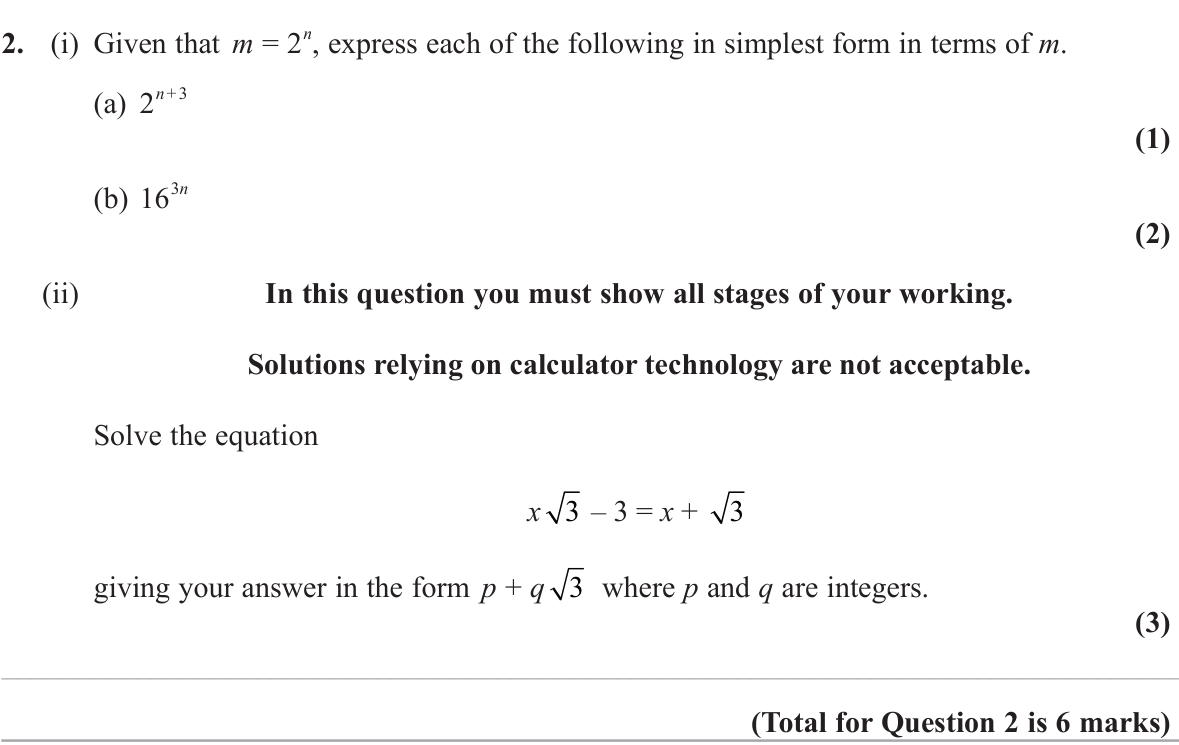
5. WMA11/01 May/June 2024 · Q2 Easy 6 marksShow worked solution Use m equals 2 to the n $2^{n+3}=2^n\times2^3=8m$.
Rewrite 16 as a power of 2 $16^{3n}=(2^4)^{3n}=2^{12n}=(2^n)^{12}=m^{12}$.
Collect the x terms $x\sqrt3-3=x+\sqrt3$ gives $x(\sqrt3-1)=3+\sqrt3$.
Rationalise $x=\dfrac{3+\sqrt3}{\sqrt3-1}\times\dfrac{\sqrt3+1}{\sqrt3+1}=\dfrac{(3+\sqrt3)(\sqrt3+1)}{2}$.
Simplify $x=\dfrac{4\sqrt3+6}{2}=3+2\sqrt3$.
Final answer $(i)(a)\ 8m.\quad (i)(b)\ m^{12}.\quad (ii)\ x=3+2\sqrt3$.
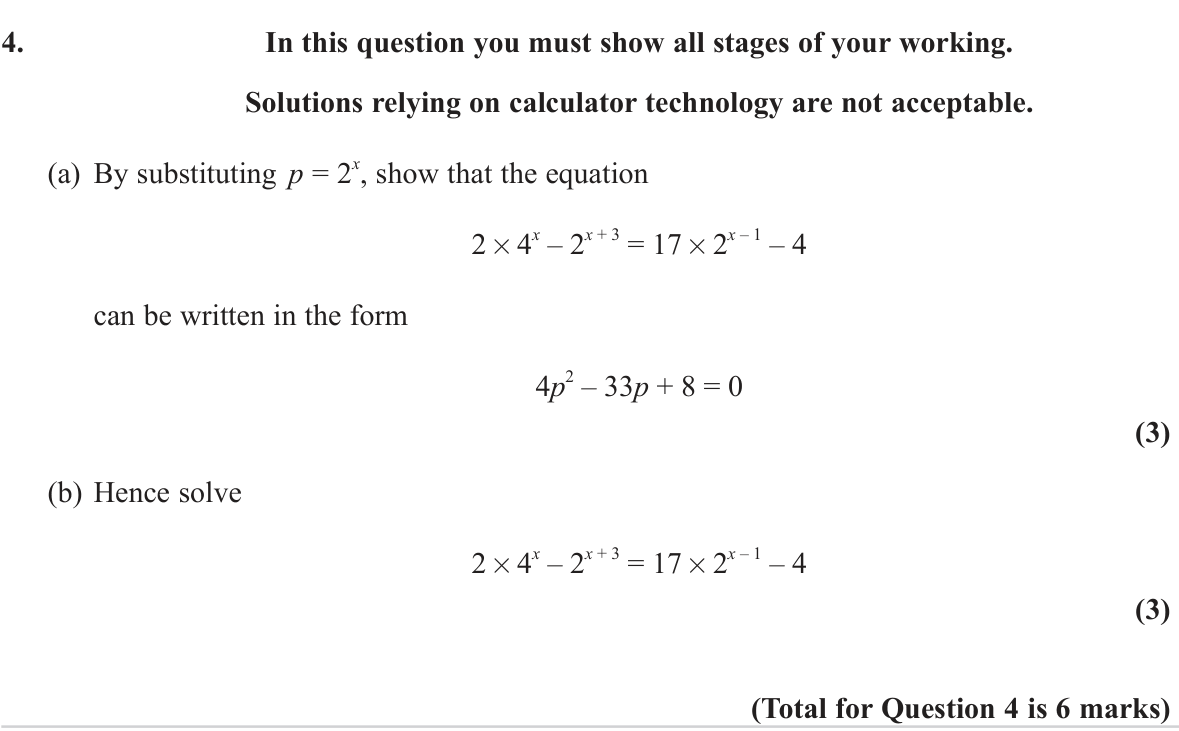
6. WMA11/01 January 2024 · Q4 Easy 6 marksShow worked solution Substitute p equals 2 to the x If $p=2^x$, then $4^x=p^2$, $2^{x+3}=8p$, and $2^{x-1}=\dfrac{p}{2}$.
Rewrite the equation $2p^2-8p=17\left(\dfrac{p}{2}\right)-4$.
Clear the fraction Multiplying by 2 gives $4p^2-16p=17p-8$, so $4p^2-33p+8=0$.
Solve the quadratic $4p^2-33p+8=(4p-1)(p-8)$, so $p=\dfrac14$ or $p=8$.
Return to x $2^x=\dfrac14=2^{-2}$ gives $x=-2$, and $2^x=8=2^3$ gives $x=3$.
Final answer $x=3$ or $x=-2$.
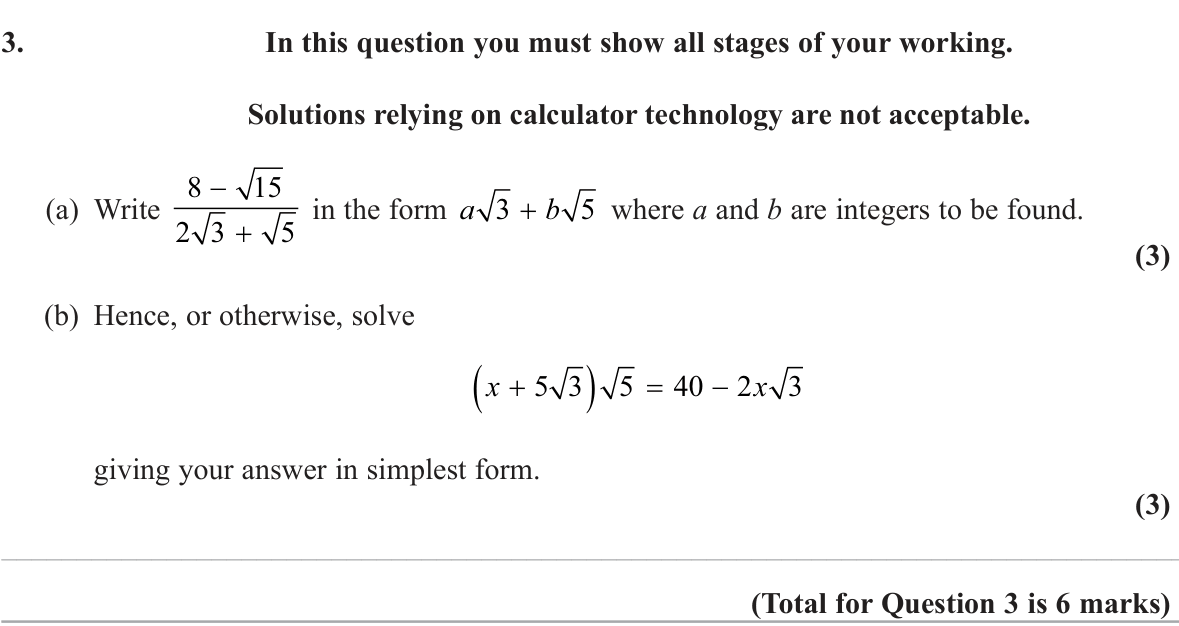
7. WMA11/01 October 2023 · Q3 Easy 6 marksShow worked solution Rationalise the denominator $\dfrac{8-\sqrt{15}}{2\sqrt3+\sqrt5}\times\dfrac{2\sqrt3-\sqrt5}{2\sqrt3-\sqrt5}=\dfrac{(8-\sqrt{15})(2\sqrt3-\sqrt5)}{12-5}$.
Simplify the numerator $(8-\sqrt{15})(2\sqrt3-\sqrt5)=16\sqrt3-8\sqrt5-3\sqrt5+5\sqrt3=21\sqrt3-14\sqrt5$.
Divide by 7 $\dfrac{21\sqrt3-14\sqrt5}{7}=3\sqrt3-2\sqrt5$.
Rearrange the equation $(x+5\sqrt3)\sqrt5=40-2x\sqrt3$ gives $x(\sqrt5+2\sqrt3)=40-5\sqrt{15}$.
Use the result from part (a) $x=\dfrac{40-5\sqrt{15}}{2\sqrt3+\sqrt5}=5\left(3\sqrt3-2\sqrt5\right)$.
Final answer $(a)\ 3\sqrt3-2\sqrt5.\quad (b)\ x=15\sqrt3-10\sqrt5$.
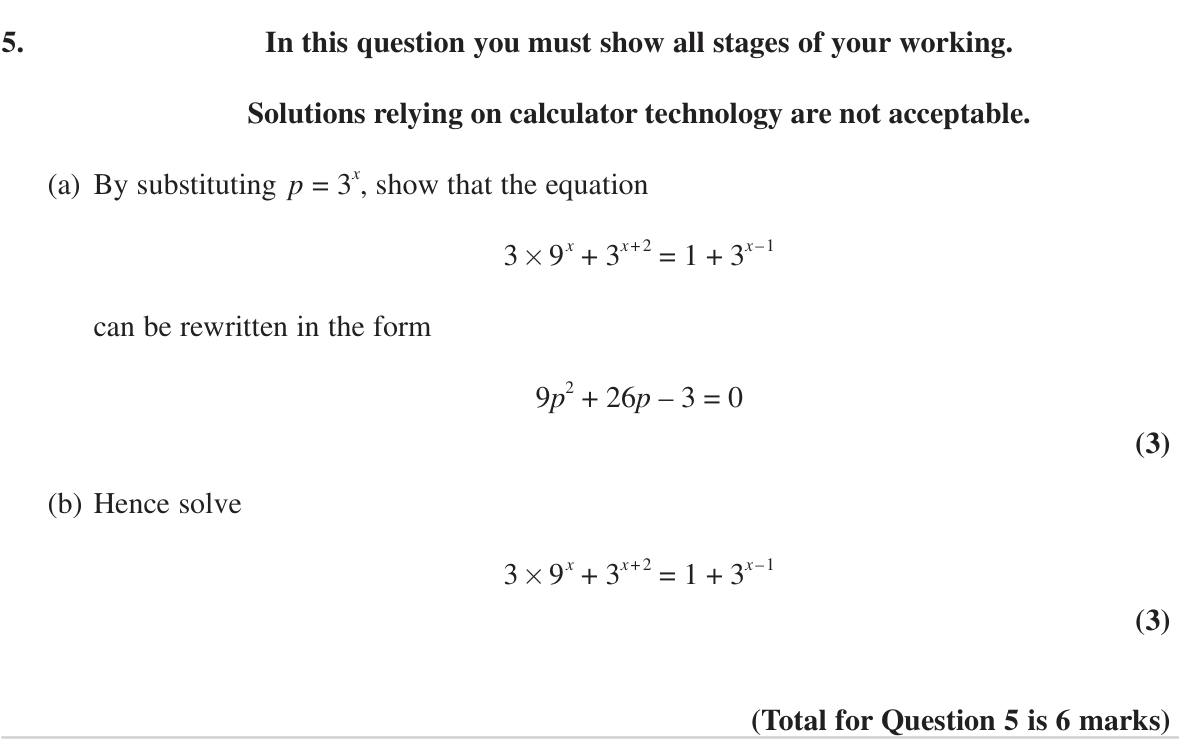
8. WMA11/01 January 2023 · Q5 Easy 6 marksShow worked solution Let p = 3^x Then $9^x=3^{2x}=p^2$, $3^{x+2}=9p$, and $3^{x-1}=\dfrac{p}{3}$.
Substitute into the equation $3p^2+9p=1+\dfrac{p}{3}$.
Clear the fraction Multiplying by 3 gives $9p^2+27p=3+p$, hence $9p^2+26p-3=0$.
Solve for p $9p^2+26p-3=(9p-1)(p+3)=0$, so $p=\dfrac19$ or $p=-3$.
Reject the negative value Since $p=3^x>0$, we reject $p=-3$. Therefore $3^x=\dfrac19=3^{-2}$.
Find x $x=-2$.
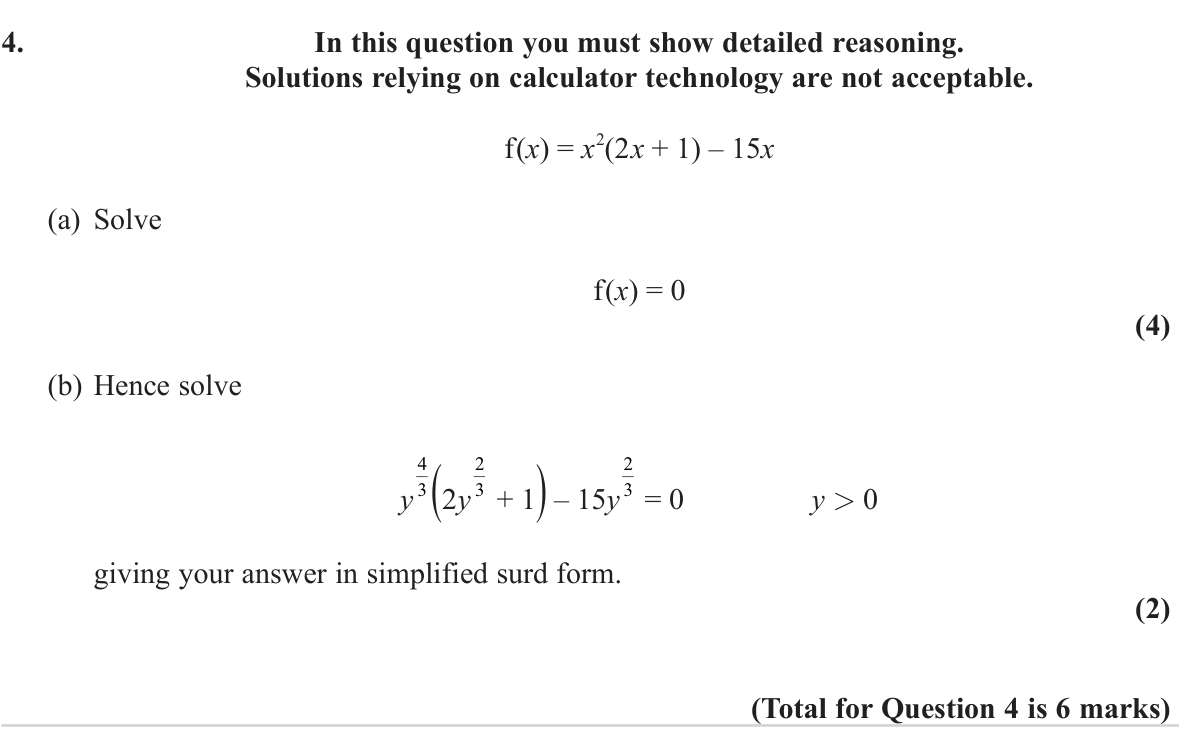
9. WMA11/01 October 2022 · Q4 Easy 6 marksShow worked solution Factor f(x) $f(x)=x^2(2x+1)-15x=x(2x^2+x-15)$.
Factor the quadratic $2x^2+x-15=(2x-5)(x+3)$.
Solve f(x) = 0 $x(2x-5)(x+3)=0$, so $x=0$, $x=\dfrac52$, or $x=-3$.
Use the substitution for part (b) The equation is the same as $f(u)=0$ with $u=y^{2/3}$.
Choose the valid root Since $y>0$, $u=y^{2/3}>0$. The valid root is $u=\dfrac52$, so $y^{2/3}=\dfrac52$.
Write y in surd form $y=\left(\dfrac52\right)^{3/2}=\sqrt{\dfrac{125}{8}}=\dfrac{5\sqrt{10}}{4}$.
Final answer $(a)\ x=-3,\ 0,\ \dfrac52.\quad (b)\ y=\dfrac{5\sqrt{10}}{4}$.
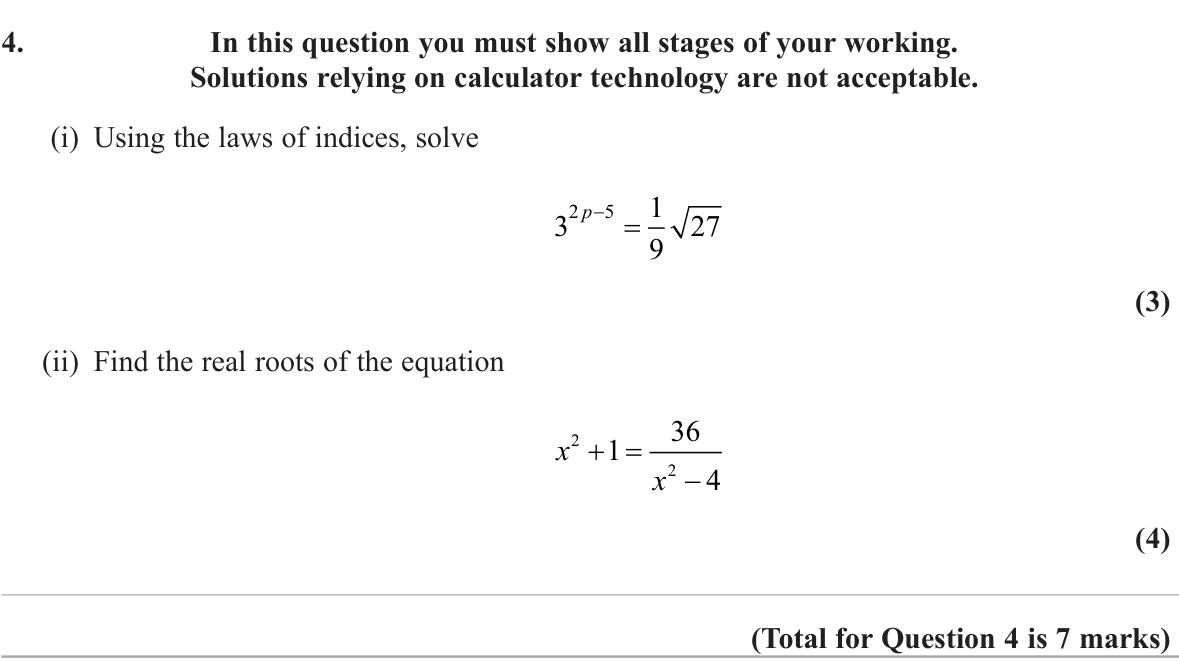
10. WMA11/01 October 2025 · Q4 Medium 7 marksShow worked solution Rewrite the right-hand side $\dfrac19\sqrt{27}=3^{-2}\cdot3^{3/2}=3^{-1/2}$.
Equate powers of 3 $3^{2p-5}=3^{-1/2}$, so $2p-5=-\dfrac12$.
Solve for p $2p=\dfrac92$, hence $p=\dfrac94$.
Clear the denominator $x^2+1=\dfrac{36}{x^2-4}$ gives $(x^2+1)(x^2-4)=36$.
Form a quadratic in x squared $x^4-3x^2-4=36$, so $x^4-3x^2-40=0$.
Factor $(x^2-8)(x^2+5)=0$.
Use real roots $x^2=8$, so $x=\pm2\sqrt2$. The equation $x^2=-5$ gives no real roots.
Final answer $(i)\ p=\dfrac94.\quad (ii)\ x=\pm2\sqrt2$.
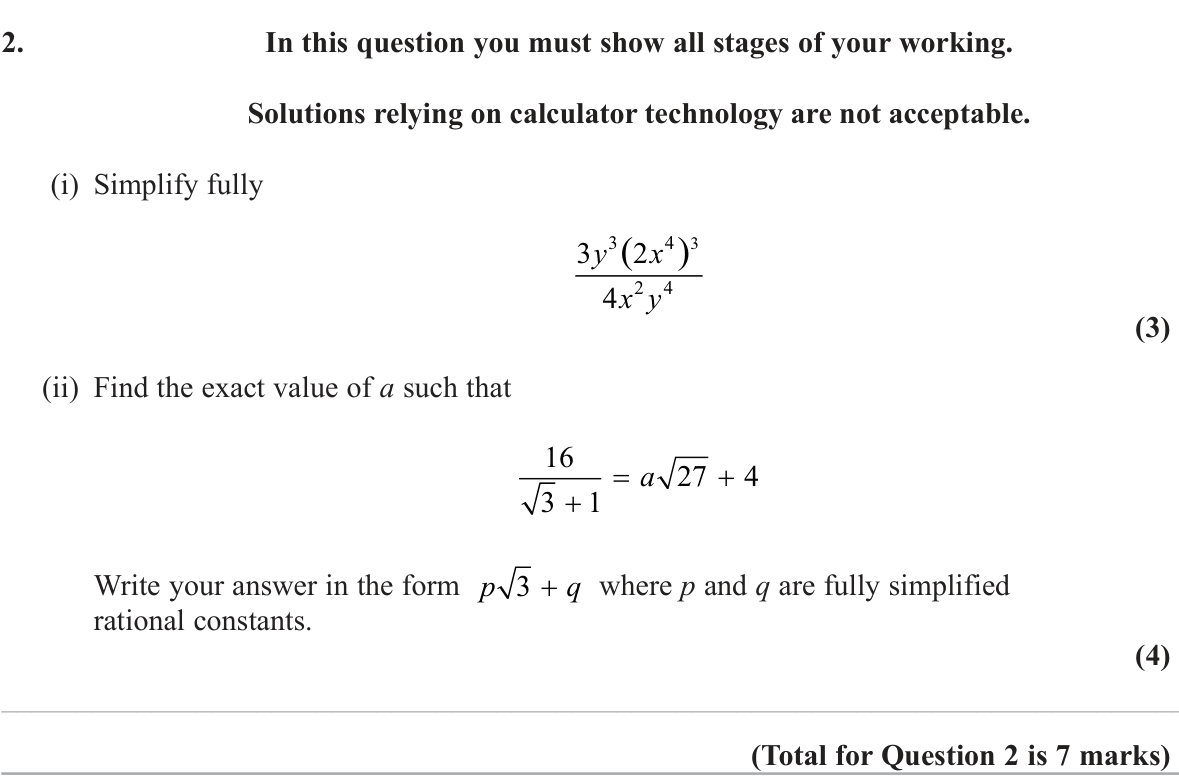
11. WMA11/01 October 2024 · Q2 Medium 7 marksShow worked solution Simplify the power bracket $(2x^4)^3=8x^{12}$.
Simplify the algebraic fraction $\dfrac{3y^3(2x^4)^3}{4x^2y^4}=\dfrac{3y^3(8x^{12})}{4x^2y^4}=\dfrac{6x^{10}}{y}$.
Rationalise the left side $\dfrac{16}{\sqrt3+1}\times\dfrac{\sqrt3-1}{\sqrt3-1}=8\sqrt3-8$.
Equate the surd parts $8\sqrt3-8=a\sqrt{27}+4=3a\sqrt3+4$.
Solve for a $3a\sqrt3=8\sqrt3-12$, so $a=\dfrac{8\sqrt3-12}{3\sqrt3}=\dfrac83-\dfrac43\sqrt3$.
Final answer $(i)\ \dfrac{6x^{10}}{y}.\quad (ii)\ a=-\dfrac43\sqrt3+\dfrac83$.
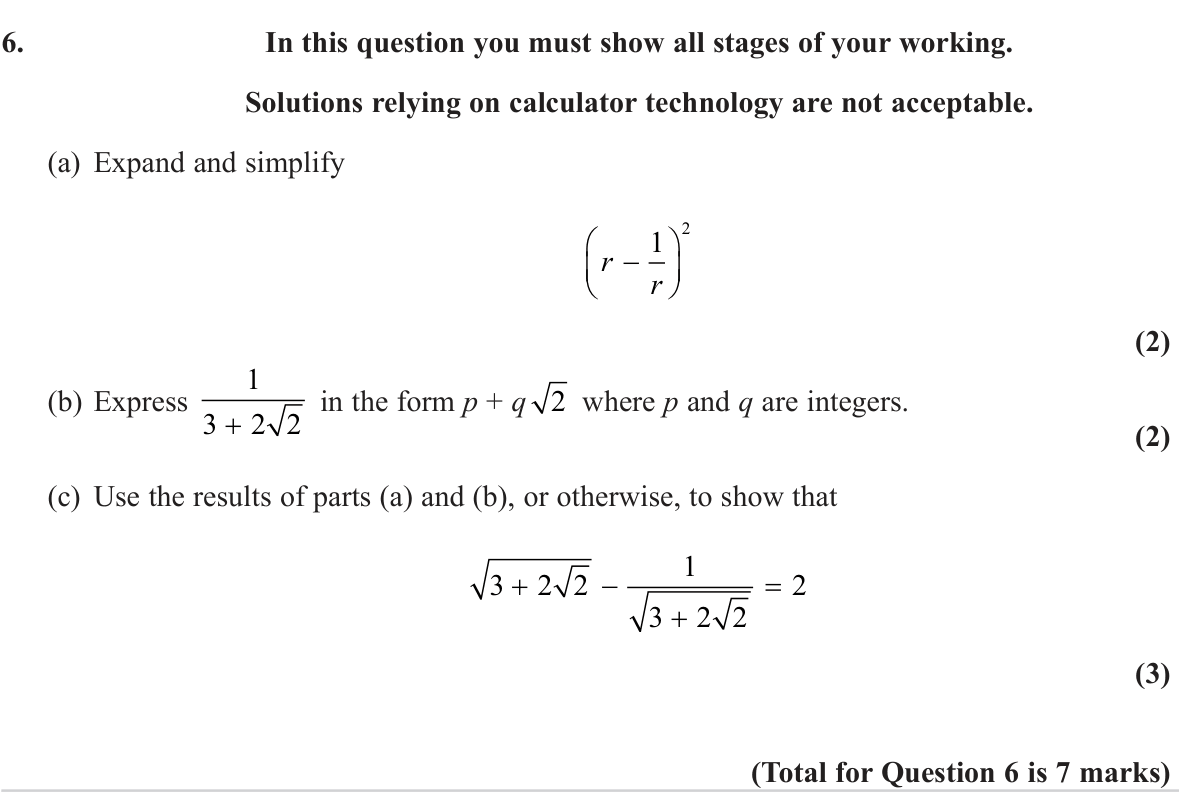
12. WMA11/01 May/June 2023 · Q6 Medium 7 marksShow worked solution Expand the square $\left(r-\dfrac1r\right)^2=r^2-2+\dfrac1{r^2}$.
Rationalise the denominator $\dfrac1{3+2\sqrt2}\times\dfrac{3-2\sqrt2}{3-2\sqrt2}=\dfrac{3-2\sqrt2}{9-8}=3-2\sqrt2$.
Let r be the square root Let $r=\sqrt{3+2\sqrt2}$. Then $r^2=3+2\sqrt2$ and $\dfrac1{r^2}=3-2\sqrt2$.
Use part (a) $\left(r-\dfrac1r\right)^2=r^2-2+\dfrac1{r^2}=(3+2\sqrt2)-2+(3-2\sqrt2)=4$.
Take the positive square root Since $r>1$, $r-\dfrac1r>0$, so $r-\dfrac1r=2$.
Final answer $(a)\ r^2-2+\dfrac1{r^2}.\quad (b)\ 3-2\sqrt2.\quad (c)$ The expression equals $2$.
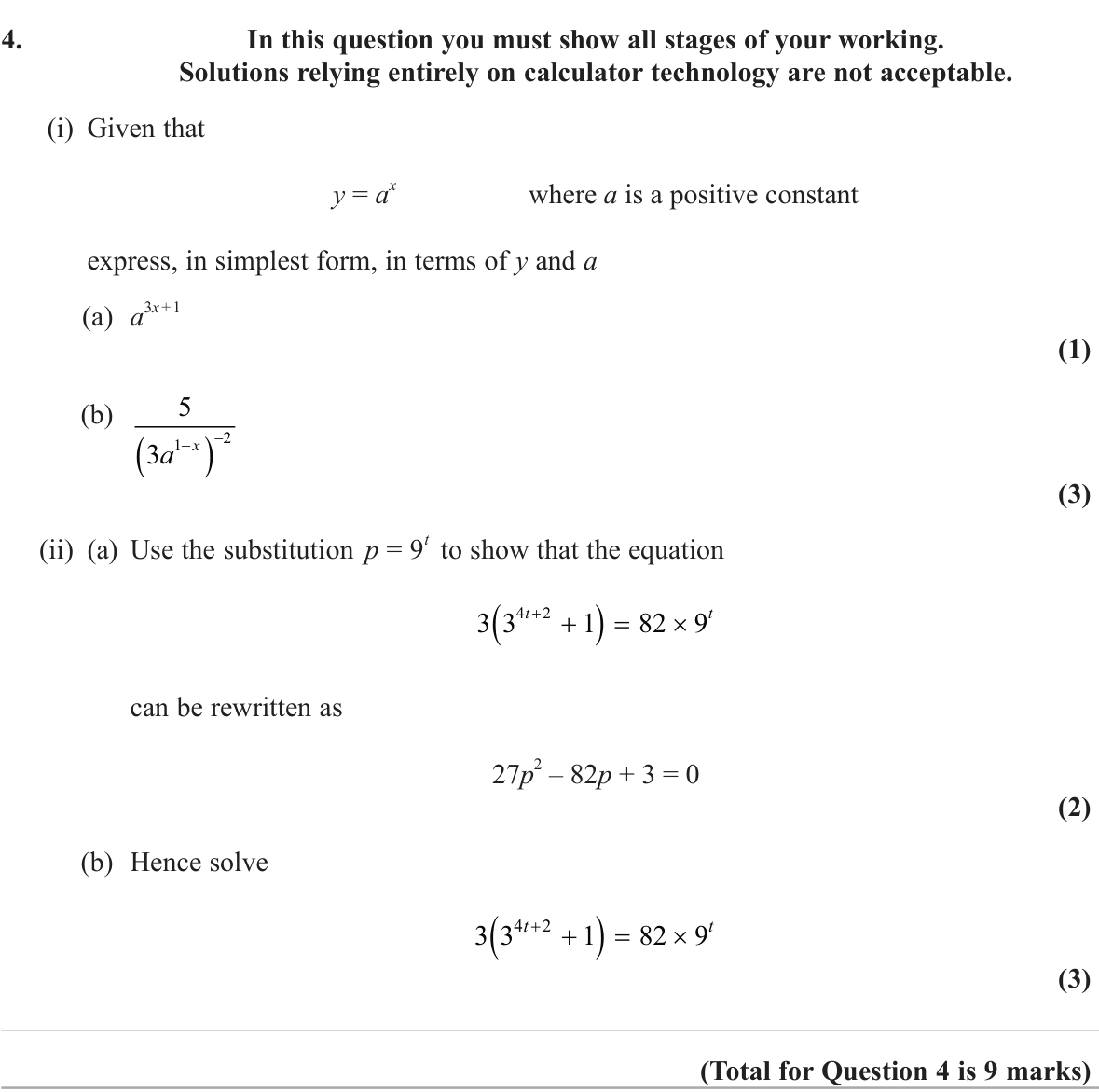
13. WMA11/01 January 2025 · Q4 Hard 9 marksShow worked solution Use y equals a to the x $a^{3x+1}=a(a^x)^3=ay^3$.
Rewrite the denominator $\dfrac{5}{(3a^{1-x})^{-2}}=5(3a^{1-x})^2=45a^{2-2x}$.
Write in terms of y $45a^{2-2x}=\dfrac{45a^2}{(a^x)^2}=\dfrac{45a^2}{y^2}$.
Use p equals 9 to the t $p=9^t=3^{2t}$, so $3^{4t+2}=9(3^{2t})^2=9p^2$.
Rewrite the equation $3(3^{4t+2}+1)=82\times9^t$ becomes $3(9p^2+1)=82p$.
Obtain the quadratic $27p^2+3=82p$, so $27p^2-82p+3=0$.
Solve for p $p=\dfrac{82\pm80}{54}$, so $p=3$ or $p=\dfrac{1}{27}$.
Return to t $9^t=3$ gives $3^{2t}=3^1$, so $t=\dfrac12$. Also $9^t=\dfrac1{27}=3^{-3}$ gives $2t=-3$, so $t=-\dfrac32$.
Final answer $(i)(a)\ ay^3.\quad (i)(b)\ \dfrac{45a^2}{y^2}.\quad (ii)(b)\ t=\dfrac12$ or $t=-\dfrac32$.
Dr Eslam Ahmed Elite Mathematics · Questions classified by topic, solutions checked by Dr Eslam
 Elite Mathematics