Elite Mathematics / Pure 1 / Topics / Basic Trigonometry IAL · WMA11 · Topic Basic Trigonometry: past paper questions & worked solutions
Every Basic Trigonometry question from the WMA11 papers in our bank, 2019–2026, sorted from easiest to hardest. Try each one first, then open the worked solution.
7 questions
42 marks in total
37% of papers (7 of 19) include it
5/1/1 easy / medium / hard
Questions, easiest first Level is estimated from marks: 1–6 easy, 7–8 medium, 9+ hard.
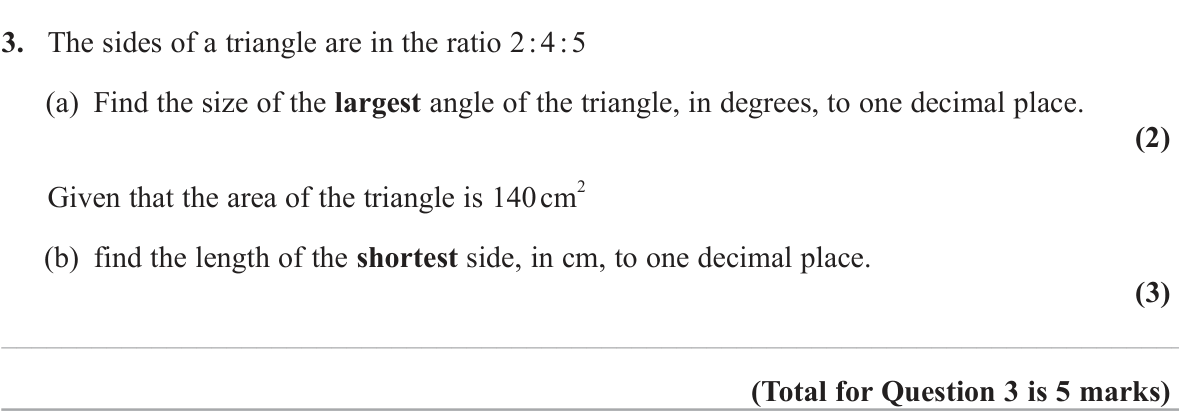
1. WMA11/01 October 2025 · Q3 Easy 5 marksShow worked solution Use the side ratio Take the side lengths as $2x$, $4x$ and $5x$. The largest angle is opposite the side $5x$.
Use the cosine rule $(5x)^2=(2x)^2+(4x)^2-2(2x)(4x)\cos\theta$.
Find the angle $25=4+16-16\cos\theta$, so $\cos\theta=-\dfrac5{16}$ and $\theta=108.2^\circ$ to one decimal place.
Use the area formula $140=\dfrac12(2x)(4x)\sin108.2^\circ=4x^2\sin108.2^\circ$.
Find the scale factor $x^2=\dfrac{140}{4\sin108.2^\circ}$, so $x\approx6.070$.
Shortest side The shortest side is $2x\approx12.1\text{ cm}$.
Final answer $(a)\ 108.2^\circ.\quad (b)\ 12.1\text{ cm}$.
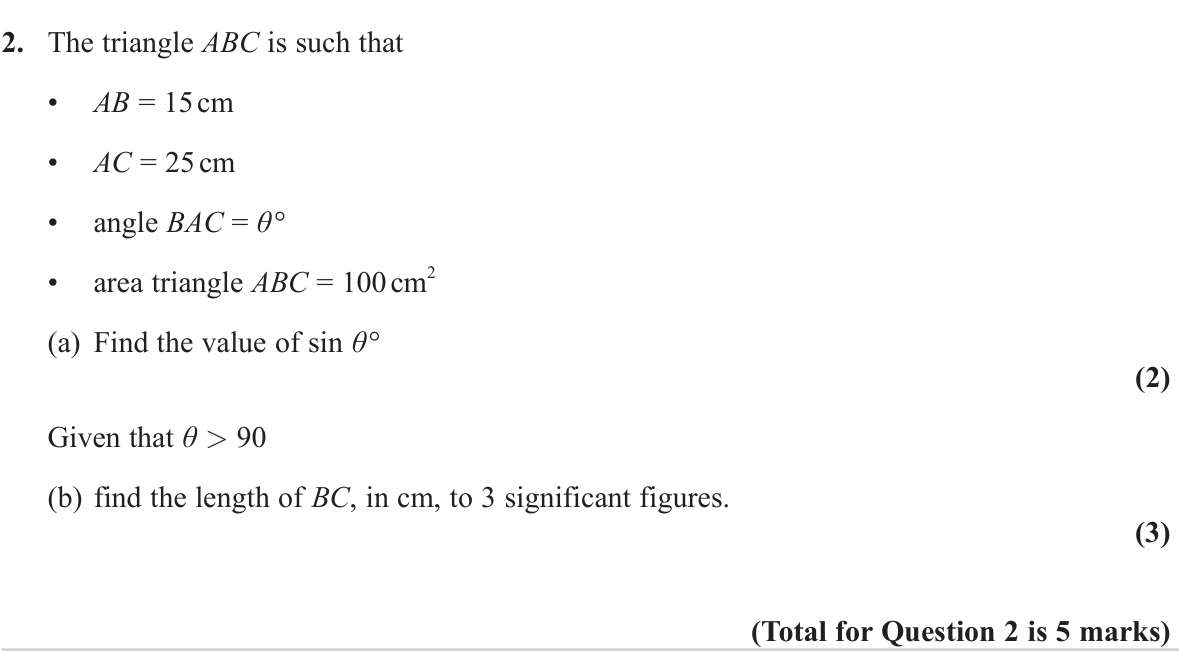
2. WMA11/01 January 2024 · Q2 Easy 5 marksShow worked solution Use the triangle area formula $100=\dfrac12(15)(25)\sin\theta$.
Find sine theta $\sin\theta=\dfrac{200}{375}=\dfrac{8}{15}$.
Use theta greater than 90 degrees Since $\theta>90^\circ$, $\cos\theta$ is negative. So $\cos\theta=-\sqrt{1-\left(\dfrac{8}{15}\right)^2}=-\dfrac{\sqrt{161}}{15}$.
Apply the cosine rule $BC^2=15^2+25^2-2(15)(25)\cos\theta=850+50\sqrt{161}$.
Round the length $BC=\sqrt{850+50\sqrt{161}}\approx38.5\text{ cm}$ to 3 significant figures.
Final answer $(a)\ \sin\theta=\dfrac{8}{15}.\quad (b)\ BC=38.5\text{ cm}$.
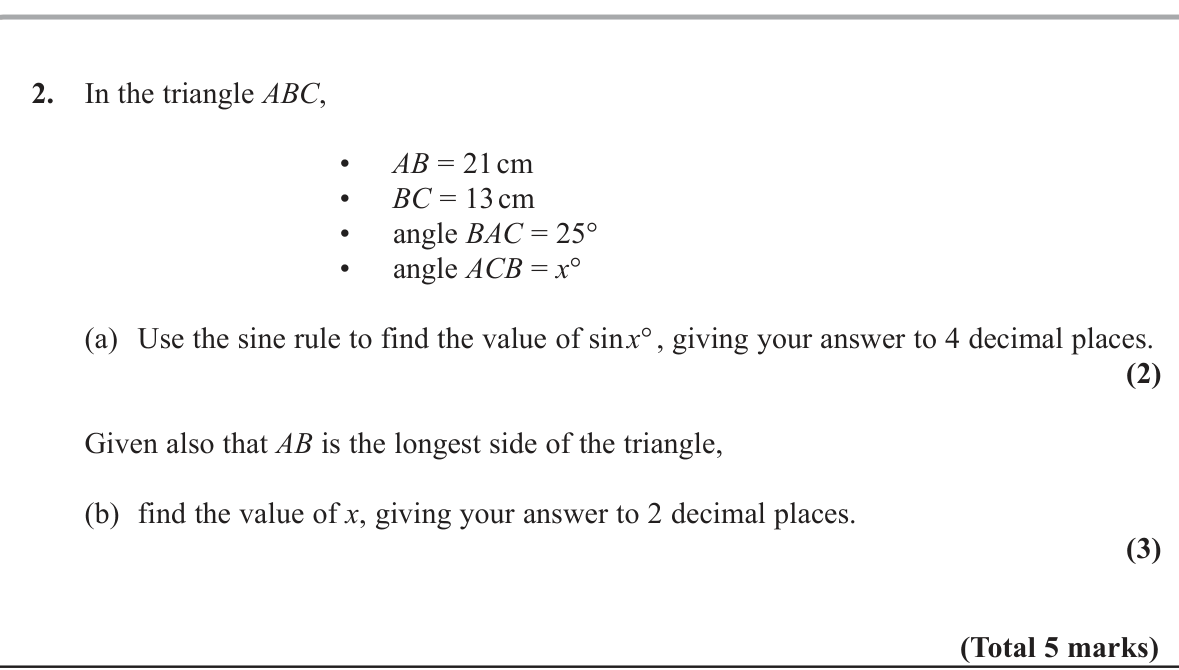
3. WMA11/01 May/June 2022 · Q2 Easy 5 marksShow worked solution Use the sine rule The side opposite $x$ is $AB=21$, and the side opposite $25^\circ$ is $BC=13$, so $\dfrac{\sin x}{21}=\dfrac{\sin25^\circ}{13}$.
Find the sine value $\sin x=\dfrac{21\sin25^\circ}{13}=0.68269\ldots$.
Choose the correct angle The angle from the calculator is $43.05^\circ$, but $AB$ is the longest side, so $x$ is obtuse. Hence $x=180^\circ-43.05^\circ=136.95^\circ$.
Final answer $x=137^\circ$ to 3 significant figures.
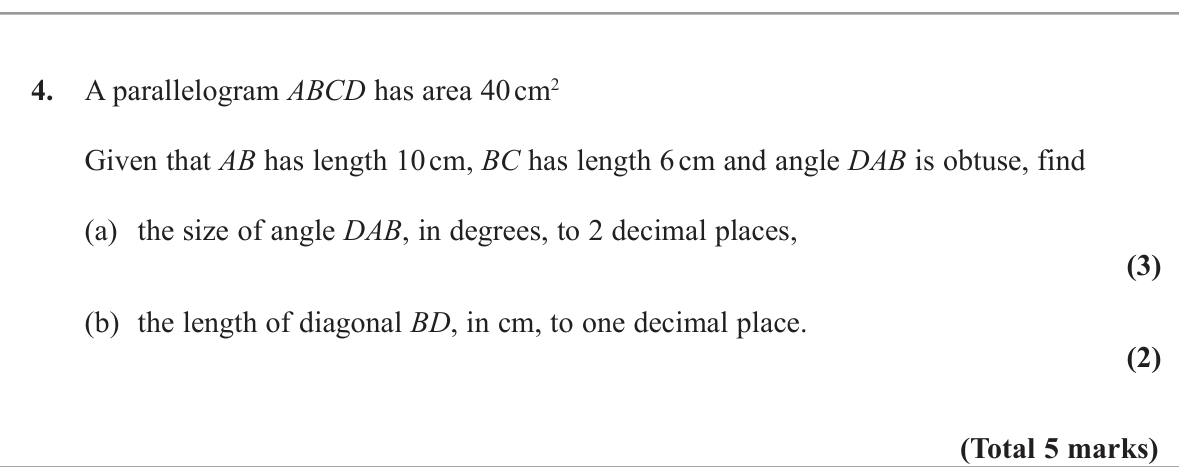
4. WMA11/01 October 2019 · Q4 Easy 5 marksShow worked solution Use the area of a parallelogram Area $=ab\sin\theta$, so $40=10\cdot6\sin\theta$. Hence $\sin\theta=\frac23$.
Choose the obtuse angle $\theta=180^\circ-\sin^{-1}\left(\frac23\right)=138.19^\circ$ to 2 decimal places.
Use the cosine rule for BD $BD^2=10^2+6^2-2(10)(6)\cos(138.19^\circ)$. Therefore $BD\approx15.014\ldots$, so $BD=15.0\text{ cm}$ to 1 decimal place.
Final answer $(a)\ \angle DAB=138.19^\circ.\quad (b)\ BD=15.0\text{ cm}$.
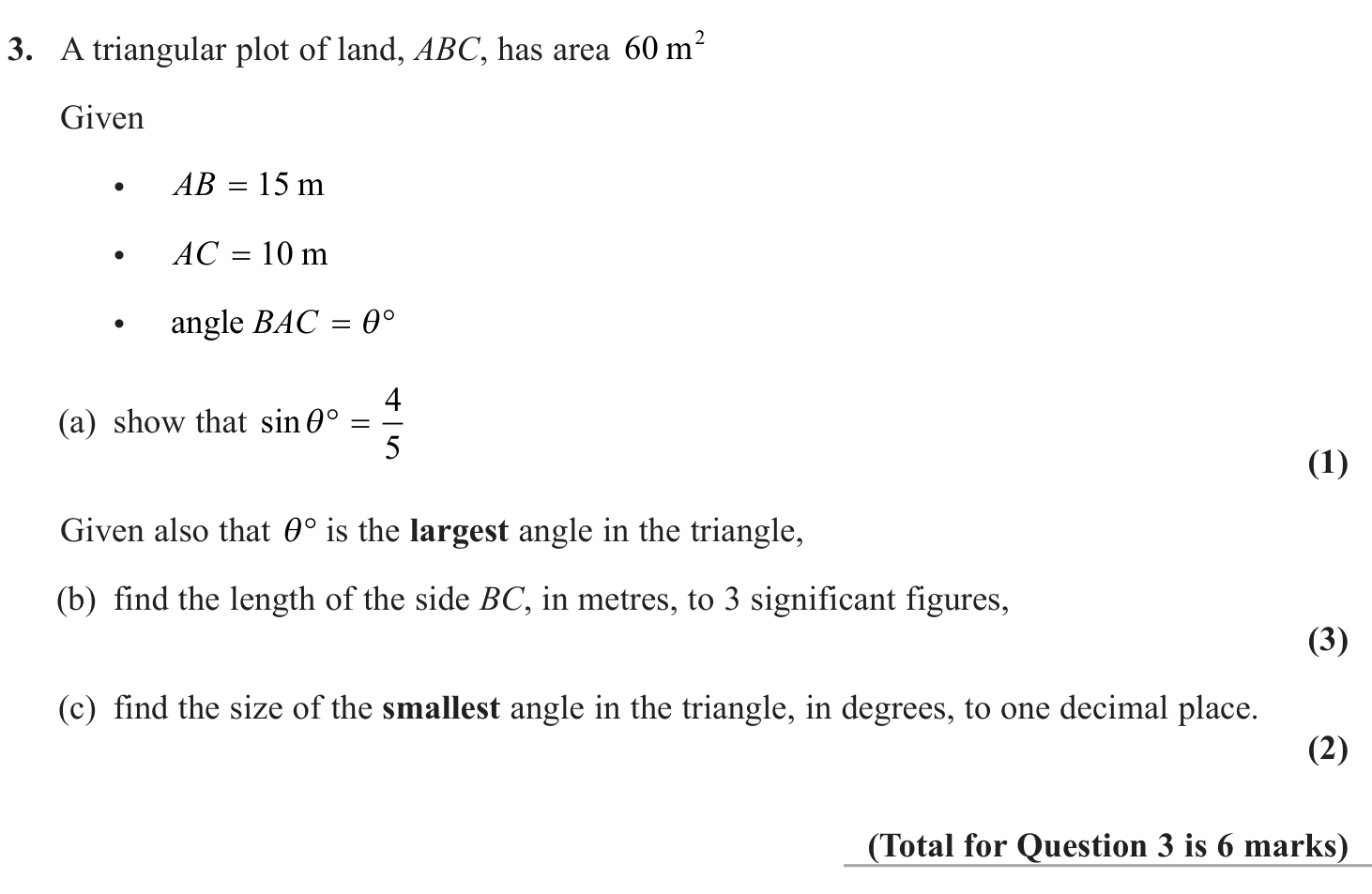
5. WMA11/01 May/June 2026 · Q3 Easy 6 marksShow worked solution (a) Use the area formula $60=\dfrac12(15)(10)\sin\theta^\circ=75\sin\theta^\circ$, so $\sin\theta^\circ=\dfrac{60}{75}=\dfrac45$.
(b) Select the angle consistent with the information $\sin^{-1}\left(\dfrac45\right)=53.130\ldots^\circ$, but $\theta$ is the largest angle, so it must be the obtuse alternative: $\theta=180^\circ-53.130\ldots^\circ=126.869\ldots^\circ$. Hence $\cos\theta=-\dfrac35$.
(b) Apply the cosine rule $BC^2=15^2+10^2-2(15)(10)\cos\theta=225+100+180=505$. Therefore $BC=\sqrt{505}=22.472\ldots\text{ m}=22.5\text{ m}$ to 3 significant figures.
(c) Identify the smallest angle The shortest side is $AC=10$, so the smallest angle is $\angle ABC$.
(c) Use the sine rule $\dfrac{\sin\angle ABC}{10}=\dfrac{\sin\theta}{\sqrt{505}}$, so $\sin\angle ABC=\dfrac{8}{\sqrt{505}}$. Thus $\angle ABC=20.854\ldots^\circ=20.9^\circ$ to one decimal place.
Final answer $(a)\ \sin\theta^\circ=\dfrac45.\qquad (b)\ BC=22.5\text{ m}.\qquad (c)\ \angle ABC=20.9^\circ.$
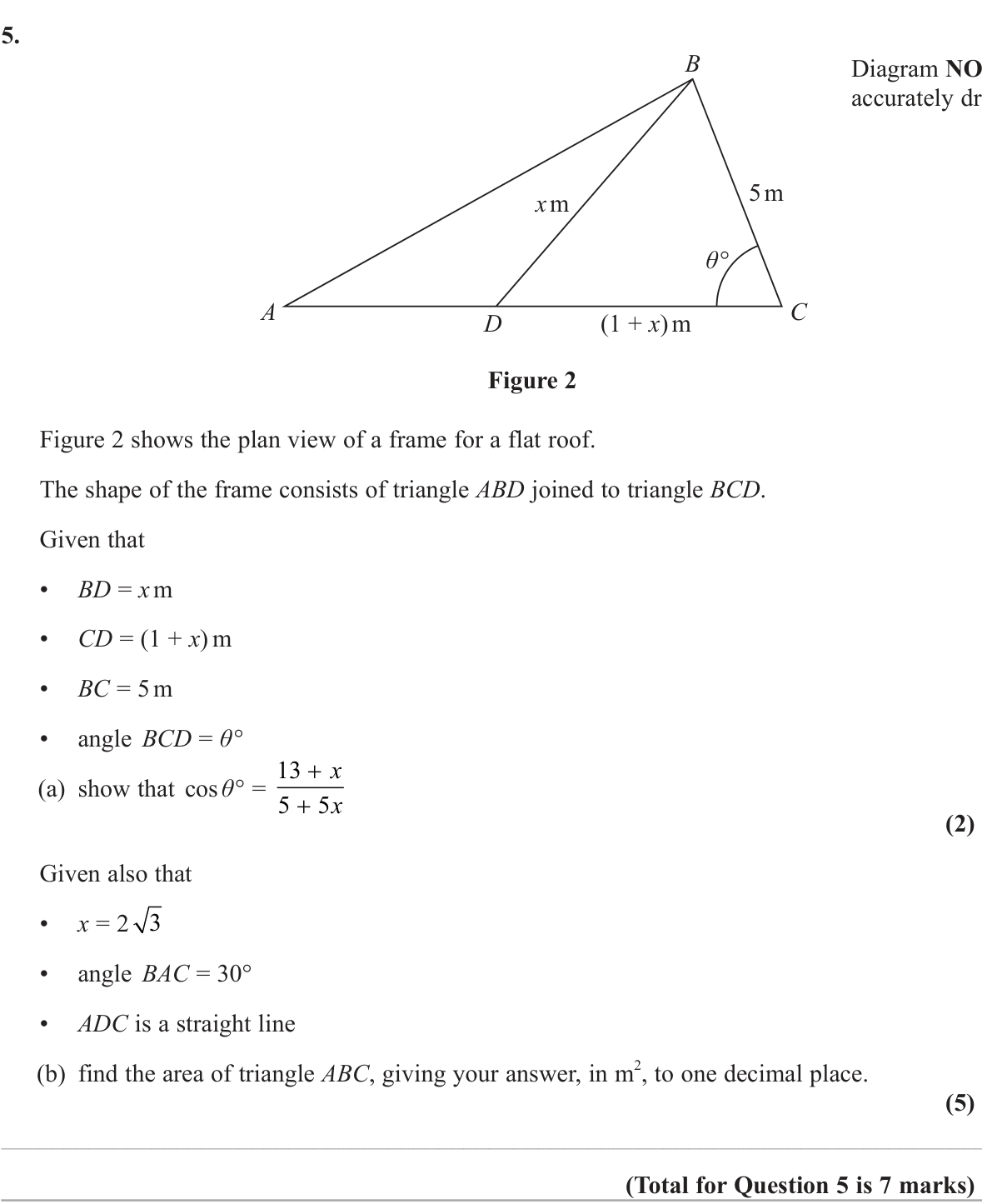
6. WMA11/01 October 2023 · Q5 Medium 7 marksShow worked solution Apply the cosine rule in triangle BCD $x^2=5^2+(1+x)^2-2(5)(1+x)\cos\theta$.
Rearrange for cos theta $10(1+x)\cos\theta=25+(1+x)^2-x^2=26+2x$, so $\cos\theta=\dfrac{26+2x}{10(1+x)}=\dfrac{13+x}{5+5x}$.
Substitute x equals 2 root 3 $\cos C=\dfrac{13+2\sqrt3}{5+10\sqrt3}$, so $C\approx42.47^\circ$.
Use angle sum $A=30^\circ$, so $B=180^\circ-30^\circ-C\approx107.53^\circ$.
Use the sine rule for the area Since $BC=5$ and $A=30^\circ$, $\dfrac{BC}{\sin A}=10$. Hence $AB=10\sin C$ and $AC=10\sin B$.
Calculate the area $\text{Area}=\dfrac12(AB)(AC)\sin A=50\sin C\sin B\approx32.2\text{ m}^2$.
Final answer $(a)\ \cos\theta=\dfrac{13+x}{5+5x}.\quad (b)\ \text{Area}=32.2\text{ m}^2$.
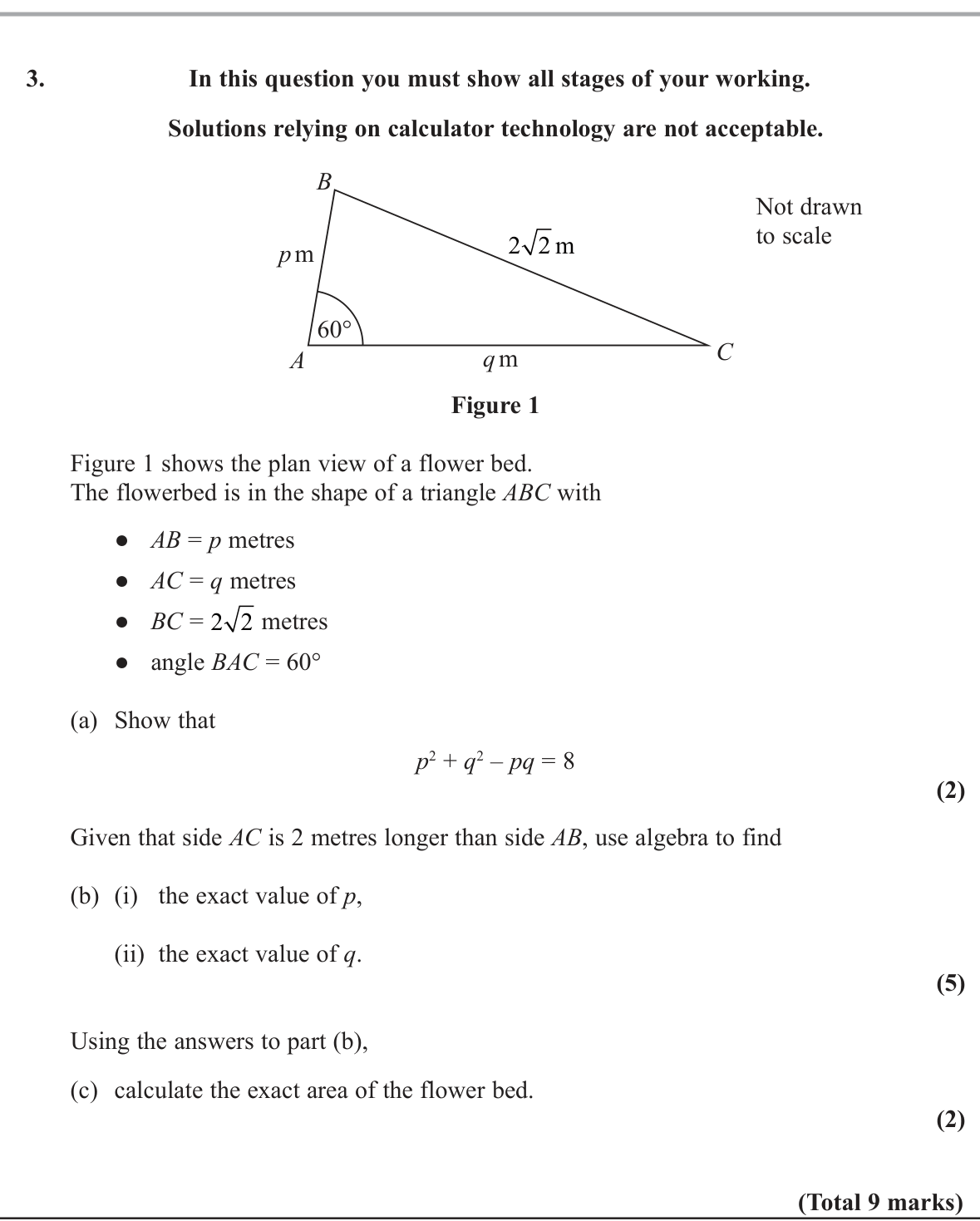
7. WMA11/01 May/June 2021 · Q3 Hard 9 marksShow worked solution Apply the cosine rule $BC^2=AB^2+AC^2-2(AB)(AC)\cos60^\circ$. Since $BC=2\sqrt2$, $AB=p$ and $AC=q$, this gives $8=p^2+q^2-2pq\left(\dfrac12\right)$.
Show the required result Therefore $p^2+q^2-pq=8$.
Use q = p + 2 Side $AC$ is 2 metres longer than $AB$, so $q=p+2$. Substitute into $p^2+q^2-pq=8$.
Solve for p $p^2+(p+2)^2-p(p+2)=8$, so $p^2+2p-4=0$. Hence $p=-1\pm\sqrt5$. Since $p>0$, $p=\sqrt5-1$.
Find q $q=p+2=\sqrt5+1$.
Find the exact area Area $=\dfrac12pq\sin60^\circ$. Now $pq=(\sqrt5-1)(\sqrt5+1)=4$, so area $=\dfrac12(4)\left(\dfrac{\sqrt3}{2}\right)=\sqrt3\text{ m}^2$.
Final answer $(a)\ p^2+q^2-pq=8.\quad (b)\ p=\sqrt5-1,\ q=\sqrt5+1.\quad (c)\ \sqrt3\text{ m}^2$.
Dr Eslam Ahmed Elite Mathematics · Questions classified by topic, solutions checked by Dr Eslam
 Elite Mathematics