Radian Measure: past paper questions & worked solutions
Every Radian Measure question from the WMA11 papers in our bank, 2019–2026, sorted from easiest to hardest. Try each one first, then open the worked solution.
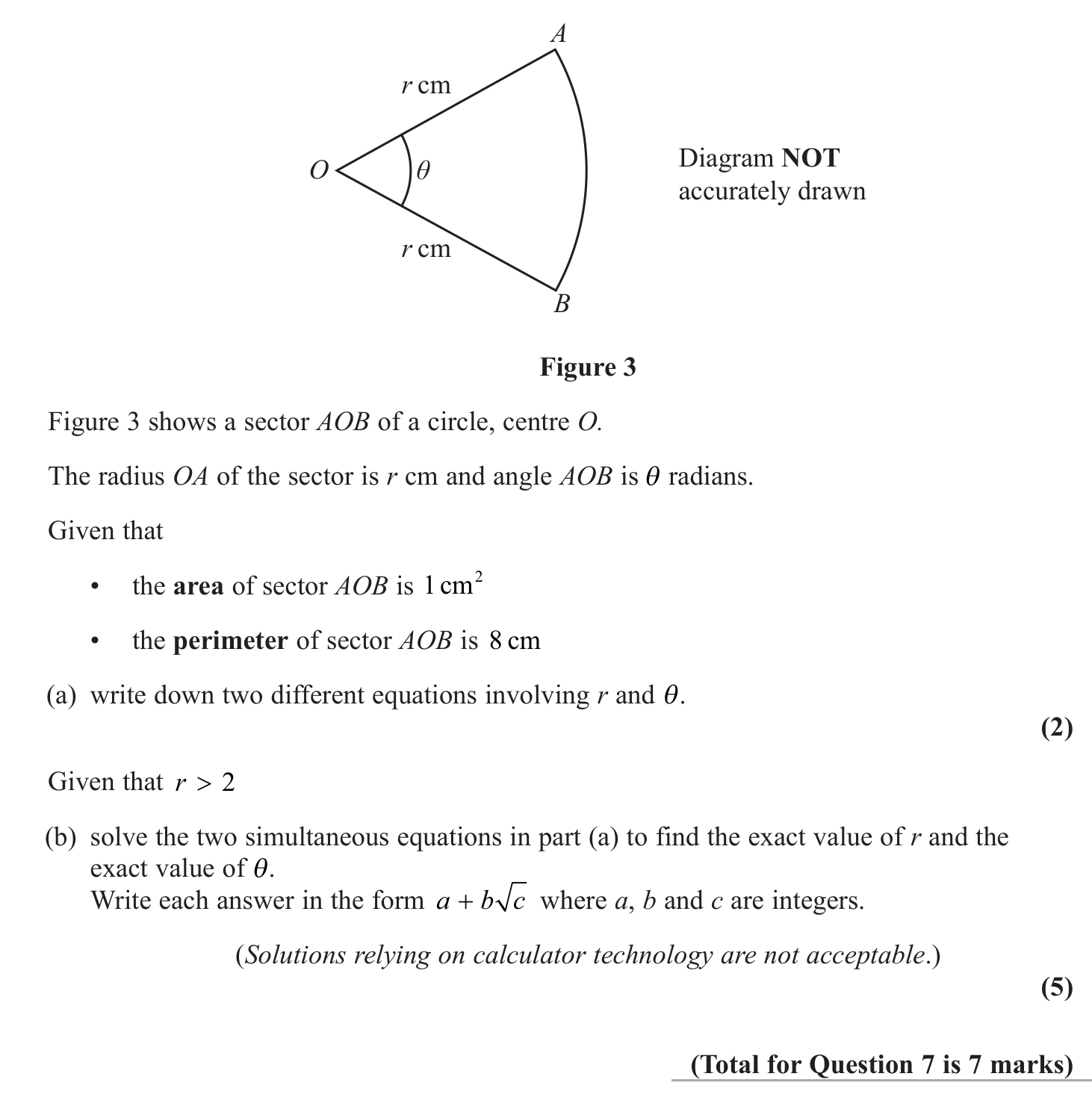
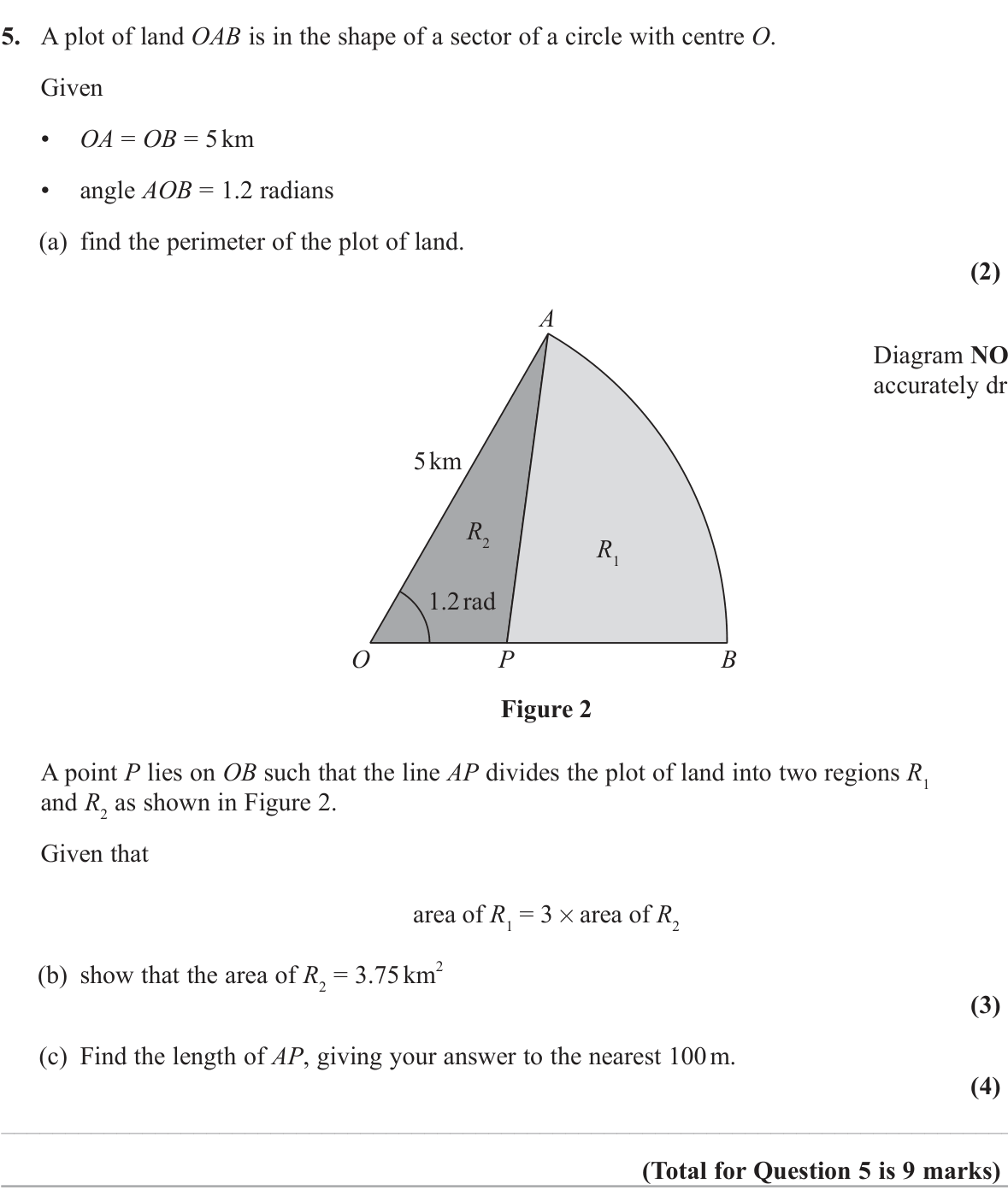
For a sector of radius $r$ and angle $\theta$ radians, $$\frac12r^2\theta=1.$$ Its perimeter is two radii plus the arc length, so $$2r+r\theta=8.$$
(b) Eliminate the angle
From the area equation, $$\theta=\frac{2}{r^2}.$$ Substitute this into the perimeter equation: $$2r+r\left(\frac{2}{r^2}\right)=8.$$ Therefore $$2r+\frac2r=8,$$ and, since $r>0$, $$r^2-4r+1=0.$$
(b) Solve for the radius and apply the condition
Complete the square: $$(r-2)^2=3,$$ so $$r=2\pm\sqrt3.$$ The condition $r>2$ selects $$r=2+\sqrt3.$$
(b) Find the exact angle
Using $\theta=\frac{2}{r^2}$, $$\theta=\frac{2}{(2+\sqrt3)^2}. $$ Since $\frac1{2+\sqrt3}=2-\sqrt3$, $$\theta=2(2-\sqrt3)^2=2(7-4\sqrt3)=14-8\sqrt3.$$
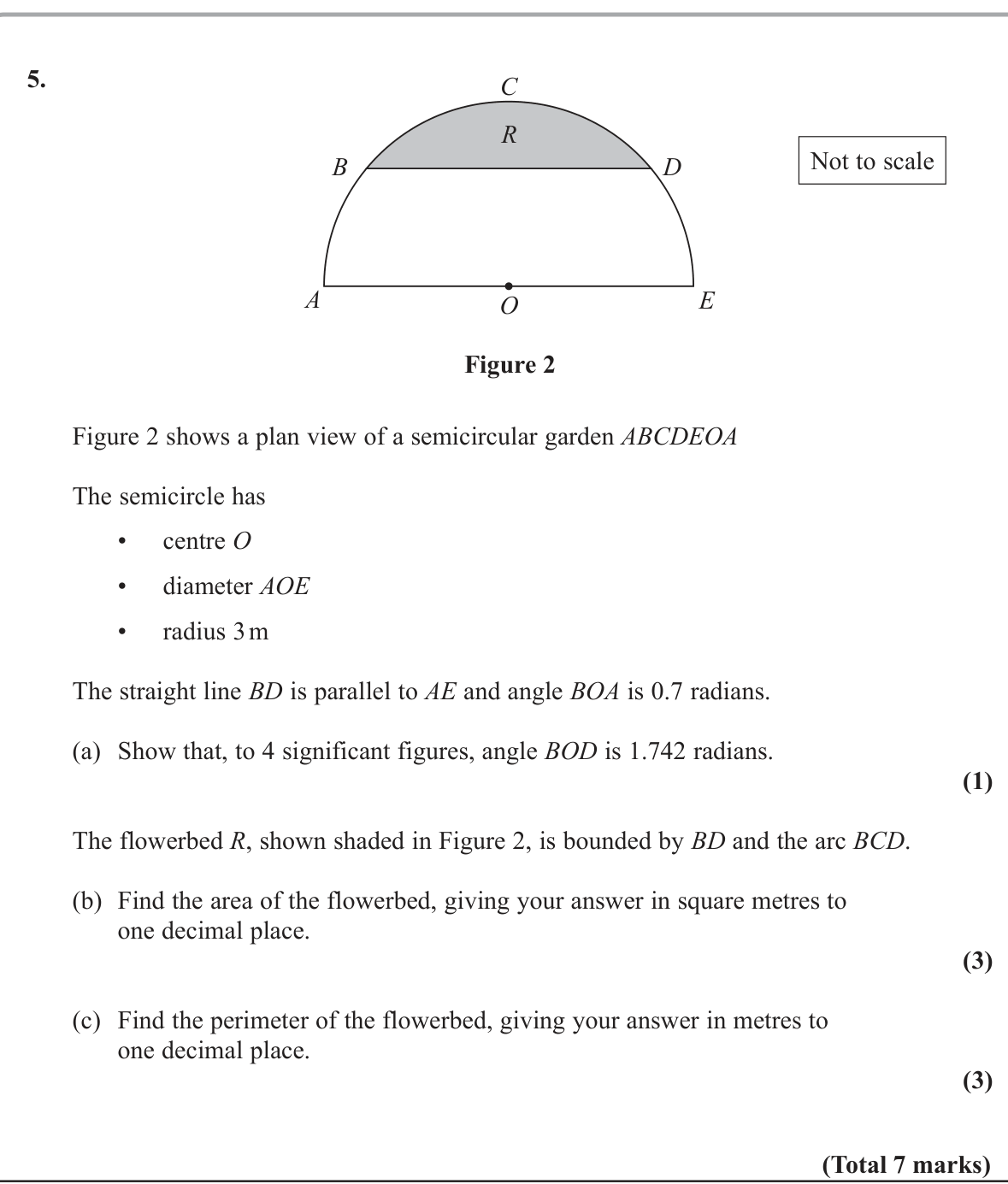
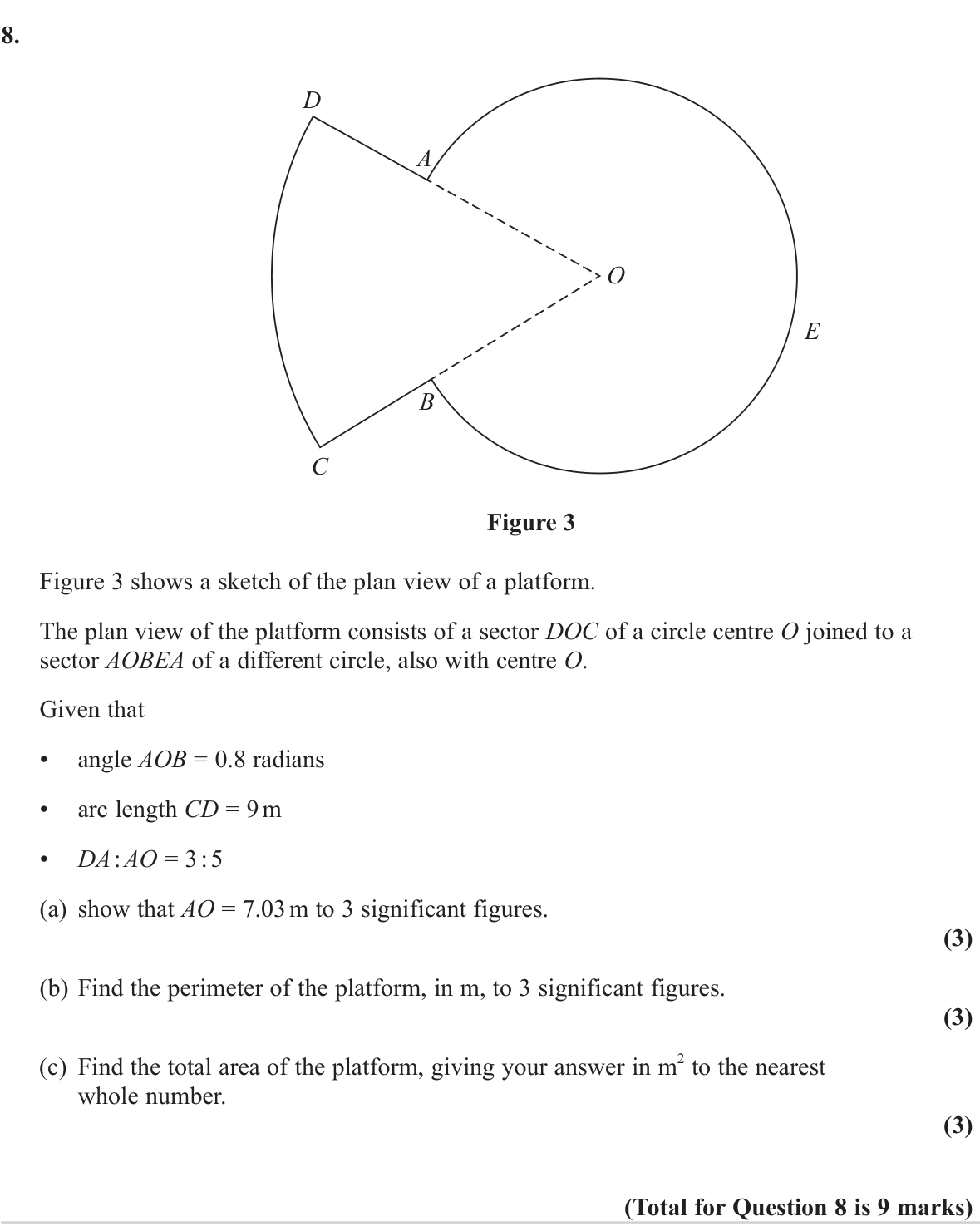
Since $BD$ is parallel to the diameter $AE$, the two side angles at the centre are both $0.7$ radians. Therefore $\angle BOD=\pi-0.7-0.7=\pi-1.4=1.74159\ldots$, so $1.742$ radians to 4 significant figures.
Find the sector area
With $r=3$ and $\theta=1.74159\ldots$, sector area $=\dfrac12r^2\theta=\dfrac12(3)^2(1.74159\ldots)=7.837\ldots$.
Subtract triangle BOD
Triangle area $=\dfrac12(3)(3)\sin(1.74159\ldots)=4.434\ldots$. The segment area is $7.837\ldots-4.434\ldots=3.403\ldots$, so $3.4\text{ m}^2$.
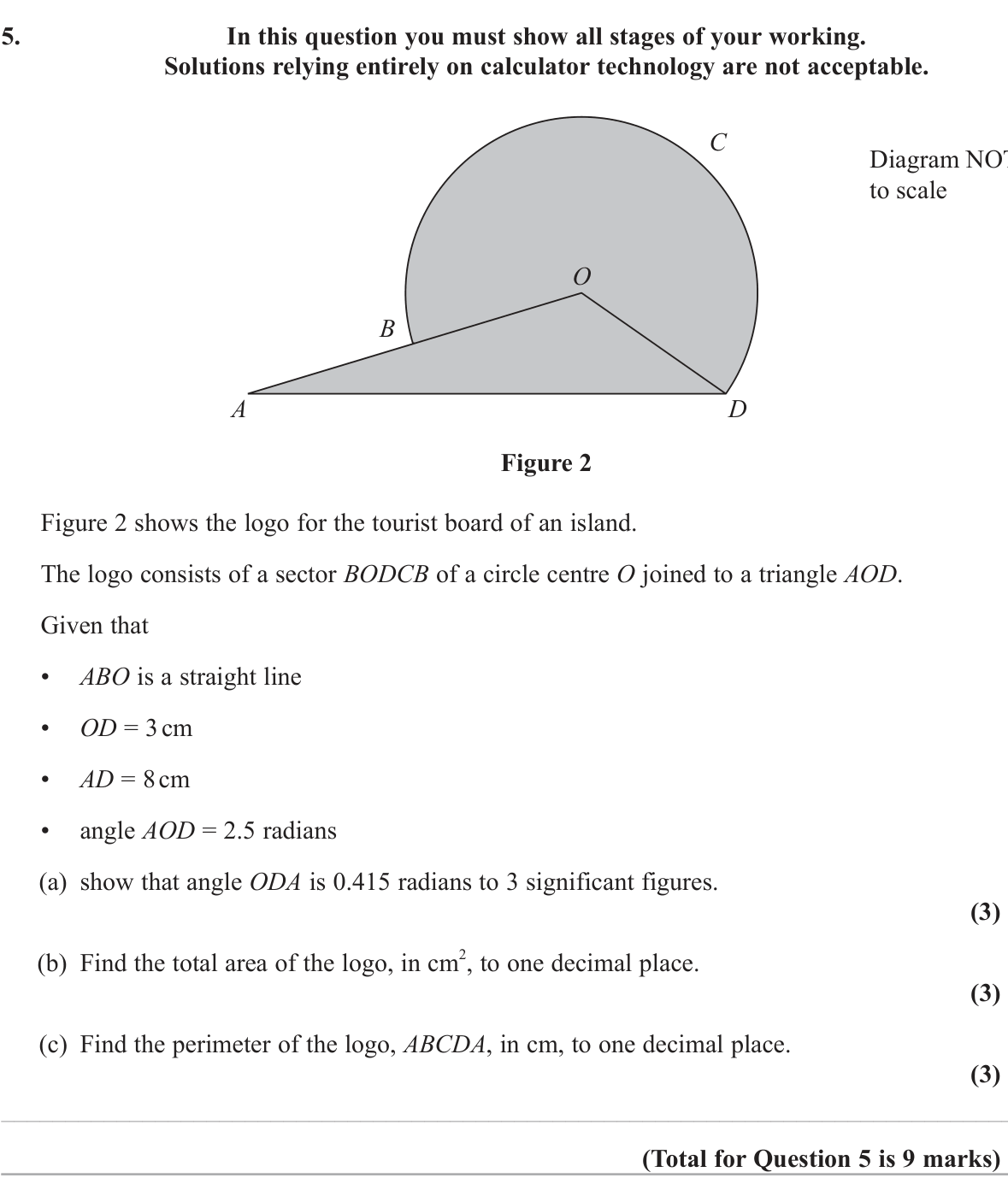
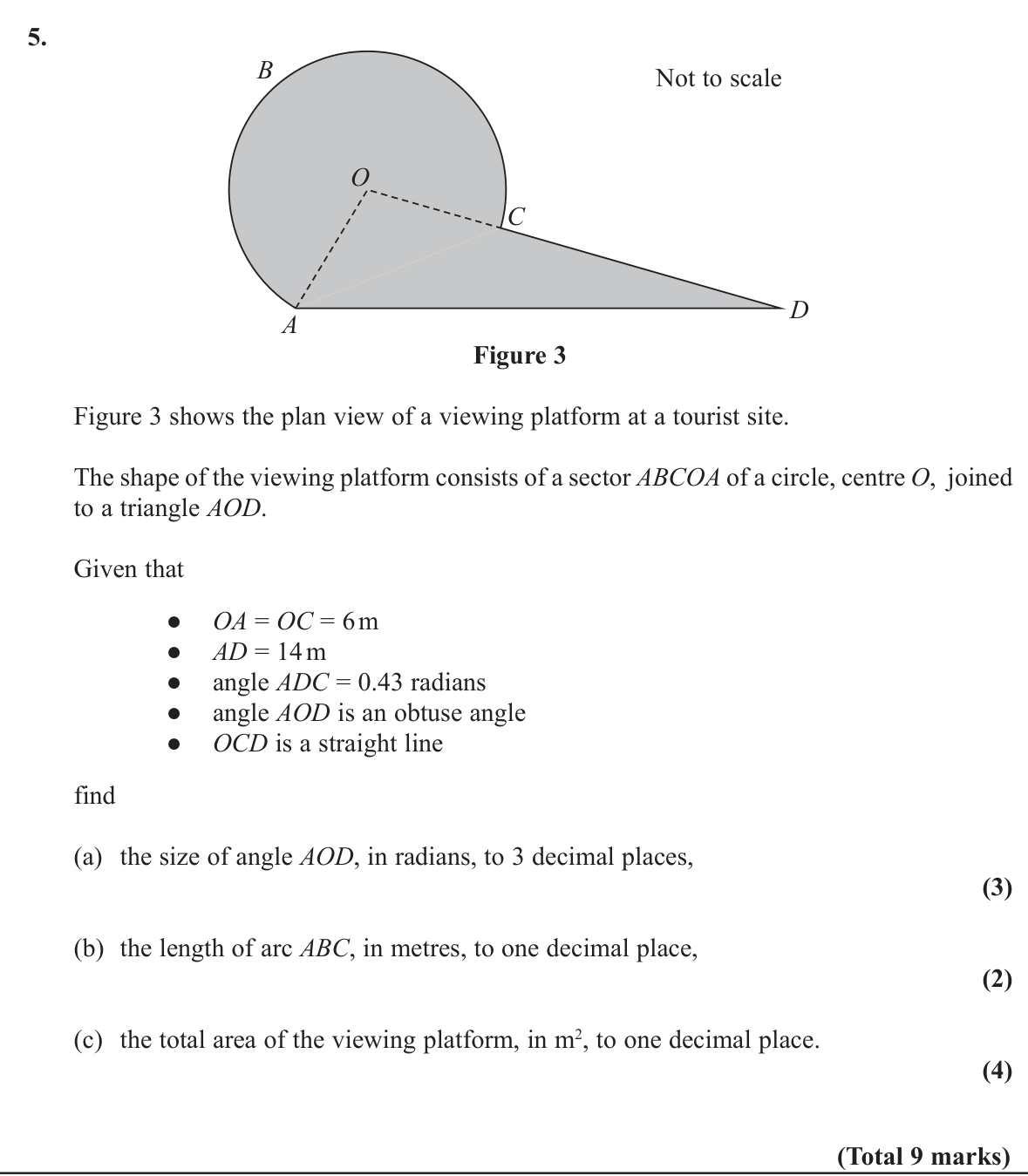
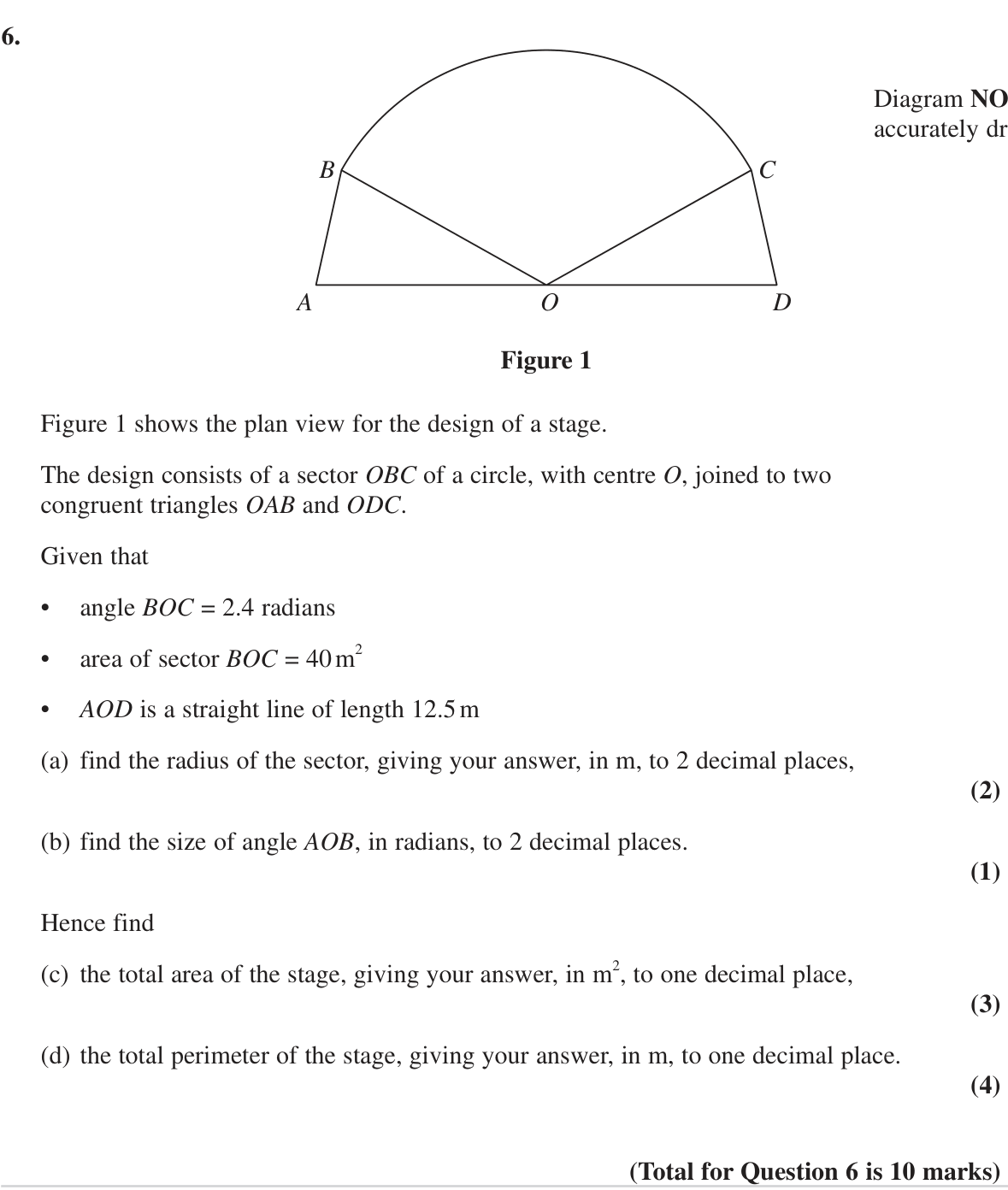
Since $O,C,D$ are in a straight line, $\angle ADO=0.43$. By the sine rule, $\dfrac{14}{\sin\angle AOD}=\dfrac{6}{\sin0.43}$, so $\sin\angle AOD=\dfrac{14\sin0.43}{6}$.
Choose the obtuse angle
The calculator gives the acute value $1.337\ldots$, but $\angle AOD$ is obtuse. Hence $\angle AOD=\pi-1.337\ldots=1.805\ldots$, so $\angle AOD=1.805$ radians.
Find the major-sector angle
Arc $ABC$ is the major arc, so its angle is $2\pi-1.805\ldots=4.478\ldots$ radians.
Find the arc length
$s=r\theta=6(4.478\ldots)=26.868\ldots$, so the length of arc $ABC$ is $26.9$ m.
Find the sector area
The sector area is $\dfrac12r^2\theta=\dfrac12(6)^2(4.478\ldots)=80.607\ldots$.
Find the triangle area and total area
$\angle OAD=\pi-0.43-1.805\ldots=0.9066\ldots$. The triangle area is $\dfrac12(6)(14)\sin(0.9066\ldots)=33.093\ldots$. Total area $=80.607\ldots+33.093\ldots=113.7\text{ m}^2$.
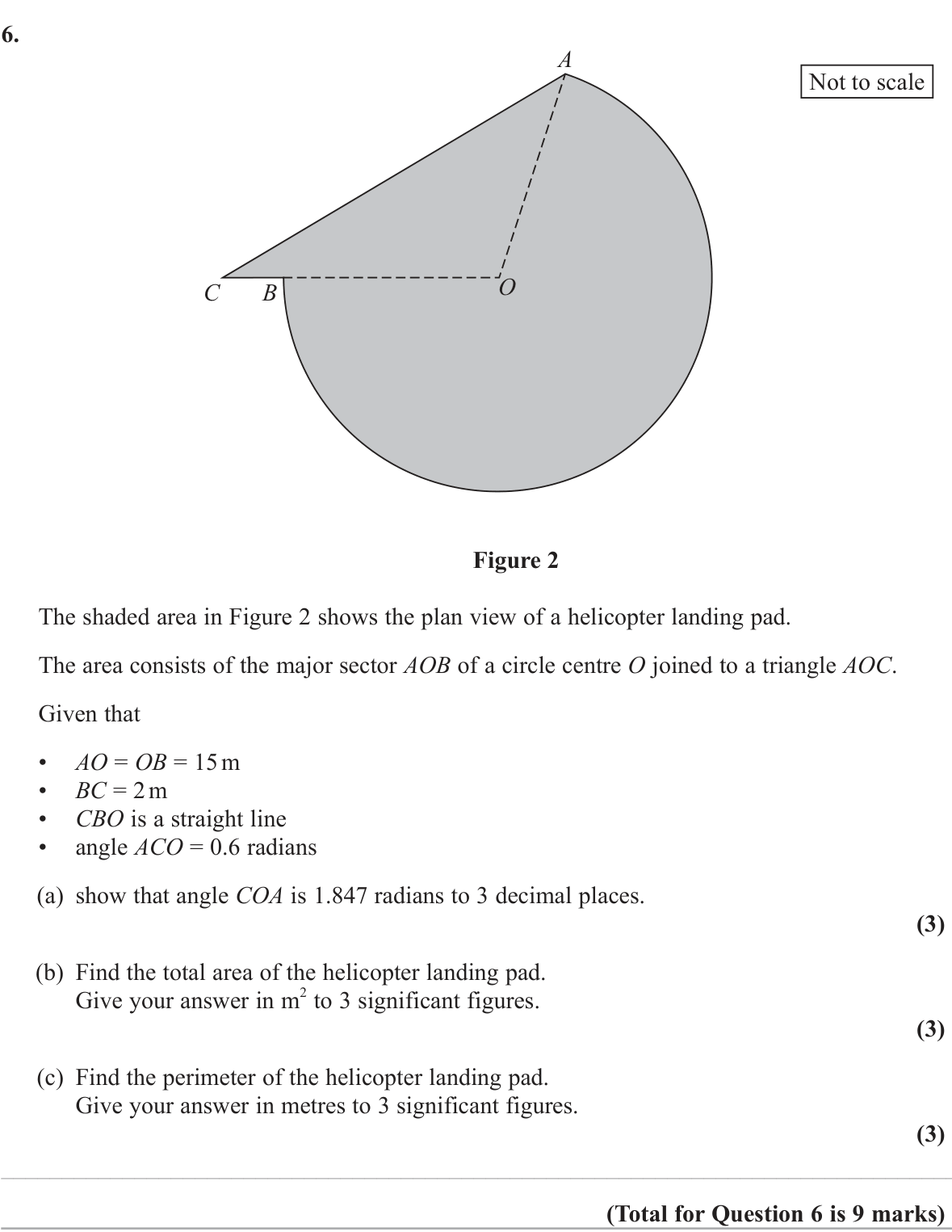
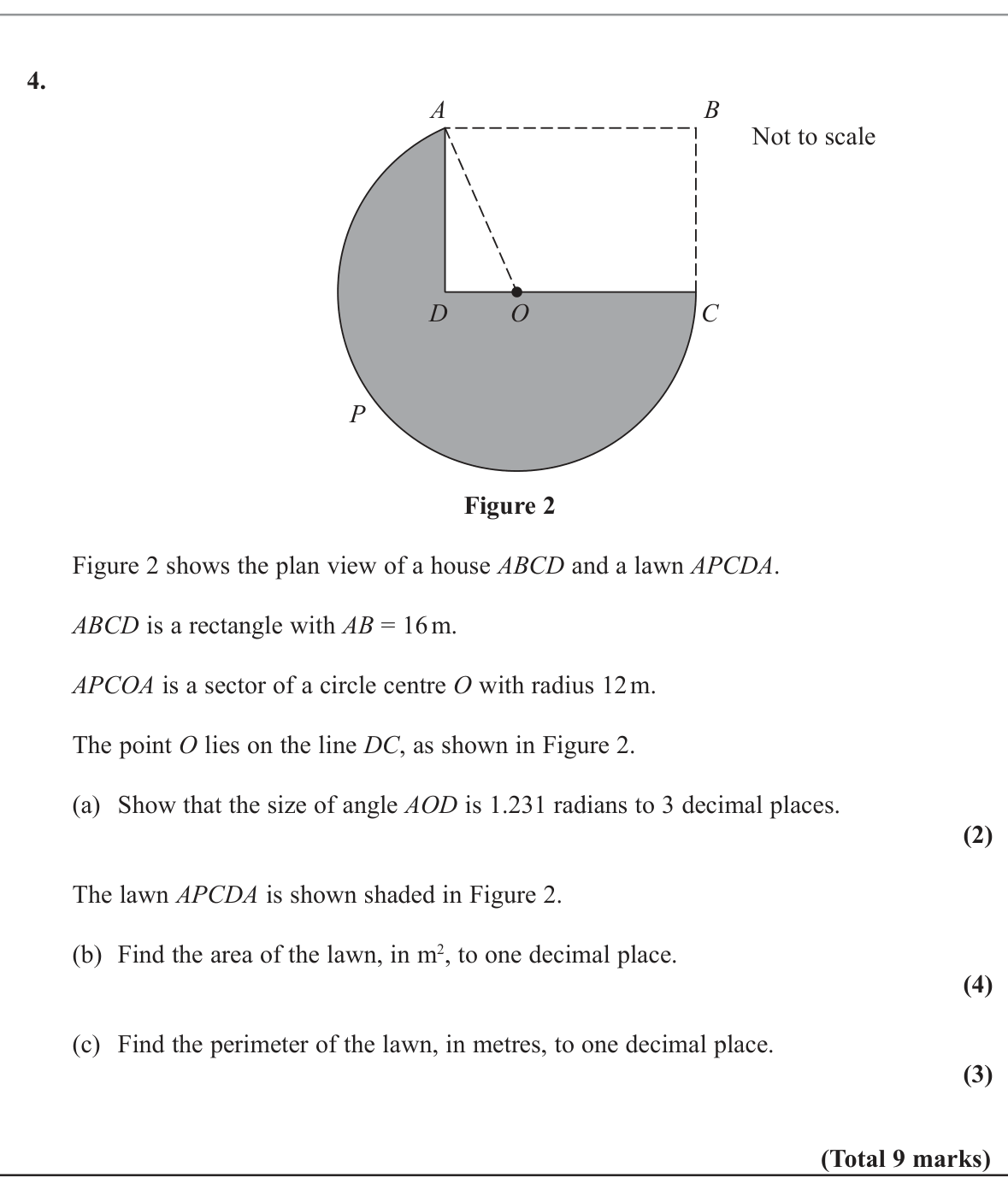
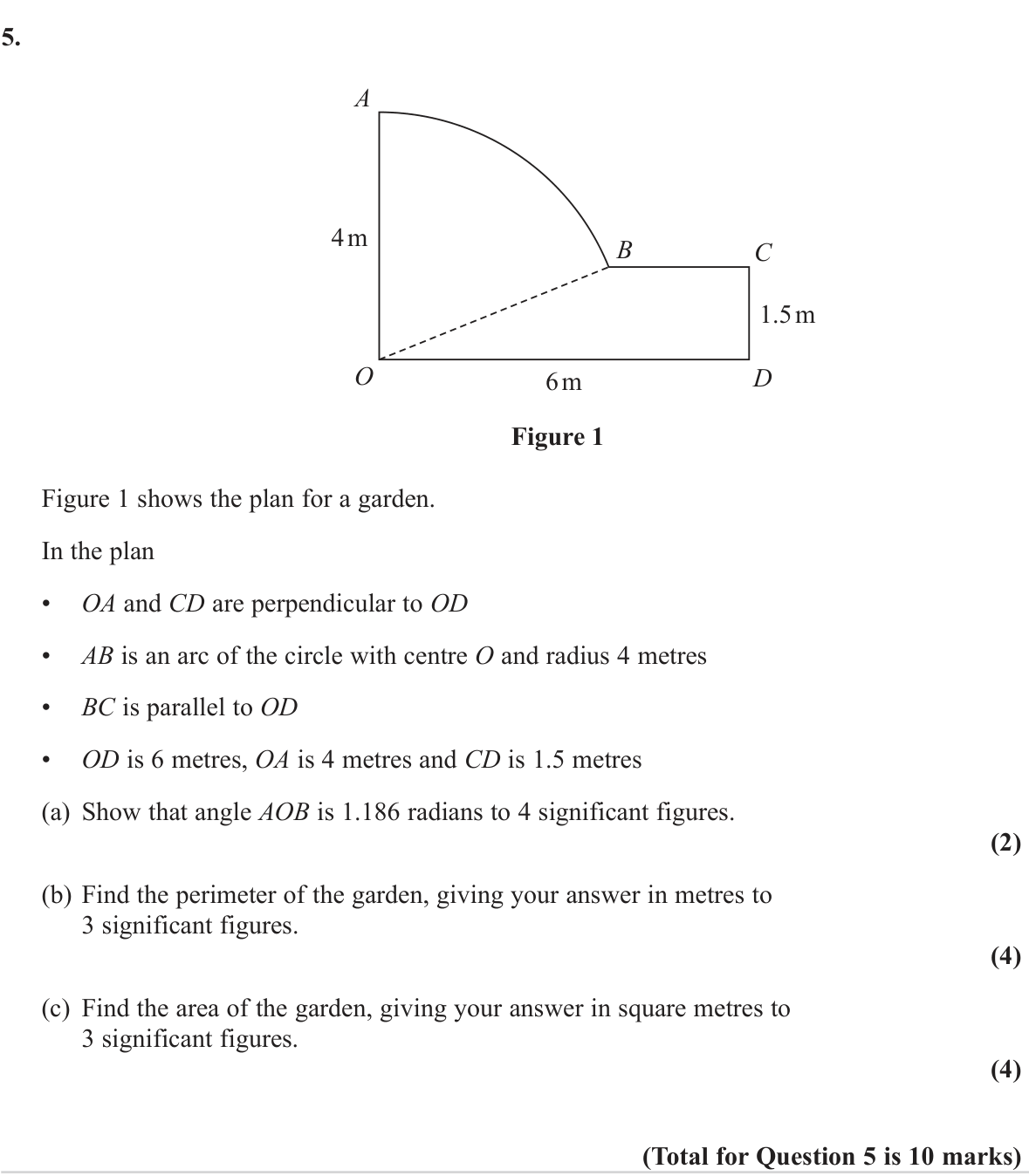
Since $OC=12$ and $DC=AB=16$, $OD=4$. In right triangle $AOD$, $\cos\angle AOD=\dfrac{OD}{OA}=\dfrac4{12}=\dfrac13$. Hence $\angle AOD=\cos^{-1}\left(\dfrac13\right)=1.231$ radians to 3 d.p.
Identify the major sector
The shaded lawn uses the major sector from $A$ to $C$, so its angle is $\pi+1.231$ radians.
Subtract the unshaded triangle
$AD=\sqrt{12^2-4^2}=8\sqrt2$. Area of major sector $=\frac12(12)^2(\pi+1.231)$. Area of triangle $AOD=\frac12(4)(8\sqrt2)$.
Find the lawn area
Area $=\frac12(12)^2(\pi+1.231)-\frac12(4)(8\sqrt2)=292.2\text{ m}^2$ to 1 d.p.
Find the lawn perimeter
Perimeter $=\text{major arc}+CD+AD=12(\pi+1.231)+16+8\sqrt2=79.8\text{ m}$ to 1 d.p.
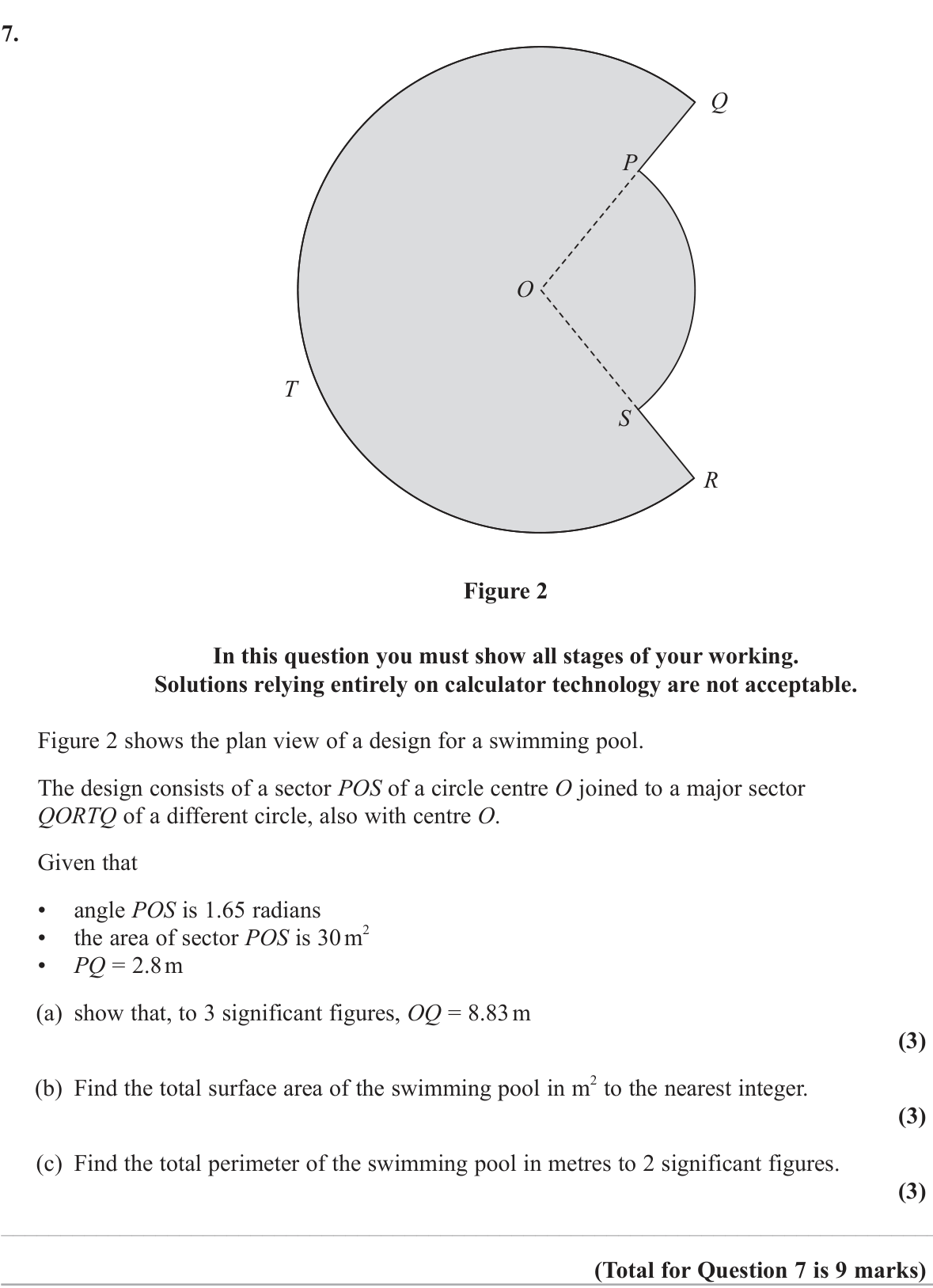
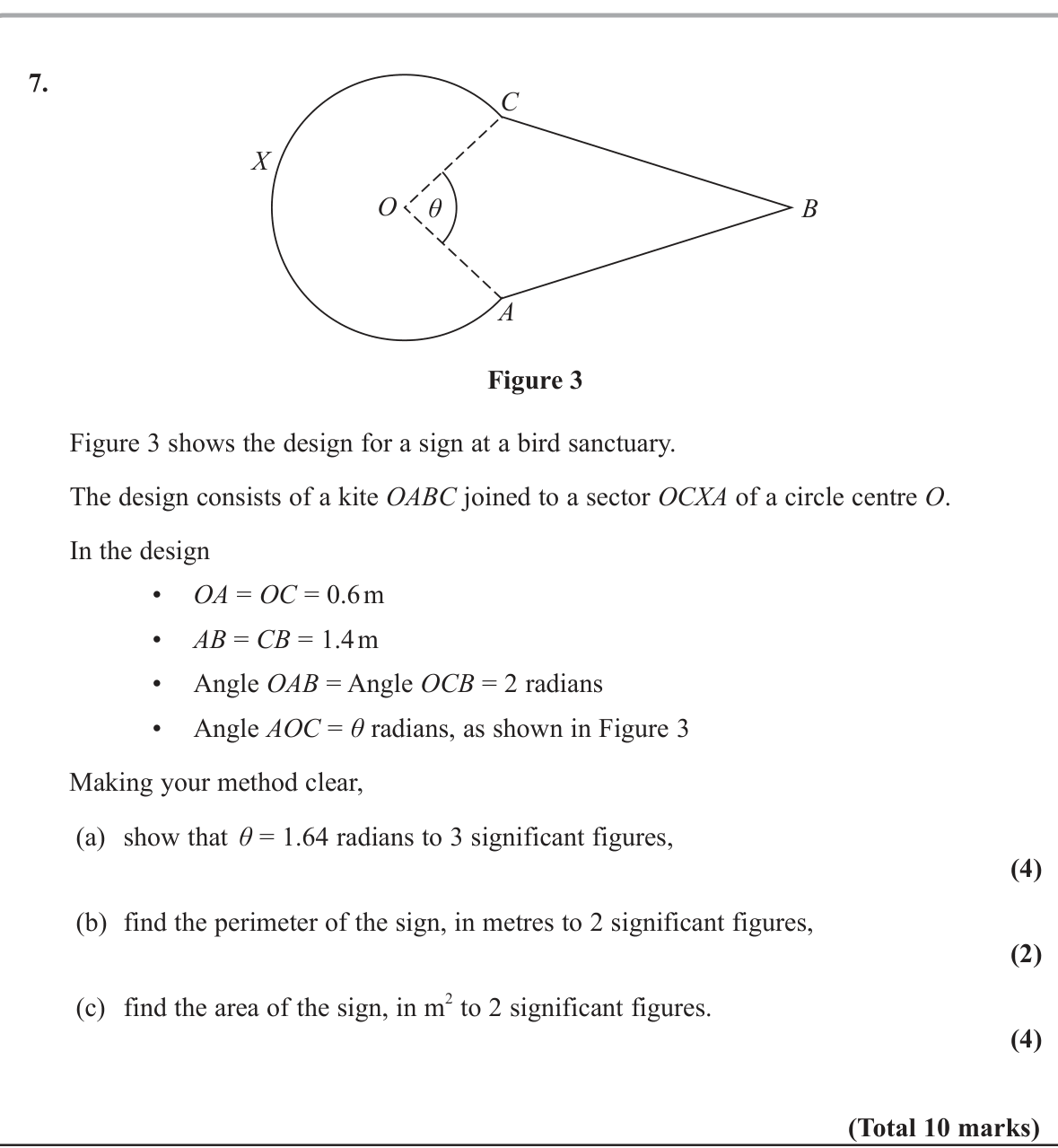
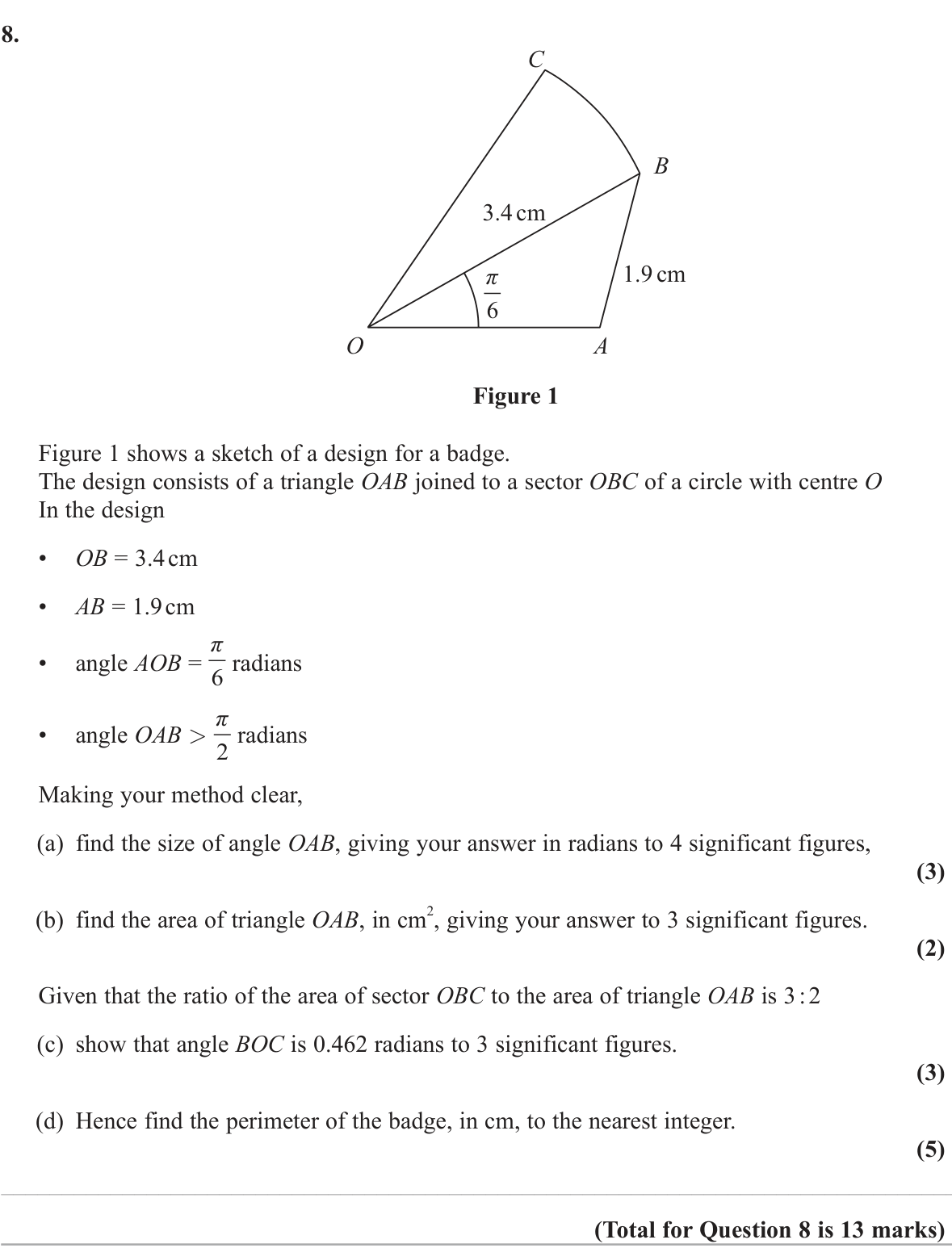
In triangle $OAB$, $OA=0.6$, $AB=1.4$, and $\angle OAB=2$ radians.
Find OB
By the cosine rule, $OB^2=0.6^2+1.4^2-2(0.6)(1.4)\cos2$, so $OB=1.73756\ldots$.
Find half of theta
Using the cosine rule again, $\cos\angle AOB=\dfrac{0.6^2+OB^2-1.4^2}{2(0.6)(OB)}$, giving $\angle AOB=0.822199\ldots$ radians.
Use symmetry of the kite
The kite is symmetric, so $\theta=2\angle AOB=1.644398\ldots$, hence $\theta=1.64$ radians to 3 significant figures.
Find the outside arc length
The sector $OCXA$ uses the major angle $2\pi-\theta$. Its arc length is $0.6(2\pi-1.644398\ldots)=2.78327\ldots$.
Find the perimeter
Perimeter $=AB+CB+\text{major arc}=1.4+1.4+2.78327\ldots=5.58327\ldots$, so the perimeter is $5.6$ m.
Find the kite area
The kite consists of two congruent triangles like $OAB$, so area of kite $=2\left(\dfrac12(0.6)(1.4)\sin2\right)=0.76381\ldots$.
Find the sector area and total area
Major sector area $=\dfrac12(0.6)^2(2\pi-1.644398\ldots)=0.83498\ldots$. Total area $=0.76381\ldots+0.83498\ldots=1.59879\ldots$, so the area is $1.6\text{ m}^2$.
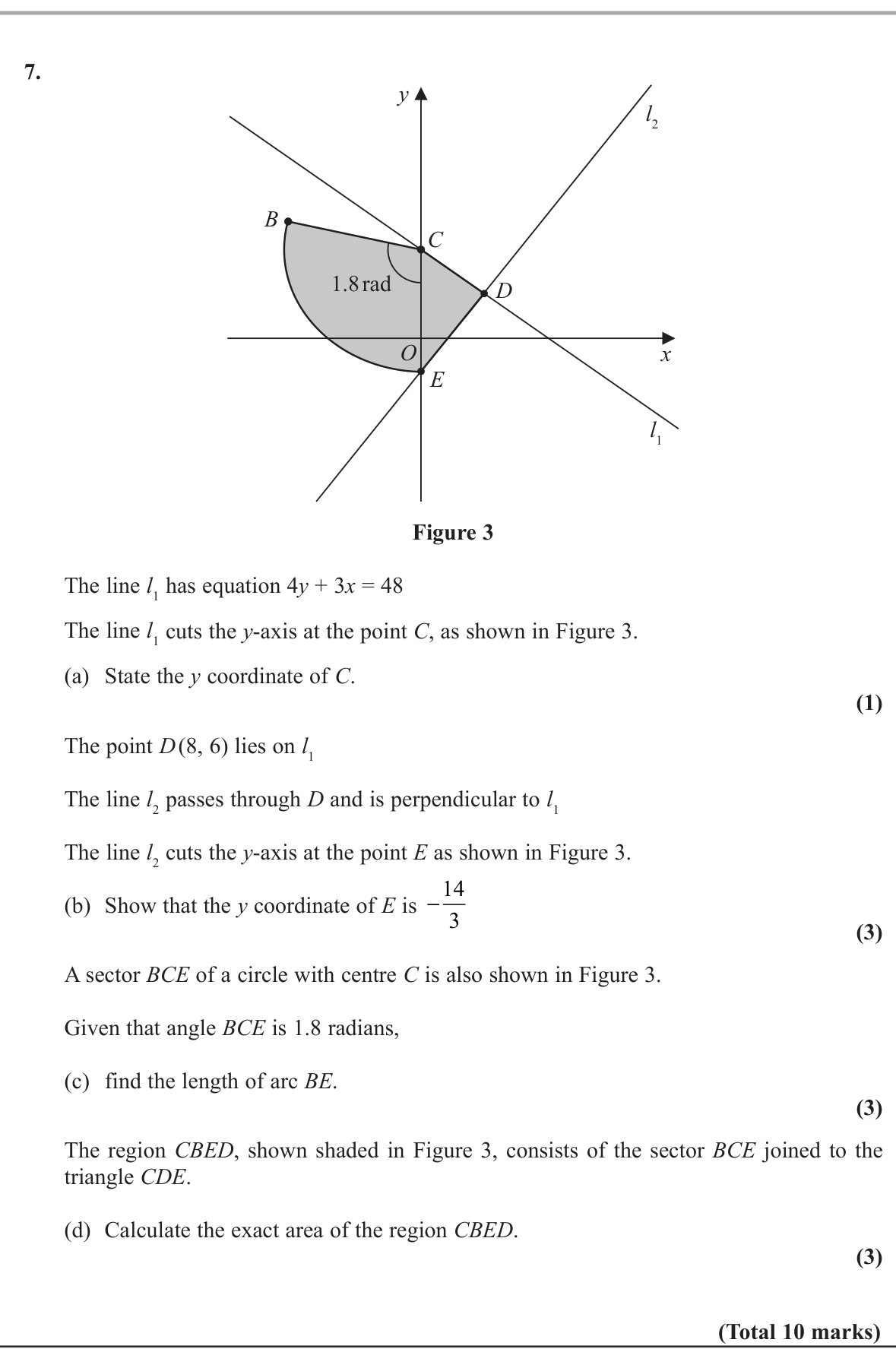
On the y-axis, $x=0$. From $4y+3x=48$, $4y=48$, so the y-coordinate of $C$ is $12$.
Find the gradient of l1
$4y+3x=48$ gives $y=-\dfrac34x+12$, so the gradient of $l_1$ is $-\dfrac34$.
Use perpendicular gradients for l2
Since $l_2$ is perpendicular to $l_1$, its gradient is $\dfrac43$. Through $D(8,6)$, $y-6=\dfrac43(x-8)$.
Show the y-coordinate of E
$y=\dfrac43x-\dfrac{32}{3}+6=\dfrac43x-\dfrac{14}{3}$. Therefore when $x=0$, $E_y=-\dfrac{14}{3}$.
Find the radius of the sector
$C=(0,12)$ and $E=\left(0,-\dfrac{14}{3}\right)$, so $CE=12+\dfrac{14}{3}=\dfrac{50}{3}$.
Find arc BE
For sector $BCE$, $r=\dfrac{50}{3}$ and $\theta=1.8=\dfrac95$. Hence arc $BE=r\theta=\dfrac{50}{3}\cdot\dfrac95=30$.
Find the sector area
Sector area $=\dfrac12r^2\theta=\dfrac12\left(\dfrac{50}{3}\right)^2\left(\dfrac95\right)=250$.
Find the triangle area and total area
Triangle $CDE$ has vertical base $CE=\dfrac{50}{3}$ and horizontal height $8$, so its area is $\dfrac12\cdot\dfrac{50}{3}\cdot8=\dfrac{200}{3}$. Total area $=250+\dfrac{200}{3}=\dfrac{950}{3}$.
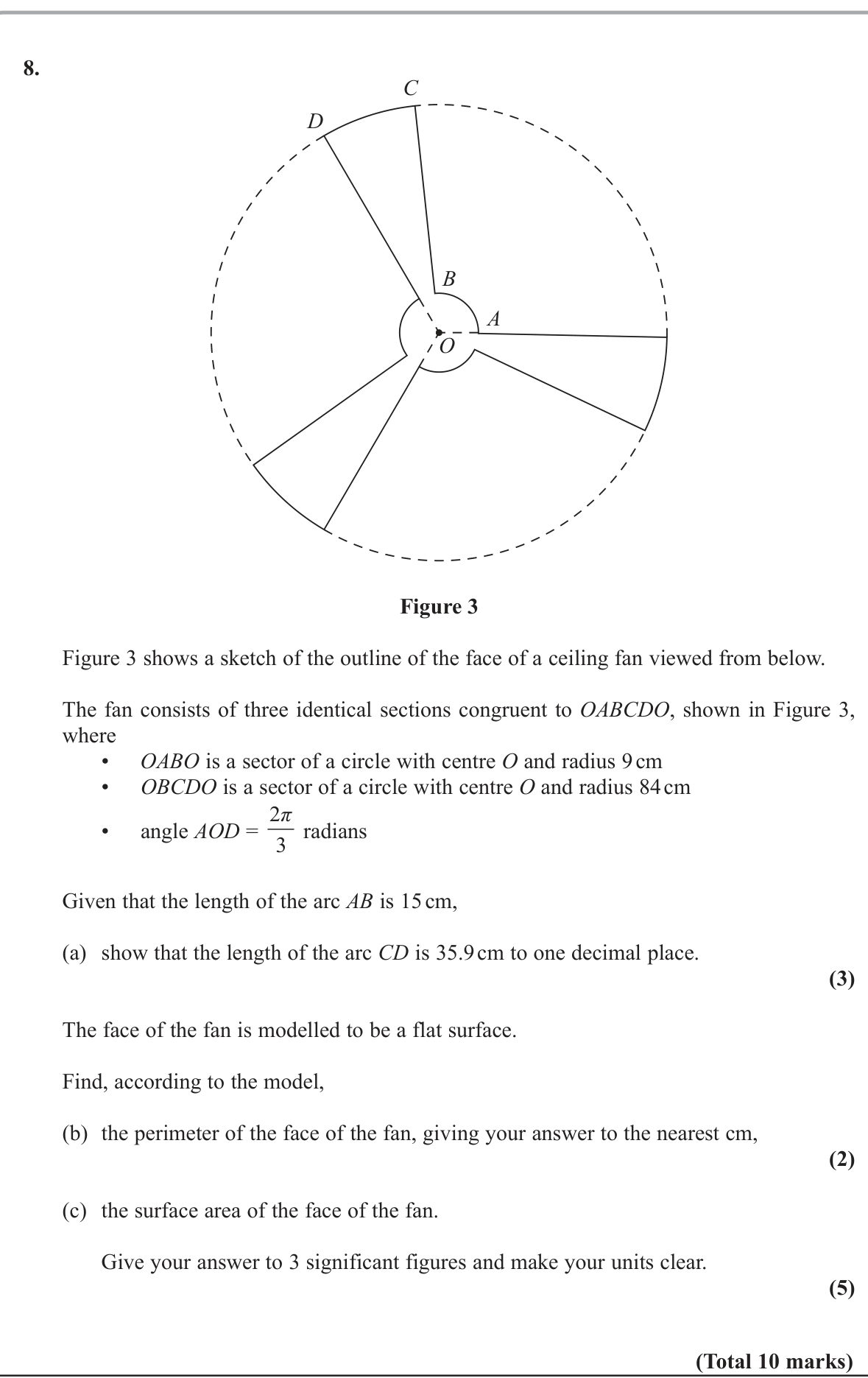
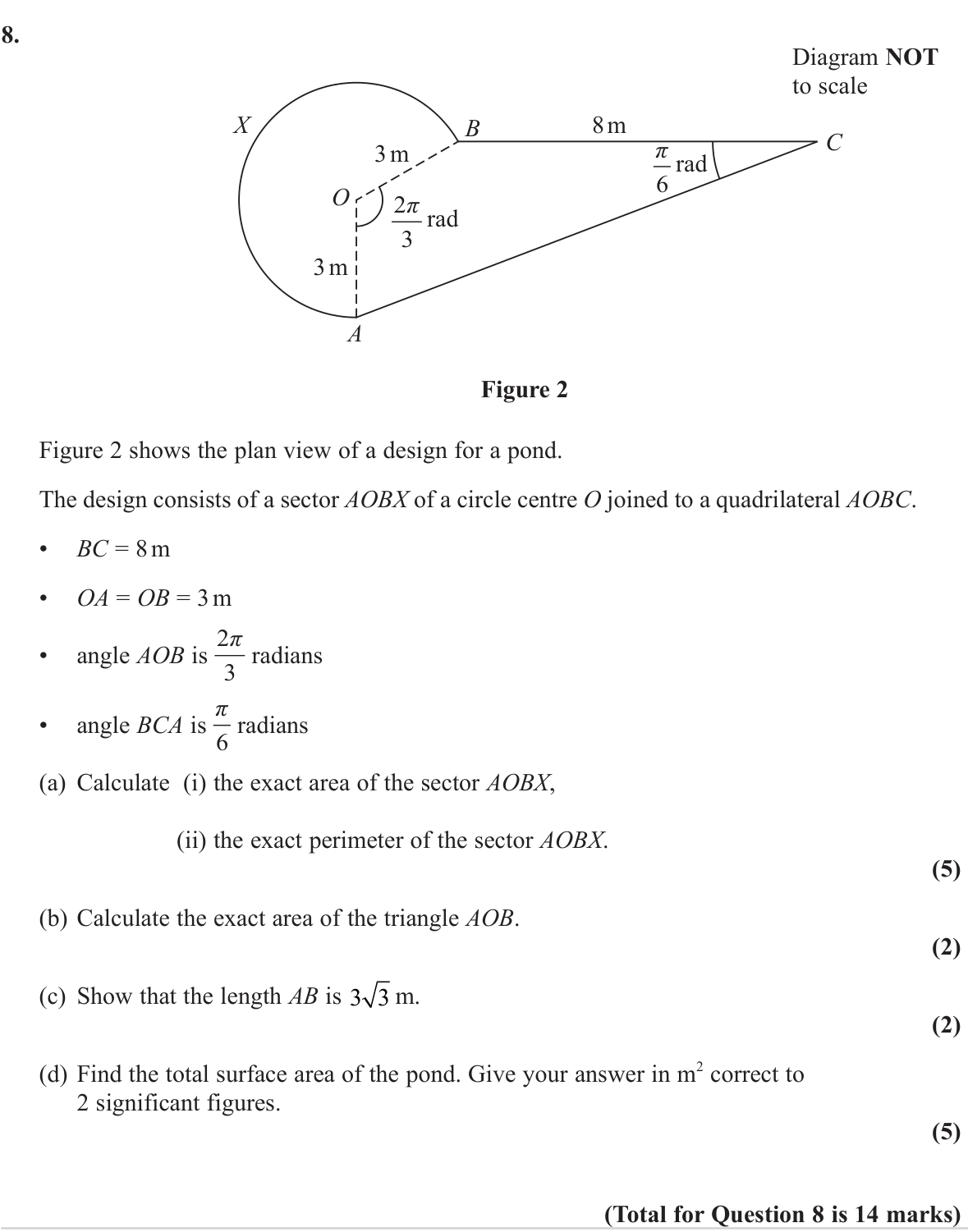
By the cosine rule, $AB^2=3^2+3^2-2(3)(3)\cos\left(\dfrac{2\pi}{3}\right)=18+9=27$, so $AB=3\sqrt3$.
Find AC
In triangle ABC, $AB^2=AC^2+8^2-2(AC)(8)\cos\left(\dfrac{\pi}{6}\right)$, so $27=AC^2-8\sqrt3\,AC+64$.
Choose the correct length
Solving gives $AC=4\sqrt3\pm\sqrt{11}$. From the diagram, $AC$ is the longer value, so $AC=4\sqrt3+\sqrt{11}$.
Find the total area
Area of triangle ABC is $\dfrac12(8)(AC)\sin\left(\dfrac\pi6\right)=2AC=8\sqrt3+2\sqrt{11}$. Total area is $6\pi+\dfrac{9\sqrt3}{4}+8\sqrt3+2\sqrt{11}=43.236\ldots$, so $43\text{ m}^2$ to 2 significant figures.
 Elite Mathematics