Skip to content
Elite Mathematics
IAL · WMA11 · Topic

Polynomials: past paper questions & worked solutions

Every Polynomials question from the WMA11 papers in our bank, 2021–2026, sorted from easiest to hardest. Try each one first, then open the worked solution.

5questions
45marks in total
21%of papers (4 of 19) include it
0/1/4easy / medium / hard

Questions, easiest first

Level is estimated from marks: 1–6 easy, 7–8 medium, 9+ hard.

1. WMA11/01 May/June 2026 · Q6

Medium7 marks
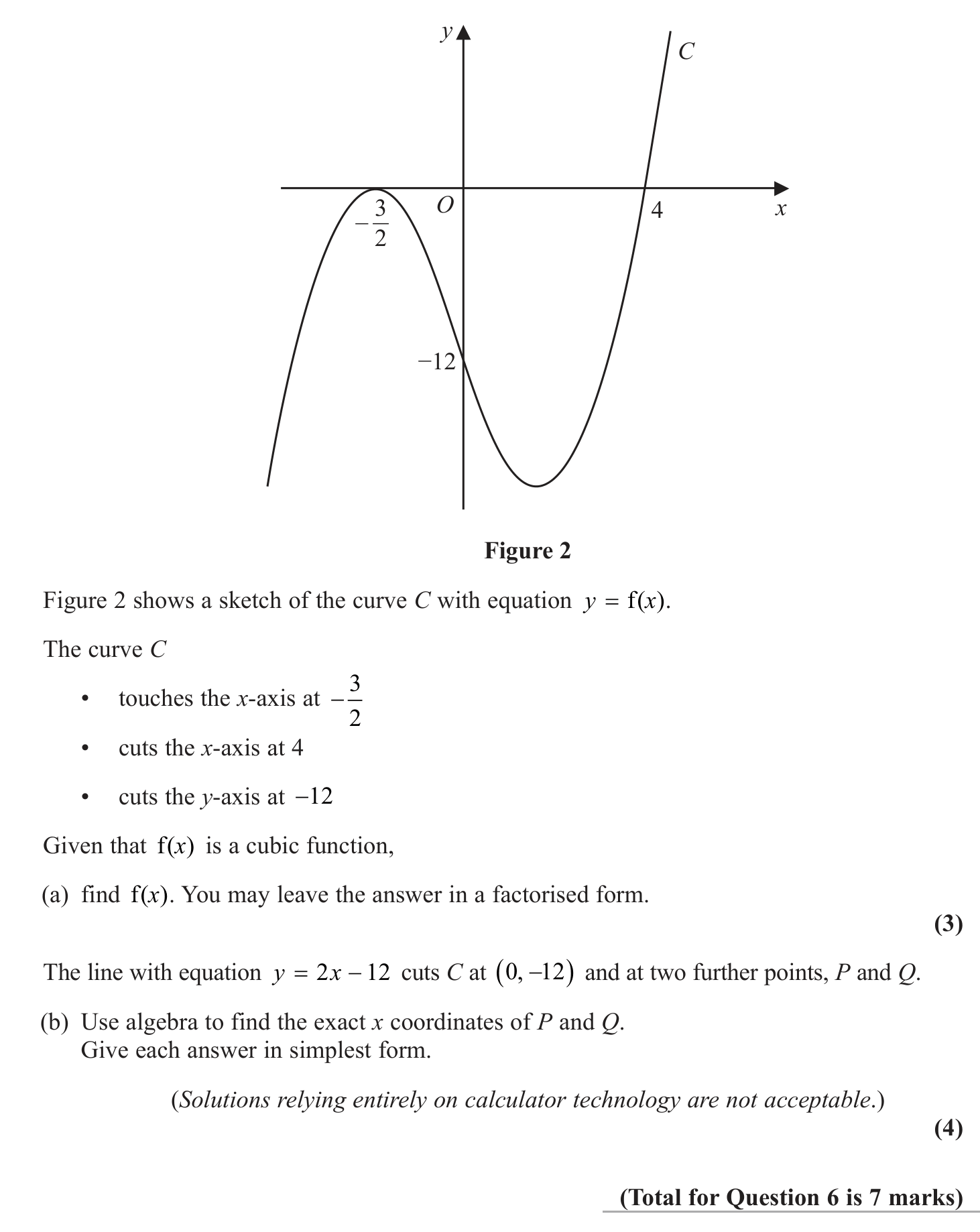
WMA11/01 May/June 2026 Question 6 (7 marks): Polynomials
Show worked solution
  1. (a) Build the cubic from its roots

    The curve touches the x-axis at $x=-\frac32$, so this is a repeated root. It crosses the x-axis at $x=4$, so this is a simple root. Hence $$f(x)=k(2x+3)^2(x-4).$$

  2. (a) Use the y-intercept

    The curve passes through $(0,-12)$. Substituting $x=0$ gives $$-12=k(3)^2(-4)=-36k,$$ so $k=\frac13$. Therefore $$f(x)=\frac13(2x+3)^2(x-4).$$

  3. (b) Form the intersection equation

    At an intersection with the line $y=2x-12$, $$\frac13(2x+3)^2(x-4)=2x-12.$$ Multiplying by 3 and expanding gives $$(4x^2+12x+9)(x-4)=6x-36,$$ so $$4x^3-4x^2-45x=0.$$

  4. (b) Remove the known intersection and solve

    Factor out the known root $x=0$: $$x(4x^2-4x-45)=0.$$ The two further intersections satisfy $$4x^2-4x-45=0.$$ Using the quadratic formula, $$x=\frac{4\pm\sqrt{(-4)^2-4(4)(-45)}}{8} =\frac{4\pm4\sqrt{46}}{8} =\frac{1\pm\sqrt{46}}{2}.$$

Final answer

$(a)\; f(x)=\dfrac13(2x+3)^2(x-4).\qquad (b)\; x=\dfrac{1-\sqrt{46}}2\text{ or }x=\dfrac{1+\sqrt{46}}2.$

2. WMA11/01 January 2026 · Q6

Hard9 marks
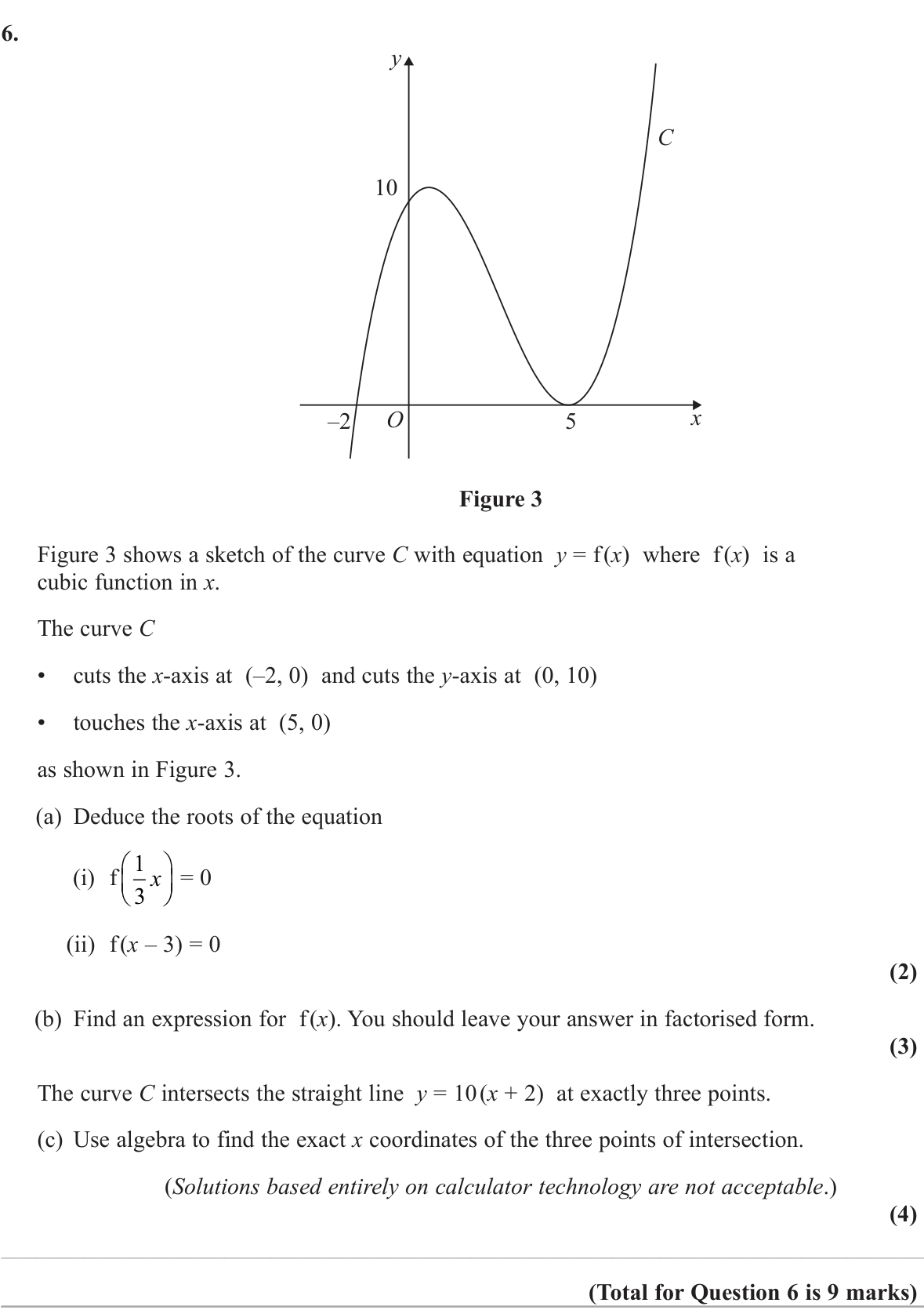
WMA11/01 January 2026 Question 6 (9 marks): Polynomials
Show worked solution
  1. Roots of f one third x

    The roots of $f(x)=0$ are $x=-2$ and $x=5$, with $x=5$ repeated. For $f\left(\dfrac13x\right)=0$, set $\dfrac13x=-2$ or $5$, giving $x=-6$ or $15$.

  2. Roots of f of x minus 3

    For $f(x-3)=0$, set $x-3=-2$ or $5$, giving $x=1$ or $8$.

  3. Use the roots and repeated root

    Since the curve cuts at $(-2,0)$ and touches at $(5,0)$, write $f(x)=k(x+2)(x-5)^2$.

  4. Use the y-intercept

    The curve passes through $(0,10)$, so $10=k(2)(25)=50k$.

  5. State f(x)

    $k=\dfrac15$, hence $f(x)=\dfrac15(x+2)(x-5)^2$.

  6. Set equal to the line

    $\dfrac15(x+2)(x-5)^2=10(x+2)$.

  7. First solution

    The factor $x+2$ gives one solution $x=-2$.

  8. Find the other solutions

    For $x\ne-2$, divide by $x+2$: $\dfrac15(x-5)^2=10$, so $(x-5)^2=50$.

  9. State all intersections

    $x=5\pm\sqrt{50}=5\pm5\sqrt2$. Therefore the three x-coordinates are $-2$, $5-5\sqrt2$ and $5+5\sqrt2$.

Final answer

$(a)(i)\ -6,15.\quad (a)(ii)\ 1,8.\quad (b)\ f(x)=\dfrac15(x+2)(x-5)^2.\quad (c)\ x=-2,\ 5\pm5\sqrt2$.

3. WMA11/01 May/June 2021 · Q8

Hard9 marks
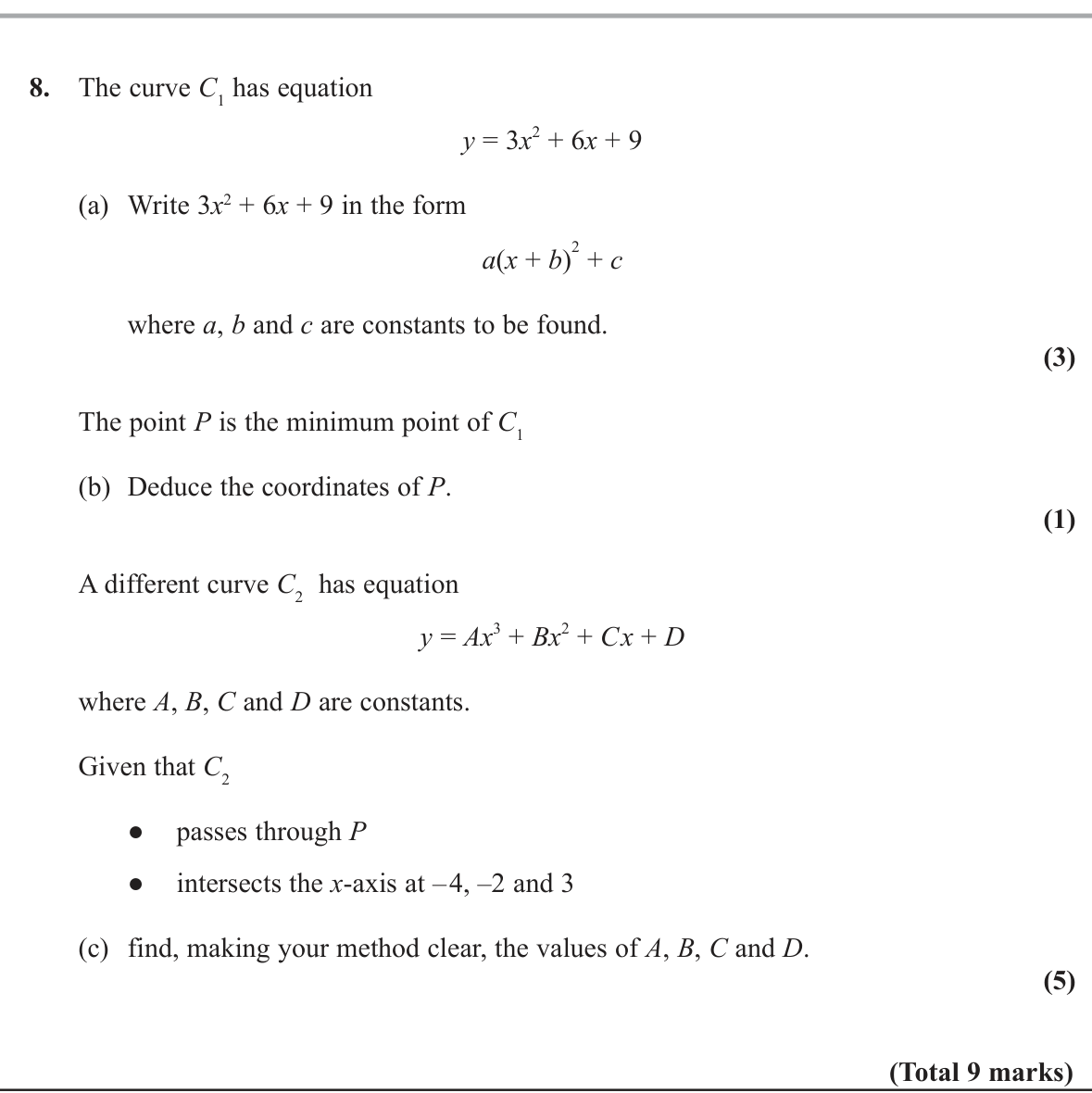
WMA11/01 May/June 2021 Question 8 (9 marks): Polynomials
Show worked solution
  1. Complete the square

    $3x^2+6x+9=3(x^2+2x)+9=3\big((x+1)^2-1\big)+9=3(x+1)^2+6$.

  2. Deduce the minimum point

    The minimum occurs when $(x+1)^2=0$, so $x=-1$ and $y=6$. Therefore $P=(-1,6)$.

  3. Use the x-intercepts of C2

    Since $C_2$ intersects the x-axis at $-4,-2$ and $3$, it has form $y=k(x+4)(x+2)(x-3)$.

  4. Use point P to find k

    Substitute $P=(-1,6)$: $6=k(3)(1)(-4)=-12k$, so $k=-\dfrac12$.

  5. Expand the cubic

    $(x+4)(x+2)(x-3)=(x^2+6x+8)(x-3)=x^3+3x^2-10x-24$.

  6. Read off A, B, C and D

    Thus $y=-\dfrac12x^3-\dfrac32x^2+5x+12$, so $A=-\dfrac12$, $B=-\dfrac32$, $C=5$ and $D=12$.

Final answer

$(a)\ 3(x+1)^2+6.\quad (b)\ P=(-1,6).\quad (c)\ A=-\dfrac12,\ B=-\dfrac32,\ C=5,\ D=12$.

4. WMA11/01 October 2024 · Q4

Hard10 marks
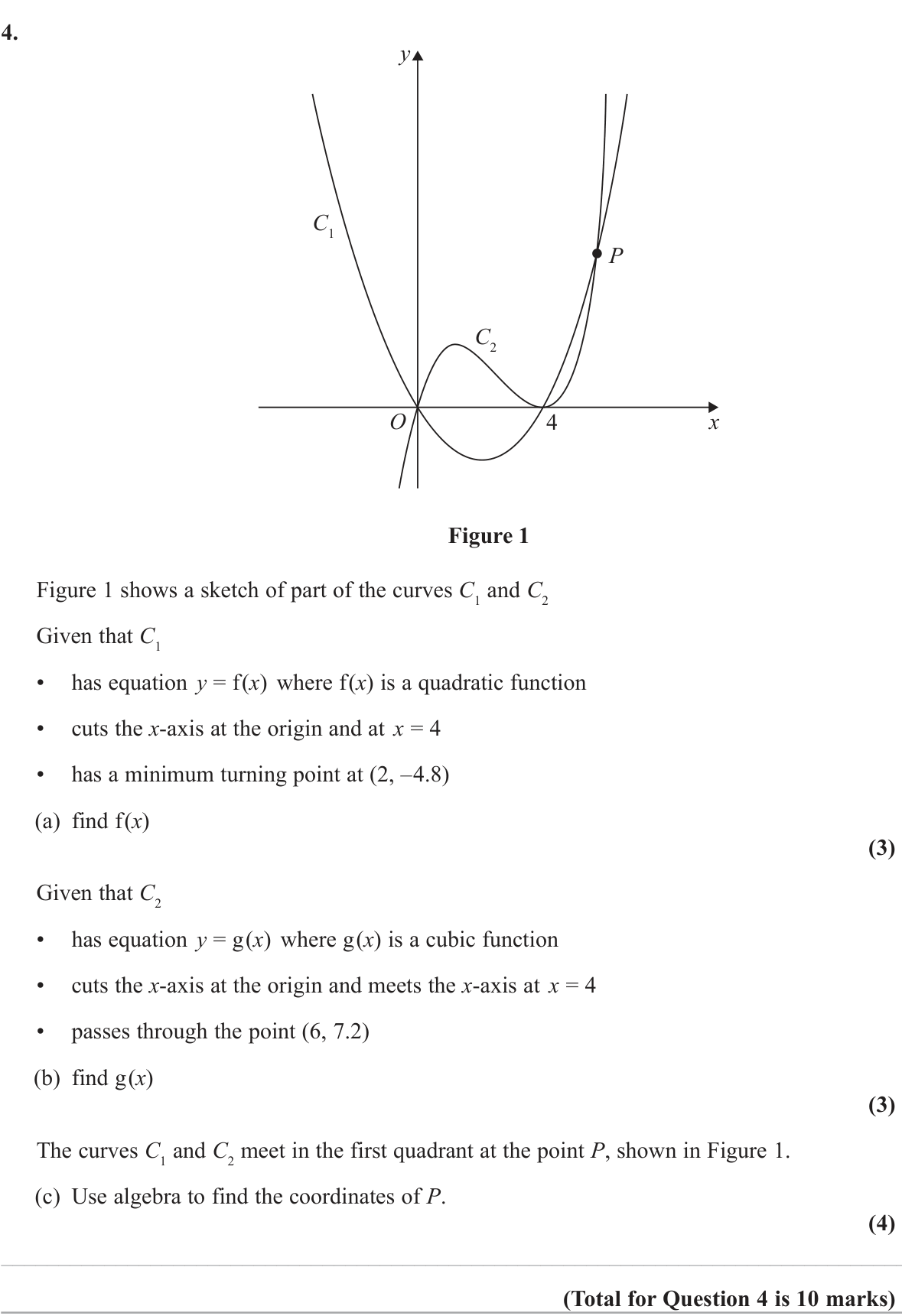
WMA11/01 October 2024 Question 4 (10 marks): Polynomials
Show worked solution
  1. Use the roots of C1

    Since $C_1$ cuts the x-axis at $0$ and $4$, let $f(x)=ax(x-4)$.

  2. Use the minimum point of C1

    At $x=2$, $f(2)=-4a=-4.8=-\dfrac{24}{5}$, so $a=\dfrac65$.

  3. Write f(x)

    $f(x)=\dfrac65x(x-4)$.

  4. Use the roots of C2

    The cubic cuts the x-axis at the origin and meets the x-axis at $x=4$, so $x=4$ is a repeated root. Let $g(x)=bx(x-4)^2$.

  5. Use the point (6, 7.2)

    $7.2=b(6)(2^2)=24b$, so $b=0.3=\dfrac3{10}$.

  6. Equate the curves

    $\dfrac65x(x-4)=\dfrac3{10}x(x-4)^2$.

  7. Find the first-quadrant intersection

    Ignoring the shared roots on the x-axis, divide by $x(x-4)$ to get $\dfrac65=\dfrac3{10}(x-4)$. Hence $x=8$.

  8. Find y

    $y=f(8)=\dfrac65(8)(4)=\dfrac{192}{5}$.

Final answer

$(a)\ f(x)=\dfrac65x(x-4).\quad (b)\ g(x)=\dfrac3{10}x(x-4)^2.\quad (c)\ P=(8,\dfrac{192}{5})$.

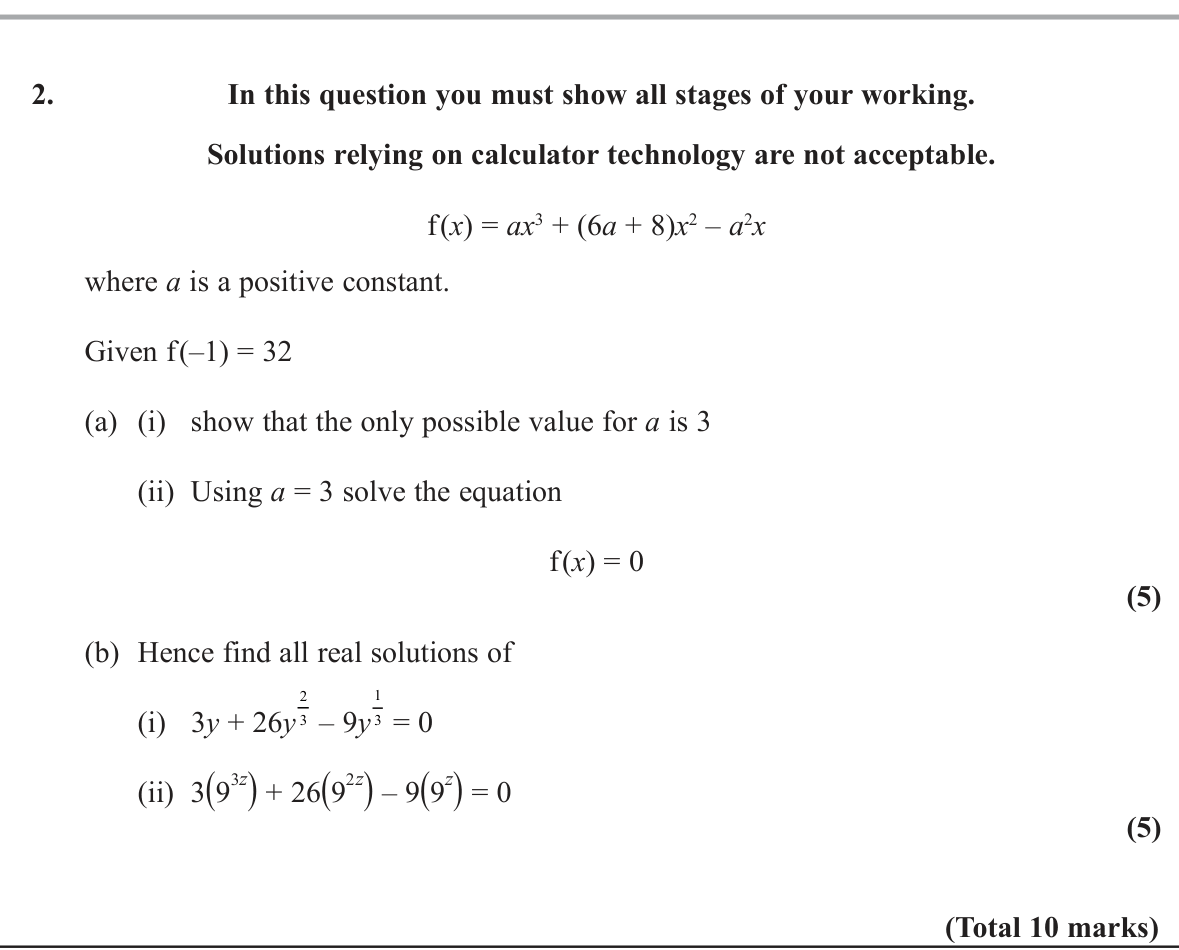
5. WMA11/01 May/June 2021 · Q2

Hard10 marks
WMA11/01 May/June 2021 Question 2 (10 marks): Polynomials
Show worked solution
  1. Use f(-1) = 32

    $f(-1)=-a+(6a+8)+a^2=a^2+5a+8$. Since $f(-1)=32$, $a^2+5a-24=0$.

  2. Choose the positive value of a

    $a^2+5a-24=(a-3)(a+8)=0$. Since $a$ is positive, the only possible value is $a=3$.

  3. Solve f(x) = 0

    Using $a=3$, $f(x)=3x^3+26x^2-9x=x(3x^2+26x-9)=x(3x-1)(x+9)$.

  4. List the roots

    $x=0$, $x=\dfrac13$, or $x=-9$.

  5. Solve the equation in y

    Let $u=y^{1/3}$. Then $y=u^3$ and $y^{2/3}=u^2$, so $3y+26y^{2/3}-9y^{1/3}=0$ becomes $3u^3+26u^2-9u=0$.

  6. Convert back to y

    From part (a), $u=-9,0,\dfrac13$. Therefore $y=u^3$, giving $y=-729,0,\dfrac1{27}$.

  7. Solve the exponential equation

    Let $u=9^z$. Then $3(9^{3z})+26(9^{2z})-9(9^z)=0$ becomes $3u^3+26u^2-9u=0$.

  8. Use positivity of 9^z

    Since $9^z>0$, the only valid root is $u=\dfrac13$. Hence $9^z=\dfrac13$, so $(3^2)^z=3^{-1}$ and $2z=-1$. Therefore $z=-\dfrac12$.

Final answer

$(a)(i)\ a=3.\quad (a)(ii)\ x=-9,0,\dfrac13.\quad (b)(i)\ y=-729,0,\dfrac1{27}.\quad (b)(ii)\ z=-\dfrac12$.

More IAL Pure 1 topics

Dr Eslam Ahmed
Dr Eslam Ahmed

Elite Mathematics · Questions classified by topic, solutions checked by Dr Eslam