Quadratics: past paper questions & worked solutions
Every Quadratics question from the WMA11 papers in our bank, 2019–2026, sorted from easiest to hardest. Try each one first, then open the worked solution.
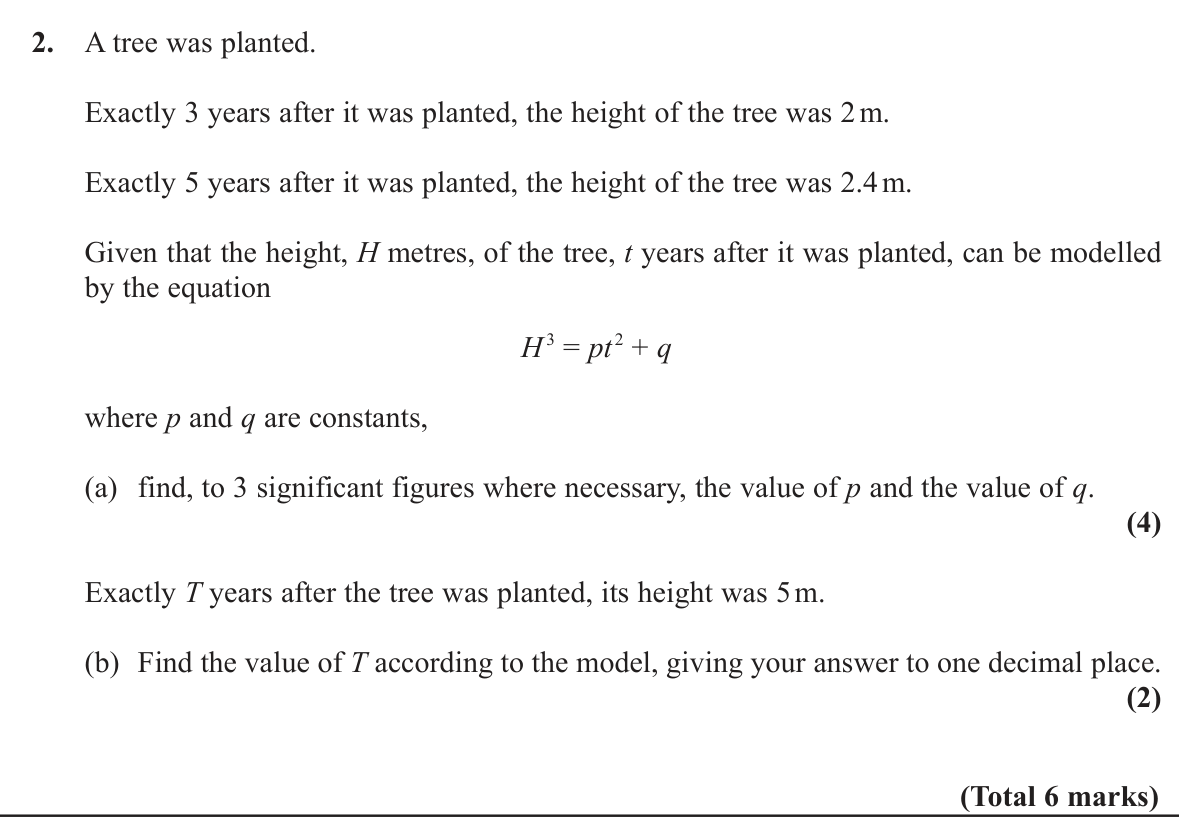
When $t=3$ and $H=2$, $2^3=9p+q$, so $8=9p+q$. When $t=5$ and $H=2.4$, $2.4^3=25p+q$, so $13.824=25p+q$.
Solve for p and q
Subtracting the two equations gives $16p=5.824$, so $p=0.364$. Then $8=9(0.364)+q$, giving $q=4.724$, so $q=4.72$ to 3 significant figures.
Use H = 5
For $H=5$, $125=0.364T^2+4.724$.
Find T
$T^2=\dfrac{125-4.724}{0.364}=330.428\ldots$, so $T=18.177\ldots$. Therefore $T=18.2$ years to one decimal place.
Final answer
$(a)\ p=0.364,\ q=4.72.\quad (b)\ T=18.2$ years.
9. WMA11/01 May/June 2026 · Q5
Medium7 marksShow worked solution
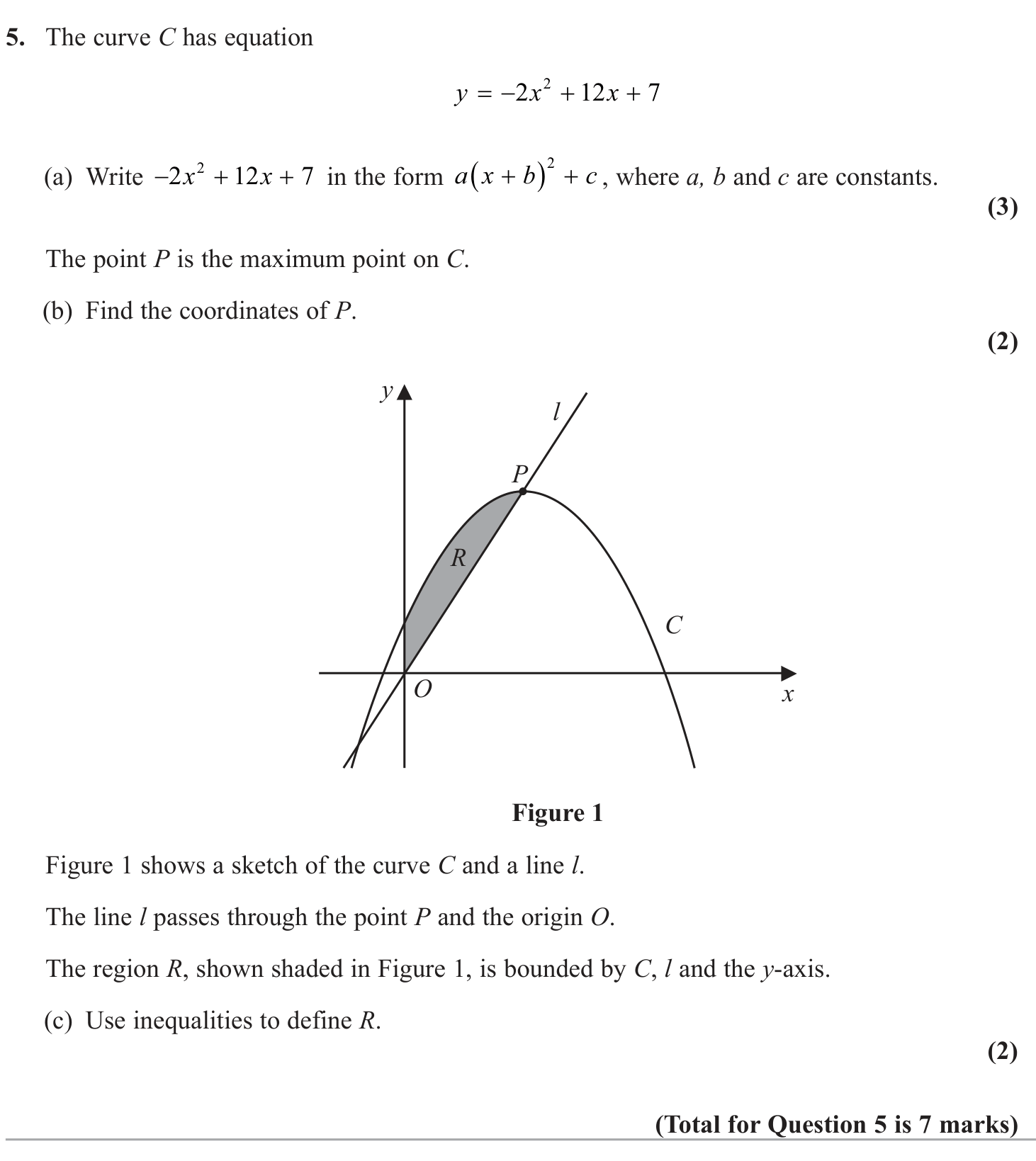
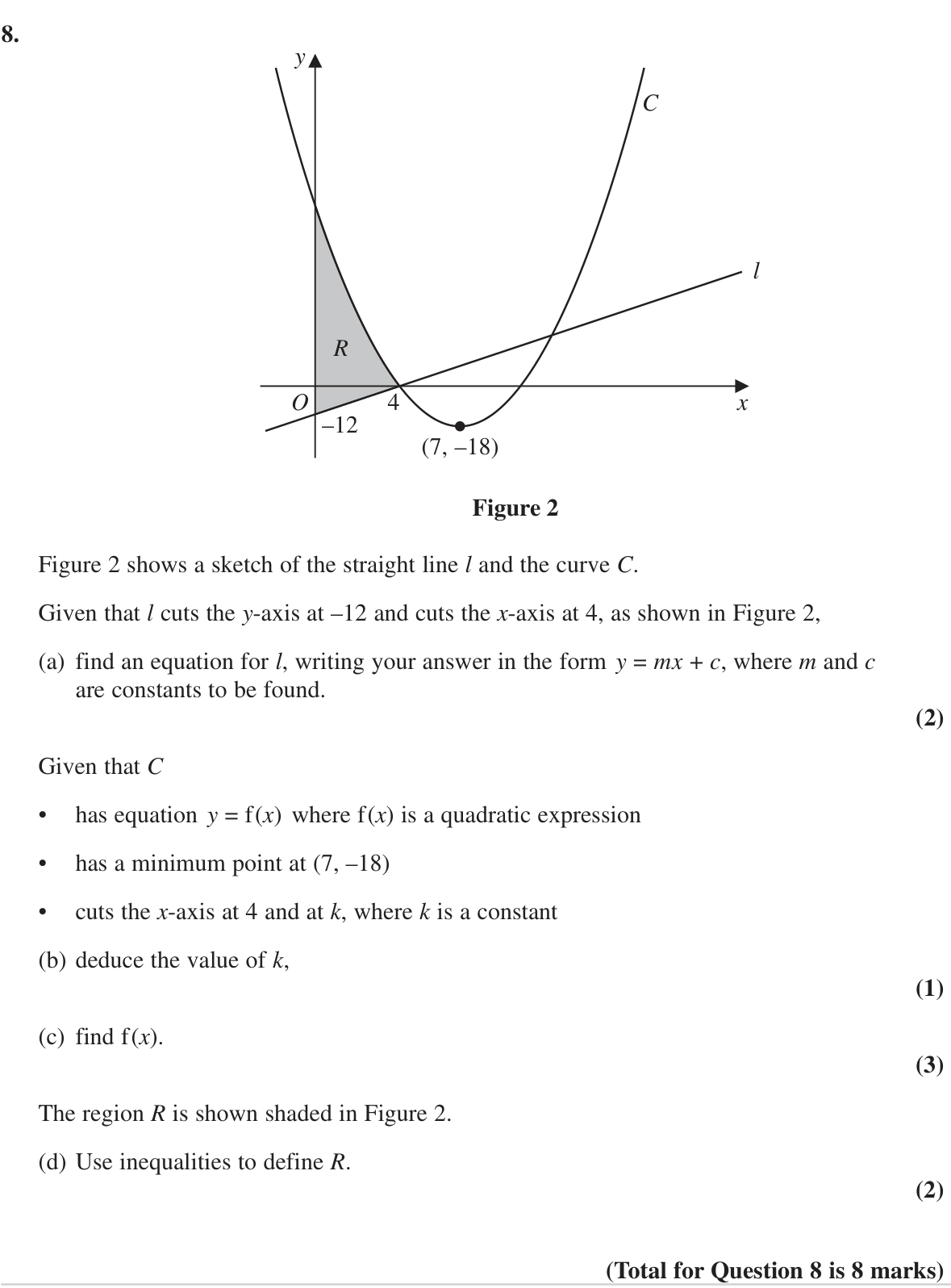
(a) Factor out the leading coefficient
$-2x^2+12x+7=-2(x^2-6x)+7$.
(a) Complete the square
$x^2-6x=(x-3)^2-9$, so $-2x^2+12x+7=-2\big((x-3)^2-9\big)+7=-2(x-3)^2+25$.
(b) Read the maximum from completed-square form
Because the coefficient of $(x-3)^2$ is negative, the curve has its maximum when $(x-3)^2=0$. Hence $x=3$, and the maximum value is $y=25$, so $P=(3,25)$.
(c) Find the equation of the boundary line
The line through $O=(0,0)$ and $P=(3,25)$ has gradient $\dfrac{25}{3}$, so $l$ has equation $y=\dfrac{25}{3}x$.
(c) Describe the shaded region
Points in $R$ are below the curve, above the line, and on or to the right of the $y$-axis. Therefore $y\leq-2x^2+12x+7$, $y\geq\dfrac{25}{3}x$, and $x\geq0$.
Hard10 marks · main topic: DifferentiationShow worked solution
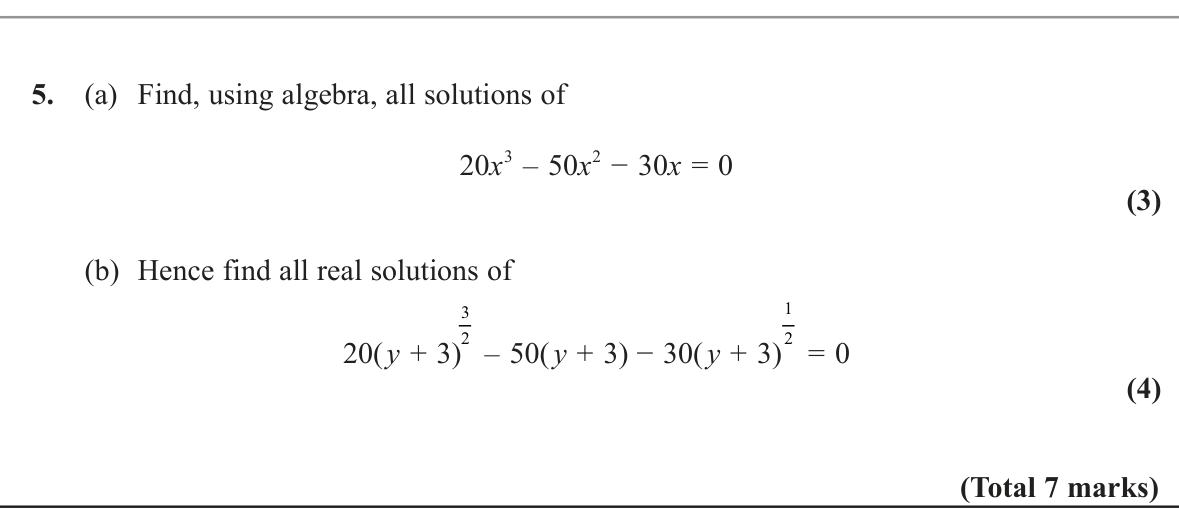
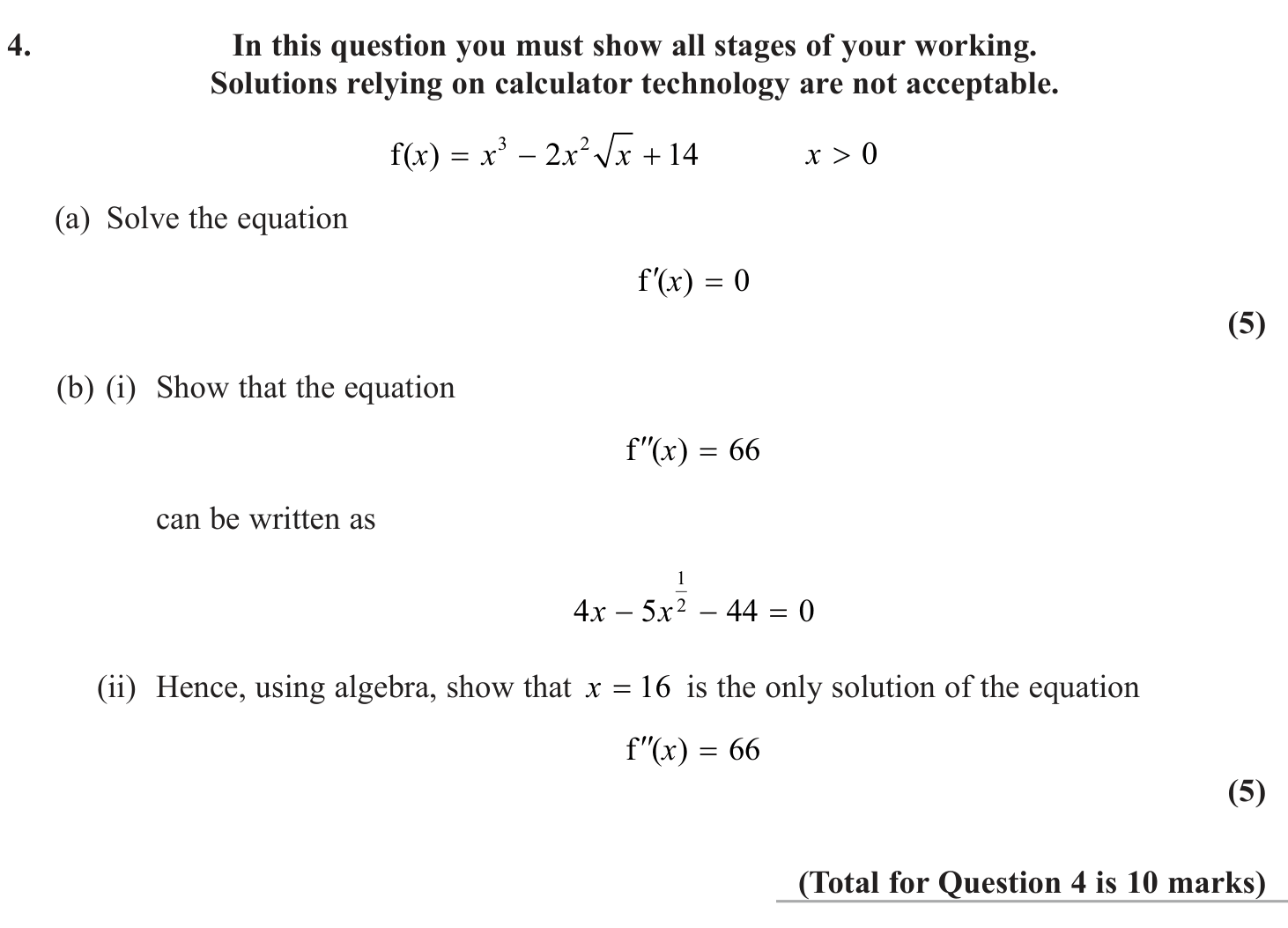
(a) Rewrite the radical as a power
$f(x)=x^3-2x^{5/2}+14$.
(a) Differentiate and solve
$f'(x)=3x^2-5x^{3/2}=x^{3/2}(3x^{1/2}-5)$. Since $x>0$, the factor $x^{3/2}$ is non-zero. Therefore $3\sqrt{x}-5=0$, so $\sqrt{x}=\dfrac53$ and $x=\dfrac{25}{9}$.
(b)(i) Differentiate again
$f''(x)=6x-\dfrac{15}{2}x^{1/2}$.
(b)(i) Rearrange the given equation
$6x-\dfrac{15}{2}x^{1/2}=66$. Multiplying by 2 and dividing by 3 gives $4x-5x^{1/2}-44=0$, as required.
(b)(ii) Factorise as a quadratic in the square root
Let $u=\sqrt{x}$, where $u\geq0$. Then $4u^2-5u-44=0$, and $(u-4)(4u+11)=0$. Hence $u=4$ or $u=-\dfrac{11}{4}$.
(b)(ii) Apply the square-root restriction
Because $u=\sqrt{x}\geq0$, the value $-\dfrac{11}{4}$ is impossible. Thus $\sqrt{x}=4$ and $x=16$, which is the only solution.
Final answer
$(a)\ x=\dfrac{25}{9}.\qquad (b)(i)\ 4x-5\sqrt{x}-44=0.\qquad (b)(ii)\ x=16\text{ is the only solution}.$
16. WMA11/01 October 2025 · Q5
Hard10 marksShow worked solution
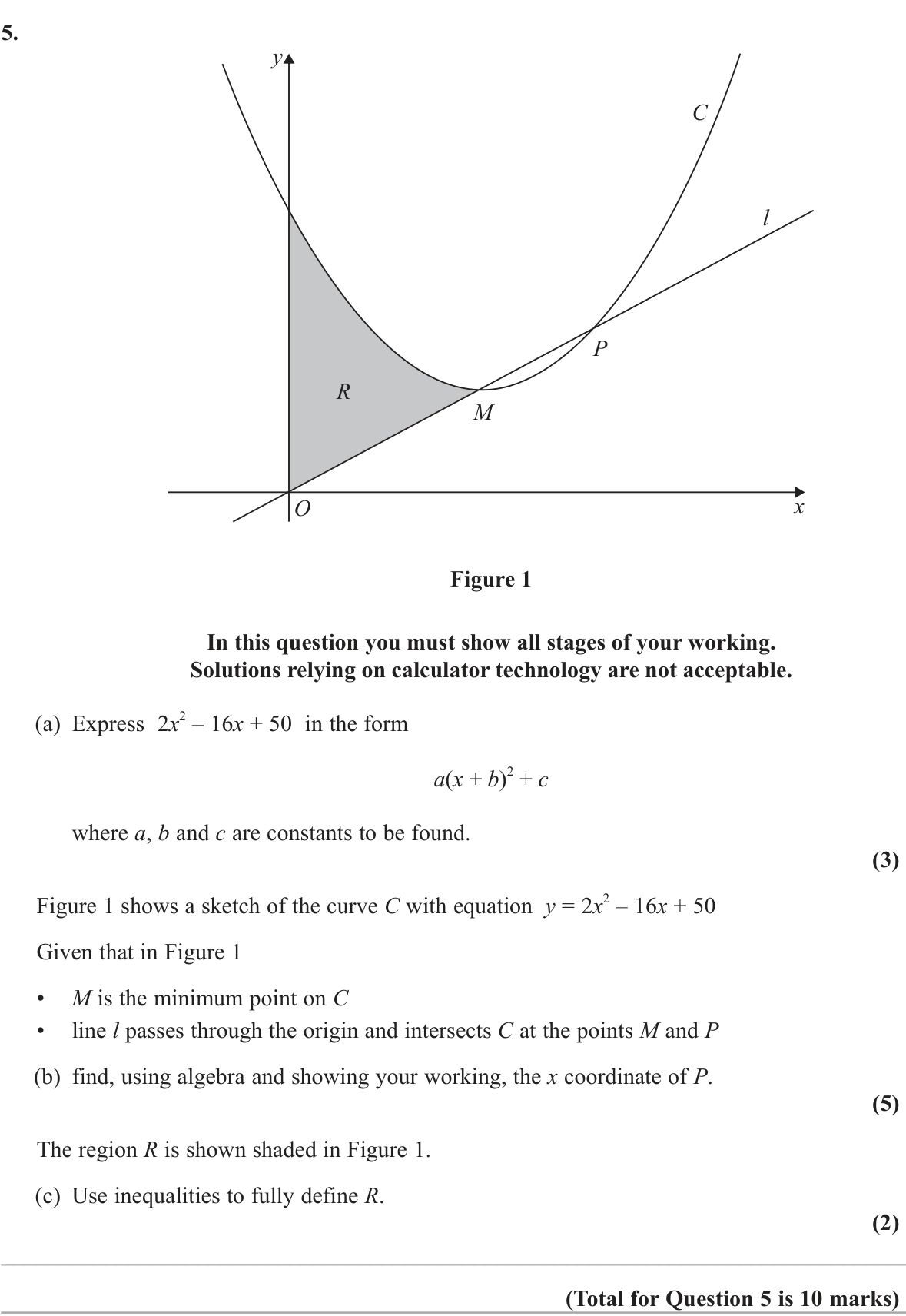
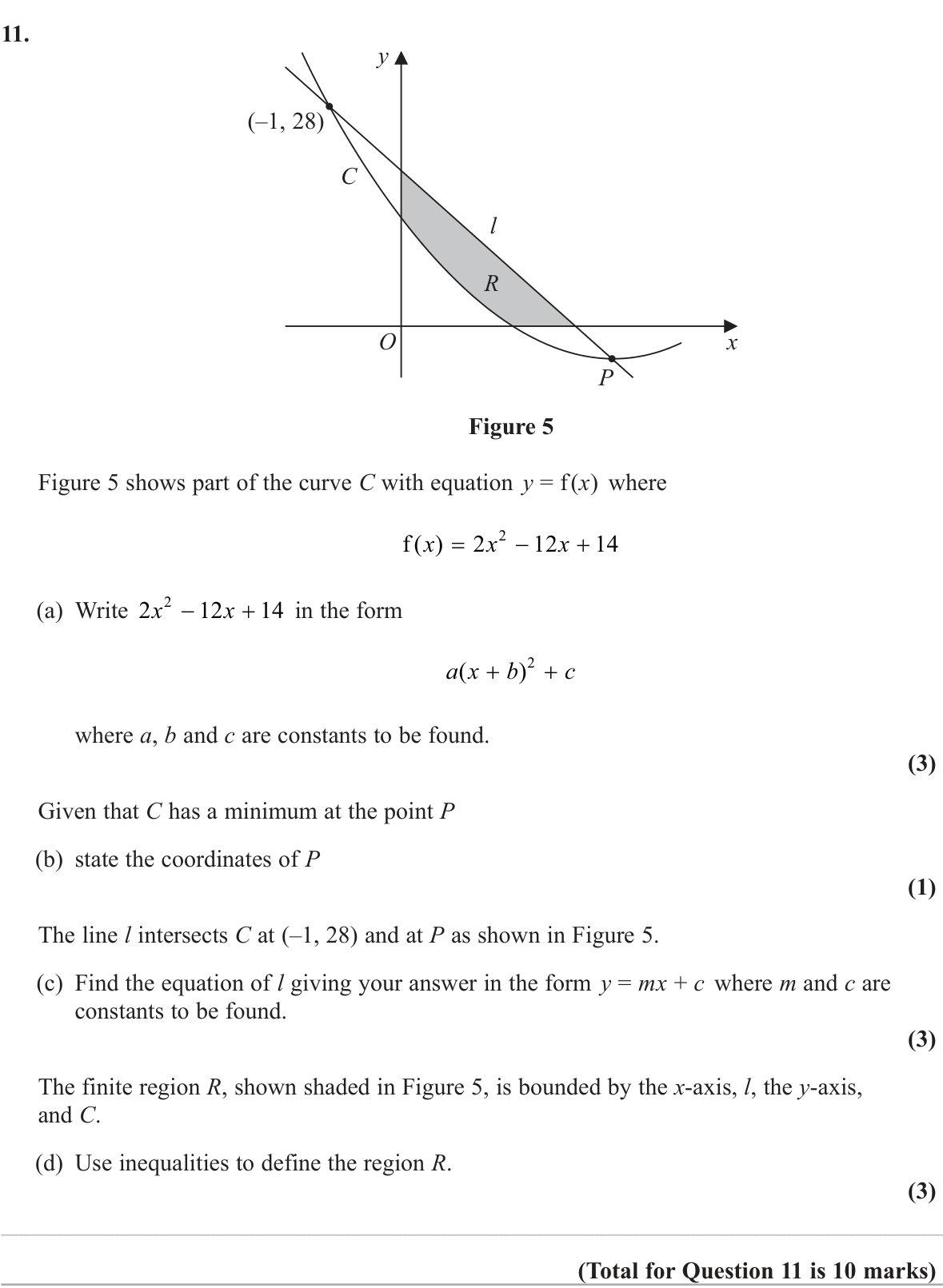
Complete the square
$2x^2-16x+50=2(x^2-8x)+50=2[(x-4)^2-16]+50$.
Simplify the completed square
$2x^2-16x+50=2(x-4)^2+18$.
Find M
The minimum point is $M=(4,18)$.
Find the line through O and M
Since $l$ passes through $(0,0)$ and $(4,18)$, its gradient is $\dfrac{18}{4}=\dfrac92$, so $l:y=\dfrac92x$.
Find the second intersection
Set $2x^2-16x+50=\dfrac92x$.
Form the quadratic
Multiplying by $2$ gives $4x^2-32x+100=9x$, so $4x^2-41x+100=0$.
Factor and select P
$4x^2-41x+100=(x-4)(4x-25)=0$. The point $M$ has $x=4$, so $P$ has $x=\dfrac{25}{4}$.
Define the region
The shaded region is above the line, below the curve, and between the y-axis and $M$.
 Elite Mathematics