Graphs of Functions: past paper questions & worked solutions
Every Graphs of Functions question from the WMA11 papers in our bank, 2019–2026, sorted from easiest to hardest. Try each one first, then open the worked solution.
Level is estimated from marks: 1–6 easy, 7–8 medium, 9+ hard.
1. WMA11/01 October 2022 · Q6
Easy6 marksShow worked solution
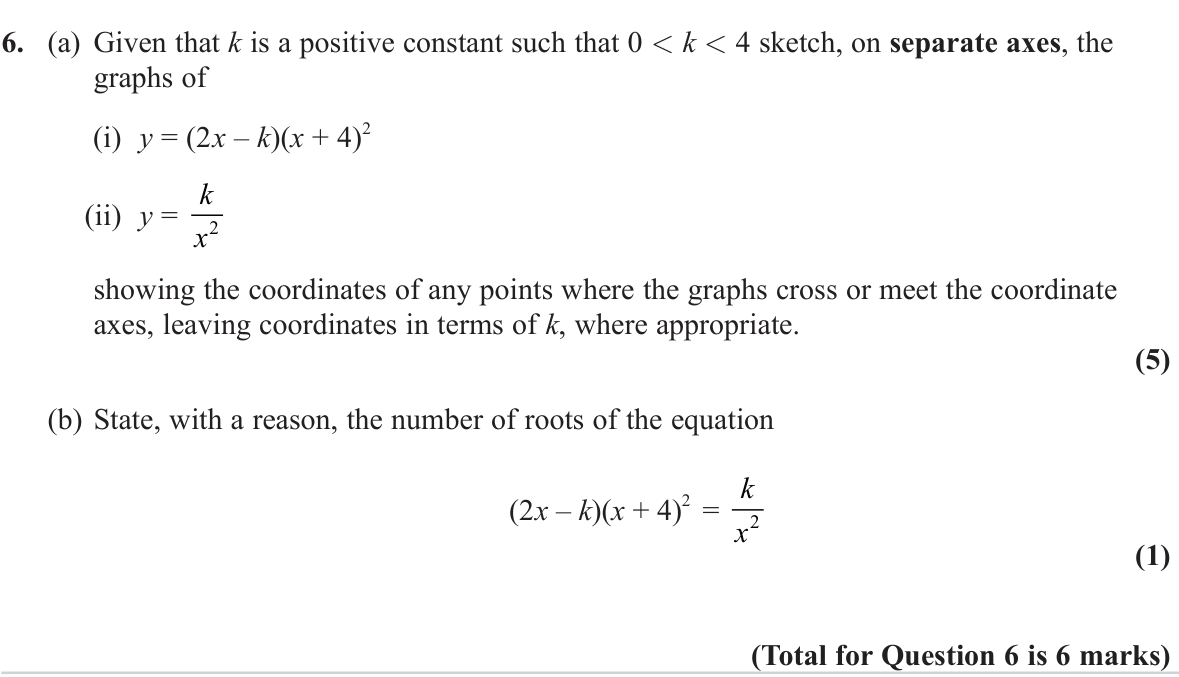
Key points for y = (2x-k)(x+4)^2
The graph has x-intercepts $(-4,0)$ and $\left(\dfrac{k}{2},0\right)$. The root at $x=-4$ is a repeated root, so the graph touches the x-axis there.
Use 0 < k < 4
Since $0<k<4$, the positive intercept $x=\dfrac{k}{2}$ lies between 0 and 2. The y-intercept is $(0,-16k)$.
Key features for y = k/x^2
The graph is positive on both sides of the y-axis, with asymptotes $x=0$ and $y=0$. It has no intercepts with the coordinate axes.
Compare the two graphs
The equation $(2x-k)(x+4)^2=\dfrac{k}{x^2}$ represents intersections between the two graphs.
State the number of roots
From the sketches, the positive branch of $\dfrac{k}{x^2}$ meets the increasing positive branch of $(2x-k)(x+4)^2$ once only. Therefore there is one root.
Final answer
The graphs intersect once, so the equation has one root.
2. WMA11/01 May/June 2024 · Q8
Medium7 marksShow worked solution
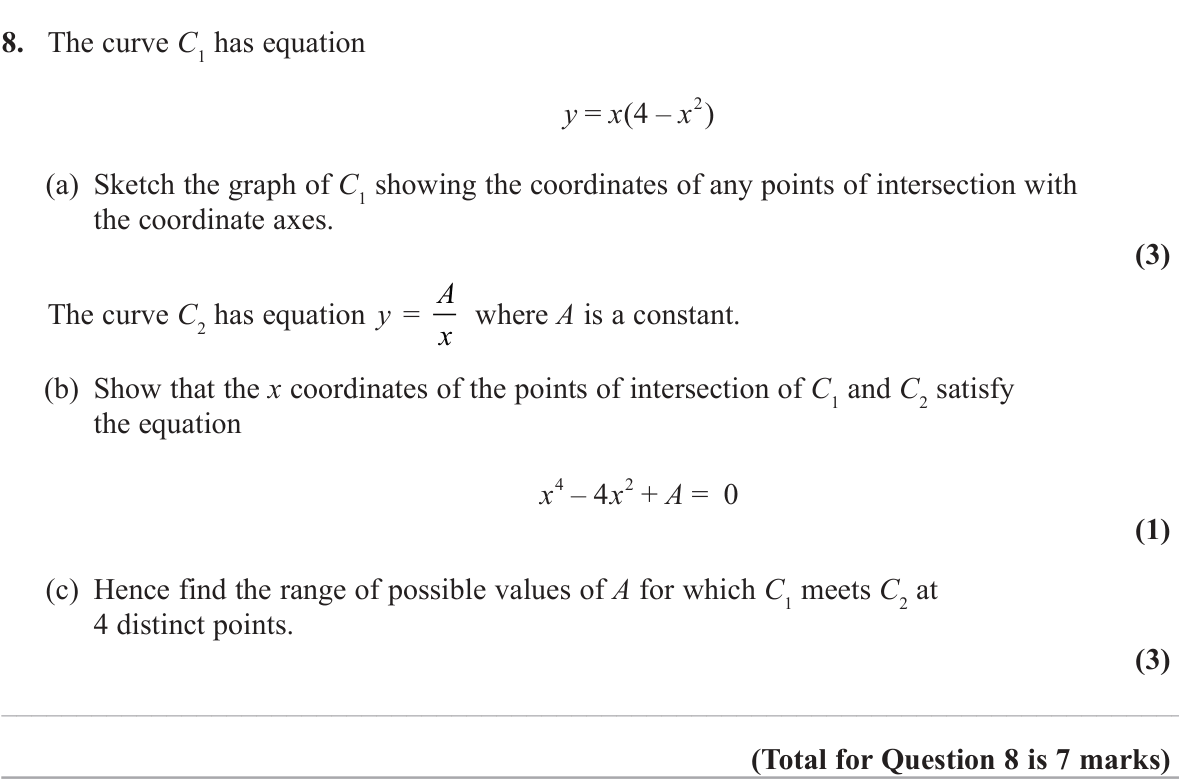
Find the intercepts of C1
$y=x(4-x^2)$, so $y=0$ when $x=0$ or $x=\pm2$. The curve crosses the axes at $(-2,0)$, $(0,0)$ and $(2,0)$.
Use the cubic shape
$y=4x-x^3$ has negative leading cubic term, so the left tail rises and the right tail falls.
Equate C1 and C2
$x(4-x^2)=\dfrac{A}{x}$.
Multiply by x
$x^2(4-x^2)=A$, so $4x^2-x^4=A$ and therefore $x^4-4x^2+A=0$.
Let u equal x squared
Let $u=x^2$. Then $u^2-4u+A=0$.
Require two positive u-values
For 4 distinct x-values, the quadratic in $u$ must have two distinct positive roots.
Find the range of A
The discriminant gives $16-4A>0$, so $A<4$. The product of the two roots is $A$, so $A>0$. Therefore $0<A<4$.
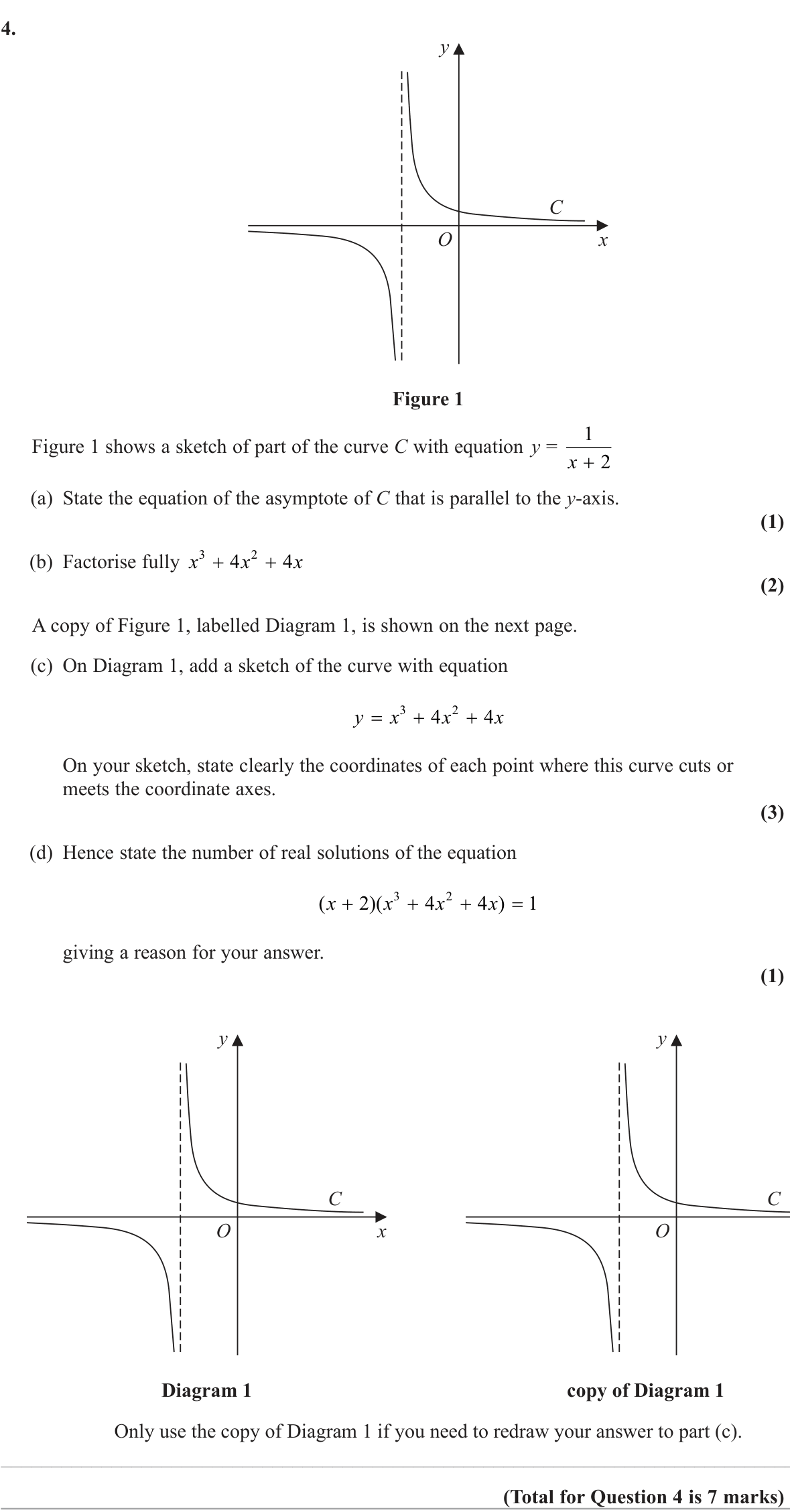
For $y=\dfrac{1}{x+2}$, the denominator is zero when $x=-2$, so the vertical asymptote is $x=-2$.
Factorise the cubic
$x^3+4x^2+4x=x(x^2+4x+4)=x(x+2)^2$.
Use the factorised form for the sketch
$x=0$ is a single root, so the curve crosses the x-axis at $(0,0)$. $x=-2$ is a repeated root, so the curve touches the x-axis at $(-2,0)$.
Connect the equation to intersections
$(x+2)(x^3+4x^2+4x)=1$ is equivalent to $x^3+4x^2+4x=\dfrac{1}{x+2}$.
Count the intersections
The number of real solutions is the number of intersections of the cubic $y=x(x+2)^2$ and the reciprocal curve $y=\dfrac{1}{x+2}$. The sketches show 2 intersections.
Final answer
$(a)\ x=-2.\quad (b)\ x(x+2)^2.\quad (c)$ roots at $(-2,0)$ and $(0,0)$. $x=-2$ is a repeated root. $(d)\ 2$ real roots.
4. WMA11/01 January 2022 · Q4
Medium7 marksShow worked solution
Set line equal to curve
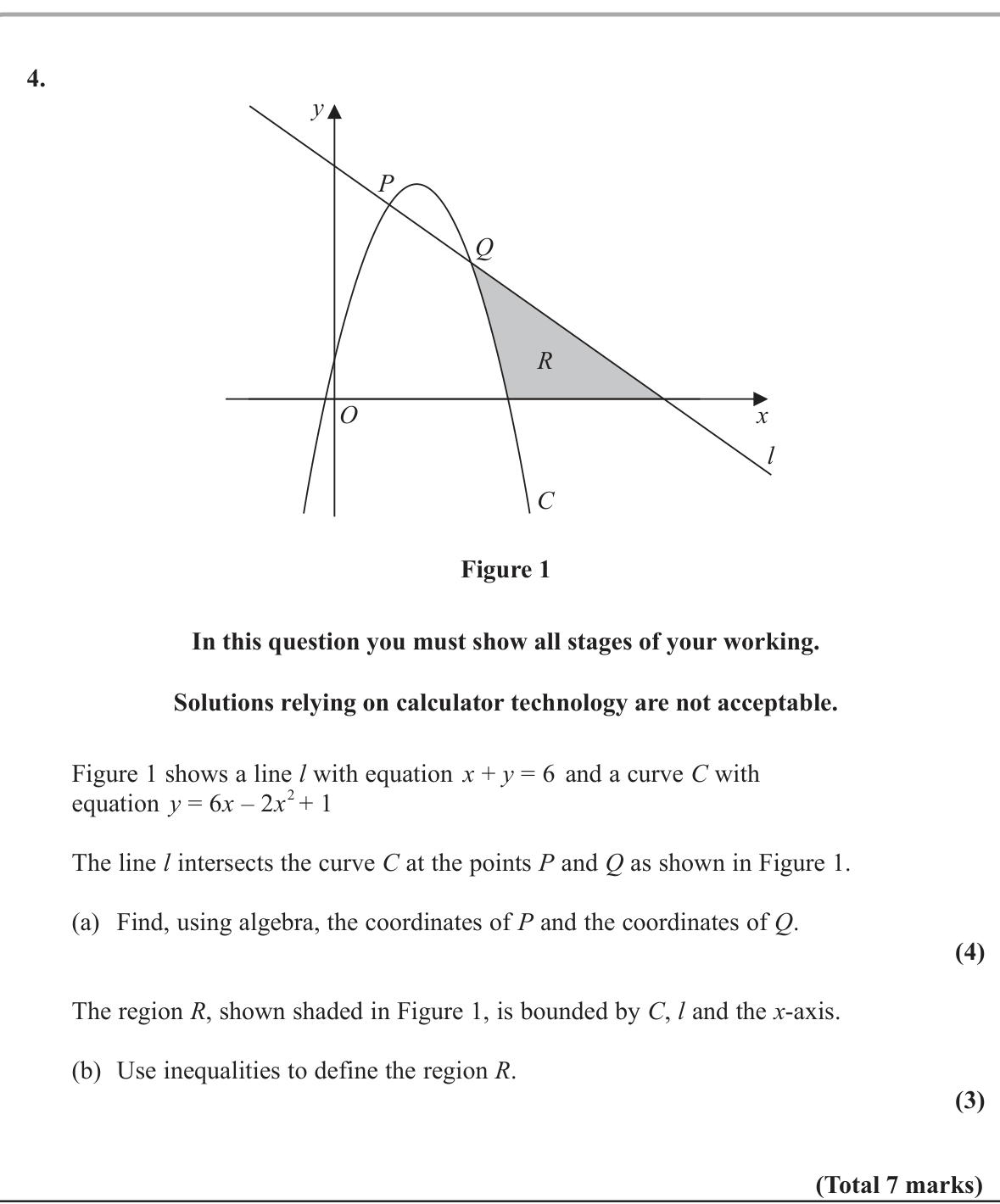
The line $x+y=6$ has equation $y=6-x$. Intersections satisfy $6-x=6x-2x^2+1$.
Solve the quadratic
Rearranging gives $2x^2-7x+5=0$, so $(2x-5)(x-1)=0$. Therefore $x=1$ or $x=\dfrac52$.
Find the coordinates
Using $y=6-x$, the points are $P=(1,5)$ and $Q=\left(\dfrac52,\dfrac72\right)$.
Read the bounded region
Region $R$ is above the x-axis, below the line, and above the curve.
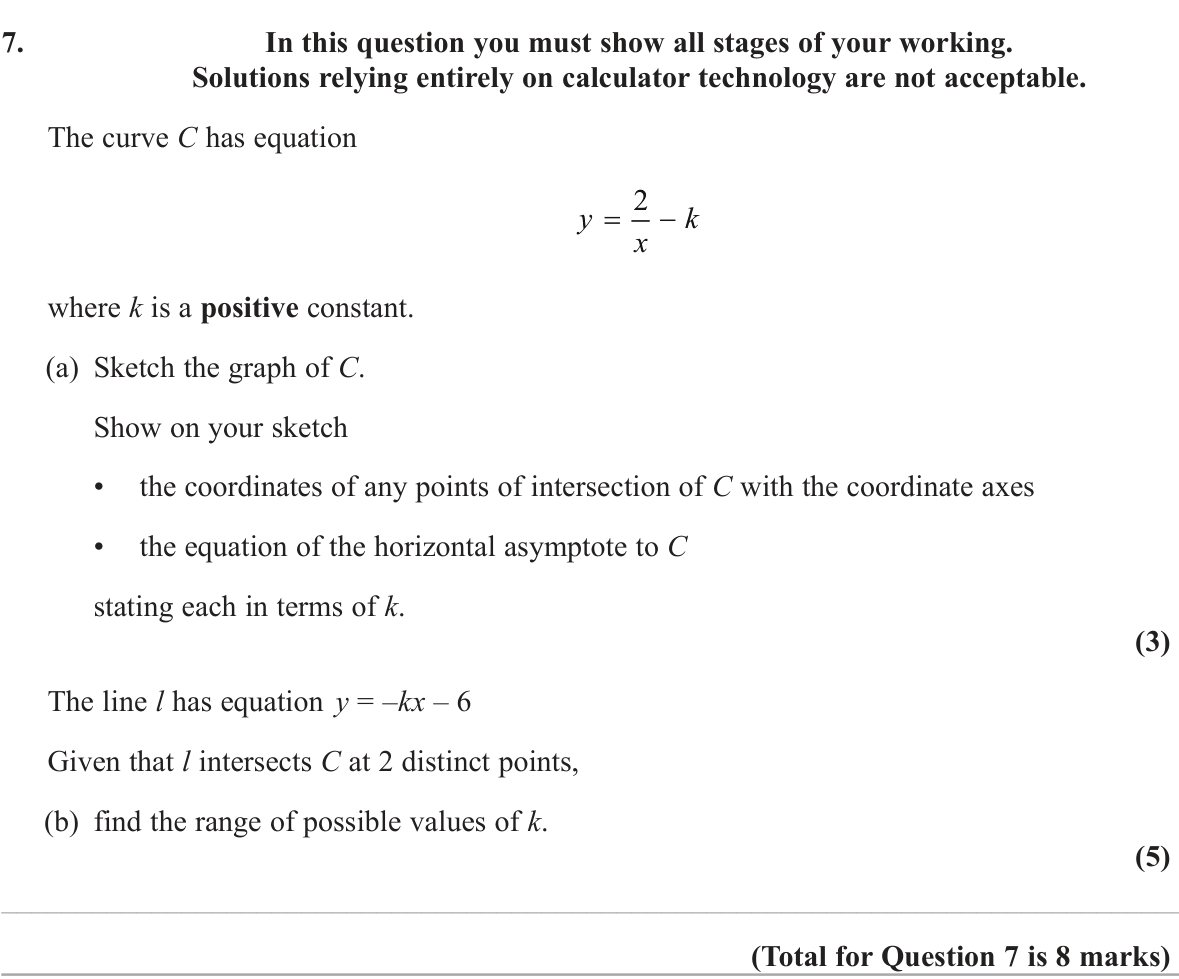
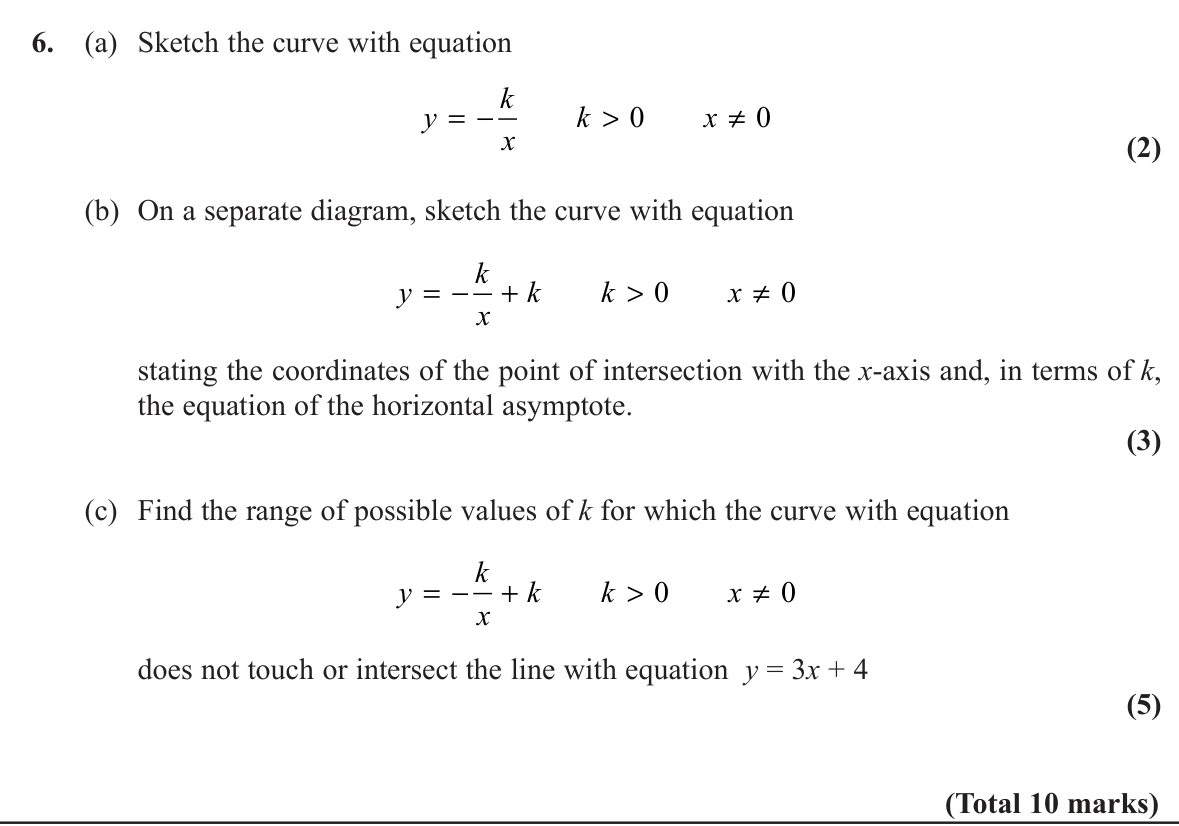
Setting $y=0$ gives $\dfrac2x=k$, so $x=\dfrac2k$. There is no y-intercept because $x=0$ is not in the domain.
Set up line-curve intersections
$\dfrac2x-k=-kx-6$.
Form a quadratic
Multiplying by $x$ gives $2-kx=-kx^2-6x$, so $kx^2+(6-k)x+2=0$.
Use two distinct intersections
For two distinct points, the discriminant must be positive.
Solve the inequality
$(6-k)^2-8k>0$, so $k^2-20k+36>0$. Since $k^2-20k+36=(k-2)(k-18)$, $k<2$ or $k>18$.
Use k positive
As $k>0$, the range is $0<k<2$ or $k>18$.
Final answer
$(a)$ x-intercept $(\dfrac2k,0)$, no y-intercept, horizontal asymptote $y=-k$. $(b)\ 0<k<2$ or $k>18$.
6. WMA11/01 May/June 2021 · Q5
Medium8 marksShow worked solution
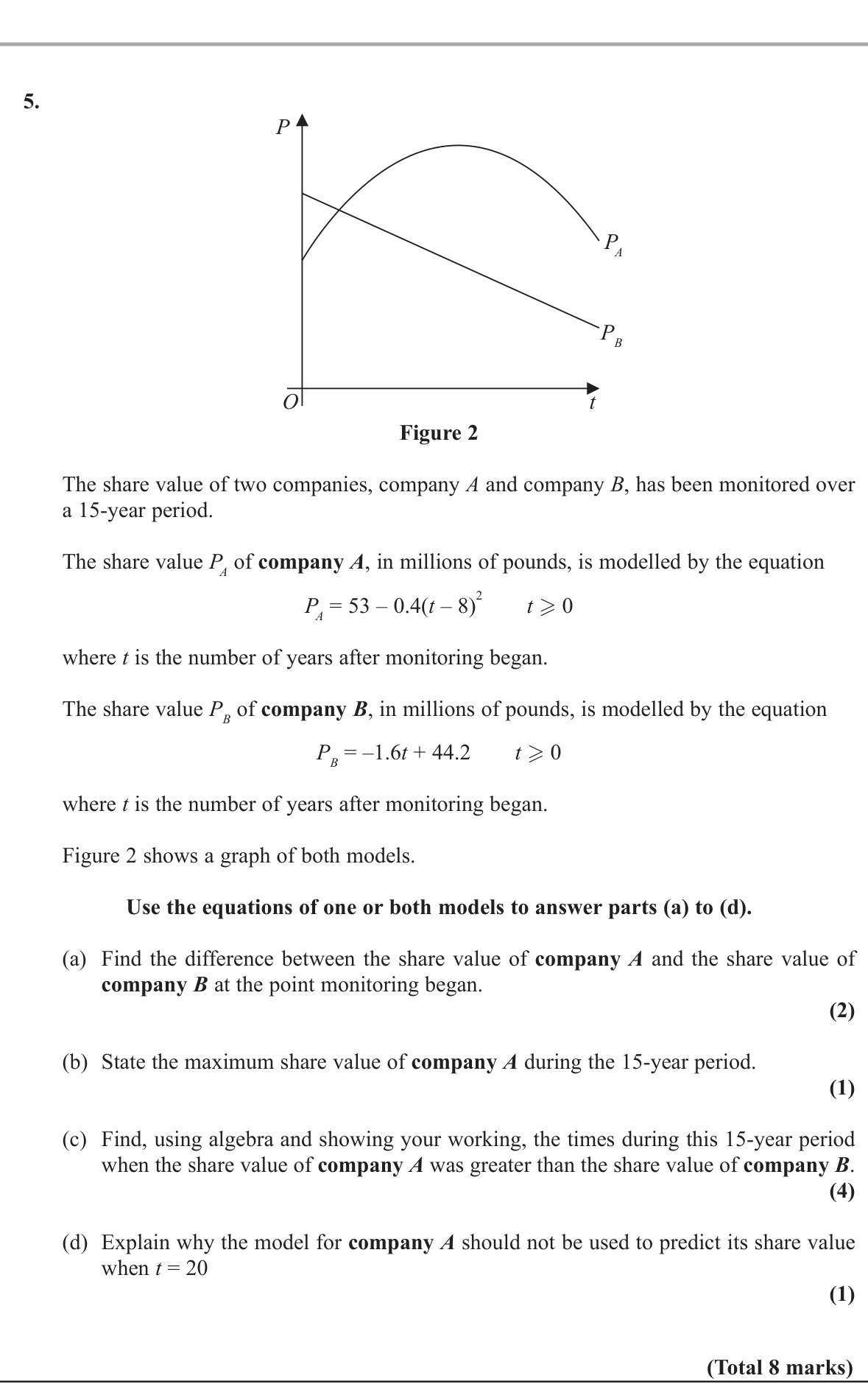
Evaluate both models at t = 0
$P_A(0)=53-0.4(0-8)^2=53-25.6=27.4$. Also $P_B(0)=-1.6(0)+44.2=44.2$.
Find the initial difference
The difference is $44.2-27.4=16.8$, so the share values differ by $16.8$ million pounds.
State the maximum of company A
$P_A=53-0.4(t-8)^2$ has maximum value $53$, reached when $t=8$, which is within the 15-year period.
Compare company costs
$53-0.4(t-8)^2>-1.6t+44.2$.
Rearrange to a quadratic inequality
Expanding gives $-0.4t^2+8t-16.8>0$. Multiplying by $-2.5$ reverses the inequality: $t^2-20t+42<0$.
Find the crossing times
$t=\dfrac{20\pm\sqrt{400-168}}{2}=10\pm\sqrt{58}$. Therefore company A is greater between the two roots.
Restrict to the 15-year period
Since the model is monitored over $0\le t\le15$, the required times are $10-\sqrt{58}<t\le15$.
Explain the limitation
The model should not be used at $t=20$ because it was only built from a 15-year monitoring period; $20$ years is outside that range.
Final answer
$(a)\ 16.8\text{ million pounds}.\quad (b)\ 53\text{ million pounds}.\quad (c)\ 10-\sqrt{58}<t\le15.\quad (d)\ t=20\text{ is outside the 15-year model}$.
7. WMA11/01 January 2020 · Q10
Medium8 marksShow worked solution
Use the factorised form for the sketch
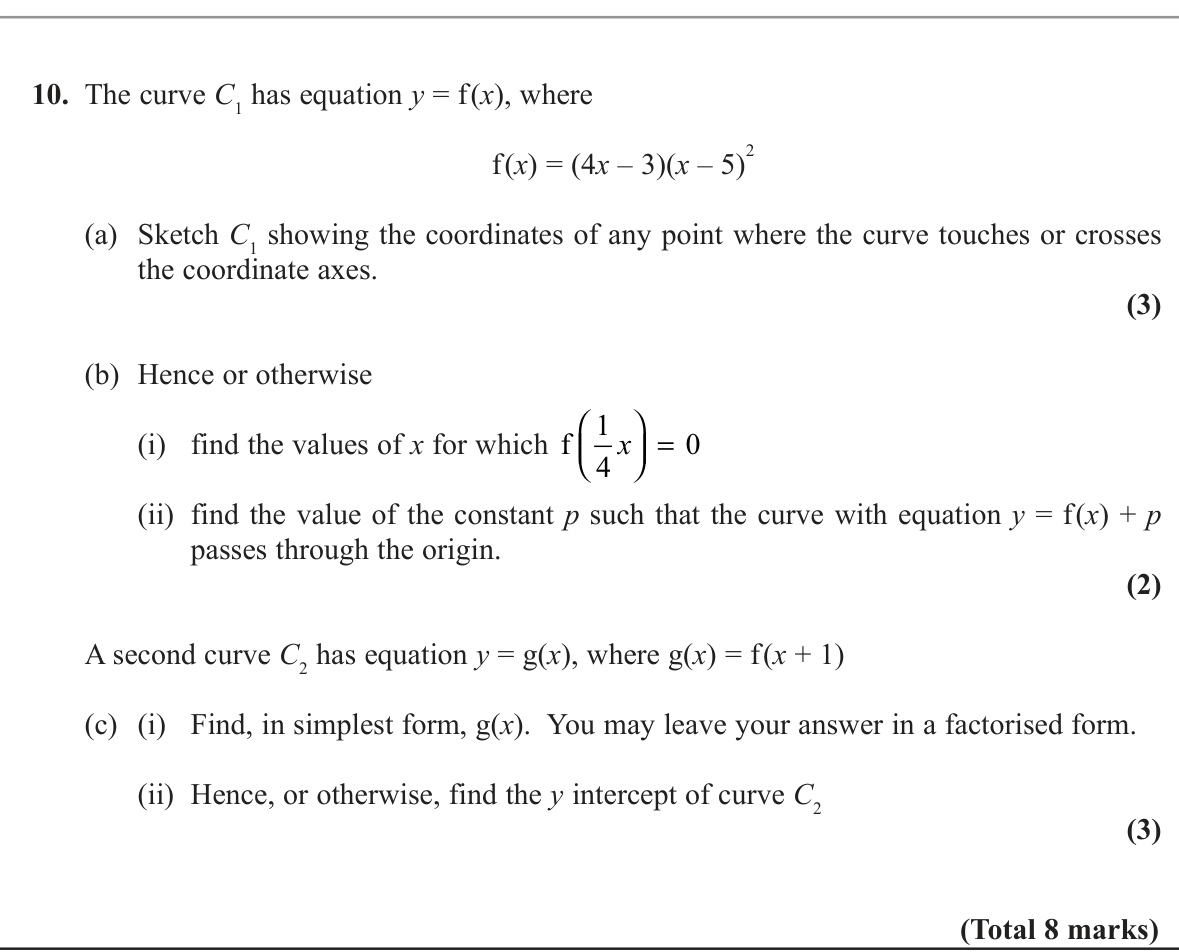
$f(x)=(4x-3)(x-5)^2$. The curve crosses the x-axis at $x=\frac34$ and touches the x-axis at $x=5$. The y-intercept is $f(0)=(-3)(25)=-75$.
Solve f(x/4)=0
For $f\left(\frac14x\right)=0$, either $4\left(\frac{x}{4}\right)-3=0$ or $\frac{x}{4}-5=0$. Therefore $x=3$ or $x=20$.
Find p
The curve $y=f(x)+p$ passes through the origin, so $0=f(0)+p=-75+p$. Hence $p=75$.
At $x=0$, $g(0)=(1)(16)=16$. So the y-intercept is $16$.
Final answer
Sketch: crosses at $\left(\frac34,0\right)$, touches at $(5,0)$, crosses y-axis at $(0,-75)$. Also $x=3,20$, $p=75$, $g(x)=(4x+1)(x-4)^2$, y-intercept $16$.
8. WMA11/01 October 2019 · Q6
Medium8 marksShow worked solution
Read the graph features
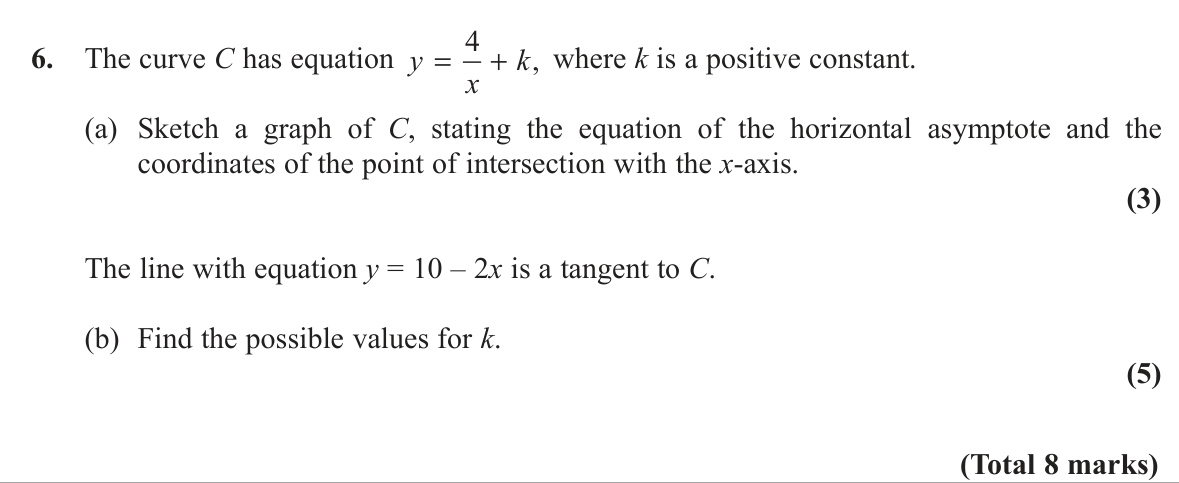
For $y=\frac4x+k$, the horizontal asymptote is $y=k$. Setting $y=0$ gives $0=\frac4x+k$, so the x-intercept is $x=-\frac4k$.
Equate line and curve
A tangent touches once, so solve $10-2x=\frac4x+k$. Multiplying by $x$ gives $2x^2+(k-10)x+4=0$.
Use the discriminant condition
For one repeated intersection, discriminant $=0$: $(k-10)^2-4(2)(4)=0$. Hence $(k-10)^2=32$.
Find k
$k-10=\pm4\sqrt2$, so $k=10\pm4\sqrt2$. Both are positive, so both satisfy the condition in the question.
Final answer
Asymptote $y=k$, x-intercept $\left(-\frac4k,0\right)$, and $k=10\pm4\sqrt2$.
9. WMA11/01 October 2025 · Q6
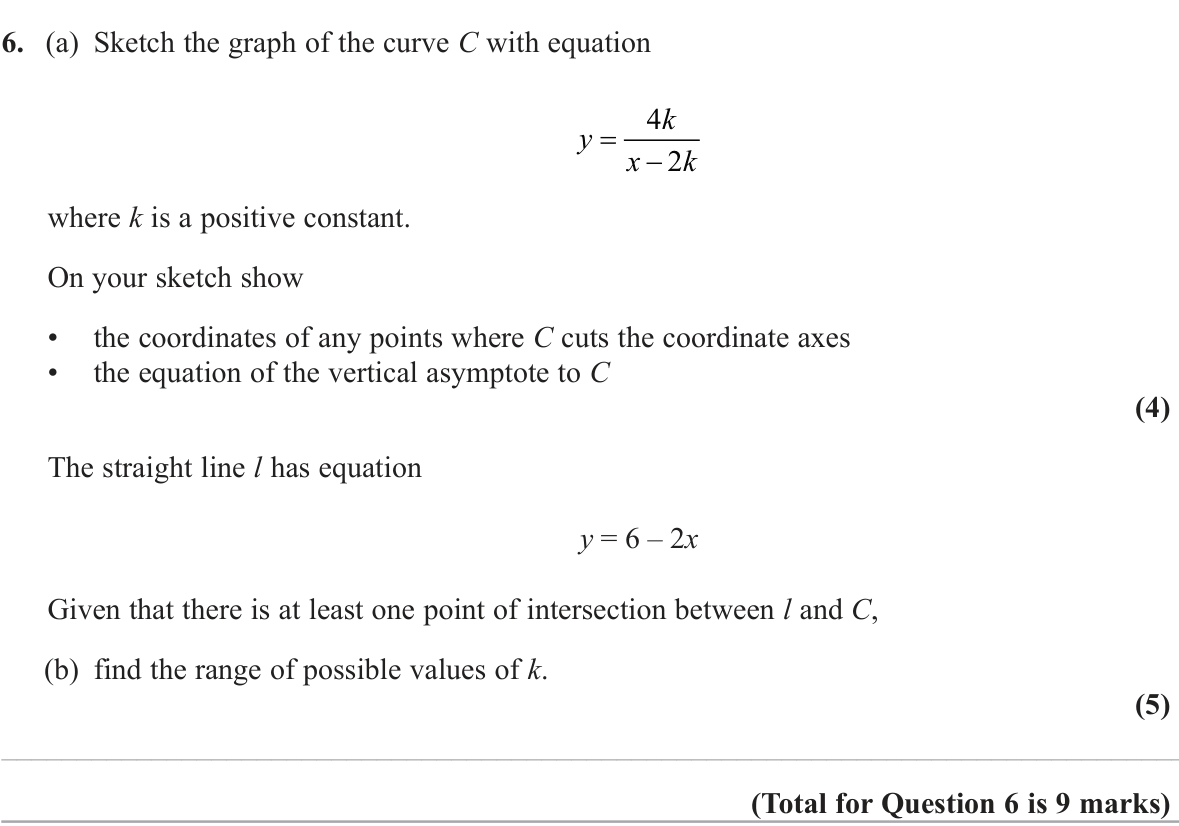
Hard9 marksShow worked solution
Find coordinate-axis intersections
$y=\dfrac{4k}{x-2k}$ has no x-intercept because the numerator is non-zero. At $x=0$, $y=\dfrac{4k}{-2k}=-2$, so the y-intercept is $(0,-2)$.
Find the vertical asymptote
The denominator is zero when $x=2k$, so the vertical asymptote is $x=2k$.
Sketch shape
The curve has one branch in quadrant I to the right of $x=2k$, and one branch passing through $(0,-2)$ and approaching the x-axis from below as $x\to-\infty$.
Set line and curve equal
$\dfrac{4k}{x-2k}=6-2x$.
Form a quadratic in x
$4k=(6-2x)(x-2k)=6x-12k-2x^2+4kx$, so $2x^2-(4k+6)x+16k=0$.
Use at least one intersection
For at least one real intersection, the discriminant must satisfy $b^2-4ac\ge0$.
Find the discriminant
$(4k+6)^2-4(2)(16k)\ge0$, so $16k^2-80k+36\ge0$.
Solve in k
$4k^2-20k+9\ge0$, so $(2k-1)(2k-9)\ge0$.
Use k positive
Therefore $k\le\dfrac12$ or $k\ge\dfrac92$. Since $k$ is positive, $0<k\le\dfrac12$ or $k\ge\dfrac92$.
Final answer
$(a)$ y-intercept $(0,-2)$, vertical asymptote $x=2k$. $(b)\ 0<k\le\dfrac12\text{ or }k\ge\dfrac92$.
10. WMA11/01 October 2024 · Q6
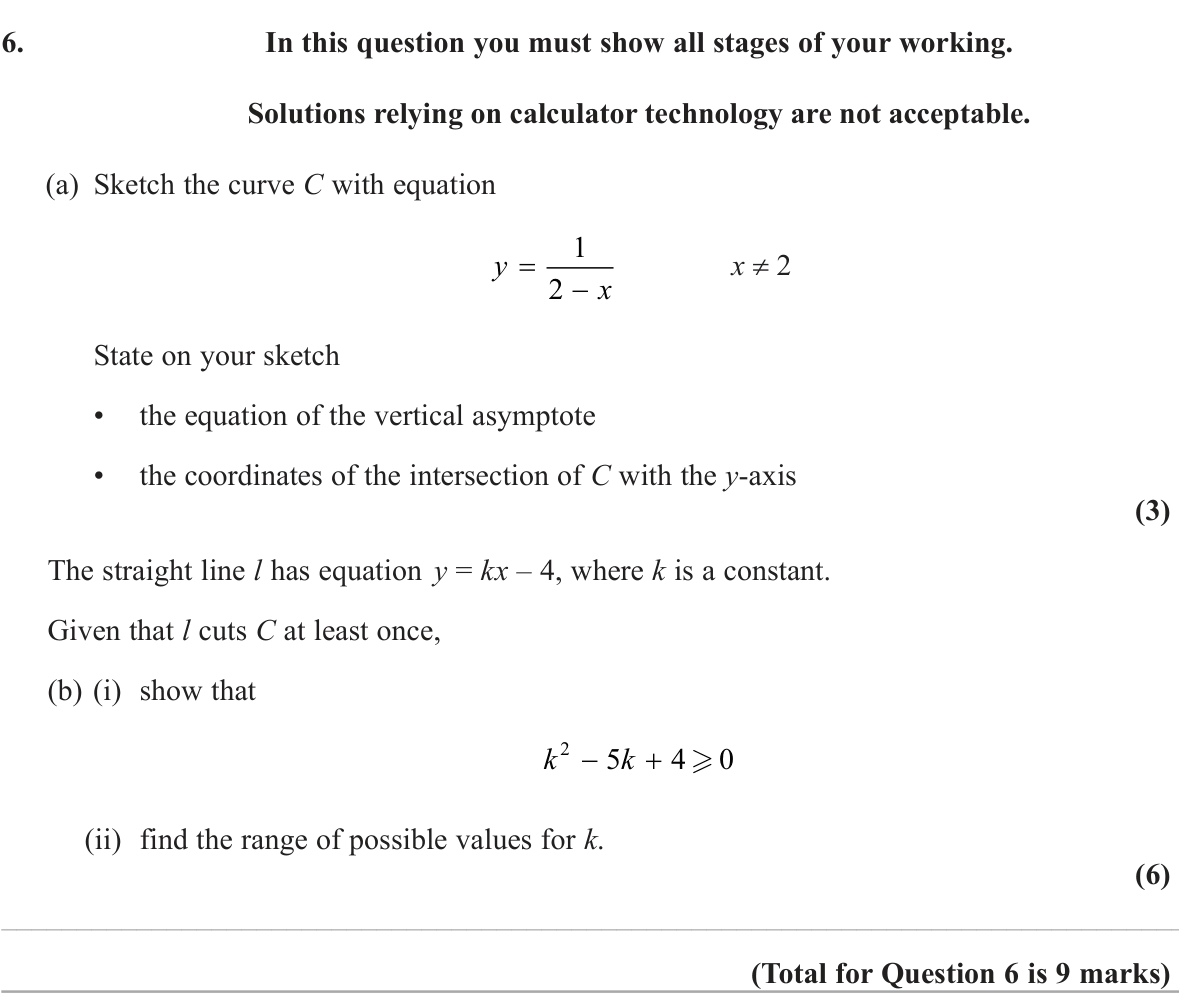
Hard9 marksShow worked solution
Identify the graph features
$y=\dfrac1{2-x}$ has vertical asymptote $x=2$ and horizontal asymptote $y=0$.
Find the y-intercept
At $x=0$, $y=\dfrac12$, so the y-intercept is $(0,\dfrac12)$.
Set up the intersection with the line
If $y=kx-4$ cuts $C$, then $kx-4=\dfrac1{2-x}$.
Form the quadratic
$(kx-4)(2-x)=1$, so $kx^2-(2k+4)x+9=0$.
Use the discriminant
For at least one intersection, the discriminant is non-negative.
Derive the given inequality
$(2k+4)^2-4(k)(9)\ge0$, so $4(k^2-5k+4)\ge0$, hence $k^2-5k+4\ge0$.
Solve the inequality
$k^2-5k+4=(k-1)(k-4)$, so $k\le1$ or $k\ge4$.
Final answer
$(a)$ vertical asymptote $x=2$, y-intercept $(0,\dfrac12)$. $(b)\ k\le1$ or $k\ge4$.
11. WMA11/01 January 2024 · Q7
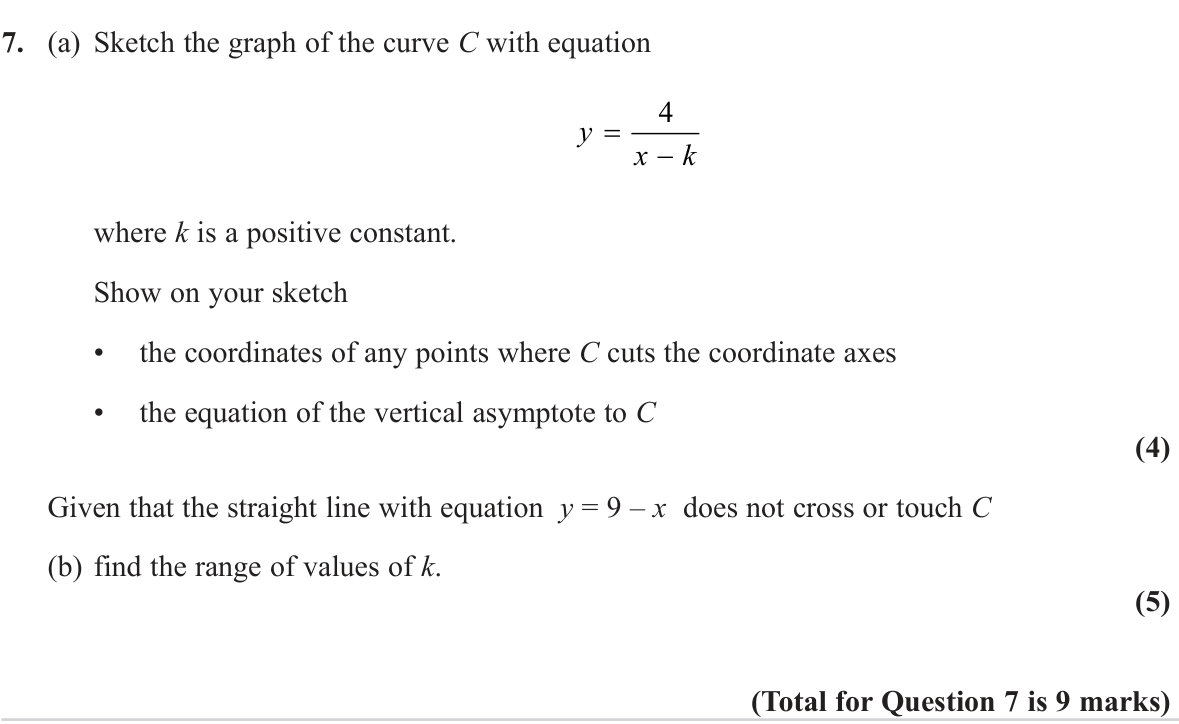
Hard9 marksShow worked solution
Identify the asymptote
For $y=\dfrac{4}{x-k}$, the vertical asymptote is where the denominator is zero, so $x=k$.
Find axis intercepts
At $x=0$, $y=-\dfrac4k$, so the y-intercept is $(0,-\dfrac4k)$. The graph has no x-intercept because the numerator is never zero.
Set up intersection with the line
If the line $y=9-x$ meets the curve, then $9-x=\dfrac4{x-k}$.
Form a quadratic
$(9-x)(x-k)=4$, which simplifies to $x^2-(9+k)x+9k+4=0$.
Use no real intersection
For the line not to cross or touch the curve, the discriminant must be negative.
Solve the inequality
$(9+k)^2-4(9k+4)<0$, so $k^2-18k+65<0$. Since $k^2-18k+65=(k-5)(k-13)$, the range is $5<k<13$.
Final answer
$(a)$ y-intercept $(0,-\dfrac4k)$, no x-intercept, vertical asymptote $x=k$. $(b)\ 5<k<13$.
12. WMA11/01 January 2022 · Q10
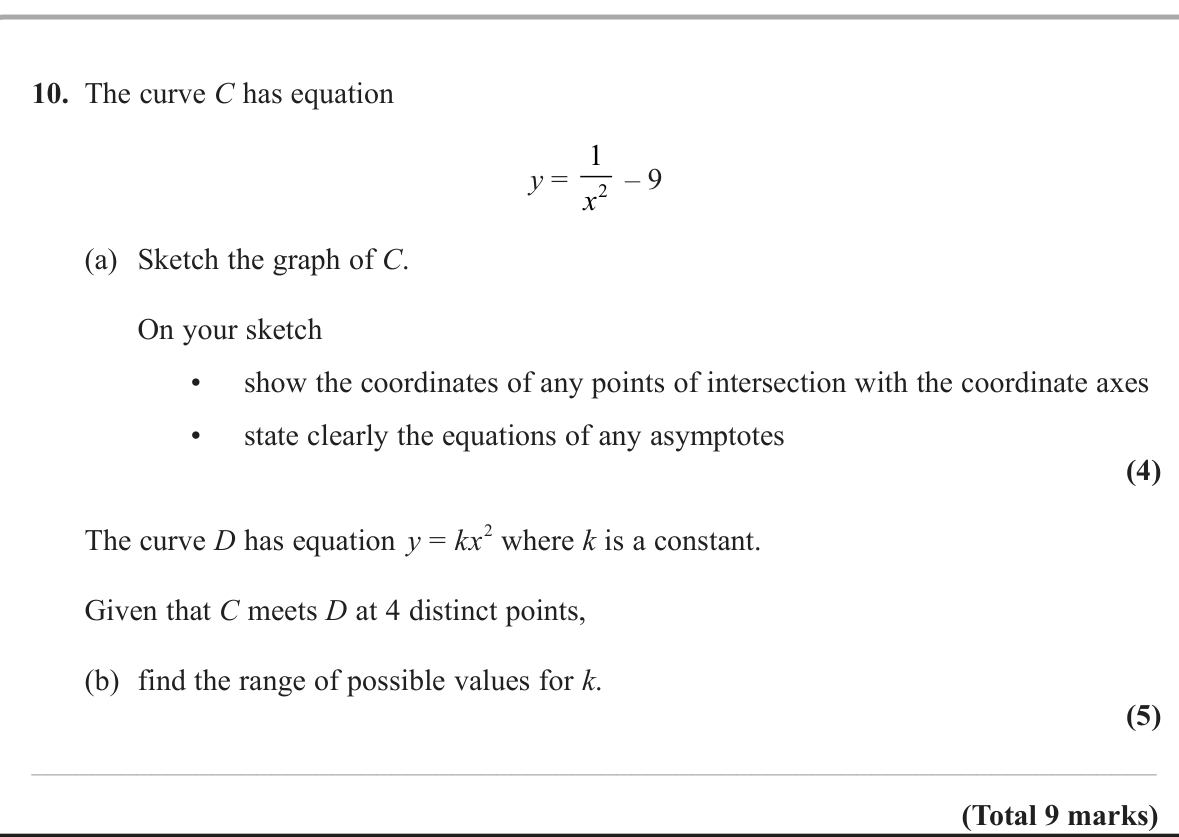
Hard9 marksShow worked solution
Find intercepts
For x-intercepts, set $\dfrac1{x^2}-9=0$. Then $x^2=\dfrac19$, so $x=\pm\dfrac13$. There is no y-intercept because $x=0$ is not in the domain.
State asymptotes
The vertical asymptote is $x=0$. As $|x|$ becomes large, $\dfrac1{x^2}\to0$, so the horizontal asymptote is $y=-9$.
Set up intersections with D
For intersections with $y=kx^2$, solve $\dfrac1{x^2}-9=kx^2$.
Use u = x squared
Let $u=x^2$, where $u>0$. Multiplying by $x^2$ gives $1-9u=ku^2$, so $ku^2+9u-1=0$.
Require two positive u-values
Four distinct x-values require two distinct positive values of $u$, since each positive $u$ gives $x=\pm\sqrt{u}$.
Find the range of k
For two positive roots, the product $-\dfrac1k$ and sum $-\dfrac9k$ must both be positive, so $k<0$. Also the discriminant must be positive: $81+4k>0$, so $k>-\dfrac{81}{4}$. Therefore $-\dfrac{81}{4}<k<0$.
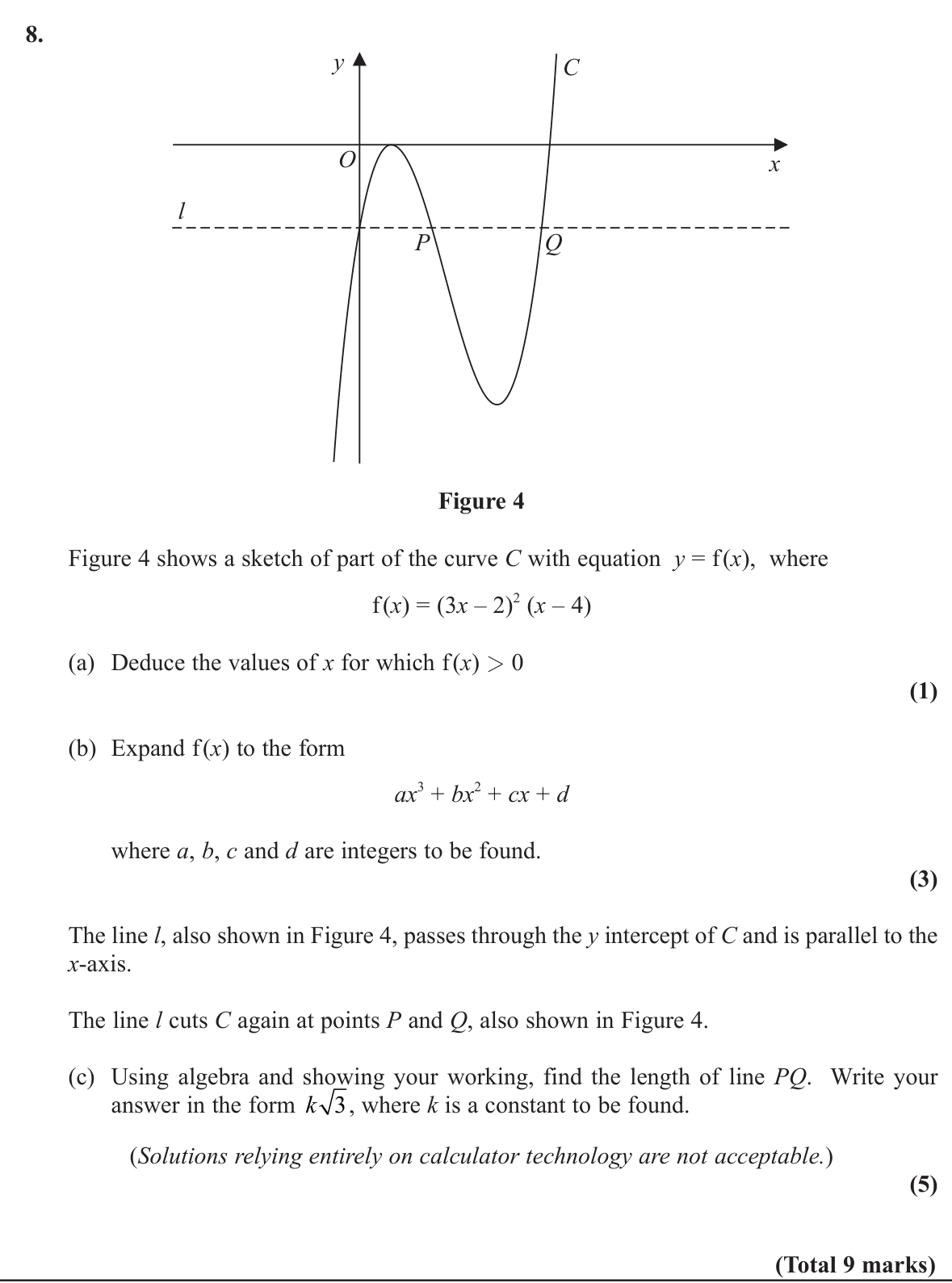
$f(x)=(3x-2)^2(x-4)$. The squared factor is never negative, and it is zero at $x=\dfrac23$. Therefore the sign of $f(x)$ away from the repeated root is controlled by $x-4$.
Because $P$ and $Q$ lie on the same horizontal line, $PQ$ is the difference in their x-coordinates: $PQ=\dfrac{8+2\sqrt3}{3}-\dfrac{8-2\sqrt3}{3}=\dfrac{4\sqrt3}{3}$.
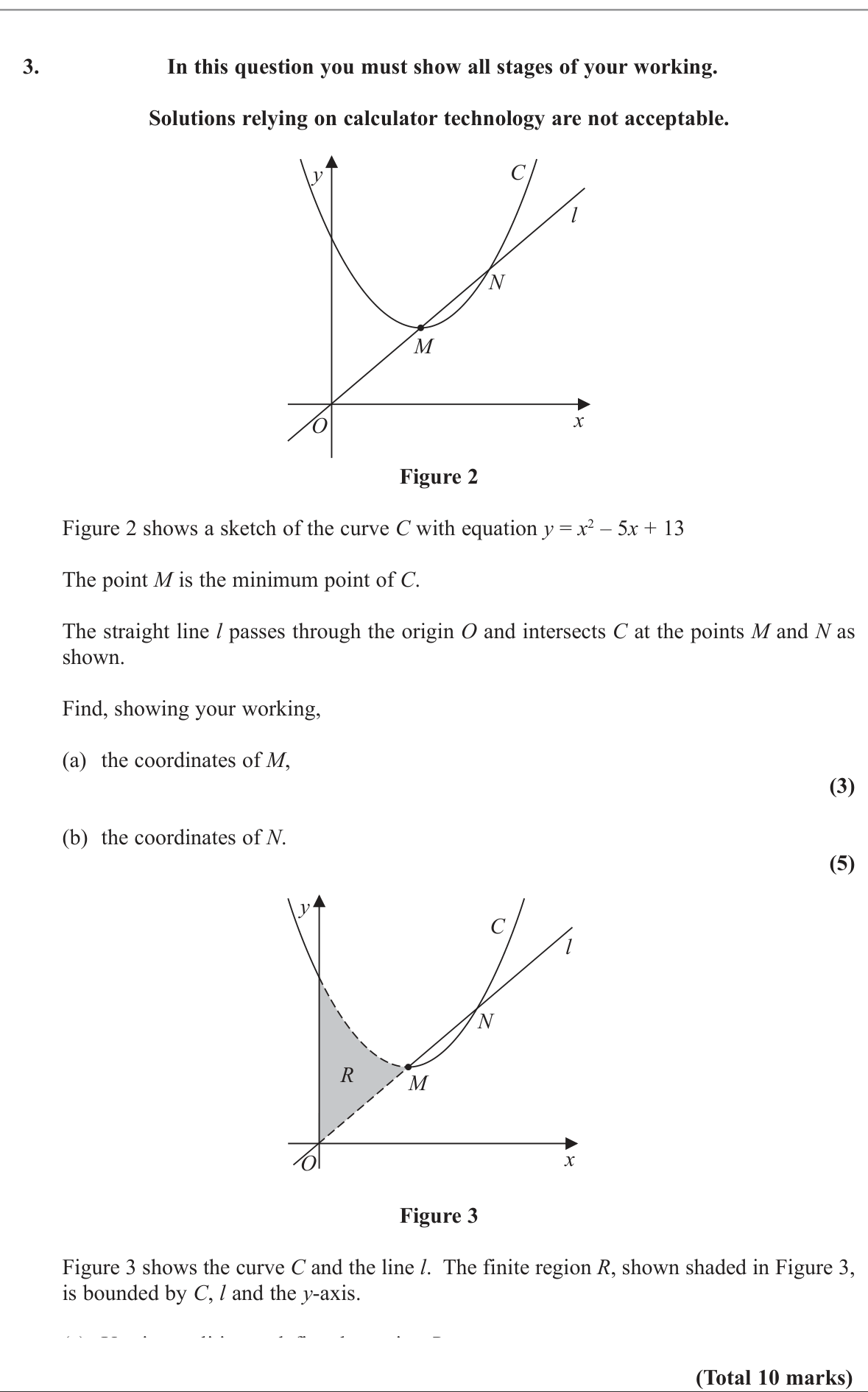
The gradient of $OM$ is $\dfrac{27/4}{5/2}=\dfrac{27}{10}$, so $l$ has equation $y=\frac{27}{10}x$.
Find the second intersection
Solve $x^2-5x+13=\frac{27}{10}x$. This gives $x^2-\frac{77}{10}x+13=0$. One root is $x=\frac52$, so the other is $x=\frac{26}{5}$. Then $y=\frac{27}{10}\cdot\frac{26}{5}=\frac{351}{25}$.
Describe the shaded region
The region is between the y-axis, the line, and the curve up to $M$: $0\le x\le\frac52$ and $\frac{27}{10}x\le y\le x^2-5x+13$.
Final answer
$M=\left(\frac52,\frac{27}{4}\right)$, $N=\left(\frac{26}{5},\frac{351}{25}\right)$, and $0\le x\le\frac52$, $\frac{27}{10}x\le y\le x^2-5x+13$.
18. WMA11/01 October 2019 · Q10
Hard10 marksShow worked solution
Use the factorised form for the inequality
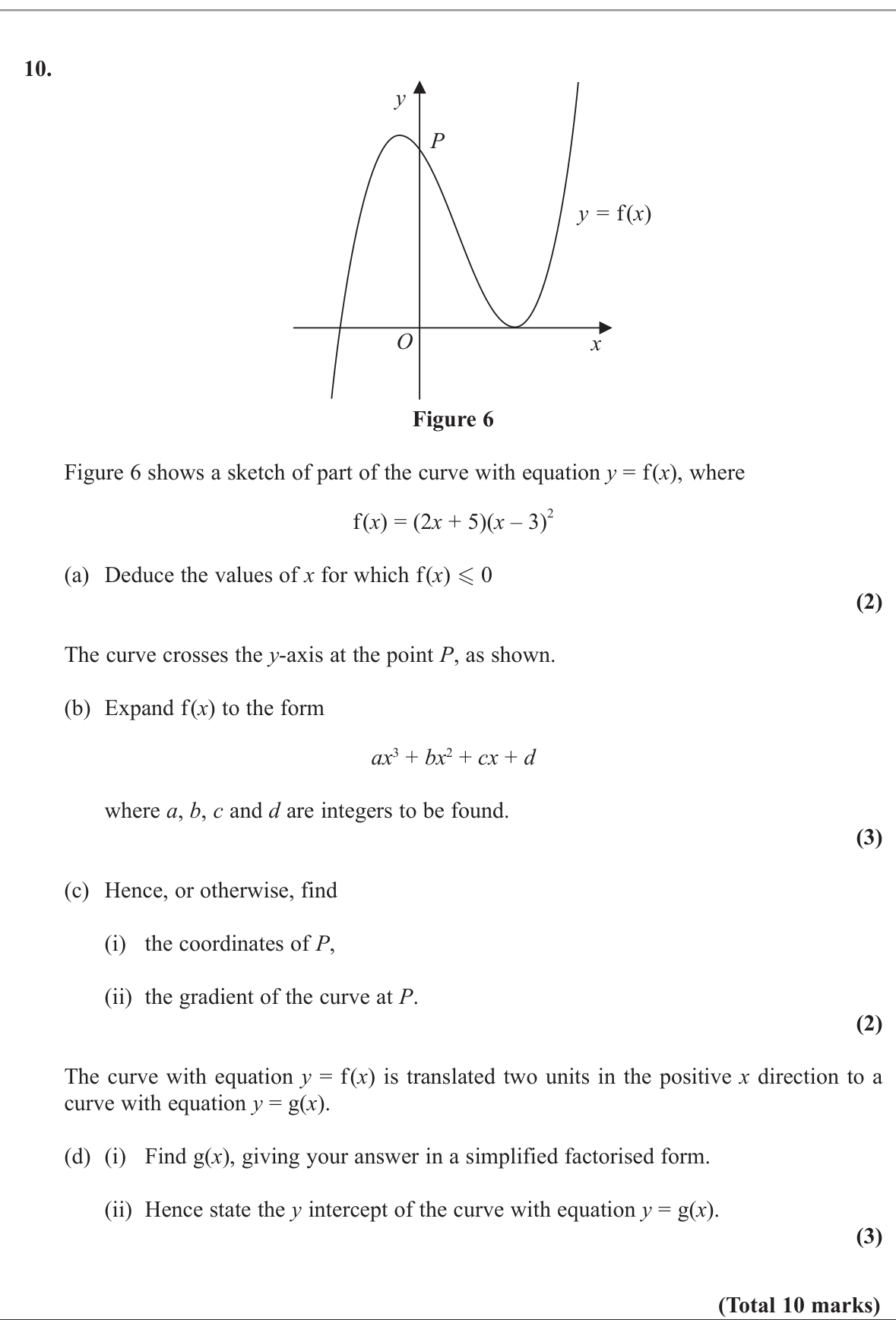
$f(x)=(2x+5)(x-3)^2$. Since $(x-3)^2\ge0$, the sign is controlled by $2x+5$, with an extra zero at $x=3$. Hence $f(x)\le0$ for $x\le-\frac52$ or $x=3$.
Expand the cubic
$(x-3)^2=x^2-6x+9$, so $f(x)=(2x+5)(x^2-6x+9)=2x^3-7x^2-12x+45$.
Find P and the gradient at P
At the y-axis, $x=0$, so $P=(0,45)$. Also $f'(x)=6x^2-14x-12$, so the gradient at $P$ is $f'(0)=-12$.
Translate the graph
A translation 2 units in the positive x direction means $g(x)=f(x-2)$. Therefore $g(x)=(2(x-2)+5)((x-2)-3)^2=(2x+1)(x-5)^2$.
Find the new y-intercept
Set $x=0$: $g(0)=(1)(25)=25$, so the y-intercept is $25$.
Final answer
$f(x)\le0$ for $x\le-\frac52$ or $x=3$; $f(x)=2x^3-7x^2-12x+45$; $P=(0,45)$; gradient $=-12$; $g(x)=(2x+1)(x-5)^2$; y-intercept $25$.
19. WMA11/01 May/June 2026 · Q10
Hard11 marksShow worked solution
(a) Identify the graph features
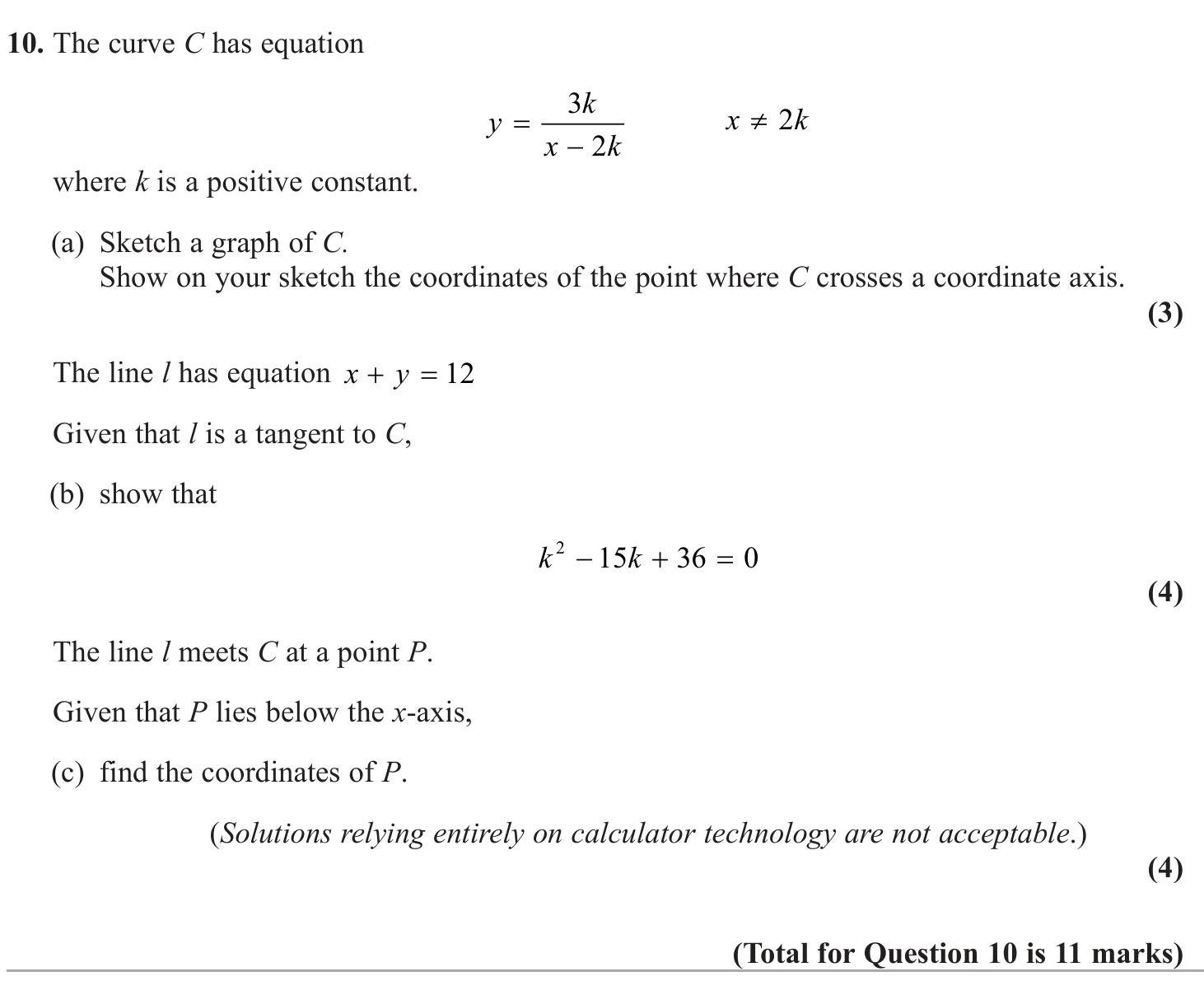
The curve $$y=\frac{3k}{x-2k}$$ is a rectangular hyperbola with vertical asymptote $x=2k$ and horizontal asymptote $y=0$. Since $k>0$, the branch for $x>2k$ lies above the x-axis. The other branch lies below the x-axis and passes through the y-axis.
(a) Find the axis intercept
At $x=0$, $$y=\frac{3k}{-2k}=-\frac32.$$ So the curve crosses the y-axis at $$\left(0,-\frac32\right).$$ There is no x-intercept because the numerator $3k$ is non-zero.
(b) Form the intersection quadratic
The line is $y=12-x$. At an intersection, $$\frac{3k}{x-2k}=12-x.$$ Cross-multiplying gives $$3k=(12-x)(x-2k)=12x-x^2-24k+2kx.$$ Hence $$x^2-(12+2k)x+27k=0.$$
(b) Use the tangency condition
A tangent gives a repeated solution for $x$, so the discriminant is zero: $$(12+2k)^2-4(1)(27k)=0.$$ Expanding and simplifying, $$144+48k+4k^2-108k=0,$$ $$4k^2-60k+144=0,$$ and therefore $$k^2-15k+36=0,$$ as required.
(c) Find the possible values of k
Factor the equation from part (b): $$k^2-15k+36=(k-3)(k-12)=0.$$ Thus $k=3$ or $k=12$.
(c) Find and select the tangent point
The repeated root of $$x^2-(12+2k)x+27k=0$$ is $$x=\frac{12+2k}{2}=6+k.$$ Then $y=12-x=6-k$. For $k=3$, the point is $(9,3)$, which is above the x-axis. For $k=12$, the point is $(18,-6)$, which is below the x-axis. Therefore $$P=(18,-6).$$
Final answer
$\begin{aligned}(a)\;&\text{Rectangular hyperbola with asymptotes }x=2k\text{ and }y=0,\\&\text{crossing the }y\text{-axis at }\left(0,-\dfrac32\right).\\[0.5mm](b)\;&k^2-15k+36=0.\\[0.5mm](c)\;&P=(18,-6).\end{aligned}$
 Elite Mathematics