Equation of a Straight Line: past paper questions & worked solutions
Every Equation of a Straight Line question from the WMA11 papers in our bank, 2019–2026, sorted from easiest to hardest. Try each one first, then open the worked solution.
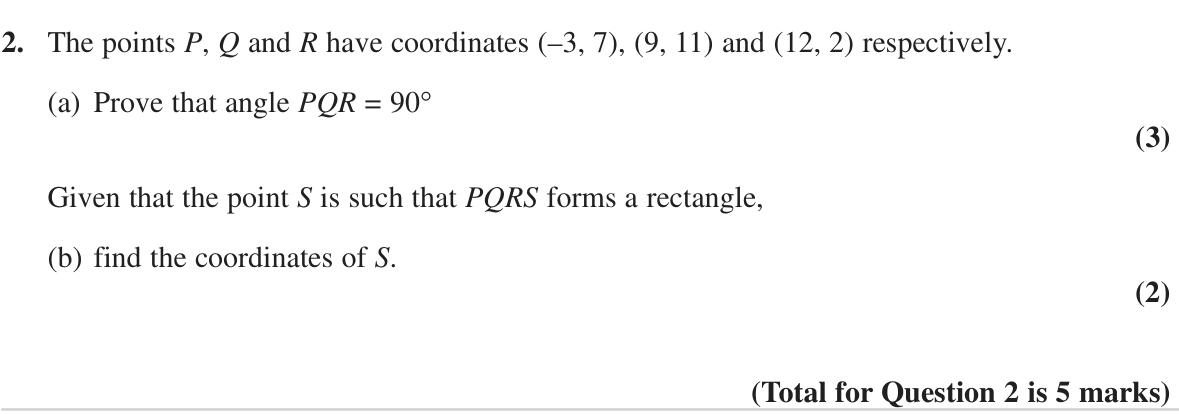
$m_{PQ}m_{QR}=\dfrac13(-3)=-1$, so $PQ$ and $QR$ are perpendicular. Hence angle $PQR=90^\circ$.
Use the rectangle vector
For rectangle $PQRS$, $\overrightarrow{PS}=\overrightarrow{QR}=(12-9,2-11)=(3,-9)$.
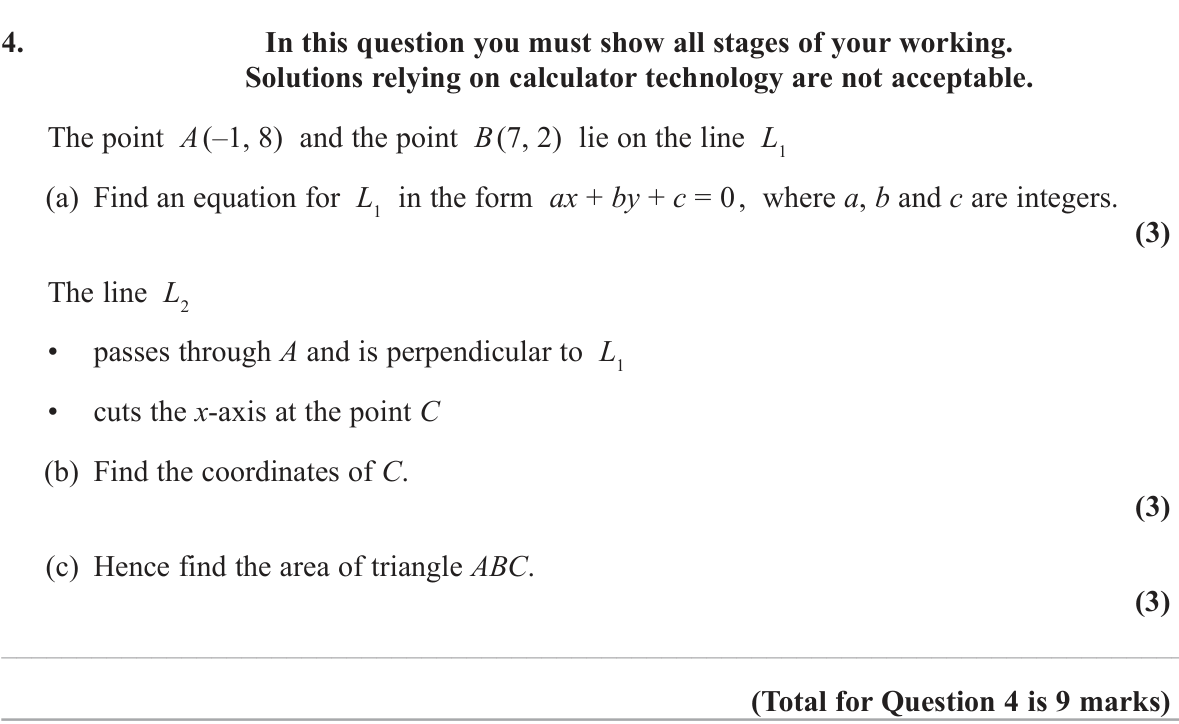
Find S
$S=P+\overrightarrow{QR}=(-3,7)+(3,-9)=(0,-2)$.
Final answer
$(a)$ Angle $PQR=90^\circ$. $(b)\ S=(0,-2)$.
3. WMA11/01 October 2022 · Q3
Easy5 marksShow worked solution
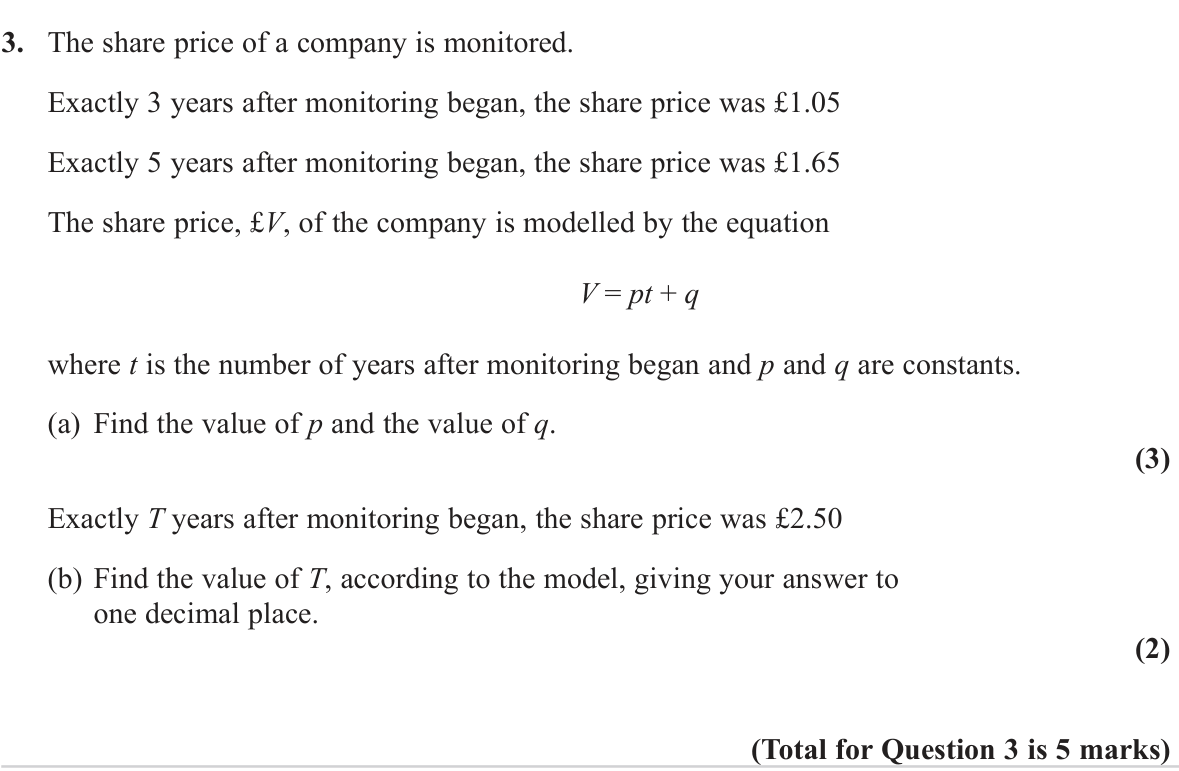
Use the two data points
The model $V=pt+q$ passes through $(3,1.05)$ and $(5,1.65)$.
Find the gradient
$p=\dfrac{1.65-1.05}{5-3}=\dfrac{0.60}{2}=0.30$.
Find the intercept
Using $1.05=0.30(3)+q$, we get $q=0.15$.
Find T
For $V=2.50$, $2.50=0.30T+0.15$, so $T=\dfrac{2.35}{0.30}=7.833\ldots$.
Round correctly
To one decimal place, $T=7.8$.
Final answer
$(a)\ p=0.3,\ q=0.15.\quad (b)\ T=7.8$ years.
4. WMA11/01 October 2019 · Q2
Easy5 marksShow worked solution
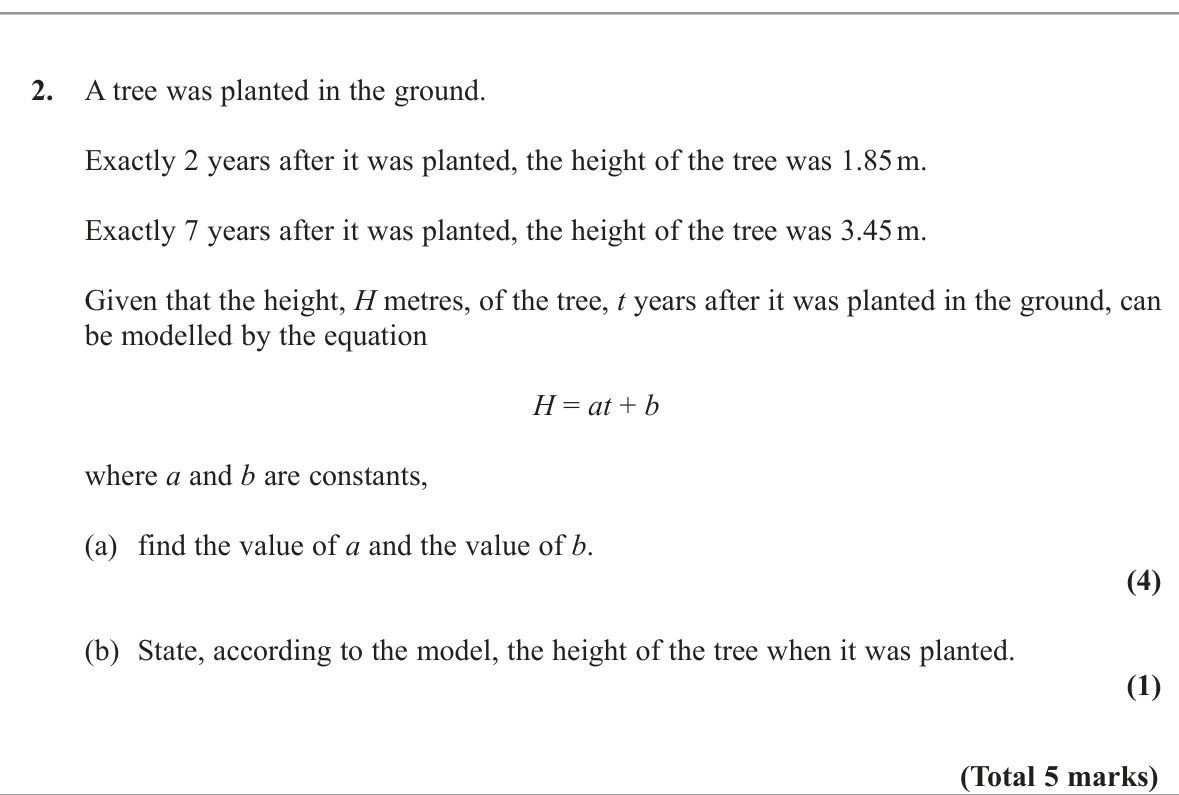
Form two equations
Using $H=at+b$: when $t=2$, $2a+b=1.85$; when $t=7$, $7a+b=3.45$.
Solve for the gradient of the model
Subtract the first equation from the second: $5a=1.60$, so $a=0.32$.
Find the starting height
Substitute into $2a+b=1.85$: $0.64+b=1.85$, hence $b=1.21$. At planting, $t=0$, so $H=b=1.21\text{ m}$.
Final answer
$a=0.32,\ b=1.21.\quad$ Height when planted: $1.21\text{ m}$.
5. WMA11/01 May/June 2026 · Q2
Easy6 marksShow worked solution
(a) Locate the intersection point and perpendicular gradient
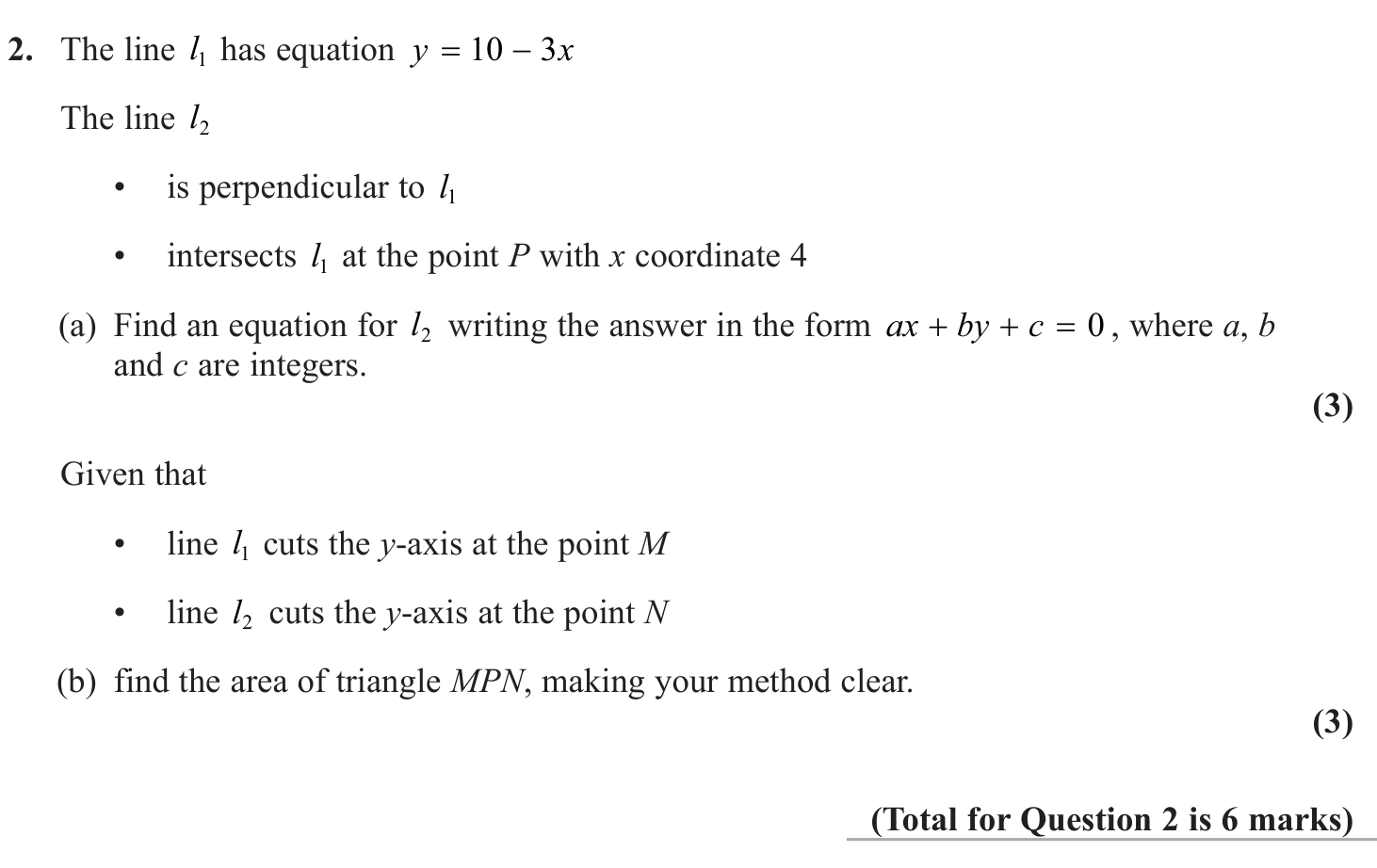
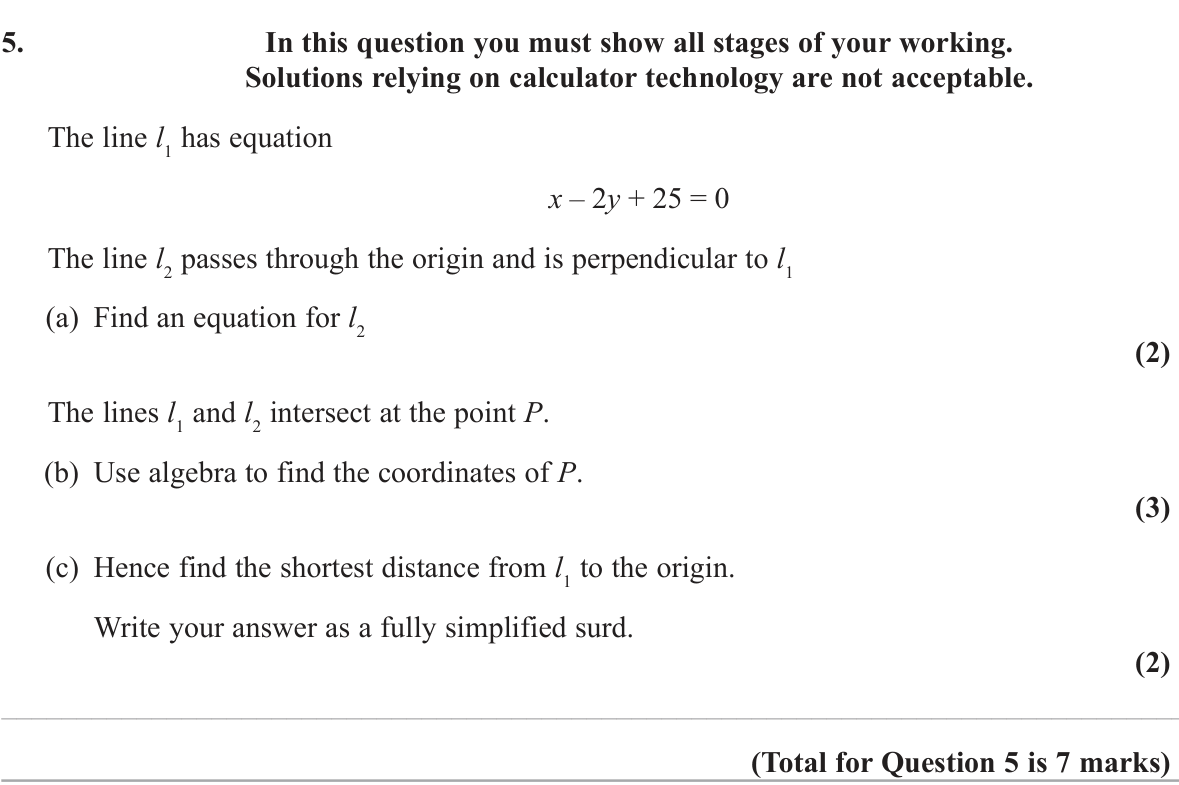
At $x=4$ on $l_1$, $y=10-3(4)=-2$, so $P=(4,-2)$. The gradient of $l_1$ is $-3$, so the gradient of the perpendicular line $l_2$ is $\dfrac{1}{3}$.
(a) Form the equation of the second line
$y+2=\dfrac{1}{3}(x-4)$. Multiplying by 3 and rearranging gives $x-3y-10=0$.
(b) Find the two intercepts on the y-axis
For $l_1$, setting $x=0$ gives $M=(0,10)$. From $l_2$, $y=\dfrac{x}{3}-\dfrac{10}{3}$, so $N=\left(0,-\dfrac{10}{3}\right)$.
(b) Use a vertical base and horizontal height
$MN=10-\left(-\dfrac{10}{3}\right)=\dfrac{40}{3}$. The perpendicular distance from $P$ to the $y$-axis is 4, so $\text{Area}=\dfrac12\times\dfrac{40}{3}\times4=\dfrac{80}{3}$.
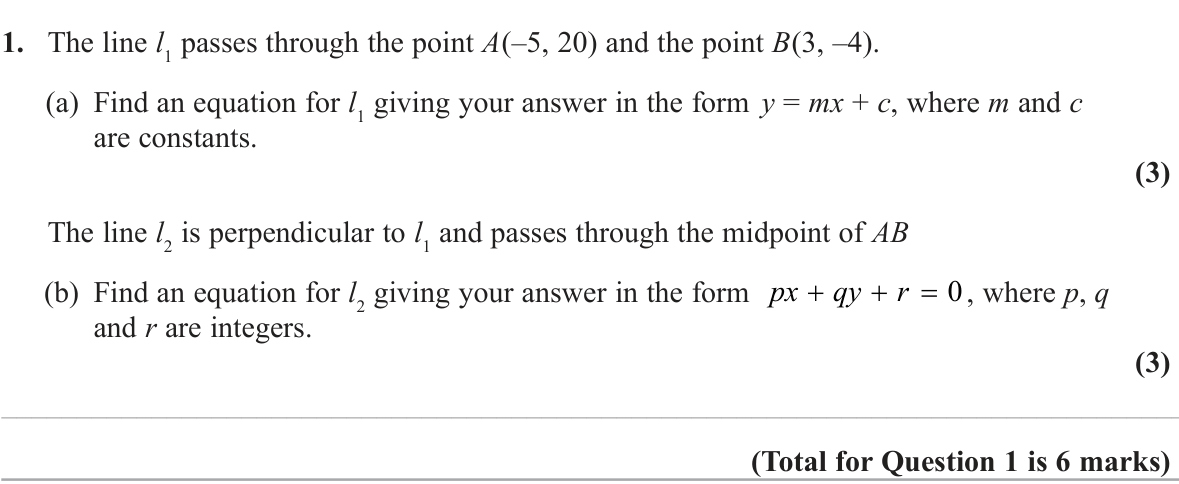
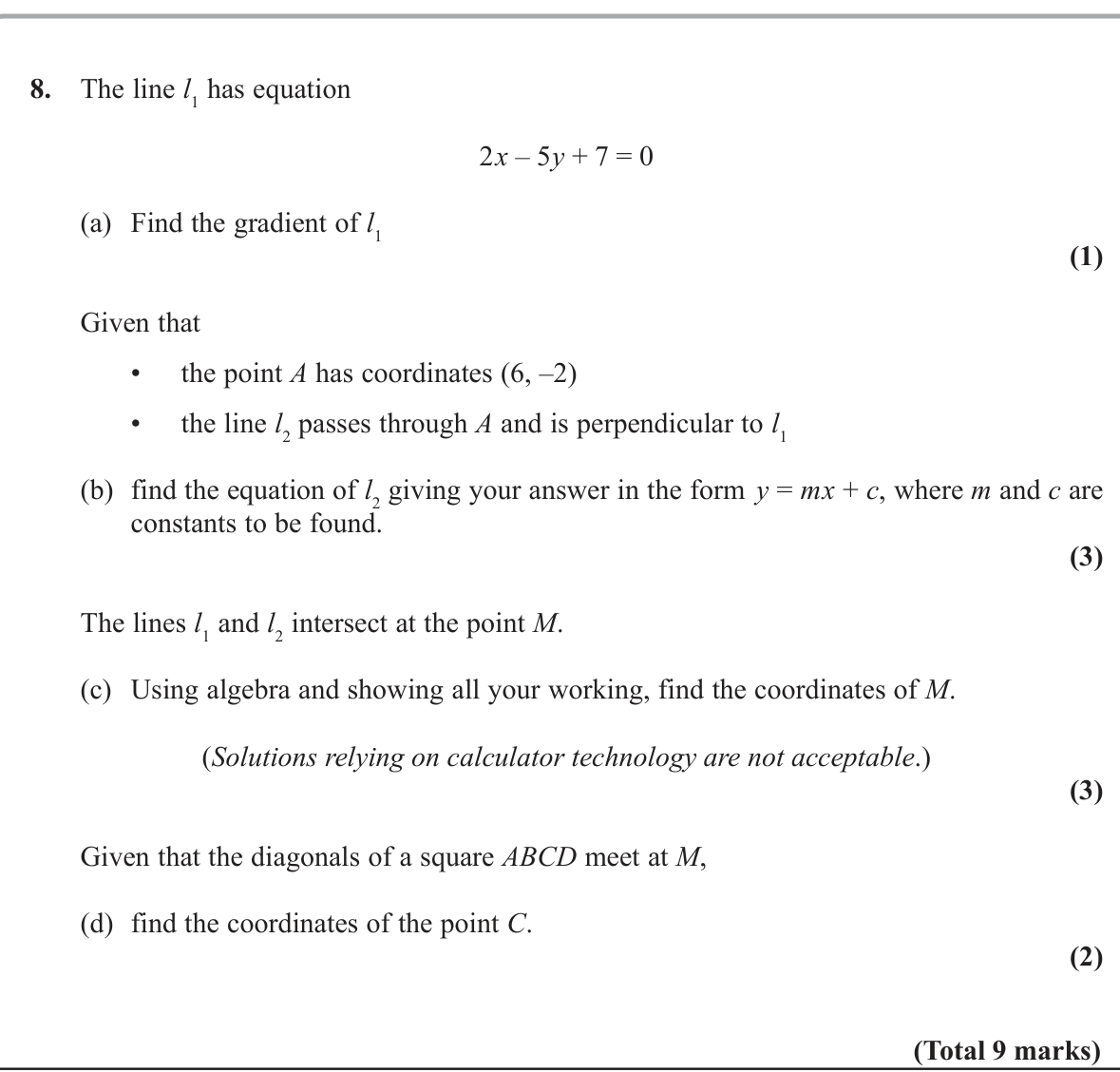
Since $l_1$ has gradient $-3$, $l_2$ has gradient $\dfrac13$.
Find the equation of l2
$y-8=\dfrac13(x+1)$, so $3y-24=x+1$ and $x-3y+25=0$.
Final answer
$(a)\ y=-3x+5.\quad (b)\ x-3y+25=0$.
7. WMA11/01 October 2021 · Q3
Easy6 marksShow worked solution
Solve the rational inequality
$\dfrac3x>4$ is equivalent to $\dfrac{3-4x}{x}>0$.
Use critical values
The critical values are $x=0$ and $x=\dfrac34$. A sign check gives the positive interval $0<x<\dfrac34$.
Find the equation of l
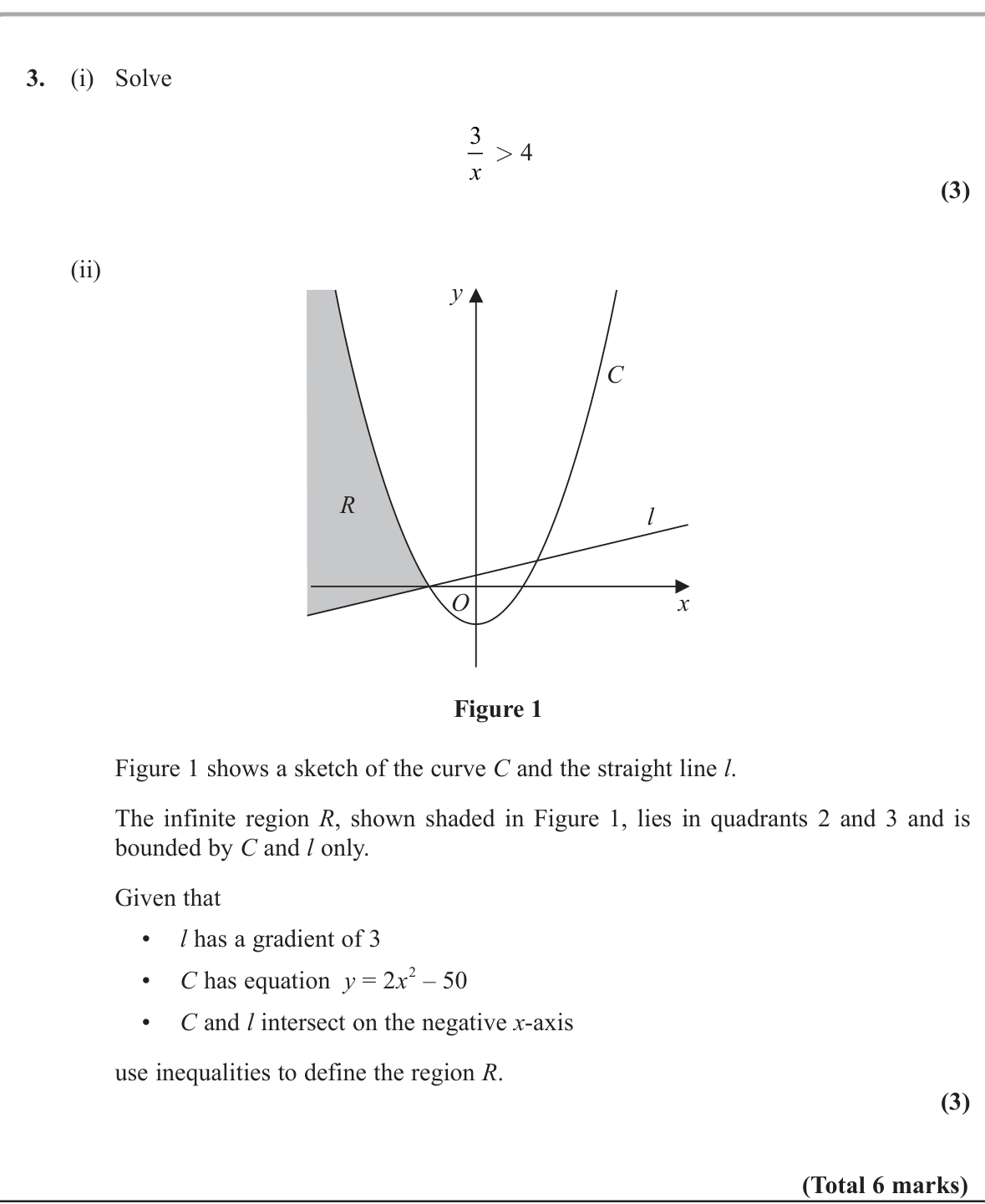
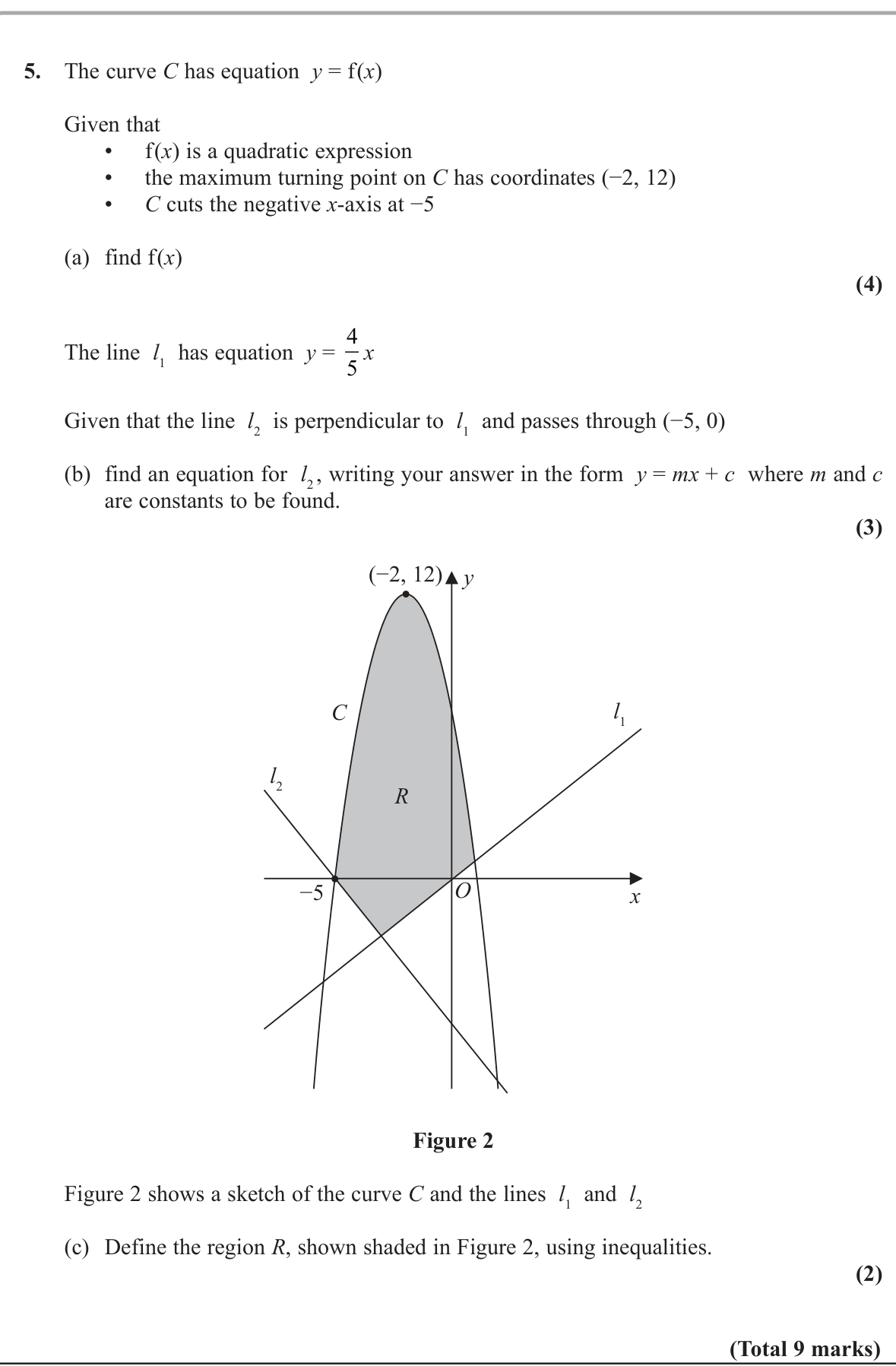
The curve $C$ meets the negative x-axis when $2x^2-50=0$, so $x=-5$. Since $l$ has gradient $3$ and passes through $(-5,0)$, $y=3(x+5)=3x+15$.
Define the shaded region
The shaded region lies above the line, below the curve, and to the left of their negative x-axis intersection. Hence $y>3x+15$, $y<2x^2-50$, and $x<-5$.
Medium7 marks · main topic: QuadraticsShow worked solution
(a) Factor out the leading coefficient
$-2x^2+12x+7=-2(x^2-6x)+7$.
(a) Complete the square
$x^2-6x=(x-3)^2-9$, so $-2x^2+12x+7=-2\big((x-3)^2-9\big)+7=-2(x-3)^2+25$.
(b) Read the maximum from completed-square form
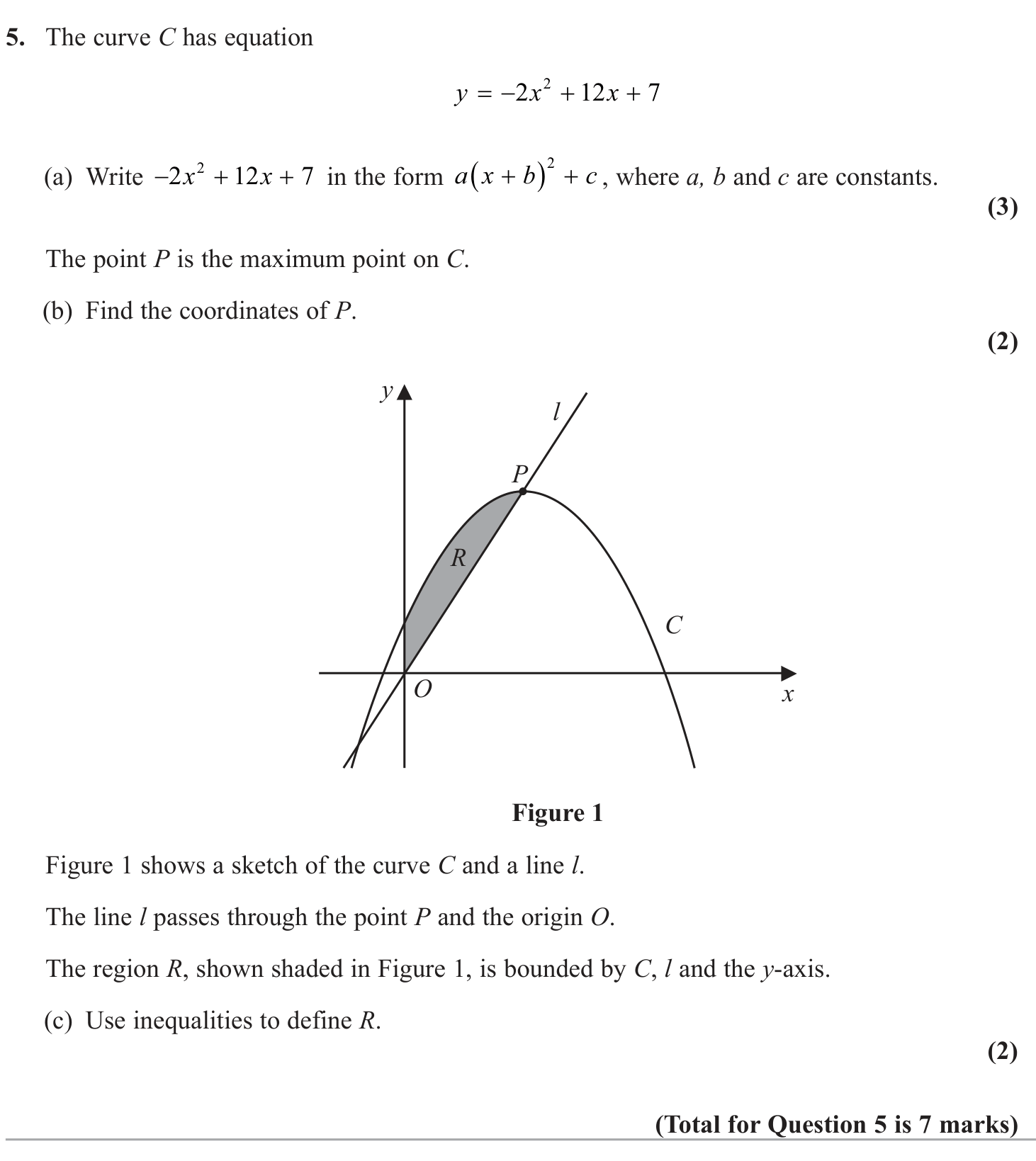
Because the coefficient of $(x-3)^2$ is negative, the curve has its maximum when $(x-3)^2=0$. Hence $x=3$, and the maximum value is $y=25$, so $P=(3,25)$.
(c) Find the equation of the boundary line
The line through $O=(0,0)$ and $P=(3,25)$ has gradient $\dfrac{25}{3}$, so $l$ has equation $y=\dfrac{25}{3}x$.
(c) Describe the shaded region
Points in $R$ are below the curve, above the line, and on or to the right of the $y$-axis. Therefore $y\leq-2x^2+12x+7$, $y\geq\dfrac{25}{3}x$, and $x\geq0$.
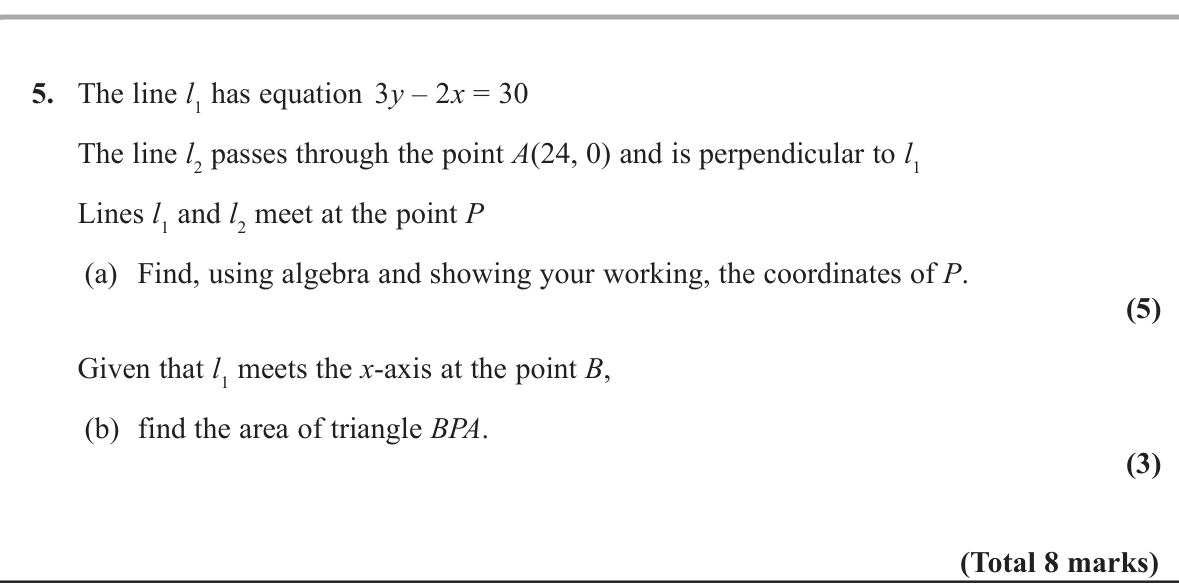
$3y-2x=30$ gives $y=\dfrac23x+10$, so the gradient of $l_1$ is $\dfrac23$.
Find l2
Since $l_2$ is perpendicular to $l_1$, its gradient is $-\dfrac32$. Through $A(24,0)$, $y=-\dfrac32(x-24)=-\dfrac32x+36$.
Solve for P
At the intersection, $\dfrac23x+10=-\dfrac32x+36$. Multiplying by $6$ gives $4x+60=-9x+216$, so $13x=156$ and $x=12$.
Find the y-coordinate
$y=\dfrac23(12)+10=18$, so $P=(12,18)$.
Find B
For the x-intercept of $l_1$, set $y=0$: $-2x=30$, so $x=-15$. Hence $B=(-15,0)$.
Find the triangle area
The base $BA$ has length $24-(-15)=39$, and the height from $P$ to the x-axis is $18$. Area $=\dfrac12(39)(18)=351$.
Final answer
$(a)\ P=(12,18).\quad (b)\ 351$ square units.
11. WMA11/01 January 2021 · Q4
Medium8 marksShow worked solution
Find the line through P and Q
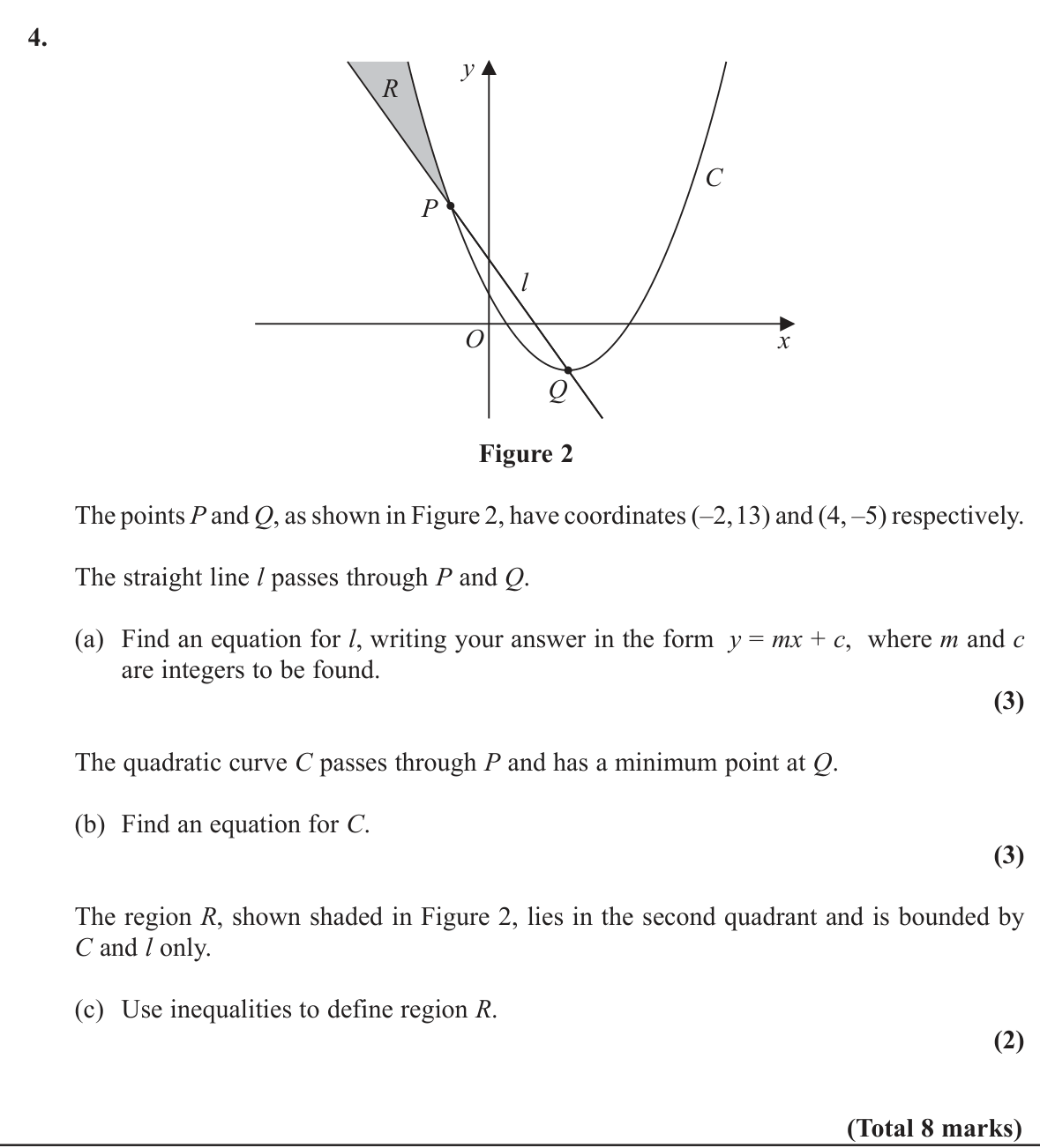
The gradient is $\dfrac{-5-13}{4-(-2)}=\dfrac{-18}{6}=-3$. Using $P(-2,13)$, $y-13=-3(x+2)$, hence $y=-3x+7$.
Use vertex form for the quadratic
The minimum point is $Q(4,-5)$, so the curve has form $y=a(x-4)^2-5$.
Substitute P to find a
Since $P(-2,13)$ lies on the curve, $13=a(-6)^2-5$. Therefore $18=36a$ and $a=\dfrac12$.
Write the curve
$C$ has equation $y=\dfrac12(x-4)^2-5$.
Define the shaded region
In the shaded second-quadrant region, points are above the line, below the curve, and to the left of $P$. Therefore $y>-3x+7$, $y<\dfrac12(x-4)^2-5$, and $x<-2$.
 Elite Mathematics