Trigonometric Functions: past paper questions & worked solutions
Every Trigonometric Functions question from the WMA13 papers in our bank, 2020–2026, sorted from easiest to hardest. Try each one first, then open the worked solution.
Level is estimated from marks: 1–6 easy, 7–8 medium, 9+ hard.
1. WMA13/01 October 2025 · Q4
Easy6 marks · main topic: Trig Equations & R-FormShow worked solution
Part (a)
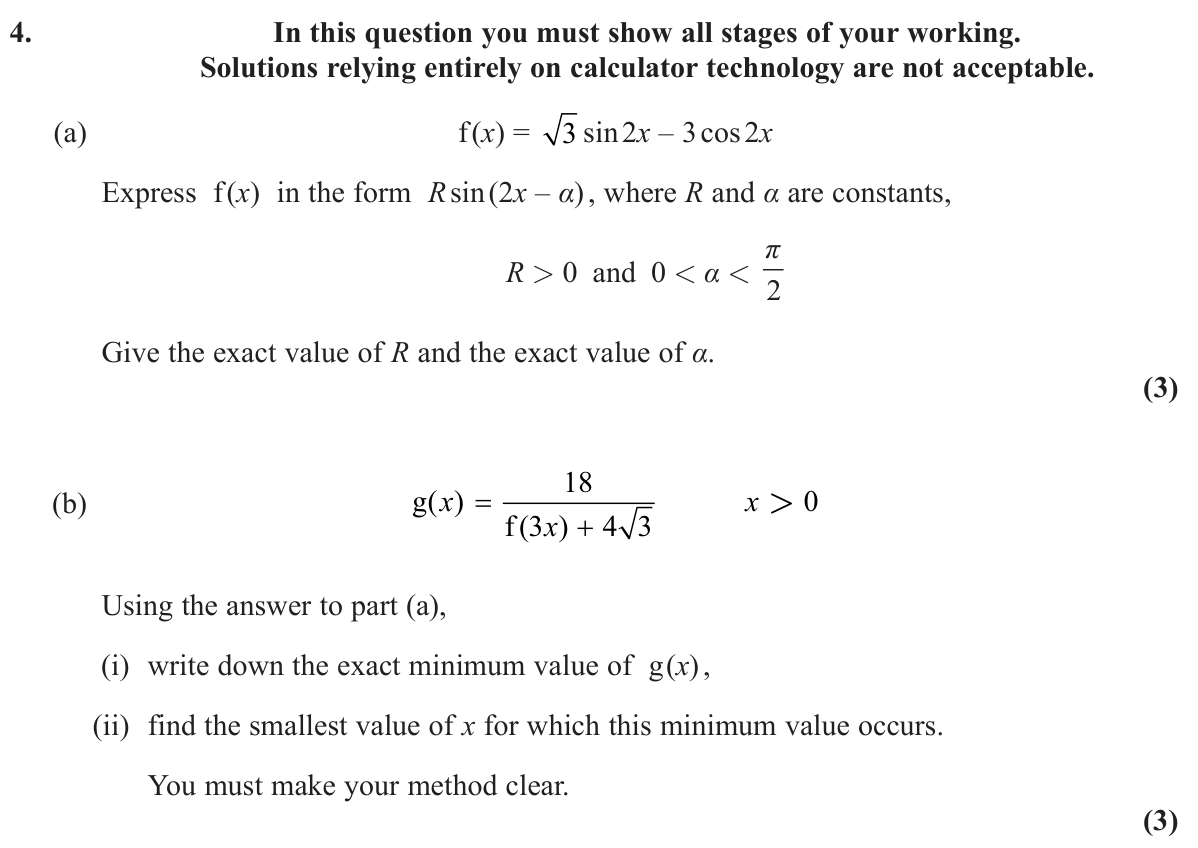
Expand $R\sin(2x-\alpha)=R\cos\alpha\sin2x-R\sin\alpha\cos2x$. Comparison gives $R\cos\alpha=\sqrt3$ and $R\sin\alpha=3$. Thus $R=\sqrt{3+9}=2\sqrt3$ and $\tan\alpha=\sqrt3$. As $0\lt \alpha\lt \pi/2$, $\alpha=\pi/3$ and
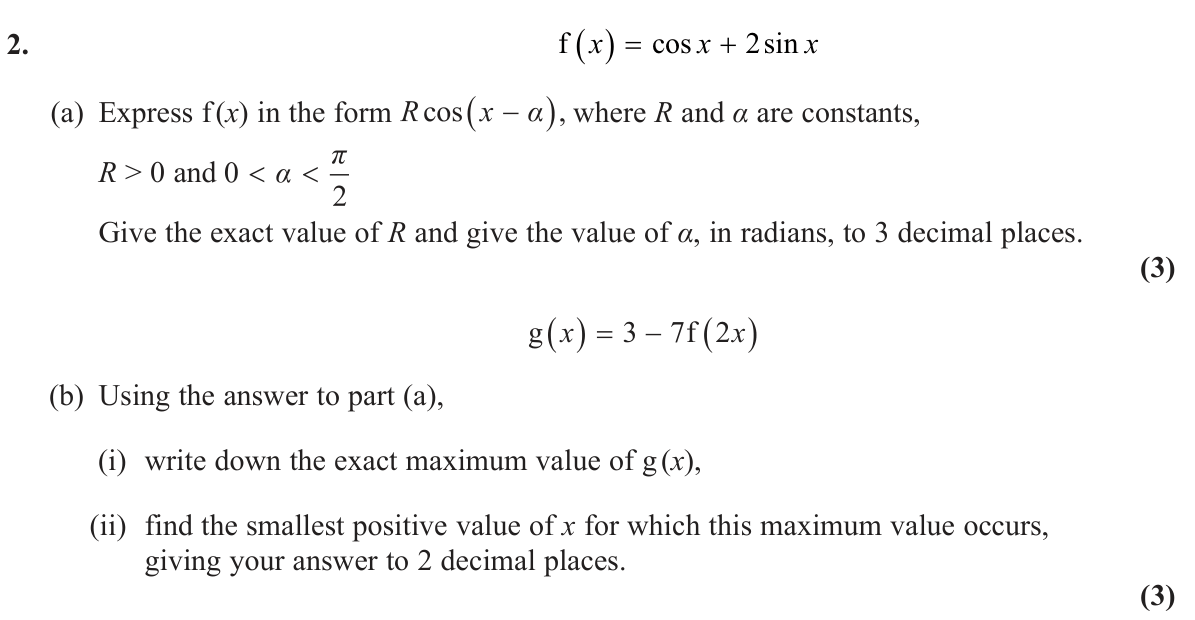
Using the exact phase $\alpha=\arctan2$, write $g(x)=3-7\sqrt5\cos(2x-\alpha)$. (i) The negative cosine coefficient means the maximum occurs when the cosine is $-1$; the maximum is $3+7\sqrt5$. (ii) $2x-\alpha=\pi+2n\pi$, so $x=(\pi+\alpha)/2+n\pi$. The $n=-1$ value is negative; $n=0$ is the smallest positive one, $x=2.1243706857\ldots$, or 2.12 to two decimal places.
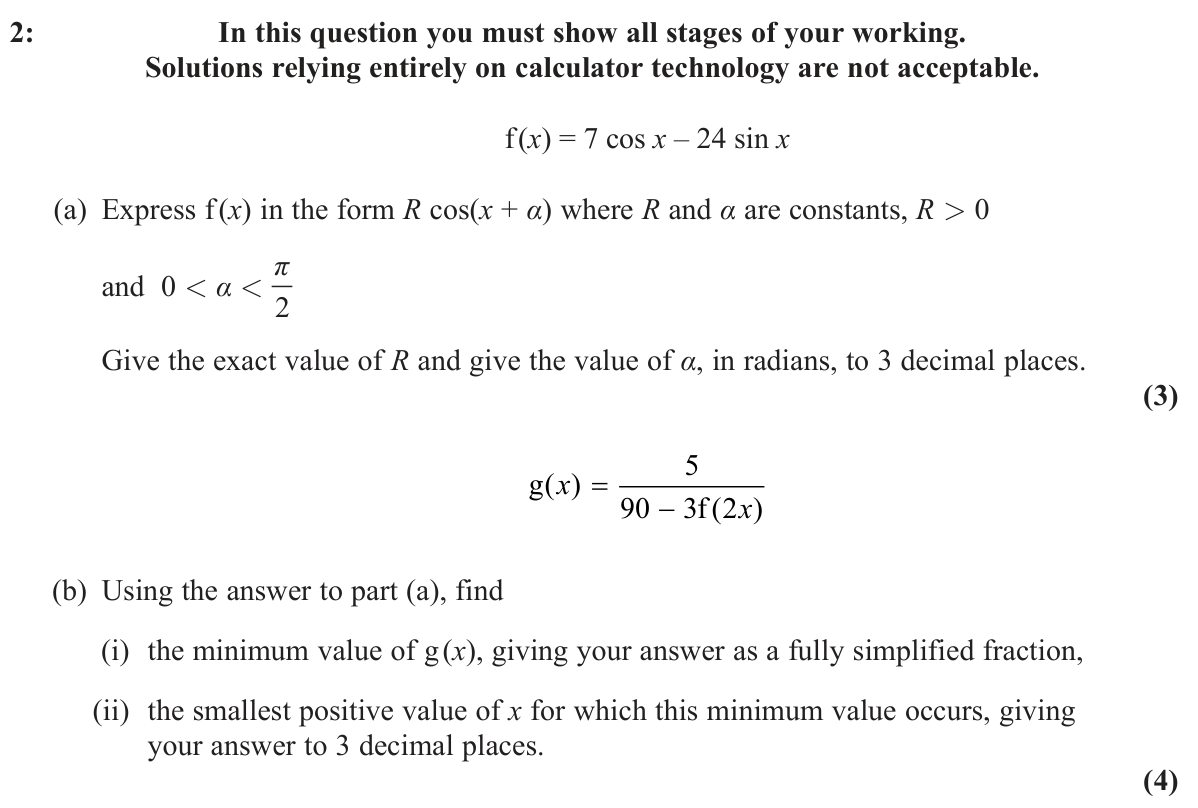
Thus $f(x)=25\cos(x+\alpha)$, using the unrounded $\alpha$ in subsequent calculations.
Part (i)
Since $-25\leq f(2x)\leq25$, the positive denominator $90-3f(2x)$ lies between $15$ and $165$. The smallest reciprocal occurs at the largest denominator:
Medium7 marks · main topic: Differentiation TechniquesShow worked solution
Part (a)
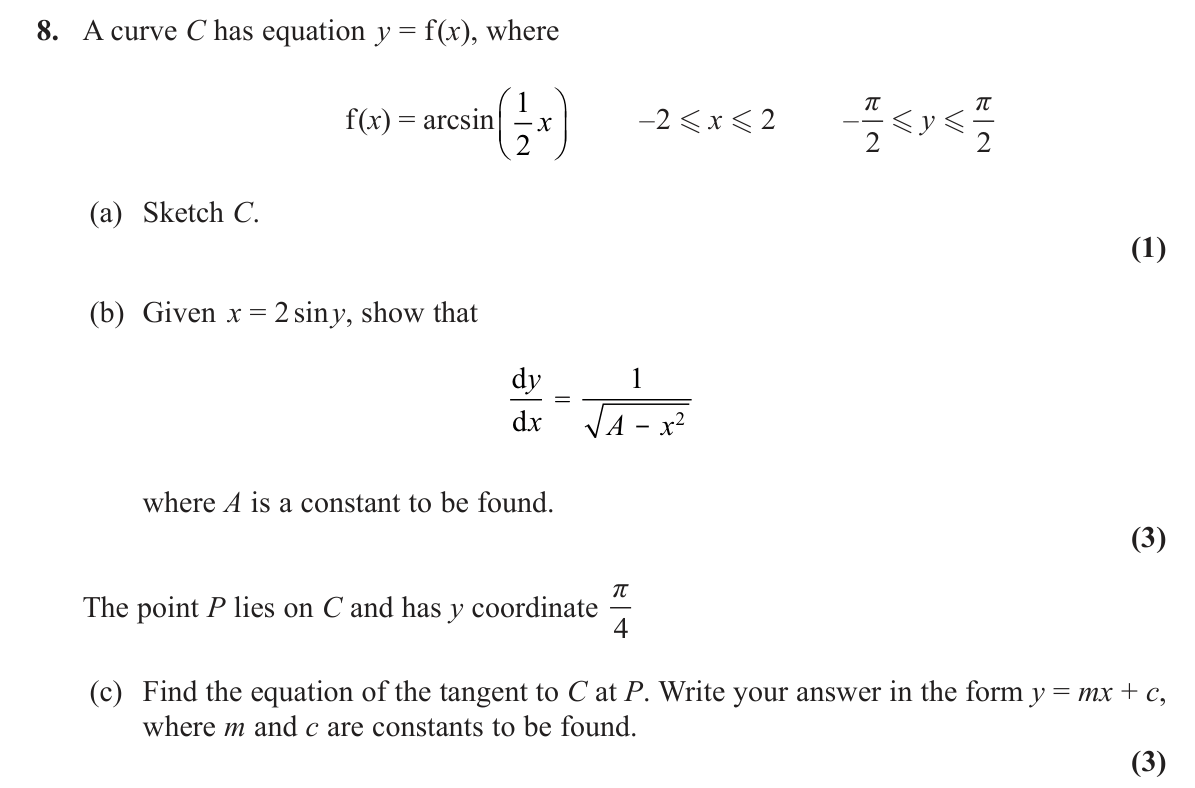
The principal arcsine curve increases from $(-2,-\pi/2)$ through $(0,0)$ to $(2,\pi/2)$. It is concave down on the negative-x half, concave up on the positive-x half, and vertical at both ends.
\[\boxed{y=\arcsin(x/2),\quad -2\le x\le2}\]
Part (b)
Differentiate the supplied inverse relation: $dx/dy=2\cos y$. For $-\pi/2\lt y\lt \pi/2$, cosine is positive, so $\cos y=\sqrt{1-\sin^2y}=\sqrt{1-x^2/4}$. Taking the reciprocal gives
Medium8 marks · main topic: Differentiation TechniquesShow worked solution
Part (i)
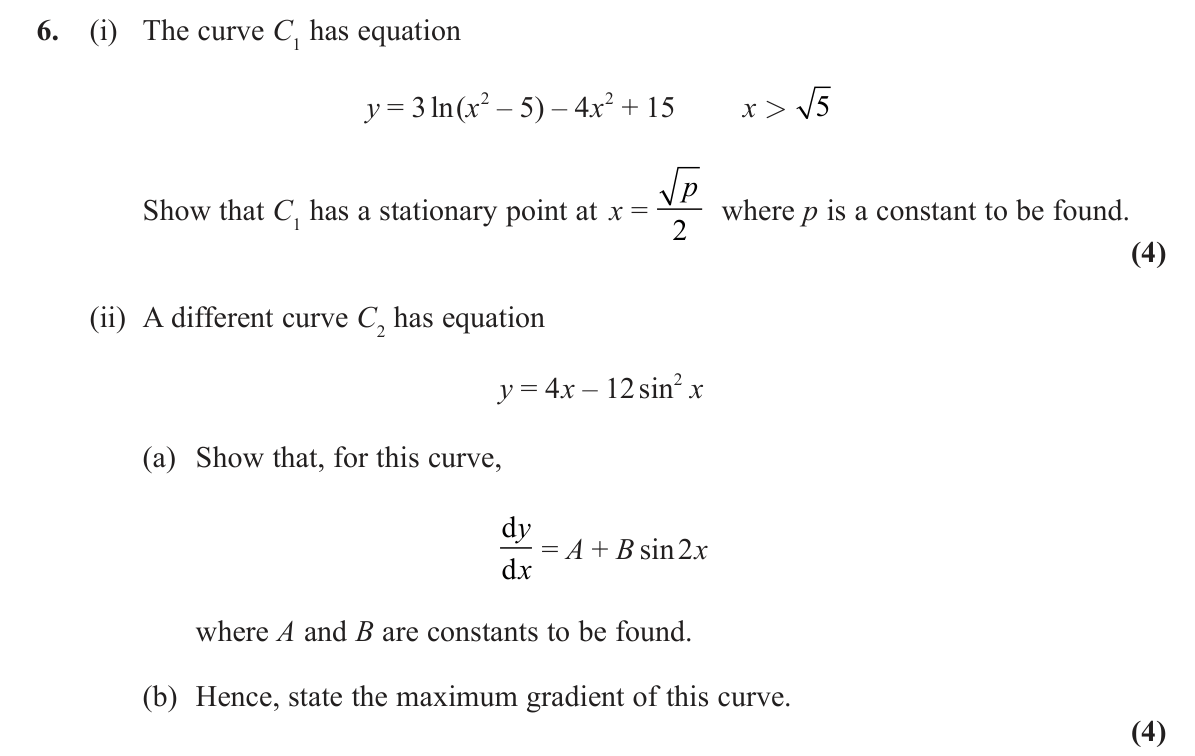
Differentiate to obtain $y'=6x/(x^2-5)-8x$. At a stationary point in $x\gt \sqrt5$, x is nonzero, so $6/(x^2-5)=8$, giving $6=8x^2-40$ and $x^2=23/4$. The original positive domain selects $x=\sqrt{23}/2$, which exceeds $\sqrt5$. Hence $p=23$.
\[\boxed{p=23,\qquad x=\frac{\sqrt{23}}2}\]
Part (ii)
(a) Differentiate the squared sine with the chain rule: $y'=4-24\sin x\cos x=4-12\sin2x$. Thus $A=4$, $B=-12$. (b) Since $-1\le\sin2x\le1$, the largest derivative is attained when $\sin2x=-1$: $4-12(-1)=16$.
(i) $p=23,\qquad x=\frac{\sqrt{23}}2$ (ii) $A=4,\quad B=-12;\qquad\text{maximum gradient}=16$
8. WMA13/01 May/June 2021 · Q9
Medium8 marks · main topic: Trig Equations & R-FormShow worked solution
Part (a)
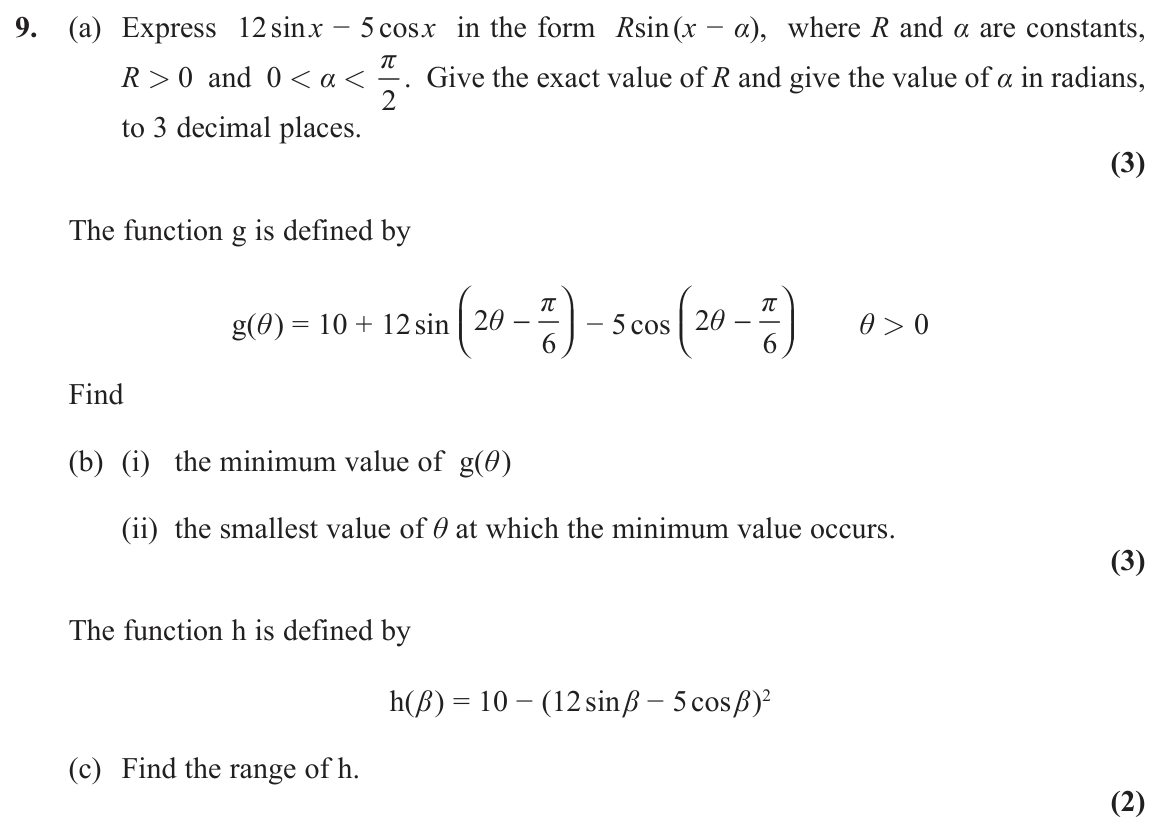
Expand $R\sin(x-\alpha)=R\cos\alpha\sin x-R\sin\alpha\cos x$. Therefore $R\cos\alpha=12$, $R\sin\alpha=5$. Thus $R=\sqrt{12^2+5^2}=13$ and $\alpha=\arctan(5/12)=0.3947911197\ldots$ radians, in the required first quadrant.
Write $g(\theta)=10+13\sin(2\theta-\pi/6-\alpha)$. (i) The minimum is $10-13=-3$. (ii) For sine to equal $-1$, $2\theta-\pi/6-\alpha=-\pi/2+2\pi n$. Hence $\theta=-\pi/6+\alpha/2+\pi n$. For $n=0$ this is negative, so the smallest permitted value uses $n=1$:
As $\beta$ varies over the reals, $12\sin\beta-5\cos\beta$ covers $[-13,13]$. Its square therefore covers $[0,169]$, not $[169,169]$. Subtracting from 10 reverses the bounds, giving $[-159,10]$; both endpoints are attained.
Hard9 marks · main topic: Trig Identities & Exact ValuesShow worked solution
Part (a)
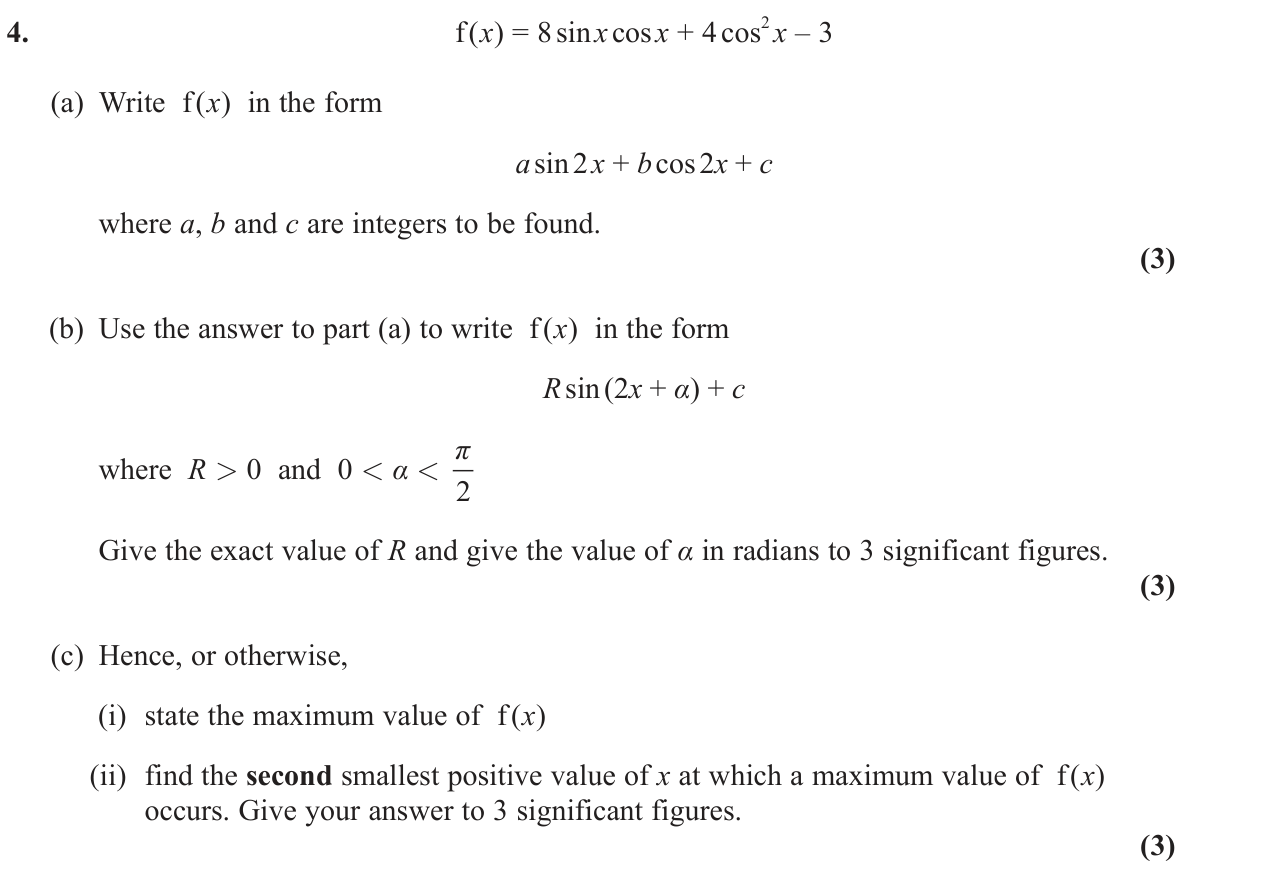
Use $\sin2x=2\sin x\cos x$ and $2\cos^2x=1+\cos2x$:
\[f(x)=4\sin2x+2(1+\cos2x)-3=4\sin2x+2\cos2x-1.\]
\[\boxed{a=4,\quad b=2,\quad c=-1}\]
Part (b)
Expanding $R\sin(2x+\alpha)$ and matching coefficients gives
\[R\cos\alpha=4,\qquad R\sin\alpha=2.\]
Squaring and adding, $R^2=20$, so $R=2\sqrt5$ since $R\gt 0$. Also $\tan\alpha=1/2$, and $0\lt \alpha\lt \pi/2$ selects $\alpha=\arctan(1/2)=0.463647609\ldots$ radians. Thus $f(x)=2\sqrt5\sin(2x+\arctan(1/2))-1$. With the phase displayed to 3 significant figures, $f(x)\approx2\sqrt5\sin(2x+0.464)-1$.
Hard9 marks · main topic: Trig Equations & R-FormShow worked solution
Part (a)
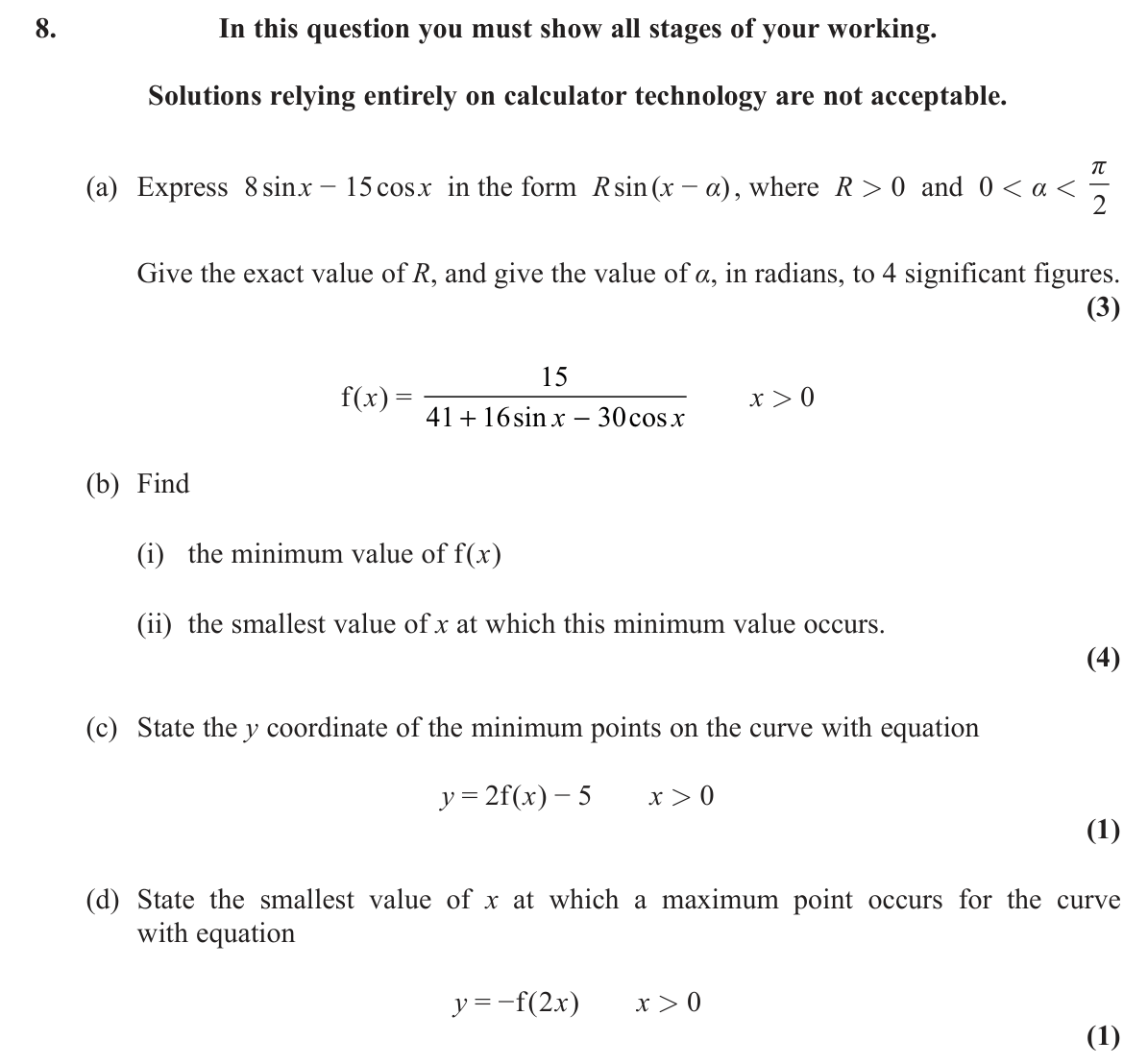
Expand $R\sin(x-\alpha)=R\cos\alpha\sin x-R\sin\alpha\cos x$. Thus $R\cos\alpha=8$, $R\sin\alpha=15$, so $R=\sqrt{64+225}=17$ and $\alpha=\arctan(15/8)=1.0808390005\ldots$ radians, in the required quadrant.
The denominator lies between 7 and 75, so it is always positive. (i) The smallest fraction occurs at its largest denominator: $f_{\min}=15/75=1/5$. (ii) This occurs when $x-\alpha=\pi/2+2n\pi$. The smallest positive value is $x=\alpha+\pi/2=2.6516353273\ldots$, or 2.65 to three significant figures.
\[\boxed{f_{\min}=\frac15,\qquad x=2.65}\]
Part (c)
The transformation $2f(x)-5$ preserves the locations of minima and maps their y coordinate to $2(1/5)-5=-23/5$.
\[\boxed{y=-\frac{23}{5}}\]
Part (d)
Reflection in the x-axis changes minima of f into maxima of $-f$. The argument $2x$ halves their x coordinates, so the first positive maximum is at
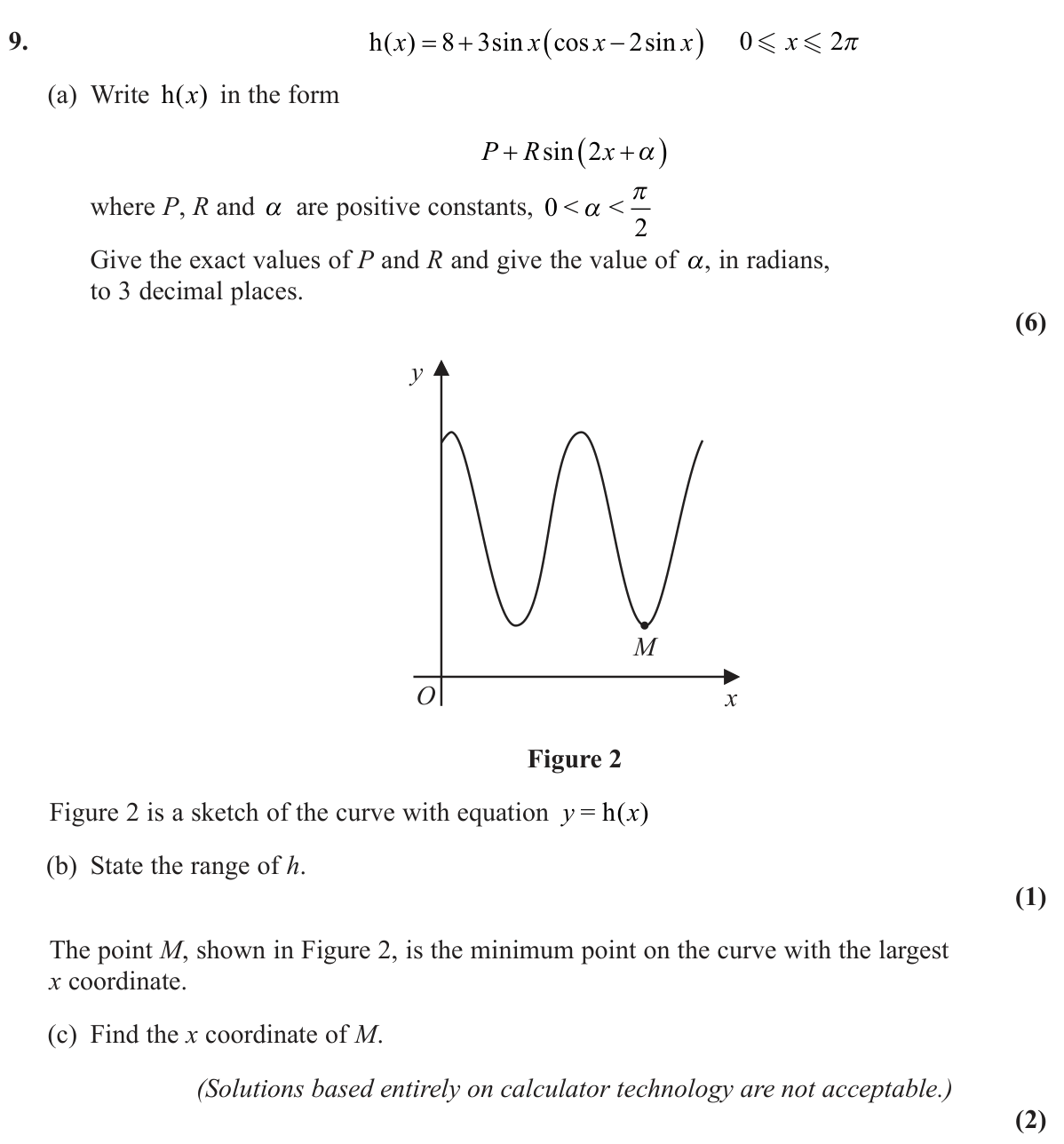
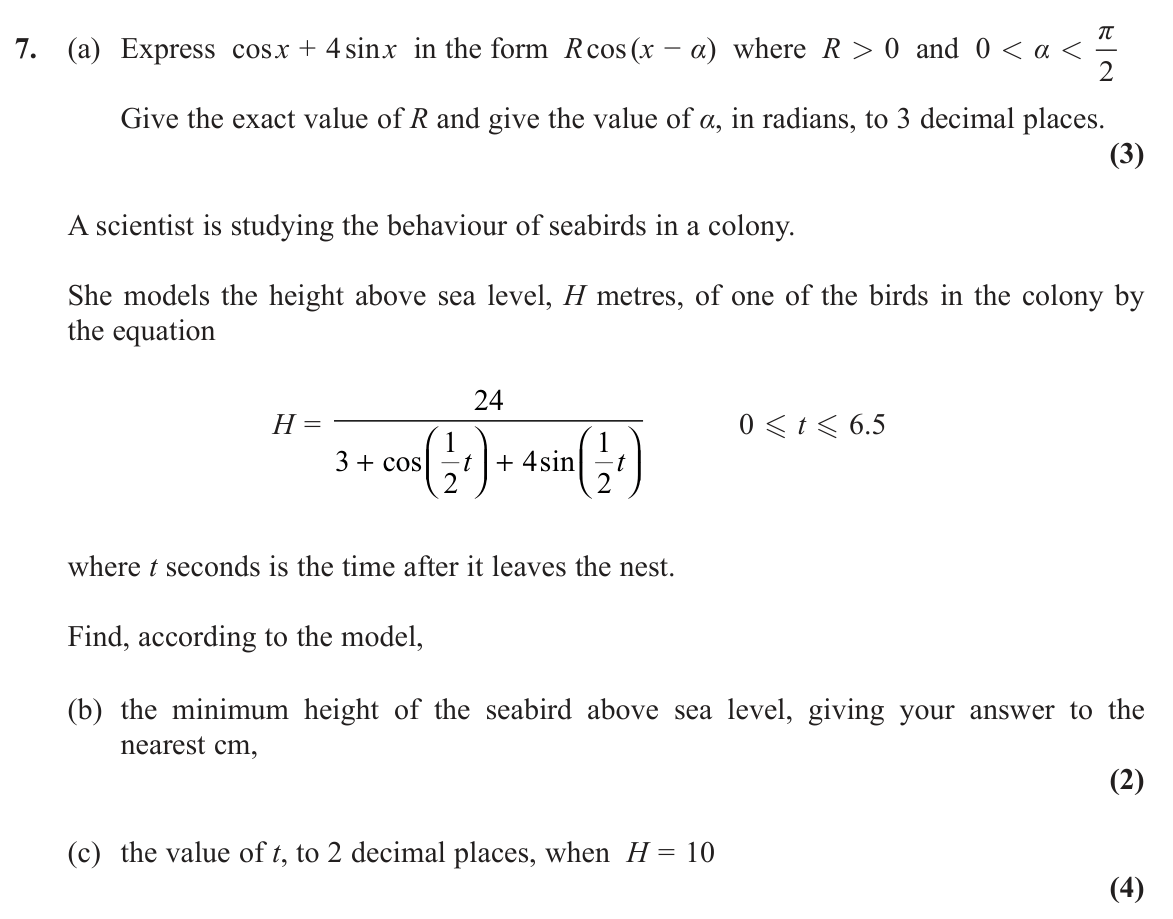
The model becomes $H=24/[3+\sqrt{17}\cos(t/2-\alpha)]$. For $0\le t\le6.5$, the phase lies between $-\alpha$ and $3.25-\alpha$; throughout this interval the denominator remains positive. Its maximum $3+\sqrt{17}$ is attained at $t=2\alpha=2.651635\ldots$, inside the time interval. The height is then smallest:
To the nearest centimetre this is $3.37\ \mathrm m$ (337 cm).
\[\boxed{H_{\min}=3.37\ \mathrm m}\]
Part (c)
For $H=10$, $3+\sqrt{17}\cos(t/2-\alpha)=24/10$, so
\[\cos(t/2-\alpha)=-\frac{3}{5\sqrt{17}}.\]
Let $\gamma=\arccos[-3/(5\sqrt{17})]$. In the permitted phase interval $[-\alpha,3.25-\alpha]$, only $+\gamma$ occurs: $-\gamma\lt -\alpha$, and shifts by $2\pi$ are outside it. Using the unrounded $\alpha=\arctan4$,
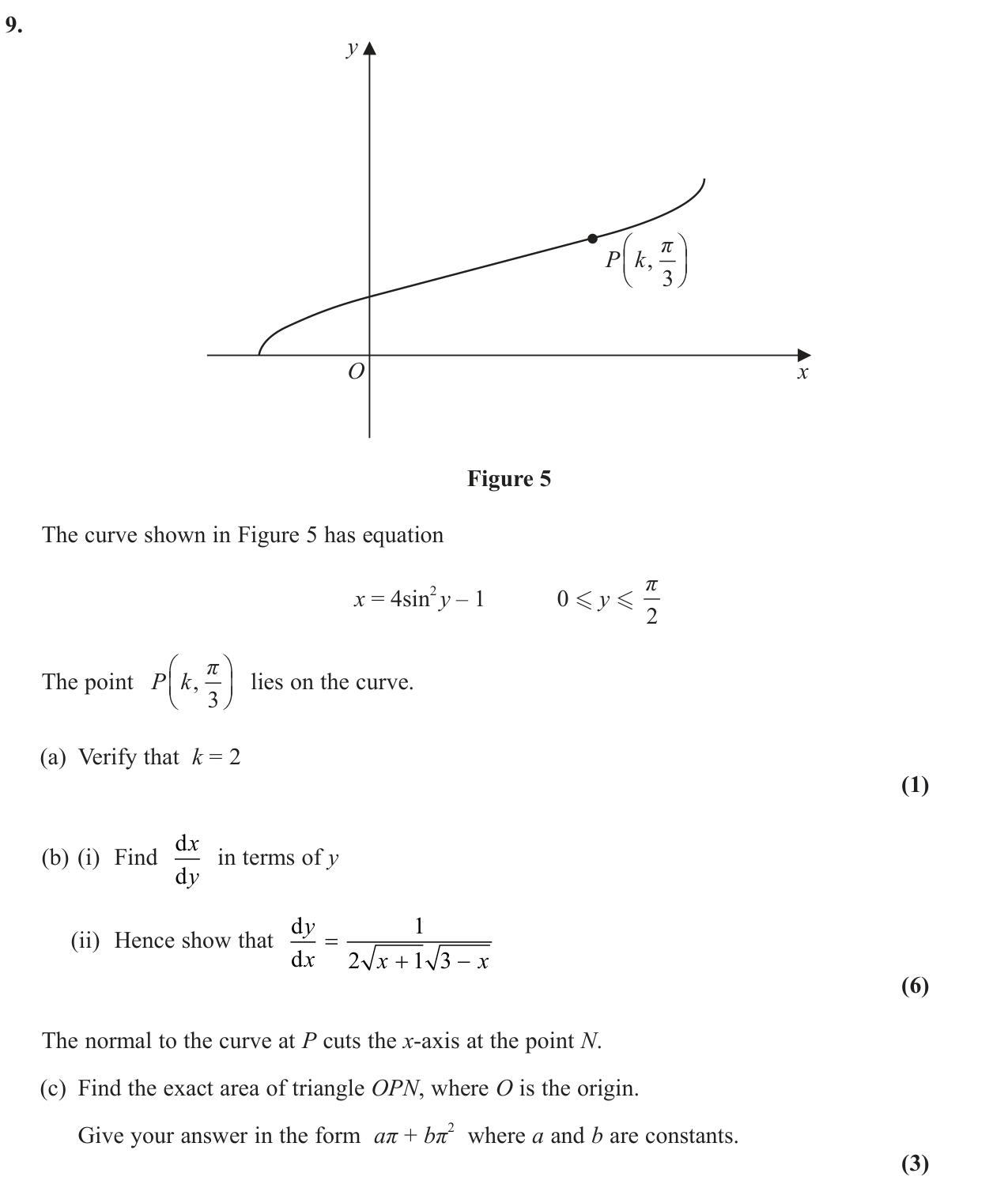
Consequently $dx/dy=2\sqrt{x+1}\sqrt{3-x}$. Taking the reciprocal proves the required formula on $-1\lt x\lt 3$. At $x=-1$ and $x=3$ the denominator is zero: these are endpoint vertical tangents, not finite derivatives.
At $P=(2,\pi/3)$ the tangent gradient is $1/(2\sqrt3)$, so the normal gradient is $-2\sqrt3$. Thus the normal is $y-\pi/3=-2\sqrt3(x-2)$. Setting $y=0$ gives $N=(2+\pi/(6\sqrt3),0)$. Triangle OPN has horizontal base $ON=2+\pi/(6\sqrt3)$ and perpendicular height $\pi/3$:
 Elite Mathematics