Skip to content
Elite Mathematics
IAL · WMA13 · Topic

Numerical Methods: past paper questions & worked solutions

Every Numerical Methods question from the WMA13 papers in our bank, 2020–2026, sorted from easiest to hardest. Try each one first, then open the worked solution.

19questions
161marks in total
100%of papers (19 of 19) include it
5/4/10easy / medium / hard

Questions, easiest first

Level is estimated from marks: 1–6 easy, 7–8 medium, 9+ hard.

1. WMA13/01 October 2023 · Q1

Easy5 marks
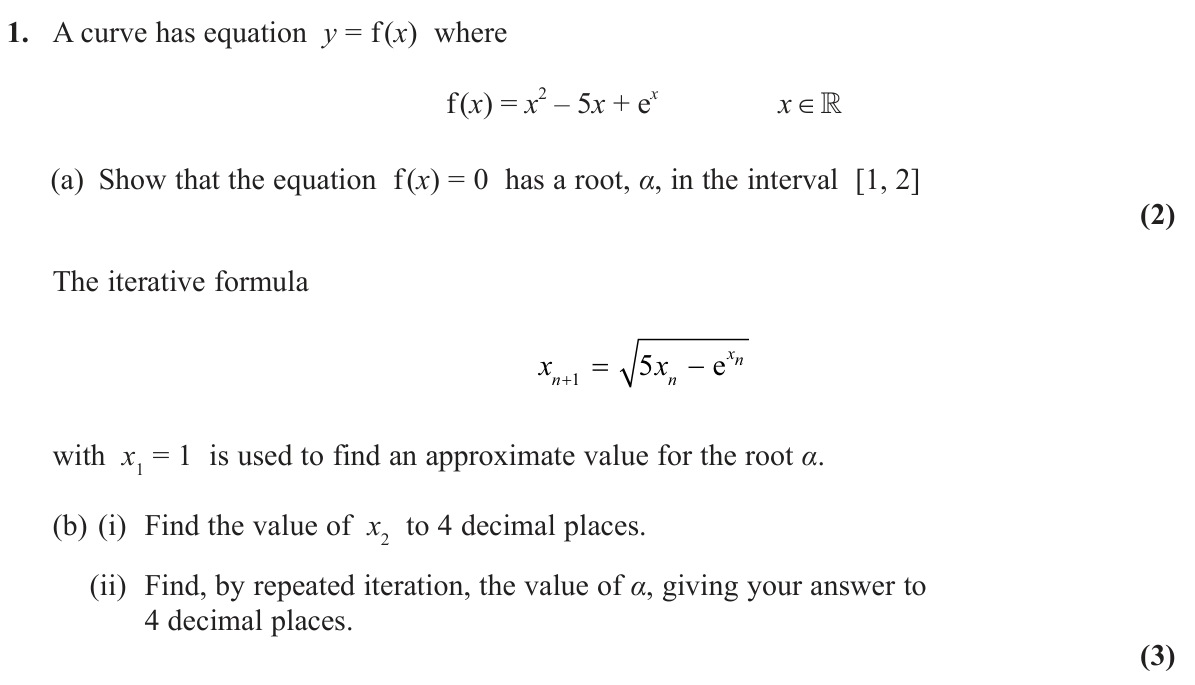
WMA13/01 October 2023 Question 1 (5 marks): Numerical Methods
Show worked solution
  1. Part (a)

    The function $f(x)=x^2-5x+e^x$ is continuous on $[1,2]$.

    \[f(1)=e-4=-1.2817\ldots\lt 0,\qquad f(2)=e^2-6=1.3891\ldots\gt 0.\]

    Since the endpoint values have opposite signs, there is a root strictly between 1 and 2.

    \[\boxed{1\lt \alpha\lt 2}\]
  2. Part (b)

    Using the given iteration with $x_1=1$,

    \[x_2=\sqrt{5-e}=1.5105357\ldots.\]

    Continue with unrounded values:

    \[x_3=1.7388278\ldots,\quad x_4=1.7330522\ldots,\quad x_5=1.7341754\ldots,\quad x_6=1.7339613\ldots.\]

    Subsequent iterates are $1.7340023\ldots,1.7339945\ldots,1.7339960\ldots$, which settle to $1.7339957\ldots$. Thus (i) $x_2=1.5105$ and (ii) $\alpha=1.7340$, each to 4 decimal places.

    \[\boxed{x_2=1.5105,\qquad\alpha=1.7340}\]
Final answer

(a) $1\lt \alpha\lt 2$ (b) $x_2=1.5105,\qquad\alpha=1.7340$
2. WMA13/01 May/June 2023 · Q1

Easy5 marks
WMA13/01 May/June 2023 Question 1 (5 marks): Numerical Methods
Show worked solution
  1. Part (a)

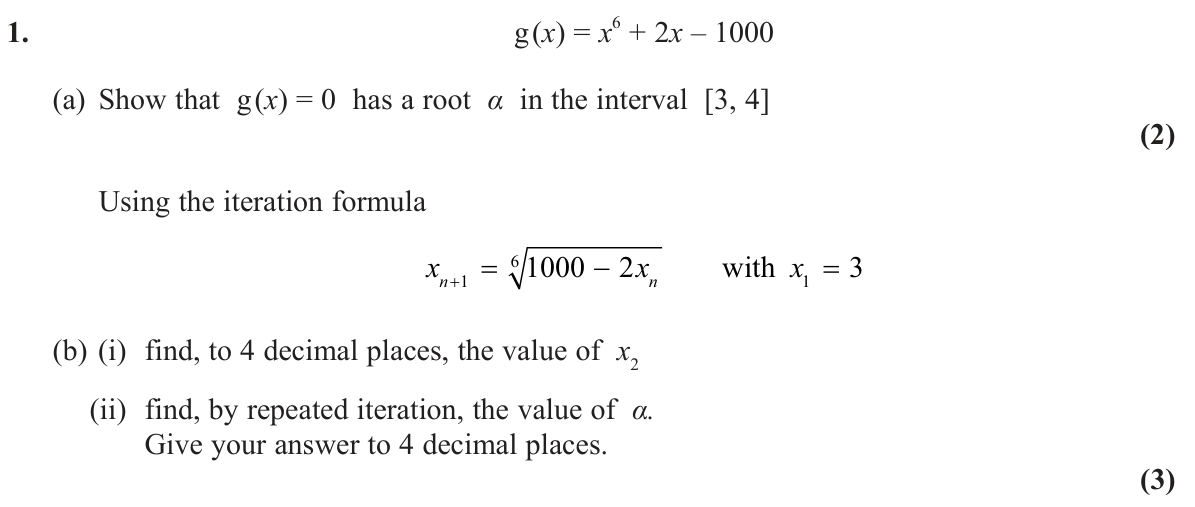
    The polynomial $g$ is continuous on $[3,4]$.

    \[g(3)=729+6-1000=-265\lt 0,\qquad g(4)=4096+8-1000=3104\gt 0.\]

    There is a sign change, so the intermediate value theorem gives a root strictly between 3 and 4.

    \[\boxed{3\lt \alpha\lt 4}\]
  2. Part (b)

    (i) With $x_1=3$, $x_2=\sqrt[6]{994}=3.1591074477\ldots$. (ii) Retaining unrounded values gives

    \[x_3=3.1589388680\ldots,\quad x_4=3.1589390467\ldots,\quad x_5=3.1589390465\ldots.\]

    Further iteration leaves the displayed four decimal places unchanged.

    \[\boxed{x_2=3.1591,\qquad\alpha=3.1589}\]
Final answer

(a) $3\lt \alpha\lt 4$ (b) $x_2=3.1591,\qquad\alpha=3.1589$

3. WMA13/01 January 2026 · Q1

Easy6 marks
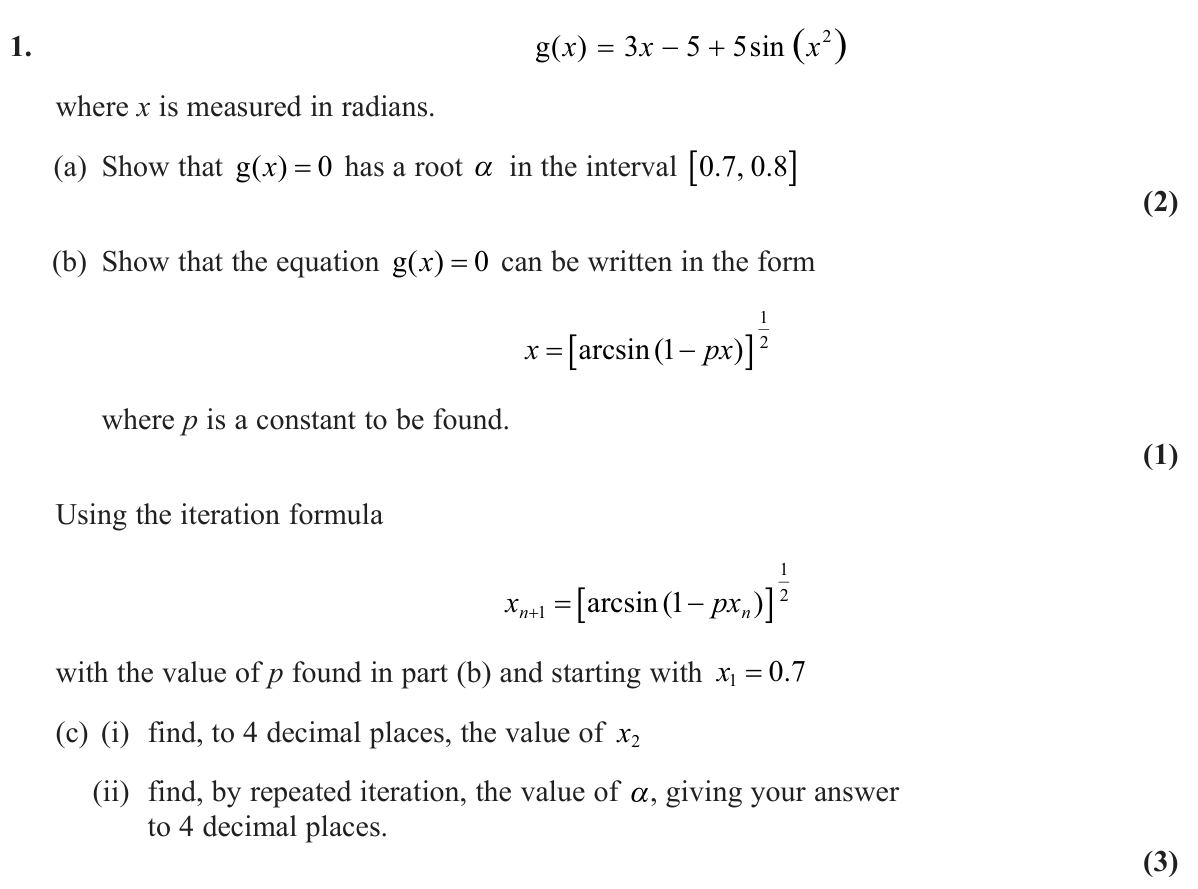
WMA13/01 January 2026 Question 1 (6 marks): Numerical Methods
Show worked solution
  1. Part (a)

    Let $g(x)=3x-5+5\sin(x^2)$. Using radians,

    \[g(0.7)=-0.546870559\ldots,\qquad g(0.8)=0.385977207\ldots.\]

    Since $g$ is continuous and changes sign, a root $\alpha$ lies between $0.7$ and $0.8$.

  2. Part (b)
    \[3x-5+5\sin(x^2)=0 \quad\Longrightarrow\quad \sin(x^2)=1-\frac35x.\]

    On the stated root interval, $0.49\lt x^2\lt 0.64\lt \pi/2$, so the principal inverse sine and positive square root give

    \[x=\sqrt{\arcsin(1-\tfrac35x)},\qquad p=\frac35.\]
  3. Part (c)(i)

    Starting with $x_1=0.7$,

    \[x_2=\sqrt{\arcsin(1-0.6(0.7))}=0.786593091\ldots=0.7866.\]
  4. Part (c)(ii)

    Continue $x_{n+1}=\sqrt{\arcsin(1-0.6x_n)}$ in radians, retaining the full calculator values. The iterates converge to $0.758924378\ldots$, so

    \[\alpha=0.7589\quad\text{(4 decimal places)}.\]
Final answer

(a) $a root $\alpha$ lies between $0.7$ and $0.8$$ (b) $p=\frac35$ (c)(i) $0.7866$ (c)(ii) $\alpha=0.7589$

4. WMA13/01 January 2025 · Q1

Easy6 marks
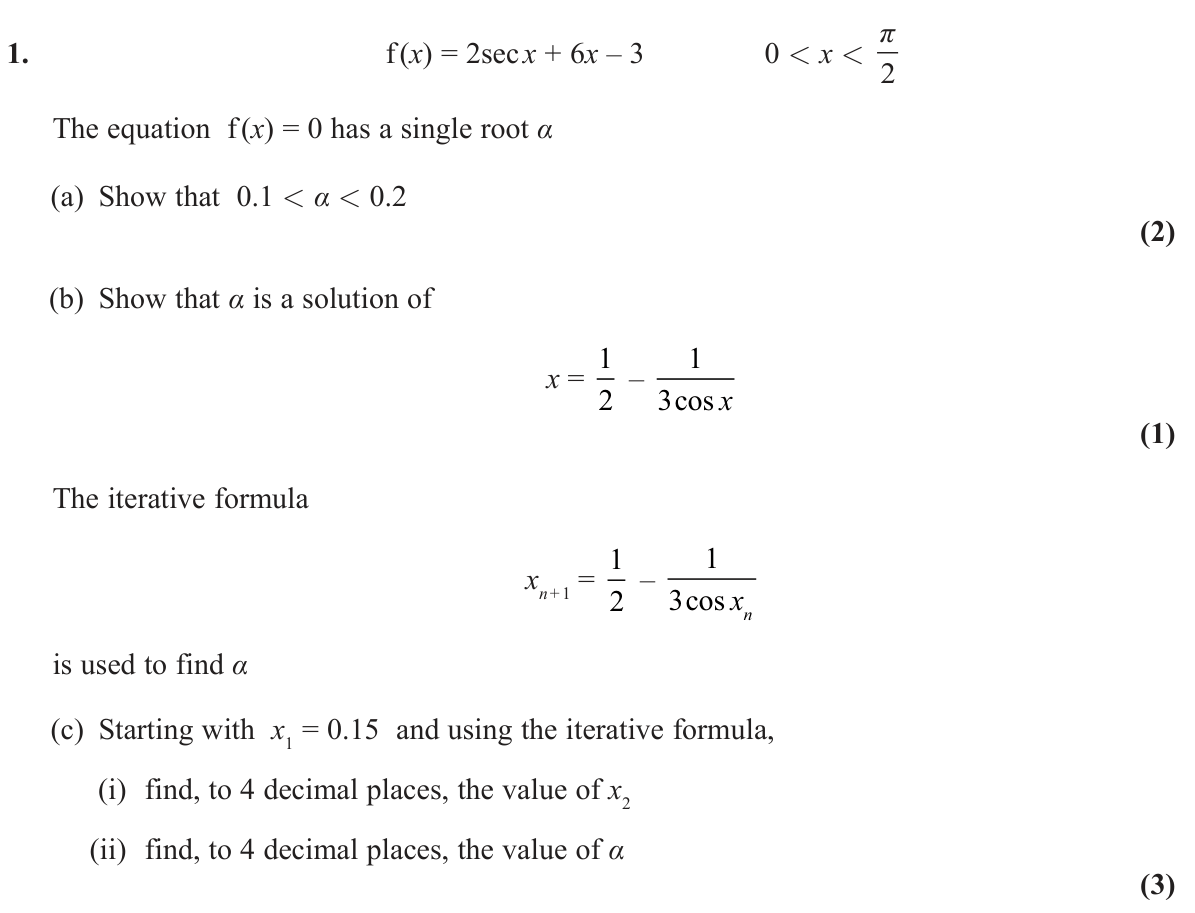
WMA13/01 January 2025 Question 1 (6 marks): Numerical Methods
Show worked solution
  1. Part (a)

    Work in radians. Substituting the endpoints into $f(x)=2\sec x+6x-3$ gives

    \[f(0.1)=-0.3899581632\ldots\lt 0,\qquad f(0.2)=0.2406776899\ldots\gt 0.\]

    The function is continuous on $[0.1,0.2]$ since $\cos x\ne0$ there. The sign change therefore places a root between the endpoints. Since the given root is unique, this root is $\alpha$.

    \[\boxed{0.1\lt \alpha\lt 0.2}\]
  2. Part (b)

    Set $f(x)=0$ and use $\sec x=1/\cos x$:

    \[\frac{2}{\cos x}+6x-3=0 \ \Longrightarrow\ 6x=3-\frac{2}{\cos x} \ \Longrightarrow\ x=\frac12-\frac{1}{3\cos x}.\]

    Thus $\alpha$, which satisfies $f(\alpha)=0$, satisfies this rearranged equation.

    \[\boxed{x=\frac12-\frac{1}{3\cos x}}\]
  3. Part (c)(i)

    With $x_1=0.15$ and angles in radians,

    \[x_2=\frac12-\frac{1}{3\cos(0.15)}=0.1628811858\ldots.\]

    Round only the displayed result to four decimal places.

    \[\boxed{x_2=0.1629}\]
  4. Part (c)(ii)

    Continuing the iteration with unrounded internal values gives

    \[x_3=0.1621955413\ldots,\quad x_4=0.1622335203\ldots,\quad x_5=0.1622314210\ldots,\quad x_6=0.1622315370\ldots.\]

    The iterates settle at $0.16223153\ldots$, giving the root to four decimal places.

    \[\boxed{\alpha=0.1622}\]
Final answer

(a) $0.1\lt \alpha\lt 0.2$ (b) $x=\frac12-\frac{1}{3\cos x}$ (c)(i) $x_2=0.1629$ (c)(ii) $\alpha=0.1622$

5. WMA13/01 January 2024 · Q2

Easy6 marks
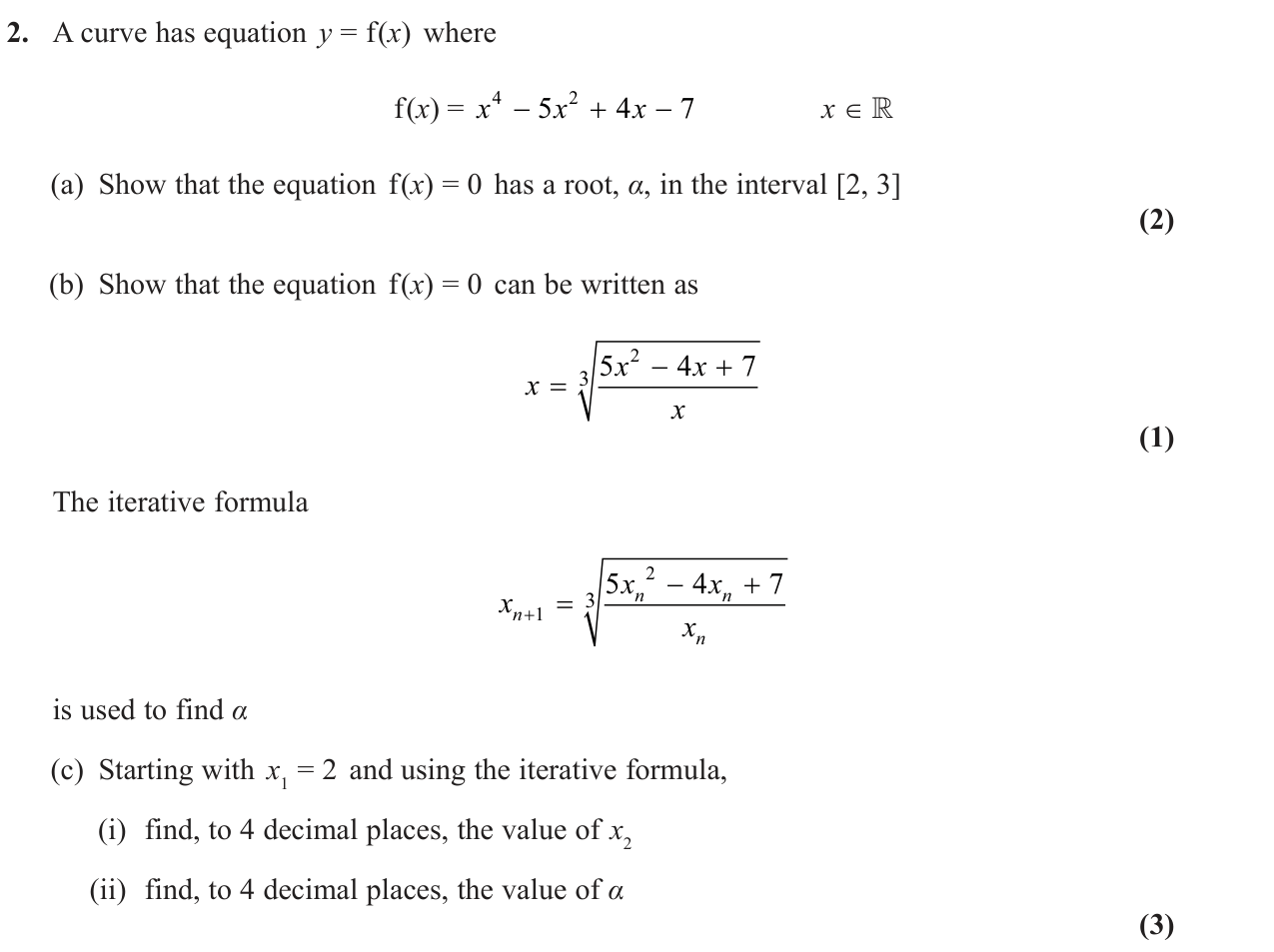
WMA13/01 January 2024 Question 2 (6 marks): Numerical Methods
Show worked solution
  1. Part (a)

    For $f(x)=x^4-5x^2+4x-7$,

    \[f(2)=16-20+8-7=-3,\qquad f(3)=81-45+12-7=41.\]

    The polynomial is continuous on $[2,3]$ and the endpoint values have opposite signs. Therefore a root lies strictly between 2 and 3.

    \[\boxed{2\lt \alpha\lt 3}\]
  2. Part (b)

    Rearrange $x^4-5x^2+4x-7=0$ to $x^4=5x^2-4x+7$. Since $f(0)=-7$, zero is not a root, so division by $x$ is valid at a root:

    \[x^3=\frac{5x^2-4x+7}{x}.\]

    Taking the real cube root gives the requested form.

    \[\boxed{x=\sqrt[3]{\frac{5x^2-4x+7}{x}}}\]
  3. Part (c)

    With $x_1=2$,

    \[x_2=\sqrt[3]{\frac{5(2)^2-4(2)+7}{2}}=\sqrt[3]{\frac{19}{2}}=2.117911792\ldots.\]

    Continue using unrounded intermediate values: $x_3=2.146846021\ldots$, $x_4=2.154063147\ldots$, $x_5=2.155869187\ldots$, $x_6=2.156321484\ldots$. Further iteration gives $x_{10}=2.156472046\ldots$ and $x_{13}=2.156472632\ldots$.

    \[\boxed{x_2=2.1179,\quad\alpha=2.1565}\]
Final answer

(a) $2\lt \alpha\lt 3$ (b) $x=\sqrt[3]{\frac{5x^2-4x+7}{x}}$ (c) $x_2=2.1179,\quad\alpha=2.1565$

6. WMA13/01 October 2025 · Q2

Medium7 marks
WMA13/01 October 2025 Question 2 (7 marks): Numerical Methods
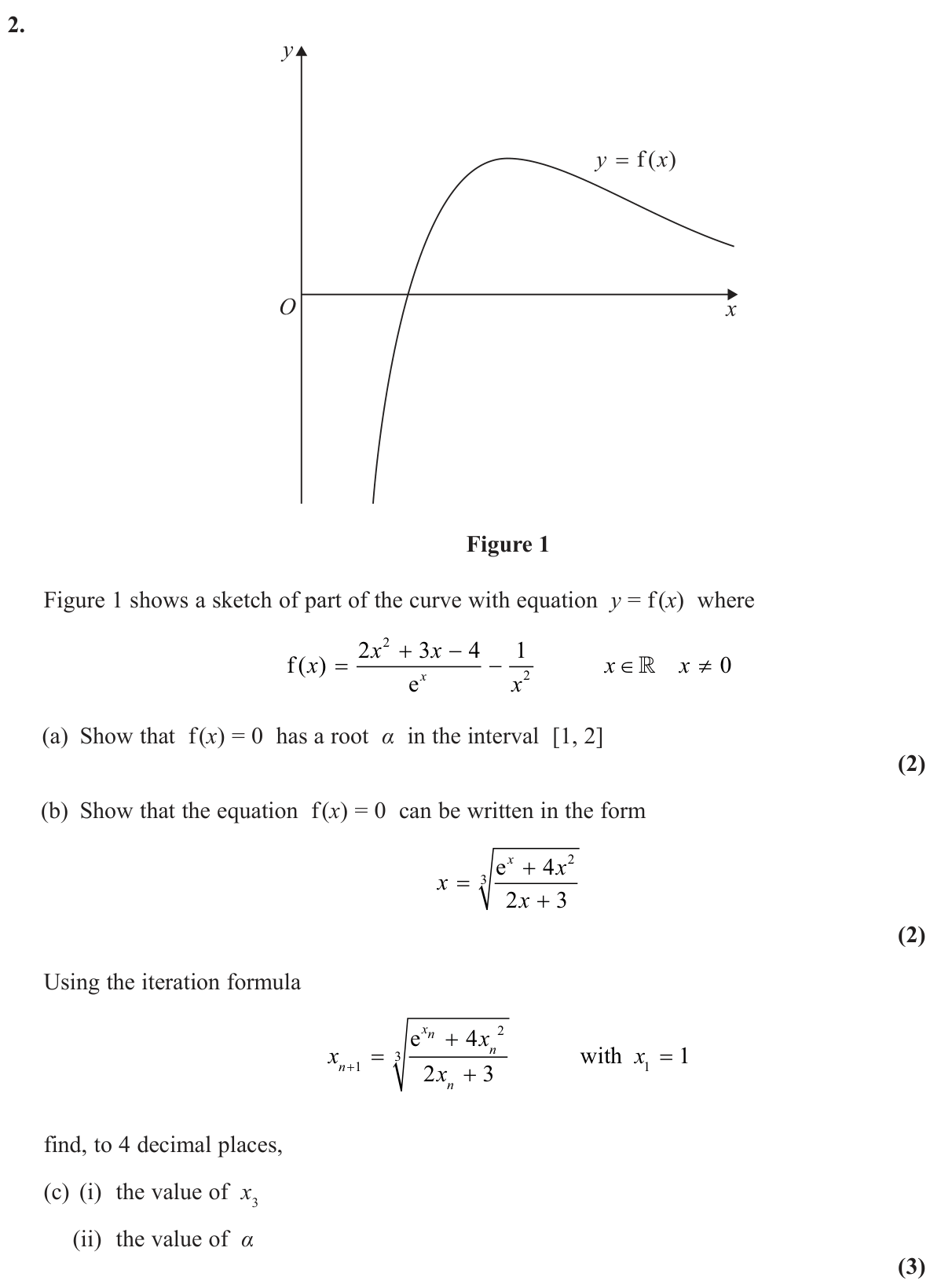
Show worked solution
  1. Part (a)
    \[f(1)=e^{-1}-1=-0.632120559\ldots,\qquad f(2)=10e^{-2}-\frac14=1.103352832\ldots.\]

    The function is continuous on $[1,2]$ and the endpoint values have opposite signs, so a root $\alpha$ lies in $(1,2)$.

  2. Part (b)

    Multiplying $f(x)=0$ by $x^2e^x$, which is nonzero on the stated interval,

    \[x^2(2x^2+3x-4)=e^x \Longrightarrow 2x^4+3x^3=e^x+4x^2 \Longrightarrow x^3(2x+3)=e^x+4x^2.\]

    As $2x+3\gt 0$ here, divide and take the real cube root:

    \[x=\sqrt[3]{\frac{e^x+4x^2}{2x+3}}.\]
  3. Part (c)(i)

    Starting with $x_1=1$ and retaining unrounded values,

    \[x_2=\left(\frac{e+4}{5}\right)^{1/3}=1.103475609\ldots,\qquad x_3=\left(\frac{e^{x_2}+4x_2^2}{2x_2+3}\right)^{1/3} =1.148358496\ldots=1.1484.\]
  4. Part (c)(ii)

    Repeated iteration converges to $1.181331\ldots$, giving $\alpha=1.1813$ to four decimal places.

Final answer

(a) $A root lies in (1,2) by continuity and opposite endpoint signs$ (b) Shown, as required. (c)(i) $1.1484$ (c)(ii) $1.1813$

7. WMA13/01 May/June 2021 · Q1

Medium7 marks
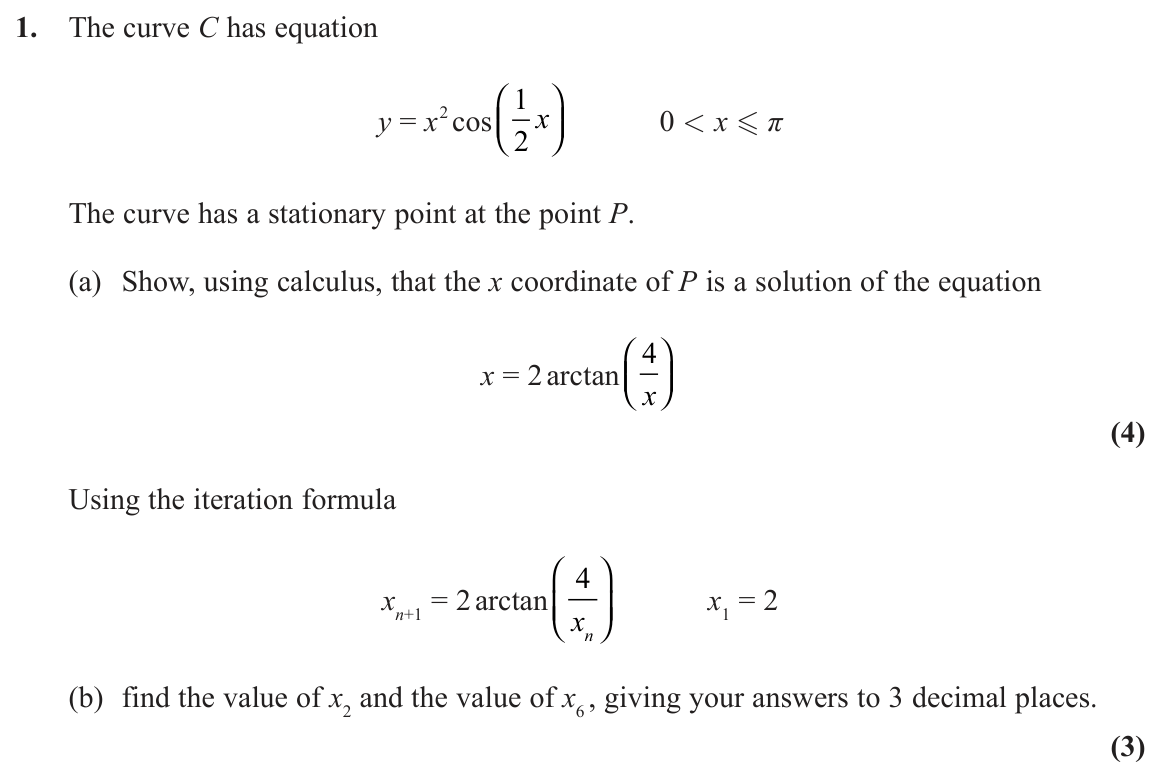
WMA13/01 May/June 2021 Question 1 (7 marks): Numerical Methods
Show worked solution
  1. Part (a)

    Using the product and chain rules,

    \[y'=2x\cos(x/2)-\frac{x^2}{2}\sin(x/2).\]

    At a stationary point, divide by $x/2$, since $x\gt 0$, to obtain $4\cos(x/2)=x\sin(x/2)$. The endpoint $x=\pi$ does not satisfy this equation, so at P we have $0\lt x\lt \pi$ and $\cos(x/2)\gt 0$. Hence $\tan(x/2)=4/x$. The principal arctangent is valid because $0\lt x/2\lt \pi/2$:

    \[x=2\arctan(4/x).\]
    \[\boxed{x=2\arctan(4/x)}\]
  2. Part (b)

    Use radian mode and retain full calculator precision between iterations:

    \[\begin{array}{c|rrrrrr}n&1&2&3&4&5&6\\\hline x_n&2&2.214297436&2.130426058&2.162810067&2.150238622&2.155108774 \end{array}\]

    Thus the requested second and sixth terms, not the limiting value, are as below.

    \[\boxed{x_2=2.214,\qquad x_6=2.155}\]
Final answer

(a) $x=2\arctan(4/x)$ (b) $x_2=2.214,\qquad x_6=2.155$

8. WMA13/01 May/June 2026 · Q1

Medium8 marks
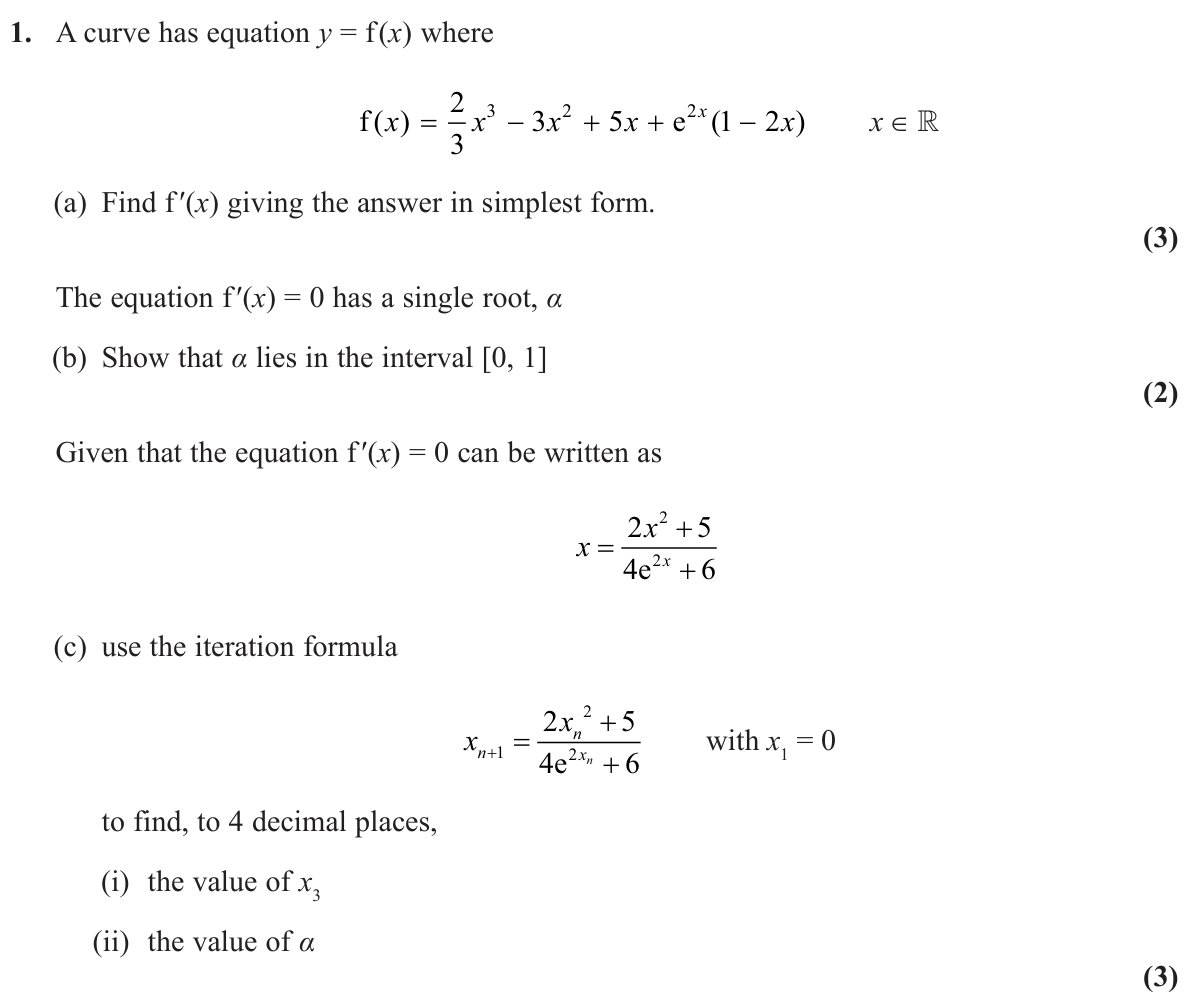
WMA13/01 May/June 2026 Question 1 (8 marks): Numerical Methods
Show worked solution
  1. Part (a)

    Apply the product rule to the exponential term:

    \[f'(x)=2x^2-6x+5+2e^{2x}(1-2x)-2e^{2x} =\boxed{2x^2-6x+5-4xe^{2x}}.\]
  2. Part (b)

    The derivative is continuous on $[0,1]$, and

    \[f'(0)=5\gt 0,\qquad f'(1)=1-4e^2\approx-28.5562\lt 0.\]

    The change of sign therefore places a zero of $f'$ between 0 and 1. Since the zero is unique, $\boxed{\alpha\in(0,1)}$, and hence it is in $[0,1]$.

  3. Part (c)(i)

    Start at $x_1=0$, retaining unrounded values in each substitution:

    \[x_2=\frac{2(0)^2+5}{4e^0+6}=0.5,\qquad x_3=\frac{2(0.5)^2+5}{4e^1+6}=0.3259620992\ldots.\]

    Thus $\boxed{x_3=0.3260}$ to 4 decimal places.

  4. Part (c)(ii)

    Continuing the supplied iteration gives

    \[\begin{array}{c|rrrrrr} n&4&5&6&7&8&9\\\hline x_n&0.381116669&0.363053595&0.368908652&0.367004338&0.367623025&0.367421950 \end{array}\]
    \[x_{10}=0.3674872922,\quad x_{11}=0.3674660574,\quad x_{12}=0.3674729582,\quad x_{13}=0.3674707156.\]

    Further iteration stabilises at $0.367471265\ldots$, so $\boxed{\alpha=0.3675}$ to 4 decimal places.

Final answer

(a) $2x^2-6x+5-4xe^{2x}$ (b) $\alpha\in(0,1)$ (c)(i) $x_3=0.3260$ (c)(ii) $\alpha=0.3675$

9. WMA13/01 January 2021 · Q6

Medium8 marks
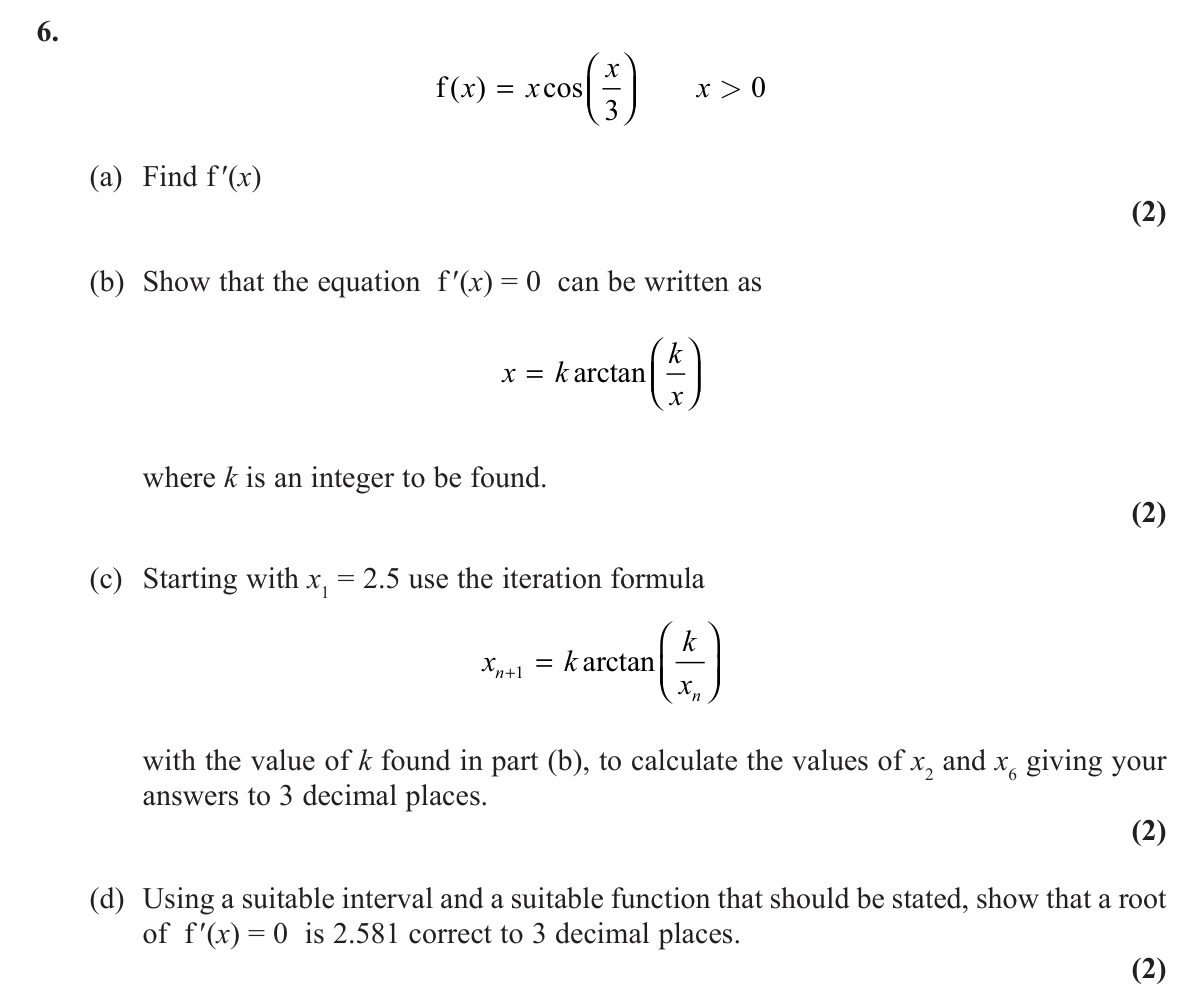
WMA13/01 January 2021 Question 6 (8 marks): Numerical Methods
Show worked solution
  1. Part (a)

    By the product and chain rules, $f'(x)=\cos(x/3)-(x/3)\sin(x/3)$.

    \[\boxed{f^{\prime}(x)=\cos(x/3)-\frac{x}{3}\sin(x/3)}\]
  2. Part (b)

    Set $f'(x)=0$: $\cos(x/3)=(x/3)\sin(x/3)$. At a solution, cosine cannot vanish (that would leave a nonzero right side), so $\tan(x/3)=3/x$. On the principal positive branch $0\lt x/3\lt \pi/2$, this gives

    \[x=3\arctan(3/x),\qquad k=3.\]

    This is the branch used by the supplied iteration for the root near 2.581. The original domain $x\gt 0$ also admits later tangent branches: in general $x=3\arctan(3/x)+3n\pi$. The principal-branch rearrangement must not be interpreted as listing every positive stationary point.

    \[\boxed{k=3;\quad x=3\arctan(3/x)\text{ on the selected branch}}\]
  3. Part (c)

    Using radians and $x_1=2.5$, the successive values are

    \[\begin{array}{c|rrrrrr}n&1&2&3&4&5&6\\\hline x_n&2.5&2.628174152&2.554102174&2.596526871&2.572101407&2.586122337 \end{array}\]

    Keep full precision between steps and round the requested terms only.

    \[\boxed{x_2=2.628,\qquad x_6=2.586}\]
  4. Part (d)

    Define $F(x)=\cos(x/3)-(x/3)\sin(x/3)$, which is continuous near 2.581. The rounding interval endpoints give

    \[F(2.5805)=0.0003467157\ldots\gt 0,\qquad F(2.5815)=-0.0003456897\ldots\lt 0.\]

    By continuity a root lies strictly between these endpoints; every number in this open interval rounds to 2.581 to three decimal places.

    \[\boxed{x=2.581\text{ correct to 3 d.p.}}\]
Final answer

(a) $f^{\prime}(x)=\cos(x/3)-\frac{x}{3}\sin(x/3)$ (b) $k=3;\quad x=3\arctan(3/x)\text{ on the selected branch}$ (c) $x_2=2.628,\qquad x_6=2.586$ (d) $x=2.581\text{ correct to 3 d.p.}$

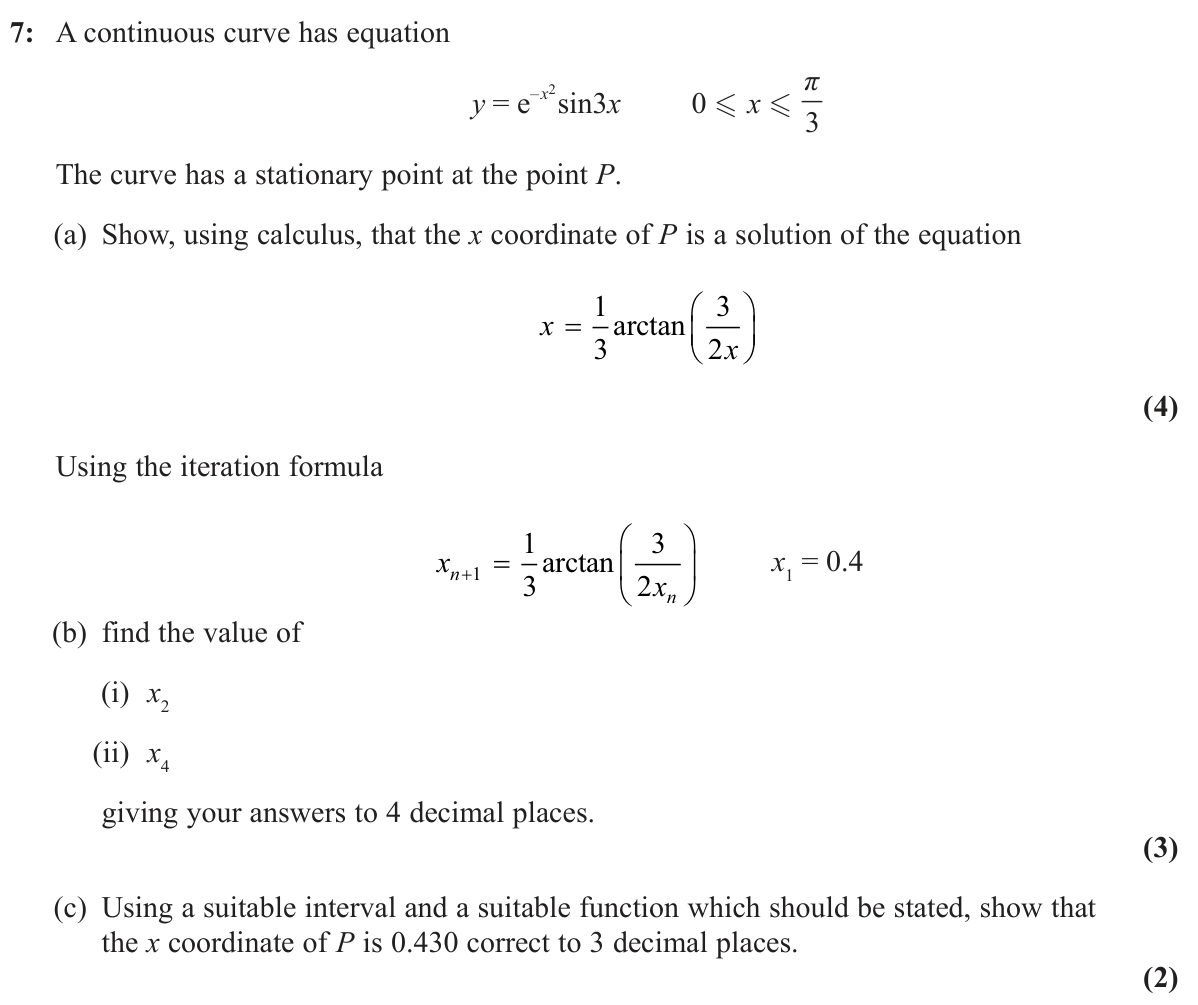
10. WMA13/01 May/June 2025 · Q7

Hard9 marks
WMA13/01 May/June 2025 Question 7 (9 marks): Numerical Methods
Show worked solution
  1. Part (a)

    Apply the product and chain rules:

    \[\frac{dy}{dx}=e^{-x^2}\bigl(3\cos3x-2x\sin3x\bigr).\]

    Since $e^{-x^2}\gt 0$, a stationary point satisfies

    \[3\cos3x=2x\sin3x.\]

    Neither endpoint $x=0,\pi/3$ is stationary. In the interior $\sin3x\gt 0$ and $x\gt 0$, so $\cos3x\gt 0$ at a stationary point and $0\lt 3x\lt \pi/2$. Therefore division and the principal inverse tangent are valid:

    \[\tan3x=\frac3{2x}\quad\Longrightarrow\quad \boxed{x=\frac13\arctan\left(\frac3{2x}\right)}.\]
  2. Part (b)

    Work in radians and retain calculator precision between iterations:

    \[x_2=\frac13\arctan\frac3{0.8}=0.4367313117\ldots,\]
    \[x_3=0.4291581882\ldots,\qquad x_4=0.4307116849\ldots.\]

    Thus (i) $\boxed{x_2=0.4367}$ and (ii) $\boxed{x_4=0.4307}$.

  3. Part (c)

    Let $h(x)=3\cos3x-2x\sin3x$, which is continuous. At the rounding boundaries,

    \[h(0.4295)=0.0106861\ldots\gt 0,\qquad h(0.4305)=-0.000598027\ldots\lt 0.\]

    The sign change places a root strictly between $0.4295$ and $0.4305$. On $0\lt x\lt \pi/6$, $h'(x)=-11\sin3x-6x\cos3x\lt 0$, so the stationary root is unique; for $\pi/6\leq x\leq\pi/3$, $h(x)\lt 0$. Hence the $x$ coordinate of $P$ is $\boxed{0.430\text{ to 3 decimal places}}$.

Final answer

(a) $x=\frac13\arctan\left(\frac3{2x}\right)$ (b) $x_2=0.4367$, $x_4=0.4307$ (c) $0.430\text{ to 3 decimal places}$

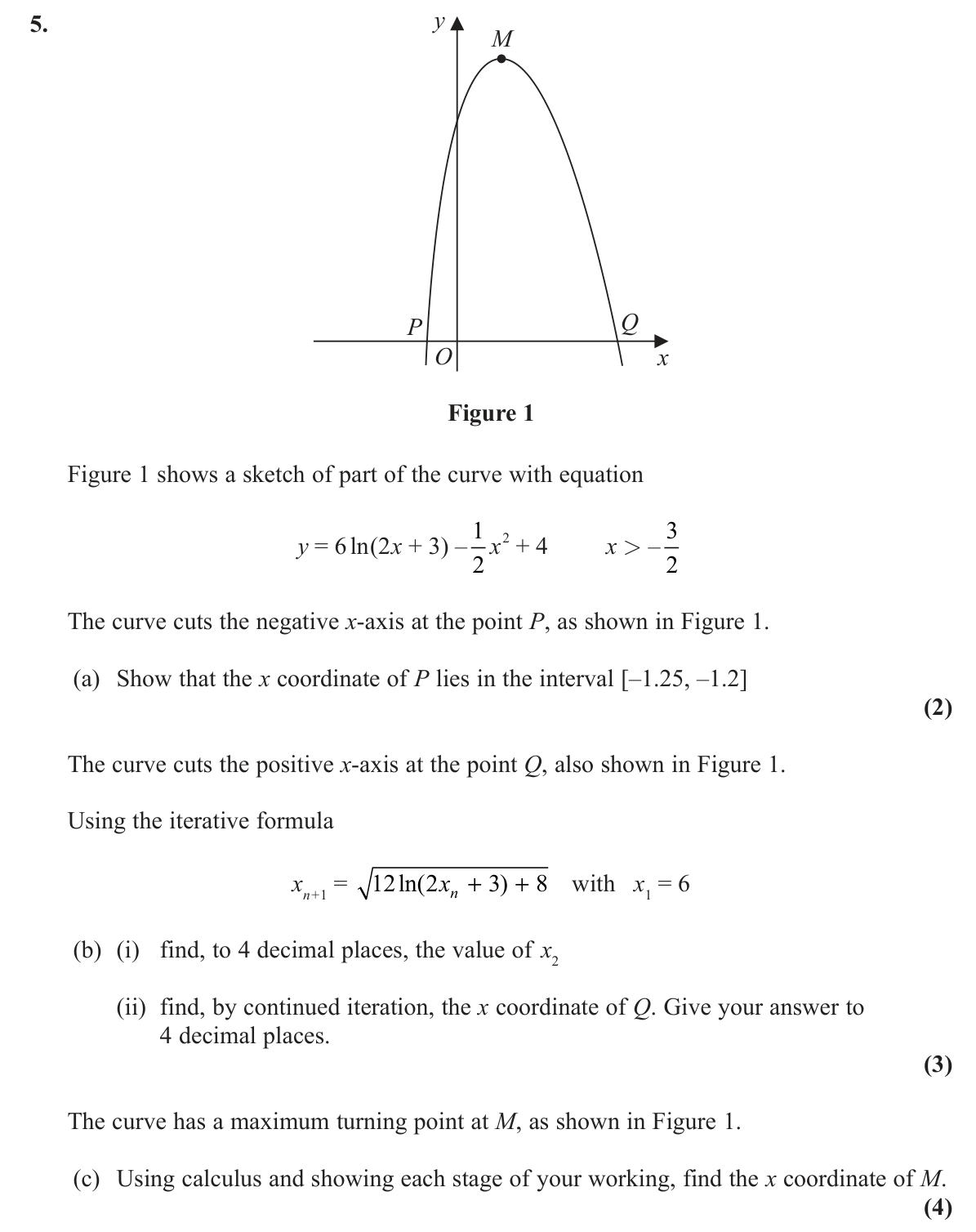
11. WMA13/01 January 2022 · Q5

Hard9 marks · main topic: Applications of Differentiation
WMA13/01 January 2022 Question 5 (9 marks): Numerical Methods
Show worked solution
  1. Part (a)

    Let $F(x)=6\ln(2x+3)-x^2/2+4$. Then $F(-1.25)=-0.94013308\ldots$ and $F(-1.2)=0.21504626\ldots$. The log argument is positive on this interval, so F is continuous there. The change of sign proves a zero between these endpoints, giving the stated bracket for P.

    \[\boxed{-1.25\lt x_P\lt -1.2}\]
  2. Part (b)

    Apply the given recurrence with $x_1=6$:

    \[x_2=\sqrt{12\ln15+8}=6.363694085\ldots.\]

    Continuing without rounding the internal values,

    \[x_3=6.408185698\ldots,\quad x_4=6.413466053\ldots,\quad x_5=6.414090476\ldots,\quad x_6=6.414164285\ldots,\quad x_7=6.414173009\ldots.\]

    Further iteration settles at $6.41417418\ldots$. The positive square-root branch corresponds to Q.

    \[\boxed{\text{(i) }x_2=6.3637,\qquad\text{(ii) }x_Q=6.4142}\]
  3. Part (c)

    Differentiate: $F'(x)=12/(2x+3)-x$. For a stationary point, $12=x(2x+3)$, or $2x^2+3x-12=0$. The quadratic formula gives $x=(-3\pm\sqrt{105})/4$. The negative choice is less than $-3/2$ and outside the original domain. Also $F”(x)=-24/(2x+3)^2-1\lt 0$, confirming the admissible point is a maximum.

    \[\boxed{x_M=\frac{-3+\sqrt{105}}4}\]
Final answer

(a) $-1.25\lt x_P\lt -1.2$ (b) $\text{(i) }x_2=6.3637,\qquad\text{(ii) }x_Q=6.4142$ (c) $x_M=\frac{-3+\sqrt{105}}4$

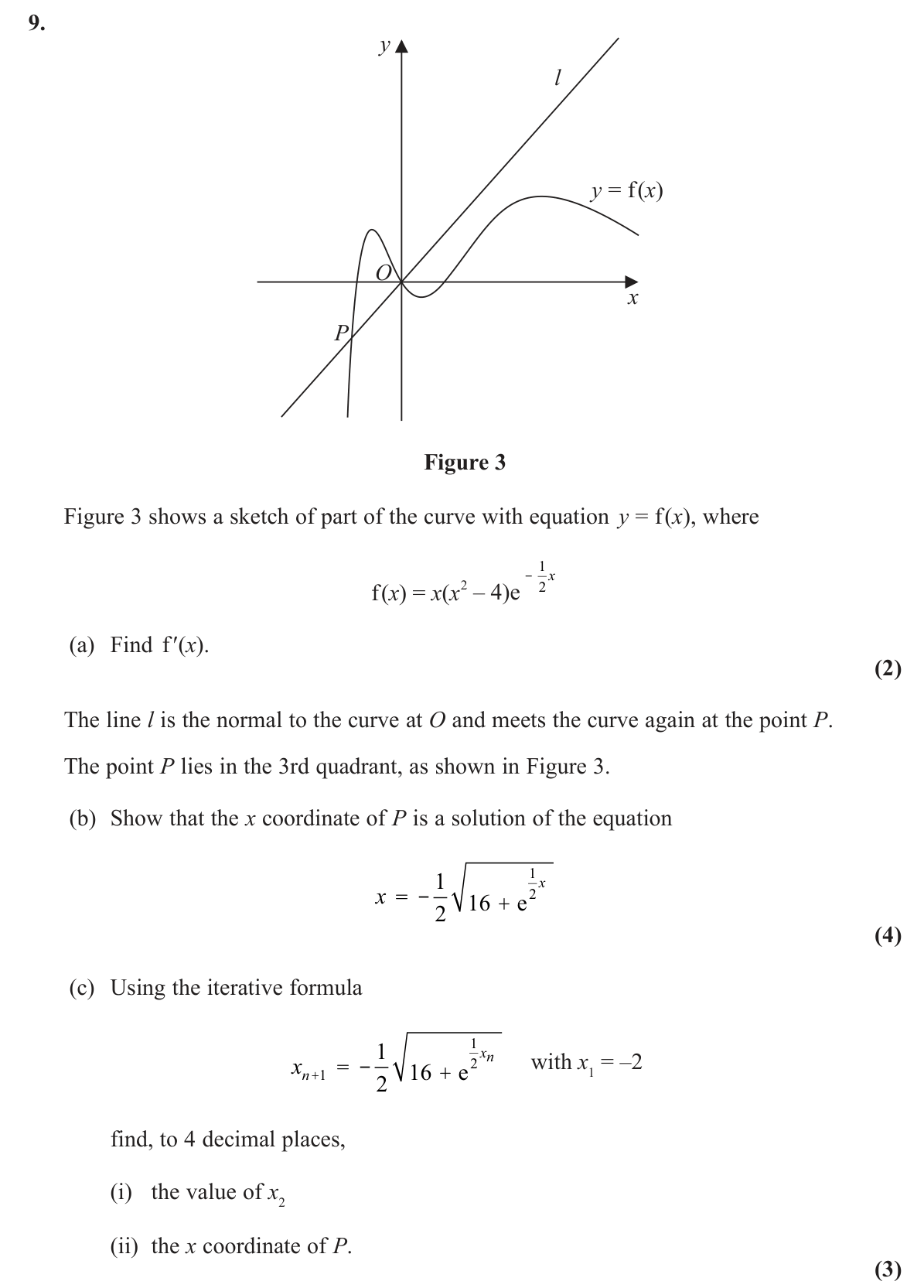
12. WMA13/01 October 2021 · Q9

Hard9 marks
WMA13/01 October 2021 Question 9 (9 marks): Numerical Methods
Show worked solution
  1. Part (a)

    Write $f(x)=(x^3-4x)e^{-x/2}$. By the product rule,

    \[f'(x)=(3x^2-4)e^{-x/2}-\frac12(x^3-4x)e^{-x/2} =e^{-x/2}\left(-\frac{x^3}{2}+3x^2+2x-4\right).\]
    \[\boxed{f^{\prime}(x)=e^{-x/2}(-x^3/2+3x^2+2x-4)}\]
  2. Part (b)

    At O, $f'(0)=-4$, so the normal gradient is $1/4$ and its equation is $y=x/4$. At the other intersection P, x is nonzero; equating curve and normal and dividing by x gives $(x^2-4)e^{-x/2}=1/4$. Thus $x^2=4+e^{x/2}/4=(16+e^{x/2})/4$. Since P lies in the third quadrant, select the negative square root.

    \[\boxed{x=-\frac12\sqrt{16+e^{x/2}}}\]
  3. Part (c)

    Starting from $x_1=-2$, $x_2=-\tfrac12\sqrt{16+e^{-1}}=-2.0228617996\ldots$. Further unrounded iterates are $x_3=-2.0226034084\ldots$, $x_4=-2.0226063126\ldots$ and $x_5=-2.0226062799\ldots$. The continuing sequence settles at $-2.0226062803\ldots$.

    \[\boxed{\text{(i) }x_2=-2.0229;\qquad\text{(ii) }x_P=-2.0226}\]
Final answer

(a) $f^{\prime}(x)=e^{-x/2}(-x^3/2+3x^2+2x-4)$ (b) $x=-\frac12\sqrt{16+e^{x/2}}$ (c) $\text{(i) }x_2=-2.0229;\qquad\text{(ii) }x_P=-2.0226$

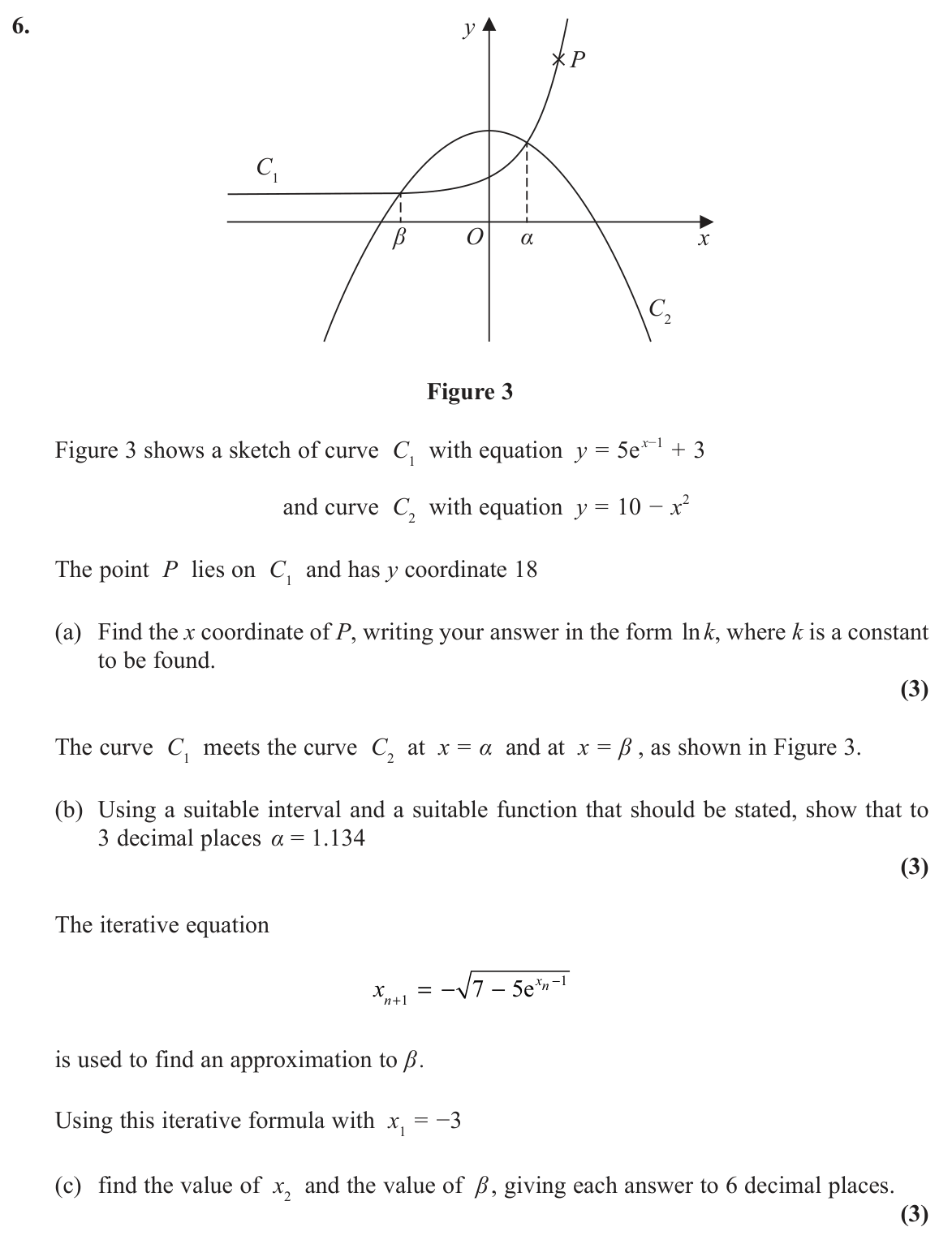
13. WMA13/01 October 2020 · Q6

Hard9 marks
WMA13/01 October 2020 Question 6 (9 marks): Numerical Methods
Show worked solution
  1. Part (a)

    At P, $18=5e^{x-1}+3$, so $e^{x-1}=3$. Taking natural logarithms gives $x-1=\ln3$, hence $x=1+\ln3=\ln e+\ln3=\ln(3e)$.

    \[\boxed{x=\ln(3e),\qquad k=3e}\]
  2. Part (b)

    Define $F(x)=5e^{x-1}+x^2-7$; its zeros are the intersection abscissae, and F is continuous. At the endpoints of the three-decimal rounding interval,

    \[F(1.1335)=-0.0010714193\ldots\lt 0,\qquad F(1.1345)=0.0069135450\ldots\gt 0.\]

    Continuity guarantees a root between them. Moreover $F'(x)=5e^{x-1}+2x\gt 0$ on this positive interval, so that root is unique there. It is the positive intersection $\alpha$, and rounds to 1.134 to three decimal places.

    \[\boxed{\alpha=1.134\text{ to 3 d.p.}}\]
  3. Part (c)

    Start at $x_1=-3$ and keep full precision in $x_{n+1}=-\sqrt{7-5e^{x_n-1}}$:

    \[\begin{array}{c|r}n&x_n\\\hline 1&-3\\2&-2.628387681746\\3&-2.620535277934\\ 4&-2.620335527988\\5&-2.620330426051\\6&-2.620330295726\\7&-2.620330292397 \end{array}\]

    The later iterates agree to six decimal places. The negative root corresponds to $\beta$ in the figure.

    \[\boxed{x_2=-2.628388,\qquad\beta=-2.620330}\]
Final answer

(a) $x=\ln(3e),\qquad k=3e$ (b) $\alpha=1.134\text{ to 3 d.p.}$ (c) $x_2=-2.628388,\qquad\beta=-2.620330$

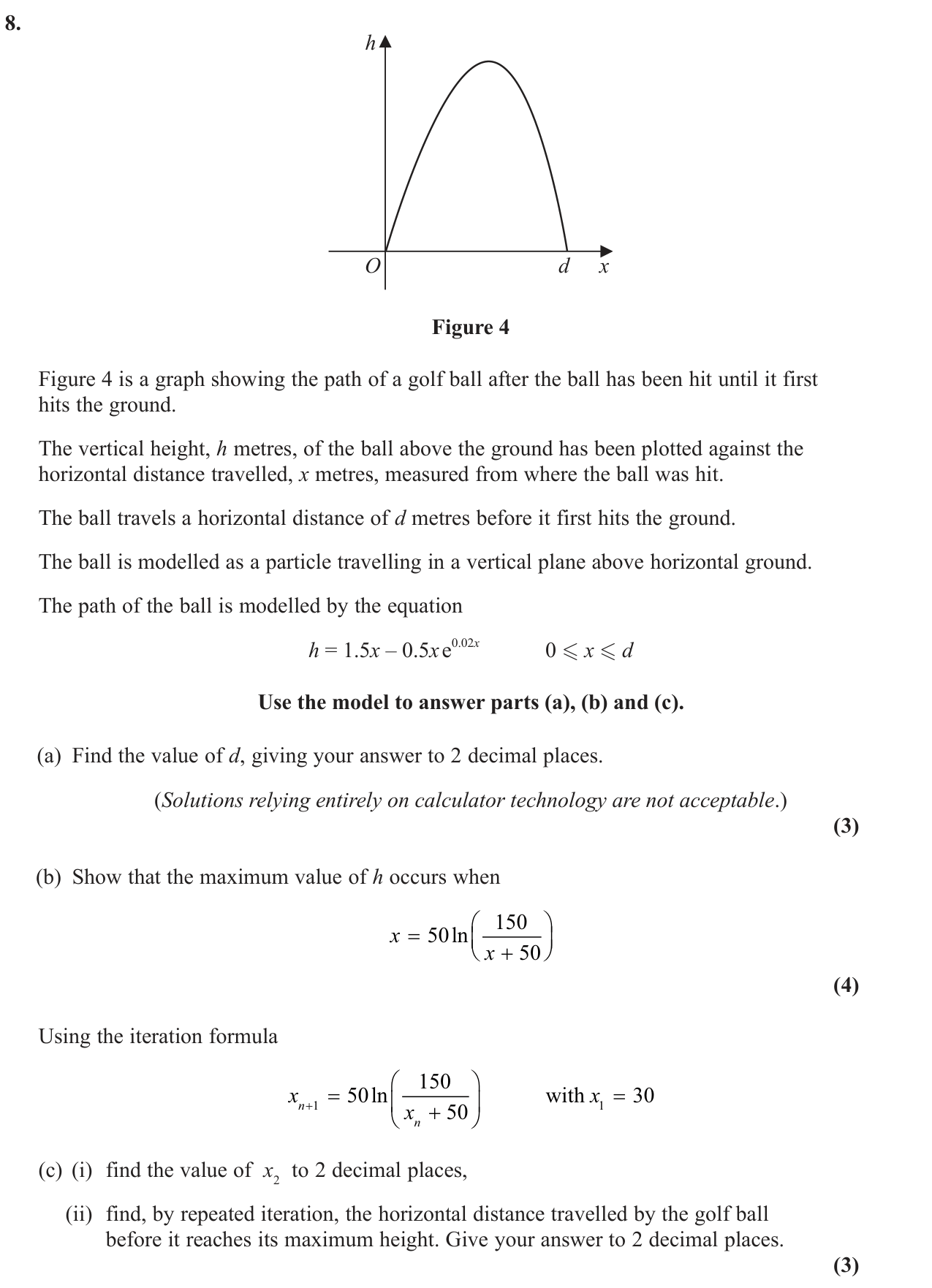
14. WMA13/01 May/June 2024 · Q8

Hard10 marks · main topic: Log Graphs & Exponential Models
WMA13/01 May/June 2024 Question 8 (10 marks): Numerical Methods
Show worked solution
  1. Part (a)

    At the first landing, $h=0$ and $x=d\gt 0$:

    \[0=d(1.5-0.5e^{0.02d}),\qquad e^{0.02d}=3.\]

    Taking logarithms, $0.02d=\ln3$, hence $d=50\ln3=54.930614\ldots$. The root $x=0$ is the launch point, not the landing point.

    \[\boxed{d=54.93\ \text{m}}\]
  2. Part (b)

    By the product and chain rules,

    \[h'(x)=1.5-0.5e^{0.02x}-0.01xe^{0.02x}.\]

    At a stationary point,

    \[1.5=0.01(x+50)e^{0.02x},\qquad e^{0.02x}=\frac{150}{x+50}.\]

    Since $x+50\gt 0$, logarithms give $0.02x=\ln(150/(x+50))$. Also $h”(x)=-(0.02+0.0002x)e^{0.02x}\lt 0$ on $[0,d]$. Thus the stationary point is the unique maximum; the endpoints both have zero height.

    \[\boxed{x=50\ln\left(\frac{150}{x+50}\right)}\]
  3. Part (c)

    (i) With $x_1=30$,

    \[x_2=50\ln\left(\frac{150}{30+50}\right)=31.43043297\ldots.\]

    (ii) Continuing with full intermediate precision gives $x_3=30.54431108\ldots$, $x_4=31.09139065\ldots$, $x_5=30.75292479\ldots$ and $x_6=30.96205562\ldots$. Continued iteration converges to $30.88212\ldots$, which lies in $(0,d)$. This is the horizontal distance at maximum height, not the maximum height itself.

    \[\boxed{x_2=31.43,\quad x_{\mathrm{maximum}}=30.88\ \text{m}}\]
Final answer

(a) $d=54.93\ \text{m}$ (b) $x=50\ln\left(\frac{150}{x+50}\right)$ (c) $x_2=31.43,\quad x_{\mathrm{maximum}}=30.88\ \text{m}$

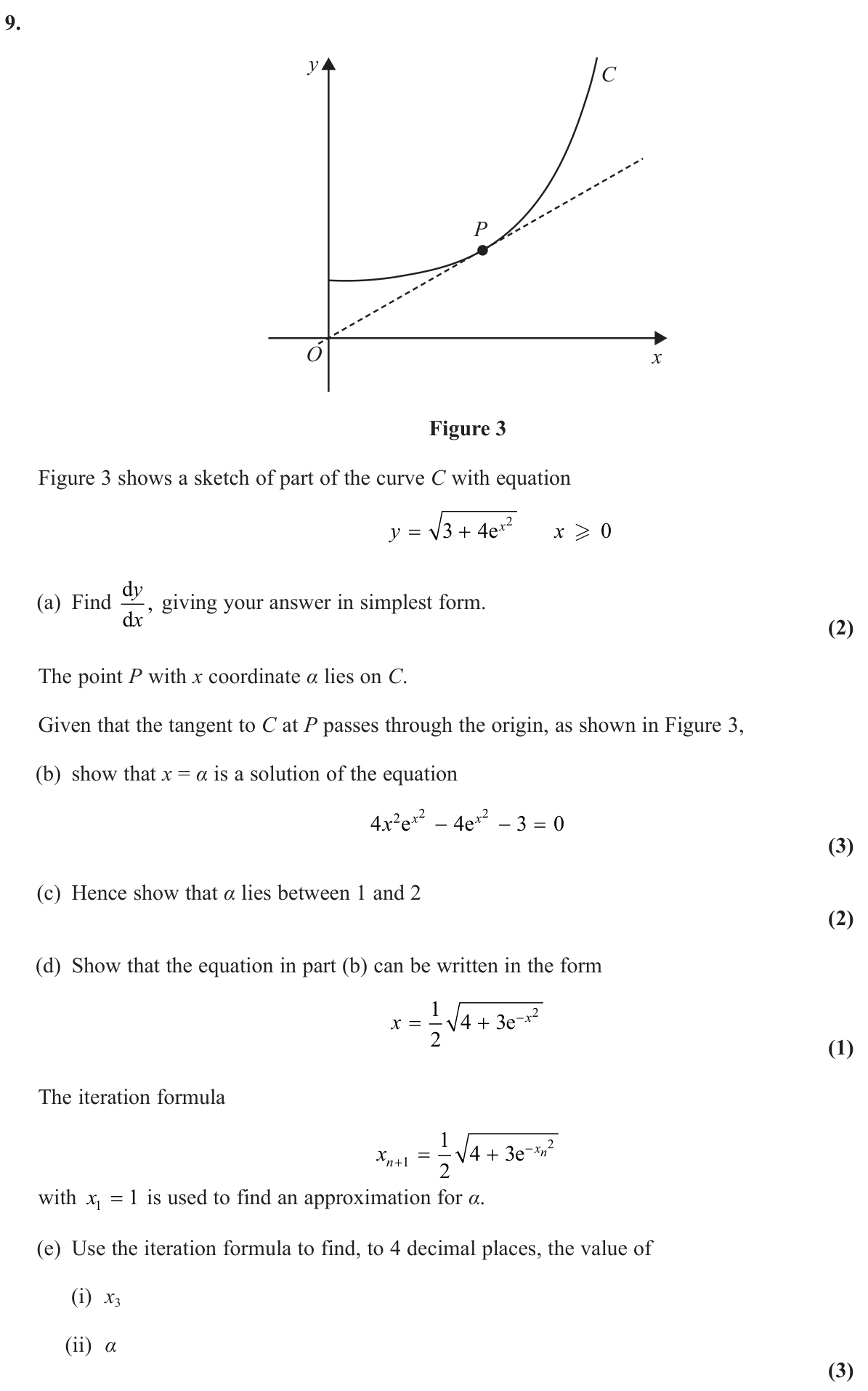
15. WMA13/01 January 2023 · Q9

Hard11 marks
WMA13/01 January 2023 Question 9 (11 marks): Numerical Methods
Show worked solution
  1. Part (a)

    Differentiate $y=(3+4e^{x^2})^{1/2}$ using the chain rule:

    \[\frac{dy}{dx}=\frac12(3+4e^{x^2})^{-1/2}\cdot4e^{x^2}\cdot2x =\frac{4xe^{x^2}}{\sqrt{3+4e^{x^2}}}.\]
    \[\boxed{\frac{dy}{dx}=\frac{4xe^{x^2}}{\sqrt{3+4e^{x^2}}}}\]
  2. Part (b)

    Since the tangent at $P=(\alpha,\sqrt{3+4e^{\alpha^2}})$ passes through the origin, its gradient is $y_P/\alpha$, with $\alpha\gt 0$. Equate this to the derivative:

    \[\frac{4\alpha e^{\alpha^2}}{\sqrt{3+4e^{\alpha^2}}} =\frac{\sqrt{3+4e^{\alpha^2}}}{\alpha} \quad\Longrightarrow\quad4\alpha^2e^{\alpha^2}=3+4e^{\alpha^2}.\]

    Consequently $x=\alpha$ solves the displayed equation.

    \[\boxed{4x^2e^{x^2}-4e^{x^2}-3=0}\]
  3. Part (c)

    Let $h(x)=4x^2e^{x^2}-4e^{x^2}-3$, a continuous function. Then $h(1)=-3\lt 0$ and $h(2)=12e^4-3=652.1778\ldots\gt 0$, so a root lies between 1 and 2. Moreover $h'(x)=8x^3e^{x^2}\gt 0$ for $x\gt 0$, so this is the unique positive root corresponding to the tangent abscissa $\alpha$.

    \[\boxed{1\lt \alpha\lt 2}\]
  4. Part (d)

    From $4x^2e^{x^2}=4e^{x^2}+3$, divide by the positive $e^{x^2}$ to get $4x^2=4+3e^{-x^2}$. The source domain has $x\ge0$, so take the positive square root.

    \[\boxed{x=\frac12\sqrt{4+3e^{-x^2}}}\]
  5. Part (e)

    With $x_1=1$, the unrounded iterates start

    \[x_2=1.1295616764\ldots,\quad x_3=1.0997193683\ldots,\quad x_4=1.1062486441\ldots,\quad x_5=1.1048012899\ldots.\]

    Continue: $x_6=1.1051212304\ldots$, $x_7=1.1050504628\ldots$, $x_8=1.1050661137\ldots$, $x_9=1.1050626523\ldots$; further iteration settles at $1.1050632792\ldots$. Therefore (i) $x_3=1.0997$ and (ii) $\alpha=1.1051$, both to four decimal places.

    \[\boxed{x_3=1.0997,\qquad\alpha=1.1051}\]
Final answer

(a) $\frac{dy}{dx}=\frac{4xe^{x^2}}{\sqrt{3+4e^{x^2}}}$ (b) $4x^2e^{x^2}-4e^{x^2}-3=0$ (c) $1\lt \alpha\lt 2$ (d) $x=\frac12\sqrt{4+3e^{-x^2}}$ (e) $x_3=1.0997,\qquad\alpha=1.1051$

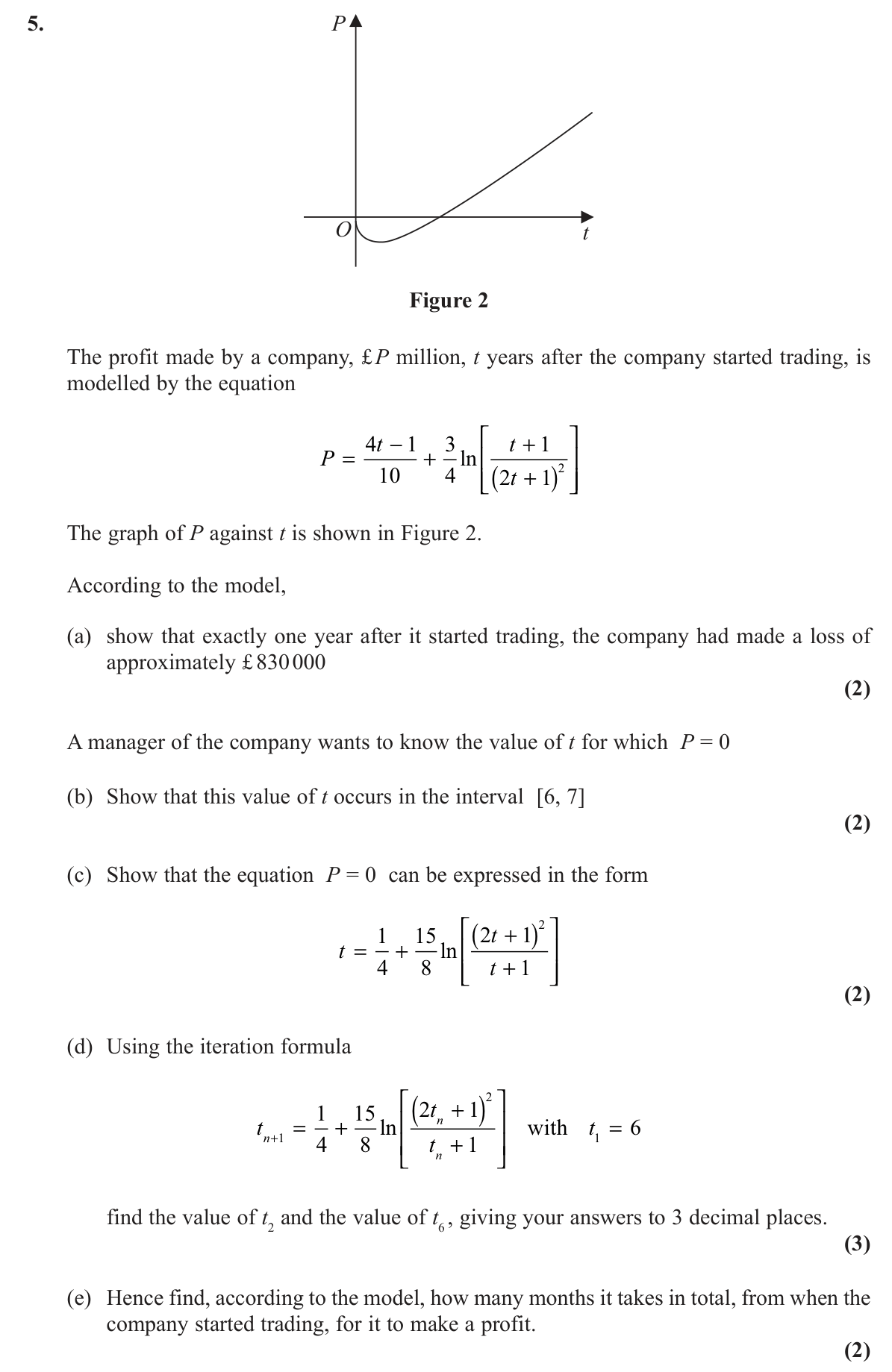
16. WMA13/01 October 2022 · Q5

Hard11 marks · main topic: Log Graphs & Exponential Models
WMA13/01 October 2022 Question 5 (11 marks): Numerical Methods
Show worked solution
  1. Part (a)

    At one year,

    \[P(1)=\frac3{10}+\frac34\ln\left(\frac29\right) =-0.8280580476\ldots\quad\text{million pounds}.\]

    The negative sign indicates a loss. Its magnitude is about $828058$ pounds, which is approximately $830000$ pounds.

    \[\boxed{\text{Loss}\approx\pounds830000}\]
  2. Part (b)

    The model is continuous for $t\ge0$. Evaluate

    \[P(6)=\frac{23}{10}+\frac34\ln\frac7{169}=-0.0879914\ldots\lt 0, \qquad P(7)=\frac{27}{10}+\frac34\ln\frac8{225}=0.1975059\ldots\gt 0.\]

    Continuity and the sign change give a zero between 6 and 7.

    \[\boxed{t\in(6,7)\subset[6,7]}\]
  3. Part (c)

    Set $P=0$ and move the logarithm to the other side:

    \[\frac{4t-1}{10}=-\frac34\ln\frac{t+1}{(2t+1)^2} =\frac34\ln\frac{(2t+1)^2}{t+1}.\]

    Multiply by 10 and divide by 4 to obtain the required form.

    \[\boxed{t=\frac14+\frac{15}{8}\ln\frac{(2t+1)^2}{t+1}}\]
  4. Part (d)

    Starting with $t_1=6$, retain full calculator precision at each substitution:

    \[t_2=6.2199785610\ldots,\quad t_3=6.2867730738\ldots,\quad t_4=6.3065963643\ldots,\quad t_5=6.3124397510\ldots,\quad t_6=6.3141587873\ldots.\]

    Therefore the requested values to three decimal places are as follows.

    \[\boxed{t_2=6.220,\qquad t_6=6.314}\]
  5. Part (e)

    The break-even time is approximately $6.315$ years, or $6.315\times12=75.78$ months. Profit starts just after that time; the first complete number of months is therefore 76, not 75. Indeed $P(75/12)\lt 0$ and $P(76/12)\gt 0$.

    \[\boxed{76\ \text{months}}\]
Final answer

(a) $\text{Loss}\approx\pounds830000$ (b) $t\in(6,7)\subset[6,7]$ (c) $t=\frac14+\frac{15}{8}\ln\frac{(2t+1)^2}{t+1}$ (d) $t_2=6.220,\qquad t_6=6.314$ (e) $76\ \text{months}$

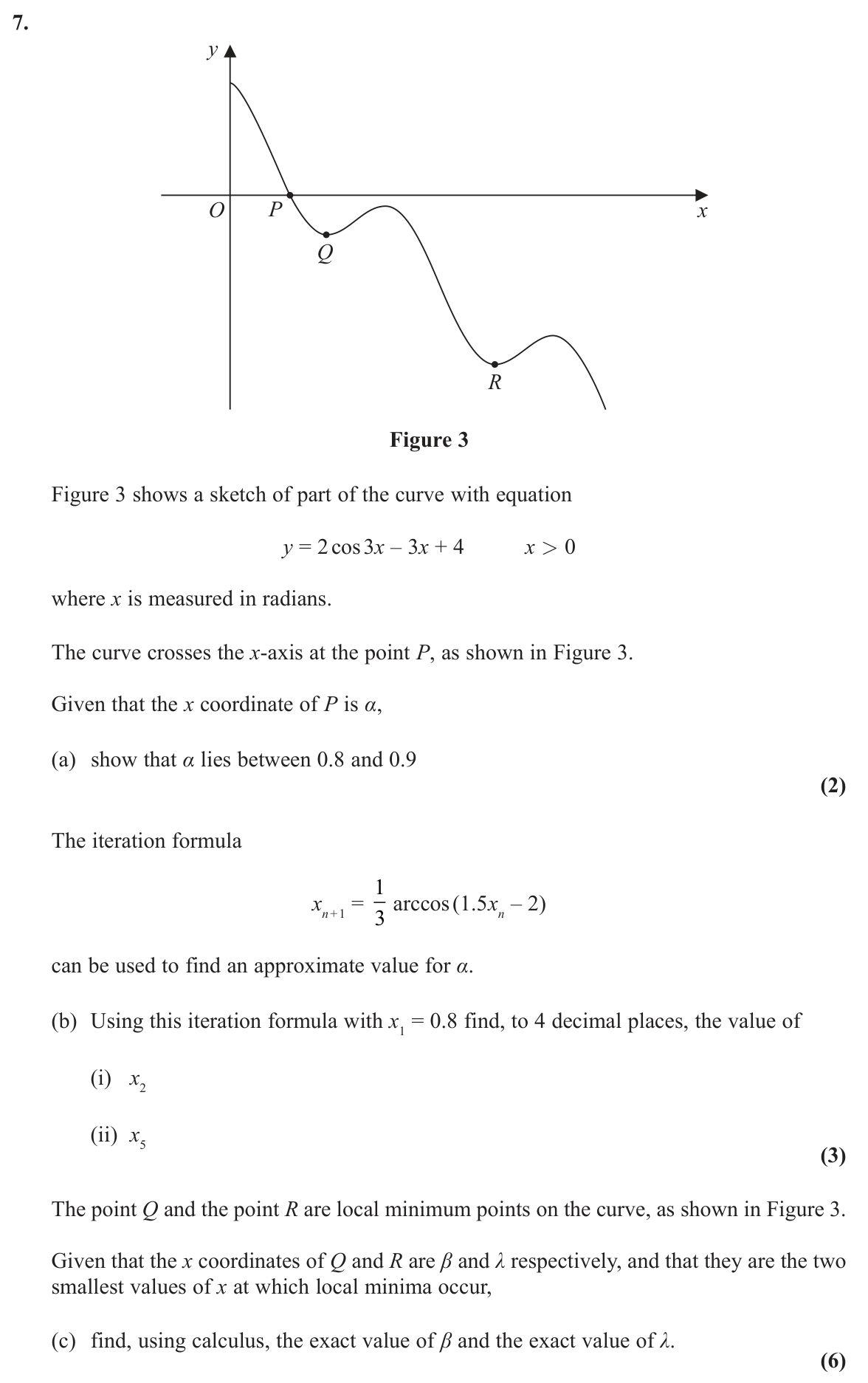
17. WMA13/01 January 2020 · Q7

Hard11 marks · main topic: Applications of Differentiation
WMA13/01 January 2020 Question 7 (11 marks): Numerical Methods
Show worked solution
  1. Part (a)

    Let $f(x)=2\cos3x-3x+4$, using radians. Then

    \[\begin{aligned} f(0.8)&=2\cos2.4-2.4+4=0.1252125\ldots\gt 0,\\ f(0.9)&=2\cos2.7-2.7+4=-0.5081443\ldots\lt 0. \end{aligned}\]

    The function is continuous on $[0.8,0.9]$, so this change of sign shows that there is a root between the endpoints. Moreover, $f'(x)=-6\sin3x-3\lt 0$ on this interval, so this root is unique there. Thus the crossing shown at $P$ has $\boxed{0.8\lt \alpha\lt 0.9}$.

  2. Part (b)(i)

    Using the inverse cosine in radians,

    \[x_2=\frac13\arccos(1.5(0.8)-2) =\frac13\arccos(-0.8)=0.8326971\ldots.\]

    Hence $\boxed{x_2=0.8327}$ to 4 decimal places.

  3. Part (b)(ii)

    Continue the iteration, retaining the full calculator values at each step:

    \[\begin{aligned} x_3&=\frac13\arccos(1.5x_2-2)=0.8067674\ldots,\\ x_4&=\frac13\arccos(1.5x_3-2)=0.8271196\ldots,\\ x_5&=\frac13\arccos(1.5x_4-2)=0.8110216\ldots. \end{aligned}\]

    Therefore $\boxed{x_5=0.8110}$ to 4 decimal places.

  4. Part (c)

    Differentiate the curve equation:

    \[\frac{dy}{dx}=-6\sin3x-3, \qquad \frac{d^2y}{dx^2}=-18\cos3x.\]

    At a stationary point,

    \[-6\sin3x-3=0 \quad\Longrightarrow\quad \sin3x=-\frac12.\]

    For $x\gt 0$, the stationary points therefore belong to the two families

    \[3x=\frac{7\pi}{6}+2n\pi \quad\text{or}\quad 3x=\frac{11\pi}{6}+2n\pi, \qquad n=0,1,2,\ldots.\]

    In the first family, $\cos3x=-\frac{\sqrt3}{2}$, giving $y”=9\sqrt3\gt 0$, so these are local minima. In the second family, $\cos3x=\frac{\sqrt3}{2}$ and $y”=-9\sqrt3\lt 0$, so these are local maxima and are excluded. Thus all positive minimum coordinates are

    \[x=\frac{7\pi}{18}+\frac{2n\pi}{3},\qquad n=0,1,2,\ldots.\]

    The two smallest are obtained with $n=0$ and $n=1$:

    \[\boxed{\beta=\frac{7\pi}{18}}, \qquad \boxed{\lambda=\frac{19\pi}{18}}.\]
Final answer

(a) $0.8\lt \alpha\lt 0.9$ (b)(i) $x_2=0.8327$ (b)(ii) $x_5=0.8110$ (c) $\beta=\frac{7\pi}{18}$, $\lambda=\frac{19\pi}{18}$

18. WMA13/01 October 2024 · Q8

Hard12 marks · main topic: Log Graphs & Exponential Models
WMA13/01 October 2024 Question 8 (12 marks): Numerical Methods
Show worked solution
  1. Part (a)

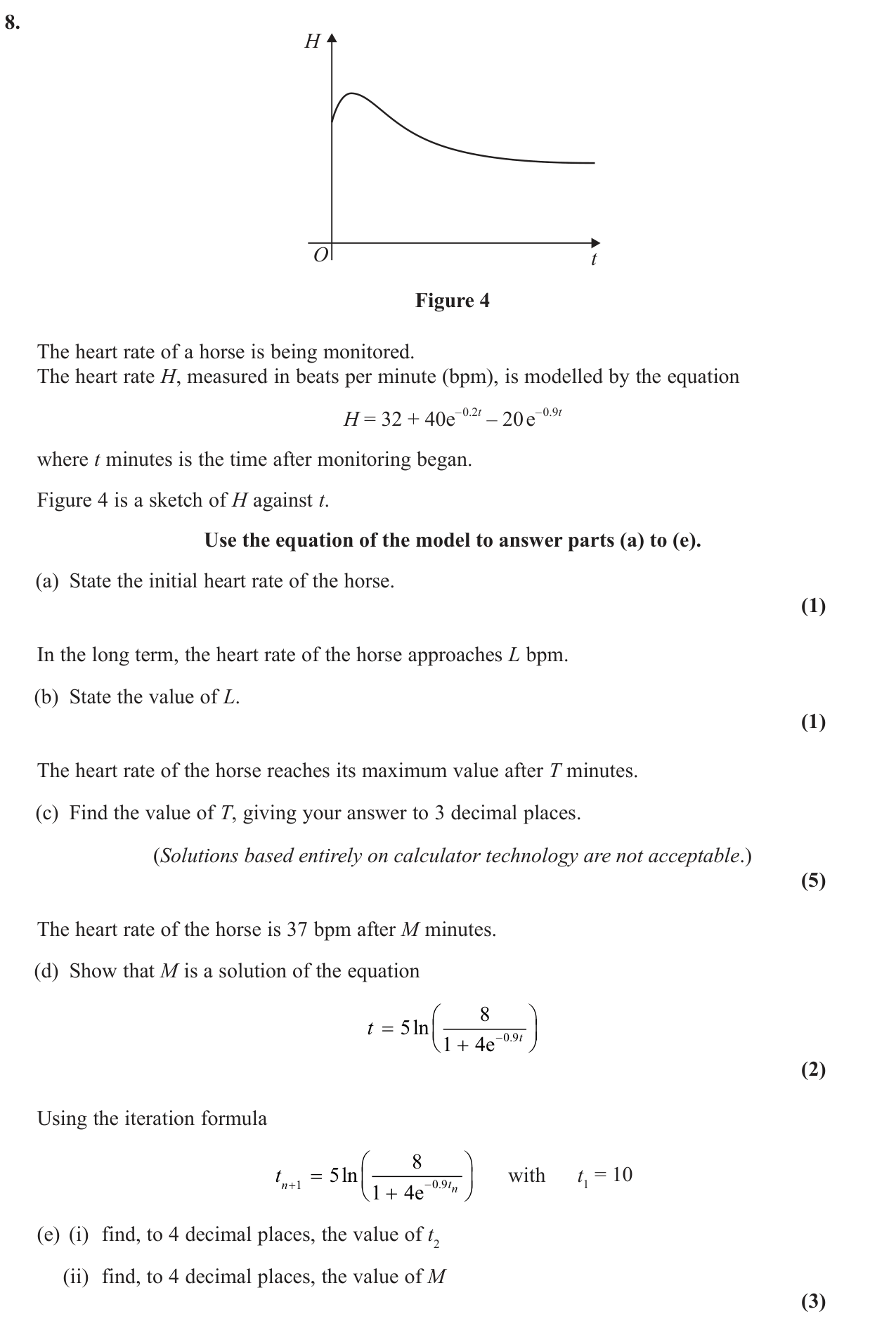
    At $t=0$, $H=32+40-20=52$.

    \[\boxed{H(0)=52\ \text{bpm}}\]
  2. Part (b)

    As $t\to\infty$, both decaying exponential terms tend to zero.

    \[\boxed{L=32}\]
  3. Part (c)
    \[\frac{dH}{dt}=-8e^{-0.2t}+18e^{-0.9t}.\]

    At the maximum,

    \[18e^{-0.9T}=8e^{-0.2T} \quad\Longrightarrow\quad e^{0.7T}=\frac94 \quad\Longrightarrow\quad T=\frac{10}{7}\ln\frac94=1.1584717\ldots.\]

    Also $H”(t)=1.6e^{-0.2t}-16.2e^{-0.9t}$. At the stationary point, $e^{-0.9T}=(4/9)e^{-0.2T}$, so $H”(T)=-5.6e^{-0.2T}\lt 0$, confirming a maximum.

    \[\boxed{T=1.158\ \text{minutes}}\]
  4. Part (d)

    For $H=37$,

    \[5=40e^{-0.2t}-20e^{-0.9t} \quad\Longrightarrow\quad 8e^{-0.2t}=1+4e^{-0.9t}.\]

    Taking logarithms gives

    \[-0.2t=\ln\left(\frac{1+4e^{-0.9t}}8\right) \quad\Longrightarrow\quad t=-5\ln\left(\frac{1+4e^{-0.9t}}8\right).\]

    Using $-\ln u=\ln(1/u)$ for $u\gt 0$ then gives

    \[t=5\ln\left(\frac8{1+4e^{-0.9t}}\right).\]
    \[\boxed{t=5\ln\left(\frac8{1+4e^{-0.9t}}\right)}\]
  5. Part (e)

    Starting with $t_1=10$,

    \[t_2=5\ln\left(\frac8{1+4e^{-9}}\right)=10.3947401213\ldots.\]

    Continuing without rounding intermediate values gives $t_3=10.3954778346\ldots$, $t_4=10.3954789826\ldots$ and $t_5=10.3954789844\ldots$. Thus (i) $t_2=10.3947$, and (ii) $M=10.3955$ minutes, both to 4 decimal places.

    \[\boxed{t_2=10.3947,\quad M=10.3955\ \text{minutes}}\]
Final answer

(a) $H(0)=52\ \text{bpm}$ (b) $L=32$ (c) $T=1.158\ \text{minutes}$ (d) $t=5\ln\left(\frac8{1+4e^{-0.9t}}\right)$ (e) $t_2=10.3947,\quad M=10.3955\ \text{minutes}$

19. WMA13/01 May/June 2022 · Q8

Hard12 marks
WMA13/01 May/June 2022 Question 8 (12 marks): Numerical Methods
Show worked solution
  1. Part (a)

    Differentiate the velocity:

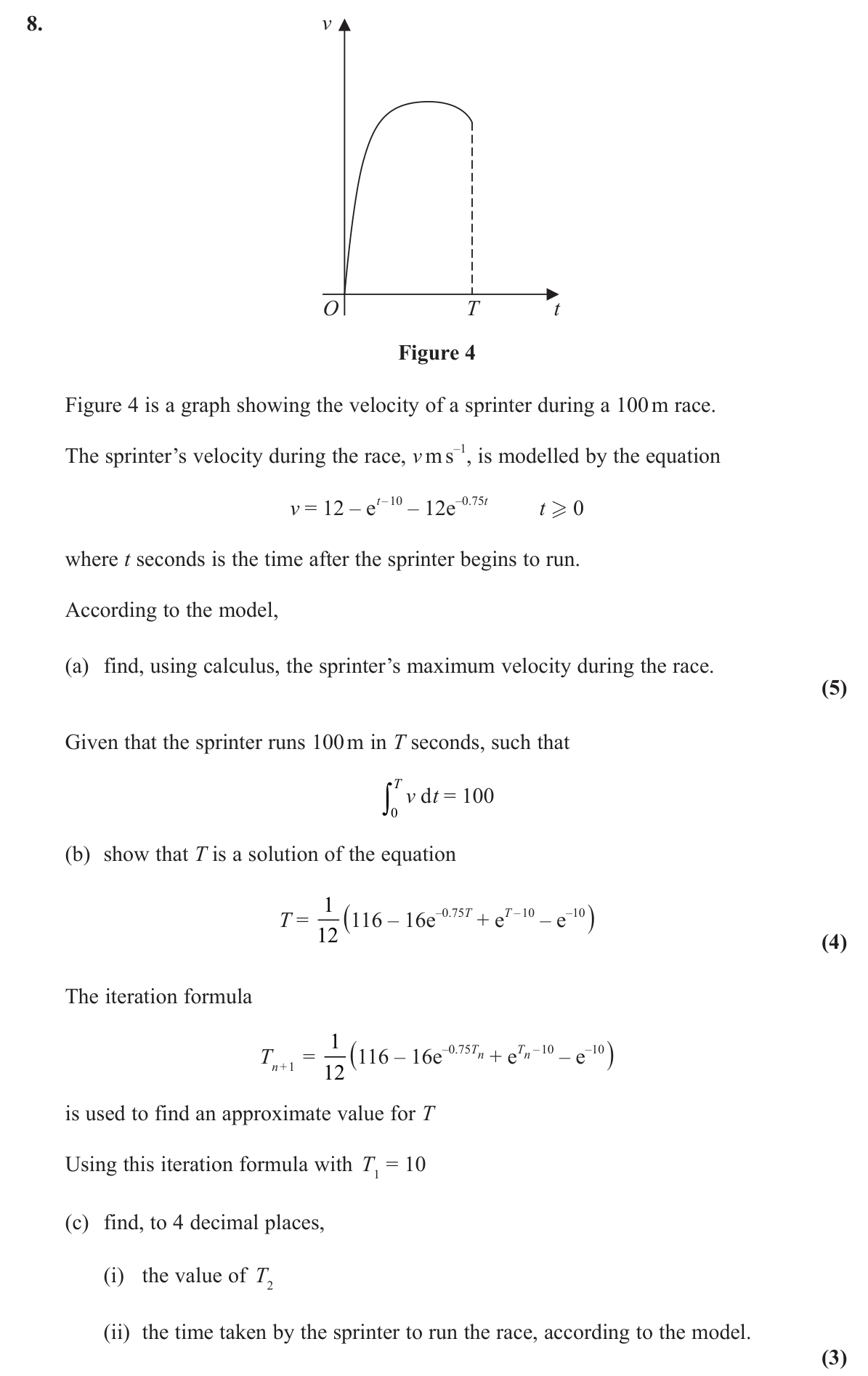
    \[v'(t)=-e^{t-10}+9e^{-0.75t}.\]

    At a stationary velocity, $e^{t-10}=9e^{-0.75t}$, so $e^{1.75t}=9e^{10}$ and $t=(10+\ln9)/1.75=6.9698426\ldots$ seconds. The second derivative $-e^{t-10}-6.75e^{-0.75t}$ is negative, so this is a maximum. Substitute this unrounded time into v to get $11.88728125\ldots$ metres per second.

    \[\boxed{v_{\max}=11.9\ \mathrm{m\,s^{-1}}}\]
  2. Part (b)

    Integrating the velocity gives $12t-e^{t-10}+16e^{-0.75t}$. Evaluate between 0 and T:

    \[100=12T-e^{T-10}+16e^{-0.75T}-(-e^{-10}+16).\]

    Rearrange to $12T=116-16e^{-0.75T}+e^{T-10}-e^{-10}$ and divide by 12.

    \[\boxed{T=\frac1{12}(116-16e^{-0.75T}+e^{T-10}-e^{-10})}\]
  3. Part (c)

    With $T_1=10$, substitution gives $T_2=9.7492587708\ldots$. Continuing with unrounded values gives

    \[T_3=9.7306248365\ldots,\quad T_4=9.7294150526\ldots,\quad T_5=9.7293372715\ldots,\quad T_6=9.7293322738\ldots.\]

    Further iteration settles at $9.7293319307\ldots$ seconds. Thus (i) $T_2=9.7493$ and (ii) the race time is $9.7293$ seconds, to four decimal places.

    \[\boxed{T_2=9.7493,\qquad T=9.7293\ \mathrm{s}}\]
Final answer

(a) $v_{\max}=11.9\ \mathrm{m\,s^{-1}}$ (b) $T=\frac1{12}(116-16e^{-0.75T}+e^{T-10}-e^{-10})$ (c) $T_2=9.7493,\qquad T=9.7293\ \mathrm{s}$

More IAL Pure 3 topics

Dr Eslam Ahmed
Dr Eslam Ahmed

Elite Mathematics · Questions classified by topic, solutions checked by Dr Eslam