Skip to content
Elite Mathematics
IAL · WMA13 · Topic

Differentiation: past paper questions & worked solutions

Every Differentiation question from the WMA13 papers in our bank, 2020–2026, sorted from easiest to hardest. Try each one first, then open the worked solution.

77questions
641marks in total
100%of papers (19 of 19) include it
17/24/36easy / medium / hard

Questions, easiest first

Level is estimated from marks: 1–6 easy, 7–8 medium, 9+ hard.

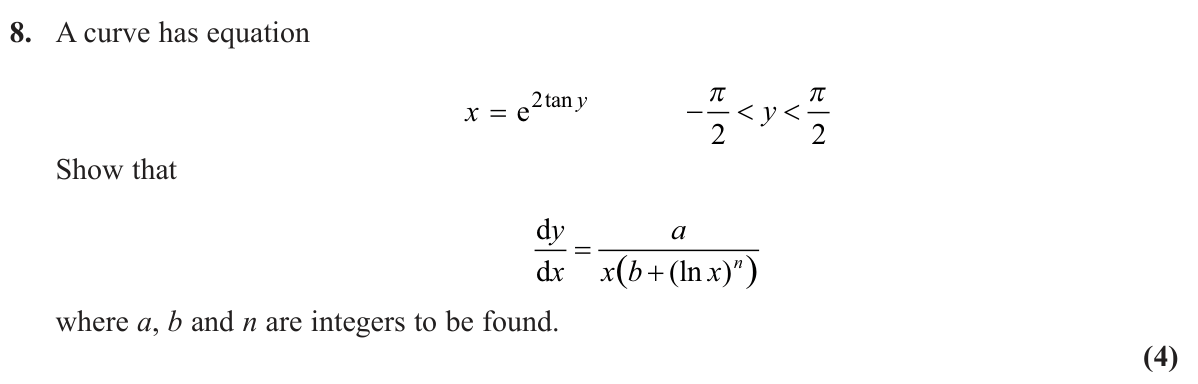
1. WMA13/01 January 2026 · Q8

Easy4 marks
WMA13/01 January 2026 Question 8 (4 marks): Differentiation
Show worked solution
  1. Solution

    \paragraph{Solution} Differentiate $x=e^{2\tan y}$ with respect to $y$:

    \[\frac{dx}{dy}=2\sec^2 y\,e^{2\tan y}=2x\sec^2y.\]

    This is positive on the stated interval, so

    \[\frac{dy}{dx}=\frac1{2x\sec^2y}.\]

    Taking logarithms of the original relation gives $\ln x=2\tan y$. Using $\sec^2y=1+\tan^2y$,

    \[\frac{dy}{dx}=\frac1{2x\left(1+\frac{(\ln x)^2}{4}\right)} =\frac2{x\bigl(4+(\ln x)^2\bigr)}.\]

    Hence $a=2$, $b=4$ and $n=2$.

Final answer

(main) $a=2,\ b=4,\ n=2$

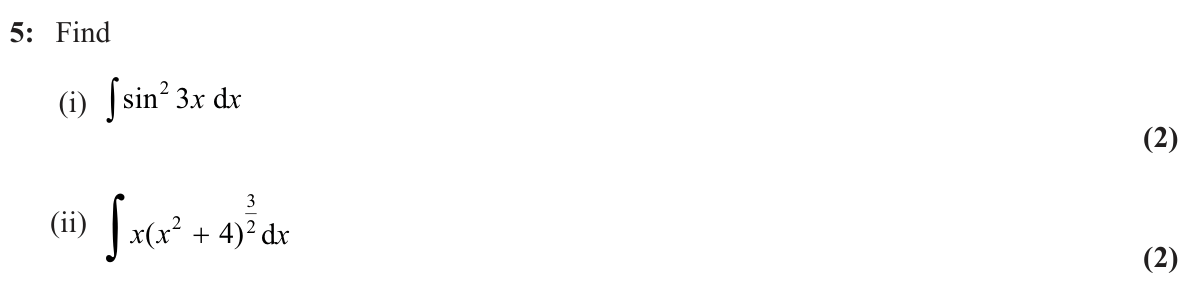
2. WMA13/01 May/June 2025 · Q5

Easy4 marks · main topic: Integration
WMA13/01 May/June 2025 Question 5 (4 marks): Differentiation
Show worked solution
  1. Part (i)

    Use $\sin^2(3x)=(1-\cos6x)/2$:

    \[\int\sin^2(3x)\,dx=\frac12\int(1-\cos6x)\,dx =\boxed{\frac{x}{2}-\frac{\sin6x}{12}+C}.\]
  2. Part (ii)

    The derivative of $(x^2+4)^{5/2}$ is $5x(x^2+4)^{3/2}$. Therefore

    \[\int x(x^2+4)^{3/2}\,dx=\boxed{\frac15(x^2+4)^{5/2}+C}.\]

    For example, differentiating this answer gives

    \[\frac15\cdot\frac52(x^2+4)^{3/2}\cdot2x=x(x^2+4)^{3/2},\]

    which recovers the integrand. Each indefinite integral has its own arbitrary constant.

Final answer

(i) $\frac{x}{2}-\frac{\sin6x}{12}+C$ (ii) $\frac15(x^2+4)^{5/2}+C$

3. WMA13/01 January 2022 · Q1

Easy4 marks · main topic: Applications of Differentiation
WMA13/01 January 2022 Question 1 (4 marks): Differentiation
Show worked solution
  1. Part (main)

    Apply the product rule:

    \[y'=2e^{3x}+3(2x+5)e^{3x}=e^{3x}(6x+17).\]

    At a stationary point, $y'=0$. Since $e^{3x}\gt 0$ for every real x, $6x+17=0$, which determines the unique stationary x coordinate.

    \[\boxed{x=-\frac{17}{6}}\]
Final answer

(main) $x=-\frac{17}{6}$

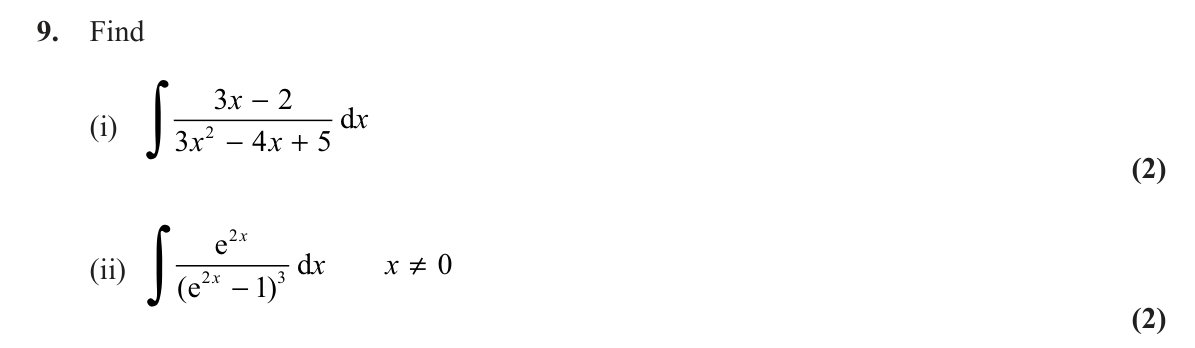
4. WMA13/01 January 2021 · Q9

Easy4 marks · main topic: Integration
WMA13/01 January 2021 Question 9 (4 marks): Differentiation
Show worked solution
  1. Part (i)

    The denominator derivative is $6x-4=2(3x-2)$. Hence reverse the logarithmic chain rule:

    \[\int\frac{3x-2}{3x^2-4x+5}\,dx=\frac12\ln(3x^2-4x+5)+C.\]

    The log argument is always positive because $3x^2-4x+5=3(x-2/3)^2+11/3$.

    \[\boxed{\frac12\ln(3x^2-4x+5)+C}\]
  2. Part (ii)

    Put $u=e^{2x}-1$, so $du=2e^{2x}\,dx$. Then $\int e^{2x}(e^{2x}-1)^{-3}\,dx=(1/2)\int u^{-3}\,du=-1/(4u^2)+C$. The source excludes $x=0$, where the integrand is undefined.

    \[\boxed{-\frac1{4(e^{2x}-1)^2}+C}\]
Final answer

(i) $\frac12\ln(3x^2-4x+5)+C$ (ii) $-\frac1{4(e^{2x}-1)^2}+C$

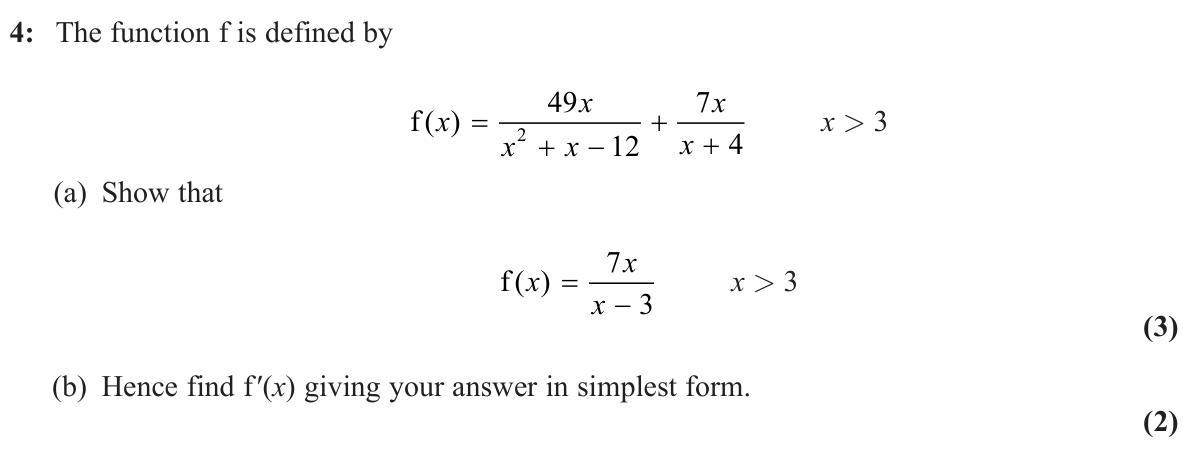
5. WMA13/01 May/June 2025 · Q4

Easy5 marks · main topic: Rational Algebra
WMA13/01 May/June 2025 Question 4 (5 marks): Differentiation
Show worked solution
  1. Part (a)

    Factor $x^2+x-12=(x+4)(x-3)$ and combine the fractions:

    \[f(x)=\frac{49x+7x(x-3)}{(x+4)(x-3)} =\frac{7x(x+4)}{(x+4)(x-3)}=\boxed{\frac{7x}{x-3}}.\]

    The cancellation is valid because $x\gt 3$. In particular, the numerator simplifies as $49x+7x^2-21x=7x^2+28x=7x(x+4)$.

  2. Part (b)

    Rewrite $f(x)=7+21/(x-3)$. Differentiating gives

    \[\boxed{f'(x)=-\frac{21}{(x-3)^2}}.\]
Final answer

(a) $\frac{7x}{x-3}$ (b) $f'(x)=-\frac{21}{(x-3)^2}$

6. WMA13/01 October 2024 · Q2

Easy5 marks · main topic: Applications of Differentiation
WMA13/01 October 2024 Question 2 (5 marks): Differentiation
Show worked solution
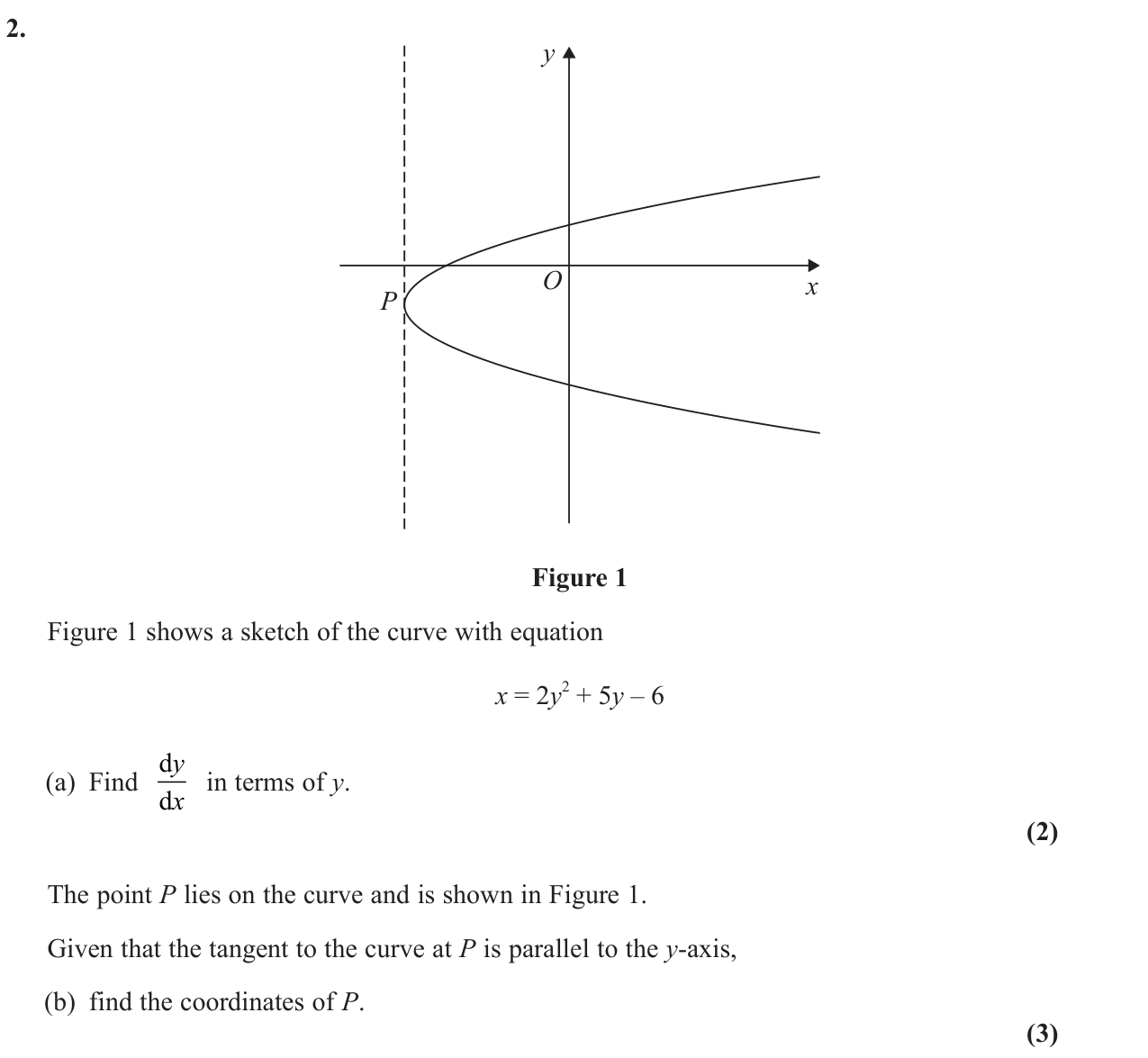
  1. Part (a)

    Differentiate $x=2y^2+5y-6$ with respect to $y$:

    \[\frac{dx}{dy}=4y+5,\qquad \frac{dy}{dx}=\frac{1}{4y+5},\quad y\ne-\frac54.\]
    \[\boxed{\frac{dy}{dx}=\frac1{4y+5}}\]
  2. Part (b)

    A tangent parallel to the $y$-axis is vertical, so use $dx/dy=0$:

    \[4y+5=0\quad\Longrightarrow\quad y=-\frac54.\]

    Substituting into the curve gives

    \[x=2\left(-\frac54\right)^2+5\left(-\frac54\right)-6 =\frac{25}{8}-\frac{25}{4}-6=-\frac{73}{8}.\]
    \[\boxed{P=\left(-\frac{73}{8},-\frac54\right)}\]
Final answer

(a) $\frac{dy}{dx}=\frac1{4y+5}$ (b) $P=\left(-\frac{73}{8},-\frac54\right)$

7. WMA13/01 October 2022 · Q4

Easy5 marks
WMA13/01 October 2022 Question 4 (5 marks): Differentiation
Show worked solution
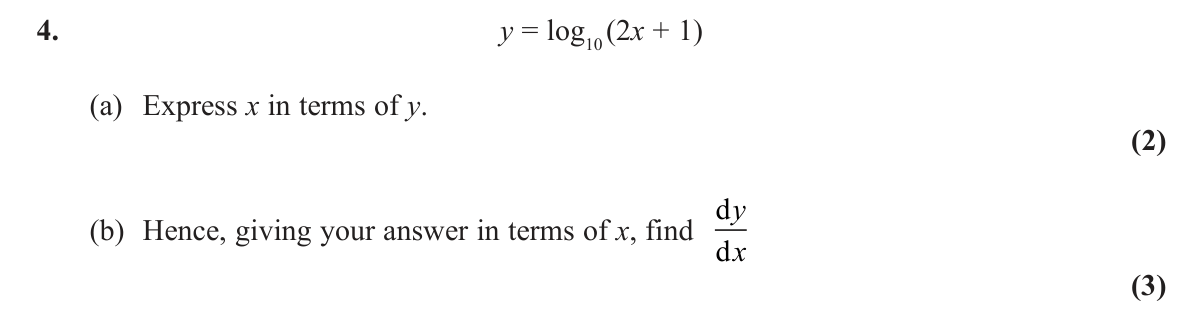
  1. Part (a)

    The logarithm is base 10. Thus $10^y=2x+1$ and $2x=10^y-1$.

    \[\boxed{x=\frac{10^y-1}{2}}\]
  2. Part (b)

    Differentiate the result of (a) with respect to y:

    \[\frac{dx}{dy}=\frac12\,10^y\ln10.\]

    Take the reciprocal and use $10^y=2x+1$:

    \[\frac{dy}{dx}=\frac2{10^y\ln10}=\frac2{(2x+1)\ln10}.\]

    The original logarithm requires $x\gt -1/2$.

    \[\boxed{\frac{dy}{dx}=\frac2{(2x+1)\ln10}}\]
Final answer

(a) $x=\frac{10^y-1}{2}$ (b) $\frac{dy}{dx}=\frac2{(2x+1)\ln10}$

8. WMA13/01 May/June 2021 · Q7

Easy5 marks
WMA13/01 May/June 2021 Question 7 (5 marks): Differentiation
Show worked solution
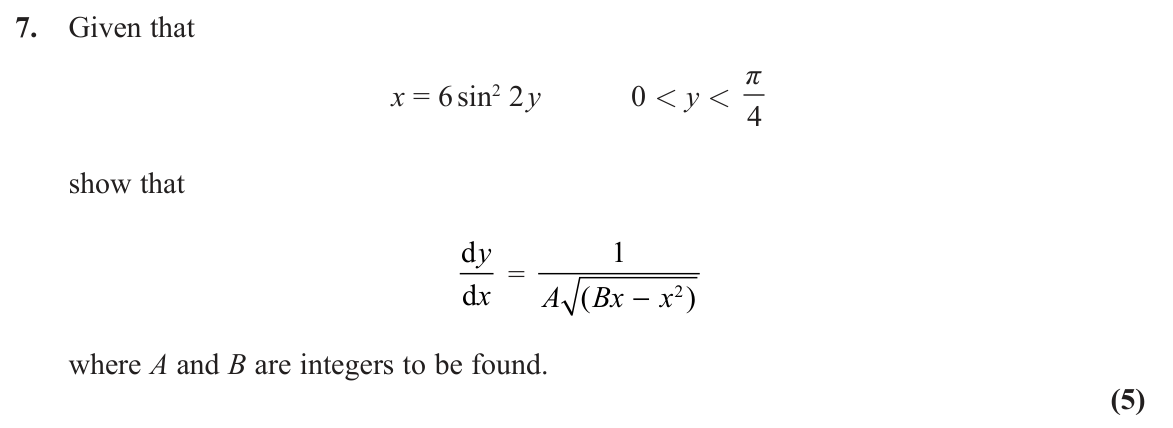
  1. Part (main)

    Differentiate x with respect to y:

    \[\frac{dx}{dy}=6\cdot2\sin2y\cos2y\cdot2=24\sin2y\cos2y.\]

    Since $0\lt 2y\lt \pi/2$, both sine and cosine are positive. Using $\sin^22y=x/6$ and $\cos^22y=1-x/6$,

    \[\frac{dx}{dy}=24\sqrt{x/6}\sqrt{1-x/6} =4\sqrt{6x-x^2}.\]

    On $0\lt x\lt 6$ this is nonzero, so take its reciprocal.

    \[\boxed{\frac{dy}{dx}=\frac1{4\sqrt{6x-x^2}},\qquad A=4,\ B=6}\]
Final answer

(main) $\frac{dy}{dx}=\frac1{4\sqrt{6x-x^2}},\qquad A=4,\ B=6$

9. WMA13/01 May/June 2026 · Q6

Easy6 marks
WMA13/01 May/June 2026 Question 6 (6 marks): Differentiation
Show worked solution
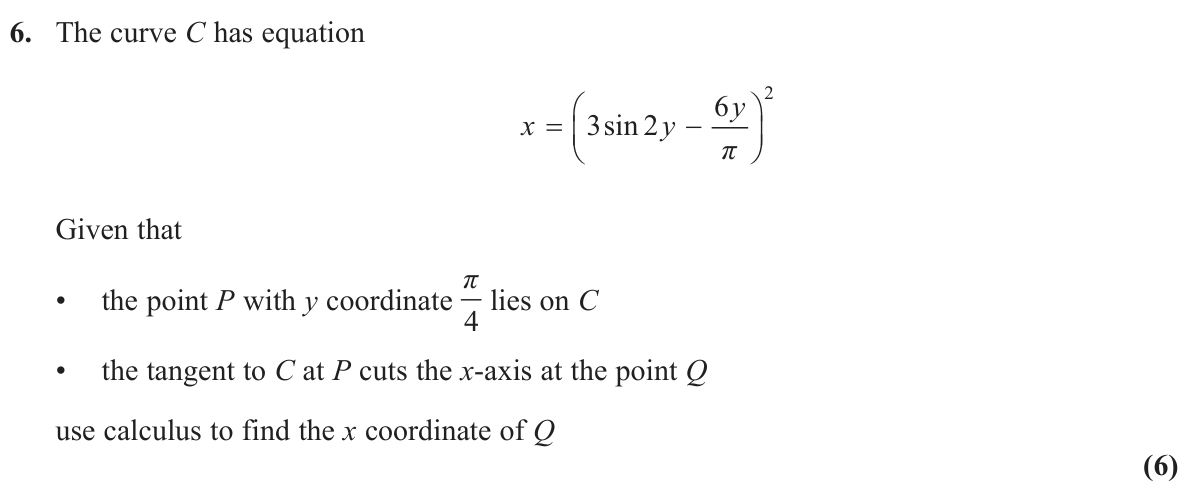
  1. Solution

    At $y=\pi/4$,

    \[x=\left(3\sin\frac\pi2-\frac{6(\pi/4)}\pi\right)^2 =\left(3-\frac32\right)^2=\frac94.\]

    Differentiate $x$ with respect to $y$ using the chain rule:

    \[\frac{dx}{dy}=2\left(3\sin2y-\frac{6y}\pi\right) \left(6\cos2y-\frac6\pi\right).\]

    At $P$, $dx/dy=2(3/2)(-6/\pi)=-18/\pi$. Since this is nonzero, the tangent gradient is $\dfrac{dy}{dx}=-\dfrac\pi{18}$, and its equation is

    \[y-\frac\pi4=-\frac\pi{18}\left(x-\frac94\right).\]

    Put $y=0$ for its intersection with the $x$-axis:

    \[x-\frac94=\frac{18}{4},\qquad \boxed{x_Q=\frac{27}{4}}.\]
Final answer

$x_Q=\frac{27}{4}$

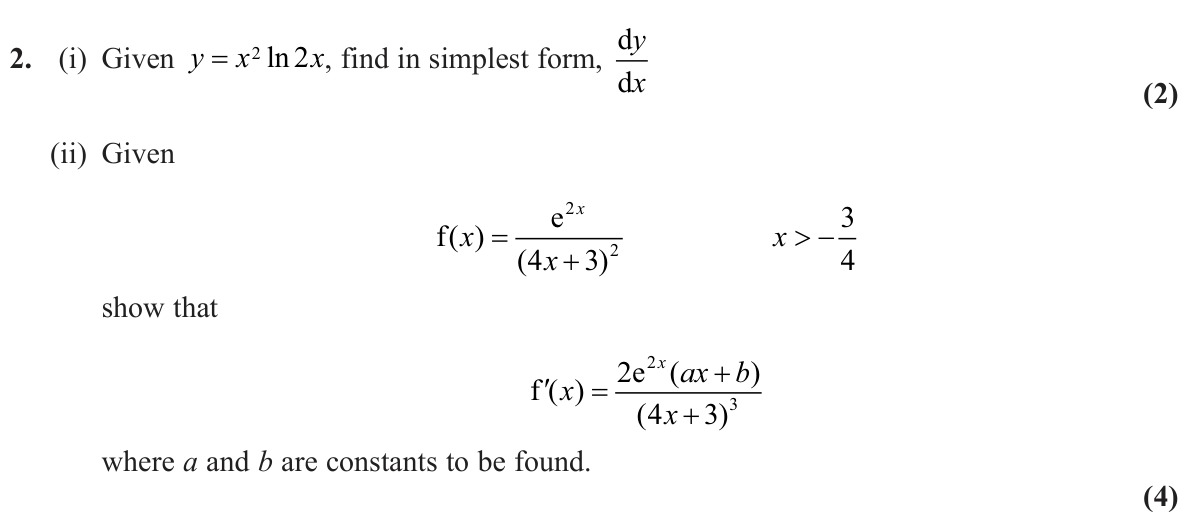
10. WMA13/01 January 2026 · Q2

Easy6 marks
WMA13/01 January 2026 Question 2 (6 marks): Differentiation
Show worked solution
  1. Part (i)

    Use the product rule and $\frac{d}{dx}\ln(2x)=1/x$:

    \[\frac{dy}{dx}=2x\ln(2x)+x^2\frac1x =2x\ln(2x)+x=x\bigl(2\ln(2x)+1\bigr).\]
  2. Part (ii)

    Write $f(x)=e^{2x}(4x+3)^{-2}$. Product and chain rules give

    \[f'(x)=2e^{2x}(4x+3)^{-2}-8e^{2x}(4x+3)^{-3}.\]

    Factoring out $2e^{2x}(4x+3)^{-3}$,

    \[f'(x)=\frac{2e^{2x}\bigl((4x+3)-4\bigr)}{(4x+3)^3} =\frac{2e^{2x}(4x-1)}{(4x+3)^3}.\]

    Thus $a=4$ and $b=-1$.

Final answer

(i) $x(2\ln(2x)+1)$ (ii) $a=4,\ b=-1$

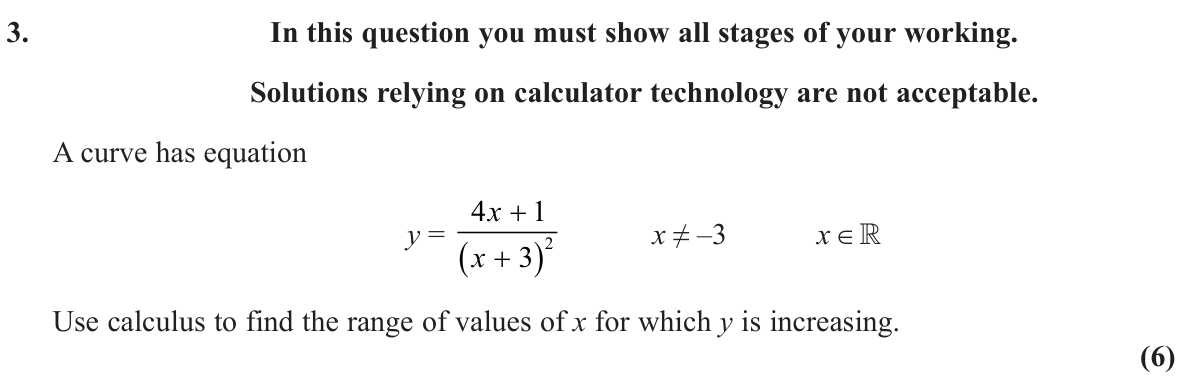
11. WMA13/01 January 2025 · Q3

Easy6 marks · main topic: Applications of Differentiation
WMA13/01 January 2025 Question 3 (6 marks): Differentiation
Show worked solution
  1. Part (main)

    Apply the quotient rule, retaining the restriction $x\ne-3$:

    \[\frac{dy}{dx}=\frac{4(x+3)^2-(4x+1)2(x+3)}{(x+3)^4} =\frac{(x+3)[4(x+3)-2(4x+1)]}{(x+3)^4} =\frac{10-4x}{(x+3)^3}.\]

    The numerator vanishes at $10-4x=0$, so $x=5/2$; the denominator changes sign at the excluded value $x=-3$. For $x\lt -3$, the numerator is positive and denominator negative, so $y'\lt 0$. For $-3\lt x\lt 5/2$, both are positive, so $y'\gt 0$. For $x\gt 5/2$, the numerator is negative and denominator positive, so $y'\lt 0$. Thus the positive-gradient interval is as follows.

    \[\boxed{-3\lt x\lt \frac52}\]
Final answer

(main) $-3\lt x\lt \frac52$

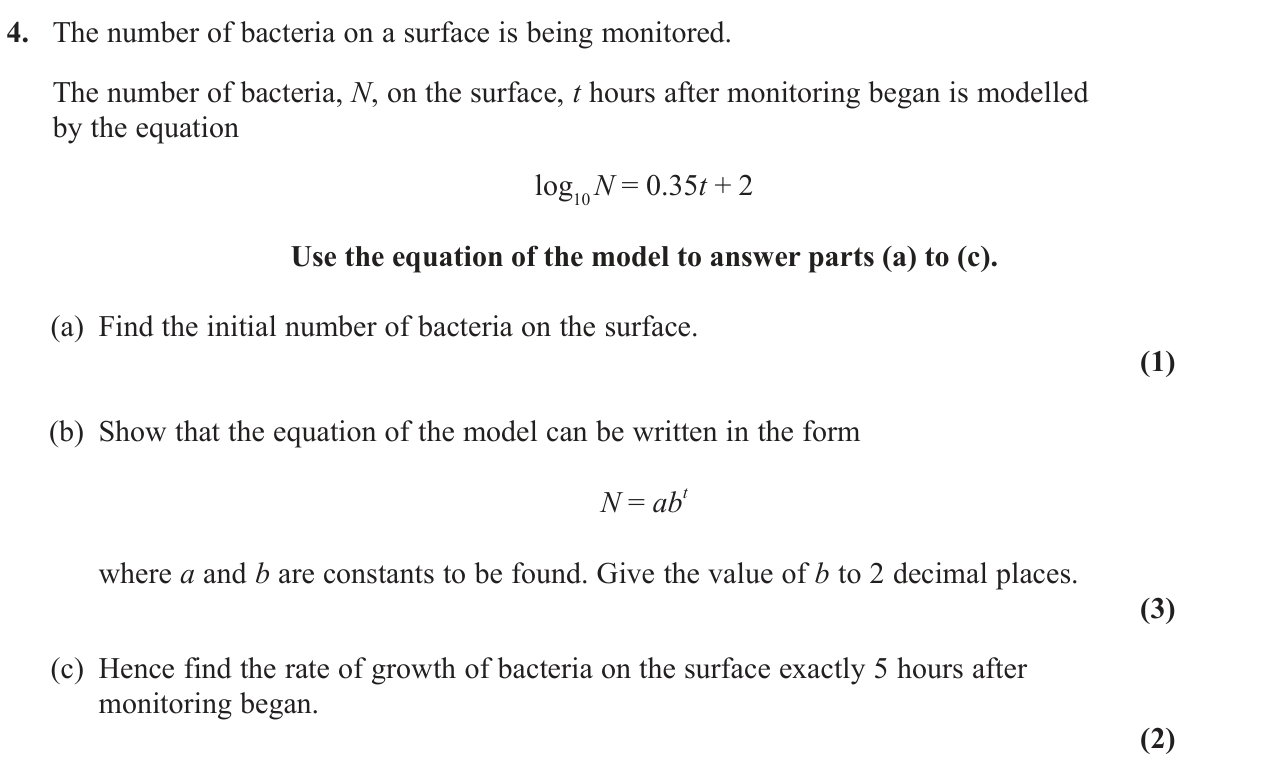
12. WMA13/01 October 2024 · Q4

Easy6 marks · main topic: Log Graphs & Exponential Models
WMA13/01 October 2024 Question 4 (6 marks): Differentiation
Show worked solution
  1. Part (a)

    At $t=0$, $\log_{10}N=2$, so $N=10^2$.

    \[\boxed{N(0)=100}\]
  2. Part (b)

    Exponentiating base 10 gives

    \[N=10^{0.35t+2}=10^2(10^{0.35})^t=100(10^{0.35})^t.\]

    Thus $a=100$ and $b=10^{0.35}=2.238721\ldots$, which is $2.24$ to 2 decimal places.

    \[\boxed{a=100,\qquad b=2.24}\]
  3. Part (c)

    Retain the unrounded base $10^{0.35}$ when differentiating:

    \[\frac{dN}{dt}=100(10^{0.35})^t\ln(10^{0.35}) =0.35\ln(10)\,10^{0.35t+2}.\]

    At $t=5$ this is $0.35\ln(10)\,10^{3.75}=4531.9356\ldots$ bacteria per hour.

    \[\boxed{\left.\frac{dN}{dt}\right|_{t=5}=4.53\times10^3\ \text{bacteria per hour}}\]
Final answer

(a) $N(0)=100$ (b) $a=100,\qquad b=2.24$ (c) $\left.\frac{dN}{dt}\right|_{t=5}=4.53\times10^3\ \text{bacteria per hour}$

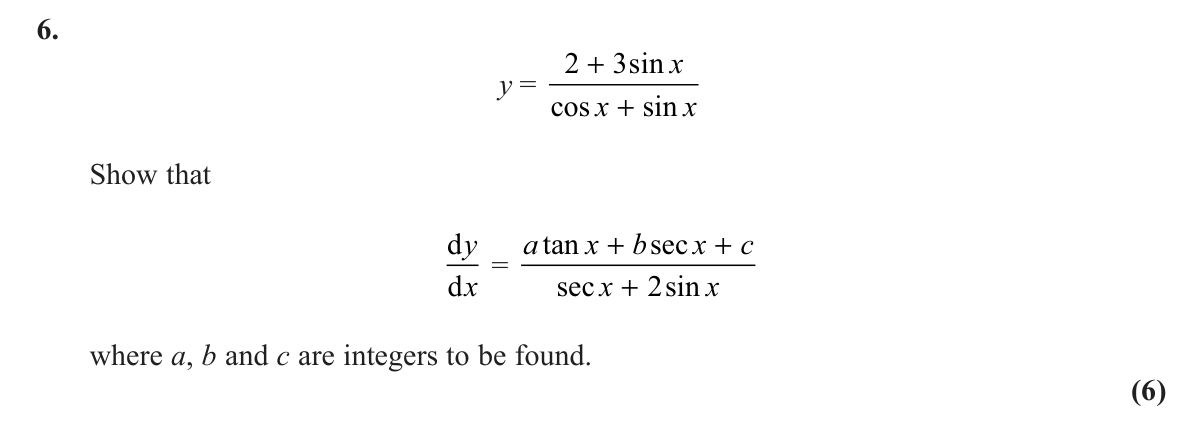
13. WMA13/01 October 2022 · Q6

Easy6 marks
WMA13/01 October 2022 Question 6 (6 marks): Differentiation
Show worked solution
  1. Part (main)

    With $y=(2+3\sin x)/(\cos x+\sin x)$, the quotient rule gives

    \[\frac{dy}{dx}=\frac{3\cos x(\cos x+\sin x)-(2+3\sin x)(\cos x-\sin x)}{(\cos x+\sin x)^2}.\]

    Expand the numerator and cancel the opposite mixed terms:

    \[3\cos^2x+3\sin^2x-2\cos x+2\sin x=3-2\cos x+2\sin x.\]

    The denominator is $1+2\sin x\cos x$. Divide numerator and denominator by $\cos x$ to obtain

    \[\frac{dy}{dx}=\frac{2\tan x+3\sec x-2}{\sec x+2\sin x}.\]

    This displayed form is used where its trigonometric terms are defined; the preceding quotient form also covers points with $\cos x=0$ when the original denominator is nonzero.

    \[\boxed{a=2,\quad b=3,\quad c=-2}\]
Final answer

(main) $a=2,\quad b=3,\quad c=-2$

14. WMA13/01 May/June 2022 · Q1

Easy6 marks · main topic: Applications of Differentiation
WMA13/01 May/June 2022 Question 1 (6 marks): Differentiation
Show worked solution
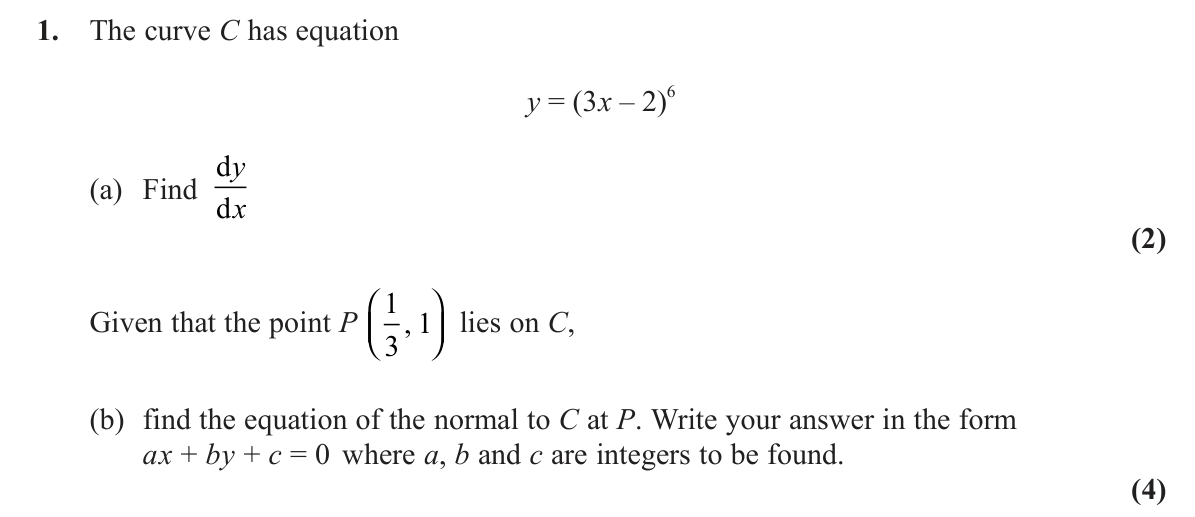
  1. Part (a)

    Differentiate the sixth power and multiply by the derivative of $3x-2$: $dy/dx=6(3x-2)^5\cdot3$.

    \[\boxed{\frac{dy}{dx}=18(3x-2)^5}\]
  2. Part (b)

    At $P=(1/3,1)$, the tangent gradient is $18(-1)^5=-18$. The normal gradient is $-1/(-18)=1/18$. Thus

    \[y-1=\frac1{18}(x-1/3)\ \Longrightarrow\ 54y-54=3x-1.\]

    Rearranging with integer coefficients gives the required equation.

    \[\boxed{3x-54y+53=0}\]
Final answer

(a) $\frac{dy}{dx}=18(3x-2)^5$ (b) $3x-54y+53=0$

15. WMA13/01 May/June 2022 · Q3

Easy6 marks · main topic: Integration
WMA13/01 May/June 2022 Question 3 (6 marks): Differentiation
Show worked solution
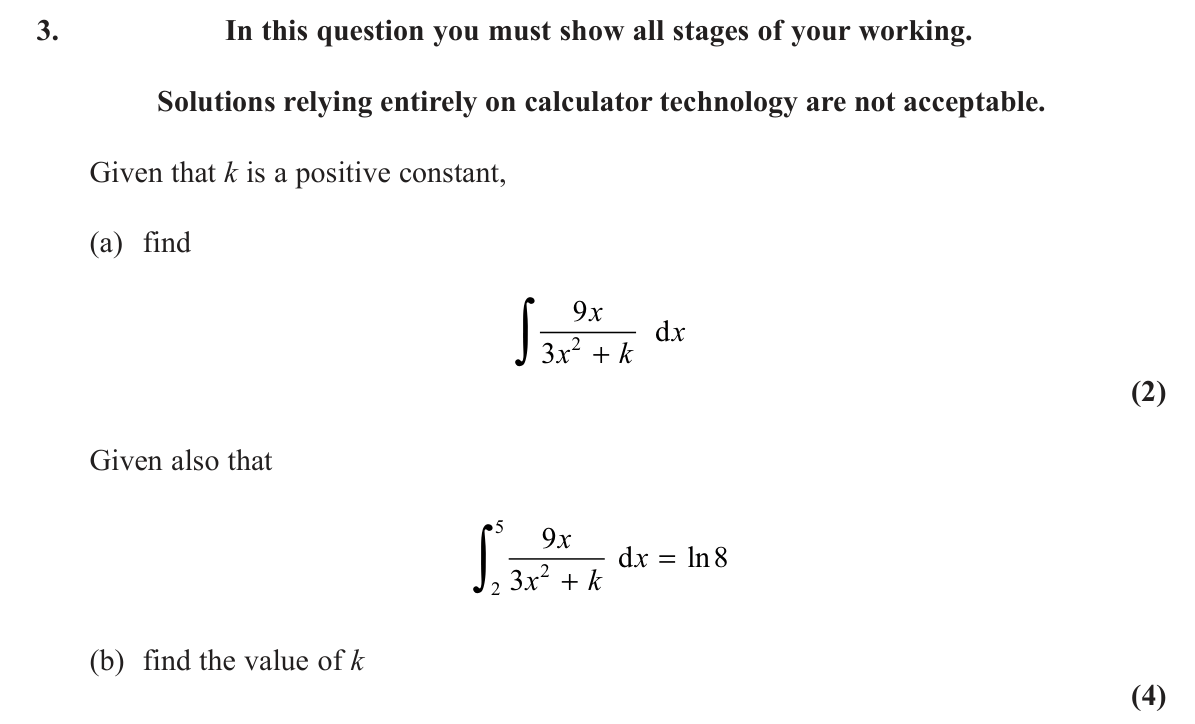
  1. Part (a)

    Since $d(3x^2+k)/dx=6x$, the numerator is $3/2$ times this derivative. The denominator is positive because $k\gt 0$, so

    \[\int\frac{9x}{3x^2+k}\,dx=\frac32\ln(3x^2+k)+C.\]
    \[\boxed{\frac32\ln(3x^2+k)+C}\]
  2. Part (b)

    Apply the limits to (a) and combine the logarithms:

    \[\frac32\ln\frac{75+k}{12+k}=\ln8.\]

    Hence $\ln((75+k)/(12+k))=(2/3)\ln8=\ln4$, so $75+k=4(12+k)$. This gives $27=3k$ and $k=9$, consistent with $k\gt 0$.

    \[\boxed{k=9}\]
Final answer

(a) $\frac32\ln(3x^2+k)+C$ (b) $k=9$

16. WMA13/01 January 2022 · Q3

Easy6 marks · main topic: Integration
WMA13/01 January 2022 Question 3 (6 marks): Differentiation
Show worked solution
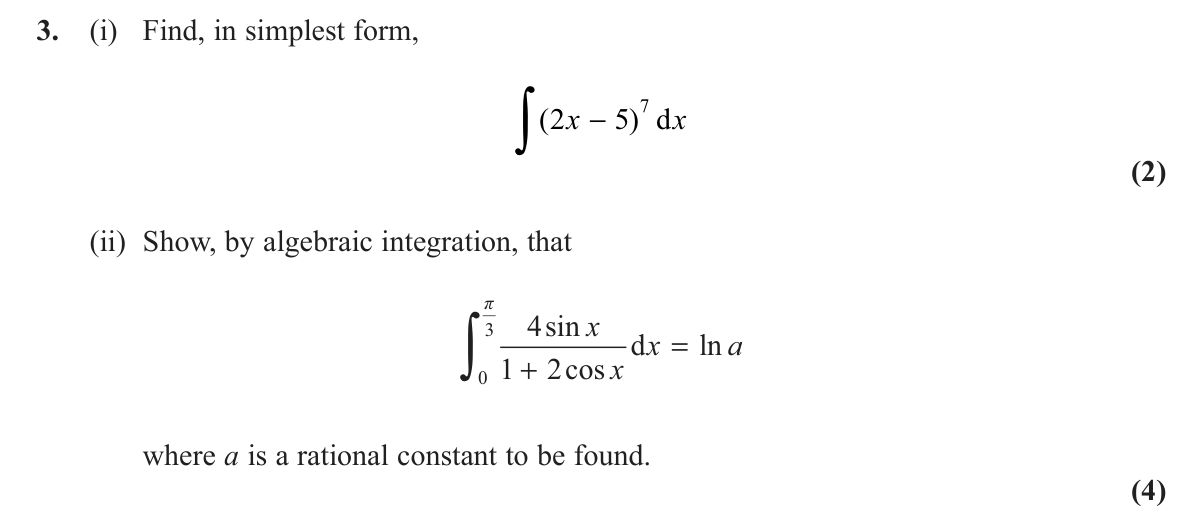
  1. Part (i)

    Raise the power by one, divide by the new power and by the inner derivative 2:

    \[\int(2x-5)^7\,dx=\frac{(2x-5)^8}{2\cdot8}+C.\]
    \[\boxed{\frac{(2x-5)^8}{16}+C}\]
  2. Part (ii)

    The derivative of $1+2\cos x$ is $-2\sin x$, so a primitive is $-2\ln(1+2\cos x)$. The log argument is positive throughout $0\le x\le\pi/3$. Hence

    \[\int_0^{\pi/3}\frac{4\sin x}{1+2\cos x}\,dx =[-2\ln(1+2\cos x)]_0^{\pi/3} =-2\ln2+2\ln3=\ln\frac94.\]
    \[\boxed{a=\frac94}\]
Final answer

(i) $\frac{(2x-5)^8}{16}+C$ (ii) $a=\frac94$

17. WMA13/01 October 2021 · Q5

Easy6 marks · main topic: Integration
WMA13/01 October 2021 Question 5 (6 marks): Differentiation
Show worked solution
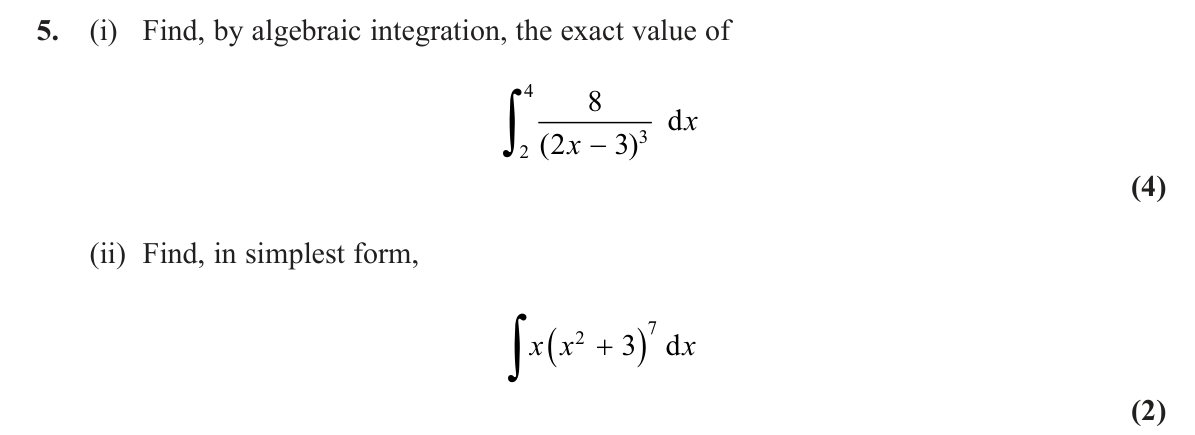
  1. Part (i)

    Write the integrand as $8(2x-3)^{-3}$. A primitive is $-2(2x-3)^{-2}$, because its derivative is $8(2x-3)^{-3}$. Thus

    \[\int_2^4\frac8{(2x-3)^3}\,dx =\left[-\frac2{(2x-3)^2}\right]_2^4 =-\frac2{25}-(-2)=\frac{48}{25}.\]
    \[\boxed{\frac{48}{25}}\]
  2. Part (ii)

    Since $d(x^2+3)/dx=2x$, reverse the chain rule:

    \[\int x(x^2+3)^7\,dx=\frac12\cdot\frac{(x^2+3)^8}{8}+C.\]
    \[\boxed{\frac{(x^2+3)^8}{16}+C}\]
Final answer

(i) $\frac{48}{25}$ (ii) $\frac{(x^2+3)^8}{16}+C$

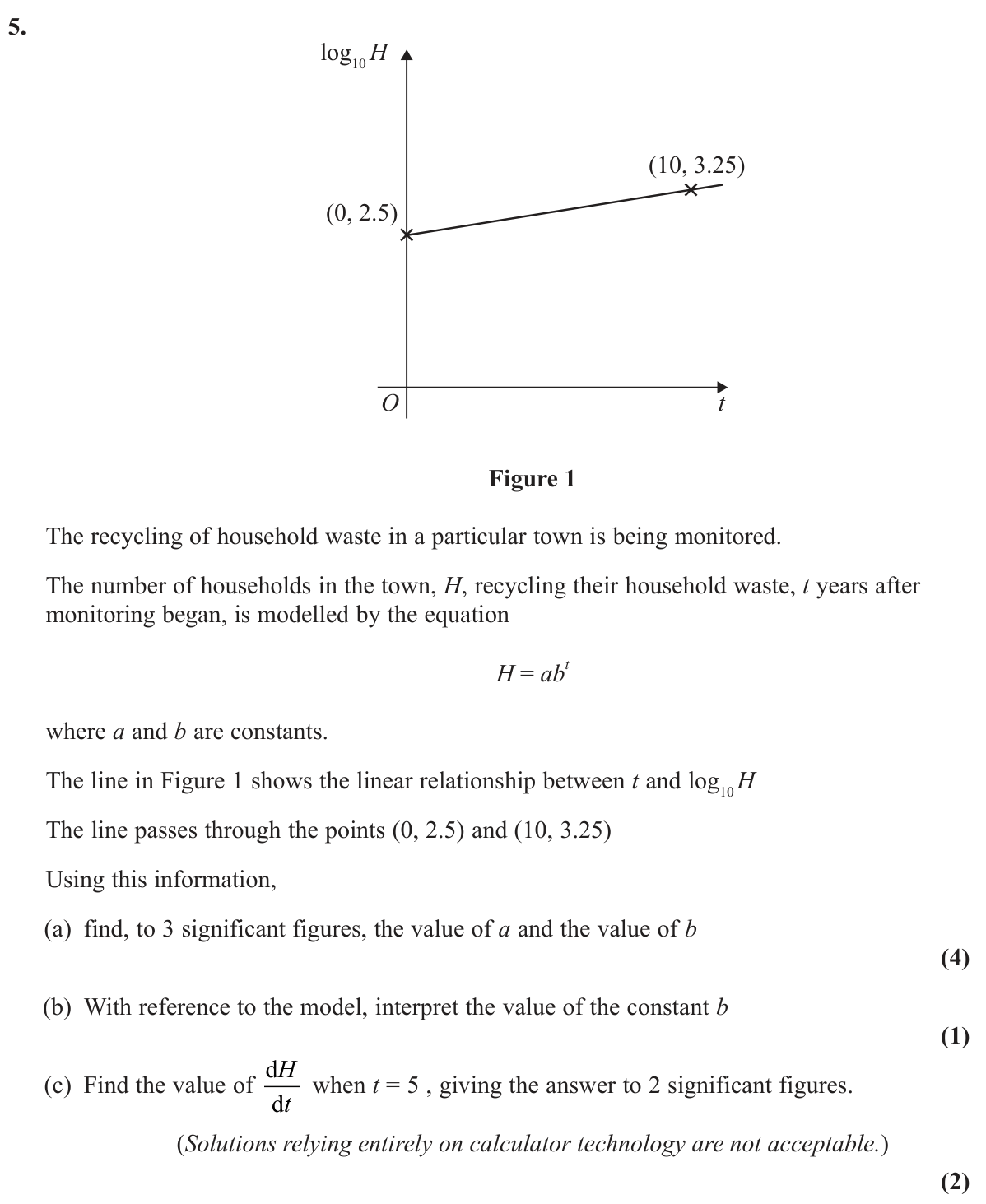
18. WMA13/01 May/June 2026 · Q5

Medium7 marks · main topic: Log Graphs & Exponential Models
WMA13/01 May/June 2026 Question 5 (7 marks): Differentiation
Show worked solution
  1. Part (a)

    Taking base-10 logarithms gives

    \[\log_{10}H=\log_{10}a+t\log_{10}b.\]

    The vertical intercept is $2.5$ and the gradient is $\dfrac{3.25-2.5}{10-0}=0.075$. Therefore

    \[a=10^{2.5}=316.227766\ldots,\qquad b=10^{0.075}=1.188502227\ldots.\]

    To 3 significant figures, $\boxed{a=316,\quad b=1.19}$.

  2. Part (b)

    Each year the model multiplies the number of recycling households by $b$. This means an increase of approximately $\boxed{19\%\text{ per year}}$ (about $18.85\%$ using the unrounded value).

  3. Part (c)

    Retain the unrounded constants:

    \[H=10^{2.5+0.075t},\qquad \frac{dH}{dt}=0.075\ln(10)\,10^{2.5+0.075t}.\]

    At $t=5$ this is $129.5021421\ldots$, hence

    \[\boxed{\frac{dH}{dt}=1.3\times10^2\text{ households per year}}\]

    to 2 significant figures.

Final answer

(a) $a=316,\quad b=1.19$ (b) $19\%\text{ per year}$ (c) $\frac{dH}{dt}=1.3\times10^2\text{ households per year}$

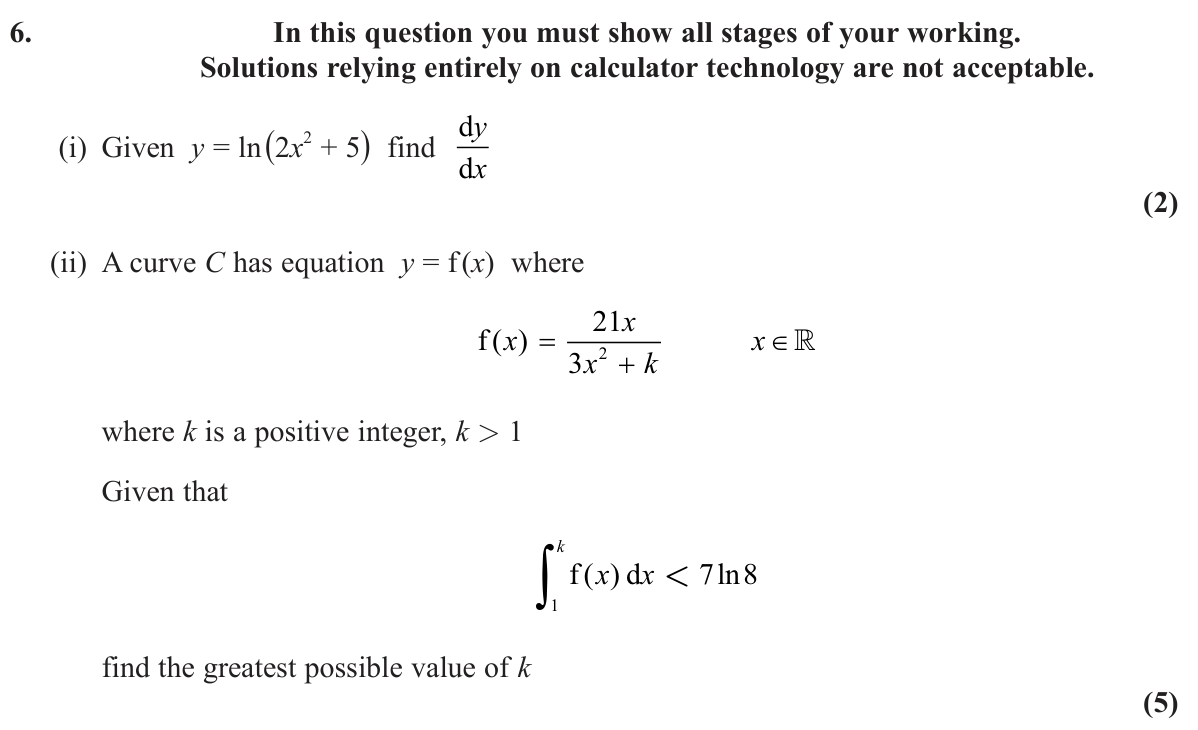
19. WMA13/01 October 2025 · Q6

Medium7 marks · main topic: Integration
WMA13/01 October 2025 Question 6 (7 marks): Differentiation
Show worked solution
  1. Part (i)

    Using the chain rule,

    \[\frac{dy}{dx}=\frac{1}{2x^2+5}(4x)=\frac{4x}{2x^2+5}.\]
  2. Part (ii)

    Treat $k$ as a constant when integrating:

    \[\int_1^k\frac{21x}{3x^2+k}\,dx =\left[\frac72\ln(3x^2+k)\right]_1^k =\frac72\ln\left(\frac{3k^2+k}{k+3}\right).\]

    The stated inequality therefore implies

    \[\ln\left(\frac{3k^2+k}{k+3}\right)\lt 2\ln8=\ln64.\]

    Since the exponential is increasing and $k+3\gt 0$,

    \[3k^2+k\lt 64(k+3) \Longrightarrow k^2-21k-64\lt 0.\]

    The roots are $(21\pm\sqrt{697})/2$, so the positive upper bound is $k\lt (21+\sqrt{697})/2=23.700378782\ldots$. With $k\gt 1$ an integer, the greatest possible value is $k=23$.

Final answer

(i) $4*x/(2*x^2+5)$ (ii) $23$

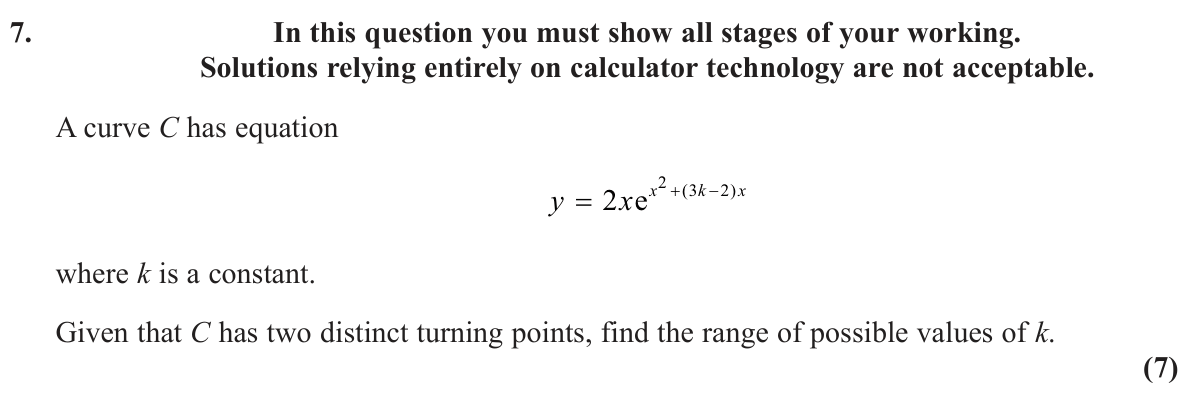
20. WMA13/01 October 2025 · Q7

Medium7 marks · main topic: Applications of Differentiation
WMA13/01 October 2025 Question 7 (7 marks): Differentiation
Show worked solution
  1. Solution

    \paragraph{Solution} Put $u=x^2+(3k-2)x$, so $u'=2x+3k-2$. By the product and chain rules,

    \[\frac{dy}{dx}=2e^u+2xe^u(2x+3k-2) =2e^u\bigl(2x^2+(3k-2)x+1\bigr).\]

    As $2e^u\gt 0$, stationary points satisfy

    \[2x^2+(3k-2)x+1=0.\]

    For two distinct real roots, the discriminant must be positive:

    \[(3k-2)^2-8\gt 0 \Longleftrightarrow |3k-2|\gt 2\sqrt2.\]

    Consequently

    \[k\lt \frac{2-2\sqrt2}{3}\quad\hbox{or}\quad k\gt \frac{2+2\sqrt2}{3}.\]

    For these values the quadratic changes sign at both simple roots, so both stationary points are genuine turning points. Equality gives a repeated root with no derivative sign change and is excluded.

Final answer

(main) $(-infinity,(2-2*sqrt(2))/3) union ((2+2*sqrt(2))/3,infinity)$

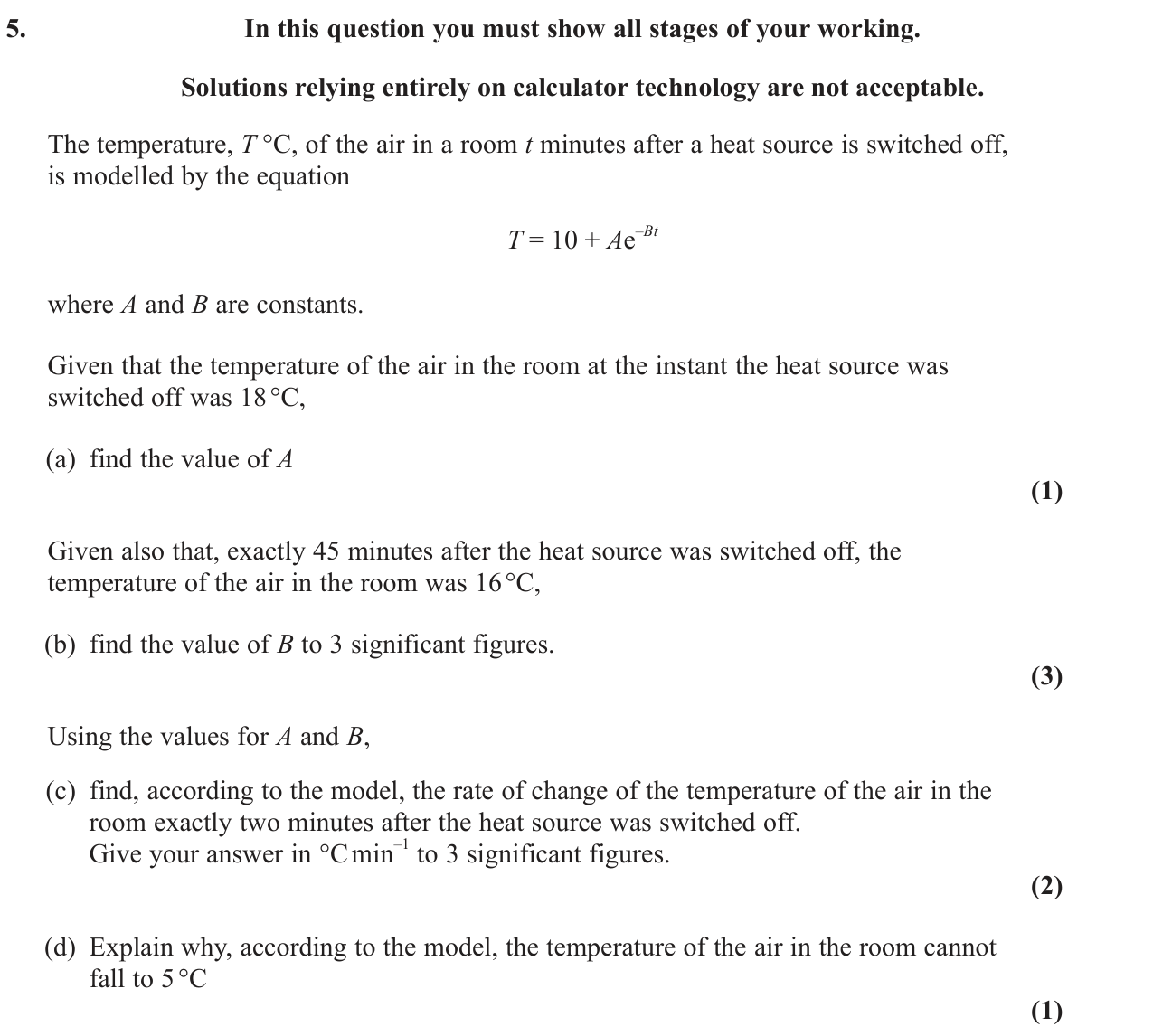
21. WMA13/01 January 2024 · Q5

Medium7 marks · main topic: Log Graphs & Exponential Models
WMA13/01 January 2024 Question 5 (7 marks): Differentiation
Show worked solution
  1. Part (a)

    At $t=0$, $18=10+Ae^0=10+A$.

    \[\boxed{A=8}\]
  2. Part (b)

    At $t=45$, $16=10+8e^{-45B}$, so $e^{-45B}=6/8=3/4$. Taking logarithms,

    \[-45B=\ln(3/4),\qquad B=\frac{\ln(4/3)}{45}=0.006392934943\ldots.\]
    \[\boxed{B=0.00639}\]
  3. Part (c)

    Differentiate $T=10+8e^{-Bt}$:

    \[\frac{dT}{dt}=-8Be^{-Bt}.\]

    At $t=2$, using the unrounded value $B=\ln(4/3)/45$, $dT/dt=-0.05049372834\ldots$. The negative sign means the temperature is falling.

    \[\boxed{\frac{dT}{dt}=-0.0505\ ^\circ\mathrm{C}\,\mathrm{min}^{-1}}\]
  4. Part (d)

    For every finite $t\ge0$, $8e^{-Bt}\gt 0$ because $B\gt 0$. Thus $T=10+8e^{-Bt}\gt 10$; as $t\to\infty$, T approaches 10 from above. It therefore cannot reach 5 degrees Celsius.

    \[\boxed{T\gt 10\gt 5}\]
Final answer

(a) $A=8$ (b) $B=0.00639$ (c) $\frac{dT}{dt}=-0.0505\ ^\circ\mathrm{C}\,\mathrm{min}^{-1}$ (d) $T\gt 10\gt 5$

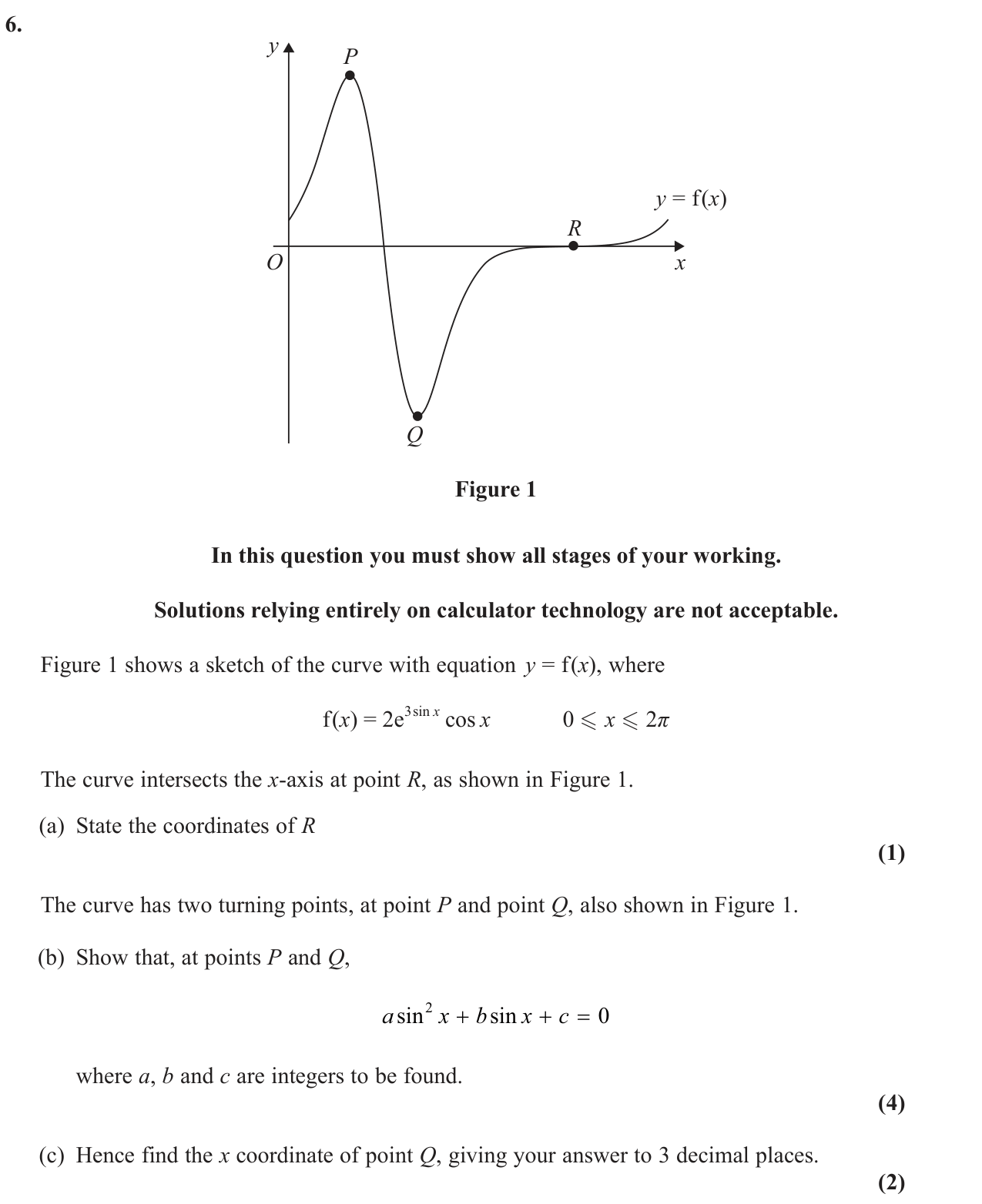
22. WMA13/01 January 2024 · Q6

Medium7 marks · main topic: Applications of Differentiation
WMA13/01 January 2024 Question 6 (7 marks): Differentiation
Show worked solution
  1. Part (a)

    Since $2e^{3\sin x}\gt 0$, zeros occur when $\cos x=0$. The labelled point R is the right-hand crossing, at $x=3\pi/2$.

    \[\boxed{R=\left(\frac{3\pi}{2},0\right)}\]
  2. Part (b)

    For $f(x)=2e^{3\sin x}\cos x$, the product and chain rules give

    \[f'(x)=2\left(3e^{3\sin x}\cos^2x-e^{3\sin x}\sin x\right) =2e^{3\sin x}(3\cos^2x-\sin x).\]

    At a turning point the derivative is zero. The exponential factor is nonzero, so $3\cos^2x-\sin x=0$. Substitute $\cos^2x=1-\sin^2x$ and rearrange: $3-3\sin^2x-\sin x=0$.

    \[\boxed{3\sin^2x+\sin x-3=0,\quad a=3,\ b=1,\ c=-3}\]
  3. Part (c)

    Solving $3s^2+s-3=0$ for $s=\sin x$ gives

    \[s=\frac{-1\pm\sqrt{37}}6.\]

    The negative root is less than $-1$, so it is impossible for a real sine. Let $\beta=\arcsin((\sqrt{37}-1)/6)$ in the first quadrant. The labelled minimum Q lies in the second quadrant, hence $x_Q=\pi-\beta=2.131037293\ldots$.

    \[\boxed{x_Q=2.131}\]
Final answer

(a) $R=\left(\frac{3\pi}{2},0\right)$ (b) $3\sin^2x+\sin x-3=0,\quad a=3,\ b=1,\ c=-3$ (c) $x_Q=2.131$

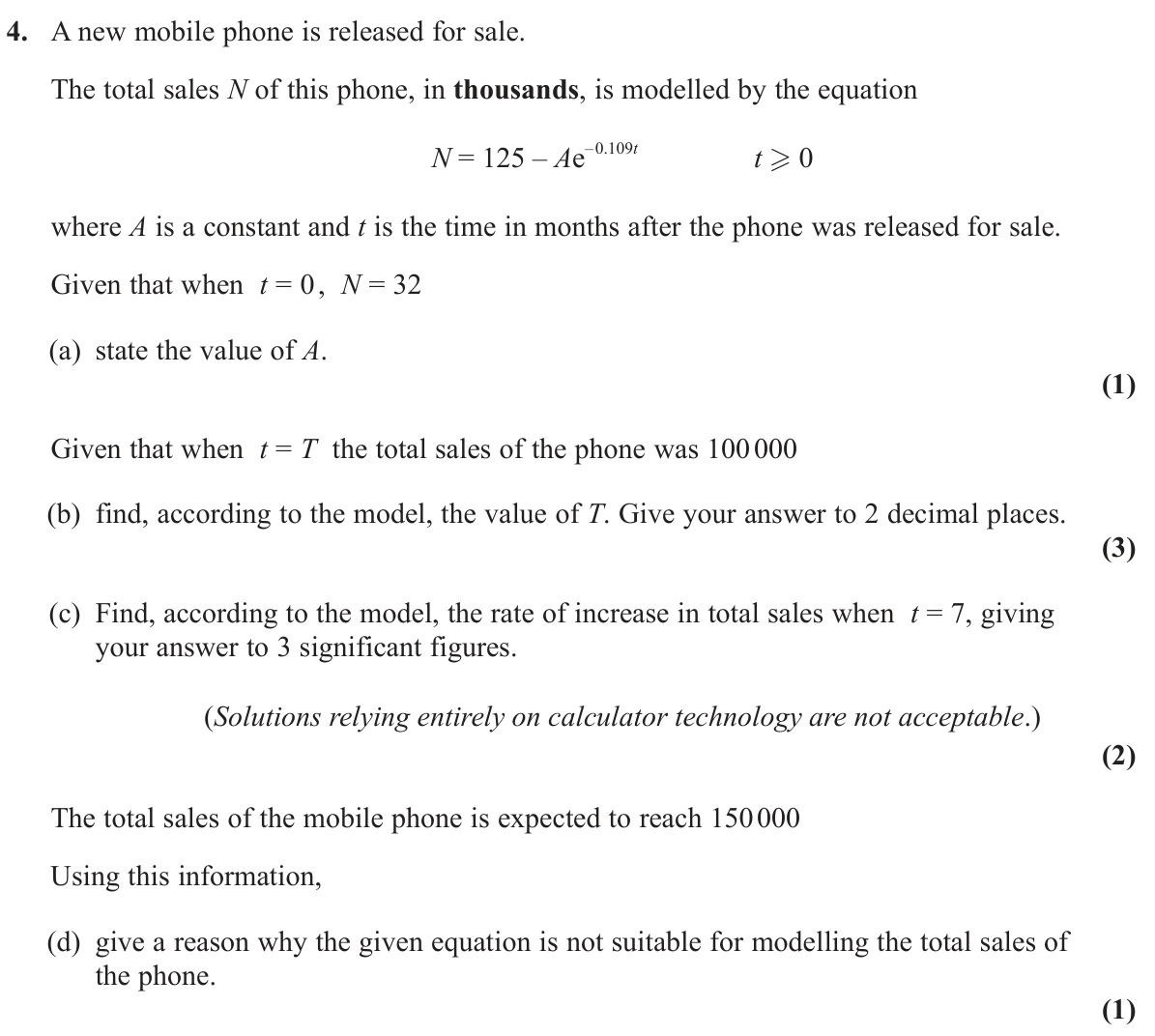
23. WMA13/01 October 2023 · Q4

Medium7 marks · main topic: Log Graphs & Exponential Models
WMA13/01 October 2023 Question 4 (7 marks): Differentiation
Show worked solution
  1. Part (a)

    Initially $t=0$ and $N=32$, because $N$ is measured in thousands.

    \[32=125-Ae^0=125-A.\]
    \[\boxed{A=93}\]
  2. Part (b)

    For 100000 phones, use $N=100$:

    \[100=125-93e^{-0.109T}\quad\Longrightarrow\quad e^{-0.109T}=\frac{25}{93}.\]

    Taking natural logarithms,

    \[T=\frac{\ln(93/25)}{0.109}=12.0525107\ldots\ \text{months}.\]
    \[\boxed{T=12.05\ \text{months}}\]
  3. Part (c)

    Differentiate the model:

    \[\frac{dN}{dt}=93(0.109)e^{-0.109t}.\]

    At $t=7$, this is $4.7265337\ldots$ thousand phones per month. Multiplying by 1000 gives $4726.5337\ldots$ phones per month.

    \[\boxed{4.73\times10^3\ \text{phones per month}}\]
  4. Part (d)

    For $t\ge0$, $93e^{-0.109t}\gt 0$, so $N\lt 125$ and $N\to125$ as $t\to\infty$. The model can therefore never reach 150000 phones: its limiting count is 125000.

    \[\boxed{\text{No: the limiting count is }125000\text{ phones.}}\]
Final answer

(a) $A=93$ (b) $T=12.05\ \text{months}$ (c) $4.73\times10^3\ \text{phones per month}$ (d) $\text{No: the limiting count is }125000\text{ phones.}$

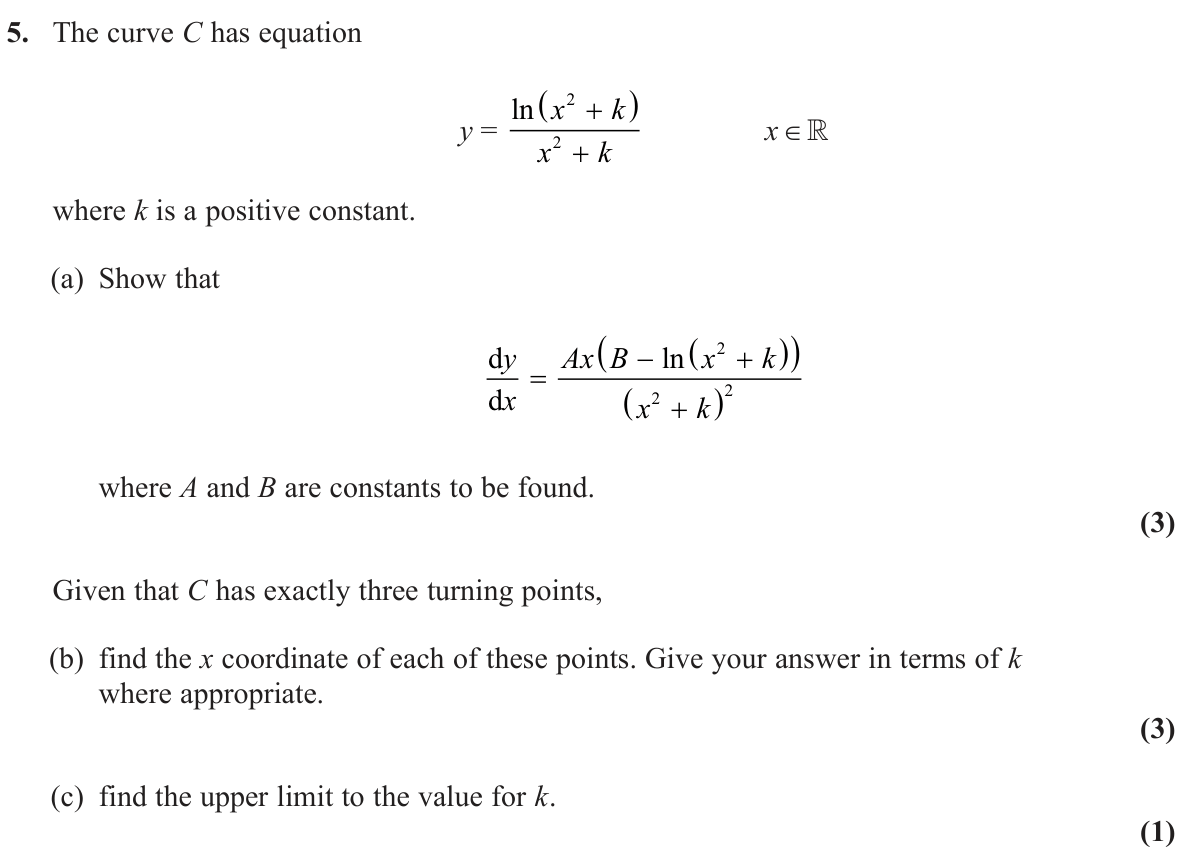
24. WMA13/01 October 2023 · Q5

Medium7 marks · main topic: Applications of Differentiation
WMA13/01 October 2023 Question 5 (7 marks): Differentiation
Show worked solution
  1. Part (a)

    Set $u=x^2+k\gt 0$. Applying the quotient and chain rules,

    \[\frac{dy}{dx}=\frac{(2x/u)u-2x\ln u}{u^2} =\frac{2x(1-\ln(x^2+k))}{(x^2+k)^2}.\]

    Comparing with the required form identifies both constants.

    \[\boxed{A=2,\qquad B=1}\]
  2. Part (b)

    The denominator is positive, so stationary points satisfy

    \[x=0\quad\text{or}\quad \ln(x^2+k)=1 \quad\Longrightarrow\quad x=0\quad\text{or}\quad x=\pm\sqrt{e-k}.\]

    There are three distinct real stationary points precisely when $e-k\gt 0$. In that case the factor $1-\ln(x^2+k)$ is positive between the outer roots and negative outside them; $2x$ changes sign at zero. Thus the derivative changes sign at all three points, so all are turning points. Together with $k\gt 0$, the three coordinates below are real and distinct; the restriction is $0\lt k\lt e$.

    \[\boxed{x=0,\quad x=-\sqrt{e-k},\quad x=\sqrt{e-k}}\]
  3. Part (c)

    At $k=e$, the two outer stationary points merge with $x=0$, so there are no longer three distinct turning points. Values of $k$ can approach $e$ from below, but cannot equal it under this condition.

    \[\boxed{\text{Upper limit }e}\]
Final answer

(a) $A=2,\qquad B=1$ (b) $x=0,\quad x=-\sqrt{e-k},\quad x=\sqrt{e-k}$ (c) $\text{Upper limit }e$

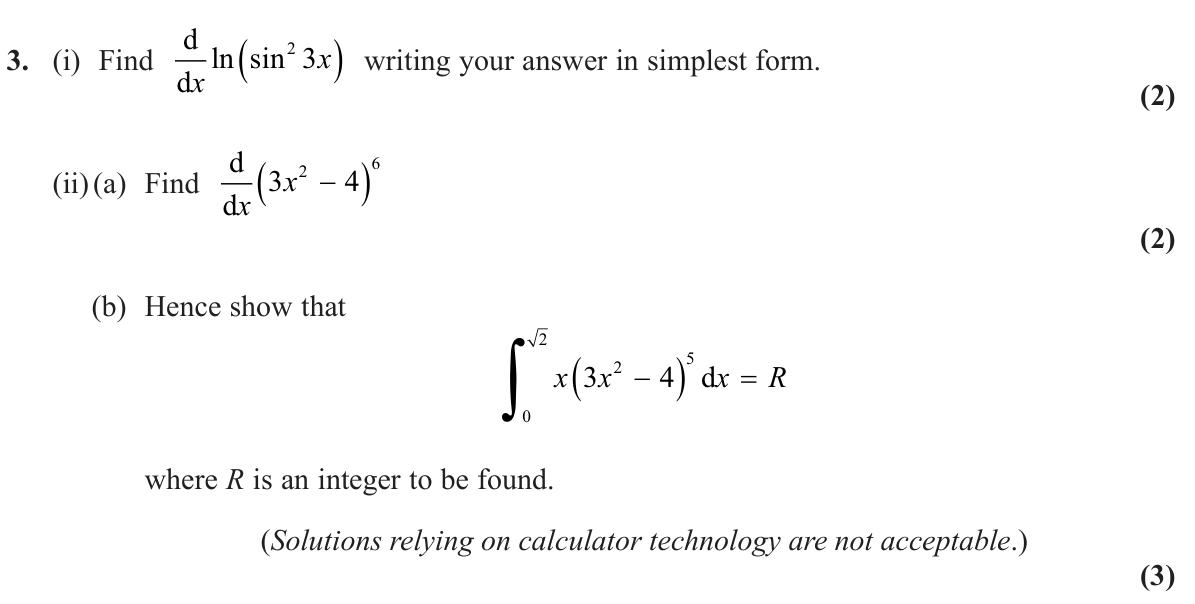
25. WMA13/01 May/June 2023 · Q3

Medium7 marks
WMA13/01 May/June 2023 Question 3 (7 marks): Differentiation
Show worked solution
  1. Part (i)

    Differentiate the logarithm directly on its domain $\sin3x\ne0$:

    \[\frac{d}{dx}\ln(\sin^2 3x) =\frac{2\sin3x\cos3x\cdot3}{\sin^2 3x}=6\cot3x.\]

    This does not assume $\sin3x\gt 0$; the logarithm's argument is its square.

    \[\boxed{6\cot3x}\]
  2. Part (ii)(a)

    Apply the power and chain rules:

    \[\frac{d}{dx}(3x^2-4)^6=6(3x^2-4)^5(6x)=36x(3x^2-4)^5.\]
    \[\boxed{36x(3x^2-4)^5}\]
  3. Part (ii)(b)

    From part (ii)(a), an antiderivative of $x(3x^2-4)^5$ is $(3x^2-4)^6/36$.

    \[R=\left[\frac{(3x^2-4)^6}{36}\right]_0^{\sqrt2} =\frac{2^6-(-4)^6}{36}=\frac{64-4096}{36}=-112.\]
    \[\boxed{R=-112}\]
Final answer

(i) $6\cot3x$ (ii)(a) $36x(3x^2-4)^5$ (ii)(b) $R=-112$

26. WMA13/01 October 2022 · Q3

Medium7 marks · main topic: Applications of Differentiation
WMA13/01 October 2022 Question 3 (7 marks): Differentiation
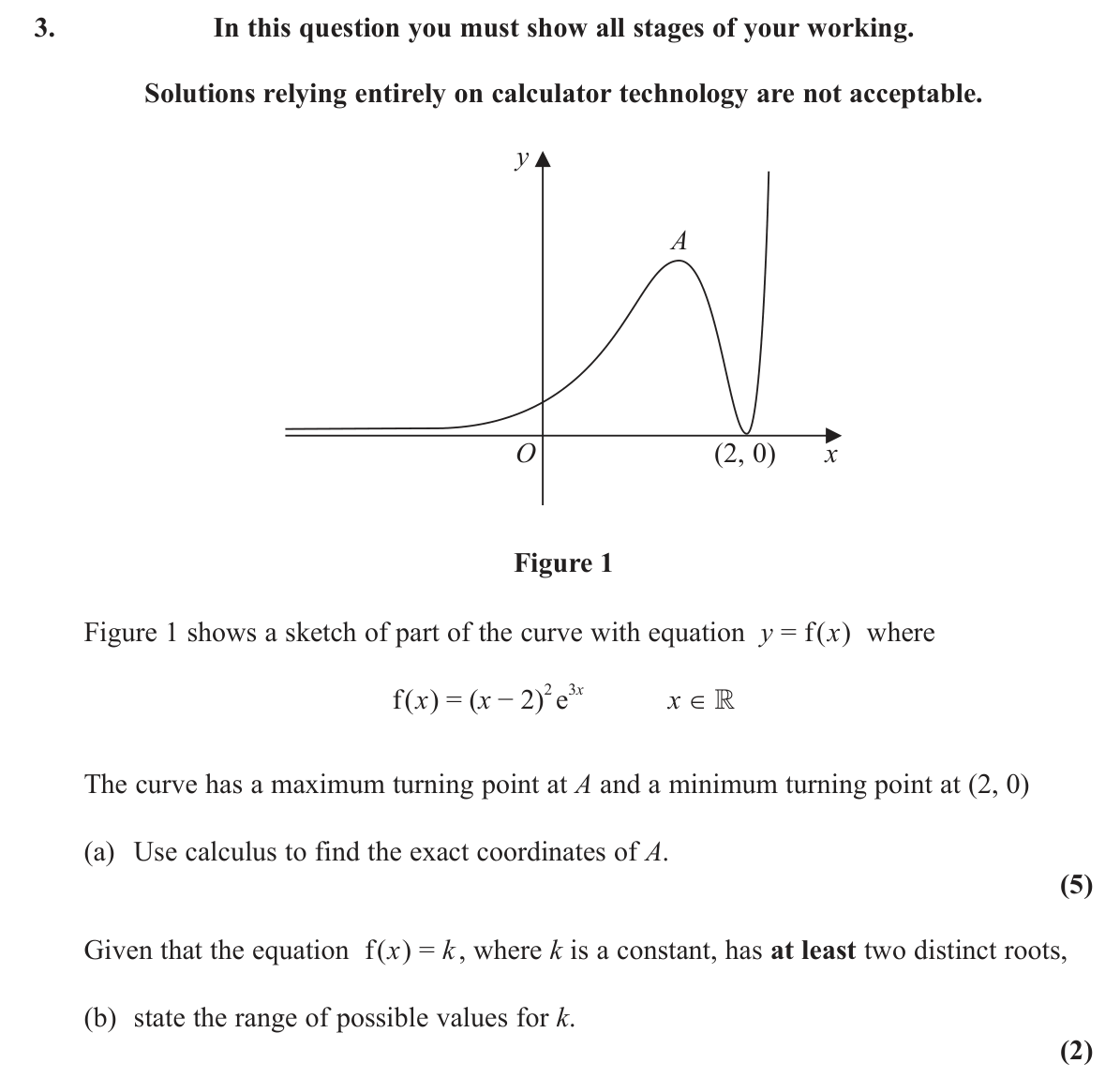
Show worked solution
  1. Part (a)

    By the product rule,

    \[f'(x)=2(x-2)e^{3x}+3(x-2)^2e^{3x} =e^{3x}(x-2)(3x-4).\]

    Since the exponential is positive, stationary points have $x=2$ or $x=4/3$. The sign of $f'$ changes from positive to negative at $4/3$, so this is the maximum A.

    \[f(4/3)=(-2/3)^2e^4=\frac49e^4.\]
    \[\boxed{A=\left(\frac43,\frac{4e^4}{9}\right)}\]
  2. Part (b)

    The curve is nonnegative and has just one zero, $x=2$; hence $k=0$ is excluded. It tends to 0 from above as $x\to-\infty$, rises to $4e^4/9$, falls to 0, then rises without bound. For $0\lt k\lt 4e^4/9$ there are three intersections. At the maximum level there are two distinct intersections, including A. For a larger positive k there is only one.

    \[\boxed{0\lt k\le\frac{4e^4}{9}}\]
Final answer

(a) $A=\left(\frac43,\frac{4e^4}{9}\right)$ (b) $0\lt k\le\frac{4e^4}{9}$

27. WMA13/01 January 2022 · Q10

Medium7 marks
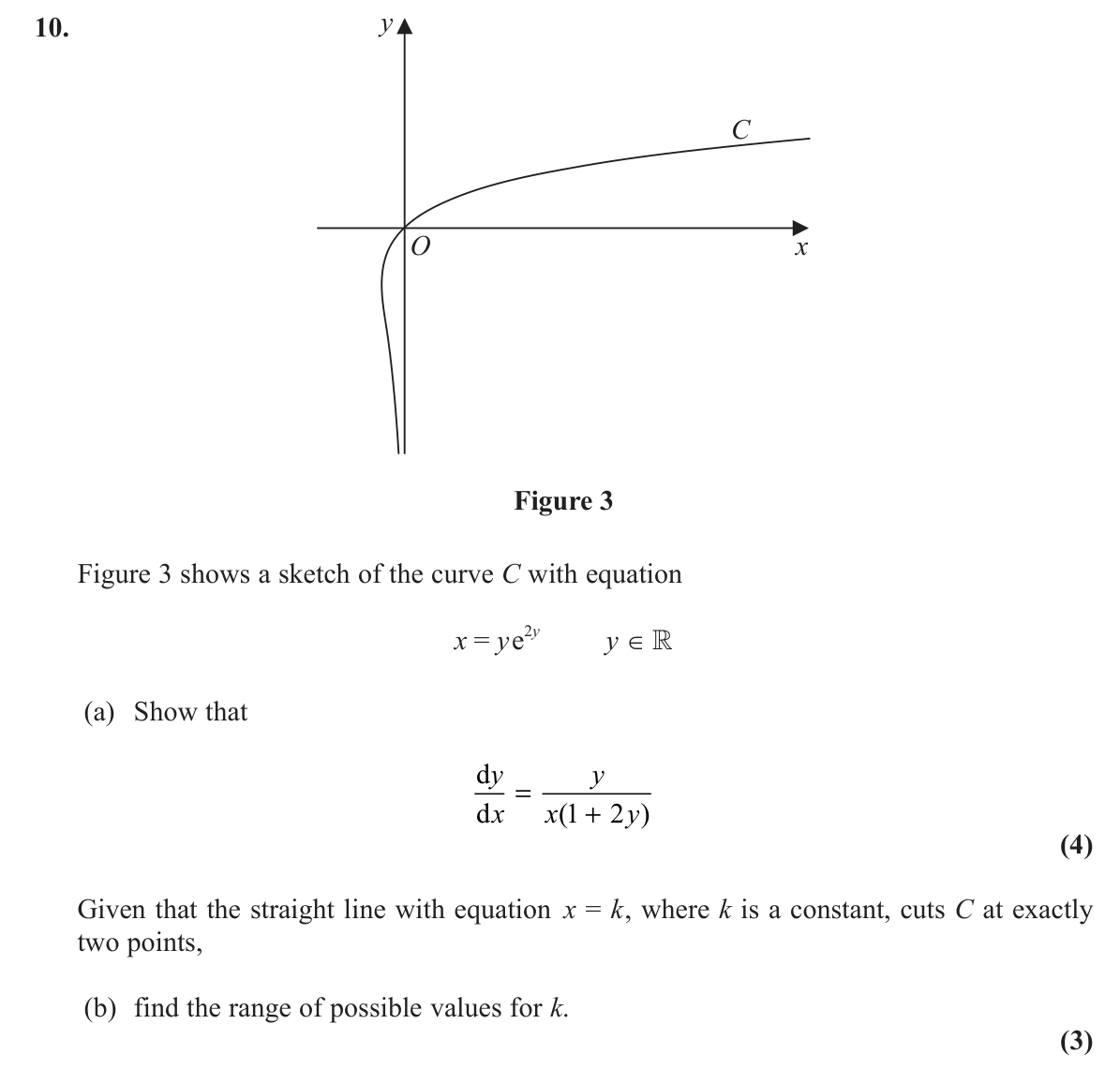
WMA13/01 January 2022 Question 10 (7 marks): Differentiation
Show worked solution
  1. Part (a)

    Differentiate x with respect to y by the product rule:

    \[\frac{dx}{dy}=e^{2y}+2ye^{2y}=e^{2y}(1+2y).\]

    Where $dx/dy\ne0$, take the reciprocal:

    \[\frac{dy}{dx}=\frac{e^{-2y}}{1+2y}.\]

    For $y\ne0$, the original relation gives $e^{2y}=x/y$, hence the required form $dy/dx=y/[x(1+2y)]$. At the origin, that last quotient is $0/0$; the preceding uncancelled derivative gives $dy/dx=1$. At $y=-1/2$ there is no finite $dy/dx$.

    \[\boxed{\frac{dy}{dx}=\frac{y}{x(1+2y)}\quad\text{where defined}}\]
  2. Part (b)

    Consider $x=h(y)=ye^{2y}$. Its derivative $h'(y)=e^{2y}(1+2y)$ vanishes at $y=-1/2$. It is negative before this y value and positive after it, so the minimum x value is $h(-1/2)=-1/(2e)$. As $y\to-\infty$, $h(y)\to0$ from below; also $h(0)=0$ and h then increases without bound. Thus a level $x=k$ meets both negative-y branches precisely between the minimum and zero. At the minimum the two intersections coincide; at zero there is just the finite point $y=0$.

    \[\boxed{-\frac1{2e}\lt k\lt 0}\]
Final answer

(a) $\frac{dy}{dx}=\frac{y}{x(1+2y)}\quad\text{where defined}$ (b) $-\frac1{2e}\lt k\lt 0$

28. WMA13/01 October 2021 · Q8

Medium7 marks
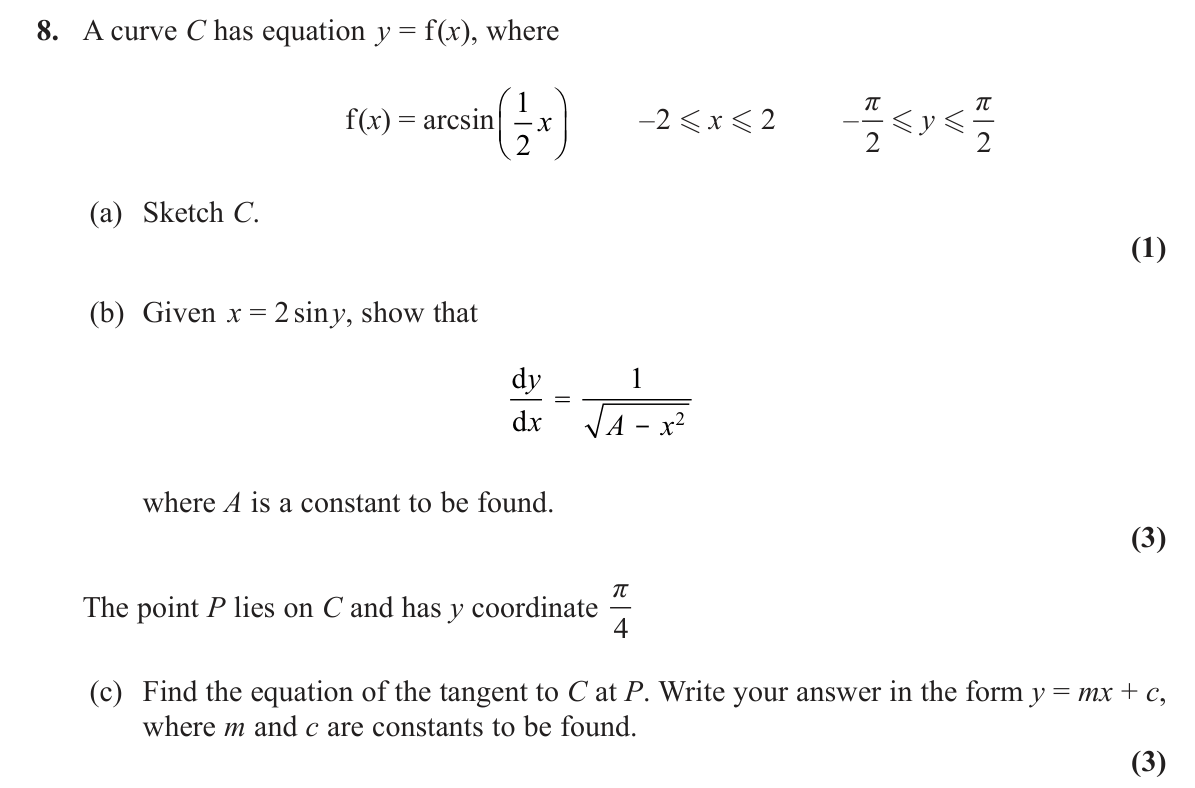
WMA13/01 October 2021 Question 8 (7 marks): Differentiation
Show worked solution
  1. Part (a)

    The principal arcsine curve increases from $(-2,-\pi/2)$ through $(0,0)$ to $(2,\pi/2)$. It is concave down on the negative-x half, concave up on the positive-x half, and vertical at both ends.

    \[\boxed{y=\arcsin(x/2),\quad -2\le x\le2}\]
  2. Part (b)

    Differentiate the supplied inverse relation: $dx/dy=2\cos y$. For $-\pi/2\lt y\lt \pi/2$, cosine is positive, so $\cos y=\sqrt{1-\sin^2y}=\sqrt{1-x^2/4}$. Taking the reciprocal gives

    \[\frac{dy}{dx}=\frac1{2\cos y}=\frac1{\sqrt{4-x^2}},\qquad -2\lt x\lt 2.\]

    Thus $A=4$; the endpoints have vertical tangents, not finite derivatives.

    \[\boxed{A=4,\qquad\frac{dy}{dx}=\frac1{\sqrt{4-x^2}}}\]
  3. Part (c)

    At $y=\pi/4$, $x=2\sin(\pi/4)=\sqrt2$. The gradient is $1/\sqrt{4-2}=1/\sqrt2$. Hence $y-\pi/4=(x-\sqrt2)/\sqrt2$, so $y=x/\sqrt2+\pi/4-1$.

    \[\boxed{y=\frac{x}{\sqrt2}+\frac\pi4-1}\]
Final answer

(a) $y=\arcsin(x/2),\quad -2\le x\le2$ (b) $A=4,\qquad\frac{dy}{dx}=\frac1{\sqrt{4-x^2}}$ (c) $y=\frac{x}{\sqrt2}+\frac\pi4-1$

29. WMA13/01 May/June 2021 · Q1

Medium7 marks · main topic: Numerical Methods
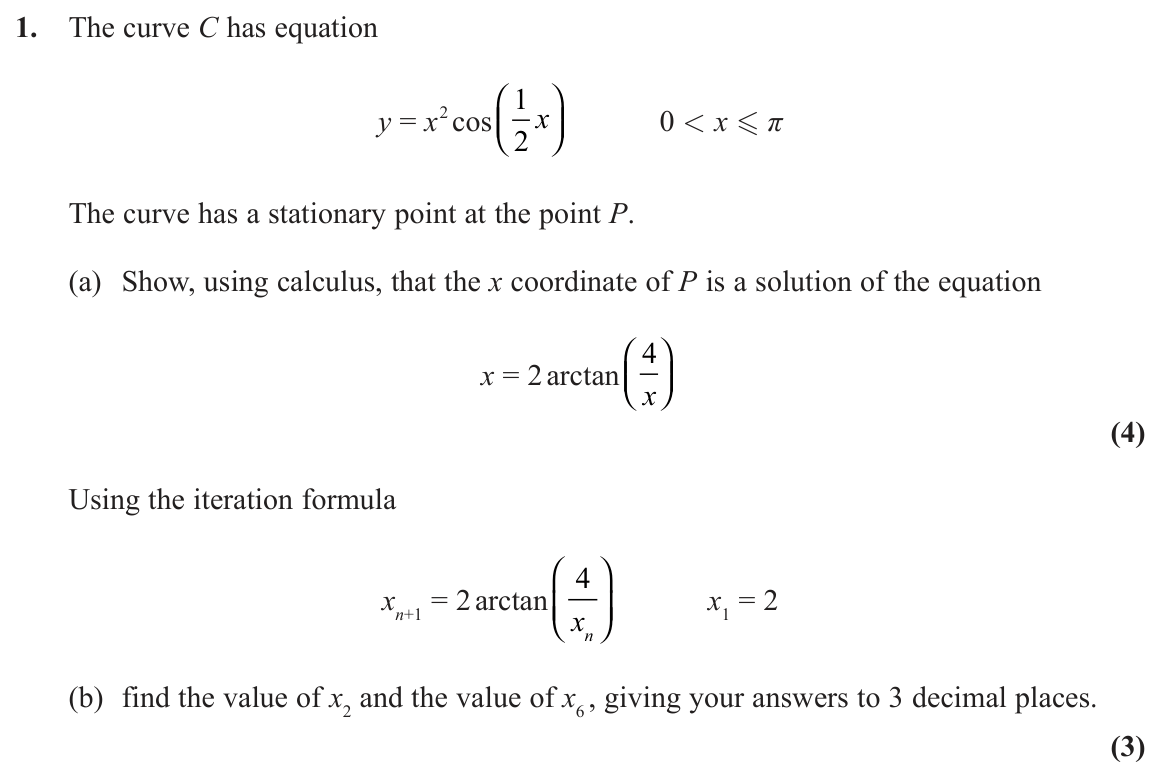
WMA13/01 May/June 2021 Question 1 (7 marks): Differentiation
Show worked solution
  1. Part (a)

    Using the product and chain rules,

    \[y'=2x\cos(x/2)-\frac{x^2}{2}\sin(x/2).\]

    At a stationary point, divide by $x/2$, since $x\gt 0$, to obtain $4\cos(x/2)=x\sin(x/2)$. The endpoint $x=\pi$ does not satisfy this equation, so at P we have $0\lt x\lt \pi$ and $\cos(x/2)\gt 0$. Hence $\tan(x/2)=4/x$. The principal arctangent is valid because $0\lt x/2\lt \pi/2$:

    \[x=2\arctan(4/x).\]
    \[\boxed{x=2\arctan(4/x)}\]
  2. Part (b)

    Use radian mode and retain full calculator precision between iterations:

    \[\begin{array}{c|rrrrrr}n&1&2&3&4&5&6\\\hline x_n&2&2.214297436&2.130426058&2.162810067&2.150238622&2.155108774 \end{array}\]

    Thus the requested second and sixth terms, not the limiting value, are as below.

    \[\boxed{x_2=2.214,\qquad x_6=2.155}\]
Final answer

(a) $x=2\arctan(4/x)$ (b) $x_2=2.214,\qquad x_6=2.155$

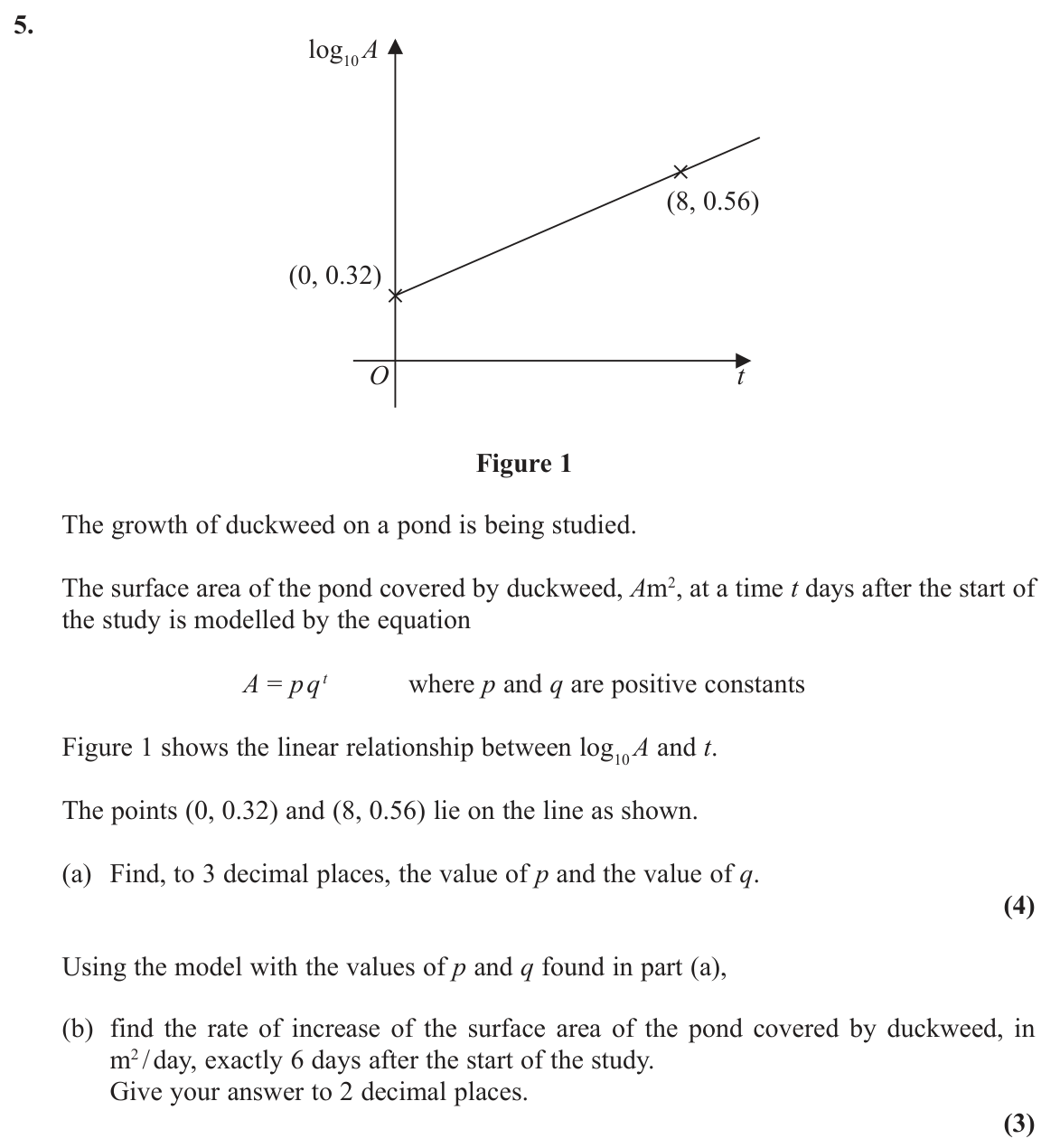
30. WMA13/01 May/June 2021 · Q5

Medium7 marks · main topic: Log Graphs & Exponential Models
WMA13/01 May/June 2021 Question 5 (7 marks): Differentiation
Show worked solution
  1. Part (a)

    Taking base-ten logarithms gives $\log_{10}A=\log_{10}p+t\log_{10}q$. The intercept is 0.32 and the gradient is $(0.56-0.32)/8=0.03$. Thus $p=10^{0.32}=2.08929613\ldots$ and $q=10^{0.03}=1.071519305\ldots$.

    \[\boxed{p=2.089,\qquad q=1.072}\]
  2. Part (b)

    Using the parameter values requested in (a), $A=2.089(1.072)^t$. For an arbitrary positive base, $d(q^t)/dt=q^t\ln q$, so

    \[A'(6)=2.089(1.072)^6\ln(1.072)=0.2204219233\ldots.\]

    This is a positive area increase per day. Retaining unrounded parameters also gives 0.22 to two decimal places.

    \[\boxed{0.22\ \mathrm{m^2/day}}\]
Final answer

(a) $p=2.089,\qquad q=1.072$ (b) $0.22\ \mathrm{m^2/day}$

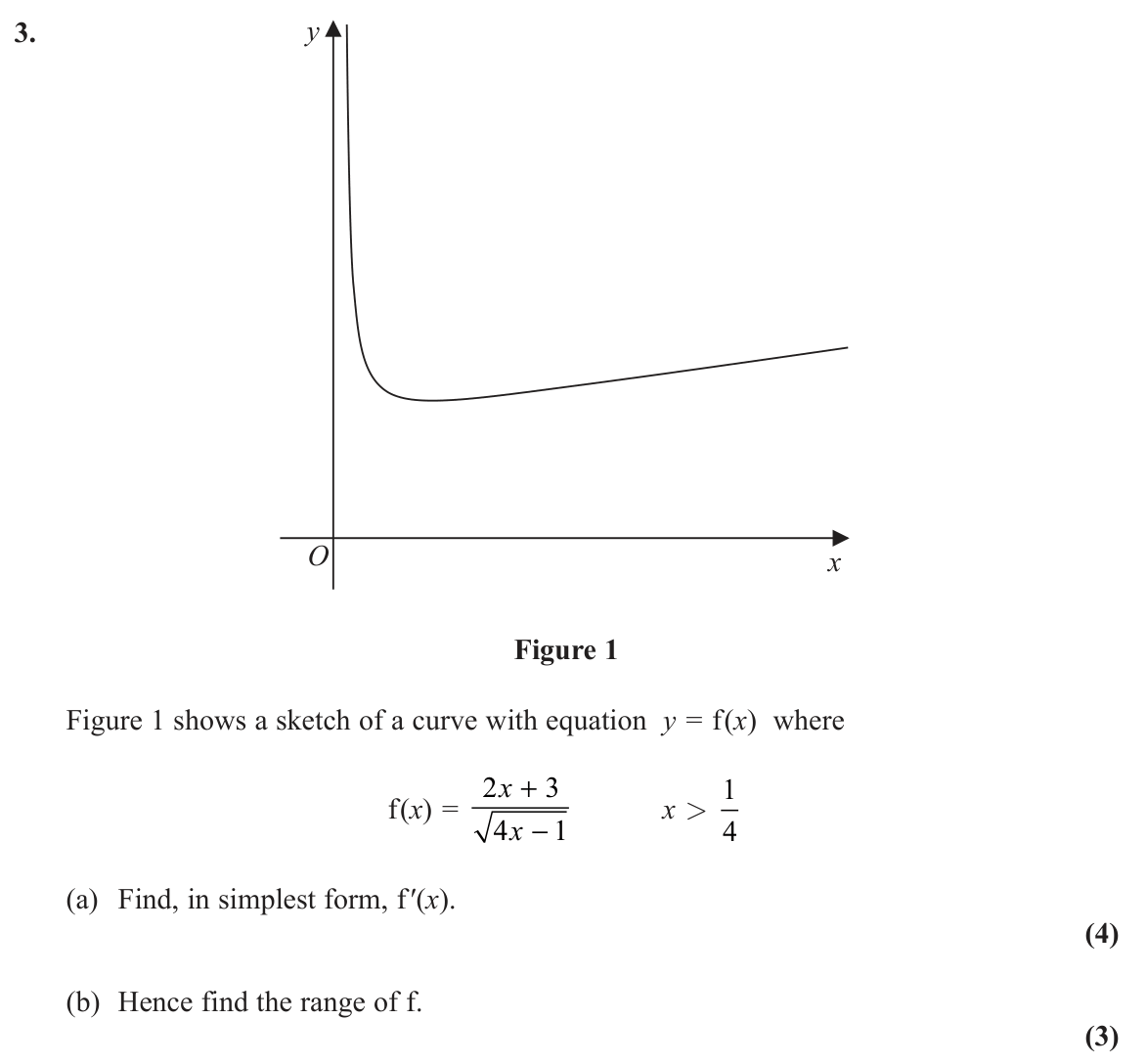
31. WMA13/01 October 2020 · Q3

Medium7 marks
WMA13/01 October 2020 Question 3 (7 marks): Differentiation
Show worked solution
  1. Part (a)

    Write $f(x)=(2x+3)(4x-1)^{-1/2}$. The product and chain rules give

    \[f'(x)=2(4x-1)^{-1/2}-2(2x+3)(4x-1)^{-3/2} =\frac{2(4x-1)-2(2x+3)}{(4x-1)^{3/2}} =\frac{4(x-2)}{(4x-1)^{3/2}},\quad x\gt \tfrac14.\]
    \[\boxed{f'(x)=\frac{4(x-2)}{(4x-1)^{3/2}}}\]
  2. Part (b)

    The denominator of $f'(x)$ is positive throughout the domain, so the derivative is negative for $1/4\lt x\lt 2$ and positive for $x\gt 2$. Consequently $x=2$ is the global minimum, with $f(2)=7/\sqrt7=\sqrt7$. Also $f(x)\to\infty$ as $x\to1/4^+$ and as $x\to\infty$. By continuity all values at least $\sqrt7$ are attained, including the minimum.

    \[\boxed{\operatorname{range}(f)=[\sqrt7,\infty)}\]
Final answer

(a) $f'(x)=\frac{4(x-2)}{(4x-1)^{3/2}}$ (b) $\operatorname{range}(f)=[\sqrt7,\infty)$

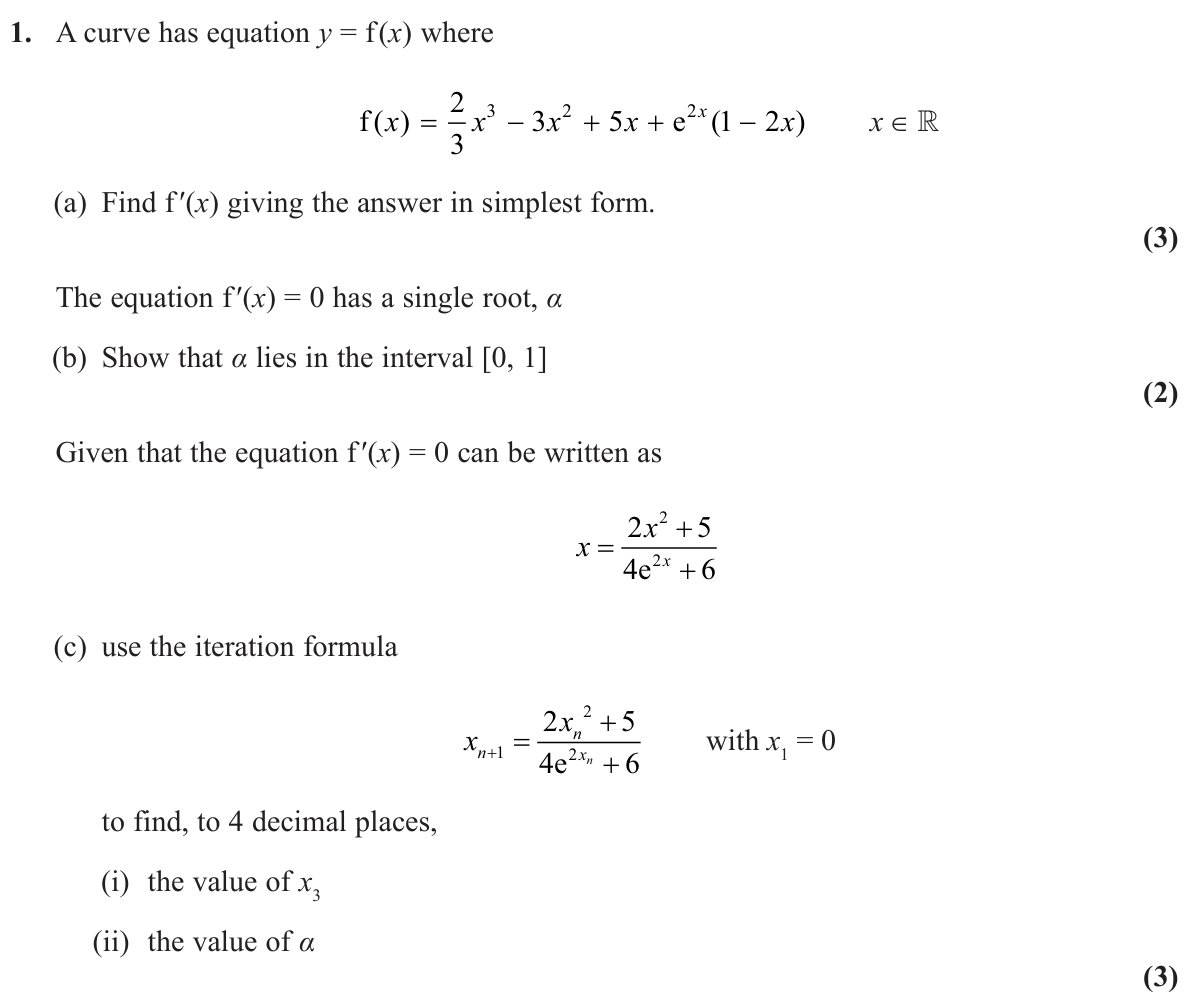
32. WMA13/01 May/June 2026 · Q1

Medium8 marks · main topic: Numerical Methods
WMA13/01 May/June 2026 Question 1 (8 marks): Differentiation
Show worked solution
  1. Part (a)

    Apply the product rule to the exponential term:

    \[f'(x)=2x^2-6x+5+2e^{2x}(1-2x)-2e^{2x} =\boxed{2x^2-6x+5-4xe^{2x}}.\]
  2. Part (b)

    The derivative is continuous on $[0,1]$, and

    \[f'(0)=5\gt 0,\qquad f'(1)=1-4e^2\approx-28.5562\lt 0.\]

    The change of sign therefore places a zero of $f'$ between 0 and 1. Since the zero is unique, $\boxed{\alpha\in(0,1)}$, and hence it is in $[0,1]$.

  3. Part (c)(i)

    Start at $x_1=0$, retaining unrounded values in each substitution:

    \[x_2=\frac{2(0)^2+5}{4e^0+6}=0.5,\qquad x_3=\frac{2(0.5)^2+5}{4e^1+6}=0.3259620992\ldots.\]

    Thus $\boxed{x_3=0.3260}$ to 4 decimal places.

  4. Part (c)(ii)

    Continuing the supplied iteration gives

    \[\begin{array}{c|rrrrrr} n&4&5&6&7&8&9\\\hline x_n&0.381116669&0.363053595&0.368908652&0.367004338&0.367623025&0.367421950 \end{array}\]
    \[x_{10}=0.3674872922,\quad x_{11}=0.3674660574,\quad x_{12}=0.3674729582,\quad x_{13}=0.3674707156.\]

    Further iteration stabilises at $0.367471265\ldots$, so $\boxed{\alpha=0.3675}$ to 4 decimal places.

Final answer

(a) $2x^2-6x+5-4xe^{2x}$ (b) $\alpha\in(0,1)$ (c)(i) $x_3=0.3260$ (c)(ii) $\alpha=0.3675$

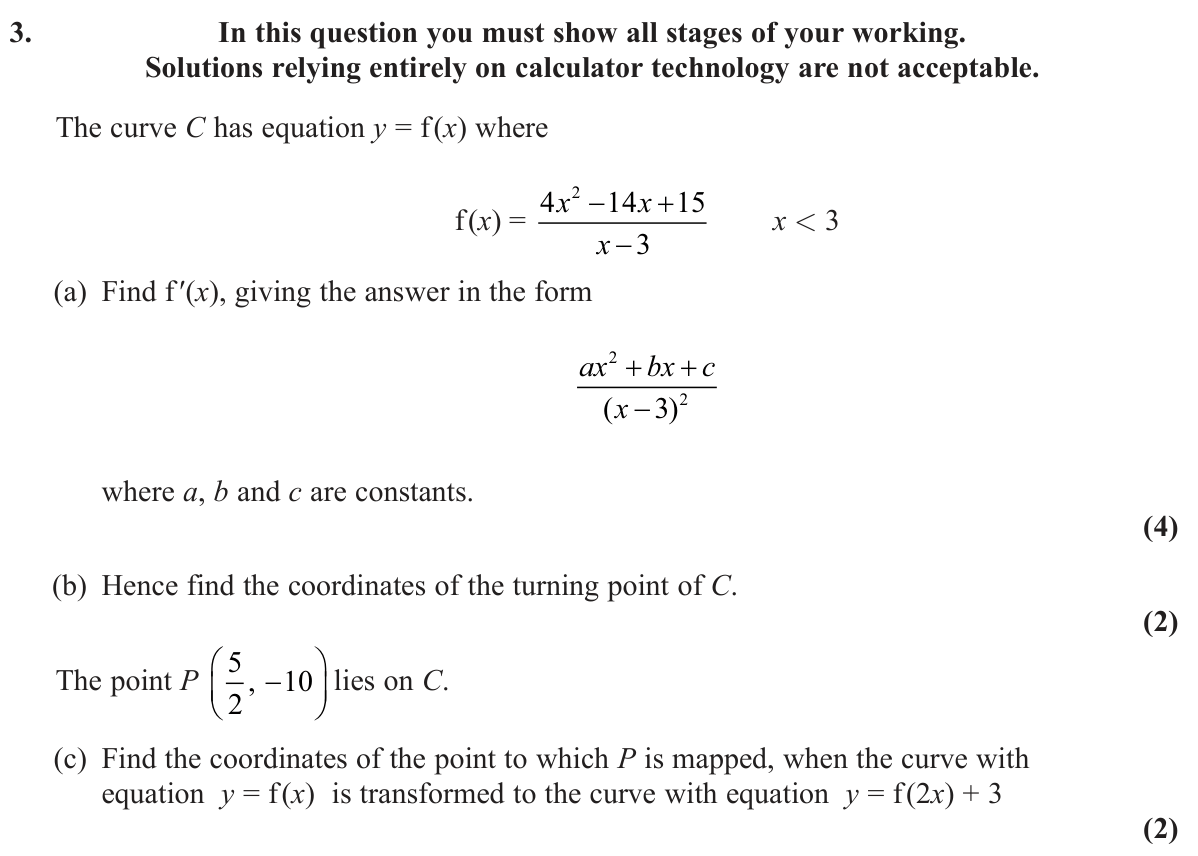
33. WMA13/01 May/June 2026 · Q3

Medium8 marks
WMA13/01 May/June 2026 Question 3 (8 marks): Differentiation
Show worked solution
  1. Part (a)

    Using the quotient rule,

    \[f'(x)=\frac{(x-3)(8x-14)-(4x^2-14x+15)}{(x-3)^2} =\boxed{\frac{4x^2-24x+27}{(x-3)^2}}.\]

    Thus $a=4$, $b=-24$ and $c=27$.

  2. Part (b)

    A stationary point requires

    \[4x^2-24x+27=(2x-3)(2x-9)=0.\]

    The roots are $3/2$ and $9/2$. Reject $9/2$ because the stated domain is $x\lt 3$. At $x=3/2$, $f(x)=-2$, so the turning point is $\boxed{(3/2,-2)}$. The derivative changes from positive to negative there, confirming a maximum.

  3. Part (c)

    The inside factor 2 halves the horizontal coordinate; adding 3 raises the vertical coordinate by 3. Therefore

    \[(x,y)\mapsto(x/2,y+3),\qquad (5/2,-10)\mapsto\boxed{(5/4,-7)}.\]
Final answer

(a) $\frac{4x^2-24x+27}{(x-3)^2}$ (b) $(3/2,-2)$ (c) $(5/4,-7)$

34. WMA13/01 October 2025 · Q5

Medium8 marks · main topic: Log Graphs & Exponential Models
WMA13/01 October 2025 Question 5 (8 marks): Differentiation
Show worked solution
  1. Part (a)

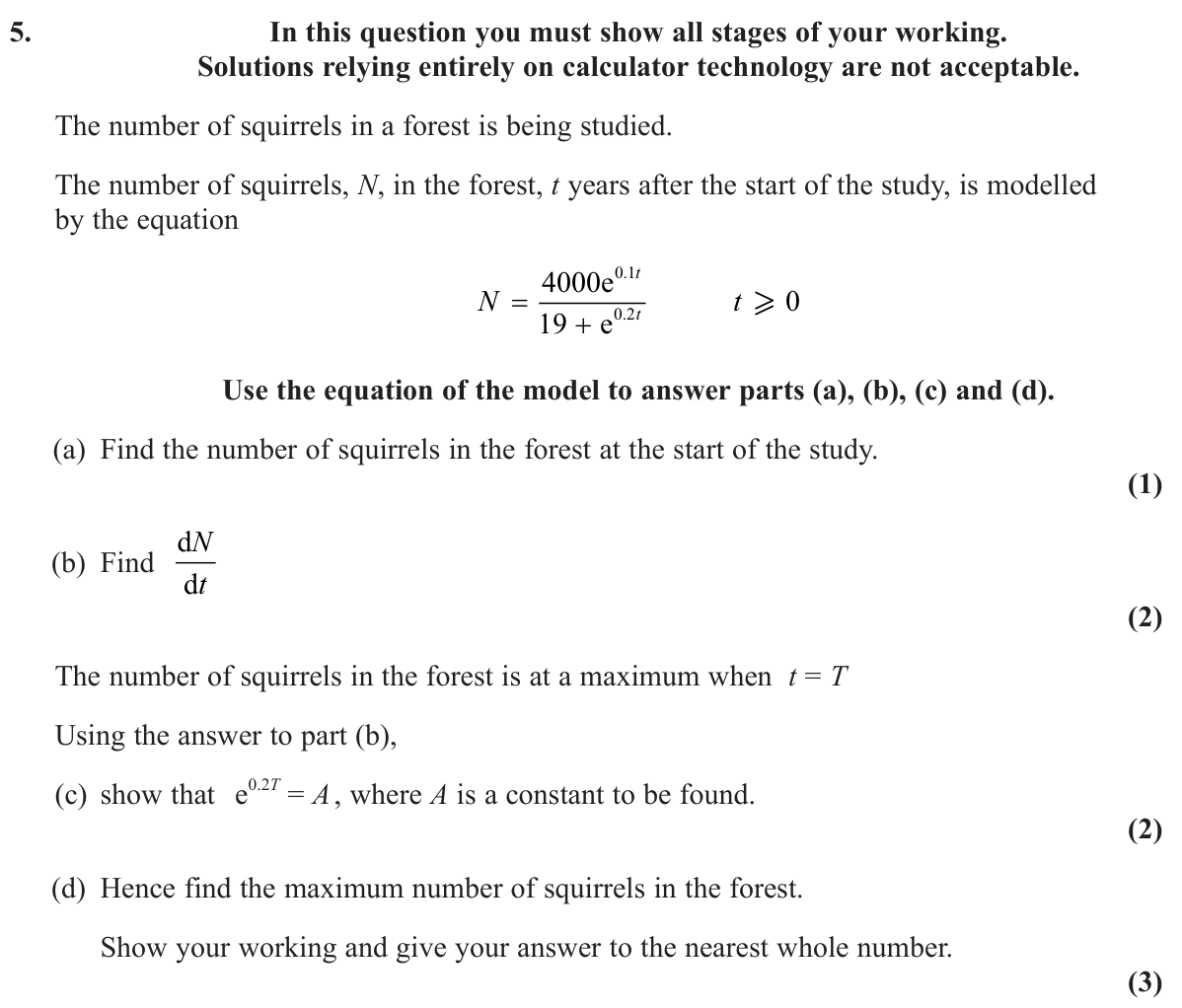
    At $t=0$, $N=4000/(19+1)=200$ squirrels.

  2. Part (b)

    The quotient rule gives

    \[\frac{dN}{dt} =\frac{400e^{0.1t}(19+e^{0.2t})-800e^{0.3t}} {(19+e^{0.2t})^2} =\frac{400e^{0.1t}(19-e^{0.2t})}{(19+e^{0.2t})^2}.\]
  3. Part (c)

    At $t=T$, the derivative is zero. The exponential and denominator are positive, so $19-e^{0.2T}=0$. Therefore $e^{0.2T}=19$ and $A=19$. The derivative is positive before $T$ and negative after $T$, confirming a maximum.

  4. Part (d)

    Since $e^{0.2T}=19$, we have $e^{0.1T}=\sqrt{19}$. Substitution into the model gives

    \[N_{\max}=\frac{4000\sqrt{19}}{19+19} =\frac{2000}{\sqrt{19}}=458.831467741\ldots.\]

    The maximum number is $459$ squirrels to the nearest whole number.

Final answer

(a) $200$ (b) $400*exp(t/10)*(19-exp(t/5))/(19+exp(t/5))^2$ (c) $exp(T/5)=19$ (d) $459$

35. WMA13/01 May/June 2025 · Q6

Medium8 marks · main topic: Log Graphs & Exponential Models
WMA13/01 May/June 2025 Question 6 (8 marks): Differentiation
Show worked solution
  1. Part (a)

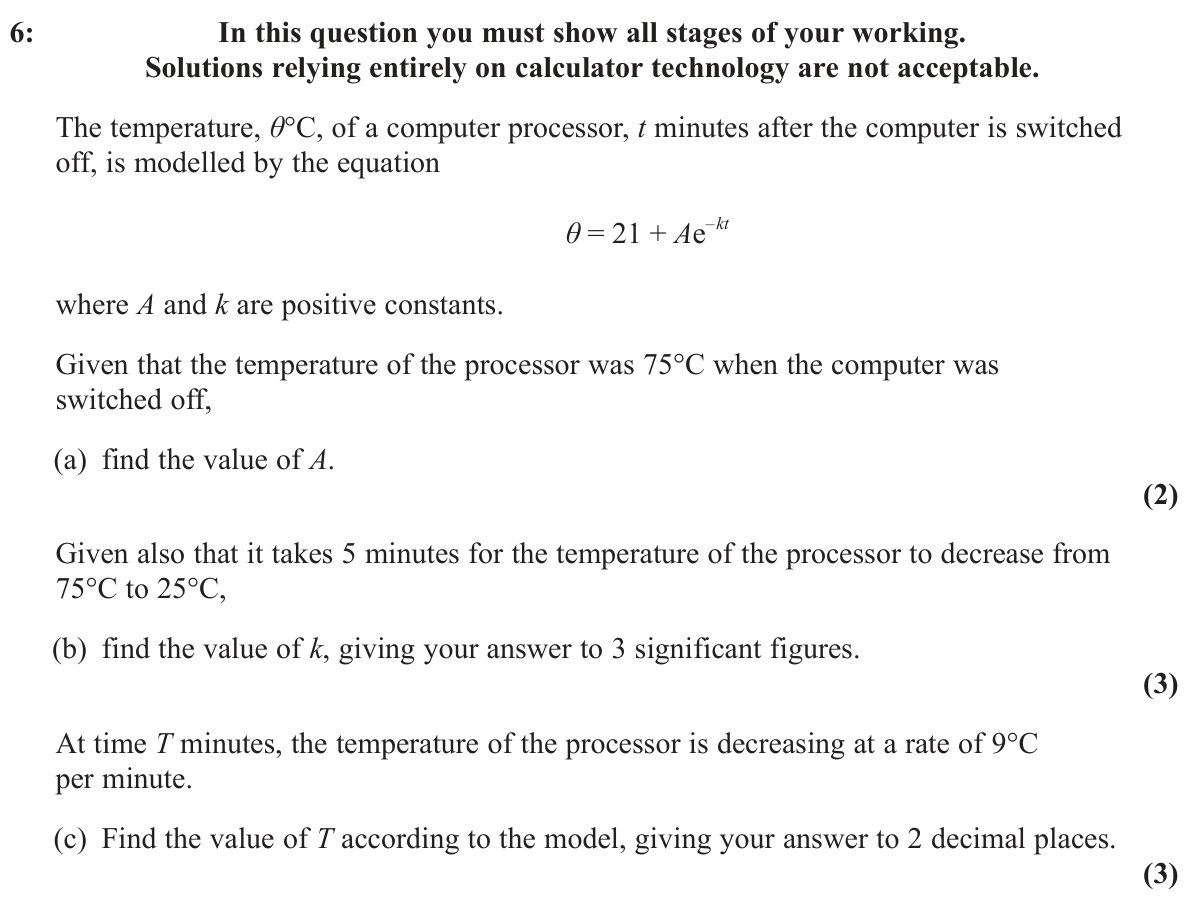
    At $t=0$, $75=21+A$, so $\boxed{A=54}$.

  2. Part (b)

    At $t=5$, $25=21+54e^{-5k}$, hence

    \[e^{-5k}=\frac2{27},\qquad k=\frac15\ln\frac{27}{2}=0.520537937\ldots=\boxed{0.521}.\]
  3. Part (c)

    Differentiate the temperature model:

    \[\frac{d\theta}{dt}=-54ke^{-kt}.\]

    A decrease of $9\,{}^{\circ}\mathrm{C}$ per minute means $d\theta/dt=-9$, not $+9$. Thus

    \[-54ke^{-kT}=-9\ \Longrightarrow\ e^{-kT}=\frac1{6k} \ \Longrightarrow\ T=\frac{\ln(6k)}{k}.\]

    Using the unrounded value of $k$,

    \[T=2.187865\ldots=\boxed{2.19\text{ minutes}}.\]
Final answer

(a) $A=54$ (b) $0.521$ (c) $2.19\text{ minutes}$

36. WMA13/01 January 2025 · Q9

Medium8 marks · main topic: Applications of Differentiation
WMA13/01 January 2025 Question 9 (8 marks): Differentiation
Show worked solution
  1. Part (a)

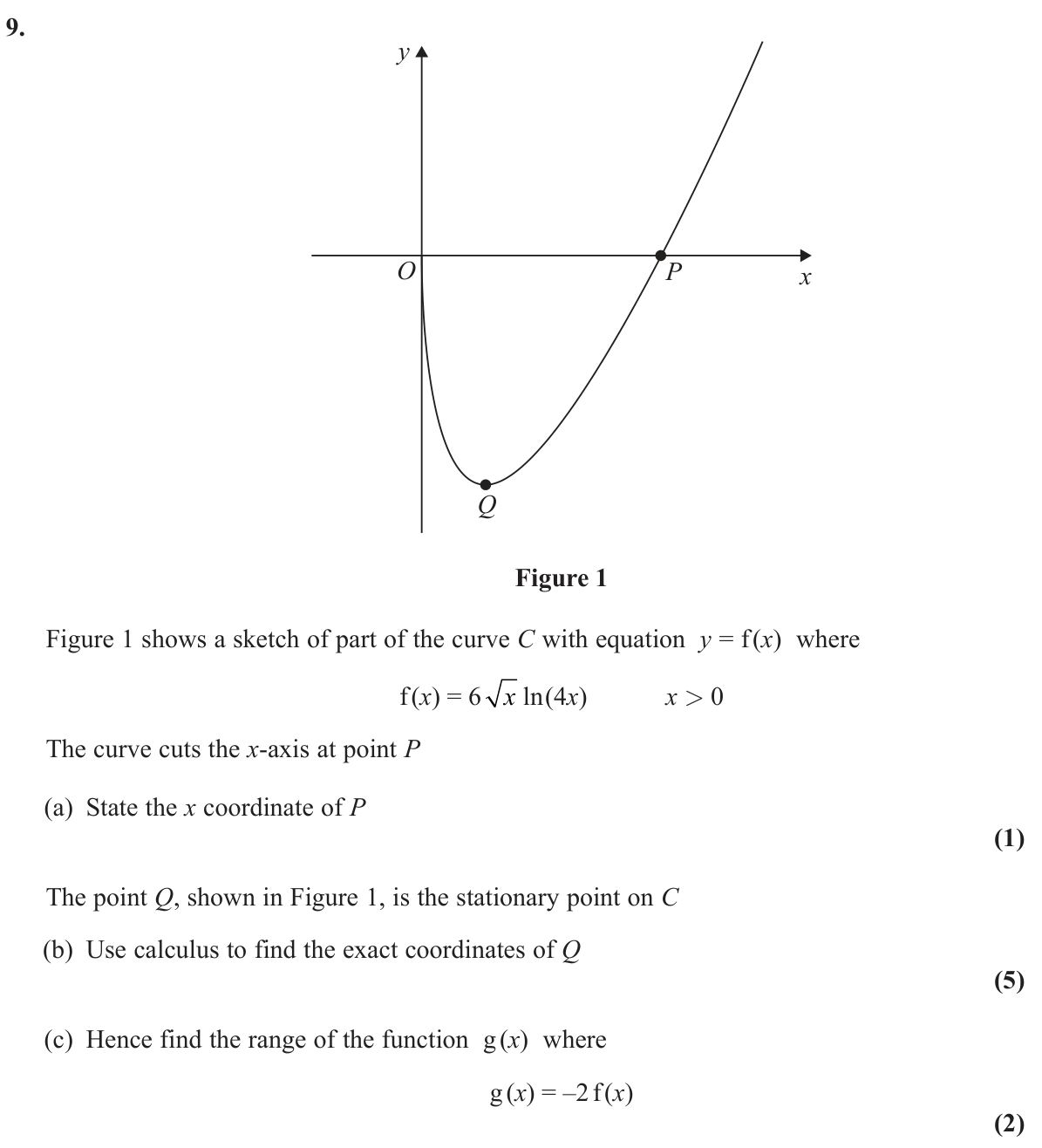
    Since $x\gt 0$, $6\sqrt{x}$ is positive. Therefore $f(x)=0$ requires $\ln(4x)=0$, so $4x=1$ and $x=1/4$.

    \[\boxed{x_P=\frac14}\]
  2. Part (b)

    Apply the product and chain rules:

    \[f'(x)=\frac3{\sqrt{x}}\ln(4x)+6\sqrt{x}\frac1x =\frac3{\sqrt{x}}[\ln(4x)+2].\]

    At $Q$, set $f'(x)=0$. Since $3/\sqrt{x}\gt 0$,

    \[\ln(4x)+2=0\quad\Longrightarrow\quad4x=e^{-2} \quad\Longrightarrow\quad x=\frac1{4e^2}.\]

    Then $\sqrt{x}=1/(2e)$ and $\ln(4x)=-2$, giving $f(x)=6(1/(2e))(-2)=-6/e$.

    \[\boxed{Q=\left(\frac1{4e^2},-\frac6e\right)}\]
  3. Part (c)

    The factor $3/\sqrt{x}$ is positive and $\ln(4x)+2$ increases through zero at $Q$, so $f'$ changes from negative to positive: $Q$ is the global minimum. As $x\to\infty$, $f(x)\to\infty$, hence the range of $f$ is $[-6/e,\infty)$. Multiplication by $-2$ reverses the inequality and includes the maximum $12/e$.

    \[\boxed{g(x)\le\frac{12}{e}}\]
Final answer

(a) $x_P=\frac14$ (b) $Q=\left(\frac1{4e^2},-\frac6e\right)$ (c) $g(x)\le\frac{12}{e}$

37. WMA13/01 May/June 2023 · Q7

Medium8 marks · main topic: Log Graphs & Exponential Models
WMA13/01 May/June 2023 Question 7 (8 marks): Differentiation
Show worked solution
  1. Part (a)

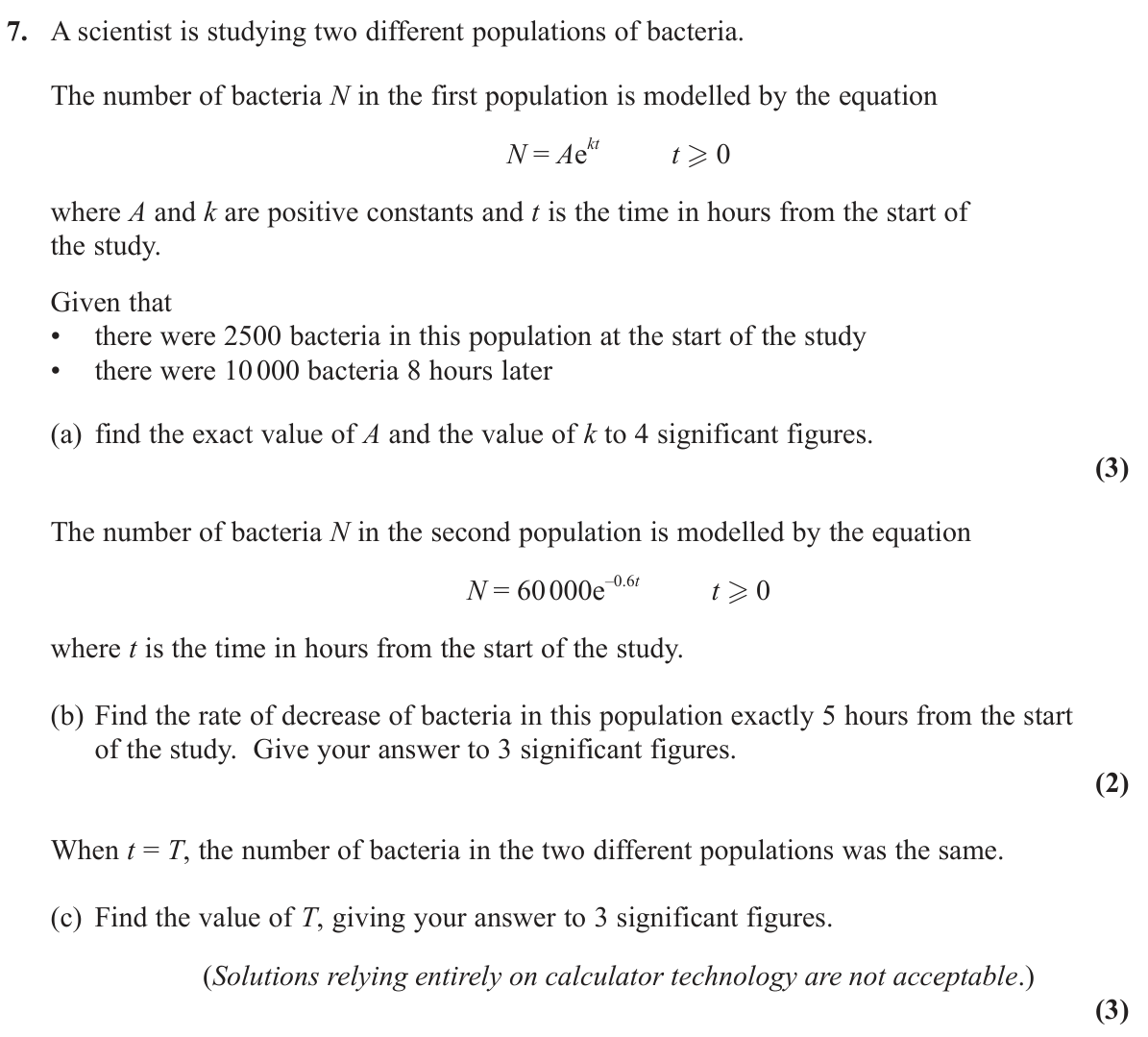
    At $t=0$, $2500=Ae^0$, so $A=2500$ exactly. At $t=8$, $10000=2500e^{8k}$; hence $e^{8k}=4$ and $k=\ln4/8=0.1732867951\ldots$. To four significant figures:

    \[\boxed{A=2500,\qquad k=0.1733}\]
  2. Part (b)

    For the second population,

    \[\frac{dN}{dt}=-36000e^{-0.6t},\qquad \left.\frac{dN}{dt}\right|_{t=5}=-36000e^{-3}=-1792.334461\ldots.\]

    The requested rate of decrease is the positive magnitude, to three significant figures.

    \[\boxed{1.79\times10^3\ \text{bacteria per hour}}\]
  3. Part (c)

    Retain the exact value $k=\ln4/8$. Equating populations gives

    \[2500e^{kT}=60000e^{-0.6T}\quad\Longrightarrow\quad e^{(k+0.6)T}=24.\]

    Take natural logs and solve:

    \[T=\frac{\ln24}{0.6+\ln4/8}=4.109799689\ldots\ \text{hours}.\]
    \[\boxed{T=4.11\ \text{hours}}\]
Final answer

(a) $A=2500,\qquad k=0.1733$ (b) $1.79\times10^3\ \text{bacteria per hour}$ (c) $T=4.11\ \text{hours}$

38. WMA13/01 May/June 2023 · Q10

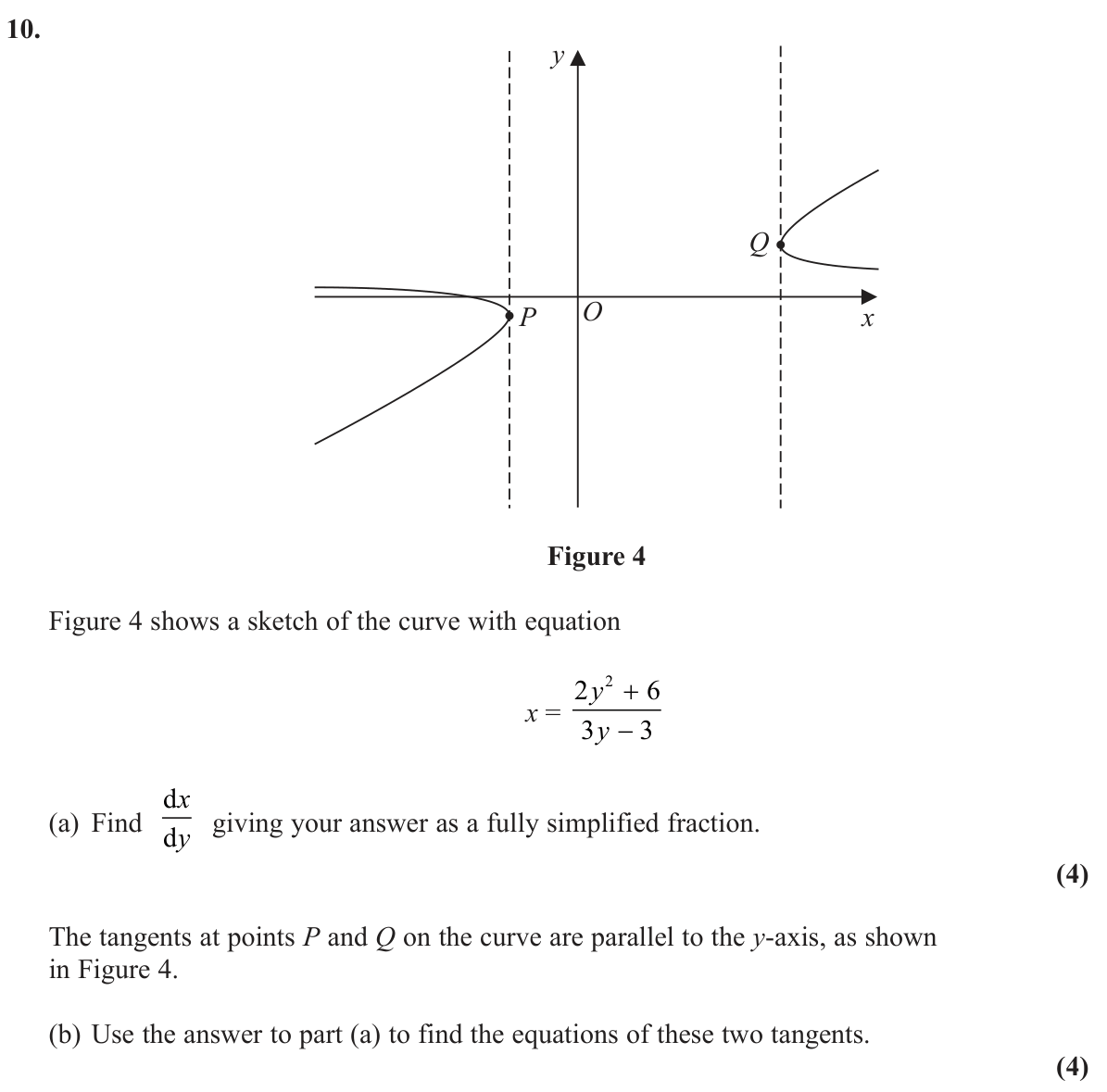
Medium8 marks
WMA13/01 May/June 2023 Question 10 (8 marks): Differentiation
Show worked solution
  1. Part (a)

    The quotient rule gives, for $y\ne1$,

    \[\frac{dx}{dy}=\frac{4y(3y-3)-3(2y^2+6)}{(3y-3)^2} =\frac{6y^2-12y-18}{9(y-1)^2} =\frac{2(y-3)(y+1)}{3(y-1)^2}.\]
    \[\boxed{\frac{dx}{dy}=\frac{2(y-3)(y+1)}{3(y-1)^2},\quad y\ne1}\]
  2. Part (b)

    A tangent parallel to the $y$-axis is vertical, so $dx/dy=0$. The numerator gives $(y-3)(y+1)=0$, hence $y=3$ or $y=-1$; neither makes the denominator zero. Then

    \[x(3)=\frac{18+6}{9-3}=4,\qquad x(-1)=\frac{2+6}{-3-3}=-\frac43.\]

    Thus $Q=(4,3)$ and $P=(-4/3,-1)$, with the vertical tangent equations below.

    \[\boxed{x=-\frac43,\qquad x=4}\]
Final answer

(a) $\frac{dx}{dy}=\frac{2(y-3)(y+1)}{3(y-1)^2},\quad y\ne1$ (b) $x=-\frac43,\qquad x=4$

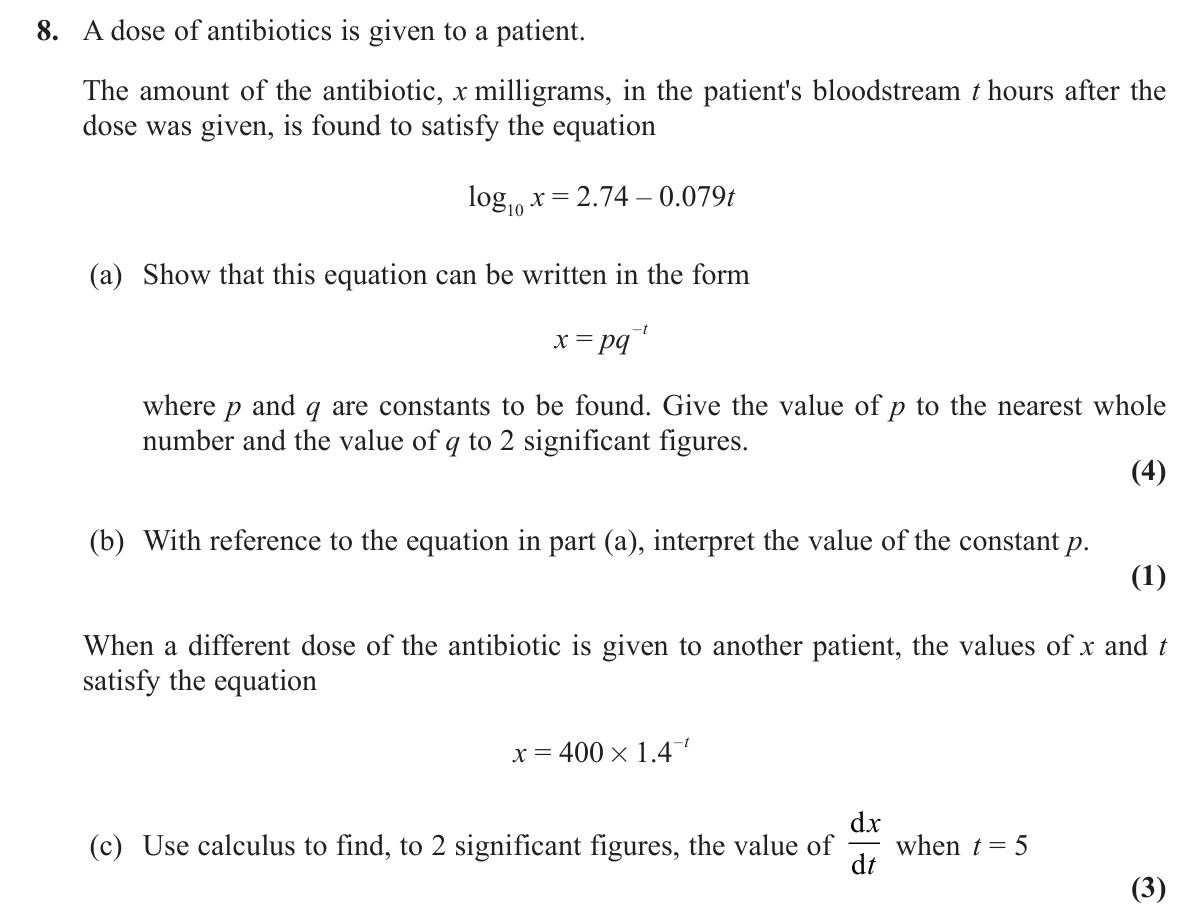
39. WMA13/01 January 2022 · Q8

Medium8 marks · main topic: Log Graphs & Exponential Models
WMA13/01 January 2022 Question 8 (8 marks): Differentiation
Show worked solution
  1. Part (a)

    Exponentiate base 10:

    \[x=10^{2.74-0.079t}=10^{2.74}(10^{0.079})^{-t}.\]

    Thus $p=10^{2.74}=549.5408739\ldots$ and $q=10^{0.079}=1.199499303\ldots$. Round p to the nearest integer and q to two significant figures.

    \[\boxed{p=550,\qquad q=1.2}\]
  2. Part (b)

    At $t=0$, $x=pq^0=p$. Thus p is the initial amount of antibiotic in the patient's bloodstream, approximately 550 milligrams immediately after the dose in this model.

    \[\boxed{p\text{ represents the initial amount, approximately }550\ \mathrm{mg}}\]
  3. Part (c)

    For the second patient, write $x=400e^{-t\ln1.4}$. Differentiate to obtain $dx/dt=-400\ln(1.4)\,1.4^{-t}$. At $t=5$, the derivative is $-25.02470969\ldots\,\mathrm{mg\,h^{-1}}$. The negative sign indicates the amount is decreasing.

    \[\boxed{\left.\frac{dx}{dt}\right|_{t=5}=-25\ \mathrm{mg\,h^{-1}}}\]
Final answer

(a) $p=550,\qquad q=1.2$ (b) $p\text{ represents the initial amount, approximately }550\ \mathrm{mg}$ (c) $\left.\frac{dx}{dt}\right|_{t=5}=-25\ \mathrm{mg\,h^{-1}}$

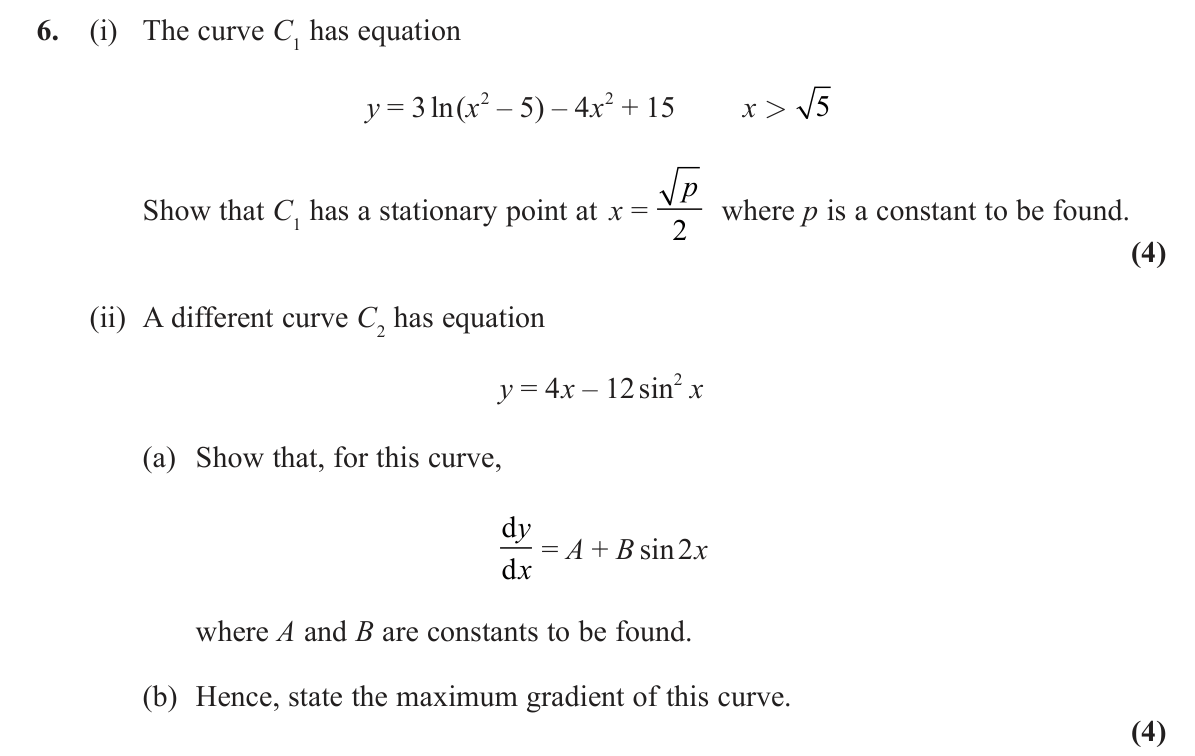
40. WMA13/01 October 2021 · Q6

Medium8 marks
WMA13/01 October 2021 Question 6 (8 marks): Differentiation
Show worked solution
  1. Part (i)

    Differentiate to obtain $y'=6x/(x^2-5)-8x$. At a stationary point in $x\gt \sqrt5$, x is nonzero, so $6/(x^2-5)=8$, giving $6=8x^2-40$ and $x^2=23/4$. The original positive domain selects $x=\sqrt{23}/2$, which exceeds $\sqrt5$. Hence $p=23$.

    \[\boxed{p=23,\qquad x=\frac{\sqrt{23}}2}\]
  2. Part (ii)

    (a) Differentiate the squared sine with the chain rule: $y'=4-24\sin x\cos x=4-12\sin2x$. Thus $A=4$, $B=-12$. (b) Since $-1\le\sin2x\le1$, the largest derivative is attained when $\sin2x=-1$: $4-12(-1)=16$.

    \[\boxed{A=4,\quad B=-12;\qquad\text{maximum gradient}=16}\]
Final answer

(i) $p=23,\qquad x=\frac{\sqrt{23}}2$ (ii) $A=4,\quad B=-12;\qquad\text{maximum gradient}=16$

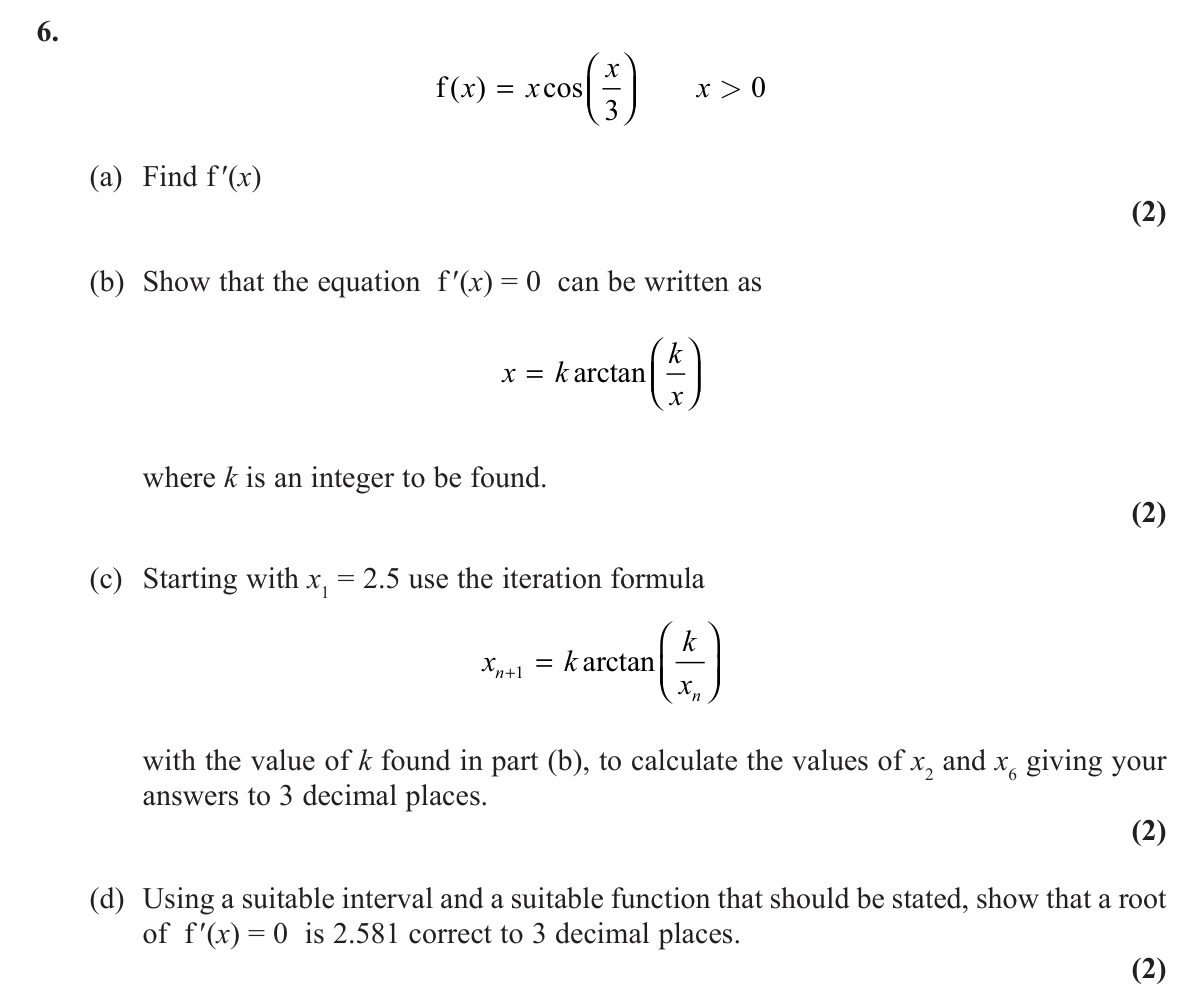
41. WMA13/01 January 2021 · Q6

Medium8 marks · main topic: Numerical Methods
WMA13/01 January 2021 Question 6 (8 marks): Differentiation
Show worked solution
  1. Part (a)

    By the product and chain rules, $f'(x)=\cos(x/3)-(x/3)\sin(x/3)$.

    \[\boxed{f^{\prime}(x)=\cos(x/3)-\frac{x}{3}\sin(x/3)}\]
  2. Part (b)

    Set $f'(x)=0$: $\cos(x/3)=(x/3)\sin(x/3)$. At a solution, cosine cannot vanish (that would leave a nonzero right side), so $\tan(x/3)=3/x$. On the principal positive branch $0\lt x/3\lt \pi/2$, this gives

    \[x=3\arctan(3/x),\qquad k=3.\]

    This is the branch used by the supplied iteration for the root near 2.581. The original domain $x\gt 0$ also admits later tangent branches: in general $x=3\arctan(3/x)+3n\pi$. The principal-branch rearrangement must not be interpreted as listing every positive stationary point.

    \[\boxed{k=3;\quad x=3\arctan(3/x)\text{ on the selected branch}}\]
  3. Part (c)

    Using radians and $x_1=2.5$, the successive values are

    \[\begin{array}{c|rrrrrr}n&1&2&3&4&5&6\\\hline x_n&2.5&2.628174152&2.554102174&2.596526871&2.572101407&2.586122337 \end{array}\]

    Keep full precision between steps and round the requested terms only.

    \[\boxed{x_2=2.628,\qquad x_6=2.586}\]
  4. Part (d)

    Define $F(x)=\cos(x/3)-(x/3)\sin(x/3)$, which is continuous near 2.581. The rounding interval endpoints give

    \[F(2.5805)=0.0003467157\ldots\gt 0,\qquad F(2.5815)=-0.0003456897\ldots\lt 0.\]

    By continuity a root lies strictly between these endpoints; every number in this open interval rounds to 2.581 to three decimal places.

    \[\boxed{x=2.581\text{ correct to 3 d.p.}}\]
Final answer

(a) $f^{\prime}(x)=\cos(x/3)-\frac{x}{3}\sin(x/3)$ (b) $k=3;\quad x=3\arctan(3/x)\text{ on the selected branch}$ (c) $x_2=2.628,\qquad x_6=2.586$ (d) $x=2.581\text{ correct to 3 d.p.}$

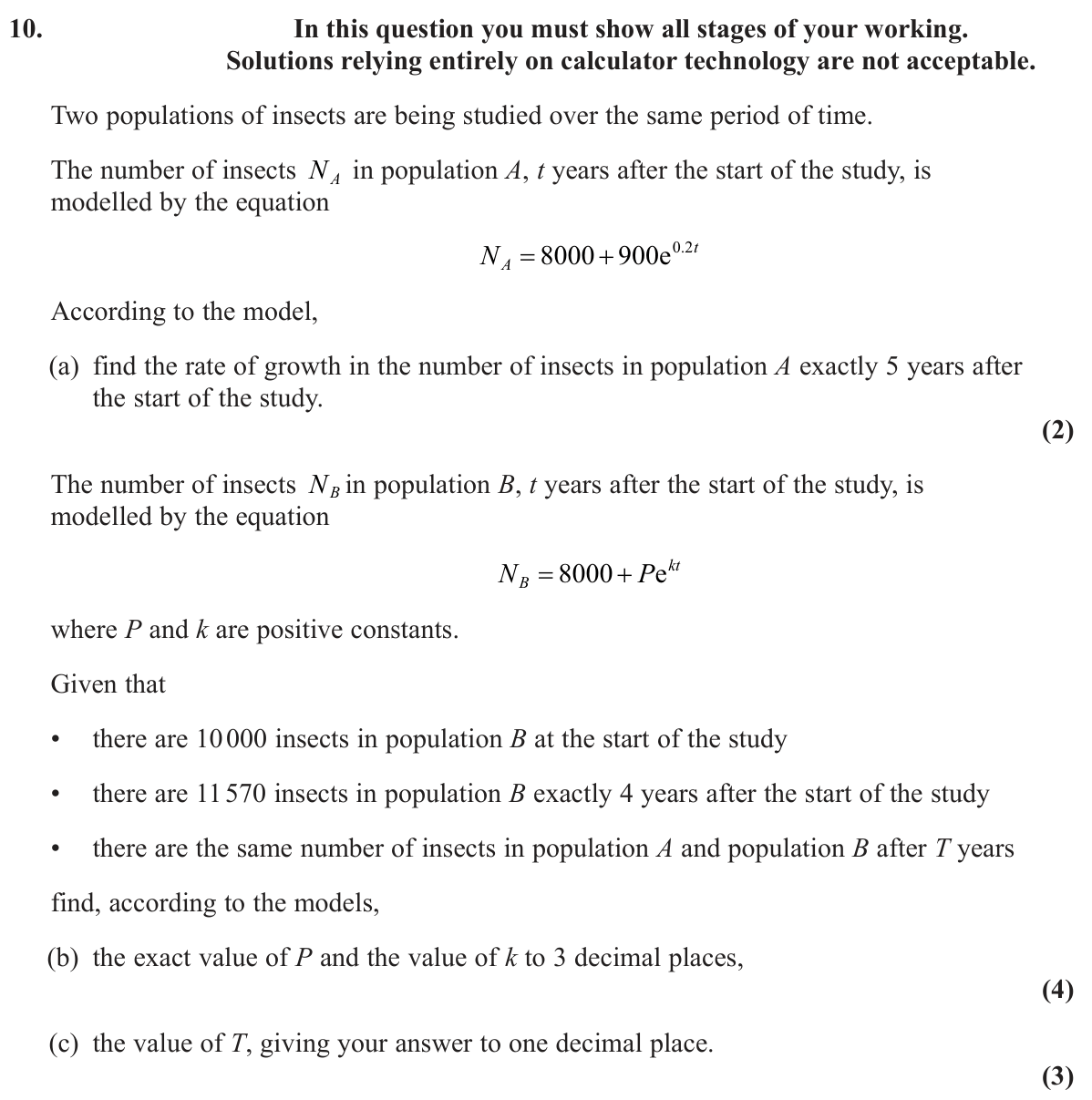
42. WMA13/01 January 2026 · Q10

Hard9 marks · main topic: Log Graphs & Exponential Models
WMA13/01 January 2026 Question 10 (9 marks): Differentiation
Show worked solution
  1. Part (a)
    \[\frac{dN_A}{dt}=900(0.2)e^{0.2t}=180e^{0.2t}.\]

    At $t=5$, the growth rate is $180e=489.290729\ldots$ insects per year.

  2. Part (b)

    At $t=0$, $10000=8000+P$, so $P=2000$ exactly. Using the population at $t=4$,

    \[11570=8000+2000e^{4k} \quad\Longrightarrow\quad e^{4k}=\frac{3570}{2000}=1.785.\]

    Taking natural logarithms,

    \[k=\frac{\ln1.785}{4}=0.144854604\ldots=0.145\quad\text{(3 d.p.)}.\]
  3. Part (c)

    At equality, $8000+900e^{0.2T}=8000+2000e^{kT}$, hence

    \[e^{(0.2-k)T}=\frac{20}{9},\qquad T=\frac{\ln(20/9)}{0.2-k}.\]

    Use the unrounded value $k=\ln(1.785)/4$:

    \[T=14.480042784\ldots=14.5\text{ years (1 decimal place)}.\]
Final answer

(a) $180e\text{ insects per year}$ (b) $P=2000,\ k=0.145\text{ (3 d.p.)}$ (c) $14.5\text{ years}$

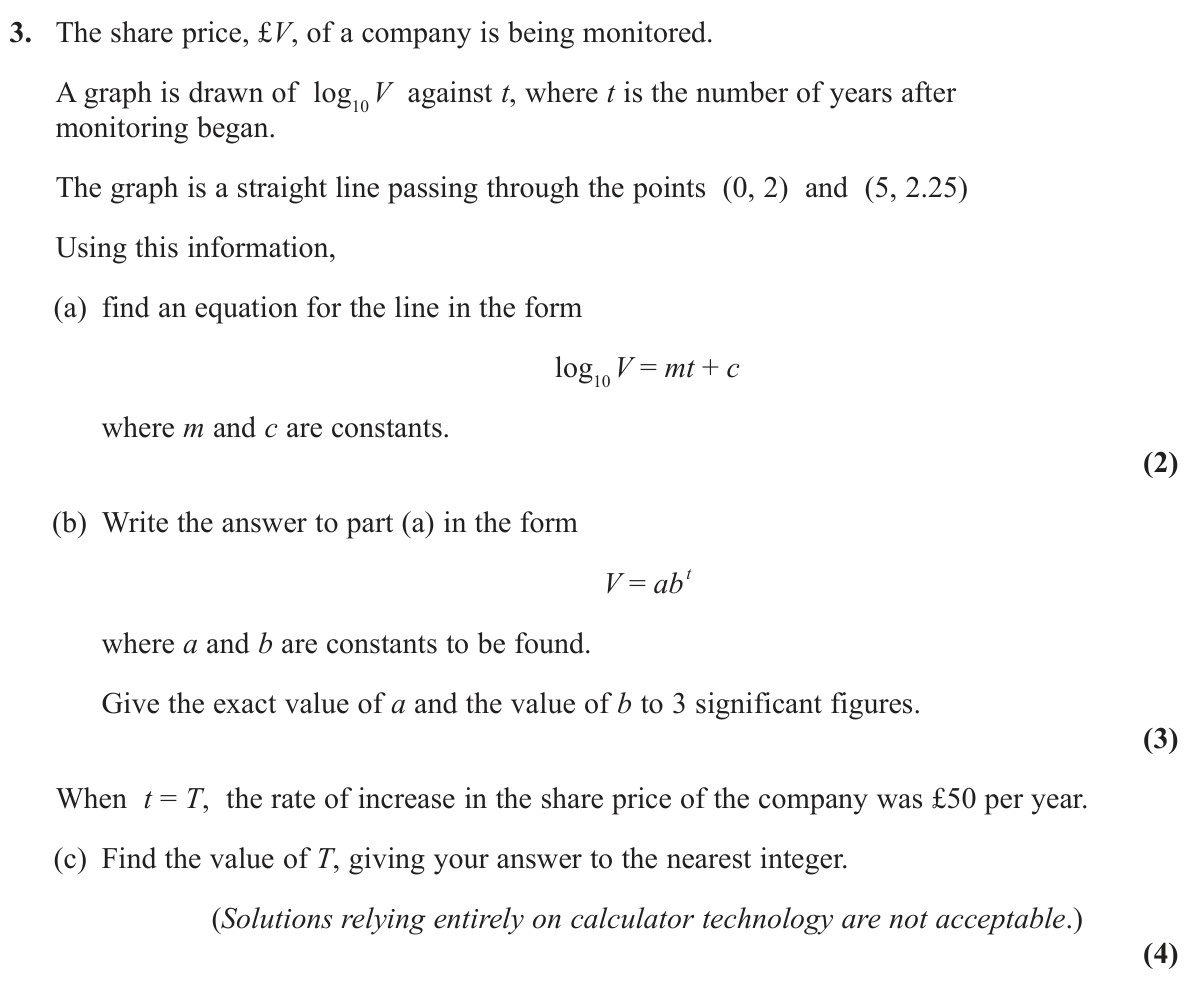
43. WMA13/01 October 2025 · Q3

Hard9 marks · main topic: Log Graphs & Exponential Models
WMA13/01 October 2025 Question 3 (9 marks): Differentiation
Show worked solution
  1. Part (a)

    The gradient is $(2.25-2)/(5-0)=0.05$ and the vertical intercept is $2$. Hence $\log_{10}V=0.05t+2$.

  2. Part (b)
    \[V=10^{0.05t+2}=100(10^{0.05})^t.\]

    Thus $a=100$ exactly and $b=10^{0.05}=1.122018454\ldots=1.12$ to three significant figures. In the requested rounded-parameter form, $V=100(1.12)^t$; retain the unrounded base for later calculations.

  3. Part (c)

    Differentiating the unrounded model,

    \[\frac{dV}{dt}=100(0.05\ln10)\,10^{0.05t}=5\ln10\,10^{0.05t}.\]

    At $t=T$ this equals $50$, so

    \[10^{0.05T}=\frac{10}{\ln10},\qquad T=\frac{\ln(10/\ln10)}{0.05\ln10}=12.755686226\ldots.\]

    Therefore $T=13$ years to the nearest integer.

Final answer

(a) $log10(V)=0.05*t+2$ (b) $V=100*(1.12)^t$ (c) $13$

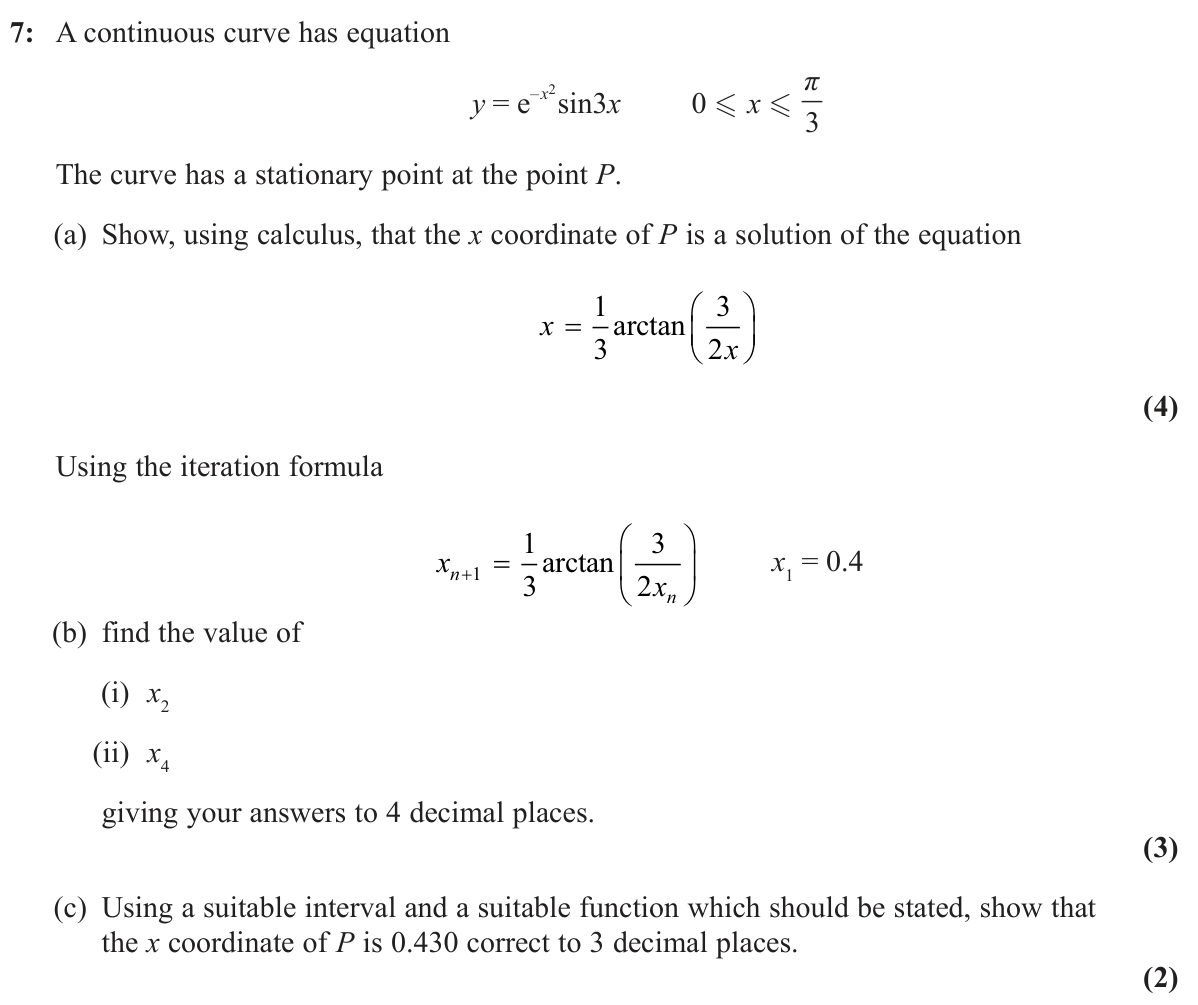
44. WMA13/01 May/June 2025 · Q7

Hard9 marks · main topic: Numerical Methods
WMA13/01 May/June 2025 Question 7 (9 marks): Differentiation
Show worked solution
  1. Part (a)

    Apply the product and chain rules:

    \[\frac{dy}{dx}=e^{-x^2}\bigl(3\cos3x-2x\sin3x\bigr).\]

    Since $e^{-x^2}\gt 0$, a stationary point satisfies

    \[3\cos3x=2x\sin3x.\]

    Neither endpoint $x=0,\pi/3$ is stationary. In the interior $\sin3x\gt 0$ and $x\gt 0$, so $\cos3x\gt 0$ at a stationary point and $0\lt 3x\lt \pi/2$. Therefore division and the principal inverse tangent are valid:

    \[\tan3x=\frac3{2x}\quad\Longrightarrow\quad \boxed{x=\frac13\arctan\left(\frac3{2x}\right)}.\]
  2. Part (b)

    Work in radians and retain calculator precision between iterations:

    \[x_2=\frac13\arctan\frac3{0.8}=0.4367313117\ldots,\]
    \[x_3=0.4291581882\ldots,\qquad x_4=0.4307116849\ldots.\]

    Thus (i) $\boxed{x_2=0.4367}$ and (ii) $\boxed{x_4=0.4307}$.

  3. Part (c)

    Let $h(x)=3\cos3x-2x\sin3x$, which is continuous. At the rounding boundaries,

    \[h(0.4295)=0.0106861\ldots\gt 0,\qquad h(0.4305)=-0.000598027\ldots\lt 0.\]

    The sign change places a root strictly between $0.4295$ and $0.4305$. On $0\lt x\lt \pi/6$, $h'(x)=-11\sin3x-6x\cos3x\lt 0$, so the stationary root is unique; for $\pi/6\leq x\leq\pi/3$, $h(x)\lt 0$. Hence the $x$ coordinate of $P$ is $\boxed{0.430\text{ to 3 decimal places}}$.

Final answer

(a) $x=\frac13\arctan\left(\frac3{2x}\right)$ (b) $x_2=0.4367$, $x_4=0.4307$ (c) $0.430\text{ to 3 decimal places}$

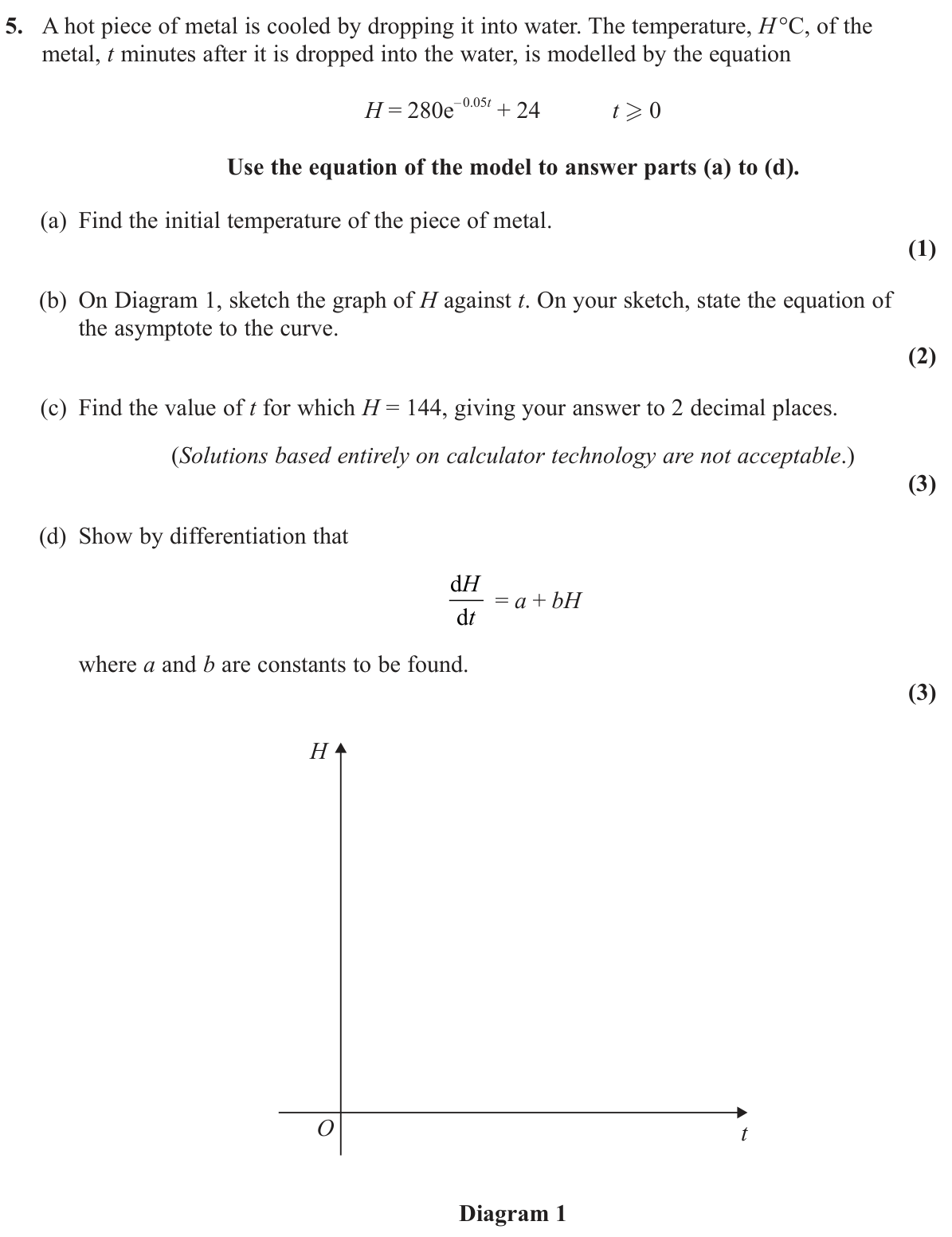
45. WMA13/01 January 2025 · Q5

Hard9 marks · main topic: Log Graphs & Exponential Models
WMA13/01 January 2025 Question 5 (9 marks): Differentiation
Show worked solution
  1. Part (a)

    At $t=0$, $e^{-0.05t}=1$, so $H=280+24=304$ degrees Celsius.

    \[\boxed{H(0)=304^\circ\mathrm C}\]
  2. Part (b)

    The curve starts at $(0,304)$ and decreases for $t\ge0$. The exponential term stays positive and tends to zero, so the curve approaches $H=24$ from above without crossing it.

    \[\boxed{H=24\text{ is the horizontal asymptote}}\]
  3. Part (c)

    Substitute $H=144$:

    \[144=280e^{-0.05t}+24\ \Longrightarrow\ e^{-0.05t}=\frac{120}{280}=\frac37.\]

    Take natural logarithms: $-0.05t=\ln(3/7)$. Hence $t=-20\ln(3/7)=20\ln(7/3)=16.9459572077\ldots$ minutes.

    \[\boxed{t=16.95\text{ minutes}}\]
  4. Part (d)

    Differentiate using the chain rule:

    \[\frac{dH}{dt}=-0.05(280)e^{-0.05t}=-14e^{-0.05t}.\]

    The original equation gives $280e^{-0.05t}=H-24$, so

    \[\frac{dH}{dt}=-0.05(H-24)=1.2-0.05H.\]
    \[\boxed{a=1.2,\quad b=-0.05}\]
Final answer

(a) $H(0)=304^\circ\mathrm C$ (b) $H=24\text{ is the horizontal asymptote}$ (c) $t=16.95\text{ minutes}$ (d) $a=1.2,\quad b=-0.05$

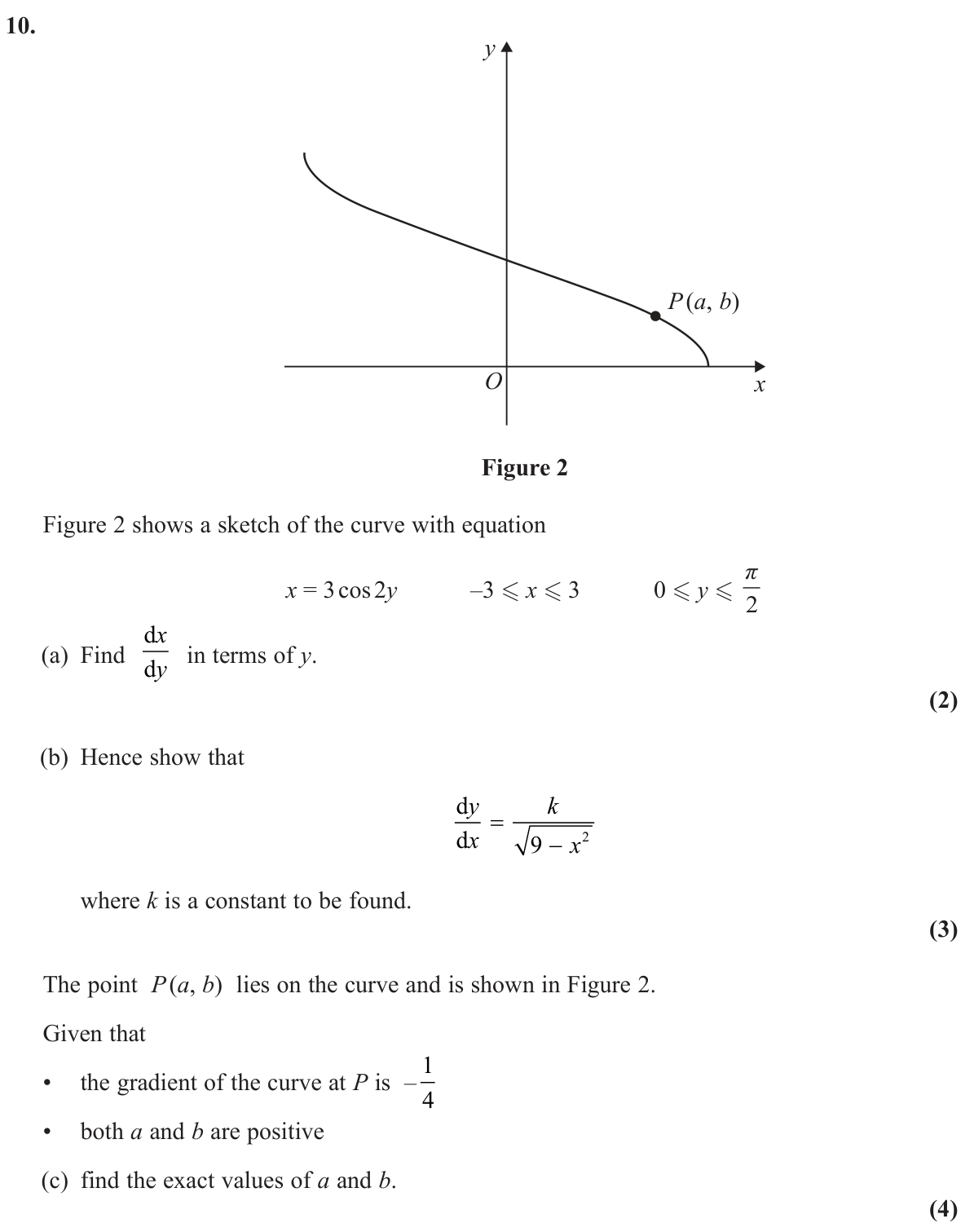
46. WMA13/01 January 2025 · Q10

Hard9 marks
WMA13/01 January 2025 Question 10 (9 marks): Differentiation
Show worked solution
  1. Part (a)

    Differentiate $x=3\cos2y$ with respect to $y$ using the chain rule:

    \[\frac{dx}{dy}=3(-\sin2y)\cdot2=-6\sin2y.\]
    \[\boxed{\frac{dx}{dy}=-6\sin2y}\]
  2. Part (b)

    For $0\lt y\lt \pi/2$, $\sin2y\gt 0$ and

    \[\frac{dy}{dx}=\frac1{dx/dy}=-\frac1{6\sin2y}.\]

    Since $\cos2y=x/3$ and the sine is positive on this interval,

    \[\sin2y=\sqrt{1-\cos^22y}=\sqrt{1-x^2/9}=\frac{\sqrt{9-x^2}}3.\]

    Consequently $dy/dx=-1/(2\sqrt{9-x^2})$, valid for $-3\lt x\lt 3$. The endpoint tangents are vertical; there is no finite derivative there.

    \[\boxed{\frac{dy}{dx}=-\frac1{2\sqrt{9-x^2}},\qquad k=-\frac12}\]
  3. Part (c)

    Set the gradient equal to $-1/4$:

    \[-\frac1{2\sqrt{9-a^2}}=-\frac14 \quad\Longrightarrow\quad \sqrt{9-a^2}=2 \quad\Longrightarrow\quad a^2=5.\]

    Because $a\gt 0$, take $a=\sqrt5$. Substitute into $a=3\cos2b$:

    \[\cos2b=\frac{\sqrt5}{3}\quad\Longrightarrow\quad b=\frac12\arccos\!\left(\frac{\sqrt5}{3}\right).\]

    Here $0\lt 2b\lt \pi/2$ since both coordinates are positive, so the principal arccos value is the required one.

    \[\boxed{a=\sqrt5,\qquad b=\frac12\arccos\!\left(\frac{\sqrt5}{3}\right)}\]
Final answer

(a) $\frac{dx}{dy}=-6\sin2y$ (b) $\frac{dy}{dx}=-\frac1{2\sqrt{9-x^2}},\qquad k=-\frac12$ (c) $a=\sqrt5,\qquad b=\frac12\arccos\!\left(\frac{\sqrt5}{3}\right)$

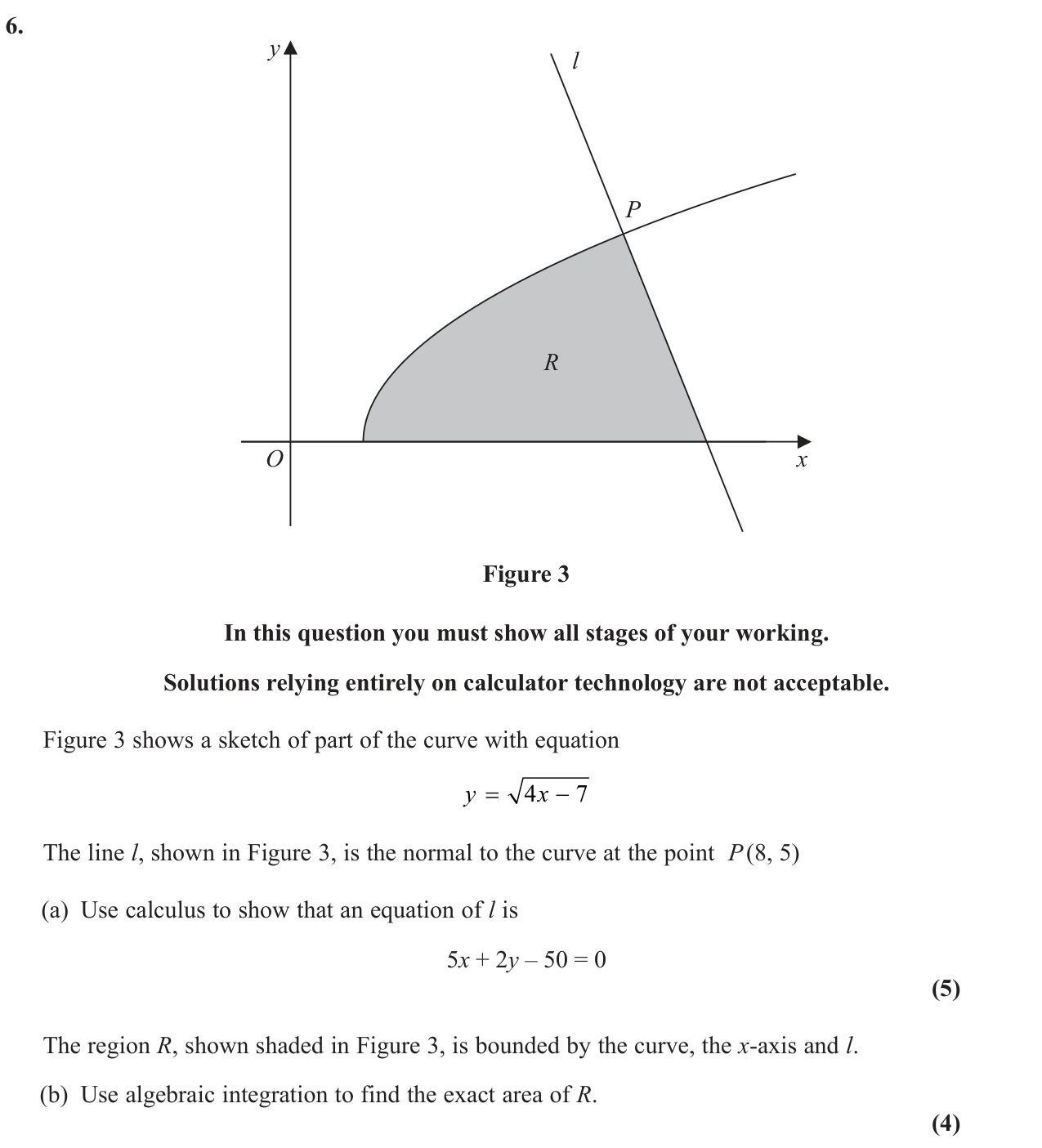
47. WMA13/01 May/June 2024 · Q6

Hard9 marks · main topic: Applications of Differentiation
WMA13/01 May/June 2024 Question 6 (9 marks): Differentiation
Show worked solution
  1. Part (a)

    For $y=(4x-7)^{1/2}$,

    \[\frac{dy}{dx}=\frac12(4x-7)^{-1/2}\cdot4=\frac2{\sqrt{4x-7}}.\]

    At $P=(8,5)$, the tangent gradient is $2/5$, so the normal gradient is $-5/2$. The point-gradient equation is

    \[y-5=-\frac52(x-8),\qquad 2y-10=-5x+40.\]
    \[\boxed{5x+2y-50=0}\]
  2. Part (b)

    The curve meets the $x$-axis at $x=7/4$. The normal meets it at $x=10$. Split the shaded region at $P$, into a curve area from $7/4$ to 8 and a triangle from 8 to 10:

    \[\int_{7/4}^8\sqrt{4x-7}\,dx =\left[\frac{(4x-7)^{3/2}}6\right]_{7/4}^8=\frac{125}{6}.\]

    The triangle has area $\frac12(10-8)\cdot5=5$. Hence the total area is $125/6+5$.

    \[\boxed{\operatorname{Area}(R)=\frac{155}{6}}\]
Final answer

(a) $5x+2y-50=0$ (b) $\operatorname{Area}(R)=\frac{155}{6}$

48. WMA13/01 October 2023 · Q10

Hard9 marks
WMA13/01 October 2023 Question 10 (9 marks): Differentiation
Show worked solution
  1. Part (a)

    At $x=1/4$, $\sin^2 4y=1/4$. Since $0\le4y\le\pi/2$,

    \[\sin4y=\frac12\quad\Longrightarrow\quad4y=\frac\pi6.\]

    Only this branch lies in the given range of $y$.

    \[\boxed{y=\frac\pi{24}}\]
  2. Part (b)

    Differentiate $x=(\sin4y)^2$ with respect to $y$:

    \[\frac{dx}{dy}=2\sin4y\,(4\cos4y).\]
    \[\boxed{\frac{dx}{dy}=8\sin4y\cos4y}\]
  3. Part (c)

    On the interior of the given interval, $\sin4y=\sqrt{x}$ and $\cos4y=\sqrt{1-x}$ are positive. Taking the reciprocal,

    \[\frac{dy}{dx}=\frac1{8\sqrt{x}\sqrt{1-x}} =\frac1{\sqrt{64x-64x^2}}.\]

    Complete the square:

    \[64x-64x^2=16-64\left(x-\frac12\right)^2.\]

    Thus $dy/dx=(q+r(x+s)^2)^{-1/2}$ has the constants below, with $0\lt x\lt 1$ for a finite derivative; the endpoints have vertical tangents.

    \[\boxed{q=16,\qquad r=-64,\qquad s=-\frac12}\]
  4. Part (d)

    The derivative is positive. Its minimum occurs when the square root in the denominator is largest. Since $(x-1/2)^2\ge0$, the largest radicand is 16, attained at $x=1/2$. Hence the smallest gradient is $1/\sqrt{16}$.

    \[\boxed{\text{(i) }x=\frac12,\qquad\text{(ii) }\min\frac{dy}{dx}=\frac14}\]
Final answer

(a) $y=\frac\pi{24}$ (b) $\frac{dx}{dy}=8\sin4y\cos4y$ (c) $q=16,\qquad r=-64,\qquad s=-\frac12$ (d) $\text{(i) }x=\frac12,\qquad\text{(ii) }\min\frac{dy}{dx}=\frac14$

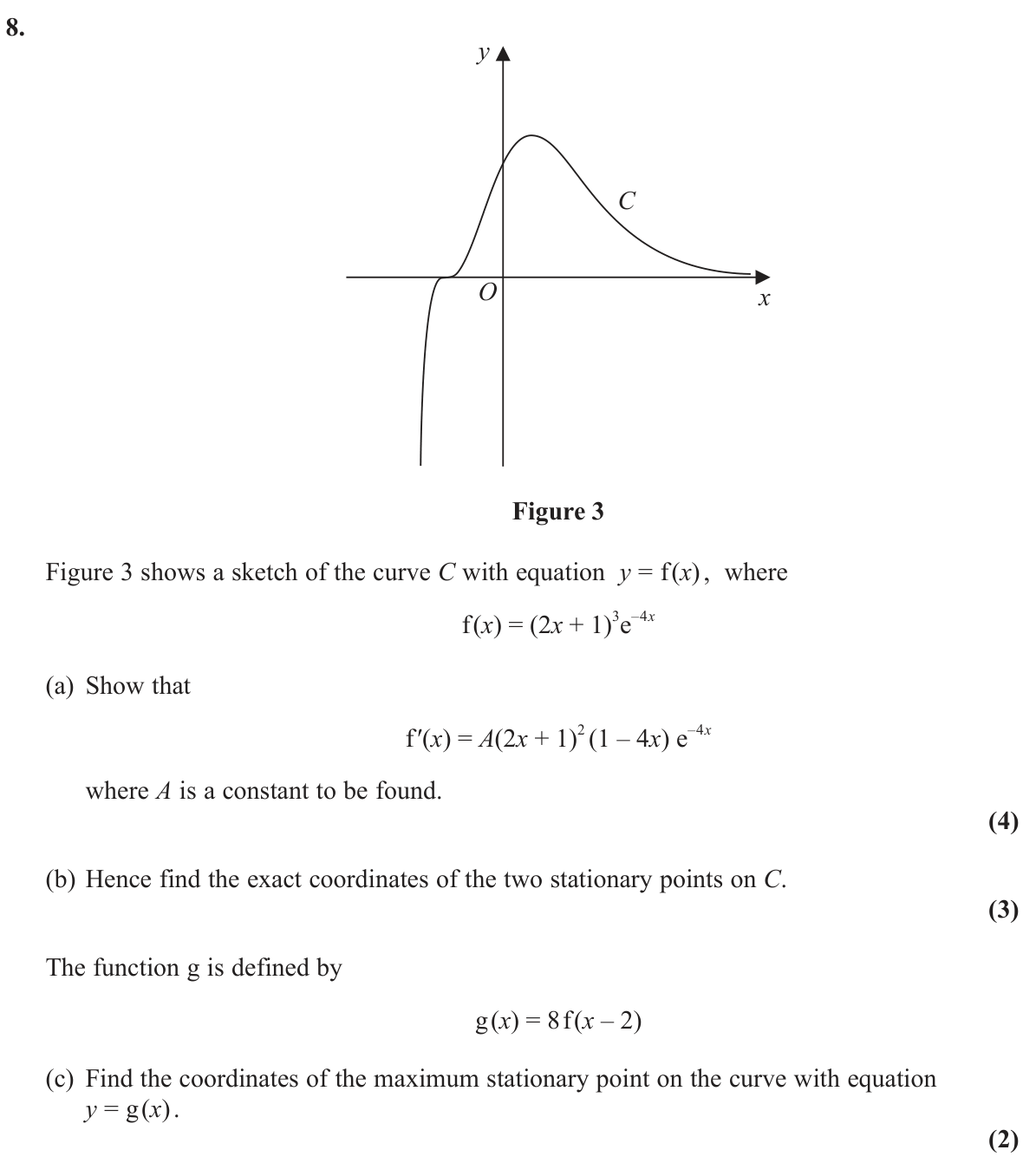
49. WMA13/01 May/June 2023 · Q8

Hard9 marks · main topic: Applications of Differentiation
WMA13/01 May/June 2023 Question 8 (9 marks): Differentiation
Show worked solution
  1. Part (a)

    The product rule gives

    \[f'(x)=6(2x+1)^2e^{-4x}-4(2x+1)^3e^{-4x} =(2x+1)^2e^{-4x}[6-4(2x+1)] =2(2x+1)^2(1-4x)e^{-4x}.\]

    Comparison with the stated form gives $A=2$.

    \[\boxed{A=2}\]
  2. Part (b)

    Since $e^{-4x}\gt 0$, $f'(x)=0$ means $2x+1=0$ or $1-4x=0$. Thus $x=-1/2$ or $x=1/4$. Substitution gives $f(-1/2)=0$ and $f(1/4)=(3/2)^3e^{-1}=27/(8e)$.

    \[\boxed{\left(-\frac12,0\right),\quad\left(\frac14,\frac{27}{8e}\right)}\]
  3. Part (c)

    The derivative changes from positive to negative at $x=1/4$, so this is the maximum; at $x=-1/2$ it does not change sign. The transformation $g(x)=8f(x-2)$ sends $(x,y)$ to $(x+2,8y)$. Hence the maximum stationary point is $(1/4+2,8\cdot27/(8e))=(9/4,27/e)$.

    \[\boxed{\left(\frac94,\frac{27}{e}\right)}\]
Final answer

(a) $A=2$ (b) $\left(-\frac12,0\right),\quad\left(\frac14,\frac{27}{8e}\right)$ (c) $\left(\frac94,\frac{27}{e}\right)$

50. WMA13/01 January 2023 · Q7

Hard9 marks · main topic: Applications of Differentiation
WMA13/01 January 2023 Question 7 (9 marks): Differentiation
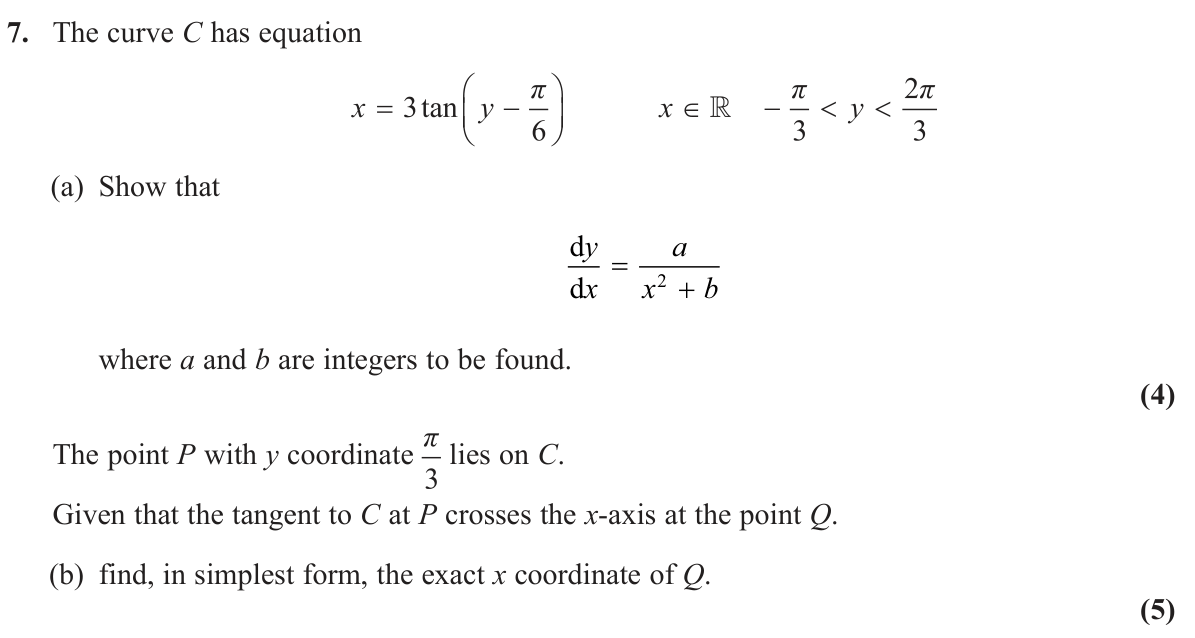
Show worked solution
  1. Part (a)

    Put $u=y-\pi/6$. Since $x=3\tan u$,

    \[\frac{dx}{dy}=3\sec^2u=3(1+\tan^2u) =3\left(1+\frac{x^2}{9}\right)=\frac{x^2+9}{3}.\]

    This is positive for all real $x$, so we may take the reciprocal: $dy/dx=3/(x^2+9)$. Thus the required integers are $a=3$, $b=9$.

    \[\boxed{\frac{dy}{dx}=\frac3{x^2+9},\qquad a=3,\quad b=9}\]
  2. Part (b)

    At $y=\pi/3$, $x=3\tan(\pi/3-\pi/6)=3\tan(\pi/6)=\sqrt3$. The tangent gradient is $3/((\sqrt3)^2+9)=1/4$. Its point-gradient equation is

    \[y-\frac\pi3=\frac14(x-\sqrt3).\]

    At its x-axis crossing $y=0$, $-4\pi/3=x-\sqrt3$.

    \[\boxed{x_Q=\sqrt3-\frac{4\pi}{3}}\]
Final answer

(a) $\frac{dy}{dx}=\frac3{x^2+9},\qquad a=3,\quad b=9$ (b) $x_Q=\sqrt3-\frac{4\pi}{3}$

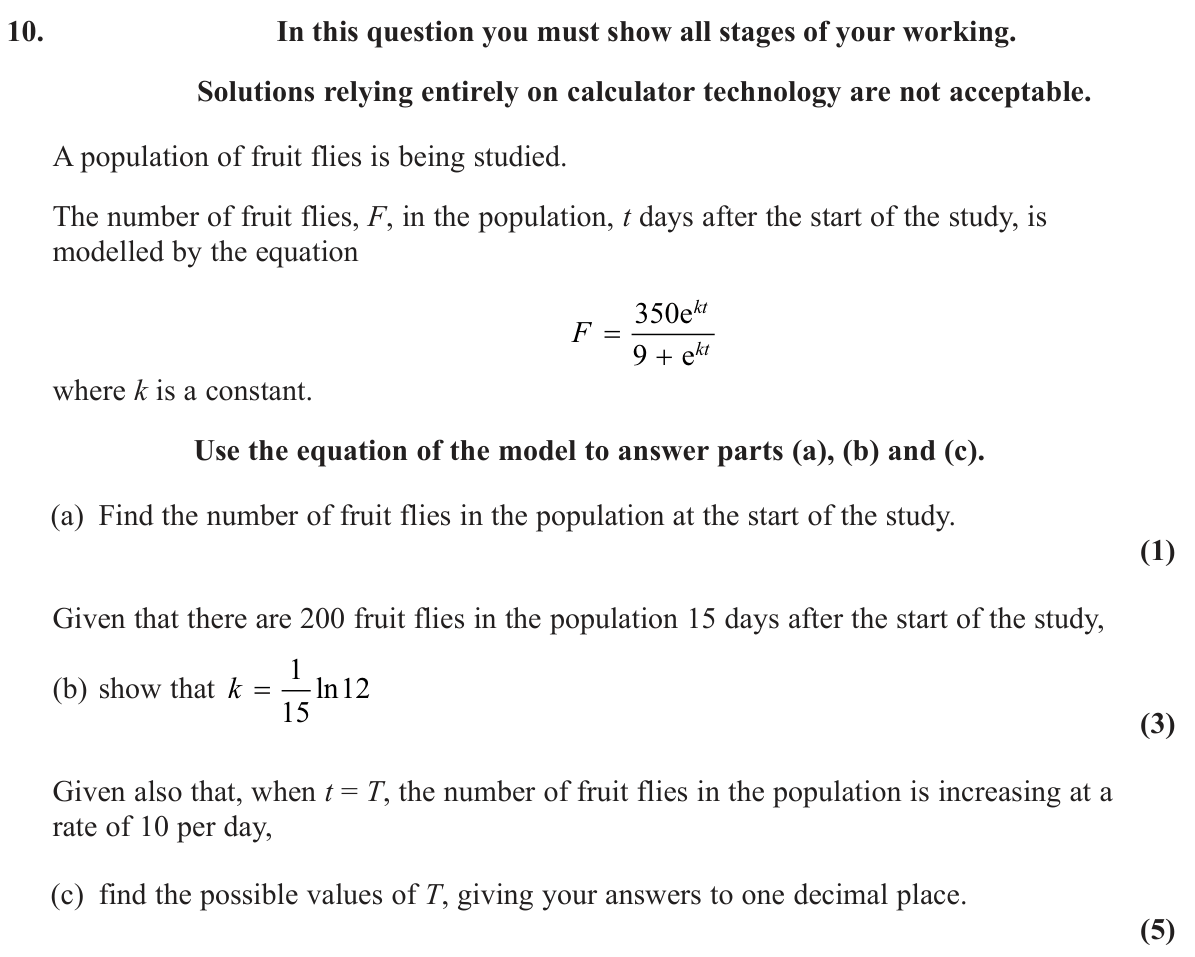
51. WMA13/01 January 2023 · Q10

Hard9 marks · main topic: Log Graphs & Exponential Models
WMA13/01 January 2023 Question 10 (9 marks): Differentiation
Show worked solution
  1. Part (a)

    At the start $t=0$, so $e^{kt}=1$ and the model gives $F(0)=350/(9+1)=35$ fruit flies.

    \[\boxed{F(0)=35}\]
  2. Part (b)

    Using $F(15)=200$,

    \[200=\frac{350e^{15k}}{9+e^{15k}} \quad\Longrightarrow\quad1800+200e^{15k}=350e^{15k} \quad\Longrightarrow\quad e^{15k}=12.\]

    Take natural logs to obtain $15k=\ln12$, as required.

    \[\boxed{k=\frac{\ln12}{15}}\]
  3. Part (c)

    By the quotient rule,

    \[F'(t)=\frac{350ke^{kt}(9+e^{kt})-350ke^{2kt}}{(9+e^{kt})^2} =\frac{3150ke^{kt}}{(9+e^{kt})^2}.\]

    Set $F'(T)=10$ and let $u=e^{kT}\gt 0$. Then

    \[315ku=(9+u)^2\quad\Longrightarrow\quad u^2+(18-315k)u+81=0.\]

    With the exact $k=\ln12/15$, the quadratic formula gives

    \[u=\frac{315k-18\pm\sqrt{(315k-18)^2-324}}2 =2.5615490777\ldots\ \text{or}\ 31.6214905678\ldots.\]

    Both values are positive and at least 1, hence both correspond to $T\ge0$. Finally $T=\ln u/k$ gives $5.6779528361\ldots$ or $20.8488936858\ldots$ days. To one decimal place the two times are as follows.

    \[\boxed{T=5.7\ \text{days},\qquad T=20.8\ \text{days}}\]
Final answer

(a) $F(0)=35$ (b) $k=\frac{\ln12}{15}$ (c) $T=5.7\ \text{days},\qquad T=20.8\ \text{days}$

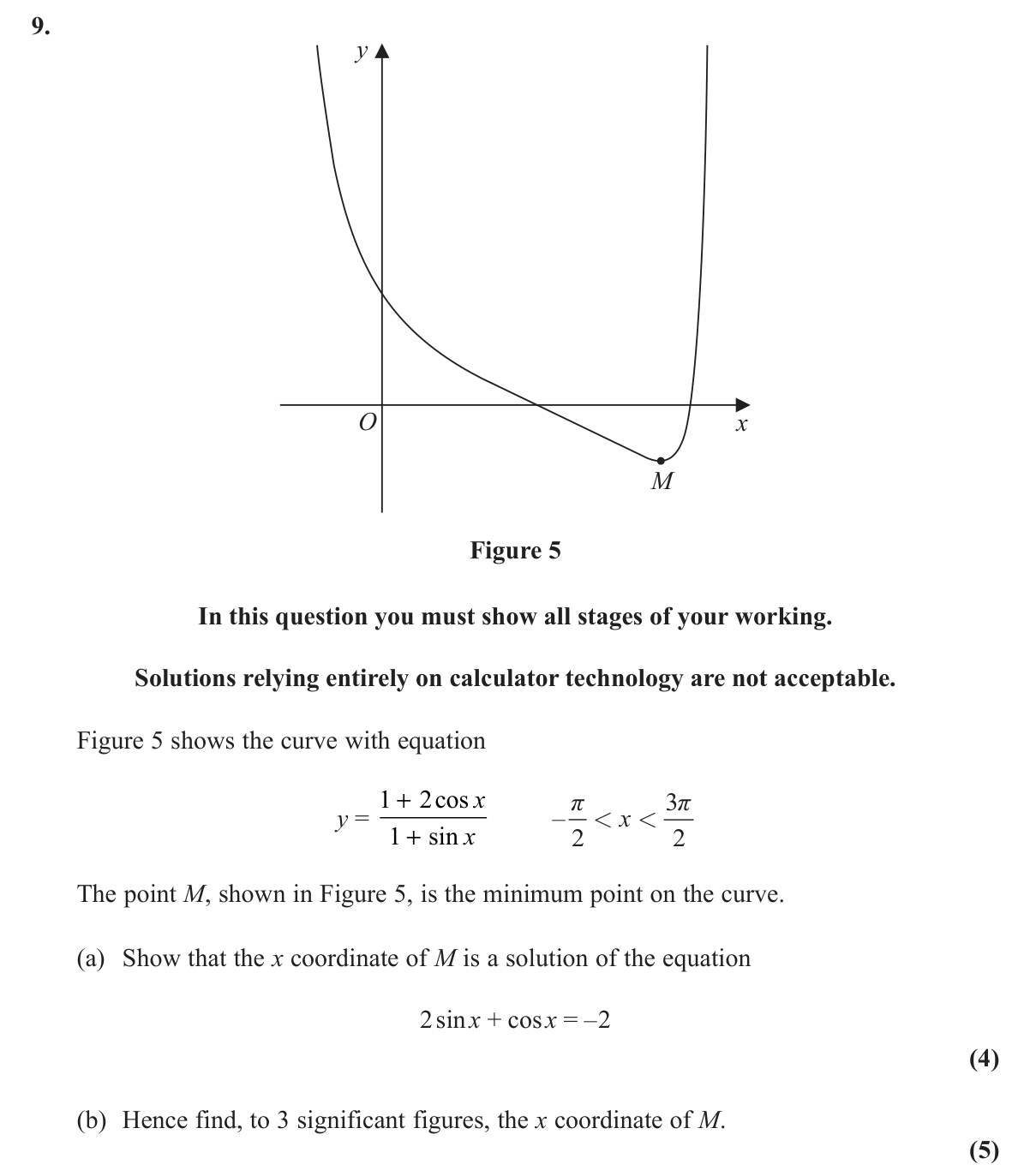
52. WMA13/01 May/June 2022 · Q9

Hard9 marks · main topic: Trig Equations & R-Form
WMA13/01 May/June 2022 Question 9 (9 marks): Differentiation
Show worked solution
  1. Part (a)

    Differentiate by the quotient rule:

    \[y'=\frac{-2\sin x(1+\sin x)-(1+2\cos x)\cos x}{(1+\sin x)^2} =\frac{-2\sin x-\cos x-2(\sin^2x+\cos^2x)}{(1+\sin x)^2} =\frac{-2\sin x-\cos x-2}{(1+\sin x)^2}.\]

    Inside the stated interval, $1+\sin x\gt 0$. At the interior minimum M, $y'=0$, so its numerator is zero, giving the required equation.

    \[\boxed{2\sin x+\cos x=-2}\]
  2. Part (b)

    Write $2\sin x+\cos x=\sqrt5\sin(x+\beta)$, where $\cos\beta=2/\sqrt5$, $\sin\beta=1/\sqrt5$ and $\beta=\arctan(1/2)$. The equation becomes $\sin(x+\beta)=-2/\sqrt5$. Let $\gamma=\arcsin(2/\sqrt5)$, so $\gamma+\beta=\pi/2$. The solutions in the closed boundary range include $x=-\pi/2$, $3\pi/2$, and

    \[x=\pi+\gamma-\beta=3.7850937624\ldots.\]

    Both boundary values are outside the original open domain (and make its denominator zero). The sole interior stationary point is M; the derivative changes from negative to positive there.

    \[\boxed{x_M=3.79}\]
Final answer

(a) $2\sin x+\cos x=-2$ (b) $x_M=3.79$

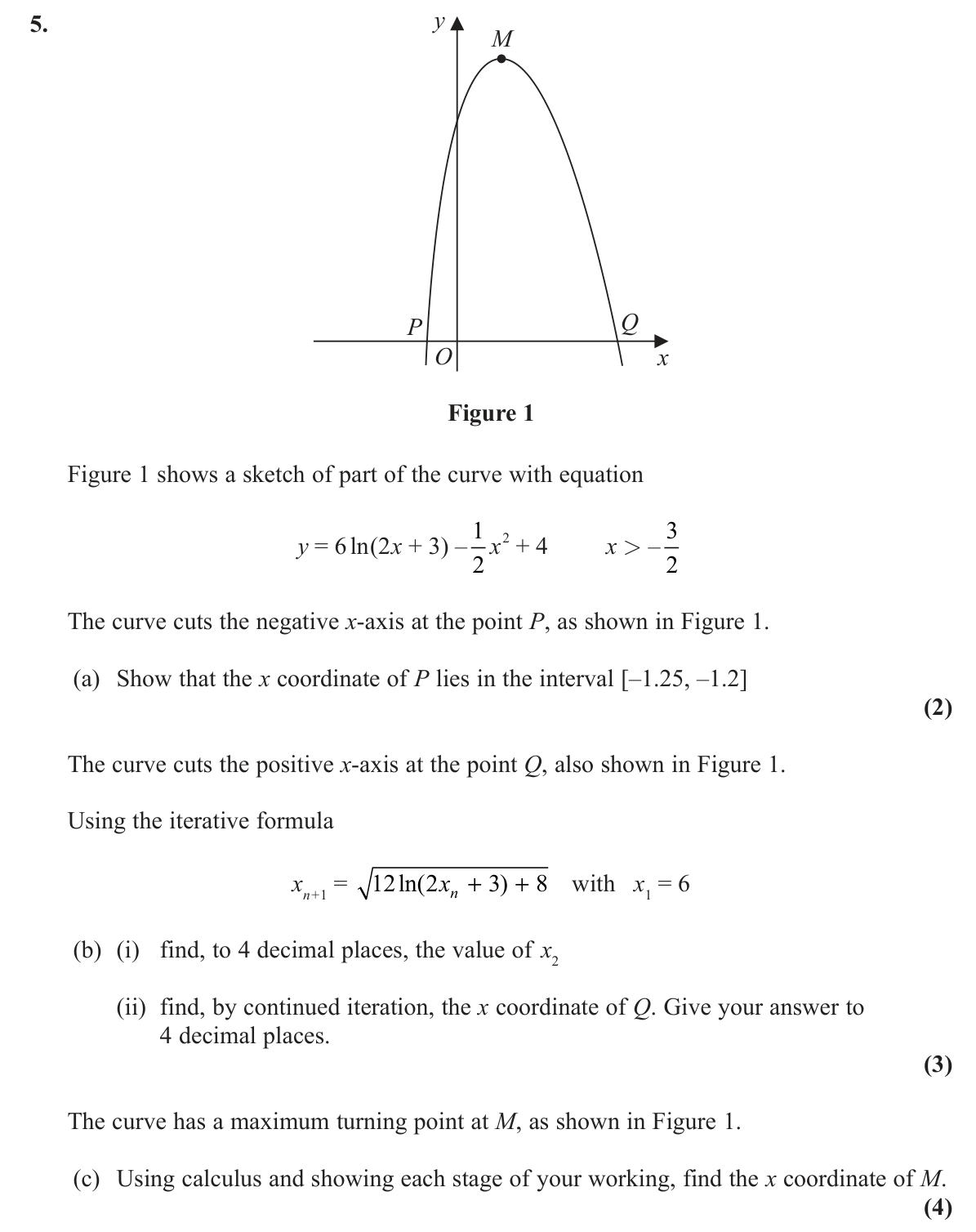
53. WMA13/01 January 2022 · Q5

Hard9 marks · main topic: Applications of Differentiation
WMA13/01 January 2022 Question 5 (9 marks): Differentiation
Show worked solution
  1. Part (a)

    Let $F(x)=6\ln(2x+3)-x^2/2+4$. Then $F(-1.25)=-0.94013308\ldots$ and $F(-1.2)=0.21504626\ldots$. The log argument is positive on this interval, so F is continuous there. The change of sign proves a zero between these endpoints, giving the stated bracket for P.

    \[\boxed{-1.25\lt x_P\lt -1.2}\]
  2. Part (b)

    Apply the given recurrence with $x_1=6$:

    \[x_2=\sqrt{12\ln15+8}=6.363694085\ldots.\]

    Continuing without rounding the internal values,

    \[x_3=6.408185698\ldots,\quad x_4=6.413466053\ldots,\quad x_5=6.414090476\ldots,\quad x_6=6.414164285\ldots,\quad x_7=6.414173009\ldots.\]

    Further iteration settles at $6.41417418\ldots$. The positive square-root branch corresponds to Q.

    \[\boxed{\text{(i) }x_2=6.3637,\qquad\text{(ii) }x_Q=6.4142}\]
  3. Part (c)

    Differentiate: $F'(x)=12/(2x+3)-x$. For a stationary point, $12=x(2x+3)$, or $2x^2+3x-12=0$. The quadratic formula gives $x=(-3\pm\sqrt{105})/4$. The negative choice is less than $-3/2$ and outside the original domain. Also $F”(x)=-24/(2x+3)^2-1\lt 0$, confirming the admissible point is a maximum.

    \[\boxed{x_M=\frac{-3+\sqrt{105}}4}\]
Final answer

(a) $-1.25\lt x_P\lt -1.2$ (b) $\text{(i) }x_2=6.3637,\qquad\text{(ii) }x_Q=6.4142$ (c) $x_M=\frac{-3+\sqrt{105}}4$

54. WMA13/01 October 2021 · Q1

Hard9 marks · main topic: Rational Algebra
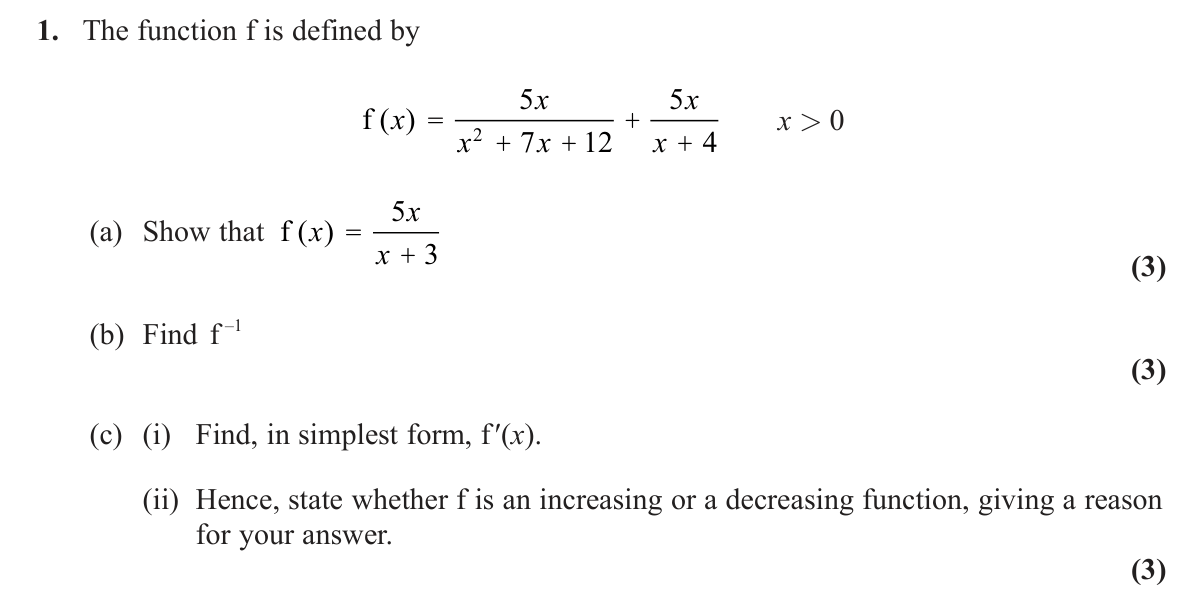
WMA13/01 October 2021 Question 1 (9 marks): Differentiation
Show worked solution
  1. Part (a)

    Factor $x^2+7x+12=(x+3)(x+4)$. A common denominator gives

    \[f(x)=\frac{5x+5x(x+3)}{(x+3)(x+4)} =\frac{5x(x+4)}{(x+3)(x+4)}=\frac{5x}{x+3}.\]

    The cancelled factor is nonzero throughout the original domain $x\gt 0$.

    \[\boxed{f(x)=\frac{5x}{x+3},\quad x\gt 0}\]
  2. Part (b)

    Let $y=5x/(x+3)$. Then $yx+3y=5x$, so $x=3y/(5-y)$. Exchange variable names. Since $f(x)=5-15/(x+3)$ for $x\gt 0$, its range is $0\lt f(x)\lt 5$. This becomes the inverse domain.

    \[\boxed{f^{-1}(x)=\frac{3x}{5-x},\quad0\lt x\lt 5}\]
  3. Part (c)

    (i) By the quotient rule, $f'(x)=[5(x+3)-5x]/(x+3)^2=15/(x+3)^2$. (ii) The numerator and denominator are positive on $x\gt 0$, so $f'(x)\gt 0$ throughout its domain. Therefore f is increasing.

    \[\boxed{f^{\prime}(x)=\frac{15}{(x+3)^2};\quad f\text{ is increasing}}\]
Final answer

(a) $f(x)=\frac{5x}{x+3},\quad x\gt 0$ (b) $f^{-1}(x)=\frac{3x}{5-x},\quad0\lt x\lt 5$ (c) $f^{\prime}(x)=\frac{15}{(x+3)^2};\quad f\text{ is increasing}$

55. WMA13/01 October 2021 · Q9

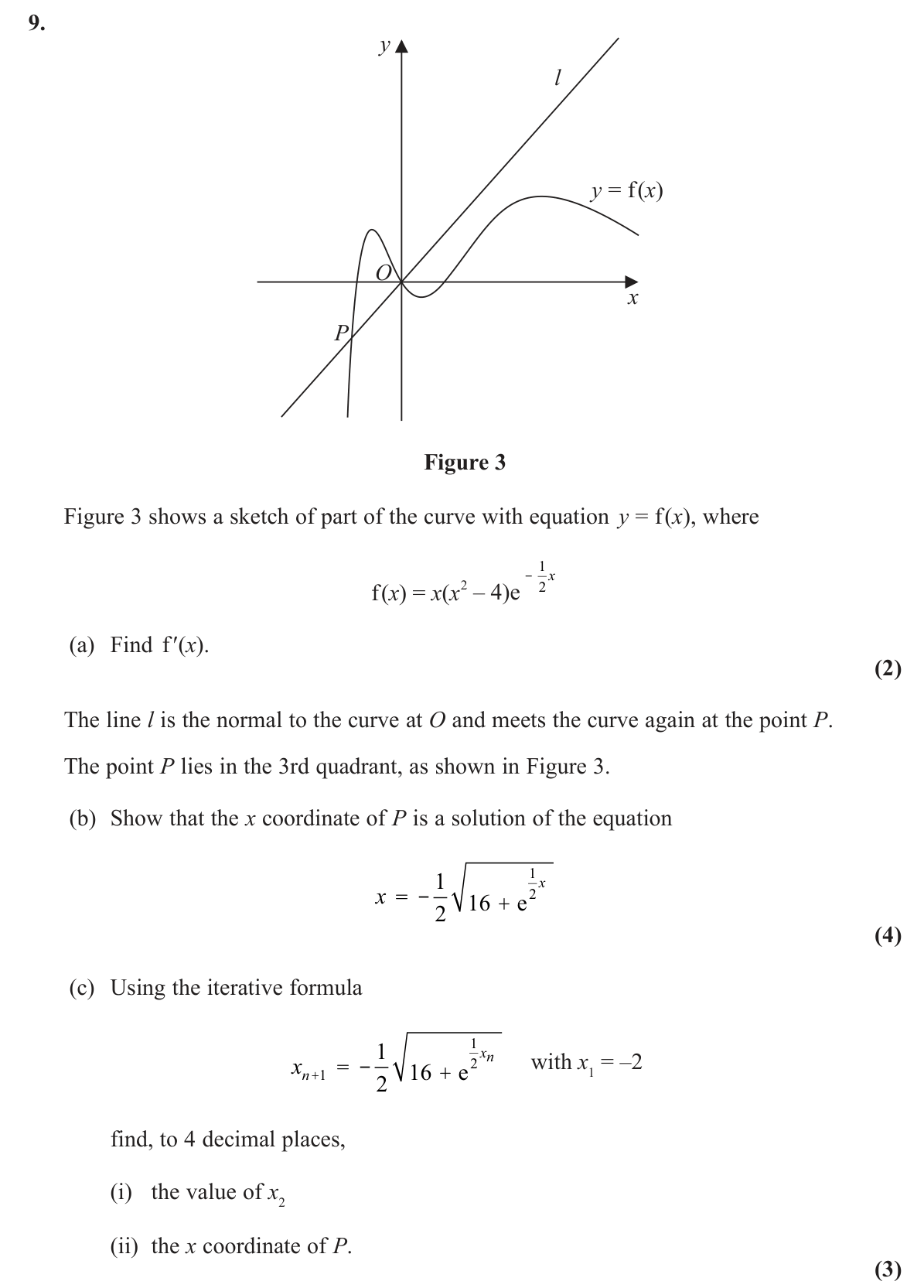
Hard9 marks · main topic: Numerical Methods
WMA13/01 October 2021 Question 9 (9 marks): Differentiation
Show worked solution
  1. Part (a)

    Write $f(x)=(x^3-4x)e^{-x/2}$. By the product rule,

    \[f'(x)=(3x^2-4)e^{-x/2}-\frac12(x^3-4x)e^{-x/2} =e^{-x/2}\left(-\frac{x^3}{2}+3x^2+2x-4\right).\]
    \[\boxed{f^{\prime}(x)=e^{-x/2}(-x^3/2+3x^2+2x-4)}\]
  2. Part (b)

    At O, $f'(0)=-4$, so the normal gradient is $1/4$ and its equation is $y=x/4$. At the other intersection P, x is nonzero; equating curve and normal and dividing by x gives $(x^2-4)e^{-x/2}=1/4$. Thus $x^2=4+e^{x/2}/4=(16+e^{x/2})/4$. Since P lies in the third quadrant, select the negative square root.

    \[\boxed{x=-\frac12\sqrt{16+e^{x/2}}}\]
  3. Part (c)

    Starting from $x_1=-2$, $x_2=-\tfrac12\sqrt{16+e^{-1}}=-2.0228617996\ldots$. Further unrounded iterates are $x_3=-2.0226034084\ldots$, $x_4=-2.0226063126\ldots$ and $x_5=-2.0226062799\ldots$. The continuing sequence settles at $-2.0226062803\ldots$.

    \[\boxed{\text{(i) }x_2=-2.0229;\qquad\text{(ii) }x_P=-2.0226}\]
Final answer

(a) $f^{\prime}(x)=e^{-x/2}(-x^3/2+3x^2+2x-4)$ (b) $x=-\frac12\sqrt{16+e^{x/2}}$ (c) $\text{(i) }x_2=-2.0229;\qquad\text{(ii) }x_P=-2.0226$

56. WMA13/01 October 2020 · Q8

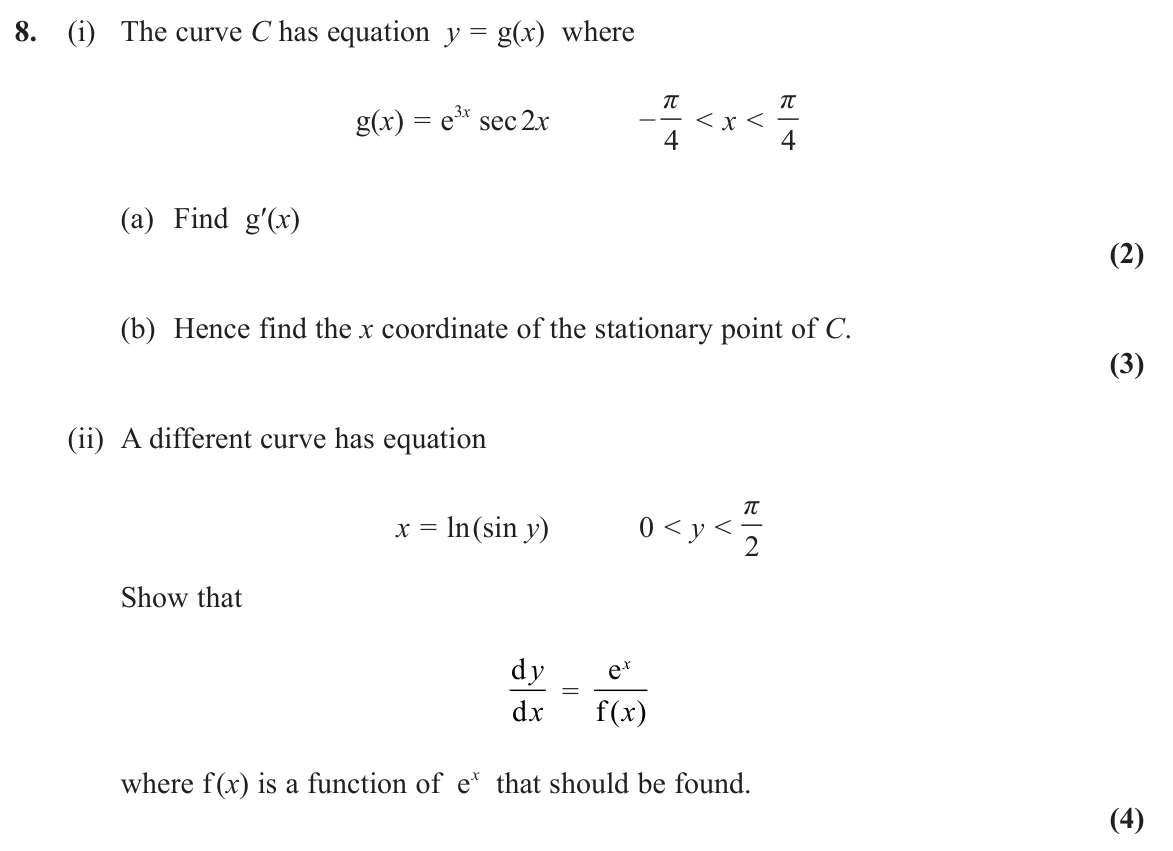
Hard9 marks
WMA13/01 October 2020 Question 8 (9 marks): Differentiation
Show worked solution
  1. Part (i)(a)

    By the product and chain rules,

    \[g'(x)=3e^{3x}\sec2x+2e^{3x}\sec2x\tan2x =e^{3x}\sec2x(3+2\tan2x).\]
    \[\boxed{g'(x)=e^{3x}\sec2x(3+2\tan2x)}\]
  2. Part (i)(b)

    For $-\pi/4\lt x\lt \pi/4$, $e^{3x}\sec2x$ is positive and nonzero. Hence $g'(x)=0$ precisely when $3+2\tan2x=0$, or $\tan2x=-3/2$. Since $-\pi/2\lt 2x\lt \pi/2$, tangent is one-to-one there:

    \[x=-\frac12\arctan\frac32=-0.4913968616\ldots.\]
    \[\boxed{x=-\frac12\arctan\frac32\approx-0.491}\]
  3. Part (ii)

    Differentiate $x=\ln(\sin y)$ with respect to y:

    \[\frac{dx}{dy}=\frac{\cos y}{\sin y},\qquad \frac{dy}{dx}=\frac{\sin y}{\cos y}.\]

    The original equation gives $\sin y=e^x$. Since $0\lt y\lt \pi/2$, cosine is positive, so $\cos y=\sqrt{1-\sin^2y}=\sqrt{1-e^{2x}}$. Therefore

    \[\frac{dy}{dx}=\frac{e^x}{\sqrt{1-e^{2x}}},\qquad f(x)=\sqrt{1-e^{2x}}.\]

    Here $x\lt 0$ from the original interval, so the square root is real and nonzero.

    \[\boxed{f(x)=\sqrt{1-e^{2x}},\qquad x\lt 0}\]
Final answer

(i)(a) $g'(x)=e^{3x}\sec2x(3+2\tan2x)$ (i)(b) $x=-\frac12\arctan\frac32\approx-0.491$ (ii) $f(x)=\sqrt{1-e^{2x}},\qquad x\lt 0$

57. WMA13/01 October 2024 · Q7

Hard10 marks · main topic: Graph Transformations
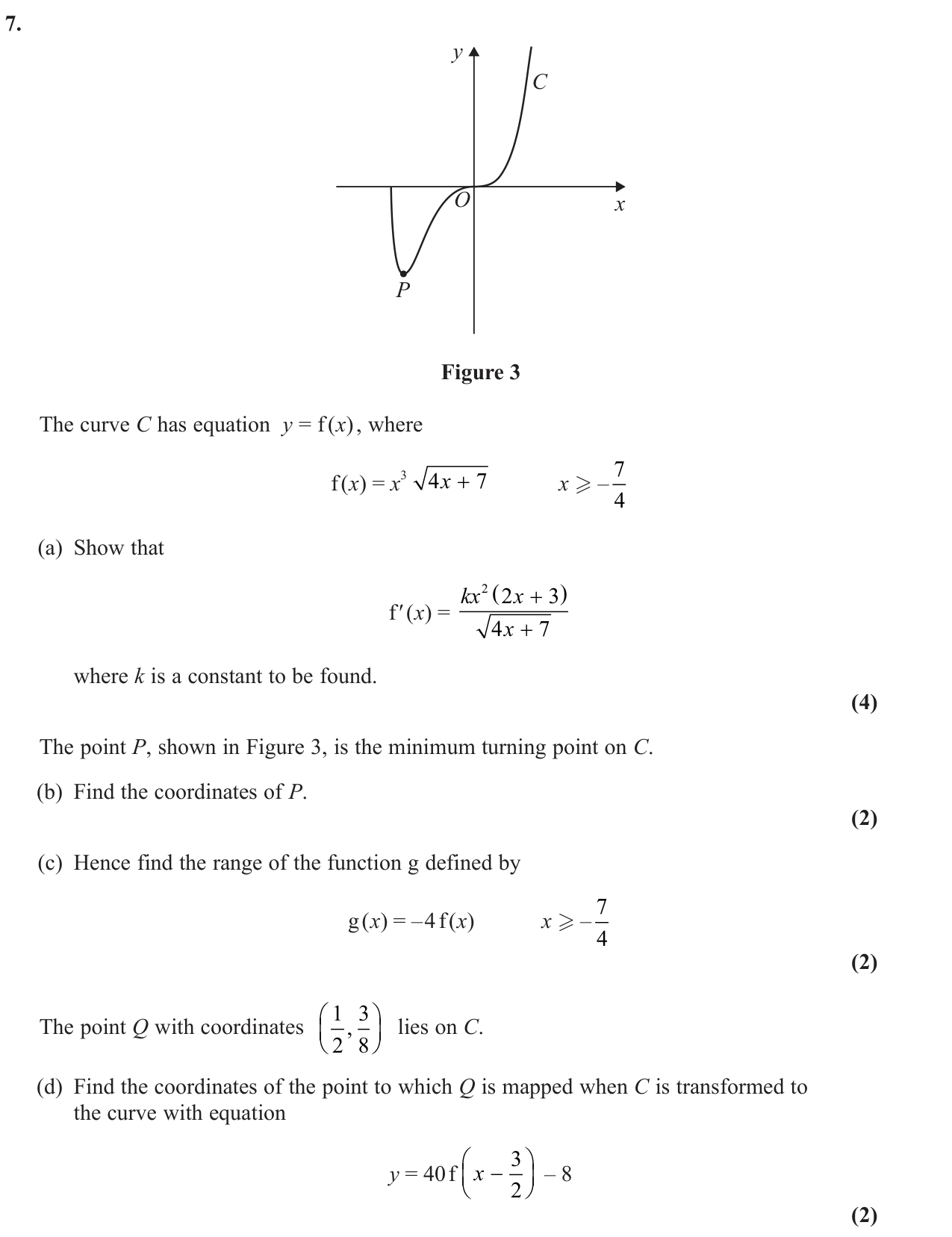
WMA13/01 October 2024 Question 7 (10 marks): Differentiation
Show worked solution
  1. Part (a)

    For $x\gt -7/4$, apply the product and chain rules:

    \[f'(x)=3x^2\sqrt{4x+7}+x^3\frac{2}{\sqrt{4x+7}} =\frac{3x^2(4x+7)+2x^3}{\sqrt{4x+7}} =\frac{7x^2(2x+3)}{\sqrt{4x+7}}.\]
    \[\boxed{k=7}\]
  2. Part (b)

    The interior stationary values satisfy $x^2(2x+3)=0$, so $x=0$ or $x=-3/2$. Near $x=-3/2$, the derivative changes from negative to positive; near $x=0$ it stays positive on both sides. Thus the minimum turning point is at $x=-3/2$.

    \[f(-3/2)=(-3/2)^3\sqrt{-6+7}=-27/8.\]
    \[\boxed{P=\left(-\frac32,-\frac{27}{8}\right)}\]
  3. Part (c)

    The endpoint has $f(-7/4)=0$, the global minimum is $-27/8$ and $f(x)$ tends to infinity as $x$ increases. Hence the range of $f$ is $[-27/8,\infty)$. Multiplication by $-4$ reverses the inequality and makes the upper endpoint $27/2$.

    \[\boxed{g(x)\le\frac{27}{2}}\]
  4. Part (d)

    The transformation is a shift right by $3/2$, vertical stretch by 40, then shift down by 8:

    \[(x,y)\mapsto(x+3/2,40y-8).\]

    Therefore $Q=(1/2,3/8)$ maps to $(1/2+3/2,\;40\cdot3/8-8)$.

    \[\boxed{Q\mapsto(2,7)}\]
Final answer

(a) $k=7$ (b) $P=\left(-\frac32,-\frac{27}{8}\right)$ (c) $g(x)\le\frac{27}{2}$ (d) $Q\mapsto(2,7)$

58. WMA13/01 May/June 2024 · Q5

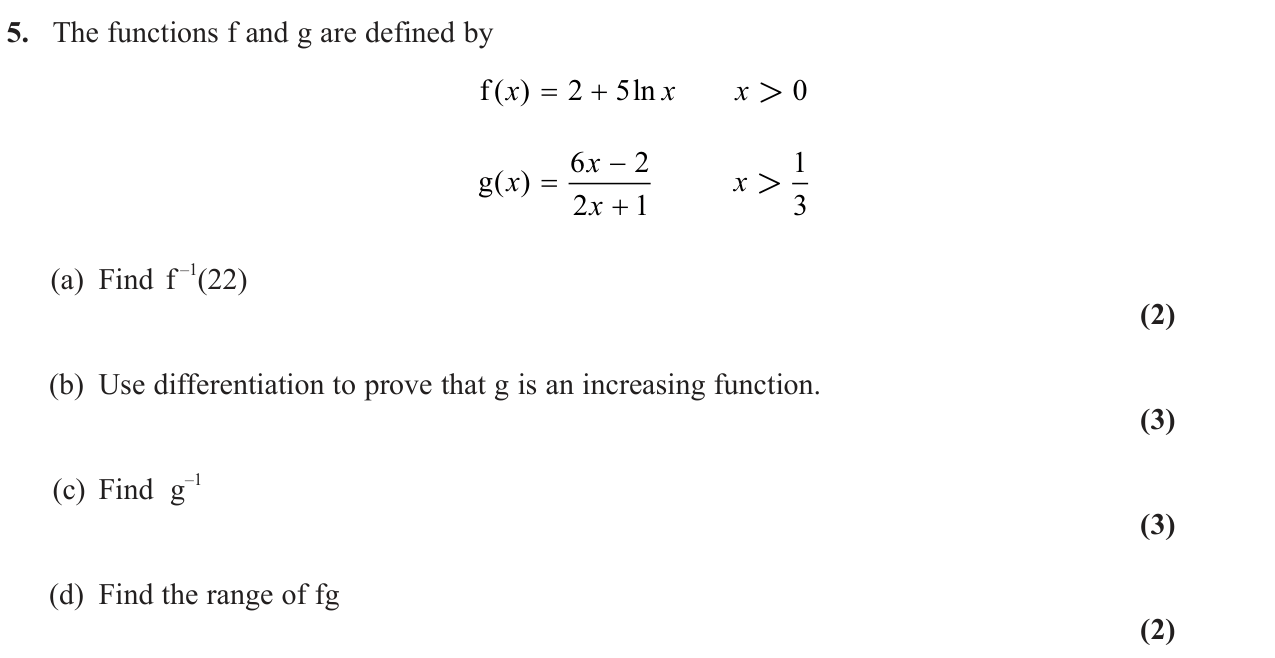
Hard10 marks · main topic: Functions, Composition & Inverses
WMA13/01 May/June 2024 Question 5 (10 marks): Differentiation
Show worked solution
  1. Part (a)

    To find $f^{-1}(22)$, solve $f(u)=22$: $2+5\ln u=22$, so $\ln u=4$ and $u=e^4\gt 0$.

    \[\boxed{f^{-1}(22)=e^4}\]
  2. Part (b)

    Using the quotient rule,

    \[g'(x)=\frac{6(2x+1)-2(6x-2)}{(2x+1)^2} =\frac{10}{(2x+1)^2}.\]

    For every $x\gt 1/3$, the denominator is positive, so $g'(x)\gt 0$. Thus g is strictly increasing on its entire domain.

    \[\boxed{g\text{ is strictly increasing for }x\gt \frac13}\]
  3. Part (c)

    Set $y=(6x-2)/(2x+1)$. Then

    \[2xy+y=6x-2,\qquad (6-2y)x=y+2, \qquad x=\frac{y+2}{6-2y}.\]

    As $x\downarrow1/3$, $g(x)\to0$; as $x\to\infty$, $g(x)\to3$. Since g is strictly increasing, its range is $(0,3)$; neither limiting value is attained. Interchange the input and output symbols.

    \[\boxed{g^{-1}(x)=\frac{x+2}{6-2x},\quad0\lt x\lt 3}\]
  4. Part (d)

    The inner function g takes every value in $(0,3)$. Since $f(u)=2+5\ln u$ is increasing for $u\gt 0$, its values on this interval run from $-\infty$ to, but not including, $2+5\ln3$.

    \[\boxed{\operatorname{Range}(fg)=(-\infty,\,2+5\ln3)}\]
Final answer

(a) $f^{-1}(22)=e^4$ (b) $g\text{ is strictly increasing for }x\gt \frac13$ (c) $g^{-1}(x)=\frac{x+2}{6-2x},\quad0\lt x\lt 3$ (d) $\operatorname{Range}(fg)=(-\infty,\,2+5\ln3)$

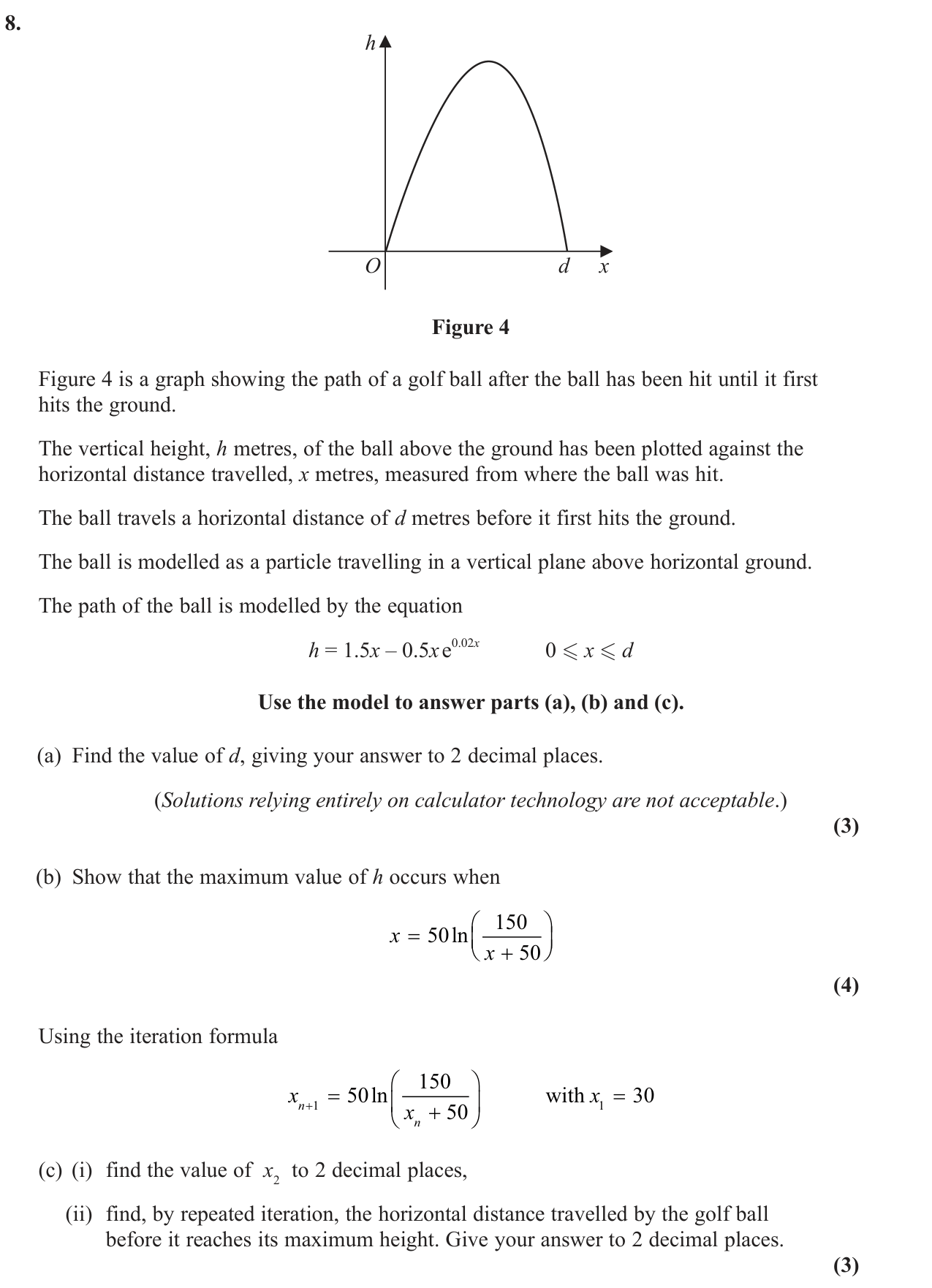
59. WMA13/01 May/June 2024 · Q8

Hard10 marks · main topic: Log Graphs & Exponential Models
WMA13/01 May/June 2024 Question 8 (10 marks): Differentiation
Show worked solution
  1. Part (a)

    At the first landing, $h=0$ and $x=d\gt 0$:

    \[0=d(1.5-0.5e^{0.02d}),\qquad e^{0.02d}=3.\]

    Taking logarithms, $0.02d=\ln3$, hence $d=50\ln3=54.930614\ldots$. The root $x=0$ is the launch point, not the landing point.

    \[\boxed{d=54.93\ \text{m}}\]
  2. Part (b)

    By the product and chain rules,

    \[h'(x)=1.5-0.5e^{0.02x}-0.01xe^{0.02x}.\]

    At a stationary point,

    \[1.5=0.01(x+50)e^{0.02x},\qquad e^{0.02x}=\frac{150}{x+50}.\]

    Since $x+50\gt 0$, logarithms give $0.02x=\ln(150/(x+50))$. Also $h”(x)=-(0.02+0.0002x)e^{0.02x}\lt 0$ on $[0,d]$. Thus the stationary point is the unique maximum; the endpoints both have zero height.

    \[\boxed{x=50\ln\left(\frac{150}{x+50}\right)}\]
  3. Part (c)

    (i) With $x_1=30$,

    \[x_2=50\ln\left(\frac{150}{30+50}\right)=31.43043297\ldots.\]

    (ii) Continuing with full intermediate precision gives $x_3=30.54431108\ldots$, $x_4=31.09139065\ldots$, $x_5=30.75292479\ldots$ and $x_6=30.96205562\ldots$. Continued iteration converges to $30.88212\ldots$, which lies in $(0,d)$. This is the horizontal distance at maximum height, not the maximum height itself.

    \[\boxed{x_2=31.43,\quad x_{\mathrm{maximum}}=30.88\ \text{m}}\]
Final answer

(a) $d=54.93\ \text{m}$ (b) $x=50\ln\left(\frac{150}{x+50}\right)$ (c) $x_2=31.43,\quad x_{\mathrm{maximum}}=30.88\ \text{m}$

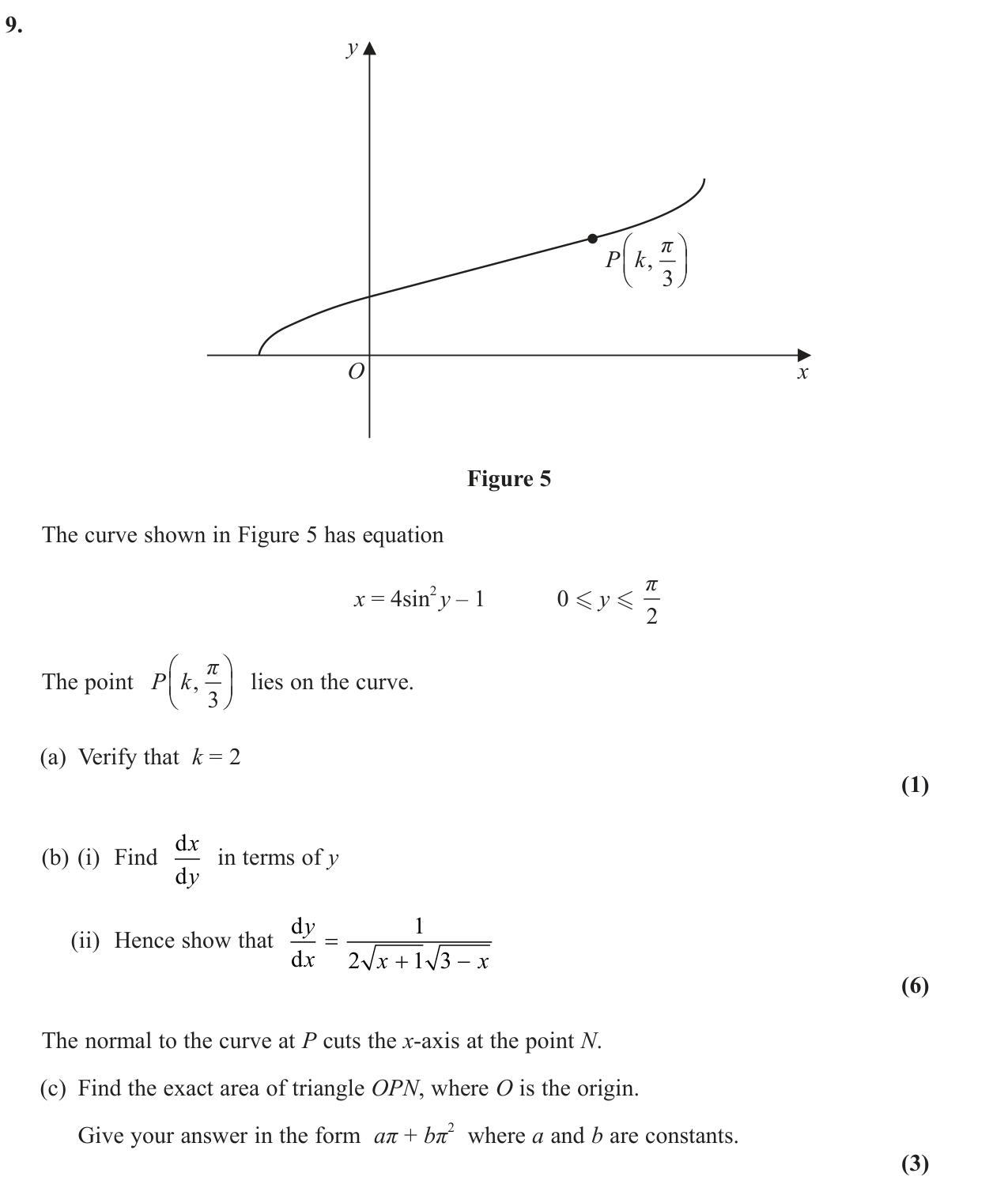
60. WMA13/01 May/June 2024 · Q9

Hard10 marks · main topic: Applications of Differentiation
WMA13/01 May/June 2024 Question 9 (10 marks): Differentiation
Show worked solution
  1. Part (a)

    At $y=\pi/3$, $x=4(\sqrt3/2)^2-1=3-1=2$.

    \[\boxed{k=2}\]
  2. Part (b)

    (i) Differentiating with respect to $y$ gives

    \[\frac{dx}{dy}=8\sin y\cos y.\]

    (ii) For $0\lt y\lt \pi/2$, both sine and cosine are positive, and $-1\lt x\lt 3$. From $x+1=4\sin^2y$,

    \[\sin y=\frac{\sqrt{x+1}}2,\qquad \cos y=\sqrt{1-\frac{x+1}{4}}=\frac{\sqrt{3-x}}2.\]

    Consequently $dx/dy=2\sqrt{x+1}\sqrt{3-x}$. Taking the reciprocal proves the required formula on $-1\lt x\lt 3$. At $x=-1$ and $x=3$ the denominator is zero: these are endpoint vertical tangents, not finite derivatives.

    \[\boxed{\frac{dx}{dy}=8\sin y\cos y,\qquad\frac{dy}{dx}=\frac1{2\sqrt{x+1}\sqrt{3-x}}}\]
  3. Part (c)

    At $P=(2,\pi/3)$ the tangent gradient is $1/(2\sqrt3)$, so the normal gradient is $-2\sqrt3$. Thus the normal is $y-\pi/3=-2\sqrt3(x-2)$. Setting $y=0$ gives $N=(2+\pi/(6\sqrt3),0)$. Triangle OPN has horizontal base $ON=2+\pi/(6\sqrt3)$ and perpendicular height $\pi/3$:

    \[\operatorname{Area}(OPN)=\frac12\left(2+\frac\pi{6\sqrt3}\right)\frac\pi3 =\frac\pi3+\frac{\pi^2}{36\sqrt3}.\]
    \[\boxed{\operatorname{Area}(OPN)=\frac13\pi+\frac{\sqrt3}{108}\pi^2}\]
Final answer

(a) $k=2$ (b) $\frac{dx}{dy}=8\sin y\cos y,\qquad\frac{dy}{dx}=\frac1{2\sqrt{x+1}\sqrt{3-x}}$ (c) $\operatorname{Area}(OPN)=\frac13\pi+\frac{\sqrt3}{108}\pi^2$

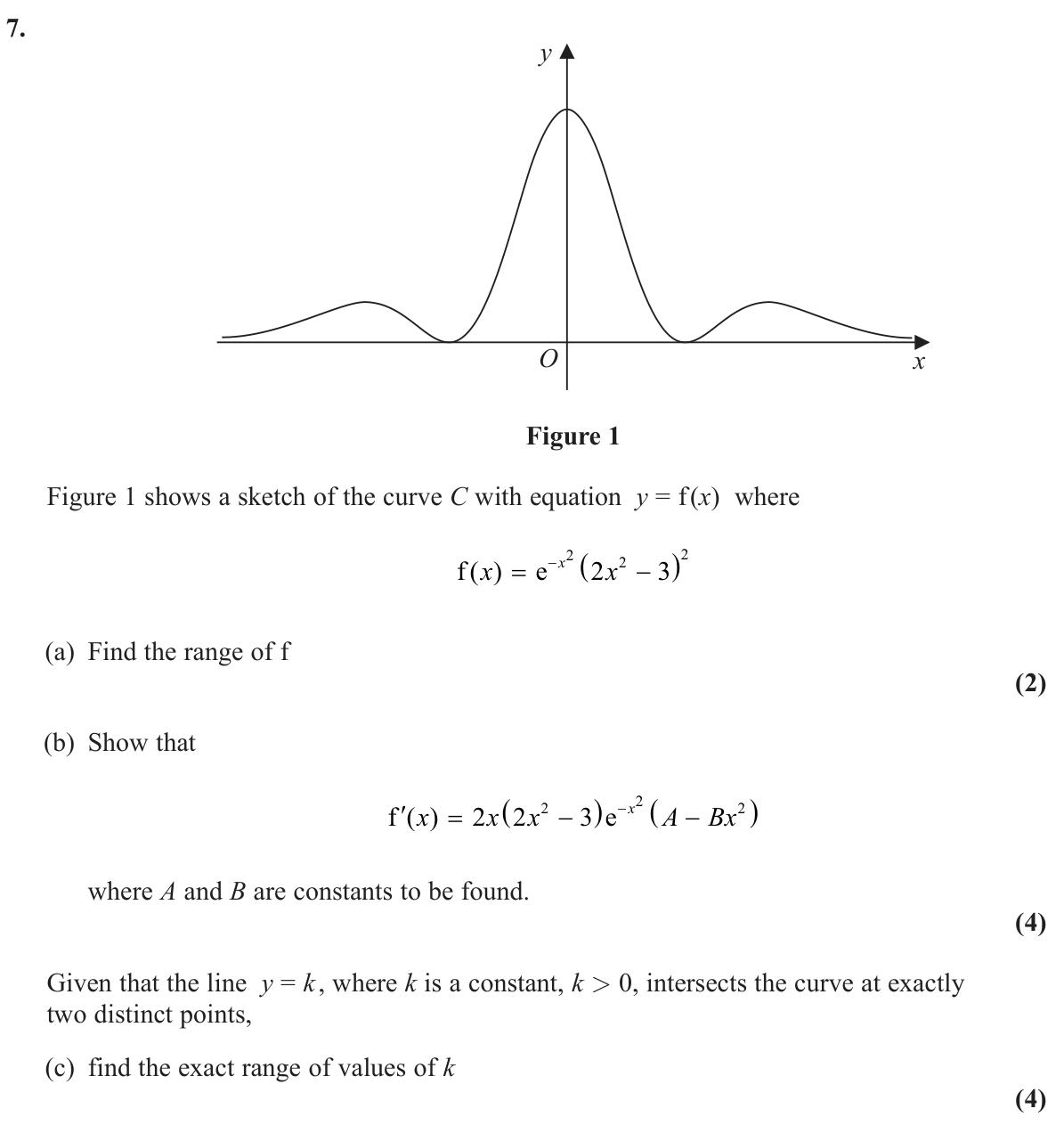
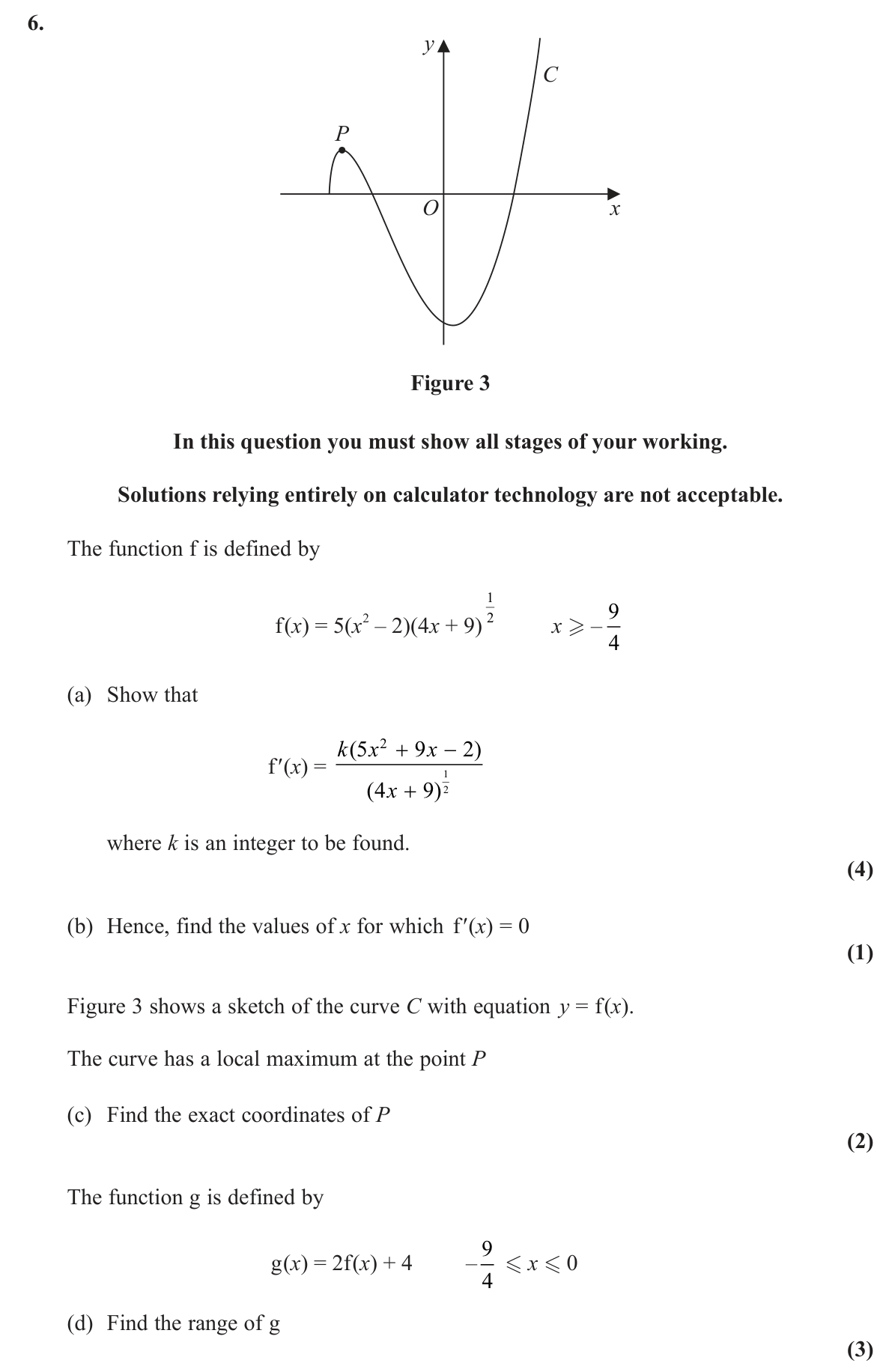
61. WMA13/01 October 2023 · Q7

Hard10 marks · main topic: Functions, Composition & Inverses
WMA13/01 October 2023 Question 7 (10 marks): Differentiation
Show worked solution
  1. Part (a)

    The exponential is positive and the squared factor is nonnegative, so $f(x)\ge0$. The value zero is attained at $x=\pm\sqrt{3/2}$. The graph has its highest point at $x=0$, where $f(0)=9$; the outer maxima are lower. Thus both endpoints of the range are included.

    \[\boxed{0\le f(x)\le9}\]
  2. Part (b)

    For $f(x)=e^{-x^2}(2x^2-3)^2$, product and chain rules give

    \[f'(x)=-2xe^{-x^2}(2x^2-3)^2 +e^{-x^2}\,2(2x^2-3)\,4x.\]

    Factoring yields

    \[f'(x)=2x(2x^2-3)e^{-x^2}\bigl(-(2x^2-3)+4\bigr) =2x(2x^2-3)e^{-x^2}(7-2x^2).\]
    \[\boxed{A=7,\qquad B=2}\]
  3. Part (c)

    The stationary abscissae are $0$, $\pm\sqrt{3/2}$ and $\pm\sqrt{7/2}$. At the outer local maxima,

    \[f\left(\pm\sqrt{7/2}\right)=e^{-7/2}(7-3)^2=16e^{-7/2}.\]

    The central maximum is 9 and the two minima are zero. Also $f(x)\to0$ as $x\to\pm\infty$. A positive horizontal line above both outer maxima but below 9 meets only the two sides of the central peak. At $k=16e^{-7/2}$ it also touches both outer peaks, giving four distinct intersections; at $k=9$ there is only one. Both bounds must be excluded.

    \[\boxed{16e^{-7/2}\lt k\lt 9}\]
Final answer

(a) $0\le f(x)\le9$ (b) $A=7,\qquad B=2$ (c) $16e^{-7/2}\lt k\lt 9$

62. WMA13/01 May/June 2022 · Q6

Hard10 marks · main topic: Applications of Differentiation
WMA13/01 May/June 2022 Question 6 (10 marks): Differentiation
Show worked solution
  1. Part (a)

    Use product and chain rules:

    \[f'(x)=10x(4x+9)^{1/2}+10(x^2-2)(4x+9)^{-1/2}.\]

    With a common denominator,

    \[f'(x)=\frac{10x(4x+9)+10(x^2-2)}{\sqrt{4x+9}} =\frac{10(5x^2+9x-2)}{\sqrt{4x+9}}.\]

    This derivative formula applies for $x\gt -9/4$; the endpoint derivative is not finite.

    \[\boxed{k=10}\]
  2. Part (b)

    The denominator is positive in the derivative domain. Thus $5x^2+9x-2=(5x-1)(x+2)=0$.

    \[\boxed{x=-2,\quad\frac15}\]
  3. Part (c)

    The derivative changes from positive to negative at $x=-2$, so this is the local maximum P. Substitute into f: $f(-2)=5(4-2)\sqrt{-8+9}=10$.

    \[\boxed{P=(-2,10)}\]
  4. Part (d)

    On $[-9/4,0]$, f rises from $f(-9/4)=0$ to $f(-2)=10$, then decreases to $f(0)=-30$. The other stationary point $1/5$ is outside this restricted interval. Thus the minimum and maximum of f on it are $-30$ and 10. Applying the positive vertical transformation $g=2f+4$ gives endpoints $2(-30)+4=-56$ and $2(10)+4=24$, both attained.

    \[\boxed{-56\le g(x)\le24}\]
Final answer

(a) $k=10$ (b) $x=-2,\quad\frac15$ (c) $P=(-2,10)$ (d) $-56\le g(x)\le24$

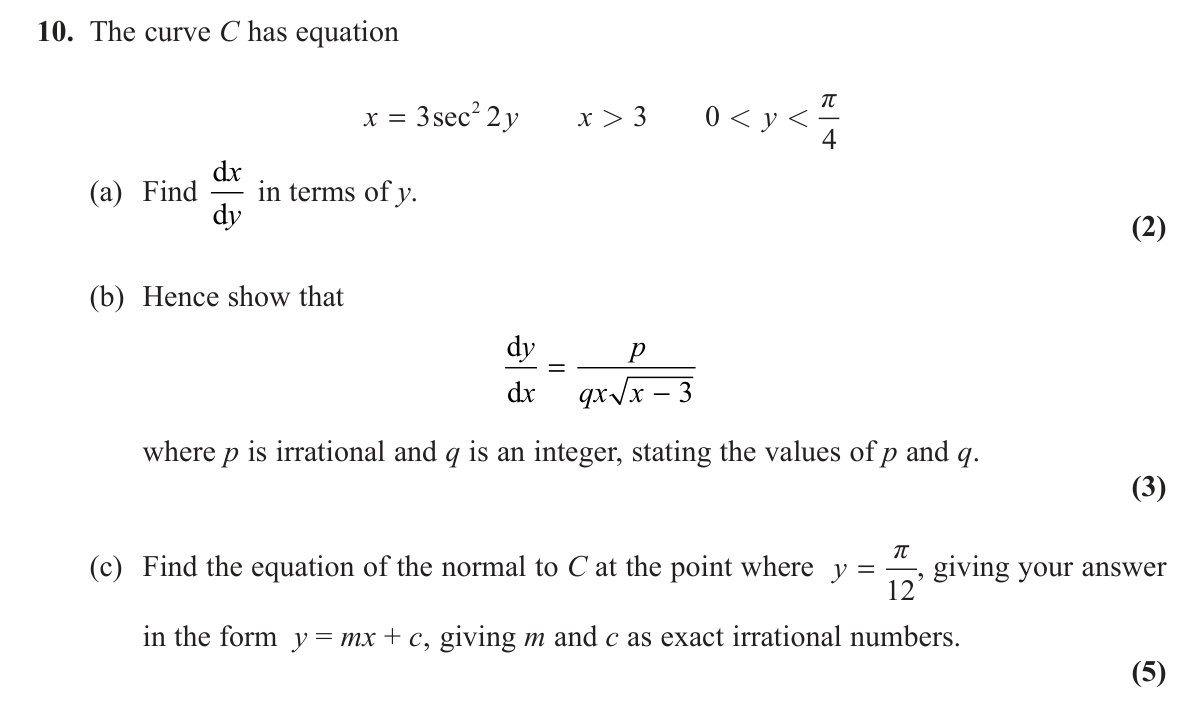
63. WMA13/01 January 2021 · Q10

Hard10 marks
WMA13/01 January 2021 Question 10 (10 marks): Differentiation
Show worked solution
  1. Part (a)

    Apply the chain rule twice:

    \[\frac{dx}{dy}=3\cdot2\sec2y\,(2\sec2y\tan2y)=12\sec^22y\tan2y.\]
    \[\boxed{\frac{dx}{dy}=12\sec^22y\tan2y}\]
  2. Part (b)

    From $x=3\sec^22y$, $\sec^22y=x/3$ and $\tan^22y=x/3-1$. Since $0\lt 2y\lt \pi/2$, tangent is positive, so $\tan2y=\sqrt{(x-3)/3}$. Thus $dx/dy=4x\sqrt{(x-3)/3}\gt 0$. Taking the reciprocal gives

    \[\frac{dy}{dx}=\frac{\sqrt3}{4x\sqrt{x-3}},\qquad p=\sqrt3,\quad q=4.\]
    \[\boxed{p=\sqrt3,\quad q=4}\]
  3. Part (c)

    At $y=\pi/12$, $2y=\pi/6$ and $x=3(4/3)=4$. The tangent gradient is $\sqrt3/(4\cdot4\sqrt1)=\sqrt3/16$. Therefore the normal gradient is $-16/\sqrt3=-16\sqrt3/3$. Using the point $(4,\pi/12)$,

    \[y-\frac\pi{12}=-\frac{16\sqrt3}{3}(x-4) \Longrightarrow y=-\frac{16\sqrt3}{3}x+\frac{64\sqrt3}{3}+\frac\pi{12}.\]
    \[\boxed{y=-\frac{16\sqrt3}{3}x+\frac{64\sqrt3}{3}+\frac\pi{12}}\]
Final answer

(a) $\frac{dx}{dy}=12\sec^22y\tan2y$ (b) $p=\sqrt3,\quad q=4$ (c) $y=-\frac{16\sqrt3}{3}x+\frac{64\sqrt3}{3}+\frac\pi{12}$

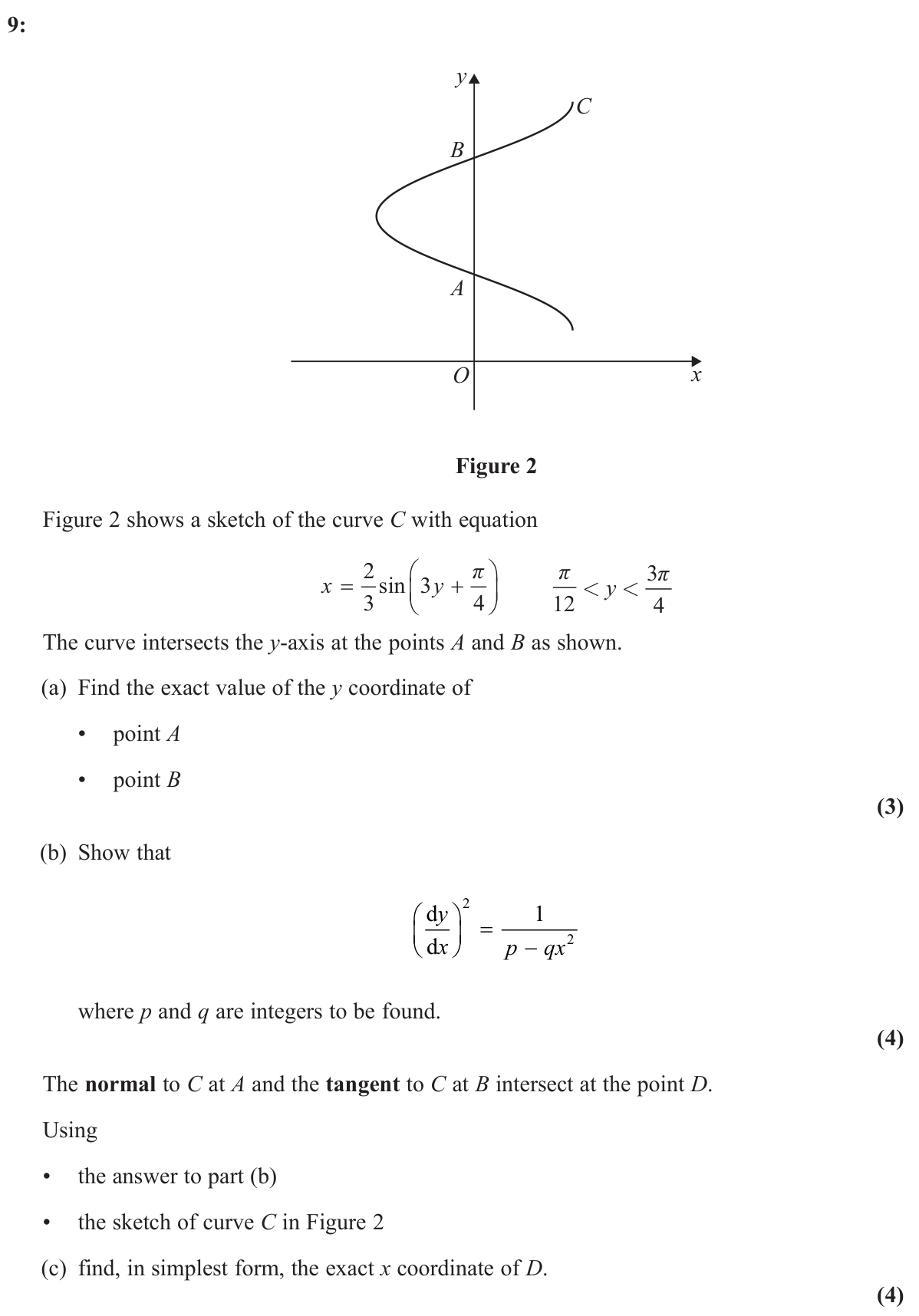
64. WMA13/01 May/June 2025 · Q9

Hard11 marks
WMA13/01 May/June 2025 Question 9 (11 marks): Differentiation
Show worked solution
  1. Part (a)

    On the $y$ axis, $x=0$, so $\sin(3y+\pi/4)=0$. Since $\pi/12\lt y\lt 3\pi/4$, we have $\pi/2\lt 3y+\pi/4\lt 5\pi/2$. Therefore the possible angles are $\pi$ and $2\pi$, giving

    \[\boxed{y_A=\frac\pi4,\qquad y_B=\frac{7\pi}{12}}.\]
  2. Part (b)

    Differentiate $x$ with respect to $y$, then take the reciprocal:

    \[\frac{dx}{dy}=2\cos(3y+\pi/4),\qquad \frac{dy}{dx}=\frac1{2\cos(3y+\pi/4)}.\]

    Using $\sin(3y+\pi/4)=3x/2$,

    \[\left(\frac{dy}{dx}\right)^2 =\frac1{4(1-\sin^2(3y+\pi/4))} =\boxed{\frac1{4-9x^2}}.\]

    Thus $\boxed{p=4,\ q=9}$. The derivative formula applies where the tangent is not vertical.

  3. Part (c)

    At $x=0$, part (b) gives $|dy/dx|=1/2$. The sketch shows a negative tangent gradient at $A$ and a positive one at $B$. The normal at $A$ therefore has gradient $2$, while the tangent at $B$ has gradient $1/2$:

    \[y=2x+\frac\pi4,\qquad y=\frac{x}{2}+\frac{7\pi}{12}.\]

    At their intersection,

    \[\frac32x=\frac{7\pi}{12}-\frac\pi4=\frac\pi3 \quad\Longrightarrow\quad\boxed{x_D=\frac{2\pi}{9}}.\]
Final answer

(a) $y_A=\frac\pi4,\qquad y_B=\frac{7\pi}{12}$ (b) $\frac1{4-9x^2}$, $p=4,\ q=9$ (c) $x_D=\frac{2\pi}{9}$

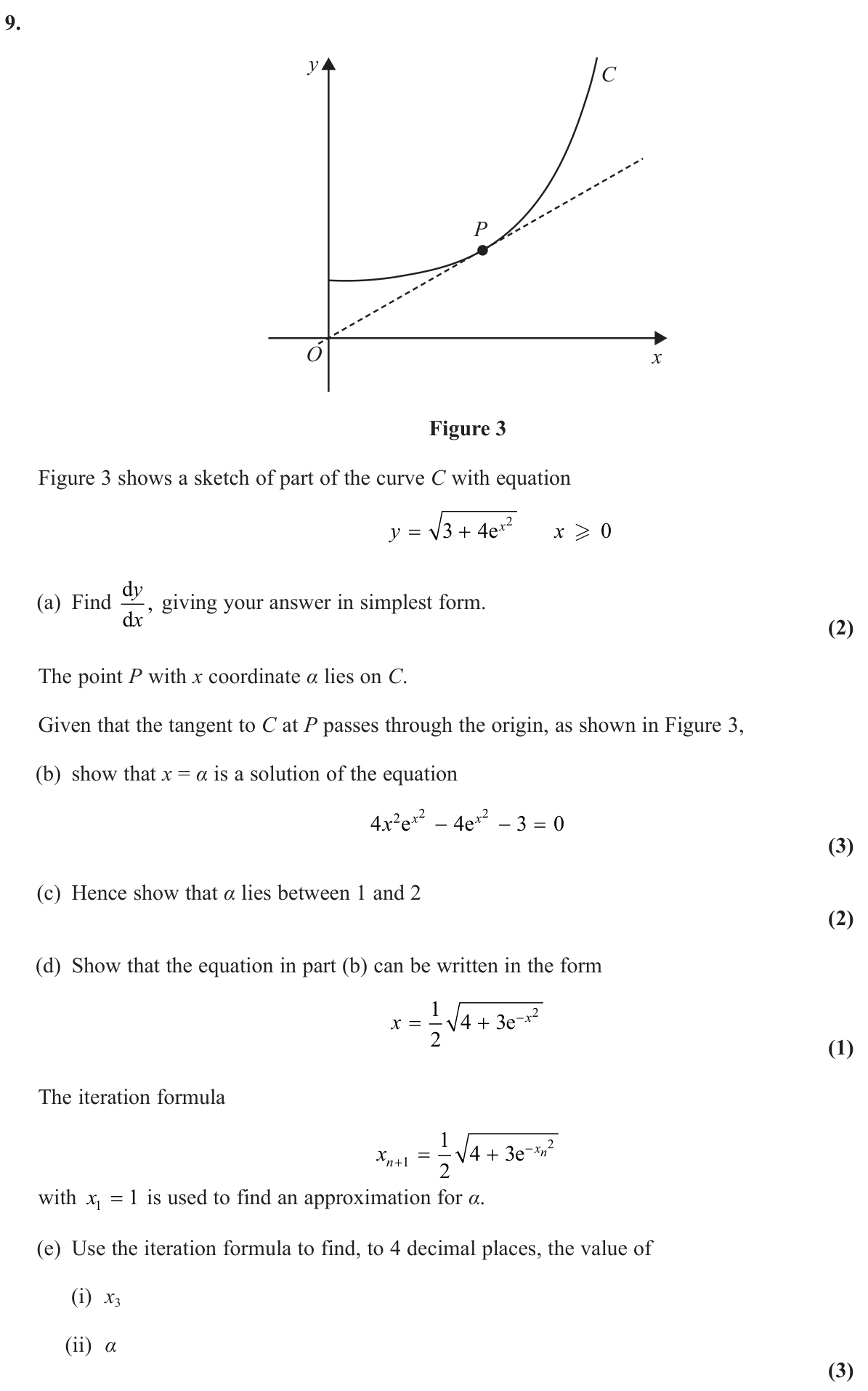
65. WMA13/01 January 2023 · Q9

Hard11 marks · main topic: Numerical Methods
WMA13/01 January 2023 Question 9 (11 marks): Differentiation
Show worked solution
  1. Part (a)

    Differentiate $y=(3+4e^{x^2})^{1/2}$ using the chain rule:

    \[\frac{dy}{dx}=\frac12(3+4e^{x^2})^{-1/2}\cdot4e^{x^2}\cdot2x =\frac{4xe^{x^2}}{\sqrt{3+4e^{x^2}}}.\]
    \[\boxed{\frac{dy}{dx}=\frac{4xe^{x^2}}{\sqrt{3+4e^{x^2}}}}\]
  2. Part (b)

    Since the tangent at $P=(\alpha,\sqrt{3+4e^{\alpha^2}})$ passes through the origin, its gradient is $y_P/\alpha$, with $\alpha\gt 0$. Equate this to the derivative:

    \[\frac{4\alpha e^{\alpha^2}}{\sqrt{3+4e^{\alpha^2}}} =\frac{\sqrt{3+4e^{\alpha^2}}}{\alpha} \quad\Longrightarrow\quad4\alpha^2e^{\alpha^2}=3+4e^{\alpha^2}.\]

    Consequently $x=\alpha$ solves the displayed equation.

    \[\boxed{4x^2e^{x^2}-4e^{x^2}-3=0}\]
  3. Part (c)

    Let $h(x)=4x^2e^{x^2}-4e^{x^2}-3$, a continuous function. Then $h(1)=-3\lt 0$ and $h(2)=12e^4-3=652.1778\ldots\gt 0$, so a root lies between 1 and 2. Moreover $h'(x)=8x^3e^{x^2}\gt 0$ for $x\gt 0$, so this is the unique positive root corresponding to the tangent abscissa $\alpha$.

    \[\boxed{1\lt \alpha\lt 2}\]
  4. Part (d)

    From $4x^2e^{x^2}=4e^{x^2}+3$, divide by the positive $e^{x^2}$ to get $4x^2=4+3e^{-x^2}$. The source domain has $x\ge0$, so take the positive square root.

    \[\boxed{x=\frac12\sqrt{4+3e^{-x^2}}}\]
  5. Part (e)

    With $x_1=1$, the unrounded iterates start

    \[x_2=1.1295616764\ldots,\quad x_3=1.0997193683\ldots,\quad x_4=1.1062486441\ldots,\quad x_5=1.1048012899\ldots.\]

    Continue: $x_6=1.1051212304\ldots$, $x_7=1.1050504628\ldots$, $x_8=1.1050661137\ldots$, $x_9=1.1050626523\ldots$; further iteration settles at $1.1050632792\ldots$. Therefore (i) $x_3=1.0997$ and (ii) $\alpha=1.1051$, both to four decimal places.

    \[\boxed{x_3=1.0997,\qquad\alpha=1.1051}\]
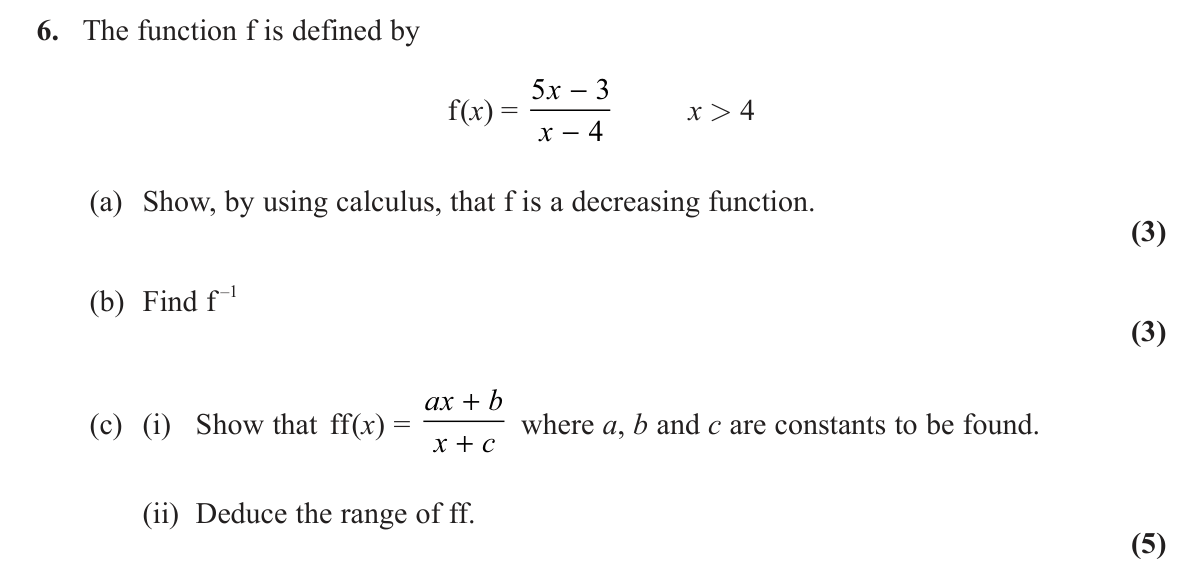
Final answer

(a) $\frac{dy}{dx}=\frac{4xe^{x^2}}{\sqrt{3+4e^{x^2}}}$ (b) $4x^2e^{x^2}-4e^{x^2}-3=0$ (c) $1\lt \alpha\lt 2$ (d) $x=\frac12\sqrt{4+3e^{-x^2}}$ (e) $x_3=1.0997,\qquad\alpha=1.1051$

66. WMA13/01 January 2022 · Q6

Hard11 marks · main topic: Functions, Composition & Inverses
WMA13/01 January 2022 Question 6 (11 marks): Differentiation
Show worked solution
  1. Part (a)

    By the quotient rule,

    \[f'(x)=\frac{5(x-4)-(5x-3)}{(x-4)^2}=\frac{-17}{(x-4)^2}.\]

    For every $x\gt 4$, the denominator is positive and the numerator is negative. Therefore $f'(x)\lt 0$ throughout its domain, so f is decreasing.

    \[\boxed{f\text{ is decreasing for }x\gt 4}\]
  2. Part (b)

    Set $y=(5x-3)/(x-4)$. Then $yx-4y=5x-3$, giving $x(y-5)=4y-3$ and $x=(4y-3)/(y-5)$. Exchange the variable names. Since $f(x)=5+17/(x-4)$ on $x\gt 4$, its range is $(5,\infty)$, which becomes the inverse's domain.

    \[\boxed{f^{-1}(x)=\frac{4x-3}{x-5},\qquad x\gt 5}\]
  3. Part (c)

    (i) For $x\gt 4$, $f(x)\gt 5\gt 4$, so the second application is defined.

    \[ff(x)=\frac{5\left(\frac{5x-3}{x-4}\right)-3} {\left(\frac{5x-3}{x-4}\right)-4} =\frac{25x-15-3x+12}{5x-3-4x+16} =\frac{22x-3}{x+13}.\]

    Thus $a=22$, $b=-3$, $c=13$. (ii) Rewrite $ff(x)=22-289/(x+13)$ with the original domain $x\gt 4$. It is strictly increasing, tends to 5 as $x\to4^+$ and to 22 as $x\to\infty$. Neither limiting value is attained.

    \[\boxed{ff(x)=\frac{22x-3}{x+13},\qquad 5\lt ff(x)\lt 22}\]
Final answer

(a) $f\text{ is decreasing for }x\gt 4$ (b) $f^{-1}(x)=\frac{4x-3}{x-5},\qquad x\gt 5$ (c) $ff(x)=\frac{22x-3}{x+13},\qquad 5\lt ff(x)\lt 22$

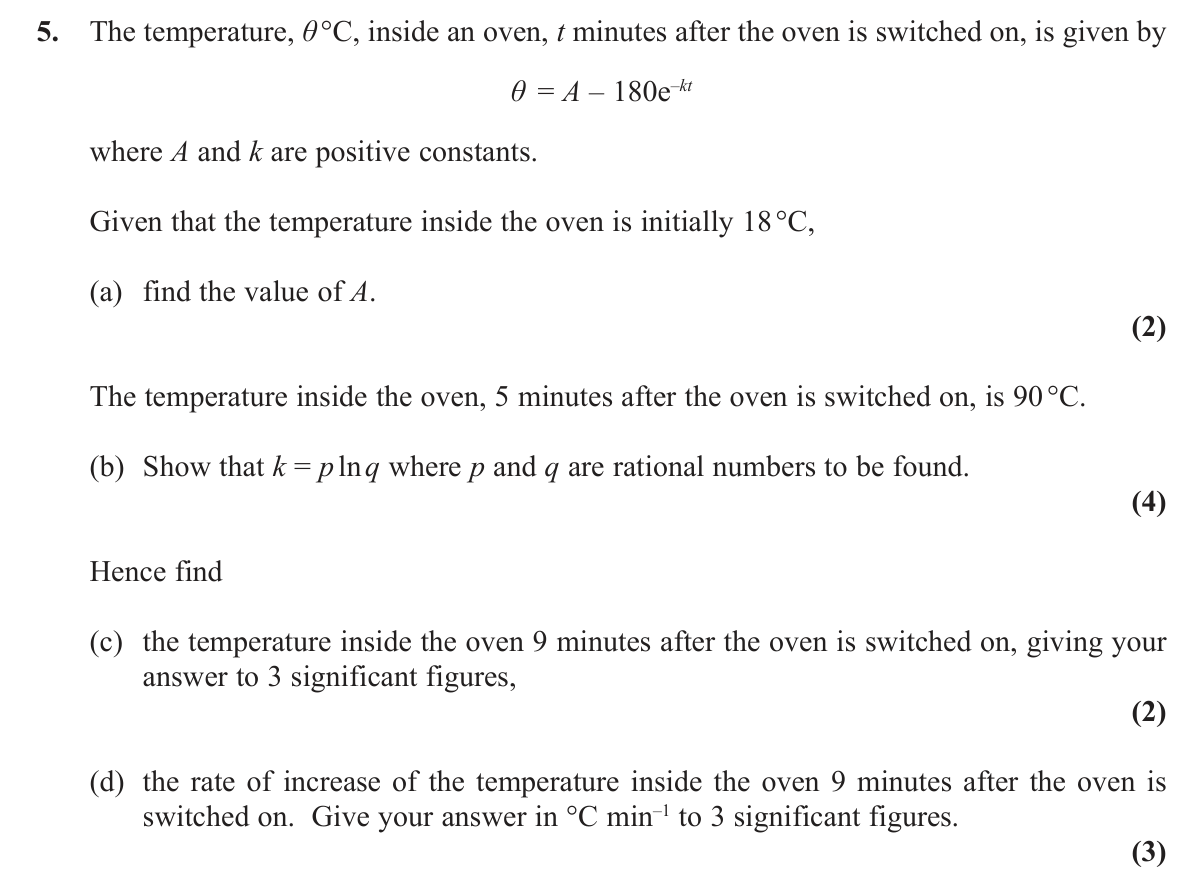
67. WMA13/01 January 2021 · Q5

Hard11 marks · main topic: Log Graphs & Exponential Models
WMA13/01 January 2021 Question 5 (11 marks): Differentiation
Show worked solution
  1. Part (a)

    At $t=0$, $18=A-180e^0=A-180$. Hence $A=198$.

    \[\boxed{A=198}\]
  2. Part (b)

    At $t=5$, $90=198-180e^{-5k}$, so $180e^{-5k}=108$ and $e^{-5k}=3/5$. Taking logarithms gives $-5k=\ln(3/5)$, hence $k=(1/5)\ln(5/3)$. Thus one suitable rational pair is $p=1/5$, $q=5/3$.

    \[\boxed{k=\frac15\ln\frac53;\quad p=\frac15,\ q=\frac53}\]
  3. Part (c)

    Use the unrounded k:

    \[\theta(9)=198-180e^{-(9/5)\ln(5/3)}=126.22970096\ldots{}^\circ\mathrm C.\]

    Round the temperature to three significant figures.

    \[\boxed{126^\circ\mathrm C}\]
  4. Part (d)

    Differentiate with respect to time: $d\theta/dt=180ke^{-kt}$. At $t=9$ this is $180[\ln(5/3)/5]e^{-(9/5)\ln(5/3)}=7.332421555\ldots$. The sign is positive because the oven is warming.

    \[\boxed{7.33^\circ\mathrm C\,\mathrm{min}^{-1}}\]
Final answer

(a) $A=198$ (b) $k=\frac15\ln\frac53;\quad p=\frac15,\ q=\frac53$ (c) $126^\circ\mathrm C$ (d) $7.33^\circ\mathrm C\,\mathrm{min}^{-1}$

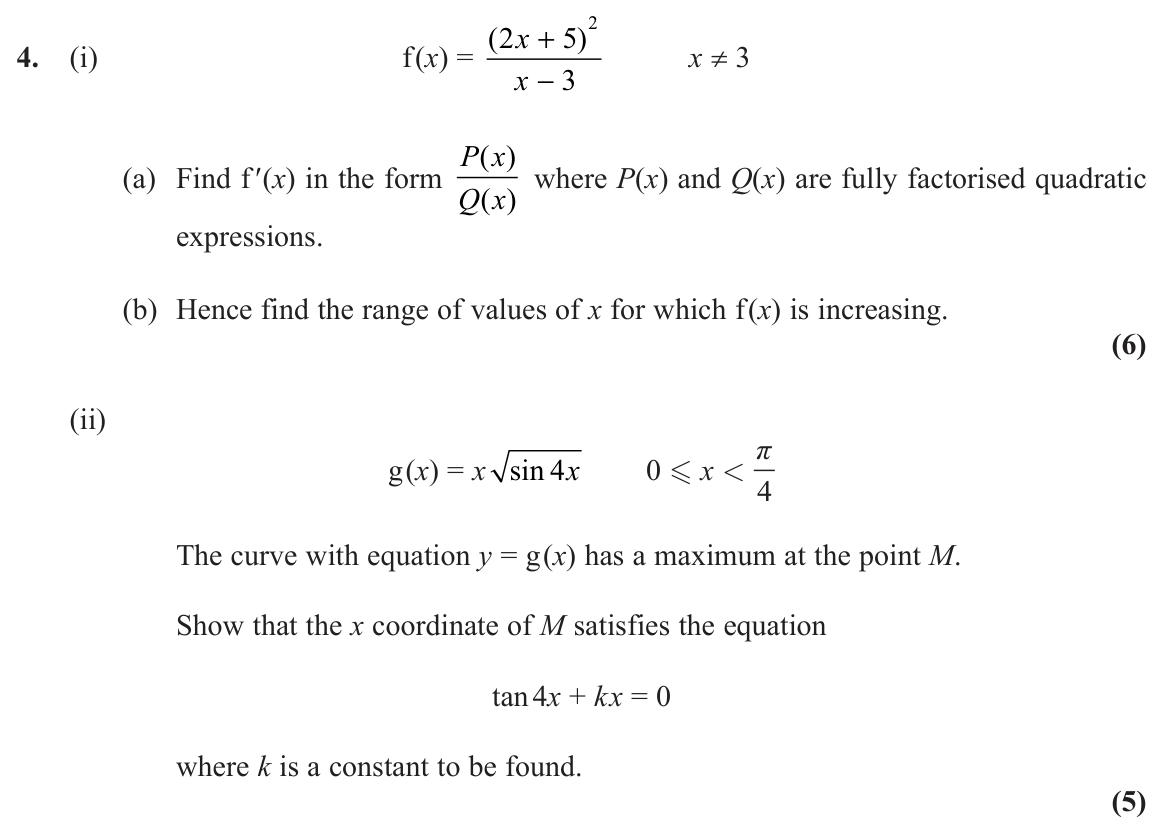
68. WMA13/01 January 2020 · Q4

Hard11 marks
WMA13/01 January 2020 Question 4 (11 marks): Differentiation
Show worked solution
  1. Part (i)(a)

    Using the quotient rule and the chain rule,

    \[\begin{aligned} f'(x)&=\frac{(x-3)\,4(2x+5)-(2x+5)^2}{(x-3)^2}\\ &=\frac{(2x+5)\{4(x-3)-(2x+5)\}}{(x-3)^2}\\ &=\boxed{\frac{(2x+5)(2x-17)}{(x-3)^2}},\qquad x\ne3. \end{aligned}\]

    Thus $P(x)=(2x+5)(2x-17)$ and $Q(x)=(x-3)^2$ are fully factorised quadratics.

  2. Part (i)(b)

    For $x\ne3$, the denominator $(x-3)^2$ is positive, so the sign of $f'(x)$ is the sign of $(2x+5)(2x-17)$. For an increasing function we require

    \[(2x+5)(2x-17)\gt 0.\]

    Both factors are negative when $x\lt -\frac52$, and both are positive when $x\gt \frac{17}{2}$. Therefore the required values are

    \[\boxed{x\lt -\frac52\quad\text{or}\quad x\gt \frac{17}{2}}.\]
  3. Part (ii)

    For $0\lt x\lt \frac{\pi}{4}$, we have $\sin4x\gt 0$. Applying the product rule and the chain rule gives

    \[\begin{aligned} g'(x)&=\sqrt{\sin4x} +x\left(\frac{1}{2\sqrt{\sin4x}}\right)4\cos4x\\ &=\frac{\sin4x+2x\cos4x}{\sqrt{\sin4x}}. \end{aligned}\]

    Since $g(0)=0$ while $g(x)\gt 0$ in the interior, the stated maximum $M$ does not occur at $x=0$. Its coordinate therefore lies in $0\lt x\lt \frac{\pi}{4}$, where $g$ is differentiable, so $g'(x)=0$ at $M$. Consequently,

    \[\sin4x+2x\cos4x=0.\]

    At such a point $\cos4x\ne0$: the only interior zero of $\cos4x$ is $x=\frac{\pi}{8}$, where the left-hand side above is $1$, not $0$. Dividing by $\cos4x$ therefore gives

    \[\boxed{\tan4x+2x=0},\qquad\boxed{k=2}.\]
Final answer

(i)(a) $\frac{(2x+5)(2x-17)}{(x-3)^2}$ (i)(b) $x\lt -\frac52\quad\text{or}\quad x\gt \frac{17}{2}$ (ii) $\tan4x+2x=0$, $k=2$

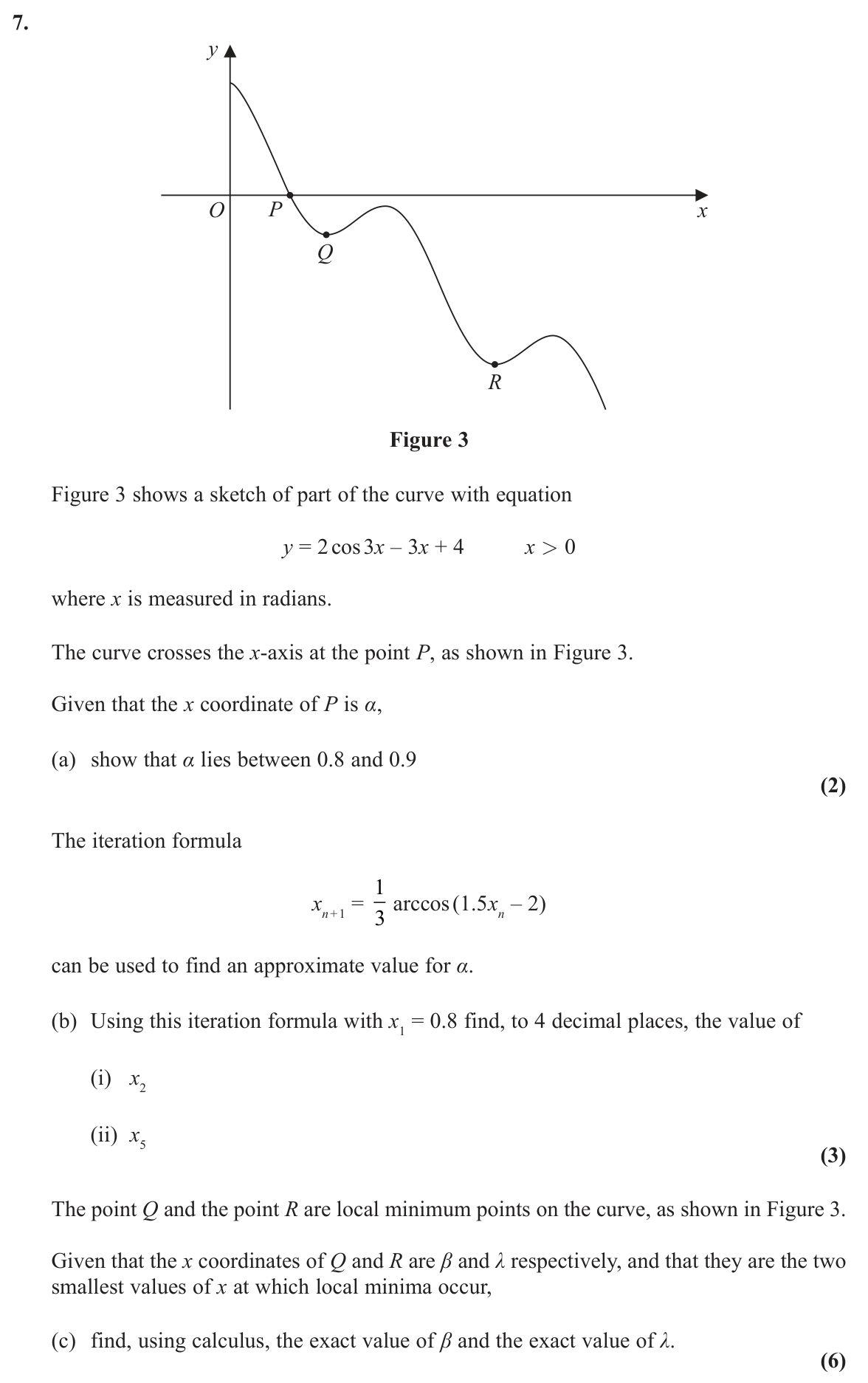
69. WMA13/01 January 2020 · Q7

Hard11 marks · main topic: Applications of Differentiation
WMA13/01 January 2020 Question 7 (11 marks): Differentiation
Show worked solution
  1. Part (a)

    Let $f(x)=2\cos3x-3x+4$, using radians. Then

    \[\begin{aligned} f(0.8)&=2\cos2.4-2.4+4=0.1252125\ldots\gt 0,\\ f(0.9)&=2\cos2.7-2.7+4=-0.5081443\ldots\lt 0. \end{aligned}\]

    The function is continuous on $[0.8,0.9]$, so this change of sign shows that there is a root between the endpoints. Moreover, $f'(x)=-6\sin3x-3\lt 0$ on this interval, so this root is unique there. Thus the crossing shown at $P$ has $\boxed{0.8\lt \alpha\lt 0.9}$.

  2. Part (b)(i)

    Using the inverse cosine in radians,

    \[x_2=\frac13\arccos(1.5(0.8)-2) =\frac13\arccos(-0.8)=0.8326971\ldots.\]

    Hence $\boxed{x_2=0.8327}$ to 4 decimal places.

  3. Part (b)(ii)

    Continue the iteration, retaining the full calculator values at each step:

    \[\begin{aligned} x_3&=\frac13\arccos(1.5x_2-2)=0.8067674\ldots,\\ x_4&=\frac13\arccos(1.5x_3-2)=0.8271196\ldots,\\ x_5&=\frac13\arccos(1.5x_4-2)=0.8110216\ldots. \end{aligned}\]

    Therefore $\boxed{x_5=0.8110}$ to 4 decimal places.

  4. Part (c)

    Differentiate the curve equation:

    \[\frac{dy}{dx}=-6\sin3x-3, \qquad \frac{d^2y}{dx^2}=-18\cos3x.\]

    At a stationary point,

    \[-6\sin3x-3=0 \quad\Longrightarrow\quad \sin3x=-\frac12.\]

    For $x\gt 0$, the stationary points therefore belong to the two families

    \[3x=\frac{7\pi}{6}+2n\pi \quad\text{or}\quad 3x=\frac{11\pi}{6}+2n\pi, \qquad n=0,1,2,\ldots.\]

    In the first family, $\cos3x=-\frac{\sqrt3}{2}$, giving $y”=9\sqrt3\gt 0$, so these are local minima. In the second family, $\cos3x=\frac{\sqrt3}{2}$ and $y”=-9\sqrt3\lt 0$, so these are local maxima and are excluded. Thus all positive minimum coordinates are

    \[x=\frac{7\pi}{18}+\frac{2n\pi}{3},\qquad n=0,1,2,\ldots.\]

    The two smallest are obtained with $n=0$ and $n=1$:

    \[\boxed{\beta=\frac{7\pi}{18}}, \qquad \boxed{\lambda=\frac{19\pi}{18}}.\]
Final answer

(a) $0.8\lt \alpha\lt 0.9$ (b)(i) $x_2=0.8327$ (b)(ii) $x_5=0.8110$ (c) $\beta=\frac{7\pi}{18}$, $\lambda=\frac{19\pi}{18}$

70. WMA13/01 May/June 2026 · Q7

Hard12 marks · main topic: Log Graphs & Exponential Models
WMA13/01 May/June 2026 Question 7 (12 marks): Differentiation
Show worked solution
  1. Part (a)

    Prices in the model are in thousands of pounds, so

    \[15=7+16e^{-0.1T}\quad\Longrightarrow\quad e^{-0.1T}=\frac12.\]

    Taking logarithms gives $T=10\ln2=6.9314718\ldots$, hence $\boxed{T=6.93\text{ years}}$.

  2. Part (b)
    \[\frac{dP_C}{dt}=-1.6e^{-0.1t},\qquad \left.\frac{dP_C}{dt}\right|_{t=5}=-1.6e^{-0.5}=-0.970449\ldots.\]

    Thus the answer is $\boxed{-0.97\text{ thousand pounds per year}}$ to 2 decimal places.

  3. Part (c)(i)

    At $t=0$, $36=4+m$, so $\boxed{m=32}$.

  4. Part (c)(ii)

    The initial car price is $7+16=23$ thousand pounds. The difference is $36-23=13$ thousand pounds, or $\boxed{\pounds13\,000}$.

  5. Part (d)

    Equating the models with $m=32$ gives

    \[7+16e^{-0.1\alpha}=4+32e^{-0.2\alpha}.\]

    Let $u=e^{-0.1\alpha}\gt 0$. Then $32u^2-16u-3=0$, so

    \[u=\frac{16\pm\sqrt{256+384}}{64}=\frac{2\pm\sqrt{10}}8.\]

    Reject the negative root because an exponential is positive. Hence

    \[\alpha=-10\ln\left(\frac{2+\sqrt{10}}8\right)=4.3806365\ldots, \qquad \boxed{\alpha=4.38\text{ years}}.\]

    This value is inside the model interval $0\leq t\leq15$.

Final answer

(a) $T=6.93\text{ years}$ (b) $-0.97\text{ thousand pounds per year}$ (c)(i) $m=32$ (c)(ii) $\pounds13\,000$ (d) $\alpha=4.38\text{ years}$

71. WMA13/01 October 2024 · Q8

Hard12 marks · main topic: Log Graphs & Exponential Models
WMA13/01 October 2024 Question 8 (12 marks): Differentiation
Show worked solution
  1. Part (a)

    At $t=0$, $H=32+40-20=52$.

    \[\boxed{H(0)=52\ \text{bpm}}\]
  2. Part (b)

    As $t\to\infty$, both decaying exponential terms tend to zero.

    \[\boxed{L=32}\]
  3. Part (c)
    \[\frac{dH}{dt}=-8e^{-0.2t}+18e^{-0.9t}.\]

    At the maximum,

    \[18e^{-0.9T}=8e^{-0.2T} \quad\Longrightarrow\quad e^{0.7T}=\frac94 \quad\Longrightarrow\quad T=\frac{10}{7}\ln\frac94=1.1584717\ldots.\]

    Also $H”(t)=1.6e^{-0.2t}-16.2e^{-0.9t}$. At the stationary point, $e^{-0.9T}=(4/9)e^{-0.2T}$, so $H”(T)=-5.6e^{-0.2T}\lt 0$, confirming a maximum.

    \[\boxed{T=1.158\ \text{minutes}}\]
  4. Part (d)

    For $H=37$,

    \[5=40e^{-0.2t}-20e^{-0.9t} \quad\Longrightarrow\quad 8e^{-0.2t}=1+4e^{-0.9t}.\]

    Taking logarithms gives

    \[-0.2t=\ln\left(\frac{1+4e^{-0.9t}}8\right) \quad\Longrightarrow\quad t=-5\ln\left(\frac{1+4e^{-0.9t}}8\right).\]

    Using $-\ln u=\ln(1/u)$ for $u\gt 0$ then gives

    \[t=5\ln\left(\frac8{1+4e^{-0.9t}}\right).\]
    \[\boxed{t=5\ln\left(\frac8{1+4e^{-0.9t}}\right)}\]
  5. Part (e)

    Starting with $t_1=10$,

    \[t_2=5\ln\left(\frac8{1+4e^{-9}}\right)=10.3947401213\ldots.\]

    Continuing without rounding intermediate values gives $t_3=10.3954778346\ldots$, $t_4=10.3954789826\ldots$ and $t_5=10.3954789844\ldots$. Thus (i) $t_2=10.3947$, and (ii) $M=10.3955$ minutes, both to 4 decimal places.

    \[\boxed{t_2=10.3947,\quad M=10.3955\ \text{minutes}}\]
Final answer

(a) $H(0)=52\ \text{bpm}$ (b) $L=32$ (c) $T=1.158\ \text{minutes}$ (d) $t=5\ln\left(\frac8{1+4e^{-0.9t}}\right)$ (e) $t_2=10.3947,\quad M=10.3955\ \text{minutes}$

72. WMA13/01 January 2024 · Q7

Hard12 marks · main topic: Applications of Differentiation
WMA13/01 January 2024 Question 7 (12 marks): Differentiation
Show worked solution
  1. Part (a)

    Write $y=(16/9)(3x-k)^{-1}$. The chain rule gives

    \[\frac{dy}{dx}=\frac{16}{9}(-1)(3x-k)^{-2}\cdot3.\]
    \[\boxed{\frac{dy}{dx}=-\frac{16}{3(3x-k)^2}}\]
  2. Part (b)

    At $x=1$, the given gradient yields

    \[-\frac{16}{3(3-k)^2}=-12 \quad\Longrightarrow\quad(3-k)^2=\frac49.\]

    Hence $3-k=\pm2/3$. Both resulting k-values are positive and different from 3.

    \[\boxed{k=\frac73\ \text{or}\ \frac{11}{3}}\]
  3. Part (c)

    Since $k\lt 3$, use $k=7/3$. At $x=1$, $y=16/[9(3-7/3)]=8/3$. The tangent gradient is $-12$, so the normal gradient is $1/12$:

    \[y-\frac83=\frac1{12}(x-1),\qquad12y-32=x-1.\]
    \[\boxed{x-12y+31=0}\]
  4. Part (d)

    With $k=7/3$, the denominator does not vanish on $[1,3]$. Using the reciprocal-linear antiderivative,

    \[\int_1^3\frac{16}{9(3x-7/3)}\,dx =\left[\frac{16}{27}\ln|3x-7/3|\right]_1^3 =\frac{16}{27}\left(\ln\frac{20}{3}-\ln\frac23\right) =\frac{16}{27}\ln\left(\frac{20/3}{2/3}\right).\]
    \[\boxed{\frac{16}{27}\ln10,\quad\lambda=\frac{16}{27}}\]
Final answer

(a) $\frac{dy}{dx}=-\frac{16}{3(3x-k)^2}$ (b) $k=\frac73\ \text{or}\ \frac{11}{3}$ (c) $x-12y+31=0$ (d) $\frac{16}{27}\ln10,\quad\lambda=\frac{16}{27}$

73. WMA13/01 May/June 2022 · Q8

Hard12 marks · main topic: Numerical Methods
WMA13/01 May/June 2022 Question 8 (12 marks): Differentiation
Show worked solution
  1. Part (a)

    Differentiate the velocity:

    \[v'(t)=-e^{t-10}+9e^{-0.75t}.\]

    At a stationary velocity, $e^{t-10}=9e^{-0.75t}$, so $e^{1.75t}=9e^{10}$ and $t=(10+\ln9)/1.75=6.9698426\ldots$ seconds. The second derivative $-e^{t-10}-6.75e^{-0.75t}$ is negative, so this is a maximum. Substitute this unrounded time into v to get $11.88728125\ldots$ metres per second.

    \[\boxed{v_{\max}=11.9\ \mathrm{m\,s^{-1}}}\]
  2. Part (b)

    Integrating the velocity gives $12t-e^{t-10}+16e^{-0.75t}$. Evaluate between 0 and T:

    \[100=12T-e^{T-10}+16e^{-0.75T}-(-e^{-10}+16).\]

    Rearrange to $12T=116-16e^{-0.75T}+e^{T-10}-e^{-10}$ and divide by 12.

    \[\boxed{T=\frac1{12}(116-16e^{-0.75T}+e^{T-10}-e^{-10})}\]
  3. Part (c)

    With $T_1=10$, substitution gives $T_2=9.7492587708\ldots$. Continuing with unrounded values gives

    \[T_3=9.7306248365\ldots,\quad T_4=9.7294150526\ldots,\quad T_5=9.7293372715\ldots,\quad T_6=9.7293322738\ldots.\]

    Further iteration settles at $9.7293319307\ldots$ seconds. Thus (i) $T_2=9.7493$ and (ii) the race time is $9.7293$ seconds, to four decimal places.

    \[\boxed{T_2=9.7493,\qquad T=9.7293\ \mathrm{s}}\]
Final answer

(a) $v_{\max}=11.9\ \mathrm{m\,s^{-1}}$ (b) $T=\frac1{12}(116-16e^{-0.75T}+e^{T-10}-e^{-10})$ (c) $T_2=9.7493,\qquad T=9.7293\ \mathrm{s}$

74. WMA13/01 January 2024 · Q4

Hard13 marks · main topic: Rational Algebra
WMA13/01 January 2024 Question 4 (13 marks): Differentiation
Show worked solution
  1. Part (a)

    Factor the first denominator:

    \[3x^2+7x-20=(3x-5)(x+4),\qquad2x^2-32=2(x-4)(x+4).\]

    On the stated domain $x\gt 2$, both denominators and $x+4$ are nonzero. Hence

    \[f(x)=\frac{2(x-4)(x+4)}{(3x-5)(x+4)}+\frac8{3x-5} =\frac{2x-8+8}{3x-5}.\]
    \[\boxed{f(x)=\frac{2x}{3x-5},\quad x\gt 2}\]
  2. Part (b)

    The quotient rule gives

    \[f'(x)=\frac{2(3x-5)-3(2x)}{(3x-5)^2}=-\frac{10}{(3x-5)^2}.\]

    For every $x\gt 2$, the squared denominator is positive; hence $f'(x)\lt 0$. Therefore f is strictly decreasing on its whole domain.

    \[\boxed{f\text{ is strictly decreasing on }(2,\infty)}\]
  3. Part (c)

    Set $y=3+2\ln x$. Then $\ln x=(y-3)/2$, so $x=e^{(y-3)/2}$. For $x\ge1$, the original range is $y\ge3$. Interchanging the input and output symbols gives the inverse with its domain.

    \[\boxed{g^{-1}(x)=e^{(x-3)/2},\quad x\ge3}\]
  4. Part (d)

    The equation $g(f(a))=5$ gives $3+2\ln(f(a))=5$, so $\ln(f(a))=1$ and $f(a)=e$. Using the simplified f,

    \[\frac{2a}{3a-5}=e\quad\Longrightarrow\quad2a=3ea-5e \quad\Longrightarrow\quad(3e-2)a=5e.\]

    The resulting value is approximately $2.2083\gt 2$, and the inner output $e\ge1$ is admissible for g.

    \[\boxed{a=\frac{5e}{3e-2}}\]
Final answer

(a) $f(x)=\frac{2x}{3x-5},\quad x\gt 2$ (b) $f\text{ is strictly decreasing on }(2,\infty)$ (c) $g^{-1}(x)=e^{(x-3)/2},\quad x\ge3$ (d) $a=\frac{5e}{3e-2}$

75. WMA13/01 May/June 2021 · Q8

Hard13 marks · main topic: Log Graphs & Exponential Models
WMA13/01 May/June 2021 Question 8 (13 marks): Differentiation
Show worked solution
  1. Part (a)

    At the start, $t=0$ and $e^{0.3t}=1$. Thus $N(0)=600/(2+1)=200$.

    \[\boxed{200\text{ fish}}\]
  2. Part (b)

    Divide numerator and denominator by $e^{0.3t}$ to write $N=600/(1+2e^{-0.3t})$. As $t\to\infty$, the denominator tends to 1, so the upper limit is 600 fish.

    \[\boxed{600\text{ fish}}\]
  3. Part (c)

    Set $N=500$ and multiply through: $1000+500e^{0.3t}=600e^{0.3t}$, so $e^{0.3t}=10$. Hence $t=\ln10/0.3=7.675283643\ldots$ years. The fractional year is $12(0.675283643\ldots)=8.10340372\ldots$ months. Round only the months to the nearest whole month.

    \[\boxed{7\text{ years }8\text{ months}}\]
  4. Part (d)

    The quotient rule gives

    \[\frac{dN}{dt}=\frac{180e^{0.3t}(2+e^{0.3t})-600e^{0.3t}(0.3e^{0.3t})}{(2+e^{0.3t})^2} =\frac{360e^{0.3t}}{(2+e^{0.3t})^2}.\]

    The two $e^{0.6t}$ terms cancel exactly.

    \[\boxed{A=360}\]
  5. Part (e)

    Let $z=e^{0.3T}$. Since $T\ge0$, require $z\ge1$. Then $360z/(2+z)^2=8$ gives $45z=(2+z)^2$, hence

    \[z^2-41z+4=0,\qquad z=\frac{41\pm\sqrt{1665}}2.\]

    The smaller root lies between 0 and 1 and would give $T\lt 0$, so reject it. For the larger root,

    \[T=\frac1{0.3}\ln\!\left(\frac{41+\sqrt{1665}}2\right)=12.37061331\ldots.\]
    \[\boxed{T=12.4\text{ years}}\]
Final answer

(a) $200\text{ fish}$ (b) $600\text{ fish}$ (c) $7\text{ years }8\text{ months}$ (d) $A=360$ (e) $T=12.4\text{ years}$

76. WMA13/01 October 2024 · Q9

Hard14 marks · main topic: Integration
WMA13/01 October 2024 Question 9 (14 marks): Differentiation
Show worked solution
  1. Part (a)

    With $u=6x^2+4x-2$ and $v=2x+1$, the quotient rule gives

    \[f'(x)=\frac{(12x+4)(2x+1)-2(6x^2+4x-2)}{(2x+1)^2} =\frac{12x^2+12x+8}{(2x+1)^2}.\]
    \[\boxed{f'(x)=\frac{4(3x^2+3x+2)}{(2x+1)^2}}\]
  2. Part (b)

    At $x=2$, $f'(2)=80/25=16/5$, so the normal gradient is $-5/16$. Through $P=(2,6)$,

    \[y-6=-\frac5{16}(x-2) \quad\Longrightarrow\quad16y-96=-5x+10.\]
    \[\boxed{16y+5x=106}\]
  3. Part (c)

    Multiplying the proposed identity by $2x+1$ gives

    \[6x^2+4x-2=(Ax+B)(2x+1)+D =2Ax^2+(A+2B)x+B+D.\]

    Compare coefficients: $2A=6$, $A+2B=4$, $B+D=-2$. Thus $f(x)=3x+\frac12-\frac{5}{2(2x+1)}$.

    \[\boxed{A=3,\quad B=\frac12,\quad D=-\frac52}\]
  4. Part (d)

    The curve meets the $x$-axis when $6x^2+4x-2=2(3x-1)(x+1)=0$. The root $x=-1$ is outside $x\gt -1/2$, leaving $x=1/3$. The normal meets the axis at $x=106/5$. Split the shaded region at $P$: a curve area from $1/3$ to 2, then a triangle.

    \[\int_{1/3}^{2}f(x)\,dx =\left[\frac32x^2+\frac12x-\frac54\ln(2x+1)\right]_{1/3}^{2} =7-\frac13-\frac54\ln\left(\frac5{5/3}\right) =\frac{20}{3}-\frac54\ln3.\]

    The triangle has area $\frac12(106/5-2)\cdot6=288/5$. Adding gives the exact area of $R$.

    \[\boxed{\operatorname{Area}(R)=\frac{964}{15}-\frac54\ln3}\]
Final answer

(a) $f'(x)=\frac{4(3x^2+3x+2)}{(2x+1)^2}$ (b) $16y+5x=106$ (c) $A=3,\quad B=\frac12,\quad D=-\frac52$ (d) $\operatorname{Area}(R)=\frac{964}{15}-\frac54\ln3$

77. WMA13/01 October 2020 · Q9

Hard14 marks · main topic: Applications of Differentiation
WMA13/01 October 2020 Question 9 (14 marks): Differentiation
Show worked solution
  1. Part (a)

    Factor the denominator as $(x-4)(x+3)$ and multiply the proposed identity through by it:

    \[x^4-x^3-10x^2+3x-9=(x^2+P)(x^2-x-12)+Q(x+3).\]

    The right side expands to $x^4-x^3+(P-12)x^2+(Q-P)x+3Q-12P$. Comparing coefficients gives $P-12=-10$, so $P=2$, and $Q-P=3$, so $Q=5$. The constant check is $3(5)-12(2)=-9$, as required. The identity holds where the original fraction is defined: the stated $x\gt -3$ still excludes $x=4$.

    \[\boxed{P=2,\qquad Q=5}\]
  2. Part (b)

    From (a), $g(x)=x^2+2+5/(x-4)$ on the curve domain. Thus $g'(x)=2x-5/(x-4)^2$. At $x=2$, $g(2)=4+2-5/2=7/2$ and $g'(2)=4-5/4=11/4$. The tangent through $(2,7/2)$ is

    \[y-\frac72=\frac{11}{4}(x-2) \quad\Longrightarrow\quad y=\frac{11}{4}x-2.\]
    \[\boxed{y=\frac{11}{4}x-2}\]
  3. Part (c)

    The source shading is above the x-axis from $x=0$ to $x=2$, so integrate g over those bounds.

    \[\operatorname{Area}(R)=\int_0^2\left(x^2+2+\frac5{x-4}\right)\,dx =\left[\frac{x^3}{3}+2x+5\ln|x-4|\right]_0^2.\]

    The absolute value is essential because $x-4\lt 0$ throughout this interval. Evaluating gives

    \[\frac83+4+5\ln2-5\ln4=\frac{20}{3}-5\ln2.\]

    Thus $a=20/3$ and $b=-5$ in the requested form.

    \[\boxed{\operatorname{Area}(R)=\frac{20}{3}-5\ln2}\]
Final answer

(a) $P=2,\qquad Q=5$ (b) $y=\frac{11}{4}x-2$ (c) $\operatorname{Area}(R)=\frac{20}{3}-5\ln2$

More IAL Pure 3 topics

Dr Eslam Ahmed
Dr Eslam Ahmed

Elite Mathematics · Questions classified by topic, solutions checked by Dr Eslam