Elite Mathematics / Pure 3 / Topics / Integration IAL · WMA13 · Topic Integration: past paper questions & worked solutions
Every Integration question from the WMA13 papers in our bank, 2020–2026, sorted from easiest to hardest. Try each one first, then open the worked solution.
27 questions
216 marks in total
100% of papers (19 of 19) include it
9/7/11 easy / medium / hard
Questions, easiest first Level is estimated from marks: 1–6 easy, 7–8 medium, 9+ hard.
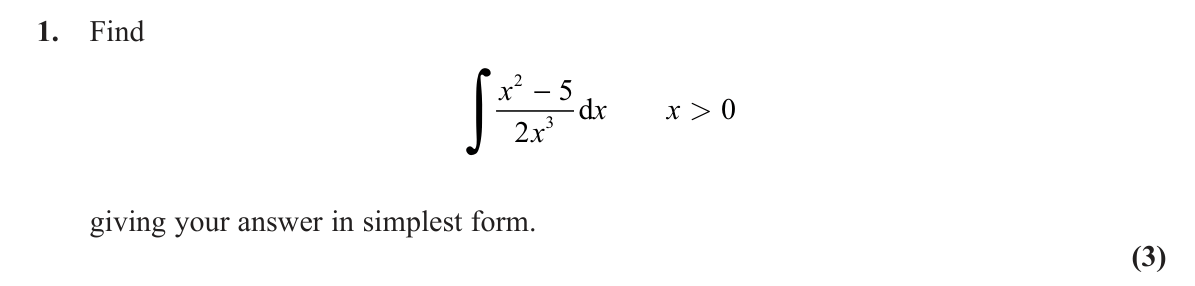
1. WMA13/01 January 2021 · Q1 Easy 3 marksShow worked solution Part (main) First split the fraction into powers:
\[\frac{x^2-5}{2x^3}=\frac12x^{-1}-\frac52x^{-3}.\]
Integrate term by term. Since $x\gt 0$, use $\ln x$ without absolute-value notation:
\[\int\frac{x^2-5}{2x^3}\,dx=\frac12\ln x+\frac54x^{-2}+C.\]
\[\boxed{\frac12\ln x+\frac5{4x^2}+C}\]
Final answer (main) $\frac12\ln x+\frac5{4x^2}+C$
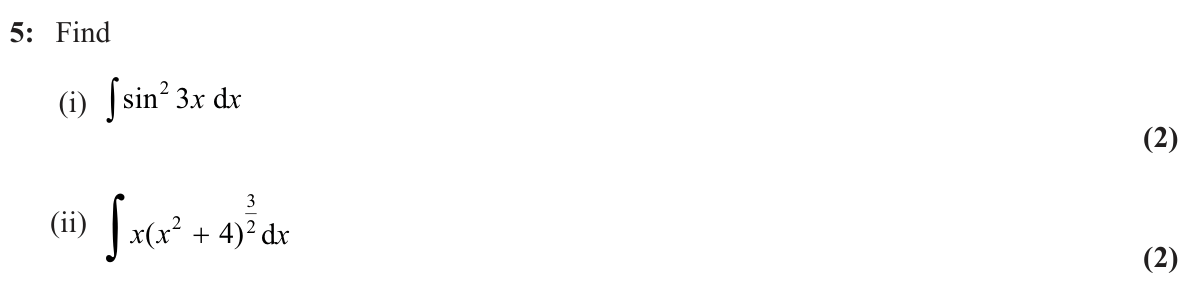
2. WMA13/01 May/June 2025 · Q5 Easy 4 marksShow worked solution Part (i) Use $\sin^2(3x)=(1-\cos6x)/2$:
\[\int\sin^2(3x)\,dx=\frac12\int(1-\cos6x)\,dx =\boxed{\frac{x}{2}-\frac{\sin6x}{12}+C}.\]
Part (ii) The derivative of $(x^2+4)^{5/2}$ is $5x(x^2+4)^{3/2}$. Therefore
\[\int x(x^2+4)^{3/2}\,dx=\boxed{\frac15(x^2+4)^{5/2}+C}.\]
For example, differentiating this answer gives
\[\frac15\cdot\frac52(x^2+4)^{3/2}\cdot2x=x(x^2+4)^{3/2},\]
which recovers the integrand. Each indefinite integral has its own arbitrary constant.
Final answer (i) $\frac{x}{2}-\frac{\sin6x}{12}+C$ (ii) $\frac15(x^2+4)^{5/2}+C$
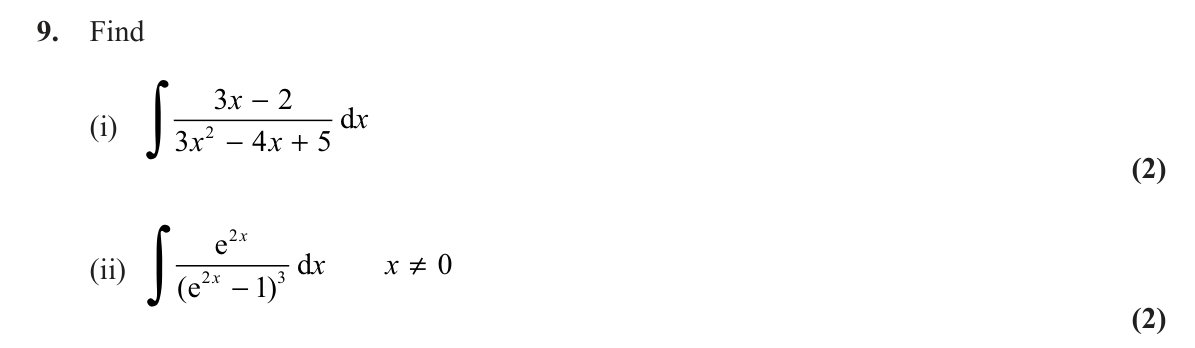
3. WMA13/01 January 2021 · Q9 Easy 4 marksShow worked solution Part (i) The denominator derivative is $6x-4=2(3x-2)$. Hence reverse the logarithmic chain rule:
\[\int\frac{3x-2}{3x^2-4x+5}\,dx=\frac12\ln(3x^2-4x+5)+C.\]
The log argument is always positive because $3x^2-4x+5=3(x-2/3)^2+11/3$.
\[\boxed{\frac12\ln(3x^2-4x+5)+C}\]
Part (ii) Put $u=e^{2x}-1$, so $du=2e^{2x}\,dx$. Then $\int e^{2x}(e^{2x}-1)^{-3}\,dx=(1/2)\int u^{-3}\,du=-1/(4u^2)+C$. The source excludes $x=0$, where the integrand is undefined.
\[\boxed{-\frac1{4(e^{2x}-1)^2}+C}\]
Final answer (i) $\frac12\ln(3x^2-4x+5)+C$ (ii) $-\frac1{4(e^{2x}-1)^2}+C$
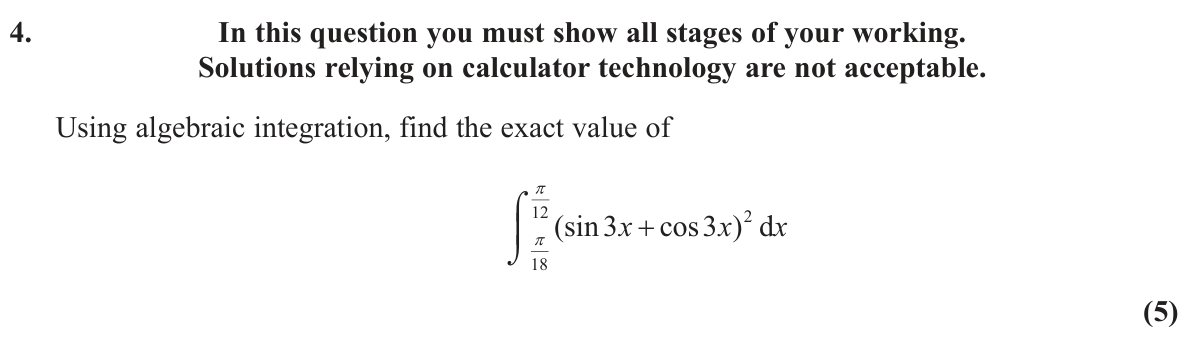
4. WMA13/01 May/June 2026 · Q4 Easy 5 marksShow worked solution Solution First expand and use the double-angle identity:
\[(\sin3x+\cos3x)^2=\sin^2 3x+\cos^2 3x+2\sin3x\cos3x=1+\sin6x.\]
Hence
\[\begin{aligned} \int_{\pi/18}^{\pi/12}(\sin3x+\cos3x)^2\,dx &=\left[x-\frac16\cos6x\right]_{\pi/18}^{\pi/12}\\ &=\left(\frac\pi{12}-\frac16\cos\frac\pi2\right) -\left(\frac\pi{18}-\frac16\cos\frac\pi3\right)\\ &=\frac\pi{12}-\frac\pi{18}+\frac1{12} =\boxed{\frac\pi{36}+\frac1{12}}. \end{aligned}\]
Final answer $\frac\pi{36}+\frac1{12}$
5. WMA13/01 January 2023 · Q8 Easy 5 marksShow worked solution Part (main) Expand the square first:
\[(2\cos x-\sin x)^2=4\cos^2x-4\sin x\cos x+\sin^2x.\]
Use $\cos^2x=(1+\cos2x)/2$, $\sin^2x=(1-\cos2x)/2$, and $2\sin x\cos x=\sin2x$. The integrand becomes
\[\frac52+\frac32\cos2x-2\sin2x.\]
Integrating with the angle-2 chain factors gives $5x/2+3\sin2x/4+\cos2x+K$.
\[\boxed{\int(2\cos x-\sin x)^2\,dx=\frac52x+\frac34\sin2x+\cos2x+K}\]
Final answer (main) $\int(2\cos x-\sin x)^2\,dx=\frac52x+\frac34\sin2x+\cos2x+K$
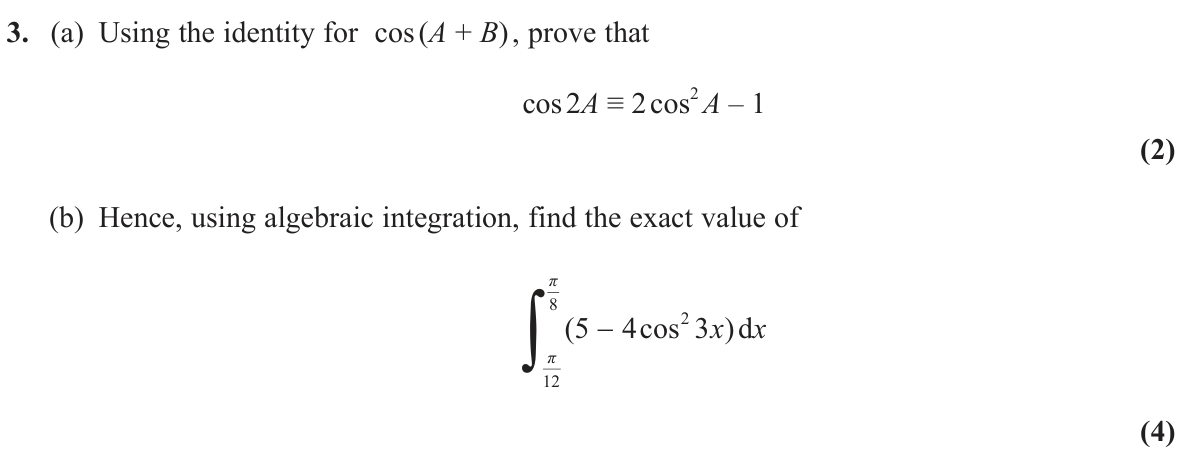
6. WMA13/01 October 2023 · Q3 Easy 6 marks · main topic: Trig Identities & Exact ValuesShow worked solution Part (a) Apply the cosine addition formula:
\[\cos2A=\cos(A+A)=\cos A\cos A-\sin A\sin A =\cos^2 A-\sin^2 A.\]
Using $\sin^2 A=1-\cos^2 A$ gives the required identity.
\[\boxed{\cos2A=2\cos^2 A-1}\]
Part (b) From part (a), $\cos^2 3x=(1+\cos6x)/2$. Therefore
\[\int_{\pi/12}^{\pi/8}(5-4\cos^2 3x)\,dx =\int_{\pi/12}^{\pi/8}(3-2\cos6x)\,dx =\left[3x-\frac13\sin6x\right]_{\pi/12}^{\pi/8}.\]
Since $\sin(3\pi/4)=\sqrt2/2$ and $\sin(\pi/2)=1$, the result is
\[\frac{3\pi}{8}-\frac{\sqrt2}{6}-\left(\frac\pi4-\frac13\right).\]
\[\boxed{\frac\pi8+\frac13-\frac{\sqrt2}{6}}\]
Final answer (a) $\cos2A=2\cos^2 A-1$ (b) $\frac\pi8+\frac13-\frac{\sqrt2}{6}$
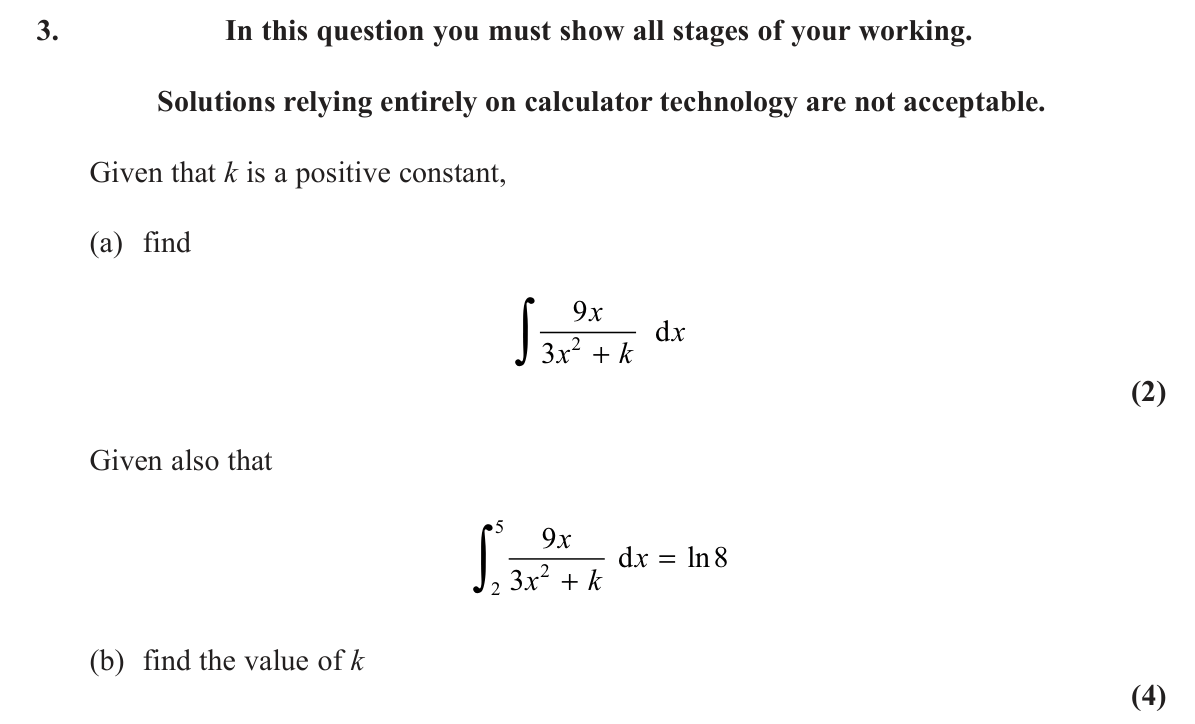
7. WMA13/01 May/June 2022 · Q3 Easy 6 marksShow worked solution Part (a) Since $d(3x^2+k)/dx=6x$, the numerator is $3/2$ times this derivative. The denominator is positive because $k\gt 0$, so
\[\int\frac{9x}{3x^2+k}\,dx=\frac32\ln(3x^2+k)+C.\]
\[\boxed{\frac32\ln(3x^2+k)+C}\]
Part (b) Apply the limits to (a) and combine the logarithms:
\[\frac32\ln\frac{75+k}{12+k}=\ln8.\]
Hence $\ln((75+k)/(12+k))=(2/3)\ln8=\ln4$, so $75+k=4(12+k)$. This gives $27=3k$ and $k=9$, consistent with $k\gt 0$.
\[\boxed{k=9}\]
Final answer (a) $\frac32\ln(3x^2+k)+C$ (b) $k=9$
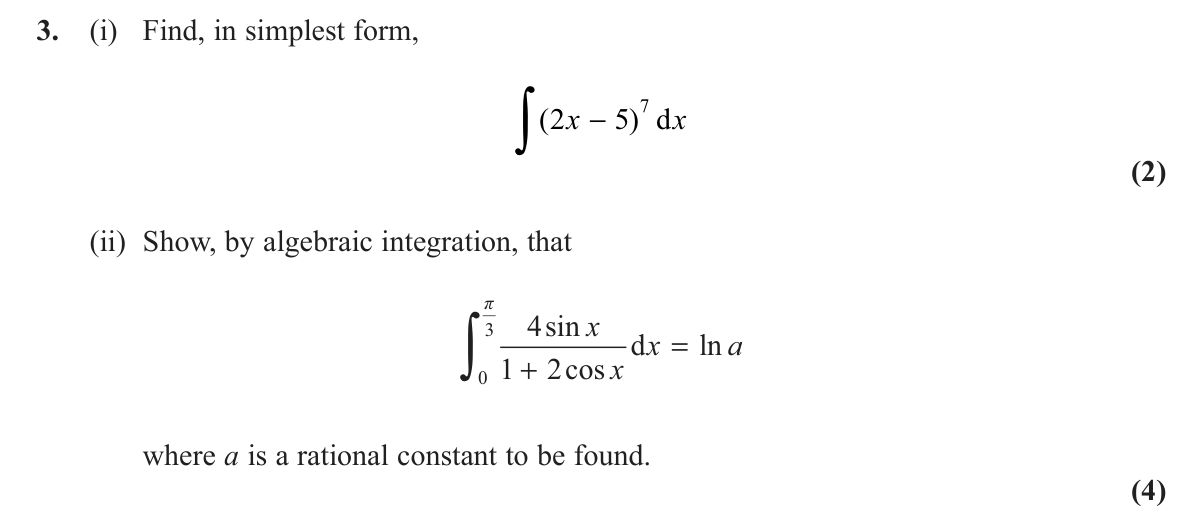
8. WMA13/01 January 2022 · Q3 Easy 6 marksShow worked solution Part (i) Raise the power by one, divide by the new power and by the inner derivative 2:
\[\int(2x-5)^7\,dx=\frac{(2x-5)^8}{2\cdot8}+C.\]
\[\boxed{\frac{(2x-5)^8}{16}+C}\]
Part (ii) The derivative of $1+2\cos x$ is $-2\sin x$, so a primitive is $-2\ln(1+2\cos x)$. The log argument is positive throughout $0\le x\le\pi/3$. Hence
\[\int_0^{\pi/3}\frac{4\sin x}{1+2\cos x}\,dx =[-2\ln(1+2\cos x)]_0^{\pi/3} =-2\ln2+2\ln3=\ln\frac94.\]
\[\boxed{a=\frac94}\]
Final answer (i) $\frac{(2x-5)^8}{16}+C$ (ii) $a=\frac94$
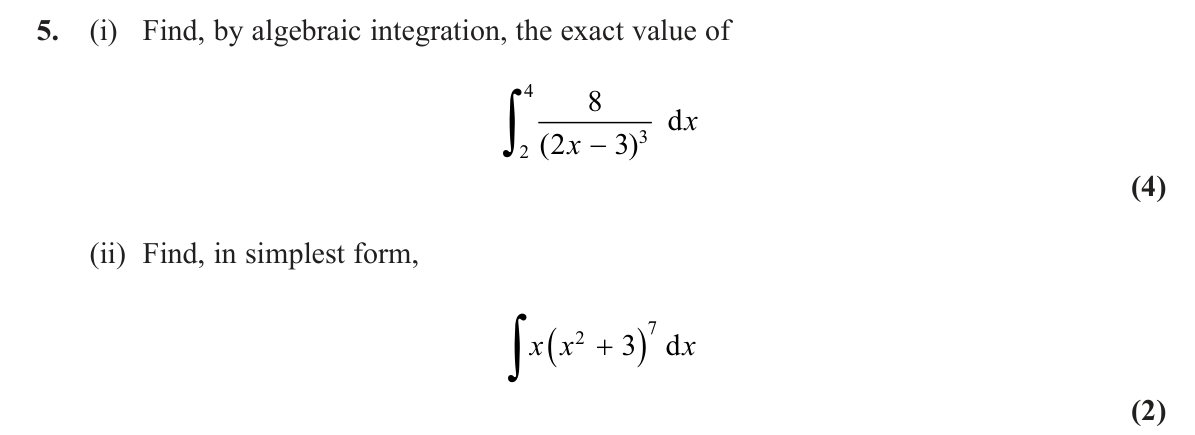
9. WMA13/01 October 2021 · Q5 Easy 6 marksShow worked solution Part (i) Write the integrand as $8(2x-3)^{-3}$. A primitive is $-2(2x-3)^{-2}$, because its derivative is $8(2x-3)^{-3}$. Thus
\[\int_2^4\frac8{(2x-3)^3}\,dx =\left[-\frac2{(2x-3)^2}\right]_2^4 =-\frac2{25}-(-2)=\frac{48}{25}.\]
\[\boxed{\frac{48}{25}}\]
Part (ii) Since $d(x^2+3)/dx=2x$, reverse the chain rule:
\[\int x(x^2+3)^7\,dx=\frac12\cdot\frac{(x^2+3)^8}{8}+C.\]
\[\boxed{\frac{(x^2+3)^8}{16}+C}\]
Final answer (i) $\frac{48}{25}$ (ii) $\frac{(x^2+3)^8}{16}+C$
10. WMA13/01 October 2025 · Q6 Medium 7 marksShow worked solution Part (i) Using the chain rule,
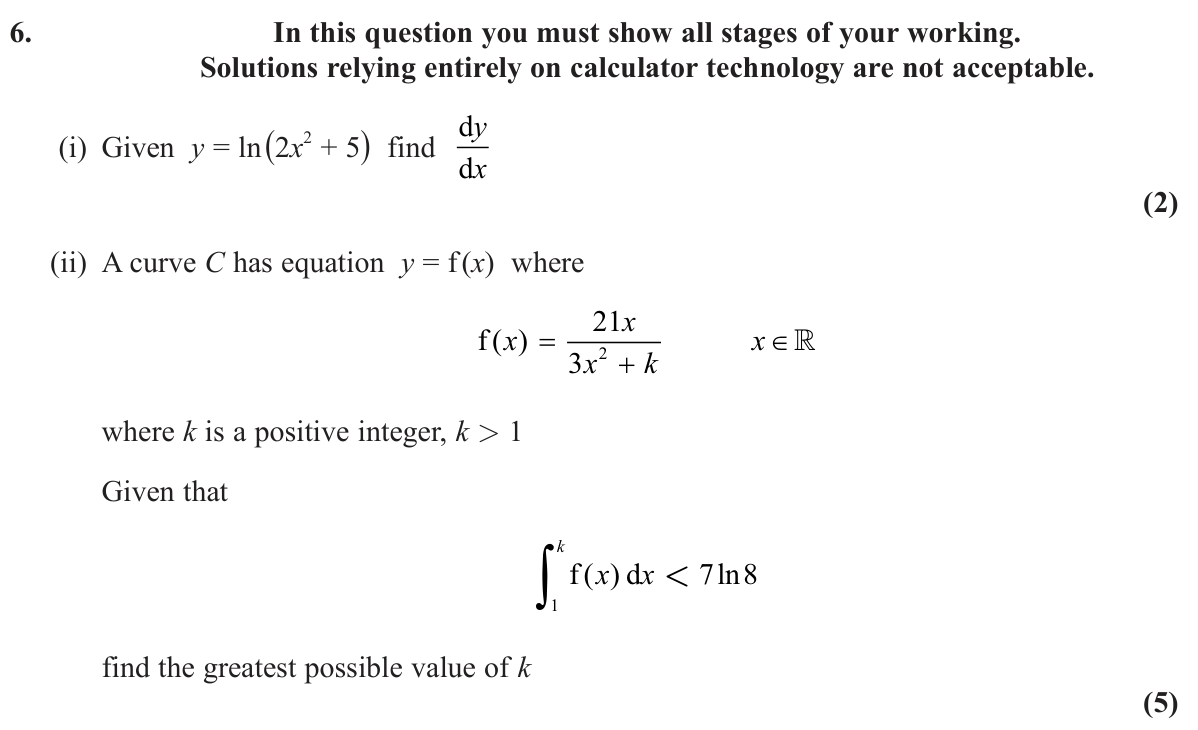
\[\frac{dy}{dx}=\frac{1}{2x^2+5}(4x)=\frac{4x}{2x^2+5}.\]
Part (ii) Treat $k$ as a constant when integrating:
\[\int_1^k\frac{21x}{3x^2+k}\,dx =\left[\frac72\ln(3x^2+k)\right]_1^k =\frac72\ln\left(\frac{3k^2+k}{k+3}\right).\]
The stated inequality therefore implies
\[\ln\left(\frac{3k^2+k}{k+3}\right)\lt 2\ln8=\ln64.\]
Since the exponential is increasing and $k+3\gt 0$,
\[3k^2+k\lt 64(k+3) \Longrightarrow k^2-21k-64\lt 0.\]
The roots are $(21\pm\sqrt{697})/2$, so the positive upper bound is $k\lt (21+\sqrt{697})/2=23.700378782\ldots$. With $k\gt 1$ an integer, the greatest possible value is $k=23$.
Final answer (i) $4*x/(2*x^2+5)$ (ii) $23$
11. WMA13/01 May/June 2024 · Q2 Medium 7 marksShow worked solution Part (a) Multiplying the proposed identity by $x-2$ gives
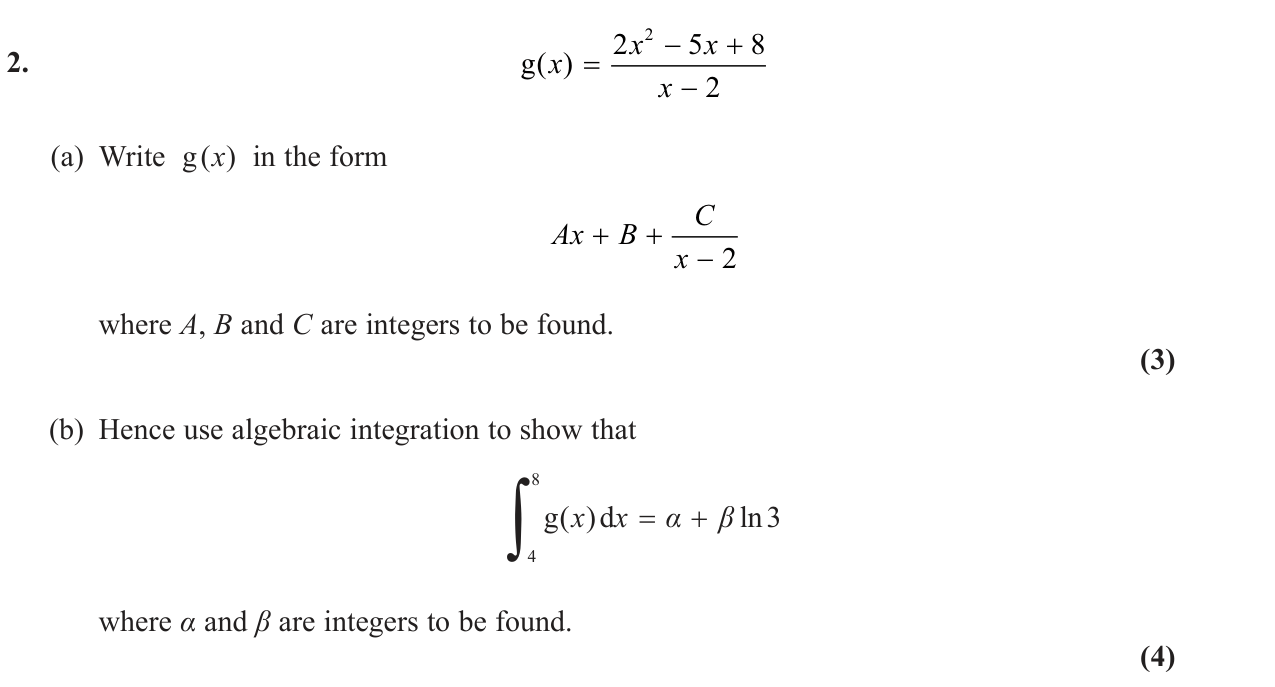
\[2x^2-5x+8=(Ax+B)(x-2)+C=Ax^2+(B-2A)x+C-2B.\]
Thus $A=2$, $B-4=-5$ and $C-2(-1)=8$, giving $B=-1$, $C=6$. Hence $g(x)=2x-1+6/(x-2)$, for $x\ne2$.
\[\boxed{A=2,\quad B=-1,\quad C=6}\]
Part (b) Since $x-2\gt 0$ throughout $[4,8]$,
\[\int_4^8g(x)\,dx=\left[x^2-x+6\ln(x-2)\right]_4^8 =(64-8+6\ln6)-(16-4+6\ln2) =44+6\ln(6/2).\]
\[\boxed{44+6\ln3,\qquad \alpha=44,\quad\beta=6}\]
Final answer (a) $A=2,\quad B=-1,\quad C=6$ (b) $44+6\ln3,\qquad \alpha=44,\quad\beta=6$
12. WMA13/01 May/June 2023 · Q3 Medium 7 marks · main topic: Differentiation TechniquesShow worked solution Part (i) Differentiate the logarithm directly on its domain $\sin3x\ne0$:
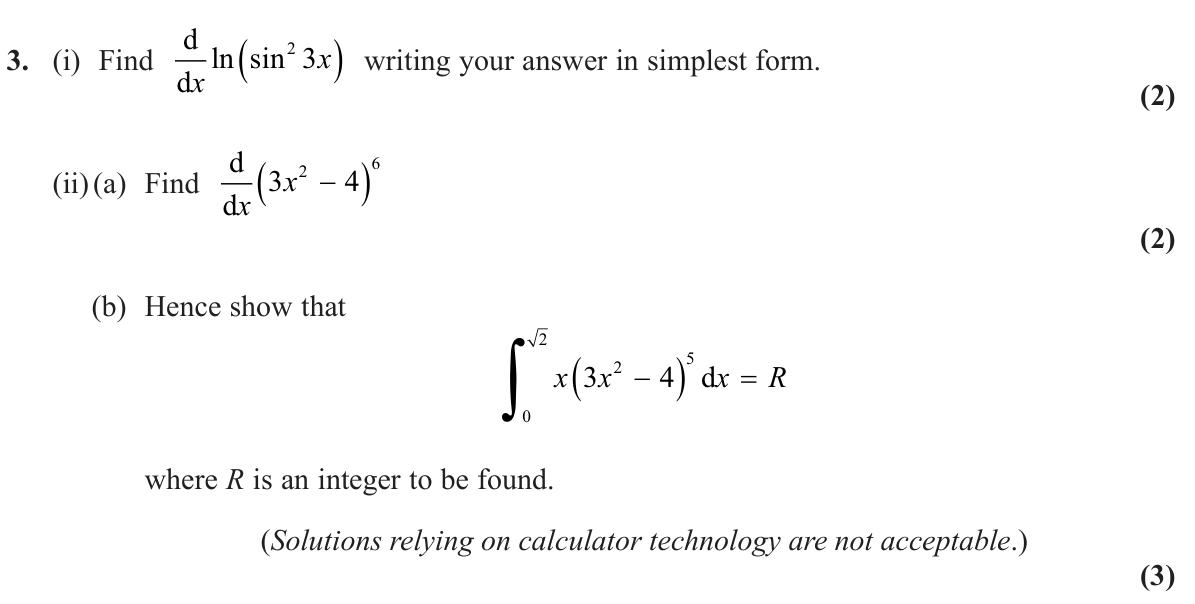
\[\frac{d}{dx}\ln(\sin^2 3x) =\frac{2\sin3x\cos3x\cdot3}{\sin^2 3x}=6\cot3x.\]
This does not assume $\sin3x\gt 0$; the logarithm's argument is its square.
\[\boxed{6\cot3x}\]
Part (ii)(a) Apply the power and chain rules:
\[\frac{d}{dx}(3x^2-4)^6=6(3x^2-4)^5(6x)=36x(3x^2-4)^5.\]
\[\boxed{36x(3x^2-4)^5}\]
Part (ii)(b) From part (ii)(a), an antiderivative of $x(3x^2-4)^5$ is $(3x^2-4)^6/36$.
\[R=\left[\frac{(3x^2-4)^6}{36}\right]_0^{\sqrt2} =\frac{2^6-(-4)^6}{36}=\frac{64-4096}{36}=-112.\]
\[\boxed{R=-112}\]
Final answer (i) $6\cot3x$ (ii)(a) $36x(3x^2-4)^5$ (ii)(b) $R=-112$
13. WMA13/01 January 2023 · Q4 Medium 7 marks · main topic: Rational AlgebraShow worked solution Part (a) Multiply the proposed identity by $(x+3)^2=x^2+6x+9$ and compare coefficients:
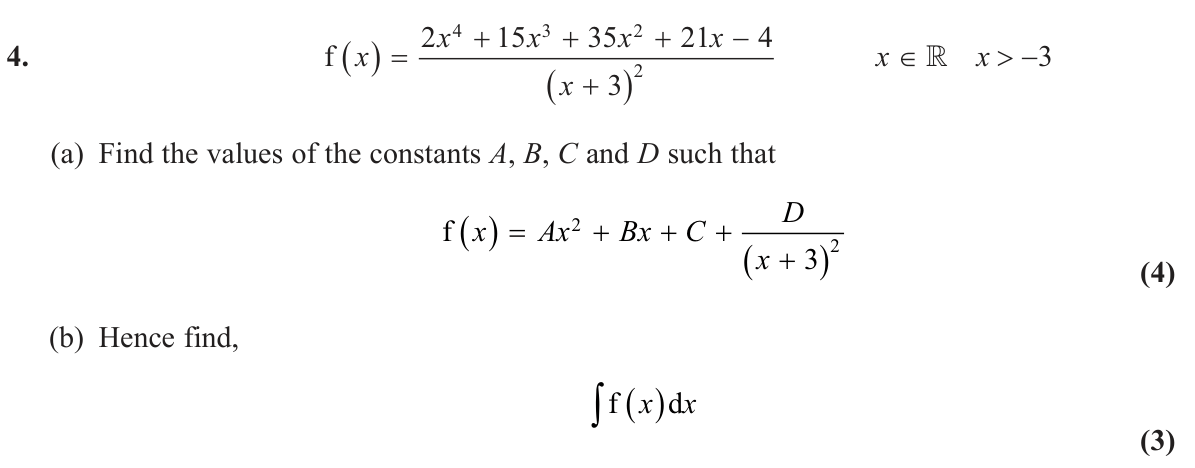
\[A=2,\quad6A+B=15\Rightarrow B=3,\quad 9A+6B+C=35\Rightarrow C=-1.\]
The coefficient of $x$ checks: $9B+6C=27-6=21$. The constant equation is $9C+D=-4$, so $D=5$. Hence $f(x)=2x^2+3x-1+5(x+3)^{-2}$.
\[\boxed{A=2,\quad B=3,\quad C=-1,\quad D=5}\]
Part (b) Integrate each term in the decomposition:
\[\int f(x)\,dx=\int[2x^2+3x-1+5(x+3)^{-2}]\,dx =\frac23x^3+\frac32x^2-x-\frac5{x+3}+K.\]
Here $K$ is an arbitrary constant; the domain $x\gt -3$ avoids the denominator zero.
\[\boxed{\frac23x^3+\frac32x^2-x-\frac5{x+3}+K}\]
Final answer (a) $A=2,\quad B=3,\quad C=-1,\quad D=5$ (b) $\frac23x^3+\frac32x^2-x-\frac5{x+3}+K$
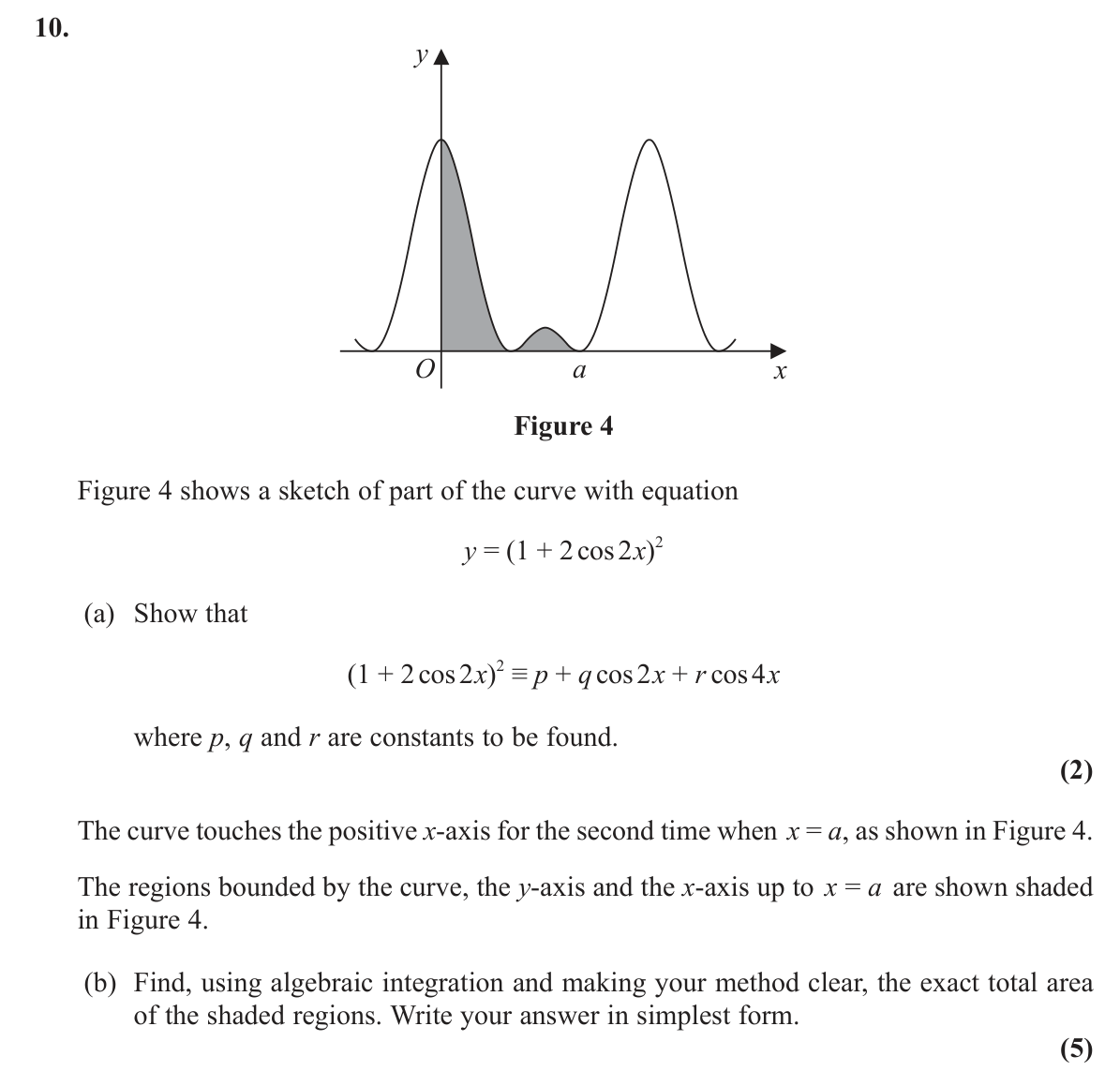
14. WMA13/01 October 2021 · Q10 Medium 7 marksShow worked solution Part (a) Expand and use $\cos^22x=(1+\cos4x)/2$:
\[(1+2\cos2x)^2=1+4\cos2x+4\cos^22x =3+4\cos2x+2\cos4x.\]
\[\boxed{p=3,\quad q=4,\quad r=2}\]
Part (b) The zeros satisfy $\cos2x=-1/2$. The first two positive values are $x=\pi/3$ and $x=2\pi/3$, so $a=2\pi/3$. The squared curve is nonnegative, so integrate directly for the total shaded area:
\[\mathcal A=\int_0^{2\pi/3}(3+4\cos2x+2\cos4x)\,dx =\left[3x+2\sin2x+\tfrac12\sin4x\right]_0^{2\pi/3}.\]
Use $\sin(4\pi/3)=-\sqrt3/2$ and $\sin(8\pi/3)=\sqrt3/2$ to obtain $\mathcal A=2\pi-\sqrt3+\sqrt3/4=2\pi-3\sqrt3/4$.
\[\boxed{2\pi-\frac{3\sqrt3}{4}}\]
Final answer (a) $p=3,\quad q=4,\quad r=2$ (b) $2\pi-\frac{3\sqrt3}{4}$
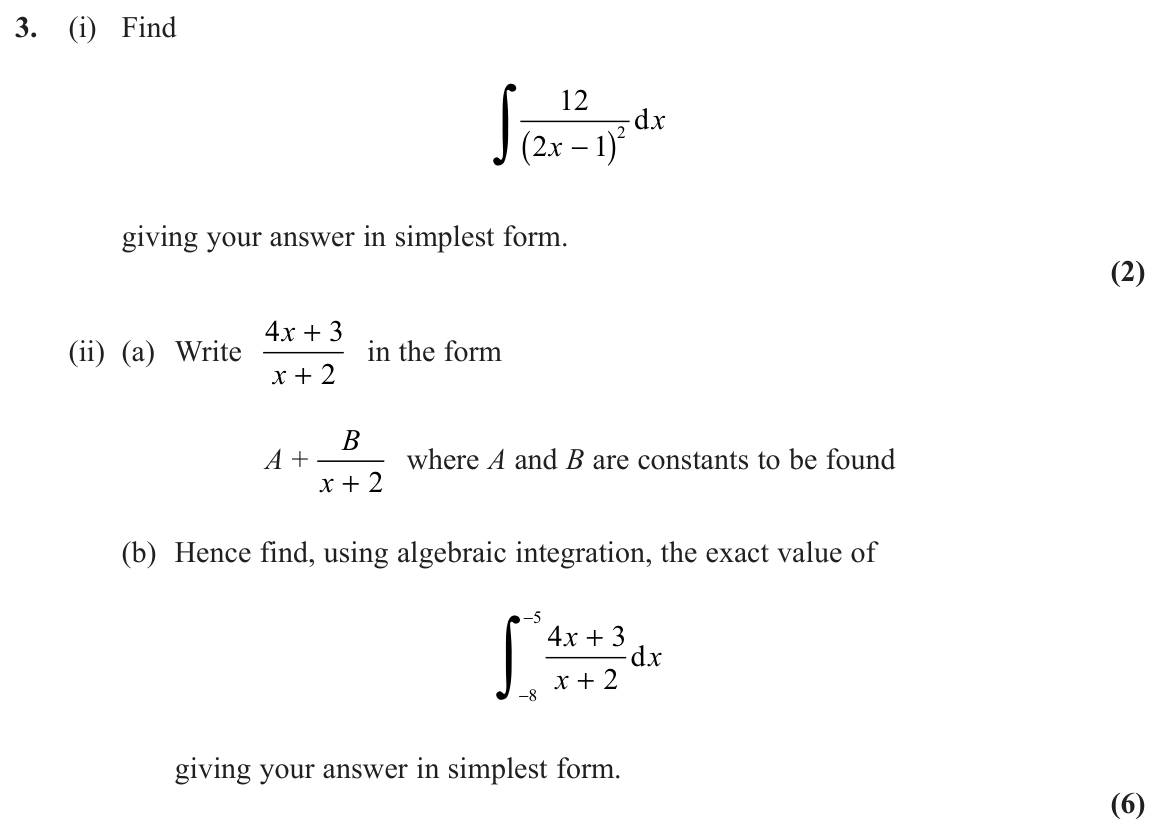
15. WMA13/01 May/June 2021 · Q3 Medium 8 marksShow worked solution Part (i) Write the integrand as $12(2x-1)^{-2}$. Reverse the chain rule, dividing by the inner derivative 2:
\[\int12(2x-1)^{-2}\,dx=-6(2x-1)^{-1}+C.\]
\[\boxed{-\frac6{2x-1}+C}\]
Part (ii) (a) Since $4x+3=4(x+2)-5$,
\[\frac{4x+3}{x+2}=4-\frac5{x+2},\qquad A=4,\ B=-5.\]
(b) A primitive is $4x-5\ln|x+2|$. The absolute value is essential here: $x+2$ is negative throughout $[-8,-5]$.
\[\int_{-8}^{-5}\frac{4x+3}{x+2}\,dx =(-20-5\ln3)-(-32-5\ln6) =12+5\ln2.\]
\[\boxed{A=4,\ B=-5;\qquad I=12+5\ln2}\]
Final answer (i) $-\frac6{2x-1}+C$ (ii) $A=4,\ B=-5;\qquad I=12+5\ln2$
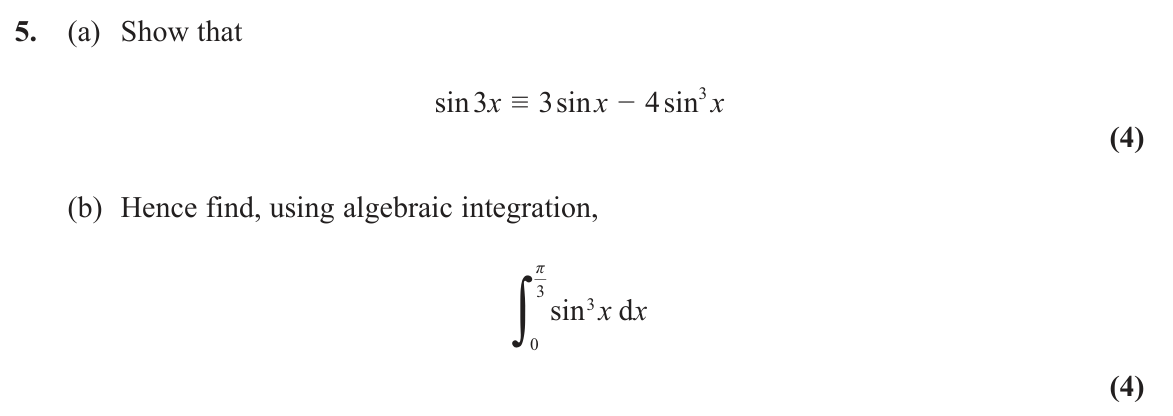
16. WMA13/01 October 2020 · Q5 Medium 8 marks · main topic: Trig Identities & Exact ValuesShow worked solution Part (a) Start with the angle-addition identity:
\[\sin3x=\sin(2x+x)=\sin2x\cos x+\cos2x\sin x.\]
Using $\sin2x=2\sin x\cos x$ and $\cos2x=1-2\sin^2x$,
\[\sin3x=2\sin x\cos^2x+(1-2\sin^2x)\sin x =2\sin x(1-\sin^2x)+\sin x-2\sin^3x =3\sin x-4\sin^3x.\]
\[\boxed{\sin3x\equiv3\sin x-4\sin^3x}\]
Part (b) From (a), $\sin^3x=(3\sin x-\sin3x)/4$. Therefore, using algebraic integration,
\[\int_0^{\pi/3}\sin^3x\,dx =\left[-\frac34\cos x+\frac1{12}\cos3x\right]_0^{\pi/3} =\left(-\frac38-\frac1{12}\right)-\left(-\frac34+\frac1{12}\right) =\frac5{24}.\]
\[\boxed{\frac5{24}}\]
Final answer (a) $\sin3x\equiv3\sin x-4\sin^3x$ (b) $\frac5{24}$
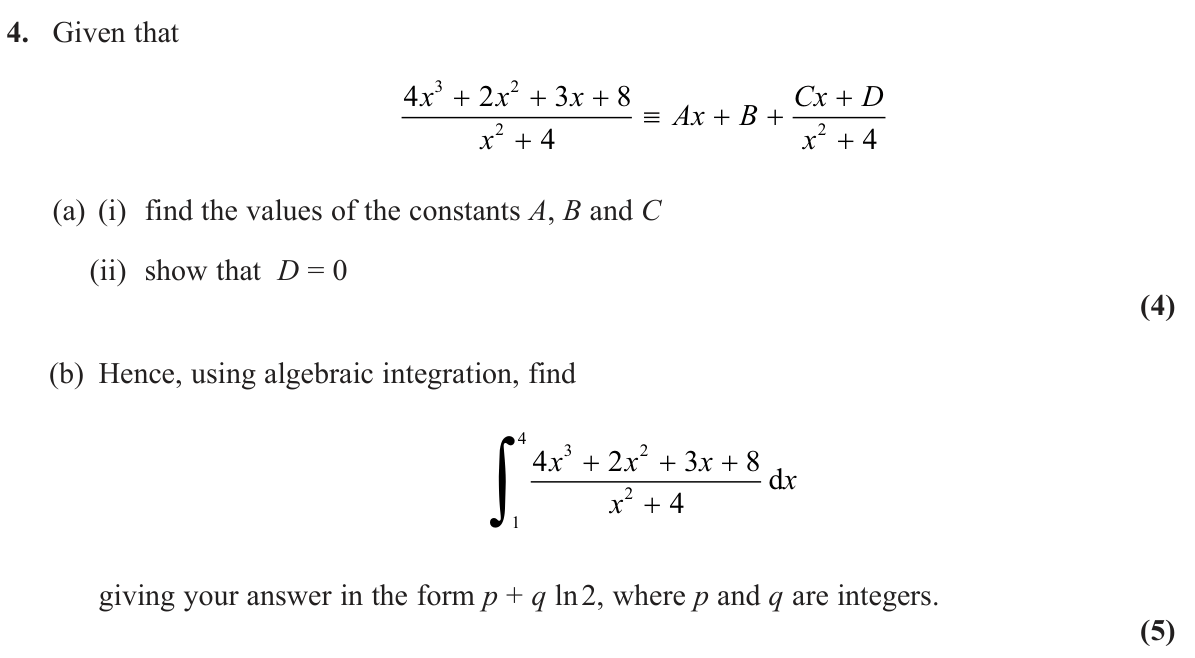
17. WMA13/01 January 2025 · Q4 Hard 9 marksShow worked solution Part (a)(i) Multiply the identity by $x^2+4$:
\[4x^3+2x^2+3x+8=(Ax+B)(x^2+4)+Cx+D =Ax^3+Bx^2+(4A+C)x+4B+D.\]
Comparing the cubic, quadratic and linear coefficients gives $A=4$, $B=2$ and $4A+C=3$, hence $C=3-16=-13$.
\[\boxed{A=4,\quad B=2,\quad C=-13}\]
Part (a)(ii) The $x^2$ coefficients give $B=2$, while the constant terms give $4B+D=8$. Substitute $B=2$: $4(2)+D=8$, so $D=0$.
\[\boxed{D=0}\]
Part (b) Using the decomposition, the integrand is $4x+2-13x/(x^2+4)$. Since the derivative of $x^2+4$ is $2x$, an antiderivative is
\[F(x)=2x^2+2x-\frac{13}{2}\ln(x^2+4).\]
Therefore
\[\int_1^4\frac{4x^3+2x^2+3x+8}{x^2+4}\,dx =\left[2x^2+2x-\frac{13}{2}\ln(x^2+4)\right]_1^4 =40-\frac{13}{2}\ln20-\left(4-\frac{13}{2}\ln5\right).\]
Combine the logarithms: $36-\frac{13}{2}\ln4=36-13\ln2$.
\[\boxed{36-13\ln2}\]
Final answer (a)(i) $A=4,\quad B=2,\quad C=-13$ (a)(ii) $D=0$ (b) $36-13\ln2$
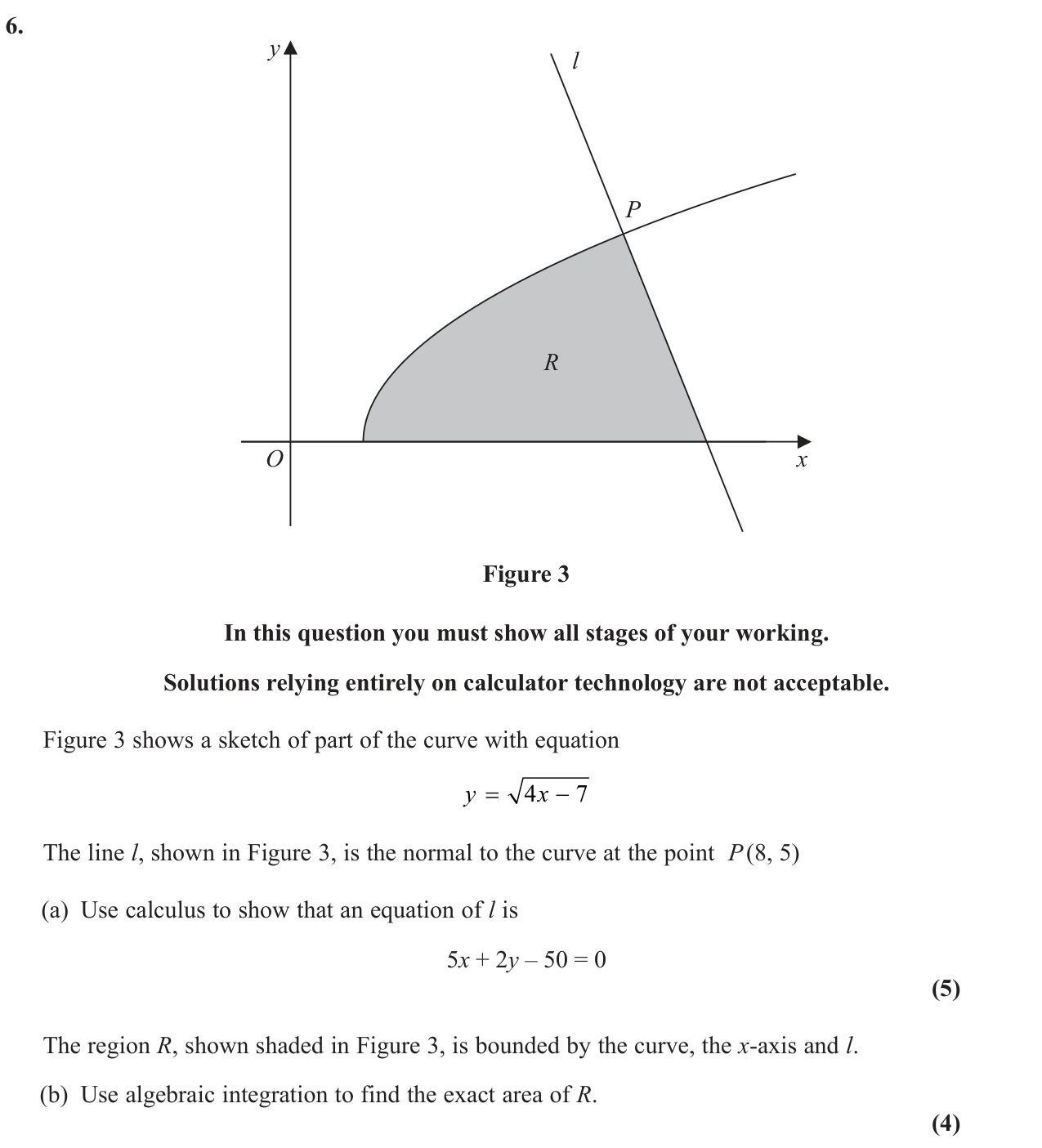
18. WMA13/01 May/June 2024 · Q6 Hard 9 marks · main topic: Applications of DifferentiationShow worked solution Part (a) For $y=(4x-7)^{1/2}$,
\[\frac{dy}{dx}=\frac12(4x-7)^{-1/2}\cdot4=\frac2{\sqrt{4x-7}}.\]
At $P=(8,5)$, the tangent gradient is $2/5$, so the normal gradient is $-5/2$. The point-gradient equation is
\[y-5=-\frac52(x-8),\qquad 2y-10=-5x+40.\]
\[\boxed{5x+2y-50=0}\]
Part (b) The curve meets the $x$-axis at $x=7/4$. The normal meets it at $x=10$. Split the shaded region at $P$, into a curve area from $7/4$ to 8 and a triangle from 8 to 10:
\[\int_{7/4}^8\sqrt{4x-7}\,dx =\left[\frac{(4x-7)^{3/2}}6\right]_{7/4}^8=\frac{125}{6}.\]
The triangle has area $\frac12(10-8)\cdot5=5$. Hence the total area is $125/6+5$.
\[\boxed{\operatorname{Area}(R)=\frac{155}{6}}\]
Final answer (a) $5x+2y-50=0$ (b) $\operatorname{Area}(R)=\frac{155}{6}$
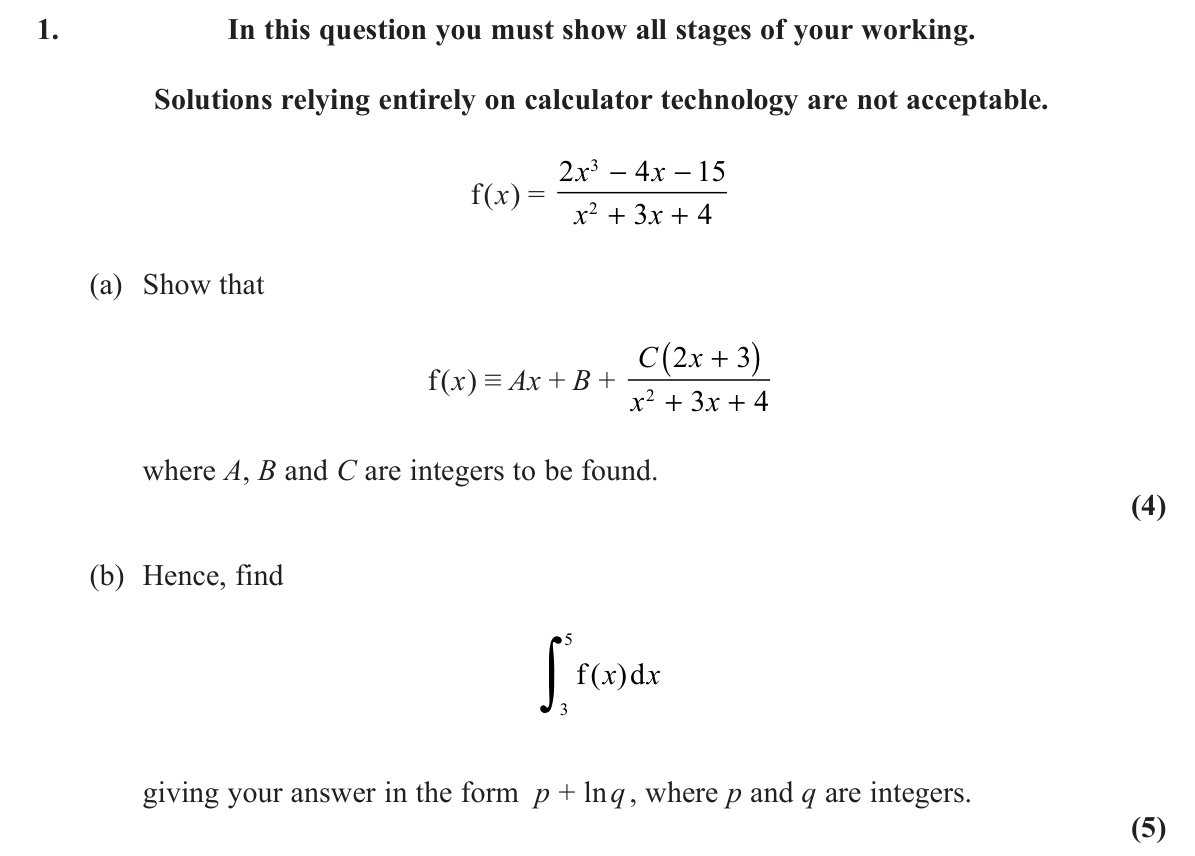
19. WMA13/01 October 2022 · Q1 Hard 9 marksShow worked solution Part (a) Clear the denominator in the proposed identity:
\[2x^3-4x-15=(Ax+B)(x^2+3x+4)+C(2x+3).\]
Matching coefficients gives $A=2$, $3A+B=0$, hence $B=-6$. Then $4A+3B+2C=-4$ gives $C=3$; the constant checks as $4B+3C=-24+9=-15$. Therefore $f(x)=2x-6+3(2x+3)/(x^2+3x+4)$.
\[\boxed{A=2,\quad B=-6,\quad C=3}\]
Part (b) The numerator $2x+3$ is the derivative of $x^2+3x+4$. This quadratic is $(x+3/2)^2+7/4\gt 0$, so
\[\int f(x)\,dx=x^2-6x+3\ln(x^2+3x+4)+K.\]
Using both limits,
\[\int_3^5f(x)\,dx=(-5+3\ln44)-(-9+3\ln22) =4+3\ln2=4+\ln8.\]
Thus $p=4$ and $q=8$ are integers, as required.
\[\boxed{4+\ln8}\]
Final answer (a) $A=2,\quad B=-6,\quad C=3$ (b) $4+\ln8$
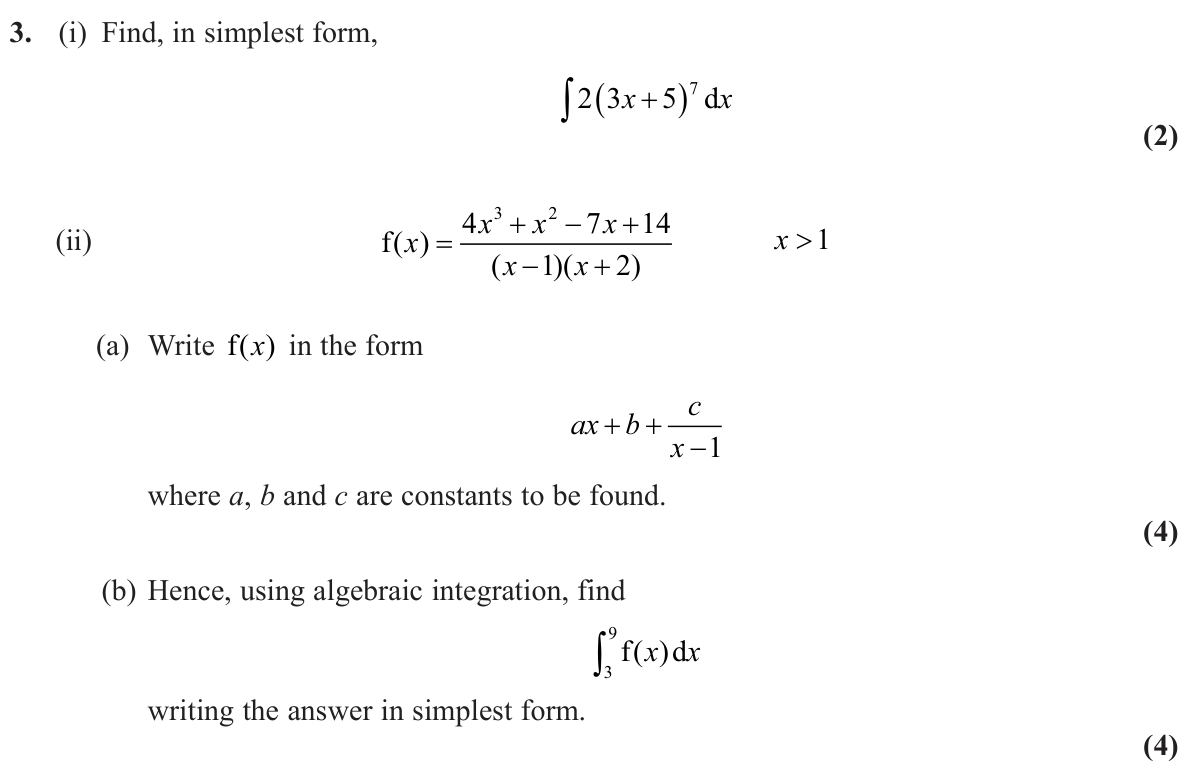
20. WMA13/01 January 2026 · Q3 Hard 10 marksShow worked solution Part (i) Increase the power to $8$ and divide by both $8$ and the inner derivative $3$:
\[\int 2(3x+5)^7\,dx=\frac{(3x+5)^8}{12}+C.\]
Part (ii)(a) The denominator is $x^2+x-2$. The first quotient term is $4x$. Subtracting $4x(x^2+x-2)$ leaves $-3x^2+x+14$. The next quotient term is $-3$. Subtracting $-3(x^2+x-2)$ leaves $4x+8$. Thus polynomial division gives
\[4x^3+x^2-7x+14=(4x-3)(x^2+x-2)+4x+8.\]
Since $4x+8=4(x+2)$,
\[f(x)=4x-3+\frac{4(x+2)}{(x-1)(x+2)} =4x-3+\frac4{x-1}.\]
Hence $a=4$, $b=-3$, $c=4$.
Part (ii)(b) For $x\gt 1$, an antiderivative is $2x^2-3x+4\ln(x-1)$, so
\[\int_3^9 f(x)\,dx =\bigl[2x^2-3x+4\ln(x-1)\bigr]_3^9 =135+4\ln8-9-4\ln2.\]
Thus the exact integral is $126+8\ln2$.
Final answer (i) $\frac{(3x+5)^8}{12}+C$ (ii)(a) $a=4,\ b=-3,\ c=4$ (ii)(b) $126+8\ln2$
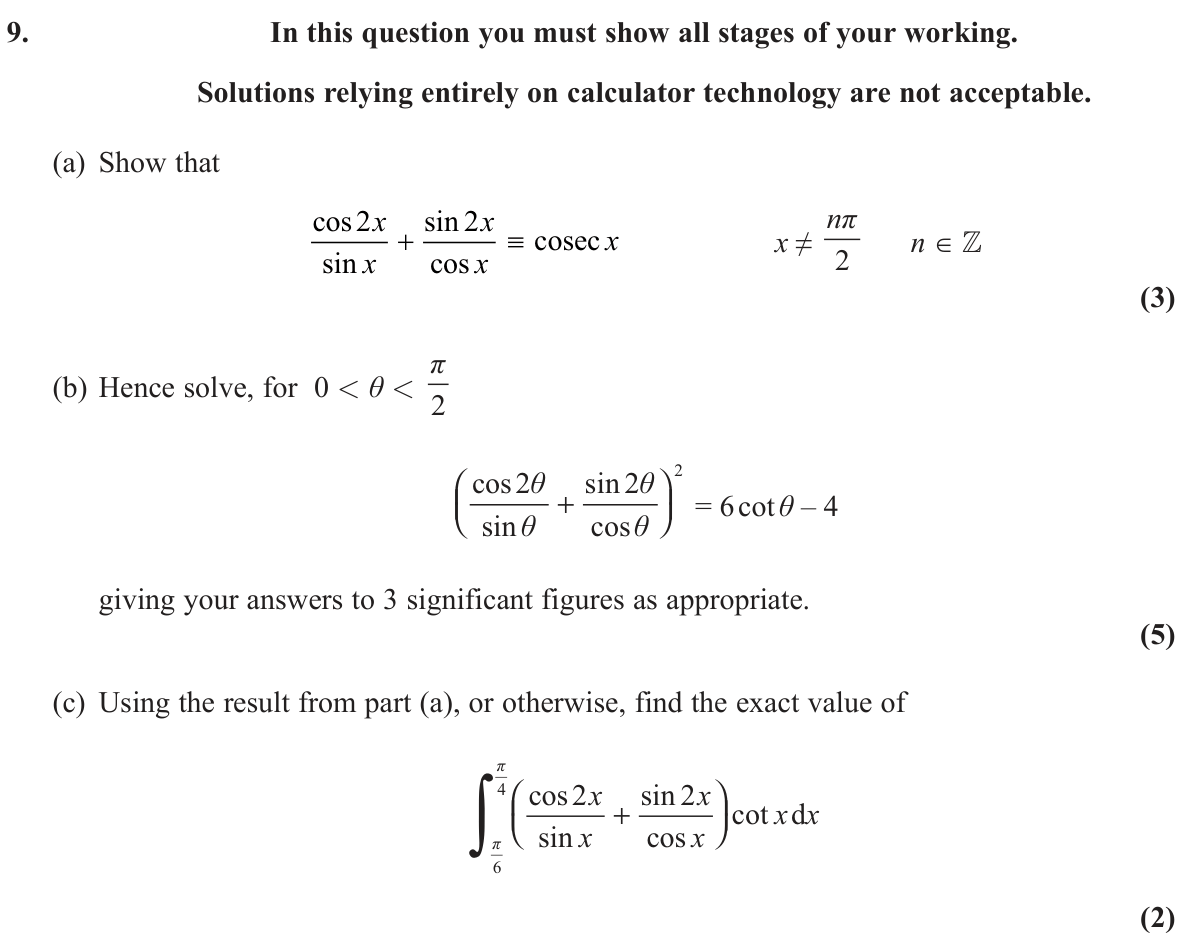
21. WMA13/01 May/June 2023 · Q9 Hard 10 marks · main topic: Trig Identities & Exact ValuesShow worked solution Part (a) Using a common denominator,
\[\frac{\cos2x}{\sin x}+\frac{\sin2x}{\cos x} =\frac{\cos2x\cos x+\sin2x\sin x}{\sin x\cos x} =\frac{\cos(2x-x)}{\sin x\cos x} =\frac1{\sin x}=\csc x.\]
The stated exclusion $x\ne n\pi/2$ ensures both denominators are nonzero.
\[\boxed{\frac{\cos2x}{\sin x}+\frac{\sin2x}{\cos x}=\csc x}\]
Part (b) By part (a), the squared bracket is $\csc^2\theta$. Using $\csc^2\theta=1+\cot^2\theta$ and setting $u=\cot\theta$ gives
\[1+u^2=6u-4\quad\Longrightarrow\quad u^2-6u+5=(u-1)(u-5)=0.\]
On $0\lt \theta\lt \pi/2$, both positive cotangents are permitted: $u=1$ gives $\theta=\pi/4$, while $u=5$ gives $\tan\theta=1/5$, $\theta=0.1973955598\ldots$ radians.
\[\boxed{\theta=\frac\pi4,\quad0.197\ \text{radians}}\]
Part (c) The bracket in part (a) equals $\csc x$. Therefore
\[\int_{\pi/6}^{\pi/4}\csc x\cot x\,dx =[-\csc x]_{\pi/6}^{\pi/4}=-\sqrt2-(-2)=2-\sqrt2.\]
\[\boxed{2-\sqrt2}\]
Final answer (a) $\frac{\cos2x}{\sin x}+\frac{\sin2x}{\cos x}=\csc x$ (b) $\theta=\frac\pi4,\quad0.197\ \text{radians}$ (c) $2-\sqrt2$
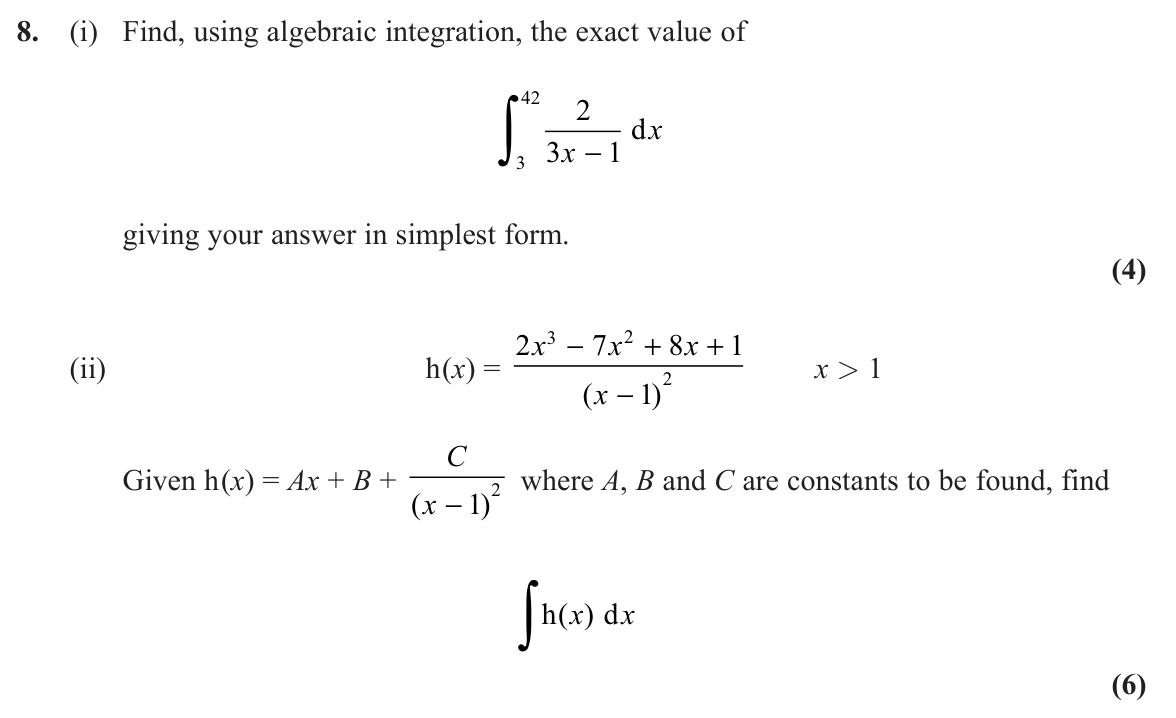
22. WMA13/01 January 2020 · Q8 Hard 10 marksShow worked solution Part (i) Since $3x-1\gt 0$ throughout $3\le x\le42$, an antiderivative is
\[\int\frac{2}{3x-1}\,dx=\frac23\ln(3x-1)+K.\]
The factor $1/3$ compensates for the derivative of $3x-1$. Thus
\[\begin{aligned} \int_3^{42}\frac{2}{3x-1}\,dx &=\left[\frac23\ln(3x-1)\right]_3^{42}\\ &=\frac23\bigl(\ln125-\ln8\bigr)\\ &=\frac23\ln\left(\frac{125}{8}\right) =\frac23\ln\left(\left(\frac52\right)^3\right). \end{aligned}\]
Using $\ln(a^3)=3\ln a$ for $a\gt 0$, the exact value in simplest form is
\[\boxed{2\ln\left(\frac52\right).}\]
Part (ii) Multiply the given decomposition by $(x-1)^2$:
\[\begin{aligned} 2x^3-7x^2+8x+1 &=(Ax+B)(x-1)^2+C\\ &=Ax^3+(B-2A)x^2+(A-2B)x+(B+C). \end{aligned}\]
Comparing coefficients gives
\[A=2,\qquad B-2A=-7\ \Longrightarrow\ B=-3, \qquad B+C=1\ \Longrightarrow\ C=4.\]
The coefficient of $x$ also agrees, since $A-2B=2-2(-3)=8$. Hence
\[\boxed{A=2,\qquad B=-3,\qquad C=4,} \qquad h(x)=2x-3+4(x-1)^{-2}.\]
Integrating each term,
\[\begin{aligned} \int h(x)\,dx &=\int\bigl(2x-3+4(x-1)^{-2}\bigr)\,dx\\ &=x^2-3x-4(x-1)^{-1}+K. \end{aligned}\]
Therefore, for $x\gt 1$,
\[\boxed{\int h(x)\,dx=x^2-3x-\frac4{x-1}+K,}\]
where $K$ is an arbitrary constant of integration, distinct from the coefficient $C=4$.
Final answer (i) $2\ln\left(\frac52\right)$ (ii) $A=2,\qquad B=-3,\qquad C=4$, $\int h(x)\,dx=x^2-3x-\frac4{x-1}+K$
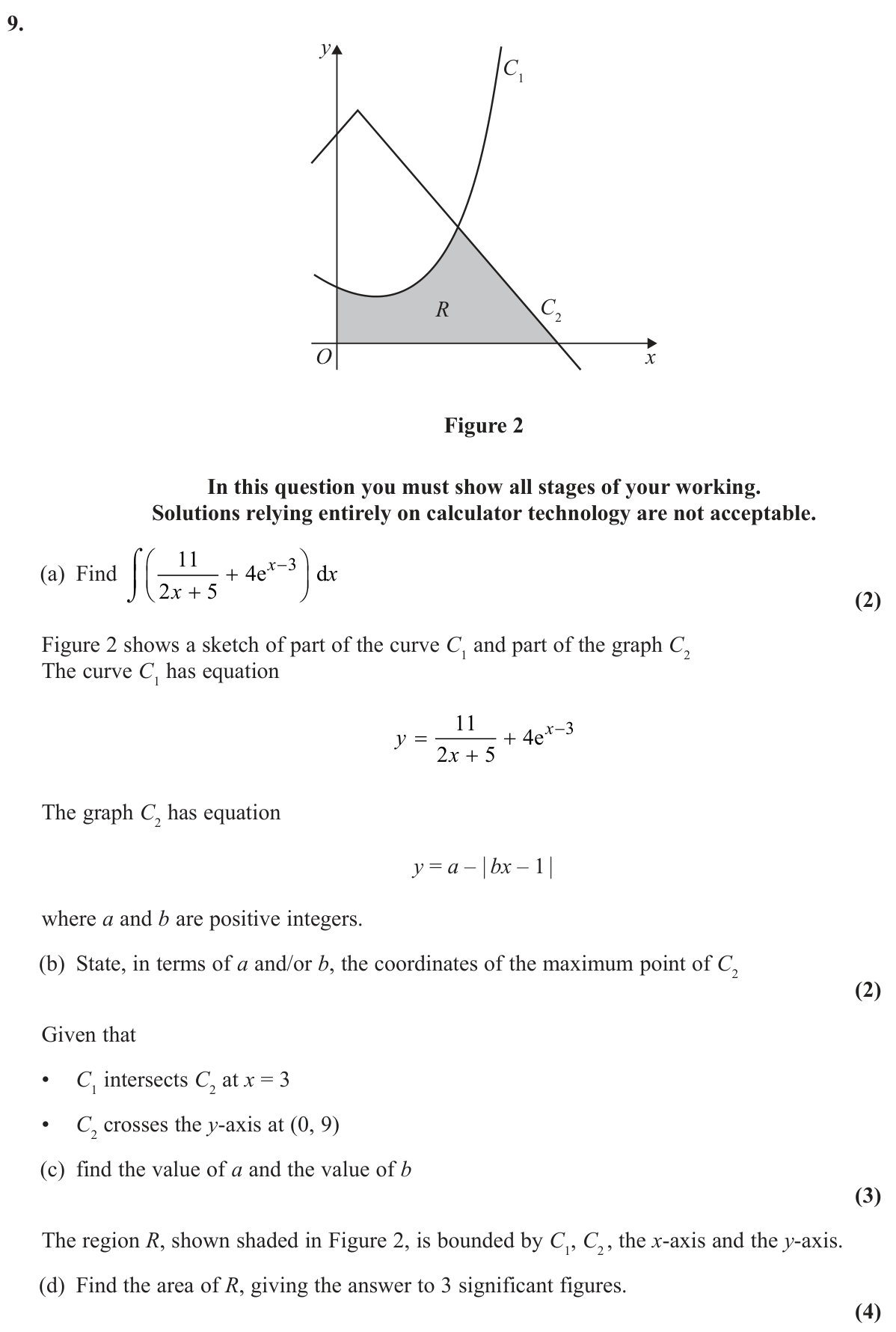
23. WMA13/01 May/June 2026 · Q9 Hard 11 marks · main topic: ModulusShow worked solution Part (a) \[\int\left(\frac{11}{2x+5}+4e^{x-3}\right)\,dx =\boxed{\frac{11}{2}\ln|2x+5|+4e^{x-3}+C}.\]
The absolute value allows both intervals on which the integrand is defined.
Part (b) The largest value of $a-|bx-1|$ occurs when $bx-1=0$. The maximum point is therefore $\boxed{(1/b,a)}$.
Part (c) At $x=0$, $9=a-1$, so $\boxed{a=10}$. At the intersection $x=3$, the first curve has height $11/11+4=5$. Thus $10-|3b-1|=5$, giving $3b-1=5$ or $-5$. These give $b=2$ or $-4/3$; only the positive integer is allowed, so $\boxed{b=2}$.
Part (d) For $x\geq3$, the required branch of $C_2$ is $y=10-(2x-1)=11-2x$. Its $x$-intercept is $x=11/2$. The shaded area is the area under $C_1$ from 0 to 3 plus the triangle from 3 to $11/2$:
\[\begin{aligned} A&=\int_0^3\left(\frac{11}{2x+5}+4e^{x-3}\right)\,dx +\frac12\left(\frac{11}{2}-3\right)5\\ &=\left[\frac{11}{2}\ln(2x+5)+4e^{x-3}\right]_0^3+\frac{25}{4}\\ &=\frac{11}{2}\ln\frac{11}{5}+4(1-e^{-3})+\frac{25}{4} =14.3873672\ldots. \end{aligned}\]
Hence $\boxed{A=14.4\text{ square units}}$ to 3 significant figures.
Final answer (a) $\frac{11}{2}\ln|2x+5|+4e^{x-3}+C$ (b) $(1/b,a)$ (c) $a=10$, $b=2$ (d) $A=14.4\text{ square units}$
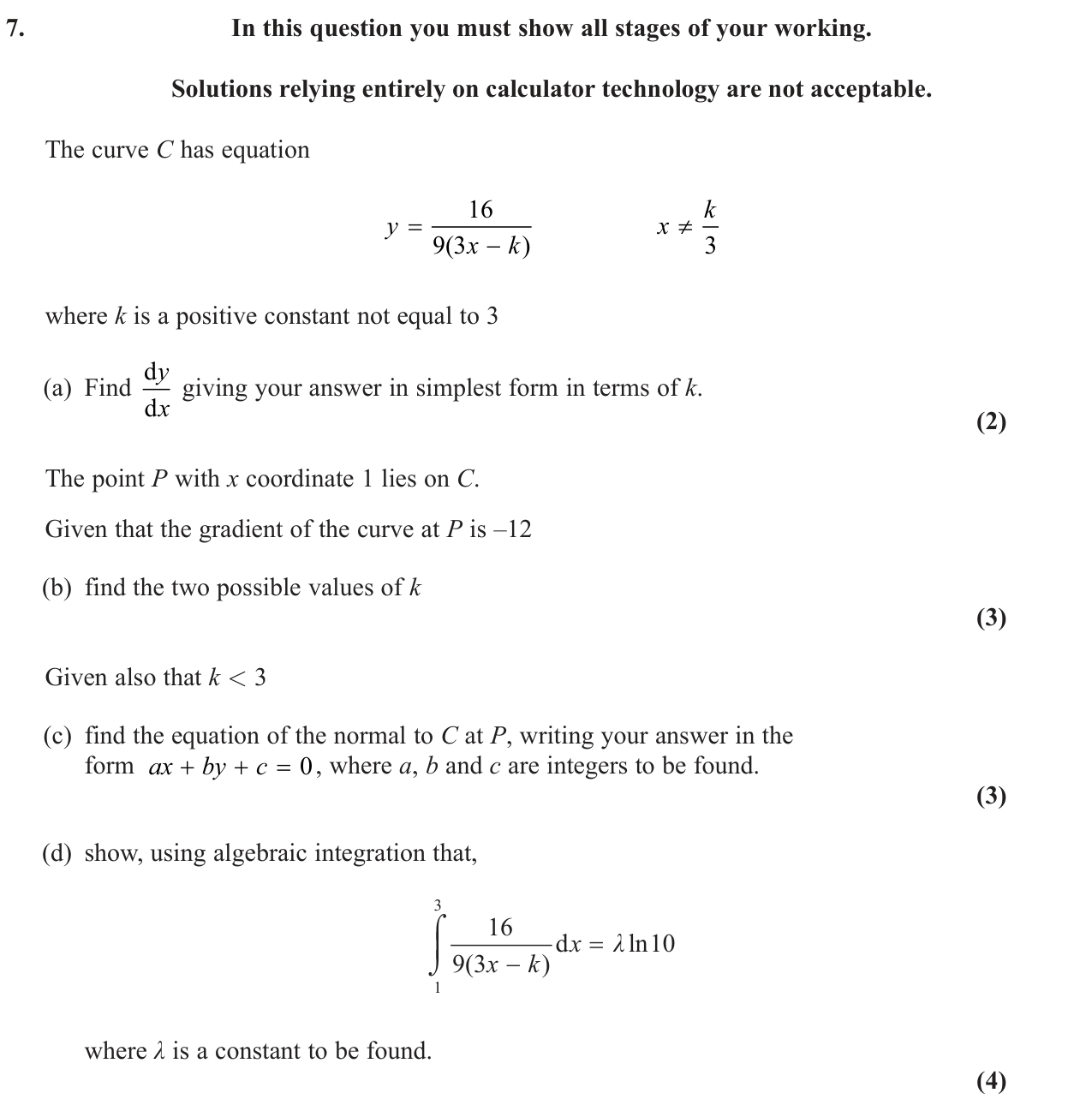
24. WMA13/01 January 2024 · Q7 Hard 12 marks · main topic: Applications of DifferentiationShow worked solution Part (a) Write $y=(16/9)(3x-k)^{-1}$. The chain rule gives
\[\frac{dy}{dx}=\frac{16}{9}(-1)(3x-k)^{-2}\cdot3.\]
\[\boxed{\frac{dy}{dx}=-\frac{16}{3(3x-k)^2}}\]
Part (b) At $x=1$, the given gradient yields
\[-\frac{16}{3(3-k)^2}=-12 \quad\Longrightarrow\quad(3-k)^2=\frac49.\]
Hence $3-k=\pm2/3$. Both resulting k-values are positive and different from 3.
\[\boxed{k=\frac73\ \text{or}\ \frac{11}{3}}\]
Part (c) Since $k\lt 3$, use $k=7/3$. At $x=1$, $y=16/[9(3-7/3)]=8/3$. The tangent gradient is $-12$, so the normal gradient is $1/12$:
\[y-\frac83=\frac1{12}(x-1),\qquad12y-32=x-1.\]
\[\boxed{x-12y+31=0}\]
Part (d) With $k=7/3$, the denominator does not vanish on $[1,3]$. Using the reciprocal-linear antiderivative,
\[\int_1^3\frac{16}{9(3x-7/3)}\,dx =\left[\frac{16}{27}\ln|3x-7/3|\right]_1^3 =\frac{16}{27}\left(\ln\frac{20}{3}-\ln\frac23\right) =\frac{16}{27}\ln\left(\frac{20/3}{2/3}\right).\]
\[\boxed{\frac{16}{27}\ln10,\quad\lambda=\frac{16}{27}}\]
Final answer (a) $\frac{dy}{dx}=-\frac{16}{3(3x-k)^2}$ (b) $k=\frac73\ \text{or}\ \frac{11}{3}$ (c) $x-12y+31=0$ (d) $\frac{16}{27}\ln10,\quad\lambda=\frac{16}{27}$
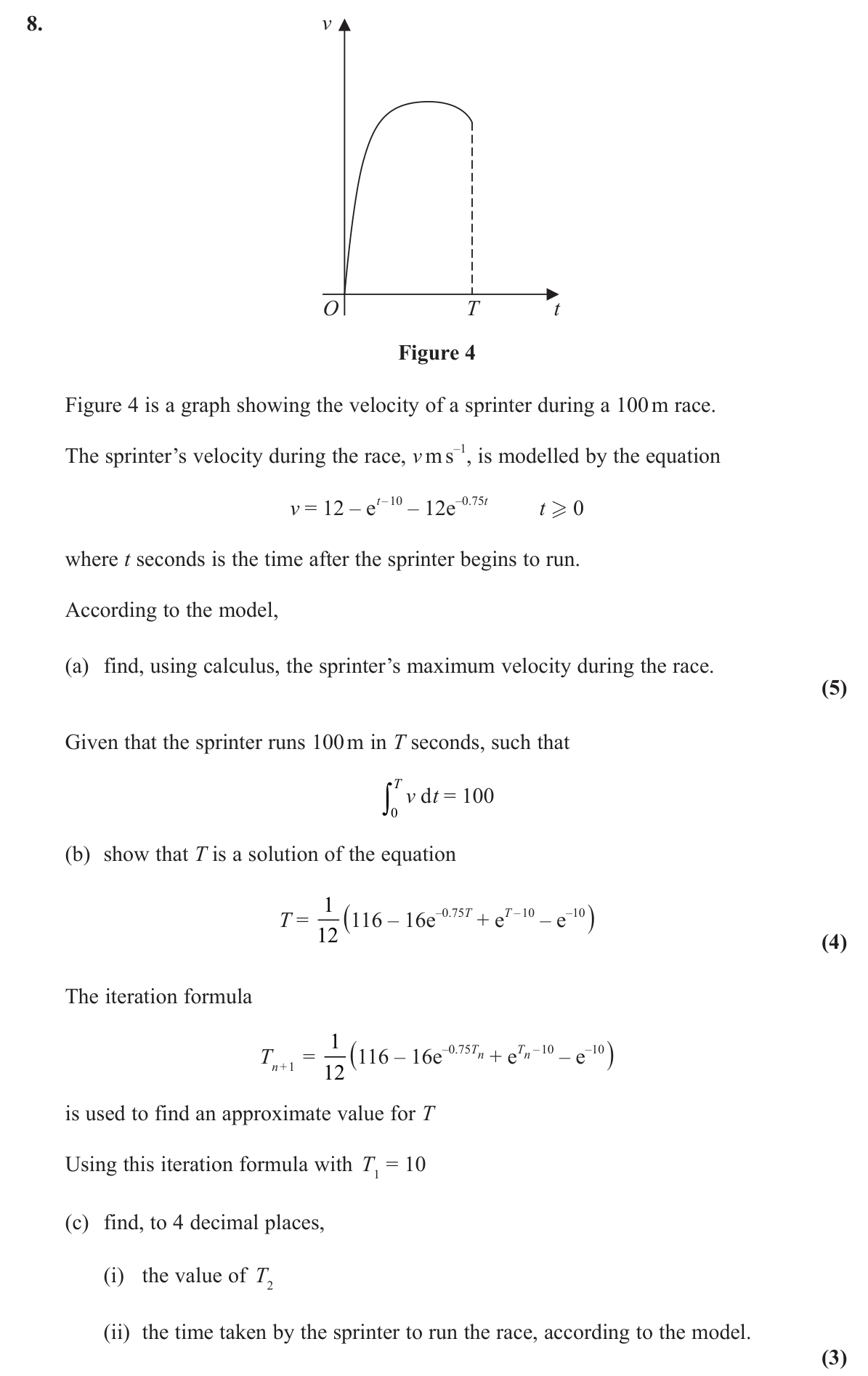
25. WMA13/01 May/June 2022 · Q8 Hard 12 marks · main topic: Numerical MethodsShow worked solution Part (a) Differentiate the velocity:
\[v'(t)=-e^{t-10}+9e^{-0.75t}.\]
At a stationary velocity, $e^{t-10}=9e^{-0.75t}$, so $e^{1.75t}=9e^{10}$ and $t=(10+\ln9)/1.75=6.9698426\ldots$ seconds. The second derivative $-e^{t-10}-6.75e^{-0.75t}$ is negative, so this is a maximum. Substitute this unrounded time into v to get $11.88728125\ldots$ metres per second.
\[\boxed{v_{\max}=11.9\ \mathrm{m\,s^{-1}}}\]
Part (b) Integrating the velocity gives $12t-e^{t-10}+16e^{-0.75t}$. Evaluate between 0 and T:
\[100=12T-e^{T-10}+16e^{-0.75T}-(-e^{-10}+16).\]
Rearrange to $12T=116-16e^{-0.75T}+e^{T-10}-e^{-10}$ and divide by 12.
\[\boxed{T=\frac1{12}(116-16e^{-0.75T}+e^{T-10}-e^{-10})}\]
Part (c) With $T_1=10$, substitution gives $T_2=9.7492587708\ldots$. Continuing with unrounded values gives
\[T_3=9.7306248365\ldots,\quad T_4=9.7294150526\ldots,\quad T_5=9.7293372715\ldots,\quad T_6=9.7293322738\ldots.\]
Further iteration settles at $9.7293319307\ldots$ seconds. Thus (i) $T_2=9.7493$ and (ii) the race time is $9.7293$ seconds, to four decimal places.
\[\boxed{T_2=9.7493,\qquad T=9.7293\ \mathrm{s}}\]
Final answer (a) $v_{\max}=11.9\ \mathrm{m\,s^{-1}}$ (b) $T=\frac1{12}(116-16e^{-0.75T}+e^{T-10}-e^{-10})$ (c) $T_2=9.7493,\qquad T=9.7293\ \mathrm{s}$
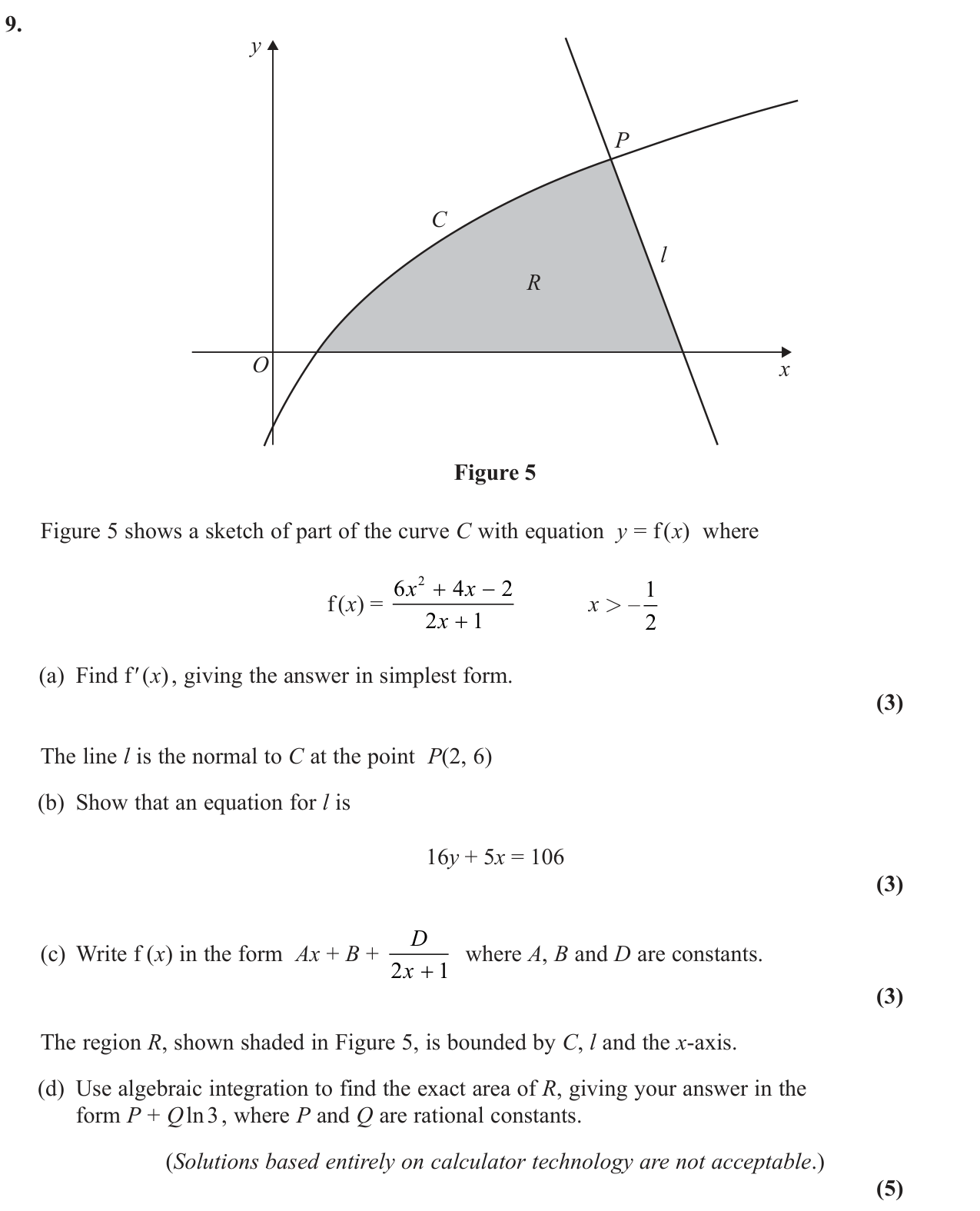
26. WMA13/01 October 2024 · Q9 Hard 14 marksShow worked solution Part (a) With $u=6x^2+4x-2$ and $v=2x+1$, the quotient rule gives
\[f'(x)=\frac{(12x+4)(2x+1)-2(6x^2+4x-2)}{(2x+1)^2} =\frac{12x^2+12x+8}{(2x+1)^2}.\]
\[\boxed{f'(x)=\frac{4(3x^2+3x+2)}{(2x+1)^2}}\]
Part (b) At $x=2$, $f'(2)=80/25=16/5$, so the normal gradient is $-5/16$. Through $P=(2,6)$,
\[y-6=-\frac5{16}(x-2) \quad\Longrightarrow\quad16y-96=-5x+10.\]
\[\boxed{16y+5x=106}\]
Part (c) Multiplying the proposed identity by $2x+1$ gives
\[6x^2+4x-2=(Ax+B)(2x+1)+D =2Ax^2+(A+2B)x+B+D.\]
Compare coefficients: $2A=6$, $A+2B=4$, $B+D=-2$. Thus $f(x)=3x+\frac12-\frac{5}{2(2x+1)}$.
\[\boxed{A=3,\quad B=\frac12,\quad D=-\frac52}\]
Part (d) The curve meets the $x$-axis when $6x^2+4x-2=2(3x-1)(x+1)=0$. The root $x=-1$ is outside $x\gt -1/2$, leaving $x=1/3$. The normal meets the axis at $x=106/5$. Split the shaded region at $P$: a curve area from $1/3$ to 2, then a triangle.
\[\int_{1/3}^{2}f(x)\,dx =\left[\frac32x^2+\frac12x-\frac54\ln(2x+1)\right]_{1/3}^{2} =7-\frac13-\frac54\ln\left(\frac5{5/3}\right) =\frac{20}{3}-\frac54\ln3.\]
The triangle has area $\frac12(106/5-2)\cdot6=288/5$. Adding gives the exact area of $R$.
\[\boxed{\operatorname{Area}(R)=\frac{964}{15}-\frac54\ln3}\]
Final answer (a) $f'(x)=\frac{4(3x^2+3x+2)}{(2x+1)^2}$ (b) $16y+5x=106$ (c) $A=3,\quad B=\frac12,\quad D=-\frac52$ (d) $\operatorname{Area}(R)=\frac{964}{15}-\frac54\ln3$
27. WMA13/01 October 2020 · Q9 Hard 14 marks · main topic: Applications of DifferentiationShow worked solution Part (a) Factor the denominator as $(x-4)(x+3)$ and multiply the proposed identity through by it:
\[x^4-x^3-10x^2+3x-9=(x^2+P)(x^2-x-12)+Q(x+3).\]
The right side expands to $x^4-x^3+(P-12)x^2+(Q-P)x+3Q-12P$. Comparing coefficients gives $P-12=-10$, so $P=2$, and $Q-P=3$, so $Q=5$. The constant check is $3(5)-12(2)=-9$, as required. The identity holds where the original fraction is defined: the stated $x\gt -3$ still excludes $x=4$.
\[\boxed{P=2,\qquad Q=5}\]
Part (b) From (a), $g(x)=x^2+2+5/(x-4)$ on the curve domain. Thus $g'(x)=2x-5/(x-4)^2$. At $x=2$, $g(2)=4+2-5/2=7/2$ and $g'(2)=4-5/4=11/4$. The tangent through $(2,7/2)$ is
\[y-\frac72=\frac{11}{4}(x-2) \quad\Longrightarrow\quad y=\frac{11}{4}x-2.\]
\[\boxed{y=\frac{11}{4}x-2}\]
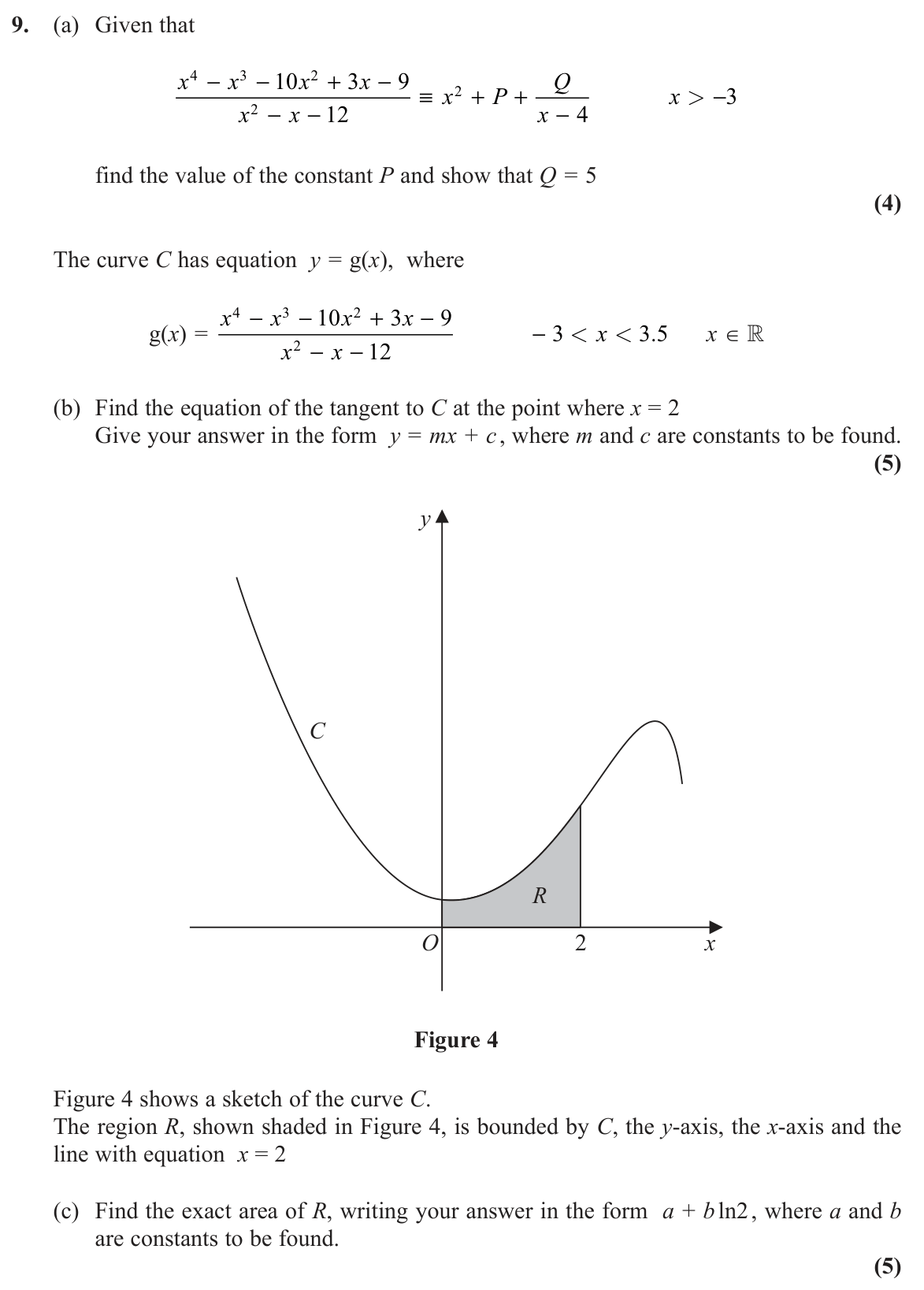
Part (c) The source shading is above the x-axis from $x=0$ to $x=2$, so integrate g over those bounds.
\[\operatorname{Area}(R)=\int_0^2\left(x^2+2+\frac5{x-4}\right)\,dx =\left[\frac{x^3}{3}+2x+5\ln|x-4|\right]_0^2.\]
The absolute value is essential because $x-4\lt 0$ throughout this interval. Evaluating gives
\[\frac83+4+5\ln2-5\ln4=\frac{20}{3}-5\ln2.\]
Thus $a=20/3$ and $b=-5$ in the requested form.
\[\boxed{\operatorname{Area}(R)=\frac{20}{3}-5\ln2}\]
Final answer (a) $P=2,\qquad Q=5$ (b) $y=\frac{11}{4}x-2$ (c) $\operatorname{Area}(R)=\frac{20}{3}-5\ln2$
Dr Eslam Ahmed Elite Mathematics · Questions classified by topic, solutions checked by Dr Eslam
 Elite Mathematics