Skip to content
Elite Mathematics
IAL · WMA13 · Topic

Log Graphs and Models: past paper questions & worked solutions

Every Log Graphs and Models question from the WMA13 papers in our bank, 2020–2026, sorted from easiest to hardest. Try each one first, then open the worked solution.

35questions
265marks in total
100%of papers (19 of 19) include it
13/12/10easy / medium / hard

Questions, easiest first

Level is estimated from marks: 1–6 easy, 7–8 medium, 9+ hard.

1. WMA13/01 January 2025 · Q2

Easy3 marks
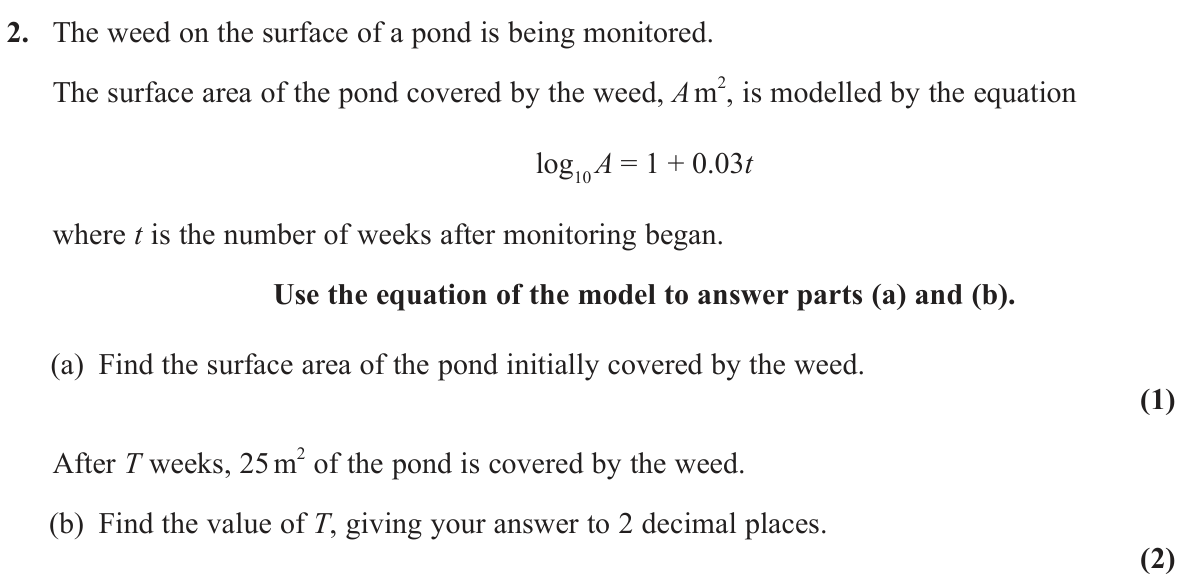
WMA13/01 January 2025 Question 2 (3 marks): Log Graphs and Models
Show worked solution
  1. Part (a)

    At $t=0$, $\log_{10}A=1$, hence $A=10^1=10$ square metres.

    \[\boxed{A(0)=10\ \mathrm{m}^2}\]
  2. Part (b)

    Substitute $A=25$ into the model:

    \[\log_{10}25=1+0.03T\quad\Longrightarrow\quad T=\frac{\log_{10}25-1}{0.03}=13.2646669557\ldots.\]
    \[\boxed{T=13.26\text{ weeks}}\]
Final answer

(a) $A(0)=10\ \mathrm{m}^2$ (b) $T=13.26\text{ weeks}$

2. WMA13/01 May/June 2025 · Q3

Easy5 marks
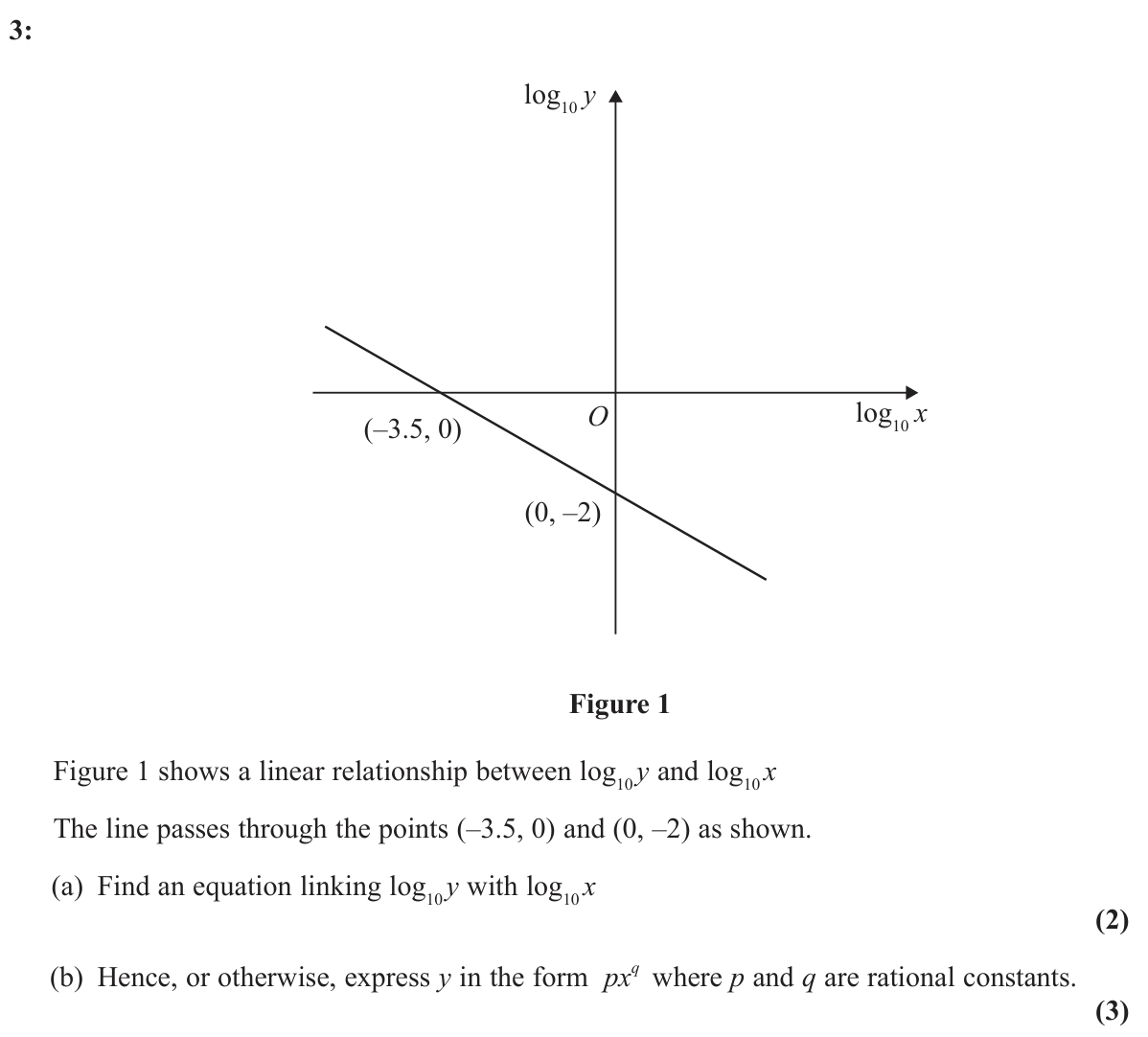
WMA13/01 May/June 2025 Question 3 (5 marks): Log Graphs and Models
Show worked solution
  1. Part (a)

    The gradient in the logarithmic coordinates is

    \[m=\frac{-2-0}{0-(-3.5)}=-\frac47.\]

    Using the vertical intercept $-2$,

    \[\boxed{\log_{10}y=-\frac47\log_{10}x-2}.\]
  2. Part (b)

    For $x\gt 0$, the logarithm laws give

    \[\log_{10}y=\log_{10}(x^{-4/7})+\log_{10}\frac1{100} =\log_{10}\left(\frac1{100}x^{-4/7}\right).\]

    Therefore

    \[\boxed{y=\frac1{100}x^{-4/7}},\qquad \boxed{p=\frac1{100},\quad q=-\frac47}.\]
Final answer

(a) $\log_{10}y=-\frac47\log_{10}x-2$ (b) $y=\frac1{100}x^{-4/7}$, $p=\frac1{100},\quad q=-\frac47$

3. WMA13/01 January 2023 · Q3

Easy5 marks
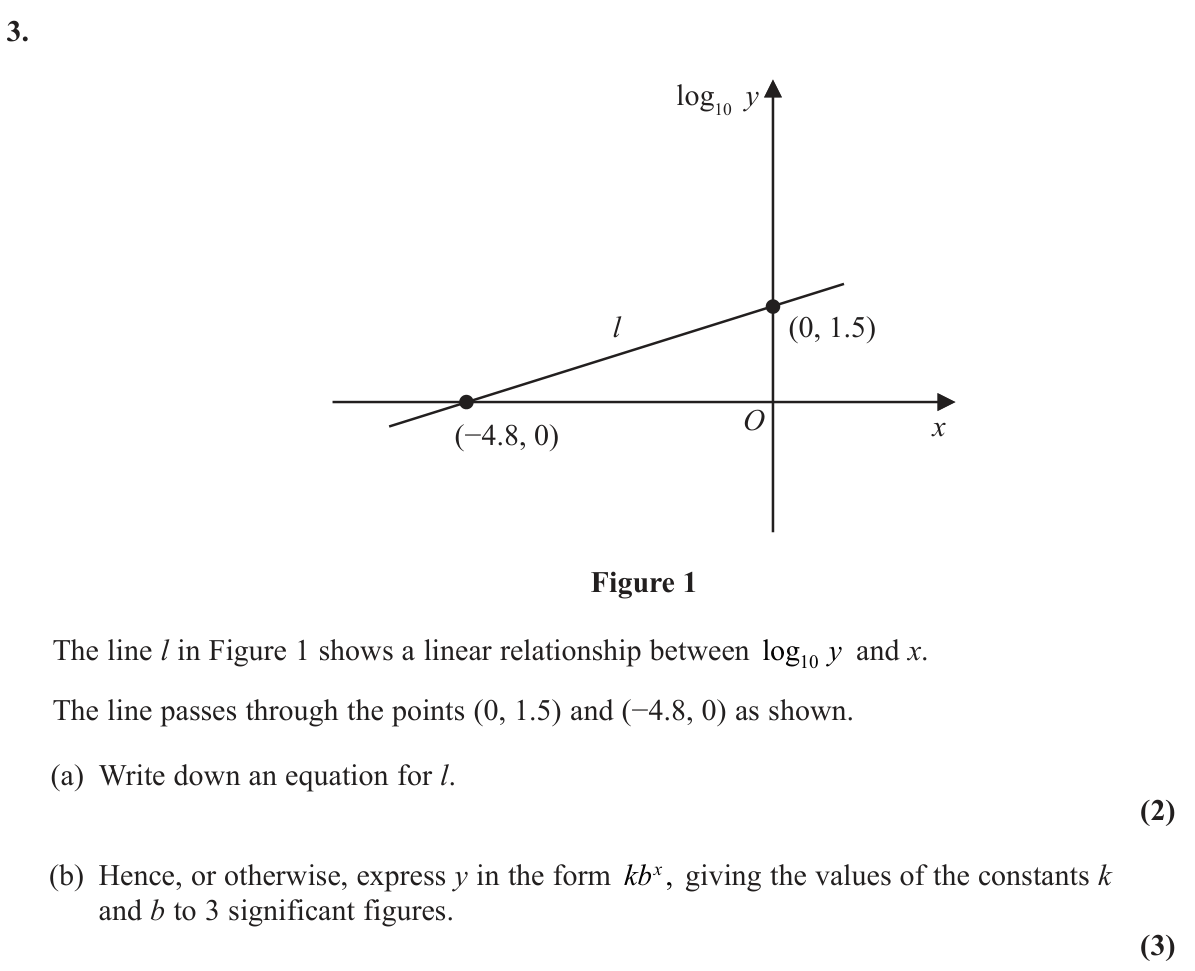
WMA13/01 January 2023 Question 3 (5 marks): Log Graphs and Models
Show worked solution
  1. Part (a)

    The gradient in the $(x,\log_{10}y)$ coordinates is $(1.5-0)/(0-(-4.8))=1.5/4.8=5/16$. The vertical intercept is $1.5=3/2$, giving the equation below.

    \[\boxed{\log_{10}y=\frac5{16}x+\frac32}\]
  2. Part (b)

    Exponentiating base 10 gives

    \[y=10^{(5/16)x+3/2}=10^{3/2}(10^{5/16})^x.\]

    Therefore $k=10^{3/2}=31.62277660\ldots$ and $b=10^{5/16}=2.053525026\ldots$. To three significant figures the model constants are 31.6 and 2.05.

    \[\boxed{k=31.6,\qquad b=2.05\quad\bigl(y\approx31.6(2.05)^x\bigr)}\]
Final answer

(a) $\log_{10}y=\frac5{16}x+\frac32$ (b) $k=31.6,\qquad b=2.05\quad\bigl(y\approx31.6(2.05)^x\bigr)$

4. WMA13/01 January 2020 · Q3

Easy5 marks
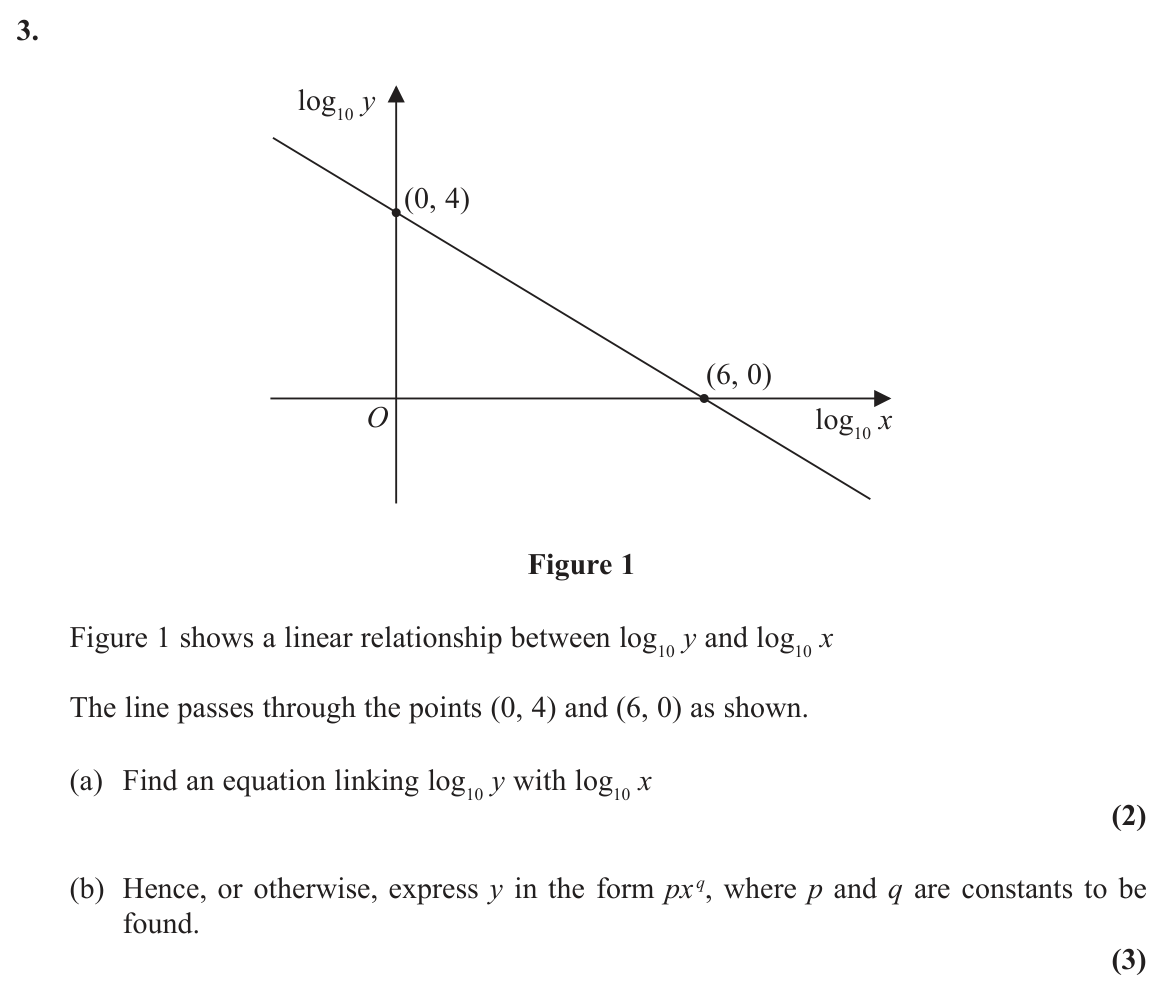
WMA13/01 January 2020 Question 3 (5 marks): Log Graphs and Models
Show worked solution
  1. Part (a)

    The horizontal coordinate is $\log_{10}x$ and the vertical coordinate is $\log_{10}y$. The gradient of the line is

    \[m=\frac{0-4}{6-0}=-\frac{2}{3}.\]

    The vertical intercept is $4$, so the required equation is

    \[\boxed{\log_{10}y=4-\frac{2}{3}\log_{10}x}.\]
  2. Part (b)

    Taking powers of $10$ on both sides gives

    \[\begin{aligned} y&=10^{4-\frac{2}{3}\log_{10}x}\\ &=10^4\left(10^{\log_{10}x}\right)^{-2/3}\\ &=10000x^{-2/3}. \end{aligned}\]

    Here $x\gt 0$, as required for $\log_{10}x$ to exist. Therefore

    \[\boxed{y=10000x^{-2/3}},\qquad \boxed{p=10000,\quad q=-\frac{2}{3}}.\]
Final answer

(a) $\log_{10}y=4-\frac{2}{3}\log_{10}x$ (b) $y=10000x^{-2/3}$, $p=10000,\quad q=-\frac{2}{3}$

5. WMA13/01 January 2026 · Q4

Easy6 marks
WMA13/01 January 2026 Question 4 (6 marks): Log Graphs and Models
Show worked solution
  1. Part (a)

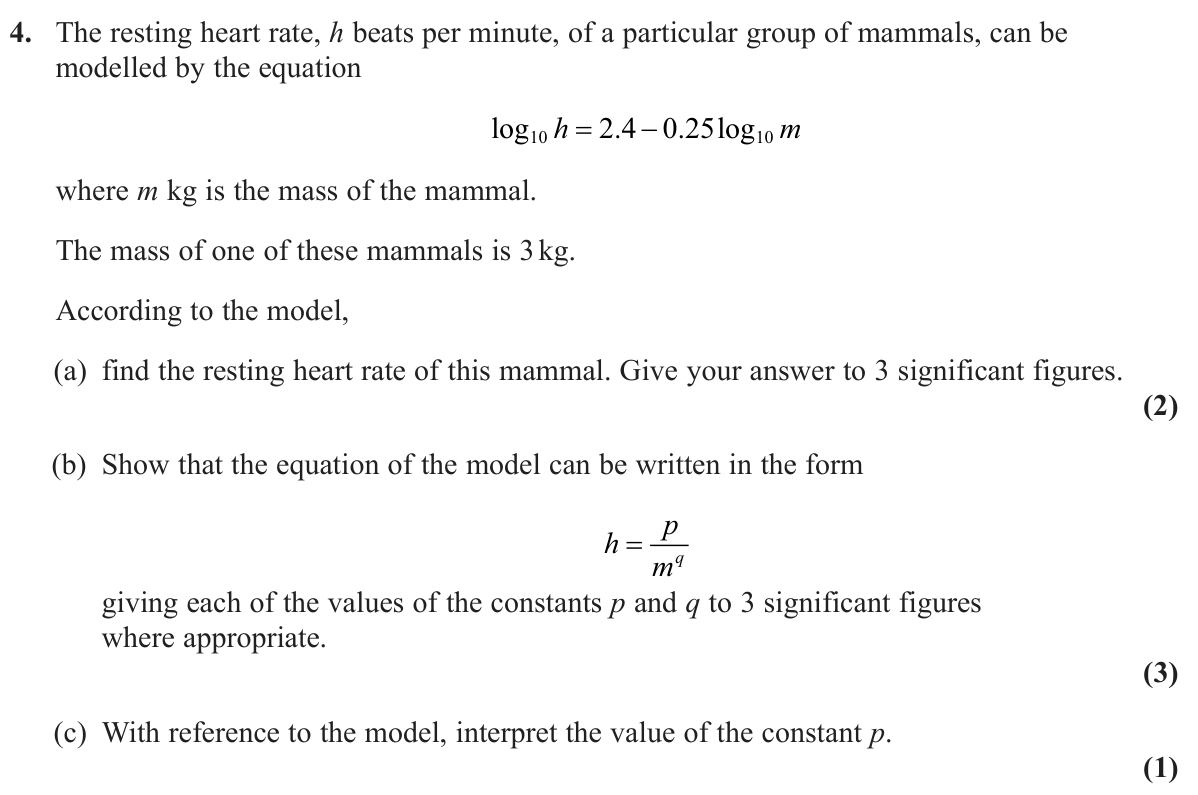
    At $m=3$,

    \[\log_{10}h=2.4-0.25\log_{10}3, \qquad h=10^{2.4-0.25\log_{10}3}=190.862095\ldots.\]

    The predicted heart rate is $191$ beats per minute (3 significant figures).

  2. Part (b)

    Using the power law of logarithms,

    \[\log_{10}h=\log_{10}(10^{2.4})-\log_{10}(m^{0.25}) =\log_{10}\!\left(\frac{10^{2.4}}{m^{0.25}}\right).\]

    Therefore

    \[h=\frac{10^{2.4}}{m^{0.25}},\qquad p=10^{2.4}=251\ \text{(3 s.f.)},\qquad q=0.25.\]

    The model, with its coefficient rounded as requested, is

    \[h=\frac{251}{m^{0.25}}.\]
  3. Part (c)

    When $m=1$, $h=p$. Thus $p$ is the model's predicted heart rate, in beats per minute, for a mammal of mass $1$ kg.

Final answer

(a) $191\text{ beats per minute}$ (b) $p=10^{2.4}=251\ \text{(3 s.f.)},\qquad q=0.25$ (c) $predicted heart rate, in beats per minute, for a mammal of mass $1$ kg$

6. WMA13/01 October 2024 · Q4

Easy6 marks
WMA13/01 October 2024 Question 4 (6 marks): Log Graphs and Models
Show worked solution
  1. Part (a)

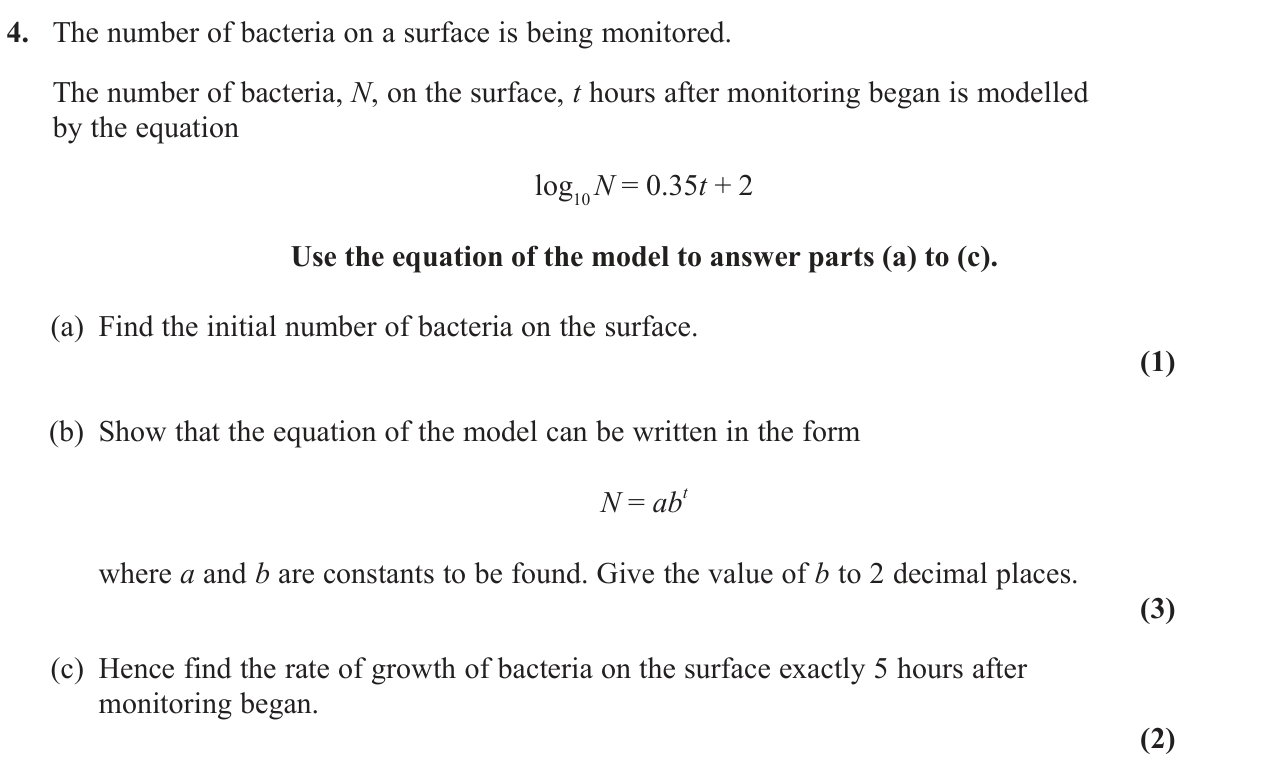
    At $t=0$, $\log_{10}N=2$, so $N=10^2$.

    \[\boxed{N(0)=100}\]
  2. Part (b)

    Exponentiating base 10 gives

    \[N=10^{0.35t+2}=10^2(10^{0.35})^t=100(10^{0.35})^t.\]

    Thus $a=100$ and $b=10^{0.35}=2.238721\ldots$, which is $2.24$ to 2 decimal places.

    \[\boxed{a=100,\qquad b=2.24}\]
  3. Part (c)

    Retain the unrounded base $10^{0.35}$ when differentiating:

    \[\frac{dN}{dt}=100(10^{0.35})^t\ln(10^{0.35}) =0.35\ln(10)\,10^{0.35t+2}.\]

    At $t=5$ this is $0.35\ln(10)\,10^{3.75}=4531.9356\ldots$ bacteria per hour.

    \[\boxed{\left.\frac{dN}{dt}\right|_{t=5}=4.53\times10^3\ \text{bacteria per hour}}\]
Final answer

(a) $N(0)=100$ (b) $a=100,\qquad b=2.24$ (c) $\left.\frac{dN}{dt}\right|_{t=5}=4.53\times10^3\ \text{bacteria per hour}$

7. WMA13/01 May/June 2024 · Q3

Easy6 marks
WMA13/01 May/June 2024 Question 3 (6 marks): Log Graphs and Models
Show worked solution
  1. Part (i)

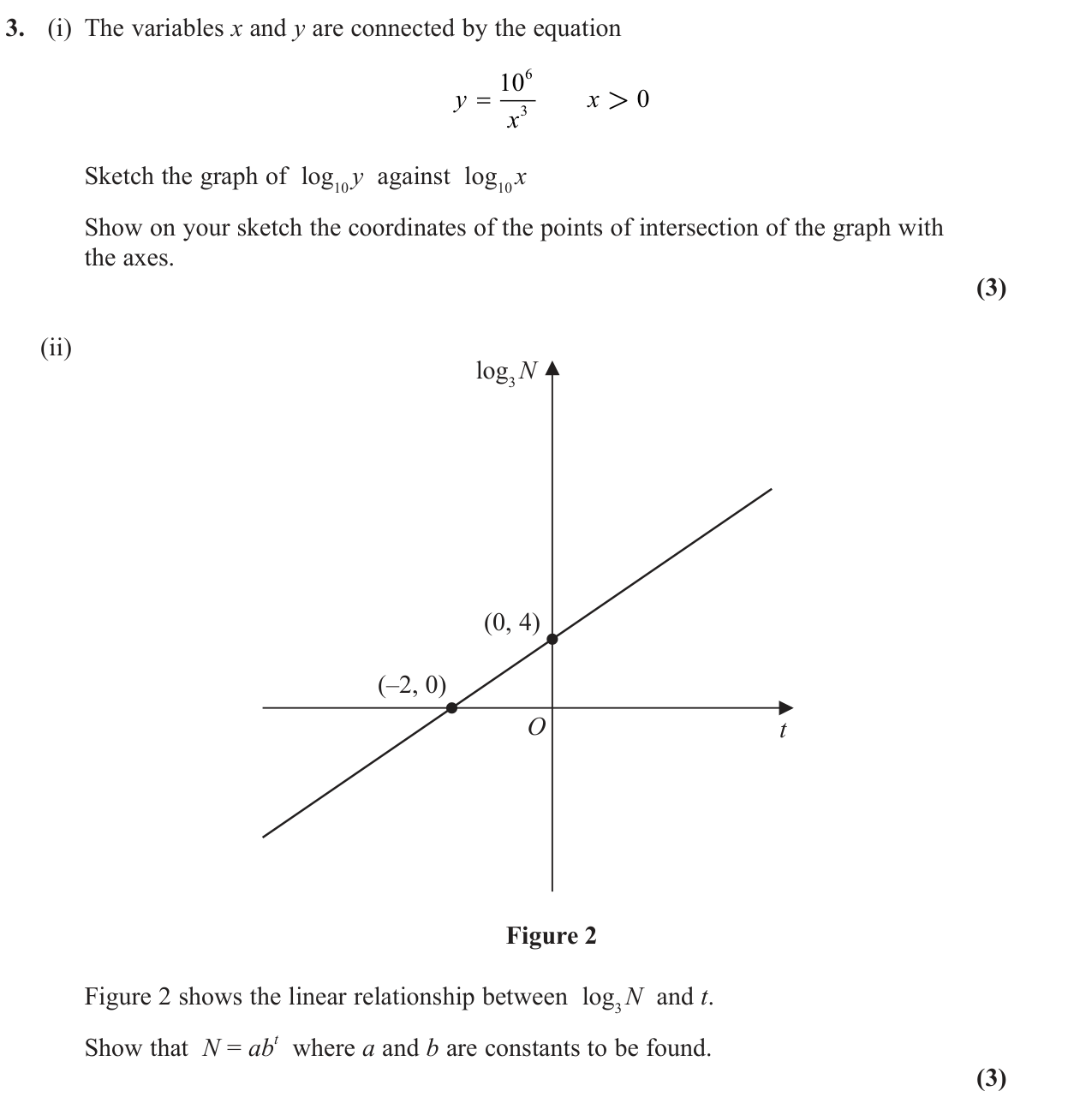
    Put $X=\log_{10}x$ and $Y=\log_{10}y$. Taking logarithms of $y=10^6/x^3$ gives

    \[Y=6-3X.\]

    At $X=0$, $Y=6$; at $Y=0$, $X=2$. The graph is a straight line of gradient $-3$.

    \[\boxed{Y=6-3X;\quad(0,6),\ (2,0)}\]
  2. Part (ii)

    The gradient in the given plot is $(4-0)/(0-(-2))=2$ and its vertical intercept is 4. Therefore $\log_3N=2t+4$. Exponentiating in base 3,

    \[N=3^{2t+4}=3^4(3^2)^t=81\cdot9^t.\]
    \[\boxed{a=81,\quad b=9}\]
Final answer

(i) $Y=6-3X;\quad(0,6),\ (2,0)$ (ii) $a=81,\quad b=9$

8. WMA13/01 October 2023 · Q6

Easy6 marks
WMA13/01 October 2023 Question 6 (6 marks): Log Graphs and Models
Show worked solution
  1. Part (a)

    Substitute $t=2$ into the logarithmic model:

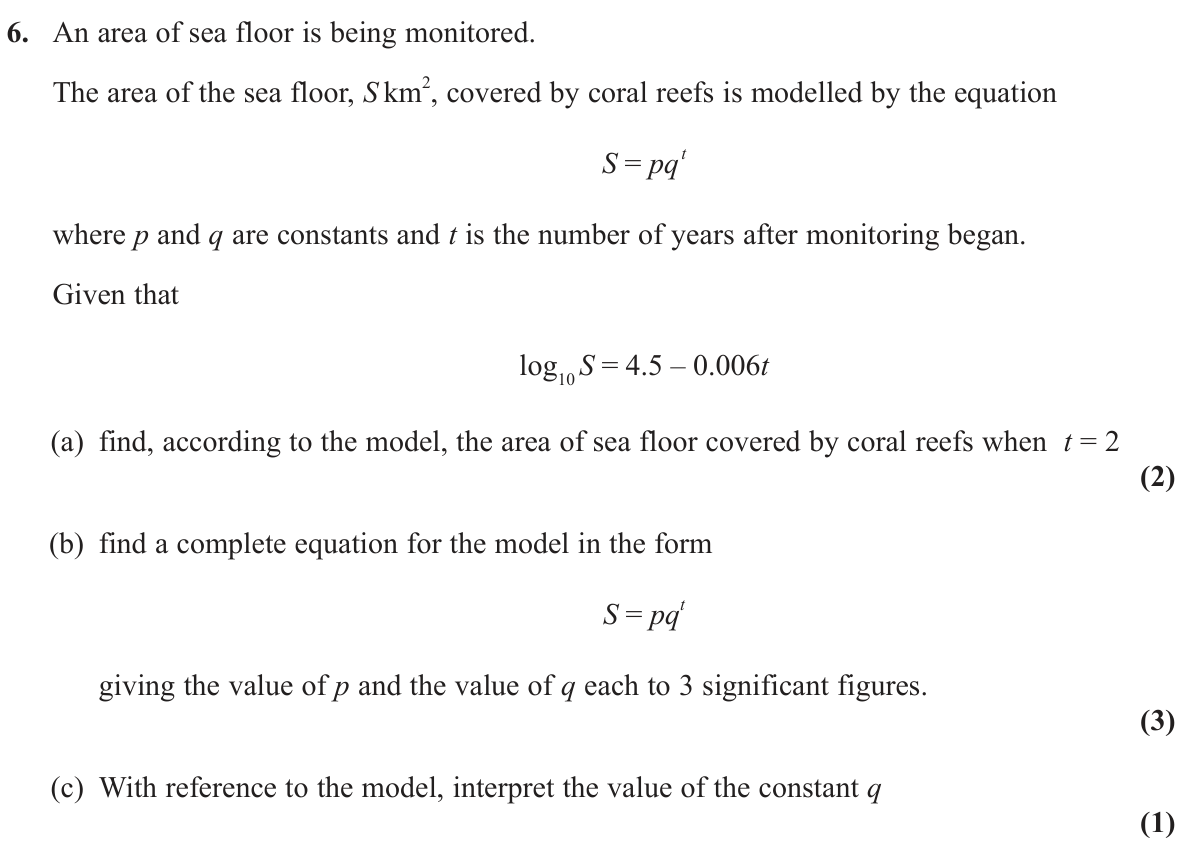
    \[\log_{10}S=4.5-0.006(2)=4.488\quad\Longrightarrow\quad S=10^{4.488}.\]

    Thus $S=30760.968\ldots\ \mathrm{km}^2$. To 3 significant figures, the area is $3.08\times10^4\ \mathrm{km}^2$.

    \[\boxed{S=3.08\times10^4\ \mathrm{km}^2}\]
  2. Part (b)

    Exponentiating and using index laws,

    \[S=10^{4.5-0.006t}=10^{4.5}(10^{-0.006})^t.\]

    Thus $p=31622.7766\ldots$ and $q=0.9862795\ldots$. To 3 significant figures, $p=3.16\times10^4$ and $q=0.986$. Hence the complete model, with both constants rounded as requested, is $S=31600(0.986)^t$, where $S$ is in $\mathrm{km}^2$ and $t$ is in years.

    \[\boxed{S=31600(0.986)^t}\]
  3. Part (c)

    The factor $q$ is the yearly multiplier for the sea-floor area covered by coral reefs. Each year, about $98.6\%$ of the previous year's coral-covered sea-floor area remains. This is a yearly decrease of about $1.4\%$ (or $1.372\ldots\%$ using the unrounded value of $q$).

    \[\boxed{\text{About }98.6\%\text{ of the coral-covered sea-floor area remains each year.}}\]
Final answer

(a) $S=3.08\times10^4\ \mathrm{km}^2$ (b) $S=31600(0.986)^t$ (c) $\text{About }98.6\%\text{ of the coral-covered sea-floor area remains each year.}$

9. WMA13/01 May/June 2023 · Q2

Easy6 marks
WMA13/01 May/June 2023 Question 2 (6 marks): Log Graphs and Models
Show worked solution
  1. Part (a)

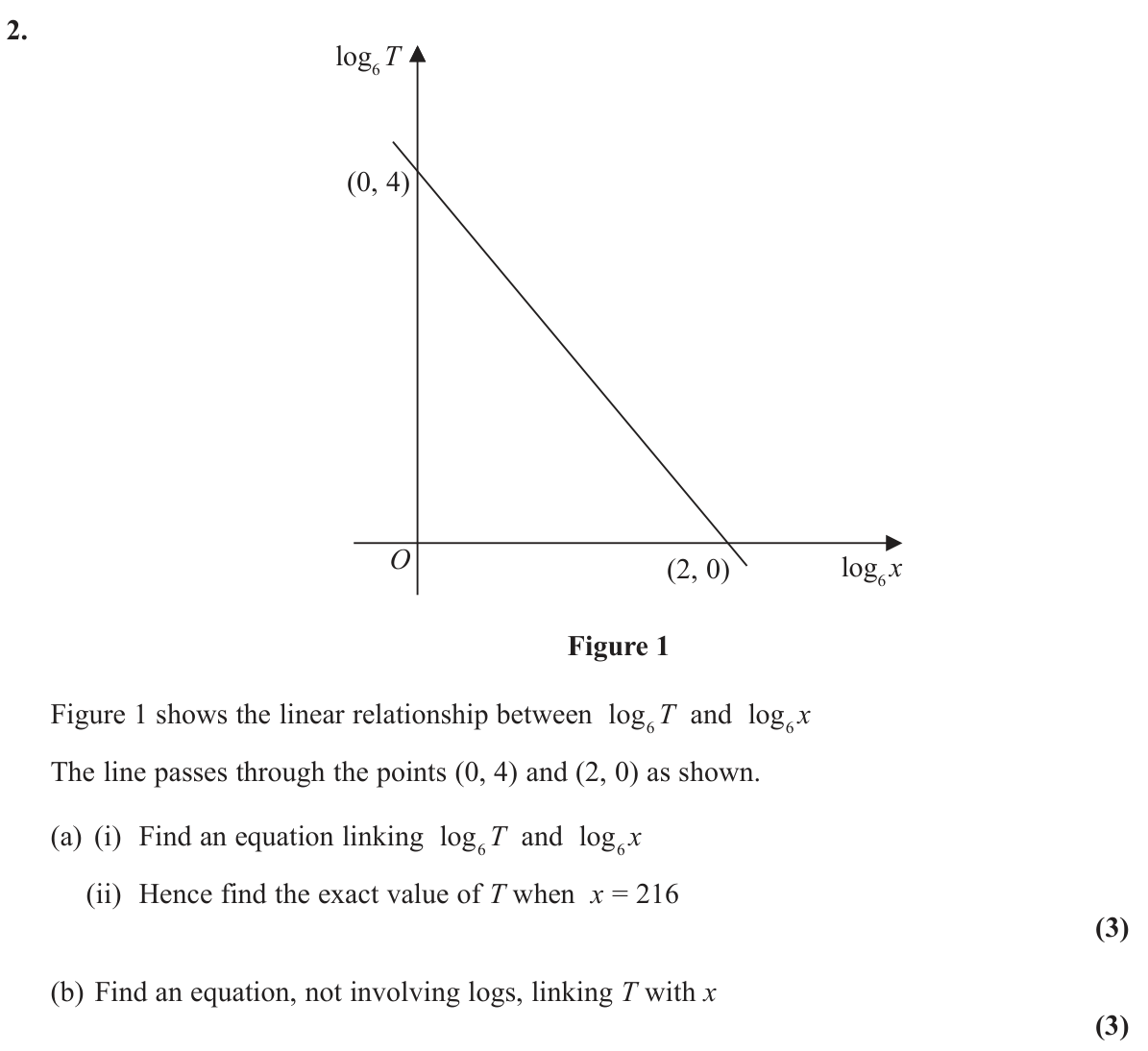
    (i) Write $Y=\log_6T$, $X=\log_6x$. The gradient is $(0-4)/(2-0)=-2$ and the intercept is 4, so $Y=4-2X$. (ii) Since $216=6^3$, $\log_6T=4-2(3)=-2$, hence $T=6^{-2}=1/36$.

    \[\boxed{\log_6T=4-2\log_6x,\qquad T=\frac1{36}}\]
  2. Part (b)

    The log equation gives $\log_6T+2\log_6x=4$. For $x,T\gt 0$, combine logs to obtain $\log_6(Tx^2)=4$. Thus $Tx^2=6^4=1296$, or $T=1296/x^2$.

    \[\boxed{T=\frac{1296}{x^2},\qquad x\gt 0}\]
Final answer

(a) $\log_6T=4-2\log_6x,\qquad T=\frac1{36}$ (b) $T=\frac{1296}{x^2},\qquad x\gt 0$

10. WMA13/01 October 2021 · Q3

Easy6 marks
WMA13/01 October 2021 Question 3 (6 marks): Log Graphs and Models
Show worked solution
  1. Part (a)

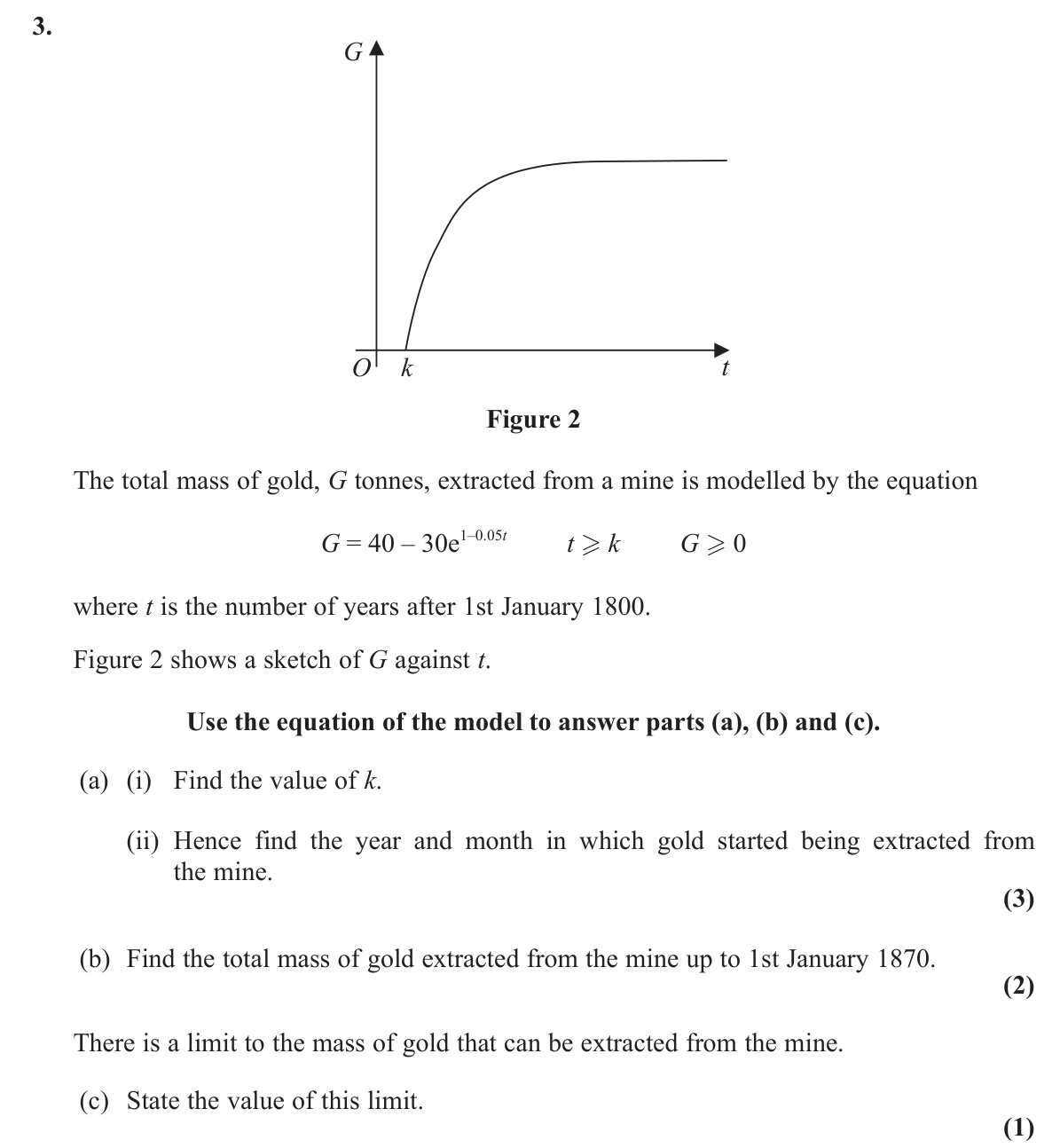
    (i) Extraction starts at $G=0$: $30e^{1-0.05k}=40$, so $1-0.05k=\ln(4/3)$ and $k=20(1-\ln(4/3))=14.24635855\ldots$ years. (ii) This is 14 years and $12(0.24635855\ldots)=2.95630261\ldots$ months after 1 January 1800. Two full months have elapsed from January 1814, so the date is in March 1814. Use the unrounded fractional year to identify the month.

    \[\boxed{k=14.2\text{ years (3 s.f.)};\quad\text{March 1814}}\]
  2. Part (b)

    On 1 January 1870, $t=70$. Substitute: $G(70)=40-30e^{1-0.05(70)}=40-30e^{-2.5}=37.53745004\ldots$ tonnes.

    \[\boxed{37.5\ \text{tonnes}}\]
  3. Part (c)

    As $t\to\infty$, $e^{1-0.05t}\to0$, so $G\to40$ tonnes.

    \[\boxed{40\ \text{tonnes}}\]
Final answer

(a) $k=14.2\text{ years (3 s.f.)};\quad\text{March 1814}$ (b) $37.5\ \text{tonnes}$ (c) $40\ \text{tonnes}$

11. WMA13/01 October 2021 · Q7

Easy6 marks
WMA13/01 October 2021 Question 7 (6 marks): Log Graphs and Models
Show worked solution
  1. Part (a)

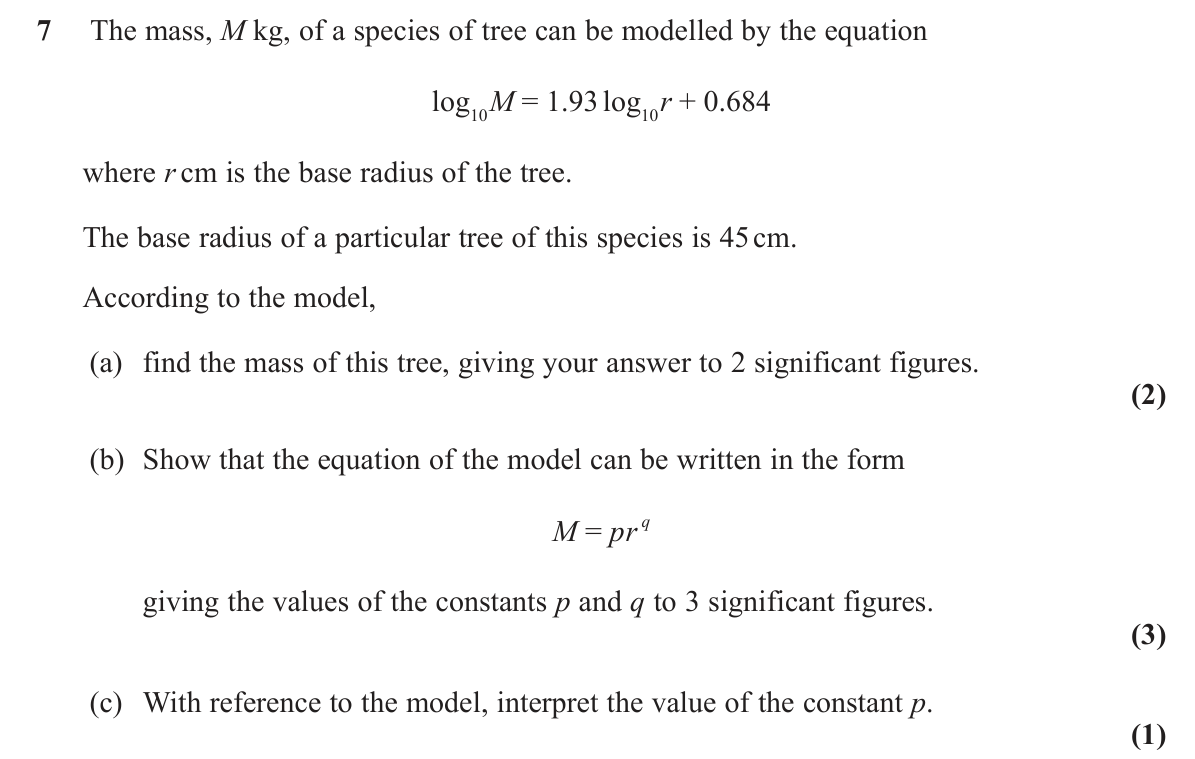
    At $r=45$, $\log_{10}M=1.93\log_{10}45+0.684$. Exponentiate to obtain $M=10^{0.684}45^{1.93}=7493.766412\ldots$ kg.

    \[\boxed{M=7.5\times10^3\ \mathrm{kg}}\]
  2. Part (b)

    Exponentiate the full equation:

    \[M=10^{1.93\log_{10}r+0.684}=10^{0.684}r^{1.93}.\]

    Therefore $p=10^{0.684}=4.83058802\ldots$ and $q=1.93$.

    \[\boxed{p=4.83,\qquad q=1.93}\]
  3. Part (c)

    If the base radius is $r=1$ cm, the model gives $M=p\cdot1^q=p$ kg. Thus p is the predicted mass in kilograms of a tree of base radius 1 cm.

    \[\boxed{\text{Predicted mass (kg) when base radius is }1\ \mathrm{cm}}\]
Final answer

(a) $M=7.5\times10^3\ \mathrm{kg}$ (b) $p=4.83,\qquad q=1.93$ (c) $\text{Predicted mass (kg) when base radius is }1\ \mathrm{cm}$

12. WMA13/01 October 2020 · Q2

Easy6 marks
WMA13/01 October 2020 Question 2 (6 marks): Log Graphs and Models
Show worked solution
  1. Part (a)

    Exponentiate in base ten and use index laws:

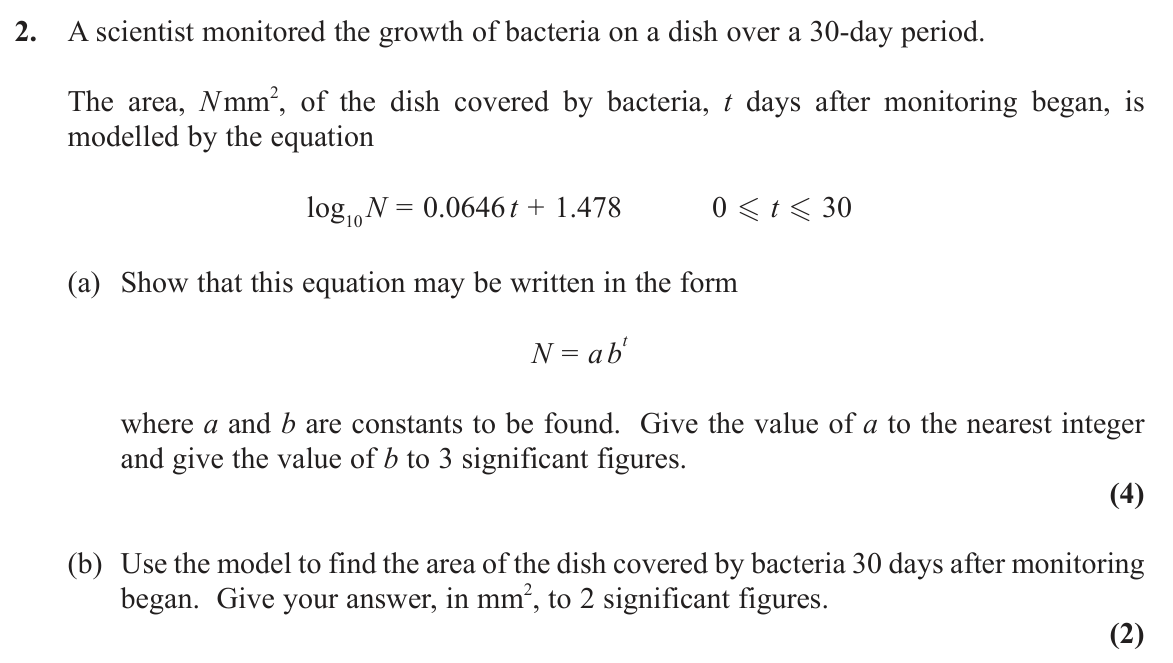
    \[N=10^{0.0646t+1.478}=10^{1.478}\left(10^{0.0646}\right)^t=ab^t.\]

    Therefore $a=10^{1.478}=30.060763\ldots$, which rounds to 30 to the nearest integer, and $b=10^{0.0646}=1.16037937\ldots$, which rounds to 1.16 to three significant figures.

    \[\boxed{a=30,\qquad b=1.16}\]
  2. Part (b)

    At $t=30$, use the original model to retain precision:

    \[N=10^{0.0646(30)+1.478}=10^{3.416}=2606.15355\ldots\ \mathrm{mm}^2.\]

    To two significant figures the covered area is $2.6\times10^3\ \mathrm{mm}^2$. Using the rounded model $30(1.16)^{30}$ gives the same two-significant-figure answer.

    \[\boxed{2.6\times10^3\ \mathrm{mm}^2}\]
Final answer

(a) $a=30,\qquad b=1.16$ (b) $2.6\times10^3\ \mathrm{mm}^2$

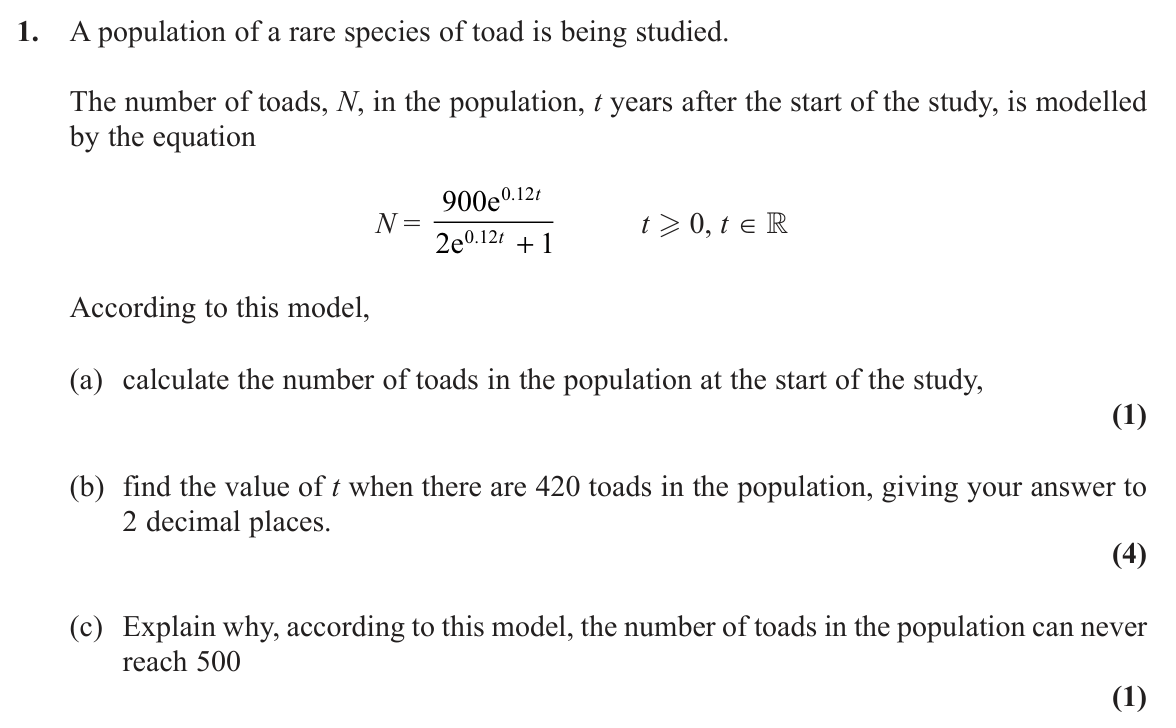
13. WMA13/01 January 2020 · Q1

Easy6 marks
WMA13/01 January 2020 Question 1 (6 marks): Log Graphs and Models
Show worked solution
  1. Part (a)

    At the start of the study, $t=0$, so

    \[N(0)=\frac{900e^0}{2e^0+1}=\frac{900}{3}=\boxed{300}.\]

    There are initially $300$ toads.

  2. Part (b)

    Set $N=420$ and clear the denominator:

    \[\begin{aligned} 420&=\frac{900e^{0.12t}}{2e^{0.12t}+1},\\ 420(2e^{0.12t}+1)&=900e^{0.12t},\\ 420&=60e^{0.12t},\\ e^{0.12t}&=7. \end{aligned}\]

    Taking natural logarithms gives

    \[0.12t=\ln 7 \quad\Longrightarrow\quad t=\frac{\ln 7}{0.12}=16.2159179\ldots.\]

    Thus $\boxed{t=16.22\text{ years}}$ to 2 decimal places.

  3. Part (c)

    Divide the numerator and denominator by $e^{0.12t}$:

    \[N=\frac{900}{2+e^{-0.12t}}.\]

    Since $e^{-0.12t}\gt 0$ for every finite $t\geq0$, the denominator is greater than $2$. Hence

    \[N\lt \frac{900}{2}=450\lt 500.\]

    The population approaches $450$ as $t$ increases without bound, so it can never reach $500$ according to this model.

Final answer

(a) $300$ (b) $t=16.22\text{ years}$ (c) $N \lt 450 \lt 500, so the population can never reach 500$

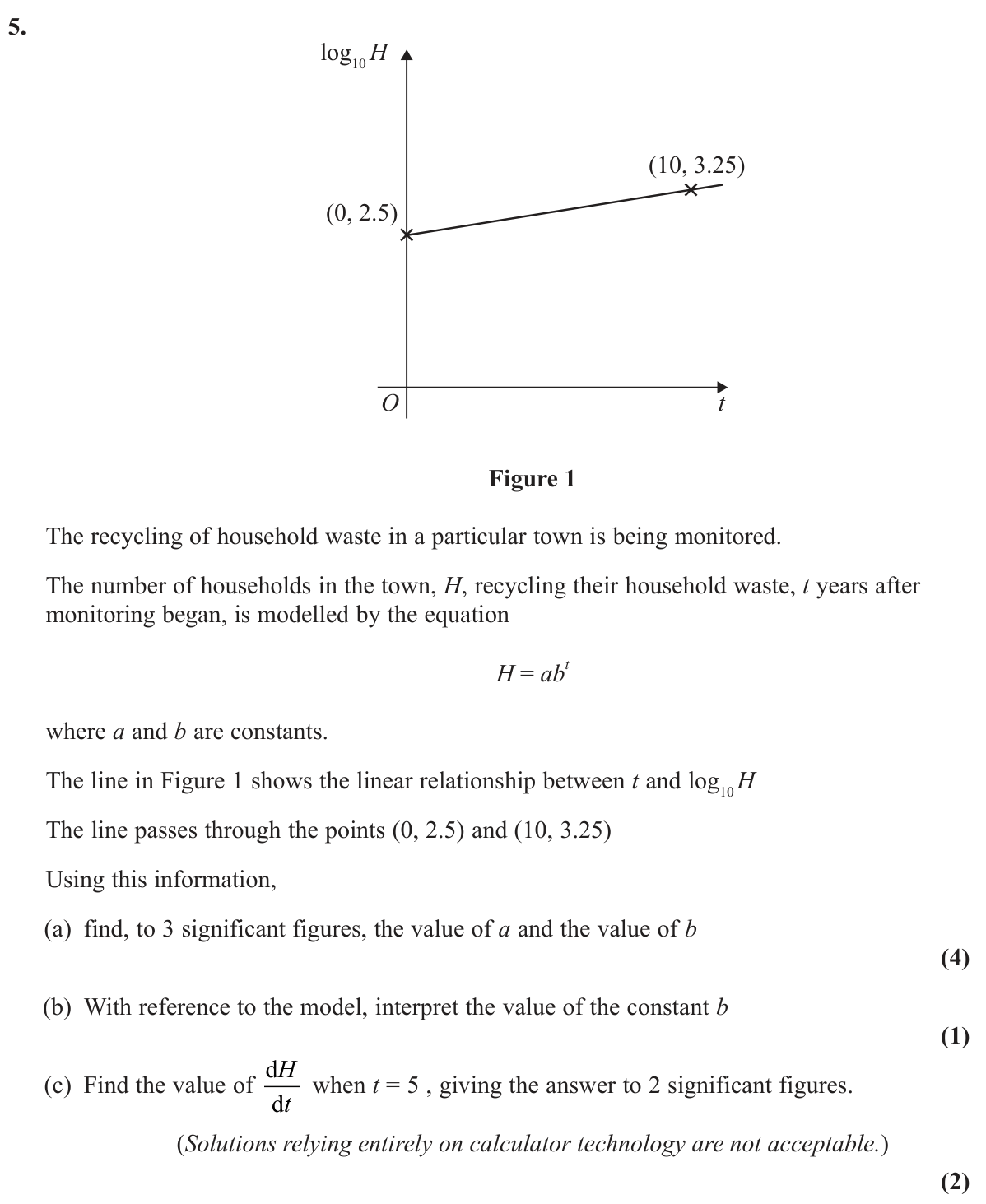
14. WMA13/01 May/June 2026 · Q5

Medium7 marks
WMA13/01 May/June 2026 Question 5 (7 marks): Log Graphs and Models
Show worked solution
  1. Part (a)

    Taking base-10 logarithms gives

    \[\log_{10}H=\log_{10}a+t\log_{10}b.\]

    The vertical intercept is $2.5$ and the gradient is $\dfrac{3.25-2.5}{10-0}=0.075$. Therefore

    \[a=10^{2.5}=316.227766\ldots,\qquad b=10^{0.075}=1.188502227\ldots.\]

    To 3 significant figures, $\boxed{a=316,\quad b=1.19}$.

  2. Part (b)

    Each year the model multiplies the number of recycling households by $b$. This means an increase of approximately $\boxed{19\%\text{ per year}}$ (about $18.85\%$ using the unrounded value).

  3. Part (c)

    Retain the unrounded constants:

    \[H=10^{2.5+0.075t},\qquad \frac{dH}{dt}=0.075\ln(10)\,10^{2.5+0.075t}.\]

    At $t=5$ this is $129.5021421\ldots$, hence

    \[\boxed{\frac{dH}{dt}=1.3\times10^2\text{ households per year}}\]

    to 2 significant figures.

Final answer

(a) $a=316,\quad b=1.19$ (b) $19\%\text{ per year}$ (c) $\frac{dH}{dt}=1.3\times10^2\text{ households per year}$

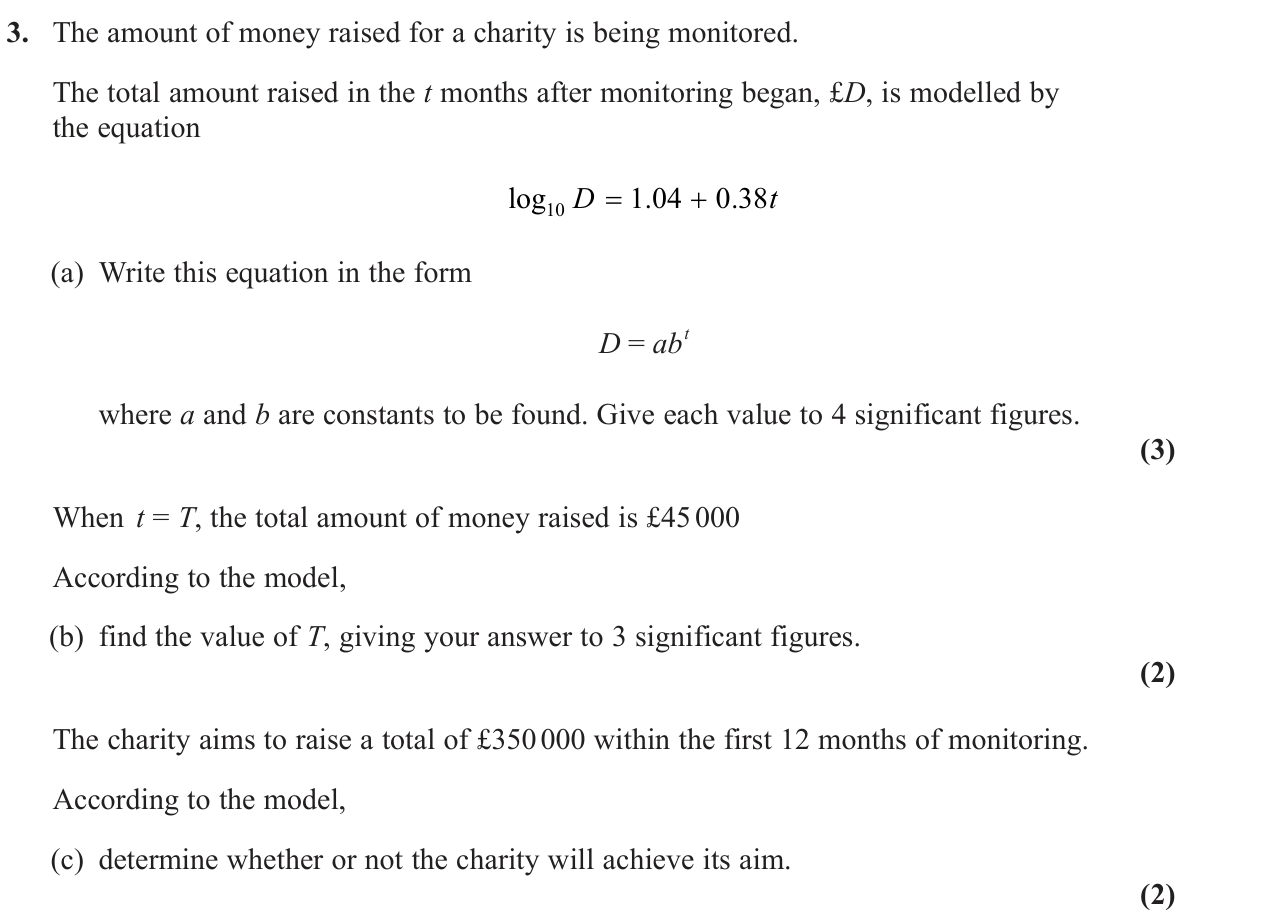
15. WMA13/01 January 2024 · Q3

Medium7 marks
WMA13/01 January 2024 Question 3 (7 marks): Log Graphs and Models
Show worked solution
  1. Part (a)

    Exponentiating in base 10,

    \[D=10^{1.04+0.38t}=10^{1.04}(10^{0.38})^t.\]

    Thus $a=10^{1.04}=10.96478196\ldots$ and $b=10^{0.38}=2.398832919\ldots$. To four significant figures the displayed model is $D\approx10.96(2.399)^t$.

    \[\boxed{a=10.96,\quad b=2.399}\]
  2. Part (b)

    Use the original unrounded logarithmic model:

    \[\log_{10}45000=1.04+0.38T, \qquad T=\frac{\log_{10}45000-1.04}{0.38}=9.508453984\ldots.\]
    \[\boxed{T=9.51\ \text{months}}\]
  3. Part (c)

    At 12 months,

    \[D(12)=10^{1.04+0.38(12)}=10^{5.6}=398107.17\ldots.\]

    This exceeds the target of 350000 pounds. The model is increasing because $10^{0.38}\gt 1$, so the target is reached within the first 12 months.

    \[\boxed{\text{Yes: }D(12)\approx398107\gt 350000}\]
Final answer

(a) $a=10.96,\quad b=2.399$ (b) $T=9.51\ \text{months}$ (c) $\text{Yes: }D(12)\approx398107\gt 350000$

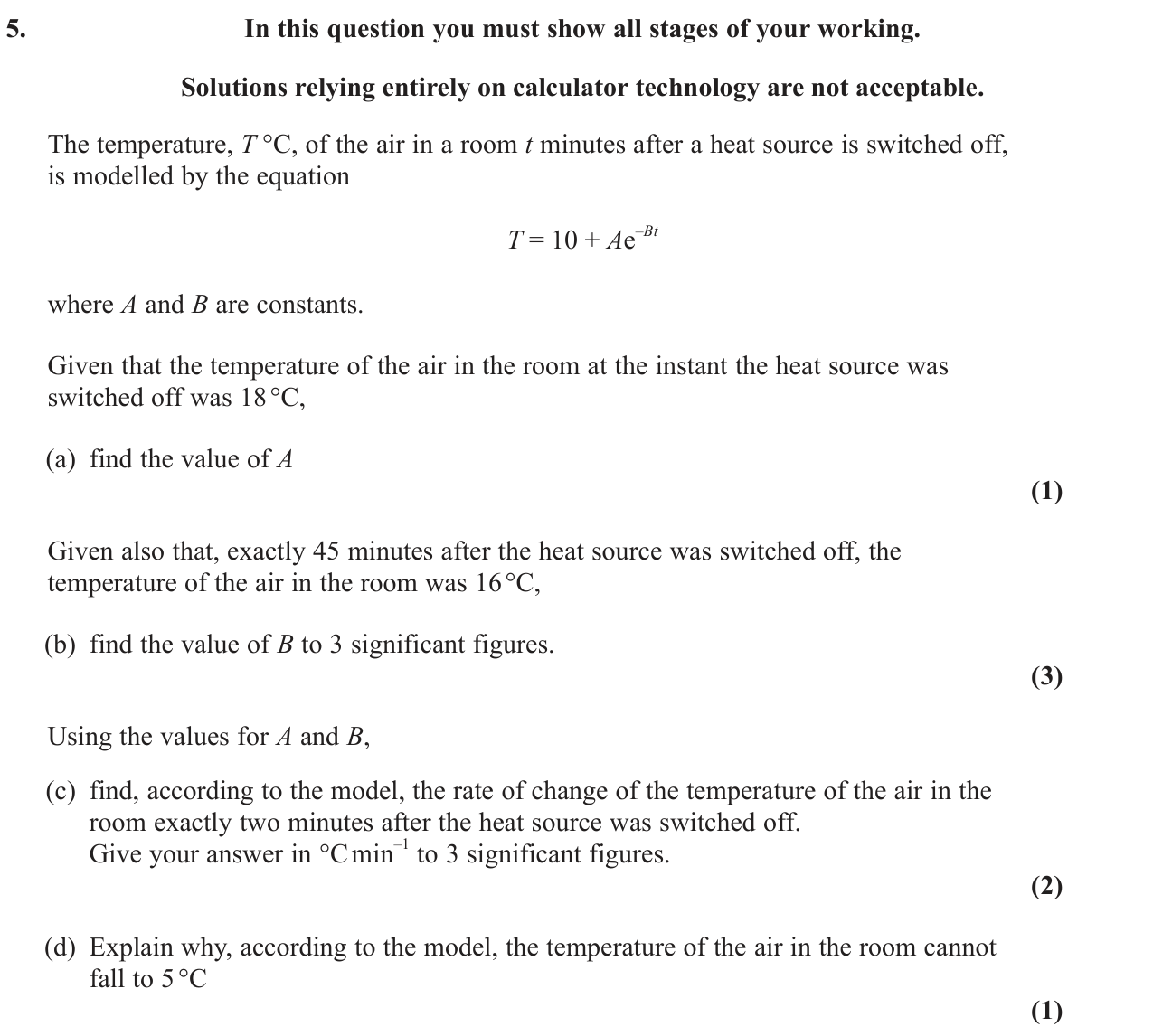
16. WMA13/01 January 2024 · Q5

Medium7 marks
WMA13/01 January 2024 Question 5 (7 marks): Log Graphs and Models
Show worked solution
  1. Part (a)

    At $t=0$, $18=10+Ae^0=10+A$.

    \[\boxed{A=8}\]
  2. Part (b)

    At $t=45$, $16=10+8e^{-45B}$, so $e^{-45B}=6/8=3/4$. Taking logarithms,

    \[-45B=\ln(3/4),\qquad B=\frac{\ln(4/3)}{45}=0.006392934943\ldots.\]
    \[\boxed{B=0.00639}\]
  3. Part (c)

    Differentiate $T=10+8e^{-Bt}$:

    \[\frac{dT}{dt}=-8Be^{-Bt}.\]

    At $t=2$, using the unrounded value $B=\ln(4/3)/45$, $dT/dt=-0.05049372834\ldots$. The negative sign means the temperature is falling.

    \[\boxed{\frac{dT}{dt}=-0.0505\ ^\circ\mathrm{C}\,\mathrm{min}^{-1}}\]
  4. Part (d)

    For every finite $t\ge0$, $8e^{-Bt}\gt 0$ because $B\gt 0$. Thus $T=10+8e^{-Bt}\gt 10$; as $t\to\infty$, T approaches 10 from above. It therefore cannot reach 5 degrees Celsius.

    \[\boxed{T\gt 10\gt 5}\]
Final answer

(a) $A=8$ (b) $B=0.00639$ (c) $\frac{dT}{dt}=-0.0505\ ^\circ\mathrm{C}\,\mathrm{min}^{-1}$ (d) $T\gt 10\gt 5$

17. WMA13/01 October 2023 · Q4

Medium7 marks
WMA13/01 October 2023 Question 4 (7 marks): Log Graphs and Models
Show worked solution
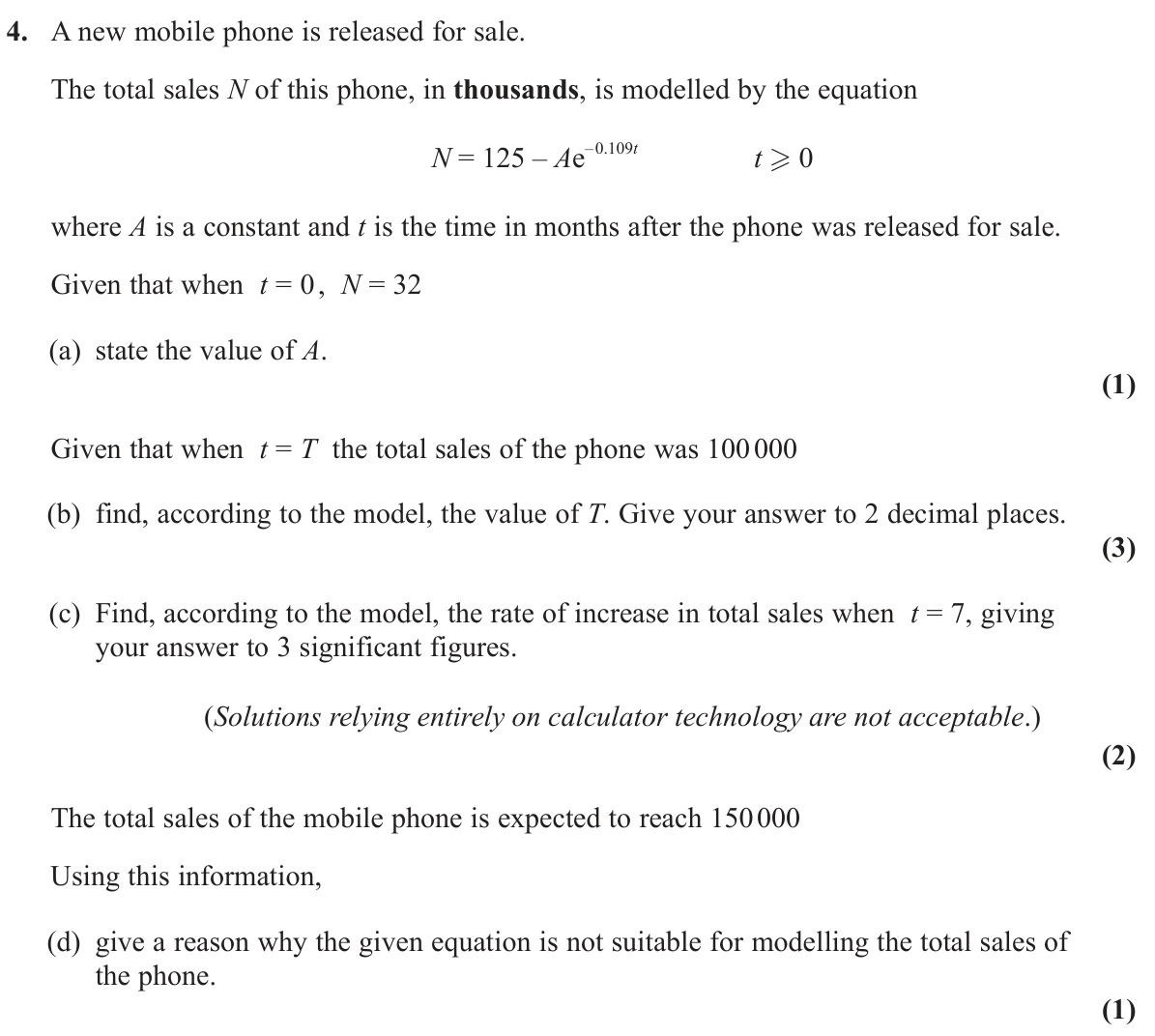
  1. Part (a)

    Initially $t=0$ and $N=32$, because $N$ is measured in thousands.

    \[32=125-Ae^0=125-A.\]
    \[\boxed{A=93}\]
  2. Part (b)

    For 100000 phones, use $N=100$:

    \[100=125-93e^{-0.109T}\quad\Longrightarrow\quad e^{-0.109T}=\frac{25}{93}.\]

    Taking natural logarithms,

    \[T=\frac{\ln(93/25)}{0.109}=12.0525107\ldots\ \text{months}.\]
    \[\boxed{T=12.05\ \text{months}}\]
  3. Part (c)

    Differentiate the model:

    \[\frac{dN}{dt}=93(0.109)e^{-0.109t}.\]

    At $t=7$, this is $4.7265337\ldots$ thousand phones per month. Multiplying by 1000 gives $4726.5337\ldots$ phones per month.

    \[\boxed{4.73\times10^3\ \text{phones per month}}\]
  4. Part (d)

    For $t\ge0$, $93e^{-0.109t}\gt 0$, so $N\lt 125$ and $N\to125$ as $t\to\infty$. The model can therefore never reach 150000 phones: its limiting count is 125000.

    \[\boxed{\text{No: the limiting count is }125000\text{ phones.}}\]
Final answer

(a) $A=93$ (b) $T=12.05\ \text{months}$ (c) $4.73\times10^3\ \text{phones per month}$ (d) $\text{No: the limiting count is }125000\text{ phones.}$

18. WMA13/01 May/June 2022 · Q4

Medium7 marks
WMA13/01 May/June 2022 Question 4 (7 marks): Log Graphs and Models
Show worked solution
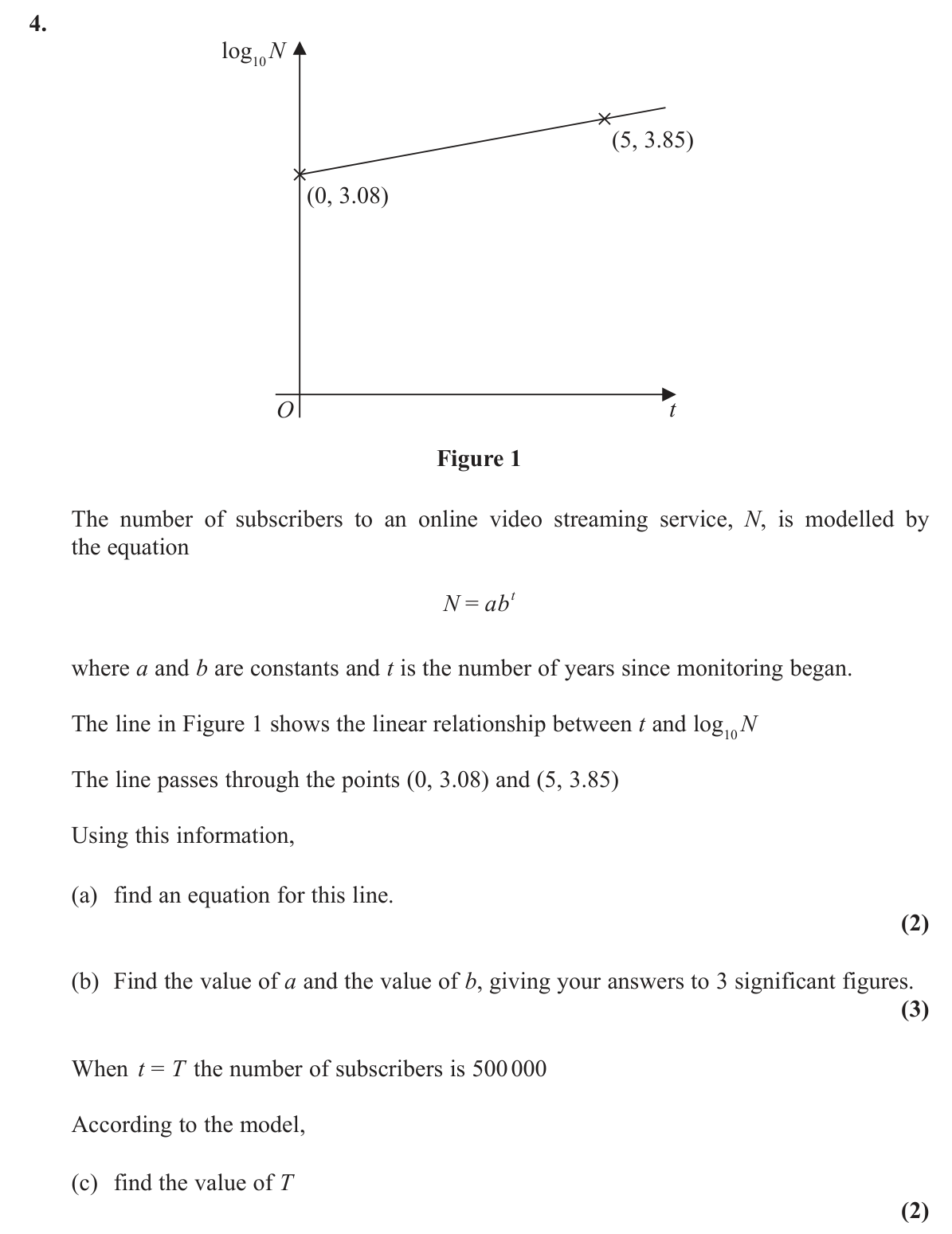
  1. Part (a)

    The slope is $(3.85-3.08)/(5-0)=0.154$ and the vertical intercept is 3.08. The plotted vertical coordinate is $\log_{10}N$, not N.

    \[\boxed{\log_{10}N=0.154t+3.08}\]
  2. Part (b)

    Taking logs of $N=ab^t$ gives $\log_{10}N=\log_{10}a+t\log_{10}b$. Compare with (a): $\log_{10}a=3.08$ and $\log_{10}b=0.154$. Thus $a=10^{3.08}=1202.2644\ldots$ and $b=10^{0.154}=1.4256076\ldots$. To three significant figures:

    \[\boxed{a=1.20\times10^3,\qquad b=1.43}\]
  3. Part (c)

    Use the unrounded logarithmic model to avoid rounding drift:

    \[\log_{10}(500000)=0.154T+3.08 \quad\Longrightarrow\quad T=\frac{\log_{10}(500000)-3.08}{0.154} =17.0062987\ldots.\]
    \[\boxed{T=17.0\ \text{years}}\]
Final answer

(a) $\log_{10}N=0.154t+3.08$ (b) $a=1.20\times10^3,\qquad b=1.43$ (c) $T=17.0\ \text{years}$

19. WMA13/01 January 2022 · Q4

Medium7 marks
WMA13/01 January 2022 Question 4 (7 marks): Log Graphs and Models
Show worked solution
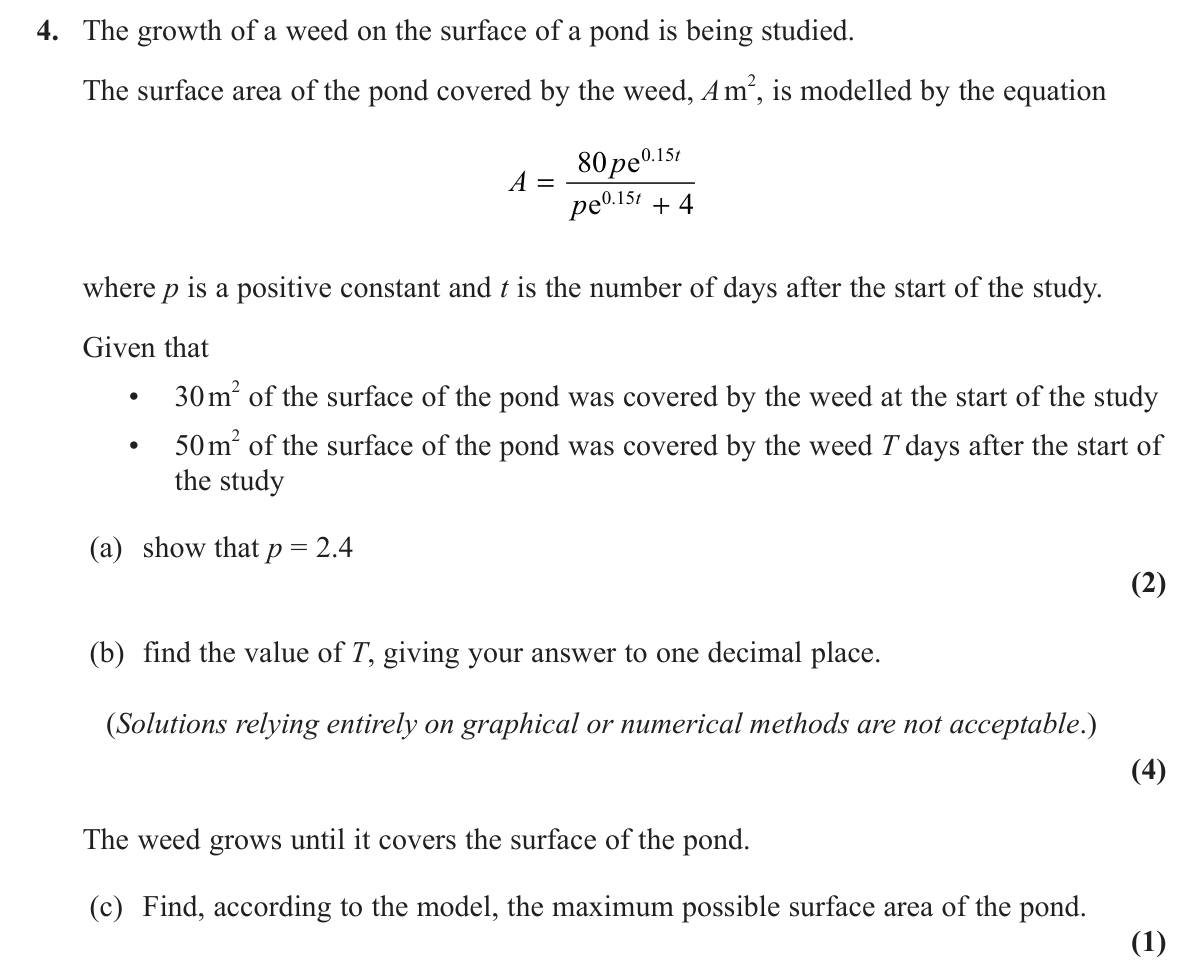
  1. Part (a)

    At $t=0$, the model gives $30=80p/(p+4)$. Thus $30p+120=80p$, so $50p=120$ and $p=2.4\gt 0$.

    \[\boxed{p=2.4}\]
  2. Part (b)

    Put $E=e^{0.15T}$ and use $p=2.4$. At area $50\,\mathrm{m^2}$,

    \[50=\frac{192E}{2.4E+4}\quad\Longrightarrow\quad 120E+200=192E\quad\Longrightarrow\quad E=\frac{25}{9}.\]

    Taking natural logarithms gives $0.15T=\ln(25/9)$, so $T=\ln(25/9)/0.15=6.8110083\ldots$ days.

    \[\boxed{T=6.8\ \text{days}}\]
  3. Part (c)

    Divide numerator and denominator by $pe^{0.15t}$: $A=80/(1+(4/p)e^{-0.15t})\longrightarrow80$ as $t\longrightarrow\infty$. Thus the model's limiting pond surface area is $80\,\mathrm{m^2}$; the finite-time covered area approaches this value from below.

    \[\boxed{80\ \mathrm{m^2}}\]
Final answer

(a) $p=2.4$ (b) $T=6.8\ \text{days}$ (c) $80\ \mathrm{m^2}$

20. WMA13/01 May/June 2021 · Q5

Medium7 marks
WMA13/01 May/June 2021 Question 5 (7 marks): Log Graphs and Models
Show worked solution
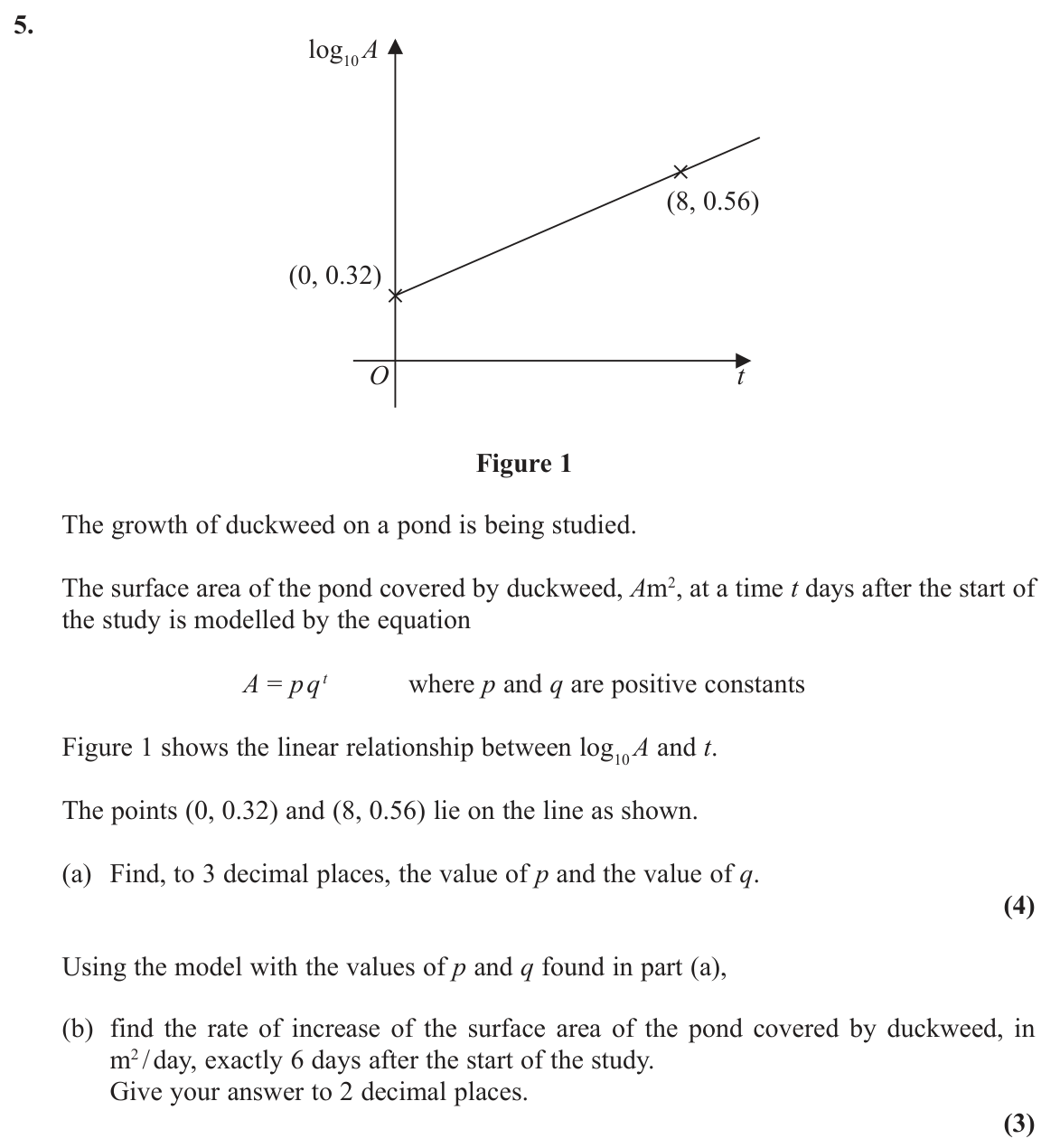
  1. Part (a)

    Taking base-ten logarithms gives $\log_{10}A=\log_{10}p+t\log_{10}q$. The intercept is 0.32 and the gradient is $(0.56-0.32)/8=0.03$. Thus $p=10^{0.32}=2.08929613\ldots$ and $q=10^{0.03}=1.071519305\ldots$.

    \[\boxed{p=2.089,\qquad q=1.072}\]
  2. Part (b)

    Using the parameter values requested in (a), $A=2.089(1.072)^t$. For an arbitrary positive base, $d(q^t)/dt=q^t\ln q$, so

    \[A'(6)=2.089(1.072)^6\ln(1.072)=0.2204219233\ldots.\]

    This is a positive area increase per day. Retaining unrounded parameters also gives 0.22 to two decimal places.

    \[\boxed{0.22\ \mathrm{m^2/day}}\]
Final answer

(a) $p=2.089,\qquad q=1.072$ (b) $0.22\ \mathrm{m^2/day}$

21. WMA13/01 January 2021 · Q8

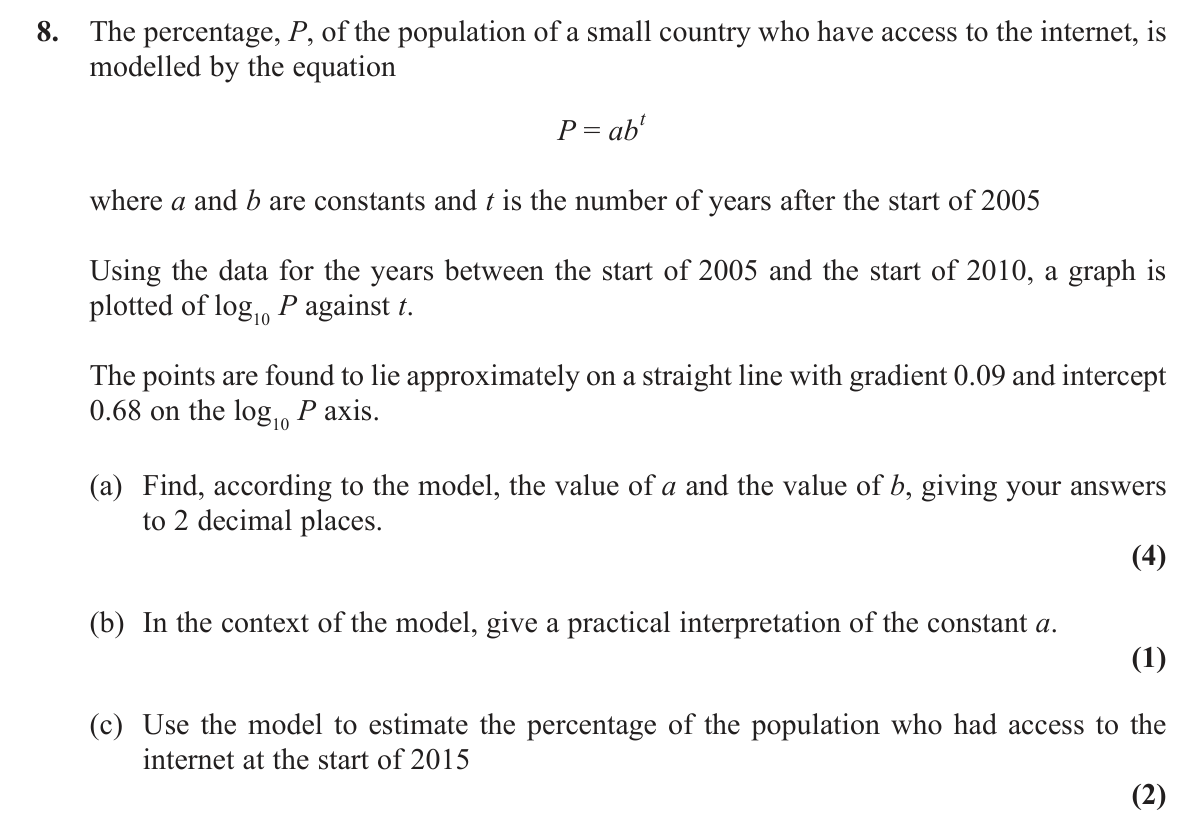
Medium7 marks
WMA13/01 January 2021 Question 8 (7 marks): Log Graphs and Models
Show worked solution
  1. Part (a)

    Taking logarithms gives $\log_{10}P=\log_{10}a+t\log_{10}b$. Match the intercept and gradient: $\log_{10}a=0.68$, $\log_{10}b=0.09$. Thus $a=10^{0.68}=4.786300923\ldots$ and $b=10^{0.09}=1.230268771\ldots$.

    \[\boxed{a=4.79,\qquad b=1.23}\]
  2. Part (b)

    At $t=0$, $P=a$. Thus a is the percentage of the country's population with internet access at the start of 2005, approximately $4.79\%$.

    \[\boxed{\text{Initial percentage with internet access at the start of 2005}}\]
  3. Part (c)

    The start of 2015 is $t=10$ years after the start of 2005. Using the model parameters, $P=4.79(1.23)^{10}=37.9652818\ldots\%$, giving $38.0\%$ to three significant figures. Using unrounded parameters gives $10^{0.68+0.09(10)}=38.0189396\ldots\%$, the same rounded answer.

    \[\boxed{38.0\%}\]
Final answer

(a) $a=4.79,\qquad b=1.23$ (b) $\text{Initial percentage with internet access at the start of 2005}$ (c) $38.0\%$

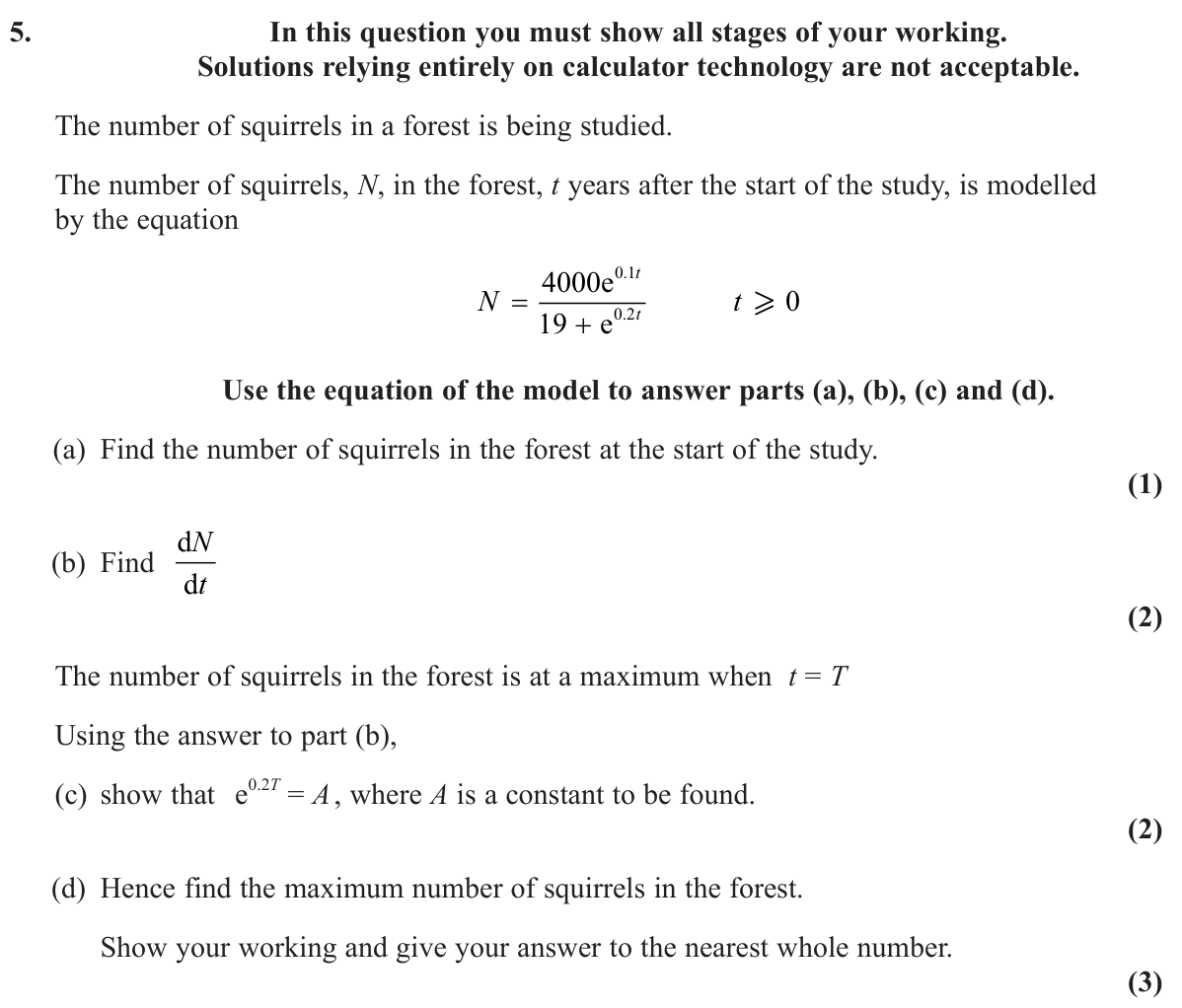
22. WMA13/01 October 2025 · Q5

Medium8 marks
WMA13/01 October 2025 Question 5 (8 marks): Log Graphs and Models
Show worked solution
  1. Part (a)

    At $t=0$, $N=4000/(19+1)=200$ squirrels.

  2. Part (b)

    The quotient rule gives

    \[\frac{dN}{dt} =\frac{400e^{0.1t}(19+e^{0.2t})-800e^{0.3t}} {(19+e^{0.2t})^2} =\frac{400e^{0.1t}(19-e^{0.2t})}{(19+e^{0.2t})^2}.\]
  3. Part (c)

    At $t=T$, the derivative is zero. The exponential and denominator are positive, so $19-e^{0.2T}=0$. Therefore $e^{0.2T}=19$ and $A=19$. The derivative is positive before $T$ and negative after $T$, confirming a maximum.

  4. Part (d)

    Since $e^{0.2T}=19$, we have $e^{0.1T}=\sqrt{19}$. Substitution into the model gives

    \[N_{\max}=\frac{4000\sqrt{19}}{19+19} =\frac{2000}{\sqrt{19}}=458.831467741\ldots.\]

    The maximum number is $459$ squirrels to the nearest whole number.

Final answer

(a) $200$ (b) $400*exp(t/10)*(19-exp(t/5))/(19+exp(t/5))^2$ (c) $exp(T/5)=19$ (d) $459$

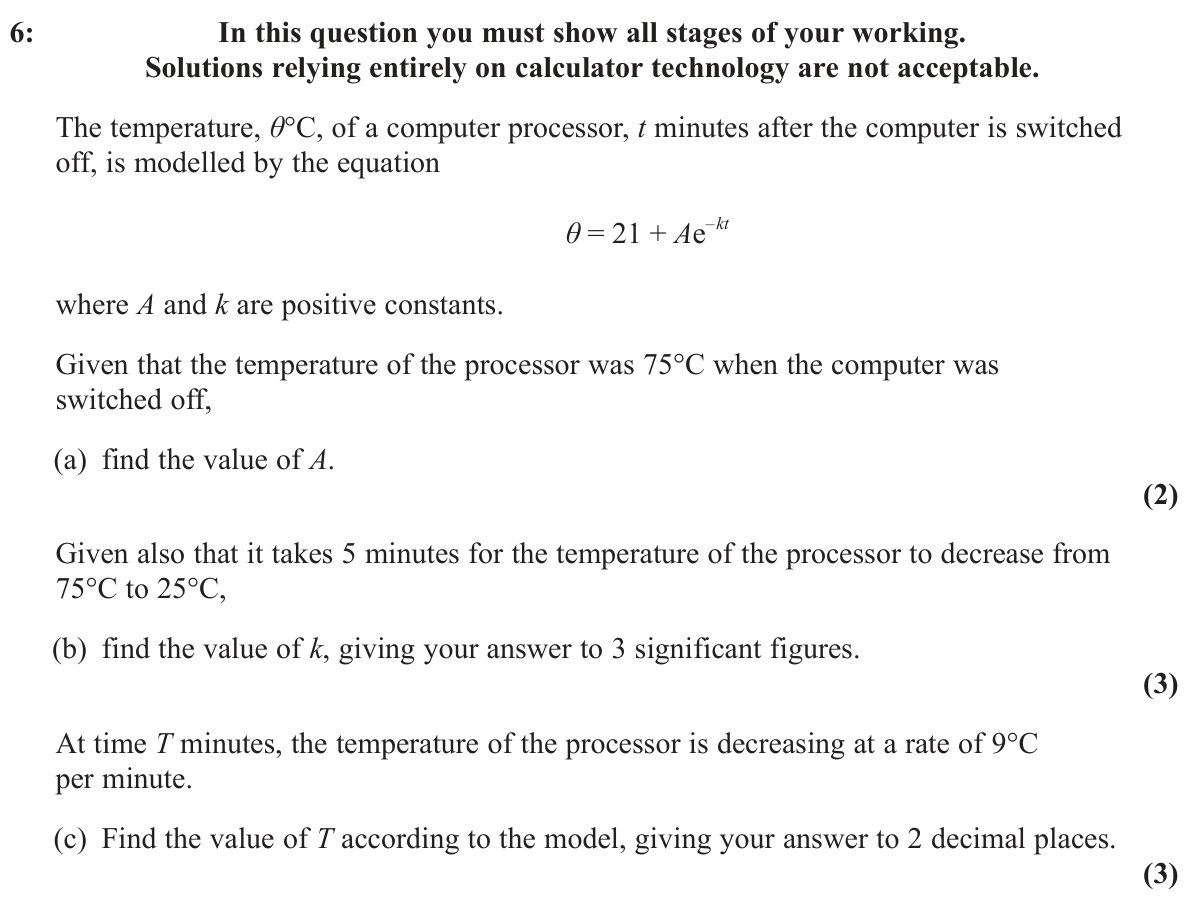
23. WMA13/01 May/June 2025 · Q6

Medium8 marks
WMA13/01 May/June 2025 Question 6 (8 marks): Log Graphs and Models
Show worked solution
  1. Part (a)

    At $t=0$, $75=21+A$, so $\boxed{A=54}$.

  2. Part (b)

    At $t=5$, $25=21+54e^{-5k}$, hence

    \[e^{-5k}=\frac2{27},\qquad k=\frac15\ln\frac{27}{2}=0.520537937\ldots=\boxed{0.521}.\]
  3. Part (c)

    Differentiate the temperature model:

    \[\frac{d\theta}{dt}=-54ke^{-kt}.\]

    A decrease of $9\,{}^{\circ}\mathrm{C}$ per minute means $d\theta/dt=-9$, not $+9$. Thus

    \[-54ke^{-kT}=-9\ \Longrightarrow\ e^{-kT}=\frac1{6k} \ \Longrightarrow\ T=\frac{\ln(6k)}{k}.\]

    Using the unrounded value of $k$,

    \[T=2.187865\ldots=\boxed{2.19\text{ minutes}}.\]
Final answer

(a) $A=54$ (b) $0.521$ (c) $2.19\text{ minutes}$

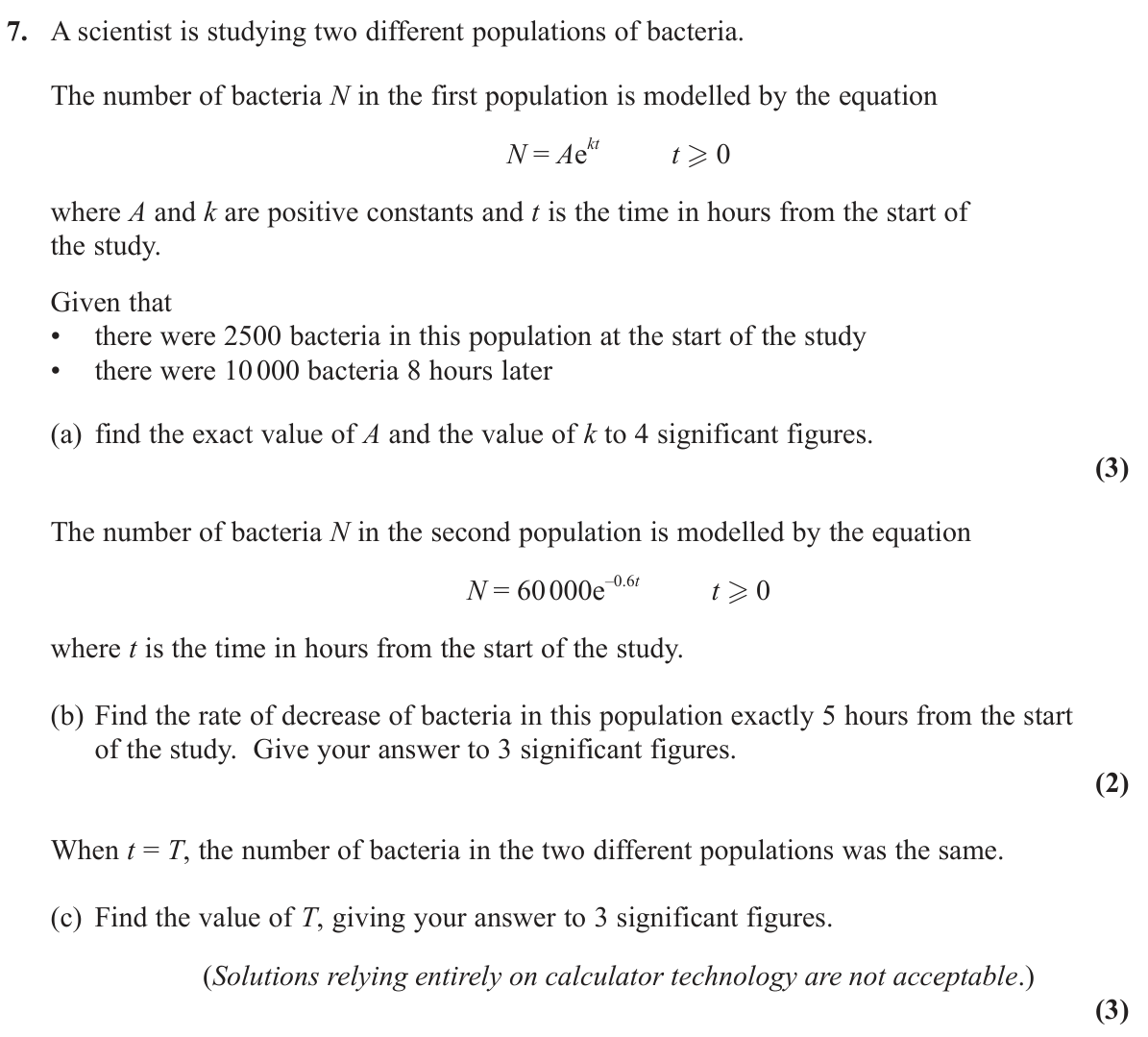
24. WMA13/01 May/June 2023 · Q7

Medium8 marks
WMA13/01 May/June 2023 Question 7 (8 marks): Log Graphs and Models
Show worked solution
  1. Part (a)

    At $t=0$, $2500=Ae^0$, so $A=2500$ exactly. At $t=8$, $10000=2500e^{8k}$; hence $e^{8k}=4$ and $k=\ln4/8=0.1732867951\ldots$. To four significant figures:

    \[\boxed{A=2500,\qquad k=0.1733}\]
  2. Part (b)

    For the second population,

    \[\frac{dN}{dt}=-36000e^{-0.6t},\qquad \left.\frac{dN}{dt}\right|_{t=5}=-36000e^{-3}=-1792.334461\ldots.\]

    The requested rate of decrease is the positive magnitude, to three significant figures.

    \[\boxed{1.79\times10^3\ \text{bacteria per hour}}\]
  3. Part (c)

    Retain the exact value $k=\ln4/8$. Equating populations gives

    \[2500e^{kT}=60000e^{-0.6T}\quad\Longrightarrow\quad e^{(k+0.6)T}=24.\]

    Take natural logs and solve:

    \[T=\frac{\ln24}{0.6+\ln4/8}=4.109799689\ldots\ \text{hours}.\]
    \[\boxed{T=4.11\ \text{hours}}\]
Final answer

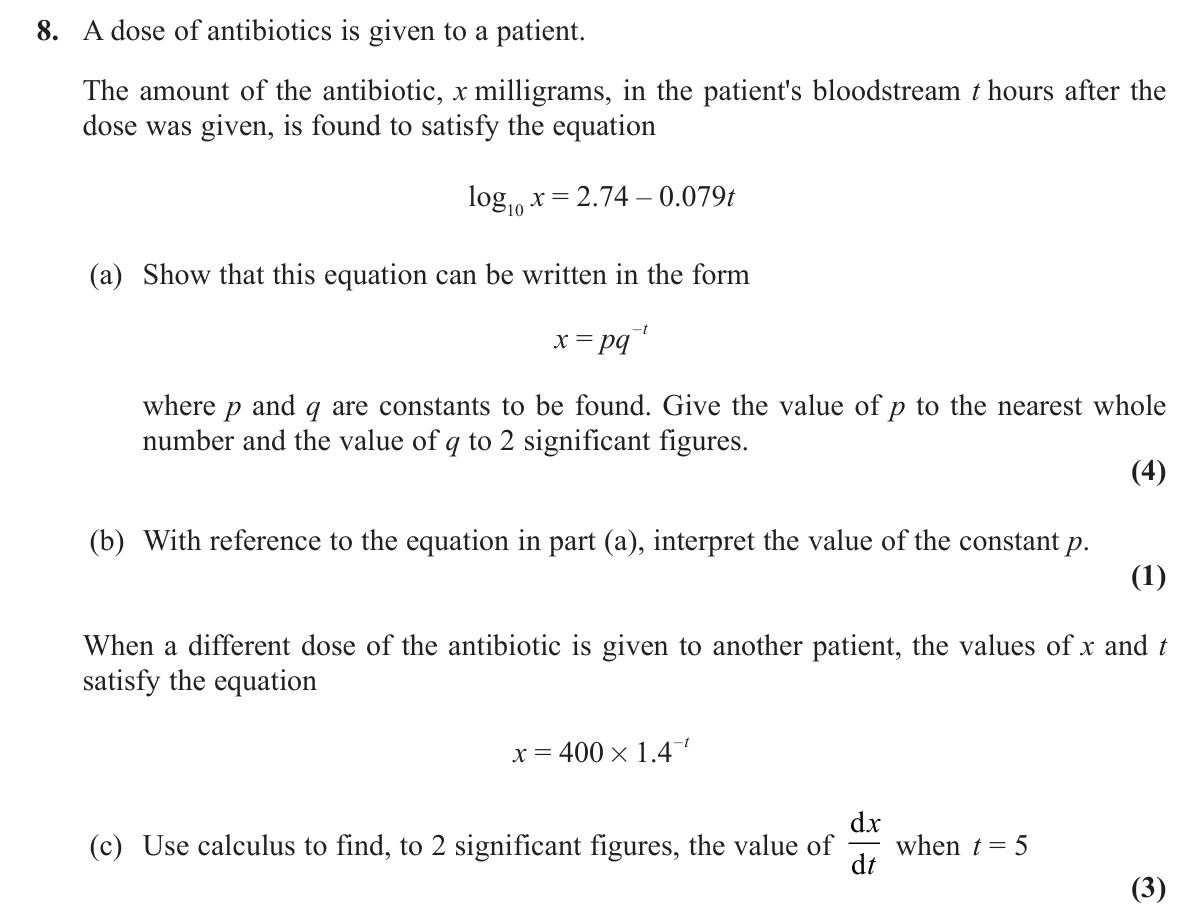
(a) $A=2500,\qquad k=0.1733$ (b) $1.79\times10^3\ \text{bacteria per hour}$ (c) $T=4.11\ \text{hours}$

25. WMA13/01 January 2022 · Q8

Medium8 marks
WMA13/01 January 2022 Question 8 (8 marks): Log Graphs and Models
Show worked solution
  1. Part (a)

    Exponentiate base 10:

    \[x=10^{2.74-0.079t}=10^{2.74}(10^{0.079})^{-t}.\]

    Thus $p=10^{2.74}=549.5408739\ldots$ and $q=10^{0.079}=1.199499303\ldots$. Round p to the nearest integer and q to two significant figures.

    \[\boxed{p=550,\qquad q=1.2}\]
  2. Part (b)

    At $t=0$, $x=pq^0=p$. Thus p is the initial amount of antibiotic in the patient's bloodstream, approximately 550 milligrams immediately after the dose in this model.

    \[\boxed{p\text{ represents the initial amount, approximately }550\ \mathrm{mg}}\]
  3. Part (c)

    For the second patient, write $x=400e^{-t\ln1.4}$. Differentiate to obtain $dx/dt=-400\ln(1.4)\,1.4^{-t}$. At $t=5$, the derivative is $-25.02470969\ldots\,\mathrm{mg\,h^{-1}}$. The negative sign indicates the amount is decreasing.

    \[\boxed{\left.\frac{dx}{dt}\right|_{t=5}=-25\ \mathrm{mg\,h^{-1}}}\]
Final answer

(a) $p=550,\qquad q=1.2$ (b) $p\text{ represents the initial amount, approximately }550\ \mathrm{mg}$ (c) $\left.\frac{dx}{dt}\right|_{t=5}=-25\ \mathrm{mg\,h^{-1}}$

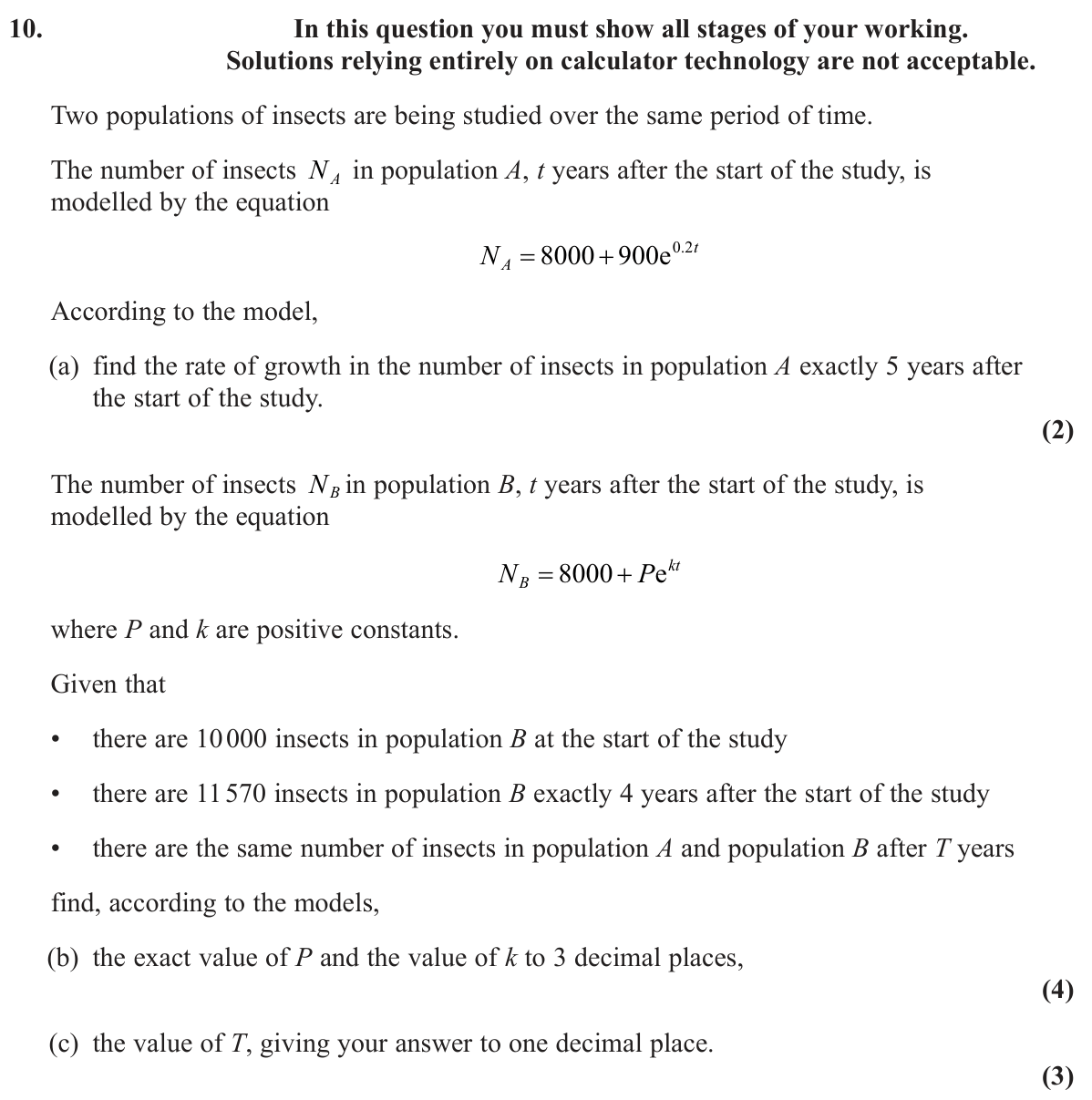
26. WMA13/01 January 2026 · Q10

Hard9 marks
WMA13/01 January 2026 Question 10 (9 marks): Log Graphs and Models
Show worked solution
  1. Part (a)
    \[\frac{dN_A}{dt}=900(0.2)e^{0.2t}=180e^{0.2t}.\]

    At $t=5$, the growth rate is $180e=489.290729\ldots$ insects per year.

  2. Part (b)

    At $t=0$, $10000=8000+P$, so $P=2000$ exactly. Using the population at $t=4$,

    \[11570=8000+2000e^{4k} \quad\Longrightarrow\quad e^{4k}=\frac{3570}{2000}=1.785.\]

    Taking natural logarithms,

    \[k=\frac{\ln1.785}{4}=0.144854604\ldots=0.145\quad\text{(3 d.p.)}.\]
  3. Part (c)

    At equality, $8000+900e^{0.2T}=8000+2000e^{kT}$, hence

    \[e^{(0.2-k)T}=\frac{20}{9},\qquad T=\frac{\ln(20/9)}{0.2-k}.\]

    Use the unrounded value $k=\ln(1.785)/4$:

    \[T=14.480042784\ldots=14.5\text{ years (1 decimal place)}.\]
Final answer

(a) $180e\text{ insects per year}$ (b) $P=2000,\ k=0.145\text{ (3 d.p.)}$ (c) $14.5\text{ years}$

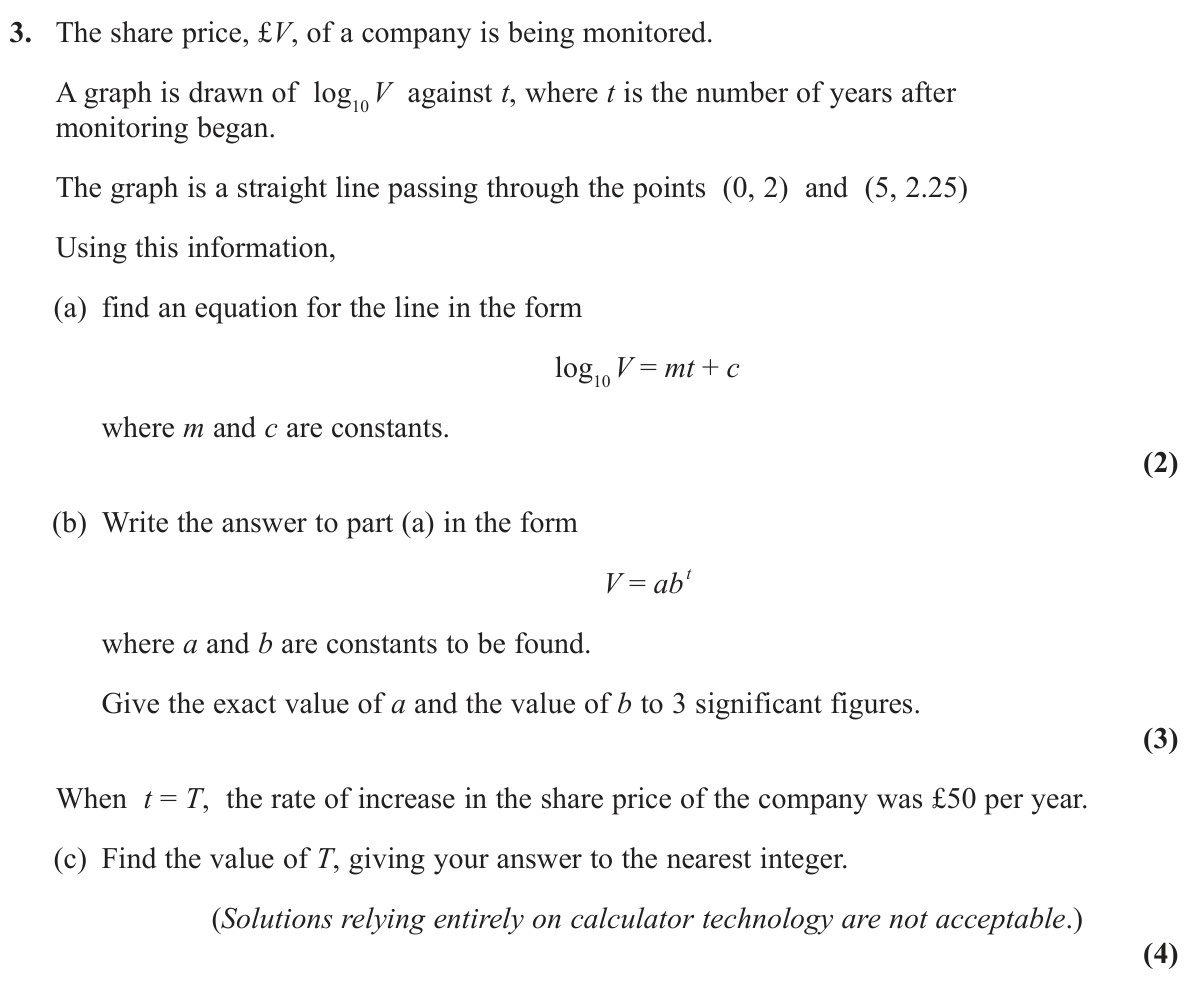
27. WMA13/01 October 2025 · Q3

Hard9 marks
WMA13/01 October 2025 Question 3 (9 marks): Log Graphs and Models
Show worked solution
  1. Part (a)

    The gradient is $(2.25-2)/(5-0)=0.05$ and the vertical intercept is $2$. Hence $\log_{10}V=0.05t+2$.

  2. Part (b)
    \[V=10^{0.05t+2}=100(10^{0.05})^t.\]

    Thus $a=100$ exactly and $b=10^{0.05}=1.122018454\ldots=1.12$ to three significant figures. In the requested rounded-parameter form, $V=100(1.12)^t$; retain the unrounded base for later calculations.

  3. Part (c)

    Differentiating the unrounded model,

    \[\frac{dV}{dt}=100(0.05\ln10)\,10^{0.05t}=5\ln10\,10^{0.05t}.\]

    At $t=T$ this equals $50$, so

    \[10^{0.05T}=\frac{10}{\ln10},\qquad T=\frac{\ln(10/\ln10)}{0.05\ln10}=12.755686226\ldots.\]

    Therefore $T=13$ years to the nearest integer.

Final answer

(a) $log10(V)=0.05*t+2$ (b) $V=100*(1.12)^t$ (c) $13$

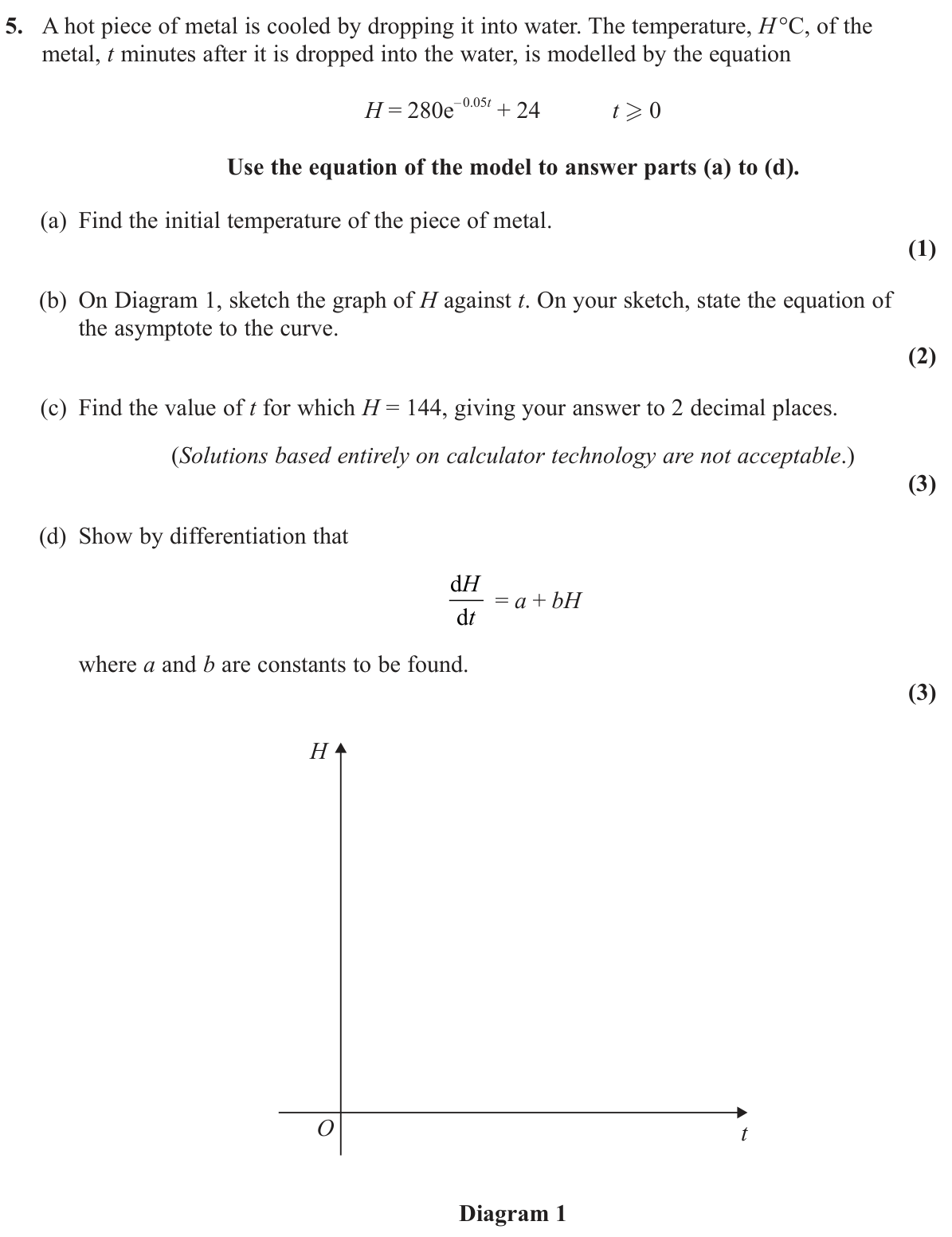
28. WMA13/01 January 2025 · Q5

Hard9 marks
WMA13/01 January 2025 Question 5 (9 marks): Log Graphs and Models
Show worked solution
  1. Part (a)

    At $t=0$, $e^{-0.05t}=1$, so $H=280+24=304$ degrees Celsius.

    \[\boxed{H(0)=304^\circ\mathrm C}\]
  2. Part (b)

    The curve starts at $(0,304)$ and decreases for $t\ge0$. The exponential term stays positive and tends to zero, so the curve approaches $H=24$ from above without crossing it.

    \[\boxed{H=24\text{ is the horizontal asymptote}}\]
  3. Part (c)

    Substitute $H=144$:

    \[144=280e^{-0.05t}+24\ \Longrightarrow\ e^{-0.05t}=\frac{120}{280}=\frac37.\]

    Take natural logarithms: $-0.05t=\ln(3/7)$. Hence $t=-20\ln(3/7)=20\ln(7/3)=16.9459572077\ldots$ minutes.

    \[\boxed{t=16.95\text{ minutes}}\]
  4. Part (d)

    Differentiate using the chain rule:

    \[\frac{dH}{dt}=-0.05(280)e^{-0.05t}=-14e^{-0.05t}.\]

    The original equation gives $280e^{-0.05t}=H-24$, so

    \[\frac{dH}{dt}=-0.05(H-24)=1.2-0.05H.\]
    \[\boxed{a=1.2,\quad b=-0.05}\]
Final answer

(a) $H(0)=304^\circ\mathrm C$ (b) $H=24\text{ is the horizontal asymptote}$ (c) $t=16.95\text{ minutes}$ (d) $a=1.2,\quad b=-0.05$

29. WMA13/01 January 2023 · Q10

Hard9 marks
WMA13/01 January 2023 Question 10 (9 marks): Log Graphs and Models
Show worked solution
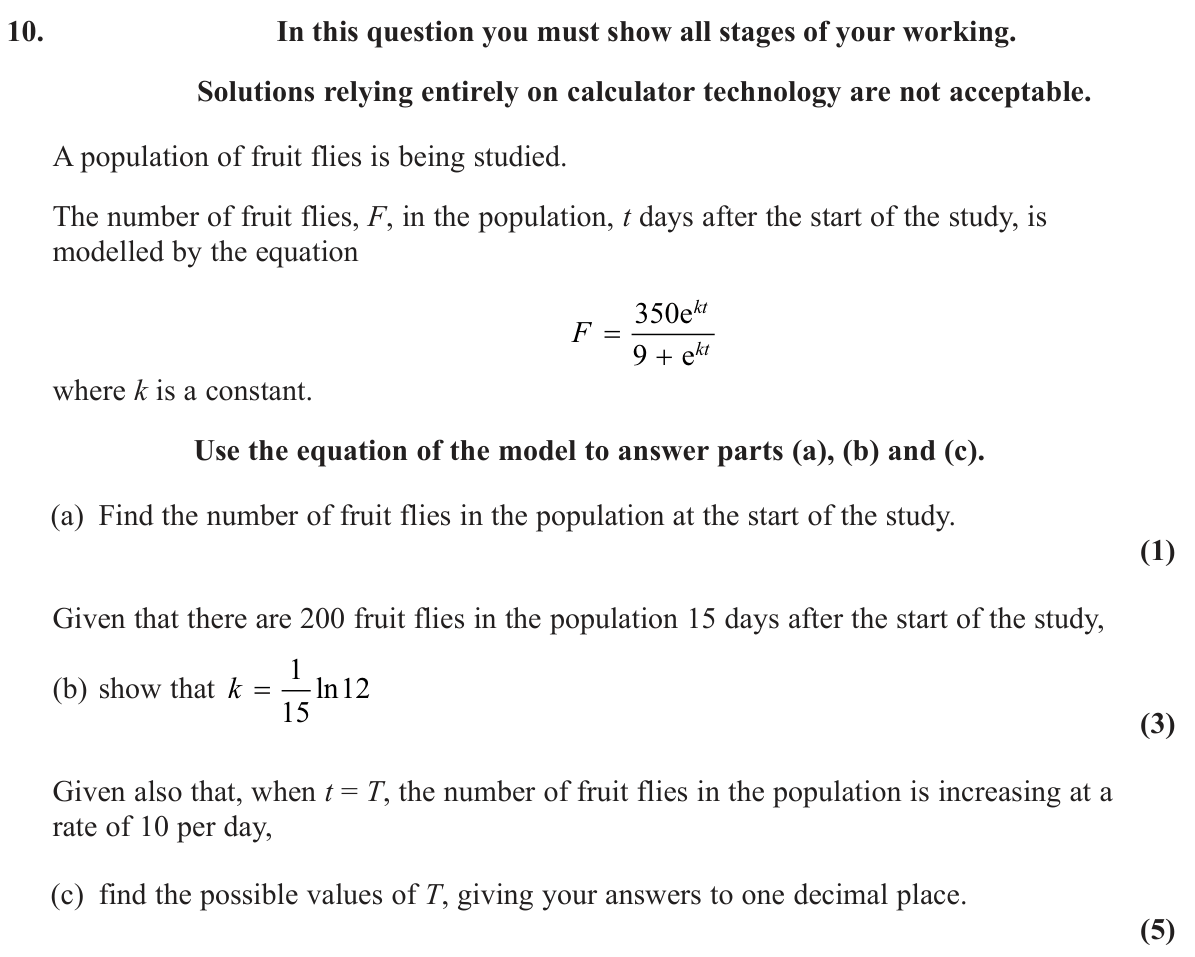
  1. Part (a)

    At the start $t=0$, so $e^{kt}=1$ and the model gives $F(0)=350/(9+1)=35$ fruit flies.

    \[\boxed{F(0)=35}\]
  2. Part (b)

    Using $F(15)=200$,

    \[200=\frac{350e^{15k}}{9+e^{15k}} \quad\Longrightarrow\quad1800+200e^{15k}=350e^{15k} \quad\Longrightarrow\quad e^{15k}=12.\]

    Take natural logs to obtain $15k=\ln12$, as required.

    \[\boxed{k=\frac{\ln12}{15}}\]
  3. Part (c)

    By the quotient rule,

    \[F'(t)=\frac{350ke^{kt}(9+e^{kt})-350ke^{2kt}}{(9+e^{kt})^2} =\frac{3150ke^{kt}}{(9+e^{kt})^2}.\]

    Set $F'(T)=10$ and let $u=e^{kT}\gt 0$. Then

    \[315ku=(9+u)^2\quad\Longrightarrow\quad u^2+(18-315k)u+81=0.\]

    With the exact $k=\ln12/15$, the quadratic formula gives

    \[u=\frac{315k-18\pm\sqrt{(315k-18)^2-324}}2 =2.5615490777\ldots\ \text{or}\ 31.6214905678\ldots.\]

    Both values are positive and at least 1, hence both correspond to $T\ge0$. Finally $T=\ln u/k$ gives $5.6779528361\ldots$ or $20.8488936858\ldots$ days. To one decimal place the two times are as follows.

    \[\boxed{T=5.7\ \text{days},\qquad T=20.8\ \text{days}}\]
Final answer

(a) $F(0)=35$ (b) $k=\frac{\ln12}{15}$ (c) $T=5.7\ \text{days},\qquad T=20.8\ \text{days}$

30. WMA13/01 May/June 2024 · Q8

Hard10 marks
WMA13/01 May/June 2024 Question 8 (10 marks): Log Graphs and Models
Show worked solution
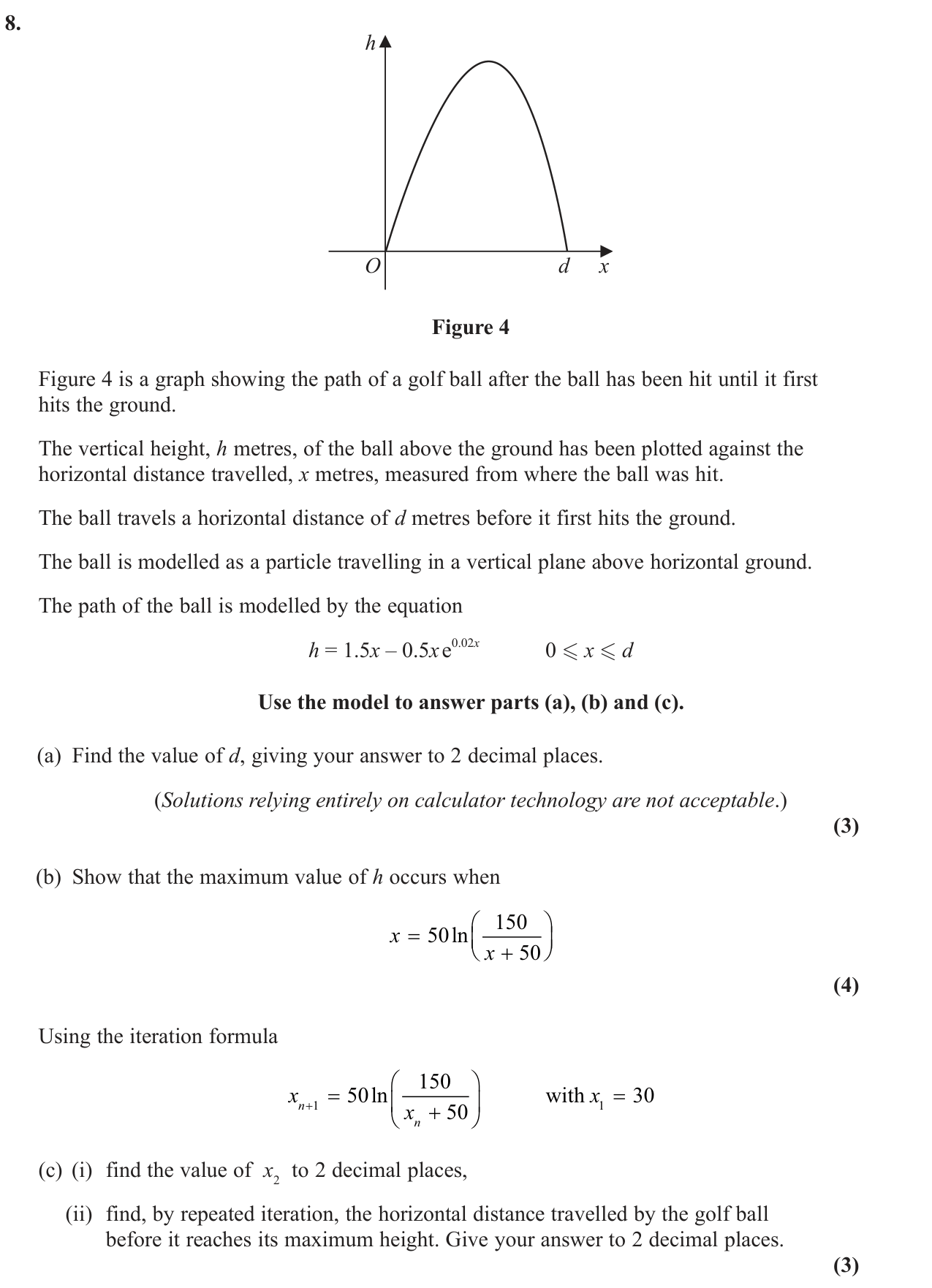
  1. Part (a)

    At the first landing, $h=0$ and $x=d\gt 0$:

    \[0=d(1.5-0.5e^{0.02d}),\qquad e^{0.02d}=3.\]

    Taking logarithms, $0.02d=\ln3$, hence $d=50\ln3=54.930614\ldots$. The root $x=0$ is the launch point, not the landing point.

    \[\boxed{d=54.93\ \text{m}}\]
  2. Part (b)

    By the product and chain rules,

    \[h'(x)=1.5-0.5e^{0.02x}-0.01xe^{0.02x}.\]

    At a stationary point,

    \[1.5=0.01(x+50)e^{0.02x},\qquad e^{0.02x}=\frac{150}{x+50}.\]

    Since $x+50\gt 0$, logarithms give $0.02x=\ln(150/(x+50))$. Also $h”(x)=-(0.02+0.0002x)e^{0.02x}\lt 0$ on $[0,d]$. Thus the stationary point is the unique maximum; the endpoints both have zero height.

    \[\boxed{x=50\ln\left(\frac{150}{x+50}\right)}\]
  3. Part (c)

    (i) With $x_1=30$,

    \[x_2=50\ln\left(\frac{150}{30+50}\right)=31.43043297\ldots.\]

    (ii) Continuing with full intermediate precision gives $x_3=30.54431108\ldots$, $x_4=31.09139065\ldots$, $x_5=30.75292479\ldots$ and $x_6=30.96205562\ldots$. Continued iteration converges to $30.88212\ldots$, which lies in $(0,d)$. This is the horizontal distance at maximum height, not the maximum height itself.

    \[\boxed{x_2=31.43,\quad x_{\mathrm{maximum}}=30.88\ \text{m}}\]
Final answer

(a) $d=54.93\ \text{m}$ (b) $x=50\ln\left(\frac{150}{x+50}\right)$ (c) $x_2=31.43,\quad x_{\mathrm{maximum}}=30.88\ \text{m}$

31. WMA13/01 October 2022 · Q5

Hard11 marks
WMA13/01 October 2022 Question 5 (11 marks): Log Graphs and Models
Show worked solution
  1. Part (a)

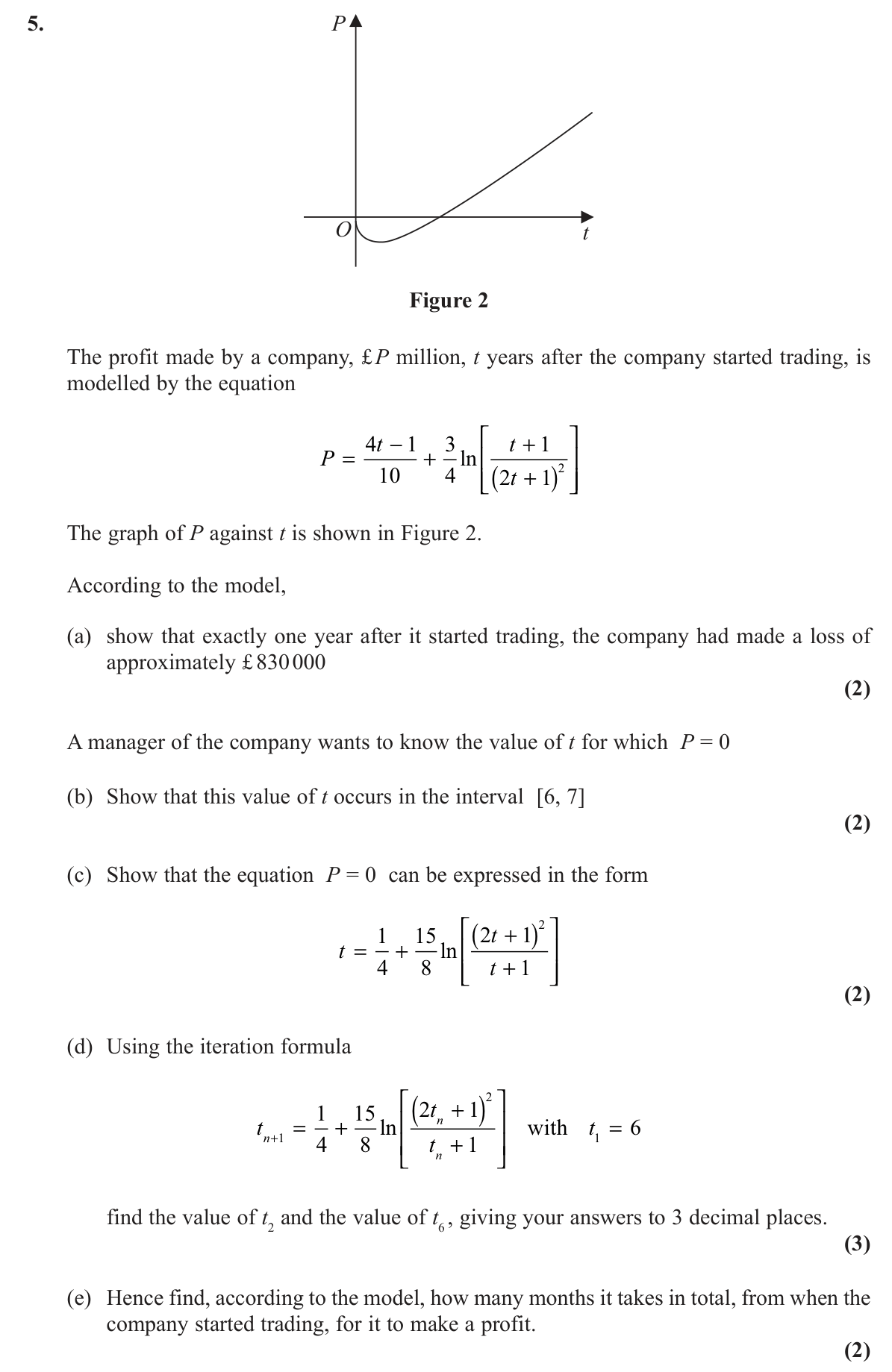
    At one year,

    \[P(1)=\frac3{10}+\frac34\ln\left(\frac29\right) =-0.8280580476\ldots\quad\text{million pounds}.\]

    The negative sign indicates a loss. Its magnitude is about $828058$ pounds, which is approximately $830000$ pounds.

    \[\boxed{\text{Loss}\approx\pounds830000}\]
  2. Part (b)

    The model is continuous for $t\ge0$. Evaluate

    \[P(6)=\frac{23}{10}+\frac34\ln\frac7{169}=-0.0879914\ldots\lt 0, \qquad P(7)=\frac{27}{10}+\frac34\ln\frac8{225}=0.1975059\ldots\gt 0.\]

    Continuity and the sign change give a zero between 6 and 7.

    \[\boxed{t\in(6,7)\subset[6,7]}\]
  3. Part (c)

    Set $P=0$ and move the logarithm to the other side:

    \[\frac{4t-1}{10}=-\frac34\ln\frac{t+1}{(2t+1)^2} =\frac34\ln\frac{(2t+1)^2}{t+1}.\]

    Multiply by 10 and divide by 4 to obtain the required form.

    \[\boxed{t=\frac14+\frac{15}{8}\ln\frac{(2t+1)^2}{t+1}}\]
  4. Part (d)

    Starting with $t_1=6$, retain full calculator precision at each substitution:

    \[t_2=6.2199785610\ldots,\quad t_3=6.2867730738\ldots,\quad t_4=6.3065963643\ldots,\quad t_5=6.3124397510\ldots,\quad t_6=6.3141587873\ldots.\]

    Therefore the requested values to three decimal places are as follows.

    \[\boxed{t_2=6.220,\qquad t_6=6.314}\]
  5. Part (e)

    The break-even time is approximately $6.315$ years, or $6.315\times12=75.78$ months. Profit starts just after that time; the first complete number of months is therefore 76, not 75. Indeed $P(75/12)\lt 0$ and $P(76/12)\gt 0$.

    \[\boxed{76\ \text{months}}\]
Final answer

(a) $\text{Loss}\approx\pounds830000$ (b) $t\in(6,7)\subset[6,7]$ (c) $t=\frac14+\frac{15}{8}\ln\frac{(2t+1)^2}{t+1}$ (d) $t_2=6.220,\qquad t_6=6.314$ (e) $76\ \text{months}$

32. WMA13/01 January 2021 · Q5

Hard11 marks
WMA13/01 January 2021 Question 5 (11 marks): Log Graphs and Models
Show worked solution
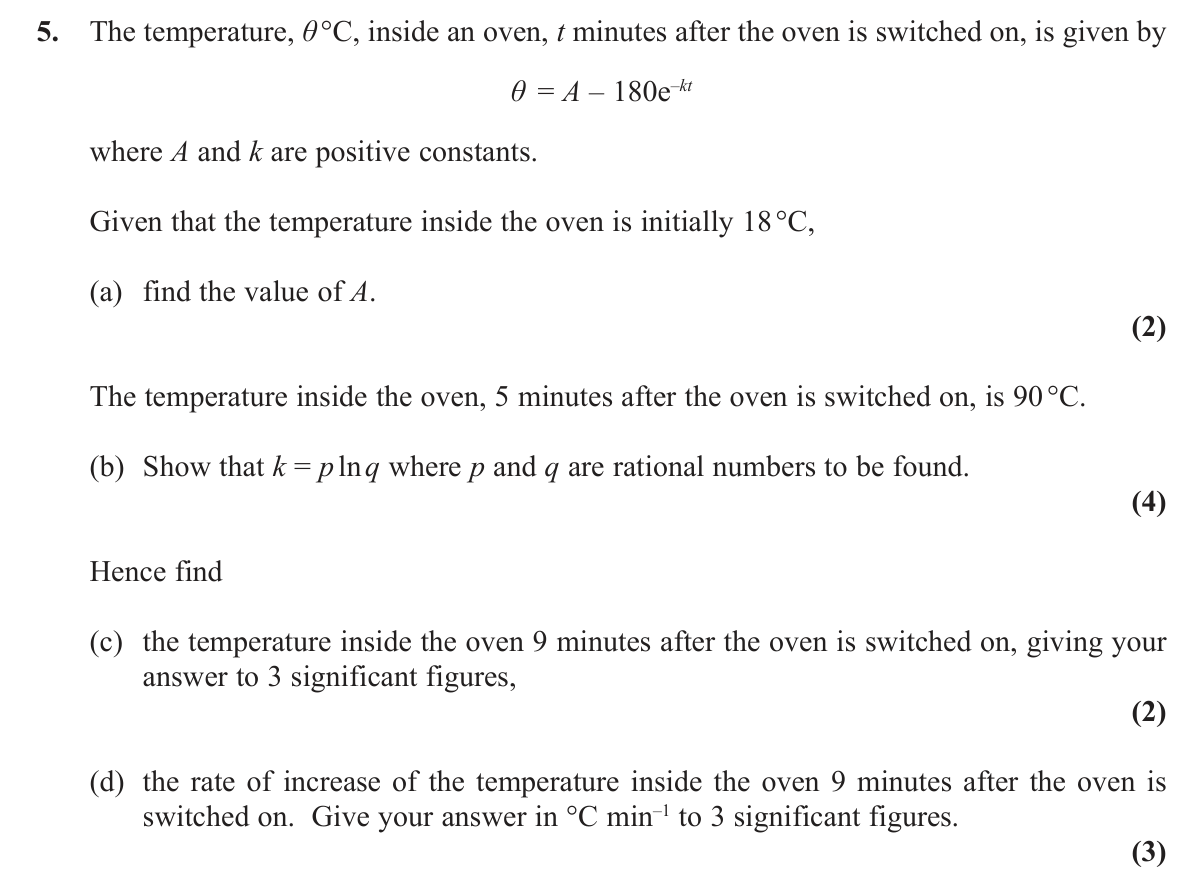
  1. Part (a)

    At $t=0$, $18=A-180e^0=A-180$. Hence $A=198$.

    \[\boxed{A=198}\]
  2. Part (b)

    At $t=5$, $90=198-180e^{-5k}$, so $180e^{-5k}=108$ and $e^{-5k}=3/5$. Taking logarithms gives $-5k=\ln(3/5)$, hence $k=(1/5)\ln(5/3)$. Thus one suitable rational pair is $p=1/5$, $q=5/3$.

    \[\boxed{k=\frac15\ln\frac53;\quad p=\frac15,\ q=\frac53}\]
  3. Part (c)

    Use the unrounded k:

    \[\theta(9)=198-180e^{-(9/5)\ln(5/3)}=126.22970096\ldots{}^\circ\mathrm C.\]

    Round the temperature to three significant figures.

    \[\boxed{126^\circ\mathrm C}\]
  4. Part (d)

    Differentiate with respect to time: $d\theta/dt=180ke^{-kt}$. At $t=9$ this is $180[\ln(5/3)/5]e^{-(9/5)\ln(5/3)}=7.332421555\ldots$. The sign is positive because the oven is warming.

    \[\boxed{7.33^\circ\mathrm C\,\mathrm{min}^{-1}}\]
Final answer

(a) $A=198$ (b) $k=\frac15\ln\frac53;\quad p=\frac15,\ q=\frac53$ (c) $126^\circ\mathrm C$ (d) $7.33^\circ\mathrm C\,\mathrm{min}^{-1}$

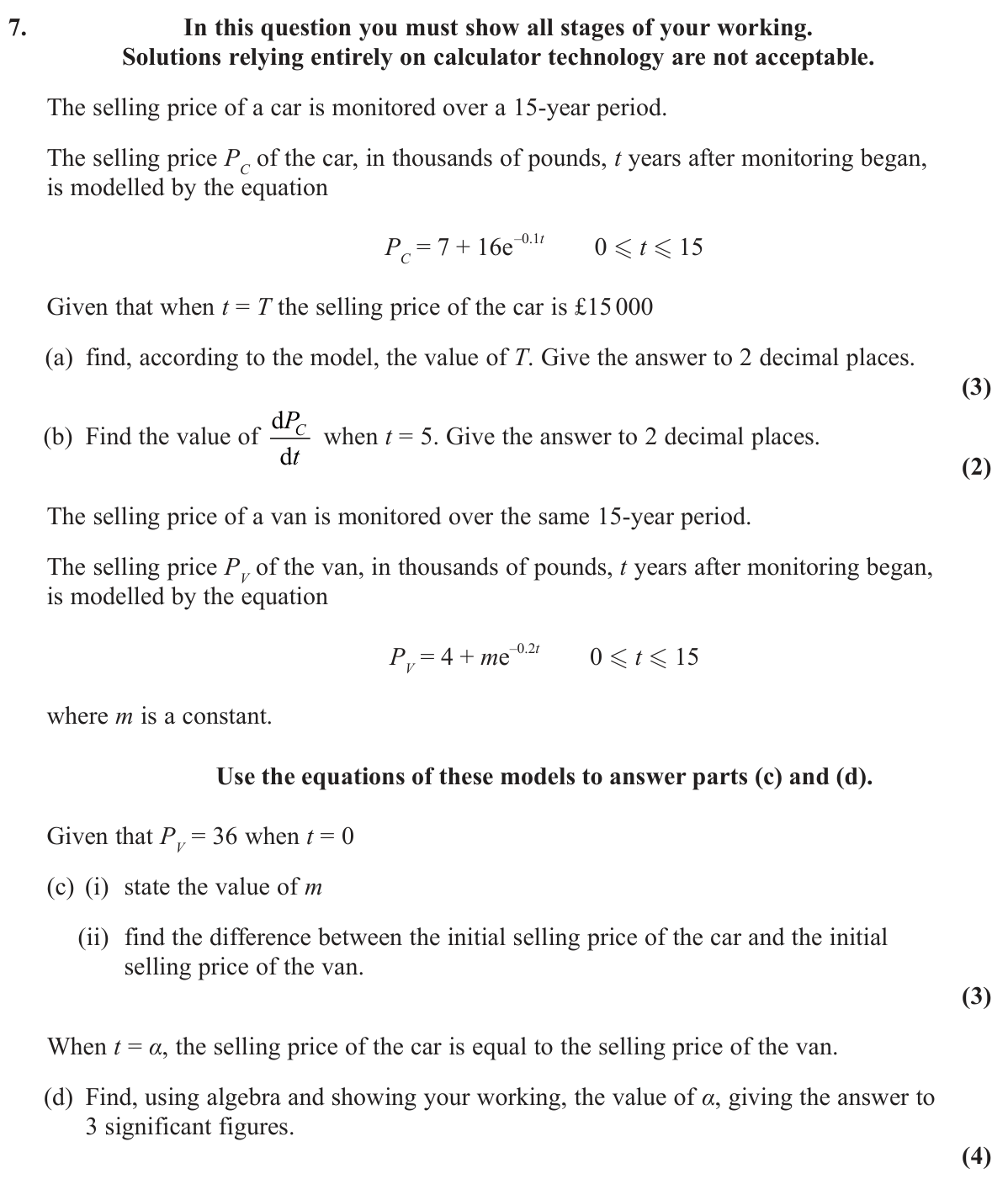
33. WMA13/01 May/June 2026 · Q7

Hard12 marks
WMA13/01 May/June 2026 Question 7 (12 marks): Log Graphs and Models
Show worked solution
  1. Part (a)

    Prices in the model are in thousands of pounds, so

    \[15=7+16e^{-0.1T}\quad\Longrightarrow\quad e^{-0.1T}=\frac12.\]

    Taking logarithms gives $T=10\ln2=6.9314718\ldots$, hence $\boxed{T=6.93\text{ years}}$.

  2. Part (b)
    \[\frac{dP_C}{dt}=-1.6e^{-0.1t},\qquad \left.\frac{dP_C}{dt}\right|_{t=5}=-1.6e^{-0.5}=-0.970449\ldots.\]

    Thus the answer is $\boxed{-0.97\text{ thousand pounds per year}}$ to 2 decimal places.

  3. Part (c)(i)

    At $t=0$, $36=4+m$, so $\boxed{m=32}$.

  4. Part (c)(ii)

    The initial car price is $7+16=23$ thousand pounds. The difference is $36-23=13$ thousand pounds, or $\boxed{\pounds13\,000}$.

  5. Part (d)

    Equating the models with $m=32$ gives

    \[7+16e^{-0.1\alpha}=4+32e^{-0.2\alpha}.\]

    Let $u=e^{-0.1\alpha}\gt 0$. Then $32u^2-16u-3=0$, so

    \[u=\frac{16\pm\sqrt{256+384}}{64}=\frac{2\pm\sqrt{10}}8.\]

    Reject the negative root because an exponential is positive. Hence

    \[\alpha=-10\ln\left(\frac{2+\sqrt{10}}8\right)=4.3806365\ldots, \qquad \boxed{\alpha=4.38\text{ years}}.\]

    This value is inside the model interval $0\leq t\leq15$.

Final answer

(a) $T=6.93\text{ years}$ (b) $-0.97\text{ thousand pounds per year}$ (c)(i) $m=32$ (c)(ii) $\pounds13\,000$ (d) $\alpha=4.38\text{ years}$

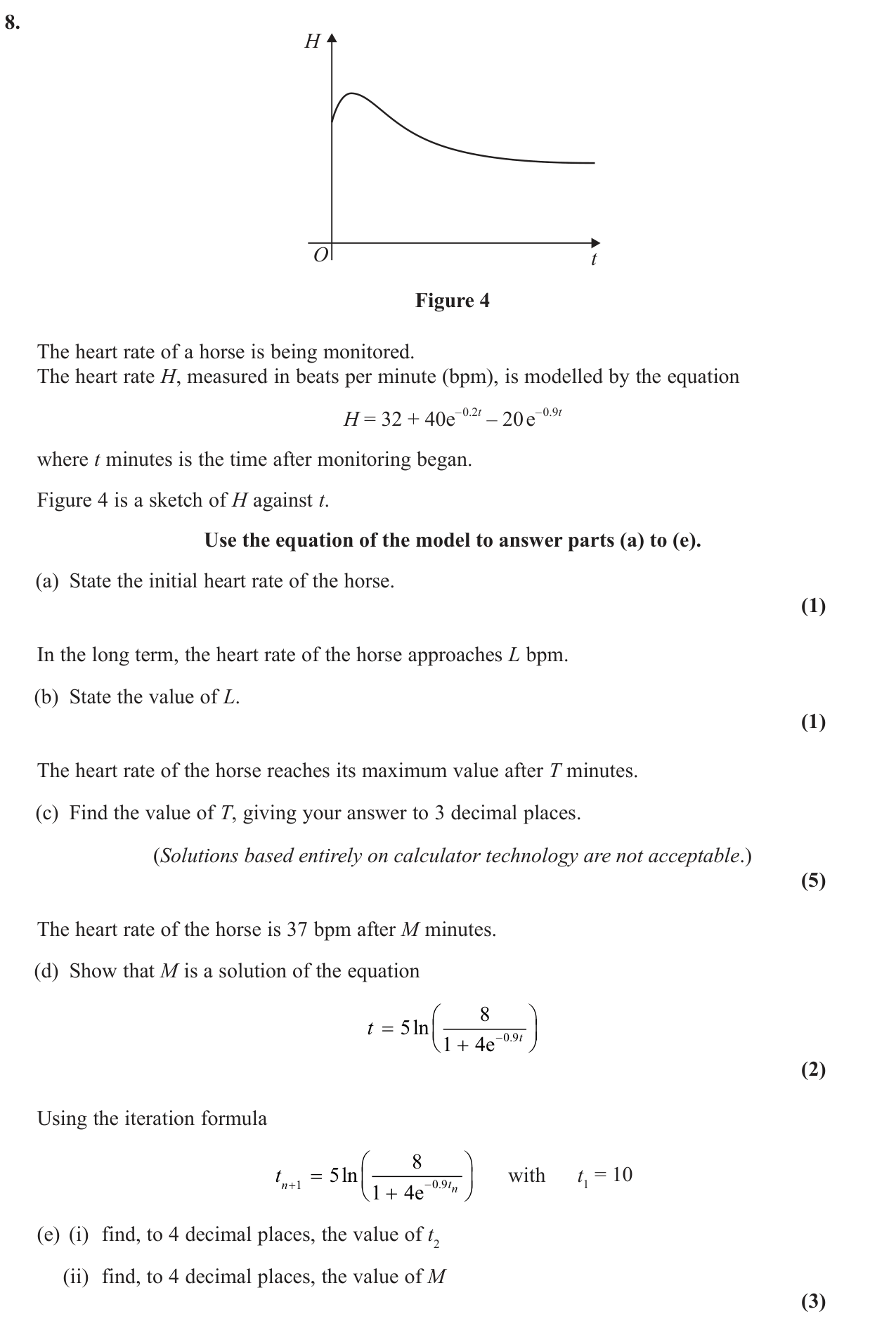
34. WMA13/01 October 2024 · Q8

Hard12 marks
WMA13/01 October 2024 Question 8 (12 marks): Log Graphs and Models
Show worked solution
  1. Part (a)

    At $t=0$, $H=32+40-20=52$.

    \[\boxed{H(0)=52\ \text{bpm}}\]
  2. Part (b)

    As $t\to\infty$, both decaying exponential terms tend to zero.

    \[\boxed{L=32}\]
  3. Part (c)
    \[\frac{dH}{dt}=-8e^{-0.2t}+18e^{-0.9t}.\]

    At the maximum,

    \[18e^{-0.9T}=8e^{-0.2T} \quad\Longrightarrow\quad e^{0.7T}=\frac94 \quad\Longrightarrow\quad T=\frac{10}{7}\ln\frac94=1.1584717\ldots.\]

    Also $H”(t)=1.6e^{-0.2t}-16.2e^{-0.9t}$. At the stationary point, $e^{-0.9T}=(4/9)e^{-0.2T}$, so $H”(T)=-5.6e^{-0.2T}\lt 0$, confirming a maximum.

    \[\boxed{T=1.158\ \text{minutes}}\]
  4. Part (d)

    For $H=37$,

    \[5=40e^{-0.2t}-20e^{-0.9t} \quad\Longrightarrow\quad 8e^{-0.2t}=1+4e^{-0.9t}.\]

    Taking logarithms gives

    \[-0.2t=\ln\left(\frac{1+4e^{-0.9t}}8\right) \quad\Longrightarrow\quad t=-5\ln\left(\frac{1+4e^{-0.9t}}8\right).\]

    Using $-\ln u=\ln(1/u)$ for $u\gt 0$ then gives

    \[t=5\ln\left(\frac8{1+4e^{-0.9t}}\right).\]
    \[\boxed{t=5\ln\left(\frac8{1+4e^{-0.9t}}\right)}\]
  5. Part (e)

    Starting with $t_1=10$,

    \[t_2=5\ln\left(\frac8{1+4e^{-9}}\right)=10.3947401213\ldots.\]

    Continuing without rounding intermediate values gives $t_3=10.3954778346\ldots$, $t_4=10.3954789826\ldots$ and $t_5=10.3954789844\ldots$. Thus (i) $t_2=10.3947$, and (ii) $M=10.3955$ minutes, both to 4 decimal places.

    \[\boxed{t_2=10.3947,\quad M=10.3955\ \text{minutes}}\]
Final answer

(a) $H(0)=52\ \text{bpm}$ (b) $L=32$ (c) $T=1.158\ \text{minutes}$ (d) $t=5\ln\left(\frac8{1+4e^{-0.9t}}\right)$ (e) $t_2=10.3947,\quad M=10.3955\ \text{minutes}$

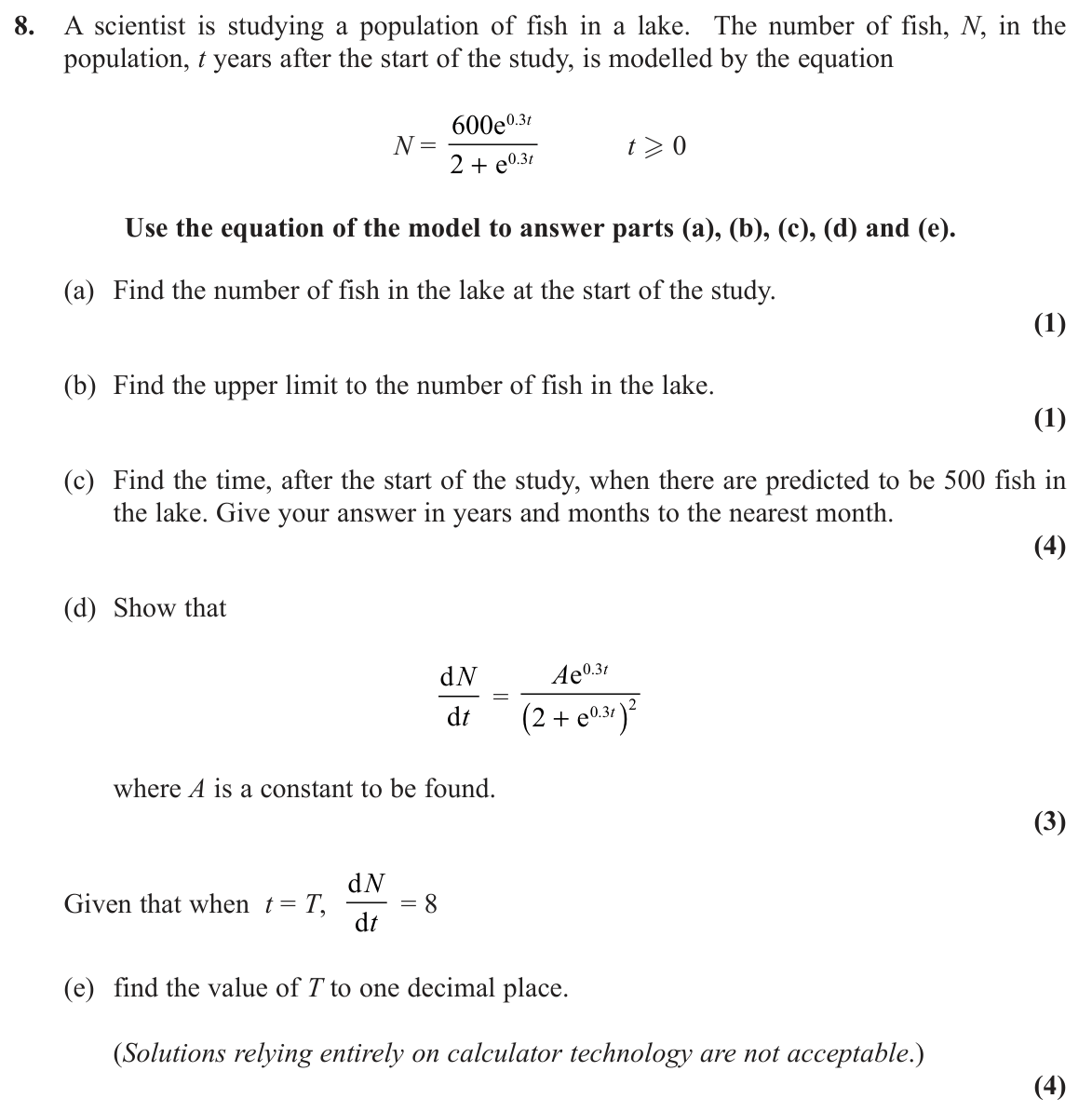
35. WMA13/01 May/June 2021 · Q8

Hard13 marks
WMA13/01 May/June 2021 Question 8 (13 marks): Log Graphs and Models
Show worked solution
  1. Part (a)

    At the start, $t=0$ and $e^{0.3t}=1$. Thus $N(0)=600/(2+1)=200$.

    \[\boxed{200\text{ fish}}\]
  2. Part (b)

    Divide numerator and denominator by $e^{0.3t}$ to write $N=600/(1+2e^{-0.3t})$. As $t\to\infty$, the denominator tends to 1, so the upper limit is 600 fish.

    \[\boxed{600\text{ fish}}\]
  3. Part (c)

    Set $N=500$ and multiply through: $1000+500e^{0.3t}=600e^{0.3t}$, so $e^{0.3t}=10$. Hence $t=\ln10/0.3=7.675283643\ldots$ years. The fractional year is $12(0.675283643\ldots)=8.10340372\ldots$ months. Round only the months to the nearest whole month.

    \[\boxed{7\text{ years }8\text{ months}}\]
  4. Part (d)

    The quotient rule gives

    \[\frac{dN}{dt}=\frac{180e^{0.3t}(2+e^{0.3t})-600e^{0.3t}(0.3e^{0.3t})}{(2+e^{0.3t})^2} =\frac{360e^{0.3t}}{(2+e^{0.3t})^2}.\]

    The two $e^{0.6t}$ terms cancel exactly.

    \[\boxed{A=360}\]
  5. Part (e)

    Let $z=e^{0.3T}$. Since $T\ge0$, require $z\ge1$. Then $360z/(2+z)^2=8$ gives $45z=(2+z)^2$, hence

    \[z^2-41z+4=0,\qquad z=\frac{41\pm\sqrt{1665}}2.\]

    The smaller root lies between 0 and 1 and would give $T\lt 0$, so reject it. For the larger root,

    \[T=\frac1{0.3}\ln\!\left(\frac{41+\sqrt{1665}}2\right)=12.37061331\ldots.\]
    \[\boxed{T=12.4\text{ years}}\]
Final answer

(a) $200\text{ fish}$ (b) $600\text{ fish}$ (c) $7\text{ years }8\text{ months}$ (d) $A=360$ (e) $T=12.4\text{ years}$

More IAL Pure 3 topics

Dr Eslam Ahmed
Dr Eslam Ahmed

Elite Mathematics · Questions classified by topic, solutions checked by Dr Eslam