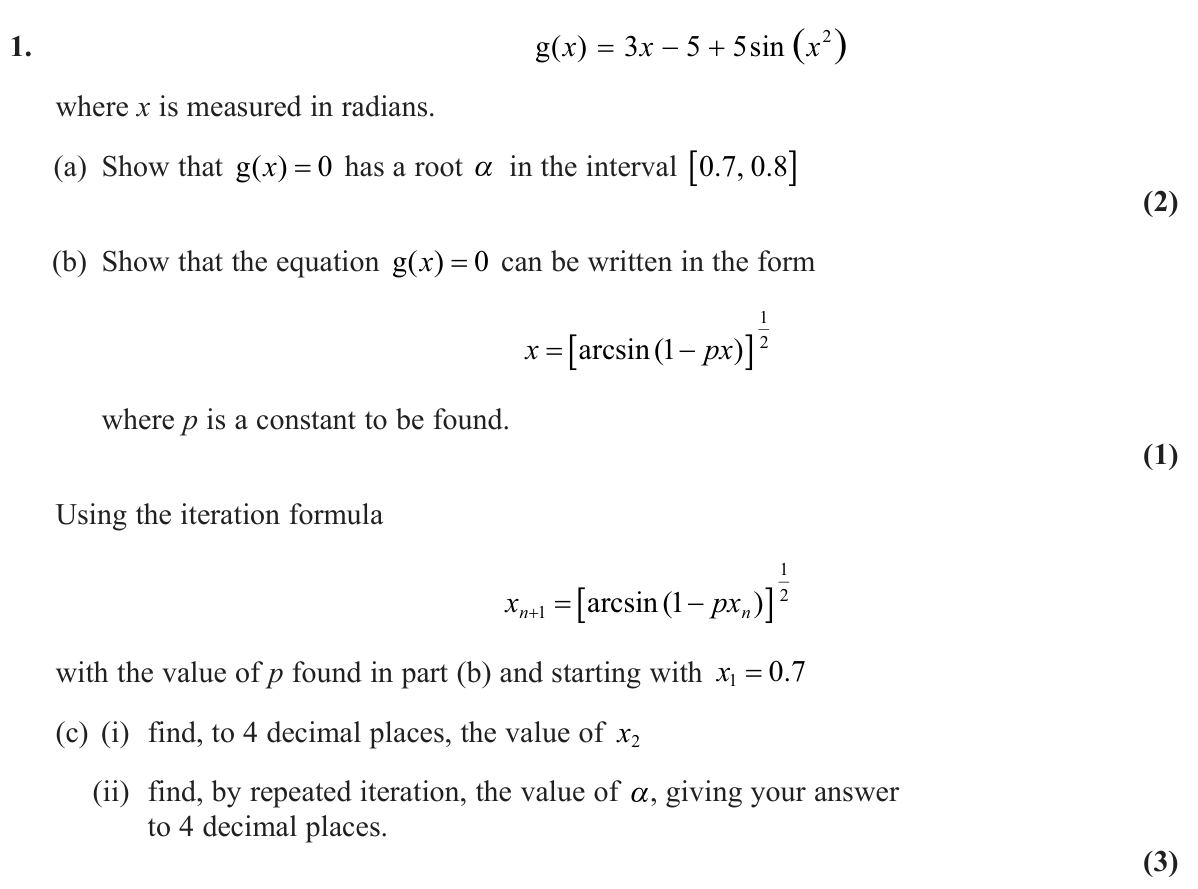
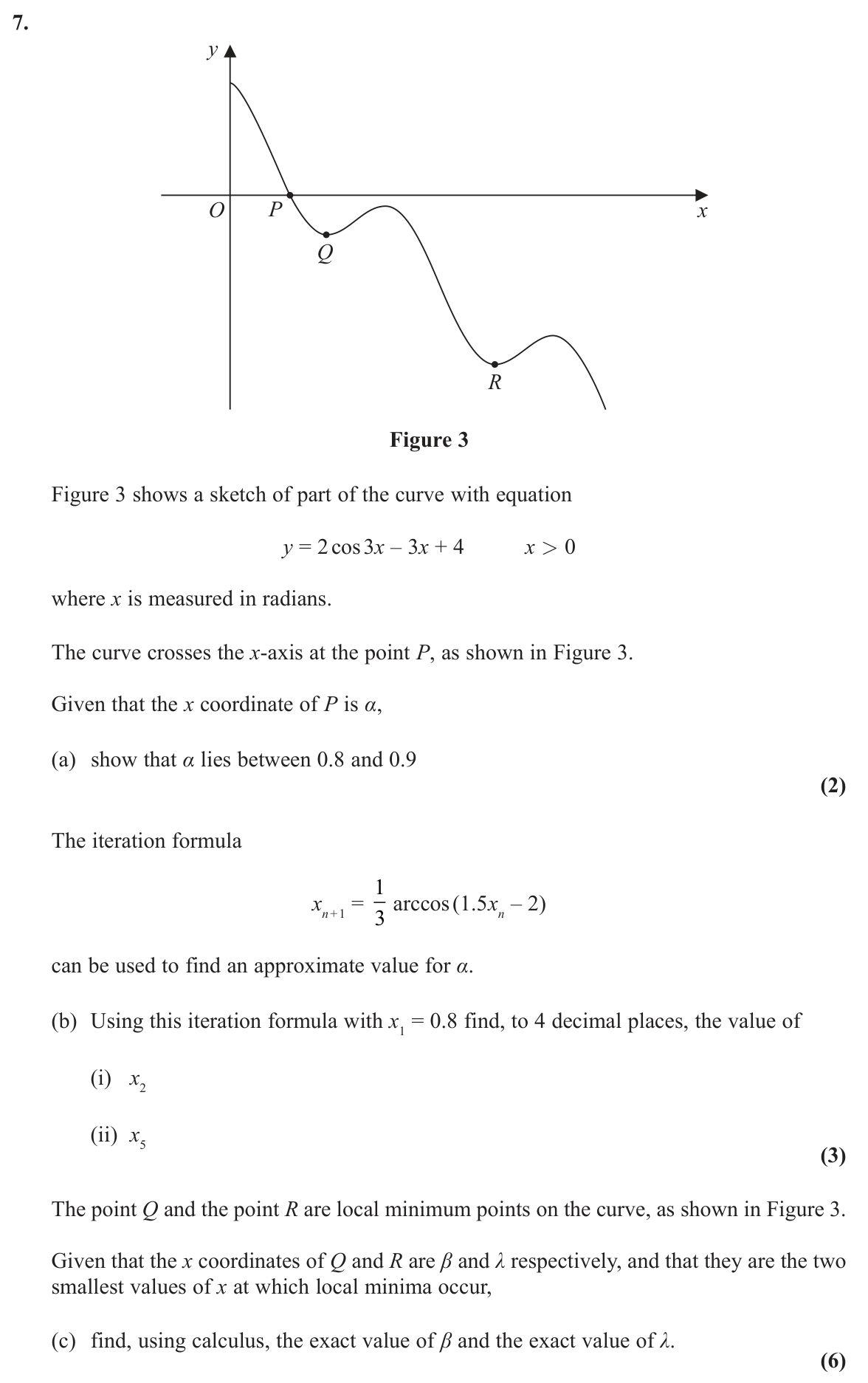
Part (a)Let $f(x)=2\cos3x-3x+4$, using radians. Then
\[\begin{aligned} f(0.8)&=2\cos2.4-2.4+4=0.1252125\ldots\gt 0,\\ f(0.9)&=2\cos2.7-2.7+4=-0.5081443\ldots\lt 0. \end{aligned}\]
The function is continuous on $[0.8,0.9]$, so this change of sign shows that there is a root between the endpoints. Moreover, $f'(x)=-6\sin3x-3\lt 0$ on this interval, so this root is unique there. Thus the crossing shown at $P$ has $\boxed{0.8\lt \alpha\lt 0.9}$.
Part (c)Differentiate the curve equation:
\[\frac{dy}{dx}=-6\sin3x-3, \qquad \frac{d^2y}{dx^2}=-18\cos3x.\]
At a stationary point,
\[-6\sin3x-3=0 \quad\Longrightarrow\quad \sin3x=-\frac12.\]
For $x\gt 0$, the stationary points therefore belong to the two families
\[3x=\frac{7\pi}{6}+2n\pi \quad\text{or}\quad 3x=\frac{11\pi}{6}+2n\pi, \qquad n=0,1,2,\ldots.\]
In the first family, $\cos3x=-\frac{\sqrt3}{2}$, giving $y”=9\sqrt3\gt 0$, so these are local minima. In the second family, $\cos3x=\frac{\sqrt3}{2}$ and $y”=-9\sqrt3\lt 0$, so these are local maxima and are excluded. Thus all positive minimum coordinates are
\[x=\frac{7\pi}{18}+\frac{2n\pi}{3},\qquad n=0,1,2,\ldots.\]
The two smallest are obtained with $n=0$ and $n=1$:
\[\boxed{\beta=\frac{7\pi}{18}}, \qquad \boxed{\lambda=\frac{19\pi}{18}}.\]
 Elite Mathematics