Functions: past paper questions & worked solutions
Every Functions question from the WMA13 papers in our bank, 2020–2026, sorted from easiest to hardest. Try each one first, then open the worked solution.
Easy6 marks · main topic: Trig Equations & R-FormShow worked solution
Part (a)
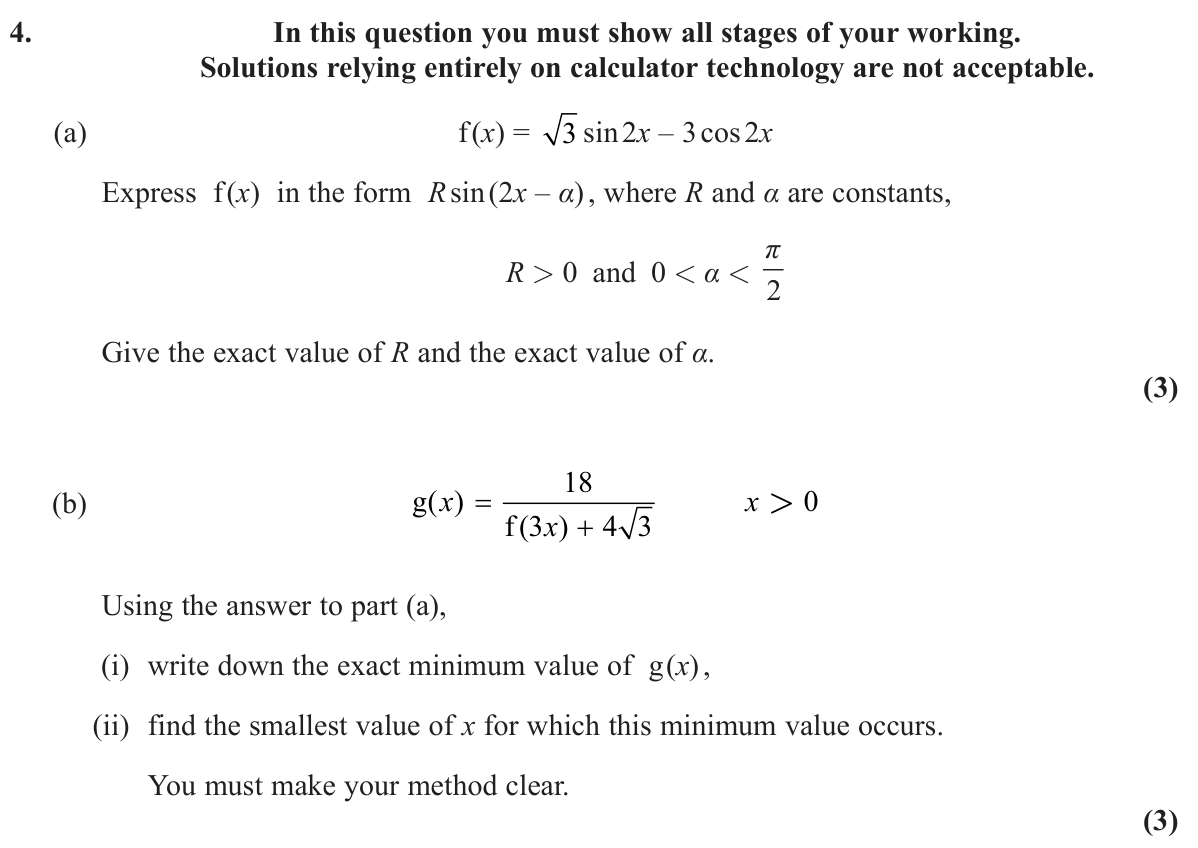
Expand $R\sin(2x-\alpha)=R\cos\alpha\sin2x-R\sin\alpha\cos2x$. Comparison gives $R\cos\alpha=\sqrt3$ and $R\sin\alpha=3$. Thus $R=\sqrt{3+9}=2\sqrt3$ and $\tan\alpha=\sqrt3$. As $0\lt \alpha\lt \pi/2$, $\alpha=\pi/3$ and
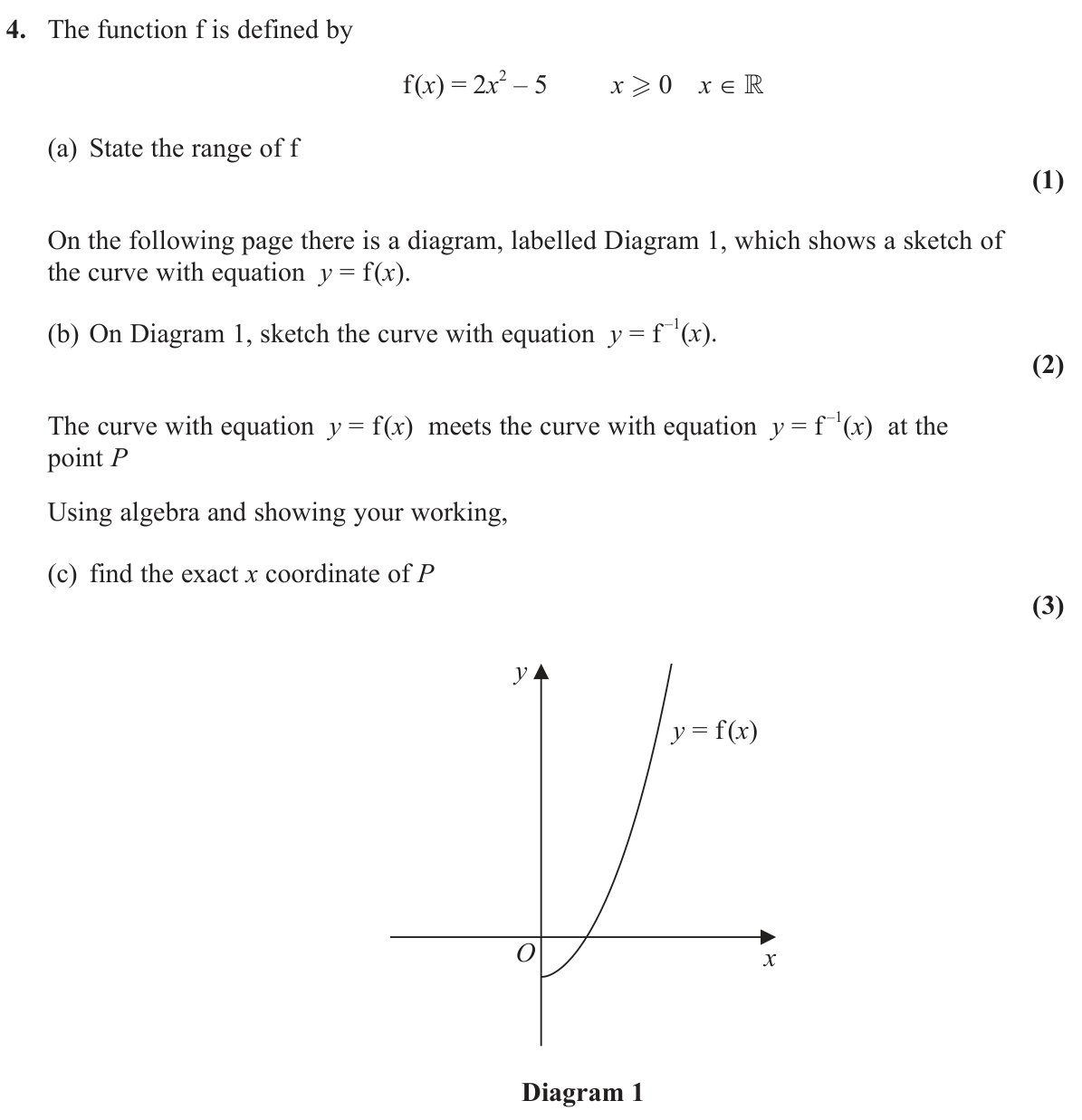
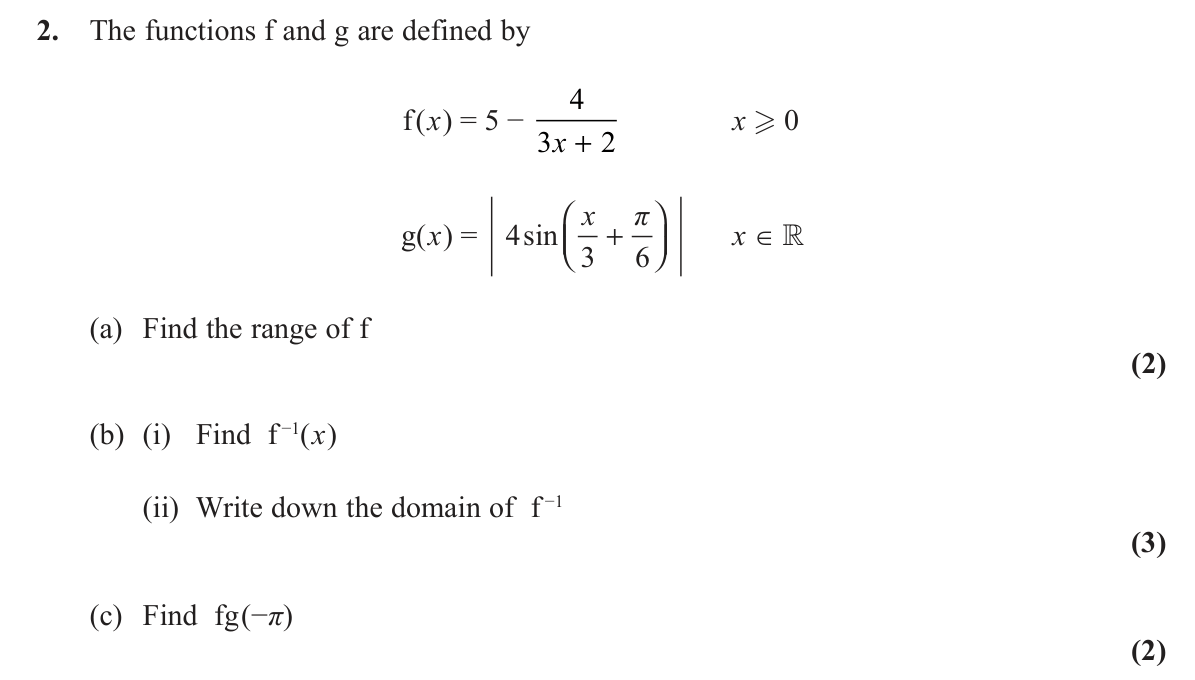
Since $x\ge0$, $2x^2\ge0$. The minimum is $f(0)=-5$ and there is no upper bound.
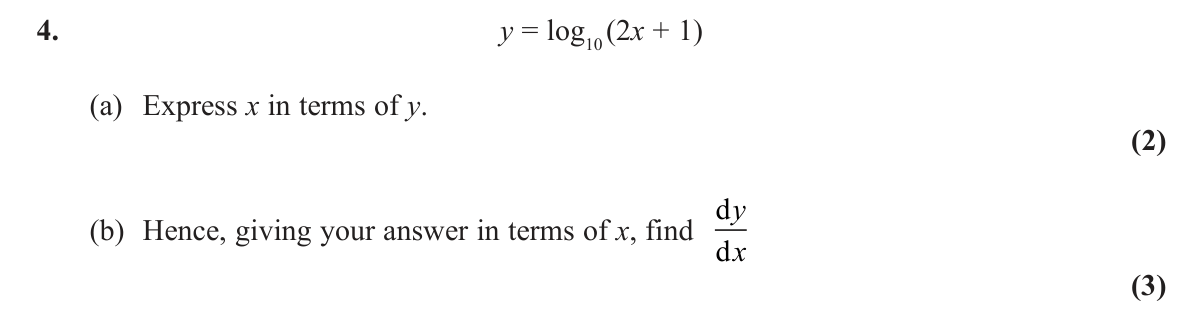
\[\boxed{\operatorname{range}(f)=[-5,\infty)}\]
Part (b)
Reflect the given curve in $y=x$. Solving $x=2y^2-5$ with $y\ge0$ gives $y=\sqrt{(x+5)/2}$, $x\ge-5$. The inverse starts at $(-5,0)$, passes through $(0,\sqrt{5/2})$, and is increasing and concave down. The solid inverse curve below is paired with the dashed original curve.
Here $f$ is strictly increasing on $[0,\infty)$, so an intersection of $f$ and its inverse must be on $y=x$: if $y=f(x)\gt x$, then $f(y)\gt f(x)=y$, contradicting $f(y)=x$; the case $y\lt x$ is similar. Hence
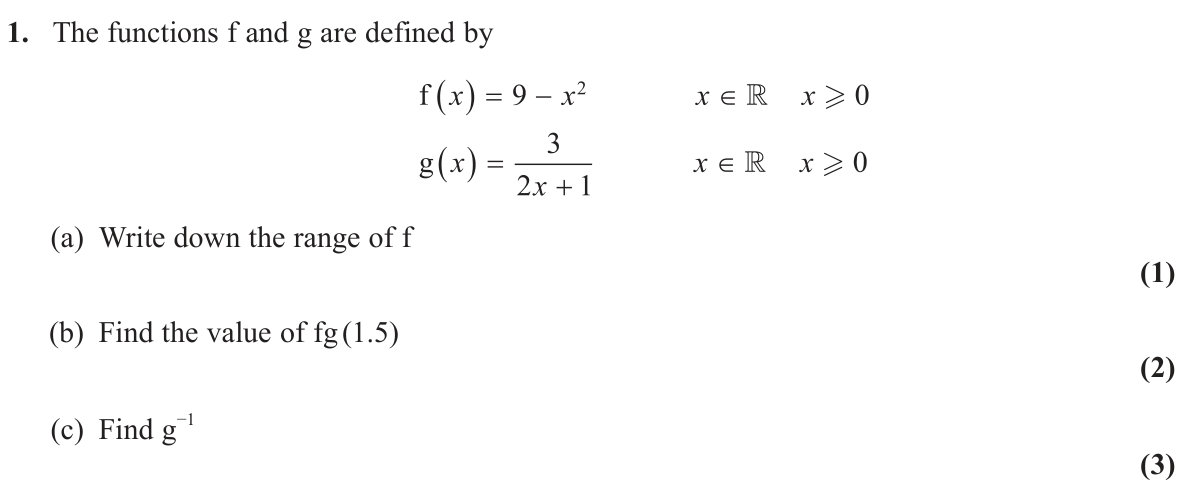
The intermediate value $3/4$ is in the nonnegative domain of $f$.
\[\boxed{fg(1.5)=\frac{135}{16}}\]
Part (c)
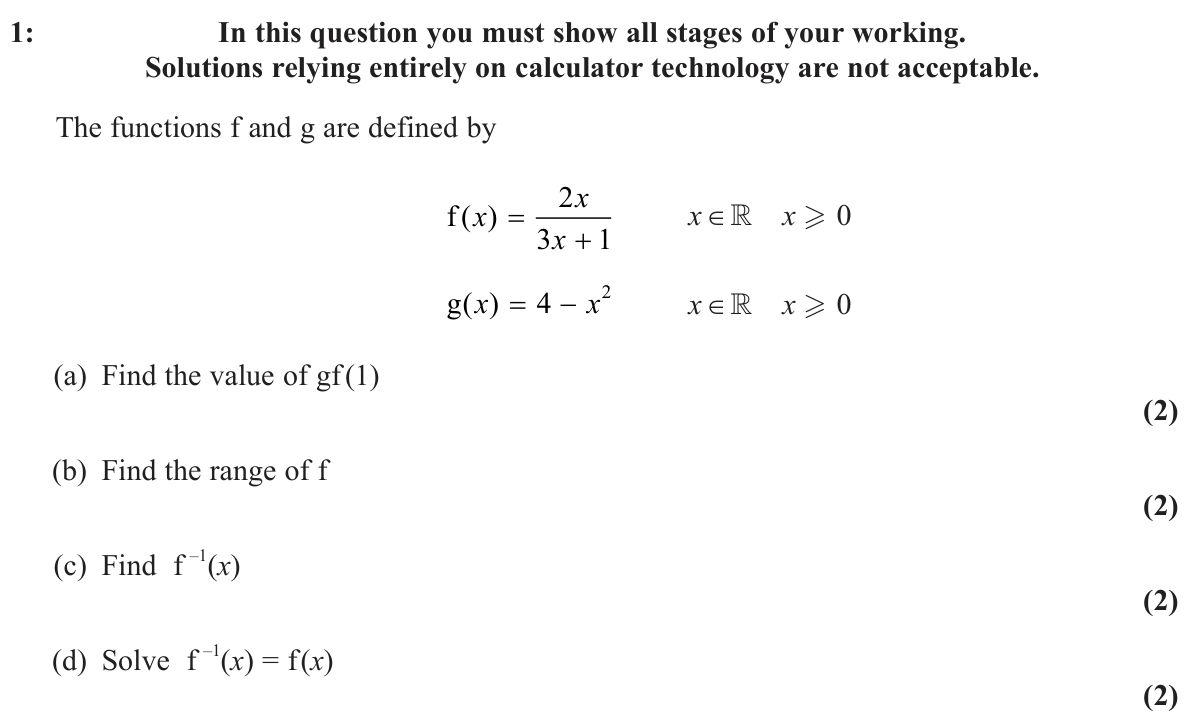
Let $y=3/(2x+1)$. Then $y(2x+1)=3$, so $2xy=3-y$ and $x=(3-y)/(2y)$. Exchange the variables. Since $g$ decreases from 3 towards 0 on $[0,\infty)$, its range is $(0,3]$, which is the inverse domain.
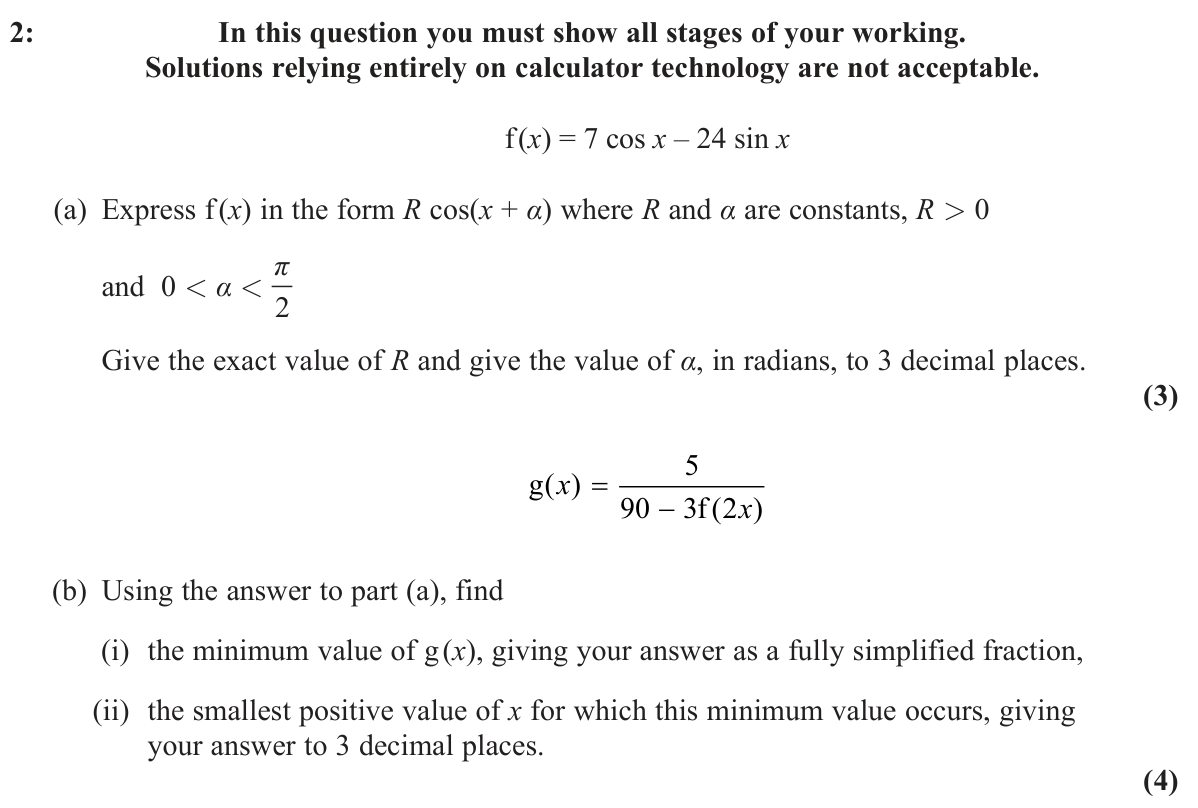
Thus $f(x)=25\cos(x+\alpha)$, using the unrounded $\alpha$ in subsequent calculations.
Part (i)
Since $-25\leq f(2x)\leq25$, the positive denominator $90-3f(2x)$ lies between $15$ and $165$. The smallest reciprocal occurs at the largest denominator:
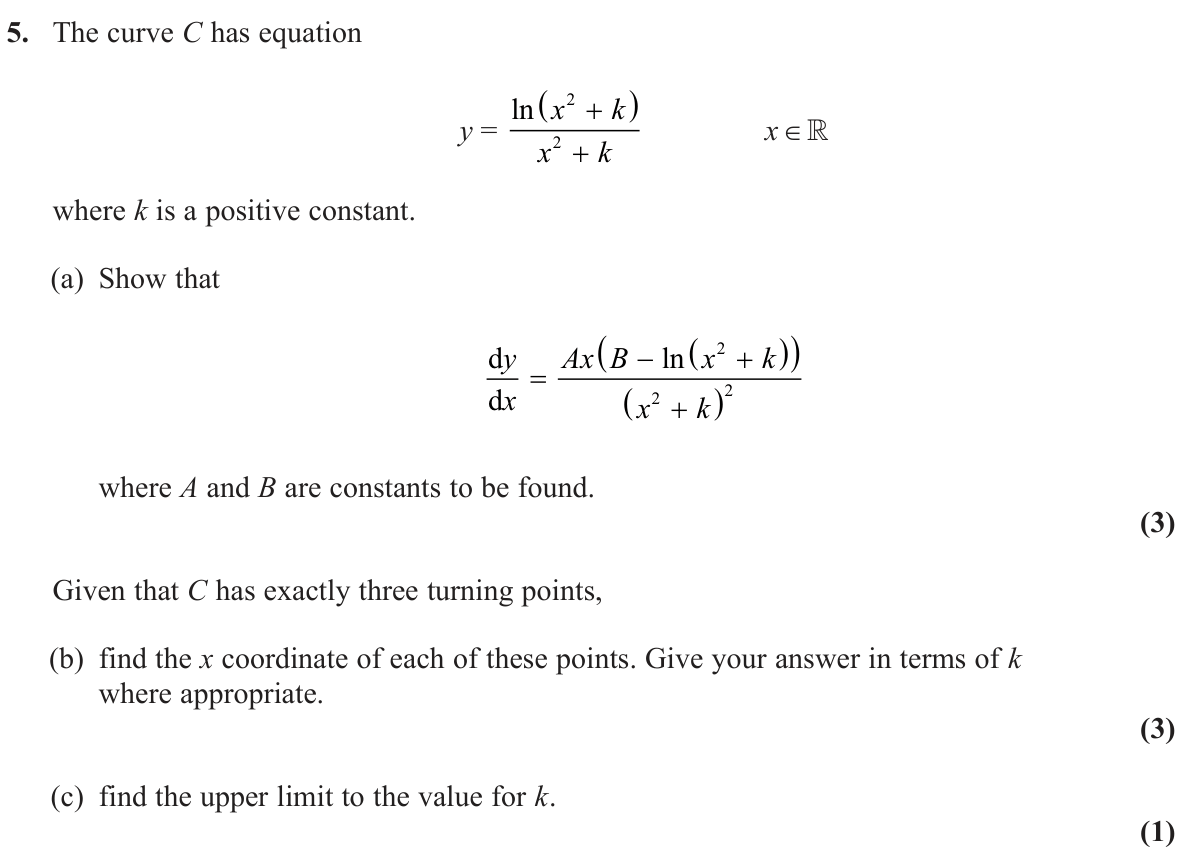
There are three distinct real stationary points precisely when $e-k\gt 0$. In that case the factor $1-\ln(x^2+k)$ is positive between the outer roots and negative outside them; $2x$ changes sign at zero. Thus the derivative changes sign at all three points, so all are turning points. Together with $k\gt 0$, the three coordinates below are real and distinct; the restriction is $0\lt k\lt e$.
At $k=e$, the two outer stationary points merge with $x=0$, so there are no longer three distinct turning points. Values of $k$ can approach $e$ from below, but cannot equal it under this condition.
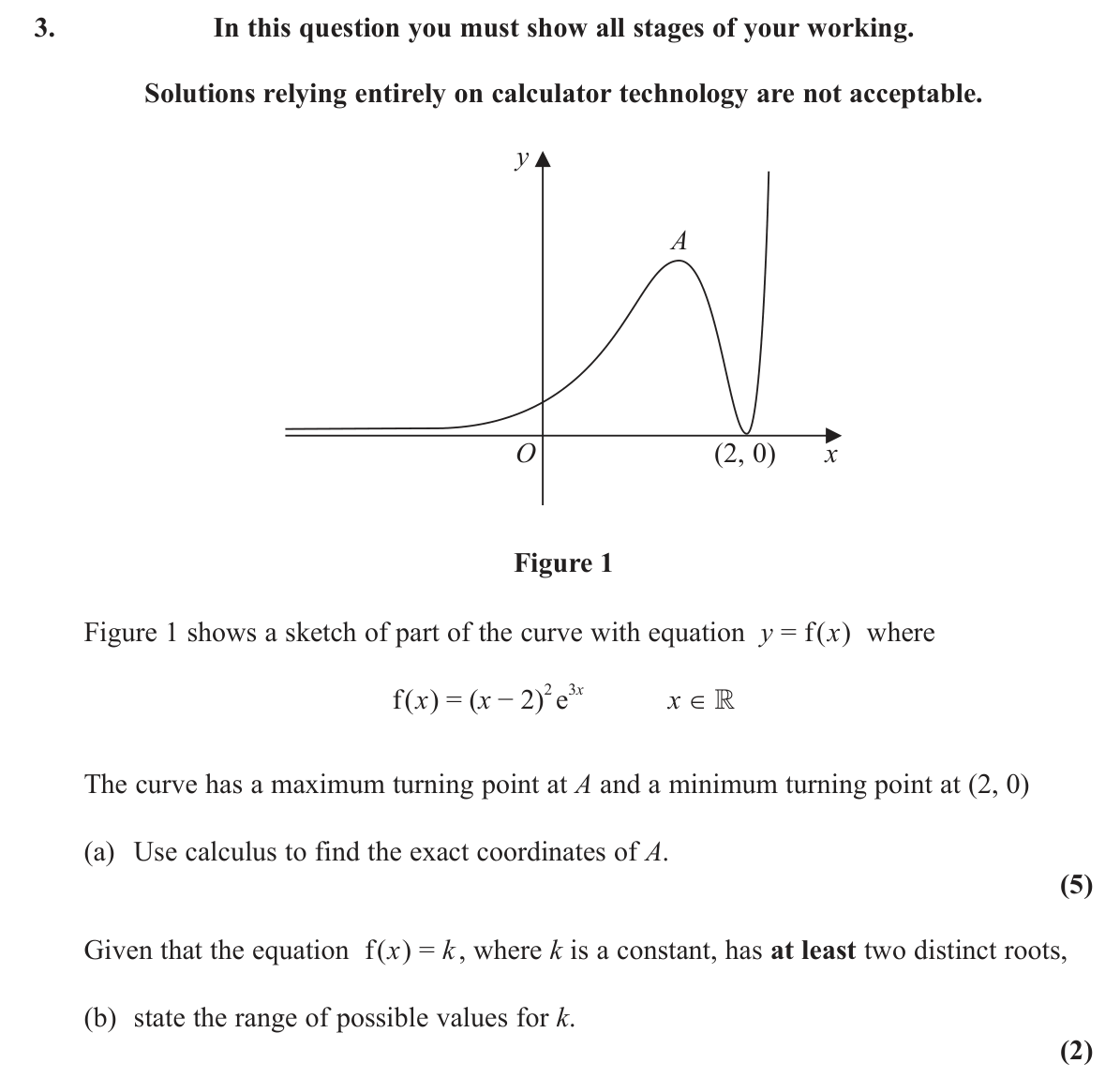
Since the exponential is positive, stationary points have $x=2$ or $x=4/3$. The sign of $f'$ changes from positive to negative at $4/3$, so this is the maximum A.
\[f(4/3)=(-2/3)^2e^4=\frac49e^4.\]
\[\boxed{A=\left(\frac43,\frac{4e^4}{9}\right)}\]
Part (b)
The curve is nonnegative and has just one zero, $x=2$; hence $k=0$ is excluded. It tends to 0 from above as $x\to-\infty$, rises to $4e^4/9$, falls to 0, then rises without bound. For $0\lt k\lt 4e^4/9$ there are three intersections. At the maximum level there are two distinct intersections, including A. For a larger positive k there is only one.
Medium7 marks · main topic: Differentiation TechniquesShow worked solution
Part (a)
Differentiate x with respect to y by the product rule:
\[\frac{dx}{dy}=e^{2y}+2ye^{2y}=e^{2y}(1+2y).\]
Where $dx/dy\ne0$, take the reciprocal:
\[\frac{dy}{dx}=\frac{e^{-2y}}{1+2y}.\]
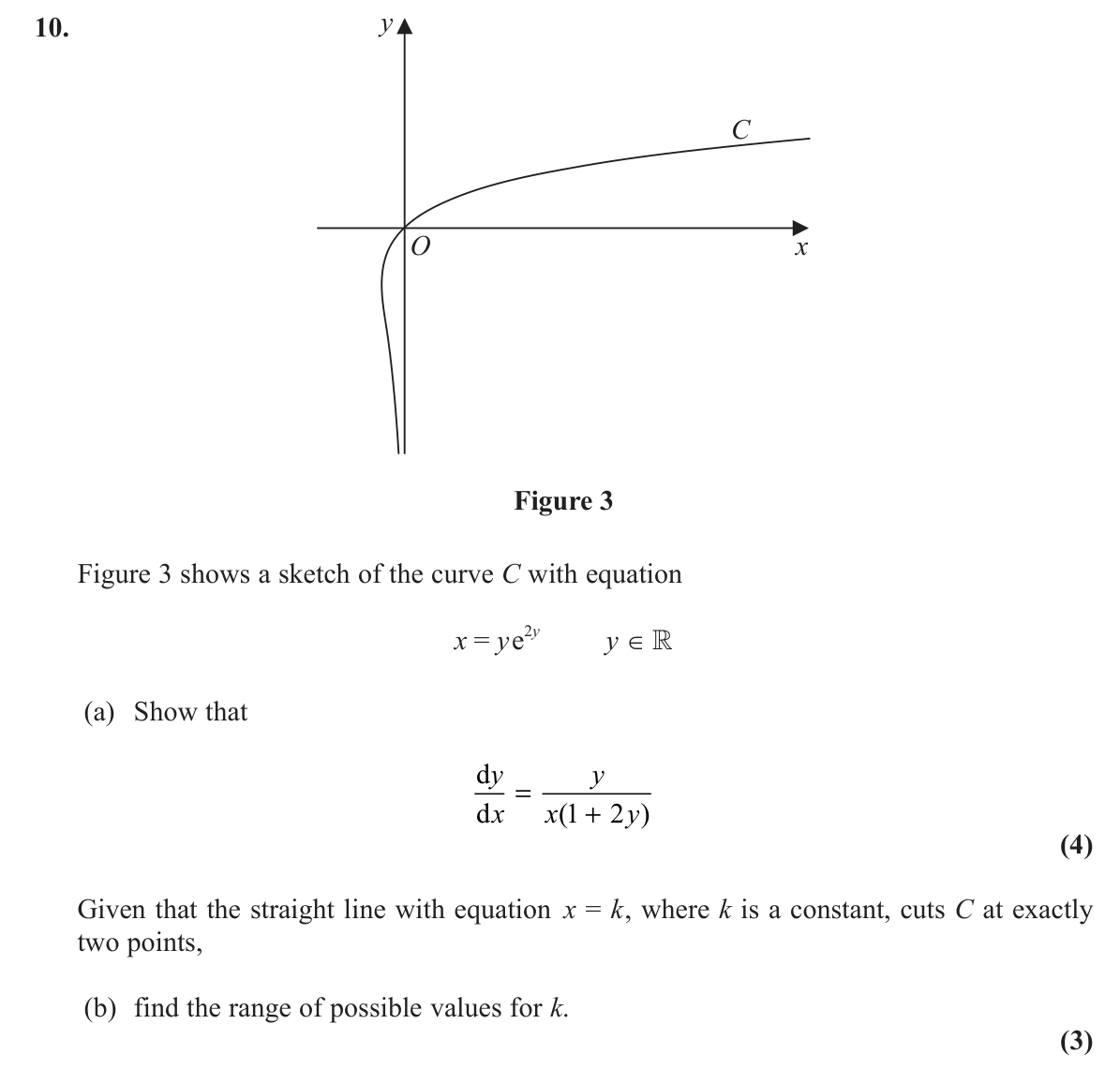
For $y\ne0$, the original relation gives $e^{2y}=x/y$, hence the required form $dy/dx=y/[x(1+2y)]$. At the origin, that last quotient is $0/0$; the preceding uncancelled derivative gives $dy/dx=1$. At $y=-1/2$ there is no finite $dy/dx$.
Consider $x=h(y)=ye^{2y}$. Its derivative $h'(y)=e^{2y}(1+2y)$ vanishes at $y=-1/2$. It is negative before this y value and positive after it, so the minimum x value is $h(-1/2)=-1/(2e)$. As $y\to-\infty$, $h(y)\to0$ from below; also $h(0)=0$ and h then increases without bound. Thus a level $x=k$ meets both negative-y branches precisely between the minimum and zero. At the minimum the two intersections coincide; at zero there is just the finite point $y=0$.
Medium7 marks · main topic: Differentiation TechniquesShow worked solution
Part (a)
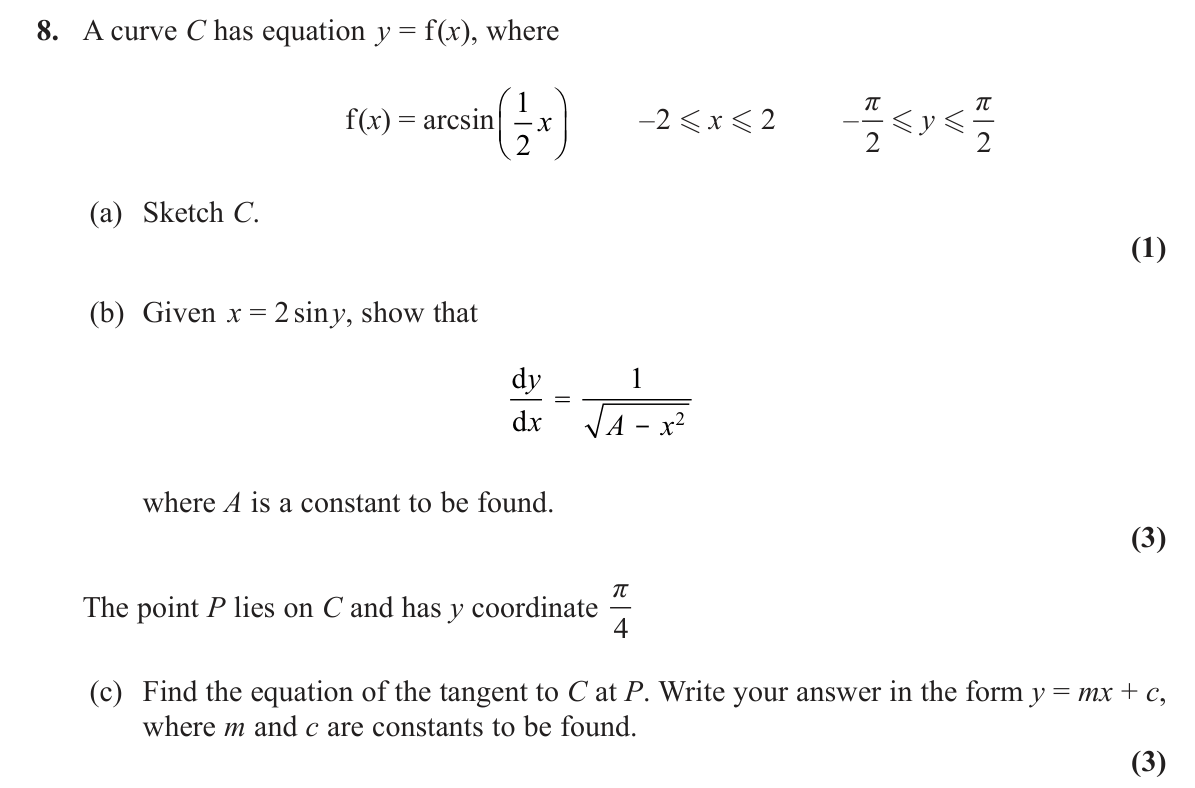
The principal arcsine curve increases from $(-2,-\pi/2)$ through $(0,0)$ to $(2,\pi/2)$. It is concave down on the negative-x half, concave up on the positive-x half, and vertical at both ends.
\[\boxed{y=\arcsin(x/2),\quad -2\le x\le2}\]
Part (b)
Differentiate the supplied inverse relation: $dx/dy=2\cos y$. For $-\pi/2\lt y\lt \pi/2$, cosine is positive, so $\cos y=\sqrt{1-\sin^2y}=\sqrt{1-x^2/4}$. Taking the reciprocal gives
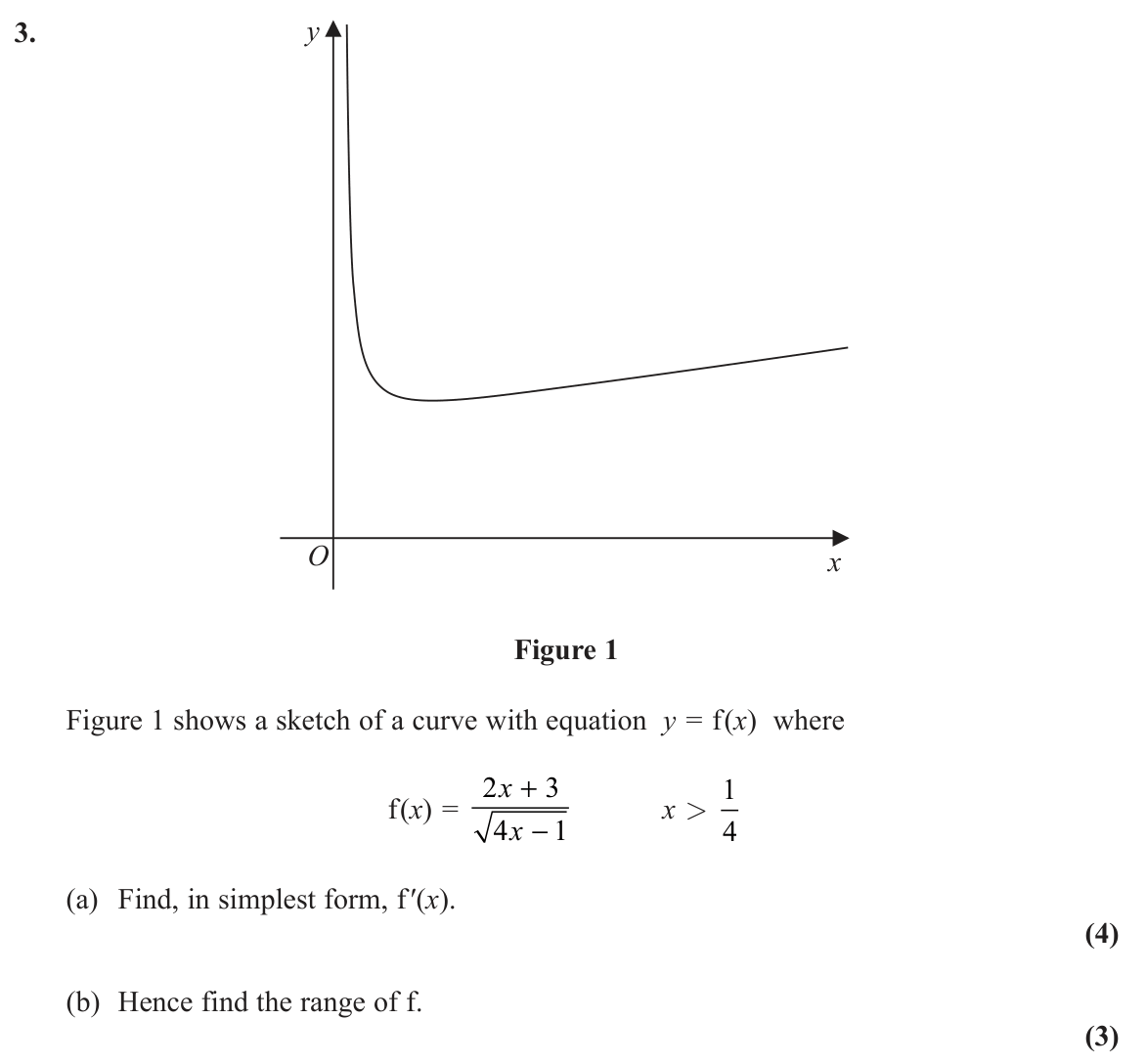
The denominator of $f'(x)$ is positive throughout the domain, so the derivative is negative for $1/4\lt x\lt 2$ and positive for $x\gt 2$. Consequently $x=2$ is the global minimum, with $f(2)=7/\sqrt7=\sqrt7$. Also $f(x)\to\infty$ as $x\to1/4^+$ and as $x\to\infty$. By continuity all values at least $\sqrt7$ are attained, including the minimum.
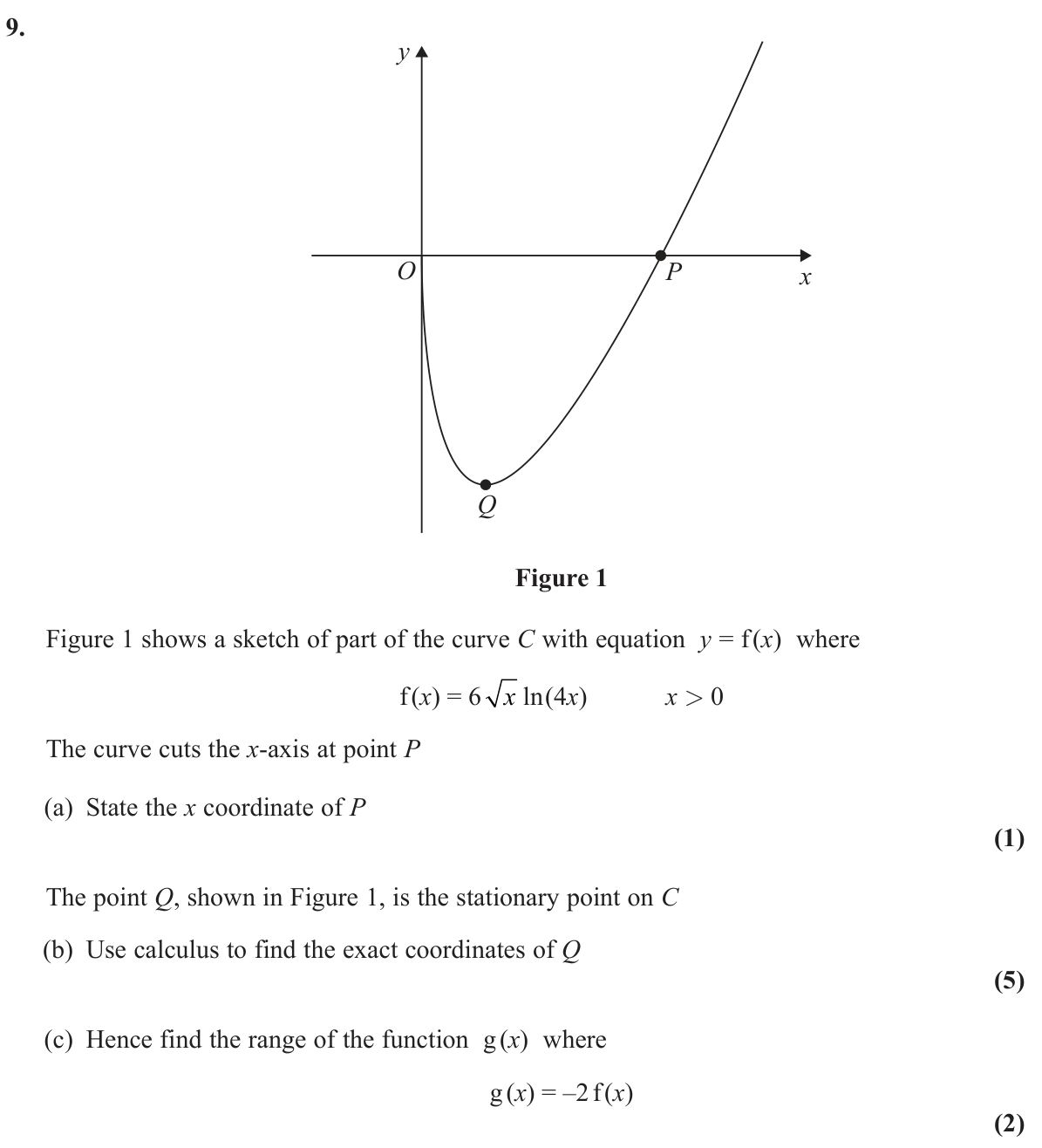
Then $\sqrt{x}=1/(2e)$ and $\ln(4x)=-2$, giving $f(x)=6(1/(2e))(-2)=-6/e$.
\[\boxed{Q=\left(\frac1{4e^2},-\frac6e\right)}\]
Part (c)
The factor $3/\sqrt{x}$ is positive and $\ln(4x)+2$ increases through zero at $Q$, so $f'$ changes from negative to positive: $Q$ is the global minimum. As $x\to\infty$, $f(x)\to\infty$, hence the range of $f$ is $[-6/e,\infty)$. Multiplication by $-2$ reverses the inequality and includes the maximum $12/e$.
Interchange $x,y$. On the original domain $x\ge0$, $f$ increases from $f(0)=-1$ towards 6, never attaining 6. Thus the inverse domain is $-1\le x\lt 6$.
Medium8 marks · main topic: ModulusShow worked solution
Part (a)
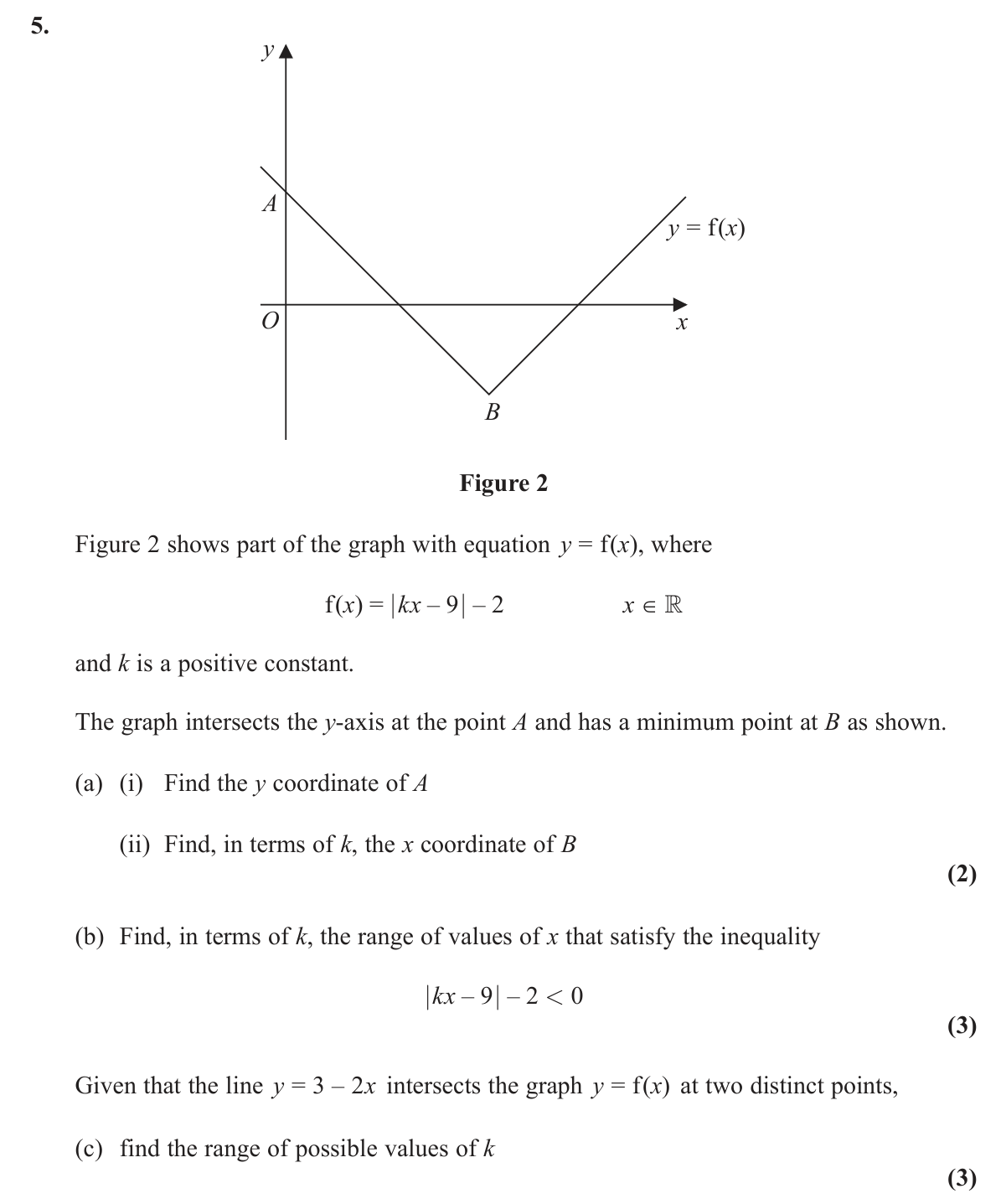
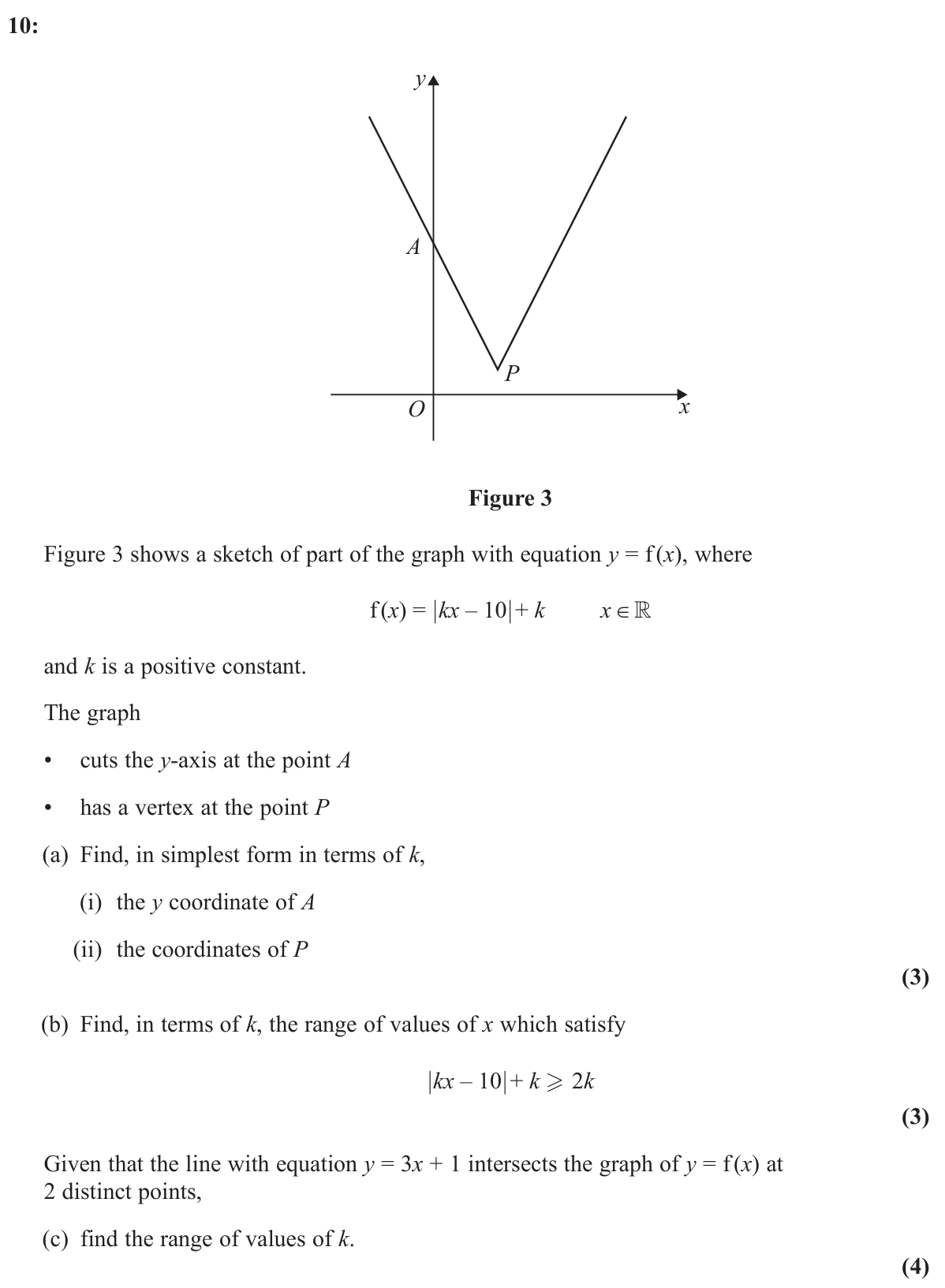
(i) At $x=0$, $f(0)=|-9|-2=7$, so the y coordinate of A is 7. (ii) The minimum occurs when the modulus vanishes: $kx-9=0$, hence $x_B=9/k$.
\[\boxed{y_A=7,\qquad x_B=\frac9k}\]
Part (b)
$|kx-9|-2\lt 0$ means $|kx-9|\lt 2$, or $-2\lt kx-9\lt 2$. Add 9 and divide by the positive k, preserving both strict inequality signs.
\[\boxed{\frac7k\lt x\lt \frac{11}k}\]
Part (c)
For $x\le9/k$, the graph is $y=7-kx$; for $x\ge9/k$, it is $y=kx-11$. The intersection of the right branch with $3-2x$ has $x=14/(k+2)$. For it to lie strictly to the right of the vertex,
For these k, the left-branch intersection has $x=4/(k-2)\lt 9/k$, so both intersections exist and differ. At $k=18/5$ the two points coincide at the vertex. Each straight branch can supply at most one intersection; when the right branch is inadmissible, two distinct points cannot occur (k=2 gives parallel, unequal left lines).
Medium8 marks · main topic: Trig Equations & R-FormShow worked solution
Part (a)
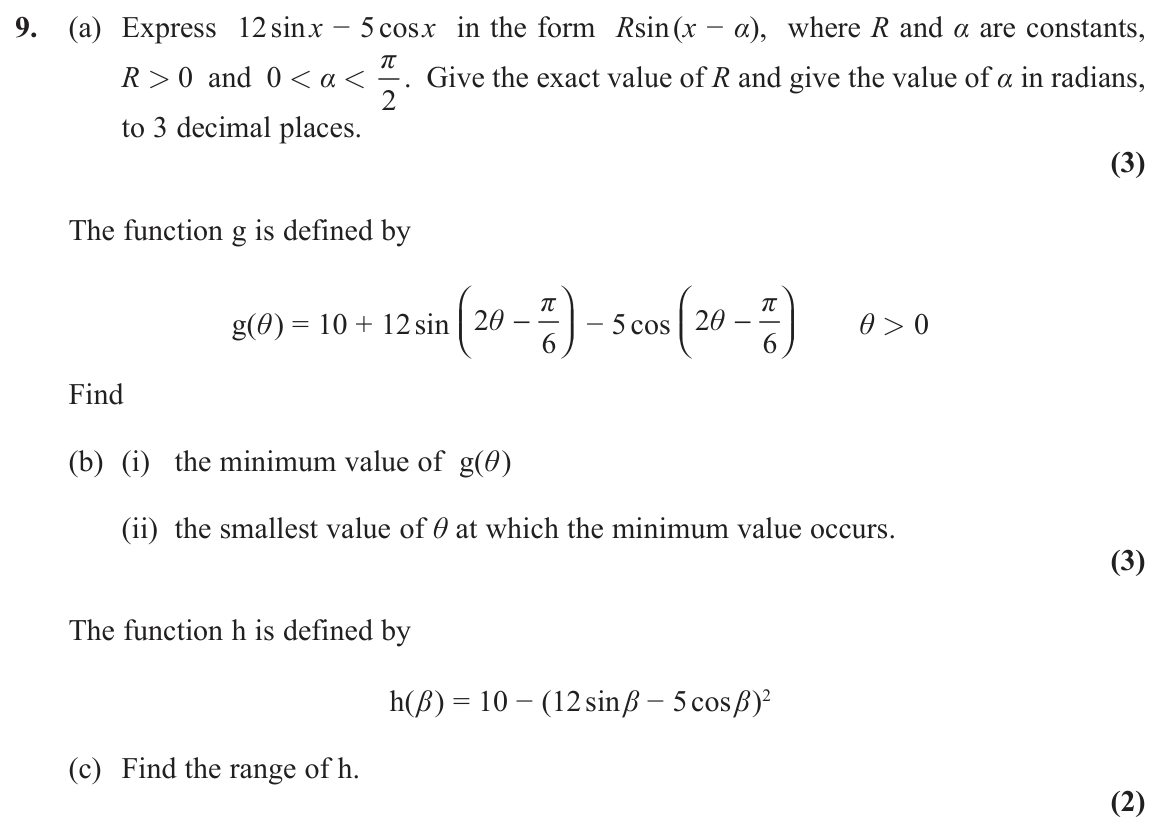
Expand $R\sin(x-\alpha)=R\cos\alpha\sin x-R\sin\alpha\cos x$. Therefore $R\cos\alpha=12$, $R\sin\alpha=5$. Thus $R=\sqrt{12^2+5^2}=13$ and $\alpha=\arctan(5/12)=0.3947911197\ldots$ radians, in the required first quadrant.
Write $g(\theta)=10+13\sin(2\theta-\pi/6-\alpha)$. (i) The minimum is $10-13=-3$. (ii) For sine to equal $-1$, $2\theta-\pi/6-\alpha=-\pi/2+2\pi n$. Hence $\theta=-\pi/6+\alpha/2+\pi n$. For $n=0$ this is negative, so the smallest permitted value uses $n=1$:
As $\beta$ varies over the reals, $12\sin\beta-5\cos\beta$ covers $[-13,13]$. Its square therefore covers $[0,169]$, not $[169,169]$. Subtracting from 10 reverses the bounds, giving $[-159,10]$; both endpoints are attained.
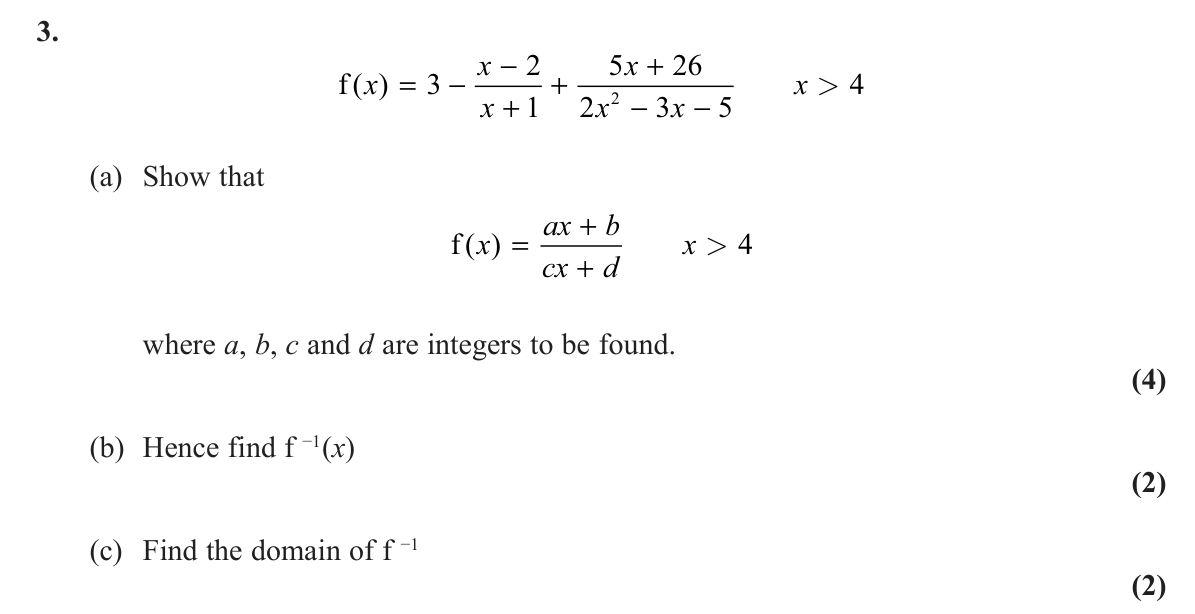
On $x\gt 4$ the cancelled factor is nonzero. One integer choice is $a=4,b=1,c=2,d=-5$.
\[\boxed{f(x)=\frac{4x+1}{2x-5},\ x\gt 4}\]
Part (b)
Let $y=(4x+1)/(2x-5)$. Rearranging gives $2xy-5y=4x+1$, hence $x(2y-4)=5y+1$ and $x=(5y+1)/(2y-4)$. Swap variable names to obtain the inverse rule; its restricted domain is determined in (c).
\[\boxed{f^{-1}(x)=\frac{5x+1}{2x-4}}\]
Part (c)
Rewrite $f(x)=2+11/(2x-5)$. For $x\gt 4$, the positive denominator is greater than 3 and grows without bound. Thus $0\lt 11/(2x-5)\lt 11/3$, so $2\lt f(x)\lt 17/3$. Neither bound is attained: $x=4$ is excluded and $f(x)=2$ is impossible. The range of f is the domain of its inverse.
Medium8 marks · main topic: ModulusShow worked solution
Part (a)
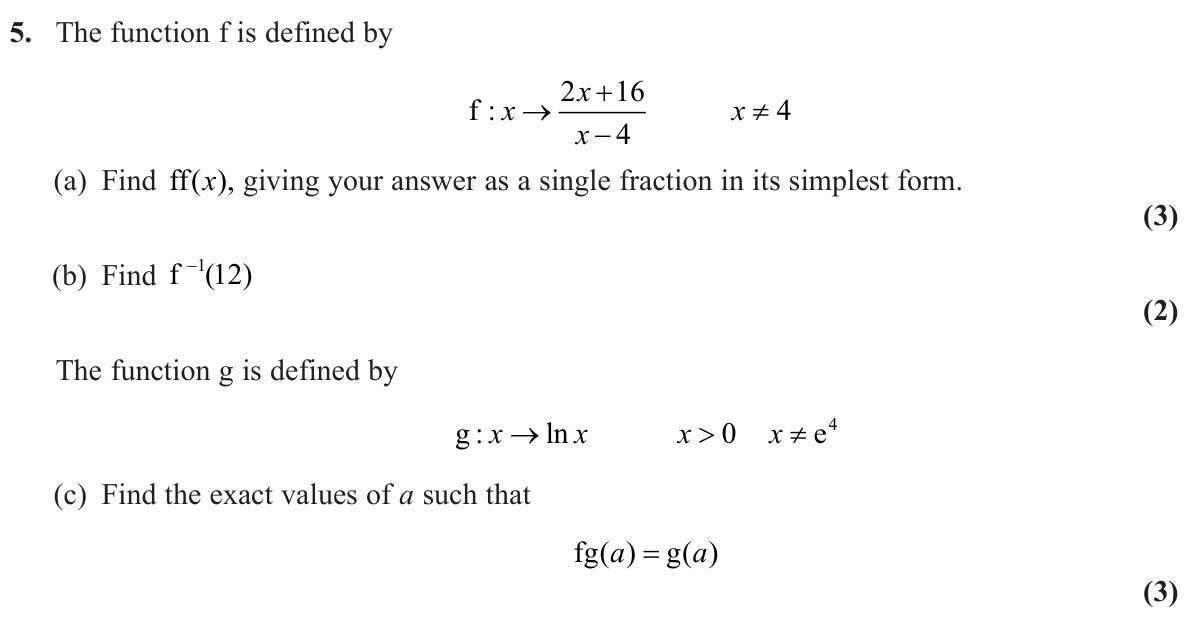
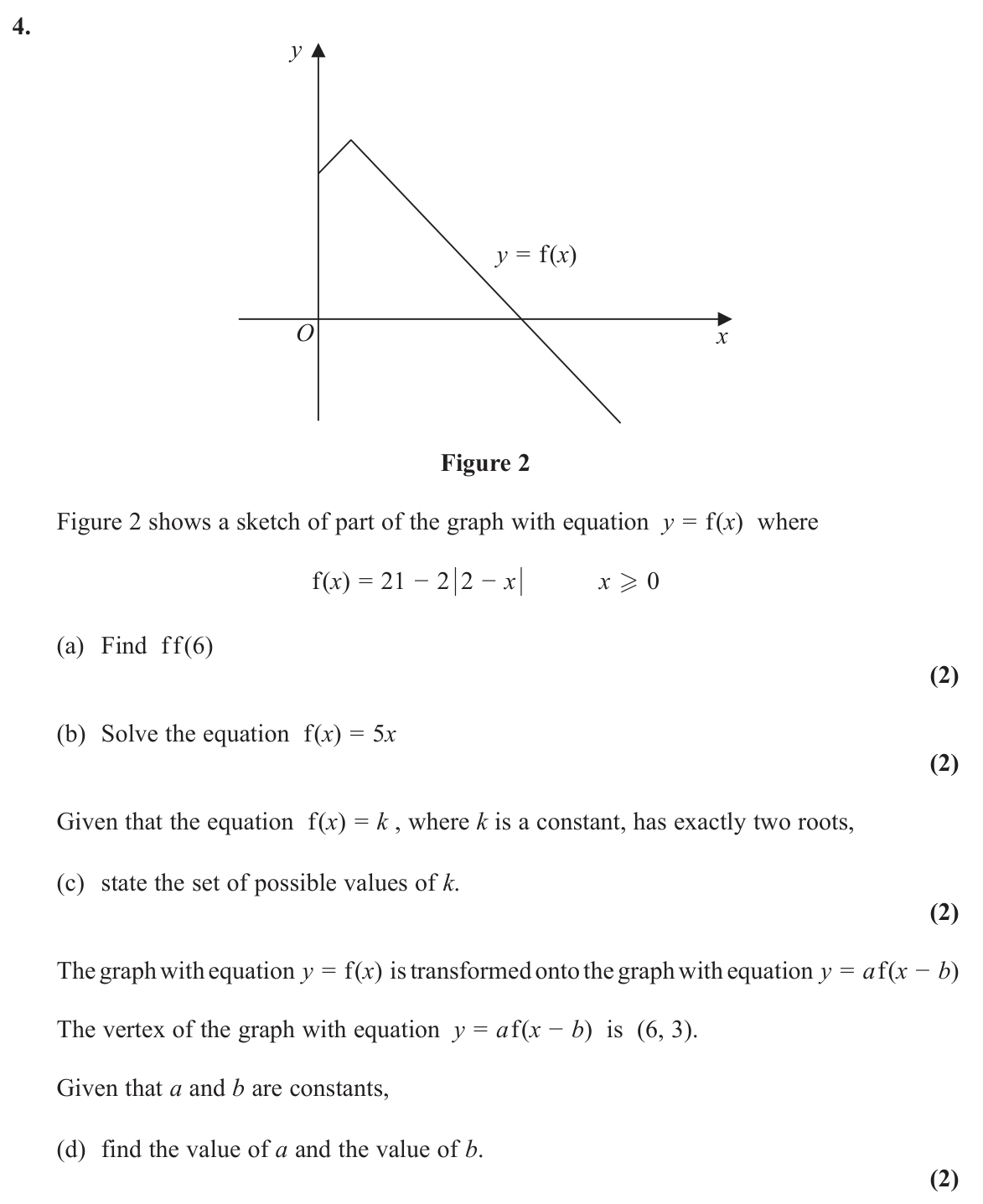
Apply f twice, in order: $f(6)=21-2|2-6|=13$. Then $ff(6)=f(13)=21-2|2-13|=21-22=-1$. The intermediate input 13 lies in the domain $x\ge0$.
\[\boxed{ff(6)=-1}\]
Part (b)
For $0\le x\le2$, $f(x)=17+2x$, so $17+2x=5x$ gives $x=17/3$, outside that branch; reject it. For $x\ge2$, $f(x)=25-2x$. Then $25-2x=5x$, giving $x=25/7$. This belongs to the second branch and satisfies the original modulus equation.
\[\boxed{x=\frac{25}{7}}\]
Part (c)
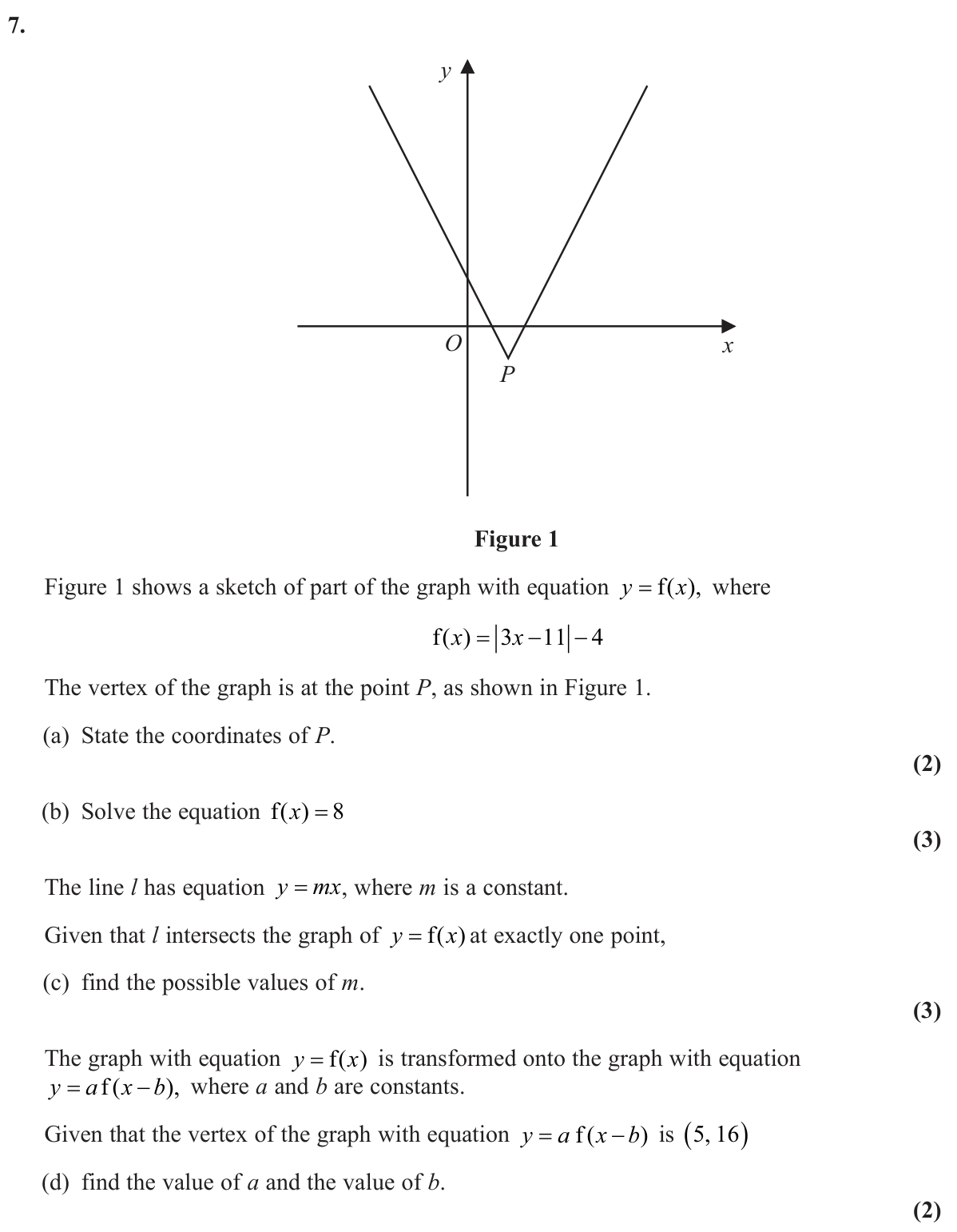
On the left branch $0\le x\le2$, f rises from $f(0)=17$ to $f(2)=21$. The right branch decreases from 21 without lower bound. A horizontal line therefore meets both branches at distinct points exactly when $17\le k\lt 21$. At $k=17$, one root is the permitted endpoint $x=0$; at $k=21$, the two intersections merge at the vertex, so 21 is excluded.
\[\boxed{17\le k\lt 21}\]
Part (d)
The original vertex is $(2,21)$. Under $y=af(x-b)$ it maps to $(2+b,21a)$. Comparing with $(6,3)$ gives $2+b=6$ and $21a=3$.
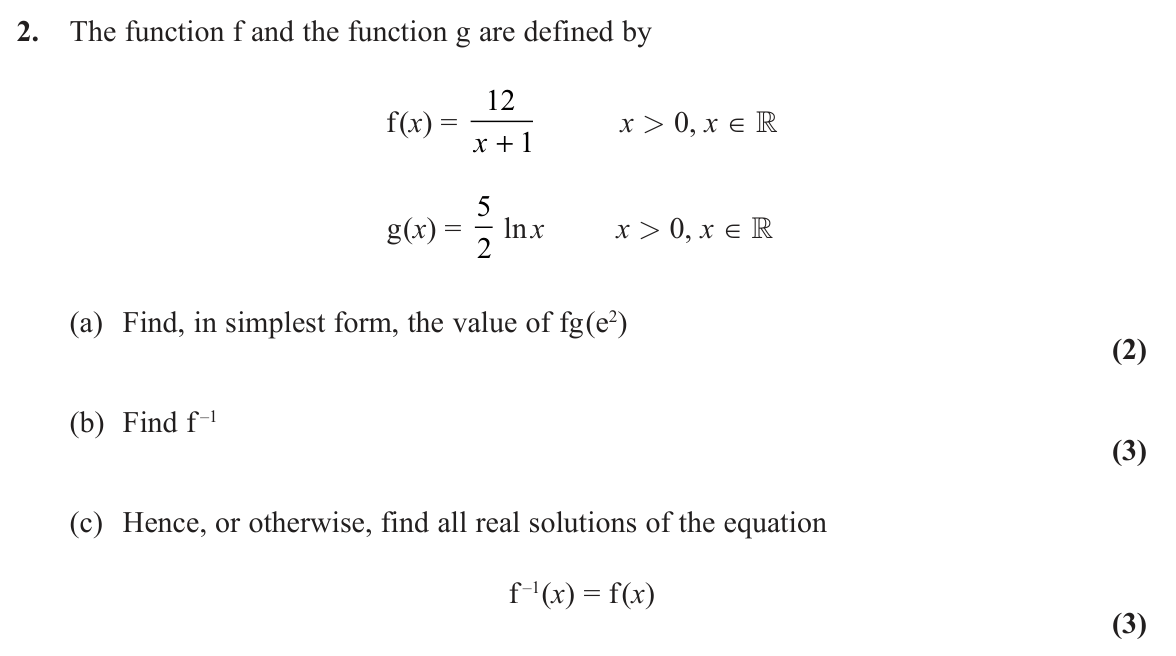
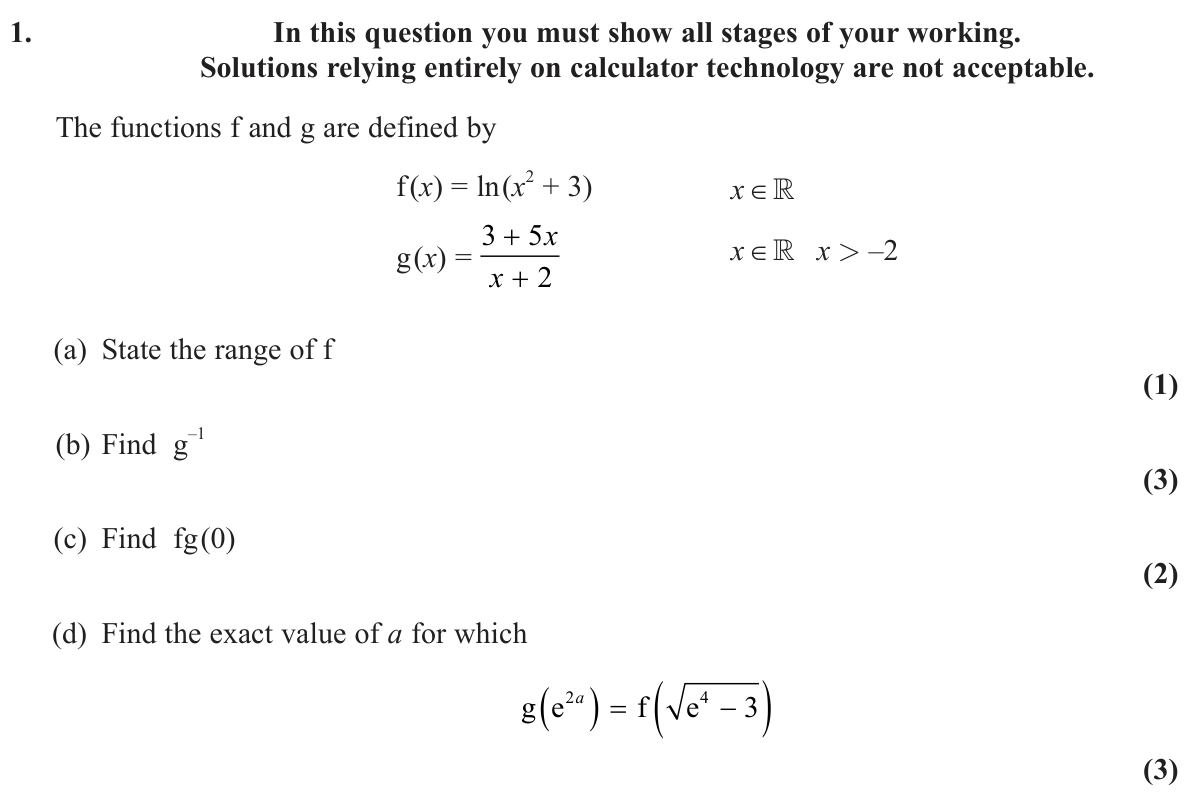
For $x\gt 0$, the denominator $x+1\gt 1$, so $0\lt f(x)\lt 12$. Conversely, every $y$ with $0\lt y\lt 12$ gives $x=12/y-1\gt 0$. Thus the range of $f$, and hence the domain of its inverse, is $(0,12)$. Interchanging $x$ and $y$ gives
The algebraic candidates are $x=-4$ and $x=3$. Reject $x=-4$ because it lies outside $0\lt x\lt 12$. For $x=3$, $f^{-1}(3)=12/3-1=3=f(3)$, so the only real solution is
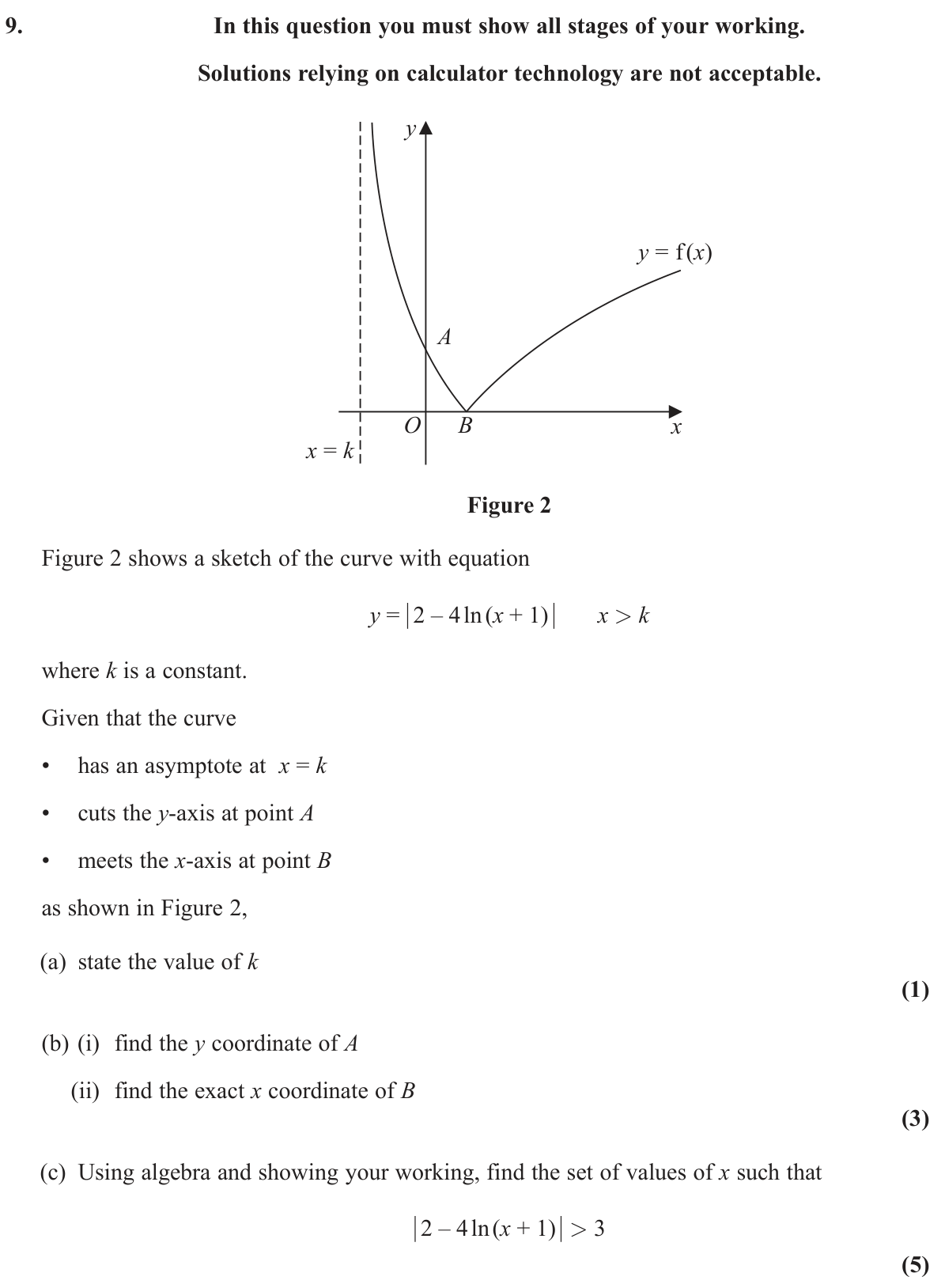
Since the exponential is increasing, this becomes $x+1\lt e^{-1/4}$ or $x+1\gt e^{5/4}$. Intersect with the logarithmic domain; neither boundary is included because the source inequality is strict.
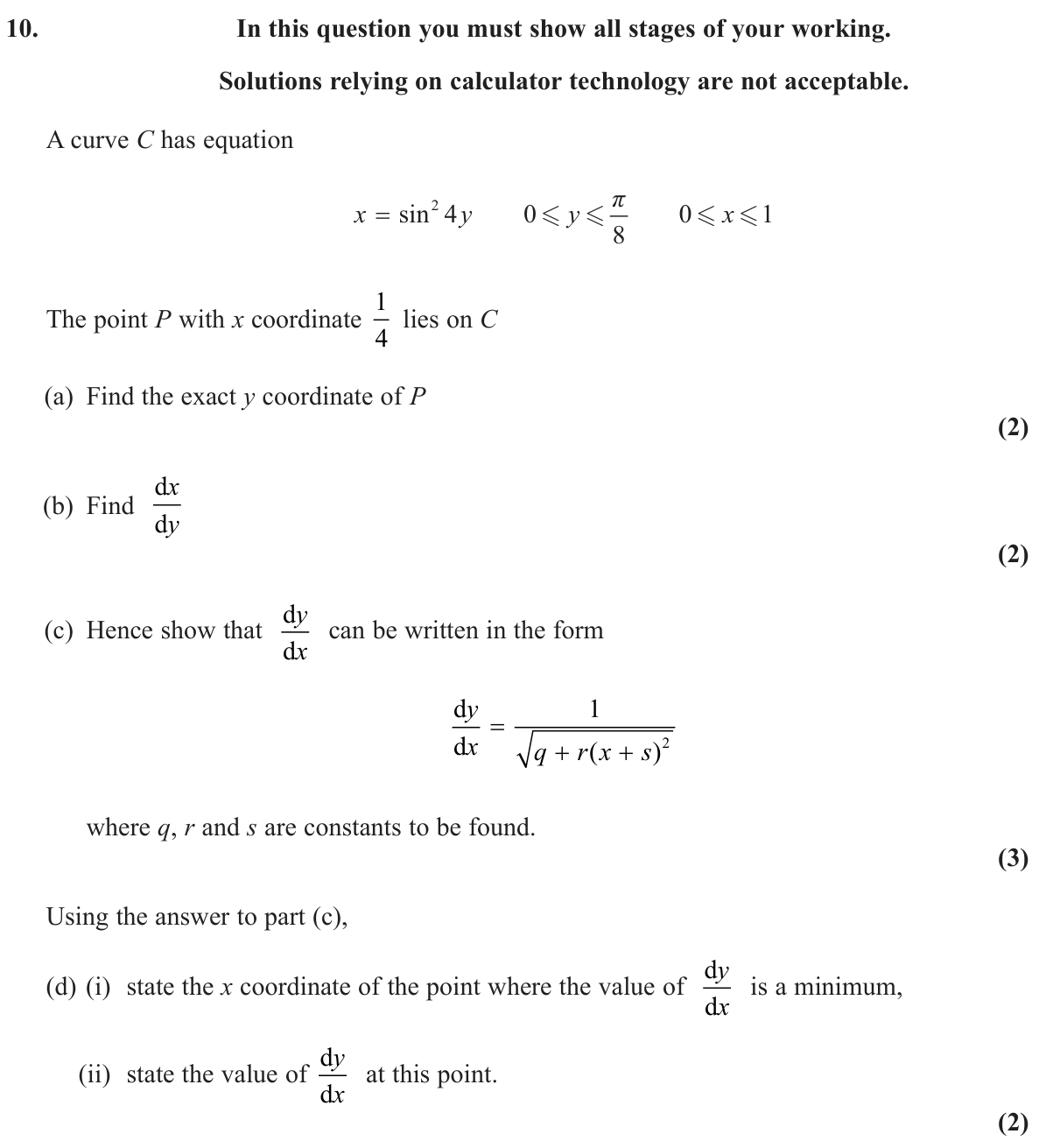
Thus $dy/dx=(q+r(x+s)^2)^{-1/2}$ has the constants below, with $0\lt x\lt 1$ for a finite derivative; the endpoints have vertical tangents.
\[\boxed{q=16,\qquad r=-64,\qquad s=-\frac12}\]
Part (d)
The derivative is positive. Its minimum occurs when the square root in the denominator is largest. Since $(x-1/2)^2\ge0$, the largest radicand is 16, attained at $x=1/2$. Hence the smallest gradient is $1/\sqrt{16}$.
Hard9 marks · main topic: ModulusShow worked solution
Part (a)
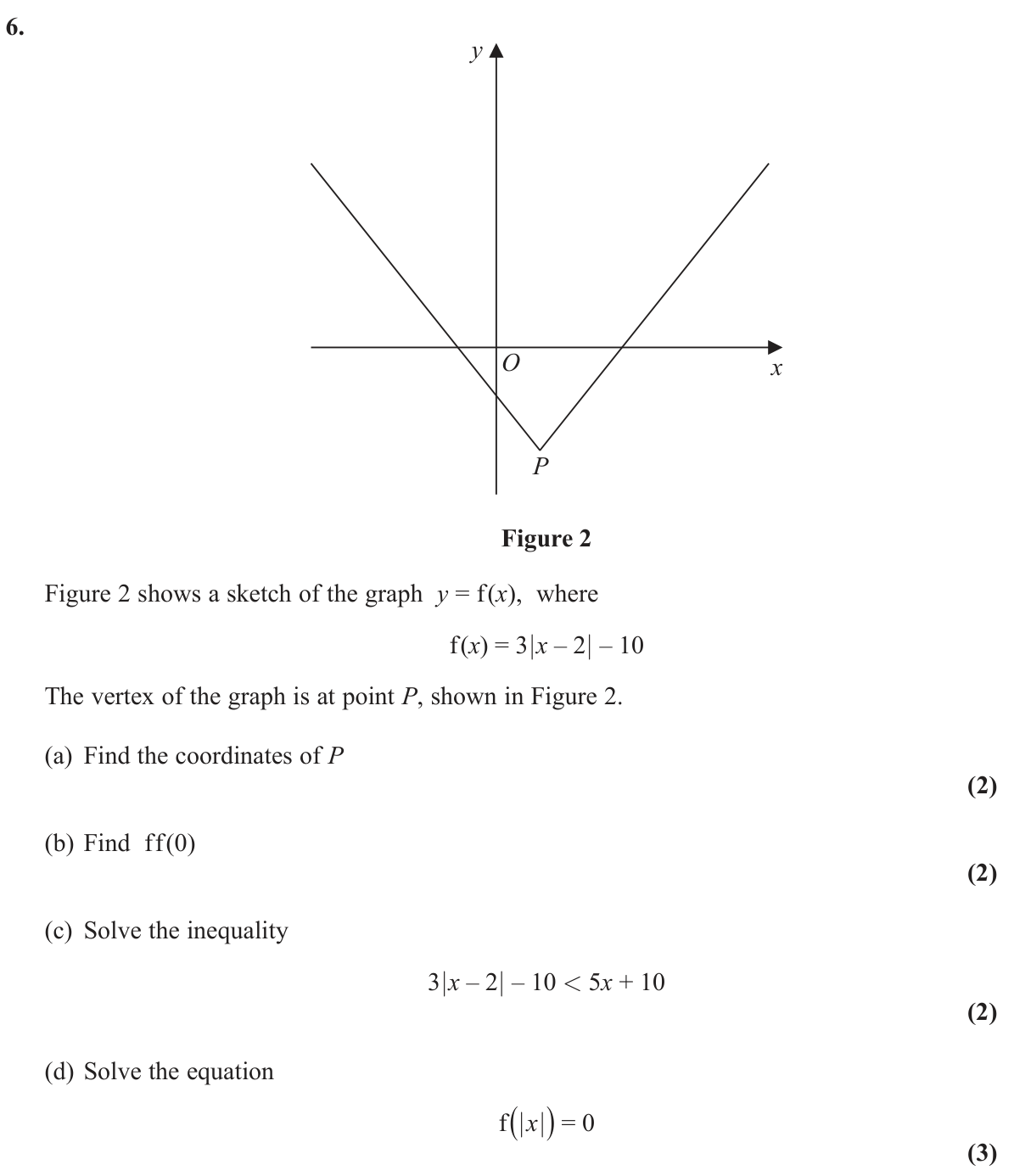
The modulus is smallest when $x-2=0$, giving $x=2$ and $f(2)=-10$. The two straight-line branches meet there, so this is the vertex of the V-shaped graph.
\[\boxed{P=(2,-10)}\]
Part (b)
First $f(0)=3|0-2|-10=-4$. Then $ff(0)=f(-4)=3|-4-2|-10=18-10=8$. In particular $ff(0)$ means $f(f(0))$, not the square of $f(0)$.
\[\boxed{ff(0)=8}\]
Part (c)
For $x\lt 2$, the inequality becomes $3(2-x)-10\lt 5x+10$, so $-4-3x\lt 5x+10$, giving $x\gt -7/4$. This yields $-7/4\lt x\lt 2$. For $x\ge2$, it becomes $3x-16\lt 5x+10$, giving $x\gt -13$; every $x\ge2$ satisfies this. The union is $x\gt -7/4$.
Hard9 marks · main topic: Trig Equations & R-FormShow worked solution
Part (a)
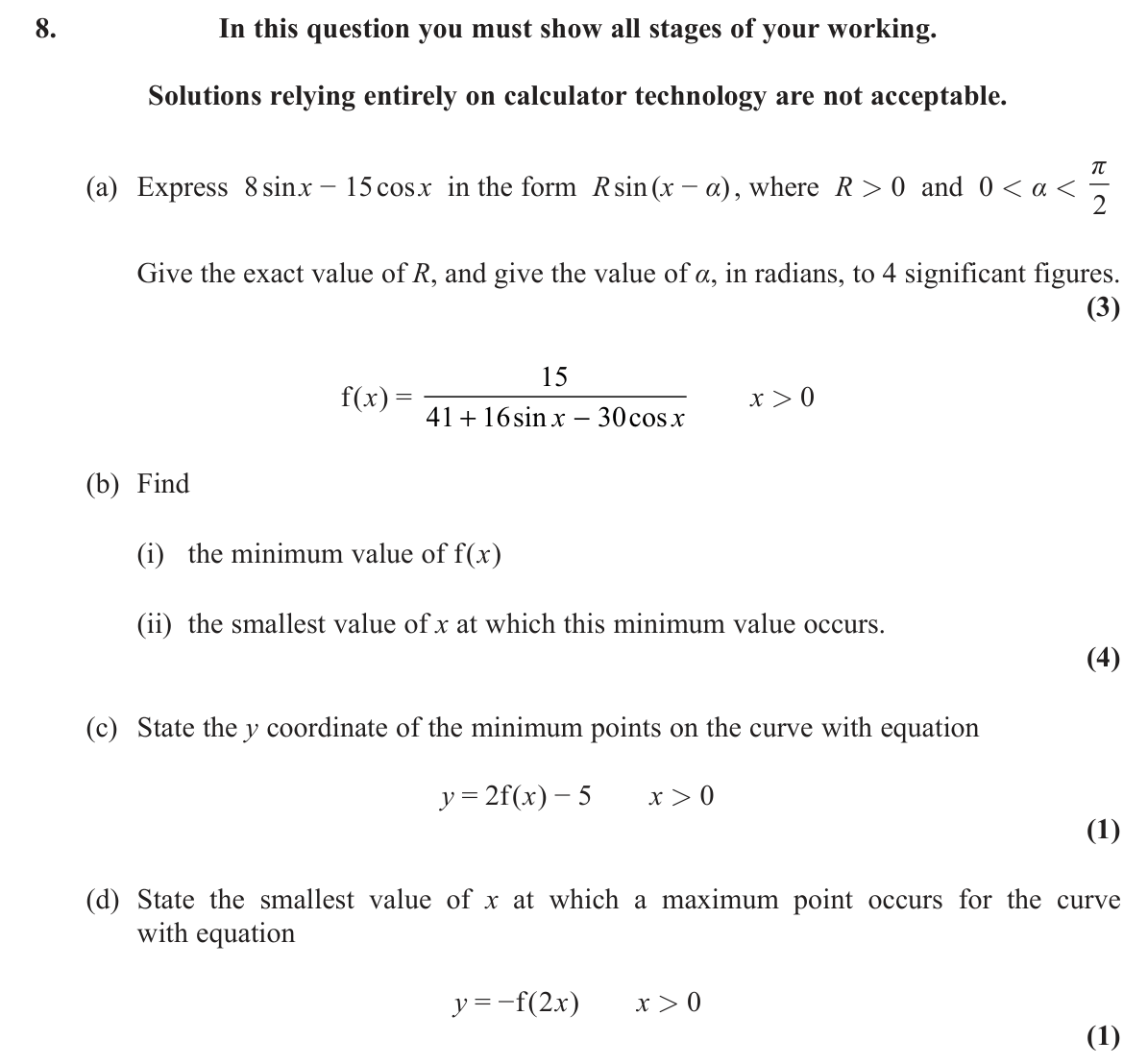
Expand $R\sin(x-\alpha)=R\cos\alpha\sin x-R\sin\alpha\cos x$. Thus $R\cos\alpha=8$, $R\sin\alpha=15$, so $R=\sqrt{64+225}=17$ and $\alpha=\arctan(15/8)=1.0808390005\ldots$ radians, in the required quadrant.
The denominator lies between 7 and 75, so it is always positive. (i) The smallest fraction occurs at its largest denominator: $f_{\min}=15/75=1/5$. (ii) This occurs when $x-\alpha=\pi/2+2n\pi$. The smallest positive value is $x=\alpha+\pi/2=2.6516353273\ldots$, or 2.65 to three significant figures.
\[\boxed{f_{\min}=\frac15,\qquad x=2.65}\]
Part (c)
The transformation $2f(x)-5$ preserves the locations of minima and maps their y coordinate to $2(1/5)-5=-23/5$.
\[\boxed{y=-\frac{23}{5}}\]
Part (d)
Reflection in the x-axis changes minima of f into maxima of $-f$. The argument $2x$ halves their x coordinates, so the first positive maximum is at
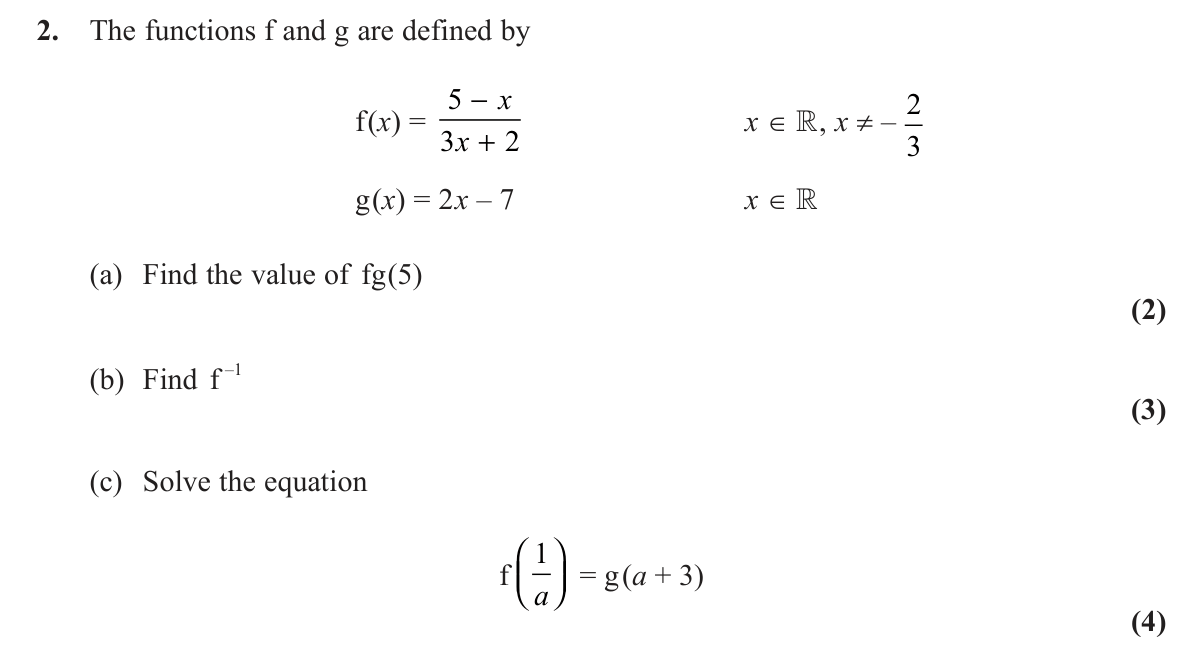
$g(5)=2(5)-7=3$, then $fg(5)=f(3)=(5-3)/(9+2)=2/11$.
\[\boxed{fg(5)=\frac2{11}}\]
Part (b)
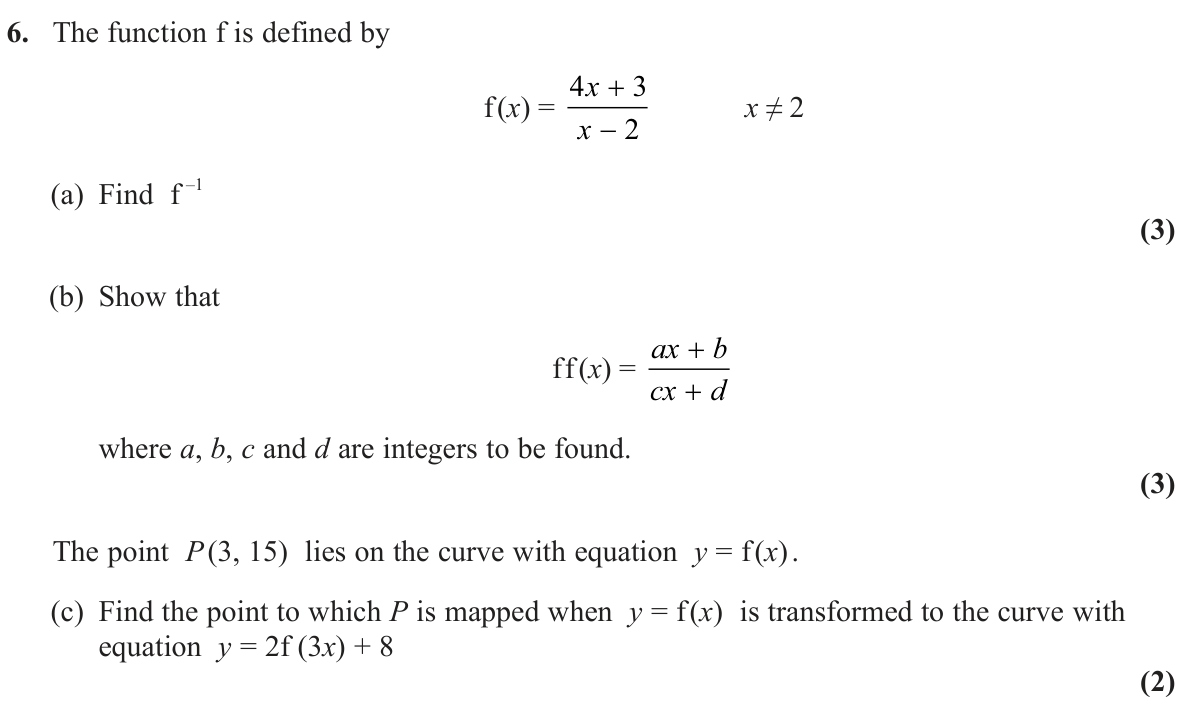
Let $y=(5-x)/(3x+2)$. Then $3xy+2y=5-x$, so $x(3y+1)=5-2y$ and $x=(5-2y)/(3y+1)$. Exchange x and y. The inverse cannot have input $-1/3$, since this is not an output of f: $(5-x)/(3x+2)=-1/3$ would imply $15=-2$.
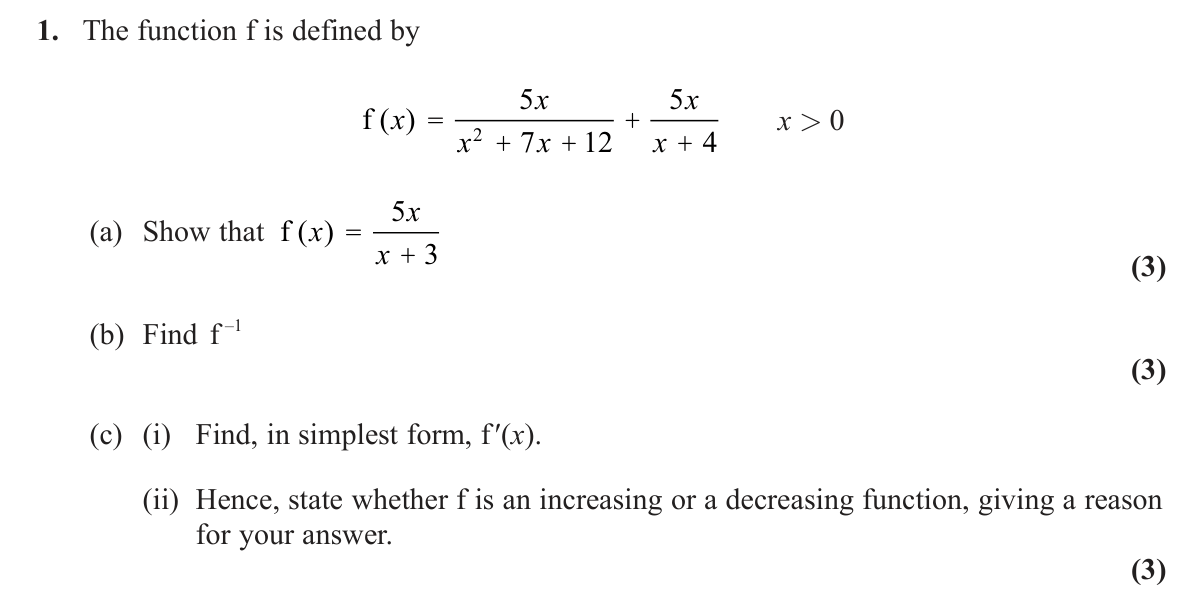
The cancelled factor is nonzero throughout the original domain $x\gt 0$.
\[\boxed{f(x)=\frac{5x}{x+3},\quad x\gt 0}\]
Part (b)
Let $y=5x/(x+3)$. Then $yx+3y=5x$, so $x=3y/(5-y)$. Exchange variable names. Since $f(x)=5-15/(x+3)$ for $x\gt 0$, its range is $0\lt f(x)\lt 5$. This becomes the inverse domain.
(i) By the quotient rule, $f'(x)=[5(x+3)-5x]/(x+3)^2=15/(x+3)^2$. (ii) The numerator and denominator are positive on $x\gt 0$, so $f'(x)\gt 0$ throughout its domain. Therefore f is increasing.
\[\boxed{f^{\prime}(x)=\frac{15}{(x+3)^2};\quad f\text{ is increasing}}\]
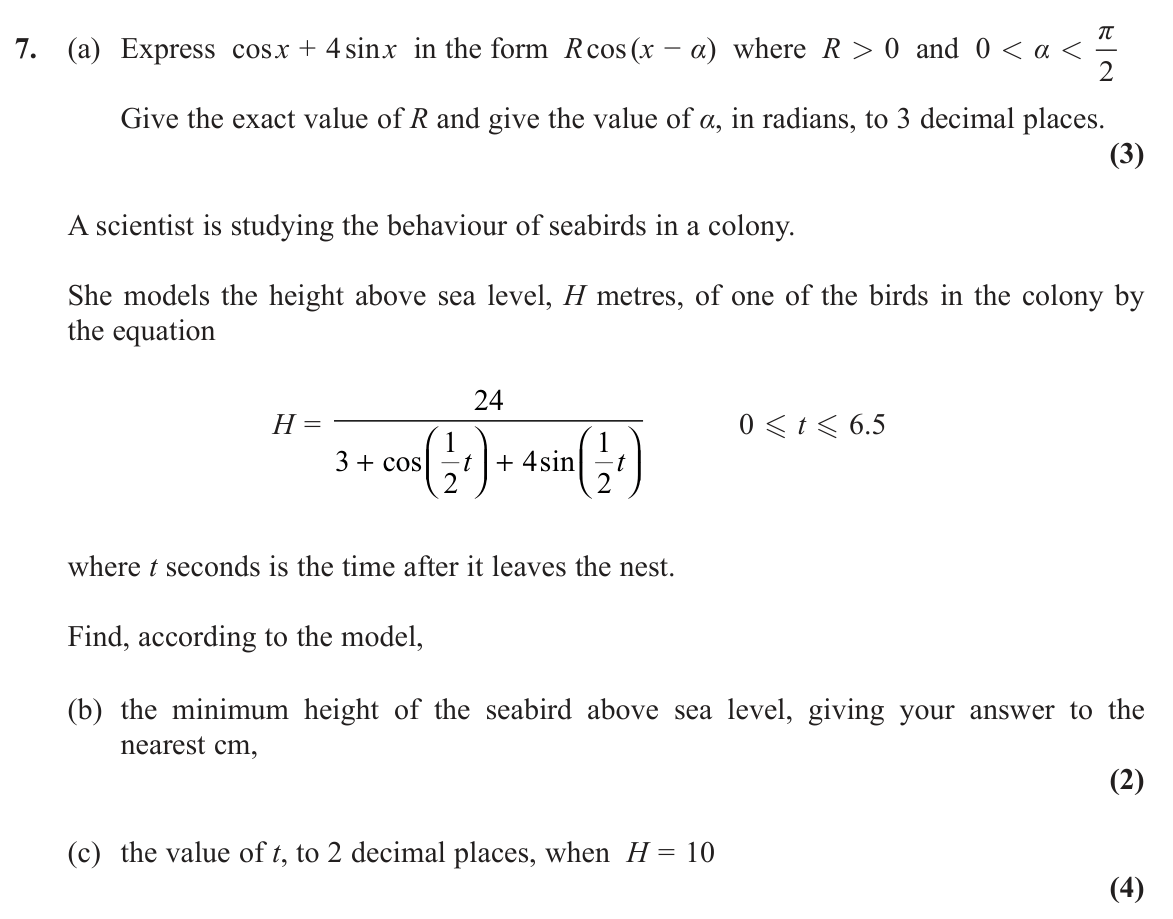
The model becomes $H=24/[3+\sqrt{17}\cos(t/2-\alpha)]$. For $0\le t\le6.5$, the phase lies between $-\alpha$ and $3.25-\alpha$; throughout this interval the denominator remains positive. Its maximum $3+\sqrt{17}$ is attained at $t=2\alpha=2.651635\ldots$, inside the time interval. The height is then smallest:
To the nearest centimetre this is $3.37\ \mathrm m$ (337 cm).
\[\boxed{H_{\min}=3.37\ \mathrm m}\]
Part (c)
For $H=10$, $3+\sqrt{17}\cos(t/2-\alpha)=24/10$, so
\[\cos(t/2-\alpha)=-\frac{3}{5\sqrt{17}}.\]
Let $\gamma=\arccos[-3/(5\sqrt{17})]$. In the permitted phase interval $[-\alpha,3.25-\alpha]$, only $+\gamma$ occurs: $-\gamma\lt -\alpha$, and shifts by $2\pi$ are outside it. Using the unrounded $\alpha=\arctan4$,
On the left branch, $mx=7-3x$ gives $x=7/(m+3)$ for $m\ne-3$. This lies on the left branch precisely when $m\lt -3$ or $m\ge-12/11$. On the right branch, $mx=3x-15$ gives $x=15/(3-m)$ for $m\ne3$. This lies on the right branch precisely when $-12/11\le m\lt 3$. At $m=-12/11$, the two branch intersections coincide at the vertex, so there is only one distinct point. For $m\lt -3$ or $m\ge3$, only the left intersection exists. At $m=-3$ there is no intersection; at $m=3$ there is one. Consequently the complete answer is
The left branch is strictly decreasing. If $0\lt k\lt 3$, the right branch also decreases, so there cannot be two roots. If $k=3$, the right branch is the nonzero constant $-8$, again giving no second root. For $k\gt 3$ the right branch increases and both outer ends tend to $+\infty$. There are two distinct roots precisely when the vertex lies below zero:
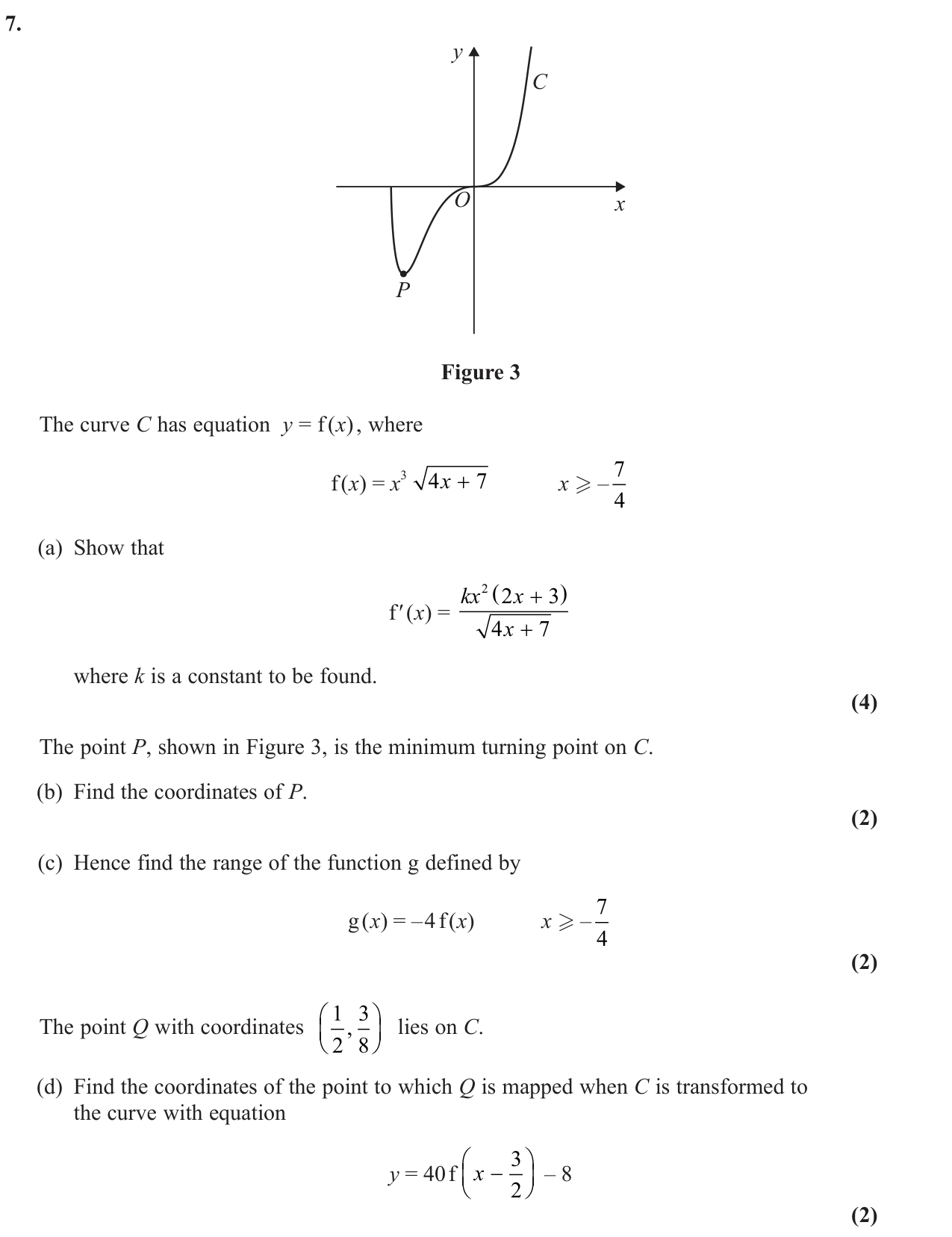
The interior stationary values satisfy $x^2(2x+3)=0$, so $x=0$ or $x=-3/2$. Near $x=-3/2$, the derivative changes from negative to positive; near $x=0$ it stays positive on both sides. Thus the minimum turning point is at $x=-3/2$.
\[f(-3/2)=(-3/2)^3\sqrt{-6+7}=-27/8.\]
\[\boxed{P=\left(-\frac32,-\frac{27}{8}\right)}\]
Part (c)
The endpoint has $f(-7/4)=0$, the global minimum is $-27/8$ and $f(x)$ tends to infinity as $x$ increases. Hence the range of $f$ is $[-27/8,\infty)$. Multiplication by $-4$ reverses the inequality and makes the upper endpoint $27/2$.
\[\boxed{g(x)\le\frac{27}{2}}\]
Part (d)
The transformation is a shift right by $3/2$, vertical stretch by 40, then shift down by 8:
\[(x,y)\mapsto(x+3/2,40y-8).\]
Therefore $Q=(1/2,3/8)$ maps to $(1/2+3/2,\;40\cdot3/8-8)$.
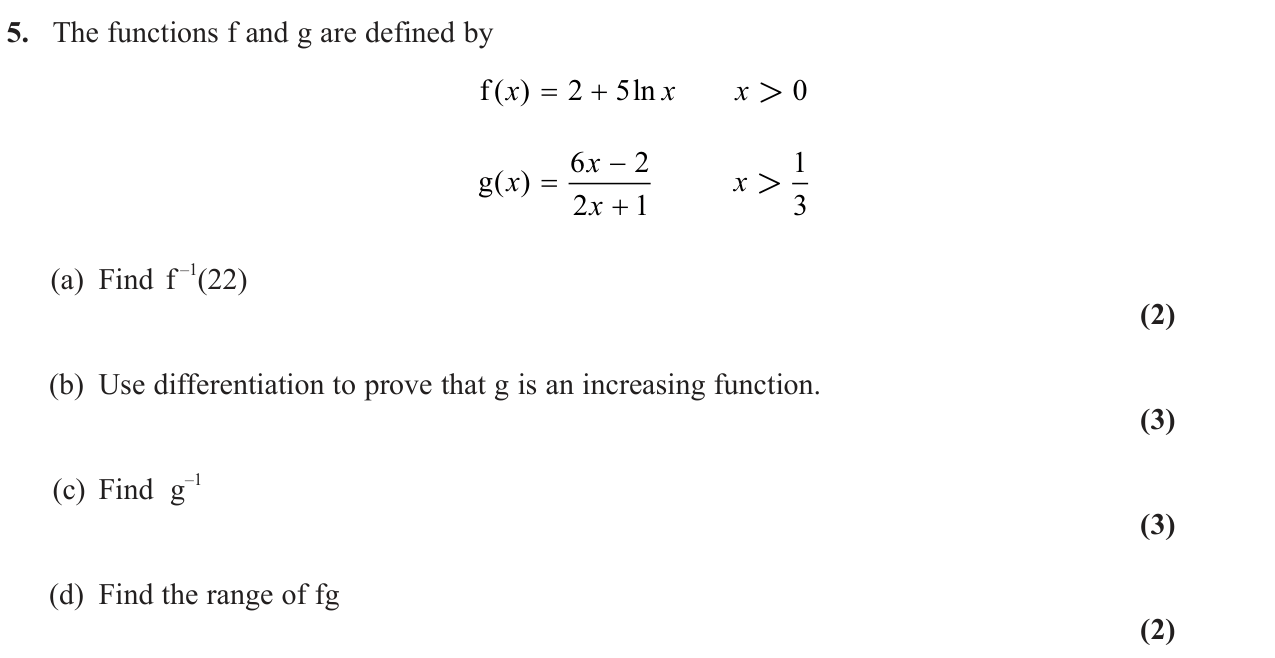
As $x\downarrow1/3$, $g(x)\to0$; as $x\to\infty$, $g(x)\to3$. Since g is strictly increasing, its range is $(0,3)$; neither limiting value is attained. Interchange the input and output symbols.
The inner function g takes every value in $(0,3)$. Since $f(u)=2+5\ln u$ is increasing for $u\gt 0$, its values on this interval run from $-\infty$ to, but not including, $2+5\ln3$.
(a) $f^{-1}(22)=e^4$ (b) $g\text{ is strictly increasing for }x\gt \frac13$ (c) $g^{-1}(x)=\frac{x+2}{6-2x},\quad0\lt x\lt 3$ (d) $\operatorname{Range}(fg)=(-\infty,\,2+5\ln3)$
37. WMA13/01 October 2023 · Q7
Hard10 marksShow worked solution
Part (a)
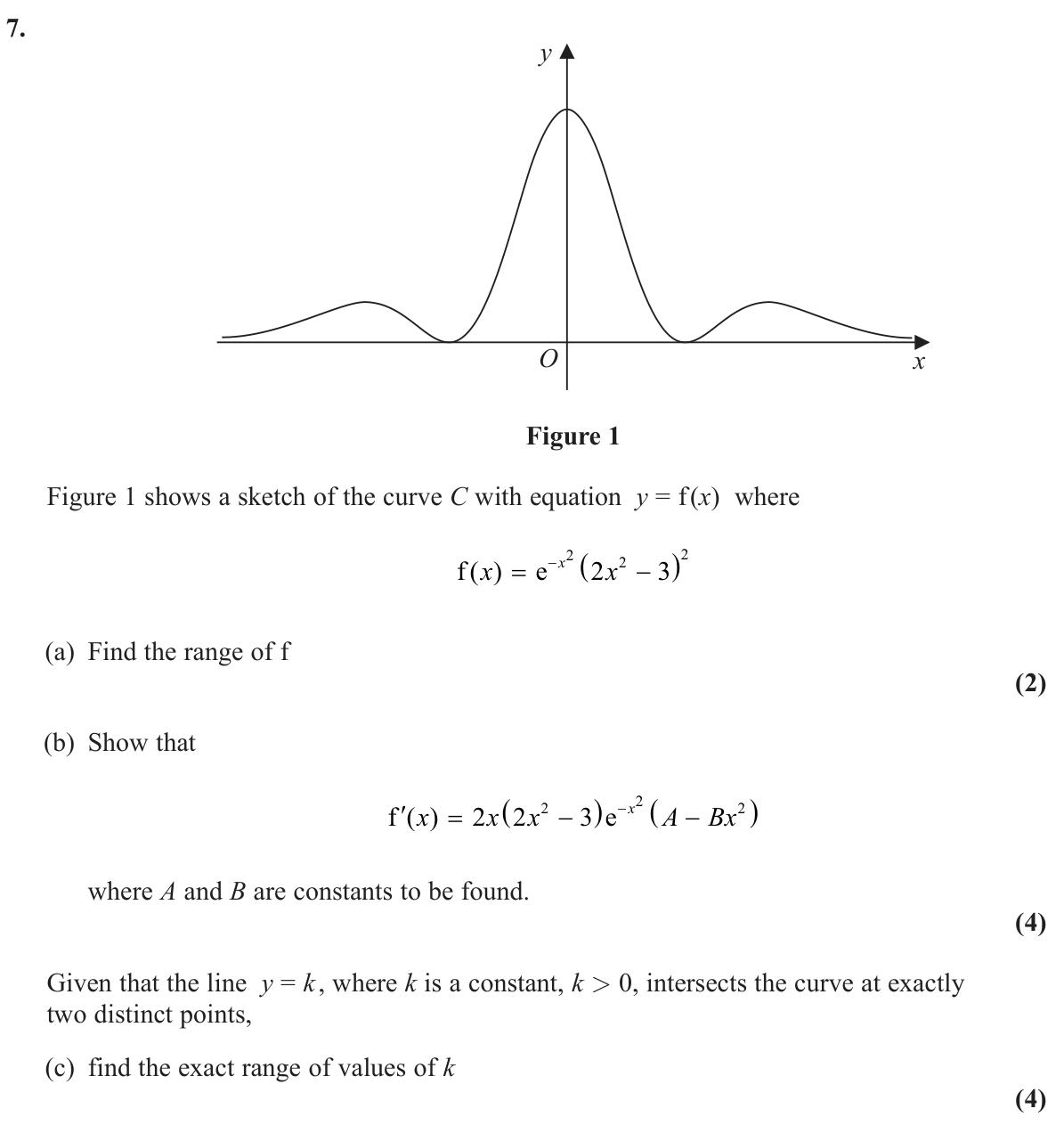
The exponential is positive and the squared factor is nonnegative, so $f(x)\ge0$. The value zero is attained at $x=\pm\sqrt{3/2}$. The graph has its highest point at $x=0$, where $f(0)=9$; the outer maxima are lower. Thus both endpoints of the range are included.
\[\boxed{0\le f(x)\le9}\]
Part (b)
For $f(x)=e^{-x^2}(2x^2-3)^2$, product and chain rules give
The central maximum is 9 and the two minima are zero. Also $f(x)\to0$ as $x\to\pm\infty$. A positive horizontal line above both outer maxima but below 9 meets only the two sides of the central peak. At $k=16e^{-7/2}$ it also touches both outer peaks, giving four distinct intersections; at $k=9$ there is only one. Both bounds must be excluded.
This derivative formula applies for $x\gt -9/4$; the endpoint derivative is not finite.
\[\boxed{k=10}\]
Part (b)
The denominator is positive in the derivative domain. Thus $5x^2+9x-2=(5x-1)(x+2)=0$.
\[\boxed{x=-2,\quad\frac15}\]
Part (c)
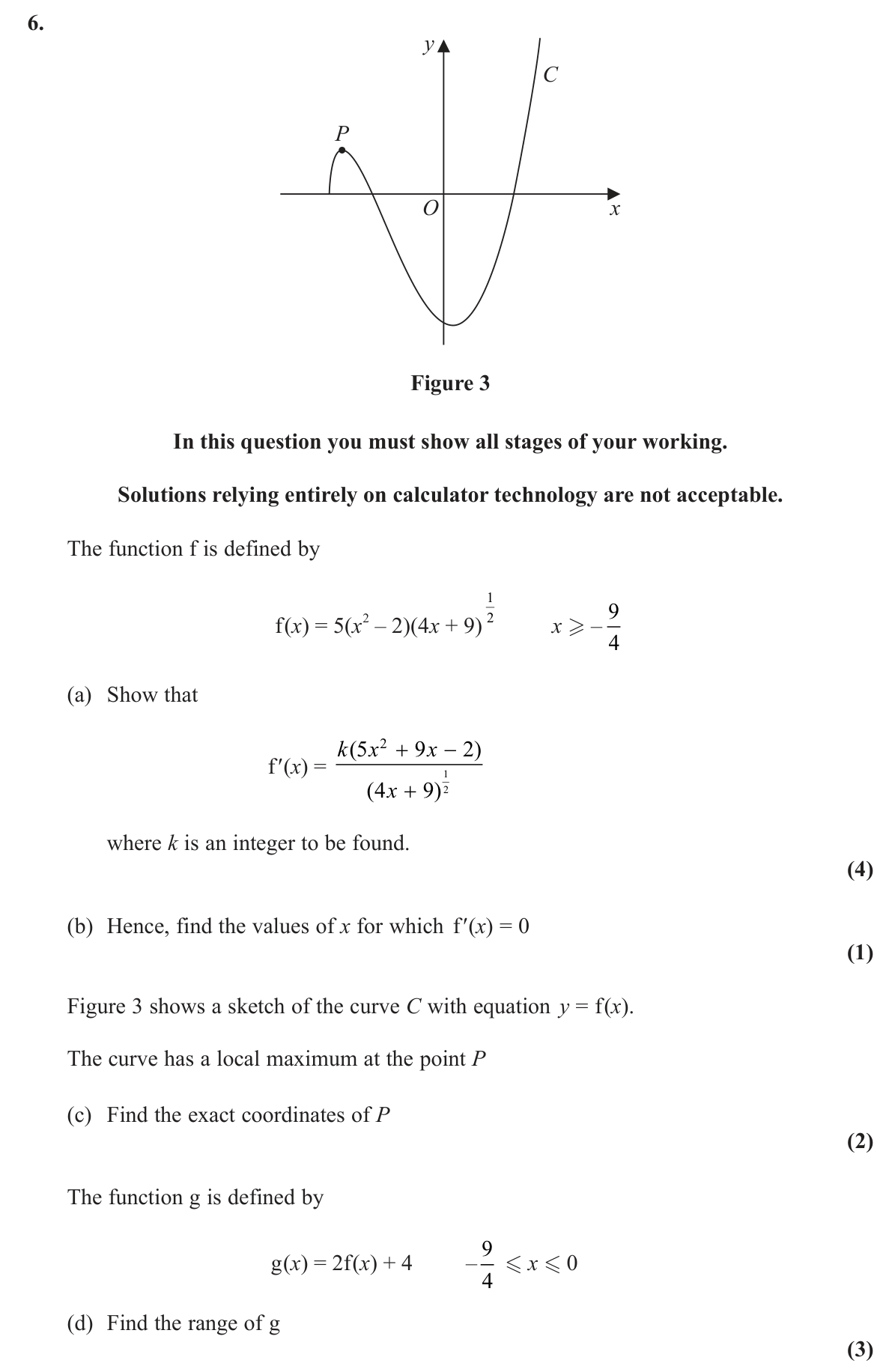
The derivative changes from positive to negative at $x=-2$, so this is the local maximum P. Substitute into f: $f(-2)=5(4-2)\sqrt{-8+9}=10$.
\[\boxed{P=(-2,10)}\]
Part (d)
On $[-9/4,0]$, f rises from $f(-9/4)=0$ to $f(-2)=10$, then decreases to $f(0)=-30$. The other stationary point $1/5$ is outside this restricted interval. Thus the minimum and maximum of f on it are $-30$ and 10. Applying the positive vertical transformation $g=2f+4$ gives endpoints $2(-30)+4=-56$ and $2(10)+4=24$, both attained.
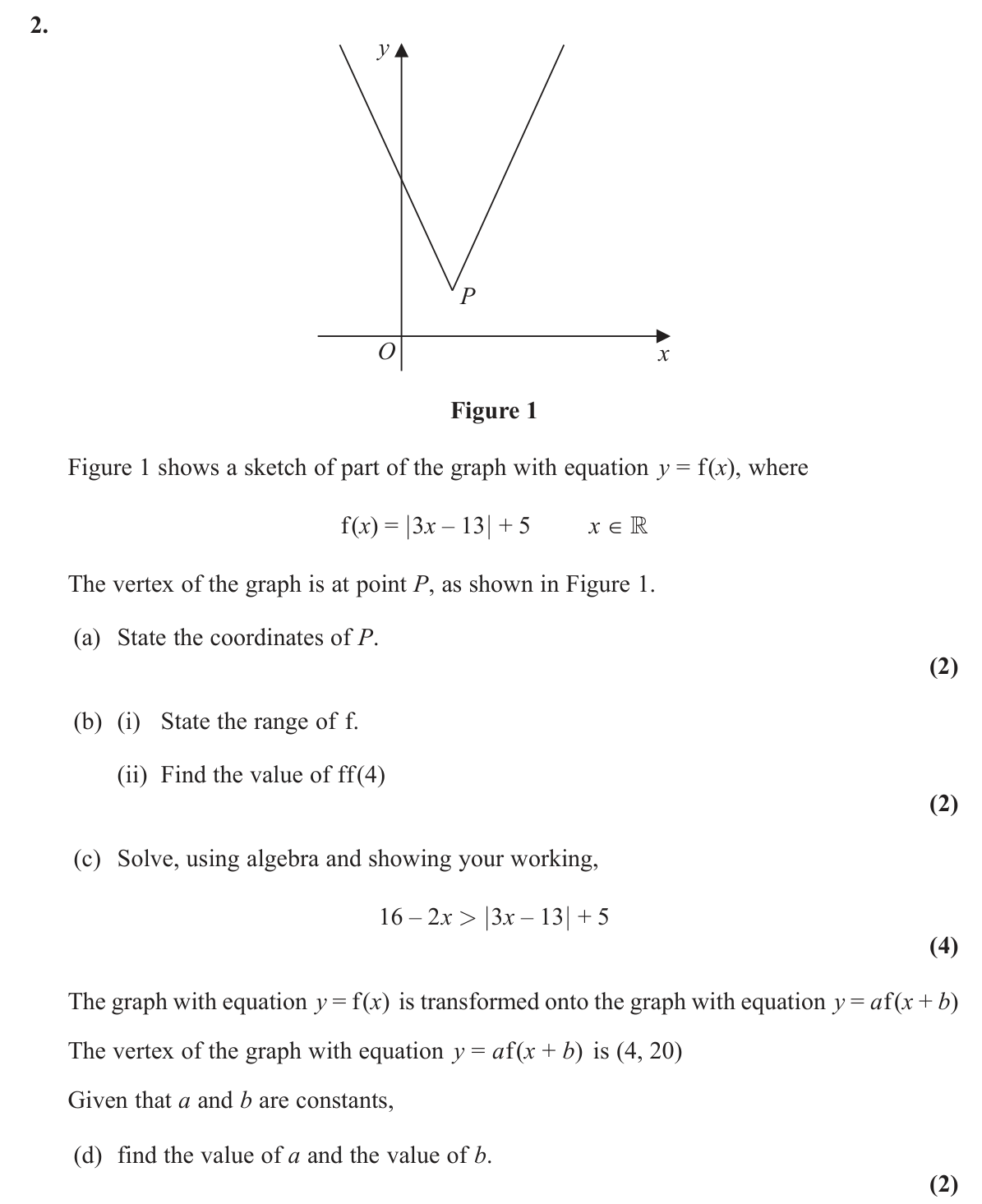
For $x\lt 13/3$, $|3x-13|+5=18-3x$. Thus $16-2x\gt 18-3x$ gives $x\gt 2$, so this branch contributes $2\lt x\lt 13/3$. For $x\ge13/3$, the right side is $3x-8$. Then $16-2x\gt 3x-8$ gives $x\lt 24/5$, so this branch contributes $13/3\le x\lt 24/5$. Combine the adjacent intervals.
\[\boxed{2\lt x\lt \frac{24}{5}}\]
Part (d)
The new vertex is at $(13/3-b,5a)$. Therefore $5a=20$ and $13/3-b=4$, giving $a=4$ and $b=1/3$.
The composite requires $x\le0$ from g and $g(x)\ne5$ from f; therefore $x\lt 0$. Now $4-13/x^2=3$ gives $x^2=13$. Only the negative root belongs to the composite domain.
\[\boxed{x=-\sqrt{13}}\]
Part (b)
Let $y=(4x+6)/(x-5)$. Then $yx-5y=4x+6$, so $x(y-4)=5y+6$ and $x=(5y+6)/(y-4)$. Exchange the variable names. The original function is $4+26/(x-5)$, whose range excludes 4.
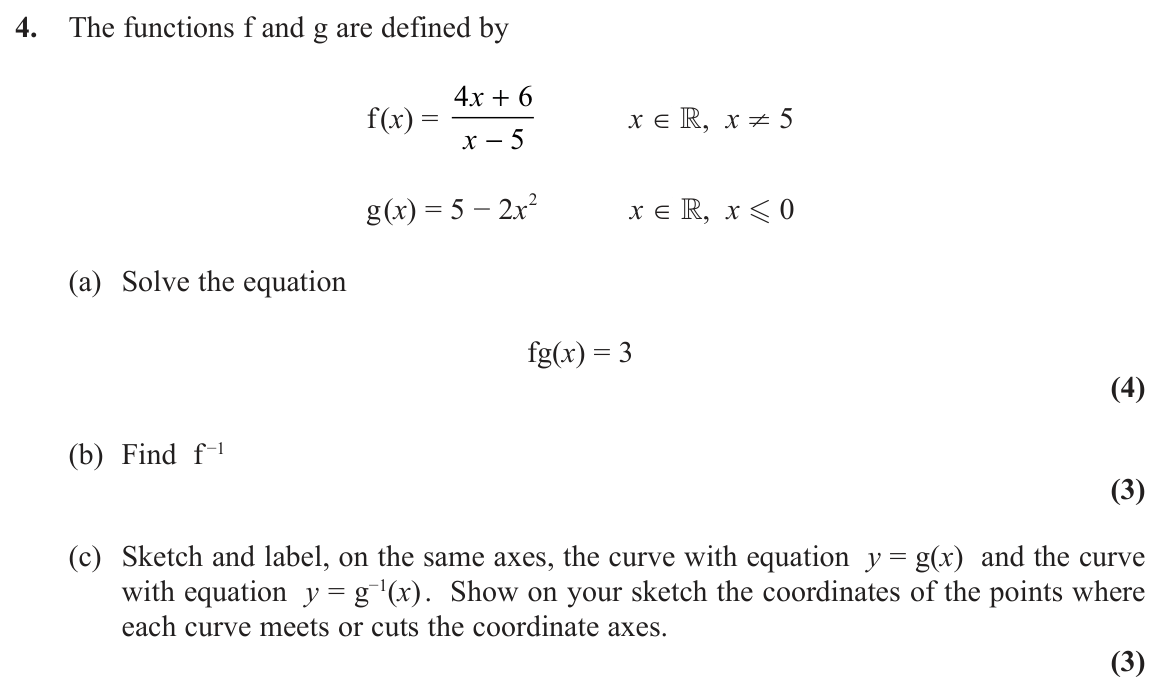
The graph of g is only the left half of the downward parabola: $y=5-2x^2$, $x\le0$. Its intercepts are $(0,5)$ and $(-\sqrt{5/2},0)$. For the inverse, $x=5-2y^2$ and $y\le0$, hence $g^{-1}(x)=-\sqrt{(5-x)/2}$, $x\le5$. Reflect the original branch in $y=x$. The inverse intercepts are $(5,0)$ and $(0,-\sqrt{5/2})$.
\[\boxed{g^{-1}(x)=-\sqrt{(5-x)/2},\ x\le5;\quad\text{graphs as shown}}\]
Final answer
(a) $x=-\sqrt{13}$ (b) $f^{-1}(x)=\frac{5x+6}{x-4},\quad x\ne4$ (c) $g^{-1}(x)=-\sqrt{(5-x)/2},\ x\le5;\quad\text{graphs as shown}$
41. WMA13/01 May/June 2026 · Q9
Hard11 marks · main topic: ModulusShow worked solution
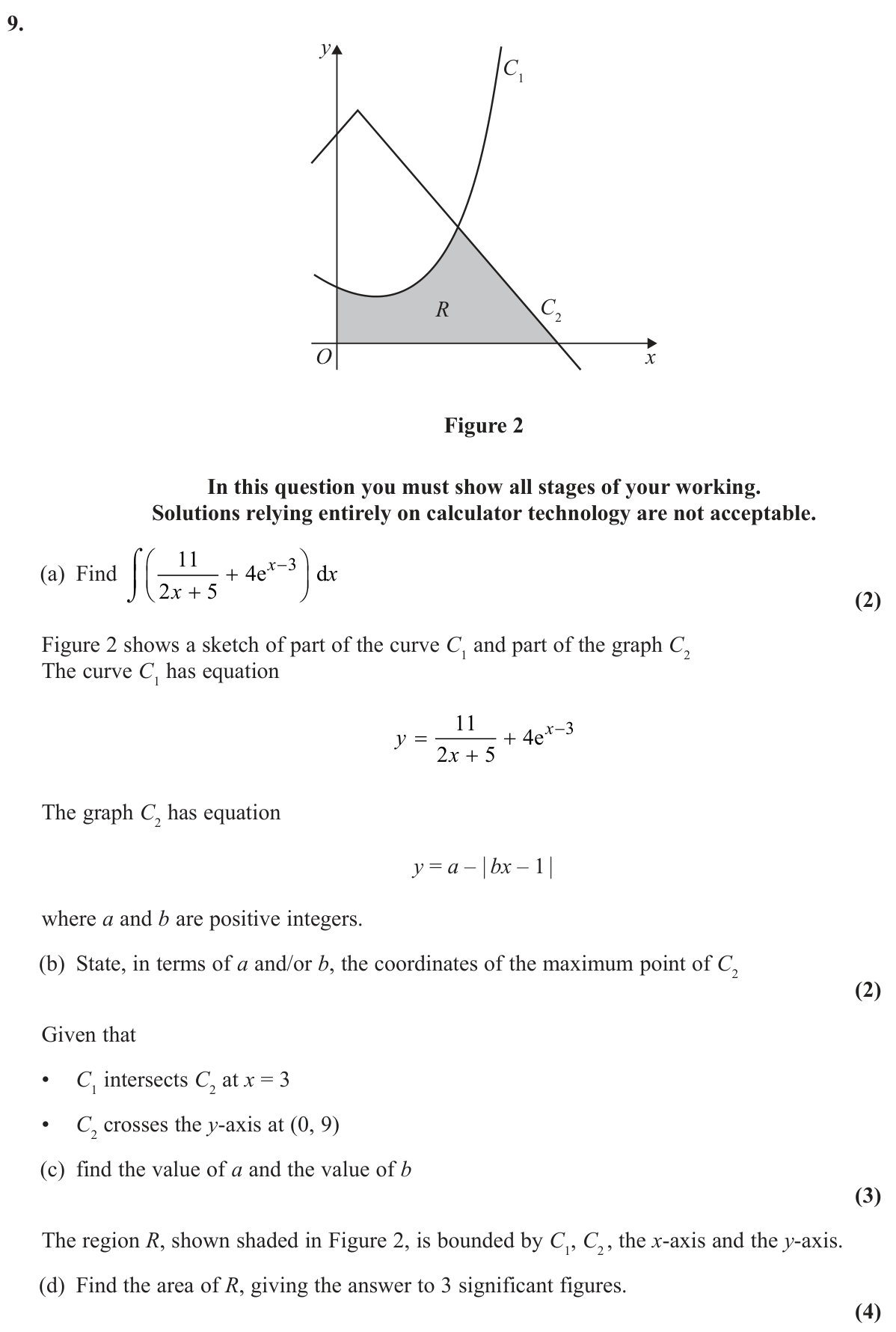
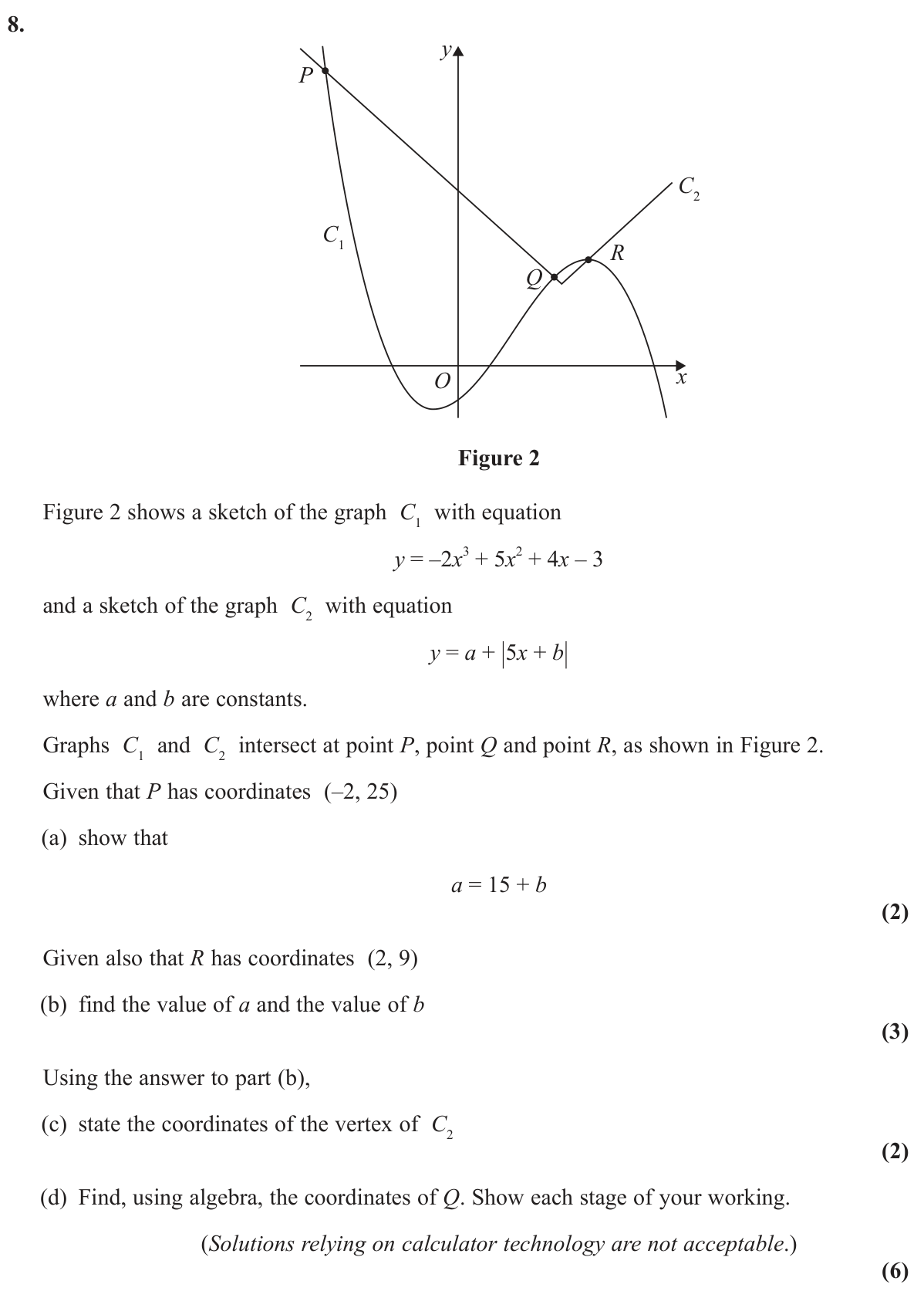
The absolute value allows both intervals on which the integrand is defined.
Part (b)
The largest value of $a-|bx-1|$ occurs when $bx-1=0$. The maximum point is therefore $\boxed{(1/b,a)}$.
Part (c)
At $x=0$, $9=a-1$, so $\boxed{a=10}$. At the intersection $x=3$, the first curve has height $11/11+4=5$. Thus $10-|3b-1|=5$, giving $3b-1=5$ or $-5$. These give $b=2$ or $-4/3$; only the positive integer is allowed, so $\boxed{b=2}$.
Part (d)
For $x\geq3$, the required branch of $C_2$ is $y=10-(2x-1)=11-2x$. Its $x$-intercept is $x=11/2$. The shaded area is the area under $C_1$ from 0 to 3 plus the triangle from 3 to $11/2$:
Hard11 marks · main topic: ModulusShow worked solution
Part (a)
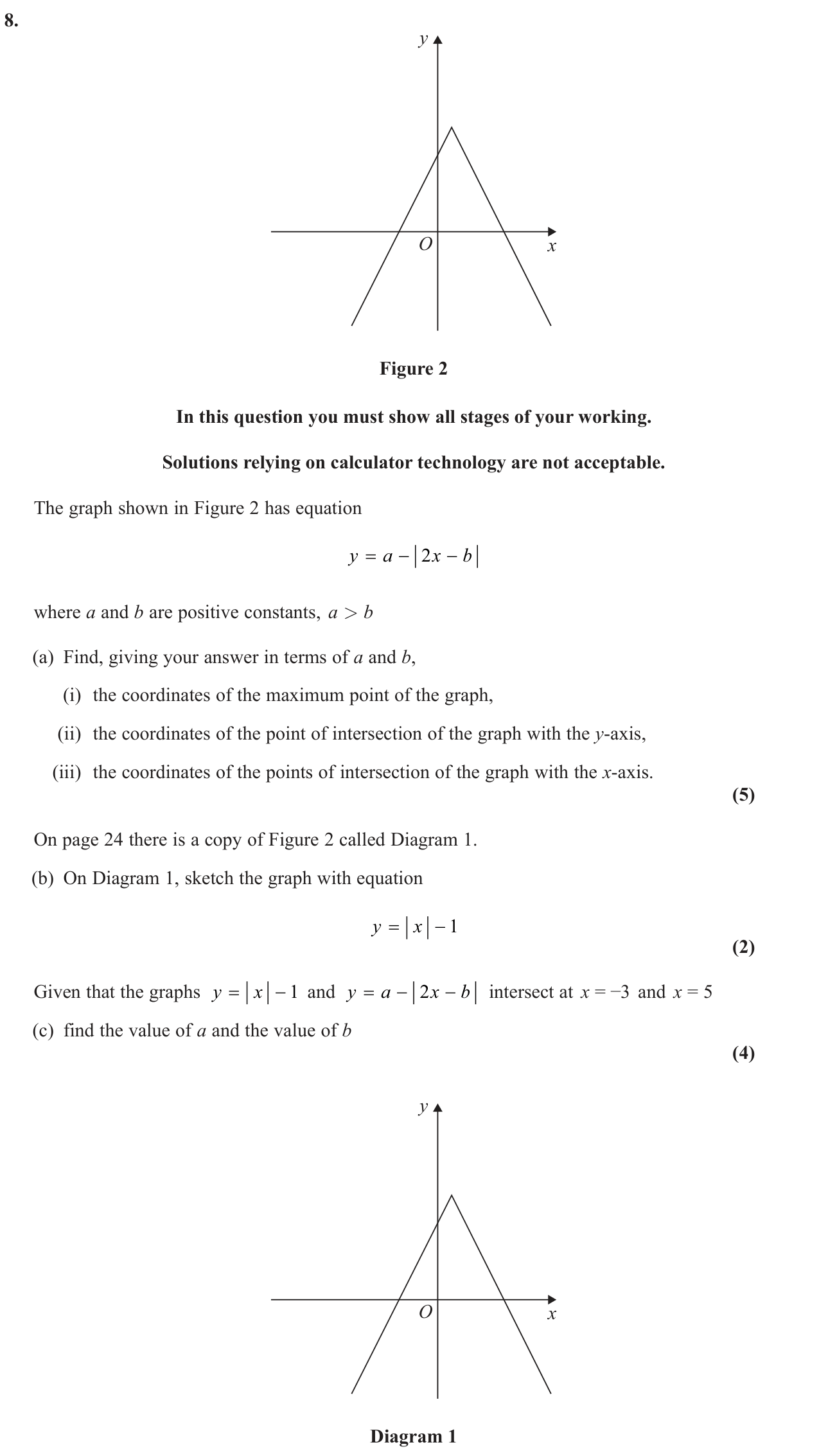
(i) Since $|2x-b|\ge0$, the maximum occurs at $2x-b=0$: $x=b/2$ and $y=a$. (ii) At $x=0$, $y=a-|-b|=a-b$ because $b\gt 0$. (iii) At an x-axis crossing, $|2x-b|=a$, hence $2x-b=\pm a$. Since $a\gt b\gt 0$, $(b-a)/2\lt 0$ and $(b+a)/2\gt 0$, matching the sketch.
The graph $y=|x|-1$ is a V with vertex $(0,-1)$ and intercepts $(-1,0)$ and $(1,0)$. Its left branch is $y=-x-1$ for $x\lt 0$ and its right branch is $y=x-1$ for $x\ge0$. Add this V to the supplied axes; the original inverted V remains unchanged.
The grey original curve is schematic; the three labelled points belong to the added graph.
At $x=-3$, the common ordinate is $|-3|-1=2$. Since $b\gt 0$, $|-6-b|=6+b$, so $a-(6+b)=2$, giving $a=b+8$. At $x=5$, the common ordinate is $|5|-1=4$, so $a-|10-b|=4$. Substitute $a=b+8$ to obtain $|10-b|=b+4$. If $b\le10$, then $10-b=b+4$, giving $b=3$, $a=11$. If $b\gt 10$, then $b-10=b+4$, impossible. Both accepted values satisfy $a\gt b\gt 0$.
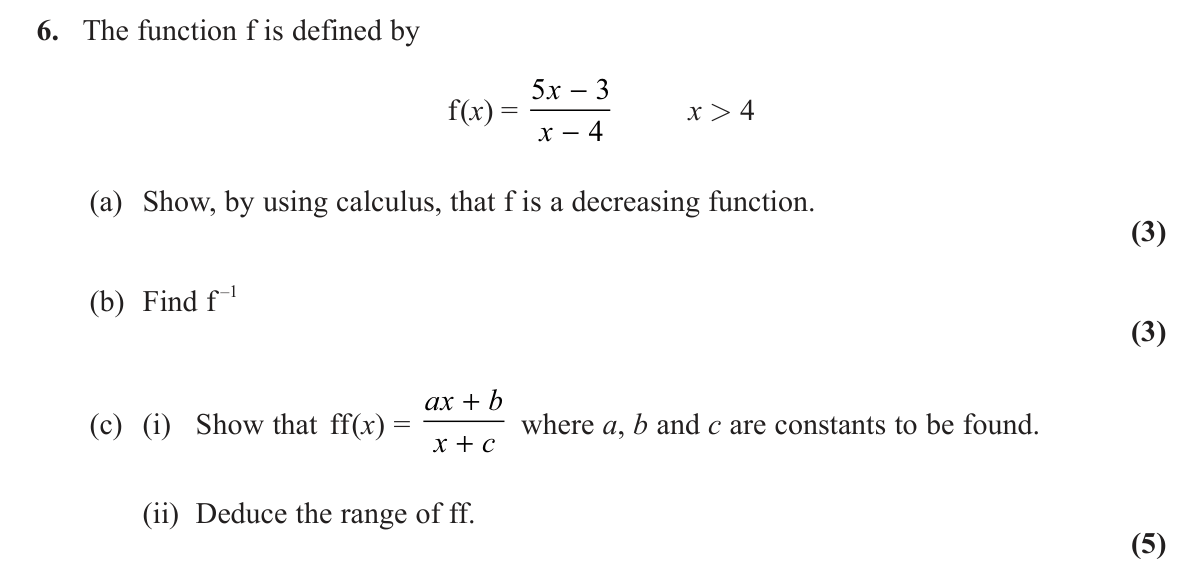
For every $x\gt 4$, the denominator is positive and the numerator is negative. Therefore $f'(x)\lt 0$ throughout its domain, so f is decreasing.
\[\boxed{f\text{ is decreasing for }x\gt 4}\]
Part (b)
Set $y=(5x-3)/(x-4)$. Then $yx-4y=5x-3$, giving $x(y-5)=4y-3$ and $x=(4y-3)/(y-5)$. Exchange the variable names. Since $f(x)=5+17/(x-4)$ on $x\gt 4$, its range is $(5,\infty)$, which becomes the inverse's domain.
Thus $a=22$, $b=-3$, $c=13$. (ii) Rewrite $ff(x)=22-289/(x+13)$ with the original domain $x\gt 4$. It is strictly increasing, tends to 5 as $x\to4^+$ and to 22 as $x\to\infty$. Neither limiting value is attained.
(a) $f\text{ is decreasing for }x\gt 4$ (b) $f^{-1}(x)=\frac{4x-3}{x-5},\qquad x\gt 5$ (c) $ff(x)=\frac{22x-3}{x+13},\qquad 5\lt ff(x)\lt 22$
44. WMA13/01 October 2022 · Q7
Hard12 marks · main topic: ModulusShow worked solution
Part (a)
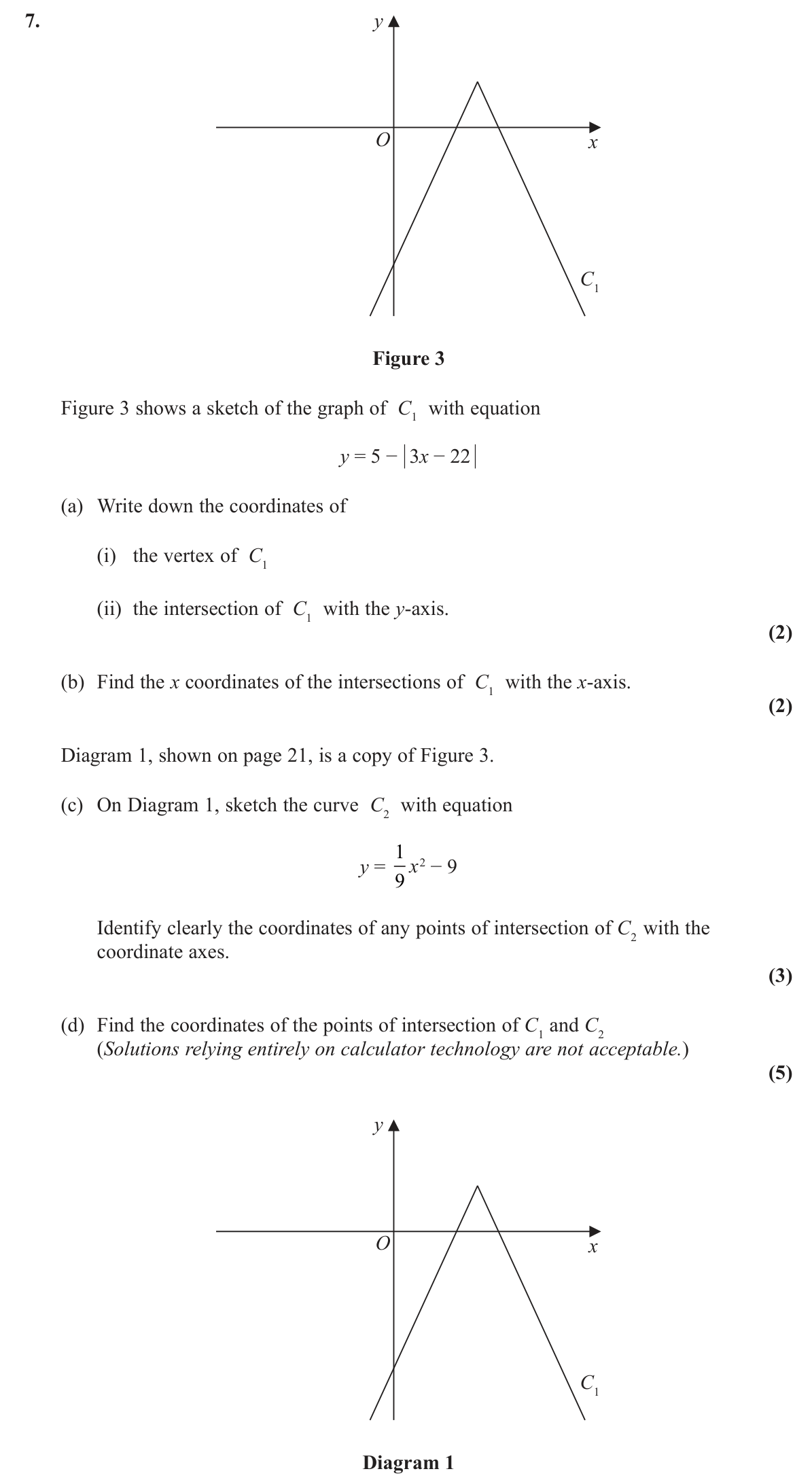
(i) The modulus is zero at $3x-22=0$, giving the vertex $(22/3,5)$. (ii) At $x=0$, $y=5-22=-17$, so the y-axis intersection is $(0,-17)$.
\[\boxed{(i)\ (22/3,5),\qquad(ii)\ (0,-17)}\]
Part (b)
Set $y=0$: $|3x-22|=5$. Thus $3x-22=5$ or $-5$, giving $x=9$ or $17/3$.
\[\boxed{x=\frac{17}{3},\quad9}\]
Part (c)
The curve $C_2:y=x^2/9-9$ is an upward-opening parabola, symmetric about the y-axis. Its vertex and y-intercept are $(0,-9)$; setting y=0 gives $x^2=81$, hence x-intercepts $(-9,0)$ and $(9,0)$. The sketch below includes $C_1$ for context and labels all three axis intersections of $C_2$.
\[\boxed{(-9,0),\quad(9,0),\quad(0,-9)}\]
Part (d)
For $x\le22/3$, $C_1$ is $y=3x-17$. Equating to $C_2$ gives
The candidates are $-2,3/2,3$. Reject $x=3$ because it is outside the descending branch, and $x=-2$ is $P$, not $Q$. Thus $x_Q=3/2$ and $y_Q=15-5(3/2)=15/2$, giving $Q=(3/2,15/2)$.
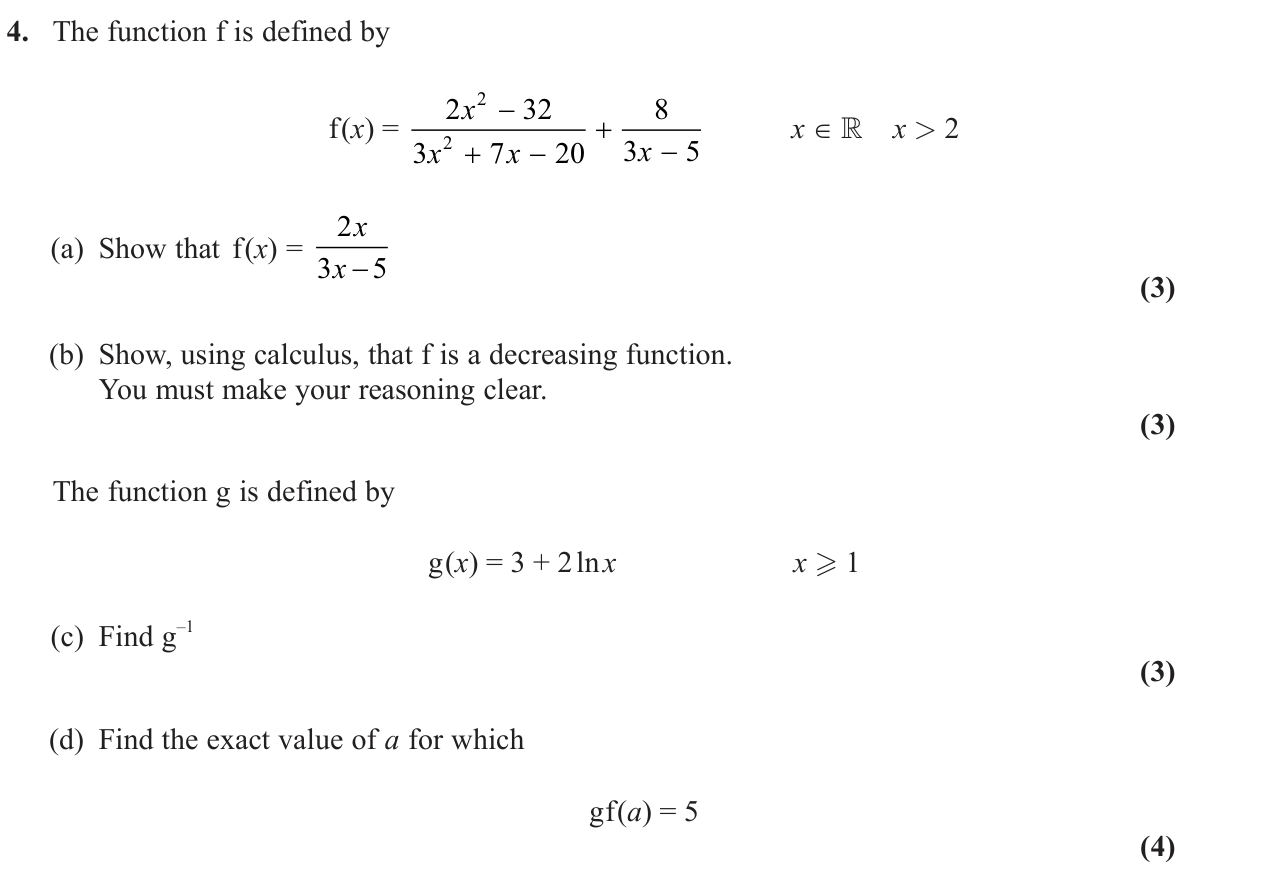
For every $x\gt 2$, the squared denominator is positive; hence $f'(x)\lt 0$. Therefore f is strictly decreasing on its whole domain.
\[\boxed{f\text{ is strictly decreasing on }(2,\infty)}\]
Part (c)
Set $y=3+2\ln x$. Then $\ln x=(y-3)/2$, so $x=e^{(y-3)/2}$. For $x\ge1$, the original range is $y\ge3$. Interchanging the input and output symbols gives the inverse with its domain.
\[\boxed{g^{-1}(x)=e^{(x-3)/2},\quad x\ge3}\]
Part (d)
The equation $g(f(a))=5$ gives $3+2\ln(f(a))=5$, so $\ln(f(a))=1$ and $f(a)=e$. Using the simplified f,
 Elite Mathematics