Trig Identities: past paper questions & worked solutions
Every Trig Identities question from the WMA13 papers in our bank, 2020–2026, sorted from easiest to hardest. Try each one first, then open the worked solution.
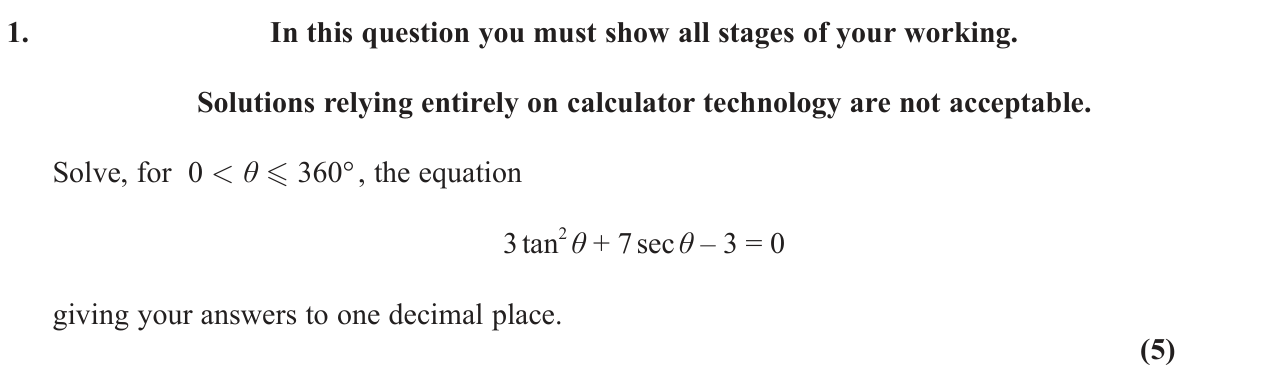
The value $\sec\theta=2/3$ would give $\cos\theta=3/2$, impossible for a real angle. Thus $\cos\theta=-1/3$. In $0\lt \theta\le360^\circ$, the two angles are $\arccos(-1/3)=109.4712\ldots^\circ$ and $360^\circ-109.4712\ldots^\circ$.
\[\boxed{\theta=109.5^\circ,\ 250.5^\circ}\]
Final answer
(main) $\theta=109.5^\circ,\ 250.5^\circ$
5. WMA13/01 January 2023 · Q8
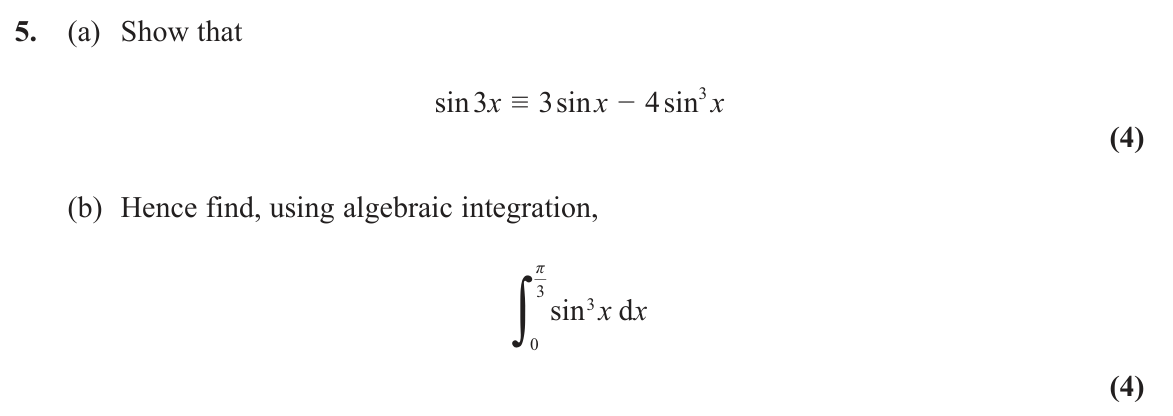
Easy5 marks · main topic: IntegrationShow worked solution
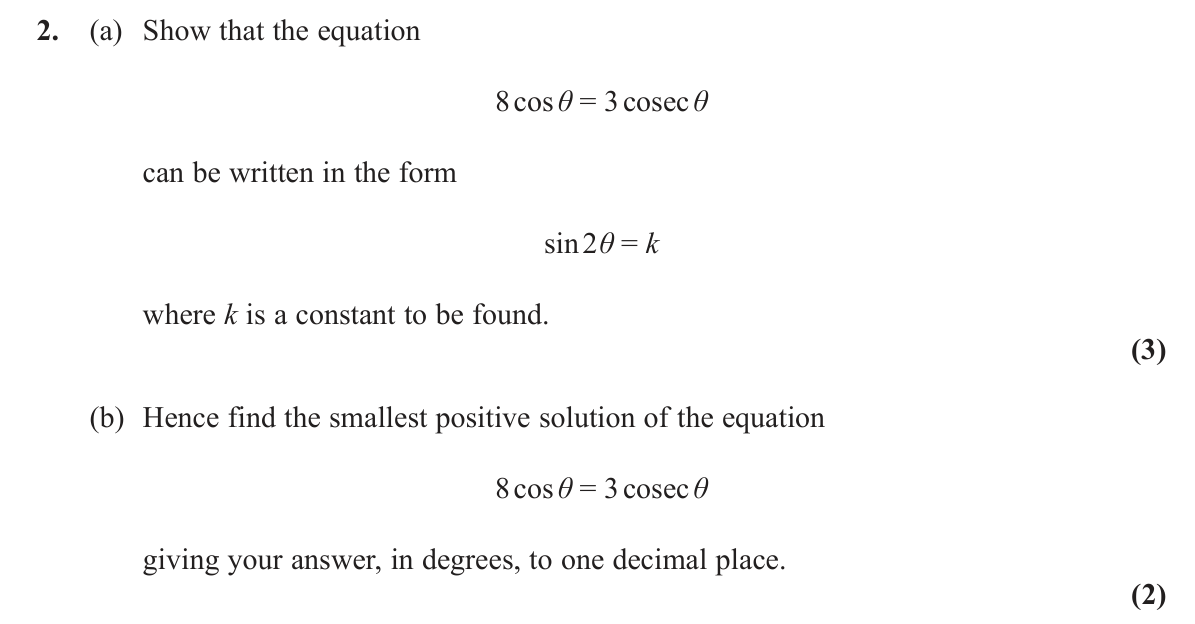
The original equation requires $\sin\theta\ne0$. Using $\csc\theta=1/\sin\theta$, multiply by $\sin\theta$ to obtain $8\sin\theta\cos\theta=3$. Since $2\sin\theta\cos\theta=\sin2\theta$, this becomes $4\sin2\theta=3$.
\[\boxed{\sin2\theta=\frac34,\qquad k=\frac34}\]
Part (b)
For the smallest positive solution take the first positive sine branch: $2\theta=\arcsin(3/4)=48.59037789\ldots{}^{\circ}$. Divide by two to obtain $\theta=24.29518895\ldots{}^{\circ}$. The supplementary branch gives a larger positive angle.
Easy6 marks · main topic: Trig Equations & R-FormShow worked solution
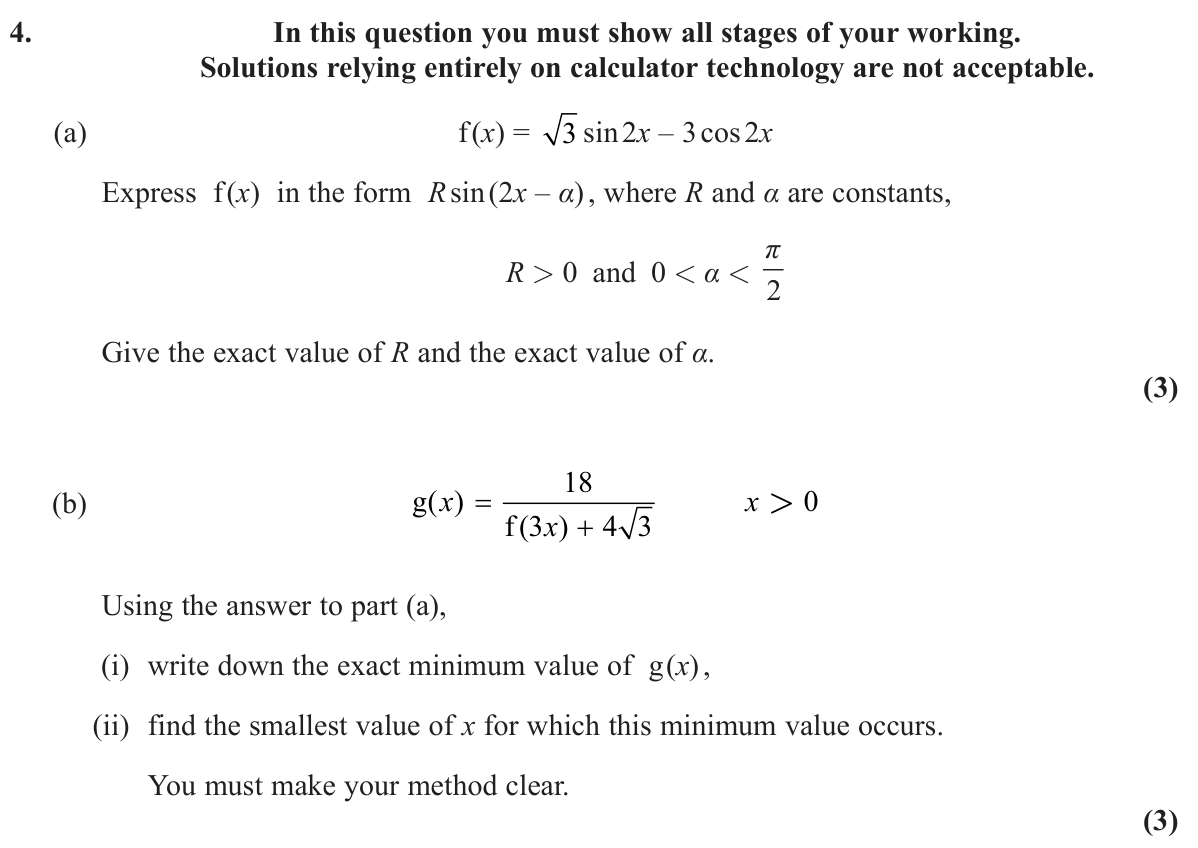
Part (a)
Expand $R\sin(2x-\alpha)=R\cos\alpha\sin2x-R\sin\alpha\cos2x$. Comparison gives $R\cos\alpha=\sqrt3$ and $R\sin\alpha=3$. Thus $R=\sqrt{3+9}=2\sqrt3$ and $\tan\alpha=\sqrt3$. As $0\lt \alpha\lt \pi/2$, $\alpha=\pi/3$ and
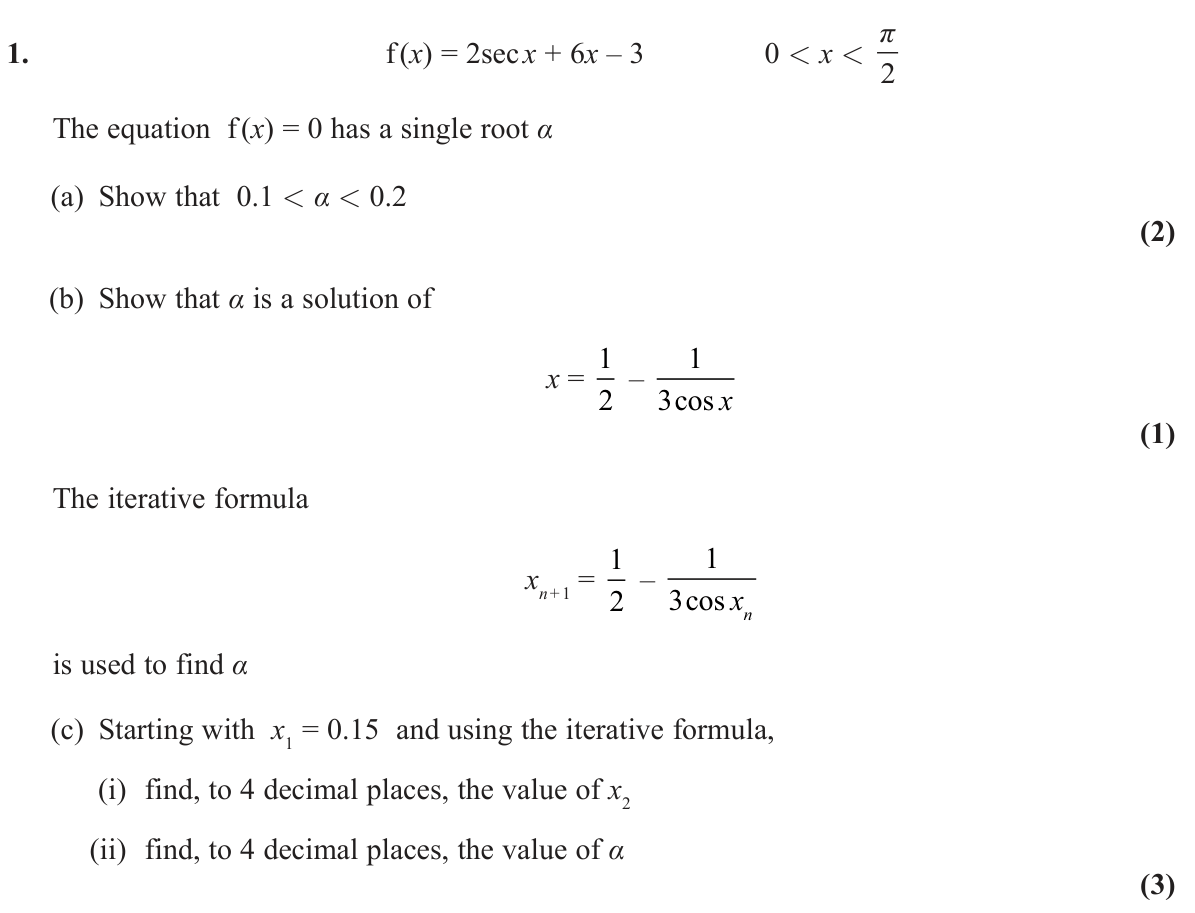
The function is continuous on $[0.1,0.2]$ since $\cos x\ne0$ there. The sign change therefore places a root between the endpoints. Since the given root is unique, this root is $\alpha$.
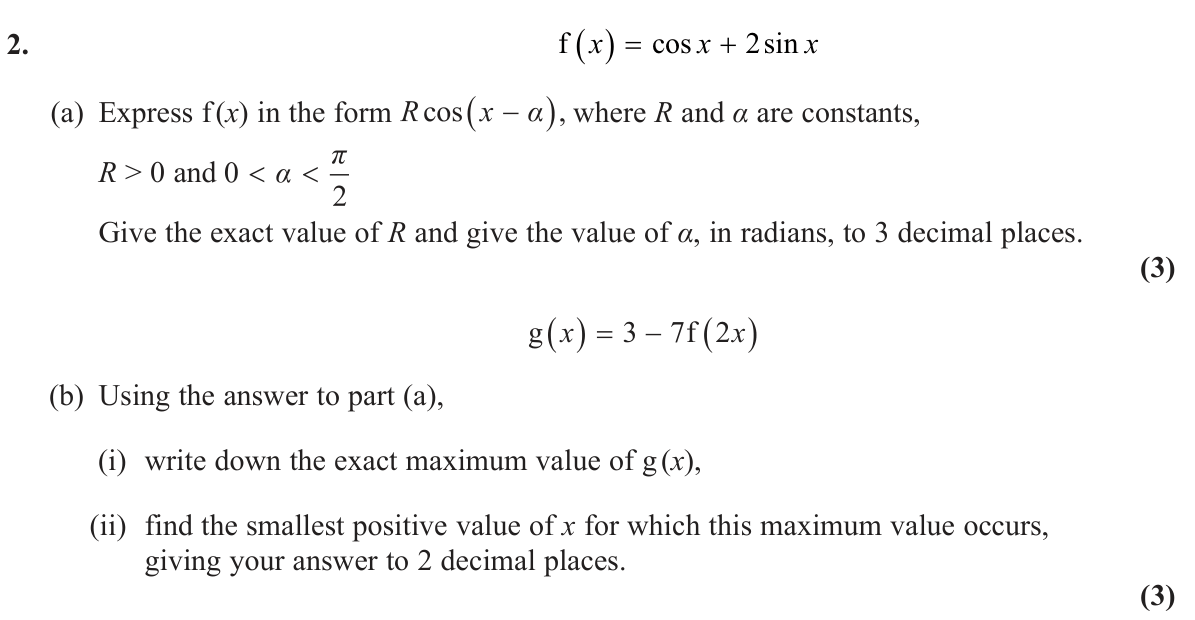
Using the exact phase $\alpha=\arctan2$, write $g(x)=3-7\sqrt5\cos(2x-\alpha)$. (i) The negative cosine coefficient means the maximum occurs when the cosine is $-1$; the maximum is $3+7\sqrt5$. (ii) $2x-\alpha=\pi+2n\pi$, so $x=(\pi+\alpha)/2+n\pi$. The $n=-1$ value is negative; $n=0$ is the smallest positive one, $x=2.1243706857\ldots$, or 2.12 to two decimal places.
This displayed form is used where its trigonometric terms are defined; the preceding quotient form also covers points with $\cos x=0$ when the original denominator is nonzero.
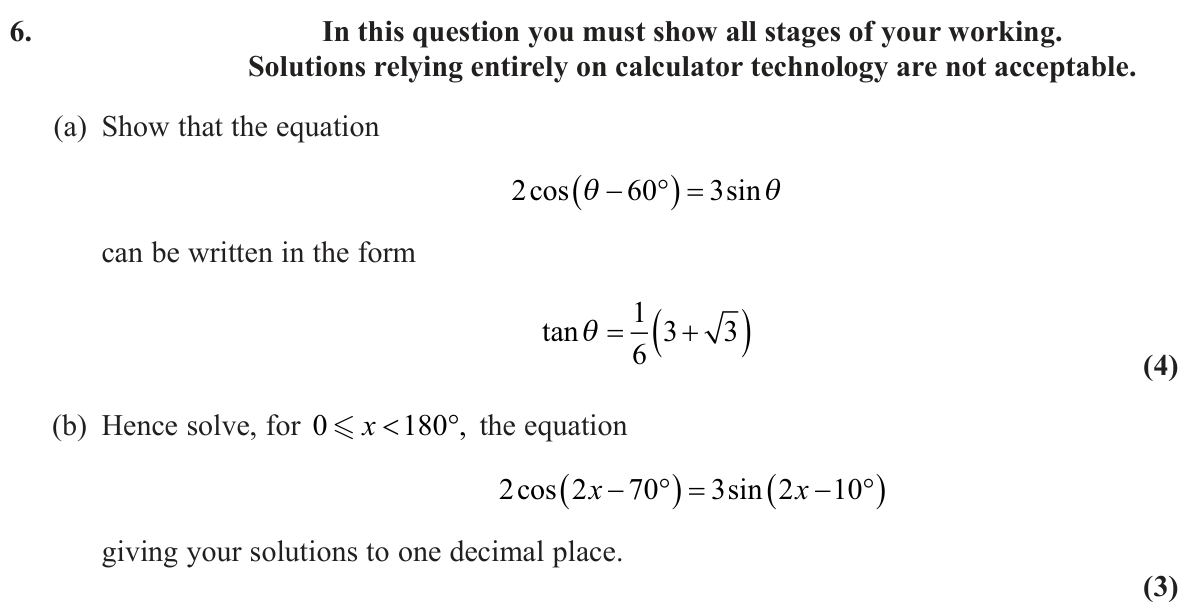
so $\cos\theta+\sqrt3\sin\theta=3\sin\theta$ and $\cos\theta=(3-\sqrt3)\sin\theta$. If $\cos\theta=0$, this equation would require $\sin\theta=0$, which is impossible. We may therefore divide by $\cos\theta$:
Set $\theta=2x-10^\circ$, so $2x-70^\circ=\theta-60^\circ$ and $-10^\circ\le\theta\lt 350^\circ$.
\[\theta=\arctan\!\left(\frac{3+\sqrt3}{6}\right)+180^\circ n =38.2619662\ldots^\circ+180^\circ n.\]
The admissible values are $38.2619662\ldots^\circ$ and $218.2619662\ldots^\circ$. Hence $x=(\theta+10^\circ)/2$, giving $x=24.1^\circ$ or $114.1^\circ$ (1 decimal place).
Final answer
(a) $\frac{3+\sqrt3}{6}$ (b) $x=24.1^\circ\text{ or }114.1^\circ$
15. WMA13/01 May/June 2025 · Q2
Medium7 marks · main topic: Trig Equations & R-FormShow worked solution
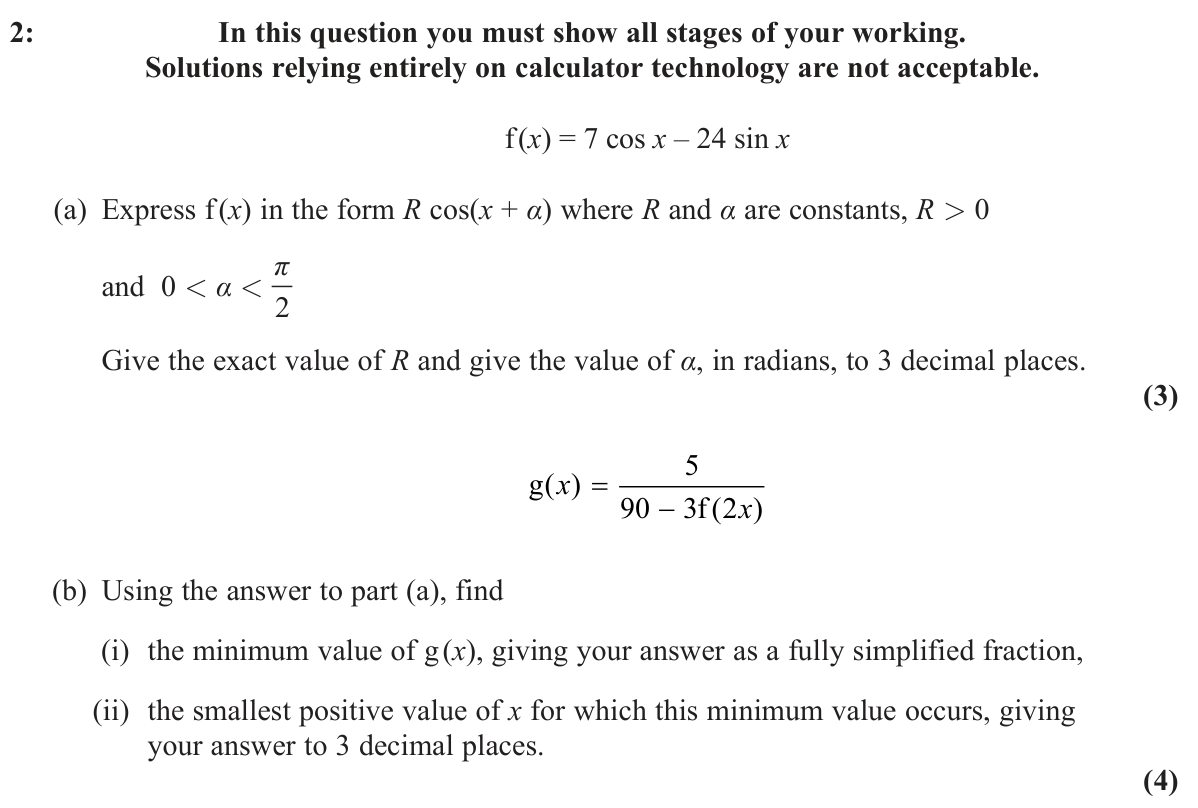
Thus $f(x)=25\cos(x+\alpha)$, using the unrounded $\alpha$ in subsequent calculations.
Part (i)
Since $-25\leq f(2x)\leq25$, the positive denominator $90-3f(2x)$ lies between $15$ and $165$. The smallest reciprocal occurs at the largest denominator:
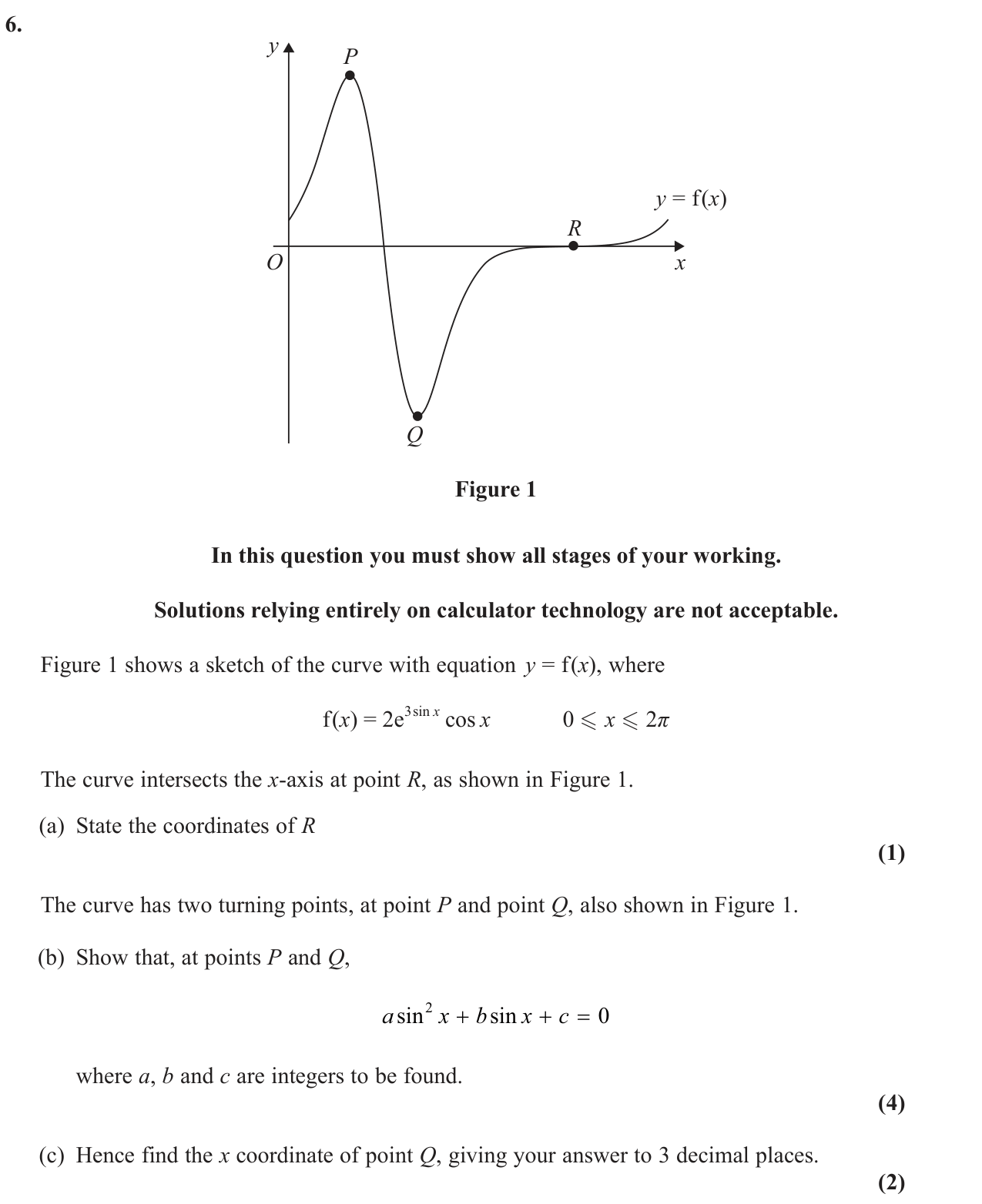
At a turning point the derivative is zero. The exponential factor is nonzero, so $3\cos^2x-\sin x=0$. Substitute $\cos^2x=1-\sin^2x$ and rearrange: $3-3\sin^2x-\sin x=0$.
The negative root is less than $-1$, so it is impossible for a real sine. Let $\beta=\arcsin((\sqrt{37}-1)/6)$ in the first quadrant. The labelled minimum Q lies in the second quadrant, hence $x_Q=\pi-\beta=2.131037293\ldots$.
Medium7 marks · main topic: Trig Equations & R-FormShow worked solution
Part (i)
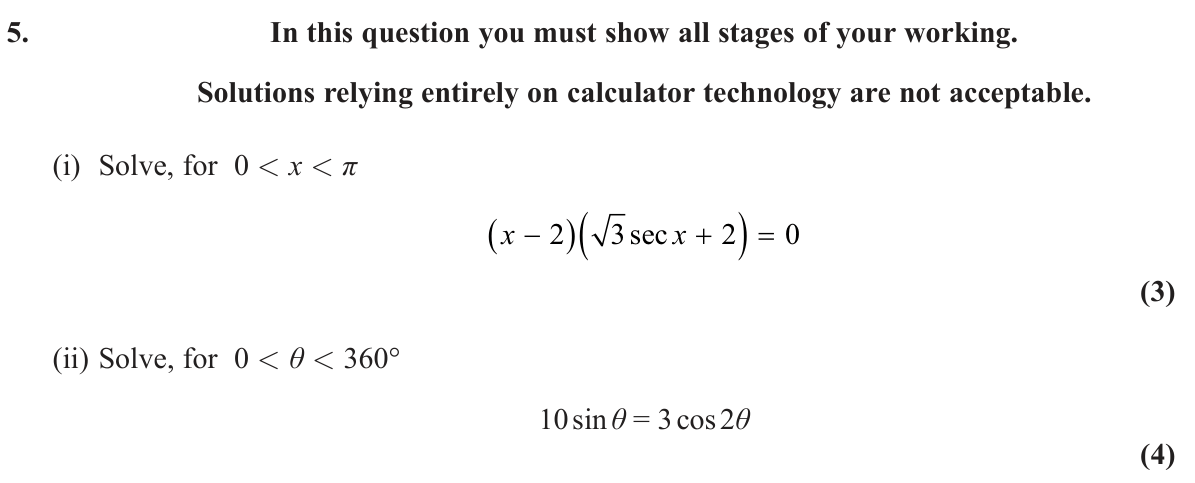
The zero-product rule gives $x-2=0$ or $\sqrt3\sec x+2=0$. The first gives $x=2$, which lies in $(0,\pi)$ and has $\cos x\ne0$. The second gives $\cos x=-\sqrt3/2$; the only angle in the interval is $5\pi/6$.
\[\boxed{x=2,\quad x=\frac{5\pi}{6}}\]
Part (ii)
Use $\cos2\theta=1-2\sin^2\theta$ and set $s=\sin\theta$:
The negative root is less than $-1$, so reject it. The positive root is $0.2595730874\ldots$. Its principal angle is $15.04473218\ldots^\circ$; the other solution is $180^\circ-15.04473218\ldots^\circ$. Both are in the given interval. To three significant figures:
\[\boxed{\theta=15.0^\circ,\quad165^\circ}\]
Final answer
(i) $x=2,\quad x=\frac{5\pi}{6}$ (ii) $\theta=15.0^\circ,\quad165^\circ$
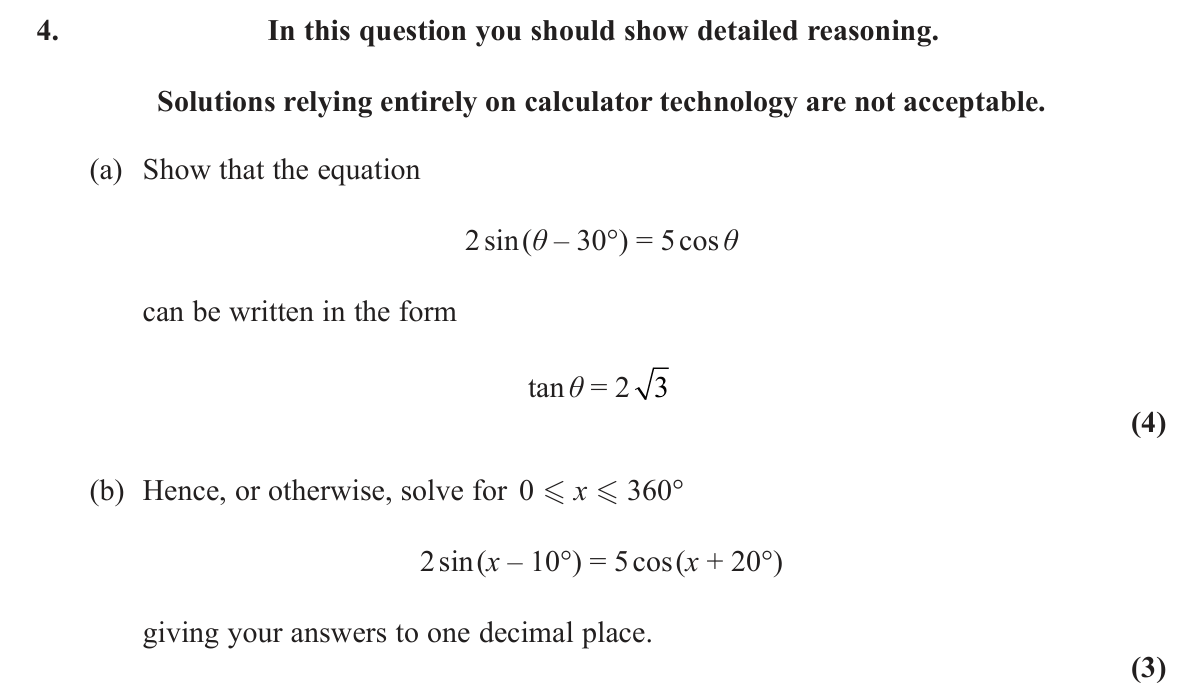
Thus $\sqrt3\sin\theta=6\cos\theta$. If $\cos\theta=0$, this equation is impossible, so divide by $\sqrt3\cos\theta$: $\tan\theta=6/\sqrt3=2\sqrt3$.
\[\boxed{\tan\theta=2\sqrt3}\]
Part (b)
Put $\theta=x+20^{\circ}$, so $x-10^{\circ}=\theta-30^{\circ}$. Part (a) gives $\tan(x+20^{\circ})=2\sqrt3$. Since $20^{\circ}\le\theta\le380^{\circ}$, the two permitted values are $\theta=73.89788625\ldots{}^{\circ}$ and $253.89788625\ldots{}^{\circ}$. Subtract $20^{\circ}$ from both and round last.
Medium7 marks · main topic: Differentiation TechniquesShow worked solution
Part (a)
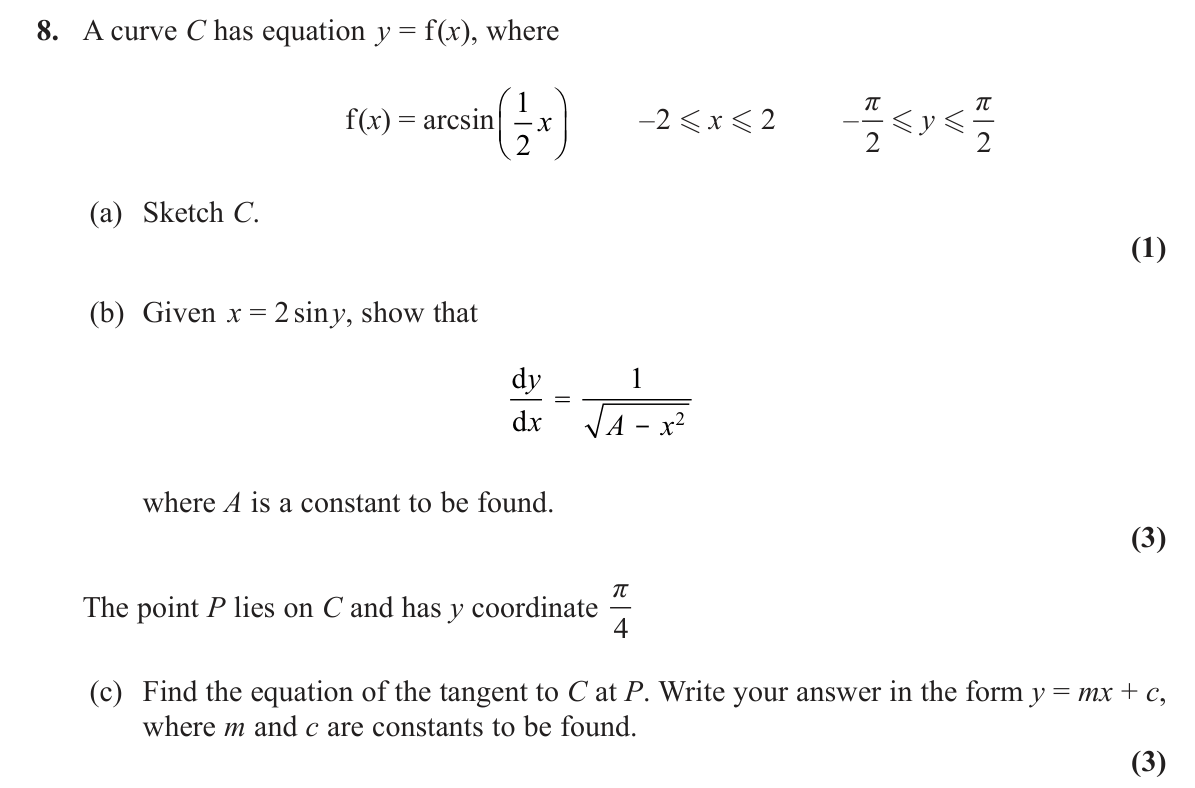
The principal arcsine curve increases from $(-2,-\pi/2)$ through $(0,0)$ to $(2,\pi/2)$. It is concave down on the negative-x half, concave up on the positive-x half, and vertical at both ends.
\[\boxed{y=\arcsin(x/2),\quad -2\le x\le2}\]
Part (b)
Differentiate the supplied inverse relation: $dx/dy=2\cos y$. For $-\pi/2\lt y\lt \pi/2$, cosine is positive, so $\cos y=\sqrt{1-\sin^2y}=\sqrt{1-x^2/4}$. Taking the reciprocal gives
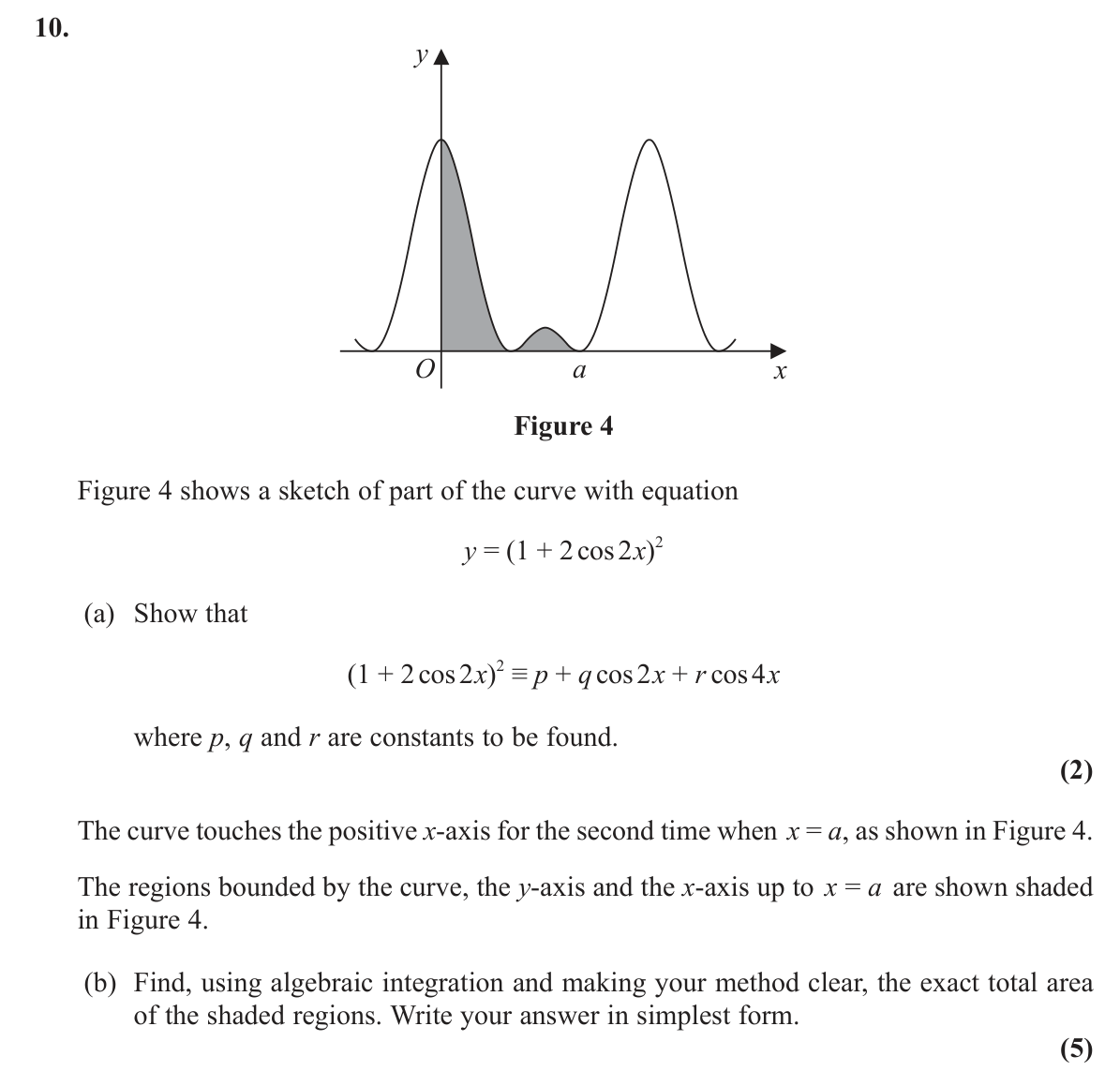
The zeros satisfy $\cos2x=-1/2$. The first two positive values are $x=\pi/3$ and $x=2\pi/3$, so $a=2\pi/3$. The squared curve is nonnegative, so integrate directly for the total shaded area:
Medium7 marks · main topic: Numerical MethodsShow worked solution
Part (a)
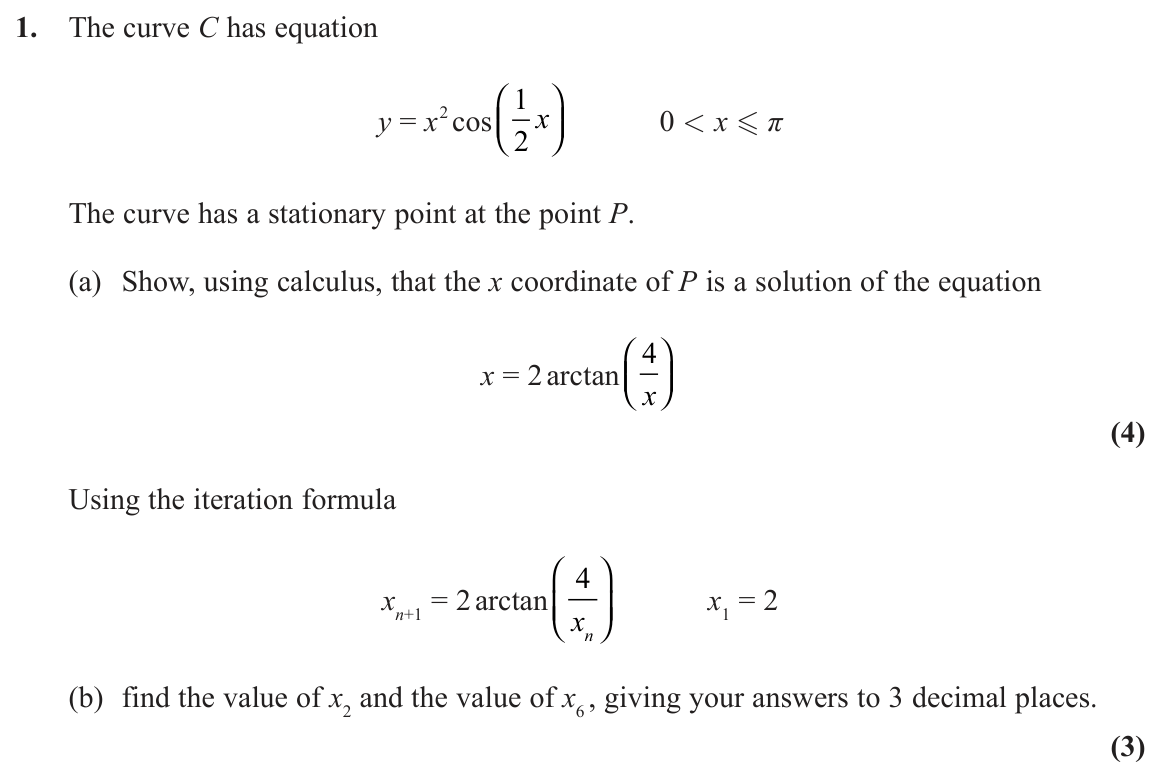
Using the product and chain rules,
\[y'=2x\cos(x/2)-\frac{x^2}{2}\sin(x/2).\]
At a stationary point, divide by $x/2$, since $x\gt 0$, to obtain $4\cos(x/2)=x\sin(x/2)$. The endpoint $x=\pi$ does not satisfy this equation, so at P we have $0\lt x\lt \pi$ and $\cos(x/2)\gt 0$. Hence $\tan(x/2)=4/x$. The principal arctangent is valid because $0\lt x/2\lt \pi/2$:
\[x=2\arctan(4/x).\]
\[\boxed{x=2\arctan(4/x)}\]
Part (b)
Use radian mode and retain full calculator precision between iterations:
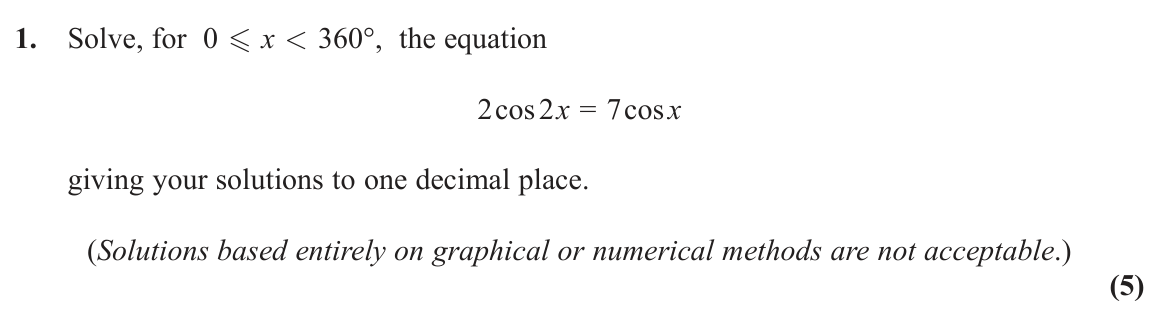
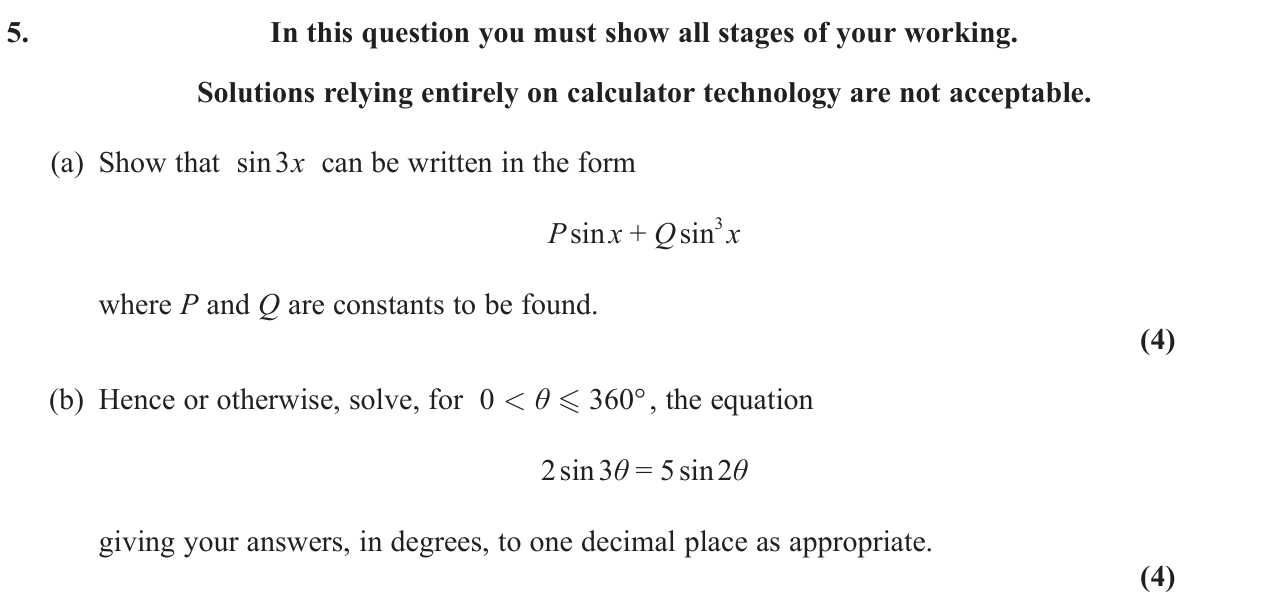
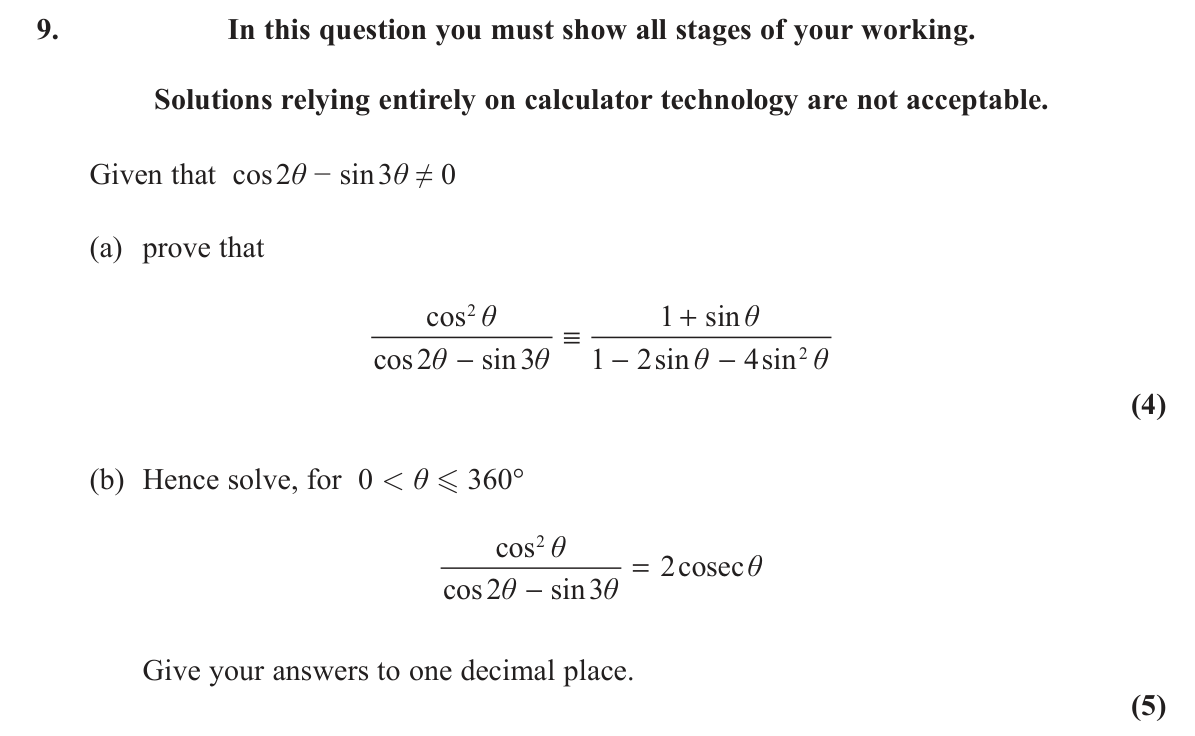
If $\sin\theta=0$, the permitted solutions are $180^\circ$ and $360^\circ$ (not $0^\circ$). Otherwise $\cos\theta=(5\pm\sqrt{41})/8$. The plus value exceeds 1 and is rejected. The minus value gives $\theta=100.1013\ldots^\circ$ or $259.8986\ldots^\circ$.
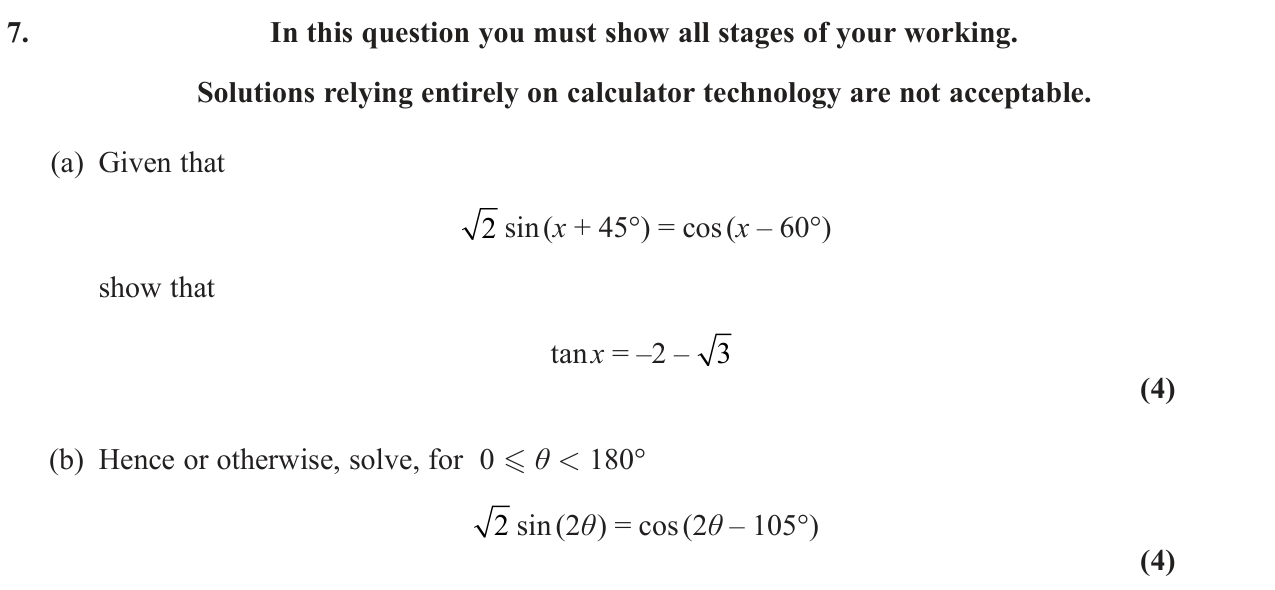
Thus $(2-\sqrt3)\sin x=-\cos x$. Here $\cos x\ne0$: otherwise this equation would require $\sin x=0$ as well, which is impossible. Dividing by $(2-\sqrt3)\cos x$ gives
Set $x=2\theta-45^\circ$. Then $x+45^\circ=2\theta$ and $x-60^\circ=2\theta-105^\circ$, so part (a) gives $\tan(2\theta-45^\circ)=-2-\sqrt3$. Since $\tan75^\circ=2+\sqrt3$,
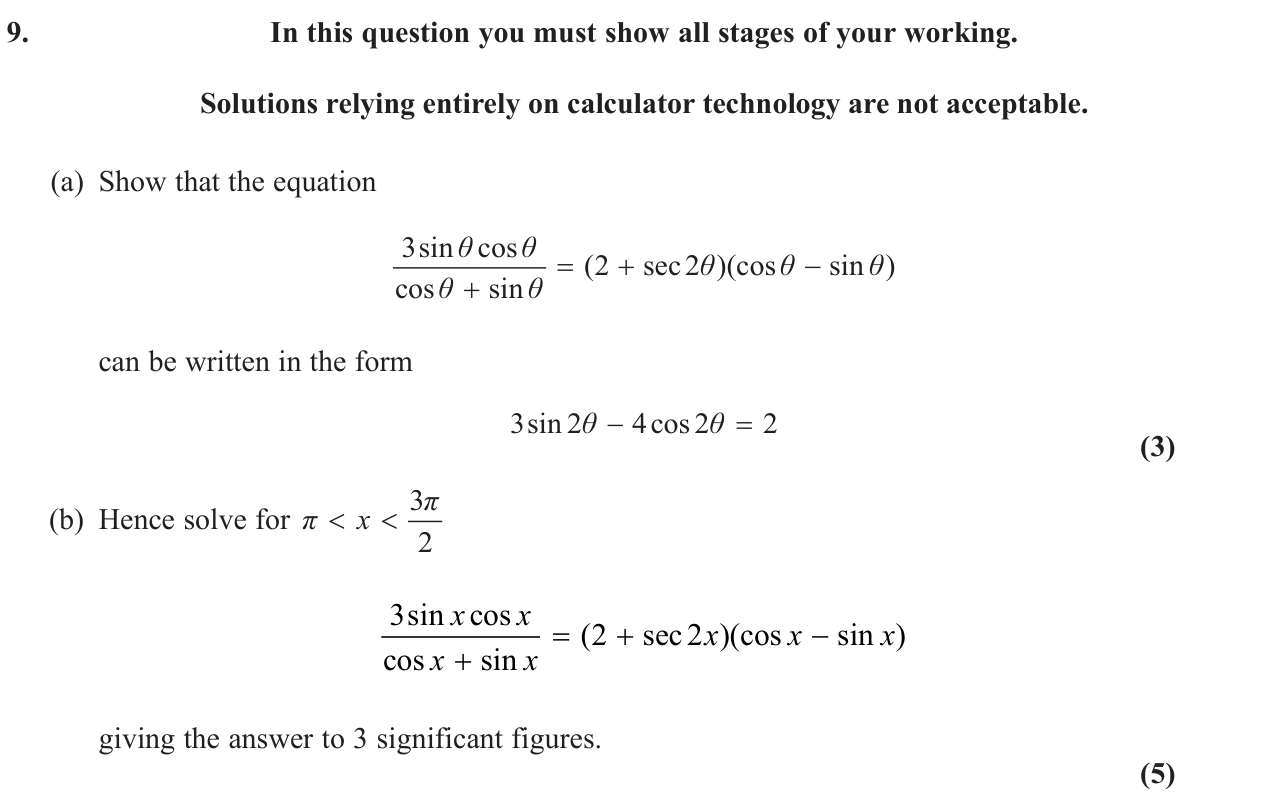
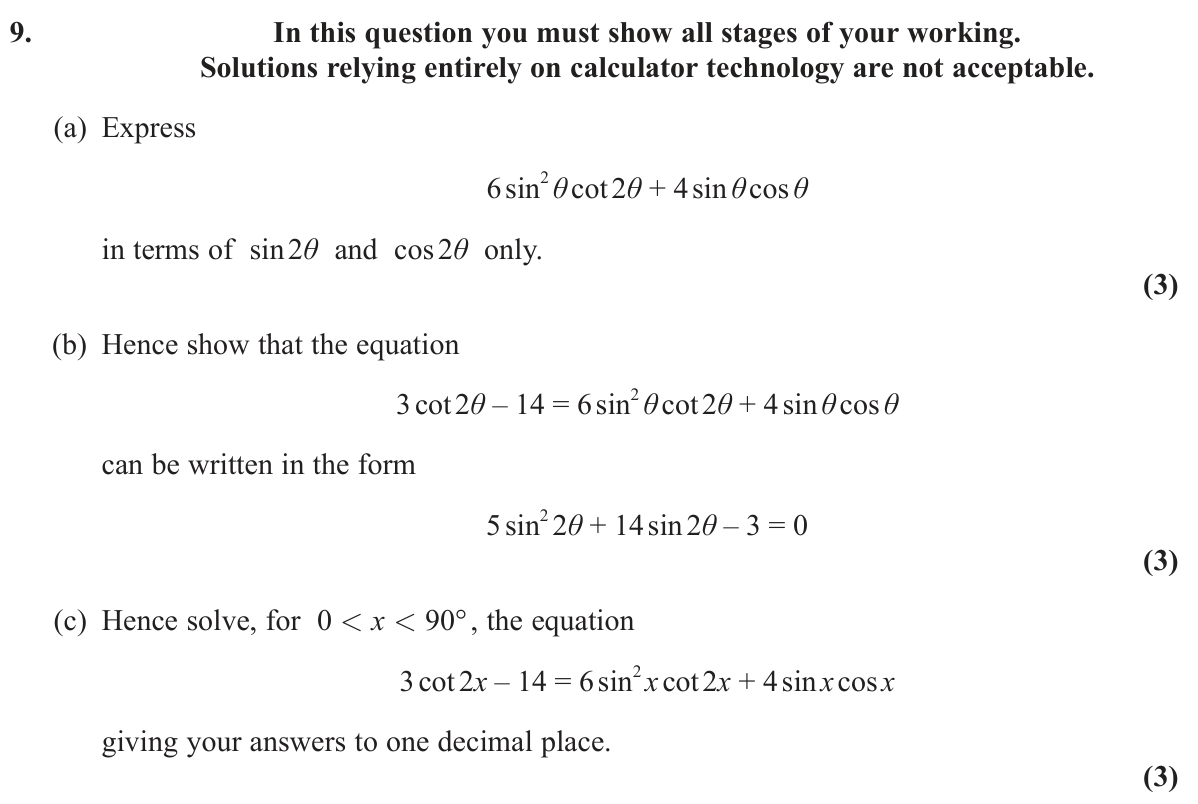
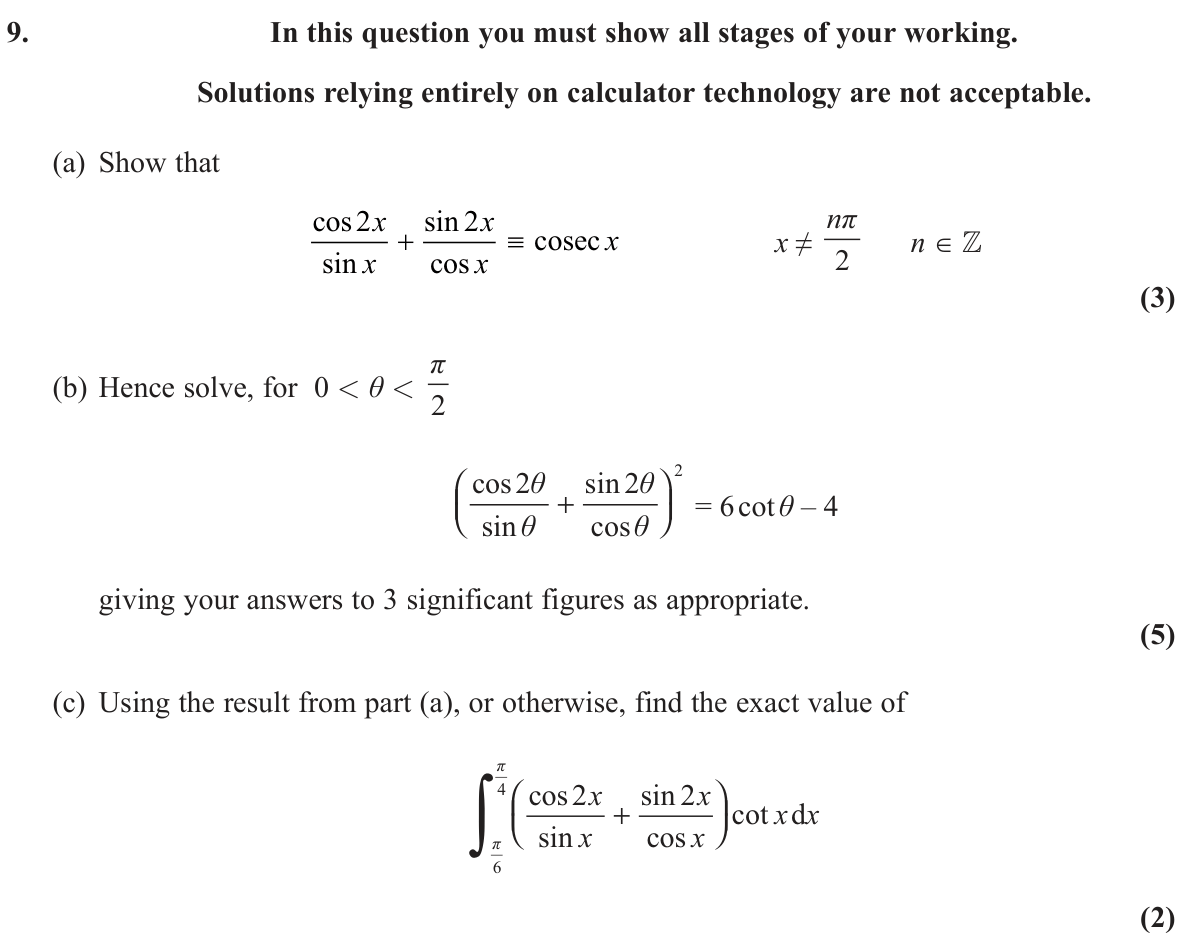
Using $2\sin\theta\cos\theta=\sin2\theta$, multiply through by 2: $3\sin2\theta=4\cos2\theta+2$.
\[\boxed{3\sin2\theta-4\cos2\theta=2}\]
Part (b)
Write $3\sin2x-4\cos2x=5\sin(2x-\phi)$, where $\cos\phi=3/5$, $\sin\phi=4/5$ and $\phi=\arctan(4/3)$. Then $\sin(2x-\phi)=2/5$. Because $\pi\lt x\lt 3\pi/2$, $2\pi-\phi\lt 2x-\phi\lt 3\pi-\phi$, approximately $(5.356,8.497)$. With $\gamma=\arcsin(2/5)$, the only angle in this interval is $2\pi+\gamma$; $3\pi-\gamma\approx9.013$ is outside it. Thus
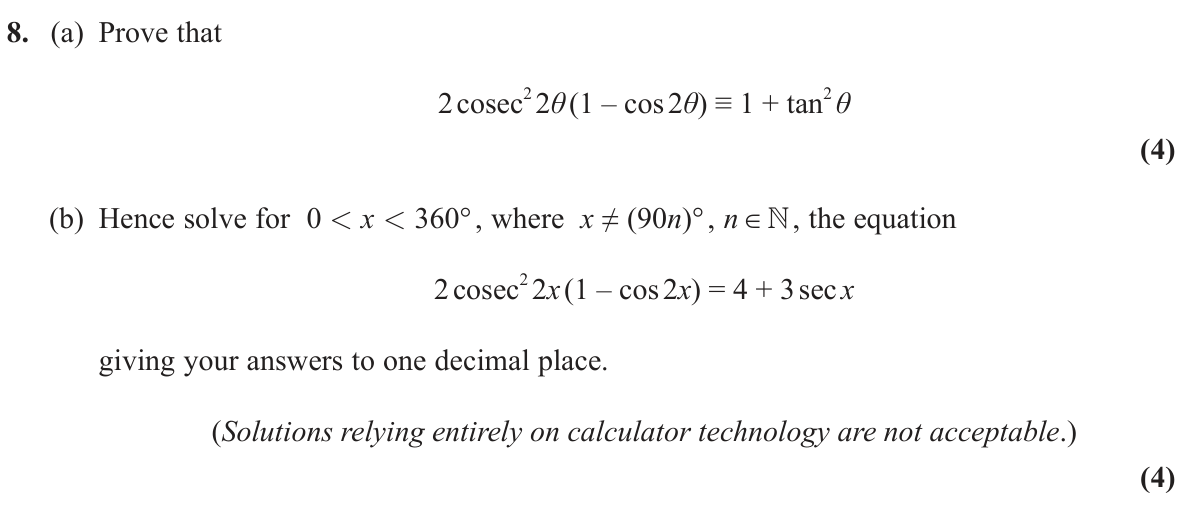
The branch $\sec x=4$ gives $\cos x=1/4$ and hence $x=75.5225\ldots^\circ$ or $284.4775\ldots^\circ$. The other branch gives $\cos x=-1$, hence $x=180^\circ$ in the stated interval. Reject $180^\circ$: it is a multiple of $90^\circ$ and the original $\csc2x$ is undefined there. The two remaining angles satisfy the exclusions.
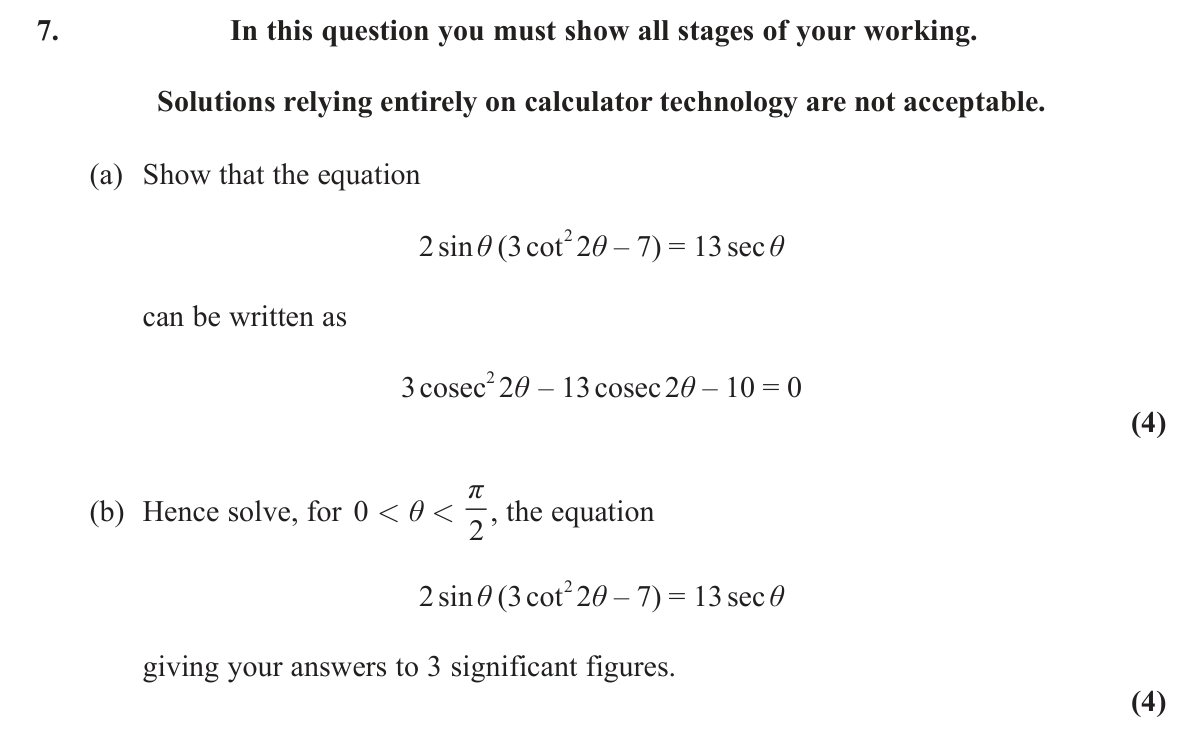
Divide by the nonzero $\sin2\theta$ and use $\cot^2u=\csc^2u-1$:
\[3(\csc^22\theta-1)-7=13\csc2\theta.\]
Collect the terms to obtain the displayed equation.
\[\boxed{3\csc^22\theta-13\csc2\theta-10=0}\]
Part (b)
Put $u=\csc2\theta$. Then $(3u+2)(u-5)=0$, so $u=5$ or $-2/3$. The second would give $\sin2\theta=-3/2$, which is impossible. For $0\lt \theta\lt \pi/2$, we have $0\lt 2\theta\lt \pi$. Thus
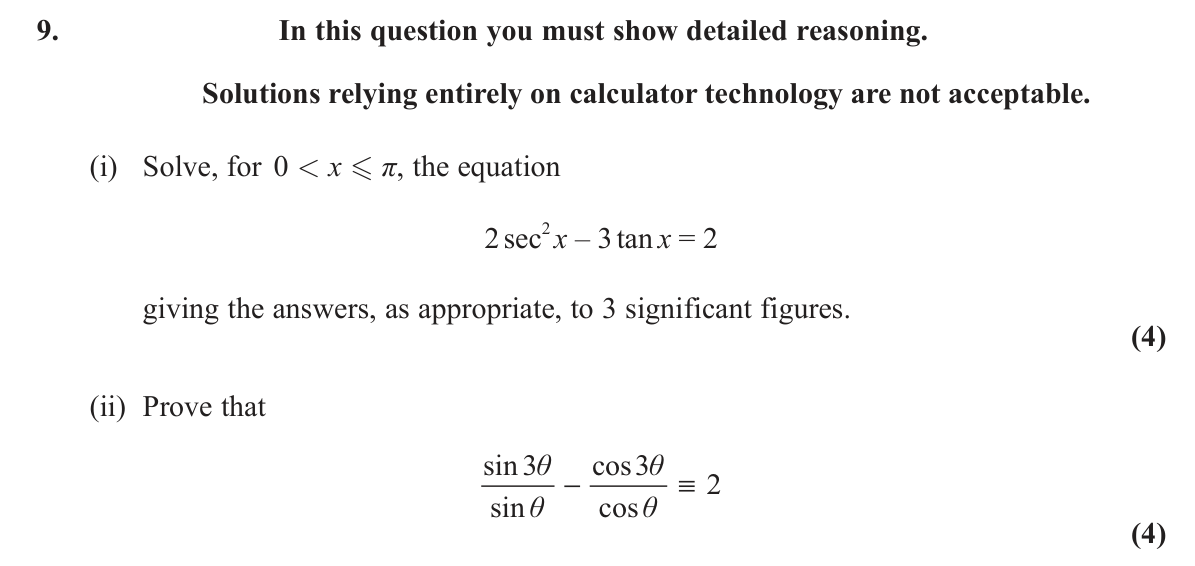
Using $\sec^2x=1+\tan^2x$, the equation becomes $2\tan^2x-3\tan x=0$, or $\tan x(2\tan x-3)=0$. If $\tan x=0$, the given interval $0\lt x\le\pi$ contains only $x=\pi$. If $\tan x=3/2$, the sole root in this interval is $x=\arctan(3/2)=0.982793723\ldots$ radians. The excluded pole $x=\pi/2$ supplies no solution.
(i) $x=0.983\ \text{radians},\quad\pi$ (ii) $\frac{\sin3\theta}{\sin\theta}-\frac{\cos3\theta}{\cos\theta}=2$
31. WMA13/01 October 2021 · Q6
Medium8 marks · main topic: Differentiation TechniquesShow worked solution
Part (i)
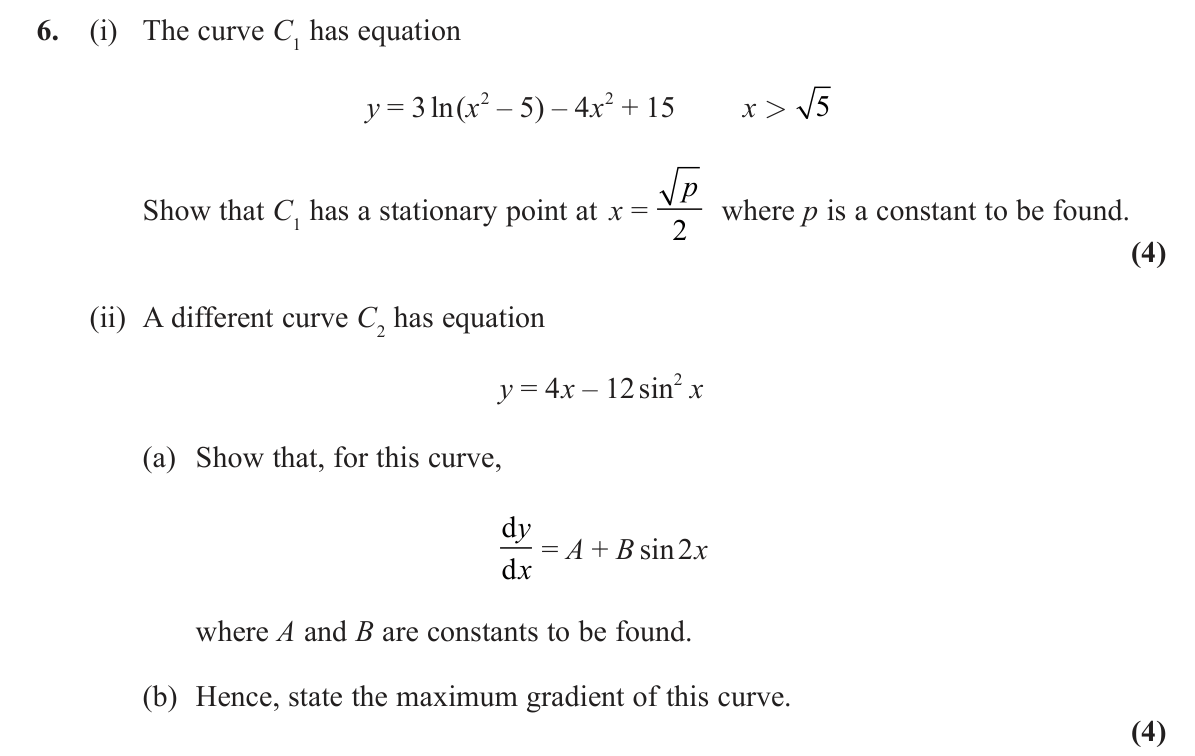
Differentiate to obtain $y'=6x/(x^2-5)-8x$. At a stationary point in $x\gt \sqrt5$, x is nonzero, so $6/(x^2-5)=8$, giving $6=8x^2-40$ and $x^2=23/4$. The original positive domain selects $x=\sqrt{23}/2$, which exceeds $\sqrt5$. Hence $p=23$.
\[\boxed{p=23,\qquad x=\frac{\sqrt{23}}2}\]
Part (ii)
(a) Differentiate the squared sine with the chain rule: $y'=4-24\sin x\cos x=4-12\sin2x$. Thus $A=4$, $B=-12$. (b) Since $-1\le\sin2x\le1$, the largest derivative is attained when $\sin2x=-1$: $4-12(-1)=16$.
(i) $p=23,\qquad x=\frac{\sqrt{23}}2$ (ii) $A=4,\quad B=-12;\qquad\text{maximum gradient}=16$
32. WMA13/01 May/June 2021 · Q9
Medium8 marks · main topic: Trig Equations & R-FormShow worked solution
Part (a)
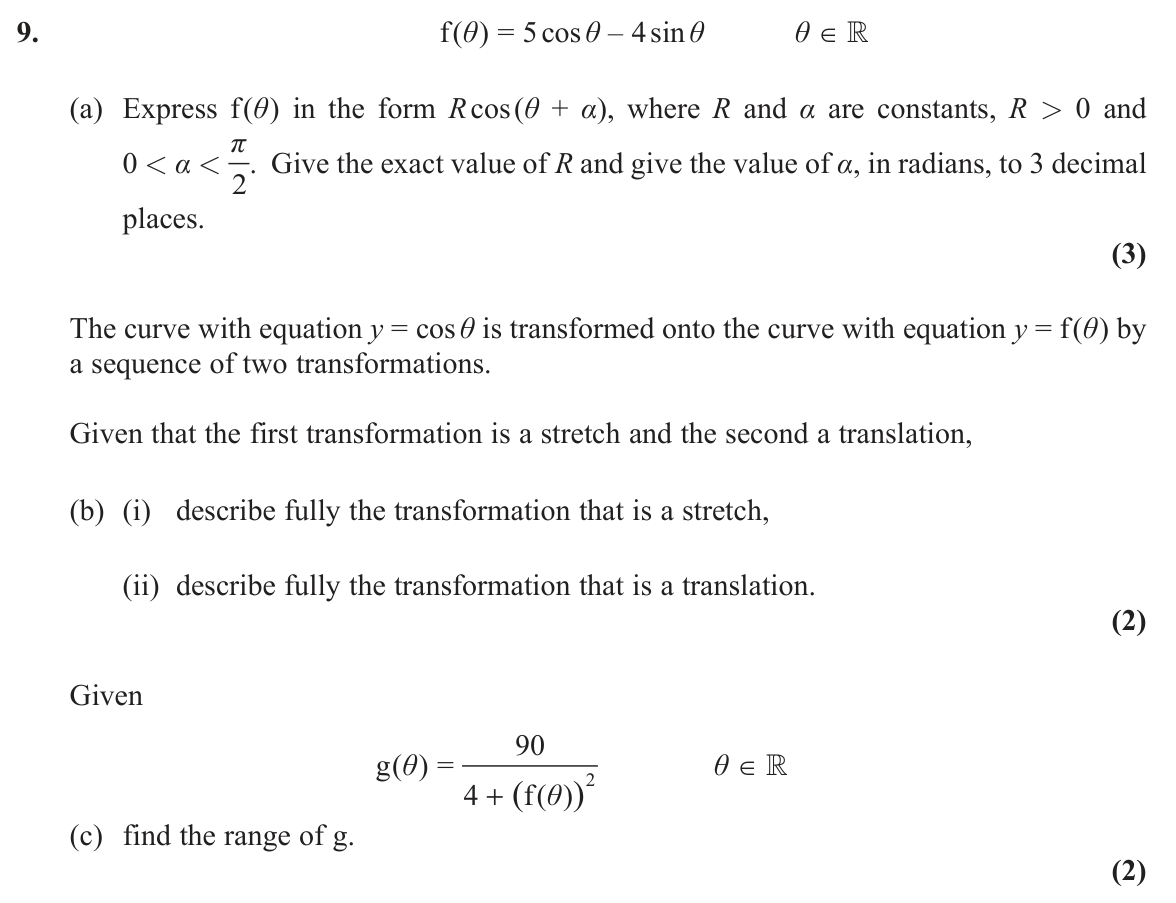
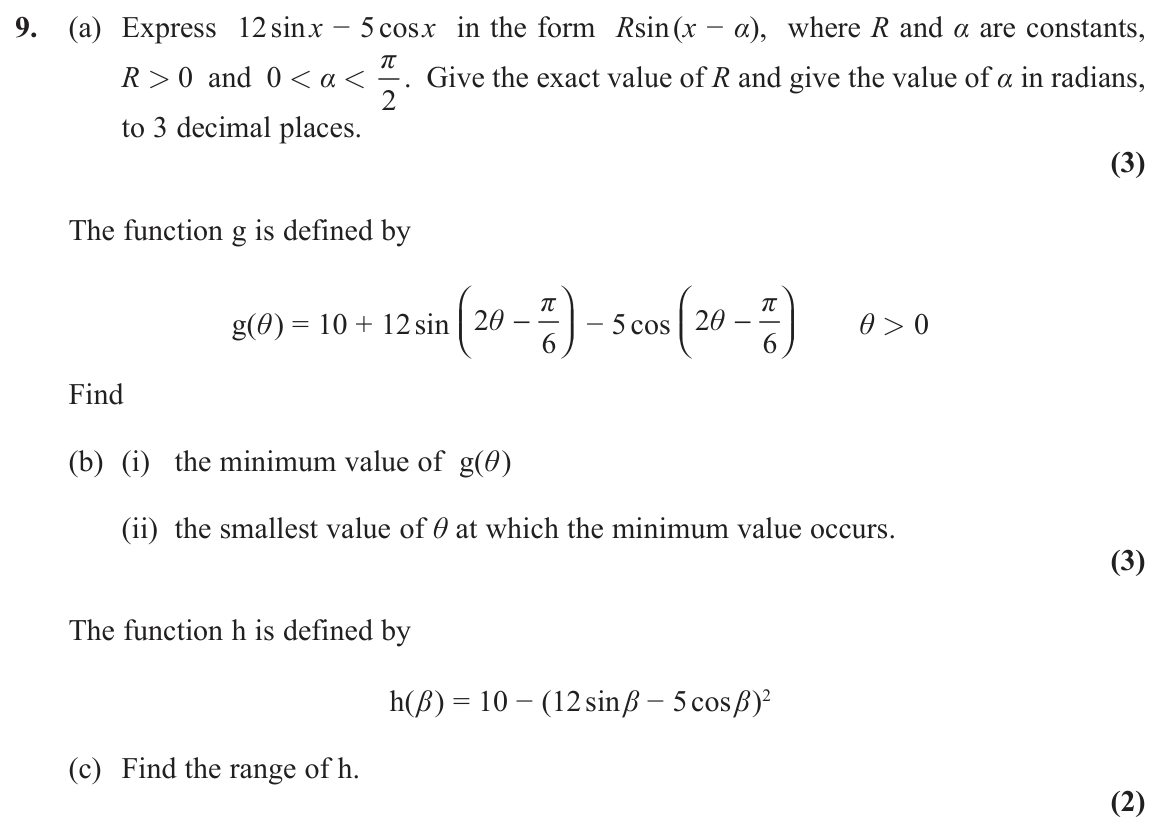
Expand $R\sin(x-\alpha)=R\cos\alpha\sin x-R\sin\alpha\cos x$. Therefore $R\cos\alpha=12$, $R\sin\alpha=5$. Thus $R=\sqrt{12^2+5^2}=13$ and $\alpha=\arctan(5/12)=0.3947911197\ldots$ radians, in the required first quadrant.
Write $g(\theta)=10+13\sin(2\theta-\pi/6-\alpha)$. (i) The minimum is $10-13=-3$. (ii) For sine to equal $-1$, $2\theta-\pi/6-\alpha=-\pi/2+2\pi n$. Hence $\theta=-\pi/6+\alpha/2+\pi n$. For $n=0$ this is negative, so the smallest permitted value uses $n=1$:
As $\beta$ varies over the reals, $12\sin\beta-5\cos\beta$ covers $[-13,13]$. Its square therefore covers $[0,169]$, not $[169,169]$. Subtracting from 10 reverses the bounds, giving $[-159,10]$; both endpoints are attained.
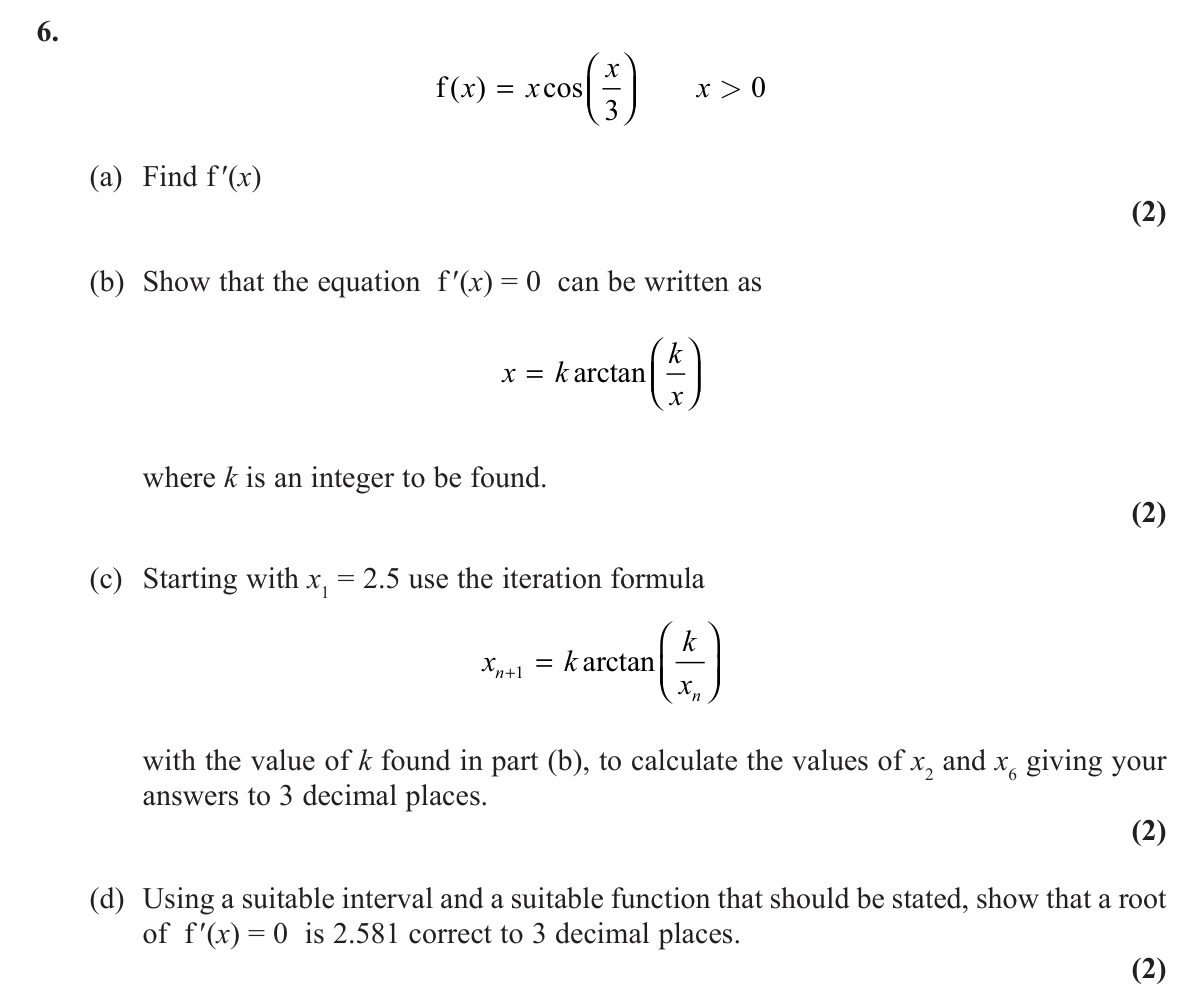
Set $f'(x)=0$: $\cos(x/3)=(x/3)\sin(x/3)$. At a solution, cosine cannot vanish (that would leave a nonzero right side), so $\tan(x/3)=3/x$. On the principal positive branch $0\lt x/3\lt \pi/2$, this gives
\[x=3\arctan(3/x),\qquad k=3.\]
This is the branch used by the supplied iteration for the root near 2.581. The original domain $x\gt 0$ also admits later tangent branches: in general $x=3\arctan(3/x)+3n\pi$. The principal-branch rearrangement must not be interpreted as listing every positive stationary point.
\[\boxed{k=3;\quad x=3\arctan(3/x)\text{ on the selected branch}}\]
Part (c)
Using radians and $x_1=2.5$, the successive values are
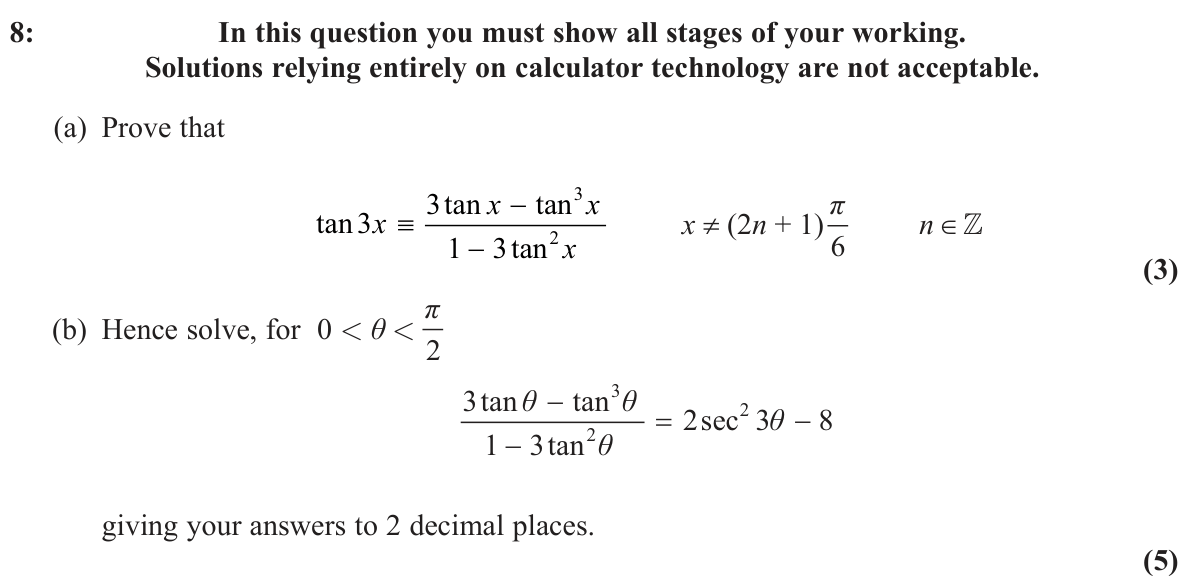
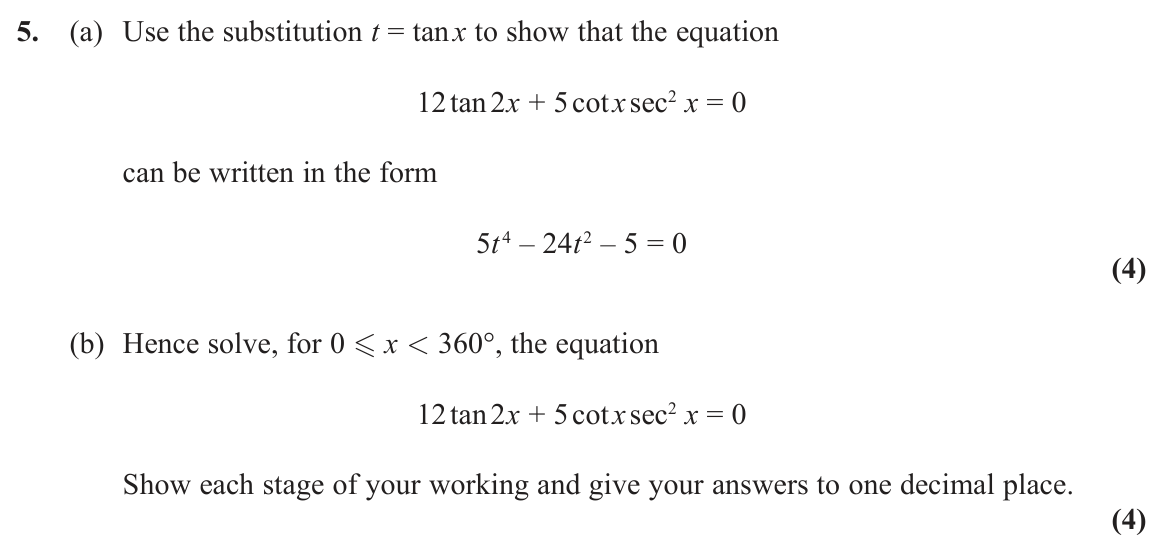
Let $t=\tan x$. For the original equation to be defined, $\sin x\ne0$, $\cos x\ne0$ and $\cos 2x\ne0$; hence $t\ne0$ and $t^2\ne1$. Using the double-angle and reciprocal identities,
These have finite, nonzero tangent with $t^2=5\ne1$, so every transformation in part (a) is reversible and all four satisfy the original equation. To one decimal place,
Hence $\boxed{x=56.8^\circ\text{ or }123.2^\circ}$ to one decimal place. Neither is an excluded multiple of $45^\circ$; these are all the solutions in the interval.
Final answer
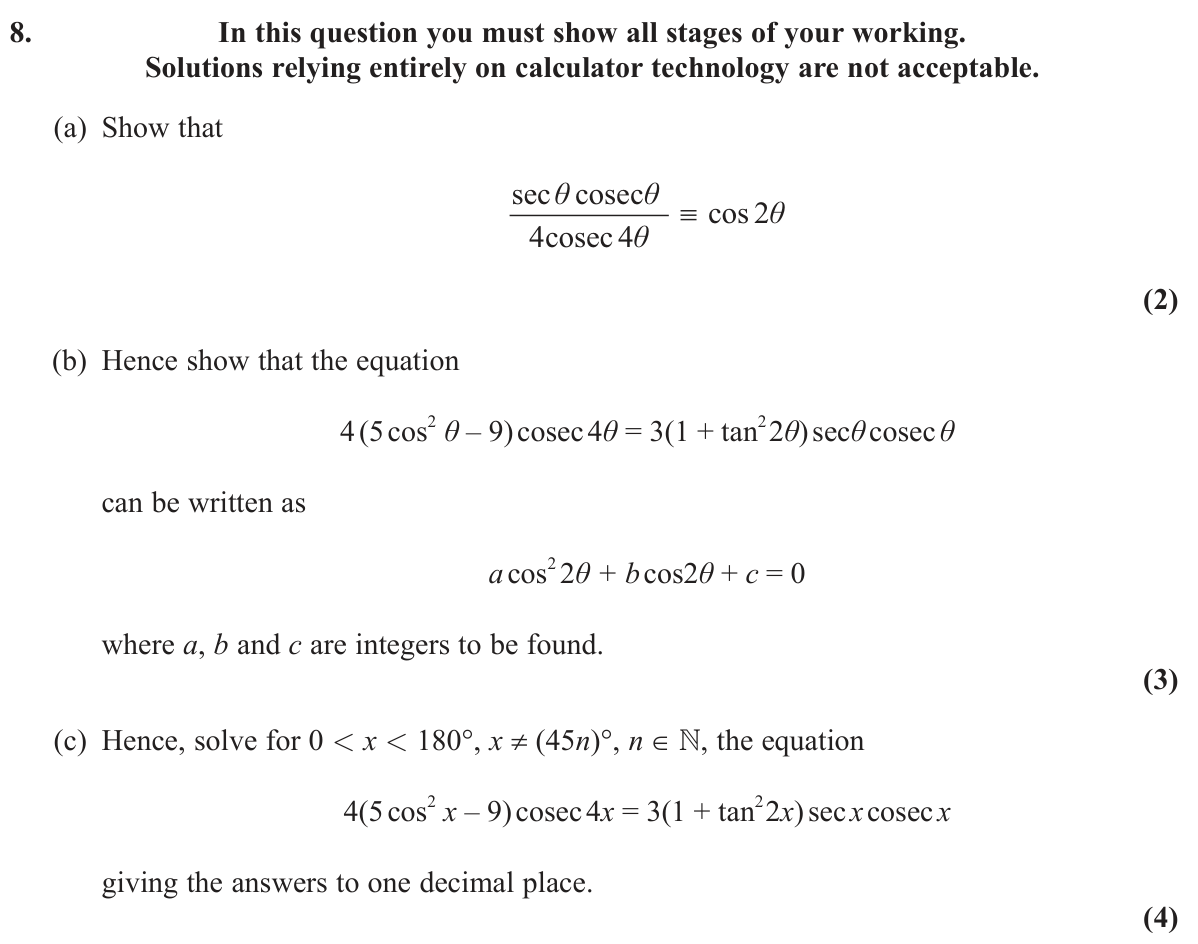
(a) $\cos2\theta$ (b) $5\cos^2 2\theta-13\cos2\theta-6=0$ (c) $x=56.8^\circ\text{ or }123.2^\circ$
37. WMA13/01 January 2026 · Q9
Hard9 marks · main topic: Trig Equations & R-FormShow worked solution
Part (a)
Use $2\sin x\cos x=\sin2x$ and $2\sin^2x=1-\cos2x$:
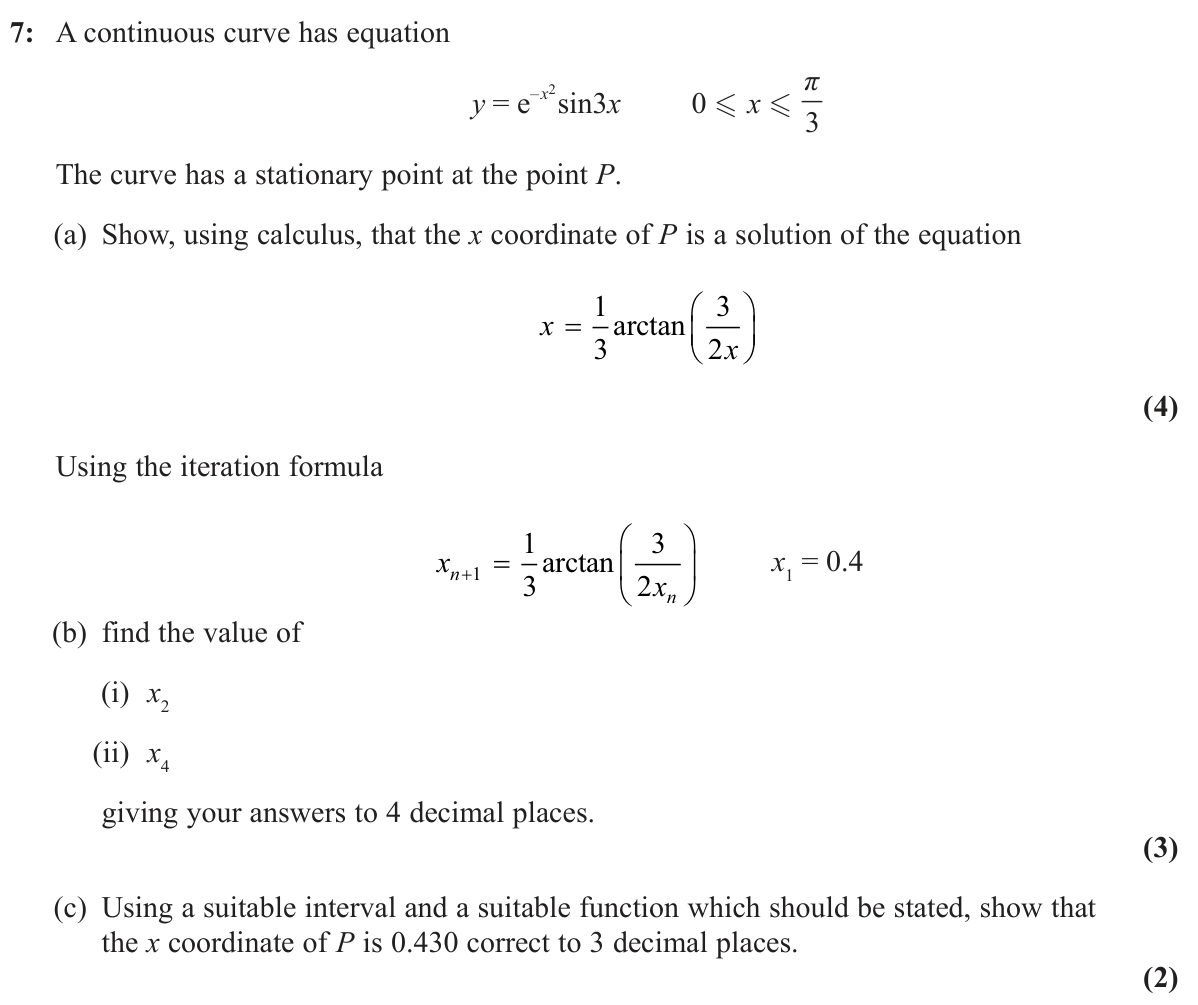
Since $e^{-x^2}\gt 0$, a stationary point satisfies
\[3\cos3x=2x\sin3x.\]
Neither endpoint $x=0,\pi/3$ is stationary. In the interior $\sin3x\gt 0$ and $x\gt 0$, so $\cos3x\gt 0$ at a stationary point and $0\lt 3x\lt \pi/2$. Therefore division and the principal inverse tangent are valid:
The sign change places a root strictly between $0.4295$ and $0.4305$. On $0\lt x\lt \pi/6$, $h'(x)=-11\sin3x-6x\cos3x\lt 0$, so the stationary root is unique; for $\pi/6\leq x\leq\pi/3$, $h(x)\lt 0$. Hence the $x$ coordinate of $P$ is $\boxed{0.430\text{ to 3 decimal places}}$.
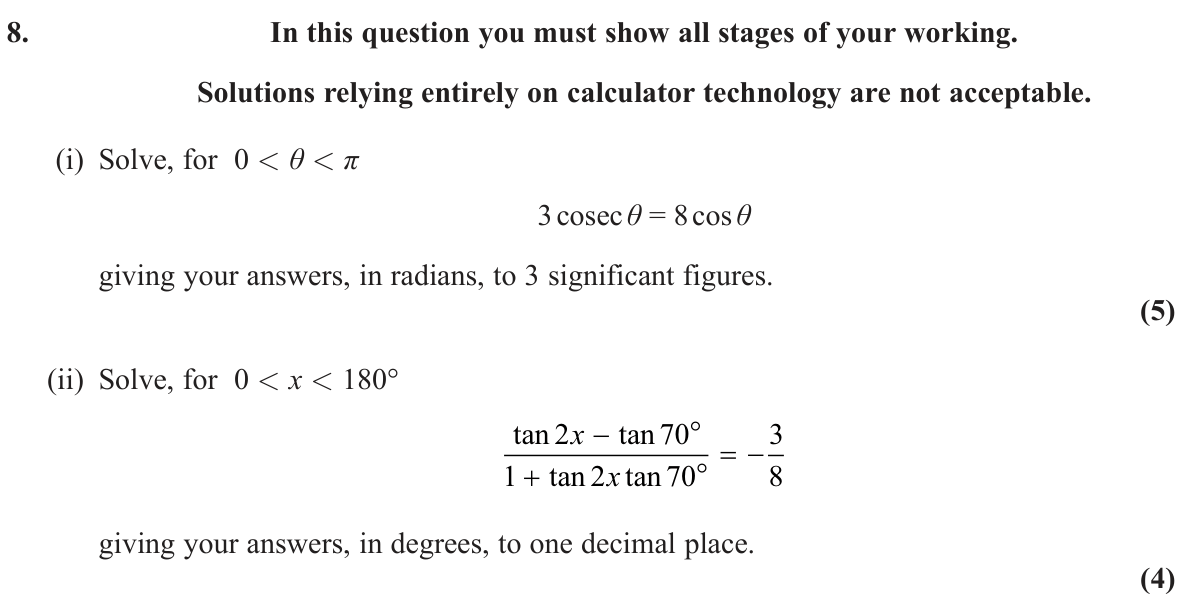
Set $u=2x-70^\circ$. The interval becomes $-70^\circ\lt u\lt 290^\circ$. With $\arctan(-3/8)=-20.5560452196\ldots^\circ$, the permitted values are $u=-20.5560452196\ldots^\circ$ and $159.4439547804\ldots^\circ$. Adding $70^\circ$ and halving gives $x=24.7219773902\ldots^\circ$ and $114.7219773902\ldots^\circ$. Both keep the original tangents and denominator defined.
\[\boxed{x=24.7^\circ,\ 114.7^\circ}\]
Final answer
(i) $\theta=0.424,\ 1.15\text{ radians}$ (ii) $x=24.7^\circ,\ 114.7^\circ$
41. WMA13/01 January 2025 · Q10
Hard9 marks · main topic: Differentiation TechniquesShow worked solution
Part (a)
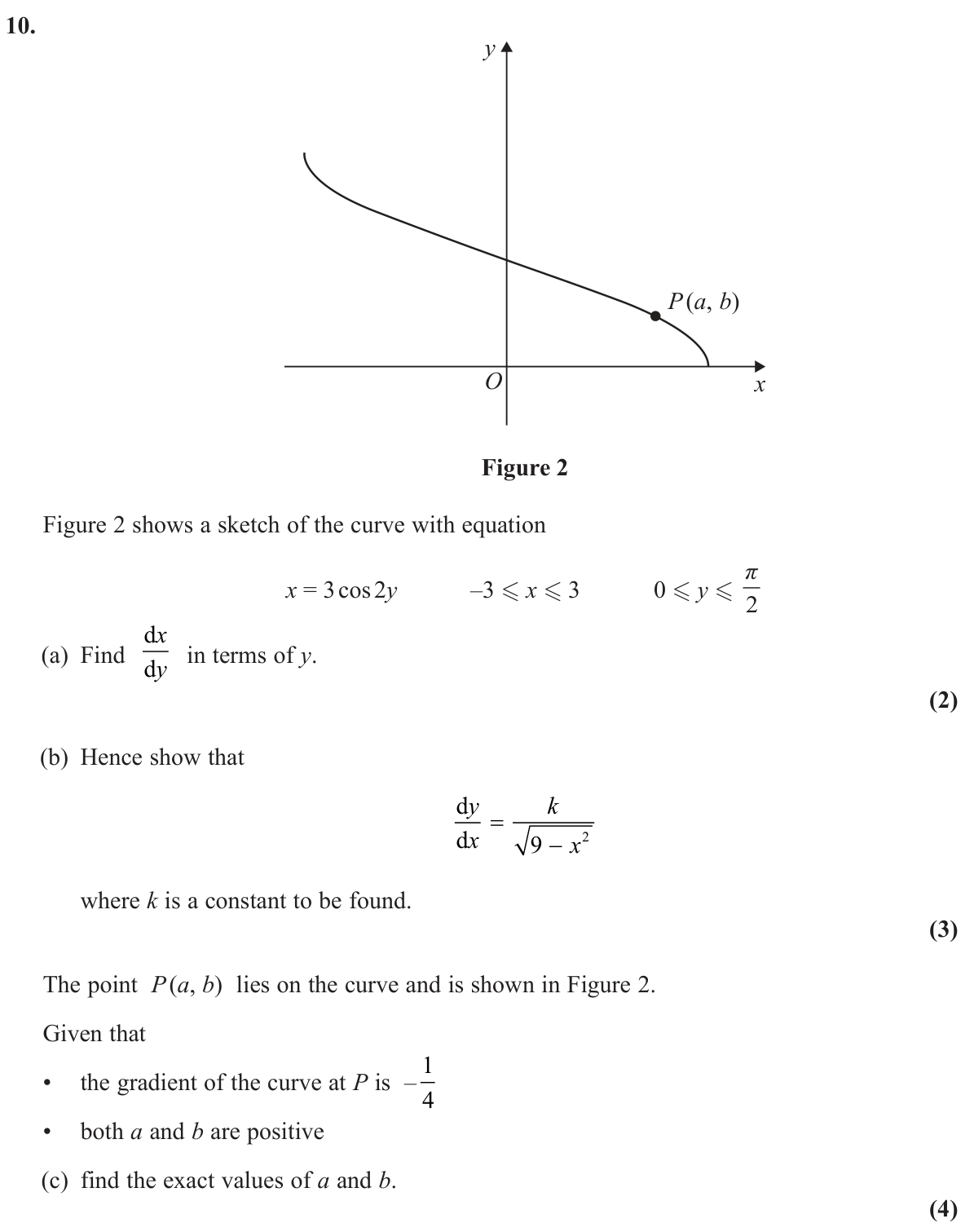
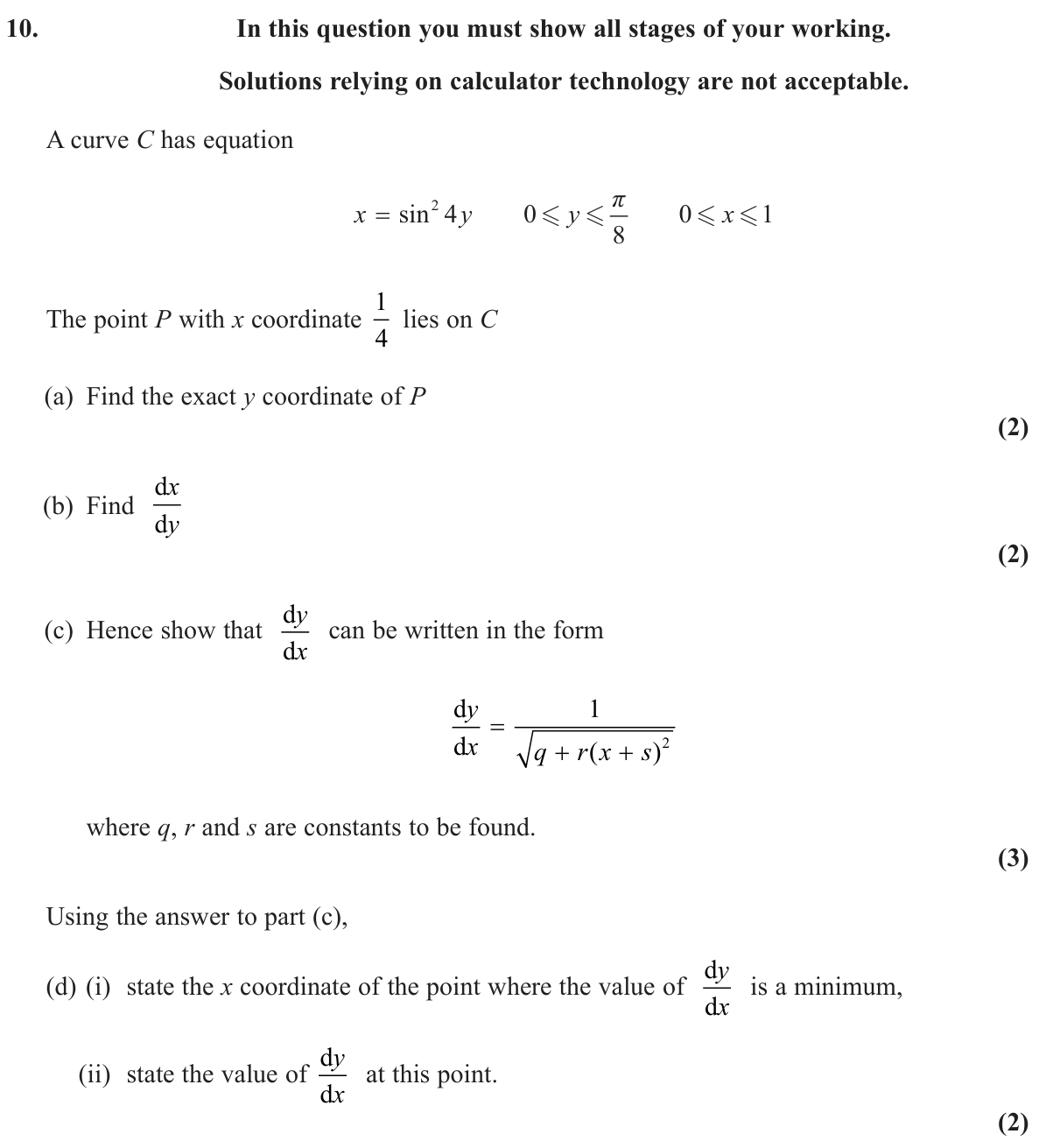
Differentiate $x=3\cos2y$ with respect to $y$ using the chain rule:
\[\frac{dx}{dy}=3(-\sin2y)\cdot2=-6\sin2y.\]
\[\boxed{\frac{dx}{dy}=-6\sin2y}\]
Part (b)
For $0\lt y\lt \pi/2$, $\sin2y\gt 0$ and
\[\frac{dy}{dx}=\frac1{dx/dy}=-\frac1{6\sin2y}.\]
Since $\cos2y=x/3$ and the sine is positive on this interval,
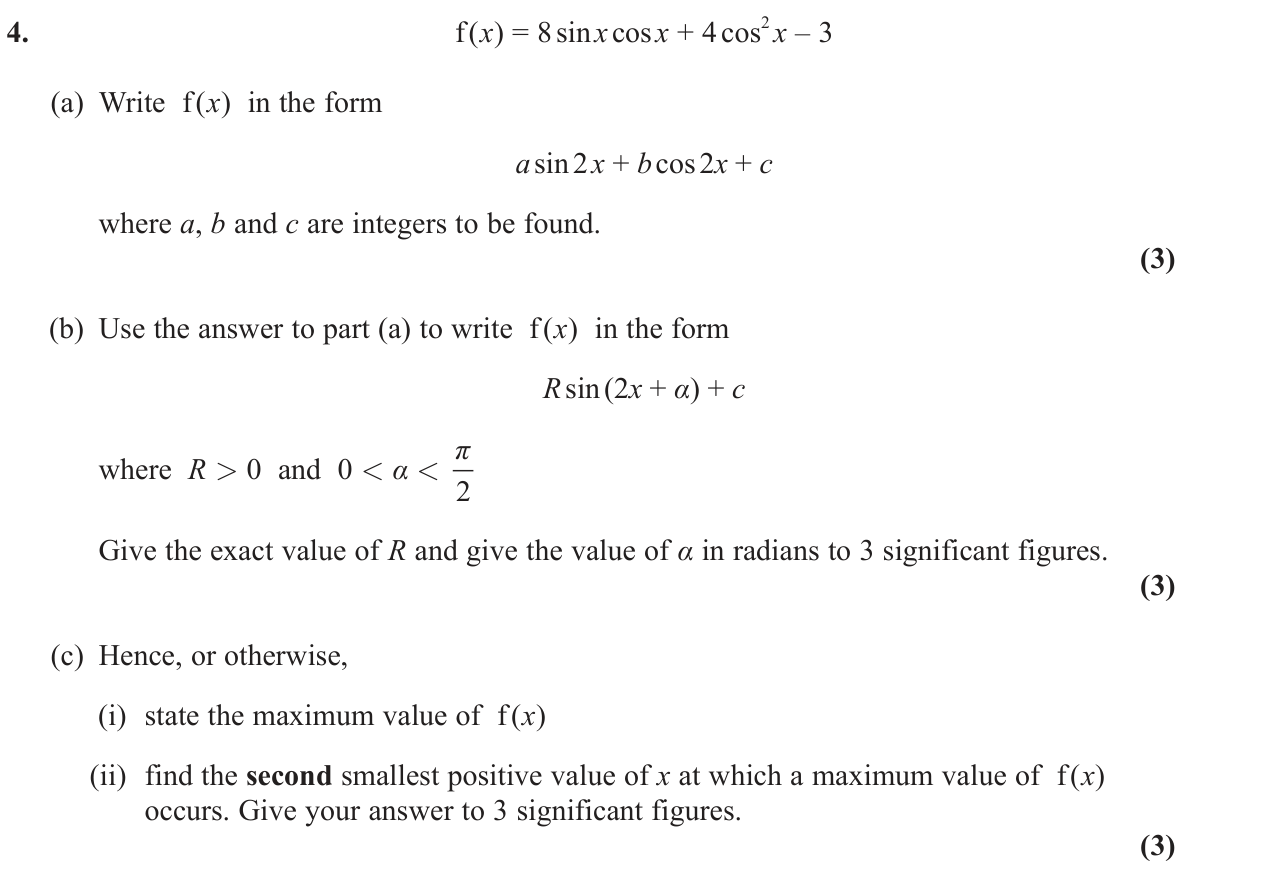
Use $\sin2x=2\sin x\cos x$ and $2\cos^2x=1+\cos2x$:
\[f(x)=4\sin2x+2(1+\cos2x)-3=4\sin2x+2\cos2x-1.\]
\[\boxed{a=4,\quad b=2,\quad c=-1}\]
Part (b)
Expanding $R\sin(2x+\alpha)$ and matching coefficients gives
\[R\cos\alpha=4,\qquad R\sin\alpha=2.\]
Squaring and adding, $R^2=20$, so $R=2\sqrt5$ since $R\gt 0$. Also $\tan\alpha=1/2$, and $0\lt \alpha\lt \pi/2$ selects $\alpha=\arctan(1/2)=0.463647609\ldots$ radians. Thus $f(x)=2\sqrt5\sin(2x+\arctan(1/2))-1$. With the phase displayed to 3 significant figures, $f(x)\approx2\sqrt5\sin(2x+0.464)-1$.
Thus $dy/dx=(q+r(x+s)^2)^{-1/2}$ has the constants below, with $0\lt x\lt 1$ for a finite derivative; the endpoints have vertical tangents.
\[\boxed{q=16,\qquad r=-64,\qquad s=-\frac12}\]
Part (d)
The derivative is positive. Its minimum occurs when the square root in the denominator is largest. Since $(x-1/2)^2\ge0$, the largest radicand is 16, attained at $x=1/2$. Hence the smallest gradient is $1/\sqrt{16}$.
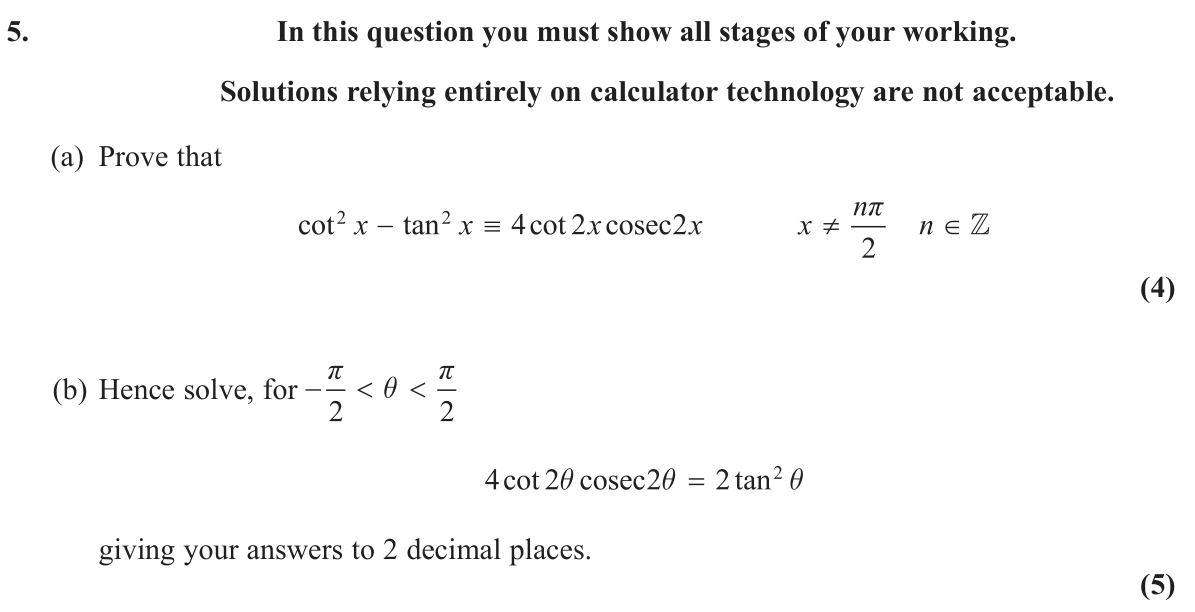
By part (a), the equation is $\cot^2\theta-\tan^2\theta=2\tan^2\theta$, so $\cot^2\theta=3\tan^2\theta$. The original expression excludes $\theta=0$ in the stated interval, so $\tan\theta\ne0$ and multiplication by $\tan^2\theta$ gives
Tangent is one-to-one on $(-\pi/2,\pi/2)$; the two angles are $\pm\arctan(3^{-1/4})=\pm0.6497662865\ldots$ radians. Both are valid and nonzero. To two decimal places:
Hard9 marks · main topic: Trig Equations & R-FormShow worked solution
Part (a)
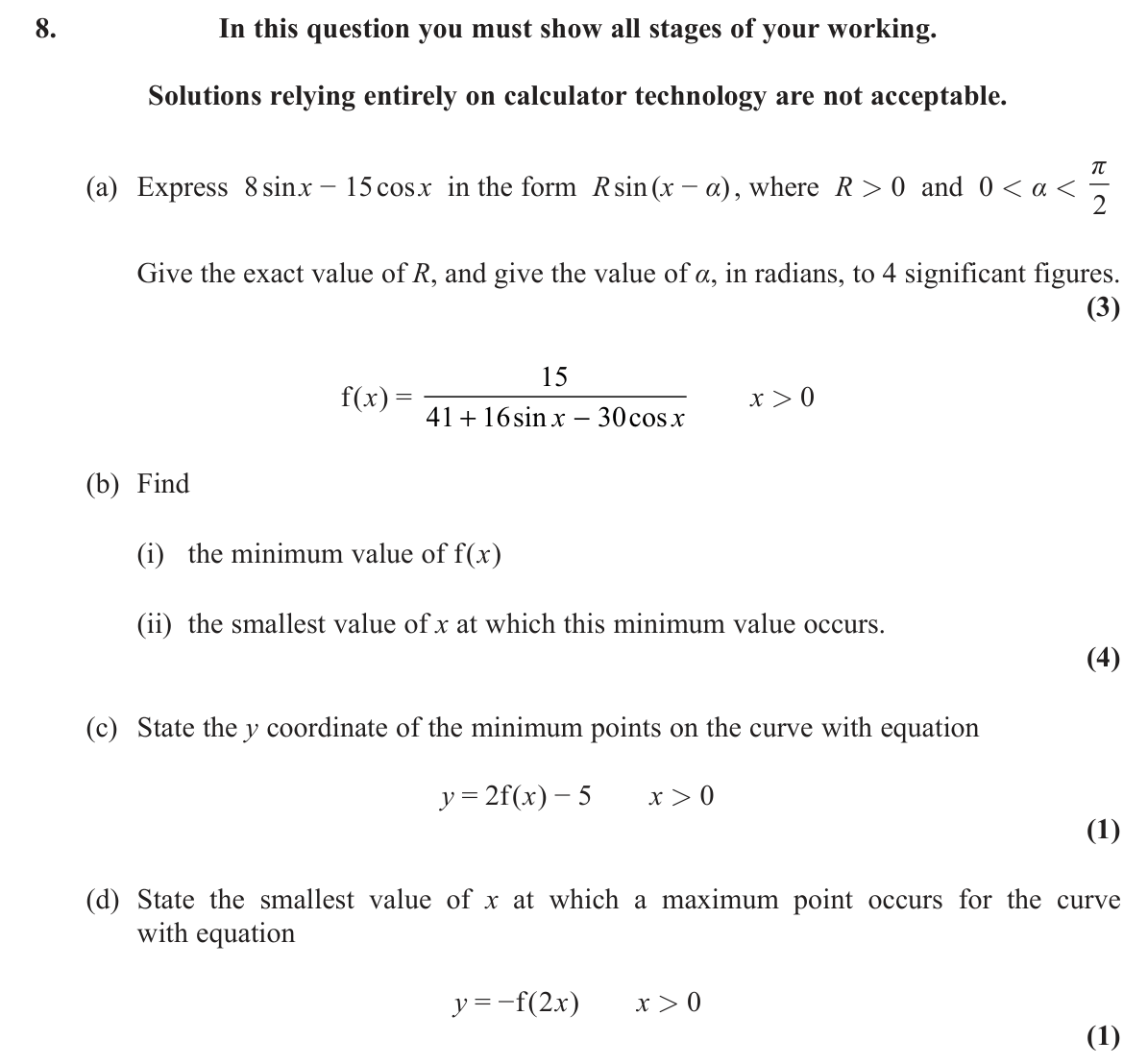
Expand $R\sin(x-\alpha)=R\cos\alpha\sin x-R\sin\alpha\cos x$. Thus $R\cos\alpha=8$, $R\sin\alpha=15$, so $R=\sqrt{64+225}=17$ and $\alpha=\arctan(15/8)=1.0808390005\ldots$ radians, in the required quadrant.
The denominator lies between 7 and 75, so it is always positive. (i) The smallest fraction occurs at its largest denominator: $f_{\min}=15/75=1/5$. (ii) This occurs when $x-\alpha=\pi/2+2n\pi$. The smallest positive value is $x=\alpha+\pi/2=2.6516353273\ldots$, or 2.65 to three significant figures.
\[\boxed{f_{\min}=\frac15,\qquad x=2.65}\]
Part (c)
The transformation $2f(x)-5$ preserves the locations of minima and maps their y coordinate to $2(1/5)-5=-23/5$.
\[\boxed{y=-\frac{23}{5}}\]
Part (d)
Reflection in the x-axis changes minima of f into maxima of $-f$. The argument $2x$ halves their x coordinates, so the first positive maximum is at
Thus $s=(-5\pm\sqrt{97})/18$, approximately $0.269380989$ and $-0.824936545$. Both lie in $[-1,1]$, are nonzero, and satisfy the original nonzero-denominator condition. The positive value gives $15.6274\ldots^\circ$ and $164.3726\ldots^\circ$; the negative value gives $235.5821\ldots^\circ$ and $304.4179\ldots^\circ$. All four angles lie in $0\lt \theta\le360^\circ$.
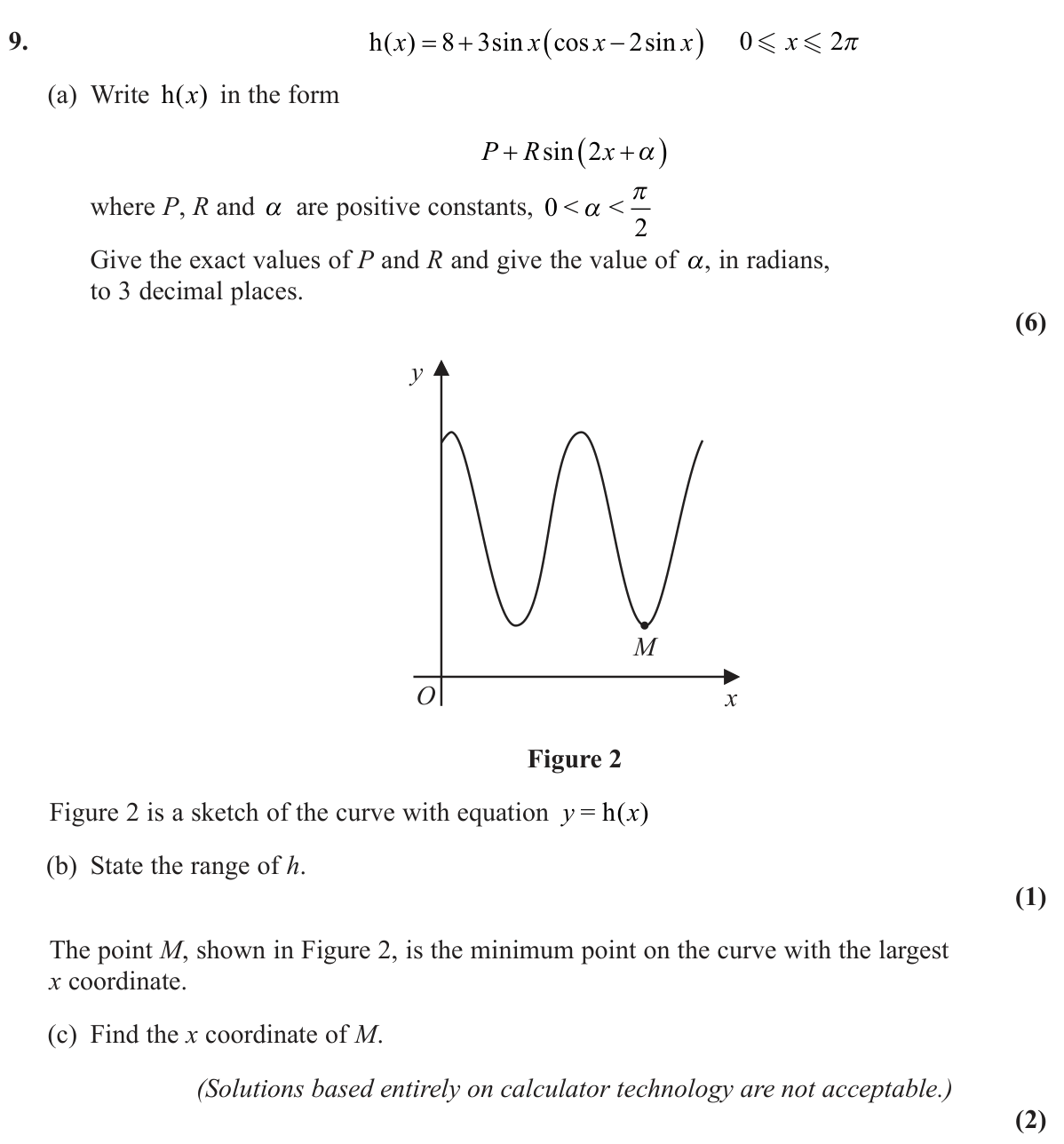
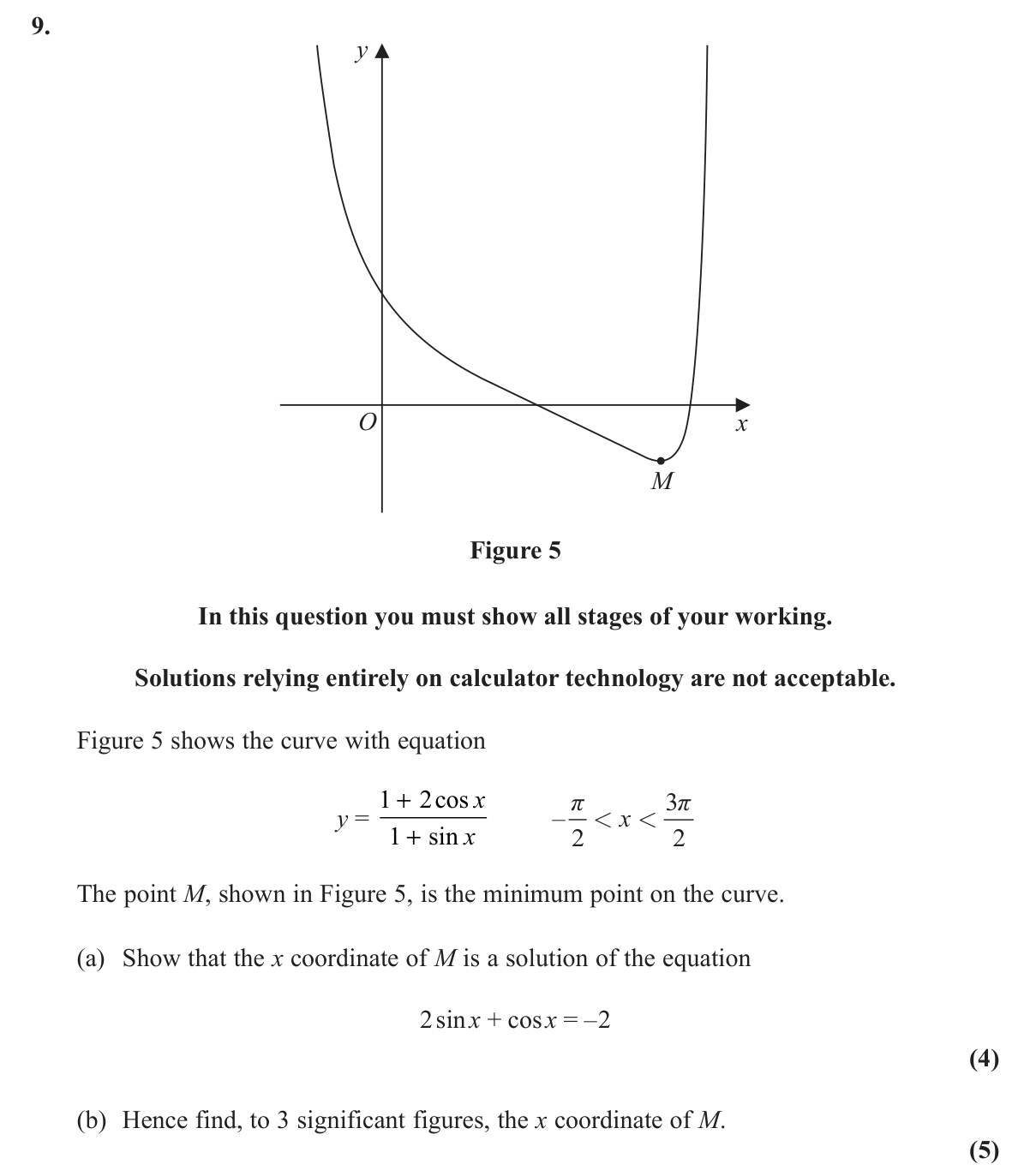
Inside the stated interval, $1+\sin x\gt 0$. At the interior minimum M, $y'=0$, so its numerator is zero, giving the required equation.
\[\boxed{2\sin x+\cos x=-2}\]
Part (b)
Write $2\sin x+\cos x=\sqrt5\sin(x+\beta)$, where $\cos\beta=2/\sqrt5$, $\sin\beta=1/\sqrt5$ and $\beta=\arctan(1/2)$. The equation becomes $\sin(x+\beta)=-2/\sqrt5$. Let $\gamma=\arcsin(2/\sqrt5)$, so $\gamma+\beta=\pi/2$. The solutions in the closed boundary range include $x=-\pi/2$, $3\pi/2$, and
\[x=\pi+\gamma-\beta=3.7850937624\ldots.\]
Both boundary values are outside the original open domain (and make its denominator zero). The sole interior stationary point is M; the derivative changes from negative to positive there.
\[\boxed{x_M=3.79}\]
Final answer
(a) $2\sin x+\cos x=-2$ (b) $x_M=3.79$
49. WMA13/01 May/June 2021 · Q2
Hard9 marksShow worked solution
Part (a)
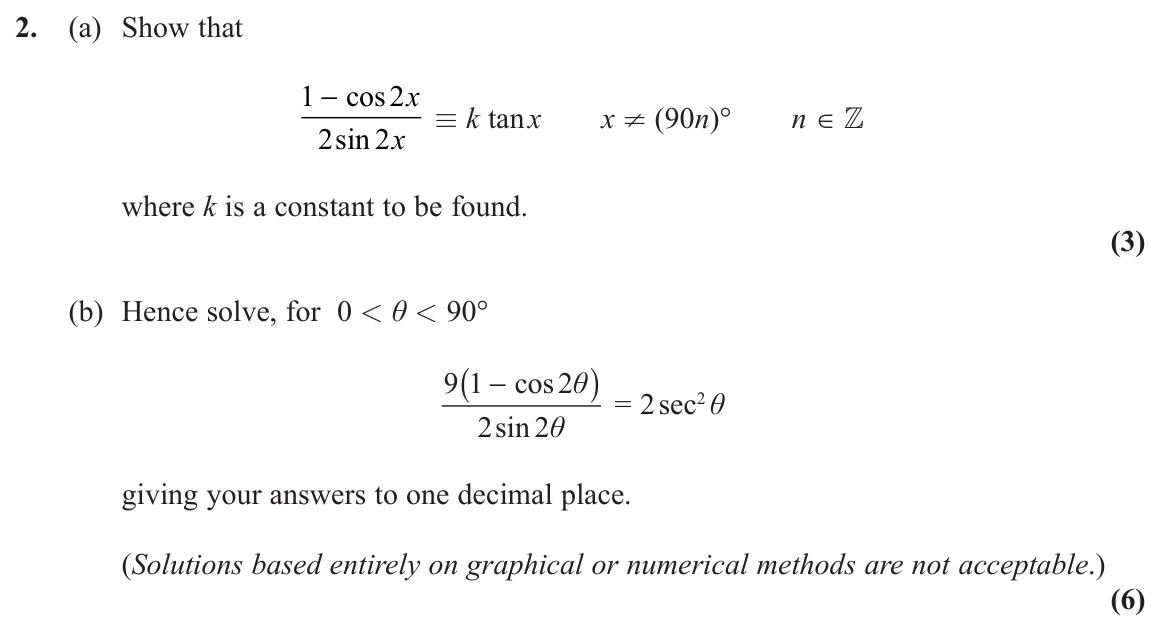
Use $1-\cos2x=2\sin^2x$ and $\sin2x=2\sin x\cos x$:
The source excludes multiples of $90^\circ$, so the cancelled sine and denominator cosine are nonzero.
\[\boxed{k=\frac12}\]
Part (b)
Part (a) reduces the equation to $(9/2)\tan\theta=2\sec^2\theta$. Set $u=\tan\theta$ and use $\sec^2\theta=1+\tan^2\theta$:
\[4u^2-9u+4=0,\qquad u=\frac{9\pm\sqrt{17}}8.\]
Both roots are positive. On $0\lt \theta\lt 90^\circ$, tangent is one-to-one, so each gives exactly one angle: $31.36697777\ldots{}^\circ$ and $58.63302223\ldots{}^\circ$.
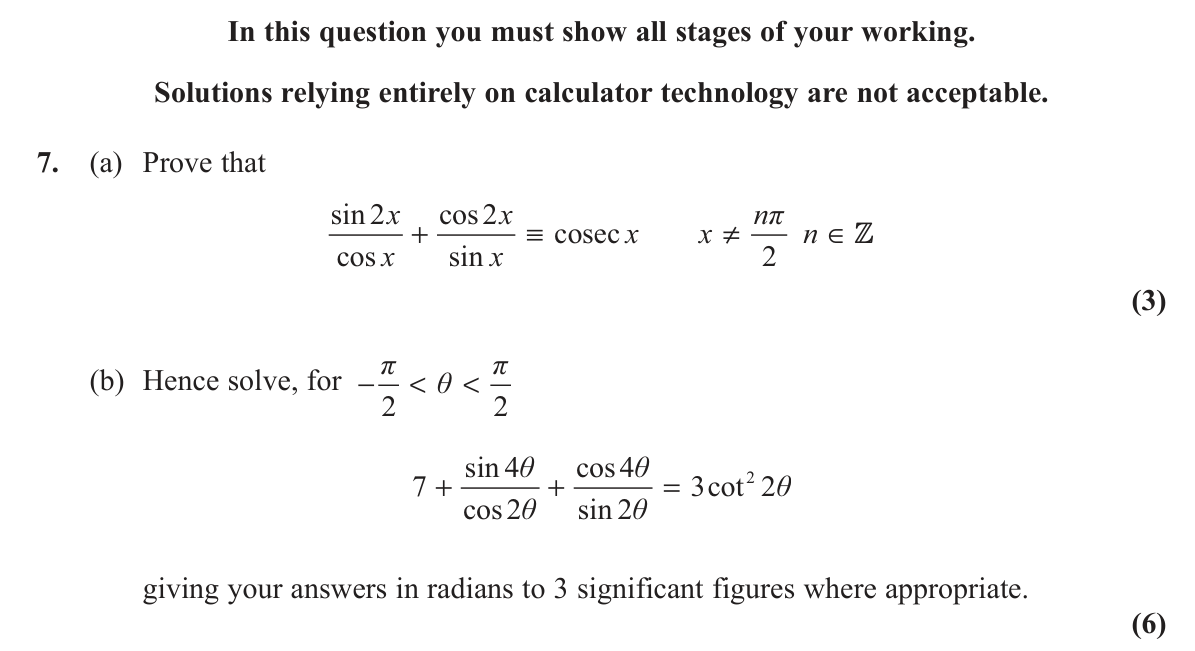
Using (a) with $x=2\theta$ gives $7+\csc2\theta=3\cot^22\theta$. Set $u=\csc2\theta$ and use $\cot^22\theta=u^2-1$: $3u^2-u-10=(3u+5)(u-2)=0$. Thus $\sin2\theta=1/2$ or $\sin2\theta=-3/5$. As $-\pi\lt 2\theta\lt \pi$, the first gives $2\theta=\pi/6,5\pi/6$. Write $\gamma=\arcsin(3/5)$; the second gives $2\theta=-\gamma,-\pi+\gamma$. Therefore the four values are $\pi/12,5\pi/12,-0.3217505544\ldots,-1.249045772\ldots$. None makes an original sine or cosine denominator zero.
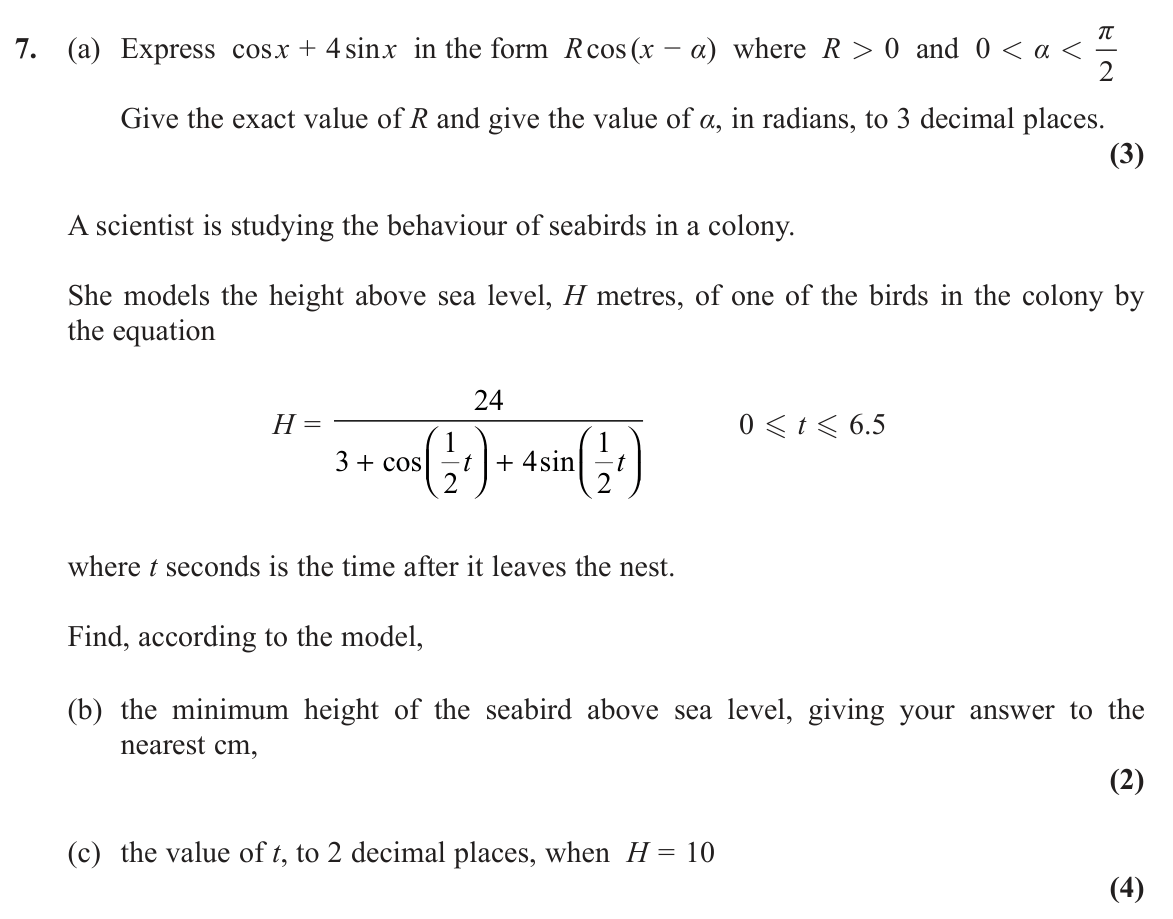
The model becomes $H=24/[3+\sqrt{17}\cos(t/2-\alpha)]$. For $0\le t\le6.5$, the phase lies between $-\alpha$ and $3.25-\alpha$; throughout this interval the denominator remains positive. Its maximum $3+\sqrt{17}$ is attained at $t=2\alpha=2.651635\ldots$, inside the time interval. The height is then smallest:
To the nearest centimetre this is $3.37\ \mathrm m$ (337 cm).
\[\boxed{H_{\min}=3.37\ \mathrm m}\]
Part (c)
For $H=10$, $3+\sqrt{17}\cos(t/2-\alpha)=24/10$, so
\[\cos(t/2-\alpha)=-\frac{3}{5\sqrt{17}}.\]
Let $\gamma=\arccos[-3/(5\sqrt{17})]$. In the permitted phase interval $[-\alpha,3.25-\alpha]$, only $+\gamma$ occurs: $-\gamma\lt -\alpha$, and shifts by $2\pi$ are outside it. Using the unrounded $\alpha=\arctan4$,
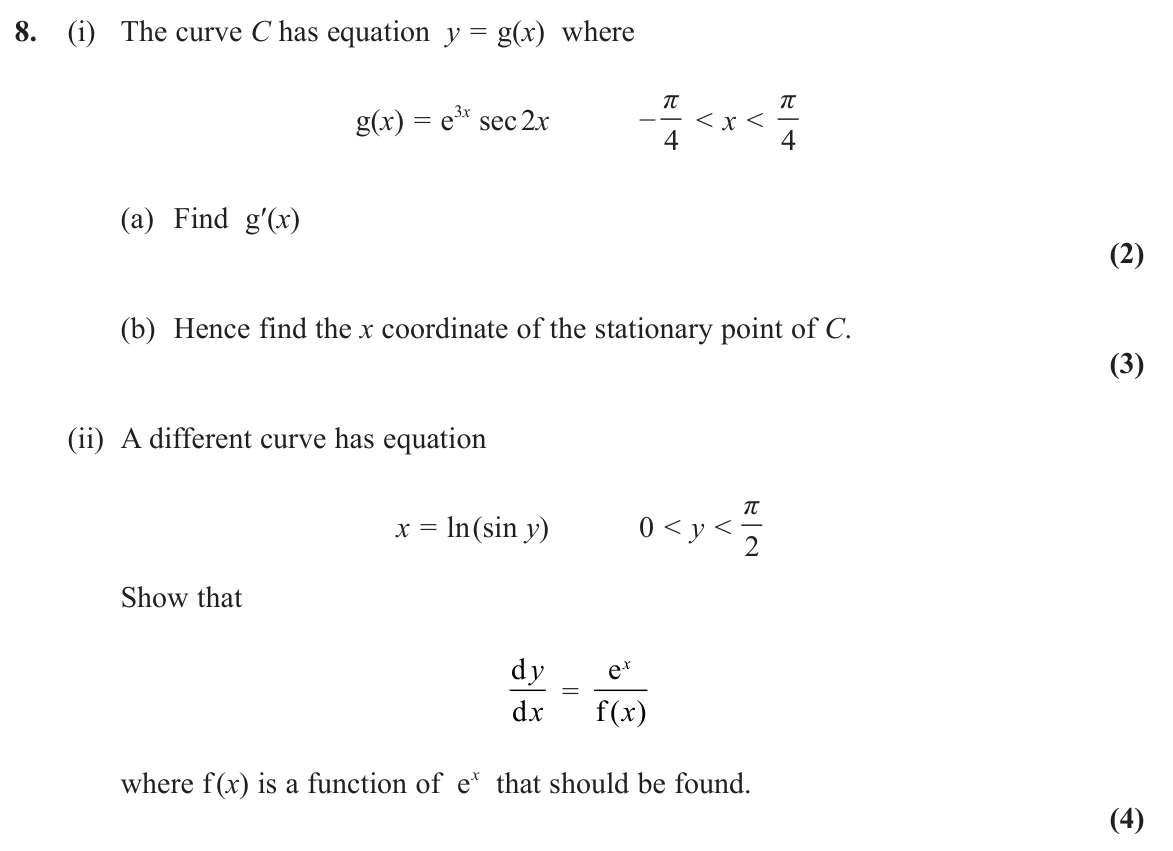
For $-\pi/4\lt x\lt \pi/4$, $e^{3x}\sec2x$ is positive and nonzero. Hence $g'(x)=0$ precisely when $3+2\tan2x=0$, or $\tan2x=-3/2$. Since $-\pi/2\lt 2x\lt \pi/2$, tangent is one-to-one there:
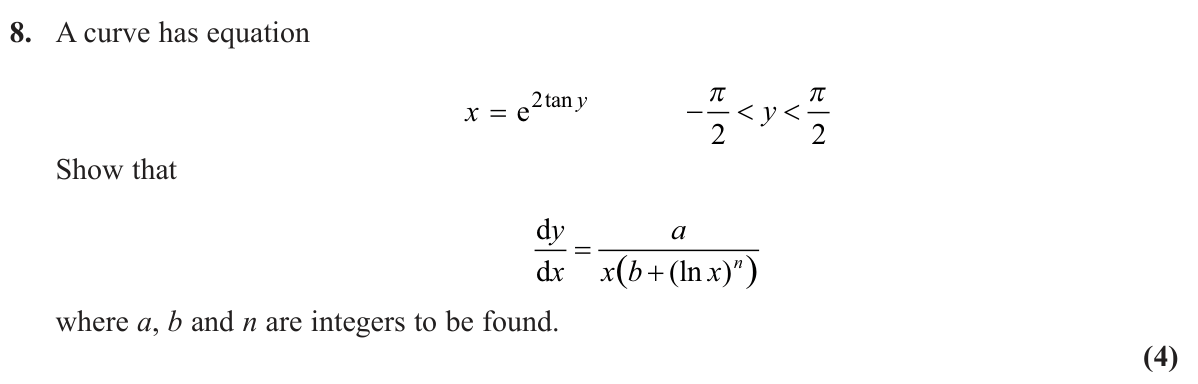
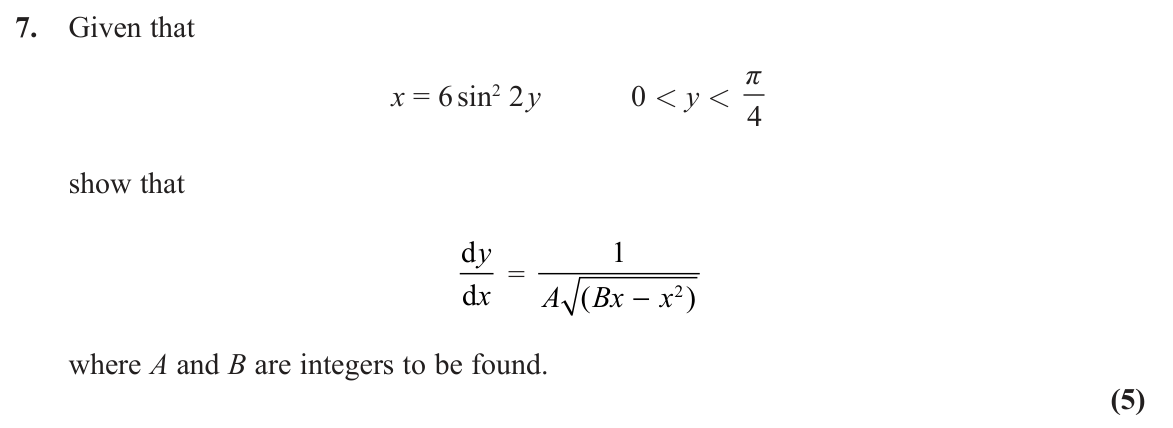
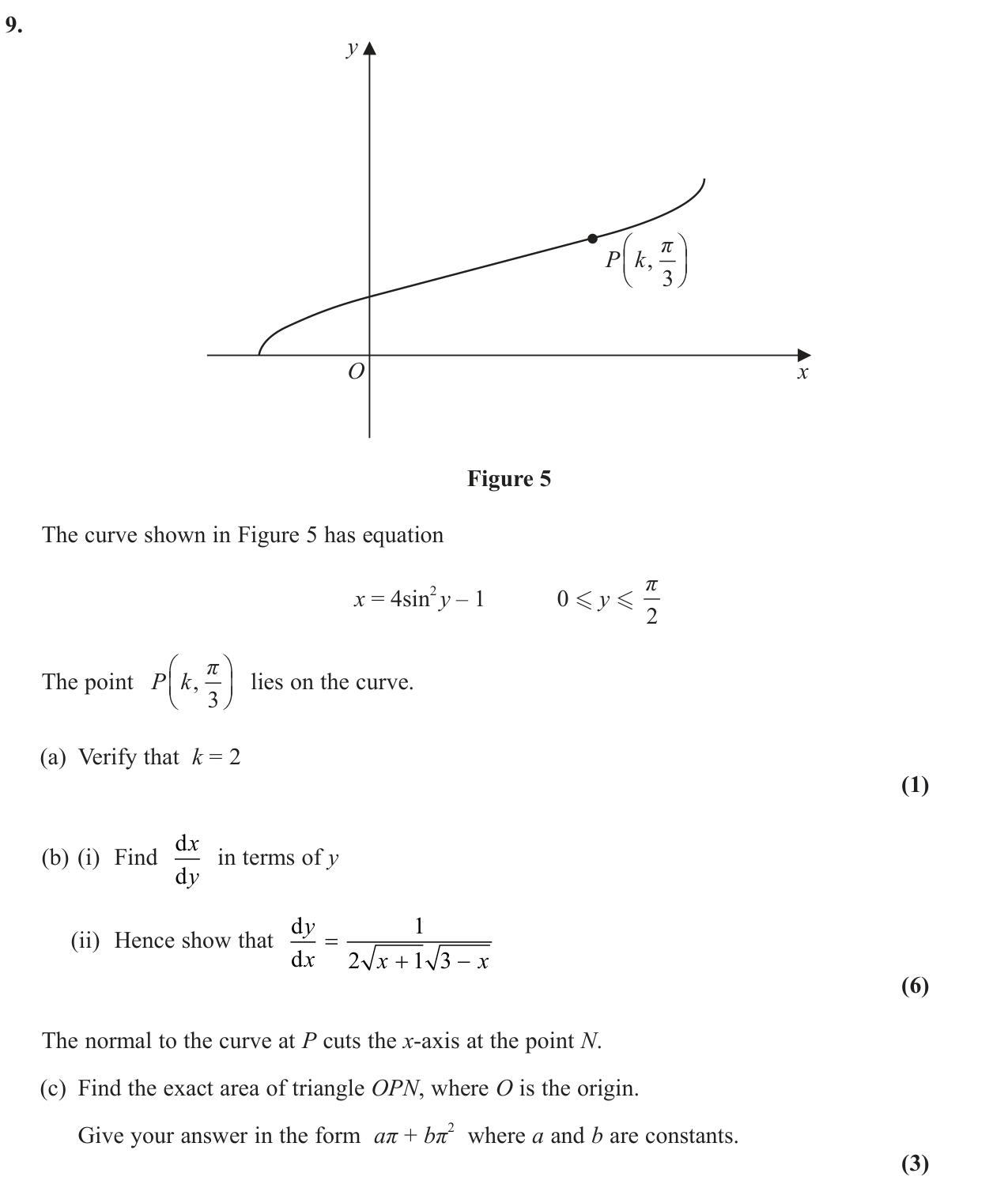
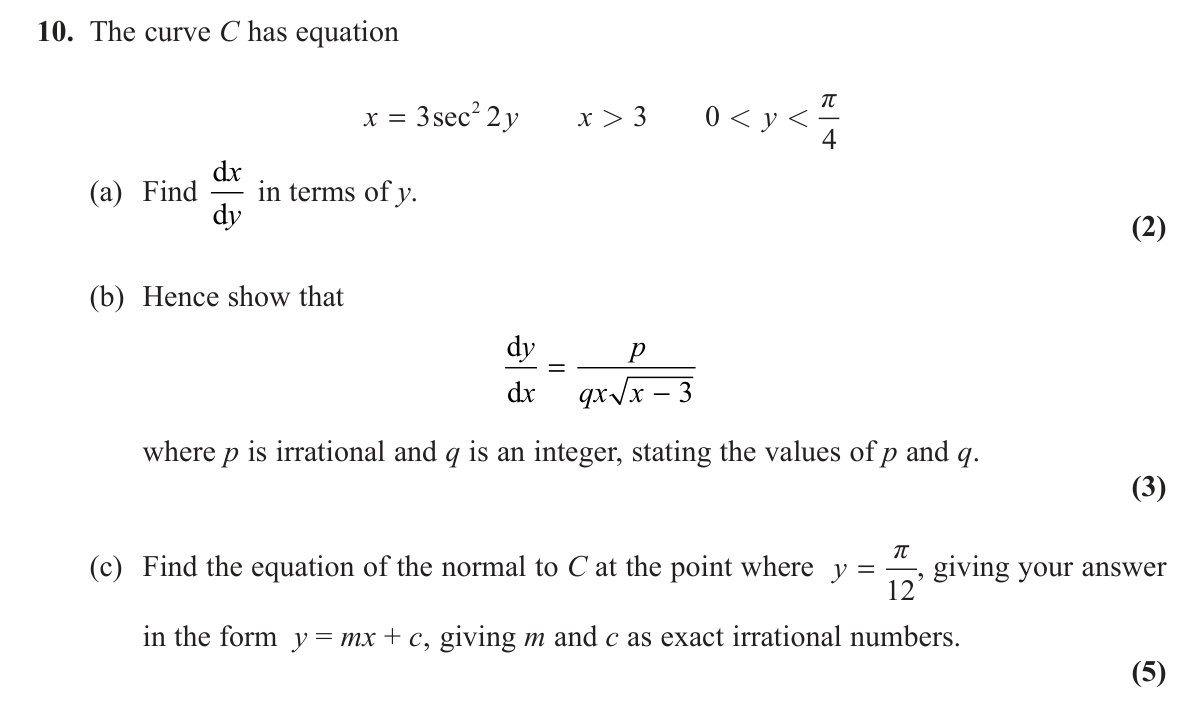
Consequently $dx/dy=2\sqrt{x+1}\sqrt{3-x}$. Taking the reciprocal proves the required formula on $-1\lt x\lt 3$. At $x=-1$ and $x=3$ the denominator is zero: these are endpoint vertical tangents, not finite derivatives.
At $P=(2,\pi/3)$ the tangent gradient is $1/(2\sqrt3)$, so the normal gradient is $-2\sqrt3$. Thus the normal is $y-\pi/3=-2\sqrt3(x-2)$. Setting $y=0$ gives $N=(2+\pi/(6\sqrt3),0)$. Triangle OPN has horizontal base $ON=2+\pi/(6\sqrt3)$ and perpendicular height $\pi/3$:
On $0\lt \theta\lt \pi/2$, both positive cotangents are permitted: $u=1$ gives $\theta=\pi/4$, while $u=5$ gives $\tan\theta=1/5$, $\theta=0.1973955598\ldots$ radians.
From $x=3\sec^22y$, $\sec^22y=x/3$ and $\tan^22y=x/3-1$. Since $0\lt 2y\lt \pi/2$, tangent is positive, so $\tan2y=\sqrt{(x-3)/3}$. Thus $dx/dy=4x\sqrt{(x-3)/3}\gt 0$. Taking the reciprocal gives
At $y=\pi/12$, $2y=\pi/6$ and $x=3(4/3)=4$. The tangent gradient is $\sqrt3/(4\cdot4\sqrt1)=\sqrt3/16$. Therefore the normal gradient is $-16/\sqrt3=-16\sqrt3/3$. Using the point $(4,\pi/12)$,
Hard11 marks · main topic: Differentiation TechniquesShow worked solution
Part (a)
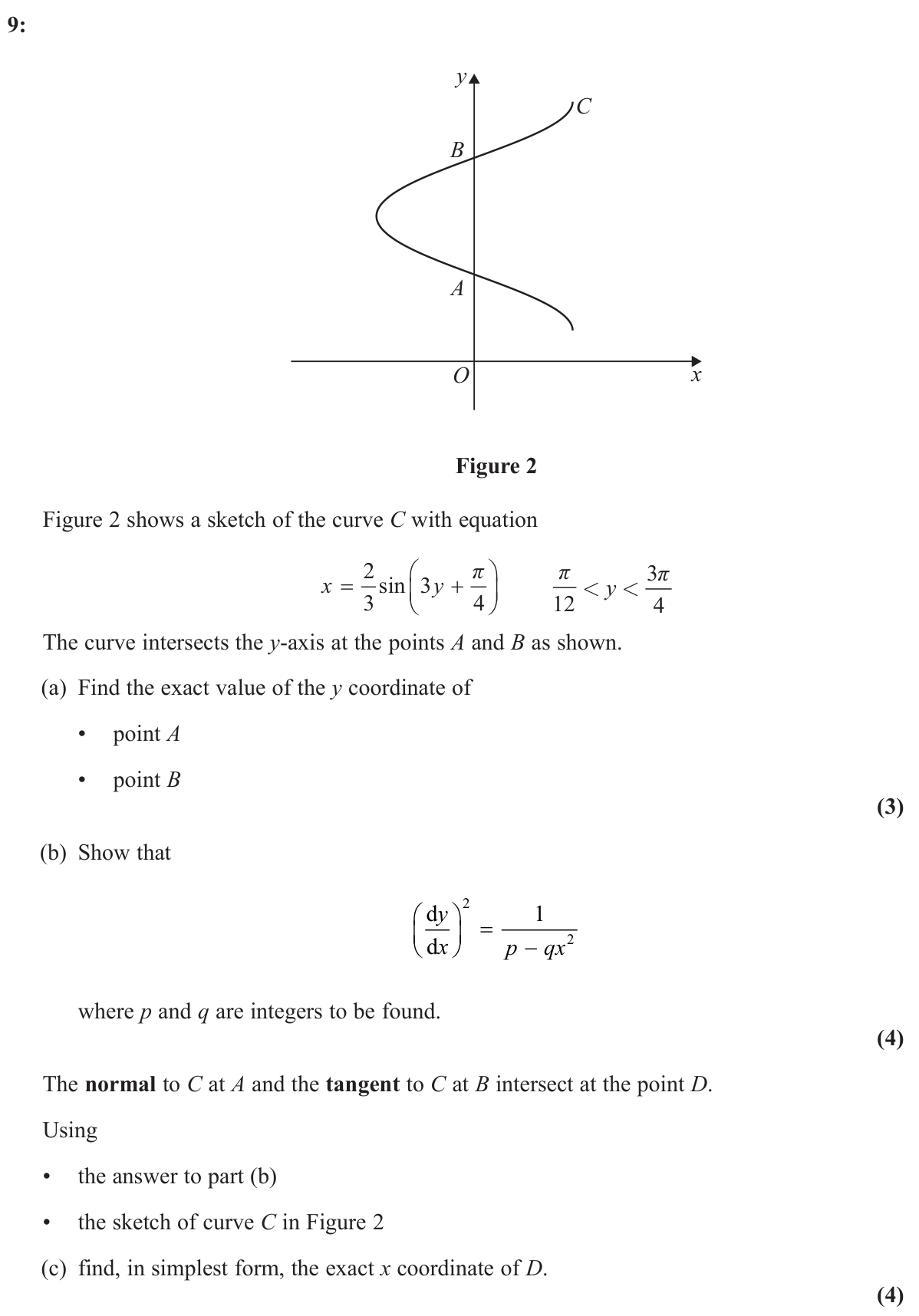
On the $y$ axis, $x=0$, so $\sin(3y+\pi/4)=0$. Since $\pi/12\lt y\lt 3\pi/4$, we have $\pi/2\lt 3y+\pi/4\lt 5\pi/2$. Therefore the possible angles are $\pi$ and $2\pi$, giving
Thus $\boxed{p=4,\ q=9}$. The derivative formula applies where the tangent is not vertical.
Part (c)
At $x=0$, part (b) gives $|dy/dx|=1/2$. The sketch shows a negative tangent gradient at $A$ and a positive one at $B$. The normal at $A$ therefore has gradient $2$, while the tangent at $B$ has gradient $1/2$:
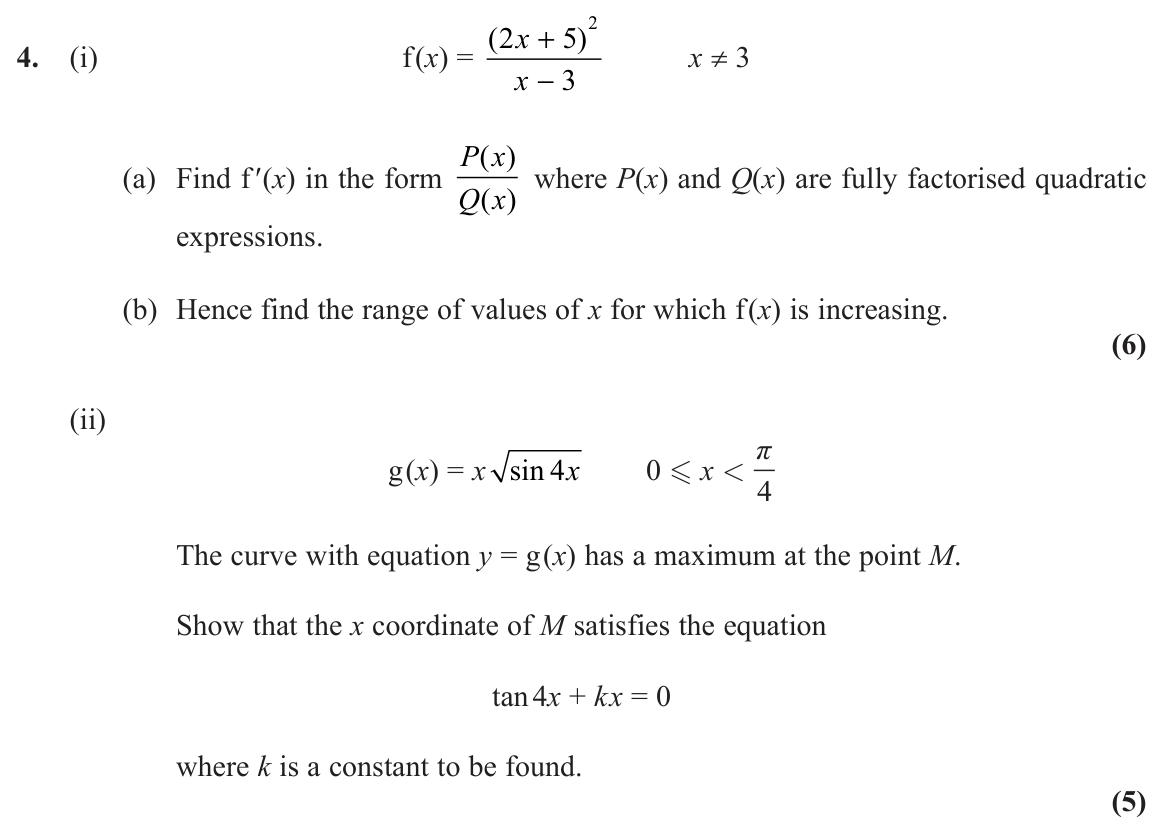
Since $g(0)=0$ while $g(x)\gt 0$ in the interior, the stated maximum $M$ does not occur at $x=0$. Its coordinate therefore lies in $0\lt x\lt \frac{\pi}{4}$, where $g$ is differentiable, so $g'(x)=0$ at $M$. Consequently,
\[\sin4x+2x\cos4x=0.\]
At such a point $\cos4x\ne0$: the only interior zero of $\cos4x$ is $x=\frac{\pi}{8}$, where the left-hand side above is $1$, not $0$. Dividing by $\cos4x$ therefore gives
\[\boxed{\tan4x+2x=0},\qquad\boxed{k=2}.\]
Final answer
(i)(a) $\frac{(2x+5)(2x-17)}{(x-3)^2}$ (i)(b) $x\lt -\frac52\quad\text{or}\quad x\gt \frac{17}{2}$ (ii) $\tan4x+2x=0$, $k=2$
 Elite Mathematics