Graph Transformations: past paper questions & worked solutions
Every Graph Transformations question from the WMA13 papers in our bank, 2020–2026, sorted from easiest to hardest. Try each one first, then open the worked solution.
This is consistent with $x\lt 5$. For $x\ge5$, $|x-5|=x-5$, so $2x\gt 6x$, which requires $x\lt 0$ and is inconsistent with this branch. The equality point $x=5/2$ is excluded because the inequality is strict.
\[\boxed{x\lt \frac52}\]
Part (c)
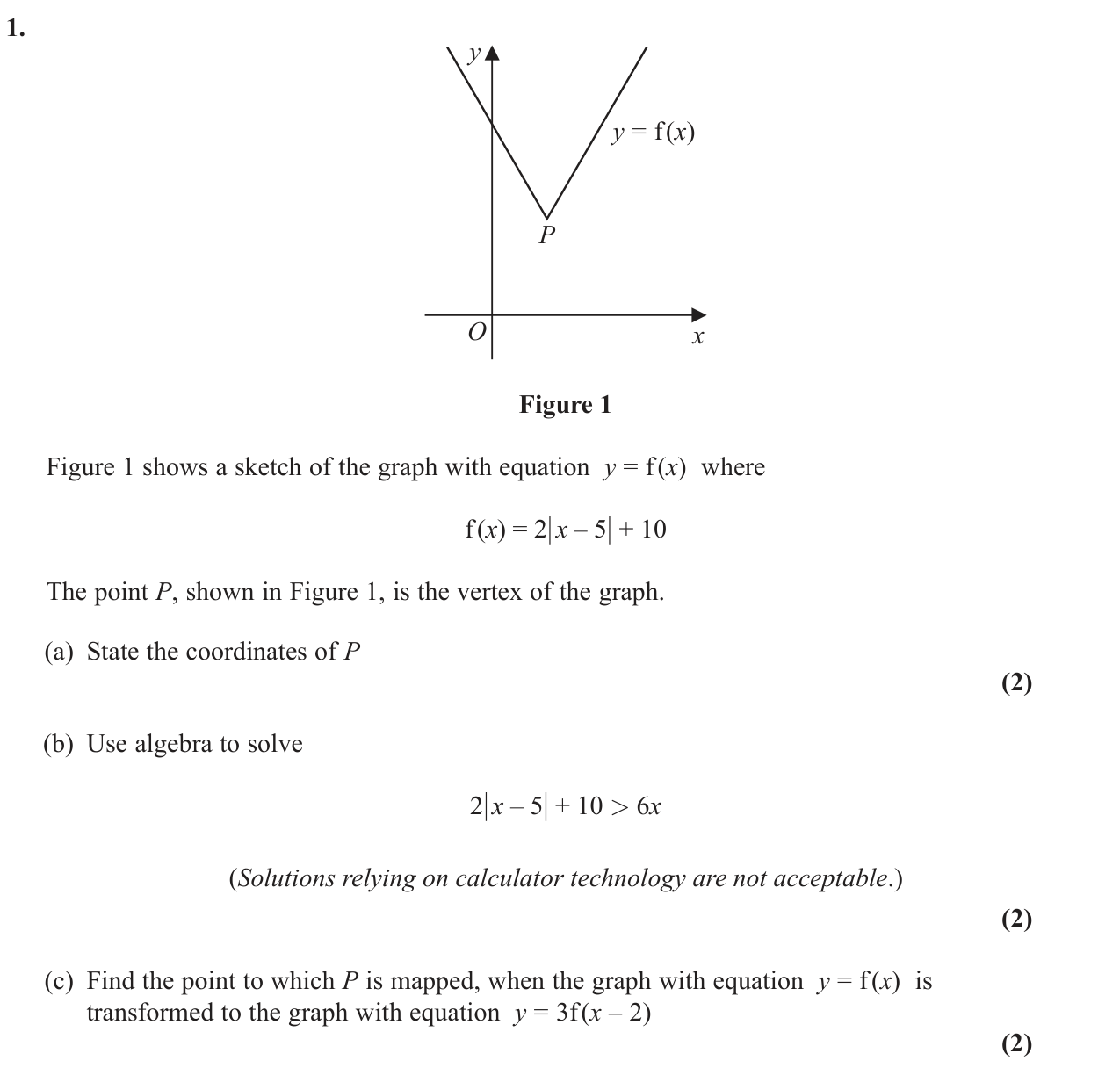
The transformation $y=3f(x-2)$ moves a point $(x,y)$ to $(x+2,3y)$. Thus $P=(5,10)$ moves to $(5+2,3\cdot10)$.
\[\boxed{(7,30)}\]
Final answer
(a) $P=(5,10)$ (b) $x\lt \frac52$ (c) $(7,30)$
3. WMA13/01 May/June 2023 · Q4
Easy6 marks · main topic: Functions, Composition & InversesShow worked solution
Part (a)
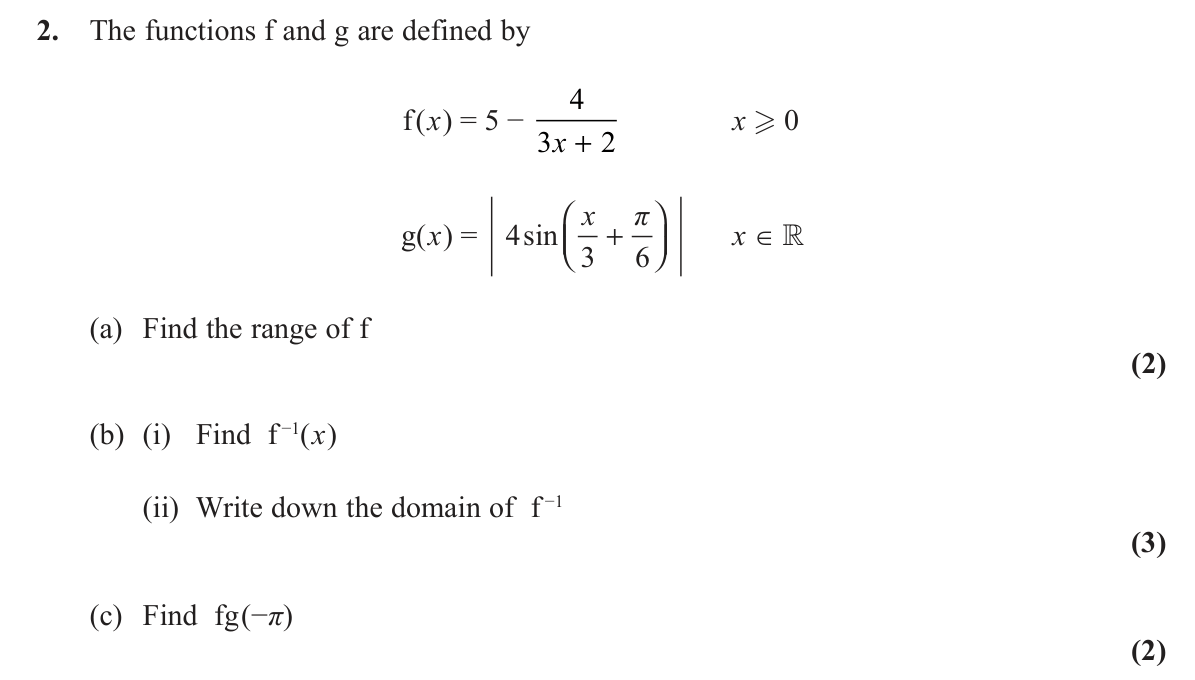
Since $x\ge0$, $2x^2\ge0$. The minimum is $f(0)=-5$ and there is no upper bound.
\[\boxed{\operatorname{range}(f)=[-5,\infty)}\]
Part (b)
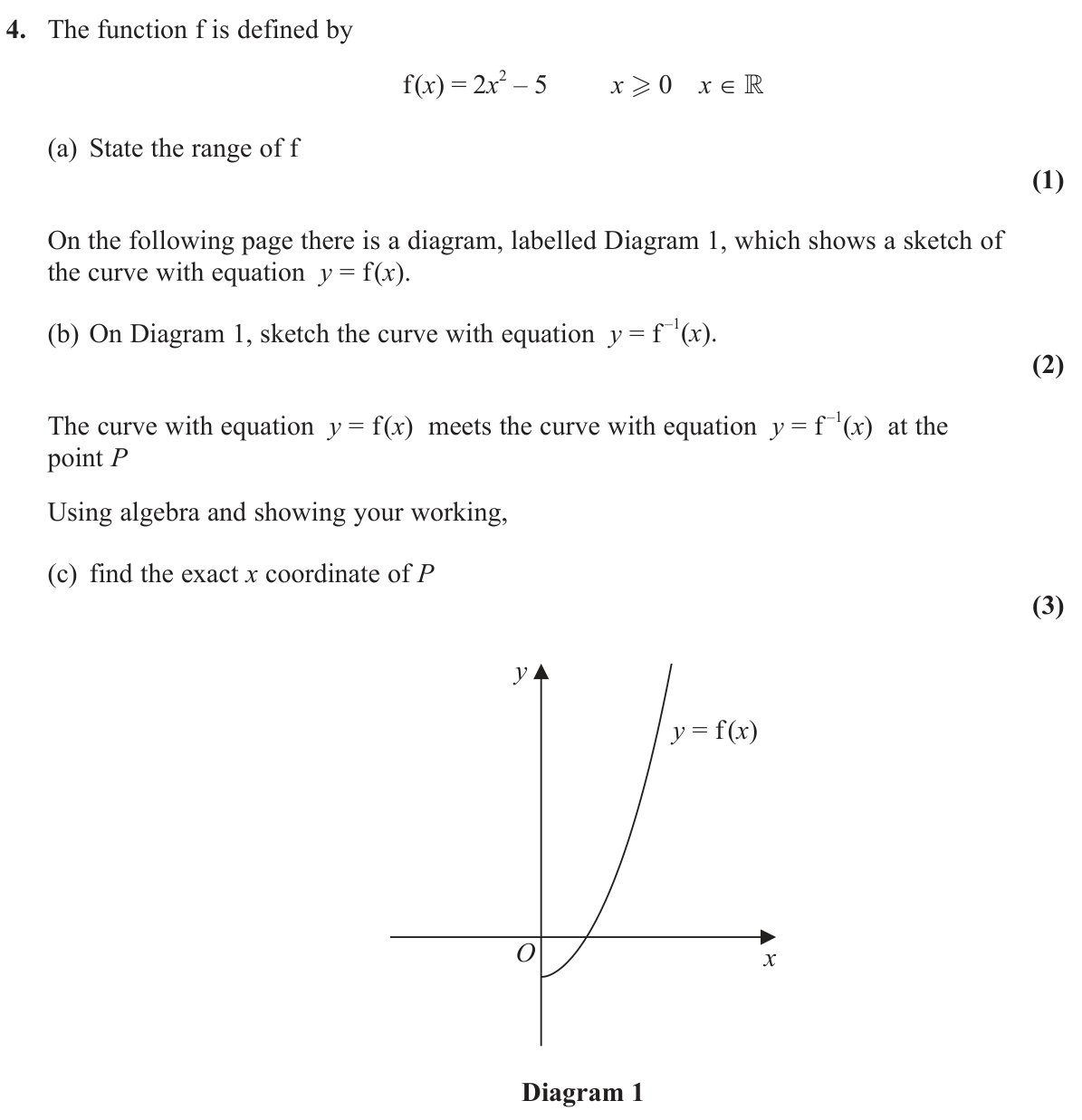
Reflect the given curve in $y=x$. Solving $x=2y^2-5$ with $y\ge0$ gives $y=\sqrt{(x+5)/2}$, $x\ge-5$. The inverse starts at $(-5,0)$, passes through $(0,\sqrt{5/2})$, and is increasing and concave down. The solid inverse curve below is paired with the dashed original curve.
Here $f$ is strictly increasing on $[0,\infty)$, so an intersection of $f$ and its inverse must be on $y=x$: if $y=f(x)\gt x$, then $f(y)\gt f(x)=y$, contradicting $f(y)=x$; the case $y\lt x$ is similar. Hence
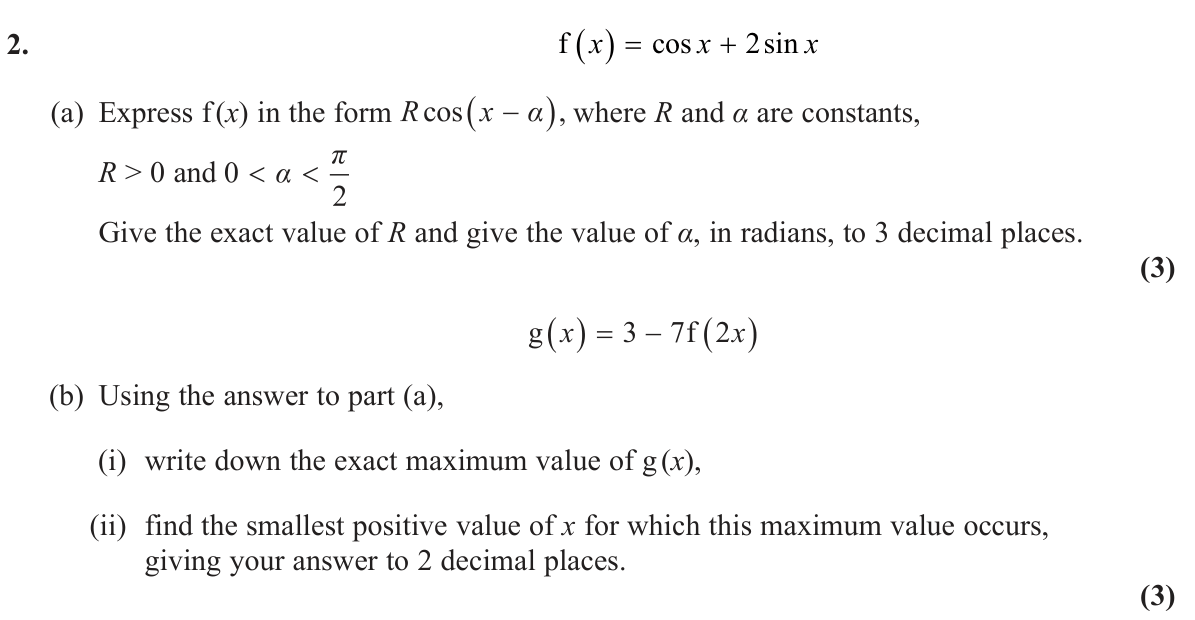
Using the exact phase $\alpha=\arctan2$, write $g(x)=3-7\sqrt5\cos(2x-\alpha)$. (i) The negative cosine coefficient means the maximum occurs when the cosine is $-1$; the maximum is $3+7\sqrt5$. (ii) $2x-\alpha=\pi+2n\pi$, so $x=(\pi+\alpha)/2+n\pi$. The $n=-1$ value is negative; $n=0$ is the smallest positive one, $x=2.1243706857\ldots$, or 2.12 to two decimal places.
Easy6 marks · main topic: Log Graphs & Exponential ModelsShow worked solution
Part (a)
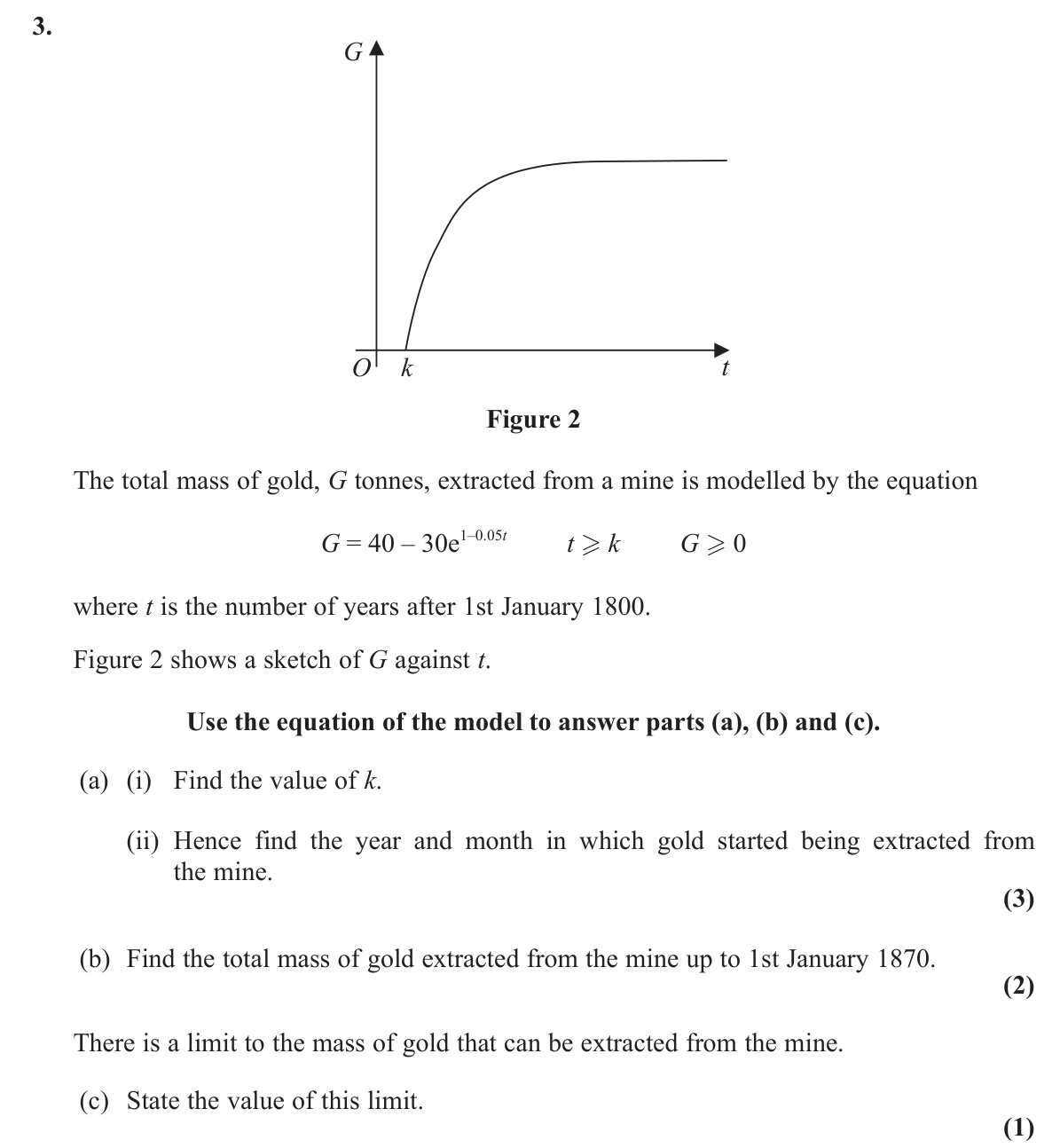
(i) Extraction starts at $G=0$: $30e^{1-0.05k}=40$, so $1-0.05k=\ln(4/3)$ and $k=20(1-\ln(4/3))=14.24635855\ldots$ years. (ii) This is 14 years and $12(0.24635855\ldots)=2.95630261\ldots$ months after 1 January 1800. Two full months have elapsed from January 1814, so the date is in March 1814. Use the unrounded fractional year to identify the month.
\[\boxed{k=14.2\text{ years (3 s.f.)};\quad\text{March 1814}}\]
Part (b)
On 1 January 1870, $t=70$. Substitute: $G(70)=40-30e^{1-0.05(70)}=40-30e^{-2.5}=37.53745004\ldots$ tonnes.
\[\boxed{37.5\ \text{tonnes}}\]
Part (c)
As $t\to\infty$, $e^{1-0.05t}\to0$, so $G\to40$ tonnes.
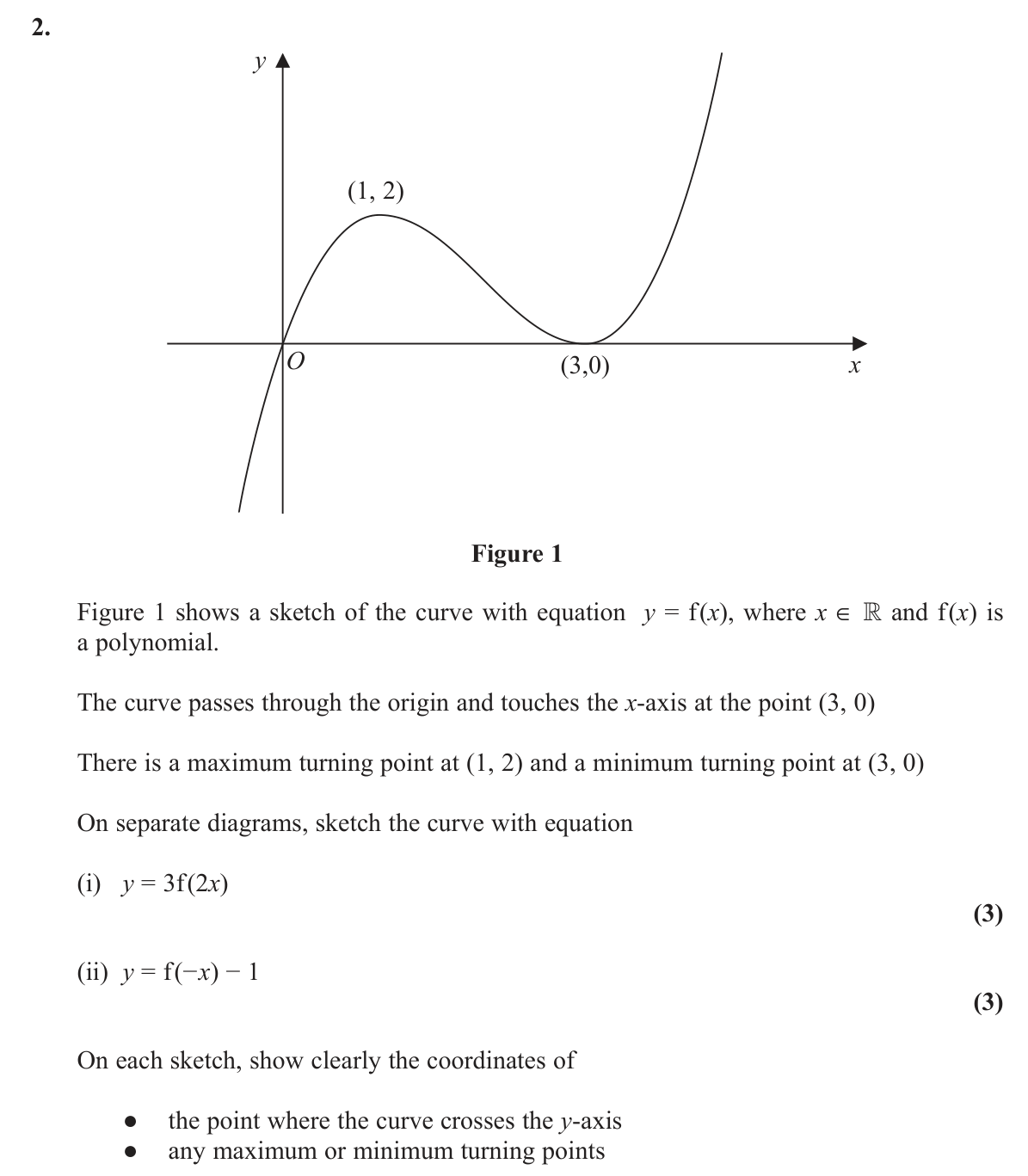
For $y=3f(2x)$, a source point $(u,v)$ maps to $(u/2,3v)$. Thus the y-intercept stays $(0,0)$, the maximum becomes $(1/2,6)$ and the minimum becomes $(3/2,0)$. The horizontal compression and positive vertical stretch preserve the turning-point types. The sketch below records the given shape and mapped features; it does not assume an additional formula for f.
For $y=f(-x)-1$, map $(u,v)$ to $(-u,v-1)$: reflect in the y-axis, then shift down 1. The y-intercept is $(0,-1)$, the maximum is $(-1,1)$ and the minimum is $(-3,-1)$. The left end now rises and the right end falls.
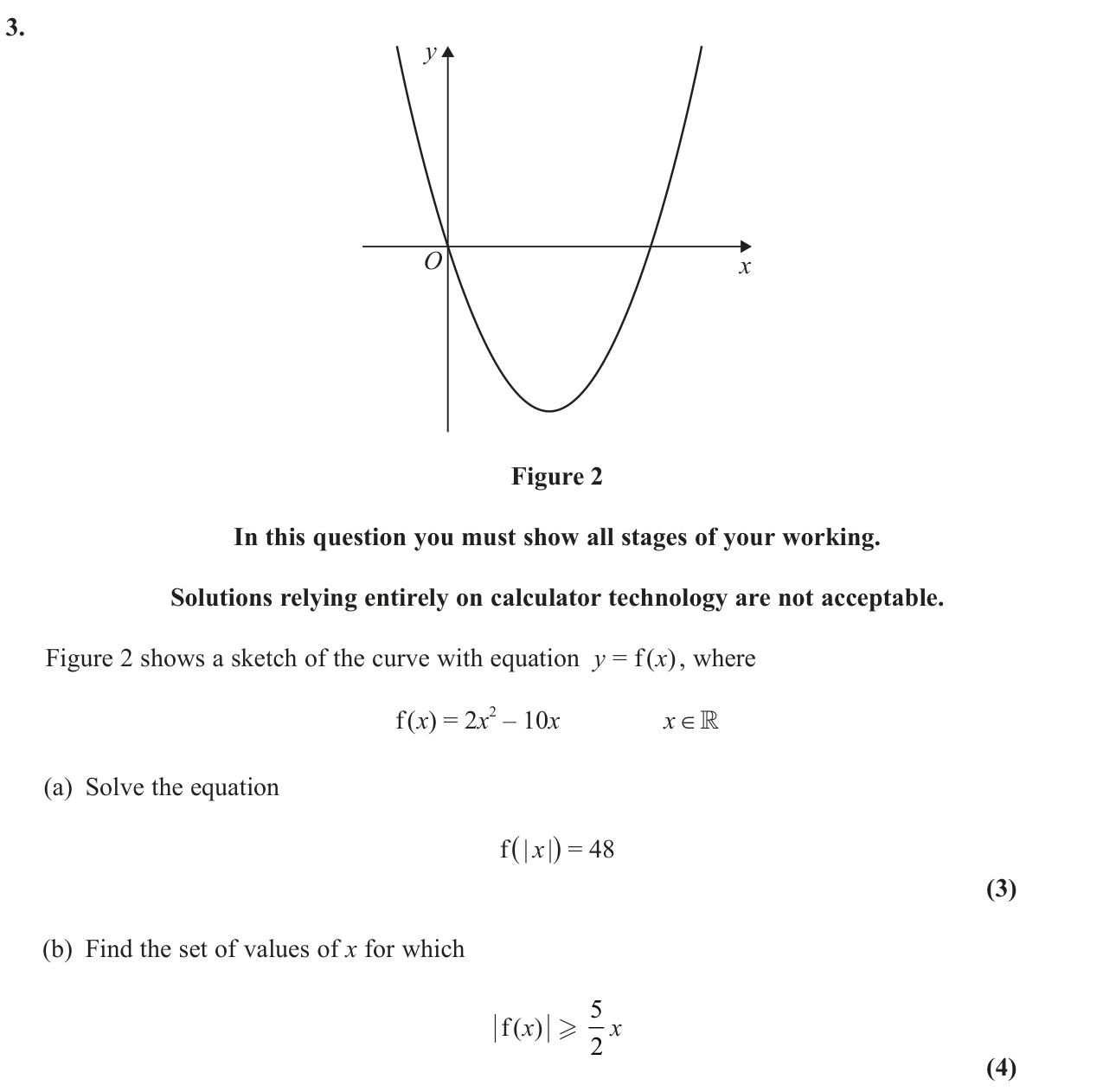
For $x\le0$, the right side $\frac52x\le0$ and the left side is nonnegative, so every such $x$ satisfies the inequality. For $0\lt x\lt 5$, $f(x)\lt 0$ and
Medium7 marks · main topic: Differentiation TechniquesShow worked solution
Part (a)
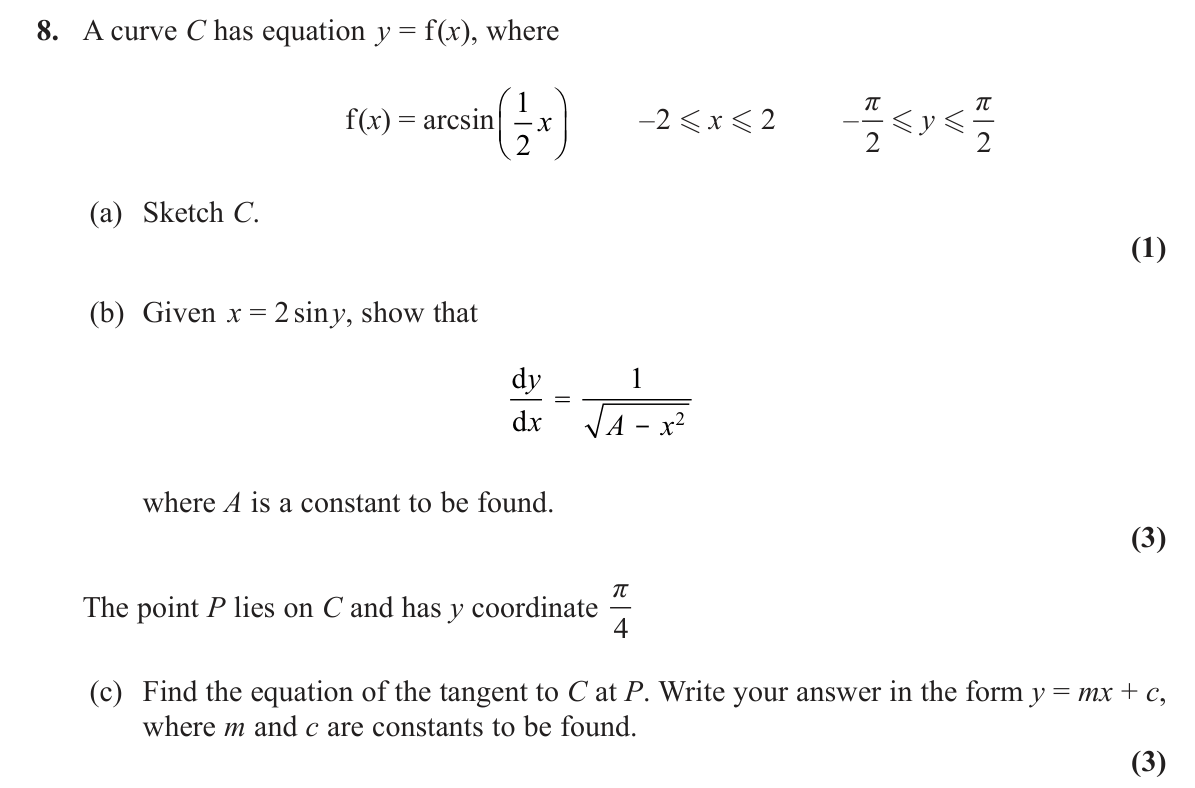
The principal arcsine curve increases from $(-2,-\pi/2)$ through $(0,0)$ to $(2,\pi/2)$. It is concave down on the negative-x half, concave up on the positive-x half, and vertical at both ends.
\[\boxed{y=\arcsin(x/2),\quad -2\le x\le2}\]
Part (b)
Differentiate the supplied inverse relation: $dx/dy=2\cos y$. For $-\pi/2\lt y\lt \pi/2$, cosine is positive, so $\cos y=\sqrt{1-\sin^2y}=\sqrt{1-x^2/4}$. Taking the reciprocal gives
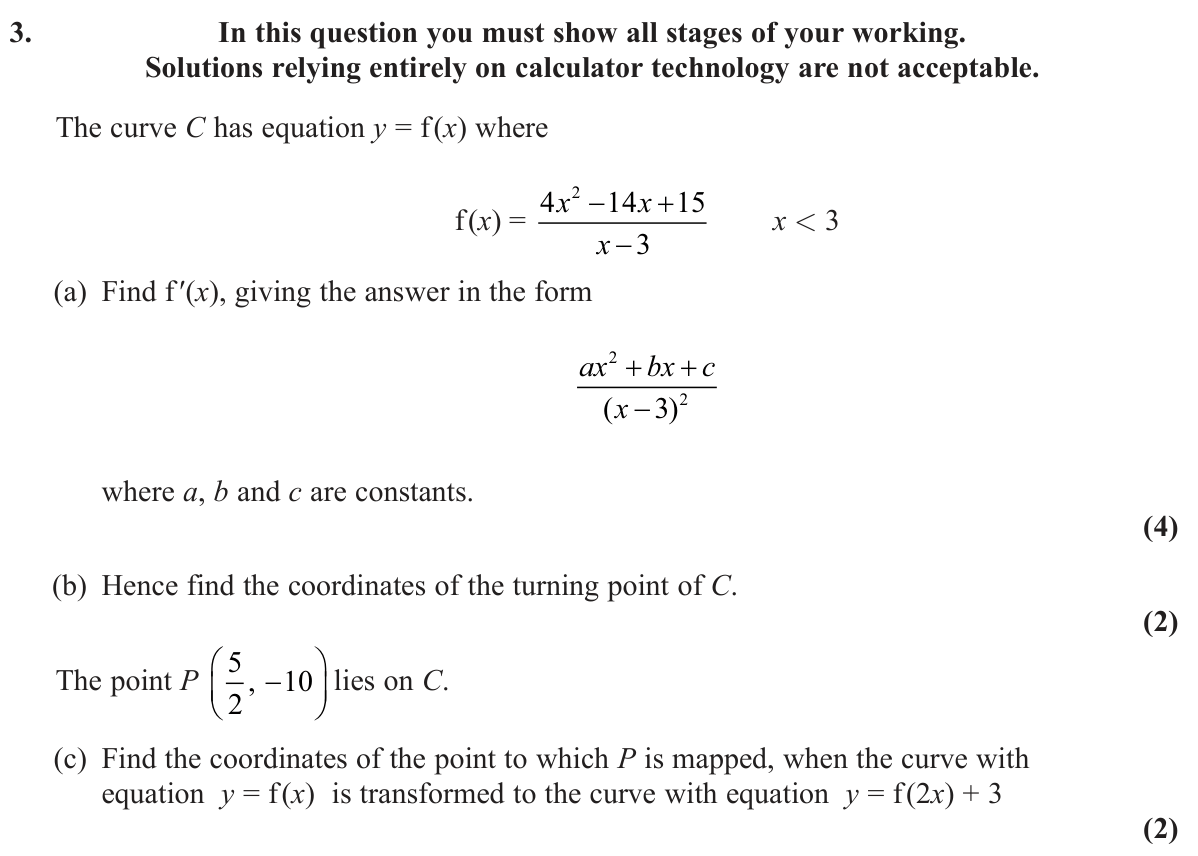
The roots are $3/2$ and $9/2$. Reject $9/2$ because the stated domain is $x\lt 3$. At $x=3/2$, $f(x)=-2$, so the turning point is $\boxed{(3/2,-2)}$. The derivative changes from positive to negative there, confirming a maximum.
Part (c)
The inside factor 2 halves the horizontal coordinate; adding 3 raises the vertical coordinate by 3. Therefore
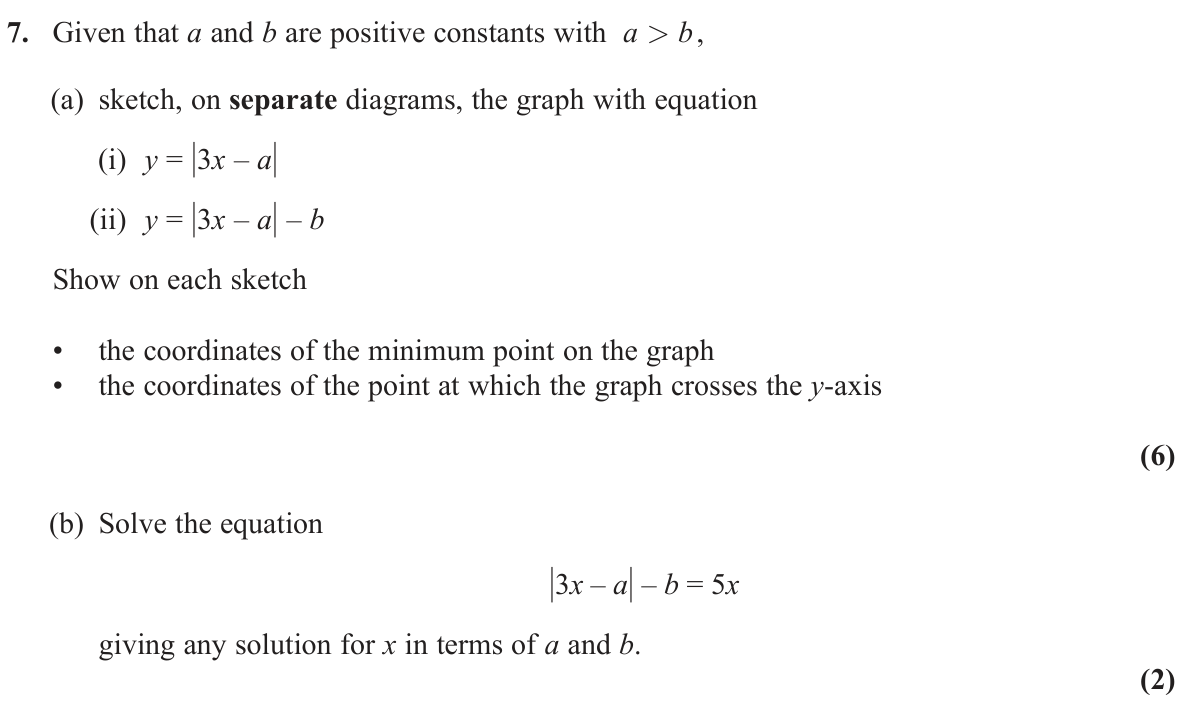
Subtracting $b$ translates the previous graph vertically down by $b$. The minimum becomes $(a/3,-b)$ and the $y$-intercept becomes $(0,a-b)$, which is above the $x$-axis because $a\gt b\gt 0$.
For $x\le a/3$, the equation becomes $a-3x-b=5x$, giving $x=(a-b)/8$. This is positive and less than $a/8\lt a/3$, so it satisfies this branch condition. For $x\ge a/3$, the equation becomes $3x-a-b=5x$, giving $x=-(a+b)/2\lt 0$. This contradicts $x\ge a/3\gt 0$ and must be rejected. Therefore only one solution remains.
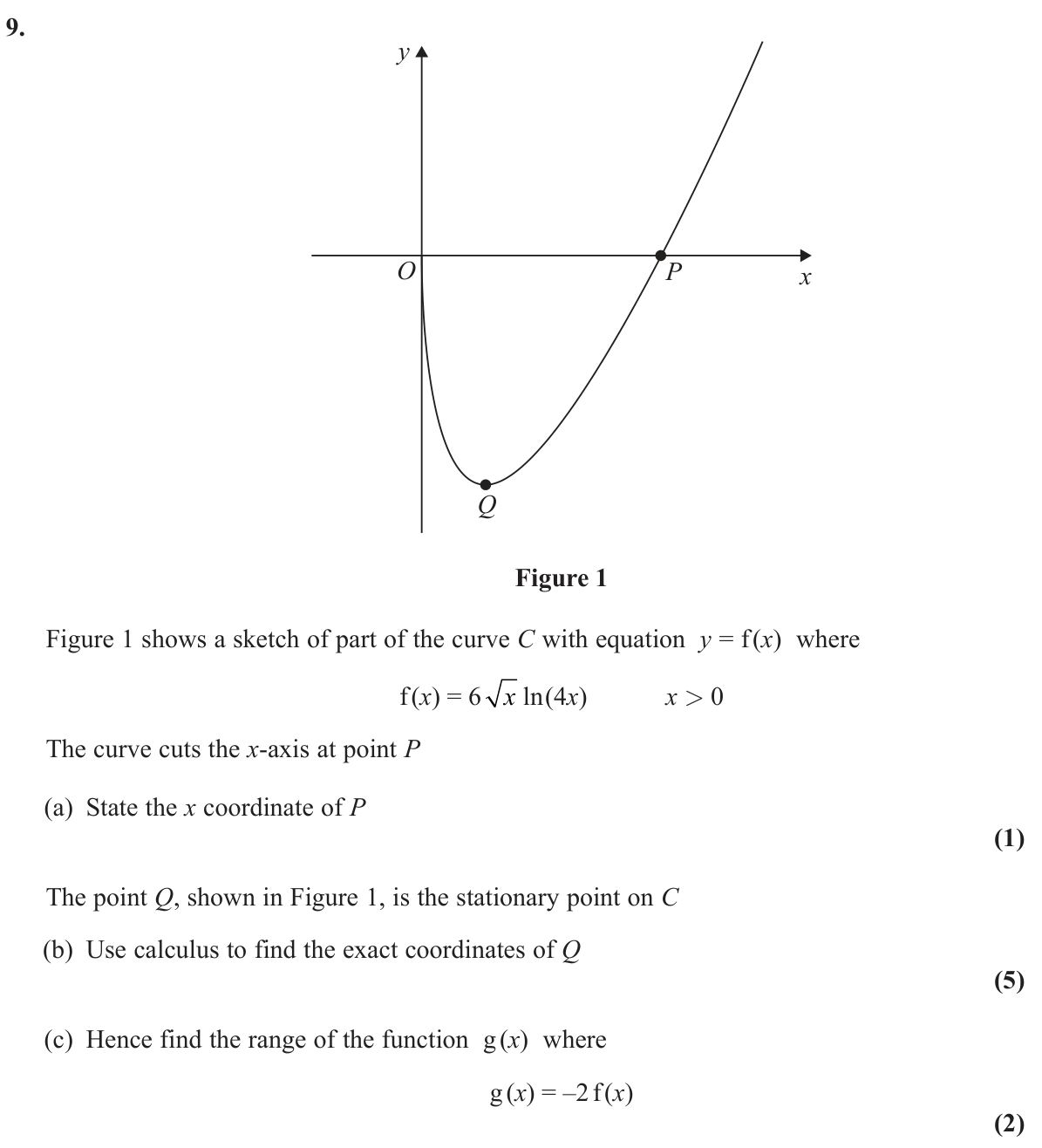
Then $\sqrt{x}=1/(2e)$ and $\ln(4x)=-2$, giving $f(x)=6(1/(2e))(-2)=-6/e$.
\[\boxed{Q=\left(\frac1{4e^2},-\frac6e\right)}\]
Part (c)
The factor $3/\sqrt{x}$ is positive and $\ln(4x)+2$ increases through zero at $Q$, so $f'$ changes from negative to positive: $Q$ is the global minimum. As $x\to\infty$, $f(x)\to\infty$, hence the range of $f$ is $[-6/e,\infty)$. Multiplication by $-2$ reverses the inequality and includes the maximum $12/e$.
Medium8 marks · main topic: ModulusShow worked solution
Part (a)
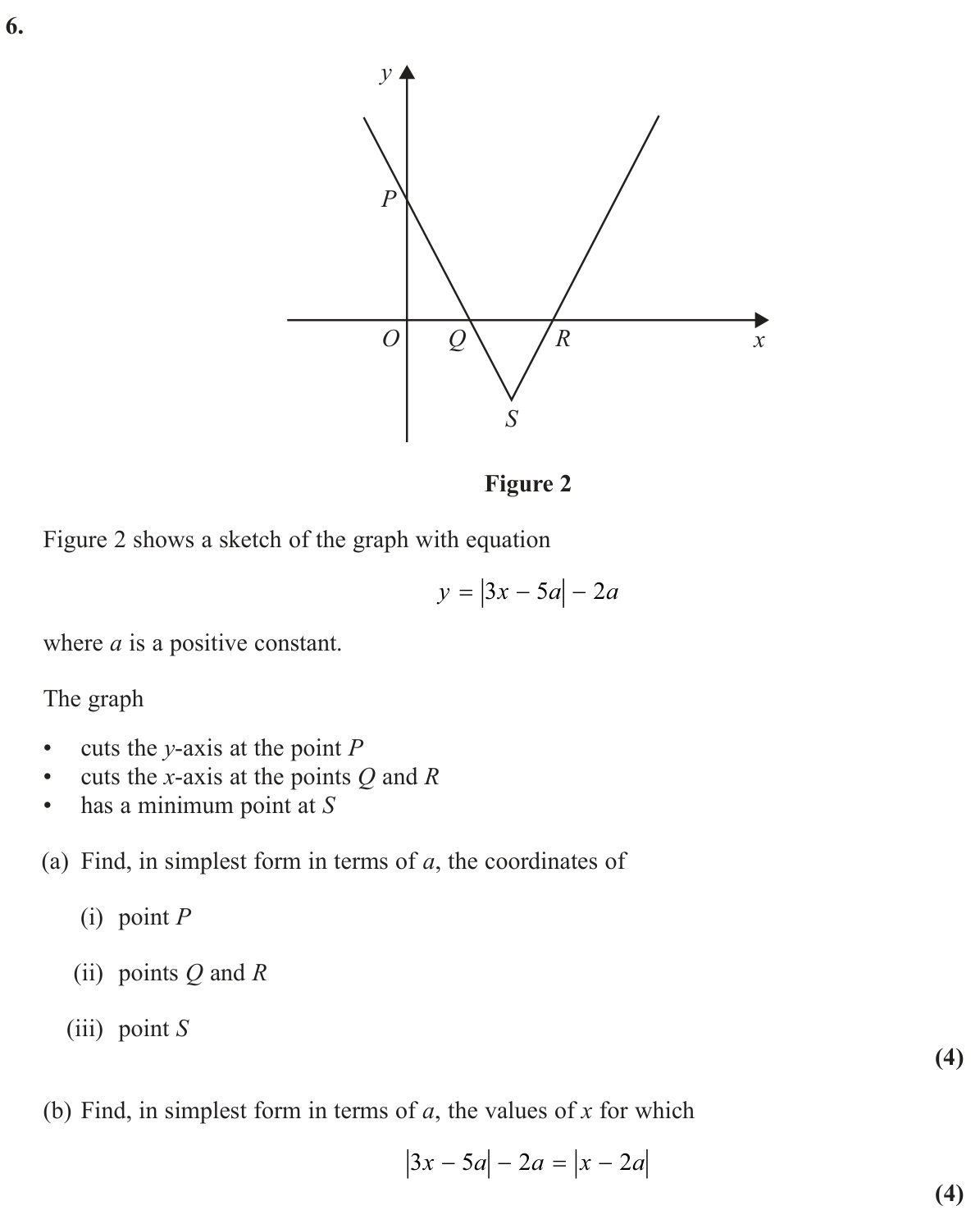
For $y=|3x-5a|-2a$ with $a\gt 0$: (i) At $x=0$, $y=5a-2a=3a$, so $P=(0,3a)$. (ii) At $y=0$, $|3x-5a|=2a$ gives $3x-5a=\pm2a$. Thus $x=a$ or $7a/3$; since $a\lt 7a/3$, $Q=(a,0)$ and $R=(7a/3,0)$. (iii) The modulus vanishes at $x=5a/3$, giving the minimum $S=(5a/3,-2a)$.
Split $|3x-5a|-2a=|x-2a|$ at $x=5a/3$ and $x=2a$; their order uses $a\gt 0$. For $x\lt 5a/3$: $3a-3x=2a-x$, so $x=a/2$, which is in this region. For $5a/3\le x\lt 2a$: $3x-7a=2a-x$, so $x=9a/4$; this is outside the assumed region and is rejected. For $x\ge2a$: $3x-7a=x-2a$, so $x=5a/2$, which is valid. These three regions cover the whole real line, so there are exactly two solutions.
Medium8 marks · main topic: ModulusShow worked solution
Part (a)
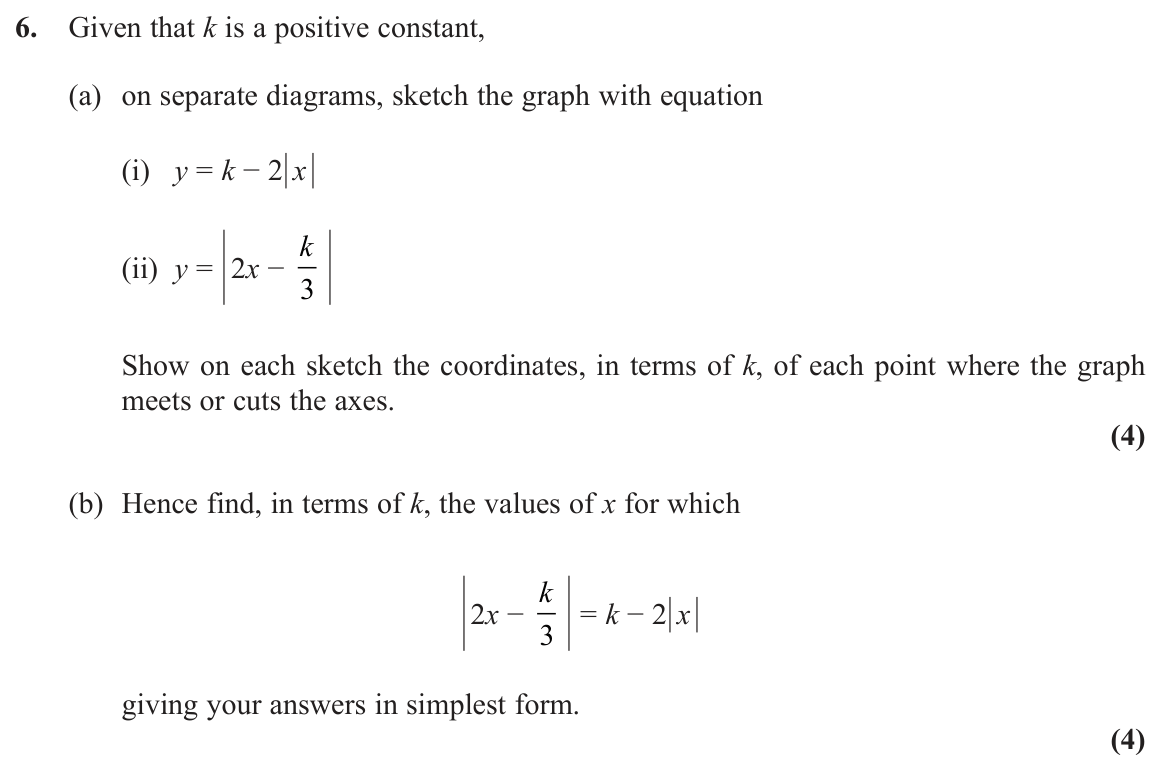
(i) $y=k-2|x|$ is an inverted V with vertex $(0,k)$ and roots $x=\pm k/2$. (ii) $y=|2x-k/3|$ is an upright V with vertex $(k/6,0)$ and y-intercept $(0,k/3)$. Because $k\gt 0$, both sketches have the ordering shown. Axes below use coordinates normalized by k, while labels give the original coordinates.
Consider the breakpoints $0$ and $k/6$. For $x\lt 0$, the equation is $k/3-2x=k+2x$, giving $x=-k/6$, valid in this branch. For $0\le x\lt k/6$, it is $k/3-2x=k-2x$, impossible because $k\gt 0$. For $x\ge k/6$, it is $2x-k/3=k-2x$, giving $x=k/3$, valid in this branch. Both have nonnegative right side and satisfy the original equation.
Medium8 marks · main topic: Trig Equations & R-FormShow worked solution
Part (a)
Expand $R\sin(x-\alpha)=R\cos\alpha\sin x-R\sin\alpha\cos x$. Therefore $R\cos\alpha=12$, $R\sin\alpha=5$. Thus $R=\sqrt{12^2+5^2}=13$ and $\alpha=\arctan(5/12)=0.3947911197\ldots$ radians, in the required first quadrant.
Write $g(\theta)=10+13\sin(2\theta-\pi/6-\alpha)$. (i) The minimum is $10-13=-3$. (ii) For sine to equal $-1$, $2\theta-\pi/6-\alpha=-\pi/2+2\pi n$. Hence $\theta=-\pi/6+\alpha/2+\pi n$. For $n=0$ this is negative, so the smallest permitted value uses $n=1$:
As $\beta$ varies over the reals, $12\sin\beta-5\cos\beta$ covers $[-13,13]$. Its square therefore covers $[0,169]$, not $[169,169]$. Subtracting from 10 reverses the bounds, giving $[-159,10]$; both endpoints are attained.
Medium8 marks · main topic: ModulusShow worked solution
Part (a)
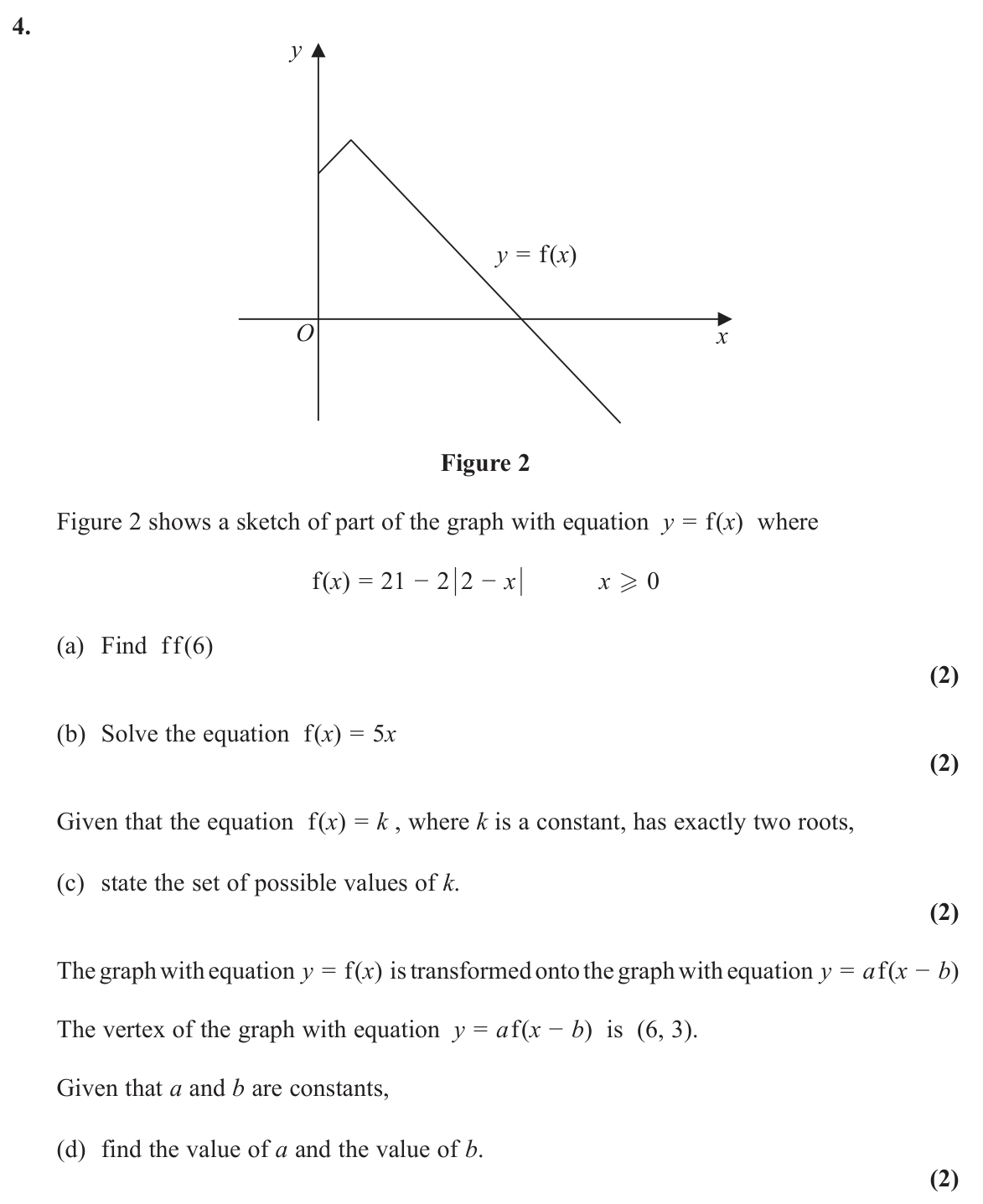
Apply f twice, in order: $f(6)=21-2|2-6|=13$. Then $ff(6)=f(13)=21-2|2-13|=21-22=-1$. The intermediate input 13 lies in the domain $x\ge0$.
\[\boxed{ff(6)=-1}\]
Part (b)
For $0\le x\le2$, $f(x)=17+2x$, so $17+2x=5x$ gives $x=17/3$, outside that branch; reject it. For $x\ge2$, $f(x)=25-2x$. Then $25-2x=5x$, giving $x=25/7$. This belongs to the second branch and satisfies the original modulus equation.
\[\boxed{x=\frac{25}{7}}\]
Part (c)
On the left branch $0\le x\le2$, f rises from $f(0)=17$ to $f(2)=21$. The right branch decreases from 21 without lower bound. A horizontal line therefore meets both branches at distinct points exactly when $17\le k\lt 21$. At $k=17$, one root is the permitted endpoint $x=0$; at $k=21$, the two intersections merge at the vertex, so 21 is excluded.
\[\boxed{17\le k\lt 21}\]
Part (d)
The original vertex is $(2,21)$. Under $y=af(x-b)$ it maps to $(2+b,21a)$. Comparing with $(6,3)$ gives $2+b=6$ and $21a=3$.
Hard9 marks · main topic: Log Graphs & Exponential ModelsShow worked solution
Part (a)
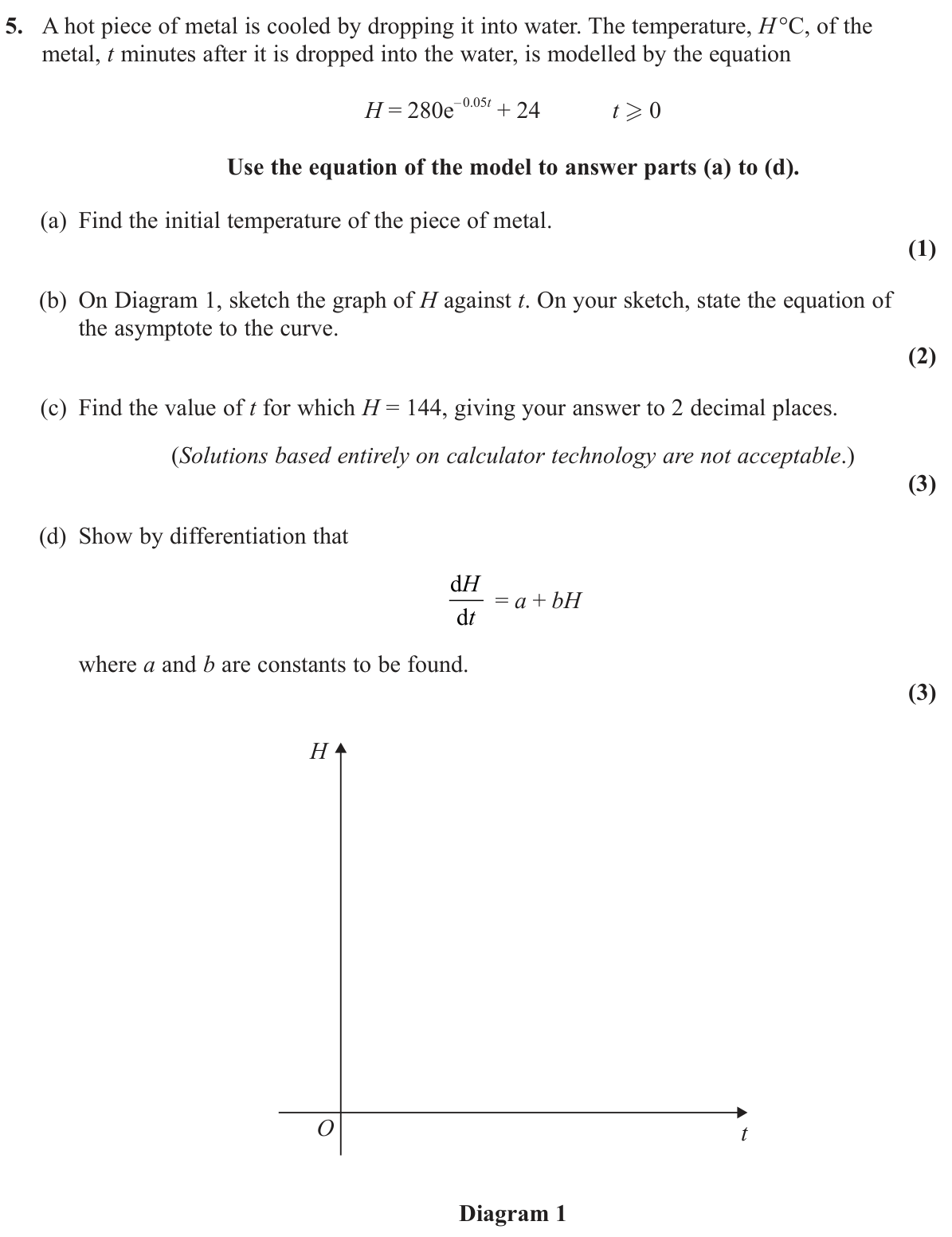
At $t=0$, $e^{-0.05t}=1$, so $H=280+24=304$ degrees Celsius.
\[\boxed{H(0)=304^\circ\mathrm C}\]
Part (b)
The curve starts at $(0,304)$ and decreases for $t\ge0$. The exponential term stays positive and tends to zero, so the curve approaches $H=24$ from above without crossing it.
\[\boxed{H=24\text{ is the horizontal asymptote}}\]
The original equation gives $280e^{-0.05t}=H-24$, so
\[\frac{dH}{dt}=-0.05(H-24)=1.2-0.05H.\]
\[\boxed{a=1.2,\quad b=-0.05}\]
Final answer
(a) $H(0)=304^\circ\mathrm C$ (b) $H=24\text{ is the horizontal asymptote}$ (c) $t=16.95\text{ minutes}$ (d) $a=1.2,\quad b=-0.05$
21. WMA13/01 May/June 2024 · Q4
Hard9 marks · main topic: Trig Identities & Exact ValuesShow worked solution
Part (a)
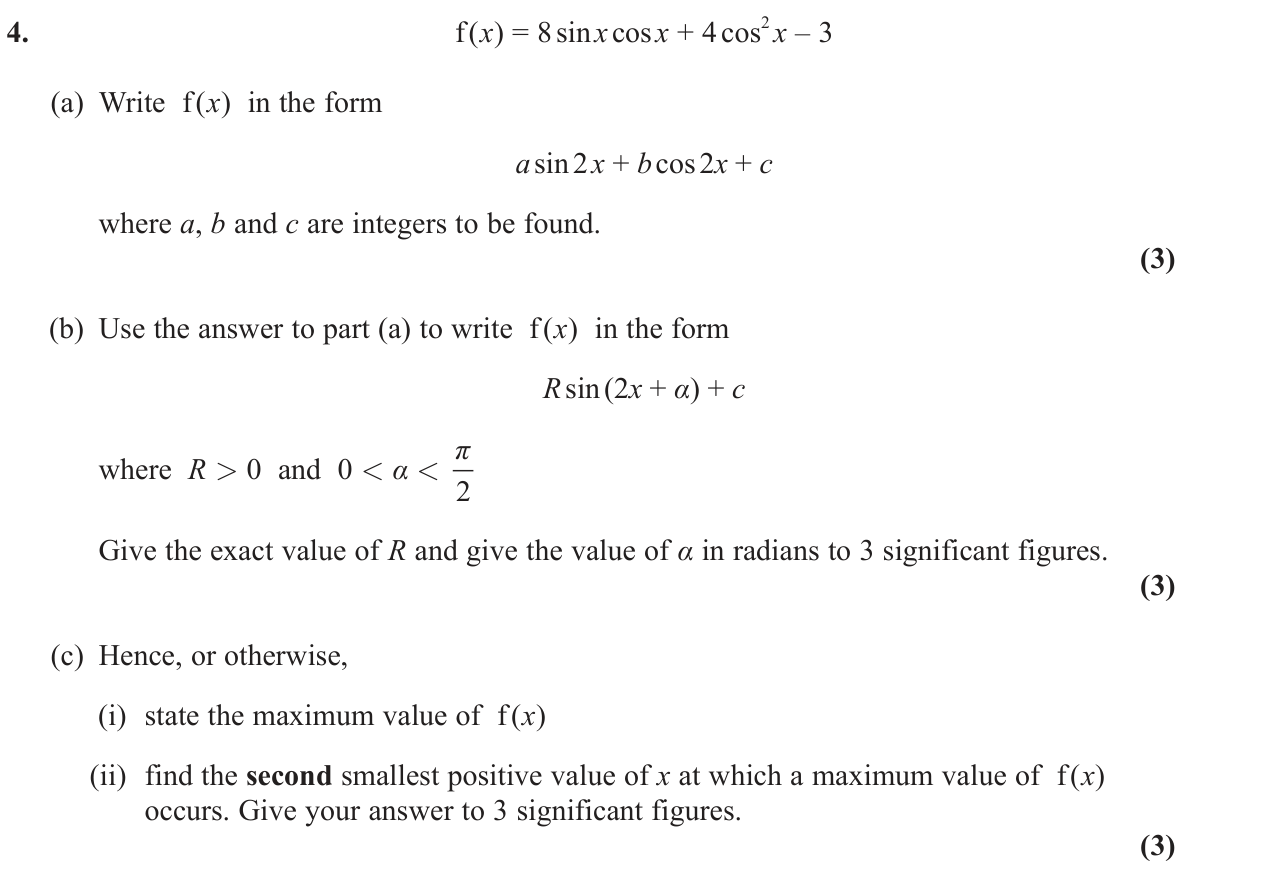
Use $\sin2x=2\sin x\cos x$ and $2\cos^2x=1+\cos2x$:
\[f(x)=4\sin2x+2(1+\cos2x)-3=4\sin2x+2\cos2x-1.\]
\[\boxed{a=4,\quad b=2,\quad c=-1}\]
Part (b)
Expanding $R\sin(2x+\alpha)$ and matching coefficients gives
\[R\cos\alpha=4,\qquad R\sin\alpha=2.\]
Squaring and adding, $R^2=20$, so $R=2\sqrt5$ since $R\gt 0$. Also $\tan\alpha=1/2$, and $0\lt \alpha\lt \pi/2$ selects $\alpha=\arctan(1/2)=0.463647609\ldots$ radians. Thus $f(x)=2\sqrt5\sin(2x+\arctan(1/2))-1$. With the phase displayed to 3 significant figures, $f(x)\approx2\sqrt5\sin(2x+0.464)-1$.
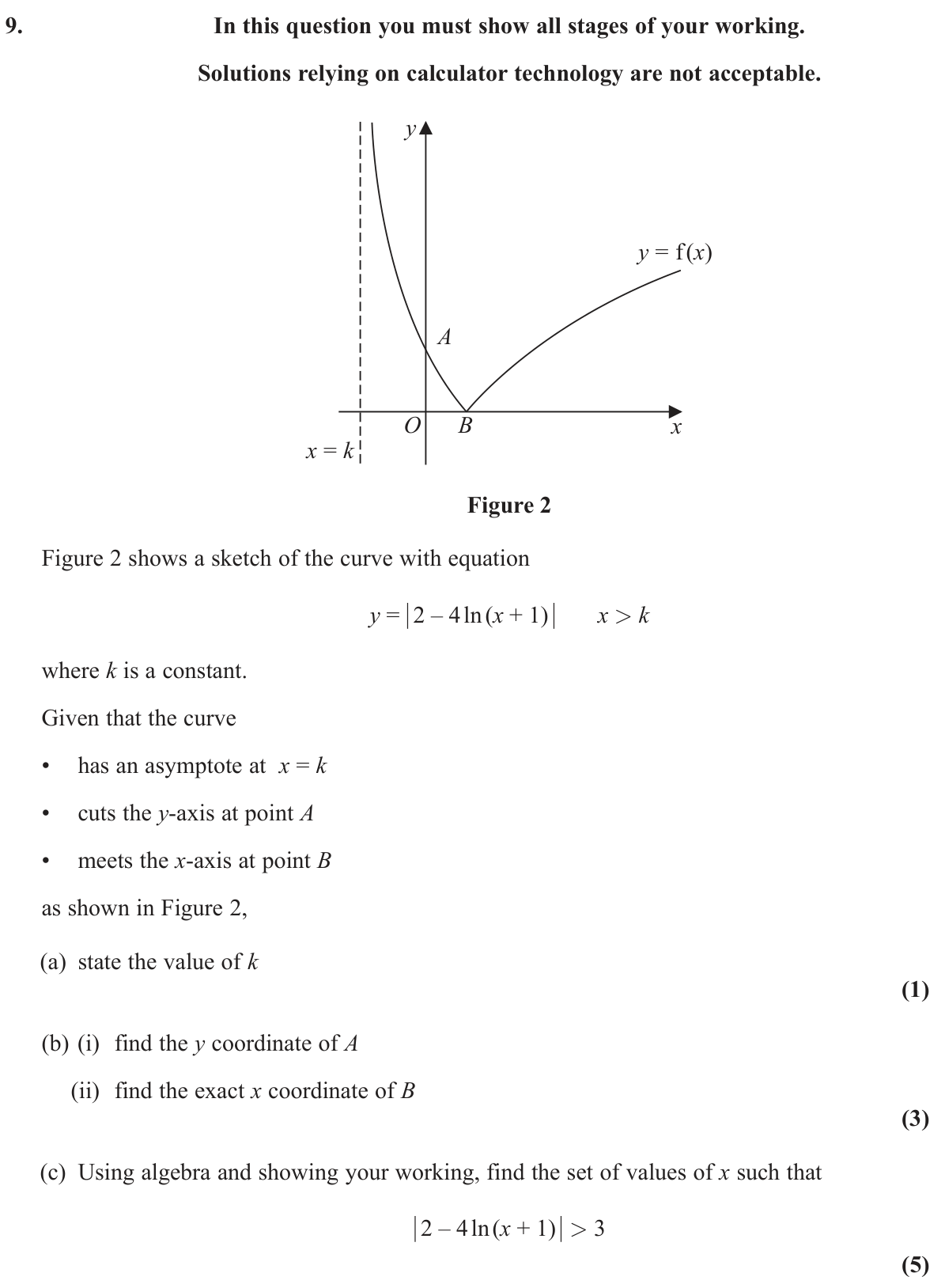
Since the exponential is increasing, this becomes $x+1\lt e^{-1/4}$ or $x+1\gt e^{5/4}$. Intersect with the logarithmic domain; neither boundary is included because the source inequality is strict.
Hard9 marks · main topic: ModulusShow worked solution
Part (a)
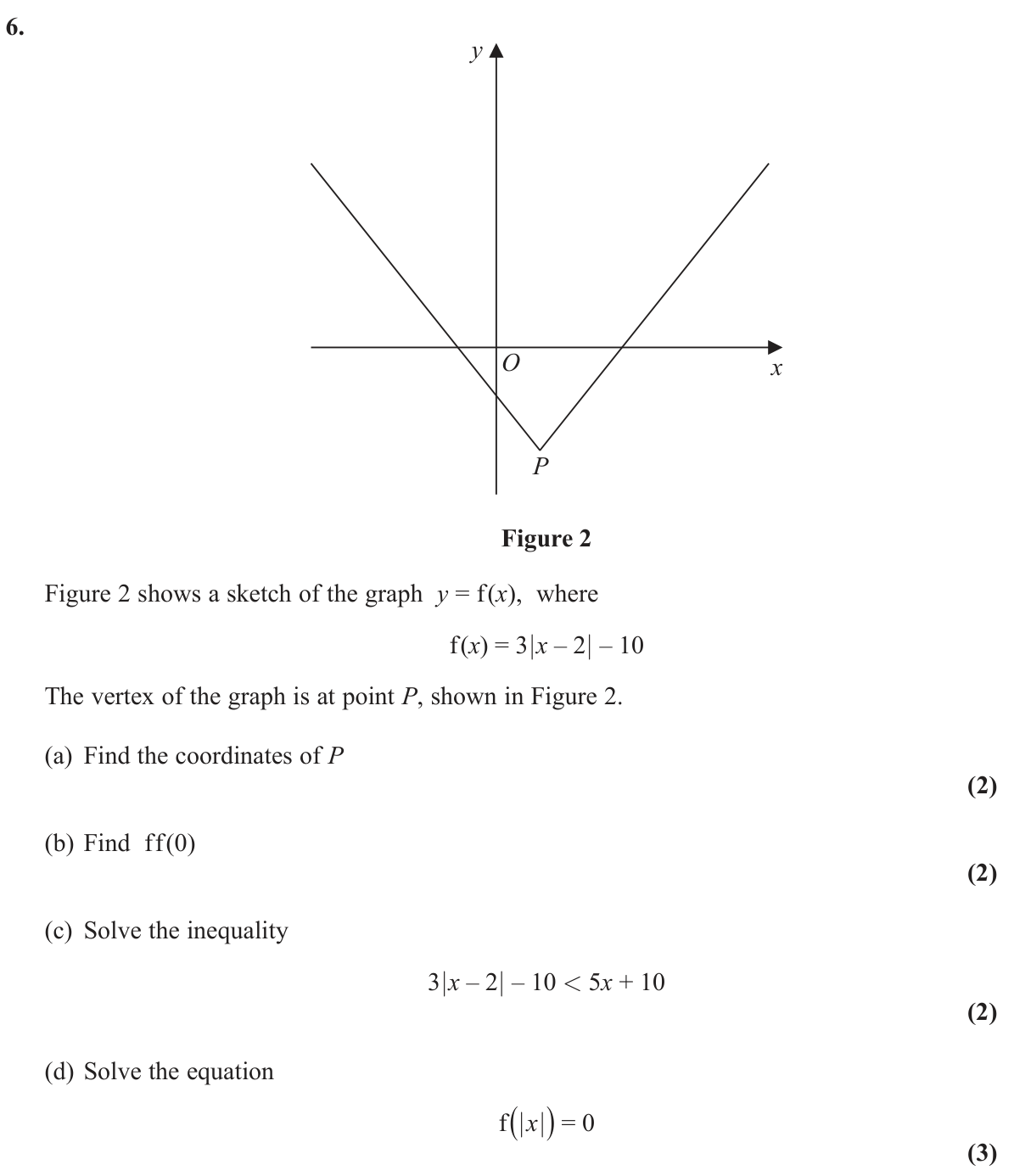
The modulus is smallest when $x-2=0$, giving $x=2$ and $f(2)=-10$. The two straight-line branches meet there, so this is the vertex of the V-shaped graph.
\[\boxed{P=(2,-10)}\]
Part (b)
First $f(0)=3|0-2|-10=-4$. Then $ff(0)=f(-4)=3|-4-2|-10=18-10=8$. In particular $ff(0)$ means $f(f(0))$, not the square of $f(0)$.
\[\boxed{ff(0)=8}\]
Part (c)
For $x\lt 2$, the inequality becomes $3(2-x)-10\lt 5x+10$, so $-4-3x\lt 5x+10$, giving $x\gt -7/4$. This yields $-7/4\lt x\lt 2$. For $x\ge2$, it becomes $3x-16\lt 5x+10$, giving $x\gt -13$; every $x\ge2$ satisfies this. The union is $x\gt -7/4$.
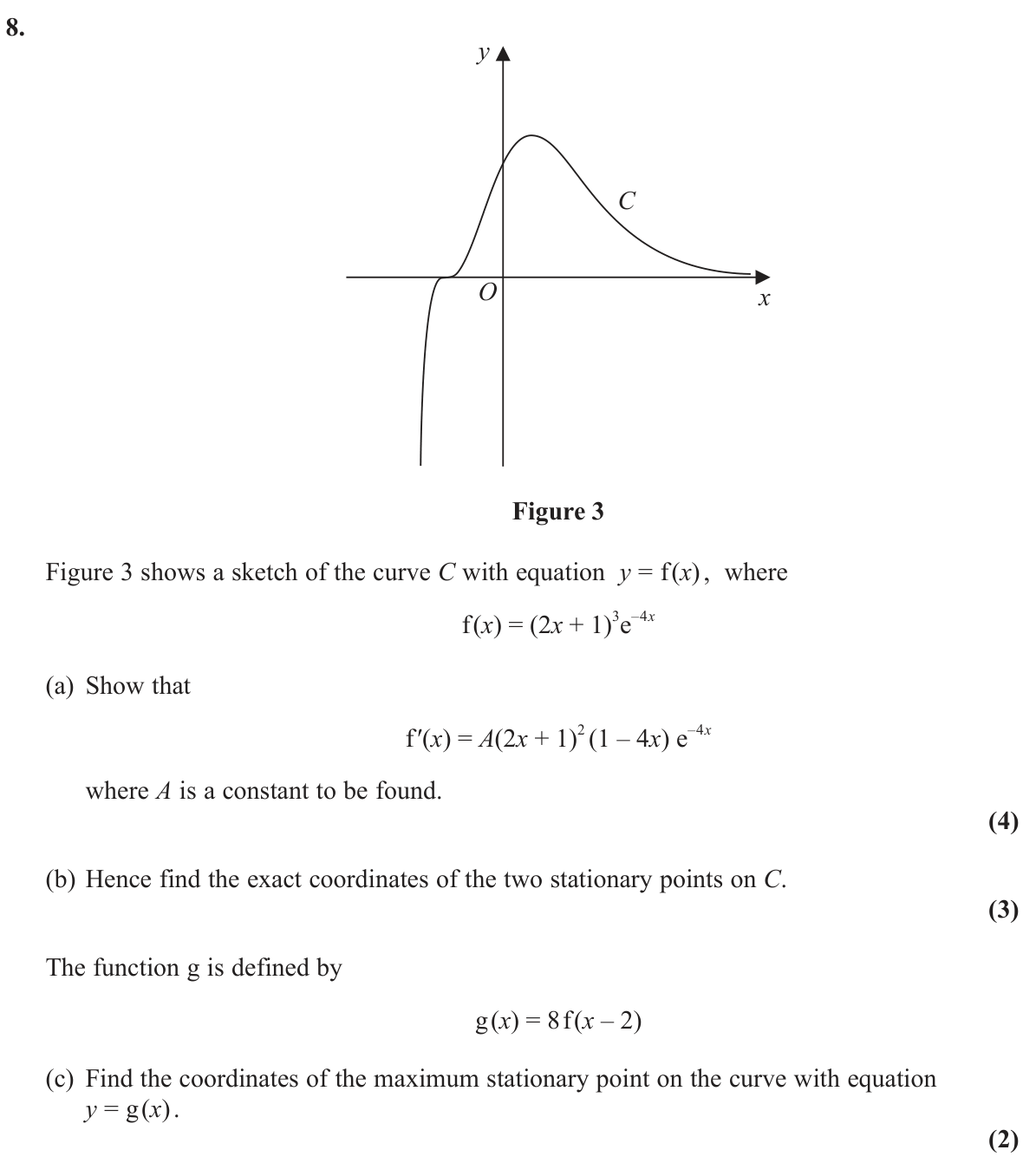
Since $e^{-4x}\gt 0$, $f'(x)=0$ means $2x+1=0$ or $1-4x=0$. Thus $x=-1/2$ or $x=1/4$. Substitution gives $f(-1/2)=0$ and $f(1/4)=(3/2)^3e^{-1}=27/(8e)$.
The derivative changes from positive to negative at $x=1/4$, so this is the maximum; at $x=-1/2$ it does not change sign. The transformation $g(x)=8f(x-2)$ sends $(x,y)$ to $(x+2,8y)$. Hence the maximum stationary point is $(1/4+2,8\cdot27/(8e))=(9/4,27/e)$.
Hard9 marks · main topic: Trig Equations & R-FormShow worked solution
Part (a)
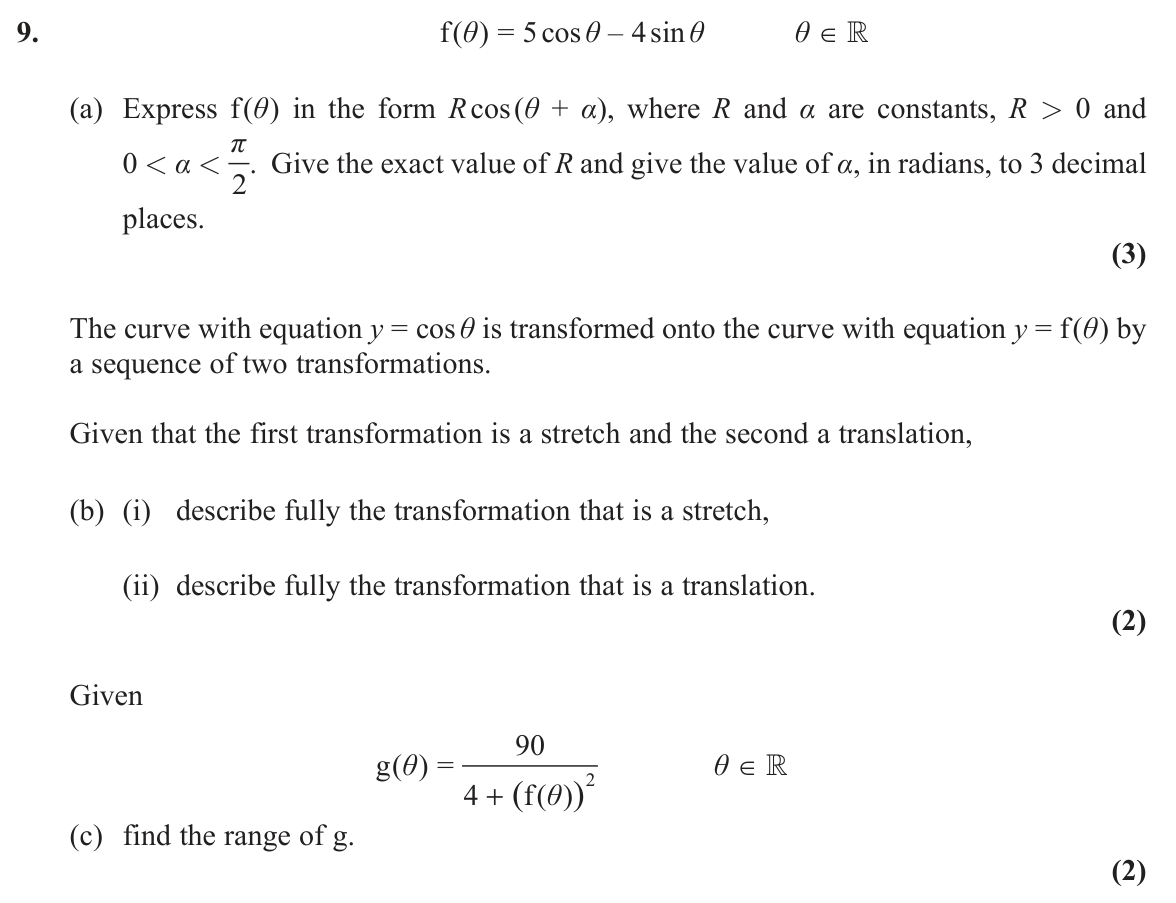
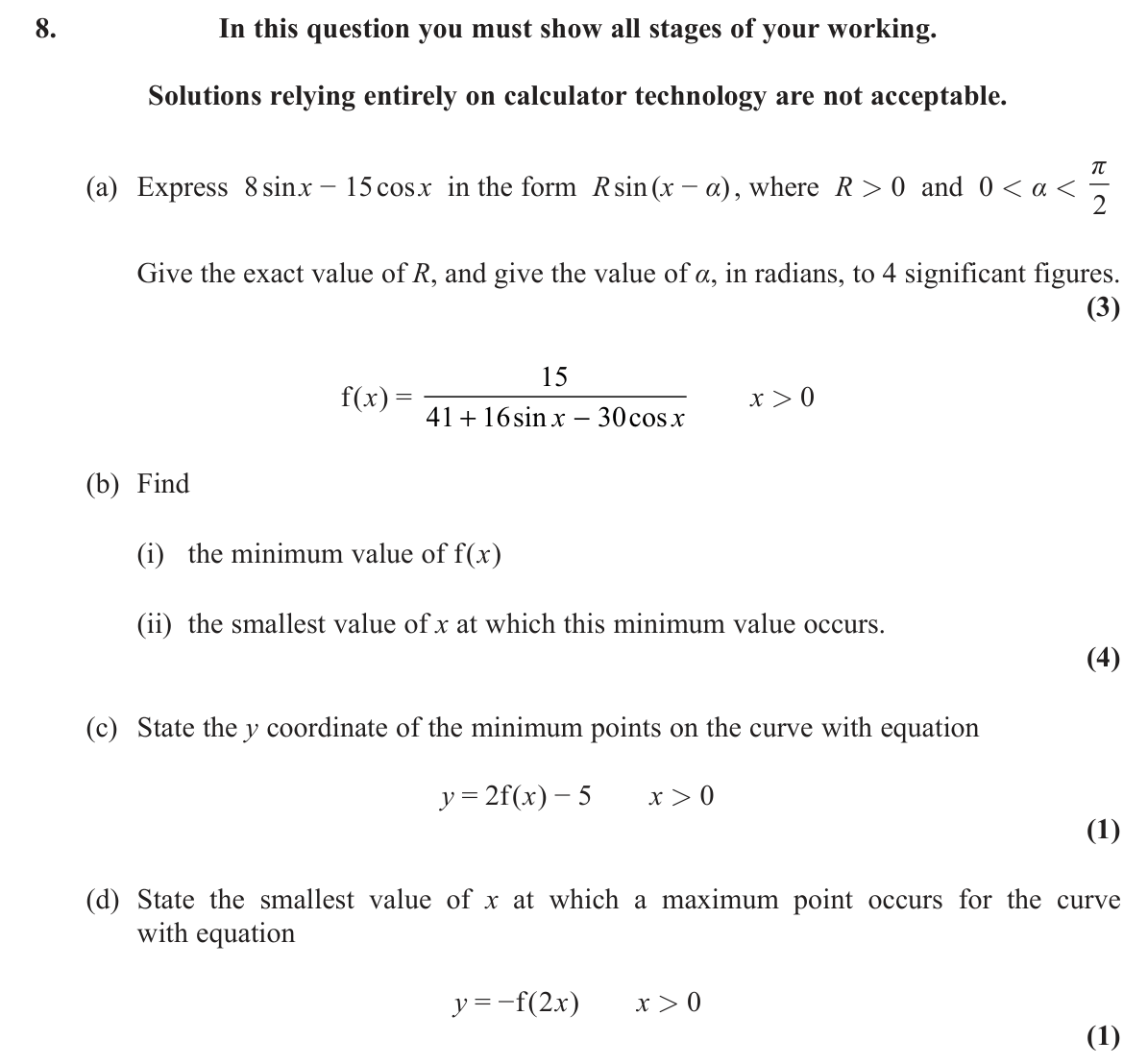
Expand $R\sin(x-\alpha)=R\cos\alpha\sin x-R\sin\alpha\cos x$. Thus $R\cos\alpha=8$, $R\sin\alpha=15$, so $R=\sqrt{64+225}=17$ and $\alpha=\arctan(15/8)=1.0808390005\ldots$ radians, in the required quadrant.
The denominator lies between 7 and 75, so it is always positive. (i) The smallest fraction occurs at its largest denominator: $f_{\min}=15/75=1/5$. (ii) This occurs when $x-\alpha=\pi/2+2n\pi$. The smallest positive value is $x=\alpha+\pi/2=2.6516353273\ldots$, or 2.65 to three significant figures.
\[\boxed{f_{\min}=\frac15,\qquad x=2.65}\]
Part (c)
The transformation $2f(x)-5$ preserves the locations of minima and maps their y coordinate to $2(1/5)-5=-23/5$.
\[\boxed{y=-\frac{23}{5}}\]
Part (d)
Reflection in the x-axis changes minima of f into maxima of $-f$. The argument $2x$ halves their x coordinates, so the first positive maximum is at
Hard9 marks · main topic: ModulusShow worked solution
Part (a)
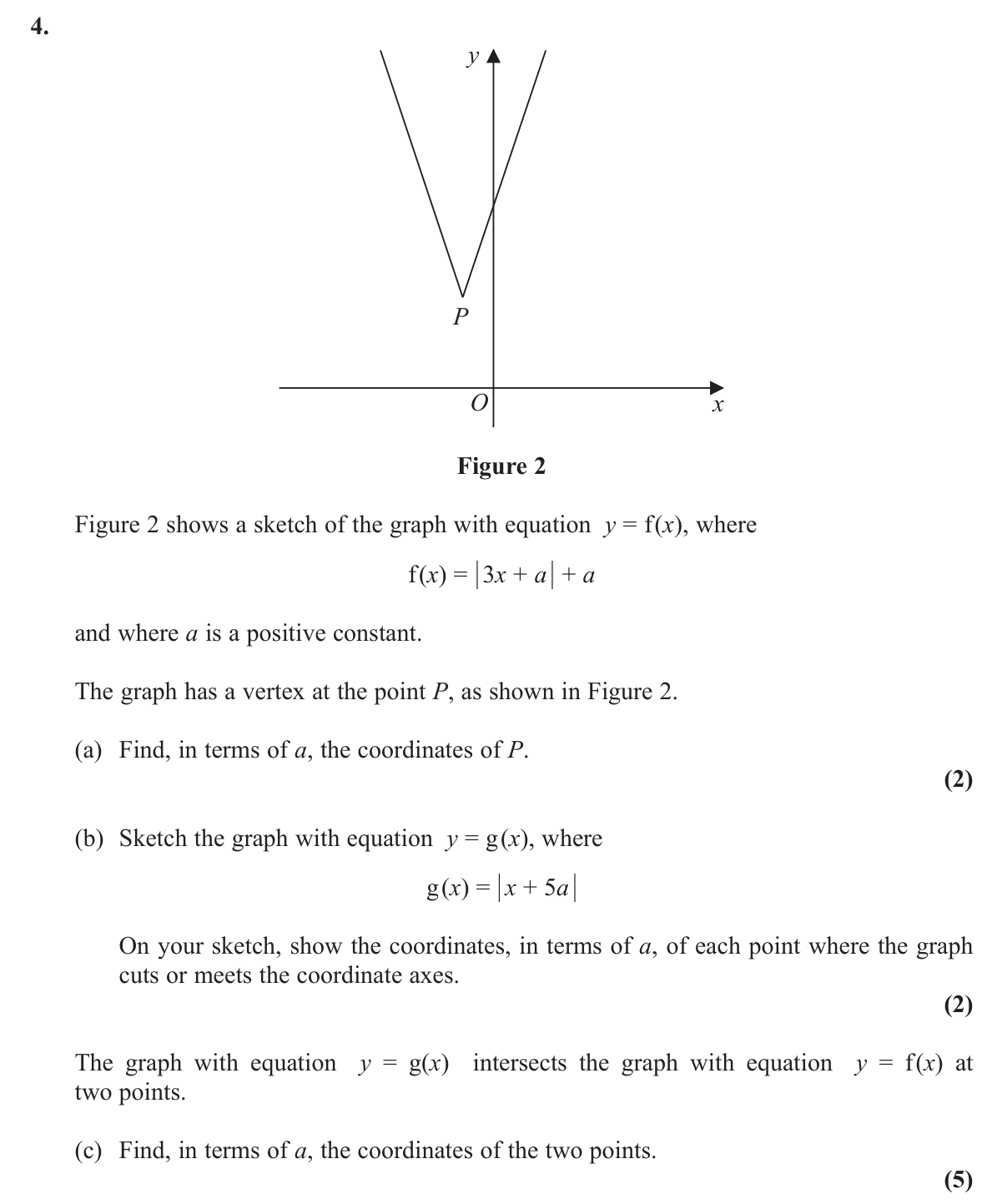
At the vertex the inner expression vanishes: $3x+a=0$, giving $x=-a/3$ and $f(x)=a$.
\[\boxed{P=(-a/3,a)}\]
Part (b)
$g(x)=|x+5a|$ is a V translated left by $5a$, with vertex $(-5a,0)$ and y-intercept $(0,5a)$. Since $a\gt 0$, the vertex lies strictly left of the y-axis. Coordinates in the drawing are normalized by a; labels give the actual intercepts.
\[\boxed{(-5a,0),\quad(0,5a)}\]
Part (c)
Solve $|x+5a|=|3x+a|+a$ using breakpoints $-5a\lt -a/3$. For $x\lt -5a$: $-x-5a=-3x$, giving $x=5a/2$, outside this branch, so reject it. For $-5a\le x\lt -a/3$: $x+5a=-3x$, giving $x=-5a/4$ and $y=15a/4$. For $x\ge-a/3$: $x+5a=3x+2a$, giving $x=3a/2$ and $y=13a/2$. The last two values belong to their respective intervals and satisfy both original functions.
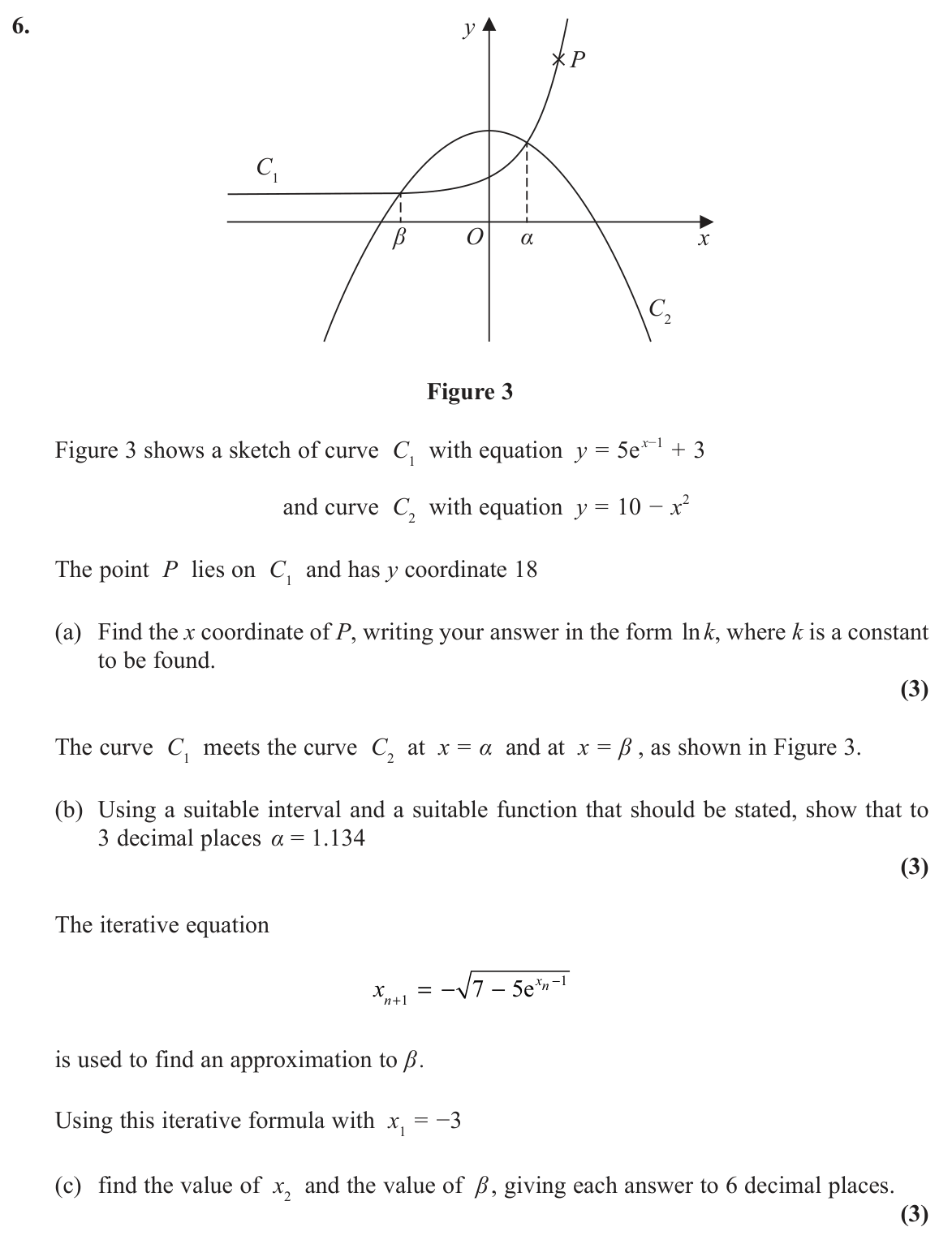
Continuity guarantees a root between them. Moreover $F'(x)=5e^{x-1}+2x\gt 0$ on this positive interval, so that root is unique there. It is the positive intersection $\alpha$, and rounds to 1.134 to three decimal places.
\[\boxed{\alpha=1.134\text{ to 3 d.p.}}\]
Part (c)
Start at $x_1=-3$ and keep full precision in $x_{n+1}=-\sqrt{7-5e^{x_n-1}}$:
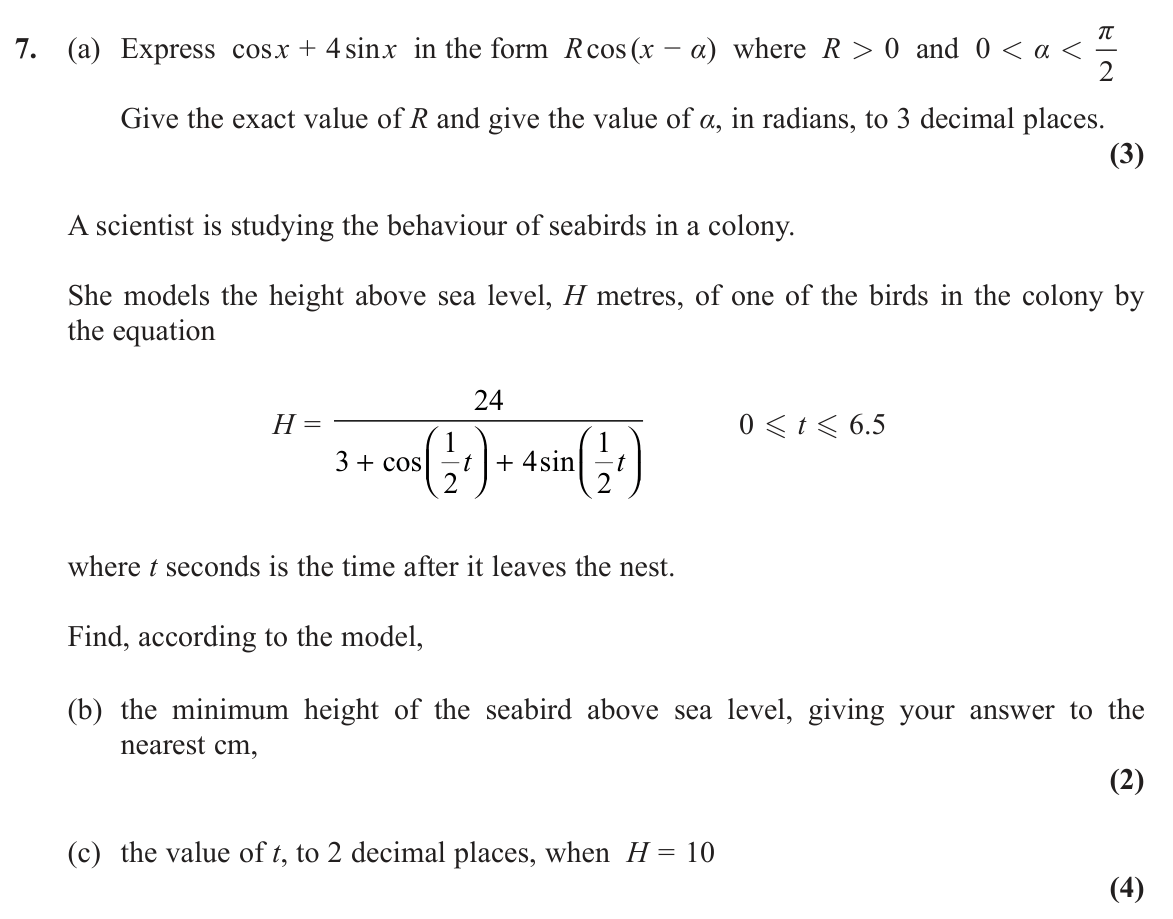
The model becomes $H=24/[3+\sqrt{17}\cos(t/2-\alpha)]$. For $0\le t\le6.5$, the phase lies between $-\alpha$ and $3.25-\alpha$; throughout this interval the denominator remains positive. Its maximum $3+\sqrt{17}$ is attained at $t=2\alpha=2.651635\ldots$, inside the time interval. The height is then smallest:
To the nearest centimetre this is $3.37\ \mathrm m$ (337 cm).
\[\boxed{H_{\min}=3.37\ \mathrm m}\]
Part (c)
For $H=10$, $3+\sqrt{17}\cos(t/2-\alpha)=24/10$, so
\[\cos(t/2-\alpha)=-\frac{3}{5\sqrt{17}}.\]
Let $\gamma=\arccos[-3/(5\sqrt{17})]$. In the permitted phase interval $[-\alpha,3.25-\alpha]$, only $+\gamma$ occurs: $-\gamma\lt -\alpha$, and shifts by $2\pi$ are outside it. Using the unrounded $\alpha=\arctan4$,
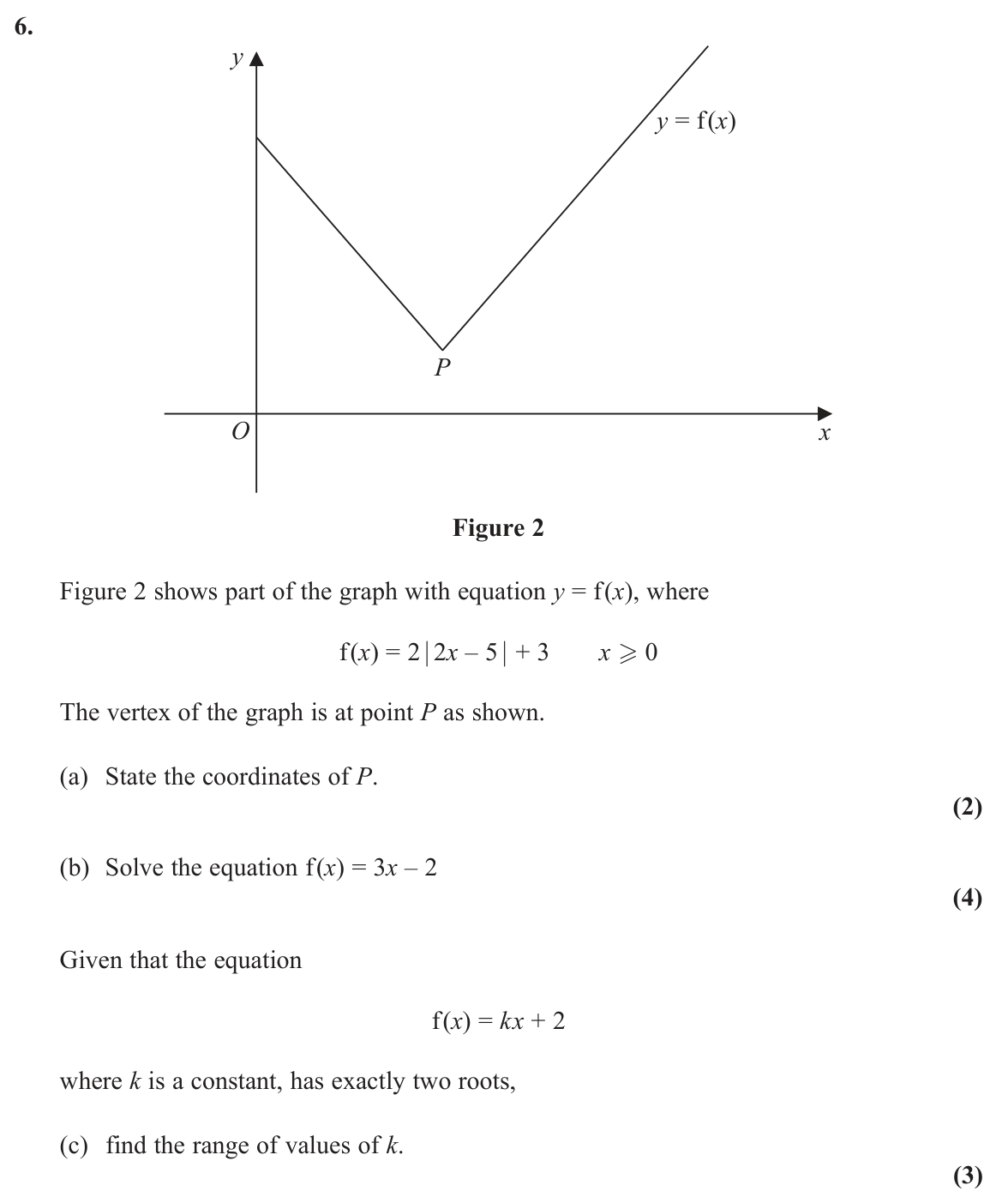
This lies in \(0\leq x\leq\frac52\), so it is valid. On the right branch,
\[4x-7=3x-2\quad\Longrightarrow\quad x=5.\]
This satisfies \(x\geq\frac52\), so it is also valid. Thus
\[\boxed{x=\frac{15}{7}\ \text{or}\ x=5}.\]
Part (c)
Each straight branch can have at most one intersection with \(y=kx+2\). Two distinct roots therefore require one intersection strictly to each side of the vertex.
At \(k=\frac25\), both intersections coincide at the vertex, giving only one root. At \(k=4\), the line is parallel to the right branch and has no intersection with that branch, again leaving only one root. Hence
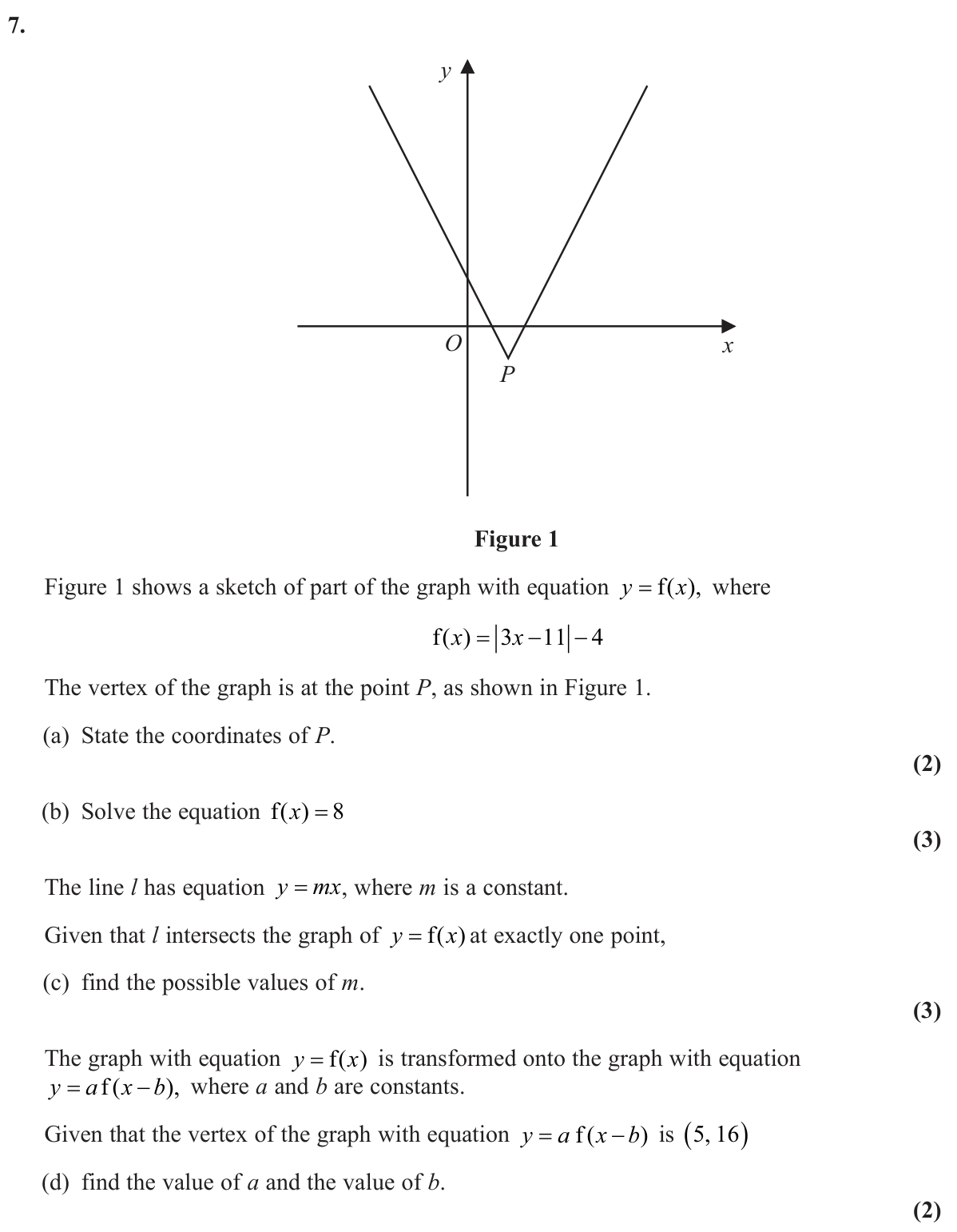
On the left branch, $mx=7-3x$ gives $x=7/(m+3)$ for $m\ne-3$. This lies on the left branch precisely when $m\lt -3$ or $m\ge-12/11$. On the right branch, $mx=3x-15$ gives $x=15/(3-m)$ for $m\ne3$. This lies on the right branch precisely when $-12/11\le m\lt 3$. At $m=-12/11$, the two branch intersections coincide at the vertex, so there is only one distinct point. For $m\lt -3$ or $m\ge3$, only the left intersection exists. At $m=-3$ there is no intersection; at $m=3$ there is one. Consequently the complete answer is
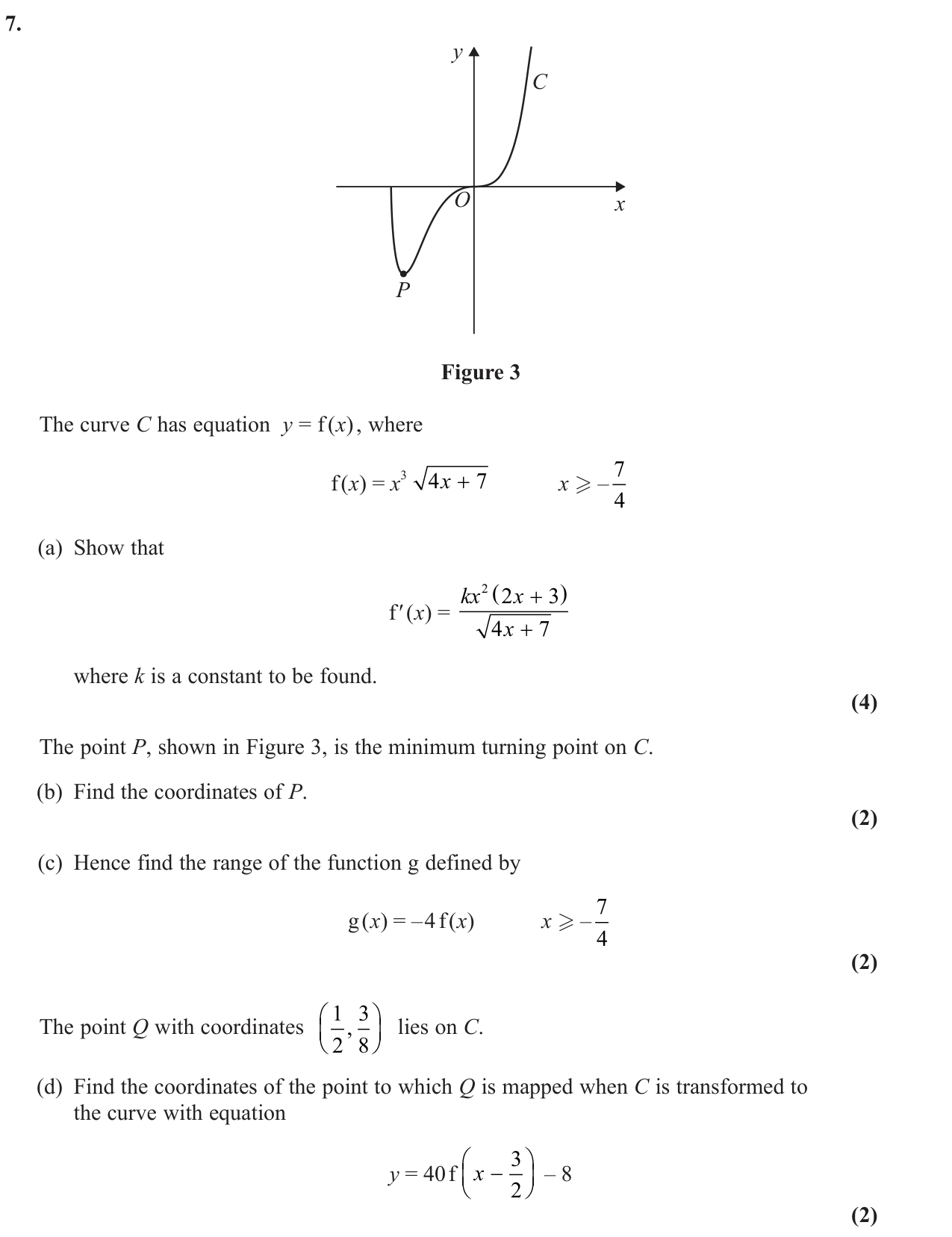
The interior stationary values satisfy $x^2(2x+3)=0$, so $x=0$ or $x=-3/2$. Near $x=-3/2$, the derivative changes from negative to positive; near $x=0$ it stays positive on both sides. Thus the minimum turning point is at $x=-3/2$.
\[f(-3/2)=(-3/2)^3\sqrt{-6+7}=-27/8.\]
\[\boxed{P=\left(-\frac32,-\frac{27}{8}\right)}\]
Part (c)
The endpoint has $f(-7/4)=0$, the global minimum is $-27/8$ and $f(x)$ tends to infinity as $x$ increases. Hence the range of $f$ is $[-27/8,\infty)$. Multiplication by $-4$ reverses the inequality and makes the upper endpoint $27/2$.
\[\boxed{g(x)\le\frac{27}{2}}\]
Part (d)
The transformation is a shift right by $3/2$, vertical stretch by 40, then shift down by 8:
\[(x,y)\mapsto(x+3/2,40y-8).\]
Therefore $Q=(1/2,3/8)$ maps to $(1/2+3/2,\;40\cdot3/8-8)$.
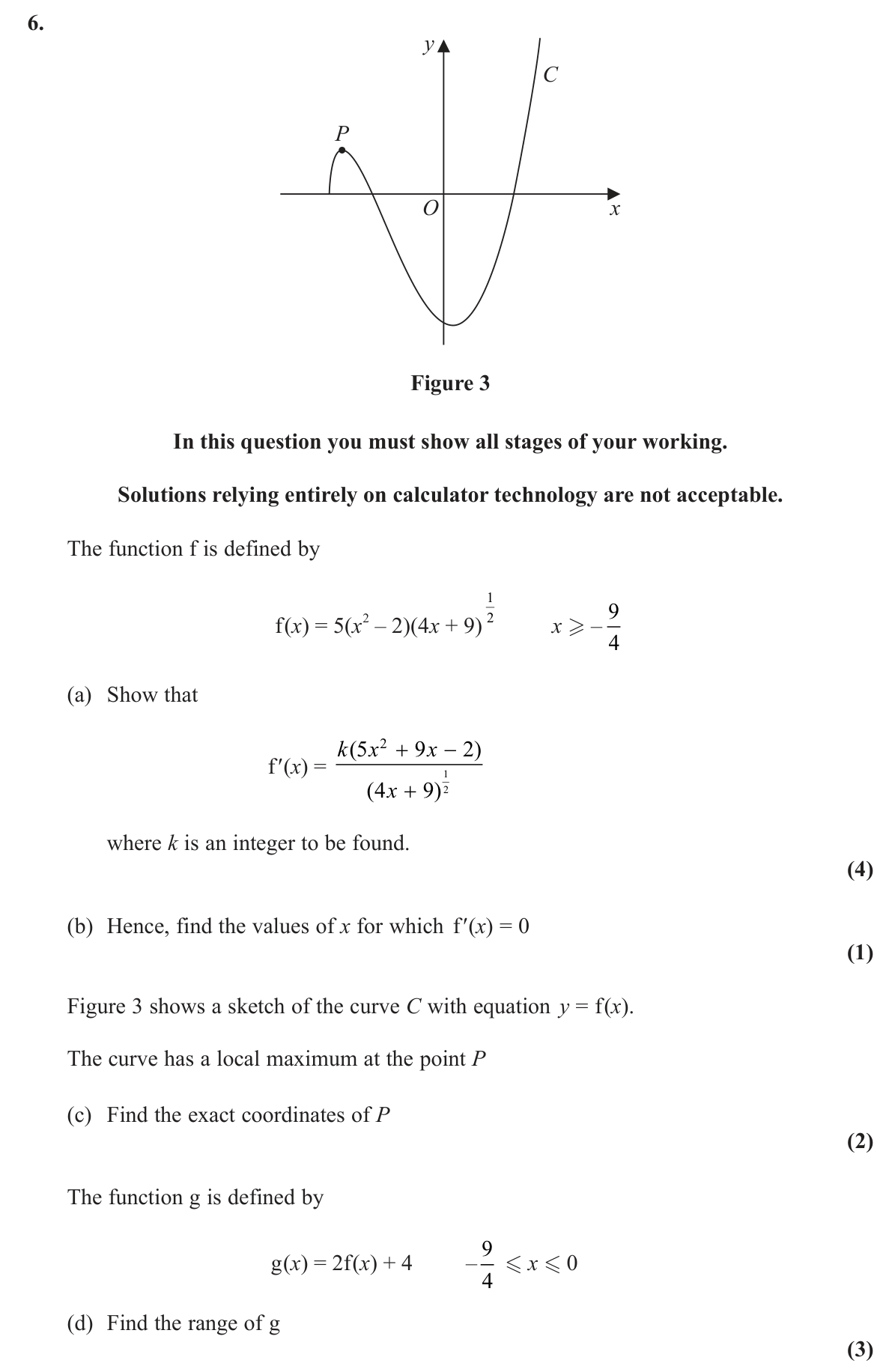
This derivative formula applies for $x\gt -9/4$; the endpoint derivative is not finite.
\[\boxed{k=10}\]
Part (b)
The denominator is positive in the derivative domain. Thus $5x^2+9x-2=(5x-1)(x+2)=0$.
\[\boxed{x=-2,\quad\frac15}\]
Part (c)
The derivative changes from positive to negative at $x=-2$, so this is the local maximum P. Substitute into f: $f(-2)=5(4-2)\sqrt{-8+9}=10$.
\[\boxed{P=(-2,10)}\]
Part (d)
On $[-9/4,0]$, f rises from $f(-9/4)=0$ to $f(-2)=10$, then decreases to $f(0)=-30$. The other stationary point $1/5$ is outside this restricted interval. Thus the minimum and maximum of f on it are $-30$ and 10. Applying the positive vertical transformation $g=2f+4$ gives endpoints $2(-30)+4=-56$ and $2(10)+4=24$, both attained.
Hard10 marks · main topic: ModulusShow worked solution
Part (a)
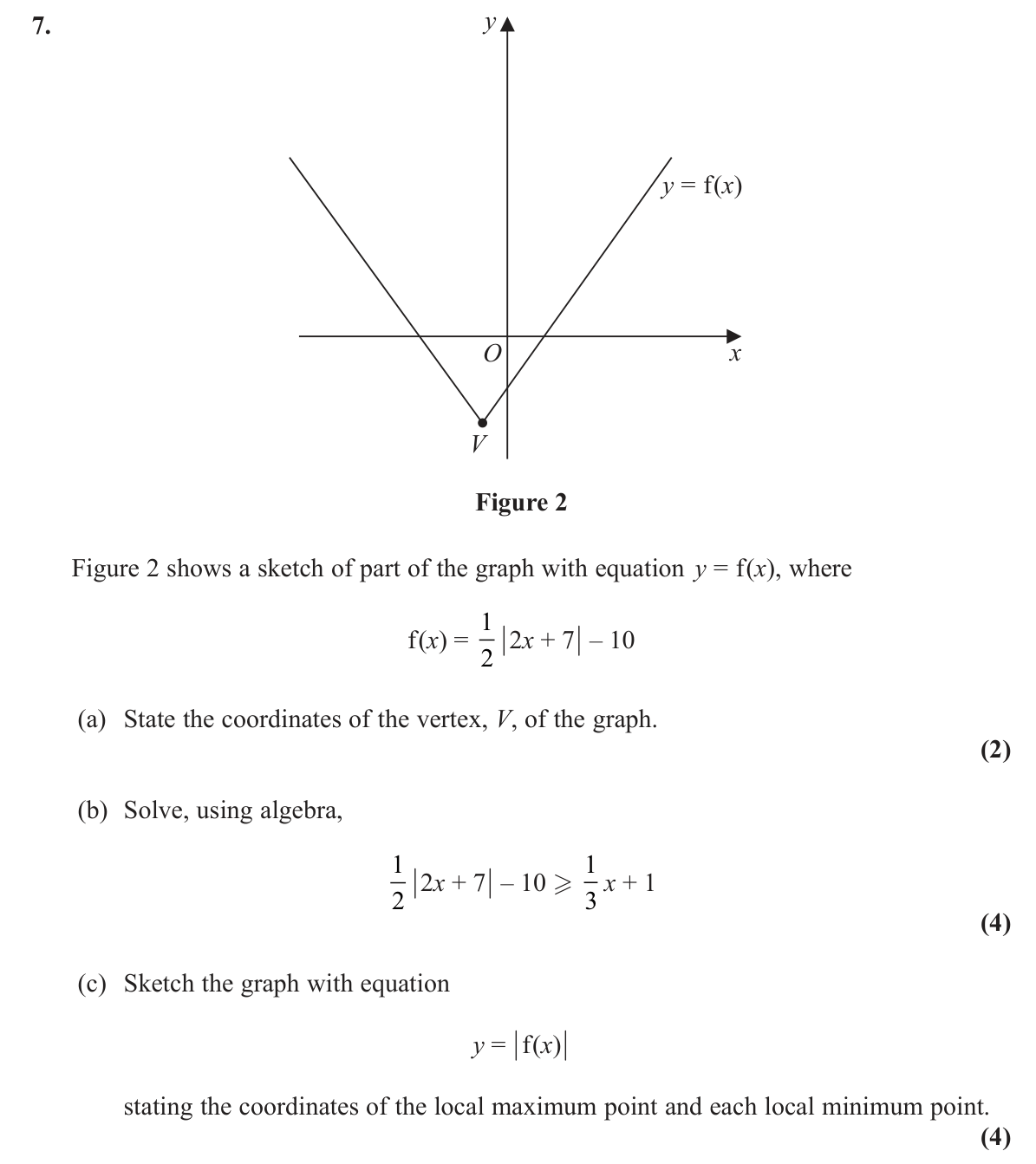
At the vertex $2x+7=0$, hence $x=-7/2$ and $f(x)=-10$.
\[\boxed{V=(-7/2,-10)}\]
Part (b)
For $x\ge-7/2$, $f(x)=x-13/2$. The inequality becomes $x-13/2\ge x/3+1$, giving $x\ge45/4$, which satisfies this branch. For $x\lt -7/2$, $f(x)=-x-27/2$. Then $-x-27/2\ge x/3+1$, giving $x\le-87/8$, which satisfies that branch. Join the two permitted outer intervals, including the equality endpoints.
The zeros of f satisfy $|2x+7|=20$, giving $x=-27/2$ and $x=13/2$. Reflect the part below the x-axis upward, leaving the positive branches unchanged. This creates minima at $(-27/2,0)$ and $(13/2,0)$ and a local maximum at $(-7/2,10)$.
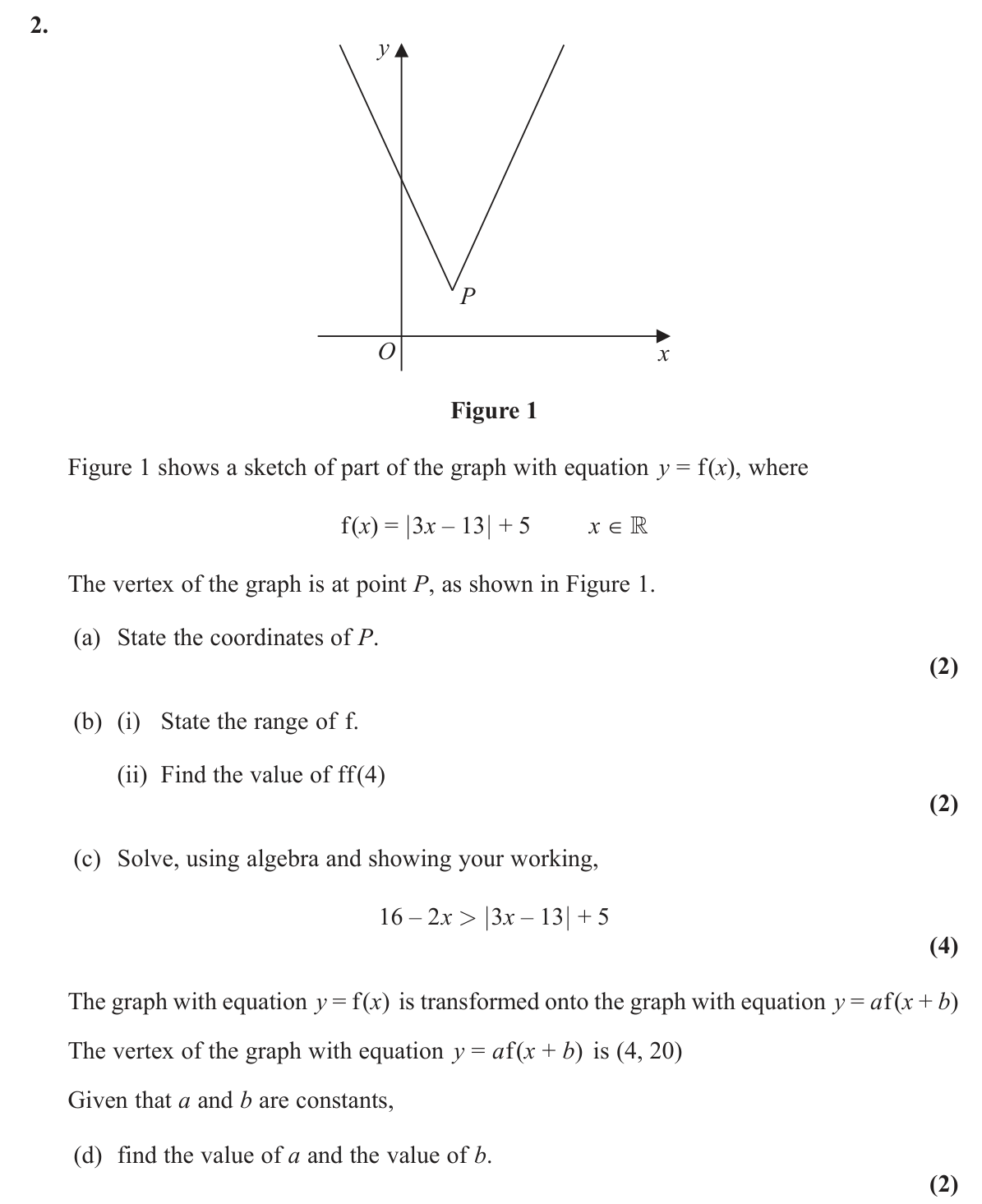
For $x\lt 13/3$, $|3x-13|+5=18-3x$. Thus $16-2x\gt 18-3x$ gives $x\gt 2$, so this branch contributes $2\lt x\lt 13/3$. For $x\ge13/3$, the right side is $3x-8$. Then $16-2x\gt 3x-8$ gives $x\lt 24/5$, so this branch contributes $13/3\le x\lt 24/5$. Combine the adjacent intervals.
\[\boxed{2\lt x\lt \frac{24}{5}}\]
Part (d)
The new vertex is at $(13/3-b,5a)$. Therefore $5a=20$ and $13/3-b=4$, giving $a=4$ and $b=1/3$.
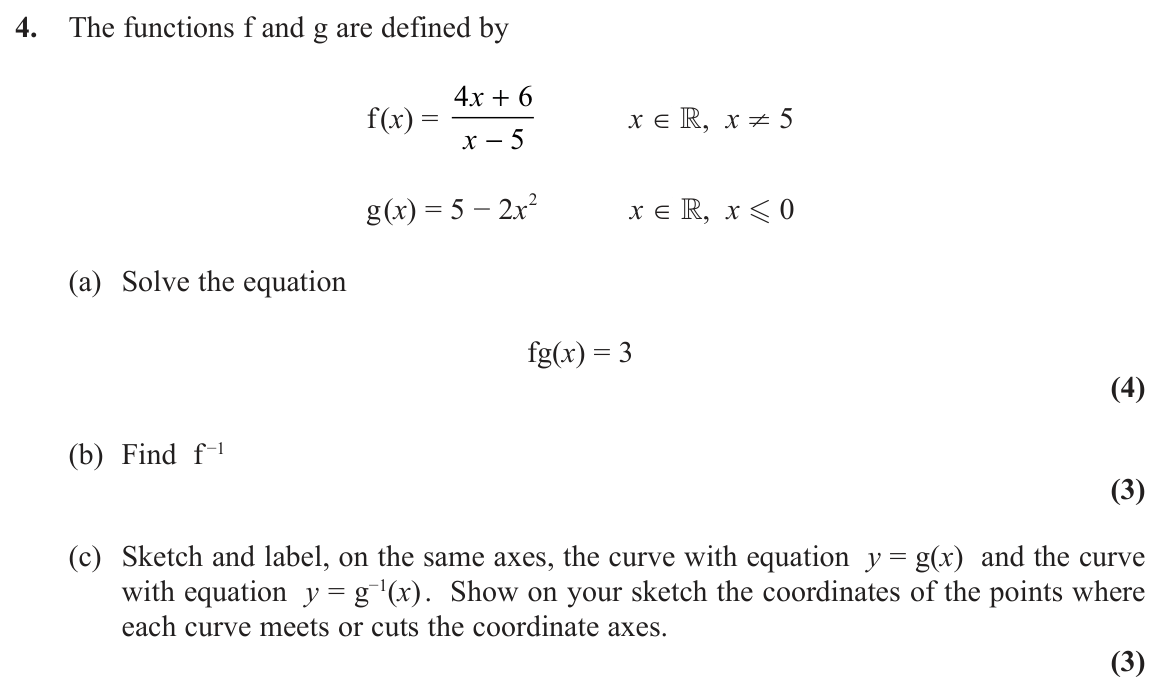
The composite requires $x\le0$ from g and $g(x)\ne5$ from f; therefore $x\lt 0$. Now $4-13/x^2=3$ gives $x^2=13$. Only the negative root belongs to the composite domain.
\[\boxed{x=-\sqrt{13}}\]
Part (b)
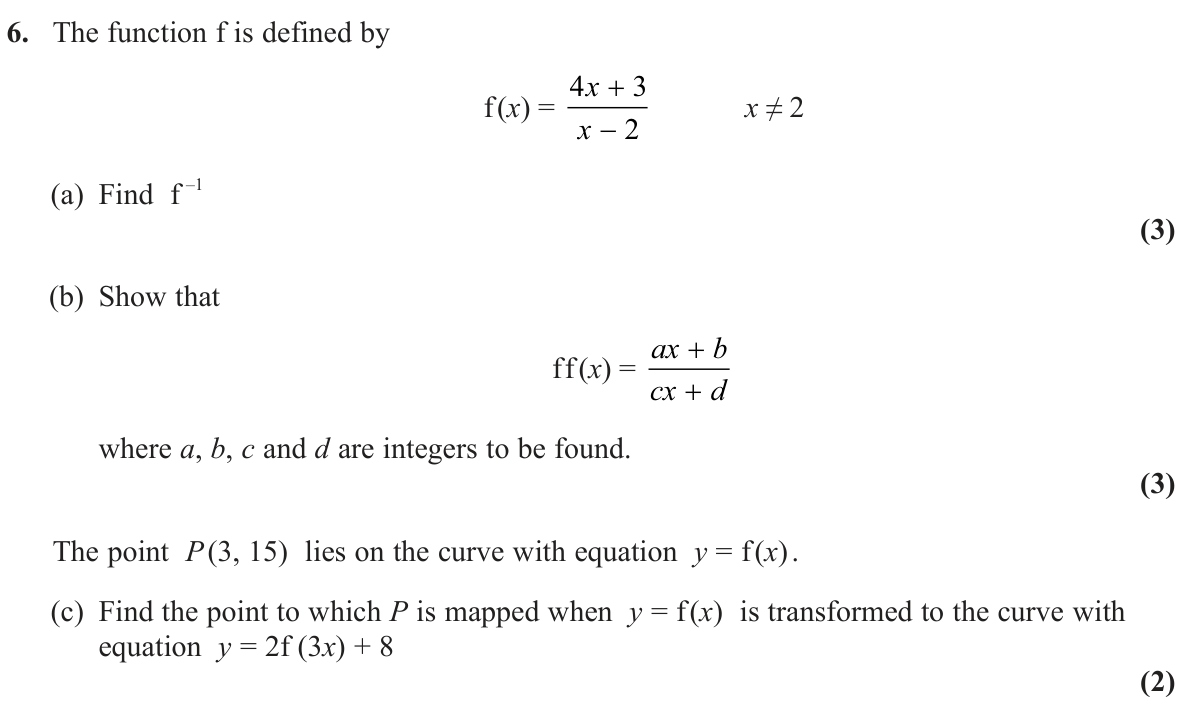
Let $y=(4x+6)/(x-5)$. Then $yx-5y=4x+6$, so $x(y-4)=5y+6$ and $x=(5y+6)/(y-4)$. Exchange the variable names. The original function is $4+26/(x-5)$, whose range excludes 4.
The graph of g is only the left half of the downward parabola: $y=5-2x^2$, $x\le0$. Its intercepts are $(0,5)$ and $(-\sqrt{5/2},0)$. For the inverse, $x=5-2y^2$ and $y\le0$, hence $g^{-1}(x)=-\sqrt{(5-x)/2}$, $x\le5$. Reflect the original branch in $y=x$. The inverse intercepts are $(5,0)$ and $(0,-\sqrt{5/2})$.
\[\boxed{g^{-1}(x)=-\sqrt{(5-x)/2},\ x\le5;\quad\text{graphs as shown}}\]
Final answer
(a) $x=-\sqrt{13}$ (b) $f^{-1}(x)=\frac{5x+6}{x-4},\quad x\ne4$ (c) $g^{-1}(x)=-\sqrt{(5-x)/2},\ x\le5;\quad\text{graphs as shown}$
36. WMA13/01 January 2024 · Q8
Hard11 marks · main topic: ModulusShow worked solution
Part (a)
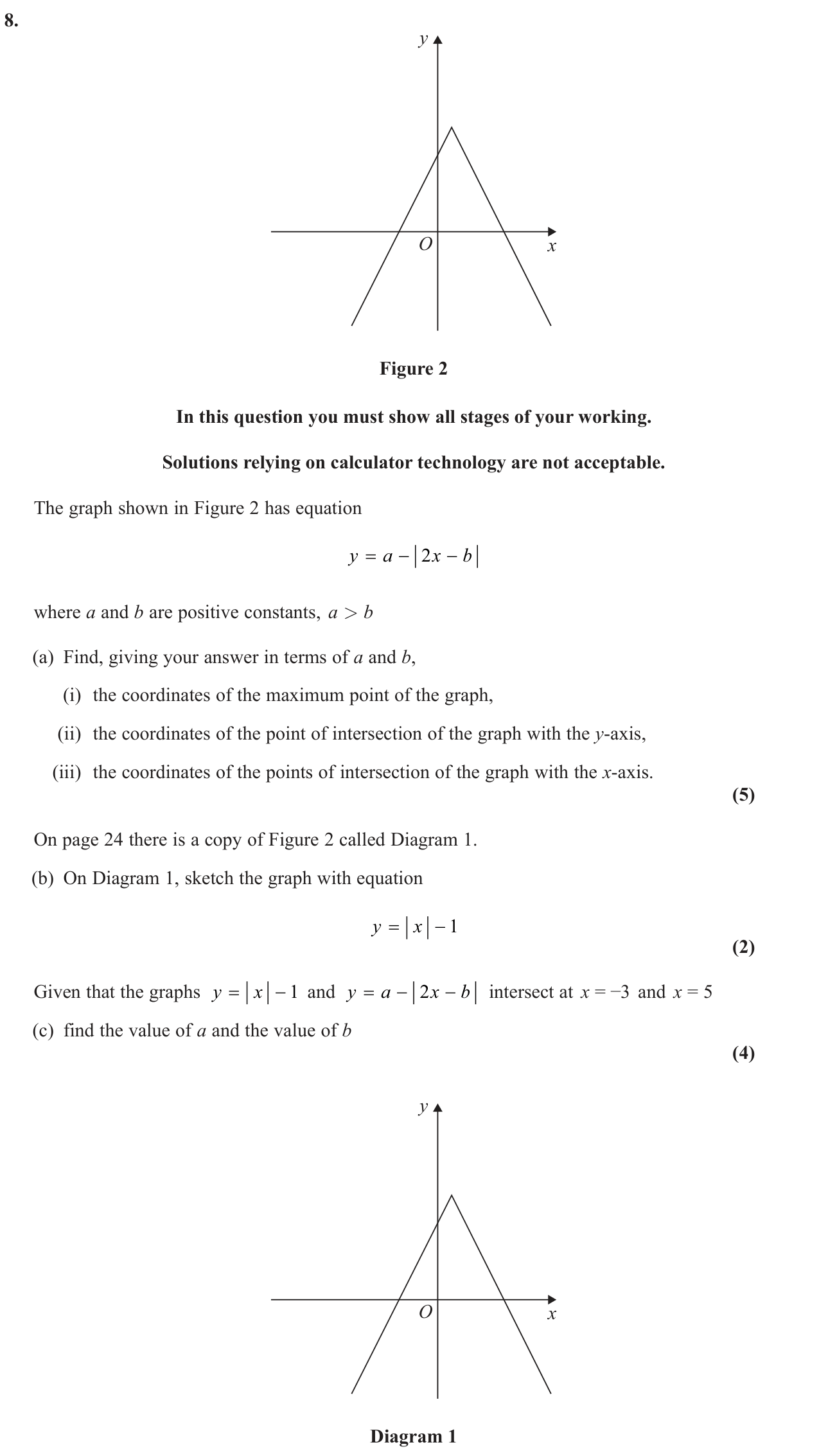
(i) Since $|2x-b|\ge0$, the maximum occurs at $2x-b=0$: $x=b/2$ and $y=a$. (ii) At $x=0$, $y=a-|-b|=a-b$ because $b\gt 0$. (iii) At an x-axis crossing, $|2x-b|=a$, hence $2x-b=\pm a$. Since $a\gt b\gt 0$, $(b-a)/2\lt 0$ and $(b+a)/2\gt 0$, matching the sketch.
The graph $y=|x|-1$ is a V with vertex $(0,-1)$ and intercepts $(-1,0)$ and $(1,0)$. Its left branch is $y=-x-1$ for $x\lt 0$ and its right branch is $y=x-1$ for $x\ge0$. Add this V to the supplied axes; the original inverted V remains unchanged.
The grey original curve is schematic; the three labelled points belong to the added graph.
At $x=-3$, the common ordinate is $|-3|-1=2$. Since $b\gt 0$, $|-6-b|=6+b$, so $a-(6+b)=2$, giving $a=b+8$. At $x=5$, the common ordinate is $|5|-1=4$, so $a-|10-b|=4$. Substitute $a=b+8$ to obtain $|10-b|=b+4$. If $b\le10$, then $10-b=b+4$, giving $b=3$, $a=11$. If $b\gt 10$, then $b-10=b+4$, impossible. Both accepted values satisfy $a\gt b\gt 0$.
Hard11 marks · main topic: Log Graphs & Exponential ModelsShow worked solution
Part (a)
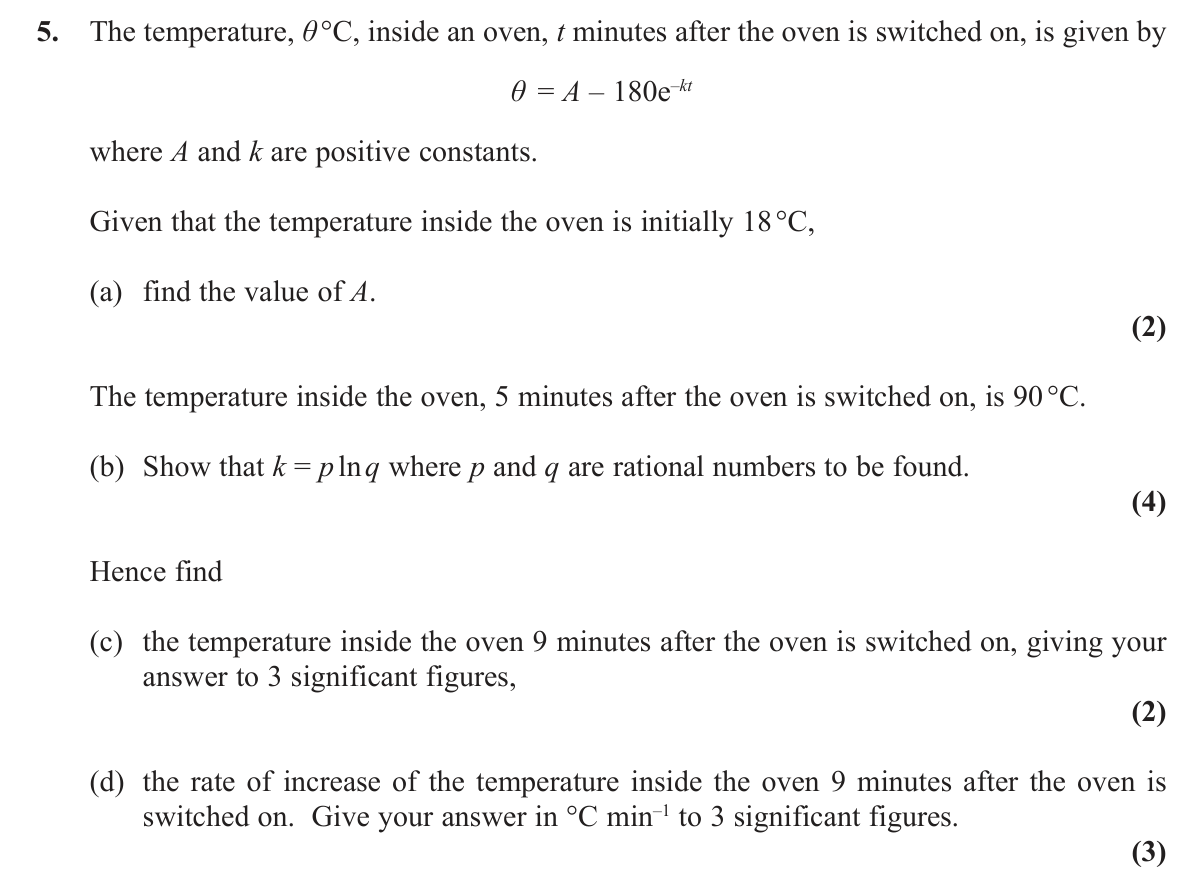
At $t=0$, $18=A-180e^0=A-180$. Hence $A=198$.
\[\boxed{A=198}\]
Part (b)
At $t=5$, $90=198-180e^{-5k}$, so $180e^{-5k}=108$ and $e^{-5k}=3/5$. Taking logarithms gives $-5k=\ln(3/5)$, hence $k=(1/5)\ln(5/3)$. Thus one suitable rational pair is $p=1/5$, $q=5/3$.
Round the temperature to three significant figures.
\[\boxed{126^\circ\mathrm C}\]
Part (d)
Differentiate with respect to time: $d\theta/dt=180ke^{-kt}$. At $t=9$ this is $180[\ln(5/3)/5]e^{-(9/5)\ln(5/3)}=7.332421555\ldots$. The sign is positive because the oven is warming.
Hard12 marks · main topic: ModulusShow worked solution
Part (a)
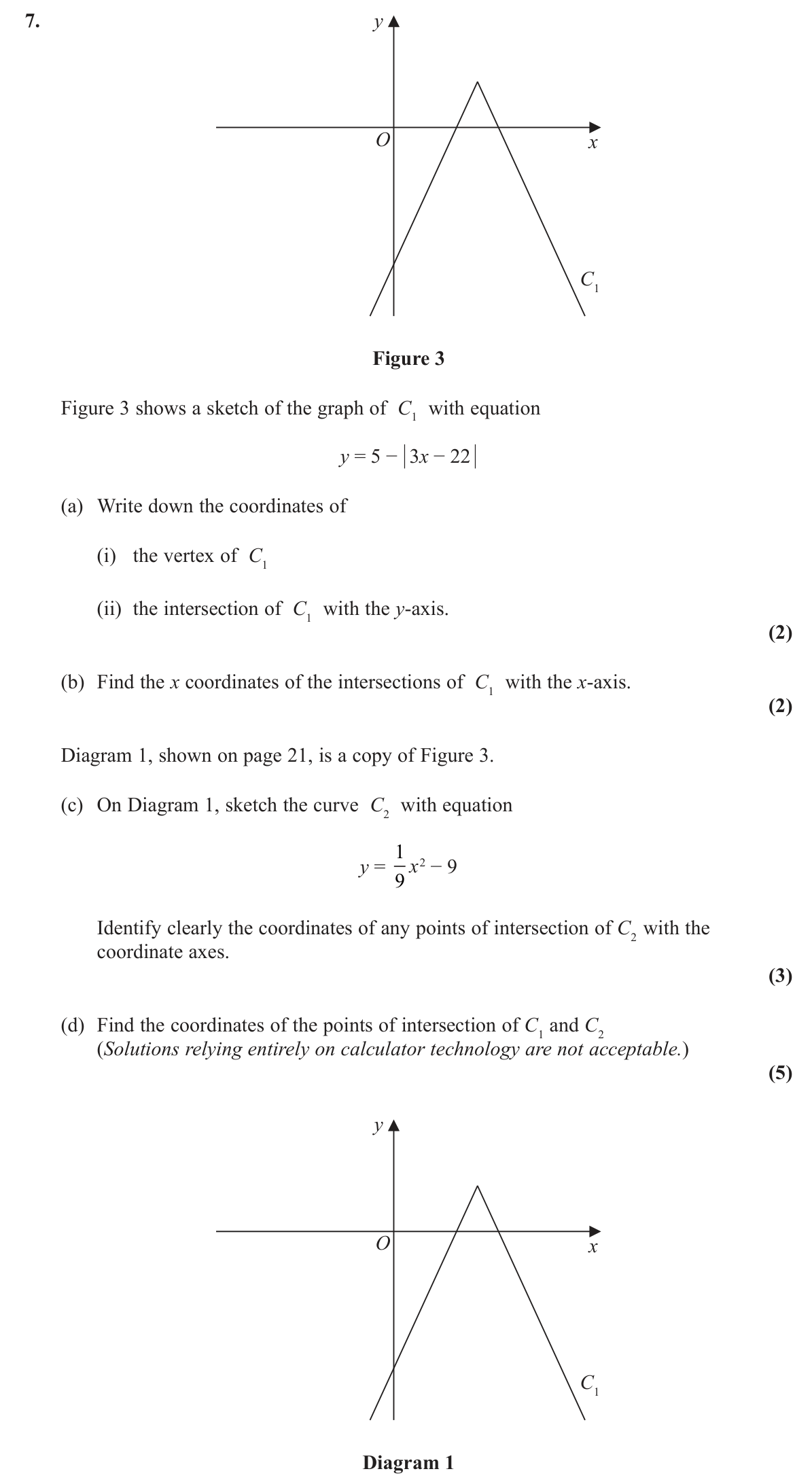
(i) The modulus is zero at $3x-22=0$, giving the vertex $(22/3,5)$. (ii) At $x=0$, $y=5-22=-17$, so the y-axis intersection is $(0,-17)$.
\[\boxed{(i)\ (22/3,5),\qquad(ii)\ (0,-17)}\]
Part (b)
Set $y=0$: $|3x-22|=5$. Thus $3x-22=5$ or $-5$, giving $x=9$ or $17/3$.
\[\boxed{x=\frac{17}{3},\quad9}\]
Part (c)
The curve $C_2:y=x^2/9-9$ is an upward-opening parabola, symmetric about the y-axis. Its vertex and y-intercept are $(0,-9)$; setting y=0 gives $x^2=81$, hence x-intercepts $(-9,0)$ and $(9,0)$. The sketch below includes $C_1$ for context and labels all three axis intersections of $C_2$.
\[\boxed{(-9,0),\quad(9,0),\quad(0,-9)}\]
Part (d)
For $x\le22/3$, $C_1$ is $y=3x-17$. Equating to $C_2$ gives
 Elite Mathematics