Skip to content
Elite Mathematics
IAL · WME01 · Topic

Working with Vectors: past paper questions & worked solutions

Every Working with Vectors question from the WME01 papers in our bank, 2019–2026, sorted from easiest to hardest. Try each one first, then open the worked solution.

42questions
416marks in total
100%of papers (18 of 18) include it
4/14/24easy / medium / hard

Questions, easiest first

Level is estimated from marks: 1–6 easy, 7–8 medium, 9+ hard.

1. WME01/01 May/June 2024 · Q2

Easy4 marks · main topic: Forces
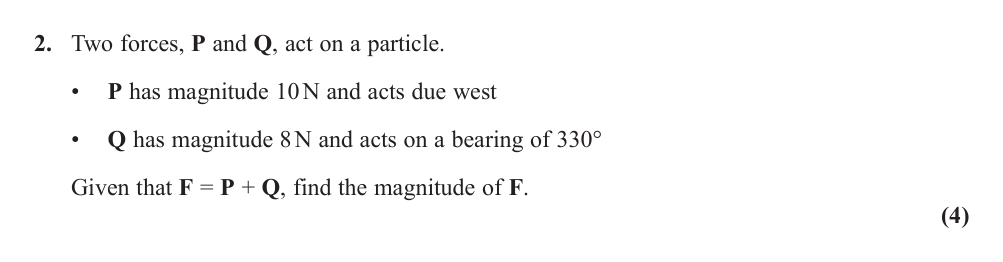
WME01/01 May/June 2024 Question 2 (4 marks): Working with Vectors
Show worked solution
  1. Resolve the two forces

    Take east as $\mathbf{i}$ and north as $\mathbf{j}$. The force due west is $-10\mathbf{i}$. A bearing of $330^\circ$ is $30^\circ$ west of north, so the 8 N force has components $-8\sin30^\circ\mathbf{i}+8\cos30^\circ\mathbf{j}$.

  2. Add the components

    $\mathbf{F}=(-10-4)\mathbf{i}+4\sqrt3\mathbf{j}=-14\mathbf{i}+4\sqrt3\mathbf{j}$.

  3. Find the magnitude

    $|\mathbf{F}|=\sqrt{(-14)^2+(4\sqrt3)^2}=\sqrt{196+48}=\sqrt{244}=2\sqrt{61}\ \mathrm{N}$.

  4. Give a decimal value

    $2\sqrt{61}=15.620\ldots$, so the magnitude is about $16\ \mathrm{N}$ to 2 significant figures.

Final answer

$|\mathbf{F}|=2\sqrt{61}\ \mathrm{N}\approx15.6\ \mathrm{N}$.

2. WME01/01 January 2026 · Q1

Easy6 marks · main topic: Momentum, Impulse & Collisions
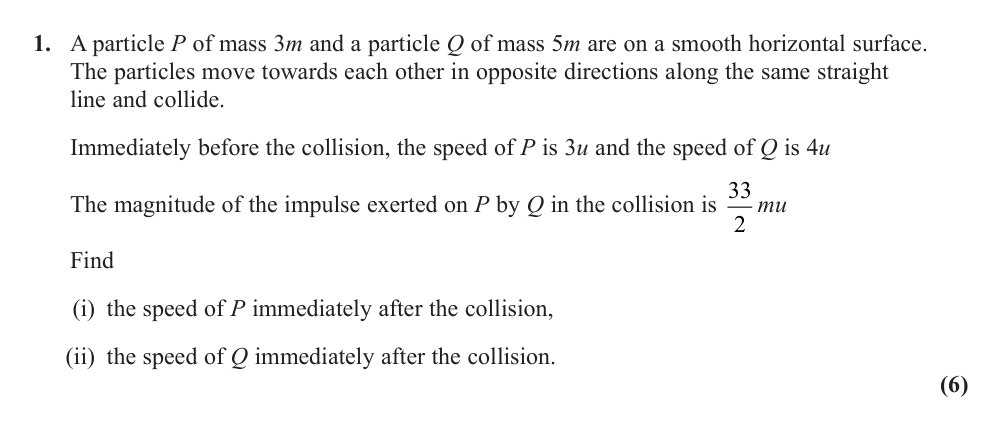
WME01/01 January 2026 Question 1 (6 marks): Working with Vectors
Show worked solution
  1. Choose a sign convention

    Take the initial direction of P as positive. Then before impact, $v_P=3u$ and $v_Q=-4u$. The impulse on P acts opposite to P\'s initial motion, so its signed impulse is $-\dfrac{33}{2}mu$.

  2. Use impulse on P

    For P, impulse equals change in momentum: $-\dfrac{33}{2}mu=3m(v_P-3u)$. Dividing by $3m$ gives $v_P-3u=-\dfrac{11u}{2}$, so $v_P=-\dfrac{5u}{2}$.

  3. Interpret the speed of P

    The negative sign means P has reversed direction. Its speed is therefore $\left|-\dfrac{5u}{2}\right|=\dfrac{5u}{2}$.

  4. Use the equal and opposite impulse on Q

    Q receives impulse $+\dfrac{33}{2}mu$ in the positive direction. Hence $\dfrac{33}{2}mu=5m(v_Q-(-4u))=5m(v_Q+4u)$.

  5. Interpret the speed of Q

    Dividing by $5m$ gives $v_Q+4u=\dfrac{33u}{10}$, so $v_Q=-\dfrac{7u}{10}$. Q is still moving in its original direction, and its speed is $\dfrac{7u}{10}$.

Final answer

$(i)\ \text{speed of P}=\dfrac{5u}{2}.\quad (ii)\ \text{speed of Q}=\dfrac{7u}{10}$.

3. WME01/01 May/June 2025 · Q1

Easy6 marks · main topic: Momentum, Impulse & Collisions
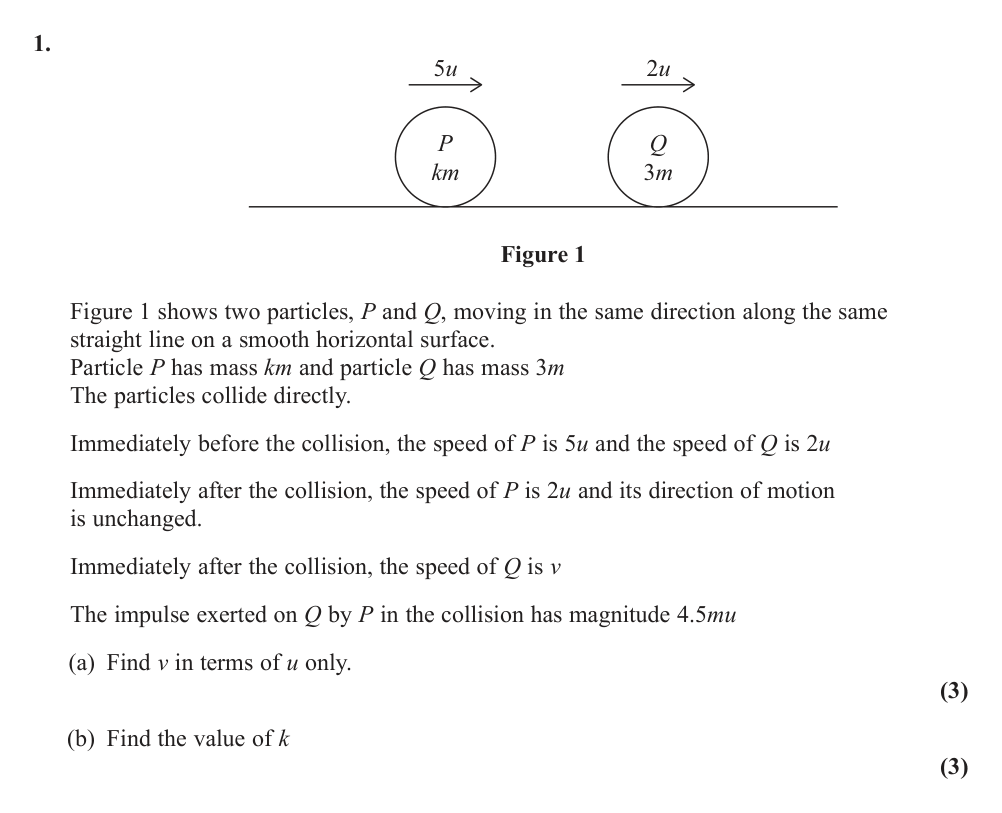
WME01/01 May/June 2025 Question 1 (6 marks): Working with Vectors
Show worked solution
  1. Part (a): Find v in terms of u - Apply impulse-momentum theorem to Q

    $\text{Impulse} = \text{Final momentum} - \text{Initial momentum}$ For particle Q: ; Mass = $3m$ ; Initial velocity = $2u$ ; Final velocity = $v$ ; Impulse received = $4.5mu$

  2. Part (a): Find v in terms of u - Set up equation

    $4.5mu = 3m \times v - 3m \times 2u$ $4.5mu = 3mv - 6mu$ $4.5u = 3v - 6u$ $4.5u + 6u = 3v$ $10.5u = 3v$ $v = \frac{10.5u}{3}$ $v = 3.5u$

  3. Part (b): Find the value of k - Apply conservation of momentum

    $\text{Total momentum before} = \text{Total momentum after}$ Before collision: $\text{P momentum} = km \times 5u = 5kmu$ $\text{Q momentum} = 3m \times 2u = 6mu$ $\text{Total} = 5kmu + 6mu$ After collision: $\text{P momentum} = km \times 2u = 2kmu$ $\text{Q momentum} = 3m \times 3.5u = 10.5mu$ $\text{Total} = 2kmu + 10.5mu$

  4. Part (b): Find the value of k - Set up equation

    $5kmu + 6mu = 2kmu + 10.5mu$ $5km + 6m = 2km + 10.5m$ $5k + 6 = 2k + 10.5$ $5k - 2k = 10.5 - 6$ $3k = 4.5$ $k = \frac{4.5}{3}$ $k = 1.5$

Final answer

$(a)\ v=3.5u=\dfrac{7u}{2}.\quad (b)\ k=1.5=\dfrac{3}{2}$.

4. WME01/01 May/June 2022 · Q6

Easy6 marks
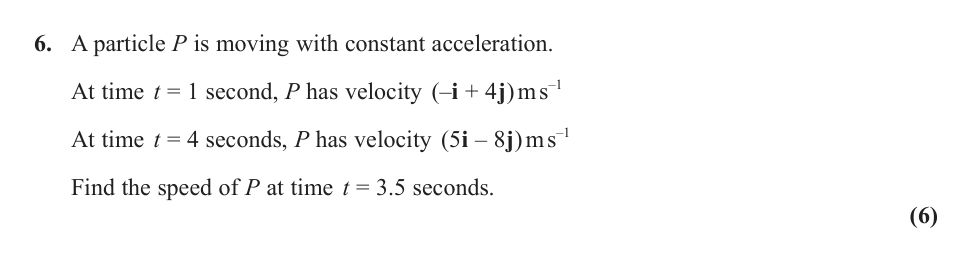
WME01/01 May/June 2022 Question 6 (6 marks): Working with Vectors
Show worked solution
  1. Find the acceleration

    The velocity changes from $-\mathbf{i}+4\mathbf{j}$ at $t=1$ to $5\mathbf{i}-8\mathbf{j}$ at $t=4$. The time difference is $3$ s.

  2. Calculate acceleration

    $\mathbf{a}=\dfrac{(5\mathbf{i}-8\mathbf{j})-(-\mathbf{i}+4\mathbf{j})}{3}=\dfrac{6\mathbf{i}-12\mathbf{j}}{3}=2\mathbf{i}-4\mathbf{j}$.

  3. Find velocity at t = 3.5

    From $t=1$ to $t=3.5$ is $2.5$ s, so $\mathbf{v}=(-\mathbf{i}+4\mathbf{j})+2.5(2\mathbf{i}-4\mathbf{j})$.

  4. Simplify the velocity

    $\mathbf{v}=-\mathbf{i}+4\mathbf{j}+5\mathbf{i}-10\mathbf{j}=4\mathbf{i}-6\mathbf{j}$.

  5. Find the speed

    Speed $=\sqrt{4^2+(-6)^2}=\sqrt{52}=2\sqrt{13}\ \mathrm{m\,s^{-1}}$, about $7.2\ \mathrm{m\,s^{-1}}$.

Final answer

$\text{speed}=\sqrt{52}=2\sqrt{13}\ \mathrm{m\,s^{-1}}\approx7.2\ \mathrm{m\,s^{-1}}$.

5. WME01/01 May/June 2025 · Q2

Medium7 marks
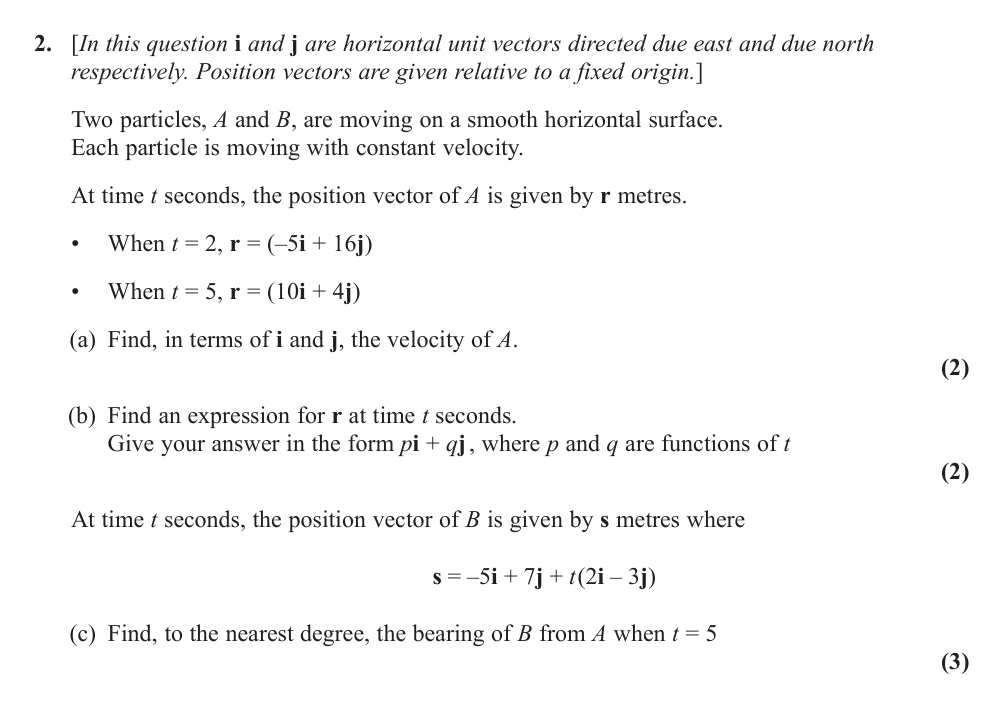
WME01/01 May/June 2025 Question 2 (7 marks): Working with Vectors
Show worked solution
  1. Part (a): Find velocity of A - Find change in position

    Given positions for particle A: ; At $t = 2$: $\mathbf{r} = -5\mathbf{i} + 16\mathbf{j}$ ; At $t = 5$: $\mathbf{r} = 10\mathbf{i} + 4\mathbf{j}$ $\mathbf{v} = \frac{\Delta \mathbf{r}}{\Delta t}$ $\mathbf{v}_A = \frac{(10\mathbf{i} + 4\mathbf{j}) - (-5\mathbf{i} + 16\mathbf{j})}{5 - 2}$ $= \frac{(10 + 5)\mathbf{i} + (4 - 16)\mathbf{j}}{3}$ $= \frac{15\mathbf{i} - 12\mathbf{j}}{3}$ $= 5\mathbf{i} - 4\mathbf{j} \text{ m s}^{-1}$

  2. Part (b): Find expression for r at time t - Use position-velocity relationship

    $\mathbf{r}(t) = \mathbf{r}(t_0) + \mathbf{v}(t - t_0)$ Using $t_0 = 2$ with $\mathbf{r}(2) = -5\mathbf{i} + 16\mathbf{j}$: $\mathbf{r}(t) = (-5\mathbf{i} + 16\mathbf{j}) + (5\mathbf{i} - 4\mathbf{j})(t - 2)$ $= -5\mathbf{i} + 16\mathbf{j} + 5(t-2)\mathbf{i} - 4(t-2)\mathbf{j}$ $= -5\mathbf{i} + 16\mathbf{j} + (5t - 10)\mathbf{i} + (-4t + 8)\mathbf{j}$ $= (-5 + 5t - 10)\mathbf{i} + (16 - 4t + 8)\mathbf{j}$ $= (5t - 15)\mathbf{i} + (24 - 4t)\mathbf{j}$

  3. Part (c): Find bearing of B from A when t = 5 - Find positions at t = 5

    For A at $t = 5$: $\mathbf{r}_A = 10\mathbf{i} + 4\mathbf{j}$ (given) For B at $t = 5$: $\mathbf{s}_B = -5\mathbf{i} + 7\mathbf{j} + 5(2\mathbf{i} - 3\mathbf{j})$ $= -5\mathbf{i} + 7\mathbf{j} + 10\mathbf{i} - 15\mathbf{j}$ $= 5\mathbf{i} - 8\mathbf{j}$

  4. Part (c): Find bearing of B from A when t = 5 - Find vector from A to B

    $\overrightarrow{AB} = \mathbf{s}_B - \mathbf{r}_A$ $= (5\mathbf{i} - 8\mathbf{j}) - (10\mathbf{i} + 4\mathbf{j})$ $= -5\mathbf{i} - 12\mathbf{j}$

  5. Part (c): Find bearing of B from A when t = 5 - Find angle and bearing

    Angle from South (negative j direction): $\tan \alpha = \frac{5}{12}$ $\alpha = \tan^{-1}\left(\frac{5}{12}\right)$ $\alpha = 22.619...°$ Bearing = $180° + \alpha = 180° + 22.619...° = 202.619...°$

Final answer

$(a)\ \mathbf{v}_A=5\mathbf{i}-4\mathbf{j}\ \mathrm{m\,s^{-1}}.\quad (b)\ \mathbf{r}=(5t-15)\mathbf{i}+(24-4t)\mathbf{j}.\quad (c)\ \text{bearing}=203^\circ$.

6. WME01/01 January 2025 · Q5

Medium7 marks
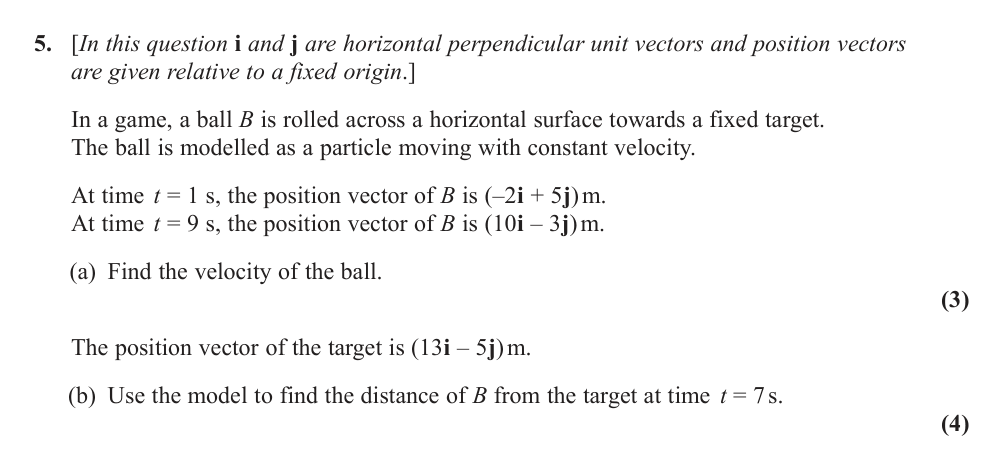
WME01/01 January 2025 Question 5 (7 marks): Working with Vectors
Show worked solution
  1. Find the displacement over 8 seconds

    From $t=1$ to $t=9$, the displacement is $(10\mathbf{i}-3\mathbf{j})-(-2\mathbf{i}+5\mathbf{j})=12\mathbf{i}-8\mathbf{j}$.

  2. Find the velocity

    The time interval is $8$ seconds, so $\mathbf{v}=\dfrac{12\mathbf{i}-8\mathbf{j}}{8}=1.5\mathbf{i}-\mathbf{j}\ \mathrm{m\,s^{-1}}$.

  3. Find the position at t=7

    Time $t=7$ is 6 seconds after $t=1$. Therefore $\mathbf{r}_B(7)=(-2\mathbf{i}+5\mathbf{j})+6(1.5\mathbf{i}-\mathbf{j})=7\mathbf{i}-\mathbf{j}$.

  4. Find the vector from B to the target

    The target has position vector $13\mathbf{i}-5\mathbf{j}$. The vector from the ball to the target is $(13\mathbf{i}-5\mathbf{j})-(7\mathbf{i}-\mathbf{j})=6\mathbf{i}-4\mathbf{j}$.

  5. Find the distance

    The distance is $\sqrt{6^2+(-4)^2}=\sqrt{52}=2\sqrt{13}\ \mathrm{m}$, which is about $7.2\ \mathrm{m}$.

Final answer

$(a)\ \mathbf{v}=1.5\mathbf{i}-\mathbf{j}\ \mathrm{m\,s^{-1}}.\quad (b)\ \text{distance}=2\sqrt{13}\ \mathrm{m}\approx7.2\ \mathrm{m}$.

7. WME01/01 May/June 2022 · Q3

Medium7 marks · main topic: Newton's Second Law
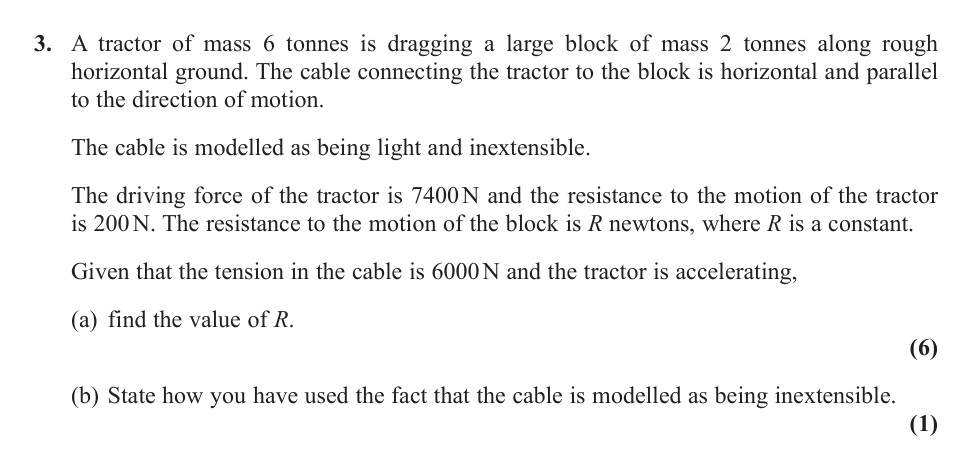
WME01/01 May/June 2022 Question 3 (7 marks): Working with Vectors
Show worked solution
  1. Apply Newtons second law to the tractor

    The tractor has mass $6000$ kg. Its forward driving force is $7400$ N, and the backward forces are $200$ N resistance and $6000$ N tension.

  2. Find the acceleration

    $7400-200-6000=6000a$, so $1200=6000a$ and $a=0.2\ \mathrm{m\,s^{-2}}$.

  3. Apply Newtons second law to the block

    The block has mass $2000$ kg. The forward force is the tension $6000$ N and the resistance is $R$ N.

  4. Find R

    $6000-R=2000(0.2)=400$. Therefore $R=5600\ \mathrm{N}$.

  5. Use the inextensible cable model

    The cable is inextensible, so the tractor and block move together with the same acceleration.

Final answer

$(a)\ R=5600\ \mathrm{N}.\quad (b)$ The tractor and block have the same acceleration.

8. WME01/01 January 2022 · Q2

Medium7 marks · main topic: Momentum, Impulse & Collisions
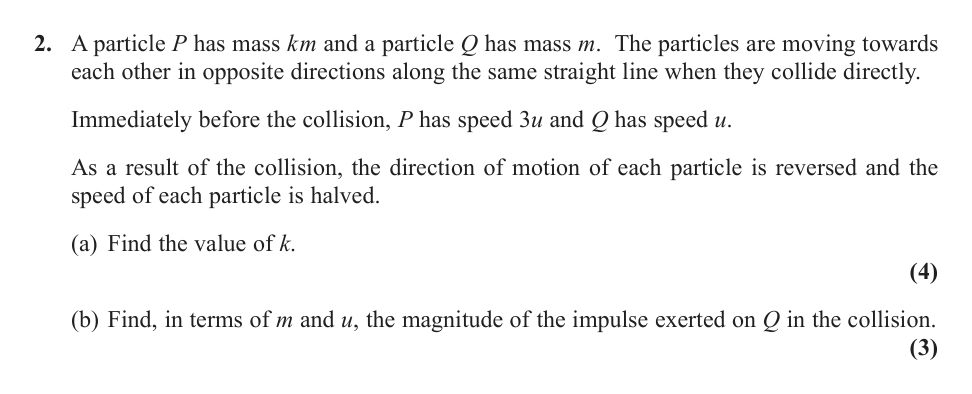
WME01/01 January 2022 Question 2 (7 marks): Working with Vectors
Show worked solution
  1. Choose a positive direction

    Take the original direction of P as positive. Before the collision, P has velocity $3u$ and Q has velocity $-u$.

  2. Write the velocities after collision

    After collision, each direction is reversed and each speed is halved. So P has velocity $-\dfrac32u$ and Q has velocity $\dfrac12u$.

  3. Use conservation of momentum

    $km(3u)+m(-u)=km\left(-\dfrac32u\right)+m\left(\dfrac12u\right)$.

  4. Find k

    Divide by $mu$: $3k-1=-\dfrac32k+\dfrac12$. Hence $\dfrac92k=\dfrac32$, so $k=\dfrac13$.

  5. Find impulse on Q

    Impulse on Q equals change in momentum of Q: $I=m\left(\dfrac12u-(-u)\right)=\dfrac32mu$.

  6. State the magnitude

    The magnitude of the impulse is $\dfrac32mu$.

Final answer

$(a)\ k=\dfrac13.\quad (b)\ I=\dfrac32mu$.

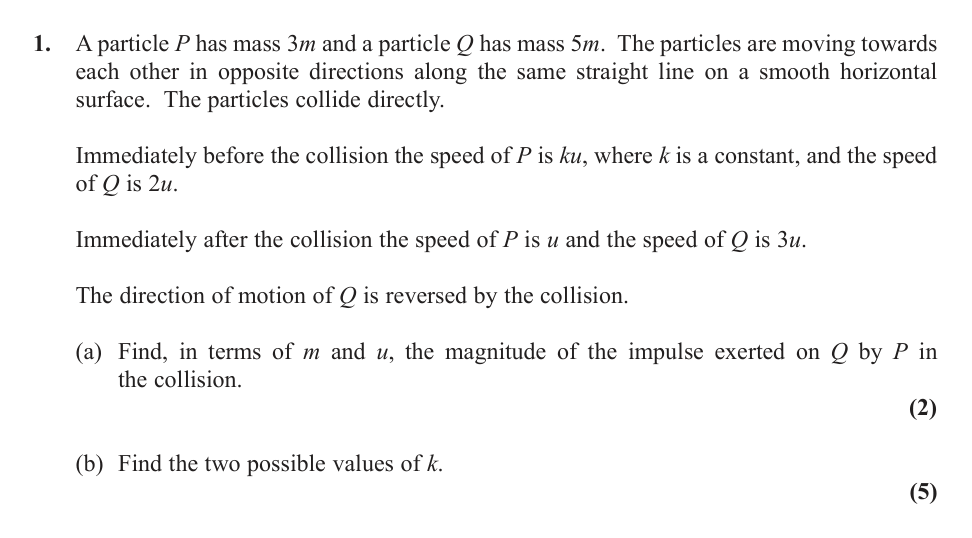
9. WME01/01 May/June 2021 · Q1

Medium7 marks · main topic: Momentum, Impulse & Collisions
WME01/01 May/June 2021 Question 1 (7 marks): Working with Vectors
Show worked solution
  1. Choose a positive direction

    Take P's original direction as positive. Q initially has velocity $-2u$. Since Q reverses direction and then has speed $3u$, its final velocity is $3u$.

  2. Find the impulse on Q

    Impulse equals change in momentum: $I=5m(3u-(-2u))=25mu$.

  3. Use conservation of momentum

    Before collision, total momentum is $3m(ku)+5m(-2u)=3mku-10mu$.

  4. Case 1: P continues in its original direction

    If P has final velocity $u$, final momentum is $3m(u)+5m(3u)=18mu$. So $3mku-10mu=18mu$, giving $3k=28$ and $k=\dfrac{28}{3}$.

  5. Case 2: P reverses direction

    If P has final velocity $-u$, final momentum is $3m(-u)+5m(3u)=12mu$. So $3mku-10mu=12mu$, giving $3k=22$ and $k=\dfrac{22}{3}$.

Final answer

$(a)\ I=25mu.\quad (b)\ k=\dfrac{28}{3}\ \text{or}\ \dfrac{22}{3}$.

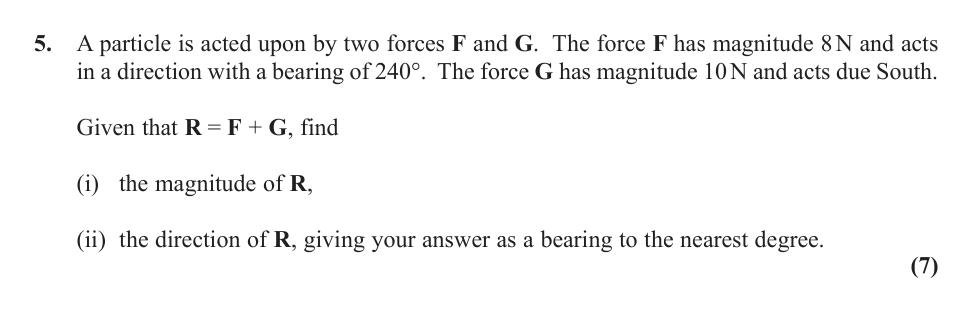
10. WME01/01 January 2021 · Q5

Medium7 marks
WME01/01 January 2021 Question 5 (7 marks): Working with Vectors
Show worked solution
  1. Resolve F into components

    A bearing of $240^\circ$ is $60^\circ$ west of south. Hence $\mathbf{F}=(-8\sin60^\circ)\mathbf{i}+(-8\cos60^\circ)\mathbf{j}=-4\sqrt3\mathbf{i}-4\mathbf{j}$.

  2. Add G

    The force $\mathbf{G}$ is due south with magnitude $10$, so $\mathbf{G}=-10\mathbf{j}$. Therefore $\mathbf{R}=\mathbf{F}+\mathbf{G}=-4\sqrt3\mathbf{i}-14\mathbf{j}$.

  3. Find the magnitude

    $|\mathbf{R}|=\sqrt{(-4\sqrt3)^2+(-14)^2}=\sqrt{48+196}=\sqrt{244}\ \mathrm{N}$.

  4. Find the bearing angle

    The resultant points south-west. The angle west of south satisfies $\tan\theta=\dfrac{4\sqrt3}{14}=\dfrac{2\sqrt3}{7}$.

  5. State the bearing

    $\theta=26.3^\circ$. Bearing $=180^\circ+26.3^\circ=206.3^\circ$, so the bearing is $206^\circ$ to the nearest degree.

Final answer

$(i)\ |\mathbf{R}|=\sqrt{244}\ \mathrm{N}\approx15.6\ \mathrm{N}.\quad (ii)\ \text{bearing}=206^\circ$.

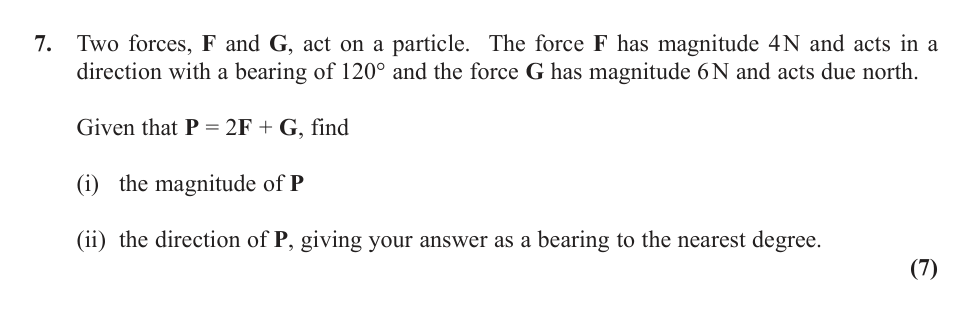
11. WME01/01 October 2019 · Q7

Medium7 marks
WME01/01 October 2019 Question 7 (7 marks): Working with Vectors
Show worked solution
  1. Resolve 2F

    Since $\mathbf F$ has magnitude $4$ N on a bearing of $120^\circ$, $2\mathbf F$ has magnitude $8$ N on the same bearing.

  2. Write the components

    $2\mathbf F=8\sin120^\circ\mathbf i+8\cos120^\circ\mathbf j=4\sqrt3\mathbf i-4\mathbf j$. Also $\mathbf G=6\mathbf j$.

  3. Find P

    $\mathbf P=2\mathbf F+\mathbf G=4\sqrt3\mathbf i+2\mathbf j$.

  4. Find the magnitude

    $|\mathbf P|=\sqrt{(4\sqrt3)^2+2^2}=\sqrt{48+4}=\sqrt{52}$ N.

  5. Find the bearing angle

    The vector is in the north-east quadrant. The angle east of north satisfies $\tan\theta=\dfrac{4\sqrt3}{2}=2\sqrt3$.

  6. State the bearing

    $\theta=73.9^\circ$ approximately, so the bearing is $074^\circ$ to the nearest degree.

Final answer

$(i)\ |\mathbf P|=\sqrt{52}\ \mathrm{N}\approx7.21\ \mathrm{N}.\quad (ii)\ \text{bearing}=074^\circ$.

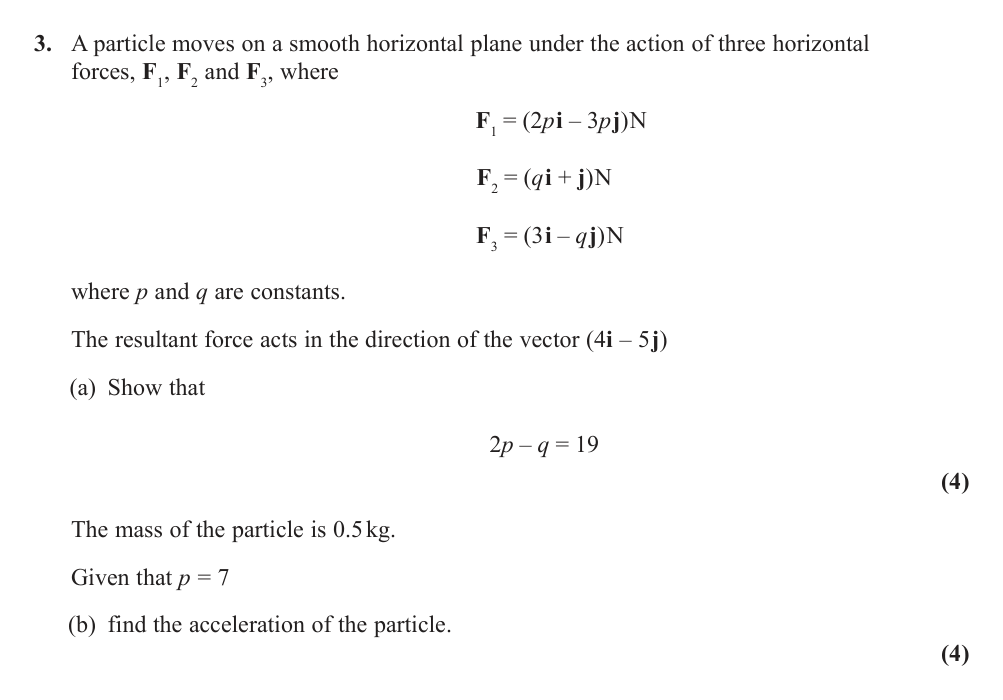
12. WME01/01 January 2026 · Q3

Medium8 marks · main topic: Forces
WME01/01 January 2026 Question 3 (8 marks): Working with Vectors
Show worked solution
  1. Add the three forces

    The resultant force is $(2p\mathbf{i}-3p\mathbf{j})+(q\mathbf{i}+\mathbf{j})+(3\mathbf{i}-q\mathbf{j})=(2p+q+3)\mathbf{i}+(-3p+1-q)\mathbf{j}$.

  2. Use the direction vector

    The resultant acts in the direction $4\mathbf{i}-5\mathbf{j}$, so the ratio of the components is the same: $\dfrac{-3p+1-q}{2p+q+3}=\dfrac{-5}{4}$.

  3. Show the required relation

    Cross-multiplying gives $4(-3p+1-q)=-5(2p+q+3)$. Therefore $-12p+4-4q=-10p-5q-15$, so $2p-q=19$.

  4. Find q when p is 7

    With $p=7$, the relation gives $14-q=19$, hence $q=-5$.

  5. Apply Newtons second law

    Substitute $p=7$ and $q=-5$ into the resultant: $\mathbf{F}=12\mathbf{i}-15\mathbf{j}$. Since the mass is $0.5$ kg, $\mathbf{F}=m\mathbf{a}$ gives $12\mathbf{i}-15\mathbf{j}=0.5\mathbf{a}$.

  6. Find the acceleration

    Dividing by $0.5$ gives $\mathbf{a}=24\mathbf{i}-30\mathbf{j}\ \mathrm{m\,s^{-2}}$.

Final answer

$(a)\ 2p-q=19.\quad (b)\ \mathbf{a}=24\mathbf{i}-30\mathbf{j}\ \mathrm{m\,s^{-2}}$.

13. WME01/01 October 2025 · Q2

Medium8 marks · main topic: Momentum, Impulse & Collisions
WME01/01 October 2025 Question 2 (8 marks): Working with Vectors
Show worked solution
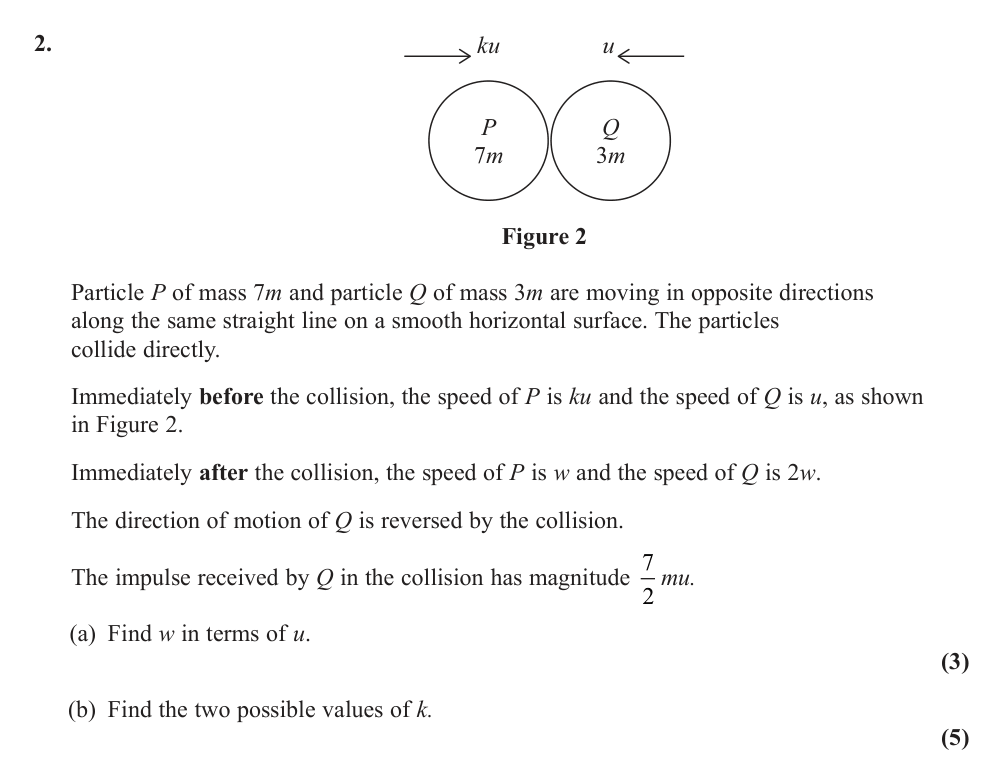
  1. Part (a): Find w in terms of u - Apply impulse-momentum theorem to Q

    $\text{Impulse} = \text{Final momentum} - \text{Initial momentum}$ For particle Q (mass = 3m): ; Initial velocity: $-u$ (moving left, negative) ; Final velocity: $+2w$ (moving right, positive) $\text{Impulse} = 3m(2w) - 3m(-u)$ $\frac{7mu}{2} = 6mw + 3mu$ $\frac{7mu}{2} = 3m(2w + u)$ $\frac{7u}{2} = 6w + 3u$ $6w = \frac{7u}{2} - 3u$ $6w = \frac{7u - 6u}{2}$ $6w = \frac{u}{2}$ $w = \frac{u}{12}$

  2. Part (b): Find the two possible values of k - Apply conservation of momentum

    $\text{Total momentum before} = \text{Total momentum after}$ Before collision: $\text{P momentum} = 7m \times ku = 7mku \text{ (right)}$ $\text{Q momentum} = 3m \times (-u) = -3mu \text{ (left)}$ $\text{Total} = 7mku - 3mu$ After collision: $\text{P momentum} = 7m \times w = 7mw \text{ (right)}$ $\text{Q momentum} = 3m \times 2w = 6mw \text{ (right)}$ $\text{Total} = 7mw + 6mw = 13mw$

  3. Part (b): Find the two possible values of k - Set up equation

    $7mku - 3mu = 13mw$ $7ku - 3u = 13w$

  4. Part (b): Find the two possible values of k - Substitute $w = \frac{u}{12}$

    $7ku - 3u = 13 \times \frac{u}{12}$ $7ku - 3u = \frac{13u}{12}$ $7ku = \frac{13u}{12} + 3u$ $7ku = \frac{13u + 36u}{12}$ $7ku = \frac{49u}{12}$ $7k = \frac{49}{12}$ $k = \frac{49}{84} = \frac{7}{12}$

  5. Part (b): Find the two possible values of k - Consider both directions for P after collision

    P could move either right (velocity = $+w$) or left (velocity = $-w$) Case 1: P moves right with velocity $+w$ Already solved: $k = \frac{7}{12}$ Case 2: P moves left with velocity $-w$ Total momentum after = $-7mw + 6mw = -mw$ $7mku - 3mu = -mw$ $7ku - 3u = -w$ $7ku - 3u = -\frac{u}{12}$ $7ku = 3u - \frac{u}{12}$ $7ku = \frac{36u - u}{12}$ $7ku = \frac{35u}{12}$ $k = \frac{35}{84} = \frac{5}{12}$

Final answer

$(a)\ w=\dfrac{u}{12}.\quad (b)\ k=\dfrac{7}{12}\ \text{or}\ k=\dfrac{5}{12}$.

14. WME01/01 January 2025 · Q1

Medium8 marks · main topic: Forces
WME01/01 January 2025 Question 1 (8 marks): Working with Vectors
Show worked solution
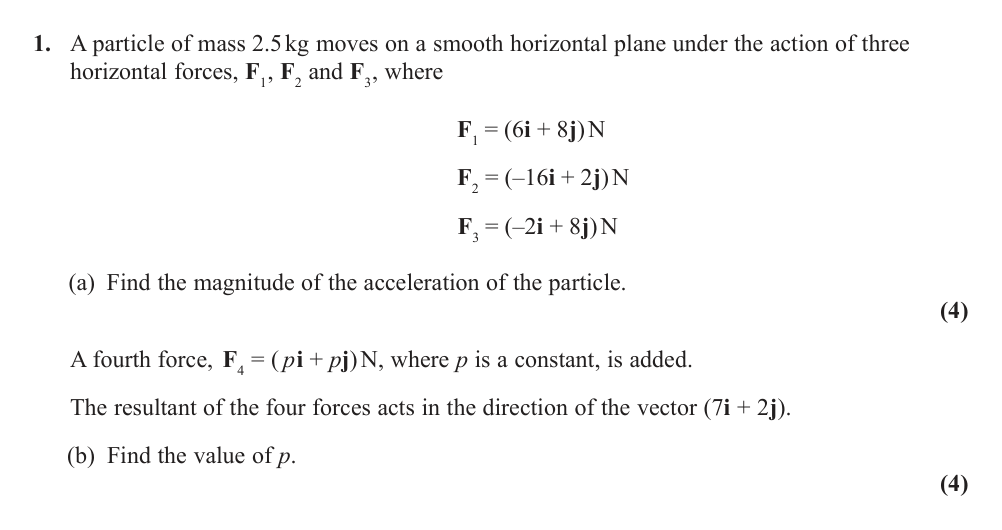
  1. Find the resultant of the first three forces

    $\mathbf{F}_1+\mathbf{F}_2+\mathbf{F}_3=(6\mathbf{i}+8\mathbf{j})+(-16\mathbf{i}+2\mathbf{j})+(-2\mathbf{i}+8\mathbf{j})=-12\mathbf{i}+18\mathbf{j}$.

  2. Apply Newtons second law

    The mass is $2.5$ kg, so $-12\mathbf{i}+18\mathbf{j}=2.5\mathbf{a}$. Hence $\mathbf{a}=-4.8\mathbf{i}+7.2\mathbf{j}\ \mathrm{m\,s^{-2}}$.

  3. Find the magnitude of the acceleration

    $|\mathbf{a}|=\sqrt{(-4.8)^2+7.2^2}=8.653\ldots$, so the magnitude is $8.7\ \mathrm{m\,s^{-2}}$ to 2 significant figures. Exactly, $|\mathbf{a}|=\dfrac{12\sqrt{13}}{5}$.

  4. Add the fourth force

    With $\mathbf{F}_4=p\mathbf{i}+p\mathbf{j}$, the new resultant is $(p-12)\mathbf{i}+(p+18)\mathbf{j}$.

  5. Use the given direction

    The resultant acts in the direction $7\mathbf{i}+2\mathbf{j}$, so $\dfrac{p-12}{p+18}=\dfrac{7}{2}$.

  6. Solve for p

    $2(p-12)=7(p+18)$, so $2p-24=7p+126$. Therefore $-150=5p$ and $p=-30$.

Final answer

$(a)\ |\mathbf{a}|=\dfrac{12\sqrt{13}}{5}\ \mathrm{m\,s^{-2}}\approx8.7\ \mathrm{m\,s^{-2}}.\quad (b)\ p=-30$.

15. WME01/01 January 2024 · Q4

Medium8 marks · main topic: Forces
WME01/01 January 2024 Question 4 (8 marks): Working with Vectors
Show worked solution
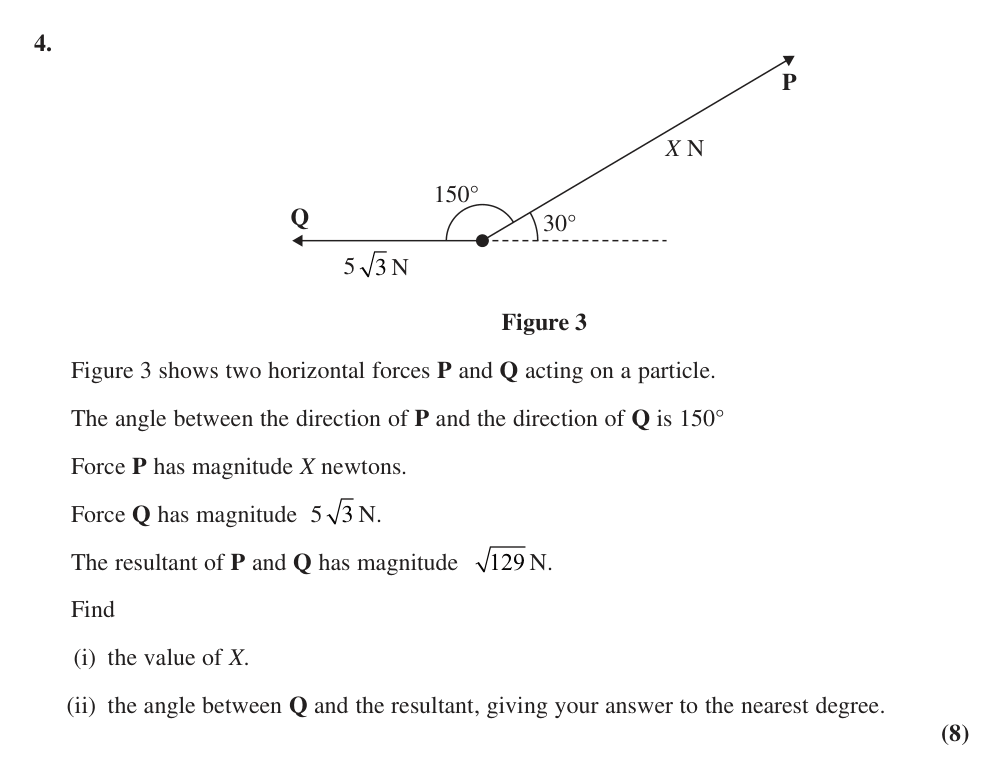
  1. Use the included angle in the force triangle

    The two given forces have angle $150^\circ$ between them, so the triangle used for adding them has the supplementary angle $30^\circ$ between the side of length $X$ and the side of length $5\sqrt3$.

  2. Use the cosine rule to find X

    The resultant has magnitude $\sqrt{129}$. Therefore $129=X^2+(5\sqrt3)^2-2X(5\sqrt3)\cos30^\circ$.

  3. Solve for X

    Since $(5\sqrt3)^2=75$ and $2(5\sqrt3)\cos30^\circ=15$, the equation becomes $129=X^2+75-15X$. Thus $X^2-15X-54=0$, giving $X=18$.

  4. Find the angle with Q

    Let $\beta$ be the angle between Q and the resultant. Using the cosine rule in the same triangle, $\dfrac{18}{\sin\beta}=\dfrac{\sqrt{129}}{\sin30^\circ}$.

  5. Choose the correct angle

    This gives an obtuse angle for $\beta$. Equivalently, $\cos\beta=\dfrac{(5\sqrt3)^2+129-18^2}{2(5\sqrt3)\sqrt{129}}$, so $\beta=127.6\ldots^\circ$.

  6. Round the angle

    To the nearest degree, the angle between Q and the resultant is $128^\circ$.

Final answer

$(i)\ X=18\ \mathrm{N}.\quad (ii)\ \text{angle}=128^\circ\ \text{to the nearest degree}$.

16. WME01/01 January 2023 · Q2

Medium8 marks · main topic: Momentum, Impulse & Collisions
WME01/01 January 2023 Question 2 (8 marks): Working with Vectors
Show worked solution
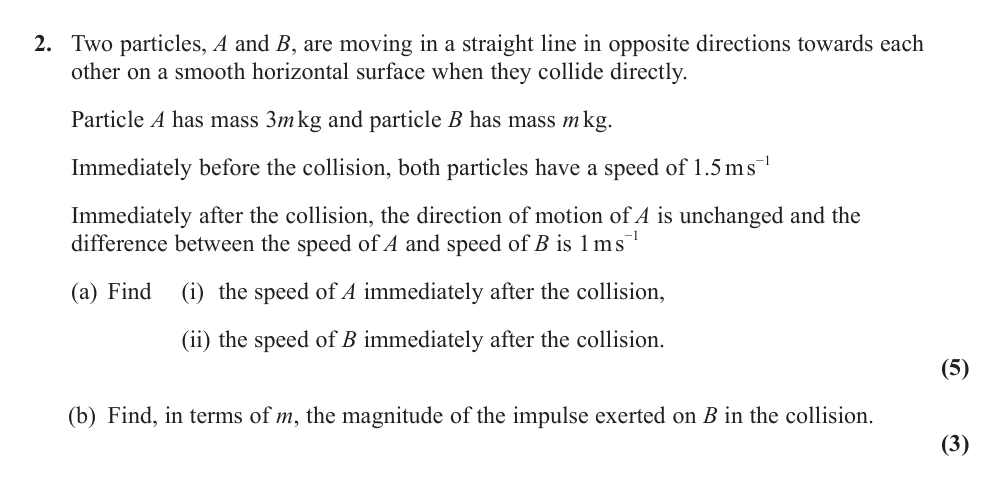
  1. Choose a positive direction

    Take the original direction of A as positive. Before the collision, A has velocity $1.5$ and B has velocity $-1.5$.

  2. Use the speed difference

    After the collision, A keeps the same direction. Let A's speed be $v$. The valid motion has B moving in A's direction with speed $v+1$.

  3. Use conservation of momentum

    $3m(1.5)+m(-1.5)=3mv+m(v+1)$.

  4. Find the two speeds

    $4.5m-1.5m=3mv+mv+m$, so $3=4v+1$. Hence $v=0.5$, and B's speed is $v+1=1.5$.

  5. Find the impulse on B

    For B, impulse equals change in momentum: $I=m(1.5-(-1.5))=3m$.

  6. State the magnitude

    The magnitude of the impulse is $3m\ \mathrm{N\,s}$.

Final answer

$(a)(i)\ \text{speed of A}=0.5\ \mathrm{m\,s^{-1}}.\quad (a)(ii)\ \text{speed of B}=1.5\ \mathrm{m\,s^{-1}}.\quad (b)\ I=3m\ \mathrm{N\,s}$.

17. WME01/01 January 2023 · Q6

Medium8 marks · main topic: Forces
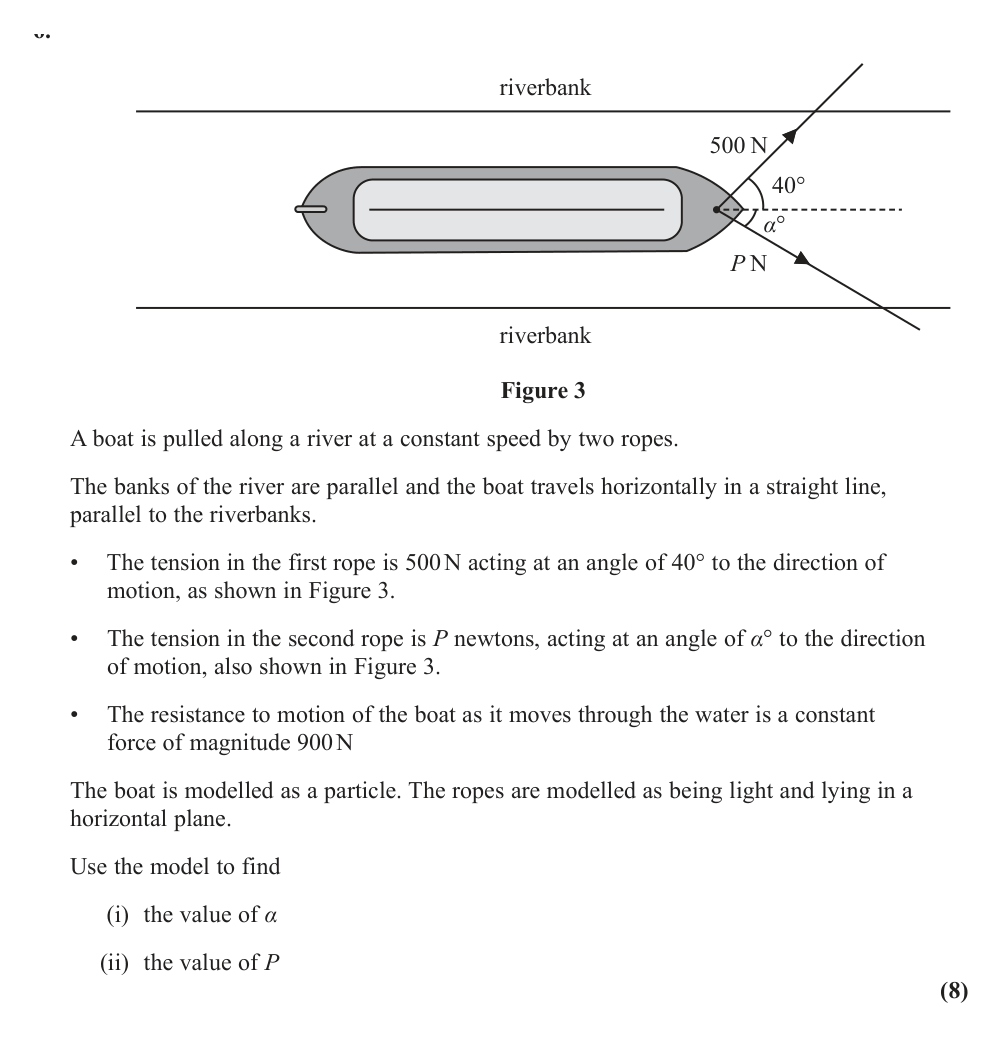
WME01/01 January 2023 Question 6 (8 marks): Working with Vectors
Show worked solution
  1. Resolve perpendicular to the motion

    The boat travels straight, so the sideways components balance: $500\sin40^\circ=P\sin\alpha$.

  2. Resolve along the motion

    The speed is constant, so the forward components balance the resistance: $500\cos40^\circ+P\cos\alpha=900$.

  3. Eliminate P

    From the two equations, $P\sin\alpha=500\sin40^\circ$ and $P\cos\alpha=900-500\cos40^\circ$.

  4. Find alpha

    Divide the sine equation by the cosine equation: $\tan\alpha=\dfrac{500\sin40^\circ}{900-500\cos40^\circ}$. This gives $\alpha=31.9^\circ$, so $\alpha=32^\circ$ approximately.

  5. Find P

    Use $P\sin\alpha=500\sin40^\circ$: $P=\dfrac{500\sin40^\circ}{\sin31.9^\circ}=608.7\ldots\ \mathrm{N}$. Hence $P\approx610\ \mathrm{N}$.

Final answer

$(i)\ \alpha=32^\circ\ \text{approximately}.\quad (ii)\ P=610\ \mathrm{N}\ \text{approximately}$.

18. WME01/01 October 2021 · Q4

Medium8 marks
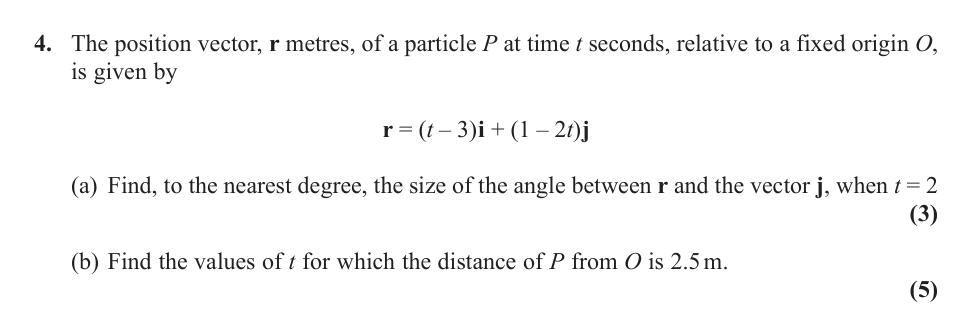
WME01/01 October 2021 Question 4 (8 marks): Working with Vectors
Show worked solution
  1. Find r when t = 2

    $\mathbf{r}=(2-3)\mathbf{i}+(1-2(2))\mathbf{j}=-\mathbf{i}-3\mathbf{j}$.

  2. Find the angle with j

    The vector is in the third quadrant. The angle between $\mathbf{r}$ and the positive $\mathbf{j}$ direction satisfies $\tan\alpha=\dfrac{1}{3}$ from the vertical comparison.

  3. State the angle

    $\alpha=18.4^\circ$ from the negative $\mathbf{j}$ direction, so the size of the angle with positive $\mathbf{j}$ is $180^\circ-18.4^\circ=161.6^\circ$, which is $162^\circ$.

  4. Use the distance condition

    Distance from O is $2.5$, so $(t-3)^2+(1-2t)^2=2.5^2$.

  5. Form the quadratic

    $t^2-6t+9+1-4t+4t^2=6.25$, so $5t^2-10t+3.75=0$.

  6. Solve

    Multiply by $4$: $20t^2-40t+15=0$, or $4t^2-8t+3=0$. Hence $(2t-1)(2t-3)=0$, so $t=\dfrac12$ or $t=\dfrac32$.

Final answer

$(a)\ 162^\circ.\quad (b)\ t=\dfrac12\ \text{or}\ t=\dfrac32$.

19. WME01/01 May/June 2023 · Q8

Hard9 marks
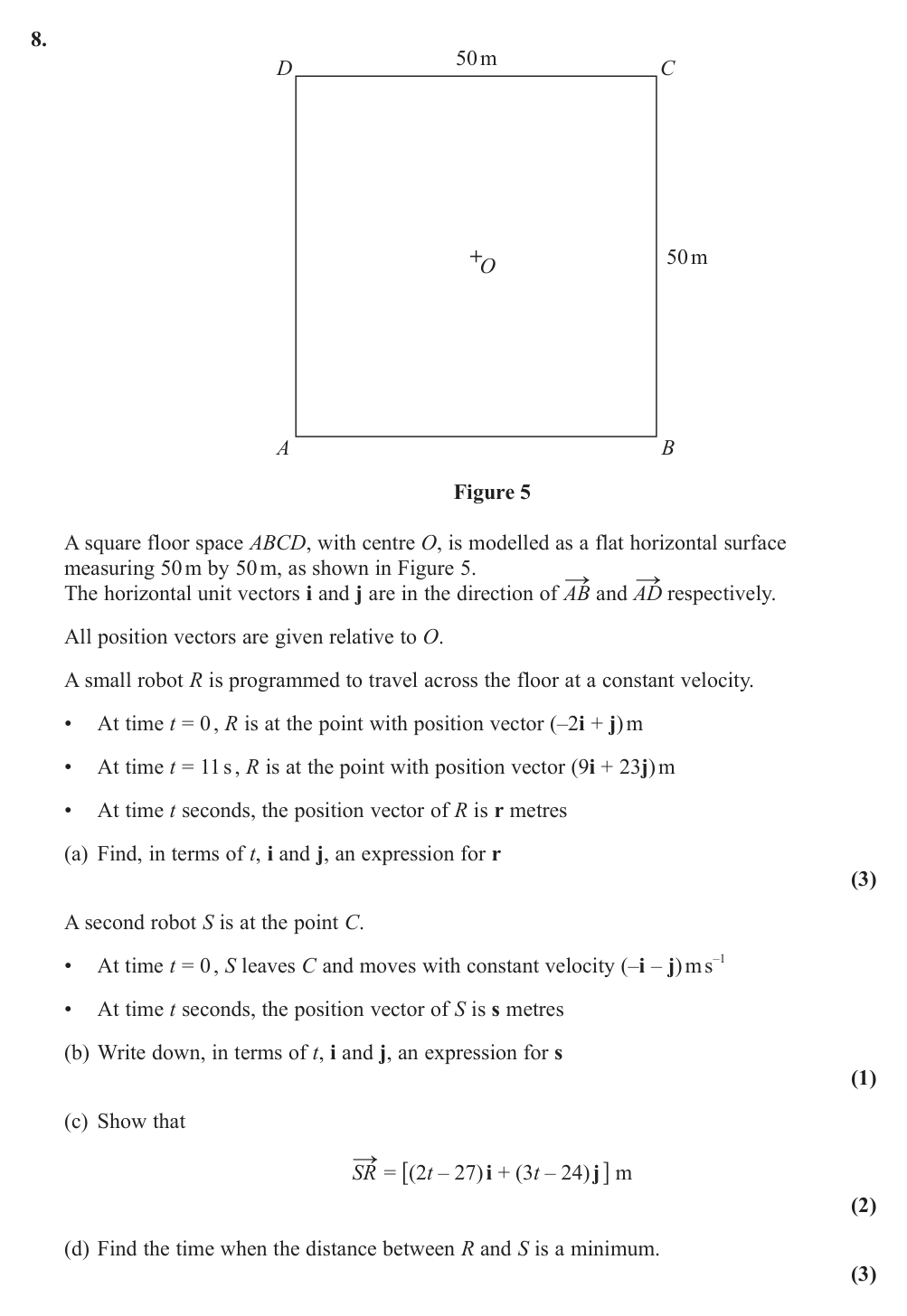
WME01/01 May/June 2023 Question 8 (9 marks): Working with Vectors
Show worked solution
  1. Find the velocity of R

    R moves from $-2\mathbf{i}+\mathbf{j}$ to $9\mathbf{i}+23\mathbf{j}$ in $11$ s. Its displacement is $11\mathbf{i}+22\mathbf{j}$, so its velocity is $\mathbf{i}+2\mathbf{j}$.

  2. Write r

    $\mathbf{r}=(-2\mathbf{i}+\mathbf{j})+t(\mathbf{i}+2\mathbf{j})=(t-2)\mathbf{i}+(2t+1)\mathbf{j}$.

  3. Write s

    Point C has position vector $25\mathbf{i}+25\mathbf{j}$. Since S moves with velocity $-\mathbf{i}-\mathbf{j}$, $\mathbf{s}=(25-t)\mathbf{i}+(25-t)\mathbf{j}$.

  4. Find SR vector

    $\overrightarrow{SR}=\mathbf{r}-\mathbf{s}=[(t-2)-(25-t)]\mathbf{i}+[(2t+1)-(25-t)]\mathbf{j}$.

  5. Simplify SR

    Therefore $\overrightarrow{SR}=(2t-27)\mathbf{i}+(3t-24)\mathbf{j}$ m.

  6. Minimise the distance squared

    The distance squared is $d^2=(2t-27)^2+(3t-24)^2$.

  7. Expand the quadratic

    $d^2=4t^2-108t+729+9t^2-144t+576=13t^2-252t+1305$.

  8. Find the minimum time

    The quadratic is minimum at $t=\dfrac{252}{2\cdot13}=\dfrac{126}{13}=9.69\ldots$ s.

Final answer

$(a)\ \mathbf{r}=(t-2)\mathbf{i}+(2t+1)\mathbf{j}.\quad (b)\ \mathbf{s}=(25-t)\mathbf{i}+(25-t)\mathbf{j}.\quad (c)\ \overrightarrow{SR}=(2t-27)\mathbf{i}+(3t-24)\mathbf{j}.\quad (d)\ t=\dfrac{126}{13}\ \mathrm{s}\approx9.7\ \mathrm{s}$.

20. WME01/01 October 2022 · Q6

Hard9 marks
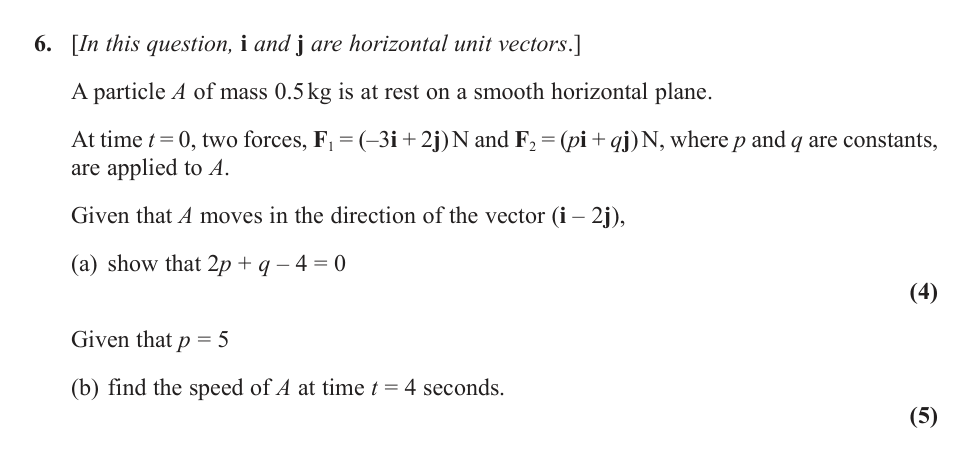
WME01/01 October 2022 Question 6 (9 marks): Working with Vectors
Show worked solution
  1. Find the resultant force

    $\mathbf{F}=(-3\mathbf{i}+2\mathbf{j})+(p\mathbf{i}+q\mathbf{j})=(p-3)\mathbf{i}+(q+2)\mathbf{j}$.

  2. Use the direction of motion

    Since the particle starts from rest, its motion is in the direction of the resultant force. This direction is $\mathbf{i}-2\mathbf{j}$, so $\dfrac{q+2}{p-3}=-2$.

  3. Show the relation

    $q+2=-2(p-3)=-2p+6$, hence $2p+q-4=0$.

  4. Find q when p = 5

    Substitute $p=5$ into $2p+q-4=0$: $10+q-4=0$, so $q=-6$.

  5. Find the resultant force

    The resultant force is $(5-3)\mathbf{i}+(-6+2)\mathbf{j}=2\mathbf{i}-4\mathbf{j}$ N.

  6. Find acceleration

    The mass is $0.5$ kg, so $\mathbf{a}=\dfrac{2\mathbf{i}-4\mathbf{j}}{0.5}=4\mathbf{i}-8\mathbf{j}$.

  7. Find velocity at t = 4

    Starting from rest, $\mathbf{v}=\mathbf{a}t=(4\mathbf{i}-8\mathbf{j})4=16\mathbf{i}-32\mathbf{j}$.

  8. Find the speed

    Speed $=\sqrt{16^2+(-32)^2}=\sqrt{1280}=16\sqrt5\ \mathrm{m\,s^{-1}}$, about $36\ \mathrm{m\,s^{-1}}$.

Final answer

$(a)\ 2p+q-4=0.\quad (b)\ \text{speed}=16\sqrt5\ \mathrm{m\,s^{-1}}\approx36\ \mathrm{m\,s^{-1}}$.

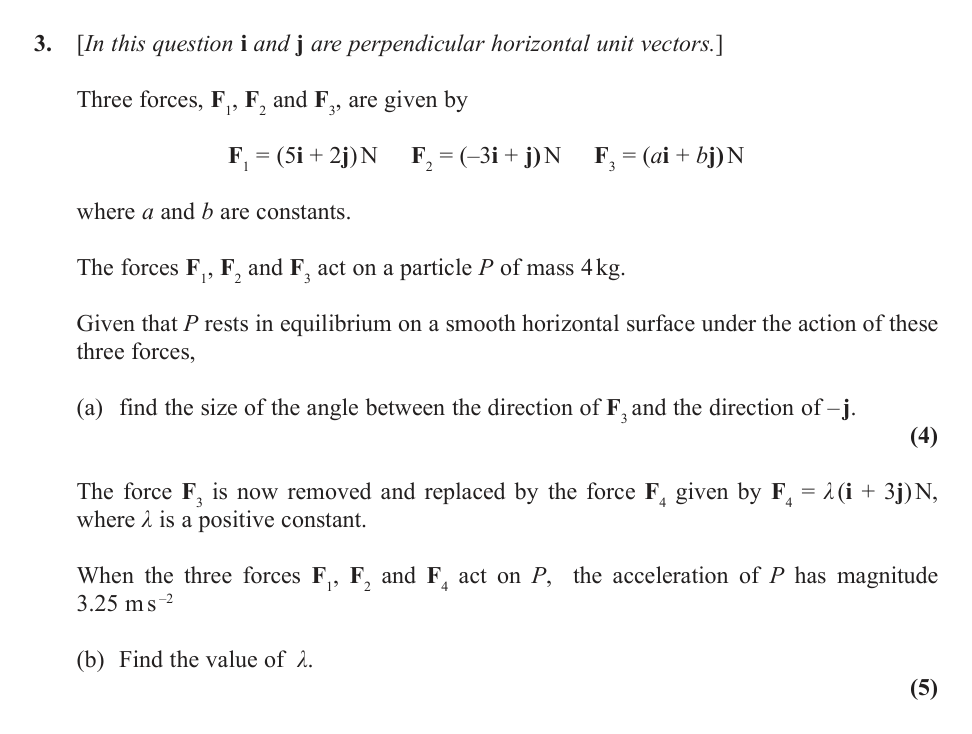
21. WME01/01 May/June 2021 · Q3

Hard9 marks
WME01/01 May/June 2021 Question 3 (9 marks): Working with Vectors
Show worked solution
  1. Find F3 from equilibrium

    Equilibrium gives $\mathbf{F}_1+\mathbf{F}_2+\mathbf{F}_3=\mathbf{0}$. Now $\mathbf{F}_1+\mathbf{F}_2=(5\mathbf{i}+2\mathbf{j})+(-3\mathbf{i}+\mathbf{j})=2\mathbf{i}+3\mathbf{j}$.

  2. Write F3

    So $\mathbf{F}_3=-2\mathbf{i}-3\mathbf{j}$.

  3. Find the angle with -j

    The vector $-\mathbf{j}$ points vertically downward. For $\mathbf{F}_3=-2\mathbf{i}-3\mathbf{j}$, the angle from $-\mathbf{j}$ satisfies $\tan\theta=\dfrac{2}{3}$.

  4. State the angle

    $\theta=33.7^\circ$, so the angle is about $34^\circ$.

  5. Find the new resultant force

    With $\mathbf{F}_4=\lambda(\mathbf{i}+3\mathbf{j})$, the resultant is $(2+\lambda)\mathbf{i}+(3+3\lambda)\mathbf{j}$.

  6. Use the acceleration magnitude

    The mass is $4$ kg and acceleration magnitude is $3.25$, so the resultant force magnitude is $4(3.25)=13$ N.

  7. Form the equation

    $(2+\lambda)^2+(3+3\lambda)^2=13^2$.

  8. Solve for lambda

    Expanding gives $10\lambda^2+22\lambda-156=0$. The roots are $3$ and $-5.2$, and since $\lambda$ is positive, $\lambda=3$.

Final answer

$(a)\ 34^\circ\ \text{approximately}.\quad (b)\ \lambda=3$.

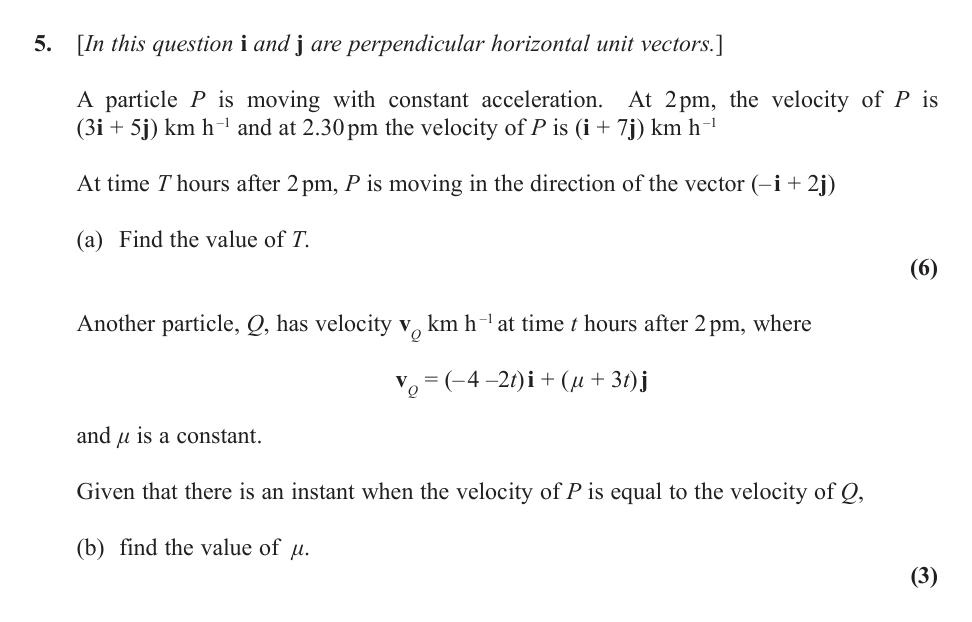
22. WME01/01 May/June 2021 · Q5

Hard9 marks
WME01/01 May/June 2021 Question 5 (9 marks): Working with Vectors
Show worked solution
  1. Find P acceleration

    From 2:00 to 2:30 is $0.5$ hours. The velocity changes from $3\mathbf{i}+5\mathbf{j}$ to $\mathbf{i}+7\mathbf{j}$.

  2. Calculate acceleration

    $\mathbf{a}=\dfrac{(\mathbf{i}+7\mathbf{j})-(3\mathbf{i}+5\mathbf{j})}{0.5}=-4\mathbf{i}+4\mathbf{j}$.

  3. Write P velocity

    At time $t$ hours after 2:00, $\mathbf{v}_P=(3-4t)\mathbf{i}+(5+4t)\mathbf{j}$.

  4. Use the direction vector

    At time $T$, the velocity is parallel to $-\mathbf{i}+2\mathbf{j}$, so $\dfrac{5+4T}{3-4T}=\dfrac{2}{-1}=-2$.

  5. Find T

    $5+4T=-2(3-4T)=-6+8T$. Hence $11=4T$ and $T=\dfrac{11}{4}$ hours.

  6. Equate i-components for P and Q

    For equal velocities, $3-4t=-4-2t$. This gives $7=2t$, so $t=3.5$.

  7. Equate j-components

    At $t=3.5$, P's j-component is $5+4(3.5)=19$. Q's j-component is $\mu+3(3.5)=\mu+10.5$.

  8. Find mu

    $\mu+10.5=19$, so $\mu=8.5$.

Final answer

$(a)\ T=\dfrac{11}{4}\ \mathrm{h}.\quad (b)\ \mu=8.5$.

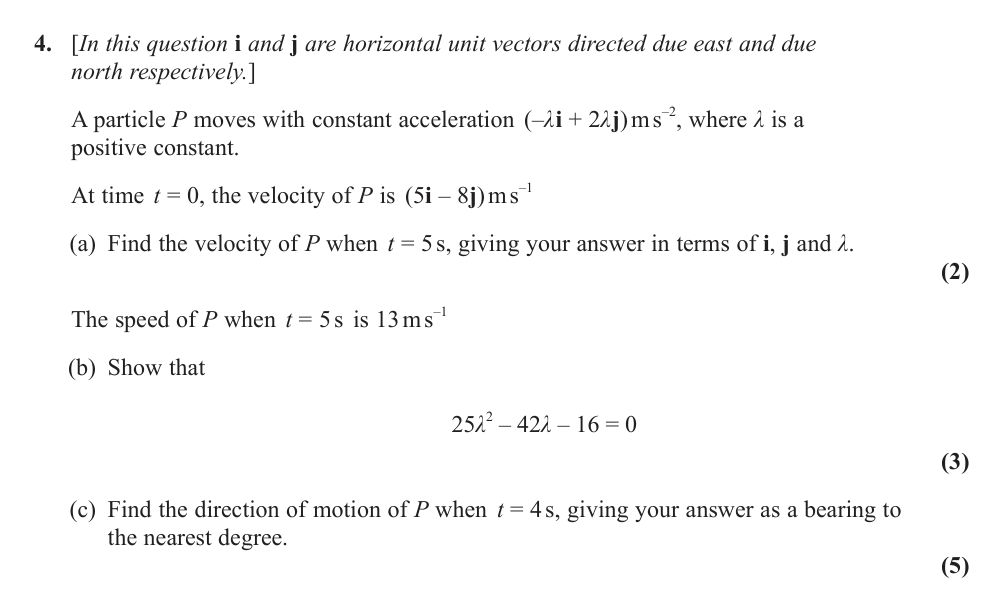
23. WME01/01 October 2023 · Q4

Hard10 marks
WME01/01 October 2023 Question 4 (10 marks): Working with Vectors
Show worked solution
  1. Use v = u + at

    The initial velocity is $(5\mathbf{i}-8\mathbf{j})$ and the acceleration is $(-\lambda\mathbf{i}+2\lambda\mathbf{j})$. At $t=5$, $\mathbf{v}=(5\mathbf{i}-8\mathbf{j})+5(-\lambda\mathbf{i}+2\lambda\mathbf{j})$.

  2. Write the velocity at t = 5

    So $\mathbf{v}=(5-5\lambda)\mathbf{i}+(-8+10\lambda)\mathbf{j}$.

  3. Use the speed at t = 5

    The speed is $13$, so $(5-5\lambda)^2+(-8+10\lambda)^2=13^2$.

  4. Simplify to the printed equation

    Expanding gives $25-50\lambda+25\lambda^2+64-160\lambda+100\lambda^2=169$. Therefore $125\lambda^2-210\lambda-80=0$, and dividing by $5$ gives $25\lambda^2-42\lambda-16=0$.

  5. Find lambda

    Solving $25\lambda^2-42\lambda-16=0$ gives $\lambda=2$ or $\lambda=-\dfrac{8}{25}$. Since $\lambda$ is positive, $\lambda=2$.

  6. Find the velocity at t = 4

    $\mathbf{v}(4)=(5\mathbf{i}-8\mathbf{j})+4(-2\mathbf{i}+4\mathbf{j})=-3\mathbf{i}+8\mathbf{j}$.

  7. Convert to a bearing

    The motion is north-west. The angle west of north satisfies $\tan\alpha=\dfrac{3}{8}$, so $\alpha=20.6^\circ$. The bearing is $360^\circ-20.6^\circ=339.4^\circ$, so $339^\circ$ to the nearest degree.

Final answer

$(a)\ \mathbf{v}=(5-5\lambda)\mathbf{i}+(-8+10\lambda)\mathbf{j}$. $(b)\ 25\lambda^2-42\lambda-16=0$. $(c)\ \text{bearing}=339^\circ$.

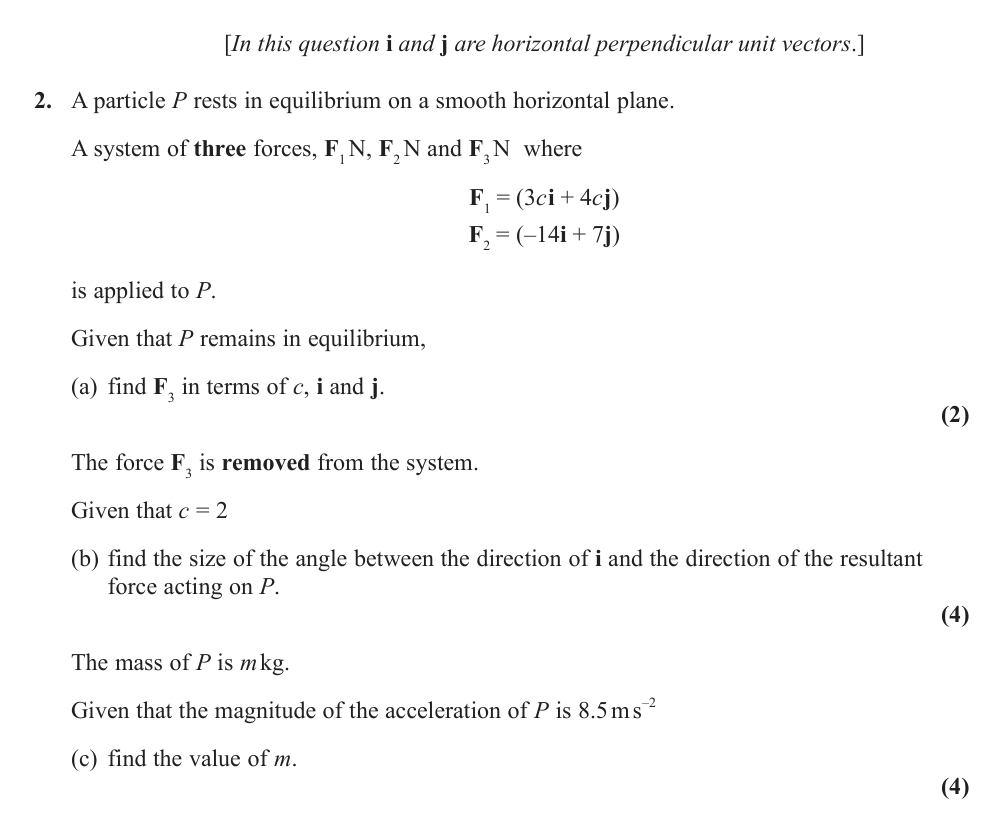
24. WME01/01 May/June 2023 · Q2

Hard10 marks
WME01/01 May/June 2023 Question 2 (10 marks): Working with Vectors
Show worked solution
  1. Use equilibrium

    For equilibrium, $\mathbf{F}_1+\mathbf{F}_2+\mathbf{F}_3=\mathbf{0}$. Hence $\mathbf{F}_3=-(\mathbf{F}_1+\mathbf{F}_2)$.

  2. Find F3

    $\mathbf{F}_1+\mathbf{F}_2=(3c-14)\mathbf{i}+(4c+7)\mathbf{j}$, so $\mathbf{F}_3=(14-3c)\mathbf{i}+(-7-4c)\mathbf{j}$.

  3. Find the resultant when c = 2

    When $c=2$, $\mathbf{F}_1=6\mathbf{i}+8\mathbf{j}$ and $\mathbf{F}_2=-14\mathbf{i}+7\mathbf{j}$. Therefore the resultant is $-8\mathbf{i}+15\mathbf{j}$.

  4. Find the angle

    The resultant is in the second quadrant. Its angle from the positive $\mathbf{i}$ direction is $180^\circ-\tan^{-1}\left(\dfrac{15}{8}\right)=118.1^\circ$, so the angle is about $118^\circ$.

  5. Find the magnitude of the resultant

    $|\mathbf{R}|=\sqrt{(-8)^2+15^2}=17\ \mathrm{N}$.

  6. Use F = ma

    The acceleration magnitude is $8.5\ \mathrm{m\,s^{-2}}$, so $17=8.5m$. Hence $m=2$.

Final answer

$(a)\ \mathbf{F}_3=(14-3c)\mathbf{i}+(-7-4c)\mathbf{j}.\quad (b)\ 118^\circ\ \text{approximately}.\quad (c)\ m=2$.

25. WME01/01 January 2023 · Q3

Hard10 marks
WME01/01 January 2023 Question 3 (10 marks): Working with Vectors
Show worked solution
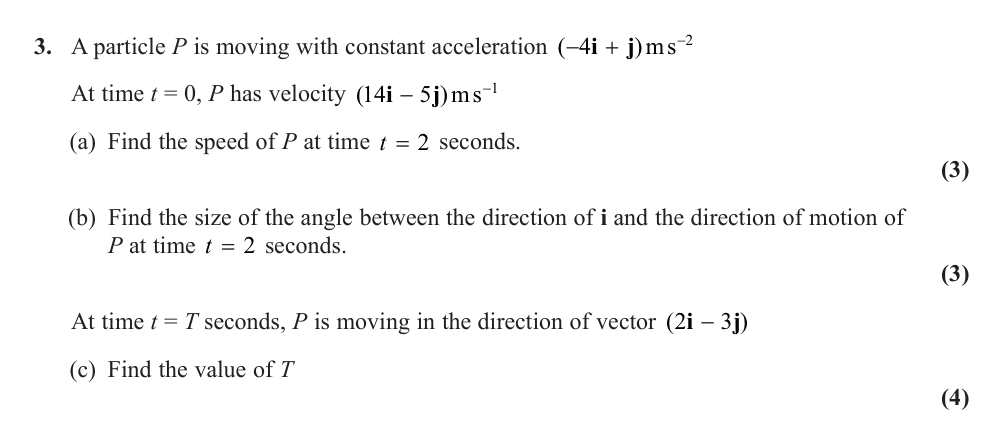
  1. Find the velocity at t = 2

    $\mathbf{v}=(14\mathbf{i}-5\mathbf{j})+2(-4\mathbf{i}+\mathbf{j})=6\mathbf{i}-3\mathbf{j}$.

  2. Find the speed

    The speed is $\sqrt{6^2+(-3)^2}=\sqrt{45}=3\sqrt5\ \mathrm{m\,s^{-1}}$.

  3. Find the angle with i

    The velocity $6\mathbf{i}-3\mathbf{j}$ is below the positive $\mathbf{i}$ direction. The acute angle satisfies $\tan\theta=\dfrac{3}{6}$.

  4. State the angle

    $\theta=26.6^\circ$, so the size of the angle is $27^\circ$ to the nearest degree.

  5. Write the velocity at time T

    $\mathbf{v}(T)=(14-4T)\mathbf{i}+(-5+T)\mathbf{j}$.

  6. Use the given direction

    The direction is parallel to $2\mathbf{i}-3\mathbf{j}$, so the component ratio must match: $\dfrac{14-4T}{2}=\dfrac{-5+T}{-3}$.

  7. Solve for T

    $-3(14-4T)=2(-5+T)$, so $-42+12T=-10+2T$. Hence $10T=32$ and $T=3.2$.

Final answer

$(a)\ 3\sqrt5\ \mathrm{m\,s^{-1}}\approx6.7\ \mathrm{m\,s^{-1}}.\quad (b)\ 27^\circ.\quad (c)\ T=3.2$.

26. WME01/01 January 2020 · Q5

Hard10 marks · main topic: Kinematics Graphs
WME01/01 January 2020 Question 5 (10 marks): Working with Vectors
Show worked solution
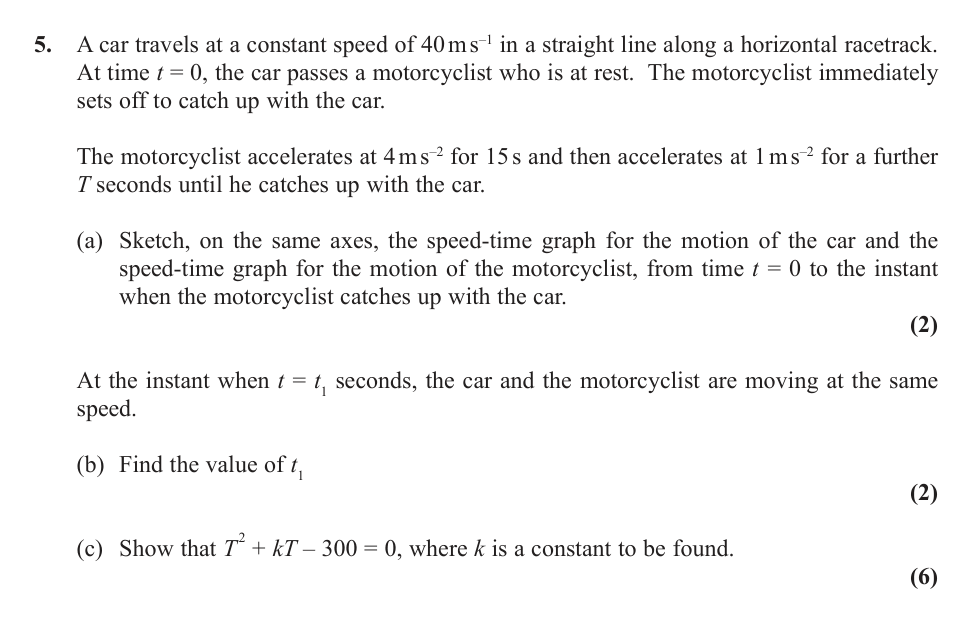
  1. Describe the graph

    The car's graph is a horizontal line at $40\ \mathrm{m\,s^{-1}}$. The motorcyclist's graph starts at zero, rises with gradient $4$ until $t=15$, then rises with smaller gradient $1$ for a further $T$ seconds.

  2. Find the equal-speed time

    Before $t=15$, the motorcyclist's speed is $4t$. Set this equal to the car's speed: $4t_1=40$, so $t_1=10$ s.

  3. Find the motorcyclist's speed at 15 seconds

    After the first $15$ seconds, the motorcyclist's speed is $4(15)=60\ \mathrm{m\,s^{-1}}$.

  4. Find the final speed at catch-up

    During the next $T$ seconds the acceleration is $1\ \mathrm{m\,s^{-2}}$, so the speed at catch-up is $60+T$.

  5. Equate distances

    Motorcyclist distance $=\dfrac12(15)(60)+\dfrac12[60+(60+T)]T$. Car distance $=40(15+T)$.

  6. Simplify the equation

    $450+60T+\dfrac12T^2=600+40T$. Hence $\dfrac12T^2+20T-150=0$, so $T^2+40T-300=0$ and $k=40$.

Final answer

$(a)$ Car: horizontal line at $40$; motorcyclist: two rising straight-line sections ending at the catch-up time. $(b)\ t_1=10\ \mathrm{s}.\quad (c)\ T^2+40T-300=0$, so $k=40$.

27. WME01/01 October 2024 · Q3

Hard11 marks
WME01/01 October 2024 Question 3 (11 marks): Working with Vectors
Show worked solution
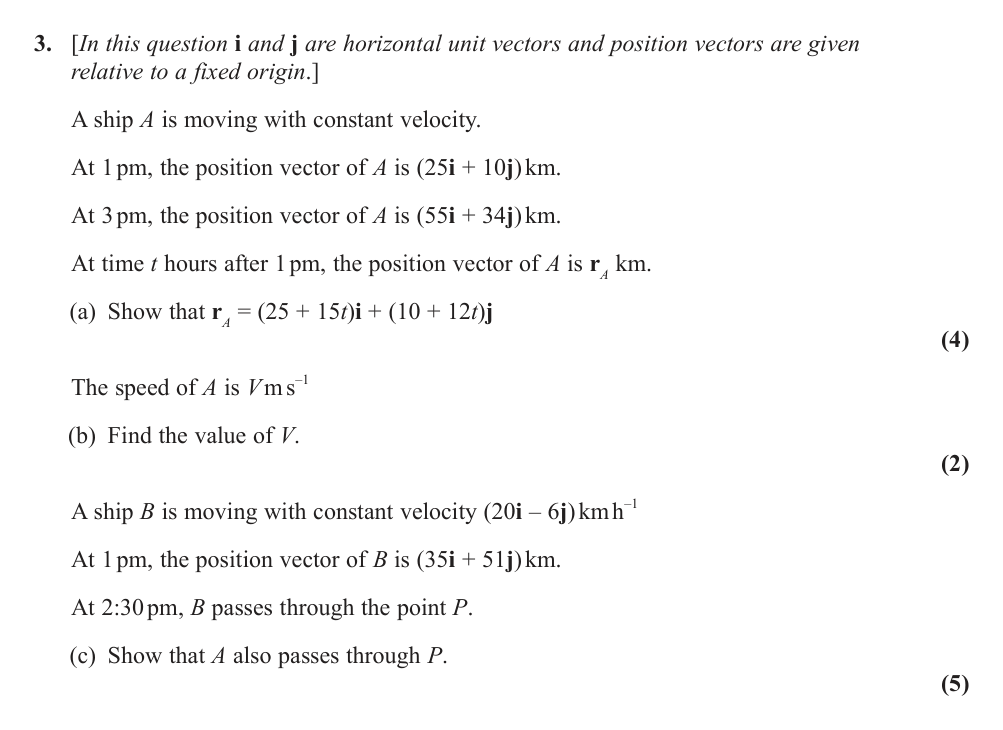
  1. Find the velocity of A

    From 1 pm to 3 pm is 2 hours. The displacement of A is $(55\mathbf{i}+34\mathbf{j})-(25\mathbf{i}+10\mathbf{j})=30\mathbf{i}+24\mathbf{j}$ km, so $\mathbf{v}_A=15\mathbf{i}+12\mathbf{j}\ \mathrm{km\,h^{-1}}$.

  2. Write the position vector of A

    At time $t$ hours after 1 pm, $\mathbf{r}_A=(25\mathbf{i}+10\mathbf{j})+t(15\mathbf{i}+12\mathbf{j})=(25+15t)\mathbf{i}+(10+12t)\mathbf{j}$.

  3. Convert the speed to metres per second

    The speed of A is $\sqrt{15^2+12^2}=\sqrt{369}\ \mathrm{km\,h^{-1}}$. Converting to $\mathrm{m\,s^{-1}}$, $V=\sqrt{369}\times\dfrac{1000}{3600}=\dfrac{5\sqrt{41}}{6}\ \mathrm{m\,s^{-1}}$.

  4. Find the point P reached by B

    At 2:30 pm, $t=1.5$ hours after 1 pm. For B, $\mathbf{r}_B=(35\mathbf{i}+51\mathbf{j})+1.5(20\mathbf{i}-6\mathbf{j})=65\mathbf{i}+42\mathbf{j}$.

  5. Check whether A reaches P

    Set $\mathbf{r}_A=65\mathbf{i}+42\mathbf{j}$. From the i-component, $25+15t=65$, so $t=\dfrac{8}{3}$.

  6. Confirm with the j-component

    When $t=\dfrac{8}{3}$, $10+12t=10+32=42$. Both components match, so A also passes through P.

Final answer

$(a)\ \mathbf{r}_A=(25+15t)\mathbf{i}+(10+12t)\mathbf{j}.\quad (b)\ V=\dfrac{5\sqrt{41}}{6}\ \mathrm{m\,s^{-1}}\approx5.3\ \mathrm{m\,s^{-1}}.\quad (c)\ A\ \text{also passes through }P$.

28. WME01/01 January 2024 · Q7

Hard11 marks
WME01/01 January 2024 Question 7 (11 marks): Working with Vectors
Show worked solution
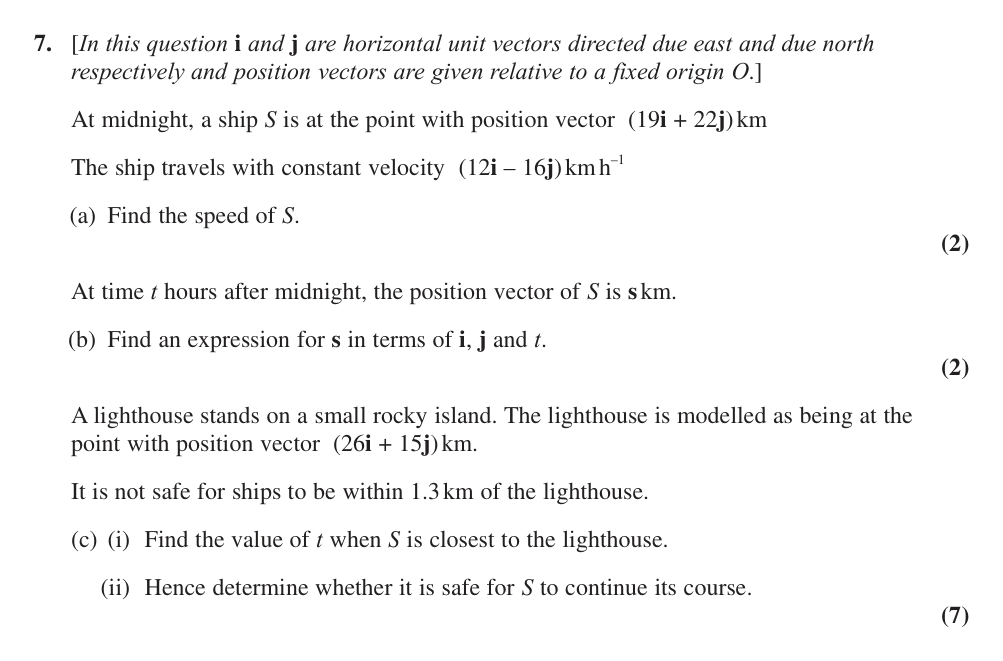
  1. Find the speed

    The velocity is $12\mathbf{i}-16\mathbf{j}$, so the speed is $\sqrt{12^2+(-16)^2}=20\ \mathrm{km\,h^{-1}}$.

  2. Write the ship position vector

    At time $t$ hours after midnight, $\mathbf{s}=(19\mathbf{i}+22\mathbf{j})+t(12\mathbf{i}-16\mathbf{j})=(19+12t)\mathbf{i}+(22-16t)\mathbf{j}$.

  3. Form the vector from lighthouse to ship

    The lighthouse is at $26\mathbf{i}+15\mathbf{j}$. Therefore $\overrightarrow{LS}=\mathbf{s}-\mathbf{l}=(12t-7)\mathbf{i}+(7-16t)\mathbf{j}$.

  4. Use distance squared

    The square of the distance is $d^2=(12t-7)^2+(7-16t)^2=400t^2-392t+98$.

  5. Find the time of closest approach

    This quadratic is minimum when $t=\dfrac{392}{2\cdot400}=0.49$.

  6. Find the minimum distance

    At $t=0.49$, $d^2=1.96$, so $d=1.4\ \mathrm{km}$.

  7. Decide if the course is safe

    The unsafe distance is $1.3$ km. Since $1.4>1.3$, it is safe for the ship to continue its course.

Final answer

$(a)\ 20\ \mathrm{km\,h^{-1}}.\quad (b)\ \mathbf{s}=(19+12t)\mathbf{i}+(22-16t)\mathbf{j}.\quad (c)(i)\ t=0.49.\quad (c)(ii)\ \text{minimum distance}=1.4\ \mathrm{km},\ \text{so it is safe}$.

29. WME01/01 January 2020 · Q6

Hard11 marks
WME01/01 January 2020 Question 6 (11 marks): Working with Vectors
Show worked solution
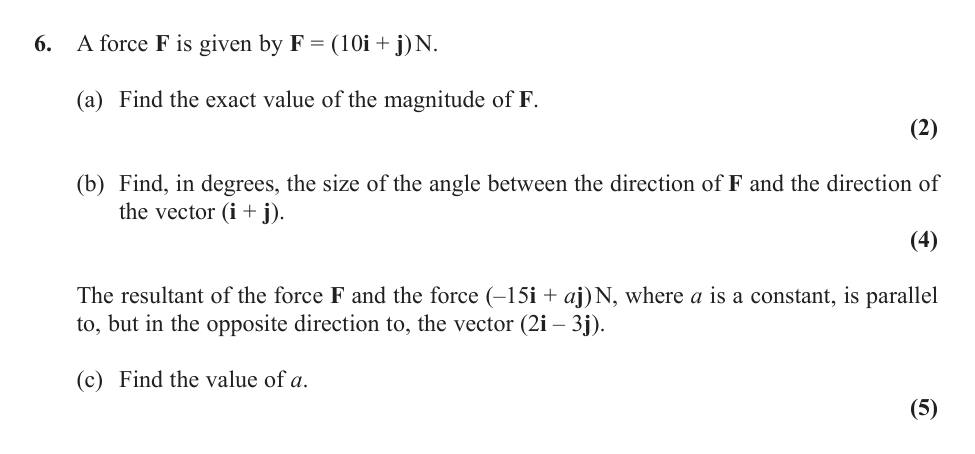
  1. Find the magnitude

    For $\mathbf F=10\mathbf i+\mathbf j$, $|\mathbf F|=\sqrt{10^2+1^2}=\sqrt{101}$ N.

  2. Find the direction angle of F

    The angle that $\mathbf F$ makes with the positive $\mathbf i$ direction is $\alpha$, where $\tan\alpha=\dfrac{1}{10}$. Thus $\alpha=5.71^\circ$ approximately.

  3. Compare with i plus j

    The vector $\mathbf i+\mathbf j$ makes an angle of $45^\circ$ with the positive $\mathbf i$ direction.

  4. Find the angle between the vectors

    So the required angle is $45^\circ-5.71^\circ=39.29^\circ$, approximately $39.3^\circ$.

  5. Write the resultant

    The resultant of $10\mathbf i+\mathbf j$ and $-15\mathbf i+a\mathbf j$ is $-5\mathbf i+(a+1)\mathbf j$.

  6. Use the parallel opposite direction

    Parallel but opposite to $2\mathbf i-3\mathbf j$ means the resultant is a positive multiple of $-2\mathbf i+3\mathbf j$.

  7. Solve for a

    Let $-5\mathbf i+(a+1)\mathbf j=\lambda(-2\mathbf i+3\mathbf j)$. From the $\mathbf i$ component, $-5=-2\lambda$, so $\lambda=2.5$. Then $a+1=3(2.5)=7.5$, hence $a=6.5$.

Final answer

$(a)\ |\mathbf F|=\sqrt{101}\ \mathrm{N}.\quad (b)\ 39.3^\circ\text{ approximately}.\quad (c)\ a=6.5$.

30. WME01/01 January 2022 · Q6

Hard12 marks
WME01/01 January 2022 Question 6 (12 marks): Working with Vectors
Show worked solution
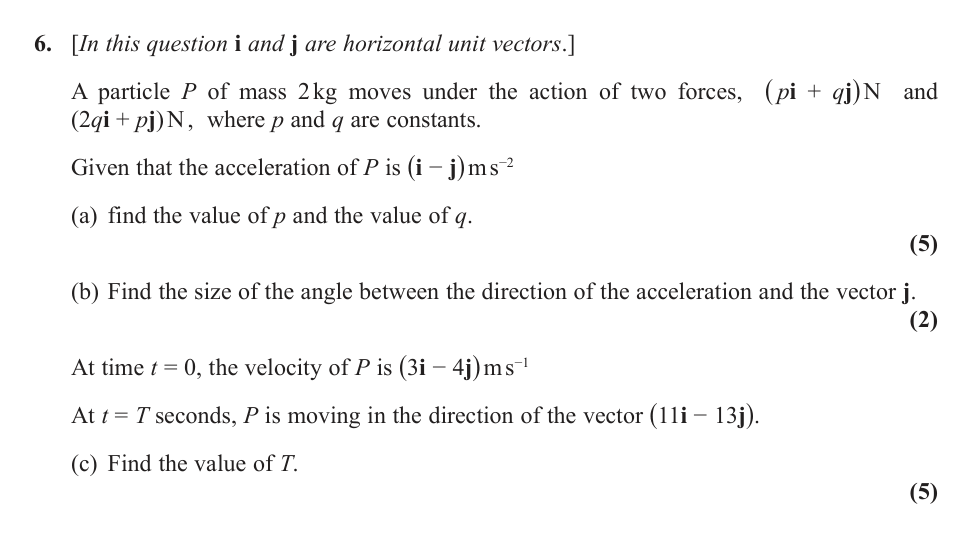
  1. Use F = ma

    The total force is $(p\mathbf{i}+q\mathbf{j})+(2q\mathbf{i}+p\mathbf{j})=(p+2q)\mathbf{i}+(p+q)\mathbf{j}$. Since the mass is $2$ kg and acceleration is $\mathbf{i}-\mathbf{j}$, the total force is $2\mathbf{i}-2\mathbf{j}$.

  2. Equate components

    $p+2q=2$ and $p+q=-2$.

  3. Find p and q

    Subtract the equations to get $q=4$. Then $p+4=-2$, so $p=-6$.

  4. Find the angle with j

    The acceleration is $\mathbf{i}-\mathbf{j}$. Its dot product with $\mathbf{j}$ is $-1$, so the angle with the positive $\mathbf{j}$ direction is obtuse. Since the components are equal in magnitude, the angle is $135^\circ$.

  5. Write the velocity at time T

    $\mathbf{v}=(3\mathbf{i}-4\mathbf{j})+T(\mathbf{i}-\mathbf{j})=(3+T)\mathbf{i}+(-4-T)\mathbf{j}$.

  6. Use the direction vector

    The velocity is parallel to $11\mathbf{i}-13\mathbf{j}$, so $\dfrac{3+T}{11}=\dfrac{-4-T}{-13}$.

  7. Solve for T

    $13(3+T)=11(4+T)$, so $39+13T=44+11T$. Hence $2T=5$ and $T=2.5$.

Final answer

$(a)\ p=-6,\ q=4.\quad (b)\ 135^\circ.\quad (c)\ T=2.5$.

31. WME01/01 October 2021 · Q8

Hard12 marks
WME01/01 October 2021 Question 8 (12 marks): Working with Vectors
Show worked solution
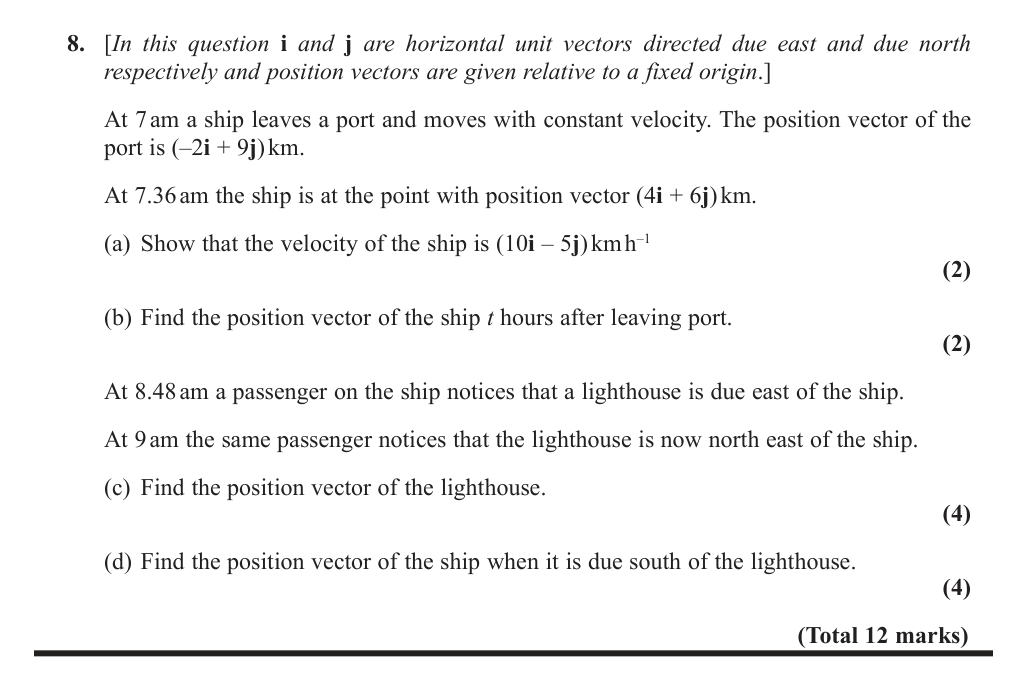
  1. Convert the time

    From 7:00 to 7:36 is $36$ minutes, which is $0.6$ hours.

  2. Find velocity

    Displacement $=(4\mathbf{i}+6\mathbf{j})-(-2\mathbf{i}+9\mathbf{j})=6\mathbf{i}-3\mathbf{j}$. Divide by $0.6$: $\mathbf{v}=10\mathbf{i}-5\mathbf{j}$.

  3. Write the ship position

    $\mathbf{r}=(-2\mathbf{i}+9\mathbf{j})+t(10\mathbf{i}-5\mathbf{j})=(-2+10t)\mathbf{i}+(9-5t)\mathbf{j}$.

  4. Use 8:48

    At 8:48, $t=1.8$. The ship position is $(-2+18)\mathbf{i}+(9-9)\mathbf{j}=16\mathbf{i}$. The lighthouse is due east, so it has the same j-component, $0$.

  5. Use 9:00

    At 9:00, $t=2$. The ship position is $18\mathbf{i}-\mathbf{j}$. The lighthouse is north-east of the ship, so its east and north displacements from the ship are equal.

  6. Find the lighthouse position

    Since the lighthouse has j-component $0$, from $18\mathbf{i}-\mathbf{j}$ it is $1$ km north, so it is also $1$ km east. Hence its position is $19\mathbf{i}$.

  7. Find when the ship is due south

    Due south of the lighthouse means the ship has i-component $19$. Set $-2+10t=19$, so $t=2.1$.

  8. Find the ship position

    At $t=2.1$, $\mathbf{r}=(-2+21)\mathbf{i}+(9-10.5)\mathbf{j}=19\mathbf{i}-1.5\mathbf{j}$.

Final answer

$(a)\ \mathbf{v}=10\mathbf{i}-5\mathbf{j}\ \mathrm{km\,h^{-1}}.\quad (b)\ \mathbf{r}=(-2+10t)\mathbf{i}+(9-5t)\mathbf{j}.\quad (c)\ \text{lighthouse}=19\mathbf{i}.\quad (d)\ \text{ship position}=19\mathbf{i}-1.5\mathbf{j}$.

32. WME01/01 January 2021 · Q6

Hard12 marks
WME01/01 January 2021 Question 6 (12 marks): Working with Vectors
Show worked solution
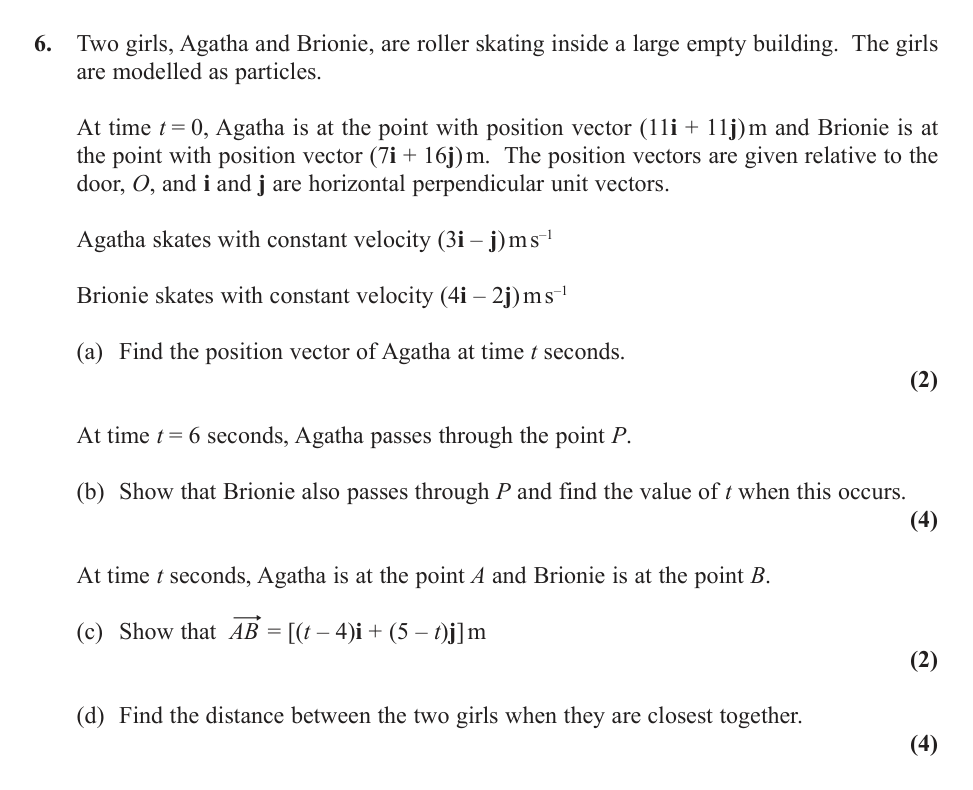
  1. Write Agatha position

    $\mathbf{r}_A=(11\mathbf{i}+11\mathbf{j})+t(3\mathbf{i}-\mathbf{j})=(11+3t)\mathbf{i}+(11-t)\mathbf{j}$.

  2. Find point P

    At $t=6$, Agatha is at $(11+18)\mathbf{i}+(11-6)\mathbf{j}=29\mathbf{i}+5\mathbf{j}$.

  3. Write Brionie position

    $\mathbf{r}_B=(7\mathbf{i}+16\mathbf{j})+t(4\mathbf{i}-2\mathbf{j})=(7+4t)\mathbf{i}+(16-2t)\mathbf{j}$.

  4. Show Brionie passes P

    Set $7+4t=29$ to get $t=5.5$. Also $16-2t=5$ gives $t=5.5$. So Brionie also passes through P at $t=5.5$ s.

  5. Find AB vector

    $\overrightarrow{AB}=\mathbf{r}_B-\mathbf{r}_A=[7+4t-(11+3t)]\mathbf{i}+[16-2t-(11-t)]\mathbf{j}$.

  6. Simplify AB

    So $\overrightarrow{AB}=(t-4)\mathbf{i}+(5-t)\mathbf{j}$ m.

  7. Minimise distance squared

    $AB^2=(t-4)^2+(5-t)^2=2(t-4.5)^2+0.5$.

  8. State the minimum distance

    The minimum occurs when $t=4.5$, giving $AB^2=0.5$. Hence the minimum distance is $\sqrt{0.5}=0.707\ldots\ \mathrm{m}$.

Final answer

$(a)\ \mathbf{r}_A=(11+3t)\mathbf{i}+(11-t)\mathbf{j}.\quad (b)\ t=5.5\ \mathrm{s}.\quad (c)\ \overrightarrow{AB}=(t-4)\mathbf{i}+(5-t)\mathbf{j}.\quad (d)\ \text{minimum distance}=\sqrt{0.5}\ \mathrm{m}\approx0.71\ \mathrm{m}$.

33. WME01/01 October 2019 · Q6

Hard12 marks · main topic: Kinematics Graphs
WME01/01 October 2019 Question 6 (12 marks): Working with Vectors
Show worked solution
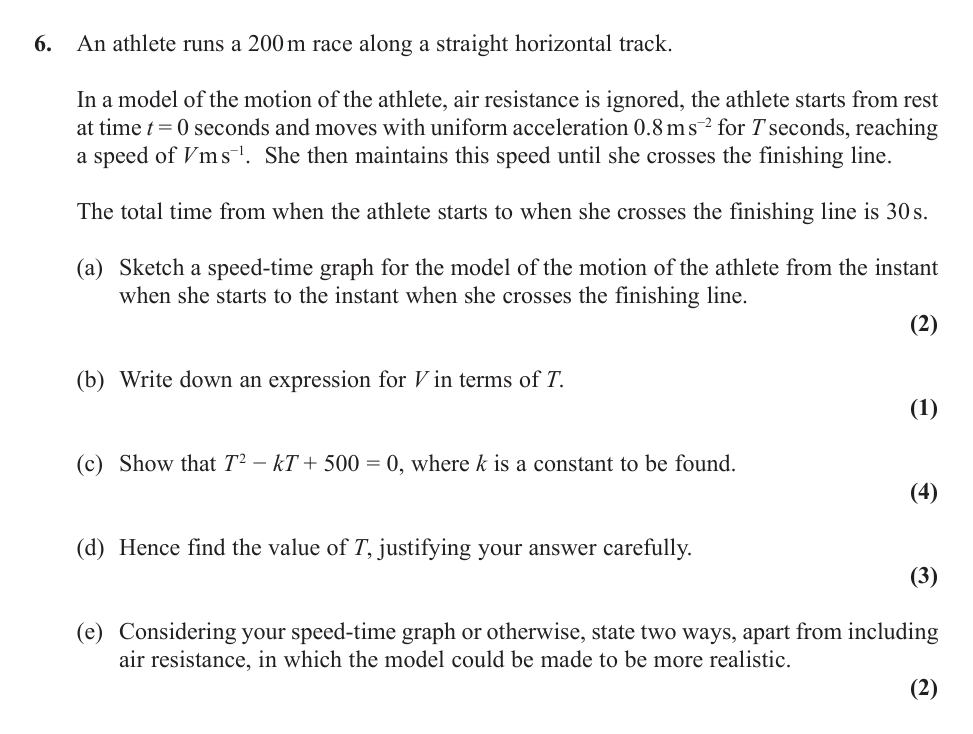
  1. Describe the speed-time graph

    The graph starts at $(0,0)$, rises in a straight line with gradient $0.8$ until time $T$ and speed $V$, then stays horizontal at speed $V$ until $t=30$.

  2. Write V in terms of T

    Uniform acceleration gives $V=0.8T$.

  3. Use area for the distance

    The distance is the area under the speed-time graph: $\dfrac12TV+V(30-T)=200$.

  4. Substitute V

    Using $V=0.8T$: $\dfrac12T(0.8T)+(0.8T)(30-T)=200$.

  5. Form the quadratic

    $0.4T^2+24T-0.8T^2=200$, so $-0.4T^2+24T-200=0$. Multiplying by $-2.5$ gives $T^2-60T+500=0$, so $k=60$.

  6. Solve and choose the valid root

    $T^2-60T+500=(T-10)(T-50)=0$, so $T=10$ or $50$. Since the whole race lasts $30$ s, $T=10$.

  7. Give two model improvements

    A more realistic model could include reaction time at the start, and could replace the instantaneous change from acceleration to constant speed with a smoother transition.

Final answer

$(a)$ Speed-time graph rises linearly to $V$ at $t=T$, then is horizontal until $t=30$. $(b)\ V=0.8T.\quad (c)\ T^2-60T+500=0$, so $k=60$. $(d)\ T=10$. $(e)$ For example, include reaction time at the start and avoid the instantaneous change to constant speed.

34. WME01/01 May/June 2025 · Q7

Hard13 marks
WME01/01 May/June 2025 Question 7 (13 marks): Working with Vectors
Show worked solution
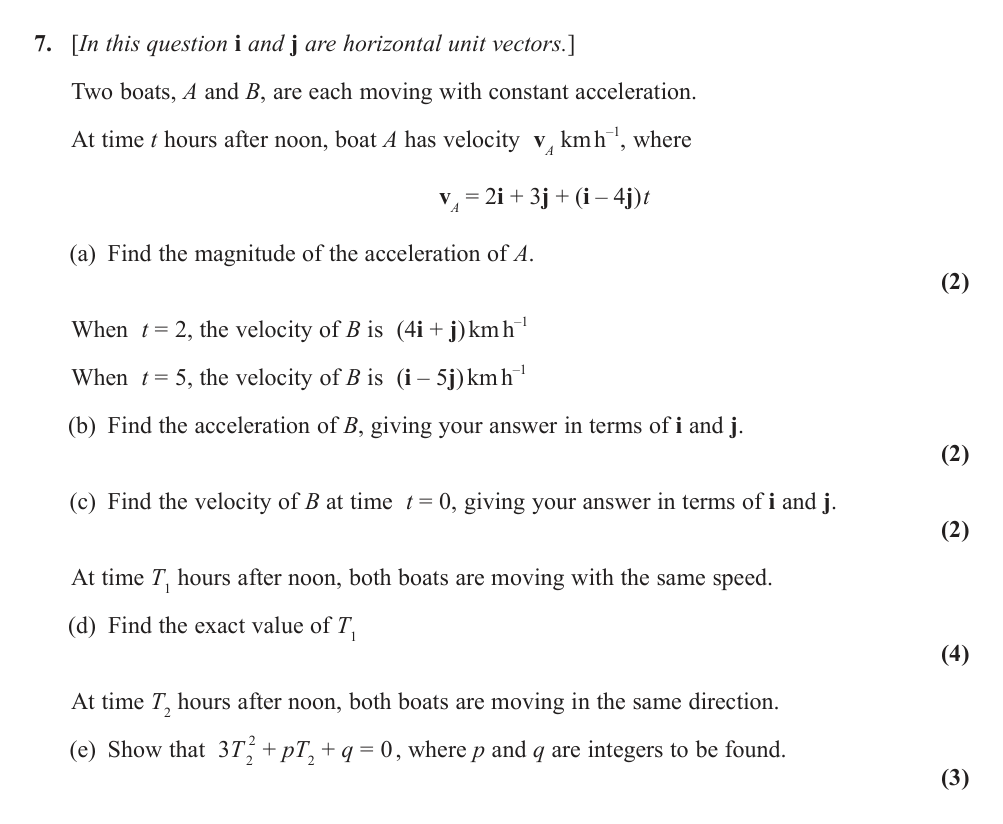
  1. Part (a): Find magnitude of acceleration of A - Identify acceleration from velocity function

    Given: $\mathbf{v}_A = 2\mathbf{i} + 3\mathbf{j} + (\mathbf{i} - 4\mathbf{j})t$ This is in form: $\mathbf{v} = \mathbf{u} + \mathbf{a}t$ Therefore: ; Initial velocity: $\mathbf{u}_A = 2\mathbf{i} + 3\mathbf{j}$ ; Acceleration: $\mathbf{a}_A = \mathbf{i} - 4\mathbf{j}$ km h$^{-2}$

  2. Part (a): Find magnitude of acceleration of A - Find magnitude

    $|\mathbf{a}| = \sqrt{a_x^2 + a_y^2}$ $|\mathbf{a}_A| = \sqrt{1^2 + (-4)^2}$ $= \sqrt{1 + 16}$ $= \sqrt{17}$ $= 4.123...$ $= 4.1 \text{ km h}^{-2} \text{ (2 sf)}$

  3. Part (b): Find acceleration of B - Use two velocity points to find acceleration

    Given: ; At $t = 2$: $\mathbf{v}_B = 4\mathbf{i} + \mathbf{j}$ ; At $t = 5$: $\mathbf{v}_B = \mathbf{i} - 5\mathbf{j}$ $\mathbf{a} = \frac{\Delta \mathbf{v}}{\Delta t}$ $\mathbf{a}_B = \frac{(\mathbf{i} - 5\mathbf{j}) - (4\mathbf{i} + \mathbf{j})}{5 - 2}$ $= \frac{(1-4)\mathbf{i} + (-5-1)\mathbf{j}}{3}$ $= \frac{-3\mathbf{i} - 6\mathbf{j}}{3}$ $= -\mathbf{i} - 2\mathbf{j} \text{ km h}^{-2}$

  4. Part (c): Find velocity of B at t = 0 - Use velocity equation backward

    $\mathbf{v}(t) = \mathbf{v}(t_0) + \mathbf{a}(t - t_0)$ From $t = 2$ back to $t = 0$: $\mathbf{v}_B(0) = \mathbf{v}_B(2) + \mathbf{a}_B(0 - 2)$ $= (4\mathbf{i} + \mathbf{j}) + (-\mathbf{i} - 2\mathbf{j})(-2)$ $= 4\mathbf{i} + \mathbf{j} + 2\mathbf{i} + 4\mathbf{j}$ $= 6\mathbf{i} + 5\mathbf{j} \text{ km h}^{-1}$

  5. Part (d): Find exact value of $T_1$ when both have same speed - Express velocities at time t

    For boat A: $\mathbf{v}_A(t) = 2\mathbf{i} + 3\mathbf{j} + (\mathbf{i} - 4\mathbf{j})t = (2+t)\mathbf{i} + (3-4t)\mathbf{j}$ For boat B: $\mathbf{v}_B(t) = (6\mathbf{i} + 5\mathbf{j}) + (-\mathbf{i} - 2\mathbf{j})t$ $= (6-t)\mathbf{i} + (5-2t)\mathbf{j}$

  6. Part (d): Find exact value of $T_1$ when both have same speed - Find magnitudes

    $|\mathbf{v}_A|^2 = (2+t)^2 + (3-4t)^2$ $= 4 + 4t + t^2 + 9 - 24t + 16t^2$ $= 17t^2 - 20t + 13$ $|\mathbf{v}_B|^2 = (6-t)^2 + (5-2t)^2$ $= 36 - 12t + t^2 + 25 - 20t + 4t^2$ $= 5t^2 - 32t + 61$

  7. Part (d): Find exact value of $T_1$ when both have same speed - Set magnitudes equal

    $17t^2 - 20t + 13 = 5t^2 - 32t + 61$ $12t^2 + 12t - 48 = 0$ $t^2 + t - 4 = 0$

  8. Part (d): Find exact value of $T_1$ when both have same speed - Solve using quadratic formula

    $t = \frac{-1 \pm \sqrt{1 + 16}}{2}$ $= \frac{-1 \pm \sqrt{17}}{2}$ Taking positive value: $T_1 = \frac{-1 + \sqrt{17}}{2}$

  9. Part (e): Show $3T_2^2 + pT_2 + q = 0$ - Condition for same direction

    Velocities parallel when: $\frac{2 + T_2}{6 - T_2} = \frac{3 - 4T_2}{5 - 2T_2}$

  10. Part (e): Show $3T_2^2 + pT_2 + q = 0$ - Cross-multiply

    $(2 + T_2)(5 - 2T_2) = (3 - 4T_2)(6 - T_2)$ $10 - 4T_2 + 5T_2 - 2T_2^2 = 18 - 3T_2 - 24T_2 + 4T_2^2$ $10 + T_2 - 2T_2^2 = 18 - 27T_2 + 4T_2^2$ $0 = 4T_2^2 + 2T_2^2 - 27T_2 - T_2 + 18 - 10$ $0 = 6T_2^2 - 28T_2 + 8$

  11. Part (e): Show $3T_2^2 + pT_2 + q = 0$ - Divide by 2 to get required form

    $0 = 3T_2^2 - 14T_2 + 4$ Therefore: $p = -14$ and $q = 4$

Final answer

$(a)\ |\mathbf{a}_A|=\sqrt{17}\ \mathrm{km\,h^{-2}}\approx4.1\ \mathrm{km\,h^{-2}}.\quad (b)\ \mathbf{a}_B=-\mathbf{i}-2\mathbf{j}\ \mathrm{km\,h^{-2}}.\quad (c)\ \mathbf{v}_B(0)=6\mathbf{i}+5\mathbf{j}\ \mathrm{km\,h^{-1}}.\quad (d)\ T_1=\dfrac{-1+\sqrt{17}}{2}\ \text{hours}.\quad (e)\ 3T_2^2-14T_2+4=0,\ p=-14,\ q=4$.

35. WME01/01 May/June 2024 · Q7

Hard13 marks
WME01/01 May/June 2024 Question 7 (13 marks): Working with Vectors
Show worked solution
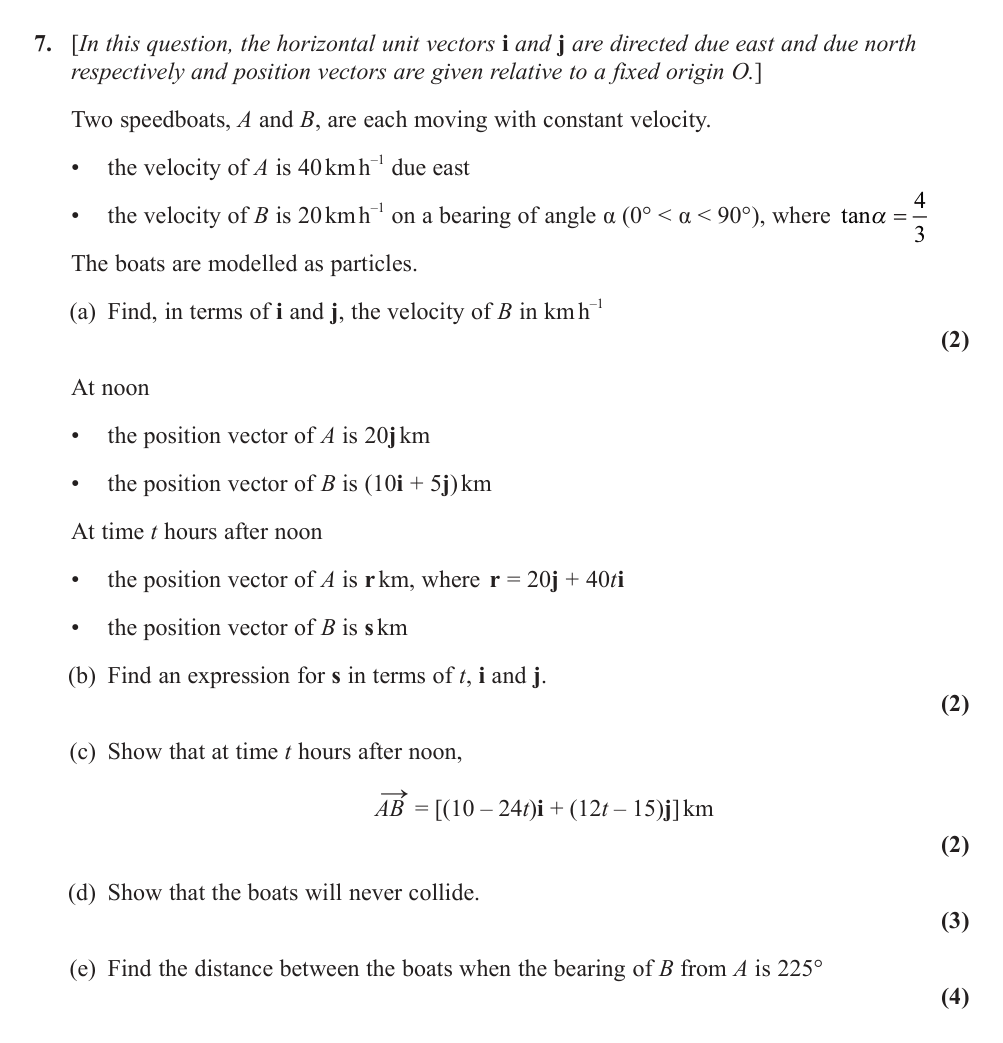
  1. Resolve the velocity of B

    For a bearing angle $\alpha$ with $\tan\alpha=\dfrac43$, use $\sin\alpha=\dfrac45$ and $\cos\alpha=\dfrac35$. Therefore $\mathbf{v}_B=20\sin\alpha\mathbf{i}+20\cos\alpha\mathbf{j}=16\mathbf{i}+12\mathbf{j}$.

  2. Write the position of B

    At noon, B is at $10\mathbf{i}+5\mathbf{j}$. With constant velocity $16\mathbf{i}+12\mathbf{j}$, $\mathbf{s}=(10+16t)\mathbf{i}+(5+12t)\mathbf{j}$.

  3. Find AB vector

    A has position vector $\mathbf{r}=40t\mathbf{i}+20\mathbf{j}$. Hence $\overrightarrow{AB}=\mathbf{s}-\mathbf{r}=(10+16t-40t)\mathbf{i}+(5+12t-20)\mathbf{j}$.

  4. Show the printed expression

    This simplifies to $\overrightarrow{AB}=(10-24t)\mathbf{i}+(12t-15)\mathbf{j}$ km.

  5. Show the boats do not collide

    For collision, both components must be zero. From $10-24t=0$, $t=\dfrac{5}{12}$. From $12t-15=0$, $t=\dfrac54$. These times are different, so the boats never collide.

  6. Use the bearing 225 degrees condition

    A bearing of $225^\circ$ means B is south-west of A, so the i and j components of $\overrightarrow{AB}$ are equal and negative. Set $10-24t=12t-15$.

  7. Find the distance

    The equation gives $t=\dfrac{25}{36}$. Then each component is $-\dfrac{20}{3}$, so the distance is $\sqrt{\left(\dfrac{20}{3}\right)^2+\left(\dfrac{20}{3}\right)^2}=\dfrac{20\sqrt2}{3}\ \mathrm{km}$.

Final answer

$(a)\ \mathbf{v}_B=16\mathbf{i}+12\mathbf{j}\ \mathrm{km\,h^{-1}}.\quad (b)\ \mathbf{s}=(10+16t)\mathbf{i}+(5+12t)\mathbf{j}.\quad (c)\ \overrightarrow{AB}=(10-24t)\mathbf{i}+(12t-15)\mathbf{j}.\quad (d)\ \text{no collision}.\quad (e)\ \dfrac{20\sqrt2}{3}\ \mathrm{km}\approx9.4\ \mathrm{km}$.

36. WME01/01 October 2025 · Q3

Hard14 marks · main topic: Forces
WME01/01 October 2025 Question 3 (14 marks): Working with Vectors
Show worked solution
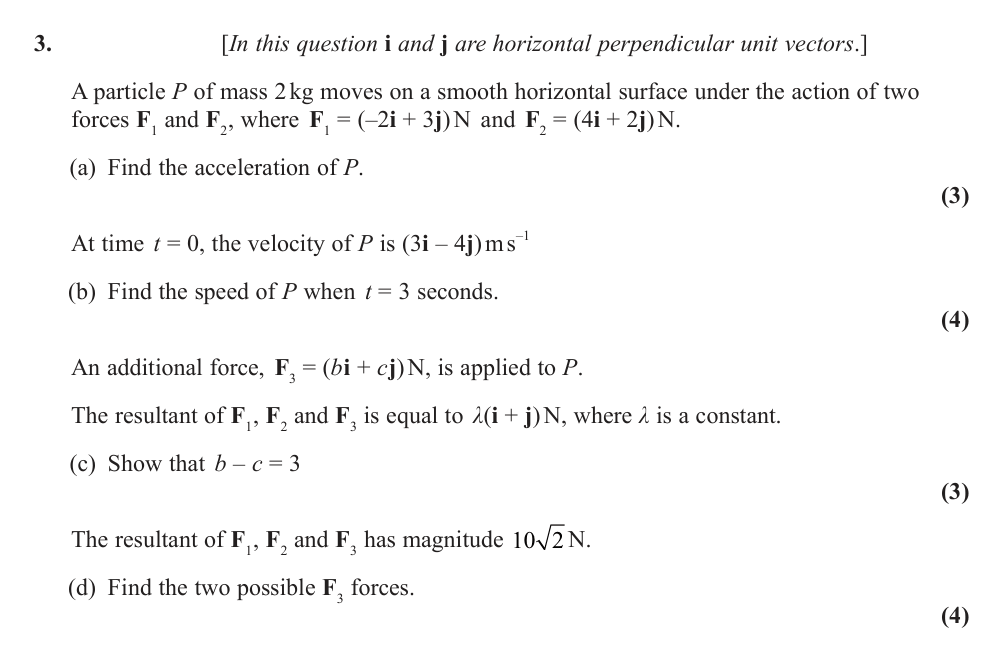
  1. Part (a): Find the acceleration of P - Find resultant force

    $\mathbf{F}_{\text{resultant}} = \mathbf{F}_1 + \mathbf{F}_2$ $\mathbf{F}_{\text{resultant}} = (-2\mathbf{i} + 3\mathbf{j}) + (4\mathbf{i} + 2\mathbf{j})$ $= (-2 + 4)\mathbf{i} + (3 + 2)\mathbf{j}$ $= 2\mathbf{i} + 5\mathbf{j} \text{ N}$

  2. Part (a): Find the acceleration of P - Apply Newton's Second Law

    $\mathbf{F} = m\mathbf{a}$ $2\mathbf{i} + 5\mathbf{j} = 2 \times \mathbf{a}$ $\mathbf{a} = \frac{2\mathbf{i} + 5\mathbf{j}}{2}$ $\mathbf{a} = \mathbf{i} + 2.5\mathbf{j} \text{ m s}^{-2}$ Or: $\mathbf{a} = \mathbf{i} + \frac{5}{2}\mathbf{j}$ m s$^{-2}$

  3. Part (b): Find the speed of P when t = 3 seconds - Find velocity at t = 3

    $\mathbf{v} = \mathbf{u} + \mathbf{a}t$ Given: ; $\mathbf{u} = 3\mathbf{i} - 4\mathbf{j}$ m s$^{-1}$ ; $\mathbf{a} = \mathbf{i} + 2.5\mathbf{j}$ m s$^{-2}$ ; $t = 3$ seconds $\mathbf{v} = (3\mathbf{i} - 4\mathbf{j}) + (\mathbf{i} + 2.5\mathbf{j}) \times 3$ $= 3\mathbf{i} - 4\mathbf{j} + 3\mathbf{i} + 7.5\mathbf{j}$ $= 6\mathbf{i} + 3.5\mathbf{j} \text{ m s}^{-1}$

  4. Part (b): Find the speed of P when t = 3 seconds - Find the speed (magnitude of velocity)

    $|\mathbf{v}| = \sqrt{v_x^2 + v_y^2}$ $\text{Speed} = \sqrt{6^2 + 3.5^2}$ $= \sqrt{36 + 12.25}$ $= \sqrt{48.25}$ $= 6.946...$ $= 6.95 \text{ m s}^{-1} \text{ (3 s.f.)}$

  5. Part (c): Show that b - c = 3 - Find resultant of $\mathbf{F}_1$, $\mathbf{F}_2$, and $\mathbf{F}_3$

    $\mathbf{F}_{\text{resultant}} = \mathbf{F}_1 + \mathbf{F}_2 + \mathbf{F}_3$ $= (-2\mathbf{i} + 3\mathbf{j}) + (4\mathbf{i} + 2\mathbf{j}) + (b\mathbf{i} + c\mathbf{j})$ $= (-2 + 4 + b)\mathbf{i} + (3 + 2 + c)\mathbf{j}$ $= (2 + b)\mathbf{i} + (5 + c)\mathbf{j}$

  6. Part (c): Show that b - c = 3 - Apply the condition

    Given that resultant = $\lambda(\mathbf{i} + \mathbf{j})$, we can write: $(2 + b)\mathbf{i} + (5 + c)\mathbf{j} = \lambda\mathbf{i} + \lambda\mathbf{j}$

  7. Part (c): Show that b - c = 3 - Compare coefficients

    For this to be in the form $\lambda(\mathbf{i} + \mathbf{j})$, the coefficients must be equal: $2 + b = \lambda$ $5 + c = \lambda$ Therefore: $2 + b = 5 + c$ $b = 5 + c - 2$ $b = 3 + c$ $b - c = 3$

  8. Part (d): Find the two possible $\mathbf{F}_3$ forces - Use the magnitude condition

    Resultant = $(2 + b)\mathbf{i} + (5 + c)\mathbf{j}$ Since resultant = $\lambda(\mathbf{i} + \mathbf{j})$, we have $2 + b = 5 + c = \lambda$ $|\mathbf{F}_{\text{resultant}}| = \lambda\sqrt{1^2 + 1^2} = \lambda\sqrt{2}$ Given: $|\mathbf{F}_{\text{resultant}}| = 10\sqrt{2}$ $\lambda\sqrt{2} = 10\sqrt{2}$ $\lambda = 10 \quad \text{or} \quad \lambda = -10$ (The negative value comes from considering the opposite direction)

  9. Part (d): Find the two possible $\mathbf{F}_3$ forces - Find b and c for each value of $\lambda$

    Case 1: $\lambda = 10$ $2 + b = 10 \quad \Rightarrow \quad b = 8$ $5 + c = 10 \quad \Rightarrow \quad c = 5$ Check: $b - c = 8 - 5 = 3$ ✓ Therefore: $\mathbf{F}_3 = 8\mathbf{i} + 5\mathbf{j}$ N Case 2: $\lambda = -10$ $2 + b = -10 \quad \Rightarrow \quad b = -12$ $5 + c = -10 \quad \Rightarrow \quad c = -15$ Check: $b - c = -12 - (-15) = 3$ ✓ Therefore: $\mathbf{F}_3 = -12\mathbf{i} - 15\mathbf{j}$ N

Final answer

$(a)\ \mathbf{a}=\mathbf{i}+2.5\mathbf{j}\ \mathrm{m\,s^{-2}}.\quad (b)\ \text{speed}=6.95\ \mathrm{m\,s^{-1}}.\quad (c)\ b-c=3.\quad (d)\ \mathbf{F}_3=(8\mathbf{i}+5\mathbf{j})\ \mathrm{N}\ \text{or}\ (-12\mathbf{i}-15\mathbf{j})\ \mathrm{N}$.

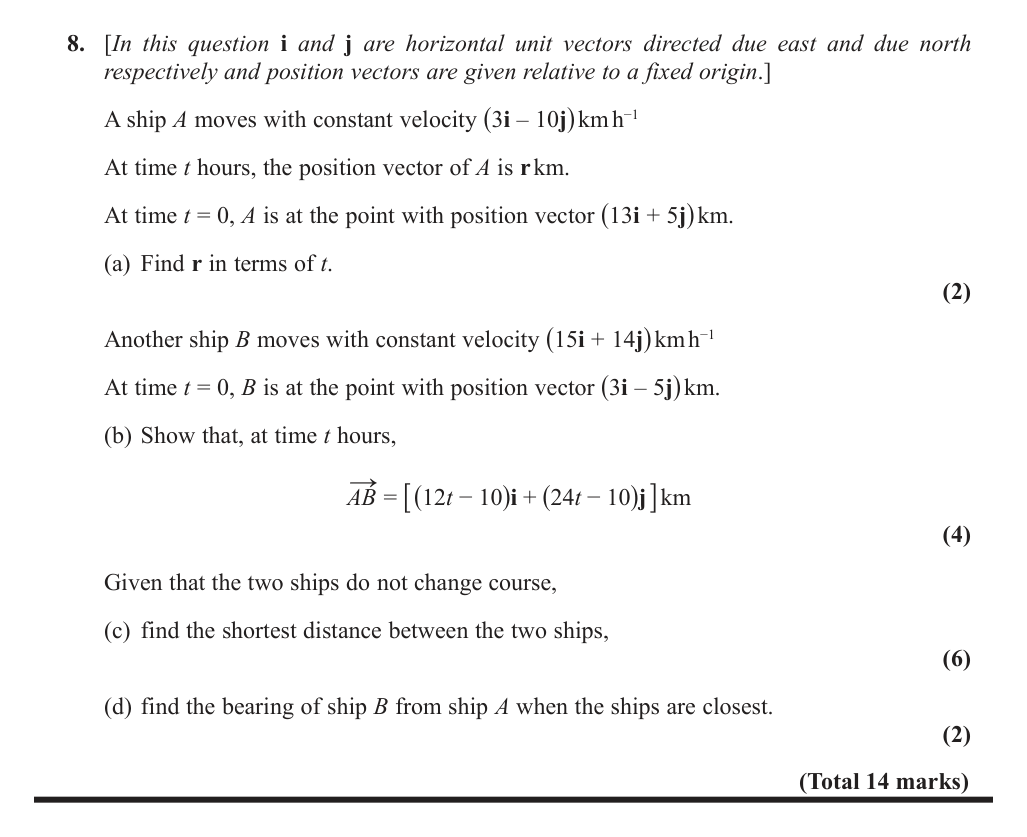
37. WME01/01 January 2022 · Q8

Hard14 marks
WME01/01 January 2022 Question 8 (14 marks): Working with Vectors
Show worked solution
  1. Write the position of A

    $\mathbf{r}=(13\mathbf{i}+5\mathbf{j})+t(3\mathbf{i}-10\mathbf{j})=(13+3t)\mathbf{i}+(5-10t)\mathbf{j}$.

  2. Write the position of B

    $\mathbf{s}=(3\mathbf{i}-5\mathbf{j})+t(15\mathbf{i}+14\mathbf{j})=(3+15t)\mathbf{i}+(-5+14t)\mathbf{j}$.

  3. Find AB

    $\overrightarrow{AB}=\mathbf{s}-\mathbf{r}=[3+15t-(13+3t)]\mathbf{i}+[-5+14t-(5-10t)]\mathbf{j}$.

  4. Show the expression

    This simplifies to $\overrightarrow{AB}=(12t-10)\mathbf{i}+(24t-10)\mathbf{j}$ km.

  5. Use distance squared

    The square of the distance is $d^2=(12t-10)^2+(24t-10)^2$.

  6. Expand and minimise

    $d^2=720t^2-720t+200$. This quadratic is minimum at $t=\dfrac{720}{2\cdot720}=\dfrac12$.

  7. Find the shortest distance

    At $t=\dfrac12$, $\overrightarrow{AB}=(-4)\mathbf{i}+2\mathbf{j}$, so the shortest distance is $\sqrt{(-4)^2+2^2}=\sqrt{20}=2\sqrt5\ \mathrm{km}$.

  8. Find the bearing

    At closest approach, B is west and north of A. The angle west of north satisfies $\tan\theta=\dfrac{4}{2}=2$, so $\theta=63.4^\circ$. Bearing $=360^\circ-63.4^\circ=296.6^\circ$, which is $297^\circ$.

Final answer

$(a)\ \mathbf{r}=(13+3t)\mathbf{i}+(5-10t)\mathbf{j}.\quad (b)\ \overrightarrow{AB}=(12t-10)\mathbf{i}+(24t-10)\mathbf{j}.\quad (c)\ 2\sqrt5\ \mathrm{km}\approx4.5\ \mathrm{km}.\quad (d)\ 297^\circ$.

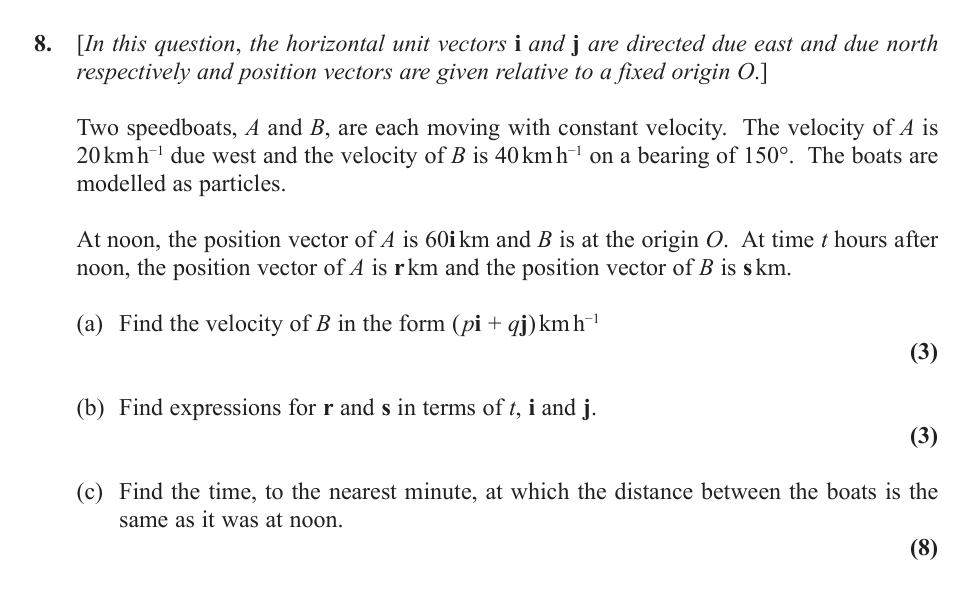
38. WME01/01 October 2019 · Q8

Hard14 marks
WME01/01 October 2019 Question 8 (14 marks): Working with Vectors
Show worked solution
  1. Resolve B's velocity

    A bearing of $150^\circ$ is $30^\circ$ east of south. Therefore the east component is $40\sin150^\circ=20$ and the north component is $40\cos150^\circ=-20\sqrt3$.

  2. Write B's velocity

    $\mathbf v_B=20\mathbf i-20\sqrt3\mathbf j\ \mathrm{km\,h^{-1}}$.

  3. Write A's position

    Boat A starts at $60\mathbf i$ and travels due west at $20\ \mathrm{km\,h^{-1}}$, so $\mathbf r=60\mathbf i-20t\mathbf i=(60-20t)\mathbf i$.

  4. Write B's position

    Boat B starts at O, so $\mathbf s=t(20\mathbf i-20\sqrt3\mathbf j)=20t\mathbf i-20\sqrt3t\mathbf j$.

  5. Find the separation vector

    $\overrightarrow{AB}=\mathbf s-\mathbf r=(20t-(60-20t))\mathbf i-20\sqrt3t\mathbf j=(40t-60)\mathbf i-20\sqrt3t\mathbf j$.

  6. Use the noon distance

    At noon the distance between the boats is $60$ km. Set the later distance equal to $60$: $(40t-60)^2+(-20\sqrt3t)^2=60^2$.

  7. Solve for t

    Expanding gives $2800t^2-4800t=0$, so $t(2800t-4800)=0$. The later time is $t=\dfrac{4800}{2800}=\dfrac{12}{7}$ hours.

  8. Convert to clock time

    $\dfrac{12}{7}$ hours is $1$ hour and $42.857\ldots$ minutes after noon, which rounds to $1{:}43$ pm, or $13{:}43$.

Final answer

$(a)\ \mathbf v_B=20\mathbf i-20\sqrt3\mathbf j\ \mathrm{km\,h^{-1}}.\quad (b)\ \mathbf r=(60-20t)\mathbf i,\ \mathbf s=20t\mathbf i-20\sqrt3t\mathbf j.\quad (c)\ 13{:}43$, or $1{:}43\ \mathrm{pm}$.

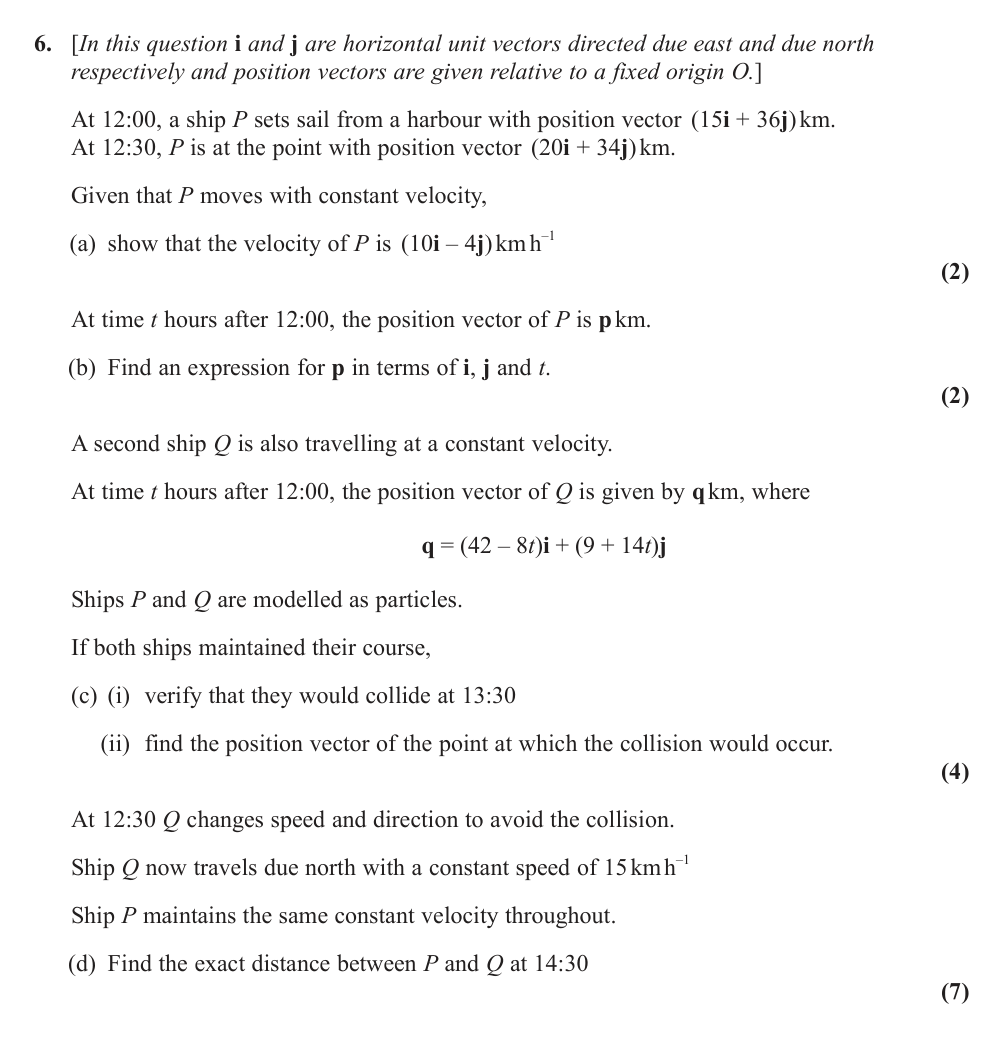
39. WME01/01 October 2023 · Q6

Hard15 marks
WME01/01 October 2023 Question 6 (15 marks): Working with Vectors
Show worked solution
  1. Find the velocity of P

    From 12:00 to 12:30, the displacement of P is $(20\mathbf{i}+34\mathbf{j})-(15\mathbf{i}+36\mathbf{j})=5\mathbf{i}-2\mathbf{j}$ km. The time is $0.5$ hours, so $\mathbf{v}_P=\dfrac{5\mathbf{i}-2\mathbf{j}}{0.5}=10\mathbf{i}-4\mathbf{j}$.

  2. Write the position of P

    At $t$ hours after 12:00, $\mathbf{p}=(15\mathbf{i}+36\mathbf{j})+t(10\mathbf{i}-4\mathbf{j})=(15+10t)\mathbf{i}+(36-4t)\mathbf{j}$.

  3. Verify the collision time

    At 13:30, $t=1.5$. Then $\mathbf{p}=(15+15)\mathbf{i}+(36-6)\mathbf{j}=30\mathbf{i}+30\mathbf{j}$. Also $\mathbf{q}=(42-8(1.5))\mathbf{i}+(9+14(1.5))\mathbf{j}=30\mathbf{i}+30\mathbf{j}$.

  4. State the collision position

    Since both position vectors are the same, the collision point has position vector $30\mathbf{i}+30\mathbf{j}$ km.

  5. Find P at 14:30

    At 14:30, $t=2.5$, so $\mathbf{p}=(15+25)\mathbf{i}+(36-10)\mathbf{j}=40\mathbf{i}+26\mathbf{j}$.

  6. Find Q after changing course

    At 12:30, $t=0.5$, so $\mathbf{q}=38\mathbf{i}+16\mathbf{j}$. From 12:30 to 14:30 is $2$ hours due north at $15\ \mathrm{km\,h^{-1}}$, so the extra displacement is $30\mathbf{j}$. Thus Q is at $38\mathbf{i}+46\mathbf{j}$.

  7. Find the distance

    The separation vector is $(40-38)\mathbf{i}+(26-46)\mathbf{j}=2\mathbf{i}-20\mathbf{j}$. The distance is $\sqrt{2^2+20^2}=\sqrt{404}=2\sqrt{101}\ \mathrm{km}$.

Final answer

$(a)\ \mathbf{v}_P=10\mathbf{i}-4\mathbf{j}\ \mathrm{km\,h^{-1}}.\quad (b)\ \mathbf{p}=(15+10t)\mathbf{i}+(36-4t)\mathbf{j}.\quad (c)(ii)\ 30\mathbf{i}+30\mathbf{j}.\quad (d)\ 2\sqrt{101}\ \mathrm{km}$.

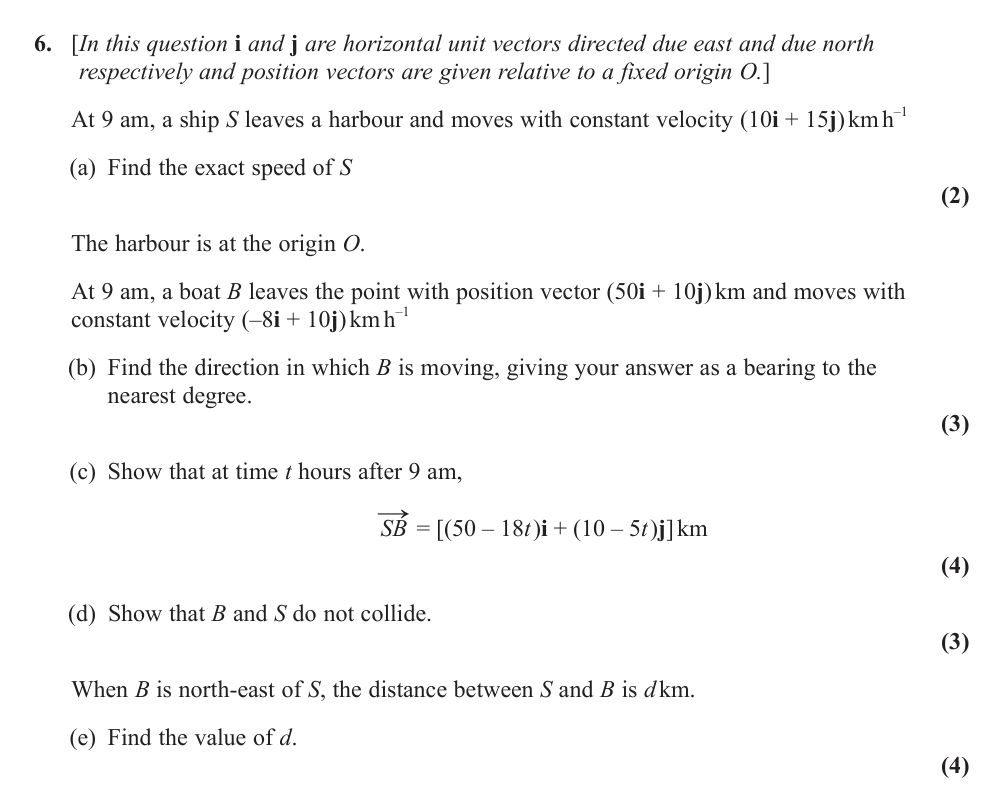
40. WME01/01 January 2026 · Q6

Hard16 marks
WME01/01 January 2026 Question 6 (16 marks): Working with Vectors
Show worked solution
  1. Find the speed of S

    The velocity of S is $10\mathbf{i}+15\mathbf{j}$. Its speed is the magnitude: $\sqrt{10^2+15^2}=\sqrt{325}=5\sqrt{13}\ \mathrm{km\,h^{-1}}$.

  2. Find the bearing of B

    B has velocity $-8\mathbf{i}+10\mathbf{j}$, so it moves west and north. The angle west of north satisfies $\tan\theta=\dfrac{8}{10}$, giving $\theta=38.66^\circ$. The bearing is $360^\circ-38.66^\circ=321^\circ$ to the nearest degree.

  3. Write both position vectors

    At time $t$ hours after 9 am, $\mathbf{r}_S=(10t)\mathbf{i}+(15t)\mathbf{j}$. Also $\mathbf{r}_B=(50\mathbf{i}+10\mathbf{j})+t(-8\mathbf{i}+10\mathbf{j})=(50-8t)\mathbf{i}+(10+10t)\mathbf{j}$.

  4. Find the relative position vector

    $\overrightarrow{SB}=\mathbf{r}_B-\mathbf{r}_S=[(50-8t)-10t]\mathbf{i}+[(10+10t)-15t]\mathbf{j}=(50-18t)\mathbf{i}+(10-5t)\mathbf{j}$.

  5. Show they do not collide

    For a collision, both components of $\overrightarrow{SB}$ must be zero at the same time. From $50-18t=0$, $t=\dfrac{25}{9}$. From $10-5t=0$, $t=2$. These are different, so B and S do not collide.

  6. Find the north-east or south-west instant

    When the separation is along a $45^\circ$ diagonal, the two components have equal magnitude. Using the given condition, set $50-18t=10-5t$, so $40=13t$ and $t=\dfrac{40}{13}$.

  7. Find the distance d

    At $t=\dfrac{40}{13}$, both components are $-\dfrac{70}{13}$. Therefore $d=\sqrt{\left(\dfrac{70}{13}\right)^2+\left(\dfrac{70}{13}\right)^2}=\dfrac{70\sqrt2}{13}=7.6\ \mathrm{km}$ to 2 significant figures.

Final answer

$(a)\ 5\sqrt{13}\ \mathrm{km\,h^{-1}}.\quad (b)\ 321^\circ.\quad (c)\ \overrightarrow{SB}=(50-18t)\mathbf{i}+(10-5t)\mathbf{j}.\quad (d)\ \text{no collision}.\quad (e)\ d=\dfrac{70\sqrt2}{13}\ \mathrm{km}\approx7.6\ \mathrm{km}$.

41. WME01/01 October 2022 · Q8

Hard16 marks
WME01/01 October 2022 Question 8 (16 marks): Working with Vectors
Show worked solution
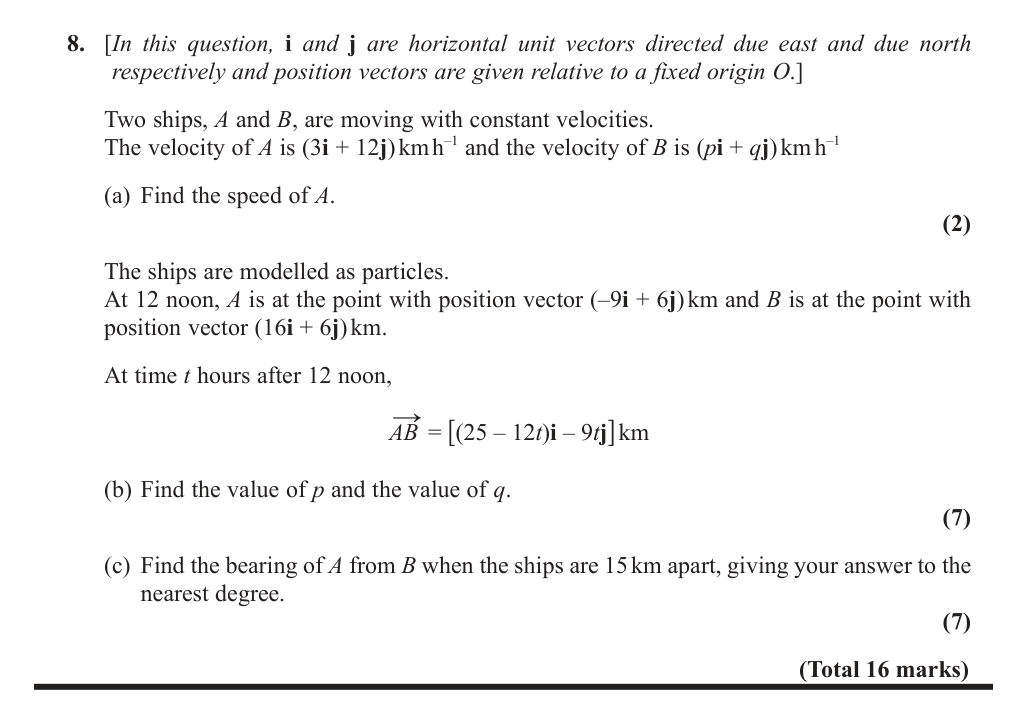
  1. Find the speed of A

    $|\mathbf{v}_A|=\sqrt{3^2+12^2}=\sqrt{153}=3\sqrt{17}\ \mathrm{km\,h^{-1}}$.

  2. Write A position

    At time $t$, $\mathbf{a}=(-9\mathbf{i}+6\mathbf{j})+t(3\mathbf{i}+12\mathbf{j})=(-9+3t)\mathbf{i}+(6+12t)\mathbf{j}$.

  3. Write B position

    $\mathbf{b}=(16\mathbf{i}+6\mathbf{j})+t(p\mathbf{i}+q\mathbf{j})=(16+pt)\mathbf{i}+(6+qt)\mathbf{j}$.

  4. Use AB vector

    $\overrightarrow{AB}=\mathbf{b}-\mathbf{a}=[25+(p-3)t]\mathbf{i}+[(q-12)t]\mathbf{j}$.

  5. Compare components

    Given $\overrightarrow{AB}=(25-12t)\mathbf{i}-9t\mathbf{j}$, compare coefficients: $p-3=-12$ and $q-12=-9$.

  6. Find p and q

    Therefore $p=-9$ and $q=3$.

  7. Find the time when the distance is 15

    Use $|\overrightarrow{AB}|=15$: $(25-12t)^2+(-9t)^2=15^2$.

  8. Solve the distance equation

    This gives $225t^2-600t+400=0$, so $(3t-4)^2=0$ and $t=\dfrac43$.

  9. Find BA at this time

    At $t=\dfrac43$, $\overrightarrow{AB}=9\mathbf{i}-12\mathbf{j}$. Therefore $\overrightarrow{BA}=-9\mathbf{i}+12\mathbf{j}$.

  10. Convert to a bearing

    A is north-west of B. The angle west of north satisfies $\tan\theta=\dfrac{9}{12}$, so $\theta=36.9^\circ$. Bearing $=360^\circ-36.9^\circ=323^\circ$ to the nearest degree.

Final answer

$(a)\ 3\sqrt{17}\ \mathrm{km\,h^{-1}}.\quad (b)\ p=-9,\ q=3.\quad (c)\ \text{bearing}=323^\circ$.

42. WME01/01 May/June 2022 · Q8

Hard17 marks
WME01/01 May/June 2022 Question 8 (17 marks): Working with Vectors
Show worked solution
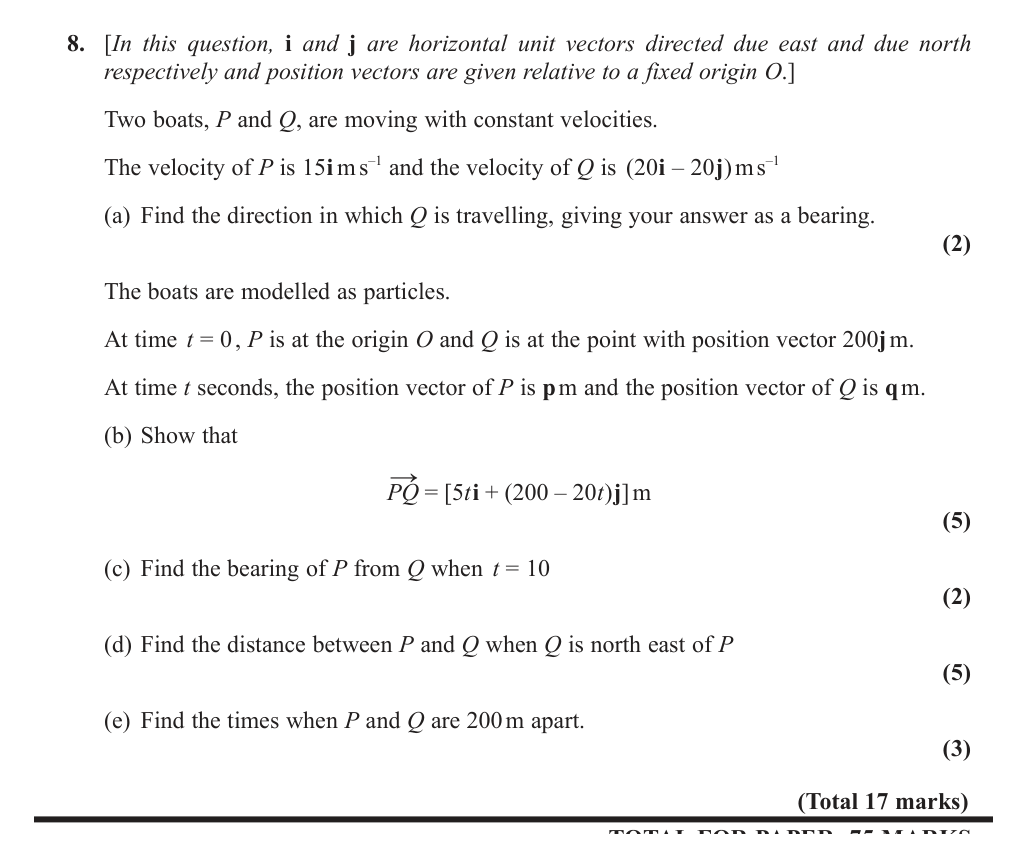
  1. Find the bearing of Q

    Q has velocity $20\mathbf{i}-20\mathbf{j}$, so it travels south-east with equal east and south components. Its bearing is $135^\circ$.

  2. Write P position

    P starts at the origin and has velocity $15\mathbf{i}$, so $\mathbf{p}=15t\mathbf{i}$.

  3. Write Q position

    Q starts at $200\mathbf{j}$ and has velocity $20\mathbf{i}-20\mathbf{j}$, so $\mathbf{q}=20t\mathbf{i}+(200-20t)\mathbf{j}$.

  4. Show PQ

    $\overrightarrow{PQ}=\mathbf{q}-\mathbf{p}=(20t-15t)\mathbf{i}+(200-20t)\mathbf{j}=5t\mathbf{i}+(200-20t)\mathbf{j}$.

  5. Find the bearing at t = 10

    At $t=10$, $\overrightarrow{PQ}=50\mathbf{i}$. This means Q is east of P, so P is west of Q. The bearing of P from Q is $270^\circ$.

  6. Use the north-east condition

    Q is north-east of P when the i and j components of $\overrightarrow{PQ}$ are equal and positive. So $5t=200-20t$.

  7. Find the distance then

    The equation gives $t=8$. Then $\overrightarrow{PQ}=40\mathbf{i}+40\mathbf{j}$, so the distance is $\sqrt{40^2+40^2}=40\sqrt2\ \mathrm{m}$.

  8. Set the 200 m distance equation

    For distance $200$ m, $(5t)^2+(200-20t)^2=200^2$.

  9. Solve for t

    This simplifies to $425t^2-8000t=0$, so $t(425t-8000)=0$. Hence $t=0$ or $t=\dfrac{8000}{425}=\dfrac{320}{17}$ s.

Final answer

$(a)\ 135^\circ.\quad (b)\ \overrightarrow{PQ}=5t\mathbf{i}+(200-20t)\mathbf{j}.\quad (c)\ 270^\circ.\quad (d)\ 40\sqrt2\ \mathrm{m}.\quad (e)\ t=0\ \mathrm{s}\ \text{or}\ \dfrac{320}{17}\ \mathrm{s}$.

More IAL Mechanics 1 topics

Dr Eslam Ahmed
Dr Eslam Ahmed

Elite Mathematics · Questions classified by topic, solutions checked by Dr Eslam