Quantities, Units and Modelling: past paper questions & worked solutions
Every Quantities, Units and Modelling question from the WME01 papers in our bank, 2019–2026, sorted from easiest to hardest. Try each one first, then open the worked solution.
Easy6 marks · main topic: Momentum, Impulse & CollisionsShow worked solution
Choose a sign convention
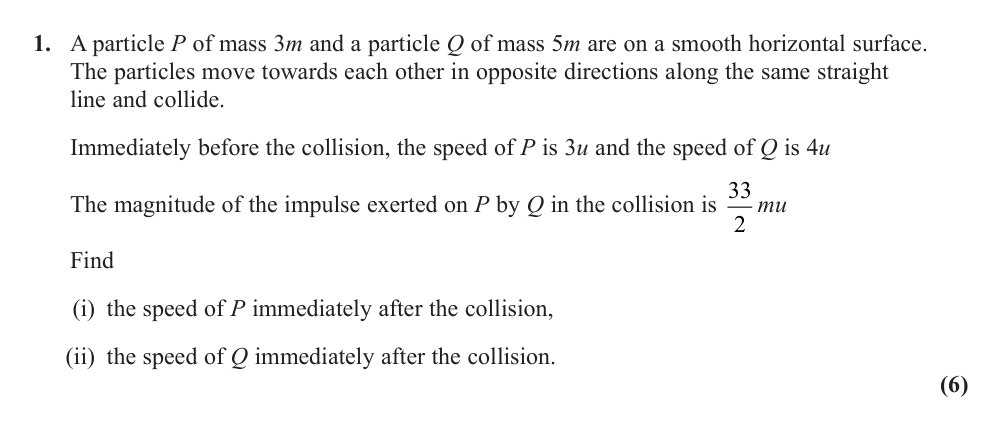
Take the initial direction of P as positive. Then before impact, $v_P=3u$ and $v_Q=-4u$. The impulse on P acts opposite to P\'s initial motion, so its signed impulse is $-\dfrac{33}{2}mu$.
Use impulse on P
For P, impulse equals change in momentum: $-\dfrac{33}{2}mu=3m(v_P-3u)$. Dividing by $3m$ gives $v_P-3u=-\dfrac{11u}{2}$, so $v_P=-\dfrac{5u}{2}$.
Interpret the speed of P
The negative sign means P has reversed direction. Its speed is therefore $\left|-\dfrac{5u}{2}\right|=\dfrac{5u}{2}$.
Use the equal and opposite impulse on Q
Q receives impulse $+\dfrac{33}{2}mu$ in the positive direction. Hence $\dfrac{33}{2}mu=5m(v_Q-(-4u))=5m(v_Q+4u)$.
Interpret the speed of Q
Dividing by $5m$ gives $v_Q+4u=\dfrac{33u}{10}$, so $v_Q=-\dfrac{7u}{10}$. Q is still moving in its original direction, and its speed is $\dfrac{7u}{10}$.
Final answer
$(i)\ \text{speed of P}=\dfrac{5u}{2}.\quad (ii)\ \text{speed of Q}=\dfrac{7u}{10}$.
4. WME01/01 May/June 2025 · Q1
Easy6 marks · main topic: Momentum, Impulse & CollisionsShow worked solution
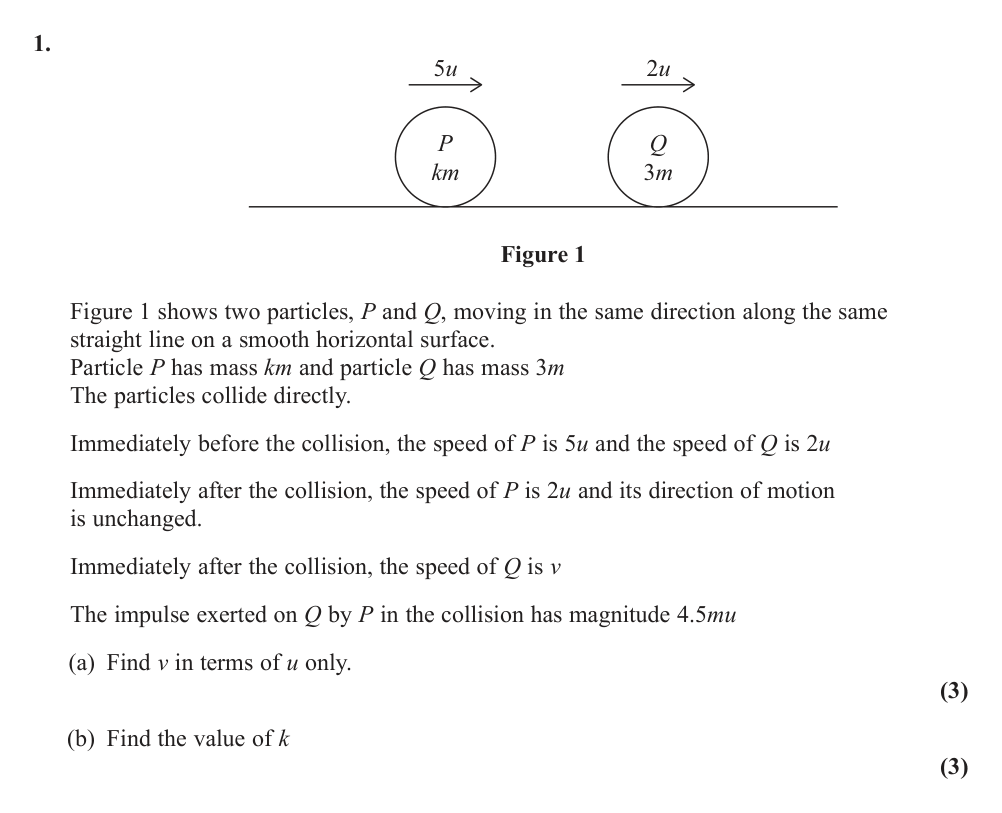
Part (a): Find v in terms of u - Apply impulse-momentum theorem to Q
$\text{Impulse} = \text{Final momentum} - \text{Initial momentum}$ For particle Q: ; Mass = $3m$ ; Initial velocity = $2u$ ; Final velocity = $v$ ; Impulse received = $4.5mu$
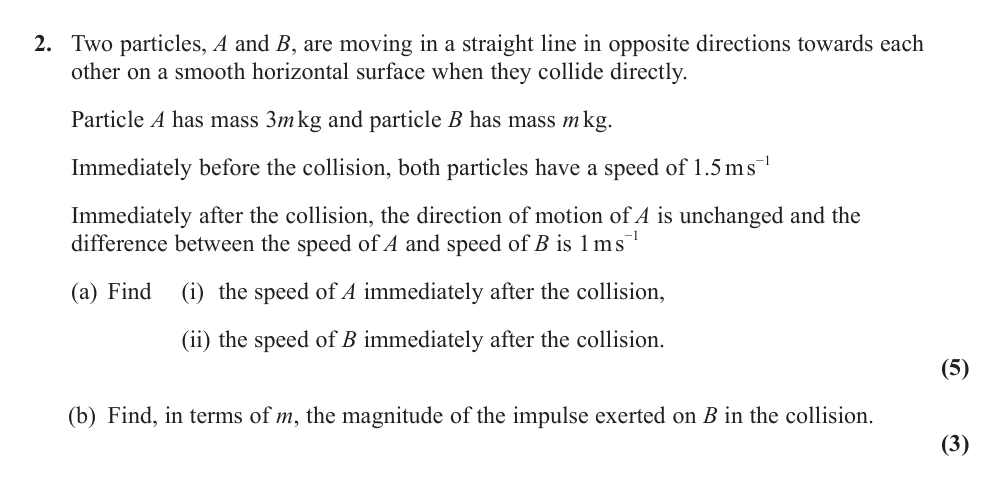
Easy6 marks · main topic: Momentum, Impulse & CollisionsShow worked solution
Choose a sign convention
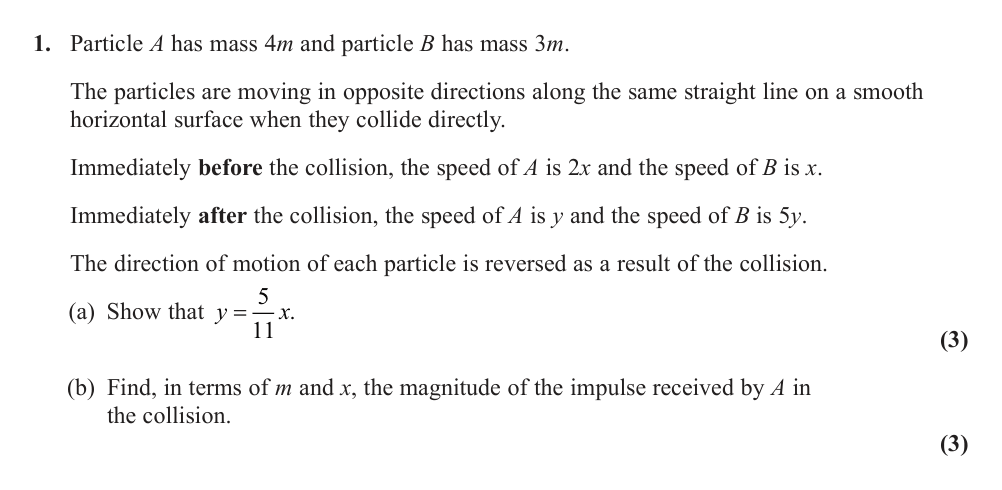
Take the initial direction of A as positive. Before collision, A has velocity $2x$ and B has velocity $-x$. After collision, both reverse direction, so A has velocity $-y$ and B has velocity $5y$.
Apply conservation of momentum
$4m(2x)+3m(-x)=4m(-y)+3m(5y)$. The left side is $5mx$ and the right side is $11my$.
Show the ratio
$5mx=11my$, so $\dfrac{y}{x}=\dfrac{5}{11}$.
Use change in momentum for A
The impulse received by A is the change in momentum of A: $I=4m|-y-2x|=4m(y+2x)$.
Substitute y
Using $y=\dfrac{5x}{11}$, $I=4m\left(\dfrac{5x}{11}+2x\right)=4m\left(\dfrac{27x}{11}\right)=\dfrac{108}{11}mx$.
Easy6 marks · main topic: Newton's Second LawShow worked solution
Use the lower particle to find acceleration
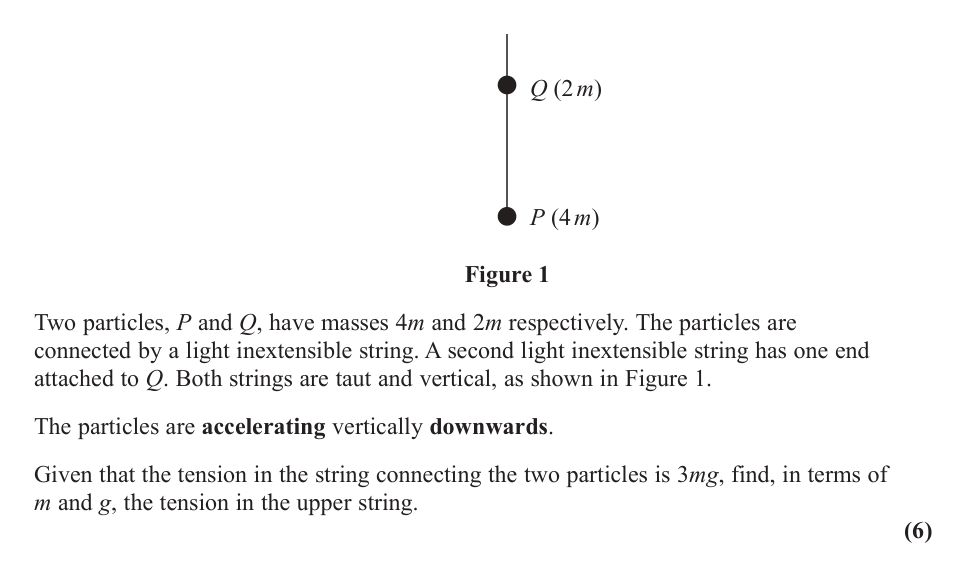
For P, take downward as positive. Its weight is $4mg$ and the tension in the string between P and Q is $3mg$ upward, so $4mg-3mg=4ma$.
Find the acceleration
The equation gives $mg=4ma$, hence $a=\dfrac{g}{4}$ downward.
Write the equation for Q
For Q, downward forces are its weight $2mg$ and the lower string tension $3mg$. The upper string tension $T$ acts upward. Taking downward as positive: $2mg+3mg-T=2ma$.
Easy6 marks · main topic: MomentsShow worked solution
Set the positions relative to C
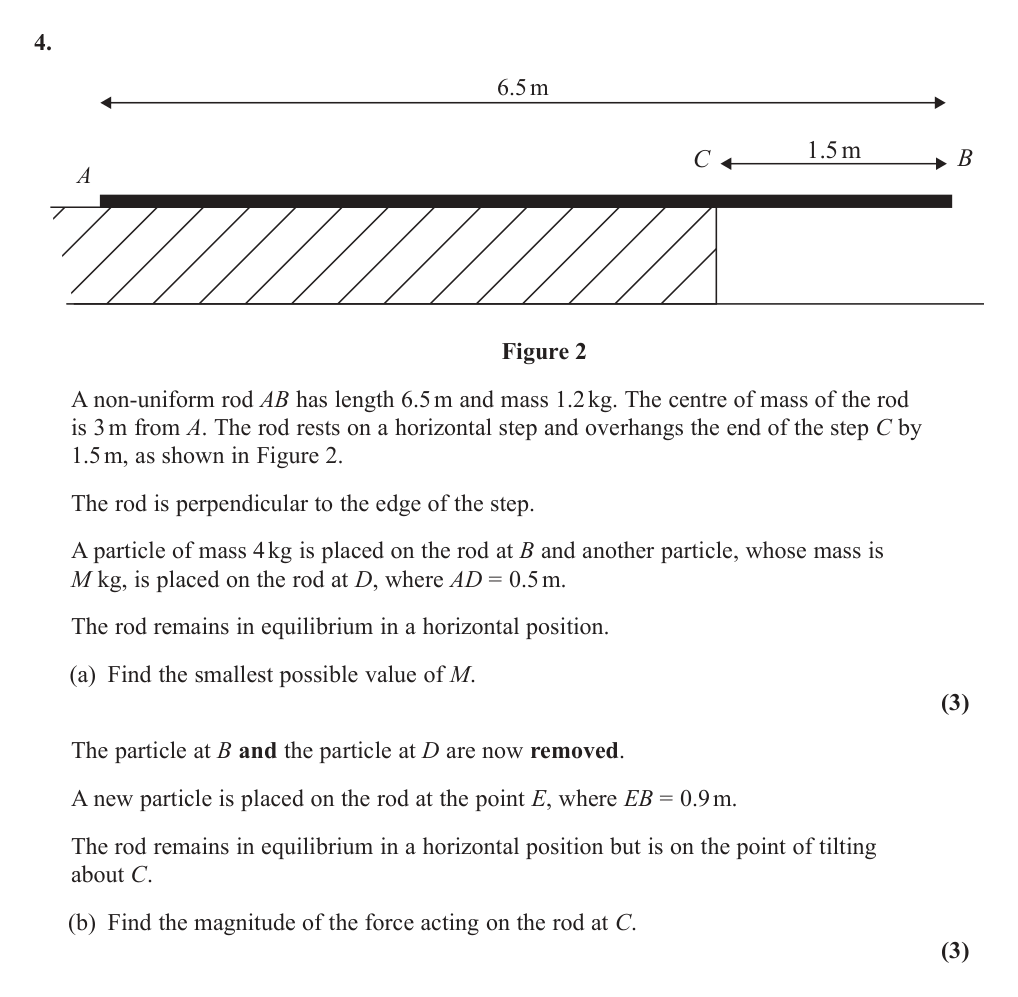
The rod is 6.5 m long and overhangs C by 1.5 m, so C is 5.0 m from A. The rod centre of mass is 3.0 m from A, so it is 2.0 m to the left of C. Point D is 0.5 m from A, so it is 4.5 m to the left of C.
Use the limiting balance for smallest M
For the smallest $M$, the rod is just prevented from tilting clockwise about C. Taking moments about C: $Mg(4.5)+1.2g(2)=4g(1.5)$.
Find M
$4.5M+2.4=6$, so $4.5M=3.6$ and $M=0.8$.
Place the new particle E
Now the old particles are removed. Since $EB=0.9$ m and $AB=6.5$ m, E is $5.6$ m from A, so E is $0.6$ m to the right of C.
Find the new particle mass from moments
At tilting about C, moments about C give $Xg(0.6)=1.2g(2)$, so $X=4$.
Find the force at C
The upward force at C balances the rod and the new particle: $R_C=1.2g+4g=5.2g\ \mathrm{N}$, which is about $51\ \mathrm{N}$.
Easy6 marks · main topic: ForcesShow worked solution
Use the trig ratios
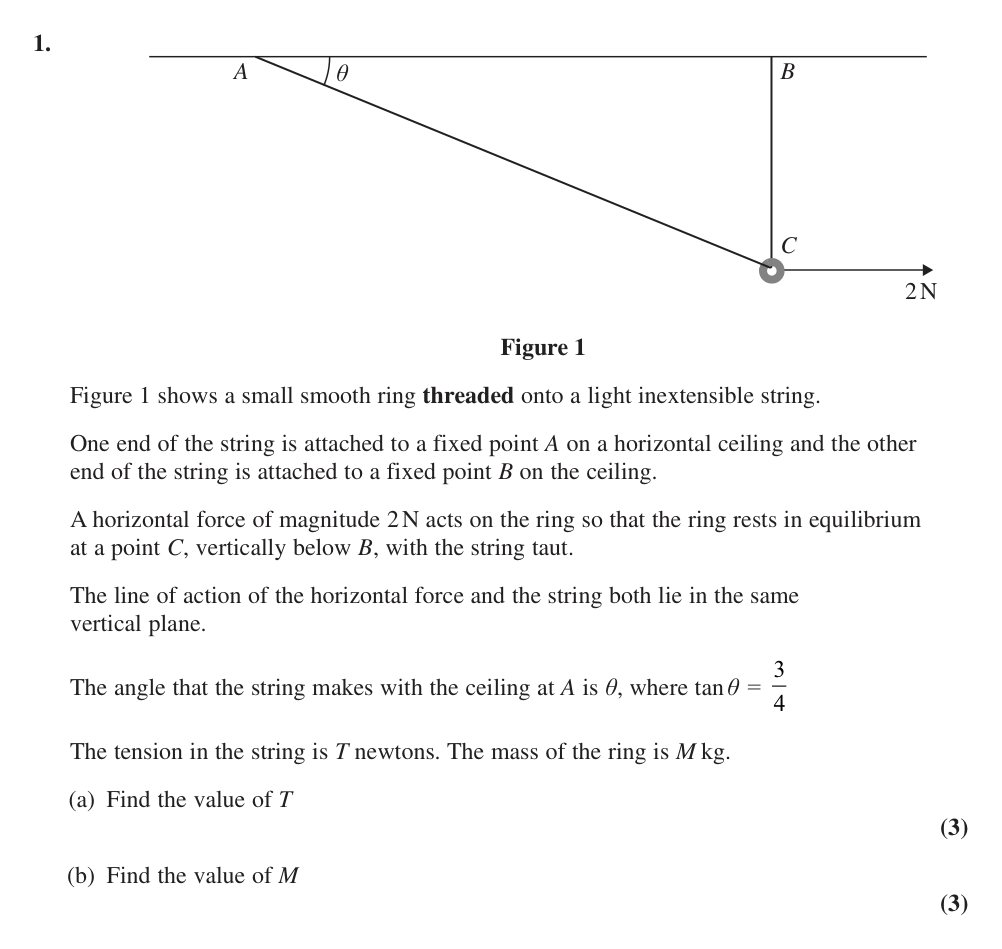
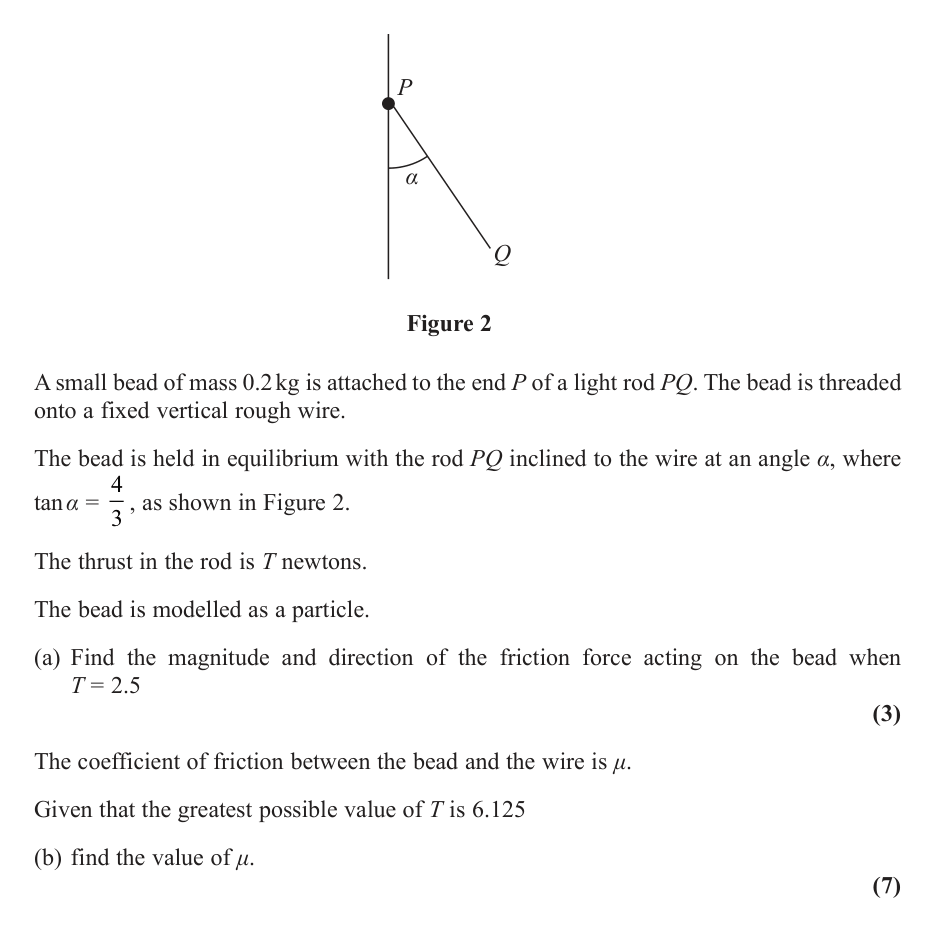
Given $\tan\theta=\dfrac34$, use $\sin\theta=\dfrac35$ and $\cos\theta=\dfrac45$.
Resolve horizontally
The horizontal force of $2$ N is balanced by the horizontal component of the tension in the sloping part of the string: $T\cos\theta=2$.
Find the tension
$T\cdot\dfrac45=2$, so $T=2.5\ \mathrm{N}$.
Resolve vertically
The ring is smooth, so the tension is the same in both parts of the string. Upward components are $T$ from the vertical part and $T\sin\theta$ from the sloping part. Therefore $T+T\sin\theta=Mg$.
Find the mass
$Mg=2.5+2.5\cdot\dfrac35=4.0$, so $M=\dfrac{4.0}{9.8}=0.408\ \mathrm{kg}$.
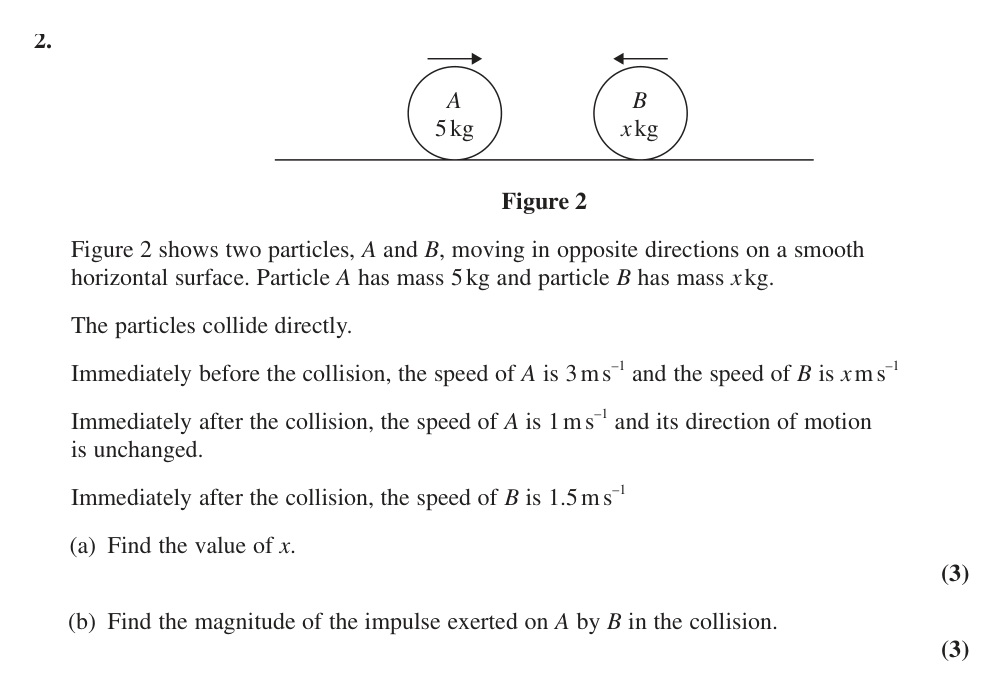
Easy6 marks · main topic: Momentum, Impulse & CollisionsShow worked solution
Choose a sign convention
Take the initial direction of A as positive. Before collision, A has velocity $3$ and B has velocity $-x$.
Set up conservation of momentum
After collision, A still moves in the same direction with velocity $1$. B has speed $1.5$ in the positive direction for the valid solution. Hence $5(3)+x(-x)=5(1)+1.5x$.
Solve for x
$15-x^2=5+1.5x$, so $x^2+1.5x-10=0$. This gives $x=2.5$ or $x=-4$. Since mass is positive, $x=2.5$.
Use change in momentum of A
The impulse exerted on A equals the change in momentum of A: $I=5(1-3)=-10\ \mathrm{N\,s}$ using the chosen positive direction.
Give the magnitude
The magnitude of the impulse is $10\ \mathrm{N\,s}$.
Final answer
$(a)\ x=2.5.\quad (b)\ I=10\ \mathrm{N\,s}$.
10. WME01/01 October 2022 · Q4
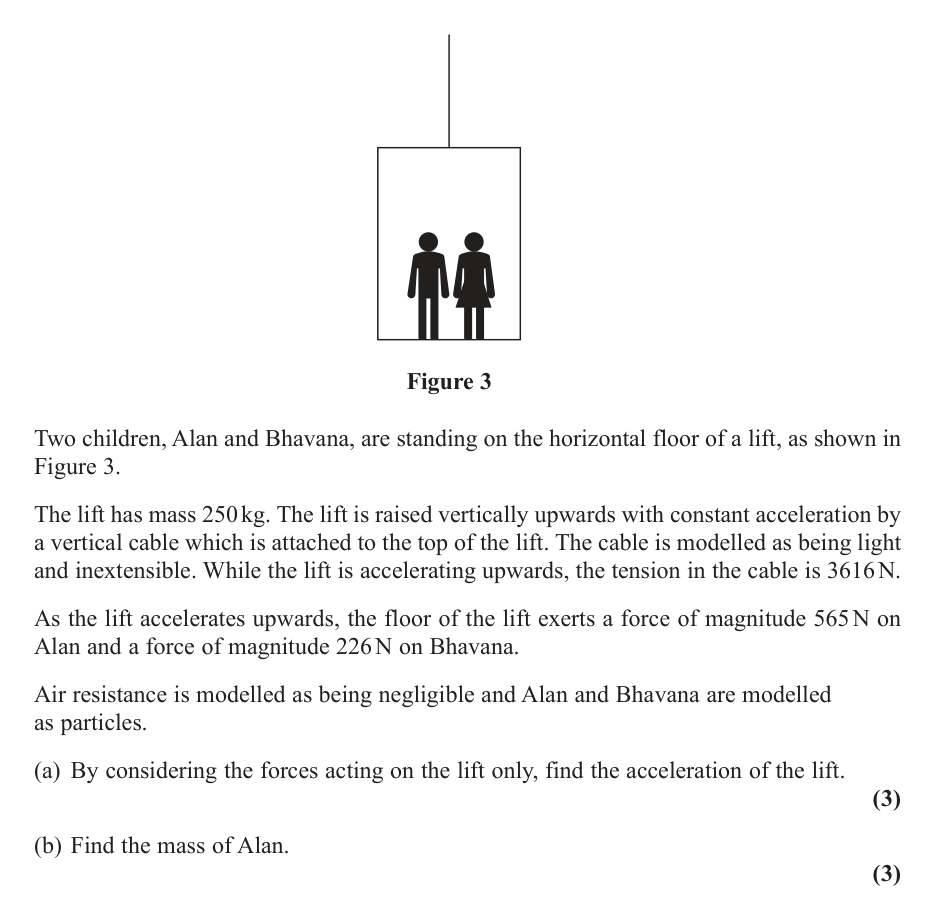
Easy6 marks · main topic: Newton's Second LawShow worked solution
Consider the lift only
For the lift, the upward force is the cable tension $3616$ N. Downward forces on the lift are its own weight $250g$ and the contact forces from Alan and Bhavana, $565$ N and $226$ N.
Apply Newtons second law
Taking upward as positive: $3616-250g-565-226=250a$.
Find the acceleration
$3616-2450-565-226=250a$, so $375=250a$ and $a=1.5\ \mathrm{m\,s^{-2}}$.
Consider Alan
Let Alan's mass be $m_A$. The upward force on Alan is $565$ N and his weight is $m_Ag$.
Find Alan's mass
$565-m_Ag=m_A(1.5)$, so $565=m_A(9.8+1.5)=11.3m_A$. Hence $m_A=50\ \mathrm{kg}$.
Final answer
$(a)\ a=1.5\ \mathrm{m\,s^{-2}}.\quad (b)\ \text{mass of Alan}=50\ \mathrm{kg}$.
11. WME01/01 January 2022 · Q1
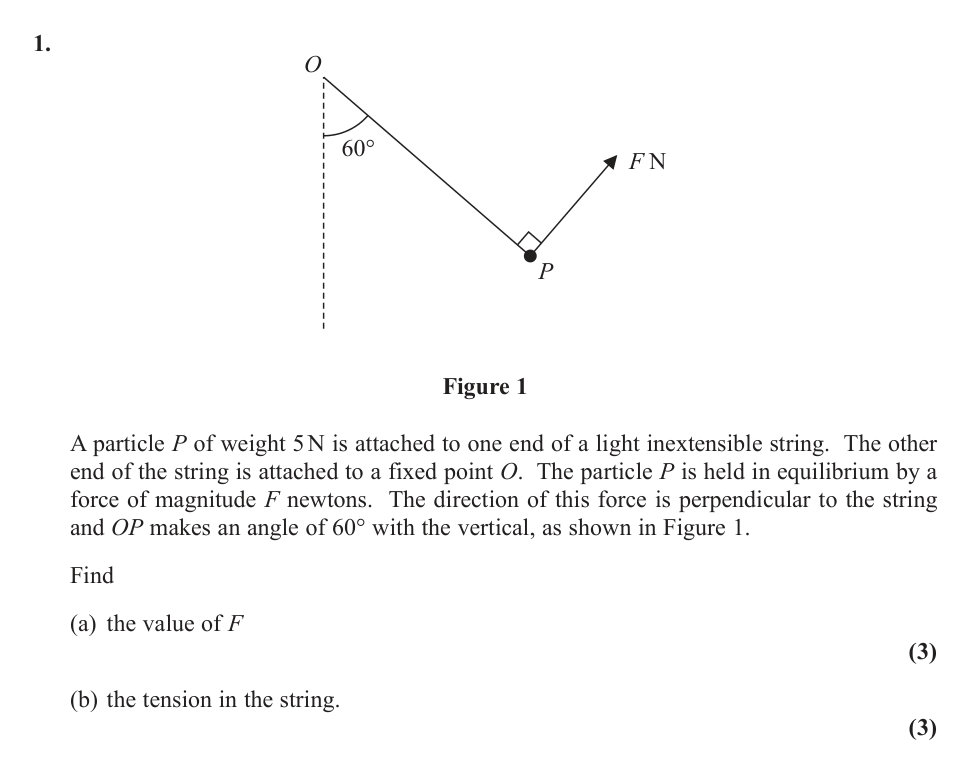
Easy6 marks · main topic: ForcesShow worked solution
Resolve perpendicular to the string
The force $F$ is perpendicular to the string. The weight is $5$ N vertically downward, and the string makes $60^\circ$ with the vertical.
Find F
The component of the weight perpendicular to the string is $5\cos30^\circ$, so $F=5\cos30^\circ=\dfrac{5\sqrt3}{2}\ \mathrm{N}$.
Resolve along the string
The tension balances the component of the weight along the string. This component is $5\sin30^\circ$.
Easy6 marks · main topic: Momentum, Impulse & CollisionsShow worked solution
Choose a positive direction
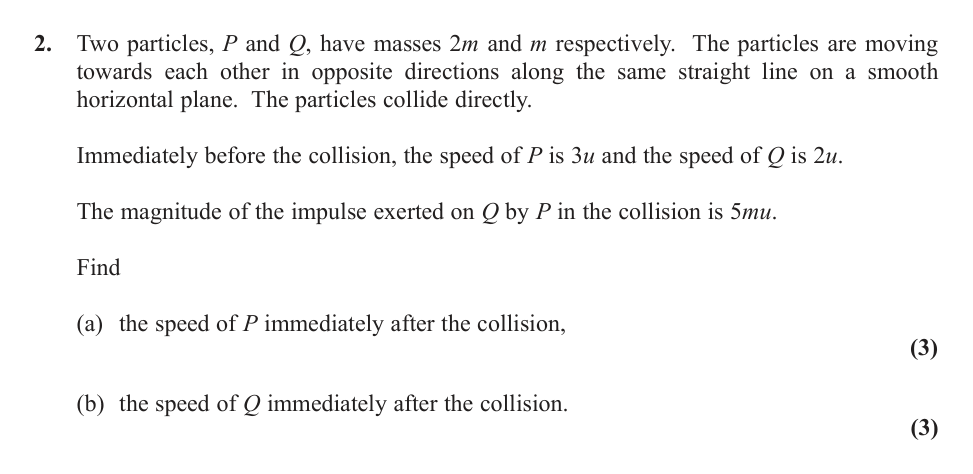
Take P's original direction as positive. Before collision, P has velocity $3u$ and Q has velocity $-2u$.
Use impulse on P
The impulse on P is opposite to P's original motion and has magnitude $5mu$. Let P's velocity after collision be $v$. Then $-5mu=2m(v-3u)$.
Find P speed
Divide by $m$: $-5u=2v-6u$, so $2v=u$ and $v=\dfrac{u}{2}$.
Use impulse on Q
The impulse on Q is in P's original direction. Let Q's velocity after collision be $w$. Then $5mu=m(w-(-2u))$.
Find Q speed
$5u=w+2u$, so $w=3u$. Therefore the speed of Q is $3u$.
Final answer
$(a)\ \text{speed of P}=\dfrac{u}{2}.\quad (b)\ \text{speed of Q}=3u$.
15. WME01/01 January 2021 · Q4
Easy6 marks · main topic: MomentsShow worked solution
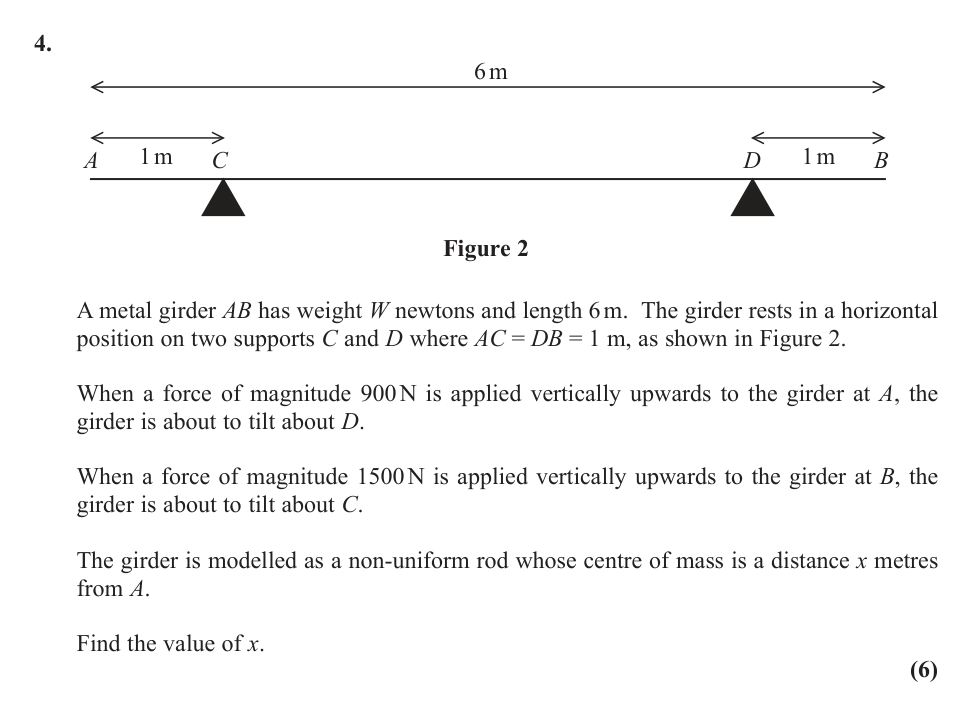
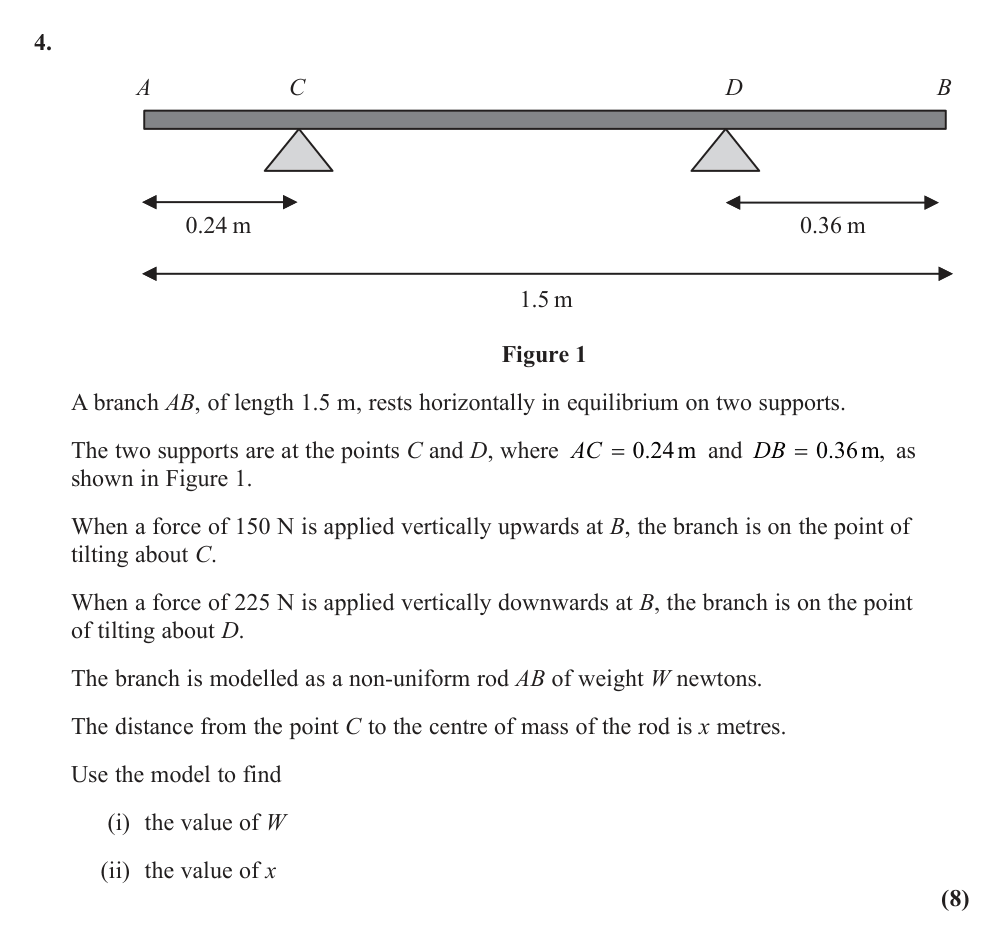
Set support positions
The girder has length $6$ m, with C $1$ m from A and D $1$ m from B. So D is $5$ m from A.
Use tilting about D
When the $900$ N upward force is applied at A, the girder is about to tilt about D. Taking moments about D gives $900(5)=W(5-x)$.
Use tilting about C
When the $1500$ N upward force is applied at B, the girder is about to tilt about C. Taking moments about C gives $1500(5)=W(x-1)$.
Solve the equations
The equations are $W(5-x)=4500$ and $W(x-1)=7500$. Add them: $W[(5-x)+(x-1)]=12000$, so $4W=12000$ and $W=3000$.
Find x
Use $W(x-1)=7500$: $3000(x-1)=7500$, so $x-1=2.5$ and $x=3.5$ m.
Final answer
$x=3.5\ \mathrm{m}$.
16. WME01/01 January 2025 · Q5
Medium7 marks · main topic: Working with VectorsShow worked solution
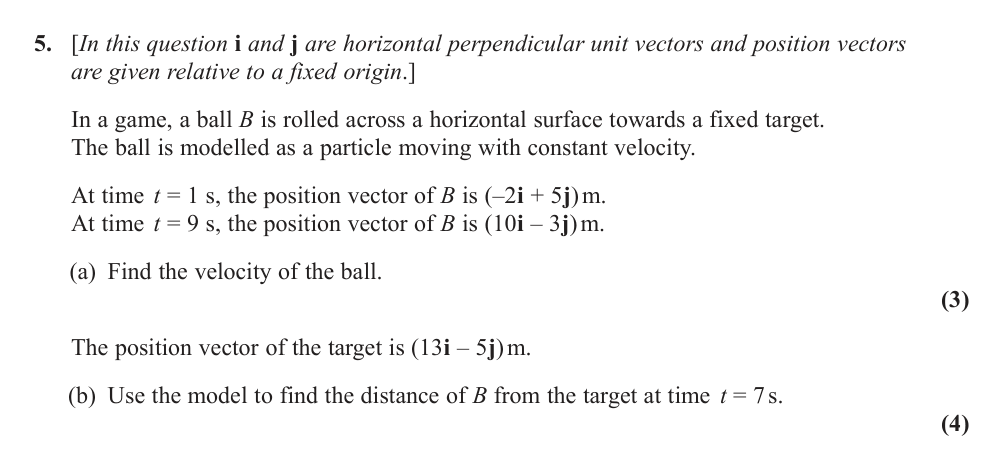
Find the displacement over 8 seconds
From $t=1$ to $t=9$, the displacement is $(10\mathbf{i}-3\mathbf{j})-(-2\mathbf{i}+5\mathbf{j})=12\mathbf{i}-8\mathbf{j}$.
Find the velocity
The time interval is $8$ seconds, so $\mathbf{v}=\dfrac{12\mathbf{i}-8\mathbf{j}}{8}=1.5\mathbf{i}-\mathbf{j}\ \mathrm{m\,s^{-1}}$.
Find the position at t=7
Time $t=7$ is 6 seconds after $t=1$. Therefore $\mathbf{r}_B(7)=(-2\mathbf{i}+5\mathbf{j})+6(1.5\mathbf{i}-\mathbf{j})=7\mathbf{i}-\mathbf{j}$.
Find the vector from B to the target
The target has position vector $13\mathbf{i}-5\mathbf{j}$. The vector from the ball to the target is $(13\mathbf{i}-5\mathbf{j})-(7\mathbf{i}-\mathbf{j})=6\mathbf{i}-4\mathbf{j}$.
Find the distance
The distance is $\sqrt{6^2+(-4)^2}=\sqrt{52}=2\sqrt{13}\ \mathrm{m}$, which is about $7.2\ \mathrm{m}$.
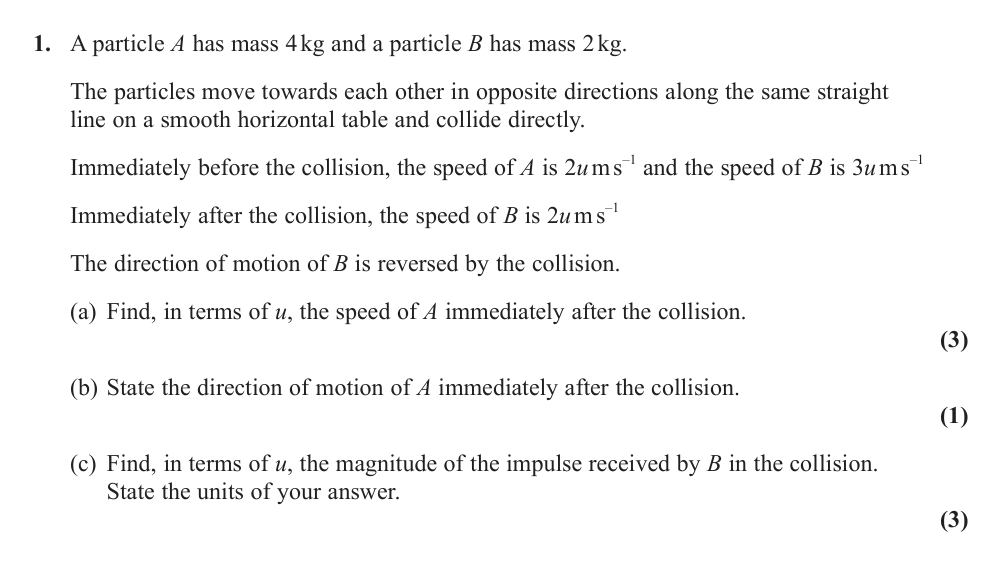
Medium7 marks · main topic: Momentum, Impulse & CollisionsShow worked solution
Choose a positive direction
Take the original direction of A as positive. Before the collision, A has velocity $2u$ and B has velocity $-3u$. After the collision, B has velocity $2u$ because its direction is reversed.
Use conservation of momentum
Let the velocity of A after the collision be $v$. Then $4(2u)+2(-3u)=4v+2(2u)$.
Solve for the velocity of A
$8u-6u=4v+4u$, so $2u=4v+4u$. Hence $4v=-2u$ and $v=-\dfrac{u}{2}$.
State the speed and direction
The speed of A is the magnitude of its velocity, so it is $\dfrac{u}{2}$. The negative sign shows that A has reversed direction.
Find the impulse on B
Impulse equals change in momentum. For B, $I=2\left(2u-(-3u)\right)=2(5u)=10u$.
Attach the units
The impulse is $10u\ \mathrm{N\,s}$, equivalently $10u\ \mathrm{kg\,m\,s^{-1}}$.
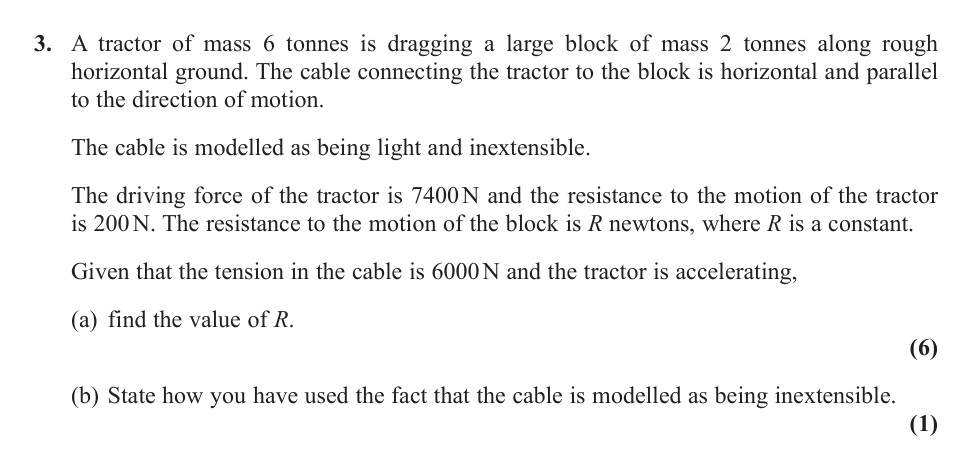
The cable is inextensible, so the tractor and block move together with the same acceleration.
Final answer
$(a)\ R=5600\ \mathrm{N}.\quad (b)$ The tractor and block have the same acceleration.
20. WME01/01 January 2022 · Q3
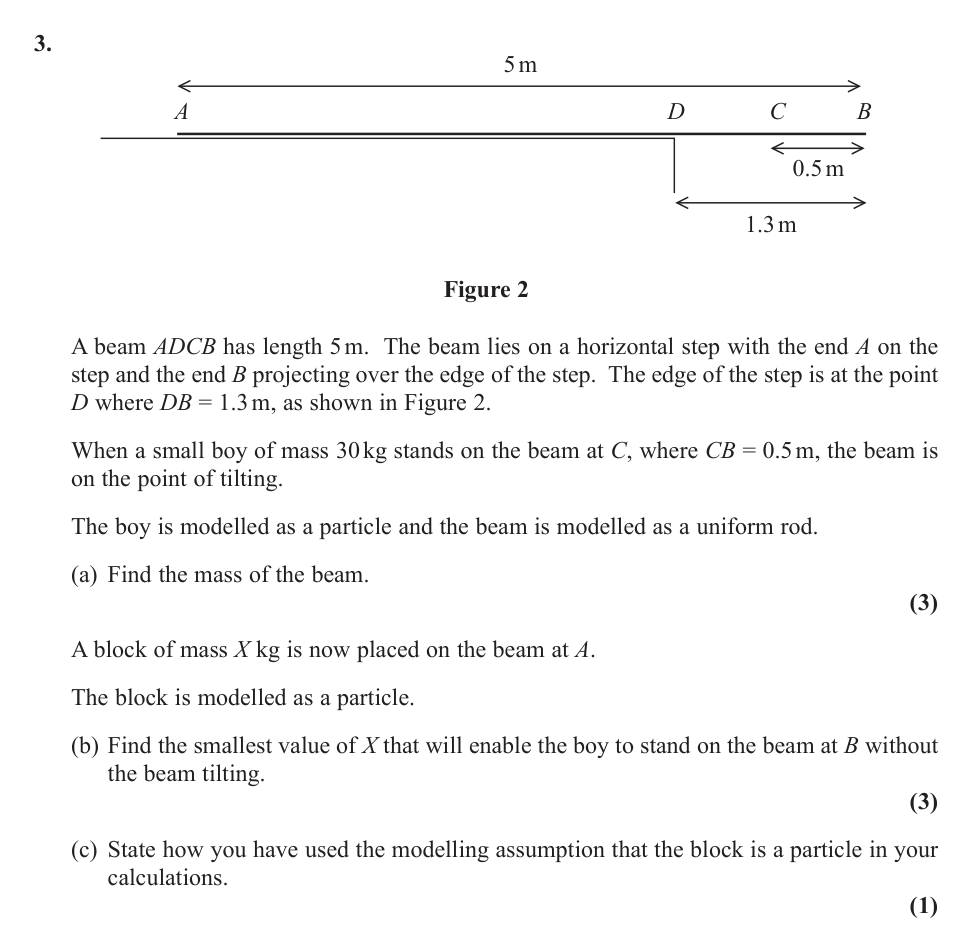
Medium7 marks · main topic: MomentsShow worked solution
Set the distances from D
The beam length is $5$ m and $DB=1.3$ m, so D is $3.7$ m from A. The centre of mass of the uniform beam is at its midpoint, so it is $1.2$ m to the left of D. Point C is $0.8$ m to the right of D.
Use the first tilting condition
When the boy stands at C, the beam is about to tilt about D. Let the mass of the beam be $M$ kg.
Take moments about D
$Mg(1.2)=30g(0.8)$. Hence $1.2M=24$ and $M=20\ \mathrm{kg}$.
Set up the second tilting condition
With the boy at B, his moment about D is $30g(1.3)$. The block at A is $3.7$ m to the left of D, and the beam's weight acts $1.2$ m to the left of D.
Take moments about D again
$Xg(3.7)+20g(1.2)=30g(1.3)$.
Find X
$3.7X+24=39$, so $3.7X=15$ and $X=\dfrac{150}{37}=4.05\ldots\ \mathrm{kg}$.
Use the particle model
The block is modelled as a particle, so its mass is treated as acting at one point, A.
Final answer
$(a)\ \text{beam mass}=20\ \mathrm{kg}.\quad (b)\ X=\dfrac{150}{37}\ \mathrm{kg}\approx4.05\ \mathrm{kg}.\quad (c)$ The block's mass is treated as concentrated at A.
21. WME01/01 May/June 2021 · Q1
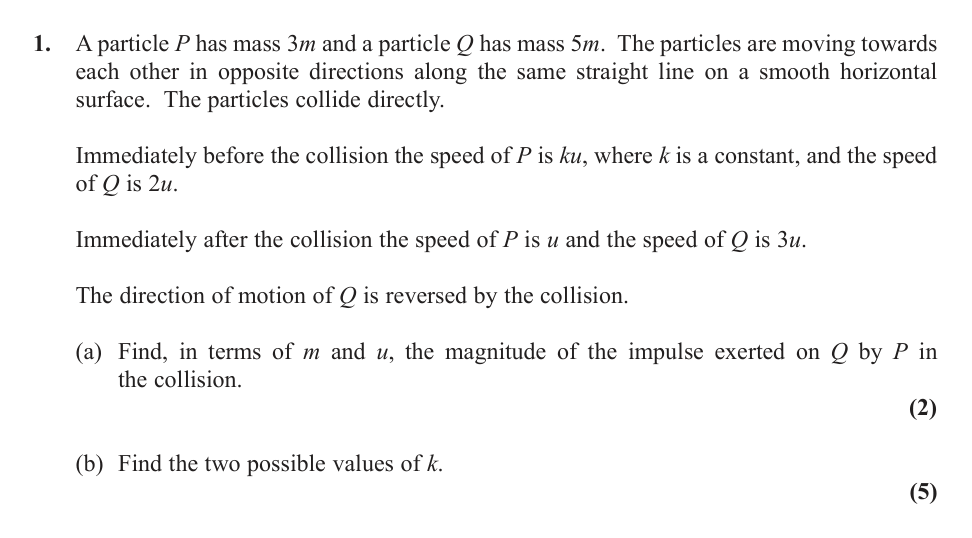
Medium7 marks · main topic: Momentum, Impulse & CollisionsShow worked solution
Choose a positive direction
Take P's original direction as positive. Q initially has velocity $-2u$. Since Q reverses direction and then has speed $3u$, its final velocity is $3u$.
Find the impulse on Q
Impulse equals change in momentum: $I=5m(3u-(-2u))=25mu$.
Use conservation of momentum
Before collision, total momentum is $3m(ku)+5m(-2u)=3mku-10mu$.
Case 1: P continues in its original direction
If P has final velocity $u$, final momentum is $3m(u)+5m(3u)=18mu$. So $3mku-10mu=18mu$, giving $3k=28$ and $k=\dfrac{28}{3}$.
Case 2: P reverses direction
If P has final velocity $-u$, final momentum is $3m(-u)+5m(3u)=12mu$. So $3mku-10mu=12mu$, giving $3k=22$ and $k=\dfrac{22}{3}$.
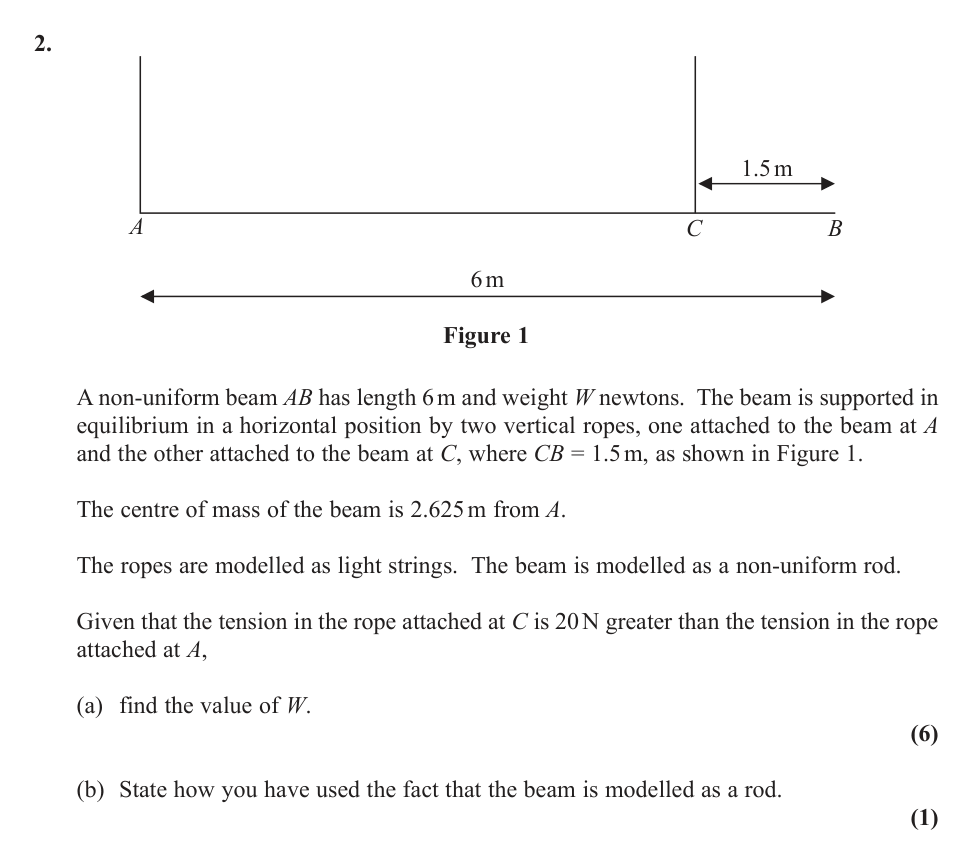
Medium7 marks · main topic: MomentsShow worked solution
Set the tensions
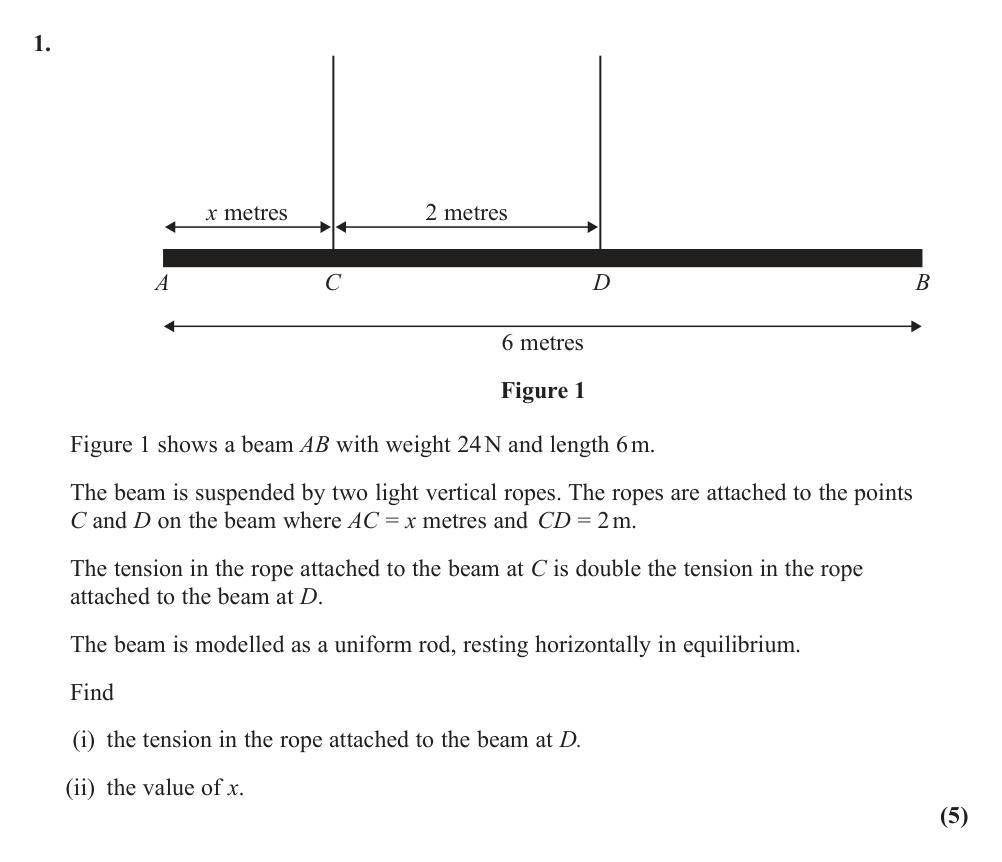
Let the tension at A be $T$. The tension at C is then $T+20$. Since $CB=1.5$ m and $AB=6$ m, $AC=4.5$ m.
Use vertical equilibrium
The upward tensions balance the weight: $T+(T+20)=W$, so $2T+20=W$.
Take moments about A
The centre of mass is $2.625$ m from A. Taking moments about A gives $4.5(T+20)=2.625W$.
Solve for W
From the moments equation, $T+20=\dfrac{2.625}{4.5}W=\dfrac{7}{12}W$. Also $T+20=\dfrac{W+20}{2}$. Hence $\dfrac{W+20}{2}=\dfrac{7W}{12}$, so $6W+120=7W$ and $W=120$ N.
State the modelling use
Modelling the beam as a rod means it stays straight and rigid, so the distances used in the moments equations do not change.
Final answer
$(a)\ W=120\ \mathrm{N}.\quad (b)$ The rod model keeps the beam straight and rigid, so the stated distances along the beam are fixed.
23. WME01/01 October 2025 · Q2
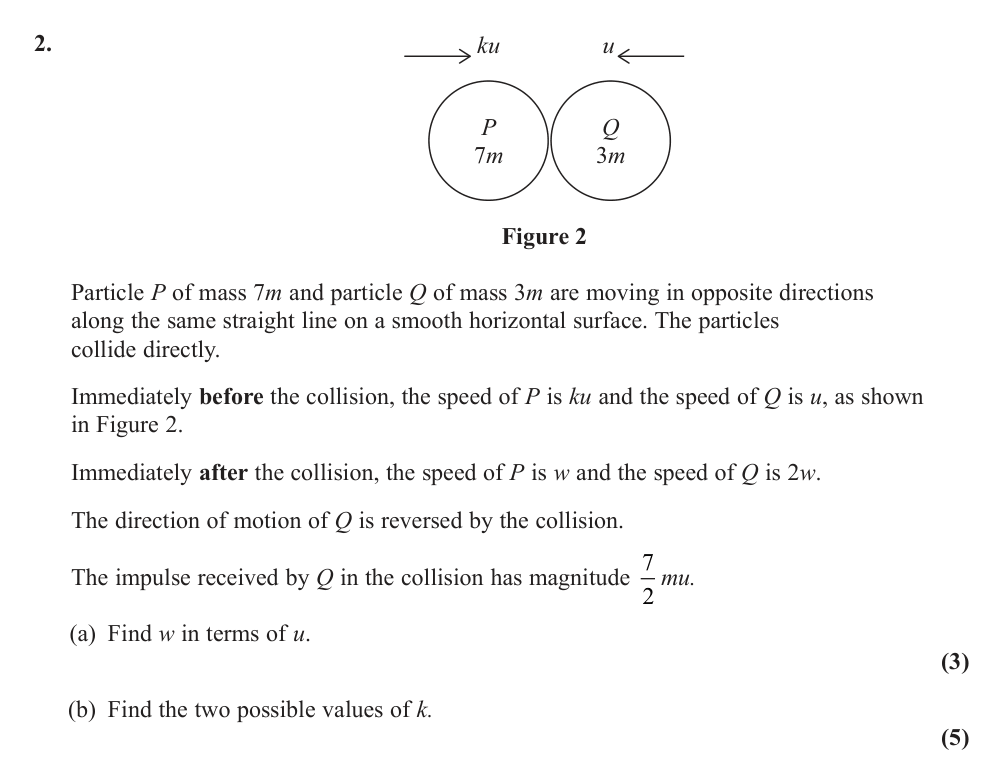
Medium8 marks · main topic: Momentum, Impulse & CollisionsShow worked solution
Part (a): Find w in terms of u - Apply impulse-momentum theorem to Q
Part (b): Find the two possible values of k - Consider both directions for P after collision
P could move either right (velocity = $+w$) or left (velocity = $-w$) Case 1: P moves right with velocity $+w$ Already solved: $k = \frac{7}{12}$ Case 2: P moves left with velocity $-w$ Total momentum after = $-7mw + 6mw = -mw$ $7mku - 3mu = -mw$ $7ku - 3u = -w$ $7ku - 3u = -\frac{u}{12}$ $7ku = 3u - \frac{u}{12}$ $7ku = \frac{36u - u}{12}$ $7ku = \frac{35u}{12}$ $k = \frac{35}{84} = \frac{5}{12}$
Medium8 marks · main topic: ForcesShow worked solution
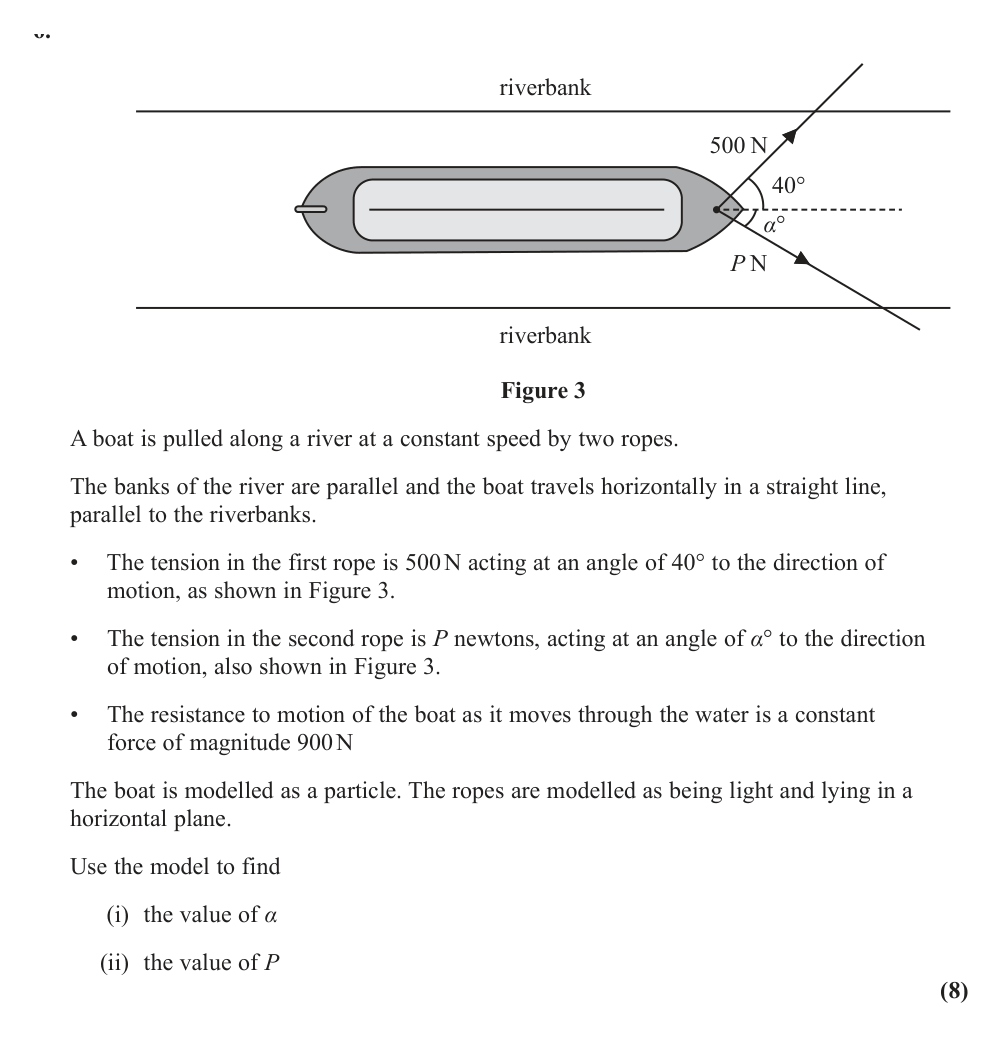
Resolve perpendicular to the motion
The boat travels straight, so the sideways components balance: $500\sin40^\circ=P\sin\alpha$.
Resolve along the motion
The speed is constant, so the forward components balance the resistance: $500\cos40^\circ+P\cos\alpha=900$.
Eliminate P
From the two equations, $P\sin\alpha=500\sin40^\circ$ and $P\cos\alpha=900-500\cos40^\circ$.
Find alpha
Divide the sine equation by the cosine equation: $\tan\alpha=\dfrac{500\sin40^\circ}{900-500\cos40^\circ}$. This gives $\alpha=31.9^\circ$, so $\alpha=32^\circ$ approximately.
Find P
Use $P\sin\alpha=500\sin40^\circ$: $P=\dfrac{500\sin40^\circ}{\sin31.9^\circ}=608.7\ldots\ \mathrm{N}$. Hence $P\approx610\ \mathrm{N}$.
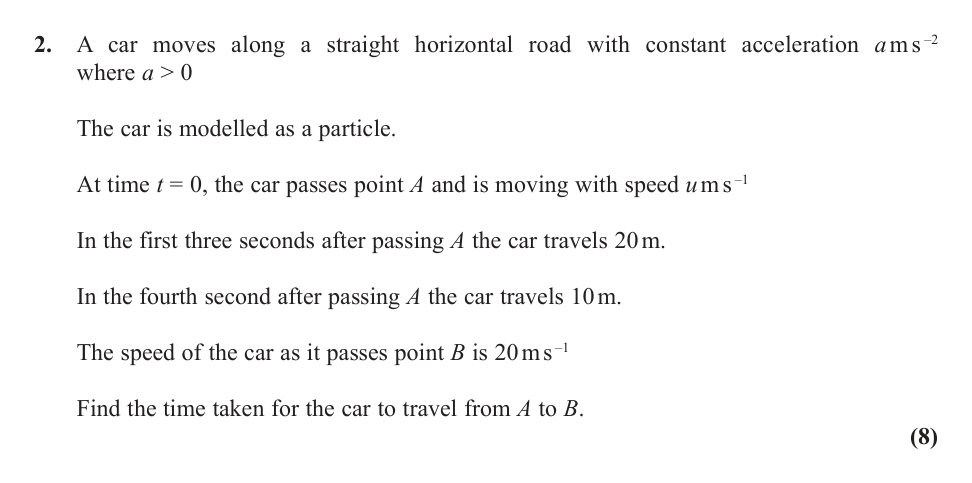
At B, speed is $20$. Use $v=u+at$: $20=\dfrac{25}{6}+\dfrac53t$.
Find the time
$\dfrac53t=20-\dfrac{25}{6}=\dfrac{95}{6}$, so $t=\dfrac{95}{10}=9.5\ \mathrm{s}$.
Final answer
$t=9.5\ \mathrm{s}$.
28. WME01/01 January 2020 · Q1
Medium8 marks · main topic: Momentum, Impulse & CollisionsShow worked solution
Choose a positive direction
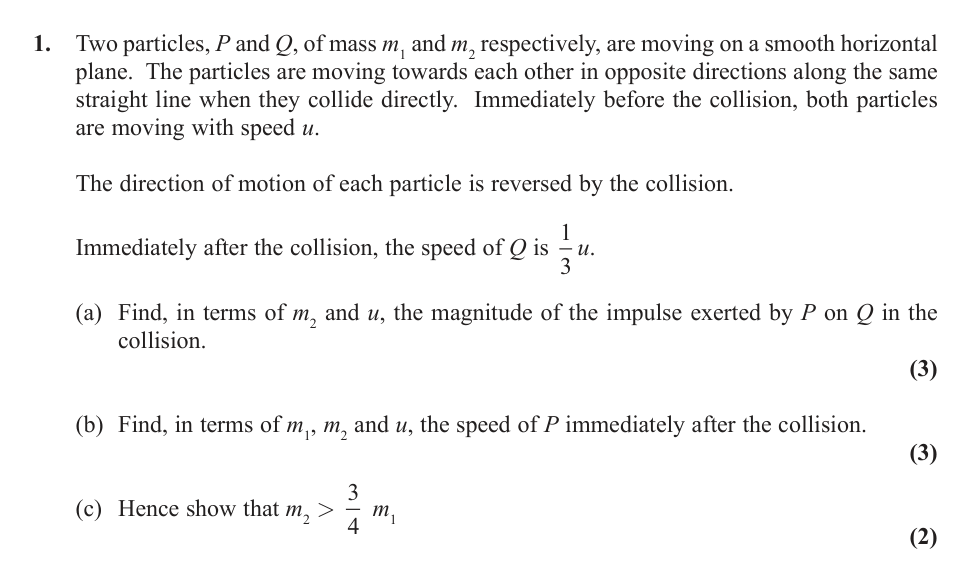
Take P's original direction as positive. Before collision, $v_P=u$ and $v_Q=-u$. After collision, Q has velocity $\dfrac{u}{3}$ because its direction is reversed.
Find the impulse on Q
Impulse on Q equals change in momentum: $I=m_2\left(\dfrac{u}{3}-(-u)\right)=m_2\left(\dfrac{4u}{3}\right)=\dfrac{4}{3}m_2u$.
Use conservation of momentum
Let the speed of P after collision be $v$. Since P reverses direction, its velocity is $-v$. Hence $m_1u-m_2u=-m_1v+\dfrac13m_2u$.
Solve for P's speed
Rearrange: $m_1v=\dfrac43m_2u-m_1u$, so $v=\dfrac{(4m_2-3m_1)u}{3m_1}$.
Use the fact that speed is positive
Since $u>0$ and $m_1>0$, the numerator must be positive: $4m_2-3m_1>0$. Therefore $m_2>\dfrac34m_1$.
Final answer
$(a)\ I=\dfrac{4}{3}m_2u.\quad (b)\ \text{speed of P}=\dfrac{(4m_2-3m_1)u}{3m_1}.\quad (c)\ m_2>\dfrac34m_1$.
29. WME01/01 October 2019 · Q5
Medium8 marks · main topic: MomentsShow worked solution
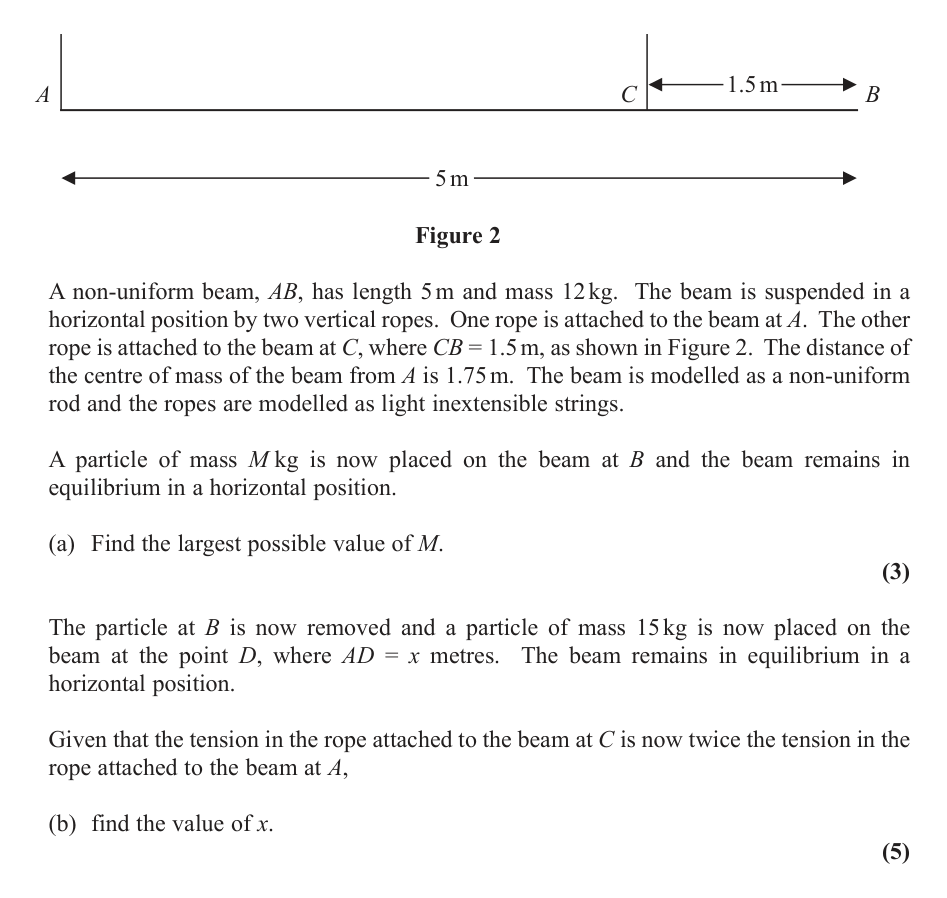
Locate the key distances
The beam is $5$ m long. Since $CB=1.5$ m, $AC=3.5$ m. The centre of mass is $1.75$ m from A, so it is also $1.75$ m from C.
Use the largest M condition
For the largest possible $M$ at B, the rope at A is just slack, so the beam is supported at C only.
Take moments about C
The particle at B is $1.5$ m to the right of C, and the beam's weight acts $1.75$ m to the left of C. Hence $Mg(1.5)=12g(1.75)$.
Find M
$M=\dfrac{12(1.75)}{1.5}=14$.
Set the tensions for part b
Let the tension at A be $T$. The tension at C is $2T$. Vertical equilibrium gives $T+2T=12g+15g=27g$, so $T=9g$ and the tension at C is $18g$.
Take moments about A
For the new particle at $AD=x$, moments about A give $18g(3.5)=12g(1.75)+15gx$.
Solve for x
Cancel $g$: $63=21+15x$. Thus $15x=42$ and $x=2.8$ m.
Final answer
$(a)\ M=14.\quad (b)\ x=2.8\ \mathrm{m}$.
30. WME01/01 October 2024 · Q2
Hard9 marks · main topic: MomentsShow worked solution
Find the reactions from vertical equilibrium
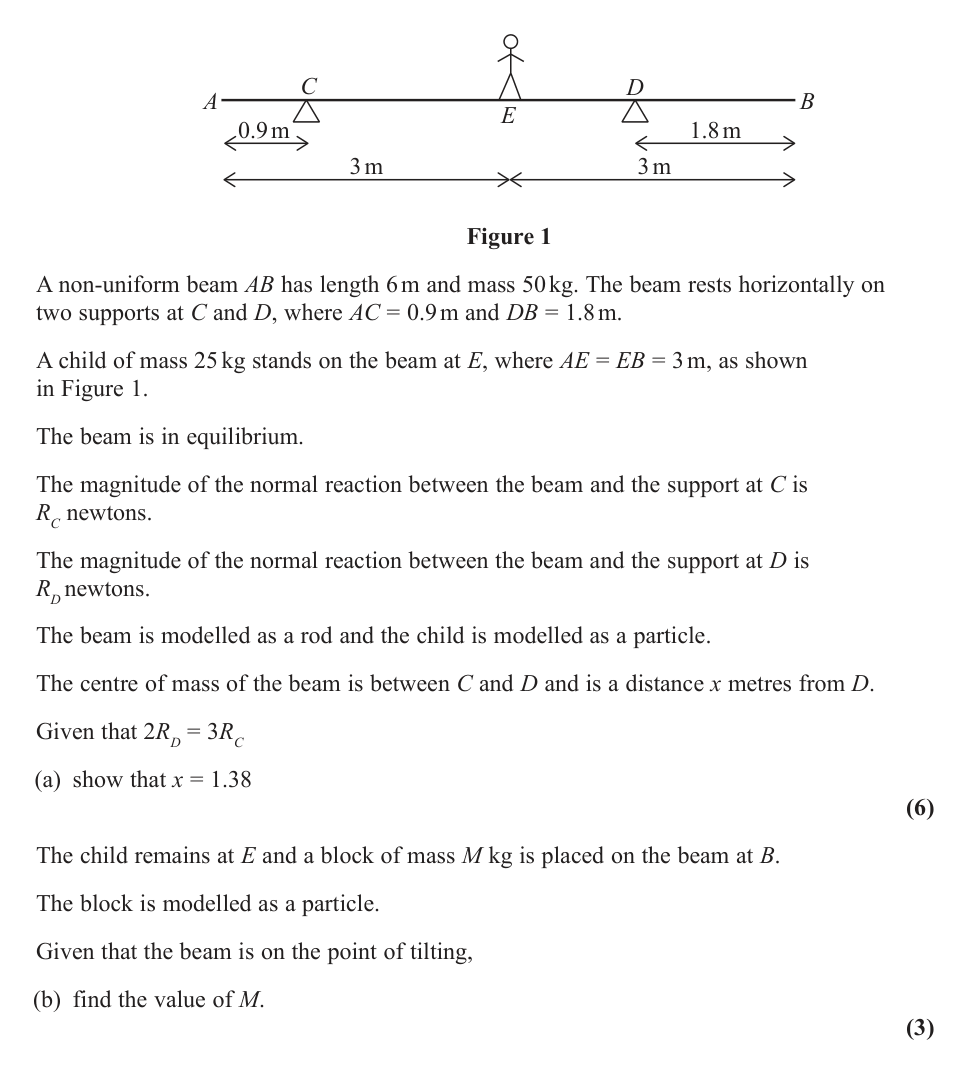
Vertically, $R_C+R_D=50g+25g=75g$. Given $2R_D=3R_C$, we have $R_D=1.5R_C$. Therefore $2.5R_C=75g$, so $R_C=30g$ and $R_D=45g$.
Set the distances from D
$D$ is $6-1.8=4.2$ m from A. The support C is $4.2-0.9=3.3$ m to the left of D, the child at E is $4.2-3=1.2$ m to the left of D, and the centre of mass is $x$ m to the left of D.
Take moments about D
Balancing moments about D gives $50gx+25g(1.2)=R_C(3.3)$.
Show x is 1.38
Substitute $R_C=30g$: $50x+30=99$, so $50x=69$ and $x=\dfrac{69}{50}=1.38$.
Use the tilting condition with the block
When the block at B is on the point of making the beam tilt, the beam is about to pivot about D and the reaction at C is zero.
Take moments about D for the block
The child and the beam act to the left of D, and the block at B acts $1.8$ m to the right of D. Hence $25g(1.2)+50g(1.38)=Mg(1.8)$.
Find M
$30+69=1.8M$, so $M=\dfrac{99}{1.8}=55$.
Final answer
$(a)\ x=1.38.\quad (b)\ M=55$.
31. WME01/01 January 2023 · Q5
Hard9 marks · main topic: Constant Acceleration in 1DShow worked solution
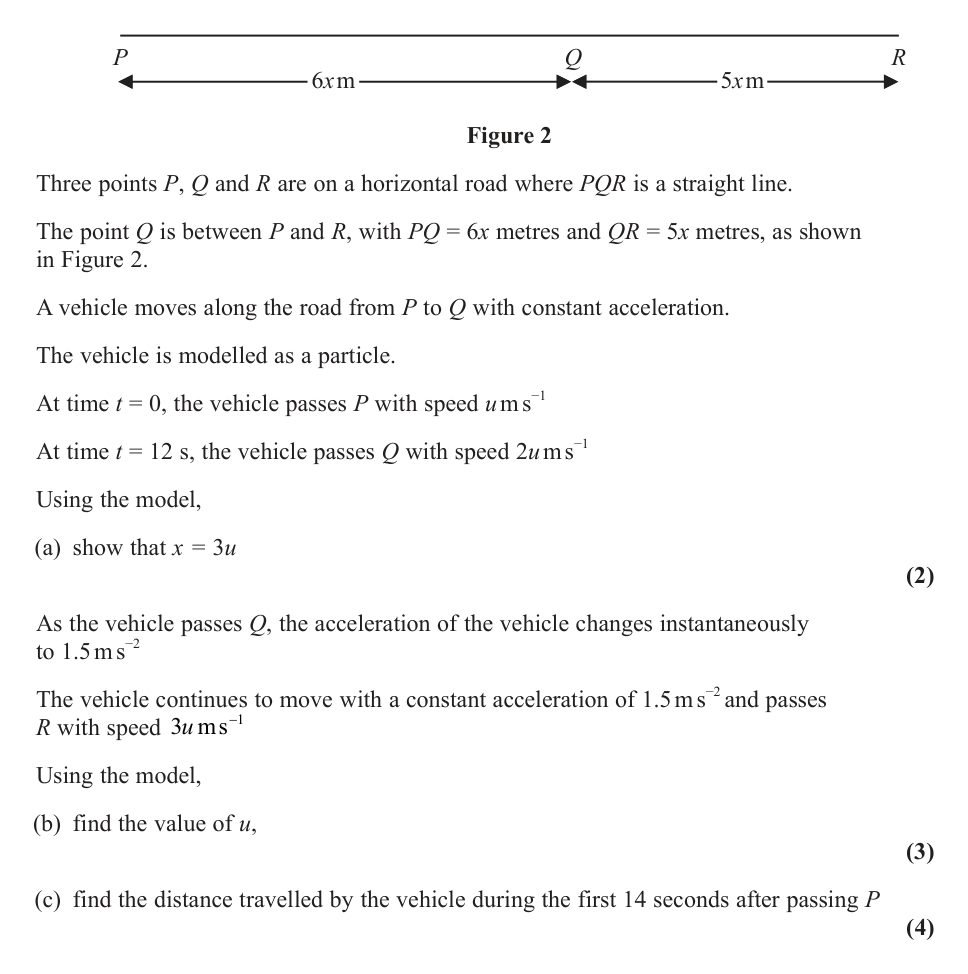
Use average speed from P to Q
From P to Q, the speed changes uniformly from $u$ to $2u$ over $12$ s. The average speed is $\dfrac{u+2u}{2}=\dfrac{3u}{2}$.
Show x = 3u
Distance $PQ=6x$, so $6x=\dfrac{3u}{2}\cdot12=18u$. Hence $x=3u$.
Use Q to R
The distance $QR=5x=15u$. The speed changes from $2u$ to $3u$ with acceleration $1.5\ \mathrm{m\,s^{-2}}$.
Find u
Use $v^2=u^2+2as$: $(3u)^2=(2u)^2+2(1.5)(15u)$. Thus $9u^2=4u^2+45u$, so $5u^2=45u$ and $u=9$.
Find the first 12 seconds distance
In the first $12$ seconds, the distance is $PQ=6x=18u=18(9)=162$ m.
Find the next 2 seconds distance
From $t=12$ to $t=14$, the vehicle starts this part at speed $2u=18$ and accelerates at $1.5$. Distance $=18(2)+\dfrac12(1.5)(2^2)=36+3=39$ m.
Add the distances
Total distance in the first $14$ seconds is $162+39=201\ \mathrm{m}$.
Hard9 marks · main topic: ForcesShow worked solution
Resolve vertically
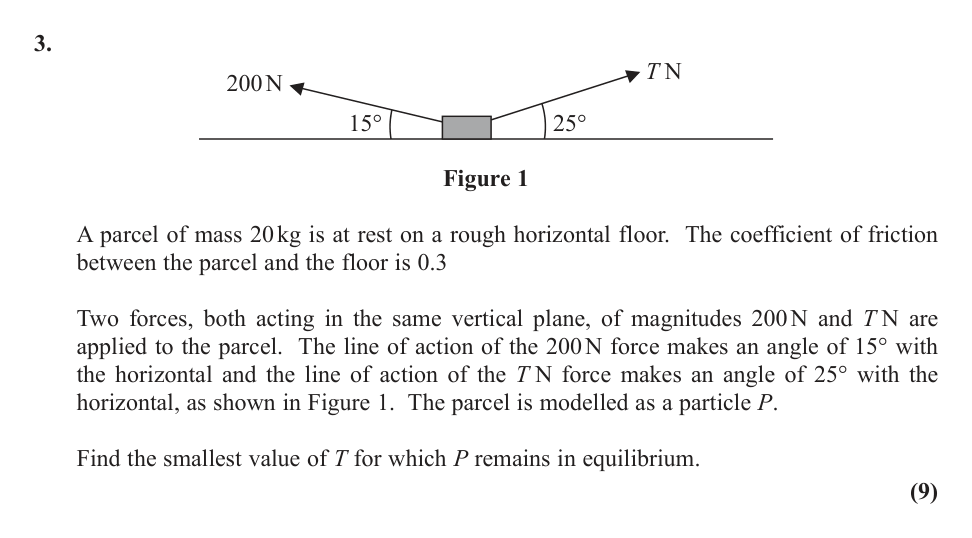
For vertical equilibrium, $R+200\sin15^\circ+T\sin25^\circ=20g$.
Resolve horizontally
For the smallest $T$, friction is limiting and balances the remaining horizontal tendency. Horizontally, $200\cos15^\circ-T\cos25^\circ-F=0$.
Use limiting friction
$F=0.3R$.
Eliminate R and F
From the vertical equation, $R=20g-200\sin15^\circ-T\sin25^\circ$. Substitute into $F=0.3R$ and then into the horizontal equation.
Solve for T
$200\cos15^\circ-T\cos25^\circ-0.3(20g-200\sin15^\circ-T\sin25^\circ)=0$. Solving gives $T=192.3\ldots\ \mathrm{N}$, so the smallest value is about $192\ \mathrm{N}$.
Final answer
$T=192\ \mathrm{N}\ \text{approximately}$.
34. WME01/01 October 2019 · Q2
Hard9 marks · main topic: Constant Acceleration in 1DShow worked solution
Find the time to the first hit
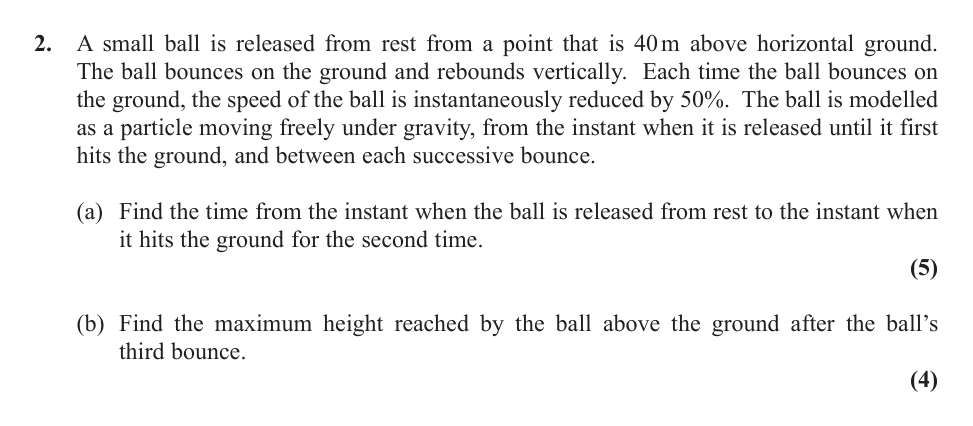
The ball is released from rest and falls $40$ m. Use $s=ut+\dfrac12gt^2$: $40=\dfrac12gt_1^2$. Thus $t_1=\sqrt{\dfrac{80}{g}}=\dfrac{20}{7}$ s.
Find the speed just before the first bounce
Using $v^2=u^2+2gs$, $v_1^2=2g(40)$, so $v_1=28\ \mathrm{m\,s^{-1}}$.
Use the rebound speed
After the first bounce the speed is reduced by $50\%$, so the upward speed is $14\ \mathrm{m\,s^{-1}}$.
Find the time until the second hit
The time to go up and return to the ground is $\dfrac{2(14)}{g}=\dfrac{20}{7}$ s.
Find the total time
Total time to the second hit is $\dfrac{20}{7}+\dfrac{20}{7}=\dfrac{40}{7}=5.71$ s approximately.
Find the speed after the third bounce
After each bounce, the speed is halved. The upward speeds after the first, second and third bounces are $14$, $7$ and $3.5\ \mathrm{m\,s^{-1}}$.
Find the height after the third bounce
At the top after the third bounce, $0=(3.5)^2-2gh$. Therefore $h=\dfrac{(3.5)^2}{2g}=0.625$ m.
Hard10 marks · main topic: MomentsShow worked solution
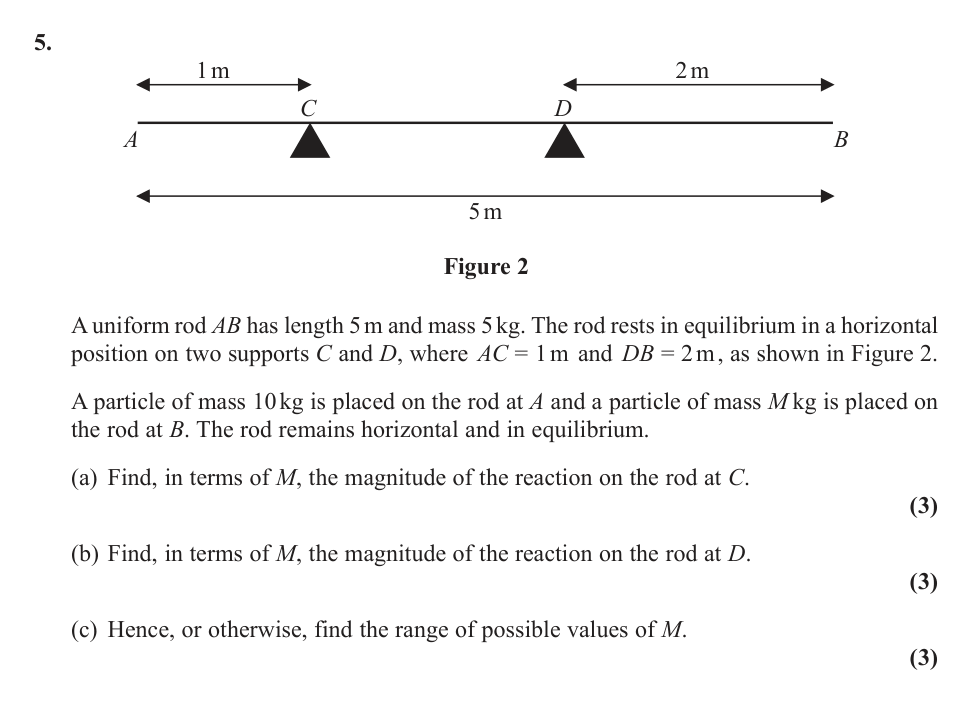
Use moments to find W
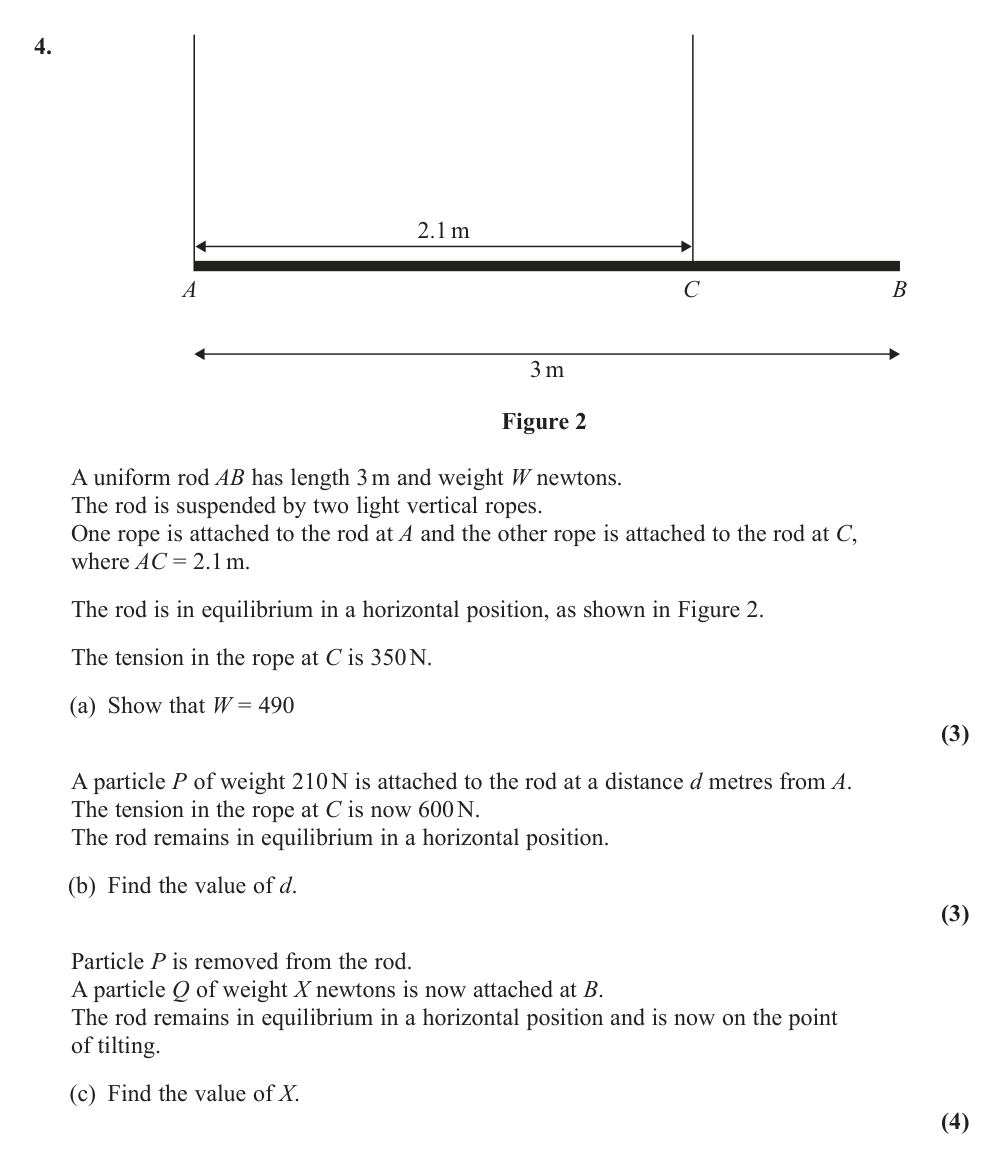
Take moments about A. The rope at C is $2.1$ m from A and the weight of the uniform rod acts at its midpoint, $1.5$ m from A. Hence $350(2.1)=W(1.5)$.
Show W is 490
$735=1.5W$, so $W=490\ \mathrm{N}$.
Set up moments with particle P
When P is attached, the tension at C is $600$ N. Taking moments about A: $600(2.1)=490(1.5)+210d$.
Find d
$1260=735+210d$, so $525=210d$ and $d=2.5$.
Use the tilting condition
When Q is attached at B and the rod is on the point of tilting, the rope at A is just slack. The rod is about to tilt about C.
Find X
Take moments about C. The rod weight acts $2.1-1.5=0.6$ m to the left of C, and Q acts $3-2.1=0.9$ m to the right. Thus $490(0.6)=X(0.9)$, so $X=\dfrac{980}{3}\ \mathrm{N}$.
Hard10 marks · main topic: MomentsShow worked solution
Set the positions on the beam
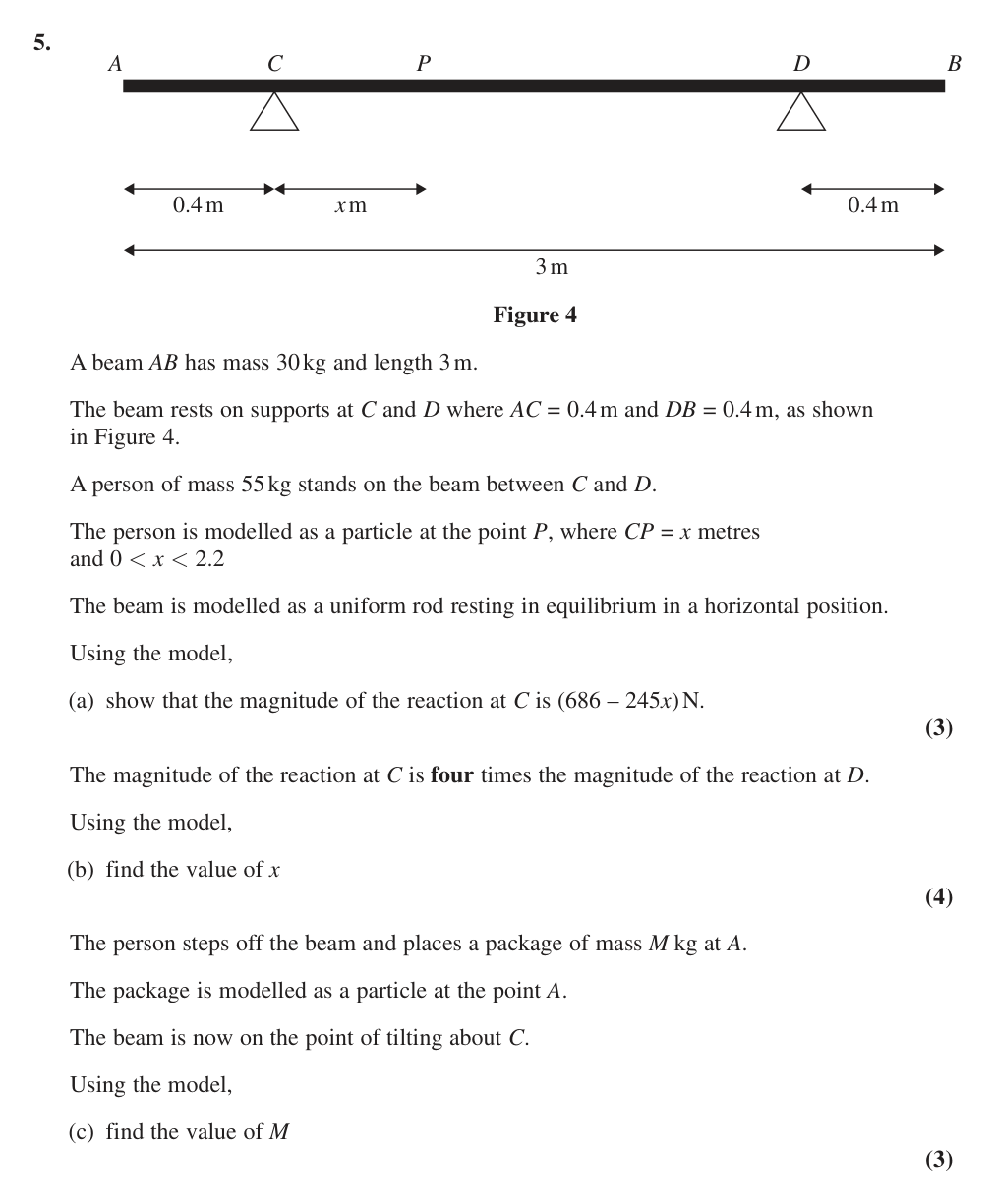
$AC=0.4$ m and $DB=0.4$ m, so $CD=2.2$ m. The beam is uniform, so its weight $30g$ acts at the midpoint, which is $1.1$ m from D. The person is $2.2-x$ m from D.
Take moments about D
Taking moments about D removes $R_D$: $R_C(2.2)=55g(2.2-x)+30g(1.1)$.
Show the expression for RC
Using $g=9.8$, $R_C=\dfrac{539(2.2-x)+294(1.1)}{2.2}=686-245x$.
Use the reaction ratio
Given $R_C=4R_D$ and vertical equilibrium gives $R_C+R_D=(55+30)g=833$. Hence $5R_D=833$ and $R_C=666.4$.
Find x
$686-245x=666.4$, so $245x=19.6$ and $x=0.08$.
Use the tilting condition with the package
When the package is at A and the beam is on the point of tilting about C, the reaction at D is zero.
Find M
Take moments about C: $Mg(0.4)=30g(1.1)$. Thus $M=\dfrac{33}{0.4}=82.5$.
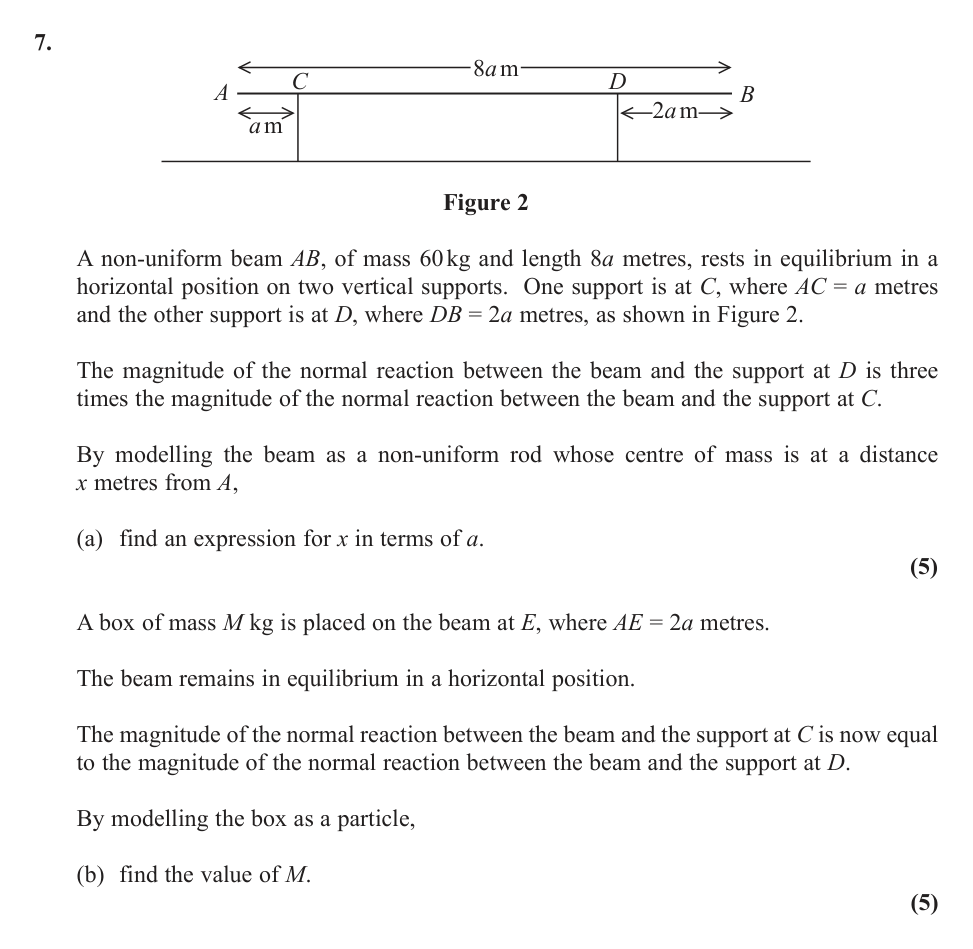
When the box is added, let each support reaction be $S$. Vertical equilibrium gives $2S=(60+M)g$.
Take moments about A again
The box is at $AE=2a$. Moments about A give $60g\left(\dfrac{19a}{4}\right)+Mg(2a)=S(a)+S(6a)=7aS$.
Solve for M
Substitute $S=\dfrac{(60+M)g}{2}$ and cancel $ag$: $285+2M=\dfrac{7}{2}(60+M)=210+\dfrac72M$. Hence $75=\dfrac32M$ and $M=50$.
Final answer
$(a)\ x=\dfrac{19a}{4}.\quad (b)\ M=50$.
39. WME01/01 January 2020 · Q4
Hard10 marks · main topic: ForcesShow worked solution
Resolve forces on C
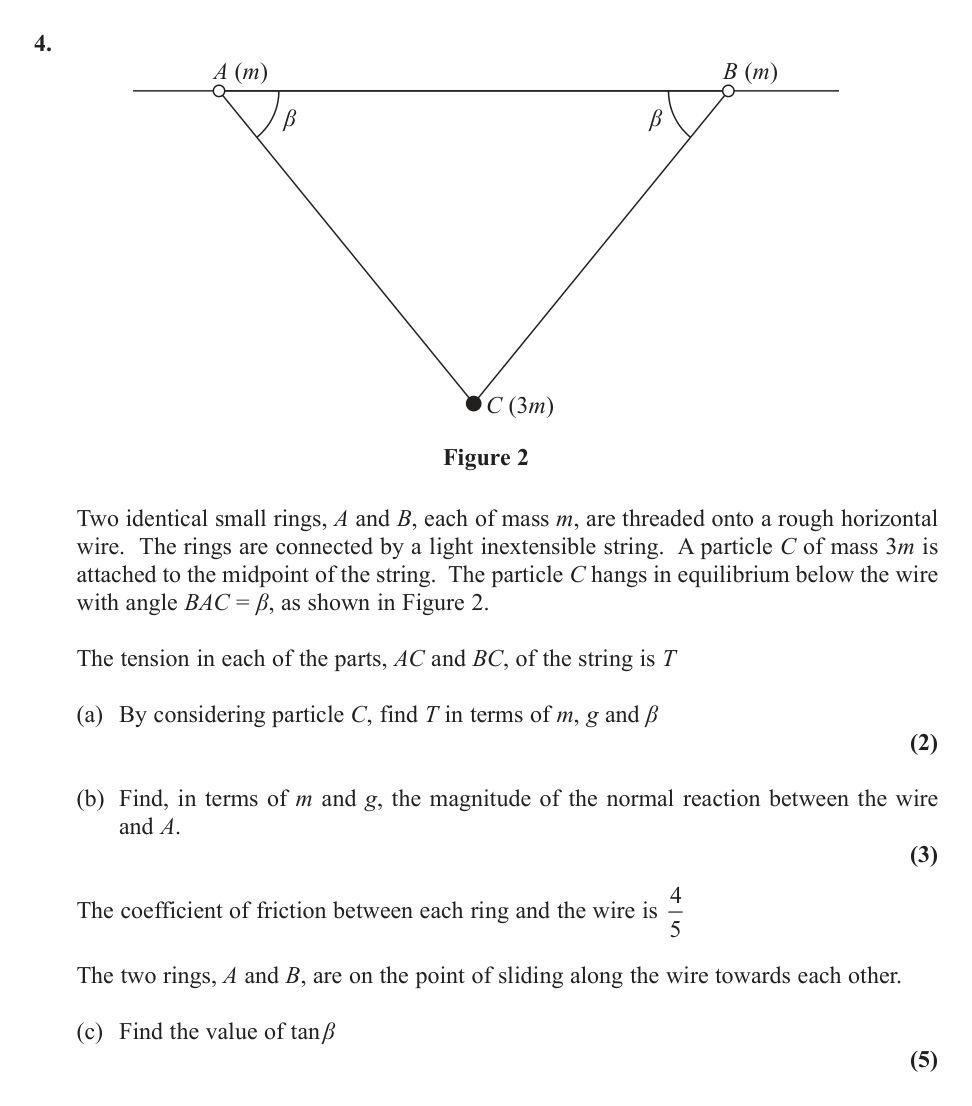
The two tensions are equal and symmetric. Their vertical components support the weight of C, so $2T\sin\beta=3mg$. Hence $T=\dfrac{3mg}{2\sin\beta}$.
Resolve vertically for ring A
For ring A, the normal reaction balances its own weight and the downward vertical component of the string tension: $R=mg+T\sin\beta$.
Find the normal reaction
From $2T\sin\beta=3mg$, we have $T\sin\beta=\dfrac32mg$. Therefore $R=mg+\dfrac32mg=\dfrac52mg$.
Use limiting friction
The rings are just about to slide towards each other, so friction is limiting. With $\mu=\dfrac45$, $F=\mu R=\dfrac45\cdot\dfrac52mg=2mg$.
Resolve horizontally for a ring
The horizontal component of the tension is balanced by friction: $T\cos\beta=F=2mg$.
Find tan beta
Substitute $T=\dfrac{3mg}{2\sin\beta}$: $\dfrac{3mg}{2\sin\beta}\cos\beta=2mg$. Hence $\dfrac32\cot\beta=2$, so $\cot\beta=\dfrac43$ and $\tan\beta=\dfrac34$.
Hard12 marks · main topic: MomentsShow worked solution
Set the geometry
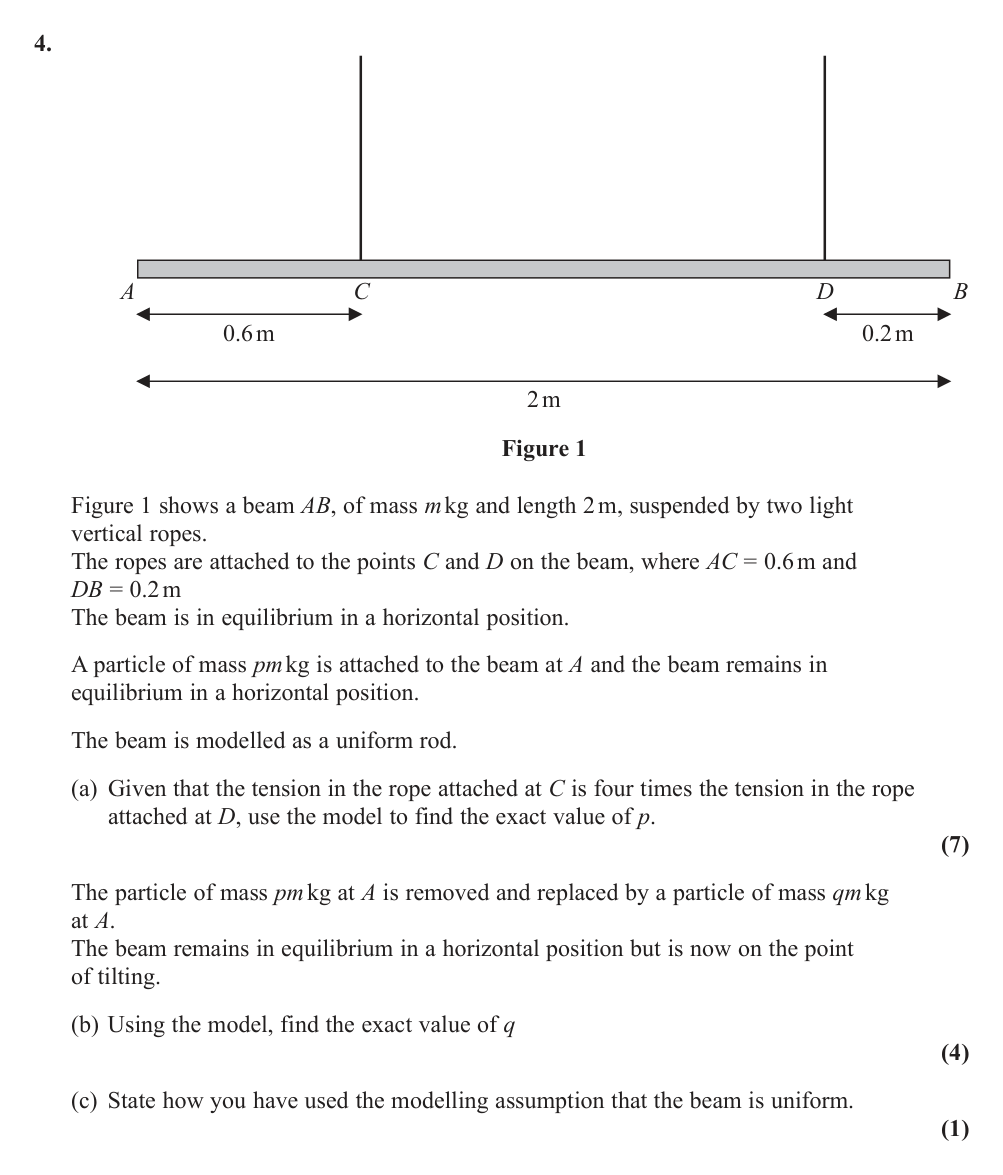
The beam is $2$ m long. Since $AC=0.6$ m and $DB=0.2$ m, point D is $1.8$ m from A. The uniform beam has weight $mg$ acting $1.0$ m from A.
Name the tensions
Let the tension at D be $T$. The tension at C is four times this, so it is $4T$.
Use vertical equilibrium
$4T+T=pmg+mg$, so $5T=(p+1)mg$.
Take moments about A
The particle at A has no moment about A. Hence $4T(0.6)+T(1.8)=mg(1.0)$.
Find T
$2.4T+1.8T=mg$, so $4.2T=mg$ and $T=\dfrac{5mg}{21}$.
Find p
Substitute into $5T=(p+1)mg$: $5\cdot\dfrac{5mg}{21}=(p+1)mg$. Thus $p+1=\dfrac{25}{21}$ and $p=\dfrac{4}{21}$.
Use the tilting condition
When the particle of mass $qm$ is at A and the beam is on the point of tilting, the rope at D is just slack, so its tension is zero.
Take moments about C
About C, the particle at A has moment $qmg(0.6)$ and the beam weight has moment $mg(0.4)$ in the opposite direction. Thus $qmg(0.6)=mg(0.4)$, giving $q=\dfrac{2}{3}$.
Use the modelling assumption
The beam is uniform, so its centre of mass is at the midpoint of the beam and its weight acts there.
Final answer
$(a)\ p=\dfrac{4}{21}.\quad (b)\ q=\dfrac{2}{3}.\quad (c)$ The beam weight acts at its midpoint.
41. WME01/01 May/June 2022 · Q4
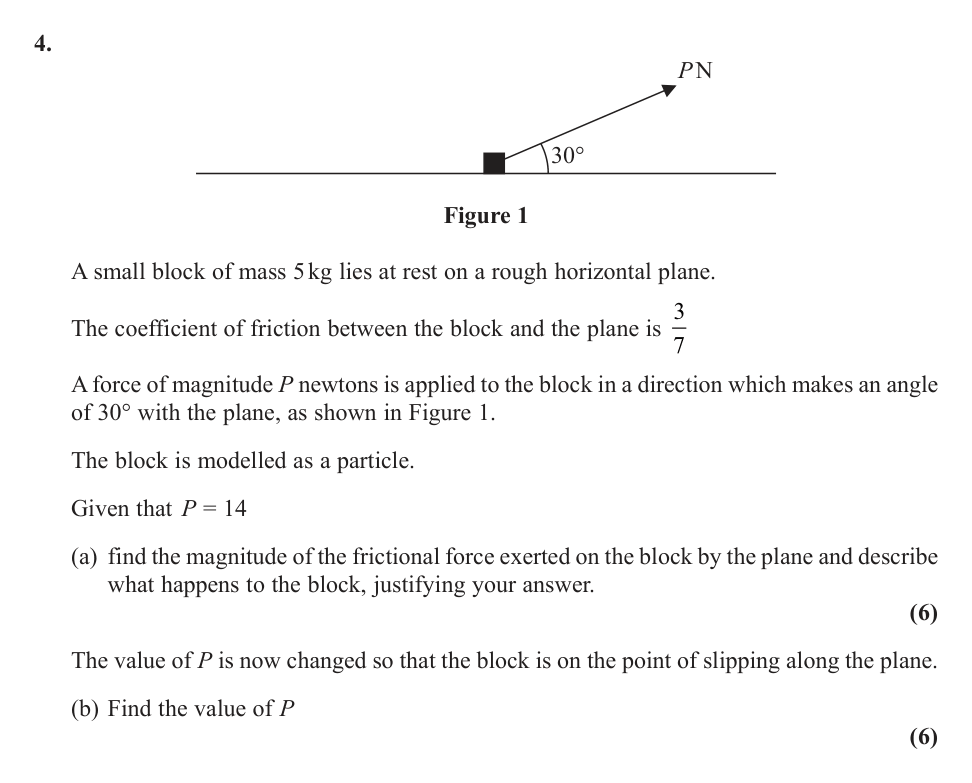
Hard12 marks · main topic: ForcesShow worked solution
Find the normal reaction when P = 14
Resolve vertically. The upward component of the applied force is $14\sin30^\circ$, so $R+14\sin30^\circ=5g$.
Calculate R
$R+7=49$, so $R=42\ \mathrm{N}$.
Find the maximum friction
$F_{\max}=\mu R=\dfrac37(42)=18\ \mathrm{N}$.
Compare with the horizontal pull
The horizontal component of the applied force is $14\cos30^\circ=12.1\ldots\ \mathrm{N}$. Since this is less than the maximum possible friction, the block does not move.
State the actual friction
For equilibrium, the actual friction equals the horizontal pull, so $F=12.1\ \mathrm{N}$ approximately.
Set up the limiting case
When the block is on the point of slipping, friction is limiting. Resolve vertically: $R+P\sin30^\circ=5g$, so $R=5g-P\sin30^\circ$.
Resolve horizontally
At the limiting case, $P\cos30^\circ=\dfrac37R=\dfrac37(5g-P\sin30^\circ)$.
$(a)\ F=12.1\ \mathrm{N}\ \text{approximately, and the block does not move}.\quad (b)\ P=19.4\ \mathrm{N}\ \text{approximately}$.
42. WME01/01 October 2019 · Q6
Hard12 marks · main topic: Kinematics GraphsShow worked solution
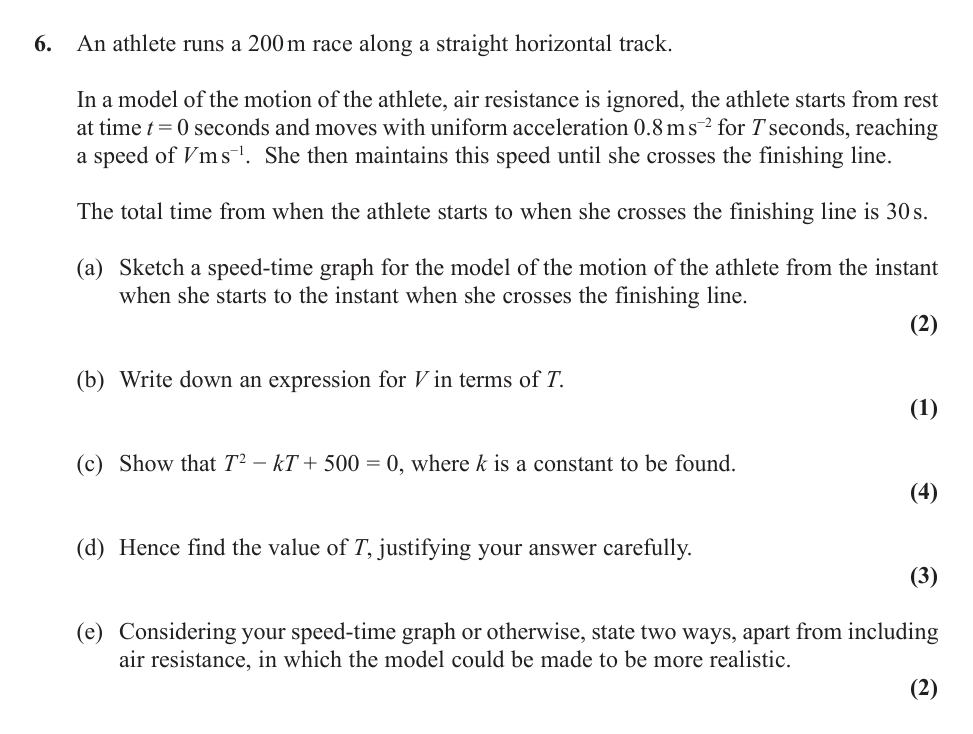
Describe the speed-time graph
The graph starts at $(0,0)$, rises in a straight line with gradient $0.8$ until time $T$ and speed $V$, then stays horizontal at speed $V$ until $t=30$.
Write V in terms of T
Uniform acceleration gives $V=0.8T$.
Use area for the distance
The distance is the area under the speed-time graph: $\dfrac12TV+V(30-T)=200$.
Substitute V
Using $V=0.8T$: $\dfrac12T(0.8T)+(0.8T)(30-T)=200$.
Form the quadratic
$0.4T^2+24T-0.8T^2=200$, so $-0.4T^2+24T-200=0$. Multiplying by $-2.5$ gives $T^2-60T+500=0$, so $k=60$.
Solve and choose the valid root
$T^2-60T+500=(T-10)(T-50)=0$, so $T=10$ or $50$. Since the whole race lasts $30$ s, $T=10$.
Give two model improvements
A more realistic model could include reaction time at the start, and could replace the instantaneous change from acceleration to constant speed with a smoother transition.
Final answer
$(a)$ Speed-time graph rises linearly to $V$ at $t=T$, then is horizontal until $t=30$. $(b)\ V=0.8T.\quad (c)\ T^2-60T+500=0$, so $k=60$. $(d)\ T=10$. $(e)$ For example, include reaction time at the start and avoid the instantaneous change to constant speed.
 Elite Mathematics