Momentum, Impulse & Collisions: past paper questions & worked solutions
Every Momentum, Impulse & Collisions question from the WME01 papers in our bank, 2019–2026, sorted from easiest to hardest. Try each one first, then open the worked solution.
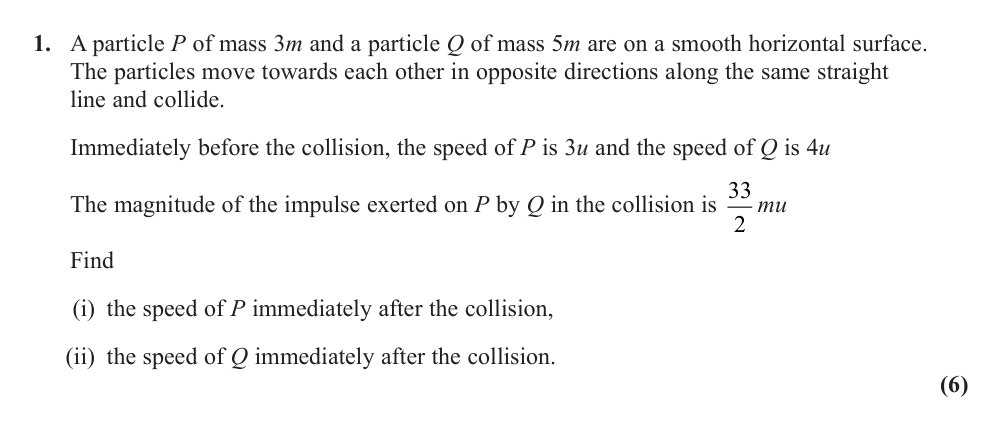
Take the initial direction of P as positive. Then before impact, $v_P=3u$ and $v_Q=-4u$. The impulse on P acts opposite to P\'s initial motion, so its signed impulse is $-\dfrac{33}{2}mu$.
Use impulse on P
For P, impulse equals change in momentum: $-\dfrac{33}{2}mu=3m(v_P-3u)$. Dividing by $3m$ gives $v_P-3u=-\dfrac{11u}{2}$, so $v_P=-\dfrac{5u}{2}$.
Interpret the speed of P
The negative sign means P has reversed direction. Its speed is therefore $\left|-\dfrac{5u}{2}\right|=\dfrac{5u}{2}$.
Use the equal and opposite impulse on Q
Q receives impulse $+\dfrac{33}{2}mu$ in the positive direction. Hence $\dfrac{33}{2}mu=5m(v_Q-(-4u))=5m(v_Q+4u)$.
Interpret the speed of Q
Dividing by $5m$ gives $v_Q+4u=\dfrac{33u}{10}$, so $v_Q=-\dfrac{7u}{10}$. Q is still moving in its original direction, and its speed is $\dfrac{7u}{10}$.
Final answer
$(i)\ \text{speed of P}=\dfrac{5u}{2}.\quad (ii)\ \text{speed of Q}=\dfrac{7u}{10}$.
5. WME01/01 May/June 2025 · Q1
Easy6 marksShow worked solution
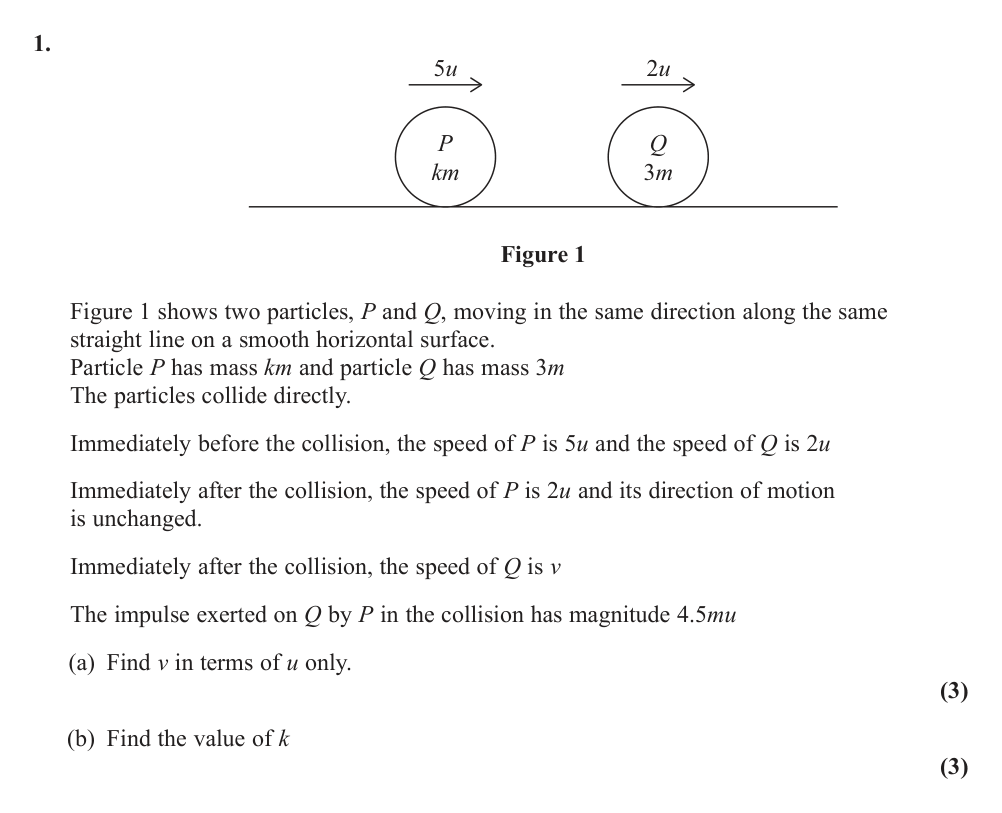
Part (a): Find v in terms of u - Apply impulse-momentum theorem to Q
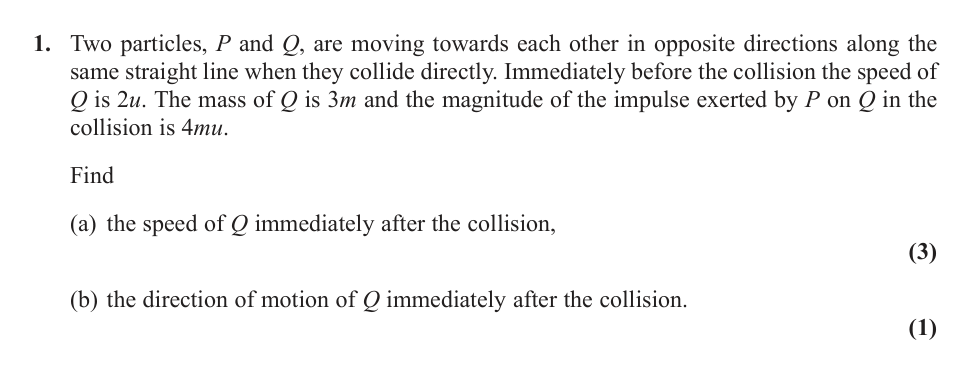
$\text{Impulse} = \text{Final momentum} - \text{Initial momentum}$ For particle Q: ; Mass = $3m$ ; Initial velocity = $2u$ ; Final velocity = $v$ ; Impulse received = $4.5mu$
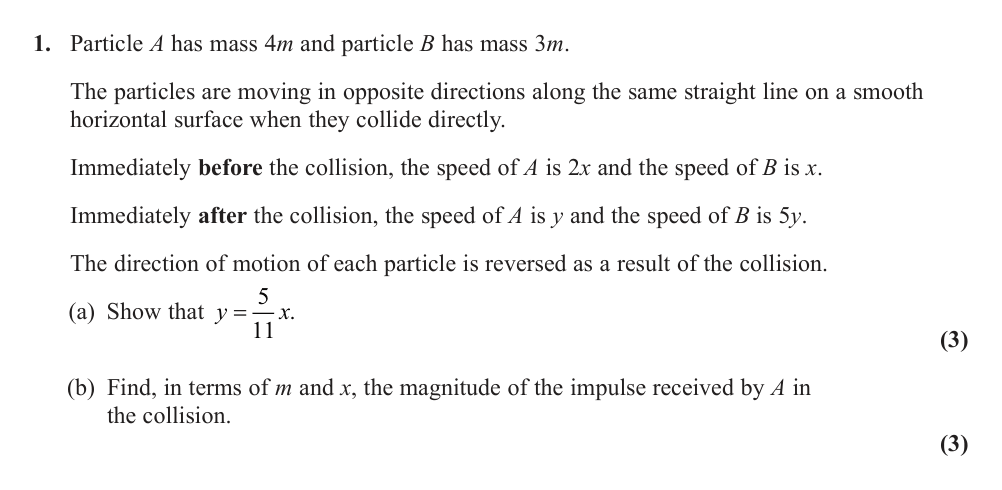
Take the initial direction of A as positive. Before collision, A has velocity $2x$ and B has velocity $-x$. After collision, both reverse direction, so A has velocity $-y$ and B has velocity $5y$.
Apply conservation of momentum
$4m(2x)+3m(-x)=4m(-y)+3m(5y)$. The left side is $5mx$ and the right side is $11my$.
Show the ratio
$5mx=11my$, so $\dfrac{y}{x}=\dfrac{5}{11}$.
Use change in momentum for A
The impulse received by A is the change in momentum of A: $I=4m|-y-2x|=4m(y+2x)$.
Substitute y
Using $y=\dfrac{5x}{11}$, $I=4m\left(\dfrac{5x}{11}+2x\right)=4m\left(\dfrac{27x}{11}\right)=\dfrac{108}{11}mx$.
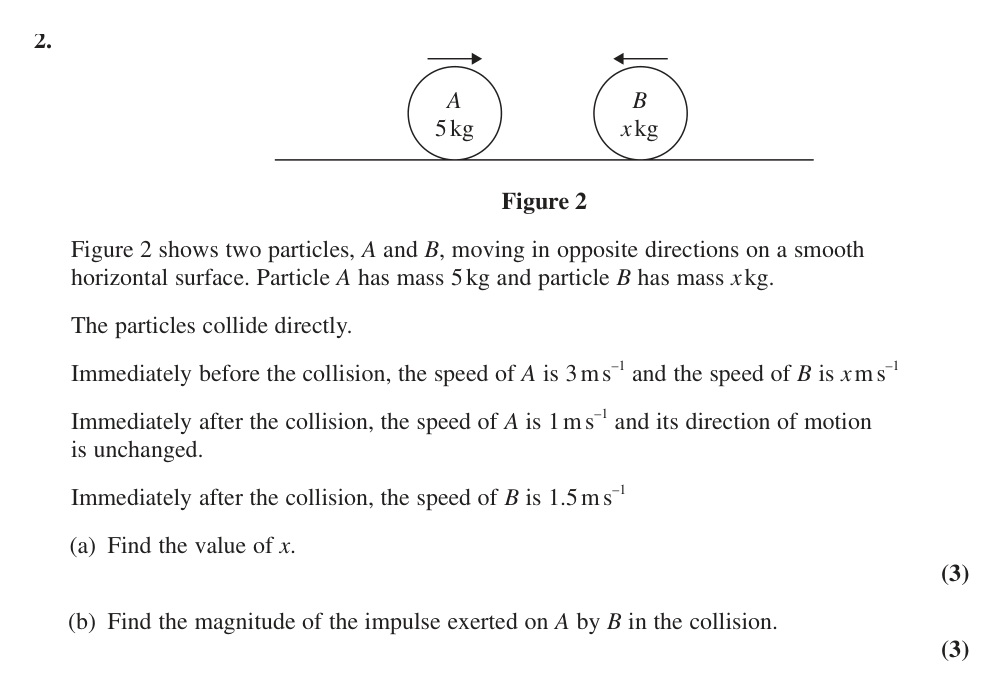
Take the initial direction of A as positive. Before collision, A has velocity $3$ and B has velocity $-x$.
Set up conservation of momentum
After collision, A still moves in the same direction with velocity $1$. B has speed $1.5$ in the positive direction for the valid solution. Hence $5(3)+x(-x)=5(1)+1.5x$.
Solve for x
$15-x^2=5+1.5x$, so $x^2+1.5x-10=0$. This gives $x=2.5$ or $x=-4$. Since mass is positive, $x=2.5$.
Use change in momentum of A
The impulse exerted on A equals the change in momentum of A: $I=5(1-3)=-10\ \mathrm{N\,s}$ using the chosen positive direction.
Give the magnitude
The magnitude of the impulse is $10\ \mathrm{N\,s}$.
Final answer
$(a)\ x=2.5.\quad (b)\ I=10\ \mathrm{N\,s}$.
8. WME01/01 January 2021 · Q2
Easy6 marksShow worked solution
Choose a positive direction
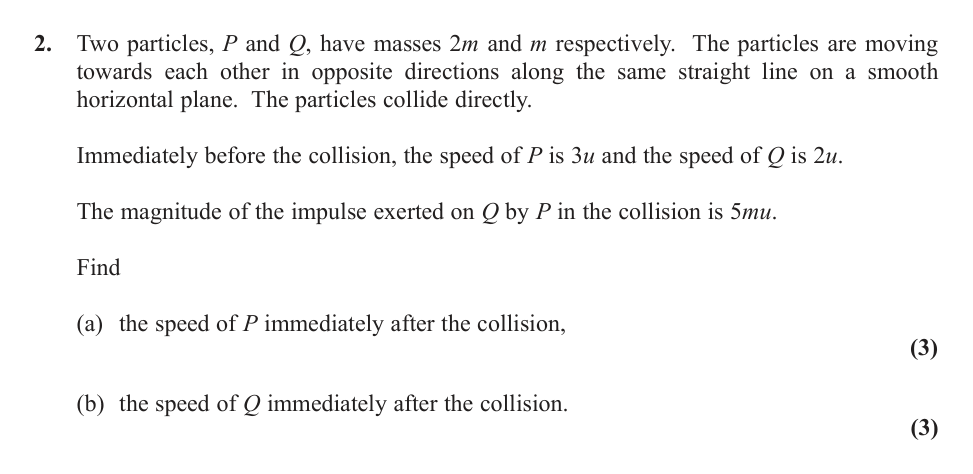
Take P's original direction as positive. Before collision, P has velocity $3u$ and Q has velocity $-2u$.
Use impulse on P
The impulse on P is opposite to P's original motion and has magnitude $5mu$. Let P's velocity after collision be $v$. Then $-5mu=2m(v-3u)$.
Find P speed
Divide by $m$: $-5u=2v-6u$, so $2v=u$ and $v=\dfrac{u}{2}$.
Use impulse on Q
The impulse on Q is in P's original direction. Let Q's velocity after collision be $w$. Then $5mu=m(w-(-2u))$.
Find Q speed
$5u=w+2u$, so $w=3u$. Therefore the speed of Q is $3u$.
Final answer
$(a)\ \text{speed of P}=\dfrac{u}{2}.\quad (b)\ \text{speed of Q}=3u$.
9. WME01/01 October 2019 · Q1
Easy6 marksShow worked solution
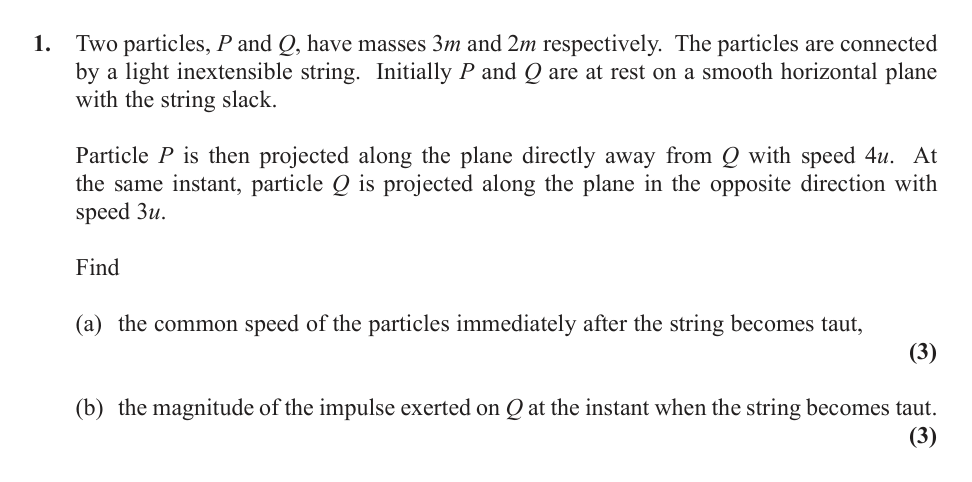
Choose a direction
Take P's initial direction as positive. Then P initially has velocity $4u$ and Q initially has velocity $-3u$.
Use conservation of momentum
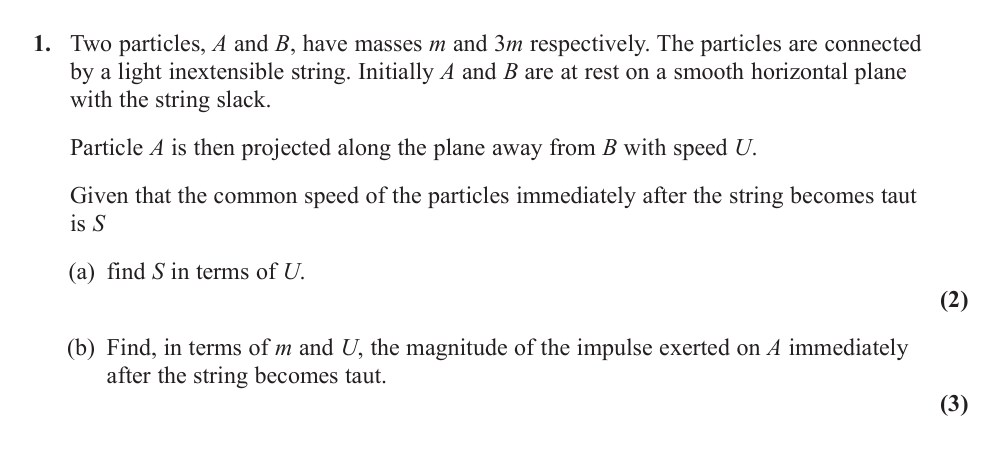
When the string becomes taut, both particles move with common speed $v$. Hence $3m(4u)+2m(-3u)=(3m+2m)v$.
Find the common speed
$12mu-6mu=5mv$, so $v=\dfrac{6u}{5}$.
Use impulse on Q
Impulse on Q equals change in momentum: $I=2m\left(\dfrac{6u}{5}-(-3u)\right)$.
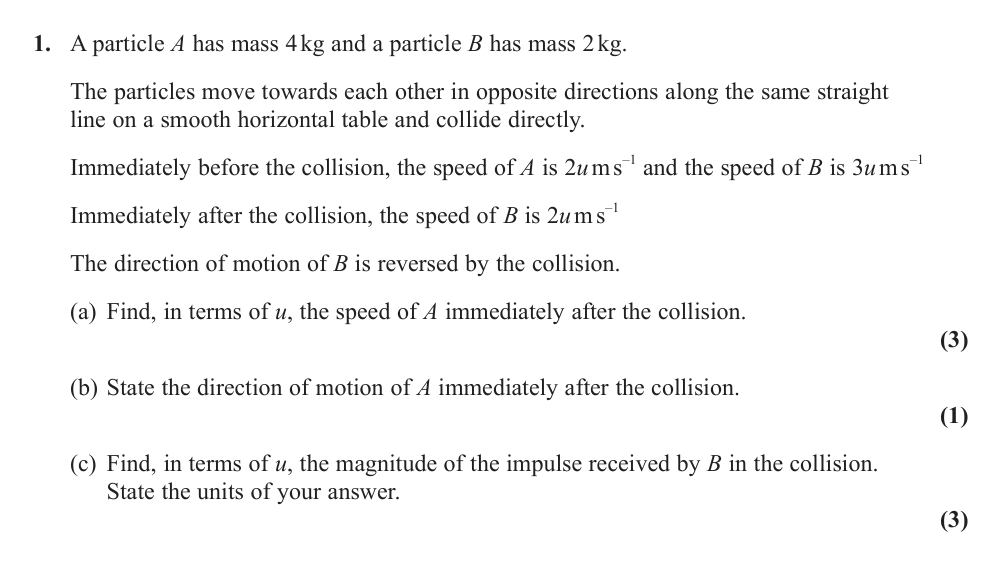
Take the original direction of A as positive. Before the collision, A has velocity $2u$ and B has velocity $-3u$. After the collision, B has velocity $2u$ because its direction is reversed.
Use conservation of momentum
Let the velocity of A after the collision be $v$. Then $4(2u)+2(-3u)=4v+2(2u)$.
Solve for the velocity of A
$8u-6u=4v+4u$, so $2u=4v+4u$. Hence $4v=-2u$ and $v=-\dfrac{u}{2}$.
State the speed and direction
The speed of A is the magnitude of its velocity, so it is $\dfrac{u}{2}$. The negative sign shows that A has reversed direction.
Find the impulse on B
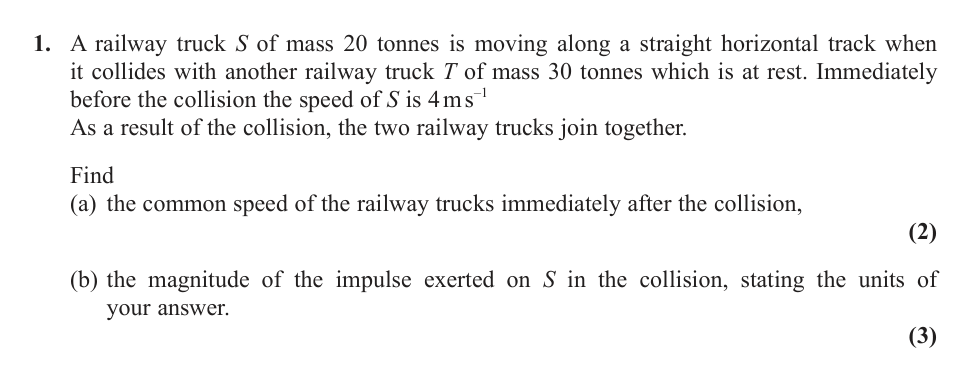
Impulse equals change in momentum. For B, $I=2\left(2u-(-3u)\right)=2(5u)=10u$.
Attach the units
The impulse is $10u\ \mathrm{N\,s}$, equivalently $10u\ \mathrm{kg\,m\,s^{-1}}$.
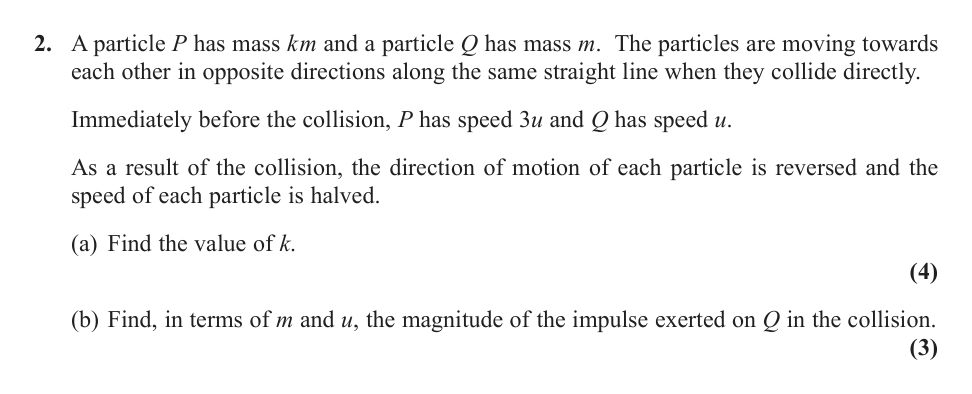
Divide by $mu$: $3k-1=-\dfrac32k+\dfrac12$. Hence $\dfrac92k=\dfrac32$, so $k=\dfrac13$.
Find impulse on Q
Impulse on Q equals change in momentum of Q: $I=m\left(\dfrac12u-(-u)\right)=\dfrac32mu$.
State the magnitude
The magnitude of the impulse is $\dfrac32mu$.
Final answer
$(a)\ k=\dfrac13.\quad (b)\ I=\dfrac32mu$.
12. WME01/01 May/June 2021 · Q1
Medium7 marksShow worked solution
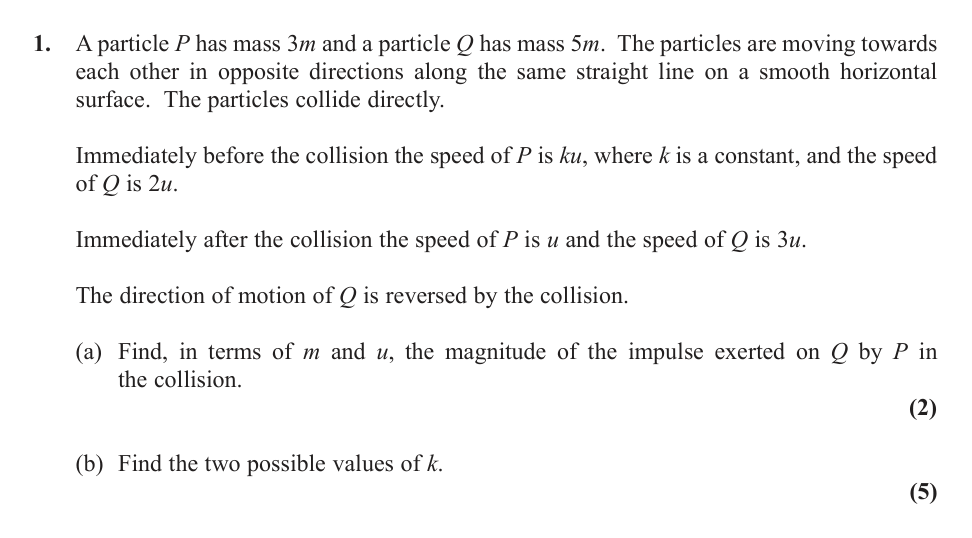
Choose a positive direction
Take P's original direction as positive. Q initially has velocity $-2u$. Since Q reverses direction and then has speed $3u$, its final velocity is $3u$.
Find the impulse on Q
Impulse equals change in momentum: $I=5m(3u-(-2u))=25mu$.
Use conservation of momentum
Before collision, total momentum is $3m(ku)+5m(-2u)=3mku-10mu$.
Case 1: P continues in its original direction
If P has final velocity $u$, final momentum is $3m(u)+5m(3u)=18mu$. So $3mku-10mu=18mu$, giving $3k=28$ and $k=\dfrac{28}{3}$.
Case 2: P reverses direction
If P has final velocity $-u$, final momentum is $3m(-u)+5m(3u)=12mu$. So $3mku-10mu=12mu$, giving $3k=22$ and $k=\dfrac{22}{3}$.
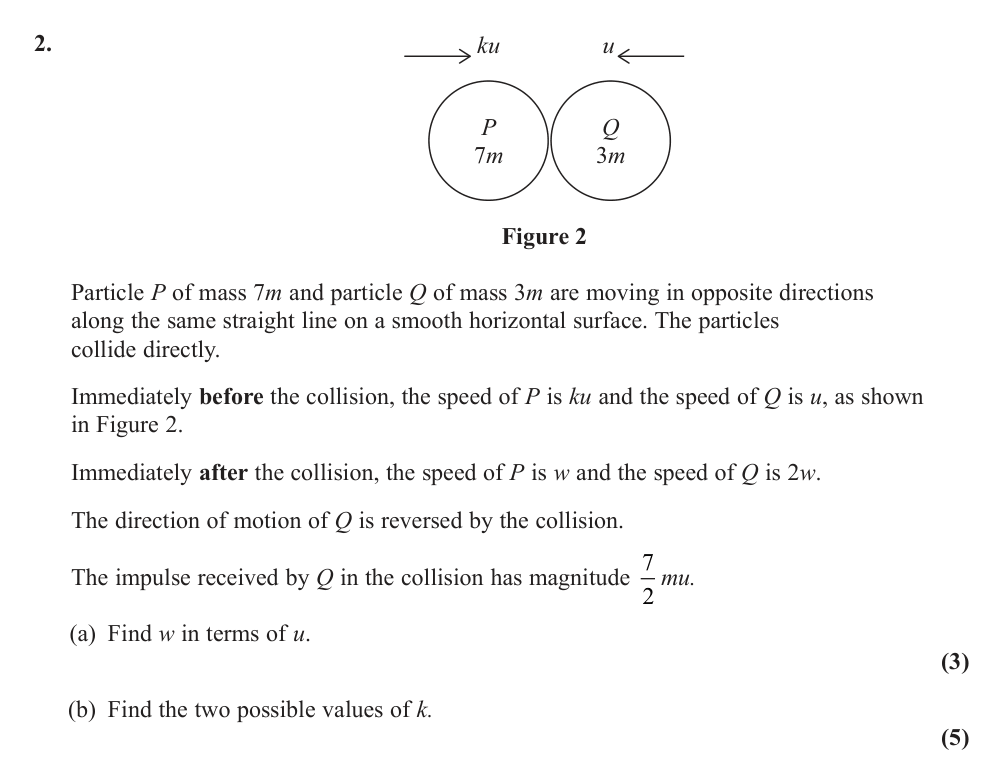
Part (b): Find the two possible values of k - Consider both directions for P after collision
P could move either right (velocity = $+w$) or left (velocity = $-w$) Case 1: P moves right with velocity $+w$ Already solved: $k = \frac{7}{12}$ Case 2: P moves left with velocity $-w$ Total momentum after = $-7mw + 6mw = -mw$ $7mku - 3mu = -mw$ $7ku - 3u = -w$ $7ku - 3u = -\frac{u}{12}$ $7ku = 3u - \frac{u}{12}$ $7ku = \frac{36u - u}{12}$ $7ku = \frac{35u}{12}$ $k = \frac{35}{84} = \frac{5}{12}$
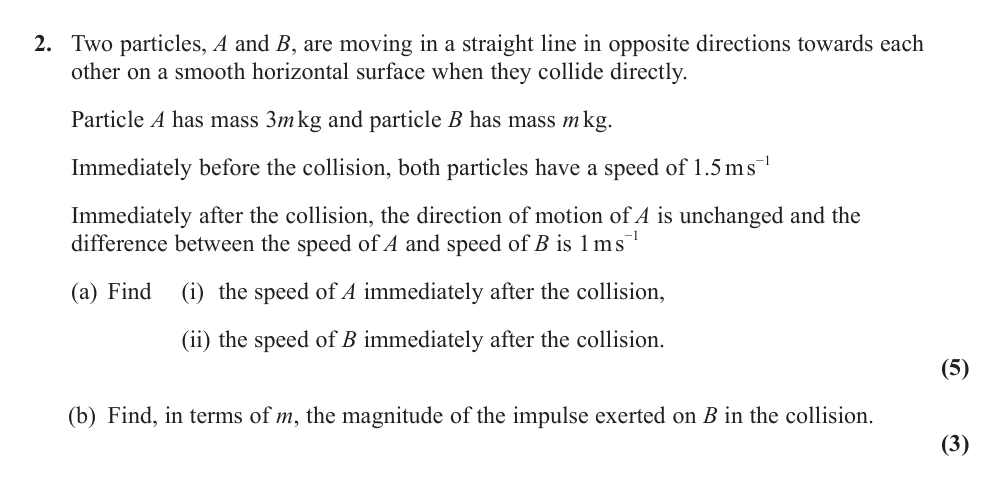
Take the original direction of A as positive. Before the collision, A has velocity $1.5$ and B has velocity $-1.5$.
Use the speed difference
After the collision, A keeps the same direction. Let A's speed be $v$. The valid motion has B moving in A's direction with speed $v+1$.
Use conservation of momentum
$3m(1.5)+m(-1.5)=3mv+m(v+1)$.
Find the two speeds
$4.5m-1.5m=3mv+mv+m$, so $3=4v+1$. Hence $v=0.5$, and B's speed is $v+1=1.5$.
Find the impulse on B
For B, impulse equals change in momentum: $I=m(1.5-(-1.5))=3m$.
State the magnitude
The magnitude of the impulse is $3m\ \mathrm{N\,s}$.
Final answer
$(a)(i)\ \text{speed of A}=0.5\ \mathrm{m\,s^{-1}}.\quad (a)(ii)\ \text{speed of B}=1.5\ \mathrm{m\,s^{-1}}.\quad (b)\ I=3m\ \mathrm{N\,s}$.
15. WME01/01 January 2020 · Q1
Medium8 marksShow worked solution
Choose a positive direction
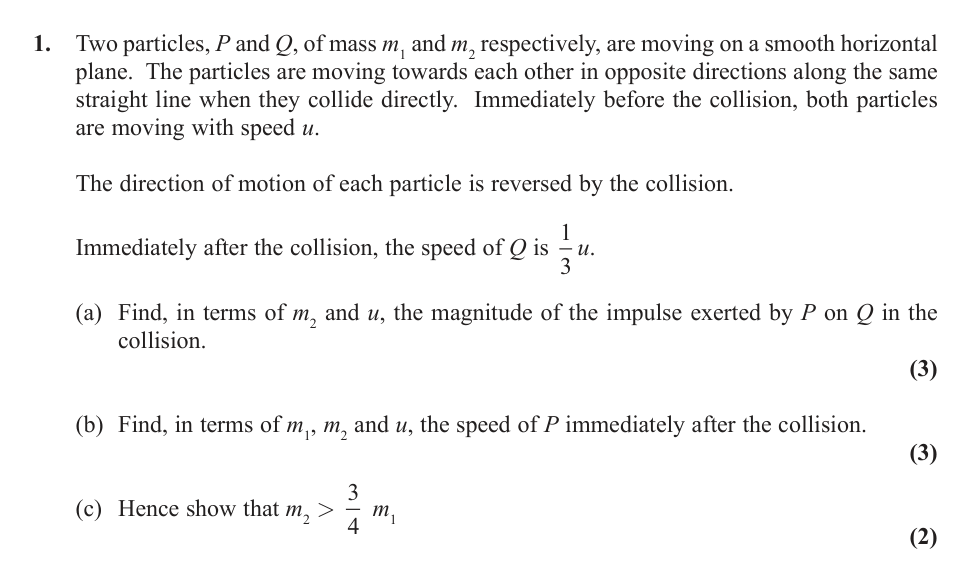
Take P's original direction as positive. Before collision, $v_P=u$ and $v_Q=-u$. After collision, Q has velocity $\dfrac{u}{3}$ because its direction is reversed.
Find the impulse on Q
Impulse on Q equals change in momentum: $I=m_2\left(\dfrac{u}{3}-(-u)\right)=m_2\left(\dfrac{4u}{3}\right)=\dfrac{4}{3}m_2u$.
Use conservation of momentum
Let the speed of P after collision be $v$. Since P reverses direction, its velocity is $-v$. Hence $m_1u-m_2u=-m_1v+\dfrac13m_2u$.
Solve for P's speed
Rearrange: $m_1v=\dfrac43m_2u-m_1u$, so $v=\dfrac{(4m_2-3m_1)u}{3m_1}$.
Use the fact that speed is positive
Since $u>0$ and $m_1>0$, the numerator must be positive: $4m_2-3m_1>0$. Therefore $m_2>\dfrac34m_1$.
Final answer
$(a)\ I=\dfrac{4}{3}m_2u.\quad (b)\ \text{speed of P}=\dfrac{(4m_2-3m_1)u}{3m_1}.\quad (c)\ m_2>\dfrac34m_1$.
16. WME01/01 October 2019 · Q2
Hard9 marks · main topic: Constant Acceleration in 1DShow worked solution
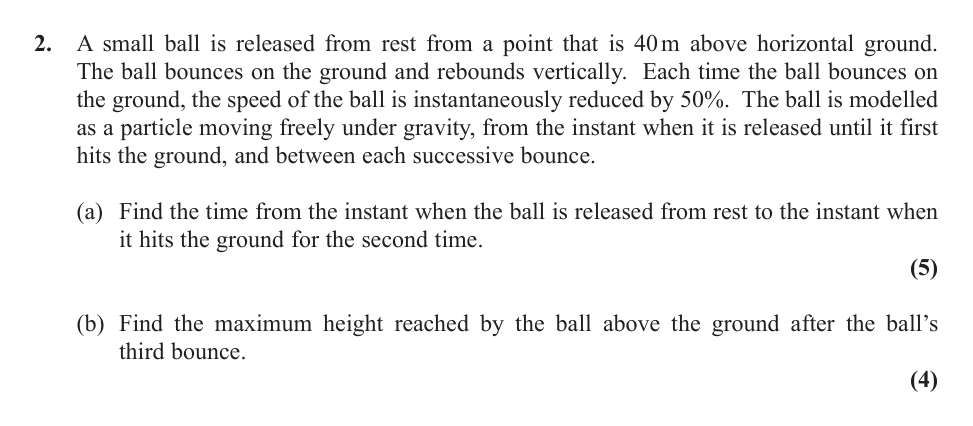
Find the time to the first hit
The ball is released from rest and falls $40$ m. Use $s=ut+\dfrac12gt^2$: $40=\dfrac12gt_1^2$. Thus $t_1=\sqrt{\dfrac{80}{g}}=\dfrac{20}{7}$ s.
Find the speed just before the first bounce
Using $v^2=u^2+2gs$, $v_1^2=2g(40)$, so $v_1=28\ \mathrm{m\,s^{-1}}$.
Use the rebound speed
After the first bounce the speed is reduced by $50\%$, so the upward speed is $14\ \mathrm{m\,s^{-1}}$.
Find the time until the second hit
The time to go up and return to the ground is $\dfrac{2(14)}{g}=\dfrac{20}{7}$ s.
Find the total time
Total time to the second hit is $\dfrac{20}{7}+\dfrac{20}{7}=\dfrac{40}{7}=5.71$ s approximately.
Find the speed after the third bounce
After each bounce, the speed is halved. The upward speeds after the first, second and third bounces are $14$, $7$ and $3.5\ \mathrm{m\,s^{-1}}$.
Find the height after the third bounce
At the top after the third bounce, $0=(3.5)^2-2gh$. Therefore $h=\dfrac{(3.5)^2}{2g}=0.625$ m.
Take downward as positive during the impact. Before impact, the hammer has momentum $1.8(10)$ and the peg has momentum $0$. After impact, the combined mass is $1.8+0.2=2.0$ kg.
Find the common speed
$1.8(10)=2.0v$, so $18=2v$ and $v=9\ \mathrm{m\,s^{-1}}$.
Use impulse on the peg
The peg changes from rest to speed $9\ \mathrm{m\,s^{-1}}$ downward. The impulse magnitude is $0.2(9-0)=1.8\ \mathrm{N\,s}$.
Find the deceleration in the ground
The hammer and peg move together from speed $9$ to rest over $0.12$ m. With downward positive, $0=9^2+2a(0.12)$, so $a=-337.5\ \mathrm{m\,s^{-2}}$.
Apply Newtons second law
For the combined mass $2.0$ kg, forces are weight $2g$ downward and resistance $R$ upward. With downward positive, $2g-R=2a$.
Find R
$19.6-R=2(-337.5)=-675$, so $R=694.6\ \mathrm{N}$, which is about $695\ \mathrm{N}$.
Take P's original direction as positive. Before collision, P has velocity $3u$ and Q is at rest. After collision, Q has velocity $2u$. Let P's velocity be $v$.
Find P velocity
$2m(3u)=2mv+4m(2u)$. Thus $6mu=2mv+8mu$, so $2mv=-2mu$ and $v=-u$.
State speed and direction
The speed of P is $u$. The negative sign shows that P moves in the opposite direction after the collision.
Find the deceleration of Q
After collision, Q starts with speed $2u$ and stops after distance $\dfrac{6u^2}{g}$. Use $v^2=u^2+2as$: $0=(2u)^2+2a\left(\dfrac{6u^2}{g}\right)$.
Simplify acceleration
$0=4u^2+\dfrac{12au^2}{g}$, so $a=-\dfrac{g}{3}$. The deceleration magnitude is $\dfrac{g}{3}$.
Use friction on Q
For Q, $R=4mg$, so friction is $\mu R=4\mu mg$. This friction produces deceleration: $4\mu mg=4m\cdot\dfrac{g}{3}$.
Find mu
Cancel $4mg$: $\mu=\dfrac13$.
Final answer
$(a)\ \text{speed of P}=u.\quad (b)\ \text{P reverses direction}.\quad (c)\ \mu=\dfrac13$.
19. WME01/01 October 2024 · Q7
Hard11 marks · main topic: Constant Acceleration in 1DShow worked solution
Find the first flight time
For ball A, take upward as positive. Returning to the ground gives $0=8T_1-4.9T_1^2$. The non-zero solution is $T_1=\dfrac{8}{4.9}=1.63\ \mathrm{s}$ to 3 significant figures.
Find the rebound speed
After impact, A rebounds to a maximum height of $2$ m. At the top, $v=0$, so $0=u^2-2g(2)$. Hence $u=\sqrt{4g}=6.261\ \mathrm{m\,s^{-1}}$.
Use impulse as change in momentum
Just before the first impact, A has velocity $-8\ \mathrm{m\,s^{-1}}$. Just after impact, it has velocity $+6.261\ \mathrm{m\,s^{-1}}$. With mass $0.1$ kg, $I=0.1[6.261-(-8)]$.
Calculate the impulse
$I=1.426\ldots\ \mathrm{N\,s}$, so the impulse is $1.43\ \mathrm{N\,s}$ to 3 significant figures.
Write the height of A before first impact
For the first meeting with B, A is still in its first flight. Its height at time $T_2$ is $h_A=8T_2-4.9T_2^2$.
Write the height of B
B starts at time $t=1$, so at time $T_2$ it has been moving for $T_2-1$ seconds. Its height is $h_B=5(T_2-1)-4.9(T_2-1)^2$.
Set the heights equal
$8T_2-4.9T_2^2=5(T_2-1)-4.9(T_2-1)^2$. Expanding and simplifying gives $6.8T_2=9.9$.
Find T2
$T_2=\dfrac{9.9}{6.8}=1.456\ldots$, so $T_2=1.46\ \mathrm{s}$ to 3 significant figures.
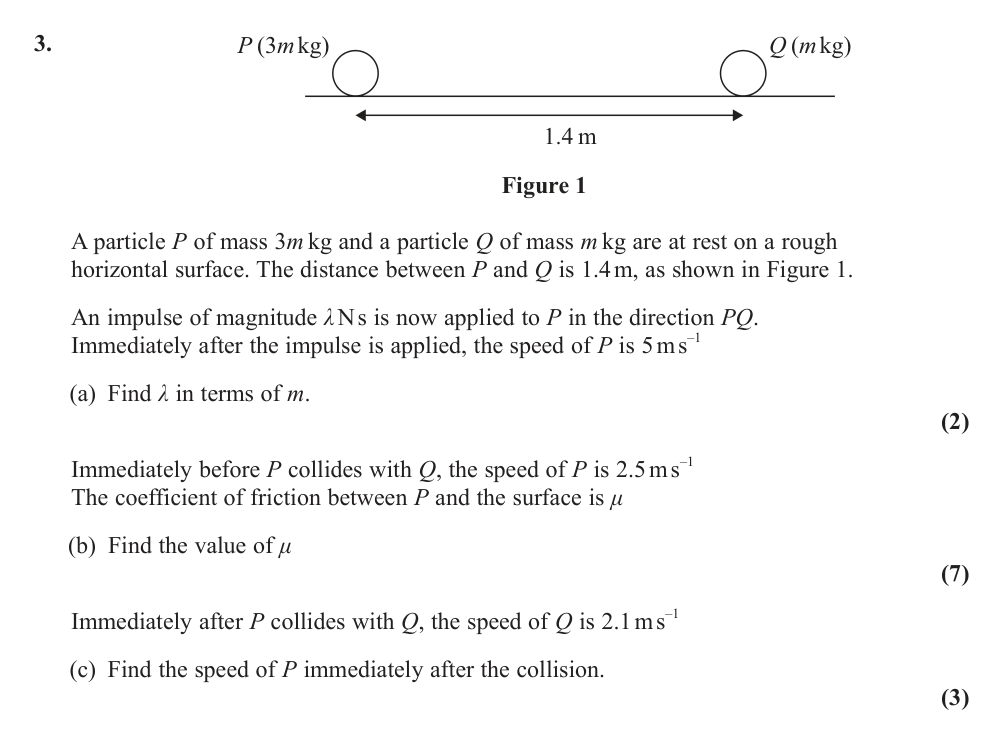
P starts from rest and immediately after the impulse has speed $5\ \mathrm{m\,s^{-1}}$. Since the mass of P is $3m$, $\lambda=3m(5-0)=15m$.
Find the acceleration before collision
Between the impulse and the collision, P slows from $5$ to $2.5\ \mathrm{m\,s^{-1}}$ over $1.4$ m. Using $v^2=u^2+2as$: $(2.5)^2=5^2+2a(1.4)$.
Calculate the acceleration
$6.25=25+2.8a$, so $a=\dfrac{-18.75}{2.8}=-6.696\ldots\ \mathrm{m\,s^{-2}}$.
Connect friction to acceleration
On the horizontal surface, $R=3mg$ and friction is $F=\mu R=3\mu mg$. This friction is opposite the motion, so $-3\mu mg=3ma$ and therefore $a=-\mu g$.
Find mu
$\mu=\dfrac{-a}{g}=\dfrac{6.696\ldots}{9.8}=0.683\ldots$, so $\mu=0.68$ to 2 significant figures.
Use momentum in the collision
Immediately before collision, P has speed $2.5$ and Q is at rest. Immediately after, Q has speed $2.1$ and P has speed $v$. Conservation of momentum gives $3m(2.5)+m(0)=3mv+m(2.1)$.
Find the speed after collision
$7.5=3v+2.1$, so $3v=5.4$ and $v=1.8\ \mathrm{m\,s^{-1}}$.
Hard12 marks · main topic: Constant Acceleration in 1DShow worked solution
Find the impact speed
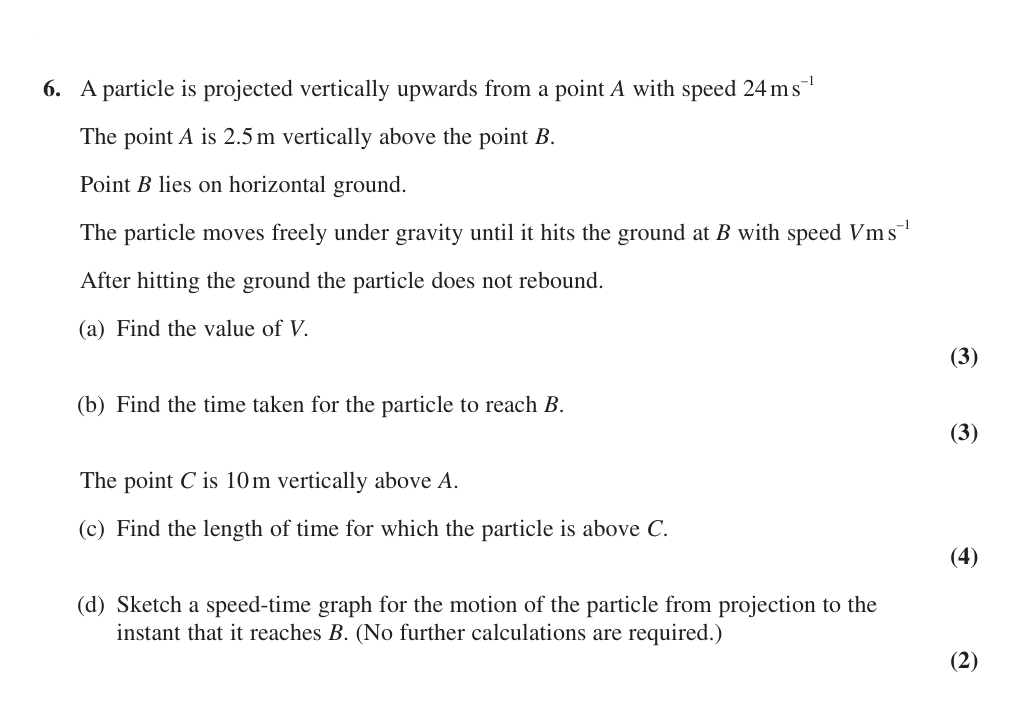
Take upward as positive from A. At B, the displacement is $-2.5$ m, with $u=24$ and $a=-9.8$. Use $v^2=u^2+2as$: $V^2=24^2+2(-9.8)(-2.5)=625$.
State V
$V=25\ \mathrm{m\,s^{-1}}$.
Find the time to reach B
The velocity at B is $-25\ \mathrm{m\,s^{-1}}$. Using $v=u+at$, $-25=24-9.8t$, so $t=5\ \mathrm{s}$.
Set up the height C equation
C is $10$ m above A. The particle is above C between the two times when $s=10$: $10=24t-4.9t^2$.
Solve for the two crossing times
$4.9t^2-24t+10=0$, giving $t=0.459\ldots$ and $t=4.438\ldots$.
Find the time above C
The length of time above C is $4.438\ldots-0.459\ldots=3.98\ldots\ \mathrm{s}$, about $4.0\ \mathrm{s}$.
Describe the speed-time graph
The graph starts at speed $24$, decreases linearly to $0$ at the highest point, then increases linearly to speed $25$ at $t=5$. It is a V-shaped speed-time graph.
Final answer
$(a)\ V=25\ \mathrm{m\,s^{-1}}.\quad (b)\ t=5\ \mathrm{s}.\quad (c)\ 4.0\ \mathrm{s}\ \text{approximately}$. (d) Speed-time graph is V-shaped, from speed 24 to 0, then to speed 25 at t=5.
22. WME01/01 May/June 2025 · Q8
Hard17 marks · main topic: Newton's Second LawShow worked solution
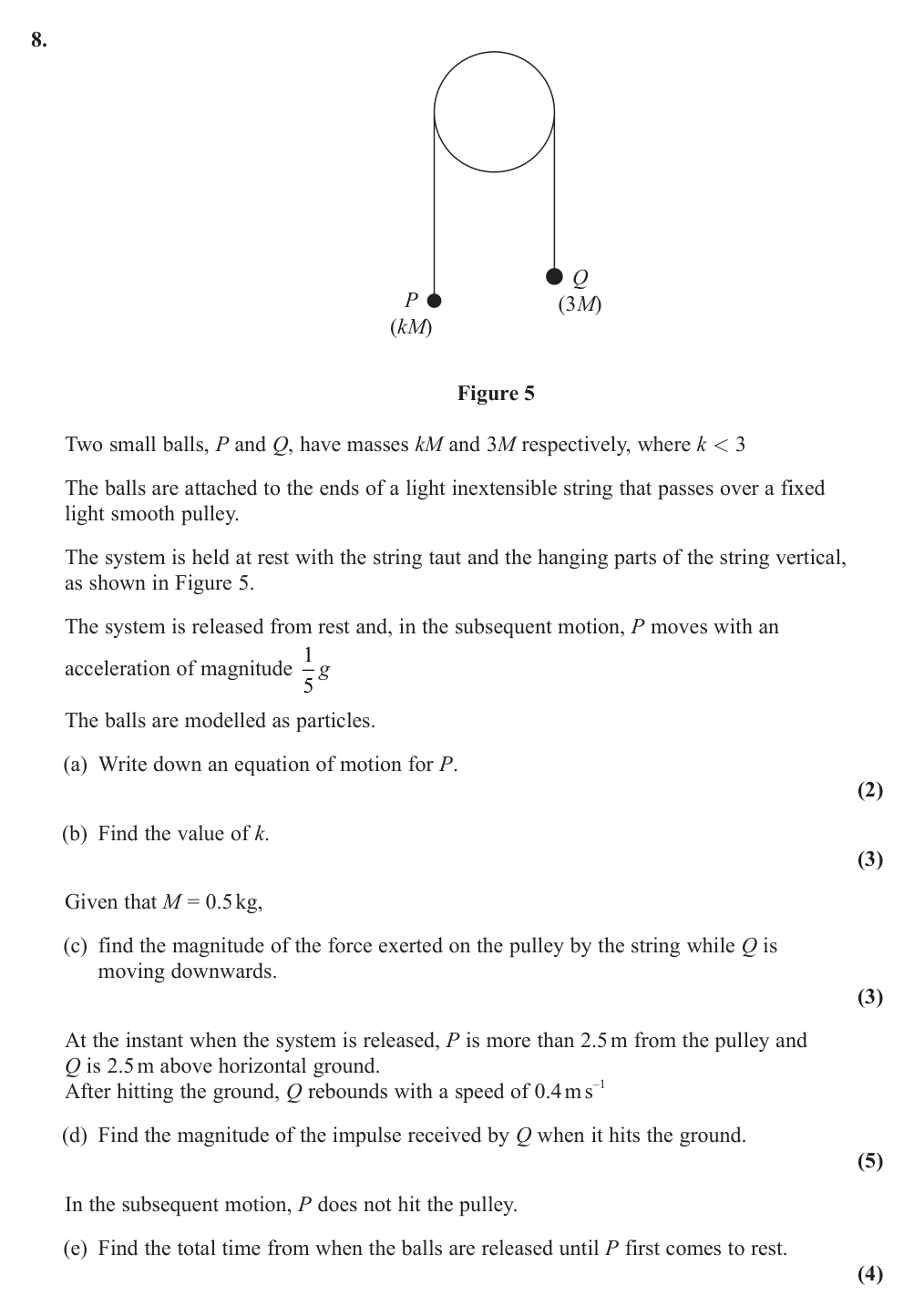
Part (a): Write equation of motion for P - Identify forces on P
Particle P (mass $kM$) moves upward with acceleration $\frac{g}{5}$: ; Tension T (upward) ; Weight $kMg$ (downward)
Part (a): Write equation of motion for P - Apply Newton's Second Law
Taking upward as positive: $\sum F = ma$ $T - kMg = kM \times \frac{g}{5}$
Part (b): Find value of k - Write equation of motion for Q
Particle Q (mass $3M$) moves downward with acceleration $\frac{g}{5}$: Taking downward as positive for Q: $3Mg - T = 3M \times \frac{g}{5}$ $3Mg - T = \frac{3Mg}{5}$ $T = 3Mg - \frac{3Mg}{5}$ $T = \frac{12Mg}{5}$
Part (b): Find value of k - Substitute into equation for P
 Elite Mathematics