Every Moments question from the WME01 papers in our bank, 2019–2026, sorted from easiest to hardest. Try each one first, then open the worked solution.
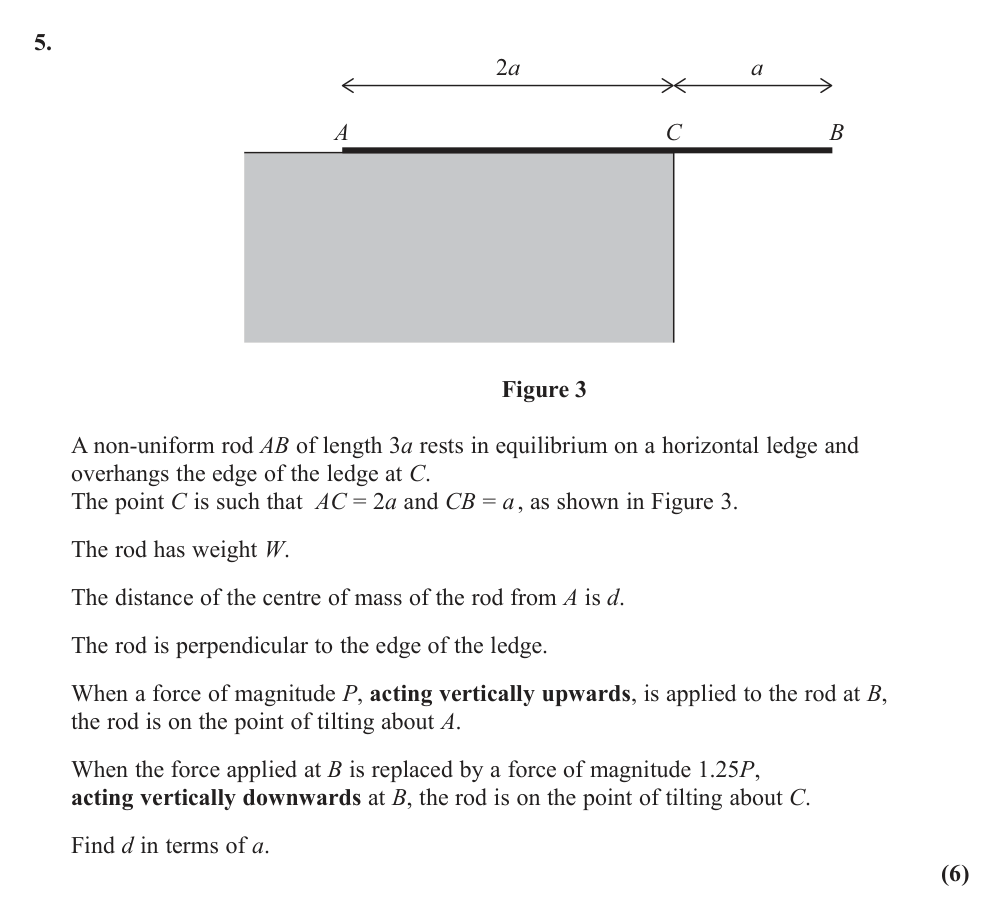
Taking moments about C: $\sum M_C = 0$ Distance from C to COM = $(2a - d)$ Distance from C to B = $a$ $1.25P \times a = W \times (2a - d)$ $1.25Pa = W(2a - d)$ $1.25Pa = 2aW - Wd \quad \text{...(2)}$
Setup Diagrams - Substitute equation (1) into equation (2)
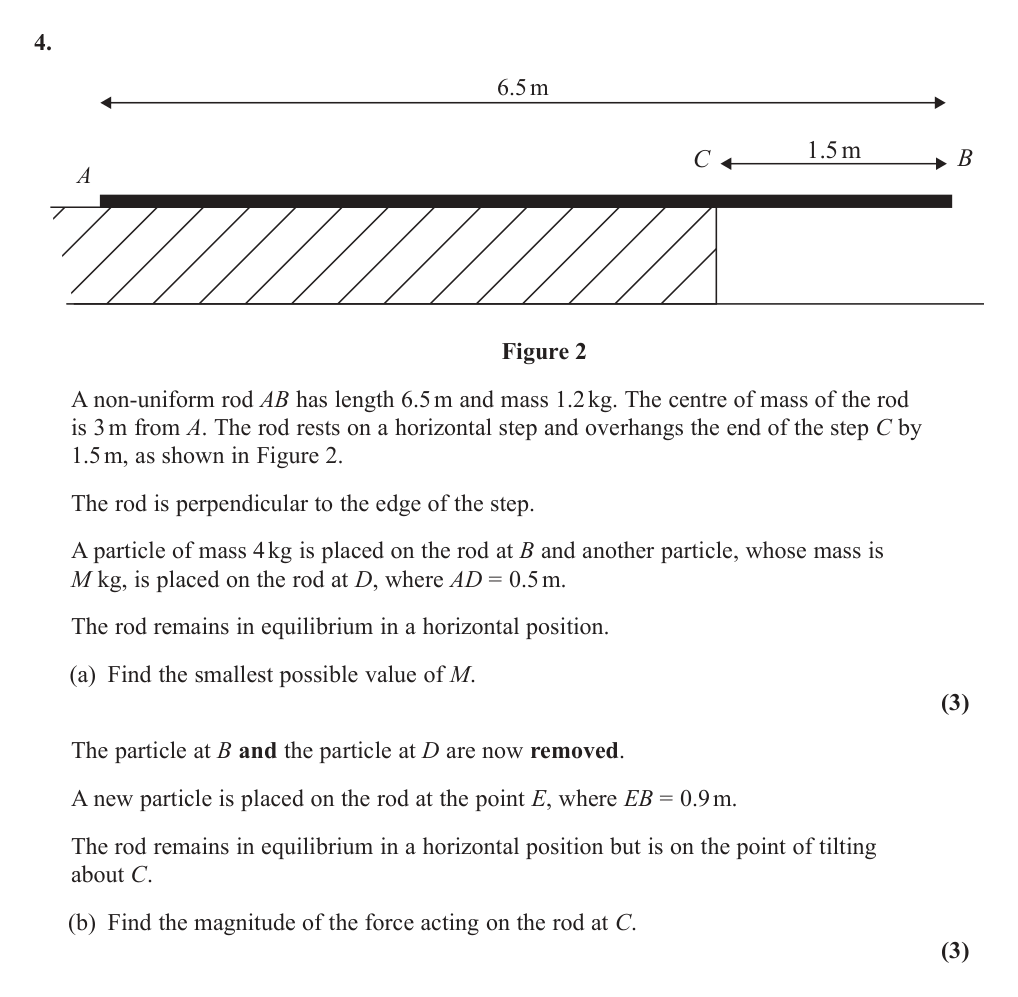
The rod is 6.5 m long and overhangs C by 1.5 m, so C is 5.0 m from A. The rod centre of mass is 3.0 m from A, so it is 2.0 m to the left of C. Point D is 0.5 m from A, so it is 4.5 m to the left of C.
Use the limiting balance for smallest M
For the smallest $M$, the rod is just prevented from tilting clockwise about C. Taking moments about C: $Mg(4.5)+1.2g(2)=4g(1.5)$.
Find M
$4.5M+2.4=6$, so $4.5M=3.6$ and $M=0.8$.
Place the new particle E
Now the old particles are removed. Since $EB=0.9$ m and $AB=6.5$ m, E is $5.6$ m from A, so E is $0.6$ m to the right of C.
Find the new particle mass from moments
At tilting about C, moments about C give $Xg(0.6)=1.2g(2)$, so $X=4$.
Find the force at C
The upward force at C balances the rod and the new particle: $R_C=1.2g+4g=5.2g\ \mathrm{N}$, which is about $51\ \mathrm{N}$.
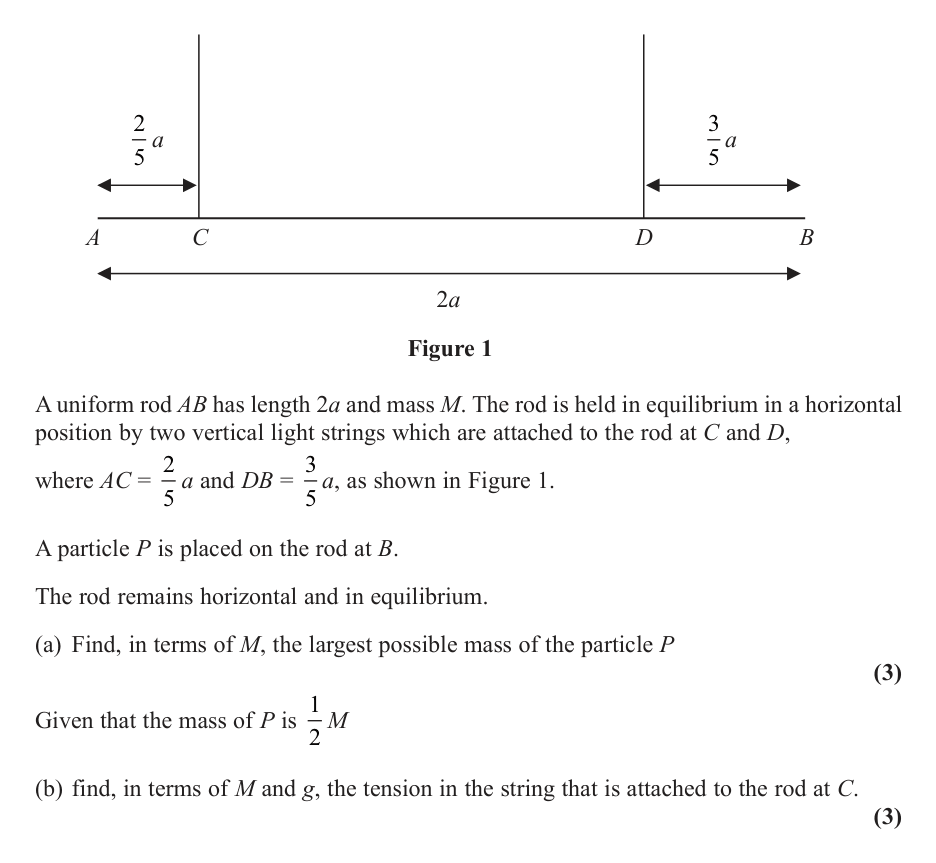
The rod length is $2a$. The centre of mass is at the midpoint, distance $a$ from A. Also $AC=\dfrac{2a}{5}$ and $AD=2a-\dfrac{3a}{5}=\dfrac{7a}{5}$.
Use the largest mass condition
For the largest possible mass at B, the string at C is just slack and the rod is about to tilt about D.
Take moments about D
Let the particle mass be $X$. The distance from D to B is $\dfrac{3a}{5}$ and the distance from D to the rod's centre of mass is $\dfrac{2a}{5}$. Hence $Xg\left(\dfrac{3a}{5}\right)=Mg\left(\dfrac{2a}{5}\right)$.
Find the largest mass
Cancel $ga/5$: $3X=2M$, so $X=\dfrac{2M}{3}$.
Use the given mass
Now the particle has mass $\dfrac12M$. Let the tensions at C and D be $T_C$ and $T_D$.
Take moments about D
About D, $T_C(a)+\dfrac12Mg\left(\dfrac{3a}{5}\right)=Mg\left(\dfrac{2a}{5}\right)$.
Find the tension at C
$T_Ca+\dfrac{3}{10}Mga=\dfrac{2}{5}Mga$, so $T_C=\dfrac{1}{10}Mg$.
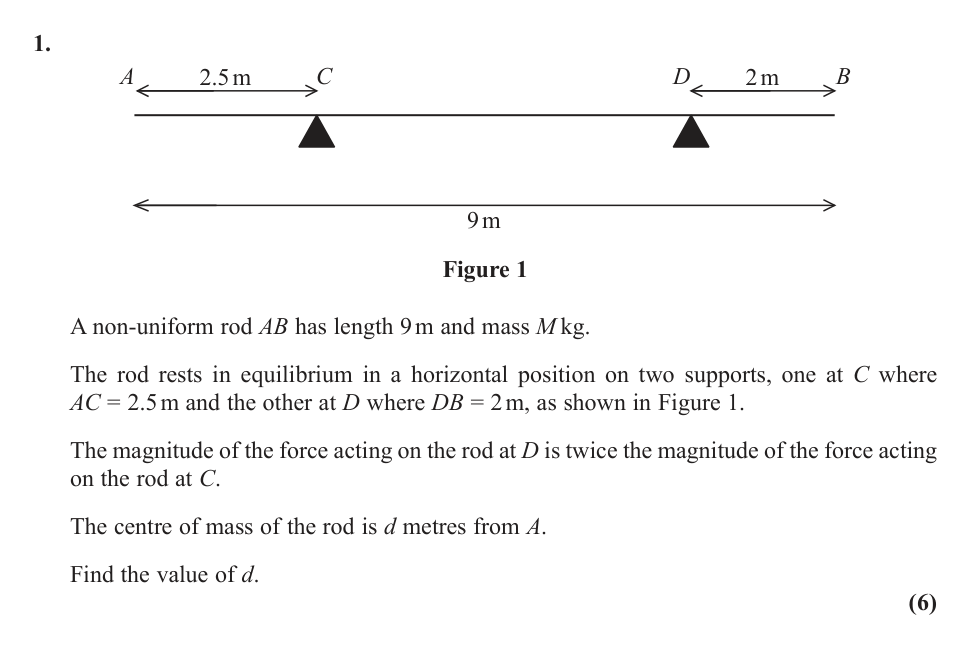
C is $2.5$ m from A. Since $DB=2$ m and $AB=9$ m, D is $7$ m from A.
Name the reactions
Let the reaction at C be $R$. The reaction at D is twice this, so it is $2R$.
Use vertical equilibrium
$R+2R=Mg$, so $3R=Mg$.
Take moments about A
$R(2.5)+2R(7)=Mgd$.
Substitute Mg = 3R
$2.5R+14R=3Rd$. Hence $16.5R=3Rd$.
Find d
Cancel $R$: $d=\dfrac{16.5}{3}=5.5\ \mathrm{m}$.
Final answer
$d=5.5\ \mathrm{m}$.
6. WME01/01 January 2021 · Q4
Easy6 marksShow worked solution
Set support positions
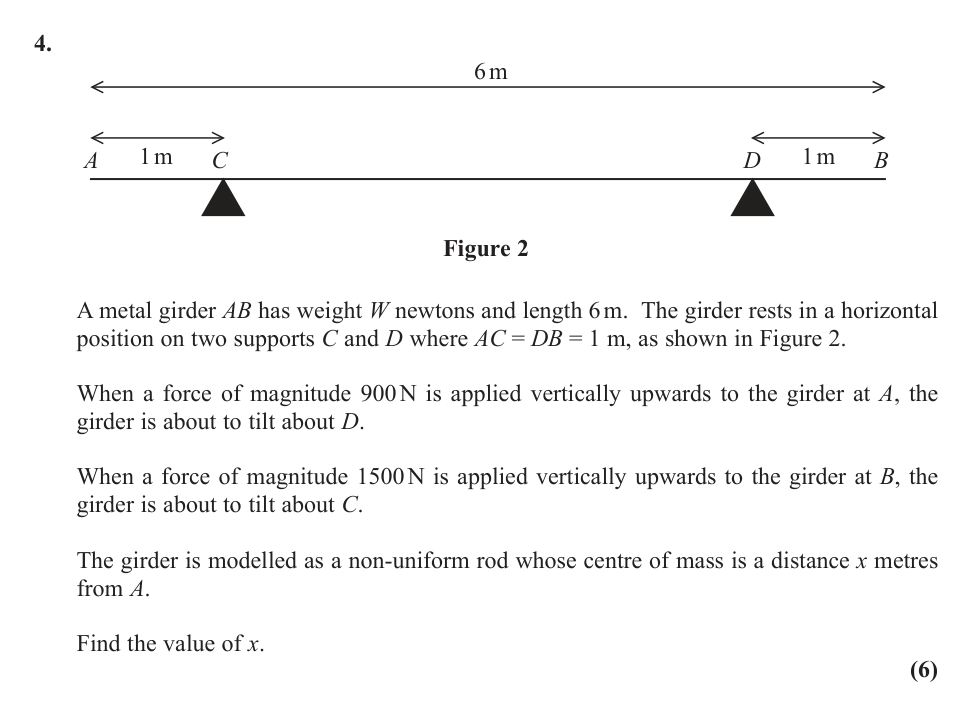
The girder has length $6$ m, with C $1$ m from A and D $1$ m from B. So D is $5$ m from A.
Use tilting about D
When the $900$ N upward force is applied at A, the girder is about to tilt about D. Taking moments about D gives $900(5)=W(5-x)$.
Use tilting about C
When the $1500$ N upward force is applied at B, the girder is about to tilt about C. Taking moments about C gives $1500(5)=W(x-1)$.
Solve the equations
The equations are $W(5-x)=4500$ and $W(x-1)=7500$. Add them: $W[(5-x)+(x-1)]=12000$, so $4W=12000$ and $W=3000$.
Find x
Use $W(x-1)=7500$: $3000(x-1)=7500$, so $x-1=2.5$ and $x=3.5$ m.
Final answer
$x=3.5\ \mathrm{m}$.
7. WME01/01 October 2025 · Q1
Medium7 marksShow worked solution
Part (a): Show that x = 2/3 - Identify distances from C
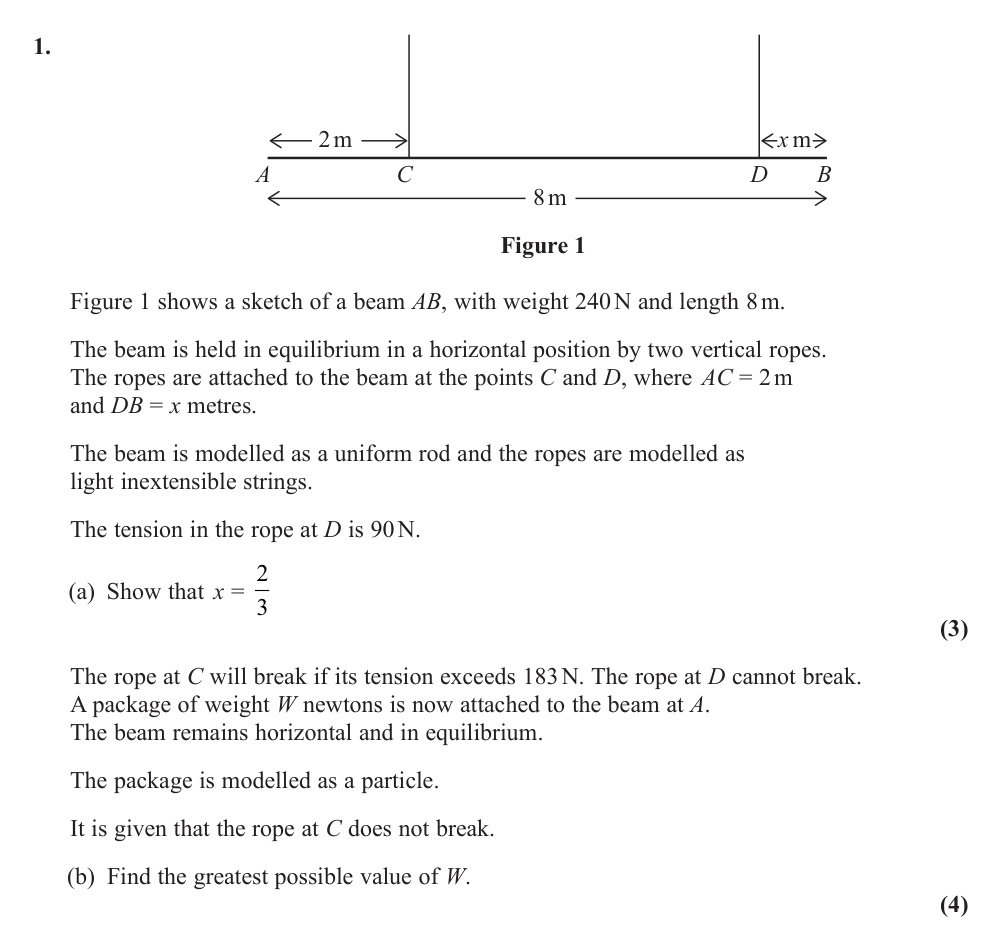
From the diagram: ; Distance AC = 2 m ; Distance CD = 8 - 2 - x = (6-x) m ; Distance from A to center = 4 m, so distance from C to center = 4 - 2 = 2 m
Part (a): Show that x = 2/3 - Take moments about C
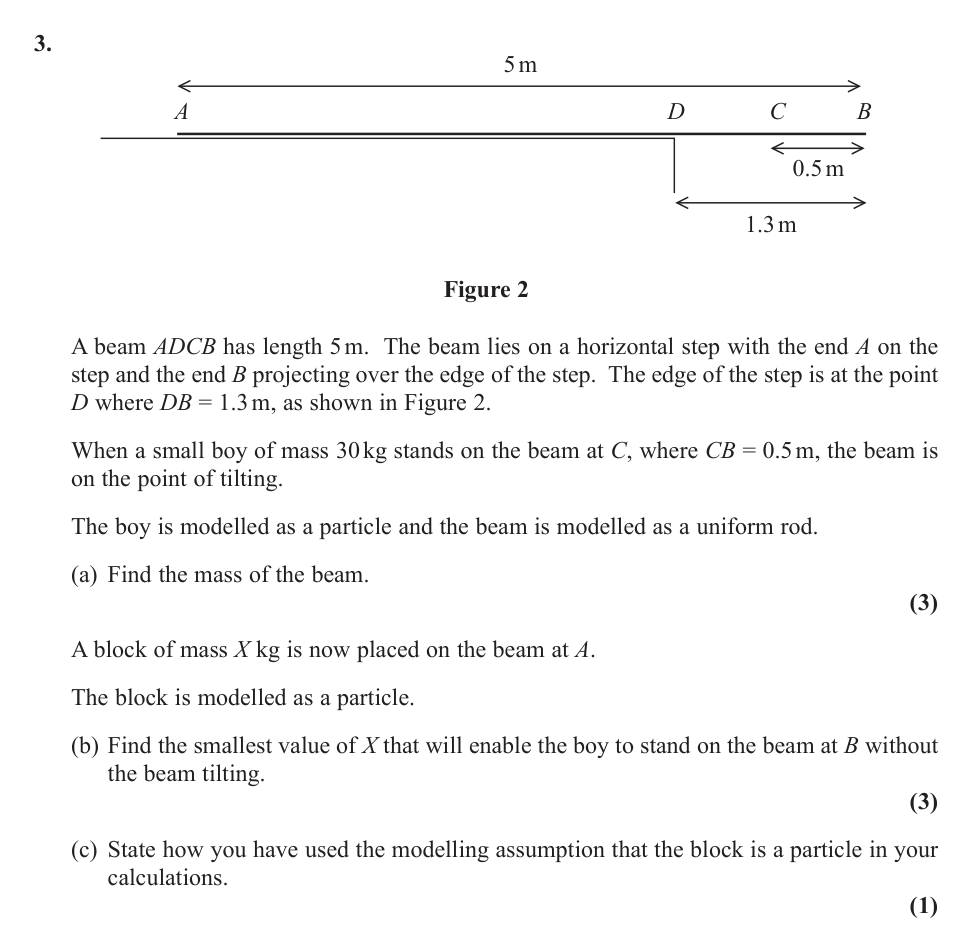
The beam length is $5$ m and $DB=1.3$ m, so D is $3.7$ m from A. The centre of mass of the uniform beam is at its midpoint, so it is $1.2$ m to the left of D. Point C is $0.8$ m to the right of D.
Use the first tilting condition
When the boy stands at C, the beam is about to tilt about D. Let the mass of the beam be $M$ kg.
Take moments about D
$Mg(1.2)=30g(0.8)$. Hence $1.2M=24$ and $M=20\ \mathrm{kg}$.
Set up the second tilting condition
With the boy at B, his moment about D is $30g(1.3)$. The block at A is $3.7$ m to the left of D, and the beam's weight acts $1.2$ m to the left of D.
Take moments about D again
$Xg(3.7)+20g(1.2)=30g(1.3)$.
Find X
$3.7X+24=39$, so $3.7X=15$ and $X=\dfrac{150}{37}=4.05\ldots\ \mathrm{kg}$.
Use the particle model
The block is modelled as a particle, so its mass is treated as acting at one point, A.
Final answer
$(a)\ \text{beam mass}=20\ \mathrm{kg}.\quad (b)\ X=\dfrac{150}{37}\ \mathrm{kg}\approx4.05\ \mathrm{kg}.\quad (c)$ The block's mass is treated as concentrated at A.
9. WME01/01 January 2020 · Q2
Medium7 marksShow worked solution
Set the tensions
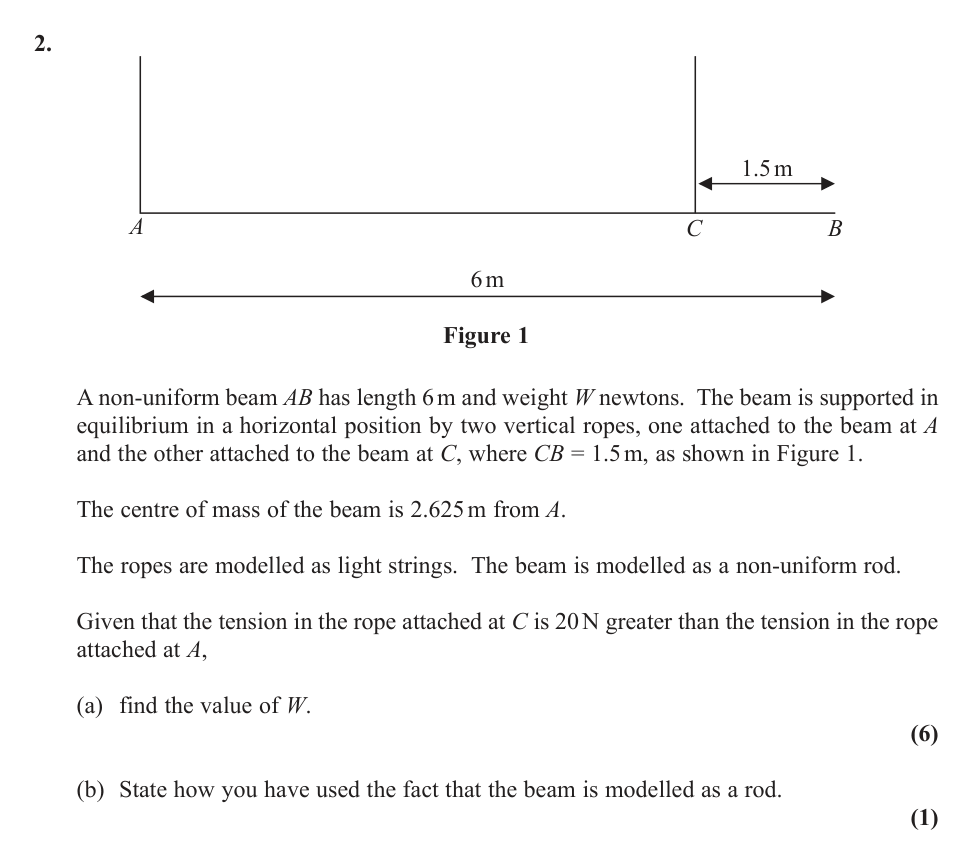
Let the tension at A be $T$. The tension at C is then $T+20$. Since $CB=1.5$ m and $AB=6$ m, $AC=4.5$ m.
Use vertical equilibrium
The upward tensions balance the weight: $T+(T+20)=W$, so $2T+20=W$.
Take moments about A
The centre of mass is $2.625$ m from A. Taking moments about A gives $4.5(T+20)=2.625W$.
Solve for W
From the moments equation, $T+20=\dfrac{2.625}{4.5}W=\dfrac{7}{12}W$. Also $T+20=\dfrac{W+20}{2}$. Hence $\dfrac{W+20}{2}=\dfrac{7W}{12}$, so $6W+120=7W$ and $W=120$ N.
State the modelling use
Modelling the beam as a rod means it stays straight and rigid, so the distances used in the moments equations do not change.
Final answer
$(a)\ W=120\ \mathrm{N}.\quad (b)$ The rod model keeps the beam straight and rigid, so the stated distances along the beam are fixed.
10. WME01/01 January 2023 · Q4
Medium8 marksShow worked solution
Set the distances
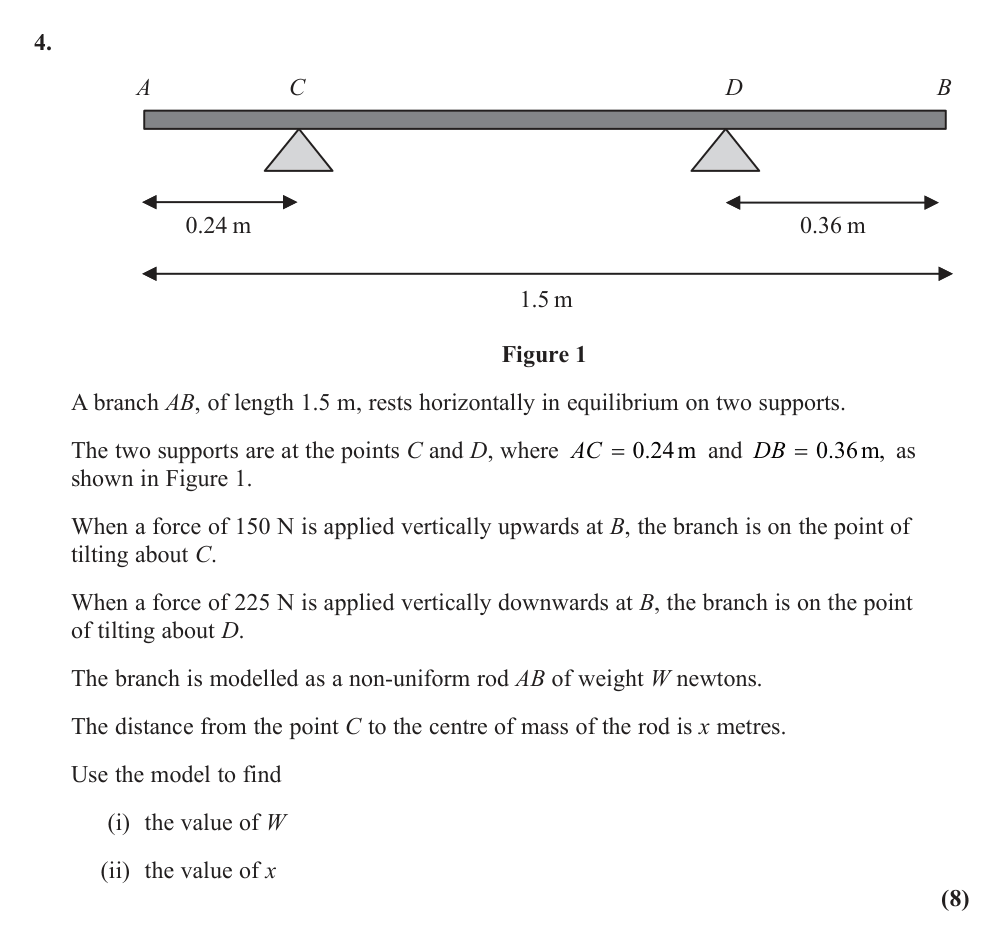
The branch has length $1.5$ m. Since $AC=0.24$ m and $DB=0.36$ m, $CB=1.26$ m and $CD=0.90$ m. The centre of mass is $x$ m from C.
Use the first tilting condition
With the $150$ N upward force at B, the branch is on the point of tilting about C, so the support at D has zero reaction.
Take moments about C
The upward force at B balances the weight moment: $150(1.26)=Wx$. Thus $Wx=189$.
Use the second tilting condition
With the $225$ N downward force at B, the branch is on the point of tilting about D, so the support at C has zero reaction.
Take moments about D
The distance from D to the centre of mass is $0.90-x$. Hence $225(0.36)=W(0.90-x)$.
Solve the simultaneous equations
From the second equation, $81=0.90W-Wx$. Since $Wx=189$, $81=0.90W-189$, so $0.90W=270$ and $W=300\ \mathrm{N}$.
Find x
Using $Wx=189$, $300x=189$, so $x=0.63\ \mathrm{m}$.
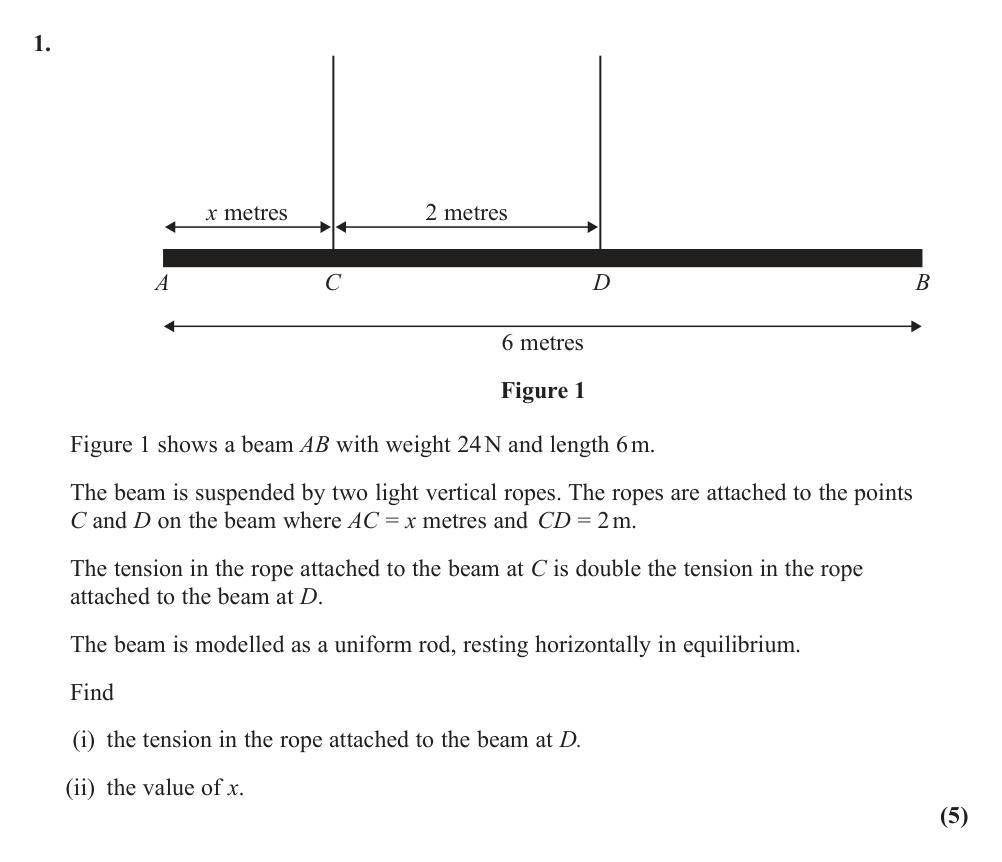
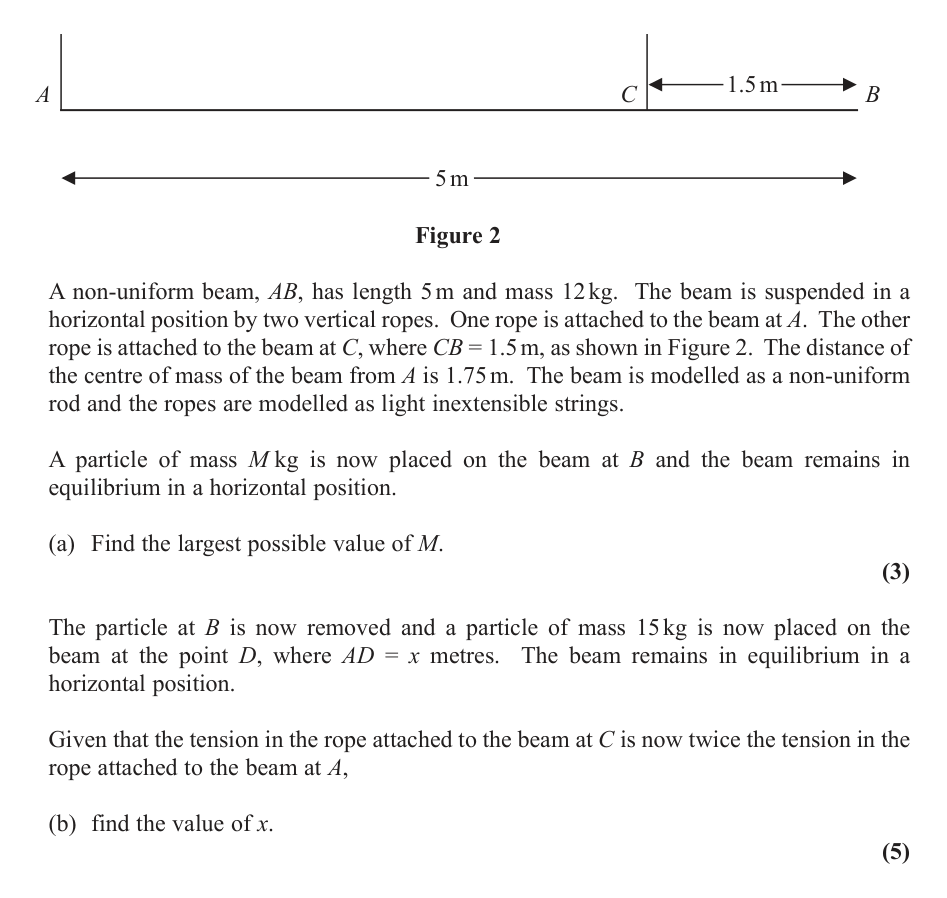
The beam is $5$ m long. Since $CB=1.5$ m, $AC=3.5$ m. The centre of mass is $1.75$ m from A, so it is also $1.75$ m from C.
Use the largest M condition
For the largest possible $M$ at B, the rope at A is just slack, so the beam is supported at C only.
Take moments about C
The particle at B is $1.5$ m to the right of C, and the beam's weight acts $1.75$ m to the left of C. Hence $Mg(1.5)=12g(1.75)$.
Find M
$M=\dfrac{12(1.75)}{1.5}=14$.
Set the tensions for part b
Let the tension at A be $T$. The tension at C is $2T$. Vertical equilibrium gives $T+2T=12g+15g=27g$, so $T=9g$ and the tension at C is $18g$.
Take moments about A
For the new particle at $AD=x$, moments about A give $18g(3.5)=12g(1.75)+15gx$.
Solve for x
Cancel $g$: $63=21+15x$. Thus $15x=42$ and $x=2.8$ m.
Final answer
$(a)\ M=14.\quad (b)\ x=2.8\ \mathrm{m}$.
12. WME01/01 January 2026 · Q4
Hard9 marksShow worked solution
Set the distances
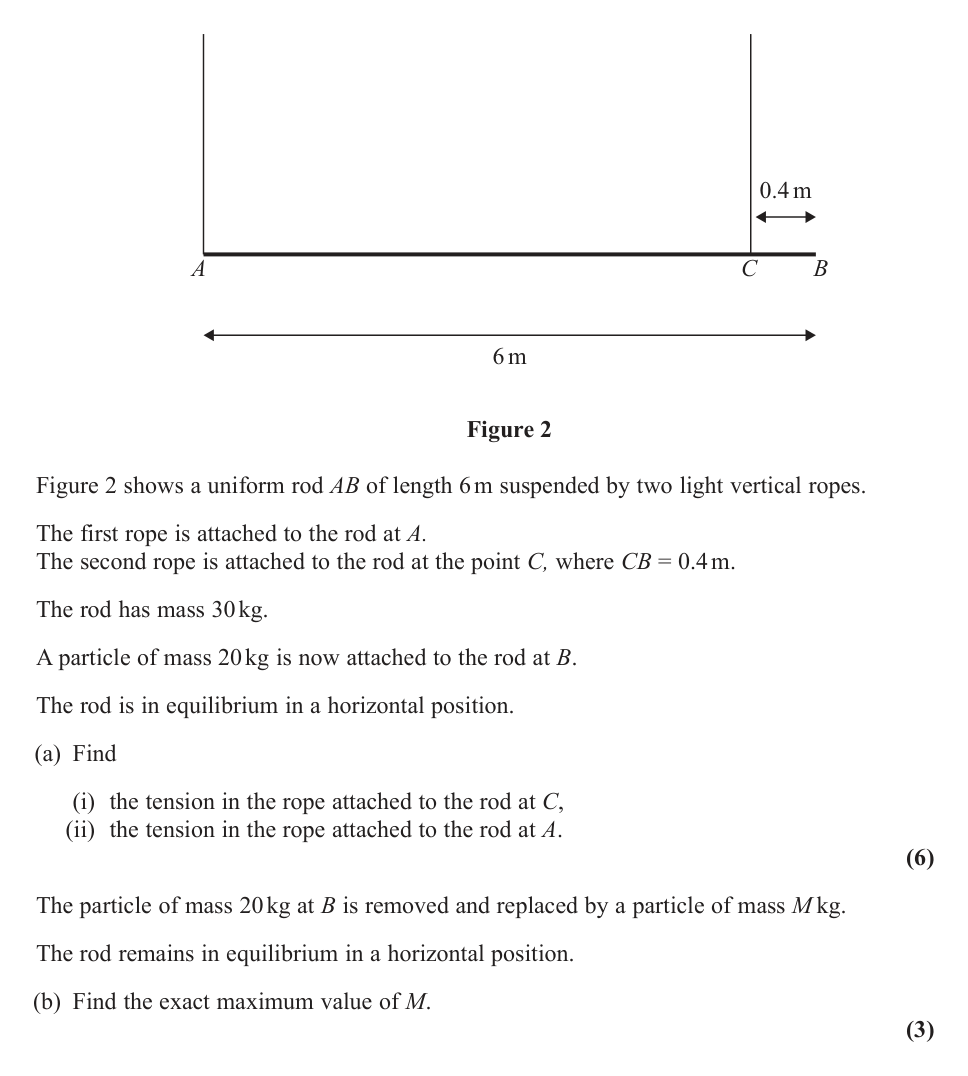
The rod is 6 m long and C is 0.4 m from B, so $AC=5.6$ m. The rod is uniform, so its weight $30g$ acts at the midpoint, 3 m from A. The 20 kg particle at B has weight $20g$.
Take moments about A
Moments about A remove the tension at A. Clockwise moments from the rod and particle equal the anticlockwise moment from the rope at C: $T_C(5.6)=30g(3)+20g(6)$.
Find the tension at C
$T_C(5.6)=210g$, so $T_C=37.5g=367.5\ \mathrm{N}$. To suitable accuracy, $T_C=368\ \mathrm{N}$, or $370\ \mathrm{N}$ to 2 significant figures.
Use vertical equilibrium
Vertically, $T_A+T_C=30g+20g=50g$. Therefore $T_A=50g-37.5g=12.5g=122.5\ \mathrm{N}$, so $T_A=123\ \mathrm{N}$, or $120\ \mathrm{N}$ to 2 significant figures.
Use the limiting case for maximum M
For the greatest possible mass at B, the rope at A is just slack, so $T_A=0$. Take moments about C: the clockwise moment of $Mg$ at B balances the anticlockwise moment of the rod weight.
Solve for M
The distance from C to B is $0.4$ m and the rod weight acts $5.6-3=2.6$ m to the left of C. Hence $Mg(0.4)=30g(2.6)$, so $M=\dfrac{78}{0.4}=195$.
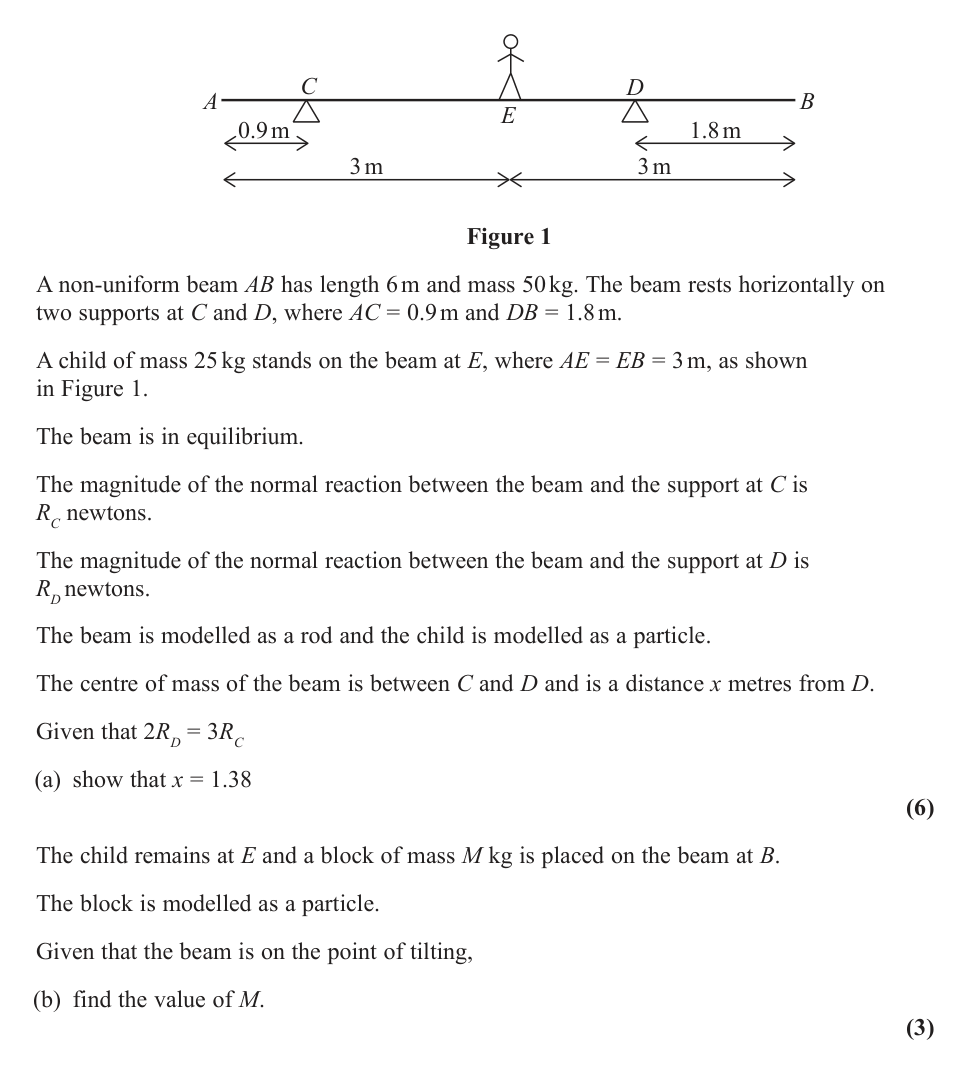
Vertically, $R_C+R_D=50g+25g=75g$. Given $2R_D=3R_C$, we have $R_D=1.5R_C$. Therefore $2.5R_C=75g$, so $R_C=30g$ and $R_D=45g$.
Set the distances from D
$D$ is $6-1.8=4.2$ m from A. The support C is $4.2-0.9=3.3$ m to the left of D, the child at E is $4.2-3=1.2$ m to the left of D, and the centre of mass is $x$ m to the left of D.
Take moments about D
Balancing moments about D gives $50gx+25g(1.2)=R_C(3.3)$.
Show x is 1.38
Substitute $R_C=30g$: $50x+30=99$, so $50x=69$ and $x=\dfrac{69}{50}=1.38$.
Use the tilting condition with the block
When the block at B is on the point of making the beam tilt, the beam is about to pivot about D and the reaction at C is zero.
Take moments about D for the block
The child and the beam act to the left of D, and the block at B acts $1.8$ m to the right of D. Hence $25g(1.2)+50g(1.38)=Mg(1.8)$.
Find M
$30+69=1.8M$, so $M=\dfrac{99}{1.8}=55$.
Final answer
$(a)\ x=1.38.\quad (b)\ M=55$.
14. WME01/01 May/June 2022 · Q5
Hard9 marksShow worked solution
Set the positions
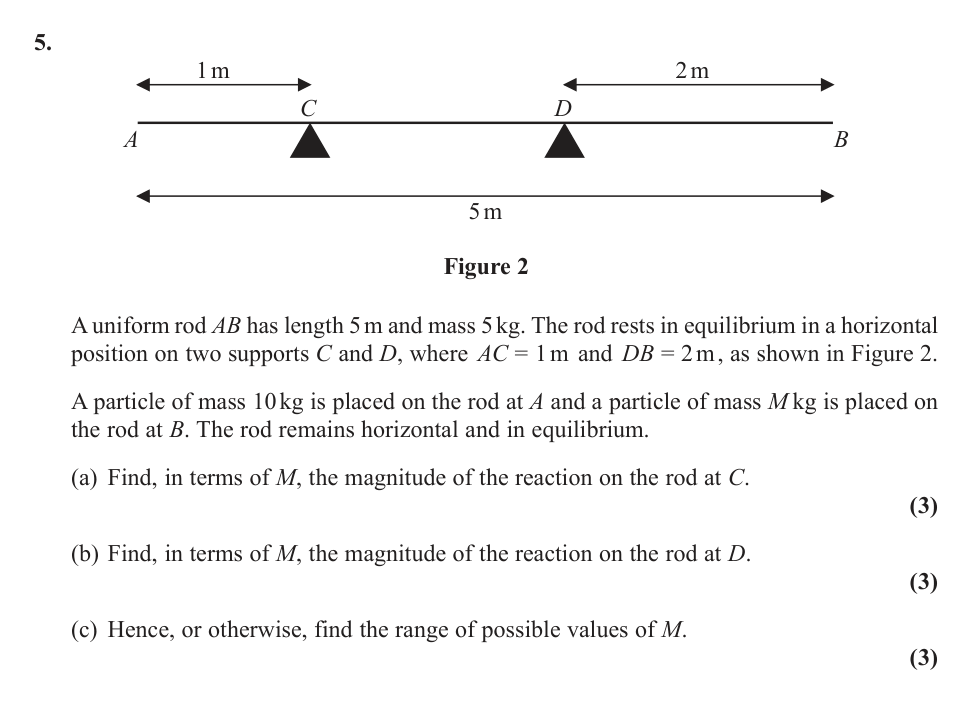
Take distances from A. Then C is at $1$ m, D is at $3$ m, the rod's centre of mass is at $2.5$ m, and B is at $5$ m.
Find RC by moments about D
Taking moments about D: $R_C(2)+Mg(2)=10g(3)+5g(0.5)$.
Simplify RC
$2R_C+2Mg=30g+2.5g=32.5g$, so $R_C=16.25g-Mg=(16.25-M)g$.
Find RD by moments about C
Taking moments about C: $10g(1)+R_D(2)=5g(1.5)+Mg(4)$.
Simplify RD
$10g+2R_D=7.5g+4Mg$, so $2R_D=(4M-2.5)g$ and $R_D=(2M-1.25)g$.
Use non-negative reactions
For the rod to rest on both supports, both reactions must be non-negative.
Find the range
$R_C\ge0$ gives $16.25-M\ge0$, so $M\le16.25$. Also $R_D\ge0$ gives $2M-1.25\ge0$, so $M\ge0.625$. Therefore $0.625\le M\le16.25$.
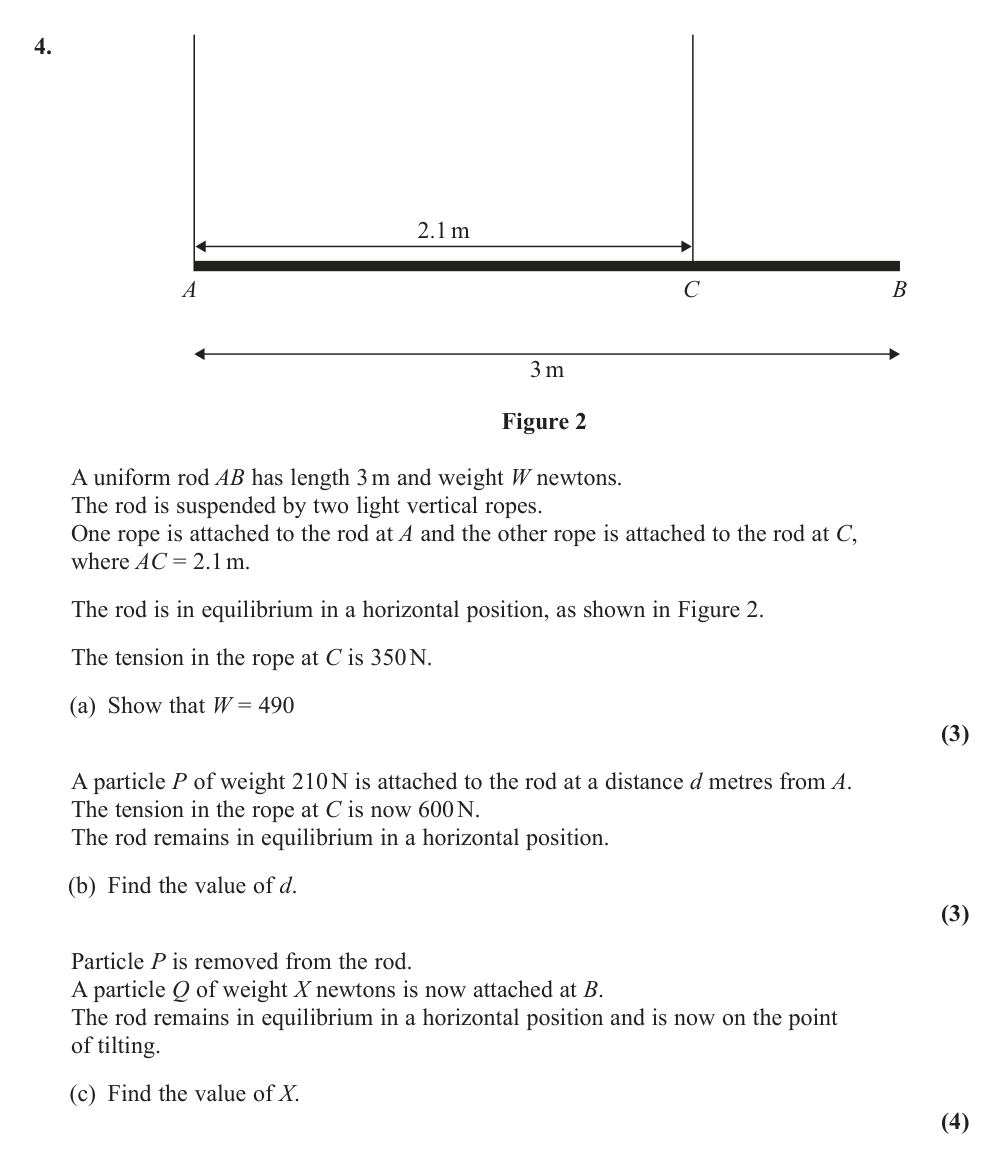
Take moments about A. The rope at C is $2.1$ m from A and the weight of the uniform rod acts at its midpoint, $1.5$ m from A. Hence $350(2.1)=W(1.5)$.
Show W is 490
$735=1.5W$, so $W=490\ \mathrm{N}$.
Set up moments with particle P
When P is attached, the tension at C is $600$ N. Taking moments about A: $600(2.1)=490(1.5)+210d$.
Find d
$1260=735+210d$, so $525=210d$ and $d=2.5$.
Use the tilting condition
When Q is attached at B and the rod is on the point of tilting, the rope at A is just slack. The rod is about to tilt about C.
Find X
Take moments about C. The rod weight acts $2.1-1.5=0.6$ m to the left of C, and Q acts $3-2.1=0.9$ m to the right. Thus $490(0.6)=X(0.9)$, so $X=\dfrac{980}{3}\ \mathrm{N}$.
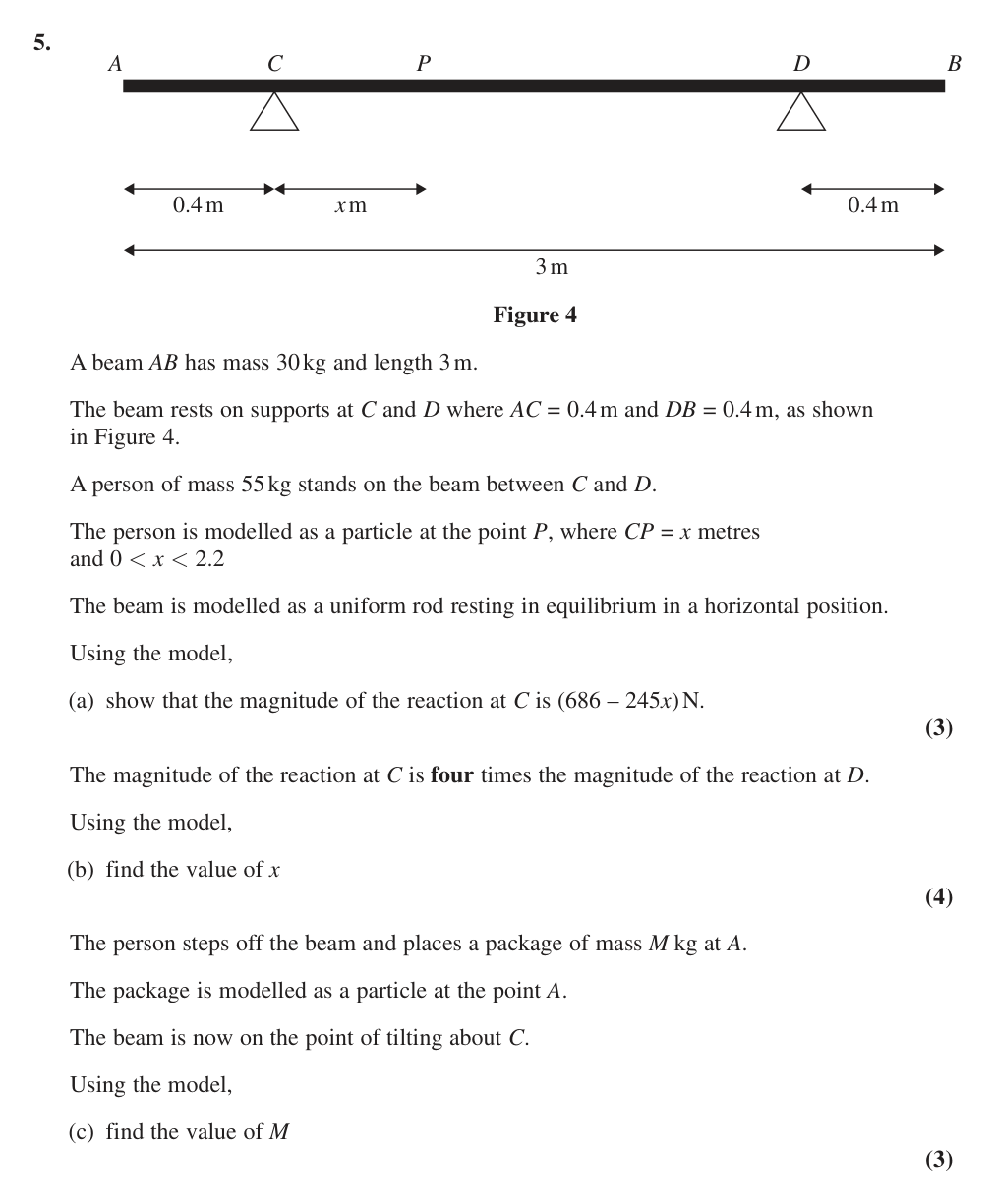
$AC=0.4$ m and $DB=0.4$ m, so $CD=2.2$ m. The beam is uniform, so its weight $30g$ acts at the midpoint, which is $1.1$ m from D. The person is $2.2-x$ m from D.
Take moments about D
Taking moments about D removes $R_D$: $R_C(2.2)=55g(2.2-x)+30g(1.1)$.
Show the expression for RC
Using $g=9.8$, $R_C=\dfrac{539(2.2-x)+294(1.1)}{2.2}=686-245x$.
Use the reaction ratio
Given $R_C=4R_D$ and vertical equilibrium gives $R_C+R_D=(55+30)g=833$. Hence $5R_D=833$ and $R_C=666.4$.
Find x
$686-245x=666.4$, so $245x=19.6$ and $x=0.08$.
Use the tilting condition with the package
When the package is at A and the beam is on the point of tilting about C, the reaction at D is zero.
Find M
Take moments about C: $Mg(0.4)=30g(1.1)$. Thus $M=\dfrac{33}{0.4}=82.5$.
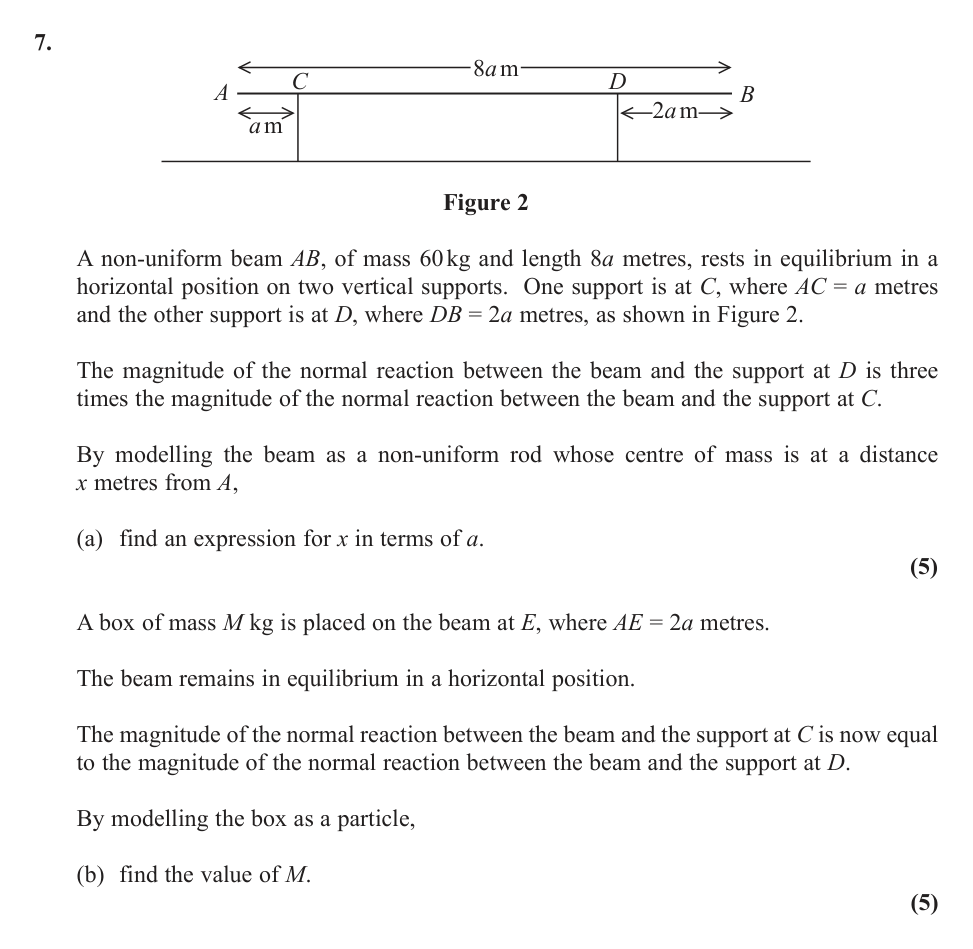
When the box is added, let each support reaction be $S$. Vertical equilibrium gives $2S=(60+M)g$.
Take moments about A again
The box is at $AE=2a$. Moments about A give $60g\left(\dfrac{19a}{4}\right)+Mg(2a)=S(a)+S(6a)=7aS$.
Solve for M
Substitute $S=\dfrac{(60+M)g}{2}$ and cancel $ag$: $285+2M=\dfrac{7}{2}(60+M)=210+\dfrac72M$. Hence $75=\dfrac32M$ and $M=50$.
Final answer
$(a)\ x=\dfrac{19a}{4}.\quad (b)\ M=50$.
18. WME01/01 May/June 2023 · Q4
Hard12 marksShow worked solution
Set the geometry
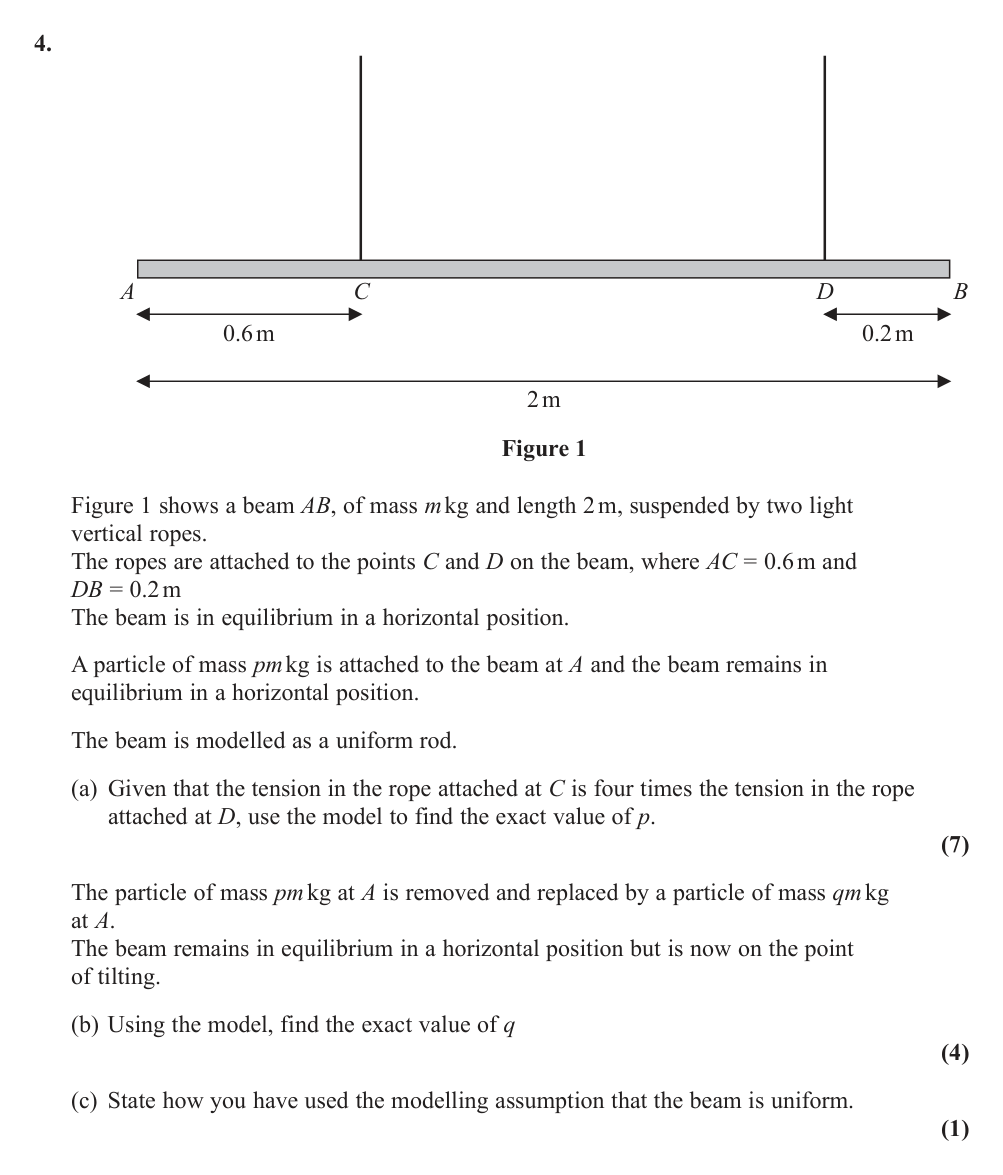
The beam is $2$ m long. Since $AC=0.6$ m and $DB=0.2$ m, point D is $1.8$ m from A. The uniform beam has weight $mg$ acting $1.0$ m from A.
Name the tensions
Let the tension at D be $T$. The tension at C is four times this, so it is $4T$.
Use vertical equilibrium
$4T+T=pmg+mg$, so $5T=(p+1)mg$.
Take moments about A
The particle at A has no moment about A. Hence $4T(0.6)+T(1.8)=mg(1.0)$.
Find T
$2.4T+1.8T=mg$, so $4.2T=mg$ and $T=\dfrac{5mg}{21}$.
Find p
Substitute into $5T=(p+1)mg$: $5\cdot\dfrac{5mg}{21}=(p+1)mg$. Thus $p+1=\dfrac{25}{21}$ and $p=\dfrac{4}{21}$.
Use the tilting condition
When the particle of mass $qm$ is at A and the beam is on the point of tilting, the rope at D is just slack, so its tension is zero.
Take moments about C
About C, the particle at A has moment $qmg(0.6)$ and the beam weight has moment $mg(0.4)$ in the opposite direction. Thus $qmg(0.6)=mg(0.4)$, giving $q=\dfrac{2}{3}$.
Use the modelling assumption
The beam is uniform, so its centre of mass is at the midpoint of the beam and its weight acts there.
Final answer
$(a)\ p=\dfrac{4}{21}.\quad (b)\ q=\dfrac{2}{3}.\quad (c)$ The beam weight acts at its midpoint.
 Elite Mathematics